School Information System

Open Courses, Nearly Free

Tamar Lewin:

After the earthquake in Haiti destroyed much of the country’s higher-education infrastructure, the University of the People decided to set up three computer centers there, inviting English-speaking students from nearby tent cities to come and work for four hours a day.
“They don’t have electricity, they don’t have computers, there are university students who have to carry water on their head from another mountain,” said Shai Reshef, the Israeli entrepreneur who spent $1 million to create the free university two years ago. “They come in two shifts, for four hours a day, to study. Their need was to the point that we began a feeding program.”
Mr. Reshef sees his project as a way to use the Internet to bring higher education to poor students around the world. It uses free software and has enlisted hundreds of volunteer professors — more, he said, than he has been able to use — to teach 10-week online courses to 1,000 students from more than 100 countries. Starting this fall, students will have to pay $10 to $50 for admission.

Share

Where GOP stands in war on Wisconsin Education ‘triangle’

Alan Borsuk:a

The start of the school year isn’t normally the time for issuing report cards. But it’s been an unusual and momentous year, so as the first day of classes approaches for almost every school in the state, here’s a report card on what I’ll call the war against the triangle.
Last winter, before Scott Walker was sworn in as governor, a leading Republican told a group of people (according to a reliable person who was present) that there was a triangle that was blocking the path to educational improvement in Wisconsin and his party was going to take out each leg of the triangle.
What were the legs?
Teachers unions, particularly the Wisconsin Education Association Council. WEAC spent hugely on political campaigns and was pro-Democratic. It also was the largest lobbying force in the Capitol. WEAC represented the unwillingness of teachers organizations to change and the need to get rid of most collective bargaining matters.
The state Department of Public Instruction, which represented the status quo, overregulation of schools and how things couldn’t change if they were in the hands of government bureaucrats.
Milwaukee Public Schools, which represented – well, which represented Milwaukee Public Schools. Or, to put it another way, a money pit where there was never any positive change.

Share

Steps Toward Artificial Intelligence

Marvin Minsky:

The work toward attaining “artificial intelligence” is the center of considerable computer research, design, and application. The
field is in its starting transient, characterized by many varied and independent efforts. Marvin Minsky has been requested to draw this work together into a coherent summary, supplement it with appropriate explanatory or theoretical noncomputer information, and introduce his assessment of the state of the art. This paper emphasizes the class of activities in which a general-purpose computer, complete with a library of basic programs, is further programmed to perform operations leading to ever higher-level information processing functions such as learning and problem solving. This informative article will be of real interest to both the general Proceedings reader and the computer specialist. — The Guest Editor.
Summary: The problems of heuristic programming–of making computers solve really difficult problems–are divided into five main areas: Search, Pattern-Recognition, Learning, Planning, and Induction. Wherever appropriate, the discussion is supported by extensive citation of the literature and by descriptions of a few of the most successful heuristic (problem-solving) programs constructed to date.

Share

Bachelor’s for Autistic Students

Allie Grasgreen:

For some students with autism, the idea of operating in the social environment of a college classroom can be so debilitating as to derail the pursuit of higher education at all. For those who do enroll, their condition can make it difficult to succeed in a traditional classroom setting.
But Dana Reinecke, in the department of applied behavior analysis at the Sage Colleges in Albany, N.Y., said she realized that through online learning, students with autism can overcome those barriers. “It allows them to learn from their most comfortable environment, whether it’s home, a library, a friend’s house, a treatment center, their psychiatrist’s office,” she said. “It takes away that need to be in a room full of people that they might be uncomfortable with.”

Share

Help improve accessible education via videos

colono:

Recently Peter Norvig and Stebastian Thrun combined to publicize a course on Artificial Intelligence with the help of Stanford School of Engineering. Within days of its announcement, the course went viral over Reddit, Hacker News and other social networking sites like Quora, FB and Twitter. At the moment, 127663 people have signed and this number is only set to increase phenomenally in the coming days. This trend has been described around as “coming of age for the way education is taught in the internet age; the future of education is here; demise of the universities” etc. Subsequently other Stanford professors pitched in with Machine Learning and Databases courses.
Even prior to these amazing initiatives – discussions, talks and debates on various topics have been going on around and the videos are subsequently being uploaded to the web in increasing regularity. TED talks eventually started featuring videos with captions. TED’s methodology and processes for captioning were simple as outlined here. Google houses some in-house guest lectures and makes it a point to upload manual based captions for some of the videos. Google eventually introduced automatic captioning via Youtube in 2009.

Share

The Liberal Education offered by the Americans is truly a gift to mankind.”

The Daily Mirror:

Never have there been so many choices in the field of international Higher Education than at present. One is faced with questions of affordability and language, both of which can be tackled with guidance in the right direction. To my mind, USA provides the best all round education I can think of. Buckminster Fuller, one of the best known academic personalities of this time said that in his study of many scientists he found most of them had their first Degrees from a Liberal Arts College. “The Liberal Education offered by the Americans is truly a gift to mankind.” A Sri Lankan Professor when speaking in the USA last year at one of the better known Liberal Arts colleges said pretty much the same thing namely that the American Universities offer the finest education in the many disciplines students choose today.
The generosity of the American world of Higher Education cannot be bettered. From Ivy League Universities down to the simple Community Colleges, offers of financial aid ranges from 100% downwards depending on the financial standing of the University. Hundres of Sri Lankans have benefitted by this generosity and continue to do so thanks to good advisors like Principals of International schools, alumni from USA and those who work closely with the Admission offices of American Colleges like Mr. and Mrs. P Dissanayake of Scholarships for USA (PVT) Ltd who have partnered Asian International School in many placements.

Share

STATE AND METROPOLITAN INNOVATION | NUMBER 7 « Previous | Next » Beyond Bachelor’s: The Case for Charter Colleges of Early Childhood Education

Sara Mead & Kevin Carey:

To enhance the quality of early childhood education, and provide better economic opportunities to early childhood educators themselves, states should create Charter Colleges of Early Childhood Education. These research-driven, flexible, and accountable institutions would help increase the supply of high-quality early childhood educators, provide those workers and their families with stable, well-paying jobs, and create a new model of higher education and credentialing that can be applied to other fields.
A growing body of research demonstrates that high-quality early childhood education has tremendous potential to improve children’s and families’ lives. Spurred by this research, as well as growing demand for childcare to enable parents to work, policymakers have seized on early childhood education as a strategy to improve student achievement and break the cycle of intergenerational poverty. Yet despite increasing public investment, only one-third of American preschoolers have access to publicly funded pre-K or the federal Head Start program, and preschool quality is often low.

Share

Arne Duncan Interview

Andrew Rotherham:

Because of space, some stuff couldn’t make it into the Arne Duncan School of Thought interview in TIME, here’s one answer I thought was pretty interesting though:
How should Americans think about the consequences of failing to address our educational problems?
Our ability to provide a great education and to have a strong country and a strong country are inextricably linked. The jobs of the future are going to require some sort of college-level experience whether it’s two-year, four-year, trade or technical but the world has changed. When I was growing up on the south side of Chicago thirty years ago in high school my friends could drop out and still get a decent job in the stockyards and steel mills and own their own homes, support a family, and do OK. Those jobs are a distant memory of a bygone era. The jobs today are going to go to countries that are producing knowledge workers. And many countries are out-educating us.

Share

Assessment As An Act of Care

Melanie Booth:

Yep – it’s the “A” word again. “Assessment.” And in higher education, that word is just about everywhere we turn. I suspect that when you saw that word, you likely got a chill up your spine – oh no! Not assessment. Not again! Yep – assessment. Again. But I have developed a take on assessment that might help us see it differently. I believe that doing assessment is not about pleasing accreditors or other external stakeholders (what Peter Ewell, in a 2009 occasional paper for NILOA, identifies as the “Accountability Paradigm”), nor is its strength in supporting continuous quality improvement (what Ewell identifies as the “Improvement Paradigm”). Though these are perfectly legitimate reasons for attending to the work of assessment, to be honest, neither truly fuels my intrinsic desire to engage in the hard work of it all. Instead, I believe that assessment is really an act of care.
I care about my students; therefore, I assess. Let me explain.

Share

iPad, I Saw, I Waited: The State of E-Textbooks

If you’re looking for a textbook example of technology obstruction by the media industry, look no further than e-textbooks.
“About 90 percent of the time, the cheapest option is still to buy a used book and then resell that book,” says Jonathan Robinson, founder of FreeTextbooks.com, an online retailer of discount books. “That is really an obstacle for widespread adoption [of e-textbooks], because smarter consumers realize that and are not going to leap into the digital movement until the pricing evens out.”
That’s sad news for students headed back to college this fall. IPads, Kindles and even HP’s doomed TouchPad tablet are literally flying off the shelves, and many students wouldn’t be caught dead on campus without one.
Meanwhile, e-textbook sales at the nation’s universities are stuck in single digits, with little hope of escape before 2013. According to Simba Information , in the next two years e-textbook revenue will reach just $585.4 million and account for just over 11 percent of all higher education and career-oriented textbook sales — a notable but not yet predominant force in the marketplace.

Related: e-textbook readers compared.

Share

Teachers reject 2 percent pay hike in return for 90 more minutes in school day

Rosalind Rossi & Kim Janssen:

Chicago Teachers Union President Karen Lewis Thursday rejected an offer of a 2 percent raise for working a 90-minute-longer school day, saying teachers would not be “bullied” by public attempts to push through a slapdash plan.
Lewis refused a proposal involving elementary-school teachers only that was aired in the media Tuesday evening by Schools CEO Jean-Claude Brizard and later amplified in writing to the union Wednesday morning.
“We fully support a better, smarter school day for our children but teachers are now being asked to work 29 percent longer for only a 2 percent pay increase,” Lewis said in a written statement. “To that we say thanks but no thanks.”
Lewis left the door open to further talks on the issue, however. She told the Chicago Sun-Times the union is crafting ways to add 15 to 60 more minutes to the elementary school day.

Share

Student achievement in Ohio’s “Big 8” district & charter schools

Thomas Fordham Institute:

In 2010-11, 40 percent of public school students (enrolled in both district and charter schools) in Ohio’s eight major urban areas attended a school rated D or F by the state. This is an improvement from the previous year, when 47 percent of students attended such schools.
The percent of students attending schools rated A or B has remained roughly the same. However, the percent of students in these cities attending a school that has met or exceeded “expected growth” (according to Ohio’s value-added metric) has risen significantly, from 67 percent in 2009-10 to 78 percent in 2010-11.

Share

So You Think You Can Sub? U.S., UK, Japan Try Oddball Ideas To Replace Absent Teachers

Carolyn Bucior:

This month, 500,000 hopeful substitute teachers are queuing up for work in Los Angeles, New York, Chicago, and countless small-town schools across the nation. I know from first-hand experience that the extra income and flexibility are big draws, especially if one is unemployed.
But I also know that the job can be demanding, low paying, and conducted without supervision or assistance. Who, I wondered, could do this work coolly and expertly and be willing to accept per diems that start at $45 and average $105?
The answers — from the United States, the UK, and Japan — may surprise you.

Share

Breakthrough

TEACHERS NOT ENOUGH? WHO KNEW?
This situation will persist as long as those funding programs and projects for reform in education pay no attention to the actual academic work of our students…
It is settled wisdom among Funderpundits and those to whom they give their grants that the most important variable in student academic achievement is teacher quality.
However, a small number of dissenting voices have begun to speak. Richard Arum and Josipa Roksa, in Academically Adrift have suggested that (p. 131) “Studying is crucial for strong academic performance…” and “Scholarship on teaching and learning has burgeoned over the past several decades and has emphasized the importance of shifting attention from faculty teaching to student learning…”
This may seem unacceptably heterodox to those in government and the private sector who have committed billions of dollars to focusing on the selection, training, supervision, and control of K-12 teachers, while giving no thought to whether K-12 students are actually doing the academic work which they are assigned.
In 2004, Paul A. Zoch, a teacher from Texas, wrote in Domed to Fail (p. 150) that: “Let there be no doubt about it: the United States looks to its teachers and their efforts, but not to its students and their efforts, for success in education.” More recently, and less on the fringe of this new concern, Diane Ravitch wrote in Death and Life of the Great American School System (2010) (p. 162) that “One problem with test-based accountability, as currently defined and used, is that it removes all responsibility from students and their families for the students’ academic performance. NCLB neglected to acknowledge that students share in the responsibility for their academic performance and that they are not merely passive recipients of their teachers’ influence.”
There are necessarily problems in turning attention toward the work of students in judging the effectiveness of schools. First, all the present attention is on teachers, and it is not easy to turn that around. Second, teachers are employees and can be fired, while students can not. It could not be comfortable for the Funderpundits and their beneficiaries to realize that they may have been overlooking the most important variable in student academic achievement all this time.
In February, when the Associated Press reported that Natalie Monroe, a high school English teacher in Pennsylvania, had called her students, on a blog, “disengaged, lazy whiners,” and “noisy, crazy, sloppy, lazy LOAFERS,” the response of the school system was not to look more closely at the academic efforts of the students, but to suspend the teacher. As one of her students explained, “As far as motivated high school students, she’s completely correct. High school kids don’t want to do anything…(but) It’s a teacher’s job…to give students the motivation to learn.”
It would seem that no matter who points out that “You can lead a student to learning, but you can’t make him drink,” our system of schools and Funderpundits sticks with its wisdom that teachers alone are responsible for student academic achievement.
While that is wrong, it is also stupid. Alfred North Whitehead (or someone else) once wrote that; “For education, a man’s books and teachers are but a help, the real work is his.”
As in the old story about the drunk searching under the lamppost for his keys, those who control funds for education believe that as long as all their money goes to paying attention to what teachers are doing, who they are, how they are trained, and so on, they can’t see the point of looking in the darkness at those who have the complete and ultimate control over how much academic achievement there will be–namely the students.
Apart from scores on math and reading tests after all, student academic work is ignored by all those interested in paying to change the schools. What students do in literature, Latin, chemistry, history, and Asian history classes is of no interest to them. Liberal education is not only on the back burner for those focused on basic skills and job readiness as they define them, but that burner is also turned off at present.
This situation will persist as long as those funding programs and projects for reform in education pay no attention to the actual academic work of our students. And students, who see little or no pressure to be other than “disengaged lazy whiners” will continue to pay the price for their lack of education, both in college and at work, and we will continue to draw behind in comparison with those countries who realize that student academic achievement has always been, and will always be, mainly dependent on diligent student academic work.
——————————
“Teach by Example”
Will Fitzhugh [founder]
The Concord Review [1987]
Ralph Waldo Emerson Prizes [1995]
National Writing Board [1998]
TCR Institute [2002]
730 Boston Post Road, Suite 24
Sudbury, Massachusetts 01776-3371 USA
978-443-0022; 800-331-5007
www.tcr.org; fitzhugh@tcr.org
Varsity Academics(r)
www.tcr.org/blog
Share

Why are Finland’s Schools Successful

LynNell Hancock:

It was the end of term at Kirkkojarvi Comprehensive School in Espoo, a sprawling suburb west of Helsinki, when Kari Louhivuori, a veteran teacher and the school’s principal, decided to try something extreme–by Finnish standards. One of his sixth-grade students, a Kosovo-Albanian boy, had drifted far off the learning grid, resisting his teacher’s best efforts. The school’s team of special educators–including a social worker, a nurse and a psychologist–convinced Louhivuori that laziness was not to blame. So he decided to hold the boy back a year, a measure so rare in Finland it’s practically obsolete.
Finland has vastly improved in reading, math and science literacy over the past decade in large part because its teachers are trusted to do whatever it takes to turn young lives around. This 13-year-old, Besart Kabashi, received something akin to royal tutoring.
“I took Besart on that year as my private student,” Louhivuori told me in his office, which boasted a Beatles “Yellow Submarine” poster on the wall and an electric guitar in the closet. When Besart was not studying science, geography and math, he was parked next to Louhivuori’s desk at the front of his class of 9- and 10-year- olds, cracking open books from a tall stack, slowly reading one, then another, then devouring them by the dozens. By the end of the year, the son of Kosovo war refugees had conquered his adopted country’s vowel-rich language and arrived at the realization that he could, in fact, learn.

More, here.

Share

New Site Brazenly Trades Pirated E-Textbooks

Jeff Young:

Textbook pirates have struck again. Nearly three years after publishers shut down a large Web site devoted to illegally trading e-textbooks, a copycat site has sprung up–with its leaders arguing that it is operating overseas in a way that will be more difficult to stop.
The new site, LibraryPirate, quietly started operating last year, but it began a public-relations blitz last week, sending letters to the editor to several news sites, including The Chronicle, in which it called on students to make digital scans of their printed textbooks and post them to the site for free online.
Such online trading violates copyright law, but some people have apparently been adding pirated versions of e-textbooks to the site’s directory. The site now boasts 1,700 textbooks, organized and searchable. Downloading the textbooks requires a peer-to-peer system called BitTorrent, and the LibraryPirate site hosts a step-by-step guide to using it.

Share

Ohio preparing new way to rank school districts

Angela Gartner and Jean Bonchak:

School districts in they future won’t just receive report card ratings from the state, they will be ranked from best to worst in a new system.
The mandate in Gov. Kasich’s $112 billion executive budget was handed to the Ohio Department of Education to devise the ranking procedure.
The listing may be ready for the beginning of the 2012-2013 school year, according to ODE spokesperson Patrick Gallaway.
The ODE is now required to rank schools within comparable groupings on the basis of student results and cost effectiveness, according to the fifth book of the governor’s budget containing selected reforms.

Share

A Capitol Conversation on Wisconsin’s Reading Challenges

UW-Madison Professor Mark Seidenberg and I had an informative conversation with two elected officials at the Capitol recently.
I am thankful for Mark’s time and the fact that both Luther Olsen and Steve Kestell along with staff members took the time to meet. I also met recently with Brett Hulsey and hope to meet with more elected officials, from both parties.
The topic du jour was education, specifically the Governor’s Read to Lead task force.
Mark kindly shared this handout:

My name is Mark Seidenberg, Hilldale Professor and Donald O. Hebb Professor, Department of Psychology, University of Wisconsin-Madison, seidenberg@wisc.edu, http://lcnl.wisc.edu. I have studied how reading works, how children learn to read, reading disabilities, and the brain bases of reading for over 30 years. I am a co-author of a forthcoming report from the National Research Council (National Academy of Sciences) on low literacy among older adolescents and adults. I’m writing a general audience book about reading research and educational practices.
We have a literacy problem: about 30% of the US (and WI) population reads at a “basic” or “below basic” level. Literacy levels are particularly low among poor and minority individuals. The identification of this problem does not rest on any single test (e.g., NAEP, WKCE, OECD). Our literacy problem arises from many causes, some of which are not easy to address by legislative fiat. However, far more could be done in several important areas.
1. How teachers are taught. In Wisconsin as in much of the US, prospective teachers are not exposed to modern research on how children develop, learn, and think. Instead, they are immersed in the views of educational theorists such as Lev Vygotsky (d. 1934) and John Dewey (d. 1952). Talented, highly motivated prospective teachers are socialized into beliefs about children that are not informed by the past 50 years of basic research in cognitive science and cognitive neuroscience.
A vast amount is known about reading in particular, ranging from what your eyes do while reading to how people comprehend documents to what causes reading disabilities. However, there is a gulf between Education and Science, and so this research is largely ignored in teacher training and curriculum development.
2. How children are taught. There continue to be fruitless battles over how beginning readers should be taught, and how to insure that comprehension skills continue to develop through middle and high school. Teachers rely on outdated beliefs about how children learn, and how reading works. As a result, for many children, learning to read is harder than it should be. We lose many children because of how they are taught. This problem does NOT arise from “bad teachers”; there is a general, systematic problem related to teacher education and training in the US.
3. Identification of children at risk for reading failures. Some children are at risk for reading and school failure because of developmental conditions that interfere with learning to read. Such children can be identified at young ages (preschool, kindergarten) using relatively simple behavioral measures. They can also be helped by effective early interventions that target basic components of reading such as vocabulary and letter-sound knowledge. The 30% of the US population that cannot read adequately includes a large number of individuals whose reading/learning impairments were undiagnosed and untreated.
Recommendations: Improve teacher education. Mechanism: change the certification requirements for new teachers, as has been done in several other states. Certification exams must reflect the kinds of knowledge that teachers need, including relevant research findings from cognitive science and neuroscience. Instruction in these areas would then need to be provided by schools of education or via other channels. In-service training courses could be provided for current teachers (e.g., as on-line courses).
Children who are at risk for reading and schooling failures must be identified and supported at young ages. Although it is difficult to definitively confirm a reading/learning disability in children at young ages (e.g., 4-6) using behavioral, neuroimaging, or genetic measures, it is possible to identify children at risk, most of whom will develop reading difficulties unless intervention occurs, via screening that involves simple tests of pre-reading skills and spoken language plus other indicators. Few children just “grow out of” reading impairments; active intervention is required.

I am cautiously optimistic that we may see an improvement in Wisconsin’s K-12 curricular standards.
Related: Excellence in Education explains Florida’s reading reforms and compares Florida’s NAEP progress with Wisconsin’s at the July 29th Read to Lead task force meeting and www.wisconsin2.org.

Share

Our Response to State Education Department’s Hold on Madison Prep Grant

Kaleem Caire, via email

Dear Friends & Colleagues,
In the last 48 hours, local media has been abuzz about the Wisconsin Department of Public Instruction’s decision to put a hold on our charter school planning grant. The grant application was formally endorsed in March 2011 by the Board of Education of the Madison Metropolitan School District.
Last week, DPI officials contacted us to request that our team and the leadership of the Madison Metropolitan School District meet with them to discuss how we intend to address issues related to (a) the 1972 Title IX Education Amendments to the Civil Rights Act of 1964 and (b) new federal Title IX regulations on the establishment of single sex classes, extracurricular activities and schools that took effect in 2006. This meeting has been scheduled.
DPI has publicly stated that it is not uncommon for grant awards to be delayed for various reasons. In our case, DPI wants to ensure that all parties – MMSD, DPI and the Urban League of Greater Madison – are on the same page with regard to how Madison Prep will comply with federal and state statutes relative to single sex public schools. We welcome this conversation. MMSD and the Urban League have been working together on this issue since June.
Single Sex Public Schools are Growing in the U.S.
According to the National Association for Single Sex Public Education, there are presently 116 single sex public schools in the United States. The number of single sex public schools continues to grow each year. For example, the Houston (Texas) Independent School District’s Board of Education recently approved an all boys and later an all girls college preparatory academy for students in grades 6 – 12. Both campuses opened this week.
There are also public charter schools such as Bluford Drew Jemison S.T.E.M Academy for boys in Baltimore, Maryland that was approved by the Board of Education of Baltimore City Public Schools without approving a similar school for girls at the same time. Bluford Drew Jameson is part of BCPS’ bold and aggressive Charter, Innovative and Transformation Schools Plan to revitalize public education in the city. BCPS’ efforts are being heralded nationally as they are seeing clear signs of turning around.
With Confidence, Precedent and Support, We Will Succeed
Given the successful growth of single sex public/charter schools across the country, along with our plans to comply with the new Title IX regulations and our publicly stated commitment to establish the 6-12 grade Madison Preparatory Academy for Young Women, we are confident that the issues raised by DPI will be resolved.
With your support and that of DPI and MMSD, Madison Prep will soon provide a long overdue solution to a deeply rooted pattern of academic failure and under-performance, particularly among African American and Latino boys in our community. It will also serve as a learning laboratory that informs the programs, strategies and practices of schools and educators across Greater Madison and the State of Wisconsin.
We look forward to Madison Prep producing hundreds of confident, excited and future-focused young men who are ready for college and committed to promoting the schools values – leadership, excellence, pride and service – in their community, homes, peer groups and daily lives.
Visit the website and sign our petition below.
Madison Prep 2012: Empowering Young Men for Life!

IB interviewed Kaleem a few weeks ago.
Much more on Kaleem Caire and the proposed Madison Preparatory Academy IB charter school, here.

Share

Evidence Supports Charter Autonomy from Milwaukee Public Schools Milwaukee’s Non-Instrumentality Charter Schools Outperform MPS on ACT

Christian D’Andrea:

There are two different types of charter schools in the City of Milwaukee, and by at least one measure, those not chartered by the Milwaukee Public Schools are performing better.
Milwaukee’s ACT scores rose in 2011, but they still weren’t able to match the production of the city’s non-union charter schools. In the end, the non-district charter schools left their instrumentality counterparts in the dust when it came to college readiness.
The city’s non-instrumentality charter schools outperformed the MPS average when it came to the ACT, a selective college readiness test, in the past school year. These schools aren’t operated or authorized by local school boards, and have been more successful in preparing students when weighed against the city’s average. In the four qualifying high schools, students averaged a score of 18.8.

Share

Chileans Strike for Education Reform

Voice of America:

Protesters have barricaded streets and burned tires in Chile’s capital, Santiago, amid a 48-hour strike to press for education reform.
Police and protesters clashed Wednesday, as the government tried to shut down demonstrations in some parts of the city.
Reports from Santiago say business in most parts of the city was un-interrupted, with public transportation continuing to function and traffic flowing through most streets.
The strike was called by Chile’s main labor union, CUT, in support of students who have been protesting for weeks for education reform and an overhaul of educational funding. In addition, strike organizers have called for tax reform and constitutional change.

Share

Don’t let Walker take credit for teachers’ good work

Nick Zweifel:

Now that Gov. Scott Walker’s major cuts for public schools have been enacted, my question for my fellow educators is: What do we do next? I am sick and tired of constantly reacting to bad news and bad policy and always being in the position of having to play defense. Educators and school districts should organize to go on the offensive.
Walker’s budget has significantly damaged one of the best public education systems in the country. He turned half of our community members against us using false information, and now we will be fighting a public relations battle while also working harder to educate students with fewer resources.
Through all of this, we Wisconsin educators will still stand tall and deliver a top-notch education for the children of this state, regardless of what Walker has done, because that is what Wisconsin professional educators do.
My fear is that after we deliver, Walker and his minions will use the media and their bully pulpit to take all the credit for the successes that we will achieve in our classrooms. I can see the headlines now of Walker proclaiming how well his budget cuts worked because schools are performing well under his budget.
So what do we do? What should our strategy be? Here are some suggestions:

Share

The Kids Should See This

Rion:

There’s just so much science, nature, music, arts, technology, storytelling and assorted good stuff out there that my kids (and maybe your kids) haven’t seen. It’s most likely not stuff that was made for them…
But we don’t underestimate kids around here.

Share

Stop second-guessing educators on student placement

Chris Rickert:

I was reminded of this story after reading about the lobbying some parents of Madison elementary school children do to get their kids assigned to teachers who match their “learning styles.”
What a contrast between a parent who’s more or less OK with a school official delivering not only a beating, but an undeserved beating, and parents who seek to intervene in the basic decisions of professional educators.
Such lobbying and the district’s willingness to hear it have “been a common thing as long as I can remember,” said district public information officer Marcia Standiford, a former teacher and audio/visual specialist who has been with the district for 15 years. Parents of Madison elementary students have long been asked to fill out questionnaires about their kids to help in assigning them to teachers.

Share

Grade Inflation for Education Majors and Low Standards for Teachers When Everyone Makes the Grade

Cory Koedel

Students who take education classes at universities receive significantly higher grades than students who take classes in every other academic discipline. The higher grades cannot be explained by observable differences in student quality between education majors and other students, nor can they be explained by the fact that education classes are typically smaller than classes in other academic departments. The remaining reasonable explanation is that the higher grades in education classes are the result of low grading standards. These low grading standards likely will negatively affect the accumulation of skills for prospective teachers during university training. More generally, they contribute to a larger culture of low standards for educators.
Key points in this Outlook:
Grades awarded in university education departments are consistently higher than grades in other disciplines.
Similarly, teachers in K-12 schools receive overwhelmingly positive evaluations.
Grade inflation in education departments should be addressed through administrative directives or external accountability in K-12 schools.

When A Stands for Average: Students at the UW-Madison School of Education Receive Sky-High Grades. How Smart is That?

Share

Q&A with Christensen and Eyring on their new book: “The Innovative University”

Forbes:

Could you give our readers a short crash course to the main ideas of your book?
“The Innovative University” makes the case that a “disruptive” technology, online learning, is bringing fundamental change to higher education. Traditional universities and colleges are vulnerable because their model of education was already becoming too expensive for many students. Most young students will continue to want the campus-based learning experience, but they will expect to pay less and to enjoy a combination of face-to-face and online instruction. Institutions that don’t provide a hybrid will see declining enrollments. Most institutions will also have to focus more narrowly on student instruction, rather than emulating the large research universities, such as Harvard. Making these changes will be hard, given the strength of higher education tradition and the autonomy of faculty members. However, we believe that it can be done.

Share

The Mindset List

Beloit College:

This year’s entering college class of 2015 was born just as the Internet took everyone onto the information highway and as Amazon began its relentless flow of books and everything else into their lives. Members of this year’s freshman class, most of them born in 1993, are the first generation to grow up taking the word “online” for granted and for whom crossing the digital divide has redefined research, original sources and access to information, changing the central experiences and methods in their lives. They have come of age as women assumed command of U.S. Navy ships, altar girls served routinely at Catholic Mass, and when everything from parents analyzing childhood maladies to their breaking up with boyfriends and girlfriends, sometimes quite publicly, have been accomplished on the Internet.
Each August since 1998, Beloit College has released the Beloit College Mindset List, providing a look at the cultural touchstones that shape the lives of students entering college this fall. The creation of Beloit’s former Public Affairs Director Ron Nief and Keefer Professor of the Humanities Tom McBride, it was originally created as a reminder to faculty to be aware of dated references, and quickly became a catalog of the rapidly changing worldview of each new generation. Mindset List websites at Beloit College and at mindsetmoment.com, the media site webcast and their Facebook page receive more than a million hits annually.
Nief and McBride recently applied their popular format to 10 generations of Americans over 150 years in their new book, The Mindset Lists of American History: From Typewriters to Text Messages, What Ten Generations of Americans Think Is Normal (Wiley and Sons.).

Share

Chicago Public Schools begins move to extend school day

Noreen S. Ahmed-Ullah:

Chicago Public Schools today launched their plans to extend students’ time in the classroom by 90 minutes each and by two weeks each year and set up an advisory committee to figure out how it’ll be done.
However, Chicago Teachers Union President Karen Lewis said she would decline an invitation to serve on the committee, saying in a written statement that, “this news has nothing do with helping our children and everything to do with politicizing a real serious problem.”
Mayor Rahm Emanuel began pushing for a longer school day while he was on the campaign trail, saying Chicago’s school day is the shortest in the nation when compared to public school systems in nine other large cities. School reform legislation passed in June allows the district to implement a longer school day in the fall of 2012 with or without the union’s agreement, and CPS officials have said they would do that.

Share

After Words with Steven Brill

C-Span:

The founder of The American Lawyer magazine and Court TV tells the story of a coalition of unlikely allies in the fight to change a school system that many parents believe is failing the nation’s children. He debated education solutions with former Assistant Secretary of Education Diane Ravitch.

Share

Wisconsin Reading program plans questioned Concerns raised about DPI’s approach to developing a model curriculum

Amy Hetzner:

So far, this has been the summer of education task forces in Wisconsin.
There’s one addressing school accountability, another tackling how to help school districts implement new academic standards and a third devoted to improving third-grade reading proficiency. That doesn’t even count other groups already in existence that are looking at reforming statewide tests or increasing teacher effectiveness.
“There’s so many work groups and task forces operating right now, it’s hard to keep track of them,” said state Rep. Steve Kestell (R-Elkhart Lake), chairman of the Assembly Education Committee and a member of some of those task forces.
Keeping all of the task forces on track may also prove difficult.
Earlier this month, a member of the group charged with helping school districts implement new reading standards sent an open letter to members of the governor’s Read to Lead Task Force expressing concerns about the approach that the state Department of Public Instruction was taking in developing a model reading curriculum. That letter was followed by another that recommended specific approaches that the task force should take. Dan Gustafson, a Madison-based pediatric neuropsychologist, said he wrote the letters because he was concerned that the DPI was moving ahead with a model reading curriculum without input from differing viewpoints on reading instruction.

Share

The Secret Language Code

Gareth Cook:

Are there hidden messages in your emails? Yes, and in everything you write or say, according to James Pennebaker, chair of the department of psychology at the University of Texas at Austin. Pennebaker has been a leader in the computer analysis of texts for their psychological content. And in his new book, “The Secret Life of Pronouns,” he argues that how we use words like “I,” “she,” and “who” reveal secrets of our psychology. He spoke recently with Mind Matters editor Gareth Cook.
COOK: How did you become interested in pronouns?
PENNEBAKER: A complete and total accident. Until recently, I never thought about parts of speech. However, about ten years ago I stumbled on some findings that caught my attention. In the 1980s, my students and I discovered that if people were asked to write about emotional upheavals, their physical health improved. Apparently, putting emotional experiences into language changed the ways people thought about their upheavals. In an attempt to better understand the power of writing, we developed a computerized text analysis program to determine how language use might predict later health improvements. In other words, I wanted to find if there was a healthy way to write.

Share

Florida Governor Scott explores higher-ed reforms

Denise-Marie Balona:

Gov. Rick Scott is exploring dramatic higher-education reforms that are similar to those already under way in Florida’s public school districts.
Patterned after reforms being championed by Texas Gov. Rick Perry, who recently announced he’s running for president, Scott is looking at changing the way professors are paid and moving toward a merit-pay system with limits on tenure.
Texas has been debating such changes to save money and bolster professor productivity — going so far as to consider tying professor pay to how many students they teach and how much research money they bring in.
Instructors would get annual bonuses as high as $10,000 a class if they rated highly on student satisfaction surveys. Even the assignment of faculty offices and parking spaces would be based on their performance.

Share

The school reform deniers

Steven Brill:

Every year I tell students in a journalism seminar I teach about the junior reporter for The American Lawyer – the magazine I founded and edited -who committed a classic error when he submitted a draft of a profile about some lawyer in the news who had made it big. Midway through the article, the young reporter described a showcase this lawyer had in his office that displayed a bunch of combat medals. The reporter declared, matter-of-factly, that our legal hero had won the medals for his heroics in Vietnam, which was relevant, he added, because the lawyer made his war record and his lock-n-load approach to his work part of his pitch to potential clients.
In the margin next to the statement about the lawyer having won the medals I wrote, “Who says?” When the reporter came to ask me what I had meant, I told him to check with the Pentagon about the supposed medals. Which the reporter did, and which caused a mini-scandal after we reported in our otherwise positive profile that our hero hadn’t won them.
The story has three points. First, that reporters should believe nothing told to them by a biased source, especially when what they are being told is a checkable fact. Second, that while opinions deserve balanced reporting of both sides’ views, facts are facts. They are knowable. The guy either got medals or he didn’t. Third, the best way to test facts that you think you know is to put them in front of the person with the greatest stake in refuting them. In this case when we confronted the lawyer with the Pentagon’s records that he had not won any medals, he produced no evidence to the contrary and, in fact, ultimately confessed his deception. Case closed.

Share

Wisconsin DPI announces $6 million for charter school planning and dissemination grants; Proposed IB Madison Preparatory Academy Charter School Not Funded

Wisconsin Department of Public Instruction, via a kind reader’s email:

Groups planning new charter schools and established charter schools that want to replicate their success are sharing $6 million in federal charter school grants.
Planning grants total $4.5 million and will go for planning activities in 23 charter schools that have already been approved by their local school board or authorizing authority. Five of those grants are going to districts that do not currently have charter schools. Five grants, totaling $625,000, will support the expansion of successful charter school models. Another seven grants, totaling $875,000, will help charter schools that are in the second year dissemination activities.
“Planning grant proposals in this round of funding are for a mix of innovative charter schools,” said State Superintendent Tony Evers. “This is just what the charter school law promotes: local solutions to serve students and their families.”

Matthew DeFour has more.

Share

Why unions are livid about L.A.’s new teacher-evaluation experiment

Daniel Wood

After years of frustration with its own teacher-evaluation system, the second-largest school district in the country is pilot-testing a new idea against the wishes of its union.
With the Obama administration offering incentives for school systems to revamp how they evaluate teachers’ effectiveness, the episode with the Los Angeles Unified School District (LAUSD) carries important lessons nationwide, analysts say.
The fresh approach in Los Angeles meshes with the Obama administration’s efforts to use more systematic and data-driven approaches to evaluate teachers. It includes parent and student feedback, students’ standardized test scores, and more detailed observations given by peers – who watch teachers and then type their observations and questions into laptop computers, then discuss their impressions the next day.

Share

Learning the Hard Way The reformers who want to save the public schools are starting to make a difference, against ferocious opposition

Joel Klein:

Like so many debates in America today, the fight over public education is as polarized as it is consequential. There appears to be a general sense of agreement that the results we are getting are woefully inadequate, especially given the demands that a high-tech, global economy will place on our future work force. Nevertheless, there’s a sharp disagreement over exactly what to do.
Spending more money is of course a perennial demand. Since 1970 America has more than doubled the real dollars spent on K-12 education. We have increased the number of teachers by more than a third, created legions of nonteaching staff, and raised salaries and benefits across the board. Yet fewer than 40% of the students who graduate from high school are ready for college. At the same time, students in other countries are moving ahead of us, scoring higher–often much higher–on international tests of reading, math and science skills.

Share

What Does Research Say About School District Consolidation?

REL Northwest:

One way REL Northwest connects practitioners with research is by posting responses to inquiries made to the Ask A REL Reference Desk. The free Reference Desk service provides educators, policymakers, and community members with prompt, authoritative resources on topical issues, customized to their local needs. Recent responses point to research on topics such as mathematics interventions, data-driven decision making, and the impact of early childhood education programs.
The latest inquiry is on a topic that’s receiving increased national attention due to budget challenges: whether consolidating school districts might result in lower overall costs for education. Unfortunately, research on consolidation does not offer definitive guidance for making such decisions. There are several reasons for this: empirical studies of consolidation employ different analytical approaches to data; older data in some studies yield results that may not be representative of current district conditions; studies do not uniformly separate costs related to merging only a narrow range of district services from costs related to merging entire districts or combining schools; different studies focus on different costs or estimate costs in different ways; and much of the literature consists of advocacy.

Share

No Common Core Standards in Waivers, but what about Assessments?

Anne Hyslop:

As Education Week has reported today, Secretary of Education Arne Duncan clarified that states will not have to endorse the Common Core State Standards in order to successfully obtain a waiver from portions of No Child Left Behind. While the full details of Duncan’s all-or-nothing waiver proposal have not been released, most (including Education Sector’s Kevin Carey) speculated that states would have to demonstrate they embraced high academic content standards – i.e. Common Core – in order to be let off the hook for meeting the 100% proficiency by 2014 deadline.

While taping C-SPAN’s Newsmakers program, Duncan assured states who have not yet adopted Common Core that the Department is “happy to work with them” as long as they verify their own standards are rigorous. Duncan also noted that this process would likely involve states having their standards approved by their state’s postsecondary institutions – supposedly to certify that they are “college and career ready” standards.

Share

Not a Verb…..

notaverb.com

This site is dedicated to informing people about words that are not verbs, even though people misuse them that way. You have to pick one of the non-verbs about which this site knows:

Share

Charter management group just might help Milwaukee schools

Alan Borsuk:

First, a lesson from baseball: It was roughly a year ago that Brewers fans were wringing their hands that the pitching was bad and there was little prospect for fixing that in the off-season, given a weak free agent scene and limited finances. Now, the Brewers have pitching that is basically amazing.
Sometimes, things do improve dramatically. Sometimes, that happens even when there are sound arguments for why they won’t.
I could write this entire column – if not a book – on why I’m pessimistic about things getting a lot better on the Milwaukee education scene. I would present a pretty sound case, too.
Maybe I’m wrong. In fact, I hope I’m wrong. I’d like to see things take off like a rocket ship.

Share

What’s the link between time in school and achievement?

Jennifer Davis and Emily McCann:

There is perhaps no more eloquent statement on the essential link between time and learning than the National Education Commission on Time and Learning, which delivered its report in April 1994. In its highly-quotable declaration, the commission makes very clear that unless the education system is completely reconfigured around the objective of achieving proficiency, rather than meeting arbitrary time requirements, we will never reach the goal of serving all children well. In the commission’s words:
“Learning in America is a prisoner of time. For the past 150 years, American public schools have held time constant and let learning vary. The rule, only rarely voiced, is simple: learn what you can in the time we make available…. If experience, research, and common sense teach nothing else, they confirm the truism that people learn at different rates, and in different ways with different subjects. But we have put the cart before the horse: our schools and the people involved with them-students, parents, teachers, administrators, and staff-are captives of clock and calendar. The boundaries of student growth are defined by schedules for bells, buses, and vacations instead of standards for students and learning.”

Share

An “Extreme Makeover” for U.S. Education — Can We? Should We?

Beverly Eakman:

A front-page August 16 Washington Times’ headline screamed: “Scores show students aren’t ready for college — 75% may need remedial classes.”
Seventy-five percent is a number that gets people’s attention. It isn’t the usual trifling stuff the U.S. Department of Education puts out about math or reading scores being up by two percent one year and down by three percent the next. Add to that another finding reported in the same article: “A 2008 report by the education advocacy group Strong American Schools found that 80 percent of college students taking remedial classes had a high school GPA of 3.0 or better.”
So are we saying that even when students score well, they don’t know much? Apparently. Readers who have been following this series (see links to other articles below) may recall U.S. Commissioner of Education Statistics’ Pascal D. Forgione, Jr., Ph.D., who famously admitted in a speech, “Our idea of ‘advanced’ is clearly below international standards.”
According to the news article, “75 percent [of college freshmen] likely will spend part of their [first] year brushing up on high-school-level course work.”

Share

Minn. ed commissioner wants ACT to be an even higher-stakes test

Tom Weber:

The state’s education commissioner says she’s exploring ways to make the ACT college entrance exam even higher-stakes for Minnesota students than it already is.
Wednesday’s release of ACT scores shows 72 percent of Minnesota high school graduates took the test. No state with that much participation scored higher. But 72 percent isn’t enough for Education Commissioner Brenda Cassellius, especially considering there are waivers available so students can take the test for free.
The problem, she said, is not enough students realize how crucial the ACT is.
“There are so many tests that they’re taking; they don’t know which is the important test,” Cassellius said. “We want to have a test that actually measures their career and college readiness.”

Share

Sending Your Child to College? Advice from Dr. Drew

Andrew Rotherham:

With thousands of kids starting to pack for their first year at college or preparing to return after the summer break, now is a good time to talk to them about some important health and wellness issues on campus. To help parents figure out what to look for and worry about, School of Thought asked Dr. Drew Pinsky, the best-selling author and TV and radio host who has been dubbed the “surgeon general of youth culture” by the New York Times. On his college radar: prescription drugs, hook-up culture and processed food. As a practicing physician and the father of triplets, Dr. Drew isn’t fielding abstract questions — his own kids are starting university this fall.
College isn’t always a bastion of healthy living. Late nights, pizza and stress can’t be good for you. What should parents talk to their children about when they leave for college?
Start with the easy stuff — safety. In the [college] age group, accidents are a major cause of morbidity, and alcohol is often involved in some fashion. Remind students that they’re on their own and are not invincible.
I’ve been to hundreds of colleges all over the country, and almost every one has an outstanding health and mental-health service. Tell them to take advantage of the screenings, services and mental-health services that are there if they need them.

Share

Recruiters at Black Colleges Break From Tradition

Sue Shellenbarger:

Katy Daugherty enrolled at Tennessee State University because of the school’s flexible daytime, evening and online classes and its new urban-studies program.
Once on campus at this historically black college, where more than 70% of the students are African-American, Ms. Daugherty, 29, who is white, became the minority.
“It was definitely different, having grown up and been in the majority, and all of a sudden you are in the minority,” she says.
In what has become a mutually beneficial relationship for schools and students, many of the nation’s 105 historically black colleges are increasingly wooing non-black students. The goals: to boost lagging enrollment and offset funding shortfalls.

Share

The Age of Noise

Dmitry Fadeyev:

The twentieth century is, among other things, the Age of Noise. Physical noise, mental noise and noise of desire–we hold history’s record for all of them. And no wonder; for all the resources of our almost miraculous technology have been thrown into the current assault against silence.

Aldous Huxley, The Perennial Philosophy
Huxley is talking about the radio and the newspaper, the carriers of noise at the start of the 20th century, but his words could just as well have been written today. Today, silence is a thing to be shunned, with the social ecosystem of apps and devices ready to help you do just that.

Share

Not For Profit College Board Getting Rich as Fees Hit Students

Janet Lorin

When Gaston Caperton was recruited to run the College Board, owner of the SAT entrance exam, he said he didn’t want to just run “a testing company.”
Founded by Harvard and 11 other universities in 1900 to create a standardized test to admit students based on merit rather than family connections, the College Board by 1999 was facing cash-flow problems.
Caperton turned the nonprofit company into a thriving business, more than doubling revenue to $660 million by boosting fees, expanding the Advanced Placement program and the sale of names of teenage test-takers to colleges. A former West Virginia governor, he persuaded 11 states to cover fees for a preliminary SAT in the 10th grade.

Share

Why Public Schools Need Less Regulation

Michael Horn:

Picture the following scenario. You ask your friend to come up with a creative meal that will amaze your guests at a dinner party you are holding, but you impose some constraints. Your friend can only use the ingredients from a restrictive list and must follow the specific directions from a meal you cooked these same guests just weeks earlier.
What are the odds that your friend makes something innovative? Not good. After all, you’ve practically defined the solution by specifying nearly all of its inputs before she can even consider what she might cook.
A far better way to generate an innovative solution is to define the outcome you need — a five-course meal for eight — and then allow your friend to figure out the best way to get there.

Share

Commentary on the Seattle School Board Races

Melissa Westbrook:

The (Seattle) Times’ editorial board is nothing if not amusing. Their current editorial on the School Board races puts forth the results without much analysis (because, of course, if they said, out loud, that the incumbents all appear to be in trouble that would hurt their cause). Here’s how they framed the results:

Frustration about Seattle School Board leadership weighed heavily on the minds of primary voters who, in all but one board race, were more generous with their votes for challengers than incumbents.

Yes, generous is one way to put it. Another would be that all the incumbents appear to be in trouble.
They can only say about the challengers that they raise valid concerns about the district and the current Board. Almost like, “thanks for pointing that out, now move along.”

Share

Apple, Microsoft May Bid for 15 Million Turkish Tablets, AA Says

Ercan Ersoy:

Apple Inc. (AAPL), Microsoft Corp. and Intel Corp. (INTC) may participate in the government’s project to supply as much as 15 million tablet computers for school children over four years, state-owned Anatolia news agency said, citing Turkish Trade Minister Zafer Caglayan.
Apple officials told Caglayan during his visit to the U.S. that the Cupertino, California-based maker of smart devices may also decide to use some Turkish manufacturers to make some peripheral equipment such as covers, earphones for its iPad and iPhone models, Caglayan said at a news conference with Turkish reporters in Seattle, according to the Ankara-based agency.

Share

Villanova law school censured after misreporting test scores

St. Petersburg Times:

The law school at Villanova University has been censured for submitting falsified admissions data for several years to the American Bar Association. Villanova’s average Law School Admissions Test scores were padded by two to three points from 2005 to 2009, law school dean John Gotanda said. The median GPA was raised by up to 0.16 points. Both data sets often factor into law school rankings. The law school could have lost its accreditation because of the scandal. The school must post the reprimand on its website for two years. School officials described the misreporting as an “odd” scheme, considering the inflation “didn’t propel us into the top 50.”
Displaced whale dies in Calif. river
A 45-foot gray whale that delighted people for more than a month after taking up residence in Northern California’s Klamath River died Tuesday after beaching itself on a sandbar. In June, the whale and its calf took refuge in freshwater for an unknown reason while migrating north from Baja California. Scientists said it may have been escaping from killer whales. The calf swam out to sea on July 23, about the right time for it to go off on its own.

Share

New Jersey Superintendents Call State Agency Ineffective

Winnie Hu:

Nearly three-quarters of New Jersey school superintendents said the state Education Department did not play an important role in helping districts raise students’ achievement or prepare graduates for college and careers, according to a survey the department released Monday.
Many superintendents criticized how the state set goals and evaluated districts’ progress and said they did not find school report cards or state and federal data requirements useful in improving students’ performance.
They also expressed dissatisfaction with the state’s handling of special-education services and its guidance on curriculum and instruction. For instance, 63 percent of superintendents said they had not found the department’s efforts helpful in improving math instruction, and 59 percent said the same of improving literacy.

Share

Cannon To Serve As Oregon Governor’s Education Policy Advisor

Glenn Vaagen:

Governor John Kitzhaber announced Tuesday that Representative Ben Cannon will join his staff as Education Policy Advisor. Representative Cannon, currently a state Representative for Portland, teaches middle school Humanities.
“Ben’s passion and expertise on education policy will be a great asset to my office and the state,” said Kitzhaber. “He’ll bring the same dedication he has shown his constituents to implementing an education improvement agenda to ensure better results for Oregon students, more resources for teachers, and a more prosperous future.”
“Serving as state Representative has been the highest honor I have ever held, and this was an incredibly difficult decision for me,” Cannon said. “But I am convinced that to advise the Governor on education policy represents a once-in-a-lifetime opportunity to make a difference on the same issues that drew me to teaching and politics in the first place. The achievements of the Governor and the Legislature this year have created a rare window of opportunity to make important improvements to the Oregon’s public education system.”

Janie Har:

Oregon Rep. Ben Cannon, D-Portland, is resigning from the Legislature to become Gov. John Kitzhaber’s top education adviser.
Cannon, a Democrat now in his third term in the House, will replace Nancy Golden, a temporary hire who has returned to her position as superintendent of the Springfield School District this summer.
His resignation is effective Sept. 1. He starts his new position Sept. 6
“It was a tremendously difficult decision to leave the Legislature,” Cannon said by phone Tuesday, “but I have the opportunity now to continue to serve the people of Oregon and this governor on an issue that matters so much to me as a teacher, and to me as a father.”

Share

The Khan Academy And The Future Of Learning

On Point @ WBUR:

Salman Khan sent a video to his young cousin online, to help her with her math homework. A simple explanation, quickly sketched out. Then another and another, up on YouTube.
The next thing you know, a lot of other kids were paying attention. Using those math videos. Millions of kids. Including Bill Gates’s kids.
Now, Salman Khan is an education rock star, with videos up on math and chemistry and the Napoleonic Wars. Teachers are keying in. Classrooms. And it’s all free.

Share

Chinese Students Flood U.S. Grad Schools

Melissa Korn:

Thanks to a thriving economy at home, an increasing number of Chinese students are attending U.S. graduate schools, according to a study to be released on Tuesday by a graduate-school industry group.
Graduate schools saw a 21% increase in Chinese applicants from the last school year and a 23% increase in admissions offers, for students slated to start this fall, according to a study by the Council of Graduate Schools. It is the sixth year in a row of double-digit percentage increases for Chinese students.
Applications and offers were up sharply for international students overall, jumping 11% compared with 2010, according to the report. The study looked at data for a total of 591,739 applications to U.S. graduate schools by prospective international students for fall 2011.

Share

Test scores same at Milwaukee public, voucher schools, auditors say; Vouchers Spend 50% Less Per Student

Dinesh Ramde:

State auditors on Wednesday confirmed a report that found little difference in test scores between students in Milwaukee’s school voucher program and those in the city’s public schools.
Wisconsin lawmakers had asked the state Legislative Audit Bureau to evaluate a study, conducted by privately funded education researchers, that analyzed test scores from both groups of students. The study had found no significant difference, a conclusion that state auditors also reached.
The researchers studied the Milwaukee Parental Choice Program, a voucher program that allows low-income children in Milwaukee to attend private schools at taxpayers’ expense. The two-year budget signed by Gov. Scott Walker in June repealed the enrollment limit for voucher schools in Milwaukee and expanded vouchers to schools in suburban Milwaukee and Racine.

View the 950K PDF report, here.
Milwaukee Voucher School WKCE Headlines: “Students in Milwaukee voucher program didn’t perform better in state tests”, “Test results show choice schools perform worse than public schools”, “Choice schools not outperforming MPS”; Spend 50% Less Per Student.

Share

Globally Challenged: Wisconsin Lags 12 States & Numerous Countries in Math Proficiency


Paul E Peterson, Ludger Woessmann, Eric A. Hanushek, Carlos X. Lastra-Anadon, via a Chan Stroman email:

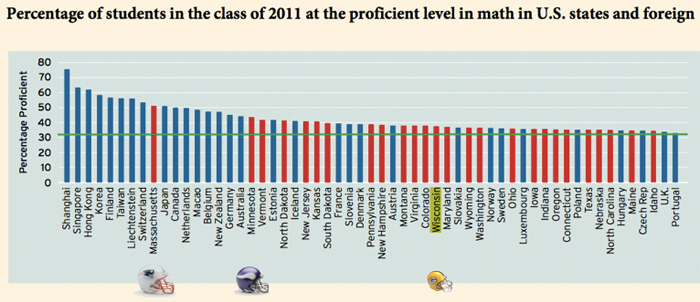
Given recent school-related political conflicts in Wisconsin, it is of interest that only 42 percent of that state’s white students are proficient in math, a rate no better than the national average.
At a time of persistent unemployment, especially among the less skilled, many wonder whether our schools are adequately preparing students for the 21st-century global economy. This is the second study of student achievement in global perspective prepared under the auspices of Harvard’s Program on Education Policy and Governance (PEPG).
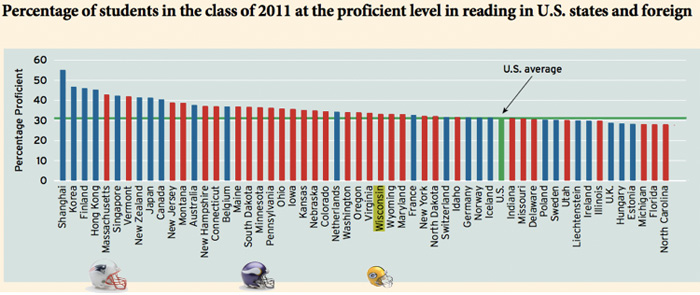
In the 2010 PEPG report, “U.S. Math Performance in Global Perspective,” the focus was on the percentage of U.S. public and private school students performing at the advanced level in mathematics.1 The current study continues this work by reporting the percentage of public and private school students identified as at or above the proficient level (a considerably lower standard of performance than the advanced level) in mathematics and reading for the most recent cohort for which data are available, the high-school graduating Class of 2011.
Proficiency in Mathematics
U.S. students in the Class of 2011, with a 32 percent proficiency rate in mathematics, came in 32nd among the nations that participated in PISA. Although performance levels among the countries ranked 23rd to 31st are not significantly different from that of the United States, 22 countries do significantly outperform the United States in the share of students reaching the proficient level in math.
In six countries plus Shanghai and Hong Kong, a majority of students performed at the proficient level, while in the United States less than one-third did. For example, 58 percent of Korean students and 56 percent of Finnish students were proficient. Other countries in which a majority–or near majority–of students performed at or above the proficient level included Switzerland, Japan, Canada, and the Netherlands. Many other nations also had math proficiency rates well above that of the United States, including Germany (45 percent), Australia (44 percent), and France (39 percent).

Much more at www.wisconsin2.org.

Share

ACT Trends: National, Wisconsin, Madison

Jeff Henriques, via email.

Many notes and links, here.

Share

Senate Hearing on College Readiness (Imaginary)

on the 17th of never, 2011
Senator, please allow me to express my thanks for including me in these vital hearings on the readiness of our high school graduates for college work.
It would be my sad duty to report to you that if high school football coaches no longer ask their athletes to learn to block and tackle, that would fail to prepare them for college teams. Oh–wait, Senator, that is not correct. (Shuffles papers, starts over).
It would be my sad duty to report that if our high school basketball coaches no longer taught their athletes to dribble, pass, and shoot baskets, then they too would fail at basketball in college.
Oh–my apologies, Senator, that is not my testimony–just a little bad joke. Of course our high school coaches take athletics much too seriously to allow that sort of thing to happen to our kids. In fact, The Boston Globe has more than 100 pages a year on high school athletes. No, Senator, there is no coverage for high school academic achievement.
But I am sorry to have to report that our History and English teachers at the high school level no longer ask our students to read complete nonfiction books or to write substantial research papers, and naturally, this unfits them for the nonfiction books they will be asked to read and the substantial research papers they will be asked to write at the postsecondary level, in what we might call Upper Education.
The famous and influential American educator, John Dewey, wrote in 1896 that: “The centrality of reading and writing was ‘one of education’s great mistakes.'” In following in his footsteps, many of our educators have pushed academic reading and writing so far to the periphery of the curriculum that, for too many of our high school students, they might just as well have fallen off the edge of the flat earth of American secondary education.
The California State College System recently reported that 47% of their Freshmen were required to take remedial reading courses. Of course they can’t handle nonfiction books as they have never been assigned one in their whole high school career.
I have had the privilege of publishing 956 serious (average 6,000 words) history research papers by secondary students from all over this country and from 38 other countries, and I have formed the opinion in the process that high school students are fully capable of reading complete nonfiction books and of writing serious research papers.
But it should be no surprise that so long as our educators never assign nonfiction books or ask students for research papers, they will continue to believe that their students may be able somehow to manage Calculus, European history, Latin, Chemistry, British Literature and the like, but they must still not be able, for some unexplained reason, to read a history book or write a real term paper.
While our colleges do complain, persistently, about the poor preparation in reading and writing of the students who come to them, what do they do in setting requirements for admission?
Senator, hard as it may be to believe, all the writing that colleges ask for is a 500-word “college” essay about the life of the applicant. It is hard to conceive of a more nonacademic task than that, or one more likely to retard the assignment of serious reading and writing at the high school level.
When we celebrate athletes and ignore scholars in our high schools, and when we set such low standards for the high school diploma and for college admission, we should not be surprised that more than one million of our high school graduates need to be in remedial courses when they get to college every year, and that more than half of those will never graduate.
Yes, Senator, I believe that until we take reading and writing more seriously at the secondary level, we can continue to push more and more students into college, but more and more of them will be sadly unprepared to take advantage of that academic opportunities there, and more and more of them will drop out before they graduate from college.
Thanks again for the opportunity to discuss these problems.
===============
“Teach by Example”
Will Fitzhugh [founder]
The Concord Review [1987]
Ralph Waldo Emerson Prizes [1995]
National Writing Board [1998]
TCR Institute [2002]
730 Boston Post Road, Suite 24
Sudbury, Massachusetts 01776-3371 USA
978-443-0022; 800-331-5007
www.tcr.org; fitzhugh@tcr.org
Varsity Academics®
www.tcr.org/blog

Share

ACT Scores Decline Somewhat in Madison, Wisconsin Slightly Up, 32% of Badger Students “Ready” for College Level Courses in 4 Areas

Matthew DeFour:

The average ACT score among the Madison School District’s 2011 graduates dipped to its lowest level in 15 years, while the gap between white and minority student scores shrank for the first time in five years.
Though Madison’s average score dipped from 24.2 to 23.9, district students still outperformed the state average of 22.2 and national average of 21.1. A perfect score on the college entrance exam is 36.
Madison’s average scores in recent years have ranged from 23.5 in 1995 to 24.6 in 2007. The average score was also 23.9 in 2003.

Amy Hetzner:

With the highest percent of students taking the ACT in state history, Wisconsin’s Class of 2011 posted an average score slightly above that from the previous year’s graduates and maintained the state’s third-place ranking among states in which the test is widespread.
Seventy-one percent of the 2011 graduates from Wisconsin private and public schools took the college admissions test, averaging a 22.2 composite score on the 36-point test, according to information to be publicly released Wednesday. The nationwide average was 21.1 on the ACT Assessment, which includes tests in English, reading, mathematics and science.
State schools superintendent Tony Evers credited the results to more high school students pursuing more demanding coursework.
“The message of using high school as preparation for college and careers is taking hold with our students,” Evers said in a news release. “Nearly three-quarters of our kids said they took the rigorous classes recommended for college entry, up from just over half five years ago.”
Even so, ACT reported that only 32% of Wisconsin’s recently graduated seniors had test results that showed they were ready for college-level courses in all four areas. Results for individual subjects ranged from 39% readiness in science to 75% in English.

A few somewhat related links:

Ruth Robarts:

When all third graders read at grade level or beyond by the end of the year, the achievement gap will be closed…and not before.
On November 7 (2005), Superintendent Art Rainwater made his annual report to the Board of Education on progress toward meeting the district’s student achievement goal in reading. As he did last fall, the superintendent made some interesting claims about the district’s success in closing the academic achievement gap “based on race”.
According to Mr. Rainwater, the place to look for evidence of a closing achievement gap is the comparison of the percentage of African American third graders who score at the lowest level of performance on statewide tests and the percentage of other racial groups scoring at that level. He says that, after accounting for income differences, there is no gap associated with race at the lowest level of achievement in reading. He made the same claim last year, telling the Wisconsin State Journal on September 24, 2004, “for those kids for whom an ability to read would prevent them from being successful, we’ve reduced that percentage very substantially, and basically, for all practical purposes, closed the gap”. Last Monday, he stated that the gap between percentages scoring at the lowest level “is the original gap” that the board set out to close.
Unfortunately, that is not the achievement gap that the board aimed to close.

“Penelope Trunk”: (Adrienne Roston, Adrienne Greenheart(

10. Homeschool. Your kids will be screwed if you don't.
The world will not look kindly on people who put their kids into public school. We all know that learning is best when it's customized to the child and we all know that public schools are not able to do that effectively. And the truly game-changing private schools cost $40,000 a year.

Notes and links on the recent, successful Madison Talented & Gifted parent complaint.

Share

Michigan accreditation system ‘no longer has relevance’

Dave Murray:

Michigan’s school accreditation system “no longer has relevance” state educators say, as every school in the state has met state criteria despite sliding backward on federal testing goals.
The state Education Department released announced Monday that 79 percent of Michigan’s public school buildings and 93 percent of the school districts made federal testing goals – called “adequate yearly progress” – for the 2010-11 school year.
That’s down from 86 percent of schools and 95 percent of districts making AYP the previous school year.

Share

Student Loan Debt is Up Sharply

Justin Lahart:

According to the Federal Reserve Bank of New York’s quarterly report on debt and credit, U.S. households had $11.42 trillion in debt outstanding in the second quarter. That was down from a peak of $12.5 trillion in the third quarter of 2008, when the financial crisis took hold, and the lowest since the first quarter of 2007. Mortgage debt, home equity loans, credit card debt and auto loans are all down sharply — partly because people are being more careful, but also because many have defaulted.
But student loans are up sharply. There was $550 billion in student debt outstanding in the second quarter, up 25% from $440 billion in the third quarter of 2008.

Share

Los Angeles teachers test a pilot evaluation program

Jason Song:

This is what one of Los Angeles Unified’s most ambitious reform efforts looks like: about 30 people gathered in a Gardena school auditorium, watching a video of a teacher trying to get her young students to understand a John Updike poem.
The viewers furiously type their observations into laptop computers and discuss their impressions of the lesson the next day. They ask open-ended questions — “What are some possible explanations for the lack of understanding of the vocabulary?” — all aimed at helping the teacher improve.
These training sessions are the school district’s first concrete steps toward replacing its age-old teacher evaluation system, which is widely regarded as a failure. The new version is based on more detailed observations, student and parent feedback, and students’ standardized test scores.

Share

Hong Kong Eco-primary school considers a step up to secondary

Chloe Lai:

Sitting under a parasol to avoid the fierce summer sun, two teenagers at a summer camp in the New Territories debate the criteria for an ideal secondary school. Rosemary and White Cloud – adopting nature-related nicknames is a tradition at the camp – are responding to a Q&A session held earlier, when two secondary school principals were quizzed on topics ranging from the logic of school uniform design to how to prevent teachers from abusing their power.
“The school must have strict rules so every student will behave and be polite,” White Cloud says.
Rosemary has very different ideas: “It is not going to work. Strict rules will only make the disobedient even more disobedient. My ideal school is one with no penalties.”
The two friends’ contrasting views reflect their exposure to Gaia School, an alternative private primary school in Tuen Mun that emphasises personal responsibility and learning from nature.

Share

Here’s how to get your children a great education

Greg Toppo:

Journalist Peg Tyre’s new book, The Good School: How Smart Parents Get Their Kids the Education They Deserve ($26, Henry Holt) out Aug. 16, condenses decades of education research to help parents make better choices about selecting schools for their children. Tyre, whose 2008 book The Trouble With Boys helped spark a national conversation, says, “Schools can’t reasonably be expected to both educate children and educate parents about education. Parents are going to have to get more sophisticated about what excellent education looks like — and demand it for their child.” Tyre recently spoke to USA TODAY:

Share

Stearns High School pitch to China is a failure

Associated Press:

A school district in the deep woods of Maine that sought out Chinese students to help boost its enrolment and its finances fell far short of its ambitious goal of bringing in 60 students.
Only six Chinese students will attend high school in Millinocket, in a rural part of the northeastern state, next month.
The target of five dozen was probably overly ambitious, officials said.
The efforts were also hindered by a recruiter in China who failed to deliver any students and a writer who told readers of China’s Global Times newspaper that the school was “mediocre” and that Millinocket children hang out in parking lots for fun.
Stearns High School officials said they were disappointed more Chinese students won’t be attending when classes begin on September 6 but will stick with the programme and try to expand in the years ahead.

Share

Why are high school grads still learning to learn?

Chris Rickert:

I’m not surprised more students are taking college-readiness and remedial courses at community and four-year colleges.
In the 1990s, I taught introductory composition at a private, career-oriented college and at a public university in Chicago, where it became clear that many of my students still hadn’t learned the difference between “it’s” and “its,” for example, or proper use of a comma. Never mind critical thinking.
It was especially evident at the private college that many of these high school graduates were forking over thousands of dollars so some master’s level English major with no formal training in education could teach them what they should have learned for free in public school.
The experience puts “Learning to Learn Camp,” Madison Area Technical College’s nine-week, $478.75 incarnation of the college preparatory class, in something of a darkly comic light.

Share

Little Girl Found

Patti Waldmeir:

One might easily see such a thing in a Shanghai alleyway and think nothing of it: a bundle of fabric tied up with a rope. Except that this particular bundle was screaming.
I could not tell at first if the squalling child was male or female, but I knew exactly what it was doing there: a desperate mother had swaddled her newborn infant in several layers of clothing and left it alone in the winter darkness – so that it could have a chance to live.
For me, it was an all-too-familiar story: my own two daughters were abandoned at birth, left alone in a Chinese street to the mercy of strangers. But that was more than a decade ago – a decade in which China has become a powerful force in markets from natural resources to sports cars, from luxury goods to aircraft carriers. In a China of diamond iPads and gold-plated limousines were babies still ending up in anonymous alleyways?

Share

The myth of the rational education market

Peg Tyre:

The idea that school choice is automatically better than no choice has recently been reinforced again, with the “Parent Trigger” in California. Under a law passed there last year, parents whose children attend underperforming public schools can get together, and if 51% of them sign a petition, they can demand their district change the school administrators or convert the school to a charter. So far, a parent group from Compton “pulled the trigger,” but parents from poor urban schools and well-funded suburban schools have been seeking information on how to use the Parent Trigger law to improve their schools.
Similar bills, which are supported by education reformers on both sides of the political aisle, have been passed in Connecticut, Ohio and Mississippi. About a half dozen state legislatures–including New York — are expected to consider Parent Trigger type bills this year.

Share

What does it mean to be a proficient 8th grade reader in Georgia? Not much.

Maureen Downey:

The U.S. Department of Education released a new analysis of state standards this week that maps the standards against federal ones to assess rigor. We don’t look strong on the mapping, especially in eighth grade reading where we trail the nation.
The analysis using National Center for Educational Statistics data superimposes a state’s standard for proficient performance in reading and mathematics onto a common scale defined by scores on NAEP, a federal test administered to student samples in every state to produce a big picture view of American education. (This report offers a lot of data and great graphics.)
The most alarming mapping revealed that Georgia’s standard for proficiency in 8th grade reading is so low that it falls into the below basic category on NAEP scoring. (We don’t look in 8th grade math, either, but the feds warn that our change from QBE standards to Georgia Performance Standards undermines comparisons.)

Share

Pre-college camps help incoming students learn how to learn

Deborah Ziff:

The fall semester hasn’t officially started yet, but this week a group of incoming Madison Area Technical College students gathered on campus to study in groups, submit homework, and take notes on lectures.
They won’t be tested. They’re just practicing.
Programs like this one at MATC — called Learning to Learn Camp — are increasingly common at colleges and universities as educators try to prepare students for the academic rigor and social stresses of college.
The courses tend to provide basic study skills such as note-taking and time management, as well as information on decidedly squishier topics, such as how to stay motivated or take personal responsibility.
“It all sounds very elementary, but particularly for community college and technical college students who often don’t have a college frame of reference, or somebody in their family who went to college, it’s really useful information,” said Melinda Mechur Karp, a senior research associate at the Community College Research Center at Teachers College, Columbia University in New York.

Share

Curriculum & Doonesbury

Well worth reading….

Share

Web site lets you compare Michigan high schools’ success

Lori Higgins:

The state will launch a Web site Monday that will eventually provide parents — and everyone else — a way to gauge how well individual high schools prepare their graduates for college.
By the end of September, the site, www.mischooldata.org , will include first-ever information on how many students from each school go to college, how many earn at least a year’s worth of college credit within two years of graduation, and how many have to take remedial courses in college.
The information could be used by parents and the public to rate high schools and for administrators to improve curricula.

Share

Double degree adds up for Hong Kong maths prodigy

Peter So:

The wonderkid who at nine became the city’s youngest undergraduate four years ago completed his bachelor’s and master’s programme this week at the age of 13.
March Boedihardjo will now head off to the United States for a research programme and, possibly, a doctorate. The youngster was admitted to Baptist University’s double-degree programme in mathematical science in 2007, finishing it in four years – a year early. March said he really enjoyed his university years, despite earlier concerns about how such a young boy would adapt to the life.

Share

Building character is a worthy subject in schools

Alan Borsuk:

Would you rather have someone graduate high school with good computer skills or good character traits?
I grant it’s a false choice. You ought to have both, and they’re not in conflict. But I ask this as a way of asking what our priorities are when it comes to educating children.
It’s hard to find a school that doesn’t have lots of computers these days. The intense push to load schools up with computers seems to have eased, compared with a decade ago. Money is tighter now, and many schools don’t need much more because they have a lot already.
But it’s not so easy to find schools that have good character education programs.
Schools are held accountable for teaching reading and math and so on. The pressure is always on for academic records for each student and for a school as a whole. But students’ character? Other than attendance and discipline for behavior problems, interest in that is pretty inconsistent.
Of course, many would say, it’s not the school’s job to civilize children. That’s the parents’ job. Absolutely correct, and I think more should be done to try to get more parents to do that job.

Share

The ever-increasing burden of education

Ivan Lorentzen:

Even with all its flaws, I’m a proponent of public education in much the same way I remain committed to the fundamental principles of democracy despite recent events in D.C. having tested this commitment.
In terms of public education, there are countless books, articles, and research projects from numerous points of view and it’s clear one can find proponents and opponents to whatever perspective you may choose. One recent publication is noteworthy due to the clarity in writing and direct premise — “Schools Cannot Do It Alone” by Jamie Vollmer, former attorney, businessman, and harsh education critic, now an advocate and consultant to education. I’d like to quote and paraphrase from this book in the following column.
He argues schools need the trust, understanding, permission and support from their communities in order to improve the public education system and increase student success. In tracing his journey from critic to consultant, he weaves an interesting tale as he encounters “blueberries, bell curves, and smelly eighth graders,” and comes to two conclusions. First, we have a system problem, not a people problem. We need to modify the system in order to get the graduates we want. And second, we cannot touch the system without touching the culture of the surrounding town because everything that goes on inside a school is tied to local attitudes, values, traditions and beliefs. But in order to improve the system it’s vital that we first accurately understand the system that presently exists and how it came to be.
For the first time in history the security, prosperity, and health of our nation depend on our ability to unfold the full creative potential of every child — not just the easy ones, not just the top 20 percent of the class, and not just those who reflect our preferred values. The problem is that America’s public education system was never designed to do this. As Thomas Jefferson imagined it, schools should be designed to select and sort students into two groups: a small handful of thinkers and a great mass of obedient doers. Back then most everyone was a farmer, the pace of change was slow, options were few, and only a small handful of people were paid to think.

Share

Louis Moreau Gottschalk on education

Chan Stroman:

Those favored by fortune can educate themselves in all countries: and it is for that reason that the American thinkers did not dedicate their cares to the aristocratic element of society, but rather to the lowest ranks of the great mass of the people, whom they have struggled to enlighten; comprehending that education ought not to be a privilege, but something which belongs to all, as much as the air we breathe; and that every citizen has as imprescriptible a right to the light of the Spirit as he has to the light of the sun which illuminates him.

Louis Moreau Gottschalk:

Share

Madison Mayor Paul Soglin on The Schools, Community, Curriculum & Parenting

Madison Mayor Paul Soglin Interview 8.12.2011 from Jim Zellmer.

I am thankful that Madison Mayor Paul Soglin took the time to chat yesterday.
Mobile (iPhone, iPad, iPod and Android) visitors, please use this link.
19MB mp3 version.

Share

Meeting test score standards – by lowering the bar

Mary McConnell:

Today’s Wall Street Journal highlights a report for the U.S. Government’s National Center for Education Statistics. In case you have trouble following the link, here’s the discouraging news:
“Eight states have raised their standards for passing elementary-school math and reading tests in recent years, but these states and most others still fall below national benchmarks, according to a federal report released Wednesday.”
The data help explain the disconnect between the relatively high pass rates on many state tests and the low scores on the national exams, known as the National Assessment of Educational Progress.

Share

Michigan has power to reimagine education, but will it?

Tom Watkins:

There are lessons that Michigan business and government must learn from the lost decade that stripped our state of pride and nearly 1 million high-paying middle-class jobs.
If we don’t embrace and imagine a better future, instead falling back on “business as usual,” we will be relegated to the trash heap of dinosaurian, economic history.
The revisionists among us would like us to believe Michigan’s fate was pre-determined by the collapse of the domestic auto industry, capped off by a global economic meltdown in 2008.
While the perfect storm of events that hit Michigan were clearly impactful, they need not have defined us. As my dad always told me, “You have little control what happens to you in this life, you have 100 percent control over how you respond.”
Michigan responded poorly.

Share

Judge Blocks Colorado Voucher Plan

Stephanie Simon:

A state court judge on Friday blocked a suburban school district south of Denver from using public funds to help residents pay for private and religious schools.
Judge Michael A. Martinez ruled that a voucher program designed by the Douglas County School District violated the state constitution because it sent public funds to schools that infused religion throughout their curriculum, required students and faculty to meet certain standards of faith and required students to attend religious services.
The program “provides no meaningful limitations on the use of taxpayer funds to support or promote religion, and no meaningful protections for the religious liberty of participating students,” the judge wrote in a 68-page decision. He also said it amounted to direct public aid to churches and church-sponsored schools, in violation of the Colorado constitution.

Much more on the Douglas County voucher program, here.

Share

Obama Shows Spunk Pushing Bold Education Plan: Jonathan Alter

Jonathan Alter:

Although President Barack Obama is on the ropes, with even some Democratic allies describing him as weak and passive, this week he showed boldness and imagination in one vital area: education.
Obama backed Education Secretary Arne Duncan’s announcement that he will grant waivers to states that want to be excused from the punitive provisions of No Child Left Behind , Washington’s much-maligned 2002 overhaul of elementary and secondary education policy.
Republican lawmakers complain that the White House waivers run roughshod over the legislative branch — and they’re right. But gridlock demands more robust use of presidential authority and, at least in this case, we’re getting it. Unless Duncan’s action is challenged and reversed on constitutional grounds, No Child Left Behind will be left behind for good.

Share

Bullying climates at schools may be linked with lower test scores

Jeannine Stein:

Bullying can affect a student’s academic performance, but a school’s bullying climate may be linked with lower overall test scores, a study finds.
The study, presented recently at the American Psychological Assn.’s recent annual convention in Washington, D.C., surveyed 7,304 ninth-grade students and 2,918 teachers who were randomly chosen from 284 high schools in Virginia. Students and teachers were asked about incidents of bullying and teasing at the school. Ninth-grade students were chosen because researchers felt this first year of high school was a critical adjustment period, and because poor test scores in this grade may be linked with a higher drop-out rate.
In the study, bullying was defined as using strength or popularity to deliberately injure, threaten or embarrass another person, and that harassment can be verbal, physical or social. Two students close in strength who argue are not considered bullies.

Share

At Dalton, a Push for Change

Sophia Hollander:

Assembling diverse classes is an oft-stated goal among New York City private schools, with brochures featuring beaming multicultural students.
But this September Dalton will approach a rare benchmark: Nearly half of the incoming kindergarten class will be students of color.
Dalton will dramatically exceed the citywide average for kindergarten diversity at New York’s private schools, which was 30% students of color last year, according to data from the National Association of Independent Schools.
It’s a milestone in an aggressive campaign by the admissions director, Elisabeth “Babby” Krents, to broaden the school’s reach since she assumed the position in 1996. The previous year, the kindergarten class was 6% diverse. This year, it will be 47% of the 97-member incoming class.

Share

States Fail to Raise Bar in Reading, Math Tests

Stephanie Banchero:

Eight states have raised their standards for passing elementary-school math and reading tests in recent years, but these states and most others still fall below national benchmarks, according to a federal report released Wednesday.
The data help explain the disconnect between the relatively high pass rates on many state tests and the low scores on the national exams, known as the National Assessment of Educational Progress.
In fourth-grade reading, for example, 35 states set passing bars that are below the “basic” level on the national NAEP exam. “Basic” means students have a satisfactory understanding of material, as opposed to “proficient,” which means they have a solid grasp of it. Massachusetts is the only state to set its bar at “proficient”–and that was only in fourth- and eighth-grade math.

Share

Robots put leadership under skills pressure

Andrew Hill:

We love robots – tireless, productive workhorses of the modern assembly line. But we also hate robots – sinister mechanical simulacra of the human workers they make redundant.
In the latest episode in our complicated relationship with automatons and automation, it is appropriate that Foxconn should have a lead role. The Taiwanese company manufactures the chattering classes’ favourite piece of science fiction come true, the Apple iPad, as well as devices for Nokia and Sony. It employs 1m people in China. It was the epicentre last year of concern about pressure on low-paid young workers, following a series of suicides at its Shenzhen factories. It is, in short, iPad users’ window on to dilemmas of assembly-line politics and management that the developed world last grappled with on this scale decades ago.

Share

Why parents can’t save schools

Jay Matthews:

One of the summer scandals keeping us education wonks amused until school starts is a American Federation of Teachers gaffe in Connecticut. Union officials posted online an analysis of their lobbying against a parent trigger law in that state that revealed too much about their distaste for letting moms and dads decide who should run their schools.
Bloggers RiShawn Biddle and Alexander Russo exposed the union celebrating its gutting of a Connecticut version of California’s parent trigger law. School reform organizations and editorialists were aghast. AFT president Randi Weingarten disowned the Web post. Activists pushing for parent triggers in Texas and New York welcomed the attention.
This idea has already reached the Washington area and may someday inspire legislation here. That would be bad. Despite its worthy proponents and democratic veneer, the parent trigger is a waste of time. Let’s toss it into the trash with other once fashionable reform ideas like worksheets for slow students and brief constructed responses on state tests.

A balance of power in school governance is vital to ongoing improvements AND relevance.

Share

Don’t Filter Information

Joshua Kim:

The context for this advice was some technical information about e-learning system downtime that we needed to communicate with our leadership. I was thinking of how to present this information to communicate the meaning I thought most essential, and therefore drive toward the conclusions and actions I thought we should take. Controlling the message and managing the information might be an understandable desire, but when it comes to technology (and perhaps everything else), a controlled message is sometimes the wrong approach.
Deciding not to filter information does not mean that we cease thinking about how to effectively communicate. We need to understand the recipient of the information, and have insight into the most effective manner to package our communication. We should also be aware of how the communication will be perceived, and be prepared to address concerns or questions.

Share

School Vouchers – Panacea or Snake Oil?

Ross Meyer:

As most Coloradans know, at least those who keep up with statewide education news, the Douglas County school board recently approved — unanimously — a groundbreaking plan to help pay the tuition costs for hundreds of students so that they can attend private schools.
This plan, known colloquially as a school voucher program, enjoys ardent support from some quarters, but vigorous opposition elsewhere.
Is such a plan useful, does it seem a wise use of taxpayer provided money, and is it available to all students?
Or, as many think, should public money earmarked for education be used exclusively for public schools to benefit all students? As with so many topics dotting the American sociological landscape, the answers lie in the murky sea of the individual’s political leanings.

Share

Education in Chile: We want the world

The Economist:

IT BEGAN on August 4th with the metallic clink of a few pots and pans. By nightfall, thousands of people were on the streets of Santiago banging kitchenware, a form of protest last heard under the dictatorship of General Pinochet. This time the cacerolazos, as they are called, are being staged in the name of educational Utopia–and in response to a cack-handed government ban on marches.
Chile’s school system is the least bad in Latin America, according to the OECD’s PISA tests, which compare educational attainment across countries. But that does not make it good. And the overall performance hides huge disparities. Analysis done in Chile of the test results in the 65 countries that took part finds that it ranked 64th in terms of the variance of the results according to social class. Rich pupils get good private education; poor ones are condemned to underfunded, dilapidated state-funded schools.

Share

Some Folks Have a (Really) Hard Time with Change

Peter Murphy:

Change is hard. So said many a politician trying to tackle problems confronting the state or nation.
The president of the New York State United Teachers (NYSUT), Richard Iannuzzi, is a tell-tale example of someone having real difficulty with change by showing a dark side.
Yesterday’s Associated Press story on the changing landscape of public education was telling. With strengthened accountability and teacher evaluation combined with tightening resources, changes are afoot. On the one hand, Governor Andrew Cuomo is recognizing the “gravitational forces” of change and is in some ways its instigator by his focus on “improving student performance,” including his push that gave more teeth to the state Regents evaluation requirements.

Share

Madison Schools To Start New Talented & Gifted Program

Matthew DeFour:

Spurred by a critical state audit, the Madison School District will begin a new program this year intended to better identify and provide services for talented and gifted students.
Using an approach similar to how it identifies and serves special education students, the district plans to categorize talented-and-gifted services into three tiers and identify where all students fit into those tiers based on a combination of test scores, grades, teacher and staff assessments, and parent and self-identification.
Students who qualify for the top tier could receive additional academic services outside of the classroom. The program also seeks to develop the potential talent of all students, especially those who may not have been identified in the past, such as English language learners and low-income students.
In the past, Madison schools have used a more ad hoc, less systematic, approach for identifying and serving students who demonstrate advanced abilities in intellect, academics, leadership, creativity, and the performance and visual arts. The district also has historically blanched at grouping students by ability.

Related: A group of Madison parents filed a successful complaint related to talented & gifted services with Wisconsin’s Department of Public Instruction.

Share

Super Teachers Alone Can’t Save Our Schools

Steven Brill:

A superstar teacher or charismatic principal rides to the rescue! Downtrodden public school children, otherwise destined to fail, are saved! We’ve all seen that movie–more than once, starting with “Stand and Deliver” and “Lean on Me” in the late 1980s and more recently with documentaries like “Waiting for Superman” and “The Lottery,” which brilliantly portray the heroes of the charter-school movement. And we know the villains, too: teachers’ union leaders and education bureaucrats who, for four decades, have presided over schools that provide comfortable public jobs for the adults who work there but wretched instruction for the children who are supposed to learn there.
One of the heroes of this familiar tale is Dave Levin, the co-founder of the highly regarded KIPP network of charter schools (KIPP stands for Knowledge Is Power Program). But Mr. Levin would be the first to tell you that heroes aren’t enough to turn around an American public school system whose continued failure has become the country’s most pressing long-term economic and national security threat.

65

Share

Hong Kong Teachers stand up against ‘moral lessons’; Profession’s biggest union says government’s proposed curriculum should ‘be given a fail’

Jennifer Ngo:

The city’s biggest teachers’ union has called on the government to scrap its plan to introduce mandatory moral and national education classes at schools after a survey of more than 2,000 of its members found widespread opposition to the proposal.
The pro-democracy Hong Kong Professional Teachers’ Union, which claims a membership of 80,000, or 90 per cent of all the city’s teaching professionals, says the poll found 70 per cent were against the move.
Union officials also criticised the government for carrying out consultation over the move in a “condescending” way and called for a new round of talks.
“If we have to speak in terms of grading requirements, this document [proposing the new curriculum] would be given a `fail’,” said James Hon Lin-shan, deputy director of the union’s rights and complaints department.

Hong Kong Professional Teacher’s Union website. Much more on the Moral and National Education (MNE) curriculum, here.

Share

The Annotated No Child Left Behind Waiver Conversation

Andrew Rotherham:

I’m not opposed to a new round of waivers on No Child Left Behind, but the devil is in the details. Unfortunately, the details seem to be getting short shrift lately in favor of the same talking points. To wit, let’s take a look at today’s NYT story on the forthcoming Duncan waiver proposal. Here it is (mostly) annotated with text from the article in itals.

Secretary of Education Arne Duncan has announced that he will unilaterally override the centerpiece requirement of the No Child Left Behind school accountability law, that 100 percent of students be proficient in math and reading by 2014.

Well, it’s not really 100 percent, more like 92 percent or so, and it’s not 2014 in practice but really several years later. And in practice for a school to make “adequate yearly progress” often only 6 or 7 in 10 of its students need to be passing a test at the proficient level right now. And, to be proficient doesn’t mean a perfect score on a test, often more like getting half the questions on a test right. That all makes it sound too reasonable though. Besides, those are details! Nothing but details!

Share

Mapping State Proficiency Standards Onto the NAEP Scales: Variation and Change in State Standards for Reading and Mathematics, 2005-2009

US Department of Education, via a kind Chan Stroman email:

State-level National Assessment of Educational Progress (NAEP) results are an important resource for policymakers and other stakeholders responsible for making sense of and acting on state assessment results. Since 2003, the National Center for Education Statistics (NCES) has supported research that focuses on comparing NAEP and state proficiency standards. By showing where states’ standards lie on the NAEP scale, the mapping analyses offer several important contributions. First, they allow each state to compare the stringency of its criteria for proficiency with that of other states.
Second, mapping analyses inform a state whether the rigor of its standards, as represented by the NAEP scale equivalent of the state’s standard, changed over time. (A state’s NAEP scale equivalent is the score on the NAEP scale at which the percentage of students in a state’s NAEP sample who score at or above that value matches the percentage of students in the state who score proficient or higher on the state assessment.) Significant differences in NAEP scale equivalents might reflect changes in state assessments and standards or changes in policies or practices that occurred between the years. Finally, when key aspects of a state’s assessment or standards remain the same, these mapping analyses allow NAEP to substantiate state-reported changes in student achievement.
The following are the research questions and the key findings regarding state proficiency standards, as they are measured on the NAEP scale.

Wisconsin’s oft criticized WKCE vis a vis NAEP:
WKCE “proficient” = 2009 NAEP Below Basic for grade 4 reading (along with 34 other states) and grade 8 reading (along with 15 other states)
= 2009 NAEP Basic for grade 4 math (along with 41 other states) and grade 8 (along with 35 other states)
WKCE results showed more positive changes than NAEP results for grade 4
reading from 2007 to 2009, grade 4 math from 2007 to 2009, and grade 4 math from 2005 to 2009
NAEP results showed more positive changes than WKCE results in grade 8
reading from 2005 to 2009.
How does Wisconsin compare? Learn more, here.

Share

Professors Cede Grading Power to Outsiders–Even Computers

Jeffrey Young:

The best way to eliminate grade inflation is to take professors out of the grading process: Replace them with professional evaluators who never meet the students, and who don’t worry that students will punish harsh grades with poor reviews. That’s the argument made by leaders of Western Governors University, which has hired 300 adjunct professors who do nothing but grade student work.
“They think like assessors, not professors,” says Diane Johnson, who is in charge of the university’s cadre of graders. “The evaluators have no contact with the students at all. They don’t know them. They don’t know what color they are, what they look like, or where they live. Because of that, there is no temptation to skew results in any way other than to judge the students’ work.”
Western Governors is not the only institution reassessing grading. A few others, including the University of Central Florida, now outsource the scoring of some essay tests to computers. Their software can grade essays thanks to improvements in artificial-intelligence techniques. Software has no emotional biases, either, and one Florida instructor says machines have proved more fair and balanced in grading than humans have.

Share

Is College Worth the Cost?

Christina Couch:

Today’s parents are paying substantially higher out-of-pocket costs for higher education than their parents did 30 years ago. And the public has noticed. Three out of four Americans say college is unaffordable for most people, according to the widely publicized survey Pew Research Center survey “Is college worth it?”
A four-year degree is becoming increasingly difficult to attain due to several factors:
–College costs are rising at nearly three times the rate of inflation, according to FinAid.org.
–More than 1 in 10 students graduate with more than $40,000 in undergraduate student debt, according to the Project on Student Debt.

Share

Online Education: A Word of Caution

Andrew Miller:

Online education is becoming a legitimate and viable option for education systems around the country. Both colleges and secondary schools are offering classes to students. In fact many states and schools are requiring students to take some method of mode of online learning. New York made major changes around seat time and face-to-face contact between student and teacher. The state’s intentions are good. They want to move away the focus from seat time, and they want to offer courses that might be hard to offer in certain areas of the state to all students. With all these innovative systemic changes, one might think we are completely on the right track. I offer a word of caution.
Online education is in danger of replicating a system that isn’t working. Yes, I wrote it. With all the potential for innovation that online education has to offer, we have fallen into the pitfall of replication. The keyword is “danger.” There is much that online education can do to innovate the education system, and much that has already been done as a result. Yet most of the actual courses and pedagogical structures that are in place are simply replicating the traditional style of education.

Share

Debate camp in Oakland

Katy Murphy:

DIEGO GARCIA: Two years ago I went to my first BAUDL summer institute, dragged along by my sister Jazmin to the foreign world of debate. I remember being nervous: I had never engaged in an activity like that before, and was worried about having to speak in front of a crowd. But in the end I loved it, and started spending a lot of time on it, enough that my partner and I came out of last year’s season as League Champions.
When the 2011 BAUDL institute began my biggest concern was the camp tournament – I had a reputation to defend. The last day of the institute there is a tournament were debaters would test their knowledge based on their own personal experiences and what they learned during the week. Being the competitive debater that I am it’s always exciting being at a tournament just to really challenge opponents and make it a learning experience for both teams.

Share