Watch the Madison School District Discuss the Proposed Middle School Charter School Online
via MMSDTV. Much more on the proposed Middle School Spanish immersion charter school here.
via MMSDTV. Much more on the proposed Middle School Spanish immersion charter school here.
Most college students would likely concur – fifty minute lectures can be a bit much. With current research indicating that attention spans (measured in minutes) roughly mirror a students age (measured in years), it begs the question as to the rationale behind lectures of such length.
Given that it is tough to justify the traditional lecture timeframes, it is no surprise to see online educational programs seeking to offer presentations that feature shorter podcasts. But in an astonishing switch, David Shieh of the Chronicle of Higher Education recently took a look at a community college program that features a microlecture format, presentations varying from one to three minutes in length.
The Micro-Lecture
While one minute lectures may be beyond the scope of imagination for any veteran teacher, Shieh reports on the piloting of the concept at San Juan College in Farmington, N.M. The concept was introduced as part of a new online degree program in occupational safety last fall. According to Shieh, school administrators were so pleased with the results that they are expanding the micro-lecture concept to courses in reading and veterinary studies.
Wall Street Journal Editorial:
Education Secretary Arne Duncan said last week that poor children receiving federally financed vouchers to attend private schools in Washington, D.C., shouldn’t be forced out of those schools. Bully for Mr. Duncan. But the voice that matters most is President Obama’s, and so far he’s been shouting at zero decibels.
His silence is an all-clear for Democrats in Congress who have put language in the omnibus spending bill that would effectively end the program after next year. Should they succeed, 1,700 mostly black and Hispanic students who use the vouchers would return to the notoriously violent and underperforming D.C. public school system, which spends more money per pupil than almost any city in the nation yet graduates only about half of its students.
The D.C. voucher program has more than four applicants for every available slot. Parental satisfaction is sky high. And independent evaluations — another is scheduled for release later this month — show that children in the program perform better academically than their peers who do not receive vouchers. This is the kind of school reform that the federal government should encourage and expand.
Arne Duncan, the secretary of education, sent a message to the nation’s school officials last week: Heads up! We’ll be sending you billions of dollars by month’s end. Spend the money quickly but wisely. And keep receipts; we’ll be asking.
The message, which went out Friday in documents e-mailed to governors, state education commissioners and thousands of school superintendents, provided the first broad guidelines for how the Education Department intends to channel $100 billion to the nation’s 14,000 school districts over the next few months. The expenditure is part of the Obama administration’s economic stimulus package.
Some $44 billion will be made available to states before the end of this month, Mr. Duncan said, in the hope that layoffs can be averted. Hundreds of thousands of job losses in schools had been projected for the fall because of growing state budget deficits caused by a steep drop in tax revenues.
More school stimulus money will be distributed in the spring through the fall, the documents said, after states apply for the financing and provide Congressionally mandated “assurances” to Mr. Duncan that they are complying with federal education laws.
On his first day of eighth grade at the former Holy Name Roman Catholic school last fall, Jeffrey Stone bowed his head, clasped his hands and began to recite the Lord’s Prayer. Within seconds, his teacher chided him: “We don’t do that anymore.”
Over the summer Holy Name, along with six other financially troubled Catholic schools here, had converted into a charter school, packing up crucifixes, redesigning uniforms and expunging religion from its curriculum. But virtually the entire staff and much of the student body stayed the same through the transition, and they had come to expect lessons in faith and values alongside algebra and literature.
“I was shocked,” recalled Jeffrey, 13, who played on the Catholic youth basketball team and relied on his school’s pastor-in-residence for advice. “I was like, how am I going to survive?”
The seven Catholic-turned-charter schools in Washington are at the cusp of what is becoming a popular exit strategy for urban parochial schools nationwide facing plummeting enrollment and untenable operating costs. In New York, Mayor Michael R. Bloomberg unveiled a plan last month to transform four Catholic schools in Brooklyn and Queens into charters, which are publicly financed but independently operated. In San Antonio, a major charter school operator is lobbying the archdiocese to consider charters if it is forced to close schools.
The Lodi Unified School District is proposing its 3,100 employees take a pay cut of up to 10 percent, district officials have confirmed.
District negotiators and union leaders met last week to discuss a potential pay cut or furlough plan for all employees, including high-ranking officials, that could trim millions from the district’s estimated $25 million budget shortfall and curb a proposed elimination of 500 jobs, Trustee President Richard Jones said.
“I won’t get into specifics, but negotiations have begun,” Jones said
Salaries account for 90 percent of Lodi Unified’s $273 million budget, and officials have determined that the majority of budget cuts must be made through payroll.
Trustees have approved a layoff plan of 217 teachers and are expected to approve the layoff of 109 full-time positions at a future meeting as well.
Trustees say jobs could be spared, however, if employees are willing to accept a furlough or pay cut. Trustees have already approved a 10 percent reduction of their $750 monthly stipend and have entered negotiations regarding Superintendent Cathy Nichols-Washer’s contract, Jones said.
Lodi Unified personnel director and lead negotiator Mike McKilligan would not comment on negotiations. Based on the $245 million district payroll, however, a 10-percent across-the-board cut would add up to $24.5 million, district officials confirmed.
Wisconsin State Journal Editorial, via a kind reader’s email:
Madison needs to get past its outdated phobia of charter schools.
Charter schools are not a threat to public schools here or anywhere else in Wisconsin. They are an exciting addition and asset to public schools — a potential source of innovation, higher student achievement and millions in federal grants.
And when charter schools do succeed at something new, their formula for success can be replicated at traditional schools to help all students.
That’s what’s starting to happen in Madison with the success of a dual-language charter elementary school called Nuestro Mundo. Yet too many district officials, board members and the teachers union still view charters with needless suspicion.
Madison’s skeptics should listen to President Barack Obama, who touts charter schools as key to engaging disadvantaged students who don’t respond well to traditional school settings and curriculums. Obama has promised to double federal money for charter school grants.
But Madison school officials are ignoring this new pot of money and getting defensive, as if supporting charter schools might suggest that traditional schools can’t innovate on their own.
Of course traditional schools can innovate. Yet charter schools have an easier time breaking from the mold in more dramatic ways because of their autonomy and high level of parent involvement.
Several School Board members last week spoke dismissively of a parent-driven plan to create a dual-language charter school within a portion of Sennett Middle School. Under the proposal, Nuestro Mundo would feed its bilingual students into a charter at Sennett starting in the fall of 2010.
I continue to believe that our community and schools would be better off with a far more diffused governance structure, particularly in the management of more than $415,699,322 (current 08/09 budget) for a 24,189 student district. Related: the failed Madison Studio Charter School application.
A family’s federal court victory over the Madison School District in a disability rights lawsuit could push forward efforts in the district to start a 4-year-old kindergarten program, the attorney representing the family predicts.
On Feb 25, U.S. District Judge Barbara Crabb ruled that the district violated the federal law governing children with disabilities when it refused to pay a portion of the private preschool tuition for a 4-year-old with a learning disability.
The child needed to participate in activities with non-disabled peers to improve his social behavior, according to the lawsuit filed by his parents.
The preschool was an appropriate setting for this to happen, and the district did not offer any alternatives, Crabb ruled.
The Individuals with Disabilities Education Act requires districts to provide disabled 3- and 4-year-olds with an appropriate preschool education at no charge
Andrew Coulson, via a kind reader’s email:
This week, education secretary Arne Duncan referred to DC public schools as a district with ” more money than God.” Perhaps he was thinking of the $24,600 total per-pupil spending figure I reported last year in the Washington Post and on this blog. If so, he’s low-balling the number. With the invaluable help of my research assistant Elizabeth Li, I’ve just calculated the figure for the current school year. It is $28,813 per pupil.
In his address to Congress and his just-released budget, the president repeatedly called for efficiency in government education spending. At the same time, the Democratic majorities in the House and Senate have been trying to sunset funding for the DC voucher program that serves 1,700 poor kids in the nation’s capital. So it seems relevant to compare the efficiencies of these programs.
According to the official study of the DC voucher program, the average voucher amount is less than $6,000. That is less than ONE QUARTER what DC is spending per pupil on education. And yet, academic achievement in the voucher program is at least as good as in the District schools, and voucher parents are much happier with the program than are public school parents.
In fact, since the average income of participating voucher families is about $23,000, DC is currently spending about as much per pupil on education as the vouchers plus the family income of the voucher recipients COMBINED.
Letters to the Wall Street Journal:
Regarding William McGurn’s Main Street column “Will Obama Stand Up for These Kids?” (March 3): The Opportunity Scholarship program was created in 2003, as a five-year pilot project designed to give District of Columbia students federally paid vouchers to attend private schools. More than 1,700 students are enrolled in a wide range of private institutions, some world class and others with substantial problems.
Reviews of the program by the Department of Education and Government Accountability Office have found “schools” (sometimes consisting of a single room in a church basement) with significant health and safety issues; teachers lacking basic college degrees or teaching credentials; and no demonstrable evidence that students are performing better than their public school counterparts.
……
President Barack Obama was fortunate to attend the most elite private high school in Hawaii. Without that educational option, it is highly unlikely that our country would today have the first black president in the White House.
After giving hope to so many, and while serving as a role model for what can be accomplished with educational striving, it is unconscionable that the president would allow his party to kill the very same opportunities he enjoyed and upon which he built his accomplishments.
….
Dick Durbin (D., Ill.)
Carol Penskar
Orinda, Calif.
President Obama’s massive education initiative detailed in his proposed budget aims at the right challenge – lifting our schools and narrowing achievement gaps. But huge chunks of his eye-popping $131 billion package, now before Congress, would go for stale federal programs that have long failed to elevate students’ learning curves.
Mr. Obama promised a sharp break from President Bush, who often bent scientific findings to advance his favored dogma. Instead, “it’s about ensuring that facts and evidence are never twisted or obscured by politics or ideology,” Obama promised at his inauguration.
Few question the president’s plea to improve the quality of our schools and colleges, racheting-up our economy’s competitiveness. This requires not just retooling auto factories or investing in solar power, but enriching the nation’s human capital as well.
To boost school quality Obama declared that he would only fund programs that lift pupil performance. “In this budget,” he declared before the Congress, “we will end education programs that don’t work.” Music to the ears of the empirically minded.
But hard-headed scholars are scratching those craniums over Obama’s desire to spend billions more on disparate federal programs that have delivered little for children or teachers over the past decade.
Take Washington’s biggest schools effort: the $14 billion compensatory education program, known as Title I, supporting classroom aides and reading tutors for children falling behind. A 1999 federal evaluation showed tepid results at best, largely because local programs fail to alter core classroom practices or sprout innovative ways of engaging weaker students.
Bruce Fuller, professor of education and public policy at the UC Berkeley, is author of “Standardized Childhood.”
The Wisconsin Virtual Academy, sponsored by the Northern Ozaukee School District, just completed its busiest time of year. As Wisconsin progressed through the open school enrollment period for the 2009-2010 school year, the WIVA bombarded homes around the state with mailings, advertising itself as an online alternative to local schools. School administrators traveled to dozens of locations around the state, offering introductory sessions designed to entice students away from brick and mortar schools, in favor of clicking, scrolling and remotely conferencing through virtual classes.
Wisconsins open enrollment provides more than $6,000 per student in transfer fees to the recipient school district, on behalf of students whose parents choose to send them to public schools outside of their local community. Open enrollment in general carries many benefits for students, providing alternatives in heavily populated areas like Milwaukee, where many different school districts of varying quality and program offerings exist in close proximity. But the WIVA, operated by the McFarland School District, has no geographical association with the majority of its students.
School districts in southern Ozaukee County require between $11,000 and $13,000 in tax revenue per student, collected from federal, state, and property taxes, and other sources. The Wisconsin Virtual Academy receives only the 2008-2009 state transfer payments of $6,322 per student. Unlike traditional schools, the state payment fully funds the virtual program, and coincidentally still provides ample profit for the virtual programs curriculum and software vendors. But any such comparison between a virtual school and a more traditional brick and mortar facility is probably not comparing apples to apples, considering teacher-to-student ratios and well-rounded learning experiences.
The WIVA is operated in partnership with a company called K12, Inc., which even hosts the WIVAs promotional Web site on behalf of the school district. K12 is a publicly-traded, for-profit company based in Virginia, and for the record, the company has no shortage of profit. For the fiscal year ended June 30, 2008, K12 reported net income of $18 million, on revenues of $226 million, primarily collected from states like Wisconsin, which make tax dollars available to virtual schools.
In what might be the largest number of school closing proposals presented at once, Milwaukee Public Schools officials announced plans Friday to end contracts with six charter schools in the district, including almost all the fledgling small high schools within the North Division complex.
MPS Superintendent William Andrekopoulos said he supported a proposal from School Board Director Michael Bonds, who wants to return North to its original incarnation – a large, comprehensive city high school at 1011 W. Center St.
While Bonds cited the desire from alumni to return North to a large-scale institution, Andrekopoulos said a review of the small schools in the complex revealed failures in test scores and poor student progress.
“We can do better for our kids; the status quo is not acceptable,” Andrekopoulos said, though he stopped short of calling the small-schools-within-a-big-school experiment a failure.
“We’ve created successful small schools,” he said. “But we’re willing to stand up (and change) something not working.”
The high schools in North that could lose their charter contracts include the Truth Institute for Leadership and Service with 171 students, the Genesis School of Business Technology/Trade, Health and Human Services with 233 students, and Metropolitan High School, with 250 students.
The proposal will be discussed at two meetings next week.
The federal economic stimulus law will deliver about $398 million to Wisconsin’s schools over the next two years, but officials say it won’t solve their budget problems and homeowners should still expect property tax increases.
Moreover, it’s still unclear how districts will be able to use the money, when it will arrive and what impact it will have on students.
“It is pretty significant,” said Erica Pickett, director of business services for the Stoughton School District, of the stimulus money. “But what we don’t have are the strings — what we can and can’t spend it on.”
Also unclear is how most of the money will be divided among school districts.
The U.S. Department of Education last week unveiled preliminary district-by-district allocations for the program in the stimulus law that provides money to help disadvantaged students, a total of $139 million for Wisconsin.
Madison schools, for example, would receive $5.7 million over the next two years for the program, known as Title I and designed to assist disadvantaged students in reading and math.
That’s in addition to the $5.4 million the district is getting in the current year under the program. In Portage, schools will get $175,987 over two years in new Title I money under the stimulus law. That compares with the $268,497 it is receiving this year.
School Districts should not spend the money in ways that increase ongoing operating costs…. Much more on the splurge/stimulus here.
WKOW-TV via a kind reader’s email:
Parents of students at a Madison middle school worry about safety after a child was beat up in one the school’s bathroom.
The incident happened last week Thursday.
According to a letter sent home to parents Monday, a group of students followed a male student into the boy’s bathroom where another student assaulted him.
The group blocked entrance to the bathroom.
Surveillance cameras show the beating along with a group of witnesses cheering on the violence.
Toki [Map] Principal Nicole Schaefer says the school sent the letter to alert parents that the proper actions were taken and assure them the school is safe.
Schaefer would not tell 27 News if any students were suspended or if the victim is back in school.
Toki Middle School Restorative Justice Plan [82K PDF]:
Judicious discipline is a three pillared process set on a solid educational foundation. The first pillar is prevention through education and positive behavior supports; the second pillar is equity through fair and consistent consequences, and the third pillar is restoration through empathy, forgiveness and conflict resolution. The educational foundation that these pillars stand on is curriculum, instruction and assessment practices that are engaging, rigorous, culturally responsive, and individualized. In summary, kids who are engaged in learning are less likely to engage in misconduct.
The backbone of our discipline policy is that all staff and students must be treated with dignity and respect, including those who harm others. We want everyone to know that misconduct is never acceptable, but always fixable. We will be warm but strict, and follow through with clear, fair and consistent consequences, but also encourage students to repair the harm they caused, earn forgiveness, and restore their reputations.
When a student engages in misconduct, we must care for two interests:
- The student who misbehaves – We teach the student how to repair the harm, earn forgiveness, and restore his or her reputation
- All other students – We protect their health, safety, property, and opportunity to learn in an environment free from distractions
Therefore, when a student engages in misconduct, he or she has two options:
- Fix the harm (ex: Apology, Mediation, Repair or Replace, Community service, Extended learning)
- Accept a consequence (ex: Lunch detention, After school detention, In school suspension, Out of school suspension, Suspension alternatives)
The consequences for misconduct will vary, depending on how the behavior harms the health, safety, property and learning opportunities of other students. Although choosing to “fix the harm” may reduce or replace consequences for less harmful misconduct, behaviors that significantly or severely harm others will result in mandatory suspension days, up to a recommendation for expulsion.
40 students ( 2008/2009 student population is 538) open enrolled out of Toki Middle school for the 2009/2010 term according to this Madison School District document. Much more on Toki here.
When the students of the Conserve School in Wisconsin poured into the auditorium on a blustery morning early this year, they had no inkling of what would follow.
Stefan Anderson, the headmaster, told them that the trustees were essentially shutting down the prep school because of the dismal economic climate. Its four-year program would be converted to a single semester of study focused on nature and the environment.
“We thought we would hear they were cutting financial aid,” recalled Erty Seidel, a senior on the wooded campus, which is filled with wildlife and sprawls across 1,200 acres in Land O’ Lakes.
Greta Dohl, a student from Iron River, Mich., in her third year at the school, broke down and cried. “I was absolutely heartbroken,” she said of the closing.
Now students and parents are banding together and challenging the action, contending the school’s underlying financial condition does not look so dire. In fact, the school’s endowment would be the envy of many a prep school. With $181 million and 143 students, it has the equivalent of more than $1 million a student.
In a lawsuit filed in State Circuit Court in Wisconsin, the parents argue that the trustees are acting in their own interests — as officials of a separate, profit-making steel company — and want them removed from oversight of the school.
Last fall I wrote a post on this blog titled Hacking Education. In it, I outlined my thoughts on why the education system (broadly speaking) is failing our society and why hacking it seems like both an important and profitable endeavor.
Our firm, Union Square Ventures, has been digging deeply into the intersection of the web and the education business in search of disruptive bets we can make on this hacking education theme.
My partner Albert led an effort over the past few months to assemble a group of leading thinkers, educators, and entrepreneurs and today we got them all together and talked about hacking education for six hours.
The event has just ended and my head is buzzing with so many thoughts.
We will post the entire transcript of the event once the stenograpger gets it to us. That usually takes about a week. In the meantime you can see about ten or twenty pages of tweets that were generated both at the event and on the web by people who were following the conversation and joining in.
But here’s a quick summary of my big takeaways:
1) The student (and his/her parents) is increasingly going to take control of his/her education including choice of schools, teachers, classes, and even curriculum. That’s what the web does. It transfers control from institutions to individuals and its going to do that to education too.
The Economist recently published a piece on Frederick Taylor “The Father of Scientific Management”, whose work had a significant effect on our current education system.
Legislative Informational Community Session: We are holding a special Board meeting to focus on legislative issues on Wednesday April 1 at 6:00pm at Wright Middle School. At this session we will provide updates on school funding and state budget issues that affect the MMSD. We will discuss and share strategies on how the community can get involved in advocating for our schools.
Fine Arts Task Force (FATF) Informational Community Sessions: The focus of each session will be a presentation of the findings and recommendations of the FATF followed by an opportunity for discussion. The Executive Summary and complete FATF report can be found at http://www.madison.k12.wi.us/boe/finearts/ Tuesday, March 10, 6:00-8:00pm, Memorial High School. Thursday, March 12, 6:00-8:00pm, La Follette High School LMC.
The American Recovery and Reinvestment Act, President Obama’s stimulus package, could serve as a historic investment in our children’s future, an initiative that could very well change the course of our nation.
It is an opportunity that cannot be squandered.
However, there is good reason for concern that the funds made available for education under the act will not result in the change we need.
Over the past eight years, educational progress in the United States has been modest at best. According to a national study by the Gates Foundation (“The Silent Epidemic,” 2006), dropout rates in many of our nation’s largest cities are 50 percent or higher.
Similarly, large numbers of students lack proficiency in reading and math in many school districts across the country, and many who graduate and go on to college are largely unprepared for the rigors of college-level course work.
Seven years after the adoption of the No Child Left Behind law, it is clear we are still leaving many children behind.
Tinkering with existing policy is unlikely to produce different results. The Obama administration needs a bold new strategy for reforming our public education system if it hopes that our schools are going to play a more significant role in moving the nation forward. However, so far, and certainly it is still is early in the term of this administration, no new vision or strategy for reforming the nation’s schools has been articulated.
There is justifiable reason to be concerned that by calling for funds from the stimulus package to be spent quickly on “shovel-ready” projects in order to produce the jobs that are so desperately needed, the administration will not have the time to develop a thoughtful strategy that can guide the reform of the nation’s public schools.
Pedro Noguera is a professor at New York University and director of the Metropolitan Center for Urban Education. He is editor of “Unfinished Business: Closing the Achievement Gap in Our Nation’s Schools” and author of “The Trouble With Black Boys: And Other Reflections on Race, Equity and the Future of Public Education.”
To help struggling schools, the federal government will use stimulus funding to encourage states to expand school days, reward good teachers, fire bad ones and measure how students perform compared with peers in India and China, Education Secretary Arne Duncan said yesterday.
History has shown that money alone does not drive school improvement, Duncan said, pointing to the District of Columbia, where public school students consistently score near the bottom on national reading and math tests even though the school system spends more per pupil than its suburban counterparts do.
“D.C. has had more money than God for a long time, but the outcomes are still disastrous,” Duncan said in an interview with Washington Post editors and reporters. He said the unprecedented influx of cash, which will begin to flow in the next 30 to 45 days, would target states, local school systems and nonprofit organizations willing to adopt policies that have been proven to work.
“The challenge isn’t an intellectual one, it’s one of political courage,” said Duncan, who developed a reputation for a willingness to experiment and disrupt the status quo in seven years as chief executive of Chicago schools.
David Chard, dean of the Simmons School of Education and Human Development at Southern Methodist University in Dallas, says there’s little difference between most grading scales.
“It’s like Celsius and Fahrenheit. It’s exactly the same thing,” he said.
Bob Schaeffer, public education director for the advocacy group FairTest, said a debate over grading scales often reveals the “tyranny of false precision.”
“These numbers were not handed down by God on a stone tablet,” he said.
To Robert Marzano, a Denver-based education researcher, the typical grading scale is an incomplete measure of student achievement. He recommends bar graphs measuring student achievement on various course topics.
As officials in the Pittsburgh Public Schools prepare to drop a controversial grading scale for a 5-point scale they’re calling fairer and more accurate, Dr. Chard, Dr. Marzano and Mr. Schaeffer cautioned that no version is perfect.
All require some degree of teacher subjectivity, and all require careful, thoughtful application, Dr. Chard said.
Mr. Schaeffer said grading scale controversies generate “much more heat than light,” yet Dallas and Fairfax, Va., also are in the midst of them now.
Dr. Marzano said as many as 3,000 schools or districts have made some of the improvements he favors, such as expanded report cards with bar graphs breaking down student achievement at the topic level while still giving overall course averages and letter grades. He said the bar graphs can correspond to five-point scales measuring achievement in the topic areas.
The Madison School District’s move toward “Standards Based” report cards has not been without some controversy.
CALIFORNIA and Texas are both large states that are home to a growing population of minorities. They also share another trait. In a blow to the policy of affirmative action, public universities in the two states were forbidden, a decade ago, from using race as a factor in college admission decisions–by a federal court, in Texas’s case, and by state law in California’s.
Texas stalled, guaranteeing admission at the state university of his or her choice to any student graduating in the top 10% of their high-school class. This helped students from predominantly minority high schools who excelled relative to their peers. The University of California (UC), on the other hand, altered its admissions standards in 2002 to require a “comprehensive” review of applications. Under that system, students win points not just for academic criteria such as grades and test scores, but also for overcoming “life challenges”. Affirmative action by the back door, some critics say.
Both policies have had modest success in maintaining diversity. But now policymakers in both states are about to shake the kaleidoscope again. William Powers, the president of the University of Texas (UT) at Austin, has sounded an alarm. The number of students in the top tenth of fast-growing Texas’s high-school classes will have climbed from some 20,000 in 1998 to over 30,000 by 2015. Last year more than 80% of Texas freshmen at UT Austin came from this group. By 2013 it will be 100%.
The watchword of this year’s Brown Center Report is caution–caution in linking state tests to international assessments–“benchmarking” is the term–caution in proceeding with a policy of “algebra for all eighth graders,” caution in gleaning policy lessons from the recent progress made by urban schools. State and local budget woes will restrain policymakers from adopting costly education reforms, but even so, the three studies contained herein are a reminder that restraint must be exercised in matters other than budgets in governing education well. All too often, policy decisions are based on wishful thinking rather than cautious analysis. As education evolves as a discipline, the careful analysis of high-quality data will provide the foundation for meaningful education reform.
The report consists of three sections, each discussing a separate study. The first section looks at international testing. Powerful groups, led by the National Governors Association, are urging the states to benchmark their state achievement tests to an international assessment, the Programme for International Student Assessment (PISA). After comparing PISA to the Trends in International Mathematics and Science Study (TIMSS), the other major international assessment in which the United States participates, the Brown Center analysis examines findings from a chapter of the 2006 PISA report that addresses student engagement. The chapter presents data on students’ attitudes, values, and beliefs toward science.
D.C. Schools Chancellor Michelle A. Rhee has said a financial consultant’s report shows that her plan to pay teachers as much as $135,000 a year in salaries and bonuses can be sustained with District dollars after a promised five-year, $100 million contribution by private foundations is spent.
The District’s long-term ability to pay for such an unprecedented compensation package is one of several important questions surrounding Rhee’s proposal. Leaders of the Washington Teachers’ Union have expressed concern about the risks of signing a contract with the District based in part on private funding, given the troubled economic climate.
“What we want is funding that is sustainable,” said WTU President George Parker.
Appearing recently on WAMU’s “Kojo Nnamdi Show,” Rhee said an outside consultant, whom she did not identify, had vetted her compensation proposal.
The “hot lunch” line snakes out the door of the multipurpose room at Franklin Elementary School. Kids dressed in snow boots and parkas file past a table where a staff member is handing out plastic-wrapped containers of hot dogs and fries, canned peaches and a cookie. Forget trays or plates. The kids clutch the packages in both hands and, after a student helper plunks a carton of milk on top, hug the whole load to their chests, trying not to drop mittens and hats. They scurry into the gym and squeeze into a spot at one of the crowded lunch tables, where the “cold lunch” kids are chowing down with a 10-minute head start. Twelve minutes left before the bell rings. Better eat fast.
Is the Madison Metropolitan School District’s school lunch program unhealthy for kids?
It depends who you ask. On one side is a well-trained food service department that manages to feed 19,000 kids under a bevy of guidelines on a slim budget. On the other is a growing number of parents and community advocates armed with research about the shortcomings of mass-produced food and race-to-the-finish mealtimes.
“We’re perpetuating a fast-food mentality,” said Pat Mulvey, a personal chef and the parent of a second-grader and a kindergartner at Franklin. “We can do better.”
Mulvey has joined a small group of parents at south side Franklin and affiliated Randall Elementary calling for changes to the school lunch program. Among their concerns: a lack of fresh fruits and vegetables, high fat and salt content in items perceived as “processed” or “junk food,” little nutritional information on the Web site, too much plastic, too much waste and too little time to eat.
This isn’t the first time parents in the district have raised concerns about school lunch. For the past decade, parents, educators and healthy food advocates in the Madison area have asked the School Board, principals and the district’s food service to serve more fresh foods and make lunch longer than 25 minutes.
This issue has come up a number of times over the years.
Privatizing education is the best way to ensure quality
With Gov. Jim Gibbons’ proposed budget cuts to Nevada’s education system being debated within the chambers of the state legislature, everyone is cowering in the corner wondering whether or not we will have a recognizable education system in the future.
Managing and cutting the budget for useless and wasteful programs is what might determine our future. Does a UNLV coach deserve to get paid millions of dollars? Does President David B. Ashley really need a $15,000 desk with matching $3600 leather chairs? Most people don’t care enough to notice this wasteful spending or assume that these benefits are predetermined in contracts. But, when we catch corporate CEOs and other executives flying in private jets or building huge corporate offices, we criticize them openly.
Outrageously expensive desks aside, raising taxes is not the solution. Some suggest raising the room tax because the burden falls on tourists. This mentality is careless because I can’t imagine a tourist who would spend a night in a hotel room with artificially inflated prices due to higher room taxes. As we have seen recently, they are more likely to take their business elsewhere.
More than enough tax money already goes to an already failing public school system. This past election, voters passed yet another room tax to further support the failing public education system in the state.
Dick Durbin has a nasty surprise for two of Sasha and Malia Obama’s new schoolmates. And it puts the president in an awkward position.
The children are Sarah and James Parker. Like the Obama girls, Sarah and James attend the Sidwell Friends School in our nation’s capital. Unlike the Obama girls, they could not afford the school without the $7,500 voucher they receive from the D.C. Opportunity Scholarship program. Unfortunately, a spending bill the Senate takes up this week includes a poison pill that would kill this program — and with it perhaps the Parker children’s hopes for a Sidwell diploma.
Sarah and James Parker attend Sidwell Friends School with the president’s daughters, thanks to a voucher program Sen. Dick Durbin wants to end.
Known as the “Durbin language” after the Illinois Democrat who came up with it last year, the provision mandates that the scholarship program ends after the next school year unless Congress reauthorizes it and the District of Columbia approves. The beauty of this language is that it allows opponents to kill the program simply by doing nothing. Just the sort of sneaky maneuver that’s so handy when you don’t want inner-city moms and dads to catch on that you are cutting one of their lifelines.
Deborah Parker says such a move would be devastating for her kids. “I once took Sarah to Roosevelt High School to see its metal detectors and security guards,” she says. “I wanted to scare her into appreciation for what she has at Sidwell.” It’s not just safety, either. According to the latest test scores, fewer than half of Roosevelt’s students are proficient in reading or math.
That’s the reality that the Parkers and 1,700 other low-income students face if Sen. Durbin and his allies get their way. And it points to perhaps the most odious of double standards in American life today: the way some of our loudest champions of public education vote to keep other people’s children — mostly inner-city blacks and Latinos — trapped in schools where they’d never let their own kids set foot.
Schools struggling with some of their worst budget crises in generations are taking stock of President Obama’s stimulus package — hoping the money will restore funding for things like textbooks, teacher salaries and tuition.
The $100 billion in funding dedicated to education touches programs for almost every age group, from early-childhood programs to financial aid for college students. While the money, part of the $787 billion stimulus package, may not result in a full turnaround, districts say, it will help stop some of the bleeding.
Michael Klein
“It’s going to mean a softer landing for us,” says Jack O’Connell, state superintendent of public instruction in California. That state is facing an $11.6 billion cutback in public-education funding, affecting the remainder of this school year as well as next. In some cases, Mr. O’Connell says, “instead of a superintendent having to decide between textbooks or a math teacher, we’ll be able to do both. Or, it will mean a longer bus ride for kids, instead of eliminating transportation.”
When addressing education in the stimulus package, the president last week told a joint session of Congress, “We have provided the resources necessary to prevent painful cuts and teacher layoffs that would set back our children’s progress.”
Ira Glass:
The true story of little-known rooms in the New York City Board of Education building. Teachers are told to report there instead of their classrooms. No reason is usually given. When they arrive, they find they’ve been put on some kind of probationary status, and they must report every day until the matter is cleared up. They call it the Rubber Room. Average length of stay? Months, sometimes years. Plus other stories of the uneasy interaction between humans and their institutions.
The Rubber Room story was produced by Joe Richman and the good people at Radio Diaries.
Note: we’re doing the Rubber Room story with some filmmakers who are making a feature-length documentary about the Rubber Room. Learn more here.
Wisconsin Department of Public Instruction:
Wisconsin has won a $2.2 million grant to expand Advanced Placement to low-income students.
Wisconsin’s $2.2 million federal Advanced Placement Incentive Program grant will target 46 eligible middle and high schools, benefitting about 26,600 students.
The Wisconsin Department of Public Instruction’s “Blended Learning Innovations: Building a Pipeline for Equity and Access” grant from the U.S. Department of Education will support a multipronged approach for students from eligible middle and high schools throughout the state. Poverty rates in participating districts range from 40 percent to 83 percent. Statewide, 35 percent of students are economically disadvantaged based on family income levels that qualify them for free or reduced-price school meals.
In the recent Advanced Placement Report to the Nation, Wisconsin had the Midwest’s highest participation rate (24.2 percent) for 2008 graduates taking one or more Advanced Placement exams while in high school. Of the 15,677 graduates who took Advanced Placement exams, 973 students, or just 6.3 percent, received a fee waiver because they were from economically disadvantaged families.
State Superintendent Elizabeth Burmaster noted that the grant employs strategies that engage students at various times in their educational planning and preparation. “We want to increase our support for students so they are ready for the academic challenges of Advanced Placement coursework,” she said. “Staff development and business, community, and family partnerships are major components of our effort.”
The three-year grant targets 19 high schools and 27 middle schools located in three cooperative educational service agencies (CESAs) and the Madison Metropolitan School District. CESA 7 is headquartered in Green Bay, CESA 9 is headquartered in Tomahawk, and CESA 11 is headquartered in Turtle Lake. The CESAs will coordinate activities associated with the grant.
The mood was sour at the WEAC offices in August of 2001. Republican Governor Scott McCallum had signed a budget that only increased school funding by $472 million over the biennium. These new funds, approved by McCallum while the Governor was wrestling with a budget deficit, represented increases of 3.1% and 4.2% in school aids over the 2001-03 biennium.
In a press release following the bill signing, the teachers’ union sneered at McCallum’s paltry effort, calling it a “status quo” budget. At no point in the release did they mention the half a billion in new funds they received – instead, they excoriated McCallum for vetoing a .78% increase in the property tax caps and for vetoing relaxation of the Qualified Economic Offer (QEO) law, which caps teacher salaries. They derided the Republican governor for not increasing aid enough for special education, saying the “lack” of special education funds meant “school districts will be forced to pit special education against other programs, resulting in decisions that hurt all students.” To the extent they mention the increased aids at all, they dismiss them as merely “part of a continuing effort” to hold down property taxes.
Nearly eight years later, Democratic Governor Jim Doyle stood at the podium in front of the Legislature, which was now controlled fully by members of his own party. Faced with a budget deficit of $5.9 billion (much of it his own doing) Doyle announced his intention to increase school aids by $426 million over the biennium. Even public school children in Wisconsin will recognize this as $46 million less than the increase authorized by McCallum in 2001.
Doyle’s budget also included a funding shell game that imperiled school aids in the future. Doyle cut over $500 million in general funds out of school aids and plugged in an equal amount in federal “stimulus” funds to cover the aids – federal funds which may very well not be available in the next budget. On top of that, he funds virtually the entire school aid increase with one-time federal money. When 2011 rolls around, school aids could be over $1 billion in the hole and fighting tooth and nail with other state programs for funding.
Undoubtedly, the small funding increase, coupled with the risky way funds are shifted around to patch up holes, would cause the thoughtful folks at WEAC to have some serious concerns regarding Doyle’s budget.
Surprise! The day after his budget address, WEAC wasted no time in praising the proposed Doyle school funding plan, gushing that it “stays true to Wisconsin’s priorities and values.”
Schneider correctly points out the risks of using stimulus/splurge funds to plug budget holes. Wisconsin K-12 spending has grown significantly over the years, while UW System state tax dollars have been flat.
ALTHOUGH it wasn’t favored to win, and it didn’t, “The Class” was film critics’ “should win” pick for best foreign-language film. Because this deeply engaging movie addresses the subject of teaching underserved public school students, it points to the obvious larger question of why education itself so often should win, but doesn’t.
In the compromised version of the economic stimulus package, it was reported by the Los Angeles Times, education spending was “one of the main sticking points” in securing the necessary votes. While protecting funds for other needs such as healthcare, housing, transportation, green energy, infrastructure, the auto industry, and even banking, why cut education? Why are teaching and learning so routinely deemed expendable when everyone agrees they shouldn’t be?
In a bracingly effective way, “The Class” confronts this riddle with the vivid example of a middle school French teacher in an immigrant neighborhood on the outskirts of Paris. François Bégaudeau is this teacher as well as the author of “Entre les Murs,” the acclaimed novel/memoir on which the film is closely based. Onscreen, he and his actual students make the hectic “ordinaire tragi-comique” of the book three-dimensional. And under the sly direction of Laurent Cantet, their fragmented classroom interactions yield a film celebrated as “seamless” by actor Sean Penn, who headed the jury awarding it the Cannes Festival’s Palme d’Or for best picture.
Alexandra Marshall, a guest columnist, is the author of “The Court of Common Pleas” and four other novels.
You can save as much as $2,500 per student, but how much you claim depends on your income, the student’s educational status and how and when you paid the bill.
If you’re paying for a college education, you may need an advanced degree to figure out how to claim federal tax breaks for those expenses.
Congress in recent years has approved myriad special credits, deductions and other tax breaks for people paying tuition bills and related costs, and new breaks and twists were added in the recent stimulus bill.
The tax breaks can be generous, saving you as much as $2,500 per student. But how much you can claim depends on your income, the student’s educational status and how and when you paid the bill.
“We call it complexification,” said Jackie Perlman, an analyst at H&R Block’s Tax Institute in Kansas City, Mo. “We hear people saying that they would like the tax law simplified, but simplifying means eliminating tax breaks. It’s really simple when there’s nothing to claim.”
There’s no worry of anything simple when it comes to college costs. Among the education-related breaks for 2008 are two tax credits, two deductions and at least two significant “income exclusions.” And for 2009 there’s a new and improved tax credit.
Tax credits provide a dollar-for-dollar reduction in the tax you owe. Deductions reduce the income that’s subject to tax. Income exclusions, like deductions, reduce the amount of income that’s subject to tax.
State legislators no sooner congratulated themselves for solving California’s $42 billion budget deficit than state Controller John Chiang insensitively reminded them they are continually adding to an even larger debt for retiree health and dental benefits.
The $42 billion deficit supposedly was wiped away by last week’s narrowly approved $12.5 billion in new taxes, $14.9 billion in spending cuts and $11 billion in new borrowing in adopted budgets for 2008-09 and 2009-10. We’re skeptical considering the state’s typically rosy revenue projections, the continual economic decline that is likely to reduce revenue even more and voters’ unlikely approval of borrowing schemes on the May 19 ballot to bridge the budget gap.
However that pans out, the state already owes another $48.2 billion in unpaid costs for retiree health and dental benefits. This year, 392,000 state employees and retirees whose health coverage is provided by the California Public Employees’ Retirement System cost the state $3.7 billion. The health benefits are separate from CalPERS’ retirement fund, and are financed from employer and member payments.
In effect the state has paid the bare minimum to cover its annual costs, as an overspending consumer might squeak by making the minimum monthly credit card payment. But the debt mounts.
Ever wish you had the option to get up off the couch and spend the afternoon learning to rock climb, cook, or maybe juggle? Well, we have and that’s why we came up with (un)classes. (Un)classes are to continuing education what BarCamps are to conferences — a lightweight, low-pressure, and most of all fun way to explore topics that interest you without having to make a big up-front commitment.
Unclasses.com is a site to connect people who want to learn about a topic with those in their area who want to teach it. It’s basically a marketplace for matching interest with passion. The actual (un)classes can be whatever you want them to be. People in your area suggest things they want to learn, others join, and someone volunteers to teach. It’s that simple.
(Un)classes are what we call casual learning, fun people exploring mutual interests in a stress-free (and non-competitive) social setting. And the community is in charge: wanna learn something no one is teaching, create a class and recruit a teacher; have a hobby you love and want to share, offer to teach it and assemble some students.
(Un)classes are all about intellectual curiosity and the joy of learning. They’re for people who want to explore the world around them, try out new hobbies, and get out of their boxes one (un)class at a time. If that sounds like you, then you’re exactly the type of person we want to form the core of the (un)class community.
Dear Mrs. Pettit,
Ald. Bob Donovan wrote recently that Bradley Tech High School, the school you made happen with a $20 million gift, is “a disgrace that is likely causing Jane Pettit to turn over in her grave.”
Fran Croak, who, unlike Donovan, knew you well as your lawyer and close adviser, is confident you’re resting comfortably, because there are a lot of good things going on at the school, which is named after your father and your uncle. Unlike Donovan, he spends time in the building and is a member of the commission of community leaders that oversees what’s going on.
I thought I’d fill you in on things I saw and heard when I spent a few hours at Tech the other day, as well as in other visits over the years, in case that’s helpful in making up your own mind whether to be pleased or horrified.
The community at large appears to be on the horrified side – at least if you listen to the radio talk shows and some similar chatter. But the folks at the school, both adults and kids, are convinced Bradley Tech is pretty much your typical school, except better than some others. They feel like the kid who incurs the teacher’s wrath even though everyone else did worse things – except in this case, it’s the wrath of the TV helicopters circling overhead after a fight in the school.
Of course, high schools these days – even in the suburbs (did you hear about the New Berlin Eisenhower mess?) – aren’t like they were when you were a student.
There are good aspects to that. A lot of kids, at Bradley Tech and elsewhere, are doing more sophisticated work than you did in high school, not only because of the changes in technology, but because expectations are so different. College wasn’t a must in your day the way it is in the eyes of many kids now, including some at Bradley Tech.
You’re now welcome to put up advertising inside Milwaukee public schools – provided you can meet more than 15 restrictions on what the ads say and where they’re placed.
An end to the ban on advertising inside schools was sought by MPS athletic commissioner Bill Molbeck and others who are hoping that ads in places such as gyms and athletic fields will generate money for financially stressed athletic programs.
After extended discussions at three meetings in recent weeks, the School Board approved the policy last week without discussion.
Athletic directors and coaches at several high schools told School Board members that they are having a hard time obtaining uniforms, practice equipment and other necessities because they are short of money. They said many of the teams they play, including teams from some suburban schools, are able to do things that they can’t because they get money from advertising.
Board members, particularly Jennifer Morales, added provisions to the original proposal from school administrators to make sure advertising they thought was inappropriate remained out of bounds.
Under the new policy, businesses or organizations will be allowed to advertise as long as ads meet requirements such as:
Chris Woodhead, via a kind reader:
Parents, teachers and ministers are all engaged in a deception over our exam system says the former chief inspector of schools
Sitting at the back of the classroom, I cringed. A pupil had given an answer that betrayed his complete misunderstanding of the question. His teacher beamed. “Well done, Johnny,” she said, “that is fantastic.”
Why, I asked her afterwards, had she not corrected his mistake? She looked at me as if I were mad. “If I’d told him that he’d got it wrong he would have been humiliated in front of the rest of the class. It would have been a dreadful blow to his self-esteem.” With a frosty glare she left the room.
Have you looked at your children’s exercise books recently? The odds are that the teacher’s comments will all be in green ink. Red ink these days is thought to be threatening and confrontational. Green is calm and reassuring and encouraging. If you read the comments, you will probably find that they are pretty reassuring and encouraging, too. The work may not be very good, but the teacher appears to have found it inspirational.
One of my Sunday Times readers wrote in recently to ask why her son’s headmaster was so reluctant to tell parents whether children had passed or failed internal school examinations. His line was that school tests were meant to diagnose weaknesses rather than to give a clear view of a pupil’s grasp of the subject. He wanted to help his pupils do better and he was worried that honesty might demotivate pupils who were not achieving very much. Did I, she asked, think this was a very sensible idea? I replied that I did not.
Roberto Agodini, Barbara Harris, Sally Atkins-Burnett, Sheila Heaviside, Timothy Novak, Robert Murphy and Audrey Pendleton [693K PDF]:
Many U.S. children start school with weak math skills and there are differences between students from different socioeconomic backgrounds–those from poor families lag behind those from affluent ones (Rathburn and West 2004). These differences also grow over time, resulting in substantial differences in math achievement by the time students reach the fourth grade (Lee, Gregg, and Dion 2007).
The federal Title I program provides financial assistance to schools with a high number or percentage of poor children to help all students meet state academic standards. Under the No Child Left Behind Act (NCLB), Title I schools must make adequate yearly progress (AYP) in bringing their students to state-specific targets for proficiency in math and reading. The goal of this provision is to ensure that all students are proficient in math and reading by 2014.
The purpose of this large-scale, national study is to determine whether some early elementary school math curricula are more effective than others at improving student math achievement, thereby providing educators with information that may be useful for making AYP. A small number of curricula dominate elementary math instruction (seven math curricula make up 91 percent of the curricula used by K-2 educators), and the curricula are based on different theories for developing student math skills (Education Market Research 2008). NCLB emphasizes the importance of adopting scientifically-based educational practices; however, there is little rigorous research evidence to support one theory or curriculum over another. This study will help to fill that knowledge gap. The study is sponsored by the Institute of Education Sciences (IES) in the U.S. Department of Education and is being conducted by Mathematica Policy Research, Inc. (MPR) and its subcontractor SRI International (SRI).
BASIS FOR THE CURRENT FINDINGS
This report presents results from the first cohort of 39 schools participating in the evaluation, with the goal of answering the following research question: What are the relative effects of different early elementary math curricula on student math achievement in disadvantaged schools? The report also examines whether curriculum effects differ for student subgroups in different instructional settings.
Curricula Included in the Study. A competitive process was used to select four curricula for the evaluation that represent many of the diverse approaches used to teach elementary school math in the United States:
- Investigations in Number, Data, and Space (Investigations) published by Pearson Scott Foresman (Russell, Economopoulos, Mokros, Kliman, Wright, Clements, Goodrow, Murray, and Sarama 2006)
- Math Expressions published by Houghton Mifflin Company (Fuson 2006a)
- Saxon Math (Saxon) published by Harcourt Achieve (Larson 2004)
- Scott Foresman-Addison Wesley Mathematics (SFAW) published by Pearson Scott Foresman (Charles, Crown, Fennel, Caldwell, Cavanagh, Chancellor, Ramirez, Ramos, Sammons, Schielack, Tate, Thompson, and Van de Walle 2005)
The process for selecting the curricula began with the study team inviting developers and publishers of early elementary school math curricula to submit a proposal to include their curricula in the evaluation. A panel of outside experts in math and math instruction then reviewed the submissions and recommended to IES curricula suitable for the study. The goal of the review process was to identify widely used curricula that draw on different instructional approaches and that hold promise for improving student math achievement.
Heather Lawnicki — Señora Lawnickci to her students — sweeps into her fourth-grade classroom at Heritage Elementary and immediately leads students in singing “Buenas tardes,” a popular Spanish tune that gets the children primed to think and speak in Spanish.
The clock is ticking and there’s no time to waste: Lawnicki has just 30 minutes to cover lessons in both Spanish and social studies — on this day “los indios” of Wisconsin, the Indians.
While Lawnicki, who is fluent in both Spanish and Portuguese, delivers most of the instruction in Spanish, she often needs to repeat her questions in English. The children, who appear to have a general grasp of the language, sometimes answer in kind until Lawnicki prompts them to respond in Spanish.
It was not a very big surprise that Gov. Jim Doyle endorsed Deputy Superintendent of Public Instruction Tony Evers for the top job at DPI, although the governor’s endorsement is valuable and important for the teachers-union-backed contender.
Most Democrats will back Evers.
Most Republicans who make endorsements will back virtual schools advocate Rose Fernandez, the conservative with whom Evers is contending in the April 7 election.
But Fernandez has one Democratic — or at least sort of Democratic — backer.
Here’s the release from her campaign:
“Veteran Democratic lawmaker Ziegelbauer backs Fernandez
Bipartisan campaign for school superintendent keeps gaining momentum.
If our nation’s high school teachers had $20 for every time they had to endure the Depth vs. Breadth debate, they all would have retired to mansions in West Palm Beach.
The debate goes like this: Should they focus on a few topics so students have time to absorb and comprehend the inner workings of the subject? Or should they cover every topic so students get a sense of the whole and can later pursue those parts that interest them most?
The truth, of course, is that students need both. Teachers try to mix the two in ways that make sense to them and their students. But a surprising study — certain to be a hot topic in teacher lounges and education schools — is providing new data that suggest educators should spend much more time on a few issues and let some topics slide. Based on a sample of 8,310 undergraduates, the national study says that students who spend at least a month on just one topic in a high school science course get better grades in a freshman college course in that subject than students whose high school courses were more balanced.
648 (2.68% of the District’s enrollment) students open enrolled out for the 2009/2010 school year. 217 high school, 127 middle school and 304 elementary students. [704K PDF: pages 14, 15 and 16]
More on the history of Wisconsin open enrollment, here. Enrollment numbers drive a school district’s tax and spending authority. Wisconsin Open Enrollment website.
Nelson Hernandez & Theresa Vargas:
The Prince George’s County Board of Education last night approved a $1.6 billion budget that eliminates almost 800 jobs, while Arlington County’s schools chief unveiled the first budget of his 12-year tenure with a reduction in total spending.
The actions showed anew how the economic recession is hitting home for Washington area school systems.
The Prince George’s board unanimously endorsed a spending plan for the 128,000-student system that omits cost-of-living raises and some seniority-based salary increases for employees. The budget also rolls back several programs begun during the 2 1/2 year tenure of superintendent John E. Deasy, who left in December for another job.
Among other cuts, the budget developed by Interim Superintendent William R. Hite Jr. eliminates 144 positions for parent liaisons, who act as a bridge between parents and school staff. Two programs to bolster academic performance will be reduced. An initiative to split school administration into nine zones will be modified to five zones, and a program to train 10 resident principals will be eliminated.
Arlington does a nice job of keeping their current and historical budgets on one easy to use page. Madison’s budget information page.
This PDF document [1MB] summarizes some of the work to date from the Madison School District’s strategic planning process. TJ Mertz posted some additional links here.
Obama may love charter schools, Georgia may be on the fence, but St. Louis school leaders see charter schools as a vice. While researching our upcoming story about the International Community School and charter school facilities, I learned that last year, as the leaders of St. Louis public schools prepared to sell a bunch of empty school buildings, the district barred certain unwanted buyers: “liquor stores, landfills, distilleries, as well as shops that sell “so-called ‘sexual toys,’ ” writes St. Louis Post-Dispatch reporter David Hunn. “They also blackballed charter schools.”
This despite the city’s 17 public charter schools and 9,500 charter students – and eight new charters expected to open by fall 2010 – writes Bill Schulz of the National Alliance for Public Charter Schools. “Porn shops and liquor stores and charter schools, oh my!” he quipped.
Huhn reports: ” ‘We tried to buy three,’ said Susan Uchitelle, board member at Confluence Academy, a charter school with three campuses and 2,700 students in St. Louis. ‘We finally just gave up…. It was made very clear they weren’t going to sell to us. They’d show them to us. They’d let us walk through them. But then they’d take them off the market.’ “
If the effectiveness of giving every student a laptop were measured in enthusiasm, the results so far in the West Bend School District would show success.
Just ask some of the students at Silverbrook Middle School who learned late last year they would participate in a 150-student pilot program of one-to-one computing in the district.
“We were all really excited,” said eighth-grader Jaclyn Utrie, 14. “We would ask like every day, ‘When are we going to get them?’ ”
The enthusiasm hasn’t died four weeks after the computers arrived, but now it’s accompanied by responsibility. They have to prove that giving every student a laptop can improve education, not just in West Bend but also to other schools in the area considering a similar step.
Although several schools in the Milwaukee area, mostly small and private, have given laptops to students or required them to bring their own, West Bend could be the first to experiment with a large, multi-school program.
“What I’m hoping is, if this works, then everyone will have the chance to have one,” said Tom Balestrieri, 14, another Silverbrook eighth-grader.
The weight’s not entirely on the shoulders of the West Bend students. Some other school districts in the state also are starting to experiment with universal laptop programs.
The Pewaukee School District plans to start distributing some sort of portable technology – be it laptop, tablet or hand-held device – to its eighth-graders in fall.
President Obama made education a big part of his speech Tuesday night, complete with a stirring call for reform. So we’ll be curious to see how he handles the dismaying attempt by Democrats in Congress to crush education choice for 1,700 poor kids in the District of Columbia.
The omnibus spending bill now moving through the House includes language designed to kill the Opportunity Scholarship Program offering vouchers for poor students to opt out of rotten public schools. The legislation says no federal funds can be used on the program beyond 2010 unless Congress and the D.C. City Council reauthorize it. Given that Democrats control both bodies — and that their union backers hate school choice — this amounts to a death sentence.
Republicans passed the program in 2004, with help from Democratic Senator Dianne Feinstein, and it has been extremely popular. Families receive up to $7,500 a year to attend the school of their choice. That’s a real bargain, given that D.C. public schools spend $14,400 per pupil on average, among the most in the country.
To qualify, a student’s household income must be at or below 185% of the poverty level. Some 99% of the participants are minority, and the average annual income is $23,000 for a family of four. A 2008 Department of Education evaluation found that participants had higher reading scores than their peers who didn’t receive a scholarship, and there are four applicants for each voucher.
Robert Tomsho, John Hechinger & Laura Meckler:
President Barack Obama laid out new national goals Tuesday aimed at boosting high school and college graduation rates, but left education experts wondering on how he intends to reach his targets, and how much he is prepared to spend on them.
In his address to Congress, the president signaled a shift in federal education policy toward improving the skills of adults and work-force entrants, following an intense focus on boosting younger students’ reading and mathematics attainment under the No Child Left Behind law, the centerpiece of the Bush administration’s schools agenda.
Some observers had believed that education would stay on the back burner early in the Obama administration while the president grappled with the economic crisis. But the subject made it to the top tier of the address to Congress partly because Mr. Obama believes he must send Americans a message about the importance of education.
“Of the many issues, this is one where he feels the bully pulpit needs to be used,” a White House official said Wednesday.
In his speech Tuesday night, Mr. Obama said “dropping out of high school is no longer an option” and set a goal of the U.S. having the highest proportion of college graduates in the world by 2020.
According to the Paris-based Organization for Economic Cooperation and Development, which tracks college-going among its 30 member countries, the U.S., at 30%, is tied for sixth place in college graduation among those 25 to 34 years of age, 2006 data show, behind such countries as Norway, South Korea and the Netherlands. OECD data suggest that the U.S. was No. 1 until around 2000, but has lost its edge as other countries have stepped up their efforts to promote higher education.
Kevin Carey, policy director of the Education Sector, a nonprofit Washington, D.C., think tank, said the U.S. hasn’t been slipping but other countries have been improving. Regaining our former top position represents “a pretty reasonable goal,” he says. “It’s not moon-shot level.”
Rift in Democratic Party over the nation’s education reform agenda is growing. One side backs strong accountability through reforms, the other looks to augment the current system with social support programs.
Secretary of Education Arne Duncan’s Senate confirmation hearing in January was thick with encomiums. He was praised by Democrat Tom Harkin of Iowa for the “fresh thinking” he brought to his post as Chicago schools chief for seven years. Republican Lamar Alexander, education secretary under George H. W. Bush, told Duncan he was the best of President Barack Obama’s cabinet appointments. Ailing Massachusetts senator Ted Kennedy, in written comments entered into the record, praised Duncan for having “championed pragmatic solutions to persistent problems” and for lasting longer in Chicago than most urban superintendents.
The warm greetings given by both Republicans and Democrats on the committee reflect Duncan’s reputation as a centrist in the ideologically fraught battles over education reform. He has received national attention for moves favored by reformers, such as opening 75 new schools operated by outside groups and staffed by non-union teachers; introducing a pay-for-performance plan that will eventually be in 40 Chicago schools; and working with organizations, including The New Teacher Project, Teach For America, and New Leaders for New Schools, that recruit talented educators through alternatives to the traditional education-school route.
At the same time, Duncan maintained at least a cordial working relationship with the Chicago Teachers Union, and both the National Education Association (NEA) and the American Federation of Teachers (AFT) backed his nomination. He supported the No Child Left Behind law (NCLB), but also called for dramatic increases in spending to help schools meet the law’s targets, and additional flexibility for districts like his own. In nominating Duncan, Obama said, “We share a deep pragmatism about how to go about this. If pay-for-performance works and we can work with teachers so it doesn’t feel like it’s being imposed upon them…then that’s something that we should explore. If charter schools work, try that. You know, let’s not be clouded by ideology when it comes to figuring out what helps our kids.”
In his address to Congress last night President Obama promised: “We will expand our commitment to charter schools.” Today, as the blogosphere buzzes over the speech, education watchers and International Community School teachers alike are taking that commitment seriously.
Calling it “one of the most important lines in President Obama’s speech,” Kevin Carey, writing for the Chronicle of Higher Education’s blog Brainstorm, discussed the power presidents have to refocus public education debates. Just as President Bush’s focus on testing and accountability all but killed a debate about vouchers that had raged since the Reagan administration, so, Carey argued, “Obama’s forceful position on charter schools is likely to have the same effect.” Charter school opponents, he wrote: “You’re in for a long eight years.”
At Politico’s blog The Arena, education heavy-hitters weighed in for and against.
“President Obama’s enthusiasm for charter schools is baffling. Doesn’t he realize that they are a deregulation strategy much beloved by Republicans?” wrote NYU education historian Diane Ravitch, “If he thinks that deregulation is the cure for American education, I have some AIG stock I’d like to sell him.”
Steven G. Calabresi, a law professor at Northwestern University, was ready to get down to brass tacks. “[The] key,” he wrote, “is to switch to funding public schools out of statewide collected taxes instead of funding them out of local property taxes and creating many, many more charter school and private schools where students can cash in the education credit or voucher that their stateought to give them.”
- We will reduce 2009‐2010 budgets by an amount equal to 7.5% of the salaries and benefits of all nonfaculty staff, rather than the 5% announced in December. We expect to achieve this reduction largely through attrition in managerial, professional, clerical, technical, service, and maintenance staff, as well as through reduction of casual and temporary employees. To the extent that layoffs are necessary, we will make sure that affected individuals are provided support and guidance.
- We will also seek larger reductions in non‐salary expenditures. Instead of a 5% reduction for each of the next two years, we will ask units to budget a 7.5% reduction for 2009‐2010, and continue to plan for an additional 5% reduction the following year.
- Faculty, managerial, and professional employees with salaries below $75,000 will continue to be eligible for merit increases of up to 2%. But there will be no increases for those with salaries above $75,000, including all deans, directors, and University officers. Foregoing the increases announced previously will allow us to preserve more staff positions.
http://www.jsonline.com/news/education/40064302.html:
Dramatic changes to a 7-year-old environmentally focused North Woods boarding school have alumni up in arms and parents frantic about finding new schools for their children.
Administrators for Conserve School in Land O’Lakes announced in January they were laying off about half the school’s 60-member staff as they begin transitioning to a “semester school” model, where students from other high schools attend for half their junior year.
The blame for the drastic alteration was placed on market conditions that have challenged the future of the young school’s $180 million endowment.
But parents, pointing out that the amount of the endowment puts the 145-student school on a per-pupil par with the likes of prestigious Northeast boarding schools Phillips Exeter Academy and Groton School, question the motives of the Chicago steel executives charged with running Conserve.
“My gut tells me, along with a number of other people, is what they are trying to do is they don’t want to run a school,” said Bill Meier, who has a sophomore son enrolled at Conserve. “It’s a pain in the rear to them.”
Meier and other parents have requested Conserve School trustees and administrators meet with them and a mediator to find a way to continue running it as one of only three boarding schools in the state.
Their efforts might be too late.
Conserve Headmaster Stefan Anderson said the school was not likely to stick with the four-year college preparatory academy model. The school already has contacted 80 other schools about the possibility of taking freshmen and sophomores who cannot stay during Conserve’s transition year, he said.
These tables (last updated 02/19/2009), in PDF [40KB] and MS Excel [77KB] show preliminary State allocations for Department of Education programs under the American Recovery and Reinvestment Act (ARRA). Funds under most of these programs can be used over 2 or more fiscal years. Amounts shown on these tables do not include the funds that will be allocated under the annual FY 2009 appropriation.
There are three additional State formula-allocated programs that received funds in the ARRA and will be added to the tables in the near future.
A table estimating State amounts for Federal Pell Grants follows the “Grand Total” table for State allocations from other programs.
In many circles, class size is considered as fundamental to education as the three R’s, with numbers watched so carefully that even a tiny increase can provoke outrage among parents, teachers and political leaders. Alarms went off in New York and California last week, as officials on both coasts warned that yawning budget gaps could soon mean more children in each classroom.
But while state legislatures for decades have passed laws — and provided millions of dollars — to cap the size of classes, some academic researchers and education leaders say that small reductions in the number of students in a room often have little effect on their performance.
At recent legislative hearings on whether to renew mayoral control of the New York City schools, lawmakers and parents alike have asked, again and again, why Mayor Michael R. Bloomberg and Chancellor Joel I. Klein have not done more to reduce class size. On Tuesday, the Education Department issued a report that found the average number of children per class increased in nearly every grade this school year.
“If you’re going to spend an extra dollar, personally, I would always rather spend it on the people that deliver the service,” Mr. Bloomberg said when asked about the report on Thursday, calling class size “an interesting number.”
Former Dallas Mayor Ron Kirk said today that Texas should take an “honest assessment” on how public schools are governed, even if it means dismantling elected school boards that he says lack financial and technical skills needed to oversee problematic urban districts.
The Dallas Morning News reported Sunday that Leppert has talked to a state senator and business leader about giving the mayor some control — or total control — of the school district.
“Good for the mayor,” Kirk said. “I understand his frustration. A mayor spends half his time talking about the state of public schools. … Whether there’s a legal nexus or not, people look toward the mayor for help.”
In 1999, when Kirk was mayor, he asked the entire DISD Board of Trustees to resign.
That didn’t happen, but the Citizens Council began recruiting young leaders like Rafael Anchia, now a state representative, to serve on the board.
As part of an effort to make college more affordable, higher-education leaders in Maryland are trying to keep textbook prices down.
The Board of Regents of the University System of Maryland unanimously approved guidelines Friday to make it easier for students to search for cheaper books.
“This is a real victory for students,” said Josh Michael, a junior at the University of Maryland Baltimore County and a student regent.
When Michael started college, he said, he spent almost $500 on books for his first four courses. He bought everything his professors suggested, then discovered as the semester went on that he didn’t really need extra Spanish workbooks and study guides.
Textbook prices have risen far more quickly than inflation. One reason, according to a U.S. Government Accountability Office study conducted several years ago, is that they often come with lots of extras, such as CDs. Publishers say such features help students learn, but they often go unused.
via a kind reader’s email:
You are invited to participate in the Madison Metropolitan School District’s climate survey for middle school parents. Your feedback is important. Please click the link below to begin the survey.
http://www.zoomerang.com/Survey/?p=U2BJMFST6Z95
Developer Randy Alexander has been a member of Bethel Lutheran Church [Map] downtown for eight years. He grew up with a strong faith-based culture and says having a moral compass is critical for raising children.
“And where better to do that than in a Christian school?” he asked.
That’s a big part of why Alexander is part of a church committee to study the market feasibility of a kindergarten through fifth-grade school at the downtown church, 312 Wisconsin Ave. [Map] It’s familiar territory for Alexander, whose Alexander Co. specializes in urban infill projects. It recently developed the Capitol West condominiums downtown and is building the Novation Campus business park in Fitchburg.
If Bethel decides to go ahead and start a school, it would become one of about 30 private elementary schools in the Madison area, most of them religiously affiliated.
Matthew Kussow, executive director of the Wisconsin Council of Religious and Independent Schools, said the dismal economy is an obstacle for anyone looking to start a school now. Overall, state private school enrollment for the 2008-09 school year saw a slight decline, he said.
“We are sort of bracing ourselves for a steeper decline for 2009-2010 as the full effects of this economy are being felt,” Kussow said, adding that he won’t know specifically until the spring how many kids are re-enrolling in non-public schools. There are about 900 of them in the state, and they historically enroll about 10 percent of the total student body.
But Kussow also said that in general, private religious schools have a built-in following. So if Bethel identifies a need and believes it can get enough kids to start the school, in the long run, a church school is usually very successful, he said.
More choices are a good thing.
IKE buses, not just one but two reviews of primary education in Britain are arriving at the same time. Their titles may be similar but they could hardly differ more.
The Cambridge Primary Review was independently conceived and financed, has been years in the planning and execution, and draws on international evidence and scores of experts. Its final conclusions, due later this year, will synthesise 30 research surveys on all aspects of primary education. The Primary Curriculum Review, by contrast, was commissioned and paid for by the government and is the sole work of a serial government-report writer, Sir Jim Rose. He was asked to look at only the curriculum–not standards, testing or funding–and within that limited remit he was constrained by a tight brief and heavy hints as to the desired conclusions.
On February 20th the Cambridge-led team abandoned their publishing schedule and released the part of their final report that looks at the curriculum. It hopes, somewhat forlornly, to influence government policy. That seems unlikely. The official curriculum agency is already far advanced in creating teaching material along the lines Sir Jim recommends–even though only his interim report has appeared, and that is supposed to be open for consultation until February 28th.
Chancellor Michelle A. Rhee says the District is no longer exploring the idea of seeking federal legislation declaring the school system in a “state of emergency,” a move that would have freed it from the obligation to bargain with the Washington Teachers’ Union.
In a recent radio interview, Rhee said that the initiative, patterned after a state takeover of schools in New Orleans after Hurricane Katrina, was never seriously considered.
The proposal appeared in a statement drafted for a Sept. 22 news conference at which Rhee and Mayor Adrian M. Fenty were scheduled to present a series of steps to rid the District of teachers deemed ineffective. The steps, dubbed “Plan B,” were based on existing powers the chancellor possessed and fell outside the legal scope of contract negotiations.
State technical college officials say it will be difficult to respond to the heightened needs of laid-off workers given a cut in funding in Gov. Jim Doyle’s proposed budget.
Doyle’s budget would eliminate $4 million from state technical colleges over the next two years and would bump up student financial aid only slightly.
The colleges, a main resource for people seeking new job skills, also likely will need to return at least $1.8 million to the state’s main account this spring under a budget repair bill.
“This is not a pretty picture at a time when the state really needs its technical colleges and we have so much demand,” said Paul Gabriel, executive director of the Wisconsin Technical College District Boards Association.
While University of Wisconsin students would get at least $36 million more in financial aid under Doyle’s budget, the increase in aid to state technical college students would be about $1 million, or less than one percent.
“It’s fair to say we were extremely disappointed that there are significant new financial aid resources in the state budget, but not for the most part targeted at technical college students,” Gabriel said.
Some laid-off workers can get free tuition under federal benefits, and Doyle’s budget includes at least $1 million in grants to help retrain workers.
Secretary of State Hillary Rodham Clinton on Sunday urged China to keep investing its substantial foreign-exchange reserves in U.S. Treasury securities, arguing “we are truly going to rise or fall together.”
China is the biggest foreign holder of U.S. debt, which helped finance the spending binge the United States went on before the current economic crisis. Some experts have expressed concern that China’s substantial holding of U.S. debt gives it increased leverage in dealings with Washington because any halt in Chinese purchases would make it more difficult to finance the government bailout and stimulus packages.
Clinton, in unusually direct comments on an interview with China’s Dragon TV before returning to Washington, said that reality made it an imperative for China to keep purchasing U.S. Treasury bonds, because otherwise the U.S. economy will not recover and China will suffer as well.
“Our economies are so intertwined,” she said. “The Chinese know that in order to start exporting again to its biggest market . . . the United States has to take some drastic measures with the stimulus package. We have to incur more debt.”
It will be interesting to see how splurge/stimulus money is spent by local school districts. Perhaps we should spend more time on Mandarin?
Judy Kujoth, via a kind reader’s email:
In the spring of 2010, nearly 50 children will comprise the first graduating class of the Nuestro Mundo Community School on Madison’s East Side.
I am the proud parent of a daughter who will be among them.
My husband and I have spent the past five years marveling as she has acquired a second language, conquered challenging curricula and embraced friends from a variety of races and ethnicities. We eagerly anticipate the years to come as her love for languages and diversity continue to blossom.
But like many other parents, we are very worried about what the next stage of her academic journey will look like.
Nuestro Mundo is a charter school that has applied innovative teaching practices within a dual-language immersion framework. It is in its fifth year of offering elementary school students a dual-immersion curriculum in Spanish and English.
Kindergartners enter Nuestro Mundo as either native Spanish or native English speakers. By fifth grade, the goal is for all students to be proficient in both languages and at least on par, academically, with their peers at other schools. The skills they have cultivated need to continue being nurtured.
Unfortunately, charter schools and the Madison School District have mostly been “oil & water”. A few years ago, a group of parents & citizens tried to start an arts oriented charter – The Studio School. Read more here.
Every organization has its challenges and charters are certainly not perfect. However, it is more likely that Madison will see K-12 innovation with a diffused governance model, than if we continue the current very top down approach and move toward one size fits all curriculum. It will be interesting to see what the recent open enrollment numbers look like for Madison. Finally, a Chicago teacher on “magnet schools“.
Congress took a potentially transformative step when it devoted $100 billion in the stimulus package to education. Carefully targeted, this money could revive the reform efforts that began promisingly with President Bush’s No Child Left Behind Act of 2002 — but later languished when his administration buckled under to political pressures from state officials.
Arne Duncan, the new education secretary, will need to resist those pressures. The Bush administration allowed states to phony-up statistics on everything from graduation rates to student achievement to teacher training and state education standards. As a result, the country has yet to reach not only the goals that were clearly laid out in the law but also farsighted education reforms dating to the mid-1990s.
The stimulus package, including a $54 billion “stabilization” fund to protect schools against layoffs and budget cuts, is rightly framed to encourage compliance. States will need to create data collection systems that should ideally show how children perform year to year as well as how teachers affect student performance over time. States will also be required to improve academic standards as well as the notoriously weak tests now used to measure achievement — replacing, for instance, the pervasive fill-in-the-bubble tests with advanced assessments that better measure writing and thinking.
Dozens of students who barricaded themselves inside a New York University cafeteria have rejected the possibility of leaving the building as negotiations with school officials continue into Friday morning.
Members of the coalition Take Back NYU! have been occupying the cafeteria of the Helen & Martin Kimmel Center for University Life for more than 24 hours.
A spokeswoman for the students said that NYU told them that they could face expulsion or arrest if they didn’t leave the building by 1 a.m. Friday.
A crowd outside the building scuffled with police officers about a half hour after the deadline.
The students are calling for a series of changes, including increased transparency of the school’s finances. They want full budget and endowment disclosure, affordable education, and increased student participation in the university’s operation.
I am not a liberal, but I’m starting to think that decades of tinkering with MPS just may be a smokescreen to ignore the real problems with the system: that in the end, our schools do nothing more than reflect the nature of the city itself.
We’ve spent generations pretending that isn’t the case. I graduated from Pulaski High School just in time to have Howard Fuller present me my diploma. You remember Fuller, right? He was the man who was going to reinvigorate the “troubled” school system and bring hope to Milwaukee.
I walked across that stage in 1992. Exactly what has changed since then? Sure, it’s not all bad. Some schools have high attendance, great parental participation and students who perform well.
But that just bolsters my point. If MPS as an entity was the problem, wouldn’t all schools fail? Wouldn’t all students have to exert an incredible amount of self-determination and willpower just to succeed academically?
Some people, such as School Board member Terry Falk, continue to believe that fiddling is best. Falk’s latest theoretical fix? Potentially scrapping K-8 schools – themselves a recent idea – in favor of grades 6-12 facilities.
Enough already. The fault lines seem clear. MPS is operating in a city with dire problems, where some geographic areas continue to prosper while others operate in a climate of poverty and crime. School performance appears often to follow those socioeconomic trends.
For the record, I’m not excusing the poor performance of students who should realize that education is a path to greater prosperity. And I don’t have any bright solutions either. Except one: If we’re going to keep the questionable practice of throwing money at the problem, quit wasting it on the wrong problem.
via a Judy Reed email:
On behalf of all of us at Dane County Transition School (DCTS), I would like to take this opportunity to personally invite you to attend the launch of the DCTS Pay It Forward campaign on February 23, 2009 at 10am at the Villager Mall, 2234C South Park Street. Steve Goldberg from CUNA Mutual Group, students from DCTS, VISTA’s Dustin Young and Dean Veneman from the Alexander Foundation will each speak at the Pay If Forward launch.
The Pay It Forward Initiative is a national movement with a very simple concept: do one kind deed for three people and ask each of those people to Pay It Forward by doing another kind deed for three other individuals. Simple. DCTS believes we can make the world a better place one kind deed at a time and the more people who believe, the larger difference we can make.
DCTS would like to celebrate with all of the Partners who believe in the concept of Pay It Forward and in promoting this altruistic effort. (See attached banner for detail listing of over 80 Partners) Imagine all those kind acts and smiles that will begin right here in the Villager Mall.
DCTS has always been a school that believes in the promise of each individual and in the power of good deeds, which is why DCTS is formally launching this Pay It Forward campaign. We truly hope that you can join us for this unique event!
Sincerely,
Judy Reed, Principal
Dane County Transition School – 2326 South Park Street – Madison, WI
(608) 698-6321 – www.dcths.org
Education Commissioner Peter McWalters has ordered the city schools to begin filling teacher vacancies based on qualifications rather than seniority, an order that could fly in the face of the teachers’ contract.
McWalters, in a no-nonsense letter yesterday to Supt. Tom Brady, said the district hasn’t been moving fast enough to improve student achievement and that it was time to intervene in a much more aggressive fashion.
The order should come as no surprise to the district. Over the last two years the commissioner has issued a series of “corrective action” orders that spelled out what the district needed to do to improve student performance.
“This is intervention,” McWalters said yesterday. “Every state gets to the point when it’s time to stop suggesting. The district can’t come back and tell me they can’t get it done.”
McWalters said that seniority can no longer be the way that teachers are assigned and vacancies are filled. Starting this fall, teachers at six Providence schools, including the new career and technical high school and the new East Side middle school, will be assigned based on whether they have the skills needed to serve students at those particular schools.
This study examines the No Child Left Behind Act system and Adequate Yearly Progress (AYP) rules for 28 states. We selected 36 real schools (half elementary, half middle) that vary by size, achievement, diversity, etc. and determined which of them would or would not make AYP when evaluated under each state’s accountability rules. If a school that made AYP in Washington were relocated to Wisconsin or Ohio, would that same school make AYP there? Based on this analysis, we can see how AYP varies across the country and evaluate the effectiveness of NCLB.
Wisconsin report [259K PDF]:
More schools make AYP in 2008 under Wisconsin’s accountability system than in any other state in our sample. This is likely due to the fact that Wisconsin’s proficiency standards (or cut scores) are relatively easy compared to other states (all of them are below the 30th percentile). Second, Wisconsin’s minimum subgroup size for students with disabilities is 50, which is a bit larger than most other states (the size for their other subgroups is comparable to other states’). This means that Wisconsin schools must have more students with disabilities in order for that group to be held separately accountable. Third, Wisconsin’s 99 percent confidence interval provides schools with greater leniency than the more commonly used 95 percent confidence interval. Last, unlike most states, Wisconsin measures its student performance with a proficiency index, which gives partial credit for students achieving “partial proficiency.” All of these factors work together so that 17 out of 18 elementary schools make AYP in Wisconsin, more than any other state in the study.
AP:
Some schools deemed to be failing in one state would get passing grades in another under the No Child Left Behind law, a national study found.
The study underscores wide variation in academic standards from state to state. It was to be issued today by the Thomas B. Fordham Institute, which conducted the study with the Kingsbury Center at the Northwest Evaluation Association.
The study comes as the Obama administration indicates it will encourage states to adopt common standards, an often controversial issue on which previous presidents have trod lightly.
“I know that talking about standards can make people nervous,” Education Secretary Arne Duncan said recently.
“But the notion that we have 50 different goal posts doesn’t make sense,” Duncan said. “A high school diploma needs to mean something, no matter where it’s from.”
Every state, he said, needs standards that make kids college- and career-ready and are benchmarked against international standards.
The Fordham study measured test scores of 36 elementary and middle schools against accountability rules in 28 states.
Fernandez cleaned up in traditionally Republican (but trending Democratic) Waukesha County, where she won 52 percent of the vote, to just 23 percent for Evers. It was roughly the same split in Washington County. Fernandez even beat Mobley in the other conservative’s home county of Ozaukee. Even in more Democratic Racine County, Fernandez won 40 percent to just 26 percent for Evers.
Where did Evers do well? Dane County, where the deputy superintendent won more than 50 percent to a mere 20 percent for Fernandez. Of Evers’ 9,905 vote lead statewide, 7,351 votes came from Madison and surrounding communities. Evers won very big in the city of Madison, where Progressive Dane-backed candidate Price actually beat Fernandez (and came close to the frontrunner) in some isthmus wards.
What’s the bottom line: Fernandez has proven herself. She is going to be a serious contender, and if she gets some national conservative money — perhaps shifting from the Supreme Court race — she could beat Evers.
Of course, in a higher-turnout, bigger-spending race, a lot can change. And Evers will have plenty of union backing. But this is going to be a hot contest right up until April 7. And that could have consequences for the court race; if Fernandez turns out conservatives in big numbers, that could help Koschnick.
Readers may find the 2005 DPI race worth revisiting. Audio & video here.
Despite being outspent $96,129 to $10,500 (WisPolitics) by Tony Evers, Rose Fernandez obtained 31% of yesterday’s vote. Tony Evers received 35%. Here’s a roundup of the election and candidates:
On Tuesday, he finished just ahead of Rose Fernandez, a former pediatric trauma nurse and parent advocate, in a five-person field.
Although she finished the night in second place, Fernandez, 51, characterized her performance as “a victory for real people over the special interests.”
In addition to being first to declare his candidacy, Evers also captured endorsements – and contributions – from the Wisconsin Education Association Council as well as other labor and education-based groups. WEAC PAC, the political arm of the state’s largest teachers union, contributed $8,625 to Evers’ campaign, in addition to spending nearly $180,000 on media buys for the candidate, according to campaign filings earlier this month.
By contrast, the Fernandez campaign spent $20,000. She said that her message of calling for merit pay for teachers and choices for parents had resonated with voters.
“Tonight, we have all the momentum,” she said. “This is going to be a real choice. It’s going to be a choice between special interests and the status quo, the bureaucracy that is entrenched at the Department of Public Instruction, vs. a focus on the results we are looking for in our investment in education, a push for higher standards instead of higher taxes.”
Evers, 57, has distanced himself somewhat from the current schools superintendent, Elizabeth Burmaster, saying it’s time to be more aggressive about reforming Milwaukee Public Schools and calling for an increase in the state’s graduation rate.
On Tuesday, he denied Fernandez’s charge of favoring special interests
South China Morning Post Editorial:
For those outside the region, whether a degree-granting institution has to be called a university would seem of little consequence. There are institutions of learning the world over that have high standing and do not feel the need to change their name. The Massachusetts Institute of Technology and Dartmouth College in the United States, Imperial College in London and Australia’s Royal Melbourne Institute of Technology are among them. In the teacher-training sphere, the Hong Kong Institute of Education’s (HKIEd’s) British and Singaporean counterparts, although affiliated to universities, have retained their separate identities.
In East Asia, particularly in countries steeped in the Confucian tradition, however, institutions are well aware of the added cachet that designation as a university brings. If the name of the Institute of Education in Tai Po was firmly entrenched in the minds of Hongkongers, there might have been less of a problem. But its creation in 1994 from the amalgamation of five colleges of education offering subdegree courses post-dated reforms that put in place the present university system. It has offered full degree courses only since 1998. Although about 77 per cent of its students are studying for degrees, HKIEd is perceived as being inferior to those institutions designated as universities. Because it is not called a university, it has also faced difficulties collaborating with universities overseas.
HKIEd’s demand is to be allowed to “rectify” its name as a university. In rejecting its request, the University Grants Committee is not saying that HKIEd has not lived up to the high standards it has set for itself. Rather, the committee has taken the broader view, formed after a review of international trends, that teacher education should take place in a multidisciplinary environment for the benefit of students, staff and the community. The view deserves support; it is intellectually sound and eminently sensible. Single-discipline institutions are the product of a bygone era. All over the world, the trend has been to merge them into bigger entities or allow them to grow by developing new programmes. The aim is to facilitate the cross-fertilisation of ideas and multidisciplinary collaboration.
Professional staff in the Nicolet, Muskego-Norway and Port Washington-Saukville school districts earned more on average than their public school counterparts in the metro Milwaukee area for 2007-’08, according to state data.
The pay figures for the three districts were boosted by large percentages of teachers, counselors, librarians and other school specialists perched at the top of the pay scales for their school systems. They were among six school districts in the region – including the Maple Dale-Indian Hill, Mequon-Thiensville and Waukesha districts – that had more than 30% of their professional staff making at least $70,000 in 2007-’08.
Nicolet had more than 40% of its teachers and other professional staff making above that amount.
In contrast, in the school system with the lowest average salaries paid to professional staff – Dover #1 in Racine County – the highest pay was $51,956.
The 2007-’08 compensation data was reported by the individual districts to the state Department of Public Instruction, which made the information public last month.
Jack Bothwell, executive director of human resources for the Waukesha School District, said retirement postponements are likely the reason for the lopsided payouts in some of the districts.
“Right now, the pension’s such a mess and the economy,” he said. “That is inhibiting a lot of people from retiring.”
To the Roman Catholic bishop of Brooklyn, it seemed like an act of salvation on par with Noah and the ark. Mayor Michael R. Bloomberg heralded it as a “win-win situation.”
They had unveiled a plan to convert four Catholic schools scheduled for closing into public charter schools, giving their students and teachers a soft landing and avoiding a crippling infusion of children into crowded neighborhood schools. But despite the celebratory air this month as Mr. Bloomberg and the bishop, Nicholas A. DiMarzio, announced the idea, the plan faces significant legal, political and educational hurdles.
Lawsuits over church-state questions seem inevitable. And with the mayor already locked in a battle to keep control of the city’s public schools, it may be an inopportune time to ask Albany to scrap a law that bars the conversion of private schools into charter schools.
If the proposal is approved, it would allow four charter schools to be created without the perennial problem of finding classroom space. It could also result in a new type of charter school, one led largely by traditional institutions like the Roman Catholic Church, in a movement that has been dominated by out-of-the-box organizations branded as agents of change.
A group of community leaders who disagree on a lot of other things about education were in general agreement Monday night on one important issue:
They don’t think much of the idea of turning control of Milwaukee Public Schools over to somebody other than the School Board.
From teachers union president Dennis Oulahan to school voucher advocate Howard Fuller, from liberal School Board member Jennifer Morales to business leader Tim Sheehy, it was hard to keep the people involved in a panel at the Marquette University Law School on the topic of whether there should be mayoral control of schools, or something in that vein, as they kept turning to other issues.
None expressed hope that a step of that kind, at least in itself, would change the rate of success in MPS.
“No matter who takes it over . . . if you don’t change anything that’s going on within the body itself that prevents good practice,” it will be an illusion to think things will get better, Fuller said.
“Any kind of governance can work if it has the right support.”
Oulahan said there was a long history of reforms in MPS, such as the Neighborhood Schools Initiative launched in 2000 and the small high school reform in recent years, that really were about buildings or programs and not about kids. Unless the focus is on teaching children using practices that actually work, nothing will change, he said.
he cellphone industry has a suggestion for improving the math skills of American students: spend more time on cellphones in the classroom.
Students at Southwest High School in Jacksonville, N.C., were given cellphones with programs to help with algebra studies.
At a conference this week in Washington called Mobile Learning 09, CTIA, a wireless industry trade group, plans to start making its case for the educational value of cellphones. It will present research — paid for by Qualcomm, a maker of chips for cellphones — that shows so-called smartphones can make students smarter.
Some critics already are denouncing the effort as a blatantly self-serving maneuver to break into the big educational market. But proponents of selling cellphones to schools counter that they are simply making the same kind of pitch that the computer industry has been profitably making to educators since the 1980s.
The only difference now between smartphones and laptops, they say, is that cellphones are smaller, cheaper and more coveted by students.
“This is a device kids have, it’s a device they are familiar with and want to take advantage of,” said Shawn Gross, director of Digital Millennial Consulting, which received a $1 million grant from Qualcomm to conduct the research.
Boosted by federal stimulus dollars, Doyle’s budget calls for a 7.4 percent increase in total state and federal spending. But the proposed spending from the state’s main account actually drops by 1.7 percent to $27.9 billion over 2010 and 2011. It would leave the state with $270 million in reserves.
The budget includes a host of major proposed changes:
• Cutting $900 million from existing agency budgets, including a 1 percent across-the-board cut, and rejecting $1.8 billion from the amount those agencies sought in new spending. The cuts include closing three dozen Division of Motor Vehicle offices, two state trooper stations and 25 Department of Natural Resources offices and cutting state staff at welcome centers for tourists.
State employees would avoid large layoffs and furloughs but the amount of state jobs would shrink by 209 to 69,038 by June 2011.
• Levying $1.4 billion in new taxes and fees, including a tax on oil companies of $544 million. That includes increasing the income tax rate on spring 2010 returns by 1 percentage point to 7.75 percent for single filers earning more than $225,000 a year and married filers earning more than $300,000. The proposal would also lower the state’s exemption for capital gains taxes from 60 percent to 40 percent, raising up to $95 million.
• Providing $426 million more in mostly federal money for K-12 schools over two years, a move Doyle said was essential to holding down property taxes. The budget would hold funding for the University of Wisconsin System essentially flat, leaving universities to manage rising costs through tuition increases, new efficiencies or service cuts.
Steven Walters, Patrick Marley & Stacy Forster:
For what may be the first time in state government history, general-fund spending will actually drop for the fiscal year that begins July 1, by about 5%. Total state spending – including tuition, fees, licenses and federal aid – will rise, however.
But, Doyle said, he had no choice but to ask the Legislature to approve $1.4 billion in tax increases – the largest reworking of the tax codes in decades.
The tax increases include: $540 million paid from oil company profits; $318 million by creating a new 7.75% tax rate for the richest 1% of taxpayers; $290 million in higher taxes on cigarette smokers; $215 million in higher corporate income taxes; and $85 million paid on capital gains investments.
Evers won the endorsement of the 98,000-member state teachers union, the Wisconsin Education Association Council, which paid for TV ads on his behalf. Evers was the only one of the five to pay for his own ads.
“I believe that my message of experience has played well so far,” Evers said. “I won the primary and I anticipate that we’ll just work hard to get the message out. I believe that people do believe experience matters.”
Fernandez, who has often been at odds with the state education department over virtual schools, reveled in the fact that she didn’t get the WEAC endorsement, touting it as another sign of her being outside the state education bureaucracy.
Fernandez was the only one of the five candidates without any professional education experience. A former nurse, she recently stepped down as president of the Wisconsin Coalition of Virtual School Families.
“Some people have dismissed me as just a mom on a mission, but that’s a label I’ll be wearing as a badge of honor,” Fernandez said. She pledged to overcome WEAC’s financial backing of Evers with a broad base of support that taps into teachers, parents and students across the state.
“We’re hearing that there’s a great hunger out there for our message that higher standards without higher taxes is what they want,” she said.
Her campaign called for reforming the state education department, enacting changes to allow for teacher merit pay and protecting alternative education options such as virtual schools, home schooling and Milwaukee’s school choice voucher program.
Evers, the deputy under retiring Superintendent Libby Burmaster for the past eight years, emphasized his 34 years of education experience during the campaign. Opponents criticized him as a status-quo insider candidate, while Evers countered he was the best-grounded to initiate reforms, particularly in the Milwaukee schools.
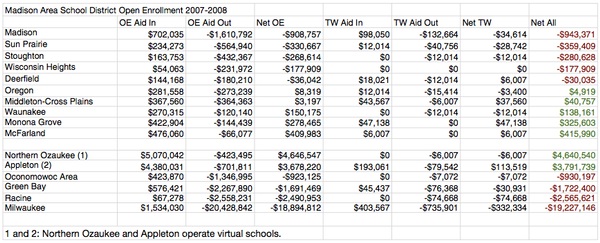
Details available in this .xls file from the Wisconsin DPI.
A few links as the open enrollment period draws to a close:
Via a kind reader’s email.
Given the recent economic news, it seems everyone wants to talk about the long-term impact of short-term thinking. Why not do the same with education and magnet schools? Think of the issues educators faced 30 or 40 years ago: Smart kids not being challenged? Academically under-prepared kids, most of them ethnic minorities, moving in and test scores going down? It’s completely logical that they chose a path to create magnet schools. But it was a short-term solution that has had long-term negative consequences.
I take my students to lots of outside events where they are required to interact with students who come from magnet or high-performing suburban schools. What I see time after time is how my kids rise to the occasion, performing as well (or at least trying to) as those students whose test scores or geographic location landed them in much more demanding academic environments.
On a daily basis, I see the same kids who do amazing things when surrounded by their brightest counterparts from other schools slip into every negative stereotype you can imagine, and worse, when surrounded by their under-performing peers at our “neighborhood” school.
When educational leaders decided to create magnet schools, they didn’t just get it wrong, they got it backwards. They pulled out the best and brightest from our communities and sent them away. The students who are part of the “great middle” now find themselves in an environment where the peers who have the greatest influence in their school are the least positive role models.
Schools adapted, and quickly. We tightened security, installed metal detectors, and adopted ideas like zero-tolerance. And neighborhood schools, without restrictive admission policies based on test scores, quickly spiraled downward — somewhat like an economy. Except in education, we can’t lay off students who have a negative impact on the school culture. That is why adopting such a business model for the educational system has been and always will be a recipe for failure.
What should have been done was to pull out the bottom ten percent. Educational leaders could have greatly expanded the alternative school model and sent struggling students to a place that had been designed to meet their educational needs.
As happens in every recession, Washington area school systems are cutting back. It’s depressing. Here’s an antidote: Harness the creativity of educators, parents and students to improve our schools without more spending. Some teachers I trust helped me come up with these seven ideas.
1. Replace elementary school homework with free reading. Throw away the expensive take-home textbooks, the boring worksheets and the fiendish make-a-log-cabin-out-of-Tootsie-Rolls projects. One of the clearest (and most ignored) findings of educational research is that elementary students who do lots of homework don’t learn more than students who do none. Eliminating traditional homework for this age group will save paper, reduce textbook losses and sweeten home life. Students should be asked instead to read something, maybe with their parents — at least 10 minutes a night for first-graders, 20 minutes for second-graders and so on. Teachers can ask a few kids each day what they learned from their reading to discourage shirkers.
2. Unleash charter schools. I know, I know. Many good people find this suggestion as welcome as a call from a collection agency. They think charter schools, public schools that make their own rules, are draining money from school systems, but the opposite seems to be true. In most states, charters receive fewer tax dollars per child than regular public schools. Yet they often attract creative principals and teachers who do more with less. School finance experts don’t all agree, but I am convinced that charters are a bargain. So let’s have more. That won’t save money in the District, one of the few places that pay as much for charters as regular schools, but Maryland and Virginia would find more charters a boon if they dropped their suburban, aren’t-we-great notions and listened to what imaginative educators in a few little charter schools could teach them.
3. Have teachers call or e-mail parents — once a day would be fine — with praise for their children. Some great classroom teachers make a habit of contacting parents when kids do something well. Jason Kamras, 2005 national teacher of the year and now a leading D.C. schools executive, used to punch up the parent’s number on his cellphone while standing next to a student’s desk. It doesn’t take long. It doesn’t cost much. But it nurtures bonds among teachers, students and parents that can lead to wonderful things.
The $100 billion in emergency aid for public schools and colleges in the economic stimulus bill could transform Arne Duncan into an exceptional figure in the history of federal education policy: a secretary of education loaded with money and the power to spend large chunks of it as he sees fit.
Upon meeting department employees last month, Arne Duncan, the new education secretary, asked them to call him by his first name. “My name is Arne,” he said. “It’s not Mr. Secretary.”
But the money also poses challenges and risks for Mr. Duncan, the 44-year-old former Chicago schools chief who now heads the Department of Education.
Mr. Duncan must develop procedures on the fly for disbursing a budget that has, overnight, more than doubled, and communicate the rules quickly to all 50 states and the nation’s 14,000 school districts. And he faces thousands of tricky decisions about how much money to give to whom and for what.
“It’ll be wonderful fun for a time for his team — it’ll be like Christmas,” said Chester Finn, a former Department of Education official who has watched education secretaries or commissioners come and go here since the mid-1960s. “But the thing about discretionary spending is that it makes more people angry than it makes happy.”
What comes through when Mr. Bush is asked about education is how radical his views are. He would toss out the traditional K-to-12 scheme in favor of a credit system, like colleges have.
“It’s not based on seat time,” he says. “It’s whether you accomplished the task. Now we’re like GM in its heyday of mass production. We don’t have a flourishing education system that’s customized. There’s a whole world out there that didn’t exist 10 years ago, which is online learning. We have the ability today to customize learning so we don’t cast young people aside.”
This is where Sweden comes in. “The idea that somehow Sweden would be the land of innovation, where private involvement in what was considered a government activity, is quite shocking to us Americans,” Mr. Bush says. “But they’re way ahead of us. They have a totally voucherized system. The kids come from Baghdad, Somalia — this is in the tougher part of Stockholm — and they’re learning three languages by the time they finish. . . . there’s no reason we can’t have that except we’re stuck in the old way.”
The Johns Hopkins University, the state’s largest private employer, said yesterday that it will freeze hiring and salaries, eliminate overtime and lay off some workers in response to a revenue shortfall estimated at $100 million by the summer of 2011.
Top Hopkins administrators will also take a 5 percent salary cut, with the savings going into financial aid as the university tries to protect its students from the recession that is taking a steep toll in higher education. The carnage in the financial markets has reduced Hopkins’ endowment by 20 percent. It now stands at $2.4 billion.
The cost-cutting measures will have a ripple effect on the region’s economy, affecting not just Hopkins employees but vendors and others who rely on the university to make a living. In total, the Johns Hopkins Institutions employ 38,200. The cuts affect only the university, which employs about 20,000.
“This is unambiguously bad news,” said Richard Clinch, an economist at the University of Baltimore who studies local economies. “It will impact everybody from low-wage workers in support jobs to high-wage workers who spend their money in the city going out to dinner.”
So maybe I was wrong. I used to consider health care our greatest national shame, considering that we spend twice as much on medical care as many European nations, yet American children are twice as likely to die before the age of 5 as Czech children — and American women are 11 times as likely to die in childbirth as Irish women.
Yet I’m coming to think that our No. 1 priority actually must be education. That makes the new fiscal stimulus package a landmark, for it takes a few wobbly steps toward reform and allocates more than $100 billion toward education.
That’s a hefty sum — by comparison, the Education Department’s entire discretionary budget for the year was $59 billion — and it will save America’s schools from the catastrophe that they were facing. A University of Washington study had calculated that the recession would lead to cuts of 574,000 school jobs without a stimulus.
“We dodged a bullet the size of a freight train,” notes Amy Wilkins of the Education Trust, an advocacy group in Washington.
So for those who oppose education spending in the stimulus, a question: Do you really believe that slashing half a million teaching jobs would be fine for the economy, for our children and for our future?
Five candidates are on the statewide primary ballot this Tuesday, February 17, 2009. One of them will replace outgoing Superintendent Libby Burmaster. The candidates are
Wisconsin voter information, including polling locations can be found here. Much more on the Wisconsin DPI here. Wisconsin’s curricular standards have been criticized for their lack of rigor.
Turning over control of a school system to a mayor is no cure-all for problems, and it is “messy, difficult work” to make such changes, according to an analysis of other cities being released today by the Greater Milwaukee Foundation.
The report and a forum set for Monday night to discuss it amount to firing the starting gun on a crucial debate over whether the mayor or some new body should take over Milwaukee Public Schools, or whether the MPS School Board should be revamped.
Mayor Tom Barrett is signaling that he is more serious than at any point since he was elected in 2004 about the possibility of putting the school system under his control.
“It’s time we do have a conversation about what’s best for the children of this community,” he said.
Barrett did not give a direct answer on whether he wants control of MPS but said, “We have to have significant change in the fiscal management of the district if it’s going to survive.”
He said he did not want to take over MPS in the absence of other steps to deal with problems that threaten the school system. They include an estimated $2.4 billion in commitments to pay benefits to current and future retirees. Progress on such issues almost surely would take broad, innovative agreements between city, state and union leadership.
To what extent has governance reform in large, urban public school districts resulted in better student performance, greater accountability, and more educational innovation? When a school district is governed by a mayor, do the district’s fortunes improve?
The answers to these questions, unfortunately, are not clear cut. Large urban districts that have experienced governance reform have often seen several iterations of reform over the course of several years and mixed results. Still, despite the complexity of their reform efforts over the past decade, comparable school districts have much to teach policymakers and educators in Milwaukee. The Public Policy Forum researched several comparable districts and came up with these key findings:
Education Secretary Arne Duncan would have $5 billion under the stimulus bill to back new approaches to improve schools, a fund that could prod states to raise standards and reward top teachers as the Obama administration presides over a massive infusion of federal education aid.
The Race to the Top Fund, as Duncan calls it, is part of about $100 billion the bill would channel to public schools, universities and early childhood education programs nationwide, helping stave off teacher layoffs, keep class sizes in check and jump-start efforts to revamp aging schools.
But the windfall also could mark the beginning of a deeper transformation of schools seven years after the No Child Left Behind law mandated an expansion of testing and new systems for school accountability.
They sound like workout sessions at a gym, but “flex periods” are fast becoming a scheduling strategy among Northern Virginia high schools that want to offer students remediation or enrichment during the school day rather than before or after classes.
High schools in Loudoun, Fairfax and Prince William counties have been inserting these chunks of time — from 40 to 90 minutes, depending on the school — for several years, often to reduce after-school tutoring costs but also to raise achievement in the era of the federal No Child Left Behind law.
The program varies among schools, but the premise is similar: Between regular courses, students are assigned to a flex classroom to review material or work independently. Flex time can also be used for attending schoolwide events. And if a student needs help from a teacher in another part of the building, he or she can get a pass and visit the teacher during flex time.
Students at Stonewall Jackson High School near Manassas are in the second year of a flex program. Reactions have been mixed: Some students interviewed said the periods help them catch up on homework or review tough lessons with teachers, but others said the time is often exploited by students prone to goofing off or leaving school property. Schools are trying to crack down on the latter.
A move to create a union at one of the city’s leading charter schools may turn into a protracted battle, as the deadline passed on Thursday for the school, KIPP AMP in Crown Heights, Brooklyn, to voluntarily recognize the union.
The United Federation of Teachers, which is seeking to represent the teachers, must now file for recognition with the state’s Public Employment Relations Board, which will most likely give the school’s administration several days to respond.
David Levin — a founder of the national network that operates the schools, the Knowledge Is Power Program, and the superintendent of its four New York City schools (another will open this summer) — said that the administration would “respect and follow the state process,” but did not specify what, if any, challenges it would raise with the labor board.
“For the past 15 years, it has been the ability of everyone to work together, and to do that with flexibility has been the key to our success,” Mr. Levin said in an interview on Thursday. “We were created as an alternative to the public schools, and we need to be committed to and maintain our work and focus on results.”
In the national charter school debate, Boston has special significance. The city has unleashed imaginative teachers to run both independent charter schools and semi-independent “pilot” schools, with much of the rest of the country waiting to see which does best.
Teachers unions and charter opponents have put unusual emphasis on this contest. Boston pilot schools were designed to show that schools with collectively bargained pay scales and seniority protections could do just as well as charters, whose teachers are usually non-union.
Charters, independently operated schools with public funding, were not designed to be anti-union. American Federation of Teachers founding president Al Shanker originated the charter idea. But many conservatives who think unions stand in the way of raising student achievement have embraced the charter school cause, thus politicizing the debate. Their side just won the first round in Boston, and they are not likely to let charter opponents forget it.
A study by scholars from Harvard, MIT, Michigan and Duke, sponsored by the Boston Foundation, shows the Boston charters are doing significantly better than pilots in raising student achievement. This includes results from randomized studies designed to reduce the possibility that charters might benefit from having more motivated students and parents. The study is called “Informing the Debate: Comparing Boston’s Charter, Pilot and Traditional Schools.”
People who see charters as a ruinous drain on regular public schools, and a threat to job security and salary protections for teachers, are not going to accept this verdict. The data come from just one city, with many qualifications. For instance, the randomized results apply only to charters so popular they have more applicants than they can accept. Less popular charters were not included in that part of the study; they could have reduced the charters’ measured gains if their data had counted.
Milwaukee Public Schools spends significantly more per student than comparable systems around the United States, but, by one measure, has some of the weakest academic results, according to a new analysis by the Wisconsin Taxpayers Alliance.
In line with other research in recent years, the private, nonprofit research organization based in Madison found that the cost of benefits in MPS was especially high – higher than any of the other 15 districts analyzed.
The practices in MPS of paying large amounts for health care for retirees and for supplemental pensions to encourage early retirement, as well as the high price MPS pays for health coverage for everyone in its system, were listed as factors in the high costs of running the system.
The analysis by the Madison-based private, nonprofit organization, which is also known as WISTAX, found:
• MPS spent $8,702 per student in 2005-’06 in compensation for employees, third highest among the 16 districts examined. Only Columbus, Ohio, and Indianapolis were higher.
• Total spending in MPS was $11,277 per student in 2005-’06, also the third highest in the study. The amount spent on instructional costs, $6,825, was the highest among the 16 districts, while the amount spent on central administration costs was the third highest.
• Spending on benefits was $3,195 per student, more than $500 above the second highest school system. Only four of the other districts spent more than $2,000 per student for benefits, including retirement costs and health costs. The MPS benefit costs were 90% above the median of the other 15 districts.
“According to figures from the Wisconsin Association of School Boards, MPS health insurance premiums were more than 50% above the average private sector rate in Wisconsin and about 15% higher than the average Wisconsin school district,” the report said.
A new three-year agreement on healthcare announced Wednesday by the Los Angeles Unified School District will preserve a generous benefits package for about 250,000 employees and their families while also limiting district costs.
But the tentative deal also increases the district’s ongoing budget deficit and could lead to higher medical expenses for employees if healthcare costs continue to rise sharply.
The agreement maintains free lifetime benefits for district employees (there is no monthly payment to the district). But the pact sets benchmarks for when new workers become eligible.
Settling the healthcare issue — the teachers union’s top priority in negotiations — could diminish the immediate possibility of a strike. Just one day earlier, United Teachers Los Angeles leaders had scheduled a strike authorization vote over protracted contract talks.
Parents in Waunakee say they’re concerned about a newer teaching technique that’s combining Spanish and Social Studies into one class.
The elementary school children are learning Social Studies entirely in Spanish — and parents said their children are struggling to learn the lessons.
Parents like Jean Magnes said children are missing out on important Social Studies topics because they simply don’t understand it in Spanish.
“I noticed something was wrong,” Magnes said. “All I knew was that she kept coming home and saying she didn’t like Spanish.”
Other parents said their children feel like they’re failing. Parents are gathering support and forming a grassroots effort to change the teaching style.
I had a couple of interesting run-ins Tuesday when I was trying to get copies of some superintendents’ contracts in light of HISD Superintendent Abelardo Saavedra’s sweet deal. When I called Dallas ISD’s press office and identified myself as a reporter, two different people asked why I wanted a copy of Superintendent Michael Hinojosa’s contract. I told them — because I wanted to see how Saavedra’s deal compared — but, for the record, under the Texas Public Information Act, a superintendent’s contract (or any public document) is public, no matter why the requester is asking.
It’s also illegal for a governmental entity to ask a person why they want a particular document (see Section 552.222). Props, though, to Dallas for sending me a link to the contract with an hour or two. And speaking of links, why don’t all districts post copies of their superintendents’ contracts in an easy-to-find spot on their Web sites? Anyone?
D.C. Schools Chancellor Michelle A. Rhee said yesterday that the deteriorating economy will force the District to cut the wage proposal in its contract offer to the Washington Teachers’ Union. At the same time, Rhee spoke in upbeat and conciliatory terms about negotiations with the union, now in their 15th month.
The financial package Rhee offered in July called for a minimum increase of 28 percent over five years, depending on which salary “tier” teachers selected. But with the District expected to collect at least $456 million less in tax revenue during the 2010 fiscal year, she said the situation has changed. Rhee said she would soon submit a revised final offer.
“Obviously, we’re in a much different situation financially,” Rhee said at a mid-morning news conference, called to highlight improved rates of graduation, attendance and service to special education students.
The chancellor said the financial downturn has not weakened what she has described as commitments from private foundations to fund an unprecedented five-year program of “reform stipends” and performance bonuses for teachers. An information packet given to the union this summer said senior teachers could make as much as $135,000 annually in salary and bonuses. Rhee has declined to name the organizations but has mentioned four to private audiences: Gates, Broad, Dell and Robertson.
There has been a lot of commentary about this NYT story about the unionization drive at the KIPP school in New York. Two quick points, which are both obviously open to debate.
First, I don’t know exactly what is or is not happening at the school. But, isn’t this one possible counter-hypothesis to the assertions in the story: This school is populated with a lot of people — on all sides of the issue of whether or not to unionize — who care deeply about kids, care deeply about the school and its mission, and are going through this process for the first time? In other words, there is an assumption that this is Wal-Mart or some other entity with a track record of and skill set for fighting union drives when in fact it may just be a case of people fumbling through a new and complicated situation.
The proposal would fully fund the Loudoun County School Board’s $747 million budget, which also freezes salaries, increases staff health-care costs and imposes new fees on students and cuts $12 million from this year’s level of local funding costs. Overall education funding is approved by the supervisors, but line-item spending power is in the hands of the School Board.
Bowers’s presentation also included proposals for local funding cuts of up to 15 percent, something supervisors asked to see so that they could better understand the consequences of the budget crunch. If they opt for the most extensive cuts, 404 jobs would be slashed and many public programs would be cut back or eliminated.
The House version of the stimulus plan also includes a one-time allotment for building maintenance. This state pays little more than half the costs of maintaining schools. No surprise then that most school districts have maintenance backlogs that are frightening and potentially dangerous. The $200 million in one-time money our state would receive would help whittle the backlog. The Senate’s version? Nada.
Fortunately, lawmakers in both houses grasp the need to spend more in special education. Washington state is in line for $120 million in new annual spending courtesy of the economic stimulus. For Seattle and many other school districts, the money would put more special-education services in all schools and end the segregating of kids with special needs in just a few schools. The money would also pay for training teachers to work with children with learning disabilities.
There will be new federal money for technology and to pay for educating homeless children. Pell grants will be increased and the underfunded No Child Left Behind federal law will get a much-needed infusion.