School Information System

“Harvard is a real-estate and hedge-fund concern that happens to have a college attached.” Take away their non-profit status.

Annie Lowrey:

The world’s richest university just got a little richer. On Monday, Harvard announced that it has received its largest-ever gift of $350 million and it will rename its school of public health after its benefactor’s father.

Public health is a wonderful and worthy cause, of course, and Harvard has a stellar program dedicated to it. But this gift — like so many other megagifts to megaendowments — has a hint of the ludicrous about it.

Related Stories
Harvard Adds Privilege-Checking to New-Student Orientation
There’s an old line about how the United States government is an insurance conglomerate protected by an army. Harvard is a real-estate and hedge-fund concern that happens to have a college attached. It has a $32 billion endowment. It charges its rich students — and they are mostly from rich families, with many destined to be rich themselves — hundreds of millions of dollars in tuition and fees. It recently embarked on a $6.5 billion capital campaign. It is devoted to its own richness. And, as such, it is swimming in cash.

“But, wait!” you might say. “That $350 million is going to support an educational institution with tremendous public spillover! Harvard does basic scientific research! It teaches doctors! It studies cells and stars and history and it educates underprivileged youths!”

Share

The college degree has become the new high school degree

Catherine Rampell:

You’ve heard of grade inflation? Welcome to the world of degree inflation.

A new report finds that employers are increasingly requiring a bachelor’s degree for positions that didn’t used to require baccalaureate education. A college degree, in other words, is becoming the new high school diploma: the minimum credential required to get even the most basic, entry-level job.

The report is from Burning Glass, a labor market analytics company that mines millions of online job postings. The company found that a wide range of jobs — in management,

administration, sales and other fields — are undergoing “upcredentialing,” or degree inflation. As examples, just 25 percent of people employed as insurance clerks have a BA, but twice that percentage of insurance-clerk job ads require one. Among executive secretaries and executive assistants, 19 percent of job-holders have degrees, but 65 percent of job postings mandate them.

Share

College Access Index: “But the problem for schools is when you admit one of those kids, you forgo $50,000 a year that you could use for other things”

David Leonhardt:

Vassar has taken steps to hold down spending on faculty and staff. Amherst and the University of Florida have raised new money specifically to spend on financial aid for low-income students. American University reallocated scholarships from well-off students to needy ones. Grinnell set a floor on the share of every freshman class – 15 percent – whose parents didn’t go to college.
Over the last decade, dozens of colleges have proclaimed that recruiting a more economically diverse student body was a top priority. Many of those colleges have not matched their words with actions. But some have.
These colleges have changed policies and made compromises elsewhere to recruit the kind of talented poor students who have traditionally excelled in high school but not gone to top colleges. A surprising number of such students never graduate from any college.

Share

The Cost of Waterloo Software Engineering

Peter Sobot:

This past June, I graduated from the University of Waterloo’s Software Engineering program. After 5 long and difficult years, I’m extremely proud to say that I’m a Waterloo grad, and very proud of my accomplishments and experiences at the school. Somewhat surprisingly, myself and most of my classmates were able to graduate from a top-tier engineering school with zero debt. (I know this might sound like a sales pitch – stick with me here.)

Waterloo is home to the world’s largest cooperative education programs — meaning that every engineering student is required to take at least 5 internships over the course of their degree. Most take six. This lengthens the duration of the course to five years, and forces us into odd schedules where we alternate between four months of work and four months of school. We get no summer breaks.

One of the most important parts of Waterloo’s co-op program is that the school requires each placement be paid. Without meeting certain minimum requirements for compensation, a student can’t claim academic credit for their internship, and without five internships, they can’t graduate. This results in Waterloo co-op students being able to pay their tuition in full (hopefully) each semester. In disciplines like Software Engineering, where demand is at an all-time high and many students are skilled enough to hold their own at Silicon Valley tech giants, many students end up negotiating for higher salaries at their internships.

Share

MOOC on Government Surveillance

Stanford:

It’s easy to be cynical about government surveillance. In recent years, a parade of Orwellian disclosures have been making headlines. The FBI, for example, is hacking into computers that run anonymizing software. The NSA is vacuuming up domestic phone records. Even local police departments are getting in on the act, tracking cellphone location history and intercepting signals in realtime.

Perhaps 2014 is not quite 1984, though. This course explores how American law facilitates electronic surveillance—but also substantially constrains it. You will learn the legal procedures that police and intelligence agencies have at their disposal, as well as the security and privacy safeguards built into those procedures. The material also provides brief, not-too-geeky technical explanations of some common surveillance methods.

Share

Why I Just Asked My Students To Put Their Laptops Away

Clay Shirky:

I teach theory and practice of social media at NYU, and am an advocate and activist for the free culture movement, so I’m a pretty unlikely candidate for internet censor, but I have just asked the students in my fall seminar to refrain from using laptops, tablets, and phones in class.

I came late and reluctantly to this decision — I have been teaching classes about the internet since 1998, and I’ve generally had a laissez-faire attitude towards technology use in the classroom. This was partly because the subject of my classes made technology use feel organic, and when device use went well, it was great. Then there was the competitive aspect — it’s my job to be more interesting than the possible distractions, so a ban felt like cheating. And finally, there’s not wanting to infantilize my students, who are adults, even if young ones — time management is their job, not mine.

Share

Malawi app ‘teaches UK pupils 18 months of maths in six weeks’

Spencer Kelly:

An app designed to help provide a better education for children in Malawi has proved an equally effective learning tool for pupils in the UK. In six weeks, children made the same progress in maths as expected after 12 to 18 months of teaching.

It will be an emotional time at my house, when my four-year-old son goes to “big school” for the first time.

As well as wondering where the last four years have gone, and being petrified that he will miss us more than we miss him, there is that niggle about how he will take to schoolwork.

How well will the teachers engage him and ensure he is not left behind?

Although I always assumed technology would play a major role in his education, I certainly didn’t expect him to get a boost from a tool originally designed to provide Malawian children with a better future.

But this is now a possibility, after pupils in Nottingham using a maths teaching app from the charity Onebillion advanced their learning at the same rapid rate as those in Africa, for whom it was originally designed.

Share

Most university undergrads now taught by poorly paid part-timers

Ira Basen::

Kimberley Ellis Hale has been an instructor at Wilfrid Laurier University in Waterloo, Ont., for 16 years. This summer, while teaching an introductory course in sociology, she presented her students with a role-playing game to help them understand how precarious economic security is for millions of Canadian workers.

In her scenario, students were told they had lost their jobs, their marriage had broken up, and they needed to find someplace to live. And they had to figure out a way to live on just $1,000 a month.

Share

Plutarch on Education

British Library Digitized Manuscripts:

Origin: Italy, N. (Venice).Provenance:Owned by the Church of San Francesco della Vigna, Venice.Acquired by Robert Curzon from a priest of the Church of San Francesco della Vigna, along with Add MS 39614 and Add MS 39615, in 1834: ownership inscription, Add MS 39614, f i recto. This note also records five more volumes of the same set as in the possession of the Rev. Walter Sneyd of Denton, Oxford (afterwards of Keele Hall), whose library was sold at Sotheby’s in December 1903: see lots 48, 52, 379, 380. Add MSS 39583-39671, along with Oriental MSS 8729-8855, were bequeathed to the British Museum by Darea Curzon, Baroness Zouche (d. 1917), having been part of the collection formed at Parham, Co. Sussex, by the Hon. Robert Curzon, afterwards 14th Baron Zouche, as the result of his travels in the Levant, etc., in 1833 and later. A copy of Robert Curzon’s Catalogue of Materials for Writing, … Rolls and other Manuscripts and Oriental Manuscript Books (1849), with manuscript additions, accompanied the gift, and is now Add MS 64098.

Share

Why Flunking Exams Is Actually a Good Thing

Benedict Carey:

Imagine that on Day 1 of a difficult course, before you studied a single thing, you got hold of the final exam. The motherlode itself, full text, right there in your email inbox — attached mistakenly by the teacher, perhaps, or poached by a campus hacker. No answer key, no notes or guidelines. Just the questions.

Would that help you study more effectively? Of course it would. You would read the questions carefully. You would know exactly what to focus on in your notes. Your ears would perk up anytime the teacher mentioned something relevant to a specific question. You would search the textbook for its discussion of each question. If you were thorough, you would have memorized the answer to every item before the course ended. On the day of that final, you would be the first to finish, sauntering out with an A+ in your pocket. And you would be cheating

Share

Suit seeks to derail Camden Renaissance schools

Julia Terruso:

A group of Camden public school advocates and parents has filed a lawsuit against the state education commissioner, saying he did not properly assess the “financial and segregative impact” of approving two Renaissance schools to open in the city.

Mastery and Uncommon Schools were approved July 7 by acting Commissioner David Hespe and opened elementary schools earlier this month.

Save Our Schools New Jersey, a group that has frequently been critical of the new administration of the state-run district, has asked Hespe to rescind his approval of the schools.

The lawsuit claims the Renaissance schools would drain traditional public schools of needed funds and exclude disabled and minority students – an impact they say the commissioner failed to consider in his one-page approval.

Mastery and Uncommon, along with KIPP, which was approved in 2012, have contracts with the district to collectively serve more than 9,000 students in the district of 15,000 by 2024.

Of the 15,000 students, 11,500 currently are in traditional public schools and 3,500 are in charter schools.

“The schools must not be allowed to open . . . under a cloud of constitutional and statutory uncertainty,” said Princeton-based attorney Richard E. Shapiro in a letter to Hespe days before the suit.

The lawsuit was filed Aug. 21, but Save Our Schools member and Camden mother MoNeke Ragsdale, one of three people named as complainants in the suit, said the group wanted to wait until after the school year started to announce the legal action.

via Laura Waters

Share

In Which I Extract My Kid From the Clutches of Traditional Schooling

JD Tuccille:

I can’t say it was the stress-induced puking that caused my wife and I to finally pull our son from his brick-and-mortar charter school. We’d been contemplating yanking him from a classroom setting for the past year or so. Over the summer, we ran him through a battery of academic tests and encouraged him to study math and Spanish online. The results were enlightening, but we thought he might be a little young for a full online education. And then the nervous tic developed as the start of school approached. That decided us well before he barfed at the thought of the next day’s schedule of classes.

Anthony’s (he started insisting on his full name) charter school is a good effort of the type. During a July meet-and-greet, the school principal and his teacher were amenable to a flexible approach—especially one that takes into account the flawed math genes I handed off to him. He grasps some lessons about math, while others on exactly the same concepts might as well be written in Sanskrit. They said they’d work with him. And they tried.

But a classroom is fundamentally a classroom. It has a structured day, and a bunch of kids requiring the divided attention of a teacher. The kids are part of a group, and mostly they’re taught as part of that group.

And my kid is now twitching and puking at the thought of school. This does not work for me.

Share

A teacher ‘marketplace’ emerges in post-Act 10 Wisconsin; Remarkable

Molly Beck:

“The great irony is that Act 10 has created a marketplace for good teachers,” said Dean Bowles, a Monona Grove School Board member.

Fellow board member Peter Sobol said though the law was billed as providing budget relief for school districts and local government, it could end up being harder on budgets as districts develop compensation models that combine their desire to reward good teachers and the need to keep them. Knowing how many teachers each year will attain the leadership responsibilities and certifications that result in added pay will be difficult.

Monona Grove is developing a career ladder to replace its current salary schedule. The new model is still being drafted by a committee of district administrators, school board members and teachers, but its aim will be to reward “increased responsibility, leadership, ‘stretch assignments’ and other contributions to the district and school missions,’ ” according to the district.

“We thought we could do better,” Monona Grove School District superintendent Dan Olson said, adding that the message to parents is that with the new model, “we’ll be able to keep our good teachers.”

Bowles said the process should result in a district being a place that might not offer the highest pay in the state, but be a place teachers want to work.

“ ‘Attract and retain’ is one of the goals on that list, and in my judgment that does not boil down to” just salary, he said. “It’s also, ‘This is a place I hope you want to be,’ and our kids will benefit from it.”

Ironically, Madison rates not a mention….

Act 10 notes and links.

Share

The Trouble With Harvard The Ivy League is broken and only standardized tests can fix it

Steven Pinker

The most-read article in the history of this magazine is not about war, politics, or great works of art. It’s about the admissions policies of a handful of elite universities, most prominently my employer, Harvard, which is figuratively and literally immolated on the cover.

It’s not surprising that William Deresiewicz’s “Don’t Send Your Kid to the Ivy League” has touched a nerve. Admission to the Ivies is increasingly seen as the bottleneck to a pipeline that feeds a trickle of young adults into the remaining lucrative sectors of our financialized, winner-take-all economy. And their capricious and opaque criteria have set off an arms race of credential mongering that is immiserating the teenagers and parents (in practice, mostly mothers) of the upper middle class.

Deresiewicz writes engagingly about the wacky ways of elite university admissions, and he deserves credit for opening a debate on policies which have been shrouded in Victorian daintiness and bureaucratic obfuscation. Unfortunately, his article is a poor foundation for diagnosing and treating the illness. Long on dogmatic assertion and short on objective analysis, the article is driven by a literarism which exalts bohemian authenticity over worldly success and analytical brainpower. And his grapeshot inflicts a lot of collateral damage while sparing the biggest pachyderms in the parlor.

Share

Poverty in the suburbs

Reihan Salam:

When I was a small child, something called “the suburbs” kept snatching away my friends, like a monster hiding under the bed, but worse. Over time, I’ve come to appreciate why my friends moved. The urban neighborhoods of my Brooklyn youth were a little rough around the edges, and they didn’t offer growing families much in the way of elbow room. I couldn’t fall asleep without the sweet sound of sirens blaring, but not everyone felt the same way. The suburbs have long been a welcome refuge for families looking for a safe, affordable place to live.

But for many Americans, the suburbs have become a trap. This week, Radley Balko of the Washington Post vividly described the many ways bite-sized suburban municipalities in St. Louis County prey on poor people. Towns too small or too starved of sales tax revenue to sustain their own local governments stay afloat by having local law enforcement go trawling for trumped-up traffic violations, the fines for which can be cripplingly expensive, and which only grow more onerous as low-income residents fail to pay them. Those who can afford lawyers know how to massage a big fine into a smaller one. Those who can’t dread their run-ins with local police, who often come across less like civic guardians and more like cash-thirsty pirates. The resentment and distrust that follows is, according to Balko, crucial for understanding the recent unrest in Ferguson, Missouri.

Share

Book Discussion on The Smartest Kids in the World

cspan 3 via Richard Askey:

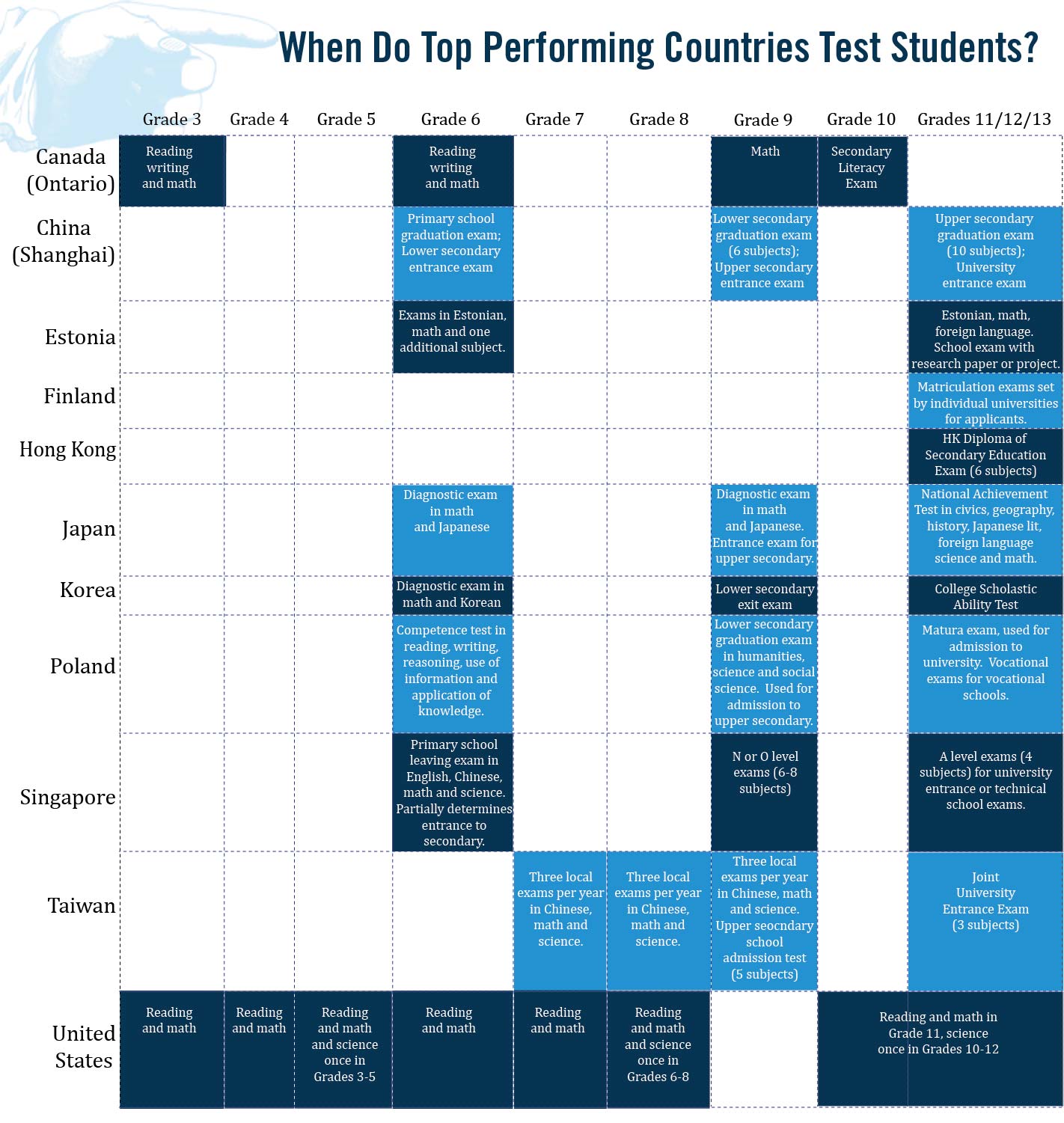
Amanda Ripley talked about her book, The Smartest Kids in the World: And How They Got That Way. In her book she followed three American high-school students who each spent a year in a high-scoring foreign school system, in Finland, South Korea, and Poland.

She spoke in the Science Pavilion of the 2014 National Book Festival, which was held August 30 by the Library of Congress at the Walter E. Washington Convention Center in Washington, D.C. close

Ripley mentioned that in her observation principals spend up to half their time on sports matters.

Share

One Dad’s Twitter Photo Essay on His Daughter’s Perilous Walk to School

Tanya Snyder:

By the way, Turner’s daughter is trying out the walk to school because the 18-block journey, which takes six to eight minutes in a car, takes 55 minutes on the school bus. She’s the first on and the last off, commuting two hours a day to get 18 blocks. It takes half an hour to walk it. Last year, her parents drove her every day, but now they’re trying the walk.

“This morning was my first on walking duty,” Turner wrote. “Spent the entire walk explaining to our 9yo all the different ways cars had been prioritized. Because I want her to have plenty of ammo for future therapy.”

Two blocks from Turner’s house on a walkable street with a sidewalk they come face to face with the car-centric, ped-hostile design he was talking about: this “outsized intersection” with “gas station sliplanes, ped markings beyond faded.”

Share

Kentucky State University drops 645 students for not paying tuition

Lance Vaught:

Kentucky State University said that it had no other choice but to drop 645 students for not making their required tuition payments.

The school said the unpaid money had added to the college’s $7 million deficit.

According to the university, some students’ balances were as high as $40,000 and had stretched over a two-year period.

Interim President Raymond Burse said KSU had tried to contact and counsel students over the past 18 months for not meeting their financial obligations.

Share

Colorado joins campus football arms race with stadium deal

Michael McDonald:

The University of Colorado is joining the athletic-facilities arms race with a $155 million football stadium overhaul as it seeks to revive a struggling program and keep pace with conference competitors.

The public university sold a record $304 million of tax-exempt bonds last month, according to data compiled by Bloomberg. It will use $100 million for the stadium on the flagship Boulder campus, and $25 million will go toward a parking garage. The rest will refinance debt and fund projects such as a $49 million student village, bond documents show.

via Noel Radomski.

Share

Online learning is not the answer to Saudi’s persistent educational and employment gaps

Hannah Geis:

Saudi leaders may not want women to drive, but they do want them to use massive open online courses (MOOCs). But Saudi Arabia’s embrace of MOOCs as a bandage for failures in its own educational system may be premature.

On July 15, edX, a nonprofit MOOC provider based in Cambridge, Massachusetts, and Saudi Arabia’s Ministry of Labor launched a pilot open-platform MOOC portal designed “exclusively for Arab audiences” to minimize the gap between educational and employment levels in the kingdom and across the Arab world. The new e-learning curriculum, aimed at rural communities, women, youth and persons with disabilities will include licensed courses from edX university partners, translated into Arabic, as well as original courses offered by Saudi institutions.

Share

Why my children were lucky to get accepted to a Finnish school in Qatar

Sonia Vermer:

I launched into the same speech I’d given a dozen others before him: My family is moving to Doha. I am seeking school placement for our daughters. Yes, I realize it is late to enroll. I know, your school probably has a wait list, and my daughters don’t have a hope in hell of getting in. But my children are bright (!) creative (!) gifted even (at least I thought so).

I was one breath short of nominating them for a Nobel Peace Prize when he interrupted: “Actually, you’re one of the first parents to call. We’d be delighted to meet with your girls,” he said.

Two weeks later, my children and I boarded a plane for Doha on a quest to secure them a Nordic education in the Qatari desert.

My daughters have spent most of their lives happily ensconced in Toronto’s west end, a neighbourhood filled with farmers markets and some of the best public schools in the city. But when my husband was offered a job in Doha in Qatar – a tiny Persian Gulf country roughly twice the geographic size of Prince Edward Island – their educational trajectories veered off course.

Share

Grading Teachers, With Data From Class

Farhad Manjoo:

Halfway through the last school year, Leila Campbell, a young humanities teacher at a charter high school in Oakland, Calif., received the results from a recent survey of her students.

On most measures, Ms. Campbell and her fellow teachers at the Aspire Lionel Wilson Preparatory Academy were scoring at or above the average for Aspire, a charter system that runs more than a dozen schools in California and Tennessee.

Share

Why Colleges With a Distinct Focus Have a Hidden Advantage

Neil Irwin

Take a look at any of the most widely followed ratings of America’s colleges and universities, and almost all of the top-ranked schools will have this in common: They want to appeal to everyone, or at least everyone with a brilliant mind and a work ethic to match.

Their course offerings are balanced among math and science, the humanities and social sciences. They seek the highest-performing students of all sorts: Men and women, of any religion and geographical background, with any career ambition imaginable.

Every student, of course, tries to find the school that best fits his or her personality and ambitions. But ultimately, most Swarthmore students would do just fine at the University of Chicago, and most young people studying away at Cornell would do well at Rice, too, at least once they got used to the Texas accents.

Share

“They are intellectually underpowered and full of themselves, because they’ve been told their whole life how wonderful they are”

Michael Schulson:

In the spring of 2008, William Deresiewicz taught his last class at Yale. In the summer of 2008, he published an essay explaining how an Ivy League education had messed up his life, and the lives of his students.

Elite schools, Deresiewicz argued, give their students an inflated sense of self-worth. They reward perfectionism and punish rebelliousness. They funnel timid students into a handful of jobs, mostly in consulting and investment banking (and now Teach for America). For a real education, he went on to suggest, you might want to head to one of the wonkier liberal arts colleges, or to a state school.

For those sensitive to the advantages of Deresiewicz’s pedigree (a B.A. and Ph.D. from Columbia, followed by 10 years on Yale’s English faculty), this might sound like a rarefied form of whining. But Deresiewicz’s essay took off. Then an undergraduate at Yale, I remember reading it with a quiet mix of amazement and horror. A former professor could say this stuff? About us?

In his new book, “Excellent Sheep,” Deresiewicz expands his argument into a full-on manifesto about the failures of the meritocracy. His timing is good. Ambitious families continue to arm their children with APs, SAT prep courses and expensive admissions advisors. At the same time, despite big financial aid packages, the student bodies at elite schools remain staggeringly affluent.

Share

New technology helps students learn Chinese

Mark Niu:

Students at the Council on International Educational Exchange in Shanghai are trying out special software.

They’re taking the world’s first fully-automated spoken Chinese Test. It questions, evaluates, and scores without ever involving a human assessor.

The test and technology were created in collaboration with Peking University and the Silicon Valley company Pearson, located in Menlo Park, California.

Pearson says with around 50 million people are now learning Chinese globally. Its software seeks to help international companies and higher education institutions assess Chinese language skill faster and more accurately.

Share

The Evolution Of The Employee

Jacob Morgan:

This concept and the visual was taken from my new book which came out today called, The Future of Work: Attract New Talent, Build Better Leaders, and Create a Competitive Organization.

One of the things I have been writing about and have tried to make clear over the past few months is that work as we know it is dead and that the only way forward is to challenge convention around how we work, how we lead, and how we build our companies. Employees which were once thought of expendable cogs are the most valuable asset that any organization has. However, the employee from a decade ago isn’t the same as the employee who we are starting to see today. To help show that I wanted to share an image from my upcoming book which depicts how employees are evolving. It’s an easy way to see the past vs the future.

Yet, our K-12 structures remain unchanged, from their agrarian era roots.

Share

The New History Wars

James Grossman:

WITH the news dominated by stories of Americans dying at home and abroad, it might seem trivial to debate how history is taught in our schools. But if we want students to understand what is happening in Missouri or the Middle East, they need an unvarnished picture of our past and the skills to understand and interpret that picture. People don’t kill one another just for recreation. They have reasons. Those reasons are usually historical.

Last month, the College Board released a revised “curriculum framework” to help high school teachers prepare students for the Advanced Placement test in United States history. Like the college courses the test is supposed to mirror, the A.P. course calls for a dialogue with the past — learning how to ask historical questions, interpret documents and reflect both appreciatively and critically on history.

Share

Where to be born 2013

The Economist:

A QUARTER of a century ago, The World in 1988 light-heartedly ranked 50 countries according to where would be the best place to be born. Then, America came top (see chart on left). Now the Economist Intelligence Unit has more earnestly calculated where would be best to be born in 2013. Its quality-of-life index links the results of subjective life-satisfaction surveys—how happy people say they are—to objective determinants of the quality of life across countries. Being rich helps more than anything else, but it is not all that counts—things like crime and trust in public institutions matter too. In all, the index takes 11 indicators into account. Some are fixed, such as geography; others change only very slowly over time (demography, social and cultural characteristics). See full article.

Share

The key differences between Indian and Chinese students studying in the US

Saptarishi Dutta:

India and China already compete over global influence and natural resources. Here’s a new area of rivalry—the number of students each has in America.

From 2008-12, India sent 168,034 students to the US, accounting for 15% of the total foreign students studying there, according to a new Brookings Institution report. This number is second only to China’s 284,173 students enrolled in various programs in US universities during the same period.

Share

The Vexing Legacy of Lewis Terman

Mitchell Leslie:

To the Los Angeles juvenile authorities in 1923, Edward Dmytryk was an ordinary runaway trying to escape a vicious father who tore up his schoolbooks and clubbed him with a two-by-four. Mr. Dmytryk wanted his 14-year-old son back — if only, as the caseworker suspected, because Edward brought home vital income.

While the authorities deliberated, a letter arrived from Professor Lewis Terman, the nation’s most famous psychologist and the man who had planted the term “IQ” in America’s vocabulary. He wasn’t a relative or family friend; he had never even met the boy. But the Stanford professor believed Edward deserved a break because he was “gifted” — a word Terman coined to describe the bright kids he devoted his life to researching.

Edward’s high score on an IQ test had qualified him for Terman’s pathbreaking Genetic Study of Genius. Terman, who had grown up gifted himself, was gathering evidence to squelch the popular stereotype of brainy, “bookish” children as frail oddballs doomed to social isolation. He wanted to show that most smart kids were robust and well-adjusted — that they were, in fact, born leaders who ought to be identified early and cultivated for their rightful roles in society.

Though the more than 1,000 youngsters enrolled in his study didn’t know it at the time, they were embarking on a lasting relationship. As Terman poked around in their lives with his inquisitive surveys, “he fell in love with those kids,” explains Albert Hastorf, emeritus professor of psychology. To the group he always called “my gifted children” — even after they grew up — Terman became mentor, confidant, guidance counselor and sometimes guardian angel, intervening on their behalf. In doing so, he crashed through the glass that is supposed to separate scientists from subjects, undermining his own data. But Terman saw no conflict in nudging his protégés toward success, and many of them later reflected that being a “Terman kid” had indeed shaped their self-images and changed the course of their lives.

Share

Sesame Street: not suitable for children

Hadley Freeman:

Thrillingly, the early episodes of Sesame Street have just been released on DVD, but be warned – those shows are dangerous! Slapped across the front of the case is the message, “These early Sesame Street episodes are intended for grown-ups, and may not suit the needs of today’s preschool child.” And looking at the wobbly sets and be-stringed puppets, they probably are better suited to sentimental adults than kids raised on Pixar. But this sticker is an expression of concern.

It’s not the psychedelic nature of the programme in its 70s incarnation that worries, but the behaviour it might encourage. Children dancing in the street! Grown men reading storybooks to kids – for no apparent reason!

Cookie Monster is the number one problem, not because he is a monster, but because he eats cookies (encourages obesity), and when his addiction takes a special stranglehold, the plate (might hurt). His alter ego, Alistair Cookie, used to smoke a pipe before eating it, which, Sesame Street producer Carol-Lynn Parente explained to the New York Times, “modelled the wrong behaviour”, and so Alistair was, tragically, dropped, and he now probably munches down on pipes in bitterness in illegal pipe dens.

The clearly depressed Oscar the Grouch is another problem: “We might not be able to create a character like Oscar today,” said Parente, which is possibly one of the most depressing sentences I have read in my life.

Share

Is Your Student Prepared for Life?

Ben Carpenter:

AS 16 million young adults set off for college this fall, they are looking at some frightening statistics. Despite the ever-rising cost of getting a degree, one number stands out like a person shouting in a campus library: According to a recent poll conducted by AfterCollege, an online entry-level job site, 83 percent of college seniors graduated without a job this spring. Even when these young people finally do get jobs, the positions are often part time, low wage or not related to their career interests. The problem isn’t the quality of higher education in the United States, so what’s missing?

Two years ago, in a full-blown panic, I asked myself this exact question when I realized that my eldest daughter, a recent college graduate, had no idea what the world was about to demand of her. She had gone to a good school and done well as a student, but had never thought about her future in a structured way, and I realized what she was missing — an education in career training.

Share

gap, Latin America must produce better teachers

The Economist:

THE Liceo Bicentenario San Pedro is a modern secondary school in Puente Alto, a gritty district of Santiago in Chile. Opened in 2012, the school nestles amid the vestiges of a shantytown where urban sprawl meets the vineyards of the Maipo valley. Most of its pupils are drawn from families classed as “vulnerable”. Yet in national tests it ranks fourth among municipal (ie, public) schools in Chile.

The school has done well by hiring committed young teachers and by offering them more time for preparation and in-service training, according to Germán Codina, the mayor of Puente Alto. When Bello strolled around the liceo recently, he saw teachers who visibly commanded the attention of their pupils. Sadly, it is far more common in Latin American schools to see inattentive children talk among themselves while a teacher writes on the blackboard. It is schooling by rote, not reasoning. And it imposes an unacceptable handicap on Latin Americans.

Share

Cancel that violin class

The Economist:

parents fear two things: that their children will die in a freak accident, and that they will not get into Harvard. The first fear is wildly exaggerated. The second is not, but staying awake all night worrying about it will not help—and it will make you miserable.

Modern parents see risks that their own parents never considered. They put gates at the top of stairs, affix cushions to table corners and jam plastic guards into sockets to stop small fingers from getting electrocuted. Those guards are “potential choking hazards”, jests Lenore Skenazy, the author of “Free-Range Kids”. Ms Skenazy let her nine-year-old son ride the New York subway on his own. He was thrilled; but when she spoke about it on TV, a mob of worrywarts called her “America’s worst mom”.

Share

The College Education Bubble

Michael Hurd

Clearly, government intervention has done for the higher educational marketplace what it did for the real estate marketplace a decade back. Politicians in both parties decided that it would be nice for everyone to own a house. As a result, regulations and incentives were initiated by the government to ensure that home loans were cheap and easy to get. This created the biggest real estate bubble in human history. Who got the blame? The private lenders and “lack of regulation,” even though it was regulation (i.e. manipulation of the marketplace for political ends) that gave us the bubble. (For one of the best books on this subject, see Cato Institute president and former BB&T CEO John Allison’s The Financial Crisis and the Free Market Cure: Why Pure Capitalism is the World Economy’s Only Hope.)

It’s the same dynamic in education. Government “does everything possible to ensure every young American gets a college education.” What could be wrong with that? In practice, it means government does everything possible to make it easier for people to get college educations, thereby driving up demand relative to the limited supply. This inevitably breeds inflation. The more you try to make something free or cheap, the more demand you will create for it. The result will either be shortages or inflation. There’s no getting around it!

Politicians such as Barack Obama, Elizabeth Warren and others maintain that college tuition inflation is the fault of the private sector and mean people who won’t allow “more” funding. But what does “more funding” actually consist of? The national debt cannot be paid off for decades or centuries, and it’s growing exponentially even without more student aid. More loans? But tampering with the loan marketplace, artificially stimulating demand, only creates a bubble, as we saw with real estate and now with education.

Share

Reading and Curricular Suggestions & Links as the school year begins

Wisconsin Reading Coalition via a kind email:

With the beginning of a new school year, here is some timely information and inspiration.

You can make a difference: At WRC, we are often focused on top-down systemic change that can improve reading outcomes for students across our state. However, bottom-up, individual efforts are equally important. A letter from Colin Powell, Alma Powell, and Laysha Ward in the Washington Post reminds us that as individuals we can be part of the solution. “Imagine that you have an envelope beneath your chair, containing the name of a child in need and within your reach. He or she is heading back to school now but is at risk of not finishing. There are students like this in every community across the country, just waiting for someone to connect with them. This school year, we challenge you to find your Nico Rodriguez: Reach out directly to your local school, parent-teacher association or a relevant nonprofit with an offer to volunteer. . . Whatever path you choose, know that everybody can do something, starting today.” If you are in the Milwaukee area, please consider volunteering for one of the reading tutor pilots through Milwaukee Succeeds. We at WRC have a personal investment in programs at St. Catherine’s School at 51st and Center and Northwest Catholic School at 41st and Good Hope. With as little as an hour a week, you can participate in providing Orton-Gillingham-based intervention to struggling K5-2 students. Contact Audra Brennan at 414-336-7038, or abrennan@milwaukeesucceeds.org

​Adult literacy issues: In his recent article, Time to knock out illiteracy, James Causey of the Milwaukee Journal Sentinel highlighted the reading difficulties of boxing champion Floyd Mayweather, and suggested that Mayweather address his reading issues and become a “better role model for black boys across America, who have the worst reading scores of any group in the nation.” Rapper 50 Cent and disc jockey Charlamagne Tha God have publicly humiliated Mayweather by pointing out his reading difficulties. Causey states: “It’s hard to feel sorry for Mayweather because he loves playing the bad guy in the ring and he’s made enough money to afford the best tutors and educators in the world. Which begs the questions, why hasn’t he learned to read yet?” Mary McFadden, a Milwaukee adult basic education tutor, responded in an opinion comment: “I can think of a few reasons. Reading difficulties are not the result of a lack of intelligence or a lack of effort. Unfortunately, effective programs for adults with learning disabilities or learning challenges are available but not very prevalent. Also, seeking help means having to tell someone you have a problem, which is difficult for many people. . . . I believe that greater pressure should be applied to 50 Cent to become a role model by educating himself on learning disabilities, apologizing for his cruel behavior and encouraging people to celebrate each other’s strengths while showing empathy and compassion as we all struggle with our weaknesses.”

You can’t learn if you’re not there: Wisconsin Superintendent Tony Evers sent some important information to school principals concerning the importance of student attendance, particularly in the early years of school. Resources and strategies for improving attendance are included. “The evidence from Wisconsin is irrefutable: students with good attendance in Kindergarten through Grade 2 have higher rates of reading and math proficiency in later grades. Good attendance in the early years also predicts good attendance rates throughout a student’s K-12 education. Data reveal that repeated early absence has negative educational implications for children.”

Setting the bar on Smarter Balanced assessment: Anyone with opinions on appropriate and fair cut scores for the upcoming Smarter Balanced assessments may participate in the achievement level setting process. An online national panel requires just three hours over two days during a window from October 6 through 17. Don’t complain if you don’t participate. Click here to register.

A win for the good guys: The Federal Trade Commission recently announced a settlement of its action against Infant Learning, Inc. and its owner for false educational claims related to its “Your Baby Can Read” product. The final order in the U.S. District Court for the Southern District of California imposes monetary judgements exceeding $185 million, which will be suspended after the owner pays $300,000. The Federal Trade Commission works for consumers to prevent fraudulent, deceptive, and unfair business practices and to provide information to help spot, stop, and avoid them. To file a complaint in English or Spanish, visit the FTC’s online Complaint Assistant or call 1-877-FTC-HELP (1-877-382-4357). The FTC enters complaints into Consumer Sentinel, a secure, online database available to more than 2,000 civil and criminal law enforcement agencies in the U.S. and abroad. The FTC’s website provides free information on a variety of consumer topics. Like the FTC on Facebook, follow us on Twitter, and subscribe to press releases for the latest FTC news and resources.

Focus on dyslexia: Wisconsin FACETS offers a free telephone workshop on September 24 from 12-1 PM. The program, titled “Red Flags of a Struggling Reader,” will be presented by Cheryl Ward. Register online at www.wifacets.org, or contact Sandra McFarland at 877-374-0511 or smcfarland@wifacets.org. Also, the National Center for Learning Disabilities (NCLD), has dyslexia basics, a free dyslexia toolkit, top 10 resources, and more on its website. A video on the dyslexic brain is also available.

It’s a big job: Lest we forget, effective reading intervention is not an easy or quick fix, particularly when begun at third grade or later. A recent New York Times article discusses the third-grade retention movement in multiple states, and the summer school programs that are seeking to avoid that outcome for students. It highlights the importance of teaching reading the right way from the start, and intervening early when problems surface. (Note: you may have to close numerous pop-up windows to read this article.)

Literate Nation Virtual Boot Camp: The Literate Nation organization will offer a free virtual boot camp on how to create literacy change in your community. This is a live webcast of a 1-1/2 day event in Denver, CO, that runs from Saturday, October 18 through Sunday, October 19. Participate individually or form your own group. Click here to register.
Share

Acting French: It’s hard to learn a new language. But it’s way harder to learn a new culture.

Ta-Nehisi Coates:

spent the majority of this summer at Middlebury College, studying at l’École Française. I had never been to Vermont. I have not been many places at all. I did not have an adult passport until I was 37 years old. Sometimes I regret this. And then sometimes not. Learning to travel when you’re older allows you to be young again, to touch the childlike amazement that is so often dulled away by adult things. In the past year, I have seen more of the world than at any point before, and thus, I have been filled with that juvenile feeling more times then I can count—at a train station in Strasbourg, in an old Parisian bookstore, on a wide avenue in Lawndale. It was no different in Vermont where the green mountains loomed like giants. I would stare at these mountains out of the back window of the Davis Family Library. I would watch the clouds, which, before the rain, drooped over the mountains like lampshades, and I would wonder what, precisely, I had been doing with my life.

I was there to improve my French. My study consisted of four hours of class work and four hours of homework. I was forbidden from reading, writing, speaking, or hearing English. I watched films in French, tried to read a story in Le Monde each day, listened to RFI and a lot of Barbara and Karim Oullet. At every meal I spoke French, and over the course of the seven weeks I felt myself gradually losing touch with the broader world. This was not a wholly unpleasant feeling. In the moments I had to speak English (calling my wife, interacting with folks in town or at the book store), my mouth felt alien and my ear slightly off.

Share

Poison Ivy

Nathan Heller

William Deresiewicz, a former professor of English at Yale, believes that choices must be made. Shortly after leaving the university, six years ago, he published a widely discussed essay in The American Scholar describing élite college students as whiz careerists caught up in a system that “rarely asked them to think about something bigger than the next assignment.” Now, some pointed essays later, he has sought to thread together his complaints into a prickly graduation tassel of a book. “Excellent Sheep: The Miseducation of the American Elite and the Way to a Meaningful Life” (Free Press) is an attack on college culture in this overscheduled age. The sheep are the students—he also calls them “Super People,” “an alien species,” and “bionic hamsters”—and he thinks that, with respect to their education, everything they do right puts them in the wrong.

Share

Children with autism ‘have too many synapses in their brain’

Medical News Today:

new study by researchers from the Columbia University Medical Center in New York, NY, finds that children and adolescents with autism have too many synapses in their brain, which can affect their brain function. Furthermore, the team believes it may be possible to reduce this excess synapse formation with a drug, paving the way for a novel autism treatment strategy.

Share

Why textbooks cost so much

The Economist:

STUDENTS can learn a lot about economics when they buy Greg Mankiw’s “Principles of Economics”—even if they don’t read it. Like many popular textbooks, it is horribly expensive: $292.17 on Amazon. Indeed, the nominal price of textbooks has risen more than fifteenfold since 1970, three times the rate of inflation (see chart).

Like doctors prescribing drugs, professors assigning textbooks do not pay for the products themselves, so they have little incentive to pick cheap ones. Some assign books they have written themselves. The 20m post-secondary students in America often have little choice in the matter. Small wonder textbooks generate megabucks.

But hope is not lost for poor scholars. Foreign editions are easy to find online and often cheaper—sometimes by over 90%. Publishers can be litigious about this, but in 2013 the Supreme Court ruled that Americans have the right to buy and resell copyrighted material obtained legally. Many university bookstores now let students rent books and return them. Publishers have begun to offer digital textbooks, which are cheaper but can’t be resold. And if all else fails, there is always the library.

Share

25 Maps That Explain College a Football

Jason Kirk:

In 1869, students at Rutgers invited students from Princeton over for sport. They played an evolving New England game sort of like soccer and sort of like rugby and mostly just brawling in a field. A week later, a rematch. And they wanted to have a tie-breaker, but faculty complained about the students spending all their time brawling in fields. And so ended the first season of American football. Since then, not much has really changed, other than it now being inconceivable that academics could ever stop a college football game from happening. And yes, Princeton claims to have won the 1869 national championship.

Share

How to Game the College Rankings

Max Kutner:

In 1996, Richard Freeland looked across the sea of crumbling parking lots that was Northeastern University and saw an opportunity few others could. As the school’s new president, he had inherited a third-tier, blue-collar, commuter-based university whose defining campus feature was a collection of modest utilitarian buildings south of Huntington Avenue, with a sprinkling of newly plant.

The university had been a victim of many things, most notably federal cutbacks—rolled out in the mid-’80s—that had left many colleges scrambling for money to close their budget gaps. These cutbacks, combined with dwindling enrollment, had forced Northeastern’s previous president, Jack Curry, to slash the budget and cut 875 jobs in the early 1990s. When he announced the layoffs to his staff, Curry burst into tears. “To say it was an institution in turmoil would be an understatement,” says a vice provost from that time.

But Freeland, the man who had helped successfully launch UMass Boston over the previous two decades, had a plan. Freeland believed that if Northeastern could justify its increased costs to students and parents, it could be saved. And one gauge consistently determined a college’s value: its position on the U.S. News & World Report “Best Colleges” rankings. Freeland observed how schools ranked highly received increased visibility and prestige, stronger applicants, more alumni giving, and, most important, greater revenue potential. A low rank left a university scrambling for money. This single list, Freeland determined, had the power to make or break a school.

Share

Bright foreigners like to study in America. Shame they can’t stay

The Economist:

THE number of foreign students at universities in America reached a new high of 819,644 last year. Many of them came from China on F-1 visas, which are reserved for students. Chinese studying in America now number 200,000, up from 16,000 in 2003. Students from India, South Korea and Saudi Arabia also flock to America’s top-notch universities.

Foreign students contribute over $30 billion to the American economy, according to a new report from the Brookings Institution, a think-tank. But few are invited to stay past their studies. The number of H-1B visas, which are given to skilled foreign workers, has barely budged over the past decade (see chart). America is not trying to poach bright young minds, say officials. Research has shown that foreigners who study in America bring liberal values back home with them.

Share

Turkey’s education row deepens as thousands placed in religious schools ‘against their will’

Hurryet Daily News:

Turkey’s secondary education examination row has deepened, amid reports that thousands of students, including some non-Muslims, have been placed in Islamic vocational schools for the upcoming school year.

After the results for the national primary to secondary education (TEOG) examination were announced earlier this month, there were a number of reports that around 40,000 students had been placed in religious “imam-hatip” schools against the will of their families.

Education Ministry Deputy Undersecretary Muhterem Kurt confirmed that a total of 9,802 students had been placed in schools far away from the districts where they live, but stressed that there was “no need to panic.” Kurt told daily Milliyet that there would be an opportunity for re-allocation in mid-September.

According to the new system, students failing to get into their top-preferred school as a result of the exam are placed in schools nearest to their area. However, many claim that too many regular schools have been turned into imam-hatip schools in recent years, making it difficult for some children to avoid a religion-focused education even if they do not want it.

Share

College Tuition Costs Soar: Chart of the Day

Michelle Jamrisko and Ilan Kolet:

The cost of higher education has jumped more than 13-fold in records dating to 1978, illustrating bloated tuition costs even as enrollment slows and graduates struggle to land jobs.

The CHART OF THE DAY shows that tuition expenses have ballooned 1,225 percent in the 36-year period, compared with a 634 percent rise in medical costs and a 279 percent increase in the consumer price index.

Share

My advice for kids: The 1,000-hour rule

Philip Guo:

I’m not yet qualified to give general life advice to kids, but I would like to share one simple piece of advice that I would’ve liked to hear when I was a kid:

Find something you genuinely enjoy doing for its own sake, stick with it, keep learning more about it, and after a decade or so, you can’t help but get good at it and feel proud of yourself.

This is my own personal take on the popular 10,000-hour rule, which claims that it takes around 10,000 hours of intense practice to become an expert in a particular topic. For instance, top-notch musicians, artists, athletes, scientists, and other experts in their respective fields all share a common experience: They practiced consistently and with high intensity for over 10,000 hours, often starting at a young age. That amounts to practicing for 4 hours every weekday for a decade straight, which takes tremendous passion and perseverance.

Share

Student Apps Teach Colleges a Thing or Two

Ariel Kaminer:

Vaibhav Verma was frustrated that he could not get into the most popular courses at Rutgers University, so he decided to try a new approach.
He didn’t sleep outside classrooms to be first in line when the door opened, or send professors a solicitous note. Instead, he built a web-based application that could repeatedly query the New Jersey university’s registration system. As soon as anyone dropped the class, Mr. Verma’s tool would send him a message, and he would grab the open spot.

“I built it just because I was a little bit bored,” he said.

By the next semester, 8,000 people had used it.

Share

America’s public schools remain highly segregated, by choice?

Reed Jordan:

Fifty million children will start school this week as historic changes are under way in the U.S. public school system. As of 2011 48 percent of all public school students were poor* and this year, students of color will account for the majority of public school students for the first time in US history.

What is surprising about these shifts is that they are not leading to more diverse schools. In fact, the Civil Rights Project has shown that black students are just as segregated today as they were in in the late 1960s, when serious enforcement of desegregation plans first began following the passage of the 1964 Civil Rights Act.

Despite our country’s growing diversity, our public schools provide little contact between white students and students of color. We’ve mapped data about the racial composition of US public schools to shed light on today’s patterns at the county level. These maps show that America’s public schools are highly segregated by race and income, with the declining share of white students typically concentrated in schools with other white students and the growing share of Latino students concentrated into low-income public schools with other students of color.

Related: Madison has long supported wide variation in school demographics.

Share

Summer Jobs Are Slowly Disappearing

Ben Casselman:

Maurice Brown has spent the summer doing something that’s increasingly unusual for American teenagers: going to work.

Brown, 17, works 25 hours a week as a fry cook at a McDonald’s down the street from where he lives in Holyoke, Massachusetts. While classmates were at the beach or the mall, Brown was learning life skills — how to behave in a professional workplace, how to multitask when the lunch rush started, how not to talk back when his managers criticized him. He said he hopes the experience will help him get a job after college. And though the pay was low, he was able to buy his own school clothes and save some money toward a car.

“I was tired of having to wait for my mom and ask her for things,” Brown said.

Research has shown that teenagers — and especially teenage boys — who work are more likely to graduate high school, more likely to go to college and less likely to get into trouble with the law. They also gain valuable work experience that can make it easier to get a job and get promoted more quickly in adulthood. But for a variety of reasons — fewer job opportunities, more emphasis on schooling, changing societal expectations — fewer young people are getting summer jobs.

Share

Closed shop at the top in deeply elitist Britain, says study

Andrew Sparrow:

Britain is “deeply elitist” because people educated at public school and Oxbridge have in effect created a “closed shop at the top”, according to a government report published on Thursday.

The Social Mobility and Child Poverty Commission said its study of the social background of those “running Britain” was the most detailed of its kind ever undertaken and showed that elitism was so embedded in Britain “that it could be called ‘social engineering'”.

Share

Looking at the Numbers: What Scales in K-12, Anyway?

Alex Hernandez:

Last week, I heard the following exchange between an education entrepreneur and a philanthropist for 9,358th time:

Education entrepreneur: “I want to start a [insert new idea].”

Philanthropist: “Great. How is it going to scale?”

I work for an education philanthropy with the word “growth” in its name. I love the scale. And even I finally cracked. What do we mean when we say “scale” in education?!

I haphazardly started listing out K12 organizations, programs, policies and ideas, along with estimates of the number of students reached per year. Student reach statistics were drawn from the National Center for Education Statistics, organizational websites, articles and other general web research, and spanned 2012 to 2014. (Disclaimer: this is an informal thought exercise, not a PhD dissertation). Here’s what I came up with:

Share

Pisa tests to include many more Chinese pupils

Sean Coughlan:

There will be a much wider sample of Chinese pupils taking part in the next round of the international Pisa tests.

Shanghai took part in the most recent tests and had the highest results.

But there were claims that the city was not representative of schools in other parts of China.

The Organisation for Economic Co-operation and Development (OECD) which runs the tests has announced that Beijing, Jiangsu and Guangdong will take part, alongside Shanghai.

The Pisa tests, taken every three years by 15-year-olds, have become one of the most influential international benchmarks for education standards.

Share

On Equality

Nicholas Eberstadt:

Is the human condition becoming more unequal? Many assert it is, but their focus is almost exclusively on economic inequality. This is problematic for two key reasons.

First, even in data-rich America, statistics on wealth distribution are at best rudimentary. Measured economic equality differs dramatically depending on whether one looks at income (pre- or post-tax? by the year or over a lifetime?), or at personal consumption, which seems to be distributed much more equally.

More crucially, income is not the only important measure of human well-being and life chances. Consider two global revolutions that are improving the human condition and making it more equal.

The first is how long people live. In 1751, according to the Human Mortality Database, Sweden’s overall life expectancy at birth was barely 38 years. But this was an arithmetic average for a population within which survival prospects were wildly, brutally disparate. Roughly a fifth of all Swedes died in their first year of life; by age 5 only 70 Swedes were still alive of every 100 born. But about half of those who made it to age 5 lived to 60 and beyond.

Share

When Chinese children forget how to write

Celia Hatton:

In China, it takes blood, sweat and months of studying dictionaries to become a Character Hero.

Millions tune in every week to watch teenagers compete for the title. Character Hero is a Chinese-style spelling bee, but in this challenge, young contestants must write Chinese characters by hand.

Every stroke, every dash must be in the correct spot.

After two tense rounds, Wang Yiluo is bumped from the contest. She bows to the panel of celebrity judges and quickly exits the bright lights of the television studio.

Backstage, she admits that she spent months studying dictionaries to prepare for the contest. The stakes were high; at 17, this was the last year she could appear on the show.

“I wanted to compete before I was too old,” she explained.

Share

College Rankings That Aren’t Ridiculous – Washington Monthly’s 2014 College Guide, now online

Paul Glastris:

Today the Washington Monthly releases its annual College Guide and Rankings. This is our answer to U.S News & World Report, which relies on crude and easily manipulated measures of wealth, exclusivity, and prestige for its rankings. Instead, we rate schools based on what they are doing for the country — on whether they’re improving social mobility, producing research, and promoting public service. This fall, the Obama administration will release its plan to rate America’s colleges and universities based on measures of access, affordability and outcome, similar metrics to those used by Washington Monthly for years.

The Washington Monthly’s unique methodology yields striking results.

* Only two of U.S. News’ top ten schools, Stanford and Harvard, make the Washington Monthly’s top ten. Yale, Columbia, Brown and Cornell don’t even crack our top 50.
* Instead, the University of California – San Diego (our #1 national university for the fifth year in a row) and the University of Texas – El Paso (unranked by U.S. News but #8 on our list) leave several members of the Ivy League in the dust.
* While all the top twenty U.S. News universities are private, 14 of the top twenty Washington Monthly universities are accessible, affordable, high-quality public universities.

Share

Teacher Evaluations in an Era of Rapid Change: From “Unsatisfactory” to “Needs Improvement”

Chad Aldeman & Carolyn Chuong:

Over the last four years, states implemented remarkable changes to their teacher evaluation systems. Rather than rating all educators as either “satisfactory” or “unsatisfactory,” school districts use new multi-tiered evaluation systems to identify their best (and weakest) teachers. States now require districts to incorporate measurements of student academic growth and rubrics from higher-quality classroom observations into their ratings of teachers and principals. And teachers and principals are starting to receive financial incentives or face potential consequences based on these evaluation results.

But after the initial rush of reforms, progress stalled. The rollout of new evaluation policies slowed down as districts faced implementation challenges and increasing public backlash against teacher evaluation reforms.

Via Laura Waters.

Share

Drugging our Kids

Karen De Sa

They are wrenched from abusive homes, uprooted again and again, often with their life’s belongings stuffed into a trash bag.

Abandoned and alone, they are among California’s most powerless children. But instead of providing a stable home and caring family, the state’s foster care system gives them a pill.

With alarming frequency, foster and health care providers are turning to a risky but convenient remedy to control the behavior of thousands of troubled kids: numbing them with psychiatric drugs that are untested on and often not approved for children.

An investigation by this newspaper found that nearly 1 out of every 4 adolescents in California’s foster care system is receiving these drugs — 3 times the rate for all adolescents nationwide. Over the last decade, almost 15 percent of the state’s foster children of all ages were prescribed the medications, known as psychotropics, part of a national treatment trend that is only beginning to receive broad scrutiny.

“We’re experimenting on our children,” said Los Angeles County Judge Michael Nash, who presides over the nation’s largest juvenile court.

Share

Reinventing American K-12 Education

Mary Dooe & Genevieve Wilson:

How do we reinvent American education?

An Unconventional Education Toolbox

You can start at the very beginning, with preschoolers and kindergarteners.

Dr. Roberta Ness, author of “Genius Unmasked” and Dean of the School of Public Health at the University of Texas, explains why Maria Montessori’s method for teaching was so successful. Montessori schools, which have a bit of a cult following in Silicon Valley, encourage creativity and inquisitiveness in a way that traditional schools don’t.

Share

‘Building a Better Teacher’ and ‘Getting Schooled’

Sebastian Stockman:

“Education is not the filling of a pail, but the lighting of a fire.” The greeting-card pithiness of this maxim obscures what is in fact a useful metaphor, and in “Building a Better Teacher,” Elizabeth Green introduces us to educators who stick to their kindling. Her project is both a history of the research on effective teaching as well as a consideration of how that research might best be implemented. What emerges is the gaping chasm between what the best teachers do and how we go about evaluating what they’ve done.

Green outlines the teacher-training debate as one between proponents of accountability on one side and autonomy on the other. She points out that both sides assume what she calls “the myth of the natural-born teacher.” The accountability folks want to use test scores to ­identify these gifted teachers and winnow out the others; the autonomy advocates want to give them creative control over their classrooms. Green, a journalist and the editor of Chalkbeat, an education news organization, argues that good teaching is largely “the result of extraordinary skill, not inborn talent.” If lighting a fire is a skill, it can be learned, and it can be taught.

Share

School Boards: “a frog at the bottom of a deep well trying to guess what is going on above based on leaves and birds flying by”

Laura Waters:

Late Sunday night yet another Trenton Board of Education member resigned, leaving only four members of the nine-member, mayor-appointed group, one less than a quorum and, thus, unable to approve any district appointments, allocations, contracts, or programming initiatives. According to the Trenton Times, Roslyn Council sent in her formal letter of resignation to Trenton Mayor Eric Jackson, following the lead of Sasa Olessi-Montano and Mary Taylor Hayes, who both resigned earlier this summer. Another member resigned earlier in the year.

But not to worry: While the Times notes that “[i]n the meantime the school board will be unable to take action on any school district items with the start of the school year two weeks away,” the district attorney, Kathleen Smallwood Johnson said “there is nothing that is essential to the start of the school year that would require board approval.” Mayor Jackson will, accordingly, take his time and appoint new members in “another week or so.”

Actually, at the meeting on Monday that was cancelled due to lack of a quorum, the published Agenda has 91 pages of recommendations, including approval of annual contracts with preschool providers, a “Proposal for Bilingual/English as a Second Language Department for the 2014-2015 school year at a cost not to exceed $272,812.00,” updated math curricula, and new supervision and intervention programs at various city schools intended to “provide students…with a safe environment before and after the regular school day.”

Share

Where are first graduates of Chicago’s Urban Prep?

Lolly Bowean:

As a student in the first class of Urban Prep Charter Academy for Young Men, Tyler Beck found himself enveloped in a nurturing environment where teachers came in early and stayed late to help tutor struggling students. There, the boys formed a brotherhood and learned affirmations that kept them pumped up to achieve.

“We were taught, ‘Each one reach one,’ and ‘It takes courage to excel.’ We all learned to help each other because we all wanted to succeed,” Beck said. “There were people who could say they’d been right where you were from and they could say they knew what your life was like.”

But four years later, at the idyllic East Coast private college to which Beck was accepted, the atmosphere was dramatically different. And even though he had earned a full academic scholarship to attend, Beck was not prepared.

Related: the proposed Madison Preparatory Academy IB Charter School, rejected by a majority of the Madison School Board.

Share

Teaching Math-Conversations on the Rifle Range 7: Winds and Currents, Formative Assessments, and the Eternal Gratitude of Dudes

Barry Garelick, via a kind email:

All my classes were getting ready to take their first quiz later in the week. My second period class was the second-year Algebra 1 class. We were working on systems of linear equations covering the various ways of solving two equations with two unknowns.

I was preparing for my second period class by looking over the upcoming quiz and identifying the questions that most students would likely get wrong. As I reached the disturbing conclusion that this would be almost all the questions, Sally, the District person who talked to the math teachers about Common Core the day before school began, stuck her head in the door and asked if I had done any of the activities she had talked about that day. These were discovery-oriented projects that lead students to explore certain topics (specifically: probability, repeating decimals, and solving systems of equations) while allowing teachers to do formative assessments. Which means evaluating students by observing them “communicate and defend their thinking”.

Share

Three reasons college textbook prices are out of control

Libby Nelson:

University of Wyoming professor Peter Thorsness didn’t used to pay much attention to how much the introductory biochemistry textbooks on his syllabus cost. He knew they were expensive, but he expected that students would use them over and over as a reference.

Then his daughter went to college. Since then, “I know what things cost,” Thorsness said. And that’s changed how he thinks about his own textbook assignments.

Recently, Thorsness and other faculty members picked one textbook — Lehninger Principles of Biochemistry — that students could use for three courses in sequence, so they wouldn’t have to spend more each semester. And Thorsness knows the exact bookstore price: $277.

The price of college textbooks has been rising rapidly for decades — much faster than consumer prices:

Share

Generation Later, Poor Are Still Rare at Elite Colleges

Richard Perez-Pena:

As the shaded quadrangles of the nation’s elite campuses stir to life for the start of the academic year, they remain bastions of privilege. Amid promises to admit more poor students, top colleges educate roughly the same percentage of them as they did a generation ago. This is despite the fact that there are many high school seniors from low-income homes with top grades and scores: twice the percentage in the general population as at elite colleges.

A series of federal surveys of selective colleges found virtually no change from the 1990s to 2012 in enrollment of students who are less well off — less than 15 percent by some measures — even though there was a huge increase over that time in the number of such students going to college. Similar studies looking at a narrower range of top wealthy universities back those findings. With race-based affirmative action losing both judicial and public support, many have urged selective colleges to shift more focus to economic diversity.

Share

Adjunct professors fight for crumbs on campus

Colman McCarthy:

We are the stoop laborers of higher education: adjunct professors.

As colleges and universities rev for the fall semester, the stony exploitation of the adjunct faculty continues, providing cheap labor for America’s campuses, from small community colleges to knowledge factories with 40,000 students. The median salary for adjuncts, according to the American Association of University Professors, is $2,700 per three-credit course. Some schools raise this slightly to $3,000 to $5,000; a tiny few go higher. Others sink to $1,000. Pay scales vary from school to school, course to course. Adjuncts teaching upper-level biophysics are likely to earn more than those teaching freshman grammar.

Via Fabius Maximus.

Share

Math wars: Rote memorization plays crucial role in teaching students how to solve complex calculations, study says

Joseph Brean:

In a finding sure to inflame the math wars, a team of neuroscientists has revealed the crucial role played by rote memorization in the growing brains of young math students.

Memorizing the answers to simple math problems, such as basic addition or the multiplication tables, marks a key shift in a child’s cognitive development, because it helps bridge the gap from counting on fingers to complex calculation, according to the new brain scanning research.

The progression from counting on fingers to simply remembering that, for example, six plus three equals nine, parallels physical changes in a child’s brain, in which the hippocampus, a key brain structure for memory, gradually takes over from the pre-frontal parietal cortex, an area of higher order reasoning.

Related: Math Forum.

Share

Are Courses Outdated? MIT Considers Offering ‘Modules’ Instead

Jeffrey Young:

People now buy songs, not albums. They read articles, not newspapers. So why not mix and match learning “modules” rather than lock into 12-week university courses?

That question is a major theme of a 213-page report released on Monday by a committee at the Massachusetts Institute of Technology exploring how the 153-year-old engineering powerhouse should innovate to adapt to new technologies and new student expectations.

Share

Textbook Prices: Don’t Shop Online

Carl Staumshein:

Faculty members at George Washington University are once again free to tell students they can save money by buying their textbooks online, after the university initially urged professors to stop pointing students to sources other than the campus bookstore.

In a letter dated July 17, the university reminded faculty members of its “contractual obligation” with Follett, which runs the campus bookstore. Since the company has the “exclusive right” to provide textbooks and other course materials for all of the university’s courses, “alternative vendors may not be endorsed, licensed or otherwise approved or supported by the university or its faculty.”

The letter irked many faculty members — not only did it prevent them from helping students save some money on textbooks, but it also seemed to prohibit them from listing on their syllabuses open educational resources, online exercises and other content that could help students understand the material.

Share

Healthcare cost growth pushed to faculty

Colleen Flaherty:

Institutions say complying with the Affordable Care Act has caused them to pass on some costs to employees, according to a new survey from the College and University Professional Association for Human Resources.

Since the act began to take effect, some 20 percent of institutions have made changes to benefits in an effort to control associated costs, the survey says. About the same percentage of colleges are considering making changes, or making further changes, in the year ahead. Of those institutions that have made changes so far, 41 percent have increased employees’ share of premium costs. Some 27 percent have increased out-of-pocket limits, while about one-quarter increased in-network deductibles or dependent coverage costs, or both. Some 20 percent increased employees’ share of prescription drug costs.

Healthcare spending has long been a significant issue in the Madison Schools. 25.62% (!) of the District’s 2014-2015 budget ($402,464,374) is spent on benefits.

Share

Guest Post: Why Students Prefer Google, and Why They Should Favor Teacher-Librarians

Emily Gover

Here at EasyBib, we research, discuss, and write a lot about how students conduct research in high school and college. We are constantly analyzing data from our 42 million users to see how they approach research, and using that data to improve our services.

Research shows that the overwhelming majority (96%) of students use Google in course-related contexts. Unfortunately, this is probably an unsurprising statistic for many of you. School and college librarians play an integral role in student academic success, yet students (and, from what we’ve heard, even some fellow faculty members!) don’t take fundamental research skills very seriously.

Here are just a few (out of many!) reasons why students should rely on their awesome teacher-librarians instead of the ubiquitous search engine, and consider basic information literacy skills and academic integrity as a natural part of their research, writing, and education.
Plagiarism goes beyond the classroom.

Through analyzing our user data, many of our student users are not even aware that they should cite paraphrased sources. Yikes! Students may not care about citing their sources now, because they believe that once they graduate, no one will care about whether or not they included a citation in their research papers, anyway. Explaining to students that plagiarism is a serious issue that has negatively impacted many professional lives can put the harsh consequences of plagiarism into a clear perspective.

We recently created a list on the EasyBib blog about celebrity plagiarism accusations. It’s likely that students have more interest in stories about rock stars and actors than, say, a politician dropping out of a Senate race. Placing plagiarism into a context that students can relate to can help them not only understand the consequences of committing plagiarism, but also see that acknowledging other people’s work is a lifelong practice.

Share

Making School Choice Work Requires Leadership

Robin Lake, via aaa kind Deb Britt email:

This commentary was originally published in Education Week on August 18, 2014.

It’s a truism in public policy that every solution breeds a new problem. School choice has created new possibilities for families desperate for better options, but it can also create serious access challenges for disadvantaged families. In localities where many state and local agencies can sponsor schools, fragmented governance makes solving those challenges difficult. This is evident in cities where parents now have many school choices and districts must compete for students.

New and promising schooling options exist via charter and private schools, but many families still can’t make them work for their children. Districts and charter authorizers protect their own schools from closure, so weak schools persist, and overall quality stagnates. Recognizing that the best schools have little advantage over weaker ones, the best educators and charter providers go elsewhere.

The Center for Reinventing Public Education, which I direct, recently conducted research in high-choice cities and unearthed both good and bad news for school choice advocates. We found that many parents, including many from highly disadvantaged backgrounds, are now actively choosing their children’s schools and getting access to their first or second choices.

Yet our research also shows that too many parents face serious barriers to finding good schools. They report having trouble getting high-quality information to inform their choices, navigating different eligibility and application requirements, and finding adequate transportation.Parents with the least education and those who have children with special needs report the most-significant barriers to the choice process.

A recent Detroit Free Press series exposed such problems in Detroit’s charter schools. Michigan’s choice system was designed to break up dysfunctional district monopolies as quickly as possible by creating many different statewide charter authorizers. But these entities, funded by fees from the schools they authorize, have little incentive to close low-performing schools. This has created a fragmented governance system in which no one agency has the incentive to care about all of the city’s students.

Share

The Future of College Is Not As Bleak As You Think

Judith Shulevitz:

Few magazine editors—myself included—can resist a dash of apocalypse in a cover line, which is why I don’t fault writer Graeme Wood for the question on the front of this month’s Atlantic: “Is College Doomed?” I’ll answer that question anyway: no. The appetite for college is huge. A larger percentage of Americans are pursuing some sort of post-high-school degree than ever before—70 percent in 2009, compared to 45 percent in 1960—and that number keeps rising. Undergraduate education isn’t going away any time soon.

Wood’s article, actually titled “The Future of College?,” is a profile of the Minerva Project, a new, low-cost, for-profit university that offers intensive seminars on a cool new online “proprietary platform.” It’s Ben Nelson, Minerva’s 39-year-old founder and CEO, who says that colleges as we know them are doomed, because his half-online, half-bricks-and-mortar university is going to disrupt and replace them. Wood is seduced by the prospect, although ultimately he doubts that Nelson could or even should succeed. In describing what makes Nelson’s pitch appealing, however, Wood accepts several premises about the dismal state of higher education that are now so widely held that perhaps he didn’t feel it necessary to defend them. If the following three premises are true, then it is indeed possible that “a whole category of legacy institutions” will have to be liquidated, in Wood’s phrase. But they are not true.

Share

A Driving School in France Hits a Wall of Regulations

Suzanne Daley:

Alexandre Chartier and Benjamin Gaignault work off Apple computers and have no intention of ever using the DVD player tucked in the corner of their airy office. But French regulations demand that all driving schools have one, so they got one.

Mr. Chartier, 28, and his partner, Mr. Gaignault, 25, are trying to break into the driving school business here, using computer technology to match teachers and students across France and to offer cut rates.

But they are not having an easy time. The other driving schools have sued them, saying their innovations break the rules. Their application for an operator’s license for their school, Ornikar, has been met with total silence at the prefecture.

“It seems like the idea is to wait us out until we run out of money,” Mr. Gaignault said recently. “There is an effort to just destroy us.”

Share

The Learning Myth: Why I’m Cautious About Telling My Son He’s Smart

Salman Khan:

My 5-year-­old son has just started reading. Every night, we lie on his bed and he reads a short book to me. Inevitably, he’ll hit a word that he has trouble with: last night the word was “gratefully.” He eventually got it after a fairly painful minute. He then said, “Dad, aren’t you glad how I struggled with that word? I think I could feel my brain growing.” I smiled: my son was now verbalizing the tell­-tale signs of a “growth­ mindset.” But this wasn’t by accident. Recently, I put into practice research I had been reading about for the past few years: I decided to praise my son not when he succeeded at things he was already good at, but when he persevered with things that he found difficult. I stressed to him that by struggling, your brain grows. Between the deep body of research on the field of learning mindsets and this personal experience with my son, I am more convinced than ever that mindsets toward learning could matter more than anything else we teach.

Researchers have known for some time that the brain is like a muscle; that the more you use it, the more it grows. They’ve found that neural connections form and deepen most when we make mistakes doing difficult tasks rather than repeatedly having success with easy ones. What this means is that our intelligence is not fixed, and the best way that we can grow our intelligence is to embrace tasks where we might struggle and fail.

Share

How to properly fund education (hint: not more taxes)

Jonathan Butcher:

First, Arizona should stop paying for ghost students.

Arizona schools can apply for additional funding for current-year enrollment growth, but they do not have to adjust for enrollment decreases in the same year. Traditional school payments are generally not updated until the following year, which means schools get funding for students who aren’t in their classrooms anymore.

As Goldwater Institute research has reported, the state pays about $125 million for empty seats every year.

Traditional school payments should be based on the number of students in the classroom, with payments updated accordingly throughout the year.

Taxpayers already pay more for schools in the lowest-performing districts than the highest-achieving districts. According to data from the Arizona Auditor General’s Office, the average expenditure per child in a “D” district (Arizona has made it nearly impossible to earn an “F”) is $11,900. For districts that earned an “A” on their report card, the average taxpayer expense per child is $9,200.

• The second step the Legislature should take is to eliminate seat-time requirements.

The late Sen. Chester Crandell was a visionary when it came to updating Arizona’s school-finance formula in this way. Two years ago, he led the passage of legislation that created a performance-funding pilot program for Arizona schools. Instead of paying schools based on how long students sit behind their desks each year, Crandell’s program based up to half of participating schools’ funding on how well students are learning.

Share

Heavy Adult Employment Focus in the Milwaukee Public a Schools

Erin Richards

But after Tyson made his offer, an MPS teacher who also is a teachers’ union employee submitted a plan to reopen Lee as a district-run charter school.

The School Board was said to be considering both options. It was scheduled to discuss the potential sale or lease of several empty buildings, including the Lee building, in closed session Tuesday night.

Despite enrollment declines of 1,000 or more students each year for nine years — before an increase in 2013-’14 — the School Board and district administration have been averse to selling their public property to nondistrict school operators. Voucher and nondistrict charter school operators compete with the district for students, and more students attending those schools means potentially fewer students — and less state aid money — coming to MPS.

Supporters of successful private voucher and independent charter schools believe there shouldn’t be so many roadblocks to those schools obtaining building space to expand. St. Marcus’ state achievement test scores are some of the highest in the city for schools with predominantly low-income, minority students.

St. Marcus will be paying around $80,000 a year to lease the Aurora Weier site, which will be called the St. Marcus Early Childhood Center, North Campus. Tyson said they may eventually buy the building.

Up to 250 young children could be served at the new site by next year, Tyson said.

This year, even with the new early childhood site opening, Tyson said about 200 children remain on the waiting list to get into St. Marcus.

An interview with Henry Tyson.

Share

21% of University of Wisconsin System Freshman Require Remedial Math

Karen Herzog:

Regent Margaret Farrow said K-12 must be a strong partner in preparing high school students for college. “We’re not, quite frankly, creating this situation we’re trying to solve.”

Starting next year, all 11th graders in Wisconsin pubic schools will be required to take the ACT college-readiness exam that universities use in their admissions process, Farrow noted. She said she’s concerned about what those test results will show.

“I think we’re doing all we can, but we need help because these are our kids,” Farrow said. “If they aren’t making it, this state and this country aren’t making it. … This is an emergency. This is a tragedy happening.”

The UW’s freshman math remediation rate of 21% is below the national average of 25% to 35%, according to Cross.

UW Regent Jose Vasquez bristled at the UW System taking on “a problem that is really our cohort’s problem,” referring to K-12. “The problem was not created by the university and I’m not convinced we can solve it within the university.”

He advocated earlier intervention in high school.

However, “it’s in all of our best interest to work together on this,” Cross said.

Related: Math Forum.

Madison’s math review task force. Have the results of the task force made a difference?

Share

Eight Years of College Lets Finns Hide From Labor Market

Eero Vassinen:

Easing the long years in college is the fact that students aren’t required to pay tuition. The state also provides grants of as much as 500 euros ($670) a month plus meal support and loans of as much as 400 euros a month. While education is a safe haven for students, the economy suffers when they put off joining the job market and don’t have skills the labor market needs, said Hannu Kaseva, an economist at ETLA research institute in Helsinki.

“Our education system is generating more bums for us,” he said by phone. “Think about the wasted investment when just half of all graduates find work suitable for their education.”

Encouraging universities to cooperate with potential employers would reduce the theoretical nature of studies and help bridge the skills gap, he said. The country doesn’t train enough doctors, nurses and dentists, according to the Economy Ministry. Finland has an oversupply of office workers and IT engineers after Nokia’s success making mobile phones in the early 2000s soured, culminating in the sale this year of its flagship handset unit to Microsoft Corp. (MSFT)

Share

Fixing Our National Accountability System

National Center on Education & The Economy:

In this new report, Marc Tucker, NCEE’s President, calls for replacing the current system of test-based accountability with a system much more likely to result in improvements in student performance. Tucker points out that the current system has not only failed to improve the performance of the at-risk students it was designed to help, but has alienated the best of our current teachers and created an environment in which able young people choosing careers are less likely to choose teaching.

The report explains that the countries in which student performance is outstripping the achievement of American students are not using accountability systems like ours, which they view as more appropriate for industrial-era blue-collar workers than the kind of professionals they want in their schools.

Fixing Our National Accountability System argues for a much needed alternative to the kind of punitive accountability measures now dominating American policy. Fixing accountability will not just require a different accountability system but a different kind of education system altogether.

Share

MIT Offers STEM Institute for Middle School Students

Joshua Bolkan:

Students entering grades 6-9 in the Boston, Cambridge and Lawrence, MA area recently had an opportunity to learn about science, technology, engineering and math (STEM) concepts thanks to a STEM Summer Institute offered by MIT’s Office of Engineering Outreach Programs.

The institute was taught by 15 instructors, mostly graduate and undergraduate students, who “worked closely with expert mentors to prepare their curricula, and academic advisors provided additional student and instructional support,” according to an MIT news release.

Share

Residency program tries to solve problem of teacher burnout

Liz Bowie:

As principal of a small Southeast Baltimore school, Anthony Ruby has guided an array of first-year teachers, from the stars who seem to have an innate sense of how to handle a class to those who were so ineffective he declined to renew their contracts.

When teachers aren’t effective, he said, “it is not fair to our kids,” many of whom are low-income and immigrant.

Hundreds of teachers are hired each year to fill vacancies in Baltimore, and the majority will be newcomers to the profession. In urban districts, where many are assigned to teach children with some of the greatest challenges, the national burnout rate is astonishing. Fifty percent of new teachers leave the profession in the first three years.

Share

The Advantages of Dyslexia

Matthew Schneps:

“There are three types of mathematicians, those who can count and those who can’t.”

Bad joke? You bet. But what makes this amusing is that the joke is triggered by our perception of a paradox, a breakdown in mathematical logic that activates regions of the brain located in the right prefrontal cortex. These regions are sensitive to the perception of causality and alert us to situations that are suspect or fishy — possible sources of danger where a situation just doesn’t seem to add up.

Many of the famous etchings by the artist M.C. Escher activate a similar response because they depict scenes that violate causality. His famous “Waterfall” shows a water wheel powered by water pouring down from a wooden flume. The water turns the wheel, and is redirected uphill back to the mouth of the flume, where it can once again pour over the wheel, in an endless cycle. The drawing shows us a situation that violates pretty much every law of physics on the books, and our brain perceives this logical oddity as amusing — a visual joke.

Share

S.F. teachers miss more school than students on average

Jill Tucker:

If last year’s numbers hold steady, the 4,100 teachers in San Francisco, on average, will each be absent about 11 times this school year, about once every three weeks. That’s four to five days more than a typical student, out of 180 days total.

About seven of those days were for sick or personal leave, and the rest were training days offered or required by the district.

Share

Diane Ravitch: Campbell Brown Shouldn’t Worry Her Pretty Little Head About Education Policy

Jonathan Chait:

Paul Farhi profiles Campbell Brown, the former CNN anchor turned education-reform activist, who is working to end strict teacher tenure protections. Naturally, this enrages teacher-union evangelist Diane Ravitch, who not only disagrees with Brown’s position, but expresses offense that anybody should listen to Brown at all:

“I have trouble with this issue because it’s so totally illogical,” says Diane Ravitch, an education historian. “It’s hard to understand why anyone thinks taking away teachers’ due-process rights will lead to great teachers in every classroom.”

Share

Compton, California School Board Approves AR-15 Rifles for Campus Police

Conor Friedersdorf:

The school board in Compton, California, has voted to arm campus police officers with AR-15 rifles, according to the Los Angeles public radio station KPPC. Some parents and students are expressing discomfort, citing the same sorts of concerns sparked by the militarized police force of Ferguson, Missouri. In Compton, the local police union says its officers are hardly alone in seeking such weapons:

Currently, the following School Districts authorize their Police Officers to deploy these weapons; Los Angeles School PD, Baldwin Park School PD, Santa Ana School PD, Fontana School PD, San Bernandino School PD.

The police union goes on to defend the semi-automatic rifle for campus police officers:

Share

Hunger in America: 2014 National Report

Nancy S. Weinfield, Gregory Mills, Christine Borger, Maeve Gearing, Theodore Macaluso, Jill Montaquila, Sheila Zedlewski (PDF):

Feeding America, the nation’s leading domestic hunger-relief organization, has conducted the most comprehensive study of hunger in America every four years since 1993. Like the prior studies, Hunger in America 2014 (HIA 2014), the latest iteration, documents the critical role that the charitable food assistance network plays in supporting struggling families in the United States. Study results are based on surveys of food programs in the charitable food assistance network supported by Feeding America, and clients that access services through that network in 2012-2013.1 In addition to this report on the Feeding America national network, this study has resulted in 42 state reports and 196 food bank reports detailing network activities on local levels.

The current assessment occurs in a period with historically high demand for food assistance. Unemployment and poverty rates have remained high since the Great Recession of 2008,2 and the number of households receiving nutrition assistance from the federal government’s Supplemental Nutrition Assistance Program has increased by approximately 50 percent between 2009 and 2013.3 Demand for charitable food assistance has also expanded. HIA 2014 finds an increased number of individuals relying on charitable assistance to access nutritious foods for themselves and their families.

Share

California lieutenant governor wants ADs’ jobs tied to academics

Steve Berkowitz:

California Lt. Gov. Gavin Newsom wants the jobs of college athletics directors at the state’s public schools to be tied to athletes’ academic performance.

In letters this week to the chief executive officers of the University of California and the California State University system, Newsom that AD’s contracts “should stipulate aggressive benchmarks for improvement in graduation and academic progress rates” and make the AD’s subject to dismissal if those benchmarks aren’t met.

An “athletic director’s contract should stipulate aggressive benchmarks for improvement in graduation and academic progress rates or face termination, period,” the letter said

The letters went out as three Division I schools in the state — Cal-Berkeley, Fresno State and Sacramento State — are looking for new athletics directors. Andrea Koskey, a spokeswoman for Newsom, said he is seeking to have this stipulation included in the contracts of the new hires, then added to other deals as deals are renewed or vacancies occur.

Share

“More Rigor is Needed” – Madison Superintendent Jennifer Cheatham; Possible?

Pat Schneider:

Middle schools in the Madison Metropolitan School District have become caring environments for students, but aren’t rigorous enough to prepare them for high school academic work, says Superintendent Jennifer Cheatham.

“We know there are quite a few things that highly effective schools do that we have not been doing in both our middle and our high schools,” Cheatham told Madison School Board members Monday during a review of a district report on coursework in the high schools.

“We haven’t established a coherent approach to instruction, as you’ve heard me say again and again, but we are making progress. We’ve all spent quality time in our middle and high school classrooms, and in middle schools in particular, we’ve made tons of progress in creating very caring environments, but the level of rigor and academic challenge isn’t where it needs to be,” Cheatham said.

Related:

Madison’s High School Coursework Review

English 10

Connected Math and https://www.schoolinfosystem.org/?s=%22Everyday+Math%22″>Everyday Math

High School Redesign & Small Learning Communities.

At the end of the day, given the District’s long term disastrous reading results, is it possible to see meaningful achievement improvement with an agrarian / Frederick Taylor era structure?

Share

“poor white British children do worse in school than those of any other group save Romany gypsies”

The Economist:

This also makes the town fashionable in Westminster, where the travails of Britain’s white working class are causing concern. Underscoring how stubbornly they languish, a recent parliamentary study confirmed that poor white British children do worse in school than those of any other group save Romany gypsies. But this fresh attention to the issue is also because it is election season and winning working-class love is, for differing reasons, a preoccupation of all the main parties. For David Cameron’s ruling Conservatives, getting such Britons off welfare and into work is a fiscal and moral mission and a test of Britain’s ability to endure austerity. For Labour, they represent an identity crisis.

Though increasingly drawn from and oriented towards middle England, where most voters reside, Britain’s main opposition still finds its cherished moral authority in a romantic association with the working-class people for whom it was formed. That is why Labour’s unexpected losses to the populist UK Independence party (UKIP) in recent local elections, in hard-up places such as Tilbury, sent the party’s leader Ed Miliband scuttling to Thurrock, the Tory-held marginal in which the town falls. There is now an argument within Labour over how to avoid a repeat of this disaster in next year’s general election, for which Thurrock is UKIP’s number two target seat; some want to ape UKIP with a more populist, especially anti-immigration, message.

Share

Facts Are More Important Than Novelty: Replication in the Education Sciences

Matthew C. Makel & Jonathan A. Plucker:

Despite increased attention to methodological rigor in education research, the field has focused heavily on experimental design and not on the merit of replicating important results. The present study analyzed the complete publication history of the current top 100 education journals ranked by 5-year impact factor and found that only 0.13% of education articles were replications. Contrary to previous findings in medicine, but similar to psychology, the majority of education replications successfully replicated the original studies. However, replications were significantly less likely to be successful when there was no overlap in authorship between the original and replicating articles. The results emphasize the importance of third-party, direct replications in helping education research improve its ability to shape education policy and practice.

Share

Our higher education system fails leftist students

Michael Munger:

Too often, American college students face a one-question test, one based not on facts, but on ideology. The test: “Are you a liberal, or conservative?”

The correct answer is, “I’m a liberal, and proud of it.” That concerns me.

However, the nature of my concern may surprise you. I’m not worried much about the students who get it wrong; for the most part, they actually get a pretty good education.

I’m worried about those who get it right. The young people that our educational system is failing are the students on the left. They aren’t being challenged, and don’t learn to think.

Share

Unschooling

Ben Hewitt:

In early September, in a clapboard house situated on 43 acres just outside a small town in northern Vermont, two boys awaken. They are brothers; the older is 12, the younger 9, and they rise to a day that has barely emerged from the clutches of dark. It is not yet autumn, but already the air has begun to change, the soft nights of late summer lengthening and chilling into the season to come. Outside the boys’ bedroom window, the leaves on the maples are just starting to turn.

Share

Commentary on the Teaching Climate, Cost Disease & Curriculum

David Kirp:

The same message — that the personal touch is crucial — comes from community college students who have participated in the City University of New York’s anti-dropout initiative, which has doubled graduation rates.

Even as these programs, and many others with a similar philosophy, have proven their worth, public schools have been spending billions of dollars on technology which they envision as the wave of the future. Despite the hyped claims, the results have been disappointing. “The data is pretty weak,” said Tom Vander Ark, the former executive director for education at the Bill and Melinda Gates Foundation and an investor in educational technology companies. “When it comes to showing results, we better put up or shut up.”

While technology can be put to good use by talented teachers, they, and not the futurists, must take the lead. The process of teaching and learning is an intimate act that neither computers nor markets can hope to replicate. Small wonder, then, that the business model hasn’t worked in reforming the schools — there is simply no substitute for the personal element.

Related: Since 1950, US schools increased their non-teaching positions by 702%; rank #2 on non teacher staff spending.

Cost Disease“.

Thinking different in Oconomowoc.

Share

‘Vergara’ decision signals start of third wave of education reform

Joshua Lewis:

The June court ruling against teacher employment laws in California was the opening salvo in a battle that already has moved to New York and likely will spread from there. It also could mark the beginning of a third great era of U.S. education reform – one that focuses not on inputs or outcomes but on the workings of schools themselves.

Moments before closing arguments began in the landmark case Vergara v. California, Judge Rolf Treu asked those in his courtroom to stand, turn and look at two portraits: one of U.S. Supreme Court Chief Justice Earl Warren, the other of California Supreme Court Chief Justice Donald Wright. He reminded everyone that Warren led the high court to unanimity in Brown v. Board of Education, which marked the beginning of the end of segregation in U.S. public schools. Then he noted that it was Wright who led the state Supreme Court when, in Serrano v. Priest, it invalidated California’s uneven school financing system. “Both decisions have an impact on what we’re doing here today,” he noted.

Not long afterward, Treu added Vergara to that pantheon. In the most explosive education-related court ruling in a generation, he invalidated several laws dear to California teachers’ unions, including statutes that provide their members generous tenure rights and seniority protections and specify elaborate and costly procedures required to fire a teacher.

The judge’s words were as striking as his verdict: The dismissal statutes prevent firing even “grossly ineffective” teachers whose effect on students “shocks the conscience”; the logic of the “last in, first out” law that prevents job performance from being a factor in layoff decisions is “unfathomable.” Taken as a group, he said, the Vergara statutes particularly harm the most vulnerable: the poor, minority, non-English-speaking students often clustered in low-performing schools.

Share

When Students Teach

Kushal Pokharel:

Before and after school, many of my students—particularly the girls—are responsible for countless hours of chores. Whether it’s planting crops, fetching buckets of water, or tending to cattle, the breadth of their responsibilities extends far beyond their schoolwork in rural Nepal. For example, Sanju, a student in my tenth grade class, washes dishes at her family’s hotel before and after school.

At the same time, my students are incredibly committed to their education. For example, Mandira and Gayatri walk well over an hour to and from school each day. The road is slippery and quite scary, particularly during monsoon season. Fallen branches often obstruct the road, making it more challenging for students. This doesn’t stop them. In fact, they’ve even enrolled in extra morning courses, which begin at 6:30 a.m. Their arduous commutes begin, on foot, before the sun rises. – See more at: http://www.teachforall.org/network-learning/when-students-teach#sthash.c63YXXSe.dpuf

Share

What the Ivies can learn from Wellesley

The Economist:

PROFESSORS at Harvard University used to be vicious examiners. In 1950, according to one source, its average grade was a C-plus. Today things are different. The median* grade is A-minus: the most commonly awarded grade is an A. Yale’s may be little better: from 1963 to 2008 the average grade increased by 37%. (We can’t verify any of these stats, and comparing over time is fraught with difficulty; but you get the idea).

Grade inflation gets some cogent defences. It may reflect harder-working students. But it irritates many—particularly those who don’t benefit from it. There is even a website that allows Princetonians, who are marked notoriously harshly, to compare themselves to cosseted Crimsons. The nerdiest Harvard students have their own complaints: when lots of students are squashed together at the top, they say, separating out the top scholars is trickier.

Some colleges have pursued anti-inflation policies of which Paul Volcker would be proud. In 2004 administrators at Wellesley College, a prestigious, women’s-only university, mandated that in introductory and intermediate courses (with at least ten students) the average grade could not exceed a B-plus, equal to a grade-point average of 3.33. Three economists look at the impact.

Only courses in high-grading departments in the humanities and social sciences needed to change grading practices: science subjects were unaffected by the policy. That gave the economists a good “control”, allowing for a meaningful analysis of the policy.

Share

Justice for Jocks

The Economist:

IT MAY have invented trust-busting, but for decades America has tolerated an insidious cartel. Unlike most price-fixers, who seek to inflate their products’ value, this one acts as a monopsony—using market power to obtain cheaper inputs—to squeeze its vulnerable employees.

The name of this syndicate is the National Collegiate Athletic Association (NCAA), the governing body for American college sports. Uniquely among major team sports, the top leagues in basketball (the NBA) and American football (the NFL) do not recruit from lower professional circuits. Instead, they delegate training to universities: the NFL requires new players to finish three seasons in college, and the NBA’s minimum age is 19. This has helped turn the schools into entertainment juggernauts. At $10.5 billion a year, college sports revenues—mainly from TV, attendance and merchandise—exceed those of any single pro league. Even this understates the profitability of college sports, because the NCAA maintains an amateurism policy that caps athletes’ compensation at the cost of their education.

Share

We’re too ignorant to see why we need tests

Matthew Syed:

Is development aid effective? Do school uniforms improve discipline? Don’t guess – try it out

Doctors have been given the go-ahead to conduct a trial on victims of heart attacks. Some randomly assigned patients will get a shot of adrenaline, the treatment conventionally used in these situations. Others will get a shot of saltwater: in other words, a placebo. Doctors will then measure the outcomes to see which, if any, work better.

Share

Apple’s iPhone Is at the Center of Another Major Revolution to address disabilities

Victor Luckerson:

Improving lives in unexpected ways

The most essential app Aimee Copeland has downloaded for her iPhone isn’t Facebook, Candy Crush Saga or Evernote. It’s “my i-limb,” an app that allows her to easily change the gestures her two prosthetic hands can make while on the go. Copeland, who lost her hands after a zipline accident in 2012, used to have to visit a registered prosthetist who had access to special software in order to adjust the grips on her hands for different physical activities. Now, with the i-limb bionic hand and its accompanying mobile app, such changes are as simple as booting up her phone or tablet.

Share

Chicago Teacher Union President “1%” Commentary

DAN MIHALOPOULOS AND CHRIS FUSCO:

Karen Lewis, the Chicago Teachers Union president now considering whether to run for mayor, has frequently railed against the influence of the wealthy.

“Why do people of wealth and privilege try to convince the world they have neither?” she said on Twitter last year. “Be honest that you don’t have a clue about poverty.”

She has ripped Mayor Rahm Emanuel as a tool of corporate Chicago, labeled him “Mayor 1%” and described herself as “not egotistical or rich.”

Lewis isn’t as wealthy as Emanuel, a multimillionaire who made his fortune during a short stint as an investment banker. But she makes more than $200,000 a year and has an ownership interest in three homes, records show.

Share