| School Information System |
 | Sponsorships | Sponsorships |
|
|
Motoko Rich (NYT)Nearly two decades ago, a landmark study found that by age 3, the children of wealthier professionals have heard words millions more times than those of less educated parents, giving them a distinct advantage in school and suggesting the need for increased investment in prekindergarten programs.
Now a follow-up study has found a language gap as early as 18 months, heightening the policy debate.
The new research by Anne Fernald, a psychologist at Stanford University, which was published in Developmental Science this year, showed that at 18 months children from wealthier homes could identify pictures of simple words they knew -- "dog" or "ball" -- much faster than children from low-income families. By age 2, the study found, affluent children had learned 30 percent more words in the intervening months than the children from low-income homes.
The new findings, although based on a small sample, reinforced the earlier research showing that because professional parents speak so much more to their children, the children hear 30 million more words by age 3 than children from low-income households, early literacy experts, preschool directors and pediatricians said. In the new study, the children of affluent households came from communities where the median income per capita was $69,000; the low-income children came from communities with a median income per capita of $23,900.
Since oral language and vocabulary are so connected to reading comprehension, the most disadvantaged children face increased challenges once they enter school and start learning to read.
"That gap just gets bigger and bigger," said Kris Perry, executive director of the First Five Years Fund, an advocate of early education for low-income children. "That gap is very real and very hard to undo."
Newsletter signup | Send us your ideas
The Springfield School District will pay outgoing School Superintendent Walter Milton $177,797 under a separation agreement obtained by The State Journal-Register. Milton's resignation takes effect March 31, according to the agreement.
The 16-page agreement, signed by Milton Jan. 31, was released to The State Journal-Register Tuesday in response to a Freedom of Information Act request. The school district also will continue to pay for Milton's health and dental insurance until May 31, 2014 unless Milton finds a new job that provides similar benefits, according to the agreement. Milton will receive Illinois Teachers Retirement System credit for about 56 days of unused sick time.
The document says Milton sought the agreement in order to be able to pursue other positions. Milton said at Monday's school board meeting he decided to search for a new job after being denied a contract extension several months ago, and after realizing that he and the board have "fundamental policy disagreements." "I would have loved to have had the opportunity to fulfill the school year," Milton said Tuesday. "I was honored to serve. I love Springfield public schools."
Resignation, reference language
Once Milton resigns, the agreement says, a Sept. 28 letter from school board president Susan White will be removed from Milton's personnel file, as well as his response. The nature of the letter was not disclosed. The State Journal-Register filed FOIA requests for those letters Tuesday.
White would not comment on whether Milton's settlement -- to be paid in two installments by May 1 -- was taken into consideration when the school board determined budget reductions for next year. Along with a non-disparagement clause, the agreement outlines language to be used in response to inquiries, and it includes Milton's resignation letter and a recommendation letter to be sent when the school board is asked to provide a reference for Milton.
That recommendation letter matches an emailed statement that White sent Feb. 4 to a reporter in Madison, Wis. and to The State Journal-Register. That letter indicated Milton would end his employment with the district March 31. At the time, White said the date was a typographical error. The email prompted The State Journal-Register to submit a series of Freedom of Information Act requests regarding Milton's employment status.
Johnson: Resignation 'coerced'
The agreement is signed by six of the seven school board members, all except Judy Johnson. "No, I won't sign it," Johnson said Tuesday. "I don't agree with the action the board has taken. I don't think it's fair. To me, it's forced and coerced. Dr. Milton has done a good job."
A statement to media and district employees, slated for release March 11, also is included in the agreement. The agreement, which stipulates that the statement would be the only comment made by the board and Milton to media and employees regarding the separation agreement, apparently explains board members' recent silence on the matter.
The agreement also allows the board to search for candidates to become interim superintendent without notifying the public. White said the details of the negotiations needed to be confidential because they involved a personnel matter.
"In my opinion, there's nothing about the way this negotiation has been handled that is inappropriate," White said. White said she is frustrated that the word "secret" is being used to describe the private deliberations during which board members and Milton agreed to the separation agreement.
"This negotiation was no more secret than any other personnel matter the board considers in executive session," White said. "There are reasons, and I think public policy reasons, why employment and bargaining matters take place in private. ... There's a privacy component that employees are entitled to." White said any steps to accept Milton's resignation or hire an interim superintendent will be done in public.
Even though the details of the separation agreement have been released, and though Milton has made public statements, White said board members are still bound by the confidentiality agreement and cannot comment on much, including the timing of Milton's planned departure.
Newsletter signup | Send us your ideas
The Milwaukee School Board is once again ignoring Superintendent Gregory Thornton's request to explore privatizing a portion of the school lunch program. And that's just another sign that the board is more concerned with saving union food service jobs than with saving money that could be better spent on educating kids.The board and Thornton have been down this road before. In his latest proposal, Thornton asked the board to approve the establishment of a leased commissary. The board voted down the proposal, 5-4, in favor of a central kitchen run by district staff. They would not even consider the possibility of looking at other options to see if those would be more cost effective.
In a cash-strapped district, this makes absolutely no sense.
"I was just talking about privatizing a piece of it," a frustrated Thornton said. "I was not talking about how to transport the food or service the food."
The board appears to be against exploring any food service options that would eliminate union jobs. Currently, the food service workforce includes 48 temporary employees and more than 100 part-time employees. Administrators say they have had a hard time filling food service jobs.
Newsletter signup | Send us your ideas
WITH little fanfare, a dangerous notion has taken hold in progressive policy circles: that the amount of money borrowed by the federal government from Americans to finance its mammoth deficits doesn't matter.Larry Summers Executive Summary of Economic Policy Work, December 2008 (PDF):Debt doesn't matter? Really? That's the most irresponsible fiscal notion since the tax-cutting mania brought on by the advent of supply-side economics. And it's particularly problematic right now, as Congress resumes debating whether to extend the payroll-tax reduction or enact other stimulative measures.
Here's the theory, in its most extreme configuration: To the extent that the government sells its debt to Americans (as opposed to foreigners), those obligations will disappear as aging folks who buy those Treasuries die off.
Closing the gap between what the campaign proposed and the estimates of the campaign offsets would require scaling back proposals by about $100 billion annually or adding newoffsets totaling the same. Even this, however, would leave an average deficit over the next decade that would be worse than any post-World War II decade. This would be entirely unsustainable and could cause serious economic problems in the both the short run and the long run.via Ryan Lizza.
Newsletter signup | Send us your ideas
In Buffalo, New York, the heart of the American rust-belt, the public school system pays for its teachers to get plastic surgery. Hair removal. Miscrodermabrasian. Liposuction. If you can name the procedure, it's probably covered.No, I am not exaggerating. And no, this article is not an excuse to make "Hot For Teacher" cracks. When I write that Buffalo's school system pays, I mean it literally. The perk is included as a self-insured rider in its teachers' contract. Therefore, the district has to cover the cost of each nip and tuck itself. There's no co-pay, so the school district ends up footing the entire bill. It estimates the current annual cost at $5.2 million, down from $9 million in 2009.
This in a city where the average teacher makes roughly $52,000 a year. The plastic surgery tab would pay salaries for 100 extra educators.
s The Buffalo News has reported, the rider existed for years with little notice. It dates back at least to the 1970s, when "getting a little work done" wasn't par for the course among women (and some men) of a certain age. Instead, it was intended to cover serious reconstructive surgery, on burn victims, for instance. In 1996, the rider was nearly cut. But after the daughter of a district employee was hurled through a windshield during a car wreck, requiring surgery to repair scars on her face and body, union officials lobbied to keep the benefit in place.
Newsletter signup | Send us your ideas
A long-awaited audit documents the perfect storm that swamped state government's ability to manage Wisconsin's Medicaid program, which provided health care to 1.18 million elderly, poor and disabled at a cost of $7.5 billion last year.Out of control healthcare spending certainly affects K-12 budgets....It's an alarming read, even for an eyes-glaze-over financial report. It could be a tea party manifesto. It explains why Democrats, who ran the Capitol for a two-year period that ended a year ago, blocked earlier requests for the audit.
Between 2007 and 2011, state Auditor Joe Chrisman and his staff found, Medicaid budget and program controls were drowned by factors that included:
A state hiring freeze and a requirement that state workers take eight unpaid days for two straight years.
The 2008-'09 expansion of Medicaid to more than 100,000 children, families, pregnant women and adults without dependent children.
The recession, which cost thousands their jobs, forcing them and their families onto Medicaid rolls.
Between 2007 and 2011, the cost of Medicaid went up by 51% (from $5 billion to $7.5 billion), while its caseload went up by 36% (from 870,201 to 1.18 million). But there's so much more to ask about those numbers. At some point, lawmakers who must approve Medicaid budgets should ask the state Department of Health Services:
Newsletter signup | Send us your ideas
Joel Klein, via a kind reader's email:
Barack Obama has been accused of "class warfare" because he favors closing several tax loopholes -- socialism for the wealthy -- as part of the deficit-cutting process. This is a curious charge: class warfare seems to be a one-way street in American politics. Over the past 30 years, the superwealthy have waged far more effective warfare against the poor and the middle class, via their tools in Congress, than the other way around. How else can one explain the fact that the oil companies, despite elephantine profits, are still subsidized by the federal government? How else can one explain the fact that hedge-fund managers pay lower tax rates than their file clerks? Or that farm subsidies originally meant for family farmers go to huge corporations that hardly need the help?Actually, there is an additional explanation. Conservatives, like liberals, routinely take advantage of a structural flaw in the modern welfare state: there is no creative destruction when it comes to government programs. Both "liberal" and "conservative" subsidies linger in perpetuity, sometimes metastasizing into embarrassing giveaways. Even the best-intentioned programs are allowed to languish in waste and incompetence. Take, for example, the famed early-education program called Head Start. (See more about the Head Start reform process.)
The idea is, as Newt Gingrich might say, simple liberal social engineering. You take the million or so poorest 3- and 4-year-old children and give them a leg up on socialization and education by providing preschool for them; if it works, it saves money in the long run by producing fewer criminals and welfare recipients -- and more productive citizens. Indeed, Head Start did work well in several pilot programs carefully run by professionals in the 1960s. And so it was "taken to scale," as the wonks say, as part of Lyndon Johnson's War on Poverty.
Newsletter signup | Send us your ideas
In a move that qualifies as one of the most ignorant and opportunist positions ever taken by a local politician; the Dumanis Mayoral Campaign announced its "Bold" educational initiative this past Thursday at a press conference. The details of the effort--expanding the school board, creating oversight committees and establishing a bureaucracy within the City government to oversee "liaison" efforts were widely reported in the local news media. Candidate Dumanis got lots of face time on local tv news as her plan was uncritically rolled out to the electorate.The local press failed to notice that Carmel Valley, where the Dumanis presser was held isn't even in the San Diego Unified School District. The Mayoral candidate appeared blissfully unaware that schools in that area are part of the San Dieguito district as she prattled on about "Leadership, vision and experience are needed to put our schools on a new path because it's clear the path we are on today is the wrong one."
Asked about who she worked with in drafting her plan, Dumanis would only say that she'd consulted with an unnamed group of teachers, parents, students and others interested in reform. It's clear though, that if you look at her list of campaign contributors, the "Bold" plan is largely drawn from the wreckage of the failed San Diegans for Great Schools ballot initiative that, despite receiving over $1 million in donations from a few well heeled "philanthropists", couldn't gather enough signatures to be placed in front of the voters.
Newsletter signup | Send us your ideas
It would be easy to be shocked by The Daily Telegraph's revelations about exam boards - but the truth is that Britain's examination system has been heading for a crash for years. The culprit? The process that saw it transformed from a national treasure to a profit-driven industry. Today, examining is not an extension of teaching and learning, but a career in itself - one that has, on occasion, meant acting as little more than an arm of government.The first mistake was to divorce the examination system from its end-users. In the past, academic exam boards were not only named after leading universities, but had a significant number of dons actually marking scripts. Today, the boards' management structures hardly have any connection with the universities. Control of the content and structure of the examination system needs to be placed firmly in the hands of universities - and, in the case of vocational training, of employers - so they can ensure that students possess the knowledge and skills their bosses or lecturers require, not what is cheapest, most convenient or most politically correct.
Newsletter signup | Send us your ideas
Changes to policies and procedures over the handling of funds will ensure that nothing like the theft of more than $300,000 from Fort High should occur again, the Rainy River District School Board said following the sentencing last Thursday of former FFHS secretary Fawn Lindberg."Obviously, there were some shortcomings in terms of oversight, both at the school and right through the board office--and those things hopefully have now all been corrected," noted board chair Michael Lewis.
A press release issued by the board called the theft a "systemic failure from the top down."
While Lindberg didn't have the authority to authorize or sign cheques, it was noted during last Thursday's court proceedings that a practice had developed whereby blank cheques would be signed in advance by the principal and vice-principal, who did have signing authority.
From June, 2005 to October, 2007, Lindberg fed a gambling addiction by stealing $312,426.45, using some 146 cheques she had made out in her name or to "cash."
The theft came to light in the fall of 2007 after a deficit of more than $175,000 was noticed by board administration and investigated.
Newsletter signup | Send us your ideas
In 2008, lawmakers in Springfield cobbled together a $530 million rescue package for Chicago's transit system, which was on the brink of collapse because of sky-high labor and legacy costs. Just this week they pushed through $300 million of tax credits for the Chicago Mercantile Exchange, Chicago Board Options Exchange and Sears to prevent the businesses from fleeing to lower-tax climes. Both Indiana and Ohio have been aggressively poaching Illinois businesses, especially since January, when lawmakers raised the state income tax to a flat 5% from 3% and the corporate tax to 9.5% from 7.3%.The special carve-outs may stop Sears and the financial exchanges from flying the coop, but the income-tax hikes will still prove job-killers. While the jobless rate in other Midwest states has stayed relatively flat over the past year, Illinois's unemployment rate has risen to 10.1% from 9%. Most of the lost jobs are in information technology and financial services, which are some of the easiest to move.
Newsletter signup | Send us your ideas
As a fledgling voice of reform in higher education, Salman Khan is an oddity. He cannot name any higher education accrediting agencies off the top of his head. He advocates for competency-based credentialing, but has never heard of Western Governors University. He is capable of talking on the phone for a full hour without using the word "disruptive" once. Until recently, he was an analyst for a hedge fund.Here is what Khan does know: algebra, statistics, trigonometry, calculus, computer science, biology, chemistry, astronomy, physics, economics, and finance -- well enough, at least, to demonstrate the concepts via brief video tutorials on Khan Academy, his free learning website. What began in 2006 as an attempt to tutor his young cousin from afar has evolved into a 2,700-video library with millions of monthly visitors.
Many have lauded Khan's natural skill as a teacher. Khan's charmingly unpolished home recordings form the public face of the organization and provide a peg for media narratives about online learning and the YouTube-ification of the textbook in an era where the rising prices and demand for higher education has collided with the Internet's culture of free.
Newsletter signup | Send us your ideas
reviewed by Richard P. Phelps, via a kind email:
In research organizations that have been "captured" by vested interests, the scholars who receive the most attention, praise, and reward are not those who conduct the most accurate or highest quality research, but those who produce results that best advance the interests of the group. Those who produce results that do not advance the interests of the group may be shunned and ostracized, even if their work is well-done and accurate.
The prevailing view among the vested interests in education does not oppose all standardized testing; it opposes testing with consequences based on the results that is also "externally administered"--i.e., testing that can be used to make judgments of educators but is out of educators' direct control. The external entity may be a higher level of government, such as the state in the case of state graduation exams, or a non-governmental entity, such as the College Board or ACT in the case of college entrance exams.
One can easily spot the moment vested interests "captured" the National Research Council's Board on Testing and Assessment (BOTA). BOTA was headed in the 1980s by a scholar with little background or expertise in testing (Wise, 1998). Perhaps not knowing who to trust at first, she put her full faith, and that of the NRC, behind the anti-high-stakes testing point of view that had come to dominate graduate schools of education. Proof of that conversion came when the NRC accepted a challenge from the U.S. Department of Labor to evaluate the predictive validity of the General Aptitude Test Battery (GATB) for use in unemployment centers throughout the country.
Newsletter signup | Send us your ideas
Richard P. Phelps, via a kind email:
Every year, the education magazine Phi Delta Kappan hires the Gallup Organization to survey American opinion on the public schools. Though Gallup conducts the poll, education grandees selected by the editors of the Kappan write the questions. In 2007 the poll asked, "Will the current emphasis on standardized tests encourage teachers to 'teach to the tests,' that is, concentrate on teaching their students to pass the tests rather than teaching the subject, or don't you think it will have this effect?"The key to the question, of course, is the "rather than"--the assumption by many critics that test preparation and good teaching are mutually exclusive. In their hands, "teach to the test" has become an epithet. The very existence of content standards linked to standardized tests, in this view, narrows the curriculum and restricts the creativity of teachers--which of course it does, in the sense that teachers in standards-based systems cannot organize their instructional time in any fashion they prefer.
A more subtle critique is that teaching to the test can be good or bad. If curricula are carefully developed by educators and the test is written with curricula in mind, then teaching to the test means teaching students the knowledge and skills we agree they ought to learn--exactly what our teachers are legally and ethically obligated to do.
Newsletter signup | Send us your ideas
Citing a critical need to not underestimate the stakes at hand, Commissioner of Education Chris Nicastro presented to the State Board of Education today her analysis of ways the state could assist the Kansas City Public Schools in regaining accreditation.The State Board met in Branson on Dec. 1-2, where discussion of the Kansas City Public Schools was part of the Department of Elementary and Secondary Education's recommendation for revamping a statewide system of support. This system would identify risk factors and target limited resources to assist unaccredited school districts and those that are at risk of becoming unaccredited. Currently, nearly one dozen schools would receive focused attention.
Newsletter signup | Send us your ideas
Madison schools aren't failing, by any stretch of the imagination, for many students.Remarkable. Are there some excellent teachers in Madison? Certainly. Does Madison's Administration seek best in the world results? A look at the math task force, seemingly on hold for years, is informative. The long one size fits all battle and the talented and gifted complaint are worth contemplating.In fact, if you're a white, middle-class family sending your children to public school here, your kids are likely getting an education that's on a par with Singapore or Finland -- among the best in the world.
However, if you're black or Latino and poor, it's an unquestionable fact that Madison schools don't as good a job helping you with your grade-point average, high school graduation, college readiness or test scores. By all these measures, the district's achievement gap between white and minority students is awful.
These facts have informed the stern (and legitimate) criticisms leveled by Urban League President Kaleem Caire and Madison Prep backers.
But they doesn't take into account some recent glimmers of hope that shouldn't be discounted or overlooked. Programs like AVID/TOPS support first-generation college-bound students in Madison public schools and are showing some successes. Four-year-old kindergarten is likely to even the playing field for the district's youngest students, giving them a leg up as they enter school. And, the data surrounding increasing numbers of kids of color participating in Advanced Placement classes is encouraging.
Stepping back from the local district and looking at education through a broader lens, it's easy to see that No Child Left Behind and Race to the Top have aimed to legislate, bribe and punish their way toward an unrealistic Lake Wobegon world where all the students are above average.
Could Madison be the best? Certainly. The infrastructure is present, from current spending of $14,963/student to the nearby UW-Madison, Madison College and Edgewood College backed by a supportive community.
Ideally, Madison (and Wisconsin) should have the courage to participate in global examinations (Florida Students Take Global Examinations, Wisconsin's Don't). Taxpayers and parents would then know if Troller's assertions are fact based.
Newsletter signup | Send us your ideas
Among the extended family I saw over the holiday was a young relative who is working as a substitute teacher in the Northeast since he can't find a full-time teaching post. He shared a story that surprised me, and I wanted to run it by folks here.He was subbing at a low-performing high school that recently had a well-publicized stabbing. A student in his class pulled what he thought was a real gun on him, and they had a standoff for several minutes until the teen put the "gun" away and the teacher tackled him to the floor. It turned out the gun was a toy, and the student received a three-day suspension for the incident.
The substitute teacher was disappointed with the punishment, but said the school wanted to prevent another round of negative press.
Would such an incident be kept quiet in Georgia? Could it go so easily unreported under zero tolerance policies in which students can get suspended for Tweety Bird key chains?
Newsletter signup | Send us your ideas
After more than two years under state control, Detroit's public school district appears to be getting its basic finances in order by privatizing services, cutting wages, restructuring debt and aggressively seeking out students to fill its classrooms.The district's operating deficit stands at $83 million, down from $327 million at the start of the year, according to documents released by the district Monday. The progress under the district's new state-appointed emergency financial manager could offer a roadmap for the city of Detroit, which is running out of cash and may itself fall into state hands.
Newsletter signup | Send us your ideas
Newt Gingrich has some unconventional ideas about education reform. He wants every state to open a work-study college where students work 20 hours a week during the school year and full-time in the summer and then graduate debt-free.In poverty stricken K-12 districts, Mr. Gingrich said that schools should enlist students as young as 9 to14 to mop hallways and bathrooms, and pay them a wage. Currently child-labor laws and unions keep poor students from bootstrapping their way into middle class, Mr. Gingrich said.
"This is something that no liberal wants to deal with," he told an audience at the John F. Kennedy School of Government at Harvard on Friday, according to Politico.
Newsletter signup | Send us your ideas
A Dane County judge on Monday ordered the Madison School District to turn over more than 1,000 sick notes submitted by teachers who didn't come to work in February during mass protests over collective bargaining.Dane County Circuit Judge Juan Colas said the district violated the state's Open Records Law by issuing a blanket denial to a request for the notes from the Wisconsin State Journal rather than reviewing each note individually.
Under the records law, government agencies must make public the records they maintain in most circumstances.
State Journal editor John Smalley said the court ruling was a victory for open records and government accountability. He said the newspaper was not planning to publish individual teacher names but rather report on the general nature of the sick notes the district received from employees.
Newsletter signup | Send us your ideas
Late last week I got an email from Kaleem Caire, Urban League CEO and champion of the Madison Preparatory Academy charter school proposal.I wonder if other Madison School District programs, many spending far larger sums, receive similar substantive scrutiny compared with the proposed Madison Preparatory Academy IB charter school? The District's math (related math task force) and reading programs come to mind.Caire was unhappy with the way I had characterized the latest version of the charter school proposal.
In a blog post following the Madison Prep board's decision late Wednesday to develop the proposed school as what's known as a "non-instrumentality" of the school district, I described this type of school as being "free from district oversight."
While it's true that the entire point of establishing a non-instrumentality charter school is to give the organization maximum freedom and flexibility in the way it operates on a day-to-day basis, I agree it would be more accurate to describe it as "largely free of district oversight," or "free of routine oversight by the School Board."
In his message, Caire asked me, and my fellow reporter, Matt DeFour from the Wisconsin State Journal, to correct our descriptions of the proposed school, which will be approved or denied by the Madison School Board in the coming weeks.
In his message, Caire writes, "Madison Prep will be governed by MMSD's Board of Education. In your stories today, you (or the quotes you provide) say we will not be. This continues to be a subject of public conversation and it is just not true."
Ideally, the local media might dig into curricular performance across the spectrum, over time along with related expenditures and staffing.
From a governance perspective, it is clear that other regions and states have set the bar much higher.
In my view, the widely used (at least around the world) IB approach is a good start for Madison Prep.
Newsletter signup | Send us your ideas
The stress was overwhelming.For years, this veteran teacher had received exemplary evaluations but now was feeling pressured to raise her students' test scores. Her principal criticized her teaching and would show up to take notes on her class. She knew the material would be used against her one day.
"My principal told me right to my face that she -- she was feeling sorry for me because I don't know how to teach," the instructor said.
The Los Angeles educator, who did not want to be identified, is one of about three dozen in the state accused this year of cheating, lesser misconduct or mistakes on standardized achievement tests.
Newsletter signup | Send us your ideas
On Sept. 28, 2011, a PDC complaint was filed with the Public Disclosure Commission because of concerns noted in multiple public records from Spokane Public Schools. This PDC complaint is about Washington State's RCW 42.17.130.
Sept. 26 (filed Sept. 28), 2011: PDC complaint
Newsletter signup | Send us your ideas
Madison School District Superintendent Dan Nerad 15MB PDF
1. Develop or Revise a District Improvement PlanClusty Search: District Identified for Improvement (DIFI)Address the fundamental teaching and learning needs of schools in the Local Education Agency (LEA), especially the academic problems o f low-achieving students.
MMSD has been identified by the State of Wisconsin as a District Identified for Improvement, or DIFI. We entered into this status based on District WKCE assessment scores. The data indicates that sub-groups of students-African American students, English Language Learner Students with Disabilities or Economically Disadvantaged -did not score high enough on the WKCE in one or more areas of reading, math or test participation to meet state criteria.
Under No Child Left Behind, 100% of students are expected to achieve proficient or advanced on the WKCE in four areas by 2014. Student performance goals have been raised every year on a regular schedule since 2001, making targets more and more difficult to reach each year. In addition to the curriculum changes being implemented, the following assessments are also new or being implemented during the 2011-12 school year (see Attachment 1):
Attached are six documents describing programs being implemented for the 2011-12 school year to address the needs of all students.
- The Measures of Academic Progress (MAP): Grades 3-7. MAP is incorporated into the MMSD Balanced Assessment Plan as a computer adaptive benchmark assessment tool for grades 3-7. Administration of the assessment was implemented in spring, 2011.
- Cognitive Ability Test (CogAT): Grades 2 and 5. As proposed in the Talented and Gifted Plan approved by the Board of Education in August, 2009, the district requested approval of funds to purchase and score the Cognitive Ability Test (CogAT) which was administered in February, 2011, to all second and fifth graders.
- The EPAS System: Explore Grades 8-9, Plan Grade 10, ACT Grade 11. The EPAS system provides a longitudinal, systematic approach to educational and career planning, assessment, instructional support, and evaluation. The system focuses on the integrated, higher-order thinking skills students develop in grades K-12 that are important for success both during and after high school. The EPAS system is linked to the College and Career Readiness standards so that the information gained about student performance can be used to inform instruction around those standards.
1. Strategic Plan Document: Year Three (Attachment 2)
2. Strategic Plan Summary of Three Main Focus Areas (Attachment 3)
3. Addressing the Needs of All Learners and Closing the Achievement Gap Through K-12 Alignment (Attachment 4)
4. Scope and Sequence (Attachment 5)
5. The Ideal Graduate from MMSD (Attachment 6)
6. 4K Update to BOE- Program and Sites- (Attachment 7)
Madison School District administrators aren't keeping track of the best classroom instruction. Not all principals create a culture of high expectations for all students. And teachers aren't using the same research-based methods.Such inconsistencies across the district and within schools -- stemming from Madison's tradition of school and teacher autonomy -- are hurting student achievement, according to a district analysis required under the federal No Child Left Behind law.
"There are problems within the entire system," Superintendent Dan Nerad said. "We do have good practice, but we need to be more consistent and have more fidelity to our practices."
Inconsistencies in teaching and building culture can affect low-income students, who are more likely to move from school to school, and make teacher training less effective, Nerad said.
The analysis is contained in an improvement plan the district is scheduled to discuss with the School Board on Monday and to deliver next week to the state Department of Public Instruction.
Newsletter signup | Send us your ideas
IN LATE 1965, President Lyndon Johnson stood in the modest gymnasium of what had once been the tiny teaching college he attended in Texas and announced a programme to promote education. It was an initiative that exemplified the "Great Society" agenda of his administration: social advancement financed by a little hard cash, lots of leverage and potentially vast implicit government commitments. Those commitments are now coming due."Economists tell us that improvement of education has been responsible for one-fourth to one-half of the growth in our nation's economy over the past half-century," Johnson said. "We must be sure that there will be no gap between the number of jobs available and the ability of our people to perform those jobs."
To fill this gap Johnson pledged an amount that now seems trivial, $1.9m, sent from the federal government to states which could then leverage it ten-to-one to back student loans of up to $1,000 for 25,000 people. "This act", he promised, "will help young people enter business, trade, and technical schools--institutions which play a vital role in providing the skills our citizens must have to compete and contribute in our society."
Newsletter signup | Send us your ideas
Earlier this year, Dropout Nation argued that one way that school reformers -- including school choice activists and Parent Power groups -- could advance reform and expand school choice was to file lawsuits similar to school funding torts filed for the past four decades by school funding advocates. But now, it looks like Parent Power activists may be filing a lawsuit in Los Angeles on a different front: Overhauling teacher evaluations. And the Los Angeles Unified School District may be the place where the first suit is filed.In a letter sent on behalf of some families Wednesday to L.A. Unified Superintendent John Deasy and the school board -- and just before the district begins negotiations with the American Federation of Teachers' City of Angels unit over a new contract -- Barnes & Thornburg's Kyle Kirwan demanded that the district "implement a comprehensive system" of evaluating teachers that ties "pupil progress" data to teacher evaluations. Kirwan and the group he represents are also asking for the district to begin evaluating all teachers "regardless of tenure status" and to reject any contract with the American Federation of Teachers local that allows for any veteran teacher with more than a decade on the job to go longer than two years without an evaluation if they haven't had one in the first place.
We represent minor-students currently residing within the boundaries of the Los Angeles Unified School District (the "District" or "LAUSD"), the parents of these students, and other adults who have paid taxes for a school system that has chronically failed to comply with California law.Our clients seek to have the District immediately meet its obligations under the Stull Act, a forty year old law that is codified at California Education Code section 44660 et seq. (the "Stull Act").
In relevant part, the Stull Act requires that "[t]he governing board of each school district establish standards of expected pupil achievement at each grade level in each area of study."
Cal. Educ. Code § 44662(a). The Stull Act requires further that "[t]he governing board of each school district ... evaluate and assess certificated employee performance as it reasonably relates to ... [t]he progress of pupils toward the standards established pursuant to subdivision (a) and, if applicable, the state adopted academic content standards as measured by state adopted criterion referenced assessments ...." Cal. Educ. Code§ 44662(b)(l).
In the forty years since the California Legislature passed the Stull Act, the District has never evaluated its certificated personnel based upon the progress of pupils towards the standards established pursuant to Education Code section 44662(a) and, if applicable, the state adopted academic content standards as measured by the state adopted criterion referenced assessments; never reduced such evaluations to writing or added the evaluations to part of the permanent records of its certificated personnel; never reviewed with its certificated personnel the results of pupil progress as they relate to Stull Act evaluations; and never made specific recommendations on how certificated personnel with unsatisfactory ratings could improve their performance in order to achieve a higher level of pupil progress toward meeting established standards of expected pupil achievement.
Newsletter signup | Send us your ideas
The Seattle Times has made their perspective clear: they support the current school board. Not only did they endorse the incumbents in the upcoming election, they have gone out of their way to claim that the Board is not to blame for the recent scandals. They write that the Board has learned from those mistakes - not that they made any mistakes - and will do better now - not they they hadn't done well enough before. The Times would have us believe that the Board isn't to blame, but that the system is to blame - nevermind that the Board controls the system.
Newsletter signup | Send us your ideas
On Oct. 24, a Spokesman-Review reporter called me to talk about education. Over five years of education advocacy, this was the second phone call I've received from a SR reporter.Related: asking questions.The first call came Oct. 13, after I submitted a Letter to the Editor about the formal complaint I filed Sept. 28 with the Public Disclosure Commission (PDC). This PDC complaint concerns Spokane Public Schools and school board candidate Deana Brower. Reporter Jody Lawrence-Turner called me to ask for a copy of the complaint.
On Monday, Lawrence-Turner called again as I was driving home with my daughter and a student I'm tutoring. Before I talked with Lawrence-Turner, I confirmed that we were having a conversation that was NOT on the record. Having confirmed that, I talked with her about various education-related topics.
This is the article that showed up in the paper today: http://www.spokesman.com/stories/2011/oct/25/caign-limit-trend-shifts-to-smaller-races
If Lawrence-Turner wonders why I asked if our conversation was off the record, all she needs to do is look at her articles. Gee, do you think The Spokesman-Review and Lawrence-Turner want Brower to win the school board election? I offered my entire blog to Lawrence-Turner, the information in it, and the links to district emails - and this is what she wrote. It looks to me like yet another slanted article with unsupported insinuations regarding school board candidate Sally Fullmer and a local community member, and with an accompanying free pass for opponent Brower.
Newsletter signup | Send us your ideas
Most area schools will be closed Thursday and Friday, but with the annual teachers union convention canceled districts are considering whether to do away with the mid-semester break in the future.Many school districts had already set their calendars for this year by the time the Wisconsin Education Association Council announced in May it would cancel its fall convention.
But Sun Prairie and McFarland have decided to hold classes next year on the days previously set aside for the WEAC convention. Others, including Cambridge, Belleville and DeForest, are thinking about doing the same.
"Early indications are people would favor having regular classes on those days to reduce breaks in instruction for students," DeForest Superintendent Jon Bales said. "It also allows for the addition of makeup snow days at the end of the year without going too far into the month of June."
Newsletter signup | Send us your ideas
The annual state teachers union convention that has traditionally meant a two-day school holiday at the end of October is off this year, leaving public school districts with decisions about how to schedule students and teachers.The Wisconsin Education Association Council canceled the convention, which would have been Thursday and Friday this week, after changes in state law weakened the union and its local affiliates.
Without the certainty of having input into school calendars through the negotiations process, members could not guarantee that they could all get the days off from school, said WEAC President Mary Bell, who added that the convention was "the flagship piece of professional development that we provided for members."
Some school districts, with their calendars already set before the convention was called off, are keeping the school holiday for students but bringing teachers in for training or other activities. Others, such as Waukesha, are keeping the holiday and treating it as two unpaid days for teachers.
The Brown Deer School District scheduled classes.
Newsletter signup | Send us your ideas
ON the night of Sept. 8, Gina M. Raimondo, a financier by trade, rolled up here with news no one wanted to hear: Rhode Island, she declared, was going broke.Maybe not today, and maybe not tomorrow. But if current trends held, Ms. Raimondo warned, the Ocean State would soon look like Athens on the Narragansett: undersized and overextended. Its economy would wither. Jobs would vanish. The state would be hollowed out.
It is not the sort of message you might expect from Ms. Raimondo, a proud daughter of Providence, a successful venture capitalist and, not least, the current general treasurer of Rhode Island. But it is a message worth hearing. The smallest state in the union, it turns out, has a very big debt problem.
After decades of drift, denial and inaction, Rhode Island's $14.8 billion pension system is in crisis. Ten cents of every state tax dollar now goes to retired public workers. Before long, Ms. Raimondo has been cautioning in whistle-stops here and across the state, that figure will climb perilously toward 20 cents. But the scary thing is that no one really knows. The Providence Journal recently tried to count all the municipal pension plans outside the state system and stopped at 155, conceding that it might have missed some. Even the Securities and Exchange Commission is asking questions, including the big one: Are these numbers for real?
Newsletter signup | Send us your ideas
SPRINGFIELD ---- Two lobbyists with no prior teaching experience were allowed to count their years as union employees toward a state teacher pension once they served a single day of subbing in 2007, a Tribune/WGN-TV investigation has found.Steven Preckwinkle, the political director for the Illinois Federation of Teachers, and fellow union lobbyist David Piccioli were the only people who took advantage of a small window opened by lawmakers a few months earlier.
Newsletter signup | Send us your ideas
Last week I walked into West High School for the first time since our daughter, Kate, graduated in 2001.Related: Madison School District maintenance referendums.I'd been warned I might be taken aback by how much the place had changed in a decade. But in fact, I had the opposite reaction. Based on my few hours there, it doesn't seem to have changed much at all.
It had the same delightful, eclectic, intellectual vibe and ethnic diversity one would expect at the public high school located nearest the University of Wisconsin-Madison campus.
Its student body of 2,100 -- largest of the city's four high schools -- hails from 55 countries. It routinely has more semifinalists for National Merit Scholarships, 26 last year, than any school in Wisconsin.
Newsletter signup | Send us your ideas
Madison Schools Superintendent Dan Nerad publicly touted President Barack Obama's stalled jobs proposal Monday, saying it would help the School District pay for millions of dollars in needed maintenance projects.Federal tax receipts, spending and deficits, fiscal years 2007-2011, billions of dollars:"We either pay now, or we pay more at a much later date," Nerad said at a press conference at West High School, which is due for about $17.4 million in maintenance projects over the next five years.
A School Board committee is reviewing maintenance projects identified in a 2010 study by Durrant Engineers that said the district may need to spend as much as $83.7 million over five years on projects not already included in the budget.
The committee is expected to make recommendations early next year. Nerad said the committee hasn't decided yet whether to recommend another maintenance referendum. A 2004 referendum authorizing $20 million over five years ran out last year.
| Receipts | Outlays | Deficit | Deficit as a % of GDP |
| 2007 | $2,568$2,729 | $161 | 1.2% |
| 2008 | $2,524$2,983 | $459 | 3.2% |
| 2009 | $2,104$3,520 | $1,416 | 10% |
| 2010 | $2,162$3,456 | $1,294 | 8.9% |
| 2011 | $2,303$3,600 | $1,298 | 8.6% |
The most recent Madison School District maintenance referendum spending has come under scrutiny - though I've not seen any further discussion on this topic over the past year.
Related: Wisconsin state budget is bad for kids by Thomas Beebe:
"It'll be OK," Gov. Scott Walker said last winter when he announced a budget that snatched away more than $800 million in opportunities to learn from Wisconsin public school kids. "I'm giving you the tools to make it work."Reuters:Well, the tools the governor gave local school districts are the right to force teachers to pay more toward their retirement, and the option to unilaterally require educators to kick in more for their health care. The problem is that the tools, along with any money some of them might have left over from federal jobs funds, are one-time solutions. These tools can't be used again unless school districts ask teachers to give up even more of their take-home pay.
By law, all school districts have to balance their budgets. They always have, and always will. That's not the point. The point is that the governor has hijacked the language. Educational accountability isn't about balancing the budget, it's about giving kids opportunities to grow up into good, contributing adults. That's not what Gov. Walker wants to talk about.
The red line, here, is median real household income, as gleaned from the CPS, indexed to January 2000=100. It's now at 89.4, which means that real incomes are more than 10% lower today than they were over a decade ago.More striking still is the huge erosion in incomes over the course of the supposed "recovery" -- the most recent two years, since the Great Recession ended. From January 2000 through the end of the recession, household incomes fluctuated, but basically stayed in a band within 2 percentage points either side of the 98 level. Once it had fallen to 96 when the recession ended, it would have been reasonable to assume some mean reversion at that point -- that with the recovery it would fight its way back up towards 98 or even 100.
Instead, it fell off a cliff, and is now below 90.
Newsletter signup | Send us your ideas
The British are coming! The British are coming!
The sky is falling! The sky is falling!
Public education needs more money! Public education needs more money!One of these statements (had Paul Revere actually said it) was true. One of these statements is obviously false. And the third, well, skies don't fall, silly.
Taxpayers keep hearing how the funding for public education has been cut. We're constantly barraged with: "Money is tight." "We've cut the budget to the bone." "We're running out of options." "We've done all we can; now we have to cut programs and teachers." These claims defy explanation. They aren't true in Spokane. They aren't true in Washington State. They aren't true in most other states, and they aren't true at the federal level. Unfortunately, many people believe them.
A city council candidate insisted recently: "We can't gut education!" Last week, a Spokane reporter wrote: "Since 2002, Spokane Public Schools has cut $45 million from its budget..." In its budget forums last spring, district administrators and board directors told the public that since 2002, the district has cut $54 million from its budget. Spokane school board candidate Deana Brower has repeatedly said that the district needs more money.
Let's look at some numbers. Follow the links to the budget documents. See how the budget has grown, and see the district's tendency to budget for greater expenditures than it has in revenues.
Newsletter signup | Send us your ideas
Get ready law schools: A Senate hearing on the ABA regulation of law schools might be coming. That is the subtext of Senator Boxer's most recent letter to the ABA. It's overdue.Law schools have demonstrated time and again that we are incapable of regulating ourselves. It started a century ago, when AALS and ABA wrote accreditation standards to keep out competition from lower cost urban law schools that educated immigrants and working class people. It was on display in 1995, when the Department of Justice filed a civil antitrust suit against the ABA, charging that legal educators had captured the accreditation process and were using it to ratchet up their wages and reduce their teaching loads. And it is happening again now--as highlighted by two recent examples.
Newsletter signup | Send us your ideas
The struggling Kansas City, Missouri School District was stripped of its accreditation on Tuesday, raising the possibility of student departures and a state takeover. The action follows weeks of tumult that included another round of turnover of top leadership.Former Madison School District Superintendent Art Rainwater formerly worked for the Kansas City School District.Though not entirely unexpected, the move was a painful return to reality for the city after a period of optimism that difficult choices were finally being made to confront longstanding problems in the school district, most notably the closing of nearly half the schools in response to a huge budget deficit.
The Missouri Board of Education cited the continued failure to improve academic performance and the continued instability in district leadership as driving its decision. The district has been provisionally accredited for nearly a decade after a two-year period during which it was unaccredited.
"We've given Kansas City more time than maybe we should have to address the problems," said Chris L. Nicastro, the state education commissioner, who had recommended the move. "Over a sustained period of time, student performance has not met state standards."
Money & School Performance is well worth a read.
It is a rare organization that can reinvent itself, rather than continuing to atrophy.
Newsletter signup | Send us your ideas
Wisconsin Governmant Accountability Board:
Four labor unions spent $4.2 million in the first half of 2011 lobbying state lawmakers, according to a report from the Government Accountability Board.Overall, lobbying organizations reported spending $23.9 million, a 15 percent increase over the first six months of the 2009-2010 legislative session.
The first-half 2011 report analyzes the activities of 707 lobbying principals and 725 registered lobbyists.
"Wisconsin has a strong lobby law which requires that the public has ready access to information on the amount and sources of money used to influence legislation," said Kevin J. Kennedy, director and general counsel of the Government Accountability Board. "The Board's Eye on Lobbying online database allows the public to keep track of lobbying activities at the Capitol without leaving home."
Newsletter signup | Send us your ideas

www.teamreal.org, via Judy Reed:
TEAM REAL is made up of students from your community that are in-the-know about drugs of abuse. The facts provided will raise awareness of the local drug trends, costs of illicit drugs, ways kids are getting high, and the use of over-the-counter and licit medications as drugs of abuse.A larger version of this image is available here.
Newsletter signup | Send us your ideas
At first glance, the ongoing lawsuit between the Wisconsin Interscholastic Athletic Association and Gannett Newspapers might seem like the Iran-Iraq War, or a Bears-Vikings game -- fans of neither side might wonder if both could lose.The WIAA, the sanctioning body for Wisconsin high school athletics, sued Gannett after The Post~Crescent live-streamed several football playoff games in 2008. If a media organization wants to broadcast or stream postseason games, it must get the WIAA's permission, pay a fee, and adhere to various other rules:
Internet blogs, forums, tweets and other text depictions or references are permitted and are not subject to rights fees unless they qualify as play-by-play (see definition below) or are not in compliance with the media policies of the WIAA. Play-by-play accounts of WIAA Tournament Series events via text are subject to text transmission rights fees.
Newsletter signup | Send us your ideas
But when it comes to sick time for teachers who work around lots of kids known for having lots of germs, Forbes has cautioned districts to tread lightly and not make big changes if it's not necessary to balance the budget.The school districts of Hamilton and Elmbrook in Waukesha County both have modified their sick-time policies. Hamilton educators used to have about 20 sick days per year, and the new policy cuts that approximately in half, said Denise Dorn Lindberg, spokeswoman for the district.
Accrual reductionHamilton's teaching staff members used to be able to accrue a maximum of 75 sick days over the course of their career; the new maximum is 30 days - time that can be used to cover extended recovery from illness or injury. But while the bank of days went down, it's also been restructured to act more like a portable benefit, Lindberg said. For example, any unused leave acquired beyond 30 days can be converted to $125 per day and deposited in a teacher's retirement account.
Newsletter signup | Send us your ideas
Marcia Henry, via a kind Chan Stroman-Roll email:
Fifteen years ago, Wisconsin fourth-graders placed third in the country in state rankings of reading ability known as the National Assessment of Educational Progress. By 2009, our fourth-graders' scores plunged to 30th, with a third of the students reading below basic levels. The scores of minority youth were even bleaker, with 65% of African-American and 50% of Hispanic students scoring in the below-basic range.Related: Wisconsin's "Read to Lead" task force and "a Capitol Conversation" on reading.As a member of Gov. Scott Walker's blue ribbon reading task force, I am one of 14 people charged with reversing that drop. And, as a 50-year veteran educator, I have a partial solution. Let me spell it out for you: We need better teacher preparation.
How many of you remember your very best teachers? I remember Miss Hickey at Lincoln School and Miss Brauer at Folwell School in Rochester, Minn. They taught me to read.
I travel throughout the country consulting and providing staff development for school districts and literacy organizations. I've met thousands of dedicated teachers who tell me they are unprepared to teach struggling readers.
This situation is not the teachers' fault. Some teachers in Wisconsin had only one course in reading instruction. Most were never exposed to the latest research regarding early reading acquisition and instruction. In contrast, several states require three or four classes in courses that contain the latest in science-based reading instruction.
Newsletter signup | Send us your ideas
AFTER a summer of budget cuts in Washington and state capitals, we have only to look to our schools, when classes begin in the next few weeks, to see who will pay the price.The minimum required school day in West Virginia is already about the length of a "Harry Potter" double feature. In Los Angeles, Philadelphia and Milwaukee, summer school programs are being slashed or eliminated. In Oregon and California this year, students will spend fewer days in the classroom; in rural communities from New Mexico to Idaho, some students will be in school only four days a week.
For all the talk about balancing the budget for the sake of our children, keeping classrooms closed is a perverse way of giving them a brighter future.
Newsletter signup | Send us your ideas
Less than two months after a new state law took health benefits off the bargaining table for public workers and required them to pay at least 12.6 percent -- up from zero, in some school districts -- of their health insurance premiums, WEA Trust has lost a fifth of its business.And that means big changes could be coming for the Madison-based group health insurer of mostly school districts that employs nearly 500.
"We're going to have to adapt and adjust," said Mark Moody, president and CEO of WEA Trust. "You can't absorb a 20 percent loss and not do anything."
The Trust, a not-for-profit company, provides health insurance to just over 100,000 employees in about 60 percent of the state's 425 school districts.
It was created in 1970 by the state's largest teachers' union, the Wisconsin Education Association Council, or WEAC.
Critics have long accused the two bodies of working together to fleece taxpayers through over-priced contracts they say school boards have effectively been forced to sign under union pressure.
Newsletter signup | Send us your ideas
Picture the following scenario. You ask your friend to come up with a creative meal that will amaze your guests at a dinner party you are holding, but you impose some constraints. Your friend can only use the ingredients from a restrictive list and must follow the specific directions from a meal you cooked these same guests just weeks earlier.What are the odds that your friend makes something innovative? Not good. After all, you've practically defined the solution by specifying nearly all of its inputs before she can even consider what she might cook.
A far better way to generate an innovative solution is to define the outcome you need -- a five-course meal for eight -- and then allow your friend to figure out the best way to get there.
Newsletter signup | Send us your ideas
On the pages of Time, Andrew Rotherham examines the various reform-minded groups that have sprung up within the ranks of the big-city teachers’ unions. Sarah Rosenberg at The Quick and the Ed follows suit. Rotherham calls them “insurgents” while Rosenberg refers to “a revolution.” While I applaud any publicly stated diversity of thought within NEA and AFT, I am considerably less sanguine about the prospects of major internal reform.
There are two problems. One is that in any corporate culture radical changes in direction are frowned upon, if not suppressed. In unions, whose very hallmark is solidarity, this reluctance to entertain unorthodox thought is ratcheted up several levels. The relative electoral success of NewTLA is remarkable, but such victories don’t usually result in further gains in subsequent elections. I admit we are operating in extraordinary times, so maybe things will be different and I’ll be surprised.
Newsletter signup | Send us your ideas
When the AFT offers a road map on how to shut down Parent Power efforts, it offers a nice PDF document to do it. Apparently in a fit of celebration during last month's TEACH 2011 conference, the nation's second-largest teachers union offered up a presentation on how its Connecticut affiliate managed to make the state's Parent Trigger law a little less harder for parents to use. (Dropout Nation is doing everyone a courtesy by making it available for public consumption; the orginal is still available at the AFT's Web site. At least, for now.)Rick Green has more.
Newsletter signup | Send us your ideas
When Luis Mario Rojas was fired from the Elizabeth Board of Education in 2006, he claimed he had been the victim of a political purge.In a federal lawsuit, Rojas said that while district officials cited a poor work record and budget cutbacks, the real reason for his termination after nearly 20 years on the job was that he became viewed as a disloyal soldier. His sister, former board member Oneida Duran, had a falling out with those in control of the school district.
Earlier this year, board members agreed to resolve the matter. They gave Rojas $68,997 to settle his complaint. In addition, they paid out another $24,652 to settle a separate workers' compensation case. Then they put him back on the payroll -- paying him $60,064 annually until he becomes eligible for retirement in two years.
As part of the agreement, he promised never to say a word about it.
Newsletter signup | Send us your ideas
A public school district in Michigan has used its phone alert system to point voters toward the recall effort against Gov. Rick Snyder. In early June, shortly after the Snyder recall reached the petition-gathering phase, the alert system for Lawrence Public Schools sent out the following robocall to residents of the district:"This is a message from the Lawrence Public Schools (inaudible) alert system. This is an informational item and not directly associated with the school. Concerned parents interested in cuts to education . . . we're here to inform you that there is information about the problem. Also, be advised that there is a petition to recall Governor Snyder. If you want, stop by Chuck Moden's house right by the school June 7th/8th between 3:30 and 4:00 pm. Thank you. Goodbye."
Newsletter signup | Send us your ideas
Richard Moore, via a kind reader's email:
With the practice of paying forced union dues soon to become a relic of the past for many public employees, officials of the Wisconsin Education Association Council have reportedly contacted members in a bid to convince them to continue paying up through automatic bank withdrawals.That's not surprising because the revenue stream the state's largest teachers' union is trying to protect is substantial. In fact, the organization collected more than $23.4 million in membership dues in fiscal year 2009 from its approximately 98,000 members.
The numbers are included on WEAC's IRS forms for the year. Fiscal year 2009 was the latest filing available. The state's new collective bargaining law that took effect this week will end mandatory dues payments and government collection of dues for many public employees immediately and for most of the rest when current contracts expire.
According to IRS documents, the union mustered membership dues of $23,458,810 in fiscal year 2009. National Education Association revenue totaled another $1,419,819, while all revenues totaled $25,480,973, including investment income of $367,482.
Newsletter signup | Send us your ideas
IT IS not exactly unusual for children to cheat at school. But Indonesians have learned recently that their teachers add a new twist to a familiar tale: ordering their own pupils to cheat, even if they do not want to. Not surprisingly, the revelation has led to an anxious debate about whether anyone can trust the grades of millions of young men and women who come onto the labour market each year in South-East Asia's biggest economy.The scandal came to light at the beginning of June when the mother of a 13-year-old boy in Surabaya, in eastern Java, told the local media that her son had been forced by his teachers to share his answers to a national exam with his classmates. The mother, Siami, first complained to the school but was ignored. So she took her story to a local radio station.
Newsletter signup | Send us your ideas
Heather Vogell, Alan Judd and Bill Rankin
State investigators have uncovered a decade of systemic cheating in the Atlanta Public Schools and conclude that Superintendent Beverly Hall knew or should have known about it, The Atlanta Journal-Constitution has learned.Douglas Stanglin:In a report that Gov. Nathan Deal planned to release today, the investigators name nearly 180 educators, including more than three dozen principals, as participants in cheating on state curriculum tests, officials said over the weekend. The investigators obtained scores of confessions.
The findings suggest the national accolades that Hall and the school system have collected -- and the much-vaunted academic progress for which she claimed credit -- were based on falsehoods. Raising test scores apparently became a higher priority than conducting the district's business in an ethical manner.
Details are beginning to tumble out from a 428-page report by state investigators on alleged cheating in Atlanta Public Schools.PBS NewsHour:On Tuesday, Gov. Nathan Deal released only a two-page summary of the report showing organized, systemic cheating in Atlantic Public Schools by scores of educators, including 38 principals.
Deal says "there will be consequences" for educators who cheated and has forwarded the findings to three district attorneys as well as state and city education officials.
GWEN IFILL: Now, an exhaustive new report reveals nearly 200 educators cheated to boost student test scores in Atlanta, a problem that has surfaced in school districts across the country.The Georgia investigation commissioned by Gov. Nathan Deal found, results were altered on state curriculum tests by district administrators, principals and teachers for as long as a decade. Educators literally erased and corrected students' mistakes to make sure schools met state-imposed testing standards. And it found evidence of cheating in 44 of the 56 schools examined for the 2009 school year.
Newsletter signup | Send us your ideas
It all started when my daughter, also a Madison teacher, called me. "You have to get down to the union office. We need to call people to go to the rally at the Capitol." I told her I hadn't heard about the rally. "It's on Facebook," she responded impatiently. "That's how they did it in Egypt."That Sunday rally in Capitol Square was just the first step in the massive protests against Gov. Scott Walker's infamous "budget repair bill." The Madison teachers' union declared a "work action" and that Wednesday, instead of going to school, we marched into the Capitol building, filling every nook and cranny. The excitement mounted day by day that week, as teachers from throughout the state were joined by students, parents, union and nonunion workers in the occupation and demonstrations.
Madison teachers stayed out for four days. It was four exhilarating days, four confusing days, four stressful and exhausting days.
When we returned to school the following week, I debated how to handle the days off. We had received a three- page email from our principal warning us to "remain politically neutral" as noted in the school board policy relating to controversial issues. We were to watch not only our words, but also our "tone and body language." If students wanted to talk about the rallies, we were to respond: "We are back in school to learn now."
Newsletter signup | Send us your ideas
Nancy Badertscher and Kristina Torres:
The U.S. Department of Justice on Tuesday approved a new law that gives Gov. Nathan Deal the power to suspend the entire Atlanta school board for jeopardizing the city district's accreditation.With that consent, state school board members will hold a hearing that involves the local nine-member board no later than July 31. They will then make a recommendation to the governor.
Deal does not have to follow the state board's recommendation. But if he suspends local members, Deal will make interim appointments and ousted board members will be allowed to appeal for reinstatement.
"I'm pleased," said House Majority Whip Edward Lindsey, R-Atlanta, who helped write the bill that gave Deal such extraordinary power over the board's future. "Now we can focus on the best needs of the 48,000 children in Atlanta Public Schools."
Newsletter signup | Send us your ideas
So we've got all these empty school buildings in Milwaukee at the same time we've got schools or potential schools that need decent buildings. Resolving this doesn't sound like the most complicated issue facing the human race.Almost needless to say, it's complicated.
For quite a while, there was not much action on the empty-school front. Now, there's a lot, including plans being developed on two different (and potentially competing) tracks.
Making maximum use of these assets will take cooperation between leaders of Milwaukee Public Schools and non-MPS schools, who are not known for cooperating across turf lines. But there is some chance that at least hunks of the empty-school issue will be worked out cooperatively and to the actual benefit of school kids. In fact, a major example of that is unfolding without public controversy right now.
School Board members last week were given a list of 29 properties owned by MPS that were considered "surplus." Several of them are not schools. Several currently are being leased or used in some way. When you boil it all down, there are maybe a dozen that seem to be good candidates to be used as schools.
With green lights being given by the state Legislature to open more charter schools (independent or semi-independent, nonreligious, publicly funded schools) and private schools in the publicly funded voucher program, more people are eyeing empty MPS buildings. Getting use of them could save millions of dollars, compared with the alternatives.
Newsletter signup | Send us your ideas
June 9: Notes from Superior Court Hearing on the Compton Parents and the Parent Trigger PetitionLocation: Downtown Los Angeles
You've probably heard the Compton Parent Trigger story by now: over 200 parents grew tired of seeing their kids drop out and fail to learn to read at one of the chronically, lowest performing schools in California. So they banded together to use the historic new Parent Trigger Law (which I authored), only to face an all-out assault by the Compton Unified School District against their efforts to create a better future for their children.
What these parents are doing invokes the spirit of Mendez, a 1946 federal court case that challenged racial segregation in Orange County schools. In its ruling, the United States Court of Appeals for the Ninth Circuit, in an en banc decision, held that the segregation of Mexican and Mexican American students into separate "Mexican schools" was unconstitutional. Likewise, in the landmark case of Brown v. Board of Education the United States Supreme Court declared state laws establishing separate public schools for black and white students unconstitutional.
Newsletter signup | Send us your ideas
This is our district and how it operates even during hard times.Update: I attended the joint Mayor/Superintendent event tonight (separate thread to come) but I asked the Mayor two things. One, how many staff at City Hall got a raise since he has been Mayor because the District had and, if he was hearing from powers that be about taking over the school district. (I pointed out that we RIFed teachers, laid off elementary counselors and maintenance workers with a $500M backlog in maintenance.) On the latter, he said no and that he felt that they were still in the collaboration stage with the district and it was working well. On the former he stated that the unionized city workers had been persuaded to NOT take a 2% raise but take the amount of inflation and that NO other city workers (non-unionized) had a raise. (He said he could not himself take a pay cut under City Charter but had given $10k to charities and that his staff was making less than the previous administration.)
The Superintendent jumped in and said that they gave bumps to people who got promotions. I had specifically said in my question to the Mayor that these were not for people with promotions and/or additional job responsibilities and I said that again. She then said that they had found that they hadn't been paying people what they should and gave them raises. You can imagine how that went over in the room.
Paying administrative people what they are worth in a poor economy in a district that says it has no money. It is not the fault of those people to ask for the money but it is wrong for the district to pay them more now. There's no amount of waffling that can change that.
Newsletter signup | Send us your ideas
The worst of Detroit's schools will be pulled out of the district--which the nation's top education official calls the "bottom of the barrel"--and placed in a new system that gives principals and staff more control over spending, hiring and improvement efforts, state officials announced Monday.The overhaul is meant to help address problems in a debt-plagued district where nearly one in five students drops out. While the Detroit Public Schools has had a state-appointed emergency financial manager for two years, the current one said there's only so much that can be done without more radical change.
"The system is broke and I can't fix it, and you can't fix it," Roy Roberts said at a news conference where he and the governor announced the plan.
As many as 45 schools could be moved to the new system in the fall of 2012. Principals will be in charge of hiring teachers, and they and their staffs will handle day-to-day operations.
Newsletter signup | Send us your ideas
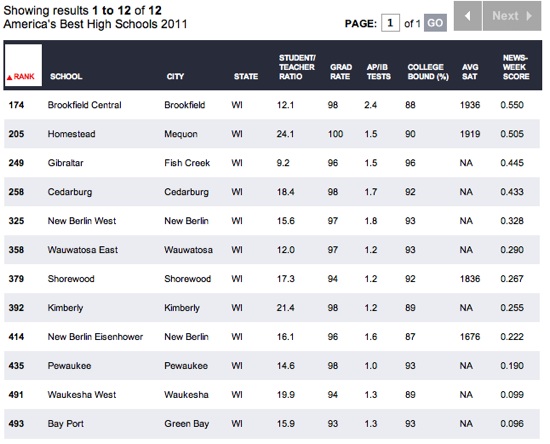
To compile the 2011 list of the top high schools in America, NEWSWEEK reached out to administrators, principals, guidance counselors, and Advanced Placement/International Baccalaureate coordinators at more than 10,000 public high schools across the country. In order to be considered for our list, each school had to complete a survey requesting specific data from the 2009-2010 academic year. In total, more than 1,100 schools were assessed to produce the final list of the top 500 high schools.Just 12 Wisconsin high schools made the list, not one from Dane County. It would be interesting to compare per student spending (Madison spends about $14,476 per student) , particularly in light of a significant number of "southern" high schools in the top 50. Much more on United States per student spending, here. Wisconsin State Tax Based K-12 Spending Growth Far Exceeds University Funding.We ranked all respondents based on the following self-reported statistics, listed with their corresponding weight in our final calculation:
Four-year, on-time graduation rate (25%): Based on the standards set forth by the National Governors Association, this is calculated by dividing the number of graduates in 2010 by the number of 9th graders 2006 plus transfers in minus transfers out. Unlike other formulas, this does not count students who took longer than four years to complete high school.
Percent of 2010 graduates who enrolled immediately in college (25%): This metric excludes students who did not enroll due to lack of acceptance or gap year.
AP/IB/AICE tests per graduate (25%): This metric is designed to measure the degree to which each school is challenging its students with college-level examinations. It consists of the total number of AP, IB, and AICE tests given in 2010, divided by the number of graduating seniors in order to normalize by school size. AP exams taken by students who also took an IB exam in the same subject area were subtracted from the total.
Average SAT and/or ACT score (10%)
Average AP/IB/AICE exam score (10%)
AP/IB/AICE courses offered per graduate (5%): This metric assesses the depth of college-level curriculum offered. The number of courses was divided by the number of graduates in order to normalize by school size.
Newsletter signup | Send us your ideas
Responding to the latest in a series of consulting scandals that have plagued the Department of Education in recent years, Manhattan Borough President Scott Stringer -- who was joined by UFT President Michael Mulgrew at a press conference at the Manhattan Municipal Building -- called for a freeze on all new, nonessential DOE consulting contracts. Declaring consulting "the new political patronage of our time," the two leaders also called for a "top-to-bottom" probe of all existing DOE contracts."There is something wrong here," Mulgrew said of the DOE's inability to effectively oversee its contractors and consultants. "The parents in this city, the children in the schools, the teachers are sick and tired of every week hearing about another scandal with outside contractors and consultants making millions of dollars that should be used in the classroom for direct services for students."
Mulgrew said revelations of the DOE financial scandals were especially disheartening at a time when the mayor is pushing to lay off more than 4,200 teachers on the grounds that the city can no longer afford to pay them.
Newsletter signup | Send us your ideas
In March, it was announced with much fanfare that the Milwaukee teachers' union was dropping it's controversial Viagra lawsuit against MPS.However, the MacIver News Service has learned that the effort to force MPS to provide coverage for erectile dysfunction treatments has arisen again, albeit in a different venue.
The Milwaukee Teachers Education Association's (MTEA) decision earlier this year came just eight months after filing their August of 2010 suit in Milwaukee County Circuit Court wherein they argued that the board's policy of excluding erectile dysfunction drugs from their health plan coverage was discriminatory against men.
Newsletter signup | Send us your ideas
A conservative society and ignorance are behind an alarming number of cases of newborn babies being killed by young Hong Kong mothersIt's a familiar story told too many times, and it has a tragic end.
An unmarried girl secretly gives birth. She is alone; one helpless child burdened with another. In this tale, it is the innocent who perishes, at the hands of the ignorant - a teenage mother.
Newsletter signup | Send us your ideas
The Madison School District failed to follow state law when it denied the Wisconsin State Journal access to more than 1,000 sick notes submitted by teachers who didn't show up for work in February, according to a lawsuit filed by the newspaper Thursday.The lawsuit, filed in Dane County District Court, asks the court to force the district to release the notes under the state's open records law, which requires government agencies to release public documents in most circumstances.
The lawsuit says the sick notes are public records because the public has a special interest in knowing how governments discipline employees, who are ultimately responsible to the public.
"We can't know if things were dealt with appropriately if we can't see the underlying documents on which decisions were made," said April Rockstead Barker, the newspaper's lawyer.
Dylan Pauly, a School District lawyer, declined comment until she had a chance to review the lawsuit.
Newsletter signup | Send us your ideas
With few exceptions, Americans spend more on public education than anyone else in the world, but we get some of the worst results. The reason is that most of our public education systems do not properly teach students what they need to know.That's it. There is no magic. And the federal takeovers, the jazzy new technology, Bill Gates' money, the data-gathering, reform, transformation, national initiatives, removal of teacher seniority, blaming of parents, hand-wringing in the media, and budget shifting won't change that simple fact.
In all of the local, state and federal plans for reforming and transforming public education, I see the bureaucracy growing, the taxpayer bill exploding, the people's voice being eliminated, good teachers being threatened with firing or public humiliation, and students not being taught what they need to know.
A May 25 Wall Street Journal article says some schools now charge parents fees for basic academics, as well as for extracurricular activities, graded electives and advanced classes. Those are private-school fees for a public-school education, and that's just wrong.
Newsletter signup | Send us your ideas
Teachers in the Hartland-Lakeside School District have agreed to switch health insurance providers to save the district $690,000, but the executive committee of a union that represents Arrowhead High feeder schools is blocking the change, officials say.Faced with a $1.2 million reduction in state aid for the 2011-12 school year, the School Board has been looking at ways to reduce costs and avoid program cuts and increases in class sizes, Superintendent Glenn W. Schilling said Tuesday.
The board determined it could achieve some saving by switching teachers' health insurance from WEA Trust, the nonprofit company started 40 years ago by the state's largest teachers union, to another provider when the contract expires on June 30.
In the end, the board and teachers - after a series of joint meetings to study the issue - agreed to go with United Healthcare.
Newsletter signup | Send us your ideas
State College Area School District in Pennsylvania several years ago abandoned plans to build a new high school. This month, it received a notice that it owes $10 million to Royal Bank of Canada for skipping an interest payment on money it never borrowed for a school it didn't build.The notice was the latest step in a legal battle over what the district calls a "naked swap" and what RBC describes as a binding legal agreement. The conflict is an example of how cities, states, schools and other public entities are second-guessing financial deals they made in recent years, pitting them against their own bankers and advisers.
Many of the regrets revolve around interest-rate swaps that became popular as a way for municipal borrowers to guard against jumps in rates. Typically under these contracts, a borrower pays a bank interest with a fixed rate and the bank pays interest with a floating rate in return. When interest rates declined, swaps proved costly to many borrowers.
Newsletter signup | Send us your ideas
School districts across the state are being asked to release the names of teachers who called in sick during protests in February at the Capitol, a move that led to closures for a day or more in many districts.It's unclear how many of the state's 424 districts received requests, but several conservative groups have made public records requests for teacher names. Most districts have released them.
But the Madison School District denied several requests, saying the release could risk the safety of teachers and students, and disrupt morale and the learning environment in schools.
And the s, the state's largest teachers union, used a similar argument in asking a La Crosse County judge to quash the release of teacher names in the La Crosse and Holmen districts.
The judge recently blocked the release of names in Holmen and may rule soon on the La Crosse case.
Newsletter signup | Send us your ideas
WHO YOU WANT TO BE TODAY -- CEO Update, a D.C.-based trade publication for association executives (a.k.a., "what we read on Blain's couch while he's on conference calls"), finds seven lobbyists who made seven figures in 2009, the latest year with data available: 1) Cary Sherman, Recording Industry Association of America, $3,185,026; 2) Bruce Josten, U.S. Chamber of Commerce, $1,340,455; 3) Todd Hauptli, American Association of Airport Executives, $1,312,350; 4) Alan Roth, USTelecom: The Broadband Association, $1,159,138; 5) Cynthia Fornelli, American Institute of CPAs, $1,154,37; 6) Rick Pollack, American Hospital Association, $1,087,024; and 7) Howard Schloss, Financial Industry Regulatory Authority (FINRA), $1,065,628. (Fine print: "highest paid non-CEO staffer who is a federally registered lobbyist in a tax-exempt organization. Compensation figures include base pay, bonuses, deferred salary and nontax income on ... tax return from years ending in 2009.")
Newsletter signup | Send us your ideas
Madison School Board Member Ed Hughes:
I am in favor of a less adversarial and more collaborative and forward-looking relationship between the school district and MTI. I think it is unfortunate that the union seems to perceive that it is in its best interests to portray the school district administration as hostile to teachers. I would like to see a world where the union views itself less in an adversarial role as a bulwark against the administration's exploitation of teachers and more collaboratively as partners with the district in figuring out better ways to improve student learning.Much more, here.From my perspective, my proposal - which, if adopted, would only have amounted to a gesture - wasn't intended to help persuade teachers to abandon their union. Instead, I'd hope that it may convey the message that, even when the administration and School Board disagree with teachers' positions and adopt policies that make their jobs harder, we are not the enemy. We want to work together collaboratively in pursuit of better results for our students.
Newsletter signup | Send us your ideas
A WEEK ago South Korea observed "Children's Day", an occasion when every school and office is closed, and the nation's families march off in unison to chaebol-owned theme parks like Lotte World or Everland. Cynical expat residents are fond of asking "isn't every day Children's Day?" They mean it sarcastically but their sarcasm is itself ironic. In reality the other 364 days of the year are very tough for Korean youngsters.Results of a survey released last week by the Institute for Social Development Studies at Seoul's Yonsei University show that Korean teenagers are by far the unhappiest in the OECD. This is the result of society's relentless focus on education--or rather, exam results. The average child attends not only regular school, but also a series of hagwons, private after-school "academies" that cram English, maths, and proficiency in the "respectable" musical instruments, ie piano and violin, into tired children's heads. Almost 9% of children are forced to attend such places even later than 11pm, despite tuitions between 10pm and 5am being illegal.
Psychologists blame this culture for all manner of ills, from poor social skills to the nation's unacceptably high rate of youth suicide, which is now the leading cause of death among those aged 15-24. Recently, a spate of suicides at KAIST, a technology-focused university, has drawn national attention. For most students the pinnacle of stress is reached somewhat earlier, in the third year of high school. This is the year in which the suneung (university entrance exam) is taken. Tragic reactions to the stress it creates are all too common.
Newsletter signup | Send us your ideas
Madison School Board Member Ed Hughes:
In an article about teacher retirements in the State Journal a couple of weeks ago, Madison Teachers Inc. Executive Director John Matthews had some harsh comments about the Madison school district and school board. Referring to the Teacher Emeritus Retirement Program, or TERP, Matthews said, "The evidence of the ill will of the board of education and superintendent speaks for itself as to why we have grave concern over the benefit continuing. . . . They tore things from the MTI contract, which they and their predecessors had agreed for years were in the best interest of the district and its employees."In an article in Isthmus last week, Lynn Welch followed up with Matthews. Matthews comes out swinging against the school district in this article as well, asserting, "The bargaining didn't have to [involve] so much animosity. . . . If they wanted to make revisions, all they had to do is talk with us and we could have worked through something that would be acceptable to both sides. But they didn't bother to talk about it. You don't buy good will this way." While the contract includes very significant economic concessions on the part of the teachers, Matthews expressed unhappiness with the non-economic changes as well, labeling them "inhumane."
In the Isthmus article, Matthews asserts that the changes in the collective bargaining agreement "show how Walker's proposed legislation (still tied up in court) has already produced an imbalance of power forcing unions to make concessions they don't want to achieve a contract deal."
.........
The collective bargaining process is useful because it provides an established framework for hammering out issues of mutual concern between the school district and its employees and for conflict resolution. However, if the collective bargaining agreement were to disappear, the school district wouldn't immediately resort to a management equivalent of pillaging the countryside. Instead, the district would seek out alternative ways of achieving the ends currently served by the collective bargaining process, because the district, like nearly all employers, values its employees and understands the benefits of being perceived as a good place to work.
But when employers aren't interested in running sweat-shops, organizations set up to prevent sweat-shop conditions aren't all that necessary. It may be that John Matthews' ramped-up rhetoric is best understood not as a protest against school district over-reaching in bargaining, since that did not happen, but as a cry against the possibility of his own impending irrelevance.
Newsletter signup | Send us your ideas
The April 28 State Journal editorial urged punishment of sick note scammers (some teachers and doctors during the recent protests), and included a column by Chris Rickert titled "Don't cry for teachers who choose early retirement." Many taxpayers in Madison and Wisconsin would say "amen."It's ironic and hypocritical that a national radio ad expresses support for Teacher Appreciation Week and touts teachers so soon after over 1,700 Madison teachers didn't show up for work -- 84 of them turning in fraudulent sick notes. The teachers used students as pawns at protest marches and contributed to protester damage at our Capitol.
In the minds of many property taxpayers and even some students, teachers have lost much respect and trust. This could be reversed if teachers and their arrogant union boss John Matthews would express in a public statement regret for their selfish and illegal actions.
Newsletter signup | Send us your ideas
For generations, Wisconsin has taken pride in the opportunities we offer children through our public schools. When students or schools are struggling, we work together to find solutions.Wisconsin is at the top when it comes to ACT and Advanced Placement scores and graduation rates, and just last month, significant gains on test scores were reported along with a narrowing of achievement gaps between minority groups. That's a foundation that should be built upon, not dismantled.
Gov. Scott Walker's education plan included in his state budget proposal will move our students and state backward. Whether you have children in a public school or not, whether you are Democrat, Republican or somewhere in between, children are counting on the state to do what's right. Public education must remain a top priority.
For months, Wisconsinites have been telling their legislators that we believe there is a better way - a balanced way - to respond to tough fiscal times without throwing away our tradition of high-quality public education. Linda Copas of Plainfield pointed out to the Joint Finance Committee that in her small school district, the number of students who live in poverty has more than doubled, but the governor's education plan ignores that. Kim Schroeder, a Milwaukee teacher, said his students are losing opportunities such as gym, art and music.
Newsletter signup | Send us your ideas
Wisconsin Governor Scott Walker
I've read Dr. Seuss' "Oh, the Places You'll Go" quite a bit over the past few weeks as I visited schools in Milwaukee, Green Bay and Stevens Point to read to second- and third-graders and meet with teachers and school officials. I've been visiting schools to promote our Read to Lead Task Force, which is finding ways to make sure all Wisconsin students can read before they complete the third grade.Related: Ripon Superintendent Richard Zimman:As a parent with two boys in public schools, it has been great to see the passion our teachers have for showing children how education can take them to amazing places. Like the teachers I met, I believe strongly in the power of education to open new worlds of opportunity, break the cycle of poverty and empower those searching for hope with a sense of purpose and self-determination.
All too often, people focus on the negatives in our education system. We are trying to focus on our strengths - particularly in reading - and then replicate that success in every classroom across our state.
"Beware of legacy practices (most of what we do every day is the maintenance of the status quo), @12:40 minutes into the talk - the very public institutions intended for student learning has become focused instead on adult employment. I say that as an employee. Adult practices and attitudes have become embedded in organizational culture governed by strict regulations and union contracts that dictate most of what occurs inside schools today. Any impetus to change direction or structure is met with swift and stiff resistance. It's as if we are stuck in a time warp keeping a 19th century school model on life support in an attempt to meet 21st century demands." Zimman went on to discuss the Wisconsin DPI's vigorous enforcement of teacher licensing practices and provided some unfortunate math & science teacher examples (including the "impossibility" of meeting the demand for such teachers (about 14 minutes)). He further cited exploding teacher salary, benefit and retiree costs eating instructional dollars ("Similar to GM"; "worry" about the children given this situation).
Newsletter signup | Send us your ideas
Something that I think drives at least some of my disagreements with other liberals about education policy is that I think a lot of middle class liberals implicitly underestimate the extent of really bad learning outcomes. Take this report (PDF) from the Detroit Regional Workforce Fund which notes "that 47% of adults (more than 200,000 individuals) in the City of Detroit are functionally illiterate, referring to the inability of an individual to use reading, speaking, writing, and computational skills in everyday life situations" and also that "within the tricounty region, there are a number of municipalities with illiteracy rates rivaling Detroit: Southfield at 24%, Warren at 17%, Inkster at 34%, Pontiac at 34%."
Newsletter signup | Send us your ideas
The Madison School District is under added pressure to improve how it identifies and educates talented and gifted students after state officials found its program does not comply with state law.Much more on the talented & gifted complaint, here.In revealing shortcomings in the district's offerings for talented and gifted (TAG) students, the Department of Public Instruction challenges the approach some schools, particularly West High School, have used in which all students learn together.
"The district is going to have to face (the question): 'How do they reconcile their policy of inclusion with honors classes?'?" said Carole Trone, director of the Wisconsin Center for Academically Talented Youth at UW-Madison. "If parents see the other districts are challenging their students more, they might send their students there."
Developing a comprehensive system to identify TAG students -- including testing and staff training -- can be expensive, Trone said. Moreover, districts that don't identify students from all socioeconomic and cultural backgrounds open themselves up to discrimination lawsuits, she said.
Superintendent Dan Nerad said it's unclear how much such a revamped program will cost.
Newsletter signup | Send us your ideas
Two-thirds of Madison teachers participated in at least one day of a coordinated four-day absence in February to protest Gov. Scott Walker's proposal to curb collective bargaining, according to information released by the school district Friday.According to the district, 1,769 out of 2,655 teachers took time off during the four days without a legitimate excuse. The records also show 84 teachers submitted fraudulent sick notes; 38 received suspensions for failing to rescind the notes by April 15, a deadline set by the district.
The exact number of teachers who caused school to shut down on Feb. 16-18 and 21 was unknown until now. The numbers "validate our decision to close our schools," Superintendent Dan Nerad said in a statement.
"We realize the challenges that our students' families experienced as a result of these school closings," Nerad said. "So we appreciate that we have been able to return since then to normal school schedules and that students have returned to advancing their learning through the work of our excellent staff members."
Madison Teachers Inc. Executive Director John Matthews acknowledged Feb. 15 that the union was encouraging members to call in sick to attend protests at the Capitol. It was the union's first coordinated work stoppage since 1,900 out of 2,300 teachers called in sick to protest contract negotiations in September 1997.
On Friday, Matthews emphasized that teachers accepted the consequences of their actions by agreeing to docked pay for the days missed. He called the suspension letters "a badge of honor for standing up for workplace justice."
Newsletter signup | Send us your ideas
Rasmussen Reports, via a kind reader's email:
Voters overwhelmingly believe that taxpayers are not getting a good return on what they spend on public education, and just one-in-three voters think spending more will make a difference.Nationally, the United States spends an average of about $9,000 per student per year. A new Rasmussen Reports national telephone survey finds that only 11% of voters think the taxpayers are getting a good return on that investment. Seventy-two percent (72%) disagree and say taxpayers are not getting their money's worth. Sixteen percent (16%) are undecided. (To see survey question wording, click here.)
Thirty-four percent (34%) voters believe student performance will improve if more money is spent on funding for schools and educations programs. A plurality (41%) disagrees and thinks that increased spending will not lead to improve student performance. Twenty-five percent (25%) aren't sure.
The survey also found that voters tend to underestimate how much is spent on education. Thirty-nine percent (39%) say the average per student expenditure is less than $9,000 per year while only 12% think it's higher than that. Nine percent (9%) estimate the right amount but a plurality of 40% is not sure. There is a wide range of expenditure on education depending upon the state and region.
Newsletter signup | Send us your ideas
School districts in southeastern Wisconsin pay significantly more for health insurance than do private businesses - as much as 76% more - and their employees bear much less of the overall cost, an analysis released Wednesday shows.MacIver Institute:The relatively small contribution teachers in general make to their insurance coverage drew considerable attention during the superheated debate over Gov. Scott Walker's budget-repair bill and his bid to sharply limit collective bargaining by most government employees.
Less discussed has been the cost of the insurance plans, which significantly outweigh those offered by private-sector employers, according to an analysis by HCTrends, which describes itself as "a market-oriented forum" on health care issues.
For single coverage, southeastern Wisconsin school districts paid 76% more than private businesses in 2009-'10, according to HCTrends.
School districts in southeastern Wisconsin are paying twice as much for health insurance as private sector companies in Milwaukee, according to a new study by HCTrends. That's just the beginning of what the group found in its study of school district health insurance expenses in 2010."Health plan costs for the region's teachers are 63 percent higher, on average, than the plans offered at private-sector companies with some union representation, and 80 percent higher than the average single-coverage cost for all private-sector plans," according to the study.
"This combination of above-average plan costs and below-average employee contributions significantly increases the school district's health care costs. While the average teachers' plan costs 80 percent more than the average private-sector plan, the per-employee cost borne by the school district is twice as much as the cost borne by the average employer."
Newsletter signup | Send us your ideas
Madison School District 450K PDF and the DPI Preliminary Audit, via a kind reader's email:
I. Introduction A.Title/topic-Talented and Gifted ComplianceMuch more on the Wisconsin DPI Parent Talented & Gifted complaint.B. Presenter/contact person -Sue Abplanalp, Jennifer Allen, Pam Nash and Dylan Pauly
Background information- On March 24,2011, MMSD received DPI's initial findings in the matter ofthe TAG complaint. DPI found MMSD to be noncompliant on all four counts. The Board has forty-five days from the date of receipt ofthe initial findings to petition the state superintendent for a public hearing. If the Board does not request such a hearing, the findings will become final. Once the findings are final, regardless of whether a hearing is held, if there is a finding of noncompliance, the state superintendent may develop with the Board a plan for compliance. The plan must contain a time line for achievement of compliance that cannot exceed ninety days. An extension of the time period may be requested if extenuating or mitigating circumstances exist.II. Summary of Current Information:
Current Status: Currently, DPI has made an initial finding of noncompliance against MMSD. While the Board is entitled to request a public hearing on the issue of compliance, the administration does not recommend this course of action. Consequently, at this time, the administration is working toward the development ofa response to DPI's findings, which will focus on remedial steps to insure compliance.Proposal: Staff are working on a response to the preliminary findings which we will present to the Board when completed. It is the administration's hope that this response will serve as the foundation to the compliance plan that will be developed once the DPI findings are final. The response will include input from the TAG Advisory Committee, the District's TAG professionals -- our Coordinator and staff. A meeting to begin work one the proposed response is currently scheduled for April28, 2011 from 4:00 p.m.-5:00pm. Subsequent meetings will follow.
Watch Monday evening's Madison School Board discussion of the DPI Talented & Gifted complaint, here (starts at 128:37). and here.
Newsletter signup | Send us your ideas
The Project On Student Debt estimates that the average college senior in 2009 graduated with $24,000 in outstanding loans. Last August, student loans surpassed credit cards as the nation's largest single largest source of debt, edging ever closer to $1 trillion. Yet for all the moralizing about American consumer debt by both parties, no one dares call higher education a bad investment. The nearly axiomatic good of a university degree in American society has allowed a higher education bubble to expand to the point of bursting.Since 1978, the price of tuition at US colleges has increased over 900 percent, 650 points above inflation. To put that in number in perspective, housing prices, the bubble that nearly burst the US economy, then the global one, increased only fifty points above the Consumer Price Index during those years. But while college applicants' faith in the value of higher education has only increased, employers' has declined. According to Richard Rothstein at The Economic Policy Institute, wages for college-educated workers outside of the inflated finance industry have stagnated or diminished. Unemployment has hit recent graduates especially hard, nearly doubling in the post-2007 recession. The result is that the most indebted generation in history is without the dependable jobs it needs to escape debt.
What kind of incentives motivate lenders to continue awarding six-figure sums to teenagers facing both the worst youth unemployment rate in decades and an increasingly competitive global workforce?
Newsletter signup | Send us your ideas
California voters want government employees to give up some retirement benefits to help ease the state's financial problems, favoring a cap on pensions and a later age for collecting them, according to a new poll.Jennfer Levitz: Tea Party Heads to SchoolVoter support for rolling back benefits available to few outside the public sector comes as Gov. Jerry Brown and Republicans in the Legislature haggle over changes to the pension system as part of state budget negotiations. Such benefits have been a flashpoint of national debate this year, and the poll shows that Californians are among those who perceive public retirement plans to be too costly.
Voters appear ready to embrace changes not just for future hires but also for current employees who have been promised the benefits under contract.
Seventy percent of respondents said they supported a cap on pensions for current and future public employees. Nearly as many, 68%, approved of raising the amount of money government workers should be required to contribute to their retirement. Increasing the age at which government employees may collect pensions was favored by 52%.
From the York Suburban Citizens for Responsible Government website:Trying to plug a $3.8 million budget gap, the York Suburban School District, in the rolling hills of southern Pennsylvania, is seeking to raise property taxes by 1.4%.
No way, says Nick Pandelidis, founder of the York Suburban Citizens for Responsible Government, a tea-party offshoot, of the plan that would boost the tax on a median-priced home of $157,685 by $44 a year to $3,225.
"No more property-tax increases!" the 52-year-old orthopedic surgeon implored as the group met recently at a local hospital's community room. "If you don't starve the system, you won't make it change."
Fresh from victories on the national stage last year, many local tea-party activist groups took their passion for limited government and less spending back to their hometowns, and to showdowns with teacher unions over pay in some cases. Now, amid school-board elections and local budgeting, they are starting to see results--and resistance.
Higher Spending and Lower Scores: From 2000 to 2009, spending per student (in constant dollars) increased from $11,413 to $15,291 - a 34% increase. Meanwhile 11th grade PSSA reading proficiency remained steady at 71% while math fell from 69% to 62%. This means 29% of students are below acceptable reading levels and 38% are not proficient in math! The York Suburban experience mirrors the national trend where increased spending in the public education system has not resulted in improved student outcomes.
Newsletter signup | Send us your ideas
Republican legislators in Wisconsin aren't the only ones getting violent threats. On Thursday, Katherine Windels pleaded not guilty to making death threats to Republican state lawmakers. Her crazed threats have gotten a lot of media attention.But what hasn't gotten attention is the ugliness directed against labor.
"We've gotten a lot of threats," says John Matthews, executive director of Madison Teachers Inc (MTI).
MTI received a death threat on April 15.
"You're all going to die. I'm going to kill you. I'm going to kill you," said a man's voice calling from the (252) area code, which MTI saw on caller ID. That area code is in North Carolina.
Newsletter signup | Send us your ideas
One by one, the children trooped to our table and put their apples in front of my son. By the fourth apple, I asked Christopher--my date for "Lunch with Your Second Grader" at the local elementary school in Kinnelon, N.J.--what was going on."Oh, they don't like the apples that come with lunch, so they give them to me," he reported, shrugging. "I can't eat them all."
I'm the mother of two boys, now middle-schoolers, one a good eater and one who would live on pizza and root beer if I let him. Christopher eats apples, and Nicholas leaves his on the lunch tray. He's the one who needs his chocolate milk. Yes, chocolate.
And so it was disturbing to hear about the recent chocolate milk ban in the Fairfax County, Va., school system and elsewhere around the country. Ditching chocolate milk to cut down on our children's sugar intake might be the right sentiment, but it's the wrong solution.
Newsletter signup | Send us your ideas
The Hudson school board will suspend dozens of employees whose absences during public worker protests in Madison, Wis., caused district schools to close Feb. 18.About 40 employees of the Hudson school district, mostly teachers, will be disciplined. Punishment ranges from one to 15 days of unpaid suspension, according to the district.
The length of suspension is based on "the district's investigation into the actions believed to have been taken by each employee," said district communications specialist Tracy Habisch-Ahlin in an email. The suspensions are to be served by the end of this school year.
"Having to close schools on Feb. 18 was a serious issue that impacted over 5,000 students along with their parents or caregivers," said school board president Barb Van Loenen. "As a result, the board spent considerable time listening to our community members and ... deliberating an appropriate response for individuals who were involved in the excessive absences."
Newsletter signup | Send us your ideas
A split in teachers' opinions over appropriate responses to an explosive state collective bargaining law resonates through disciplinary records released by the Oshkosh school district last week.The records obtained by The Northwestern include forms signed by 86 employees who admitted they called in sick on Feb. 17 and 18 to join protests in Madison as well as a discipline settlement with teachers' union president Len Herricks, who incorrectly told staff members that district administration would condone calling in sick to attend the protests.
Comments hand-written by educators on many of the records show a range of regret, defiance and confusion felt by rank-and-file employees caught in a whirlwind of political rhetoric and polarization.
Newsletter signup | Send us your ideas
A new state law has emboldened the Detroit mayor and schools chief to take a more aggressive stance toward public unions as the city leaders try to mop up hundreds of millions of dollars in red ink.Robert Bobb, the head of the Detroit Public Schools, late last week sent layoff notices to the district's 5,466 salaried employees, including all of its teachers, a preliminary step in seeking broad work-force cuts to deal with lower enrollment.
Earlier last week, Detroit Mayor Dave Bing presented a $3.1 billion annual budget to City Council in which he proposed higher casino taxes and substantial cuts in city workers' health care and pensions to close an estimated $200 million budget gap.
Mr. Bobb, already an emergency financial manager for the struggling and shrinking public school system, is getting further authority under a measure signed into law March 17 that broadens state powers to intervene in the finances and governance of struggling municipalities and school districts. This could enable Mr. Bobb to void union contracts, sideline elected school-board members, close schools and authorize charter schools.
......
Mr. Bobb, appointed in 2009 by Democratic Gov. Jennifer Granholm and retained by Republican Gov. Rick Snyder, pledged last week to use those powers to deal decisively with the district's $327 million shortfall and its educational deficiencies. Mr. Bobb raised the possibility of making unilateral changes to the collective-bargaining agreements signed with teachers less than two years ago.
He is also expected to target seniority rights that protect longtime teachers from layoffs and give them the ability to reject certain school placements.
The Detroit Federation of Teachers will likely fight him on these issues. The union couldn't be reached for comment.
Newsletter signup | Send us your ideas
A misdialed union voicemail message, emails obtained through an open records request and official court documents reveal new details about the Madison teachers' work stoppage [Google Cached Link] that closed the district's public schools for four days.Emails Reveal Madison Teachers' Union Behind the Scenes StrategyThe Madison Metropolitan School District called the "sickouts" a "strike" and accused the union of organizing it. The union, Madison Teachers Inc., however, maintained that teachers were calling in sick on their own initiative. New evidence suggests the union's claim is not true.
The MacIver News Service obtained dozens of emails in response to an open records request filed with the school district.
On Tuesday, February 15th, the day before the four day sick out began, Dan Nerad, Madison Schools Superintendent, sent out a mass email to teachers stating "Throughout the day we have received significant information indicating that staff members will call in ill tomorrow, Thursday and/or Friday to protest the Governor's actions. While I believe his actions warrant protest, I am asking that this course of action not be taken,"
John Matthews, Madison Teachers Inc. Executive Director, replied to that email with one of his own, "What teachers are doing is based on their own conscience, for education, the children in our schools, for their own families," he wrote.
Wednesday, March 9th.Nerad was floored when he found out Matthews was telling the union MMSD was not willing to meet that past weekend. He said Matthews never confirmed a meeting with them.
Howard Bellman, the arbitrator, responded that he had suggested to Nerad they meet sometime over the weekend. Nerad said he wasn't available until Tuesday, and Bellman relayed that to the union.
Matthews then sent Nerad an email stating "Dan: I know that you are dealing with your Mother's illness at this time, and I respect that. However, for MMSD to not be prepared to deal with the issues facing both MMSD and MTI (your employees) today is reprehensible."
Later that day the Senate passed an amended version of the budget repair bill, and Nerad wondered if he could expect his staff to report to work on Thursday.
Matthews responded the union asked all teachers to go to work in the morning. He also pushed for a contract agreement for MTI's support staff groups.
"You have to know that our negotiations are at a very serious juncture. We simply must reach an agreement on Friday or the volcano may just erupt. It is not fair to those in the support unites to be treated differently than those in the professional unit. Because AFSCME took an inferior contract is no reason for MTI to do so. This matter is clearly in your hands to resolve, so be fair, creative and decisive. We have no time left to wring our hands. It is very difficult to hold people back from taking further action," said Matthews.
Newsletter signup | Send us your ideas
Fair warning: This article will piss off a lot of you.I can say that with confidence because it's about Peter Thiel. And Thiel - the PayPal co-founder, hedge fund manager and venture capitalist - not only has a special talent for making money, he has a special talent for making people furious.
Some people are contrarian for the sake of getting headlines or outsmarting the markets. For Thiel, it's simply how he views the world. Of course a side benefit for the natural contrarian is it frequently leads to things like headlines and money.
Consider the 2000 Nasdaq crash. Thiel was one of the few who saw in coming. There's a famous story about PayPal's March 2000 venture capital round. The offer was "only" at a $500 million-or-so valuation. Nearly everyone on the board and the management team balked, except Thiel who calmly told the room that this was a bubble at its peak, and the company needed to take every dime it could right now. That's how close PayPal came to being dot com roadkill a la WebVan or Pets.com.
Newsletter signup | Send us your ideas
Fernando Dominguez cut the figure of a young revolutionary leader during a recent lunch period at his elementary school."Who thinks the lunch is not good enough?" the seventh-grader shouted to his lunch mates in Spanish and English.
Dozens of hands flew in the air and fellow students shouted along: "We should bring our own lunch! We should bring our own lunch! We should bring our own lunch!"
Fernando waved his hand over the crowd and asked a visiting reporter: "Do you see the situation?"
Newsletter signup | Send us your ideas
Only a fool would think that the sick out that closed down Madison schools for five days in February was anything but an illegal, union-coordinated, illegal strike.But there are a lot of fools in Madison, aren't there?
Now there is proof that the sickout was a premeditated, union-authorized job action -- a phone tree of teachers calling other teachers to close down the schools. This kind of activity is prohibited by the union's own contract and illegal in WI Statute Chapter 111.84(2)(e):
It is unfair practice for an employee individually or in concert with others: To engage in, induce or encourage any employees to engage in a strike, or a concerted refusal to work or perform their usual duties as employees.
The problem, of course, is finding an impartial prosecutor -- but that would require a level of professionalism sorely lacking in the Doyle-appointed incumbent.
Newsletter signup | Send us your ideas
The Madison Metropolitan School District Board of Education and the Madison Teachers, Inc. ratified an expedited Collective Bargaining Agreement for 2011-2013. Several significant considerations were ignored for the negative impact and consequences on students, staff and taxpayers.
First and foremost, there was NO 'urgent' need (nor ANY need at all) to 'negotiate' a new contract. The current contract doesn't expire until June 30, 2011. Given the proposals regarding school finance and collective bargaining processes in the Budget Repair Bill before the legislature there were significant opportunities and expectations for educational, management and labor reforms. With such changes imminent, there was little value in 'locking in' the restrictive old provisions for conducting operations and relationships and shutting the door on different opportunities for increasing educational improvements and performances in the teaching and learning culture and costs of educating the students of the district.
A partial listing of the missed adjustments and opportunities with the ratification of the teacher collective bargaining agreement should be instructive.
For further information and discussion contact:
Don Severson President
Active Citizens for Education
donleader@aol.com
608 577-0851
Newsletter signup | Send us your ideas
So here we are pouring shiploads of cash into yet another war, this time in Libya, while simultaneously demolishing school budgets, closing libraries, laying off teachers and police officers, and generally letting the bottom fall out of the quality of life here at home.Welcome to America in the second decade of the 21st century. An army of long-term unemployed workers is spread across the land, the human fallout from the Great Recession and long years of misguided economic policies. Optimism is in short supply. The few jobs now being created too often pay a pittance, not nearly enough to pry open the doors to a middle-class standard of living.
Arthur Miller, echoing the poet Archibald MacLeish, liked to say that the essence of America was its promises. That was a long time ago. Limitless greed, unrestrained corporate power and a ferocious addiction to foreign oil have led us to an era of perpetual war and economic decline. Young people today are staring at a future in which they will be less well off than their elders, a reversal of fortune that should send a shudder through everyone.
Newsletter signup | Send us your ideas
Madison teachers who missed school last month to attend protests and turned in fraudulent doctor's notes have been given until April 15 to rescind those notes, officials said Thursday.The district received more than 1,000 notes from teachers, human resources director Bob Nadler said. A couple hundred of those were ruled fraudulent because they appeared to be written by doctors at the Capitol protests against Gov. Scott Walker's proposal to limit collective bargaining.
Teachers who don't rescind fraudulent notes could receive a disciplinary letter of suspension, the most serious form of discipline aside from termination, Nadler said. The suspension would be considered already served -- the time missed during the protests.
"We didn't want to give anybody more time off," Nadler said. "They can't afford it. We can't afford to have them gone any more. I don't think kids need their teacher gone another two days."
Newsletter signup | Send us your ideas
At the recent School Board Retreat, the Board discussed a Governance and Oversight Policy that would define the Board's job.On page 18 of this 21 page document, is a section titled "Board-Superintendent Communications". Under this section is this set of guidelines for communication between the Board and the superintendent:
Communications between the Board and the Superintendent will be governed by the following practices:
a. Exercise honesty in all written and interpersonal interaction, avoiding misleading information
b. Demonstrate respect for the opinions and comments of each other
c. Focus on issues rather than on personalities
d. Maintain focus on common goals
e. Communicate with each other in a timely manner to avoid surprises
f. Criticize privately, praise publicly
g. Maintain appropriate confidentiality
h. Openly share personal concerns, information knowledge and agendas
i. Make every reasonable effort to protect the integrity and promote the positive image of the district and each other
j. Respond in a timely manner to request and inquired from each other.
Newsletter signup | Send us your ideas
Two Seattle school board members were warned in late 2008 that a contractor hired by Silas Potter was unlicensed, paying below-market wages and not following safety rules on construction sites at two elementary schools, according to e-mails between the school board and union officialsThe contractor, Solar West Office Solutions, was investigated by the state Department of Labor and Industries, which ordered the company to pay $57,000 in back wages. However, the school district wound up footing the bill because Solar West's owner, Keith Battle, could not be located and failed to respond to state officials, according to an L&I spokeswoman.
For four years, Potter ran both a school district program aimed at connecting minority contractors with the district and the Seattle Schools' small works roster, which allocates low-dollar construction contracts offered by the district. The district's minority contractor development program is now the subject of a criminal investigation.
Newsletter signup | Send us your ideas
The U.S. government has 15 different agencies overseeing food-safety laws, more than 20 separate programs to help the homeless and 80 programs for economic development.These are a few of the findings in a massive study of overlapping and duplicative programs that cost taxpayers billions of dollars each year, according to the Government Accountability Office.
A report from the nonpartisan GAO, to be released Tuesday, compiles a list of redundant and potentially ineffective federal programs, and it could serve as a template for lawmakers in both parties as they move to cut federal spending and consolidate programs to reduce the deficit. Sen. Tom Coburn (R., Okla.), who pushed for the report, estimated it identifies between $100 billion and $200 billion in duplicative spending. The GAO didn't put a specific figure on the spending overlap.
Newsletter signup | Send us your ideas
The U.S. government has 15 different agencies overseeing food-safety laws, 20 separate programs to help the homeless and 80 programs for economic development.These are a few of the findings in a massive study of overlapping and duplicative programs that cost taxpayers billions of dollars each year, according to a new Government Accountability Office report to be released Tuesday.
The report from the nonpartisan GAO compiles a list of redundant and potentially ineffective federal programs, and it could serve as a template for lawmakers in both parties as they move to cut federal spending and consolidate programs to reduce the deficit.
Newsletter signup | Send us your ideas
During the holiday break this winter, a woman in my neighbourhood was at the supermarket with her son when they ran into the son's teacher. "See you Monday," the mother said. The teacher gaily informed her she would not be back until mid-month, as she had planned a vacation in Central America. Teachers used to content themselves with the months off they enjoy in summers and at holidays, but they have got used to more. One can understand why American public employees ardently defend their unions, and the benefits they win. But one can also understand why, in a time of straitened budgets, union-negotiated contracts might be among the first places to make savings.A fierce budget battle has been running for more than a week in Madison, Wisconsin. It goes far beyond salaries and benefits, to touch on the deeper question of whether collective bargaining has any place in government employment. Governor Scott Walker, a Republican elected last autumn with support from the Tea Party movement, believes it does not. His "budget repair" bill not only requires state employees to contribute to their pension and health plans. It would also end collective bargaining for benefits. Democratic senators, lacking the votes to defeat the bill, fled the state, denying the quorum necessary to bring it to a vote.
Mr Walker is not making a mountain out of a molehill. Wisconsin has a $137m budget gap to fill this year and a $3.6bn deficit over the next two. The big year-on-year leap reflects, in part, the expiration of federal stimulus spending, much of which was used to avoid laying off government workers. Citizens of other advanced countries sometimes make the mistake of assuming that the US has a skeletal bureaucracy. That is wrong. Once you include state, county and city employees, it is a formidable workforce and an expensive one. State employees account for up to $6,000bn in coming pension costs. Wisconsin's difficulties are milder than those elsewhere, which means that similar clashes are arising in other states, especially where Republicans rule.
Newsletter signup | Send us your ideas
Let's face it: Teachers union president John Matthews decides when to open and when to close Madison schools; the superintendent can't even get a court order to stop him. East High teachers marched half the student body up East Washington Avenue Tuesday last week. Indoctrination, anyone?This Tuesday, those students began their first day back in class with the rhyming cadences of professional protester Jesse Jackson, fresh from exhorting unionists at the Capitol, blaring over the school's loudspeakers. Indoctrination, anyone?
Madison Teachers Inc. has been behind every local referendum to blow apart spending restraints. Resist, as did elected school board member Ruth Robarts, and Matthews will brand you "Public Enemy Number One."
When then-school board member Juan Jose Lopez would not feed out of the union's hand, Matthews sent picketers to his place of business, which happened to be Briarpatch, a haven for troubled kids. Cross that line, kid!
The teachers union is the playground bully of state government. Wisconsin Education Association Council spent $1.5 million lobbying the Legislature in 2009, more than any other entity and three times the amount spent by WMC, the business lobby.
Under Gov. Doyle, teachers were allowed to blow apart measures to restrain spending and legislate the union message into the curriculum. Student test scores could be used to determine teacher pay -- but only if the unions agreed.
The most liberal president since FDR came to a school in Madison to announce "Race to the Top" grants for education reform. How many millions of dollars did we lose when the statewide teachers union sandbagged the state's application?
Newsletter signup | Send us your ideas
Teachers in the School District of Fort Atkinson will not be paid for time taken off to participate in the ongoing protests at the State Capitol in Madison.Fort Atkinson was among districts that were forced to cancel classes Friday in response to the number of teachers who failed to report for class, apparently opting to attend the protests on the governor's budget-repair bill. No Jefferson County schools were closed today due to either weather or the protests.
Following the adverse public reactions to teachers' departures causing school closures, the head of Wisconsin's teachers' union called upon educators to return to classrooms today and Tuesday rather than continue being absent to protest the anti-union bill in Madison.
Newsletter signup | Send us your ideas
Madison School Board Member Ed Hughes, via email:
It's been a non-quiet week here in Madison. Everyone has his or her own take on the events. Since I'm a member of the Madison School Board, mine is necessarily a management perspective. Here's what the week's been like for me.Nearly as soon as the governor's budget repair bill was released last Friday, I had a chance to look at a summary and saw what it did to collective bargaining rights. Basically, the bill is designed to gut public employee unions, including teacher unions. While it does not outlaw such unions outright, it eliminates just about all their functions.
Our collective bargaining agreement with MTI is currently about 165 pages, which I think is way too long. If the bill passes, our next collective bargaining agreement can be one paragraph -- way, way, way too short.
On Monday, Board members collaborated on a statement condemning the legislation and the rush to push it through. All Board members signed the statement on Monday evening and it was distributed to all MMSD staff on Tuesday.
Newsletter signup | Send us your ideas
A statewide grand jury investigating the Broward School District issued a scathing final report Friday evening, saying there was evidence of such widespread "malfeasance, misfeasance and nonfeasance" by school board members and senior managers alike that only "corruption of our officials by contractors, vendors and their lobbyists" could explain it.Leadership in the district is so lacking, the jurors said, they would move to abolish the whole School Board if only the state constitution would allow it.
The panel met in secret for a year, reviewed hundreds of documents and took widespread testimony reaching from past and current School Board members to school principals and secretaries. The conclusion: The district suffers from "gross mismanagement and apparent ineptitude" on a grand scale.
Newsletter signup | Send us your ideas




Click on the images above to view the full screen panoramas on mac/pc/iPhone/iPad and Android devices. Look for one or two more panoramas tomorrow.

I've posted a number of still images, here.
Many Madison residents went about their weekend as always, including the ice fisherman captured in this scene (look closely for the eagle):
Newsletter signup | Send us your ideas
1. Intensify reading instruction in Kindergarten in order to ensure all No additional costs. Professional development provided by central students are proficient in oral reading and comprehension as office and building-based literacy staff must focus on Kindergarten. measured by valid and reliable assessments by 2011-2012. Instruction and assessment will be bench marked to ensure Kindergarten proficiency is at readinQ levels 3-7 {PLAA, 2009).Related:2. Fully implement Balanced Literacy in 2011-12 using clearly defined, Comprehensive Literacy Model (Linda Dorn), the MMSD Primary Literacy Notebook and the MMSD 3-5 Literacy Notebook.
a. Explore research-based reading curricula using the Board of Education Evaluation of Learning Materials Policy 3611 with particular focus on targeted and explicit instruction, to develop readers in Kindergarten.
b. Pilot the new reading curricula in volunteer schools during 2011-12.
c. Analyze Kindergarten reading proficiency scores from Kindergarten students in fully implemented Balanced Literacy schools and Kindergarten students in the volunteer schools piloting the new reading curricula incorporated into a
Balanced Literacy framework to inform next steps.
d. Continue pilot in volunteer schools in Grade 1 during 2012-13 and Grade 2 durino 2013-14. 2011-12 Budget Addition Request $250,0003. Incorporate explicit reading instruction and literacy curricula into 6th grade instruction.
.....
3. Review previous Reading Recovery recommendations, with Additional Reading considerations to:
Additional Reading Recovery and/or Interventionist FTE costs. 1 FTE-$79,915 (average rate when teacher is re-assigned). 1 new FTE-$61,180 (displaced rate when new teacher is hired).
- Place Reading Recovery Teachers in buildings as needed to (displaced rate when new teacher is hired).reflect the needs of 20% of our District's lowest performing first graders, regardless of what elementary school they may attend;
- Analyze the other instructional assignments given to Reading Recovery teachers in order to maximize their expertise as highly skilled reading interventionists
- Ensure standard case load for each Reading Recovery teacher at National Reading Recovery standards and guidelines (e.g. 8 students/year).
- Place interventionists in buildings without Reading Recovery. Interventionists would receive professional development to lift the quality of interventions for students who need additional support in literacy.
Newsletter signup | Send us your ideas
On Tuesday, Feb. 15, Secretary of Education Arne Duncan convened hundreds of teachers'-union leaders and school-district leaders in Denver to discuss ways management and labor could work together better. Kumbaya!
Two days later, all hell broke loose in Madison, Wis. The flash point was Republican Governor Scott Walker's plan to address the state's budget gap by making public employees contribute more to health care coverage, coupled with a proposal to eliminate collective bargaining for most public employees -- including teachers. Democratic state legislators went into hiding to thwart a vote on the measure, and schools closed as thousands of teachers left their classrooms to descend on the state capital.The two episodes vividly illustrate the hope -- and the reality -- of labor-management issues in education today. As Madison becomes ground zero for the debate over government spending and public-sector reform, some hard questions are getting lost in political theatrics and overwrought rhetoric. Here are questions Wisconsin's governor, labor leaders and President Obama should have good answers for but so far don't:
Newsletter signup | Send us your ideas
The University of Wisconsin Athletic Department had its operating budget request of $88.368 million for 2011-12 approved without rancor or debate Friday.Members of the UW Athletic Board voted unanimously to allow the department to spend $5.29 million more than its current operating budget of $83.219 million, an increase designed primarily to address two major capital projects.
The matter-of-fact process and calm pulse of the meeting was in contrast to the mood at the Capitol, where protesters, controversy and edgy rhetoric defined a state budget crisis.
Asked to weigh the two developments, UW athletic director Barry Alvarez acknowledged that sooner or later they will become one.
Newsletter signup | Send us your ideas
Idaho Superintendent of Public Instruction Tom Luna's vehicle was vandalized overnight at his Nampa home and he and his family have received threats, he told police."Yes, he has made us aware of threats to him and family members and we are looking into those, and we are aware of those, and we are doing what we can to provide protection," Nampa Police Deputy Chief Craig Kingsbury said.
On Saturday night, a man who identified himself as a teacher reportedly showed up at Luna's mother's home in Nampa in order to speak with her about the superintendent's contentious education reform plan. Luna happened to be at his mother's house at the time, Department of Education spokeswoman Melissa McGrath said.
"The man was very angry... the superintendent did feel threatened," she said. The man eventually left after Luna spoke to him for several minutes. Luna told the man it was an inappropriate place and time, and later filed a police report, McGrath said.
Newsletter signup | Send us your ideas
Madison School District superintendent Dan Nerad called on teachers late Thursday to end their protest and return to the classroom.Related: Judge denies Madison School District request to stop teacher sick-out and "Who Runs the Madison Schools?""These job actions need to end," Nerad said in an e-mail to families of students. "I want to assure you that we continue to examine our options to more quickly move back to normal school days."
Madison schools are closed Friday for a third straight day. Nerad also apologized for the closures.
On Thursday, state and Madison teachers union leaders urged their members to report to the Capitol on Friday and Saturday for continued protests against Gov. Scott Walker's collective bargaining proposal.
"Even though the Madison School District can only react to the group decisions of our teachers, I apologize to you for not being able to provide learning for the last three days to your students," Nerad said.
Newsletter signup | Send us your ideas
Don Severson, via email:
Attached is the Active Citizens for Education statement regarding the MMSD Board of Education and Administration actions related to the Governor's Budget Repair Bill.Much more, here.Here is the link to the video of the MMSD Board meeting on 02/14/11
http://mediaprodweb.madison.k12.wi.us/node/601 go to the 9:50 minute mark for Marj Passman.
Letters from the Board and Superintendent to Governor Walker are accessible from the home page of the MMSD website.
Glaringly, there is no leadership from the Madison Metropolitan School District Board of Education nor administration for the overall good of the community, teachers nor students as evidenced by their actions the past few days. Individual Board members and the Board as a whole, as well as the administration, are complicit in the job action taken by teachers and their union. The Board clearly stepped out of line. Beginning Monday night at its Board meeting, Board member Marj Passman took advantage of signing up for a 'public appearance' statement as a private citizen. She was allowed to make her statement from her seat at the Board table instead of at the public podium--totally inappropriate. Her statement explicitly gave support to the teachers who she believed were under attack from the Walker proposed budget repair bill; that she was totally in support of the teachers; and encouraged teachers to take their protests to the Capital. Can you imagine any other employer encouraging their employees to protest against them to maintain or increase their own compensation in order to help assure bankruptcy for the organization or to fire them as employees? All Board members subsequently signed a letter to Governor Walker calling his proposals "radical and punitive' to the bargaining process. With its actions, including cancellation of classes for Wednesday, the Board has abdicated and abrogated its fiduciary responsibility for public trust. The Board threw their responsibility away as elected officials and representatives of the citizens and taxpayers for the education of the children of the District and as employers of the teachers and staff. The Board cannot lead nor govern when it abdicates its statutory responsibilities and essentially acts as one with employees and their union. Under these circumstances, it is obvious they have made the choice not to exercise their responsibilities for identifying solutions to the obvious financial challenges they face. The Board will not recognize the opportunities, nor tools, in front of them to make equitable, fair and educationally and financially sound decisions of benefit to all stakeholders in the education of our young people.Don Severson
President, ACE
Newsletter signup | Send us your ideas
Under its "performance pay" proposal, teachers would get more for staffing hard-to-staff schools and filling hard-to-fill positions. Pay would also be related to regular employee evaluations -- if in some as-yet-undefined, possibly very weak way. WEAC president Mary Bell declined to specify how closely student test scores should track with evaluations and thus pay hikes, for instance.Related: 2010 Fall Election - WEAC: $1.57 million for Four Wisconsin Senators in a Losing Cause.Protecting pay is, of course, the most important of the union's objectives in its reform plan. But pay is a function of how much money is available, and while WEAC is advocating paying better teachers better salaries, it's not in favor of cutting pay for teachers who aren't so good. This is about a bigger education pie, in other words, not about the same pie cut into different-sized pieces.
Pay is also a function of who's handing out the raises, and WEAC is doing what it can to ensure those partly or mostly responsible for handing out the raises are as sympathetic as possible.
To wit, it would like to see the majority of the members on a teacher's evaluation panel be teachers themselves -- thus paving the way, it seems to me, for a lot of good reviews.
"It's an extremely difficult task," Bell said of evaluating one of your peers, but one that can work because "people care so deeply about the quality of the profession."
Newsletter signup | Send us your ideas
No one wants the big teacher layoffs that most analysts say are inevitable under our current state budget crisis. But many of us are very concerned that if such layoffs are necessary, the state's "last in, first out" rule will mean that many of our best teachers will be forced out regardless of their qualifications and effectiveness. This could be particularly devastating for schools in high-poverty neighborhoods, where teachers tend to have fewer years of experienceA new poll shows that a majority of New Yorkers disapprove of the state's "last in, first out" (LIFO) law that forces schools to fire the most recently hired teachers during a budget crisis, regardless of teacher quality
Newsletter signup | Send us your ideas
The simplest of conversations, the most important of facts. And yet nearly six years after those images were discovered by the Madison School District, Nelson was a superintendent and had to be caught allegedly trying to solicit sex from what he thought was a 15-year-old boy online before the bizzaro world of public school human resources stood up and took notice.Rickert deserves props for contacting former Madison Superintendent Art Rainwater (who now is employed - along with others from the Madison School District - at the UW-Madison School of Education) on this matter.I am assuming (safely, I really, really hope) that had my imagined exchange occurred, Nelson's public schools career would have been over. There also does not appear to have been anything contractually or legally to prevent it from occurring.
Madison human resources director Bob Nadler said Nelson had an oral agreement -- "not a contract" -- under which, in exchange for Nelson's resignation, the district would disclose nothing more than his dates of employment, position and salary.
These kinds of agreements happened with some frequency, according to Art Rainwater, the superintendent in Madison at the time Nelson was nabbed for porn. As to the exact circumstances surrounding how Nelson was lucky enough to get one and who it was with, well, "I honestly don't remember," Rainwater told me.
Not only could Madison have dropped the dime on its very own pervert; state law provides some liability protection for doing so. Employers who act in "good faith" when providing a reference are protected unless they knowingly lie or provide a reference maliciously or violate the state's blacklisting statute, according to Marquette University Law School Associate Professor Paul Secunda.
Newsletter signup | Send us your ideas
Background information: In 2010, the Board approved a number of administrative recommendations geared toward increasing usage of the Infinite Campus System. The current timeline requires all high school teachers to use grade-level appropriate Infinite Campus teacher tools by the end of the fourth quarter of the 2010-2011 school year.Much more on the Madison School District's implementation of Infinite Campus, here.
The administration has been notified by the vendor that significant changes will be made to the Infinite Campus interface in July 2011. Accordingly, if training sessions were to continue as required to meet the current deadline, those same teachers would have to be trained on a new interface only months later.It would be more prudent to wait until the new interface is available and require full implementation of the Infinite Campus teacher tools at the high schools by the end of the second quarter of the 2011-2012 school year.
D. BOE action requested: Postpone mandatory use of Infinite Campus teacher tools at the high schools until the end of the second quarter of the 2011-2012 school year.
The system originally lifted off during the fall of 2007. I wonder how much has been spent on it without full use? This type of system can be a useful way for parents, teachers and students to communicate - if it is used.....
Newsletter signup | Send us your ideas
Craig Howley, Jerry Johnson, and Jennifer Petrie:
Arguments for consolidation, which merges schools or districts and centralizes their management, rest primarily on two presumed benefits: (1) fiscal efficiency and (2) higher educational quality. The extent of consolidation varies across states due to their considerable differences in history, geography, population density, and politics. Because economic crises often provoke calls for consolidation as a means of increasing government efficiency, the contemporary interest in consolidation is not surprising.However, the review of research evidence detailed in this brief suggests that a century of consolidation has already produced most of the efficiencies obtainable. Indeed, in the largest jurisdictions, efficiencies have likely been exceeded--that is, some consolidation has produced diseconomies of scale that reduce efficiency. In such cases, deconsolidation is more likely to yield benefits than consolidation. Moreover, contemporary research does not support claims about the widespread benefits of consolidation. The assumptions behind such claims are most often dangerous oversimplifications. For example, policymakers may believe "We'll save money if we reduce the number of superintendents by consolidating districts;" however, larger districts need--and usually hire--more mid-level administrators. Research also suggests that impoverished regions in particular often benefit from smaller schools and districts, and they can suffer irreversible damage if consolidation occurs.
For these reasons, decisions to deconsolidate or consolidate districts are best made on a case-by-case basis. While state-level consolidation proposals may serve a public relations purpose in times of crisis, they are unlikely to be a reliable way to obtain substantive fiscal or educational improvement.
Newsletter signup | Send us your ideas
Mark Schug & Scott Niederjohn:
It has been 10 years since Wisconsin overhauled an old set of rules for state teacher licensure (PI 3 and PI 4) and replaced it with a new set called PI 34. At the time of its approval in 2000, PI 34 was warmly welcomed by state leaders and legislators from both sides of the aisle. It was praised as a way to create a new generation of Wisconsin teachers.Related: An Email to Madison Superintendent Dan Nerad on Math Teacher Hiring Criteria.The purpose of this report is to assess PI 34 in an effort to learn whether it has made good on these high expectations.
The underlying issue in this assessment has to do with occupational licensure. Why is it widespread in many states including Wisconsin? There are two viewpoints. The first is that consumers don't have enough information to make judgments regarding the purchase of services from members of certain occupations. Licensure, according to this view, serves as a means to protect consumers from fraud and malpractice.
The second argument is made by economists. It opposes the first. Prominent economists claim that licensure benefits members of various occupations more than it benefits consumers. It does so by limiting access to the occupations in question, thus reducing competition. Those seeking protection from barriers of this sort believe that the various regulations will eventually enhance their incomes. The costs to consumers include reduced competition and restricted consumer choice....
PI 34's weaknesses far outweigh its strengths. The weaknesses include the following:
- PI 34 undervalues the importance of subject-matter knowledge in initial training programs for teachers and in teachers' professional development activity.
- PI 34 imposes an overwhelming regulatory system--dwarfing, for example, the regulatory system governing licensure for medical doctors.
- PI 34 rules for licensure renewal fail to ensure that renewal will depend on demonstrated competence and professional growth. These rules create incentives for pro forma compliance, cronyism, and fraud.
- PI 34 sets up high barriers (a single, proprietary avenue) for entrance into teaching. It makes licensure conditional on completion of approved training programs requiring, normally, at least two years of full-time enrollment in education coursework. Many highly trained professionals contemplating career changes are deterred by these requirements from becoming teachers, despite demand for their services.
- PI 34 has no built-in measures for linking teacher licensure to teacher competence. Wisconsin has no evidence that any incompetent teacher has ever been denied licensure renewal.
- PI 34 enables education producers (WEAC and the DPI) to dominate the licensure system. In this system, parents and students are marginalized.
- PI 34 is particularly onerous for educators in large urban districts like Milwaukee, where producing academic gains is a challenging problem, and school principals, struggling to hire competent teachers, would benefit greatly from a flexible licensure system.
Newsletter signup | Send us your ideas
District, county, and state education offices are fond of sharing "best practices" through professional development. The idea is to spread the word about strategies that work in some schools so other teachers can use these strategies and get the same great results. There are times when it works this way. Unfortunately, things can get complicated when the same people who pick and distribute best practices are also responsible for checking whether they are being done correctly, and when none of those people are current teachers. Here's an example of how the sharing of best practices sometimes works once supervising offices get involved.Phase one: A school seems to be successful in educating students in a given subject or demographic sub-group. Let's call this School A.
Phase two: A team of people who want to know what made School A successful descends upon the school. They sit in the classrooms. They ask questions. Then the team comes back with a report that says something like, "Teachers at School A are successful because they ask students to make their own test using fill-in-the-blank test questions. This is a research-based report."
Phase three: The information from the report is filtered through a series of people sitting in a quiet, student-less office. Materials are created. Packets are made.
Newsletter signup | Send us your ideas
In an effort to be transparent in the district's budget transactions, the Wichita Public Schools launched its District Checkbook on its website. Superintendent John Allison made the announcement during the South Central Legislative Delegation meeting at Wichita State University on January 6.Wichita spends $12,631 per student (50,033 students) via a 632,000,000 budget. Madison spent $15,241 per student in 2009-2010."Many community members ask questions about school budgets, and this is a way to allow taxpayers to review transactions by month for the fiscal year, to see which fund is used, and the function for that transaction," said Superintendent Allison.
The District Checkbook shows every item the district purchases and what the purchases were for including instruction, support and bond construction. The items are reported by the categories defined by the State of Kansas and the categories are consistent throughout Kansas' school districts.
Newsletter signup | Send us your ideas
Erik J Kass, Assistant Superintendent for Business:
The process outlined below is intended to provide adequate and timely information to the Board of Education and Community relative to the development of the 2011-12 Budget. This process will create transparency, credibility around data, and provide options for the Board of Education along the way. This process as you will see, also leans very heavily on the 5 year model worked on and completed by the 5 Year Budget Model Ad Hoc Committee.The 2010-2011 Madison School District budget raised property taxes by about 9%.The goal of this upcoming budget process is comprised of five phases: planning, preparation, approval/ adoption, implementation, and review I evaluation. The proposed timeline and list of activities below are aimed at meeting the goals for planning, preparation, and approval/adoption. It is important to note that all phases of the process will be completed by utilizing the PMA Model and its summary reports only. The proposed process and timeline are as follows:
Perhaps program reviews and effectiveness will inform 2011-2012 financial decisions.
Newsletter signup | Send us your ideas
Huffington Post
How much is a good teacher worth? Some would say they're priceless, but recent findings in the National Bureau of Economic Research's The Economic Value of Higher Teacher Quality, is a bit more exact. The report, written by Eric A. Hanushek, suggests that quality teachers with 20 students are worth $400,000 more in the future earnings of their students than an average teacher, annually.
Hanushek examines how the quality and effectiveness of a good teacher can impact a student's future success and how this achievement can effect future economic outcomes for the country as a whole.
According to his calculations, it isn't just that good teachers are worth a lot when considering our economic future as a country; alternatively, bad teachers are costing us trillions. Hanushek says that by exchanging the bottom 5-8 percent of crummy teachers with average teachers, the United States, as a country, could jump up the ranks to top in math and science, generating an astounding $100 trillion in present-day value.
The full report can be found at the NBER website.
Newsletter signup | Send us your ideas
The end-of-the-year Omnibus Appropriations bill includes approximately $8.3 billion and 6,714 earmarks.The Madison School District $500,000 earmark is in row 4380 of the .xls file. The description: Madison Metropolitan School District, Madison, WI, for educational programming and Elementary & Secondary Education (includes FIE) via the US Department of Education. Senator Kohl also supports a $20,000,000 Teach for America earmark (row 5497).Click here for a working database of all the earmarks included in the Omnibus Appropriations bill. It's important to note that the database only refers to disclosed earmarks, not the billions in undisclosed earmarks.
I wonder what the $500,000 earmark, if it is realized, will be used for and how it ended up in the $1,100,000,000,000 spending bill?
Update: Senator Kohl's office provided this link and description:
Recipient: Madison Metropolitan School District
Location: Madison
Amount Requested: $500,000The AVID (Advancement via Individual Determination) [SIS Links] program supports high school students who complete a college preparatory path and enroll in college. The program uses "small learning communities" and a rigorous curriculum to prepare students for college. The program places particular priority on serving students in the "academic middle," who are capable of success in college with some additional supports. AVID currently serves 240 students and will use this federal funding to expand access to the program to 800 students in all four Madison Metropolitan School District high schools.
Newsletter signup | Send us your ideas
The Obama administration could not have set the stage for a better demonstration of the power and priorities of Wisconsin's teachers unions.Related: WEAC tops lobbyist spending listWith its Race to the Top competition, the federal government dangled the prospect of a share of $4.35 billion for those states ready to enact reforms, especially related to improving teacher and principal performance.
Eyes on that prize, states launched plans tying teacher pay and promotions to student achievement, giving state officials more control over local schools and overhauling data tracking and assessment systems.
Then the game got tricky: Teachers unions had to be on board.
In the end, only 11 states and the District of Columbia ended up with money from the program this year. Wisconsin got nothing.
The Wisconsin Education Association Council had helped kill or watered down critical parts of the state's proposal, with the president of the teachers union attaching a letter to the application that one participant described as "grudging." In the end, only 12% of the union's local leaders endorsed a plan that might have brought in more than $250 million in school funding to Wisconsin.
The Wisconsin Education Association Council spent nearly twice as much as any other organization to lobby lawmakers in 2009, according to the Government Accountability Board.The state's largest teachers union reported spending more than $1.5 million and 7,239 hours lobbying, almost twice as much as the Wisconsin Insurance Alliance, which spent the second-highest amount on lobbying in the state.
One aspect of the union's lobbying effort was largely successful, with the state Legislature repealing the 16-year-old qualified economic offer law that restricted teachers' pay and benefits.
Newsletter signup | Send us your ideas
Mom's admonishment still rings true today, with only minor adjustment: "Starving children in North Korea would be happy to have that beef and bean burrito."Or, as it's known in the Madison School District, the least popular lunch among students this past October and a poster child for the dilemma faced by lunch ladies across this land of plenty: How to get children to eat things that are good for their bodies, not just pleasing to their tongues.
The irony in trying to solve this problem -- also known as a "blessing" in food-deprived parts of the world -- is so old as to be left unmentioned. I mention it here only as a reminder that in our free-flowing-capital-and-consumer-products global economy, we still can't manage to keep kids from starving to death.
In any case, my first reaction to the healthy choices conundrum was simple: Let them go hungry.
Newsletter signup | Send us your ideas
Amanda Ripley, via two kind readers:
FOR YEARS, POOR PERFORMANCE BY STUDENTS IN AMERICA RELATIVE TO THOSE IN OTHER COUNTRIES HAS BEEN EXPLAINED AWAY AS A CONSEQUENCE OF OUR NATIONWIDE DIVERSITY. BUT WHAT IF YOU LOOKED MORE CLOSELY, BREAKING DOWN OUR RESULTS BY STATE AND SEARCHING NOT FOR AN AVERAGE, BUT FOR EXCELLENCE?Emphasis added.Stanford economist Eric Hanushek and two colleagues recently conducted an experiment to answer just such questions, ranking American states and foreign countries side by side. Like our recruiter, they looked specifically at the best and brightest in each place--the kids most likely to get good jobs in the future--using scores on standardized math tests as a proxy for educational achievement.
We've known for some time how this story ends nationwide: only 6 percent of U.S. students perform at the advanced-proficiency level in math, a share that lags behind kids in some 30 other countries, from the United Kingdom to Taiwan. But what happens when we break down the results? Do any individual U.S. states wind up near the top?
Incredibly, no. Even if we treat each state as its own country, not a single one makes it into the top dozen contenders on the list. The best performer is Massachusetts, ringing in at No. 17. Minnesota also makes it into the upper-middle tier, followed by Vermont, New Jersey, and Washington. And down it goes from there, all the way to Mississippi, whose students--by this measure at least--might as well be attending school in Thailand or Serbia.
ANUSHEK, WHO GREW UP outside Cleveland and graduated from the Air Force Academy in 1965, has the gentle voice and manner of Mr. Rogers, but he has spent the past 40 years calmly butchering conventional wisdom on education. In study after study, he has demonstrated that our assumptions about what works are almost always wrong. More money does not tend to lead to better results; smaller class sizes do not tend to improve learning. "Historically," he says, "reporters call me [when] the editor asks, 'What is the other side of this story?'"
Newsletter signup | Send us your ideas
Channel3000, via a kind reader's email:
A Madison East High School student has been arrested and charged on suspicion of sexually assaulting another student on school grounds this week.
Madison police said the 15-year-old boy was arrested on a charge of first-degree sexual assault on Thursday after a 15-year-old girl reported the incident.Dan Nerad, superintendent of the Madison Metropolitan School District, said while these cases are rare, they happen and it forces district officials to take a step back and look how this could have been prevented. Officials sent a letter home to parents to explain the incident and the district's next steps.
"We're going to work real hard to deal with it, we're going to work real hard to learn from it. We're going to work real hard to make any necessary changes after we have a change to review what all of these facts and circumstances are," Nerad said.
Nerad said that while there are things the district can do to prevent such incidents, he believes much more help is needed from the community. He said the fact that this type of activity has entered the school door should be a wake up call to society.
Related: Gangs & School Violence Forum Audio & Video and police calls near Madison high schools 1996-2006.
Newsletter signup | Send us your ideas
ssential background:
On 1-29-2010 the Superintendent received two memos from Eric M. Anderson, a Gates Data Fellow, in the Seattle Schools' Research, Evaluation, and Assessment division. Dr. Anderson is a real statistician and knows statistics well.One of his two memos was more complete than the other. It analyzed 8 schools that someone else had given him to analyze. This memo was forwarded to the School Board on 2-02-2010. I shall refer to it as the Authentic Memo.
The other memo was not sent to the School Board. I refer to it as the Draft Memo, as it was less complete and was not sent to the school board.
The Superintendent claimed to have written the Action Report of 3-12-2010 using the Authentic Memo but this was untrue. She used the Draft Memo and thus deceived the Public and perhaps the Board as well.
Newsletter signup | Send us your ideas
A group of San Francisco Unified School District administrators, including an associate superintendent, engaged in a long-running scheme to funnel district money into their personal bank accounts via nonprofit community organizations, according to internal documents.The administrators worked out of the Student Support Services Department, which partners with community organizations to provide thousands of San Francisco students with health education, substance abuse counseling, violence prevention, after-school activities and other services.
The scandal has stunned San Francisco educators and thrown Student Support Services into turmoil at a time when the district faces a $113 million deficit. Some vital student services have been threatened as investigators comb through millions of dollars of transactions dating back at least four years.
Newsletter signup | Send us your ideas