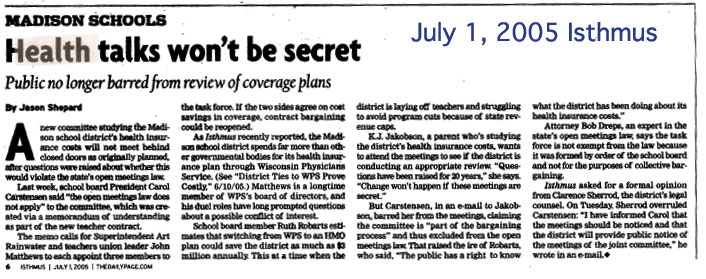
| School Information System |
 | Sponsorships | Sponsorships |
|
|
University of Wisconsin-Madison NewsPoverty may have direct implications for important, early steps in the development of the brain, saddling children of low-income families with slower rates of growth in two key brain structures, according to researchers from the University of Wisconsin-Madison.
By age 4, children in families living with incomes under 200 percent of the federal poverty line have less gray matter -- brain tissue critical for processing of information and execution of actions -- than kids growing up in families with higher incomes.
"This is an important link between poverty and biology. We're watching how poverty gets under the skin," says Barbara Wolfe, professor of economics, population health sciences and public affairs and one of the authors of the study, published today in the journal PLOS ONE.
The differences among children of the poor became apparent through analysis of hundreds of brain scans from children beginning soon after birth and repeated every few months until 4 years of age. Children in poor families lagged behind in the development of the parietal and frontal regions of the brain -- deficits that help explain behavioral, learning and attention problems more common among disadvantaged children.
The parietal lobe works as the network hub of the brain, connecting disparate parts to make use of stored or incoming information. The frontal lobe, according to UW-Madison psychology professor Seth Pollak, is one of the last parts of the brain to develop.
"It's the executive. It's the part of the brain we use to control our attention and regulate our behavior," Pollak says. "Those are difficulties children have when transitioning to kindergarten, when educational disparities begin: Are you able to pay attention? Can you avoid a tantrum and stay in your seat? Can you make yourself work on a project?"
The maturation gap of children in poor families is more startling for the lack of difference at birth among the children studied.
"One of the things that is important here is that the infants' brains look very similar at birth," says Pollak, whose work is funded by the National Institutes of Health. "You start seeing the separation in brain growth between the children living in poverty and the more affluent children increase over time, which really implicates the postnatal environment."
Newsletter signup | Send us your ideas
Motoko Rich (NYT)Nearly two decades ago, a landmark study found that by age 3, the children of wealthier professionals have heard words millions more times than those of less educated parents, giving them a distinct advantage in school and suggesting the need for increased investment in prekindergarten programs.
Now a follow-up study has found a language gap as early as 18 months, heightening the policy debate.
The new research by Anne Fernald, a psychologist at Stanford University, which was published in Developmental Science this year, showed that at 18 months children from wealthier homes could identify pictures of simple words they knew -- "dog" or "ball" -- much faster than children from low-income families. By age 2, the study found, affluent children had learned 30 percent more words in the intervening months than the children from low-income homes.
The new findings, although based on a small sample, reinforced the earlier research showing that because professional parents speak so much more to their children, the children hear 30 million more words by age 3 than children from low-income households, early literacy experts, preschool directors and pediatricians said. In the new study, the children of affluent households came from communities where the median income per capita was $69,000; the low-income children came from communities with a median income per capita of $23,900.
Since oral language and vocabulary are so connected to reading comprehension, the most disadvantaged children face increased challenges once they enter school and start learning to read.
"That gap just gets bigger and bigger," said Kris Perry, executive director of the First Five Years Fund, an advocate of early education for low-income children. "That gap is very real and very hard to undo."
Newsletter signup | Send us your ideas
Alan Schwarz and Sarah CohenNearly one in five high school age boys in the United States and 11 percent of school-age children over all have received a medical diagnosis of attention deficit hyperactivity disorder, according to new data from the federal Centers for Disease Control and Prevention.
These rates reflect a marked rise over the last decade and could fuel growing concern among many doctors that the A.D.H.D. diagnosis and its medication are overused in American children.
The figures showed that an estimated 6.4 million children ages 4 through 17 had received an A.D.H.D. diagnosis at some point in their lives, a 16 percent increase since 2007 and a 41 percent rise in the past decade. About two-thirds of those with a current diagnosis receive prescriptions for stimulants like Ritalin or Adderall, which can drastically improve the lives of those with A.D.H.D. but can also lead to addiction, anxiety and occasionally psychosis.
"Those are astronomical numbers. I'm floored," said Dr. William Graf, a pediatric neurologist in New Haven and a professor at the Yale School of Medicine. He added, "Mild symptoms are being diagnosed so readily, which goes well beyond the disorder and beyond the zone of ambiguity to pure enhancement of children who are otherwise healthy."
Read more here.
A thoughtful (and personal) commentary here.
Newsletter signup | Send us your ideas
Roger Cohen
THIS is America's college town par excellence. Kids from all over the world flock to Boston to learn. I have a son who is a freshman here. Last autumn, as he entered school, I listened to warnings about the dangers of binge drinking. I think they missed the point. The real epidemic involves so-called smart drugs, particularly Adderall, an amphetamine prescribed for attention deficit hyperactivity disorder (A.D.H.D.) but so freely available as to be the pill to take whenever academic pressure requires pulling an all-nighter with zero procrastination to get a paper done.
"Just popped an Addie, so I'm good to go" -- this sort of pretest attitude has become pervasive. Conversations with several students suggested Adderall was always available, costing from $2 to $5 a pill. Adderall has become to college what steroids are to baseball: an illicit performance enhancer for a fiercely competitive environment. What to say to doctors to get a prescription is now so widely known among students -- "It's like my thoughts are channel-surfing and I can't stop" -- as to have become a kind of joke.
"If there are no A.D.H.D. symptoms prior to college I have a very hard time writing a prescription," Jill Kasper, a pediatrician, told me. "But if somebody wants a prescription for Adderall, they can find someone to give it to them." The problem is that Adderall is dangerous, a Class 2 controlled substance like cocaine. While it has helped countless A.D.H.D. sufferers, it can also lead down a dark road of dependency, ever higher doses, fight-or-flight anxiety levels, sleeplessness and depression.
Here, in his own words, is the Adderall story of Steven Roderick, 24, a smart, soft-spoken, lost senior studying health science at the University of Massachusetts Boston:
I started taking it my first year in college. My performance had always fluctuated a lot. It was hard to pay attention, even in classes I was interested in. I was getting D's. I felt something had to change. Adderall flies around campus. The first time I took it I wrote a paper for an astronomy class that was out of this world. I could not believe it -- I was so inspired it made me want to be a doctor! I thought -- oh my God! -- this is the whole problem. You have the ability. You are intelligent. You just don't have the link between intelligence and the capacity to be productive. The pill is the link. I felt literally unstoppable.I went to the doctor, said I'd like to give Adderall a try. There were no diagnostic procedures. Doctors give in too easily. I did not think there could be a risk later on. I started on 20 milligrams. I went from D's and F's to straight A's. But your brain adapts, you have to increase the dose, and by 2011 I was up to 45 milligrams. In the spring of that year I started to feel Adderall was my best friend and my worst enemy at the same time. Because I could not sleep I went to see my psychopharm, and she prescribed me Ativan to sleep. That worked O.K. for a while. But I really ran into trouble last year. I was up to 65 milligrams, and then during finals went to 80, even 120, milligrams, and I was just locked into this Adderall-Ativan cycle. My doctor seemed scatterbrained. She'd prescribe something but not follow up.
It's a complicated dependency. I mean I never took Adderall to get high, never took it in a way that was not academically oriented; and I think there's a distinction between dependency and addiction, taking something for a purpose or for a rush. But I feel awful. My baseline anxiety level would be most people's highest anxiety level. The drop of a pin makes me spin around. I am living at home. My parents are clueless, and it is hard to discuss with them, although my Mom helps me now. I alternate between 'on' and 'off' states -- I come off the Adderall, take Ativan and sleep for days. I miss appointments. I know I need to go to the appointments, but I wonder if I will be functional enough.
Adderall suddenly turned its back on me. It enabled me to focus, got me to a higher place academically. But then I could no longer rely on it. I was on my own. And although I have less than three credits to go, I may have to withdraw from school because I have not been able to make it to enough classes. "Look, I am in a culture that constantly justifies the means to an end. So how do we persuade people not to take it? All you hear is how impossible it will be to get a job when you get out, and you are going more and more into debt, and you think without this I won't be top of the class. With other drugs you know you are ruining your life. But Adderall manipulates you into thinking you are doing what is needed to have a great life.
Newsletter signup | Send us your ideas
Deborah Brauser
So-called "Internet addiction" is associated with increased depression and even druglike withdrawal symptoms, new research suggests.
A study of 60 adults in the United Kingdom showed that those who were classified as high Internet users had a significantly greater decrease in positive mood after logging off their computers than the participants classified as low Internet users.
"Internet addiction was [also] associated with long-standing depression, impulsive nonconformity, and autism traits," report the investigators, adding that the latter is "a novel finding."
"We were actually expecting that people who used the net a lot would display enhanced moods after use -- reflecting the positive reinforcing properties of the net," coinvestigator Phil Reed, DPhil, professor and chair in the Department of Psychology at Swansea University in the United Kingdom, told Medscape Medical News.
"So the key finding of an immediate increased negative mood, the withdrawal effect, was something of a surprise. But the more we looked into the literature, the more it seemed to fit the notion of an addictive disorder," added Dr. Reed.
He noted that the main takeaway message for clinicians is that some people may experience disruptions to their lives from excessive Internet use -- and that this can affect both their psychological and physical health.
In addition, patients "may need help exploring the reasons for this excessive use and what functions it serves in their lives."
The study was published online February 7 in PLoS One.
Newsletter signup | Send us your ideas
The Daily BeastRecently, the Huffington Post published an article titled "I am Adam Lanza's mother" by a woman named Liza Long. The article presents a picture of a 13-year-old boy who threatened his mother, sometimes going so far as to pull a knife on her, scream obscenities at her, and leap out of cars as they're driving down the highway.
The rest of the world has reacted to the idea of such a child with horror and incomprehension. I sympathize with the horror. I can only wish that I shared the incomprehension. I understand, intimately, how Liza Long's son feels. I was like him.
Like the author of that piece, Liza Long, my mother had no idea what to do about my sudden transformation (in my case, around 16) into a borderline homicidal maniac. Like her son, I used knives to try and make my threats of violence seem more real. Like her son, I would leap out of our car in the middle of the road just to get away from my mother, over the most trivial of offenses. Like her son, I screamed obscenities at my mother shortly after moments of relative peace. And worse than this poor woman's son, whose mindset toward his peers we can only guess, I will admit that I fantasized multiple times about taking ordnance to my classmates.
By the logic which leads Liza Long to say, "I am Adam Lanza's mother," I have to say: "I was Adam Lanza."
This is a very honest, generous, and thought-provoking piece ... and one from an important source.
Newsletter signup | Send us your ideas
Not long ago few doctors - not even pediatricians - concerned themselves much with nutrition. This has changed, and dramatically: As childhood obesity gains recognition as a true health crisis, more and more doctors are publicly expressing alarm at the impact the standard American diet is having on health."I never saw Type 2 diabetes during my training, 20 years ago," David Ludwig, a pediatrician, told me the other day, referring to what was once called "adult-onset" diabetes, the form that is often caused by obesity. "Never. Now about a quarter of the new diabetes cases we're seeing are Type 2."
Ludwig, who is director of the New Balance Foundation Obesity Prevention Center in Boston, is one of three authors, all medical doctors of an essay ("Viewpoint") in the current issue of the Journal of the American Medical Association titled "Opportunities to Reduce Childhood Hunger and Obesity."
That title that would once have been impossible, but now it's merely paradoxical. Because the situation is this: 17 percent of children in the United States are obese, 16 percent are food-insecure (this means they have inconsistent access to food), and some number, which is impossible to nail down, are both. Seven times as many poor children are obese as those who are underweight, an indication that government aid in the form of food stamps, now officially called SNAP, does a good job of addressing hunger but encourages the consumption of unhealthy calories.
Given the role that nutrition plays -- from conception onward -- in brain development, learning, etc., clearly this is an achievement gap issue.
Newsletter signup | Send us your ideas
THREE million children in this country take drugs for problems in focusing. Toward the end of last year, many of their parents were deeply alarmed because there was a shortage of drugs like Ritalin and Adderall that they considered absolutely essential to their children's functioning. But are these drugs really helping children? Should we really keep expanding the number of prescriptions filled?
In 30 years there has been a twentyfold increase in the consumption of drugs for attention-deficit disorder. As a psychologist who has been studying the development of troubled children for more than 40 years, I believe we should be asking why we rely so heavily on these drugs.
Attention-deficit drugs increase concentration in the short term, which is why they work so well for college students cramming for exams. But when given to children over long periods of time, they neither improve school achievement nor reduce behavior problems. The drugs can also have serious side effects, including stunting growth.
Sadly, few physicians and parents seem to be aware of what we have been learning about the lack of effectiveness of these drugs.
What gets publicized are short-term results and studies on brain differences among children. Indeed, there are a number of incontrovertible facts that seem at first glance to support medication. It is because of this partial foundation in reality that the problem with the current approach to treating children has been so difficult to see.
Back in the 1960s I, like most psychologists, believed that children with difficulty concentrating were suffering from a brain problem of genetic or otherwise inborn origin. Just as Type I diabetics need insulin to correct problems with their inborn biochemistry, these children were believed to require attention-deficit drugs to correct theirs. It turns out, however, that there is little to no evidence to support this theory.
In 1973, I reviewed the literature on drug treatment of children for The New England Journal of Medicine. Dozens of well-controlled studies showed that these drugs immediately improved children's performance on repetitive tasks requiring concentration and diligence. I had conducted one of these studies myself. Teachers and parents also reported improved behavior in almost every short-term study. This spurred an increase in drug treatment and led many to conclude that the "brain deficit" hypothesis had been confirmed.
But questions continued to be raised, especially concerning the drugs' mechanism of action and the durability of effects. Ritalin and Adderall, a combination of dextroamphetamine and amphetamine, are stimulants. So why do they appear to calm children down? Some experts argued that because the brains of children with attention problems were different, the drugs had a mysterious paradoxical effect on them.
However, there really was no paradox. Versions of these drugs had been given to World War II radar operators to help them stay awake and focus on boring, repetitive tasks. And when we reviewed the literature on attention-deficit drugs again in 1990 we found that all children, whether they had attention problems or not, responded to stimulant drugs the same way. Moreover, while the drugs helped children settle down in class, they actually increased activity in the playground. Stimulants generally have the same effects for all children and adults. They enhance the ability to concentrate, especially on tasks that are not inherently interesting or when one is fatigued or bored, but they don't improve broader learning abilities.
And just as in the many dieters who have used and abandoned similar drugs to lose weight, the effects of stimulants on children with attention problems fade after prolonged use. Some experts have argued that children with A.D.D. wouldn't develop such tolerance because their brains were somehow different. But in fact, the loss of appetite and sleeplessness in children first prescribed attention-deficit drugs do fade, and, as we now know, so do the effects on behavior. They apparently develop a tolerance to the drug, and thus its efficacy disappears. Many parents who take their children off the drugs find that behavior worsens, which most likely confirms their belief that the drugs work. But the behavior worsens because the children's bodies have become adapted to the drug. Adults may have similar reactions if they suddenly cut back on coffee, or stop smoking.
TO date, no study has found any long-term benefit of attention-deficit medication on academic performance, peer relationships or behavior problems, the very things we would most want to improve. Until recently, most studies of these drugs had not been properly randomized, and some of them had other methodological flaws.
But in 2009, findings were published from a well-controlled study that had been going on for more than a decade, and the results were very clear. The study randomly assigned almost 600 children with attention problems to four treatment conditions. Some received medication alone, some cognitive-behavior therapy alone, some medication plus therapy, and some were in a community-care control group that received no systematic treatment. At first this study suggested that medication, or medication plus therapy, produced the best results. However, after three years, these effects had faded, and by eight years there was no evidence that medication produced any academic or behavioral benefits.
Indeed, all of the treatment successes faded over time, although the study is continuing. Clearly, these children need a broader base of support than was offered in this medication study, support that begins earlier and lasts longer.
Nevertheless, findings in neuroscience are being used to prop up the argument for drugs to treat the hypothesized "inborn defect." These studies show that children who receive an A.D.D. diagnosis have different patterns of neurotransmitters in their brains and other anomalies. While the technological sophistication of these studies may impress parents and nonprofessionals, they can be misleading. Of course the brains of children with behavior problems will show anomalies on brain scans. It could not be otherwise. Behavior and the brain are intertwined. Depression also waxes and wanes in many people, and as it does so, parallel changes in brain functioning occur, regardless of medication.
Many of the brain studies of children with A.D.D. involve examining participants while they are engaged in an attention task. If these children are not paying attention because of lack of motivation or an underdeveloped capacity to regulate their behavior, their brain scans are certain to be anomalous.
However brain functioning is measured, these studies tell us nothing about whether the observed anomalies were present at birth or whether they resulted from trauma, chronic stress or other early-childhood experiences. One of the most profound findings in behavioral neuroscience in recent years has been the clear evidence that the developing brain is shaped by experience.
It is certainly true that large numbers of children have problems with attention, self-regulation and behavior. But are these problems because of some aspect present at birth? Or are they caused by experiences in early childhood? These questions can be answered only by studying children and their surroundings from before birth through childhood and adolescence, as my colleagues at the University of Minnesota and I have been doing for decades.
Since 1975, we have followed 200 children who were born into poverty and were therefore more vulnerable to behavior problems. We enrolled their mothers during pregnancy, and over the course of their lives, we studied their relationships with their caregivers, teachers and peers. We followed their progress through school and their experiences in early adulthood. At regular intervals we measured their health, behavior, performance on intelligence tests and other characteristics.
By late adolescence, 50 percent of our sample qualified for some psychiatric diagnosis. Almost half displayed behavior problems at school on at least one occasion, and 24 percent dropped out by 12th grade; 14 percent met criteria for A.D.D. in either first or sixth grade.
Other large-scale epidemiological studies confirm such trends in the general population of disadvantaged children. Among all children, including all socioeconomic groups, the incidence of A.D.D. is estimated at 8 percent. What we found was that the environment of the child predicted development of A.D.D. problems. In stark contrast, measures of neurological anomalies at birth, I.Q. and infant temperament -- including infant activity level -- did not predict A.D.D.
Plenty of affluent children are also diagnosed with A.D.D. Behavior problems in children have many possible sources. Among them are family stresses like domestic violence, lack of social support from friends or relatives, chaotic living situations, including frequent moves, and, especially, patterns of parental intrusiveness that involve stimulation for which the baby is not prepared. For example, a 6-month-old baby is playing, and the parent picks it up quickly from behind and plunges it in the bath. Or a 3-year-old is becoming frustrated in solving a problem, and a parent taunts or ridicules. Such practices excessively stimulate and also compromise the child's developing capacity for self-regulation.
Putting children on drugs does nothing to change the conditions that derail their development in the first place. Yet those conditions are receiving scant attention. Policy makers are so convinced that children with attention deficits have an organic disease that they have all but called off the search for a comprehensive understanding of the condition. The National Institute of Mental Health finances research aimed largely at physiological and brain components of A.D.D. While there is some research on other treatment approaches, very little is studied regarding the role of experience. Scientists, aware of this orientation, tend to submit only grants aimed at elucidating the biochemistry.
Thus, only one question is asked: are there aspects of brain functioning associated with childhood attention problems? The answer is always yes. Overlooked is the very real possibility that both the brain anomalies and the A.D.D. result from experience.
Our present course poses numerous risks. First, there will never be a single solution for all children with learning and behavior problems. While some smaller number may benefit from short-term drug treatment, large-scale, long-term treatment for millions of children is not the answer.
Second, the large-scale medication of children feeds into a societal view that all of life's problems can be solved with a pill and gives millions of children the impression that there is something inherently defective in them.
Finally, the illusion that children's behavior problems can be cured with drugs prevents us as a society from seeking the more complex solutions that will be necessary. Drugs get everyone -- politicians, scientists, teachers and parents -- off the hook. Everyone except the children, that is.
If drugs, which studies show work for four to eight weeks, are not the answer, what is? Many of these children have anxiety or depression; others are showing family stresses. We need to treat them as individuals.
As for shortages, they will continue to wax and wane. Because these drugs are habit forming, Congress decides how much can be produced. The number approved doesn't keep pace with the tidal wave of prescriptions. By the end of this year, there will in all likelihood be another shortage, as we continue to rely on drugs that are not doing what so many well-meaning parents, therapists and teachers believe they are doing.
Newsletter signup | Send us your ideas
Newsletter signup | Send us your ideas
In Buffalo, New York, the heart of the American rust-belt, the public school system pays for its teachers to get plastic surgery. Hair removal. Miscrodermabrasian. Liposuction. If you can name the procedure, it's probably covered.No, I am not exaggerating. And no, this article is not an excuse to make "Hot For Teacher" cracks. When I write that Buffalo's school system pays, I mean it literally. The perk is included as a self-insured rider in its teachers' contract. Therefore, the district has to cover the cost of each nip and tuck itself. There's no co-pay, so the school district ends up footing the entire bill. It estimates the current annual cost at $5.2 million, down from $9 million in 2009.
This in a city where the average teacher makes roughly $52,000 a year. The plastic surgery tab would pay salaries for 100 extra educators.
s The Buffalo News has reported, the rider existed for years with little notice. It dates back at least to the 1970s, when "getting a little work done" wasn't par for the course among women (and some men) of a certain age. Instead, it was intended to cover serious reconstructive surgery, on burn victims, for instance. In 1996, the rider was nearly cut. But after the daughter of a district employee was hurled through a windshield during a car wreck, requiring surgery to repair scars on her face and body, union officials lobbied to keep the benefit in place.
Newsletter signup | Send us your ideas
A long-awaited audit documents the perfect storm that swamped state government's ability to manage Wisconsin's Medicaid program, which provided health care to 1.18 million elderly, poor and disabled at a cost of $7.5 billion last year.Out of control healthcare spending certainly affects K-12 budgets....It's an alarming read, even for an eyes-glaze-over financial report. It could be a tea party manifesto. It explains why Democrats, who ran the Capitol for a two-year period that ended a year ago, blocked earlier requests for the audit.
Between 2007 and 2011, state Auditor Joe Chrisman and his staff found, Medicaid budget and program controls were drowned by factors that included:
A state hiring freeze and a requirement that state workers take eight unpaid days for two straight years.
The 2008-'09 expansion of Medicaid to more than 100,000 children, families, pregnant women and adults without dependent children.
The recession, which cost thousands their jobs, forcing them and their families onto Medicaid rolls.
Between 2007 and 2011, the cost of Medicaid went up by 51% (from $5 billion to $7.5 billion), while its caseload went up by 36% (from 870,201 to 1.18 million). But there's so much more to ask about those numbers. At some point, lawmakers who must approve Medicaid budgets should ask the state Department of Health Services:
Newsletter signup | Send us your ideas
Don Berwick is an American hero and also a victim of the obscene stalemate in Washington; the one being heaped on us by our Congress that has a 9% approval rating. Most people that I know with a score that low would have the self-respect to quit rather than to point fingers at others. Well, as part of this mess, Congress wouldn't approve the appointment of Dr. Don Berwick, who is a true American hero because he is among one of the real leaders of the movement to save American health care. Before coming to Washington, the organization he led, a small non-profit called the Institute for Health Improvement, organized and guided an effort in American hospitals that -- by doing simple, evidence things like hand washing, raising the bed when people are on a respirator, and other small but effective things -- saved more than 100,000 lives by some estimates. This little non-profit recruited over 3000 hospitals that had over 70% of the beds in the U.S. to participate in this effort to reduce preventable deaths.Obama, recognizing his greatness, appointed him as head of the Centers for Medicare and Medicaid Services. Or he tried to. Our do nothing -- or actually do nothing but screw the other side -- Congress opposed his appointment, so Obama did one of those sneaky interim appointments that Berwick to keep the position for 17 months before being forced out. The New York Times Joe Nocera did a great piece on him, check it out.
Newsletter signup | Send us your ideas
Health care spending in Wisconsin averaged $7,233 for each person - or almost $29,000 for a family of four - in 2009, according to a report released last week.The amount was 6% higher than the national average of $6,815.
Wisconsin, which spent an estimated $40.9 billion on health care in 2009, ranked 35th in the country in per-capita spending, according to the report by researchers at the Centers for Medicare & Medicaid Services. Thirty-four states spent less.
The study shows the wide variation in health care spending from state to state. The variation stems largely from demographics, such as the average age of the population, and the percent of the population with health insurance.
States with higher incomes and higher cost of living also tended to spend more on health care.
Utah, with a young population and healthy lifestyle, spent an average of $5,031 per person on health care, or 26% less than the national average. In contrast, Massachusetts, with higher incomes and nearly universal insurance coverage, spent an average of $9,278, or 36% more than the national average.
Newsletter signup | Send us your ideas
More parents are opting out of school shots for their children. In eight states now, more than one in 20 public school kindergartners aren't getting all the vaccines required for attendance, an Associated Press analysis found.That growing trend among parents seeking vaccine exemptions has health officials worried about outbreaks of diseases that once were all but stamped out.
Take measles, for example. It can lead to pneumonia, encephalitis and death. Since 2000, one in every 250 Americans who got measles died.
The measles vaccine is so effective, 99.9% of those who get vaccinated gain immunity, said Geoffrey Swain, associate professor at the University of Wisconsin School of Medicine and Public Health and chief medical officer for the Milwaukee Health Department.
Many children cannot get the measles vaccine, though, because they aren't old enough - the first dose of vaccine is recommended between 12 and 15 months. Or, they have medical issues or families with religious beliefs that leave them unprotected and susceptible to measles through no fault of their own, Swain said.
Newsletter signup | Send us your ideas
As soon as the school day ended, the rush at the health clinic began.Two high school seniors asked for sports physicals. A group of teenagers lined up for free condoms. A girl told a counselor she needed a pregnancy test.
The clinic, at Belmont High School near downtown Los Angeles, is part of a rapidly expanding network of school-based centers around the nation offering free or low-cost medical care to students and their families.
In California, there are 183 school health centers, up from 121 in 2004. Twelve more are expected to open by next summer, according to the California School Health Center Assn.
The centers have become a small but important part of the nation's healthcare safety net, experts say, treating low-income patients who might otherwise not have regular medical care. Now, they add, campus clinics are serving as a model for health officials trying to reduce costs.
Newsletter signup | Send us your ideas
Ron Winslow & Jennifer Corbett Dooren:
Government health experts recommended Friday that all children be tested for high cholesterol before they reach puberty, in an effort to get an early start in preventing cardiovascular disease.The National Heart, Lung and Blood Institute said a child's first cholesterol check should occur between ages 9 and 11 and the test should be repeated between ages 17 and 21. The American Academy of Pediatrics endorsed the guideline.
The recommendation reflects growing evidence the biological processes that underlie heart attacks and other consequences of cardiovascular disease begin in childhood, even though manifestations of the diseases generally don't strike until middle age or later.
The guidelines also come amid broad concern about growing numbers of American children who are overweight or obese and thus potentially on course for diabetes, high blood pressure and other abnormalities. The U.S. Centers for Disease Control and Prevention estimate that 17% of American children are obese, triple the level three decades ago.
Newsletter signup | Send us your ideas
Banning sugar-filled sodas from American schools as an effort to combat childhood obesity doesn't reduce overall consumption levels of sweetened beverages, research found.In U.S. states that banned only soda, about 30 percent of middle-school students still purchased sugary drinks like sports and fruit beverages at school, similar to states that had no policy, according to a study released online today in the Archives of Pediatrics and Adolescent Medicine. In states that banned all sugar-sweetened beverages, students still consumed the drinks outside of school, the researchers said.
Over the past 25 years, children have gotten more of their calories from sugary beverages and consumption of the drinks has been associated with childhood obesity and weight gain, the authors said. Today's study is the first to look at whether efforts by states to curb these drinks really works, said Daniel Taber, the lead study author.
Newsletter signup | Send us your ideas
As more Chicago public schools cash in on Mayor Rahm Emanuel's longer-day financial incentives by adding 90 minutes to their school day, the previous votes by a dozen schools to add about a half hour to the day by bringing back recess are going unnoticed.Restoring recess is part of a broader health push by parents, advocacy groups and some city officials to bring more exercise and better nutrition to both schoolchildren and preschoolers.
Beginning in November, the city's Department of Public Health will require children who attend preschool or day care centers in Chicago to spend less time in front of television or computer screens -- 60 minutes or less -- and more time, at least an hour a day, participating in physical activity. At snack or meal time, milk cannot have a fat content higher than 1 percent, unless a child has written consent from a doctor. Only 100 percent juice can be served.
In Chicago, 22 percent of children are overweight before they enter school, more than twice the national average, according to research compiled by the Consortium to Lower Obesity in Chicago Children, a group of organizations and health advocates.
Newsletter signup | Send us your ideas
WEA Trust doesn't like what Mark Belling has to say, and the health insurer wants the conservative talk show host to "cease and desist."WEA Trust, which bills itself on its website as a not-for-profit insurance group for Wisconsin public school employees and their families, today sent a letter to the afternoon, drive-time, radio host at 1130 WISN in Milwaukee, demanding Belling stop making what WEA Trust describes as "defamatory public accusations.
Belling repeatedly has accused the private health insurance company of "racketeering" by transferring its revenue to the Wisconsin Education Association Council, or WEAC, the state teachers union, an act that would be illegal under state and federal law.
Newsletter signup | Send us your ideas
A group of researchers said that by examining the whole genome of a family of four, they were able to make unusually specific findings, including the daughter's risk of blood clots, and suggestions for preventive care.The study, published Thursday in the journal PLoS Genetics, was led by researchers at Stanford University School of Medicine in Palo Alto, Calif., but also listed as co-authors John and Anne West, a father and daughter who were researching their own genetic make-up at home in Silicon Valley and met the Stanford team in the process. The research is part of scientists' continuing quest to extract truly useful information from the genome, a person's complete genetic code.
This is the second time a paper has been published about a family's whole genome. In the earlier paper, published last year in Science Express by a different group of researchers, the two children in the family had rare genetic conditions, and researchers were searching for the genes that caused them. The goal in the current study was to better predict the disease risk of a family and how family members might respond to medications.
Newsletter signup | Send us your ideas
Randy White of the Dallas Cowboys, star defensive tackle of the 1970s, member of both the College Football Hall of Fame and Pro Football Hall of Fame: What a joy it was to watch him play! White was a master of leverage, burst and anticipation. Today, he might not even make an NFL roster. If White got on the field, he'd be crushed.White played defensive tackle at 257 pounds, across from centers weighing 240 or 250 pounds and guards who were considered huge if 265. Last year's Super Bowl featured defensive tackles B.J. Raji (337 pounds) and Casey Hampton (330 pounds) versus guards Chris Kemoeatu (344 pounds) and Josh Sitton (318 pounds). Either guard would have steamrolled Randy White as if he wasn't there.
As for today's biceps: Your Honor, I call to the stand America's leading expert on these matters, Mel Kiper Jr. Everyone assumes today's football players are bigger, faster and stronger than those who came before. But what does the data show? No one is better suited to answer that question than Kiper.
Far, far in the past -- about 1980 -- the United States was not obsessed with the NFL draft. Of course that's hard to imagine today. Once, bread did not come sliced. But I digress.
Newsletter signup | Send us your ideas
While attending a recent party on the shores of Lake Mendota, the use of drug-sniffing dogs in city high schools became a discussion topic. As parents and taxpayers, we concluded that the use of random sweeps is an excellent idea because Madison and Dane County have seen dramatic increases in drug use among younger people.We thought it incredible that John Matthews, the teachers union boss, would utter such nonsense that there wouldn't be better control with drug-sniffing dogs and "why do we want to make kids go to school in that environment?"
Newsletter signup | Send us your ideas

www.teamreal.org, via Judy Reed:
TEAM REAL is made up of students from your community that are in-the-know about drugs of abuse. The facts provided will raise awareness of the local drug trends, costs of illicit drugs, ways kids are getting high, and the use of over-the-counter and licit medications as drugs of abuse.A larger version of this image is available here.
Newsletter signup | Send us your ideas
Less than two months after a new state law took health benefits off the bargaining table for public workers and required them to pay at least 12.6 percent -- up from zero, in some school districts -- of their health insurance premiums, WEA Trust has lost a fifth of its business.And that means big changes could be coming for the Madison-based group health insurer of mostly school districts that employs nearly 500.
"We're going to have to adapt and adjust," said Mark Moody, president and CEO of WEA Trust. "You can't absorb a 20 percent loss and not do anything."
The Trust, a not-for-profit company, provides health insurance to just over 100,000 employees in about 60 percent of the state's 425 school districts.
It was created in 1970 by the state's largest teachers' union, the Wisconsin Education Association Council, or WEAC.
Critics have long accused the two bodies of working together to fleece taxpayers through over-priced contracts they say school boards have effectively been forced to sign under union pressure.
Newsletter signup | Send us your ideas
In our last post, we made some estimates on potential savings in the 2011-12 budget due to over-budgeting for health insurance premiums in the wake of Governor Walker's budget.Sun Prairie's website.Our calculations were based on the following:
The cost to the district for a Family plan was estimated to be: $14,249
The cost to the district for a Single plan was estimated to be: $ 6,307
Newsletter signup | Send us your ideas
Karen Herzog and Erin Richards:
A health insurance company affiliated with the state's largest teachers union is caught in the cross-fire of Wisconsin school reform politics, the company's CEO told the Journal Sentinel editorial board Monday."We haven't really wanted to be the story," said Mark Moody, president and CEO of WEA Trust. "We've become the lightning rod for debate."
Moody said WEA Trust has lost about 17% of its subscribers as a number of school districts have switched insurance providers in the wake of deep state budget cuts. WEA Trust at the start of the year insured two-thirds of Wisconsin's 424 school districts, but only 35% of the state's teachers, since many of the insured districts are small, he said.
One renewal sweetener WEA Trust offered to districts - which the provider said was done in accordance with federal rules - may prompt legal action.
Newsletter signup | Send us your ideas
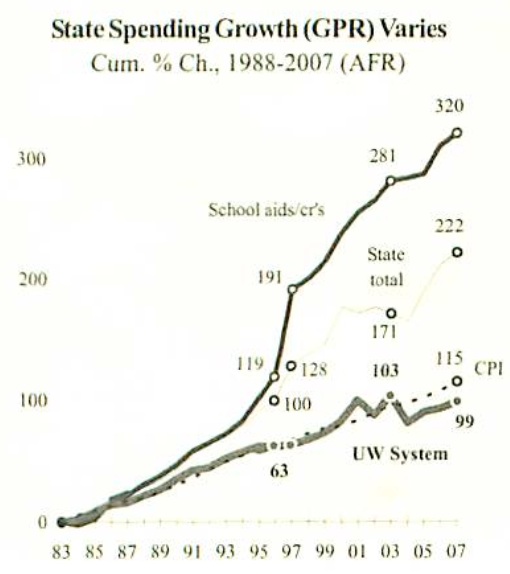
The Madison School District will lose $6.7 million in state aid next year -- $2 million more than it anticipated -- according to estimates released Friday by the Department of Public Instruction.Related: 1983-2007 Wisconsin K-12 Spending Growth via WISTAX:The 13.5 percent cut is third-highest in the state among K-12 districts and higher than the 10 percent cut the School Board used to calculate its preliminary budget last week.
The $43.2 million in aid is also nearly one-third less than the $60.8 million the district received from the state four years ago.
Superintendent Dan Nerad said continuous cuts in state aid are hurting the quality of public education.
"School districts like ours cannot continue to be in an environment like this with increased expectations for student performance, and yet we're not willing to provide the resources," Nerad said.
 Newsletter signup | Send us your ideas
Heavily Democratic Massachusetts on Friday became the latest state to curtail public workers' collective-bargaining rights, as lawmakers approved a $30.6 billion budget that gives cities and towns greater leeway to force employees to pay more for their health care.The restrictions come as states including Ohio and Wisconsin, where Republicans control the governor's office and legislature, have been attacking collective bargaining.
More-recent moves elsewhere show Democrats, long union allies, are starting to demand more savings from public employees as well. In New Jersey, the Democrat-controlled legislature recently passed cuts to pension and health-care benefits pushed by Republican Gov. Chris Christie.
In Massachusetts, House Speaker Robert A. DeLeo, a Democrat, said after Friday's vote that "this common-sense reform will save $100 million for cities and towns and preserve the jobs of fire-fighters, police officers and teachers."
Newsletter signup | Send us your ideas
The number of overweight kids and adolescents in the U.S. has almost tripled since the 1980s. That's pretty troubling, but the Institute of Medicine says we need to be paying more attention to the littlest kids: those under five.Almost 10 percent of babies and toddlers carry too much weight for their size. And more than 20 percent of children 2 through 5 are already overweight, the IOM says, which could have pretty serious repercussions later in life.
"Contrary to the common perception that chubby babies are healthy babies and will naturally outgrow their baby fat, excess weight tends to persist," Leann Birch, chair of the IOM's childhood obesity prevention committee, said in a statement. The committee's report released today makes some recommendations on what to do about it.
Newsletter signup | Send us your ideas
"They're ready," Matthews said afterward, "to do whatever it takes."Much more on John Matthews, here. Madison Teachers, Inc. website and Twitter feed.After 43 years as executive director of Madison Teachers Inc., Matthews is in the spotlight again after encouraging a four-day sick-out that closed school in February. The action allowed teachers to attend protests at the Capitol over Gov. Scott Walker's proposal to curb collective bargaining by public employees. The matter remains in the courts, but it prompted a hasty contract negotiation between the district and union.
Teachers aren't happy about some of the changes, and Matthews is preparing for a street fight.
"It's going to get down and dirty," Matthews said, alluding to the possibility of more job actions, such as "working the contract" - meaning teachers wouldn't work outside required hours - if the School Board doesn't back off changes in the contract. "You can't continually put people down and do things to control them and hurt them and not have them react."
Moreover, the latest battle over collective bargaining has taken on more personal significance for Matthews, whose life's work has been negotiating contracts.
Newsletter signup | Send us your ideas
In March, it was announced with much fanfare that the Milwaukee teachers' union was dropping it's controversial Viagra lawsuit against MPS.However, the MacIver News Service has learned that the effort to force MPS to provide coverage for erectile dysfunction treatments has arisen again, albeit in a different venue.
The Milwaukee Teachers Education Association's (MTEA) decision earlier this year came just eight months after filing their August of 2010 suit in Milwaukee County Circuit Court wherein they argued that the board's policy of excluding erectile dysfunction drugs from their health plan coverage was discriminatory against men.
Newsletter signup | Send us your ideas
With deadlines looming against a backdrop of uncertainty, some area school districts are scurrying to reach agreements with employee unions, gaining concessions in benefits to avoid mass layoffs and program cuts.A few agreements are new or extended contracts, including a two-year contract for teachers approved last week in Menomonee Falls. Others, such as an agreement approved for West Allis-West Milwaukee teachers, are more limited. School districts could have made the changes without union approval if the law largely eliminating collective bargaining for most public employees wasn't stalled in court.
School officials also are crafting new employee handbooks to replace union contracts, outlining benefits and working conditions no longer subject to negotiations if, as expected, collective bargaining is limited to wages.
Some districts are obligated by contract to send layoff notices by June 1. Districts also must give 30 days' notice if they want to switch to less expensive insurance plans before the new fiscal year begins July 1. Many districts have union contracts that expire June 30.
Newsletter signup | Send us your ideas
Teachers in the Hartland-Lakeside School District have agreed to switch health insurance providers to save the district $690,000, but the executive committee of a union that represents Arrowhead High feeder schools is blocking the change, officials say.Faced with a $1.2 million reduction in state aid for the 2011-12 school year, the School Board has been looking at ways to reduce costs and avoid program cuts and increases in class sizes, Superintendent Glenn W. Schilling said Tuesday.
The board determined it could achieve some saving by switching teachers' health insurance from WEA Trust, the nonprofit company started 40 years ago by the state's largest teachers union, to another provider when the contract expires on June 30.
In the end, the board and teachers - after a series of joint meetings to study the issue - agreed to go with United Healthcare.
Newsletter signup | Send us your ideas
Madison School Board Member Ed Hughes:
In an article about teacher retirements in the State Journal a couple of weeks ago, Madison Teachers Inc. Executive Director John Matthews had some harsh comments about the Madison school district and school board. Referring to the Teacher Emeritus Retirement Program, or TERP, Matthews said, "The evidence of the ill will of the board of education and superintendent speaks for itself as to why we have grave concern over the benefit continuing. . . . They tore things from the MTI contract, which they and their predecessors had agreed for years were in the best interest of the district and its employees."In an article in Isthmus last week, Lynn Welch followed up with Matthews. Matthews comes out swinging against the school district in this article as well, asserting, "The bargaining didn't have to [involve] so much animosity. . . . If they wanted to make revisions, all they had to do is talk with us and we could have worked through something that would be acceptable to both sides. But they didn't bother to talk about it. You don't buy good will this way." While the contract includes very significant economic concessions on the part of the teachers, Matthews expressed unhappiness with the non-economic changes as well, labeling them "inhumane."
In the Isthmus article, Matthews asserts that the changes in the collective bargaining agreement "show how Walker's proposed legislation (still tied up in court) has already produced an imbalance of power forcing unions to make concessions they don't want to achieve a contract deal."
.........
The collective bargaining process is useful because it provides an established framework for hammering out issues of mutual concern between the school district and its employees and for conflict resolution. However, if the collective bargaining agreement were to disappear, the school district wouldn't immediately resort to a management equivalent of pillaging the countryside. Instead, the district would seek out alternative ways of achieving the ends currently served by the collective bargaining process, because the district, like nearly all employers, values its employees and understands the benefits of being perceived as a good place to work.
But when employers aren't interested in running sweat-shops, organizations set up to prevent sweat-shop conditions aren't all that necessary. It may be that John Matthews' ramped-up rhetoric is best understood not as a protest against school district over-reaching in bargaining, since that did not happen, but as a cry against the possibility of his own impending irrelevance.
Newsletter signup | Send us your ideas
A dispute has developed between Madison teachers and the school district over changes to contracts secured during quickie negotiations in March. John Matthews, executive director of Madison Teachers Inc., is upset about what he calls an "unfair and unreasonable" process."The bargaining didn't have to [involve] so much animosity," says Matthews. "If they wanted to make revisions, all they had to do is talk with us and we could have worked through something that would be acceptable to both sides. But they didn't bother to talk about it. You don't buy good will this way."
Elsewhere, in an interview with the Wisconsin State Journal, Matthews referred darkly to "the ill will of the board of education and superintendent" toward his members, as shown in these contract talks.
But school board members and district administrators take a different view, saying Matthews and his staff were at the bargaining table and agreed to all changes made to the contracts during an all-night negotiation that ended March 12; MTI members ratified the deal the next day. School Board President Maya Cole suggests that Matthews now has "buyer's remorse."
Newsletter signup | Send us your ideas
Falling enrollment, budget cuts and layoff have led to corresponding declines in membership for most National Education Association state affiliates. Without compensatory action, fewer members mean less dues revenue - a situation these unions have not had to face in recent memory.As the numbers show quite clearly, even lean times do not mean NEA's affiliates will become destitute. There is an awful lot of cash flowing through union headquarters around the country. But union officers and representatives are quick to find ways to spend it, particularly on their own employees. Adjusting budgets downwards is not their strong suit.
NEA itself had to revise its budget to account for membership loss and a smaller-than-planned increase in dues. It also froze the pay of its executive officers for the 2011-12 school year.
Two NEA state affiliates - California and Wisconsin - have different troubles to face in different political environments, so we shouldn't be surprised that they are applying different measures to their fiscal problems.
The California Teachers Association sets its dues level by a formula that involves the average teacher salary over the last three years. With layoffs occurring almost exclusively at the bottom of the salary scale, it actually has the effect of driving up the state's average teacher salary, and thus the dues level. With fewer members, CTA will raise its dues $8 next fall, to $647. This will mitigate the money lost, but not cover it entirely.
......
WEAC announced the cancellation of its fall convention, citing the uncertainty of whether it will be allowed to bargain the time off for its members. However, holding these events each year is also a budgetary drain, one that other NEA state affiliates have been forced to face.
Despite the serious state of financial affairs, WEAC is allocating up to $2 million for lobbying, legal action and internal communications in order to turn the political tide. It has, and will continue to receive, monetary and manpower assistance from NEA and other affiliates, including California.
These early signs indicate that the likely outcome of the collective bargaining battles in statehouses across the country is financially weaker teachers' unions - but only relatively. Overall, there may be fewer members and fewer staffers. The unions may require special assessments or higher dues increases just to restore former revenues. But $1.5 billion annually is still an awful lot of money. We may see it applied in concentrated form on the unions' existential issues, not diffused among feel-good projects.
Newsletter signup | Send us your ideas
School districts in southeastern Wisconsin pay significantly more for health insurance than do private businesses - as much as 76% more - and their employees bear much less of the overall cost, an analysis released Wednesday shows.MacIver Institute:The relatively small contribution teachers in general make to their insurance coverage drew considerable attention during the superheated debate over Gov. Scott Walker's budget-repair bill and his bid to sharply limit collective bargaining by most government employees.
Less discussed has been the cost of the insurance plans, which significantly outweigh those offered by private-sector employers, according to an analysis by HCTrends, which describes itself as "a market-oriented forum" on health care issues.
For single coverage, southeastern Wisconsin school districts paid 76% more than private businesses in 2009-'10, according to HCTrends.
School districts in southeastern Wisconsin are paying twice as much for health insurance as private sector companies in Milwaukee, according to a new study by HCTrends. That's just the beginning of what the group found in its study of school district health insurance expenses in 2010."Health plan costs for the region's teachers are 63 percent higher, on average, than the plans offered at private-sector companies with some union representation, and 80 percent higher than the average single-coverage cost for all private-sector plans," according to the study.
"This combination of above-average plan costs and below-average employee contributions significantly increases the school district's health care costs. While the average teachers' plan costs 80 percent more than the average private-sector plan, the per-employee cost borne by the school district is twice as much as the cost borne by the average employer."
Newsletter signup | Send us your ideas
One indication of how disingenuous the world of public education has become is the sympathy some of us apparently feel for veteran Madison teachers who feel compelled to retire early.As this newspaper detailed Sunday, early retirements have spiked over concerns about what Gov. Scott Walker's bid to curtail public sector collective bargaining rights will mean for teachers' retirements.
It's clear teachers beginning their careers today could be subjected to lots of things the private sector has had to endure for a long time (e.g., merit evaluations, higher health care costs). What puzzles me is what veteran teachers risk by working a few more years -- especially given the love they express for the job.
Take, for example, teachers' ability to parlay unused sick days into health insurance coverage or other benefits after they retire.
District spokesman Ken Syke said the district's legal team has not produced an opinion on this. But teachers union president John Matthews was certain it was a benefit long-time teachers would retain.
Newsletter signup | Send us your ideas
Three children in Pingliang, Gansu, have died and 36 others have fallen ill from nitrite poisoning after drinking milk bought direct from farmers.Pingliang's No2 People's Hospital recorded the first food-poisoning death around 9am on Thursday and another hospital recorded two similar deaths shortly afterwards.
"The three dead children were all under three years old. The rest of the patients were mostly children under 14 years old," a Pingliang government spokesman said.
Newsletter signup | Send us your ideas
NUSD board members have medical, dental and vision coverage for themselves and their families that is paid for by the district. Possible changes sparked disagreements at budget workshop.Debates surfaced among school board members on whether they should receive health benefits, a topic that was brought up during a budget workshop held on Tuesday night.
Disagreements began when board member Nancy Thomas presented the idea that board members should no longer participate in health benefits provided by Newark Unified School District.
Newsletter signup | Send us your ideas
In freeing school boards from bargaining with employees over anything but inflation-capped wage increases, Wisconsin lawmakers might have opened the floodgates for districts seeking to drop coverage by the state's dominant - and highly controversial - health insurance provider for teachers.WEA Trust, the nonprofit company started 40 years ago by the state's largest teachers union, currently insures employees in about two-thirds of Wisconsin school districts. The company's market dominance has dropped in recent years, although not as much as some school officials who complain about the company's costs would like.
After switching the district's nonunion employees to a different health insurance carrier, Cedarburg School Board President Kevin Kennedy said his school system is likely to look at cost savings by doing the same for its unionized teachers after unsuccessful attempts in previous years.
"It's such a large-ticket item; it's such low-hanging fruit," he said. "You can lay off an aide or increase your student fees, but that doesn't make up such a magnitude of saving as insurance does."
Newsletter signup | Send us your ideas
Gov. Scott Walker says the changes he has rammed through the Legislature will give school districts and local governments "the tools" they need to withstand the severe cuts in state aid his budget will deliver. What he doesn't get into is how the tensions caused by his agenda will divide the members of these bodies, as they have the state as a whole.Somewhat related: Jason Shepherd: Going to the mat for WPSOne example of this is the Madison school board, where disagreements over the impact of Walker's actions have spurned an ugly exchange, in which school board member Lucy Mathiak lobbed an F-bomb at a fellow board member, Marj Passman.
The exchange happened yesterday, March 14. Passman was contacted by a Madison school teacher who felt Mathiak had been dismissive of the teacher's concerns, urging her to "get over yourself." Passman, who allows that board members have been deluged with angry emails, says she expressed to Mathiak that she agreed this response was a little harsh.
Suzanne Fatupaito, a nurse's assistant in Madison schools, is fed up with Wisconsin Physicians Service, the preferred health insurance provider of Madison Teachers Inc.Lucy has been a long time friend and I have long appreciated her activism on behalf of students, the schools and our community."MTI uses scare tactics" to maintain teacher support for WPS, Fatupaito recently wrote to the school board. "If members knew that another insurance [plan] would offer similar services to WPS and was less expensive - it would be a no-brainer."
WPS, with a monthly price tag of $1,720 for family coverage, is one of two health coverage options available to the district's teachers. The other is Group Health Cooperative, costing $920 monthly for a family plan.
During the past year, the Madison school board has reached agreements with other employee groups to switch from WPS to HMO plans, with most of the savings going to boost pay.
In December, the board held a secret vote in closed session to give up its right to seek health insurance changes should negotiations on the 2007-09 teachers contract go into binding arbitration. (The board can seek voluntary insurance changes during negotations.)
Newsletter signup | Send us your ideas
Kansas Gov. Sam Brownback is cutting $50 million from schools and will ask the Legislature to transfer nearly that much to cover increased costs in health and human services caseloads.Much more on increased adult to adult spending, here.The school funding reduction makes up the lion's share of $56.5 million in total cuts announced late Friday.
Brownback, a Republican, said the reductions are necessary to meet the constitutional requirement that the state budget be in balance when the fiscal year ends in June.
"I wish we didn't have to do this," he said. "It's been difficult, but it's something we need to do."
The cut in base state aid to education will reduce the state's annual school spending per pupil by $22, from $4,012 to $3,990, according to Sherriene Jones-Sontag, the governor's spokeswoman.
Newsletter signup | Send us your ideas
Here are the fiscal facts. Unlike most employees, few Wisconsin teachers have to contribute more than marginally to their retirement and health care costs. My colleague Bob Costrell, who has done substantial work in Milwaukee, calculates that the city's public school teachers get a remarkable package of benefits equal to 74% of salary, roughly double the normal benefits for workers calculated by the Bureau of Labor Statistics but in line with other Wisconsin teachers.And that's not all. By collective bargaining agreement, the Wisconsin Education Association Council has a lock on health insurance coverage for members, not necessarily a great service for teachers but a wonderful profit center for the union.
What explains this? As one who has served in government and taught public personnel management, the answers are three-fold, and in combination explain why allowing a broad scope for collective bargaining undermines transparency and, ultimately, democracy.
First, teachers unions play a big role in politics, meaning that, as Terry Moe writes in "Teacher Unions and School Board Elections" (published in a Brookings Institution book on school boards), "the fact that school boards are elected means that the teacher unions can actually participate in choosing - or even literally choose - the management they will be bargaining with."
In the California school districts Moe studies, unions fund candidates and mobilize voters in (low-turnout) school board elections and often recruit the candidates. Unions thus control both sides of the collective bargaining table. Surveys of school board members suggest that business interests, in contrast, have little power.
I have not seen comparable research on Wisconsin, but I suspect similar dynamics.
Newsletter signup | Send us your ideas
School districts required to offer health insurance through WEA Trust, a company created by the teachers' union, would save $68 million a year if employees could switch to the state health plan, Gov. Scott Walker said this week, repeating a claim he made last year.The cost of providing WPS coverage to Madison teachers has long been controversial."That's one of the many examples of why it's so critically important to change collective bargaining," Walker said at a news conference Monday before bringing up the issue again in his public address Tuesday.
Madison-based WEA Trust, created by the Wisconsin Education Association Council, disputes the claim. The insurer says it provides lower-cost choices, and districts can already join the state health plan.
"It's been an option for them for some time," said WEA Trust spokesman Steve Lyons.
About 65 percent of the state's school districts contract with WEA Trust, covering about 35 percent of school employees. Several large districts, including Green Bay, Madison and Milwaukee, don't offer the plan.
Newsletter signup | Send us your ideas
The Department of Health and Human Services released its latest list of companies and organizations that received a one-year waiver of the Affordable Care Act's ban on annual dollar limits on benefits. A total of 733 waivers have been granted for 2011, of which at least 144 went to unions and union trusts, while an additional 18 went to school districts.Waivers were granted to at least 17 locals and affiliates of the Teamsters, 11 of the International Brotherhood of Electrical Workers (IBEW), 28 of the United Food and Commercial Workers (UFCW), 7 of the SEIU, and one to the United Federation of Teachers Welfare Fund.
Newsletter signup | Send us your ideas
There's always lots of talk about how Madison area teachers enjoy gold-plated health insurance plans, courtesy of the taxpayers. But a recently released report from the Wisconsin Association of School Boards should go a long ways towards dispelling that myth.Almost 400 school districts showed insurance data for the 2009-2010 school year, and the cost of premiums for Madison school district employees were rock bottom, second only to the tiny Maple school district's premium costs. (Only about a quarter of the school districts in Wisconsin have yet reported their 2010-2011 figures).
Last year's premium costs for the Maple School District, located in Douglas County in northern Wisconsin, were $369.26 per month for a single person's policy; Madison's costs ran $419.13 for a single policy, with Hortonville in third place at $419.42. Family insurance premiums in Maple were $1107.79 per month while Madison's were $1119.10; Hortonville was 1220.41.
Newsletter signup | Send us your ideas
A Memphis, Tennessee high school is trying to come to grips with a teen pregnancy epidemic.Ninety students who attend Frayser High School are currently pregnant or have already had a baby this year.
The stunning number means nearly 11 percent of the school's approximately 800 students are already experiencing the trials of parenthood.
A Title One school, Frayser receives federal dollars based on the number of students from low income families who qualify for free or reduced lunch.
Nearly 100 percent of the students who attend the school qualify.
Such a high rate of pregnancy at one school is dire, but sources say there is a massive initiative in the works dedicated to preventing teen pregnancy in the Frayser community.
Newsletter signup | Send us your ideas
Nobody knew it at the time, but Peter Glenn Cartier's arrival at Bellin Hospital on Jan. 1, 1946, marked Green Bay's official entry into a revolution.Born at 6:25 a.m. that Tuesday morning, the son of Glenn and Kay Cartier was the first from Green Bay in a new generation of Americans who would forever be known as baby boomers.
By 1964, they numbered 77 million nationwide -- the largest generation ever -- and they transformed the world with their ideas, talents and values.
Now that the first of them has reached retirement age, baby boomers are redefining the meaning of golden years with their can-do, forever-young attitude.
Newsletter signup | Send us your ideas
After years of watching escalating health insurance costs eat up and even surpass the savings provided by early retirements, some public school districts are getting tough in contract negotiations to reduce benefit levels.Health care cost growth has also been an issue locally.The Hartland-Lakeside School Board and its teachers union went to arbitration in mid-December as district officials sought to cap insurance benefits and lower a stipend given to retiring teachers.
The Waukesha School Board has gone even further, denying almost all early retirement requests by teachers for the past two years as it advances toward arbitration in contract negotiations.
Newsletter signup | Send us your ideas
Bernie Nikolay should be happy. His school district - he's the superintendent in Milton - had a good November.The girls swim team won the state title, a first for Milton girls athletics. And an arbitrator said the district could switch health coverage away from the insurer owned by the teachers union. That'll save the district as much as a million bucks a year.
For a district with a $33 million budget, that's cheery. For the rest of the state, it means a tide may have turned.
It could mean the end to the costly market dominance of WEA Trust, the health insurer owned by the Wisconsin Education Association Council. Just under two-thirds of Wisconsin districts use WEA Trust, a puzzling preference since its coverage is so costly.
Districts that buy WEA Trust plans average $1,665 a month for family premiums, according to their state association, while those choosing other carriers average $1,466. The difference is greatest where taxpayers cover the whole premium.
Newsletter signup | Send us your ideas
Time for a FREEZE! Janesville teacher contract.ONE ALSO OUGHT TO READ VERY CAREFULLY the report on COMPENSATION settlement negotiated! First and foremost, even a FREEZE on salary would NOT BE A TRUE FREEZE on compensation! While a freeze would impact an across the board increase in the salary schedule, it would NOT impact two other factors which INCREASE teacher compensation year-by-year.
First, the "seniority" or "experience" move on the salary schedule and second, the pay provided when "they hit continuing-education milestones." The Gazette article reports that about 57% of the teachers would get the longevity increase. There is no data cited on "continuing-education milestone" increases.
Where is the data about the significant increase in FRINGE BENEFITS for teachers with the increase in HEALTH INSURANCE COSTS for the District? The District is self-insured. The shocking announcement of $2 million in UNexpected costs with $1 million coming from the teacher COMPENSATION package in the new contract and $1 million coming from increase in costs for health insurance. Is this $1 million NOT an increase in TOTAL COMPENSATION for teachers? WHY is it NOT reported in the Gazette article? WHY has it NOT been clarified by the district? How much compensation increase is that for each teacher?
Newsletter signup | Send us your ideas
The year-round program covers annual physical exams, primary care office visits at the assigned clinic, including visits when the child is sick, as well as some prescription medicines."It's a new program so I think I signed up 12 families probably in a couple weeks time at the end of school last year," she said.
The program starts with the school nurse in every school in the district. The nurse identifies students based on two main criteria: they don't have any health insurance and do not qualify for any state programs like Badger Care.
The nurse then forwards an application for the program to the health care provider that has been paired up with the school. The health care provider then contacts the student's parents.
The program is available to undocumented students. MMSD Superintendent Dan Nerad defends this decision by citing the U.S. Supreme Court case that requires schools to educate all children regardless of immigration status.
"These are children that have needs and we have an obligation to educate them both legally and ethically and morally but underscoring it's a legal obligation first and foremost for us," he said. "And when kids aren't well they need to be taken care of."
Newsletter signup | Send us your ideas
Milwaukee County Executive Scott Walker proposed a plan he says would potentially save school districts and local units of government more than $300 million in health care costs.Locally, the Madison School District's use of WPS has long been controversial due to its high cost versus alternatives, such as GHC, among others.Walker, a Republican candidate for governor, said his proposal would allow local units of government to switch from health plans that have high premiums to the state's lower-cost employee health plan.
Walker said his proposal could save school districts $68 million and local governments up to $242 million annually in health care costs.
He cautioned, however, that the savings estimate for local units of government is impossible to estimate because there is no central database of what municipalities pay for health care. To make his projections, he used data of the potential savings at school districts and applied those figures to the state's more than 200,000 local public employees.
Walker said the biggest reduction would come from Milwaukee Public Schools, which he said could realize $20 million a year in savings.
Newsletter signup | Send us your ideas
If I were looking for people who had done much to curb the use of performance-enhancing drugs, I think I might take Arnold Schwarzenegger over Bud Selig. Apparently, the Taylor Hooton Foundation thinks differently.NEW YORK -- Commissioner Bud Selig was named the first recipient of Taylor's Award, presented by the Taylor Hooton Foundation to an individual who has made a major impact on efforts to educate and protect American youth from the dangers of using performance-enhancing drugs.
...
Newsletter signup | Send us your ideas
Though shrouded in the overly formal language of district documents, new amendments to the proposed 2010-'11 Milwaukee Public Schools budget signal an ultimatum to unions from the Milwaukee School Board: Accept changes to your health care and be open to a furlough, or watch your colleagues be laid off next year.This is not a new topic. Some elements of the Madison School District have sought similar changes.In a Strategic Planning and Budget Committee meeting Thursday night that carried into Friday morning, the board got its first chance to discuss and act on amendments to the administration's proposed $1.3 billion budget, which calls for an estimated 150 to 200 teacher layoffs and hundreds of other staff job eliminations.
Amendments that direct changes to the health-care plan and the implementation of furloughs would require an agreement with labor unions that represent certain employees. But the board's amendments could set the ball in motion for those discussions.
One of those included restoring about a third of the positions set to be eliminated for teachers, paraprofessionals and general education aides, but only if those bargaining units - namely, the Milwaukee Teachers' Education Association - agree to accept the less expensive health care plan.
Newsletter signup | Send us your ideas
The ongoing health care debate has focused on accessible and affordable health care. Although reforming health care policies is important, we need to change the health behaviors that make our health system one of the most expensive in the developed world. Costly chronic diseases such as diabetes and heart disease are linked to obesity, smoking and diet - things we can do something about.The Michigan Youth Risk Behavior Survey found that nearly one-fifth of high school students smoke cigarettes and binge drink. Over 50% do not attend any physical education classes, and the number of overweight youth has been increasing. These behaviors set the stage for lifelong obesity, smoking habits and poor diet.
According to Trust for America's Health, in five years, Michigan could save $545 million in annual health care costs by spending just $10 per person on programs to increase physical activity, encourage better nutrition and prevent the use of tobacco.
Newsletter signup | Send us your ideas
PepsiCo Inc. said Tuesday it will remove full-calorie sweetened drinks from schools in more than 200 countries by 2012, marking the first such move by a major soft-drink producer.PepsiCo announced its plan the same day first lady Michelle Obama urged major companies to put less fat, salt and sugar in foods and reduce marketing of unhealthy products to children. Pepsi, the world's second-biggest soft-drink maker, and Coca-Cola Co., the biggest, adopted guidelines to stop selling sugary drinks in U.S. schools in 2006.
The World Heart Federation has been urging soft-drink makers for the past year to remove sugary beverages from schools. The group is looking to fight a rise in childhood obesity, which can lead to diabetes and other ailments.
PepsiCo's move is what the group had been seeking because it affects students through age 18, said Pekka Puska, president of the World Heart Federation, made up of heart associations around the world. In an interview from Finland, Dr. Puska said he hopes other companies feel pressured to take similar steps. "It may be not so well known in the U.S. how intensive the marketing of soft drinks is in so many countries,'' he said. Developing countries such as Mexico are particularly affected, he added.
Newsletter signup | Send us your ideas
Milwaukee Mayor Tom Barrett is calling on Milwaukee Public Schools and union leaders to work quickly on ways to get more MPS employees to take less expensive health insurance.In an interview, Barrett said, "I'm calling on the school district, on the School Board, on the representatives of the employees, to meet as quickly as possible to see if they can find a solution to stave off" what lies ahead for MPS, including projections of cuts in hundreds of teaching jobs and increases in average class size.
"I believe a big component of that is putting more people into the lower cost health care plan," he said. MPS offers two health plans, and about 80% of employees take one that costs $7,380 a year more for a family than the other plan.
Newsletter signup | Send us your ideas
But changing benefits is, of course, a matter for labor negotiations, and the unions, particularly the Milwaukee Teachers' Education Association, don't want to change what they have.This strategy is not unique to Milwaukee.Union's response
Mike Langyel, president of the MTEA, said in a lengthy telephone conversation that the union just does not accept that there would be any savings by shifting more, if not all, employees to the lower cost plan. He called the notion that money could be saved this way "a fantasy" and accused Bonds and Superintendent William Andrekopoulos of engaging in "a theatrical production" aimed at making teachers scapegoats for MPS' problems.
He said teachers earned their health insurance by accepting lower wage increases, going back more than 20 years, and members feel strongly about the Aetna plan. Langyel also questioned the honesty of the administration's cost figures, although he did not give any specific instance that he believed was wrong.
"This is a calculated attempt by this administration to provide false choices," Langyel said. "This will not solve the funding problems of this district one bit. . . . The needs of this district are not going to be met on the backs of those people who are already sacrificing to be Milwaukee teachers."
Langyel said that if all MPS employees were on the HMO plan, that would drive up the costs of that plan to a point that might eliminate the claimed savings. MPS administrators agree that the actual results of such a switch are not known and most likely would be less than the simple calculation that yielded the $47 million figure. Many older employees with higher health care costs are now on the Aetna plan, for one thing. But they do not agree there would be no savings.
Newsletter signup | Send us your ideas
Today we received notice of the Seattle School District's decision to appeal the Decision of Judge Spector which required the SPS board to reconsider its high school math text adoption vote.I am deeply disappointed that SPS will funnel more resources into this appeal, which, I suspect, will be more costly than following the judge's instruction to reconsider.
Our attorney tells me: ".... I'll put in a notice of appearance, and then we wait for the District to complete the record by having the documents and transcripts transmitted to the Court of Appeals. They write the first brief, due 45 days after the record is complete.
Newsletter signup | Send us your ideas
Milwaukee School Board member Bruce Thompson:
For Milwaukee Public Schools, the financial crisis that many of us have been warning about is here. As principals get their initial budgets, they are faced with cutting teachers; larger class sizes; the loss of specialty teachers such as those in art, music, physical education; and the lost of librarians. Perversely, schools that have the best student achievement are often the hardest hit, since the middle-class students attracted to these schools bring less aid with them.While many other school systems (and other government units) are also facing cuts brought on by exploding health care costs and the weak economy, MPS has been particularly hard hit. And much of the MPS pain is self-inflicted. Next year, MPS is facing a 77% fringe benefit rate, meaning that the cost to the district of an employee is 77% more than that employee's pay. If the unfunded liability for retiree benefits were correctly included, the fringe benefit rate would rise to almost 104%, meaning that the cost to the school district of an employee is more than twice that employee's pay.
The biggest factor in the exploding benefits cost is the cost of health care. MPS offers two plans, one of which costs MPS twice as much per employee as the other. Yet because MPS pays the full cost of the plans, there is no incentive for employees to pick the less-expensive plan. Employees can retire at age 55 and continue to have MPS pay for their health insurance at the rate it did when they retired. Pensions have an employer and an employee contribution, but MPS pays both parts.
Newsletter signup | Send us your ideas
Gov. Chris Christie and lawmakers of both parties will unveil a series of sweeping pension and benefit reforms Monday that could affect every public employee in New Jersey while saving the state billions of dollars, according to four officials with direct knowledge of the plan.The proposals would require workers and retirees at all levels of government and local school districts to contribute to their own health care costs, ban part-time workers at the state and local levels from participating in the underfunded state pension system, cap sick leave payouts for all public employees and constitutionally require the state to fully fund its pension obligations each year.
Details of the four-bill package to be introduced Monday were provided to The Star-Ledger on the condition of anonymity because the four officials were not authorized to speak in advance.
The proposals go further than several past efforts at reining in taxpayer-funded pension and benefit costs, and if enacted would represent a major early victory for the new Republican governor and Democrats who control the state Legislature. But supporters anticipate an angry response from public employee and teachers unions that wield considerable power throughout the state -- though lawmakers argue rank-and-file workers would have safer pensions than before.
Christie's office declined to comment, as did top Democrats and Republicans involved in crafting the bills.
All sides had made their feelings clear last month, when Senate President Stephen Sweeney (D-Gloucester) announced the upper house's intentions to fix a system that would otherwise "go bankrupt." Lawmakers of both parties pledged their support, with Christie saying "bipartisan action is critical to reforming a broken pension and benefits system."
Newsletter signup | Send us your ideas
Abstinence-only education has been a frequent point of contention between conservatives and liberals.Conservatives, particularly religious ones, have argued that young people need to be taught the moral dimension of sexual activity as part of abstinence education and urged to avoid sex until marriage.
For those reasons, liberals and many health and education professionals have argued against abstinence-only education. Many of them have preferred comprehensive sex education.
Now a new study indicates that abstinence-only education works even when it doesn't have a moral component.
Newsletter signup | Send us your ideas
The Milwaukee School Board has spent 20 years ignoring a "fiscal time bomb" in the form of generous and unfunded health insurance benefits for retired MPS teachers and staff that will cost the district $5 billion by 2016, according to a new report by the Wisconsin Policy Research Institute.On Monday, the president of the conservative institute that conducted the report, George Lightbourn, said the study raises serious questions about the School Board's ability to provide financial oversight of the district and that it lends support to changing the governance structure of MPS.
The report comes in the same week that the Legislature is expected to convene a special session to consider a bill that would give the Milwaukee mayor power to appoint a superintendent and authority over the district's budget.
"Even if the mayor took over (the school system), the mayor would have to deal with this thing," Lightbourn said. "But it's more likely that somebody who has a different approach to this might actually look at this and if nothing else say: 'We have to slow down these costs.' "
Newsletter signup | Send us your ideas
New federally financed drug research reveals a stark disparity: children covered by Medicaid are given powerful antipsychotic medicines at a rate four times higher than children whose parents have private insurance. And the Medicaid children are more likely to receive the drugs for less severe conditions than their middle-class counterparts, the data shows.Those findings, by a team from Rutgers and Columbia, are almost certain to add fuel to a long-running debate. Do too many children from poor families receive powerful psychiatric drugs not because they actually need them -- but because it is deemed the most efficient and cost-effective way to control problems that may be handled much differently for middle-class children?
The questions go beyond the psychological impact on Medicaid children, serious as that may be. Antipsychotic drugs can also have severe physical side effects, causing drastic weight gain and metabolic changes resulting in lifelong physical problems.
Newsletter signup | Send us your ideas
Boos and jeers filled Cobo Hall this afternoon as Detroit Public Schools teachers reacted to details in a proposed contract agreement with the district.The tentative agreement [Master Settlement PDF] includes:
Teachers union president Keith Johnson told the crowd that the contract may not be exactly what they want but the alternative is to have the district declare bankruptcy, possibly leaving many of them unemployed.
- Teachers loaning the district $10,000 each over two years with deductions taken from their paychecks.
- A base salary increase of 1% in the third year of the three-year contract.
- Increase in health insurance costs.
- Plus a plethora of school reforms that include a peer evaluation process.
"I cannot, I will not gamble, play Russian roulette, call the bluff of the district," Johnson said.
Newsletter signup | Send us your ideas
School District administrators estimate that under the provisions of the city's tax cap, the school district could see as little as $142,000 in additional money for next year's local budget.In addition, all three union contracts are up for renegotiation and administrators also learned this week that health insurance rates could rise as much as 26.2 percent -- or a maximum increase of $1,064,000.
The provisions of the current tax cap allow next year's budget to increase by a "capped amount" that is based on the Consumer Price Index-Urban -- a standard measure of inflation -- and the dollar amount of building permits in a 12-month time period from April 1 to March 31.
For example, the 2009-10 budget was based on a CPI-U of 3.8 percent, meaning that the local portion of the school budget was $20,001,940 and was multiplied by 3.8 percent -- giving the district the potential to raise an additional $760,000.
That increase was added to the local school tax rate of $9.32 per $1,000 evaluation multiplied by the dollar amount of building permits as of March 31, 2008 -- or new growth -- giving the district an additional $242,000.
With adjustments and according to the cap, the school district could have raised an additional $1.1 million for this school year -- a number that was reduced by $500,000 in June by the Laconia City Council.
Newsletter signup | Send us your ideas
Last weekend, two football teams faced off in a fierce divisional rivalry. Both boasted intimidating offenses built around sumo-sized linemen; half of the two teams' centers, guards and tackles tipped the scales above 300 pounds.The teams aren't from the NFL. They aren't big-time colleges, or even Division II or III squads. They are the Central Texas high schools of McNeil and Cedar Park. The largest of their linemen is approaching 350 pounds.
Once a rarity, teenaged mega-players have become a common sight under the Friday night lights. "If you were to weigh the lines of high school football teams, they're significantly higher in recent years," said Brian Carr, a physical therapist and trainer at Georgetown High School. "Compared to just 15 years ago, there's a huge difference."
Doctors and trainers are reporting increases in certain injuries -- stress-related muscle and ligament tears, knee strains and foot fractures -- that can be directly attributed to the strains placed on developing bodies by extra bulk. Weight-related medical problems are also beginning to crop up among the giant teenagers.
Newsletter signup | Send us your ideas
At a time when taxpayers are struggling in this destabilizing recession and most are not seeing wage gains, the Appleton Area School District (AASD) has proposed a budget that increases the tax levy by 9.7%.At a time when the state budget is suffering billion dollar deficits, when the state has cut its support of AASD, when enrollment has declined by 220 students, and when inflation is 0%, still the district's total budget increased by over $3 million (from $176 million to $179 million)!
The district's budget increase is primarily fueled by employee compensation increases, including an 8.2% increase in health care benefits - for a benefit plan that is already a Cadillac. Cost reductions could most certainly be achieved via increased efforts to decrease utilization and increased premium participation (school employees pay only 5% of their health insurance premium that for a family is almost $20,000 a year) and/or simply putting the very costly health insurance program out to bid. As it is now, the union dictates that the health insurance must be carried by an arm of WEAC.
In addition, though the budget reflects a wage freeze for administration employees, no such offer has been forthcoming from the teachers union.
Newsletter signup | Send us your ideas
via a kind reader's email (200K PDF):
The Madison Metropolitan School District and Madison Teachers Inc. reached a tentative agreement Tuesday evening on the terms and conditions of a new two-year Collective Bargaining Agreement for MTI's 2,600 member teacher bargaining unit. Negotiations began April 15.The Contract, for July 1, 2009 to June 30, 2011, needs ratification from both the Board of Education and MTI. The Union will hold its ratification meeting on Wednesday, October 14, beginning at 7:00 p.m. at the Alliant Energy Center, Dane County Forum. The Board of Education will tentatively take up the proposal in a special meeting on October 19 at 5:00 p.m.
Terms of the Contract include:
2009-2010 2010-11
Base Salary Raise - 1.00% Base Salary Raise - 1.00%
Total Increase Including Benefits - 3.93% Total Increase Including Benefits - 3.99%
Bachelor's Degree Base Rate $33,242 Bachelor's Degree Base Rate $33,575A key part of this bargain involved working with the providers of long term disability insurance and health insurance. Meetings between MTI Executive Director John Matthews and District Superintendent Dan Nerad and representatives of WPS and GHC, the insurance carriers agreed to a rate increase for the second year of the Contract not to exceed that of the first year. In return, the District and MTI agreed to add to the plans a voluntary health risk assessment for teachers. The long term disability insurance provider reduced its rates by nearly 25%. The insurance cost reductions over the two years of the contract term amount to roughly $1.88 million, were then applied to increase wages, thus reducing new funds to accomplish this.
The new salary schedule increase at 1% per cell, inclusive of Social Security and WRS, amount to roughly $3.04 million. Roughly 62% of the salary increase, including Social Security and WRS, was made possible by the referenced insurance savings.
Key contract provisions include:
Inclusion in the Contract of criteria to enable salary schedule progression by one working toward the newly created State teacher licensure, PI 34. Under the new Contract provision, one can earn professional advancement credits for work required by PI 34. - Additive pay regarding National Board for Professional Teaching Standards, i.e. an alternative for bargaining unit professionals who are not teachers (nurses, social workers, psychologists, et al) by achieving the newly created Master Educator's License.
- Continuance of the Teacher Emeritus Retirement Program (TERP).
- The ability after retirement for one to use their Retirement Insurance Account for insurance plans other than those specified in the Collective Bargaining Agreement. This will enable one to purchase coverage specific to a geographic area, if they so choose, or they may continue coverage with GHC or WPS - the current health insurance providers.
For elementary teachers, the frequency and duration of meetings has been clarified, as have several issues involving planning time. All elementary teachers and all elementary principals will receive a joint letter from Matthews and Nerad explaining these Contract provisions.- For high school teachers who volunteer for building supervision, there is now an option to enable one to receive compensation, rather than compensatory time for the service. And there is a definition of what "class period" is for determining compensation or compensatory time.
- For elementary and middle school teachers, MTI and the District will appoint a joint committee for each to study and recommend the content and frequency of report cards.
For elementary specials (e.g. art, music) teachers, the parties agreed to end the class and a half, which will mean that class sizes for specials will be similar to the class size for elementary classroom teachers.- For coaches, and all others compensated on the extra duty compensation schedule, the additive percentage paid, which was frozen due to the State imposed revenue controls, will be restored.
- School year calendars were agreed to through 2012-2013.
- Also, MTI and the District agreed to a definite five-year exemption to the Contract work assignment clause to enable the District to assist with funding of a community-based 4-year-old kindergarten programs, provided the number of said 4-K teachers is no greater than the number of District employed 4-K teachers, and provided such does not cause bargaining unit members to be affected by adverse actions such as lay off, surplus and reduction of hours/contract percentage, due to the District's establishment of, and continuance of, community based [Model III] 4-K programs. (See note below.)
MTI Executive Director John Matthews said that he was glad that the parties were able to successfully resolve several matters which were raised in negotiations. In all, 67 Contract provisions were amended or created in this year's bargaining.Superintendent Daniel Nerad said, "I am very pleased that we have reached this tentative agreement after an extensive period of bargaining. We have addressed a significant number of contract language related items. A key example lies in the area of elementary planning time. Of greatest significance to the District is an agreement over language that would allow for the implementation of a four-year-old kindergarten program."
"Also, in working with MTI we have been able to provide a salary increase, in part, as a result of reductions in health care costs. I appreciate working with John Matthews in accomplishing these insurance savings. I look forward to presenting this tentative agreement to the Board of Education in the near future."
John Matthews said, "But the economic provisions do not adequately reward those who have made the Madison schools among the best in the country. With the State usurping local control as regards to school funding, this is a matter that the State must fix; there is nothing local school boards can do, given the State's heavy hand. The State must realize that their funding formula for education is inadequate, and that it is causing the dissolution of the great education once available to Wisconsin children. That must be fixed and it is up to the Governor and the Legislators to do it."
For more information and to coordinate interviews, contact:
MMSD: Ken Syke, 663-1903 or Joe Quick, 663-1902
MTI: John Matthews, 257-0491There are three models for how 4-K instruction is delivered, i.e., where and by whom:
Model I - in a school district site and by district-employed teachers
Model II - in preschool/child care centers and by district-employed teachers
Model III - in preschool/child care centers and by center-employed teachers
Newsletter signup | Send us your ideas
The National Education Association has appeared front and center in the debate over reform of the health care and insurance system, spending hundreds of thousands of dollars on lobbying and media buys. But a 2008 internal survey of NEA members and officers on health care issues indicates varying levels of enthusiasm for proposed reforms.Though the survey itself was not made available to EIA, the union's collective bargaining and member advocacy department has been briefing union activists on its findings throughout 2009. I have posted a link to the relevant information on EIA's Declassified page. The report included statistics such as the average health insurance premium paid in 2007 by NEA members was $603 for employee-only coverage - about 12.6% of the total cost. Eight affiliates reported members paid nothing.
NEA commissioned the polling firm of Greenberg Quinlan Rosner to learn member and officer attitudes about health care reform. Most of those surveyed were concerned about the system, but satisfied with their own health care. NEA members were also more favorably disposed towards government health care programs than the average American.
Still, the survey found that NEA members were "split on whether government or employers should provide health care" and that a "Massachusetts-style proposal [is] susceptible to arguments against it."
Newsletter signup | Send us your ideas
The gym at Eberhart Elementary School is bright and spacious -- with high ceilings, several basketball hoops, even a large, colorful climbing wall.
But for much of the day, the gym doubles as a cafeteria where the school's 1,800-plus students are offered breakfast and lunch.There's another gym on the fourth floor, but it's so old it has basketball hoops attached to ladders. Time and space limitations mean each class gets physical education just once a week for 40 minutes.
In the fight against childhood obesity, getting kids moving is one of the most effective ways to combat the problem. But only Illinois and Massachusetts require P.E. classes for all kids in kindergarten through 12th grade. And, as Eberhart's example shows, even those requirements sometimes are not enough.
"I understand the funding issue. I understand the space issue," said Betty Hale, one of two P.E. teachers at Eberhart. But "our children are getting shortchanged."
Newsletter signup | Send us your ideas
No matter what happens in the special election May 19, California's government finances will remain a mess. It took years of mismanagement and economic misfortune for the state to dig itself into this hole, and it is going to take many years to climb out of it.As the climbing begins, the state needs to make fundamental changes in the way it collects and spends the taxpayers' money. Otherwise, the next generation of lawmakers will repeat the same old mistakes as their predecessors.
Proposition 1A, with its rainy-day fund, would be one improvement, requiring lawmakers to set money aside in good times to cushion the blow of the next downturn. A bipartisan commission that has been studying the tax system will soon release its recommendations on how to make California's revenue collections fairer and more stable. That could also improve things.
Newsletter signup | Send us your ideas
The federal school lunch program, which subsidizes meals for 30 million low-income children, was created more than half a century ago to combat malnutrition. A breakfast program was added during the 1960s, and both were retooled a decade ago in an attempt to improve the nutritional value of food served at school.More must now be done to fight the childhood obesity epidemic, which has triggered a frightening spike in weight-related disorders like diabetes, high-blood pressure and heart disease among young people. And the place to start is the schools, where junk foods sold outside the federal meals programs -- through snack bars, vending machines and à la carte food lines -- has pretty much canceled out the benefits of all those healthy lunches and breakfasts.
Newsletter signup | Send us your ideas
Ayub Abdi is a cute 5-year-old with a smile that might be called shy if not for the empty look in his eyes. He does not speak. When he was 2, he could say "Dad," "Mom," "give me" and "need water," but he has lost all that.He does scream and spit, and he moans a loud "Unnnnh! Unnnnh!" when he is unhappy. At night he pounds the walls for hours, which led to his family's eviction from their last apartment.
As he is strapped into his seat in the bus that takes him to special education class, it is hard not to notice that there is only one other child inside, and he too is a son of Somali immigrants.
"I know 10 guys whose kids have autism," said Ayub's father, Abdirisak Jama, a 39-year-old security guard. "They are all looking for help."
Autism is terrifying the community of Somali immigrants in Minneapolis, and some pediatricians and educators have joined parents in raising the alarm. But public health experts say it is hard to tell whether the apparent surge of cases is an actual outbreak, with a cause that can be addressed, or just a statistical fluke.
Newsletter signup | Send us your ideas
State legislators no sooner congratulated themselves for solving California's $42 billion budget deficit than state Controller John Chiang insensitively reminded them they are continually adding to an even larger debt for retiree health and dental benefits.The $42 billion deficit supposedly was wiped away by last week's narrowly approved $12.5 billion in new taxes, $14.9 billion in spending cuts and $11 billion in new borrowing in adopted budgets for 2008-09 and 2009-10. We're skeptical considering the state's typically rosy revenue projections, the continual economic decline that is likely to reduce revenue even more and voters' unlikely approval of borrowing schemes on the May 19 ballot to bridge the budget gap.
However that pans out, the state already owes another $48.2 billion in unpaid costs for retiree health and dental benefits. This year, 392,000 state employees and retirees whose health coverage is provided by the California Public Employees' Retirement System cost the state $3.7 billion. The health benefits are separate from CalPERS' retirement fund, and are financed from employer and member payments.
In effect the state has paid the bare minimum to cover its annual costs, as an overspending consumer might squeak by making the minimum monthly credit card payment. But the debt mounts.
Newsletter signup | Send us your ideas
A new three-year agreement on healthcare announced Wednesday by the Los Angeles Unified School District will preserve a generous benefits package for about 250,000 employees and their families while also limiting district costs.But the tentative deal also increases the district's ongoing budget deficit and could lead to higher medical expenses for employees if healthcare costs continue to rise sharply.
The agreement maintains free lifetime benefits for district employees (there is no monthly payment to the district). But the pact sets benchmarks for when new workers become eligible.
Settling the healthcare issue -- the teachers union's top priority in negotiations -- could diminish the immediate possibility of a strike. Just one day earlier, United Teachers Los Angeles leaders had scheduled a strike authorization vote over protracted contract talks.
Newsletter signup | Send us your ideas
I often spout opinions on matters about which I know nothing, so I understand when my favorite peer group -- the American people -- does the same. The latest example is a survey of 1,000 U.S. adults [931K PDF] by the Robert Wood Johnson Foundation, which specializes in public health projects, and Sports4Kids, a national nonprofit organization that supports safe and healthy playtime in low-income elementary schools.According to the survey's press release, "seven out of 10 Americans disagree with schools' policies of eliminating or reducing recess time for budgetary, safety or academic reasons." I realize most people don't know how poisonous recess can be for urban schools with severe academic needs, but I was surprised to see the news release fail to acknowledge this. It even suggests, without qualification, that "in low-income communities" recess time "offers one of our best chances to help children develop into healthy, active adults who know how to work together and resolve conflicts."
Few Americans have an opportunity to experience what teaching in urban schools is like. The people I know who have done so have developed a well-reasoned antipathy for the typical half-hour, go-out-and-play-but-don't-kill-anybody recess. In my forthcoming book, "Work Hard. Be Nice," about the Knowledge Is Power Program, I describe the classroom and playground chaos KIPP co-founders Mike Feinberg and Dave Levin encountered before starting their first KIPP fifth grade in a Houston public elementary school, the beginning of their successful program:
Newsletter signup | Send us your ideas
Randi Weingarten, president of the American Federation of Teachers, said Monday that given the economic crisis, her union would be willing to discuss new approaches to issues like teacher tenure and merit pay."Faced with declining tax revenues, state and local governments are cutting" education budgets nationwide, Ms. Weingarten said in a speech to education policy makers in Washington.
"In the spirit of this extraordinary moment, and as a pledge of shared responsibility, I'll take the first step," she said. "With the exception of vouchers, which siphon scarce resources from public schools, no issue should be off the table, provided it is good for children and fair to teachers."
It is unclear how much practical effect Ms. Weingarten's speech will have on the stance her 1.4-million-member union and its locals take in negotiations with school districts or in lobbying state legislatures.
Newsletter signup | Send us your ideas
FoxPolitics via a Steve Loehrke email:
Fremont School District Board of Education and FoxPolitics reader, wrote to update me with positive (!!) financial news from a school district. Refreshing!In early March, 2007, the Post-Crescent, striving to illustrate the Freedom of Information Act for readers, requested invoices for legal charges from Weyauwega Fremont (W-F), a 1000-student school district west of Appleton. Per one of the newspaper's articles at the time:
Using the state's Open Records law, the newspaper fought for 10 months to see detailed invoices for attorney services after the district released heavily redacted copies ....(P-C, March 11, 2007. The articles are no longer linkable. You can pay the P-C for an archived copy, or access articles from 1999 and later, free with your library card via Newsbank on the Appleton Public Library website.)Loehrke objected to carte blanche (unredacted) release of the information and the P/C suit ended up costing district taxpayers about $25,000.
Quoting again from the March 11, 2007 P/C article:
District officials maintain they have not broken the law nor spent money irresponsibly, that the media is hyping the issue, and a handful of antagonistic residents are digging for dirt where none exists.Much of the legal work paid for by W-F and questioned by the P-C, was in response to actions by district retirees unhappy with health insurance changes the board and administration were considering - changes which ultimately led to substantial savings for the District."We have willingly and openly responded promptly to more than 30 open records requests in the last year," school board president Steve Loehrke wrote in an e-mail to The P-C this past week.
Loehrke is proud of his school district and concerned that good news isn't reported.
To update you, our school district changed to a self-funded insurance plan and got rid of the WEAC owned insurance carrier. This year the school district put $800,000 (8%) of our budget into the Fund Balance. Tax rate is lowest of all surrounding school districts. Test scores are up. Permanently fixed the OPEB [Other Post-Employment Benefits] problem. Balanced the next year's budget. Many things the newspaper could have and should have reported. Instead they wanted a whipping boy to help them sell papers. They never showed up at this year's annual meeting. News silence. Good news isn't news.I talked with W-F District Administrator Jim Harlan to confirm Loehrke's claims, and if accurate, to get the low-down on how the district achieved all this good stuff.It seems to me the primary story is one of doggedly doing everything they can to reduce costs - to reduce costs that don't impact learning in the classroom. Lo and behold, one way W-F reduced costs was by controlling - surprise, surprise - health insurance costs.
Like the typical school district, teachers had a contracted right to choose the district's health insurance carrier. So again, like most other districts in the state, WEAC members chose the Insurance Trust (WEA IT) run by their union. With no competitive bidding.Much more on Steve Loehrke here.In negotiations, Harlan and his teachers agreed to form a committee that would simply look into a possible change. Ultimately all parties saw it as a win-win for the district to self-fund their insurance program. Premiums are lower and coverage is better than the WEA IT program - so good in fact, the district was able to add dollars to their reserve fund, as Loehrke mentions above. ($200,000 of the $800,000 mentioned by Loehrke came from positive performance of the self-funded health insurance program.)
Those dang OPEBs
"Other Post-Employment Benefits" are a huge budget item for most school districts - districts that years ago agreed to fund health insurance benefits for retirees from as early as age 55, to age 65 when employees are eligible for Medicare coverage. As you can imagine, this gets to be a pretty hefty bill, with family coverage per retiree at $14,000 annually and up. (Here's a great primer on the extent of the OPEB problem in Wisconsin. To get a good overview, read the Executive Summary at the beginning and the Recommendations section at the end.)For newly hired employees, W-F is phasing in a defined contribution retirement plan meant to fund retiree health care coverage. The District now establishes (and funds half of) a 403(b) (like a 401(k), only used by public sector and nonprofit corp. employees) that ultimately is meant to pay for health insurance benefits on retirement. And it's portable - traveling with a teacher if he moves to another district - or another position.
Other school districts, and several local governments have huge health insurance and OPEB challenges. Kudos to W-F for addressing theirs.
Newsletter signup | Send us your ideas
Newsday examined hundreds of school menus, budgets and vending machine contracts, and spoke to professionals and leaders. What we found might disturb you.
Newsletter signup | Send us your ideas
East Hartford Public Schools [300K PDF]:
The East Hartford Public Schools District Improvement Plan represents the evolution of work begun five years ago. Although it has undergone several transformations as a result of extensive professional development, it continues to serve as the blueprint for action and a path to excellence.Kate Farrish:
The generally upward trajectories in student achievement confirm the application of researched-based strategies can make a difference in student achievement. This result has provided encouragement and motivation to staff.
Although pleased with the district's accomplishments and the progress we have made, sustained focus, reinforcement, and fidelity of implementation must continue to be priority. Accomplishments, along with current work in progress, encompass many important areas of focus:
The board of education has unanimously endorsed a state-mandated district improvement plan that aims to raise standardized test scores, reduce school suspensions and narrow significant achievement gaps between black and white students and poor students and their wealthier peers.Superintendent of Schools Marion H. Martinez will present the plan, approved Monday night, to the State Board of Education on Oct. 2. It will then be detailed for the public at a local board meeting on Oct. 6. The state requires such plans when districts or schools have been deemed "in need of improvement" under the federal No Child Left Behind Act.
The plan calls for raising the percentage of students reaching proficiency in reading, writing and math scores on the Connecticut Mastery Test and Connecticut Academic Performance Test by at least 15 points over the next three years. It also calls for reducing the test score gap between racial and ethnic groups and socioeconomic groups by 30 percent in the same three years. Currently, for example, there is a 30 percent average gap in reading scores between those groups in grades 3 to 9, and the plan calls for the gap to be narrowed by 9 percentage points -- a 30 percent drop -- by 2010-11.
Newsletter signup | Send us your ideas
Speaking at the 2007 EG conference, "renegade lunch lady" Ann Cooper shares her passionate belief in remaking the school lunch. She uses scathing language to describe how most American kids are fed at the noon bell, out of cans, boxes and plastic bags -- sowing the seeds of the obesity epidemic that is spreading from the US around the globe. But, she says, there's a coming revolution in the way kids eat at school -- local, sustainable, seasonal and even educational food. (Recorded December 2007 in Los Angeles, California. Duration: 19:42.)
Newsletter signup | Send us your ideas
Today's paper brings the news that Michelle Rhee, the superintendent of the D.C. public schools, has come up with a Plan B to use if the D.C. teachers union refuses to accept her proposed new contract.Plan A, as I wrote last week, was a contract under which teachers could give up tenure in return for large pay increases. Plan B, essentially, is a system in which teachers lose tenure and don't get large pay increases. Rhee says she and the state superintendent could also change the licensing requirements for the district's teachers so as to require them to demonstrate classroom performance--the kind that would have earned them big bonuses under the contract--merely to keep their jobs.
The story in the Washington Post suggests that Rhee is not only aware of the city's generation gap among teachers, she also plans to take advantage of it.
Rhee's ultimate goal is clear: to weed the District's instructional corps of underperformers and remake it, at least in part, with younger, highly energized graduates of such alternative training programs as Teach for America, where she began her career. Unlike many tenured Washington teachers, those emerging from such programs are unlikely to invest their entire working lives in education. But they will, in Rhee's estimation, be more inclined to embrace her core message: that children can learn no matter what economic and social conditions they face beyond the classroom and that teachers should be held directly accountable for their progress through test scores and other measurements.
Newsletter signup | Send us your ideas
Nearly 200 employees of the Madison School District who currently have health insurance provided by Wisconsin Physicians Service will lose that option, saving the district at least $1.6 million next year.Related:But the real savings in eliminating what has long been the most expensive health insurance option for district employees will come in "cost avoidance" in the future, said Bob Nadler, director of human resources for the district.
"It's a big deal for us - it really is," Nadler said.
"It certainly will be a benefit to both our employees and the taxpayers," said Superintendent Art Rainwater, adding that the savings were applied to salary increases for the employees affected.
The change, which will take effect Aug. 1, is the result of an arbitrator's ruling that allows the district to eliminate WPS coverage as an option for members of the clerical unit of Madison Teachers Inc., and instead offer a choice of coverage by Group Health Cooperative, Dean Care or Physicians Plus at no cost to employees. Those employees previously had a choice between only WPS or GHC.
Currently, the district pays $1,878.44 a month for each employee who chooses WPS family coverage and $716.25 for single coverage.
For Dean Care, the next highest in cost, the district will pay $1,257.68 per employee a month for family coverage and $478.21 for single coverage.
This year, WPS raised its costs more than 11 percent while other providers raised their costs by 5 percent to 9 percent, Nadler said.
Newsletter signup | Send us your ideas
I am no match for Chester E. Finn Jr. in a debate. The president of the Thomas B. Fordham Foundation and author of "Troublemaker: A Personal History of School Reform Since Sputnik" (Princeton University Press) is feared by many ideological adversaries for his sharp wit and inexhaustible erudition. But I am taking him on anyway in this column because he suggested recently in his own weekly Gadfly column that I was promoting Advanced Placement courses for all students, even those unable or unwilling to handle their difficulties. I thought this would also be a good way to explore the limits of the movement to make high schools more challenging, a very lively issue in our highest-performing schools. Here we go:Related:Mathews: I want to get to the broader issues pretty quickly, but let's deal first with your wicked poke in my ribs. I don't believe I have ever said AP is for everyone. My view has always been that AP is for far more people than are allowed to, or encouraged to, enroll in AP (and International Baccalaureate) courses. There is lots of data to support this, including College Board analysis of PSAT scores showing two or three times as many people could handle and benefit from AP than actually take the course. Have you got a citation showing I said any such silly thing? If not, please debase yourself with an apology to my readers so we can get to the fascinating topic of how much AP and IB should kids have.
Newsletter signup | Send us your ideas
To better understand the local and state implications of the obesity epidemic, we ranked the nation's heaviest cities. In doing so, we discovered states with multiple offenders, metropolitan areas with expanding waistlines and a high representation of Southern cities. Worse yet, after claiming the title of the most sedentary city, Memphis, Tenn., has also ranked first as the country's most obese.Behind the Numbers
To determine which cities were the most obese, we looked at 2006 data on body mass index, or BMI, collected by the Centers for Disease Control's Behavioral Risk Factor Surveillance System, which conducts phone interviews with residents of metropolitan areas about health issues, including obesity, diabetes and exercise.In this case, participants report their height and weight, which survey analysts use to calculate a BMI. Those with a BMI between 18.5 and 24.9 are considered at a healthy weight, those with a BMI between 25 and 29.9 are considered overweight, and those with a BMI of 30 or higher are considered obese. About 32% of the nation is obese, according to the Centers for Disease Control; Memphis ranked above the national average at 34%.
Newsletter signup | Send us your ideas
The Madison School Board voted 4-3 (for: Carstensen, Moss, Silveira and Winston; no: Cole, Kobza and Mathiak) Monday evening to approve the proposed MMSD / MTI 2007 - 2009 agreement. The new arrangement, which does not include substantial health care changes, was set in motion by the "Voluntary Impasse Resolution Document" - also approved by a 4-3 vote (Carol Carstensen's alt view). This document, approved before negotiations began, took health care changes off the table if the discussions resulted in arbitration.
Three Board of Education members voted against the MTI contract on Monday, June 18, 2007. My initial reaction was that it was a ‘free” vote, a vote without consequences. When elected officials know that there are sufficient votes to pass or defeat a measure they can use their votes to make a statement without taking responsibility for what would happen were they to prevail. This is what happened on Monday, those who voted against the contract knew that it would pass and that they would not be held responsible for the serious consequences that would ensue had they been in the majority. Upon reflection, I realized that in fact the vote has the consequences of exacerbating divisions among our teachers that are hard to justify based on their stated rationales for opposing the contract.
Newsletter signup | Send us your ideas
After much consideration, I have decided to vote against the tentative agreement negotiated by the District and the MTI teachers union. I will do so because the agreement fails to include significant health insurance changes, and as a result, unreasonably depresses the salary increases that can be provided to our teachers.
While the total salary and benefit increase to our teachers under the proposed agreement is 4.02%, our teachers will only receive a 1% increase in their salaries in each of the next two years. This is so even though we ask our teachers to do more and more each year given budget cuts and changes in our student demographics. The rest of the increase is eaten up by benefits, the vast majority of which is for health insurance.
I would like to see our teachers’ salaries increase by more than 1% per year. I believe a greater increase is well-deserved, and is needed to continue to keep and retain excellent teachers. I also believe a greater increase is needed so that the District’s starting salary for new teachers is competitive.
While money is obviously very tight, we could provide teachers with higher salaries if the District and the MTI teachers union - working together - would negotiate health insurance changes. The District’s initial proposal regarding health care insurance was to offer teachers the choice of three different HMO options or WPS. If a teacher chose one of the HMO options - Group Health Cooperative, Physicians Plus, or Dean Care- the District would pay the full cost of that HMO. If however a teacher chose coverage under WPS, which would still be available, the District would only pay the cost of the most expensive HMO, and the teacher would pay the rest of the cost of WPS. This proposal would have provided for a 2.81% salary increase for teachers for 2007-2008 - as opposed to a 1% increase.
The District and other employees groups have successfully worked together to revise health insurance coverages during this past year with the result that more money was available for employee wages to these groups. I was hopeful that similar results could be achieved for our teachers.
When I have raised this concern about how teacher salaries have been unreasonably depressed by the increasing cost of WPS, I have been told by some that it is none of the District’s business how MTI decides to split the negotiated salary and benefit package. I just cannot agree with this view.
While it is true that the total dollar impact to the District is the same regardless of how MTI splits the money between salary and benefits, I believe it is very important to the District how the money is spent. It is essential to the District that we have good, competitive teacher salaries and that our health insurance costs not drain money away from those salaries. It is essential that our teachers are paid fairly and equitably. It is not fair that a teacher who takes WPS insurance should receive $7,500 more in salary and benefits than a teacher who takes Group Health Cooperative. It is not fair that a majority of our teachers take Group Health Cooperative, yet they continue to have their compensation reduced to fund the benefits of others.
I am extremely disappointed that the District and MTI, working together, could not reach an agreement that puts more money into teachers salaries and less into health insurance costs. I truly believe that if the interests of the whole had been put first, this could have been done. Because we failed to take advantage of this opportunity, I feel I have no choice but to vote against the tentative agreement.
Newsletter signup | Send us your ideas
Madison Metropolitan School District:
The Madison Metropolitan School District and Madison Teachers Incorporated reached a tentative agreement yesterday on the terms and conditions of a new two-year collective bargaining agreement for MTI's 2,400 member teacher bargaining unit.Related Links:The contract, for the period from July 1, 2007 to June 30, 2009, needs ratification from both the Board of Education and MTI. MTI will hold a ratification meeting on Thursday, June 14 at 7:00 p.m. at the Alliant Energy Center, Dane County Forum. The Board of Education will take up the proposal in a special meeting on Monday, June 18 at 5:00 p.m. The MTI meeting is closed to the public, while the Board's meeting is open.
Terms of the contract include:
2007-08
Base Salary Raise: 1.00%
Total Raise incl. Benefits: 4.00%2008-09
Base Salary Raise: 1.00%
Total Raise incl. Benefits: 4.00%
Taxpayers will continue to pay 100% of the health care premiums for half of the teachers who choose Group Health, and 90% of the premiums for the other half of teachers who join WPS. WPS teachers pay $190 a month for a family and $72 a month for an individual.The union says those costs are too high.
The district said it tried to introduce two new HMO plans to lower costs, but the union rejected them.
Key contract provisions include:TJ Mertz comments on the agreement. Concessions before negotiations.- Creation of a Joint Committee on Wellness and Preventive Health Care
which will study and make recommendations to the district and MTI in hopes
of providing the means to halt the rapid escalation of healthcare costs.- Creation of a Joint Committee to study and make recommendations to MTI
and the district about the workload of elementary teachers.- Initiate an emergency room co-pay of $75 and an office visit co-pay of
$10- Two additional school year calendars. For 2008-09, classes begin
September 2 and end June 12, and for 2009-10 the start and end dates are
September 1 and June 11. Both will have a two-week winter break and a
six-day spring break. (In 2007-08, classes begin September 4 and end June
13.)"I am very pleased that we are able to reach a negotiated settlement that I
believe is fair to our employees and to the Madison community, given the
financial limitations created by the state-imposed revenue cap," said
Superintendent Art Rainwater.MTI Executive Director John Matthews said that he was glad that the
contract was reached in time for the union to hold its ratification meeting
prior to school being released for the summer, and that the parties were
able to successfully resolve several matters which were raised in
negotiations."But the economic provisions do not adequately reward those who have made
the Madison schools the best in the country. With the State usurping local
control as regards to school funding, this is a matter that the State must
fix; there is nothing local school boards can do. The State must realize
that their funding formula for education is inadequate, and that it is
causing the dissolution of the great education once made available to
Wisconsin children. That must be fixed and it is up to the Governor and
the Legislators to do it," Matthews said.Contracts are still outstanding for MTI's clerical/technical, educational
assistant and school security bargaining units.For more information, contact:
MMSD: Ken Syke, 663-1903, or Joe Quick, 663-1902, or
MTI: John Matthews, 257-0491
COMMENTS OR QUESTIONS? PLEASE CONTACT:
Madison Metropolitan School District
Public Information Office
545 W. Dayton St.
Madison, WI 53703
608-663-1879
Newsletter signup | Send us your ideas
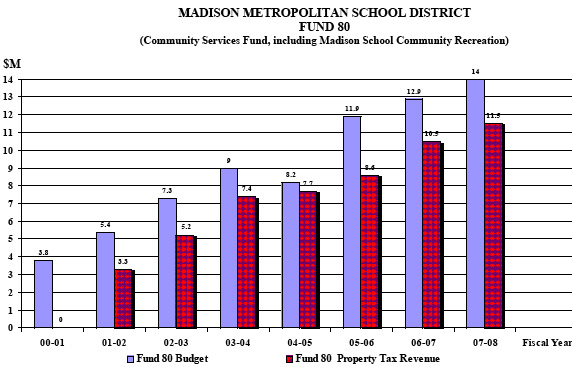
MADISON MARKET COMPARITIVE HEALTH CARE COSTS
The bargained contract between the Madison Metropolitan School District and Madison Teachers, Inc. (representing teachers) stipulates health coverage from a ‘preferred provider’ (WPS) and a ‘health maintenance organization’ (GHC).
Bids have not been solicited from health care providers in many years. Comparative monthly premium costs for the employer and the employee in the Madison market:| Plan | Single Coverage | Family Coverage | ||
| Employer | Employee | Employer | Employee | |
| MMSD (WPS) | $673.00 | $75.00 | $1,765.00 | $196.00 |
| MMSD (GHC) | $365.00 | $00.00 | $974.00 | $00.00 |
| City (Dean) | $406.00 | $13.09 | $1,010.00 | $33.00 |
| County (Phys Plus) | $385.00 | $00.00 | $905.00 | $33.00 |
| State (Dean) | $438.00 | $22.00 | $1.091.00 | $55.00 |
Newsletter signup | Send us your ideas
The recent announcement that Montgomery County school officials were starting work on an annual report of crimes committed by students and other disciplinary incidents underscored a surprising fact: In this era of heightened concern about school safety, few Washington area school systems regularly report such offenses to the public.The annual School Safety Report, slated for publication in Montgomery starting in the 2008-09 academic year, will place the county almost alone among Maryland and Northern Virginia school systems in reporting detailed school crime statistics to the public, according to education leaders and lawmakers. In much of this region, as in much of the nation, comprehensive reports on weapons, drugs and sex in individual public schools simply don't exist.
Among the area's largest school systems, only Fairfax County reports school crime data online, as part of its searchable database of school report cards. One other county, Anne Arundel, publishes a hard-copy student discipline report with annual crime data for individual schools. School systems in Montgomery, Prince George's, Howard, Loudoun and Prince William counties publish no such document.
"It's all theoretically available to the public but rather difficult to obtain," said Montgomery County Council member Phil Andrews (D-Gaithersburg-Rockville), who has pushed for annual school crime reporting.
Newsletter signup | Send us your ideas
The district and Madison Teachers Inc. exchanged initial proposals Wednesday to begin negotiations on a new two-year contract that will run through June 30, 2009. The current one expires June 30.It's important to remember that a majority of the Madison School Board voted several months ago to not arbitrate with MTI over health care costs. Andy Hall has more:"Frankly, I was shocked and appalled by the school district's initial proposal because it was replete with take-backs in teachers' rights as well as the economic offer," John Matthews, executive director of MTI, said in an interview Thursday.
But Bob Butler, a staff attorney with the Wisconsin Association of School Boards who is part of the district's bargaining team, said he believed the district's proposal was fair and flexible.
He said the administration's proposal on health care provides two new HMO plans that could bring savings to the district and new options to employees, while still providing an option for the more expensive Wisconsin Physicians Service plan for employees who want it.
The district is proposing that teachers accept language that would allow two new HMO insurance plans, provided by Dean Care and Physicians Plus, to be added to the two plans currently offered.
Slightly more than 53 percent of the employees represented by the teachers' bargaining unit use the less expensive Group Health Cooperative plan, which is a health maintenance organization, or HMO. The district's costs for the GHC plan for next year are $364.82 per month for singles and $974.08 for families. Employees who opt for the GHC do not pay a percentage of the premium themselves but are responsible for co-pays for drugs that range from $6 to $30.
If about the same number of district employees -- 1,224 -- use the GHC plan next year, it would cost the district about $11.6 million.
The other option currently available to teachers is provided by Wisconsin Physicians Service. A preferred provider organization plan, it provides health insurance to just under 47 percent of the district's teacher unit.
A more flexible plan that allows participants to go to different doctors for different medical specialties, the WPS plan next year will cost the district $747.78 per month for singles and $1,961.13 for families. Under the current contract, employees pay 10 percent of the cost of the WPS plan, which this year is $65.65 per month for singles, and $172.18 per month for families.
The cost estimate for the school district's share of the WPS plan under the current contract would be about $19 million. Employees, who pick up 10 percent of the cost as their share of the premium, would pay another $2 million under the current structure.
But with the Madison School Board facing a $10.5 million budget shortfall, is the board giving away too much with its promises to retain teachers' increasingly pricey health insurance and to discard its legal mechanism for limiting teachers' total compensation increase to 3.8 percent?Carol Carstensen posted an alt view on Concessions before negotiations. Related: What a sham(e), Sun Prairie Cuts Health Care Costs & Raises Teacher Salaries - using the same Dean Healthcare Plan and "Going to the Mat for WPS". TJ Mertz says Susan neglected to mention the QEO (note that the a majority of the MMSD school board agreed not to arbitrate over the QEO or health care casts in "Concessions before negotiations".Yes, School Board Vice President Lawrie Kobza said Saturday, "I feel very strongly that this was a mistake," said Kobza, who acknowledged that most board members endorse the agreement with Madison Teachers Inc., the teachers union.
State law allows districts to avoid arbitration by making a so-called qualified economic offer, or QEO, by boosting salaries and benefits a combined 3.8 percenter a year.
"To agree before a negotiation starts that we're not going to impose the QEO and negotiate health care weakens the district's position," Kobza said. She contended the district's rising health-care costs are harming its ability to raise starting teachers' salaries enough to remain competitive.
The "voluntary impasse resolution" agreements, which are public records, are used in only a handful of Wisconsin's 425 school districts, according to the Wisconsin Employment Relations Commission.
Newsletter signup | Send us your ideas
Doug Erickson on the 2007/2008 $345M budget (up from $333M in 2006/2007) for 24,342 students):
As feared by some parents, the recommendations also included a plan to consolidate schools on the city's East Side. Marquette Elementary students would move to Lapham Elementary and Sherman Middle School students would be split between O'Keeffe and Black Hawk middle schools.Links: Wisconsin K-12 spending. The 10.5M reductions in the increase plus the planned budget growth of $12M yields a "desired" increase of 7.5%. In other words, current Administration spending growth requires a 7.5% increase in tax receipts from property, sales, income, fees and other taxes (maybe less - see Susan Troller's article below). The proposed 07/08 budget grows 3.6% from 333M+ (06/07) to $345M (07/08). Madison's per student spending has grown an average of 5.25% since 1987 - details here.No school buildings would actually close - O'Keeffe would expand into the space it currently shares with Marquette, and the district's alternative programs would move to Sherman Middle School from leased space.
District officials sought to convince people Friday that the consolidation plan would have some educational benefits, but those officials saw no silver lining in having to increase class sizes at several elementary schools.
Friday's announcement has become part of an annual ritual in which Madison - and most other state districts - must reduce programs and services because overhead is rising faster than state-allowed revenue increases. A state law caps property-tax income for districts based on enrollment and other factors.
The Madison School District will have more money to spend next year - about $345 million, up from $332 million - but not enough to keep doing everything it does this year.
School Board members ultimately will decide which cuts to make by late May or June, but typically they stick closely to the administration's recommendations. Last year, out of $6.8 million in reductions, board members altered less than $500,000 of Rainwater's proposal.
Board President Johnny Winston Jr. called the cuts "draconian" but said the district has little choice. Asked if the School Board will consider a referendum to head off the cuts, he said members "will discuss everything."
But board Vice President Lawrie Kobza said she thinks it's too early to ask the community for more money. Voters approved a $23 million referendum last November that included money for a new elementary school on the city's Far West Side.
"I don't see a referendum passing," she said.
UPDATE: A reader emails:
The spectre of central city school closings was what prompted some of us to resist the far-west side school referendum. Given the looming energy crisis, we should be encouraging folks to live in town, not at the fringes, strengthen our city neighborhoods. Plus, along with the need to overhaul the way we fund schools, we need a law requiring developers to provide a school or at least the land as a condition to development.
UPDATE 2: Susan Troller pegs the reduction in the increase at $7.2M:
Proposed reductions totaled almost $7.2 million and include increases in elementary school class sizes, changes in special education allocations and school consolidations on the near east side.Other recommendations include increased hockey fees, the elimination of the elementary strings program and increased student-to-staff ratios at the high school and middle school levels.
UPDATE 3: Roger Price kindly emailed the total planned 07/08 budget: $339,139,282
Newsletter signup | Send us your ideas
In what could be the biggest fight yet over repealing the controversial law limiting the pay raises of Wisconsin's teachers, Gov. Jim Doyle and Democrats who run the state Senate once again are taking aim at it.Related Links:The so-called qualified economic offer law was passed in 1993 to control property taxes on homes.
It says that teachers unions and school boards at a collective bargaining impasse cannot request binding arbitration, if the unions have been offered wage and fringe benefit raises that total 3.8% a year. If increased fringe benefits costs eat up the 3.8%, school boards don't have to offer teachers any pay raise.
Stoking the Capitol fire is the Wisconsin Education Association Council, the state's largest teachers union, which says the entire school-aid formula is so broken it must be reinvented this year - a change the union says should include abolishing the qualified economic offer law.
Backing up Republicans such as Rhoades is Wisconsin Manufacturers & Commerce, the state's largest business group and one of the most powerful Capitol lobbying groups.
"Any effort to repeal QEO is a non-starter with the business community because it's going to lead to pressure to raise property taxes," said Jim Pugh, the business group's spokesman. "Wisconsin has the seventh-highest taxes in the nation."
But the largest teachers union, an equally powerful Capitol force, says the school-aid formula is so broken a new one must be passed this year - a huge task that legislators might not have the time, will or cash to approve.
Wisconsin Education Association Council President Stan Johnson said the formula fails the poorest one-third of all public school students - the ones who need the most help.
Since 1993, Johnson says, the pay-raise limit has caused average salaries for Wisconsin's teachers to fall to 24th nationally overall and to 30th nationally for starting teachers.
The law has meant that property taxes have been controlled "on our backs" for the past 13 years, Johnson said.
It "has been their property tax relief program," Johnson said of Capitol officials.
Although the council spent $1.9 million to help re-elect Doyle, Johnson said he did not know whether the Democratic governor will include a complete new school-aid formula in his state budget proposal.
Newsletter signup | Send us your ideas
The October 30, 2006 Board of Education met to discuss a series of resolutions, and approve the final 2006-07 MMSD Budget, and approve the AFSCME Local 60 contract.

The video of the meeting is 210MB, and 2 hours and 30 minutes long. Click on the image at left to watch the video. The video contains chapter headings which allow quick navigation to sections of the meeting. The video will play immediately, while the file continues to download.
Public Appearances
There was a public appearance by Barbara Lewis who expressed concern over the apparent change in policy of MMSD in granting high school credit for courses taken at the University of Wisconsin Madison. Both Superintendent Art Rainwater and Director of Alternative Programs Steve Hartley discussed the issues with the Board and clarified that the policy statement which Ms. Lewis had received, and which apparently was being misinterpreted by some high school staff referred only to Independent Study. The Board, noting confusion of parents, school staff and themselves, requested that these issues be placed on the Board agenda as soon as possible.
Agenda Item #4
Resolution supporting expenditures for school security be placed outside the revenue caps.
Agenda Item #5
Resolution supporting language by the Superintendent and other superintendents that the State adopt the Adequacy Model for school funding.
Agenda Item #6 - Discussion and Approval of 2006-2007 Budget
This portion of the meeting begins at approximately 20 minutes into the meeting and continues until the Board votes to approve the tax levy amount at 2 hours into the meeting. Final approval of the full budget is rescheduled for a later meeting. The discussions included issues of fund equity, the fund reserve, the unexpected decrease of State support, liquidation of earnings on Chavez building funds, changes in the budget necessary to offset decrease in State support, and the minimum decisions the Board needed to make to meet budget deadline.
Agenda Item #7
Approval of the AFSCME Local 60 contract, in which the District and Union agree to a health care package containing only HMOs, saving the District significant healthcare costs, in exchange for a generous wage increase.
Newsletter signup | Send us your ideas
The Madison School District Board of Education approved a collective bargaining contract with the custodial units last night in which the custodians agreed to move from their current health care plans (GHC and the Alliance PPO) to a 3 HMO plan which is GHC, Dean Care and Physicans Plus. MMSD continues to pay 100% of the premium, but there are cost savings associated with this change. 85% of those costs savings was passed on to employees in salary and 15% went to MMSD.
This change is effective 1/1/2007. A big benefit of this change is that Administrators will also move to the 3 HMO option.
I've not seen an MMSD press on this important issue, but this is what I understand is happening.
Health care expense links.
This is a very positive development, particularly given the inaction on this topic in the recent past and one I believe helps support the 11/7/2006 referendum.
MMSD Press Release.
Newsletter signup | Send us your ideas
Robert Butler[PDF]:
Health insurance has become the most prevalent issue discussed at the bargaining table today. Recent premium increases for school districts with July renewalButler is Co-Director of Employee Relations Services, Staff Counsel; Wisconsin Association of School Boards.
dates have focused even more attention on this issue.Many administrators and board members ask: How can this continue? How do we communicate to our employees, our taxpayers and other interested constituents the effect that our health insurance costs have on our budgets? How do we maintain and, hopefully, expand our educational offerings when our costs for health insurance continue to eat up an ever larger portion of our budget?
There are many factors that have contributed to the high cost of health insurance: utilization of services, demographic trends (such as life expectancy and obesity), healthcare provider consolidation, duplication of services, new products and services, the growing number of uninsured, marketing of prescription drugs, medical malpractice expenses, level of benefits and plan design, among others.
This article will provide insight on how to address items that we can control at the bargaining table: the level of benefits, plan design and consumer behavior. Remember, health insurance is an economic and emotional issue; people don't always make rational decisions when negotiating over this topic.
Negotiating health care costs with employees is the first item on the Board's Human Resources Committee agenda: Monday, September 25, 2006 @ 6:00p.m. in the McDaniels Auditorium [map].
Newsletter signup | Send us your ideas
By Anita Weier, The Capital Times, JAnuary 31, 2006
Wisconsin ranked 13th among the states in a national health study, down from ninth in 2004, as obesity and child poverty rose.
The study, titled America's Health Rankings 2005, analyzed personal behaviors, community environment, health policies and health outcomes.
The healthiest states were Minnesota, Vermont, New Hampshire, Utah and Hawaii, in that order. The least-healthy was Mississippi, followed in order by Louisiana, Tennessee, Arkansas and South Carolina.
Wisconsin's strengths included a high rate of high school graduation, a low rate of violent crime, a low incidence of infectious diseases and a low rate of uninsured people.
Challenges included low per capita public health spending at $79 per person, which put the state in 46th place, and a high rate of smoking at 21.9 percent of the population, which put it in 31st place.
Herb Bostrom, deputy administrator of the state's Division of Public Health, agreed that smoking and some other behavioral issues are a problem. But the public health funding issue is another matter, he said.
The study tends to look only at state funding for public health, not at grants and fees, according to Bostrom. "Wisconsin has been very successful in acquiring federal grants and grants from non-federal sources," he said.
Another factor is that some states provide direct health services while Wisconsin funds other providers that do so. "Different states do things differently," he said.
The study was conducted by the United Health Foundation, the American Public Health Association and the Partnership for Prevention, and was published in State Policy Reports as well as other publications and Web sites.
Another major health problem cited by the study was the fact that the percentage of children in poverty increased by 17 percent - from 15.4 percent to 18 percent of those under 18, from 2004 to 2005.
That figure would have been worse, the study said, if the rate of births per 1,000 teenage females had not decreased by 26.1 percent - from 43.7 births per thousand in 1991 to 32.3 births per thousand in 2002.
Since 1990, the prevalence of obesity soared by 105 percent - from 11.3 percent to 23.2 percent of the population.
Additionally, Wisconsin ranked 23rd for cardiovascular deaths and 23rd for total mortality.
Racial disparities also existed.
For instance, the infant mortality rate was substantially worse for minorities. Non-Hispanic whites had a rate of 5.6 deaths per 1,000 live births, while non-Hispanic blacks had a rate of 17.9 deaths per 1,000 live births.
Whites were screened for cholesterol levels at a much higher rate than Hispanics.
Bostrom added that blacks and American Indians have high rates of diabetes.
"Disparity is a big problem. The Division of Public Health is focusing on the disparity in health outcomes and working with minority populations in the Milwaukee area, Rock County and Dane County," he said.
But he pointed out that such differences are often due more to income than any sort of genetic tendency. "In many cases, there are socio-economic and education differences. These are societal issues," he said.
"If we could raise our health status for minorities to the level of the majority, that could make a substantial improvement."
Newsletter signup | Send us your ideas
Wisconsin families and businesses are being priced out of health care coverage. It doesn't have to be this way. We can turn things around.
Every day brings new evidence that we are in the middle of a health care crisis.
The Wisconsin Realtors Association released a poll earlier this month that showed 66 percent of Wisconsin residents are worried that health care costs will soon become unaffordable.
By Wisconsin State Senator Judy Robson (D-Beloit), a registered nurse, from WisOpinion.com, November 21, 2005.
The Economic Policy Institute reported that between 1999 and 2004, 355,000 Wisconsin residents lost employer-provided health coverage.The Wisconsin Association of Health Plans recently reported that more people in Wisconsin now rely on taxpayer-funded health plans than on commercial insurance.
Perhaps the biggest wake-up call was the report by the U.S. Government Accountability Office that showed eight of the nation's 10 most expensive cities in terms of physician costs are right here in Wisconsin.
It doesn't have to be this way. Many bright minds have put forth proposals to significantly bring down the costs of health care and insure more people. We aren't saying we need to spend more money on health care. We're saying we need to spend smarter.
One in every three dollars spent on health care in the United States is spent on administrative overhead. Not doctors, not nurses, not medicine. Anyone who had done battle with the health care bureaucracy knows how much time office workers spend figuring out the proper insurer to bill, the co-payment, the deductible, referral procedures, and whether the procedure should even be covered.
As a nurse, I have seen how much money and resources are expended on paper shuffling and marketing rather than direct patient care. I saw that the business model for health care was not working. Managed care was not bringing down health care costs. In fact, the expansion of managed care and market-based competition has coincided with the upswing in administrative costs over the last 30 years.
Jobs With Justice, a coalition of labor and faith-based organizations, calculated that we waste $94 billion nationwide due to our patchwork system of private insurers. That would be sufficient to insure 55 million people who are currently uninsured. If we also stopped drug manufacturers from overcharging for prescription drugs, we would have more than enough money to insure everyone in this country.
Of course, the pharmaceutical industry and other powerful special interests oppose any reform measures that would cut into their profits. That's why we can't wait for Congress to act. As we did with welfare reform and SeniorCare, Wisconsin can show the rest of the nation the way.
A group of state legislators has made a commitment to making health care affordable here in Wisconsin. Thirty-seven Democrats and one Republican have introduced the Action Plan for Affordable Health Care. The Action Plan requires both parties to come together to develop a plan that brings down health care costs by 15 percent within two years of enactment. The plan must also ensure that 98 percent of Wisconsin residents have health coverage. A working group could use the groundwork laid in existing proposals or develop entirely new approaches.
Any legislator who has spent any time talking to constituents knows that the cost of health care is at or near the top of their concerns. It's time for all of us to come together to develop a solution. The Republicans in control of the Legislature must change their can't-do attitude to a can-do attitude. We must stand up to special interests who oppose reform.
The Action Plan for Affordable Health Care sets the goals and the timeframe. It will be up to legislators of both parties to work out the details. The first step is for the Legislature to make affordable health care a priority.
Newsletter signup | Send us your ideas
Candy, soda, pizza and other snacks compete with nutritious meals in nine out of 10 schools, a government survey found.Already plentiful in high schools, junk food has become more available in middle schools over the past five years, according to the Government Accounting Office, the investigative arm of Congress.
"Parents should know that our schools are now one of the largest sources of unhealthy food for their kids," Sen. Tom Harkin, who asked for the study, said in an interview.
Newsletter signup | Send us your ideas
Alan J. Borsuk and Sarah Carr:
Milwaukee Public Schools teachers will begin shouldering a larger share of the costs of their health care under an arbitrator's ruling issued Tuesday.The decision ended 2 1/2 years of work on a two-year contract for more than 6,000 teachers with a victory for the School Board and the administration of Superintendent William Andrekopoulos.
After management and the Milwaukee Teachers' Education Association deadlocked - almost entirely over health insurance issues - the dispute went to the arbitrator, Marquette University Law School Professor Jay Grenig, who was required to pick between the final offers of each side without making any changes.
Under the MPS plan, teachers would begin paying portions of the cost of their health care, including deductibles and co-pays on many services. Administrators say the district pays more than 60 cents in fringe benefits for every dollar it pays in salaries.
Newsletter signup | Send us your ideas
Getting school supplies, adjusting to a new morning routine, doing homework again, meeting new friends, and joining sports teams and after school clubs: it all adds up to make heading back to school a busy time for children and families. But Congresswoman Tammy Baldwin, Madison School Board member Johnny Winston, Jr., and a working family who gets its health care through BadgerCare are urging parents to set aside a few minutes to explore their options for free or low-cost quality healthcare.
“Health insurance can give students the healthy start they need to begin the school year right, so looking into BadgerCare really needs to be on your family’s back-to-school list this summer,” said Madison School Board member Johnny Winston, Jr. “Families in Wisconsin who are uninsured, underinsured or spending huge amounts of their income on health insurance should explore BadgerCare as an option.”
BadgerCare is a comprehensive health care program for families that covers eyeglasses, immunizations, sports physicals, speech therapy, doctor and hospital visits, prescriptions and more. BadgerCare is available at little or no cost to families earning up to 185% of the federal poverty line. A family of three, for example, earning nearly $30,000 can qualify; the income limit is nearly $36,000 for a family of four.
Finding out BadgerCare was available to families, even if the adults are working, made a big difference for Erin Quinn and her seven-year-old daughter, Alexus. Erin works full time, but cannot afford the $200 premiums that come with the health insurance offered through her employer. Five years ago, the county worker who assists Erin with Alexus’ mental health care needs mentioned BadgerCare. Erin enrolled herself and her daughter and say “the routine checks, prescriptions and other health care BadgerCare covers for our family’s needs are heaven-sent. I feel real lucky that BadgerCare is there for families who cannot afford health care,” said Quinn.
Erin works in sales and marketing at Widen Enterprises in Monona, earning $12.35 an hour. BadgerCare, through Unity HMO, covers not only routine check-ups for her and Alexus, but also the very important in-home mental health therapy their family needs. Erin is concerned about the challenges of getting into dental clinics and that getting some mental health care services can be challenging. “But, overall, the coverage is really making a difference for us.”
- more -
Research released earlier this month by the Robert Wood Johnson Foundation shows that kids who lack health insurance are less likely to get any medical care at all, much less the medical care they need, and are less likely to have a personal doctor than kids who have health insurance.
In Wisconsin in 2003:
·25.6% of children without health insurance received no medical care, compared to 15% of children with health insurance.
·Children without health insurance were three times more likely (1.7% vs. .5%) to have not received all the medical care they needed compared to those with health insurance.
·39.5% of children without health insurance did not have a personal doctor or nurse, compared to 11.8% of children with health insurance.
“Bottom line: health insurance makes a big difference when it comes to keeping kids healthy,” said Michael Jacob, project coordinator for Covering Kids and Families – Wisconsin, a coalition based at the University of Wisconsin that seeks to get kids and families enrolled in the health insurance programs for which they are eligible. Jacob stressed the importance of exploring BadgerCare as an option. “A phone call can make a world of difference for you and your family.”
An estimated 85,000 children in Wisconsin were without health insurance in 2003, with half of them likely eligible for BadgerCare.
BadgerCare and other Family Medicaid health plans for children and their families now provide free or low-cost health insurance for more than 517,000 residents statewide, nearly 90,000 through BadgerCare. As of June 2005, 26,887 Dane County residents were enrolled in BadgerCare and Family Medicaid programs. Yet, thousands more families who may be eligible for these free benefits are not enrolled.
Students who receive free or reduced-price meals – about 30 percent of the state’s school children – are income-eligible for the BadgerCare family health plan if they lack health coverage. In Dane County, 21 percent of schoolchildren were enrolled in the free/reduced price lunch program last year.
“While we've long recognized that school achievement is linked to meeting kids’ nutritional needs, we must also meet their medical needs,” said Congresswoman Tammy Baldwin. “Many students are likely to underachieve if they cannot see the blackboard or hear their teacher because they lack medical coverage for eyeglasses or hearing aids. BadgerCare is essential for keeping at-risk children healthy and in school and their parents at work. It’s a federal-state partnership that I strongly support,” said Baldwin.
“Something as simple as new eyeglasses could really turn around a struggling child’s performance in school,” notes Winston. “These kids are our future workers, homeowners, neighbors and leaders. By helping to build stronger community members, we help build a stronger community.”
The Covering Kids and Families Back to School Campaign is a national effort funded by the Robert Wood Johnson Foundation. More information about the Wisconsin effort can be found at www.ckfwi.org.
How to Apply for BadgerCare:
To apply, call or visit your county human services department.
In Dane County, call 242-7441.
Satellite sites are also available in:
·Stoughton (873-5636)
·Sun Prairie (837-7380)
Information is also available at the State Department of Health and Family Services web site at http://dhfs.wisconsin.gov/em/imagencies/index.htm
Newsletter signup | Send us your ideas
Jason Shepherd wrote about the nature of the Madison School District's joint committee with MTI (Madison Teachers Inc.)regarding health care costs. Initially, according to Shepherd, Madison School Board President Carol Carstensen said that "the open meeting law does not apply to the committee".
KJ Jakobsen, a parent studying the District's health insurance costs, wants to attend the meetings to see if the district is conducting an appropriate review. "Questions have been raised for 20 years," she says. "Change won't happen if these meetings are secret".Read the article here. Isthmus' web site
But Carstensen, in an e-mail to Jakobsen, barred her from the meetings, claiming the committee is "part of the bargaining process" and thus excluded from the open meetings law. That raised the ire of [Ruth] Robarts, who said, "The public has a right to know what the distrct has been doing about its health insurance costs".
Newsletter signup | Send us your ideas
Wed 05/11/2005 -
27 News has uncovered an extraordinary amount of days missed by employees of the Madison School District because of worker's comp claims. These claims are far in excess of those filed by other similar sized Wisconsin school districts. And worker's comp claims in Madison are, in some cases, 14 times those of other districts. When added together, last year alone, Madison School District employees lost more than three and and a half years of work, because of on the job injuries.
When you think of school, you think of teachers, administrative staff, custodians, coaches -- you don't think of worker's comp. Here in Madison, you might want to start. 27 News has learned worker's comp claims by Madison School employees are costing taxpayers millions -- more than $3.3 million over the past the three years; last year - $1.25 million.
"The Madison school district's approach has been to reduce the losses, manage the claims, and then to also get people back to work as quickly as we possibly can," said Roger Price, Assistant Superintendent for Business Services at the Madison School District.
Last year, the Madison School District reported 144 injuries resulting in 1280 days missed. According to OSHA reports, A custodian at East High School lost 109 days because of a strained knee. And a teacher at Sennett Middle School broke an ankle. Instead of returning to work on light duty, that teacher missed 147 days.
Karen Townsend, worker's comp administrator for the Green Bay school district said she was very surprised at Madison's numbers. "We can accommodate anything," Townsend told 27 News. "I've rented wheelchairs for people who have broken their ankle, for example. We get people back to the job." Townsend says there's no reason why Madison can't bring the number of lost days down. Especially when virtually every district in the state is trying to find ways to trim costs.
Madison's Price said the district does a lot to bring employees back to the job. "We've been able to get employees back to work, which reduces the days out."
But the numbers don't bear that out: in our research, we found only one district comparable to Madison. The Racine school district reported 193 injuries last year, and lost just over 1,000 days.
But take a look at other similar sized districts: Green Bay is slightly smaller than Madison, but still fair to compare. Last year, Green Bay reported 219 injuries. But their days lost: 92; about 1,100 less than Madison.
Kenosha reported 428 injuries -- but only 520 days lost; less than half of what Madison School District employee's lost.
Even when presented with these numbers, Madison's Price maintained the Madison School District was in good shape. "When I look at the comparisons, I feel that our numbers look great, compared to some of the other districts that you had brought forward."
But Green Bay's Townsend says Madison can do better. In her 11 years at Green Bay, an aggressive approach in her district has brought injury claims and days lost down. What I just really instill is that these are really valuable people," Townsend said. "Even if they're just stilling in a chair with a presence -- in a classroom or you know, in the custodial area.
In Madison, it's the custodians who file the most claims. Madison custodians accounted for 56% of days lost last year -- they lost 716 days because of injuries. Price says those injuries were severe -- and like every claim, they're looked at on an individual basis. Isn't there more Madison could do to bring down those claims, like Green bay did? "There's always more we can do, and it takes an effort and staff to do that," Price said. "One of our budget cuts is our risk management position this year. Those duties will be consolidated with other individuals." And price says without that front line position, bringing the number of claims and lost days down will be even more difficult. "Budget cuts can actually impact your ability to be more affective."
But let's look for a second at the private sector: assembly lines, paper mills. Companies can go weeks and months without a single day missed because of an on the job injury. Madison's Price wouldn't comment. "You're in areas that I'm not familiar with their environment," Price said. "I'm not going to speculate on what happens in a different environment. I know what we do and what we're trying to accomplish is provide a safe workplace for employees."
Every year, the Madison School District is assigned a rating by the Wisconsin Compensation Rating Bureau. The rating determines how much the district pays for it's worker's comp insurance premiums; the lower the rating, the bigger the discount. Over the past three years, the Madison School District has seen improvements in it's rating: with a 1.26 rating in 2003 to a projected .99 rating this year. The district says that will save them $300,000 in their premium. 27 News found out, though, the rating system, doesn't extensively look at time lost -- it focuses on the number of injuries. And when you look at time lost in a school district, the costs multiply -- because not only are you paying for that employee, but you're also paying a substitute while that hurt employee is out.
Madison is the second largest school district in the state -- the school districts we compared to Madison were the three closest in size. Kenosha has virtually the same number of employees as Madison does. Green Bay is about 18% smaller.
Newsletter signup | Send us your ideas