June 03, 2007
Madison Students Participate in an International Origami Exhibit
There are plenty of pages to turn in a library, though usually it's between book covers. At the Pinney Branch Library, carefully arranged and locked behind glass, stand adventures in paper of a much different sort: "Origami By Children," a traveling exhibit of tiny, ingeniously folded works selected in an international competition by the group OrigamiUSA.Origami USA websiteTwo Madison students have works in the exhibit, which was first assembled in 2005 but only now has arrived in Madison. Each creation is deceptively simple: many are made from a single sheet of paper, yet turned into a fanciful creature or sharp-edged geometric shape by the skilled, young hands of their creators.
"Origami is a very different art than arts that are based on expression, like painting," says Natalya Thompson, a Madison West High School sophomore whose interlocking paper "Bow-Tie Motif," made from 48 squares of three-inch-by-three-inch paper, is featured in the exhibit. Most pieces in the small show are based on designs created by published origami masters.
 Newsletter signup | Send us your ideas
May 23, 2007
Call for Study of Access to Arts Education
Dodd, Alexander Call for Study of Access to Arts Education
Introduce Resolution in Recognition of Music Education
May 8, 2007
Today Senator Chris Dodd (D-CT) and Senator Lamar Alexander (R-TN) sent a letter to David Walker, the Comptroller General of the Government Accountability Office (GAO), requesting that the GAO conduct a study on access to music and arts education in the American public school system since passage of the No Child Left Behind Act. This week, Senators Dodd and Alexander also introduced a resolution recognizing the benefits and importance of school-based music education. Senators Dodd and Alexander are members of the Senate Committee on Health, Education, Labor and Pensions (HELP), and are Chairman and Ranking Member of its Subcommittee on Children and Families.
“No child should be deprived of the chance to explore his or her creativity in a nurturing educational environment,� said Dodd. “Picking up a musical instrument, a paint brush, or a script can allow a child to discover a hidden talent and can serve as a much-needed positive influence in the midst of the many difficult decisions that young people face today. I am hopeful that the GAO will act quickly to deliver findings about the current condition of arts education in American public schools so that we can seek to improve it during the reauthorization of the No Child Left Behind Act.�
Added Alexander: “Music Education is important. I had some great teachers, but my piano teacher, Miss Lennis Tedford was the best. From age five until my high school senior recital, I spent thirty minutes with her each week. ‘Don’t play that monkey business,’ she would say, as she could always tell when I’d been playing too much Jerry Lee Lewis. From Miss Tedford I learned more than music. She taught me the discipline of Czerny and the metronome, the logic of Bach, the clean joy of Mozart. She encouraged me to let my emotions run with Chopin and Rachmaninoff. She made sure I was ready for the annual piano competition, and that I performed completely under control. I still thank her for the discipline and love of music she gave me each time I sit at the piano today.�
A companion resolution – introduced by Reps. Jim Cooper (D-TN) and Jon Porter (R-NV) – passed the House of Representatives on April 26 by unanimous consent.
The full text of the letter is below:
The Honorable David M. Walker
Comptroller General
Government Accountability Office
441 G Street N.W.
Washington, DC 20548
Dear Mr. Walker:
We write to request the Government Accountability Office to conduct a study on access to music and arts education in our public schools since passage of the No Child Left Behind Act, with a specific focus on any disparities in access between minority and low-income students and their non-minority, more affluent peers. The study should investigate evidence of the possible link between participation in music and arts education and increased student engagement, positive behavior, high school graduation rates and academic achievement for all students, as well as for minority and low-income students and students with disabilities.
As Congress moves toward reauthorization of the No Child Left Behind Act, we continue to examine the goals of educating the whole child and the positive impact of rigorous instruction in all areas of the curriculum. These policy decisions are based on sound research and driven by systematic data collection relating to the condition of education, the practices that improve academic achievement, and the effectiveness of federal education programs. Of particular interest are the effects, since its implementation, of the No Child Left Behind Act on access to music and arts education in our nation's public schools.
Specifically, we request the Government Accountability Office to design and implement a study that determines the following with regard to K-12 academic instruction in our public schools.
Any changes in access to music and arts education since passage of the No Child Left Behind Act.
Access to music and arts education for minority students relative to non-minority students.
Access to music and arts education for low-income students relative to non-low income students.
Any disparities in access to music and arts education, since passage of the No Child Left Behind Act, between schools with high percentages of minority and low-income students and students with disabilities and those schools with low percentages of such students.
Any link between participation in music and arts education and increased student engagement, positive behavior, high school graduation and academic achievement for all students, as well as any such link for minority and low-income students and students with disabilities.
Descriptions of highly effective music and arts education programs that promote increased student engagement, positive behavior, high school graduation and academic achievement.
Identification of any barriers actively imposed by Federal law, regulations, or guidance that prevent schools from engaging students in a rich curriculum that includes music and arts.
Because consideration of the No Child Left Behind Act reauthorization has already begun, the need for this information is immediate. We request that you meet with representatives of our offices as soon as possible to discuss the proposed scope of this study, an appropriate methodology, and a timetable which would establish an interim reporting schedule and completion date.
We look forward to hearing from you regarding this request and your availability to meet as soon as possible to set forth plans for receipt of this information which will provide relevant insights into the impact of No Child Left Behind on access to music and arts education, especially for those students who have the fewest opportunities and greatest need.
Thank you for your assistance.
Newsletter signup | Send us your ideas
May 22, 2007
Music Event Benefitting Madison's Elementary Strings Program
Wednesday night, May 23, local band Marvin's Gardens, will be playing at the King's Club (114 King Street). There will be jazz from 6-9 p.m. All proceeds will go to benefit Grade 5 Strings! Strings players invited to bring their instruments to play with the band.
$5 at the door.
Newsletter signup | Send us your ideas
May 21, 2007
Art Awards: Young artists can apply for grants up to $10,000
The National Foundation for Advancement in the Arts is accepting applicants for cash awards of up to $10,000 and an opportunity for arts enrichment programs.The early deadline, which provides for a 30 percent discount on the $35 application fee, is June 1. The final deadline is Oct. 1. High school seniors or graduates who will be 17 or 18 years old on Dec. 1 can apply for the money.
Newsletter signup | Send us your ideas
April 15, 2007
Grade 5 Strings - How you can help
Grade 5 elementary string students need your help. There are ways you can support the hundreds of ten-year olds who are in Grade 5 strings and this year's Grade 4 students who would like the chance to take the course next year:
A. Bring your child to play his/her instrument at Thursday's Budget Hearing - April 19th at 6:00 p.m., Memorial High School Auditorium.
If your child would like to “play� in support of Grade 5 strings, there will be an opportunity to do this at Thursday’s budget hearing to be held in the auditorium at Memorial High School ( http://www.mmsd.org/145.htm). Students from grades 5-12 are welcome. There will be adults present to help coordinate the playing of a few songs from the strings festival. If you want to play, please come at 6 p.m., so we can organize the students.
B. Email the School Board – comments@madison.k12.wi.us - let them know:
1. you support the program for all children,
2. what this course has meant to your child if your child is/has
taken elementary strings,
3. you would like the newly formed school board community task
force on fine arts to have a chance to do it’s work, which
includes:
a. identifying the community’s fine arts education values and
goals,
b. identifying ways to increase low-income/minority
participation in the arts (45% elementary string students
are minority, 35% are low income), and
c. identifying funding priorities for the School Board
C. Speak at the Budget Hearings - 6:30 p.m. - Tuesday, April 17th at La Follette High School Auditorium and Thursday, April 19th at Memorial High School Auditorium:
There are two public hearings next week on the budget – Tuesday, April 17th, 6:30 p.m. at La Follette High School and Thursday, April 19th, 6:30 p.m. at Memorial High School – both public hearings are in the school’s auditoriums. If you come, you need to sign if you want to speak. You can sign in and not speak but say you support the program. Each person who speaks is given 3 minutes.
For nearly 40 years, MMSD has had an elementary strings program. Two years ago, elementary string instruction was cut in half. Last year, Grade 4 strings was cut entirely. This year, Superintendent Rainwater is proposing to cut Grade 5 strings, which would eliminate all string instruction during the school day.
Thank you for your support of Grade 5 strings and a strong fine arts education for our children.
Newsletter signup | Send us your ideas
April 12, 2007
Grade 5 Strings - Letter to School Board
Please write the School Board about what is important to you and your state legislature about funding our public schools. Following is a copy of my letter to the school board on Grade 5 strings:
Dear School Board Members (comments@madison.k12.wi.us),
I am happy to serve as a member of the newly created Fine Arts Task Force for the next year. The second charge to the committee is: " Recommend up to five ways to increase minority student participation and participation of low income students in Fine Arts at elementary, middle and high school levels."
I noticed in the Grade 5 strings report you received last week there was no information on low-income and minority student enrollment. Our task force received this specific demographic information at our March 26th meeting along with additional information, so I would like to share it with you, because I think it is important. As the program has been cut in the past two years, the low-income and minority student enrollment (numbers and percentage) has remained strong [but the cuts have affected hundreds of low-income students as the numbers show]. For this school year, 44% of the string students are minority students (47% of all Grade 5 students are minority students), and 35% of the string students are low income (44% of Grade 5 students are low income students). This information is captured in the attached Chart for the this year and the previous two years when the program was offered to students in Grades 4 and 5. I've also included information on special education student enrollment. I was not able to access ELL information for the previous years.
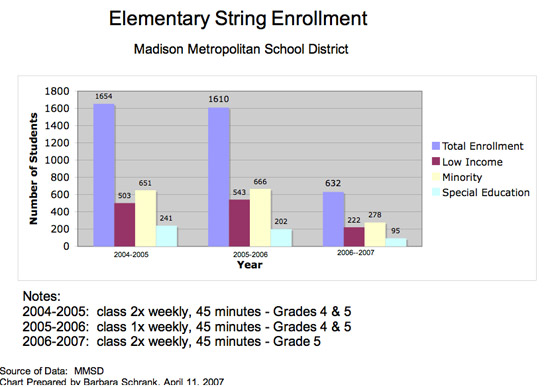
Decreasing academic opportunities to develop skills at a younger age is more likely to hurt participation at higher grades for low income and minority students who often lack support outside school to strengthen and reinforce what is learned in school either at home or through additional, private opportunities.
I hope you make the decision to give the Fine Arts Task Force an opportunity to complete its charge before making additional cuts to courses, because these cuts may prove to be more harmful to those students we want to reach than we realize. Also, if changes are made, I hope they are done equitably and with time for transitions. I'm asking this not only for arts education but also for other programs and activities Madison values in its public education. Eliminating elementary strings entirely would be the third year of major cuts in either funds or instruction time for students in this program. This seems to me to be overly harsh, especially when you consider that no extracurricular sports have been cut (nor would I support that).
Elementary strings is one arts course, but it has taught up to 2,000+ children in one year and is valued highly by parents and the community. I have 500+ signatures on a petition, which I will share with the board next week that says: "Madison Community Asks the MMSD School Board: Don't Cut, Work with the Community to Strengthen and Grow Madison's Elementary String Program. I have many emails with these signatures, and I'm planning to ask folks to write you about what this program means to them, so you hear their words and not only my words.
As I stated when I spoke before you earlier this year, there are those activities where a mix of public and private funding along with fees and grants might work for the arts and for extracurricular sports, for example. Please consider support of this and please consider helping with transitions toward different approaches.
Thank you for your hard work and support for public education.
Barbara Schrank
P.s. - note, I am speaking as an individual and not on behalf of the fine arts task force.
I would also like to add for SIS readers - I know due to the current financing scheme, the state is not funding public schools adequately nor fairly and is placing a huge burden on personal income and property taxes. I also know there have been cuts in previous years to the arts, increases in class sizes, fewer SAGE classes, etc. Just so you know, that is not the point of this letter. I see the need to work both locally and at the state. I also feel we need to be doing something more than referendums at the local level, and I don't mean cut or referendum. I think in the areas of extracurricular sports, some of the arts, we may be able to put in place a financial package of public, private, fees, grants - but this takes time and planning and commitment by our school board following public discussions on the topic.
Not all minority children are low income, but by far, the majority of low income children are minority. By not working with the community on funding for this high demand, highly valued program, several hundred fewer low income students are receiving skill-based training on an instrument, which scientific research is showing more and more has a positive effect on other areas of academics.
No where else in this city do so many low-income children have the opportunity to learn how to play an instrument and to do so as inexpensively per student. This is a program where "thinking outside the box" for the School Board could come in handy, so we can continue this academic program as part of the school day for so many children.
Newsletter signup | Send us your ideas
March 28, 2007
Maintain and Grow Madison's Art Programs: Support Elementary Strings
Parents and Students distributed to attendees of the recent Spring 2007 Strings Festival the following information in a flier:
Madison Community Asks the MMSD School Board:
Don’t Cut, Work with the Community to Strengthen and Grow
Madison’s Elementary String Program
Superintendent Rainwater has proposed cutting Grade 5 strings, which would eliminate the nearly 40-year old elementary strings program. This does not have to happen and you can help:
1) Email the School Board (comments@madison.k12.wi.us), letting the School Board know:
a. You support elementary strings and a vibrant, strong fine arts academic education for all Madison’s school children as important for and fundamental to a student’s personal and academic growth, and
b. You support and want the newly formed School Board Community Fine Arts Task Force to have a chance and time to explore ways to continue and to sustain elementary strings, and all arts education, in Madison’s schools, without further cuts to programs.
Newsletter signup | Send us your ideas
March 26, 2007
Milwaukee Public Schools / Milwaukee Symphony Arts Program
The Progressions program of the Milwaukee Youth Symphony Orchestra, which gives kids mostly from Milwaukee Public Schools a start on classical instruments, is one of many arts programs in the city that are benefiting from a new $1 million fund created by the Milwaukee School Board.That amount is being matched by private donations or contributed services from each of the organizations receiving the MPS grants.
Many in the arts community are viewing the new support as a strong boost for efforts to give city kids some of the arts education that has been shrinking in recent years under budget pressures.
Newsletter signup | Send us your ideas
March 25, 2007
2007 West Area Strings Festival Photos, Audio & Video
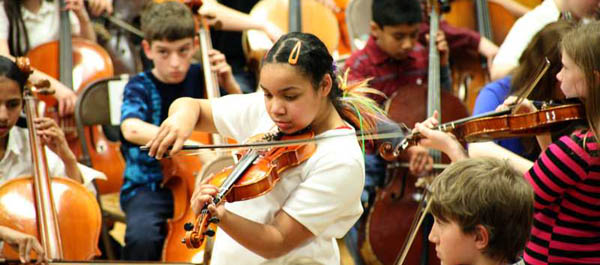
The Madison Strings Festival was held Saturday. Check out the photos here. A 20 minute video clip: (CTRL click to download) mpeg-4 ipod video | mp3 audio.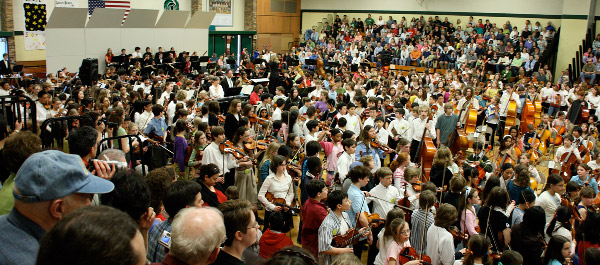
Call to action: [PDF] [Petition PDF]
Newsletter signup | Send us your ideas
March 16, 2007
Music Lessons Affect Brain Development
As the district considers the total elimination of strings education in our elementary schools, a recently published study provides yet more evidence of the benefits of musical training.
Music Training 'Tunes' Human Auditory System
Science Daily — A newly published study by Northwestern University researchers suggests that Mom was right when she insisted that you continue music lessons -- even after it was clear that a professional music career was not in your future.
The study, which will appear in the April issue of Nature Neuroscience, is the first to provide concrete evidence that playing a musical instrument significantly enhances the brainstem's sensitivity to speech sounds. This finding has broad implications because it applies to sound encoding skills involved not only in music but also in language.
The findings indicate that experience with music at a young age in effect can "fine-tune" the brain's auditory system. "Increasing music experience appears to benefit all children -- whether musically exceptional or not -- in a wide range of learning activities," says Nina Kraus, director of Northwestern's Auditory Neuroscience Laboratory and senior author of the study.
"Our findings underscore the pervasive impact of musical training on neurological development. Yet music classes are often among the first to be cut when school budgets get tight. That's a mistake," says Kraus, Hugh Knowles Professor of Neurobiology and Physiology and professor of communication sciences and disorders.
For further information about how music instruction impacts intellectual development, readers are encouraged to explore the work of psychologist Glenn Schellenberg:
Schellenberg, E.G. (2005). Music and cognitive ability, Current Directions in Psychological Science, 14, 322-325.
Schellenberg, E.G. (2004). Music lessons enhance IQ. Psychological Science, 15, 511-514.
Newsletter signup | Send us your ideas
March 03, 2007
Statewide Study of Arts Education in California
An Unfinished Canvas, Arts Education in California: Taking Stock of Policies and Practices by Katrina Woodworth, Roneeta Guha, Alix Gallagher, Ashley Campbell, June Park, and Debbie Kim:
Policies recently enacted at both the state and federal levels demonstrate a commitment to arts education. In 2001, the California State Board of Education adopted content standards for the visual and performing arts. In 2002, the federal No Child Left Behind law, with provisions recognizing the arts as a core subject, was signed into law. Beginning in 2005-06, students seeking admission to the University of California and California State University systems are required to take one full year of arts education coursework during high school.Sharon Noguchi has more.Despite expectations and enthusiasm for instruction in the arts, little information about California students' access to and performance in the arts is available, and statewide information about the delivery of arts education is lacking. Several recent studies suggest that arts education is in jeopardy—and perhaps in decline—and that schools are struggling to incorporate arts in their curriculum. Recent studies also point to disparities in access by school demographic characteristics, as well as differences in offerings by discipline. None of these studies, however, systematically examine the status of arts education in all four arts disciplines across all of California's schools.
Once derided as non-essential fluff and an expensive luxury, the arts have languished in California schools for nearly three decades.Now, a Menlo Park think tank has recommended that California students spend more time in school to learn music, drama, theater and visual arts.
In a statewide survey of 1,123 California schools, researchers at SRI International found that 89 percent of schools fail to meet state standards for arts education.
Nearly one-third of the schools surveyed offered no art courses that met the standards, and K-12 enrollment in music courses dropped by 37 percent over the five years ending last June.
Newsletter signup | Send us your ideas
February 19, 2007
Sports and Fine Arts - Planning for the Future
I pulled my blog from yesterday, because I think my main point got lost in too much unnecessary rhetoric. Basically, I would like to see the School Board support efforts to develop multi-year education funding plans for Fine Arts Education and extracurricular competitive sports. I would like to see the School Board be equitable in their cuts and help transition to a mix of public/private financing if that is needed in the future. I don't see any reason to whack at or eliminate one program vs. another - it's disruptive and unnecessary and plans cannot be made.
Newsletter signup | Send us your ideas
January 30, 2007
Elementary String Education for Nine and Ten Year Olds: Private Funding Required
According to a meeting I had with the Superintendent, he says MMSD will require $300,000 to fund elementary string instruction and that private funding and/or grants will be needed to continue Elementary String Education in the Madison public schools. Without this funding, he is likely to again propose cutting this Madison public school tradition of nearly 40 years.
I'm exploring setting up a specific fund for string education at either the Foundation for Madison Public Schools or the Madison Community Foundation, so tax deductible contributions can be made in support of the curriculum. Madisonians United for String Education for Students (MUSEs) is a working title for a group of parents who want to keep elementary string instruction in our public schools for our young children. We welcome your ideas on next steps. Personally, we feel if this is the route we have to take, an endowment fund will be needed to ensure the course continues into the future.
I met last week with the Superintendent who said he a) supports elementary string curriculum instruction during the school day, b) would accept proposals for privately funding elementary string education. I also said the support and/or leadership of the Fine Arts Coordinator was important to such an effort, and he agreed, saying the Fine Arts Coordinator would be supportive.
Public schools surrounding Madison have strong, growing elementary string courses, because the community values the course and this is the foundation course for more advanced instrumental training/experiences in middle and high school. Plus, elementary string courses make their school districts attractive to parents deciding where to live and to send their children to school. Many parents want their children to have the experience of learning to play an instrument and to make music with other students. Private lessons can cost $2,000 or more per year - few families can afford this, especially low income families. That's what's special about Madison's elementary strings program. In Madison, in previous years, Grade 4 and 5 strings taught about 500+ low-income students annually.
String instrument instruction offers a number of benefits for children - they can be sized to a small child, they are "easy" to take home to practice, all types of cultural and popular music can be played on the string instruments, and these instruments lend themselves to ensemble playing. Furthermore, learning how to play an instrument prepares you for playing a string or band instrument in middle school or for chorus, because you learn how to read music. Through the one- to two-year elementary course, children experience the joy of making music and performing through discipline and practice. Also, by offering this course Madison's public schools stand shoulder to shoulder with what the surrounding school districts value and offer their children.
Lastly, I'm also be looking at various financial information to develop some proposals for the School Board's consideration. I welcome your support and ideas.
Newsletter signup | Send us your ideas
January 29, 2007
On Musical Talent
How can we explain the vast differences in musical ability? How can one species produce Paul Simon and William Hung? Are we born with musical talent, or do we develop it? Let's sort through the research:
Newsletter signup | Send us your ideas
January 24, 2007
Elementary Strings: Update and Community Appeal
Action and Help Needed: I am beginning to work with some parents and others in the community to raise awareness and possibly financial support for all fine arts education. If you are interested in learning more, or would like to help, let me know (schrank4@charter.net or 231-3954). I will be posting on the blog more of what we are doing, including surveys and petitions of support.
Due to the proposed budget gap for next year and the Superintendent's preliminary discussion idea to cut up to $300,000 from elementary strings, our focus will be on this course in the short-term. Elementary strings is only one piece of Fine Arts Education, but there is no other organization that teaches so many low income children how to play an instrument for about $200 per child vs. $2,000 per child in private instruction. We would like to resolve this issue this spring, working collaboratively with the administration and the school board.
The School Board would like proposals from the community re supporting elementary strings. I have begun working with parents and others on this topic, and I welcome ideas and support from readers of this blog. In addition to various proposals for School Board consideration, which I'm being encouraged to submit, we feel there is a need to raise awareness of the importance of a strong, vibrant standards-based, academic fine arts education. For an instrumental curriculum that meets national and state standards, course instruction begins in Grade 4 and classes are held at least twice weekly during the day.
The demand for elementary strings from parents and students has been and continues to be strong; but sadly, I feel the administration (not the School Board) has been a barrier to moving forward in partnership with the community, preferring each year to cut and to whittle away the course each year rather than gather the community together to bring ideas and solutions to the table. Last November, I asked District Administration for the following basic information: number of elementary string students, number of FTEs, number of middle and high school band and string students, number of FTEs, and revenue collected. I have not received this information, which I need to work on proposals, even though I have asked for the information repeatedly. The administration may have a lot on their plate, but I was only asking for basic information needed to develop some proposals for board consideration. I thought, perhaps the administration is working on their own proposals to continue this course, but that is not the case.
Up until a few years ago, there were nearly 2,000 4th and 5th grade students taking elementary strings, 30-40% of these children were low income (600+ children). During the 1990s, as the district's low income population increased, enrollment in elementary strings doubled from about 1,000 students in 1991 to more than 1,900 in after the year 2000.
Elementary strings has been part of the Madison schools for more than 40 years. Growing school districts around Madison offer this course, and the enrollment is growing. Grandparents and parents who live in Madison took this course when they were in elementary school. The large string festival is one of other opportunities that make our elementary schools unique. If we want to keep parents sending their children to Madison, and to keep the needed diversity in our schools, I think this course is important and unique to Madison.
I hope some of you will join me in supporting a vibrant fine arts education for our children and working on proposals for elementary strings. Thank you for reading this blog item,
Barb
Background: In December 2006, Supt. Rainwater wrote a memo to the School Board outlining ideas for discussion for possible cuts to balance the budget. Not only is the District facing budget cuts from revenue caps but there is a structural deficit in the budget of about $6 million.
The Superintendent provided the School Board with a list of possibilities - one more troubling than the other. For example, increased class sizes, was on the list. A couple of weeks ago, the School Board discussed increasing class sizes, including increases in class sizes for specials.
On the list was a specific recommendation to cut up to $300,000 from strings. In checking with the Superintendent, he said the amount was for elementary strings.
Newsletter signup | Send us your ideas
December 20, 2006
Local Politics: Zig and Zag with the Madison Studio School
Steven Elbow's Tuesday article in The Capital Times on the proposed Madison Studio School included a rather tantalizing opening quote from organizer Nancy Donahue:
When Nancy Donahue began her effort for a charter school in Madison, she had no idea she would be wading into a world of politics.A couple of close observers of Madison's political tea leaves emailed some additional context:"It's a campaign," said Donahue, who hopes to have her arts- and technology-oriented Studio School up and running next fall. "And before this I was very apolitical. But I've learned if you believe in something you do what you have to do."
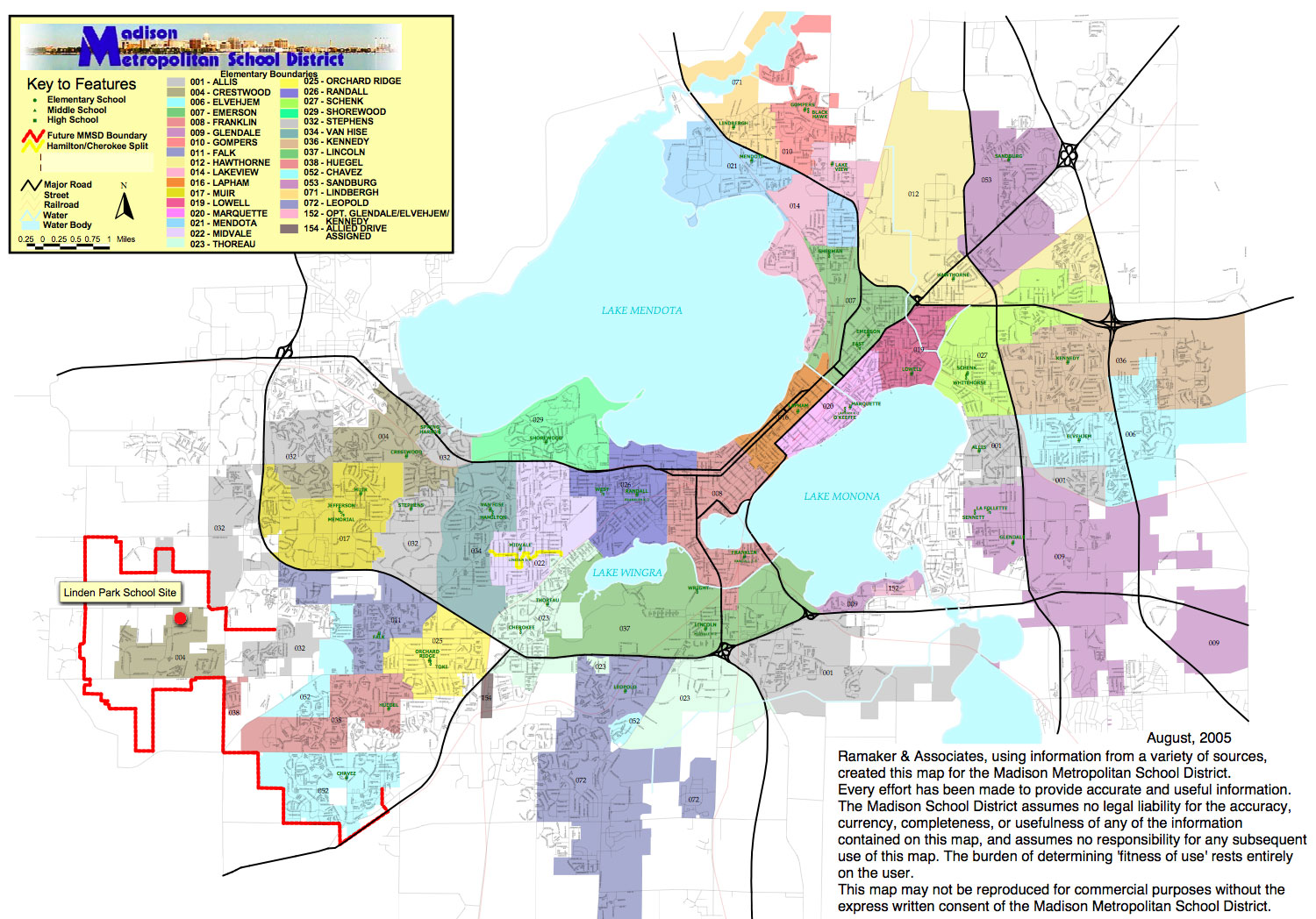
Former teacher and Progressive Dane education task force member Kristin Forde is a member of the Madison Studio School's "core planning group". In the past, Forde has participated in School Board candidate interviews and a Progressive Dane (PD) candidate Forum.I find PD's positions interesting. They recently strongly supported the Linden Park edge school [map] (opposed by a few locals who dislike the sprawl implications, though it handily passed in November, with 69% voting in favor). I do think Madison is behind the innovation curve with respect to online learning and possibly charters. Appleton has 12 charter schools, including an online school.Madison School Board President Johnny Winston, Jr. has been and is supported by PD along with recently elected (in one of the closest local elections in memory - by 70 votes) board member Arlene Silveira.
PD reportedly requires any candidate they endorse to back all of their future candidates and initiatives. [ed: Shades of "with us or against us". Evidently both Russ Feingold and Barack Obama have not read the memo.]
Background documents:
- The Madison Studio School Proposal 256K PDF.
- Philosophy, staff and Board information 256K PDF.
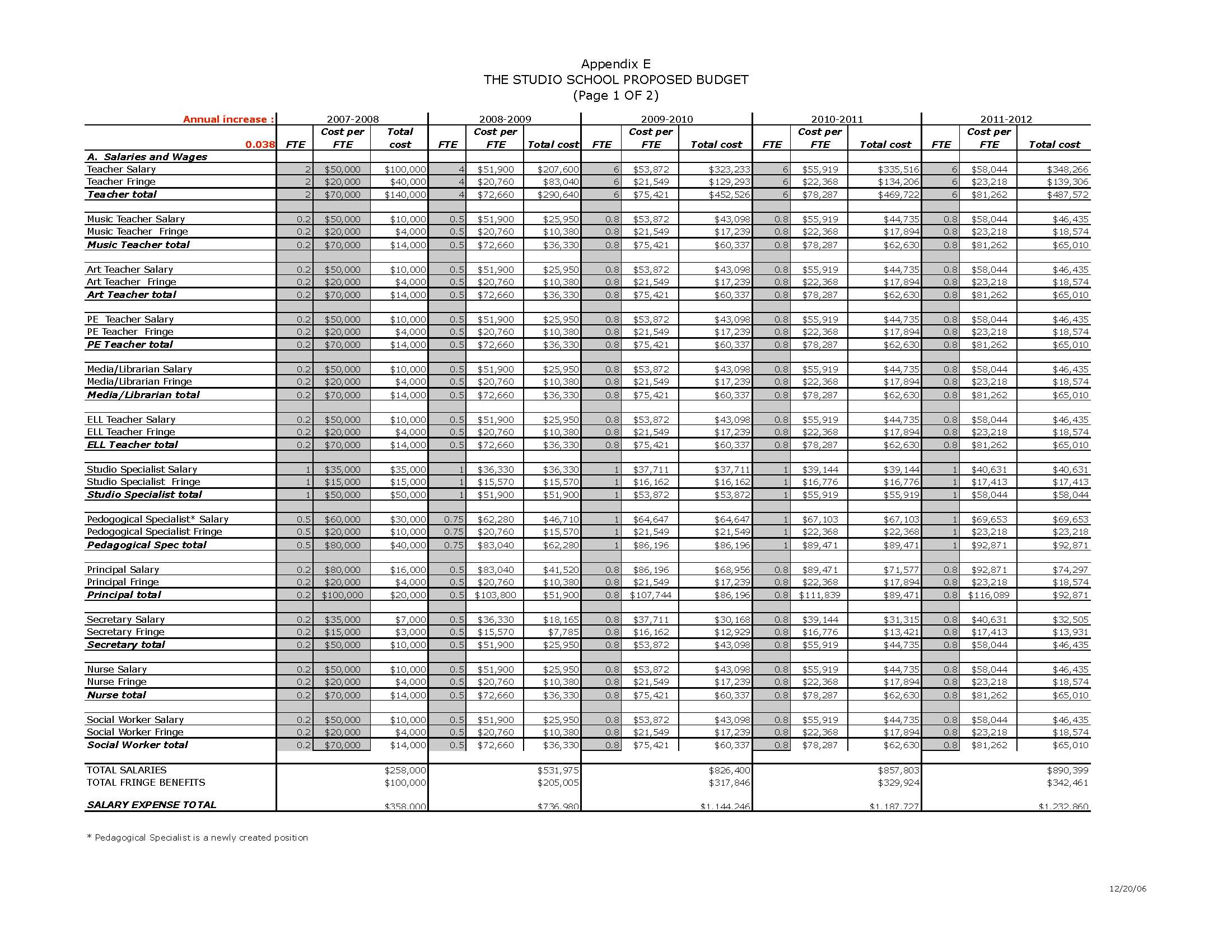
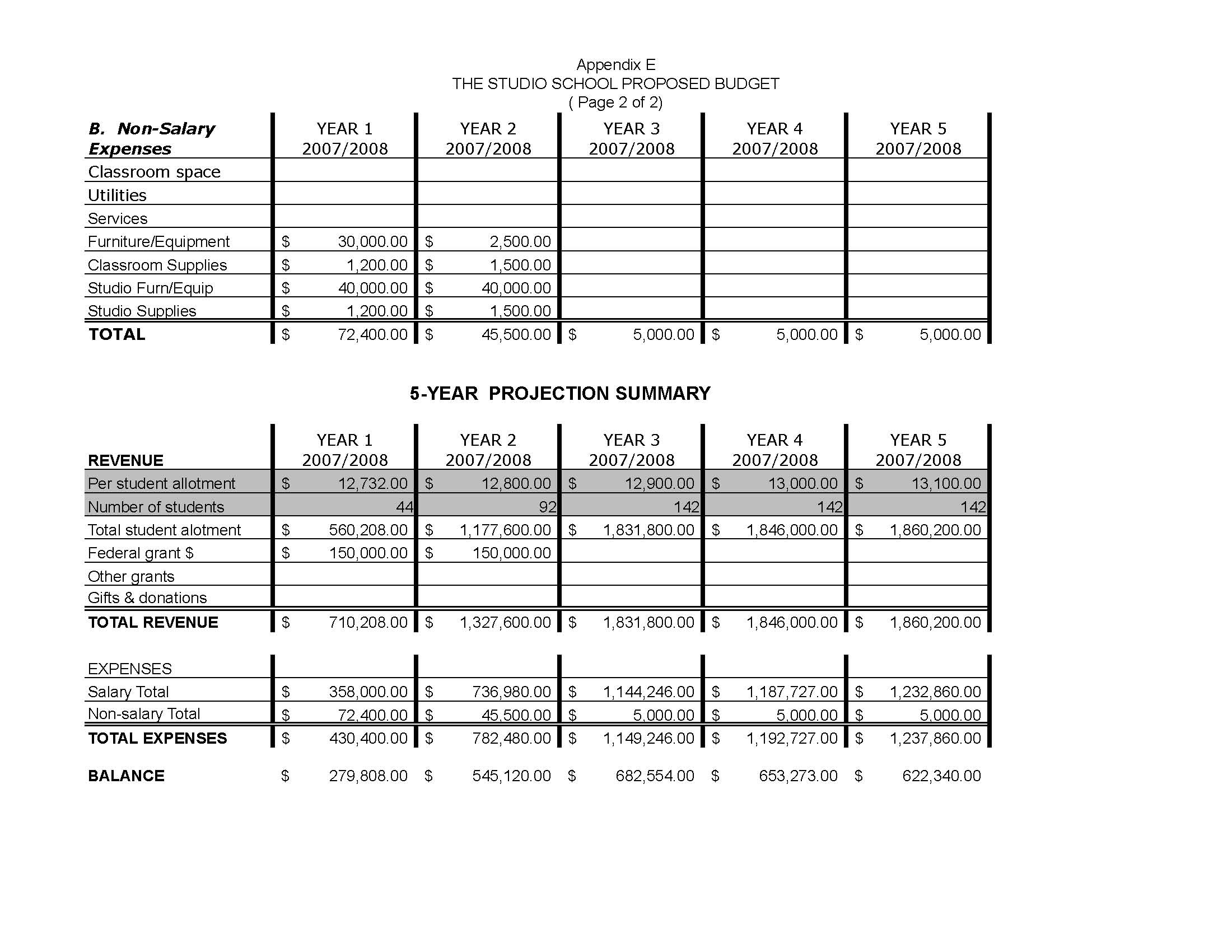
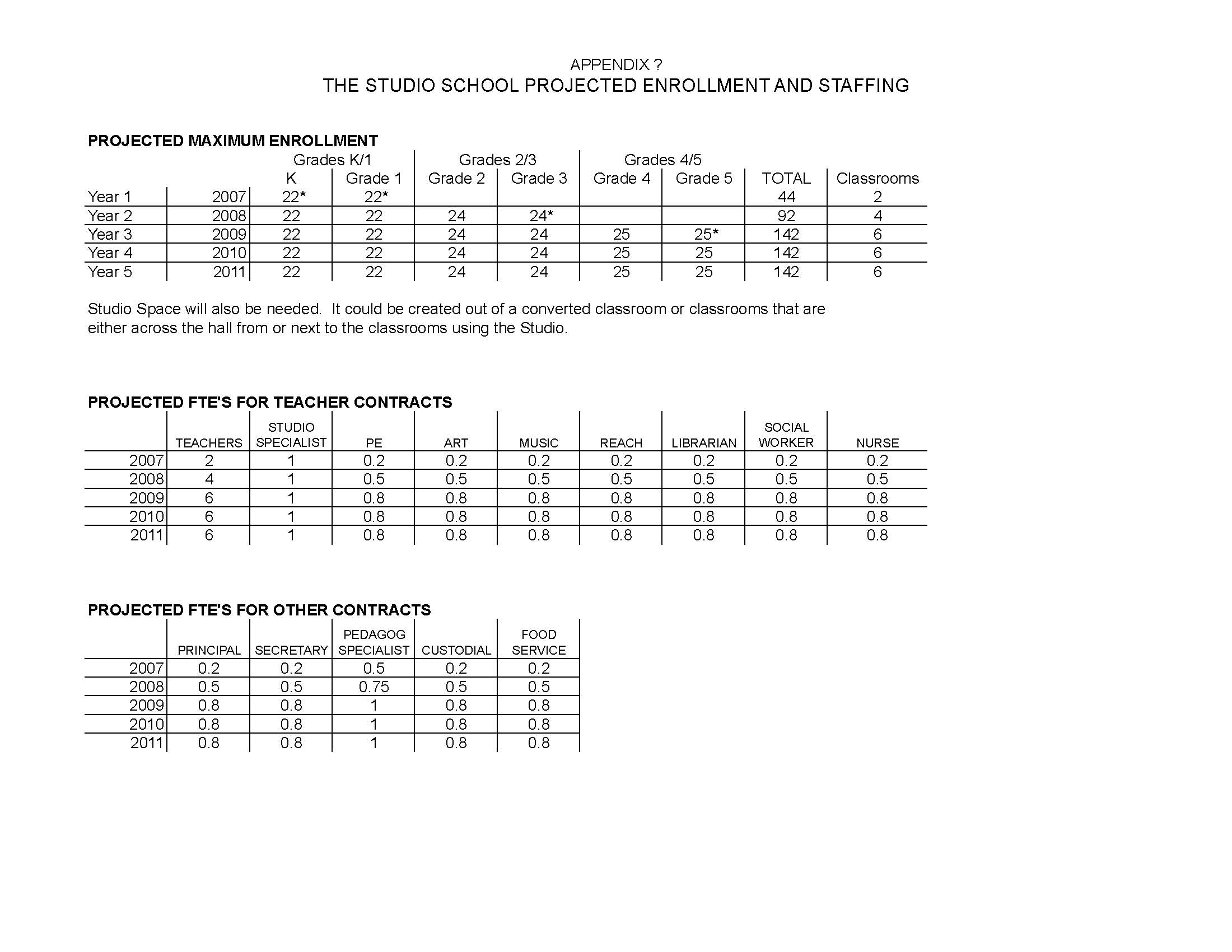
- Budget documents 1 [jpg] [PDF] [.xls] | 2 [jpg] [PDF] [.xls] | 3 [jpg] [PDF] [.xls]
- SIS notes and links
I have very fond memories of Madison's Preschool of the Arts.
It will be interesting to see if the Studio School supporters endorse PD's spring, 2007 candidates, which include Johnny Winston, Jr who is standing for re-election.
Newsletter signup | Send us your ideas
December 13, 2006
Something Different: Cherokee's 8th Grade Orchestra Plays "Stairway to Heaven"
Cherokee Middle School's 8th grade orchestra plays the famous Led Zeppelin tune Stairway to Heaven: [4.2MB mp3].
Newsletter signup | Send us your ideas
November 29, 2006
New Project to Send Musicians Into Schools
Two pillars of the classical musical establishment, Carnegie Hall and the Juilliard School, have joined forces to give birth to a music academy whose fellows will go forth and propagate musicianship in New York public schools.The city’s Education Department is opening its arms to the new program, seeing an inexpensive but valuable source of teaching for a system deprived of comprehensive music training. And the leaders of Carnegie and Juilliard see an opportunity to promote their conviction that a musician in 21st-century America should be more than just a person who plays the notes.
Under the new program elite musicians will receive high-level musical training, performance opportunities at Carnegie Hall and guidance from city school teachers in how to teach music. The fellows will each be assigned to a different school and work there one and a half days a week. They will teach their instruments, or music in general, and give their own pointers to school music teachers.
Newsletter signup | Send us your ideas
November 23, 2006
New Program in Schools Takes Students From Playwriting to Performance
There have been programs promoting theater involvement in New York City schools for years, but Fidelity Investments, together with the Viertel/Frankel/Baruch/Routh Group, the Broadway producing team behind “Hairspray� and “Company,� and Leap, a 30-year-old non-profit organization dedicated to arts education, have announced one of the broadest programs yet.Other organizations, like Theater Development Fund, have programs to involve students in Broadway theater, but this one, which started last month at 10 high schools and junior high schools in the city, aspires to be the most comprehensive. It is a seven-month course involving big-name theater professionals, trips to Broadway shows, playwriting and play producing classes and, for 10 students, a Broadway stage on which their plays will be performed.
“We have never done a program as comprehensive as this,� said Alice Krieger, the associate executive director of Leap.
Newsletter signup | Send us your ideas
October 11, 2006
World Famous Artist Collaborates with Cherokee Middle School Students
tudents at a Madison middle school collaborated with a world-famous contemporary painter to create a mural.Much more on Wyland. Wyland's Milwaukee County Courthouse Annex "Whale Commuters" was recently destroyed as part of a new freeway project.
The artist known simply as Wyland -- who is famous for panting building-sized marine murals in cities around the country -- visited Cherokee Middle School on Tuesday where he worked with 40 students to paint a mural.
Newsletter signup | Send us your ideas
September 20, 2006
Artists Working in Education
Artists Working in Education (AWE) presents "A Celebration of Children's Art," a collection of work created this summer by kids who participated in AWE's Truck Studio Program.Artists Working in Education website."A Celebration of Children's Art" hangs in the Milwaukee City Hall Rotunda, Sept. 19 through Oct. 6. There is an opening reception on Tuesday, Sept. 19 from 5 to 7 p.m. at City Hall, 200 E. Wells St.
The exhibit features paintings, collages, plaster casts and fiber arts pieces made by four to 14-year-olds who were instructed by professional artists, art teachers and college-level art students through the Truck Studio Program.
"All of the work is created by children in Milwaukee's most challenged neighborhoods," says Sally Salkowski Witte, AWE executive director. "To me, it's entirely appropriate that their artwork is positioned, at least for a short time, where those who have a great deal of power to make a difference will pass by every day."
Newsletter signup | Send us your ideas
July 28, 2006
Not to Worry: Neal Gleason Responds to Marc Eisen's "Brave New World"
Neal Gleason in a letter to the Isthmus Editor:
I have long admired Marc Eisen's thoughtful prose. But his recent struggle to come to grips with a mutli-ethnic world vvers from xenophobia to hysteria ("Brave New World", 6/23/06). His "unsettling" contact with "stylish" Chinese and "turbaned Sikhs" at a summer program for gifted children precipitated first worry (are my kids prepared to compete?), And then a villain (incompetent public schools).Although he proclaims himself "a fan" of Madison public schools, he launches a fusillade of complaints: doubting that academic excellence is high on the list of school district pirorities and lamentin tis "dubious maht and reading pedagogy." The accuracy of these concerns is hard to assess, because he offers no evidence.
His main target is heterogeneous (mixed-ability) classes. He speculates that Madison schools, having failed to improve the skills of black and Hispanic kids, are now jeopardizing the education of academically promising kids (read: his kids) for the sake of politically correct equality. The edict from school district headquarters: "Embrace heterogeneous classrooms. Reject tracking of brighter kids. Suppress dissent in the ranks." Whew, that is one serious rant for a fan of public schools.
Eisen correctly observes that "being multilingual" will be a powerful advantage in the business world; familiarity and ease with other cultures will be a plus." Mare than 20 years ago, my kids began to taste this new world in the diverse classrooms of Midvale-Lincoln Elementary, and continued on through West High with its 50-plus nationalitities and a mix of heterogeneous and advanced classes.Background:They did just fine in college and grad school, emerged bi-and tri-lingual with well worn passorts, and started interesting careers at high tech internationl companies. How will Eisen's kids acquire modern cultural skills if they are cloistered in honors classes, sheltered from daily contact with kids of varied ability?
Neal Gleason
- Flat MMSD enrollment and growth in the suburbs
- This is Not Your Grandchild's Madison School District - Lucy Mathiak's response
- CARE posted some useful numbers on the Madison School District's budget, staffing and enrollment changes over the past decade.
- Extensive discussion on heterogeneous groupings in West High School's one size fits all English 9/10 curriculum
- Jason Shephard's "The Fate of the Schools" is a must read.
- Gleason coaches West High's Chess Club
- Ongoing, mandatory heterogenous curriculum controversy comments, including those from Neal. Google has more.
Newsletter signup | Send us your ideas
July 27, 2006
Guggenheim Study Suggests Arts Education Benefits Literacy Skills
In an era of widespread cuts in public-school art programs, the question has become increasingly relevant: does learning about paintings and sculpture help children become better students in other areas?A study to be released today by the Solomon R. Guggenheim Museum suggests that it does, citing improvements in a range of literacy skills among students who took part in a program in which the Guggenheim sends artists into schools. The study, now in its second year, interviewed hundreds of New York City third graders, some of whom had participated in the Guggenheim program, called Learning Through Art, and others who did not.
Newsletter signup | Send us your ideas
June 26, 2006
Renewed Push for the Arts in New York's Schools
Each of the 10 Regional Arts Supervisors oversees more than 100 schools, making it difficult to monitor each one closely. And with the recent establishment of about 300 "empowerment" schools that are largely independent of the Education Department, superintendents have been asked to cut their budgets in proportion to the number of schools leaving their jurisdiction. Regional arts supervisors could be a casualty.Still, arts education advocates say the administration is moving in the right direction. They point to the beefed-up staff dedicated to arts education at the Education Department. In addition to Ms. Dunn there is now a full-time director in each of the four disciplines.
The very existence of qualified regional arts supervisors represents progress. In the past a district superintendent could appoint anybody for the position; now it requires supervisory certification and experience teaching the arts. Schools formerly could get away with spending their arts education money — known as Project Arts funds — on nonarts expenses, but now, for the first time, there is a budget code, which is being hailed as an accomplishment in and of itself. (Principals in the new empowerment schools will have greater budgetary autonomy, however, so the Education Department will not monitor their arts spending.)
Newsletter signup | Send us your ideas
June 25, 2006
Brave New World: Are our kids ready to compete in the new global economy? Maybe not
Marc Eisen:
Most of us have had those eerie moments when the distant winds of globalization suddenly blow across our desks here in comfortable Madison. For parents, it can lead to an unsettling question: Will my kids have the skills, temperament and knowledge to prosper in an exceedingly competitive world?I’m not so sure.
I’m a fan of Madison’s public schools, but I have my doubts if such preparation is high on the list of school district priorities. (I have no reason to think things are any better in the suburban schools.) Like a lot of parents, I want my kids pushed, prodded, inspired and challenged in school. Too often -- in the name of equity, or progressive education, or union protectionism, or just plain cheapness -- that isn’t happening.
Brave New World: Are our kids ready to compete in the new global economy? Maybe not
Last summer I saw the future, and it was unsettling.My daughter, then 14, found herself a racial minority in a class of gifted kids in a three-week program at Northwestern University. Of the 16 or so kids, a dozen were Asian or Asian American.
The class wasn't computer science or engineering or chemistry -- classes increasingly populated by international students at the college level -- but a “soft� class, nonfiction writing.
When several hundred parents and students met that afternoon for the introductory remarks, I spotted more turbaned Sikhs in the auditorium than black people. I can't say if there were any Hispanics at all.
Earlier, I had met my daughter's roommate and her mom -- both thin, stylish and surgically connected to their cell phones and iPods. I casually assumed that the kid was a suburban princess, Chinese American division. Later, my daughter told me that her roommate was from Hong Kong, the daughter of a banker, and had at the age of 14 already taken enrichment classes in Europe and Canada. Oh, and she had been born in Australia.
Welcome to the 21st century.
In the coming decades, you can be sure the faces of power and influence won't be monochromatic white and solely American. Being multilingual will be a powerful advantage in the business world, familiarity and ease with other cultures will be a plus, and, above all, talent and drive will be the passwords of success in the global economy.
Thomas Friedman's The World Is Flat, his chronicle of the rapid economic and social changes wrought by the mercury-like spread of new technology, serves as an essential primer for understanding this new world.
In a nutshell, we shouldn't bet on American hegemony in technology and economic growth in the 21st century. In a ramped-up, knowledge-based, digitalized economy, there are no borders. The built-in advantage the U.S. enjoyed after World War II -- our industrial based was untouched, while the rest of the developed world's was in ruins -- has finally run its course. Today, many tech jobs can just as easily be performed in Bangalore and Beijing as in Fitchburg.
Whether America's youth, raised in the lap of luxury with an overpowering sense of entitlement, will prosper in this meritocratic environment is an interesting question. And what of America's underprivileged youth, struggling in school and conspicuously short of family assets: How well will they fare in the new global marketplace?
My own a-ha! moment came a year ago at about the same time I dropped my youngest daughter off at Northwestern. Out of the blue I received an e-mail from a young man in India, offering his services to proofread the paper. Technically, it was no problem to ship him copy, and because of the 12-hour time difference he could work while the rest of us slept and played -- if we wanted to go down the outsourcing road.
Most of us have had those eerie moments when the distant winds of globalization suddenly blow across our desks here in comfortable Madison. For parents, it can lead to an unsettling question: Will my kids have the skills, temperament and knowledge to prosper in an exceedingly competitive world?
I'm not so sure.
I'm a fan of Madison's public schools, but I have my doubts if such preparation is high on the list of school district priorities. (I have no reason to think things are any better in the suburban schools.) Like a lot of parents, I want my kids pushed, prodded, inspired and challenged in school. Too often -- in the name of equity, or progressive education, or union protectionism, or just plain cheapness -- that isn't happening.
Instead, what we see in Madison is just the opposite: Advanced classes are choked off; one-size-fits-all classes (“heterogeneous class groupings�) are mandated for more and more students; the talented-and-gifted staff is slashed; outside groups promoting educational excellence are treated coolly if not with hostility; and arts programs are demeaned and orphaned. This is not Tom Friedman's recipe for student success in the 21st century.
Sure, many factors can be blamed for this declining state of affairs, notably the howlingly bad way in which K-12 education is financed in Wisconsin. But much of the problem also derives from the district's own efforts to deal with “the achievement gap.�
That gap is the euphemism used for the uncomfortable fact that, as a group, white students perform better academically than do black and Hispanic students. More to the point, mandating heterogeneous class grouping becomes a convenient cover for reducing the number of advanced classes that fail the PC test: too white and unrepresentative of the district's minority demographics.
The problem is that heterogeneous classes are based on the questionable assumption that kids with a wide range of skills -- from high-schoolers reading at a fourth-grade level to future National Merit students -- can be successfully taught in the same sophomore classroom.
“It can be done effectively, but the research so far suggests that it usually doesn't work,� says Paula Olszewski-Kubilius, head of Northwestern's Center for Talent Development, which runs an enrichment program for Evanston's schools.
I have to ask: After failing to improve the skills of so many black and Hispanic kids, is the Madison district now prepared to jeopardize the education of its most academically promising kids as well?
Please don't let me be misunderstood. Madison schools are making progress in reducing the achievement gap. The district does offer alternatives for its brightest students, including college-level Advanced Placement classes. There are scores of educators dedicated to improving both groups of students. But it's also clear which way the wind blows from the district headquarters: Embrace heterogeneous classrooms. Reject tracking of brighter kids. Suppress dissent in the ranks.
The district's wrongheaded approach does the most damage in the elementary-school years. That's where the schools embrace dubious math and reading pedagogy and shun innovative programs, like those operated by the Wisconsin Center for Academically Talented Youth, a nonprofit group that works tirelessly to promote gifted education. (Credit school board president Johnny Winston Jr. for cracking the door open to WCATY.)
In a perfect world, Madison would learn from Evanston's schools and their relationship with WCATY's peer, the Center for Talent Development. Faced with predominantly white faces in its advanced high school classes, this racially mixed district didn't dump those classes but hired Olszewski-Kubilius' group to run an after-school and weekend math and science enrichment program for promising minority students in grades 3-6.
In other words, raise their performance so they qualify for those advanced classes once they get to high school. Now there's an idea that Tom Friedman would like!
MARC EISEN IS EDITOR OF ISTHMUS.Email: EISEN at ISTHMUS.COM
Links:
- Wisconsin Center for Academically Talented Youth
- Northwestern Center for Talent Development
- Paula Olszewski-Kubilius
- Mandatory grouping in Madison West's English 10
- Connected Math
- Reading Recovery
Newsletter signup | Send us your ideas
June 02, 2006
Kobza, Mathiak, Robarts and Vang Vote Yes to Support Elementary Strings: Carstensen, Silveira and Winston Vote No And Support Cutting Elementary Strings
Thank you to students, parents and community members who wrote to and spoke before the School Board in support of elementary strings. It may seem, at times, that your letters or statements fall on deaf ears, but that is not the case. Each and every letter and each and every statement of support is critical to communicating to the School Board how much the community values this course. There are Board members who listen and understand what you're saying.
Last night MMSD School Board members Lawrie Kobza, Lucy Mathiak, Ruth Robarts and Shwaw Vang voted to restore Grade 5 elementary strings classes to twice weekly. Also, these same four Board members voted in favor of a pilot elementary string course at one or more schools that would provide 4th and 5th grade students with the option to select either General Music or Elementary Strings as their music class. My thanks for their votes of support for elementary strings and a strong music education and opportunities for all our children.
Johnny Winston Jr. (Board President), Carol Carstensen and Arlene Silveira voted against this option, electing to support cutting elementary strings. These three board members did not support elementary strings and supported the Superintendent's proposal, which would cut Grade 4 elementary strings next year and would have cut Grade 5 elementary strings the following year, eliminating elementary strings for about 543 low-income children, 1610 elementary children in all, within two years.
The elementary string program, even with an additional class in Grade 5 was cut in Grade 4 and the budget was reduced about 13% on top of a 50% cut the previously year. (In comparison, the budget for extracurricular sports increased 25%.)
The board majority who voted for 2 classes per week in Grade 5 and a pilot want to learn more about what option(s), instructionally, administratively, and financially would work best in the future, so elementary string instruction remains part of music education. I appreciate their efforts.
Elementary strings is less than 0.09% of the District's $330+ million budget, taught 1610 (543 low income) Grade 4 and Grade 5 children this year, is a heterogenous, diverse course.
Newsletter signup | Send us your ideas
May 30, 2006
Continue Elementary Strings - 550 Low-Income Children Deserve the Opportunity to Proudly Play Their Instruments
On Wednesday, May 31st, the MMSD School Board will consider amendments to the 2006-2007 school budget proposed by the Superintedent. In his proposal, the Superintendent proposed cutting Grade 4 strings this year and Grade 5 strings the end of next year. One amendment to be discussed on Wednesday would have Grade 4 strings 1x per week (45 minutes) and Grade 5 2x per week (45 minutes each class).
Students who will be affected the most are our low-income children. There is no other place in Dane County that can teach so many low-income children. This year about 550 low-income students took elementary strings. Fewer opportunities at this age will lead to fewer low-income/minority students in our middle and high school orchestras and band - this is a direction we do not want to move in as our student body becomes more diverse.
Like it or not, people moving into the area with children check out what schools offer - our suburban school districts have elementary string programs that are growing in many towns.
I've advocated for a community committee for fine arts education to develop a long-term plan for this academic area. I hope this comes to pass, but first I hope the School Board favorably considers this amendment and follows Lawrie Kobza's idea - hold off spending on "things" because people cannot be added back in as easily as things can be added back into the budget.
I've written a letter to the school board that follows:
Dear Madison School Board,
Last week, I had the honor of listening to more than 130 4th and 5th grade students give a ½ half hour concert for their parents and classmates. These children were so excited being able to play for an audience. I have to admit, I wasn’t sure how their teacher would get them organized and ready to play, but he did, and the concert was terrific! What a wonderful experience for player and audience alike.
Thank you for considering options to continue elementary strings, which is the first two years of the district’s Grade 4-12 instrumental academic program. I implore you to support the following option: Grade 4 – 1x per week (45 minute class) and Grade 5 – 2x per week (45 minute classes) for the following reasons:
A. Low income children will be affected the most by cuts to Grade 4 strings – about 550 low-income children participated in elementary strings this year, an increase from several years ago. We need to develop opportunities (lessons, small group rehearsals) that will help all children be successful performers on his/her instrument. Opportunities, such as these, need to BUILD UPON what children learn during the day in a large group class.
B. Equity in making cuts – last year this course was cut too much – 50%, which is more than any other academic course that is highly valued and has a strong demand. The burden of cuts needs to be shared, yet we need to protect our academic courses. I support Lawrie Kobza’s proposal to cut “things� now, not staff. As the School Board learns more about the budget after it is implemented, “things� can be added back in. Once the school year has begun, it’s next to impossible to add back staff.
C. DPI Standards – recommend beginning violin instruction in Grade 4 as does MMSD’s curriculum. There has been no curriculum assessment of the district’s music education with teachers, parents, music professionals involved. I feel this is important before any changes to this curriculum, or any academic curriculum, are made. Promises of planning are inappropriate.
D. Children’s interest and demand – remains strong and has grown during the past 15 years, AT THE SAME TIME that the district’s low-income and minority population has grown. Consistently, 1,800 to 2,000 children have signed up each year for elementary strings. They may not all come to School Board meetings, but like the hundreds of parents, students and community members who have spoken and emailed the School Board these past 5 springs, these students make their wishes known by taking elementary strings, learning to play and playing their hearts out at concerts for the community.
E. Middle school students want more music in school – elementary strings is an important stepping stone to more advanced performance. Nothing in General Music alone prepares them to perform at a level children can play after two years of elementary strings. Middle and high school music classes are larger – requiring fewer staff than other classes.
For 5 springs, the community has spoken up for elementary strings. Students have spoken about how important these classes are to their education, parents share with you what their children’s experiences are, community members tell you how much they value elementary strings. Please help them.
I’ve been asking the School Board to consider putting in place a community fine arts education committee to develop a long-term strategic plan for fine arts. I hope the School Board takes a leadership role and moves forward with such an effort. But, first, please continue elementary strings.
Sincerely,
Barbara M. Schrank, Ph.D.
Newsletter signup | Send us your ideas
May 29, 2006
A Parent's Note to the Madison School Board on Strings
Ann O' Brien:
Every year when I attend my children’s strings concerts, I am so amazed by the broad and diverse participation of students in strings. How moving to see so many students playing instruments often stereotyped as only for the rich who can afford lessons. The cacophony of sounds coming from the 100’s of students at the city-wide concerts inspires the kids, the parents and the community that all is well in the world; that integration, opportunity, and artistic expression are not just paid lip service, but are working in our schools. I appreciate your work to keep strings available to all students.
Newsletter signup | Send us your ideas
May 20, 2006
High School Documentary Film Making
Newsletter signup | Send us your ideas
May 15, 2006
Speak Up For Fine Arts Education's Future
I have been an outspoken advocate for elementary strings the past several years, because this course is a highly valued, high demand academic course that is part of the K-12 MMSD music curriculum but has been repeatedly put on the cut list without any meaningful curriculum planning taking place from year to year. However, I also strongly believe there has been a lack of long-term planning in all fine arts education since cuts began about 1999. Perhaps other academic areas have needed the administration's attention, such as reading and math. That's understandable, but the School Board missed yearly opportunities to put in place other structures to plan for the future of fine arts education in Madison - community committee is an example of one option they might have considered pursuing.
I was encouraged two weeks ago when the Performance and Achievement and Partnership Committee chairs indicated an interest in working on not only the cuts to elementary strings, but also other aspects of fine arts education. I hope a community-led fine arts education committee is formed from these two Board committees that will undertake long-term, strategic planning for fine arts education in Madison. I would like to see such planning include music, visual arts, dance, theater, etc. - all facets of the arts that bring joy and enrichment to the citizens in our community, growth to our city's economy now and in the future and play an important academic role in the excellent education our children receive.
Again, School Board members can be emailed at: comments@madison.k12.wi.us
Newsletter signup | Send us your ideas
Speak Up For Strings - Thanks for Emailing the School Board: Keep The Emails Coming
MMSD's School Board meets tonight to discuss the 2006-2007 school budget. There are no public appearances on tonight's agenda, but the Madison community can continue to email the School Board in support of elementary strings at: comments@madison.k12.wi.us. Thank you to the parents and community who have attended the public hearing and who have sent emails to the School Board in support of elementary strings for Madison's 9- and 10-year old students.
Cutting elementary strings will hurt low-income children! Keep the emails coming in support of about 550 low-income children who signed up for elementary strings - no other organization in Madison or Dane County offers an academic year long class that teaches this many children how to play an instrument. Madison School Board: Let's work together to enhance this learning experience for our children; not tear it down and not tear it down before hearing from and working with the community.
I support restoring elementary strings to 2x per week, and I support forming a community task force on elementary strings and fine arts education to build fine arts education in Madison, not continue to tear it down. I reject late spring reports from the District administration that are clearly biased against this course and have not engaged teachers, music professionals, the community in the preceding 4 years! It's not a administrative staffing issue, but it is poor, poor planning. We've had revenue caps since the early 1990s, and the Superintendent has been cutting fine arts since 1999 with no long-term plan in place, no community task force formed.
Call for an end to unfair cuts to elementary strings - cut 50% last year. No other high demand, highly valued course has been targeted in any year let alone year in and year out for cuts for 5 springs!
The state needs to take action on school financing; Madison needs the MMSD School Board to take action on elementary strings and fine arts educationl. Work with the community - please start now!
Newsletter signup | Send us your ideas
May 13, 2006
MadCAP Spring Concert Video Clips
| MadCAP held their music studio recital last night. 20MB video clip excerpts. |  |
Newsletter signup | Send us your ideas
May 10, 2006
Cutting Elementary Strings Hurts Children From Families With Low and Moderate Incomes
Members of the Board of Education,
I am writing to urge you all to vote in support of continuing the strings program in elementary schools.
I am a parent of a 6th grader at Hamilton Middle School, and I am fortunate to have been able to afford private and group violin lessons outside the school system for my son, since kindergarten. I can not tell you what a huge benefit this has been to him, in terms of teaching him to strive towards a rewarding goal, the joy of working together in a group of other learners, and appreciating the goodness of the arts in a troubled world.
And yet I know that the disadvantaged children in MMSD have no opportunity at all to play a violin or other instrument in elementary school unless the strings program continues.
It is clear to me and all music instructors that if a child starts violin in 6th grade, it is by far more difficult for them and much more likely that they will become frustrated and give up.
Starting in grade 4 will not only help students learn and stay with it, but will be a better use of the precious funds that we do allocate to strings in all grades -- a better foundation means better participation and more benefits in the later grades.
My own son did not take strings in 4th and 5th grade, because I felt it was better to give another spot to a family that did not have another means to offer strings to their child. He now participates in 6th grade. I can tell you that with all the other major adjustments of the transition to middle school, starting a stringed instrument from scratch would have added a lot of stress to our family.
Please, please find a way to continue strings in 4th and 5th grades. I have been to enough meetings to know that there are things that could be cut from the budget that are way less important than strings.
Thank you,
Jane Sekulski
PS. If you have never seen the movie "Music of the Heart", please consider doing so. It is based on a true story, which is documented in the film "Small Wonders", of a violin program in inner city New York. The documentary is even better.
Newsletter signup | Send us your ideas
May 09, 2006
Speak Up for Strings Tonight: Public Appearances at Board Public Hearing On the Budget - 6:30 p.m. Tuesday, May 9th at Memorial High School
Dear Madison Community,
Children and parents are encouraged to speak in support of elementary strings and to bring their instruments to tonight’s School Board public hearing on the budget if they would like to play. My husband, Fred Schrank, who is the principal bassist with the MSO and who teaches orchestra to elementary and middle school children in the district, will be there. I’ve asked him if he would accompany those children who might want to play for the School Board to show their support for the course. The public hearing begins 6:30 p.m at Memorial High School, 201 S. Gammon Road, Auditorium [map].
For your information - the School Board takes students who want to speak for 3 minutes (or play for 3 minutes) first. I also have signs and will have colored markers for students or others who want to make signs for the School Board to see.
The Superintendent’s proposal to cut Grade 4 strings is unacceptable, incomplete and would put in place a music curriculum planning process AFTER the cut is made to Grade 4 strings instruction. His conceptual idea is to plan to offer elementary children experiences with varied instruments in the 07-08 school year when Grade 5 strings would be cut and there would be no more elementary strings. That’s a curious idea. Why? Current General Music practice is to offer children experiences on different instruments – so the planning would not result in any meaningful curriculum change except the elimination of elementary stringed instrument instruction. What kind of plan would that be? No community planning took place this year for music education, which DPI recommends as best practice for standards based curriculum planning – include professionals and the community in the effort. The only plan is to cut Grade 4 strings, with planning for next steps to follow. Without good planning and good information – bad practice and bad decisions follow.
My question: Where’s the planning been for the past year, for the past 5 years? Our kids deserve better. Hundreds of children and community members have spoken in support of the elementary strings course over the years and emails and support for this course remain strong as demonstrated by the children once again this year through their enrollment in this course – over 1,700 children in September (550+ low income children who will be hurt the most by this cut).
After 5 springs of advocating for this course, I’m exasperated and annoyed; but when I listen to children and parents tell their stories about their hopes and dreams, I get reinvigorated as I was last night after listening and speaking. Last night, Ruth Robarts, Shwaw Vang and Lucy Mathiak spoke strongly in support of the program and in working on strings through the Performance and Achievement and the Partnership Committees. I think the idea to collaborate among board committees is novel and appropriate for Fine Arts – and may be for other areas. I feel involving the community - music and art professionals, parents, organizations in the process is critical to the long-term success of fine arts education in Madison, especially in tight financial times.
Also, Lawrie Kobza, School Board Vice President, reminded the Superintendent that the School Board had additional options to his proposal to consider - the Superintendent's options plus keeping the course the same as this year or restoring the course to what it was two years ago (2x per week for 45 minutes).
So, please, if you have time tonight, come and Speak Up For Strings! Even if it’s only to stop in on your way to and from another event (it’s that crazy time of year with concerts, sporting games, dances and preparation for graduations taking up lots of time) and register with the Board in support of the course. I’ll be there to help with registering to speak in support, or simply registering your support. Each person’s presence makes a difference – individually and collectively!
Best,
Barbara Schrank
P.S and FYI – the Supt.’s proposed Grade 4 strings cut would not affect any current teachers and would be made through retirements and resignations. However, 1,700 children would lose something they dearly value that provides them with so much. I think, over time, our community will lose even more.
Newsletter signup | Send us your ideas
May 08, 2006
Why Does Elementary Stringed Instrument Instruction Matter? One Reason - Student Demand is Strong
I sent the following letter to the School Board last week after reviewing data and text on elementary strings sent to the School Board by the Fine Arts Coordinator. In late March, I spoke before the School Board about working together on strengthening strings and fine arts education and hoped that we would not see another spring of "surprise reports." Shwaw Vang and others thought this was a good idea, but I guess the administration did not agree. Following my talk, the Superintendent sent a memo to the School Board with a proposal to eliminate elementary strings the end of next school year and offer General Music.
For the past five springs, in one form or another, reports on strings have been presented to the School Board, which present data and give reasons why not to teach strings. These reports are all prepared by top administrators with basically no input from or curriculum review by teachers, parents, students, the community. No other data are presented in the same manner and with as much detail as this course - none, which I find troubling. Courses are dropped for lack of enrollment, which is not the case with elementary strings. Also, no other academic course has come before the School Board year after year for cuts - not even open classroom, ropes, wrestling.
I have MMSD historical data on strings from when the course was first introduced. In spite of the administration's best efforts to cut the course,
- demand from students remains strong and
- the community still values the course.
Attacking strings, or extracurriculars, or sports, will not put teachers, librarians, and other key staff into schools. Nor will it repair curricula that are of questionable efficacy. If we want good schools, the conversation starts with what is in the budget -- ALL of the budget -- and whether the budget supports the kind of programs that we value in our schools." I strongly agree with her statement, because focusing on ALL of the budget keeps the focus on what's important - student learning and achievement. An increasing body of research and experience shows studying an instrument positively affects student achievement. If so, why isn't the School Board working with the community to strengthen fine arts education.
Dear School Board Members,
You recently received some statistical information from the District Fine Arts Coordinator on string instrumental enrollment for Grades 4-12 that was in response to a question from Ms. Carstensen on enrollment.
I feel the information presented could have been titled, “Reasons [the Administration Wants] to Cut Elementary Strings,� which, of course I found strange and inconsistent with data on this course and how other data are presented to the School Board [for issues/practices the administration supports].
I would like to provide you with some additional information that I believe provides a bigger picture and shows how this course has grown as the District has changed:
- Historical Enrollment:
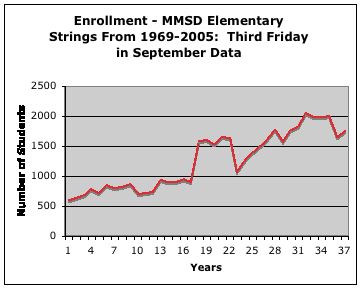
[Please excuse me, I don’t know how to change the x axis to years. Year 1 is 1969 and the last year is 2005.] This data was kept in the Fine Arts Department by those overseeing the elementary strings enrollment. I have a copy of the original chart, which I would be happy to provide MMSD if they cannot find a copy of this information..The dip around year 23 (1991) was due to a proposal to cut elementary strings and the later dip around year 29 was due to the inability to replace an FTE. You can see the strong growth in the course following a proposal to cut the course. During the 1990s enrollment grew, peaking in the early 2000s at 2,049. Even with the Superintendent's proposals to cut the course, demand for instruction remains strong. During the same time period in the 1990s, low-income and minority enrollment in the elementary grades increased (while total enrollment in elementary school declined). Even with the proposed cuts to elementary strings since 2002, enrollment has stayed strong, consistently about 50% of 4th and 5th grade students participate. This course is a high demand, highly valued course as growth in enrollment continues to show.
- Elementary Strings – Demographics and Over Time:
When you look at the statistics you received on elementary strings – I would recommend that you look at the entire course over time as well as student groups over time (cohorts). If you look at the course over time, you see increases in demographics at all grade levels as you see increases in low-income and minority in the total student population – that’s moving in the right direction and teachers deserve praise for this. In fact, if you look at the low-income (%) enrollment in Grade 4 strings this year – that percentage is 2.8% lower than the percentage of low-income students in the entire Grade 4 this year.
Also, when students go from Grades 5 to Grade 6, they have another choice of instrument to study – a band instrument. When you look at the historical enrollment in instrumental music from grades 5 to 6, you will see an increase in students opting to play an instrument in Grade 6. Elementary strings plays a role in preparing students to read music and to perform with other students in an ensemble. The curriculum is an instrumental curriculum from Grades 4-12. [Low income children have no other viable option to learn how to play an instrument - $2,000 per year for lessons and instrument rental.]
It is not unusual to see a decrease in participation as children have more options. By the time children are in high school, music is an elective among many, many more electives than in earlier grades. Before jumping to conclusions, I would suggest learning why more children do not continue to study an instrument. One of those reasons might be they did not like to play an instrument or they have other interests they want to explore in another course - or they moved on to play a band instrument. Another reason might be they became discouraged, because they needed more instruction and help learning the instrument – something that I feel a fine arts community committee could help happen.
When I look at the data, I’m impressed with how the enrollment in the program has grown over time and has grown with the changing demographics in the District. [This is during the same time the District is making strong gains in closing the achievement gap.] This is wonderful. One question I have when I see this data is – how can we help children build upon their interest and success in the classroom? There are many options for doing this, but first we need to keep elementary strings as part of our children’s elementary music instruction in school and build upon what they learn. I believe we can do this if we work together as a community, and I hope the School Board considers this additional data, maintains elementary strings and considers putting in place a community committee for fine arts education to help grow and strengthen fine arts education in Madison.
Barbara M. Schrank
Fine Arts Advocate, Parent
Newsletter signup | Send us your ideas
May 07, 2006
Strings Program - Why is it So Important?
Reader Andrea Cox emails:
I don't understand why it's so important to keep the elementary strings program. Some things have to go because of the budget constraints imposed upon the schools. Strings strikes me as much less important than, say, class size, mathematics, or reading. We can't have everything without major changes in how the school funding is set at the state level.(I would have posted a "comment" to this topic, but I couldn't figure out how to do this on the site.)
Newsletter signup | Send us your ideas
May 02, 2006
Speak Up For Strings - Starting May 9th
Please Help Save Elementary Strings!!!
How: Ask the New School Board -
Work with the Community to Build Fine Arts Education!
When: Starting May 9th
Other districts facing fiscal and academic achievement challenges have had successes maintaining and growing their fine arts education - through strategic planning, active engagement and real partnerships with their communities. School districts in Arizona, Chicago, New York, Texas and Minneapolis are looking for innovative ways to preserve and to grow fine arts education when facing tight budgets.
What does MMSD do?
For the 5th spring, elementary strings are at risk. Superintendent Rainwater is proposing to eliminate elementary strings - to cut Grade 4 strings next year and Grade 5 strings the following year. NO other high demand, highly valued academic course is targeted in next year’s budget - NONE.
Hundreds of students, parents, teachers and community members understand the value of this course for young children and have shown their public support for this course before the School Board each spring. We need to remind the new School Board, once again, of the value of this course – to our students’ growth and achievement, to our community.
Facts:
Enrollment Doubled - In the 1990s, course enrollment doubled to slightly more than 2,000 students – at the same time the low income and minority elementary student population increased. Approximately 50% of 4th and 5th graders elect to participate in elementary strings.Low Income Enrollment Grew – Over time, low-income enrollment in elementary strings has grown. This year, the percentage of low-income children enrolled in Grade 4 strings is higher than the percentage of low-income children in that grade enrolled in the district. No other private/public organization in Madison teaches 550+ low-income children how to play an instrument at a higher level and to perform in ensembles.
You Can Help:
Speak to the School Board – bring signs, play your instrument
When: Tuesday, May 9, 2006 – 6:30 p.m., Memorial High School Auditorium [map]
Write to the School Board – comments@madison.k12.wi.us - and ask them
- to reject the Superintendent’s proposal as inadequate, and
- to work with Madison by forming a community fine arts committee to address fine arts educations issues, such as strings, so kids can get the personal and academic benefits of fine arts education.
Five years of targeting strings is unacceptable, short-sighted and goes against a) what the research shows strings does for children’s growth, development and academic achievement, b) what’s being done in other areas in MMSD, and b) what the community values for our children’s education.
For more information, email: savestrings@charter.net
Newsletter signup | Send us your ideas
April 28, 2006
Fostering Young Artists: Start Spreading the News
The foundation awards high school seniors more than $500,000 in cash prizes each year for achievement in the performing, literary and visual arts. It also nominates presidential scholars in the arts, and some colleges refer to its rosters for recruitment.National Foundation for the Advancement of Arts website. 2007 registration is open.Yet many people have never heard of the foundation.
"That's what I was surprised about," said Grace Weber, a winner in voice who attends Pius XI High School in Milwaukee. "People outside the art world don't know about it."
Billy Buss, a winner in jazz trumpet and a senior at Berkeley High School in California, added, "My friends only cared I was winning a lot of money."
Newsletter signup | Send us your ideas
April 26, 2006
The Madison Community - Students, Parents, Professionals, Citizens - Can Help Elementary Strings: Here's How
The community CAN HELP elementary strings and fine arts education in MMSD. Please write the School Board - comments@madison.k12.wi.us - ask them a) to establish a community fine arts education advisory committee beginning with a small community working group to put together a plan for this, b) develop a multi-year strategic and education plan for fine arts education, c) work with the music professionals and community to address short-term issues facing elementary music education (other fine arts areas - dance, drama) that supports children's learning and academic achievement. Until this is done, please write the School Board asking them not to accept (to reject) the Superintendent’s current K-5 music education proposal to eliminate elementary strings.
At this late date in the year, I feel a small community working group needs to be established that will develop a plan for moving forward with the community on fine arts education issues. I would be more than happy to volunteer my time to help coordinate this effort, which I see as a first step toward the establishment of a community fine arts education task force/advisory committee. However, what is key is the School Board’s support and the Superintendent’s leadership, and I would be honored to work with all members of the school board and with the Superintendent. I'm sure other people would be happy to help as well.
The issues with MMSD's fine arts elementary music education is not solely a budget issue, but the administration's lack of imagination and longer-term education planning in fine arts makes courses such as strings become budget issues because nothing is done from year to year to make it anything other than a budget issue.
Elementary strings is a high-demand course - this isn't 50 kids across the district, it was 1,745 in September 2005. From 1969 to 2005, enrollment has tripled, increasing by 1,000 students from 1992 until 2002, at the same time that the number of low income and minority children increased in the elementary student population. Demand for the course is annually 50% of the total enrollment in 4th and 5th grade. Plus, minority and low income enrollment has increased over the years. This year there are about 550 low income children enrolled in the elementary class. More low income children enrolled to take the course, but did not because of the pull out nature, I'm assuming. There is nowhere else in the City that so many low-income children have the opportunity to study an instrument at a higher level and continuously as part of their daily education.
Each spring, the administration waits until late April and then releases reports on elementary strings, saying they've worked hard, but can't figure it out. These documents imply that teachers have had input, but I can tell you that this spring's reports a) were not reviewed by teachers, and b) string teachers might have spent less than an hour or so learning about what other schools do, but they were not asked to be part of a process, they were not given objectives, process, timeline. And, they did not receive any draft documents to review. To me, this is unacceptable in the day and age of email.
I spoke before the board less than a month ago, saying how concerned I was that nothing had been done asking them to please avoid the past years’ mistakes and move forward working together, knowing how important this course is to the community and how quickly budget time was approaching. I asked the School Board to consider establishing an advisory Fine Arts Community Education Committee, because a) Madison values the arts and b) this would be a great vehicle to develop a fine arts education strategy. Shwaw Vang, who chaired the committee I spoke at, and other board members were supportive of my comments. If there are any plans to obtain private grants or private money, there must be a strategy in place that is clear and supported. Also, there must be vehicles that allow relationships to be built that will lead to contributions – this takes organization, commitment and time.
To be successful, support for fine arts education and a strategic plan has to come from the School Board and has to come from the Superintendent. So far, it has not, and I believe this has been damaging on so many fronts.
Both Art Rainwater and the Fine Arts Coordinator heard me say publicly another approach is needed, reports should be reviewed and have input from the appropriate professionals and that we should work together as we move forward. I said I wanted to be supportive and work together. I have spent time with each one of them privately saying the same things as I am writing here. Yet, at the meeting where I spoke publicly, neither person indicated to the school board publicly that a report with a proposal for K-5 music education was underway and would be sent to the school board shortly. No K-5 music teacher knew this report/memo was being prepared.
In my opinion, major issues negatively affecting music education are a) lack of top level administrative support for fine arts education and b) lack of multi-year planning in fine arts education, which would have been in place years ago when cuts first affected fine arts education if top level administrators cared about this education.
Sometimes approaches appear to me to reflect some sort of a mindset - that only administrators can do the job. The best administrators I encountered while working were those who knew how to surround themselves and work with the appropriate expertise, no matter what the issue. I have not seen this approach with fine arts education in Madison recently. Music education planning this year effectively has been closed - to teachers, to the School Board, to the public. In effect, the district added an additional administrative layer, that put up one more wall. I don't think the district and the community can afford additional layers of administrators who keep out and do not work side-by-side with teachers, other professionals and the community, keeping them informed and "in the loop," so to speak. It’s not productive and it is too expensive.
Why don't I feel the Superintendent’s approach takes fine arts education more seriously? Two years ago or more, the Superintendent requested a committee composed of parents come together to address specific issues re extracurricular sports when sports became an issue. No such action was forthcoming on fine arts, especially strings. We currently have board sponsored public committees on equity, animals in the classroom, boundaries. It's time for one for fine arts, and I think this has to come from the School Board and be co-chaired by members of the community.
I support referendums, adequate funding for our schools, and I abhor the legislature's lack of attention and failure to address school financing. However, locally, I feel our school board needs to encourage and to support different approaches and next steps. Please write to Madison's School Board members, asking them to do this for strings and fine arts education in MMSD.
Newsletter signup | Send us your ideas
April 24, 2006
Fifth Verse - Same, Sorrowful Tune: Superintendent Proposes to Elminate Elementary Strings
Other districts facing fiscal and academic achievement challenges have had successes maintaining and growing their fine arts education - through strategic planning, active engagement and real partnerships with their communities. In Tuscon, AZ, with a large low income and hispanic population, test scores of this population have climbed measurably (independent evaluations confirmed this). This state has received more than $1 million in federal funding for their fine arts education work. School districts in Chicago, New York, Texas and Minneapolis have also done some remarkable work in this area.
In my opinion, the administration's music education work products and planning efforts this year are unsatisfactory, unimaginative and incomplete. In spite of research that continues to demonstrate the positive effects on student achievement (especially for low income students) and the high value the Madison community places on fine arts, the administration continues to put forth incomplete proposals that will short change all students, especially our low-income students, and the administration does its work "behind closed doors."
Three or four weeks ago, I spoke at a board meeting and said I thought we needed to do things differently this year - Shwaw Vang and other board members supported my idea of working together to solve issues surrounding elementary strings. Apparently, the administration saw things differently. Since my public appearance the Superintendent has issued two reports - one eliminating elementary strings replacing K-5 music with a “new, improved� idea for K-5 music and a second report with enrollment data presented incompletely with an anti-elementary strings bias. Teachers had no idea this proposal or data were forthcoming, saw no drafts, and they did not receive copies of statistics relevant to their field that was sent last week to the School Board. Neither did the public or the entire School Board know these reports were planned and underway. During the past 12 months, there were no lists of fine arts education priorities developed and shared, no plans to address priorities, processes, timelines, staff/community involvement, etc. String teachers received no curriculum support to adjust to teaching a two-year curriculum in 1/2 the instructional time even though they asked for this help from the Doyle building, and they never received information about the plans for recreating elementary strings in the future. None.
I don't feel the Superintendent proceeded in the manner expressed to me by Mr. Vang nor as demonstrated by the School Board's establishment of community task forces over this past year on a number of important issues to the community. Madison's love of fine arts lends itself well to a community advisory committee. I hope other Board members support Mr. Vang's community team approach, rejecting the Superintendent's recent music proposal as incomplete and unacceptable.
In his fifth year of proposals to eliminate elementary strings, the Superintendent is proposing a "new and improved" K-5 music that is not planned for another year, but requires elimination of Grade 4 strings next year. The recent proposal, once again, was developed by administrators without any meaningful involvement of teachers and no involvement of the community. Elementary strings and fine arts education are important to the community. The Superintendent did not use a process that was transparent, well planned with a timeline, open and involved the community.
Music education, including elementary string instruction, is beneficial to a child's developing, learning and engagement in school. However, music education, also directly supports and reinforces learning in math and reading. Instrument instruction does this at a higher level and that's one of the reasons why MMSD's music education curriculum introduces strings in Grade 4, following a sequence of increasing challenges in music education. In fact, all the points made in the Superintendent's "new" K-5 music program, including multicultural experiences, exist in MMSD's current music curriculum. The only thing "new" in the Superintendent's proposal is the elimination of elementary strings.
It is not acceptable to say that we have to do something, because we have to cut money. Also, this is not about some folks being able to "yell" louder than others. To me, this is about five years that have been wasted - no planning, no community involvement, no shared visions. Our kids deserve better. Let's get started on a new path working together now.
MMSD administration has not worked with the Madison community (parents, teachers, organizations), and this year has simply been a continuation of a closed-door attitude toward the community and toward teachers in this field. Until the administration has worked with the community and put in place a transparent, public process, proposed changes to fine arts education should be rejected. Also, the School Board needs to set expectations before any process commences.
MMSD's historical data for elementary strings tell us the program is reaching and attracting our low income students: From 1992-2002 enrollment doubled to 2,049 students (consistently about 50% of 4th and 5th graders were enrolled in classes). During this same time period the NUMBER of low income MMSD students enrolled in elementary school grew and the NUMBER of non-low income MMSD students in elementary school declined. Nearly 30% of students currently enrolled in elementary strings are low income and the percentage of students taking the class has grown over time.
NO OTHER PUBLIC/PRIVATE ORGANIZATION IN THE AREA TEACHES HUNDREDS OF LOW-INCOME CHILDREN HOW TO PLAY AN INSTRUMENT – NO OTHER ORGANIZATION IS PRESENTLY EQUIPPED TO DO THIS. No other public/private organization teaches hundreds of low-income children how to play an instrument for little more than $100 per student per year. How can the Madison community help these students continue to be successful?
While THOUSANDS of dollars of administrative time have been spent discussing next steps for elementary strings, teachers were basically excluded. This year teachers were given limited, incomplete information at one voluntary (unpaid) meeting in December, which less than half the teachers were in attendance. They received no information on next steps and heard nothing on progress following this meeting.
Even sadder, the Superintendent has sent a proposal for K-5 music to the School Board, which "promises" a new K-5 music education course in one year (nothing now) that will be great, because it will be well planned! There has been no curriculum assessment or planning this entire year! Why should the School Board expect this to magically change next year unless the structure, process and "players" change?
If this "new" curriculum already exists, the following question comes to mind - why isn't the existing curriculum being implemented? When was an evaluation last done? Who did this evaluation? There could be a number of issues - questions about implementation, training and coordination that need to be addressed. I would expect any process to begin with an assessment of the current curriculum; which, at a minimum, I would expect to include teachers and community representatives.
The Superintendent's "idea" will not result in a new, improved K-5 music curriculum and will continue to alienate students, teachers and the community. What the Superintendent wrote in his proposal for K-5 music education ALREADY EXISTS in a thoroughly written K-12 sequential MMSD music education curriculum plan that meets state requirements for a) a K-12 sequential curriculum plan for music and b) is approved by the School Board. When resources are tight, we cannot afford to waste precious time and money.
Lastly, some may read and roll their eyes that I'm writing AGAIN about elementary strings! Rightly so, but not because I'm having to write about this course again and again, but because the Superintendent and the School Board majority have not taken proactive steps toward meaningful, workable solutions - at every turn teachers, parents, and community organizations are excluded. Teachers asked for curriculum time last summer to reorganize the strings course, which was cut in half. The admin. did not help and has not helped this past year, being more of a burden on teachers. This situation has left teachers and kids to figure out curriculum as they go, which does not help teachers who are new or teachers who have introductory classes of 35 kids.
The Superintendent's record of handling fine arts education in MMSD has wasted precious time and resources, is short changing our low income population and our community. I'd like to see the process change this year. Until it does, I believe the School Board needs to reject the current proposal from the Superintendent.
Newsletter signup | Send us your ideas
April 17, 2006
The heterogeneous debate: Some say best students get short shrift
Some parents say the Madison School District's spending cuts, combined with its attempts to close the achievement gap, have reduced opportunities for higher-achieving students.Check out Part I and Part II of Cullen's series.
Jeff Henriques, a parent of two high-achieving students, said one of the potential consequences he sees is "bright flight" - families pulling students with higher abilities out of the district and going elsewhere because their needs aren't being met.One of the larger examples of this conflict is surfacing in the district's move toward creating "heterogeneous" classes that include students of all achievement levels, eliminating classes that group students of similar achievement levels together.
Advocates of heterogeneous classes say students achieving at lower levels benefit from being in classes with their higher-achieving peers. But some parents of higher-achieving students are concerned their children won't be fully challenged in such classes - at a time when the amount of resources going to talented and gifted, or TAG, programs is also diminishing.
Watch Professor Gamoran's presentation, along with others related to the homogeneous / heterogeneous grouping debate here. Links and commentary and discussion on West's English 10. Jason Shepherd took a look at these issues in his "Fate of the Schools" article.
Newsletter signup | Send us your ideas
Madison Schools Make Effort to Close the Achievement Gap
Working in conjunction with the Schools of Hope project led by the United Way of Dane County, the district has made progress in third-grade reading scores at the lowest achievement levels. But racial and income gaps persist among third-graders reading at proficient and advanced levels.The first part of Cullen's series is here.Other initiatives are taking place in the middle and high schools. There, the district has eliminated "dead-end classes" that have less rigorous expectations to eliminate the chance that students will be put on a path of lower achievement because they are perceived as not being able to succeed in higher-level classes.
In the past, high school students were able to take classes such as general or consumer math. Now, all students are required to take algebra and geometry - or two credits of integrated mathematics, combining algebra, statistics and probability, geometry and trigonometry - in order to graduate.
One of the district's more controversial efforts has been a move toward "heterogeneous" classes that include students of all achievement levels, eliminating classes that group students of similar achievement levels together.
Advocates of heterogeneous classes say students who are achieving at lower levels benefit from being in classes with their higher-achieving peers. But others say the needs of higher-achieving students aren't met in such classes.
And in addition to what schools are already doing, Superintendent Art Rainwater said he would like to put learning coaches for math and reading in each of the district's elementary schools to improve teachers' ability to teach all students effectively.
Newsletter signup | Send us your ideas
April 16, 2006
Richard Davis Birthday Bash Audio / Video
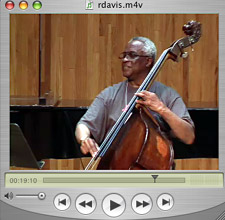 | Richard Davis's Friday night Birthday Bash (Richard mentioned that his birthday is actually tax day, April 15) seemed an appropriate way to wrap up a beautiful Madison week, with temperatures reaching into the 70's. The bash was held Friday night at Mills Hall and included participants from the Bass Conference Faculty. Audio / Video: Conference pictures are available here. More on Richard: Wikipedia | Clusty | Google | Yahoo |
Newsletter signup | Send us your ideas
March 30, 2006
Performance and Achievement Meeting of 27-Mar-2006 Available
The Performance and Achievement Meeting of 27-Mar-2006 is now available. Julie Palkowski, the District's Fine Arts Coordinator, made a presentation on the current Elementary Schools Strings program, and discussed future directions.
Newsletter signup | Send us your ideas
March 27, 2006
Task Forces Are an Important Mechanism for Bringing People With Different Perspectives Together to Work on Important Issues - What About Music and Art Education?
Tonight the School Board's Performance and Achievement Committee will discuss a status report on the elementary strings class, which they received last Thursday.
This report describes the current course, but the report a) is not an assessment of the course and b) says nothing about the future of the course. (Mr. Rainwater told me the committee only asked for a status report.) I have been one of hundreds of advocates for this course over the past 5 springs, and I see the same thing unfolding again this year that I have in the 4 previous springs without any work from the preceding year on this academic course. This course is much loved by generations of people who live in Madison, many who do not have children in the schools but do vote.
Not included with the status report is a draft vision statement developed by a group of string teachers. It's long, needs more discussion with string teachers and the community (all string teachers have seen this) but with this draft statement a) these teachers tried to come up with something meaningful, which top management asked them to do and b) these teachers have had less than two hours of group time to even discuss what the future could be and that ended abruptly in December with no further next steps. These same teachers were given no time to work together on what adjustments needed to be made to curriculum when class time is cut in half. In June, they asked the interim FAC, who forwarded this request to Supt. Rainwater. The meetings did not take place. I don't feel this should happen, especially when drastic curriculum changes are being considered.
For five years, hundreds of students, parents, community members and community organizations have asked for your help - either restructuring the course of redesigning this course, but working with the community in some way to keep arts strong, because it's so important for achievement.
I and others have been strong proponents of making the course work in our current financial situation. Over these five years, I feel we have lost opportunities to develop relationships which are important for acquiring funds, to assess and redesign the K-5 music education curriculum, to develop funding sources for small group lessons for children afterschool to further strengthen what they learn during the school day.
Last year the elementary strings course reached about 1,800 students in 27 schools. Nearly 600 children (42% of the low income children in Grades 4 & 5 participated in this course). This year the course is teaching 1,650 students. The status report does not say how many low income. I do know from conversations with the Fine Arts Coordinator and with teachers that more low income children indicated an interest in taking elementary strings than were in the class for many reasons, I am sure.
I think elementary strings is an example where there have been hundreds of advocates for keeping this course, but minimal positive response and support from the School Board to bring the professionals and advocates together to work on this and other music and art issues. We have task forces for boundary changes, afterschool, live animals in the classroom, equity, etc. Given the community's love of the arts, such a task force seems right for the arts.
I'd like to see the dialogue change this year for elementary strings and for music and art education to one where we talk about how can we work together. I would like to see the School Board consider a community task force under the oversight of the Performance and Achievement and the Partnership Committees that would bring advocates for music and art education and professionals together to work on this issue. I would like to see such a committee work on short-term issues re the elementary strings course, but also develop a 5 year fine arts strategic community plan. I have spoken with teachers, music organizations, private music teachers, the Fine Arts Coordinator and the Superintendent about the need for this. I have heard positive responses from community members and teachers, interest from the Fine Arts Coordinator.
I feel such a committee needs to be led by well-known community leaders who support the arts and arts education in the schools, because developing relationships within the community will be important for partnerships and possible fundraising.
I also think such a committee is important for credibility and for continuity. Over 5 years, MMSD has had 3 fine arts coordinators with one year without a fine arts coordinator. In spring 2003, the last fine arts coordinator was getting up to speed, in the 04-05 school year a teaching team was to help with coordination when the fine arts coordinator position was cut but this group was not put in place, and now the district has a new fine arts coordinator, who is working hard, meeting the community, teachers, helping in many ways. I think this is a critical position on the district and an important member to be on a community fine arts education committee.
Lastly, without classes during the day for elementary strings, there is no way to reach as many low-income children as the course currently reaches. Also, the district loses something special. Hundreds of children have asked the Board for help. I hope they do.
I will commment on this at the School Board meeting tonight. I have taken to writing on the blog vs. speaking at School Board meetings, because, after 5 years, and personal attacks, it takes too much out of me.
Newsletter signup | Send us your ideas
March 26, 2006
2006 West Side Strings Festival: Photos & Video
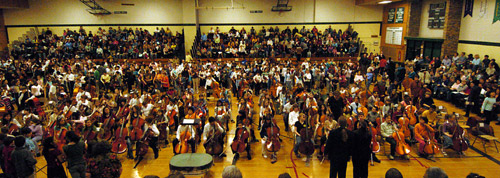
Check out the photos and video from this great event.
[Download a video ipod compatible file here.]
Newsletter signup | Send us your ideas
March 09, 2006
New Glarus 4th Grader Wins Art Prize
Fourth grader Jonathan Mattmann may live in a hushed world but his artistic interpretation shouts from the page in the drawing that has won him top honors in a statewide art competition for people with disabilities.Jonathan comes from a family in which sign language is a way of life and lip reading is second nature. His father, Eric, has been deaf since early childhood and Jonathan, his sister Heather, and his mother Melisa have varying degrees of hearing loss.
Jonathan's drawing titled "Summer Day on the Farm" was one of five winners selected from more than 100 entries in the VSA arts of Wisconsin's 2006 Children's Call for Art. The winning pieces are displayed in a traveling art show for five years before being retired and sold.
Newsletter signup | Send us your ideas
March 08, 2006
Jazz in the Schools
the National Endowment for the Arts and Jazz at Lincoln Center:
Dear Teacher:Welcome to NEA Jazz in the Schools. The National Endowment for the Arts and Jazz at Lincoln Center have created these materials to help fill and enthrall your classroom with jazz and build important connections for your students between the music and the story of our nation.
Newsletter signup | Send us your ideas
February 22, 2006
A Power Point You Will Actually WANT To See
http://www.blackshirtbands.org/budget.asp
Description from the Milwaukee Journal-Sentinel
MONDAY, Feb. 20, 2006, 2:33 p.m.
Banding together: Waukesha students support music programs
Waukesha South High School band boosters have set to music their reasons for why band and orchestra should be saved from anticipated cuts in the next school year.
You can check out their multimedia presentation here. A sample: "Don’t let the community that gave us Les Paul end up with Less Music."
The Waukesha School Board is considering $3 million worth of program and service cuts to balance its 2006-’07 budget. Among the cutbacks being contemplated is the elimination of three full-time music teachers, which would push back the start of elementary orchestra and band instruction by one year.
The board has a work session scheduled for Feb. 28. A final vote on program cuts is slated for the board’s March 8 meeting.
-By Amy Hetzner
Newsletter signup | Send us your ideas
February 20, 2006
UW: Future Artists Showcase
The arts are not only a means of personal expression. Ideas also regularly travel the compelling highways that the arts of all kinds provide.Quite a deal at $15.00.Case in point: The ideas embedded in the works that apprentice artists — students — are exploring and articulating in “The Chancellor Presents the Performing Artists of the Future: A World Class Evening of Music, Drama and Dance,� Saturday, Feb. 25, at the Overture Center.
Newsletter signup | Send us your ideas
February 13, 2006
East High School Show Choir
Antonio Branch may have gotten off on the wrong foot at Madison East High School, but his tune changed once he started singing and dancing with the school's Show Choir."I was with a bad crowd," said Branch, 18, who saw many of his friends from eighth grade drop out of high school.
But Branch said the tightknit ensemble of student performers he joined last fall has helped give him the motivation to get his grades up and set his sights on attending Madison Area Technical College en route to a four-year college degree.
"They build you up, tell you you can do it," said Branch, a senior who's now thinking about becoming an elementary school teacher.
Newsletter signup | Send us your ideas
December 16, 2005
Winter Solstice Celebration: Thoreau Student Self Portraits
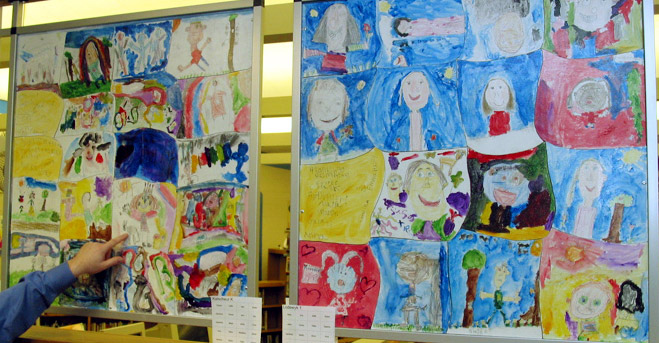
Thoreau Art Teacher Andy Mayhall:
Thoreau Elementary School was given a donation by a retired art teacher to have an artist-in-residency. We had artists submit proposals to the school, which were reviewed by the Cultural Arts Committee. Local artist, Susan Tierney, was selected to work with me, and Thoreau students to create self-portrait paintings. Susan worked with students in the classroom on and off for about a month. The students made sketches and then final drawings onto hardboard. Students could create realistic or non-realistic, some were cartoon like, self-portraits. They used colored pencil and acrylic paint to color the portraits. The finished portraits were put together to form 22 murals. The murals are on display in the hallway between the LMC (library) and classrooms on the upper floor. These murals will be a permanent display at Thoreau.Check out the murals via these photos.
Newsletter signup | Send us your ideas
December 13, 2005
Giving Credit Where Credit Is Due: A Look at the Educational Histories of the 29 West HS National Merit Semi-Finalists
Earlier this semester, 60 MMSD students -- including 29 from West HS -- were named 2006 National Merit Semifinalists. In a 10/12/05 press release, MMSD Superintendent Art Rainwater said, "I am proud of the many staff members who taught and guided these students all the way from elementary school, and of this district's overall guidance and focus that has led to these successes."
A closer examination of the facts, however, reveals that only 12 (41%) of West High School's 29 National Merit Semifinalists attended the Madison public schools continuously from first grade on (meaning that 59% received some portion of their K-8 schooling in either private schools or non-MMSD public schools). Here's the raw data:
NMSF #1: Wingra K-5th; HamiltonNMSF #2: Franklin-Randall K-5th; Wright for 6th; Hamilton 7th-8th
NMSF #3: Midvale-Lincoln, K-5th; Cherokee
NMSF #4: Denver public schools (magnet Montessori school) K-6th; Hamilton 7th-8th
NMSF #5: New Orleans parochial school K-8th; New Orleans public high school through 11th
NMSF #6: Libertyville, IL, public schools ("extremely rigorous") through first semester 10th
NMSF #7: Franklin-Randall, K-5th; Hamilton
NMSF #8: Van Hise, K-5th; Hamilton
NMSF #9: Van Hise, K-5th; Hamilton
NMSF #10: Starkville, MS, public schools K-8th
NMSF #11: Japanese school for K; Glenn Stephens 1st-4th; Van Hise for 5th; Hamilton
NMSF #12: Franklin-Randall, K-5th; Hamilton
NMSF #13: Madison Central Montessori through 3rd; Shorewood 3rd-5th; Hamilton
NMSF #14: Lincoln-Midvale through 4th; Eagle 5th-8th
NMSF #15: Eagle K-8th
NMSF #16: MMSD through 9th; home schooled beginning in 10th
NMSF #17: Leopold though 4th; Eagle 5th-8th
NMSF #18: Lapham K-2nd; Randall 3rd-5th; Hamilton
NMSF #19: California private school through 5th; Hamilton
NMSF #20: Midvale and Van Hise; Hamilton
NMSF #21: Seattle public schools (TAG pullout program) through 7th; Hamilton for 8th
NMSF #22: Unknown private school K-1st; Eagle 2nd-8th
NMSF #23: Lincoln-Midvale K-5th; Cherokee
NMSF #24: Madison Central Montessori through 4th; Eagle 5th-8th
NMSF #25: Shorewood K-5th; Hamilton
NMSF #26: Queen of Peace through 5th; Hamilton
NMSF #27: West Middleton through 4th; Eagle 5th-8th
NMSF #28: Montessori pre-K through 2nd; Shorewood 4th-5th; Eagle 5th-8th
NMSF #29: Shorewood K-5th; Hamilton
Looking at the sample in a little more detail, we find the following:
- Elementary school (K-5) history: 31% attended private school for three or more years (an additional 21% attended non-MMSD public schools for three or more years -- total: 52%).
- Middle school (6-8) history: 28% attended private school for two or more years (an additional 14% attended non-MMSD public schools for two or more years -- total: 42%).
- K-8 schooling history: 28% attended private school for five or more of their K-8 school years (an additional 17% attended non-MMSD public schools for five or more of their K-8 school years -- total: 45%)
Descriptive data like these are certainly interesting, though they often raise more questions than they answer. And of course, they don't prove anything. Nevertheless, with 45% of the West HS National Merit Semifinalist sample attending non-MMSD schools for over half of their K-8 years, it is recommended that the District temper its sense of pride in and ownership of these very accomplished students.
Many thanks to each of these fine young people for speaking with us on the telephone. Congratulations and good luck to each and every one of them!
Newsletter signup | Send us your ideas
December 06, 2005
NEW ART DOLLARS TARGET MADISON SCHOOLS
American Girl and an anonymous donor contribute $20,000 to grants program
The Foundation for Madison’s Public Schools and the Dane County Cultural Affairs Commission have secured $20,000 in new grant funds designated exclusively for arts programs in Madison schools. The two organizations have forged a unique grantmaking partnership to distribute the funds supporting guest artist residencies and other special K-12 arts programs in the schools planned for the 2006-07 year
A $10,000 contribution to the commission from American Girl’s Fund for Children will be competitively allocated to Madison schools seeking support for visual art, music, theater, dance, and creative writing programs. An equal amount from an anonymous donor to the school’s foundation will automatically provide matching funds to every school receiving a commission award. The combined grant dollars have the potential to fully fund visual, performing and literary arts projects occurring outside the schools’ general operating budgets.
“This wonderful financial boost by American Girl’s Fund for Children, matched by an anonymous angel, comes at a critical time for local schools. After several years of severe budget reductions in arts education, our donors are offering an infusion of new resources to support some exceptional arts experiences for Madison students next year,� commented Dane County Cultural Affairs Commission director Lynne Watrous Eich in announcing the new grants. “One of our goals is to simplify the application and award process for everyone involved.�
Jodi Bender Sweeney, President of the Foundation for Madison’s Public Schools concurred. “We’re simply thrilled. These private funds will offer a helping hand to teachers and parents interested in building collaborations among our local schools, artists and arts organizations. They’re earmarked specifically for projects which promote students’ creative potential and learning opportunities, while building arts audiences for the future.�
Application deadlines are February 1, June 1 and September 1, 2006. Only Madison schools are eligible to apply for these funds. For more information on arts-in-schools grants, call Lynne Eich, Cultural Affairs Office, 266-5915, Jodi Bender Sweeney, Foundation for Madison Public Schools, 232-7820, or Madison school district Fine Arts Coordinator Julie Palkowski, 663-5227. Grants for Dane County schools outside Madison are also available through the commission with a combination of other public and private funding.
For immediate release: December 1, 2005
Contact: Jodi Bender Sweeney, President, Foundation for Madison’s Public Schools, 232-7820;
Lynne Eich, Director, Dane County Cultural Affairs Commission, 266-5915
Newsletter signup | Send us your ideas
November 28, 2005
Revisit and Evaluate a Strings Change
I know this topic is discussed every year but I want to re-visit the success of the administrative change to 4/5 strings based on budgetary demands versus academic demands.
The 4/5 strings was changed to once a week this year from twice a week last year. The choices the board juggled was no strings in 4/5, twice a week 5th only, or once a week 4/5 strings due to the budget cuts. While I applaud the board for trying to work with the community I would love some feedback on how the once a week 4/5 decision is working at other schools.
For my daughter, and I can only speak for her and a few of her friends, this is what we have experienced.........
In fourth grade, my daughter and several of her friends loved strings once they got the hang of it. She practiced all the time, played for her 95 year old grandmother in Texas on her birthday, took a summer strings camp provided by MSCR, and even (with not much whining)talked me into renting a violin over the summer so she could play.
In her fifth grade class, there are 35 kids in her strings class, twice as many as last year. She also only has class on Thursday. This month she has had a Teacher Conference, field trip, testing, and Thanksgiving break on Thursday and therefore she has not had strings in a month. Due to the class size half of the time is spend tuning the instruments and the other half seems frustrating to my daughter as there are so many kids and so little time.
I do not want to see 4/5 strings eliminated but would like to re-evaluate. If we only have limited funds perhaps I was wrong and it should just be for 5th graders twice a week, or perhaps it is just my child's class that is unrewarding to her as each teacher/school has its own style. I miss listening to her enthusiatic practice as she hardly ever plays her violin anymore. What is happening at other schools? The district makes so many decisions (like pairing schools, combining classes, etc..) based on economics and not academic studies and I wonder if we are EVALUATING the success of these decisions along the way.
Newsletter signup | Send us your ideas
November 04, 2005
Music and Art Improve Student Achievement, Especially for English Language Learners and Low Income Students In Tucson Unified School District
The Tucson Unified School District’s Opening Minds through the Arts , also known as OMA, was recently awarded a federal grant totaling over one million dollars to continue research on its music and art model and how it positively effects student achievement.
Independent research has shown that OMA participant’s especially English language learners and students from disadvantaged communities, have significantly improved their standardized test scores in reading, language, and math. Furthermore, research indicates that students at OMA schools demonstrate fewer behavioral problems, improve their classroom focus, and show greater respect for themselves and fellow students and teachers.
Now in its fifth year at TUSD, OMA integrates the fine arts into traditional and arts curriculum for kindergarten through sixth-grade students. The OMA model is based on extensive research on the neurological development of children. Using opera, dance, costume design and music, students learn new ways to view and understand complex math and language problems. In Grade 3 students learn to play the recorder. In Grade 4 all students learn to play a stringed instrument and in Grade 5 all students learn to play an instrument in a band or orchestra.
OMA was one of 23 programs selected nationally to receive the U.S. Department of Education grant. Titled Professional Development for Arts Educators, the grant will provide the district with $1,001,700 over the next three years for additional research on past student achievement results and specific OMA components that help increase student success.
It's amazing what can be accomplished when minds are open to changes and a focus on what contributes positively to student achievement and what improves learning and closing the achievement gap. Federal funding for approaches similar to OMA have been available for several years. But, the first step is support for what supports children's learning and achievement and a willingness to work together under current constraints on new ideas. This past summer the director of OMA conducted workshops throughout the US, one in Minneapolis. Perhaps School Board will put together a working group to get started on something similar for our children.
Newsletter signup | Send us your ideas
October 27, 2005
Arts & Technology Charter School
The initial steps toward creation of an arts and technology charter public school in Madison will be held Thursday at 6 p.m. at the Madison Gas and Electric Co. Innovation Center in Research Park.The target date to begin such a program is the fall of 2007, according to Nancy Donahue, a leader in the Preschool of the Arts. The Madison School District now has two charter schools - the Wright Middle School and Nuestro Mundo, a kindergarten/first-grade unit operating in the Allis Elementary School. Board of Education approval would be required to add a third school.
Donahue said the charter school could be built on encouraging the exploration by pupils much like what occurs in the private preschool of the arts. A downtown location would enable pupils to tap into existing resources there, she said.
Newsletter signup | Send us your ideas
October 24, 2005
Ken Lonnquist @ Thoreau School
Local musician Ken Lonnquist was recently in residence at Thoreau School. Ken worked with each grade to compose a song. The resulting music, ultimately destined for a CD, was performed on a recent evening. Here's a brief video clip from the event.
UPDATE: Thoreau's Rhonda Schilling emailed the funding details:
Dane County Cultural Affairs ($1450 grant)
Wisconsin School Music Association ($500 grant)
Thoreau PTO ($1750 Cultural Arts Budget and Barnes & Noble Fundraiser)
Newsletter signup | Send us your ideas
October 22, 2005
UW Freshman Class Scores High in Smarts - 52% Studied Performance Music
Karen Rivedale in the WI State Journal article, "Creamier Crop at UW Madison," writes that "This year’s freshman class posted high scores on college entrance exams, beating the average national scores on the tests and continuing UW-Madison’s increasing selectivity among the state’s top students. Freshmen this year posted high class ranks, with more than half graduating from high school in the top 10 percent."
In a sidebar in the article, the Freshamn enrolled is a record high (6,142), 62% earned a varsity letter, 52% performed with a school musical group, 23% won an award for community service.
Meanwhile, closer to home, MMSD's administrator's proposed a competitive athletic budget that continued to grow from the previous school year for this school year (parents do pay a fee of $115 per sport, extra for more expensive sports) - that's good. However, MMSD's administrators continued their cuts to music education with proposals to eliminate elementary performance music and increase general music class size. The School Board restored half the elementary stringed course in elementary schools and did not increase general music class size. There were also reductions in middle school performance music that were not restored.
Performance music improves academic performance, especially for lower income children who have no other access to performance music except through their public school. It is sad that MMSD is moving in the opposite direction of what the research shows benefits children's academic performance by cutting performance music.
Performance music directly benefits reading and mathematical skills for young children. There is more research and results that show that today and the information and data showing the positive effects of instrumental music on children's education are growing not shrinking. In future blogs I will post additional information on this research and results.
Newsletter signup | Send us your ideas
September 01, 2005
Arts - Ask For More
A Harris Poll released in June 2005 on the attitudes of Americans toward arts education revealed that 93 percent of Americans agree that the arts are vital to providing a well-rounded education for children. Additionally, 54 percent rated the importance of arts education a "ten" on a scale of one to ten.
Newsletter signup | Send us your ideas
Next Steps for Fine Arts Education in Madison Public Schools - community arts education advisory committee?
An issue that interests and is important to me is arts education, and I hope to journal about this issue on this blog site and www.danearts.org over the coming school year. Also, I hope to be able to play a different role in supporting arts education as a community member on the Partnership Commmittee.
For the past six years there have been various cuts in fine arts education for Madison's students. If the current budget constraints continue, there will be continued cuts in Madison's public schools, which will lead to continued cuts in many areas that contribute to an excellent education for all Madison's children.
For example, in the arts for the upcoming school year, children will begin elementary classes with half the instrumental instruction. Students in middle school will have to juggle multiple classes in order to study an instrument. Fewer high school classes in the arts are being offered even though demand is there for these classes. These are the cuts in one academic area. Children will also be facing larger class sizes, reduction of services due to budget cuts. Where we can, we need to try to think and to act differently.
An important next step in addressing some of the arts education issues and the future of arts education in the Madison public schools might be the formation of a community arts education advisory committee composed of representatives from the community (including district educational and administrative staff) who are knowledgable about and interested in developing a community strategy and action plan for arts education in the Madison public schools.
There are those who say the budget is mismanaged and that there is adequate money to provide an excellent education for all our children. There are other's who say we are about to go over an education cliff into an abyss due to revenue caps. What I know is that arts education is being cut and I'd like those interest community members to have an opportunity to think and to plan about what we might do for our kids in this academic area. This type of approach is feasible is likely to be more feasible in the arts area than some other areas.
The recently completed community afterschool task force is an example of a successful community committee working together on a challenging problem - best mix of afterschool offerings for Madison's children using existing resources and working together across several businesses. This committee did an incredible amount of work and provided the School Board via the Partnership Committee with important information and recommendations on a number of issues.
This community committee began last year under the supervision of the Partnership Committee, which Johnny Winston Jr. chaired at the time. Numerous cities and school districts around the country have formed successful committees on arts education. Now might be the time for Madison to catch up before our children lose much more in this academic area.
Newsletter signup | Send us your ideas
Art Smarts: Two New Books on the Meaning of Arts
The Economist on two new books, The Accidental Masterpiece: On the Art of Life and Vice Versa and What Good Are the Arts:
Mr Kimmelman, a gifted piano student as a boy, returned more seriously to the keyboard in 1999 when he entered, and went on to the final round, of an amateur piano competition in Fort Worth, Texas. Organised by the Van Cliburn Foundation, which since 1962 has presented the world's leading piano competition for young professionals, the competition brought 90 people, who neither taught nor performed professionally, to Texas.Mr Kimmelman's article about his fellow pianists—a numismatist, two flight attendants, a hairstylist and a former crack addict who had been jailed for burglary and who found taking up music helped him recover—raised a sizeable correspondence from people who are not artists by profession, but for whom art adds an important other dimension to their lives. It was this idea, so emblematic of the author's own life, that spawned the book.
Far better is the second half of the book in which Mr Carey seeks to persuade us that the greatest of all art forms is not painting or music but literature, and English literature specifically. Uninflected and without gendered nouns, English was uniquely placed to offer Shakespeare the linguistic pliancy and suppleness he needed to turn out the epidemic of metaphors and similes that so mark his work.
WHAT is art for and what good does it do? Two centuries ago, Kant and Hegel spent much of their lives contemplating questions about art and aesthetics. Many others have done so since. The latest are two studies, from either side of the Atlantic, by Michael Kimmelman and John Carey. The authors are professionally involved in the arts, Mr Kimmelman as chief art critic at the New York Times and Mr Carey as a professor of English literature at Oxford University. Scholars both, they are prodigious readers, listeners to, and students of, art. Yet both their books are at their most impressive when the authors seem to be trying the least.Mr Kimmelman, a gifted piano student as a boy, returned more seriously to the keyboard in 1999 when he entered, and went on to the final round, of an amateur piano competition in Fort Worth, Texas. Organised by the Van Cliburn Foundation, which since 1962 has presented the world's leading piano competition for young professionals, the competition brought 90 people, who neither taught nor performed professionally, to Texas.
Mr Kimmelman's article about his fellow pianists—a numismatist, two flight attendants, a hairstylist and a former crack addict who had been jailed for burglary and who found taking up music helped him recover—raised a sizeable correspondence from people who are not artists by profession, but for whom art adds an important other dimension to their lives. It was this idea, so emblematic of the author's own life, that spawned the book.
“I have come to feel�, he writes, “that everything, even the most ordinary daily affair, is enriched by the lessons that can be gleaned from art. Put differently, this book is, in part, about how creating, collecting, and even just appreciating art can make living a daily masterpiece.�
The portraits Mr Kimmelman presents in order to illustrate his point are loosely associated. There is the artist who created without lifting a finger: Ray Johnson, a coolly analytical man who was fascinated by numbers and who killed himself a decade ago at the age of 67 on January 13th (6+7=13, his friends noted), having first telephoned an old colleague, William Wilson, whose name contains 13 letters. There is the accidental artist: a German policeman photographed for posterity in 1927 hanging on to the bottom of a zeppelin that had broken its moorings. And there is the illuminating artist, a Baltimore dentist who, in the course of a lifetime, collected 75,000 lightbulbs and created the Museum of Incandescent Lighting.
But his best example is Pierre Bonnard, whose accidental encounter with a young, elfin woman alighting from a Paris tram in 1893 led to an intense relationship that would last until her death half a century later. Easily derided after his death as a facile, if accomplished, colourist, it is Bonnard's secretive, moody portraits of the woman, Marthe, many of them posed in the privacy of her bathroom, that mark him out as a painter of elegy. Often described as a painter of pleasure, one critic observed, he was something even more rare: a painter of the effervescence of pleasure and the disappearance of pleasure.
Mr Kimmelman's book works best when he describes the ineffable by showing rather than telling. His brief anecdote about how Bonnard once asked a model not to sit still, but to move around the room, is far more effective than a convoluted explanation about the difficulty of painting presence and absence at once.
Too much telling, by contrast, is Mr Carey's error. What is a work of art, is high art superior, do the arts make us better, can art be a religion? One after the other, Mr Carey head-butts these questions. The result, however, is that he ties himself up in knots. Unable to reach any conclusion about what art is, he turns instead to what it is not. There are plenty of things that are not works of art: for example, human excrement. Probably. But what about Piero Manzoni, an Italian artist who died in 1963 after creating an “edition� of 90 tin cans each containing 30 grams of his own excrement? The Museum of Modern Art, the Tate Gallery and the Pompidou Centre snapped them up. More fool them, you say. Others would agree, but they would be no closer to defining what art is.
Far, far better is the second half of the book in which Mr Carey seeks to persuade us that the greatest of all art forms is not painting or music but literature, and English literature specifically. Uninflected and without gendered nouns, English was uniquely placed to offer Shakespeare the linguistic pliancy and suppleness he needed to turn out the epidemic of metaphors and similes that so mark his work. Here, Mr Carey turns in a bravura performance. Drawing on his great knowledge of poetry, he is able to show how literature outsmarts other art forms; how it alone is able to criticise itself, which makes it more powerful and self-aware than other forms; how only literature can comment, and therefore moralise, not by making you more moral but by giving you ideas to think with; and how by hinting rather than spelling out, it is literature's indistinctness that empowers the reader's imagination.
Read every word of Mr Kimmelman for ideas to think with, and start Mr Carey's book on page 171. You won't regret it.
Newsletter signup | Send us your ideas
August 26, 2005
The Simpson Street Free Press Sounds Off On Arts Education
The current issue of The Simpson Street Free Press includes pieces by both Jazmin Jackson and Andrea Gilmore on the importance of arts education. This issue also has a letter to the editor from School Board member Johnny Winston, Jr. on the arts funding issues facing the District.
Participating in Arts Promotes Achievement and Academic Success
by Jazmin Jackson, age 15
When I was four years old, my mother took me to watch my older sister perform in a ballet. Since then, I knew I wanted to take dance lessons and perform like her. I’m fortunate to have hard-working parents who help pay for expensive classes. But many parents are not able to afford the cost of putting their kids into special programs like dance lessons. So what do those kids do?
Their best option is participating in the school art programs.
Music classes, show choir, theater, ceramics, painting, strings, band—I could go on and on. These are just a few of the great programs that our schools offer. These are also the programs that often face cuts from school budgets—especially these days.
Many people don’t realize the importance of these programs. The arts allow kids to learn many important life skills that they will use throughout their lives—skills for interviewing for a job, getting into college, and maturing into a responsible adult.
As a dancer, I must arrive on time and commit to attending every class and every rehearsal. Our teachers are constantly stressing how we have to be able to adapt quickly and step in for someone if they are sick or injured. If I want to get a good part, I have to work to the best of my ability. The lessons I learn I will use for the rest of my life.
Children involved in the arts are constantly developing good work habits that build strong character. Kids involved in arts and music not only benefit now, but they broaden their horizons for the future. They explore talents that they may wish to pursue later in life.
For a long time, sports have been an all-around-favorite school activity. Most teens are involved in some type of club having to do with a sport. And no matter how much we complain about running in 80-degree weather, gym class will continue to be mandatory. We all understand the importance of physical health.
Isn’t just as important to continue to hold music classes during the school day? Apparently it was to the parents of Sherman Middle School students.
In a recent letter to school board members, the principal at Sherman, Ann Yehle, proposed a plan to move music programs to after hours. Then, at a school board meeting, parents voiced strong disagreement about moving band and orchestra classes to the end of the school day. Superintendent Art Rainwater quickly stated, “music will be offered during the regular school day.�
However, Sherman plans to proceed in testing its after-school proposal.
I think it’s very important that all kids have the opportunity to participate in an arts program. Not all students are interested in sports. Arts and music programs are extremely important because they allow kids to express themselves and participate in something they enjoy doing.
But what’s even more important is that these kinds of programs are really academic programs. Andrea Gilmore, our senior teen editor, has made this point around our newsroom often in the past few months. Her editorials have been printed in this paper and in the Wisconsin State Journal. I tend to agree with Andy. Skills learned in art or music classes are easily transferred to math or science or English class.
Creating artwork, making music, or using the imagination allows kids to exercise their minds and explore their talents. Children participating in art or music better themselves by learning positive lifelong habits important academic skills.
Elementary Strings Should Be Part of Madison's Core Curriculum
An Editorial
by Andrea Gilmore, age 18
I am lucky. I have been playing the violin since I was in the fourth grade. I was exposed to music at an early age and music has helped me gain skills that have enhanced my school career. Through music, I learned self-confidence, self-discipline, time management, cooperation, and study skills.
Unfortunately, many young people may not have the opportunity I had.
The elementary strings program costs only $500,000 in a budget of more than $350 million. School board members recently decided to keep the elementary strings program next year in some form, while cutting approximately $500,000 overall out of the music-education programs.
Elementary strings programs are essential to the development of our community’s young people and should be supported in all Madison Schools.
One reason elementary strings programs are crucial to schools is that music programs help close the minority-student-achievement gap. Music programs, when incorporated in the academic curriculum, increase academic achievement of minority and low-income students.
Eliminating programs like elementary strings only adds to the widening differences among students that is often based on family income. The opportunity to play in an orchestra or to receive music education should not be based on whether parents can afford private lessons. If school districts eliminate music programs, students from low-income families will be adversely affected.
According to University of Wisconsin music professor Richard Davis, “underprivileged children will suffer the most. It’s another way of letting those who can afford it get the opportunities. The fear is that you’re going to have a very one-sided warped community, where one world will have all of the exposure and sophistication, and the other world won’t.�
Music and fine arts should be part of the core curriculum in our schools. I attribute much of my success in school, and in life, to my experience with music. I sincerely hope every fourth grader in Madison has this important opportunity.
A young person learning how to play music, who can put a price on that? School Board, please make your cuts elsewhere.
[Sources: Ruth Robarts of the Madison School Board; The Capital Times]
Andrea Gilmore is a senior at Madison Memorial High School and the Science Editor for the Simpson Street Free Press. She will attend UW-Madison this fall.
Newsletter signup | Send us your ideas
August 03, 2005
NEA Jazz in the Schools Curriculum and Resources
http://media.jalc.org/nea/home.html
The National Endowment for the Arts and Jazz at Lincoln Center have created materials to help fill and enthrall classrooms with jazz and to build important connections between the music and the story of our nation. The program web sites includes on-line materials and contact information for people who are interested in using this curriculum.
Newsletter signup | Send us your ideas
June 30, 2005
Concerts on the Square: 16 Year Old Violinist
Joan mentioned last night's Wisconsin Chamber Orchestra's Concerts on the Square. The concert included the performance of a Dvorak piece by a 16-year old violinist from Janesville Parker, Saya Chang-O'Hara. Conductor Andrew Sewell introduced Saya as follows (paraphrased): "I don't mean to be political here, but she learned to play the violin in elementary strings".
Newsletter signup | Send us your ideas
June 29, 2005
Simply amazing
This season's Concerts on the Square kicked off with an interesting medley of polka/waltz/cancans, but the best reason to have attended was the performance of a Dvorak piece by a 16-year old violinist from Janesville Parker, Saya Chang-O'Hara. Put simply, she was brilliant. Juilliard should be knocking on her door any day now. It was an honor to hear her play.
But what might be of interest to folks on this site is this: she only started playing when she was eleven, AS PART OF HER SCHOOL'S STRINGS PROGRAM.
Newsletter signup | Send us your ideas
June 17, 2005
Music Education - Learn About the Benefits Before Cutting Curriculum
If there is no money, cut arts education is the decisions administrators make - often, though, without first looking at the impact on student's achievement (using readily available data) or without consideration of the impact on who will stay/leave a school. Couldn't decisions made in the absence of examining data and listening to parents cost far more in lost revenue and prestige than the cost of a class?
When I read about the cuts to music education at the elementary school level, the primary reasons given are that these cuts were due to budget constraints and pull-out programs are difficult to schedule. When I read about the cuts to Sherman Middle School's vocal and instrumental music program from the regular school day, the primary reasons given are lack of interest (decline in enrollment during the past several years coincidentally matches the current principal's tenure) and the principal's requirement for heterogenous classes and mandated exploratory options for Sherman's children.
Yet, when I read the national news, research and hundreds of other documents I learn that a) music improves children's peer relationships and academic performance in schools and b) schools with a signficant low income student body that increase their arts education see significant increases in these children's test scores.
I am concerned that Madison's budget cut decisions and the adoption of "new" models of education that make access to meaningful sequentially developed music classes difficult or impossible are being made without better information about the benefits to Madison school children's learning from fine arts education. We know parents will move (and some are moving and/or making plans to move their children out of Sherman Middle School following the principal's spring mandates) to those schools that offer rigorous academics, foreign language, music and art classes.
What do we know about the effect of cuts to music and art courses on our children's success in school, their interest in learning and improved test scores? What analysis is done, data reviewed, prior to making such major curricular decisions? What options are explored? How are teachers and professionals in the community involved in these decisions?
I'd like to see our Board ask some of these questions. I'd like to see more public discussions of these changes before they are made. Madison schools have a history of music and art classes as part of our children's public education. Before we cut these programs further, we owe it to our children to better understand the positive impacts on their learning from music and art classes. It costs much more money and effort to start all over.
My sense from talking with administrators is that if I have to make a choice between reading and art, I'll choose reading. Sounds sensible enough unless we learn that those art classes were in fact making a positive contribution to a child's ability to read. Current administrators, feeling stressed from budget cut decisions, are falling into the traditional role of keep the basics, cut everything else. The Board and the community needs to help them look beyond that and ask them to explore the data a bit more for our kids' sakes.
There may also be implications for the school district's ability to continue to attract a wide variety of students to its school system, a subject that will wait for another blog.
Newsletter signup | Send us your ideas
June 16, 2005
Music Education in Sherman MIddle School: Pull Out or Afterschool
Sherman's parents are puzzled and frustrated. Music classes for instrument and vocal will be during the day, but the classes will be pull out classes!
Last Monday, Principal Ann Yehle informed parents that orchestra, band and vocal music would be offered during the day if her concerns were met. Parents asked what her concerns were - the response they received was a list of what teachers needed in the exploratory classes to teach those classes - including certain equipment for a class in one case.
No mention was made of demographics, student academic background, etc. This week parents received a letter from the principal which says that all children will have the opportunity to play an instrument afterschool if the day schedule does not meet their schedule's needs - good step. However, those children taking instrumental or vocal music during the day will be pulled out of various classes depending upon the week. Children in these music classes will not have schedules that accomodate their desire to study an instrument or to develop vocal skills and to fully participate in their other classes without the extra burden of making up work missed in class, which might be hard to do for some types of classes such as gym class. Children will need to take their instrument or vocal music class in addition to all the other "mandated" classes without having the full benefit of being in the class the entire quarter - bad step.
Madison's music education curriculum is for grades K-12 and requires that students take classes in sufficient time and frequency to meet the standards set forth in the curriculum. There is reference in the curriculum that children should have the opportunity to study music during the day; however, I don't think those writing the curriculum felt it necessary to add "study during the day without conflict with other classes." Isn't it about time that the music professionals had a chance to assess the impact on children's learning of changes in the music curriculum at Sherman Middle School?
Earlier in the month, Principal Ann Yehle indicated that the instrument and vocal classes would be held during the day and the impression parents had was that she would work with them to plan for this for next year. It appears the Sherman parents are being handed another mandate and that children who want to play an instrument or train their voice are being penalized - and these were children who tended to have better school behavior!
Newsletter signup | Send us your ideas
June 15, 2005
Gilmore: Add Elementary Strings to the Curriculum
Andrea Gilmore (This opinion piece was published in the Wisconsin State Journal):
I am lucky. I have been playing the violin since I was in the fourth grade. I was exposed to music at an early age and music has helped me gain skills that have enhanced my school career. Through music, I learned self-confidence, self-discipline, time management, cooperation and study skills.Unfortunately, many young people may not have the opportunity I had. The elementary strings program costs only $500,000 in a budget of about $300 million. School board members recently decided to keep the elementary strings program next year in some form, while cutting approximately $500,000 overall out of the music-education programs.
Elementary strings programs are essential to the development of our community's young people and should be supported in all Madison schools. Elementary strings programs are crucial to schools because music programs help close the minority student achievement gap. Music programs, when incorporated in the academic curriculum, increase academic achievement of minority and low-income students.Eliminating programs like this only adds to the widening differences among students that is often based on family income. The opportunity to play in an orchestra or to receive music education should not be based on whether parents can afford private lessons. If school districts eliminate music programs, students from low-income families will be adversely affected.
According to UW music professor Richard Davis, "underprivileged children will suffer the most. It's another way of letting those who can afford it get the opportunities. The fear is that you're going to have a very one-sided, warped community, where one world will have all of the exposure and sophistication, and the other world won't."
Music and fine arts should be part of the core curriculum in our schools. I attribute much of my success in school, and in life, to my experience with music. I sincerely hope every fourth grader in Madison has this important opportunity. Who can put a price on a young person learning how to play music? The Madison School Board should make cuts elsewhere.
Newsletter signup | Send us your ideas
Dear MMSD Interim Fine Arts Coordinator -
I was asked to post the following letter from Robert Rickman, MMSD instrument teacher, to Rita Applebaum, MMSD Interim Fine Arts Coordinator:
6/15/05
Dear Ms. Applebaum,
I was recently informed that you spoke to Mark Messer, Memorial High School orchestra teacher, about the 4th and 5th grade Strings classes. I am shocked to hear that you have moved to eliminate fourth grade Strings classes based upon a conversation with him, and a hurried and undiscussed vote from Strings teachers that you solicited by e-mail the day before school was out.
Approximately 8 years ago, Mariel Wozniak, the Arts Administrator, called me and ten of my colleagues together to interpret Wisconsin DPI music education guidelines and adapt the Madison Strings curriculum accordingly. Our current curriculum is the result of this arduous and thoughtful undertaking.
If the curriculum must be revisited, I believe that the least that should occur in terms of educationally justifiable action is to have a curriculum evaluation discussion amongst senior instrumental teaching staff as to best practices for administering this 4th and 5th grade instrumental curriculum. It would be irresponsible for this matter to be acted upon by any other means.
After teaching instrumental music for 16 years (specifically Strings from 4th to 12th grade), it is my opinion that the 4th and 5th grade curriculum should remain as is, even with a reduction from twice a week to a once a week lessons.
I am sure that you are aware that 4th and 5th grade Strings is hugely popular in Madison. Attempts to eliminate or reduce this program have been met with huge community outcry repeatedly over the past four years. Additionally, the School Board clearly directed the administration to provide Strings at least once a week even in light of the failure of the referenda. I trust that as acting Arts Administrator, you will do everything you can to support this curriculum, the will of the public, and the School Board.
If I can be of help in any future discussion, please call upon me.
Sincerely,
Robert C. Rickman
Newsletter signup | Send us your ideas
June 12, 2005
There is Something Seriously Wrong with Music Education in MMSD
Suzy Grindrod writes that Madison school bureaucrats' decisions are short-sighted and are Stringing the kids along
So they make the arts unworkable in early elementary school, they gut the incredibly successful elementary strings program, they remove band and orchestra from core curriculum in middle school ... and then they are going to complain that there is no diversity in the high school bands and orchestras and -- CHOP.
There is something fundamentally wrong with what is happening in Wisconsin’s Capitol city -- a community that just built a $200 million arts district downtown, as these short-sighted and creatively stunted bureaucrats make it unlikely that many Madison kids will end up on Overture's stage in the future unless they have the money to buy private lessons.
Can Madison turn this disgraceful situation around before the existing cost-effective MMSD music education curriculum implodes and vanishes from public school and performance music education is only for those who can pay?
Stringing kids along By Suzy Grindrod I recently attended the Madison East High School orchestra concert, where there was a lovely slide show of the graduating seniors. I recognized a number of them from my tenure at Hawthorne Elementary (which at one time was a magnet school for the fine arts, although Madison Metropolitan School District revisionist history now denies that) – I knew those kids from kindergarten on.Many of those kids got their musical start in 4th grade strings, if not before. There are numerous CDs in my collection by professional musicians who are graduates of Madison schools. These are not just local musicians, but people who are known nationally and internationally.
Music (and all fine arts education, not to mention foreign language) is in trouble in Madison. The reduction in the Strings program has been well publicized. In the wake of the failed May 24 referenda it seems like a done deal that elementary "specials" teacher allocations are being cut and classes will be doubling up for art, music, and PE.
The latest is the plan to remove band and orchestra from the core curriculum at Sherman Middle School, making them optional and "exploratory" two days a week AFTER SCHOOL HOURS. This flies in the face of so much it is hard to know where to begin. It violates No Child Left Behind which identifies fine arts as part of a core curriculum. It violates DPI standards which mandate a specified amount of fine arts education in middle school. It belies the stated MMSD "framework" of engagement, relationships, and learning. It ignores reams of research that show the correlation between arts education and academic achievement. It assumes that parents of Sherman middle schoolers want an extended day for their child. It seems like it will violate the contracts of the band and orchestra teachers, and certainly sends them the message that what they teach is not important, that they are essentially glorified babysitters.
It is also inequitable -- other middle schools get music as part of their core curriculum and after school clubs. Sherman gets this. But wait ... if this program is "successful" (but there are no published criteria for what "success" would look like) the year after next it will be forced down the throats of -- no, no, I mean MANDATED in -- ALL Madison middle schools. And then, maybe, all the schools in the state will be taking advantage of this money-saving maneuver.
So they make the arts unworkable in early elementary school, they gut the incredibly successful elementary strings program, they remove band and orchestra from core curriculum in middle school ... and then they are going to complain that there is no diversity in the high school bands and orchestras and -- CHOP.
There is something fundamentally wrong with what is happening in Wisconsin’s Capitol city -- a community that just built a $200 million arts district downtown, as these short-sighted and creatively stunted bureaucrats make it unlikely that many Madison kids will end up on Overture's stage in the future unless they have the money to buy private lessons.
Newsletter signup | Send us your ideas
June 06, 2005
Art Attack at Lapham School
From The Capital Times, Monday, June 6
http://www.madison.com/tct/mad/local//index.php?ntid=42450
Changes coming in music, art classes
The arts hit hardest in teacher layoffs
By Cristina Daglas
June 6, 2005
Lapham Elementary School music teacher Lynn Najem and art teacher Sally Behr will keep their jobs next year, but their classrooms won't be what they have been.
Next year, both Behr and Najem will be teaching classes of approximately 22 students in comparison to the previous 15.
The total number of students they teach is not increasing, but the number of classes offered is decreasing. The approximately 230 kindergarten through second-grade students at Lapham will remain the same.
"They think of us as fancy recess ... a holding tank," Najem said. "This is typical of the School Board."
In the wake of a failed referendum question two weeks ago, the Madison School Board approved 23 layoffs, reportedly the highest number in more than 10 years. Music positions accounted for the greatest number of those positions, 8.5, followed by physical education teachers with 5.3 and art teachers with 2.5. Friday was the deadline for teachers to get layoff notices.
At Lapham, there will no longer be enough equipment to go around for all of the students in Najem's music classes and she said trying to get young children to share time on a keyboard is not easy. More importantly, both Najem and Behr worry about the amount of attention they can give to each student.
"Special needs kids are not going to have a place to excel," Behr said, adding that many students often find expressive outlets in the arts rather than in math class. "We catch a different part of them."
And there are greater musical opportunities at Lapham than in most schools. Najem recently orchestrated an "Alice in Wonderland" production with 49 students.
"I've had people come to this school because of the drama program," Najem said, adding that it is funded through other organizations.
Between them, Najem and Behr have 27 years of experience, but they still fear that future cuts could push them out of their jobs.
"Because I am not full time, I'm low on the totem pole," Najem said, adding that while she qualifies for benefits right now, additional cuts in future years may change that. "You know that there will be cuts next year."
Behr reiterated this fear, stating that when she started in the district 10 years ago she was teaching at 80 percent time and this upcoming year she will be at 50 percent, the minimum level required to receive health insurance benefits.
"For some reason it keeps coming out of the arts and I don't know why," Behr said, adding that the cuts are "very disproportionate."
Despite their frustration, both teachers said there is still much to be thankful for. They haven't had to switch schools or leave the district, allowing them to continue to work with the same families.
"You have such an investment in your building. I love the kids and the families," Behr said teary-eyed, adding that art classes challenge students. "Every lesson we raise the bar. That would have saved me in elementary school."
Years ago, Lapham was home to a full-time talented and gifted teacher who offered a number of classes allowing students to excel in their particular interests, according to Behr. Lapham also employed a teacher devoted to teaching computer classes.
"We just had much more in the building and it's eroded," she said. "We're the last fun thing and now we're going too."
Newsletter signup | Send us your ideas
June 03, 2005
Please Help Sherman Middle School Children: Email the School Board and Say to Them - We Want our School Board Approved Academic Curricular Subjects Taught During the Middle School Day (7:45 a.m. - 2:40 p.m.)
Please e-mail the school board. Simply say, "I do not agree with the plan to move Sherman's curricular performance music classes to an afterschool, 8th hour format. Our children deserve to have their school academic curricular classes during the day not after school."
And sign your name. It's as easy as that. School Board members can be emailed at: comments@madison.k12.wi.us.
Newsletter signup | Send us your ideas
June 02, 2005
Sherman Middle School Principal Mandates Change by Fiat – Renames Afterschool an 8th hour and Kicks Academic Performance Music Out to Afterschool
The current music education upheaval at Sherman Middle School is about
- what Madison values for our children’s education, such as academic music education during the school day and
- who makes those decisions.
Making changes that seem to be by fiat may be desirable to the person in charge, but the students and parents are the school's and district's customers - please listen to us at the start of a process, let us have time to have meaningful input and comment! Isn't it the School board who are the district's policymakers, especially curriculum policy and what defines a school day. Those are the basics! A longer school day might make sense - but not by what appears and feels like fiat and not without public discussions, deliberations and decisions by our School Board.
The Madison School Board, not a principal, is responsible for making the value decisions about what Madison’s children learn and the length of a school day. Our school board is given this responsibility by the State of WI constitution and by the public who elect members to a local board. In the case of the issues at Sherman Middle School, the School Board is currently not part of the process; they are definitely not the policymakers and decisionmakers in this important change – but they need to be, because this affects learning for all Madison’s children.
For music education, WI state law requires that a local school board approve a sequential, K-12 curriculum plan for music instruction. Madison’s School Board has approved a district-wide curriculum plan for music education with standards that meets state requirements. School boards don’t write the educational plans, but they are required by law to approve them and board members need to be sure these plans are developed with input from appropriate professionals and community members – teachers, music professionals in Madison, administrators, parents. Once the curriculum plan is approved, our district-wide and school administrators need to follow that curriculum as teachers develop classes to meet the curriculum. A school principal mandating that children take General Music at Sherman Middle School does not meet district curriculum standards and does not comply with state law.
Other middle schools in Madison with high numbers of low income and minority populations are devising ways to grow and to have strong performance music classes during the day (for example, Sennett, Jefferson, Hamilton, Cherokee). Why should Sherman Middle School’s children have less equitable access to this beneficial academic subject? A principal needs to work on addressing problems that face his/her school while complying with School Board directives. Why didn’t the Sherman principal form a team of parents, elementary and high school music teachers to determine what the barriers are to higher participation in performance music in Sherman Middle School and develop options for discussion and review at the school level? Isn’t that what we want our principals to be doing when they run into a challenge? In the case of music education, put children’s learning in music education first and pull together a team that includes, not excludes parents, from the process to tackle issues facing Sherman and develop options. Why didn’t a school team approach the challenge from how do we make this work for our children?
The continued deterioration of music education in Madison’s schools is not about money. Academic music education classes are cost effective and positively benefit children’s learning in so many areas, including the core academics. The entire K-12 MMSD music education program, including performance music that begins in Grade 4, costs less than $250 per student and nearly 20,000 students participate in music education districtwide. Compare that to $350+ per participant spent on high school extracurricular sports and $600 per student spent on the district’s administrative contract budget. If you had seen any of the wonderful music performances this spring, including the citywide strings festival, you would know that the Madison community is getting a huge bang for its buck and that our children worked very hard.
If we need to make changes, let’s work together for our children. Our School Board makes the decisions on our behalf about what our children learn. They must make these decisions in open meetings following processes that engage teachers, administrators, students and the community in order to make the best decisions for our children’s learning. That’s their responsibility.
Newsletter signup | Send us your ideas
June 01, 2005
Parents skeptical of music class shakeup
"A plan to make band and orchestra classes at Sherman Middle School an after-school program next year is upsetting parents and other music supporters in the Madison School District," according to a story by Sandy Cullen in the Wisconsin State Journal.
Newsletter signup | Send us your ideas
May 29, 2005
Erosion of music instruction is the wrong direction, especially for non-traditional learners
The following letter was written by a parent of an East High Student to Carol Carstensen, President of the Madison School Board. The writer expresses concerns over the Sherman Middle School proposal to place curriculum band and orchestra classes in afterschool and the layoff Thursday of 8.55 FTE music teachers.
Based upon my review of the 05-06 MMSD budget, financial issues do not support the recent music educator layoffs and the curriculum change proposal at Sherman Middle School. It's about values - community values for what our children learn in public school and what contributes positively to their achievement as learners.
Carol:
I am writing to you as School Board President (and neighbor) because I am very disturbed about the impact on music education of several recent decisions affecting students of the MMSD . I write as the mother of an 11th grade student of color at East High for whom music performance education has been crucial. Without the solid, consistent music instruction and opportunities he has received for the last six years, I question where he would be right now.I fear that music performance is sometimes viewed as an elite activity for already motivated students. For my son, it has been the primary area in which he could excel at school over the years while he struggled with regular academic classes. It was the break in the school day where he felt energized and motivated, part of a large team working toward excellence and specific identifiable goals. Over the years, band classes offered an opportunity to interact with a different group of highly motivated peers, to perform in public concerts that affirmed his sense of achievement, and to participate in challenging music trips. Because of his school day band experience, my son gets himself up and to school every Tuesday morn! ing at 6:30 a.m. to participate in Jazz Band before school starts. His band program is a source of joy, discipline, and motivation, as well as musical growth.
My only concern over the years has been the fact that there are not more students of color in the band and orchestra. If the School District is concerned about the achievement of students of color, it should look more closely at assuring that kids of color including ESL students get involved in band and orchestra during middle school or even earlier. Music performance offers such a different learning experience than traditional academic subjects, one that is needed for those students who struggle with traditional academics. Instead, MMSD seems to be ignoring the current and future value of music performance education. I am appalled that 8.55 strings and music teachers are being laid off. I am also baffled by Sherman Middle School’s plan to remove band and string performance education from the school day and make it an after-school activity through the so-called 8th hour plan. I can’t think of anything that will more quickly make music performance an activity of an elite set of students than removing it from the school day. It is my understanding that some middle schools are doing much better at recruiting students of color and ESL students for band than Sherman, yet it is my understanding that the Assistant District Superintendent has asserted that if Sherman’s experiment works, it will be the model for the District middle schools. I have to wonder where would our son be if he hadn’t had the refuge and challenge of band education throughout middle school. Finally, I note that Sherman’s 8th hour plan, especially if spread elsewhere in the District, appears to violate PI 8 and DPI’s Standard J Music requirements. “Music instruction including general music, vocal music, and instrumental music shall be available to all students in grades 7-12 and shall be taught by a licensed music teacher.� Per DPI materials, any student electing such a course may not be denied access. Reoving instrumental music instruction from the mandatory school day, and offering it as an after-school activity competing with a variety of clubs, tutoring programs, and possible family obligations does not constitute compliance with these requirements. It is my hope that the School Board will join the parents of current music students in viewing these issues as ones of major policy importance for the Board to re-evaluate. Carol Rubin
Newsletter signup | Send us your ideas
MMSD Teacher Layoffs Target Elementary String Teachers
On Thursday, based upon Superintendent Rainwater's recommendation, the Madison School Board approved 20 FTEs for layoff. These layoffs included 60% of the elementary string staff - the largest percentage of one academic personnel group ever laid off in the history of the Madison Metropolitan School District. How come a program that cost less than 1/10 of one percent of the $318 million budget resulted in nearly 50% of the teacher layoffs? Elementary string teacher are less than 3/10 of 1% of the total teacher population. What happeded? No evaluation of the music education curriculum, no planning (not exploring the allowed use of federal dollars for fine arts education for low income children) and some might say vindictiveness from top administrators and some Board members toward string teachers because of the community outcry in support of elementary strings - our community cannot tolerate the latter. Money is not the issue - data do not support money being the issue.
I don't think it was necessary for any of the 20 layoffs to take place. School Board members said they had no choice, because the operating referendum did not pass. I don't agree. We have had revenue caps for 10 years. Our School Board makes decisions piecemeal (labor contracts, maintenance, etc.) in isolation from the overall budget and an assessment of the impact of their decisions on children's learning. You simply cannot do this with revenue caps in place, because a board is always fighting against costs rising faster than revenue caps and board members end up making last minute drastic cuts to certain areas out of proportion to their percentage of the budget.
There was no professional evaluation and redesign of MMSD's music education curriculum prior to making recommendations to cut music this year. There are numerous studies that document the positive benefits of music education on children's learning and academic achievement. Cuts to music education should not be made until a detailed evaluation shows there is absolutely NO other option and a well thought out plan is put into place. MMSD administration has not taken this important step.
Cuts to music can still be avoided if the School Board decides to look hard at next year's budget and the grant dollars that come in over the next few months. Here's what is in the 05-06 budget and how many teachers' jobs this cost for examples:
Increase of $1.2 million in the administrative contract budget over two years - 23.76 teaching positions (14.6 teaching positions per year)
Extracurricular sports (not required for high school graduation) - $2 million plus ($1.4 million net of fees and gate receipts) - 29.7 teaching positions. The administration kept this budget out of the Board discussion and public view, giving more weight to HS sports than to academic areas and support for students.
Had the School Board considered increases to textbook/supply fees - each $10 increase would have generated about $180,000 - 3.56 teaching FTEs.
These examples are easy to find. There are other areas where savings would be possible that would protect a) children's learning and b) teachers' jobs. Children and teachers are being made to suffer the failed referendum and we need to do everything we can to minimize the impact on their learning!
Even the worst business managers do everything they can to protect their employees' careers and livelihoods, because that is what is best for the customers in order to remain competitive and in business. Madison is no longer competitive with the surrounding school district's music education program offerings - surrounding districts have stronger music education curriculums, because these school district's administrators support the curriculum.
Our children need and deserve better efforts on their behalf from our school district's leaders.
Newsletter signup | Send us your ideas
May 28, 2005
NPR: Washington DC Jr. High Orchestra Teacher Interview
Sarah Henks is a first-year orchestra teacher at Kipp Academy in Washington, D.C. The Florida State University graduate says she had originally wanted to perform in an orchestra herself, but something kept pulling her towards kids, strings and the classroom.For her it's been a year of highs and lows. Her junior high orchestra just performed its first big concert. We recently visited her class and asked her to tell us how the year went.
Newsletter signup | Send us your ideas
May 26, 2005
Middle School Band and Orchestra
Picked up the following flyer in our PTO box this morning......
"ATTENTION ALL PARENTS OF MIDDLE SCHOOL BAND & ORCHESTRA:
Sherman Middle School Administration has taken upon themselves to move the Orchestra and Band Programs to an "exploratory" optional class that will be offered after the school day effective next school year. MMSD is looking at this as a pilot program at Sherman with idea of implementing these changes at all middle schools in Madison.
Please help us fight this change. Our students have rights to attend these classes during the school day.
You can help by writing to the school board and MMSD administration to voice your concerns before this becomes the norm in the Madison School District.
For more information you can contact Sheryl Trumbower at 243-1005 or 279-2117."
East High Band Parents Organization
Newsletter signup | Send us your ideas
May 19, 2005
Mischaracterized Mr. Winston Re Sports and Arts
In previous blogs I left the impression that Johnny was pro sports and dropping the ball on fine arts academic curriculum because there was a sports committee last year and not a fine arts committee.
The admin made that decision, not the school board. My apologies to Mr. Winston for assuming as Chair of the Partnership Committee that he had been involved in this decision.
I still believe we need a fine arts committee that includes parents, teachers, fine arts organizations, uw staff, etc., to discuss long-term issues facing MMSD's fine arts academic curriculum. I hope School Board members urge the administration to get this rolling rather than wait until next spring when it's too late.
Newsletter signup | Send us your ideas
May 15, 2005
Superintendent Rainwater: It doesn't matter what Johnny thinks
In Thursday’s Capital Times article titled "Strings program is still not safe" by Lee Sensenbrenner, the Superintendent said, “It doesn’t matter what Johnny thinks!� Mr. Winston responded strongly. “I would like to see the strings program continued somehow, some way," Winston added. "I think the community wants that. I think that's loud and clear."
Mr. Rainwater, it does matter to me what Johnny thinks. I, and I’m sure others, care about what the School Board is directing the superintendent to do, and we care deeply that the Superintendent is following through on directions from the majority of the School Board. Coming back one day later, declaring the charge is impossible, is puzzling following a presentation by the administration the night before of options.
Madison’s children need someone like Johnny, and a majority of the School Board, standing up for them. Elementary strings is part of our kids’ music education curriculum and does not merit a 100% cut in the budget – especially without any curriculum review process. Creative solutions/problem solving to make this work for our children and community is welcomed. Thank you, Mr. Winston.
There is no reason why the approach to music education should not be child-centered, focusing on what children are learning. That’s what the administration did for HS athletics. They need to do the same for elementary music education – an academic course. Put children’s learning and academic achievement first.
Newsletter signup | Send us your ideas
May 11, 2005
Sports, Music, Academics - Last Minute Proposals Stressful: Need Big Picture with all the Pieces
(The Capital Times, Strings to play on in city's schools by Lee Sensenbrenner) reported that I "...admitted to calling Winston "a jock," but said she meant the board was favoring athletics while it dealt with budget cuts.." Not exactly with the name-calling, but I have been critical of the District Administration’s handling of cuts to fine arts, and the School Board’s implicit support of this approach until hundreds of students, teachers, parents and other Madison residents rally, write letters and emails, or lobby board members. I believe the board needs to be working on any changes to an academic curriculum over the year and needs to engage teachers, parents and other professionals in the process. That has simply not been done with the fine arts, an academic curriculum, and I still believe the proposed cuts to the fine arts curriculum, especially in elementary school, are burdensome – 41% of the proposed elementary school budget cut is from elementary music education (general and strings classes) yet elementary music education makes up less than 3% of the elementary school budget. A 3% cut to elementary music education would have been $49,000 – reduction of 1 FTE rather than nearly 13 FTEs. We need to share the burden of cuts - I don't get cutting a high-demand (1,866), highly valued curriculum program 100% that just put in place a fee this year.
Since 2002, hundreds of teachers, parents and community members have asked the District administration and the School Board to look at fine arts education – what next steps need to be taken in light of our continuing financial challenges. In the absence of a fine arts coordinator, a committee of teachers was to be formed last summer to oversee te fine arts curriculum. This did not happen. Fine arts supporters specifically asked the board for their help last fall. The board did not form a fine arts task force. However, they did form a sports task force, which reported to the Partnership Committee that Mr. Winston chaired. One can’t help but wonder where priorities are being placed when planning decisions like these are made. I’d like to see the board look at the big picture all year long, and I think they need to do a better job of engaging teachers and the community in their planning process before major changes and decisions are proposed.
I do not support trading one group of teachers for another group of teachers. There are options that provide what’s good for students’ learning and there are approaches that can be taken that save money and do not result in playing one group of teachers against another group of teachers. But for that to happen, the School Board cannot wait each year until April to think about what to do.
________________
Note: Both elementary strings and HS sports saw an increase in their fees this school year – elementary strings had a $50 participation fee for the first time, sports fees soared past $100 with special fees for more expensive sports. Cuts to HS athletics this year (mostly proposed transfer of dollars to fund 80) – about $213,700. Cuts to elementary music education - $150,000 and to elementary strings - $600,000 (staff and supplies).
HS athletics budget is about $2 million – about 20 to 25% is from fees/gate receipts. Board has not received any information at a board meeting on HS athletics budget, serving 4,200 participants (not students – there are students who participate in multiple sports)
Elementary strings budget is $500,000 (staff) and $100,000 supplies, serving 1,866 students
Newsletter signup | Send us your ideas
May 10, 2005
My Proposal for 4th & 5th Grade Strings
Tonight (May 10, 2005) the Board of Education will discuss proposed amendments to the budget. This discussion will include a discussion of the 4th & 5th grade strings programs.
I support offering students the opportunity to take strings in 4th and 5th grade. Currently, 4th and 5th grade students who elect to take strings have two different music classes each week: general music, and strings. General music has two 30 minute classes per week, and strings meets twice a week for 45 minutes each. The strings classes are pull-out classes, which means that the students taking strings are missing another class during the time that they are out for strings.
In the event the referendum fails, I support offering 4th and 5th grade students the option of taking either general music or strings. For students who select strings, strings would be their music class and would be held at the regular music time. Strings would not be a pull-out program. I also support extending the music time for 4th and 5th grade students to 45 minutes a day, twice a week.
While 4th and 5th grade students would have access to less music education in total under this proposal, this proposal would retain the strings program for 4th and 5th grade students who elect to take the program.
I would have preferred that the District had worked with the community, including parents, students, and teachers, to develop a proposal for the future direction of the strings program. That, however, did not happen. I am now put in the position of voting on $8.6 million of budget cuts, which includes the Administration's proposal to totally eliminate the 4th & 5th grade strings program. I cannot support that proposal. At the same time, however, I must deal with the reality of needing to cut $8.6 million. While the above proposal is by no means perfect, it does continue to give children the ability to learn and experience instrumental music (strings) in the 4th and 5th grade.
I understand that many people may be disappointed in this proposal, but even this proposal may not be acceptable to the majority of the members of the Board of Education. To date, four of the seven Board members have put the issue of 4th & 5th grade strings back on the discussion list - Ruth Robarts, Shwaw Vang, Johnny Winston, Jr., and me. However, there is not a consistent vision for the future of the program among us. Mr. Winston's proposal, for example, is to hold strings as an afterschool activity.
I urge you to stay involved in this budget process and do what you can to influence it. However, I also urge you to focus on what is possible. Right now, my personal view is that the 4th & 5th grade strings program will only continue if there are changes to the program. Thank you for your involvement and work on this issue.
Lawrie Kobza
Newsletter signup | Send us your ideas
May 02, 2005
Elementary Strings - It Doesn't Affect You Bill Keys Tells Student
An East High Student wrote Bill Keys, MMSD School Board president. In her letter she wrote:
"The reason I am involved in the high school orchestra today is
because I was able to participate in the elementary strings program
in elementary school....I am the oldest child of thirteen children. The youngest is about two months old today. All of my siblings following me up to the fifth grade play the violin in school. This was made possible because we were all given the chance to participate in the ever-wonderful Elementary Strings program that started in elementary school."
Mr. Keys' began his response, "First, to clarify: it is only at the 4th and 5th grade level that the strings program has been recommended bythe staff for cut should the referendum fail."
Mr. Keys, I think it is you who need the clarification.
I am a senior from Madison East High School and I play the violin in
East's Symphony Orchestra. I am concerned about the Elementary strings for the Madison public school district being cut.
The reason I am involved in the high school orchestra today is
because I was able to participate in the elementary strings program
in elementary school. I started playing the violin when I was in
fourth grade in Lindbergh Elementary school and Hawthorne Elementary. Then I continued orchestra at Black Hawk middle school where I found my true talent in playing the violin and decided to complete all four of my high school years by staying in orchestra, directed by the most wonderful teacher Ms. Jackie Dhoore Becker.
With this beautiful talent that I learned, I have had the chance to
be up on stage to perform and participate in Solo Ensemble events and win awards from it. I have been able to be a volunteer to play the violin at the Madison Free Will Baptist church as a solo for a few
years too.
Without the Elementary Strings Festival, I wouldn't have made any of
these accomplishments in my life that have made me become the great person that I am now. They say that music makes a student have an improved academic achievement. I believe that this saying is true. Learning music is like learning a new subject in school everyday.
You improve with the more practice time that you spend with your
instrument, along with that you learn more things that help with
achievement.
I am the oldest child of thirteen children. The youngest is about
two months old today. All of my siblings following me up to the
fifth grade play the violin in school. This was made possible
because we were all given the chance to participate in the
ever-wonderful Elementary Strings program that started in elementary school.
I really hope that the much-loved and well-established strings
program will not be cut from the Madison School District. I would
want all the younger children including all my youngest siblings to
be able to participate in the strings program and have the beautiful
talent of performing like me.
I know that my e-mail will make a difference in the choices that the
School District will be making for my future, and the children's
future.
Thank you for you time.
Bill Keyes response:
Thank you for your email. First, to clarify: it is only at the 4th
and 5th grade level that the strings program has been recommended bythe staff for cut should the referendum fail.
While I do understand your passion about music and the arts--I taught English for 36 years and always included the visual, performance, and musical arts in my teaching of literature--the reality is that programs are inevitably going to pitted against each other. At schools departments are fighting with other departments over reduced allocations. Regarding strings, my grandson will be entering 4th grade next year at Randall, so I realize that his opportunity to participate in the fine strings program there is in jeopardy. But there are no donors offering over $500K to continue the program. The recommendations of DPI do not bring in any money.
Given the state budget system, all programs are vulnerable except
those mandated by law. The WISCONSIN STATE JOURNAL on March 31, 2005 in its editorial provides a fuller explanation of why neither the MMSD administration nor the Board is to blame.
For every program we save, however, we must cut other programs to stay within the revenue limits. We highly value each of the items
proposed for cutting--as do students and parents, not matter what
they are. But the fiscal reality is that we must cut $8.6 million in
order to stay within the state imposed revenue caps unless we can
pass the Board approved referenda.
We will have already cut $1.2 million by the time we approve the
operating referendum question. We will be looking for approval to
exceed the caps by $7.4 million. Without the passage of an
operations referendum this year, and then the next, and so on, any
program not mandated or central to our Board priorities is subject to be cut.
This is a statewide problem, and Madison is not exempt from the
pressures facing all districts, many of which are now near total
bankruptcy, and some of which are likely to close within a year.
Bill
Newsletter signup | Send us your ideas
May 01, 2005
String / Fine Arts Rally - May 2nd at 545 W. Dayton
What: Elementary Strings / Fine Arts Rally -
Where: Doyle Building - 545 W. Dayton Street
When: May 2nd, 7 p.m.
Why: 1,866 Nine- and Ten-Year Old Children Need Your Help Now! The entire 4th and 5th grade elementary strings program has been targeted for removal from the 2005-2006 budget. Further, since last year, the administration has not undertaken any curriculum assessment and review of fine arts education, needs, costs, etc. The administration has not done their homework. There is no justification for cutting 100% a program that costs 0.17% of the $328 million school budget and is a well-established, much-loved curriculum.
Download Information on String Rally
Newsletter signup | Send us your ideas
Benefits of Strings More Than Music
Pat Kukes, MMSD teacher, wrote the following opinion piece that appeared in the WI State Journal on Friday, April 29, 2005:
Having already received my termination notice, I write this not as a teacher trying to save his job, but rather as an experienced educator who knows the value of a good educational system and who has seen firsthand how cutting a program like elementary strings can hurt a sound school district.
Before coming to Madison, I taught strings for 30 years in three western states. The reputation of the Madison string program has long been well known in the western states. It has been, in fact, considered a program that leads, not follows. The standards set here have often been modeled by other large orchestra programs in other cities and states.
When I began teaching, the diversity of students we now see was not present or as prominent, but as our country and the world change, so must our educational system. While language barriers were once uncommon, today there is hardly a school district that does not need or use an English-as-a-second-language program.
Music, however, is a universal language. A child who has not mastered English can still communicate through music. Learning to play an instrument and read music allows for quick success, leading to more self-confidence and self-drive, qualities that are certainly needed for success in the classroom. In addition, participation in music gives each child a sense of belonging to a group where most are learning at the same pace.
As far as music taking away from class time, it is important to remember that music teaches more than it appears. For one to read and play music, skills in comprehension, reading, and math, physical dexterity, and motor skills are necessary. The skills learned in music certainly carry over to the classroom.
And what about proficiency and excellence? If music does not teach those attributes, what does? If a child takes a 40-question test and misses one answer, the grade is still an A. "Twinkle, Twinkle, Little Star" has 40 notes. If it is played by a 10 or 15-member group, and each child makes only one mistake as it is played, that would certainly be a failing score.
I have taught in other large school districts where elementary strings have been cut for the sake of raising test scores and balancing the budget. I can honestly say that the results produced were hardly what was anticipated. Test scores did not go up dramatically, if at all. The quality of the string program in both districts deteriorated, largely because some children who would have played if they had started in fourth and fifth grade never played. By the time strings were offered in sixth grade, the interest was gone. I often wonder how many students missed the opportunity to enjoy or even excel in music simply because they never tried the program.
It is important, too, to remember that strings allows for more participation than many activities. Take, for instance, a varsity team where the 12 to 15 top athletes are allowed to play. Unless it is a select group such as a chamber orchestra, school string programs do not make cuts based on ability. All that is required is active participation in class and the responsibility of learning the pieces. Therefore, success and participation in music at a higher level are more apt to occur for more students than in other areas.
I urge the Madison community to continue supporting elementary strings, and I strongly urge the school board to reconsider its threat to cut the program. Elimination of such a successful program will do more harm than good. All of our children deserve the best education we can provide. We need to strive for continued excellence in Madison schools, not settle for the mediocrity many other school districts are choosing.
(Kukes teaches at Leopold, Chavez and Huegel schools in Madison.)
Return to story
madison.com is operated by Capital Newspapers, publishers of the Wisconsin State Journal, The Capital Times, Agri-View and Apartment Showcase. All contents Copyright ©2005, Capital Newspapers. All rights reserved.
Newsletter signup | Send us your ideas
April 29, 2005
The Power of the Arts
A moving story in the New York Times on the staging of King Lear by inmates of a Wisconsin prison.
Would that these men had a fine arts program when they were young students.
http://www.nytimes.com/2005/04/29/national/29lear.html?
In One Prison, Murder, Betrayal and High Prose
By JODI WILGOREN
Published: April 29, 2005
STURTEVANT, Wis., April 27 - Plastic Toys "R" Us swords were nixed for fear the guards might misconstrue them as real weapons. Gloucester's pouch was filled with metal washers, rather than pennies, because money is barred inside the barbed wire.
The two-and-a-half-hour production of Shakespeare's "King Lear" ran without intermission so that the audience of 100 inmates would not be idle in a big room. And, shortly after their curtain call on Tuesday night to a standing ovation, the actors lined up again, this time against the gymnasium wall, for one of the six daily head counts here at the Racine Correctional Institution.
"It's an opportunity for us to see something in ourselves that others don't see," Megale Taylor said of the play, adding that his role as the Fool had shown him "how much of a fool I've been in my life."
"I've always been an actor," said Mr. Taylor, who is 35 and serving five years for cocaine possession and battery. "We always have on our masks - life is a stage, really."
Here, there was no actual stage - just a set made of blue cloths draped over chin-up bars - for this week's performances of the first full play ever put on at this medium-security prison and one of a handful of Shakespearean works produced behind bars nationwide.
For prison officials, the nine-month Shakespeare Project was a rare opportunity to provide post-secondary education in a budget-crunched system that emphasizes remedial reading. For the director, Jonathan G. Shailor, a professor of communication at the nearby University of Wisconsin-Parkside, it was an experiment in the theater of empowerment....
Kenneth Spears, 52, who killed a woman and a 5-year-old girl with his car, already has 18 years inside, with "34 months, 23 days and a wake-up" left to go. But when a guard informed him last week that he was headed to a minimum-security facility, Mr. Spears asked if the move could wait until after the show.
"I said, 'Please don't let them transfer me,' " recalled Mr. Spears, adding that only the play has enabled him to overcome his rage and grief since his conviction. "My legacy is not going to be a crazy Vietnam veteran or a killer of women and children or a convict. My legacy is what I do with this from now on."
Newsletter signup | Send us your ideas
April 26, 2005
Elementary Strings Cut is Punitive and Too Much
Cuts of 10% to elementary music and art and 100% to elementary strings are being proposed by the administration. The overall MMSD budget cut needed is 2%. The School Board has not discussed or asked questions about the proposed cut list at any public meeting since they received the list on March 3rd - that's nearly two months now. Rather School Board members are "selling Art Rainwater's proposed cut list." Board members are "making excuses" why there are increases to the administrative contract budget, save all extracurricular sports for kids, unecessarily dividing rather than bringing together parent and professionals to work on what we can do for all kids and fairly. Rather, our board says, we can't do anything else - it's because the state does not give the school district enough money. Our board membes are not asking the question - what's academic, how will this affect children's learning, how have the administrators worked with teachers and other relevant professionals to minimize the impact on children. If they asked this about elementary strings and fine arts education - the answer would be that they have done nothing. I expect the answer is the same for many other academic areas.
MMSD's elementary strings course is academic and is one of those courses where the proposed cut is punitive and out of line with the overall budget cuts. Strings is well-established, much loved part of the district's music education curriculum plan approved by the Madison School Board. State law requires local school boards to approve curriculum plans - Madison's music education plan follows national, state and local standards for the study of music. Making changes to curriculum plans need to involve professionals in the field, need to follow a best practice process so that the impact on children's learning is minimized. Administrators with schedule sheets and dollar spreadsheets doesn't work.
Not only are the cuts to fine arts education heavier than any other academic area, they were made without asking the question: "What will be the impact on children's learning?" There are no existing processes and procedures in writing in place in the district to change curriculum plans - and it shows in the recommended cuts put before the school board. All we have is a Superintendent working with top administrators who work with more administrators - professionals in the variouls fields are not included. Any other business that worked this way would fail. So, why would we settle for less for our kids?
We need to do everything we can - if the School Board backs away from their responsibility, the community needs to step in. In the case of fine arts education, I believe we need to do that now.
Newsletter signup | Send us your ideas
April 10, 2005
5 Reasons Why the Madison School Board Should Continue the Elementary Strings Program
In the May 24 referendum for the operating budget, voters will determine whether the Madison schools will have an additional $7.4 million to spend next year and for all the years thereafter. Superintendent Art Rainwater and the management team issued a cut list in March. According to Rainwater, the board should cut the programs, staff and expenses on this list if the referendum fails. http://www.madison.k12.wi.us/budget/mmsd/0506/2005-06_Budget_Discussion_Items.pdf
Before the referendum election, the school board can take items off of the cut list. One of the items that should come off the list is the proposed elimination of the elementary strings program, a program that costs $500,000 within a budget of more than $350 million.
There are at least five good reasons why the board should support the strings program and direct Superintendent Rainwater to make other cuts to save these dollars.
Reason 1: Music programs help close the minority student achievement gap. Music programs integrated into the academic curriculum are proving that they increase the academic achievement of minority and low income students, in particular. For this reason, the Ford Foundation is currently funding music and art programs in many school districts nationally.
Reason 2: Federal funding is available for expanded music programs. Music and other fine arts programs integrated into the academic curriculum can bring in federal dollars under the No Child Left Behind Act, as they have in the Tucson, Arizona and New York City school districts.
Reason 3: Eliminating programs like elementary strings adds to the differences between have and have-nots in Madison. When districts eliminate music programs, the harm falls mainly on low income children. Recently University of Wisconsin Music Professor Richard Davis assessed the proposed cut in the Madison schools. He said,“underprivileged children will suffer the most,” says Davis. “It’s another way of letting only those who can afford it get the opportunities. The fear is that you’re going to have a very one-sided, warped community, where one world will have all of the exposure and sophistication, and the other world won’t."
Reason 4: Strings programs are essential preparation for good jobs in the future in Madison. The City of Madison and the University of Wisconsin-Madison are investing together to develop Madison as a national and international venue for the performing arts. Pulling the strings training program out from under our low income and minority students in 2005 will keep these children from getting the good jobs and careers that come with that development. Families with economic means will be able to prepare their children from the new arts-focused economy in Madison. Other families will be left out.
Reason 5: There are many economic alternatives to this cut. The school board has many, sound alternatives to eliminating the elementary strings program as a way of saving $500,000. Think about the size of the cut. Out of a budget of more than $350 million, the cost of the elementary strings program is 0%. Combinations of small cuts in discretionary accounts used for purchasing outside services and consultants, conferences and staff travel expenses, supplies and equipment or the “miscellaneous” accounts of district departments would cover the cost of elementary strings and other classroom programs now on the cut list.
Please contact your school board members at comments@madison.k12.wi.us as soon as possible. Register your opposition to cutting this important program for our students. Our young musicians need your help now. You can also express your opposition by speaking to the school board at a rally on May 2. For more information about the rally, contact Barbara Schrank at schrank4@charter.net.
Newsletter signup | Send us your ideas
April 09, 2005
Demand Student Centered Decisions
Decisions: Adult or Student-centered? by Dr. John Benham, Music Advocate
Why do I include this as an issue of music advocacy? Because, it is my observation that the lack of a student-centered decision-making process is the number one issue in education!
As stated in a previous entry, whenever any decision is made the question must be asked:
"What will the short and long term effects of this decision be on the students in the district?"
Federal mandates, the demand for increasing test scores, the shortage of funding for public education, and a variety of other issues often convey an environment of negativism toward public education and in particular the public school educator. Even in states or districts that have demonstrated standards of excellence in student achievement there is often the presence of a public attitude that assumes "since there are problems in education somewhere they must be just as bad in our district, too!"
This crisis of negativism places the educator in the position of constantly defending their roles as administrators or teachers. The need to demonstrate administrative leadership or skills as a teacher can drive the decision-maker to operate out of personal need. The need for self-preservation politicizes the decision-making process and can lead to conflict (power struggles) between administrators, school board, and teachers. Student learning can become a secondary issue.
While public education exists for learning, the decision-makers in any school district are adults. Adults tend to make decisions based upon the perspective their position gives them on any issue. Administrators solve problems from an administrative perspective: Budgets, staffing, public relations, keeping teachers happy. Teachers solve problems from a teaching perspective: class size, student loads, salaries & benefits, keeping parents happy.
When the mission of education is perceived as teaching or educating children (See Decision-Makers: Who's Really Calling the Shots?) and not learning, the forces underlying the decision-making process may be driven by adult-centered issues. The influence of adult-centered issues in the decision-making process is often subtle. At other times they are blatantly obvious. Somehow educators seem to have adopted the concept that if we solve the issues that surface related to our job conditions, we have improved the learning of our students. Consequently decisions tend to be made that resolve adult needs, but do not necessarily improve learning.
Some examples from actual school districts may serve to illustrate the problem.
Example #1: The school district is in a financial crisis. The administrators decide that all students shall be required to schedule a one-period
While the district was in a financial crisis, further research into the situation revealed that there was a music teacher the administration had wanted to fire for several years. The financial crisis provided the perfect opportunity. The district mandated the elimination of 50% of the entire music teaching staff in order to go deep enough into the seniority tract to eliminate that teacher. The decision to require each student to schedule one study period per day was primarily to facilitate those students who would no longer be able to take music.
The Result: Upon revealing these facts to the parents, the administration rescinded their recommendation and reinstated the music program.
Example #2: Elementary schools in the district are overcrowded, but building a new school is not an option. Changing attendance boundaries or areas would solve the problem, but is an extremely volatile issue. The district decides to approach the problem with "educational reform." They will adopt a middle school philosophy of education.
The Result: The six graders are moved into the old "junior high" facilities. The names are changed, but little else. They may add an exploratory wheel in which student take a greater variety of subjects or activities, or even make a few other changes. General music is reduced from a full year to a six week exploratory. Band, choir and orchestra are reduced from daily instruction to every other day to facilitate more exploratory classes; and music teachers are replaced with exploratory teachers. Lessons and elementary (grade five) beginning instruction are eliminated. Elementary classroom teachers are happier because the "pull-out" lessons are gone.
Example #3: The district has hired a new administrator(s) who has decided to investigate various alternatives of educational reform. They decide to adopt block scheduling.
The Result: Students lose eight weeks of instructional time per course. The new administrator demonstrates leadership skill as an "agent of change." [Note:In every district that has consulted me about block schedule as educational reform, there has been a new administrator leading the change.]
Example #4: In a small district, the administration and guidance counselors are working out the class schedule for the coming year. One major issue seems to be in the way of completing the process. All the coaches (including the high school principal) participate in an amateur basketball league. Their schedules have all been arranged so that they have the last hour of the day available to practice in the gym. The problem: There are no other teachers available to supervise study hall during the last period.
The Result: Although the band director is voluntarily teaching band lessons during his "prep" hour, it is decided that the only logical action is to eliminate lessons and assign study hall supervision to the band director.
DEMAND STUDENT-CENTERED DECISIONS!
*
John Benham, Ph.D.
www.supportmusic.com
March 23, 2005
Newsletter signup | Send us your ideas
Arts & Education: Milwaukee Ballet, Degas & Milwaukee Art Museum
 | I chanced upon a rather extraordinary afternoon recently at the Milwaukee Art Museum. The Museum is currently featuring a Degas sculpture exhibition, including Little Dancer. Interestingly, several ballerinas from the Milwaukee Ballet were present. Children could sketch and participate. I took a few photos and added some music. The result is this movie. Enjoy! |
Newsletter signup | Send us your ideas
April 07, 2005
Mr. Rainwater, I am looking at you. And I’m more than disappointed.
Dear Editor,
I just returned from the annual Madison Strings Festival with a warm feeling in my heart. It wasn’t the warmth of joy, however, despite the lasting echoes of 1,000 children playing music. It was the embers of rage beginning to kindle. For the fourth time, the Strings Festival was tainted by rumblings of anger, shock, and outrage at Art Rainwater’s ongoing assault on Madison values. For the fourth time, the elementary strings program in the Madison schools is targeted for demolition.
Madison has spoken clearly about its commitment to the arts. (We have a $200 million gift downtown to prove it.) Madison has spoken clearly about its commitment to fact-based decision-making. Students who play an instrument care more about school, perform better in school, and are better equipped to achieve their life goals. More than 67% of students participate in strings (and the numbers would be higher but for a handful of anti-strings principals.) Minority and low-income children participate in percentages higher than their representation in the district. Private lessons are expensive (current market rate - $1500/year). At a cost of $285 per student, elementary strings is likely the most cost-effective minority achievement program in the district.
Madison has spoken clearly and unrelentingly about its commitment to arts in our schools and the Strings program in particular. Why does the superintendent persist in putting this extremely popular $500,000 budget item on the chopping block, while never considering a cut to the $500,000 pay increase for his administration? Madison values our low student to teacher ratios (10-to-1). But as a taxpayer, I can’t support an administrator-to-child ratio that is 20% higher than the state average. Madison does NOT value an administration so bloated, it includes a full-time "Chief of Staff” for the superintendent.
Madison schools need to reflect Madison values. We spend more than $12,000 per student. Are we really relegated to reading, ‘riting and ‘rithmetic? As Mr. Rainwater stated publicly a few years back, he came from a small town in Arkansas that didn’t have a well-developed arts program in his schools, “And look at me!” Mr. Rainwater, I am looking at you. And I’m more than disappointed.
Maureen Rickman, Ph.D.
Parent
Madison, WI
Letter in The Capital Times on Thursday, April 7, 2005
Newsletter signup | Send us your ideas
April 05, 2005
String Instrument Study is Academic - Can Comfortably Begin at a Young Age
Bravo for taking this [string survey] on...it is really important for the elementary string classes to be recognized as an ACADEMIC elective, NOT as extra- or co-curricular study.
Find and use the research. Compile many testimonials from families with children in string instrument study. Look at best practice in the area and around Wisconsin. The study of a stringed instrument, which can comfortably start at as young an age as possible, allows a student to take ownership of their own learning in a completely direct way. Rarely is there such an opportunity for students to experience simultaneous physical, intellectual and emotional development at 100% capacity ANYWHERE else in the academic environment. Bring the Madison music study offerings up to par [with surrounding area school districts]! Stop the cuts and squeezing that has been happening over the last 5 years.
String Survey Comment - Non-Madison Orchestra Teacher -
Newsletter signup | Send us your ideas
April 04, 2005
Strings Festival Video/Audio Now Available
 |
Newsletter signup | Send us your ideas
April 03, 2005
The arts are a crucial component of an intelligent school curriculum.
"Without incorporating arts education, our children will not be prepared for success and survival in the world community we live in. The arts broaden our perception of the world, utilize our brains more fully and train us to look for a variety of solutions. The arts bring joy into lives that are not always full of sun.
I am deeply concerned about the impact on the future lives of children in lower middle class families as well as children living in poverty who will be denied access to orchestral music if the strings program is cut for 4th & 5th grades.
I grew up in a family of six children, in a blue collar family in north central Wisconsin. There was no extra money for private lessons, but all of us played an instrument beginning in 4th grade, and continuing through high school graduation. We continue to value music in our adult lives. That early music education broadened our perspectives, and enriched our lives in so many different ways."
String Survey - Parent Comment
Newsletter signup | Send us your ideas
Strings Festival Photos (Madison West High School)
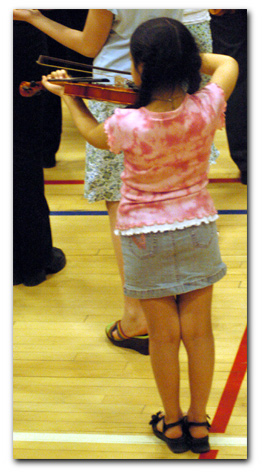 | West High School April 2, 2005 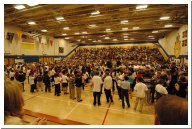 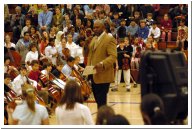 Video/Audio (MP3) (thanks to Denny Lund for taking these pictures) |
Newsletter signup | Send us your ideas
Let the String Teachers Stick to Music Education
"It is unreasonable that the strings program in MMSD should be the target of cuts every year, when it is demonstrated OVER AND OVER that it is a successful program musically, it helps with academic progress, and it is a boon to economically disadvantaged students. Will the School Board please allow the string teachers in the district stick to music education rather than fighting for the existence of a proven program?"
from comments - String Survey
Newsletter signup | Send us your ideas
String Survey - Comments
Take the string survey - results will be tabulated and forwarded to the school board. I'll be posting comments from the survey on this website:
survey comment response: "Don't cut music. I was never in a strings program, but rather played trombone. I think that my experiences in music helped shape my teenage years more than probably any other factor. I think it would be sad to see it go. 4th grade is not too young to learn music; and early start allows them to be interested in music before they are overwhelmed by too many other things."
Newsletter signup | Send us your ideas
String Orchestra Festival Soars Despite District Administration Annual Assault
The annual string festival is a reminder of how wonderful music education is, and of how important this is for our children's education. This annual spring event is also a reminder of how badly the existing School Board is failing our children. Lawrie Kobza, school board candidate for Seat 6, wrote, "Fourth and fifth grade strings is a well-established, much-loved, and much-supported program. There is also significant research demonstrating a high correlation between playing an instrument and achievement. Given all of these positives, the 4th & 5th grades strings program should not be considered for cuts until the district does everything possible it can to retain or if necessary restructure the program so that strings can continue to be offered in 4th and 5th grades even in times of tight finances." This is Lawrie's approach - not settling for the status quo, working together creatively for what we value for our kids's education. I am voting for her on Tuesday, April 5th, because the strings festival, sports, academics would all benefit from her talents on the school board. The status quo is not working locally - the longer we stay with the status quo, the more our kids will suffer.
The 39th string festival that was held yesterday was inspiring and an experience that children and parents alike will hold dearly in their memories. Consider, when the first elementary string orchestra was taught in 1969 Madison, there were was not even 100 students. Today, the total student population has not changed all that much and the elementarys string orchestra has grown to nearly 2,000 students - 1,866 students this year.
Yet, each year students, parents and teachers are left to wonder - what is going on? It is not simply about money, it is not even about scheduling. The Superintendent is not considering children's learning and achievement - he has no clue about the benefit to children's learning of this curriculum. He has has spent every year since he has been Superintendent using one lame excuse after another trying to cut this program, remaining deaf to the children, parents and city of madison. Why can he "get away with this?" On this and many other trends that are troubling in our school district. Rainwater has a compliant school board and he loves it, who wouldn't.
Shipping this curriculum to MSCR would destroy the music education instrumental curriculum. Setting up private lessons to supplement what children learn in school would add to the learning experience, having small group lessons would complement the program. The spring performance yesterday was the culmination of a semester's work for children - they memorized all those songs. There were complicated skills, etc., that was included in that work. Think of how much learning they absorbed into their minds!
The Rainwater budget excuse to cut the program is not supported by the data, a possible impact on test scores is not supported by the data, and even the scheduling is not supported when teachers are left to work out the issues. Leopold Elementary is an example of a school where the new teacher has done a phenomonal job of working out the scheduling with teachers and the demand for the curriculum and participation has soared.
So, what does the current superintendent and school board approve - an increase in the administrative budget these past 2 years of $1.4 million - the number of administrators have increased in number, not decreased. Not one cut. this year's budget increase cut $2 million from the elementary and secondary school budgets - adding dollars to every other department. Those are bad decisions for kids, and the current board is letting the current administration make those decisions. The current school board is letting the administration to use "terror" to manage our school district on budget, new buildings, boundary changes, etc. Yes, state financing is not there, but neither is our existing school board.
For four years, students, parents and the community have asked for a community advisory committee on fine arts education - nothing from the School Board, because the Superintendent does not want us to come together to work together. When you make changes to what children learn and study, you start with the curriculum - you begin with the teachers.
Newsletter signup | Send us your ideas
April 02, 2005
Super Strings Festival
The Memorial Strings Festival was a wonderful collection of children from forth to twelve grade, every color, every size, and all abilities. As I sat proudly and watched my daughter play, along with so many parents who were sitting and standing (as there were no seats left so many showed up)I was sad. The director was sad and the two strings teachers that were given pink slips (one from Crestwood, our school) Friday were sad. Surely this program does not need to be on the chopping block. I kept thinking, with this many parents attending a festival couldn't we do a fundraiser at the festival, sale something or just have a donation box for strings. Many parents like myself feel strings and no-cut freshman sports are placed on the block because they get the "involved parents" fired up to vote for whatever the referendum is, just to save these two programs. They are right. I will vote for the referendum to save a $500,000 program. I would not vote to save a secretary, two aides, two janitors and two middle management positions. But I will vote for it because, although I have been in charge of many fundraising events, I can't figure out how to raise $500,000 without a major community effort.
I have an idea though. How about moving 4/5 strings out of the classroom and into the Monday afternoon slot? Run it through MSCR or After School Program and while all the other teachers do whatever it is they do Monday afternoon allow strings kids to stay Monday for an hour of strings.(At Crestwood, After School provides foreign language in this same manner) MSCR does not seem to be a part of the MMSD budget that requires cutting and parents already pay a fee ($40 for me) to have their child in strings. We could increase the fee and then raise money for scholarships so to include low income children. The only problem I see with this arrangement is;
1. transportation for low -income students (we could have one at the Allied Drive Learning center instead of the school, parents could choose) 2. could we get enough strings teachers to cover the schools at the same time slot? If the referendum fails lets not throw this program out, let's think outside the box and find a solution.
Newsletter signup | Send us your ideas
April 01, 2005
School Board Candidate Lawrie Kobza Says Don't Cut Elementary Strings - Offers Suggestions
VOTE TUESDAY, APRIL 5
I support offering students the opportunity to take strings in 4th and 5th grade, and oppose the administration's proposed cuts to the program.
Fourth and fifth grade strings is a well-established, much-loved, and much-supported program. There is also significant research demonstrating a high correlation between playing an instrument and achievement. Given all of these positives, the 4th & 5th grades strings program should not be considered for cuts until the district does everything possible it can to retain or if necessary restructure the program so that strings can continue to be offered in 4th and 5th grades even in times of tight finances.
One step in this process, and a step that the community has requested, is to bring fine arts professionals and advocates to the table and work collaboratively on what the district's fine arts curriculum is and what it should be, what it costs, what ways there are to reduce or control district costs, whether there are other sources of funding, and whether services can be offered in conjunction with or through other community partners. Fine arts professionals and advocates are in the best position to look at these questions and think creatively about what and how these services can be offered.
Another step in the process is to form a community-wide task force, with a diverse group of interested parties, to establish community priorities for the programs offered by the school district, including programs such as fine arts and extracurricular sports. Instead of pitting program against program, we need to develop a community consensus on what the school district should offer and how cuts to desired programs should be made if cuts are necessary. The school board should use this community guidance -- not just administration's recommendations -- as it makes necessary funding decisions.
The school district is faced with limited financial resources and as a community we must look at ways to reduce spending. However, I do not believe it is appropriate or justified to totally eliminate an important program such as 4th and 5th grade strings based solely upon the administration's recommendation. We need to first take the steps set out above before we even consider elimination of this much-loved program.
Lawrie Kobza
Madison School Board Candidate for Seat 6
For more information about Lawrie, go to www.kobzaforschoolboard.org
VOTE TUESDAY, APRIL 5
Authorized and paid for by Kobza for School Board, Barbara Schrank, Treasurer
Newsletter signup | Send us your ideas
March 30, 2005
Madison Area String Festivals - Saturday, April 2, 2005
Saturday, April 2nd is the annual Madison Area String Festivals - a much-loved, special event for all Madison public school children who play in MMSD's string orchestras from Grades 4-12. More than 2,000 children will be performing 12 songs.
Each of the 4 area high schools will host a string performance on Saturday. Your elementary or middle school child, who is playing in a string orchestra, will be performing at the high school their school feeds into. For example, Randall Elementary feeds into West High School, so the elementary string children from Randall Elementary will be performing Saturday at that high school.
The performances last about one hour, and the schedule for the day is:
Memorial Area String Festival - 10 a.m. at Memorial High School
East Area String Festival - 12 noon at East High School
LaFollette Area String Festival - 2 p.m. at Lafollette High School
West Area String Festival - 4 p.m. at West High School
Dress rehearsals will be held Friday - performers need to check with their orchestra teacher for times.
These are wonderful performances - 600+ children playing together in each of Madison's four area high schools; a special site to behold and wonderful music to hear!
Parents and relatives - bring your still and video cameras! This is truly a unique Madison experience.
Newsletter signup | Send us your ideas
March 22, 2005
Elementary Strings is Academic Music Education - Parents and Madison Citizens Need to Ask School Board Why Supt. Is Not Supporting an Academic Curriculum with Direct Postive Benefits on Student Achievement
Madison parents and citizens need to ask the School Board a) why they continue to allow the Superintendent to treat elementary strings separate from the music education curriculum, b) why there is a continued delay in getting a committee together for fine arts, c) why the delay in seeking federal funding for fine arts for disadvantaged children, d) why the Administration continues to attack the fine arts academic curriculum rather than coming forward with ideas for strengthening this curriculum in light of the academic achievement benefits?
In July 2004, U.S. Secretary of Education wrote to all Superintendents of school districts in the United States:
"...the arts are a core academic subject under the No Child Left Behind Act (NCLB). I believe the arts have a significant role in education both for their intrinsic value and for the ways in which they can enhance general academic achievement and improve students' social and emotional development."
"There is much flexibility for states and local school districts under the No Child Left Behind Act with respect to support for the core subjects. ...Under NCLB, Title I, Part A funds also can be used by local education agencies to improve the educational achievement of disadvantaged students through the arts."
"In keeping with NCLB's principle of classroom practices based on research evidence, studies have shown that arts teaching and learning can increase students' cognitive and social development. The arts can be a critical link for students in developing the crucial thinking skills and motivations they need to achieve at higher levels."
Newsletter signup | Send us your ideas
March 16, 2005
WORT's In Our Backyard - March 15, 2005
Proposed Elementary Strings Program Elimination
Listen now: 3.5MB mp3 audio file. WORT
Madison School Board President Bill Keys, Strings Teacher Jack Young, Parent Michael McGuire and Activist Barb Schrank.
Newsletter signup | Send us your ideas
March 12, 2005
Axing the Arts: District (again) proposes cutting popular strings program
Jason Shephard, writing in the 3.11.2005 Isthmus:
Music teachers, parents and community activists are already agitating against Madison schools Superintendent Art Rainwater’s call to eliminate the elementary strings program, as part of a proposed slate of budget cuts.
“This creates a very disturbing environment in the community,” says Marie Breed, executive director of the Wisconsin Youth Symphony Orchestra. “It’s particularly shocking for a strong arts community like Madison to dismiss elementary string education so easily, saying essentially, ‘We’re not going to support these children.’”
By eliminating the fourth- and fifth-grade strings program, Rainwater says the district can cut nearly ten full-time equivalent positions, saving about $500,000 in salaries and another $100,000 in equipment, repairs and books. In all, the district needs to trim $8.6 million to comply with state-imposed revenue caps -- or else secure referendum approval to exceed them.
Breed, a former classroom teacher, says the benefits of the strings program are many, as teachers and parents have attested in recent years of budget debates, in which this program has been a mainstay on the chopping block.
“The strings program is important because it teaches kids about art for the sake of art -– and that teaches humanity,” Breed says. “But it also helps kids work on life skills, on finding pride in accomplishments, and with self-esteem and time management.” She cites research showing a link between studying music and higher scores on academic achievement tests.
David Lovell, chairman of the youth symphony, says lasting damage may be done if the local arts community does not get more involved -– including searching for partnerships to keep programs alive in the school. “I don’t think speaking out on school budgets is traditionally our role,” he says. “But because of what’s been happening, there’s a growing willingness to get involved.”
Richard Davis, a UW-Madison emeritus professor of music and an internationally known bassist, has won dozens of awards in Madison and around the world for his work with young musicians. He worries that the elimination of the strings programs in Madison will be a blow to minority students.
“Underprivileged children will suffer the most,” says Davis. “It’s another way of letting only those who can afford it get the opportunities. The fear is that you’re going to have a very one-sided, warped community, where one world will have all of the exposure and sophistication, and the other world won’t.”
The strings program is just one of many flashpoints for the embattled fine-arts program in Madison schools. Teachers complain about increased class loads and the loss of music rooms. Last fall, a dozen arts teachers petitioned the school board to appoint a committee to craft a “vision” for a fine-arts curriculum; the board took no action.
This week, Rainwater announced that he will wait until the summer to hire a fine-arts coordinator. The position has been vacant since last fall, much to the chagrin of arts advocates.
“This community has clearly told the Madison school district that Madison values music and art,” says citizen activist Barb Schrank. “I’m not sure they’ve been responsive to the community.”
Rhonda Schilling, a music teacher at Thoreau Elementary, says fine-arts teachers are getting fed up with the barrage of budget attacks: “It seems to be year after year in which they are cutting the arts left and right. We’re getting very tired. Clearly our opinions are falling on deaf ears.”
Rainwater’s proposed cuts also include eliminating some athletics programs and reducing to half-time the district’s gay and lesbian outreach position. These cuts, too, are sure to prove controversial.
There are those -- including the two candidates challenging incumbents on the April 5 ballot -- who suggest the board hasn’t been proactive enough in prioritizing cuts. And the contention is sure to continue after the election, as voters will be asked to decide as many as three referendum questions to approve up to $50 million in additional spending.
A meeting Monday night turned ugly when citizen critic Don Severson accused the board of “irresponsible leadership” and slammed its president, Bill Keys, for suggesting in a TV interview that the cost to taxpayers to hold a special election in May, rather than the general election in April, is minimal. In fact, this special election will cost taxpayers about $90,000 extra. Keys angrily said he misspoke on TV based on sloppy notes, then proceeded to question and lecture Severson during what was supposed to be the public comment portion of the meeting.
Board members, at virtually every opportunity, blame the state Legislature for the district’s fiscal crisis. But with no legislative changes in sight, such cries begin to ring hollow.
Moreover, several board members continue to lob bombs at outsiders, while remaining particularly sensitive to criticism directed at them. In recent weeks, Keys has referred to lawmakers as “bastards,” and Juan Jose Lopez has called a local Web site devoted to school issues, open to everyone, “destructive.” On Monday, Lopez also criticized colleague Ruth Robarts for writing an op-ed column that questions the board’s budgeting process, saying Robarts shouldn’t be questioning the process just because she’s upset with the outcome.
In fact, what’s needed is more questioning, not less. Can it really be that there is no other way for the district to operate than to continually point a gun to the head of popular programs and demand of taxpayers, “Give us more money or else?”
Background Links: Strings | Budget Send your thoughts on this issue to the Madison School Board: comments at madison.k12.wi.us
Newsletter signup | Send us your ideas
March 08, 2005
School Strings Cut Plan Blasted by Lee Sensenbrenner, The Capital Times
Strings Plucked: Once again, District administrators attack elementary music and art to the tune of nearly $800,000, including total elimination of the elementary string progam. Their pitch is off and their song is out of tune.
Keys and Carstensen have no plans to reach out to fine arts students and teachers for their support - aren't annual threats of cut classes and lost livelihood enough? In his article Sensenbrenner writes "...School Board President Bill Keys said he hoped that strings supporters would help the district pass the spring referendums.
But neither he nor fellow board member Carol Carstensen said they had a ready plan to convince strings supporters - stung to see the whole program on the chopping block - to be a helping hand, not a pounding fist."
Monday night Mr. Keys said that the Overture Center was not a metaphor for MMSD's fine arts - however, the fine arts vision of those who brought Overture is what inspires.
Ms. Carstensen said she had tried to raise money throught the Founation for Madison Public Schools - I worked with her on those fundraisers. they were not designed to fund a fine arts curriculum but rather were meant to have an endowment for grants for creative projects for existing fine arts curriculum. further the foundation for Madison's public schools, at the time, was not making grants for existing MMSD programs. That policy is now changing and may provide an opportunity to pursue.
If our leaders look at the glass as half empty that's what we'll get - a half empty glass. You never finish a painting unless you begin, you never get to the fourth movement of a symphony unless you start playing, etc. Failed expectations won't get us where we need to go and it's not up to two people - we need the community at the table.
Newsletter signup | Send us your ideas
Comments to School Board - Where Are You Putting Your Increased Revenue for Next Year, Why Do You Form Collaborations With Parents and the Community for Sports, Pets but after Four Years - Still Fail to Collaborate with the Community on Fine Arts?
Dear School Board Members,
Good evening. I plan to comment on the following – a) net reductions in classroom instruction budgets while the total budget grew this year, b) cutting elementary strings 100 % inequitably targets low income (minority) children and says you do not deserve what others in Madison have, c) limited options offered to the public and pursued by the board - fourth year that the board has not pursued with parents and the community ideas and possibilities for collaborations/partnerships for fine arts.
The budget discussion items document distributed last week is not a budget it’s only one option of cuts. The board needs to ask where the increased revenue dollars for next year will be spent and they need to ask for additional sets of budget cut options.
Annually advancing only one set of a seemingly random list of cuts out of context of where the money will be spent makes parents and voters skeptical about the board’s decisionmaking ability and this year public skepticism will threaten the passage of an operating referendum for instruction.
We may very well need money for instruction, but what do we need and what options can we pursue – referendum, private funds, grants for what Madison values. The current school board will not get people to vote for a referendum if what Madison values is threatened and important questions are not asked now. Voters will not have confidence in how and where the money is being spent and in how the board is protecting children’s learning and achievement through alternatives.
We cannot continue the path of current decisionmaking, because this board continues to lead us toward a narrow, conservative vision for public education bankrupting our children’s learning.
Download comments to School Board on Budget
Newsletter signup | Send us your ideas
March 04, 2005
Superintendent Art Rainwater Proposes to Decimate Fine Arts: Turns Back on Curriculum and Academic Achievement Benefits of Fine Arts Education - Fails to Work with the Community, Year After Year
Superintendent Art Rainwater proposes (2005-2006 Budget Discussion Items)to cut another $1 million in elementary music and art education once again this year without any prior curriculum review and assessment of impact on children's learning and achievement - that would have involved teachers and the community.
MADISON SCHOOL BOARD CONTINUES TO IGNORE CHILDREN'S, PARENTS', TEACHERS' AND THE COMMUNITY'S REQUEST TO WORK TOGETHER TO EXPLORE ALTERNATIVE FINANCING STRATEGIES FOR FINE ARTS EVEN AS STUDIES ACROSS THE COUNTRY ARE SHOWING THE POSITIVE IMPACTS ON ACADEMIC ACHIEVEMENT FOR LOW INCOME CHILDREN WHO HAVE A STRONG MUSIC, ART AND INSTRUMENTAL MUSIC INSTRUCTION IN ELEMENTARY SCHOOL.
NO CHILD LEFT BEHIND IDENTIFIES FINE ARTS AS CORE CURRICULUM - IMPORTANT TO STUDENT ACHIEVEMENT, STUDENT INTEREST IN LEARNING AND IMPROVEMENT IN CHILDREN'S CREATIVITY.
Here's the Information:
Superintendent's Proposed Fine Arts Cuts - Released to MMSD Board of Education yesterday:
Eliminate elementary strings curriculum 9.8 FTEs $496,860
Double up Special classes in Grade 1 5-7.5 FTEs $253,500-$380,250
Total Impact on Fine Arts Curriculum 14.8-17.3 FTEs $750,367-$877,110
plus another $100,000 in instrument purchase and repair budget.
Total existing k-12 Fine Arts budget approximately $7 million which is 2% of the total budget. Superintendent Art Rainwater's proposed cut would eliminate 14% of the existing fine arts budget - 100% of the elementary string teachers who likely would be laid off as they are specialized and not easily transferred. They're also not administrators, none of whom are at risk of layoff.
History of Holding Hostage a Community that Values Music and Art Education:
Spring 2002 - Superintendent Art Rainwater proposes to cut 4th grade elementary strings course. Community rallies - course reinstated.
Spring 2003 - - Superintendent Art Rainwater proposes to cut 4th grade string course if referendum fails unless fee imposed.
School Board approves all increases in fees if referendum fails EXCEPT the proposed fee for elementary string course.
Spring 2004 - Bill Keys explores $600 elementary string course fee, Bill Clingan proposes to cut Fine Arts Coordinator, Superintendent Rainwater increases elementary music and art section, Johnny Winston Jr. proposes $50 participation fee for elementary string course. Superintendent Rainwater cuts $70,000 instrument budget. All proposals passed.
Spring 2005 - Superintendent Art Rainwater proposes elimination of elementary strings course, elimination of string budget, elimination of instrument repair budget, doubling of class sizes for elementary music and art in grade 1.
Summary -
WI statutes set parameters for skill areas, but the statutes require the local School Board to approve curriculum. Our school board does not want to approve curriculum, saying we're not the experts. That's true but being an expert in a specific curriculum is not needed to ask the right "board appropriate" questions and to be sure that policies are followed and procedures are put in place to protect children's learning. Madison's school board has no written procedures for designing, implementing, evaluating and changing curriculum. Our school board, not the Superintendent, is responsible for overseeing what our children learn and the results of that learning.
Further, rather than listenting and responding to the community's value of fine arts education and researching the growing body of independent test results showing positive impacts on math and reading scores for low income children; our Superintendent, after another year of stonewalling requests from teachers and the community to form a working group to explore financial strategies; doesn't think that is necessary, yet wants us to believe he has to cut $8+ million and has no choice but to make the tough decisions. Hogwash. We want him to do the tough work - keep what contributes to academic achievement, madison values and what makes children's education worthwhile.
Newsletter signup | Send us your ideas
February 26, 2005
Ford Foundation Funding Arts Infused Education - Supporting Partnerships
The Ford Foundation is one organization that is investing in efforts to integrate the arts into classroom instruction in urban schools. Read Ford Foundation: Deep In the Arts of Texas .
Madison Schools have a fine arts curriculum with standards and benchmarks in place. In addition to fine arts curricula, Madison's public school children attend performances and there are artists-in-residences, for example. Many of these relationships were nurtured by the district's fine arts coordinator, a position that has been vacant for nearly 9 months. Two arts issues require immediate attention:
- First: Last fall, the District's fine arts teachers asked that the Fine Arts Coordinator be reinstated (which the school board voted to do). These same teachers also asked for personnel to be hired that could help them out in the interim, which has not been done. This has left a void in the district's relationship with the community's arts organizations. The Fine Arts Coordinator had served on many local committees and boards to foster the relationship between the District and the community's arts organizations. We need to get back on track with these relationships. This is an important first step.
- Second: As a next step, I would like to see a collaborative effort form among the City, University, community arts organizations and the MMSD to explore models for strengthening an arts infused education that further supports learning in the classroom - and raises children's test scores, especially for low income and minority children. Test scores from various parts of the country are showing the positive links between arts and test scores.
Newsletter signup | Send us your ideas
February 09, 2005
School Board Governance Lacking - Fine Arts
Let the School Board know how you feel about the following at comments@madison.k12.wi.us.
Monday, February 7, 2005, I spoke before the School Board during public appearances. The purpose of my statement was to speak about my concern re. the School Board's ongoing inaction regarding the fine arts curriculum. During the past six years, there have been cuts to courses, reduced positions, continued threats of cuts to curriculum (such as the elementary strings academic classes) without any engagement or dialogue with the hundreds of concerned community members who have voiced their support for a strong fine arts curriculum and have asked (over and over) for the School Board to work collaboratively with the community to develop a fine arts vision and strategy for fine arts.
If the fine arts curriculum were being treated fairly in light of the District's overall financial challenges, that would be one thing. But this academic discipline has not been treated fairly and in some cases analyses and a board member's recommendation are made that appear spiteful (for example, a $500-600 fee for the elementary strings academic classes that are part of the School Board approved Grade 4-12 instrumental curriculum). In the fall the District formed a working group with supporters of extracurricular sports. What's wrong with this picture? Fine arts is also a great way to explore and develop community partnerships.
I believe the City of Madison and its fine arts community need to be seriously concerned with the District's continued lack of attention to this important curriculum area and the absence of leadership by the School Board to “think outside the box.” Board members are allowing this curriculum to wither even in light of research showing the positive effect on low income student achievement and have missed opportunities for federal funding of the arts for low income children.
On Monday, I was "politely" told that I should be the one to remind board committee chairs to follow up with items on their agenda. What kind of foolishness is this? Each board committee has a support person from district staff who should review this information with the committee and provide periodic updates - publicly, since the public is expecting follow-up.
This follow-up and continuity is not happening. For example, in March 2003 the Fine Arts coordinator provided an overview of fine arts curriculum and community relationships between MMSD and the community to the Performance and Achievement Committee. Board members asked for a follow-up the next year. This did not happen. During the year, I contacted the Fine Arts Coordinator and asked about progress on a Fine Arts strategy. He informed me that his superiors would tell him when to work on this - they never did. Does that mean the public needs to take note of tasks assigned or commitments made publicly at a meeting and follow whether the statements are being followed up? No way.
I also reminded the School Board that the superintendent said that in the absence of a Fine Arts Coordinator, he had told the board a committee of teachers would be put together to handle tasks. Rather than address my concern, I was "politely" told (dismissed) about how it's taken so long to find a Fine Arts Coordinator, because the District wants the best person for the position. I say hogwash. The District waited 5 months before even putting up an ad for the position when the outreach portion existed.
Are community members supposed to let the School Board know the teachers' committee is not in place, there has been no posting for the Fine Arts Coordinator position and MMSD positions on fine arts boards are going unfilled because there is no Fine Arts coordinator and another options is needed? The fine arts teachers did just that in early fall - no action by the School Board.
The Board says they are making an effort to find the best person. Yet, the District abandoned the first interview process that included qualified candidates, lowered the standards (removed a licensing requirement) and re-announced the position. Ads were only placed in newspapers. When asked if the District had placed ads with professional organizations that would know how to contact qualified personnel, the District said they did not have the time to do that. (note: many employers advertise online for positions
these days - www.monster.com is the place to be, generally).
Why does the public have to follow up with everything? Why can't we have confidence that appropriate steps are being taken? Why are there no mechanisms in place for the Board to provide appropriate oversight?
By his actions (and inactions) the Superintendent continues to show a lack of understanding of the demonstrated positive benefits of fine arts curriculum on student achievement, and fails to reach out to the community to keep the arts strong in Madison’s schools, which is something the community deeply values. In times of scarce resources, the district needs to work collaboratively with the community.
In the area of Fine Arts, it appears the Superintendent needs closer supervision by the Board. Yet, the School Board is not providing oversight either. Maybe I'm being too cranky. Afterall, what difference does it make if the Board abandons fine arts? Plenty.
What are the risks of not doing this? The board runs the risk of missing an important opportunity to improve student achievement and build community relationships with a community that strongly values the arts. Also, the board runs the risk of the district not remaining competitive with surrounding districts that have strong fine arts curriculum for their students. This would be an additional burden and negative impact on our low income students whose families do not have the opportunity to move to the suburbs. We can’t let this happen. Our children's learning deserves more responsibility and accountability from our School Board.
How does the School Board expect the community to support a referendum when there is inaction year after year? They won’t if the public is not confident in the board's ability to keep our school district strong by reflecting community values.
Specific comments in my statement included:
A. School Board is Non-responsive to the Community.
For three years, children, parents and members of the Madison community have spoken to board members about the important contribution of the fine arts curriculum to successful learning in core academic subject areas. While the School Board forms community committees to address community concerns about long-term planning, extracurricular sports, afterschool, and even school animals, the requests of hundreds of children, teachers and community members over the past three years for such a committee for fine arts curriculum planning go unanswered.
Abandoned promises. While looking for a new Fine Arts Coordinator, the School Board has let 9 months pass without professional support in the fine arts area for teachers and as a liaison with the community. Yet, the Superintendent said a committee of fine arts teachers would be put into place – this did not happen, and there was no follow-up publicly from the Board even after fine arts teachers spoke to the School Board about needing help last fall. Teachers even provided the School Board with possible solutions.
What has this meant? Diminished Community Outreach. There has been less community outreach and communication between the District and the arts community than in previous years. Representatives from the district’s fine arts professionals have not been on boards. I can only believe that if you had asked any of the fine arts teachers who are experienced professionals (many are involved in the community) to be on these boards, they would have been honored to serve. Even if you need to pay for time, the money would have been well spent.
Diminished Long-Term Planning for the Arts. MMSD lacks a fine arts vision that can only be developed with teacher, administrator, and community involvement. Long-term planning for the fine arts curriculum – looking at what currently exists, and what is needed for maintenance and growth of a strong fine arts curriculum is non-existent.
B. Missed Funding Opportunities.
In July, the Secretary of Education sent all school district superintendents a policy letter on fine arts curriculum. His letter began,
“As I am sure you know, the arts are a core academic subject under the No Child Left Behind Act (NCLB). I believe the arts have a significant role in education both for their intrinsic value and for the ways in which they can enhance general academic achievement and improve students' social and emotional development.”
While we can all agree that we have philosophical and financial issues with NCLB, the points made in the Secretary’s letter reflect the current knowledge, key strengths and benefits to math and reading about fine arts education. His letter also went on to provide links to flexibility in federal grants for fine arts curriculum for low income students and all students and provided links to resources and to research showing independently evaluated improved test scores for low income children. This funding has been available for several years – MMSD’s former fine arts coordinator was not included in grant applications at federal level for fine arts. This is not something you would not undertake independently.
C. Community Enagagement/Partnering
How much longer is the School Board willing to let the District’s fine arts curriculum wither? If resources are as scarce as the School Board continues to warn the public, then action is needed yesterday. Our community values fine arts – that’s clear to everyone. Fine arts curriculum directly benefits children’s performance in school – achievement.
Other districts nationally are independently assessing the proven benefits of fine arts curriculum for low income children’s learning and academic achievement. They are seeing improved results in their test scores. How long is the School Board willing to risk these benefits to Madison’s children?
What’s needed? I believe the Board needs a Fine Arts working group under the Partnership Committee with feedback to the Performance and Achievement Committee. This committee must a) review what exists – existing approved curriculum and standards, b) develop a vision and action plan for fine arts that will lead to a strong fine arts curriculum for our children c) determine costs and d) identify partnerships. I would recommend the first step for the group would be to develop a work plan for board approval. I believe the Fine Arts Coordinator needs to lead this, but I asked the Board to begin now. Even though the Fine Arts Coordinator might be new, there are people with vast experience in this field and strong community ties who can help get up and going and provide the support the Fine Arts Coordinator will need when they are on board.
What are the risks of not doing this? The board runs the risk of missing an important opportunity to improve student achievement. Also, the board runs the risk of the district not remaining competitive with surrounding districts that have strong fine arts curriculum for their students. This would be an additional burden and negative impact on our low income students whose families do not have the opportunity to move around. We can’t let this happen.
Newsletter signup | Send us your ideas
February 03, 2005
The Public Survey Trap and Music Education
In his weekly advice on music advocacy, Dr. Benham, on www.supportmusic.com talks about public surveys. Useful information can be gathered, but they can also be used to threaten the public or be used as a mandate from the public if referendums do not pass. the music advocate needs to keep music off the surveys. Dr. Benham writes,
"In the presence of a financial crisis one of the approaches used to inform the public of the seriousness of the situation is a Public Survey.
The survey may be used for a variety of reasons, some of which may need to be "read between the lines."
* To inform the public of the financial crisis
* To inform the public of the need to raise taxes
* To establish a basis for a levy referendum to increase funding
* To inform (sometimes threaten) the public of probable cuts if additional finding is not increased
* To get a sense of what the public values most so that the cuts made cause the least negative reaction
One school district in which I worked mailed surveys to all employees and residents in the district. The survey listed 200 categories or programs within the district. The respondent was asked to rank each with a response of "A" (Most important to retain), "B" (Cut here first), or "C" (Save this if possible). After the district levy referendum failed the district mandated cuts in the music program that would have eliminated 70% of the orchestra staff and 48% of the band staff.
What actually occurred is that the results were summarily ignored, not even calculated. The administration proposed the music cuts based on their own educational philosophy and blamed the community for lack of support for music. The music parents requested permission to review the surveys and discovered the following.
* Of the 60,000 surveys distributed only 211 were returned
* Lack of participation by the community invalidated the survey, exposing the administrative action as self-serving
* Of the nine (9) music categories included on the list of 200 in the survey, music was ranked by the community as "most important to retain" on a basis equivalent with curricular status.
* Music categories outranked all extra-curricular activities as "most important to retain"
Continue Reading "The Public Survey Trap"
Newsletter signup | Send us your ideas
January 22, 2005
The Art of Education Success by Nick Rabkin and Robin Redmond
Rabkin and Redmond wrote in the Washington Post on January 8, 2005 that "...the arts are not just affective and expressive. They are also deeply cognitive."
Districts with music and art curriculum standards and benchmarks tied to other curriculum see improved test scores. The research is showing more and more that children's learning directly benefits from music and art curriculum.
The authors note that "Successful programs in Chicago, Minneapolis and elsewhere have proven that arts integration is within the reach of most schools and districts. Now research is showing that connecting the arts to learning across the curriculum is a strategy that helps close the achievement gap and make schools happier places by moving beyond a crippling focus on basics and discipline. It is time for more districts and schools to make use of this strategy."
MMSD's fine arts teachers know this and gear their curriculum to provide student's with the benefits in learning from music and art education. If MMSD administration narrowly focuses on reading, math, science, etc., scores and not what contributes to children learning experiences being successful, administrators will miss the benefits of the arts.
Children and teachers have been telling them for the past several years how music and art benefit children's learning. Hopefully, they are listening.
The Art of Education Success
By Nick Rabkin and Robin Redmond
Saturday, January 8, 2005; Page A19
It is fall. Fourth-graders in a Chicago school in a low-income neighborhood are focused and coiled with excitement. They are drawing portraits of each other in a lesson that is part of a unit on descriptive writing. They are deeply engaged, and the rich writing and art on the walls are evidence of real learning and accomplishment. Most other classrooms in the building also integrate the arts with other subjects and buzz with the intensity of discovery.
The same day, in another low-income Chicago school, fourth-graders slump in their chairs, waiting to read a bit of advice to their classmates. They mumble, "Don't hit your sister," and "Do your homework." There is no children's work on the walls, no evidence of learning. Instead, posters remind students of rules they must follow. One asks, "What is freedom?" The answers suggest freedom is a reward for self-control.
The new economy may require higher-order skills such as creativity, adaptability and teamwork, but most schools in low-income areas focus narrowly on "basic" academic skills, testing and discipline. The student boredom and academic failure that follow prompt calls for yet more testing and discipline.
The first school and others like it are proving that integrating the arts into the core of the academic program is a far more productive strategy. Recently the principal of Edgebrook, Chicago's highest-scoring non-selective elementary school, attributed her school's success to its embrace of the arts. "We were concerned we might see a negative impact on test scores," Diane Maciejewski said. "But actually, just the opposite happened."
A growing body of research is yielding data that support her claim. A study of 23 arts-integrated schools in Chicago showed test scores rising up to two times faster there than in demographically comparable schools. A study of a Minneapolis program showed that arts integration has substantial effects for all students, but appears to have its greatest impact on disadvantaged learners. Gains go well beyond the basics and test scores. Students become better thinkers, develop higher-order skills, and deepen their inclination to learn.
The studies also show that arts integration energizes and challenges teachers. Karen Seashore, a distinguished sociologist who studies urban schools, called the Minneapolis program "one of the most powerful professional development experiences we have seen for large numbers of teachers."
When the arts are an interdisciplinary partner with other subjects, they generate conditions that cognitive scientists say are ideal for learning. The curriculum becomes more hands-on and project-based, offering what University of Chicago researchers have called authentic and challenging intellectual work. Learning in all subjects becomes visible through the arts. Teachers' opinions of their students rise.
Students invest emotionally in arts-integrated classrooms, where the curriculum often connects lessons to their own experience, and where they often work in groups and turn classrooms into learning communities. These classroom changes lead to a cascade of broader school changes. Schedules change to accommodate sustained attention to meaningful questions. Parents become more involved in schools. Teachers collaborate and take on new leadership roles.
These successes make clear that the arts are not just affective and expressive. They are also deeply cognitive. They develop the tools of thinking itself: careful observation of the world, mental representation of what is observed or imagined, abstraction from complexity, pattern recognition and development, symbolic and metaphoric representation, and qualitative judgment. We use these same thinking tools in science, philosophy, math and history. The advantage of the arts is that they link cognitive growth to social and emotional development. Students care more deeply about what they study, they see the links between subjects and their lives, their thinking capacities grow, they work more diligently, and they learn from each other.
Students will not be prepared for work in an economy that demands higher-order skills if their schools focus exclusively on the basics. Students will not learn to think for themselves if their schools expect them just to stay in line and keep quiet. Successful programs in Chicago, Minneapolis and elsewhere have proven that arts integration is within the reach of most schools and districts. Now research is showing that connecting the arts to learning across the curriculum is a strategy that helps close the achievement gap and make schools happier places by moving beyond a crippling focus on basics and discipline. It is time for more districts and schools to make use of this strategy.
Nick Rabkin is executive director of the Center for Arts Policy, Columbia College Chicago, and Robin Redmond is its associate director. They edited "Putting the Arts in the Picture: Reframing Education in the 21st Century."
© 2005 The Washington Post Company
Newsletter signup | Send us your ideas
Arts Are a Core Subject Under No Child Left Behind - Flexibility for Federal Funding of the Arts Exists
In an August Letter to ALL superintendents across the country, Secretary Paige (Dept. of Education) stated that the arts are a core subject area of No Child Left Behind, provided research that demonstrates children who are more engaged in the arts do better on tests, and offered guidance on flexibility, funding for arts
Noting that the arts are a core subject under the No Child Left Behind Act, U.S. Secretary of Education Rod Paige has issued guidance on the law's funding and flexibility that can be used to improve art education and teacher quality, particularly as a means to improve the educational achievement of economically disadvantaged students through the arts.
The letter cites research that shows arts teaching and learning can increase students' cognitive and social development and serve as a "critical link" to help students develop crucial thinking skills and become motivated to achieve at higher levels. Research also shows that students who are highly involved in the arts earn better grades and perform better on standardized tests.
Secretary Paige's letter also reminds superintendents about the law's flexibility and the funding available to support core subjects through programs supported by the No Child Left Behind Act, including: Title I funds to improve the academic achievement of the neediest students; the Comprehensive School Reform program; and Title II Teacher Quality Enhancement Grants to provide professional development for teachers of the arts.
In Arizona, for example, as part of Superintendent Tom Horne's current "content-rich curriculum" initiative, $4 million in Comprehensive School Reform (Title I, Part F) funds are supporting arts education at 43 current Comprehensive School Reform schools throughout the state. Additional Arizona Arts Education Initiative school sites are being supported with Title V (Innovative Programs) funding under NCLB.
The City of Madison needs to ask what available funding for the arts under NCLB the Madison Metropolitan District has pursued.
Newsletter signup | Send us your ideas
January 21, 2005
MUSIC ADVOCACY: Caring Enough to Put the Student First by Dr. Benham
Dr. John Benham, writing on www.supportmusic.com says, "Music Education Advocacy. The concept can make us indignant. Why should anything so valuable to the education of every child need to be defended?"
He continues, "If you’re a parent of a young person interested in playing music, you’ve already experienced first-hand the positive impact of this sort of challenge. If you’re a member of the community with a love of music, you know how much it has benefited you.
But the truth is, we have no choice but to defend school music programs. In a time of drastic reductions in school budgets, music can sometimes be misunderstood as not core to an academic curriculum. But we do know that participation in music is vital to a young person’s academic and social development."
Advocacy for music education for students is not about what we teach children as much as it is about what children are learning and music education is fundamental to that.
Continue Reading "MUSIC ADVOCACY: Caring Enough to Put the Students First" - Dr. John Benham
Newsletter signup | Send us your ideas
Music To His Ears by Sandy Cullen, WI State Journal
Janitor Directs Generosity To East High, Trades His Broom For Baton Tonight by Sandy Cullen, January 13,2005, WI State Journal
Jim Ely loves music and the arts.
He also loves Madison East High School.
It's where he and his wife, Judy, who died of ovarian cancer in February 2003, were high school sweethearts more than 30 years ago, when he took her to his prom and she took him to the TWIRP (The Woman Is Required to Pay) dance.
It's where they worked together on the 1969 production of "Oklahoma!"
Read the entire article,
Music to His Ears
Newsletter signup | Send us your ideas
January 20, 2005
Update on Hiring MMSD Fine Arts Coordinator - Art Rainwater Briefs Board on Ongoing Delay and Reposting of Position with Fewer Requirements
Art Rainwater informed MMSD School Board members on January 10, 2005 that the Fine Arts Coordinator position would be reposted. Why? It's unclear, as the following quicktime movie shows. There were about 9 candidates.
Members on the committee, who included MMSD and public representatives, said they forwarded two qualified candidates for the next step toward hiring. Why wasn't one of those people hired?
Art Rainwater says that the license requirement for the position will be removed to attract a broader category of candiate. My question is - possibly a less qualified candidate? There has been no public notice of a substantive change in the responsibilities of this position. You would think that professionals in the field and the arts community would be involved in major changes were being considered. Read Mariel Wozniakl for information on how removing a license can be problemmatic and what experience an MMSD Fine Arts Coordinator needs to have.
Newsletter signup | Send us your ideas
A Local Music Coalition - Madison Needs Its Own Music Coalition
"...in my view it is the most effective way to ensure that your school district provides equal educational opportunities for all of its students to participate in the making of music!" Dr. Benham exclaims for children in his recent commentary on music advocacy, "An effective local music coalition holds a school district accountable for student-centered decision making."
Some of the leading reasons Dr. Benham identifies for a local music coalition include:
* A local coalition places the student back to the center of the decision-making process.
* A local coalition identifies the music program as an integral part of the community.
* A local coalition unifies the music program as a unified district-wide curriculum.
* A local coalition promotes music education, not just band, choir, orchestra, or general music.
* A local coalition is a community organization that incorporates all of its constituents in the support of music making.
* A local coalition provides for bringing music into all of life.
* A local coalition puts the "public" in Public Education!
Continue Reading "The Local Music Coalition - Dr. John Benham"
Newsletter signup | Send us your ideas
January 13, 2005
New Posting for the Fine Arts Coordinator Position Mentioned - Removes Professional License Requirements by Dr. Mariel Wozniak, retired MMSD Fine Arts Coordinator
I was concerned and confused as I listened on Monday night to Superintendent Rainwater inform the School Board that the position description posted for the Fine Arts Coordinator was being reposted without a license requirement so that more applicants could be included. The Fine Arts Coordinator oversees the design and implementation of the District's Fine Arts curriculum, and this position has an important community role with the City's varied fine arts organizations.
All other coordinators require a license #10 and so should the Fine Arts Coordinator position. Licenses insure that an applicant has met certain standards and is meant to protect against less qualified applicants being hired.
"The points in the posting indicate a change in the position of a full-time Coordinator of Fine Arts," Dr. Wozniak, retired MMSD Fine Arts Coordinator pointed out in a recent essay. "While educational change is legitimate, a new role for the Coordinator of Fine Arts and reasons for change should not only be well known by the community, but by arts education specialists who should be involved in those changes. This city values education which includes designated arts instruction in its schools and its enhancement by the arts and other resources in the community. We need to remember that teachers, principals, and superintendents are public servants and should fulfill the community's educational goals."
What continues to be lacking in the District's decisionmaking about Fine Arts education is the ongoing lack of an open process that includes professionals in the field and the community so that best choices can be made for children's learning.
Dr. Wozniak notes, "The responsibility of the board of education is to make informed decisions for the education of its children with accountability and commitment to its electorate." This is not possible at MMSD, because decisions about Fine Arts education are being made behind closed doors by a handful of administrators and then announced to the board of education as fact.
Newsletter signup | Send us your ideas
ARTS DAY 2005 - GROW WISCONSIN CREATIVELY - WEDNESDAY, MARCH 2, 2005
Wisconsin’s arts leaders will come together to show support for greater visibility and increased investment in the arts to benefit Wisconsin's communities and the people of the state, on ARTS DAY 2005, Wednesday, March 2, 2005, at the State Capitol in downtown Madison.
Wisconsin’s arts leaders will come together to show support for greater visibility and increased investment in the arts to benefit Wisconsin's communities and the people of the state, on ARTS DAY 2005, Wednesday, March 2, 2005, at the State Capitol in downtown Madison. Across Wisconsin, the arts, culture, creativity and innovation are becoming recognized as integral to economic development, downtown revitalization, educational advancement, and community engagement. Creative economy guru Richard Florida says, "Better than any other country in recent years, America has developed innovative technologies and ideas that spawn new industries and modernize old ones. These creative industries, employing scientists, artists, designers, engineers, financiers, marketers, and sundry entrepreneurs, have generated more than 20 million U.S. jobs since the 1990s and currently account for fully half of all U.S. wages and salaries." Americans for the Arts (AFTA), the national arts service organization, recently released a study of the nation’s “creative industries”, based on an analysis of data provided by Dun and Bradstreet. Wisconsin boasts over 8,000 “creative industry” businesses, supporting over 43,000 full-time jobs. In addition, a 2002 study conducted by AFTA and the Wisconsin Arts Board found that Wisconsin’s non-profit arts industry generates $289.8 million in economic activity every year. And research from the National Governors Association proves that arts-based education helps build students’ skills, increase academic success, heighten standardized test scores, and lower the incidence of crime among general and at-risk populations. Wisconsin’s creative economy must be nurtured to drive, expand and sustain our state’s economic, educational and civic well-being. Arts advocates from throughout the state will convene at the State Capitol on March 2 to show their strength in numbers, and demonstrate the importance of the state’s investment in the arts and creativity to Governor Doyle, Lt. Governor Lawton, and state legislators. These elected decisionmakers will learn that public and private investment in the arts and arts education reaps tremendous benefits in human, economic, educational, and civic capital. ARTS DAY 2005 will begin with the fifth Legislative Arts Breakfast, 8:30-10 am, and will include: •• poetry reading by Denise Sweet, Wisconsin’s new Poet Laureate •• constituent meetings with legislators •• the latest information on the issues facing the arts in Wisconsin •• new initiatives addressing the impact and importance of the creative economy •• roundtables on current and future trends, policies, and issues for Wisconsin’s arts industry •• Weston, WI’s DC Everest Chamber Choir and Songspinners, performing at noon in the Capitol Rotunda •• Artwork by Wisconsin artists on display in Lt. Governor Barbara Lawton’s office, Room 19 East. ARTS DAY 2005 endorsing sponsors include UW Extension-Division of Outreach and E-Learning Extension, Wisconsin Education Association Council, Wisconsin Manufacturers and Commerce, Wisconsin Music Educators Association. Endorsing partners are Wisconsin Academy of Sciences, Arts and Letters and Wisconsin Alliance of Artists and Craftspeople. For up to the minute information on ARTS DAY 2005, Arts Wisconsin and the arts across Wisconsin, contact Anne Katz, Executive Director, Arts Wisconsin, 608 255 8316 / akatz@wisconsinarts.org / www.wisconsinarts.org.
Newsletter signup | Send us your ideas
January 11, 2005
Is My Music Program Vulnerable to Cuts? - Dr. John Benham
As one superintendent stated, "There is no group of people more capable of rallying immediate and effective advocacy than a well-organized music coalition!" John Benham, music education advocate, reminds his readers in his December 15th column on www.supportmusic.com.
Dr. Benham urges his readers to become active participants in the education decision-making process. "In the face of what appears to have become a national trend to target music programs for reduction, it becomes the responsibility of the music advocate to stay informed by active participation in the decision-making process." he advises, "We must encourage and/or remind parents and other advocates that the school district really belongs to the community. We must become educated in school polity, empowering the people to ensure student-centered decisions."
Continue Reading "Is My Music Program Vulnerable to Cuts? - Dr. John Benham"
Newsletter signup | Send us your ideas
January 07, 2005
What is the Single Most Important Issue in Music Advocacy - YOU! by Dr. John Benham
SupportMusic.com is a website storehouse of resources for defending music education in schools. In December, this website began a weekly blog on advocacy for music education by Dr. John Benham, who is President of Music in World Cultures, Inc. and Director of Graduate Studies in Music at Bethel University in St. Paul, Minnesota.
In his December 8th blog, Dr. Benham writes that "In over 20 years as a consultant for music advocacy I have never seen a music program cut when there was a well-organized and cohesive support group.
There is no place where your participation has more immediate impact than in your school district. Your participation is vital to the health of your music program.
It is quite simple: Your participation is a "YES" vote, providing music making opportunities for the students in your district. Your failure to participate is a "NO" vote, even if by default."
Continue Reading "What is the Single Most Important Issue in Music Advocacy - YOU!"
Newsletter signup | Send us your ideas
December 23, 2004
Elementary School Needs String Instruments - Sandy Cullen
Sandy Cullen, Wisconsin State Journal reporter, wrote a story in early December about a shortage of string instruments at Leopold Elementary School. It seems that newly hired MMSD strings teacher, Pat Kukes, has more students than violins for his elementary string students. He's hoping donations will be made to the school so that children will have instruments to practice and so that all students can play together in a concert.
Most of the students in the elementary strings program are low income, so renting an instrument privately is not an option.
Elementary School Needs String Instrumenets
Newsletter signup | Send us your ideas
November 23, 2004
Overture Center Soars while MMSD Fine Arts Curriculum Sinks
The following letter was submitted to the Madison papers today.
Dear Editor:
What joy I experience when I attend performances at the new Overture Center for the Performing Arts! I’ve been to a variety of free and paid performances, including the MSO and Kanopy Dance. Thank you Jerry Frautschi and Pleasant Rowland for your gift to the City of Madison, your vision for a vibrant arts community, and your support for the city’s economic and cultural future. Yet sadly, we are in danger of this joy not lasting into the future.
The problem is not Madison’s citizens. Their support for arts organizations is impressive. The Great Performance Fund is a major step in that direction, and the UW-Madison is undertaking a major renovation and investment in the arts as well. These foundations are critical to the support of a vibrant Madison future, but they are not sufficient.
What is missing? We are lacking a commitment to a strong Fine Arts foundation in the Madison Metropolitan School District (MMSD), which serves nearly 25,000 students.
continue reading entire letter.
Overture Center Soars while MMSD Fine Arts Curriculum Sinks
Dear Editor,
What joy I experience when I attend performances at the new Overture Center for the Performing Arts! I’ve been to a variety of free and paid performances, including the MSO and Kanopy Dance. Thank you Jerry Frautschi and Pleasant Rowland for your gift to the City of Madison, your vision for a vibrant arts community, and your support for the city’s economic and cultural future. Yet sadly, we are in danger of this joy not lasting into the future.
The problem is not Madison’s citizens. Their support for arts organizations is impressive. The Great Performance Fund is a major step in that direction, and the UW-Madison is undertaking a major renovation and investment in the arts as well. These foundations are critical to the support of a vibrant Madison future, but they are not sufficient.
What is missing? We are lacking a commitment to a strong Fine Arts foundation in the Madison Metropolitan School District (MMSD), which serves nearly 25,000 students. Over the past 5 years, delivery of the Fine Arts curriculum in the district has been deteriorating: classes have been eliminated; staff has been reduced; some teachers are required to travel to 5 schools to teach; no Fine Arts Coordinator is in place; and the District’s own School Board approved curriculum and its standards are not being evaluated before making administrative decisions. Today’s public school students are not getting the Fine Arts academics outlined in national and state standards and there is danger that this downward spiral will continue.
What needs to happen? A first step is commitment to the existing Fine Arts curriculum and its standards, and this commitment must come from the School Board and the Superintendent. Their actions to date do not demonstrate support for the curriculum or the community’s values for our children. The next step is funding. The District’s current Fine Arts budget is about 3% of the total budget for all K-12 music, art, dance, etc., and costs districtwide about $200-250 per participant. Cuts to already cost-effective Fine Arts classes make curriculum delivery more ineffective and inefficient — the District will end up paying more for less.
Who suffers the most? Low-income children — who are predominantly minority children — are affected more than any other children. These children simply do not have the same opportunities outside public school to take private lessons or to perform in private organizations. Public schools provide the opportunity to open a child’s world to possibility.
Does the quality of Fine Arts education matter? Absolutely. Research shows that Fine Arts education directly benefits children in other academic areas, especially math and reading. Why shouldn’t these benefits be available for Madison’s public school children?
Madison’s school children need to know that the community will help them by contacting Board members (comments@madison.k12.wi.us ). We need to come together with the School Board to develop a vision for Fine Arts education that will benefit Madison’s future performers and educate its future audiences.
Barbara M. Schrank, Ph.D., former management consultant
Currently, Artist and Spouse of MSO Principal Bassist and MMSD Teacher
www.schoolinfosystem.org
Newsletter signup | Send us your ideas
October 05, 2004
MMSD Fine Arts Teachers Ask School Board for Community Arts Committee
On Monday night, October 4, 2004, more than 12 MMSD Fine Arts teachers attended the School Board meeting. Four of those teachers read a letter to the School Board asking for the Fine Arts Coordinator position to be filled. They also asked that a community committee be formed to develop a fine arts vision for the district that would include an assessment of the current fine arts curricula. A summary of the points in the letter (which can be downloaded) includes:
Fine Arts Coordinator (FAC)
- Thank you for reinstating the portion of the Fine Arts Coordinator position that works with teachers. (The existing ½ time position was funded by Fund 80 and would not have supported the 140+ teachers in 47 schools.)
- Need a professional in the field to fill the vacant position
- Need someone soon
- Hire an interim FAC – much like a long-term sub until a full-time professional is hired
- In next budget, look across all professional support staff – over the the FAC cut from 2 FTE to 0 FTE. The ½ Fund 80 position isn’t able to work with staff
Fine Arts Vision
- Fine Arts have curricula in MMSD
- Fine Arts have standards in MMSD
- Overture and UW have their vision for the role of art in the community – MMSD needs to do the same
- Form a community committee – community assessment of the fine arts in schools and development of fine arts vision for the MMSD with goals, budget, etc.
Newsletter signup | Send us your ideas
September 21, 2004
September 20, 2004 MMSD Board of Education Meeting Audio/Video Clips
Barb Schrank collected video & audio clips from last nights Madison School District Board of Education Meeting:
- Don Hunt: Retired West High School Art Teacher Fine Arts Statement [MP3 1.4MB] [Quicktime Video] [Transcripts: html | PDF]
- Barb Schrank Fine Arts Presentation [MP3 1.6MB] [Quicktime Video] [Transcripts: html | PDF]
- Mariel Wozniak Fine Arts Presentation [MP3 1.9MB] [Quicktime Video] [Transcripts: html | PDF]
- Juan Lopez lecture to Ruth Robarts [MP3 2.7MB] [Quicktime Video] [Transcripts: html | PDF]
- Athletic Fees Presentation [MP3] [Quicktime Video] [Transcripts: html | PDF]
Newsletter signup | Send us your ideas
September 20, 2004
Diary of MMSD Fine Arts - District Policy Requires Fine Arts Coordinator
MMSD Board policies require a trained coordinator for filling a vacant position for a number of specialties, including art, music and physical education.
Only last night did the Superintendent inform the Board that he would be sending around a modification to this policy in light of no Fine Arts Coordinator and that this information would be made available to the Board on Tuesday, September 21, 2004. The only change being proposed would be to eliminate the coordinator requirement for music and art. The coordinator requirement will remain for bilingual, ESL, physical education and special education.
The Superintendent's remarks were made following a public appearance by the District's former Fine Arts Coordinator, Mariel Wozniak, who pointed this policy out to the Board. Dr. Wozniak said that if fine arts personnel were being hired without a coordinator, the district administration was in violation of Board policy.
POLICY EMPLOYMENT 8005
FILING A VACANT POSITION FOR COUNSELOR, BILINGUAL, ESL, ART, MUSIC, PHYSICAL EDUCATION, AND ALL SPECIAL EDUCATION CLASSROOM TEACHERS
1. The position supervisor(s) must complete a Vacancy Notice and forward it to the Human Resources Department. When a new position is to be filled, the Assistant Superintendent or Superintendent must approve the request to fill the vacant position.
2. When a vacancy occurs the Human Resources Department refers to the appropriate Coordinator names of up to five (5) applicants with the required certification and qualifications from the active applicant pool.
3. The Director of the Human Resources Department or the Director's designee will inform the Coordinator of her/his responsibility, the procedure and timetable to be followed, and the District's Affirmative Action goals.
4. The Coordinator reviews the credentials of the applicants who have been referred by the Human Resources Department and interviews all such applicants. The Coordinator shall develop job-related questions and ask all candidates the same questions. Follow-up questions may be asked.
5. The Coordinator refers up to three (3) candidates to a Principal.
6. The Principal reviews the credentials of the candidates referred by the Coordinator in the Human Resources Department and interviews all such applicants. The Principal shall develop job-related questions and ask all candidates the same questions. Follow-up questions may be asked.
7. The Principal shall consult with the Coordinator relative to the candidates s/he interviewed to fill the vacancy prior to making a recommendation to hire an individual.
8. If the references are to be used in the selection decision by the Principal, then the Principal must contact the references of all the candidate(s) and solicit the same information from such references.
9. The Principal will contact the reference(s) of the successful candidate before the Principal recommends that such candidate be employed by the Board of Education unless the Principal is informed that a successful reference check has already been made.
10. The Principal completes a written recommendation for employment for the applicant s/he selects, and an "unsuccessful candidate" form for each applicant not chosen.
Newsletter signup | Send us your ideas
September 18, 2004
Call to Action for Teachers & Arts Advocates
I’ve just learned about the agenda for the Monday, September 20th School Board meeting that includes a proposal to transfer additional funds to the athletic afterschool budget from the educational contingency fund.
On Monday night, September 20th the School Board will be holding a special Board meeting. There will be public appearances. I think the art and music teachers (arts professionals in general) need to either e-mail board members prior to Monday or be at this meeting demanding a fine arts coordinator to help them with administrative and educational issues. I would suggest that the fine arts teachers send copies of all e-mail questions that you are asking about where you are working, how to transfer supplies, scheduling be copied to the school board.
I’m sure that Mary Gilbrandsen, Mary Ramburg and the HR department are doing their best, but they are simply inadequate resources for 130+ personnel working in 47 schools with increased class sizes and increased number of sections. Art has mistakenly said that Mary G. has done the allocations for the arts. In fact the senior administrators have determined the allocation amount, but finding the personnel for those allocations and working with the principals on scheduling was a major function of the Fine Arts Coordinator at the beginning of the year.
The reason this coming Monday is critical is because the Board will be considering a second request from the District Administration to add possibly up to $100,000+ into the extracurricular sports budget – see more information below.
Last Monday night, Laura Beale and Don Hunt spoke to the board, advocating for replacement of the Fine Arts Coordinator, (FAC). The Board did not respond to their requests for help, telling them they had no money. Board members said this to these two speakers after transferring $200,000 to the athletic budget from the educational contingency fund two weeks earlier. Further, Board members were not happy that people were pitting the arts against athletics. In my opinion, Board members are creating the division – not the public.
Board members did not tell these speakers that they could have made the requirement that the athletic director positions need to follow the union contract, but those working with the sports budget would need to work that out with existing funds, working with parents and coaches on this issue. That’s because Board members were not given this option nor did they ask for this option from the Administration.
Instead, a majority of the board voted to transfer educational funds to extracurricular activities – and only extracurricular sports activities, not the performance budget at West High School, for example.
To make a decision that did not transfer funds, the Board would have had to have a strategic discussion, which they did not.
What’s on the Board’s agenda
Agenda Item 4 - 2004-2005 adjustments to the budget relative to the price that has to be paid to be admitted into a MMSD interscholastic athletic event.
The board received a memo from Roger Price detailing two options to lower the ticket prices for athletic events, saying the additional cost is $80 - 100,000+. Roger’s options propose that the additional funds needed to cover the cost of the two options be transferred from the education contingency fund to the extracurricular sports budget. That would amount to nearly $300,000 added back to the sports budget in about 3 weeks, which would result in a total extracurricular athletic budget greater than $2 million for the ’04-’05 school year.
When proposals such as these are made, the Board continually ignores the big strategic picture. Board members need first to review what cuts were made in June – which were in the classroom or affected delivery of educational services to children. Also, the board ought to review what proposed amendments to the budget have been made since June and what the outcomes of those changes to the budget were. All of these discussions need to take place in the context of the district’s overall educational priorities with consideration of equity and fairness to teachers and to students.
There are simply no procedures in place in the administration for changes to academic curricula that minimizes the impact on teachers and on students. Teachers are not engaged in a process; the community is certainly not asked nor included in discussions and decisions in any meaningful way. The result is bad decisions and more pain than necessary in the development and implementation of the MMSD budget. The results for the fine arts in the district is a continued deterioration of an excellent curricula that was once run extremely efficiently.
Action Needed Monday Night
I would recommend that the fine arts teachers need continually to e-mail the board about the additional burden to their workload is placing on them, the deterioration in their curriculum, the impact on the low income children, the increased inefficiencies they are experiencing.
I hope Don Hunt and Laura Beale will speak to the Board on Monday, again. Last week they were telling him they had no money for the FAC!!!!!!!
I strongly caution against comparing sports and the arts, which is not the issue - the Board is trying to pin that on folks, mentioning this to Don Hunt last week after he spoke. Teachers need to advocate for what they need to do their jobs and to show the negative impact and increased inefficiencies on their academic work, which results in lower academic standards for children. Every other academic subject has administrative and/or educational support from a person experienced in the field. The arts need this as well. There is no good reason for eliminating this support, but keeping this support for all other academic areas.
I will be speaking on Monday night regarding the failure of the School Board and the Administration to reinstate the FAC and that their decision to cut this position last spring has added inefficiencies to formerly efficient academic curricula. I believe the FAC helped keep the cost per child low by providing needed educational and logistics assistance to teachers who are often the only professional in their field in a school and are almost always in more than one school – up to 5 schools last year for one teacher.
The cost per participant in the arts is about $200-250 overall. For comparison nearly $1,000 per child is spent on math in elementary school and nearly $2,000 per child on language arts. Nearly $400 per participant is spent on extracurricular sports.
I will also address costs in my public appearance, emphasizing the costs of the inefficiencies the district is incurring, the lower quality of service to children, especially low income children who do not have options that children from families with money might have. I will offer some different options for the Board to consider rather than increasing the budget once again for extracurricular sports, including:
- What cuts were made last June – what’s been changed since then. What’s been proposed to be added in/what has been added back into the budget and where did the money come from?
- Lower ticket prices with no further increases to the athletic budget – MMSD administration needs to sit down with coaches, parents, etc. to go over the budget. As a group decide where to make changes so that ticket prices can be lowered. This should have been done when the additional athletic directors were discussed – prioritize. Even better, these discussions need to begin now for next year.
Newsletter signup | Send us your ideas
August 31, 2004
New Research Provides The First Solid Evidence That The Study Of Music Promotes Intellectual Development
Source: American Psychological Society
Date: 2004-08-20
The idea that studying music improves the intellect is not a new one, but at last there is incontrovertible evidence from a study conducted out of the University of Toronto.
The study, led by Dr. E. Glenn Schellenberg, examined the effect of extra-curricular activities on the intellectual and social development of six-year-old children. A group of 144 children were recruited through an ad in a local newspaper and assigned randomly to one of four activities: keyboard lessons, voice lessons, drama lessons, or no lessons. Two types of music lessons were offered in order to be able to generalize the results, while the groups receiving drama lessons or no lessons were considered control groups in order to test the effect of music lessons over other art lessons requiring similar skill sets and nothing at all. The activities were provided for one year.
The participating children were given IQ tests before and after the lessons. The results of this study revealed that increases in IQ from pre- to post-test were larger in the music groups than in the two others. Generally these increases occurred across IQ subtests, index scores, and academic achievement. Children in the drama group also exhibited improvements pre- to post-test, but in the area of adaptive social behavior, an area that did not change among children who received music lessons.
This study is published in the August issue of Psychological Science, a journal of the American Psychological Society. View a PDF (78k) of the full article.
E. Glenn Schellenberg is currently with the Department of Psychology at the University of Toronto at Mississauga. He can be reached via e-mail at g.schellenberg@utoronto.ca.
Psychological Science is ranked among the top 10 general psychology journals for impact by the Institute for Scientific Information. The American Psychological Society represents psychologists advocating science-based research in the public's interest.
Newsletter signup | Send us your ideas
Fine Arts Coordinator
Board Ignores Fine Arts Teachers June Plea For Fine Arts Coordinator Academic Support – Instead, Board Adds Back $210,000 (4 athletic coordinators and 1 administrator downtown) Into the Extra-Curricular High School Athletics Budget
Board Ignores Fine Arts Teachers June Plea For Fine Arts Coordinator Academic Support – Instead, Board Adds Back $210,000 (4 athletic coordinators and 1 administrator downtown) Into the Extra-Curricular High School Athletics Budget.
After last night’s Board meeting, I became convinced that the current School Board is not acting to stop the continued erosion and degradation of the Fine Arts academic curriculum. As our City begins to enter a new arts phase, MMSD’s School Board seems out of touch with Madison’s values and what its Fine Arts teachers need to do their job.
Last night I attended my first school board meeting in nearly 3 months, and I was saddened by the School Board’s decision (6-1, Robarts opposed) to add back into the budget $210,000 for extracurricular high school athletic administration (5 FTEs). This money is coming from the District’s contingency fund, which is used to cover extra teachers that may be needed at the start of the school year. These 5 athletic FTEs in four high schools and the downtown office are part of the administrative team that would oversee the activities of the $2 million extra-curricular sports budget. For comparison, the former 0.5 FTE Fine Arts Coordinator oversaw more than 100 staff (less than $5 million budget for more than 20,000 participants) in 47 schools.
The 5 positions include the addition of .5 FTE which would make the downtown Athletic Coordinator a full-time position. Even though the Superintendent did not explain in his August 26, 2004 memo to the Board what this additional time would be used for, he said he needed to add back the time because he had committed to this person a two-year contract back on February 1, 2004! The appearance is that the superintendent couldn’t find an existing administration position for this person.
Before the decision was made to add $210,000 back into the extra-curricular athletics budget, I spoke during public appearances and asked the School Board if the District had looked at the workload surrounding the Fine Arts Coordinator. What professional will be reviewing the national standards, the state standards, the MMSD curriculum, training staff in two-year training, providing general support for more than 100 professionals in 47 schools with allocations as small as 0.1 in some schools.
Further, why wasn’t administrative and educational support for teachers in the Fine Arts being considered at the same time that other areas such as extra-curricular athletics was being considered? Nothing has been done on the need for coordination of the arts curriculum since last May. Art did say that he met with people to discuss the Fine Arts Coordinators workload. More importantly, though, what is being done and why did this take nearly three months to do? Teachers start classes on Wednesday, September 1st! Where’s the help?
According to the Superintendent, it seems there was a union contract issue regarding how the athletic administrative positions in the schools could be configured. Also, the Superintendent was concerned that no one would even want a position that was 0.4, less than a full-time position. Of course, that’s nothing fine arts teachers would know about – positions less than full-time!
The Superintendent did offer the School Board several options to choose from regarding extra-curricular sports administration with costs ranging from $0 - $210,000. Did the School Board pick the least expensive option offered by the Superintendent? No, the School Board chose the most labor-intensive, expensive option!
Did the School Board even direct the Superintendent to make the necessary personnel changes but keep the budget the same, working with coaches and parents to come up with workable solutions? No!
Teachers need a Fine Arts Coordinator – contact the school board and let them know that academics need support. Comments@madison.k12.wi.us .
Newsletter signup | Send us your ideas
June 29, 2004
Resources online
I wanted to point out a couple of useful sites on the internet that can be very helpful in demonstrating the importance of music education as an important part of all students' development.
A very useful site with lots of information, research and resources is SupportMusic.com. They can even help you build your case for keeping your school's music program by addressing talking points to 13 common issues including: Music is not perceived as a core academic subject or districtwide budget cuts.
Another useful site is the American Music Conference. They also have a sizable listing of music related research.
For instance, did you know that middle school and high school students who participated in instrumental music scored significantly higher than their non-band peers in standardized tests. University studies conducted in Georgia and Texas found significant correlations between the number of years of instrumental music instruction and academic achievement in math, science and language arts.
Another important finding: A ten-year study, tracking more than 25,000 students, shows that music-making improves test scores. Regardless of socioeconomic background, music-making students get higher marks in standardized tests than those who had no music involvement. The test scores studied were not only standardized tests, such as the SAT, but also in reading proficiency exams.
Visit both of these sites and see why schools need more not less music instruction.
Newsletter signup | Send us your ideas
June 12, 2004
Arts & School Crime in the Local Newspapers
Brendia Ingersoll on "Some say schools have gotten more violent."
Lee Sensenbrenner on Arts in Schools supporters pressing the Board of Education to save K-12 curriculum.
Manny Fernandez provides another perspective on school crime, from Washington, DC.
He avoided trouble by sticking to the basketball court, focused on sharpening his game while walking past clusters of young men who hang out near his apartment building after school.
Newsletter signup | Send us your ideas
June 01, 2004
Cutting Fine Arts Coordinator Will Cost Money
With the recent elimination of the Fine Arts Coordinator in the Madison public schools, music and art (arts) education in Madison’s public schools will continue to crumble and to fall apart but at a faster pace. That’s bad for our children’s education, but it’s also bad for the City’s economy.
This letter to the editor of local Madison papers expresses concerns over the educational and financial costs of cutting 1/2 the position of the MMSD Fine Arts Coordinator that works with the District's 130+ music and art FTEs in 47 schools to help these teachers deliver a quality curriculum.
Dear Editor:
With the recent elimination of the Fine Arts Coordinator in the Madison public schools, music and art (arts) education in Madison’s public schools will continue to crumble and to fall apart but at a faster pace. That’s bad for our children’s education, but it’s also bad for the City’s economy.
Madison’s School Board did not have to eliminate the portion of the Fine Arts Coordinator that supports the entire District’s arts education. Rather than save money, this decision will likely cost the District money. More expensive personnel will be scheduling 130+ FTEs in 47 schools in increments of 0.1 positions. Those same expensive personnel will now assemble a team of teachers to oversee the arts curriculums which will be an added expense. This additional personnel time will be needed to develop and monitor the music and arts curriculums, to ensure that MMSD continues to meet DPI requirements and to ensure that the arts staff has the needed resources and support to do their jobs.
Why didn’t the Board’s decision include an estimate of these costs before the Board voted May 17 on Winston’s proposal (seconded by Bill Clingan)? Why did Board discussion last only a few minutes before deciding to eliminate this position? Budgets are tight and the community has been calling for a reduction in administrative staff, but there still ought to be some basic review and analysis of the net educational and dollar impacts before positions are eliminated. If this work was done on this position, I don’t remember seeing this information presented and discussed publicly. I don’t think members of the arts community were asked for their opinions prior to the Board’s decision.
Arts education in the public schools ought to be a foundation piece in a City that is as invested in its arts community as Madison is. Just as people want to live in Madison because of what Forbes magazine calls Madison’s hyper-active arts schedule, they also want to live in Madison because their children can get a good arts education as part of an excellent public school education system.
The children in our schools represent the City’s present performers and will be Madison’s future audience and its future performers. The MMSD music and art teachers are experts in their field, and they also perform professionally. Madison teachers perform in the Madison Symphony Orchestra, theater productions, Madison Opera, choral works, gallery exhibits, to name a few art venues. Their efforts contribute to the cultural and economic well-being of the City.
In Madison arts education is already efficient and cost-effective. Less than 5% (less than $10 million) of the District’s $308 million annual budget supports the entire DPI mandated music and art curriculums. The entire budget costs less than $400/student (MMSD spend about $2,000/elementary student on language arts education). Elementary music and art teachers instruct more than 200 students per teacher (classroom teachers average about 125 students each). Music and art teachers are itinerant teachers. In the elementary school these teachers can travel to as many as five schools to instruct children. The District’s Fine Arts Coordinator adds to the cost-effectiveness of the arts education curriculum by efficiently scheduling personnel and serving as an important liaison between itinerant arts teachers and school principals.
Only the ½ time outreach portion of the Fine Arts Coordinator position will remain, which is responsible for relationships between the District and the community’s arts organizations. While this is a necessary component of a Fine Arts Coordinator’s role, it is neither sufficient nor adequate. An outreach-only Fine Arts Coordinator for the District cannot do his/her job without both the connection to the schools and a relationship with the District’s arts teachers. Otherwise, the relationship with the community will be greatly diminished.
Studies done on arts education have reported that those school districts with successful arts education have the following elements: strong community support and involvement in the politics and instruction of arts education in the schools, a vision for arts education from the Superintendent, a supportive School Board, a districtwide fine arts coordinator, arts curriculums and staff specialized in their field. Madison is quickly losing these key elements.
Perhaps MMSD needs a Fine Arts Council composed of arts educators and community representatives who actively oversee and make recommendations to the District’s arts curriculums, serving to build consensus among the Superintendent, School Board, teachers and the community. Perhaps the community ought to push for arts education in the public schools to be a more integral part of the City’s cultural planning. Afterall, arts education is a core component of No Child Left Behind.
For the past five years, music and art curriculums in Madison’s schools have been on the decline, squeezing personnel allocations and eliminating important elements of the curriculum. With the elimination of the Fine Arts Coordinator position in the schools, Madison’s School Board and its Superintendent are continuing to abandon the strong arts support we have had in our schools for decades. Rather than reaching out to and working with the community to build a strong vision for arts education in the public schools that would continue to be a foundation piece of the larger community of arts Madison so dearly values and invests in, MMSD’s leaders are choosing to turn their backs on what Madison values.
Barbara M. Schrank
Newsletter signup | Send us your ideas
May 27, 2004
Music Education Important - US House of Representatives Resolution
RESOLUTION RECOGNIZING BENEFITS AND IMPORTANCE OF SCHOOL-BASED MUSIC EDUCATION PASSED BY US HOUSE OF REPRESENTATIVES
U.S. HOUSE OF REPRESENTATIVES PASSES MUSIC EDUCATION RESOLUTION
On May 4, 2004 the United States House of Representatives approved a
resolution supporting music education. We encourage you to send a
letter to your congressperson thanking him or her for supporting music
in schools. It's very easy to do, just visit www.house.gov/writerep
and enter your zip code. You will be linked right away to a form to
contact your representative. You can encourage your students and
parents to write to their representative as well.
For a complete listing of sponsors and votes on this resolution, visit http://thomas.loc.gov and enter "H Con Res 380" in the "Bill Number"
field.
U.S. HOUSE OF REPRESENTATIVES PASSES MUSIC EDUCATION RESOLUTION
On May 4, 2004 the United States House of Representatives approved a
resolution supporting music education. We encourage you to send a
letter to your congressperson thanking him or her for supporting music
in schools. It's very easy to do, just visit www.house.gov/writerep
and enter your zip code. You will be linked right away to a form to
contact your representative. You can encourage your students and
parents to write to their representative as well.
For a complete listing of sponsors and votes on this resolution, visit http://thomas.loc.gov and enter "H Con Res 380" in the "Bill Number"
field.
108th CONGRESS
2d Session
H. CON. RES. 380
CONCURRENT RESOLUTION
Whereas school music programs enhance intellectual development and
enrich the academic environment for students of all ages;
Whereas students who participate in school music programs are less
likely to be involved with drugs, gangs, or alcohol and have better
attendance in school;
Whereas the skills gained through sequential music instruction,
including discipline and the ability to analyze, solve problems,
communicate, and work cooperatively, are vital for success in the 21st
century workplace;
Whereas the majority of students attending public schools in inner
city neighborhoods have virtually no access to music education, which
places them at a disadvantage compared to their peers in other
communities;
Whereas local budget cuts are predicted to lead to significant
curtailment of school music programs, thereby depriving millions of
students of an education that includes music;
Whereas the arts are a core academic subject, and music is an
essential element of the arts; and
Whereas every student in the United States should have an opportunity
to reap the benefits of music education: Now, therefore, be it
Resolved by the House of Representatives (the Senate concurring),
That-- (1) it is the sense of the Congress that music education
grounded in rigorous instruction is an important component of a
well-rounded academic curriculum and should be available to every
student in every school; and
(2) the Congress recognizes NAMM, the International Music Products
Association for its efforts to designate a Music in Our Schools Month
in order to highlight the important role that school music programs
play in the academic and social development of children.
Passed the House of Representatives May 4, 2004.
Attest:
Clerk.
Source: http://thomas.loc.gov enter "H Con Res 380" in search field
RESOLUTION RECOGNIZING BENEFITS AND IMPORTANCE OF SCHOOL-BASED MUSIC
EDUCATION PASSED BY US HOUSE OF REPRESENTATIVES
CARLSBAD, Calif., May 13, 2004-In a victory for school music education
programs across the country, the US House of Representatives recently
passed H. CON. RES, 380 recognizing the benefits and importance of
school-based music education. The resolution was read on the floor of
the House on May 4, 2004 at 7:04 Eastern time and covered on cable
television by C-SPAN.
The resolution, the result of years of lobbying by NAMM and its
partners, was read by sponsor Representative Jim Cooper of Tennessee
and was co-sponsored by 31 other representatives including congressman
Randy "Duke" Cunningham, a longtime ally of NAMM and music education.
"This resolution expresses the view of the Congress that studying
music helps kids achieve in school and supports the industry's efforts
to make sure that all children have access to music study as part of a
quality education," said Mary Luehrsen, director of public affairs and
government relations, NAMM. "It also stresses that the developmental
attributes taught by music education including discipline, analytical
thinking, problem solving, communication and interpersonal skills are
vital for success in the 21st century workplace. This document gives
grassroots advocacy groups a new tool in their local campaigns to
preserve music education in our communities."
The resolution also recognized NAMM "for its efforts to designate a
national "Music in Our Schools Month" in order to highlight the
important role that school music programs play in the academic and
social development of children."
"NAMM is pleased to be recognized by Congress and we share those
accolades with many other organizations including MENC, the National
Association for Music Education and The American Music Conference
(AMC) who work daily to provide a strong music education for every
child," said Joe Lamond, president and CEO, NAMM.
Source: http://www.namm.com/pressroom/pressreleases/2004May13.html
Newsletter signup | Send us your ideas
May 18, 2004
School Board Balances Final Budget on the Backs of Some Kids
On Monday, May 17th, the MMSD School Board made less than $1 million in changes to Mr. Rainwater's proposed $308 million budget for the 2004-2005 school year. These changes were made right after the Board approved more than $500,000 in salary and benefits increases to Administrators. The primary changes later made to the 2004-2005 budget were made by increasing existing fees (sport fees to $115/sport) and creating a new elementary strings fee of $50 per participant. The increase in fees for 2004-2005 totaled more than $300,000.
Robarts, Vang and Winston were right to vote against the proposed 2004-2005 school budget. Ruth Robarts' call for an alternative budgeting approach is needed now. Reasons for her approach are outlined further in the following commentary that is also being submitted as a Letter to the Editor.
People may read Ruth Robarts’ alternative budgeting approach and focus solely on the numbers presented in her one example. That would be a mistake. The emphasis of her commentary was on a budgetary approach that begins the process by establishing goals and objectives and initially protecting instruction. Her approach also asks the Administration to come back to the Board with several budget scenarios not just the Same Service budget.
The primary focus of Ruth’s commentary was “…we should set specific, measurable student achievement goals as our guide to evaluate future curriculum, program and staffing needs. Second, we should conduct a wide-open [public] debate about how best to meet our goals.” To me that means looking at where we are and what we’re spending, engaging the public (in a meaningful way) and deciding where we need to go for our community.
As was demonstrated once again on Monday night, the Superintendent’s proposed MMSD budget is not discussed but rather rubber stamped by the School Board. Board members made less than $1 million in changes in a $308 million budget, and most of their changes were made around the fringes by increasing fees. Madison cannot afford to have a School Board that does not engage the community in any meaningful way during the budget process and does not ensure that every dollar added to or cut from the budget supports the Board’s priorities and strategies.
For example, if the Board examined the 04-05 MMSD Balanced Budget compared to the 2002-2003 expenditures, one would see that salary and benefits for Instruction increased 1%, for Business Services increased 6% and for MSCR increased 18% over two years.
Holding Business Services and MSCR salary and benefits expenditures to 1% increases may have saved the District nearly $1 million and $900,000, respectively. Holding these two departments to a 0% increase for the past two years may have saved approximately $2.3 million from the total budget – approximately $1.3 million under revenue caps and $1 million in Community Fund 80.
Why does this matter? If you say you don’t have the money and one puts kids’ education first, then the Board would want the budget for salary and benefits increases in non-instruction to be in line with these same budget increases in instruction. Or they would direct that non-instruction expenses be cut at the beginning of the Board’s budget planning. It’s a starting point for a student-focused budget, not an end point.
By not starting this way, the Board ends up boxed into a corner with limited information and even fewer options to pursue such as throwing fees in without having had a policy discussion about the role of fees in the District’s finances or which items in the District’s budget can be charged a fee. Rather, Board members recommended increases to the increased sports fees and spent 15 minutes or less in discussion before approving a $50 fee for the academic elementary strings program – the first ever fee for an academic program. This was after the Board had had two years to work with the professionals and the community (but did not) to consider strategies for funding a portion of elementary strings and extracurricular sports and other activities.
While Robarts’ approach is too late for this spring, I hope the School Board seriously discusses the issues raised in her commentary. The continued revenue caps make this dialogue an even more important one to have - soon. The State has to pick up its share of the responsibility for public education, but Madison needs to put a budget process in place that works for the kids no matter what the District’s financial situation, and the budget approved Monday night falls short of that for next school year. Please, call, write, or e-mail Board members to take action to implement a better budgeting process - now.
Note: The MMSD budget document notes that due to a new accounting system put into place that enters actual salaries vs. average salaries the 02-03 expenditures and 03-04 budget have crosswalk variances to the 04-05 budget. Contact the Business Services office with any specific questions.
Newsletter signup | Send us your ideas
May 11, 2004
B Sharp Not Flat
In an effort to find funding for custodians and maintenance work, a Madison Board member proposed an unprecedented $460 fee for elementary strings, which is an academic curriculum subject in the Madison School District. No other fee, not even for extracurricular sports is as high.
He noted as part of his explanation for the fee that he starts high in a negotiation so as not to bargain away his position. Other Board member recommendations for changes to the MMSD 04-05 budget tried to minimize the impact on children's instruction and opportunity to participate in activities beneficial to their education.
If the MMSD School Board wants the City of Madison's support, I hope they take better care than to make extreme recommendations on a targeted group of students. The following Letter to the Editor, which has been sent in to the papers but not yet published asks for fairness and responsible decisionmaking when it comes to all academic curriculum.
Letter to the Editor:
This month the MMSD School Board will vote on a proposal by President Bill Keys to charge 4th and 5th grade strings players $460 to pay for custodians in the schools. I hope the Board rejects his unfair proposal that would ask 1,600 nine- and 10-year olds to pay for custodians and maintenance when these are services that benefit all children. Also, I hope the Board rejects any other 12th hour proposal to cut this or any other curriculum and instead follows suggestions made at various times by Board members Carstensen, Robarts, Winston and Vang to bring the community together to secure arts education and extracurricular activities for our children in our schools.
The children of Madison’s public schools understand the value of elementary strings education to them, and they are courageous in speaking about their beliefs to the Board. On Monday, May 3rd, nine- and ten-year old children came with their parents in tow to the Madison Board of Education meeting to demonstrate once again their support of a curriculum they dearly value. They came because they wanted to let the Board know what the community thinks as well as how important and beneficial this ACADEMIC curriculum is to their education. They also wanted to know why the Board had done what appears to be nothing over the past two years to seriously explore options “outside the box” to secure this valued curriculum.
The children, their parents and the community already told Mr. Keys, other School Board members and the Superintendent two years ago how important the Grades 4-12 instrumental curriculum was to their education. Board members saw the research that demonstrates the positive academic benefits of instrumental music on a child’s non-music education. High school students told Board members how they needed this curriculum so that they could play well enough to qualify for college scholarships and to stand out on their college applications. Losing two years of study through the elimination of the elementary strings program would put them that much further behind their peers from other schools. In addition to sports, music on a college application is looked upon very favorably by college admissions offices.
The MMSD elementary strings program is run efficiently but somehow this critical background and financial information was not included in the budget analysis done for Mr. Keys. Each string teacher teaches about 200 elementary school children per week at a cost of about $285 per child per year. For comparison, top administrator contracts cost the District $600 per student and extracurricular sports can cost the District anywhere from $200 to more than $1600 per student per year.
Over the past decade, while elementary school enrollment has declined, elementary strings enrollment increased 21 percent. Nearly 30 percent of the students participating in strings are low-income and minority students (more than 500 children) and more than 10 percent (160 children) are special education children. Through instrument rental fees the District has built up an impressive collection of string instruments and is able to provide more than 400 instrument grants per year to low-income children at NO COST to the District.
The District’s budget analysis of the elementary strings program pointed out that a $460 annual fee would cover the costs of the program for all students plus the low-income students who would be waived a fee. No other District activity, including athletics, has fees that cover the entire cost of that activity – a point not included in the analysis. The fee students paid this year for extracurricular high school sports will cover only 8% of what the District identifies as its extracurricular sports budget this year. A comparable fee for elementary strings would be $33 per student per year – not $460.
Madison values the arts. Forbes magazine identified Madison WI as one of the best places to do business in part because people want "...just to stay in Madison, drawn in part by year-round lakefront recreation, endless bike paths and a hyperactive schedule of performing arts [emphasis added]." (“Miracle in the Midwest,” by Mark Tatge, 05.24.04 Forbes Magazine [Real Video]).
Madison’s public schools need to reflect Madison’s values if the community is to continue its strong support of public education. The City is developing and implementing its vision for the arts, the UW has its vision for the arts. Madison’s public school children are the city’s future artists. They are the city’s future audiences. It’s time for the MMSD to reflect Madison values, and the arts are central to what our City values, beginning with our young children’s elementary string education.
Barb Schrank, Ph.D.
Parent
Newsletter signup | Send us your ideas
Strings Fee - Summary of Discussion at Monday, May 10th School Board Meeting
School Board President Bill Keys is proposing that elementary strings students will have to pay $460 to take strings next year. There has been no proposal to cut the program, administrators and Board members alike say. However, a $460 fee would have the same effect.
I attended the Monday, May 10, 2004 MMSD School Board meeting and shook my head in disbelief as I listened to Mr. Keys explain his reasons for coming in with a recommendation for a string fee because after all the district needs money. His reasons included:
a) Parents ought to be willing to pay for the cost of the service if they value it so much. He didn’t suggest that hockey parents should be paying $1600 because they value hockey. He didn’t mention paying towards social workers and psychologists so that we can keep reasonable student/professional ratios. He made no mention of putting decisions on a fair playing field, reviewing all fees for information about their structure, what’s reasonable,
b) Elementary strings is redundant and and overlaps with general music so it’s not required. Mr. Keys did not have the information regarding past board decisions that approving elementary strings as part of the MMSD music education curriculum and the Board has not questioned nor changed this curriculum. Additionally, the district has no written processes and procedures for developing, assessing and changing curriculum in any systematic manner,
c) I’m starting high from a negotiating standpoint. I’m not sure who he’s negotiating with, where these negotiations are to take place. I’m not sure how much experience 9 and 10 year olds have with negotiation. I’m sure the parents see this as extortion rather than a starting point for a negotiation – isn’t a premise of negotiation fair and reasonable,
d) Bill Keys said he talked with Roger Price about his recommendation, who thought adding $500,000 back in the school’s budget for cleaning and maintenance sounded reasonable (it’s Roger’s budget, of course it sounds reasonable to him). Bill K. did not seem to feel that it would be just as appropriate to talk to the Fine Arts Coordinator nor it would seem members of the Overture Board of which he is a member.
Ruth Robarts questioned why, if the district needed money for cleaning, everyone wouldn’t contribute to paying for these costs. Carol Carstensen questioned whether this might discourage children from participating in the curriculum – the point of a fee is to defray costs but not to obliterate participation. Either Ruth or Carol asked if there were no takers at $500 what’s the point since you wouldn’t have clean schools and you wouldn’t have a program (but maybe that’s someone's point if you took a look at the information provided to Keys from the Administration). After these gentle, but pointed questions for clarification, did Bill rethink his idea? Nope, he thought it was just fine as it was.
Newsletter signup | Send us your ideas
May 09, 2004
MMSD Administration's Cost Analysis of Elementary Strings is Out of Tune - A Critique
If the City of Madison is to have confidence in the School Board's decisions, a fair and equitable budget process that is clear and understandable to the public is essential.
In late April 2004, the District Administration responded to the Bill Keys' question about the cost of the District's elementary strings program. The following letter to the School Board is a critique of that analysis which concluded the budget and curriculum information presented to the Board on elementary strings was done in a manner inconsistent with other cost studies and was incomplete.
April 26, 2004
To Members of the Madison School Board
As a concerned parent, I have kept close tabs on the budget, and I am well aware of the budget challenges facing the District. I also believe in a fair and equitable budget process that is clear and understandable to the public.
I have reviewed the budget question #4 – Examine the costs of 4th and 5th Grade Strings that was sent to School Board members last Thursday, and I am concerned about its content and I am troubled by the tone and timing of the document as well. This is a serious curriculum issue this late into the budget process. Why did it take one month for the administration to inform the Board of the cost of the elementary portion of the instrumental music education curriculum? Couldn’t this have been done in within a week of the request so that the information could have been released publicly as soon as possible? I do not understand why someone with no curriculum experience with the District’s program was asked to write up the analysis? Who’s checking curriculum accuracy?
The document’s tone seems to sound negative and is unlike any of the other relatively "up-beat" write-ups the School Board has received. A cynical person might suspect this is purposeful, a set up to eliminate the elementary strings curriculum. That tactic would be a disservice to the community, especially the children who participate in this program, and would further erode our confidence in our School Board.
I have been asking all year long about forming a committee to address any issues re elementary strings. Carol Carstensen has asked. I was told we’re not looking at that now and the Supt. specifically told Carol that he did not want any public input now – if not now, then when. Furthermore, why was the fine arts curriculum professional not directed to work on this curriculum issue, if needed, during the past two years? I also asked the Fine Arts Coordinator during the past two years the same question as I asked Carol Carstensen, and he told me that senior administration would let him know when to organize a committee with public members – he’s still waiting to hear.
I. Questions About the Calculations
A. Numerical
a. Cost of the Program / Student Participant –
i. FTE Allocation - The analyst did not adjust the FTE allocation. Not all schools’ information was collected. The total number of FTEs were used (9.5). This number used should have been proportioned for the FTE (9 FTE) and total program cost for 9 FTE would be $518,932.
ii. The program was staffed and costed based on the September enrollment in the program. The program cost per student using 1921 students and a budget of $547,762 is $285/student. This should be the starting point for starting the discussion of a fee.
b. Class Trend – Elementary strings are the first two years of the District’s instrumental curriculum. Looking only at the strings numbers is not the entire picture. You need to look at the number of string students in Grades 5, then total instrumental in Grade 6-12. This would show an increase in instrumental participation from Grade 5 to Grade 6.
B. Curriculum – This document was not prepared by a curriculum professional familiar with the MMSD’s Board approved music education academic curriculum and the curriculum errors reflect this. This document was by a budget analyst who I am sure did the best with the information they had. The Fine Arts Coordinator did not sign off on the final document nor did he have any part in writing the document. Some comments on the analysis.
a. Administrative Code – A key requirement of the Administrative Code as it relates to music education is that there is in place a Board approved sequentially developmental curriculum. MMSD has in place Board approved Music Education curriculum for instrumental music that begins in Grade 4.
My questions for the Board are what are the written policies and procedures for developing, evaluating and changing curriculum. What process was followed regarding the music education curriculum during the past year? Who was involved?
C. Outdated Information – The written background information refers to studies done in previous years but does not reference the working group that met in February 2004 to discuss these exact issues and came to recommendations that would be workable. This group involved principals, music and string teachers, the Fine Arts Coordinator, the Lead Elementary School principal and a facilitator
D. Out of Context and Unsupported Comments – statements made without backup.
a. The analysis fails to note positively that minority and low income participation in the strings program has increased over time. The document does point out that students can get the same service privately for $1500 per academic year (that number excludes instrument rental), which I believe might be difficult, if not impossible for low income students.
Further, the growth in this program for low income and minority students has been enormous over the past decade. District gives out more than 400 instrument grants to low-income students each year at no incremental cost to the District – this was not described in the District’s analysis. This is a significant benefit of the current program design.
b. The analysis points out that the reduction of $500,000+ is 5+% of the cut. In no other presentation does the Admin. provide information in this way. Did you know that cutting extracurricular sports equals 20% of the revenue gap or that a $2 million cut in the admin. budget (13%) equals 20% of the revenue gap.
c. The Administration has no information to support that strings has negatively affected children’s performance. We do know that both teachers AND parents sign off on participation in strings, which is designed to keep students out of the program who are not ready.
d. General music and strings are higher than required by DPI. Our district is above DPI requirements in many academic areas. Is this an existing Board policy statement – only curriculum DPI requires? If so, why don’t we have DPI develop our curriculum, all the state’s curriculum.
Curriculum assessment is necessary – we don’t have to offer more than one foreign language, extracurricular sports, advanced classes, etc. Are you saying that we will only fund what DPI says we must and we are no longer going to review curriculum?
e. Where is the demographic information for all the cut proposals that the district received? I saw none included with the extracurricular sports information. Why is this information included only when discussing elementary strings?
f. Where is the cost/student for all curricula and programs?
II. Equity in Decisionmaking
Saying that a fee of $493.50 would be needed to cover the cost of elementary strings is not only inaccurate but is grossly unfair. No other fee covers anywhere near the 100% of the costs – extracurricular sports, textbooks, for example. We need the Board to ensure that a fair process is being used to make decisions. If decisions appear to be made in an arbitrary, or in a worst case, vindictive manner the community will not support the School Board. Following are some recommended steps to consider in a decisionmaking process – questions for the Board to ask the Superintendent.
1. Does the District have a policy in place regarding cuts to academic curriculum? Does the Board have a policy? What is that policy? Where can I find that policy? If a policy exists what criteria are in place for making these kinds of decisions?
2. What process does the board expect the Administration to follow before cuts are recommended?
3. Does the Board know the cost of a curriculum, service, etc., before deciding on how much needs to be covered by fees? Is this applied equitably?
4. Does the Board know the curriculum/service results?
5. Has the Board discussed and decided how much they can afford to pay? How can the Board ensure an equitable process?
6. In all cases, I would hope that the Board would expect to see the professionals carrying out the policies of the School Board, with the Administration using the appropriate professionals given an issue/question.
III. Next Steps
Lastly, I would like to know if any of you are planning to offer elementary strings as an amendment to the Budget cuts. I believe parents and the community need to know this now, because we are running out of time and this is a major issue late in the budget process – especially considering there has been no preparation done during the past year. There is only one more public hearing. The children are saying they want to be heard.
Further, before you discuss this issue further I hope that you ask that staff review the comments in this letter and make changes as appropriate to their analysis.
Nothing has changed for the last two years. In light of our dire financial situation, no action was taken to address if any steps need to be taken to assess the music education curriculum – to explore options. The Supt. directed the Fine Arts Coordinator to spend his time this year holding a workshop with principals and teachers to address issues with the delivery mechanism. That is not an indication to the public that the program will be cut.
How long do we have to wait? Our kids deserve more responsible actions from the organization’s leaders – let’s not make a bad situation worse. And let’s be equitable and work together. You need our support, and we need your leadership.
Barbara M. Schrank, Ph.D.
April 26, 2004
Newsletter signup | Send us your ideas
May 08, 2004
String 'em up - Strings Hits the Isthmus
In an article by Vikki Kratz in the Isthmus, published on May 7, 2004, the author wonders if the MMSD is tone deaf.
"Bill Keys, president of the Madison Board of Education, recently asked for a budget analysis of the popular 4th and 5th grade strings program. ... The move by Keys was the last straw for Rick Neuenfeldt, the district's coordinator of fine arts, who says he can no longer work in the district's anti-arts atmosphere. "
The analsysis that exasperated the District's Fine Arts Coordinator was not prepared by him, but by District business professionals, unfamiliar with the academic curriculum. The analysis stated that a fee to cover the costs of the program would need to be nearly $500 per academic year.
The elementary strings program costs 1/4 what the District spends on extracurricular sports ($2 million per year) but a possible fee would be more than 5 times higher than what is currently paid for by any participant in a MMSD extracurricular sport this school year.
Examining the costs of all the District's programs and services ought to be part of a robust budget process - targeting one program seems purposeful and biased. This approach runs the risk of losing rather than building the community's confidence in its School Board.
The complete article and reference material is included below and can also be read at:
http://www.isthmus.com/features/docfeed/docs/document.php?intdocid=76
String 'em up
The Madison Board of Education considers cutting the strings program--again
Bill Keys, president of the Madison Board of Education, recently asked for a budget analysis of the popular 4th and 5th grade strings program. The board will begin recommending cuts to the school district's $300 million budget to address a $10 million shortfall. The move by Keys was the last straw for Rick Neuenfeldt, the district's coordinator of fine arts, who says he can no longer work in the district's anti-arts atmosphere. What follows is an Isthmus article, the analysis of the strings program, and an e-mail from Neuenfeldt announcing his resignation. Some of the documents have been scanned in, resulting in minor formatting changes.
Isthmus article by Vikki Kratz, 5/7/04
Analysis of the strings program
Rick Neuenfeldt's e-mail
1. Isthmus article by Vikki Kratz, 5/7/04
Is MMSD tone deaf?
Despite Supt. Art Rainwater's promise a few months ago that the Madison school district's popular fourth- and fifth- grade strings program would not be recommended for a cut this year, School Board President Bill Keys is putting it back on the table. Last month Keys asked the district for an analysis of the program, which costs about $500,000 a year.
"It doesn't mean I want to eliminate strings," says Keys. "I just said, let's talk about it. We ought not to be afraid to look at anything."
But advocates say the board should analyze all of the district's programs when looking for cuts to address this year's $10 million shortfall, not merely target strings.
"These things are important to kids. They want the arts," says Barb Schrank, a parent who organized a pro-strings rally at Monday's board meeting. "We have a very anti-arts administration."
Rick Neuenfeldt, the district's coordinator of fine arts, agrees. He's resigning his post, saying he feels shut out by Rainwater and the board.
"The report the board received about the strings program was not a report I generated or had any say about," he says, adding that the analysis came from the district's business office and he hasn't even received a copy of it yet.
Joe Quick, a district spokesman, won't comment on the report, saying only, "There was no recommendation from the district to do anything about strings." Of Neuenfeldt's resignation, Quick says, "We're always disappointed when we lose staff."
Neuenfeldt will leave in June. "I have to feel like I'm involved in the discussion about how important the arts are," he says. "I'm a bit mystified about why this is coming back on the list of cuts. There are some kids for whom arts is every bit as important as reading or math."
[End of document]
2. Analysis of the strings program
BOE Member Name(s): Bill Keys
Date Submitted to MMSD Administration: 3/17/04
BOE Question: Examine the costs of 4th & 5th grade strings.
Analysis Item: #4 - Keys - 4th grade strings.doc
This Section to be Completed by MMSD Administration
Date of MMSD Administrative Analysis & Response: 4/21/04 Administrator(s) Submitting Analysis & Response: K Kucharz BOE Members & MMSD Staff this Report was Copied To: R Price
MMSD Administrative Analysis & Response
Department: Elementary Schools
Division: Elementary Schools
Background: According to the Wisconsin Administrative Code, the recommended music allocation of time per-week for a six-hour school day is 75 minutes. Music instruction does not have to be delivered by a certified music teacher; however, it must be given under the direction of a certified music teacher. Many larger districts have a central music teacher to provide consultation to classroom teachers who integrate music instruction into the school day.
MMSD currently provides 60 minutes a week for general music and an additional 90 minutes for those children electing to participate in Strings, totaling 150 minutes for some children. This instruction is provided directly by a certified music teacher. There is no question that the quality of music experience in the MMSD is excellent for our students. When assessing the Strings program, it is important to keep in mind that:
1 .) The combination of general music and Strings for grades 4 & 5 is above the DPI recommended levels. 2.) A reduction of approximately $547,762 for 4th & 5th grade Strings represents 5.5% of the $9,910,018 2004-05 deficit. 3.) The mandated high-stakes expectations for the achievement of 4th & 5th grade students is less effective under the current arrangement of pull-out Strings. Academic instruction (reinforcement, enrichment, extension of curriculum) for non-Strings students still occurs during the time for Strings, but not all students are present for this instruction.
There are 979 fourth-grade students currently enrolled in District Strings programs, representing 63.4% of the total 4th grade enrollment. There are 613 fifth-grade students currently enrolled in District Strings programs, representing 37.5% of the total 5th grade enrollment. Attachment 1 shows the following demographic patterns for the 4th and 5th grade students currently enrolled in Strings. The greatest Strings participation rate occurs in 4th & 5th grades and steadily decreases as students get older.
Although teachers can see the value of Strings, classroom teachers have become increasingly concerned about missed academic time for students. In recent years, a principal work group looked at scheduling issues and determined there are no alternative ways to schedule Strings classes so they do not interfere with academic offerings.
Expenditures:
Grade 4 5.84* $336,874*
Grade 5 3.66 $210.888
Total FTEs = 9.5 $547,762
* FTE and salary distribution was based on the ratio of each grades' Strings enrollment as a percentage of the total 4/5 Strings enrollment.
Revenues: A fee to cover the cost would amount to $493.50 per student.
FTE: 9.5
Anticipated Savings: $547,762 savings
Student Impact: There has been no study to indicate whether or not the Strings program has made any gains in the achievement gap. However, in 4th & 5th grade Strings, 37.2% of students are of color and 62.8% of students are white; 30.3% of the students are low income and 69.7% of students are not low income.
As a comparison, in 01-02, 52% of students were Of color and 68% of students were white; and 24% of the students were low income, and 76% were not low income.
Strategic Priorities: Instructional Excellence: The acquisition of learning to play an instrument will be diminished with the loss of this opportunity; however, the gain of instructional time and the value of less class disruption will be an asset to the classroom.
Fiscal Responsibility: There will be financial savings, and students will still have an opportunity to learn an instrument in middle school.
Board Priorities:
Effectiveness: Teachers will have more time on task with their students.
Redundancies or Availability of the Service Elsewhere: All students K-5 have 60 minutes of music per week. The Strings program is a redundancy of the state-mandated music program. For an equivalent amount of music instruction time, students can receive private lessons from Ward-Brodt for $150 per month or $1,500 per academic year.
Service Delivery: Service delivery would change. All students will be given one hour per week of music lessons, resulting in a reduction for those already enrolled in the Strings program.
CBA Impact:
[End of document]
3. Rick Neuenfeldt's e-mail
It is with a great deal of regret that I must inform you all that I will not be returning to the position of MMSD Coordinator of Fine Arts next year. This decision comes after a long period of soul-searching which actually began early this school year, and resulted in my coming to the conclusion that I am not the person to help you through the difficult years to come in this school district. Please believe me when I tell you that if this position was more like I had envisioned it to be, I would instead be looking forward to staying in it long enough to retire from the profession. You are without a doubt the FINEST group of educators it has been my honor and pleasure to know and work with, but that work has not turned out to be what I thought it would be. I have always tried throughout my career to be a builder, but in order to build, one needs to feel like their opinion is valued and they can operate in an atmosphere of support and confidence. I feel that I was in that type of environment in your classrooms, at your concerts, in our meetings and in those meetings with the local arts organizations. I also feel that it is just not the reality for me here at Doyle, and Doyle is where I work.
I am just not a strong enough person to persevere in spite of this, and I have finally accepted that.
No matter where I end up going from here, I will never forget the group of dedicated educators I was honored to work with in Madison, Wisconsin.
My very best wishes to you all.
RICK NEUENFELDT
[End of document]
http://www.isthmus.com/features/docfeed/docs/document.php?intdocid=76
© Isthmus Publishing Company, Inc.
staff | privacy statement | advertise
Newsletter signup | Send us your ideas
May 04, 2004
Elementary Strings Rally A Success
About forty elementary string students serenaded the School Board members as they entered the McDaniels Auditorium Monday evening, May 3rd. Nearly 200 parents and children filled the auditorium to demonstrate to School Board members their support for the academic program.
If you have not written the School Board about the strings program, take a moment to compose an e-mail. Ask your children if they want to write a letter to School Board members (545 W. Dayton Street, Madison, 53703) - School Board members read these letters AND THEY DO MATTER.
MMSD School Board e-mail: comments@madison.k12.wi.us
Public Hearing on the Budget - May 13 5:00 p.m. in the McDaniels Auditorium.
The MMSD School Board members will be submitting amendments to the proposed budget cuts. At this time elementary strings is not part of the proposed cuts but that does not mean that a School Board member could not propose cutting the program. Here's the current published budget schedule
May 5 - School Board member budget amendments due at Doyle by 3 p.m.
May 10 - Board workshop to discuss amendments to the budget cut.
May 13 - Public Hearing on the Budget
May 17 - Budget workshop to discuss additional budget amendments
May 24 - Budget workshop - determine layoffs
Letters in support of the elementary strings program are very helpful. The BOE does read their mail. If you haven't written yet, please consider writing board members. If you've already written but have another idea, write again.
School Board email: comments@mmsd.k12.wi.us.
Newsletter signup | Send us your ideas
May 03, 2004
Strings Action - Photos & Video
Barb Schrank published a Strings Call to Action last week. This evening, many parents and children attended, demonstrated and performed at a School Board Meeting.
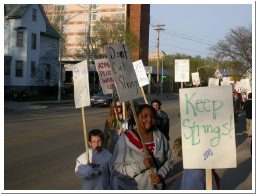 |  |
Newsletter signup | Send us your ideas
April 29, 2004
Parent Comments on Strings Program
"The strings program has been very valuable to my son. It has built up his confidence, and the musical performances have really shown him how his hard work pays off. Strings are an asset to his education that benefits him beyond the musical arena."
"Why are we spending time on pennies, when there are much larger issues at play?"[ 58K PDF Version]"Curriculum: Lack of any sort of strategic & tactical planning (Rainwater's comment about the potential need for new schools and a 2005 referendum.... - might be so, but how does this fit into any sort of a long-term educational plan and the overall costs for that plan)?"
"How are we going to pay for our plans? I think the property tax has largely run it's course? Low income achievement.....positive opportunity."
"My son is in the 4th grade strings program. Last year he had no interest in playing an instrument at all. After his teacher gave the demonstration class, he came home and handed me the sign up sheet and said "I want to play the cello, fill this out". He has really enjoyed playing this year, he has learned a lot about music and I think it has helped with his self esteem. He is a sports kid and I never thought he would take up an instrument, let alone a string instrument. I was amazed to see what the strings program has done when I attended the Strings Festival and saw the West High Gym filled with 600 kids from all the schools. I saw so many children that I would never have thought would be interested in playing an instrument, looking so proud of themselves. It would be a terrible waste and a great shame to cut money from a program that is reaching so many children who have so little to look forward to."
"I don't have anything profound to say, but something that happened in our house recently is a testimonial to the strings program."
"Our 11 year old son, who started strings in 4th grade recently asked his piano teacher if he could play a viola solo at his piano recital. She said yes, and as a result, he not only prepared his piano pieces, he also learned Vivaldi's "Spring" on viola. For a boy who can't seem to accomplish getting his dirty socks in the hamper, initiating and completing this goal is a big deal:-)"
"The 4th and 5th grade strings programs have meant a great deal to our son and to our family. I believe exposure to this wonderful musical opportunity helps to define our schools as excellent vs. just mediocre. It is especially important to provide this opportunity to the many children that could not possibly find the funds or means for private lessons. I believe musical education can open doors for children, broaden their horizons, touch and spark creativity that can lead to other successes. Musical education has documented positive impact on math skills as well. Trends in education caused by wrongheaded government management along with funding constraints are pushing schools toward rote learning for improved standardized test scores. This can only diminish the overall learning experience for our children and society as a whole. I strongly encourage the board to find a solution that will preserve the elementary strings program."
"Two thoughts leap to mind. First, I want Madison to have excellent public schools, not schools which provide only the barest basics. Music instruction at all levels is part of the excellence Madison should offer. A district without an elementary instrumental program is saying it is not an excellent school system. If Madison wants to declare loud and clear that excellence is not a priority, the schools will quickly get much worse, a self-fulfilling prophecy.""Second, for my own kids I could live without school strings, because my children get private music instruction from a young age. But for many children, especially for children of poverty whom the district claims it wants to serve, the chance to study a string instrument in school opens the door to a whole cultural world which may otherwise be shut to these children forever, and to a challenge which they can meet individually and learn about their own abilities. That is what school is supposed to be for."
"I expect the girls will want to add some thought. I told them about this issue on the way to school and their responses were on the order of, "That makes me so mad! That is just *idiotic*!" We may have to tone down the language a little. : )"
Newsletter signup | Send us your ideas
Strings Community Action
A. Introduction:
There's no need for community action if the MMSD Administration and BOE state support for the current elementary strings academic curriculum. They don't. When the Board members don't say yes, it means no, given their recent history with this curriculum.
The MMSD Board of Education adopted and approved the elementary strings program as a necessary component of its Music Education Curriculum in the late 1980s. Standards and benchmarks were added in the late 1990s. The BOE has neither discussed nor changed its decisions on this curriculum.
The recent treatment of the elementary strings curriculum is another example of what happens when our BOE is lacking Long Range Plans for curriculum, for funding and for letting the Administration call the shots for kids rather than the BOE.
B. Background:
For the 2 previous MMSD budget cycles, the District Administration has used various approaches to try to eliminate the 4-5th grade strings academic curriculum.
- Spring 2002 - included elimination of Grade 4 strings on cut list - at least this approach gave parents, teachers and the community notice - opportunity to propose ideas for alternative funding, etc. There was no follow up by the Administration during the 2002-2003 school year.
- Spring 2003 - after waiting until BOE completed its budget amendments, the District administration proposed a huge fee for families (a fee so large that the BOE would have cut the program rather than charge the fee). The District Administration and the BOE did not use this interim academic year (2003-2004) to engage the community and to seek alternative options or funding by foundations, different fee structure, etc
- Spring 2004 – There is no Administration proposal to cut the elementary strings curriculum, but Board President Bill Keys has asked the District Administration for the kind of information that would justify elimination of the program.
I directly asked Mr. Keys and all of the other Board members during public appearances at the Board meeting on Monday night, April 26th, whether a cut proposal was coming – I did not get an answer. Based upon the Board’s lack of response, a rally was discussed among parents, teachers and community members. The decision to share the information and to take action on Monday, May 3, 2004 was decided.
C. Concerns/Issues:
- It was irresponsible and unfair of Mr. Keys to singularly identify this curriculum/activity without applying the same request to all district activities. It is unclear what criteria were used in the analysis the School Board received and if the same criteria have been applied to other activities/curricula. I prepared a critique of the District Administration’s analysis, which was given to the Board on Monday, April 26th.
- The District Administration said that eliminating this academic curriculum would save 5% of the needed budget cut. What does that mean out of context of educational goals and objectives for the district, etc.?
- Why doesn’t the district have a comprehensive set of criteria to use for a cost analysis which is applied to ALL programs, curricula and activities? The board does not have an understanding and agreement about what is curriculum, what an extra-curricular activity is and what a co-curricular activity is.
Upon determining the base-line costs of all activities, then an equitable decision framework can developed as to how and to what degree such activities can/should be funded on an equitable basis across the total list. It’s not okay simply to say sports yes, elementary strings no. Attached is a proposal for equitable funding prepared by Don Severson.
- It’s not okay to eliminate a valued Board approved academic subject that is in high demand (more than 50% of 4th and 5th graders – about 1900 kids in September) by many students who cannot afford to study privately. Each year the demand from minority and low income students increases.
Why does the School Board continue to consider cutting an academic curriculum that is part of a Board approved curriculum that has standards and benchmarks in place? Why would the School Board want to dumb down its curriculum two years? (Current 12th graders in strings would have two years fewer of study.) Colleges often look to a student’s sports and music accomplishments in addition to core academics.
- What are the motivations of board members to identify “lightening rods” of selective programs for parents, teachers, and the public to ‘fight’ against each other to ‘save’ whatever program/activity? Our excellent school system demands that we work together to problem solve the issues facing us.
- Why isn’t the Administration and the School Board working with the community?
Newsletter signup | Send us your ideas
April 28, 2004
Elementary Strings - Call to Action
Who: Students, Parents, Teachers and Citizens – Elementary Strings Kids Need Your Help!
What: Rally in Support of the Elementary Strings Program – Grades 4 & 5.
When: Monday, May 3, 2004 – Meet at 6:30 p.m. to organize/picket before the 7:15 p.m.regular School Board Meeting and personal appearances. String teachers will organize children who bring their string instruments to play a couple of songs from the spring string festival.
Where: Doyle Building McDaniels Auditorium at 545 W. Dayton Street.
Why: To let the MMSD School Board know that we do not want to see elementary strings added to the cut list this year. No assessment of the cut’s curriculum impact has been made.
On March 21, Board President Bill Keys asked the Administration to prepare an analysisof the cost of the elementary strings program. The Administration’s analysis, which was released only last Thursday, April 22, was very biased, incorrect and unfavorable toward thecurriculum and proposed a $493 fee to cover the full cost of the program – no other activity has a 100% fee! Blatant, inequitable treatment – not fair to kids or Madison!
There is a chance the elementary strings program could be put on the cut list by School Boardmembers, and the May 3rd rally at the auditorium is to let the School Board hear from the public in a loud unison voice - NO.
Time is of the essence. Budget decisions will be made very soon. Here’s the budget timeline:
- May 3 – Budget workshop before the 7:15 p.m. regular school board meeting. Further review of the proposed 2004-2005 budget.
- May 5 – Board member amendments to the MMSD Administration budget cut list to be submitted. At this time a School Board member could recommend including elementary strings (4th and 5th grade) on the cut list.
- May 10 – Board budget workshop to discuss and vote on Board member proposed amendments. Four votes are needed to include/exclude an item from the budget cut list
- May 13 – Public Hearing on the Budget at 7 p.m. in the McDaniels Auditorium.
- May 17 – Board budget workshop – determine personnel layoffs.
Come to the rally and let your voice be heard. Tell others. Call Board members. E-mail the Board: comments@madison.k12.wi.us.
"Never doubt that a small group of thoughtful, committed citizens can change the world; indeed, it's the only thing that ever has." Margaret Mead
PDF Version (print/distribute) 40K
Newsletter signup | Send us your ideas