| School Information System |
 | Sponsorships | Sponsorships |
|
|
IN THE WEE HOURS OF THE MORNING last Halloween, Maria Devlin and her mother, Donna, were both wide awake in their apartment in Bronxville, N.Y., scanning an essay that shared Maria’s most profound thoughts on “one or two of her principal intellectual interests.” The buzz from what had become, of late, a 10 p.m. ritual hot chocolate — part soothing balm, part energizing caffeine — had come and gone. Now they were struggling to focus on proofreading that essay as well as some other college application forms due to be mailed the next day. On photocopied pages, they practiced squeezing Maria’s many accomplishments — National Merit finalist, area all-state flutist (honor ensemble), numerous playwriting awards — into the too-small lines scattered throughout the page. Once Maria’s mother found a way to make it all fit, with abbreviations and tiny, neat letters, Maria would commit the list to the official page in clean, precise writing. Around 2 in the morning, a friend sent Maria an e-mail message: What are you doing? Maria told her and fired back the same question. A.P. American history, the friend wrote. Gotcha, wrote Maria. She had already aced her Advanced Placement exams in American history, world history and French, not to mention calculus, a class she took her junior year, one of only four students in her grade at Bronxville High School to do so. It was accomplishments like that, as well as her near-perfect SATs, her near-perfect G.P.A., her in-progress novel and her natural gifts as a studio artist that put Maria, then 17, in line for the scholarship for which she was applying.That night, she was finishing off her application for the Woodruff Scholarship at Emory University in Atlanta, a full ride that would cover room, board and tuition. Other students worried about just getting into a good school; Maria was worried about getting one of those schools to take her in its arms and give her everything she needed and perhaps a little bit more — money for books or maybe funds for summer travel. Her father’s income as a computer programmer placed the family in that awkward spot, comfortable enough that they couldn’t be sure of comprehensive financial aid but so stretched with three kids in a high-tax town that even a generous scholarship, if it was incomplete, would leave them in difficult straits. In applying to a typically competitive school, her classmates were looking at odds like 1 in 4 or maybe 1 in 10. Maria, in shooting for a full merit scholarship, was looking at odds like 1 in 100. More than 2,600 students were nominated by their high schools to apply for Emory’s scholarship program, for example, but only 23 would be chosen for the Woodruff.
Newsletter signup | Send us your ideas
THE release this week of national test scores in reading and math was an embarrassment for the state Department of Education. Scores nationally and in many individual states showed modest gains from 2005 to 2007, but New York did not - even though the Education Department had trumpeted "gains" on its tests just weeks earlier.The federally sponsored National Assessment of Educational Progress (NAEP) is known in the education world as the gold standard of testing. In 2002, Congress authorized NAEP testing in every state to serve as a check of the states' own claims about their progress. (Congress rightly worried that individual states would dumb-down tests that they themselves develop and administer.)
Just a few months ago, the state Education Department celebrated large gains for eighth-grade students in both reading and math. In May and June, The New York Times ran front-page stories heralding major improvements in the state test scores for eighth-graders: "Eighth Graders Show Big Gain in Reading Test" and "City Students Lead Big Rise on Math Tests."
In grade 8, the Education Department reported, the share of students meeting state reading standards jumped from 49.3 percent to 57 percent - a remarkable single-year rise, especially in a grade where academic performance had stagnated for several years. Similarly, the portion of eighth-graders meeting state math standards jumped from 53.9 percent to 58.8 percent.
These are very impressive gains. Unfortunately, they all failed to show up in the NAEP results (a fact the Times mentioned not on its front page but at the end of a story on page A20).
Newsletter signup | Send us your ideas
The Madison School Board's Performance & Achievement Committee met Monday evening. Topics discussed included:
Newsletter signup | Send us your ideas
"Be true to your school" could be the motto of a challenge the Foundation for Madison's Public Schools has issued to friends and supporters of public education here.Local entrepreneur John Taylor provided a $250K "Challenge Grant" in December, 2003. It would be interesting to add his perspective to the the conversation. Clusty Search on John Taylor.According to Martha Vukelich-Austin, foundation president, it's taken less than 10 months for over half the schools in Madison to meet a challenge grant aimed at helping build individual endowments at every local elementary, middle and high school in the city.
The foundation is an independent, nonprofit community group that raises money to help support public education in Madison.
The grant promises to match every dollar raised at each individual school with 50 cents from the Madison Community Foundation -- which manages the funds for the Foundation for Madison Public Schools -- up to $3,750 at each of 48 schools. Pledges totalling up to $180,000 will yield an extra $90,000 for the schools, for a total of $270,000 to be divided among 48 schools.
.......
For example, Mendota Elementary School, with one of Madison's highest poverty rates among its students but strong academic scores, had an endowment of $36,745 as of the second week in September. Other elementary schools with impressive endowments include Thoreau, with $54,968, and Shorewood, with $39,047.
East High School has an endowment of $82,944, and tiny Shabazz City High has an endowment of $63,027, compared with West High School's $26,800, Memorial High School's $26,397 and La Follette High School's $13,632.
Among middle schools, Cherokee and Spring Harbor lead the pack with $63,886 and $59,855 respectively.
Newsletter signup | Send us your ideas
With its focus on testing, achievement, accountability and transparency, the No Child Left Behind Act has undoubtedly altered the terms of the education debate in the U.S. But the law, which is set to expire this year, remains seriously flawed, and the Bush administration's weak enforcement of its best provisions argues against renewal.George Miller, the 17-term liberal Democrat from California who chairs the House Education Committee, has issued a reauthorization draft proposal, and his provisions aren't entirely without merit -- he wants performance pay for teachers -- but almost. On balance, his proposals do nothing to close accountability loopholes in NCLB and in most cases would expand them.
Mr. Miller's "multiple measures" provision is a good example. NCLB uses math and reading test scores to determine whether students in a school are making Adequate Yearly Progress (AYP) toward proficiency. Mr. Miller's changes would allow schools to use less rigorous measures -- like social-studies test results, good attendance and dropout rates -- to grade AYP. We've gotten to the point where some consider merely showing up for school to be the equivalent of learning.
The soft bigotry of low expectations is also apparent in Mr. Miller's plan to allow "local assessment" of educational progress. Right now, each state is charged with implementing its own academic norms and applying them uniformly in all school districts. Everyone in Illinois takes the same exam to measure AYP. Under the proposed changes, school districts would be allowed to walk away from state standards and create their own tests. The ability to compare districts would vanish, along with another way for parents to hold schools accountable.
Newsletter signup | Send us your ideas
Despite a new law designed to ban the sale of junk food at California schools, the kiosk at Santa Clara High is stocked with chocolate-chip cookies, the lunch window at Novato High serves up potato chips, and the concession stand at Albany High is doing a booming business in Cheetos.But don't call the food police. All three districts are in compliance with the state law that requires snacks and individual entrees sold on campus to contain fewer calories and less fat and sugar.
It seems that while kids were preparing to go back to school this fall, food manufacturers were busy re-creating their products - shrinking portions, eliminating trans fats and baking instead of frying - to make them meet the requirements of the Food Nutrition Standards Bill by July 1.
The statute is intended to improve students' diets by nudging them into eating a well-rounded healthful lunch. But so far, that goal has proved elusive. Some campuses, such as Piedmont Middle School, appear to be ignoring the regulations altogether. And others let kids make a meal of revamped snack foods.
Newsletter signup | Send us your ideas
Waukesha Forward has published their new newsletter and much of what they said, we agree with-the support the AB447, AB448 and AB449, the call on the union to slow down the rate of growth of teachers' salaries. However, while we appreciate the board's attempt to slow down the administrative salaries, we believe they should have been frozen. If our district adminstrative costs were brought into line with other districts (per position comparison), our district could have saved hundreds of thousands (see WaukeshaForward.org). In addition to slowing down the rate of growth in teacher salaries, we also believe there needs to be changes in the insurance--copays AND contributions to premiums. These are all things that the Waukesha Taxpayers League has supported for a very long time.The slowing real estate market will place more emphasis on "mill rate" increases vs. assessed values.Now that we are coming into tax season, we will give a lesson on how to calculate school taxes. This has been an area of contention we have had with the school district and the way the tax increases get underplayed. Sometimes, the newspaper catches the misreprentation and sometimes they don't.
Newsletter signup | Send us your ideas
Gary Schumacher's future is as wide open as the no-walls classrooms he taught in 30 years ago.His "new adventure" might involve teaching at the college level, which he has dabbled in, or a job in the private sector.
It will likely be somewhere warm.
"I've gotten less tolerant of Wisconsin winters," said Schumacher, who announced last week he would leave his post as Monona Grove superintendent on June 30, with some ideas but no specific plan for what comes next.
Schumacher has been superintendent of Monona Grove since 2000.
"There have been challenging times here, no doubt, but this has been a great experience. It's just time to move on," he said.
School Board President John Kitslaar said the search for a replacement will begin in October. The first step, he said, will be deciding whether to hire a consultant to oversee the process or to handle it in-house.
Newsletter signup | Send us your ideas
In another time, it wouldn’t have been too hard to guess where Frances Harris would have ended up going to college. She has managed to do very well in very difficult circumstances, and she is African-American. Her high school, in the Oak Park neighborhood of Sacramento, was shut down as an irremediable failure the spring before her freshman year, then reopened months later as a charter school. Midway through high school, her father developed heart problems and became an irritable fixture around the home. She also discovered that he was not actually her biological father. That was a man named Leroy who, when her mother took Harris to see him, simply said his name was George and waited for her to leave. In Harris’s senior year, her mother lost her job at a nursing home and the family filed for bankruptcy.Harris somehow stayed focused on teenage life. She earned an A-minus average and she distinguished herself as a debater. Her basketball teammates sometimes teased her for using big words, but they also elected her co-captain. As she led me on a tour of her school and her neighborhood one day this summer, she introduced me around with an assured ease that most adults can’t manage, even if her sentences are peppered with “like,” “you know” and “Oh, my God.” Her bedroom in the bungalow she shares with her parents is a masterpiece of teenage energy, the walls covered with her prom-queen tiara, her purple-and-white basketball jersey (No. 3) and photos of her friends. “The hardest part of high school,” she says, “was to be smart and cool at the same time.” She decided her dream college was the University of California, Los Angeles.
Ten or 20 years ago, Frances Harris almost certainly would have been admitted. Her excellent grades might not have even been necessary, because Berkeley and U.C.L.A. — the jewels in the U.C. system — accepted almost all of the African-Americans who met the basic application requirements. To an admissions officer, Harris would have seemed like gold: diversity and achievement, wrapped up in a single kid.
Newsletter signup | Send us your ideas
Madison residents met Thursday night to share ideas and concerns about the future of area schools.A district-wide community roundtable tackled issues dealing with budget cuts, school closures, and school board leadership.
Residents from all over the city also discussed statewide education funding reform, keeping neighborhood schools open and improving the overall budget process.
Organizers said the roundtable helps stimulate new ideas and make current ones stronger."Even people who think they know each other and know each other's points of view, when they really sit down and talk, they realize, 'Oh, I didn't know that about you. I didn't know you shared that concern,'" said Rebecca Kemble, co-chair of the East Attendance Area PTO.
A district-wide forum with the Madison School Board is set for Oct. 21 at 3 p.m. at the University of Wisconsin-Madison Memorial Union.
Newsletter signup | Send us your ideas
Don Becker finds it odd and annoying that in a time of dwindling resources and a beleaguered budget he's had trouble giving money to Madison's public schools.It's not that he hasn't tried, and hasn't been successful in the past, at providing help to a number of schools on items ranging from books to bus rides to practice shirts for girls' athletic teams.
But when it came to signing a check for $2,500 last year to buy updated atlases for classrooms at Muir Elementary School, Becker's money disappeared into a bureaucratic hole at the Doyle Administration Building for months on end. When he tried to follow up on what happened to his donation, he said he was given several different explanations for the delay in purchasing the books.
The bottom line was that when his wife went back this fall to volunteer in her favorite classroom, there was still no sign of the atlases.
Last week, in frustration, Becker called Rand-McNally, the publisher, and bought the atlases himself at what he says is a better price than the district had negotiated. Then he asked for his money back.
According to Becker, he was initially told by Steve Hartley, the district's chief of staff, that although he would get his donation returned, the district would not provide its sales tax certificate number to Rand-McNally so that the $127 tax charged to Becker for the purchase of the atlases could be reimbursed.
Newsletter signup | Send us your ideas
Jessica Blanchard & Casey McNerthney:
King County prosecutors on Wednesday charged two Seattle teenagers in a sexual assault on a developmentally disabled female classmate in a Rainier Beach High School restroom in June -- an incident that school officials never reported to police.Related:A Seattle P-I review of police and Seattle Public Schools records shows that case isn't the only likely crime that wasn't reported to police. While a majority of incidents on school campuses were recorded into the district's safety and security logs and reported to police if necessary, some incidents weren't -- including cases of assaults and strong-arm robberies.
In a few cases, parents or victims say school officials urged them not to report the crimes to police at all.
Pegi McEvoy, who recently took over as interim manger of Seattle schools' safety and security department, acknowledged that the district had a "fragmented" system for documenting and tracking alleged crimes on campuses. This fall, though, district security specialists began filing their reports electronically -- one of a handful of changes intended to streamline and strengthen the reporting process, she said.
Newsletter signup | Send us your ideas
Among my many private worries as a parent, I've wondered if I hover too much. New research on helicopter parents confirms it: I am one.I have plenty of company. An estimated 40% to 60% of college parents qualify as helicopter parents, and they come from all socioeconomic groups, based on a thought-provoking study of 75 officials, professors and staff at 15 universities. The study, which is drawing attention on campuses, moves the helicopter-parent debate onto new ground by identifying types of parental hovercraft, ranging from benign to pathological.
There's room to disagree on the boundaries of healthy parental involvement with college-age students, the focus of the research. Nevertheless, I found the typology a helpful lens for sizing up my parenting. If you're wondering where you stand, here are a few of the most distinct types:
Newsletter signup | Send us your ideas
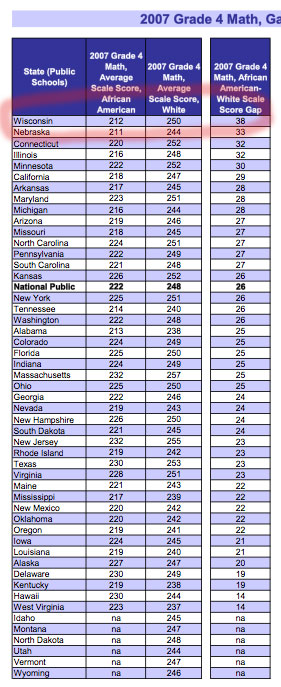
| NAEP Fourth Grade Mathematics | |||
| Whites | 1992 | 2007 | |
| Wisconsin | 233 | 250 | |
| Ohio | 222 | 250 | Ohio gained 11 points on Wisconsin |
| Blacks | 1992 | 2007 | |
| Wisconsin | 195 | 212 | |
| Ohio | 194 | 225 | Ohio gained 14 points on Wisconsin |
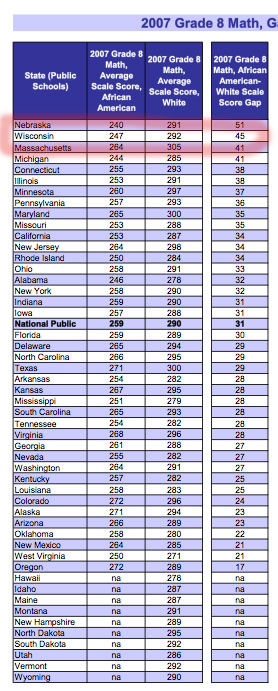
| NAEP Eighth Grade Mathematics | |||
| Whites | 1990 | 2007 | |
| Wisconsin | 279 | 292 | |
| Ohio | 268 | 291 | Ohio gained 10 points on Wisconsin |
| Blacks | 1990 | 2007 | |
| Wisconsin | 236 | 247 | |
| Ohio | 233 | 258 | Ohio gained 14 points on Wisconsin |
Newsletter signup | Send us your ideas
Ho-hum: Another study suggesting good results from school choice in Milwaukee, not that it will make much of a dent with the opposition.This tells you something about the opposition.
The latest study links the ability of poor parents to take state aid to religious schools to improvements at Milwaukee Public Schools.
Researcher Rajashri Chakrabarti found that while school choice showed little effect on MPS early on, it showed a much bigger effect after key changes in late 1990s: The Wisconsin Supreme Court cleared the way for religious schools to take part, greatly increasing the options, and changes in funding made MPS feel the loss of students more keenly.
Math, language arts and reading scores at Milwaukee's public schools showed more improvement after new competition came into the picture, says Chakrabarti. Scores improved more at schools that were more subject to competition - schools where a greater proportion of students were poor and could use a voucher if their parents chose. This shows the improvements weren't driven by other changes in MPS, such as new leadership. It was the increased competition, she says.
It's plain to Fuller, a former MPS superintendent, that choice helps public schools, too. "It gives a superintendent leverage," he says. While there are many in MPS who try improving schools out of professionalism, there are some teachers and administrators who resist reform. Competition strengthens the reformers' hand.
Newsletter signup | Send us your ideas
Sara Mead and Andrew J. Rotherham, two of my favorite educational researchers, have inspired me to save the charter school movement with five brilliant if perhaps too far-sighted suggestions for reform.The complete report is available here: Education Sector Reports: Charter School SeriesThe Washington-based think tank Education Sector www.educationsector.org has just published their paper, "A Sum Greater Than the Parts: What States Can Teach Each Other About Charter Schooling." They may be horrified by what I have done with their facts and insights, but I think my ideas will push charters in the right direction -- more good ones and fewer bad ones.
In theory, charter schools are a great idea. There are now more than 4,000 of them with more than 1 million students in 40 states and the District. These independent public schools give smart educators with fresh ideas a chance to show what they can do without the deadening hand of the local school system bureaucracy around their necks. They also give public school parents more choice. The problem is, as one former state charter school official told me, there are a lot of loons out there starting charter schools. We don't seem to be able to get rid of their loony schools as easily as the original advocates of charter schools promised. That is one reason why charter schools, despite including some of the best public schools I have ever seen, do no better on average than regular public schools in raising student achievement.
Here are my suggestions for fixing that situation, based largely on what I learned from Mead and Rotherham:
1. Stop letting local school boards authorize charters. Mead, a senior research fellow at the New America Foundation, and Rotherham, co-director of Education Sector and a member of the Virginia Board of Education, used a grant from the Annie E.Casey Foundation to analyze reports they oversaw on charter schools in California, Minnesota, Arizona, Ohio, Texas, Colorado, Florida and Michigan and four cities: New York, Indianapolis, Chicago and the District. They conclude that "perhaps the most significant lesson of the charter school movement to date" is that the number and quality of charter schools depend on who does the authorizing and how well they do it. State school boards, universities and independent bodies like the D.C. Public Charter School Board appear to do a better job of authorizing charters than local school boards, which see charters as competition for students, funds and prestige. California, Colorado and Florida have built strong charter systems with local school boards as the prime authorizers, but only by creating alternative authorizers for charter proposals that get turned down by local school boards.
Newsletter signup | Send us your ideas
Rebecca Kremble: [Additional Links & Background here]
Last week, the consultants hired to organize the superintendent search conducted 31 hour-long individual and focus group sessions to gather information from concerned citizens and stakeholders about the strengths and challenges of the Madison School District, as well as characteristics we would like to see in the next superintendent.I attended three of these sessions -- two general community sessions and the Parent-Teacher Organization representatives ' focus group.
Many different opinions were expressed on a broad array of topics, but in each there was widespread agreement about two issues: the need for a more transparent budget process and the vastly underused resource of potential partnerships with parents, businesses and community members who are willing to participate in the creation of a thriving public education system that benefits all of our students.
Many people also expressed the perception that the School Board is powerless in relation to the administration. This perception is fueled by the fact that the board as a whole is actually not connected to its source of power (the residents of the district) in any broad-based, comprehensive way.
It is time for concerned citizens to find common ground on district-wide issues so that we can give the board the support it needs to make principled, proactive decisions about the future of our schools, instead of making decisions that falsely pit schools against each other or that divide taxpayers who have children in public schools from those who do not.
The district is at a point of great opportunity with the promise of a new superintendent, the pressures of a possible referendum, and a School Board that seems willing to engage the public in productive dialogue based on shared concerns rather than divisive ones. (At its planning meeting with the search consultants, the board requested that the written surveys be returned to them so that they could use the input for planning purposes not connected with the superintendent search.)
Over the summer, the Northside Planning Council and the East Attendance Area PTO Coalition have conducted a house meeting campaign to discuss residents ' concerns about and hopes for the district.We have had more than 20 house meetings on the North and East sides of town. In an attempt to reach out to the rest of the community, we will be host to a community roundtable at 6:30 p.m. on Thursday at the Madison Senior Center, 330 W. Mifflin.
We invite anybody who wishes to contribute to this process to join us. We will break into small groups, share personal stories and concerns about how the Madison School District operates, and tease out common themes.
In a public meeting on Oct. 21, we will share the results of the house meetings and roundtable with board member and ask them to act upon the specific issues that we will have identified.
We hope this campaign will be the first step in shifting the relationship between the community and the School Board away from reactive, crisis-driven involvement, toward mutually satisfying, cooperative efforts that benefit the most underused resource in our district -- the creative genius of each and every one of our children.
Kemble is co-chairperson of the East Attendance Area PTO Coalition.
Newsletter signup | Send us your ideas
From a story by Alan J. Borsuk in the Milwaukee Journal Sentinel:
The average reading ability for fourth- and eighth-grade black students in Wisconsin is the lowest of any state, and the reading achievement gap between black students and white students in Wisconsin continues to be the worst in the nation.Those are among the facts found in a mass of testing results released Tuesday by the U.S. Department of Education, the latest results from a long-standing federal program called the National Assessment of Education Progress. It is the closest thing to a nationwide standardized testing program for reading and math ability.
The gap between blacks and whites was worse in Wisconsin than, say, Louisiana? Yes.
The average score for black fourth-graders in reading was lower than, say, Washington, D.C., or Alabama? Yes.
Newsletter signup | Send us your ideas
I asked all 140 of my eighth-grade students to divide 10 by 2. Just eight of them wrote down 5.I knew my students would need remedial work, but I had no idea it would be to this extent. One of the first standards for eighth-grade physical science is manipulating this equation: speed equals distance divided by time (S = D/T). This is a foundation for upper-level skills in physical science. Next come velocity, acceleration, and gravity. I knew that many of my eighth-grade students would have trouble converting fractions into decimals, but I never fathomed that 10 divided by 2 would give so many of them trouble.
They made comments such as, “Mr. Chapman, this is science class, not math class. I hate math.” Almost half of the first periodic assessment given in November will be based on division, multiplication, and addition to solve for a scientific term. Division remedial work was a must.
Newsletter signup | Send us your ideas
Maria Allen worried about her son Matthew's prospects in high school and beyond. He had always been regarded as an underachiever by his teachers. He received B's in middle school with virtually no effort because he did well on what were, she thought, very easy tests.Every new school year, the Reston mother donned her Super Nag persona, got on his case and tried to turn around his bad habits and attitude. It never worked. By the second quarter, whenever her attention turned to other matters, he stopped working, and his teachers started complaining.
So she was more than a little surprised when Matthew asked if he could take an Advanced Placement biology course online at the beginning of eighth grade, when he was only 14 years old. She knew where he got the idea. His big brother, a high school junior, had signed up for online AP biology so he would have time for other courses during the school day. She laughed. Good joke, Matthew. But he brought it up again. He was serious. Even when she showed him the demanding syllabus on the Web site apexlearning.com, he did not back down.
Well, she thought, why not? Her Super Nag act had not worked. She paid the $600 course fee and waited, without much hope, to see what would happen next.
"Matthew continued to put negligible effort into his middle-school work," Allen told me, "but in biology, he started to work hard, very hard, in fact. And, even more remarkably, he continued to work hard throughout the year."
She said he took a full complement of eighth-grade honors courses, but they demanded very little. "Unencumbered by any significant homework," she said, "Matt had plenty of time available to log on to AP bio for a few hours each evening, and so he often did better on AP quizzes and assignments than my high school junior, who was always swamped with homework and competing deadlines from several other challenging courses."
Newsletter signup | Send us your ideas
ifty years ago today, riot-trained troops from the 101st Airborne Division escorted nine black students through the doors of Central High School in Little Rock. Just 48 hours earlier, President Eisenhower deployed--in a single day--1,000 troops to restore order and to reassert federal authority in Arkansas's capital city.For weeks the entire nation had watched on television as a mob of angry white adults gathered each morning to prevent the nine black students from integrating Central High. It would come to be remembered as one of the ugliest and meanest white mobs of the entire civil rights era. And because of television--then still a very new medium--the horrible images of people galvanized by ferocious racial hatred were seared into the national consciousness.
Finally, Arkansas Gov. Orval Faubus succumbed to a kind of madness, if not to a perverse politics of racial hatred, and withdrew the National Guard from Central High, effectively turning the school over to the raging mob. The nine courageous black students, who had suffered so much to integrate the school, were withdrawn for their own protection. So, for a time, the authority of the mob prevailed over all governmental authority--local, state and federal. And this was the provocation that pushed a reluctant President Eisenhower to deploy federal troops.
Newsletter signup | Send us your ideas
Susan Troller
The Capital Times
September 25, 2007
Football coach Barry Switzer's famous quote, "Some people are born on third base and go through life thinking they hit a triple," could easily apply to schools and school districts that take credit for students who enter school with every advantage and continue as high achievers all along.
But how do you fairly judge the job that teachers, schools and districts with many children who have significant obstacles -- obstacles like poverty, low parental expectations, illness and disability or lack of English proficiency -- are doing? Likewise, how do you make certain that your top students are adding growth every year as they go through school, rather than just coasting toward some average or proficient standard?
Those kinds of complex questions are at the heart of a discussion that the Madison School Board will be having over the next several months.
At its Performance and Achievement Committee meeting Monday night, the Madison district began taking its first steps toward developing what's called a value-added assessment system for measuring the growth of its students year by year.
It would add demographic data about every student as it charts his or her performance on the Wisconsin Knowledge and Concepts Exam, which is administered every fall in grades 3 through 8, and in 10th grade.
The WKCE test is the basis for determining how well public schools in Wisconsin are meeting the requirements of the federal government's No Child Left Behind legislation.
This kind of system is being used in other larger districts, including Milwaukee, committee chair Lawrie Kobza said.
If the blueprint for the assessment system -- based on the actual academic growth of students in 3rd through 8th grades in reading and math -- is implemented, it would supplement the way student achievement in Madison is measured by factoring in a number of external factors including income, mobility, parent education levels, the number of adults in the household, ethnicity, English language proficiency, gender and special education status.
The resulting data would allow the board, the administration, the staff and the community to see what kind of teaching methods are working, or not working, for individual students, and for groups of students.
"We're looking at a much finer analysis of how our children are performing," Rainwater said at Monday night's meeting.
In addition, he said, the value-added assessment system would provide a much more nuanced look at how each school is performing, recognizing both the potential assets and obstacles students are bringing to their academic experience.
"I think the growth model is absolutely the right path to follow, and a critical way to measure our progress," Kobza said in an interview today.
"Regardless of where you start in school, you're expected to make progress. If you're at the high end, it's not good enough to coast," she said. And she added that kids who start lower are also expected to make significant, regular improvement.
The use of the growth-based model would be done in conjunction with a refinement of the Madison district's goals, which include all students reading at or above grade level in 3rd grade and all students completing algebra by the end of 9th grade and geometry by the end of 10th grade.
"I think this change is critical. Our existing goals have served us very well for a number of years but they are static measurements," Kobza explained. "This would really allow us to look at goals that are applicable each year.
"We'll probably bring our own refinements to how we'd implement this, but overall it's not a brand new thing we're creating," she added.
Newsletter signup | Send us your ideas
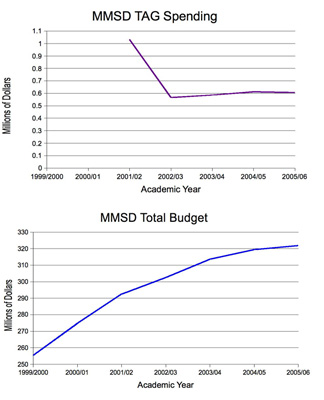
Madison United for Academic Excellence has a meeting this evening:
Out of Level Testing Opens Doors of Opportunity, Midwest Academic Talent Search—MATS)," 7:00 p.m. McDaniels Auditorium, Doyle Administration Building, 545 W. Dayton Street. [Map]This chart presents a useful opportunity to review spending via the handy $339M+ MMSD Citizen's Budget for 2007-2008 (The citizen's budget is one of the work products from Lawrie Kobza's stint on the finance and operations committee this past year).
2007-2008 Student Count: 24,268
Newsletter signup | Send us your ideas
Quick, what's the most influential piece of hardware from the early days of computing? The IBM 360 mainframe? The DEC PDP-1 minicomputer? Maybe earlier computers such as Binac, ENIAC or Univac? Or, going way back to the 1800s, is it the Babbage Difference Engine?More likely, it was a 183-pound aluminum sphere called Sputnik, Russian for "traveling companion." Fifty years ago, on Oct. 4, 1957, radio-transmitted beeps from the first man-made object to orbit the Earth stunned and frightened the U.S., and the country's reaction to the "October surprise" changed computing forever.
Although Sputnik fell from orbit just three months after launch, it marked the beginning of the Space Age, and in the U.S., it produced angst bordering on hysteria. Soon, there was talk of a U.S.-Soviet "missile gap." Then on Dec. 6, 1957, a Vanguard rocket that was to have carried aloft the first U.S. satellite exploded on the launch pad. The press dubbed the Vanguard "Kaputnik," and the public demanded that something be done.
The most immediate "something" was the creation of the Advanced Research Projects Agency (ARPA), a freewheeling Pentagon office created by President Eisenhower on Feb. 7, 1958. Its mission was to "prevent technological surprises," and in those first days, it was heavily weighted toward space programs.
Speaking of surprises, it might surprise some to learn that on the list of people who have most influenced the course of IT -- people with names like von Neumann, Watson, Hopper, Amdahl, Cerf, Gates and Berners-Lee -- appears the name J.C.R. Licklider, the first director of IT research at ARPA.Armed with a big budget, carte blanche from his bosses and an unerring ability to attract bright people, Licklider catalyzed the invention of an astonishing array of IT, from time sharing to computer graphics to microprocessors to the Internet.
Newsletter signup | Send us your ideas
Education is the best investment not only for workers but also for the economy in a time of continuing competitive strain, Federal Reserve Chairman Ben Bernanke said Monday."Education - lifelong education for everyone - from toddlers to workers well advanced in their careers - is indeed an excellent investment for individuals and society as a whole," said Bernanke. He spent most of his professional life as a teacher and is married to one.
Economists have long recognized that the skills of the work force are an important source of economic growth, the Fed chairman said in a speech.
Although the United States has long been a leader in expanding educational opportunities, it also has long grappled with challenges such as troubling high-school dropout rates, particularly for minority and immigrant youths, as well as frustratingly slow and uneven progress in raising test scores, he said.
Newsletter signup | Send us your ideas
Congress has taken up renewal of the No Child Left Behind Act, with a major hearing in the House education committee. Unfortunately, despite little evidence that NCLB has done any good, there's no reason to believe Congress will improve it. After more than a century of industrial-era schooling, policy-makers are still unwilling to do what's necessary and turn public education on its head.NCLB's results have been ambiguous at best. The most positive news has come from the Center on Education Policy, a Washington think tank, which found that scores on state tests have risen under NCLB. But CEP only had usable pre- and post-NCLB scores for 13 states and could do full analyses for only seven.
Nationally representative measures offer worse news: Improvements on National Assessment of Educational Progress math exams have slowed under NCLB, and reading outcomes have either stagnated or declined, depending on the grade.
These outcomes should be no surprise. The federal Institute for Education Sciences recently confirmed that states are in a race to the bottom on standards, setting them as low as possible so they're easy to hit. But that's just symptomatic of a more basic problem: No matter how revolutionary politicians say laws like NCLB are, they always preserve the same institutional structures we've had for more than a century, in which politicians and bureaucrats have all the power, and parents and children have none.
Newsletter signup | Send us your ideas
Researcher: Sadhana Puntambekar
Email puntambekar@education.wisc.edu
Phone: (608) 262-0829
Link to site: www.compassproject.net/info
News context:
Science Magazine: The World of Undergraduate Education
Previous participants include:
Contacts:
Kelly Francour: kfrancou@marinette.k12.wi.us
Dana Gnesdilow: gnesdilow@wisc.edu
Hands-on science lab activities provide students with engaging ways to learn. But sometimes students don't fully learn the concepts behind what they're doing.
A hypertext computer environment being developed and field tested gives students graphical ways to practice learning and relating science concepts like 'force' and 'energy,' for example.
The program, called CoMPASS, helps ensure that hands-on construction activities leads to student understanding of the underlying deep science principles and phenomena.
UW-Madison education professor Sadhana Puntambekar points out that reading, writing, and communicating are an essential part of science instruction.
Research has pointed out the important role of language in science. Yet informational text is seldom used to complement hands-on activities in science classrooms.
This CoMPASS computer environment gives students a graphical, interactive, hypertext 'concept map' to help students visualize concepts and their relations. Navigating these 'concept maps' helps student make connections between abstract concepts, and to select text resources based on the relatedness of the documents to each other.
Eighth-grade students using the CoMPASS 'concept maps' performed better on essay question requiring depth. On a concept mapping test, students using CoMPASS made richer connections between concepts in their own maps (6th and 8th grades)
The CoMPASS environment helps teachers, too. It gives them another way to observe how well students learn.
The system is being used in inquiry-based curriculum units in sixth and eighth grade science classes. To date, CoMPASS has been used by over 1000 students in sixth and eighth grades in Wisconsin and Connecticut.
The CoMPASS project gives students better ways to find information related to their goals. The CoMPASS 'concept map' interface helps students navigate and learn using digital resources (illustration). A 'fisheye' view zooms in and out to help students clarify relationships between science concepts.
Middle school science teachers in and around Madison sign up for training and field testing CoMPASS because they get experience in teaching combined hands-on science with conceptual text-based support materials.
Participating in the project gives teachers more experience in curriculum design.
Teachers get more experience helping students establish connections between the questions students asked and the design challenge they were working on.
Teachers get more experience helping students connect new topics to their prior knowledge, and more experience in facilitating whole-class and small-group discussions.
Teachers can add to their resume that they've participated in a National Science Foundation-funded project.
Teachers who engage in the project receive support through the school year from graduate assistants with training in psychology, computer sciences, cognitive and learning sciences, or physics education.
Participating teacher Kelly Francour says that working with the project has made her focused on the best teaching practices. She uses inquiry-based instruction, and participating in the project has given her more strategies to use in the classroom. She says she now asks more higher-level-thinking questions during instruction.
Participating teacher Dana Gnesdilow says participating in the project has been worth the effort. 'There's a variety of benefits, including a huge amount of student engagement,' she says. 'Students like CoMPASS because it's hands-on and minds-on. Students take control of their own learning. It's a student-centered environment.' She says that benefits to teachers include professional development and a growing sense of confidence in 'teaching through inquiry.' Gnesdilow says, 'Teachers gain more content knowledge. Students have great questions and we explored their questions together.'
Name Paul Baker
E-mail: pbaker@wisc.edu
Telephone 608 263 8814
Newsletter signup | Send us your ideas
For about seven minutes after the bell sounds the end of the school day at Thoreau elementary, chaos rules.Children tumble out of the school in gleeful disorder and parents arrive to pick them up by car, foot or bike - all while traffic whizzes past on busy Nakoma Road.
At Thoreau, some parents park directly across from the school where they must make the treacherous journey across Nakoma, often with little ones in tow, without a crosswalk nearby.
"It's very frightening," said Thoreau Principal Elizabeth Fritz, "because the drivers of the cars aren't as careful as one would hope."
Newsletter signup | Send us your ideas
Ground will be broken this fall on a two-story 20-unit apartment community to go with the 40 units already standing on a surplus school property in Santa Clara. The groundbreaker is Paul Perotti, 58, former superintendent, and the housing is for teachers."I was superintendent of the Santa Clara Unified School District here from 1994 to 2005. I had this idea in about 1999.
At first my thought was 'well, everybody is talking about the high cost of living in this valley and there was an exodus of teachers migrating to the Central Valley. You could afford to live there. A lot of teachers were getting hired by us, getting trained and then leaving.
I wasted six months meeting with federal agencies in housing, local people in government, state people. If I played totally by their rules I didn't feel I could do what I needed to do. There were tons of restrictions. I decided to forget all that. Let's start thinking as if we're Intel and we're going to build a big new facility in Santa Clara, and we have no restrictions. The first thing was 'what's it going to cost us?' It was about $5.6 million. The land is free. The deal was it wouldn't cost the school district $1. We're going to pay for it with rent money.
I didn't want to do it unless we could charge 50 percent or less of the current market rate . Otherwise it wasn't significant. We did the numbers, checked them 100 times. We came up with $635 a month for a one-bedroom, when the going rate was $1,800. Our two-bedroom started out at $990 when they were going for $2,500.
Newsletter signup | Send us your ideas
Nearly a decade after the School District started shifting its pay scale to emphasize education over experience, about one-third of Waukesha teachers are at the top of the school system's salary schedule.More at the Waukesha Taxpayer's League.More than 300 of 960 district teachers made $70,507 in 2006-'07, the highest salary available to teachers and other certified staff without picking up extra duties.
District officials are careful to point out that the compressed salary schedule, in which teachers can earn large pay boosts for reaching certain benchmarks in graduate and post-graduate education, doesn't cost the district more than a traditional schedule that pays based on a mixture of experience and education.
But because many of the teachers earning top pay also have seniority privileges protecting them from layoffs, the top-loaded pay system could cause problems as the district looks to more staff cuts to balance its budgets.
Newsletter signup | Send us your ideas
Dedicated to everything from architecture to sports medicine, "career academies" claim to offer high school kids focus, relevancy, and solid job prospects. Now add a new kind of program to the list: homeland security high. In late August, Maryland's Joppatowne High School became the first school in the country dedicated to churning out would-be Jack Bauers. The 75 students in the Homeland Security and Emergency Preparedness magnet program will study cybersecurity and geospatial intelligence, respond to mock terror attacks, and receive limited security clearances at the nearby Army chemical warfare lab.The new school is funded and guided by a slew of federal, state, and local agencies, not to mention several defense firms. Officials say it will teach kids to understand the "new reality," though they hasten to add that the school isn't focused just on terrorism. School administrators, channeling Cheneyesque secrecy, refused to be interviewed for this story. But it's no secret that the program is seen as a model for the rest of the country, with the Pentagon and other agencies watching closely.
Students will choose one of three specialized tracks: information and communication technology, criminal justice and law enforcement, or "homeland security science." David Volrath, executive director of secondary education for Harford County Public Schools, says the school also hopes to offer "Arabic or some other nontraditional, Third World-type language."
Newsletter signup | Send us your ideas
The Guardian has an extensive list of writers and the rooms in which they write (with photos and descriptions by the authors).
Newsletter signup | Send us your ideas
A generation of experience with racial integration has taught a clear lesson: Sitting black kids next to white kids in school is not a silver bullet that zaps unequal achievement.Much more on Kansas City here.However, the faith that proximity leads to equal achievement remains the cargo cult of education. In June, the U.S. Supreme Court barred school assignments based on race to increase racial diversity. So school leaders immediately began considering economic integration plans instead.
Sit poor kids next to middle-class kids. That should work!
Presidential candidate John Edwards - Mr. Two Americas - has made this the core of his education proposals. He promises "a million housing vouchers" over five years to move poor kids to better schools in the `burbs plus $200 million to create magnet schools that will lure affluent kids to inner-city schools.
The magnet school scheme was tried from 1985 to 1997 in Kansas City, Mo., at a cost of $2billion. To lure suburban white students, Kansas City's inner-city schools were equipped with lavish facilities: Indoor pools, gymnasia, high-tech science labs, computers, etc. But programs designed for the needs and interests of middle-class white suburbanites did not serve inner-city blacks. And few suburban students were willing to commute to city schools for a luxury athletic complex or a classics magnet. Test scores remained dreadful. By 1997, the district actually had a smaller percentage of white students than when the plan started.
Well, what about moving poor kids to better schools?
Newsletter signup | Send us your ideas
In an effort to keep people informed of my activities on the Madison School Board, and to encourage people to participate in school-related activities, I have started a podcast, which I am calling the Maya Cole Schoolcast. You can find it at www.coleschoolcast.org. You can also subscribe to the podcast with iTunes or any other podcast software. You can find it by searching the podcast directory for Maya Cole.
Please feel free to give me your comments and suggestions. This edition includes a discussion with several Madison Alders regarding safe walk to school among other topics.
Newsletter signup | Send us your ideas
And somehow, in a time window one third the size that many adults take for lunch, 215 young children crowd around picnic-style tables, consume chicken nuggets — or whatever they brought from home — and hustle outside to play.Squeezed by tight school budgets, the federal No Child Left Behind law and Wisconsin Department of Public Instruction rules on instructional time, the school lunch period isn't what it used to be in many school districts.
ver the years," said Frank Kelly, food services director of the Madison School District, who estimates that overall, school lunch periods in the district have been trimmed about 10 minutes over the past 10 years.
"I don't think people are going to accept anything less than this."
In fact, in response to complaints from parents four years ago, Madison officials eased the lunch crunch a bit for elementary students by using the last five minutes of the class period before lunch to move students to the cafeteria.
There was talk four years ago of expanding the elementary lunch period to 35 minutes. But the idea was dropped after officials estimated it might cost more than $2 million to pay teachers and lunch supervisors.
"We don't have much flexibility in extending that," said Sue Abplanalp, an assistant superintendent who oversees Madison's elementary schools.
While DPI leaves it up to local officials to determine the length of lunch periods, Madison educators say they believe they attain a decent compromise by giving:
•Elementary students 20 minutes.
•Middle school students 30 to 34 minutes.
•High school students about 35 minutes (except at West High School, where most students get 55 minutes under a plan initiated last year).
Those schedules are typical of what's found around Wisconsin, said Kelly, who has worked in food service for 31 years.
"For most of our people, it works very well," Madison schools Superintendent Art Rainwater said.
Newsletter signup | Send us your ideas
Moving On
Jeff Zaslow
Wall Street Journal
September 20, 2007
Randy Pausch, a Carnegie Mellon University computer-science professor, was about to give a lecture Tuesday afternoon, but before he said a word, he received a standing ovation from 400 students and colleagues.He motioned to them to sit down. "Make me earn it," he said.
What wisdom would we impart to the world if we knew it was our last chance? For Carnegie Mellon professor Randy Pausch, the question isn't rhetorical -- he's dying of cancer. Jeff Zaslow narrates a video on Prof. Pausch's final lecture.They had come to see him give what was billed as his "last lecture." This is a common title for talks on college campuses today. Schools such as Stanford and the University of Alabama have mounted "Last Lecture Series," in which top professors are asked to think deeply about what matters to them and to give hypothetical final talks. For the audience, the question to be mulled is this: What wisdom would we impart to the world if we knew it was our last chance?
It can be an intriguing hour, watching healthy professors consider their demise and ruminate over subjects dear to them. At the University of Northern Iowa, instructor Penny O'Connor recently titled her lecture "Get Over Yourself." At Cornell, Ellis Hanson, who teaches a course titled "Desire," spoke about sex and technology.
At Carnegie Mellon, however, Dr. Pausch's speech was more than just an academic exercise. The 46-year-old father of three has pancreatic cancer and expects to live for just a few months. His lecture, using images on a giant screen, turned out to be a rollicking and riveting journey through the lessons of his life.
He began by showing his CT scans, revealing 10 tumors on his liver. But after that, he talked about living. If anyone expected him to be morose, he said, "I'm sorry to disappoint you." He then dropped to the floor and did one-handed pushups.
[photo]
Randy Pausch and his three children, ages 5, 2 and 1.Clicking through photos of himself as a boy, he talked about his childhood dreams: to win giant stuffed animals at carnivals, to walk in zero gravity, to design Disney rides, to write a World Book entry. By adulthood, he had achieved each goal. As proof, he had students carry out all the huge stuffed animals he'd won in his life, which he gave to audience members. After all, he doesn't need them anymore.
He paid tribute to his techie background. "I've experienced a deathbed conversion," he said, smiling. "I just bought a Macintosh." Flashing his rejection letters on the screen, he talked about setbacks in his career, repeating: "Brick walls are there for a reason. They let us prove how badly we want things." He encouraged us to be patient with others. "Wait long enough, and people will surprise and impress you." After showing photos of his childhood bedroom, decorated with mathematical notations he'd drawn on the walls, he said: "If your kids want to paint their bedrooms, as a favor to me, let 'em do it."
While displaying photos of his bosses and students over the years, he said that helping others fulfill their dreams is even more fun than achieving your own. He talked of requiring his students to create videogames without sex and violence. "You'd be surprised how many 19-year-old boys run out of ideas when you take those possibilities away," he said, but they all rose to the challenge.
He also saluted his parents, who let him make his childhood bedroom his domain, even if his wall etchings hurt the home's resale value. He knew his mom was proud of him when he got his Ph.D, he said, despite how she'd introduce him: "This is my son. He's a doctor, but not the kind who helps people."
He then spoke about his legacy. Considered one of the nation's foremost teachers of videogame and virtual-reality technology, he helped develop "Alice," a Carnegie Mellon software project that allows people to easily create 3-D animations. It had one million downloads in the past year, and usage is expected to soar.
"Like Moses, I get to see the Promised Land, but I don't get to step foot in it," Dr. Pausch said. "That's OK. I will live on in Alice."
Many people have given last speeches without realizing it. The day before he was killed, Martin Luther King Jr. spoke prophetically: "Like anybody, I would like to live a long life. Longevity has its place." He talked of how he had seen the Promised Land, even though "I may not get there with you."
Dr. Pausch's lecture, in the same way, became a call to his colleagues and students to go on without him and do great things. But he was also addressing those closer to his heart.
Near the end of his talk, he had a cake brought out for his wife, whose birthday was the day before. As she cried and they embraced on stage, the audience sang "Happy Birthday," many wiping away their own tears.
Dr. Pausch's speech was taped so his children, ages 5, 2 and 1, can watch it when they're older. His last words in his last lecture were simple: "This was for my kids." Then those of us in the audience rose for one last standing ovation.
Write to Jeffrey Zaslow at jeffrey.zaslow@wsj.com
Newsletter signup | Send us your ideas
As it continues to negotiate contracts with eight employee groups, the School Board has approved health insurance changes and modest salary increases that are expected to reduce overall compensation costs for non-unionized employees this school year.Locally, health care costs [RSS] have been a topic of much discussion and controversy.Other employees will hopefully take note, School Board President William Baumgart said.
"This was a small group of people in comparison to the total district," Baumgart said of the approximately 70 administrators, secretaries and technical staff covered by the settlement. "We feel if we're going to put emphasis on saving money in employee costs, we're going to have to do it at all levels. And this will be the first one."
Under the one-year settlement the School Board approved last week, non-unionized employees will pay higher deductibles, office co-payments and drug costs for their health care. They also will continue to pay 5% of their health insurance premiums.
Salaries will increase by 2% this school year for the pool, except for assistant principals who will receive a 1% pay boost. Overall, the changes are expected to reduce costs for covered employees by 0.63%, or $31,647, less than what the district spent last school year, said Erik Kass, executive director of business services for the district.
Newsletter signup | Send us your ideas
Intercollegiate Studies Institute:
Anita Weier has more, along with Tracey Wong Briggs:
- College Seniors Failed a Basic Test on America's History and Institutions.
- Colleges Stall Student Learning about America.
- America's Most Prestigious Universities Performed the Worst.
- Inadequate College Curriculum Contributes to Failure.
- Greater Learning about America Goes Hand-in-Hand with More Active Citizenship.
Students don't know much about history, and colleges aren't adding enough to their civic literacy, says a report out today.
The study from the non-profit Intercollegiate Studies Institute shows that less than half of college seniors knew that Yorktown was the battle that ended the American Revolution or that NATO was formed to resist Soviet expansion. Overall, freshmen averaged 50.4% on a wide-ranging civic literacy test; seniors averaged 54.2%, both failing scores if translated to grades."One of the things our research demonstrates conclusively is that an increase in what we call civic knowledge almost invariably leads to a use of that knowledge in a beneficial way," says Josiah Bunting, chairman of ISI's National Civic Literacy Board. "This is useful knowledge we are talking about."
Newsletter signup | Send us your ideas
It may not be Cornell '77, but here and just below (part 1) and here and the second video below (part 2) are videos of a speech Michelle Rhee gave the other night discussing the state of affairs in Washington, D.C. that are well worth checking out. If you want the inside view of the challenges there and the ones facing urban schools more generally, you can't do much better than this. I keep hearing how there is nothing to any of these issues reformers keep raising...starting to think maybe I'm being snowed...See also this Richard Whitmire post:The surprise star at last night's launch of the Democrats For Education Reform was Michelle Rhee, the new DC schools chancellor. With her humor and spunk very much intact in spite of smacking repeatedly against what may be the worst-run school central office in the entire country, Rhee regaled a crowd of about 100 national education reformers at the Hotel Washington across from the U.S. Treasury Department with fresh stories from close quarters bureaucratic combat.
Newsletter signup | Send us your ideas
Democrats for Education Reform:
But the times seem to have changed a bit. At Monday's night's DFER DC launch at the Hotel Washington, Jackson seemed to be embracing what I like to call the Anti-Crappy Schools Doctrine. Forget whether a school is a traditional public school, or a charter school, or private school - how do we make sure every kid in America is able to attend a GOOD school?Nearly a decade after the Milwaukee rally, Jackson Jr. was talking about "alarming dropout rates" the dangers of a "monopoly" filled with failing schools, etc. He was suggesting that every American child be entitled to a good public education "or charter education or whatever kind of education we can to produce the kind of Americans that we'll all be proud of in the future."
With the Washington Monument to his left, Jackson Jr. was highlighting the fact that his own parents sought the best for him by sending him to the elite St. Albans Episcopal School in DC as a kid. He talked about "pushing the envelope to make the majority party in this country" approach education with a more open mind.
"We must explore options," Jackson Jr. said. "Every option for every American child so that every child might have the high-quality education they deserve in their lifetime."
"We need more competition in the system."
Newsletter signup | Send us your ideas
A year and a half ago, President Bush proposed the creation of a new federal mathematics effort that would offer millions of dollars in grants to school districts to adopt proven strategies for improving classroom instruction in that subject.Last month, federal lawmakers gave the president what he was looking for—with some differences.
Administration officials had pictured the new program, called Math Now, as being modeled on Reading First, the $1 billion-a-year federal effort that provides money for research-based improvements in reading instruction in the early grades.
But in the end, Congress’ vision differed. Math Now—included as part of a broader piece of legislation to support math and science education and research known as the America COMPETES Act, which Mr. Bush signed into law Aug. 9—is authorized to receive less half the amount the administration had wanted: $95 million a year, not $250 million.
Newsletter signup | Send us your ideas
[Editor’s note: City Comptroller William C. Thompson, Jr. released an audit on Sept. 19 that found that many safety incidents in New York City public schools are not being reported as required under state law. For the 10 large high schools audited, 21 percent of the sampled incidents were not reported, including 14 percent of those incidents deemed serious.]While we know the mayor and the chancellor want schools to be safe, this audit confirms a practice educators and the UFT have complained about for years: the failure to report all school incidents. Now with data driving all education decision-making, this audit couldn’t have come at a more important time.
Newsletter signup | Send us your ideas
Paul Soglin on Why the Prospects for Madison are so Bleak, Part II:
"Struck by the number of residents who said if things don't improve soon, they'll consider moving elsewhere." Good grief. Its been going on for over a decade and really picked up around 2000. The school enrollment figures clearly show that. And go look at the private schools, bulging at the seams, for confirmation.Related: Barb Schrank on "Where have all the Students Gone?":That's OK. This is Madison. All is forgiven. Throw a good party on State Street, recycle a few beer cans, vote to impech Bush-Cheney, and it does not matter that we are losing the city.
Politically correct trumps substance every time.
MMSD Lost 174 Students While the Surrounding School Districts Increased by 1,462 Students Over Four School Years. Revenue Value of 1,462 Students - $13.16 Million Per Year*
Newsletter signup | Send us your ideas
An unprecedented windfall is on the horizon for the city of Madison and Madison School District, promising to relieve some budget pressures and affect major issues such as the city 's hiring of 30 police officers and the School Board 's debate over whether it still needs to ask voters for more money in a referendum.
Under a proposal from Madison Mayor Dave Cieslewicz, the city would receive $3.7 million and the School District would get $5.4 million in money flowing from two fast-developing special taxing districts created years ago by the city. In addition, Dane County and Madison Area Technical College would receive a little less than $1 million apiece.
"It 's significant news, and very good news, for the School District and the city, " Madison Mayor Dave Cieslewicz said Wednesday. "The amount is unprecedented. "
The one-time payouts would occur by the end of next year if the City Council votes to close the two tax incremental financing districts as recommended by city staff members who say the move is necessary under state law.
Newsletter signup | Send us your ideas
According to a NEW STUDY, the Milwaukee Public Schools (MPS) and the Milwaukee Teachers’ Education Association (MTEA) have made great strides in their joint efforts to create a more effective teacher hiring and evaluation model. However, the school system’s current school staffing and teacher transfer practices continue to cause dissatisfaction among many teachers. The study, conducted by The New Teacher Project (TNTP), a national non-profit organization dedicated to the improvement of teacher quality in America’s public schools, indicated that such shortcomings hamper Milwaukee’s efforts to build, support, and retain a high-quality teaching force, especially in its highest-need schools.Alan Borsuk has more.The New Teacher Project’s extensive study was funded by the Joyce Foundation and conducted with the cooperation of both MPS and the MTEA. TNTP staff conducted a briefing for members of the Milwaukee Board of School Directors at last night’s public meeting. The scope of the study included a detailed survey that drew over 2,000 responses from 5,000 MPS teachers, a survey of MPS principals, an in-depth examination of the MTEA contract with MPS, and interviews with school principals and district administrators. The organization’s final analysis shows that:
Newsletter signup | Send us your ideas
STUNG by harsh publicity about fat kids and threatened with lawsuits, the nation’s three largest beverage companies finally got some love last year when they voluntarily agreed to remove sugary drinks from schools.In the place of soda and sugar-laden beverages, Coca-Cola, PepsiCo and Cadbury Schweppes agreed that only water, low-fat milk and 100 percent juice would be offered in elementary and middle schools. In high schools, sports drinks, light juices and diet drinks would also be allowed.
The announcement was brokered by the Alliance for a Healthier Generation, a collaboration of the American Heart Association and the William J. Clinton Foundation, and it was widely praised. Former President Bill Clinton, who attended the press conference, called the decision “courageous.”
“Shrewd” was probably a better word.
Newsletter signup | Send us your ideas
I enjoyed a wonderful 90 minutes at Madison's Cherokee Middle School this evening. The teachers presented course materials and discussed student (and parent) expectations. I particularly appreciated the loudspeaker announcements when it was time to change classrooms and begin a new period. Reminded me of my school days decades ago. Karen Seno runs a great school.
Newsletter signup | Send us your ideas
The public has an opportunitiy to provide input regarding qualities sought for the new Superintendent:
Newsletter signup | Send us your ideas
The decision of Madison School Board member Lawrie Kobza not to seek a second term, while anticipated, is both significant and troubling.Along with veteran Carol Carstensen, who will also step down after next April's election, Kobza is a School Board member who has seriously embraced the difficult work of budgeting.
Since her election three years ago, Kobza has meticulously studied the intricate process by which the school district shapes it complex spending plans. A successful lawyer with a young family and multiple civic responsibilities, she nonetheless has carved time out of her weekly schedule to meet with experts on budgeting at the district's Dayton Street headquarters and with independent analysts.
When Carstensen announced that she was stepping down after serving the better part of two decades on the board, the hope was that Kobza would fill the gap created by the loss of the body's most serious player in the budget process.
That won't happen. Kobza's legitimate frustration with the way the board has operated combined with personal and professional demands to make her decide against seeking re-election.
Newsletter signup | Send us your ideas
A jury will get to decide if a Madison Metropolitan School District employee speaking out about alleged bid-rigging cost her a promotion, a federal judge ruled.Linda Martin had worked in the district's transportation office since 1989, but was passed over in November 2002 for the newly created position of transportation coordinator. A month later, Martin was transferred to the accounting department as her transportation clerk's job was eliminated.
Although the school district contends Martin wasn't qualified for the coordinator's job, that argument is contradicted by the district's interviewing her for the position, according to U.S. District Judge John Shabaz's decision issued Thursday. It also is under dispute whether the district's choice, Jeff Fedler, was more qualified than Martin.
Fedler had worked for a school bus vendor, First Student, formerly Verona Bus, before being recommended in May 2002 by Martin's supervisor, Rene Bremer, for the job Martin was seeking.
Newsletter signup | Send us your ideas
Much of the global boom in spending on schools has been wasted by governments who have poured money into unreformed education systems, a report by the Organisation for Economic Co-Operation and Development said on Tuesday.OECD:Wastage is so great that the results currently achieved by the world's pupils could be achieved with 30 per cent less finance if better teaching techniques were introduced and more efficient ways of running schools developed.
On the other hand, if resource levels were maintained, education systems could improve their results by 22 per cent if all education institutions performed at the same level of efficiency as the world's most efficient schools.
The annual Education at a Glance Report said that of all the 24 countries surveyed the US and Italy were getting the most disappointing results out of their schools despite spending some of the largest amounts on their students.
Australia, Canada and Japan were among the countries that performed more strongly than might have been expected from their level of investment in schools, when the data was corrected to take into account differences in class background.
The US is the second highest spender on educational institutions in the OECD, but only a comparatively small proportion of those resources "reach the classroom”, according to Andreas Schleicher, head of the OECD's education analysis department.
However, the biggest spenders do not get the best outcomes. For example, Korea and the Netherlands have some of the most-able 15 year-olds in the world, according to international tests of their aptitude in maths, science and reading, despite having cumulative education expenditure below the OECD average.
The report said productivity in education has generally declined in recent years "because the quality of schooling has broadly remained constant, while the price of inputs has markedly increased”.
Unlike other professions, the report said, the education sector has not "reinvented itself” to improve outcomes and productivity. Instead, it has remained labour intensive and teachers' salaries tend to rise simply according to length of service and qualifications held.
Other factors responsible for the different outcomes include how many hours teaching pupils receive and the number of layers of management in a school system.
cross OECD countries, governments are seeking policies to make education more effective while searching for additional resources to meet the increasing demand for education.The 2007 edition of Education at a Glance enables countries to see themselves in the light of other countries' performance. It provides a rich, comparable and up-to-date array of indicators on the performance of education systems. The indicators look at who participates in education, what is spent on it and how education systems operate and at the results achieved. The latter includes indicators on a wide range of outcomes, from comparisons of student's performance in key subject areas to the impact of education on earnings and on adults' chances of employment.
The ExcelTM spreadsheets used to create the tables and charts are available via the StatLinks printed in Education at a Glance.
Newsletter signup | Send us your ideas
The 5-4 decision by the U.S. Supreme Court in June to strike down school desegregation plans in Seattle and Louisville has focused public attention on the degree of racial and ethnic integration in the nation's 93,845 public schools. A new analysis of public school enrollment data by the Pew Hispanic Center finds that in the dozen years from 1993-94 to 2005-06, white students became less isolated from minority students while, at the same time, black and Hispanic students became slightly more isolated from white students.Alan Borsuk:These two seemingly contradictory trends stem mainly from the same powerful demographic shift that took place during this period: an increase of more than 55% in the Hispanic slice of the public school population. Latinos in 2005-06 accounted for 19.8% of all public school students, up from 12.7% in 1993-94.
In part because whites now comprise a smaller share of students in the public schools, white students are now more likely to be exposed to minority students. In 1993-94, fully one-third (34%) of all white students attended a nearly all-white school (this report defines a school as "nearly all-white" if fewer than 5% of the students are non-white). By 2005-06, just one in five white students (21%) was attending a nearly all-white school.
Mix two parts population growth (among Latino and African-American students) and one part population decline (white students). Fold in a continuing pattern in which whites, blacks and Latinos generally live separately from each other. Let the mixture steep in a much cooler climate - legal, political and social - toward integrating schools.The Civil Rights Project [192K PDF Report]:This recipe for re-segregation is the subject of two new national studies.
Both say the tide of desegregation that roiled America from the 1950s through the 1970s has turned, and the reduction in racial separation that often came via court order and school bus is being reversed.
But there is a twist: Largely because there are so many more minority students than in the past, fewer whites are going to schools that are all-white or close to it.
At the same time, the numbers of all-minority schools are increasing.
Within several years, for the first time, fewer than half of the nation's kindergarten through 12th-grade students will be white.
This new report released by The Civil Rights Project at UCLA finds that for the first time in three decades, the South is in danger of losing its leadership as the nation's most integrated schools. The report examines the effects of the dual processes of racial transformation and resegregation on the educational opportunity of students, as well as the relationship between race and poverty and its implications in light of the recent Supreme Court decisions. The report concludes with recommendations for school districts.Bruce Murphy has more.
Newsletter signup | Send us your ideas
That may not be the most surprising finding from a report released last week by the Educause Center for Applied Research, the analytical arm of the nonprofit group that promotes effective technology use in higher education. But it certainly provides a jumping-off point for an investigation into how students use information technology in college and how it can be harnessed to improve the learning experience.In at least one central respect, proponents of technology in the classroom are on to something: Most students (60.9 percent) believe it improves their learning.
The changes in technological habits aren’t revolutionary per se, as the authors point out; rather, students are making “evolutionary” gains in access to the Internet for everyday uses, inside the classroom and out. Perhaps the most visible of these changes is the continuing increase in the proportion of students with laptops, which has grown to 73.7 percent of respondents (while an almost-total 98.4 percent own a computer of some kind). More surprisingly, over half of laptop owners don’t bring them to class at all, with about a quarter carrying them to lectures at least once a week.
Newsletter signup | Send us your ideas
Theory" and "experiment" were two ways Waukesha School Board members last week described the district's move to create two schools focused solely on the lower or upper elementary grade levels.But staff in schools already organized around such grade levels describe the model another way: child-focused.
"Really, the whole building kind of revolves around those early learners," said Deb Ristow, principal of Pewaukee Lake Elementary School, which has housed students in kindergarten through third grade since 2002.
Although not as common in southeastern Wisconsin, "grade centers" that serve students for a fraction of their elementary years make up one of every five elementary schools nationwide, according to an analysis by the Educational Research Service. The facilities can be kindergarten-only centers, pre-kindergarten through second- or third-grade buildings or third- through fifth- or sixth-grade schools.
Newsletter signup | Send us your ideas
Valerie Lee and Douglas Ready:
How effective is whole-school high school reform, such as the Schools-Within-Schools (SWS) model? What benefits does it have for students and in which areas does it fall short? This book seeks to answer these questions through the compelling stories of five public high schools that have embraced the SWS method. In order to fully understand the effectiveness of such a system, Valerie Lee and Douglas Ready have delved into every aspect of the reform in these settings, including participants’ reactions, curriculum structures, governance and leadership, and the allocation of students to the schools. The result is a thoughtful look at the SWS model that considers the benefits and problems of implementation, along with issues of equity and access.Erick Robelen:
The idea that many U.S. high schools are too large and impersonal to serve students well has gained considerable credence in research and policy circles.The implementation of "Small Learning Communities" within the current Madison high schools has been rather controversial.But starting over from scratch with thousands of small, stand-alone high schools is also often seen as expensive and impractical. As a result, many districts in recent years have pursued the cheaper option of simply breaking up their large high schools into smaller schools within schools.
A new book tells a cautionary tale about that understudied alternative, training its sights on five high schools examined closely over time. What emerges is largely a story of the differences between theory and reality, of what can go wrong if school officials aren’t careful, and of many missed opportunities to make the most of a smaller learning environment. Probably the single most salient finding of Schools Within Schools: Possibilities and Pitfalls of High School Reform is that the approach led to increased stratification of students by race, academic ability, and socioeconomic status. The authors also describe as surprisingly rare the cases of instructional innovation tied to the smaller structure.
The book says that, typically, the same campuses would have separate academies, or subunits, as the authors call them, ranging from those known to be “full of brains” to others that were deemed “dumping grounds” for weak students.
...........
The authors note that while there has been substantial research on high school size and small schools, “very little research” has specifically evaluated the effectiveness of the schools-within-schools model.
“Similar to many other educational reforms,” the book says, “the SWS reform has been promoted and implemented without a solid base of empirical evidence to support it.”
Amazon: Schools Within Schools
Newsletter signup | Send us your ideas
As students return to school in Virginia, there's something new in their curriculum. Virginia is the first state to require public schools to teach Internet safety.The mandate is in response to concerns about sex offenders and other adults preying on young people they've met through social-networking Web sites such as MySpace. It's one of several steps states are taking to try to protect children and teenagers online.
George Washington High School in Danville, Va., is one of the largest schools in southern Virginia. But there's one thing almost all of its 1,800 students have in common — MySpace pages.
Gene Fishel, an assistant Virginia attorney general, came to the school auditorium to give a lesson about Internet safety — especially on social-networking sites such as MySpace, Facebook, and Xanga that teenagers often use to communicate, and criminals sometimes use to prowl for victims.
Newsletter signup | Send us your ideas
Provide your input here.Wanted: Superintendent for Madison School District, Wisconsin's second-largest school system, responsible for about 24,000 students, 3,700 employees and a $340 million budget.
Pay negotiable. Current superintendent, Art Rainwater, receives a salary of $190,210.
Women and minorities are encouraged to apply. While historical records are incomplete, district observers believe that except for Cheryl Wilhoyte, who served from 1992 to 1998, the superintendents who have served since the position was created in 1855 have been white males.
Newsletter signup | Send us your ideas
"I read a quote from a young lady in New York. She said, 'I don't ever remember taking an exam. They just kept passing me along. I ended up dropping out in the 7th grade. I basically felt nobody cared.'"There was no national requirement to test and measure all students, to make sure everyone knew how to read and write, do basic math. The president told the crowd in Ohio that the United States needs testing; he called it the "right" thing for America.
"I understand taking tests aren't fun," the president quipped. "Too bad. We need to know in America. We need to know whether or not children have got the basic education."
And testing was just the beginning. The more ambitious endeavor: equalize education. To do that, the law set up a new definition of what it means to be a good school. This new definition, adequate yearly progress, or AYP, requires schools to show they're raising test scores among each group of students. Schools can't hide in good averages anymore. They must prove their poor and minority students are passing the tests too. This new definition of what it means to be a good school is having a dramatic impact on everything about education.
Four years after President Bush signed No Child Left Behind, there's a different kind of celebration going on in the media center of Western Guilford High School in Greensboro, North Carolina. The walls are decorated; there are cakes and casseroles on the tables. Veteran English teacher Angela Johnson is calling it quits, abruptly, in the middle of the school year. Students, colleagues and friends from her 30-year career have gathered to say goodbye. Someone hands her a microphone, and she pulls her glasses up onto her nose, the prepared English teacher, ready with a speech.
Newsletter signup | Send us your ideas
When Heather Schaeffer heard she could get free tutoring for her children, she didn't think twice."I said, 'Thank you, God.' Because I didn't read until junior high. My father had to get a second job so I could go to Sylvan," Schaeffer said Wednesday night, as she attended a tutoring provider fair at Northwest Elementary. "I just raced right over."
Last year, Schaeffer had no problems getting her son, Sylvester, and daughter, Gretchen, into the federally funded program, a component of the No Child Left Behind Act. In Pasco County, as nationally, just a small percentage of the children eligible for services actually took advantage.
This year, the number of eligible students has grown along with the generally favorable word of mouth. Schaeffer worries that her kids won't get access to the services that the federal government promises to low-income children who attend schools that don't make adequate yearly academic progress for three or more years.
Newsletter signup | Send us your ideas
Verona elementary school students who participated in the United Way of Dane County-led Schools of Hope tutoring program showed better-than-expected improvement in reading and class-participation last year, according to program organizers who are kicking off a major volunteer recruitment effort this week.
The Schools of Hope program began in 1995 in Madison as a journalism project by the Wisconsin State Journal and WISC-TV (Ch. 3) examining Madison 's public schools, and it grew into a countywide effort to reduce racial disparities in achievement patterns. Schools of Hope provides reading and math tutoring for children from preschool through fifth grade.
In 2005, the program expanded to Sun Prairie, and in 2006, it expanded to four Verona-area schools. There, organizers said two-thirds of the 30 third-grade students who received tutoring for the full year showed significantly greater progress on their Measure of Academic Progress reading tests than anticipated. The MAP is a national nonstandardized test that measures individual academic improvement in students.
Also in 2006, the United Way reported that the percentage of third-grade minority students in participating Madison-area schools who had below-average reading ability had declined from 28.5 percent to 5.5 percent from 1995 to 2005.
According to evaluations from participating Verona schools, 95 percent of school staff felt the program contributed to student success, and all staff expressed a wish to continue to work with volunteer tutors this year.
Such results, coupled with the enthusiasm of teachers, parents and volunteers for the program, has fueled the expansion of the program to almost 30 schools in Madison, Sun Prairie and Verona.
Newsletter signup | Send us your ideas
Madison School Board Vice President Lawrie Kobza announced Monday that she won't seek re-election, and retired teacher Marj Passman immediately jumped into the race to succeed her.Susan Troller:Kobza's move guarantees that the board will gain two new members in the April 1 election.
"I've very much appreciated the opportunity to serve on the School Board, but I have a number of other personal and professional interests which I would like to explore and I just need more time in the week to do so," Kobza wrote in an e-mail to Board President Arlene Silveira, schools Superintendent Art Rainwater and reporters.
Kobza, a lawyer, will leave the board after serving a single three-year term.
Madison School Board Vice President Lawrie Kobza announced this morning that she will not seek re-election in next spring's School Board race.Elected to her first term on the board in 2005, Kobza joins longtime board member Carol Carstensen in announcing that she will not run again.
In an e-mail this morning, Kobza said she has a number of personal and professional interests that she hopes to explore and needs the time to do so.
Two candidates, Marj Passman and Ed Hughes, have announced that they will seek slots on the seven-member School Board.
Newsletter signup | Send us your ideas
At the John D. Shoop Academy on Chicago's South Side, Principal Lisa Moreno ushers students inside for an early breakfast.She greets her uniformed flock, then heads to the playground, where she keeps a close eye on some of the eighth graders who are already testing her staff.
"You just try to make sure that they don't think that they run the school," she says.
Moreno is one of 170 new principals in the Chicago public school system this year. Since 2004, more than 350 of the school system's principals have retired, taking advantage of early retirement incentives. Like Chicago, many other school systems across the country are facing the same turnover, as baby boomer principals near retirement age. And for the rookie principals, challenges come early and often.
Newsletter signup | Send us your ideas
The HOPE (Having Options in Public Education) Coalition is a grassroots group of concerned parents, educators, and community members who believe creating and sustaining new educational options would strengthen MMSD. New options in public schools would benefit students, families, teachers, and our community. Options are needed because "one size does not fit all"! The diversity of students' backgrounds and learning styles requires a diversity of learning models.
The HOPE Coalition met last week to discuss the superintendent search. We found 3 characteristics to be important for our incoming superintendent. Using the points below, and/or your own words, please make your voice heard! You may copy and paste the below paragraphs if you are pressed for time. The superintendent should:
Newsletter signup | Send us your ideas
New reports looking at how the teacher-quality provisions of the No Child Left Behind Act are playing out in the nation’s classrooms suggest that, while compliance with the 5½-year-old federal law is widespread, problems and inequities persist and, in the end, labeling a teacher “highly qualified” is no guarantee of effectiveness.“I think the high compliance rate suggests there were states that set the bar low and, in a way, grandfathered in a lot of teachers,” said Kerstin Carlson Lefloch, a primary author of “Teacher Quality Under NCLB: Interim Report,” a large-scale study released last week by the U.S. Department of Education [PDF]. “To get to the real story, you have to look below the surface, and that’s where we’re still seeing variation and still seeing inequities.”
Under the wide-ranging federal law, which is up for congressional reauthorization, states had until the end of this past school year to ensure that they were staffing 100 percent of their core academic classes with highly qualified teachers. Such teachers are defined as those who have a bachelor’s degree, are fully certified, and can show mastery of the subjects they teach, either by completing coursework, passing state subject-matter tests, or meeting some other state-set criteria.
Newsletter signup | Send us your ideas
In a sunny classroom at the Escuela Bilingüe Internacional on the Oakland-Berkeley border, a group of kindergartners clustered around a table, busily pasting scraps of colored paper onto collages, as their teacher offered guidance and glue.A boy named Ian bounced up to the teacher, Rocío Salazar, and exclaimed, "Look! I made my name!"
"A ver tu nombre," she replied smoothly, repeating the boy's words, but in Spanish. "Donde está tu nombre?"
"Aquí!" pointed Ian, picking up on the Spanish.
"Qué bueno!" encouraged Salazar, who runs her class entirely in Spanish and gently guides her English-speaking pupils toward the new language.
A new school year has begun at the year-old Escuela Bilingüe, believed to be the state's first and only Spanish bilingual private school, where 110 children, about equally divided between English and Spanish speakers, are starting with a full immersion in Spanish. They are expected to graduate speaking, reading and writing fluently in both English and Spanish and with a mastery of all the usual academic subjects.
Private bilingual schools for students of French and German are well established - there are at least five French bilingual schools in the Bay Area alone - and they've long been popular among well-heeled parents with European connections wanting to raise cultured children who can skillfully navigate the global economy.
Newsletter signup | Send us your ideas
Twenty years ago, when Reagan and Gorbachev were negotiating the end of the cold war and college cost far less than it does today, a book arrived like a shot across the bow of academia: “The Closing of the American Mind,” by Allan Bloom, a larger-than-life political philosophy professor at the University of Chicago. Subtitled “How Higher Education Has Failed Democracy and Impoverished the Souls of Today’s Students,” it spent more than a year on the best-seller list, and today there are more than 1.2 million copies in print. Saul Bellow, who had urged his brilliant and highly idiosyncratic friend to write the book in the first place, wrote the introduction. (Bellow later cast Bloom as the main character in “Ravelstein.”)Saigon South International School Recommended Reading List: Grades 6 to 12 [PDF.]Bloom’s book was full of bold claims: that abandoning the Western canon had dumbed down universities, while the “relativism” that had replaced it had “extinguished the real motive of education, the search for a good life”; that rock music “ruins the imagination of young people”; that America had produced no significant contributions to intellectual life since the 1950s; and that many earlier contributions were just watered-down versions of Heidegger, Nietzsche, Weber, Freud and other Continental thinkers. For Bloom, things had gone wrong in the ’60s, when universities took on “the imperative to promote equality, stamp out racism, sexism and elitism (the peculiar crimes of our democratic society), as well as war,” he wrote, because they thought such attempts at social change “possessed a moral truth superior to any the university could provide.”
Newsletter signup | Send us your ideas
Back when Debbie Heimowitz was a middle schooler in Castro Valley, if you wanted to cut somebody down you talked behind her back. Now you post your putdowns on the Internet. Heimowitz, a 26-year-old grad student at Stanford, has made a film about this online cruelty."Cyber bullying is harassing someone using the Internet, cell phones and any sort of digital technology. A common scenario is they will find somebody's picture on the Internet that they know from school. Let's say it's 'Amy.' I download the picture, Photoshop it, go to MySpace, create a new account, create a new e-mail address and display this whole 'I Hate Amy' MySpace page. Then I have everybody at school write mean things about Amy in the comments section. Amy finds out that now everybody at the school hates her and has no clue who started this page.
Newsletter signup | Send us your ideas
The number of students taking Advanced Placement tests increased almost 10 percent between 2006 and 2007, according to information released Thursday by the Texas Education Agency.In addition, 52 percent of students who took the test are minorities, compared with 45 percent five years ago. Nationally, 35 percent of test-takers are minorities.
Not only has participation in the AP program increased, but performance has also improved significantly.
Students at most high schools have the option of taking AP classes. They take exams at the end of the course and are given a score of 1 to 5, with 5 being the highest. Most colleges and universities award credit for AP scores of 3 or higher. In 2006, 51.4 percent of tests scored at 3 or higher. In 2007, that number increased to nearly 53 percent.
Newsletter signup | Send us your ideas
To Kelby Jasmon, there was only one answer. The question: If he received yet another concussion this football season, while playing offensive and defensive line for his high school in Springfield, Ill., would he tell a coach or trainer?Jasmon, with his battering-ram, freshly buzz-cut head and eyes that danced with impending glory, immediately answered: “No chance. It’s not dangerous to play with a concussion. You’ve got to sacrifice for the sake of the team. The only way I come out is on a stretcher.”
Jasmon, a senior with three concussions on his résumé, looked at two teammates for support and unity. They said the same thing with the same certainty: They did not quite know what a concussion was, and would never tell their coaches if they believed they had sustained one.
Matt Selvaggio, who plays with Jasmon on both lines, said: “Our coaches would take us out in a second. So why would we tell them?”
Many of the 1.2 million teenagers who play high school football are chanting similar war whoops as they strap on their helmets. They either do not know what a concussion is or they simply do not care. Their code of silence, bred by football’s gladiator culture, allows them to play on and sometimes be hurt much worse — sometimes fatally.
Newsletter signup | Send us your ideas
Like many college kids, my daughter Hannah ended up with a credit-card problem. But it wasn't the problem I feared.As students head off to college, many parents worry that their sons and daughters will apply for a fistful of credit cards and amass a heap of debt. Indeed, 42% of freshmen have credit cards, and they carry an average balance of $1,585, according to a study by college lender Nellie Mae.
But in her freshman year, Hannah didn't rack up a single charge -- because she had a heck of a time just getting a card.
• Getting carded. To be honest, I don't really want Hannah to have a credit card. But I do want her to have a decent credit score. And one of the best ways to earn that score is to get a credit card, charge a small sum each month and then dutifully pay off the balance.
Newsletter signup | Send us your ideas
Groundbreaking report just released by the Jack Kent Cooke Foundation. Here is the September 10, 2007, press release:
MAJOR TALENT DRAIN IN OUR NATION'S SCHOOLS, SQUANDERING THE POTENTIAL OF MILLIONS OF HIGH-ACHIEVING, LOWER-INCOME STUDENTS, NEW REPORT UNCOVERS
Current education policy focused on "proficiency" misses opportunity to raise achievement levels among the brightest, lower-income students
WASHINGTON, DC - A disturbing talent drain in our nation's schools, squandering the potential of millions of lower-income, high-achieving students each year was exposed today before the U.S. House of Representative's Education Committee. New research cited at the hearing shows that students who demonstrate strong academic potential despite obstacles that come with low incomes, are currently ignored under No Child Left Behind (NCLB).
Alternative NCLB legislation being debated in the Education Committee hearing today includes provisions that could, for the first time, hold schools accountable for the academic growth of students performing at advanced levels. The report cited in the testimony -Achievement Trap: How America is Failing 3.4 Million High-Achieving Students from Lower-Income Families - is a first-of-its-kind look at a population below the median income level that starts school performing at high levels, but loses ground at virtually every level of schooling and suffers a steep plummet in college.
"No Child Left Behind's successes in demanding greater accountability for reversing poor achievement among low-income students are laudable and should be continued," testified Joshua S. Wyner, Executive Vice President of the Jack Kent Cooke Foundation, which wrote the report with Civic Enterprises. "But we are missing an important opportunity to promote high achievement for all students, no matter what their income and background. The needs of high potential and high-achieving students should not be pitted against the educational needs of underachievers."
Overlooked under the No Child Left Behind law, these 3.4 million extraordinary students are larger than the populations of 21 individual states and largely representative of the race, ethnicity, gender and geography of America as a whole. The report's authors say the faulty assumption that these students don't need help to achieve at high levels is causing an enormous, but preventable talent drain in our nation's schools. As a result, the top 25 percent of students are disproportionately higher-income.
K-12 findings:
**Even before they enter first grade, lower-income high achievers are off to a bad start - only 28 percent of students in the top quarter of their first grade class are from lower-income families, while 72 percent come from higher-income families.
**From first to fifth grade nearly half of the lower-income students in the top 25 percent of their class in reading fell out of this rank.
**In high school, one quarter of the lower-income students who ranked in the top 25 percent of their class in eighth grade math fell out of this top ranking by twelfth grade.
**In both cases, upper-income students maintain their places in the top quartile of achievement at significantly higher rates than lower-income students.
Tanner Mathison, a student featured in the report who is now a freshman at Dartmouth College studying medicine, said: "There are a ton of smart, low-income students in this country who do not have someone to speak for them - no one to get them access to the programs and enrichment they need. In modern society we tend to associate monetary gains with success, and sadly with this paradigm, we often fail to recognize that academic talent can rest within lower-income students."
College and graduate school findings:
**The significance of a college education is underscored by our nation's growing knowledge economy, which demands more than a high school degree. More than nine out of ten high-achieving high school students attend college, regardless of income level-a great success at a time when only 80 percent of all twelfth graders enter postsecondary education.
**Although high-achieving lower-income students are attending college at impressive rates, they are less likely to graduate from college than their higher-income peers (59 percent versus 77 percent). In addition, lower-income, high-achievers are:
--- Less likely to attend the most selective colleges (19 percent versus 29 percent)
--- More likely to attend the least selective colleges (21 percent versus 14 percent)
--- Less likely to graduate when they attend the least selective colleges (56 percent versus 83 percent)
--- Much less likely to receive a graduate degree than high-achieving students from the top income half.
"These extraordinary students are found in every corner of America and represent the American dream. They defy the stereotype that poverty precludes high achievement. Notwithstanding their talent, our schools are failing them every step of the way," said John Bridgeland, CEO of Civic Enterprises and a co-author of the report.
The Jack Kent Cooke Foundation is a private, independent foundation established in 2000 by the estate of Jack Kent Cooke to help young people of exceptional promise reach their full potential through education. It focuses in particular on students with financial need. The Foundation's programs include scholarships to undergraduate, graduate, and high school students, and grants to organizations that serve high-achieving students with financial need.
Civic Enterprises is a Washington, D.C.-based public policy development firm dedicated to informing discussions on issues of importance to the nation.
Newsletter signup | Send us your ideas
None of the students in Dr. Brooks Green's geography classes last week could tell him where the Strait of Hormuz was. One of his history students said she knew it was in the Middle East — somewhere.Green, who is a professor at the University of Central Arkansas in Conway, is dismayed by the fact that none of the 46 students he quizzed knew about what some consider the most important spot on earth currently: The narrow sea lane that provides the only passage to the open ocean for the oil from the Persian Gulf states.
If students don't know where a country is, or a people, how can they understand them?
With the change in the way Arkansas schools are to teach geography, he fears, ignorance over the world we live in is going to get worse.
Thanks to an increased emphasis on world history in middle school (it was previously taught in elementary grades), geography as a stand-alone course has gone out the window. It will now be “embedded” as one of four social studies “strands” (history, economics and civics are the other three) into other classes in grades K-8.
Newsletter signup | Send us your ideas
Lucy,
A week ago Laurie Frost and I posted the following, but you haven't posted a response:
Lucy, Would you be willing to tell us -- preferably with some substance and detail -- how the BOE has been involved in the development and submission of the SLC grant? What role have you played? What on-going discussion has there been? What impact have you had? And so forth. I confess, it's a mystery and a concern to me, as well. Thanks.Posted by: Laurie Frost at September 7, 2007 5:04 PM
-------------------------To make the issue even simpler, Lucy, do you support the direction of high school reform outlined in the grant application?
If yes, say no more.
If no, go back and answer Laurie's questions.
Posted by: Ed Blume at September 7, 2007 7:44 PM
Would you please answer, Lucy? It's part of being responsive to the citizens you serve and accountable for what you do or don't do when you hold a public office -- concepts foreign to the MMSD BOE in the past and the present.
Newsletter signup | Send us your ideas
Teachers College: Columbia University News:
On the issue of educational equity, Tom Sobol is an unabashed friend of the people. On the issue of Tom Sobol, he takes a tougher lineWhen Tom Sobol was superintendent of schools in Scarsdale, New York, there was a guy named Bob who came to all the budget meetings—the classic, thorn-in-your-side self-appointed public citizen who haunts town halls across the nation.
"Bob used to roundly excoriate us for violating the public trust, and I had to hand it to him, he did a great job at doing his thing—he knew the budget better than just about anyone except me," says Sobol.
It's a warm spring day, and Sobol, 75, who retired in 2006 as TC's first Christian A. Johnson Professor of Outstanding Educational Practice, is talking with an interviewer in his new office on the second floor of Grace Dodge Hall. (He still teaches one course per semester.) He is a kind-faced man whom time has given the craggy features of an eagle, with a thatch of white hair atop his head. His voice is soft, the result of medicine he takes for a spinal cord disorder that has left him without feeling in his legs, confined to a powered wheelchair; however, his eyes are clear and steady.
"Well, then Bob's wife died, and he stopped coming to meetings. And one year, we were going along, and I knew the annual budget hearings were coming up, and I thought, I wonder how Bob is doing. So I picked up the phone and called him. I said, ‘How are you?,' and he said, ‘Well, it's hard getting along without Jane.' I said, ‘Are you up on your numbers?,' and of course, he was, he wouldn't have been anything else. I said, ‘Are we going to see you out there at the meeting?,' and he said, ‘No, I can't drive anymore.' And I said—and this was before my own legs gave out—‘Listen, the meeting is at eight, I'll come around beforehand and pick you up, and we'll go over together.' So I did, and we drove over, and the meeting went along, and around nine o'clock, he stood up and roundly excoriated us for violating the public trust. And afterward I drove him home. I've always felt good about that."
The story captures many familiar aspects of Sobol—the good Samaritan, whose many students and friends distributed "Noble Sobol" buttons for his retirement party; the adroit politician whose sense of community interaction (he wrote his doctoral thesis at TC on the subject) helped him become New York State's Commissioner of Education under Governor Mario Cuomo; the dry, self-deprecating wit who effortlessly mixes quotes from Robert Frost, E.M. Forster and May Sarton with amusing stories of being "parked" by his grandchildren so they can ride around on his motorized wheelchair. Perhaps the most singular, however, is the man so concerned about choosing the moral course of action—and so committed to public engagement as the best means of arriving at it—that he quite literally imports his own toughest critics.
Newsletter signup | Send us your ideas
Bruce Murphy:
That was certainly the suggestion of a new Wisconsin Taxpayers Alliance study, which was done for the Metropolitan Milwaukee Association of Commerce. The latter’s leader, Tim Sheehy, has been a frequent critic of local governments for paying benefits he believes are too high. In the Milwaukee Journal Sentinel article covering the study, Sheehy was quoted as declaring that the district needed to establish control over its “staffing, pension and benefit costs.”Blogger Jay Bullock has suggested that the report, the JS story by Alan Borsuk, and an earlier JS story written by me in 2003, were all deliberately timed to pressure the teacher’s union to accept lower salaries and benefits. I doubt that Borsuk cares to be classed with me (he’s probably wearing a bag over his head), and I’m not convinced he was out to get the union. But his story, as well as Bullock’s blog, seemed to miss some of the forest for the trees. So who and what should we believe?
For starters, MPS is spending less per pupil than the Madison system and an amount similar to what other urban districts in Wisconsin spend. But it’s doing that with less-experienced teachers: Milwaukee teachers average 10 years of experience versus 15 years statewide. Since teachers typically get an automatic “step increase” for every year of service, you need to hold the level of experience constant and then measure. That measurement shows MPS teachers are getting 38 percent more than the statewide average in total compensation, the report found.
Newsletter signup | Send us your ideas
The mystery of how we read a sentence has been unlocked by scientists.Previously, researchers thought that, when reading, both eyes focused on the same letter of a word. But a UK team has found this is not always the case.
In fact, almost 50% of the time, each of our eyes locks on to different letters simultaneously.
At the BA Festival of Science in York, the researchers also revealed that our brain can fuse two separate images to obtain a clear view of a page.
Sophisticated eye-tracking equipment allowed the team to pinpoint which letter a volunteer's eyes focused on, when reading 14-point font from one metre away.
Newsletter signup | Send us your ideas
Aaron Olson is confident he's ready for UW-Madison.Much more on the People Program, here.He graduated from Memorial High School last year with a 3.6 grade point average, scored a 28 on the ACT exam and did it all while being an athlete.
But University of Wisconsin-Madison officials continue to struggle to attract minority students like Olson, and even more importantly, to retain them through graduation.
The freshman enrollment of targeted minorities (meaning all of them except foreigners and Asians not connected to southeast Asia) increased from 254 in 1996 to 541 in 2006. Less than 58 percent of targeted minorities who started college in 2000 had graduated by 2006, however, compared to 79.2 percent of students overall.
So what is it that makes it hard for many minorities to succeed at UW-Madison.
Newsletter signup | Send us your ideas
Milwaukee Public Schools officials expressed confidence Wednesday that continuing improvements they have made in determining whether children need special education help will convince a federal judge that he does not need to force the school system to do more.While U.S. Magistrate Judge Aaron Goodstein talked in a decision issued Tuesday about "systemic failures" in how MPS assessed children and got them into programs, Patricia Yahle, director of special services for MPS, talked about systemic improvements. Yahle said the Goodstein decision was based on the track record through 2005 and that things had gotten better since.
"We all believe we have made important systemic changes," she said. "I think that you would definitely see a different picture now. . . . We have moved consistently forward and have made many, many improvements in many aspects of our service."
Newsletter signup | Send us your ideas
There's been a fundamental change in family life, and it has played out over the years in my office. Teachers, pediatricians and therapists like me are seeing children of all ages who are not afraid of their parents. Not one bit. Not of their power, not of their position, not of their ability to apply standards and enforce consequences.I am not advocating authoritarian or abusive parental behavior, which can do untold damage. No, I am talking about a feeling that was common to us baby boomers when we were kids. One of my friends described it this way: "All my mother had to do was shoot me a look." I knew exactly what she was talking about. It was a look that stopped us in our tracks -- or got us moving. And not when we felt like it.
Now.
These days, that look seems to have been replaced by a feeble nod of parental acquiescence -- and an earnest acknowledgment of "how hard it is to be a kid these days."
In my office, I have seen small children call their parents names and tell them how stupid they are; I have heard adolescents use strings of expletives toward them; and I remember one 6-year-old whose parents told me he refused to obey, debated them ad nauseam and sometimes even lashed out. As if on cue, the boy kicked his father right there in the office. When I asked the father how he reacts at home, he told me that he runs to another room!
Newsletter signup | Send us your ideas
Twenty-one years later, Suzanne Stradling still remembers her third-grade teacher. The woman passed out math worksheets that each student had to complete and bring to her for a personal assessment. Stradling spent the entire time writing her answers, erasing them and writing them again because she said she was so terrified by the teacher's yelling at students who did not seem to be working and deriding students when they presented answers. Stradling's most vivid memory is of a dyslexic classmate named Sean, who stood in the front of the class as the teacher "launched into a tirade about his laziness, stupidity, and probable future failure."I received many Web site comments and e-mails like Stradling's in response to my series of columns on parents left out of decisions about teachers. Many readers shared unhappy memories of abusive teachers and told why they often did not mention what they saw and heard to their parents. "This teacher had a reputation as mean, and I knew that complaining that the teacher was mean would be a non-starter with my parents," Stradling said. "Of course, 'mean' is often school patois for strict teachers."
Newsletter signup | Send us your ideas
A few weeks ago I had a thought so heretical that it really surprised me. It may not matter all that much where you go to college.For me, as for a lot of middle class kids, getting into a good college was more or less the meaning of life when I was growing up. What was I? A student. To do that well meant to get good grades. Why did one have to get good grades? To get into a good college. And why did one want to do that? There seemed to be several reasons: you'd learn more, get better jobs, make more money. But it didn't matter exactly what the benefits would be. College was a bottleneck through which all your future prospects passed; everything would be better if you went to a better college.
A few weeks ago I realized that somewhere along the line I had stopped believing that.
What first set me thinking about this was the new trend of worrying obsessively about what kindergarten your kids go to. It seemed to me this couldn't possibly matter. Either it won't help your kid get into Harvard, or if it does, getting into Harvard won't mean much anymore. And then I thought: how much does it mean even now?
Newsletter signup | Send us your ideas
If there were a test on the current state of cheating in school, I would have gotten an F. My knowledge was as outdated as the stolen answers to last week's quiz. Ask a high school or college student about cheating, and before you can finish the sentence, the person will blurt out two things: "Everybody does it," and "It's no big deal." Survey statistics back up the first statement, and the lack of serious consequences and lax enforcement of academic integrity policies in schools support the second.Not only is cheating on the rise nationally - a 2005 Duke University study found that 75 percent of high school students admit to cheating, and if you include copying another person's homework, that number climbs to 90 percent - but there has also been a cultural shift in who cheats and why.
It used to be that cheating was done by the few, and most often they were the weaker students who couldn't get good grades on their own. There was fear of reprisal and shame if apprehended. Today, there is no stigma left. It is accepted as a normal part of school life, and is more likely to be done by the good students, who are fully capable of getting high marks without cheating. "It's not the dumb kids who cheat," one Bay Area prep school student told me. "It's the kids with a 4.6 grade-point average who are under so much pressure to keep their grades up and get into the best colleges. They're the ones who are smart enough to figure out how to cheat without getting caught."
Newsletter signup | Send us your ideas
wo Madison high schools easily outpaced any other high schools in Wisconsin in the number of students who qualified as semifinalists for the 2008 National Merit Scholarships. Thirty-one students at West High School qualified and 24 qualified at Memorial in the prestigious scholarship competition.Schools with the next highest numbers of semifinalists were Mequon's Homestead High School in Ozaukee County with 17 semifinalists and the University School of Milwaukee with 16 semifinalists.
Four students at East High, two students at La Follette and one student at Edgewood also qualified for a total of 62 National Merit semifinalists from Madison.
Other Dane County high schools with qualifying students include Middleton (10 students), De Forest (5 students), Monona Grove (3 students), Verona (3 students), Oregon (2 students), Sun Prairie (2 students), Mount Horeb (2 students, including a student who is homeschooled), Deerfield (1 student) and Waunakee (1 student).
Newsletter signup | Send us your ideas
A federal judge ruled Tuesday that Milwaukee Public Schools systemically failed to provide special education services to children who needed them, and the state Department of Public Instruction failed to exercise adequate oversight.In his decision, U.S. Magistrate Judge Aaron Goodstein said the district broke the law between 2000 and 2005 when it failed to evaluate students with a suspected disability on a timely basis and routinely suspended them instead of figuring out if they needed special education services.
For the state, Goodstein wrote, "the underlying problem was the failure of DPI to put any teeth into its bite."
Goodstein quoted the testimony of one DPI administrator who said she was not aware that any deadlines were set for MPS to remedy its problems. "No consequences were ever imposed," Goodstein wrote.
Newsletter signup | Send us your ideas
UW-Madison & Carolyn Lukensmeyer, via a reader's email:
UW-Madison is pleased to welcome Carolyn Lukensmeyer, founder and President of AmericaSpeaks, to our campus for a unique day-long workshop on Monday, September 24, 2007."Engaging Our Community in Meaningful Public Deliberation: Facilitating Large Scale Dialogue" will provide a special opportunity for us to experience Carolyn's special skills and tools for engaging communities in meaningful, deliberative dialogue.
America Speaks has emerged as a leader in applying technology to the facilitation of large-scale conversations that allow for small-group, intimate, honest dialogue among diverse participants. It has been used in addressing issues such as the future of social security, addressing the needs of Washington, DC, and reconstruction of the World Trade Center site in New York City.
Newsletter signup | Send us your ideas
from a "Madison Parent", via email:
I was checking out the MMSD situation with reguards to the Athletic Directors positions and its impact on the schools. I was real suprised to hear that Lafollette has kept on Jim Pliner as a stff member in a position as Dean of Students. It seems that as he cannot be the AD they did find a way to keep Mr. Pliner. I will first say that Jim was and is a great asset to Lafollette. He was a great influence on students in a most positive fashion, not just for athletes but all the student body. BUT.....Lafollette already has one Dean of students. This replaces a Assit. Principal that was eliminated due to enrollment decline and the budget.Now we take and add a dean of students and they assume some of those duties to help the administration cope. What they do not tell parents is the position takes away from a teaching position.So now we have two deans and that means two Faculty positions are gone. Lafollette has created "skinny" classes in some electives so they can still be offered to students but even these are not enough to keep classes avail to most. What was cut from the schedule this year and prior years to keep the "Deans".And with cuts coming up again, what gets cut again. A look will reveal its not the "prep" courses but a lot of Tech and other electives that the "blue collar" community of Lafollette could use. enough from me..Could someone show mw Im wrong?
Newsletter signup | Send us your ideas
Napa High School has so impressed the state's top education brass that they've declared it a California Distinguished School in recognition of its good scores, stellar performing arts programs, and success at helping needy kids.Joanne has more.Rogelio Ramirez was one of those kids. He sold bottled water on the streets of Mexico until 2002, when he immigrated with his family to the United States. He spoke no English, but with help from teachers at Napa High, Ramirez was soon taking one advanced-placement class after another, participating in clubs and sports, and maintaining an A+ average until he graduated in June. Brown University, the highly selective Rhode Island college, snapped him up.
"Academically, I would give Napa an A," said Ramirez, 18. "It's a pretty good school."
But the federal No Child Left Behind Act - the dominant force in public education today - has a different grade for Napa High: F, for failing.
Newsletter signup | Send us your ideas
A glimpse of the real life of students in the school: MPS Superintendent William Andrekopoulos asked the sixth-graders some questions about their summer.How many of you took a trip on an airplane? No hands went up.
How many of you took a trip out of state? Three hands went up (one went to Chicago, one to North Carolina, one moved to Milwaukee from Minnesota).
How many saw a movie? Most of the hands went up. Went to State Fair? Eight or so hands, it appeared. Summerfest? About the same.
How many went swimming? Almost everybody.
How many read a book? Less than a quarter, it appeared.
Newsletter signup | Send us your ideas
Five years of study, planning, and effort regarding the future of the high school are likely to come to a critical decision point at the regular School Board meeting this Monday, September 10.Sun Prairie will also begin to require that school visitors show a Photo ID at the main office.The School Board will consider the final options developed this past year by the High School Planning Team and reviewed by the Community Response Team and may pass resolutions that put into place a referendum on Tuesday November 6, 2007.
The Board will begin with consideration of a possible swimming pool, based on last year's recommendations from the Ad Hoc Pool Task Force. They will then review the final high school plans and costs, and finally decide whether to adopt resolutions necessary to cause a referendum.
Newsletter signup | Send us your ideas
Mark Claypool left social work jaded by how special education students were shuffled around and ignored in public schools. He had one radical idea: The best way to teach special education students would be to turn a profit while doing it."It would have been more traditional to do this in a not-for-profit fashion," Claypool said. "But the CEO for a not-for-profit walks around with his hand out all day long to keep the doors open and the lights turned on. I didn't want to do that."
Claypool founded Educational Services of America in Nashville in 1999 as one of the few companies even attempting to make money by running special education private schools.
With programs in 16 states, ESA owns and operates more than 120 private and charter schools. It hires the teachers and sets up the curriculum for about 7,800 students with learning, developmental or behavioral problems.
Critics from within public education have said it's wrong and ineffective to turn a profit off special education students, but the company generated $75 million in revenue this year, and Claypool expects revenue to grow to $90 million next year. The privately owned company would not disclose profits.
Newsletter signup | Send us your ideas
Michelle González has an impressive résumé. She has worked at Booz Allen Hamilton, a consulting company; and Fried, Frank, Harris, Shriver & Jacobson, a law firm; she starts a job at the architecture firm Arquitectonica this month. Even more impressive? She's only 17 years old. "Every year there's a new profession thrown at me," she says.That's because she's a student at Cristo Rey New York High School (CRNYHS), part of a new national network of 19 urban Catholic schools that combine on-the-job work experience with rigorous academics. Five days a month for the past few years, González has traveled from her Bronx home to Manhattan offices. She has answered phones, written letters and filled in Excel spreadsheets. Three other classmates have shared each job with her.
(Illustration by Sam Ward, USA TODAY)
In exchange, her employers have paid $27,500 for each full-time equivalent position to CRNYHS, as do the 80 other companies that employ González's 300 fellow students. These payments keep tuition at $2,000 a year. That's important because the majority of students at this East Harlem school, and its sister schools with similar work-study programs in Denver, Los Angeles and elsewhere, come from economically disadvantaged backgrounds.
Newsletter signup | Send us your ideas
AP:
Days before the start of the school year, Fabrice Jaumont walked out of the French Consulate's mansion on Fifth Avenue, his arms filled with boxes containing books, DVDs and CDs in his native tongue.He loaded them into the trunk of a car. Destination: the Bronx.
The 35-year-old diplomat was headed to the public Jordan L. Mott middle school in one of the nation's poorest districts, where some students will arrive for science and other classes — taught in French.
Four dual-language programs are starting in the city this fall. Three are in French, for the first time, including one at a school in Manhattan's Harlem area, and the fourth is in Chinese.
"It's about time," says Mr. Jaumont, the education attache for the Cultural Services of the French Embassy.
Newsletter signup | Send us your ideas
At 7:13 a.m. on Monday September 10th Madison Police were called to the Cherokee Middle School at 4301 Cherokee Drive for a report of a pedestrian versus motor vehicle crash.Channel3000:The preliminary investigation shows that a parent driving a red SUV dropped off a student in front of the school. As this was happening, school staff member Becky Sue Buchmann, Age 48, from Oregon WI, was walking across Cherokee Drive while on her way to the school.
A woman was struck by a car and injured in front of Cherokee Middle School in Madison on Monday morning.The Capital Times:Madison police are investigating the crash, which happened at about 7:30 a.m., WISC-TV reported.
Authorities said that the woman was hit by a red SUV in the street in front of the school and was taken to the hospital with what witnesses said were serious injuries.
A Cherokee Middle School staff member suffered potentially life-threatening injuries after being hit outside of the school this morning.According to Madison Police Department spokesman Joel DeSpain, the woman was hit by a red SUV at 7:13 a.m. Witnesses at the scene told police the woman suffered serious injuries and she was taken by ambulance to the hospital.
Newsletter signup | Send us your ideas
As states look for ways to hold school districts accountable for how they use big increases in K-12 funding, New York’s experience may offer a test case in directing the flow of that new money.Under the state’s ambitious “Contracts for Excellence” program, 55 of New York’s 705 districts will share $430 million in extra aid this school year, but are required to file detailed plans that limit the spending to five strategies intended to raise student achievement.
The early signs are that districts are complying with the new rules. According to a review by Education Week of contracts available as of last week—representing some three-quarters of the new funding—about half the increase will be spent this year on reducing class size, one of the five state-mandated categories.
Another quarter of the new money will go to increase students’ time on task in those districts, usually by lengthening the school day or year.
Newsletter signup | Send us your ideas
The Kansas City, Mo., school superintendent believes he has found the wave of the future in education: Eliminate middle school and test scores will go up.For 50 years, the model for American public schools has been elementary school, then middle school and then high school.
But Kansas City, Mo., is eliminating the middle schools in favor of a single "elemiddle" school that will go from kindergarten through eighth grade. There, students in all grades stick with one teacher for the most of the day, so older kids will not switch classrooms for every subject as is the practice in middle schools.
"You're in a nurturing environment," said Kansas City School Superintendent Anthony Amato. "You don't see as many teachers as you would in a large environment, [such] as a middle school of 1,000 students."
He said the kids will calm down when they can be role models for the younger students. And he believes reading and math scores will go up as expulsion rates and drop-out rates go down.
Kids Reactions: 'Horrible' to 'Helpful'
Newsletter signup | Send us your ideas
A new learning and networking platform that combines the unmatched resources of The New York Times with the best educators from leading institutions. Online.
Newsletter signup | Send us your ideas
But the afternoon's biggest surprise came when Todd Shaw — aka Too $hort, the most iconic Oakland rapper of all time — announced that he was moving back to "tha town" and joining the two-year-old East Oakland community center as a career counselor. $hort's remarks were met with cheers, and attracted favorable notice from San Francisco Chronicle columnist Chip Johnson four days later — yet also drew pointed criticism from one of Youth UpRising's most outspoken opponents.
Newsletter signup | Send us your ideas
The Economist:
LADEN with hefty backpacks, French children filed back to school this week amid fresh agonising about the education system. Given its reputation for rigour and secular egalitarianism, and its well-regarded baccalauréat exam, this is surprising. What do the French think is wrong?Quite a lot, to judge from a 30-page “letter to teachers [Lettre aux éducateurs 326K PDF Google Summary Ministry of Education]” just sent by President Nicolas Sarkozy. Too many school drop-outs; not enough respect or authority in the classroom (pupils, he says, should stand up when the teacher enters); too little value placed on the teaching profession; too little art and sport in the curriculum; too much passive rote-learning; and too much “theory and abstraction”. France, the president concludes, needs “to rebuild the foundations” of its education system.
The criticisms touch all levels. A government-commissioned report reveals that two in five pupils leave primary school with “serious learning gaps” in basic reading, writing and arithmetic. One in five finish secondary school with no qualification at all. Even the baccalauréat is under attack. This year's pass rate of 83% is up from just over 60% in the early 1960s. “The bac is worth absolutely nothing,” asserts Jean-Robert Pitte, president of the Sorbonne-University of Paris IV.
Going beyond the call of duty to get good teachingTHE transition to secondary school is hard for children at the best of times. Imagine, then, that your precious baby must make a 90-minute journey across London twice a day, just to attend a school that has space only because locals have turned up their noses and gone elsewhere. Until this autumn, that was the prospect faced by many parents in West Norwood, South London. Not any more—and they can take the credit for improving their children's lot.
On September 10th 180 of the neighbourhood's 11-year-olds will start their secondary education in the school their parents built. Not quite with their bare hands—the local council, Lambeth, renovated a disused Victorian school to house them until their permanent home is finished in 2009. But certainly with their sweat, and even the occasional tear. For The Elmgreen School is Britain's first state school to have been set up with parents—not a church, or business, or charity, or council—in the driving seat.
THE Conservative Party knows all too well that education is an emotive issue in British politics—indeed, perhaps the most emotive. In May a restatement of its line on selective grammar schools—that new ones would not be created by a future Tory government, just as they had not been by the last one—provoked a fortnight of internal strife.The report of the party's public-services policy group on September 4th is forcing the Tories to talk about education again. They will be grateful for its many sensible ideas. Setting (selecting classes by students' ability in specific subjects) is a neat compromise between the inclusive aims of comprehensive secondary schools and grammar schools' commitment to high-flying performance. There are measures to improve discipline, too.
SOMETHING extraordinary is happening in London this week: in Lambeth, one of the city's poorest boroughs, 180 children are starting their secondary education in a brand new school. The state-funded school was set up, without a fancy business sponsor, by parents who were fed up with the quality of local education. In countries with more enlightened education systems, this would be unremarkable. In Britain, it is an amazing achievement by a bunch of desperate and determined people after years of struggle (see article).Britain's schools are in a mess. Although British schoolchildren perform reasonably well compared with those in other countries, average standards are not improving despite billions in extra spending, and a stubbornly long tail of underachievers straggles behind. A couple of years ago, a consensus emerged among reformers that councils had too much control and parents too little. There was radical talk in both main parties of encouraging parental choice as the best way to drive up standards: if schoolchildren were free to vote with their feet, taking public funding with them, new schools would open and existing ones would improve in order to compete.
Newsletter signup | Send us your ideas
Andy Hall covers a potent issue:
If he lived anywhere else in Wisconsin, Zachary Walton, 12, wouldn't have this problem.Much more on Wisconsin's Open Enrollment Law here.If he were black, Asian, Hispanic, or American Indian, Zachary wouldn't have this problem, either.
But he's in Madison, where growing numbers of white students are discovering that because of their race, the state's open enrollment program actually is closed.
"I feel like I'm left out," said Zachary, who wants to attend a public online school — one like his big brother Daniel, 15, enjoys.
Last week, when most students across Wisconsin began a new school year, Zachary began his second year of home schooling in his family's East Side apartment.
Madison officials, supported by the state Department of Public Instruction, have ruled that Zachary and 125 other students living in the district must stay put this year in the name of racial integration.
The policy is enforced even for dozens of students, such as Zachary, who don't attend public school but instead go to private schools or receive home schooling.
Laura and Mike Starks, Zachary's mother and stepfather, believe that Madison and DPI are going overboard. And that it's depriving Zachary of one-on-one attention needed for him to catch up academically.
"If we had the money, we would have aggressively fought this," Mike Starks said.
The headline in Sunday's paper - "You can't transfer, white kids told" - could just as easily have been "School district refuses to re-segregate" or "School district complies with spirit of Brown decision." Of course, that would not be nearly as provocative as the one designed to sell more papers and allow members of the white community to believe they have fewer privileges than families of color.Charles Staeven:
School district officials are not ignorant. They know that if every transfer request is granted, some of our schools will become even more racially segregated and inequitable.Also, it is interesting that your story focuses on the 140 denials rather than the 286 acceptances and, more specifically, on the 77 out of 140 denials that used racial balance as a reason for the denial.
Incidentally, my own daughter was denied a transfer in 1999. I guess if she were white we could have had a feature story about it.
Madison's enrollment policy racist
I was appalled by the front page of Sunday's State Journal. Madison, the supposed bastion of progressive thought, has the only school district in the state that is working under a racist policy when it comes to open enrollment.Even worse, District Administrator Art Rainwater believes his hands are tied. His "we are powerless" statements when facing a blatantly in-your-face racist policy indicate poor leadership.
Please recall Dr. King's message that it's not the color of one's skin, and I believe he meant any color. Come on, get out of the kids' way!
Newsletter signup | Send us your ideas
The No Child Left Behind Act of 2002 set ambitious new goals when it required the states to improve public schooling for all students — and to educate poor children up to the same standards as their affluent counterparts — in exchange for federal aid. The country still has a long way to go to reach those goals. And they will never be met if Congress, which must now reauthorize the law, backs away from provisions that hold schools accountable for how well and how much children learn.The country’s largest teachers’ union, the politically powerful National Education Association, would like to see the law gutted. Fortunately, the chairman of the House education committee, George Miller, Democrat of California, has resisted those pressures. Even so, his proposed changes in the law’s crucial accountability provisions, put forth in a draft version of the House bill, may need to be recast to prevent states from backing away from the central mission of the law.
Newsletter signup | Send us your ideas
News & Notes continues its month-long education series with a look at what happens when parents and teachers approach education as a team effort.AudioJoining the discussion are Joyce Epstein, director of the Center on School, Family, and Community Partnerships at Johns Hopkins University; Pam Dickenson, a parent of two students at KIPP Tech Valley school in Albany, New York; and Daniel Ceaser, principal and math teacher at KIPP Tech Valley.
Newsletter signup | Send us your ideas
A couple weeks back I wrote a story about the drug Salvia divinorum, a legal hallucinogen that is sold over the Internet and at area smoke shops. The DEA and some states are considering banning it, but only a few have (Texas lawmakers tried, but didn't succeed last session).So far schools say they haven't seen teenagers with Salvia and police said they are unaware of it, which makes some folks less than eager to go through the effort of banning it. Their argument: it's not doing any visible harm. And, indeed, many I talked with said the effects of the plant are so strong that those who try it once never want to take it again. I heard recently, though, from two parent in the Katy area who said it's becoming popular among some teens out there. Neither wanted to be quoted, but said I could post parts of theirs emails and their stories on this blog. Here they are:
Newsletter signup | Send us your ideas
As a former charter school student, I can attest to how valuable they can be to a child's education. When they're properly planned, a charter school can give a student exactly what he or she needs to succeed later on in life. I feel I owe many of my present successes to my charter school upbringing.Sara Hetland:However, we need to cut back on the number of educational options in Wisconsin, specifically in the Fox Valley.
In the last decade, there has been an explosion of charter schools in Appleton alone. Programs like the Classical Charter School, Magellan Charter School, Tesla Engineering School and the Renaissance School for the Arts are examples of the numerous alternative schooling opportunities now available to parents and their children.
Despite my earlier comments about the good qualities of charter schools, the increasing number of programs isn't beneficial to anyone, especially the student. It is, after all, possible to have too much of a good thing.
Take the charter school I participated in, for example. When most kids would have gone to middle school, my parents opted to send me to the Magellan program. It allowed gifted students to take classes at a high school setting with high school teachers at an accelerated pace.
Not only did the Magellan students learn a great deal more about traditional subjects then they would have normally, they were also exposed to a world of new opportunities at Appleton West, where the program was located. Students in the program were allowed to join the debate team as well as many other character-building activities and organizations.
Magellan was exactly what the students needed — accelerated learning in a high school locale with endless possibilities for development.
A visit to a public school classroom will reveal the immense range of learning styles among students.There's the boy sitting seemingly idle in the back corner. He says little, but his test scores indicate he's among the intellectually gifted.
In the middle of the room is the student who can play anything he wishes on the piano, but simply can't comprehend long division.
There's the student who finds it difficult to learn from a lecture, but she makes great academic strides while doing a hands-on project.
Charter schools allow for more academic freedom. They're publicly funded schools that have been released from some of the regulations that apply to other public schools, and instead are accountable for producing certain results written in the school's charter.
Charter schools can avoid many of the procedural obstacles that distract other schools' resources and energy away from the goal of education. Diversity in learning styles, a sense of community and potential benefits to public schools make expanding charter schools in the Fox Valley a good decision.
One reason why charter schools should be expanded is to address the diversity in learning styles.
Newsletter signup | Send us your ideas
“MARCH on,” wrote the Lebanese-American philosopher and poet Khalil Gibran, “and fear not the thorns, or the sharp stones on life's path.” Thus did the pupils, staff and administrators of the institution named after him march through a storm of controversy and into the doors of the Khalil Gibran International Academy this week.The school, which will teach Arabic as well as Middle Eastern history and culture and will inevitably discuss Islam, has been under scrutiny since the New York Department of Education announced its creation last February. Conservative commentators have muttered that it will be a training ground for terrorists. Many portrayed Debbie Almontaser, the school's Yemeni-American principal, as an apologist for suicide-bombers after she insufficiently denounced an Arab women's group that produces “Intifada NYC” T-shirts.
Newsletter signup | Send us your ideas
As a seventh-grader, Kelsey-Anne Hizer was getting mostly D's and F's and felt the teachers at her Ocala middle school were not giving her the help she needed. But after switching to a virtual school for eighth grade, Kelsey-Anne is receiving more individual attention and making A's and B's. She's also enthusiastic about learning, even though she has never been in the same room as her teachers.Meanwhile, just down the street at the University of Wisconsin-Madison, Jan Miernowski, Professor of Italian and French won a national award for his online learning course.Kelsey-Anne became part of a growing national trend when she transferred to Orlando-based Florida Virtual School. Students get their lessons online and communicate with their teachers and each other through chat rooms, e-mail, telephone and instant messaging.
"It's more one-on-one than regular school," Kelsey-Anne said. "It's more they're there; they're listening."
Newsletter signup | Send us your ideas
ased on recent demographic trends, this is likely to be the year when minority students become the majority in Madison's elementary schools.While the student census in all districts in Wisconsin will not be verified until Sept. 21, which is the official enrollment count, statistics from the Madison district over the last 10 years suggest a combination of Hispanic, Asian, African-American and American Indian students will exceed 50 percent of the elementary school population during the 2007-08 school year.
"This could be the tipping year when minority students become the majority," Sue Abplanalp, assistant superintendent for elementary education, confirmed in a recent interview.
During the 2006-07 school year, Madison's 5,542 American Indian, Hispanic, Asian and African-American elementary students accounted for 49.6 percent of the kindergarten through fifth grade student body, compared to 5,636 white students. Minority enrollment in Madison has been growing by about 2 percent each year for more than a decade.
Newsletter signup | Send us your ideas
Just in time for the start of school, the state of Florida has launched an eye-opening Web site that enables parents to see the disciplinary records of their kids’ teachers. The site, called www.myfloridateacher.com, makes public a troubling secret in education: that the people who teach our kids and discipline them sometimes have a few demerits on their own permanent records.
Newsletter signup | Send us your ideas
Third, the NAACP must make public education the civil-rights issue of our times. Everything else will fall into place if young blacks overcome illiteracy, stay in school, and are inculcated with a love for learning and for the pursuit of excellence instead of trained to accept mediocrity and quotas as a means of social advancement.Holding school authorities accountable -- including black teachers and black-dominated school boards such as in Newark, N.J., and Washington, D.C. -- must be the priority. That means tutoring pupils and coaching teachers so that they pass standardized competency tests, and eschewing notions that such examinations are "culturally biased."
A revamped NAACP should not accept any alibis for blacks' academic underachievement. It would take the lead in answering those black educators and their paternalistic allies who develop ghetto industries for grants and careers explaining blacks' deficits. It would confront separatist schemes such as "black paradigms" of learning and Ebonics as the language of Africans in America.
Newsletter signup | Send us your ideas
Tremors from the housing market's slump are straining the budgets of state and local governments from coast to coast, sending officials scrambling to plug gaps.Rising defaults on subprime home loans are boosting the inventory of unsold homes and driving sale prices lower. That's cutting into housing-related revenues from building-permit fees, taxes on contracting and recording property transfers, and even sales taxes.
As a result, legislators in Florida, which was at the forefront of the housing boom, plan a special session this month to consider deep budget cuts to offset a projected $1.5 billion funding gap. California forecasts a shortfall of at least $5 billion in next year's budget. And Chicago faces a $217 million gap in its $5.6 billion budget for 2008.
In the Kansas City, Mo., area, more than two dozen agencies that serve the homeless are likely to lose at least some of their funding this year. Meanwhile, the tiny town of Sultan, Wash., near Seattle, has had to lay off the janitor at City Hall, forcing office workers to take over bathroom-cleaning duties.
In many cases, budget officials knew that the fast pace of housing-related revenue growth in recent years wasn't sustainable, but the extent of the slowdown has sometimes surprised them. Unlike the federal government, states and local governments generally balance their budgets. That means sudden revenue shortfalls can translate into serious cutbacks in spending plans.
"Our forecasts for the last couple of years have been building in a decline" of revenue as the economy headed toward a soft landing, says Amy Baker, coordinator of the Florida Legislature's Office of Economic and Demographic Research. "What we discovered, when we met in 2006 and then spring 2007, is that the decline was actually occurring more rapidly than we thought."
Newsletter signup | Send us your ideas
This week, nearly 25,000 Madison schoolchildren will settle into the routines of a new school year defined by anticipation and anxiety about big changes to come.After eight years as superintendent, Art Rainwater, 64, will retire in June. Last week, the Madison school board moved decisively on its new top priority by agreeing on key details for the replacement search and setting a half-dozen deadlines leading to the hiring of a new superintendent early next year.
Rainwater's announcement in early January of his plan to step down has given his loyal deputies ample time to consider retirement or new jobs. In recent months, Rainwater has lost three top aides: chief of staff Mary Gulbrandsen, legal counsel Clarence Sherrod and budget director Roger Price.
Rainwater calls Gulbrandsen and Sherrod his "two closest advisers," and tried to convince both to stay for his final year. "I honestly talked to Mary probably 15 times a day," Rainwater says. "There probably hasn't been a thought that went through my head in the last nine years that she didn't react to."
More high-level retirements are expected at the end of this school year, leaving in place as few as three of nine department heads with significant time on the job. The brain drain is coupled with a relatively inexperienced principal base, especially at the city's four major high schools, and departures in other administrative positions.
Newsletter signup | Send us your ideas
Should suburban schools that barely miss federal learning targets be allowed to escape penalties, while inner-city schools that never even hit the dart board are required to give free tutoring and let students transfer to better schools?Secretary of Education Margaret Spelling's Speech.That question is at the heart of an emerging argument in Washington over how to improve the federal No Child Left Behind Act. Influential House Democrats and Republicans have circulated a draft proposal that would take many schools off the hook if they raise achievement for most students but miss the mark for a few.
Yesterday, Education Secretary Margaret Spellings pushed back hard against that approach. "To move from reasonable accommodations to big loopholes would be a huge mistake," she said.
In a speech to the Business Coalition for Student Achievement, which supports the federal law, Spellings said she is willing to consider proposals to allow states to use more than just annual tests in reading and math to rate schools and to treat differently schools that fall only slightly short of targets. But she said she is not willing to bend if the changes mean struggling students won't get the extra help they need.
Newsletter signup | Send us your ideas
Many public schools are supplying their students with an ever-growing list of essentials that go far beyond textbooks to include scientific calculators, personal laptops and free breakfast.Now they are dressing them, too.
The Elizabeth school district has spent more than $2 million since January 2006 to buy navy blazers, khaki pants, polo shirts, gym shorts and even socks as part of a new policy to put all its students in uniforms.
The district, which serves mostly poor and minority families, has outfitted more than 9,000 students — nearly half its enrollment — so far as it phases in the uniforms a few schools at a time over five years to spread out the cost.
“They’re just getting another school supply; that’s how we see it,” said the Elizabeth superintendent, Pablo Muñoz, noting that schools had long provided uniforms for athletic teams, choirs and marching bands. “If we expect high-quality academic achievement in the Elizabeth schools, not only do we need the staff and the materials, the kids need their uniforms.”
Newsletter signup | Send us your ideas
As students return to school this week, some are finding an unusual entry on the list of class rules: no cupcakes.School districts across the country have been taking steps to make food in schools healthier because of new federal guidelines and awareness that a growing number of children are overweight.
In California, deep fryers have been banned, so chicken nuggets and fries are now baked. Sweet tea is off the menu in one Alabama school. In New Jersey, 20-ounce sports drinks have been cut back to 12 ounces.
Food and beverage companies have scrambled to offer healthier alternatives in school cafeterias and vending machines, and some of the changes have been met with a shrug by students. The whole-wheat chocolate-chip cookies? “Surprisingly, the kids have kind of embraced them,” said Laura Jacobo, director of food services at Woodlake Union schools in California.
Newsletter signup | Send us your ideas
The number of American children and adolescents treated for bipolar disorder increased 40-fold from 1994 to 2003, researchers report today in the most comprehensive study of the controversial diagnosis.Experts say the number has almost certainly risen further since 2003.
Many experts theorize that the jump reflects that doctors are more aggressively applying the diagnosis to children, and not that the incidence of the disorder has increased.
But the magnitude of the increase surprises many psychiatrists. They say it is likely to intensify the debate over the validity of the diagnosis, which has shaken child psychiatry.
Newsletter signup | Send us your ideas
Stephanie Banchero & Heather Stone:
At a school where every other reform had failed, Montie Apostolos was the last, best chance for students to succeed.She had been brought in because she produced impressive gains in reading test scores at her last school. She was tough. Her lessons were rooted in the best research, and she was trained for inner-city schools.
She's an uncompromising, charismatic 56-year-old grandmother with an irresistible life story: She had fought off water cannons, attack dogs and white supremacists to get her own education in the segregated South. Nothing her students faced was going to surprise her.
But on a fall morning last year, at Sherman School of Excellence on Chicago's South Side, Apostolos' steely demeanor met its match.
A baby-faced 8th-grade boy stood at a lectern analyzing a poem. In a squeaky voice, he talked about feeling alone and neglected, like the narrator. And, matter-of-factly, he ticked off events that brought him there.
He had been taken away from his crack-addicted mother. His brother had been shot in the heart and head during a gang fight. His young cousin had died of neglect.
Newsletter signup | Send us your ideas
Colorado's speaker of the house is traveling the state in daylong jaunts - driving on unpaved roads to meet with kids, eating lunch in restaurants decorated with rusted farm tools, singing America the Beautiful with the Lions Club - to learn more about rural schools.It's not always a pretty picture.
In the San Luis Valley, the high school's only math teacher is too busy with other subjects to teach calculus; in Ordway, the gym weights are prison castoffs; in tiny Joes, a teacher applies for Gerber Foods grants to buy textbooks.
In repairs alone, K-12 schools statewide need $6 billion to $10 billion. Which is why Romanoff may propose, for the first time in Colorado history, a statewide ballot measure to build and repair schools.
Newsletter signup | Send us your ideas
As a new school year opens, we look at the new challenges and recurring demands facing education and ask what can be done to aid our classrooms and studentsThe start of the school year is always a time when children, parents, teachers and administrators have to rush to take care of a zillion small questions, from what to wear on the first day to whether there's a teacher in every classroom.
But it is also the start of the next round of the wrestling match with the largest questions hanging over education, especially in urban places such as Milwaukee.
Here are 10 of the big questions facing Milwaukee as the school year begins in earnest today and thumbnail thoughts on how they are being answered.
1) What works? Want to hear a recitation of all the reforms that haven't really succeeded in getting better educational outcomes for Milwaukee children? Neither do we. Nonetheless, there are bright spots on the local education scene - specific schools that are doing well - and they tend to have common traits, including excellent principals, united and stable staffs, a strong commitment to clear education programs and a willingness to keep working with each child to get the child engaged and to the point of success.
Newsletter signup | Send us your ideas
Jared Downer, 17, stared in awe at the curved, concrete walls towering above him. Stepping into the open lobby, more than 15 metres high, he saw sweeping staircases, multi-coloured up-lighting and soundproof glass walls. A striking, arched ceiling stretched above him with retractable panels and mirrors that reflected light back towards the centre-piece - a huge eye-shaped pod filled with computers.Related: The Big Picture.Designed by architects working for Norman Foster, this could have been the futuristic headquarters of a multinational company. It was, in fact, Jared's new school.
It is more than just the architecture that will be different when the Thomas Deacon Academy opens in Peterborough, Cambridgeshire, next week, replacing three local schools. This project will break apart the traditional notion of how a school should operate. Under head Alan McMurdo, the academy will be a school with no playground, no break time, no bells and no register. A school that McMurdo hopes will help shape the future of British education.
'People have got to realise that things develop,' he said, standing by a vast window overlooking the red-brick building that was until recently Deacon's School. 'We know more about the brain, about how people work and about effective teaching. It would be an outrage if you went to the doctor and they were still treating you like they did 40 years ago.'
Newsletter signup | Send us your ideas
As children make their way back to classrooms, schools and municipalities in Wisconsin will start spending $4 million in federal transportation grants to encourage and help more of them make that trek by foot or bicycle.Milwaukee Public Schools will spend the largest planning grant, $242,000, to teach 6,000 grade school and middle school students how to walk or bike to school safely.
That such an educational program is deemed necessary suggests how much society has changed from a time in the late 1960s when more than half of the students in the country walked or biked to school. That percentage has dropped to 15%, according to the Federal Highway Administration.
The decline in walking or biking to school has been cited as a cause behind a different trend: the growing number of children who are overweight or obese. A national study found that 18.8% of children ages 6 to 11 were obese in 2003'-04, roughly triple the percentage found two decades earlier.
Looking to reverse the trends, Congress allocated $612 million for the national Safe Routes to Schools program, spread across the 2005-'09 fiscal years.
Newsletter signup | Send us your ideas
Anyone who reads is bound to wonder, at least occasionally, about how those funny squiggles on a page magically turn into "Bare ruined choirs, where late the sweet birds sang" or "After a while I went out and left the hospital and walked back to the hotel in the rain." Where did this unlikely skill called reading come from? What happens in our brain when our eyes scan a line of type? Why do some of us, or some of our children, find it difficult to process the visual information held in words?Proust and the Squid: The Story and Science of the Reading Brain @ Amazon.comIn Proust and the Squid, Maryanne Wolf, a professor at Tufts University and director of its Center for Reading and Language Research, offers explanations for all these questions, but with an emphasis that is "more biological and cognitive than cultural-historical." This means that Wolf focuses on the physiological character of the human brain, which holds at its disposal "three ingenious design principles: the capacity to make new connections among older structures; the capacity to form areas of exquisitely precise specialization for recognizing patterns in information, and the ability to learn to recruit and connect information from these areas automatically." These "design principles" provide the neuronal foundation of reading, and Wolf spends half her book explaining the evolution and minutiae of this "reading brain."
Newsletter signup | Send us your ideas
"Strike two," said Brian Hill as his stepdaughter Briana DeLeon, 11, rotated the dial on her red locker, searching for the number 39 through slightly crooked, wire-framed glasses. "Left, right, left," he coached, as she spun it around. After the third misdial, her mother gave it a go. Then Hill rolled up his sleeves. "Let me try."After a few more strikes, a teacher parted the crowd of sixth-graders and parents at Seneca Ridge Middle School's orientation last week in Sterling and helped Briana and her family cross the first of many potential middle school hurdles to come: opening her locker.
For the first days of school, the anxieties of moving from the familiarity of the one-teacher classroom in elementary school to a bigger, more anonymous middle school can be boiled down to a three-digit combination.
Worries include "I could be late to class," "I could grab the wrong book" and a myth that Jack Berckemeyer, assistant executive director of the National Middle School Association, said is "passed down from generation to generation: 'I could get locked in there.' "
Newsletter signup | Send us your ideas
NPR:
Today we kick off a new month-long series on education. While public school may be free, the price of making sure kids are equipped to learn is out of reach for some parents.Joining Farai Chideya are Rudy Crew, the superintendent of Miami-Dade County Public Schools and the author of Only Connect: The Way to Save Our Schools; Janelle Thompson, a third grade teacher at Kohne Elementary in the Chicago Public School District; and Genea, a single mom living in Southern California.
Newsletter signup | Send us your ideas
Mr. Meyers’s student-lending niche has exploded into something of the norm as the cost of a college education has skyrocketed. And the company he helped to found 16 years ago, First Marblehead, is now one of the biggest in a $20 billion industry that occupies one of the most lucrative segments of consumer lending.But such growth — as well as the fact that debt levels for newly minted graduates have more than doubled over the last decade — has drawn the scrutiny of Congress and regulators. Andrew M. Cuomo, the New York State attorney general, has helped expose financial ties between some lenders and colleges — including kickbacks to financial aid officers — that put their own interests ahead of those of students. (First Marblehead was not one of the companies implicated.)
The student loan industry could be in for more jolts. Policy makers and regulators say that there are dangerous parallels between the private student loan and subprime mortgage markets. In both, there have been phenomenal profits, aggressive marketing and, until the recent credit market turmoil, a healthy appetite from Wall Street investors.
And, as was seen in the subprime market, many student loans that were made in the last couple of years are resetting at much higher rates.
Newsletter signup | Send us your ideas
The tables linked below summarize Madison Police Department calls for service to MMSD schools from July 1, 2006 through June 30, 2007, as follows:The tables linked below summarize Madison Police Department calls for service to MMSD schools from July 1, 2006 through June 30, 2007, as follows:
By call date
By school, subgrouped by call date
By school, subgrouped by incident type
School subtotals
Incident type subtotalsTo repeat the commentary from the last time we posted call data statistics:
Data like this provides a starting point for getting a sense of the type and levels of incidents that affect safety in our children's schools, and it'll be useful to compare these numbers from time to time against like categories of data going forward. Context that we need, but don’t have, is information on the number and types of violent or disruptive incidents occurring in the schools as a whole (not just those resulting in police calls), and to what extent policies on summoning law enforcement in response to a violent or disruptive incident vary from school to school (in which case call data alone may be an unreliable index of the school’s relative safety).
Newsletter signup | Send us your ideas
Superintendent Search: The search for our new Superintendent officially started on August 27. The Board met with our search consultant, Hazard, Young and Attea, to plan the timeline and action items for the search. Ideally, we would like to have a new Superintendent in place in the February time-frame. This will give the new person time to transition properly with Superintendent Rainwater. The first big step in the process is the development of the Superintendent Leadership Profile. The development of the profile will involve the Board, staff and community. Our consultants will conduct focus groups and forums on September 19 and 20 to determine what people value in a new Superintendent. We are in the process of scheduling times for our staff and community to be involved in this process. More detailed information will be available the week of September 3. Everyone will have an opportunity to participate in this process.School Naming: The Board has made final revisions to Board Policy 6700, the policy for naming an MMSD building or facility. A Citizens Naming Committee will now be part of the process. The committee will review all of the proposed names, copies of public comments, and ay additional research conducted on the proposed names. The committee will recommend to the Board a minimum of four names which meet the naming criteria established by the Policy and provide the reasons for the Committee’s recommendation. At least 2 of the recommended names shall be for a prominent national or local figure who is deceased. The committee will have 12 members and 1 chairperson. Board members will submit citizen recommendations to the Board President who will assign the committee members. We will start accepting new names the week of September 17. The process and information on how to submit names will be found on the MMSD home page at www.mmsd.org .
Referendum Discussion: The Board had its first discussion on a potential referendum to be held during the 2007-2008 school year. Below are the questions the Board will have to answer as we move through the evaluation process:
- Should the Board submit a referendum question(s) to the public during the 2007-2008 school year to alleviate the continuing reduction of services caused by the revenue caps?
- If the Board decided to submit a referendum question(s) to the public, should it be recurring or non-recurring?
- How many years should the referendum question(s) cover?
- What should be the content of the referendum question(s)?
- Should the referendum be one question or separate questions?
- When should the referendum be held? February 19, 2008 or April 1, 2008
Newsletter signup | Send us your ideas
Amy Hetzner & Jennie Tunkieicz:
Among the problems highlighted in a recent investigation of the Racine Unified School District's relationship with a private firm was the "broad discretion" given to the district's superintendent.Although the words are never mentioned in the seven-page preliminary report by Milwaukee-based law firm Reinhart Boerner Van Deuren, to those familiar with the Racine School Board, that complaint refers to policy governance.
Begun in Racine in early 2006, policy governance was intended to reduce board micromanagement in operational issues that could be left to hired professionals, such as superintendents, so members could focus more on student achievement. It's a concept that is gaining support in school systems throughout the state with encouragement and training by the Wisconsin Association of School Boards.
The idea is that while school boards have traditionally been intimately involved in the operational issues of running school districts - some believe too involved - they have not been active enough in monitoring student achievement. Under policy governance, they draft policies and achievement goals and give wide leeway to their superintendents to meet those high expectations.
Area school boards are trying to change the traditional model, and three - Brown Deer, Kettle Moraine and Wauwatosa - have agreed to participate in a multistate study into whether their efforts can affect student performance.
"The demands have changed, where years ago boards were really to focus on the budget and maybe boundary lines," said LuAnn Bird, a governance consultant for the school board association. "What's changed for school boards is . . . there's more demand from the public that it's no longer acceptable to have children who, for example, can't read or graduate without the basics.
Newsletter signup | Send us your ideas
HERE’S a math problem only truant officers will get right: How is it possible for many school districts in America to report both that average daily attendance is better than 90 percent and that almost 30 percent of students miss a month of school annually?(a) Averages hide underlying data. While a few schools have nearly perfect attendance, most have a serious truancy problem.
(b) Elementary schools are large and have high attendance, while middle and high schools have smaller enrollments and miserable attendance. Large numbers of dropouts in the upper grades hide mass absences because enrollments there are lower.
(c) That 90 percent average daily attendance doesn’t mean the same 10 percent of children are out all the time; it could mean 30 percent are chronically absent, only on different days.
Sadly, the answer is:
Newsletter signup | Send us your ideas
Paying kids for good grades is a popular (if questionable) parenting tactic. But when school starts next week, New York City will try to use the same enticement to get parents in low-income neighborhoods more involved in their children's education and overall health. Mayor Michael Bloomberg has raised more than $40 million (much of it from his own money and the Rockefeller Foundation) to pay families a modest amount for small tasks—$50 for getting a library card or $100 to take a child to the dentist—that could make a big difference.The experimental program, called Opportunity NYC, is modeled on a 10-year-old Mexican program called Oportunidades, which has been so successful in reducing poverty in rural areas that it has been adopted by more than 20 countries, including Argentina and Turkey. International studies have found that these programs raise school enrollment and vaccination rates and lower the number of sick days students take
Newsletter signup | Send us your ideas
Students of David Keener, an ex-priest who teaches at T.C. Williams High School in Alexandria, almost always pass the Advanced Placement biology exam. So when the teacher submitted a description of his course for the College Board's first quality-control audit of the AP program, nobody thought there would be a problem.A clean audit was also expected for Frazier O'Leary of Cardozo High School in the District. The College Board has often asked the highly regarded AP English teacher, who has long experience in urban education, to help train others to meet the challenge of teaching at a college level.
Yet Keener, O'Leary and other AP veterans in the last few months have met with a surprising initial response from auditors: rejection. Most ultimately win approval, but the new audits begun this year have rubbed raw the already bruised relations between some high school AP teachers and the college professors who are rating them.
Newsletter signup | Send us your ideas
During Middle School Registration, some middle schools collected a $70 string participation fee. This fee, which was posted on the District's Fee webpage, was in error and has been corrected. Those parents who paid a fee should be receiving a refund per a letter from the Administration to parents (MS String Participation Fee Reimbursement).
Newsletter signup | Send us your ideas
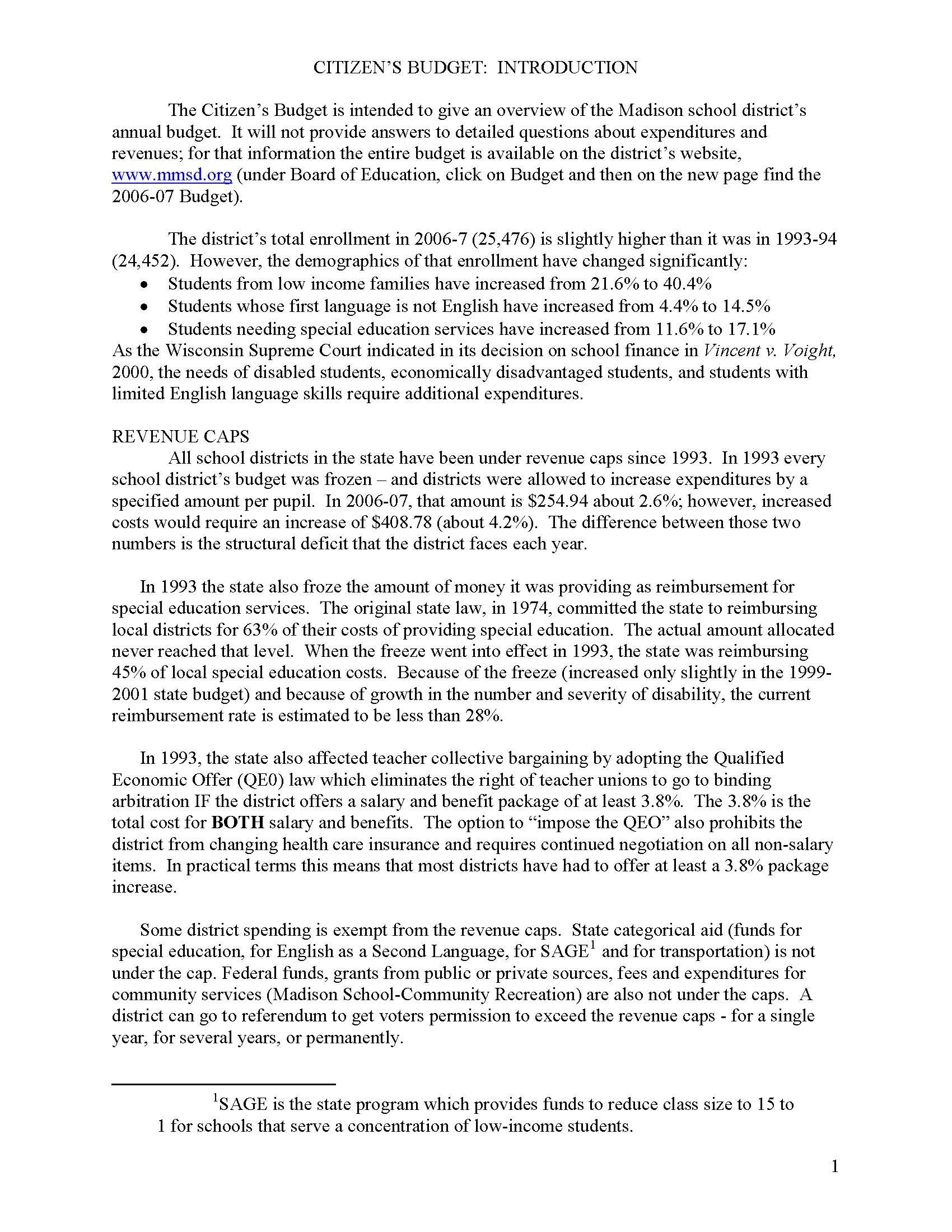
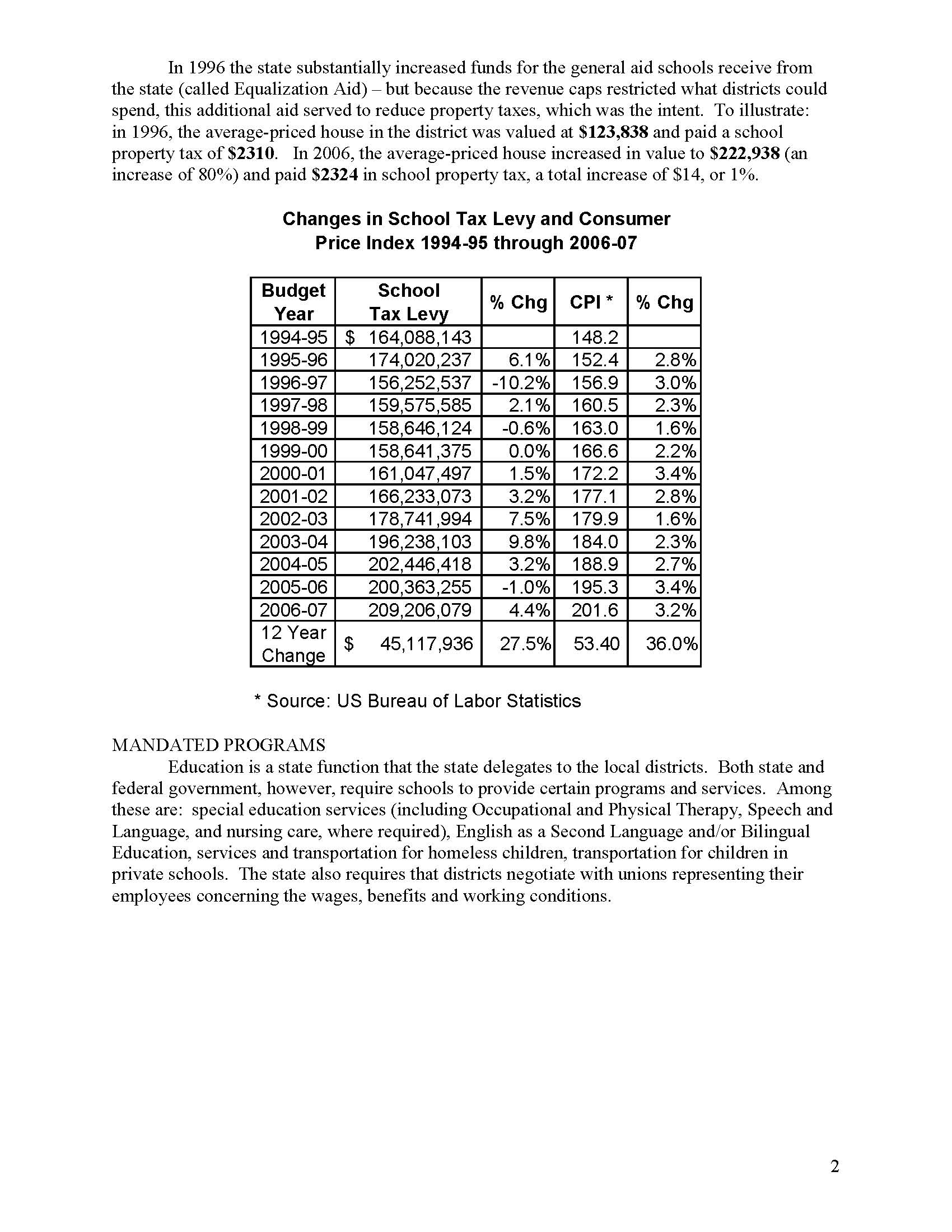
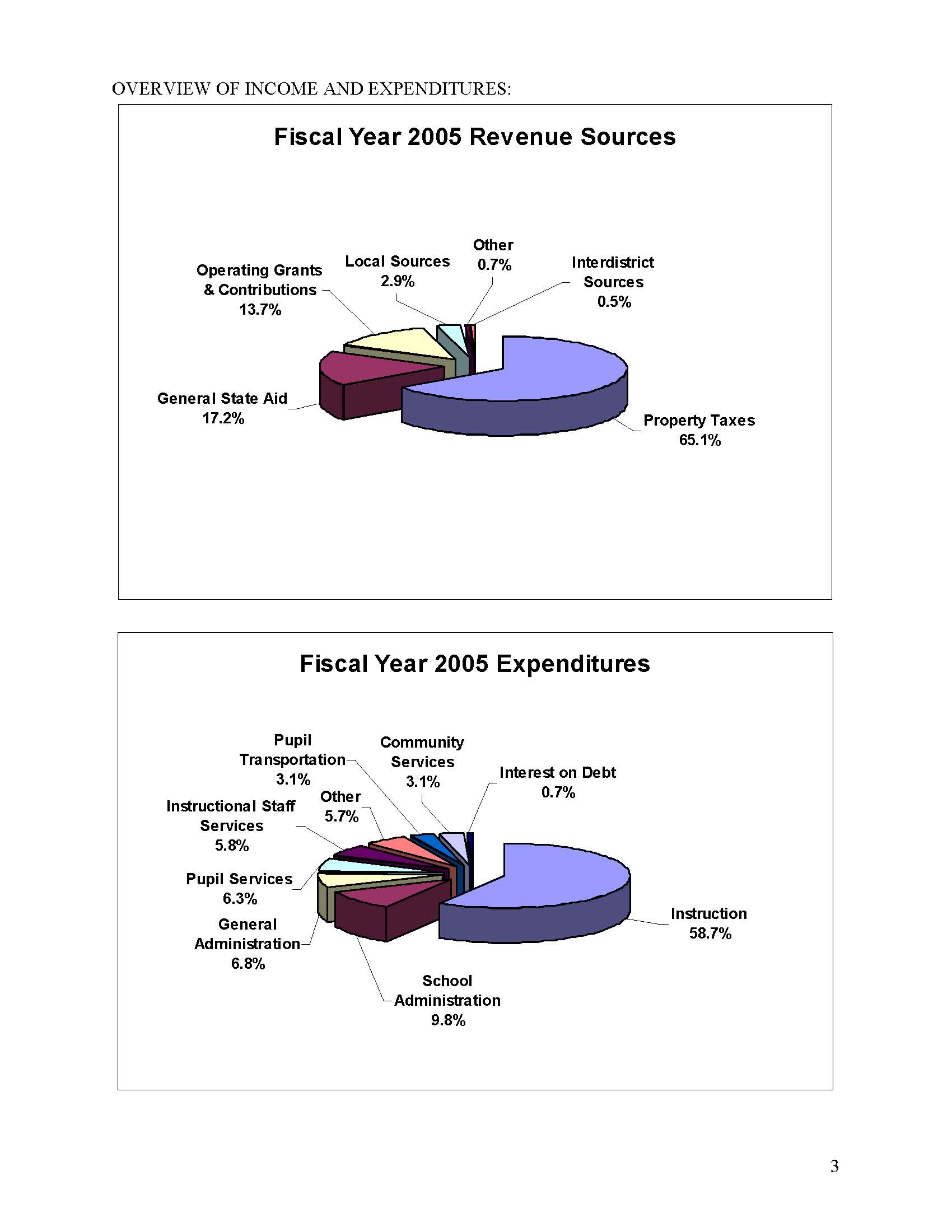
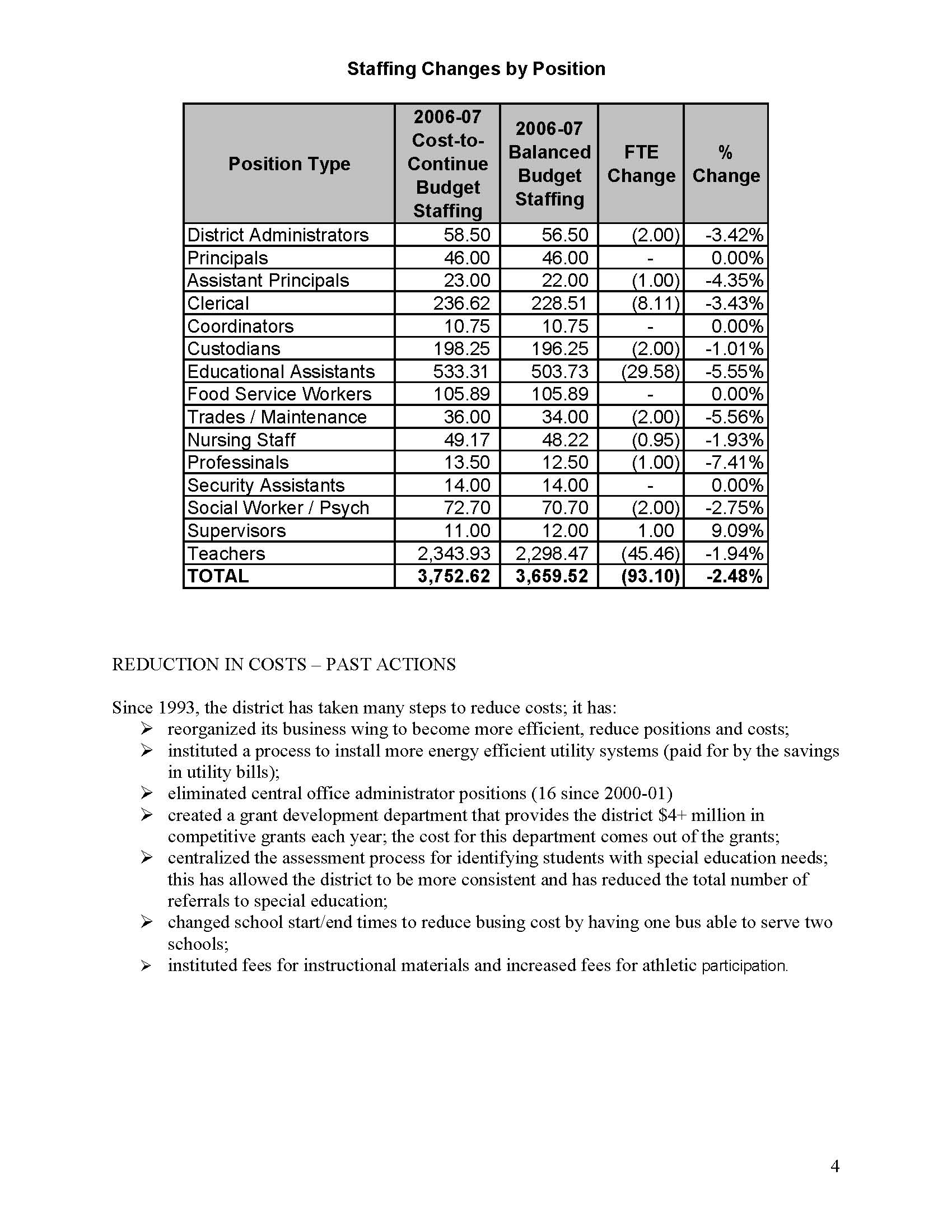
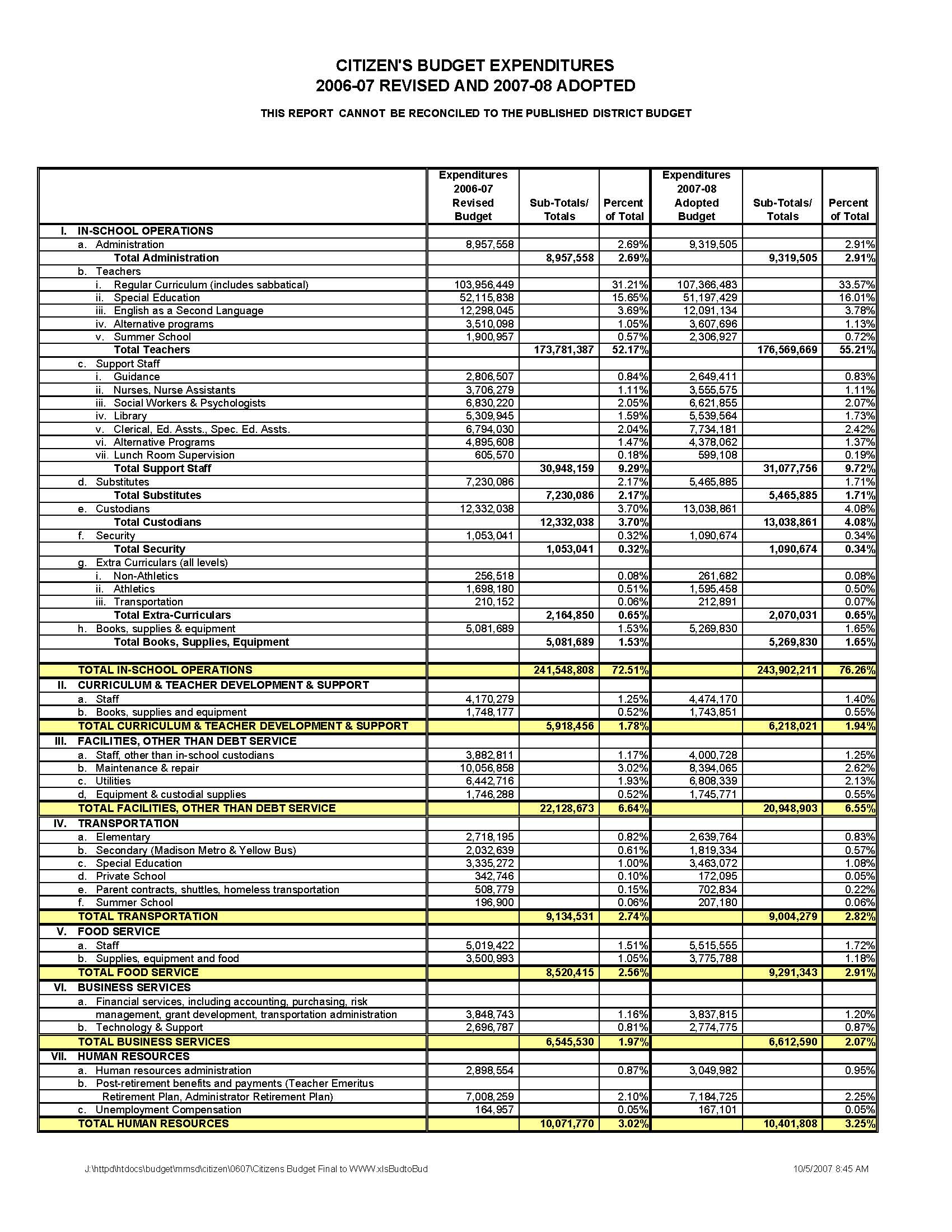
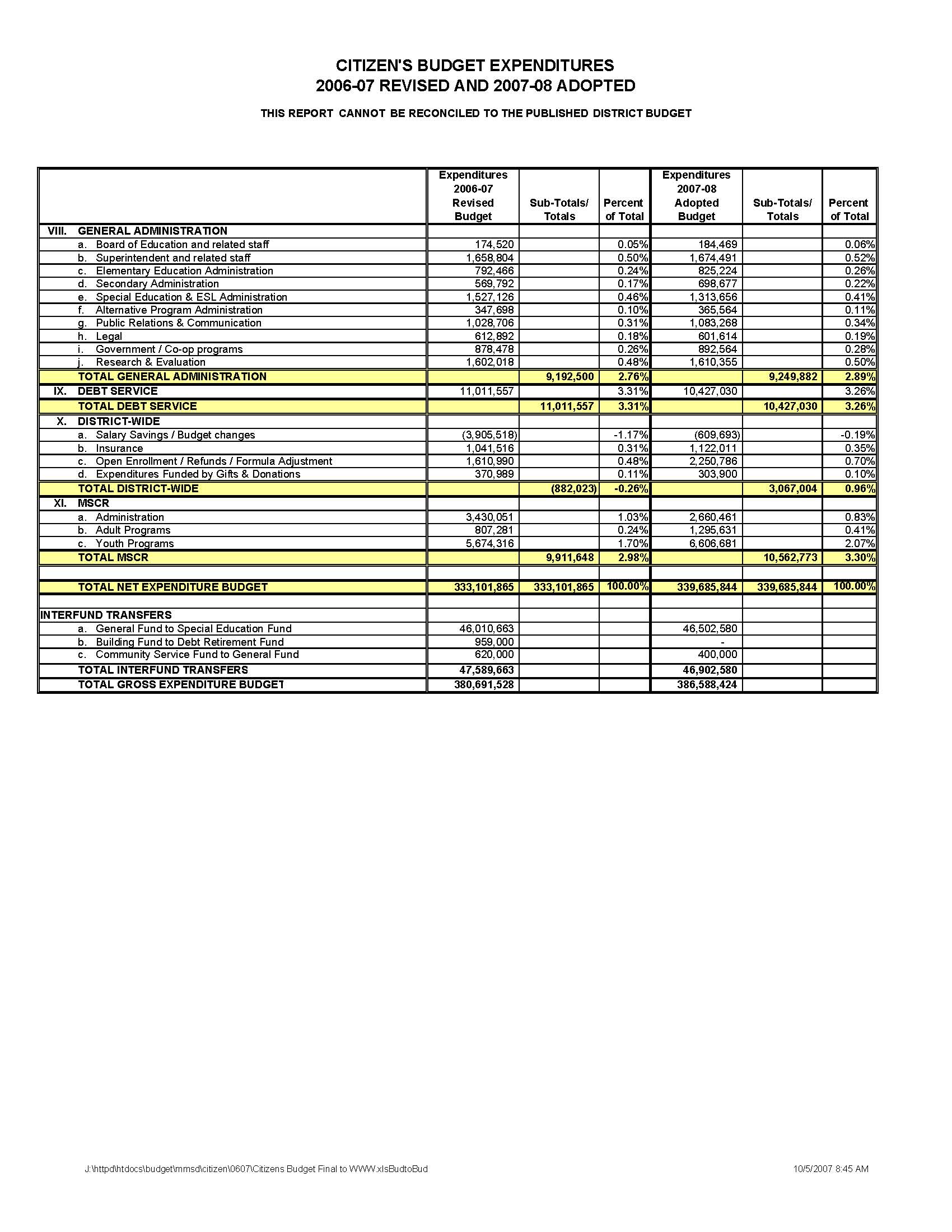



PDF Version 2007-2008 enrollment: 24,268 [24,342 in 2006/2007 and 24218 in 2005/2006]
q
Newsletter signup | Send us your ideas
It's that time of year -- a chance for a fresh start for all students. It's been a long time since I started a school year, but I remember the anxiety and anticipation: Will it be a good year? What do I have to do to be successful?With that in mind, I e-mailed principals at three Madison schools and asked them to offer a bit of advice. My question was simple and straightforward: What are the three most important things parents can do to help their kids get off to a good start in school this fall?
Their answers brought to mind a book that was a bestseller in the 1980s: "All I Really Need to Know I Learned in Kindergarten" by Robert Fulghum. The advice from these experienced educators involves a lot of common sense and caring and sharing.
Here are their responses:
Newsletter signup | Send us your ideas
Blowing the Lid Off Reading Achievement: Putting All the Pieces Together [120K PDF Conference Program] [160K PDF Registration Form]
Alliant Energy Center, Exhibition Hall, Madison, WI [Map]
October 12-13, 2007
Conference Program
Friday, October 12, 2007________________________________________________________
9:00-12:00 Keynote Speakers:
Drs. Sally and Bennett Shaywitz, Overcoming Dyslexia
Extraordinary progress in understanding the nature of reading and dyslexia, including their neural underpinnings, have direct implications for the earlier and more accurate identification and more effective treatment of dyslexia. This presentation focuses on these discoveries and their translation into clinical practices for overcoming dyslexia and for appreciating the sea of strengths associated with dyslexia.
12:00-1:30 Luncheon: Entertainment provided by Ervin Allen and the Walbridge Choir
2:45-3:45 Breakout Sessions
Newsletter signup | Send us your ideas