School Information System

Project Girl Program helps middle schoolers sort through barrage of media messages

Susan Troller:

What if parents could vaccinate their adolescent daughters against the siren song of the mall? Is there any way to get them to just say no to the power of brand name clothing, accessories and cosmetics?
And what should be done about the barrage of marketing messages telling them they can never be too rich, or too thin, and that they must be hot, hot, hot as they shop, shop, shop, even if they’re only 10 years old?

Share

Madison School Board Candidates Address the Achievement Gap

Isthmus continues their excellent candidate take home tests, this week addressing the Madison School District’s achievement gap:

Share

Confirmation of MMSD’s bargaining give aways

Roger Price provided a copy of the 2007 Voluntary Impasse Resolution Procedure agreement between the MMSD and MTI.
As reported earlier, if the MMSD and MTI go to arbitration, the MMSD agrees not make a final offer that would modify health insurance benefits for teachers or change the salary structure, which offers new teachers a starting salary of $23,000, a salary lamented by Marj Passman in her interview on WORT.
The agreement duplicates the 2005 agreement, as discussed here.

Share

Statewide Study of Arts Education in California

An Unfinished Canvas, Arts Education in California: Taking Stock of Policies and Practices by Katrina Woodworth, Roneeta Guha, Alix Gallagher, Ashley Campbell, June Park, and Debbie Kim:

Policies recently enacted at both the state and federal levels demonstrate a commitment to arts education. In 2001, the California State Board of Education adopted content standards for the visual and performing arts. In 2002, the federal No Child Left Behind law, with provisions recognizing the arts as a core subject, was signed into law. Beginning in 2005-06, students seeking admission to the University of California and California State University systems are required to take one full year of arts education coursework during high school.
Despite expectations and enthusiasm for instruction in the arts, little information about California students’ access to and performance in the arts is available, and statewide information about the delivery of arts education is lacking. Several recent studies suggest that arts education is in jeopardy—and perhaps in decline—and that schools are struggling to incorporate arts in their curriculum. Recent studies also point to disparities in access by school demographic characteristics, as well as differences in offerings by discipline. None of these studies, however, systematically examine the status of arts education in all four arts disciplines across all of California’s schools.

Sharon Noguchi has more.

Once derided as non-essential fluff and an expensive luxury, the arts have languished in California schools for nearly three decades.
Now, a Menlo Park think tank has recommended that California students spend more time in school to learn music, drama, theater and visual arts.
In a statewide survey of 1,123 California schools, researchers at SRI International found that 89 percent of schools fail to meet state standards for arts education.
Nearly one-third of the schools surveyed offered no art courses that met the standards, and K-12 enrollment in music courses dropped by 37 percent over the five years ending last June.

Share

The Kid Spending Spectrum

Eileen Daspin and Ellen Gameran:

With the debate about the country’s wealth gap heating up again, pampered kids provide some of the most dramatic examples, from toddlers in $800 strollers to 10-year-olds with cellphones. But for many families, drawing the line between attentive parenting and extravagance is a tough call; even parents who are relatively strapped will go to great lengths for their children. And though millions can’t afford the government’s child-cost estimate, there is no question that many others are spending far more without viewing it as extreme.
To assess how relatively routine expenses, as well as more excessive ones, can contribute to the total cost of raising a child, The Wall Street Journal deconstructed the government’s approach and recalculated it using a different range of costs.
Escalating kid spending is more rampant among wealthier households, so we used the government’s top-third income bracket as a starting point. We also added some costs that aren’t included in that government calculation, such as college-savings plans, which a growing number of households are setting up for their kids.

Share

March Madison BOE Progress Report

March Madness is approaching! On the board level, madness can be characterized by the large assortments of topics and decisions that have been or will need to be made such as the superintendent search, budget, and other serious issues that require time, analysis and public discussion. I would like to give you a brief report on some of those topics.

(more…)

Share

Financing Quality Education, March 12

Financing Quality Education: A Five-Year Look
March 12, 12:00 noon to 1:00 p.m.
Lower Conference Room
222 South Hamilton Street, Madison
Bring your brown-bag lunch and join others concerned about Madison schools to discuss long-range plans to help the district meet the financial challenges created by the state-imposed revenue limits.
The meeting and discussion will help identify the stakeholders and possible steps needed to begin and shape long-term view of the MMSD and its budget.
Some ideas were laid out on schoolinfosystem.org:
https://www.schoolinfosystem.org/archives/2006/03/a_5_year_approa.php:
“[Ask] what is the best quality of education that can be purchased for our district for $280 million a year. Start with a completely clean slate. Identify your primary goals and values and priorities. Determine how best to achieve those goals to the highest possible level, given a budget that happens to be $40 million smaller than today’s. Consider everything – school-based budgeting, class sizes, after-school sports, everything.”
Everyone and all ideas are welcome at this brown-bag discussion in the lower level conference room at 222 S. Hamilton Street.
For more information, contact Ed Blume at edblume@mailbag.com or by phone at 225.6591.

Share

No Child Left Behind’s Effect on the States

The Economist:

FOR as long as there have been maths tests, there have been cheats. But whereas a schoolboy caught furtively copying his neighbour’s answers can expect a zero and an angry letter home, states that rig exam results are showered with federal cash. This is one reason why the No Child Left Behind Act, a noble attempt to impose discipline on American schools, needs revision before it merits an A grade.
The premise behind the law was sensible enough. Before it was passed in 2002, state education bureaucrats were reluctant to collect and publish the kind of data that would have allowed parents to make comparisons between schools, or to tell if a school was improving over time. Good schools received few rewards; bad ones had little incentive to improve. President George Bush sought to change that.
Under No Child Left Behind, students must be tested on maths and reading every year between the ages of eight and 13, and once in high school. Test results must be published and broken down by race. Schools that fail to show “adequate yearly progress” face penalties. Parents of children at consistently failing schools must be allowed to move them to better ones.
All good stuff. But there are catches. Federal subsidies to the states depend on students meeting standards that the states themselves set. States thus have a multi-billion-dollar incentive to game the system. In Arizona, for example, only one-fifth of eighth-graders were rated “proficient” at maths after taking the state test in 2003. Two years later, that proportion had magically tripled. Does this mean that the test got easier to pass? “Yes,” says Janet Napolitano, Arizona’s plain-talking governor.

Wisconsin’s academic standards have been criticized by the Fordham Foundation:

The report being released today by the Thomas B. Fordham Foundation in Washington uses harsh terms in critiquing the standards that are intended to guide instruction in Wisconsin schools. “Depth is nowhere to be found,” it said of the science standards. “This document has no structure or method,” it said of the world history standards. “Skimpy content and vague wording,” it said in describing the math standards.
In June, a different group ranked Wisconsin No. 1 in the country in frustrating the goals of the federal No Child Left Behind law. Also in June, a third organization focused on Milwaukee and Wisconsin as examples of places where more inexperienced – and therefore, less proficient – teachers are disproportionately assigned to high-needs schools. And two weeks ago, the U.S. Department of Education rejected as inadequate Wisconsin’s plans for dealing with federal requirements that every student have a “highly qualified” teacher.

along with Kevin Carey: “Hot Air: How States Inflate Their Educational Progress Under NCLB “

Critics on both the Left and the Right have charged that the No Child Left Behind Act tramples states’ rights by imposing a federally mandated, one-size-fits-all accountability system on the nation’s diverse states and schools.
In truth, No Child Left Behind (NCLB) gives states wide discretion to define what students must learn, how that knowledge should be tested, and what test scores constitute “proficiency”—the key elements of any educational accountability system. States also set standards for high school graduation rates, teacher qualifications, school safety and many other aspects of school performance. As a result, states are largely free to define the terms of their own educational success.
The Pangloss Index ranks Wisconsin as the most optimistic state in the nation. Wisconsin scores well on some educational measures, like the SAT, but lags behind in others, such as achievement gaps for minority students. But according to the Wisconsin Department of Public Instruction, the state is a modern-day educational utopia where a large majority of students meet academic standards, high school graduation rates are high, every school is safe and nearly all teachers are highly qualified. School districts around the nation are struggling to make Adequate Yearly Progress (AYP), the primary standard of school and district success under NCLB. Yet 99.8 percent of Wisconsin districts—425 out of 426—made AYP in 2004–05.
How is that possible? As Table 2 shows, some states have identified the large majority of districts as not making AYP. The answer lies with the way Wisconsin has chosen to define the AYP standard.

Share

The Birth of Stochastic Science

Nassim Nicholas Taleb:

It fosters entrepreneurs and creators, not exam takers, bureaucrats or, worse, deluded economists. So the perceived weakness of the American pupil in conventional and theoretical studies is where it very strength lies — it produces “doers”, Black Swan hunting, dream-chasing entrepreneurs, or others with a tolerance for risk-taking which attracts aggressive tinkering foreigners. And globalization allowed the U.S. to specialize in the creative aspect of things, the risk-taking production of concepts and ideas, that is, the scalable and fat-tailed part of the products, and, increasingly, by exporting jobs, separate the less scalable and more linear components and assign them to someone in more mathematical and “cultural” states happy to be paid by the hour and work on other people’s ideas. (I hold, against the current Adam Smith-style discourse in economics, that the American undirected free-enterprise works because it aggressively allows to capture the randomness of the environment — “cheap options”— not much because of competition and certainly less because of material incentives. Neither the followers of Adam Smith, nor to some extent, those of Karl Marx, seem to be conscious about the role of wild randomness. They are too bathed in enlightenment-style causation and cannot separate skills and payoffs.)

Taleb’s excellent “Fooled By Randomness” is a must read.

Share

Gifted? Autistic? Or Just Quirky?

Maia Szalavitz:

“Paradoxically liberating” is how Phil Schwarz has described his Asperger’s syndrome diagnosis. He was in his late 30s at the time, and he had number of things on his mind: A software developer in Framingham, Mass., Schwarz had been labeled “gifted” as a child and had graduated third in his high school class. For years he had struggled with depression and a feeling that he was not living up to the promise of his past.
What’s more, he had begun to worry about his toddler’s delayed language development and repetitive play style. But he had no idea how the diagnosis that his son Jeremy would receive might affect his own identity.

Share

Civics Failure in Public Education

Paul Soglin:

While everyone is weighing in on the best way to teach our kids, I cannot get over the failure to educate youngsters about American institutions.
The more inclusive and more truthful curriculum about our nation’s history that is taught today is a vast step forward. However, when I graduated from high school I could discuss the Constitution, the Bill of Rights, the the Declaration of Independence and their inherent contradictions. I knew the three branches of government and their powers.

There are some teachers who emphasize civics. A great teacher friend recently mentioned “if we’re doing such a good job with the students, why are so few people asking questions of our government?”

Share

Marj Passman & Tony Casteneda Discuss The Madison School Board Race

Madison School Board Seat 5 candidate Marj Passman talked with Tony Castañeda recently on WORT-FM. Marj faces Maya Cole in the April 3, 2007 spring election. Marj and Tony discussed health care costs, curriculum, governance, special education, this website, and the Madison School District’s $331M+ budget.
Listen via this 5.7MB mp3 audio file. A transcript will be posted when available.

Share

Presentation on Special Education in the Madison Public Schools

Madison School Board Special Education PresentationThe Madison School Board heard a presentation on the district’s special education program, which currently serves 4,314 students, Monday evening. Watch Jack Jorgenson’s presentation via this video.
Links:

Share

Education Report Card

US Chamber of Commerce:

The United States in the 21st century faces unprecedented economic and social challenges, ranging from the forces of global competition to the impending retirement of 77 million baby boomers. Succeeding in this new era will require our children to be prepared for the intellectual demands of the modern workplace and a far more complex society. Yet the evidence indicates that our country is not ready. Despite decades of reform efforts and many trillions of dollars in public investment, U.S. schools are not equipping our children with the skills and knowledge they-and the nation-so badly need.
It has been nearly a quarter century since the seminal report A Nation at Risk was issued in 1983. Since that time, a knowledge-based economy has emerged, the Internet has reshaped commerce and communication, exemplars of creative commerce like Microsoft, eBay, and Southwest Airlines have revolutionized the way we live, and the global economy has undergone wrenching change. Throughout that period, education spending has steadily increased and rafts of well-intentioned school reforms have come and gone. But student achievement has remained stagnant, and our K-12 schools have stayed remarkably unchanged-preserving, as if in amber, the routines, culture, and operations of an obsolete 1930s manufacturing plant.

Share

A Bad Report Card

NY Times Editorial:

Congress, which is preparing to reauthorize both the No Child Left Behind Act and the Higher Education Act, needs to take a hard look at these scores and move forcefully to demand far-reaching structural changes.
It should start by getting the board that oversees the National Assessment of Educational Progress testing to create rigorous national standards for crucial subjects. It should also require the states to raise the bar for teacher qualifications and end the odious practice of supplying the neediest students with the least qualified teachers. This process would also include requiring teachers colleges, which get federal aid, to turn out higher quality graduates and to supply many more teachers in vital areas like math and science. If there’s any doubt about why these reforms are needed, all Congress has to do is read the latest national report card.

Share

Two Educators Discuss “My Life & Times with the Madison Public Schools”

Audrey Soglin & Char Gearing respond to Marc Eisen’s recent words:

I think we have learned and the research supports that kids need a balanced literacy approach. The “whole language vs. phonics” wars should really be put to rest. It is an old fight. Kids don’t learn the same way so a variety of instructional methods should be available. It is not unusual for districts to offer both direct instruction to identified students and reading recovery to others. The problems that kids have are different so the instructional interventions should be different as well. In terms of kids in heterogeneous classrooms receiving instruction – all kids need to be taught at their level. The challenge for teachers in diverse reading and math classrooms is to figure out how to meet those very different needs. It is difficult but not impossible.
The author seems to be saying that we should be segregating our classrooms and our schools. If you look at the scores of low-income students in low income schools-where the demographics are 90% low income, 90% African American or Hispanic – the scores are generally low. It is not like segregating the kids will automatically raise the scores.

Share

Advocates for Madison Public Schools Website and Blog

http://www.madisonamps.org/

Share

Sparks Fly as the Madison Studio Charter School is Voted Down

The Madison School Board voted down the proposed Studio Charter School Monday night in a 4-2 vote (Against: Carstensen, Kobza, Silveira and Winston; For Mathiak and Robarts with Vang away).
Sparks flew when Lucy Mathiak asked Nancy Donahue about their interaction with the attempts to talk with principals and teachers about the proposed charter school [12 minute video.] Watch the complete discussion here.
Susan Troller has more:

There is disagreement among Madison School Board members over what put the nails in the coffin of a proposal to create a new fine arts and technology-focused charter school.
The Studio School suffered from being the wrong proposal at the wrong time, said board President Johnny Winston Jr., who joined board members Carol Carstensen, Arlene Silveira and Lawrie Kobza in voting against the plan at Monday night’s School Board meeting.
But board member Lucy Mathiak says that the vote was wrapped up in School Board and labor politics, and that the Studio School suffered from disapproval from Madison Teachers Inc., the district’s union.
But Mathiak, who along with board member Ruth Robarts voted in favor of what would have been Madison’s third charter school, said she felt the proposal was primarily doomed by disapproval from MTI.
She noted that the MTI’s School Board candidate questionnaire asks whether candidates support charter schools, and added that there was a MTI representative at Monday night’s meeting.
“There is definitely the feeling that the union does not look favorably on charter schools, although they are public schools, staffed by district teachers,” Mathiak said.
“I find it ironic that the same people who voted for a voluntary impasse resolution agreement regarding teachers’ contract negotiations are now saying that developing a charter school is something we can’t afford. We should keep all of our options open in the bargaining process … the potential for cost savings are very significant,” she said.
Mathiak is referring to a vote taken by School Board members in preparation for negotiations with the teachers’ union next month that included concessions from the district on bargaining over health care insurance.

Much more on the Studio School here along with some discussion at The Daily Page.

Share

More than a Horse Race: A Guide to International Tests of Student Achievement

The Center for Public Education:

Few education stories get as much attention as the periodic ranking of U.S. students on international tests. The headlines are by now familiar: “U.S. Kids Mediocre in Math and Science”1; “4th and 8th Graders in U.S. Still Lag Many Peers”2. Surely, the media fascination with these stories is partly driven by our national desire to be number one. But according to many policymakers, business leaders, and analysts, more is at stake than American boasting rights. These individuals argue that the nation’s economic future depends directly on our ability to raise our present academic standing, particularly in math and science (Business Roundtable 2005; National Research Council 2005; White House 2006).
Others aren’t so sure. These observers assert that the reported failure of American students is exaggerated, claiming that the differences among countries aren’t so large. Besides, they say, our top students do just fine compared with their top-scoring peers in other countries (Bracey 1998).
Still others point to inherent difficulties in trying to make apples-to-apples comparisons across countries and argue that international rankings are not meaningful (Rotberg 1995).

Jay Matthews:

The report, “More Than a Horse Race,” was written by Jim Hull, policy analyst at the center, which is affiliated with the National School Boards Association. I sent a copy to a top U.S. expert on international educational comparisons, author and columnist Gerald W. Bracey. There were parts of the report Bracey did not like.
But I have found several points on which Hull and Bracey seem to agree. The Hull report at www.centerforpubliceducation.org, released on Jan. 17, should be read in its entirety because it is the best summary yet of the four major studies that compare our achievement rates to those abroad. (You can also get Bracey’s response if you e-mail him at gbracey1@verizon.net.)
5. Those who say our economy is doomed unless our schools get better appear to be ignoring recent history.
Hull introduced this topic in his report by noting that none of the international comparative studies include data from China or India. “Given the rapidly rising position these nations are taking in the global economy,” he said, he hoped they would be included in the future. Bracey interpreted this as a reflection of “the common, but perhaps erroneous assumption that how well 13-year-olds bubble in answer sheets has something to do with the economic health of a nation.”

Share

Making Safety a Piece of the Pie

Teacher Voices:

In Philadelphia last week a teacher named Frank Burd, wound up in the hospital after two students assaulted him, apparently because he had confiscated an iPod during class. After class, according to a report on NBC news, the two students were waiting for Burd. One punched him and the other pushed him. As of Friday night (February 23), he was still in intensive care with two broken bones in his neck.
Mr. Burd’s experience may seem like an aberration, but actually, it is only a slightly more extreme example of the kind of violence, crime, and general incivility that teachers and students confront in schools all over the nation. Here in NY, for example, Mayor Bloomberg’s Preliminary Management Report showed a 21-percent increase in felony crimes committed in the city’s schools between July and October 2006 compared with the same period the previous year. And according a February 23 article in The Chief, “Major crimes rose from 287 to 348, other criminal reports increased from 820 to 983, and additional safety incidents climbed from 1,614 to 1,926, according to the Mayor’s report.

Share

Latest MMSD Today

is online here.

Share

Wisconsin’s School Finance Climate

Andy Hall on local referendums:

Layoffs and pay cuts are looming in a western Dane County school district, and officials in the Adams-Friendship area are contemplating closing two elementary schools after voters rejected two school referendums last week.
Voters also approved referendums Tuesday for a $14.68 million elementary school in Sun Prairie and $2.48 million to avert school cuts in Pardeeville 30 miles north of Madison.
But ballot measures were narrowly defeated in the Wisconsin Heights School District, which includes Mazomanie and Black Earth, and Adams-Friendship, 75 miles north of Madison.

Student population, expense and tax revenue growth all affect local school district budgets.
Andy also posted an article on a survey conducted by the Wisconsin Association of School District Administrators:

Twenty-seven percent of superintendents said their school boards have held discussions during the past few years about the possibility of dissolving or consolidating their school districts. Among those districts, more than 90 percent said the talks were prompted by financial problems.
Increasing portions of districts report changes that could reduce the quality of educational services. Since the 1998-99 school year, for example, the percentage of districts increasing class sizes grew from 48 to 74 percent. The percentage laying off teachers during that period rose from 36 to 62 percent.

Wistax reported recently that Wisconsin residents paid 33.4% of income in taxes, up from 30.7% in 2003. Decisions like this do not help pass referendums, much less build confidence in our $331M+ local school district.

Share

More on Homework

Jay Matthews:

But more important, let’s say that for the sake of argument that only 10 percent of America’s children suffer from homework overload (although we believe it’s much more). Isn’t it still a problem for that 10 percent, for all the reasons listed by the many psychologists, educators and health experts whom we interviewed? If “only” 10 percent of America’s children suffered from depression or diabetes, wouldn’t it still be worth addressing? We found many such children and they are definitely suffering and losing their love of school and learning. Just because homework overload might not affect every child doesn’t make it any less serious.

Share

The MMSD five years from now

Financing Quality Education: A Five-Year Look
March 12, 12:00 noon to 1:00 p.m.
Lower Conference Room
222 South Hamilton Street, Madison
Bring your brown-bag lunch and join others concerned about Madison schools to discuss long-range plans to help the district meet the financial challenges created by the state-imposed revenue limits.
The meeting and discussion will help identify the stakeholders and possible steps needed to begin and shape long-term view of the MMSD and its budget.
Some ideas were laid out on schoolinfosystem.org:
https://www.schoolinfosystem.org/archives/2006/03/a_5_year_approa.php:
“[Ask] what is the best quality of education that can be purchased for our district for $280 million a year. Start with a completely clean slate. Identify your primary goals and values and priorities. Determine how best to achieve those goals to the highest possible level, given a budget that happens to be $40 million smaller than today’s. Consider everything – school-based budgeting, class sizes, after-school sports, everything.”
Everyone and all ideas are welcome at this brown-bag discussion in the lower level conference room at 222 S. Hamilton Street.
For more information, contact Ed Blume at edblume@mailbag.com or by phone after March 1 at 225.6591.

Share

School Board Vote on the Studio School Tonight

In the context of the Madison School District’s financial challenges, it’s easy to understand why creating a new program may seem unthinkable. Yet creativity can prove a strong ally in times of adversity. Take the prospect of the latest charter school idea to come before the Madison School Board, and consider these points:
As a charter school, the Studio School can bring in $550,000 in federal grants over its first four years. These grants, earmarked for charter schools, are designed to help districts cover start-up costs. The Studio School can be implemented in a way that keeps operating costs in line with other elementary schools district-wide; yet as a charter with an arts and technology emphasis, it would have the ability to seek additional grants and sources of financial support.
The Studio School would be in an existing public school, just as the district’s bilingual charter school operates. This school-within-a- school model is a cost- efficient way to foster innovation. As a taxpayer and a parent, I see the Studio School as an excellent use of underused space. While its location has yet to be determined by the district and School Board, the idea poses interesting possibilities. Could a charter school draw some students from a nearby overcrowded school? Over the long term, might an innovative option help attract new families to a neighborhood where parents had once worried about the future of an under-enrolled school? And how might such an effort dovetail with our city’s development plans?

(more…)

Share

Online Mathematics Textbooks

George Cain:

The writing of textbooks and making them freely available on the web is an idea whose time has arrived. Most college mathematics textbooks attempt to be all things to all people and, as a result, are much too big and expensive. This perhaps made some sense when these books were rather expensive to produce and distribute–but this time has passed.
A few years ago when I first posted a list of mathematics textbooks freely available on line, there existed only a handful of such books. Now there are many. The list here has grown and grown and is perhaps in serious need of some kind of organization into topics. There are also now many other sites at which there are links to on-line mathematics books and lecture notes. This site is far from comprehensive and I have considered abandoning it. Many people, however, still seem to find it useful, and so I shall continue to maintain it for a while.

Share

Recent Madison School Board Discussions, Including Teaching & Learning Effectiveness, Superintendent Search Consultant and Extracurricular Activities

Teaching & Learning Department Effectiveness

Video | mp3 audio

Superintendant Search Consultant

Video | mp3 audio

Extracurricular Activities

Video | mp3 audio

Share

AP Classes Face Audit

Amy Hetzner:

What’s bad, according to Roby Blust, Marquette’s dean of undergraduate admissions, is that some of those courses labeled as AP aren’t really Advanced Placement courses, as trademarked by the College Board.
“They’re not going through what we know is the AP curriculum for English, but they’re listing it as an AP course,” Blust said. “So they’re mislabeling, I guess.”
That could be about to change.
Pressured by colleges and universities with similar stories, the College Board is launching its first major oversight effort of the popular courses this year. By fall, the organization responsible for the AP program and its associated tests expects to have reviewed detailed descriptions of what’s being taught in about 120,000 courses throughout the world bearing the AP label.

Share

Better Serving Gifted Students of Poverty

The National Association for Gifted Children (NAGC) has just published the proceedings of their recent conference on high potential learners of poverty. The book is called “Overlooked Gems: A National Perspective on Low-Income Promising Learners” and includes chapters by Donna Ford, Alexinia Baldwin and Paula Olszewski-Kibilius.
To download or order a free copy of “Overlooked Gems,” go to www.nagc.org and click on “New at NAGC: Conference Proceedings.”
Also on the NAGC website, a brief article by Paul Slocumb and Ruby Payne entitled “Identifying and Nurturing the Gifted Poor”. Slocumb and Payne are the authors of “Removing the Mask: Giftedness in Poverty.”
Previous post on academically talented MMSD students of color and poverty: https://www.schoolinfosystem.org/archives/2006/01/theyre_all_rich.php
Article on the negative effects of detracking, especially for high achieving students of color and poverty (cited by U.W. Professor of Sociology and Educational Policy Studies Adam Gamoran, Ph.D., in his chapter “Classroom Organization and Instructional Quality“): “If Tracking is Bad, Is Detracking Better?” by J. E. Rosenbaum (American Educator, 1999).

Share

Kids, the Internet and the End of Privacy: The Greatest Generation Gap since the Rock & Roll

Emily Nussbaum:

As younger people reveal their private lives on the Internet, the older generation looks on with alarm and misapprehension not seen since the early days of rock and roll. The future belongs to the uninhibited.
After a few minutes of this, I turn to Gasaway and ask if he has a Web page. He seems baffled by the question. “I don’t know why I would,” he says, speaking slowly. “I like my privacy.” He’s never seen Hannah’s Facebook profile. “I haven’t gone on it. I don’t know how to get into it!” I ask him if he takes pictures when he attends parties, and he looks at me like I have three heads. “There are a lot of weirdos out there,” he emphasizes. “There are a lot of strangers out there.”
There is plenty of variation among this younger cohort, including a set of Luddite dissenters: “If I want to contact someone, I’ll write them a letter!” grouses Katherine Gillespie, a student at Hunter College. (Although when I look her up online, I find that she too has a profile.) But these variations blur when you widen your view. One 2006 government study—framed, as such studies are, around the stranger-danger issue—showed that 61 percent of 13-to-17-year-olds have a profile online, half with photos. A recent pew Internet Project study put it at 55 percent of 12-to-17-year-olds. These numbers are rising rapidly.

Virginia Postrel has more, including Greg Lukianoff and Will Creeley’s “Facing off over Facebook“:

tudents, be warned: the college of your choice may be watching you, and will more than likely be keeping an eye on you once you enter the hallowed campus gates. America’s institutions of higher education are increasingly monitoring students’ activity online and scrutinizing profiles, not only for illegal behavior, but also for what they deem to be inappropriate speech.
Contrary to popular misconceptions, the speech codes, censorship, and double standards of the culture-wars heyday of the ’80s and ’90s are alive and kicking, and they are now colliding with the latest explosion of communication technology. Sites like Facebook and MySpace are becoming the largest battleground yet for student free speech. Whatever campus administrators’ intentions (and they are often mixed), students need to know that online jokes, photos, and comments can get them in hot water, no matter how effusively their schools claim to respect free speech. The long arm of campus officialdom is reaching far beyond the bounds of its buildings and grounds and into the shadowy realm of cyberspace.

Share

Notes from a New Teacher

RedKudo:

I feel perfectly fine being a teacher. I don’t get angry, I just document, and etc. (Learned that from the airline job, actually.)
What I don’t feel good about is kids coming to me that have somehow slipped through the system without the most rudimentary skills. Minimum skills tests be damned – we’re talking about kids who don’t know how language influences the decisions they make every day, from politics to credit cards. Students who do not know how to question “information” they’re receiving, who don’t know how to express themselves intelligibly verbally or in writing. I’ll have to go on record as saying I do not believe it’s as simple as apathy or disinterest, and here’s why: I think I know what they’re going through.

As in many professions, there are some truly extraordinary teachers, those who go out of their way to grow student achievement (staying after school to provide students with extra math instruction), buck the system and constantly improve their craft. Deming often mentioned “delighting your customers“. I have two recent examples to pass along: A teacher organized an overnight trip to Upham Woods for the entire class. Another calls students at home with test results when they perform well.

Share

“The School Did Nothing and They Gave Me “A’s”

Joanne Jacobs:

. . . last year i reported some of my teachers who didn’t teach me to the state, all we did was watch “R”movies and my other teacher fight and drew chairs, but the school did nothing and they gave me “A’s.
(The principal) is doing nothing about it he tells my mom that the SCHOOL has more rights and power than me and the parent.

Share

PTA’s Go Way Beyond Cookies

Winnie Hu:

With many members who stepped out of high-profile careers to become stay-at-home parents, traditional parent-teacher associations (and the similar parent-teacher organizations, or PTOs) have evolved into sophisticated multitiered organizations bearing little resemblance to the mom-and-pop groups that ran bake sales a generation ago.
Last month, the Scarsdale Middle School PTA in Westchester County began posting podcasts of meetings on the Internet as a way to reach more parents, while the PTO at Squadron Line Elementary School in Simsbury, Conn., now has its own reserved parking space at the school. (To raise money for the school playground, parents bid each month for the right to use it.)
And in the Washington suburbs, the Arlington Traditional School PTA developed training manuals with past meeting minutes, treasurer reports, and program evaluations for its six vice presidents last year.

Share

Going to the Mat for WPS

Jason Shephard:

Suzanne Fatupaito, a nurse’s assistant in Madison schools, is fed up with Wisconsin Physicians Service, the preferred health insurance provider of Madison Teachers Inc.
“MTI uses scare tactics” to maintain teacher support for WPS, Fatupaito recently wrote to the school board. “If members knew that another insurance [plan] would offer similar services to WPS and was less expensive — it would be a no-brainer.”
WPS, with a monthly price tag of $1,720 for family coverage, is one of two health coverage options available to the district’s teachers. The other is Group Health Cooperative, costing $920 monthly for a family plan.
During the past year, the Madison school board has reached agreements with other employee groups to switch from WPS to HMO plans, with most of the savings going to boost pay.
In December, the board held a secret vote in closed session to give up its right to seek health insurance changes should negotiations on the 2007-09 teachers contract go into binding arbitration. (The board can seek voluntary insurance changes during negotations.)
“What we’ve done is taken away a huge bargaining chip,” says board member Lucy Mathiak. “Every other major industry and public sector has had to deal with health-insurance changes, and we’ve got a very real $10 million deficit.”
MTI Executive Director John Matthews says other employee unions “made a big mistake” in switching to HMO plans. Matthews has long maintained that WPS provides superior coverage, despite its higher costs and disproportionate number of complaints. And he defends the paycheck he collects from WPS as a member of its board, saying he’s better able to lobby for his teachers.

Much more on this issue, including links, audio and a transcript, here.

Share

2005 NAEP Grade 12 Reading and Math Scores Released

The Nation’s Report Card via Ed Week:

The proportion of high school students completing a solid core curriculum has nearly doubled since 1990, and students are doing better in their classes than their predecessors did.
But that good news is tempered by other findings in two federal reports released here today. The performance of the nation’s high school seniors on national tests has declined in reading over the past decade, and students are lackluster in mathematics. A third of high school graduates in 2005 did not complete a standard curriculum, which includes four credits of English and three credits each of social studies, math, and science.
The 12th grade reading and math results on the National Assessment of Educational Progress are based on a nationally representative sample of 21,000 seniors at 900 public and private schools who took the tests between January and March of 2005. The report on their performance was accompanied by the latest NAEP transcript study, which analyzes the coursetaking patterns and achievement of high school graduates.
Two-thirds of the 26,000 graduates who were followed for the transcript study also participated in the 2005 NAEP math and science assessments.
No Improvement in Reading
On the reading test, 12th graders’ average score has declined significantly since the first time the test was given in 1992. The test-takers averaged 286 points on a 500-point scale, a 6-point decline over 13 years, but statistically the same score as in 2002. Achievement levels in reading have also declined since 1992; 80 percent of the students tested that year scored at the “basic” level or better, but only 73 percent did so on the 2005 test, the same proportion as in 2002. In addition, the gap in scores between members of minority groups and higher-scoring white students has not narrowed significantly.
In math, the scores are not comparable with those from previous tests since the 2005 test was based on a new framework. Students scored, on average, 150 points on a 300-point scale. Just 61 percent of the 12th graders demonstrated at least basic command of the subject, with 23 percent considered “proficient” and 2 percent “advanced.”
Among 2005 high school graduates, 68 percent completed at least a standard curriculum, while 41 percent took a more challenging course load, and 10 percent took more-rigorous classes. In 1990, just 40 percent of graduates completed at least a standard curriculum, and 36 percent took additional courses, while 5 percent took what was deemed a rigorous course load.

Share

Cutbacks in Class, Upgrades on the Field

Amy Hetzner:

If successful, Kettle Moraine High School would be the latest school in the state to perform a pricey upgrade to its athletic facilities at a time when many school districts complain they have to reduce services or are holding referendums to raise tax dollars to keep existing programs.
“I don’t think the two efforts are directly in conflict,” said Larry Laux, a member of the field project committee and parent of a football player. “It is a little bit awkward, I’ll grant you that.”
Already, Arrowhead and Brookfield Central high schools have replaced grass football fields with the synthetic stuff. Both were funded by donations from private groups, although the Elmbrook School District has pledged to match half of the $830,000 upgrade of Brookfield Central’s stadium.

Share

Moving For Schools

Suein Hwang:

“No place is perfect, but I wanted the place that was the most perfect for us and them,” says Ms. O’Gorman, 44. “To me, it’s better than leaving them a house or my 401k.”
Across the country, a small but growing number of parents like the O’Gormans are dramatically altering their families’ lives to pursue the perfect private school for their children. While past generations of parents might have shifted addresses within a town to be near a particular school, or shipped junior off to boarding school, these parents are choosing school first, location second. “I hear about it all the time,” says Patrick Bassett, president of the National Association of Independent Schools, or NAIS, in Washington, D.C.
Germantown Friends School in Philadelphia says four families have moved to the area in the past two years so their children can attend the school. Hathaway Brown School, an all-girls school in Shaker Heights, Ohio, reports five such families, four of which moved in the past few years. “It’s been a little more frequent in the last two or three years,” says Sally Jeanne McKenna, admissions director at Polytechnic School of Pasadena, Calif.

Locally, the well known Waisman Center has brought families to the Madison area.

Share

Closing the Math Gap

Milwakee Journal-Sentinel Editorial:

Too many grads of the Milwaukee Public Schools wind up in remedial classes in math when they pursue college. Key educational leaders in the city have come up with a proven plan to reverse this alarming trend – a plan Gov. Jim Doyle has proposed to finance with $15 million in state money as part of his $80 million financial package to help Milwaukee over two years.
Raising math achievement in the state’s sole big city is all the more reason to support that package. Math proficiency among workers can attract good jobs to Milwaukee. And the better the city does economically, the better the state does.

The “Math Coach” model mentioned by the J-S is also under discussion in Madison.

Share

Taking Back a School

Joanne Jacobs:

In Indianapolis, a new principal tries to take back the city’s worst middle school, a place of disorder, violence and rock-bottom expectations. He transfers 17-year-old seventh- and eighth-graders to alternative schools, suspended students for fighting and tries to enforce a dress code.

Share

Wed March 7th Town Hall Meeting about Underage Drinking

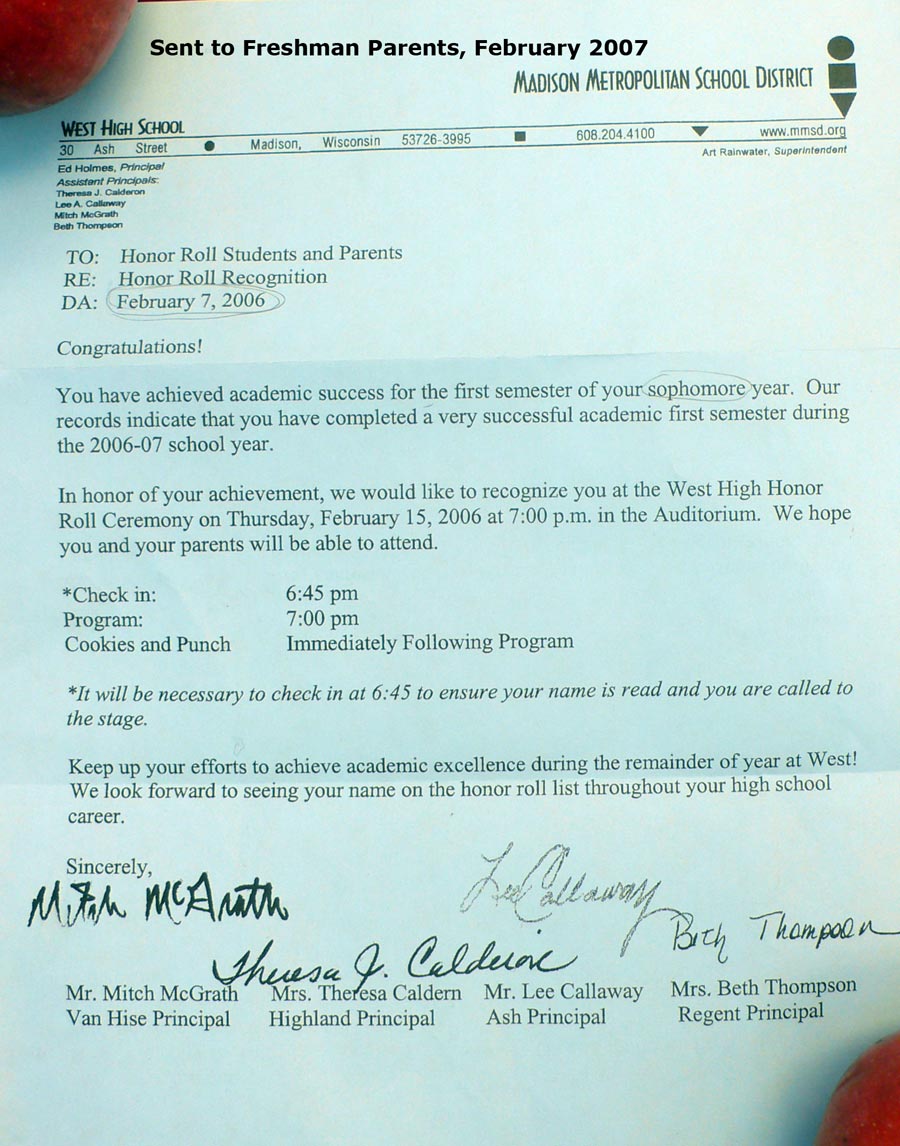
Dane County Human Services [PDF]: via a West High Freshman parent who mentions that while West is a good school, it is important that parents are ready for an eye opening year of “scary challenges” in terms of alcohol, sex, drugs and violent crime. (Not to mention schoolwork!). Alliant Energy Center 6:45 to 8:45p.m.

Share

Goodbye to Girlhood

Stacy Weiner:

Ten-year-old girls can slide their low-cut jeans over “eye-candy” panties. French maid costumes, garter belt included, are available in preteen sizes. Barbie now comes in a “bling-bling” style, replete with halter top and go-go boots. And it’s not unusual for girls under 12 to sing, “Don’t cha wish your girlfriend was hot like me?”
American girls, say experts, are increasingly being fed a cultural catnip of products and images that promote looking and acting sexy.
“Throughout U.S. culture, and particularly in mainstream media, women and girls are depicted in a sexualizing manner,” declares the American Psychological Association’s Task Force on the Sexualization of Girls, in a report issued Monday. The report authors, who reviewed dozens of studies, say such images are found in virtually every medium, from TV shows to magazines and from music videos to the Internet.

Share

Had Enough Top Down Reform?

Jay Matthews:

But the more I read these well-intended documents, the more I wonder. Haven’t we had enough of this stuff? Are we really going to get significant improvement in our lowest-performing schools through more reports telling us how to fix the federal rules?
I share the view of the majority of Congress, and the leaders of both major parties, that No Child Left Behind was a good idea. It forced the states to pay attention to the poor teaching in our low-income neighborhood schools. That was something many of those states failed to do under an earlier law that asked them nicely but had no serious penalties if they told Washington to mind its own business. Nearly everybody in education applauds No Child Left Behind’s insistence on measuring the progress each school and district is making in helping low-income students, learning-disabled students, students from immigrant families and students from the most neglected minority groups.

Share

Beth Moss and Rick Thomas Advance in Tuesday’s Madison School Board Primary Election

Sandy Cullen:

Beth Moss and Rick Thomas will face off in the April 3 election for one of three open seats on the Madison School Board.
They came in first and second in Tuesday’s primary for the seat being vacated by Shwaw Vang.
Pam Cross-Leone came in third.

Results here.

Share

Getting Kids Off of Google

Diana Day:

Teachers, take back the online research process! (If you are asking the question: “Did we ever have control of the online research process in the first place?” then you get a gold star for your healthy skepticism).
Before Google and other search engines got so good, I think we did have some control. I remember the days, not so long ago, when kids couldn’t always find material for their research topics using Google, especially if their topics were just a little unusual or offbeat. They would then be forced to ask for help, and I took advantage of some great teachable moments to help students refine their keywords and search techniques.
Being with students as they refine search skills leads naturally to the next opportunity: helping students evaluate the reliability and credibility of the sites we’d find together.
These teachable moments worked well.

Share

Sports and Fine Arts – Planning for the Future

I pulled my blog from yesterday, because I think my main point got lost in too much unnecessary rhetoric. Basically, I would like to see the School Board support efforts to develop multi-year education funding plans for Fine Arts Education and extracurricular competitive sports. I would like to see the School Board be equitable in their cuts and help transition to a mix of public/private financing if that is needed in the future. I don’t see any reason to whack at or eliminate one program vs. another – it’s disruptive and unnecessary and plans cannot be made.

Share

Concessions Made in Advance of MTI Negotiations by a Majority of the Madison School Board

It will be interesting to see how voters on February 20 and April 3 view this decision by a majority of the Madison School Board: Should the Board and Administration continue to give away their ability to negotiate health care benefits ($43.5M of the 2006/2007 budge) before MTI union bargaining begins? Read the 2005 MMSD/MTI Voluntary Impasse Agreement [1.1MB PDF; see paragraph’s 2, 10 and 11]. The 2007 version, alluded to in Andy Hall’s article below, will be posted when it sees the light of day.
This is an important issue for all of us, given the MMSD’s challenge of balancing their growing $331M+ budget, while expenses – mostly salaries and benefits – continue to increase at a faster rate. Mix in the recent public disclosure of the district’s $5.9M 7 year structural deficit and I doubt that this is the best approach for our children.
Recently, the Sun Prairie School District and its teachers’ union successfully bargained with DeanCare to bring down future costs for employee health insurance.

Andy Hall, writing in the Wisconsin State Journal asks some useful questions:

But with the Madison School Board facing a $10.5 million budget shortfall, is the board giving away too much with its promises to retain teachers’ increasingly pricey health insurance and to discard its legal mechanism for limiting teachers’ total compensation increase to 3.8 percent?

Yes, School Board Vice President Lawrie Kobza said Saturday, “I feel very strongly that this was a mistake,” said Kobza, who acknowledged that most board members endorse the agreement with Madison Teachers Inc., the teachers union.

State law allows districts to avoid arbitration by making a so-called qualified economic offer, or QEO, by boosting salaries and benefits a combined 3.8 percenter a year.

“To agree before a negotiation starts that we’re not going to impose the QEO and negotiate health care weakens the district’s position,” Kobza said. She contended the district’s rising health-care costs are harming its ability to raise starting teachers’ salaries enough to remain competitive.

The “voluntary impasse resolution” agreements, which are public records, are used in only a handful of Wisconsin’s 425 school districts, according to the Wisconsin Employment Relations Commission.

Four of the 7 current Madison School Board Members were backed by MTI during their campaigns (Arlene Silveira, Carol Carstensen, Shwaw Vang and Johnny Winston, Jr.). Those four votes can continue this practice. Independent School Board members Lawrie Kobza and Ruth Robarts have spoken publicly against the concessions made in advance of negotiations. If you support or oppose this approach, let the board know via email (comments@madison.k12.wi.us), or phone.

Related links, media and transcripts:

  • What’s the MTI Political Endorsement about?:

    In 2006-07 the Madison School district will spend $43.5M on health insurance for its employees, the majority of the money paying for insurance for teachers represented by Madison Teachers, Inc. (MTI) That is 17% of the operating budget under the revenue limits.
    In June of 2007, the two-year contract between the district and MTI ends. The parties are now beginning negotiations for the 2007-09 contract.
    The Sun Prairie School district and its teachers union recently saved substantial dollars on health insurance. They used the savings to improve teacher wages. The parties joined together openly and publicly to produce a statement of the employees health needs. Then they negotiated a health insurance package with a local HMO that met their needs.

  • The MMSD Custodians recently agreed to a new health care plan where 85% of the cost savings went to salaries and 15% to the MMSD.
  • Ruth Robarts discussed concessions in advance of negotiations, health care costs and the upcoming elections with Vicki McKenna recently. [6.5MB MP3 Audio | Transcript]
  • What a Sham(e) by Jason Shephard:

    Last week, Madison Teachers Inc. announced it would not reopen contract negotiations following a hollow attempt to study health insurance alternatives.
    Not to put too fine a point on it, but anyone who suggests the Joint Committee on Health Insurance Issues conducted a fair or comprehensive review needs to get checked out by a doctor.
    The task force’s inaction is a victory for John Matthews, MTI’s executive director and board member Wisconsin Physicians Service.
    Losers include open government, school officials, taxpayers and young teachers in need of a raise.
    From its start, the task force, comprised of three members each from MTI and the district, seemed to dodge not only its mission but scrutiny.

(more…)
Share

Teachers Reclaiming Assessment Through Rethinking Accountability

Chris Gallagher
THE EDUCATION report card for my home state of Nebraska in the spring of 1999 was mixed, according to Education Week. While children in the state ranked among the top 10 nationally in most academic categories, Nebraska nonetheless garnered only a C. Why? Largely because it does not administer statewide, standardized assessments and so is “lagging behind” in accountability. Both those reporting this verdict and most of the state and local officials receiving it seem to be resigned to it as a sure but unsurprising sign that we have more work to do to “catch up” with the rest of the country. It does not seem to strike most observers as odd that, although students’ performance is high, the state’s marks are only average. Until Nebraska develops statewide tests, it will continue to receive low grades, irrespective of what our students are doing. This kind of press may well propel the state to abandon its long-held commitment to local assessment and fall in line with the national movement toward state standardized tests.
This report and its handling demonstrate the extent to which educational tests have become “common sense.” To use a term proposed by Italian philosopher Antonio Gramsci, educational testing is “hegemonic” — that is, it manufactures consent by presenting itself (or being represented as) “obvious.” Although standardized tests came under intense fire for a short time in the 1970s, we have returned to this practice with a fervor perhaps greater than at any other time since schools in the United States began making extensive use of standardized tests in the 1930s. Even many educators who have long understood the limitations and outright injustices of standardized testing and the testing industry claim that the time has passed when resistance to testing is useful.
I think it is dangerous to be too sanguine about the prospects for reforming the assessment community and disrupting the commonsense script for education reform, in which schools are cast as damsels in distress, remote experts are cast as heroic saviors, and teachers are written out of the production altogether. We need to confront the fact that, finally, the persistence of the “crisis in education” is attributable in large part to two factors: the profit margins of the testing industry that maintains the crisis and the cultural distrust of teachers that the testing industry, along with the political and education establishments, endorses.
But the testing industry has been able to secure a spot in our cultural imagination and our stock exchanges not only because of the business acumen of its leaders (though that is part of it), but also because it plays to and plays up our cultural distrust of teachers. The corporate establishment, led by the political Right, works hard to create a “public” of concerned taxpayers: those who want to be sure that their “investments” in children pay off. Neoconservative columnists play to this audience constantly, stoking the fires of educational crisis and inspiring suspicions about the competence of our public school teachers…. This distrust is carefully nurtured to keep the present educational power structure intact: remote “experts” (the capitalists) develop educational tests and prepackaged curricula and send them off to school administrators (the managers), who then ensure that teachers (the workers) faithfully execute those plans. Students (the products) are thus shaped to the specifications of experts whom they will never meet and who may never have set foot in a classroom.
In other words, whatever the gains of movements like the one for authentic assessment, the prevailing wisdom about education reform has it that reform must be top down, not inside out. Underlying our embrace of the assessment industry and our cultural distrust of teachers is a fundamental belief that what’s missing in education today is “efficiency” and that the best way to ensure efficiency is to set up a corporate structure in which teachers are held accountable to corporate CEOs. What’s good for General Motors . . .

Share

Campaign funnies

If nothing else, politics provides a never-ending source of entertainment.
Take Marj Passman’s Web site.
The site greets visitors with the headline “Marj answers 38 school issue questions received from Madison Teachers Inc. and the Madison Board of Education.” Finally! Proof that MTI and the Madison Board of Education are one in the same.
Then, a visitor gets the opportunity to click on the highlighted link to the Madison Board of Education. Only it goes the Madison Board of Education in Madison, Connecticut (http://www.madison.k12.ct.us/boepg.htmscreen shot.)

Share

Where is Sport Steering Youth?

Lance Pugmire:

For generations it has been one of the great American axioms, accepted truth on diamonds, courts and gridirons everywhere: Sports builds character, instilling the values of teamwork and good sportsmanship.
But amid fresh headlines of alleged cheating in auto racing, continuing controversies over steroid use in baseball, track and cycling and ugly brawls among basketball players comes a nationwide survey suggesting a decidedly darker vision of sports.
“There is reason to worry that the sports fields of America are becoming the training grounds for the next generation of corporate and political villains and thieves,” says Los Angeles ethicist Michael Josephson.
The latest two-year study of high school athletes by the Josephson Institute found a higher rate of cheating in school among student-athletes than among their classmates. It also found a growing acceptance of cheating to gain advantages in competition.
Josephson’s report, based on interviews across the country with 5,275 high school athletes, concluded that too many coaches are “teaching our kids to cheat and cut corners.”

Share

America’s Perfect Storm

Educational Testing Service:

A report from ETS’s Policy Information Center, America’s Perfect Storm: Three Forces Changing Our Nation’s Future, looks at the convergence of three powerful sociological and economical forces that are changing our nation’s future:

  • substantial disparities in skill levels (reading and math)
  • seismic economic changes (widening wage gaps)
  • sweeping demographic shifts (less education, lower skills)

There is little chance that economic opportunities will improve among key segments of our population if we follow our current path. To date, educational reform has not been sufficient to solve the problem. National test results show no evidence of improvement over the last 20 years. Scores are flat and achievement gaps persist. Hope for a better life — with decent jobs and livable wages — will vanish unless we act now.

2.4MB PDF Report.

Share

Madison’s Kindergarten Climate & Student Support

Andy Hall:

A drop in Hispanic children’s scores is largely responsible for fewer students beginning kindergarten with the skills needed to succeed in Madison schools.
Just 26 percent of Hispanic children in this year’s kindergarten class passed a screening test designed to show whether they were ready to start school, down from 29 percent four years ago, according to Madison School District data.
That drop led to a decline in the overall percentage of Madison students ready for kindergarten – from 62 percent to 58 percent.
While educators across the country focus on helping such children catch up with their classmates, two emerging efforts in Dane County will aim to get at the root of the problem by helping children be ready to enter kindergarten:

Share

Parenting vs. Poverty

Steven Malanga:

In football, a quarterback’s blind side is the side of the field opposite his throwing arm—the left side of the field for a right-handed quarterback, for instance. One shouldn’t confuse the blind side with a blind spot, which is what our policy-makers and media often have when discussing American poverty: it is a product of our unjust economic system, they say, and we should fight it with redistributive government programs. These experts would do well to read Michael Lewis’s wonderful new football book, The Blind Side. Though the book’s publisher pitches it as a sports story, it’s more notable as a portrait of the social dysfunction that shapes much of America’s inner-city poverty and, by extension, of the reasons that so many government efforts to alleviate that poverty have come to naught.
At the heart of The Blind Side—in fact, occupying more pages than its ostensible subject, the evolution of college and professional football—is the astonishing life story of National Football League–bound Michael Oher. Oher is born into horrific circumstances that give him little chance at succeeding in our society: his mother is a drug addict who, though unable to care for children, has 13 kids by various men, none her husband. Each of these children fends for himself on the mean streets of West Memphis. Oher’s mother collects her welfare check on the first of the month and disappears for ten days or so, stranding the kids without provisions or supervision. Oher recalls going days with nothing to eat or drink except water, begging food from neighbors, and sleeping outdoors.

Share

Implied Threat in Homework Paper

Gena Kittner:

The Oregon Police Department has reopened an investigation into an alleged threat in a writing assignment against an Oregon Middle School teacher after the teacher provided police with additional information about the incident.
The teacher went to police early Thursday with more information, said Oregon Police Chief Doug Pettit.
“We are now in the process of further investigating the perceived threat,” he said.

Share

School Climate Words from Steve Jobs & Michael Dell

April Castro:

In a rare joint appearance, Jobs shared the stage with competitor Michael Dell, founder and CEO of Dell Inc. Both spoke to the gathering about the potential for bringing technological advances to classrooms.
“I believe that what is wrong with our schools in this nation is that they have become unionized in the worst possible way,” Jobs said.
“This unionization and lifetime employment of K-12 teachers is off-the-charts crazy.”
At various pauses, the audience applauded enthusiastically. Dell sat quietly with his hands folded in his lap.
“Apple just lost some business in this state, I’m sure,” Jobs said.
Dell responded that unions were created because “the employer was treating his employees unfairly and that was not good.
“So now you have these enterprises where they take good care of their people. The employees won, they do really well and succeed.”

Former computer science teacher Alfred Thompson:

Today’s rash of quick fix answers started with Steve Jobs telling us the teacher unions are broken in the worst possible way. Principals can’t get rid of poorly performing teachers. Plus Jobs says we need online books that are updated like Wikipedia. Brilliant job of stating the obvious and repeating things everyone in education knows. Yes, teacher unions help protect the jobs of poor teachers and yes textbooks are not being updated fast enough. I have yet to meet a teacher, a principal or a school board member who doesn’t agree with those statements.
Don Dodge jumps in to support Jobs and to add that the other part of the problem is that principals have no way to reward top performers. Is there someone in education who doesn’t know that this is a problem? It is a problem hardly anyone wants to fix though because it depends on people being fair and no one respects principals enough to give them a job like that. Robert Scoble agrees with both Jobs and Dodge and suggests that teachers need to be paid more. And he should know because he used to be married to someone who used to be a teacher. They all mean well but the problem is bigger than they think it is. In fact it is much too large to cover in a blog post. One of these days I’ll write a book.
Heaven save us from experts. They all seem to have one thing in common – they think that teachers are, if not the only problem, the largest problem with American education. By my reckoning there are several groups that are a much larger problem. They are:

  • Government officials and the rules they lay down
  • Parents and the lack of support they give education
  • Students and their lack of willingness to do their part
  • Voters for not supporting the needs of good education.
Share

My Life and Times With the Madison Public Schools

Up close, the author finds that politics obscure key educational issues
Marc Eisen:

Where’s the challenge?
I’m no different. I want my kids pushed, prodded, inspired, and challenged in school. Too often—in the name of equity, or progressive education, or union protectionism, or just plain cheapness—that isn’t happening in the Madison schools.
Advanced classes are being choked off, while one-size-fits-all classes (“heterogeneous groupings”) are created for more and more students. The TAG staff has been slashed nearly in half (one staffer is now assigned to six elementary schools), and even outside groups promoting educational excellence are treated coolly if not with hostility (this is the fate of the most excellent Wisconsin Center For Academically Talented Youth [WCATY]). And arts programs are demeaned and orphaned.
This is not Tom Friedman’s recipe for student success in the 21st century. Sure, many factors can be blamed for this declining state of affairs, notably the howlingly bad way in which K-12 education is financed and structured in Wisconsin. But much of the problem also derives from the district’s own efforts to deal with “the achievement gap.”
That gap is the euphemism used for the uncomfortable fact that, as a group, white students perform better academically than do black and Hispanic students. For example, 46% of Madison’s black students score below grade level on the state’s 3rd grade reading test compared to 9% of white students.
At East, the state’s 10th grade knowledge-and-concepts test show widely disparate results by race. With reading, 81% of white kids are proficient or advanced versus 43% for black students. The achievement gap is even larger in math, science, social studies, and language arts. No wonder TAG classes are disproportionately white.
Reality is that the push for heterogeneous class grouping becomes, among other things, a convenient cover for reducing the number of advanced classes that are too white and unrepresentative of the district’s minority demographics.

Share

How do Madison School Board Candidates Work With Others?

Kristian Knutsen continues Isthmus’ excellent Take Home Tests with two interesting questions this week:

Only a few days remain until the Madison school board primary on Feb. 20. Just one of the three spring races –for Seat 3 — will be on the ballot as voters narrow the three-person field of Beth Moss, Pam Cross-Leone and Rick Thomas to two finalists on the April 3 ballot. In his final pre-primary query, we ask the school board candidates how they work with others, when it’s appropriate to compromise and when it’s best to dissent.

There’s some discussion of this issue (working with others) at the Daily Page Forum. Jason Shephard touched on this issue in “Spring Elections Could Bring New Directions“.
Much more on the election here.

Share

Madison School Board Seat 3 Primary Overview

Susan Troller:

Watch the candidates' video presentations here.

At first glance, the three primary candidates seeking the seat that Shwaw Vang is leaving open on the Madison School Board appear far more similar than different.

Beth Moss, Rick Thomas and Pam Cross-Leone are all married, white, middle class parents of students who attend Madison public schools. Their ages range from 37 to 47, and all bring impressive records of school volunteer work and community involvement to the table.

Major props to Susan Troller and Lee Sensenbrenner for these online interviews:

The Capital Times recently asked the three Madison School Board candidates running in next week’s primary election for Seat 3 to come to our office to discuss their priorities for the Madison district and to participate in a couple of exercises that might offer an unusual glimpse into how they view city schools.
We marked 10 cards with issues that the district has dealt with over the last year and asked the candidates to place them in order, based on what they would most like to protect from cuts. We also gave them a couple of wild cards they could use for items we had not included on the list. Then we asked them to take paper and a packet of crayons and use them to present their ideal classroom. Finally, we asked them to talk about each of these exercises, for which they were given 10 minutes to complete.
Both Pam Cross-Leone and Beth Moss listed class size and competitive salaries as among their top three priorities. Rick Thomas listed his top priority as school safety, and he placed competitive salaries last. Cross-Leone used multiple colors to write about her ideal classroom, while Moss drew a diagram using only a green crayon. Thomas drew a simple picture, with stick figures.
To hear what the candidates had to say, how they ordered their priorities and how they put their crayons to use, click on each of their names listed above.

Links, video interviews and more election information here.
Vote February 20 and April 3, 2007.

Share

UW-Madison hosts summer youth activities fair

Jonathan Zarov:

The University of Wisconsin-Madison’s Summer Youth Activities Fair will be held from noon-2 p.m. on Saturday, Feb. 17, at the Villager Mall, 2300 S. Park St. [map]
Parents and students will find exhibitors from many of the skill-building programs — academic, recreational and athletic — offered by postsecondary educational institutions in Dane County this summer.
This program is open to all youth and families of Madison and Dane County. Many of the programs have a special focus on the recruitment and retention of families of color and low-income families for summer and academic precollege programs.

Share

Editorial on Milwaukee School Board Candidates

Milwaukee Journal-Sentinel:

The trick for voters is to elect a School Board that is most likely not only to keep up the momentum but to accelerate it. To that end, in Tuesday’s primary, we recommend Bruce Thompson for the citywide seat, Michael Bonds in the 3rd District and incumbent Joe Dannecker in the 8th District.
Reformers now run the School Board, but barely. Almost with each election, control of the board has long switched back and forth between the reform side and union side, which is beholden to the Milwaukee Teachers’ Education Association. We prefer the reform agenda, which is laying the foundation for success.

Share

A K-12 View from 35,000 Feet

I happened to sit next to the Curriculum Coordinator (20+ years in that District) for a large, growing US School District recently ( north of 100,000 students). I found some of the comments interesting:

  • They cycle through superintendents every 2 to 3 years. The Supers are paid $300K+ with “lots of benefits”.
  • The new super is decentralizing all over the place, pushing control down.
  • They use trailers as enrollment moves around the community.
  • The new super wants to require any children in grades K-3 not reading at grade level to have only one task per day (beyond lunch, recess and PE) – read. This involves tracking.
  • I asked what sort of curriculum they used for reading: Whole language with “lots of phonics”. I asked if they used Reading Recovery. The person said that they evaluated RR but felt it was “far too expensive”.
  • Offer a great deal of IB and AP courses. They also have magnet schools, though the person said that they are less popular now that the district has gone back to neighborhood schools (evidently there was a successful reverse discrimination lawsuit). They have evidently received “a great deal of federal funds” to support IB and AP.
  • 8th graders who cannot read at grade level will go to a different set of curriculum or school than those who are at or above.

This district spends about $7,900 per student annually (Madison is in the $12,500 range).
Interestingly, this is the 2nd time during the past 12 months that I’ve sat next to an educator on their way to a conference sponsored by curriculum publishers.

Share

How Not to Talk to Your Kids: The Inverse Power of Praise

Po Bronson:

But as Thomas has progressed through school, this self-awareness that he’s smart hasn’t always translated into fearless confidence when attacking his schoolwork. In fact, Thomas’s father noticed just the opposite. “Thomas didn’t want to try things he wouldn’t be successful at,” his father says. “Some things came very quickly to him, but when they didn’t, he gave up almost immediately, concluding, ‘I’m not good at this.’ ” With no more than a glance, Thomas was dividing the world into two—things he was naturally good at and things he wasn’t.
For instance, in the early grades, Thomas wasn’t very good at spelling, so he simply demurred from spelling out loud. When Thomas took his first look at fractions, he balked. The biggest hurdle came in third grade. He was supposed to learn cursive penmanship, but he wouldn’t even try for weeks. By then, his teacher was demanding homework be completed in cursive. Rather than play catch-up on his penmanship, Thomas refused outright. Thomas’s father tried to reason with him. “Look, just because you’re smart doesn’t mean you don’t have to put out some effort.” (Eventually, he mastered cursive, but not without a lot of cajoling from his father.)
Why does this child, who is measurably at the very top of the charts, lack confidence about his ability to tackle routine school challenges?
Thomas is not alone. For a few decades, it’s been noted that a large percentage of all gifted students (those who score in the top 10 percent on aptitude tests) severely underestimate their own abilities. Those afflicted with this lack of perceived competence adopt lower standards for success and expect less of themselves. They underrate the importance of effort, and they overrate how much help they need from a parent.

Tom Ashbrook talked with Bronson, Carol Dweck and Bob Younglove. Listen here.

Share

Mayors and Schools

John Nichols noted that Madison’s Mayoral challengers have not raised substantive questions of the incumbent Mayor’s (Dave Cieslewicz) record, including schools:

No. 2, he has failed to offer much in the way of a vision for how this rapidly changing city should approach the future. How green should it be? Where does mass transit fit in? How do we diversify the economy? How do we make sure that the schools remain strong and popular with all the city’s residents? The mayor thinks about all these issues. He works on them in incremental ways and, frankly, he’s done so ably. Unfortunately, he has not communicated in a particularly bold or effective manner with regard to them. Once again, the vulnerability remains.
In politics, an incumbent’s vulnerabilities are meaningless if they are not exploited by his or her challengers. Ray Allen and Peter Munoz have failed, so far, to put a dent in Cieslewicz. One of them will survive the primary, and that candidate will have a chance to mount a more serious challenge. With the first critical test just days away, however, Allen and Munoz give every sign of having boarded the wrong trolley.

I’ve been surprised at the lack of Mayoral involvement in our K-12 climate. The Madison school district’s enrollment has been flat for years, while surrounding schools have grown significantly. Continued growth of our edge cities, business migration (Epic systems move to Verona), a growing budget, safety concerns and curriculum questions provide plenty of issues relevant to the health of our community. Around the country, as Jill Tucker notes in San Francisco, many mayors are active for obvious reasons on K-12 issues.
Why have the Mayor (and challengers) been quiet on substantive school issues?
Perhaps in Madison, where a local elected official recently remarked to me that “we don’t have a democracy” (think about that), the endorsement merry go round (maybe the deal with schools is that a candidate gets ground and monetary support, or help with a holiday party, if they stay out of K-12), the “remain silent” requirements of some and the fact that political upside in K-12 is difficult leads to the present situation. Or just indifference?
What do we, as a community, give up when candidates who have cut deals and agree to remain silent on certain issues are elected? What sort of example does this leave for future generations?

Share

Pam Cross-Leone Seat 3 Madison Board of Education

Since 1992, Pam Cross-Leone has quietly, effectively and tirelessly worked as a parent volunteer in the Madison schools. Pam welcomed the homeless children at Emerson Elementary, working to make them part of the school in every way. When Sherman Middle School and East High School experienced the problems that come with rapid changes in students and too frequent changes in principals, Pam did her part to help steady the schools and keep expectations high for all children. She should have a life-time service award from East High for unending service to its Booster Club for athletics.
Problem-solving and concern for workable, inclusive decisions are the hallmarks of Pam’s years of service to her union at MGE. The same is true of her work with United Way of Dane County as a “loaned executive.” Always on task, always open to better ideas, always focused on ways to increase support for the group’s decision.
The representatives elected to the Madison School Board in 2007 will make decisions that will affect the future of our schools in critical ways. The next board will choose a new superintendent. It will determine whether parents and public should have a greater role in evaluating the curriculum for our children. It must develop new financial partnerships between the schools and local businesses. It must address the legitimate desire of employees for high quality health insurance by making competition among insurance providers work to reduce future costs.
I support Pam Cross-Leone because I know that I can trust her judgment. I can expect openness to all ideas. I can expect concern for every child. I can expect her to work toward solutions that merit wide community support. Pam has done the work that makes her the best choice in her race since 1992.

Share

February 20, 2007 Madison School Board Primary Election Summary

Andy Hall:

Three Hopefuls Say Close Examination Of School Budget Is Needed Before Any Cuts Are Made.
In the lone primary race for Madison School Board, three candidates are competing for a chance to confront the district’s chronic budget shortfalls and help pick a successor to Superintendent Art Rainwater when he retires next year.
The two top vote-getters in the Feb. 20 primary election will face off in the April 3 general election. The seat is being vacated by Shwaw Vang.

Share

2005-2006 Milwaukee Public Schools Report Card

Milwaukee Public Schools:

School by school reports are presented along with a district overview.

Alan Borsuk has more:

“We have to do much better,” School Superintendent William Andrekopoulos said, summarizing it all.
But he pointed to improved graduation and dropout rates as encouraging and said he remains convinced reforms will bear fruit, even though it may take years to see that. “We need to stay the course,” he said.
The course itself has had plenty of bumps, as the high school redesign report showed. There are now 33 small high schools in MPS, with a wide range of success. An administrative report concluded, “New, small high schools continue to be difficult to develop and implement but show promise with some significant gains.”

Share

‘No Child’ Commission Presents Ambitious Plan

Amit R. Paley:

A commission proposed a wide-reaching expansion of the No Child Left Behind law yesterday that would for the first time require schools to ensure that all seniors are proficient in reading and math and hold schools accountable for raising test scores in science by 2014.
The 230-page bipartisan report [2.5MB PDF], perhaps the most detailed blueprint sent to Congress thus far as it considers renewal of the federal education law, also proposes sanctions for teachers with poorly performing students and the creation of new national standards and tests.
The recommendations from the Commission on No Child Left Behind underscore that the emerging debate over the law is not over whether it will continue, but rather over how much it will be expanded and modified. Even the panel’s leaders acknowledged that their proposal is more sweeping than many politicians had expected or wanted.
“You’re never going to hit a home run unless you swing for the fences, and this is swinging for the fences” said Tommy G. Thompson, a former secretary of health and human services in the Bush administration and a former governor of Wisconsin. Thompson, a Republican who is weighing a run for president, co-chaired the commission with former Georgia governor Roy E. Barnes, a Democrat.

Share

Testing My IQ and Yours

Jay Matthews:

Why am I wandering into this ethereal topic? I can’t stop thinking about the three op-ed pieces on education and intelligence that Charles Murray had in the Wall Street Journal last month.
Murray is one of the most interesting bad boys of the American intelligentsia. He regularly tweaks conventional views of social and educational progress. His three “On Education” pieces in the Journal are worth discussing not only because parts of them are infuriating, a Murray trademark, but also because they point toward new ways of thinking about schools that even Murray’s many adversaries might embrace.

Share

Differentiate This!

Jason Shephard:

Friday afternoon is not an optimal time for academic focus, but when Keesia Hyzer peers over her glasses and commands three minutes of “think time,” the 21 students in English 10 at West High School get busy.
“The only thing you’re thinking about right now is what you can get passionate about!” she proclaims as she snakes her way around aisles of desks.
Hyzer is teaching a new “core curriculum” class that puts the most-struggling students together with the highest-performing. It’s part of the Madison school district’s effort to reduce the achievement gap between racial minorities and whites.
The students are being asked to brainstorm topics for a semester-long research project. One by one, they stand and share their ideas, which Hyzer scribbles on the blackboard. Among the topics: Greek mythology, genocide in Sudan, prejudice against gays and lesbians. The students quiz each other on these ideas before breaking up into topic-based groups, listing on posters what they already know and what they want to learn.

Share

Wisconsin Governor’s 2007 Budget Address

Jim Doyle:

First and foremost, this budget maintains the state’s commitment to fund two-thirds of the cost of our kids’ education.
Especially when you consider how much more it costs just to fuel the busses and heat the schools, the funding I’m providing is hardly extravagant. Schools will have a modest, 3 percent increase to keep up with inflation – so that our kids continue to get a great education.
Second, we should make a major new investment in school breakfast, four-year-old kindergarten, and smaller class sizes from kindergarten through third grade … because getting the right start is so critical to our kids’ education.
Third, we must reform the school financing formula to make it fairer, more flexible, and more focused on the needs of our kids.
We can start by helping rural districts with transportation costs, providing relief to schools with declining enrollment, and continuing to address the disparity faced by our lowest spending districts.

WisPolitics budget blog.

Share

Denise Jackson & the Madison Schools

Former Madison Mayor Paul Soglin:

Denise Jackson may be on the road to fame, but there is another important story about this potential American Idol. She represents thousands of youngsters who entered the Madison Public Schools in the past twenty years after a less that promising future in another city.
Denise’s story is not finished, but we hope the best for her and her contemporaries. Here are the salient points form the Wisconsin State Journal story on Sunday. Denise’s road to ‘Idol’

Share

Madison Schools Superintendent Art Rainwater on Budget Season

Art Rainwater:

Budget season is not as much fun as the other seasons. We approach budget season with anxiety because each new budget season means that we will again reduce the services that our students need. Under the current revenue cap law, yearly service reductions are a fact of life for most school districts in Wisconsin. The demands for students to gain more knowledge and skills increase every year while resources to meet their needs decrease every year.
Budget season creates intense concern among staff and parents and makes adversaries among friends. Priorities must be set, and when all of the input has been gathered and discussion completed, it is the responsibility of the elected Board of Education to make those final priority decisions.

Share

The School Referendum Season Commences

Bonnie Jenko:

What’s needed now in terms of facilities wasn’t even an illusion 50 years ago. How many of us would like to have heart surgery in a hospital built in 1950 but never upgraded? How about taking the car to a repair shop that looks just like it did in 1955? Comparatively, schools built in the 1950s cannot provide the educational facilities needed for a 21st-century education.
Yes, property taxes will increase. Until there is reform on that front, that’s how we provide for education in Wisconsin.
A significant motivation for today’s families moving to the suburbs is the potential of better schools. The taxpayers of yesterday built and paid for the schools that today’s students attend. Now it’s our turn to continue the strong academic tradition of quality schools in our communities.

Share

Henok Mehari’s High School Graduation Speech

Henok Mehari’s high school graduation speech at the Notre Dame Education Center:

I was just fourteen years old and a teenager in Ethiopia, when the civil war broke out. I found myself all alone without my mother and father in a hot and dusty refugee camp stuck in the middle of Kenya, struggling to survive. Do you have any idea what life in a refugee camp is like? Let me tell you, it’s hell. Eighty thousand refugees crowded together and doing their best to stay alive survived on just one meal a day suffering in the heat and the dust. No matter how dusty the road, no matter how empty my stomach, I did what I thought was important for me at the time. And I had a crazy dream, but I never gave up hope.

Share

February 2007 Madison West High School Memo to Freshman Honors Parents

freshwest022007s.jpg

From a reader and parent. Full size. West High’s website.

Share

Dozens of resource teachers work out of Doyle

According to the MMSD staff directory, 29 resource teachers in Educational Services, seven instructional resource teachers in Language Art/Reading and eight in Math work out of the Doyle building.
Why are those teachers located at Doyle? They work in schools, so they could be relocated in any number of buildings, freeing space at Doyle to house the Brearly Street programs.

Share

Long Range Planning Meetings on possible school closing

I received this notice from a listserve:
Please Attend
Monday February 12th
8:00pm
Doyle Admin. Building
545 W. Dayton
Long Range Planning Commission
MMSD administrative staff will be discussing possible closing of Lapham
+++++++++++++++++
TUESDAY-February 13th
6:30pm
Marquette SCHOOL LIBRARY
LAPHAM/MARQUETTE PTG MEETING
FREE CHILCARE AVAILABLE

Share

Students Voice Flaws in DC

Yolanda Woodlee:

Students from D.C. public and charter schools crammed into the chambers of the city’s John A. Wilson Building yesterday, clutching sheets of paper with stories of crumbling buildings, a textbook shortage and absent athletic and arts programs.
And they expressed fear that little will change, even if Mayor Adrian M. Fenty (D) succeeds in taking control of schools.
Donnell Kie, a sophomore at Ballou Senior High School, said it should not be too much for students to want safe buildings, up-to-date libraries, books when school opens in the fall and music, arts and foreign language programs.

Share

Seat 3 and Seat 5 Madison School Board Candidate Video Conversations

Seat 3: Primary Election February 20, 2007
Pam Cross-Leone

Video | mp3 audio
Beth Moss

Video | mp3 audio
Rick Thomas

Video | mp3 audio

Seat 5: General Election, April 3, 2007
Maya Cole

Video | mp3 audio
Marj Passman

Video | mp3 audio
More on the election, here.
Share

A Parent’s Worst Nightmare

Elizabeth Fernandez:

The phone rang. Linda O’Connor let it ring. And ring and ring and ring. She knew.
She was sitting in the family room on her blue sofa, as she always did, waiting for Kyle to return to their Pleasanton home. Kyle, 16, had never given her cause to worry, but over the last few weeks, since the start of her son’s Christmas vacation, she had felt a disquiet she could neither define nor shake.
She went upstairs and woke her husband, Steve.
“There is something wrong,” she whispered. “You better get dressed.”

Share

Mentors needed

Would you be willing to serve as an academic mentor for a highly able student who needs the expertise of a trained adult? Mentorships may provide a student with an opportunity to independently research a topic in depth, or to explore and experiment within an academic area of passionate interest. Mentors are needed in math, the visual and performing arts, science, social studies, technology, and writing. We would work with the student’s classroom teachers to find a time each week for you and the student to meet.
If you are interested in serving as a mentor, please email Kerry Berns, MMSD TAG resource teacher, at kberns@madison.k12.wi.us.

Share

Spring 2007 Madison School Board Election Update

I’ve updated the election page with the following information:

Share

Wisconsin Governor Doyle Proposes a 4% Increase in Property Taxes

Steven Walters:

Gov. Jim Doyle will ask the Legislature to let local governments raise their fall property tax levies by 4% – double the limit of the past two years, but a rate the governor said would still control local taxes.
He also said his plan would impose tight limits to protect homeowners, who now pay about 71% of all property taxes. In 1990, homeowners paid 60% of the property tax burden.
Last year, property taxes in the state hit a record $8.7 billion. Two state credits lowered the total that property owners had to pay to $7.9 billion.
Levy controls that expired on Jan. 1 limited local governments to increases of 2% a year or the growth in new construction in their communities, whichever was greater. That allowed Milwaukee, where new construction grew by 3.3%, and other local governments with similar growth to raise their levies by more than 2% last year.
Public school spending is controlled by separate formulas. Partly because of the passage of so many local referendums, the average statewide levy for public schools rose 5.4% last year, according to the non-partisan Wisconsin Taxpayers Alliance.

Wisconsin Resident’s Total 2006 Tax Rate: 33.4% of Income according to WISTAX:

For the third consecutive year, total taxes paid by Wisconsin individuals and firms relative to personal income increased in 2006. They now claim 33.4% of income, up from a 2003 low of 30.7%. Both the federal and state tax burdens increased in 2006, while the local government burden dipped slightly.

Share

Students Charged in Snow-Day Hoax

AP:

Two teenage girls posted a fake announcement on their school district’s Web site that said school was closed for the day due to winter weather, police said.

Share

Wisconsin Governor Doyle Proposes an Expanded 4 Year Old Kindergarden

Jason Stein:

s part of his two-year budget proposal to be unveiled Tuesday, the Democratic governor said he will pay for prenatal visits for poor expectant mothers, expand 4-year-old kindergarten classes and help provide in-home care for the elderly. The plans will help students succeed and frail seniors stay in their homes while saving the state money over the long run, Doyle said.
“I believe really strongly in good early childhood development and I think everybody who is involved in education understands how important it is for kids to get off to a good start,” Doyle said in an interview. “To me, this is one of the best investments that you can make and the payoff comes in very many ways.”
But unlike his previous two budgets, Doyle has an ally in the state Senate, now controlled by Democrats. Political observers said at least some of Doyle’s ideas could pass, including proposals to expand 4- year-old kindergarten and send more money to struggling rural school districts, often represented by Republican lawmakers.
“We need to set our priorities, and one of the priorities is our children, and we’ve just got to find the funding for them,” Senate Majority Leader Judy Robson, D-Beloit.
Doyle has not said how he would pay for the programs.
Todd Berry, president of the Wisconsin Taxpayers Alliance, said it was unclear whether Doyle’s proposals actually increase spending or redistribute existing money for schools or other items.

Share

New Jersey Math Teacher Leon Varjian Discusses his Madison Roots

Dee Hall:

Now that the lakes have finally frozen over, longtime Madison residents may gaze (if their eyes don’t tear up too badly) over the bleak landscape of Lake Mendota and reminisce about that fateful February 28 years ago when the Statue of Liberty came to town.
Of course it wasn’t the real statue (which is still firmly planted in Upper New York Bay) but an elaborate prank that came at a time when the city was still feeling the effects of anti-war riots and a fatal bombing nearly a decade earlier.
Leading the march toward levity – literally – was a scruffy UW-Madison student named Leon Varjian. The New Jersey native organized boom- box parades and toga parties on State Street and was one of the architects of the Statue of Liberty ruse, which has been named one of the top college pranks of all time.
Varjian, who already held bachelor’s and master’s degrees from other universities in mathematics, came to the city in the fall of 1977 with the goal of studying in “the graduate school of fun.”

Share

Wisconsin Economic Outlook

Wisconsin Department of Revenue [300K PDF]:

Based on the current economic forecast and recent collection experience, General Purpose Revenue (GPR) tax collections in fiscal year (FY) 2007 will increase 3.8% relative to FY 2006 to $12.491 billion. This Department of Revenue (DOR) estimate is $69 million (0.6%) below the Legislative Fiscal Bureau (LFB) estimate for FY 2007 collections issued in January 2006.
GPR tax collections are estimated to increase 3.6% in FY 2008 to $12.941 billion and 4.0% in FY 2009 to $13.462 billion.
GPR tax collections by DOR during the first four months of FY 2007 increased 3.6% over the comparable period of FY 2006 from $3.322 billion to $3.443 billion. During this period, individual income tax receipts increased 4.3% to $1.888 billion; sales tax revenue increased 2.8% to $1.111 billion, and corporate collections increased 12.5% to $261 million.

Share

Wisconsin State K-12 Budget Notes

Jason Stein:

Gov. Jim Doyle will maintain in his upcoming budget proposal the state’s commitment to funding two-thirds of the cost of public schools – the state’s single biggest expenditure and the largest source of revenue for most schools, a Doyle spokesman confirmed Friday.
Senate Majority Leader Judy Robson, D-Beloit, said that the state’s funding level for schools was important to property taxpayers.
“It’s good to keep that commitment because then we can keep the property taxes even or lower the property taxes,” Robson said.
Todd Berry, president of the Wisconsin Taxpayers Alliance, agreed but noted that more money from the state doesn’t necessarily mean more money for schools overall. That’s because their revenues are kept under state limits and they could have to lower property taxes if their state aids rise, he said.
Though Doyle and other past Republican governors have referred to the state’s funding commitment as a full two- thirds, it technically has fallen short of that in the past because calculations don’t include other fees and federal money that schools might receive, Berry said.

Share

Notes on School Violence

India McCanse:

Violence in our schools is preventable, but we don’t seem to understand how to do that. Our first response is to blame the Milwaukee Public Schools: If something goes wrong, it’s the fault of the school system.
I wonder how many of us who hold MPS responsible have visited a school and seen for ourselves how difficult life there can be.
What we don’t see from the outside are talented and devoted teachers and staff who make it their duty every day to educate and support our kids. What we don’t know is how many disadvantaged youth have no hope for the future, give up and become part of the problem. And what we don’t feel is the anxiety of thousands of parents for the safety and well-being of their children in a public school.

Share

School Closings & the Long-Term Outlook

School closings need to be considered in light of the long-term (5-10 years or more) outlook – a 3-5 year outlook, yet alone 1-2 years, is not nearly long enough when considering a measure whose impact lasts for many years, at a student/family level, as well as financial.
What muddies this school closing picture is the outlook for continued enrollment increases on the east side of town, not just the far west and southwest sides. I’ve heard the district is considering purchase of land not far from the interstate with an eye to building an elementary school there one day. It’s hard to imagine building a new school for $10+ million, when other schools less than five miles away have recently been closed. I believe the combination of continued growth on the east side, combined with the continuing increasing birth rate (births have been up every year here for the past ten years, which is a significant explanatory factor for why there is increasing enrollment pressures on almost all our city schools) will render school closures quite unnecessary.
However, the picture gets further complicated when we recognize that the MMSD budget will be $40 million smaller (in real terms) over the next five years (give or take). The only way to find that kind of money is to increase class sizes. The only questions are how, where, when, and by how much. (Which again is why I think a 5-year plan is needed, to ensure these painful adjustments are done in a way that least harms the quality of education.)
Ultimately, the appropriateness and wisdom of closing any school, from a strictly financial perspective, rests on what the long-term picture looks like. This picture needs to combine long-term enrollment projections (at a neighborhood/school level) with a variety of realistic scenarios as to how class sizes may change as the long-term budget situation continues to deteriorate. Without such projections, the district runs a serious risk of doing the wrong thing: by either closing schools when it later proves unnecessary, or by leaving them open when it later proves we would have done better to close them.
Peter Gascoyne
GascoyneP@aol.com
608-256-9680

Share

My Thoughts on Lapham-Marquette

Over the past week, I have had several heartfelt e-mails from residents of the Lapham-Marquette neighborhood, urging me and other board members to oppose closing Lapham School. To put the e-mails in context, let us all remember that there are MANY proposals out there because EVERYTHING is on the table thanks to the $10 million structural deficit that the district faces.
For those of you who are unaware of my background, let me share with you that I have lived in the Marquette neighborhood since 1978, first as a renter and now as a home owner. My membership # at Willy St. is 10. Yes, ten. My roots go deep, as does my memory of community history. After all, I chose to live there when we had to step over drunks to get to the laundromat, and anyone could get a good dose of grease and indigestion at Dolly’s. I moved in when there were crack houses around the corner, and stayed because it was a values choice.
So where do I stand on “don’t close Lapham?” This is the gist of what I am replying to the e-mails:
I have lived in the Marquette neighborhood since 1978 and was engaged in the vigorous and divisive neighborhood debate over whether to reopen Lapham. Having opposed reopening Lapham at the time because the optimistic demographic projections seemed unsupportable, and having predicted that we would end up at exactly this point, I am now disinterested in closing it so that we can debate the issue once more in ten years. I would note that the majority of children in Lapham are still being bused from the Marquette side of the isthmus; after all these years, the school as family magnet argument has not lived up to predictions.
That said, there is a brutal bugetary reality before the district. $10 million in structural – ongoing – deficit is going to mean change for all of our schools. For that reason, I will be supporting a review of staffing levels for the current population and demographics. (I urge everyone considering the debate to look at the demographics http://www.madison.k12.wi.us/topics/stats/2006/byincome.htm for ALL of our elementary schools and understand that as a progressive I must be concerned for the schools that are functioning with high levels of poverty and inadequate staffing.)
I urge the people who are so passionate about not closing Lapham or combining the pair to be proactive about proposals that can make keeping the school open easier to support. This means finding ways to use the space for some segment of district administration or renting space to community groups or finding some other use that goes beyond the current structure. E.g., the district used to rent space to the Tenney Lapham nursery school.
This time around, it is going to take a lot more than rhetoric or advocacy for referenda to address the very real shortage of resources that we face.

Share

School board candidates: What do you think of closing schools?

David Cohen suggested that I ask candidates their positions on closing a school on the isthmus or east side.
So, candidates, if you’re elected to the board, will you vote to support closing a school? A simple yes or no will suffice; however, if you’d like to elaborate, feel free.

Share

Isthmus school targetted for closing

From all appearances, the MMSD administration desperately wants to close Lapham Elementary without giving serious consideration to other cost-saving options.
The 2006 East Area Task Force concluded that closing a school would be harmful.
Weigh in on whether to close a school by contacting board members and administators with this e-mail address: comments@madison.k12.wi.us

Share

Connecticut Governor Proposes Income Tax Increase to Raise $3B for K-12

Jennifer Medina:

Using a decisive election victory to take a political risk, Gov. M. Jodi Rell on Wednesday proposed raising Connecticut’s income tax to 5.5 percent from 5 percent to pay for a $3.4 billion increase in education spending over the next five years.
Ms. Rell also proposed increasing the state’s cigarette tax by 49 cents, to $2 a pack, which her assistants said would bring in an additional $169.2 million during the next two years.
In delivering her budget message to the Democratic-controlled State Legislature, Ms. Rell, a Republican, characterized the income tax increase as a “wrenching decision,” but said it was the best way to pay for the record-breaking increase in financing the state’s public schools. But even as she called for increased taxes as part of her $35.8 billion, two-year budget plan, Ms. Rell also proposed eliminating the estate tax and the often-criticized car tax, which local governments assess on automobiles at widely varying rates.

Share

Minnesota Governor Proposes $75M for Additional College Prep

Megan Boldt:

In his State of the State speech last month, Pawlenty argued that too many Minnesota students coast through high school with no plan for what they are going to do after graduation.
To combat that, the Republican governor wants lawmakers to give $75 million over the next two years to high schools so they can teach tough courses that clearly relate to future careers or majors and to require every student to earn one year of college credit before they graduate.
He also wants all high school students to take four years of a foreign language and to get workplace training and internships so they can be qualified for jobs at companies that will have to compete in a global economy.

Share

The College Board’s AP Report to the Nation

Wisconsin ranked 13th in the percentage of public school students scoring 3 or higher on an AP exam during their high school years.
The College Board:

Almost 15 percent (Wisconsin = 15.8%) of public school graduates from the class of 2006 achieved during their high school years an AP® Exam grade of 3 or better (the score predictive of college success 1). This achievement represents a significant improvement since the class of 2000, when just 10 percent of public school graduates were achieving this result. The College Board, the not-for-profit membership association that administers the AP Program, released the third annual Advanced Placement Report to the Nation, which also showed that since 2000, all 50 states and the District of Columbia achieved an increase in the percentage of high school graduates that had earned an exam grade of 3 or higher on the college-level AP Exams.
The Report also highlights new independent research, which bolsters previous research findings that students who participate in AP have significantly better college grades and college graduation rates than academically and economically similar students who did not take the demanding courses and exams.
Media and others occasionally rank states, districts, and schools on the basis of AP Exam results, despite repeated warnings that such rankings may be problematic. AP Exams are valid measures of students’ content mastery of college-level studies in academic disciplines, but should never be used as a sole measure for gauging educational excellence and equity.

92K Wisconsin Summary pdf.
Sam Dillon:

More high schools across the nation are offering Advanced Placement courses to help students get into college and get ready for its academic rigors. In the process, however, many minority students who often need help most urgently are missing out.
“Taking rigorous courses is good for high school students, and there’s a lot of evidence that kids who have taken A.P. courses — even if they don’t do well on the tests — do better in college,” said Mike Cohen, president of Achieve Inc., a nonprofit organization created by state governors and business leaders that works to raise academic standards.
As increasing numbers of high schools offer the courses, minority enrollment in them has become a focus of study. Although African-American students were underrepresented last year, Asian students were the opposite; 11 percent of students who took the tests were Asian, while only 6 percent of the student population was Asian. About 62 percent of students who took the exams were white, while 65 percent of the nation’s student population was white, the report said.

Share

Doyle wants state to pay for added school choice

Steven Walters & Stacy Forster:

Making good on a promise, Gov. Jim Doyle today will announce that he wants the state to pay all costs associated with last year’s expansion of the school choice program – a change he said could save Milwaukee residents about $21 million in property taxes over the next two years.
It will be one component of what is expected to be a wide-ranging package that the governor is to unveil at Elm Creative Arts Elementary School to help revitalize Milwaukee. Last week, Doyle promised that the package would also include anti-crime and job-creation elements.
It will also include a “substantial commitment” to Milwaukee Public Schools, Doyle said Tuesday. He declined to give details of how his plan would help the troubled district, however.

Seth Zlotocha has more, as does Mark Belling.

Share

Too Many AP Courses?

Jay Matthews:

How many Advanced Placement courses are enough? Here in the Washington area, a hotbed of AP mania, the College Board provided an answer for the first time yesterday: Five is plenty in a high school career. Any more, the official response suggested, might be just showing off.
Trevor Packer, executive director of the AP program, said he had spoken to a number of college officials about how many of the college-level courses were needed to impress admissions officers and prepare for the rigors of higher education. They told him that “three, four or five AP courses are sufficient” in a high school career, he said. Under that scenario, a student could max out with one AP course as a sophomore and two each in junior and senior years. “Beyond that, they are interested in seeing students participate in other activities.”

Share

Local School Climate Tea Leaves?

A Capital Times Editorial:

At a time when Madison should be discussing the very real challenge of retooling our schools so that they can educate our young to be the leaders of the 21st century, when we should be getting serious about how to ensure that all citizens have access to affordable housing, and when we should be strategizing about how to diversify our economy in order to provide the jobs that will be required by our burgeoning population – and to protect the dwindling number of unionized industrial jobs that remain – the City Council will tonight discuss whether to put an advisory referendum about trolleys on the spring ballot.
Yikes!

Share

School Board Candidate Meet and Greet: Wednesday, 2.7.2007 @ 7:00p.m.

Madison Public Library (Central) [map]
Democracy for Wisconsin:

Our February meeting will be an opportunity for you to meet many of the candidates running for election this spring in Madison. It can be difficult to separate the wheat from the chaff in nonpartisan races, so I encourage you to come on out and judge the candidates for yourself. We will be voting on endorsements in at least some of these races.

Share

This Bush Education Reform Really Works

A story by Sol Stern posted on City Journal highlights the success of Reading First and includes striking parallels to our superintendent’s response to the program:

Reading First, though much maligned, succeeds in teaching kids to read. . . .
A comprehensive study by an outside evaluator will appear in 2007, measuring Reading First’s influence on student achievement nationally. But some states and districts are already seeing significant improvement. When the relevant congressional committees hold hearings on NCLB reauthorization, they might start by looking to neighboring Virginia, where they’ll discover a dramatic example of Reading First’s power. With apologies to Dickens, we might call it a tale of two school districts—one welcoming Reading First, the other disdaining it.

(more…)

Share