School Information System

Volunteer mentoring program teaches robotics

Maggie Rossiter Peterman:

In an abandoned insurance office, a handful of Madison engineers and scientists logged hundreds of volunteer hours to create a workshop so high school students could put their math and science lessons into practice.
It’s a drill two GE Healthcare engineers – Rob Washenko and Bob Schulz – have performed 20 hours a week for six weeks each of the last four years to assist Memorial High School science and aerospace engineering teacher Ben Senson in the development of a high school robotics program.
“We teach students how to think to solve problems,” said Washenko, 50, an engineering manager and inventor at GE Healthcare in Madison.

Share

Reaction to Waukesha School Budget Cutbacks & State Financial Aid

Amy Hetzner:

About 500 parents, students and spectators packed a school auditorium Monday night, pleading for help from local legislators in dealing with a financial situation that some predicted would devastate the School District.
“If we can pay for a stadium for a bunch of overpaid baseball players, we can certainly pay for an education for all of our children,” Heyer Elementary School parent Cheryl Gimignani told the six legislators participating in the forum in North High School’s auditorium.
The event came just two days before the School Board is set to approve $3.4 million worth of program and service cuts to balance its 2007-’08 budget.
Administrators have recommended eliminating the equivalent of 62 full-time staff positions, which would raise class sizes, delay band and orchestra instruction and nearly eliminate elementary guidance, elementary library and gifted programs in the district.
They blame the school system’s financial woes on perennial discrepancies between what the state allows the district to raise under revenue caps and its actual expenses. A separate law, the qualified economic offer, virtually guarantees teachers annual compensation increases of 3.8% while revenue grows by about 2%.
But the legislators offered little hope that much will change, at least in the near future, and said the school system would be better off looking for cost savings than expecting more money from Madison. Any change to the state funding system for schools likely would not benefit residents in Waukesha County, who already pay more in taxes than they receive back in aid from the state, they said.
“I do not want to change the formula,” said state Sen. Mary Lazich (R-New Berlin), “because if we tamper and change the formula, the school districts that I represent will lose, not gain.”

Lazich’s comments illustrate the unlikely nature of significant state K-12 finance changes that would benefit property rich school districts like Madison and Waukesha.

Share

Elementary School Foreign Languages

Jamaal Abdul-Alim:

That’s about all the time she has if you add up all the 15-minute Spanish lessons she gives twice a week to kindergartners at Stormonth Elementary School.
The other day, her instruction involved an animated session using stuffed toys for a lesson about the Spanish words for animals, as well as the movements and sounds they make.
“¿Cómo mueve la rana?” Harris asked the students, posing in Spanish the question: “How does the frog move?”

Share

Parents Balk at Proposed Cuts

Andy Hall:

The Madison School District’s struggle to handle a $10.5 million budget shortfall moved into a new stage Monday night, as 17 people spoke out against proposed cuts and a School Board member urged her colleagues to turn to voters for more money.
The School Board began struggling with the budget cuts following Superintendent Art Rainwater’s announcement Friday of his plans for addressing the shortfall, including consolidation of schools on the city’s East Side, increases in kindergarten through third-grade class sizes at seven elementary schools and changes in how services are delivered to students with speech and language problems.
The district’s budget next year will rise 1.9 percent to $339.1 million. But cuts are needed because that increase, which is limited by state revenue caps, isn’t enough to allow the district to continue all current services.
At the School Board meeting, five parents of Crestwood Elementary students protested Rainwater’s proposal to remove the school next year from the state’s Student Achievement Guarantee in Education (SAGE) program, which limits class sizes in grades K-3 to 15 students in order to aid low-income students.

Share

Science, math deficit holds back state

Shirley Dang
CONTRA COSTA TIMES
Amid the whir of an overhead projector, Concord High School biology teacher Ellen Fasman sketched out the long, chubby legs of an X-shaped chromosome with her erasable marker.
“What do you remember from seventh grade about mitosis?” she asked the class.
Her question on cell division met with blank stares. From underneath his baseball cap in the back of the room, sophomore Vincent Thomas muttered in confusion.
“Wait, I don’t get this,” Thomas said. “We learned this in seventh grade?”
Even in her college prep biology class, students come less and less prepared each year, Fasman said.
“They’re every bit as bright as they’ve ever been,” said Fasman, who has taught for 16 years. However, they increasingly come hampered by smaller vocabularies, lacking knowledge of basic cell biology and unable to deal with fractions, she said.
“Their math skills are rather poor,” Fasman said. “When we do the metric system at the beginning of the year, it’s a killer for them. When we get into genetics, sometimes it’s hard for them, understanding ratios.”
American students — particularly those in California — come up short in math and science.

Share

An Alt View on Concessions Before Negotiations

Carol Carstensen:

I thought it might be helpful to provide some facts and explanations about the topic of health insurance – hopefully this will clear up some of the misinformation and misconceptions present in the public discussions. It is important to remember that the focus must be on the total package settlement – because that is what has an impact on the budget. For example, Sun Prairie’s agreement to make changes in its health insurance (by using a joint committee to find a way to reduce health insurance costs) has been praised, as it should be. It should be noted, however, that Sun Prairie’s total package settlement was 4.75% – while Madison’s package, without switching health insurance carriers, was 3.98%. (A rough estimate is that a 4.75% settlement would have cost Madison about $1.5 Million more.)

Related:

Share

A Note on Wellness & PE

Via a reader’s email message:

our school banned all vending machines 1 1/2 yrs. ago. Did it help? ABSOLUTELY NOT! The kids are now bringing sodas and candy in their back packs and eat it at lunch time. They do not eat in the lunchroom. Elementary students have snack time around 9:30 to 10:30 each day depending on what grade you are in. They have 30 min. What do they eat? They bring candy, chips, sweetened tea, sodas and kool aid bursts. The school lost money and yet the kids are still eating poorly.
What could be done?
Ban the sodas and snacks from home and take away the snack time and replace it with 30 min. of instruction time. or better yet, replace it with 30 more min. of PE time.

Share

Superintendent’s March Message

Smart and successful
March, 2007
By Superintendent Art Rainwater
For children growing up today, becoming a successful adult requires much more than mastering reading, writing and arithmetic. The requirements for success are very different in an era when work on a single project may involve several countries, languages and cultures. Success requires much more than “book learning.” Success means having the “basic skills” to interact productively and have positive relationships with people who come from many different backgrounds.
The ability of today’s students to play a vital role in this changing world requires us to think differently about what constitutes a “basic” education. For many years we lived by the credo that students must primarily have the basic skills of reading, writing and arithmetic. No one disputes the essential nature of these skills. There are people who still believe that these are the only essential skills needed for success. In a world that brings together a truly diverse group of people every day in the workplace and society, being successful means much more than the advanced application of reading, writing and arithmetic.

(more…)

Share

Limits of Law-Based School Reform

Mike Antonucci:

There’s an excellent book from 1997 called The Limits of Law-Based School Reform that I think everyone – especially lawmakers and public policy experts – should read. But the title alone should be enough for all of us who think passing a law to address a perceived education problem is sufficient to solve it.
It’s only human nature after winning a tough legislative battle to want to declare victory and go home. I’m sure the 186 Republicans and 197 Democrats in the U.S. House who voted for the No Child Left Behind Act in 2001 didn’t think they would still be debating it five years later. The pattern is repeating itself in Utah.

Share

Retired Teacher And Mom Compete For School Board Seat

Channel3000:

The race for three Madison Metropolitan School District’s school board seats is off and running.
One of the spots up for grabs currently belongs to longtime board member Ruth Robarts, who is retiring, WISC-TV reported. Two local women said that they are hoping to fill that spot: retired teacher Marjorie Passman and parent Maya Cole.

Share

School Board Candidate Take Home Test, Week 8

Isthmus:

Isthmus’ cover story this week addressed the rise of “disconnected youth” in our community — kids who aren’t in school, who don’t have jobs and who don’t have supportive families to help them. These kids often get in trouble. Is there more that Madison schools can do to address their needs before they drop out?
Our schools, says former county executive Jonathan Barry, do well with motivated, college-bound students, but are increasingly failing students who don’t see college in their future. Do you agree or disagree with his assessment that the Madison schools should be doing more with vocational education, and why?

Responses:

Share

Growing Trend Toward Eighth Grade Algebra

Jay Matthews:

Experts say the trend toward early algebra is driven by more rigorous teaching and a commitment to providing greater access to a course that provides a crucial foundation for further study in math and science. Algebra, they say, opens doors. That can be especially important at schools such as Gunston Middle, where about half of the students are economically disadvantaged.
“We work to identify and support students so that they can move ahead as they are successful, and we sometimes make moves mid-year,” Allen said. “Many kids move ahead in elementary school, but many of our students make the leap in sixth or seventh grade.”
Some skeptics worry that kids are being rushed and the math curriculum is being watered down.

Share

Wisconsin Charter School News

Appleton’s Odyssey – Magellan Charter School captures state MathCounts championship
Environment-Focused Charter School Meetings at Stevens Point (March 30), Madison (May 2) and Oshkosh (May 10)
Appleton Superintendent & WCSA President TOM SCULLEN Honored
Lake Country Academy Wants Charter School Status
Portage Charter School & Aldo Leopold
Green Lake Charters Course for School
Coulee Montessori Charter School in La Crosse
D.C. Everest Exploring Charter School Options
Learn more about public charter schools at the 2007 WISCONSIN CHARTER SCHOOLS CONFERENCE, co-sponsored by WCSA & DPI, on April 15-17 at Waukesha.
See conference program: WCSA Conference Schedule & Sessions (PDF) Speakers
Learn about planning, authorizing and operating public charter schools. Why Charter Schools?
Conference Registration Info. Join the WCSA now for member registration rate.

Share

Knowledge is Power Only if You Know How To Use It

Denise Caruso:

In the 17th century, they note that reading know-how was such a known quantity that the colony of Massachusetts had a law requiring it to be taught in the home. But a century later, when Cotton Mather championed a new and effective smallpox inoculation in Boston, most of the physicians in town rejected the treatment because it was not supported by the accepted know-how of the time.
Today the situation is reversed. “While almost every child vaccinated against measles is safe from the disease,” the professors write, “an alarming number of children who are ‘taught’ to read in school never really learn to read at a level necessary to perform well in today’s society.”

Share

Middle schools giving way to K-8 programs

Sarah Carr:

But in choosing to send her children to a middle school, Allen is part of a declining breed of parents in the city.
Next year, Milwaukee Public Schools officials expect about 8,750 middle school students, down about 10% from this school year and nearly 35% from four years ago.
The School District has long planned to put more children of middle school age in kindergarten-through-eighth-grade schools. Over the last few years, the number of K-8 schools has grown from about a dozen to about 60. But recent developments raise the question of whether your run-of-the-mill middle school will survive, particularly in some urban areas.
Milwaukee, Boston, Baltimore, Cleveland and Cincinnati are only a few of the cities that have shifted heavily to K-8s in recent years. In Philadelphia, district leaders have said they plan to phase out middle schools entirely, replacing them with K-8s. Many parents and school officials consider that grade configuration to be safer and more nurturing, particularly in city schools. The trend is more of an urban than a suburban one, and nationally there are still more middle schools than K-8s.

Share

Why Fund Raising Isn’t Child’s Play

Jeff Opdyke:

A couple of times a year, my son comes home with an assignment that is supposed to warm our hearts: fund raising. But to be honest, it always leaves me cold.
It’s always the same old, painful drill. My son carries a clutch of papers that, for all he cares, could be written in Sanskrit. The only thing he sees is the catalog filled with pictures of the prizes he can win if he raises a ton of money for some cause he can’t even identify.
And it gets worse.
My son has no interest in peddling products door-to-door. I have no interest in letting him — in part because we don’t know every neighbor, and in part because I’m opposed to letting my son donate free labor to for-profit companies that run many of these nonprofit fund-raising efforts and keep a percentage of the money raised. Ultimately, the only thing my son cares about is winning some overpriced award. Since he hasn’t the time to sell this stuff to begin with, he wants me and his mom to find buyers or to pony up our own cash. And when we won’t, he wants to spend all of his money to buy ever more boxes of whatever the fund-raiser of the day is pitching.

Share

Modern-Day 3 R’s: Rules, Rules, Rules

Ian Shapira:

A culture of control has Washington area campuses in an ever-tightening grip, many students say, extending beyond the long-standing restrictions on provocative clothing, cellphone use and class-time bathroom visits. Akin to the omnipresent “helicopter parents,” these students say, are helicopter administrators who home in on their smallest moves, no matter how guileless or mundane.
Some administrators acknowledge that the list of rules meant to ban, limit or deter potentially inappropriate or dangerous actions is steadily growing.
“Where to start? It’s getting huge,” said Linda Wanner, a Blair assistant principal. “The word of the day is prevention. We’re on high alert all the time.” It’s a result, experts say, of the many pressures on those who lead a modern campus with anywhere from 1,000 to 3,000 teenagers and the potential for violence or a lawsuit around every hallway corner.

Share

“Bitter Medicine for Madison Schools”:
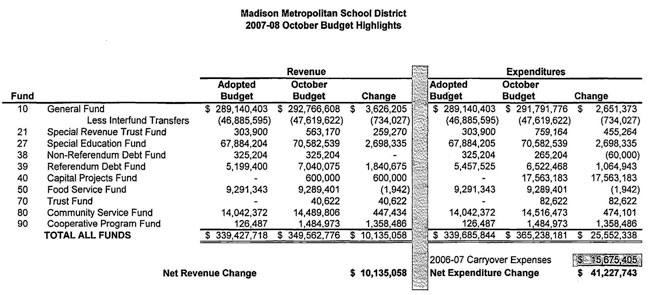
07/08 budget grows 3.6% from 333M (06/07) to $345M with Reductions in the Increase

Doug Erickson on the 2007/2008 $345M budget (up from $333M in 2006/2007) for 24,342 students):

As feared by some parents, the recommendations also included a plan to consolidate schools on the city’s East Side. Marquette Elementary students would move to Lapham Elementary and Sherman Middle School students would be split between O’Keeffe and Black Hawk middle schools.
No school buildings would actually close – O’Keeffe would expand into the space it currently shares with Marquette, and the district’s alternative programs would move to Sherman Middle School from leased space.
District officials sought to convince people Friday that the consolidation plan would have some educational benefits, but those officials saw no silver lining in having to increase class sizes at several elementary schools.
Friday’s announcement has become part of an annual ritual in which Madison – and most other state districts – must reduce programs and services because overhead is rising faster than state-allowed revenue increases. A state law caps property-tax income for districts based on enrollment and other factors.
The Madison School District will have more money to spend next year – about $345 million, up from $332 million – but not enough to keep doing everything it does this year.
School Board members ultimately will decide which cuts to make by late May or June, but typically they stick closely to the administration’s recommendations. Last year, out of $6.8 million in reductions, board members altered less than $500,000 of Rainwater’s proposal.
Board President Johnny Winston Jr. called the cuts “draconian” but said the district has little choice. Asked if the School Board will consider a referendum to head off the cuts, he said members “will discuss everything.”
But board Vice President Lawrie Kobza said she thinks it’s too early to ask the community for more money. Voters approved a $23 million referendum last November that included money for a new elementary school on the city’s Far West Side.
“I don’t see a referendum passing,” she said.

Links: Wisconsin K-12 spending. The 10.5M reductions in the increase plus the planned budget growth of $12M yields a “desired” increase of 7.5%. In other words, current Administration spending growth requires a 7.5% increase in tax receipts from property, sales, income, fees and other taxes (maybe less – see Susan Troller’s article below). The proposed 07/08 budget grows 3.6% from 333M+ (06/07) to $345M (07/08). Madison’s per student spending has grown an average of 5.25% since 1987 – details here.
UPDATE: A reader emails:

The spectre of central city school closings was what prompted some of us to resist the far-west side school referendum. Given the looming energy crisis, we should be encouraging folks to live in town, not at the fringes, strengthen our city neighborhoods. Plus, along with the need to overhaul the way we fund schools, we need a law requiring developers to provide a school or at least the land as a condition to development.

UPDATE 2: Susan Troller pegs the reduction in the increase at $7.2M:

Proposed reductions totaled almost $7.2 million and include increases in elementary school class sizes, changes in special education allocations and school consolidations on the near east side.
Other recommendations include increased hockey fees, the elimination of the elementary strings program and increased student-to-staff ratios at the high school and middle school levels.

UPDATE 3: Roger Price kindly emailed the total planned 07/08 budget: $339,139,282

Share

$1.74B Tax and Fee Increases in Governor Doyle’s Proposed Wisconsin 07-09 Budget

Bob Lang, Director: Legislative Fiscal Bureau, 92K PDF:

A number of legislators have requested information concerning state tax and fee changes included in the 2007-09 budget recommendations of the Governor. This memorandum responds to those inquiries.
The attached table provides a brief description of each state tax and fee modification proposed in the Governor’s bill. The table consists of three parts: (1) tax increases and decreases; (2) fee increases and decreases; and (3) measures which would enhance the collection of current taxes or fees. Each entry in the table includes the agency name, the Legislative Fiscal Bureau’s budget summary document item that describes the change in more detail, a summary of the proposed modification, and an estimate of the revenue change due to the tax or fee modification.
In the table, GPR represents general fund revenue. Revenue to a program revenue account is signified by PR and SEG signifies revenue to a segregated fund. “Unknown” means that no estimate of the revenue impact is available at this time. The fiscal effects shown in the table reflect estimates made by the administration; estimates prepared by this office during budget deliberations may be different.

Steven Walters:

Democratic Gov. Jim Doyle’s proposed two-year budget includes $1.74 billion in higher taxes and fees, according to a report by the Legislative Fiscal Bureau released Friday.
To put that number in perspective, it amounts to about $630 for each of the 2.76 million Wisconsin income tax filers for 2005.
The budget Doyle presented two years ago, before he won a second term in November, included $304 million in tax and fee increases, according to the non-partisan Fiscal Bureau.
The report says taxes would go up by a total of $1.37 billion by mid-2009, and listed the largest increases as:

Wisconsin residents paid 33.4% of income in taxes during 2006. More on Doyle’s proposed budget here.

Share

Senator Mike Ellis on Governor Doyle’s Proposed Budget

Jo Egelhoff:

While Senator Ellis can turn complex policy into a sentence or two, he claims Governor Doyle has magically turned tax hikes into tax cuts! About that Ellis quips “No wonder the governor is proposing a third year of math and science for high school students. Talk about new math…”
Ellis and his staff have poured over the Fiscal Bureau’s budget analysis “finding one time bomb after another.” The roarin’ and raspy Senator points out that Doyle’s sleight of hand creates new segregated funds out of whole cloth. An example shows up on page 238 of the Fiscal Bureau’s review – the newly created “Health Care Quality Fund” (HCQF). Here’s where all those new taxes (“hospital tax”, “cigarette tax”) show up as Revenues.

Share

Draft Madison West High School Dance Policies & Procedures

144K PDF File. This draft document was presented at Monday evening’s PTSO meeting prior to the school board candidate forum.

Share

Initiative Will Pay Students to Pass AP Tests

Percentage of admissions officials citing criteria as
John Hechinger & Susan Warren:

Jessica Stark, a 17-year-old from Abilene, Texas, earned $600 for some hard work last year. It wasn’t flipping burgers or waiting tables. She made the money for passing six of the toughest examinations in high school at $100 apiece.
Ms. Stark is part of a movement that is going national: paying kids to take Advanced Placement tests. Success on these exams, administered by the nonprofit College Board, often gives students college credit and sometimes encourages them to pursue study and careers in the field. Ms. Stark plans to become an engineer and has already been admitted to the Colorado School of Mines. “I do homework all the time,” she says. “I don’t have too much of a social life. … Study parties — we’re pretty good at those.”
A new initiative, aimed at encouraging careers in math and science, plans to replicate these AP bonuses across the country. Teachers get them, too — at times, $5,000 annually or more — for helping their kids pass AP classes in math, science and English. The money is provided by a network of private donors. Along with cash, students in Texas sometimes get gifts, such as iPods, as door prizes for attending weekend prep classes.
The program’s proponents say AP incentives have succeeded at getting more students to pass the tests in Texas, and they expect the broader initiative to encourage more students to go on to careers in math and science. But some critics question whether cash bonuses are an appropriate and effective way to engage students in the subjects. Robert Schaeffer, public education director for the National Center for Fair and Open Testing, a critic of standardized tests, calls the approach “basing education reform on a series of bribes to kids and bounties to teachers” and says the money would be better spent on broader efforts to improve instruction.

Share

Madison Superintendent’s 2007-2008 Proposed Budget Changes

Art Rainwater on the reductions in increases to the proposed 2007-2008 MMSD Budget [1.4MB PDF]:

Dear Board of Education,
The attached is my recommendation for the service reductions required to balance the budget for 2007-2008. They are provided to you for review in advance of my Recommended Balanced Budget for 2007-2008 which will be available on April 12, 2007. You requested that the service reductions be presented to you in advance to provide sufficient time for your study and analysis.
After 14 years of continuous reductions in our services for children there are no good choices. While these service reductions are not good for children or the health of the school district they represent our best professional judgment of the least harmful alternatives.
The process that we used to study, analyze, consider and finally recommend the items presented was done over a period of weeks. We first reviewed each department and division of the district and listed anything that could be reduced or eliminated legally or contractually. We narrowed that list to those items which we believed would do the least harm to:

  • Our academic programs,
  • The health and safety of our schools,
  • The opportunities for student involvement,
  • Our ability to complete our legal and fiscal requirements

The document presented to you today is the result of those discussions. The items are broken into four categories:

  1. Reductions to balance the budget ( Impact Statements provided)
  2. Reductions analyzed, discussed and not included (Impact statements provided)
  3. Reductions reviewed and not advanced
  4. Possible revenues dependent on legislative action

The administration is prepared to provide you further analysis and respond to questions as we continue to work to approve a final working budget in May.

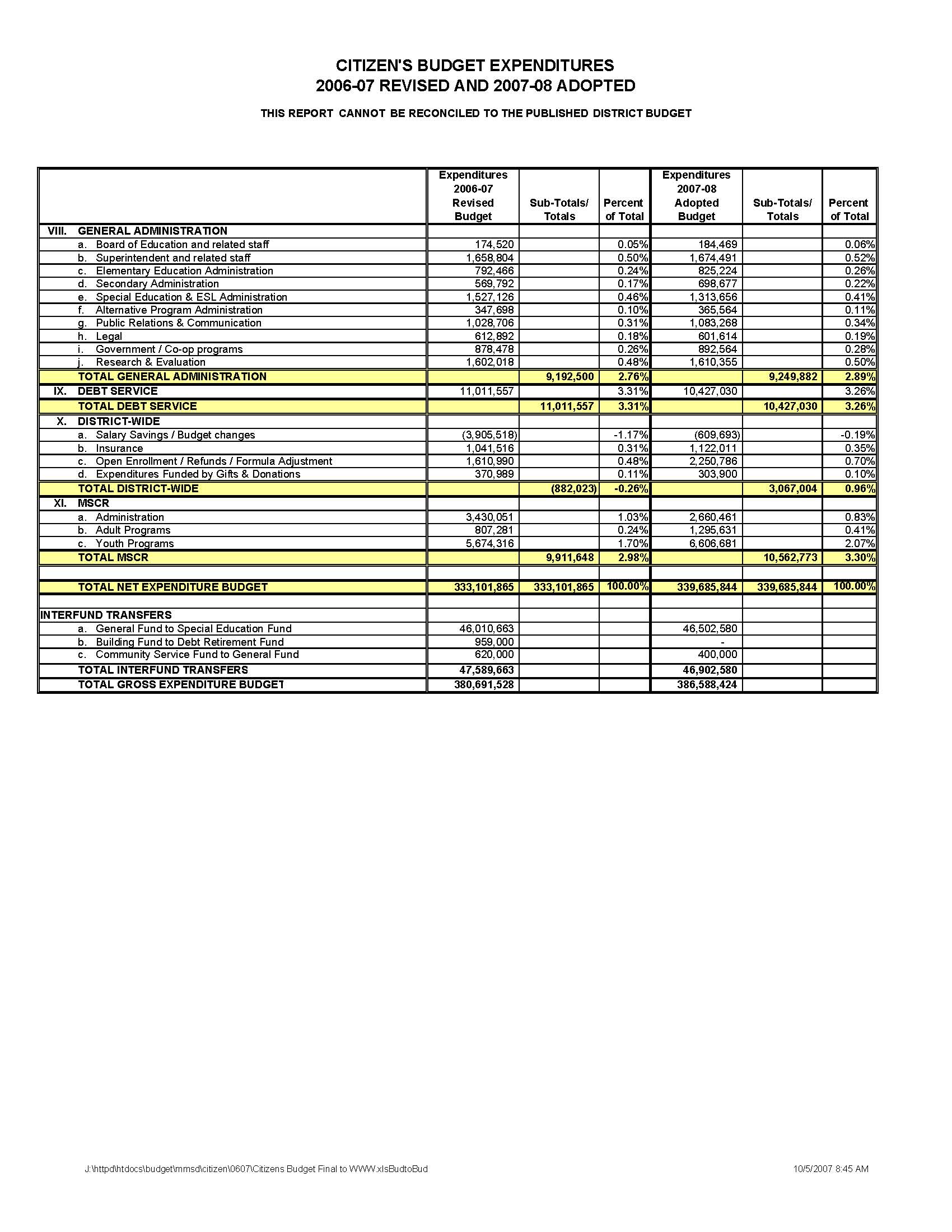
2006/2007 Citizen’s Budget ($333M+) for 24,342 students. I did not quickly notice a total proposed 2007/2008 spending number in this document.
UPDATE: Overall spending will grow about 3.4% from $333M to $345M per Doug Erickson’s article.
Links: NBC15 | Channel3000

Share

The Future of Our Schools: The Funding Crisis

The League of Women Voters of Dane County, Dane County PTO’s, Principals and School Boards
Panel Presentation featuring:

Questions to follow presentations
Wednesday, April 11, 2007
7:00 ? 9:30 p.m.
Meriter Main Gate Grand Hall
333 W. Main Street, Madison[map]
(free parking across the street)
All Welcome! Come and Bring a friend!
For more information:
The League of Women Voters of Dane County 232-9447

Share

School District Annual Reductions in Budget Increases

Doug Erickson:

Madison School District administrators are scheduled to announce today their recommendations for millions of dollars in program and staff cuts, a grim step in a budget process that typically consumes the School Board’s attention each spring.
Larger class sizes at the elementary level and bigger caseloads for special education teachers likely will be among the proposals.
Consolidating schools on the city’s East Side also is a strong possibility – parents there already are mobilizing to beat back the idea – although district officials would not confirm that such a proposal will be part of today’s announcement.
The district’s most recent budget forecast in January put next year’s shortfall at $10.5 million. That number was being refined Thursday but is in the ballpark, district officials said.

Related:

The MMSD’s budget increases annually. A variety of perspectives on enrollment, spending and staff history can be found here.
Those interested in school finance might check out Monday’s brown bag lunch meeting “Financing Quality Education“.

Share

Homeschooling and Socialization

Richard Medlin:

Shyers (1992a, 1992b), in the most thorough study of home-schooled children’s social behavior to date, tested 70 children who had been entirely home-schooled and 70 children who had always attended traditional schools. The two groups were matched in age (all were 8-10 years old), race, gender, family size, socioeconomic status, and number and frequency of extracurricular activities. Shyers measured self-concept and assertiveness and found no significant differences between the two groups.
The observers used the Direct Observation Form of the Child Behavior Checklist . . . , a checklist of 97 problem behaviors such as argues, brags or boasts, doesn’t pay attention long, cries, disturbs other children, isolates self from others, shy or timimd, and shows off. The results were striking — the mean problem behavior score for children attending conventional schools was more than eight times higher than that of the home-schooled group.

via Joanne.

Share

Why this year is different for state public school funding

Beth Swedeen:

Many people in Madison continue to say that the district and its leadership (including the Board of Education) are helpless in changing the revenue caps and the way public education is funded in Wisconsin. They point out that the revenue caps have been in place for 14 years and at least during in the last three budget cycles (since 2000), districts have been screaming for help. I’m not a political insider, but here’s at least some reasons that this year (and definitely the budget cycle in 2009) is significantly different:

Steven Walters and Stacy Forster along with numerous notes & links:

Despite Gov. Jim Doyle’s public – and repeated – promises that his budget proposal would pay for two-thirds of public education costs, an analysis released today showed that it falls short of that goal.
In a 624-page summary of the budget that Doyle gave legislators last month, the Legislative Fiscal Bureau said the state would pay 65.3% of public school costs in the year that begins July 1, and 65.5% of those costs in the following year.

Share

WORT’s Tony Casteneda Interviews Beth Moss

Tony Casteneda interviewed Seat 3 Candidate Beth Moss (vs Rick Thomas) recently. Listen to the interview here [60 minute mp3 audio]. Tony asked Beth if MTI controls the Madison School Board (Beth has been endorsed by MTI) and also discussed this site. The interview begins at about 25 – 30 minutes into the one hour show.

Share

Madison’s Reading Battle Makes the NYT: In War Over Teaching Reading, a U.S.-Local Clash

Diana Jean Schemo has been at this article for awhile:

The program, which gives $1 billion a year in grants to states, was supposed to end the so-called reading wars — the battle over the best method of teaching reading — but has instead opened a new and bitter front in the fight.
According to interviews with school officials and a string of federal audits and e-mail messages made public in recent months, federal officials and contractors used the program to pressure schools to adopt approaches that emphasize phonics, focusing on the mechanics of sounding out syllables, and to discard methods drawn from whole language that play down these mechanics and use cues like pictures or context to teach.
Federal officials who ran Reading First maintain that only curriculums including regular, systematic phonics lessons had the backing of “scientifically based reading research” required by the program.
Madison officials say that a year after Wisconsin joined Reading First, in 2004, contractors pressured them to drop their approach, which blends some phonics with whole language in a program called Balanced Literacy. Instead, they gave up the money — about $2 million, according to officials here, who say their program raised reading scores.
“We had data demonstrating that our children were learning at the rate that Reading First was aiming for, and they could not produce a single ounce of data to show the success rates of the program they were proposing,” said Art Rainwater, Madison’s superintendent of schools.

Much more on Reading First and Madison, here.
Notes & Links:

UPDATE: Joanne Jacobs:

In part one of his response, Ken DeRosa of D-Ed Reckoning provides a reading passage altered to force readers to guess the meaning from context. Struggling this way does not inspire love of reading.
In part two, DeRosa analyzes the statistics to argue Madison students aren’t doing better in reading compared to other Wisconsin students; if anything, they’ve slipped a bit. Because the state reading test was made easier and the cut score for proficiency was lowered, all Wisconsin students look better. However, there was no progress in fourth-grade reading on the federal NAEP test.
With help from Rory of Parentalcation, who’s great at finding data, Ken shows that claims of fantastic progress by black students are illusory. Their scores improved on the easier test at a slightly slower rate than white students. It looks like to me as though blacks nearly caught up in basic skills but remain far behind at the proficient and advanced level. Perhaps someone who knows more statistics than I do — lots of you do — can find flaws in Ken’s analysis.

NYT Letters to the editor. Finally, others have raised questions about the MMSD’s analysis and publication of test score data.
Andrew Rotherham:

Diana Schemo’s NYT story on Reading First is not surprisingly sparking a lot of pushback and outraged emails, especially from the phonicshajeen. But, they have a point. There are problems with Reading First, but this may not be the best example of them at all…but, while you’re there, don’t miss the buried lede in graf eight…it’s almost like Schemo got snowed by all sides at once on this one…

Share

East siders angered by school plan

From a story by Susan Troller in The Capital Times:

Recommended Madison school district changes that involve closing a middle school and joining a pair of elementary schools on the near east side are causing heated reaction in the Lapham-Marquette neighborhood.
“Do we know what we’re doing here and does this actually reflect best practices?” Marquette parent and district teacher Kit Rittman asked, reacting to a boundary change scenario that would include closing Sherman Middle School and consolidating students at Black Hawk and O’Keeffe middle schools.
Both schools feed into East High.
Changes would also involve combining students from Lapham, a K-2 school, and Marquette, which houses grades 3, 4 and 5, at the Lapham building on East Dayton Street. Space at Sherman would be filled by moving an existing high school alternative program there.

Share

We Energies offers great scholarships to CA energy conferences

The We Energies Renewable Energy Development Program
“2007 Wind and Solar Scholarship Program”
Request for Applications
March 5, 2007
Program Description
We Energies supports the development of renewable energy technologies as part of a long-term strategy for providing low-cost, environmentally sound energy options to its customers. To help in furthering this objective, the “2007 Wind and Solar Scholarship Program” will provide grant funds to faculty members at secondary schools, colleges, technical colleges, and universities located within the We Energies electric service territory for purposes of attending one of two conferences. The conferences include:
1. Windpower 2007, Los Angeles, June 3 – 6, 2007
The Windpower conference will include over 200 speakers, 150 poster presentations, and 50 sessions on leading wind energy topics organized into tracks with policy, business, and technical focuses. The conference anticipates 6,000 visitors. www.eshow2000.com/awea/
2. Solar Power 2007, Long Beach, Sept. 24 – 27, 2007
This annual conference has become America’s largest solar energy event. Solar Power will feature 175 exhibitors, 125 speakers and networking opportunities. The conference anticipates 10,000 visitors. www.solarpowerconference.com

(more…)

Share

Help Increase Support for Wisconsin Students of Poverty to Take AP Exams

Below you will find a forward from the Wisconsin Gifted Education listserv. A brief communication from each of us to our state legislators could release money to cover AP exam registration fees for Wisconsin students who qualify for free and reduced lunch. A small change is needed in the wording of a specific state statute in order to release federal dollars for that purpose. Thanks for your help. –LAF

As you know, students are beginning to pay registration fees for the Advanced Placement Exams they are planning to take in May.
In Chapter 120 of “School District Government,” Wisconsin statute 120.12 — “School Board Duties”, item (22) — reads as follows:
ADVANCED PLACEMENT EXAMINATIONS. Pay the costs of advanced placement examinations taken by pupils enrolled in the school district who are eligible for free or reduced – price lunches in the federal school lunch program under 42 USC 1758.
While no one objects to these students having the exam fee paid, the district common funds that are used for this purpose are constantly being reduced. As there are no state aids connected to this legislative requirement, districts are following the statute as an “unfunded mandate”.
The Department of Public Instruction has written a federal grant which would allow a variety of other funds (not just local common funds) to be used for the payment of AP exam fees. The federal grant is on hold pending some immediate action by our legislature to change the wording of the above quoted statute that would allow federal grant money to be awarded to the Department of Public Instruction for the express purpose of reimbursing districts for the AP exam fees of students qualifying for free or reduced lunches. With the current language in the statute, the federal government will not release grant funds for this purpose because thy see it as “supplanting” other resources.
Action is needed immediately since students are NOW registering for those exams and district are required to cover these fees NOW.
Let your legislators know that their immediate action to change the wording of the statute would result in the release of federal grant money to the State of Wisconsin. If no action is taken, the grant money will be lost. The decision is currently on hold, pending legislative action.
Go to http://waml.legis.state.wi.us/ “Who are my Legislators?” to find out who represents you. You will see their email and snail mail addresses. You are advised to send both and always remember to include your home street address so that the legislator realizes that you do live and vote in their district.
Ruth Robinson
Coordinator of Talented & Gifted Education & District Assessment
527 South Franklin Street
Janesville, WI 53548
608-743-5035
608-743-5130 fax

Share

Intel Competition Is Where Science Rules and Research Is the Key

Joseph Berger:

The Intel is more than a gimmicky contest that garners publicity for its chipmaker sponsor. It genuinely prompts hundreds of students to plunge into vanguard research. This year, 1,705 students from 487 schools in 44 states entered, said Katherine Silkin, the contest’s program manager. High school seniors in the United States and its territories enter the Intel, though their research often begins years earlier.
Six winners of the Westinghouse, as Intel was known until 1998, have gone on to win Nobel Prizes. Its springboard power is particularly important when Americans fret that colleges are no longer producing as many graduates willing to make the financial sacrifices of lives in science.
“Not only do we have to have equity and close the famous achievement gap,” said Leon M. Lederman, a Nobel-winning physicist who is co-chairman of the Commission on 21st Century Education in Science, Technology, Engineering and Mathematics. “We also have to have innovation if we’re going to survive, so you have to nurture the gifted kids.”

Share

Collaborate on 4 Year Old Kindergarten

Milwaukee Journal-Sentinel:

Recognizing that the earlier you start teaching a child, the more and better that child will learn, Wisconsin (actually, Margarethe Schurz) brought kindergarten to America in 1856. Today, recognizing the value of that principle and the importance of collaboration, school districts in Wisconsin are starting to work with private day care centers to give 4-year-olds an even bigger boost to their education.
The Menomonee Falls School District is planning to join several other area school districts this fall in offering such a program. It’s an idea that more districts should consider.
“The goal to all of this is to provide quality 4-year-old services for each and every child who resides in the school district so when they come to 5-K, they’ve got the same kindergarten basis,” Marlene Gross-Ackeret, director of pupil services for the Menomonee Falls district, told Journal Sentinel reporter Amy Hetzner.

Share

Another gem from Bill Keys and AMPS

Since Advocates for Madison Public Schools doesn’t allow access to the archived posts of its listserve, I post the following to illustrate the contempt these people feel toward anyone who isn’t in lock-step with their point of view:

To: advocatesformadisonpublicschools@yahoogroups.com
Subject: [advocatesformadisonpublicschools] Summer Exercise for “Advocates”
Date: Mon, 24 Jul 2006 23:51:45 -0000
Here’s an interesting post from a local blog:

I wil be moving to the madison area soon and need to find schools that
realize “gifted” children do have special needs. I can not waist anymore time trying to get this point accross to educators because meanwhile my cildren suffer. Where is the the best public school for gifted children in the Madison area? I will purchase a home right next door and hopfully I can stop fighting to get my children a proper education

And so “advocates”…how would you answer if she ran into you at the
grocery store?

(more…)

Share

Why Illinois Test Scores Went Up?: Changing the Test or Academic Improvements?

Via a reader looking at this issue: Stephanie Banchero, Darnell Little and Diane Rado:

Illinois elementary school pupils passed the newly revamped state achievement exams at record rates last year, but critics suggest it was more the result of changes to the tests than real progress by pupils.
State and local educators attribute the improvement to smarter pupils and teachers’ laser-like focus on the state learning standards—the detailed list of what pupils should know at each grade level. They also say that the more child-friendly exams, which included color and better graphics, helped pupils.
But testing experts and critics suggest that the unprecedented growth is more likely the result of changes to the exams.
Most notably, the state dramatically lowered the passing bar on the 8th-grade math test. As a result—after hovering at about 50 percent for five years—the pass rate shot up to 78 percent last year.
While the number of test questions remained generally the same, the number that counted on pupil scores dropped significantly.

Kevin Carey criticized Wisconsin’s “Statistical Manipulation of No Child Left Behind Standards“. The Fordham Foundation and Amy Hetzner have also taken a look at this issue.

Share

Governor Doyle’s Proposed Budget Does Not Save the Madison School District:
Proposed Budget provides 65% of public school costs via redistributed sales, income, corporate taxes and fees, rather than 67%.

I’ve received some emails on this story. It seems there are two approaches to “fixing” the Madison School District’s $333M+ budget for our 24,342 students. Blame the state/federal government, or work locally to build support for our public schools in terms of volunteer hours, partnerships and money.
I believe that latter approach is far more likely to succeed because we have more control all around and we have a vested interest in our community’s future. That’s also why I support Maya Cole (vs. Marj Passman) and Rick Thomas (vs. Beth Moss) for school board. Ruth Robarts, Lucy Mathiak and Lawrie Kobza have proven that the board and individual members can be effective. An insider friend mentioned that Doyle’s budget is “thinly balanced”, which likely explains the reality. The Madison School Board’s majority decision (4-3) with respect to concessions before negotiations magnifies the governance issue. Watch the candidates discuss this issue, among others recently.
Those interested in this issue should check out Monday’s (3/12 from 12 to 1:00p.m.) brown bag lunch on Financing Quality Education. [map]
Steve Walters and Stacy Forster:

Despite Gov. Jim Doyle’s public – and repeated – promises that his budget proposal would pay for two-thirds of public education costs, an analysis released today showed that it falls short of that goal.
In a 624-page summary of the budget that Doyle gave legislators last month, the Legislative Fiscal Bureau said the state would pay 65.3% of public school costs in the year that begins July 1, and 65.5% of those costs in the following year.
Because public schools cost about $9 billion every year, each 1% equals about $90 million – money that is tight as legislators begin the process of reviewing Doyle’s budget and drafting changes to it. Legislators will act on their version of the budget over the next three or four months.

Legislative Fiscal Bureau Summary. Via WisPolitics. More on Wisconsin’s school finance climate here. The Associated Press has also posted an article here:

The nonpartisan Legislative Fiscal Bureau said Tuesday in a summary of the budget the governor gave to legislators in January that the state would pay 65.3 percent of public school costs in the year that begins July 1 and 65.5 percent during the next year.

The AP article references some special and school choice funding changes that may help some districts:

David Schmiedicke, the governor’s budget director, said the budget proposal is just short of the 66 percent goal next year because it includes more money for specific programs such as aid to students with disabilities, subsidies for small class sizes and free breakfasts, and $21 million more to pay for Milwaukee’s school choice program.

Share

How the Open Source Movement Has Changed Education: 10 Success Stories

Online Education Database:

How would you like to study at MIT (Massachusetts Institute of Technology) for free? It has been nearly six years since MIT first announced their MIT OpenCourseWare (OCW) program. More recently, MIT announced that the OCW program, a free and open educational resource (OER) for educators, students, and self-learners around the world, is online and will be completed by 2008. The OCW provides open access to course materials for up to 1,550 MIT courses, representing 34 departments and all five MIT schools. The goal is to include materials from all MIT courses by next year.
MIT provides just one of the 10 open source educational success stories detailed below. Open source and open access resources have changed how colleges, organizations, instructors, and prospective students use software, operating systems and online documents for educational purposes. And, in most cases, each success story also has served as a springboard to create more open source projects.

Share

Education, Education, Education

Bob Herbert:

It’s an article of faith that the key to success in real estate is location, location, location.
For young black boys looking ahead to a difficult walk in life, the mantra should be education, education, education.
We’ve watched for decades — watched in horror, actually — as the lives of so many young blacks, men and boys especially, have been consumed by drugs, crime, poverty, ignorance, racial prejudice, misguided social pressures, and so on.
At the same time, millions of blacks have thrived, building strong families and successful careers at rates previously unseen. By far, the most important difference between these two very large groups has been educational attainment.
If anything, the role that education plays in the life prospects of black Americans is even more dramatic than in the population as a whole. It’s the closest thing to a magic potion for black people that I can think of. For boys and men, it is very often the antidote to prison or an early grave.

(more…)

Share

18 Year Old Madison Resident Wins National Vocabulary Championship

James Barron:

Rich Cronin, the president and chief executive of GSN, said he was not just thrilled to watch the competition, he was euphoric. “One person will be the ‘American Idol’ of vocabulary,” he said. (In the end, after an afternoon with its share of technical difficulties and dashed hopes, the winner was Robert Marsland, 18, of Madison, Wis. He will receive $40,000 toward college tuition. The winners in the finals and in the earlier citywide competitions held nationwide divided more than $80,000 in tuition money. The Princeton Review, a tutoring and test preparation service, came up with the questions. )
Off camera, it took Joel Chiodi, GSN’s vice president for marketing, a moment to remember a word he had learned from listening to contestants around the country.

Susan Troller:

Madison’s Robert Marsland, 18, took first place at the inaugural National Vocabulary Championship Monday in New York City, nabbing a trophy and a $40,000 scholarship prize. Last year, he nailed a perfect 36 on his ACT college entrance exam, and in 2003 he represented Wisconsin in the National Spelling Bee.
He is a student at the tiny St. Ambrose Academy on Madison’s west side, where he studies both Greek and Latin.

Share

3/5/2007 Madison School Board Candidate Forum: West High School

The Madison West High School PTSO held a school board candidate forum Monday night. Topics included:

  • Madison High School Comparison
  • A candidate’s ability to listen, interact and work successfully with other board members
  • Past and future referenda support
  • Candidate views on the $333M+ budget for our 24,000 students
  • Extensive conversations on the part of Marj and Johnny to lobby the state and federal governments for more money. Maya wondered how successful that strategy might be given that our own State Senator Fred Risser failed to sign on to the Pope-Roberts/Breske resolution and that there are many school districts much poorer than Madison who will likely obtain benefits first, if new state tax funds are available. Maya also mentioned her experience at the state level via the concealed carry battles.
  • The challenge of supporting all students, including those with special needs. Several candidates noted that there is white flight from the MMSD (enrollment has been flat for years, while local population continues to grow)
  • Mandatory classroom grouping (heterogeneous) was also discussed

I applaud the West PTSO for holding this event. I also liked the way that they handled questions: all were moderated, which prevents a candidate supporter from sandbagging the opposition. I attended a forum last year where supporters posed questions before local parents had the opportunity.
Video and mp3 audio clips are available below. Make sure you have the latest version of Quicktime as the video clips use a new, more efficient compression technique.

(more…)

Share

Notes from UW-Madison and Madison West High on AP Standards

Danielle Repshas:

“Still, there is not an absolute guarantee that a course [called] one thing someplace has the same rigor somewhere else,” Reason said.
Part of the challenge is judging the standards of one AP class from another at different high schools, and Reason said the level of trust colleges and secondary schools have with one another is one way colleges try to establish relationships with high schools. But Reason said he is concerned about the competition level at high schools in terms of coursework because schools in some areas do not have the same rigor in their coursework with respect to others.

The article includes a comment regarding Madison West High School’s limited approach:

In fact, there are only a handful of AP classes at Madison West, and most students aren’t interested in them. They’d rather take more stimulating and challenging classes.

Marcia Gevelinger Bastian touched on the issue of West’s limited number of AP classes here.

Share

Home Schoolers and College Applications

Ana Beatriz Cholo:

“For home-schoolers, it was basically a shut door for us because of the restrictions,” Sample said.
Last fall, however, UC Riverside joined a growing number of colleges around the country that are revamping application policies to accommodate home-schooled students.
The change came just in time for the 18-year-old Sample to apply and get accepted with a substantial scholarship.
Under UC Riverside’s new policy, home-schoolers can apply by submitting a lengthy portfolio detailing their studies and other educational experiences.
Sample’s package showed he had studied chemistry, U.S. history and geometry, rewired a house and helped rebuild a medical clinic in Nicaragua.

Share

Milwaukee School Board Reviews Their Superintendent

Alan Borsuk:

Less than a month before an election that is likely to leave School Superintendent William Andrekopoulos with a board that is not as favorably disposed toward him, the current School Board will hold a session Thursday to consider changing provisions in his contract.
School Board President Joe Dannecker said Monday that he wants the session to focus on how the board will conduct its annual review of Andrekopoulos’ job performance. The current contract says the way of conducting those reviews needs to be settled by the end of April. Dannecker also said he hopes the Thursday session will be conducted mostly in public.

Share

Life-Long Computer Skills Rather Than PowerPoint or Windows

Jakob Nielsen:

Schools should teach deep, strategic computer insights that can’t be learned from reading a manual.
I recently saw a textbook used to teach computers in the third grade. One of the chapters (“The Big Calculator”) featured detailed instructions on how to format tables of numbers in Excel. All very good, except that the new Excel version features a complete user interface overhaul, in which the traditional command menus are replaced by a ribbon with a results-oriented UI.
Sadly, I had to tell the proud parents that their daughter’s education would be obsolete before she graduated from the third grade.
The problem, of course, is in tying education too tightly to specific software applications. Even if Microsoft hadn’t turned Excel inside out this year, they would surely have done so eventually. Updating instructional materials to teach Office 2007 isn’t the answer, because there will surely be another UI change before today’s third graders enter the workforce in 10 or 15 years — and even more before they retire in 2065.

Share

Kentucky: Teacher and School Grants for Math, Chemistry, Physics and Expanded AP Classes

Tom O’Neill:

SB1 would provide $10,000 grants to help schools start advanced-placement courses. Students scoring highly on the AP exams and who receive free or reduced-price lunches would be eligible for $200 to $300 in state scholarships.
Under SB2, teachers could get salary bumps if they perform well on the teacher-certification tests in math, chemistry and physics.
The two-year cost of the bills is estimated at $4.7 million and $9.2 million, respectively. The savings to students from exam costs and tuition assistance is estimated at $7.9 million for the two years.
By comparison, giving every teacher in Kentucky a 1 percent raise would cost the state $23 million a year, Kelly said.
The Senate has passed both bills, and they are now awaiting assignments to House committees.
Supporters of the measures include University of Kentucky President Lee Todd and the influential Lexington-based Prichard Committee for Academic Excellence.
The primary opponent is the KEA, which represents 38,000 public school teachers in Kentucky.

Share

Course-Title Inflation

Amit Paley:

In 2005, Asian/Pacific Islander graduates took a tougher course load than white and black graduates, with 63 percent completing at least a mid-level curriculum. The rate was 44 percent for Hispanic graduates.
The study did not include transcripts of high school dropouts, an important caveat because dropout rates vary widely among racial and ethnic groups.
Experts also point out that the study based its definition of course rigor on titles and descriptions, not necessarily on the delivered content. Known as course-title inflation, that means a class might be called calculus but really teach only algebra. Experts say minority students are often disproportionately affected by such inflation.
“You see all the time that courses are being dumbed down even if they have tough-sounding titles,” said Erich Martel, a history teacher at Woodrow Wilson Senior High School in the District.

Share

3/8/2007 Madison Mayor Forum

WisPolitics is hosting a Madison Mayoral Forum Thursday at the Madison Club at 11:45a.m. [map]

Share

Keys and Casteneda sing same song

After listening to Phony Tony Casteneda’s ludicruous charaterizations of those who post on this blog, I remembered a post by Bill Keys on a listserve sponsored by Advocates for Madison Public Schools. Bill and Phony Tony used nearly the same language and divisiveness. Here’s Bill’s rant:

FACTS? FACTS? FACTS?
Do you really believe that those who criticize public education are the least bit interested in INFORMATION?????
You shoulda been with us while campaigning for the referenda in 2005.
You’d know by now.
They are the Neo-cons and fascists who got us into Iraq, who support
amendments banning same sex marriage, who are opposed to sick leave for workers and living wages and health benefits as well, and who want to stop Mexican immigration even while eating the food that Mexican-Americans grow and harvest?
FACT?
They are not at all interested. A FACT never changed any of these folks’ minds.
‘Course that’s assuming they have any.
Bill

Not a single one of the Advocates for Madison Public Schools called Bill on this abrasiveness or questioned his assertions.
Remember, these are the people who advise and support Marj Passman. Do the comments of Bill and Phony Tony reflect Marj’s feelings? Apparently, we’ll never know. She’s mum to e-mails and requests for her to explain her positions.

Share

2006 – 2007 Madison School District $333M+ Citizen’s Budget


[JPG | PDF | .xls versions] MMSD Statistics.
Paul Soglin’s observations on the MMSD’s funding issues, special ed and our politicians.

Share

Menomonee Falls School District Works with Community on 4 Year Old Kindergarten

Amy Hetzner:

When the Menomonee Falls School District opens its doors to a new 4-year-old kindergarten program this fall, private day cares in the village will open theirs to it, too.
Using an idea that’s catching on throughout the state, the district plans to partner with local preschool and child care centers to give 4-year-olds a half-day program that proponents say will give them an educational boost for years to come.
“The goal to all of this is to provide quality 4-year-old services for each and every child who resides in the school district, so when they come to 5-K they’ve got the same kindergarten basis,” said Marlene Gross-Ackeret, Menomonee Falls’ director of pupil services, and one of the key players in its 4-K initiative.
Almost every Wisconsin school district looking to add a new 4-year-old kindergarten program is considering such a collaborative approach, said Jill Haglund, an early-childhood education consultant for the state Department of Public Instruction who estimated that the partnerships exist in about 50 school systems. Even Milwaukee Public Schools collaborates with some community partners, placing its teachers at off-campus sites, despite having its own extensive 4-K programs.

Quite a contrast to the general Madison School District approach with respect to After School and classes taken outside our public school district. More here.

Share

Wisconsin’s K-12 Spending Climate

Avrum Lank:

Per capita income will continue to grow in Wisconsin through 2009, but at a slower rate than in the nation as a whole, according to an economic outlook released Friday by the state Department of Revenue.
Employment also will grow, but manufacturing jobs will decline, the report said.
Even so, corporate income tax collections are growing about four times faster than all state tax revenue, reflecting robust business profits.
“The U.S. economy is expected to slow this year,” the report said. The state’s economy also will slow “before returning to stronger growth in 2008.”
Jobs in the state will grow 0.8% this year to 2,892,800 – less than the 1% growth last year. Growth rates of 1.3% in 2008 and 1.2% in 2009 will bring the job total to slightly fewer than 3 million, the report said.
However, manufacturing jobs will fall from 507,300 last year to 502,900 by 2009.
Per capita personal income will rise about 8%, to $33,174 in 2009 from $30,706 last year, using constant 2000 dollars.
That is a decline to 96.2% of the national average in 2009, from 96.7% last year.

Wisconsin Department of Revenue Economic Outlook 292K PDF
Changing state K-12 funding to benefit Madison (perceived as a rich district based on property values and spending growth) will be difficult given our higher than state average per student spending and some of the issues noted above. The politics of this issue can be seen in those who have supported (and those who have not, including our own Senator Fred Risser) the Pope-Roberts/Breske resolution. Senator Risser’s bills.

Share

Project Girl Program helps middle schoolers sort through barrage of media messages

Susan Troller:

What if parents could vaccinate their adolescent daughters against the siren song of the mall? Is there any way to get them to just say no to the power of brand name clothing, accessories and cosmetics?
And what should be done about the barrage of marketing messages telling them they can never be too rich, or too thin, and that they must be hot, hot, hot as they shop, shop, shop, even if they’re only 10 years old?

Share

Madison School Board Candidates Address the Achievement Gap

Isthmus continues their excellent candidate take home tests, this week addressing the Madison School District’s achievement gap:

Share

Confirmation of MMSD’s bargaining give aways

Roger Price provided a copy of the 2007 Voluntary Impasse Resolution Procedure agreement between the MMSD and MTI.
As reported earlier, if the MMSD and MTI go to arbitration, the MMSD agrees not make a final offer that would modify health insurance benefits for teachers or change the salary structure, which offers new teachers a starting salary of $23,000, a salary lamented by Marj Passman in her interview on WORT.
The agreement duplicates the 2005 agreement, as discussed here.

Share

Statewide Study of Arts Education in California

An Unfinished Canvas, Arts Education in California: Taking Stock of Policies and Practices by Katrina Woodworth, Roneeta Guha, Alix Gallagher, Ashley Campbell, June Park, and Debbie Kim:

Policies recently enacted at both the state and federal levels demonstrate a commitment to arts education. In 2001, the California State Board of Education adopted content standards for the visual and performing arts. In 2002, the federal No Child Left Behind law, with provisions recognizing the arts as a core subject, was signed into law. Beginning in 2005-06, students seeking admission to the University of California and California State University systems are required to take one full year of arts education coursework during high school.
Despite expectations and enthusiasm for instruction in the arts, little information about California students’ access to and performance in the arts is available, and statewide information about the delivery of arts education is lacking. Several recent studies suggest that arts education is in jeopardy—and perhaps in decline—and that schools are struggling to incorporate arts in their curriculum. Recent studies also point to disparities in access by school demographic characteristics, as well as differences in offerings by discipline. None of these studies, however, systematically examine the status of arts education in all four arts disciplines across all of California’s schools.

Sharon Noguchi has more.

Once derided as non-essential fluff and an expensive luxury, the arts have languished in California schools for nearly three decades.
Now, a Menlo Park think tank has recommended that California students spend more time in school to learn music, drama, theater and visual arts.
In a statewide survey of 1,123 California schools, researchers at SRI International found that 89 percent of schools fail to meet state standards for arts education.
Nearly one-third of the schools surveyed offered no art courses that met the standards, and K-12 enrollment in music courses dropped by 37 percent over the five years ending last June.

Share

The Kid Spending Spectrum

Eileen Daspin and Ellen Gameran:

With the debate about the country’s wealth gap heating up again, pampered kids provide some of the most dramatic examples, from toddlers in $800 strollers to 10-year-olds with cellphones. But for many families, drawing the line between attentive parenting and extravagance is a tough call; even parents who are relatively strapped will go to great lengths for their children. And though millions can’t afford the government’s child-cost estimate, there is no question that many others are spending far more without viewing it as extreme.
To assess how relatively routine expenses, as well as more excessive ones, can contribute to the total cost of raising a child, The Wall Street Journal deconstructed the government’s approach and recalculated it using a different range of costs.
Escalating kid spending is more rampant among wealthier households, so we used the government’s top-third income bracket as a starting point. We also added some costs that aren’t included in that government calculation, such as college-savings plans, which a growing number of households are setting up for their kids.

Share

March Madison BOE Progress Report

March Madness is approaching! On the board level, madness can be characterized by the large assortments of topics and decisions that have been or will need to be made such as the superintendent search, budget, and other serious issues that require time, analysis and public discussion. I would like to give you a brief report on some of those topics.

(more…)

Share

Financing Quality Education, March 12

Financing Quality Education: A Five-Year Look
March 12, 12:00 noon to 1:00 p.m.
Lower Conference Room
222 South Hamilton Street, Madison
Bring your brown-bag lunch and join others concerned about Madison schools to discuss long-range plans to help the district meet the financial challenges created by the state-imposed revenue limits.
The meeting and discussion will help identify the stakeholders and possible steps needed to begin and shape long-term view of the MMSD and its budget.
Some ideas were laid out on schoolinfosystem.org:
https://www.schoolinfosystem.org/archives/2006/03/a_5_year_approa.php:
“[Ask] what is the best quality of education that can be purchased for our district for $280 million a year. Start with a completely clean slate. Identify your primary goals and values and priorities. Determine how best to achieve those goals to the highest possible level, given a budget that happens to be $40 million smaller than today’s. Consider everything – school-based budgeting, class sizes, after-school sports, everything.”
Everyone and all ideas are welcome at this brown-bag discussion in the lower level conference room at 222 S. Hamilton Street.
For more information, contact Ed Blume at edblume@mailbag.com or by phone at 225.6591.

Share

No Child Left Behind’s Effect on the States

The Economist:

FOR as long as there have been maths tests, there have been cheats. But whereas a schoolboy caught furtively copying his neighbour’s answers can expect a zero and an angry letter home, states that rig exam results are showered with federal cash. This is one reason why the No Child Left Behind Act, a noble attempt to impose discipline on American schools, needs revision before it merits an A grade.
The premise behind the law was sensible enough. Before it was passed in 2002, state education bureaucrats were reluctant to collect and publish the kind of data that would have allowed parents to make comparisons between schools, or to tell if a school was improving over time. Good schools received few rewards; bad ones had little incentive to improve. President George Bush sought to change that.
Under No Child Left Behind, students must be tested on maths and reading every year between the ages of eight and 13, and once in high school. Test results must be published and broken down by race. Schools that fail to show “adequate yearly progress” face penalties. Parents of children at consistently failing schools must be allowed to move them to better ones.
All good stuff. But there are catches. Federal subsidies to the states depend on students meeting standards that the states themselves set. States thus have a multi-billion-dollar incentive to game the system. In Arizona, for example, only one-fifth of eighth-graders were rated “proficient” at maths after taking the state test in 2003. Two years later, that proportion had magically tripled. Does this mean that the test got easier to pass? “Yes,” says Janet Napolitano, Arizona’s plain-talking governor.

Wisconsin’s academic standards have been criticized by the Fordham Foundation:

The report being released today by the Thomas B. Fordham Foundation in Washington uses harsh terms in critiquing the standards that are intended to guide instruction in Wisconsin schools. “Depth is nowhere to be found,” it said of the science standards. “This document has no structure or method,” it said of the world history standards. “Skimpy content and vague wording,” it said in describing the math standards.
In June, a different group ranked Wisconsin No. 1 in the country in frustrating the goals of the federal No Child Left Behind law. Also in June, a third organization focused on Milwaukee and Wisconsin as examples of places where more inexperienced – and therefore, less proficient – teachers are disproportionately assigned to high-needs schools. And two weeks ago, the U.S. Department of Education rejected as inadequate Wisconsin’s plans for dealing with federal requirements that every student have a “highly qualified” teacher.

along with Kevin Carey: “Hot Air: How States Inflate Their Educational Progress Under NCLB “

Critics on both the Left and the Right have charged that the No Child Left Behind Act tramples states’ rights by imposing a federally mandated, one-size-fits-all accountability system on the nation’s diverse states and schools.
In truth, No Child Left Behind (NCLB) gives states wide discretion to define what students must learn, how that knowledge should be tested, and what test scores constitute “proficiency”—the key elements of any educational accountability system. States also set standards for high school graduation rates, teacher qualifications, school safety and many other aspects of school performance. As a result, states are largely free to define the terms of their own educational success.
The Pangloss Index ranks Wisconsin as the most optimistic state in the nation. Wisconsin scores well on some educational measures, like the SAT, but lags behind in others, such as achievement gaps for minority students. But according to the Wisconsin Department of Public Instruction, the state is a modern-day educational utopia where a large majority of students meet academic standards, high school graduation rates are high, every school is safe and nearly all teachers are highly qualified. School districts around the nation are struggling to make Adequate Yearly Progress (AYP), the primary standard of school and district success under NCLB. Yet 99.8 percent of Wisconsin districts—425 out of 426—made AYP in 2004–05.
How is that possible? As Table 2 shows, some states have identified the large majority of districts as not making AYP. The answer lies with the way Wisconsin has chosen to define the AYP standard.

Share

The Birth of Stochastic Science

Nassim Nicholas Taleb:

It fosters entrepreneurs and creators, not exam takers, bureaucrats or, worse, deluded economists. So the perceived weakness of the American pupil in conventional and theoretical studies is where it very strength lies — it produces “doers”, Black Swan hunting, dream-chasing entrepreneurs, or others with a tolerance for risk-taking which attracts aggressive tinkering foreigners. And globalization allowed the U.S. to specialize in the creative aspect of things, the risk-taking production of concepts and ideas, that is, the scalable and fat-tailed part of the products, and, increasingly, by exporting jobs, separate the less scalable and more linear components and assign them to someone in more mathematical and “cultural” states happy to be paid by the hour and work on other people’s ideas. (I hold, against the current Adam Smith-style discourse in economics, that the American undirected free-enterprise works because it aggressively allows to capture the randomness of the environment — “cheap options”— not much because of competition and certainly less because of material incentives. Neither the followers of Adam Smith, nor to some extent, those of Karl Marx, seem to be conscious about the role of wild randomness. They are too bathed in enlightenment-style causation and cannot separate skills and payoffs.)

Taleb’s excellent “Fooled By Randomness” is a must read.

Share

Gifted? Autistic? Or Just Quirky?

Maia Szalavitz:

“Paradoxically liberating” is how Phil Schwarz has described his Asperger’s syndrome diagnosis. He was in his late 30s at the time, and he had number of things on his mind: A software developer in Framingham, Mass., Schwarz had been labeled “gifted” as a child and had graduated third in his high school class. For years he had struggled with depression and a feeling that he was not living up to the promise of his past.
What’s more, he had begun to worry about his toddler’s delayed language development and repetitive play style. But he had no idea how the diagnosis that his son Jeremy would receive might affect his own identity.

Share

Civics Failure in Public Education

Paul Soglin:

While everyone is weighing in on the best way to teach our kids, I cannot get over the failure to educate youngsters about American institutions.
The more inclusive and more truthful curriculum about our nation’s history that is taught today is a vast step forward. However, when I graduated from high school I could discuss the Constitution, the Bill of Rights, the the Declaration of Independence and their inherent contradictions. I knew the three branches of government and their powers.

There are some teachers who emphasize civics. A great teacher friend recently mentioned “if we’re doing such a good job with the students, why are so few people asking questions of our government?”

Share

Marj Passman & Tony Casteneda Discuss The Madison School Board Race

Madison School Board Seat 5 candidate Marj Passman talked with Tony Castañeda recently on WORT-FM. Marj faces Maya Cole in the April 3, 2007 spring election. Marj and Tony discussed health care costs, curriculum, governance, special education, this website, and the Madison School District’s $331M+ budget.
Listen via this 5.7MB mp3 audio file. A transcript will be posted when available.

Share

Presentation on Special Education in the Madison Public Schools

Madison School Board Special Education PresentationThe Madison School Board heard a presentation on the district’s special education program, which currently serves 4,314 students, Monday evening. Watch Jack Jorgenson’s presentation via this video.
Links:

Share

Education Report Card

US Chamber of Commerce:

The United States in the 21st century faces unprecedented economic and social challenges, ranging from the forces of global competition to the impending retirement of 77 million baby boomers. Succeeding in this new era will require our children to be prepared for the intellectual demands of the modern workplace and a far more complex society. Yet the evidence indicates that our country is not ready. Despite decades of reform efforts and many trillions of dollars in public investment, U.S. schools are not equipping our children with the skills and knowledge they-and the nation-so badly need.
It has been nearly a quarter century since the seminal report A Nation at Risk was issued in 1983. Since that time, a knowledge-based economy has emerged, the Internet has reshaped commerce and communication, exemplars of creative commerce like Microsoft, eBay, and Southwest Airlines have revolutionized the way we live, and the global economy has undergone wrenching change. Throughout that period, education spending has steadily increased and rafts of well-intentioned school reforms have come and gone. But student achievement has remained stagnant, and our K-12 schools have stayed remarkably unchanged-preserving, as if in amber, the routines, culture, and operations of an obsolete 1930s manufacturing plant.

Share

A Bad Report Card

NY Times Editorial:

Congress, which is preparing to reauthorize both the No Child Left Behind Act and the Higher Education Act, needs to take a hard look at these scores and move forcefully to demand far-reaching structural changes.
It should start by getting the board that oversees the National Assessment of Educational Progress testing to create rigorous national standards for crucial subjects. It should also require the states to raise the bar for teacher qualifications and end the odious practice of supplying the neediest students with the least qualified teachers. This process would also include requiring teachers colleges, which get federal aid, to turn out higher quality graduates and to supply many more teachers in vital areas like math and science. If there’s any doubt about why these reforms are needed, all Congress has to do is read the latest national report card.

Share

Two Educators Discuss “My Life & Times with the Madison Public Schools”

Audrey Soglin & Char Gearing respond to Marc Eisen’s recent words:

I think we have learned and the research supports that kids need a balanced literacy approach. The “whole language vs. phonics” wars should really be put to rest. It is an old fight. Kids don’t learn the same way so a variety of instructional methods should be available. It is not unusual for districts to offer both direct instruction to identified students and reading recovery to others. The problems that kids have are different so the instructional interventions should be different as well. In terms of kids in heterogeneous classrooms receiving instruction – all kids need to be taught at their level. The challenge for teachers in diverse reading and math classrooms is to figure out how to meet those very different needs. It is difficult but not impossible.
The author seems to be saying that we should be segregating our classrooms and our schools. If you look at the scores of low-income students in low income schools-where the demographics are 90% low income, 90% African American or Hispanic – the scores are generally low. It is not like segregating the kids will automatically raise the scores.

Share

Advocates for Madison Public Schools Website and Blog

http://www.madisonamps.org/

Share

Sparks Fly as the Madison Studio Charter School is Voted Down

The Madison School Board voted down the proposed Studio Charter School Monday night in a 4-2 vote (Against: Carstensen, Kobza, Silveira and Winston; For Mathiak and Robarts with Vang away).
Sparks flew when Lucy Mathiak asked Nancy Donahue about their interaction with the attempts to talk with principals and teachers about the proposed charter school [12 minute video.] Watch the complete discussion here.
Susan Troller has more:

There is disagreement among Madison School Board members over what put the nails in the coffin of a proposal to create a new fine arts and technology-focused charter school.
The Studio School suffered from being the wrong proposal at the wrong time, said board President Johnny Winston Jr., who joined board members Carol Carstensen, Arlene Silveira and Lawrie Kobza in voting against the plan at Monday night’s School Board meeting.
But board member Lucy Mathiak says that the vote was wrapped up in School Board and labor politics, and that the Studio School suffered from disapproval from Madison Teachers Inc., the district’s union.
But Mathiak, who along with board member Ruth Robarts voted in favor of what would have been Madison’s third charter school, said she felt the proposal was primarily doomed by disapproval from MTI.
She noted that the MTI’s School Board candidate questionnaire asks whether candidates support charter schools, and added that there was a MTI representative at Monday night’s meeting.
“There is definitely the feeling that the union does not look favorably on charter schools, although they are public schools, staffed by district teachers,” Mathiak said.
“I find it ironic that the same people who voted for a voluntary impasse resolution agreement regarding teachers’ contract negotiations are now saying that developing a charter school is something we can’t afford. We should keep all of our options open in the bargaining process … the potential for cost savings are very significant,” she said.
Mathiak is referring to a vote taken by School Board members in preparation for negotiations with the teachers’ union next month that included concessions from the district on bargaining over health care insurance.

Much more on the Studio School here along with some discussion at The Daily Page.

Share

More than a Horse Race: A Guide to International Tests of Student Achievement

The Center for Public Education:

Few education stories get as much attention as the periodic ranking of U.S. students on international tests. The headlines are by now familiar: “U.S. Kids Mediocre in Math and Science”1; “4th and 8th Graders in U.S. Still Lag Many Peers”2. Surely, the media fascination with these stories is partly driven by our national desire to be number one. But according to many policymakers, business leaders, and analysts, more is at stake than American boasting rights. These individuals argue that the nation’s economic future depends directly on our ability to raise our present academic standing, particularly in math and science (Business Roundtable 2005; National Research Council 2005; White House 2006).
Others aren’t so sure. These observers assert that the reported failure of American students is exaggerated, claiming that the differences among countries aren’t so large. Besides, they say, our top students do just fine compared with their top-scoring peers in other countries (Bracey 1998).
Still others point to inherent difficulties in trying to make apples-to-apples comparisons across countries and argue that international rankings are not meaningful (Rotberg 1995).

Jay Matthews:

The report, “More Than a Horse Race,” was written by Jim Hull, policy analyst at the center, which is affiliated with the National School Boards Association. I sent a copy to a top U.S. expert on international educational comparisons, author and columnist Gerald W. Bracey. There were parts of the report Bracey did not like.
But I have found several points on which Hull and Bracey seem to agree. The Hull report at www.centerforpubliceducation.org, released on Jan. 17, should be read in its entirety because it is the best summary yet of the four major studies that compare our achievement rates to those abroad. (You can also get Bracey’s response if you e-mail him at gbracey1@verizon.net.)
5. Those who say our economy is doomed unless our schools get better appear to be ignoring recent history.
Hull introduced this topic in his report by noting that none of the international comparative studies include data from China or India. “Given the rapidly rising position these nations are taking in the global economy,” he said, he hoped they would be included in the future. Bracey interpreted this as a reflection of “the common, but perhaps erroneous assumption that how well 13-year-olds bubble in answer sheets has something to do with the economic health of a nation.”

Share

Making Safety a Piece of the Pie

Teacher Voices:

In Philadelphia last week a teacher named Frank Burd, wound up in the hospital after two students assaulted him, apparently because he had confiscated an iPod during class. After class, according to a report on NBC news, the two students were waiting for Burd. One punched him and the other pushed him. As of Friday night (February 23), he was still in intensive care with two broken bones in his neck.
Mr. Burd’s experience may seem like an aberration, but actually, it is only a slightly more extreme example of the kind of violence, crime, and general incivility that teachers and students confront in schools all over the nation. Here in NY, for example, Mayor Bloomberg’s Preliminary Management Report showed a 21-percent increase in felony crimes committed in the city’s schools between July and October 2006 compared with the same period the previous year. And according a February 23 article in The Chief, “Major crimes rose from 287 to 348, other criminal reports increased from 820 to 983, and additional safety incidents climbed from 1,614 to 1,926, according to the Mayor’s report.

Share

Latest MMSD Today

is online here.

Share

Wisconsin’s School Finance Climate

Andy Hall on local referendums:

Layoffs and pay cuts are looming in a western Dane County school district, and officials in the Adams-Friendship area are contemplating closing two elementary schools after voters rejected two school referendums last week.
Voters also approved referendums Tuesday for a $14.68 million elementary school in Sun Prairie and $2.48 million to avert school cuts in Pardeeville 30 miles north of Madison.
But ballot measures were narrowly defeated in the Wisconsin Heights School District, which includes Mazomanie and Black Earth, and Adams-Friendship, 75 miles north of Madison.

Student population, expense and tax revenue growth all affect local school district budgets.
Andy also posted an article on a survey conducted by the Wisconsin Association of School District Administrators:

Twenty-seven percent of superintendents said their school boards have held discussions during the past few years about the possibility of dissolving or consolidating their school districts. Among those districts, more than 90 percent said the talks were prompted by financial problems.
Increasing portions of districts report changes that could reduce the quality of educational services. Since the 1998-99 school year, for example, the percentage of districts increasing class sizes grew from 48 to 74 percent. The percentage laying off teachers during that period rose from 36 to 62 percent.

Wistax reported recently that Wisconsin residents paid 33.4% of income in taxes, up from 30.7% in 2003. Decisions like this do not help pass referendums, much less build confidence in our $331M+ local school district.

Share

More on Homework

Jay Matthews:

But more important, let’s say that for the sake of argument that only 10 percent of America’s children suffer from homework overload (although we believe it’s much more). Isn’t it still a problem for that 10 percent, for all the reasons listed by the many psychologists, educators and health experts whom we interviewed? If “only” 10 percent of America’s children suffered from depression or diabetes, wouldn’t it still be worth addressing? We found many such children and they are definitely suffering and losing their love of school and learning. Just because homework overload might not affect every child doesn’t make it any less serious.

Share

The MMSD five years from now

Financing Quality Education: A Five-Year Look
March 12, 12:00 noon to 1:00 p.m.
Lower Conference Room
222 South Hamilton Street, Madison
Bring your brown-bag lunch and join others concerned about Madison schools to discuss long-range plans to help the district meet the financial challenges created by the state-imposed revenue limits.
The meeting and discussion will help identify the stakeholders and possible steps needed to begin and shape long-term view of the MMSD and its budget.
Some ideas were laid out on schoolinfosystem.org:
https://www.schoolinfosystem.org/archives/2006/03/a_5_year_approa.php:
“[Ask] what is the best quality of education that can be purchased for our district for $280 million a year. Start with a completely clean slate. Identify your primary goals and values and priorities. Determine how best to achieve those goals to the highest possible level, given a budget that happens to be $40 million smaller than today’s. Consider everything – school-based budgeting, class sizes, after-school sports, everything.”
Everyone and all ideas are welcome at this brown-bag discussion in the lower level conference room at 222 S. Hamilton Street.
For more information, contact Ed Blume at edblume@mailbag.com or by phone after March 1 at 225.6591.

Share

School Board Vote on the Studio School Tonight

In the context of the Madison School District’s financial challenges, it’s easy to understand why creating a new program may seem unthinkable. Yet creativity can prove a strong ally in times of adversity. Take the prospect of the latest charter school idea to come before the Madison School Board, and consider these points:
As a charter school, the Studio School can bring in $550,000 in federal grants over its first four years. These grants, earmarked for charter schools, are designed to help districts cover start-up costs. The Studio School can be implemented in a way that keeps operating costs in line with other elementary schools district-wide; yet as a charter with an arts and technology emphasis, it would have the ability to seek additional grants and sources of financial support.
The Studio School would be in an existing public school, just as the district’s bilingual charter school operates. This school-within-a- school model is a cost- efficient way to foster innovation. As a taxpayer and a parent, I see the Studio School as an excellent use of underused space. While its location has yet to be determined by the district and School Board, the idea poses interesting possibilities. Could a charter school draw some students from a nearby overcrowded school? Over the long term, might an innovative option help attract new families to a neighborhood where parents had once worried about the future of an under-enrolled school? And how might such an effort dovetail with our city’s development plans?

(more…)

Share

Online Mathematics Textbooks

George Cain:

The writing of textbooks and making them freely available on the web is an idea whose time has arrived. Most college mathematics textbooks attempt to be all things to all people and, as a result, are much too big and expensive. This perhaps made some sense when these books were rather expensive to produce and distribute–but this time has passed.
A few years ago when I first posted a list of mathematics textbooks freely available on line, there existed only a handful of such books. Now there are many. The list here has grown and grown and is perhaps in serious need of some kind of organization into topics. There are also now many other sites at which there are links to on-line mathematics books and lecture notes. This site is far from comprehensive and I have considered abandoning it. Many people, however, still seem to find it useful, and so I shall continue to maintain it for a while.

Share

Recent Madison School Board Discussions, Including Teaching & Learning Effectiveness, Superintendent Search Consultant and Extracurricular Activities

Teaching & Learning Department Effectiveness

Video | mp3 audio

Superintendant Search Consultant

Video | mp3 audio

Extracurricular Activities

Video | mp3 audio

Share

AP Classes Face Audit

Amy Hetzner:

What’s bad, according to Roby Blust, Marquette’s dean of undergraduate admissions, is that some of those courses labeled as AP aren’t really Advanced Placement courses, as trademarked by the College Board.
“They’re not going through what we know is the AP curriculum for English, but they’re listing it as an AP course,” Blust said. “So they’re mislabeling, I guess.”
That could be about to change.
Pressured by colleges and universities with similar stories, the College Board is launching its first major oversight effort of the popular courses this year. By fall, the organization responsible for the AP program and its associated tests expects to have reviewed detailed descriptions of what’s being taught in about 120,000 courses throughout the world bearing the AP label.

Share

Better Serving Gifted Students of Poverty

The National Association for Gifted Children (NAGC) has just published the proceedings of their recent conference on high potential learners of poverty. The book is called “Overlooked Gems: A National Perspective on Low-Income Promising Learners” and includes chapters by Donna Ford, Alexinia Baldwin and Paula Olszewski-Kibilius.
To download or order a free copy of “Overlooked Gems,” go to www.nagc.org and click on “New at NAGC: Conference Proceedings.”
Also on the NAGC website, a brief article by Paul Slocumb and Ruby Payne entitled “Identifying and Nurturing the Gifted Poor”. Slocumb and Payne are the authors of “Removing the Mask: Giftedness in Poverty.”
Previous post on academically talented MMSD students of color and poverty: https://www.schoolinfosystem.org/archives/2006/01/theyre_all_rich.php
Article on the negative effects of detracking, especially for high achieving students of color and poverty (cited by U.W. Professor of Sociology and Educational Policy Studies Adam Gamoran, Ph.D., in his chapter “Classroom Organization and Instructional Quality“): “If Tracking is Bad, Is Detracking Better?” by J. E. Rosenbaum (American Educator, 1999).

Share

Kids, the Internet and the End of Privacy: The Greatest Generation Gap since the Rock & Roll

Emily Nussbaum:

As younger people reveal their private lives on the Internet, the older generation looks on with alarm and misapprehension not seen since the early days of rock and roll. The future belongs to the uninhibited.
After a few minutes of this, I turn to Gasaway and ask if he has a Web page. He seems baffled by the question. “I don’t know why I would,” he says, speaking slowly. “I like my privacy.” He’s never seen Hannah’s Facebook profile. “I haven’t gone on it. I don’t know how to get into it!” I ask him if he takes pictures when he attends parties, and he looks at me like I have three heads. “There are a lot of weirdos out there,” he emphasizes. “There are a lot of strangers out there.”
There is plenty of variation among this younger cohort, including a set of Luddite dissenters: “If I want to contact someone, I’ll write them a letter!” grouses Katherine Gillespie, a student at Hunter College. (Although when I look her up online, I find that she too has a profile.) But these variations blur when you widen your view. One 2006 government study—framed, as such studies are, around the stranger-danger issue—showed that 61 percent of 13-to-17-year-olds have a profile online, half with photos. A recent pew Internet Project study put it at 55 percent of 12-to-17-year-olds. These numbers are rising rapidly.

Virginia Postrel has more, including Greg Lukianoff and Will Creeley’s “Facing off over Facebook“:

tudents, be warned: the college of your choice may be watching you, and will more than likely be keeping an eye on you once you enter the hallowed campus gates. America’s institutions of higher education are increasingly monitoring students’ activity online and scrutinizing profiles, not only for illegal behavior, but also for what they deem to be inappropriate speech.
Contrary to popular misconceptions, the speech codes, censorship, and double standards of the culture-wars heyday of the ’80s and ’90s are alive and kicking, and they are now colliding with the latest explosion of communication technology. Sites like Facebook and MySpace are becoming the largest battleground yet for student free speech. Whatever campus administrators’ intentions (and they are often mixed), students need to know that online jokes, photos, and comments can get them in hot water, no matter how effusively their schools claim to respect free speech. The long arm of campus officialdom is reaching far beyond the bounds of its buildings and grounds and into the shadowy realm of cyberspace.

Share

Notes from a New Teacher

RedKudo:

I feel perfectly fine being a teacher. I don’t get angry, I just document, and etc. (Learned that from the airline job, actually.)
What I don’t feel good about is kids coming to me that have somehow slipped through the system without the most rudimentary skills. Minimum skills tests be damned – we’re talking about kids who don’t know how language influences the decisions they make every day, from politics to credit cards. Students who do not know how to question “information” they’re receiving, who don’t know how to express themselves intelligibly verbally or in writing. I’ll have to go on record as saying I do not believe it’s as simple as apathy or disinterest, and here’s why: I think I know what they’re going through.

As in many professions, there are some truly extraordinary teachers, those who go out of their way to grow student achievement (staying after school to provide students with extra math instruction), buck the system and constantly improve their craft. Deming often mentioned “delighting your customers“. I have two recent examples to pass along: A teacher organized an overnight trip to Upham Woods for the entire class. Another calls students at home with test results when they perform well.

Share

“The School Did Nothing and They Gave Me “A’s”

Joanne Jacobs:

. . . last year i reported some of my teachers who didn’t teach me to the state, all we did was watch “R”movies and my other teacher fight and drew chairs, but the school did nothing and they gave me “A’s.
(The principal) is doing nothing about it he tells my mom that the SCHOOL has more rights and power than me and the parent.

Share

PTA’s Go Way Beyond Cookies

Winnie Hu:

With many members who stepped out of high-profile careers to become stay-at-home parents, traditional parent-teacher associations (and the similar parent-teacher organizations, or PTOs) have evolved into sophisticated multitiered organizations bearing little resemblance to the mom-and-pop groups that ran bake sales a generation ago.
Last month, the Scarsdale Middle School PTA in Westchester County began posting podcasts of meetings on the Internet as a way to reach more parents, while the PTO at Squadron Line Elementary School in Simsbury, Conn., now has its own reserved parking space at the school. (To raise money for the school playground, parents bid each month for the right to use it.)
And in the Washington suburbs, the Arlington Traditional School PTA developed training manuals with past meeting minutes, treasurer reports, and program evaluations for its six vice presidents last year.

Share

Going to the Mat for WPS

Jason Shephard:

Suzanne Fatupaito, a nurse’s assistant in Madison schools, is fed up with Wisconsin Physicians Service, the preferred health insurance provider of Madison Teachers Inc.
“MTI uses scare tactics” to maintain teacher support for WPS, Fatupaito recently wrote to the school board. “If members knew that another insurance [plan] would offer similar services to WPS and was less expensive — it would be a no-brainer.”
WPS, with a monthly price tag of $1,720 for family coverage, is one of two health coverage options available to the district’s teachers. The other is Group Health Cooperative, costing $920 monthly for a family plan.
During the past year, the Madison school board has reached agreements with other employee groups to switch from WPS to HMO plans, with most of the savings going to boost pay.
In December, the board held a secret vote in closed session to give up its right to seek health insurance changes should negotiations on the 2007-09 teachers contract go into binding arbitration. (The board can seek voluntary insurance changes during negotations.)
“What we’ve done is taken away a huge bargaining chip,” says board member Lucy Mathiak. “Every other major industry and public sector has had to deal with health-insurance changes, and we’ve got a very real $10 million deficit.”
MTI Executive Director John Matthews says other employee unions “made a big mistake” in switching to HMO plans. Matthews has long maintained that WPS provides superior coverage, despite its higher costs and disproportionate number of complaints. And he defends the paycheck he collects from WPS as a member of its board, saying he’s better able to lobby for his teachers.

Much more on this issue, including links, audio and a transcript, here.

Share

2005 NAEP Grade 12 Reading and Math Scores Released

The Nation’s Report Card via Ed Week:

The proportion of high school students completing a solid core curriculum has nearly doubled since 1990, and students are doing better in their classes than their predecessors did.
But that good news is tempered by other findings in two federal reports released here today. The performance of the nation’s high school seniors on national tests has declined in reading over the past decade, and students are lackluster in mathematics. A third of high school graduates in 2005 did not complete a standard curriculum, which includes four credits of English and three credits each of social studies, math, and science.
The 12th grade reading and math results on the National Assessment of Educational Progress are based on a nationally representative sample of 21,000 seniors at 900 public and private schools who took the tests between January and March of 2005. The report on their performance was accompanied by the latest NAEP transcript study, which analyzes the coursetaking patterns and achievement of high school graduates.
Two-thirds of the 26,000 graduates who were followed for the transcript study also participated in the 2005 NAEP math and science assessments.
No Improvement in Reading
On the reading test, 12th graders’ average score has declined significantly since the first time the test was given in 1992. The test-takers averaged 286 points on a 500-point scale, a 6-point decline over 13 years, but statistically the same score as in 2002. Achievement levels in reading have also declined since 1992; 80 percent of the students tested that year scored at the “basic” level or better, but only 73 percent did so on the 2005 test, the same proportion as in 2002. In addition, the gap in scores between members of minority groups and higher-scoring white students has not narrowed significantly.
In math, the scores are not comparable with those from previous tests since the 2005 test was based on a new framework. Students scored, on average, 150 points on a 300-point scale. Just 61 percent of the 12th graders demonstrated at least basic command of the subject, with 23 percent considered “proficient” and 2 percent “advanced.”
Among 2005 high school graduates, 68 percent completed at least a standard curriculum, while 41 percent took a more challenging course load, and 10 percent took more-rigorous classes. In 1990, just 40 percent of graduates completed at least a standard curriculum, and 36 percent took additional courses, while 5 percent took what was deemed a rigorous course load.

Share

Cutbacks in Class, Upgrades on the Field

Amy Hetzner:

If successful, Kettle Moraine High School would be the latest school in the state to perform a pricey upgrade to its athletic facilities at a time when many school districts complain they have to reduce services or are holding referendums to raise tax dollars to keep existing programs.
“I don’t think the two efforts are directly in conflict,” said Larry Laux, a member of the field project committee and parent of a football player. “It is a little bit awkward, I’ll grant you that.”
Already, Arrowhead and Brookfield Central high schools have replaced grass football fields with the synthetic stuff. Both were funded by donations from private groups, although the Elmbrook School District has pledged to match half of the $830,000 upgrade of Brookfield Central’s stadium.

Share

Moving For Schools

Suein Hwang:

“No place is perfect, but I wanted the place that was the most perfect for us and them,” says Ms. O’Gorman, 44. “To me, it’s better than leaving them a house or my 401k.”
Across the country, a small but growing number of parents like the O’Gormans are dramatically altering their families’ lives to pursue the perfect private school for their children. While past generations of parents might have shifted addresses within a town to be near a particular school, or shipped junior off to boarding school, these parents are choosing school first, location second. “I hear about it all the time,” says Patrick Bassett, president of the National Association of Independent Schools, or NAIS, in Washington, D.C.
Germantown Friends School in Philadelphia says four families have moved to the area in the past two years so their children can attend the school. Hathaway Brown School, an all-girls school in Shaker Heights, Ohio, reports five such families, four of which moved in the past few years. “It’s been a little more frequent in the last two or three years,” says Sally Jeanne McKenna, admissions director at Polytechnic School of Pasadena, Calif.

Locally, the well known Waisman Center has brought families to the Madison area.

Share

Closing the Math Gap

Milwakee Journal-Sentinel Editorial:

Too many grads of the Milwaukee Public Schools wind up in remedial classes in math when they pursue college. Key educational leaders in the city have come up with a proven plan to reverse this alarming trend – a plan Gov. Jim Doyle has proposed to finance with $15 million in state money as part of his $80 million financial package to help Milwaukee over two years.
Raising math achievement in the state’s sole big city is all the more reason to support that package. Math proficiency among workers can attract good jobs to Milwaukee. And the better the city does economically, the better the state does.

The “Math Coach” model mentioned by the J-S is also under discussion in Madison.

Share

Taking Back a School

Joanne Jacobs:

In Indianapolis, a new principal tries to take back the city’s worst middle school, a place of disorder, violence and rock-bottom expectations. He transfers 17-year-old seventh- and eighth-graders to alternative schools, suspended students for fighting and tries to enforce a dress code.

Share

Wed March 7th Town Hall Meeting about Underage Drinking

Dane County Human Services [PDF]: via a West High Freshman parent who mentions that while West is a good school, it is important that parents are ready for an eye opening year of “scary challenges” in terms of alcohol, sex, drugs and violent crime. (Not to mention schoolwork!). Alliant Energy Center 6:45 to 8:45p.m.

Share

Goodbye to Girlhood

Stacy Weiner:

Ten-year-old girls can slide their low-cut jeans over “eye-candy” panties. French maid costumes, garter belt included, are available in preteen sizes. Barbie now comes in a “bling-bling” style, replete with halter top and go-go boots. And it’s not unusual for girls under 12 to sing, “Don’t cha wish your girlfriend was hot like me?”
American girls, say experts, are increasingly being fed a cultural catnip of products and images that promote looking and acting sexy.
“Throughout U.S. culture, and particularly in mainstream media, women and girls are depicted in a sexualizing manner,” declares the American Psychological Association’s Task Force on the Sexualization of Girls, in a report issued Monday. The report authors, who reviewed dozens of studies, say such images are found in virtually every medium, from TV shows to magazines and from music videos to the Internet.

Share

Had Enough Top Down Reform?

Jay Matthews:

But the more I read these well-intended documents, the more I wonder. Haven’t we had enough of this stuff? Are we really going to get significant improvement in our lowest-performing schools through more reports telling us how to fix the federal rules?
I share the view of the majority of Congress, and the leaders of both major parties, that No Child Left Behind was a good idea. It forced the states to pay attention to the poor teaching in our low-income neighborhood schools. That was something many of those states failed to do under an earlier law that asked them nicely but had no serious penalties if they told Washington to mind its own business. Nearly everybody in education applauds No Child Left Behind’s insistence on measuring the progress each school and district is making in helping low-income students, learning-disabled students, students from immigrant families and students from the most neglected minority groups.

Share

Beth Moss and Rick Thomas Advance in Tuesday’s Madison School Board Primary Election

Sandy Cullen:

Beth Moss and Rick Thomas will face off in the April 3 election for one of three open seats on the Madison School Board.
They came in first and second in Tuesday’s primary for the seat being vacated by Shwaw Vang.
Pam Cross-Leone came in third.

Results here.

Share

Getting Kids Off of Google

Diana Day:

Teachers, take back the online research process! (If you are asking the question: “Did we ever have control of the online research process in the first place?” then you get a gold star for your healthy skepticism).
Before Google and other search engines got so good, I think we did have some control. I remember the days, not so long ago, when kids couldn’t always find material for their research topics using Google, especially if their topics were just a little unusual or offbeat. They would then be forced to ask for help, and I took advantage of some great teachable moments to help students refine their keywords and search techniques.
Being with students as they refine search skills leads naturally to the next opportunity: helping students evaluate the reliability and credibility of the sites we’d find together.
These teachable moments worked well.

Share

Sports and Fine Arts – Planning for the Future

I pulled my blog from yesterday, because I think my main point got lost in too much unnecessary rhetoric. Basically, I would like to see the School Board support efforts to develop multi-year education funding plans for Fine Arts Education and extracurricular competitive sports. I would like to see the School Board be equitable in their cuts and help transition to a mix of public/private financing if that is needed in the future. I don’t see any reason to whack at or eliminate one program vs. another – it’s disruptive and unnecessary and plans cannot be made.

Share

Concessions Made in Advance of MTI Negotiations by a Majority of the Madison School Board

It will be interesting to see how voters on February 20 and April 3 view this decision by a majority of the Madison School Board: Should the Board and Administration continue to give away their ability to negotiate health care benefits ($43.5M of the 2006/2007 budge) before MTI union bargaining begins? Read the 2005 MMSD/MTI Voluntary Impasse Agreement [1.1MB PDF; see paragraph’s 2, 10 and 11]. The 2007 version, alluded to in Andy Hall’s article below, will be posted when it sees the light of day.
This is an important issue for all of us, given the MMSD’s challenge of balancing their growing $331M+ budget, while expenses – mostly salaries and benefits – continue to increase at a faster rate. Mix in the recent public disclosure of the district’s $5.9M 7 year structural deficit and I doubt that this is the best approach for our children.
Recently, the Sun Prairie School District and its teachers’ union successfully bargained with DeanCare to bring down future costs for employee health insurance.

Andy Hall, writing in the Wisconsin State Journal asks some useful questions:

But with the Madison School Board facing a $10.5 million budget shortfall, is the board giving away too much with its promises to retain teachers’ increasingly pricey health insurance and to discard its legal mechanism for limiting teachers’ total compensation increase to 3.8 percent?

Yes, School Board Vice President Lawrie Kobza said Saturday, “I feel very strongly that this was a mistake,” said Kobza, who acknowledged that most board members endorse the agreement with Madison Teachers Inc., the teachers union.

State law allows districts to avoid arbitration by making a so-called qualified economic offer, or QEO, by boosting salaries and benefits a combined 3.8 percenter a year.

“To agree before a negotiation starts that we’re not going to impose the QEO and negotiate health care weakens the district’s position,” Kobza said. She contended the district’s rising health-care costs are harming its ability to raise starting teachers’ salaries enough to remain competitive.

The “voluntary impasse resolution” agreements, which are public records, are used in only a handful of Wisconsin’s 425 school districts, according to the Wisconsin Employment Relations Commission.

Four of the 7 current Madison School Board Members were backed by MTI during their campaigns (Arlene Silveira, Carol Carstensen, Shwaw Vang and Johnny Winston, Jr.). Those four votes can continue this practice. Independent School Board members Lawrie Kobza and Ruth Robarts have spoken publicly against the concessions made in advance of negotiations. If you support or oppose this approach, let the board know via email (comments@madison.k12.wi.us), or phone.

Related links, media and transcripts:

  • What’s the MTI Political Endorsement about?:

    In 2006-07 the Madison School district will spend $43.5M on health insurance for its employees, the majority of the money paying for insurance for teachers represented by Madison Teachers, Inc. (MTI) That is 17% of the operating budget under the revenue limits.
    In June of 2007, the two-year contract between the district and MTI ends. The parties are now beginning negotiations for the 2007-09 contract.
    The Sun Prairie School district and its teachers union recently saved substantial dollars on health insurance. They used the savings to improve teacher wages. The parties joined together openly and publicly to produce a statement of the employees health needs. Then they negotiated a health insurance package with a local HMO that met their needs.

  • The MMSD Custodians recently agreed to a new health care plan where 85% of the cost savings went to salaries and 15% to the MMSD.
  • Ruth Robarts discussed concessions in advance of negotiations, health care costs and the upcoming elections with Vicki McKenna recently. [6.5MB MP3 Audio | Transcript]
  • What a Sham(e) by Jason Shephard:

    Last week, Madison Teachers Inc. announced it would not reopen contract negotiations following a hollow attempt to study health insurance alternatives.
    Not to put too fine a point on it, but anyone who suggests the Joint Committee on Health Insurance Issues conducted a fair or comprehensive review needs to get checked out by a doctor.
    The task force’s inaction is a victory for John Matthews, MTI’s executive director and board member Wisconsin Physicians Service.
    Losers include open government, school officials, taxpayers and young teachers in need of a raise.
    From its start, the task force, comprised of three members each from MTI and the district, seemed to dodge not only its mission but scrutiny.

(more…)

Share

Teachers Reclaiming Assessment Through Rethinking Accountability

Chris Gallagher
THE EDUCATION report card for my home state of Nebraska in the spring of 1999 was mixed, according to Education Week. While children in the state ranked among the top 10 nationally in most academic categories, Nebraska nonetheless garnered only a C. Why? Largely because it does not administer statewide, standardized assessments and so is “lagging behind” in accountability. Both those reporting this verdict and most of the state and local officials receiving it seem to be resigned to it as a sure but unsurprising sign that we have more work to do to “catch up” with the rest of the country. It does not seem to strike most observers as odd that, although students’ performance is high, the state’s marks are only average. Until Nebraska develops statewide tests, it will continue to receive low grades, irrespective of what our students are doing. This kind of press may well propel the state to abandon its long-held commitment to local assessment and fall in line with the national movement toward state standardized tests.
This report and its handling demonstrate the extent to which educational tests have become “common sense.” To use a term proposed by Italian philosopher Antonio Gramsci, educational testing is “hegemonic” — that is, it manufactures consent by presenting itself (or being represented as) “obvious.” Although standardized tests came under intense fire for a short time in the 1970s, we have returned to this practice with a fervor perhaps greater than at any other time since schools in the United States began making extensive use of standardized tests in the 1930s. Even many educators who have long understood the limitations and outright injustices of standardized testing and the testing industry claim that the time has passed when resistance to testing is useful.
I think it is dangerous to be too sanguine about the prospects for reforming the assessment community and disrupting the commonsense script for education reform, in which schools are cast as damsels in distress, remote experts are cast as heroic saviors, and teachers are written out of the production altogether. We need to confront the fact that, finally, the persistence of the “crisis in education” is attributable in large part to two factors: the profit margins of the testing industry that maintains the crisis and the cultural distrust of teachers that the testing industry, along with the political and education establishments, endorses.
But the testing industry has been able to secure a spot in our cultural imagination and our stock exchanges not only because of the business acumen of its leaders (though that is part of it), but also because it plays to and plays up our cultural distrust of teachers. The corporate establishment, led by the political Right, works hard to create a “public” of concerned taxpayers: those who want to be sure that their “investments” in children pay off. Neoconservative columnists play to this audience constantly, stoking the fires of educational crisis and inspiring suspicions about the competence of our public school teachers…. This distrust is carefully nurtured to keep the present educational power structure intact: remote “experts” (the capitalists) develop educational tests and prepackaged curricula and send them off to school administrators (the managers), who then ensure that teachers (the workers) faithfully execute those plans. Students (the products) are thus shaped to the specifications of experts whom they will never meet and who may never have set foot in a classroom.
In other words, whatever the gains of movements like the one for authentic assessment, the prevailing wisdom about education reform has it that reform must be top down, not inside out. Underlying our embrace of the assessment industry and our cultural distrust of teachers is a fundamental belief that what’s missing in education today is “efficiency” and that the best way to ensure efficiency is to set up a corporate structure in which teachers are held accountable to corporate CEOs. What’s good for General Motors . . .

Share

Campaign funnies

If nothing else, politics provides a never-ending source of entertainment.
Take Marj Passman’s Web site.
The site greets visitors with the headline “Marj answers 38 school issue questions received from Madison Teachers Inc. and the Madison Board of Education.” Finally! Proof that MTI and the Madison Board of Education are one in the same.
Then, a visitor gets the opportunity to click on the highlighted link to the Madison Board of Education. Only it goes the Madison Board of Education in Madison, Connecticut (http://www.madison.k12.ct.us/boepg.htmscreen shot.)

Share