School Information System

A remarkable legacy as education champion

Des Moines Register:

Marvin Pomerantz will be remembered for many accomplishments: successful self-made businessman, powerhouse in Iowa politics, generous philanthropist. But his greatest public achievement is his longstanding commitment to improving the quality of education for all Iowa youngsters.
Pomerantz, a Des Moines resident who died Thursday at age 78, was one of nine children of Polish Jewish immigrants. He graduated from Roosevelt High School in Des Moines and the University of Iowa, and wanted others to benefit from getting an outstanding education, just as he had.

Share

Jump in US measles cases linked to vaccine fears

Mike Stobbe:

Measles cases in the U.S. are at the highest level in more than a decade, with nearly half of those involving children whose parents rejected vaccination, health officials reported Thursday.
Worried doctors are troubled by the trend fueled by unfounded fears that vaccines may cause autism. The number of cases is still small, just 131, but that’s only for the first seven months of the year. There were only 42 cases for all of last year.
“We’re seeing a lot more spread. That is concerning to us,” said Dr. Jane Seward, of the Centers for Disease Control and Prevention.

Share

D.C. Tries Cash as a Motivator In School

V. Dion Haynes & Michael Birnbaum:

D.C. Schools Chancellor Michelle A. Rhee announced plans yesterday to boost dismal achievement at half the city’s middle schools by offering students an unusual incentive: cash.
For years, school officials have used detention, remedial classes, summer school and suspensions to turn around poorly behaved, underachieving middle school students, with little results. Now they are introducing a program that will pay students up to $100 per month for displaying good behavior.
Beginning in October, 3,000 students at 14 middle schools will be eligible to earn up to 50 points per month and be paid $2 per point for attending class regularly and on time, turning in homework, displaying manners and earning high marks. A maximum of $2.7 million has been set aside for the program, and the money students earn will be deposited every two weeks into bank accounts the system plans to open for them.
The system has 28 middle-grade schools. Rhee will select the schools to participate in the pilot program.
“We believe this is the time for radical intervention,” Rhee said at a news conference outside Hardy Middle School in Northwest Washington. “We’re very excited about this particular program.”

Not a promising trend.

Share

When Learning Has a Limit

Ben Wildavsky:

Since the release of “A Nation at Risk” 25 years ago, we have seen the introduction of top-down standards (including the No Child Behind Act), the spread of a bottom-up school-choice movement (including vouchers and charter schools), and the advent of entrepreneurial programs, like Teach for America, that combine a market-oriented approach with a focus on academic results.
Meanwhile, record numbers of students aspire to higher education, not least because the economic returns to a college degree are, despite a recent leveling off, indisputable. Thus all sorts of people are busy trying to make sure that more high-school grads get a shot not only at enrolling in college but at finishing it.
None of this much impresses Charles Murray. In “Real Education,” he suggests that teachers, students and reformers are all suffering from a case of false consciousness. “The education system,” he says, “is living a lie.”
The problem with American education, according to Mr. Murray, is not what President Bush termed the “soft bigotry of low expectations” but rather the opposite: Far too many young people with inherent intellectual limitations are being pushed to advance academically when, Mr. Murray says, they are “just not smart enough” to improve much at all. It is “a triumph of hope over experience,” he says, to believe that school reform can make meaningful improvements in the academic performance of below-average students. (He might have noted, but doesn’t, that such students are disproportionately black and Hispanic.)

Real Education by Charles Murray.

Share

Milwaukee Mayor Seeks Private Funds for Public School Financial Audit

Dave Umhoefer & Dani McClain:

He downplayed his previously stated interest in mayoral control of the district, but said all options for control of the district should be explored.
“I’m not interested in a power grab,” Barrett said. “I’m interested in MPS performance. But confidence is not high right now.”
Barrett made his comments after a Journal Sentinel investigation this week of the district’s neighborhood schools plan. Despite spending $102 million to expand schools, MPS failed to reduce busing as hoped or attract more students to local schools, leaving a trail of empty or severely underused building additions. Many of the schools that got new classrooms and other improvements also have seen a decline in student test scores.
Two School Board leaders, reacting to the mayor Thursday night, said a study would merely duplicate one soon to get under way.
The mayor said that in recent months, he has stepped up his behind-the-scenes efforts regarding the “very stressed” district. He said he has been talking with a firm that specializes in financial and operational reviews of urban school systems

Related Milwaukee Journal-Sentinel editorial:

And now, thanks to the in-depth reporting this week by the Journal Sentinel’s Alan J. Borsuk and Dave Umhoefer, we know that the district has wasted millions of taxpayer dollars on the failed Neighborhood Schools Initiative.
What isn’t known precisely is how bad things are.
Milwaukee Mayor Tom Barrett said Thursday he wants to hire a consultant to do an audit of the district. The audit would be paid for, he hopes, by local foundations. Previously, the School Board had ordered a “long-term stability” audit to be performed by Robert W. Baird & Co., the district told reporters.

Share

Fort Wayne wants schools reorganized into magnets

AP:

School officials hope to reorganize the city’s six public high schools into specialty magnet schools designed to connect students with real-world experiences and increase their chances for success after graduation.
The proposal presented to the community on Friday calls for partnering with businesses, increasing the number of rigorous classes and strengthening existing programs.
“Our high schools aren’t broken,” said Fort Wayne Community Schools Superintendent Wendy Robinson. “They’re just not as good as they need to be.”
Officials plan to have public meetings to solicit input from the community and to meet with business leaders about possibly funding portions of the plan. Each high school will offer a different program of study, and students can take courses based around the subject to give them a taste of the career path.

Share

Math scores at Metro schools jump

Natalia Mielczarek:

Metro high school students did something last year that most school districts only dream of — 80 percent reached math proficiency, or better, as compared with 69 percent the year before.
Definitions of proficiency aside, some testing experts call the 11-percentage-point jump unprecedented.
“If the numbers are accurate and represent the change in learning, that’s a tremendous gain,” said David Silver, a statistician at the National Center for Research on Evaluation, Standards, and Student Testing at UCLA.
“For comparison, over the past five years in California, we saw a total increase of eight points in mathematics in grades 2 to 7,” he said. “The biggest gain we ever saw in that time from year-to-year was four percentage points.”

Share

Welcome to the Nerad era
Madison’s new school chief seems ready for a tough job

Marc Eisen:

Nerad is earnest, diplomatic and clear spoken. It’s a good bet that most anybody who hears him talk will find something they like in his message. Whether that adds up to support for a coherent educational program remains to be seen.
He faces huge challenges: not just closing the achievement gap while maintaining programs that attract middle-class families, but doing it while state fiscal controls continually squeeze his budget.
Equally hard will be overcoming the district’s own organizational stasis — it’s tendency to stick with the status quo. For all of Madison’s reputation as a progressive community, Madison schools are conservatively run and seriously resistant to change.
Authoritarian, top-down management grew under Nerad’s predecessor, Art Rainwater. Innovations like charter schools are still viewed skeptically, including by Nerad. Four-year-old kindergarten, which could be key to narrowing the achievement gap, is still seen as a problem. The middle school redesign project of a few years ago has been judged by insiders as pretty much a non-event. The high school redesign effort that Nerad inherited seems intent on embracing a program that is still unproven at West and Memorial.

Much more on Dan Nerad here, including his January, 2008 public appearance video.

Share

When Schools Offer Money As a Motivator
More Districts Use Incentives To Reward Top Test Scores; So Far, Results Are Mixed

Jeremy Singer-Vine:

In the latest study of student-incentive programs, researchers examining a 12-year-old program in Texas found that rewarding pupils for achieving high scores on tough tests can work. A handful of earlier studies of programs in Ohio, Israel and Canada have had mixed conclusions; results of a New York City initiative are expected in October. Comparing results is further complicated by the fact that districts across the country have implemented the programs differently.
Still, school administrators and philanthropists have pushed to launch pay-for-performance programs at hundreds of schools in the past two years. Advocates say incentives are an effective way to motivate learning — especially among poor and minority students — and reward teaching skills. Critics argue that the programs don’t fix underlying problems, such as crowded classrooms or subpar schools.
In Texas, high-school students enrolled in Advanced Placement classes who got top scores on math, science and English tests were paid up to $500. (AP classes are considered more difficult than traditional high school curricula, and some colleges award credit for AP coursework.) The research, by C. Kirabo Jackson, an economics professor at Cornell University, found that over time, more students took Advanced Placement courses and tests, and that more graduating seniors attended college. Most of the gains came from minority students in the 40 high schools studied, accounting for about 70,000 students in all. The study, set for release on Thursday, will appear in the fall issue of Education Next, a journal published by Stanford University’s Hoover Institution.

Share

Seeking Greater High School Rigor:
Wisconsin ACT Scores Show College Readiness Gap

Wisconsin Taxpayer’s Alliance [156K PDF Report]:

Wisconsin high school seniors have the second-highest average ACT scores in the U.S. However, ACT finds that only 29% of those tested have a 50% chance of earning a B or a 75% chance of earning a C in each of four college freshman courses: English composition, algebra, social sciences, and biology. Among African-American students, that chance is 4%.
In studying 2007 high school graduates, ACT found that only 29% (boxed in table below) of 46,430 Wisconsin students tested met college-readiness benchmarks in four core subject areas; the national percentage was even lower (23%). In its report “College Readiness: Rigor at Risk,” the ACT testing service concluded that “our high school graduates are in danger of entering college or the workforce without sufficient academic preparation.”

The ACT testing service has urged high schools to offer–and students to pursue–core curricula of sufficient depth and rigor to ensure college success. The minimum core (detailed in the table above, col. 1) includes four years of English and three years each of social studies, math, and science. Unfortunately, ACT has found that the current “quality and intensity–inother words rigor–of the high school curriculum” is not adequate to prepare students for college unless they take courses beyond the core. Calling that “neither realistic nor justifiable,” ACT says it is “essential” that we “improve the quality of core courses that really matter in preparing students for college and work.”
The testing firm goes onto observe that much of the loss in momentum toward college readiness “appears to be occurring during the last two years of high school.” Data in the table support ACT’s concern. The first four columns show the “core” curriculum, as well as a maximal course load (“core plus”) that includes math through calculus. The final two show the percentages of Wisconsin-tested students who met the readiness benchmarks, having pursued one of the two curricula. The need for rigor in all high school courses is reflected in the “collegeready” percentages of Wisconsin students taking four or more years of classes in all areas (“core +”).

Share

Madison Property Tax History: 2001-2007

via the City of Madison Assessor’s office: “The 2008 Property Tax Base of the City of Madison (52K PDF)”. The City’s tax base continues to expand. There are 71,939 parcels in Madison, up from 40,069 in 1990. The Total 2008 assessed value is 21,496,000,000, up from $13,791,000,000 in 2002. Such growth provides great latidude in easing mill rates. Of course, as valuations flatten or decline, the mill rate may dramatically increase, depending on the magnitude of government/school spending increases.

Share

How to Write With Style

Kurt Vonnegut:

Newspaper reporters and technical writers are trained to reveal almost nothing about themselves in their writings. This makes them freaks in the world of writers, since almost all of the other ink-stained wretches in that world reveal a lot about themselves to readers. We call these revelations, accidental and intentional, elements of style.
These revelations tell us as readers what sort of person it is with whom we are spending time. Does the writer sound ignorant or informed, stupid or bright, crooked or honest, humorless or playful– ? And on and on.
Why should you examine your writing style with the idea of improving it? Do so as a mark of respect for your readers, whatever you’re writing. If you scribble your thoughts any which way, your readers will surely feel that you care nothing about them. They will mark you down as an egomaniac or a chowderhead — or, worse, they will stop reading you.

Share

The 2008 Education Next-PEPG Survey of Public Opinion

William G. Howell, Martin R. West and Paul E. Peterson:

Americans clearly have had their fill of a sluggish economy and an unpopular war. Their frustration now may also extend to public education. In this, the second annual national survey of U.S. adults conducted under the auspices of Education Next and the Program on Education Policy and Governance (PEPG) at Harvard University, we observe a public that takes an increasingly critical view both of public schools as they exist today and, perhaps ironically, of many prominent reforms designed to improve them.
Local public schools receive lower marks than they did a year ago. More significantly, perhaps, survey respondents claim that their local post offices and police forces outperform their local schools. Meanwhile, support for the most far-reaching federal effort to reform public schools–the No Child Left Behind Act–has slipped. A considerable portion of the public remains undecided about charter schools. And the poll found no enthusiasm for the use of income rather than race as a basis for assigning students to schools.
This does not mean that Americans are unwilling to explore alternate ways of educating young people. A large majority of Americans would let their child take some high school courses for credit over the Internet. An equally large majority favor the education of students with emotional and behavioral disabilities in separate classrooms rather than “mainstreaming” them, as is common practice. A plurality support giving parents the option of sending their child to an all-boys or all-girls public school. And a rising number of Americans know someone who is home schooling a child.
These and other findings appear in the 2008 Education Next -PEPG survey, which once again examines the views of U.S. adults taken as a whole, as well as those of white, African American, and Hispanic subgroups. In addition to the opinions of respondents from different ethnic backgrounds, we
take a special look at those of public school teachers. Responses for the public as a whole and for the subgroups are reported at the bottom of each of the pages that follow. We have also posted responses to additional questions not discussed in this essay.

Share

How Well Are They Really Doing? Criticism for State’s “Weak Student Tests”

NY Times Editorial:

Congress has several concerns as it moves toward reauthorizing the No Child Left Behind Act of 2002. Whatever else they do, lawmakers need to strengthen the requirement that states document student performance in yearly tests in exchange for federal aid.
The states have made a mockery of that provision, using weak tests, setting passing scores low or rewriting tests from year to year, making it impossible to compare progress — or its absence — over time.
The country will have difficulty moving ahead educationally until that changes.
Most states that report strong performances on their own tests do poorly on the more rigorous and respected National Assessment of Educational Progress, which is often referred to as NAEP and is also known as the nation’s report card. That test is periodically given to a sample of students in designated grades in both public and private schools. States are resisting the idea of replacing their own tests with the NAEP, arguing that the national test is not aligned to state standards. But the problem is that state standards are generally weak, especially in math and science.

Letters, in response to this editorial:

In discussing how some states game their student test results, you state, “The federal government could actually embarrass the laggard states by naming the ones that cling to weak tests.” The evidence on these states has been available for some time.
In 2005, Tennessee tested its eighth-grade students in math and found 87 percent of students performed at or above the proficiency level, while the National Assessment of Educational Progress, or NAEP, test indicated only 21 percent of Tennessee’s eighth graders proficient in math.
In Mississippi, 89 percent of fourth graders performed at or above proficiency on the state reading test, while only 18 percent demonstrated proficiency on the federal test. In Alabama, 83 percent of fourth-grade students scored at or above proficient on the state’s reading test, while only 22 percent were proficient on the NAEP test.
Other states were also found guilty in their determinations of proficient when compared with the federal NAEP test.
The No Child Left Behind Act will never be able to realize its potential as long as entire states are left behind because of the duplicitous efforts of their state officials. If Congress adopted national standards with a corresponding set of national exams in its reauthorization of the law, it could effectively minimize or eliminate these individual state shenanigans.
Paul Hoss
Marshfield, Mass., Aug.

Locally, the Madison School District’s Value Added Assessment Program is based on the State Department of Instruction’s Standards.

Share

Dalles Eases Grading Policies in an Effort to Limit Dropouts

Jeffrey Ball:

As students prepare to return to school here Monday, teachers and parents criticized the relaxation of the district’s grading policies in a state that helped trigger national testing requirements.
The Dallas Independent School District’s new policies give students who do poorly more chances to improve their grades. Among the changes: High-school students who fail major tests can retake them within five school days, and only the higher scores count.
School officials say the changes are designed to reduce one of the highest dropout rates in the state. According to the Texas Education Agency, 25.8% of students in the Dallas district who enrolled as ninth-graders in 2003 dropped out before their class’s scheduled 2007 graduation.
But the policies have sparked criticism since the Dallas Morning News reported them last week, with angry parents and teachers contending that the district is watering down educational standards for its more than 160,000 students.

Locally, the ongoing implementation of a one size fits all curriculum has been rather controversial.
Links: Center on Reinventing Public Education.

Share

Buildings rise, test scores fall
Spate of school expansions is no tonic for student proficiency

Alan Borsuk & Dave Umhoefer:

The $102 million spent on reviving the concept of the neighborhood school in Milwaukee hasn’t improved academic success at most of the schools where the money was used, a Journal Sentinel investigation found.
With a few exceptions, student achievement has shown little improvement – and in some cases it has fallen dramatically – at 22 schools that were among the largest beneficiaries of the district’s school construction program.
The district’s Neighborhood Schools Initiative was conceived as a way to get children off buses and into their local schools – which MPS officials hoped to improve with new classrooms, before-school and after-school services, and such things as state-of-the-art science labs and libraries.
But bricks and mortar have not raised student performance, testing data shows.
In 16 of the 22 schools, the percentage of fourth-graders rated as proficient or better in reading was lower last year than it was in 2002 – the year the school building initiative hit high gear. Nine schools saw their math scores drop.
Overall, combined fourth-grade reading and math scores have declined sharply at a half dozen of the22 schools where more than $1 million was spent on improvements. Only five schools have had major increases in their combined reading and math performance.

Share

Beth Moss, Arlene Silveira & Lucy Mathiak on the Fall, 2008 Madison Schools’ Referendum

Tamira Madsen:

But Silveira also said the 2005 referendum campaign suffered because the School Board itself was divided on it, “and it was a pretty split community speaking out on both sides in favor and being opposed.
“We are on the same page now. We’re really changing our focus to one of really spending more time on student achievement.”
For board member Lucy Mathiak, a key difference between Nerad’s proposal and past ones are the measures he has taken to cut costs already.

Share

Free digital texts begin to challenge costly college textbooks in California

Gale Holland:

Would-be reformers are trying to beat the high cost — and, they say, the dumbing down — of college materials by writing or promoting open-source, no-cost online texts.
The annual college textbook rush starts this month, a time of reckoning for many students who will struggle to cover eye-popping costs of $128, $156, even $198 a volume.
Caltech economics professor R. Preston McAfee finds it annoying that students and faculty haven’t looked harder for alternatives to the exorbitant prices. McAfee wrote a well-regarded open-source economics textbook and gave it away — online. But although the text, released in 2007, has been adopted at several prestigious colleges, including Harvard and Claremont-McKenna, it has yet to make a dent in the wider textbook market.
“I was disappointed in the uptake,” McAfee said recently at an outdoor campus cafe. “But I couldn’t continue assigning idiotic books that are starting to break $200.”
McAfee is one of a band of would-be reformers who are trying to beat the high cost — and, they say, the dumbing down — of college textbooks by writing or promoting open-source, no-cost digital texts.

Yian Mui & Susan Kinzie:

The rising cost of college textbooks has driven Congress and nearly three dozen states — including Maryland and Virginia — to attempt to curtail prices and controversial publishing practices through legislation. But as the fall semester begins, students are unlikely to see much relief.
Estimates of how much students spend on textbooks range from $700 to $1,100 annually, and the market for new books is estimated at $3.6 billion this year. Between 1986 and 2004, the price of textbooks nearly tripled, rising an average of 6 percent a year while inflation rose 3 percent, according to a 2005 report by the Government Accountability Office. In California, the state auditor reported last week that prices have skyrocketed 30 percent in four years.
“It’s really hard just paying for tuition alone,” said Annaiis Wilkinson, 19 and a student at Trinity Washington University who spends about $500 a semester on books. “It really sets people back.

Well worth looking into, including in the K-12 world.

Share

(Madison) School Referendum News

I have appreciated having the opportunity to talk about our schools with you and value your insights, so I wanted to let you know where matters stand on the possibility of a school spending referendum on the November ballot.
As you probably know, Superintendent Dan Nerad submitted his recommendations to the Board at a School Board meeting Monday night (1MB PDF, 3 year financial forecast PDF). In summary, the structural deficit the school funding law imposes on districts as well as increased fixed costs result in a projected budget deficit of $8.1 million for the 2009-2010 school year, $4.4 million for the 2010-2011 school year, and $4.3 million for the 2011-2012 school year, calculated on a same-service basis.
To meet these gaps, the superintendent recommends that the Board approve a referendum asking the voters to authorize the district to exceed our spending limits by $5 million next year, and $4 million in each of the following two years. This would be a recurring referendum, meaning that the authorization for the increased spending in the specified amounts would continue indefinitely.
The amount of extra spending authority we would seek is less than the projected budget gaps. The idea is that this a shared-sacrifice sort of proposal – we would be asking the community to permit us to erase some of the gap through additional taxes while we pledge to address the remainder through seeking out savings and efficiencies that will not have a detrimental impact on classroom learning. As is probably apparent, the referendum is not designed to allow us to restore in a significant way any of the painful cuts we have made in previous years.

(more…)

Share

Dan Nerad gets it!
Madison’s new superintendent is serious about listening to students

Natalia Thompson:

Last month, I wrote about the potential for the Madison school district’s new superintendent, Dr. Daniel Nerad, to make Madison schools more receptive to students’ voices (“Daniel Nerad, Stop Shutting Out Student Input,” 7/24/08).
When the piece was published in Isthmus, I was traveling in central Mexico. The day after it appeared, I sat down in front of a computer at an Internet cafe in Mexico City, half expecting a barrage of messages criticizing my naiveté and idealism.
After all, how many people would take seriously a high school student who suggests not only “holding a series of listening sessions [for students] at several of the district’s middle and high schools,” but also “advancing students [on school advisory boards and task forces] from the confines of tokenism to a position of shared power”?
When I opened an email from my mom relating that Dr. Nerad had called our home shortly after my column was printed, I almost thought she was joking. He wants to meet with you, she wrote, to hear more about your ideas on student engagement.
She wasn’t kidding — and neither is Nerad, whom I met with recently at the Doyle Building, the school district’s administrative headquarters. As he told me, “When I read your article, this first thing I wanted to know was, ‘What’s her phone number?”

It appears that Madison Superintendent Dan Nerad has taken a much different approach to community engagement than previous administrations. As always, the proof is in the pudding (or was it “Trust but Verify”); we’ll see how these interactions play out in terms of rigorous curriculum, discipline policy, budget transparency, program effectiveness, expanded educational options and ultimately, growing enrollment after decades of stagnant numbers.

Share

State High School Exit Exams: Moving Toward End-of-Course Exams

Dalia Zabala, Dr. Angela Minnici, Jennifer McMurrer, Liza Briggs:

This report examines the new developments in the implementation of state high school exit exams in the 26 states that currently implement or plan to implement these tests. The report specifically focuses on the states’ move away from minimum-competency and comprehensive exams toward end-of-course exams.

Via Howard Blume.

Share

Is Google Making Us Stupid?

Guy Billout:

Dave, stop. Stop, will you? Stop, Dave. Will you stop, Dave?” So the supercomputer HAL pleads with the implacable astronaut Dave Bowman in a famous and weirdly poignant scene toward the end of Stanley Kubrick’s 2001: A Space Odyssey. Bowman, having nearly been sent to a deep-space death by the malfunctioning machine, is calmly, coldly disconnecting the memory circuits that control its artificial »
brain. “Dave, my mind is going,” HAL says, forlornly. “I can feel it. I can feel it.”
I can feel it, too. Over the past few years I’ve had an uncomfortable sense that someone, or something, has been tinkering with my brain, remapping the neural circuitry, reprogramming the memory. My mind isn’t going–so far as I can tell–but it’s changing. I’m not thinking the way I used to think. I can feel it most strongly when I’m reading. Immersing myself in a book or a lengthy article used to be easy. My mind would get caught up in the narrative or the turns of the argument, and I’d spend hours strolling through long stretches of prose. That’s rarely the case anymore. Now my concentration often starts to drift after two or three pages. I get fidgety, lose the thread, begin looking for something else to do. I feel as if I’m always dragging my wayward brain back to the text. The deep reading that used to come naturally has become a struggle.

Share

Referendum Discussion: Vicki McKenna & Don Severson

Download or listen to this 15MB mp3 audio file.
Related:

  • $367M+ Budget notes and links
  • Don Severson’s memo to the Madison School Board on the current financial situation.
  • Marj Passman and Don Severson discuss school finance with Mitch Henck.
  • Madison Superintendent Dan Nerad’s budget and recommendations memorandum to the School board (1MB PDF):

    In 1993, three pieces of legislation were enacted by the State of Wisconsin directly affecting school districts throughout the state. These pieces of legislation created revenue limits, created the state’s commitment to two·thirds funding, and created the qualified economic offer (QEO) in Wisconsin. Since 1993 revenue limits in Wisconsin have allowed the Madison Metropolitan School District to increase revenues annually by 2.2% on average. Conversely the QEO requires school boards to offer a comprehensive salary and benefit package to certified teaching staff of not less than 3.8% annually to avoid binding arbitration. Recognizing that the Madison Metropolitan School District’s budget is comprised of 84% salary and benefits, it must be recognized that while our revenues increase annually by 2.2%, the largest portion of our budget is mandated to minimally increase by 3.8%. Due to these competing pieces of legislation, the Board of Education since 1993 has reduced program and services by over $60 million to comply with state mandated revenue limits, of which $35 million has occurred within the past five years.
    Since the 1992·93 School Year the Madison Metropolitan School District has increased the total tax levy by $74,944,431 through the projected 2008·09 property tax levy. This amounts to an average annual increase of 2.56% since the 1992·93 School Year (see Attachment A). During that same time frame from 1992·93 through the projections for the 2008·09 property tax rate, the Madison Metropolitan School District has decreased the total tax rate from $20.69 to a projected rate of $9.92 for the 2008·09 School Year (see Attachment B).

    Nerad also posted a 3 year financial forecast (250K PDF)

  • City of Madison Assessor: 2008 Madison Property Tax base (PDF)
  • A look at the growth in Madison’s tax base: In 1990, the City of Madison included 40,069 parcels, a number that grew to 64,976 in 2005. Assessment and parcel growth mitigates tax levy increases, or allows it to decline (though this of course, depends on the real estate market along with tax policies).
Share

Don Severson & Marj Passman on School Spending & The Proposed November Madison School Referendum

Chart via Global Education Spending data via UNESCO Institute for Statistics

Mitch Henck @ WIBA: 15MB mp3 audio file. Marj discussed her views on US taxes vis a vis education spending versus other countries.
Much more on the Madison School District’s $367M 2008-2009 budget along with the referendum.

Share

Factory for Unhappy People

The Economist:

MORMONS, military and McKinsey are the three Ms said to characterise the student body at Harvard Business School (HBS). Philip Delves Broughton, a British journalist, was none of the above, yet he was prepared to spend $175,000 for a chance to attend this “factory for unhappy people”. He never completely fitted in, perhaps because he largely shunned the prodigious alcohol-driven networking for which MBAs are famous, or perhaps because he did not really want to devote his life to getting rich. Yet his engaging memoir suggests he found it a positive experience.
Mr Delves Broughton did not set out to write a book about the course. Nor is this probably the book that HBS would choose to mark its 100th birthday, which it is celebrating extensively this year. Yet anyone considering enrolling will find this an insightful portrait of HBS life, with detailed accounts of case studies and slightly forced classroom fun, such as the students on the back row–the “skydecks”–who rate the performance of their peers. (“HBS had two modes, deadly serious and frat boy.”)

What They Teach You At Harvard Business School

Share

English Spelling: You write potato, I write ghoughpteighbteau

The Economist:

The rules need updating, not scrapping
GHOTI and tchoghs may not immediately strike readers as staples of the British diet; and even those most enamoured of written English’s idiosyncrasies may wince at this tendentious rendering of “fish and chips”. Yet the spelling, easily derived from other words*, highlights the shortcomings of English orthography. This has long bamboozled foreigners and natives alike, and may underlie the national test results released on August 12th which revealed that almost a third of English 14-year-olds cannot read properly.
One solution, suggested recently by Ken Smith of the Buckinghamshire New University, is to accept the most common misspellings as variants rather than correct them. Mr Smith is too tolerant, but he is right that something needs to change. Due partly to its mixed Germanic and Latin origins, English spelling is strikingly inconsistent.
Three things have exacerbated this confusion. The Great Vowel Shift in the 15th and 16th centuries altered the pronunciation of many words but left their spelling unchanged; and as Masha Bell, an independent literacy researcher, notes, the 15th-century advent of printing presses initially staffed by non-English speakers helped to magnify the muddle. Second, misguided attempts to align English spelling with (often imagined) Latin roots (debt and debitum; island and insula) led to the introduction of superfluous “silent” letters. Third, despite interest in spelling among figures as diverse as Benjamin Franklin, Prince Philip and the Mormons, English has never, unlike Spanish, Italian and French, had a central regulatory authority capable of overseeing standardisation.

Share

Who Will Pay for College?

Jeff Opdyke:

Who pays for college?
With our son in sixth grade and our little girl only 5 years old, Amy and I certainly have many years to contemplate that question. But if I’ve demonstrated any trait in this column through the years, it’s that I’m constantly peering ahead, at future costs, so that Amy and I can prepare for what we know is coming.
Yet, while we’re saving for that day, we’re probably not saving enough. But that’s by design. I think that instead of a free ride through college, a better gift to my kids is a mom and dad financially self-sufficient in their dotage.
But is that a fair approach? Should parents put their future needs above their kids’? Or, should we strive to save every possible dime we can for our kids’ education on the theory that we’re supposed to give them a head start to a better life than we have?

Share

Five Reasons to Warn Your Daughter about Alcohol

Barbara Kantrowitz & Pat Wingert:

In the next few weeks, parents of college freshmen will be helping their kids pack up all those seemingly indispensable items for dorm life. Sending a child off for what is probably his or her first extended period of independence is scary, and many parents try to cram in last-minute bits of advice. Here’s one more: talk about drinking. This is a critical conversation whether you have a son or a daughter, but it’s especially important for young women to understand the ways in which they risk both short-term and lifelong health problems if they abuse alcohol during these years.
First, a reality check. Laws against underage drinking don’t stop kids who really want to drink. Colleges around the country have made efforts to crack down at on-campus functions, but it isn’t easy when fake IDs are just a scanner away. So don’t count on fear of the law to do your work for you.

Share

Early School Start Might Have Academic Advantage

Angela Bettis:

For many students in the area, summer isn’t winding down it’s already over.
Lakeside Lutheran Schools in Lake Mills and Edgewood High School in Madison welcomed students back to campus for the first day of the new school year on Monday.
“There comes a point in time in the summer when, for kids, they say, ‘I’ve gone through my summer camps. I’ve gone through the Little League season, swimming, vacations,’ and they’re ready to see their friends. They’re ready to be around adults that they trust and that they know and start another school year,” said Edgewood High School President Judd Schemmel.
Schemmel said Edgewood High School moved up its start date by one week this year and moved up the time to 7:50 a.m.

Share

Madison Superintendent Recommends Three Year Recurring Spending Increase via a November, 2008 Referendum

Channel3000:

Nerad told school board members on Monday night that he’s recommending a three-year recurring referendum.
It’s part of what he called a partnership plan to address the budget shortfall.
The plan would put a referendum on the November ballot for $5 million and would ask voters for $4 million in the two following years.
Nerad said to make up the remaining $3 million gap the district would move $2 million from the district’s fund balance, eliminate $600,000 in unallocated staff, which are positions set aside in case of additional enrollment, and make up the remaining $400,000 through other reductions, which he has not yet named.
“We’re working both sides of this and in the end our kids need things from us, our taxpayers need us to be sensitive and all I can say is we tried every step of putting these recommendations together to be responsive on both fronts,” said Nerad.

Andy Hall:

The measure, a “recurring referendum,” would give the district permission to build on the previous year’s spending limit increase by additional amounts of $4 million in 2010-11 and another $4 million in 2011-12. The measure would permit a total increase of $13 million — a change that would be permanent, unlike the impact of some other referendums that end after a specified period.
Approval of the referendum would cost the owner of a home with an assessed value of $250,000 an estimated $27.50 in additional taxes in the 2009-10 school year. That represents an increase of 1.1 percent of the School District’s portion of the tax bill.
But for at least the next two years, the schools’ portion of that homeowner’s tax bill would decline even if the referendum is approved, under the plan developed by Nerad and Erik Kass, assistant superintendent for business services.
They estimate the tax bill for 2010-11 would be $27.50 lower than it is now, and the bill the following year would be about $100 below its current level if voters back the referendum and the School Board implements proposed changes in accounting measures.

Tamira Madsen:

In the first year, the referendum would add an additional $27.50 onto the tax bill of a $250,000 home. Another initiative in Nerad’s recommendation, drawn up along with Assistant Superintendent of Business Services Erik Kass, is to enact changes to help mitigate the tax impact of the referendum. Nerad and Kass said these changes would decrease taxes for homeowners in the second and third year of the referendum.
One aspect of the proposal would return $2 million of an equity to the taxpayers in the form of a reduced levy in the Community Services Fund (Fund 80) for the 2009-10 school year. The second part of the tax impact referendum would be implementation of a Capital Expansion Fund, called Fund 41, in an effort to levy a property tax under revenue limits to spread the costs of facility maintenance projects over a longer period.
Nerad said the referendum process has been a deliberative process, and he’s been cognizant of weighing board members and community questions.

Links:

Links:

Share

A Mother on Fire storms into public education

Mary MacVean:

The writer and performer Sandra Tsing Loh chronicles her adventure, as she travels from being a mother who turned the job of finding a school for their daughters over to her husband to being a Mother on Fire, the title of her new book.
Like so many parents who live in large, urban school districts, Loh at first sees maneuvering through Los Angeles Unified as impossible, with options that seem to be restricted to “frightening unknown elementaries no one had ever heard of.”
At one point during the search for a kindergarten, she writes, “Everything I assumed about my life is wrong.” But maneuver through the system — and her midlife crisis — she does, encountering API scores (“1 API point = $1,000 worth of real estate,” she concludes), magnet applications, high-stakes educational activities for children, private school testing. In the end, Loh has become a vocal public school advocate.

www.sandratsingloh.com

Share

Poor planning, complacency, politics sapped campaign to fill neighborhood schools

Dave Umhoefer & Alan Borsuk:

There couldn’t have been a better situation for Milwaukee’s Neighborhood Schools Initiative than Clarke Street School.
It was a superstar – high test scores, a nationally recognized program and a top-notch principal and staff in the heart of the central city.
The elementary school was at capacity, and hundreds more Milwaukee Public Schools students lived nearby.
If the school were expanded, what could go wrong?
A lot of things. And they did.
Despite a $4.1 million middle-school addition to Clarke Street, enrollment has fallen 33%. Programs have been sharply reduced. Test scores have fallen.
Even the addition has problems: A spacious new gym has acoustics so poor, the school sometimes uses its old gym on the third floor so teachers and students can be heard. Several classrooms are unused.

Share

From Crayons to Condoms: The Ugly Truth About America’s Public Schools

Summary:

Synopsis
The American public school system, once the envy of the world, is now a cesspool of political correctness, ineptitude and violence, yet its administrators demand – and receive – far more funding per child than do higher-performing private and religious schools.
From “teachers” who can barely comprehend English to the elevation of foreign cultures and ideals above our own, from the mainstreaming of violent juvenile felons to demands that “queer studies” be considered as vital as math, our classrooms have become havens for indoctrination, sexual license and failed educational fads.
In From Crayons to Condoms, you’ll experience today’s public schools as never before, through the voices of parents and children left stranded in the system, the same voices that teachers unions and school administrators are determined to stifle. Here’s a “must-read” for every parent concerned about their child’s future, and for every taxpayer sick of being dunned endlessly to prop up a failed system.

via Barnes & Noble. Clusty Search: Steve Baldwin & Karen Holgate.

Share

Denver Teacher Contract Negotiations: Controversey over Incentive Pay and Increased Compensation for Younger Teachers

Stephanie Simon:

National education experts are dismayed. If merit pay can’t work in Denver, “future initiatives are destined to fail,” said Matthew Springer, director of the National Center on Performance Incentives at Vanderbilt University in Tennessee.
The breakdown stems from a philosophical disagreement between the school district and the union.
The district is offering large increases in incentive pay. But the biggest rewards will go to early- and midcareer teachers — and to those willing to take risks by working in impoverished schools or taking jobs few others want, such as teaching middle-school math. Yearly bonuses for such work would nearly triple, to about $3,000.
The union is all for boosting bonuses but also wants an across-the-board pay increase. Most crucially, union leadership objects to proposed changes that would hold down the salaries of veteran teachers to free more money for novices.
Mediation is scheduled to begin Wednesday. If it fails, the union could begin job actions just as the Democratic National Convention comes to town.

Much more on Denver incentive pay here.
It will be interesting if similar issues arise in Madison’s next teacher contract.

Share

Great Little Schools Without a Name

Jay Matthews:

For awhile I figured that didn’t matter. These schools are raising student achievement to new heights without a cool, overarching label. Maybe they don’t need one. But I changed my mind about that after reading David Whitman’s splendid new book about these schools, “Sweating the Small Stuff.”
Whitman is a terrific reporter whose 365-page paperback, published by The Thomas B. Fordham Institute, provides a lively, readable and exhaustive account of this fast-growing phenomenon. Whitman focuses on six schools that represent different forms of this approach–the American Indian Public Charter School in Oakland, the Amistad Academy in New Haven, the Cristo Rey Jesuit High School in Chicago, the KIPP Academy in the South Bronx, the SEED public charter school in Washington, D.C. and the University Park Campus School in Worcester, Mass. The profiles of the schools and their founders are well-written. Whitman’s analysis of what has made them work is thoughtful and clear.
My problem is this: I hate his subtitle, “Inner-City Schools and the New Paternalism.” And I like his decision to refer to this group as “the paternalistic schools” even less.

Share

Preschool programs feel kindergarten squeeze
More parents opt for ‘free’ classes for 4-year-olds

Patti Zarling @ Green Bay Press-Gazette:

Kindergarten classes for 4-year-olds through a few area public school systems haven’t started yet, but some local private preschools already are losing students.
Two local programs are ending or on the verge of it, saying they can’t afford to maintain preschools, partly because of the launch of public 4-year-old kindergarten.
A few area school districts, including Ashwaubenon, Green Bay and West De Pere, are starting 4-year-old kindergarten programs this fall.
Advocates say the programs provide education and school-preparation to students regardless of family income. But critics liken the programs to free babysitting and worry that districts will dumb down curriculum.
Green Bay has more than 800 children enrolled so far in its 4-year-old kindergarten program for 2008-2009; Ashwaubenon has more than 100 and West De Pere has 178. State rules require districts to partner with private day cares to receive state grants for the programs.

Recently arrived Madison Superintendent Dan Nerad spent most of his career in the Green Bay Schools.

Share

Advocating a November 4, 2008 Madison School District Referendum

Capital Times Editorial:

But even those who might oppose a referendum should be in favor of board action at this point.
If the board moves now, the referendum question can be on the Nov. 4 ballot.
Because the presidential race between Democrat Barack Obama and Republican John McCain is expected to draw a record voter turnout on that day, there could be no better point at which to assess the level of support for the school district in general and the current board’s strategies in particular.
Wisconsin has a great tradition of involving all taxpayers in the process of setting and supporting education priorities. We keep the decision-making process at the grass roots level. We elect school boards. We put major spending and building questions to the voters in the form of referendums. The system has worked well — even as state meddling in the structures of school financing has made things difficult. And it works best when referendums attract maximum participation.

Transcript & mp3 audio file: 7/28/2008 Madison School Refererendum Discussion.
Referendum climate.
Don Severson: Madison School District’s Financial Situation: Memo to the School Board & Administration.

Given the critical values briefly outlined above, it is premature at this time to make recommendations or decisions on a course or courses of action to seek more spending authority as a solution regarding the financial needs of the district. The groundwork for decision-making and the development of improved levels of public confidence in the Board and administration have to continue to be proactively matured for both short- and long-term successes in the district. We urge you to proceed carefully, firmly and in a strategic and progressive manner.

Share

Why Resist a Successful School Strategy?

Boston Business Journal:

Imagine this scenario: You are the head of a declining business. Without much fanfare, you have developed a new product that is highly effective and wildly popular when test-marketed on a limited basis. What would you do? Most likely, expand the new product as rapidly as possible while you reach out to potential new customers.
This first part of this situation exists in our own city in a key enterprise with great significance for the region: the Boston public school system. The product is the pilot school, which gives autonomy to individual schools, enabling them to control their budgets, staffing, schedule and curriculum. Research has established that Boston school students thrive in pilot schools, outperforming their peers in traditional schools. They test better, accrue fewer suspensions, are less likely to drop out and more likely to further their schooling.

Clusty search: Boston Pilot Schools.

Share

London City academies spell good news for education

Julie Henry:

First it was the Sats fiasco. Then results for 14-year-olds revealed that more than 30 per cent of boys were three years behind in reading. Finally, last week’s A-level data exposed a north/south divide in achievement that shattered Labour’s claims that huge investment was changing the fortunes of children in the poorest communities.
And with GCSE results out this week, which are expected to show a similar disparity, the exam season is making life distinctly uncomfortable for the Department for Children, Schools and Families.
But while Ed Balls, the Education Secretary, and Jim Knight, the schools minister, scramble round trying to distance themselves from the mess, one minister has gone about his business seemingly untouched by the fallout.
Lord Adonis, the architect behind city academies, has – at least for the moment – the plum education job. Late last month, at the height of the general condemnation over the Sats debacle, he emerged heckle-free from a speech he gave at a teachers’ conference. While national newspapers slam the mind-boggling inefficiency of Sats administration, the culpability of the department, and A-level grade inflation, local papers carry positive pieces about schools bidding to become academies.

Share

Homeschool Victory

Wall Street Journal Editorial:

Hold on to your hats. Common sense and constitutionalism have prevailed in the California judiciary. Last week, the Second District Court of Appeal in Los Angeles declared that parents who homeschool don’t need teaching credentials in order to educate their own children.
Amazingly, the three judges were overturning their own February decision. We quote from their recent revelation: “It is important to recognize that it is not for us to consider, as a matter of policy, whether homeschooling should be permitted in California. That job is for the Legislature. It is not the duty of the courts to make the law; we endeavor to interpret it.”
What prompted this fit of judicial restraint?

Share

Milwaukee Public Schools spent $102 million on a building spree meant to reduce busing by convincing parents to enroll students in bigger, better neighborhood schools. Today, many of those new classrooms go unused.

Dave Umhoefer & Alan Borsuk:

A massive building expansion by Milwaukee Public Schools has saddled the district with tens of millions of dollars worth of vacant or severely underused school additions, a Journal Sentinel investigation found.
he $102 million Neighborhood Schools Initiative was supposed to get students off buses and into revamped schools near their homes. Instead, darkened classrooms and half-empty buildings serve as monuments to the program’s failures.
The district spent $30 million on major additions to schools where enrollment has actually declined. An additional $19.5 million went toward construction at schools where enrollment gains have fallen far short of expectations. Construction began in 2001, and almost all additions were completed by 2005.
In the most expensive misfire, MPS spent $7 million upfront to lease new classroom space from an affiliate of Holy Redeemer, a prominent Milwaukee church.
That MPS addition is one of the nicest facilities in a district that still uses century-old buildings. And it’s vacant.

A rare piece of school finance related investigative journalism.

Share

Transcript: Madison School Board 7/28/2008 Referendum Discussion

Meeting Transcript:

We begin the presentation by focusing on why is there a problem. And we wanna first and foremost point out that the issues affecting this school district are issues that are also occurring in other school districts in the state. While there may be some circumstances, and there are circumstances that are unique to one place or another, we know that this funding dilemma and the gap that exists between what the current state funding formula provides and how expenses are being dealt with in school district is not unique to this school district. Although we have our story here that is certainly unique. And again I want to emphasize that it really lies at the heart of it is the constraint between the current formula that was put into place in 1993 which basically asserted that the state provide more resources to schools through the two thirds funding if, in turn, school districts would control their costs in two ways. One was through the revenue cap and the second was through the qualified economic offer. And so that was the kind of exchange or the quid pro quo that was made at that time in public policy; to be able to provide more state funding for schools at the same time to place limitations on how much a school district could spend.
In the document we point out examples of this dilemma as it is affecting some of the top ten school districts in the state. Ranging in, for example Waukesha school district of 2.6 million dollar program and service reduction for the 08/09 school year. The district that I am most recently familiar with, Greenbay with a 6.5 million program and service reduction. And just to point out the difference we mentioned we seen there, we use a wording increase revenue authority that represents their gap but that’s also, its described that way because of having more authority through a successfully passed referendum to exceed the revenue cap within that community. So that is what’s meant by an increase revenue of authority.
Now the funding formula is one that school districts across the state are wrestling with. You know the history that this school district has had in terms of the types of decisions that have been made which we are going to underscore in just a minute to accommodate that funding formula but as I turn this over to Eric for the bulk of the rest of the presentation, I’ll conclude its all with the idea yes there is a need to have school funded but its around the assertion that our kids have to have a high quality education to be successful in the world that they are growing into. And yes we do have a fiscal responsibility to use community resources in the most cost effective manner and the reality of it is there are constraints in meeting that proposition. So with that, and I will return for the conclusion, I’ll turn it to Eric who will provide us with more detail of the nature of the problem.

Related:

Share

At School, Technology Starts to Turn a Corner

Steve Lohr:

COUNT me a technological optimist, but I have always thought that the people who advocate putting computers in classrooms as a way to transform education were well intentioned but wide of the mark. It’s not the problem, and it’s not the answer.
Yet as a new school year begins, the time may have come to reconsider how large a role technology can play in changing education. There are promising examples, both in the United States and abroad, and they share some characteristics. The ratio of computers to pupils is one to one. Technology isn’t off in a computer lab. Computing is an integral tool in all disciplines, always at the ready.
Web-based education software has matured in the last few years, so that students, teachers and families can be linked through networks. Until recently, computing in the classroom amounted to students doing Internet searches, sending e-mail and mastering word processing, presentation programs and spreadsheets. That’s useful stuff, to be sure, but not something that alters how schools work.

Share

California’s Algebra Problem

Los Angeles Times Editorial:

Even if there were money to pay for it, the state’s new algebra mandate would still be a bad idea.
ow that the State Board of Education is foolishly requiring every eighth-grader to take algebra, starting in three years, all that remains to be figured out is, how on Earth is this going to happen when so few kids are on track to get there?
The solution, according to state Supt. of Public Instruction Jack O’Connell, is to spend $3.1 billion on a “California Algebra I Success Initiative” that would recruit and train math teachers, lengthen the middle-school day, reduce class sizes in math and so forth.
The ideas are good enough. Essentially, though, they’re a political ball tossed to Gov. Arnold Schwarzenegger, who pushed for the eighth-grade requirement. (O’Connell opposed it.) The governor took on the easy part of school reform, in which he got to call for an unrealistic standard and proclaim that California was the first in the land with such high expectations. Will he now refuse to pay for the math requirement that he said was so necessary? That’s a possibility. The algebra funding would add about 5% to the state’s total allocation for public education, money that is not readily available even in a good budget year.

Share

A Teachable Moment: On Changes in Governance and Curriculum in New Orleans Schools


Paul Tough:

But it wasn’t only sympathy for the survivors of Katrina that drew them to New Orleans. The city’s disastrously low-performing school system was almost entirely washed away in the flood — many of the buildings were destroyed, the school board was taken over and all the teachers were fired. What is being built in its place is an educational landscape unlike any other, a radical experiment in reform. More than half of the city’s public-school students are now being educated in charter schools, publicly financed but privately run, and most of the rest are enrolled in schools run by an unusually decentralized and rapidly changing school district. From across the country, and in increasing numbers, hundreds of ambitious, idealistic young educators like Hardrick and Sanders have descended on New Orleans, determined to take advantage of the opportunity not just to innovate and reinvent but also to prove to the rest of the country that an entire city of children in the demographic generally considered the hardest to educate — poor African-American kids — can achieve high levels of academic success.
Katrina struck at a critical moment in the evolution of the contemporary education-reform movement. President Bush’s education initiative, No Child Left Behind, had shined a light on the underperformance of poor minority students across the country by requiring, for the first time, that a school successfully educate not just its best students but its poor and minority students too in order to be counted as successful. Scattered across the country were a growing number of schools, often intensive charter schools, that seemed to be succeeding with disadvantaged students in a consistent and measurable way. But these schools were isolated examples. No one had figured out how to “scale up” those successes to transform an entire urban school district. There were ambitious new superintendents in Philadelphia, New York City, Denver and Chicago, all determined to reform their school systems to better serve poor children, but even those who seemed to be succeeding were doing so in incremental ways, lifting the percentage of students passing statewide or citywide tests to, say, 40 from 30 or to 50 from 40.

Related:Clusty Search:

Fascinating. Innovation occurs at the edges and is more likely to flourish in the absence of traditional monolithic governance, or a “one size fits all” approach to education.
More from Kevin Carey.

Share

Madison School District’s Financial Situation: Memo to the School Board & Administration

Thank you for engaging the community in such a meaningful way with the forums this week. I believe the forums were successful in that the participating citizens had the opportunity to openly ask questions, seek information and give suggestions for consideration. The information provided by Dan and Erik was clear and helpful. We believe, that with the actions of the board and administration in recent weeks, there is a new openness, a willingness for exercising greater due-diligence, and an openness to examine more fully the opportunities and challenges with fresh insights and strategies.
There is a challenging road ahead with very heavy lifting to be done to continue to more fully communicate with and engage the public in the decision-making process regarding the future of the district in the educational, business and financial elements. These processes are absolutely critical to charting the course toward more effectivenss in student achievement results and business management. At this point in time, the plans and communications provide greater hope for more effective decision-making. However, time is critical for these processes to evolve with hard evidence to show the public that serious steps are actually underway and are producing information and results in order to provide for clearer future options and enlightened decision-making.
Given the critical values briefly outlined above, it is premature at this time to make recommendations or decisions on a course or courses of action to seek more spending authority as a solution regarding the financial needs of the district. The groundwork for decision-making and the development of improved levels of public confidence in the Board and administration have to continue to be proactively matured for both short- and long-term successes in the district. We urge you to proceed carefully, firmly and in a strategic and progressive manner.
I am available and willing at any time to engage in discussion regarding these statements and recommendations.
Sincerely,
Don Severson
President
Active Citizens for Education
577-0851

Share

Colorado Lt. Gov. O’Brien talks education reform

Charlotte Burrous:

Many educators and visitors had an opportunity to learn how Colorado is addressing education reform during the back-to-school kick-off workshop Wednesday at Cañon City High School.
“Gov. Ritter and I are doing (this) all over the state” to kick off the beginning of the school year, Lt. Gov. Barbara O’Brien said prior to her speech. “We want to talk about changes that we’re implementing through the P-20 Education Coordinating Council. P is for preschool and the 20 is to get us all ready for graduate school.”
During her presentation, she explained how several recommendations were passed through the Legislature that took affect July 1.

Share

Texas School District to Let Teachers Carry Guns

Reuters:

A Texas school district will let teachers bring guns to class this fall, the district’s superintendent said on Friday, in what experts said appeared to be a first in the United States.
The board of the small rural Harrold Independent School District unanimously approved the plan and parents have not objected, said the district’s superintendent, David Thweatt.
School experts backed Thweatt’s claim that Harrold, a system of about 110 students 150 miles northwest of Fort Worth, may be the first to let teachers bring guns to the classroom.

Share

Pay to ride the school bus or walk? That’s what Mount Horeb students must decide

Gena Kittner:

About 800 Mount Horeb students should lace up their walking shoes or get ready to pay to take the bus to school this fall.
High diesel costs have prompted the Mount Horeb School District to start charging students $25 per year to ride the bus if they live within two miles of their school. A family would be charged a maximum of $50.
Previously, only students living within a half-mile of school had to find their own way to school, except for kindergartners, who were bused no matter where they lived. Other students who qualified for busing — based on age or whether they lived in a hazardous area — were bused for free.

I can hear my father’s words: “I used to bike 6 miles to my school, in each direction”.

Share

Doyle hires director for Wisconsin Covenant program

Tamira Madsen:

Amy Bechtum has been named the first-ever director of the Wisconsin Covenant, a new program designed by Gov. Jim Doyle to offer eighth-grade students financial incentives for college if they meet certain objectives throughout their high school careers.
Approximately 17,000 students in 72 counties across the state in 2007 signed the covenant, promising to earn a B average in high school, take college preparatory courses, stay out of trouble and perform community service work. If students meet these objectives, they are guaranteed a spot in the University of Wisconsin System, the Wisconsin Technical College System or one of the state’s 20 private, nonprofit and independent colleges. The first group of Wisconsin Covenant scholars will begin college in 2011.
Bechtum, a La Crosse native who currently works as assistant director at Morgridge College of Education at the University of Denver, will begin her job with the Wisconsin Covenant in mid-September with a salary of $89,000.

Much more on the Wisconsin Covenant here.

Share

Creating classroom rosters for Wisconsin schools “an art form”

Andy Hall:


An annual matchmaking ritual is nearly complete in hundreds of elementary schools around Wisconsin.
Next week, elementary students in Madison and most Wisconsin school districts will learn the names of their classroom teachers — a culmination of one of the most important and least-understood processes in education.
Richard Halverson, a UW-Madison education researcher and an expert in school leadership, said his research has found that coming up with those classroom rosters “turns out to be quite an art form.”

Share

Transforming the way to learn through dialogue and participation

Global University Network for Innovation:

Why should issues such as citizenship, sustainable development or multiculturalism be included in higher education curricula?
Because they are really pressing issues, which the world is facing today. If we think about the traditional role of higher education, when it first began, it was very socially engaged. In fact, the early universities really grew from the need from the church to actually engage in society and the role of the universities reflected that. Overtime, I think universities have become more removed from society and gradually have been involved in a production of knowledge, which tends to objectify reality. In fact, the multiple realities of the world are very complex. So it is very hard to see how that kind of learning, based on a belief in an objective truth, really can be maintained within many higher education systems at the moment when we see so many challenges facing people: of living in multicultural contexts or in contexts where there is violence and conflict; where they are trying to understand much better their relationship with wider society and with the state, and are thinking how they can engage in acting on the problems and the challenges that they face on a daily basis, either individually or collectively.
My reason for wanting to see an integration of those ideas in the curricula of universities is to enable people to learn in a way that is different from simply being passive recipients of preformed ideas. For me, education is about learning and learning is about change. So where we see the need for social change, for human and social development, which really is rooted in issues of rights, power and voice of people, then I think it is absolutely necessary for higher education to actually build the curricula upon these issues, not just to add them but actually to integrate them and use them as foundations for learning and teaching.

Share

Wisconsin GED completion lags behind other states

Amy Hetzner:

Pregnant at 18, Telisa Haynes said she cried when she saw her classmates in caps and gowns, knowing she would not be joining them for graduation.
Now, 23 years later, Haynes is on the verge of fulfilling her goal of earning her General Educational Development certificate, commonly called the GED.
It hasn’t been easy.
“What makes it hard is your life,” she said. “When you get ready to do this, you have to be focused. . . . You have to want it. You have to want it badly.”

Share

Judge says UC can deny class credit to Christian school students

Bob Egelko:

A federal judge says the University of California can deny course credit to applicants from Christian high schools whose textbooks declare the Bible infallible and reject evolution.
Rejecting claims of religious discrimination and stifling of free expression, U.S. District Judge James Otero of Los Angeles said UC’s review committees cited legitimate reasons for rejecting the texts – not because they contained religious viewpoints, but because they omitted important topics in science and history and failed to teach critical thinking.
Otero’s ruling Friday, which focused on specific courses and texts, followed his decision in March that found no anti-religious bias in the university’s system of reviewing high school classes. Now that the lawsuit has been dismissed, a group of Christian schools has appealed Otero’s rulings to the Ninth U.S. Circuit Court of Appeals in San Francisco.

Share

For Most People, College is a Waste of Time

Charles Murray:

Imagine that America had no system of post-secondary education, and you were a member of a task force assigned to create one from scratch. One of your colleagues submits this proposal:
First, we will set up a single goal to represent educational success, which will take four years to achieve no matter what is being taught. We will attach an economic reward to it that seldom has anything to do with what has been learned. We will urge large numbers of people who do not possess adequate ability to try to achieve the goal, wait until they have spent a lot of time and money, and then deny it to them. We will stigmatize everyone who doesn’t meet the goal. We will call the goal a “BA.”
You would conclude that your colleague was cruel, not to say insane. But that’s the system we have in place.

Share

A Taste of Failure Fuels an Appetite for Success at South Korea’s Cram Schools

Choe Sang-Hun:

As the sun was dipping behind the pine hills surrounding this rural campus one recent Monday, Chung Il-wook and his wife drove up with Min-ju, their 18-year-old daughter. They gave her a quick hug and she hurried into the school building, dragging a suitcase behind her.
Inside, a raucous crowd of 300 teenage boys and girls had returned from a two-night leave and were lining up to have their teachers search their bags.
The students here were forsaking all the pleasures of teenage life. No cellphones allowed, no fashion magazines, no television, no Internet. No dating, no concerts, no earrings, no manicures — no acting their age.
All these are mere distractions from an overriding goal. On this regimented campus, miles from the nearest public transportation, Min-ju and her classmates cram from 6:30 a.m. to past midnight, seven days a week, to clear the fearsome hurdle that can decide their future — the national college entrance examination.

Share

Decoding the five stages of the college application process

Risa Nye:

I am a short-term crisis counselor. For more than 15 years, I’ve guided high school seniors through applications, personal statements, deadlines and all the pressure that goes along with the process. As a college counselor in both public and private schools, I have worked with many kids, held a lot of hands and pulled out the tissue box on several occasions. And, I have survived this journey three times with my own children. The first time around, my daughter did all the work, and my husband and I “just” paid the application fees. My older son had a different approach to the process and involved me a bit more, even allowing me to drag him off to look at the college he eventually fell in love with. My younger son danced dangerously close to every deadline and finally pulled the rabbit out of the hat at the last moment. Happily, all three landed where they wanted to be, and we were still speaking to one another when the dust settled.

Share

College Students Behaving Badly

Tara Parker-Pope:

Many people associate property crime and other delinquent behaviors with low social status and a lack of education. But new research has identified a surprising risk factor for bad behavior — college.
Men who attend college are more likely to commit property crimes during their college years than their non-college-attending peers, according to research to be presented at the annual meeting of the American Sociological Association in Boston this weekend.
Sociologists at Bowling Green State University in Ohio examined data from the National Longitudinal Study of Adolescent Health, which tracks education, crime levels, substance abuse and socializing among adolescents and young adults. Beginning with 9,246 students who were seventh through twelfth graders in the 1994-1995 academic year, the survey followed the students again in 1996 and 2001. The study defined “college students” or “college-bound youth” as those who were enrolled full-time in a four-year college for at least 12 months by the third wave of the survey. “Non-college students” were defined as those respondents who either did not attend college through the course of the study or were not enrolled full-time at a four-year university.

Share

2008 ACT State Profile Reports

ACT News:

The ACT High School Profile Report for each state provides information about the performance of 2008 graduating seniors who took the ACT as sophomores, juniors, or seniors. The reports focus on performance, access, course selection, course rigor, college readiness, awareness, and articulation.

Wisconsin’s report can be found here.
Related: Minnesota ranks #1. Jeff Shelman has more:

Minnesota high school students have top scores, but only a third reach the benchmark for college preparedness, and minority students’ scores lag.
Is being the best good enough? When it comes to how Minnesota’s high school graduates fared on the ACT college entrance exam, that’s a question educators are facing.
For the fourth consecutive year, Minnesota’s seniors recorded higher scores than seniors in other states where at least half of the students took the test. But there are significant concerns as well.
Fewer than a third of the 2008 Minnesota high school graduates who took the ACT reached the benchmark for college readiness in all four of the subject areas of English, math, reading and science. Minority students continue to score much lower than white students in the state.

Mike Glover:

Iowa students have ranked second in the nation in the ACT college entrance exam, according to a new report from state education officials.
The average ACT score for Iowa students rose by 0.1 percentage point to an average composite of 22.4 out of a possible total of 36. That ranks Iowa second highest among states testing a majority of graduating high school seniors, the report said.
Minnesota is again first in the nation, with an average score of 22.6. The national average for the college entrance examination is 21.1.

Share

Parents must have choices on their children’s education

Lydia Glaize:

Although it is the first week of school, my husband and I refused to send our twins, Aaron and Abigail, to our local Fulton County high school.
With its low test scores and dangerous incidents on campus, we have been hoping and praying for a miracle to find the money to return them to private school. Over the years, we have depleted our savings, our retirement funds, used our home equity, taken extra jobs and received gifts to send our four older children to private school to escape failing public schools.
But as our two youngest enter ninth grade, we have hit the end of our financial road.
To read the resistance to school vouchers editorialized at The Atlanta Journal-Constitution makes us want to ask opponents if they would like to spend a day in our family’s shoes.

Share

Wisconsin Web Academy Now Open

Wisconsin Department of Public of Instruction:

State Superintendent Elizabeth Burmaster and Cooperative Educational Service Agency (CESA) 9 Administrator Jerome Fiene announced the launch of the Wisconsin Web Academy (WWA), a partnership of the two agencies which makes online courses available to students throughout Wisconsin.
The WWA operates as a supplemental online course provider, which means that students taking courses through the academy remain enrolled in their home districts. They also receive credit for their WWA courses through their home district.
“Virtual education is an innovative reality in the 21st century and an effective educational strategy for some students,” said Burmaster. “The Wisconsin Web Academy will ensure that all children in our state, regardless of where they live, will have access to quality online courses taught by appropriately licensed educators.”

Share

Referendum or no referendum? First school forum draws dozens

Tamira Madsen:

On Aug. 18 Nerad will present his recommendations to the board on whether a referendum is the way to trim an $8.2 million hole in the budget, and the board likely will vote Aug. 25 to formulate referendum questions for the Nov. 4 election. In addition, the gap is expected to be $6 million in the 2010-11 school year and $5.1 million in 2011-12.
Since a state-imposed revenue formula was implemented in 1993 to control property taxes, the district has cut $60 million in programs, staffing and services. The district did not have to make budget reductions during the 2008-09 school year after it benefited from a one-time, $5.7 million tax incremental financing district windfall from the city. The district will spend approximately $367.6 million during the 2008-09 school year, an increase of about 0.75 percent over the 2007-08 school year budget.

Andy Hall:

In addition to exploring reductions, Madison officials are researching how much it would cost to begin offering kindergarten to 4-year-olds in the district — a program offered by two-thirds of the school districts in Wisconsin.
Resident William Rowe, a retired educator, urged school officials to generate excitement by offering 4K, which research has shown can help improve academic achievement.
“I believe this is the time to go for it,” said Rowe, who proposed that a 4K referendum be offered separately from a referendum that would help avert budget cuts.
Don Severson, president of Active Citizens for Education, a district watchdog group, praised district officials for making the process so open to the public. However, he urged officials to provide more information about the costs and benefits of specific programs to help the public understand what’s working and what’s not. He predicted a referendum is “going to be very difficult to pass” but said he still hasn’t decided whether one is needed.

Much more on the budget here.

Share

LA’s $7,000,000,000 School Bond

LA Times:

The Los Angeles Unified School District’s Board of Education voted on Aug. 1 to put a $7 billion school bond on the Nov. 4 ballot. That’s more than twice the amount the school board was mulling just two weeks earlier. The size of the bond may have jumped because polling showed voters would approve it, and because the Community College District trustees voted the previous week to put a $3.2 billion bond on the same ballot.
But the board may have overreached. About $2 billion of the bond is not yet allocated to any particular project. That lack of specificity may run afoul of the California constitutional amendment that allows school bonds to pass with just a 55% vote, rather than the two-thirds needed for other local bonds. The larger number may also be more of a reflection of bargaining with charter schools over funding and backing for the bond, and Mayor Antonio Villaraigosa’s desire to demonstrate progress on improving schools, than actual need.

Share

The demographic inversion of the American city

Alan Ehrenhalt:

Thirty years ago, the mayor of Chicago was unseated by a snowstorm. A blizzard in January of 1979 dumped some 20 inches on the ground, causing, among other problems, a curtailment of transit service. The few available trains coming downtown from the northwest side filled up with middle-class white riders near the far end of the line, leaving no room for poorer people trying to board on inner-city platforms. African Americans and Hispanics blamed this on Mayor Michael Bilandic, and he lost the Democratic primary to Jane Byrne a few weeks later.
Today, this could never happen. Not because of climate change, or because the Chicago Transit Authority now runs flawlessly. It couldn’t happen because the trains would fill up with minorities and immigrants on the outskirts of the city, and the passengers left stranded at the inner-city stations would be members of the affluent professional class.
In the past three decades, Chicago has undergone changes that are routinely described as gentrification, but are in fact more complicated and more profound than the process that term suggests. A better description would be “demographic inversion.” Chicago is gradually coming to resemble a traditional European city–Vienna or Paris in the nineteenth century, or, for that matter, Paris today. The poor and the newcomers are living on the outskirts. The people who live near the center–some of them black or Hispanic but most of them white–are those who can afford to do so.

Share

America’s Fastest-Dying Cities

Joshua Zumbrun:

The turmoil of the mortgage market granted a temporary reprieve from hearing about the woes of America’s Rust Belt. That doesn’t mean things are better. Despite a decade of national prosperity, the former manufacturing backbone of the U.S. is in rougher shape than ever, still searching for some way to replace its long-stilled smokestacks.
Where’s it worst? Ohio, according to our analysis, which racked up four of the 10 cities on our list: Youngstown, Canton, Dayton and Cleveland. The runner-up is Michigan, with two cities–Detroit and Flint–making the ranking.

Share

Give Education a Sporting Chance

Frederic J. Fransen
Center for Excellence in Higher Education
Perhaps it’s time for college fundraisers to come clean about the differences between giving to colleges and universities and giving to their athletic programs.
When donors give to athletics their gifts may produce visible results (a winning season, perhaps, or an NCAA tournament spot), but such gifts do not help colleges achieve their primary mission: the education of tomorrow’s leaders.
Not that there is anything wrong with giving to athletic programs, but a spade needs to be called a spade.
We’ve all heard the rationalizations. College athletic programs — especially big-time football and basketball — boost school spirit and spur alumni giving.
College athletic programs give some students a shot at a college education they wouldn’t get otherwise. And sports competition helps us become well-rounded individuals. None of these points is inherently untrue. They’re just irrelevant.
Americans, through tax dollars, tuition, and philanthropy, support some 2,500 public and private four-year colleges and universities for a reason: to educate those who will lead and sustain us in the future.
As much as I might enjoy the Indiana Pacers and Indianapolis Colts, their services are fundamentally unnecessary for the survival, prosperity, well-being and enlightenment of the country.
Yet, 26 percent of all dollars donated to Division I-A colleges and universities now go to athletics, according to an analysis published in the April 2007 issue of the Journal of Sport Management. In 1998, the comparable figure was 14.7 percent.
The Chronicle of Higher Education reported late last year that overall spending on sports has been growing “at a rate three times faster than that for spending on the rest of the campus.” And for most schools, according to recently released NCAA research, sports program costs exceed revenues. Only the top athletic powerhouses make money — and, frequently, only when they win.
Where’s the money going? Mostly, the money goes to build new stadiums, arenas and practice facilities to showcase the schools’ gladiators.
Schools in the six top college athletic conferences received more than $3.9 billion in donations for athletic facilities from 2002 to 2007 alone, the Chronicle of Higher Education says.
The question that needs to be asked is why are schools spending big bucks on athletic facilities for a relative handful of semi-pro athletes when academics should be their focus?
One reason many philanthropists choose to give to college athletics is because they know what they are getting. Who can blame them?
When you donate a large sum of money to support University of Wisconsin athletic programs, you do so because the Badgers have a winning tradition and you hope your gift will help produce additional championships.
When you write the same check to the English or history department, you may never know where the money went.
If education is to be the primary focus of our colleges and universities, officials involved in the “rainmaking” process need to do a better job of demonstrating to donors what their educational gifts accomplish in an equally transparent and powerful way.
They do higher education a disservice when they spend money excessively on the game, while shortchanging the end game: a highly educated workforce to face the competitive challenges of the 21st century — and a tolerant and enlightened public capable of making intelligent personal and political choices.
That’s what we need. And that’s what a new field house doesn’t buy.
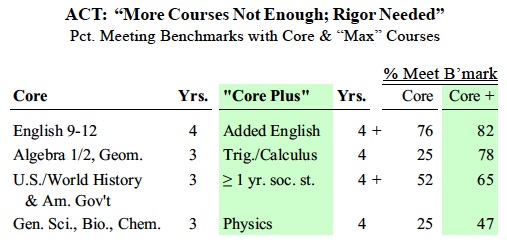
Share

Learn to Earn

The NewsHour:

The newest, hottest idea in school reform seems to be paying students to learn. New York City and Baltimore made national headlines when both launched pilot programs this year, and other cities and towns are considering the notion.

Share

Meeks Solicits Support for Chicago School Boycott Plan

Fran Spielman:

State Sen. James Meeks (D-Chicago) met privately with the City Council’s Black Caucus last week to explain his plan to have hundreds of Chicago Public School students boycott the first four days of classes.
Implied, but not stated, was the fact that Meeks would like aldermanic support for his controversial tactics. Apparently, he’s not going to get it.
On Tuesday, the Black Caucus will hold a news conference to turn up the heat on Gov. Blagojevich and the General Assembly to address the school funding disparity between rich and poor districts.
But, the aldermen will not take a stand on Meeks’ boycott threat.
“We can’t take an official position. We didn’t have a consensus. All of us want our children in school. That’s really the bottom line,” said Ald. Freddrenna Lyle (6th).

Share

Winners Never Quit? Well, Yes, They Do

Alina Tugend:

I’VE been thinking about quitting lately. No, not my job, nor my marriage nor the incredibly long Russian novel I need to read by September for my book group (check back with me on that later).
Rather, I’ve been thinking about the concept in general. Watching the superhuman feats of the Olympic athletes this week, I’ve admired the dedication and single-minded focus they exhibit. I think about how maybe if I had just worked harder — much harder — at gymnastics when I was young, I could have reached that lofty goal (conveniently forgetting how ill-suited I was to the sport because of my great fear of falling on my head).
Olympians embody one of the great clichés about quitting: “Quitters never win and winners never quit.” My athletic career, on the other hand, is summed up by the other platitude about quitting: “You’ve gotta know when to hold ’em, know when to fold ’em.”

Share

Madison High School “Redesign”: $5.5M Small Learning Community Grant for Teacher Training and Literacy Coordinators

Andy Hall:

A $5.5 million federal grant will boost efforts to shrink the racial achievement gap, raise graduation rates and expand the courses available in the Madison School District’s four major high schools, officials announced Monday.
The five-year U.S. Department of Education grant will help the district build stronger connections to students by creating so-called “small learning communities” that divide each high school population into smaller populations.
Many of those structural changes already have been implemented at two high schools — Memorial and West — and similar redesigns are planned for East and La Follette high schools.
Under that plan, East’s student body will be randomly assigned to four learning communities. La Follette will launch “freshman academies” — smaller class sizes for freshmen in core academic areas, plus advisers and mentors to help them feel connected to the school.

Tamira Madsen:

“The grant centers on things that already are important to the school district: the goals of increasing academic success for all students, strengthening student-student and student-adult relationships and improving post-secondary outlooks,” Nerad said.
Expected plans at Madison East include randomly placing students in one of four learning neighborhoods, while faculty and administrators at La Follette will create “academies” with smaller classes to improve learning for freshmen in core courses. Additional advisors will also be assigned to aid students in academies at La Follette.

Related:

The interesting question in all of this is: does the money drive strategy or is it the other way around? In addition, what is the budget impact after 5 years? A friend mentioned several years ago, during the proposed East High School curriculum change controversy, that these initiatives fail to address the real issue: lack of elementary and middle school preparation.
Finally, will this additional $1.1m in annual funds for 5 years reduce the projected budget “gap” that may drive a fall referendum?

Share

Future ‘Top 10’ Hot Careers in 2012: Space Tourism to Genetic Counseling

Rebecca Sato:

In our information-rich society there is an ever increasing demand for workers in the fields of computers, health care, science and space technology—much of it driven by the demands of the retiring baby boomers. If you like to plan ahead, here is sampling of some of the jobs that will be hot in the next several years and beyond.
1) Organic food Industry
By 2010, organic food and beverage will represent about 10 percent of the total market — a tenfold increase from 1998. Bob Scowcroft, executive director of the Organic Farming Research Foundation says the industry will soon need more organic food producers, certification experts, retailers and scientists as organic becomes mainstream.

Share

School Program Puts Focus On Graduation, Not Grades

Ian Shapira:

Bria Heard, 14, a rising sophomore in Prince William County, had a couple of options after she failed world history last year. She could retake the course over six weeks in summer school or during the next school year and try to improve her grade.
Or, she could choose a fairly novel program available in the school system. She could do the course work using a new computer-based program that would not improve her grade, but would allow her to earn the credits needed to stay on track to graduate in four years. To her, the benefits outweighed the cost of not getting a better grade. The program is free and can be completed in days.
“You can go at your own pace and it’s quicker,” Bria said recently while stumbling through questions on Russian history. “I didn’t know if I should do it, but then I realized it was easier than taking the full course.”

Share

Illinois High School Basketball Star Leaves for Prep School

Michael O’Brien & Scott Powers:

It has happened again.
For the second consecutive year, the best basketball player in the state’s senior class is packing up and heading to prep school.
Peoria Central guard and Illinois recruit DJ Richardson announced on Monday that he will spend his senior season at Findlay Prep in Henderson, Nev.
That’s the same school that Washington’s DeAndre Liggins spent his senior year at last season.
“It was my family’s idea,” Richardson said. “It’s because of the ACT. I had a good GPA, just not the ACT. I’m not far off. I just took it two times. I think I could do better. There is no reason to take chances so I’m just going to prep school.”
According to Richardson, the Illinois coaching staff gave him a list of prep schools to choose from.

Share

Businesses Partner in Education with Calcasieu Schools

Amanda Ward:

As we get ready to send our students back to school, two separate businesses are doing their parts to partner in education.
Hundreds of students and their parents packed the Pryce-Miller recreation center in Lake Charles for the Back to School Bash with free school supplies and backpacks from PPG as well as information about healthcare and education support services and loads of fun. The children are excited about going back to school for several different reasons.
Kayman St. Junious said, He loves “going to P.E.”
Austin Delafosse said, Science is his favorite subject, because “you get to make objects.”

Share

Teen Texting Expert Insists on Being Letter-Perfect

Jenna Johnson:

Even though Glass shuns shorthand, he embraces speed. At a pace that veteran secretaries might envy, Glass sends as many as 800 texts a month, his thumbs quickly flying across his phone’s Qwerty, or mini-keyboard.
That speed and respect for the English language landed the St. Mary’s County teenager in the LG National Texting Championship in New York last month.
In June, Glass logged on to the LG Electronics Web site for an online qualifying round. Phrases popped up on the screen, and Glass quickly typed them into his phone and messaged them to the cellphone company.

Share

Winston’s Streetball brings hoops to south side

Dennis Semrau:

Johnny Winston Jr. was wearing a powder blue T-shirt, just like the rest of his numerous volunteers at Penn Park early Saturday afternoon.
The founder and organizer of the eighth annual Streetball and Block Party that bears his name, Winston said most of his work is done in the months leading up to the event, which was held at Penn Park on Madison’s south side.
“The thing pretty much runs itself,” Winston said, “but there is tons of prep work that has to be done to pull it off. That’s what takes the most time.”
However, Winston, who is a city of Madison firefighter, a member of the Madison Metropolitan School District School Board and resident jack-of-all-trades in his community, was ready to make a quick change if necessary.

Share

The 25 Best Boarding School Books

Sarah Ebner:

Books about boarding school have always been popular, but they’ve often been seen – like the schools themselves – as old fashioned and well past their sell-by date. This may no longer be the case – for the school, and their fictional equivalents.
The Boarding Schools Association say that both independent and the 35 state boarding establishments, are in robust health. The numbers of boarders is up for the first time in three years.
Meanwhile Wild Child, a film about an 16-year-old American sent to a British boarding school to be “tamed” is released next week, while School Friends, a new boarding school series aimed at girls of eight and up, is published at the end of August. Its publishers are claiming that it’s “Malory Towers for the new Millennium.” My daughter is already a fan, proclaiming concisely that she “really, really likes them.”

Share

Education spending spree has “failed pupils”

Jack Grimston:

THE literacy and numeracy of new employees have tumbled over the past decade despite Labour’s £28 billion increase in annual education spending, according to research by a leading employers’ organisation.
The Institute of Directors (IoD) found that 71% of its members believe the writing abilities of new employees had worsened, while 60% believed numeracy had also declined; 52% reported a worsening of the basic ability to communicate.
With the exam results season under way, more than 60% of company directors now think GCSEs and A-levels are less demanding than a decade ago. Overall, only 27% believe schools have got better under Labour.
A-level results to be released this Thursday are expected to show the number of passes going above 97% and the proportion of A grades rising slightly from last year’s 25.3%, the 11th successive annual rise.

Share

Keeping Up With Korea
Move over, Andover and Exeter. Two South Korean high schools score high on Ivy League acceptances.

BJ Lee & Adam Kushner:

Even as Visa restrictions have tightened in the United States since September 11, foreign students are still banging down the doors at American universities. They now regularly represent more than 10 percent of students at elite schools, many of which have taken up campaigns to broaden their global appeal. And the overwhelming source of these new students? Not the established European and American boarding schools that have always placed a respectable bloc of graduates into the best colleges. Instead, a new crop of prep schools is rising in other parts of the world, particularly South Korea. In a Wall Street Journal survey last December, only two foreign schools ranked in the top 40 for best admission rates to eight leading American universities, including Harvard, Princeton and MIT. Both are in South Korea.
Minjok Leadership Academy, a 12-year-old high school located in a remote mountain village in South Korea, has a track record comparable to the best American prep schools. Of its 77 graduates who applied to American universities for this year, 25 were accepted into the Ivy League, 19 by UC Berkeley and 10 by New York University. The remainder will attend Stanford and other leading institutions. Daewon Foreign Language High School in Seoul has a similar success rate. In 2000 it began to focus on foreign universities, and by the end of last year had sent 263 graduates to the top 50 U.S. universities. Last year alone, 36 got into Ivy League schools.

Share

The Thinking Behind Critical Thinking Courses

Jay Matthews:

Looking for a way to improve your mind and make some money? Check out the latest “critical thinking” courses. Many come up on a Google search. Many promise better grades and higher test scores. Without much effort, you can create your own course and tap into this hot topic.
The only thing is, it turns out such programs don’t work very well, except as a measure of the gullibility of even smart educators. A remarkable article by Daniel T. Willingham, the University of Virginia cognitive scientist outlines the reasons. Critical thinking, he explains in a summer 2007 American Educator article, overlooked until now by me, is not a skill like riding a bike or diagramming a sentence that, once learned, can be applied in many situations.
Instead, as your most-hated high school teacher often told you, you have to buckle down and learn the content of a subject–facts, concepts and trends–before the maxims of critical thinking taught in these feverishly-marketed courses will do you much good.

Share

School’s Health Reviewed

Jessica Blanchard:

It wasn’t until he hand-delivered bottles of the discolored water to School Board members at a public meeting that the district took action.
That was five years ago, and Seattle Public Schools has addressed those problems and adopted tough water-quality standards since then. But Cooper warns of similar environmental health and safety problems in schools statewide – and that Washington’s code is woefully outdated.
With the state Board of Health on the cusp of revising its rule governing environmental health and safety in schools – the first major changes in nearly four decades – it’s time for the public to take note, Cooper said.
“If you don’t pay attention, and don’t get involved, it will be your own backyard, your own child being affected,” he said.
The proposal under consideration would modernize the rule, adding standards for indoor air and water quality and playground safety.

Share

Education Reform: Still Reaching

Letters to the Denver Post on Still Reaching, 25 years after A Nation at Risk:

Re: “Still reaching’ 25 years after ‘A Nation at Risk,’ education struggling,” Aug. 3 Perspective article.
The ideas expressed by Dick Hilker about the problems with public education are echoed throughout our society. Parents, legislators and school administrators bemoan the fact that many students do not measure up to the proficient level in reading.
Mr. Hilker and the rest of the people who blame schools need to face reality. Scoring “proficient” on the CSAP test in reading, math or any other subject is the equivalent of getting a B on a report cards in years past. Not every kid in class when I was in school scored all B’s and A’s.
Yes, every kid can learn, and it is the school’s job to take every student to their limit. But to expect teachers to get everyone in their class to the proficient level in all classes ignores the fact that not all kids are average or above.

Share

2007 Michigan Merit Exam Results Released

Lori Higgins, Peggy Walsh-Sarnecki & Chastity Pratt Dawsey:

As a whole, the results of the exam — released Thursday by the Michigan Department of Education — illustrate how ill-prepared many Michigan teens are for college. The new exam, which the state debuted in spring 2007, includes the ACT, a college entrance test. The exam is rounded out with a workplace skills test, and tests aligned with the state’s standards in math, science and social studies.
“We have not made any significant improvement,” Sharif Shakrani, codirector of the Education Policy Center at Michigan State University, said of this year’s scores.
The exam, given this spring, was taken by nearly 124,000 students.
The percentage of students scoring at the top two levels on the math exam was 46%, unchanged from last year. In reading, it was 62%, up from 60%. In writing it was 41%, up from 40%. In science it was 57%, up from 56%; and in social studies it was 80%, down from 83%.

Share

Getting Involved With Your Childrens’ Education

Keloland:

Kids all across KELOLAND will be heading back to school in the next few weeks and that means adding a few more things to their calendar. But how about adding a few school-related things to yours? Research shows that when parents are involved in their children’s education, kids do better in school. This week’s Inside KELOLAND shows you how your involvement can help your student achieve and succeed. You’ll find out why it’s important to your child’s development to have you involved in their education. And we show you what rewards there are for those parents who do get involved. Finally, we tell you where to go to find out how you can be more involved in your child’s schooling, whether it’s through volunteering in the classroom, or taking a more active role in their lessons.

Share

If We Lose Our Children We Lose America

Karl Priest:

John Stossel (of television’s “20-20”) produced an outstanding report entitled “Stupid in America” which reported that a South Carolina governor would not send his own children to public schools because—it would “sacrifice their education”. The governor wanted to allow the free market to deliver an alternative to public schools. Teacher unions and politicians (who are controlled by teacher unions) complained. They asked, “How can we spend state money on something that hasn’t been proven?” In other words, it’s better to spend state money on something that is proven NOT to work.
Stossel described how the national School Board’s Association (NSBA) claimed, “America’s Public Schools out perform Private Schools when variables are controlled.” Actually, the Private School students scored higher on the tests, but there were adjustments for race, ethnicity, income, and parent’s education backgrounds. That may be a valid statistical tool, but it’s prone to bias and leads to statistical hocus-pocus.
Many public school teachers are nice people trying to make a living, but the number of good teachers and administrators, whether Christian or not, has been decreasing from retirement. The good teachers that remain are entangled victims of the agenda that controls what they can do. Textbook publishers are puppets of the education establishment thereby making it nearly impossible for well-meaning teachers to avoid participating in the indoctrination.

Share

A Second-Rate Secondary Education
High schools need to start treating their students with the same respect colleges do.

Leon Botstein:

The weakest and most vulnerable element in education, particularly in the developed world, is the education of adolescents in our secondary-school systems. Relative economic prosperity and the extension of leisure time have spawned an inconsistent but prevalent postponement of adulthood. On the one hand, as consumers and future citizens, young people between the ages of 13 and 18 are afforded considerable status and independence. Yet they remain infantilized in terms of their education, despite the earlier onset of maturation. Standards and expectations are too low. Modern democracies are increasingly inclined to ensure rates of close to 100 percent completion of a secondary school that can lead to university education. This has intensified an unresolved struggle between the demands of equity and the requirements of excellence. If we do not address these problems, the quality of university education will be at risk.
To make secondary education meaningful, more intellectual demands of an adult nature should be placed on adolescents. They should be required to use primary materials of learning, not standardized textbooks; original work should be emphasized, not imitative, uniform assignments; and above all, students should undergo inspired teaching by experts. Curricula should be based on current problems and issues, not disciplines defined a century ago. Statistics and probability need to be brought to the forefront, given our need to assess risk and handle data, replacing calculus as the entry-level college requirement. Secondary schools and their programs of study are not only intellectually out of date, but socially obsolete. They were designed decades ago for large children, not today’s young adults.

Raise, not lower standards. Quite a concept. Clusty Search: Leon Botstein.
High School Redesign.

Share

Students turn to co-op for competitive edge

Lisa Cornwell:

Ren Brown is banking on the work experience she gains while at college to give her a competitive edge over other young job seekers — an advantage increasingly sought by students and employers amid a weak economy and a changing workplace.
Schools and education groups are seeing growth in established programs that link students with employers, who also are showing increased interest. Many point to student concerns over job competition in a tight labor market and employer needs to replace retiring baby boomers.
“Historically, interest in cooperative education increases when the economy slumps, especially since it does seem to give people a leg up in the job market,” said Terry Hartle, senior vice president of the American Council on Education.
Employers are looking to cooperative education as a way to observe potential employees over several months to better determine if they fit the company, said Phil Gardner, director of the Collegiate Employment Research Institute at Michigan State University.

Share

Teacher’s Group “Way off Mark in Attack on No Child Left Behind Law”

DeWayne Wickham:

But this time, the group has an unlikely adversary in its long-shot effort to gut NCLB. It’s being opposed by the Leadership Conference on Civil Rights — a coalition of 192 organizations, including the NEA — that supports “the enactment and enforcement of effective civil rights legislation and policy.”
The Leadership Conference says NCLB is civil rights legislation. Given the yawning achievement gap in public schools between whites, blacks and Hispanics, the umbrella group argues that improving public education is a civil rights issue.
“While NCLB is a flawed law — and we have repeatedly called on Congress to make improvements through the reauthorization process — NCLB has been crucial in exposing the extent of the opportunity and achievement gaps plaguing chronically underperforming schools and creating an atmosphere conducive for fundamental education reform,” Wade Henderson, president of the Leadership Conference on Civil Rights, said last month.
The bill pending in the House would temporarily exempt states from enforcing some NCLB accountability requirements until fixes are made to the 2002 law. But in an editorial earlier this month, The New York Times called the House bill “a stealth attempt to gut the national school accountability effort.”

Share

Family move reveals differences in early education

Nancy Zuckerbrod:

That’s my girl, I thought, as Olivia tore away from us to join the other 5-year-olds for circle time — legs crossed, hand stick-straight in the air in response to the teacher’s question about how the kids spent Father’s Day.
My husband and I exchanged knowing glances, convinced that she was a shoo-in for admission, and left Olivia with her uniform-clad peers so we could tour the British prep school in the quaint red-brick Victorian building.
The e-mail came a week later. It asked us to please call the head teacher, the equivalent of a school principal in the United States.
We were back at home in Washington D.C., thinking about what to store, ship and toss as we prepared for our family move to London. The change is a big one for all of us, but I didn’t realize quite how different things would be for Olivia until that phone call.
The head teacher and I exchanged pleasantries, and then she laid it out. My daughter, who commonly invokes the Mandarin word for little brother and usually wins at the game hangman, has a significant “learning gap” when compared with her British peers — especially in literacy.

Share

Dreams for school’s accessible playground prove boundless

The Capital Times:

Members of the Elvehjem Elementary School community, including students, teachers, parents and other supporters of a unique idea, watched Friday as groundbreaking occurred for a playground designed to be inclusionary to all.
The new playground is designed for use by all kids, including those with disabilities who could not participate in play with their peers on older models of playgrounds.
Last year members of the Elvehjem community decided to enter a national contest for a Boundless Playground and submitted an essay they hoped would win the day for the east side school. But they fell just short, finishing third out of 900 entries.

Share

Referendum Climate: Stupid Budget Tricks

Michael Granof:

STATE governments across the country are reeling from the effects of the current economic downturn. New York, facing a $26.2 billion deficit over the next three years, is particularly hard hit. Like most other states, it is looking to balance its budget mainly by cutting spending.
But if history is a guide, governors and legislators across the country will seek to avoid the difficult choices that are required. Instead, they will likely pass the costs of the services that we enjoy today on to our children and grandchildren, through creatively deceptive budgeting.
This is a time-honored practice. In 1991, the State of New York sold Attica prison to none other than itself. The buyer was a state agency that financed the $200 million purchase price by issuing bonds. The agency then leased the prison back to the state, with the lease payments being equal to the debt service on the bonds.
In substance, of course, the transaction was nothing more than a borrowing arrangement — the equivalent of borrowing $200 million from the buyers of the bonds. Nevertheless, the state booked the entire sale price as revenue for the year. The previous year, the state sold the Cross Westchester Expressway to the New York Thruway Authority — in other words, to itself.

Share

As Program Moves Poor to Suburbs, Tensions Follow

Solomon Moore:

rom the tough streets of Oakland, where so many of Alice Payne’s relatives and friends had been shot to death, the newspaper advertisement for a federally assisted rental property in this Northern California suburb was like a bridge across the River Jordan.
Ms. Payne, a 42-year-old African-American mother of five, moved to Antioch in 2006. With the local real estate market slowing and a housing voucher covering two-thirds of the rent, she found she could afford a large, new home, with a pool, for $2,200 a month.
But old problems persisted. When her estranged husband was arrested, the local housing authority tried to cut off her subsidy, citing disturbances at her house. Then the police threatened to prosecute her landlord for any criminal activity or public nuisances caused by the family. The landlord forced the Paynes to leave when their lease was up.
Under the Section 8 federal housing voucher program, thousands of poor, urban and often African-American residents have left hardscrabble neighborhoods in the nation’s largest cities and resettled in the suburbs.
Law enforcement experts and housing researchers argue that rising crime rates follow Section 8 recipients to their new homes, while other experts discount any direct link. But there is little doubt that cultural shock waves have followed the migration. Social and racial tensions between newcomers and their neighbors have increased, forcing suburban communities like Antioch to re-evaluate their civic identities along with their methods of dealing with the new residents.

Why is crime rising in so many American cities? The answer implicates one of the most celebrated antipoverty programs of recent decades by Hanna Rosin @ the Atlantic Monthly:

Lately, though, a new and unexpected pattern has emerged, taking criminologists by surprise. While crime rates in large cities stayed flat, homicide rates in many midsize cities (with populations of between 500,000 and 1 million) began increasing, sometimes by as much as 20percent a year. In 2006, the Police Executive Research Forum, a national police group surveying cities from coast to coast, concluded in a report called “A Gathering Storm” that this might represent “the front end … of an epidemic of violence not seen for years.” The leaders of the group, which is made up of police chiefs and sheriffs, theorized about what might be spurring the latest crime wave: the spread of gangs, the masses of offenders coming out of prison, methamphetamines. But mostly they puzzled over the bleak new landscape. According to FBI data, America’s most dangerous spots are now places where Martin Scorsese would never think of staging a shoot-out–Florence, South Carolina; Charlotte-Mecklenburg, North Carolina; Kansas City, Missouri; Reading, Pennsylvania; Orlando, Florida; Memphis, Tennessee.
Memphis has always been associated with some amount of violence. But why has Elvis’s hometown turned into America’s new South Bronx? Barnes thinks he knows one big part of the answer, as does the city’s chief of police. A handful of local criminologists and social scientists think they can explain it, too. But it’s a dismal answer, one that city leaders have made clear they don’t want to hear. It’s an answer that offers up racial stereotypes to fearful whites in a city trying to move beyond racial tensions. Ultimately, it reaches beyond crime and implicates one of the most ambitious antipoverty programs of recent decades.

Related:

Share

School Program Puts Focus On Graduation, Not Grades

Ian Shapira:

Bria Heard, 14, a rising sophomore in Prince William County, had a couple of options after she failed world history last year. She could retake the course over six weeks in summer school or during the next school year and try to improve her grade.
Or, she could choose a fairly novel program available in the school system. She could do the course work using a new computer-based program that would not improve her grade, but would allow her to earn the credits needed to stay on track to graduate in four years. To her, the benefits outweighed the cost of not getting a better grade. The program is free and can be completed in days.

Share

Virginia Weighs Wider Index to Certify Schools

Chris Jenkins:

Gov. Timothy M. Kaine (D) is reviewing a plan that would require all Virginia high schools to meet certain graduation-rate requirements by 2014 to receive accreditation under a new assessment system.
Under the proposal, state officials would use a computer system to track students throughout their academic careers to determine the number of diplomas, GEDs and other certificates that schools award during any given year. Schools would receive accreditation based on those results. Current accreditation standards are based on pass rates on the annual Standards of Learning exams.
As part of the accreditation process, schools would be rated on a points system. For instance, schools would be awarded 100 points for each student who received a diploma; the school would earn 75 points if a student received a general equivalency diploma. If a student earned a certificate of completion, given to those who don’t earn high-school diplomas or their equivalent, the school would receive 60 points.

Share

Referendum Climate: Wisconsin 9th in State / Local Tax “Burden”

Gerald Prante @ Tax Foundation [340K PDF]:

For 18 consecutive years the Tax Foundation has published an estimate of the combined state-local tax burden shouldered by the residents of each of the 50 states. For each state, we calculate the total amount paid by the residents in taxes, and we divide those taxes by the total income in each state to compute a “tax burden” measure.
We make this calculation not only for the most recent year but also for earlier years because tax and income data are revised periodically by government agencies, and in our own methodology to take advantage of new datasets.
The goal is to focus not on the tax collectors but on the taxpayers. That is, we answer the question: What percentage of their income are the residents of this state paying in state and local taxes? We are not trying to answer the question: How much money have state and local governments collected?

Related: Milwaukee Journal-Sentinel Editorial on McCain & Obama’s deficit spending plans.

Share

Where’s the Data on Smaller Class Sizes?

Kevin Carey:

You see it all the time, in the brochures and advertisements from liberal arts colleges and other non-gargantuan institutions. “Small class sizes,” they promise, and for good reason, because everyone knows that small classes are better than large. No cavernous lecture halls where the professor is little more than a distant stick figure, they say — raise your hand here, and someone will stop and listen. Plus, he or she will be a real professor, the genuine tenure-track article, not a part-timer or grad student but someone who really knows his or her stuff. Because everyone knows that real professors are better than the other kind.
Except, they don’t.
Nobody actually knows whether small classes are better than large. Pascarella and Terenzini’s How College Affects Students, the bible of such matters, says “We uncovered 10 studies that focus on the effects of class size on course learning. All of the investigations are quasi-experimental or correlational in design …. Unfortunately, five of the studies used course grade as the measure of learning … the conflicting evidence and continuing methodological problems surrounding this small body of research make it difficult to form a firm conclusion.”

Share

Shakespeare for Gifted Students

Carol Fertig:

Shakespeare never grows old. He was an outstanding observer of life and created many immortal characters that profess human nature. His characters often capture traits that are universal. He used rich literary devices, compelling plots, and had an enduring wisdom and wit. He also wrote many unforgettable lines that are imbedded in our culture. He continues to be the most-quoted author in the English language.
There are many resources available to help teach about Shakespeare. Here are just a few.

Share

Longer Year for Fairfax Teachers, Incentive Programs

Michael Alison Chandler:

Schools nationwide are looking for ways to pay striving or successful teachers more so they can attract and keep talent. The District and Prince George’s County are offering financial incentives for exceptional teachers in challenging schools. Arlington County is enabling qualified teachers to skip a step on the salary schedule.
Fairfax’s move toward a year-round teacher schedule is unusual, said Allan Odden, a University of Wisconsin professor who studies alternative teacher pay and who has advised Dale. But Odden said the notion of giving teachers more responsibilities in exchange for more pay is gaining momentum in public education. He said a “cadre of teacher leaders” in a school has proven to be critical for student achievement.
Fairfax’s “teacher leadership” program began in summer 2006 with extended contracts for about 600 teachers at 24 schools, issued through competitive grants. The contracts add nine, 14 or 24 days to the traditional 194-day schedule. They can increase salaries as much as 12 percent.

Share

Milwaukee-area school districts grapple with sex-ed policies

Erin Richards:

For parents like the Timmermons in Milwaukee, who diligently pre-screen G-rated movies and forbid their daughter from playing with the made-up and mini-skirted Bratz dolls, when and how to start talking about the human body and sex can be a bit of a mystery.
Schools face a similar dilemma. Many districts teach what’s broadly known as human growth and development, but the thoroughness of the information varies widely among districts, schools and classrooms, based on an informal survey of schools by the Journal Sentinel.
Over the summer, Milwaukee Public Schools is addressing the unevenness in its human growth and development curriculum by revamping the entire program from kindergarten through high school, and making a plan to train teachers on how to deliver the information.

Share

The Wisconsin Center for Education Research was founded 44 years ago this month.

via email:

Part of the School of Education at the University of Wisconsin-Madison, the Wisconsin Center for Education Research receives $29 million in current funding from the National Science Foundation, the U.S. Department of Education, and private foundations.
One of WCER’s strengths is the interdisciplinary nature of its work. While most of its researchers make their academic home in the School of Education, one-third come from other fields, including astronomy, business, chemistry, economics, engineering, human ecology, law, mathematics, sociology, and social work. Each discipline brings its own way of learning and thinking. Together these researchers focus on problems of learning, teaching, assessment, and policy in today’s education systems.
In August 1964 then-University president Fred Harvey Harrington signed an agreement with the U.S. Office of Education to establish what was then called the Wisconsin Research and Development Center for Learning and Re-education. “It was an adventure of opportunity that was in line with the University’s traditional commitment to innovation and experimentation in teaching, to the union of basic and applied research, and to outreach tying the Madison campus to progress in the state and beyond,” he writes in the introduction to the book, The Wisconsin Center for Education Research: 25 Years of Knowledge Generation and Educational Improvement” (WCER, 1990).
WCER’s funding sources represent a broad mix of federal, private, state, and district level agencies. Of $29 million in current funding, fees for service account for 44%, while private foundations account for 21%. The U.S. Education Department accounts for 19% of current funding and the National Science Foundation 7%. The State of Wisconsin and school districts including Milwaukee and Chicago account for 9%. This array of sources attests to WCER’s breadth of research across disciplines, and its depth of reach from the federal level to local school districts.
The establishment of the Center, Harrington wrote, was “a part of a major movement of our time—the conscious attempt to enlist higher education in research-and-action efforts to help solve pressing problems and improve the quality of life in the U.S. and abroad.”
A list of 48 education experts and topics of research interest is available. Contact Paul Baker, pbaker@wisc.edu

Share