School Information System

Raising Successful Children

Madeline Levine:

PHRASES like “tiger mom” and “helicopter parent” have made their way into everyday language. But does overparenting hurt, or help?
While parents who are clearly and embarrassingly inappropriate come in for ridicule, many of us find ourselves drawn to the idea that with just a bit more parental elbow grease, we might turn out children with great talents and assured futures. Is there really anything wrong with a kind of “overparenting lite”?
Parental involvement has a long and rich history of being studied. Decades of studies, many of them by Diana Baumrind, a clinical and developmental psychologist at the University of California, Berkeley, have found that the optimal parent is one who is involved and responsive, who sets high expectations but respects her child’s autonomy. These “authoritative parents” appear to hit the sweet spot of parental involvement and generally raise children who do better academically, psychologically and socially than children whose parents are either permissive and less involved, or controlling and more involved. Why is this particular parenting style so successful, and what does it tell us about overparenting?

Share

High Schools putting kids off IT careers, deepening skills shortage

Simon Sharwood:

High School teaching of IT as a career actually puts kids off pursuing careers in the field, according to John Ridge, Executive Director of the Australian Computer Society Foundation Trust Fund (ACSF).
Ridge says general computer literacy courses in early high school are important and welcome, as employers expect some level of skill with productivity applications when hiring. But once kids start to study IT as a career, he says, they tend to abandon the idea of actually working in the industry.
The reason for the rebound, he says, is that too few teachers have the skills and passion to teach IT well. In New South Wales, Ridge said he feels 100 to 200 IT teachers do well … but with more than 1000 high schools in the State that’s not a great strike rate. Without proper resourcing and relevant curricula – the NSW Higher Schools Certificate’s Software Development and Design course is unchanged since 2009 – Ridge therefore wonders if it is even worth teaching IT as a career in schools.

Share

Brown’s CS1730 Available Online

brown.edu:

We will be making this course, Brown’s upper-level programming languages offering, available for free on the Web. People anywhere are welcome to view the lectures, read the materials, and do the assignments.
The on-line version does not offer credit from Brown; but those who successfully complete it can get recognition of this directly from the instructor. In particular, because we anticipate some people following the course will be busy professionals, we will offer three levels of recognition:
Lite
You successfully complete a sufficiently high number of the regular quizzes throughout the semester.
Mezzanine
In addition to Lite, you also complete the minor project that occupies the first month.
Ninja
In addition to Mezzanine, you also complete the major project that occupies the remaining two months.

Share

How to help your child overcome the fear of public speaking

Jessica Ogilvy-Stuart:

My son’s school is following the Hong Kong Diploma of Secondary Education (HKDSE) curriculum, and I am worried about the speaking element of the English assessment. His written work is good, but he is not a great communicator. How can I help him to develop more confidence in this area?
Public speaking is seen as a challenge by many Hong Kong students. The speaking portion of the HKDSE may be less familiar than other assessment tools. But it can be an area in which students can develop confidence, which will serve them well in their professional lives.
All Form Four to Form Six students taking the HKDSE course through their schools will have to take the school-based assessment (SBA) component of the English language examination. This accounts for 15 per cent of the final grade. Part A of the assessment contributes two-thirds of the grade and requires students to read or view four texts, record their personal views and then either discuss their perspectives with classmates or make individual presentations.

Share

Percentage of College Graduates in Total Population

OECD via Laura Waters:

The OECD (Organisation for Economic Cooperation and Development) has just released data regarding the “tertiary education graduation rates” based on the “percentage of graduates to the population at the typical age of graduation.”
The percentages run from 2000 – 2007. So, for example, in the Czech Republic the percentage of high school graduates as part of the general population was only 13.8% in 2000 but then soared to 34.9% in 2007.
The United States was relatively flat: 34.4% in 2000 with a slight increase to 36.5% by 2007. For comparison’s sake, hallowed Finland moved from 40.8% to 48.5% and Japan started at 29.4% and moved to 38.8%. Among the 25 nations included in the analysis, in 2007 15 countries achieved higher percentages than the U.S. and 9 had percentages below. Outliers were Iceland, with a 63.1% graduation rate in 2007 and Turkey with 15.2% in 2006.

Share

An Interview with Laurie Rogers: Parent, Activist, Author, Education Blogger


Laurie Rogers
39MB mp3 audio file
Transcript
I appreciate the time Laurie took to discuss her activism, experience and aspirations along with her views on where our ed system is going.

Laurie is the author of Betrayed: How the Education Establishment Has Betrayed America and What You Can Do About It and publishes a related blog.
Share

A Review of Sunday is for the Sun; Monday is for the Moon

Sandra Priest Rose and Glen Nelson
New York: Reading Reform Foundation, 2012
There seems to be a growing frustration and concern, among Upper Education professors, and many teachers in Lower Education as well, with the poor reading and writing abilities of our students. If they cannot read, they cannot understand the material being assigned, and their academic writing has discouraged many educators from even trying to assign term papers.
This book, by Sandra Priest Rose and Glen Nelson, explains the thirty-year effort of the Reading Reform Foundation to ensure that at least some students in New York learn to read well early, and so to enjoy the knowledge and understanding they can get from reading with ease. It should be widely read and its programs sought out by educators all over the country who want to do more to introduce their students as soon as possible to such success.
I did not learn to read in the first grade. When I brought home an “F” in reading, it is not too much to say that my mother (Wellesley BA, Radcliffe MA, in English Literature) was not happy. That summer she taught me (unrelentingly) to read phonetically. When my first report card came back from second grade (the school had let me advance) it showed a “D”in reading. My mother went to the school and said “What is this? He is an excellent reader!” The problem, as it turned out was that I “would not stay with the rest of the class”–that is, when the class started a story, I finished it by myself–thus my grade of “D.”
That was probably in 1942, so I am not sure whether I was being offered the “look-say” method in my first school year or not, but my mother’s phonics instruction was very helpful to me in my reading at Harvard and later at Cambridge University, again in English Literature.
This new book about the reading program of the Reading Reform Foundation is not just about the essential value of phonics. It also takes the now unorthodox view that there are obvious connections between reading and knowledge, between knowledge and understanding, and between understanding and writing.
Over the last thirty years, for about 2,000 students a year in New York, the Reading Reform Foundation has offered 160 hours of teacher training, 60 visits a year by a mentor for each participating teacher, and an engaging curriculum to immerse young students in the excitement of sounding out words, and discovering not only their meaning, but very soon the meaning of the reading material in which they appear.
More than 14,000 teachers have attended the annual conferences of the Reading Reform Foundation over the years, and the Program is now at work in 75 New York classrooms each year.
This book includes the results of a study conducted by the City University of New York into the work of the Reading Reform Foundation. They may mean more to those who got a better grade in Statistics in graduate school than I did, but they look very encouraging to anyone concerned over the slow progress in reading of too many of our current youngsters who don’t have explicit phonics instruction on their side.
One of the authors, Sandra Priest Rose, has been a supporter of The Concord Review for years, and is assuredly one of the small group of dedicated people who have enabled the Reading Reform Foundation to serve students and teachers for thirty years with only 20% of their expenses coming from the schools which participate.
For those with an English major Wellesley graduate at home, learning to read phonetically (after school) may not be a problem. For all other elementary students, and especially for their teachers, I recommend the Reading Reform Foundation’s program. Jeanne Chall’s idea that after third grade students will be “reading to learn,” will not come true for too many students if they don’t have the benefit of a vigorous and engaging reading and writing program like the one offered by the Reading Reform Foundation in New York.

Share

New Jersey Passes Teacher Tenure Reform

Heather Haddon:

After signing a bill to overhaul teacher tenure rules Monday, Gov. Chris Christie said the changes represented one of his signature political achievements, ranking only behind a successful effort to limit government employees’ pension and benefit costs.
“It’s right behind pension and benefit reform just because the level of skepticism that we would get anything done,” Mr. Christie said in an interview with The Wall Street Journal following a news conference at a middle school here. “There had been such inertia on this topic. I always enjoy defying expectations.”
The new law doesn’t go as far as tenure bills passed in other states in the past year. But it marks a significant shift in the nation’s oldest teacher job-security law, requiring all teachers to undergo annual performance reviews and making it easier to fire poorly performing educators.

Laura Waters:

For Senator Teresa Ruiz, who tirelessly shepherded NJ’s tenure reform bill through the gauntlet of the Senate, the Assembly, union opposition, aggressive reformers, and countless interest groups.
How collegial was the signing yesterday at a Middlesex middle school? Chris Christie sounded practically conciliatory, telling NJ Spotlight that he signed the bill because “my decision was there was enough really good things in this bill that I was not going to allow it not to become law because it didn’t have everything I wanted” and seating arrangements placed B4K’s Derrell Bradford in between NJEA President Barbara Keshishian and AFT President Joseph Del Grosso.

Share

What I’ve Learned About Learning

raganwald:

I have a rather glaring life-long weakness, a behaviour that has tripped me up many times. You would think that I would have noticed it and corrected my behaviour in my teens or twenties, but no, it has persisted. While I am much better at correcting myself, it is extremely persistent and requires constant vigilance to suppress.
The behaviour in question is this: When I am learning something new, I suffer from laziness, impatience, and hubris. I try to grasp the gist of the thing, the conclusion, and then I stop. I figure I “understand” it, so I must be done learning.
This is wrong for me. I am blessed with a quick mind for certain subjects, so there are times when I am reading something, or someone is explaining something, and I can work out the obvious implications. Someone is telling me about aspect-oriented programming, and I start thinking about cross-cutting concerns like authorization. Or perhaps database access. Then I ask myself whether AOP is related to the “Unobtrusive Javascript” style. Or if it’s really fine-grained dependency injection.

Share

5 Things Young People Don’t Know

Jason Goldberg:

One of the greatest joys of my job is coaching and mentoring super smart and super ambitious young people.
I find myself doing this a lot lately.
Here’s a common pattern we find at Fab (and, I’m sure, at many startups): Young person leverages his or her brain, passion, ambitions and talents to rise up to a senior role very quickly. They take on a ton of responsibility and they kick ass at it. But, then, invariably, the young superstar hits some sort of a wall. Often it’s a burnout wall. Other times it’s a managing-down wall. Other times it’s a managing-up wall. Other times it’s just a bruised ego. Most of the time though it’s just youth. There’s value and maturity that comes from experience and pattern recognition. And, for young people who rise to the top quickly, there’s a natural impatience that flies in the face of waiting for that experience and pattern recognition to guide the way.

Share

N.J. Mom Puts Kids To Bed With Math

Ashley Milne-Tyte:

The U.S. ranks 25th out of 34 countries when it comes to kids’ math proficiency. One New Jersey parent wants to change that by overhauling the culture of math. An astrophysics graduate and mother of three kids, she started a ritual when each child was 2 years old: a little bedtime mathematical problem-solving that soon became a beloved routine. Parent friends began to bug her to send them kid-friendly math problems, too. Now Bedtime Math is gaining fans among children and math-shy parents around the country.

Share

Kindergarten in the Computer

Katherine Mangu-Ward:

The notion of online education for the Crayola set can strike adults as absurd. But for kids, even little ones, it’s the idea ignoring computers all day that sounds crazy. After all, if you ask a third grader to list his favorite things, “doing stuff on the computer” will rank high, probably somewhere between race cars and string cheese.
What most people envision when they think of online education–a college or high school student sitting at a computer all day at home, perhaps with minimal parental guidance–isn’t viable for the vast majority of families with young kids. Warehousing is a dirty word in education circles, but the truth is that it must be part of the package. Kids need somewhere to go during the day, preferably to hang out with other kids. They also need a bunch of adults there to keep them from killing one another and help them learn something.

Share

New Jersey Gov. Christie signs teacher tenure overhaul bill

Melissa Hayes:

Governor Christie today signed a bill that overhauls the state’s teacher tenure system, even though it is missing a key component he fought to include in the measure.
Christie signed the bill, known as the Teacher Effectiveness and Accountability for Children of New Jersey Act, in the media center of the Von E. Mauger Middle School after briefly meeting with children in a summer camp program in the school’s gymnasium.
Christie had wanted the bill to include a provision that would weaken seniority provisions, known as last in first out.
Education Commissioner Chris Cerf praised the law, but said that the “last in, first out” provision must still be addressed.
“Lets celebrate this moment together but lets not pretend the work is done,” he said.

Share

Carrots and Sticks for School Systems

The New York Times:

Education Secretary Arne Duncan has been pushing the states to create rigorous teacher evaluation systems that not only judge teachers by how well their students perform but also — when the results are in — reward good teachers while easing chronic low performers out of the system. More than half the states have agreed to adopt new evaluation systems in exchange for competitive grants from the federal Race to the Top program or greater flexibility under the No Child Left Behind law.
These incentives are long overdue. As things stand now, according to a study by the New Teacher Project, a Brooklyn-based policy group, many school managers make no distinction between high-performing and low-performing teachers. The result is that poor teachers stick around while good teachers go elsewhere or leave the profession, frustrated because they are not promoted, rewarded with better pay, or even simply acknowledged.

Share

HS football players’ cognitive skills tested

Associated Press:

South Florida public high school football players are having their cognitive skills assessed before their season starts.
The Immediate Post-Concussion Assessment and Cognitive Testing is a 20-minute, computerized evaluation often administered by a trainer. It gives doctors a baseline assessment of an athlete’s mental abilities so that after an injury, the test can be retaken for a true measure of recovery.
The Cleveland Clinic agreed last month to underwrite a pilot program testing Palm Beach County football players before their season starts Monday. Miami-Dade County has been using baseline testing for two years, and Broward County began mandatory testing this year.

Share

More education jargon and what it really means

Valerie Strauss:

Here are 10 education terms with definitions that tell you what they really mean to people who use them in our national education conversation.
Yesterday I published the first installment of education jargon, written by Joanne Yatvin, a vet­eran public school educator, author and past president of the National Council of Teachers of English. She is now teaching part-time at Portland State University.
Here’s more jargon from Joanne Yatvin:
School Reform Plans: Untested notions for improving public education, many of which have been tried before with negligible results
School Reformers: People with impressive titles who have had little or no practical experience in schools.
Charter Schools: Semi-private schools supported by public funds deemed superior by parents because they appear more elegant and exclusive than public schools.

Share

Day Dreaming – The Secret Behind Success

Dan Jones:

Research shows daydreaming leads to improved learning; enhanced abilities; greater creativity & increased success I researched how people achieve success. I wanted to find out if there is a pattern that can be replicated and used to help others get the same results. I initially looked at highly successful people in their chosen field from Entrepreneurs like Richard Branson & Peter Jones to Geniuses like Albert Einstein & Leonardo Da Vinci. I also looked at the thinking styles of successful creative people like Beethoven & Walt Disney. What I found was that they all had one thing in common. They all spent time daydreaming about their area of success. “When I get an idea I start at once building it up in my imagination.” Nikola Tesla “When I heard the music it made pictures in my head…here are the pictures.” Walt Disney (Describing the film Fantasia)

Share

To Increase Learning Time, Some Schools Add Days to Academic Year

Motoko Rich:

Griffith, one of five schools in the Balsz Elementary School District here, is one of a handful of public schools across the country that has lengthened the school year in an effort to increase learning time.
A typical public school calendar is 180 days, but the Balsz district, where 90 percent of the students qualify for free or reduced lunch, is in session for 200 days, adding about a month to the academic year.
According to the National Center on Time and Learning, a nonprofit research group in Boston, about 170 schools — more than 140 of them charter schools — across the country have extended their calendars in recent years to 190 days or longer.

Share

Why Students Need a Guide to Free Speech on Campus More Than Ever

Will Freeley:

Today’s college students enjoy the ability to speak their minds in unprecedented ways. Powered by omnipresent high-speed Internet access, students may sound off at all hours via a sparkling array of online outlets: Twitter, Facebook, Tumblr, Instagram, email, instant messaging, and blogs, just to name a few.
The ancient among us — by which I mean those who graduated from college before, say, the year 2002 — may not realize the enormity of this change. While old standbys like phone calls, text messages, and even face-to-face conversations have certainly not been forsaken, student speech — to each other, and to professors, parents, and the public — has increasingly moved online.
On balance, this shift is a positive development. Students may now communicate with each other and the wider world at a speed impossible just 20 years ago. The vastly expanded audience made possible by the Internet’s hyperconnectivity means student ideas now rocket around the globe instantly, no longer confined to the quad or the classroom.

Share

Open Access facts from Peter Suber

David Weinberger:

I’m enjoying my friend Peter Suber’s small book Open Access. He’s a very clear and concise writer, and of course he knows this topic better than anyone.
Here are some facts Peter mentions:
In 2008, Harvard subscribed to 98,900 serials. Yale subscribed to 73,900. “The best-funded research library in India…subscribed to 10,600.” And, Peter points out, some Sub-Saharan universities cannot afford to subscribe to any. (pp. 30-32) Way to make yourself smart, humanity!
“In 2010, Elsevier’s journal division had a profit margin of 35.7 percent while ExxonMobil had only 28.1 percent.” (p. 32)
The cost of journals has caused a dramatic decrease in the percentage of their budgets research libraries spend on books, from 44% in 1986 to 28% now. “Because academic libraries now buy fewer books, academic book publishers now accept fewer mauscripts…” (p. 33)

Share

K-12 Tax & Spending Climate: The Size of the State

The Economist:

At first glance, Mr Obama’s critics have ample ammunition. Federal spending during his term was the highest relative to GDP since the end of the second world war. A record number of the population now gets federal entitlements such as Medicaid and food stamps. The federal government backs 90% of new mortgages, up from half before the financial crisis, as well as a growing share of student loans. Staffing levels at regulatory agencies have ballooned, and they churn out more and costlier rules than their predecessors.
Behind these bits of data, however, lies a more complicated reality. Much of the expansion in government is a direct consequence of the weak economy. Last year a record 45m people received food stamps, up 58% from 2008, while a record 53m were on Medicaid (the health-care programme for the poor), up 21%. This is almost entirely caused by unemployment and shrunken pay-cheques; eligibility has not changed for either programme in that time, although the 2009 stimulus act temporarily raised food stamp benefits and state Medicaid transfers. Similarly, because investors have lost their appetite since the crisis for securities without a federal guarantee, federally-backed agencies have been forced to underwrite a growing share of new mortgages.

Share

Large study says great teachers get little respect

Jay Matthews:

The fourth-grade teacher was by any measure a star. Fidgety students behaved in her class. Test scores were high. She had come to the low-income neighborhood school to make an impact. In her class, she did. But few of her supervisors or colleagues seemed to care.
“School leaders gave her little recognition,” says a new research study on how schools treat great teachers. They “failed to take advantage of her instructional expertise and stymied the sort of team-building and collaboration that had helped her boost performance among students and fellow teachers at other schools for decades.”
So this summer, she left for another school that wanted her talent. She told the researchers that when she resigned, the principal “just signed my paperwork, and didn’t even say a word. . . . It made me feel like he couldn’t care less, not about me and not about this school.”

Share

Common Core Anyone? Anyone?

The totalitarian left has been similarly clear that decision-making power should be confined to a political elite–the “vanguard of the proletariat,” the leader of a “master race,” or whatever the particular phrase that might become the motto of the particular totalitarian system. In Mussolini’s words, “The mass will simply follow and submit.”
Thomas Sowell
Intellectuals and Society
New York: Basic Books, 2011, pp. 104-106
…Reliance on systemic processes, whether in the economy, the law, or other areas, is based on the constrained vision–the tragic vision–of the severe limitations on any given individual’s knowledge and insight, however knowledgeable or brilliant that individual might be, compared to other individuals. Systemic processes which tap vastly more knowledge and experience from vastly more people, often including traditions evolved from the experience of successive generations, are deemed more reliable than the intellect of the intellectuals.
By contrast, the vision of the left is one of surrogate decision-making by those presumed to have not only superior knowledge but sufficient knowledge, whether these surrogates are political leaders, experts, judges or others. This is the vision that is common to varying degrees on the political left, whether radical or moderate, and common also to totalitarians, whether Communist or Fascist. A commonality of purpose in society is central to collective decision-making, whether expressed in town-meeting democracy or totalitarian dictatorship of other variations in between. One of the differences between the commonality of purpose in democratic systems of government and the totalitarian systems of government is in the range of decisions infused with that commonality of purpose and in the range of decisions reserved for individual decision-making outside the purview of government.
The free market, for example, is a huge exemption from government power. In such a market, there is no commonality of purpose, except among such individuals and organizations as may choose voluntarily to coalesce into groups ranging from bowling leagues to multinational corporations. But even these aggregations typically pursue the interests of their own respective constituents and compete against the interests of other aggregations. Those who advocate this mode of social decision-making do so because they believe that the systemic results of such competition are usually better than a society-wide commonality of purpose imposed by surrogate decision-makers superintending the whole process in the name of “the national interest” or of “social justice.”
The totalitarian version of collective surrogate decision-making by government was summarized by Mussolini, who defined “totalitarianism” in the motto: “Everything in the State, nothing outside of the State, nothing against the State.” Moreover, the state ultimately meant the political leader of the state, the dictator. Mussolini was know as Il Duce–the leader–before Hitler acquired the same title in German as the Führer.
Democratic versions of collective surrogate decision-making by government choose leaders by votes and tend to leave more areas outside the purview of government. However, the left seldom has any explicit principle by which the boundaries between government and individual decision-making can be determined, so that the natural tendency over time is for the scope of government decision-making to expand, as more and more decisions are taken successively from private hands, since government officials constantly have incentives to expand their powers while the voters’ attention is not constantly focussed on maintaining limits on those powers.
Preferences for collective, surrogate decision-making from the top down are not all that the democratic left has shared with the original Italian Fascists and with the National Socialists (Nazis) of Germany. In addition to political intervention in economic markets, the democratic left has shared with the Fascists and the Nazis the underlying assumption of a vast gap in understanding between ordinary people and elites like themselves. Although both the totalitarian left–that is, the Fascists, Communists and Nazis–and the democratic left have widely used in a positive sense such terms as “the people,” “the workers” or “the masses,” these are the ostensible beneficiaries of their policies, but not autonomous decision-makers. Although much of the rhetoric on both the democratic left and the totalitarian left has long papered over the distinction between ordinary people as beneficiaries and as decision-makers, it has long been clear in practice that decision-making has been seen as something reserved for the anointed in these visions.
Rousseau, for all his emphasis on “the general will,” left the interpretation of that will to elites. He likened the masses of the people to “a stupid, pusillanimous invalid.” Godwin and Condorcet, also on the eighteenth century left, expressed similar contempt for the masses. Karl Marx said, “The working class is revolutionary or it is nothing”–in other words, millions of human beings mattered only if they carried out his vision. George Bernard Shaw included the working class among the “detestable” people who “have no right to live.” He added: “I should despair if I did not know that they will die presently, and that there is no need on earth why they should be replaced by people like themselves.” As a young man serving the U.S. Army during the First World War, Edmund Wilson wrote to a friend: “I should be insincere to make it appear that the deaths of this ‘poor white trash’ of the South and the rest make me feel half so bitter as the mere conscription or enlistment of any of my friends.”
The totalitarian left has been similarly clear that decision-making power should be confined to a political elite–the “vanguard of the proletariat,” the leader of a “master race,” or whatever the particular phrase that might become the motto of the particular totalitarian system. In Mussolini’s words, “The mass will simply follow and submit.”
—————————
“Teach by Example”
Will Fitzhugh [founder]
The Concord Review [1987]
Ralph Waldo Emerson Prizes [1995]
National Writing Board [1998]
TCR Institute [2002]
730 Boston Post Road, Suite 24
Sudbury, Massachusetts 01776-3371 USA
978-443-0022; 800-331-5007
www.tcr.org; fitzhugh@tcr.org
Varsity Academics®
www.tcr.org/blog

Share

Automated grammar-checking

The Economist:

READERS are still debating my criticism of Kyle Wiens’s “I won’t hire people with bad grammar” post on language and computer code. To recap, Mr Wiens said “at its core, code is prose” and I said “no, it isn’t.” My criticism had more to it than that (and granted Mr Wiens several points). But here is a test, illustrative if not dispositive: if code is prose, then prose is a kind of code, and excellent coders should be able to write meta-code that would error-check natural language (analogous to how compilers check a program).
As it happens, Ben Yagoda recently tested Grammarly, a service that, for $140 a year, will be “an automated proofreader and your personal grammar coach.” Yesterday he posted his results:

Share

10 Things in School That Should Be Obsolete in Schools

Greg Stock:

So much about how and where kids learn has changed over the years, but the physical structure of schools has not. Looking around most school facilities — even those that aren’t old and crumbling – it’s obvious that so much of it is obsolete today, and yet still in wide use.
1. COMPUTER LABS. Students are connected to the Internet everywhere except in school. Regardless of their income bracket, most kids carry around a world of information in their pockets on their mobile devices, and yet we force them to power down and disconnect, and we confine them in obsolete computer labs. A modern school needs to have connectivity everywhere and treat computers more like pencils than microscopes.

Share

Auto Crrect Ths!

James Gleick:

I MENTION a certain writer in an e-mail, and the reply comes back: “Comcast McCarthy??? Phoner novelist???” Did I really type “Comcast”? No. The great god Autocorrect has struck again.
It is an impish god. I try retyping the name on a different device. This time the letters reshuffle themselves into “Format McCarthy.” Welcome to the club, Format. Meet the Danish astronomer Touchpad Brahe and the Franco-American actress Natalie Portmanteau.
In the past, we were responsible for our own typographical errors. Now Autocorrect has taken charge. This is no small matter. It is a step in our evolution — the grafting of silicon into our formerly carbon-based species, in the name of collective intelligence. Or unintelligence as the case may be.
Earlier this year, the police in Hall County, Ga., locked down the West Hall schools for two hours after someone received a text message saying, “gunman be at west hall today.” The texter had typed “gunna,” but Autocorrect had a better idea.

Share

‘Won’t Back Down’ highlights parent trigger law for schools

Greg Toppo:

Set in a gritty Pittsburgh neighborhood, the upcoming Maggie Gyllenhaal/Viola Davis film tells the story of two parents, one of them a teacher, who use a little-known state law to take over their kids’ struggling public school. Turns out that such laws actually exist in four states — California, Texas, Mississippi and Louisiana — with lawmakers in about a dozen more, including Pennsylvania, expected to consider them over the next year.
First dreamed up by Democratic activist and former Clinton White House staffer Ben Austin, so-called parent trigger laws allow dissatisfied parents to demand changes at their kids’ schools — including a total takeover — if a majority sign on.

Won’t Back Down Links.

Share

Early childhood education works; it’s time to just make it happen

Tom Beebe:

If our children are going to learn in school and succeed in life they need opportunities to learn, like quality early childhood educational experiences.
The Wisconsin State Journal made that point very well in a recent editorial (“Sooner is better than later in learning”). Children from poverty face an array of problems that hold them back when they enter school. The paper talked about the United Way of Dane County’s Parent-Child Home Programs as a way to “help more parents give their children a good start at learning.”
This program and others, including Head Start and local efforts around the state and country, have been around for years. In this specific instance, United Way points to studies that suggest participants were better prepared for kindergarten, had higher test scores in elementary school and were more likely to graduate than non-participating peers.”

Share

Junking old way of teaching writing

Jay Matthews:

I almost never give advice to teachers. They live their work, while I just observe it and cannot hope to know as much as they do.
But on one subject, writing, I could teach most of them. My learning to put words together was long, painful and instructive. I know what works and what doesn’t.
That’s my excuse for suggesting in my last Local Living column a new kind of high school course. We should suspend the regular English curriculum for a semester and teach “Reading and Writing.” Every student would produce an essay each week and spend time at the teacher’s desk being edited. We would hire or train teachers to do what my first editors did: Cross out cute phrases, ask what I was trying to say, break overlong sentences into pieces, ask for specific examples, replace inactive verbs with active ones, and so on.
A class of 25 meeting five times a week for 50 minutes would allow only 10 minutes of editing a week for each student. But that adds up to 200 minutes of one-on-one editing per student by the end of the semester, a big improvement over what students get now, which often is zero. The usual written comments on graded papers lack the force of these personal exchanges.

Share

Utah ed leaders: Share teacher data with parents

Lisa Schencker:

Parents may soon be able to learn how their children’s individual teachers rate when it comes to student achievement.
But the general public will not be given access to that information.
The Utah state school board jumped this week into what’s become a national debate over whether individual teacher performance data should be released publicly. The board voted 9-6 on Friday to encourage school principals to share classroom-level achievement data with parents who ask for it. But the data will not be posted publicly, meaning nonparents will not have access to it, and parents will not likely be able to see that information for schools other than their own.

Share

Scolding, threats and security escorts — and it’s only August

Katy Murphy:

The fall semester is weeks away, but after a brief summer recess, tension came flooding back to the Oakland school board room this week.
I wasn’t at the Wednesday night board meeting when this went down, but it didn’t look pretty from my screen.
One minute Joel Velasquez — a Westlake and former Lakeview parent who has been perhaps the most outspoken and persistent critic of Oakland’s school closures — was at the podium, speaking about working closely with the superintendent and school board and becoming “allies.”
In the next, he was being escorted out of the school board meeting room by Oakland School Police after having threatened to stage protests at board members’ homes.

Share

A School Desk That Can Save Lives During An Earthquake

fastcodesign.com:

In the ’50s, American students practiced taking cover under their desks to protect themselves against nuclear attack. That precaution, of course, would have been pointless under those circumstances, but it could save lives in the case of an earthquake. The Earthquake Proof Table, designed by Bezalel student Arthur Brutter and instructor Ido Bruno, is engineered to shield two students from a ton of debris.

Share

Former Des Moines Superintendent Sebring: School slow in turning over emails she requested

Mary Stegmeir:

Nancy Sebring is at odds with her former employer, the Des Moines school district, which she claims has been slow to respond to her requests for public records.
The former schools superintendent believes the information in the emails and other documents that she has requested will “give a full picture” of what transpired following her May 10 resignation.
Sebring left her post after district staff members learned she had used her school email account to send and receive sexually explicit emails.
“I’m trying to put all the information of the last couple of months together and see what was going on and what was being said,” Sebring told The Des Moines Register Friday. “I’ve been approached by someone who is interested in my story. I am just trying to keep track of everything while it is still available.”

Share

We get got you into the UCF classes you need.

ucouldfinish.com

In just six days, U Could Finish helped over 500 students search for classes. On the seventh day, we were blocked.
U Could Finish was a tool that searched myUCF and sent a text when it found a seat in the class you wanted. That all came to a screeching halt on Friday, June 8th, when our server was blocked from UCF entirely. If you try to access this site on campus, it doesn’t even exist.

Share

PAVE aims to improve school boards

Alan Borsuk:

I’ve often said things like this: Show me a good school and I’ll show you a good principal. Or this: Show me a good school and I’ll show you valued and valuable teachers who row the boat together.
Dan McKinley would add this to the list: Show me a good school and I’ll show you a good board of directors.
He makes an important point, and PAVE, the organization he has headed for two decades, is launching a potentially valuable effort to improve a key to a school’s quality that has gotten little attention.
In a way that is likely to unfold largely behind the scenes, the new board quality initiative PAVE has launched could improve the success and long-term vitality of the 125 or so schools in Milwaukee that largely govern themselves – often, not particularly well.
The focus in education policy these days is predominantly on the classroom – including teachers and teaching, curriculum, higher standards and whether technology and online resources will bring fundamental changes in the way kids are taught in coming years. This is all important, of course.

Share

Education — Heading to Mediocrity for the Many

Adnan Al-Daini

Would Einstein and Newton have made good teachers of physics and mathematics in a school? I very much doubt it. Being an expert in a particular subject does not necessarily mean you are able to teach it to a class of teenagers; obvious really, but not to Britain’s Education Secretary apparently.
The decision by Michael Gove, the Education Secretary, that Academies – semi-independent state schools that receive funding directly from the government rather than through a local authority – can appoint teachers without formal teaching qualifications – “qualified teacher status” (QTS) – was characterized by the Department of Education as no big deal, and that most teachers will continue to have QTS qualifications.
But how long will this remain the case? Presumably, the Education Secretary believes that formal teaching qualifications make no difference to the quality of teaching in the classroom. That being the case why, then, should anyone bother with it in the future?

Share

Students need more civics education, warts and all

Chris Rickert:

Or consider — as both an example of the need for more civics education and as fodder for a potential lesson — the Kelda Helen Roys-Mark Pocan Democratic primary for Congress.
What else than a stunning lack of voter awareness could let Roys paint a staunch liberal like Pocan as some kind of Republican sympathizer and not get laughed out of Wisconsin’s 2nd District?
Then there’s the explosion in partisan media’s cult of personality.
I don’t know any better evidence of the citizenship skills gap than the droves of people who practice a form of citizenship that involves having their political biases regularly reinforced by radio and TV opinionators who feel pretty much the way they do.
Lack of civics education is a “huge problem,” said Mike McCabe, who as executive director of the Madison-based Wisconsin Democracy Campaign said he gets invited to speak in high school and college classrooms one to three times a month during the school year.

Share

Words: Madison’s Plan to Close the Achievement Gap: The Good, Bad, and Unknown

Mike Ford:

Admittedly I did not expect much. Upon review some parts pleasantly surprised me, but I am not holding my breath that it is the answer to MMSD’s achievement gaps. It is a classic example of what I call a butterflies and rainbows education plan. It includes a variety of non-controversial, ambitious, and often positive goals and strategies, but no compelling reason to expect it to close the achievement gap. Good things people will like, unlikely to address MMSD’s serious problems: butterflies and rainbows.
What follows is a review of the specific recommendations in the MSSD plan. And yes, there are good things in here that the district should pursue. However, any serious education plan must include timelines not just for implementation, but also for results. This plan does not do that. Nor does it say what happens if outcomes for struggling subgroups of students do not improve.
Recommendation #1: Ensure that All K-12 Students are Reading at Grade Level

The rejected Madison Preparatory IB charter school was proposed to address, in part Madison’s long standing achievement gap.
Related: Interview: Henry Tyson, Superintendent of Milwaukee’s St. Marcus Elementary School (an inner-city voucher school).

Share

Does mathematics have a place in higher education?

Cathy O’Neil:

A recent New York Times Opinion piece (hat tip Wei Ho), Is Algebra Necessary?, argues for the abolishment of algebra as a requirement for college. It was written by Andrew Hacker, an emeritus professor of political science at Queens College, City University of New York. His concluding argument:

Share

Teacher Dress Code

Yasmeen Abutaleb:

The Wichita School District is just one of a growing number in the nation cracking down on teacher apparel. Jeans are banned in at least one elementary school in New York City. A school district in Phoenix is requiring teachers to cover up tattoos and excessive piercings. And several Arizona schools are strictly defining business casual.
In an increasingly diverse nation where what you wear may be the ultimate self-expression, teachers are falling victim to the same dress code rules as their students.
In most cases, schools are taking the actions because they believe some teachers are dressing inappropriately. School board members received parental complaints about teacher dress at Arizona’s Litchfield Elementary School District, Superintendent Julianne Lein says.
The move comes at a time when the number of public schools requiring uniforms has nearly doubled over the past decade to 19%, reports the National Center for Education Statistics. The center doesn’t track teacher uniforms or dress codes. But it soon may have to, as schools have moved to:

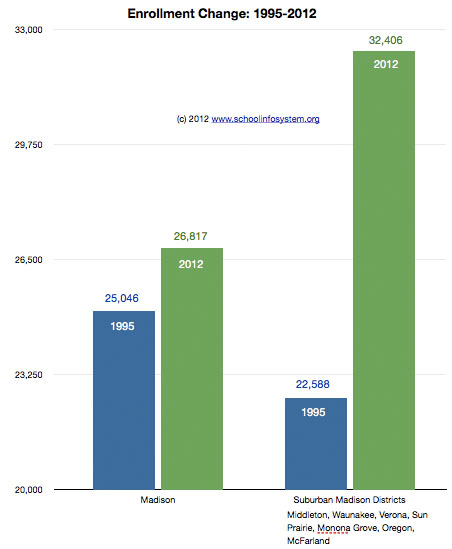
Wichita’s 2011-2012 budget was $606,000,000 for 50,103 students ($12,095/student). Madison spent 18.6% more, or $14,858/student during the 2011-2012 budget cycle.

Share

Selling Public Education Feels Like Selling Out

One Teacher’s Perspective:

Gen. George C. Marshall once said, “There is no limit to the amount of good you can do if you don’t care who gets the credit.” Purportedly, this quote was one of Ronald Reagan’s favorites and was etched on a plaque that sat on the late president’s Oval Office desk.
A plaque with this noble quote would be equally appropriate sitting on a teacher’s desk. Most educators realize from our own schooling that education is normally a no credit profession and rarely a deferred credit occupation. Most students do not mature enough to realize the amount of good teachers do until they have already outgrown schools. A supermajority of my colleagues and I do not care if we never get credit for the amount of good we do for our students. We teach because we recognize–even without the surveys and the quantified data–the limitlessness of learning. The lack of recognition is simply the nature of the teaching profession.

Share

Belt Tightening @ Harvard University

Jennifer Levitz:

In 2009, as its endowment plunged by nearly 30%, Harvard University halted construction on a $1.2 billion science center across the Charles River, angering the neighborhood there by leaving behind a foundation and an idle construction site.
Harvard now says it will resume work on the project, but not until 2014 and even then at half the originally planned size, reflecting a newfound fiscal caution at the school. “The economic realities necessitate this,” Kevin Casey, a Harvard spokesman, said in June at a community meeting.
Due to budgetary constraints, Harvard has delayed the construction of a science complex, seen in the foreground above, inside the fenced-in area.
Many universities face shaky finances because of declining state aid and weakened returns on endowments. At Harvard–and some of its Ivy League peers –the recession has lingered because of an unusually heavy dependency on their endowments for operating income. Harvard’s $32 billion endowment is up from its 2009 drop to $26 billion, but still off its pre-recession 2008 value of $36.9 billion.

Share

A Look at Governance: Anthropologists join actuaries on risk

Gillian Tett:

On the first issue, for example, it is possible to view the world in two ways. Sometimes societies assume that there is a vertical, hierarchical pattern of control (ie somebody, like a government, in charge) but sometimes there is a horizontal dynamic where crowd power rules. This second pattern is roughly how the financial markets were supposed to work before 2007, when investors and free market forces shaped our financial system instead of government diktat. However, since 2007, government intervention has repeatedly trumped the power of the crowd, in ways that feel alien to investors.
However, it also matters whether we believe that societies operate in a benign, accountable manner, or not. Hierarchical relationships can be considered beneficial; wise regulators, for example, can shape markets in sensible, accountable ways and corporate managers steer their way round risks. But sometimes power seems capricious and harmful; panic-stricken governments suddenly do unpredictable, negative things. Similarly, while crowd rule can feel benign and collaborative, markets, say, can feel like a community, it can also be anarchic and unpleasant, a jungle driven by Darwinian selfish instincts.

I thought this passage “Sometimes societies assume that there is a vertical, hierarchical pattern of control (ie somebody, like a government, in charge) but sometimes there is a horizontal dynamic where crowd power rules.” was appropriate for what we often witness in the school governance arena.

Share

Whatever happened to kids’ chemistry sets?

Alex Hudson:

The first chemistry sets for children included dangerous substances like uranium dust and sodium cyanide, but all that has changed.
Talk to people of a certain age about chemistry sets and a nostalgic glaze comes over their eyes.
Stories of creating explosions in garden sheds and burning holes in tables are told and childhood is remembered as a mischievous adventure.
Portable chemistry sets were first used in the 18th Century but it took more than 100 years before they became popular with children, partly prompted by a desire to recreate the coloured puffs of smoke used by conjurors.

Share

Jumping the gap between a US and UK high school education

Andrew Maynard:

Tomorrow, my 16 year old daughter is leaving her home in the US for the UK. She’ll be there for the next two years while she studies for her A levels. It was a heart-rending decision for my wife and I to agree to her living apart from us in a different country. But the stark reality is that my daughter’s high school education here is just not good enough to prepare her for a British University – and in two years’ time, that’s where she wants to be.
I’ve long been worried about the US approach to science education in particular. When I was at school in the UK, we started studying physics, chemistry and biology in parallel from the age of 13. It didn’t suit everyone. But I wouldn’t be here as a science professor and department chair in a major university without this early start. It was key to me getting hooked on physics at an early age, while gaining a broad and integrated understanding of how the different disciplines complemented each other. In contrast, both of my kids have been following a sequential science track – biology (grade 9), geophysical science (grade 10), chemistry (grade 11) then physics (grade 12).

Share

PISA based Wealth Comparison

Zeit Online, via a kind Richard Askey email:

How do families live these days? OECD’s comprehensive world education ranking report, PISA 2009, was published in December of 2010. All participants of the test (fifteen-year-old pupils) completed a questionnaire about their living situation at home. ZEIT ONLINE analyzed and visualized this data to provide you with a unique way of comparing standards of living in different countries. Click on any icon to see further details.

Share

Australian Teachers to face annual review of performance

Andrew Stevenson:

EVERY school teacher faces an annual performance review with education ministers set today to approve a national framework for assessments to begin next year.
The actual form of the review will be left to individual schools and school systems but the ministers will commit to begin the process of reviewing the work of the country’s 290,000 teachers.
Reviews will be led by the principal, a senior teacher or an outsider could be brought in. They are expected to include observation of classroom performance, student results and feedback from both parents and students.
The federal Education Minister, Peter Garrett, said the performance reviews were a ”genuinely big and important reform”.

Share

AAE Signs on to College of Education Reform Coalition

Association of American Educators:

With the teaching profession growing and evolving, one theme that remains constant is the fact that effective teachers are the key to student success. Studies have shown that education schools are deeply in need of reform. From attracting top high school graduates, to improving the quality of instruction, institutions that prepare future teachers must be able to produce results. In order to bring our colleges of education into a new era of success, AAE is pleased to be joining the list of endorsers of the National Council on Teacher Quality’s (NCTQ) project to rank colleges of education in an effort to better prepare future educators.

Share

On Louisiana School Reform

The Advocate:

A deserved amount of controversy is generated by the state’s new vouchers for private school tuition, but it is not the only element of state law that changed this year. Significant changes are in store and new demands placed on traditional school systems by education bills championed by Gov. Bobby Jindal in this year’s Legislature.
Parts of the wide-ranging new laws — crammed together as Act 1 and Act 2 of the 2012 Legislature — affect the relationships between school boards and superintendents, giving the latter more untrammeled authority in hiring and firing. Other parts of the package include new alternative course work that might be available online for some students.
And amid all this is the looming implementation of a teacher evaluation system that could provide a significant amount of new work for principals and other supervisors of teachers, as well as paperwork demands. The state, for example, is working to assess whether computer capabilities in local systems are up to the task — for otherwise, the new demands could overwhelm the information technology that cash-strapped public schools can today afford.

Share

Why an All-Female School May Be Best Training Ground

Melissa Korn:

The best training ground for success in a male-dominated business world is a classroom full of women, says Cathy E. Minehan, dean of the all-female Simmons College School of Management.
In a coed environment, “male leadership roles remain unchallenged, and women are left with ‘play the game our way, or go home,'” she says.
Ms. Minehan, 65 years old, knows a thing or two about the old boys’ club. She is a former chief of the Federal Reserve Bank of Boston, and spent nearly 40 years at central bank branches in Boston and New York. She stepped down in 2007, then took the deanship at the Boston-based school last summer, joking that she “flunked” retirement.

Share

MMSD Alum Barbara Thompson’s Tenure in Montgomery, Alabama: IB, AP, Pre-AP, Mandarin, Programs with Higher Ed; Spends 39% per student less

The Montgomery Business Journal, via a kind reader’s email:

The Grundels’ success story is exactly what Montgomery Public Schools Superintendent Barbara Thompson [bing blekko clusty google] wants to hear. She wants all the district’s nearly 32,000 students to achieve, succeed and enjoy learning.
This fall, the district will launch its International Baccalaureate program and will offer a career technical education program along with seven Career Academies; a growing magnet program for both the arts and academics; and an Advanced Placement (AP) program that continues to expand at a tremendous pace.
“It is a unique pathway for our students having all those programs,” Thompson said. “It means that your child can come into this school district and be challenged at any level. Some of those pathways are going to lead to a four-year college; some will lead to a two-year college; some will lead you right into the world of work. It’s giving students those career pathways that really fit with their strength area.”
Now, you begin to see what all those pieces mean and what the big picture is. “The master plan is to bring our traditional schools up to the level of the magnets,” Thompson said. “That really is the ultimate goal in terms of what we are doing with our rigor and expectations. That is the end game.”
“These are all steps to get us there. I think kids need deliberate steps to get from places, which is why you have the pre-AP program offered at middle school because they can’t just jump into AP in high school.
“It’s why you have the Career Exploratory at middle school because once again you want to go into the Career Academies or career tech. We are making sure that every child takes the explorer test in eighth grade and that goes over their aptitude and skills so when they reach high school they are supposedly doing a four-year plan. That’s every student.”
And the programs that the superintendent has implemented the past few years as well as expanding existing ones, support, encourage and excite targeted groups of students – all students.
The programs on the surface may appear to be disjointed – what does a pre-K program have in common with an Overage Academy – but the common thread is making sure the students succeed.
The pre-K program was expanded from six to 23 programs and turned the closed McKee Elementary School into a pre-K center. Those programs may be cut to 21 because of funding.
That’s the youngest targeted group. Here’s what the district has done for other groups of students:

  • Increased graduation rates, although with the state’s new method of computing graduation rates – those numbers are likely to fall as will graduation rates across the state.
  • Created a sixth-grade academy to help elementary school students make the transition to middle school.
  • Created a ninth-grade academy to help middle school students make the transition to high school.
  • Created an Overage Academy to help struggling ninth-graders who are two or more years older than the usual students further advance in their schooling.
  • Created a Credit and Grade Recovery program to provide more one-on-one teacher assistance so the students will be able to graduate – and hundreds have.
  • Launched an academic magnet program at Johnnie Carr Middle School.
  • Reconfigured nearly all the middle schools for grades six through eight.
  • Instituted a school-wide dress code.
  • Placed a pre-AP program in middle schools.
  • Placed a career tech program in middle schools.
  • Will launch a Mandarin Chinese program with Auburn University Montgomery that will be at the new eastside high school (in fall 2013) as well as Carr and MacMillan International Academy.
  • Consolidated the district by closing some schools and using others in a different way.
  • Will bring at least 15 highly qualified Teach for America teachers to the district in the fall – and they usually stay for two years.
  • Has begun the process for system-wide accreditation.
  • Cut $37 million from the budget over three years and turned a $2.5 million deficit into a surplus of nearly $8 million.

“It really is a puzzle and you are trying to put it together so you create this environment where learning is really exciting for students,” Thompson said. “We are trying to meet those needs of all of our students.
“When I first came here, I gave you the three Rs: relevance, rigor and relationships. All of these programs fall under that category.”
You can imagine, a system with nearly 32,000 students has a lot of needs and you can imagine that Montgomery County’s third-largest employer – about 4,500 people – has a lot of needs. Tom Salter, senior communications officer for MPS, likes to point out that if you combine the students and employees, the school district would be the 13th-largest city in the state. “With that many folks compared to a single, private school that has a hand-picked 600 or 700 in it – it’s different, but it’s not necessarily better to be in a private school.”

“relevance, rigor and relationships” – well said.
Alabama participated in the 2011 TIMSS global exam along with Minnesota and Massachusetts. Wisconsin has never benchmarked our students via the global exams. We have been stuck with the oft-criticized WKCE.
The Montgomery, Alabama schools spent $283,633,475 for 31,470 students ($9,012.82/student) while Madison spent 39% more, or $14,858 per student. The 2011-2012 budget was roughly $369,394,753 for 24,861 students.

Share

India’s street children bank on the future

International News:

Ram Singh, 17, earns just one dollar from the 100 cups of tea he makes every day outside Delhi railway station, but each evening, after packing up, he goes to the bank and deposits nearly half of it.
Singh holds an account at a special bank, run for — and mostly by — Indian street children, that keeps what little money they have safe and seeks to instill the idea that savings, however meagre, are important.
Just one among millions of street children who rely on menial jobs for survival, Singh is determined to make his work pay some sort of future dividend.
“I’m smart, but that alone isn’t enough to start a business.

Share

Many American universities are in financial trouble

The Economist:

WITH its leafy avenues and Gothic buildings, the University of Chicago seems a sober, solid sort of place. John D. Rockefeller, whose money built it, said it was the “best investment I ever made”. Yet Chicago and other not-for-profit American universities have been piling on the debt as if they were high-tech start-ups.
Long-term debt at not-for-profit universities in America has been growing at 12% a year, estimate Bain & Company, a consultancy, and Sterling Partners, a private-equity firm (see chart 1). A new report looked at the balance-sheets and cashflow statements of 1,692 universities and colleges between 2006 and 2010, and found that one-third were significantly weaker than they had been several years previously.
A crisis in higher education has been brewing for years. Universities have been spending like students in a bar who think a Rockefeller will pick up the tab. In the past two years the University of Chicago has built a spiffy new library (where the books are cleverly retrieved by robots), a new arts centre and a ten-storey hospital building. It has also opened a new campus in Beijing.

Share

Michigan school report cards: Achievement gaps could see academic powerhouses targeted for improvement

Dave Murray:

For individual school and district data, visit www.MISchoolData.org and click on Dashboard & School Report Card button located on the left.
The changes were praised by an education advocacy group, with leaders saying that the problems of low-scoring students were for years masked by the high-achievers in some districts. Communities that have long prided themselves on their school systems are now left to ponder stark disparities, said Amber Arellano, executive director of the Education Trust-Midwest.
New this year is a designation based in part on the gap between the highest-scoring 30 percent of students and the lowest-performing 30 percent – a measure that landed some high-achieving schools in affluent areas in a new, “focus school” category. The 10 percent of the schools with the widest gaps are added to the group.

Share

How to Write

Colson Whitehead:

The art of writing can be reduced to a few simple rules. I share them with you now.
Rule No. 1: Show and Tell. Most people say, “Show, don’t tell,” but I stand by Show and Tell, because when writers put their work out into the world, they’re like kids bringing their broken unicorns and chewed-up teddy bears into class in the sad hope that someone else will love them as much as they do. “And what do you have for us today, Marcy?” “A penetrating psychological study of a young med student who receives disturbing news from a former lover.” “How marvelous! Timmy, what are you holding there?” “It’s a Calvinoesque romp through an unnamed metropolis much like New York, narrated by an armadillo.” “Such imagination!” Show and Tell, followed by a good nap.

Share

‘Conventional’ online universities consider strategic response to MOOCs

Steve Colowich:

Online education not only gave nontraditional students a chance to enroll in collegiate programs from afar; it has also given universities that historically have not enjoyed the prestige of the Ivies a chance to build a reputation on fresh territory and build reliable revenue streams.
But, now that higher education’s traditional heavyweights are creating online courses and offering them for free to anyone who wants to register, those universities that have made names for themselves in the market for “conventional” online programs are trying to sort out how these high-profile “MOOCs” (i.e., Massive Open Online Courses) could affect their own positions in an online market where many have staked their futures.
One strategy for established online players would put them in the somewhat ironic role of making sure students who have passed Harvard-level exams deserve college credit.

Share

China Re-Educates Hong Kong

The Wall Street Journal:

Some 90,000 Hong Kong citizens, many of them parents accompanied by small children, marched in blazing heat Sunday to oppose a government plan to teach respect for one-party rule in all government-funded schools. So far the administration of newly inaugurated Chief Executive Leung Chun-ying refuses to back down. Officials in Beijing insist the courses go ahead, a serious violation of Hong Kong’s autonomy and a move that could alienate Hong Kong from the motherland.
Chinese President Hu Jintao called for “more emphasis on national education” in 2007, and the territory’s government has paid lip service to the idea. But concrete plans only got underway in the last two years. The sudden urgency is clearly related to the passage of political reforms in 2010 that allow for elections by universal suffrage for the Chief Executive in 2017 and Legislative Council in 2020.

Share

Future of education, workforce to be discussed at Yuba City meeting

Ashley Gebb:

The future of education and its role in economic development will be featured in a town hall meeting on Saturday hosted by the Yuba City Unified School District.
As part of the review and discussion of the district’s strategic plan, officials want feedback on what residents value about students’ preparation for the future and workforce, and how to prioritize the budget to achieve those goals. With a $100 million budget and as one of the largest employers in Yuba-Sutter, the district wants to ensure it can continue to provide quality education with its dwindling resources, said Superintendent Nancy Aaberg.
“It’s about keeping our students competitive and the community competitive,” she said.

Share

Commentary on the Wisconsin DPI’s New School Report Cards

Madison School Board Member Ed Hughes:

A few weeks ago, the Wisconsin Department of Public Instruction (DPI) released an example of what the upcoming report cards for state schools will look like. The report cards are described as one of the package of reforms that that DPI promised to implement in order to win a waiver from the federal Department of Education from the more onerous burdens of the federal No Child Left Behind (NCLB) Act.
One of the qualifications for an NCLB waiver is that a state must put into place an accountability system for schools. The system must take into account results for all students and subgroups of students identified in NCLB on: measures of student achievement in at least reading/language arts and mathematics; graduation rates; and school performance and progress over time. Once a state has adopted a “high-quality assessment,” the system must also take into account student growth.
In announcing the NCLB waiver, DPI claimed that it had established accountability measures that “1) are fair; 2) raise expectations; and 3) provide meaningful measures to inform differentiated recognitions, intervention, and support.”
Designing a fair and meaningful system for assessing the performance of the state’s schools is a worthy endeavor. The emphasis for me is on the “fair” requirement. I consider an assessment system to be fair if it measures how successfully a school promotes the learning of whichever students show up at its door.

Related: Notes and links on the oft-criticized WKCE and Madison’s long term reading recovery challenges.

Share

Charter schools raise educational standards for vulnerable children

The Economist:

The Credo study has been criticised for not comparing the results of children who have won charter-school lotteries with those who have not–a natural experiment in which the only difference between winners and losers should be the schooling they receive. Such studies suggest that charters are better. For example, a lottery study in New York City found that by eighth grade (around 13), charter-school pupils were 30 points ahead in maths.
However, recent work by Mathematica, an independent policy group, suggests that the Credo study is sound. The bigger problem is that its findings have been misinterpreted. First, the children who most need charters have been served well. Credo finds that students in poverty and English language learners fare better in charters. And a national “meta-analysis” of research, done last year for the Centre on Reinventing Public Education in Seattle, found charters were better at teaching elementary-school reading and mathematics, and middle-school mathematics. High-school charters, though, fared worse. Another recent study in Massachusetts for the National Bureau of Economic Research concluded that urban charter schools are shown to be effective for minorities, poor students and low achievers.

Share

Abandoning Algebra Is Not the Answer

Evelyn Lamb:

In an opinion piece for the New York Times on Sunday, political science professor Andrew Hacker asks, “Is Algebra Necessary?” and answers, “No.” It’s not just algebra: geometry and calculus are on the chopping block, too. It’s not that he doesn’t think math is important; he wants the traditional sequence to be replaced by a general “quantitative skills” class, and perhaps some statistics.
Quite a few people have responded to Hacker’s column already. I highly recommend these posts by Rob Knop, Daniel Willingham, and RiShawn Biddle.
There are so many problems with Hacker’s essay that it’s hard to know where to start. Hacker’s first main point is that math is difficult, and the poor grades that result prevent too many people from graduating high school or college. His second is that the math we learn is not the math we need in our jobs.

Share

Shadow Education: Private tuition has its place, but only after careful consideration

Anjali Hazari:

A reader recently told me about her neighbour’s daughter, who is in grade six at an international school.
One day the girl’s maths teacher asked students if they attended the Kumon or Enopi programmes after school. Most did, but all the teacher did was to tell the others they would have to catch up. The reader was rightly appalled.
Research by University of Hong Kong Professor Mark Bray on students’ increasing reliance on tuition in Asia has energised the debate on whether tutorial schools are a necessary evil.
In my experience, parents are too quick to send their children to tutors. Their reasons for doing so vary. For some parents, it’s because their child’s friends are tutored; others feel they are depriving their children of the chance to succeed if they don’t receive tutoring. Some parents do it out of guilt because they are unable to personally supervise the children’s progress.

Private Supplementary Tutoring and Its Implications for Policy Makers in Asia.

Share

E-Reading: A Midterm Progress Report

Alan Jacobs:

E-readers have been around long enough now that the novelty has largely worn off. To be sure, we still get the occasional article or blog post celebrating the smell of “real books” and denouncing the disembodied fakery of text on a screen, but not nearly as many as in recent years. E-readers are simply part of the reading landscape now — the first Kindle was released almost five years ago — and it’s time for a midterm progress report. How is the technology developing? What has been accomplished and what remains to be done?
One good development in the past five years: more options for reading at night. There are backlit LCD reading possibilities via the iPad and subsequent tablets, including the Kindle Fire and the Nexus 7, plus a much less eye-frying option, the e-ink Nook Simple Touch GlowLight. The Kindle software for the iPad and iPhone allows you to dim the screen for that app only, which is helpful — and I think it’s great to be reading as the sky grows darker and not have to get up to turn on a light, remaining focused on the book — but my eyes just hurt after a long iPad session. I don’t know that anything can be done about that.

Share

The Seven Myths of Helicopter Parenting

Katie Rophie:

1. You are not a helicopter parent if your kid is not in a zillion extracurriculars. In the recent clamor on the subject of whether this generation of parents is hovering too much and oversteering, overmanaging, and otherwise spoiling their children, I’ve heard parents say, “But we don’t know any actual helicopter parents.” They say this because they don’t know anyone who fits the obvious caricatures–that is anyone who schedules Mandarin classes for their 5-year-old and dutifully shuttles them off every Saturday morning for theater-to-express-yourself classes. But the overabundance of extracurriculars is only one small part of the larger, disturbing phenomenon Madeline Levine chronicles in her voice-of-reason-ish new book, Teach Your Children Well, which was excellently reviewed this weekend in the New York Times by Judith Warner.

Share

Hong Kong’s national education push too heavy-handed

Frank Ching:

The Basic Law stipulates that the Hong Kong government shall “on its own, formulate policies on the development and improvement of education”. Yet the idea of national education, which is arousing such controversy, was evidently conceived not by the government here. It was proposed in Beijing by President Hu Jintao .
At a dinner on June 30, 2007, the president suggested to Donald Tsang Yam-kuen, who was to be sworn in as chief executive the following day, that Hong Kong “should put more emphasis on national education for the youth”.

Share

Can School Performance Be Measured Fairly?

Room for Debate:

More than half the states have now been excused from important conditions of the No Child Left Behind education law. They’ve been allowed to create new measures of how much students have improved and how well they are prepared for college or careers, and to assess teacher performance on that basis. Teachers will be evaluated in part on how well their students perform on standardized tests. One study, though, found that some state plans could weaken accountability.

Share

Madison School Board member Burke spent $128,000 to win seat

Matthew DeFour:

Madison School Board member Mary Burke spent more than $128,000 on her spring campaign — all of it her own — surpassing by far the most spent in recent city school board elections, according to available data.
Since 2001, the earliest online city clerk records are available, the most spent on a Madison School Board campaign was $28,349 by Marj Passman in 2007, when she lost to Maya Cole. That amount also was surpassed this year by incumbent Arlene Silveira, who reported spending $36,530.
Burke, a former state Commerce secretary and Trek Bicycle executive, said she made most of the expenditures, mostly for marketing and advertising, after the local teachers union, Madison Teachers Inc., backed her opponent, firefighter Michael Flores.

Share

A 20-year lesson Evidence from America and Britain shows that independence for schools works

The Economist:

Yet the virtue of experiments is that you can learn from them; and it is now becoming clear how and where charter schools work best. Poor pupils, those in urban environments and English-language learners fare better in charters (see article). In states that monitor them carefully and close down failing schools quickly, they work best. And one great advantage is that partly because most are free of union control, they can be closed down more easily if they are failing.
This revolution is now spreading round the world. In Britain academies, also free from local-authority control, were pioneered by the last Labour government. At first they were restricted to inner-city areas where existing schools had failed. But the Conservative-Liberal Democrat coalition has turbocharged their growth, and has launched “free schools”, modelled on a successful Swedish experiment, which have even more independence. By the end of this year half of all British schools will be academies or free schools. Free schools are too new for their performance to be judged; in academies, though, results for GCSEs (the exams pupils take at 15 or 16) are improving twice as fast as those in the state sector as a whole.

Share

Boushra and Line Dalile: Our homemade curriculum

TED Talks:

Aged 16 and 14 respectively, Boushra and Line are homeschooling enthusiasts. Largely self-taught, they collectively speak Arabic, English, Chinese, German, Italian and French

Share

Students, here’s why you should do hackNY

Jesse Pollack:

I’m Jesse Pollak, a student at Pomona College. This summer, I was lucky enough to participate in the hackNY fellows program. If you don’t already know, hackNY is a non-profit organization whose mission is to “to federate the next generation of hackers for the New York innovation community.” In addition to holding twice annual student hackathons, each summer hackNY organizes the hackNY fellows program:
“a program that pairs quantitative and computational students with startups which can demonstrate a strong mentoring environment: a problem for a student to work on, a person to mentor them, and a place for them to work. Students enjoy free housing together and a pedagogical lecture series to introduce them to the ins and outs of joining and founding a startup.”

Share

The Success Myth

Heidi Grant Halvorson:

Quick: Think of a successful person. Someone who is really good at what they do.
Now, in a word or phrase, tell me why that person has been so successful. What makes them so good?
Obviously, I can’t hear your answer. But I’d be willing to wager that it had something to do with innate ability.
“He’s so brilliant.”
“She’s a genius.”
“He’s a natural leader.”
These are the kinds of answers people — particularly Americans — tend to give when you ask them why certain individuals have enjoyed so much success.

Share

Teachers Unions Go to Bat for Sexual Predators

Campbell Brown:

By resisting almost any change aimed at improving our public schools, teachers unions have become a ripe target for reformers across the ideological spectrum. Even Hollywood, famously sympathetic to organized labor, has turned on unions with the documentary “Waiting for ‘Superman'” (2010) and a feature film, “Won’t Back Down,” to be released later this year. But perhaps most damaging to the unions’ credibility is their position on sexual misconduct involving teachers and students in New York schools, which is even causing union members to begin to lose faith.
In the last five years in New York City, 97 tenured teachers or school employees have been charged by the Department of Education with sexual misconduct. Among the charges substantiated by the city’s special commissioner of investigation–that is, found to have sufficient merit that an arbitrator’s full examination was justified–in the 2011-12 school year:

  • An assistant principal at a Brooklyn high school made explicit sexual remarks to three different girls, including asking one of them if she would perform oral sex on him.

Share

The Price Everybody Talks About and Nobody Really Knows: How Much Does College Cost?

Jordan Weissmann:

If you’re a parent, and you don’t suffer palpitations whenever the topic of paying for college comes up, congratulations: You’re either unusually mellow, or unusually wealthy. Higher education is expensive, and getting more so by the year.
But how expensive? Ah, that’s a trickier question. What we talk about when we talk about the price of a degree can be a bit murky, thanks to the vast variations in tuition, financial aid, and lifestyle choices that determine how much a student spends during their time on campus. For parents paying the tab, and for wonks who’d like to make higher education more affordable, it’s useful to have a realistic baseline for how much a bachelor’s actually runs these days.
So without further ado, let’s look at the numbers.

Share

Saudi Students Flood In as U.S. Reopens Door

Ellen Knickmeyer:

Dressed in caps and gowns, the college students packing a graduation ceremony in suburban Washington, D.C., acted like excited graduates anywhere in the United States.
Except, perhaps, when the men broke into tribal line dances. Or when the women, wearing headscarves, burst forth with zagareet, soaring trills of their tongues, in celebration.
The more than 300 graduates gathered at a hotel overlooking the Potomac River were all from Saudi Arabia, part of a massive government-paid foreign study program to earn bachelor’s, master’s and doctorate degrees and return home to help run their country.

Share

Raising the Bar

Larisa:

It has recently been suggested that, in order to elevate the quality and status of teachers in America, teachers need to take a “bar exam.” After all, doctors and lawyers have serious hurdles to jump over in order to secure and maintain their licenses. The work that you do as a teacher is just as important as the work that a doctor or a lawyer does–in fact you educate future doctors and lawyers. Why shouldn’t teachers be held to the same standard as lawyers and doctors?
Being an effective teacher requires more than just attending professional development workshops. Excellent instruction in the classroom facilitates student learning, which leads to better achievement on formal assessments and standardized tests. Starting the discussion with disappointing test results, however, often brings up the “chicken or the egg” dilemma: is poor performance on standardized tests the fault of the teacher for not providing quality instruction or is it the fault of the student for failing to work hard and learn? Frequently, teachers are shouldering the blame.

Share

Tennessee Directs Nashville to Back Charter School; Per Student Spending Comparison

Stephanie Banchero:

The Tennessee State Board of Education has cleared the way for a charter school backed by neighborhood parents to open in middle-class West Nashville.
The board voted Friday to direct the Metro Nashville Public Schools to approve an application by Great Hearts Academies, a nonprofit that operates prep-school-like charter schools in the Phoenix area, to open a school in 2014. The group hopes to open four more schools across Nashville after that.
The Nashville school board, whose members are elected on a nonpartisan basis, approved two other charter schools last month. But it twice rejected Great Hearts’ application, claiming the school would recruit only affluent students and harm diversity efforts in the district, where 45% of elementary students passed state reading exams last year, and 33% passed math. The local teachers union didn’t take a public stand on the application.

Nashville schools spent $674,034,800 [PDF] to educate 79,117 students [District Fact Sheet PDF, 71% “economically disadvantaged”] during the 2011-2012 school year ($8519.47/student), 42% less than Madison’s $14,858.

Share

When Andrew Hacker asks “Is Algebra Necessary?”, why doesn’t he just ask “Is High School Necessary?”

rknop:

Yes, I admit, the editorial at the New York Time entitled “Is Algebra Necessary?” pushes my buttons. Hacker makes some valid and relevant points, and I’ll get back to that. However, the core of his argument is the ultimate in anti-intellectualism. What’s worse, it’s the kind of anti-intellectualism that you get from intellectuals, the sort of thing that sprouts from those on the math-ignorant side of the “two cultures” identified by C. P. Snow.
Andrew Hacker’s argument against making algebra necessary for high school and college students is essentially: Math Is Hard. Having to do it gets in the way of people who could be amazing at other things, because they will drop out of high school because Math Is Hard. So, rather than stop them from achieving all that they might achieve, we should just remove algebra from the high school curriculum. He points out that failing math is one of the main reasons students leave school. Now, I might think that this is a reason to look at our educational culture, at how math is taught, at the fact that it is somehow deemed acceptable and indeed normal to find basic math impenetrable. But, if you’re on the other side of the two cultures, evidently this means that we as a society should just give up on the general teaching of basic algebra. Evidently, it’s OK that the elites who understand the simplest things about science become that much more separated from the general educated public, and that the generally educated public know that much less about them.

Share

A New Type of Mathematics for non-Mathematicians

Gowers Blog:

As I said would happen in my post about a possible approach to teaching maths to non-mathematicians aged 16-18, I went last Wednesday to Watford Grammar School for Boys to try the approach out. The headmaster there, Martin Post, was remarkably helpful and assembled a usefully varied group of pupils, some from his school, some from the equivalent school for girls, and some from a nearby mixed comprehensive school (I wasn’t told which one) whose pupils receive some of their teaching in scientific subjects from Watford Grammar School. What’s more, some of the people there were doing maths and further maths, some were doing just maths, and some were not doing either. The one thing that was not representative about the group was that they were much brighter than average: for example, the non-mathematicians there had been chosen by their teachers as clever people who could have done maths but decided that they were more interested in other things. For most of the rest of this post, I’ll say what questions I discussed and how the discussions went. All but two of them were taken from the list in the earlier post.

Share

Information Asymmetries and the Market for Higher Education

Elizabeth Malm:

Here is how it works. Each year, a student (or more likely, their family) fills out the Free Application for Federal Student Aid (FAFSA). In this cumbersome, complicated process, families report income and other related assets. Essentially, this reports to the government the family’s estimated ability to pay for higher education–not willingness to pay, but ability to pay. This is an important point. The government then calculates what is known as the “expected family contribution,” which is sent to colleges, reporting what exactly the government deems a family can devote to their student’s education.
Let’s step back for a moment and frame this problem a little differently. Imagine you are on the market to purchase a new car. When a salesman approaches, you (the buyer) have an information advantage. You know exactly what you are willing to pay for the car based on your own personal preferences and your personal belief as to how much of your family budget you can realistically devote to purchasing the car. With this knowledge, you are in the driver’s seat on negotiating the price of the car.

Share

Questions on Louisiana School Vouchers

Mike Hastens:

After the Louisiana Board of Elementary and Secondary Education approved state Superintendent John C. White’s version of accountability for voucher schools this week, some people were asking “what accountability?”
They especially feel that way since White reserved the right to waive any and all restrictions imposed in the accountability plan if he believes it’s merited.
If a school doesn’t have 40 students, there are no repercussions, even if every voucher student fails the state assessment tests.

Share

E-Books in Libraries: A Briefing Document Developed in Preparation for a Workshop on E-Lending in Libraries

David O’Brien, Urs Gasser, and John Palfrey:

This briefing document was developed with helpful inputs from industry stakeholders and other practitioners in preparation for the “E-Books in Libraries” workshop, hosted on February 24, 2012, by the Berkman Center for Internet & Society with the generous support of the Charles H. Revson Foundation.
The “E-Books in Libraries” workshop was convened as part of a broader effort to explore current issues associated with digital publishing business models and access to digitally-published materials in libraries. Workshop attendees, including representatives from leading publishers, libraries, academia, and other industry experts, were invited to identify key challenges, share experiences, and prioritize areas for action. This document, which contains some updates reflecting new developments following the February workshop (up to June 2012), is intended to build on and continue that discussion with a broader audience, and encourage the development of next steps and concrete solutions.

Share

Our generation’s Legos

rogue Lynn:

First time I heard about raspberry pi was through twitter. I thought: Oh I bet that’s a cute name for a new python module. Didn’t look into it.
Then I overheard a very dedicated PyLady saying “OMG my Raspberry Pi shipped today!”
Wait, a module shipped? She doesn’t develop python modules. Is this a physical thing?
Then, weeks later, I asked another friend, “What is this Raspberry Pi?”
The world stopped to him. “What, are you serious?” he responded. “Yeah…?” Clearly I wasn’t getting “it.” Then I preceded to get educated in “it.”

Share

Addressing the Middle School Achievement Gap

GE Citizenship:

Dr. Sabrina Hope King is Chief Academic Officer for the New York Department of Education’s Office of Curriculum and Professional Development. As part of her role, she leads the Campaign for Middle School Success, a multi-year strategic plan to develop a culture of success in schools throughout the city and improve the academic performance of middle school students.
The Campaign for Middle School Success is a $35 million initiative supported by both public and private funds, including a five-year, $17.9 million grant from the GE Foundation as part of the Developing Futures™ in Education program.
Dr. King’s audio perspective discusses how New York City schools are addressing the achievement gap and creating a system of middle schools that help prepare children for success in further education and future careers.

Share

My Education in Home Schooling

Quinn Cummings:

I don’t know how most people spend their second morning home schooling. I spent mine hyperventilating into a paper bag. After less than 24 hours of educating my child at home, I was struck by the realization that I wasn’t up to the task and should move immediately to Plan B. Except I didn’t have a Plan B.
For two years leading up to this I had watched my daughter convince experienced, well-meaning teachers that she was incapable of mastering long division when, in fact, she simply didn’t like long division. Alice’s ploy raised a larger concern: At age 9, she appeared to be cruising along in school without actually doing any work. To my sorrow, it appeared I had given birth to myself, another pleasant slacker fated to a lifetime of successfully studying for midterms between classes until barely paying attention stopped working. Alice wasn’t learning how to learn, she was learning how to coast. Maybe I could wait and see if she came to learning on her own. Or maybe she needed a different kind of education.
Her father and I checked out a few middle-school programs known for their rigor. Each promised to challenge Alice academically but also promised hours of homework every night. I’m greedy. I want my child challenged, but I don’t want her staying up until 2 a.m. every night translating “The Aeneid.” I knew we had a small window of opportunity to teach Alice to love learning, but I also knew there was an equally small window for her to be a child. Her academic options seemed to lie on either side of a wide chasm: a fluffy pillow on one side, a jackhammer on the other. I tried home schooling because I couldn’t find a better alternative.

Share

An Interview with Laura Waters: Parent, Activist, School Board President, Citizen, Blogger


Laura Waters
39MB mp3 audio file
Transcript
President, Lawrence Township Board of Education [Note the “user friendly” budget ($14,483/student, about 4% less than Madison’s $15,132/student)], publisher of the New Jersey Left Behind blog and author of an occasional column. .

I appreciate the time Laura took to discuss her activism, experience and aspirations along with her views on where our ed system is going. Laura further discussed her District’s recent turnaround strategy. Finally, Laura offered several useful suggestions for parents researching schools.
Share

Academies told they can hire “unqualified” teachers

By Angela Harrison:

England’s new academy schools can now hire unqualified teachers, after a change to the rules.
Government officials say this means academies will be free to hire “great linguists, computer scientists and other specialists who have not worked in state schools before”.
Unions for head teachers and teachers have attacked the move, describing it as a damaging backward step.
The change is immediate.
Until now, most state-funded schools could only employ people with what is known as “Qualified Teacher Status (QTS)“, meaning they have been trained and approved as meeting a range of standards.
Independent schools are exempt.
The change also brings academies in line with the new free schools, which are already free to employ people without QTS.

Related: An Email to Madison Superintendent Dan Nerad on Math Teacher Hiring Criteria.

Share

Talks collapse over Hong Kong national classes delay

Jennifer Cheng and Dennis Chong:

The subject is intended to engender national pride but is derided as a “brainwashing” tool by critics.
A representative of the central government’s liaison office waded into the furore, urging parents to back the curriculum.
While Ng claimed there had been no “falling out”, leaders of the National Education Parents Concern Group said they walked out of the talks and felt “disrespected” by Ng.
Convener Eva Chan Sik-chee said the talks were like “playing music to a bull” and called for more parents to join the march, due to start at 2.30pm in Victoria Park and end at government headquarters in Admiralty.
Chan said the talks were no more than a gesture, intended to “turn down the heat” before the protest.

Share

Inside the Coursera Contract: How an Upstart Company Might Profit From Free Courses

Jeffrey Young:

Coursera has been operating for only a few months, but the company has already persuaded some of the world’s best-known universities to offer free courses through its online platform. Colleges that usually move at a glacial pace are rushing into deals with the upstart company. But what exactly have they signed up for? And if the courses are free, how will the company–and the universities involved–make money to sustain them?
Some clues can be found in the contract the institutions signed. The Chronicle obtained the agreement between Coursera and the University of Michigan at Ann Arbor, the first public university to make such a deal, under a Freedom of Information Act request, and Coursera officials say that the arrangement is similar to those with the other partners.
The contract reveals that even Coursera isn’t yet sure how it will bring in revenue. A section at the end of the agreement, titled “Possible Company Monetization Strategies,” lists eight potential business models, including having companies sponsor courses. That means students taking a free course from Stanford University may eventually be barraged by banner ads or promotional messages. But the universities have the opportunity to veto any revenue-generating idea on a course-by-course basis, so very little is set in stone.

Share

New York’s Charter Schools Get an A+

Joel Klein:

During the eight years I served as chancellor of New York City’s public schools, the naysayers and the apologists for the status quo kept telling me “we’ll never fix education in America until we fix poverty.”
I always thought they had it backward, that “we’ll never fix poverty until we fix education.” Let me be clear. Poverty matters: Its debilitating psychological and physical effects often make it much harder to successfully educate kids who grow up in challenged environments. And we should do everything we can to ameliorate the effects of poverty by giving kids and families the support they need. But that said, I remain convinced that the best cure for poverty is a good education.
And I’m equally convinced that pointing to poverty as an excuse for why we fail to properly educate poor kids only serves to condemn more of them to lives of poverty.

Share

‘Exceptional’ Is the Standard U.S. Education Must Aim For

Ed Moore:

The use of the phrase “global marketplace” has become so commonplace it is almost trite.
It has developed into one of those catch phrases that fill the hours of talking heads and appear in virtually every paper issued on the American economy.
Americans like to think of our country as an undefeated champion, capable of conquering every challenge. Yet, we find ourselves in an increasingly competitive universe of economies, all seeking to become economic giants; all working hard to become leaders across the spectrum of competitive fields.
In “Benchmarking for Success: Ensuring U.S. Students Receive a World Class Education,” published by the National Governors Association (NGA), the plea was made clear: “what matters is how a state’s students compare to those in countries around the globe. America must seize this moment to ensure that we have workers whose knowledge, skills and talents are competitive with the rest of the world.”

Related: www.wisconsin2.org

Share

Catholic schools can learn from charters

Sean Kennedy:

Charter schools, only 20 years old, are on the rise across America as parents and students try to escape failing public schools. The growth in charter schools has hit Catholic schools especially hard, as education historian Diane Ravitch noted, “Where charter schools are expanding, Catholic schools are dying.” Instead of fearing the rise of Charter schools, Catholic schools should learn from their innovative practices.
Parents who once preferred Catholic schools to the failing public system are abandoning Catholic schools en masse. This coming school year (2012-2013), more American elementary and secondary school students will enroll in charter schools than Catholic schools for the first time.
Charters have grown precisely because they took some of the best practices of Catholic schools – uniforms, discipline and high expectations – and applied them zealously. Now, Catholic schools should adopt some of the best practices used by charters to stage a comeback.
Milwaukee’s Catholic schools have a special opportunity to lead reform. Starting in the fall of 2013, one of the most innovative charter school networks, Rocketship Academy of San Jose, Calif., will open its first franchise in Milwaukee.
Rocketship plans to open eight in total and enroll 4,000 students in the coming years. Rocketship’s model has improved student outcomes dramatically, especially for English language learners. More important, Rocketship spends half as much per pupil than traditional schools.

Share

Not all math classes are the same even in the same school

Maureen Downey:

Researcher William H. Schmidt believes education has become a game of chance in which the odds of success are predicated on factors outside the control of the students, including where they live, the schools they attend, the teachers they have and the textbooks they use.
An internationally recognized researcher on effective math education, Schmidt says that U.S. students lack equal opportunities to learn math, something he saw firsthand when he took sabbatical from Michigan State University to spend a year at the University of Virginia.
As an author of Michigan’s math standards, Schmidt knew his second grader would have been learning multiplication tables up to the number five back home in East Lansing. In Virginia, multiplication was not taught at all in second grade, reinforcing what Schmidt already realized from his international comparisons: All math classes are not equal and students do not have the same opportunities to learn math.

Share

Why do charter schools in N.J. generate so much heat?

Laura Waters:

N.J. charter schools are, by statute and conception, public schools. They are funded by public money on a per pupil basis, just like traditional schools, although the sending districts keep a small portion. They are all non-profits.
They adhere to the same fiscal and curricular metrics as other N.J. public schools. The kids take the same tests. Staff members can unionize, although they don’t have to. Admissions policies can’t discriminate against kids new to the English language or children with disabilities. 

The charter universe in N.J. is tiny, serving only 2 percent of students, mostly poor minority kids.
While there’s no current legislation that restricts new charters to needy districts, eight of the nine new charters just approved by the DOE are in Newark, Camden, Jersey City, and Willingboro.

Share

Calif. Student Sues Teacher, District Over C+ Grade

Katie Kindelan, via a kind reader’s email:

A C+ is considered average on the grading scale but for one California high school student it was well below average, enough so that he filed a lawsuit against both his teacher and school district.
Bowen Bethards, 17, was a sophomore in Peggy Carlock’s chemistry class at Albany High School in Albany, Calif., outside of San Francisco, in the 2010-11 school year when she gave him the C+ grade at the center of the suit, according to court records first reported by the Albany Patch.
Bethards, in a lawsuit filed with his mother, Laureen, in Contra Costa County Superior Court last month, claims that he has suffered severe physical and emotional suffering, damage to his academic reputation, and diminished chances of getting into his college of choice because of the grade.
The Bethards claim that Carlock, who no longer teaches at the school, punished Bowen for missing class on a day that his fellow students performed a lab. Bethards, according to the suit, had to miss class to attend the adoption hearing for his younger sister and so informed Carlock of his absence ahead of time. The two agreed upon a make-up date but when Bethards showed up on the agreed-upon date, he says, Carlock said he could not make up the lab and was instead, “going to fail him,” according to court documents.

Share

55 Year Old CPA With 169 LSAT Sues Baylor Over Admissions Denial, Says His 3.2 GPA Was Earned Before Grade Inflation

Paul Caron:

Following up on my previous post, Baylor Law School Sends Mass Email With Personal Data on Each of its 442 Admitted Students (Apr. 6, 2012): C. Michael Kamps, a CPA who was denied admission to Baylor Law School, has filed an age discrimination lawsuit agains the school based in part on the improperly released data, claiming that his 169 LSAT was higher than 97% of Baylor’s admitted class and that the school failed to take into account the fact that his 3.2 GPA from Texas A&M (Class of 1979) was earned in the days before rampant grade inflation.

From the complaint (2MB PDF):

Plaintiff, more than thirty years ago, graduated from a major and wel-respected university in the top quarter of his class comprising primarily his similarly aged peers.
Plaintiff first applied to Defendant Baylor University’s Law School in 2009, for the fall quarter commencing in 2010. Plaintiff also applied for a specific merit based scholarship with published and long-established qualifying criteria which Plaintiff met. The candidate pol for this class, and for the scholarship, generally consisted of applicants substantially younger than Plaintiff.
2. Plaintiff expected to be, and insists that he be, allowed to compete on an equal footing with the much younger candidates for admission to Law School and access to merit based scholarships.
Plaintiff expects, and insists, that Defendants judge and evaluate his application as one submitted by a top quarter graduate of a major and wel- respected university.
3. Defendants refuse and insist upon applying disparate standards to older vs. younger candidates. Defendants pretend that these are not disparate standards at all ,but rather one factually neutral and uniform standard.
These standards, as applied by Defendants, are biased with respect to age and are therefore in violation of the Age Discrimination Act of 1975, 42U.S.C.§6101etseq., (“the Act”) and its implementing Regulations at 34C.F.R. Part 10 (“Regulations”). Defendants persist in this practice
even while faced with overwhelming evidence of, and while actually acknowledging, the bias.
Plaintiff scored at the 97th percentile on the Law School Admissions Test (“LSAT”), with a score of 169. Plaintiffs “Baylor Index,” an index calculated by multiplying Plaintiff’s UGPA by a factor of 10 and adding that product to Plaintiffs LSAT score, is 201.

Share

Is Algebra Necessary?

Andrew Hacker:

A TYPICAL American school day finds some six million high school students and two million college freshmen struggling with algebra. In both high school and college, all too many students are expected to fail. Why do we subject American students to this ordeal? I’ve found myself moving toward the strong view that we shouldn’t.
My question extends beyond algebra and applies more broadly to the usual mathematics sequence, from geometry through calculus. State regents and legislators — and much of the public — take it as self-evident that every young person should be made to master polynomial functions and parametric equations.

Share

Teaching students to stake out their own personal cloud namespaces, to which they’ll attach a variety of services, is an excellent lesson

Jon Udell:

In the mid-2000s I made some friends in the world of higher education who were starting to think like the web and to imagine how that might transform an institution that everyone could see needed to change. One of them, Gardner Campbell, invited me to speak at the University of Mary Washington’s Faculty Academy on Instructional Technologies. There I met an inspired team of thinkers and doers who were pioneering the academic use of what we now call cloud technology.
UMW isn’t a wealthy school; there wasn’t a big budget for IT; that was a constraint well embraced. Gardner’s dream team found their way to BlueHost where, for $8/month, they could spin up web servers, wikis, and most importantly the blogs that have become central to the intellectual life of the school. Here’s Jim Groom, aka Mr. Edupunk, reflecting on what UMW Blogs has become.

Share

All kids need a great education: Common Core as a Panacea

Bill Berezowitz and Tim Sheehy:

As the CEO of Manpower Group, Jeff Joerres knows a lot about what’s required to fill the job needs of employers all over the globe, and as he has noted “we are in the human age, where economies compete and survive based mainly on talent.”
Wisconsin’s release of a new measure of student academic performance in grade and high school was a warning sign worth our attention (“Student scores slip with new standard,” July 17). Credit goes to the state Department of Public Instruction, led by Superintendent Tony Evers, for its on-point and timely release of this new data showing how Wisconsin’s students perform when we use a higher common standard to compare with students in other states.
The results were tough to swallow, 36% proficient in reading and 48% proficient in math on standards that are more representative of what is needed to compete nationally and globally. It looks as if we have been training our students on the low hurdles, when in reality we are running in an international high-hurdle race where jobs are the finish line.
We recently attended a conference sponsored by GE on this very topic. The national audience of business and education leaders came together to better understand the implications of all states adopting a common core set of standards to measure educational performance in K-12. Wisconsin has significant ground to make up.

Through the looking glass.
wisconsin2.org

Share

The Usefulness of Useless Knowledge

Maria Popova:

“The real enemy is the man who tries to mold the human spirit so that it will not dare to spread its wings.”
In an age obsessed with practicality, productivity, and efficiency, I frequently worry that we are leaving little room for abstract knowledge and for the kind of curiosity that invites just enough serendipity to allow for the discovery of ideas we didn’t know we were interested in until we are, ideas that we may later transform into new combinations with applications both practical and metaphysical.
This concern, it turns out, is hardly new. In The Usefulness of Useless Knowledge (PDF), originally published in the October 1939 issue of Harper’s, American educator Abraham Flexner explores this dangerous tendency to forgo pure curiosity in favor of pragmatism — in science, in education, and in human thought at large — to deliver a poignant critique of the motives encouraged in young minds, contrasting those with the drivers that motivated some of history’s most landmark discoveries.

Share

How academic standards disappear

Jay Matthews:

A literature professor at a Washington-area college wasn’t surprised by my column last week on the terrible quality of college essays purchased on the Internet. She had suffered from the output of the paper mills and told me a story illustrating how bogus work sells even when it is bad.
One of her students wanted to raise his grade with extra-credit work. Because he had not understood a 19th-century novel that was key to her course, she said, she suggested that he “read a particular journal article and write a short summary/review of the author’s analysis.”
She thought this would be a plagiarism-proof assignment. She may have been right about that, but the essay she received had other flaws.
“It was clear to me that the writer of the submitted paper had read no more than two or three pages of the article, and although it was well-written, it did not really answer the assignment,” she said. “I suspected that the paper was custom-ordered and custom-written.”

Share