School Information System

Use Data to Build Better Schools

TED Talks:

How can we measure what makes a school system work? Andreas Schleicher walks us through the PISA test, a global measurement that ranks countries against one another — then uses that same data to help schools improve. Watch to find out where your country stacks up, and learn the single factor that makes some systems outperform others.
What makes a great school system? To find out, Andreas Schleicher administers a test to compare student performance around the world. Full bio ยป

Share

Former Atlanta Schools Chief Is Charged in Testing Scandal

Robbie Brown & Kim Severson:

A grand jury on Friday indicted Beverly L. Hall, the former superintendent powerhouse of the Atlanta School District, on racketeering and other charges, bringing a dramatic new chapter to one of the largest cheating scandals in the country.
The grand jury also indicted 34 teachers and administrators in addition to Dr. Hall, who resigned in 2011 just before results of an investigation into the scandal was released. The panel recommended $7.5 million bond for Dr. Hall, who could face up to 45 years in prison.
In a list of 65 charges against the educators that includes influencing witnesses, theft by taking, conspiracy and making false statements, Fulton County prosecutors painted a picture of a decade-long conspiracy that involved awarding bonuses connected to improving scores on the Criterion-Referenced Competency Tests, the state’s main test of core academic subjects for elementary and middle schools, and a culture where, in some schools, cheating was an acceptable way to get them.
“Prosecutors allege the 35 named defendants conspired to either cheat, conceal cheating or retaliate against whistle-blowers in an effort to bolster C.R.C.T. scores for the benefit of financial rewards associated with high test scores,” according to the indictment.

Share

How to Succeed in School and Life

Jacob Thomas:

Set goals….
and do them! Set them out of reach, but able to be accomplished. Make them possible to do, but impossible to do right now. After all, the whole purpose of a goal is personal growth right? Set your goals so you need external information or help from somebody else. You are guaranteed to pick up new information, grow as a person, and gain new skills. The feeling from achieving something you didn’t think you could do is worth the whole (usually painful) process.
Find a passion….
and chase it. Find something you love to do and become good at it. Whenever you feel like something is wearing you down, go do what you love, then come back to the issue at hand. It allows you to disconnect for a while, but when you come back to the issue you will have renewed vigor. I’ve found that the more unrelated to school it is, the better. I’m going to school for business, but outdoor activities and building UAV’s are my passion. Whenever I feel like I’m overloaded in school, I go ski for a while or work on a new personal project. The schoolwork doesn’t get any less painful, but my mindset changes.
Be creative.
Some people are born creative, but most people work at it. Creativity isn’t a talent that just appears after a crazy weekend in Tijuana; it’s a skill that takes work. The more effort you put into being creative, the more you will get out of it. Dream up something crazy, and build it. Brainstorm about a crazy system or program, and see through to its end. See what other people are doing, analyze it, and figure out how it can be done better. See how you can make something stronger, less expensive, look better, function better, sound better, or simply hype something up more than someone else. In most cases, little changes can have huge effects. Do you spend $600 every semester on books for school? Stop. Rent, trade, or barter to get the material. Need beer money? Find something people want, make it, and sell it to them. DIY is the new cool.

Share

A Simple Way to Send Poor Kids to Top Colleges

David Leonhardt

The packages arrived by mail in October of the students’ senior year of high school. They consisted of brightly colored accordion folders containing about 75 sheets of paper. The sheets were filed with information about colleges: their admissions standards, graduation rates and financial aid policies.
The students receiving the packages were mostly high-achieving, low-income students, and they were part of a randomized experiment. The researchers sending the packets were trying to determine whether most poor students did not attend selective colleges because they did not want to, or because they did not understand that they could.
The results are now in, and they suggest that basic information can substantially increase the number of low-income students who apply to, attend and graduate from top colleges.

Share

Bringing Free Market Choices to Education

John Katzman:

Americans have learned to trust free markets. Republican or Democrat, we believe the unimpeded exchange of goods and services will yield better solutions than five-year plans set by even the most well-meaning public servants. Free markets have sometimes led to excess — reality TV and supersized soft drinks come to mind — but have also given us incredible innovation, a remarkable degree of choice and the world’s strongest economy.
And yet free markets are absent from K-12 education. We grant each school district a geographic monopoly, which creates a monopoly on how students within the (sometimes arbitrary) district lines are taught. Worse, we are setting state and national standards that move steadily toward greater central control of education.
The people who favor that control have the right intentions. Just as doctors don’t extemporize while performing open-heart surgery, why, they ask, should 3 million K-12 teachers be inventing their own ways to teach? We need to figure out what works and then make every teacher do it.
It sounds so simple, but consider these facts:

Share

Madison School Board Candidates Discuss Redistributed State Tax Dollars & Voucher Schools

Isthmus

Five candidates are competing for three seats on the Madison school board, with the general election on April 2, 2013.
The political context for the races is explosive, given Gov. Scott Walker’s revolutionary proposals for education in Wisconsin: cuts to public school funding, an expansion of the voucher program, and a revamping of teachers’ evaluations and bargaining rights.
In Madison, the issues are particularly complex, with the intense disagreements over the district’s achievement gap between white and minority students.
In the race for Seat 4, incumbent James Howard is running against Greg Packnett, a Democratic legislative aide.
In this competitive series of elections, there are numerous candidate forums and listening sessions under way, and we thought we’d pose our own questions to candidates.
For this fourth and final week of questions, we ask candidates to evaluate Gov. Scott Walker’s proposals for the Wisconsin’s 2013-15 budget, and consider how it would impact schools in the state. Along similar lines, we ask candidates to share their thoughts on the proposal to expand voucher schools in Wisconsin.

Wayne Strong and Dean Loumos (Isthmus) TJ Mertz (Isthmus).

Share

Notes on the Indiana School Voucher Ruling

Valerie Strauss:

So the Indiana Supreme Court has ruled that the state’s school voucher program is constitutional. It isn’t the first time a supreme court has made a questionable call but, apart from the legal argument, the decision doesn’t mean that vouchers are a good educational or civic idea.
They aren’t.
Indiana is one of a growing number of states with school voucher programs. These allow public dollars to be used at private schools, including religious schools, including those religious schools that use creationist materials that teach anti-scientific notions such as the idea that the universe is no more than 10,000 years old, and that humans lived at the very same time as dinosaurs.
With Tuesday’s decision by the Indiana Supreme Court, Indiana can now expand its program, in which more than 9,300 low-income students already are enrolled. Under the program, students in grades 1-8 can receive up to $4,500 annually for private school tuition, and high schoolers can get a little bit more. The court ruled that the money is going to families, who use it as they wish, rather than the schools themselves, which the justices believe is an argument that gets around the separation between church and state.

Jack Nicas:

Indiana’s Supreme Court upheld a law that lets taxpayer funds pay for private schools, boosting an effort to expand what is already the broadest such voucher program in the U.S. and rebuffing critics who say it undermines public education.
The court’s five judges unanimously rejected the argument of the state’s largest teachers union and other plaintiffs that the Indiana voucher program violates the state Constitution because it uses public funds to support religious education. Most of the voucher funding goes to parochial schools. The judges, upholding an earlier trial-court decision, ruled that as long as the state maintains a public-education system, using Indiana tax dollars to help fund the private-school educations of low- and middle-income children doesn’t violate the state Constitution.
Proponents say vouchers offer parents important alternatives to public schools. Twenty-two states and Washington, D.C., have some sort of program that funds private schools, but most limit eligibility to low-income or otherwise disadvantaged families, said Robert Enlow, chief executive of the Friedman Foundation for Educational Choice, a national advocacy group for vouchers. In Indiana’s two-year-old program, families are eligible if their income is up to 150% more than the threshold to qualify for a free or reduced-price lunch, which translates to as much as $64,000 a year for a family of four.

Share

Industrial Age Education Is a Disservice to Students

John Baker:

Both of my parents are educators, and from my travels around the world, there is a clear understanding that we need a major change in how we educate students. The traditional model of education, born in the industrial age with a one-size-fits-all approach, is not meeting the needs of our knowledge economy. We can do much more to give the next generation a personalized educational experience that equips them with the skills, values, characteristics and knowledge they need to thrive in our modern society.
The role of the employee in today’s knowledge economy is very different from the role of the employee in yesterday’s industrial economy. To prepare for industrial work, K-12 students were taught how to read and write, along with topics that could help them in their everyday lives such as history and arithmetic. The education system emphasized memorization and judged students by their ability to recall factoids on multiple-choice exams.
If the education system didn’t provide the specific abilities to perform a function in a factory, the employer could fill the void. Employees could spend a few weeks of on-the-job training and be ready for a lifetime of work without the need for continued education.

Share

Why vote in state schools superintendent race?

SchoolMattersMKE:

Why vote in this race?
There are almost a million reasons.
If you are writing a column and you want people to take a nap while pretending to read it, try writing about the exciting race for Superintendent of Schools in Wisconsin.
But once you shake your head to rid it of exciting thoughts you may have a little space to consider an office that has wide-ranging impact on how we all live – those with children and not.
This is kind of a classic race. The incumbent is Dr. Tony Evers, a veteran educator with a decades-long file of experience. He’s being challenged by Don Pridemore, a right-wing lawmaker from Hartford who has no meaningful education experience and has made a name for himself by saying single parenthood is the leading cause of child abuse and that abused women should just remember the good times and the reasons they got married in the first place.
See what I mean?
This is not the first time that we’ve had a candidate with experience and credentials being challenged by a weirdo. That’s our system.

Share

Spelling bee winner encouraged by grandmother’s last words

Steven Verburg:

The Madison girl who won the state spelling bee Saturday almost didn’t show up for the event, even though she qualified to be there with a victory in last month’s citywide bee.
Aisha Khan, 13, said she felt too upset a few weeks ago after she and her parents returned from a sad visit to India, where they comforted Aisha’s maternal grandmother in the days before she died of cancer at the age of 63.
The grandmother, Asgari Noor, helped raise Aisha, and the girl visited her for three months every summer, so it took some effort to overcome her grief. In the end, Aisha took her place in the state competition because of something her grandmother told her.
“That was the last thing she told me to do, ‘Get first place,'” Aisha said.
Aisha did just that in the state bee, which is sponsored by the Wisconsin State Journal, by outlasting 47 other top spellers from around the state.
Aisha now advances to the national competition in Washington, D.C., held May 26 to June 1.

Share

Will Obama’s Budget Recognize Charter Schools? Less than 1% of federal education dollars go to these demonstrably successful networks.

Nina Rees:

President Obama will soon release his federal budget for 2014, and a top priority is likely to be early-childhood education, particularly for the poor. But will the proposal seek much funding for the growth of charter schools–at least more than the paltry 0.4% of federal education spending that currently supports these exciting and demonstrably successful schools?
Last month, the respected private firm Mathematica Policy Research published a multiyear study (PDF) of students enrolled in KIPP (the Knowledge Is Power Program), a network of 125 charter schools serving 41,000 students in 20 states and the District of Columbia. The study found that after three years students in the KIPP program were 11 months ahead of their traditional-public-school peers in math and eight months ahead in reading. Also after three years (or four for some children in the study), KIPP students were 14 months ahead in science and 11 months ahead in social studies.
These gains are substantial. For every three (or four) years they spend in the program, KIPP students are benefiting from almost a full year of greater learning growth than they would if they remained in traditional public schools.

Share

Why my grandson, 4, won’t be taking a gifted ed test

Jay Matthews:

My eldest grandson, Ben Mathews, just turned four. According to the New York Times, that is a perilous age in that big city. Many four year olds are toiling through exercises designed by their parents and tutoring companies to prepare for kindergarten gifted program entrance tests.
It gets worse. Adults are fighting over the very nature of those exams. Should they, as they do now, measure how much academic preparation preschoolers have had? Or should they assess the magic essence of giftedness, something much talked about but so far poorly understood.
Ben can relax. The public schools where he lives in South Pasadena, Calif., like most schools in the Washington area, don’t have gifted programs for kindergartners to compete for. Fairfax and Montgomery counties have separate elementary and middle school classes for those designated gifted, but like many other districts here they provide similarly imaginative teaching and opportunities for creative work to children who don’t score that high on IQ tests. High schools in the Washington area, as well as South Pasadena High, offer the most challenging college-level courses to anyone, gifted or not, who wants to take them.

Share

Wisconsin schools superintendent candidates clash on major issues

Erin Richards:

In the race to head the state Department of Public Instruction – overseeing 870,000 public school students in Wisconsin – the incumbent superintendent and longtime public schools employee is facing a challenge from a Republican lawmaker who supports leaner government and private school vouchers.
The election Tuesday will pit Tony Evers, the incumbent superintendent of public instruction, against Republican Rep. Don Pridemore from Erin in Washington County.
Officially, the state superintendent is a nonpartisan office. But Evers, 61, has historically won support from Democrats and teachers unions. He was opposed to Gov. Scott Walker’s legislation that rolled back collective bargaining, and he signed the petition to recall Walker.
Pridemore, 66, wants to see more local control and believes teachers unions have monopolized education. He favored Walker’s Act 10 legislation and has called for an audit of the Department of Public Instruction.
So where do the candidates stand on many of the state’s other hot-button education issues?

Share

More on “Genius Babies”

On Point:

The internet headline was “engineering genius babies” out of China. Not true. But the reality is very interesting. We’ll check it out.
The headline flying all over the digital universe was head-turning: “China is engineering genius babies.” “Superbabies” was the follow-on. And it was not exactly correct. But it wasn’t entirely wrong, either.
And it’s not just China stepping toward that brave new world. China is studying the genetics of intelligence, and how to apply them.
The whole world – the U.S. very much included – is studying genetics and reproduction. How to avoid defects and disease via the test tube. Will sex for reproduction soon look primitive?

Share

Sun Prairie Culinary students take 1st at state competition

Channel3000:

The Sun Prairie High School ProStart Culinary Team took first place in the state competition held mid-March in Milwaukee at the Wisconsin Restaurant Expo. The win makes the team eligible for the first time to go on to the national competition in Baltimore.
Under guidance from Family and Consumer Educator and ProStart Coordinator Gerry Fritsch, the culinary team took first place out of 29 other schools had teams participating.
“The students earned this recognition because of their dedication to the industry and their passion for cooking,” Fritsch said.
The culinary team chefs include students Claire Sanders, Darnell Morris, Zach Newby, Grace Singer, and Dillon Muir as an alternate.

Share

Online courses open doors for teenagers

Andrew Edgecliffe-Johnson:

Teenage applicants from as far afield as India and Mongolia are catching western colleges’ attention by taking so-called “massive online open courses” designed for older students.
Schoolchildren taking courses on their own initiative already account for about 5 per cent of the 800,000 students at edX, the non-profit online venture founded by Harvard and the Massachusetts Institute of Technology. Some have used their results to apply to the colleges that pioneered MOOCs.
Amol Bhave, a 17-year-old from Jabalpur, India, learnt last week that he had been accepted to MIT after scoring 97 per cent on edX’s circuits and electronics course. He received the good news on March 14 – or “pi day”, as he put it in a Skype conversation with the FT.
“I am like the first person in my city to get into MIT ever so I have become sort of pretty famous,” he said. “I was so motivated by how we were taught [by edX] that I decided that maybe I belong to MIT after all.”

Share

Wrong Turn on the Road to School

Mary Thompson:

One wrong turn on the “road to school” issues, was embodied by Milton Friedman’s idea of government funded school vouchers as free market enterprise to ostensibly create competition for government funded schools. Why advocates for private free market enterprise would not/could not grasp that no reasonable entity, whether private or government, ever funds its own demise through competition with itself, unless private schools were the target to be usurped by government control and regulation, is a question of the era. The idea of competitive free market enterprise has no conceptual room for funding with government funds which are obtained by virtue of government “power of the sword” to compel. There is simply no way to synthesize the two concepts except to confound the principles of free market and government funding. That is currently in high gear as well with what is called “public-private partnerships”. The dichotomy of charter schools as “competition” in real terms being the darling of the “right” is equally as mystifying.
Not possessing the ability to read minds, one can only wonder at the contradictions. The definition of political principles is becoming blurred as political parties become more meaningless with every election, labels for “Conservative” or “Liberal are also rapidly becoming obfuscated.

Share

What Your Kids Eat

The Strobist:

Or, more accurately, what they could choose to eat if they happen to attend a Howard County public school.
A few months ago at a New Year’s Eve gathering I happened to meet Judith Schardt-Shure, who is the cafeteria manager for Burleigh Manor Middle School in Ellicott City. Over the course of the next 30 minutes, Judith proceeded to dispel one myth after another that I held about the HCPSS school lunch program.
Other people are noticing our school lunches, too. The Howard County Public School System’s Food & Nutrition Service recently earned an “A+” grade from the Physicians Committee For Responsible Medicine. They also received, for all 73 schools, a HealthierUS Schools Bronze Award, which includes a letter from First Lady (and fitness maven) Michelle Obama.

Share

School Board Candidate Forum – March 28

MADISON SCHOOL BOARD CANDIDATE FORUM
Thursday, March 28
6:30 – 8:30 p.m.
Sequoya Library
4340 Tokay Boulevard
Moderator: Charles Read, former Dean of the U.W. School of Education
Sponsored by the Harvard Club of Wisconsin and Madison Magnet
FREE AND OPEN TO THE PUBLIC. ALL ARE WELCOME!!!

Share

An A from Nabokov

Edward Jay Epstein:

I wandered into Lit 311 at the beginning of my sophomore year at Cornell in September 1954. It was not that I had any interest in European literature, or any literature. I was just shopping for a class that met on Monday, Wednesday, and Friday mornings so that I wouldn’t have any Saturday classes, and “literature” also filled one of the requirements for graduation. It was officially called “European Literature of the Nineteenth Century,” but unofficially called “Dirty Lit” by the Cornell Daily Sun, since it dealt with adultery in Anna Karenina and Madame Bovary.
The professor was Vladimir Nabokov, an รฉmigrรฉ from tsarist Russia. About six feet tall and balding, he stood, with what I took to be an aristocratic bearing, on the stage of the two-hundred-fifty-seat lecture hall in Goldwin Smith. Facing him on the stage was his white-haired wife Vera, whom he identified only as “my course assistant.” He made it clear from the first lecture that he had little interest in fraternizing with students, who would be known not by their name but by their seat number. Mine was 121. He said his only rule was that we could not leave his lecture, even to use the bathroom, without a doctor’s note.
He then described his requisites for reading the assigned books. He said we did not need to know anything about their historical context, and that we should under no circumstance identify with any of the characters in them, since novels are works of pure invention. The authors, he continued, had one and only one purpose: to enchant the reader. So all we needed to appreciate them, aside from a pocket dictionary and a good memory, was our own spines. He assured us that the authors he had selected–Leo Tolstoy, Nikolai Gogol, Marcel Proust, James Joyce, Jane Austen, Franz Kafka, Gustave Flaubert, and Robert Louis Stevenson–would produce tingling we could detect in our spines.

Share

Will free MOOCs destroy Higher Education?

Joshua Gans:

MIT Strategy professor Michael Cusumano published a lengthy opinion piece where he argued that free online courses may have much higher costs and consequences than the socially minded people promoting them intended.

I worry, however, based on the history of free products and services available on the Internet and their impact on the software products business as well as on the music, video, book publishing, and newspaper and magazine businesses. We have learned that there can also be “negative” network effects. In education, this would occur if increasing numbers of universities and colleges joined the free online education movement and set a new threshold price for the industry–zero–which becomes commonly accepted and difficult to undo. Of course, it is impossible to foresee the future. But we can think about different scenarios, and not all of them are good.

The piece is a bit frustrating with some internal inconsistencies that would take too long to go through. But, by way of example, as I’ll get to in a moment, Cusumano’s concern is that free online courses by elite institutions may wipe out the non-elite ones but at the same time suggests that a free price sends a signal that those courses are of low value. So, on the one hand, their free price combined with high value will wipe out the non-elite courses while their free price sends a signal of low value compared to non-free courses offered by non-elite institutions. You can’t have it both ways.

Share

Why can’t 21-year-olds in Madison get high school diplomas?

Jack Craver:

There’s no doubt about it. Madison is home to an embarrassing gap in achievement between white students and minority students, as well as between the well-to-do and the poor. In most discussions of the issue, the figure that is often used to convey the crisis is the dismal 50 percent graduation rate for African-American students.
That figure, however, represents only the percentage of students who graduate in four years of high school. It leaves out a critical mass of kids who take longer to obtain their diplomas, some through alternative programs.
“If we concentrate only on that number then all of the hard work that you’re doing is being ignored,” T.J. Mertz, a candidate for Madison School Board, told a group of students last week at Operation Fresh Start, a program in Madison that helps high school dropouts obtain their GED or high school equivalency diploma (which is slightly more comprehensive). Participants in the program, which is partnered with AmeriCorps, split their time between working on a job site (either building housing or engaging in conservation projects) and the classroom.
The organization had invited all five School Board candidates to discuss their plans for the district with the students, as well as to take questions from the young adults, who range in age from 16-24. The only candidate who did not attend was Greg Packnett, who is challenging School Board President James Howard.

Share

School choice helps taxpayers as well as pupils

Christian Schneider

Among the ways of calling people greedy, there is no more puzzling way than accusing them of wanting to “have their cake and eat it, too.” It would seem that cake’s inherent utility, without being eaten, is limited. What are you supposed to do with it if you don’t eat it? Dress it up like Harry Potter? Use it as bait for a ring of international cake thieves?
Thus, in order to characterize the avaricious nature of Wisconsin taxpayers, I have decided to coin my own soon-to-be-popular phrase. For instance, Wisconsin citizens want “to go on a date with a girl and have it end without her throwing a drink on them,” which, given my past experience, is really the best-case scenario.
A Marquette University poll released last week shows that as taxpayers, we think we can have it all. In the poll, respondents strongly supported increasing funding for public schools – 71.9% believed the increase should be somewhere between 1.5% and greater than the rate of inflation. But when given a choice between increasing funding for schools and cutting property taxes, more respondents favored the tax cuts. The message: Go ahead and increase funding for schools, as long as we don’t have to pay for it.
The highway funding system also gets similar treatment in the poll. A small number (27.9%) of Wisconsin residents support raising gas taxes or vehicle registration fees to pay for transportation projects, and an even smaller group (24%) supports borrowing money to build roads. Conversely, a much higher number (42.5%) of Wisconsinites oppose reducing transportation spending if it delays road projects. At least in the short term, these numbers appear to be incongruous, as it seems the state will have to pick one or the other.

Share

Bend it Like Truman

In the United Kingdom the number of reports of the verbal and physical abuse of teachers is growing at a sad and steady rate. In the United States as well, a number of fine teachers say that they are leaving the profession primarily because of the out-of-control attitudes and behavior of poorly-raised children who will not take any responsibility for their own education and don’t seem to mind if they ruin the educational chances of their peers.
David McCullough tells us that when Harry Truman took over the artillery outfit, Battery ‘D’, “the new captain said nothing for what seemed the longest time. He just stood looking everybody over, up and down the line slowly, several times. Because of their previous (mis) conduct, the men were expecting a tongue lashing. Captain Truman only studied them…At last he called ‘Dismissed!’ As he turned and walked away, the men gave him a Bronx cheer….In the morning Captain Truman posted the names of the noncommissioned officers who were ‘busted’ in rank…the First Sergeant was at the head of the list…Harry called in the other noncommissioned officers and told them it was up to them to straighten things out. ‘I didn’t come here to get along with you,’ he said. ‘You’ve got to get along with me. And if there are any of you who can’t, speak up right now, and I’ll bust you back right now.”
Now, I do realize the classroom is not a military unit, and that students cannot be busted back to a previous grade, however their behavior suggests that they don’t belong in a higher grade. But Truman realized poor discipline would endanger the lives of the men in his unit, and teachers, however much they yearn to be liked, relevant, and even loved, need to realize and accept that poor discipline in their classes will destroy some of the educational opportunities of their students. As it turned out, his unit respected and loved Truman in time, and lined Pennsylvania avenue for his inauguration parade.
For years, the Old Battleaxe was offered as a stereotype of the stern, demanding teacher who represented the expectations of the wider community in the classroom and required students to meet her standards.
In The Lowering of Higher Education, Jackson Toby quotes the experience of one man with an Old Battleaxe:
“Professor Emeritus of Religion at Hamline University in St. Paul, Minnesota, Walter Benjamin, wrote about a demanding freshman English teacher, Dr. Doris Garey, whose course he had taken in 1946, in an article entitled ‘When an ‘A’ Meant Something.’ Professor Benjamin praised the memory of Dr. Garey and expressed gratitude for what her demanding standards had taught him.
‘Even though she had a bachelor’s degree from Mount Holyoke and a doctorate from Wisconsin, Miss Garey was the low person in the department pecking order. And physically she was a lightweight–she could not have stood more than 4-foot-10 or weighed more than 100 pounds. But she had the pedagogical mass of a Sumo wrestler. Her literary expectations were stratospheric; she was the academic equivalent of my [Marine] boot camp drill instructor…The showboats (other instructors) had long since faded, along with their banter, jokes and easy grades. It was the no-nonsense Miss Garey whose memory endured.'”
In my view, too many of our teachers have been seduced by the ideas that they should be making sure their students have fun, and that their teaching should include “relevant” material from the evanescent present of her students, their egregiously temporary pop culture, and from current events of passing interest.
Once discipline and student responsibility for their own learning is established and understood, there can be a lot of interesting and even entertaining times in the classroom. Without them, classes are in a world of trouble. Samuel Gompers used to read aloud for their enjoyment to a room full of employees making cigars, but they continued to make the cigars while he did it.
In education reform discussions in general, in my view practically all the attention is on what the adults are and/or should be doing, and almost no attention is given to what students are and should be doing. Leaving them out of the equation quite naturally contributes to poor discipline and reduced learning.
A suburban high school English teacher in Pennsylvania wrote that: “My students are out of control,” Munroe, who has taught 10th, 11th and 12th grades, wrote in one post. “They are rude, disengaged, lazy whiners. They curse, discuss drugs, talk back, argue for grades, complain about everything, fancy themselves entitled to whatever they desire, and are just generally annoying.” And one of her students commented: “As far as motivated high school students, she’s completely correct. High school kids don’t want to do anything…It’s a teacher’s job, however, to give students the motivation to learn.”
As long as too many of us think education is the teacher’s responsibility alone, we will have failed to understand what the job of learning requires of students, and we will be unable to make sense of the outcomes of our huge investments in education.
————————-
“Teach by Example”
Will Fitzhugh [founder]
The Concord Review [1987]
Ralph Waldo Emerson Prizes [1995]
National Writing Board [1998]
TCR Institute [2002]
730 Boston Post Road, Suite 24
Sudbury, Massachusetts 01776-3371 USA
978-443-0022; 800-331-5007
www.tcr.org; fitzhugh@tcr.org
Varsity Academicsยฎ
www.tcr.org/blog

Share

Indiana court upholds broadest school voucher program

Stephanie Simon:

(Reuters) – The Indiana Supreme Court on Tuesday unanimously upheld the nation’s broadest school voucher program, which gives poor and middle-class families public funds to help pay private school tuition.
Opponents, including the state teachers’ union, had sued to block the program on grounds that nearly all the voucher money has been directed to religious schools.
Voucher systems have drawn criticism across the United States from critics who say they drain money from public schools and subsidize overtly religious education. Supporters say they offer families greater choice on where to educate their children.
In a 5-0 vote, the Indiana justices said that it did not matter that funds had been directed to religious schools, so long as parents – and not the state – decide where to use the tuition vouchers.
“Whether the Indiana program is wise educational or public policy is not a consideration,” Chief Justice Brent Dickson wrote. The program is constitutional, he wrote, because the public funds “do not directly benefit religious schools but rather directly benefit lower-income families with school children.”

Share

Beware of the High Cost of ‘Free’ Online Courses

Steve Lohr:

That the acronym MOOCs rhymes with “nukes” seems apt. Massive open online courses, or MOOCs — led by two profit-making start-ups, Coursera and Udacity, founded by entrepreneurial Stanford professors — are a new disruptive force in education. Leading universities have scrambled to join or offer alternatives like edX, a collaboration of the Massachusetts Institute of Technology, Harvard University and others.
The MOOCs movement has been greeted with equal parts enthusiasm and angst. The MOOC champions predict a technology-fueled revolution in the distribution and democratization of high-quality education. The MOOC skeptics have a variety of qualms, but especially about what is lost in the retreat of face-to-face teaching — a point eloquently made by Andrew Delbanco, a professor of American studies at Columbia University, in an article in the current New Republic, “MOOCs of Hazard.”
Michael A. Cusumano, a professor at the Sloan School of Management at M.I.T., raises a different issue in an essay published this week: the economics of MOOCs and the implications.
His article appears in Communications of the ACM, the monthly magazine of the Association for Computing Machinery, and he had circulated a version of it earlier to his M.I.T. colleagues. After reading it, L. Rafael Rief, M.I.T.’s president, asked Mr. Cusumano to serve on a task force on the “residential university” of the future, including online initiatives.

Share

Gustavo Dudamel: an orchestra ahead of its age

Harry Eyres:

After an hour-and-a-half rehearsing Tchaikovsky’s Fantasy Overture “Romeo and Juliet” with a mixed youth orchestra from east London and Los Angeles, Gustavo Dudamel felt the need to sit down on the podium. “I must be getting old,” he joked (in fact he had every reason to feel a little weary, having just returned from a flying visit back to Venezuela to conduct at the state funeral of Hugo Chรกvez). It was not entirely a joke, because Dudamel, in his thirties, a little bit more rounded than when I last saw him, suddenly appeared if not middle-aged, then old enough to be a (young) father to the youngest of the musicians in the orchestra.
And not entirely a joke because one of Dudamel’s great calling-cards has always been his youth; he has been the whizz-kid and posterboy of the classical music world, mamboing with the exuberant teenagers of the Simรณn Bolรญvar Youth Orchestra of Venezuela in their Latin American encores. But time waits for no man or woman; the SBYOV itself is not as youthful as it was, and Dudamel is now chief conductor of the Los Angeles Philharmonic, a grown-up in a grown-up’s world. Having enjoyed ecstatic press, he has had to endure a few critical brickbats.
If you wanted to be cynical, you might question the whole premise of a youth orchestra project carried out under the banner “Discover Dudamel”. But then the man himself questions it: “I don’t like that,” he said, pointing at the “Discover Dudamel” T-shirts worn by all the members of the orchestra – a gesture which no doubt brought on unpleasant palpitations in a host of PR and marketing people. He hardly needed to explain further; the point was not really to discover Dudamel, but to explore and discover the music. In the end I think the young players from the Barbican Youth Orchestra, the Centre for Young Musicians, Junior Guildhall, the London boroughs of Tower Hamlets, Redbridge, Barking and Dagenham and Youth Orchestra Los Angeles discovered even more than the music. We will come to that.

Share

It’s Time to Turn the Page on Math in Seattle Schools

Rick Burke:

Days are getting longer, the weather is warmer. The smell of spring is in the air. But if you inhale deeply down by JSCEE, there’s another smell. It’s the smell of math. After years of sideways movement, the stars are aligned for systemic changes to math instruction in Seattle Public Schools.
When you look at Seattle kids’ math achievement against other urban districts, Seattle might seem to be doing OK. As a district-level statistic, we’re not too bad. But closer inspection of disaggregated data and the view from inside the system prompt a cry for help. Seattle still has a large number of struggling students and a persistent achievement gap which we can’t shake. Outside tutoring has become commonplace, with math as the most frequent remediation subject. However, recent national and state developments have identified common ground and outcome-proven methods which can serve as a model for Seattle.
This brings us around to a community support initiative for math education. Seattle has a math-focused School Board, and Seattle’s new superintendent, Jose Banda, came to Seattle from proven math success with a diverse student population in Anaheim. Recent news reports are that staff at JSCEE are planning a K-8 math instructional materials adoption soon. Examples of success are scattered through Seattle classrooms and it’s time for those successes to take root across the district.

Related: Math forum audio/video and Seattle’s “Discovery Math” lawsuit.

Share

Jennifer Cheatham and community can support racial equity

Rachel Krinsky:

f you are tired of all the talk about the achievement gap in our school district, take heart. Newly appointed Superintendent Jennifer Cheatham’s entry plan is a promising beginning.
From racial disparities in academics to the race politics in the School Board primary election, the feeling of frustration has been palpable. The YWCA Madison suggests the reason this talk hasn’t created much tangible progress is that these issues are part of a larger system of racial inequalities. Individual strategies, action plans or initiatives are less likely to be successful if they are not part of a larger racial equity strategy.
So we are delighted to see Cheatham’s plan is based on values including commitment to equity and systemic improvement. If our community is serious about racial equity in education, we will join Cheatham in learning what kids of color need to be successful, and then making those resources and solutions the priority.
We will also consider every education-related decision and discussion with racial equity in mind. We will think holistically about Dane County’s future as a more racially diverse community and welcome and retain professionals, including educators, of color.
Let’s be part of a community-wide commitment to equity, and let’s remember that we’re doing it for the kids.

Related: And, so it continues.

Share

Continuing to Advocate Status Quo Governance & Spending (Outcomes?) in Madison

Madison School Board Member Ed Hughes:

First, I provide some background on the private school voucher imposition proposal. Next, I list thirteen ways in which the proposal and its advocates are hypocritical, inconsistent, irrational, or just plain wrong. Finally, I briefly explain for the benefit of Wisconsin Federation for Children why the students in Madison are not attending failing schools.

Related: Counterpoint by David Blaska.
Does the School Board Matter? Ed Hughes argues that experience does, but what about “Governance” and “Student Achievement”?
2005: When all third graders read at grade level or beyond by the end of the year, the achievement gap will be closed…and not before

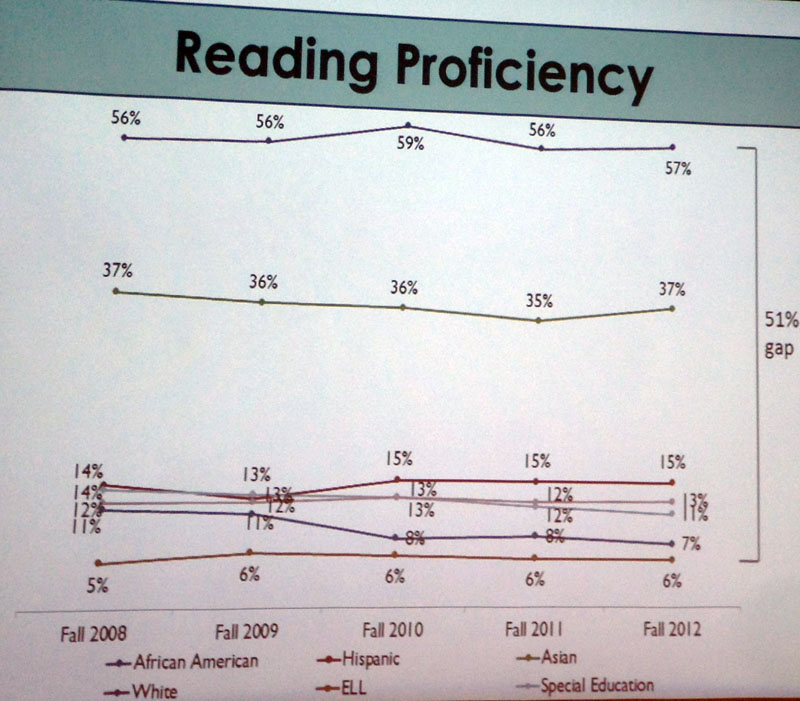
According to Mr. Rainwater, the place to look for evidence of a closing achievement gap is the comparison of the percentage of African American third graders who score at the lowest level of performance on statewide tests and the percentage of other racial groups scoring at that level. He says that, after accounting for income differences, there is no gap associated with race at the lowest level of achievement in reading. He made the same claim last year, telling the Wisconsin State Journal on September 24, 2004, “for those kids for whom an ability to read would prevent them from being successful, we’ve reduced that percentage very substantially, and basically, for all practical purposes, closed the gap”. Last Monday, he stated that the gap between percentages scoring at the lowest level “is the original gap” that the board set out to close.
Unfortunately, that is not the achievement gap that the board aimed to close.

2009: 60% to 42%: Madison School District’s Reading Recovery Effectiveness Lags “National Average”: Administration seeks to continue its use. This program continues, despite the results.
2004: Madison Schools Distort Reading Data (2004) by Mark Seidenberg.
2012: Madison Mayor Paul Soglin: “We are not interested in the development of new charter schools”
Scott Bauer

Almost half of Wisconsin residents say they haven’t heard enough about voucher schools to form an opinion, according to the Marquette University law school poll. Some 27 percent of respondents said they have a favorable view of voucher schools while 24 percent have an unfavorable view. But a full 43 percent said they hadn’t heard enough about them to form an opinion.
“There probably is still more room for political leadership on both sides to try to put forward convincing arguments and move opinion in their direction,” pollster Charles Franklin said.
The initial poll question about vouchers only asked for favorability perceptions without addressing what voucher schools are. In a follow-up question, respondents were told that vouchers are payments from the state using taxpayer money to fund parents’ choices of private or religious schools.
With that cue, 51 percent favored it in some form while 42 percent opposed it.
Walker is a staunch voucher supporter.

More on the voucher proposal, here.
www.wisconsin2.org
A close observer of Madison’s $392,789,303 K-12 public school district ($14,547/student) for more than nine years, I find it difficult to see substantive change succeeding. And, I am an optimist.
It will be far better for us to address the District’s disastrous reading results locally, than to have change imposed from State or Federal litigation or legal changes. Or, perhaps a more diffused approach to redistributed state tax dollar spending.

Share

Untangling Wisconsin School Options: Public, Charter, or Voucher? March 28, 2013 Noon

Milwaukee Public Television 4th Street Forum:

Can parents make informed decisions? How does the community benefit from these school options? And how important are standards, accountability, and transparency?
ALAN BORSUK is an education columnist for the Milwaukee Journal Sentinel. Until 2009, he worked full time for the paper as an education reporter. Mr. Borsuk is a Law and Public Policy senior fellow for Marquette University Law School where he continues his research and writing on education.
ANNELIESE DICKMAN, JD is the research director for Public Policy Forum, a Milwaukee-based, nonpartisan think tank. The focus of her research and writing is on education policy, including financing and governance. Ms. Dickman was the Forum’s lead author of their 15th annual report on education, “Cost and Performance in Choice Schools.”
LATISH REED, PhD is an assistant professor of educational leadership at UW-Milwaukee. Earlier in her career, she was a middle school teacher and an assistant principal for Milwaukee Public Schools. Professor Reed also helped to start a charter school, Malcolm X Academy, which has since closed.

Share

Governor Walker’s bait-and-switch budget has nothing new for public school children

Tom Beebe:

Question: When is $129 million not $129 million?
Answer: When it is the additional aid Wisconsin Governor Scott Walker promised to send to the state’s public schools.
Despite the Governor’s claimed increase for 2013-15โ”€an anemic and inadequate one percent even if trueโ”€it is really only $39 million …. a paltry half-percent increase or $44.83 per student even if schools could spend it (but more on that later).
This is a cruel joke on kids who only want a quality education. It is also public policy that calls into question the moral commitment of the administration to public education.

Related: Wisconsin State Tax Based K-12 Spending Growth Far Exceeds University Funding.

Share

Marquette Law School Poll shows range of public views of charter schools in Wisconsin

Marquette University Law School Poll:

A statewide Marquette Law School Poll conducted March 11-14 finds that voters view charter schools as enabling more choice in education options but are doubtful that students learn more in charter schools than in public schools. Seventy-one percent said charter schools offer more choice, while 18 percent disagreed. Thirty-four percent think students learn more in charter schools, but 51 percent disagree. The poll finds that voters have a mix of views about charter schools, reflecting varied evaluations of them as education alternatives.
Charter schools are publicly funded, independently operated schools that are allowed more flexibility over instruction and subject matter than traditional public schools. The poll also touched upon views of vouchers, which support students attending private and religious schools.
A large majority, 72 percent, think charter schools provide flexibility to meet student needs that may not be met in traditional public schools, while 16 percent disagree. Voters doubt that charter schools skim the best students: 31 percent think they do, but 58 percent disagree. Opinion is more evenly divided on whether charters take needed money away from traditional public schools: 40 percent think they do, while 48 percent think they do not drain money from traditional schools. Forty-six percent think competition with charter schools makes public schools better, but 42 percent disagree.
Voters are concerned that the public pays for charter schools but has little control over school quality, with 47 percent agreeing and 38 percent disagreeing.
Charter schools are viewed favorably by 42 percent of voters statewide, while 16 percent have an unfavorable view of them. However, 42 percent say they don’t know enough about charter schools to offer an opinion. That is a higher favorability than toward voucher schools, which are seen favorably by 27 percent and unfavorably by 24 percent. An even larger segment, 49 percent, said they didn’t know enough to express an opinion about voucher schools. Public schools, in contrast, were viewed favorably by 72 percent of the public with 18 percent having unfavorable views and 10 percent unable to say. Likewise, 24 percent said they were very satisfied with the public schools in their community and 57 percent said they were satisfied. Eleven percent were dissatisfied and 2 percent very dissatisfied

Poll topline views (PDF).

Share

Universities Hire Rankings Pros


Andrew Trounson:


Some Australian universities are paying about $100,000 a year each to employ full-time managers dedicated to working with ranking agencies and developing strategies aimed at climbing league tables.
The University of New South Wales recently advertised for a manager of strategic reputation, while La Trobe University was seeking a manager of institutional rankings. For $100,000, responsibilities included maintaining relationships with ranking agencies to “maximize” or “optimize” their positions in rankings.
Observers say such positions highlight the growing importance of rankings in influencing research and teaching plans. But there are concerns that the professionalized management of rankings risks warping university strategies and may prove more a marketing effort than an effort to boost the substance of an institution’s performance.
The deputy vice chancellor at New South Wales, Les Field, said the position wasn’t new and was part of a team that ensured the information sent to annual data collections and the ranking agencies was accurate.

Share

Children should be allowed to get bored, expert says

Hannah Richardson:

Dr Teresa Belton told the BBC cultural expectations that children should be constantly active could hamper the development of their imagination
She quizzed author Meera Syal and artist Grayson Perry about how boredom had aided their creativity as children.
Syal said boredom made her write, while Perry said it was a “creative state”.
The senior researcher at the University of East Anglia’s School of Education and Lifelong Learning interviewed a number of authors, artists and scientists in her exploration of the effects of boredom.
She heard Syal’s memories of the small mining village, with few distractions, where she grew up.

Share

Possible Milwaukee School Board Governance Changes

Alan Borsuk:

It’s been several years since I thought about tumult and division at the top of the Milwaukee Public Schools system, which was fine with me on several levels.
The run ended last week with several conversations that left me wondering what lies ahead on several important fronts for the state’s epicenter of education concerns.
To jump to the bottom line: My guess is that Superintendent Gregory Thornton will stay on for a while, the School Board, which will have one and possibly two new members after the April 2 elections, will stay on more or less the course it’s on, and the school system as a whole will continue to be faced with big problems of declining enrollment and increasing challenges in serving students well.

Share

The Professors Who Make the MOOCs

Steve Kolowich:

What is it like to teach 10,000 or more students at once, and does it really work? The largest-ever survey of professors who have taught MOOCs, or massive open online courses, shows that the process is time-consuming, but, according to the instructors, often successful. Nearly half of the professors felt their online courses were as rigorous academically as the versions they taught in the classroom.
The survey, conducted by The Chronicle, attempted to reach every professor who has taught a MOOC. The online questionnaire was sent to 184 professors in late February, and 103 of them responded.
Hype around these new free online courses has grown louder and louder since a few professors at Stanford University drew hundreds of thousands of students to online computer-science courses in 2011. Since then MOOCs, which charge no tuition and are open to anybody with Internet access, have been touted by reformers as a way to transform higher education and expand college access. Many professors teaching MOOCs had a similarly positive outlook: Asked whether they believe MOOCs “are worth the hype,” 79 percent said yes.
Princeton University’s Robert Sedgewick is one of them. He had never taught online before he decided to co-lead a massive open online course titled “Algorithms: Part I.”
Like many professors at top-ranked institutions, Mr. Sedgewick was very skeptical about online education. But he was intrigued by the notion of bringing his small Princeton course on algorithms, which he had taught for five years, to a global audience. So after Princeton signed a deal with an upstart company called Coursera to offer MOOCs, he volunteered for the front lines.
His online course drew 28,000 students when it opened last summer, but Sedgewick was not daunted. He had spent hundreds of hours readying the material, devoting as much as two weeks each to recording and fine-tuning videotaped lectures. The preparation itself, he said, was “a full-time job.”

Share

Alan Turing’s Reading List: What the Computing Pioneer Borrowed From His School Library

Maria Popova:

What Alice in Wonderland has to do with electromagnetic theory, relativity, and Pluto.
“You are a mashup of what you let into your life,” it’s been said. Since creativity is combinatorial, the architecture of mind and character is deeply influenced by the intellectual stimulation we choose to engage with — including the books we read. There is hardly anything more fascinating than the private intellectual diet of genius — like this recently uncovered list of books computing pioneer and early codehacker Alan Turing borrowed from his school library. Though heavy on the sciences, the selection features some wonderful wildcards that bespeak the cross-disciplinary curiosity fundamental to true innovation. A few personal favorites follow.

Share

Selling Students Short: Declining Teaching Loads at Colleges and Universities

Andrew Gillen:

When it comes to laying blame for the high price of college, one culprit always comes to the fore: the size and the cost of faculty. Faculty salaries often account for the majority of a university’s spendยฌing, and these salaries not only compensate faculty for their research but for directly instructing students as well. Yet this latter responsibility, fundamental to a faculty position, has in recent years been a declining part of the job.
What does this decline mean for higher education?
As Andrew Gillen explains in Selling Students Short, the decrease in teaching loads has had a dramatic influence on the spiraling costs of higher education. As colleges face impending budget cuts and students and families find it harder to keep pace with rising tuition, increasing teaching loads could provide significant relief.

Share

Behind the Odyssey: How one college course is transforming lives

Emily Auerbach:

Tineisha Scott remembers running out of the house in the middle of the night with no shoes on, scared, hiding to get away from the abuse and drug use overrunning her home. As a young man, Corey Saffold found himself racially profiled. Sherri Bester suffered from PTSD and anxiety so extreme she got severe panic attacks during tests.
These three Madisonians faced personal struggles and obstacles that often seemed insurmountable. Fortunately, they also each encountered a class syllabus that included Plato, Whitman, Dickens, Shakespeare and Toni Morrison.
And they embarked on paths to success beginning in a classroom in the library on the south side of Madison.
Scott, Saffold and Bester are all graduates of the Odyssey Project, a free humanities course offered through UW-Madison’s Division of Continuing Studies and English Department to adult students facing economic barriers to college. Each year, the Odyssey Project gives thirty students free tuition, textbooks and childcare–and access to life-changing discussions
of literature, philosophy, history and art led by UW
humanities faculty.

Share

We Don’t Run Computers Anymore, They Run Us

Douglas Rushkoff:

Technology has always given us more control over time–especially now at the dawn of the digital age. But no matter how precisely we can count our milliseconds, neither our bodies nor our businesses are proving as programmable as our computers.
Digital technology tends to make one minute look the same as any other. Still, try as we might to ignore them, the people who work for us, invest in us, and buy from us are guided by rhythms we ignore at our peril.
While our technologies may be evolving as fast as we can imagine new ones, we humans and our culture evolved over millennia and are slower to adapt. The body is based on hundreds, perhaps thousands, of different clocks, syncing to everything from the sun and moon to levels of violence and available water. We can’t simply declare noon to be midnight and expect our body to conform to the new scheme as if it were a Google Calendar resetting to a new time zone. Neither can we force our businesses to conform to an always-on ethos when the people we work with and for are still obeying a more deeply embedded temporal scheme.

Share

Making Sense of College Aid

Ruth Simon & Rob Barry:

Cole Schenewerk has a tough choice ahead of him.
The high-school senior from El Cajon, Calif., already has gotten an acceptance packet from Southern Methodist University and a preliminary scholarship offer from an Ivy League college. And he is still waiting to hear from seven other schools, which he expects will dangle a variety of financial-aid offers.
“Definitely, finances are a big deal,” says Mr. Schenewerk, a coin collector who plans to work part-time in college while studying business. “A lot of these schools have really high sticker prices. If I don’t get the scholarships I need, I won’t be able to go there.”

Share

“Pet peeve of the day: Oregon is trying to make it harder to have exceptional public schools. Which kind of sucks.”

Linus Torvalds:

Background for non-Americans: the US school system is a disaster, with very uneven quality. You have some good school districts, and you have some really bad ones, and it’s all just pretty crazy. Very different from back in Finland, where education isn’t just good, it’s fairly reliably good. You don’t have to worry too much about which school you go to, because while there are certainly differences, they simply don’t tend to be all that marked.
In the US, if you care about education, you end up having to make sure you live in a good school district. Or you do the whole private school thing, or try to make sure you can transfer, or whatever. The one thing you do not do is to just take it for granted. You work at it.
I’m not a huge believer in private schools, and I actually wanted my kids to be able to walk to their friends houses, so we made sure to move to one of the better districts in Oregon.
Now, living in a good school district means that you end up paying a lot more for housing, so it’s not actually necessarily really any cheaper than sending your kids to a private school. But you do also end up being in a community where people care about education, so it’s not just the school: it’s the whole environment around you and your kids.
But it’s unquestionably unfair, and it unquestionably means that people who can afford it get a better education in the US. Despite the whole “public” part of the US public school system, it’s like so much else in the US: you don’t want to be poor. The whole “American Dream” is pretty much a fairy tale.
So the Oregon legislature is trying to fix the unfairness. Which I very much understand, because I really do detest the whole US school system – it was always one of the things that we talked about being a possible reason to move back to Finland when the kids needed to go to school. We ended up learning how the US system works, and made it work for us, but that doesn’t mean that I have to like the situation. Because I’ve seen better.
So why is trying to make things fairer a peeve?
The way the Oregon legislature is trying to fix things isn’t by making the average school better, it’s by trying to make it hard to have the (fairly few) bright spots around.
In particular, let’s say that you do have a good school district, where people not only end up paying for it in the property taxes (which is what largely funds the school), but also by having special local tax bonds for the school in addition to the big fund-raisers every year. Because the public US school funding just isn’t that great, so the local community ends up fixing it – to the point of literally raising much of the money to build a new building etc.

The US outspends and underperforms. More
Portland schools’ 2012-2013 budget is $687,513,063 for 47,000 students or 14,627.93/student. Madison will spend $14,527/student during the 2012-2013 fiscal year.
US teacher content knowledge requirements are lag other countries.
Oregon HB 2748
Notes and links on Sweden’s voucher system and Finland’s schools.
Linus Torvalds

Share

The U.S.’s Low Standards for Teacher Training

Heather Brady:

The U.S. public education system is trying any number of techniques–from charter schools to presidential initiatives to oil-company-run teacher academies–to catch up to countries like Finland and South Korea in math and science education. But policymakers seem to be overlooking one simple solution: requiring math and science teachers to progress further up the educational ladder before they teach those subjects to kids.
The map above shows the minimum level of education each country requires teachers to obtain before working at the upper-secondary level. The map, based on data collected by Jody Heymann and the World Policy Analysis Center and subsequently published in Children’s Chances: How Countries Can Move from Surviving to Thriving, illustrates that the United States lags behind most other countries in its requirements.
Many U.S. school systems defer to teachers with higher degrees when they hire faculty, and teachers are required to have some kind of state certification along with a bachelor’s degree. However, the precise certification requirements vary, depending on how a teacher enters the profession and what state they teach in. The traditional route to becoming a teacher in the United States usually involves a bachelor’s or master’s degree in education along with a standardized test and other state-specific requirements. But most states have some form of an alternative route, usually involving a bachelor’s degree and completion of an alternate certification program while a person simultaneously teaches full-time. There is no federal mandate for teacher education requirements, according to the World Policy Analysis Center. The federal Improving Teacher Quality State Grants program rewards states with funds when they meet the “highly qualified teacher” requirement set forth in the No Child Left Behind Act.

Related: When A Stands for Average: Students at the UW-Madison School of Education Receive Sky-High Grades. How Smart is That?
and,
Examinations for Teachers Past and Present by Dr. Richard Askey.

Share

Low-Hanging Fruit: Three Things To Do Before We Say We’re Doing All We Can…

Andy Rotherham:

Hang around the education debates long enough and you’ll hear many times that schools are basically doing all they can to meet the needs of students, especially high-poverty students, so we should ease up on the pressure to do more. I don’t think that’s the case and you see a lot of variance in how well schools do with similar students.
In that spirit, here are three examples of ideas, some more more substantial than others – happening in some places but far from commonplace – that we could do to reach more students and families. It’s hardly an exhaustive list but it makes the point.
24-hour school: Many of our cities, and not just Las Vegas and New York, are 24-hour towns these days. Yet other than night school we still don’t engage students or parents that are on a 24-hour schedule. It would be absurd to make every school a 24-hour option but providing that option in places where many older students are, especially those who have left school, are working alternative schedules would help reach kids who are disconnected today. They are doing this in Vegas. And in this case what happens in Vegas, shouldn’t stay there.
Back-to-school day: I recently heard a school superintendent, a generally progressive guy concerned about equity, congratulating all the parents taking part in a “Back-to-School Night” style event in his community for being the kind of involved parents the school system needs to be successful. Problem was, the event was at 8pm and a not-small proportion of parents in that community were beginning their work days around that time, not wrapping them up. Back to School nights are an evergreen feature of our schools, and necessary for many parents who work a traditional 9-5 schedule. But for many parents, and not just those working nights, a chance to visit during the day would make school engagement more accessible. If we were really serious about meeting more parents where they are, “Back to School Days” (in addition to ‘back to school nights’) would be a lot more common than they are. And even easier thing to jettison would be policies that limit parent-teacher conferences to just a few minutes in some places.
Responding to parents:

Related: Wisconsin Schools Superintendent Tony Evers: Wisconsin education chief: Governor’s new report cards not ‘ready for prime time’.

Share

Clemenza’s Advice to Madison

John Roach:

Here’s a good idea.
In light of the retirement of Pope Benedict, Madison should demand a similar transition.
Pope John Matthews I, the Vicar of Madison Education, should step down from his throne. Admittedly this suggestion is informed by my participation on the board of the Urban League of Greater Madison and the now-defunct Madison Prep board.
But look, Matthews is still in good health. His $300K per annum package at the helm of Madison Teachers Inc. has placed him among the very one percent many of his followers revile. Like the Pope–and Don Vito Corleone–John has fought too many wars. He now prowls his mansion at night, toying with the local Democratic Party he has purchased, fighting enemies that do not exist, in battles that need not be waged.
No better example of why John’s retirement would be good for our New Madison, rich with faces of many colors and voices, than The Manski Debacle. Never have Progressive White Folk appeared so utterly smug and ruthless as when Sarah made her dash.
First, it has to be asked: Why was Manski even running for the Madison School Board? Kids? No. A passion for education? No. So why? Because The John Father wanted it to be so.
So The John Father, like Don Corleone, unleashed his money and powerful networks. The usual list of progressive endorsers fell in line creating a snapshot for Manski whiter than Ronald Reagan’s cabinet. The Cap Times played its part, never seeming to understand that “all white progressive” is an oxymoron. Did any of them think for a minute that the sea of white faces for Manski communicated something to minority Madison? This is how tone deaf they have become.

Share

Inspirational Women

Richard Zimman:

This weekend I’m currently attending the national ASCD annual conference in Chicago with approximately 10,000 other educators from across the nation and around the world. With internationally known speakers, featured experts, over 400 sectionals, and hundreds of exhibitors covering a variety of topics during the three-day conference, it is truly a unique gathering of educators focused on issues of curriculum, teaching, and learning.
Amidst all this I had an incredible morning by attending back-to-back presentations by real celebrities–people who are famous for their amazing achievements, unlike many of today’s celebrities who are made famous by the pop culture media. It was my privilege to attend sessions by retired U.S. Supreme Court Justice Sandra Day O’Connor and poet/author Maya Angelou. Both women are in their eighties, both feisty as ever, and both still have sharp minds that focus on what’s really important from their respective reflective perches from experience from eight decades of observing America. Needless to say, these ground-breaking women held audiences spell-bound.

Much more on Richard Zimman, here.

Share

Continuing Professional Development (CPD) in Chile: Why We Do It

Thomas Jerome Baker:

Continuous Professional Development, or CPD as it is more commonly known, has one basic proposition: Improvement. The teacher has the option of either passively waiting for someone else (the employer) to committ resources to CPD, or the teacher takes the initiative and actively seeks out CPD opportunities.
One might take the position that if the employer wants the teacher to improve, then the employer will make the necessary resources available. The “resources” referred to are time, materials, and money.
The teacher would receive pay for the time they are investing in learning. Books, travel costs, and any fees would be paid for by the employer. However, to be honest, in Chile very few teachers find themselves in this utopian situation.

Share

Chicago’s public schools are in shutdown mode

David Blaska:

May explain why former Chicago schools administrator Jennifer Cheatham sought greater opportunities here in Madison. The Chicago school system is closing 61 school buildings to address a $1 billion deficit; 140 of its 681 schools are at least half-empty. (More about that here.)
Might not a tiny voice be whispering to Fighting Ed Garvey, John Nichols, Jeff Simpson, the UW School of Education, and other bitter-enders that perhaps the Chicago teachers union bears some responsibility for a) the financial deficit and b) the flight of students out of the public schools? It was, after all, the Chicago teachers union that walked out on students last September to fight performance measures and a longer school day.
Fighting Ed Garvey is not a stupid man. But he does suffer from labor union fixation disorder. Visit his blog on that subject today and tell me if Ed doesn’t remind you of the guy stocking up on matches as his house burns down. Bad schools are how cities die.

Share

Taming college inflation shows up on public agenda

Walter Jones:

It’s not just parents complaining about the cost of college, as state and national policymakers search for ways to balance it against the need for more graduates to fill future jobs.
At a lecture to board members of the Federal Reserve Bank of Atlanta last Tuesday, The Higher Education Bubble author and University of Tennessee Professor Glenn Reynolds reminded them of Stein’s principle of economics which says, If something cannot go on forever, it will stop.”
Since the price of tuition grows faster than personal income, it’s rapidly becoming unaffordable to average families without reliance on their retirement savings, an inheritance or loans.

Share

No End to Magical Thinking When It Comes to High-Tech Schooling

Larry Cuban:

Few high-tech entrepreneurs, pundits, or booster of online learning, much less, policymakers, would ever say aloud publicly that robots and hand-held devices will eventually replace teachers. Yet many fantasize that such an outcome will occur. High-profile awards to entrepreneurs, the occasional cartoon, and advocates who dream of online instruction anywhere, anytime transforming education feed the fantasy.
Consider Sugata Mitra, Professor of Educational Technology at Newcastle University (United Kingdom). He recently received the TED award of $1 million for creating learning environments where illiterate Indian children had access to computers in actual holes-in-walls on streets of New Delhi slums. Some of the children told him: “You’ve given us a machine that works only in English, so we had to teach ourselves English.” Believing that children’s sense of wonder and intrepid curiosity would spur them to use computers and learn English, science, and whatever else they were curious about on their own, Mitra said to his audiences and funders: “My wish is to help design the future of learning by supporting children all over the world to tap into their innate sense of wonder and work together. Help me build the School in the Cloud, a learning lab in India, where children can embark on intellectual adventures by engaging and connecting with information and mentoring online.”

Share

Globalizing MOOCs

Kris Olds:

After nearly 12 years living in the United States, I continue to be perplexed by this country. As I noted when acting as a respondent to Anya Kamenetz at ED Talks Wisconsin last Friday night, the US is an amazing place when it it comes to unleashing and scaling up a multiplicity of innovations related to higher education. Kamenetz’s recent books capture many of these innovations; a veritable cacophony of experiments, some successful, some still with us, and some quickly dated (is anyone still talking about Second Life?!). This said, the US has a troubling history of seeking easy ‘silver bullet’ solutions to complex higher ed challenges that can only be addressed by the state and other stakeholders (including universities) in a strategic, systemic, and sustained way.
Back on the ed innovation topic, as an economic geographer it is mandatory of me to point out that all innovations are placed; they’re dreamt up, variably fueled, and then scaled up such that they can potentially leave their mark on multiple locales and/or larger numbers of people. The unruly process of innovation, being what it is, means that innovations are translated – the take-up/utilization process, the interpretation process, and the impact generation process, vary across space and time via the translation process.
A case in point is the phenomenon of Massive Open Online Courses (MOOCs). While we can argue about important histories and practices, we do know that the first online MOOC was dreamt up and run in Canada (see ‘What is a MOOC? 100k people want to know’ and ‘All about MOOCs’) courtesy of some innovative scholars, state-run funding councils (the Social Sciences and Humanities Research Council of Canada and the National Research Council), and the facilitative work of two universities (the University of Manitoba and the University of Prince Edward Island).

Share

Notes on a Recent Madison School Board Candidate Forum

Channel3000::

“For the past 24 years as a criminal justice practitioner, what I’ve seen is the kids not succeeding in the schools are ending up in juvenile and ultimately our criminal justice system.” Howard said he would continue to work for students at all achievement levels, and said his time on the board has taught him to be selective in approving programs to implement. “We have to figure out a way to raise all (test) scores up, and we’re doing that by implementing a brand new literacy program in all our schools,” he said. Howard, answering a question from Mertz, said he was concerned that raising property taxes by the maximum amount allowed puts too much of a burden on taxpayers. Mertz disagreed, saying schools need all the money they can get. For video on this story, visit the video section He cited trust as the district’s biggest obstacle. “As a community, trust has been broken,” he said. “We can’t get at the achievement gap unless the parents trust the teachers, the teachers trust the administration, and the board trusts the administration.”
……
Howard, answering a question from Mertz, said he was concerned that raising property taxes by the maximum amount allowed puts too much of a burden on taxpayers.
Mertz disagreed, saying schools need all the money they can get.

Much more on the 2013 Madison School Board election and Madison’s 14.5k per student spending, here.

Share

In Some Schools, Students Bring Their Own Technology

Matt Richtel:

Educators and policy makers continue to debate whether computers are a good teaching tool. But a growing number of schools are adopting a new, even more controversial approach: asking students to bring their own smartphones, tablets, laptops and even their video game players to class.
Officials at the schools say the students’ own devices are the simplest way to access a new generation of learning apps that can, for example, teach them math, test them with quizzes and enable them to share and comment on each other’s essays.
Advocates of this new trend, called B.Y.O.T. for bring your own technology, say there is another advantage: it saves money for schools short of cash.

Share

Madison School Board candidate says response to union’s voucher question an error

Matthew DeFour

Madison School Board candidate Wayne Strong said Friday he mistakenly told Madison Teachers Inc.’s political action committee in a January questionnaire that he supported private school vouchers.
The issue of voucher support has loomed large in this spring’s election. Ananda Mirilli, a former candidate for a separate seat, was falsely accused of supporting vouchers in an email from the husband of her opponent, Sarah Manski, who dropped out of the race after winning the primary. Mirilli finished third and will not be on the April 2 ballot.
The South Central Federation of Labor sent out a campaign flier this week supporting Strong’s opponent Dean Loumos. The flier says Strong “has retracted an earlier statement that he supports the use of public funds for private and religious schools.”
“I didn’t retract it, I corrected it,” Strong said. “It’s always been my position that I did not support use of public money (for private voucher schools).”

Much more on the 2013 Madison School Board elections, here.

Share

Education in the 21st century

John Ebersole:

OK, congressional leadership. Let’s talk American competitiveness. Where to start? Let’s begin with the nursing shortage.
Anyone hospitalized in our nation realizes pretty quickly that the nursing shortage is not a myth, and hospitals are taking drastic steps to try to maintain adequate patient care. Your nurse here in Washington may in fact be “traveling” from Georgia, living with relatives or taking a temporary apartment to commute for a period of time, and then return home or move on to another city. Migrant nurses you ask? Yes. We also have immigrant nurses from the Philippines, Canada, India and many other countries.
What exactly is going on here? And why aren’t we talking about it?
Let’s consider our veterans for a moment. How are they managing on their return from deployments around the world? They aren’t spat upon and reviled, as was the case in the Vietnam era. They are welcomed home and told to make their way in an America with fewer jobs, less opportunity and decreased paychecks. For veterans, perhaps the only thing on the rise is the suicide rate, which reached a record high of 349 last year.
In both examples, I speak to the heart of the crisis in American competitiveness and that is the waste and abuse of our country’s most valuable asset. It may be clichรฉ, but it’s true: The most important resource we have is our people. We are wasting our citizens’ lives by not supporting their struggles to advance their education and train for a secure job.

Share

Milwaukee teachers’ union asking School Board to negotiate new contracts

Erin Richards:

Citing the decision of a Dane County judge who struck down portions of a state law prohibiting most collective bargaining for public employees, the Milwaukee Teachers’ Education Association is asking the School Board to negotiate new contracts with its members.
To press for action, the MTEA rallied supporters to wear red, make signs and attend the School Board’s meeting en masse Thursday night.
The MTEA says a one-year contract with teachers, education assistants, substitutes and accountants could help keep qualified teachers in the classroom and help solve the district’s impending teacher shortage. It would also maintain the salary structure of pay based on earned degrees and years of teaching experience for teachers.
Milwaukee’s teachers have been shielded from the effects of Act 10, a state law enacted in 2011 that dramatically limits collective bargaining for most public workers and dictates higher employee contributions to benefits, because of a four-year bargaining agreement that does not end until June 30.
Teachers agreed to benefit concessions in that contract.

Share

Richard Florida Concedes the Limits of the Creative Class

Joel Kotkin:

The so-called creative class of intellects and artists was supposed to remake America’s cities and revive urban wastelands. Now the evidence is in–and the experiment appears to have failed, writes Joel Kotkin.
Among the most pervasive, and arguably pernicious, notions of the past decade has been that the “creative class” of the skilled, educated and hip would remake and revive American cities. The idea, packaged and peddled by consultant Richard Florida, had been that unlike spending public money to court Wall Street fat cats, corporate executives or other traditional elites, paying to appeal to the creative would truly trickle down, generating a widespread urban revival.
Urbanists, journalists, and academics–not to mention big-city developers– were easily persuaded that shelling out to court “the hip and cool” would benefit everyone else, too. And Florida himself has prospered through books, articles, lectures, and university positions that have helped promote his ideas and brand and grow his Creative Class Group’s impressive client list, which in addition to big corporations and developers has included cities as diverse as Detroit and El Paso, Cleveland and Seattle.
Well, oops.

Share

New college promises a new model of education

Daniel Willingham:

We are in the midst of an effort to explore what the new technologies enabled by powerful computing and reliable long-distance connection will mean to higher education. (There is, of course, a parallel effort in K-12, but that’s another topic.)
A new entrant is poised to make a bid, and it’s worth some study.
The Minerva Project was initiated by Ben Nelson, the man behind Snapfish (a photo website). His vision is of a university that offers an “uniquely rigorous and challenging university education.” (At a price, we might add, that is a relative bargain–reportedly, the target cost is something like half of what the Ivys charge).
The idea is that classes will be delivered via video, and students will then engage in discussion and debate. Importantly, and in pointed contrast to MOOCs, class size will be limited to 25.

Share

Fund ‘pick-and-mix’ Mooc generation, ex-wonk advises

Chris Parr:

Students should be able to access government loans in order to study massive open online courses, a former education adviser to Tony Blair has said.
Sir Michael Barber, now chief education adviser at publishing and education company Pearson, pointed to the emergence of a new breed of “pick-and-mix students” who assemble their learning from a range of sources rather than taking traditional campus-based degrees.
Such students were entitled to funding, he argued.
“If you’re a student or a potential student, it is no longer a question of choosing a degree course you want to do at a university,” he said. “It’s a question of thinking…’How will I keep learning through my life, how do I combine a range of educational experiences not just from one university but also from a range of universities – potentially around the world?'”
Sir Michael, head of the Prime Minister’s Delivery Unit from 2001 to 2005, was speaking ahead of the publication on 11 March of a report by the Institute for Public Policy Research, which warns of a coming era of unprecedented competition in higher education, driven by proliferating online opportunities.

Share

Do schools for ‘the gifted’ promote segregation?

Wendy Lecker:

From Brown vs. Board of Education to Connecticut’s landmark case, Sheff v. O’Neill, to the language of the Connecticut constitution, the law has been clear. Children have a constitutionally guaranteed right to a public education that is not impaired by isolation based on race, ethnicity, national origin or disability. Therefore, it is unconstitutional to develop and fund education programs that intentionally or unintentionally limit access to educational opportunities based on racial or ethnic backgrounds, or disabilities.
Yet recently, it was announced that schools exclusively for “gifted” children will be opening in Windham, New London and Bridgeport. Whether intended or not, the proposal takes Connecticut back to the ugly era of school segregation.
These three districts plan to pull what they characterize as “gifted” children from their schools and create separate schools “to highlight and encourage the potential” of these particular students. The schools are modeled after the Renzulli Academy in Hartford, named for University of Connecticut professor Joseph Renzulli, and serving “gifted” children in kindergarten and in fourth through ninth grades.

Share

Damn straight I’m a college grad! Paper or plastic?

Lisa Pollack:

It’s the kind of motto one sees on a T-shirt in a shop in the touristy part of town, but over the last few years it’s had a particularly painful ring of truth to it. Students in America are staying in education longer and are struggling to obtain full, gainful employment once they leave. This, combined with the rising costs of tuition, has seen the outstanding balance of student debt go past the one trillion mark and delinquency rates increase.
Talk is in the air of a bubble, as pundits point to student loans themselves and to the securities that are built from them. But is what’s going on “a bubble” in the usual sense? And more importantly, what does this say about college education in America?
Debt bubble by design
It does feel similar to the housing boom and bust of the last decade in that America has policies specifically aimed at encouraging people to take on a type of debt that is viewed as socially acceptable, even desirable. Government sponsored housing behemoths Fannie Mae and Freddie Mac are without comparable peers — the entities encouraged home ownership since their creation that is above and beyond what other many countries would even consider desirable.

Share

Alums Help Boston Students Overcome Disadvantages with Match Corps

Brown Daily Herald

It seems like an odd jump from the flexible anti-structure that gives Brown its laid-back reputation to a school where kindergartners are called “scholars” and get demerits for slumping. But for the six Brown alums who work as tutors at Match Corps: Boston, it’s not a question of autonomy — it’s a question of equality.
Match Corps is a one-year fellowship program that brings top college graduates to tutor disadvantaged youth in the Boston area. At Match charter schools, tutors work with small groups, often one-on-one, and form close relationships with students and their families, according to the program’s website.
“Match’s mission is to help all students succeed in college and beyond by giving them the best education they can get,” said Match Corps COO Michael Larsson.
The program directs its efforts toward helping kids in city schools in an effort to overcome the stereotype that students in urban areas are unable to achieve their full potentials. If students in urban public schools are less equipped for success, it is because they are “historically extremely underserved in the education system,” said Reuben Henriques ’12, a current member of Match Corps.
Matching potential
Henriques said he is a firm believer that providing all students with “equal access to structures of power” through skills like reading and critical thinking is crucial not only for the individuals but also for society as a whole.
“A democracy needs people who can advocate for themselves and function in a healthy debate — not just rich, white students, but everyone,” he said.


More about the Match Public Charter School, the Match Corps, and the Match Teacher Residency Program here.

Share

K-12 Tax & Spending Climate: Federal Debt explosion; State education and tax innovation

The Economist:

This is the America that China’s leaders laugh at, and the rest of the democratic world despairs of. Its debt is rising, its population is ageing in a budget-threatening way, its schools are mediocre by international standards, its infrastructure rickety, its regulations dense, its tax code byzantine, its immigration system hare-brained–and it has fallen from first position in the World Economic Forum’s competitiveness rankings to seventh in just four years. Last year both Mr Obama and his election opponent, Mitt Romney, complained about the American dream slipping away. Today, the country’s main businesses sit on nearly $2 trillion in cash, afraid to invest in part because corporate bosses cannot imagine any of Washington’s feuding partisans fixing anything.
Yet there is also another America, where things work. . . . Pressed for cash, states are adopting sweeping reforms as they vie to attract investments and migrants. Louisiana and Nebraska want to abolish corporate and personal income taxes. Kansas has created a post called “the Repealer” to get rid of red tape and pays a “bounty” to high schools for every vocational qualification their students earn in certain fields; Ohio has privatised its economic-development agency; Virginia has just reformed its petrol-tax system. In this second, can-do America, creative policymaking is being applied to the very problems Congress runs away from.

Similar to the status quo battle in Madison. www.wisconsin2.org

Share

Madison school board candidates James Howard and Greg Packnett discuss charter schools, teacher evaluation

Isthmus:

Five candidates are competing for three seats on the Madison school board, with the general election on April 2, 2013.
The political context for the races is explosive, given Gov. Scott Walker’s revolutionary proposals for education in Wisconsin: cuts to public school funding, an expansion of the voucher program, and a revamping of teachers’ evaluations and bargaining rights.
In Madison, the issues are particularly complex, with the intense disagreements over the district’s achievement gap between white and minority students.
In the race for Seat 4, incumbent James Howard is running against Greg Packnett, a Democratic legislative aide.
In this competitive series of elections, there are numerous candidate forums and listening sessions under way, and we thought we’d pose our own questions to candidates.
This week, we ask the candidates about charter schools, whether they’d like to see their expansion in the district, and if so, how they should operate within the district. Another question focuses on teacher evaluation, and how the candidates think it should be conducted with regards to student test scores.

Much more on the 2013 Madison School Board, here.

Share

AP good for high school, bad for college?

Jay Matthews:

I complained recently that college professors too often wrongly dismiss high school teachers as being unsuited to teach college-level classes such as the Advanced Placement courses so popular in the Washington region. Two scholars from distinguished universities gently chided me for being too hard on their academic colleagues. They might be right.
After an e-mail exchange with John T. Fourkas, Millard Alexander Professor of Chemistry at the University of Maryland, and Bryan McCann, associate professor of history at Georgetown University, I concede that professors’ concerns about AP often show no disrespect for high schools but instead stem from discomfort with the ill effects of colleges competing for AP students.
Fourkas and McCann like AP and similar college-level programs such as International Baccalaureate. They recognize that those classes have made high school more challenging and gotten students ready for long college reading lists and long exams.
“College professors love well-prepared students and are big fans of high school AP courses,” Fourkas said.

Share

Do NJ Kids Do Better in Private Special Education Schools?

Laura Waters:

A report commissioned by ASAH, the NJ consortium of private special education schools found that students in these out-of-district placements have better outcomes than students placed within public districts in more inclusive settings.
Today’s NJ Spotlight interviews the researcher who compiled and interpreted the data, Professor Deborah Carran of Johns Hopkins University.

“The most amazing thing I found is that the number and proportion of these kids that are going into post-secondary education,” said Carran in an interview. “They are going into junior colleges and four-year colleges. And they are employed and engaged.
“They are doing stuff and not just sitting at home waiting for their parents to take care of them,” she said.

“Ouch,” say parents of kids with disabilities stuck in in-district placements. ” Our kids are not going to be doing stuff! Better sue our districts to pay tuition to private schools.”

Share

Poor Implementation Undermines Promise Of The Common Core

Stephen Lazar:

The Common Core Learning Standards (CCLS) seek to define “college and career readiness expectations.” Forty-five states have adopted them, and are moving briskly towards full implementation in the coming year. Last January, I wrote that the standards “represent the greatest opportunity for history teaching and learning to be widely re-imagined since the Committee of Ten set the basic outlines for American education over a hundred years ago.”
While I stand by that statement, with each step towards implementation I see the opportunity being squandered. We cannot possibly continue to move solely in the direction of “college and career readiness” in History & Social Studies education without ensuring that “civic” readiness is valued equally. Additionally, we need to ensure that as states write new curricula, that they contain the proper balance of content, skills, and understandings. New curricula will need to ensure students use an inquiry-based approach to go in depth with a smaller amount of content to gain the wider breadth of skills and dispositions required for civic, college, and career readiness.
All teachers working in Common Core states are currently engaging with the changes demanded by the Common Core. In too many places, this is happening without sufficient time and supports, but it is happening very quickly nonetheless. The U.S. and state Departments of Education have poured over half a billion dollars into the assessments already, and, beginning this year, the results will be high-stakes for students and teachers. All systems are moving full speed ahead to assess core skills without sufficient consideration of the end to which these skills are applied. Two things need to happen to avoid driving off a cliff.

Share

Wisconsin education chief: Governor’s new report cards not ‘ready for prime time’

Matthew DeFour:

The state’s top education official warned the Legislature’s budget committee Thursday that Gov. Scott Walker’s proposal to tie funding and voucher expansion to new state report cards could undermine bipartisan reform efforts already underway.
State Superintendent of Public Instruction Tony Evers said the new report cards “aren’t ready for prime time” and will look “a lot different eight years from now.”
Evers agreed with Sen. Luther Olsen, R-Ripon, a member of the Joint Finance Committee and chairman of the Senate Education Committee, that the report cards should be used “as a flashlight and not a hammer.”

“If we use them as a hammer it’s going to make all the other transformative efforts we’re doing more difficult
,” Evers said, referring to new curriculum, testing and teacher evaluation systems that were developed by a bipartisan coalition of teachers, administrators, school boards and political leaders in recent years.
“Teachers will back off,” he said.

2008: “Schools should not rely on only WKCE data to gauge progress of individual students or to determine effectiveness of programs or curriculum”. Parents, students and taxpayers might wonder what precisely the DPI has been doing since 2008? The WKCE has been long criticized for its lack of rigor.
Related: Matthew DeFour’s tweets from Mr. Evers recent budget appearance.

Share

Ebooks are actually not books–schools among first to realize

Beth Bacon:

Part 1 in a series on e-book distribution to schools.
Digital books are triggering tectonic shifts in education. One of the most fundamental, yet seemingly invisible, shifts is happening in the back rooms of district offices–not in the classrooms, not among teachers and students, and definitely not in the board rooms of most big-name publishers and textbook companies.
If ebooks are not actually books, what are they? School purchasing departments know.
This profound, significant change is happening first in school district business offices, IT departments, and cubicles among staff members who work behind the scenes to acquire materials for today’s students.
What exactly is this shift? It’s a shift in awareness. A very subtle, yet primary, change in perception.
It’s the revelation of the idea that ebooks are not books at all.

Share

Wisconsin schools superintendent: Lawmakers should reject Scott Walker’s voucher expansion

Jason Stein:

Addressing the most contentious issue in Gov. Scott Walker’s budget bill, state Schools Superintendent Tony Evers on Thursday called on members of the Legislature’s Joint Finance Committee to reject a proposed expansion of voucher schools and to give more money to public schools.
Citing figures from the Legislature’s nonpartisan budget office, Evers said the $129 million in new state aid Walker included in his two-year budget bill drops to $39.2 million after accounting for how part of that money would go to private and charter schools under the proposal. Walker seeks to increase funding for existing and future voucher schools, expand them to nine new school districts and allow special-needs students from around the state to attend private schools at taxpayer expense.
At the same time, Walker wants to use the state public school aid to hold down local property taxes rather than increase spending on education.
Evers, who is running for re-election on April 2 against Rep. Don Pridemore (R-Erin), said Walker’s budget pitted public schools against private schools by increasing state funding for voucher school initiatives by 32% while keeping overall revenue to schools flat.
“This has to stop. The state cannot continue to play favorites. We can and must meet our constitutional obligation to invest in all of our kids,” Evers said.
In its third straight day of budget hearings, the Joint Finance Committee took testimony Thursday on Walker’s 2013-’15 budget proposals for Wisconsin’s K-12 schools, technical colleges and universities. The hearing made clear that the governor’s education proposals will face resistance from some senators in the Republican-controlled Senate and have strong support from Republicans in charge of the Assembly, leaving its future in doubt.

Share

On Tom Vander Ark & The Gates Foundation

Jay P. Greene:

Under Tom Vander Ark’s leadership the Gates Foundation pursued an education reform strategy focused on creating smaller high schools. The theory was that smaller high schools would create tighter social bonds between schools and students, preventing students from slipping through the cracks and increasing the likelihood that they would graduate and go on to college. Smaller high schools could also be more varied in their approaches and offerings, allowing students to choose schools that best fit their needs.
But around the same time Vander Ark left the Gates Foundation at the end of 2006, the reform strategy shifted. Rather than fostering small, diverse schools of choice, the Gates Foundation now wanted to build centralized systems of what everyone should be taught (Common Core) and centralized systems of evaluating, training, and promoting teachers (Measuring Effective Teachers). As I’ve written before, the shift in Gates strategy was not prompted by research. In fact, the high quality random-assignment study that Gates had commissioned to evaluate the small high school strategy showed strong, positive results. But the post-Vander Ark leadership at Gates couldn’t wait for the evidence. The knew the truth without any pesky research and had abandoned the small high schools strategy in favor of their new centralization approach years before those results were released.

Share

Status Quo K-12 vs a Little “Reform” Rhetoric at a Wisconsin Budget Hearing

Matthew DeFour’s tweets tell the unsurprising story (Wisconsin Schools Superintendent Tony Evers is testifying before the State’s “Joint Finance Committee”):


Related:


Wisconsin State Tax Based K-12 Spending Growth Far Exceeds University Funding.
Madison’s per student spending is $14,547 for the 2012-2013 school year (the number ignores differences in pre-k per student costs – lower, vs “full time” students).
Watch the committee hearing.

Share

Primary School Computer Science (!) Curriculum in Vietnam

Neil Fraser:

By grade 4 they start programming in Logo. Starting with sequences of commands, then progressing to loops.
By grade 5 they are writing procedures containing loops calling procedures containing loops.
At this point a quick comparison with the United States is in order. A couple of visits to San Francisco’s magnet school for science and technology (Galileo Academy) revealed grade 11 and 12 students struggling with HTML’s image tag. Loops and conditionals were poorly understood. Computer Science homework was banned by the school board.
It is an understatement to say that I was impressed with the Vietnamese primary school CS curriculum. I asked what I could do to help. Unexpectedly, the answer was “software”. Educational software doesn’t even exist in Vietnamese, and even if it did exist, there was no budget to purchase any. So the rest of my vacation was spent writing software. The result was the Blockly Maze, a self-teaching set of tutorials that introduces loops and conditionals. Everything had to be burned to CD because the school couldn’t afford reliable Internet.

Share

Doing More With Less

Richard Zimman:

“What should be the top priority for Ripon’s next superintendent?” was this newspaper’s readers’ poll question in late-February.
Teaching is a people business, and the most significant school-based influence on the quality of a child’s education is the classroom teacher. With so many retirements occurring these days as boomers are leaving their teaching jobs, did the readers choose hiring quality staff as the top priority?
Or were readers concerned about the numerous curriculum changes being required by the state as Wisconsin schools convert to the concepts of the Common Core and 21st century learning skills in order to prepare college and career ready graduates?
With our middle school facility approaching its 75th birthday and the building showing obvious strains as we try to prepare today’s students with a building designed for a 1930’s world, did readers rank updating our facilities the highest priority?
Sadly, those three priorities collected only twenty-five percent of the votes while another priority garnered three-quarters of the votes. What, you may ask, was so important that it won in a landslide against the aforementioned three priorities which are staring us in the face like a tidal wave on the horizon?

Much more on retiring Ripon Superintendent Richard Zimman, here.

Share

Commentary on Madison’s Incoming Superintendent Cheatham

Pat Schneider:

But Cheatham, who served as what amounts to an area superintendent overseeing 25 schools and later as chief of instruction and curriculum for the entire 400,000-student, $5.1 billion-budget school system, not only got strong recommendations, she demonstrated intellect and ideas to Madison school officials, Passman said. The Madison School District, in comparison, has a $376 million budget and an enrollment of about 27,000.
Board member Mary Burke told me she wasn’t thrilled at first to be considering a candidate from the perennially troubled Chicago Public Schools. “I feel Madison is the type of district that should be able to attract people from the best school districts,” Burke said. So she used a method that had served her well in hiring situations over a career that has included executive positions in the private and public sectors: Burke and other School Board members went beyond resumes and references and contacted additional people Cheatham had worked with in the past.
“They were very consistent in terms of what they said: She’s a great instructional leader, really smart and hardworking, and the schools under her made incredible progress raising students’ level of achievement,” Burke told me.
Like the board members, I also turned to people Cheatham had worked with in Chicago to get a glimpse of how her skills and personality will dovetail with the Madison community.

Pat Schneider refers to the Madison School District’s $376,000,000 budget, yet Matthew Defour just a few days ago, put it at $394,000,000. A subsequent email from the District’s Donna Williams placed the 2012-2013 budget at $392,789,303 for approximately 27,000 students, or $14,547/student about 12% more than Chicago’s $12,750, according to Schneider’s article.
Many notes and links on Jennifer Cheatham, here.

Share

Aging leadership makes change harder for Madison schools

Dave Cieslewicz:

Here’s the larger point.
While much of this has been characterized as a racial split in our community, and it is, I believe this issue is just as much the result of a generational divide. The truth is that most of the people standing in the way of any kind of meaningful change are aging progressives in their late sixties and seventies, self-satisfied folks who are just sure that they have all the answers to every problem. They are at the highest levels of MTI and other unions, city government, and even a newspaper in town. They cling tightly to power, and they seem not to know when it’s time to let a new and more diverse generation step up to leadership positions.
So, yes, much of the controversy surrounding our schools is race-based, but much of it also has to do with the tired leadership in a lot of major institutions in Madison. I don’t think we’ll make real progress on this or other serious issues facing our community until we get fresh faces and new ideas in place.
It’s time for a change.

Related: www.wisconsin2.org and Vietnam’s primary school computer science curriculum.
Yet, Madison’s disastrous reading problems continue year after year.

Share

Madison school board candidates Dean Loumos and Wayne Strong discuss charter schools, teacher evaluation

Isthmus:

Five candidates are competing for three seats on the Madison school board, with the general election on April 2, 2013.
The political context for the races is explosive, given Gov. Scott Walker’s revolutionary proposals for education in Wisconsin: cuts to public school funding, an expansion of the voucher program, and a revamping of teachers’ evaluations and bargaining rights.
In Madison, the issues are particularly complex, with the intense disagreements over the district’s 0 between white and minority students.
In the race for Seat 3, former La Follette High School teacher and low-income housing provider Dean Loumos is running against retired Madison police lieutenant Wayne Strong. The winner will replace retiring school board member Beth Moss.
In this competitive series of elections, there are numerous candidate forums and listening sessions under way, and we thought we’d pose our own questions to candidates.
This week, we ask the candidates about charter schools, whether they’d like to see their expansion in the district, and if so, how they should operate within the district. Another question focuses on teacher evaluation, and how the candidates think it should be conducted with regards to student test scores.

Much more on the 2013 Madison School Board elections, here.

Share

Wisconsin School Superintendent Election: Tony Evers & Don Pridemore Word Cloud

Tony Evers WISTAX 2013 Election Interview Word Cloud:


Don Pridemore WISTAX 2013 Election Interview Word Cloud:


Links: A recent Wisconsin State Journal Evers endorsement.
wuwm.com

Three weeks from today, Wisconsin voters will decide who will oversee K-12 public education for the next four years. Incumbent state Superintendent Tony Evers faces a challenge from Republican state Rep. Don Pridemore.
Evers says he’s proud of his accomplishments over the past four years. He highlights the implementation of Common Core Standards. The national initiative sets benchmarks for students to meet in English, Language Arts and Math, to make sure they’re prepared for the workforce.
“We’re developing new assessment systems and accountability systems. We have a new reading screener we’ve implemented at kindergarten that’s been very good as far as providing information for classroom teachers to intervene early,” Evers says.
Evers says his biggest challenge has been competing with choice or voucher schools for state funding. Students in Milwaukee and Racine can attend private schools – taking with them, the tax money that would have gone to the public system. Evers opposes Gov. Walker’s plan to expand the voucher program to nine more school districts and increase funding for participating students.
“There’s a zero dollar increase for our public schools per pupil and then on the voucher side there’s a $1,400 per student increase for $73 million. To me that’s a concept that isn’t connected in any good way for our public schools,” Evers says.
Evers opponent, Republican Rep. Don Pridemore of Hartford supports the expansion of choice. He says there would not to be need for it, if public schools better prepared students. Pridemore says if he’s elected, he’ll work to expand the program statewide.

Share

White Wristbands: Wisconsin declares war on Caucasian privilege.

Stefan Kanfer:

Graham Greene’s observation has lost none of its salience in 50 years: innocence remains “like a dumb leper who has lost his bell, wandering the world, meaning no harm.”
The latest illustration comes from Wisconsin, where the state’s Department of Public Instruction website devotes a page to “Power and Privilege.” Caucasians who volunteer in the state’s AmeriCorps VISTA antipoverty programs are instructed to “set aside sections of the day to critically examine how privilege works”; “put a note on your mirror or computer screen as a reminder to think about privilege”; and, in order to underline white guilt, “find a person of color who is willing to hold you accountable for addressing privilege.” The site generously provides a link to a “diversity document,” recommending that Caucasians “wear a white wristband as a reminder about your privilege, as well as a personal commitment to explain why you wear the wristband.”

Share

Why do some students struggle with math?

Daniel Willingham:

Illiteracy and its costs to individuals and to society has long been a focus of concern in public policy. A corresponding lack of ability in mathematics–innumeracy–has received increasing attention in the last few decades. The ability to use basic math is more and more important as modern day society grows more complex.
Some children have a problem in learning to read that is disproportionate to any other academic challenge they face. Some children have a corresponding problem with math. For some reason, the ideas just don’t come together for these students.
In a recent article, David Geary (2013) reviews evidence that one cause of the problem may be a fundamental deficit in the representation of numerosity.
Geary describes three possible sources of a problem in children’s appreciation of number.

Share

Bill would create $200 fine for teachers who fail to report bullying

Mary Spicuza:

Teachers and other school district employees would face $200 fines if they fail to report bullying incidents under a bill being circulated by a Republican lawmaker.
But some school advocates worry the bill would have unintended consequences.
“I think it creates incentives in the wrong directions,” said Dan Rossmiller, director of government relations for the Wisconsin Association of School Boards.
He said he fears the proposal could lead to teachers over-identifying student behavior as bullying due to fears of being penalized, or districts narrowing the definition of bullying in an effort to avoid exhausting school resources on a flood of bullying investigations.
But the bill’s sponsor, Rep. Garey Bies, R-Sister Bay, said parents have told him they talked to teachers about bullying problems but “nothing was ever done.”

Share

What Americans Keep Ignoring About Finland’s School Success

Anu Partanen:

Everyone agrees the United States needs to improve its education system dramatically, but how? One of the hottest trends in education reform lately is looking at the stunning success of the West’s reigning education superpower, Finland. Trouble is, when it comes to the lessons that Finnish schools have to offer, most of the discussion seems to be missing the point.
The small Nordic country of Finland used to be known — if it was known for anything at all — as the home of Nokia, the mobile phone giant. But lately Finland has been attracting attention on global surveys of quality of life — Newsweek ranked it number one last year — and Finland’s national education system has been receiving particular praise, because in recent years Finnish students have been turning in some of the highest test scores in the world.
Finland’s schools owe their newfound fame primarily to one study: the PISA survey, conducted every three years by the Organization for Economic Co-operation and Development (OECD). The survey compares 15-year-olds in different countries in reading, math, and science. Finland has ranked at or near the top in all three competencies on every survey since 2000, neck and neck with superachievers such as South Korea and Singapore. In the most recent survey in 2009 Finland slipped slightly, with students in Shanghai, China, taking the best scores, but the Finns are still near the very top. Throughout the same period, the PISA performance of the United States has been middling, at best.

Share

Talking about the Computational Future at SXSW 2013

Stephen Wolfram:

Let’s start from some science. And you know, a lot of what I’ll say today connects back to what I thought at first was a small discovery that I made about 30 years ago. Let me tell you the story.
I started out at a pretty young age as a physicist. Diligently doing physics pretty much the way it had been done for 300 years. Starting from this-or-that equation, and then doing the math to figure out predictions from it. That worked pretty well in some cases. But there were too many cases where it just didn’t work. So I got to wondering whether there might be some alternative; a different approach.
At the time I’d been using computers as practical tools for quite a while–and I’d even created a big software system that was a forerunner of Mathematica. And what I gradually began to think was that actually computers–and computation–weren’t just useful tools; they were actually the main event. And that one could use them to generalize how one does science: to think not just in terms of math and equations, but in terms of arbitrary computations and programs.
So, OK, what kind of programs might nature use? Given how complicated the things we see in nature are, we might think the programs it’s running must be really complicated. Maybe thousands or millions of lines of code. Like programs we write to do things.
But I thought: let’s start simple. Let’s find out what happens with tiny programs–maybe a line or two of code long. And let’s find out what those do. So I decided to do an experiment. Just set up programs like that, and run them. Here’s one of the ones I started with. It’s called a cellular automaton. It consists of a line of cells, each one either black or not. And it runs down the page computing the new color of each cell using the little rule at the bottom there.

Share

On the need for Teacher Tenure Reform

Lisa Fleisher

Principals at more than one in 10 New York City public schools didn’t flunk a single teacher for at least eight years, according to an analysis of city data by The Wall Street Journal.
Teachers at 142 of 1,269 schools that have been open for at least the past eight years were all marked “satisfactory” on the city’s pass/fail system for reviewing job performance.
The schools are in all five boroughs. They include highly sought-after schools, such as Millennium High School in Manhattan, the High School of American Studies in the Bronx, and the Children’s School in Brooklyn. They also include schools that have received low marks from the city, such as Public School 39 Francis J. Murphy Jr. in Staten Island and Intermediate School 349 Math, Science & Tech in Brooklyn.
The city data didn’t include charter schools, which have their own policies on evaluating teachers. The Department of Education released the information in response to a public-records request from the Journal.

Blowing up the K-12 Textbook Business

Scott Olster:

Call it a math lesson. Why would a school pay $80 for a textbook that may quickly become irrelevant, when it could pay around $5 or less?
A cadre of so-called open-education publishers is slowly beginning to gain the trust of schools and university systems by posing that question. Using free, open-source education materials, firms like CK-12 and Boundless are building digital textbooks and learning materials (mostly for math and science) that students and teachers can use and edit as they wish. While no single outfit yet dominates, the better such offerings get, the more traditional textbook giants like Pearson (PSO), Reed Elsevier (RUK), and Cengage ought to fear for their business models.
The U.S. spends more than $7 billion every year on K-12 textbooks, according to the FCC. And college textbook prices have increased by a whopping 812% since 1978, according to the American Enterprise Institute, surpassing inflation, college tuition increases — even the much-discussed rise in medical expenses during that time period. College students report that they pay an average of $655 a year on books and supplies, according to a 2012 report from the National Association of College Stores.

The K-12 world is generally very slow to change. Some schools, like Avenues have gone completely electronic along with their own iTunes U channel.

Share

Madison school board candidate TJ Mertz discusses charter schools, teacher evaluation

Isthmus:

Five candidates are competing for three seats on the Madison school board, with the general election on April 2, 2013.
The political context for the races is explosive, given Gov. Scott Walker’s revolutionary proposals for education in Wisconsin: cuts to public school funding, an expansion of the voucher program, and a revamping of teachers’ evaluations and bargaining rights.
In Madison, the issues are particularly complex, with the intense disagreements over the district’s achievement gap between white and minority students.
TJ Mertz, an Edgewood College history instructor and education blogger, is running unopposed after Sarah Manski dropped out of the race for Seat 5 following the February primary. Her name will appear on the ballot, but she is moving to California. Mertz will replace retiring school board member Maya Cole.

Much more on the 2013 Madison School Board election, here.

Share

Wisconsin State Journal Madison School Board Endorsements

Wisconsin State Journal:

The Wisconsin State Journal editorial board interviewed — in person — 20 candidates for the City Council and four for Madison School Board. Every candidate deserves praise for giving voters a choice.
Yet the candidates pictured below are best prepared to tackle local challenges, including a dismal graduation rate for minority students and the need for a stronger economy and more jobs.
Seat 3
Wayne Strong will bring urgency to narrowing the achievement gap for minority students in Madison schools, while insisting on high standards for all. A father of two Madison graduates and an active community volunteer, Strong served on the strategic committee that prioritized the gap for action. Strong promises more accountability for results, starting with the new superintendent. He also wants to improve the school climate for minority families to encourage more involvement. A retired police officer, he’s well versed on effective strategies for reducing conflicts in schools that often lead to suspensions — “the genesis of the problem.” Strong’s opponent, Dean Loumos, is impressive, too. But Strong seems more willing to try new strategies for success.
Seat 4
James Howard likes to focus on school data to inform board decisions, rather than relying on assumptions or bowing to political pressure. The longtime economist and father of Madison students doesn’t go along to get along. Yet his peers elected him board president, and he played a big role in hiring incoming Superintendent Jennifer Cheatham. Howard expects action toward better results for struggling students. He wants to hire more minority educators and let key staff work flexible hours to better engage parents. Unlike his opponent, Greg Packnett, Howard cites concern for the burden property taxes place on older homeowners. A legislative aide at the Capitol, Packnett shows promise. But Howard’s experience makes him the clear choice.

Much more on the 2013 Madison School Board election, here.

Share

School Board votes to end dual-language immersion program at Chavez

Matthew DeFour:

The Madison School Board voted Monday night to discontinue the district’s dual-language immersion program at Chavez Elementary next year.
Current students will continue for one more year in the program, which offers a mix of Spanish and English instruction to both native Spanish and English speakers. Next year the district plans to work with families on how to continue the only dual-language program in the Memorial High School attendance area into the future, but there is no guarantee that it will continue.
The school district recommended discontinuing the program because of a shortage of Spanish-speaking families interested in participating. The program has been operating with some classes that have only native English speakers, which the board had not approved.

I wonder how much of the previous Superintendent’s initiatives (Dan Nerad) will unravel. Better to focus on the core reading issues, in my humble opinion.

Share

This Is What It’s Like to Take on School Unions As a Democratic Leader in California

Scott Shackford:

When National School Choice Week kicked off at the end of January in Los Angeles, former California State Senator Gloria Romero was there to celebrate. 2013 may prove to be a banner year for Romero in her school-choice activism. As a state senator, Romero introduced and fought for the passage of “parent-triggered” school reform in 2010. The law allows for parents to force a school district to convert a failing public school into a charter program if they have enough community support.
Toward the end of 2012, Desert Trails Elementary School in Adelanto, Calif., became the first school to successfully convert to a charter program through application of the parent-trigger law. A second school in Los Angeles is now on its way to join them.
Romero is also a Democrat, and thus her education reform activism has pitted her against the powerful education unions that are very politically influential within her party. She’s now the California director for Democrats for Education Reform (DFER), a group devoted to fighting for school choice from the left. Last month I interviewed Romero about recent school choice successes and the challenges of trying to fight for education reform within the confines of her own political party.
Reason: How do you feel National School Choice Week went this year?

Share

Madison West Student Wins Siemens Award

Madison School District:

Amy Hua (left) from West High School is the 2012 Wisconsin Winner of the prestigious Siemens Award for Advanced Placement, making her one of the nation’s top achievers in AP science and mathematics courses and a future leader in the disciplines of science, technology, engineering, and mathematics (STEM).
Amy is the first student at West High to receive this honor. The annual award honors up to 100 of the nation’s top performers in AP science and math courses (Biology, Calculus BC, Chemistry, Computer Science A, Environmental Science, Physics C: Electricity and Magnetism, Physics C: Mechanics, and Statistics) with a $2,000 scholarship from the Siemens Foundation to one male and one female student in each state.
Amy has taken 11 AP courses during her high school years and lists calculus among her favorite such classes. Her initiative to enroll and excel in AP courses reflects potential to be a future leader in math and science and a role model for others. She advises to other students, “Collaborating with peers is a great way to learn new material since you can share ideas and synergistically approach complex problems.”

Share

Incoming Madison Superintendent’s “Entry Plan” Word Cloud


Incoming Madison Superintendent Jennifer Cheatham (1.4MB PDF):.
More from Matthew DeFour.
Much more on Jennifer Cheatham, here along with a history of Madison Superintendents.

Share

ED TALKS: Renewing Public Education in Wisconsin

Madison Teachers, Inc. Solidarity Newsletter (PDF), via a kind Jeannie Bettner email:

The University of Wisconsin is sponsoring a free 10-day public event which is designed to engage educators and community members in a conversation about efforts to renew and reinvigorate education in Wisconsin. All sessions are in the evening. Program titles, presenters and locations can be found on MTI’s website (www.madisonteachers.org) or by contacting your MTI Faculty Representative. This week’s sessions are:

Related: www.wisconsin2.org
Much more on the Wisconsin School of Education, here.
Ed Talks notes and links.

Share

Students bare souls, and more, on Facebook “confession” pages

Stephanie Simon:

“I’m a compulsive laundry room thief,” says one Facebook confession. “I’m the reason the ‘Public Urination is Illegal’ signs were put up at Coyote Village,” says another.
“I sold books for the semester to go to South Padre for spring break … Gotta pay for the booze somehow,” reveals yet another poster.
By turns rueful and raunchy, these anonymous admissions pop up on ‘campus confession’ pages unofficially linked to scores of high schools and universities.
Like many social media trends, the confession craze captivates teenagers and 20-somethings – but alarms teachers, law enforcement officers and counselors.

Share

Federal gridlock means states control future of education

Alan Borsuk:

Optimism is such a core impulse for Milwaukee School Superintendent Gregory Thornton that he began to tell School Board members at a meeting Thursday he was pleased to inform them of something – and then corrected himself to say he regretted to inform them.
What he regretted – and a statewide roster of public school officials would agree – is that the news coming out of Washington and Madison when it comes to education funding is filled with uncertainty, confusion, and, from their standpoint, ill tidings.
Thornton said the meeting of the board’s budget committee had been postponed a week in the hope there would be more clarity (and maybe better news) by the time the board sat down. In reality, he said, things were cloudier than before.
But the lack of clarity on what lies ahead only underscores how important signals from Madison and Washington are.
It isn’t news that the capitals of the nation and state are the places to turn to if you want to get handles on what is going on in local education. Twenty-five years ago or so, that wasn’t nearly so true, especially in a places such as Wisconsin, which was (and still says it is) a “local-control” state for schools. As education moved up the priority list, the influence of Washington and Madison increased.

Share

Most Eighth Graders Matched to a High School of Their Choice

NY Times

This year, the racial breakdown of admission offers at these three schools looks like this (race and ethnicity data were not available for all test-takers):

Stuyvesant offered admission to 9 black students; 24 Latino students; 177 white students; and 620 students who identify as Asian.
Bronx Science offered admission to 25 black students; 54 Latino students; 239 white students; 489 Asian students; and 3 American Indian/Alaskan Native students.
Brooklyn Tech offered admission to 110 black students; 134 Latino students; 451 white students; 960 Asian students; and 5 American Indian/Alaskan Native students.

a

Share

Students not to blame for web multitasking in class

Garth Beyer:

I’m going to be bold here and ask a question: “Does anyone pay attention in lectures?”
Of course some students do, but the majority are busy with other things: Facebook, emails, applying to internships (I hope you see the irony of this), reading, texting and now – what is most trendy – viewing images. Obviously not just any images but powerful images. Witty images. Funny images. Cute images. Images that really spark an emotion. In a couple of my classes if I sit in the back and look around, I can see a handful of people that are using laptops looking at images on Imgur.
Warning: If you haven’t been on sites like Imgur, 9gag, or Imgfav yet, you will get sucked in once you visit. You’ve been warned.
The days in which students could only spend boring classes napping are gone. The same goes with the age of merely texting. College students are notorious for multitasking. To think that we only text in class or only go on Facebook is outlandish.

Share

Western business schools have a crucial role to play in China

Simon Mosey:

Every business school in the western world places enormous stock in its global appeal, but how many of these institutions are genuinely catering for the market they probably covet above all others?
Latest OECD figures show that in 2010 the number of students studying internationally exceeded 4m for the first time, having topped 3m just five years earlier. The likes of India and Africa may have emerged as key targets, but it is China, inevitably, that demands special attention as the quest to expound the management wisdom of the west grows ever more competitive.
China needs entrepreneurs, but the notion that it is already a hotbed of innovation is a myth: it is still an imitator. Last year the Wall Street Journal, remarking on the findings of an investigation by the Chinese Academy of Social Sciences, observed that the typical Chinese entrepreneur might still be regarded as a restaurant owner or a farmer.

Share

Teens aspire to wrong jobs, says study

Helen Warrell:

British teenagers are in danger of pursuing careers which represent only a small fraction of future job vacancies, according to new research which exposes the gulf between pupils’ aspirations and the demands of the labour market.
The study of over 11,000 13 to 16 year-olds compared their career ambitions with projections of UK job availability over the next decade.
It showed that over a third of teenagers are interested in just 10 occupations. These included glamorous roles such as acting and professional sports and professions such as teaching, law, medicine and psychology.
The contrast is most stark among 15 to 16 year olds, a fifth of whom have ambitions to work in the culture, media and sport sector, which is projected to have only 2.4 per cent of the UK’s new and replacement jobs between 2010 and 2020.

Share

School Spotlight: Art program an oasis for students with special needs

Pamela Cotant:

Brenda Mueller was thrilled to have a creative outlet for her daughter, who attended a recent open art studio at the Monroe Street Arts Center for students with special needs.
“Sara loves to paint,” Mueller said about her daughter, who has Down syndrome. “She does a lot of painting at home.”
But the arts center program, called OASis, also gives the participants a chance to socialize with others, said Beth Jesion, art department head and lead art teacher.
OASis will be offered through May from 3:30 to 5 p.m. on the last Friday of each month except this month when it will run Friday, March 22, due to spring break for area students. It is open to those ages 6 and up, and registration by phone is encouraged.
The program is free due to a $1,000 grant from The Capital Times Kids Fund.
OASis started in September, and Jesion said it will be offered again next school year. The arts center also would like to expand the program in the future such as offering it twice a month or having a day-long program, she said.

Share