School Information System

Are Computers Making Society More Unequal?

Joshua Rothman:

Ever since inequality began rising in the U.S., in the nineteen-seventies, people have debated its causes. Some argue that rising inequality is mainly the result of specific policy choices–cuts to education, say, or tax breaks for the wealthy; others argue that it’s an expression of larger, structural forces. For the last few years, Tyler Cowen, an economist at George Mason University and a widely read blogger, has been one of the most important voices on the latter side. In 2011, in an influential book called “The Great Stagnation,” Cowen argued that the American economy had exhausted the “low-hanging fruit”–cheap land, new technology, and high marginal returns on education–that had powered its earlier growth; the real story wasn’t inequality per se, but rather a general and inevitable economic slowdown from which only a few sectors of the economy were exempt. It was not a comforting story.
“Average Is Over,” Cowen’s new book, is a sequel to, and elaboration upon, “The Great Stagnation.” In many ways, it’s even less comforting. It’s not just, Cowen writes, that the old economy, built on factory work and mid-level office jobs, has stagnated. It’s that the nature of work itself is changing, largely because of the increasing power of intelligent machines. Smart software, Cowen argues, is transforming almost everything about work, and ushering in an era of “hyper-meritocracy.” It makes workers redundant, by doing their work for them. It makes work more unforgiving, by tracking our mistakes. And it creates an entirely new class of workers: people who know how to manage and interpret computer systems, and whose work, instead of competing with the software, augments and extends it. Over the next several decades, Cowen predicts, wages for that new class of workers will grow rapidly, while the rest will be left behind. Inequality will be here to stay, and that will affect not only how we work, but where and how we live.

Share

A New Teacher-Licensing Test: Where Will States Set the Bar?

Stephen Sawchuk:

The developers of a new performance-based teacher-licensing test have a clear message for states that want to use it: Set the passing bar high, but not too high.
Striking that balance will be among the key decisions states must now make about the edTPA, which had its official launch at a press conference today in Washington. Where states set the cutoff score will determine which candidates will be granted or denied a teaching license; as such, it’s the major “stake” attached to the performance-based test.
In development since 2009, the edTPA includes a 15-minute videotape of each candidate’s teaching skill. Seven states—Hawaii, Washington, Minnesota, New York, Tennessee, Georgia, and Wisconsin—have formally committed to using the edTPA for certification, or to gauge the quality of teacher-preparation programs; four other states are considering adopting it. (Twenty-two other states and jurisdictions have individual programs that have piloted the test.)
A technical report issued today by the Stanford Center on Assessment, Learning, and Equity, or SCALE, recommended that states not set a passing bar higher than 42 out of 75 total points—a cutoff point that would allow only 58 percent of candidates to pass on their first try. The figure is based on field-test data collected over the past year.
States that chose a different cutoff point would have a different yield: A passing score of 37 would boost passing rates up to 78 percent of candidates.

Share

Bill would add more math, science credits

Christin Tang:

Although Wisconsin currently requires the fewest number of math and science credits in the Midwest for high school students to graduate, recently proposed legislation would increase the number of necessary credits in those subjects.
The bill, which received a public hearing Thursday, would require students to take three credits of math and science, as opposed to the current state-required two credits of each.
“As we work to raise the bar this year, we are challenging students to think critically and solve complex problems. We believe that’s what it takes to ensure students are college, career and community ready,” Madison Metropolitan School District Superintendent Jennifer Cheatham said in an email to The Badger Herald. “Additional math and science classes align with that vision. Many of our students already take additional math and science in high school, and we’re supportive of making that a requirement.”
The bill would require more credits at the state level, but many districts in Wisconsin already have higher numbers of mandatory credits, Peter Goff, UW professor in the department of educational leadership and policy analysis, said.

Share

Adjuncts want, most immediately, more pay – a livable wage

Music for Deck Chairs:

Adjuncts want, most immediately, more pay – a livable wage. They want space on campus in which to work. They want benefits, of health insurance especially, and a budget for essential work-related expenses (such as computers and support for their maintenance and repair). They want job security: renewable contracts guaranteeing long-term or consistently longer-term employment; advance notice for teaching appointments. They wish, most broadly, for equality: a role in faculty governance; a stake in the curricular or operational decisions of the department; the respect and support of their tenured peers.
Noel Jackson, “A brief dispatch from Boston’s Adjunct Action Symposium”, this week

The US Campus Equity Week has just finished highlighting the working conditions of the off-track teachers who keep America’s higher education systems running. There are tropes here that don’t translate easily into the Australian context–working for Walmart wages, qualifying for food stamps, missing out on healthcare–but Rebecca Schuman’s drive to show search committees how bad things are is pretty frank. And it’s just as obvious here as there that the idea of graduate student teaching as a rite of passage towards a tenured career has become a redundant fantasy.
I think we’ve been slow to recognise this in universities because we’ve focused inwards and backwards, in the naive belief that things could be made better now just because they were different before. But the reality is that universities didn’t just lose their way momentarily; they are changing in step with the broader workforce, where middle class contingency is expanding beyond the traditional freelancing professions. As the 2010 Intuit Report intuited, it’s time to “imagine a world where contingent work is as common as traditional employment.”

Share

Just Say No to College

Mike Bruschini:

Paul Gu is the winner of a Thiel Fellowship-a two-year $100,000 grant designed to encourage teenagers to skip college and pursue scientific or entrepreneurial projects in the real world. He is also the founder of Upstart, a human capital contract firm that allows investors to fund an individual’s education in exchange for a share of their future earnings. Gu spoke with reasonintern Michael Bruschini in August about his experience with the Thiel fellowship, his start-up, and the future of higher education.
Q: You came here from China at six without any knowledge of English. How did you climb the ladder to attend Yale and become a Thiel Fellow?
A: I developed a streak for independent thinking early on and generally preferred to try beating the system instead of doing what I was told. I loved my time at Yale, but after two years, it was obvious to me that I was more of a self-learner and was getting impatient to get in the “real world.” So when I saw the Thiel opportunity come along, it was a no-brainer for me.

Share

Words Reflect Knowledge

Esther Quintero:

I was fascinated when I started to read about the work of Betty Hart and Todd Risley and the early language differences between children growing up in different socioeconomic circumstances. But it took me a while to realize that we care about words primarily because of what words indicate about knowledge. This is important because it means that we must focus on teaching children about a wide range of interesting “stuff” – not just vocabulary for vocabulary’s sake. So, if words are the tip of the iceberg, what lies underneath? This metaphor inspired me to create the short animation below. Check it out!

Share

An Educational Surprise from Down East: the Maine Maritime Academy

John Tierney:

Eastport, Maine, which Deb and Jim Fallows have been profiling recently in their American Futures posts – and which Jim is writing an article about for the January issue of the magazine (subscribe here!) – is a tiny town of 1300 people in Washington county, which wraps around Maine’s farthest “down East” stretches.
Washington County calls itself the “Sunrise County” because it’s the easternmost county in the U.S, where the sun first rises on the 48 contiguous states. But it doesn’t boast about being the poorest county in Maine, which it is. Many of the small seaside communities dotting the county’s eastern border survive on small-scale fishing operations, while much of the rest of the county’s economy depends on wild blueberries. This is hardscrabble-life territory. That’s why towns like Eastport are working so strenuously to innovate and find paths to a more prosperous future.
It’s also why a college education leading to a solid career is perhaps even more prized here than in much of the rest of the U.S – why families celebrate when their kids get admitted to their chosen college.
There’s nothing unusual about celebrating your kid’s admission to a preferred college with a party. But for many families in Maine, that party has a name – a “lottery party,” as in “our kid just won the lottery.” I’m told this is what lots of folks in Maine call such a celebration that follows admission to the Maine Maritime Academy(MMA), graduation from which, they believe, virtually guarantees lifetime earnings equal to a big lottery win.

Share

One Million K-12 Students Are Homeless

Crystal Shepeard:

Homelessness is defined as not having a regular permanent residence. This doesn’t necessarily mean living in the streets or in their vehicles – though many do. A large portion of homeless split their times between hotels, homeless shelters or crowding in with friends and families. For many students, when they go to school each morning, they may have no idea where they will be sleeping that night.
The Department of Education released its latest report on homeless students last month and the numbers are startling. More than 1.2 million K-12 students for the 2011-12 school year were homeless. This staggering number is considered underreported, since many kids take great measures to hide their homelessness due to embarrassment, and parents do their best to stay under the radar for fear of losing their children.
Most states saw a year to year increase in the number of homeless students. The nearly 75 percent increase nationwide since the recession began is a sign that whatever improvements are happening in the economy, it has not reached the poorest families.

Share

Same names have attended Oxbridge since the Norman Conquest

Miranda Prynne:

Students with traditional surnames such as Darcy and Percy have dominated the roll-calls at Oxford and Cambridge Universities since the Norman Conquest, a new study has revealed, sparking concerns over social mobility.
Despite the upheavals of the last 800 years, there have been Darcys, Mandevilles, Percys and Montgomerys at the two elite institutions for 27 generations.
Researchers found the same names which were associated with great wealth and privilege under William the Conqueror are still found at the top echelons of society today.
Family names which signalled poverty 150 years ago, such as Boorman, Defoe, Goodhill and Ledwell, also tend to remain low on the social scale, the team from the London School of Economic (LSE) concluded.

Share

The Public Option for Higher Education

Andrew Ross, Michael Cheque, and Luke Herrine:

Top-level lawmakers are finally turning their attention to the student debt crisis. On August 22, President Obama announced a plan to “fundamentally rethink how higher education is paid for in this country.” A few weeks before, Senator Jeff Merkley of Oregon declared that he would introduce a bill that would spread Oregon’s “Pay It Forward” loan repayment proposal across the nation. No doubt, there is a widespread hunger for a new way forward in education funding, and it has only sharpened in the wake of the sorry spectacle, earlier in the year, of legislators squabbling over how much to raise interest rates on federal loans. But the well-intentioned proposals floated by Obama and Merkley fall far short of a sustainable, effective solution to the problem.
Before dealing with these plans, let’s be clear: making college affordable would hardly put a dent in the federal budget. If we subtracted all of the tax exemptions, outlays, and programs that currently subsidize public education, only $12.4 billion in additional annual funding would be needed to cover the current tuition at all two and four-year public colleges and universities. In other words, the cost of a genuinely “public option” that would turn education into a binding democratic right turns out to be not much more than a rounding error in the federal budget–less than one percent of yearly spending. That’s all it would take for the federal government to join the long list of other countries that fully fund higher education. By way of comparison, U.S. taxpayers are currently subsidizing too-big-to-fail banks to the tune of $83 billion a year. If we just turned off that faucet we could provide public education completely tuition-free with $70 billion to spare.

Share

Florida’s long-term NAEP gains easily outpace the nation

Patrick Gibbons:

Florida made small gains over the last NAEP cycle, but how does its growth compare over the long haul? Pretty good.
If you go all the way back to the beginning of NAEP time (which can vary from 1990 to 2003 depending on the grade, subject and sub-group), Florida’s gains since then best the national gains in 38 of 40 categories. If NAEP gains were heavyweight boxing, Florida’s career record would be 38-2 with 11 KO’s (beating the average by 10 or more points).
Florida’s average gain per category is 21.5 points (about two grade levels worth of advancement). Its average spread over the national gain is 7.1 points (nearly a grade level).
One caveat: In the two areas where Florida was beat by the national average (4th grade math by English Language Learners (ELL) and 8th grade math by low-income Hispanics) the results may be biased because so few states had enough ELL and Hispanic students to compare.

Share

Why Black Students Are Avoiding UC Berkeley

J. Douglas Allen-Taylor:

In the post-Prop 209 era, nearly 60 percent of African-American students accepted at Cal are choosing to attend other colleges — often, because they feel unwelcome.
In 1997, the year after California voters approved Proposition 209, which prohibited the consideration of race or ethnicity in the operation of state institutions, black students made up 8 percent of UC Berkeley’s freshmen enrollment — roughly the same percentage of African Americans living in the state. The following year, the percentage of black freshmen at Cal plummeted by more than half, and has hovered at or below 4 percent ever since. It averaged 3.6 percent in the five-year period between 2006 and 2010.
“On the campus website, more often than not, you’ll often find a black face representing some program or other,” said American Studies senior Salih Muhammad of Oakland. Muhammad is the former chair of Berkeley’s Black Student Union and currently chair of the statewide UC African-American Coalition. “But when it comes to walking around the campus, those black faces are few and far between. Or, you’ll see the ‘I Support Berkeley’ banners on campus, with all these black faces on them, but there are more black faces on the banners than there are in many of the classes.”
In fact, some students in Cal’s science and technology departments — where black students are least represented — said they can go an entire day without seeing another African American.

Share

Commentary on Wisconsin Virtual School Governance

Madison School Board President Ed Hughes

Pending Senate Bill 76 is another volley in the war Wisconsin Republican legislators have unleashed on local control. The bill would further undermine the authority of locally-elected school boards to determine the number of charter schools that operate within their school districts.
Senators Darling and Olson introduced an amendment to the bill on October 31. The amendment provision making it easier for a school district to convert all of its schools to charter schools has already drawn attention. What seems to have escaped notice so far is that Senators Olson and Darling may have mixed up their holidays – their Halloween amendment provides yet another Christmas present for their well-heeled friends at K12 Inc. and the for-profit virtual charter school industry.
The poor performance of virtual charter schools in Wisconsin has resulted in few if any negative consequences for their operators. But this past year, a slight dose of accountability has slipped into the mix with the advent of school district report cards issued by DPI. Senators Olson and Darling’s amendment nips that positive trend in the bud by stripping virtual charter schools out of the home school district for report card purposes. It is hard to see this as anything other than a sell-out to K12 and their virtual charter chums.
There are currently 28 virtual charter schools operating in Wisconsin. Many of them – like Middleton-Cross Plains 21st century eSchool – are wholly operated by and genuinely integrated into the home school district. In other cases, however, the home school district serves as the equivalent of a mailing address for a virtual charter school that is operated by an out-of-state, for-profit vendor.

Do we apply the same governance standards to traditional school districts that spend at least double the virtual schools?
Much more on Ed Hughes, here.

Share

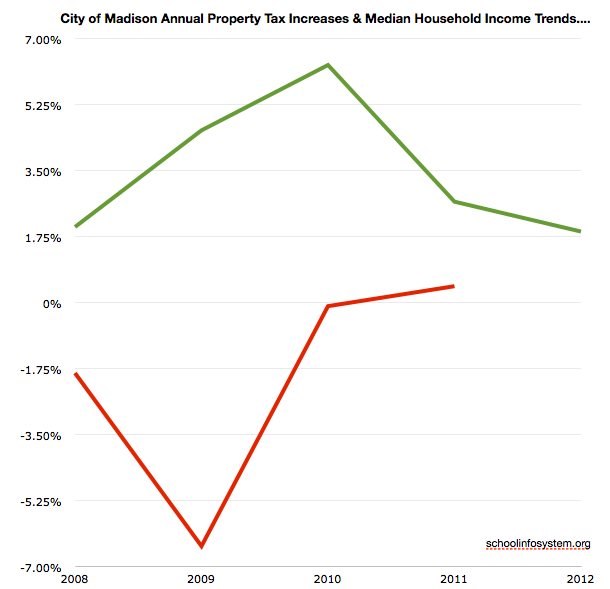
School Board Property Tax Increase Votes and State Politics

Chris Rickert

So I get why Burke was the only board member to vote against a tax-raising, 2013-2014 school district budget.
Still, just once I’d like to see a candidate throw caution to the wind and mount a data-based defense of good, if politically unwise, choices. If voters don’t buy it, well then they deserve what they get.
Burke explained her latest no vote on the budget last week by saying the district needs to consider whether salary increases for district residents are keeping up with school district tax increases.
To back up that concern, Burke provided me with a May 1 news release from the Bureau of Labor Statistics showing that in Dane County, residents saw a 3.9 percent drop in average weekly wages between the third quarter of 2011 and the third quarter of 2012.
I did a little more digging and found that wages also dropped by 0.1 percent between the second quarter of 2011 and the second quarter of 2012, and by 0.3 percent between the first quarters of 2012 and 2013.
Nevertheless, a broader view of the most recent available data suggests her concern is largely unfounded.
The BLS reported that wages were up 7.7 percent and 5.9 percent respectively, in the first and fourth quarters of last year – essentially wiping out, and then some, the wage decreases.
Plus, over the most recent 10 years for which data are available, personal income and per-capita income in Dane County rose, on an average annual basis, by 4.29 percent and 2.92 percent, respectively, according to the U.S. Bureau of Economic Analysis.
By contrast, next year’s school district budget raises taxes on the average homeowner by 2.5 percent, and over the past 10 years, the average annual school district tax increase has been 1.75 percent.
If anything, district tax increases aren’t keeping up with district residents’ ability to pay them.
Despite the old tax-and-spend myth frequently pinned on liberal Dane County, the school district isn’t unique, either, at least when it comes to Madison and county government.


Mr. Rickert neglects to mention the changing composition of Wisconsin K-12 tax revenue sources. Redistributed state tax dollars grew substantially during the past few decades. That growth has now largely stopped. Absent a serious look at our agrarian era school organizations and practices, property tax & spending growth are going up annually.

Share

Would you spy on your teenager?

Katie Rophie:

The technology now exists to let you read every email your child sends and receives. But should you?
If you could see every email, every chat, every internet search your teenager does on his laptop late at night would you want to? Because if you want to, you can.
I know this because one day at lunch in a restaurant I ran into a friend, whom I’ll call Mrs Orwell, and she told me that she had started monitoring her daughter’s computer by installing spyware. Before I go any further I should say that Mrs Orwell is in no way the drab or crazy person you might imagine from this particular vignette. Instead she is quite glamorous and sensible and fun; she is busy with her own life, and does not seem unduly or excessively involved with her children. Which is why when she told me that she was secretly monitoring her daughter’s every move on the internet, I was intrigued. If anyone else had told me the same thing, I would have thought, well, she’s nuts or dangerously bored.
The reason Mrs Orwell turned to spyware is that her 15-year-old has a very serious, brooding boyfriend. She had come across some evidence (in the real world: a diary entry left open on a desk) that the boyfriend was dangerously or theatrically self-destructive, and so she was worried about her daughter.

Share

How Many Are Following the “Worst Advice in the History of The World”

Erica Ritz:

Mike Rowe, widely-known from the hit TV show “Dirty Jobs” and a series of Ford commercials, appeared on The Glenn Beck Program Wednesday to discuss his efforts with the mikeroweWORKS Foundation in challenging “the absurd belief that a four-year degree is the only path to success.”
“We’re lending money we don’t have, to kids who will never be able to pay it back, for jobs that no longer exist,” he explained, echoing what he told TheBlaze TV’s Andrew Wilkow earlier this month. “That’s crazy, right? That’s what we’ve been doing for the last forty years.”
Rowe’s motivation for the work largely began with what he described as “the worst advice in the history of the world” – a poster he saw in high school challenging students to “work smart, not hard.” The picture of the person working “smart” was holding a diploma, and the person working “hard” looked miserable performing some form of manual labor.
“Today, skilled trades are in demand. In fact, there are 3 million jobs out there that companies are having a hard time filling. So we thought that skilled trades could do with a PR campaign,” he said with a smile. “So we took the same idea, went ahead and vandalized it. Work smart AND hard.'”

Share

Local student challenges high-school stress

Jay Matthews:

Student critiques of adult cluelessness have long been as much a part of high school as Friday night football and backpacks. My best friend in high school, Dan Cummings, was suspended for publishing an underground newspaper eviscerating how our school was run.
Maddy King, a junior at Fairfax County’s James Madison High School in Vienna, was similarly moved to vent recently, but being a teacher’s daughter and a staffer for the official school newspaper, she opted for a long, thoughtful letter to Principal Mark Merrell. When posted on the newspaper Web site, the letter created a sensation. She exposed issues that often infuriate students and yet are blithely overlooked by policymakers trying to upgrade the U.S. secondary school system.

Share

Teacher Union Survey Shows Mixed Support for iPads

Michael Janofsky:

A slight plurality of LA Unified teachers said they would favor continuing the iPad program, according to a new UTLA survey that produced mixed results in a district contemplating the next phase of a billion dollar digital device program.
The union poll was conducted over a week in late October, with 255 teachers from the 47 district schools that received iPads in Phase 1 of the program responding. Not all the teachers responded to all the questions, but taken together, the ambiguous results may undermine the value of the survey as a credible resource for policy.
Even the number who favored continuing the program, 62, was barely more than those who would stop it, 57, with another 54 saying they were unsure what to do. The district is planning to give iPads to all 650,000 students by the end of 2015.
The survey was conducted at the request of Monica Ratliff, the LA Unified board member who serves as chair of the Common Core Technology Project committee. She has been in favor of district students’ receiving digital devices beyond Phase 1 but not necessarily iPads. At the board’s meeting two days ago, she proposed holding off further distribution until officials could evaluate the instructional effectiveness of all digital devices used in the district.

Share

UW researcher surprised by ‘magnitude of grimness’ of Wisconsin achievement gap

Jesse Opoien:

Without trying to pin it on one magic solution — what are some of the potential solutions that are being discussed?
There’s plenty of research that says you get the most bang for your buck in investing in the early childhood grades. That probably still holds true. But at the same time, if you invested in high quality preschool and then let chips fall where they may, many of those positive effects will eventually deteriorate.
My sense is that the efforts to identify high-performing schools, high-quality schools regardless of what sector they’re in — public, charter or private — identifying the characteristics of high-performing schools regardless of sector, and trying to replicate them.
The other thing we’ve known for a long time is the single biggest within-school factor or influence on student achievement, in this order, are the quality of the teacher and the quality of the principal. Investing in ways of identifying effective teachers and helping them get better is almost always a good investment. It’s hard work, but it’s a good investment.
The other thing in terms of causes worth mentioning: there’s plenty of research that shows we have inequitable distributions of teacher quality. The higher the poverty rate, the more likely students are to be taught by a younger, less effective teacher. We can look at ways of trying to incentivize the most effective teachers to teach in the neediest schools. There are some positive signs here, but it’s nothing that’s going to be fixed over night.

Related: the rejected Madison Preparatory IB charter school.

Share

The Principal: The Most Misunderstood Person in All of Education

Kate Rousmaniere:

A few years ago when I walked the hallways of a high school with my five-year-old niece Evie, she remarked, without prompting: “There’s the principal’s office: you only go there if you are in trouble.” As an educator and an aunt, I wondered how the office of an educational professional had come to be symbolized in such a decisive way in the mind of a child, particularly a child who had yet to enter formal schooling. As I scanned popular representations of the school principal, I found that Evie’s impression was hardly unusual. Across popular and professional cultures, the figure of the school principal is commonly reduced to a small, often disagreeable functionary of bad news, the wet blanket of progressive teacher practice, the prison guard of students’ freedom. As I asked friends and colleagues about their impressions of school principals, few actually knew what principals did, and many people confused the role of school building principal with school district superintendent. Most remarkably, those very people who did not understand what a principal did were often the first to argue for the abolition of the role.
In American public schools, the principal is the most complex and contradictory figure in the pantheon of educational leadership. The principal is both the administrative director of state educational policy and a building manager, both an advocate for school change and the protector of bureaucratic stability. Authorized to be employer, supervisor, professional figurehead, and inspirational leader, the principal’s core training and identity is as a classroom teacher. A single person, in a single professional role, acts on a daily basis as the connecting link between a large bureaucratic system and the individual daily experiences of a large number of children and adults. Most contradictory of all, the principal has always been responsible for student learning, even as the position has become increasingly disconnected from the classroom.
The history of the principal offers even more contradictions. Contemporary principals work in the midst of unique modern challenges of ever-changing fiscal supports, school law and policy, community values, and youth culture. At the same time, the job of the contemporary principal shares many of the characteristics of their predecessors two centuries ago. While social and economic contexts have changed, the main role of the principal has remained essentially the same over time: to implement state educational policy to the school and to maneuver, buffer, and maintain the stability of the school culture at the local level.

Share

School choice plays growing role in Charlotte’s education scene, panel says

Ann Doss Helms:

School choice plays a growing role in the quest to educate all students in the Charlotte region, speakers told more than 100 people gathered Saturday for a forum on the future of public education.
In the past, public education was synonymous with Charlotte-Mecklenburg Schools. Superintendent Heath Morrison was one of the speakers at the session organized by Staying Ahead Carolina, a social networking group. But he was joined by Eddie Goodall of the N.C. Public Charter Schools Association and state Rep. Rob Bryan, R-Mecklenburg, co-sponsor of the state’s Opportunity Scholarship Act, which will provide income-based vouchers to pay private school tuition starting in 2014.
All of them, along with Bill Anderson of the nonprofit advocacy group MeckEd, agreed that families want high-quality choices for their children. But they voiced different views on the benefits and drawbacks of North Carolina’s options.
“Parents like choice. That shows up on every survey, across the state and across the country,” Morrison said. “We have to make sure that there’s quality as well as quantity.”
Staying Ahead Carolina, a nonpartisan group that has previously focused on noneducation issues such as arts and health, convened the forum at UNC Charlotte Center City to talk about choices, challenges and changes in public education.

Share

Report: Use No Child waivers to innovate

Caitlin Emma:

States should take student demographics into consideration when constructing school performance measures, move away from A-F grading of schools and be more innovative in measuring school accountability under No Child Left Behind waivers issued by the Education Department, a new paper presented in the journal Educational Researcher says.
The paper, written by researchers at the University of Southern California and North Carolina State University, is the latest input the Education Department has received as it moves forward with plans to renew waivers for some states through the 2015-16 school year.
A renewal of the law is stalled in Congress, but 42 states, the District of Columbia and eight school districts in California have waivers absolving them of some of the key requirements of NCLB.

Share

Pity the kids who cannot read: Mary Burke masters triangulation with Madison schools budget vote

Alan Talaga:

But voting down a bill with a relatively minor tax increase, one that was less than the maximum allowed by the district, makes it look like she might offer an austerity budget if she sat in the governor’s chair. That’s why Burke made sure to toss a little red meat to the deep blue crowd.
“My concern is that very little of it (the property tax increase) went into increasing pay for teachers,” she said.
Ta-da! She voted against the budget because it wasn’t paying teachers enough! There’s another campaign slogan: “Mary Burke: She fights to pay teachers more!”

Yet, the same service tax, spending and curricular approach continues in Madison, despite long term disastrous reading results.
Rhetoric and vote parsing does nothing for the thousands of young people who cannot read.
Bread & circuses.

Share

University exam brings South Korea to standstill

Song Jung-a:

Time was put on hold in South Koreaon Thursday as financial markets and public offices opened late to ensure calm when more than 650,000 students sat the annual university entrance exam. Success in the test is critical to millions of young students’ career and marriage prospects.
Trading at the Korea Stock Exchange and the country’s foreign exchange market began at 10am, an hour later than usual, to keep roads clear while aircraft will be grounded in the afternoon during the English listening test. About 65 commercial flights have been rescheduled to avoid take-off or landing for 30 minutes from 1.05pm.
Classes at primary and secondary schools started an hour later than usual while civil servants and most employees in the private sector were also asked to go to work an hour later than usual to ease traffic congestion to ensure that students arrive at their exam sites on time.
The university entrance exam is one of the most critical annual events for young people in the country – where seven out of every 10 high school students go on to higher education – as a diploma from top schools is widely regarded as a ticket to success in Asia’s fourth-largest economy. An almost cult-like devotion to learning has been among the driving forces behind the country’s rapid economic development over the past half century, creating one of the world’s most highly educated workforces.

Share

Schools expert Diane Ravitch warns Wisconsin off Common Core standards

Catherine Capellaro:

Less than a decade ago, Ravitch promoted many of the same policies she now rails against. As assistant secretary of education under George H.W. Bush, and then as head of the federal testing program, she led the charge for state and national academic standards and supported ideas of “choice” and merit pay. “I believed in those things because in theory they made a lot of sense,” Ravitch says when I ask about her dramatic about-face. “It sounds right that if you pay teachers a bonus they’ll get higher scores. It just doesn’t work.”
Ravitch went public with her change of heart in her 2010 book The Death and Life of the Great American School System: How Testing and Choice Are Undermining Education. In her new book, she uses data to rebut arguments for market-based solutions to education problems.
“When you look at the data, the test scores have never been higher in the last 40 years,” says Ravitch. “Dropouts have never been lower than they are today.”
Real gaps
“The achievement gap is real,” Ravitch told me when I brought up Madison’s racial and economic disparities.
She points to research showing the only time the black-white achievement gap has narrowed was in the late 1970s and early 1980s because of concerted efforts to desegregate schools, reduce class size, increase access to early childhood education and target federal resources to schools with low-income students.
But today’s leaders have abandoned solutions that work, says Ravitch, who comes down as hard on President Barack Obama and Education Secretary Arne Duncan as she does on conservatives. “Our policymakers have given up on reducing class size,” she adds, saying she visits classes with up to 40 students. “Are there expanding opportunities for African American families? Our society has thrown up its hands, and we’re resegregating

Share

The future of work?

Angus:

As AI and globalization chew up good jobs for the non-elites, there is a bright spot on the career horizon. The market for household staff is booming.
According to the WSJ, “A good housekeeper earns $60,000 to $90,000 a year. A lady’s maid can make $75,000 a year. A butler may start at $80,000 a year and can earn as much as $200,000.”
And, there are openings, “Demand for the well-staffed home is on the rise, according to agencies and house managers alike. Clients are calling for live-in couples, live-out housekeepers, flight attendants for private jets, stewards for the yachts and chefs for the summer house. In San Francisco, Town and Country Resources, a staffing agency for domestic help, has seen demand for estate managers and trained housekeepers grow so fast the agency is going to offer its own training programs in subjects like laundry, ironing and spring cleaning starting in 2014. Claudia Kahn, founder of The Help Company, a staffing agency based in Los Angeles, says she used to get one call a month for a butler but has gotten three in the past week alone.”

Share

New NAEP data brings fresh round of questions on how to improve education

Alan Borsuk:

What are we doing wrong? Why aren’t things getting better?
No, I don’t have some powerful secret answer. But I know the urgency behind the questions became all the clearer last week, whether you’re talking about Milwaukee or Wisconsin as a whole. Whatever it is that would work, we haven’t done it yet or, at best, we haven’t done it well enough.
There are so many people trying to change education outcomes for the better. I respect so many of them and think some are having praiseworthy impact in specific arenas. But the overall pursuit? Look at the record.
There are two reasons for my fresh agitation:
First are new results from the National Assessment of Educational Progress (NAEP). NAEP is the best, most nailed-down gauge of how students are doing nationwide. About every two years, NAEP releases results from reading and math tests of samples of fourth and eighth graders in every state. New results came out Thursday.
Nationwide, there were some bright spots, but overall, not much was new or better.
For Wisconsin, the results were disheartening. The average score of a fourth grader in reading was lower than in 1992. We pride ourselves on being a high performing state, but the Wisconsin score and the national score were the same. Sounds pretty middle-of-the-pack to me.
There has been long-term improvement in math scores in Wisconsin. But almost all of it occurred years ago — scores have been flat for the last half-dozen years.

Share

Sun Prairie schools agree to revamp special ed screening

Gayle Worland:

In response to findings that a disproportionate number of black students enrolled in the Sun Prairie School District are placed into special education programs, the district has agreed to revamp its student screening process and bolster teacher training.
The U.S. Department of Education’s Office for Civil Rights announced Friday that the Sun Prairie district had volunteered to make the changes in response to a “compliance review,” which was designed to determine whether the district discriminates against black students when referring them to special education meant for students with a disability.
The federal office found that in the 2012-13 school year, black students made up 10 percent of the district’s student enrollment but 24.2 percent of the students enrolled in special education.
Screenings for students who might be struggling vary from school to school within the 7,372-student district, and some students referred to special education did not receive follow-up, the investigation found.
The review was still in progress when the district offered to make changes, including:

Share

When Should an Academic Write for Free?

Tressie McMillan Cottom:

Should writers work for free? What if those writers are academics?
That is a real question up for debate in several media outlets this past week. But I’d like to ask why we work for free and why we don’t shame organizations that expect us to.
The Internet has created a bottomless void that requires content. In a classic case of how expansion breeds stratified access, an increase in platforms that require writing has resulted in fewer outlets that pay writers to write. In the New York Times recently, Tim Kreider argued that he cannot afford to write for free. He encourages other writers to reject the freemium culture for the benefit of all who make a living by penning the word. In a column for the Chronicle of Higher Education, Sarah Kendzior says that journalists may find it beneficial to write for free occasionally, but that academics should never do the same, even though “[p]ublishers like to evoke academics’ professional status to justify not paying them.”

Share

The Surprising Impact of High School Math on Job Market Outcomes

Jon James:

The economic returns to education are well documented. It is also well-known that college graduates with certain majors will earn more than others and find it easier to land a job. But surprisingly, the courses students take in high school also make a difference, when the courses are mathematics. Even among workers with the same level of education, those with more math have higher wages on average and are less likely to be unemployed. These findings suggest that even students ending their formal education after high school can increase their future earnings by investing in more math courses while in high school.

High school graduates earn more money in general than high school dropouts. This well-known fact is a powerful incentive to finish high school. But is it just the diploma that counts, or do the particular courses students take while in high school matter for their future job prospects? Students can opt for a variety of courses, from vocational tracks to advanced placement classes for college credit, during their final four years of required education.
Most high school graduates choose a curriculum that is far more rigorous than the minimum requirements. This is most evident in mathematics courses. For example, in 2009, 75 percent of high school graduates completed math coursework at the level of Algebra II or above. Most of these students could have stopped at Algebra I and satisfied the minimum high school requirements. Only six states required Algebra II for graduation as of 2006. About 11 required Algebra I, six required geometry, and the remaining 27 required only that students complete a minimum of three years of mathematics at any level.
The fact that so many students take a rigorous math curriculum is not surprising given that a minimum of Algebra II is necessary for adequate college preparation. But an analysis of detailed high school transcript data and employment outcomes suggests that a more rigorous high school math curriculum benefits even those who do not go to college. While math may be difficult for many, our findings indicate that the payoffs for all students may be substantial.

Unsurprising, particularly when one encounters young people unable to comprehend cell phone costs, student loan terms or simply make change.
Related: Math Forum audio / video and Connected Math.

Share

Name-calling turns nasty in education world

Stephanie Simon:

“I have never encountered politics as mean, nasty and personal as in ed reform,” said Ben Austin, who runs an advocacy group called Parent Revolution. He’s hardly a naïf: He led a communications team for the 2000 Democratic National Convention and spent five years in the Clinton White House. Yet Austin says he finds the bare-knuckle brawling of education politics both bewildering and depressing.
“The toxicity level is bizarrely high,” he said. “It would be funny if [the instigators] were bloggers sitting around in their underwear in tin-foil hats, but these are thought leaders in the field.”
Austin himself took a direct hit several months ago when Ravitch skewered him on her widely read blog, describing him as “loathsome” and writing of Parent Revolution: “There is a special place in hell reserved for everyone who administers and funds this revolting organization …”
Ravitch later apologized in a long public letter that spent 87 words repenting and nearly 1,700 running through all the reasons she considers Austin and his team to be heartless and destructive for organizing parents at a struggling Los Angeles school to oust the principal.

Share

U.S. Private Colleges Face Enrollment Decline

Douglas Belkin:

Spring Hill College in Mobile, Ala., was founded in 1830. It has graduated governors and admirals. Martin Luther King Jr. praised it for its early efforts at integration in his “Letter from Birmingham Jail.”
None of that august history protected it from plummeting enrollment last year. So, to induce prospective students to consider its $170,000 sticker price for a four-year education, Spring Hill began offering $1,000 scholarships for taking a campus tour.
“We’re at a time when enrollment is the No. 1 driver,” said Bob Stewart, the school’s vice president for admissions and financial aid. “We needed to have some game changers to bring in new students.”
Spring Hill was caught in the same tailspin that many U.S. private colleges are facing as they endure plummeting enrollment among price-conscious students.

Share

NAEP Wisconsin Results & Commentary with a Remarkable Reading Recovery Booster

Wisconsin Reading Coalition, via a kind email:

The results of the 2013 National Assessment of Educational Progress (NAEP) were released today. For Wisconsin, the news on reading is much the same as it was two years ago at the last NAEP administration. 33.6% of our 4th graders reached the proficient level. Massachusetts again scored at the top, with 50.4% of its 4th graders proficient.
Wisconsin students who are Asian, black, and white, as well as students who are not eligible for a free and reduced lunch, all posted scores that are significantly lower than the national averages for those groups of students. We had no 4th grade sub-groups that scored significantly above the national average for their group.
Wisconsin’s black 8th graders had the lowest scores in the nation, falling below Mississippi and Alabama. Wisconsin’s black 4th graders had the second lowest scores in the nation, and at both 4th and 8th grade, Wisconsin had the largest gap between white and black students.
As we examine the data more fully, we will have more specifics.

Stephanie Banchero:

Fourth- and eighth-graders across the country made modest advances in national math and reading exams this year, according to data released Thursday, but proficiency rates remained stubbornly below 50% on every test.
Amid the sluggish progress nationwide, a few areas notched drastic improvements on the 2013 National Assessment of Educational Progress exams, with Tennessee and Washington, D.C., –as well as schools on military bases–the only ones achieving statistically significant gains on all tests.
Washington gained a cumulative 23 points since 2011, while Tennessee posted a 22-point jump–both compared with a 4-point national gain. The exams are scored on a 0-500 scale.
Officials in Tennessee and Washington attributed the gains to tougher classroom math and reading standards, improved teacher development and overhauling teacher evaluations.

State posts widest achievement gap in ‘the nation’s report card’ by Lydia Mulvany:

Steven Dykstra, a founding member of the Wisconsin Reading Coalition, a grassroots group devoted to reforming reading instruction, said the state needs to start imitating reforms in other states by training teachers more effectively. In the past, Wisconsin students ranked as high as third in the nation in reading.
“This isn’t a surprise. The last time we did well in reading was when everyone sucked at reading,” Dykstra said. “When some states started doing better, they very quickly left us behind.”
“Left behind” is precisely what the data shows is happening to Wisconsin’s black students:
Eighth graders, reading: 9% were judged proficient; 55% rated below basic, the most of any state.
Fourth graders, reading: 11% were proficient; 65% scored below basic, again the most of any state.
Eighth graders, math: 8% were proficient; 62% rated below basic, better than only three states.
Fourth graders, math: 25% were proficient; 30% scored below basic, again with only three states performing worse.
Henry Krankendonk, a retired Milwaukee Public Schools math curriculum planner and NAEP board member, said Wisconsin’s failure to narrow the disparity — which has existed for decades — is a challenge for Milwaukee in particular, because it has the highest concentration of minority students. Krankendonk said the problem has long been weak standards for what students should know, and he was hopeful that the recent adoption of new standards more in line with NAEP, called Common Core State Standards, would help.

Meanwhile, St. Norbert College Education Professor Steve Correia emphasized how well (!) Reading Recovery is working while discussing Wisconsin’s NAEP results on WPR. [5.6mb mp3 audio]
Related: Madison’s long term disastrous reading results.
Much more on NAEP over time, here.

Share

The School-to-Prison Pipeline: A Nationwide Problem for Equal Rights

Molly Knefel:

What happens to education when students, from preschool to high school, are subjected to disciplinary policies that more closely resemble policing than teaching? Around the country, advocates are collecting data illustrating the devastating effects of what they call the “school-to-prison pipeline,” where student behavior is criminalized, children are treated like prisoners and, all too often, actually end up behind bars. “The school-to-prison pipeline refers to interlocking sets of relationships at the institutional/structural and the individual levels,” explains Miriame Kaba, founding director at Project NIA, an advocacy group in Chicago fighting youth incarceration. “All of these forces work together to push youth of color, especially, out of schools and into unemployment and the criminal legal system.”
This fall, the New York Civil Liberties Union (NYCLU) issued a report focusing on how the criminalization of school discipline is profoundly harming children’s educational opportunities in New York City. “Once a child is subjected to suspensions or arrests in school, they are less likely to graduate and more likely to end up involved in the criminal justice system,” says Donna Lieberman, the NYCLU’s executive director. “That means they’re on a path to prison, not graduation.” The report demonstrates that the city’s black and low-income students, as well as students with disabilities, are disproportionately affected by suspensions, expulsions and arrests – which have skyrocketed under Mayor Michael Bloomberg’s administration. The data also shows a correlation between neighborhoods whose students experience high rates of suspension and those with high rates of stop-and-frisk, the controversial policing tool ruled unconstitutional earlier this year.
The number of students suspended from New York City schools each year has more than doubled under Bloomberg, from roughly 29,000 in 2001 to almost 70,000 in 2011. Half of those suspended were black, despite black students comprising less than a third of the student population. Black students with disabilities have the highest rates of suspension, almost three times higher than their white disabled peers. White students with disabilities are also suspended at higher rates than their non-disabled peers. “It’s a lot about race,” says Lieberman. “Black students are far more likely than [non-disabled] white students and white students with special needs to be suspended from school.”

Share

States are Starting to Test Teachers

The Economist:

IN THE film “Bad Teacher”, Cameron Diaz’s character says she entered the profession “for all the right reasons: shorter hours, summers off, no accountability”. No one is threatening to take away the first two agreeable perks, but several states are eyeing the third.
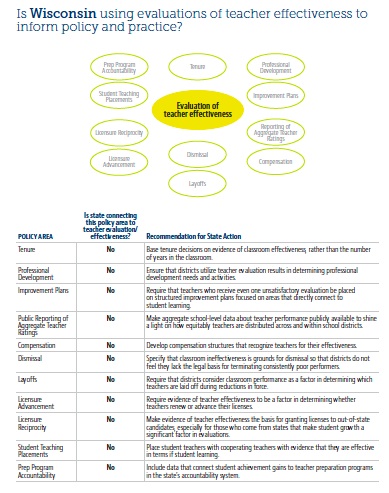
In the past, teachers were judged solely on their level of education and the number of years they had spent in the classroom–neither of which tells you whether their pupils are learning anything. But this is changing. A new report from the National Council on Teacher Quality (NCTQ), a research group, finds that most states now demand that student achievement should be a significant factor in teacher evaluations (see chart). Only Alabama, California, Idaho, Iowa, Montana, Nebraska, New Hampshire, North Dakota, Texas and Vermont have no formal policy.
The expansion of teacher evaluation is broadly good news. Work published in 2011, from Columbia and Harvard, showed that pupils assigned to better teachers are more likely to go to college and earn decent salaries, and less likely to be teenage mothers. If teachers in grades 4 to 8 are ranked according to their ability to add value (ie, teach) and those in the bottom 5% are replaced with ones of average quality, a class’s cumulative lifetime income is raised by $250,000. Bill Gates once said that if every child had mathematics teachers as good as those in the top quartile, the achievement gap between America and Asia would vanish in two years. (His lecture has been watched 1.5m times online.)

Much more on teacher content knowledge requirements, here.

Share

Wisconsin public-sector unions report big drops in revenue

Jack Craver:

Total revenue for the Wisconsin Education Association Council, the largest union in the state, dropped from $26 million in 2011 to $20 million in 2012. WEAC, which represents 80,000 teachers across the state, has for years been a great force for the Democratic Party, providing millions of dollars on attack ads against Republicans on top of legions of volunteers.
The next largest public sector union, American Federation of State, County and Municipal Employees, has also taken a financial hit. AFSCME Council 40, which represents county and municipal workers outside of Milwaukee County, reported its gross revenue dropping from $6.7 million in 2011 to $4.5 million in 2012. Reports for some of the other large AFSCME Councils, including Council 24, which represents state employees, are not yet available online.
Revenue for the American Federation of Teachers, which in Wisconsin largely represents academic staff at the state’s universities as well as a number of white-collar state employees, dropped from just under $4 million in 2011 to $2.6 million in 2012.
The Service Employees International Union (SEIU) Local 150 — which represents many public sector healthcare professionals — saw its revenue drop from $937,000 to $783,000. Fortunately for that union, many of its members, including nurses at Meriter Hospital, are in the private sector, and are thus unaffected by Act 10.
The decrease in union money could spell serious trouble for Democrats as they try to recapture the governorship and gain seats in the state Legislature next year. Third-party ads in favor of Democrats are largely funded by labor, whether from individual unions or union-funded groups such as the Greater Wisconsin Committee or We Are Wisconsin.
With the largest unions bleeding dues, it will be hard for Democratic forces to compete with corporate-funded players on the right, such as Wisconsin Manufacturers & Commerce, which has already dumped $1 million into an ad buy celebrating Walker’s record as governor.

Related: WEAC: $1.57 million for Four Wisconsin Senators.

Share

Teachers are getting a bum rap, many at fault

Bill Bollom:

But poor parenting is not alone on the hook. Our culture is on the hook too. We put too little value on a strong work ethic for our kids. Our kids are not hungry to succeed, particularly the boys. The boys in our culture seem to love, even respect, their stereotype of dumb and dumber. They are not interested in investing effort for the future; postponing gratification. Our many welfare programs are at least partly responsible for this attitude, by giving handouts and asking less of our citizens, making us weaker and less proud of beating our foreign competition.
Our culture loves excellence in sports far more than academic achievement. Too many students (and parents) think sports are the very purpose of high schools; academics suffer as a result. Because sports, particularly football is so expensive, academic areas get too little funding. One school found that cheerleading instruction cost four times more than math instruction.

Share

Vouchers & Politics: Commentary

Chris Rickert:

Despite all this, Gov. Scott Walker and lawmakers seem paralyzed in the face of potential bipartisan agreement.
Walker has said as far back as August that he’s open to changing the voucher program to give preference to public school students. The Republican chairmen of the Senate and Assembly education committees have made similar noises. Yet none responded to messages from me saying essentially: Well, OK, so are you introducing legislation to do that?
Similarly, Gillian Drummond, spokeswoman for Democratic Senate Minority Leader Chris Larson, said “I have not heard of anything” on possible Democratic legislation on the issue in the Senate.
Speaking on background, a staffer for Rep. Sondy Pope, who has been outspoken in her criticism of underwriting private school tuition with vouchers, said “our caucus as a whole is looking” to do something even more stringent than in Racine, but was less than optimistic about Republicans going along.

Share

NY Democrat Senator Schumer: “Voluntary” Tracking of Kids with Autism

Chloe Albanesius:

New York Sen. Charles Schumer today called on the Justice Department to develop a program that would allow for voluntary tracking of children with autism or other developmental disorders.
Devices could be worn as wristwatches, anklets, or clipped onto belt loops or onto shoelaces, Schumer said in a letter to Attorney General Eric Holder.
Schumer’s request comes one month after 14-year-old Avonte Oquendo (left) disappeared from his Queens, New York school. The teen, who suffers from autism and does not speak, was seen on surveillance cameras leaving his school on Oct. 4. New York authorities have mounted an extensive campaign to find him, but he remains missing. Those with information about Avonte should call 1-800-577-TIPS, while anyone who spots him should call 911 immediately.
“The sights and sounds of NYC and other busy places can be over-stimulating and distracting for children and teens with Autism, often leading to wandering as a way to escape. Voluntary tracking devices will help our teachers and parents in the event that the child runs away and, God forbid, goes missing,” Schumer said in a statement. “DOJ already funds these devices for individuals with Alzheimer’s and they should do the same for children with Autism Spectrum Disorder. Funding this program will help put school systems and parents of children and teens with Autism at ease knowing where their children are.”
In related news, AT&T announced today that it will sell the Amber Alert GPS, a 3G device that kids can carry in their pockets or backpacks and features two-way calling and among other features.

This is a very bad idea…. The data will flow as we continue to learn.

Share

Colorado Voters reject big tax hike, school finance measure Amendment 66

Kevin Simpson:

Voters emphatically rejected a $950 million tax increase and the school funding revamp that came with it, handing Amendment 66 a resounding defeat Tuesday night.
The measure fell behind by a large margin as the early returns were counted, with nearly two-thirds of voters giving it a thumbs-down, and the outcome was clear just a little more than an hour after the polls closed.
“Colorado families spoke loud and clear,” said Kelly Maher, executive director of Compass Colorado, which opposed Amendment 66. “We need substantive outcome-driven reforms to the educational system before we ask families and small businesses to foot a major tax bill.”

Share

Education Improvements Key to Better Opportunities for Milwaukeeans, Chetty Says

Alan Borsuk:

The answer to the question of whether America is still a land of opportunity varies widely depending on where you live – and the Milwaukee area is one of the places where the answer is not so good, a prominent economist told an audience of several hundred at the Marquette University Alumni Memorial Union on Tuesday.
The answer to what Milwaukee might do to improve the opportunities of success for children from lower income homes emphasizes better education, Raj Chetty of Harvard University said.
Chetty spoke at a session that combined the Marquette University Department of Economics’ Marburg Memorial Lecture with the Marquette Law School’s “On the Issues with Mike Gousha.” Chetty spoke for about 45 minutes, followed by a conversation in which Gousha, Milwaukee Journal Sentinel editorial page editor David Haynes, and audience members asked questions.
Chetty, now 34, is one of the youngest people to be named a tenured professor at Harvard and has won numerous awards, including a MacArthur Foundation “genius” grant. He spent his high schools years in the Milwaukee area and was the 1997 valedictorian at University School of Milwaukee.

Share

Madison: The most racist city in the U.S.?

Sarah Blaskey and Phil Gasper:

MADISON, WIS., has a reputation as one of the most liberal cities in the country. It is also possibly the most racially unequal.
In early October, Race to Equity–a Madison-based initiative started by the Wisconsin Council on Children and Families–released a report detailing racial disparities in Madison, and more broadly in Dane County, Wis. The findings are staggering.
The Race to Equity researchers expected the numbers compiled for racial disparities in Dane County to be similar or slightly better than the national averages. After all, Madison has long prided itself on having quality public education, good jobs, access to health care and human services programs, a relatively high standard of living and, in general, a progressive outlook on social, economic and political questions.
But while living standards for the white population in Dane County are higher than the national average, for the Black population, the opposite is true. On every indicator, with only two exceptions out of 40 measures, statistics collected in Dane County demonstrated equal or higher racial disparities between whites and Blacks than the national averages.

Related: The failed battle over the proposed Madison Preparatory Academy IB charter school and our disastrous reading scores.

Share

Madison School Board Grows Taxes & Spending: 6-1 vote

Molly Beck:

Property taxes in the Madison School District will increase by about $67 for the average homeowner as part of the final $392 million 2013-14 budget approved by the school board on Monday.
The board voted 6-1 to approve this year’s amended budget and also to set the levy at $257.7 million, a 3.38 percent increase over last year.
That increase is about 1 percentage point less than originally projected in July, before Gov. Scott Walker unveiled his two-year $100 million property tax relief bill that sent an additional $2.5 million in state aid to Madison schools.
Total property taxes will increase by $66.74 on average. That’s $39.24 less of an increase than originally expected earlier this year, according to district budget documents. A property tax bill for the average $231,000 Madison home is now estimated to be $2,739.66 for school purposes.
School board member Mary Burke, a candidate for governor, cast the lone votes against the final amended budget and against the levy, citing the desire to see a better balance between the needs of the district and the needs of taxpayers.
“Next year, as we look at this, we really need to look at how many people are struggling to make ends meet,” Burke said about the levy increase, noting the district and board should consider whether salary increases among district families are not keeping pace with property tax increases.

Much more on the 2013-2014 budget, here.
The City of Madison’s portion of local property tax will grow 2.2%.
Middleton’s property taxes are 16% less than Madison’s on a comparable home.

Share

Principal who left six weeks into school year getting full year’s pay

Don Behm:

The principal of Cedar Grove-Belgium High School left his job just six weeks after the start of this school year — and shortly after board members discussed not renewing his contract — but will be paid his full year’s salary of $91,290.
Larry Theiss resigned as principal effective at the end of his contract — June 30, 2014 — but has not actually worked since mid-October. Theiss informed the school board in a letter dated Oct. 15 that he was taking an immediate leave of absence from the job so he could take classes toward a superintendent’s license, Superintendent Steve Shaw said.
School Board President Chad Hoopman said Wednesday that Theiss’ departure was “a forced resignation.”
Earlier in October, the board discussed not renewing Theiss’ contract for the 2014-’15, so Shaw sat down with the principal to alert him to the possible change, Hoopman said.
After meeting with Shaw, Theiss resigned.
There was no provision in Theiss’ contract that required payout of the full year’s salary, according to Shaw. However, the school board decided to accept the resignation and pay Theiss through his absence to create “an opportunity for both sides to move forward,” Shaw said.

Share

Student debt to stall millennial retirements

Amy Hoak:

Thanks to hefty student loan debts, many millennials will have to wait until 73 to retire, a recent study found. That’s 12 years later than the current average retirement age, 61.
Joseph Egoian, a financial analyst for personal finance website NerdWallet and the author of the study, explains that 73 was the age by which a college graduate with a median amount of student debt and a median starting salary would finally build a big enough retirement portfolio to replace 80% of his peak salary annually. (Also factored in are Social Security benefits beginning at 67, at $11,070 a year.) Read the full report here.
Here’s the problem, according to NerdWallet: The median debt for a student when she graduates is $23,300, and the median starting salary for a recent grad (who has a job) is $45,327. Assuming a student makes the average annual loan payment of $2,858 for the first 10 years of her career, that drastically cuts into the amount of retirement saving she can manage. And figuring that missed-out contributions could have been earning a compounded rate of return until retirement, the lost savings due to student debt payments is $115,096 by age 73, according to the report. The report assumes every loan payment would have gone to retirement savings, and that the graduate would save at the historical 30-year national post-tax savings rate of 6.1% after the debt is paid off, Egoian said.

Share

Childhood Poverty Linked to Poor Brain Development

Caroline Cassels
Exposure to poverty in early childhood negatively affects brain development, but good-quality caregiving may help offset this effect, new research suggests. A longitudinal imaging study shows that young children exposed to poverty have smaller white and cortical gray matter as well as hippocampal and amygdala volumes, as measured during school age and early adolescence.
“These findings extend the substantial body of behavioral data demonstrating the deleterious effects of poverty on child developmental outcomes into the neurodevelopmental domain and are consistent with prior results,” the investigators, with lead author Joan Luby, MD, Washington University School of Medicine in St. Louis, Missouri, write.
However, the investigators also found that the effects of poverty on hippocampal volume were influenced by caregiving and stressful life events.
The study was published online October 28 in JAMA Pediatrics.
Powerful Risk Factor
Poverty is one of the most powerful risk factors for poor developmental outcomes; a large body of research shows that children exposed to poverty have poorer cognitive outcomes and school performance and are at greater risk for antisocial behaviors and mental disorders. However, the researchers note, there are few neurobiological data in humans to inform the mechanism of these relationships.
“This represents a critical gap in the literature and an urgent national and global public health problem based on statistics that more than 1 in 5 children are now living below the poverty line in the United States alone,” the authors write.
To examine the effects of poverty on childhood brain development and to understand what factors might mediate its negative impact, the researchers used magnetic resonance imaging (MRI) to examine total white and cortical gray matter as well as hippocampal and amygdala volumes in 145 children aged 6 to 12 years who had been followed since preschool.
The researchers looked at caregiver support/hostility, measured observationally during the preschool period, and stressful life events, measured prospectively. The children underwent annual behavioral assessments for 3 to 6 years prior to MRI scanning and were annually assessed for 5 to 10 years following brain imaging. Household poverty was measured using the federal income-to-needs ratio.
“Toxic” Effect

The researchers found that poverty was associated with lower hippocampal volumes, but they also found that caregiving behaviors and stressful life events could fully mediate this negative effect.
“The finding that the effects of poverty on hippocampal development are mediated through caregiving and stressful life events further underscores the importance of high-quality early childhood caregiving, a task that can be achieved through parenting education and support, as well as through preschool programs that provide high-quality supplementary caregiving and safe haven to vulnerable young children,” the investigators write.
In an accompanying editorial, Charles A. Nelson, PhD, Boston Children’s Hospital and Harvard Medical School, in Massachusetts, notes that the findings show that early experience “weaves its way into the neural and biological infrastructure of the child in such a way as to impact development trajectories and outcomes.”
“Exposure to early life adversity should be considered no less toxic than exposure to lead, alcohol or cocaine, and, as such it merits similar attention from health authorities,” Dr. Nelson writes.

Share

Hacking Public Education

Jason Freedman:

This post will be a bit of a departure from what you guys are used to seeing from me, but it’s super-important to me personally, and I wanted to share it with you.
I’ve watched in admiration as my brother Andrew Freedman has worked in politics the last few years. My brother is a campaign director of Colorado Commits to Kids, which is an amendment in Colorado that fixes Colorado’s educational system. If you are at all interested in fixing public schools, not just in Colorado specifically, but throughout the country, I think it will be worth your time to read this post.
The public education has some truly massive underlying problems. Hopefully most of you by now have seen Waiting for Superman. This clip below really got to me:

Share

Swedish children complain their parents spend too long on phones

Richard Orange:

More than a third of children in Sweden’s cities complain that their parents spend too much time staring at phones and tablet computers, leading doctors in the country to warn that children may be suffering emotional and cognitive damage.
According to a survey by YouGov, 33% of parents in Sweden’s major towns and cities have received complaints from their children about their excessive phone use.
The survey also found that more than one in five parents in Stockholm and its suburbs admit to having lost sight of their children while out after being distracted by their phones.
“Of course it will affect their emotional development,” said Dr Roland Sennerstam, one of several paediatricians in the country to warn of the phenomenon. “I sometimes see children tapping their parents on the back to get attention, but the parents give them no time.”
Sweden now boasts the second highest smartphone usage in western Europe after Norway. According to data from Google, 63% of adults own an iPhone, Android phone or Windows phone.

Share

Douglas County, Colorado School Governance Competition

Stephanie Simon:

It isn’t often that the Koch brothers’ political advocacy group gets involved in a local school board race.
But this fall, Americans for Prosperity is spending big in the wealthy suburbs south of Denver to influence voters in the Douglas County School District, which has gone further than any district in the nation to reshape public education into a competitive, free-market enterprise.
The conservatives who control the board have neutered the teachers union, prodded neighborhood elementary schools to compete with one another for market share, directed tax money to pay for religious education and imposed a novel pay scale that values teachers by their subjects, so a young man teaching algebra to eighth graders can make $20,000 a year more than a colleague teaching world history down the hall.
Conservatives across the U.S. see Douglas County as a model for transforming public schools everywhere. But with four of seven seats on the board up for grabs in Tuesday’s election, reformers find themselves fending off a spirited challenge from a coalition of angry parents and well-funded teachers unions. The race has been nasty and pricey, too; spending from all parties is likely to hit at least $800,000.

Share

Generation Tech: One in three kids learn to use a mobile phone or tablet before they learn to talk

Risk Averse:

A new Freakonomics trend is forming. Kids are mastering technology before they learn to speak. It is difficult to even attempt to predict what kind of implications this will have on this new “Generation Tech.” Malcom Gladwell suggested that one of the biggest factors in Bill Gates’ success was his immense exposure to programming by the time he was in a position to act profit from this experience. How about an army of kids who have 10,000 hours of interaction with mobile phones and tablets before they turn 5 years old? I am not sure if this is a positive or negative development. As kids we played video games endlessly, and before us kids stared at the TV endlessly, and before them kids played in the yard endlessly… And all of these were frowned upon at the time. Perhaps Generation tech just needs some guidance in the right direction.

Share

On New Jersy Teacher Tenure Reform

John Mooney:

The first year of New Jersey’s new tenure law has so far resulted in a much quicker process for deciding discipline charges against teachers, while established case law has still largely determined the outcomes.
At least that’s the interpretation of an attorney who has summarized and analyzed the approximately 40 tenure cases brought before state arbitrators so far under the Teacher Effectiveness and Accountability for the Children of New Jersey Act (TEACHNJ).
Carl Tanksley of the law firm of Parker McCay presented a summary of the first 23 of those tenure decisions at last month’s New Jersey School Boards Association convention in Atlantic City.
He said that from his perspective as an attorney representing school boards, the process has pretty much worked as intended. Tanksley’s firm represents about 80 districts, mostly in southern and central New Jersey.
“I think there are a couple of bugs to work through, but overall it’s an improvement over the old process,” he said yesterday.
Tanksley noted that the tenure decisions have come in all shapes and sizes, as the 25 state-certified arbitrators selected under the law each using their own style and wording in making decisions. But he said his review found that the arbitrators have largely followed legal precedents.

Share

Remember whom open enrollment serves

Chad Aldis:

Quick! Name the Ohio school-choice program that has provided students the opportunity to attend a school not operated by their resident school district for the longest period of time. Charter schools? Nope, strike 1. The Cleveland voucher program? Try again, strike 2. Unless you guessed open enrollment, that’s strike 3. Before heading back to the dugout, read on to learn more about this established school-choice program.
Open enrollment, first approved by the legislature in 1989, allows school districts (if they choose) to admit students whose home district is not their own. Perhaps against conventional wisdom, it has become a popular policy for districts. We even analyzed the trend in an April 2013 Gadfly.
According to Ohio Department of Education records, over 80 percent of school districts in the state have opted to participate in some form of open enrollment. There are 432 districts that have opened their doors to students from any other district in the state, and another sixty-two districts have allowed students from adjacent districts to attend their schools.
This year’s budget bill (HB 59) created a task force to study open enrollment. The task force is to “review and make recommendations regarding the process by which students may enroll in other school districts under open enrollment and the funding mechanisms associated with open enrollment deductions and credits.” The task force’s findings are to be presented to the Governor and legislature by the end of the year.

Much more on Open Enrollment here.

Share

Online Education as an Agent of Transformation

Clayton Christensen & Michael Horn, via a kind Rick Kiley email:

WHEN the first commercially successful steamship traveled the Hudson River in 1807, it didn’t appear to be much of a competitive threat to transoceanic sailing ships. It was more expensive, less reliable and couldn’t travel very far. Sailors dismissed the idea that steam technology could ever measure up — the vast reach of the Atlantic Ocean surely demanded sails. And so steam power gained its foothold as a “disruptive innovation” in inland waterways, where the ability to move against the wind, or when there was no wind at all, was important.
In 1819, the technology vastly improved, the S.S. Savannah made the first Atlantic crossing powered by steam and sail (in truth, only 80 of the 633-hour voyage was by steam). Sailing ship companies didn’t completely ignore the advancement. They built hybrid ships, adding steam engines to their sailing vessels, but never entered the pure steamship market. Ultimately, they paid the price for this decision. By the early 1900s, with steam able to power a ship across the ocean on its own, and do so faster than the wind, customers migrated to steamships. Every single transoceanic sailing-ship company went out of business.
Traditional colleges are currently on their hybrid voyage across the ocean.
Like steam, online education is a disruptive innovation — one that introduces more convenient and affordable products or services that over time transform sectors. Yet many bricks-and-mortar colleges are making the same mistake as the once-dominant tall ships: they offer online courses but are not changing the existing model. They are not saving students time and money, the essential steps to disruption. And though their approach makes sense in the short term, it leaves them vulnerable as students gravitate toward less expensive colleges.

Share

Who Will Get NEA’s Great Public Schools Grants?

Mike Antonucci:

Who Will Get NEA’s Great Public Schools Grants? Last July, the National Education Association offered the delegates to its representative assembly a choice. They could either approve a budget with a dues level of $179, or a budget with a dues level of $182. The latter choice would set up a $6 million Great Public Schools fund, which would disburse grant money to state and local affiliates for projects “enhancing the quality of public education.”
NEA was deliberately vague about what kinds of projects these might be, but made clear that it was in response to “those with little or no practical classroom experience” who were “crafting policies and implementing practices that we know won’t work for our students.” The $6 million annually would allow the union to “fund our own ideas.”
The delegates approved the dues increase and the creation of the fund, although it was a close vote by the standards of NEA elections. It gave the union’s 12-member Executive Committee the power to write the grant guidelines, subject to the approval of the board of directors. I mentioned at the time that, as a practical matter, it gave the Executive Committee the power to dispense the money any way it wished.

Share

Schooling Is Not Education!

Lant Pritchett, Rukmini Banerji & Charles Kenny:

For the last ten years, the major focus of the global education community has been on getting children into school. And that effort has been a success: most of the world’s children live in countries on track to meet the Millennium Development Goal of universal primary completion by 2015.
But behind that progress is a problem–one that grows with each additional child that walks through the classroom door. Some children in those classes are learning nothing. Many more are learning a small fraction of the syllabus. They complete primary school unable to read a paragraph, or do simple addition, or tell the time. They are hopelessly ill-equipped for secondary education or almost any formal employment. The crisis of learning is both deep and widespread. It is a crisis for children, too many of whom leave school believing they are failures. And it is a crisis for their communities and countries, because economic analysis suggests it is what workers know–not their time in school–that makes them more productive and their economies more prosperous.

Share

School improvement plans to identify attendance strategies

Jessica Arp:

Schools across the Madison Metropolitan School District submitted reports this week on how they can do a better job.
Those “school improvement reports” will be made public in the next couple weeks, and what’s inside them may help the United Way of Dane County target an effort started earlier this year.
WISC-TV first told you about the “Here!” campaign by the United Way on the first day of school. The effort is a push to reduce the number of absences, specifically in kindergarten.
“Up to 25 percent of our Latino kids are regularly absent and about 35 percent of our African American kids are regularly absent and that’s unacceptable” said Sal Carranza, co-chair of the Here! Advisory Council for the United Way of Dane County.

Share

A ridiculous Common Core test for first graders

Carol Burris:

My speech teacher came to see me. She was both angry and distraught. In her hand was her 6-year-old’s math test. On the top of it was written, “Topic 2, 45%”. On the bottom, were the words, “Copyright @ Pearson Education.” After I got over my horror that a first-grader would take a multiple-choice test with a percent-based grade, I started to look at the questions.
The test provides insight into why New York State parents are up in arms about testing and the Common Core. With mom’s permission, I posted the test here. Take a look at question No. 1, which shows students five pennies, under which it says “part I know,” and then a full coffee cup labeled with a “6″ and, under it, the word, “Whole.” Students are asked to find “the missing part” from a list of four numbers. My assistant principal for mathematics was not sure what the question was asking. How could pennies be a part of a cup?

Share

Chart of the Day: The Collapse of the American Middle Class

Kevin Drum:

Via Harrison Jacobs, here’s a recent study showing the trend in income segregation in American neighborhoods. Forty years ago, 65 percent of us lived in middle-income neighborhoods. Today, that number is only 42 percent. The rest of us live either in rich neighborhoods or in poor neighborhoods.
This is yet another sign of the collapse of the American middle class, and it’s a bad omen for the American political system. We increasingly lack a shared culture or shared experiences, and that makes democracy a tough act to pull off. The well-off have less and less interaction with the poor outside of the market economy, and less and less empathy for how they live their lives. For too many of us, the “general welfare” these days is just an academic abstraction, not a lived experience.

Share

Event: What Does it Take to Go To Harvard College?


The Harvard Club of Wisconsin cordially invites you to a public conversation about higher education, college admissions, equity, and access. [PDF Flyer]
Tuesday, November 5, 2013 6:30 – 8:00 p.m.
Urban League of Greater Madison
2222 S. Park Street [Map]
Madison, WI

Share

Indiana Community College Makes Studying Pay Off

Caroline Porter:

The typical community-college student works at least part time while attending classes and often doesn’t complete a degree even after three years, according to the U.S. Education Department.
Derrick Johnson is on a different track. The 19-year-old first-year student from a low-income neighborhood of Indianapolis received a scholarship for spending six hours in class each day and another six hours a day studying with classmates. He has pledged not to work during the week. His scholarship, besides tuition and fees, also helps cover expenses, such as some food and transportation costs. Best of all, he expects to earn an associate’s degree by May, within one year.
Mr. Johnson sleeps on a couch at his dad’s house and rises at 5 a.m. He then rides two buses for about an hour to get to school each day by 7 a.m., and usually leaves campus by 7 p.m. His weekdays consist of little more than attending class, studying and commuting. Other students have more breathing room because they can drive to school, avoiding a lengthy trip on public transportation.
“It takes up a lot of time,” Mr. Johnson said. “But I can get stuff done in a year and the cost is less” than a traditional two-year associate’s degree.
Mr. Johnson is part of an experimental program at Ivy Tech Community College, a public community college in Indiana. The Associate Accelerated Program, known by the nickname ASAP, aims to chart a new path to a degree as two-year schools across the nation wrestle with poor graduation and retention rates and a growing need to upgrade the skills of people entering the workforce.

Share

Fractions…


Learn about fractions, here.

Share

Germany’s vocational system keeps its youth on the job

Harold Sirkin, via a kind Erich Zellmer email:

The United States continues to invest massive amounts of talent and treasure on two goals: preventing students from dropping out of high school and increasing the percentage of high school graduates who go on to college.
We do everything possible to encourage college attendance. During the most recent year for which data are available (the 2011-2012 academic year), the federal Pell Grant program, intended to help low- and moderate-income students finance college, cost taxpayers about $33.6 billion, about half the U.S. Department of Education budget.
Yet, many Pell Grant recipients never graduate. They flounder, drop out, become statistics. As a result of this and other factors, in September the teenage unemployment rate was 21.4%, the Bureau of Labor Statistics said.
How can we prevent such waste?
The College Board, in a recent report funded by the Bill and Melinda Gates Foundation, offers a variety of useful ideas, such as providing larger grants to students who demonstrate a commitment to their studies by taking heavier course loads.
That’s one approach. But let me suggest another, which Germany has pioneered.

Share

A policy of strictness in classroom usually leads to good things

Alan Borsuk:

Three recent anecdotes that I think point to something important:
First: A friend told me her fifth-grade daughter, a high-performing student in a high-performing school, picked up an art project from a counter. It fell to the floor. She let out a four-letter expletive that begins with “s.” This prompted a phone call from the school to the parent to discuss the daughter’s conduct.
Second: Someone else told me about a teacher she knew who worked for years in challenging schools. She was dedicated, but she got worn down, so she retired, somewhat earlier than she might otherwise have. The clinching factor in her decision? She couldn’t take the students’ language any longer.
Third: I visited a small private high school on a recent Monday. The students are required to wear uniforms — polo shirts with the school logo and khakis, that sort of thing. But the previous week had been “spirit week” and students were allowed to wear other stuff. The principal said she was relieved to have them wearing uniforms again because it reduced the number of behavior problems she had to deal with.
What do these anecdotes suggest? This is just the view of one increasingly old person, but if I’m in a school where learning is particularly serious and energetic, I’m probably in a school that is a pretty buttoned-down place.
The culture of a school is critical to its success. It generally involves things that don’t show up easily in data — how healthy and constructive the environment is, how well everyone knows how to treat each other and so on. Furthermore, classroom management is a huge challenge — oh, today’s kids and all that. The thing new teachers usually find the hardest to master is getting kids to focus on their work. I’ve been in classrooms where the pursuit of order took huge chunks of time away from the pursuit of education.

Share

Special education fights pit parents against Montgomery County

Lynh Bui:

They hired private tutors for their son after educators told them that he would never be literate. They pushed back when administrators at their son’s middle school wanted to place him in a more restrictive classroom, isolating him from students without disabilities. And they fought when Montgomery public-school officials wanted to label their son “emotionally disturbed” after an administrator didn’t allow him to go to the restroom and he had an accident.
The Powells’ 15-year-old son is now thriving in high school despite his learning disability, but it wouldn’t have happened, they say, without a series of painstaking clashes with the school system that have just about consumed their lives and family income.
“His entire future was at stake,” said Drew Powell, who asked that his son’s name not be used in order to protect him. “His educational, academic and personal future and his whole self-esteem. Sadly, our experience and experiences similar to these have been shared by many other parents over the years.”
The Powells are not alone. Complaints of difficult relations between special education parents and the school system have prompted some elected officials to call for an external review of the special education department in Montgomery, a proposal that a Board of Education committee is expected to consider in coming months.

Share

Commentary on Wisconsin’s Voucher Program

Chris Rickert

The funny thing about the whole loud, bitter debate over school vouchers in Wisconsin is that it’s hard to argue with the goals of the most honorable advocates from both sides.
Honorable pro-voucher folks see the issue as one of choice: What does it matter if voucher schools don’t do any better than public schools? Everyone knows that different children need different educational experiences, and if choice is intimately connected with freedom, and public education is a right, then parents should be able to choose which schools their children go to — on the government’s dime.
Honorable anti-voucher folks, on the other hand, see a strong and enduring network of public schools as kind of a great democratic leveler of playing fields: Here are institutions where children — regardless of means and family background — can go to get a good education, experience cultures and histories different from their own, and be molded into capable participants in a democratic society and lovers of the commonweal.
All of these values — choice and freedom, democracy and community — are distinctly American.

Share

Brain stimulation boosts social skills in autism

New Scientist:

THE first clinical trial aimed at boosting social skills in people with autism using magnetic brain stimulation has been completed – and the results are encouraging.
“As a first clinical trial, this is an excellent start,” says Lindsay Oberman of the Beth Israel Deaconess Medical Centre in Boston, who was not part of the study.
People diagnosed with autism spectrum disorder often find social interactions difficult. Previous studies have shown that a region of the brain called the dorsomedial prefrontal cortex (dmPFC) is underactive in people with autism. “It’s also the part of the brain linked with understanding others’ thoughts, beliefs and intentions,” says Peter Enticott of Monash University in Melbourne, Australia.
Enticott and his colleagues wondered whether boosting the activity of the dmPFC using repetitive transcranial magnetic stimulation (rTMS), which involves delivering brief but strong magnetic pulses through the scalp, could help individuals with autism deal with social situations. So the team carried out a randomised, double-blind clinical trial – the first of its kind – involving 28 adults diagnosed with either high-functioning autism or Asperger’s syndrome.

Share

History Paralysis

When it comes to working together to support the survival and enjoyment of history for students in our schools, why are history teachers, as a group, as good as paralyzed?
Whatever the reason, in the national debates over nonfiction reading (history books, anyone?) and nonfiction writing for students in the schools, the voice of history teachers, at least in the wider conversation, has not been clearly heard.
Perhaps it could be because, as David Steiner, former Commissioner of Education in New York State, put it: “History is so politically toxic that no one wants to touch it.”
Have the bad feelings and fears raised over the ill-fated National History Standards which emerged from UCLA so long ago persisted and contributed to our paralysis in these national discussions?
Are we (I used to be one) too sensitive to the feelings of other members of the social studies universe? Are we too afraid that someone will say we have given insufficient space and emphasis to the sociology of the mound people of Ohio or the history and geography of the Hmong people or the psychology of the Apache and the Comanche? Or do we feel guilty, even though it is not completely our fault, that all of the Presidents of the United States have been, (so far), men?
I am concerned when the National Assessment of Educational Progress finds that 86% of our high school seniors scored Basic or Below on U.S. History, and I am appalled by stories of students, who, when asked to choose our Allies in World War II on a multiple-choice test, select Germany (both here and in the United Kingdom, I am told). After all, Germany is an ally now, they were probably an ally in World War II, right? So Presentism reaps its harvest of historical ignorance.
Of course there is always competition for time to give to subjects in schools. Various groups push their concerns all the time. Business people often argue that students should learn about the stock market at least, if not credit default swaps and the like. Other groups want other things taught. I understand that there is new energy behind the revival of home economics courses for our high school future homemakers.
But what my main efforts have been directed towards since 1987 is prevention of the need for remedial nonfiction reading and writing courses in college. My national research has found that most U.S. public high schools do not ask students to write a serious research paper, and I am convinced that, if a study were ever done, it would show that we send the vast majority of our high school graduates off without ever having assigned them a complete history book to read. Students not proficient in nonfiction reading and writing are at risk of not understanding what their professors are talking about, and are, in my view, more likely to drop out of college.
For all I know, book reports are as dead in the English departments as they are in History departments. In any case, most college professors express strong disappointment in the degree to which entering students are capable of reading the nonfiction books they are assigned and of writing the term papers that are assigned.
A study done by the Chronicle of Higher Education found that 90% of professors judge their students to be “not very well prepared” in reading, doing research, and writing.
I cannot fathom why we put off instruction in nonfiction books and term papers until college in so many cases. We start young people at a very early age in Pop Warner football and in Little League baseball, but when it comes to nonfiction reading and writing we seem content to wait until they are 18 or so.
For whatever reason, some students have not let our paralysis prevent them either from studying history or from writing serious history papers, and I have proof that they can do good work in history, if asked to do so. When I started The Concord Review in 1987, I hoped that students might send me 4,000-word research papers in history. By now, I have published, in 98 issues, 1,077 history research papers averaging 6,000 words, on a huge variety of topics, by high school students from 46 states and 38 other countries.
Some have been inspired by their history teachers, other by their history-buff parents, but a good number have been encouraged by seeing the exemplary work of their peers in print. Here are parts of two comments from authors–Kaitlin Marie Bergan: “When I first came across The Concord Review, I was extremely impressed by the quality of writing and the breadth of historical topics covered by the essays in it. While most of the writing I have completed for my high school history classes has been formulaic and limited to specified topics, The Concord Review motivated me to undertake independent research in the development of the American Economy. The chance to delve further into a historical topic was an incredible experience for me and the honor of being published is by far the greatest I have ever received. This coming autumn, I will be starting at Oxford University, where I will be concentrating in Modern History.” And Emma Curran Donnelly Hulse: “As I began to research the Ladies’ Land League, I looked to The Concord Review for guidance on how to approach my task. At first, I did check out every relevant book from the library, running up some impressive fines in the process, but I learned to skim bibliographies and academic databases to find more interesting texts. I read about women’s history, agrarian activism and Irish nationalism, considering the ideas of feminist and radical historians alongside contemporary accounts…Writing about the Ladies’ Land League, I finally understood and appreciated the beautiful complexity of history…In short, I would like to thank you not only for publishing my essay, but for motivating me to develop a deeper understanding of history. I hope that The Concord Review will continue to fascinate, challenge and inspire young historians for years to come.”
Lots of high school [and middle school] students are sitting out there, waiting to be inspired by their history teachers [and their peers] to read history books and to prepare their best history research papers, and lots of history teachers are out there, wishing there were a stronger and more optimistic set of arguments coming from a history presence in the national conversation about higher standards for nonfiction reading and writing in our schools.
—————————–
“Teach by Example”
Will Fitzhugh [founder]
The Concord Review [1987]
Ralph Waldo Emerson Prizes [1995]
National Writing Board [1998]
TCR Institute [2002]
730 Boston Post Road, Suite 24
Sudbury, Massachusetts 01776-3371 USA
978-443-0022; 800-331-5007
www.tcr.org; fitzhugh@tcr.org
Varsity Academics®
tcr.org/bookstore
www.tcr.org/blog


Share

As Interest Fades in the Humanities, Colleges Worry

Tamar Lewin:

On Stanford University’s sprawling campus, where a long palm-lined drive leads to manicured quads, humanities professors produce highly regarded scholarship on Renaissance French literature and the philosophy of language.
They have generous compensation, stunning surroundings and access to the latest technology and techniques of scholarship. The only thing they lack is students: Some 45 percent of the faculty members in Stanford’s main undergraduate division are clustered in the humanities — but only 15 percent of the students.
With Stanford’s reputation in technology, it is no wonder that computer science is the university’s most popular major, and that there are no longer any humanities programs among the top five. But with the recession having helped turn college, in the popular view, into largely a tool for job preparation, administrators are concerned.

Share

Marriage Makes Our Children Richer–Here’s Why

Bradford Wilcox:

The United States’ reputation as “the land of opportunity” is a cruel bit of false advertising.
Americans are less likely to experience relative economic mobility than our peers in countries like Canada, Denmark, and Sweden. Children born to poor and working-class parents are considerably less likely to reach the highest rungs of the economic ladder than their richer classmates.
But why? One of the most promising new groups working to answer this question is Opportunity Nation, a group committed to working across partisan and ideological lines “to expand economic opportunity and close the opportunity gap in America.” Their newly released Opportunity Index includes 16 indicators, from high-school graduation to income inequality. But not one indicator relates to the family.
In fact, the opportunity story begins with our families–in particularly, with our parents. As the Nobel-prize-winning economist James Heckman recentlynoted, “the family into which a child is born plays a powerful role in determining lifetime opportunities.” My own research using individual-level data from the Add Health dataset for the Home Economics Project, a new joint initiative between the American Enterprise Institute and the Institute for Family Studies, indicates that adolescents raised in intact, married homes are significantly more likely to succeed educationally and financially. The benefits are greatest for less privileged homes–that is, where their mother did not have a college degree.

Share

Beloit teacher remixes lesson plans into rap songs, videos

Margo Spann:

A Beloit teacher is gaining in popularity online for turning classroom lessons into song lyrics and music videos.
John Honish creates parodies of popular songs and uses them as lessons in his classroom. He said he wanted his students to retain the material, so he started rapping.
Honish said he likes to put the most important information in the chorus, since it will get repeated.
“Oh, Mr. Honish, you’re so crazy to the kids that can recite every word from every video I’ve put out there,” said Honish.
He remixed Kanye West’s “Power” to teach students about World War II and Hitler.
For the last three years, Honish, a geography teacher, has been dropping rhymes and giving students a valuable lesson with each line.

Share

Scorecard for Scorecards

Paul Fain:

In the last few years, 16 states have begun funding public colleges based at least partially on student outcomes like degree production and completion rates. That number soon will grow, according to Complete College America, bringing the total to 25 states.
“It’s sweeping across the country,” said Stan Jones, president of the nonprofit group, which is hosting its fourth annual meeting here this week.
Supporters of performance-based funding now include President Obama, who wants to link his planned college ratings system to federal financial aid.
Complete College America, which receives significant funding from the Bill and Melinda Gates Foundation, is a prominent and effective proponent of linking state funding to student outcomes. Attendees at this week’s meeting include representatives from 33 states and the District of Columbia, all of which have signed on to elements of the group’s take on the national college completion “agenda.

Share

NJEA PAC is a leading election spender

Laura Waters:

The Election Law Enforcement Commission (ELEC) just issued a report on special interest group spending for the Christie/Buono contest and the heavyweight is NJEA. Here’s ELEC Director Jeff Brindle in a press statement:

Related: WEAC: $1.57 million for Four Wisconsin Senators.

Share

Teachers sue to force Wisconsin school district recertification votes

Jason Stein:

Seeking to counter a recent trial judge’s ruling in a public labor lawsuit, a Milwaukee teacher and four others from Wisconsin are suing to force the union elections called for under Gov. Scott Walker’s signature legislation.
With teachers from La Crosse, Waukesha, Brookfield and Racine, Nicholas Johnson of Milwaukee Public Schools filed the lawsuit in Waukesha County Circuit Court with legal help from union opponents at the National Right to Work Foundation and the conservative Wisconsin Institute for Law and Liberty.
The lawsuit seeks to force the state Wisconsin Employment Relations Commission to hold recertification elections to determine whether the unions in their districts can officially represent school employees. The rules for the recertification elections make them difficult for unions to win, and many labor groups faced with them have chosen not even to hold them.
Dane County Circuit Judge Juan Colás last year found Act 10 was unconstitutional for teachers and local government workers, saying it violated their guarantee of equal protection under the law and infringed on their freedom-of-association rights.

Share

romising CPS principal follows promising Chicago Schools administrator to Madison

Steve Bogira:

I called Hanks to ask her about her decision to leave Chicago. She responded by e-mail. “A great opportunity presented itself that I thought I could really grow and learn from. You know I am still pretty young, too. I don’t have kids, so it’s easier for me to move around now versus one day when I am more settled.
“I had a great experience leading Melody and I’m proud of the work that we did,” she went on. “That work prepared me to take on this role.”
A spokesperson for CPS told me in an e-mail: “We never like to see talented leaders like Nancy Hanks leave the district. We wish her success in her new role and hope she returns to CPS at some point.” He added that the district’s “extensive professional development, training, and recruiting programs . . . help ensure that we always have a pipeline of qualified leaders ready to replace principals who may move, retire, or leave the district for new opportunities.”
The Madison superintendent who recruited Hanks, Jennifer Cheatham, had herself recently left CPS. Cheatham, 41, who was chief instruction officer here, was named superintendent in Madison in February.

Share

Latest Madison Schools’ 2013-2014 $391,834,829 Budget


Michael Barry (PDF):

The Board of Education must adopt a tax levy by November 6, 2013. We recommend a total tax levy for all Funds of $257,727,292. This is a 3.38% increase over the prior year, and a 1.09% decrease over the levy estimate included in the August 2013 preliminary budget. The Board’s ‘unused’ levy authority, which can be preserved and carried forward, is $8.9 million.
We also recommend that the Board adopt a Fall Budget for 2013-14 which will replace the preliminary budget approved in August. The Fall Budget has been updated to reflect the latest information regarding funding, grants, and actual staffing levels. A review of all budget line items was included in the update process, with adjustments made wherever necessary to improve the accuracy of the budget.
The materials included in this packet provide multiple layers of detail concerning the budget and tax levy, from the concise ‘DP! recommended budget format’ to more detailed views of the budget and levy.

The current 2013-2014 budget spends $391,834,829 for 27,186 pk-12 students or $14,413/student. Note that per student spending is not linear for pre-k plus full time students.
Related: Madison’s Planned $pending & Property Tax Increase: Does it Include $75/Student “Unrestricted” State Budget Increase (Outside of Revenue Caps)?, 45% (!) Increase in Madison Schools’ Fund 80 Property Taxes from the 2011-2012 to 2012-2013 School Year; No Mention of Total Spending, Madison Schools’ 2013-2014 Budget Charts, Documents, Links, Background & Missing Numbers and Madison’s disastrous reading results.

Share

Good school lighting, adjusted through the day, boosts student performance

Ed Blume, via a kind email:

Watch the video and access more information —
http://www.lighting.philips.com/main/application_areas/school/schoolvision/index.wpd
I’d think that similar appropriate lighting would boost output in an office while making employees feel better at the end of the day.
Feel free to contact me if you’d like to pursue this type of lighting in your school or business.
I work with lighting designers and installers who understand these lighting principles behind SchoolVision.
The pioneering SchoolVision solution [by Phillips Lighting] was put to the test as part of an independent study by the local government in Hamburg and the Universitätsklinikum Hamburg-Eppendorf. A total of 166 pupils and 18 teachers took part in the year-long scientific experiment, which recorded significant improvements in student performance.
A lesson in behaviour
After the existing lighting in each classroom was replaced with the SchoolVision system, attention span, concentration and the behaviour of pupils all improved significantly. Under the dynamic daylight conditions not only did their performance improve, they also read faster and made fewer mistakes.
The proof is in the figures

Share

10 myths about faith-based schools

redefined:

We’ve heard the myths before. Parents can’t receive public support for their children to attend a faith-based school because that would violate constitutional restrictions. Faith-based schools are selective and homogenous. Faith-based schools shred the social fabric and civic unity. Despite overwhelming evidence to the contrary, the myths persist. And, in doing so, they continue to hamper efforts to bring faith-based schools fully into the panoply of choices from which all parent should be able to choose – and which compose public education in the 21st Century.
In its first report to the nation, “Religious Schools in America: A Proud History and Perilous Future,” the Commission on Faith-based Schools lists 10 of these myths – along with the facts that dispel them. The commission is a product of the American Center for School Choice, which co-hosts this blog. Its aim: To cast a brighter spotlight on the value and plight of faith-based schools, which are declining in urban areas where they have long been part of the solution in educating low-income children. The commission is holding a leadership summit in New York City on Nov. 19, where the report will be released. We’ll bring you more information in future posts. In the meantime, we thought the 10 myths worth sharing on their own.

Share

State of the States 2013 Connecting the Dots: Using Evaluations of Teacher Effectiveness to Inform Policy and Practice

National Council on Teacher Quality:

This report provides a detailed and up-to-date lay of the land on teacher evaluation policies across the 50 states and DCPS. It also offers a more in-depth look at the states with the most ambitious teacher evaluation systems, including their efforts to connect teacher evaluation to other policy areas. In addition, it includes some advice and lessons learned from states’ early experiences on the road to improving teacher evaluation systems.

Share

Which Madison schools are losing the most students to open enrollment?

Todd Milewski:

he number of students that have left Madison schools for other districts through the state’s public school open enrollment program has grown every year since 2005.
But which schools are those students leaving? Our graphic below uses Madison Metropolitan School District data to show the number of leavers — the term used for students who live in the Madison district but go to school in another — by which school’s attendance area they live in. (Note that the open enrollment program doesn’t apply to students who leave for private schools or to be home-schooled.)
By percentage of enrollment, the schools with the most leavers were Glendale Elementary (83, 17.5 percent), Leopold Elementary (67, 10.2 percent), Toki Middle (48, 9.4 percent) and La Follette High (121, 8.2 percent). Memorial High has the highest number of leavers at 134, but its higher enrollment put it only eighth when ranked by percentage (7.3 percent).
Of the 1,041 leavers for the 2012-13 school year, 494 were from elementary schools, 188 were in the middle school grades 6 through 8 and 359 were at the high school level.
The Monona Grove School District was the most popular destination for the leavers, followed closely by Verona and McFarland. Students left Madison for 25 districts, but data for how many attended each was not fully available because the district can’t report small numbers due to privacy concerns.

Much more on outbound open enrollment here.

Share

Celebration of Teaching: Ten Exceptional Urban Teachers – See more at: http://schoolmattersmke.com/celebration-of-teaching-ten-exceptional-urban-teachers/?utm_source=rss&utm_medium=rss&utm_campaign=celebration-of-teaching-ten-exceptional-urban-teachers#st

School Matters Milwaukee:

These are those educators.
2013 Early Career Award Winner: Lauren Boyd
Lauren Boyd has been a second-grade teacher at Milwaukee College Preparatory School-38th Street Campus for two years (as of 3/13). She earned her certification for teaching through the Urban Education Fellows’ licensure program at Mount Mary University, where she also completed her master’s in education.
According to Principal Maggie Olson, Lauren was chosen by Ms. Olson to attend lead teacher meetings at Schools That Can Milwaukee. Ms. Boyd is very engaged with her learners, and her students show strong growth on MAP testing in math and reading. Lauren also demonstrates other positive instructional traits: “…superior classroom management skills…strong classroom culture…open to feedback and seeking support…builds wonderful relationships with (her students’) families.”

Share

Why Local Educators Haven’t Heeded the Warnings in ‘A Nation at Risk’

Gary W. Phillips:

Editor’s Note: Recently, six well-known AIR thought leaders including George Bohrnstedt, Beatrice Birman, David Osher, Jennifer O’Day, Terry Salinger, and Jane Hannaway posted blogs on the AIR website about A Nation at Risk. Gary Phillips, AIR Vice President and AIR Institute Fellow, joins these thinkers with his blog, “Why Local Educators Haven’t Heeded the Warnings in A Nation at Risk,” which we’ve reposted below.
For the last 30 years national education leaders have believed that our underachieving educational system has put our nation at risk. One persistent problem with that belief is that the international data examined by national policy makers to support the claim don’t match the state data reported to the local press and parents. International assessments generally show that the United States is, at best, in the middle of the pack among other industrialized nations while state data generally show that students are proficient and performing above average. No wonder the crisis experienced by policy makers doesn’t seem so urgent to local governors, boards of education, and parents. And no wonder local educators haven’t acted on what national policy makers consider crises.
A graph helps illustrate the problem. The beige bars represent the state performance in 2007 based on the data reported by states to the federal government under the 2001 reauthorization of the Elementary and Secondary Education Act, also known as No Child Left Behind. Look at Tennessee, for example. In 2007, the state reported that 90 percent of its 4th graders were proficient in mathematics based on challenging performance standards established by the state.

Share

GW misrepresented admissions and financial aid policy for years

Jeremy Diamond:

he University admitted publicly for the first time Friday that it puts hundreds of undergraduate applicants on its waitlist each year because they cannot pay GW’s tuition.
Administrators now say the admissions process has always factored in financial need. But that contradicts messaging from the admissions and financial aid offices that, as recently as Saturday, have regularly attested that the University remained need-blind.
Students who meet GW’s admissions standards, but are not among the top applicants, can shift from “admitted” to “waitlisted” if they need more financial support from GW. These decisions affect up to 10 percent of GW’s roughly 22,000 applicants each year, said Laurie Koehler, the newly hired associate provost for enrollment management.
Admissions representatives do not consider financial need during the first round of reading applications. But before applicants are notified, the University examines its financial aid budget and decides which students it can actually afford to admit.

Share

Crib mates in a Romanian orphanage, today they’re college roommates

Karen Herzog:

Eighteen years ago, they were crib mates in a Romanian orphanage.
Today, Elena Heimark and Rachel Murphy are roommates at the University of Wisconsin-Whitewater.
Taking their first steps into adulthood side-by-side as college freshmen is as natural to them as taking their first steps together as toddlers, even though they didn’t see each other for years in between while they were busy growing up.
They were 2 years old when their parents traveled halfway around the world to adopt them and bring them home to Wisconsin — Elena to West Bend and Rachel to South Milwaukee.
There’s a picture of the girls sitting on the steps of the orphanage the day they left. Each is wearing brand new sneakers and adorable outfits their parents picked out for them when they were still imagining what it would be like to be their parents.
Once in Wisconsin, their moms arranged occasional play dates to keep the girls connected. There’s a picture of them giggling and spinning together in a tire swing. Elena, who is one month and two days older, is a whole head taller than Rachel. You can see their bond. But nothing foretells just how much alike they will be as 18-year-olds.

Share

Blame Parents, Not Kids, for Sexting

Leonard Sax:

Earlier this year I visited a school in turmoil. It began with two students: a sixth-grade girl who I’ll call Emily, and her 14-year-old boyfriend, who I’ll call Justin. Justin begged Emily to send him some photos. “Nothing raunchy,” he said. Their parents would never know, he promised.
Emily did as he asked in the privacy of her bedroom. She pulled down her shirt to reveal the curve of her breast. (Like many other 12-year-old girls nowadays, she could easily pass for 15.)
Justin promised Emily that nobody else would ever see the photos, and it seems he meant to keep that promise. But Justin left his phone unattended at a party, and another boy, we’ll call him Brett, picked up Justin’s phone, scrolled through the photos, and saw the ones Emily had sent. Brett forwarded the photos of Emily from Justin’s phone to his phone, and then posted the photos on Instagram, using an account with a fictitious name.
Within their suburban community, the photos went viral. Other girls began calling her “Emily the slut.” Boys came up to Emily and asked her to put on a show for them. She was uninvited from a ski weekend with friends when the parents of one of the other girls said they didn’t want their daughter to be around Emily’s bad influence.

Share

Florida is not ready for the future

Matthew Ladner:

Florida, in short, will need to find a way to educate far more than one million additional students each year by 2030. Note that Florida’s charter school law passed in 1996. The time between 1996 and now is the same at the amount of time between now and 2030. Charter schools educated 203,000 students in 2012-13.
The Step Up for Students and McKay programs educate another 86,000. It will take a very substantial improvement in Florida choice programs simply to get them to absorb a substantial minority of the increase in student population on the way. Otherwise, Florida districts will either find themselves overwhelmed with expensive construction projects, or can start using their facilities in early and late shifts, or both.
A giant new investment in school facilities will prove incredibly difficult because of the other meta-trend in Florida’s demographics: aging. The expansion of Florida’s youth population, while substantial, pales in comparison to that of the elderly population. Florida’s population aged 65 and older projects to more than double between 2010 and 2030, from approximately 3.4 million to almost 7.8 million (see Figure 3).

Share

Micro-Targeting Students

Ry Rivard:

For years, colleges have sought out applicants who have high test scores or who can throw a football. But increasingly the targets are far more precise, in part because of technology and in part because recruiters are under the gun to meet enrollment goals.
Now, it’s easier for recruiters to use millions of high school students’ personal information to target them for certain traits, including family income or ethnicity, or even to predict which students will apply, enroll and stay in college.
These tactics, which are beginning to resemble the data-driven efforts used by political campaigns, have already prompted internal discussions at the College Board. Advisers to the College Board — which has data on seven million students it sells to about 1,100 institutions each year – met early this summer and talked about doing more to police how colleges can use the board’s student data, but a committee decided not to change the current policies.

Share

Why First-Born Kids Do Better in School Parents focus on disciplining their first children, and then … they give up.

Joseph Hotz:

Time and again, research has shown that first-born children are better at a lot of things than their younger siblings. First-borns do better on IQ tests and are more likely to become president of the United States than their kid brothers or sisters. And, at the other end of the spectrum, first-borns are less likely to do drugs andget pregnant as teenagers.
So it probably won’t surprise anyone that first-borns do better in school than their younger siblings, a finding documented in a recent study I wrote with Juan Pantano, an assistant professor of economics at Washington University in St. Louis.

Share

Boston Charter School Demand and Effectiveness

Sarah R. Cohodes, Elizabeth M. Setren, Christopher R. Walters, Joshua D. Angrist & Parag A. Pathak:

Boston charter schools have had many reasons to tout their performance in 2013. Research reports and MCAS scores have shown exceptional progress by charter students. But while we were buoyed by these findings, the Boston Foundation and NewSchools Venture Fund sought to better understand in more detail not only how well charters are working, but for whom.
The answer–or at least the beginnings of it–is described in this report by a team of researchers from MIT’s School Effectiveness and Inequality Initiative (SEII). This is the third in a series of studies examining charter and Boston Public Schools (BPS) student performance. The first, released in 2009, was groundbreaking in its use of individual student data, its research design–which incorporated an observational study–and a lottery analysis. The second report, released in May 2013, examined Boston’s charter high schools and found gains in their students’ MCAS, Advanced Placement and SAT scores compared to their peers in the Boston Public Schools.
This report updates the 2009 study and uses a similar methodology. It examines the performance of all students enrolled in Boston’s charter schools as well as that of important subgroups of high-needs students, including those whose first language isn’t English or who have special needs. Importantly, this report also examines demand and enrollment patterns and finds a changing student population that includes more of these subgroups.
Like earlier studies, this report finds that attending a charter school in Boston dramatically improves students’ MCAS performance and proficiency rates. The largest gains appear to be for students of color and particularly large gains were found for English Language Learners.
At the same time, it is important to note that the analysis showed that charter school students are less likely to have special needs or to be designated as English Language Learners. While that gap has narrowed since the passage of education reform in 2010, the charters’ success with high-needs students should provide an even greater impetus to connect those student populations with charter schools.
In addition, the research team found that charter schools continue to be a popular option for Boston families. As the number of available seats grows, so too does the number of applicants. Nonetheless, the report finds that the odds of receiving a charter offer are roughly comparable to a student receiving his or her first choice through the BPS school-assignment process.
Readers of this report will draw many different conclusions, but the takeaway for us is clear: charters work for their students. It’s not only evident that we need more of these schools, but we must also redouble our efforts to ensure that students who have the most to gain are afforded greater access to them.

Share

Rethinking the Move from High School to College

Pablo Muirhead:

High school graduates may be better served by taking a year off after graduation for an intense immersion experience in a country of their choosing instead of diving straight into college.
Too often students rush from high school to college and don’t seriously contemplate taking some time to grow in other directions. My response to students who would thrive in such an experience but feel compelled to race off to college with their peers is questioning what they would really lose if they started college a year later. In fact, students that go abroad for year often end up acquiring a second language and culture, and more importantly, calling a new place home.
American Field Service (AFS), perhaps the most well-respected and distinguished study abroad program, has been an integral part of bridging youth from the Milwaukee area with youth from all over the globe. It was born as a result of WWI and WWII. The idea spawned from a group of volunteer ambulance drivers that were tired of the carnage and atrocity of war. They thought that the only way to avoid future conflict was to get youth from all over the world to live in and experience other countries. Over sixty years later AFS continues advancing its mission with the help of a strong cadre of volunteers and dedicated teachers.

Share

Education critic Diane Ravitch says test scores went up for 40 years until federal No Child Left Behind, Race to the Top initiatives

Politifact:

Education analyst and professor Diane Ravitch is a harsh critic of many recent trends in education, from high-stakes testing to privately run charter schools.
Ravitch supported many of those efforts when she was assistant secretary of education under President George H.W. Bush.
But she later concluded they didn’t work. And she has been especially critical of both the 2002 federal No Child Left Behind Act, championed by President George W. Bush, and President Obama’s 2009 Race to the Top grant program.
Ravitch offered some of her insights in a speech Oct. 15, 2013, at the University of Rhode Island.
Part of her argument is that champions of such so-called reforms are overstating the problem. She said a decades-look back at standardized test scores shows more student improvement than the nation’s public schools get credit for.
“Test scores had gone up steadily for 40 years until No Child Left Behind and Race to the Top,” she said.
We wondered whether scores had increased so steadily and whether, as her statement implies, they leveled off or dropped after the two federal programs took hold.

Share

On the non-payment of adjuncts at CUNY

Jonathan Buchsbaum:

An email landed in my inbox this morning about widespread non-payment of adjuncts in the CUNY system. I’ll reprint it below the fold. IANAL, but those who are might want to comment on this in light of NY’s “Wage Theft” law.
Here, though, read how Anthony Galluzo, one of those affected, describes his situation:

I’m supposed to be paid–finally–tomorrow, although classes started the last week of August. The explanation? Well, I was hired late–the week before said classes began–and there is a state mandated pay schedule. Fantastic. A system apparently designed with long term employees in mind, hence the glacial in-processing, even though it now runs on casualized permatemps hired at the last minute. This scenario was compounded by the fact that the secretary in the English department only submitted materials for one of my courses. I am teaching three. A fluke that happens all too often, as I’ve since learned from other adjuncts. Of the several adjuncts I talk to, I don’t know one who was paid on time.

If you’ve been affected by non-payment, late payment, or partial payment, contact Debbie Bell dbell@pscmail.org. To offer support of any kind, contact Jonathan Buschbaum. Below the fold, more details:

Share

Frederick Wiseman’s “At Berkeley,” or, Seeing Like an Administration

reclaim uc:

rederick Wiseman’s films often document the insipid, noxious operations of bureaucracies. This is certainly the case with High School, released in the auspicious year 1968. If At Berkeley can be read as a sequel to that earlier film, what becomes clear is that it is not only the character of educational institutions that has changed over the past fifty years–like the Fordist factory in the era of globalization, the factory-like public school has faded as well (although many schools have at the same time become increasingly prison-like)–but also the character of the director, who has become, notes one reviewer, “something of an institution himself.”
Another way of putting this comes from Wiseman’s reflections on the documentary form itself. The following comes from a Q&A panel after a screening at the New York Film Festival (above), but it’s an argument Wiseman repeats in nearly every discussion of the film:

People don’t want to believe that other people can act the way they sometimes do. Both good and bad–not necessarily just because it shows people doing difficult, uncomfortable or occasionally sadistic or cruel, but it’s equally true that some people don’t want to admit that other people can do nice, kind, helpful things. And in part that’s related to the idea that documentary film should always be an expose, should reveal something bad about government or people’s behavior. . . . I think it’s equally important when people are doing a good job and care and are kind and sensitive to other people, that’s an equally good subject for a documentary.

Share

College students still often find spouses on campus

Cara Newton:

In 2013, women generally don’t go to college for their “MRS” degrees — meaning, going to college to find a young man with a good education and high earning potential — instead, they often focus on education and career before getting married.
A 2011 Pew Research survey found that the median age of first marriage was around 27 for women and 29 for men — years after college graduation.
That doesn’t mean college students have stopped finding their fiancés in the undergraduate dating pool.
A Facebook Data Sciences study released last week found that about 28% of married graduates attended the same college as their spouse. About 15% of individuals on Facebook attended the same high school as their spouse.
Though the results are limited by the population on Facebook and how diligently users update their relationship statuses, people clearly are still meeting their future partners in college.

Share

Pushing back against Republican lawlessness over Act 10

Ruth Conniff:

When Dane Country Circuit Court Judge Juan Colas held officials in Gov. Scott Walker’s administration in contempt this week, he was pushing back against a level of unchecked lawlessness by this administration that is “practically seditious,” says attorney Lester Pines.
Colas had already ruled a year ago that parts of Act 10 — the law that ended most collective bargaining rights for most public employees — were unconstitutional. This included Act 10’s requirement that unions hold annual recertification elections. But commissioners at the Wisconsin Employment Relations Commission decided to ignore that decision. They went ahead and prepared for recertification elections for more than 400 school district and worker unions in November.
“The commissioners knew full well” they were flouting the court, Colas said, despite their cute argument that the word “unconstitutional” applied only to the specific plaintiffs in the case — teachers in Madison and city workers in Milwaukee.
As John Matthews, executive director of Madison Teachers Inc., put it, Colas’ decision “is one of the most important decisions not only in public-sector labor history, but also in democracy.”
The principle here is simple. If a law is unconstitutional on its face, it’s unconstitutional in every case. That has always been understood in Wisconsin courts. And, Judge Colas pointed out, the Walker officials understood it, too.

Share

The Decline of Wikipedia

Tom Simonite

The sixth most widely used website in the world is not run anything like the others in the top 10. It is not operated by a sophisticated corporation but by a leaderless collection of volunteers who generally work under pseudonyms and habitually bicker with each other. It rarely tries new things in the hope of luring visitors; in fact, it has changed little in a decade. And yet every month 10 billion pages are viewed on the English version of Wikipedia alone. When a major news event takes place, such as the Boston Marathon bombings, complex, widely sourced entries spring up within hours and evolve by the minute. Because there is no other free information source like it, many online services rely on Wikipedia. Look something up on Google or ask Siri a question on your iPhone, and you’ll often get back tidbits of information pulled from the encyclopedia and delivered as straight-up facts.
Yet Wikipedia and its stated ambition to “compile the sum of all human knowledge” are in trouble. The volunteer workforce that built the project’s flagship, the English-language Wikipedia–and must defend it against vandalism, hoaxes, and manipulation–has shrunk by more than a third since 2007 and is still shrinking. Those participants left seem incapable of fixing the flaws that keep Wikipedia from becoming a high-quality encyclopedia by any standard, including the project’s own. Among the significant problems that aren’t getting resolved is the site’s skewed coverage: its entries on Pokemon and female porn stars are comprehensive, but its pages on female novelists or places in sub-Saharan Africa are sketchy. Authoritative entries remain elusive. Of the 1,000 articles that the project’s own volunteers have tagged as forming the core of a good encyclopedia, most don’t earn even Wikipedia’s own middle-­ranking quality scores.

Share

Michigan teachers fight unions over forced dues

Sean Higgins:

Michigan teachers are discovering that their union is determined to make it as hard as possible for them to take advantage of the state’s new right-to-work law, which prohibits workers from being forced to pay dues to a union.
Nine teachers sued the Michigan Education Association in the last week alleging unfair labor practices.
Eight teachers sued the MEA on Monday. They are being represented by the conservative Mackinac Center Legal Foundation. Their complaint alleges the union is violating the intent of the right-to-work law by only giving them a very brief period — the month of August — to drop their membership.
One of the eight, Coopersville teacher Miriam Chanski, told MEA in a May letter she was leaving the union. MEA denied her request because it was sent in too early.
She claims the union did not tell her this at the time. She only learned of the August opt-out window in September. That was when MEA informed her she would now have to pay another year’s dues.
“It surprised me that there would be more to the process — I had not heard anything else,” she told the local ABC affiliate.
It got worse for her when MEA said that if she didn’t continue to pay, they would report her to a collection agency, which would negatively affect her credit rating.

Share

The Teacher’s Journey To Technology Integration

Catlin Tucker:

The SAMR model (substitution, augmentation, modification and redefinition) explores the impact of integrating technology on both teaching and learning. It attempts to outline a progression that educators follow in their journey towards redefining teaching and learning with technology. I’ve used this model as a guide to identify where a particular lesson or activity falls on the spectrum of technology integration, but it does not reflect the teacher’s evolution.
In professional development, it’s common to hear teachers groan, “I’m so behind. There’s so much to learn. I won’t ever catch up.” That’s right. We won’t ever catch up. We will never be in front of the rapid advances transforming technology…and that’s okay. We don’t need to be ahead of the Edtech curve. We just need a willingness to continue learning and taking risks! It also helps to have a powerful PLN (personal learning network) supporting you.

Share

Is significant school reform needed or not?: an open letter to Diane Ravitch (and like-minded educators)

Grant Wiggins:

It’s also noteworthy how you tiptoe here around the elephant in the room in the preceding paragraph: to what extent today’s teachers are doing an adequate job. Indeed, much of your polemic is to criticize those who say that “blame must fall on the shoulders of teachers and principals.” Well, why shouldn’t it? That’s where achievement and change do or do not happen. Instead, you blame the forces of privatization and corporatism and poverty. Indeed, even, in the first paragraph above you lament merely a lack of “standards” and “curriculum” – a de-personalized critique. So, which is it? Are schools doing as well as they can with the teachers they have, or not? Are kids getting the education they deserve or not?
I think there is plenty of evidence about the inadequacies of much current teaching that you and I find to be credible and not insidiously motivated. How else, in fact, would you say that schools aren’t “fine” as they are? Reform is strongly needed in many schools (and not just the dysfunctional urban schools). To say that these problems are somehow not due to teaching and mostly due to forces outside of school walls belies the fact that schools with both non-poor students and adequate resources are also under-performing, and outlier schools serving poor children have had important successes.

Share

America does not have equal opportunity, in one chart

Dylan Matthews:

Americans love equality of opportunity. The idea that, if you work hard and play by the rules, you can end up better than you, is pretty deeply embedded in the national psyche. It’s what the American dream’s all about.
And it doesn’t apply if you’re black. Patrick Sharkey, a sociologist at NYU, has been studying trends and causes of social mobility, and finds that white children born into the bottom 20 percent of the income distribution are twice as likely to move up to the top 80 percent as black kids. Even worse, 78 percent of black kids born into the top three fifths of the income distribution fall below it as adults. Social mobility goes *backwards*. By comparison, only 43 percent of white kids fall back that much.

Share

The Emergency in Pakistan’s Schools

Madiha Afzal:

Pakistan’s daily disasters and constant crises mean that long-term issues, education prominent among them, get little attention from our harried leadership. When education is addressed, the focus is almost entirely on increasing access, enrolment and literacy, and if we’re lucky, on girls’ schooling. Getting children to go to school, and to stay there, is obviously critical. Fortunately, we appear to be on a positive trajectory in terms of this goal, especially in Punjab.
But that goal overlooks the glaring education emergency within our schools. The fact is that our schools are failing miserably in educating the children who make it to them. Each day is an opportunity lost for each uniform-clad, schoolbag-burdened child who heads to school in the morning. These children attend school, but are not getting an education. Their inquisitive spirit is crushed, their thinking ability never developed. They are never taught that there are, at least, two sides to every story, and every history. They never learn to question and to analyse, much less to imagine and to create.
Let me be clear here — I am not talking about the schools which cater to our elite, but about those that reach our masses. In these schools, textbooks following the official curriculum, with their poor quality, and questionable and biased content, reign supreme. The teachers literally teach one page of the textbook per lecture, asking students to memorise the content, with barely any explanation and no additional material taught.

Share