School Information System

Entry Plan Report summarizes strengths, challenges, and planning efforts

Madison Times:

After two months on the job, Madison Metropolitan School District (MMSD) Superintendent Jennifer Cheatham has released a report summarizing what she’s learned during her entry process and previewing the district’s planning work going forward.
“I’d like to thank our staff, parents, students and the Madison community for helping me build a shared understanding of our district’s strengths and challenges,” Cheatham said. “The work ahead will take urgency, determination and tenacity, but my experience over the past two months has made me so confident because I know that all of the ingredients for success are here in Madison.”
Over the past two months, Superintendent Cheatham has visited all 48 MMSD schools, as well as several after-school programs, alternative programs, community early childhood care and education centers, and the district’s alternative high school. Each visit included a meeting with teachers and staff, classroom observations and a meeting with the principal and members of their leadership team. In high schools, visits also included discussions with students and culminated in community meetings. The superintendent also met with parents, elected officials, community leaders, university partners, religious leaders, business leaders and union leaders.

Much more, here.

Share

The Human Voice May Not Spark Pleasure In Children With Autism

Jon Hamilton:

The human voice appears to trigger pleasure circuits in the brains of typical kids, but not children with autism, a Stanford University team reports. The finding could explain why many children with autism seem indifferent to spoken words.

Share

Stronger teacher preparation needed to improve schools

Gloria Romero:

We Californians like to think our state is the national leader in policy change and innovation, that new ideas are born here and other states follow our lead.
In one area, I am sad to say, that is not the case.
California is short-selling too many of its public school students because of education programs that inadequately prepare the next generation of teachers. A new review from the National Council on Teacher Quality that evaluates educational institutions, state by state, produced some sobering results for anyone who cares about what’s going on inside California schools of education.
Among the more disturbing findings from the institutions that provided data:

  • Half of 72 programs for elementary school preparation failed the evaluation, a higher failure rate than programs in any other state.
  • California’s secondary certification structure combined with inadequate coursework requirements, particularly in the sciences and social sciences, showed that only 17 percent of programs adequately prepared secondary teaching candidates in core subjects. That compared with 34 percent nationally.
  • Coursework in a majority (63 percent) of California elementary programs did not mention a single strategy for teaching reading to English language learners.
  • Of the 139 elementary and secondary programs that were evaluated on a four-star rating system, 33 programs earned no stars and only three earned as many as three. Not a single program earned four stars.

Related: Richard Askey: Examinations for Teachers Past and Present:

I have written about the problem in mathematics and hope that some others will use the resouces which exist to write about similar problems in other areas.
In his American Educational Research Association Presidential Address, which was published in Educational Researcher in 1986, Lee Shulman introduced the phrase “pedagogical content knowledge”. This is a mixture of content and knowing how to teach this content and is the one thing from his speech which has been picked up by the education community. However, there are a number of other points which he made which are important. Here is an early paragraph from this speech:

When A Stands for Average: Students at the UW-Madison School of Education Receive Sky-High Grades. How Smart is That?

Share

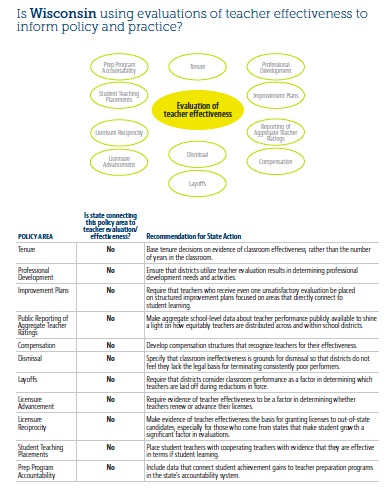
Round and Round Way: Federal waver from waver for State Teacher Evaluation Systems…

Andrew Rotherham

It’s starting to look like Tommy James and the Shondells might be the new theme music over at the Department of Education. Federal elementary and secondary education policy, already a barely cohesive mess because of the Administration’s waiver program, just got even more complicated. Yesterday Secretary of Education Arne Duncan announced that – if they apply for a waiver from their existing waiver – states can delay consequences for their new teacher evaluation systems until the 2016-2017 school year. He also announced a sensible step to avoid double-testing of students during the transition from existing assessments to new ones as part of Common Core implementation. Although critics are understandably jumping all over them for the waiver waivers, the Administration’s plan is not entirely indefensible because it’s aimed at a real issue. But it is quite problematic. Here are a few things to keep in mind.
– This is a big political win for AFT President Randi Weingarten. It’s not her moratorium per se but it’s awfully close and does hit the pause button on the issue that matters most to her members. And while state chiefs like Tony Bennett in Florida are already saying they won’t apply for a waiver waiver, many chiefs are going to face a lot of political pressure to do so. As you might expect there was a lot of behind the scenes back and forth on this and some state leaders worried this step would pull the rug out from under them. The Department is hoping that the September 30 deadline for applying for a waiver wavier will help stem the tide but the pressure will be intense.

Share

The Glaring Hypocrisy of the NCTQ Teacher Prep Institution Ratings

Bruce Baker:

But, given that NCTQ has just come out with their really, really big new ratings of teacher preparation institutions… with their primary objective of declaring teacher prep by traditional colleges and universities in the U.S. a massive failure, I figured I should once again revisit why the NCTQ ratings are, in general, methodologically inept & vacuous and more specifically wholly inconsistent with NCTQ’s own primary emphasis that teacher quality and qualifications matter perhaps more than anything else in schools and classrooms.
The debate among scholars and practitioners in education as to whether a good teacher is more important than a good curriculum, or vice versa, is never-ending. Most of us who are engaged in this debate lean one way or the other. Disclosure – I lean in favor of the “good teacher” perspective. Those with labor economics background or interests tend to lean toward the good teacher importance, and perhaps those with more traditional “education” training lean toward the importance of curriculum. I’m grossly oversimplifying here (perhaps opening a can of worms that need not be opened). Clearly, both matter.
I would argue that NCTQ has historically leaned toward the idea that the “good teacher” trumps all – but for their apparent newly acquired love of the Common Core Standards.
Now here’s the thing – if the content area expertise of elementary and secondary classroom teachers and the selectivity and rigor of their preparation matters most of all – how is it that at the college and university level, faculty substantive expertise (including involvement in rigorous research pertaining to the learning sciences, and specifically pertaining to content areas) is completely irrelevant to the quality of institutions that prepare teachers? That just doesn’t make sense.

Much more, here.

Share

Unpaid Internship? Some Colleges Pick Up the Tab

Melissa Korn:

The plight of the unpaid intern is improving. Not because businesses are paying more for summer helpers, but because colleges are stepping in to pay when companies can’t, or won’t, compensate student hires.
Schools have long granted stipends for stints in nonprofits and the arts, where unpaid labor is common, but now they are paying the way for students to work at profit-making enterprises, including a New York money-management firm, a Washington, D.C., lobbying firm and even a General Motors Co. GM -0.32% plant.
Colleges’ job-placement rates have come under intense scrutiny as cost-conscious families, stung by rapidly rising tuition, want proof that universities can deliver on both academic and career fronts.

Share

Tenure’s Fourth Rail

Colleen Flaherty:

Collegiality can be a dirty word in higher education — particularly in regard to tenure or promotion, where it frequently becomes a catchall for likability and other subjective qualities that some faculty advocates say can be used to punish departmental dissenters. But two researchers are trying – through data-based definitions and metrics – to sanitize collegiality enough for it to be a viable, fourth criterion in personnel decisions.
In academic departments, “what we want is productive dissent,” Robert Cipriano, professor emeritus and former chair of the department of recreation of leisure studies at Southern Connecticut State University, and author of Facilitating a Collegial Department in Higher Education: Strategies for Success, said during the American Association of University Professors’ annual meeting Thursday (where their push to formalize the role of collegiality in faculty employment decisions drew some skepticism from the assembled professors). “As passionate as the discussion is, it has to be respectful. You go to lunch and it’s over.”

Share

NYU’s ‘Toxic’ Expansion Prioritizes Marketing Over Debt-Saddled Students, Professors Say

Ben Hallman:

n a time of growing alarm over soaring student loan debt, New York University — which graduates the most indebted classes of students in the country — has embarked on an ambitious real estate expansion that could make the school even more expensive.
A vocal group of professors has mounted a rebellion aimed at halting the university’s plans, which call for the addition of 6 million square feet of new space over the next two decades. NYU’s administration has refused to publicly disclose the cost, but faculty critics point to estimates that the build-out could run several billion dollars.
“The situation is so toxic right now,” said Adam Becker, an associate professor of religious studies at the university, and a member of the faculty opposition movement. “People are angry at the place. We feel like we have been pushed into the corner.”
Like many of its students, NYU will need to finance its ambitions through borrowing. The plan’s critics argue that these costs will surely get passed along to future classes in the form of higher tuition and less financial aid.
“I think they should put more money back into scholarships for students instead of expanding,” said Sashika Gunawardana, who graduated from NYU in 2012 with about $150,000 in student loans.

Share

Wisconsin Leglislative Fiscal Bureau Budget Memo on Fund 80 and School Related Changes

Bob Lang, Wisconsin Legislative Fiscal Bureau (PDF):

COMMUNITY SERVICE LEVY (FUND 80)
Prohibit a district from levying more for community service activities in 2013-14 and 2014- 15 than it did in the most recent year preceding 2013-14 in which the district levied for those activities. Provide that if a district wishes to exceed the limit on the community service levy, the school board could adopt a resolution to exceed the limit by a specified amount and submit the resolution to the electors of the district for approval. Specify that the limit otherwise applicable to the district would be increased by the amount approved by a majority of those voting on the question.
Under ASA 1, a school district would be prohibited from levying more for community service activities in 2013-14 and 2014-15 than it did in 2012-13.
3. PARENTAL CHOICE PROGRAMS — STUDENT PRIORITY
Specify that under the ~xpandedchoice program outside of Milwaukee and Racine, a private school would be required to give preference to a pupil who satisfies either of the following: (a) the pupil was enrolled in a public school in the school district in the previous year and is applying to attend the school in grades 2 through 8 or 10 through 12; or (b) the pupil was not enrolled in school in the previous school year.
Under current law, choice schools must select pupils on a random basis, except that they may give preference in accepting applications to siblings of pupils selected on a random basis. Under ASA 1, schools would be allowed to give preference in accepting applications to any of the following: (a) pupils who attended the school under the choice program during the school year prior to the school year for which the application is being made; (b) siblings of pupils who attended the school during the school year prior to the school year for which the application is being made and to siblings of pupils who have been accepted to the school for the school year for which the application is being made; and (c) pupils who attended another school under a parental choice program during the school year prior to the school year for which the application is being made.
PARENTAL CHOICE PROGRAMS — RELEASE OF INFORMATION
Require DPI, when publicly releasing data related to, but not limited to, enrollment of, standardized test results for, applications submitted by, waiting lists for, and other information related to pupils participating in or seeking to participate in parental choice programs, to release the data all at the same time, uniformly, and completely. Provide that DPI may selectively release portions of the information specified above only to the following: (a) the school district or an individual school; and (b) an entity requesting the information for a specific participating school or the school district, provided that the entity is authorized to obtain official data releases for that school or the school district.
5. PARENTAL CHOICE PROGRAMS — REQUIRED CREDENTIALS FOR TEACHERS
Modify current law that specifies that a teacher in a choice school have a bachelor’s degree, to also allow a degree or educational credential higher than a bachelor’s degree, including a masters or doctorate.

Share

Big “take-aways” about teacher preparation in Wisconsin

Wisconsin Elementary Teacher Prep Rating Distribution


Wisconsin Secondary Teacher Prep Rating Distribution


National Council on Teacher Quality:

Highly rated programs — The undergraduate secondary program at the University of Wisconsin – Stout is on the Teacher Prep Review’s Honor Roll, earning at least three out of four possible stars. Across the country, NCTQ identified 21 elementary programs (4 percent of those rated) and 84 secondary programs (14 percent) for the Honor Roll.
Selectivity in admissions — The Review found that 32 percent of elementary and secondary programs in Wisconsin restrict admissions to the top half of the college-going population, compared to 28 percent nationwide. Countries where students consistently outperform the U.S. typically set an even higher bar, with teacher prep programs recruiting candidates from the top third of the college-going population.
Some worry that increasing admissions requirements will have a negative effect on the diversity of teacher candidates. By increasing the rigor and therefore the prestige of teacher preparation the profession will attract more talent, including talented minorities. This is not an impossible dream: 83 programs across the country earn a Strong Design designation on this standard because they are both selective and diverse, although no such programs were found in Wisconsin.
Early reading instruction — Just 25 percent of evaluated elementary programs in Wisconsin are preparing teacher candidates in effective, scientifically based reading instruction, an even lower percentage than the small minority of programs (29 percent) providing such training nationally. The state should find this especially alarming given that Wisconsin now requires elementary teacher candidates to pass one of the most rigorous tests of scientifically based reading instruction in the country.
Elementary math — A mere 19 percent of evaluated elementary programs nationwide provide strong preparation to teach elementary mathematics, training that mirrors the practices of higher performing nations such as Singapore and South Korea. 25 percent of the evaluated elementary programs in Wisconsin provide such training.
Student teaching — Of the evaluated elementary and secondary programs in Wisconsin, 58 percent entirely fail to ensure a high quality student teaching experience, in which candidates are assigned only to highly skilled teachers and receive frequent concrete feedback. 71 percent of programs across the country failed this standard.
Content preparation — None of Wisconsin’s elementary programs earn three or four stars for providing teacher candidates adequate content preparation, compared to 11 percent of elementary programs nationwide. At the high school level, 23 percent of Wisconsin secondary programs earn four stars for content preparation, compared to 35 percent nationwide. The major problem at the secondary level is that programs’ requirements for general science or general social science certifications do not ensure that candidates are prepared in the content of every subject they will be licensed to teach, since the states licensing test requirements do not provide this assurance.
Outcome data — None of the evaluated programs in Wisconsin earn four stars for collecting data on their graduates, compared to 26 percent of evaluated programs in the national sample. In the absence of state efforts to connect student achievement data to teacher preparation programs, administer surveys of graduates and employers or require administration of teacher performance assessments (TPAs), programs that fare poorly on this standard have not taken the initiative to collect any such data on their own.

Related: “Transparency Central” National Review of Education Schools and Georgia, Wisconsin Education Schools Back Out of NCTQ Review.
Erin Richards

  • Some of the education programs in Eau Claire, Platteville, River Falls, La Crosse and Madison received between two and two and a half stars.
  • Other programs in Eau Claire, Green Bay, La Crosse, Madison, Milwaukee, Oshkosh, Platteville, River Falls, Stevens Point, Stout, Superior and Whitewater received between one and one and a half stars.
  • About 1 in 3 teacher training programs reviewed restrict admission to the top half of the college-going population.
  • About 1 in 4 elementary education programs reviewed prepare teacher candidates in effective, scientifically based reading instruction
  • About 1 in 4 elementary ed programs reviewed provide strong preparation to teach elementary mathematics. That’s better than the national average of 19% of elementary education programs that offer strong math prep.
  • No Wisconsin programs evaluated earned any credit for collecting data on their graduates, compared with 26% of programs that did so in the national sample.

Nationally, more than 200,000 candidates graduate from teacher preparation programs each year, then enter systems where teacher quality has long been a point of debate.

Finally, Wisconsin recently adopted Massachusett’s elementary teacher content knowledge licensing (English only, not math) requirements beginning in 2014 (MTEL).

Share

More US Schools Go International

Stephanie Banchero & Caroline Porter:

An educational curriculum that originally catered to the children of globe-trotting diplomats is making rapid inroads in K-12 public schools across the U.S., boosting test results and academic readiness even at inner-city schools.
An educational curriculum designed for the children of globetrotting diplomats is making rapid inroads in K-12 schools across the U.S., showing surprising improvements in test results and academic readiness even at inner-city schools. Caroline Porter has details.
Houston, Chicago, Tampa, Fla., and other cities are embracing the International Baccalaureate [SIS IB Link] program as a way to overhaul low-performing schools, attract middle-income families who might otherwise favor private schools, or offer more choice.
“It’s not a program for the elite,” said Samuel Sarabia, who runs the IB program for Houston Independent School District, where 10 schools have IB programs, including two where the majority of students qualify for free or reduced-price lunch. Five more low-income schools are in the midst of an IB conversion process run by the nonprofit International Baccalaureate group.
The program began in Geneva in the 1960s as a two-year high-school diploma offering for the children of diplomats and itinerant business executives. It later expanded into elementary- and middle-school programs.
Today, there are 1,651 IB programs in the U.S.–including 1,493 public schools–up from 503 in 2003. About 90% of them are in public schools, and most are aimed at U.S. students, not the children of diplomats.
Officials tout the programs’ emphasis on critical thinking. Unlike the traditional model of teachers imparting knowledge in a lecture format, IB programs emphasize individual and group projects governed by a philosophy of “international mindedness.” Students are required to take a second language.

The Madison School Board rejected the proposed Madison Preparatory IB Charter school in 2012, largely sponsored by the local Urban League.

Share

How Poor Students Subsidize Unworthy College Sports

Richard Vedder:

As parents and students struggle to keep up with rising college tuition and take on greater burdens of debt, universities are being challenged to justify the ballooning athletic fees they tack on to the bill.
In the 2010-11 academic year, the 227 public institutions in Division 1 of the National Collegiate Athletic Association collected more than $2 billion in athletic fees from their students — or an average of more than $500 per enrollee — according to research by Jeff Smith at the University of South Carolina Upstate.
These fees, which can exceed $1,000 a year, are often itemized as a “student activity” or “general” expense. That may explain why separate research, by David Ridpath of Ohio University, found that students were only dimly aware of the extent of the fees, and weren’t pleased once they found out how much they were paying.
Worse yet, institutions with high proportions of poorer students carrying substantial education debt appeared to be charging the highest fees. While all students must pay the costs of maintaining athletic programs, few actually benefit from the services they subsidize. In this sense, the fees are comparable to a regressive tax — and one that is more onerous for lower-income students than for the more affluent, who are able to attend schools where athletic fees are lower.

Share

Schooling Ourselves in an Unequal America


Rebecca Strauss:

Averages can be misleading. The familiar, one-dimensional story told about American education is that it was once the best system in the world but that now it’s headed down the drain, with piles of money thrown down after it.
The truth is that there are two very different education stories in America. The children of the wealthiest 10 percent or so do receive some of the best education in the world, and the quality keeps getting better. For most everyone else, this is not the case. America’s average standing in global education rankings has tumbled not because everyone is falling, but because of the country’s deep, still-widening achievement gap between socioeconomic groups.
And while America does spend plenty on education, it funnels a disproportionate share into educating wealthier students, worsening that gap. The majority of other advanced countries do things differently, at least at the K-12 level, tilting resources in favor of poorer students.

Share

Data Suggest Boomer Faculty Are Putting Off Retirement

Colleen Flaherty:

At the height of the financial crisis, it was unclear how diminished 401(k)s and general economic uncertainty would impact retirement trends for baby boomer professors. But new data suggest that professors are either significantly – or indefinitely – putting off retirement, and not just for financial reasons. Experts say the trend is forcing institutions to rethink traditional faculty models.
Some 74 percent of professors aged 49-67 plan to delay retirement past age 65 or never retire at all, according to a new Fidelity Investments study of higher education faculty. While 69 percent of those surveyed cited financial concerns, an even higher percentage of professors said love of their careers factored into their decision.
“While many would assume that delayed retirement would be solely due to economic reasons, surprisingly 8 in 10 — 81 percent — cited personal or professional reasons for delayed retirement,” said John Rangoni, vice president of tax exempt services at Fidelity. “Higher education employees, especially faculty, are deeply committed to their students, education and the institutions they serve.”

Share

Our Schools, Cut Off From the Web

Luis Ubinas:

ON June 6, at a middle school in Mooresville, N.C., President Obama set a goal of high-speed Internet in nearly every public school in America in five years. It was a bold and needed pronouncement — except that in 1996 President Clinton said virtually the same thing, calling for libraries and classrooms to be “hooked up to the Information Superhighway by the year 2000.”
Many people reading this article are probably doing so on a smartphone, tablet or computer. They might not know that half of Americans don’t own a smartphone, one-third lack a broadband connection and one-fifth don’t use the Web at all.
Since 2007, when I was named president of the Ford Foundation, we’ve given $44.5 million to dozens of organizations — like Harvard’s Berkman Center for Internet and Society, the Mozilla Foundation and the Media and Democracy Coalition — to make the Internet more accessible, affordable and mindful of privacy.

Share

Sesame Street Creates a Muppet Whose Dad Is in Jail. Way Too Many Kids Relate.

Amanda Marcotte:

Grab your hankies: To help kids coping with a parent in prison, Sesame Street created a Muppet whose father can’t play with him because he’s in jail.
Sesame Street has always made it part of its larger mission to address all children, not just the ones with traditional families or easily digestible experiences. In the latest move toward that goal, the popular children’s program created an online toolkit, titled “Little Children, Big Challenges: Incarceration,” for those struggling to raise a child who has an incarcerated parent. Released just in time to help kids in need get through Father’s Day, the toolkit has its detractors. Alex Jones naturally went into full-blown conspiracy theory mode, calling it a “propaganda program designed to help children accept the fact that daddy is in jail” by dangerously telling kids that “all you have to do is talk about your feelings, draw a few pictures, write letters to your dad, and toddle off to visit him in jail every now and then and everything will be all rainbows and lollipops.” (Better to tell them … what?) Mike Riggs at Reason was also angry, though not at Sesame Street but at the U.S. government for incarcerating so many people that these kinds of materials are necessary. He points out that nearly 7 million people are under correctional supervision in this country, writing, “congratulations, America, on making it almost normal to have a parent in prison or jail.”
Obviously, Sesame Street can’t do anything about the growth of the police state or the war on drugs that has resulted in the massive incarceration numbers in this country. The show is just trying to help innocent children deal with the repercussions. But Riggs is absolutely right: That this even has to exist in the first place shows how much pointless damage our prison system does not just to people who are caught up in the overly punitive, often racially biased justice system, but also to their families. As Jill Filipovic writes in the Guardian:

Share

School ignores advice from learning disability experts

Jay Matthews:

Stacie Brockman is the Prince George’s County mother of lively twin 9-year-old boys. Her sons were born two months premature. She has done everything possible to deal with the disabilities that often impede the progress of such children.
She took them to the developmental pediatricians at the Kennedy Krieger Institute in Baltimore, one of the top U.S. providers of care for children with learning disabilities. They gave the boys many tests. They diagnosed mixed expressive/receptive language disorder, attention deficit hyperactivity disorder, dysgraphia (a writing disability) and dyslexia (a reading disability).
The doctors told Brockman that her sons need to be in small classes with research-based reading instruction and intensive math and language remediation. As the law requires, administrators at Potomac Landing Elementary School set up an individualized education program (IEP) team, which meets with Brockman.
As sometimes happens, these meetings have not gone well, Brockman said. Learning disability issues appear to be one of the greatest sources of friction between parents and schools. Brockman’s account reveals how clumsy educators can be in communicating to parents what they are doing with their children, and why.
Both boys have IEPs, Brockman said in an e-mail, but the team chairperson dismissed some Kennedy Krieger assessments, “saying that all of KKI’s reports say the kids are dysgraphic and dyslexic, thus suggesting that the reports have little or no validity.”

Share

When words are not enough: The dying art of professional letter writing

Xenia Chan and Hedy Bok:

Professional letter writers were once a common sight on Hong Kong’s streets, but today only a few survive. In the latest episode of our Uniquely Hong Kong series, we talk to Pun Tse-ching about the dying art
Pun Tse-ching, 73, performs a role which is dying out in Hong Kong. He is a professional Chinese letter writer.
As is that case with so many other industries, the rise of modern technology, coupled with higher rates of literacy, have led to a sharp fall in the number of letter writers.
Once they performed a vital role in Chinese society. During the 1950s, for example, they were needed because Hong Kong only had a literacy rate of about 60 per cent.
A professional letter writer or “se seun lou” (寫信佬) writes formal letters for customers in Chinese characters. These can include business letters or correspondence to family and friends abroad.Usually well-educated and highly literate, they were skilled in writing and performed the role of professional secretary. As well as writing letters, they also had to read letters to their customers.

Share

Graduates from low-performing D.C. schools face tough college road

Emma Brown:

Johnathon Carrington grew up on the sixth floor of a low-income D.C. apartment complex, a building most recently in the news for a drive-by shooting that injured 13.
His parents told him early on that education could be his escape, and Carrington took them at their word. He graduated Friday as the valedictorian of his neighborhood school, Dunbar High, and against all odds is headed to Georgetown University.
But Carrington, 17, is nervous, and so are his parents. What if Dunbar — where truancy is chronic and fewer than one-third of students are proficient in reading — didn’t prepare him for the rigors of college? What if he isn’t ready?
“I don’t think I’m going to fail everything,” Carrington said. “But I think I’m going to be a bit behind.”
It’s a valid concern. Past valedictorians of low-performing District high schools say their own transitions to college were eye-opening and at times ego-shattering, filled with revelations that — despite taking their public schools’ most difficult classes and acing them — they were not equipped to excel at the nation’s top colleges.
When these students arrived on campuses filled with students from high-flying suburban public schools and posh privates, they found a world vastly different from the one they knew in their urban high schools.
For Sache Collier, it meant writing her first research paper. For Darryl Robinson, it meant realizing that professors expected original ideas, not just regurgitated facts. For Angelica Wardell, who grew up going to school almost exclusively with African American students, it meant taking classes with whites and Asians.

Share

Evidence suggests voucher expansion won’t lift education

Karl Dommershausen:

I started out against the voucher program in Wisconsin, even organizing a letter from the Janesville School Board to our lawmakers opposing this effort. Later, I decided to research vouchers/charters and their tax credits/scholarships to understand them better. I didn’t study existing private schools, unless they were involved with vouchers.
Gov. Tommy Thompson started Wisconsin’s voucher system in 1990 in Milwaukee. It has grown, and other programs have emerged throughout the country. With thousands of voucher programs in 20 states, solid evidence for evaluation should exist. From Florida’s scholarship programs, Texas’ charter schools, Indiana and Louisiana’s charter-to-voucher adjustments, Tennessee’s Muslim question, and other adaptations, I searched for answers. Surprisingly, very little documentation of results exists, and what is available appears to be selectively picked.
Private companies and their associations have created the “mantra of choice and competition” for the impoverished, challenged and underperforming. This method focuses on the hopes and fears of parents. It also labels public schools and teachers as culprits, while ignoring social-economic factors, dwindling funding, or lack of parental involvement and responsibility.

Much more on vouchers, here.

Share

The Voucher Boondoggle in Wisconsin

Barabara Miner:

When Gwen Moore walked into Milwaukee’s North Division High School in September 1965, she was terrified.
“North was seen as this jungle,” she explains more than 40 years later. “All black, segregated, inferior.”
Moore had wanted to attend West Division high School, a “white” school closer to home. When she tried to register at West, school officials told her she had to go to North Division. (It would be another decade before the federal courts would order the desegregation of Milwaukee’s schools.)
“My mom was in Texas at a Baptist convention, and I talked to her and said, ‘Mom, they wouldn’t let me go to West,’ ” Moore remembers.
“Gerrymandering,” her mom muttered.
“Gerry who?” Moore asked.

Much more on vouchers, here.

Share

Getting Real Value Out of An Engineering Education

Eric Evenchick:

Succeeding in most engineering courses is a matter of memorizing material and passing an exam. Some courses will have lab exercises, but most of these boil down to following a predefined list of instructions as closely as possible, and collecting the highly predictable results.
To me, engineering is about applying knowledge to solve problems. Memorizing equations wont help you much with this, nor will repeating a list of steps. To get experience solving problems, you need real problems to solve.
This is where engineering student teams come in. These teams usually operate as extracurriculars, with only a handful of students participating.
These teams tackle problems that range from building a race car to designing nano-robotics. They need support with everything from software development to business and fundraising. My experience with student teams has been the most valuable part of my undergraduate education.

Share

ESF teacher’s quest to visit every province in China

Simon Parry:

The strangeness of English Schools Foundation teacher Chris Taylor’s quest to visit every mainland province dawned on him as he sat down on a bench in a town square in Ningxia – an obscure northwestern chunk of China most foreigners have never heard of, let alone considered visiting.
Alone and nearly 2,000 kilometres away from his family in Hong Kong and his job as head of senior school at Sha Tin College, the 43-year-old suddenly found himself surrounded by a throng of locals. “They just sat really close to me and stared and stared,” he recalls.
“As soon as I did anything like get my notebook out, everyone would be really interested and lean over and stare. I distinctly remember just wanting to be left alone and sitting there doing nothing until people finally dispersed and gave me a bit of space.”
Being the object of intense curiosity is an experience Taylor relived in different ways throughout 10 years visiting all 27 provinces and five autonomous regions of the mainland, an adventure recounted in his newly published book, Riding the Dragon.

Share

Half of Americans below or near poverty line

Paul Bucheit:

The Census Bureau has reported that 15% of Americans live in poverty. A shocking figure. But it’s actually much worse. Inequality is spreading like a shadowy disease through our country, infecting more and more households, and leaving a shrinking number of financially secure families to maintain the charade of prosperity.
1. Almost half of Americans had NO assets in 2009
Analysis of Economic Policy Institute data shows that Mitt Romney’s famous 47 percent, the alleged ‘takers,’ have taken nothing. Their debt exceeded their assets in 2009.
2. It’s Even Worse 3 Years Later
Since the recession, the disparities have continued to grow. An OECD report states that “inequality has increased by more over the past three years to the end of 2010 than in the previous twelve,” with the U.S. experiencing one of the widest gaps among OECD countries. The 30-year decline in wages has worsened since the recession, as low-wage jobs have replaced formerly secure middle-income positions.
3. Based on wage figures, half of Americans are in or near poverty.
The IRS reports that the highest wage in the bottom half of earners is about $34,000. To be eligible for food assistance, a family can earn up to 130% of the federal poverty line, or about $30,000 for a family of four.
Even the Census Bureau recognizes that its own figures under-represent the number of people in poverty. Its Supplemental Poverty Measure increases, by 50%, the number of Americans who earn between one-half and two times the poverty threshold.

Share

Experts’ wrong way to pick best principals

Jay Matthews:

Anyone involved with schools has noticed that many governors, legislators and school boards think business practices can improve education. There is little proof of this. It’s a fad. If we leave it alone, it will go away.
But sometimes the latest business idea is too foolish to ignore. Take, for instance, this recent commentary piece in Education Week, “We Need a New Approach to Principal Selection,” by Ronald J. and Bill J. Bonnstetter.
“Identifying an effective principal requires a clear vision of the job duties, expectations and required personal attributes,” they wrote. “While most selection committees would agree with these criteria, the present selection system ends up being filled with personal biases and status quo mentalities. That’s why we recommend using benchmarking.”
Ronald Bonnstetter is professor emeritus of science education at the University of Nebraska. He now works as senior vice president of research and development for his brother Bill, chairman of Target Training International, a private company that does human behavior and skill assessments for businesses and groups in 90 countries. The Bonnstetters know much about business and education, but they fail in this piece to consider the importance of finding out how well principal candidates have done with students.

Share

America’s worst Charities

Kris Hundley & Kendall Taggert:

Across the nation, hundreds of charities take your donations in the name of cancer patients, dying children and homeless veterans. But the real beneficiaries are the charity founders themselves and the for-profit companies they pay to run boiler rooms that dial for dollars. To tell the stories of America’s worst charities, reporters reviewed thousands of charities and charted their finances going back a decade. These charities use deception, and in some cases outright lies, to persuade donors to give. Then they spend as much as 90 cents of every dollar raised to generate more donations. Regulators have proven powerless to stop the cycle of waste and deceit.

Share

My mother was named teacher of the year: Her job is to get students college-ready

Michael Alison Chandler:

My mother, Rebecca Worthen Chandler, was named Teacher of the Year at a charter school in North Carolina where she teaches English, bringing an unexpectedly buoyant end to what has been one of the toughest years of her 36-year career.
The award “floored” her, she said, because by the last day of school, all she could think about was what she wished she had accomplished. She didn’t give personal feedback on all her students’ papers. She wasn’t able to set up individual writing conferences for everyone. She never made it to the games.
“You know in ‘Alice in Wonderland,’ where the Queen says she thinks about six impossible things before breakfast?” she said. “I feel like teachers do six impossible things and probably don’t have breakfast.”
For most of her career, she taught middle-school English at a private girls school in Shaker Heights, Ohio, where class sizes were small and college ambition was assumed, and where she was able to make a first-rate education affordable for my sisters and me (and to be our eighth-grade English teacher.)

Share

Race vs. class in college admissions: A false dichotomy or not?

Valerie Strauss:

The Supreme Court will soon hand down its verdict in a case that challenges racial preferences in admissions at the University of Texas. In this post, Richard D. Kahlenberg, a senior fellow at the nonprofit public policy research organization The Century Foundation, and a proponent of class-based affirmative action in higher education admissions, looks at the issue. This appeared on the foundation’s blog.
By Richard Kahlenberg
Sherrilyn A. Ifill, the president and director-counsel of the NAACP Legal Defense and Education Fund Inc., just wrote a New York Times op-ed in defense of race-based affirmative action. The future direction of such policies is likely to be decided at some time in the next two weeks when the U.S. Supreme Court issues its ruling in a challenge to racial preferences in the case of Fisher v. University of Texas.
In particular, Ifill is concerned that “an alarming number of scholars, pundits and columnists–many of them liberal–have declared that economic class, not race, should be the appropriate focus of university affirmative-action efforts.” As a longtime proponent of class-based affirmative action (author of a 1996 book, “The Remedy: Class, Race and Affirmative Action,” coauthor a 2012 Century Foundation report, “A Better Affirmative Action: State Universities that Created Alternatives to Racial Preferences”) and a liberal, to boot, let me explain why I disagree with the four central arguments Ifill advances in favor of racial preference policies.

Share

Mexico’s Spoiled Rich Kids

David Luhnow:

You can spot them prowling the streets of Mexico City’s wealthy enclaves in sports cars. The guys wear their hair slicked back and designer shirts with the top three buttons open. The women have expensive bags and sunglasses. They are nearly always followed by a black SUV packed with armed bodyguards.
They are known in Mexico as “Juniors”–the sons and daughters of the country’s elite, young people whose love of brand names is surpassed only by their sense of entitlement. Juniors grow up to dominate the upper echelons of business and politics. They live behind high walls, travel in private jets and seem utterly untouchable–and out of touch in a country that struggles with poverty and violence.
For the first time, though, Mexico’s Juniors are coming under fire. In April, Andrea Benitez, the daughter of a well-connected politician, turned up at a trendy restaurant in Mexico City without a reservation and threw a fit when she was not given the table she wanted. So she called inspectors at Profeco, the government’s consumer protection agency–which happened to be run by her father. Inspectors promptly shut down the restaurant.

Share

Big data meets the Bard

John Sunyer:

Here’s some advice for bibliophiles with teetering piles of books and not enough hours in the day: don’t read them. Instead, feed the books into a computer program and make graphs, maps and charts: it is the best way to get to grips with the vastness of literature. That, at least, is the recommendation of Franco Moretti, a 63-year-old professor of English at Stanford University and unofficial leader of a band of academics bringing a science-fiction thrill to the science of fiction.
For centuries, the basic task of literary scholarship has been close reading of texts. But for digitally savvy academics such as Moretti, literary study doesn’t always require scholars actually to read books. This new approach to literature depends on computers to crunch “big data”, or stores of massive amounts of information, to produce new insights.
Who, for example, would have guessed that, according to a 2011 Harvard study of four per cent (that is, five million) of all the books printed in English, less than half the number of words used are included in dictionaries, the rest being “lexical dark matter”? Or that, as a recent study using the same database carried out by the universities of Bristol, Sheffield and Durham reveals, “American English has become decidedly more ’emotional’ than British English in the last half-century”?

Share

A wallflower becomes a confident leader

Doug Erickson:

Myles Strong didn’t want to be noticed in middle school.
He kept to himself and never spoke in class. He wore bland polo shirts to avoid drawing anyone’s eyes.
“The Myles in middle school would not recognize this person. He’d think this was an alternate version of himself,” Strong, 19, said of himself Thursday at Madison East High School, where he is one of 360 seniors graduating Friday. La Follette High School also holds commencement exercises Friday, and ceremonies for Memorial and West are scheduled for Saturday.
High school is meant to stretch and push students. Strong’s transformation was particularly pronounced, faculty members say, turning a wallflower into a confident leader.
“This is one top-notch young man here,” East Principal Mary Kelley said Thursday when she ran into him in a school hallway.
Kelley was Strong’s principal at Black Hawk Middle School. By coincidence, they transitioned together to East four years ago.
Strong was so shy at Black Hawk he wouldn’t give his opinions in public, Kelley said. Strong puts it more pointedly: “I was living inside myself.”

Share

A Ripon Graduation Speech

Retired Ripon Superintendent Richard Zimman:

The first speech was at a family dinner following that graduation ceremony 44 years ago. My father told me the most important thing to remember was to choose my career carefully. He said that I should do something I loved because 40 years is a long time doing something you don’t like or you don’t care about.
That’s Lesson #2: “Work is a 4-letter word,” my father said, “but so is the word play. Find a job that brings playful joy every day and you’ll never work a day in your life.” Not that it hasn’t had its ups and downs, but being an educator has been a labor of love for me, and I’m thankful that I followed my father’s advice. Now it’s your turn to find your own labor of love.
My mother then said, “Not so fast, young man,” as she leaned over, elbowing my father lovingly in the process. “It’s not all about enjoying yourself,” she said. “It’s not all about you–that’s selfish and useless.” She insisted, “Find something that will make the world a better place than you found it.” Although my mother was not a camper, and never saw an insect that she didn’t run from, she believed in the good camper rule. “Always leave your campsite better than you found it,” and she preached it constantly.
That’s Lesson #3: Make a positive difference for others. When you look back at your life, you won’t be proud of the money you made or the stuff you’ve accumulated or even the fun times you had for yourself. No, you’ll look back and be most proud of what you did for others. You will feel your life was worth living because you made the world a better place for others. Then, my mother told me to stop chewing with my mouth open and to save room for dessert, and the speeches were over.

I hope that Zimman stats active on education issues.

Share

One year in, Oconomowoc High School staff, students adjusting to change

Alan Borsuk:

Time, time, time, see what’s become of Oconomowoc High School.
The nearly 1,500-student high school 30 miles west of Milwaukee attracted a lot of attention a year ago with a transformation plan: Reduce the staff, give most teachers increased workloads and pay, and implement learning approaches that call for more initiative by students and a lot of technology.
As Superintendent Patricia Neudecker (now retired) and high school Principal Joseph Moylan saw it, it was a way to tighten spending while personalizing and improving learning. As critics, including many teachers and students, saw it, it was a way to make things worse.
One year into the new reality, Oconomowoc High still stands. The critics haven’t been proved wrong, but it appears it was a pretty decent year by many measures. Change did not derail the basic flow of a healthy, energetic school and in some ways it helped. But there are signs of the stress the approach is putting on all involved, and change does not come easily.
With a bow to Simon and Garfunkel (“Hazy Shade of Winter,” of course), consider this an update focused on time, time, time.
Teachers’ time: For about a decade, the high school has used a block schedule, which means the school day is built around four longer periods rather than six or seven periods. The conventional teaching load in such a situation is three blocks a day. Many Oconomowoc teachers now teach all four blocks, which means they are in front of students just about all day.
Neudecker said the change was made to reduce staff and save money without reducing offerings to students. “We haven’t cut one program,” she said. “We have not increased our class size.”
In exchange for the heavier workload, teachers receive an additional $14,000 a year. For those affected, that has raised salaries to $50,000 at the starting level and $70,000 or more for experienced teachers.

Related: May, 2012: Budget Cuts: We Won’t Be as Bold and Innovative as Oconomowoc, and That’s Okay. Indeed. Madison appears to have mastered the art of status quo governance.

Share

How to Survive the Higher-Ed Meltdown

Thomas Lindsay:

Higher education is reeling. A recent study demonstrates that a third of colleges and universities are now financially unstable through overbuilding, over-borrowing, and over-diversifying. But the good news is there are schools not only surviving but prospering in these harsh times.
This good news comes from ARAMARK Higher Education’s Presidential Perspectives Series, a national forum authored by college and university presidents. Its Responding to the Commoditization of Higher Education includes an article by Michael MacDowell, president of Pennsylvania’s Misericordia University. MacDowell traces the historical roots of the higher-education crisis. Key to how we got to this point was society’s decision that nearly all should attend college, which raised costs for taxpayers. Moreover, with more-universal admissions, greater numbers of entering-college students find themselves “not ready for the experience,” leading them to drop out (often with student-loan debt) or to “take many years to graduate, thereby increasing the cost to taxpayers, themselves, and their families.” Simply put, with rising access, costs increased while student success fell.

Share

A Letter to the President


Chris Callison-Burch
:

Omar F. Zaidan, a Jordanian citizen, was denied re-entry to the US on the eve of his PhD defense at Johns Hopkins University. It has been over a year and a half, and he has not yet been allowed to return. This is madness. Omar is exactly the type of person who the US should be actively recruiting to come to the country. Here is a shortlist of reasons why:

  • The US government invested approximately $200,000 in Omar’s education through DARPA grants that paid for his tuition and his PhD stipend.
  • Omar had accepted a job at Microsoft Research in Seattle, where he would have repaid his moral debt to the country many times over by paying taxes on his high salary, and through his intellectual contributions to the US tech industry.
  • Omar is the best PhD student who I have supervised in the 6 years that I have been a computer science professor. Omar’s research into computational linguistics and Arabic dialects has implications for national defense as well as for the technology sector.
  • Omar is a model Muslim. Omar perfectly assimilated into US culture, while being proud of his own culture and religion. He made efforts to be an ambassador for Islam, patiently explaining aspects of his religion (like fasting at Ramadan) to his friends and classmates.
Share

New Superintendent Jennifer Cheatham calls for accountability across the board in Madison School District

Pat Schneider:

Fresh off a two-month tour to observe the operations of all 48 schools, various programs, and the Madison School District’s central administrative offices, Superintendent Jennifer Cheatham is promising to “ensure accountability at every level.”
Accountability as Cheatham describes it will include student achievement on standardized tests of the type that current school reform movements emphasize, but will go far beyond that to a new understanding of educators’ roles, the support they need to master them, and refined local measures of progress, she said.
“I worry that people perceive accountability as standardized test results, for example, and what I’m talking about is accountability for everybody playing well the function they are best positioned for in the service of children learning well,” Cheatham told me Thursday in an interview. “Educators at every level of the system lack clarity on what that particular function is for them.”https://www.schoolinfosystem.org/archives/2013/06/deja_vu_a_focus.php”>Accountability was one of five priority areas Cheatham identified in anEntry Plan Report released Wednesday. The others are: well-rounded, culturally responsive instruction; personal educational pathways for students; attracting, developing and retaining top-level talent; and engaging families and community members as partners.

Related: Deja Vu: A Focus on “Adult Employment” or the Impossibility of Governance Change in the Madison Schools.

Share

Much Ado About MOOCs

Rob Reich:

The backlash against MOOCs and online learning in higher education has begun. Philosophers at San Jose State University recently wrote an open letter to Harvard’s Michael Sandel, explaining why they were declining to support the use of his acclaimed class, Justice, in an online format provided by edX, an online course platform created jointly by Harvard and MIT. “There is no pedagogical problem in our department that JusticeX solves,” they wrote.
Moving beyond Sandel’s class to MOOCs of all kinds, they broadly rejected “products that will replace professors, dismantle departments, and provide a diminished education for students in public universities.”
The letter is an exceptional document, articulating with welcome clarity several distinct objections and concerns. In considering the future of higher education in an era of MOOCs and the expansion of online learning, these objections and concerns are worthy of widespread attention and debate.

Share

Peer to Peer: Portable Reviews set to speed up the publication of papers

The Economist:

ASK a researcher what annoys him most about scientific publishing, and slowness will come near the top of the list of gripes. It takes nearly six months, on average, for a manuscript to wend its way from submission to publication. Worse, before a paper is accepted by a journal, it is often rejected by one or more others. The reason need not be a fatal flaw in the research; sometimes the work is simply not splashy enough for outlets high up in the pecking order. But in the process, each journal’s editors send the paper for peer review–appraisal by experts in the relevant field–in much the way that each prospective purchaser of a house commissions his own survey. And, unlike those multiple, parallel surveys, the reviewers do not even get paid for their efforts.
Some publishers are at last beginning to twig that this is an awful waste of resources. Last month a number of them, including big ones like the Wellcome Trust, BioMed Central (BMC), the Public Library of Science (PLoS) and the European Molecular Biology Organisation, said they would give authors of papers they reject the option of making referees’ reports available to the other publishers.

Share

Brazilian students protest over inflation

Joe Leahy:

A series of student protests against bus fare rises in São Paulo have turned increasingly violent, bringing chaos to the centre of South America’s largest city and highlighting discontent with inflation in Brazil.
Police fired rubber bullets and tear gas to stop protesters occupying the city’s main thoroughfare, Avenida Paulista, disrupting evening traffic and leaving office workers stuck in their buildings. There were similar clashes in Rio de Janeiro and Porto Alegre in Brazil’s south.
In Sâo Paulo, 232 people were detained and 12 officers hurt, police said, while figures for the number of protesters injured were not yet available. “There were [tear gas] bombs landing on all sides,” said a protester, Bruna Gisi Martins de Almeirda, a student at the University of São Paulo. “I took one [rubber] bullet in the leg and one in the arm.”
The intensity and violence of the protests, which follow those in Turkey and were dubbed by one economist as Brazil’s “tropical spring”, are uncommon for a country that has enjoyed a decade of economic growth and represent a new challenge for President Dilma Rousseff.

Related: US student loan bubble.

Share

Study Gauges Value of Technology in Schools

Motoko Rich
With school districts rushing to buy computers, tablets, digital white boards and other technology, a new report questions whether the investment is worth it.
In a review of student survey data conducted in conjunction with the federal exams known as the National Assessment of Educational Progress, the nonprofit Center for American Progress found that middle school math students more commonly used computers for basic drills and practice than to develop sophisticated skills. The report also found that no state was collecting data to evaluate whether technology investments were actually improving student achievement.
“Schools frequently acquire digital devices without discrete learning goals and ultimately use these devices in ways that fail to adequately serve students, schools, or taxpayers,” wrote Ulrich Boser, a senior fellow at the Center for American Progress and the author of the report. The analysis of the N.A.E.P. data found that 34 percent of eighth graders who took the math exams in 2011 used computers to “drill on math facts” while less than a quarter worked with spreadsheets or geometric figures on the computer. Only 17 percent used statistical programs.
The federal survey data showed striking differences among racial groups and income levels. More than half of the black students who took the eighth-grade math exam in 2011 said they used computers to work on math drills, while only 30 percent of white students said they did. Similarly, 41 percent of students eligible for free and reduced lunches said they used computers for math drills, compared with 29 percent of students whose families earn too much for them to qualify for the lunches. In high school science classrooms, the use of technology evidently has not advanced much past the 1980s. According to the report, 73 percent of students who took the 12th-grade National Assessment science exam said they regularly watched a movie or video in class.
Such data, Mr. Boser said, suggested that technology “doesn’t seem to have dramatically changed the nature of schooling.” Experts who study the effectiveness of instructional technology say there is potential for some digital programs to improve teaching. John Pane, a senior scientist at the RAND Corporation, said good technology allowed students to work at their own pace and independently while teachers worked with smaller groups.
Mr. Pane conducted a study, financed by the federal Department of Education, of an algebra software program created by Carnegie Learning, a math curriculum developer. He found that high school students who used the program, which was designed to accompany a teacher-led curriculum, showed gains on their state-standardized math tests that were nearly double the gains of a typical year’s worth of growth using a more traditional high school math curriculum.
Whether those gains came from the use of technology or changes in the curriculum, he said, was hard to say. But Steve Ritter, chief scientist at Carnegie Learning, said one of the benefits of the technology was that it used the principles of cognitive science to help students gain a deeper understanding of concepts rather than simply drill math problems. “We’re not just seeing whether they got the answer right or wrong,” Mr. Ritter said, “but why they got it right or wrong.”

Share

New Jersey’s interdistrict school choice program is working well

Laura Waters:

Take over Camden Public Schools! Reform tenure and evaluate teachers and principals on student growth data! Strengthen and expand charter schools! Enact a school voucher bill!
Education reformers in New Jersey and elsewhere sure do love radical change, seven-league strides towards the imagined Bethlehem of high-achieving schools accessible to all children. We’ve no patience for baby-steps that gingerly transverse the mired ruts of the status quo, no time for triangulated compromises that slap a coat of paint on failing schools and call it an improvement.
But sometimes meaningful change does occur incrementally. This is hard to hear for die-hard reformers. But one particular Jersey-grown school reform measure argues for a gradual approach: the state’s Interdistrict Public School Choice Program.

Share

Intensity and Attachment: How the Chaotic Enrollment Patterns of Community College Students Affect Educational Outcomes

Peter Crosta:

This paper examines the relationship between community college enrollment patterns and two successful student outcomes–credential completion and transfer to a four-year institution. It also introduces a new way of visualizing the various attendance patterns of community college students. Patterns of enrollment intensity (full-time or part-time status) and continuity (enrolling in consecutive terms or skipping one or more terms) are graphed and then clustered according to their salient features.
Using data on cohorts of first-time community college students at five colleges in a single state, the author finds that, over an 18-semester period, 10 patterns of attendance account for nearly half the students. Among the remaining students who persisted, there is astounding variation in their patterns of enrollment. Clustering these patterns reveals two relationships: the first is a positive association between enrollment continuity and earning a community college credential, and the second is a positive association between enrollment intensity and likelihood of transfer.

Share

Texas students to seek federal help to soften ‘cruel’ truancy

Stephanie Simon:

Several students from northeast Texas said they plan to file a federal complaint on Wednesday accusing their school districts of cruel and unusual punishment by prosecuting them in criminal court for missing school or being late for class.
The civil rights complaint, a copy of which was obtained by Reuters, is directed at school districts in Dallas and three other communities.
The districts funnel truancy cases to a special court system that prosecuted more than 36,000 cases and collected $2.9 million in fines last year from students convicted of multiple unexcused absences or tardy arrivals, according to the complaint.
Students as young as 12 can be arrested and handcuffed at school. Once they turn 17, they can be jailed for failing to pay past fines, which can run into thousands of dollars, according to the complaint, which was drafted by the National Center for Youth Law and advocacy groups Texas Appleseed and Disability Rights Texas.
“I’m getting treated like a criminal,” Ashley Brown, 16, one of the complainants, told Reuters late on Monday. She said she had been erroneously sent to truancy court for four excused absences after her grandmother’s death.

Share

Inconvenient Educational Truths

Steve Prestegard:

The new money added to the K-12 system by 2010 equaled $4,714/pupil. Given public school enrollment of 872,000 students that year, Wisconsin taxpayers had provided public schools with a spending windfall of more than $4.1 billion a year by the time Governor Walker took office. So much for being “oblivious.”
Wisconsin journalists have failed to report this history. Further, they have failed to explain adequately that much of the new spending has not reached the classroom. Instead, it has gone to pension, health care, and other fringe benefits. Where such costs once equaled about a quarter of teacher salaries, in many school districts that share now exceeds fifty per cent. In the Milwaukee Public Schools, the meteoric rise in fringe benefits is the principal reason for reductions in education programming that have been part of recent budgets. …
The overall journalistic failure has predictable consequences when it comes to public opinion. In scientific polling, scholars at Harvard University have found that the public is clueless when it comes to public school spending and levels of teacher compensation.
These scholars have reported their findings in the respected journal Education Next. They find that the average citizen has a “wildly inaccurate” understanding of school finance. For example, “…[w]e asked respondents to estimate average per-pupil expenditures within their local school district and the average teacher salaries in their states…[W]e discovered that those surveyed, on average, underestimated per-pupil expenditures by more than half and teacher salaries by roughly 30 percent…”

Share

Voucher Schools: Inherently Unequal

Wisconsin Senator Tim Cullen:

Last week, I expressed my extreme disappointment when the budget-writing Joint Finance Committee voted along party lines to create a statewide unaccountable school voucher program.
Make no mistake – this plan creates two separate school systems in Wisconsin, both paid for by taxpayers.
In 1954, late Chief Justice of the U.S. Supreme Court Earl Warren said, “Separate educational facilities are inherently unequal.” His words hold true today.
While the agreement creates a 500-student cap during the program’s first year and a 1,000-student cap in subsequent years, the cap could be lifted in the future or may be line-item vetoed by the governor. The ultimate goal of voucher supporters is not to open the voucher program to 500 or 1,000 students, but an unrestricted expansion of vouchers.
The private school voucher effort is a political movement, not an educational movement. It is a top-down movement funded by tens of millions of dollars in out-of-state campaign contributions and the hiring of several highly-paid lobbyists.

Share

Wisconsin DPI Superintendent Plans Press Conference on Negative Affect of Voucher Expansion on Public Schools


DPI Superintendent, Tony Evers, and legislators who want to maintain Wisconsin’s proud system of public education, are holding a press conference on Monday, June 17 at 10 AM in the Assembly Parlor to address the recent decision by the Joint Committee on Finance to expand voucher funding at the expense of public schools. The Senate and Assembly will be voting to pass this extreme budget within weeks. Please join these folks to inform and educate the public about the negative impact that private school voucher expansion will have on Wisconsin’s public schools. Wear Red for Public Ed. We need a wall of support behind the speakers. Time is running short to stop this train wreck but we cannot allow our opposition to go unnoticed!
TIME / LOCATION: 10 am in the Assembly Parlor with Superintendent Tony Evers.

Governance change is apparently quite difficult within the present school district model.

Share

Deja Vu: A Focus on “Adult Employment” or the Impossibility of Governance Change in the Madison Schools

The Madison School Board discussed the renewal of Administrator contracts (500K PDF) during their June 10, 2013 meeting (video, about 50 minutes into the meeting). Listen via this 5mb mp3 audio.
The timing and length of administrator contracts along with substantive reviews is not a new subject:
February, 2006: Are Administrators Golden?

Lawrie Kobza pointed out last night that 2-year rolling administrative contracts may be important for some groups of administrators and that the School Board should consider that issue. Otherwise, if the annual pattern continues, extensions will occur in February before the School Board looks at the budget and makes their decisions about staffing. Even though the Superintendent has indicated what positions he proposes to eliminate for next year, when the School Board has additional information later in the budget year, they may want to make different decisions based upon various tradeoffs they believe are important for the entire district.
What might the School Board consider doing? Develop criteria to use to identify/rank your most “valuable” administrative positions (perhaps this already exists) and those positions where the district might be losing its competitive edge. Identify what the “at risk” issues are – wages, financial, gender/racial mix, location, student population mix. Or, start with prioritizing rolling two-year contracts for one of the more “important,” basic administrative groups – principals. Provide the School Board with options re administrative contracts. School board members please ask for options for this group of contracts.
Ms. Kobza commented that making an extension of contracts in February for this group of staff could make these positions appear to be golden, untouchable. Leaving as is might not be well received in Madison by a large number of people, including the thousands of MMSD staff who are not administrators on rolling two-year contracts nor a Superintendent with a rolling contract (without a horizon, I think). The board might be told MMSD won’t be able to attract talented administrators. I feel the School Board needs to publicly discuss the issues and risks to its entire talent pool.
Mr. Nadler reported that MMSD might be losing its edge in the area of administration. He gave one example where there more than a few applicants for an elementary school position (20 applicants); however, other districts, such as Sun Prairie, are attracting more applicants (more than 100). The communities surrounding Madison are becoming more attractive over time as places to live and to do business. If we don’t recognize and try to understand the issues, beyond simply wages and benefits, the situation will continue to worsen. I feel the process in place needs to change in order to be a) more responseive to the issues, b) more flexible for the School Board in their decisionmaking processes, especially around budget time.

Administrator Contracts – School Board Adds to Agenda

Questions that are not clear to me include: a) is a two-year rolling contract required for all administrators, b) what is the difference between non-renewal and extension of a contract – is the end of January date really an extension?, c)is there a Board policy – if not, does one need to be developed, d) are there options open to the School Board to hold on one-year contract extensions due to upcoming cuts to the budget, e) how can changes be made by moving/retraining staff if needed, and f) can grant money being used to pay for administrators be used in other ways (not including grant oversight/accounting? We’re in the same spot as the past two years – not talking about administrator contracts until one week or so before a deadline.
I feel this information needs to be clear and to be transparent to all employees, the board and the community. I believe a multi-year staffing strategy as part of a multi-year strategic plan is important to have, especially given the critical nature of the district’s resources. This idea is not proposed as a solution to the public school’s financial situation – not at all, that’s not the point.

Retired Ripon Superintendent Richard Zimman on the “adult employment focus”.
Additional administrator contract links, here.
It is ironic, in my view, that there has not been much change in the District’s administration from the Rainwater era….

Share

China grapples with attacks on teachers after cheating halted on college exam

Amy Li:

Days after dozens of Hubei teachers were attacked by angry students whose attempts at cheating on China’s highly competitive national college entrance exam were foiled, the nation is struggling to understand what exactly went wrong.
Shocked by the violence, many students and parents have urged an immediate overhaul of the gaokao, a system known to drill students into testing-taking machines.
The attack happened on Saturday afternoon outside a school in Hubei’s Zhongxiang city. After the exam, students besieged teachers who had reportedly imposed strict measures and stopped students from cheating.
Students and parents block teachers from leaving the Hubei school after the exam. Photo: Screenshot via WeiboMore than 50 teachers from outside Zhongxiang had been assigned to invigilate the exam on purpose, said media reports. Of those, two were attacked.

Share

Public education’s “culture of power”: Small minds, thin skins, fragile egos

Laurie Rogers:

“Culture of Power”: That’s what a parent recently called the prevailing attitude in the local school district. It’s an apt description. Power is what people in public education know, and power is what they crave. In any culture of power, dissenters are seen as the problem and dealt with accordingly.
I’m privileged to know some teachers and staff members who care deeply about the children and who work hard to do what’s best for them. But there are many, many others whose interests begin and end with themselves and with their own economic/political/social agenda. Conversing with these self-interested people in a reasonable, intelligent way is impossible, a fruitless exercise. They want; they don’t want. It’s all they can see. Their logic is infantile and their perspective constricted and unyielding. With thin skins and fragile egos, it doesn’t take much for them to start showing teeth and claws.
Public education has been infiltrated by a willfully ignorant, bureaucratic, obscenely expensive, narcissistic, dictatorial mob. The Edu Mob is an enterprise concerned with enriching, maintaining and expanding itself — not with accountability, responsibility or transparency. Derelict in its duty to the children and morally bankrupt, the Edu Mob blames others, attacks dissenters, and finds creative ways to get more money (such as filing lawsuits; trading private student information for grants and other payments; and training children to support the enterprise without question).

Share

New Denver Public Schools remedial classes aimed at college success

Zahira Torres:

KayLynn McAbee is one of thousands of high school graduates across the state slated to take costly remedial courses that do not count toward her college degree.
But McAbee will not have to pay for the courses because of a new summer program developed by Denver Public Schools. The program, which will offer free remedial classes in math and English, is geared toward curbing the number of DPS graduates taking remedial courses in college.
“This will help a lot of students because they’re not just remedial classes, they’re also classes that will help kids be more confident in college,” McAbee said.
District officials said they came up with the program after the release of a report earlier this year from the Colorado

Share

The family of Mann Scholars continues to grow, achieve

A. David Dahmer:

The Mann Scholars Ceremony was celebrated at the Wisconsin Institute of Discovery Town Center on the University of Wisconsin-Madison campus June 7.
“It’s a thrill to welcome you all here today to celebrate our new Mann Scholars and our graduating seniors,” said Madison Metropolitan School District Partnerships Coordinator Kathy Price. “The Madison Board of Education and our new [MMSD] Superintendent Jennifer Cheatham are extending their warmest wishes to you tonight and their sincere congratulations. For the Madison District, the Mann Scholars program represents one of our premiere collaboration of family, school, and community partners. This is one that has served as a model for additional scholarship programs that have been launched including the Sanchez Scholars and our the newest scholarship that we have launched — the Reading Recovery Scholarship Program.”
The Mann Educational Opportunity Fund is a scholarship that honors the late Bernard and Kathlyn Mann, long-time African American residents of Madison whose strong belief in education helped ensure the graduation of their five children from Madison Memorial High School and later from universities. The Mann Program’s goal is to provide mentoring and educational tools to students from the Madison Metropolitan School District who show potential for academic achievement but face significant challenges to reaching their full potential.
Mann Scholars are picked every year based on their academic promise, their motivation, their financial need, and the willingness of their families to encourage participation in enrichment activities. They are primarily, but not exclusively, students of color.

Share

Sweden’s data protection Authority bans Google cloud services over privacy concerns

a Simon Davies:

In a landmark ruling, Sweden’s data protection authority (the Swedish Data Inspection Board) this week issued a decision that prohibits the nation’s public sector bodies from using the cloud service Google Apps.
The ruling – which bans Google cloud products such as calendar services, email and data processing functions – is based on inadequacies in the Google contract. A risk assessment by the Board determined that the contract gives Google too much covert discretion over how data can be used, and that public sector customers are unable to ensure that data protection rights are protected.
The assessment gives several examples of this deficiency, including uncertainty over how data may be mined or processed by Google and lack of knowledge about which subcontractors may be involved in the processing. The assessment also concluded that there was no certainty about if or when data would be deleted after expiration of the contract.

Many schools use Google apps.

Share

How critical are the early years of life?

Tyler Cowen:

“Early intervention” to benefit children is one of those sacred cows which I consider unproven and which also is cited in far too malleable a fashion. Here is a new paper by Alan Rushton, Margaret Grant, Julia Feast, and John Simmonds, probably gated for many of you, but worth a read if you can.
The abstract is too wordy, but the study is a follow-up on one hundred Chinese girls who first lived in Chinese orphanages, were later adopted into the UK, and who now are 40 to 50 years old. The orphanage involved deprivation and even some malnutrition (55% of sample). There was basic medical care and supervision, although no general one-to-one caregiver relationship.
Of the initial hundred children, 98 were still alive and 72 of those responded to the survey, which also involved extensive follow-up interviews.
Most entered the orphanage very early, in the first year of life, with a mean of three months old. Age at exit varied between eight months and 83 months, with a mean of 23 months, and with a mean of 20 months spent in the care of the orphanage.

Madison Superintendent’s “Entry Process Report”


Madison Superintendent Jennifer Cheatham (PDF):

Strengths
Overall Themes
Quality of teachers, principals, and central office staff: By and large, we have quality teachers, principals, support staff and central office staff who are committed to working hard on behalf of the children of Madison. With clarity of focus, support, and accountability, these dedicated educators will be able to serve our students incredibly well.
Commitment to action: Across the community and within schools, there is not only support for public education, but there is also an honest recognition of our challenges and an urgency to address them. While alarming gaps in student achievement exist, our community has communicated a willingness to change and a commitment to action.
Positive behavior: District-wide efforts to implement an approach to positive student behavior are clearly paying off. Student behavior is very good across the vast majority of schools and classrooms. Most students are safe and supported, which sets the stage for raising the bar for all students academically.
Promising practices: The district has some promising programs in place to challenge students academically, like our AVID/TOPS program at the middle and high school levels, the one-to-one iPad programs in several of our elementary schools, and our Dual Language Immersion programs. The district also does an incredibly successful job of inclusion and support of students with special needs. Generally, I’ve observed some of the most joyful and challenging learning environments I’ve ever seen.
Well-rounded education: Finally, the district offers a high level of access to the arts, sports, world language and other enriching activities that provide students with a well- rounded learning experience. This is a strength on which we can build.
“AVID is totally paying off. Kids, staff, everyone is excited about what it has brought to the school.” – Staff member
“Positive Behavior Support has made a dramatic improvement in teaching and the behavior expected. We’ve seen big changes in kids knowing what is expected and in us having consistent, schoolwide expectations”
– Staff member
Challenges
Focus: Principals, teachers and students have been experiencing an ever-changing and expanding set of priorities that make it difficult for them to focus on the day-to-day work of knowing every child well and planning instruction accordingly. If we are going to be successful, we need to be focused on a clear set of priorities aimed at measurable goals, and we need to sustain this focus over time.
“One of the strengths of MMSD is that we will try anything. The problem is that we opt out just as easily as we opt in. We don’t wait to see what things can really do.”
– Staff member
Coherence: In order for students to be successful, they need
to experience an education that leads them from Pre-Kindergarten through 12th grade, systematically and seamlessly preparing them for graduation and postsecondary education. We’ve struggled to provide our teachers with the right tools, resources and support to ensure that coherence for every child.
Personalized Learning: We need to work harder than ever to keep students engaged through a relevant and personalized education at the middle and high school levels. We’ve struggled to ensure that all students have an educational experience that gives them a glimpse of the bright futures. Personalized learning also requires increased access to and integrated use of technology.
Priority Areas
To capture as many voices as accurately as possible, my entry plan included a uniquely comprehensive analysis process. Notes from more than 100 meetings, along with other handouts, emails, and resources, were analyzed and coded for themes by Research & Program Evaluation staff. This data has been used to provide weekly updates to district leadership, content for this report and information to fuel the internal planning process that follows these visits.
The listening and learning phase has led us to five major areas to focus our work going forward. Over the next month, we’ll dive deeper into each of these areas to define the work, the action we need to take and how we’ll measure our progress. The following pages outline our priorities, what we learned to guide us to these priorities and where we’ll focus our planning in the coming month.

Matthew DeFour collects a few comments, here.
Much more on Madison’s new Superintendent Jennifer Cheatham, here.

Share

Ethnicity, Class and Suicide Lead a Hamptons School to Reach Out

Jim Rutenberg:

As he walked the East Hampton High School campus on the last day of classes last week, Adam S. Fine seemed to be one satisfied principal. Graduating seniors were moving on to colleges including Brown and Cornell Universities; class-cutting was down; and Newsweek had ranked the school among the 2,000 best public schools in the nation, all to be expected in a ZIP code synonymous with success.
But, asked to reflect on the year that was, he sighed and moved his hand up and down, suggesting a roller coaster. “Resiliency,” he said. “That’s my theme word for graduation.”
This has been a year like none other for East Hampton High, which faced an uncomfortable ethnic integration problem that had been festering in the background for years but was thrust to the foreground by a tragedy at the opening of the school year.
A 16-year-old junior from Ecuador, David Hernandez, hanged himself just a few days after homecoming in September; it was the second student suicide in three years. Two months later, a student who was about to transfer to the school committed suicide. Three suicides in three years in a school community of about 900 students is far above the regional average. And all of the students who killed themselves were Hispanic.

Share

In Raising Scores, 1 2 3 Is Easier Than A B C

Motoko Rich:

David Javsicas, a popular seventh-grade reading teacher known for urging students to act out dialogue in the books they read in class, sometimes feels wistful for the days when he taught math.
A quiz, he recalls, could quickly determine which concepts students had not yet learned. Then, “you teach the kids how to do it, and within a week or two you can usually fix it,” he said.
Helping students to puzzle through different narrative perspectives or subtext or character motivation, though, can be much more challenging. “It could take months to see if what I’m teaching is effective,” he said.
Educators, policy makers and business leaders often fret about the state of math education, particularly in comparison with other countries. But reading comprehension may be a larger stumbling block.
Here at Troy Prep Middle School, a charter school near Albany that caters mostly to low-income students, teachers are finding it easier to help students hit academic targets in math than in reading, an experience repeated in schools across the country.
Students entering the fifth grade here are often several years behind in both subjects, but last year, 100 percent of seventh graders scored at a level of proficient or advanced on state standardized math tests. In reading, by contrast, just over half of the seventh graders met comparable standards.

Share

When did parents and teachers become enemies of education?

Steve Norton:

The evidence is piling up that the Snyder administration was closely involved in the effort to construct an alternative “education” system whose top priority is to minimize public school costs, not improve education. According to emails obtained by the Detroit News, top advisers to Gov. Rick Snyder helped put the so-called “skunk works” group together or approved of its creation as early as September 2012.
From the parent perspective, one of the most disturbing discoveries was a statement by Gov. Snyder’s chief of staff, Dennis Muchmore. “Frankly, there’s nothing I enjoy more than seeing the education community in a fratz,” Muchmore wrote not long after the “skunk works” story first broke.
Thousands of parents, educators, and other concerned citizens who care about quality public education expressed their outrage at the secrecy and narrow vision of the “skunk works” project. Since when did we become the enemy? What kind of distorted lens must members of the Snyder administration be using that they see in concerned parents an opponent to be overcome rather than a constituency to be heard?

Share

Filling India’s Huge Need for Vocational Training

Amy Yee:

In a simple classroom above a storefront on a bustling street, four young men crowded around the colorful innards of an open computer hard drive while their teacher explained in Hindi how it all worked.
The computer repair course was among 25 offerings at Gras Academy, a private institution with 58 skills training centers across India, including this one in Ghaziabad, a city on the outskirts of New Delhi.
Gras is one of a burgeoning number of private academies providing hands-on job training in India, filling a gap between government vocational centers and four-year universities. These schools — which offer short, practical, nondegree programs — have been growing since the early 2000s.
India has a vast population of young people, with more than half of its population of 1.2 billion younger than 25. It faces the immense challenge of harnessing this generation as a productive work force, or else facing the combustible prospect of hundreds of millions of unemployed youth in the future. The Indian government estimates that 500 million young people must be trained by 2022 and has made skills training a major policy issue.
Inderjeet Singh, 19, is a first-year student at a government college; but attendance there is not mandatory, giving him time to attend Gras’s computer repair class. His college tuition is about 5,000 rupees, or less than $90, per year, but he is willing to pay 22,000 rupees for the six-month Gras course. He thinks it will be worth it, because 70 percent to 75 percent of Gras’s graduates find jobs immediately, according to the academy.

Share

My sister absolutely refuses to learn math

Mathematics Stack Exchange:

My 13-year-old sister has a problem which, given the way math is currently taught, I doubt is anything but all too common. She has a low grade in her math course and only ever attempts to memorize formulas and tricks, but never actually learn any of the reasoning behind the math. Cross multiplication is the perfect example.
She knows that from
35=x10
.. she can “cross multiply” to get
30=5x
.. and from there get x=6. She has absolutely no idea what any of this means, however. She’s simply memorized a pattern and is applying that pattern to a recognizable arrangement of numbers.

Share

Is the college process fair?

Elizabeth Hong:

Is the college admissions process fair? That’s been the question of this year’s college admission season, with articles like Suzy Lee Weiss’s Wall Street Journal Op-Ed “To (All) the Colleges That Rejected Me” and the Fisher v. University of Texas Supreme Court case challenging race-based Affirmative Action. As a recent high school graduate from a private school in New York, I have thought much about this topic.
I first read Weiss’s piece when it was published in March. Since then, it has gone viral and has received a mostly negative response, with Weiss criticized for having a sense of white entitlement (See “To (All) the White Girls Who Didn’t Get Into The College of Their Dreams“). Weiss was lucky enough to get into some of the Big 10 schools, including the University of Michigan and Penn State, but was upset she did not get into more elite schools. She felt discriminated against for being Caucasian. In herWall Street Journal editorial, she wrote, “What could I have done differently over the past years? For starters, had I known two years ago what I know now, I would have gladly worn a headdress to school. Show me to any closet and I would’ve happily come out of it. ‘Diversity!’…If it were up to me, I would’ve been any of the diversities: Navajo, Pacific Islander, anything. Sen.”

Share

Ed school dean: Urban school reform is really about land development (not kids)

Leslie T. Fenwick:

The truth can be used to tell a lie. The truth is that black parents’ frustration with the quality of public schools is at an all time righteous high. Though black and white parents’ commitment to their child’s schooling is comparable, more black parents report dissatisfaction with the school their child attends. Approximately 90 percent of black and white parents report attending parent teacher association meetings and nearly 80 percent of black and white parents report attending teacher conferences. Despite these similarities, fewer black parents (47 percent) than white parents (64 percent) report being very satisfied with the school their child attends. This dissatisfaction among black parents is so whether these parents are college-educated, high income, or poor.
The lie is that schemes like Teach For America, charter schools backed by venture capitalists, education management organizations (EMOs), and Broad Foundation-prepared superintendents address black parents concerns about the quality of public schools for their children. These schemes are not designed to cure what ails under-performing schools. They are designed to shift tax dollars away from schools serving black and poor students; displace authentic black educational leadership; and erode national commitment to the ideal of public education.
Consider these facts: With a median household income of nearly $75,000, Prince George’s County is the wealthiest majority black county in the United States. Nearly 55 percent of the county’s businesses are black-owned and almost 70 percent of residents own homes, according to the U.S. Census. One of Prince George’s County’s easternmost borders is a mere six minutes from Washington, D.C., which houses the largest population of college-educated blacks in the nation. In the United States, a general rule of thumb is that communities with higher family incomes and parental levels of education have better public schools. So, why is it that black parents living in the upscale Woodmore or Fairwood estates of Prince George’s County or the tony Garden District homes up 16th Street in Washington D.C. struggle to find quality public schools for their children just like black parents in Syphax Gardens, the southwest D.C. public housing community?

Share

What Critical Problems in K-12 Schools Does Online Instruction Solve?

Larry Cuban:

K-12 online instruction attracts policy-inclined school reformers and reform-minded policymakers because it appears as a technological and inexpensive solution for serious problems at a time when public schools are viewed as a double failure: in urban districts where largely poor and minority youth get a third-rate education and many suburban and rural schools that fall short of producing skilled and knowledgeable graduates who can contribute to a strong, competitive global economy.
Here is a brief list of those problems that promoters say will get solved through virtual instruction.
Traditional whole-class instruction. Teaching lessons to the whole group of 25-30 students at one time generation after generation has resulted in tedium and boredom for students who already know the content or are too far behind to grasp the lesson. It has been difficult for teachers with these size classes and district and state requirements to cover the curriculum to hit the sweet spot of learning that brings all students along at the same time.

Share

Professional Development Goes Rogue

David Cohen:

My last professional development experience occurred at a bar, with a pitcher of beer passed among participants at the table. Don’t worry – no district funds were misspent. It was my second time joining an informal evening tweet-up (i.e., organized on Twitter) of Computer-Using Educators (CUE) in the San Francisco Bay Area. These gatherings go by hashtag #brewcue. There’s an occasional afternoon version – same idea, more caffeinated – called #coffeecue, with gatherings popping up in a wider variety of locations.
I won’t be able submit any paperwork from these experiences, won’t be reimbursed or move up the pay scale – but I have benefitted from the experience. At my first #brewcue I talked with peers about how we manage paperless assignments and grading, and even had a chance to talk with someone working on the technical side of this matter, developing a product called Voice Comments. Then I heard about how different schools organize teacher time in different ways to promote technology integration. And then I listened in as two tech gurus shared their perspectives on how to make informed and cost-effective purchasing decisions that promote student learning and autonomy. And then I learned how students can use Minecraft in a variety of educational ways. As the parent of a California fourth-grader, I found the online California Mission Reports particularly interesting.

Share

Cameras in Schools: Extra Safety Measure or Violation of Privacy?

Ruthie:

Everyone is familiar with camera surveillance at banks, high-end stores, and office buildings. In a post-Newtown world, however, surveillance cameras are becoming increasingly familiar in neighborhood schools. In fact, after the tragedy in December, over 62 of the 400 bills relating to school safety nationwide, pertained to surveillance cameras.
Proponents argue that cameras in schools can be an efficient, minimally intrusive method of security. Unlike metal detectors or guards, cameras do not significantly impact the daily lives of students and teachers. Cameras are also more affordable than other forms of security. “They (schools) can now buy 10 cameras where they could afford two before, so they’re becoming more mainstream,” said Bob Stockwell, a global technology leader with Stanley Security.
Cameras are not only easily accessible, they are also able to provide sharper images and greater storage capacity, enabling footage that is easy to view, store, and share. This technology is considered a cutting edge way of keeping schools safer.

Share

The University of Wisconsin Tuition Freeze in Context

Sara Goldrick-Rab:

The only problem is that neither the chart or the accompanying article addresses the likely assumption of many readers: students who can’t pay these costs, even by working, are “held harmless” through financial aid. For that reason, many say, we should simply raise tuition further and invest that additional revenue in financial aid distributed to the neediest students.
To evaluate that claim, let’s take a look at the “net price” of attending UW-Madison and UW-comprehensives– the cost paid by the poorest students after taking into account all grant/scholarship aid provided to offset the sticket price.
At UW-Madison, for the upcoming year 2013-2014, that amount is $13,635.00 for Pell recipients with no expected family contribution. As you can see in the chart above, that means students from families typically earning less than $30,000 a year are expected to either work 1,866 hours a year (~35 hours/week) or borrow around $68,000 (5 years is typical time-to-degree for these students at Madison). Is this a reasonable proposition?
In addition, consider that no more than say 3-4% of UW-Madison undergraduates come from this sort of family. After all, more than 85% of students do not receive any Pell at all. For those students, the net price is over $21,000 in the coming year (total cost in 2013-14i s $24,000). Redistribution is helping very, very well– and many students with substantial need deliberately overlooked by the federal “needs analysis” are being left out in the cold. It’s no wonder there’s now backlash against our financial aid system– there’s universal need and a narrow means-tested system. Never works.

Share

Madison school with steepest growth in poverty

Pat Schneider:

How does an elementary school adjust to a steep and rapid rise in the number of poor children coming through its doors?
With programs to build language and technological literacy, resilient character, and ties to the community, says Brett Wilfrid, principal of Sandburg Elementary School, 4114 Donald Drive, on Madison’s far east side.
“When people come and spend time in this school, they see a lot of happy children and adults. It is a wonderful, thriving community,” Wilfrid told me in a phone interview Thursday.
I spoke with Wilfrid after a Cap Times data report published this week showed that Sandburg Elementary had the greatest increase in the Madison School District — 34.3 percentage points — in the number of children from low-income families in the past decade.
The percentage of low-income children, based on eligibility for free or reduced price lunch, rose from 37.9 percent of Sandburg enrollment in the 2003-2004 school year to 72.2 percent this year.
(One district evening program to help students who have left school to get their high school diplomas saw a slightly higher rate of increase, 35.4 percent, in the percentage of low-income students enrolled.)

Related: Madison Schools’ Measures of Academic Progress (MAP) Assessment Results Released.

Share

Failing Math Curriculum in Seattle Public Schools

Cliff Mass:

If I was a Seattle Public School parent, I would be getting angry now.
Why? Most Seattle students are receiving an inferior math education using math books and curriculum that will virtually insure they never achieve mastery in key mathematical subjects and thus will be unable to participate in careers that requires mathematical skills.
There are so many signs that a profound problem exists in this city. For example,
Parents see their kids unable to master basic math skills. And they bring home math books that are nearly indecipherable to parents or other potential tutors.
Nearly three quarters of Seattle Community College students require remediation in math.
Over one hundred Seattle students are not able to graduate high school because they could not pass state-mandated math exams.
Minority and economically disadvantaged students are not gaining ground in math.

Much more on Seattle’s math battles, here.
Related:

Share

And Yet, Another Bomb

Madison Teachers Solidarity Newsletter (PDF), via a kind Jeannie Bettner email:

In Governor Walker’s first legislative session, using the ruse that the State was millions in debt, he proposed eliminating collective bargaining for public employees as the means to fill in the alleged budget deficit. As he described it, he dropped the bomb.
Last week, another legislative session and another bomb. Walker’s budget will hit education and educators once again. It is a giant step to privatize education. This is done by forcing pubic schools to pay tuition for children to attend religious and private schools by giving the parents of such children a voucher which forces the public school district to send money to the religious or private school. Walker and his right- wing legislators made vouchers available in every school district in the State. To this, UW Education Dean Julie Underwood said, “School Boards beware”, that this is, “the model legislation disseminated by the pro-free market American Legislative Exchange Council’s network of corporate members and conservative legislators to privatize education and erode local control.” In criticizing the legislation, State Superintendent Tony Evers chided, “A voucher in every backpack.”
Public school districts lose twice. Once by having to use money intended to educate children in their schools, and also losing State aid because they cannot count the child attending the religious or private school on which State aid is based. It is projected that this will cost MMSD $27 million over the next five years. Vouchers provide parents $4,000 per year for an elementary school student and $10,000 for a high school student. State Senator Jennifer Schilling calls it, “Vouchers on steroids!” Research shows that most voucher schools in Wisconsin underperform compared to their public school counterparts.

Much more on vouchers, here.

Share

Open Letter to Dr. Diane Ravitch from Ben Austin

Ben Austin, via a kind email:

Parents, educators, and education advocates have a lot in common when it comes to a kids-first first agenda. But we can never seize that common ground if those with whom we disagree are deemed to be “evil” and sentenced to Hell, as you did last week in your now infamous blog post.
If we can’t start from that basic premise, then we are no more mature than the children we endeavor to serve. We cannot purport to encourage tolerance and discourage bullying on the schoolyard if the adults in charge of the schoolyard can’t adhere to those same basic principles.
For the past year, the organization for which I serve as executive director – Parent Revolution – has been working with parents from the Watts neighborhood community school Weigand Avenue Elementary to help turnaround their failing school. Although there appear to be some areas of improvement at the school, Weigand is currently ranked 15th worst of nearly 500 elementary schools in the Los Angeles Unified School District (LAUSD), and has been on a continual overall downward slide for the past 3-4 years under its current school leadership.
Four years is a long time for parents to wait for improvements in a failing school, despite even the best of intentions from dedicated professionals like Weigand’s current principal. Unfortunately, the current principal was unable to make the progress needed to turnaround the school.
In 2011 many of these same parents petitioned along with Weigand’s teachers to oust their failed principal, but had no real power to force change, and the principal retained her job. Every teacher who signed that 2011 petition is now gone, and the school has gotten even worse since then.
Many of the kids have now “graduated” without having learned basic skills. Currently, more than half of kids at Weigand cannot read, write, or do math at grade level.

Share

The Teacher Pension Crisis: Is There a Solution?

Ruthie:

Teacher pensions are in danger in many states. Educators deserve a secure retirement; however, lawmakers have for years promised benefits that the system cannot afford. According to some estimates, America’s pensions are underfunded by nearly one trillion dollars. This reality has caused experts to debate who is at fault, and what can be done to create a solvent system.
Yesterday, the Thomas B. Fordham Institute held a panel discussing a new report, “The Big Squeeze: Retirement Costs and School District Budgets.” Participants included Sandi Jacobs from the National Council on Teacher Quality, Josh B. McGee from the Laura and John Arnold Foundation, Charles Zogby, Pennsylvania’s budget secretary, and Leo Casey, from the Albert Shanker Institute.
The panelists discussed the teacher pension issue through the lens of three school districts: Milwaukee, Cleveland, and Philadelphia. One panelist simplified the situation in these three states, stating that the cost to repair these underfunded systems lie either on the state (tax payers), retired teachers, or new teachers. Something must be done to ensure that teachers are compensated fairly and currently retired teachers do not lose promised benefits.
When Milwaukee was faced with a crippling pension situation in 2011, under Governor Walker’s Act 10 labor reforms, retiree costs were deescalated by requiring employees to pay in to their pension accounts, instead of being covered exclusively by the district. Similarly, the Cleveland Metropolitan School District was able to scale back retiree costs by increasing taxes on new employees, whose future pensions will be funded differently.

Share

School board stipends: Fair compensation or a luxury of the past?

Danielle Arndt:

Ann Arbor Board of Education members earn $130 per month for attending meetings. Broken down per meeting, that’s about $43. Other school board members in Washtenaw County earn $25 or $30 per meeting — or nothing at all.
Desperate times call for desperate measures.
It’s a statement that recently has played out in school districts across the state of Michigan, as the number of traditional public schools facing staggering deficits and elimination of key educational services for Fiscal Year 2014 grows.
In Ann Arbor, high school transportation; more than 80 employees, including about 50 teachers; middle school pools; and several athletics programs are on the chopping block for the 2013-14 academic year.
However, one item not on the table is school board members’ per diem stipends.

Share

On Writing in English: Language Evolves Over The Years

Chiew-Siah Tei:

My childhood memory is crowded with people, with their different languages and accents: my family spoke Mandarin and Hokkien; my playmates Cantonese, Hakka, Teochew and Hainan; there were Malays among my neighbours; and every evening the Indians got themselves drunk at the toddy hut opposite our house, before stopping by my father’s butcher stall for a piece of wild boar meat for dinner, if they had some cash left.
For a child, everything seemed to be natural, the languages and the way they were spoken. As I grew up, though, I noticed how these languages intertwined, and how new words, new phrases – shared by different languages – were created. ‘苦力’ (kuli), labourer, originated in the Malay synonym ‘kuli’; and vice versa, ‘巴刹’ (basha), market, derived from the Malay word ‘pasar’.
This form of integration, I realised years later, is no longer about language but culture. It is the need to be understood and to understand, the need for this understanding to be recognised and, most importantly, the natural drive of these cultures to complement each other that had created, not just the words and phrases, but a new form of culture, of life. This discovery had planted the seed of my interest in experimenting with language in future.

Share

Online Education Will Be the Next ‘Bubble’ To Pop, Not Traditional University Learning

John Tamny:

Speaking in Providence, RI not too long ago, the post-speech conversation turned to college education. The word was that Brown University’s tuition alone had risen above $50,000 per year.
The above number is staggering. For the most part college students tune out during their four years on campus; that, or they memorize what’s needed to get As on the tests. Why then would any parent pay the sky-high tuition, and then barring parental help, what 18-year old would take on that kind of debt in order to be the recipient of lots of largely useless information?
Brown is course not alone in this regard. Whether at public or private schools, college tuition over the years has skyrocketed. One factor, though it’s certainly not as big as analysts presume, is the federal government’s growing role in the financing of education.
With the above entity increasingly the only market for college loans, and with that same entity rather generous with the money of others, colleges and universities have very little incentive to do anything but raise tuition. Since our federal government is price insensitive, tuition can keep rising.

Share

Who’s Minding the Schools?

Andrew Hacker & Claudia Dreifus, via a kind Erich Zellmer email:

IN April, some 1.2 million New York students took their first Common Core State Standards tests, which are supposed to assess their knowledge and thinking on topics such as “The Adventures of Tom Sawyer” and a single matrix equation in a vector variable.
Students were charged with analyzing both fiction and nonfiction, not only through multiple-choice answers but also short essays. The mathematics portion of the test included complex equations and word problems not always included in students’ classroom curriculums. Indeed, the first wave of exams was so overwhelming for these young New Yorkers that some parents refused to let their children take the test.
These students, in grades 3 through 8, are taking part in what may be the most far-reaching experiment in American educational history. By the 2014-15 academic year, public schools in 45 states and the District of Columbia will administer Common Core tests to students of all ages. (Alaska, Nebraska, Texas and Virginia have so far held out; Minnesota will use only the Common Core English test.) Many Catholic schools have also decided to implement the Common Core standards; most private, nonreligious schools have concluded that the program isn’t for them.
Many of these “assessments,” as they are called, will be more rigorous than any in the past. Whether the Common Core is called a curriculum or not, there’s little doubt that teachers will feel pressured to gear much of their instruction to this annual regimen. In the coming years, test results are likely to affect decisions about grade promotion for students, teachers’ job status and school viability.

Share

Education is for parents as well

Esther Cepeda:

When I saw a recent Pew Hispanic Center report with the sunny title, “Hispanic High School Graduates Pass Whites in Rate of College Enrollment,” I thought, “What’s the catch?”
There was none on this exact point. A record 69 percent of Hispanic high school graduates in the class of 2012 enrolled in college that fall. But this was the only bright spot in the Pew survey. The high school dropout rate is falling, but it is still far above the rate for whites. In 2011, 14 percent of Hispanics ages 16 to 24 were dropouts. This was half the level in 2000. White students, in comparison, had a 5 percent dropout rate in 2011.
And all those college-going Latinos don’t have such great prospects for earning a degree. According to Pew, Hispanic students are much less likely than their white counterparts to enroll in a four-year college (56 percent versus 72 percent). They are less likely to attend a selective college, less likely to be enrolled in college full time, and less likely to complete a bachelor’s degree.

Share

Visualizing 10 years of poverty growth in Dane County schools

Todd Milewski:

Where has the rise in poverty been the sharpest in Dane County schools over the last 10 years? Use our interactive graphic showing the changes in percentage of children approved for free or reduced-price meals by school or by district.

Share

The Return of “Ability Grouping”

Vivian Yee:

It was once common for elementary-school teachers to arrange their classrooms by ability, placing the highest-achieving students in one cluster, the lowest in another. But ability grouping and its close cousin, tracking, in which children take different classes based on their proficiency levels, fell out of favor in the late 1980s and the 1990s as critics charged that they perpetuated inequality by trapping poor and minority students in low-level groups.
Now ability grouping has re-emerged in classrooms all over the country — a trend that has surprised education experts who believed the outcry had all but ended its use.
A new analysis from the National Assessment of Educational Progressa a Census-like agency for school statistics, shows that of the fourth-grade teachers surveyed, 71 percent said they had grouped students by reading ability in 2009, up from 28 percent in 1998. In math, 61 percent of fourth-grade teachers reported ability grouping in 2011, up from 40 percent in 1996.
“These practices were essentially stigmatized,” said Tom Loveless, a senior fellow at the Brookings Institution who first noted the returning trend in a March report, and who has studied the grouping debate. “It’s kind of gone underground, it’s become less controversial.”

We have seen this movie before English 10.
Much more on ability grouping, here.

Share

Education winners, losers in Wisconsin budget talks

Alan Borsuk:

I usually give awards for special distinction for work on kindergarten through 12th-grade matters only at year’s end. But we’re having bonus presentations now to mark completion of the work of the Legislature’s Joint Finance Committee on the state budget for the next two years.
The budget still has to go to the Assembly, Senate and Gov. Scott Walker, but Republican leaders are determined to kibosh any substantial changes, so it’s a strong bet this is basically the final version. Without further ado, the awards:
The Surprise! Surprise! Award:
Intense competition for this, given all that happened after a 10-hour, closed-door session of Republicans led to an all-nighter for the committee. The prize goes to tax credits for private school tuition. Never put forth earlier as a proposal, never subject to public input, it was introduced and approved around dawn Wednesday. Starting in 2014, taxpayers could deduct as much as $10,000 from their income for state tax purposes to offset private school tuition. That translates into as much as $600-plus in actual money for some families and probably somewhat of a boost to the appeal of private schools.

Share

Number of Homeschoolers Growing Nationwide Researchers are expecting a surge in the number of students educated at home by their parents over the next ten years as more families spurn public schools.

Julia Lawrence:

As the dissatisfaction with the U.S. education system among parents grows, so does the appeal of homeschooling. Since 1999, the number of children who are being homeschooled has increased by 75%. Although currently only 4% of all school children nationwide are educated at home, the number of primary school kids whose parents choose to forgo traditional education is growing seven times faster than the number of kids enrolling in K-12 every year.
Any concerns expressed about the quality of education offered to the kids by their parents can surely be put to rest by the consistently high placement of homeschooled kids on standardized assessment exams. Data shows that those who are independently educated typically score between 65th and 89th percentile on such exams, while those attending traditional schools average on the 50th percentile. Furthermore, the achievement gaps, long plaguing school systems around the country, aren’t present in homeschooling environment. There’s no difference in achievement between sexes, income levels or race/ethnicity.

Recent studies laud homeschoolers’ academic success, noting their significantly higher ACT-Composite scores as high schoolers and higher grade point averages as college students. Yet surprisingly, the average expenditure for the education of a homeschooled child, per year, is $500 to $600, compared to an average expenditure of $10,000 per child, per year, for public school students.

College recruiters from the best schools in the United States aren’t slow to recognize homeschoolers’ achievements. Those from non-traditional education environments matriculate in colleges and attain a four-year degree at much higher rates than their counterparts from public and even private schools. Homeschoolers are actively recruited by schools like the Massachusetts Institute of Technology, Harvard University, Stanford University and Duke.

Related: A focus on adult employment.

Share

Accreditation Fast Track?

Libby Nelson:

A proposal is circulating quietly on Capitol Hill to ask accreditors to create a new, more flexible form of approval for new and nontraditional providers of higher education.
The measure, a slight 37 words, contains few details about the new system it envisions. Its odds are long; so far, no lawmakers have volunteered to sponsor it. And its backers are few, albeit potentially influential: Bob Kerrey, the former New School president and Nebraska senator and governor, and Ben Nelson, the founder of the Minerva Project, the for-profit, startup online university with Ivy League-level ambitions. (Kerrey is executive chairman of the Minerva Institute for Research and Scholarship, a fledgling nonprofit established by the Minerva Project.)
Still, the proposal represents a shot across the bow at the traditional system of higher education accreditation, which has been under increasing pressure since the second half of the Bush administration. Margaret Spellings, the former education secretary, tried to take on the system through tighter scrutiny and new regulations, but met opposition in Congress.

Share

Dialect Survey Results

Joshua Katz:

Starting with the point-referenced data from Bert Vaux’s online survey of English dialects, we used a k-nearest neighbor smoothing algorithm to estimate the probability of seeing a particular answer–eg, whether a person would say soda, pop, or coke–at every point in the continental US.
The composite map gives a picture of the overall distribution, coloring each cell according to whichever answer is estimated to be most likely at that location. The more clearly one answer dominates, the darker the color. Individual maps show estimated probability of each particular answer at a given location, with larger probabilities shown in red and smaller probabilities shown in blue. At the moment, only the four most popular answers for each survey question are displayed.

Share

Go to Homeschool My Education Among the Strange Kids of Rural Georgia in the 90s

Jon Bois:

“To a very great degree, school is a place where children learn to be stupid.” – John Holt

My brother’s first-grade classroom was a repurposed janitor’s closet. There wasn’t enough room for aisles, so he and his 40 classmates would crawl over the tops of the desks to enter and exit the room. They went on exactly one field trip that year, to one of the actual, honest-to-God classrooms the Cherokee County, Georgia, school system was frantically building to catch up to the massive influx of families moving to suburban Atlanta. “You’d better be on your best behavior,” his teacher said, “or we’ll never move into this classroom.” They never did.
I reckon that my fourth-grade classroom, on the other end of the school, didn’t suffer from as many health-code violations. There were a half-dozen leaks in the ceiling, but those would have probably helped if the classroom had ever caught on fire. We didn’t really have aisles either; the desks were arranged in a sort of amorphous jumble to avoid the drips from above.
My parents were more concerned with the curriculum than what the classroom looked like. In third grade up North, I was learning long division, and then we moved to Georgia, where I stepped down to single-digit addition and subtraction. Worksheets featured such problems as 6-2, 3+9, even the occasional 1+1. One day, the kid next to me scooted his desk over. I thought he was going to laugh with me about the 1+1. He spoke in a thoroughly Southern drawl I was still getting used to. “You know how to do this? I don’t get it,” he said as he pointed at the first problem on his worksheet. Eight plus zero.

Share

Chart of the Day: Student Loan Debt Is Skyrocketing


Kevin Drum:

You’ve probably seen this chart before, but it’s worth seeing again: Student loan debt is just flatly out of control. I understand why this has happened, and I understand why it’s hard to get a handle on, but we’re going to regret it if we don’t do something about this. We’re training a whole generation to be wary of going to college, and for those who do, we’re forcing them to start out their lives living under a mountain of debt. This is a recipe for disaster. More here from Maggie Severns.
It’s also yet another fault line between young and old that’s not likely to turn out well. My generation got a cheap college education when we were young, and we’re getting good retirement benefits now that we’re old. Pretty nice. But now we’re turning around and telling today’s twentysomethings that they should pay through the nose for college, keep paying taxes for our retirements, and oh by the way, when it comes time for you to retire your benefits are going to have to be cut. So sorry. And all this despite the fact that the country is richer than it was 50 years ago, and will be richer still 50 years from now.
But at least today’s kids don’t have to worry about being drafted. That’s something, I suppose.

Share

PISA based Wealth Comparison

Die Zeit:

How do families live these days? OECD’s comprehensive world education ranking report, PISA 2009, was published in December of 2010. All participants of the test (fifteen-year-old pupils) completed a questionnaire about their living situation at home. ZEIT ONLINE analyzed and visualized this data to provide you with a unique way of comparing standards of living in different countries. Click on any icon to see further details.

Share

It’s the Results, Stupid

Paul Fain:

Mitch Daniels is agnostic on the various delivery modes of higher education or the tax status of colleges offering them, as long as students are getting a quality education at an appropriate price.
“I’m only interested in results per dollar charged,” Daniels, president of Purdue University and the former Indiana governor, said in a speech to for-profit-college leaders here on Thursday. “That’s the value equation.”
Daniels was speaking at the annual meeting of the Association of Private Sector Colleges and Universities, which is the for-profit sector’s primary trade group. The mood may have been glum here for some attendees, because most for-profits are coping with steep dips in enrollment and revenue.
However, the rest of higher education also faces challenges, Daniels said, many of which have similar dimensions to those that are buffeting for-profits. Tests for public universities include declining state support and questions from lawmakers and the general public about the value of college credentials.
“You must sense some of the same shifting of the ground that I do,” said Daniels.
Furthermore, no college will be exempt from the growing clamor for accountability, he said. “It’s coming and high time for it.”

Share

Madison Schools’ 2013-2014 Budget Charts, Documents, Links, Background & Missing Numbers


Sources:

The charts reveal several larger stories:
First, the State of Wisconsin “committed” to 2/3 K-12 funding in the mid-1990’s. The increase in redistributed state tax dollars is apparent. [Wisconsin Legislative Fiscal Bureau: State Aid to School Districts (PDF)]
Second, Madison’s substantial real estate growth during the 2000’s supported growing K-12 spending while reducing the property tax rate (the overall pie grew so the “rate” could fall somewhat). The real estate music stopped in the late 2000’s (“Great Recession) and the tax rate began to grow again as the District consistently raised property taxes. *Note that there has been justifiable controversy over Madison’s large number of tax exempt properties. Fewer exemptions expands the tax base and (potentially) reduces individual homeowner’s taxes.
Third, Madison has long spent more per student than most public schools.
Fourth, the District’s June 10, 2013 budget document fails to address two core aspects of its mission: total spending and program effectiveness. The most recent 2012-2013 District budget number (via a Matthew DeFour email) is $392,789,303. This is up 4.4% from the July, 2012 District budget number: $376,200,000. The District’s budget has always – in my nine years of observation – increased throughout the school year. The late, lamented “citizen’s budget” was a short lived effort to create a standard method to track changes over time.
Fifth, the June 10, 2013 document does not include the District’s “Fund balance” or equity. The balance declined during the 2000’s, somewhat controversially, but it has since grown. A current number would be useful, particularly in light of Madison’s high property taxes.
Sixth, I took a quick look at property taxes in Middleton and Madison on a $230,000 home. A Middleton home paid $4,648.16 in 2012 while a Madison home paid 16% more, or $5,408.38. Local efforts to significantly increase property taxes may grow the gap with Middleton.
Finally, years of spending and tax growth have not addressed the District’s long term-disastrous reading results. Are we doing the same thing over and over?

Share

Ein neuer Deal? Germany’s vaunted dual-education system is its latest export hit

The Economist:

URSULA VON DER LEYEN, Germany’s labour minister, likes to point out that the two European Union countries with the lowest unemployment, especially among the young, have dual-education systems: Austria and Germany. Like Switzerland, they have a tradition of combining apprenticeships with formal schooling for the young “so that education is always tied to demand,” she says. When youths graduate, they often have jobs to walk into.
With youth unemployment in Germany and Austria below 8% against 56% in Spain and 38% in Italy, Mrs von der Leyen has won Europe’s attention. Germany recently signed memoranda with Greece, Italy, Latvia, Portugal, Slovakia and Spain to help set up vocational-education systems. Mrs von der Leyen discussed the topic in visits to Madrid in May and to Paris this week. There is even talk of a “new deal” for Europe, including bringing youths from crisis-hit countries to work in Germany and making more loans.

Share

New Lincoln math pages suggest more education

David Mercer:

Two math-notebook pages recently authenticated as belonging to Abraham Lincoln suggest the 16th president, who was known to downplay his formal education, may have spent more time in school than usually thought.
And the Illinois State University math professors behind the discovery say the work shows Lincoln was no slouch, either.
Math professors Nerida Ellerton and Ken Clements said Friday at the university in Normal that they’d recently confirmed that the two pages were part of a previously known math notebook from Lincoln’s childhood. It was found in the archives of Houghton Library at Harvard University, where it remains.
The book, known as a cyphering book in Lincoln’s day, is a sort math workbook in which Lincoln wrote math problems and their answers. It’s the oldest known Lincoln manuscript.

Share

Graduates finish GED before changes to testing GED testing will be computer-based, have essay portion starting in 2014

Channel3000:

Madison College GED students graduated Thursday night before major changes are made to testing.
The class that graduated Thursday night is the last to graduate before GED requirements change January 2014. Starting in 2014 the tests will be computer-based and an essay portion will be added.
Students who don’t finish before the deadline will have to start over.
“The students have made quite an accomplishment tonight,” said Jim Merritt, director of testing and assessment at Madison College. “They have worked very hard and some of them have been working at it for years and have felt a little pressure to get done with the changes coming this year.”
For most students, it takes years to complete the degree they hope will lead to better employment.

Share

Further Evidence That IQ Does Not Measure Intelligence

Annalee Newitz:

Every ten years, the average IQ goes up by about 3 points. Psychologist James Flynn has spent decades documenting this odd fact, which was eventually dubbed the Flynn Effect. The question is, does the Flynn Effect mean we’re getting smarter? Not according to Flynn, who argues that the effect simply reveals that IQ measures teachable skills rather than innate ones. As education changed over time, kids got better at standardized tests like the IQ test. And so their scores went up.
But some thinkers cling to the idea that IQ measures an inborn intelligence that transcends culture and schooling. If that’s true, one would expect that the most abstract, “culture free” elements of IQ testing wouldn’t be subject to the Flynn Effect. But they are. And now two psychology researchers have shown why that is.

Share

The Metropolitan (Philadelphia) Education Problem: Why High School Students Are Walking Out; Madison Spends about 36% More Per Student

Jon Shelton:

Philadelphia is far from the only American city with major fiscal problems in the school system at the moment. Just a few weeks ago, a similar student walkout took place in Newark, and for much of this week, teachers and students have been protesting the Chicago Public School District’s plan to close fifty-four public schools, mostly in Hispanic and African-American neighborhoods. These are not mere coincidences; indeed, both Newark and Chicago have demographic and economic trajectories that are similar to Philly. It is high time that we stop slashing budgets, closing schools, and blaming teachers and instead revisit the notion of metropolitan and even federal solutions to the crisis in urban education, which has been exacerbated by our seemingly endless economic downturn. We need to reconsider bold solutions to these problems–like integrating city and suburbs or legislating counter-cyclical revenue sharing that would pump up urban budgets during times of economic difficulty.
Because of the fractured nature of American metropolitan areas, those who live in the suburbs enjoy many of the privileges that cities offer–high-paying professional jobs, top-notch restaurants, museums, public transit, sports arenas–without contributing nearly as much to the city’s tax base in return. Beyond that, all Americans have a vested interest in providing a great education for all young people: developing civic responsibility, an educated electorate, and the human capital necessary to compete in an integrated global economy should be in everyone’s best interest. We may not live in a time in which these policies seem politically possible, but we must introduce them into the political conversation, instead of wallowing in the limits of what seems doable. If those thousands of marching students have shown us anything, it is that each of them wants an education. When historians look back at this period, perhaps they can point to 2013 as a time when talk about viable long-term solutions began, and every student was ensured the kind of education they deserve, no matter where they live.

Philadelphia plans to spend 2,224,219,000 for 202,300 students or $10,994 each. Madison spends 36% more, about $15k per student.

Share

Higher education for the masses

The Roanoke Times:

Larry Sabato doesn’t need to teach a free online course to become a celebrity professor. The director of the University of Virginia Center for Politics is one of the most visible and quoted academics in the country, analyzing topics as broad as presidential elections and as close to home as your local House of Delegates race.
But this fall, Sabato will enter the brave, new world of “massive open online courses,” or MOOCs. Sabato will lead a free online course examining the administration of President John F. Kennedy and his legacy in the half-century since his assassination. The noncredit class will be offered through the educational technology company Coursera, a Silicon Valley startup that partners with some of the nation’s top universities to offer free online courses.
Sabato said he was willing to conduct the course as part of UVa’s experiment with MOOCs, one of the hottest trends in American higher education. Companies such as Coursera and Udacity and the nonprofit edX have partnered with scores of universities in the U.S. and abroad to offer online courses on their sites, potentially expanding the institutions’ reach to millions of students worldwide.
Virginia Tech, which has developed its own strong distance-learning program, is not making an institutional push to experiment with MOOCs. Nor is it discouraging faculty from exploring opportunities. The Roanoke Times reported Monday that Tom Sanchez, a Tech urban affairs and planning professor, teamed with an Ohio State colleague to teach a course through Coursera for 21,000 students.

Share

Drew Houston’s Commencement address ‘I stopped trying to make my life perfect, and instead tried to make it interesting.’

Drew Houston:

Thank you Chairman Reed, and congratulations to all of you in the class of 2013.
I’m so happy to be back at MIT, and it’s an honor to be here with you today. I still wear my Brass Rat, and turning this ring around on graduation day is still one of the proudest moments of my life.
There are a lot of reasons why this is a special day, but the reason I’m so excited for all of you is that today is the first day of your life where you no longer need to check boxes.
For your first couple decades, success in life has meant jumping through one hoop after another: get these test scores, get into this college. Take these classes, get this degree. Get into this prestigious institution so you can get into the next prestigious institution. All of that ends today.
The hard thing about planning your life is you have no idea where you’re going, but you want to get there as soon as possible. Maybe you’ll start a company, or cure cancer, or write the great American novel. Or who knows? Maybe things will go horribly wrong. I had no idea.
Being up here in robes and speaking to all of you today wasn’t exactly part of my plan seven years ago. In fact, I’ve never really had a grand plan — and what I realize now is that it’s probably impossible to have one after graduation, if ever.

Share

The power of names

Adam Alter:

The German poet Christian Morgenstern once said that “all seagulls look as though their name were Emma.” Though Morgenstern was known for his nonsense poetry, there was truth in his suggestion that some linguistic labels are perfectly suited to the concepts they denote. “Dawdle” and “meander” sound as unhurried as the walking speeds they describe, and “awkward” and “gawky” sound as ungainly as the bodies they represent. When the Gestalt psychologist and fellow German Wolfgang Köhler read Morgenstern’s poem, in the nineteen-twenties, he was moved to suggest that words convey symbolic ideas beyond their meaning. To test the idea more carefully, he asked a group of respondents to decide which of the two shapes below was a maluma and which was a takete:

Share

European MOOCs in Global Context Workshop (19-20 June 2013 @ UW-Madison)

Kris Olds:

Massive Open Online Courses (MOOCs) were ‘invented’ in Canada in 2008, and then became transformed, institutionalized and scaled up via the efforts of people, universities, and firms, in the Boston and San Francisco Bay Area city-regions. In the process debates about MOOCs have blossomed, entangled as they are in discussions about online pedagogy through to longer-standing debates about lifelong learning, internationalization, austerity, ‘disruptive innovation,’ public service, deterritorialization, education reform, and many (many) other issues.
The European MOOCs in Global Context Workshop, a free and open access (i.e. no RSVP) event will be held in the Wisconsin Idea Room, Education Building, at the University of Wisconsin-Madison from 19-20 June 2013, This workshop is designed to engender discussion and debate about the MOOCs phenomenon from a European perspective, as well as about the implications of the MOOCs juggernaut for European universities and students. We seek to learn about MOOCs by contextualizing them, speaking about their histories and geographies, their technologies and aspirational futures, as well as their uneven geographies and power geometries. In doing so we hope that participants will become more astute thinkers about potentials and limits of MOOCs, not to mention how to situate the fast changing MOOCs phenomenon. Given this workshop attendees need not be Europeanists; you simply need to be interested in MOOCs, online learning, and the transformation of higher education more generally.

Share

Does Expanding School Choice Increase Segregation?

Matthew M. Chingos:

Advocates of expanding the educational options available to students from low-income families raise not only social justice arguments–pointing to the choices made by families that can afford to live close to a good public school or pay private-school tuition–but also the theory that competition induced by expanded school choice will be “the proverbial rising tide that lifts all boats.” Breaking the ironclad link between residence and school attended will, proponents argue, force schools to compete for students and resources in ways that increase the quality of education provided.
But critics of school choice policies argue that these reforms will lead to increased segregation by race and class as more motivated families move to better schools, leaving the most disadvantaged students behind in the worst public schools. Criticism has often focused on charter schools given the growth in the charter sector in recent years. Nationwide, charter enrollment grew from 1 to 3 percent of all students between 1999-2000 and 2009-10. Charters make up a much larger share of the market in several places, including 11 percent of Arizona students and 37 percent in the District of Columbia.

Share

The Dark Side of Dual Enrollment

Ken Smith and Diana Nixon:

Different students learn in different ways–we know that. Students know that too.
A precalculus student I talked to on a recent afternoon failed the class last fall and was on her way to failing it again this spring. Sadly, she will probably fail the class in the fall, too. Despite all the class aids (and there were many), she had not reacted to her consistently low exam scores until I spoke to her after class.
Her science major requires that she complete Calculus 1 and possibly Calculus 2. Her mathematics SAT score was 380.
We talked a little bit about the class, her performance, and where she should go next. The student explained that my class is not compatible with her “learning method.” She said that she prefers “that multiplying method, you know, where there are letters, A, B, C.”
I said, “You mean, multiple choice?”

Share

Humanities Fall From Favor

Jennifer Levitz & Douglas Belkin:

The humanities division at Harvard University, for centuries a standard-bearer of American letters, is attracting fewer undergraduates amid concerns about the degree’s value in a rapidly changing job market.
A university report being released Thursday suggests the division aggressively market itself to freshmen and sophomores, create a broader interdisciplinary framework to retain students and build an internship network to establish the value of the degree in the workforce.
This “is an anti-intellectual moment, and what matters to me is that we, the people in arts and humanities, find creative and affirmative ways of engaging the moment,” said Diana Sorensen, Harvard’s dean of Arts and Humanities. The division needs to show “what it is our work does so they don’t think we’re just living up in the clouds all the time.”

Share

A father who saw untapped forces in his son’s autism

Emma Jacobs:

When Thorkil Sonne’s son Lars was diagnosed with autism at the age of two and a half in 1999, the last thing the chief technology officer expected was a career change. “I was a happy employee. I was happy to be employed by a big company,” he says.
Today, the 52-year-old who once oversaw technology at a spin-off of TDC, Denmark’s largest telecoms company, has sold his family home – after remortgaging it several times – and is relocating to the US state of Delaware. It is all part of his mission to persuade high-tech companies of the merits of employing autistic workers.
This month Specialisterne, the social enterprise he formed in 2004, which recruits autistic people for work on data entry, software programming and testing projects, announced a partnership with SAP, the German business software company. SAP’s ambition is to recruit hundreds of autistic employees to test its software. By 2020, the tech company aims to employ 650 autistic workers, or 1 per cent of its workforce.
The announcement, he says, has sparked interest from other employers.CAI, an IT consulting firm, last week announced it would work with Mr Sonne’s organisation to recruit autistic employees.

Share

Florida colleges to drop remedial classes for thousands

Denise-Marie Ordway:

For years, men and women wanting to take classes at their local community colleges have been discouraged to learn they must complete a remedial program before enrolling in college-level courses.
Almost 200,000 students, including recent high-school graduates, had to take refresher classes in math, reading or writing last school year. Some needed extra help in all three subjects, adding a semester or two or more — and hundreds of dollars in tuition — onto their educational plans.
It’s a situation that has prompted numerous students to drop out before they ever enroll in their first college-level course.
Educators and lawmakers have long agreed the system needs revamping, considering colleges statewide pay tens of millions of dollars a year for a program with dismal results. Nationally, fewer than 1 in 10 students who started in remediation graduate from community colleges within three years, according to one estimate. Recent reliable data for Florida students were not immediately available, but old figures show it’s just as bad.

Share