School Information System

Millennials Love Life, But They’re Broke and Living at Home

Stephen Marche:

These policy decisions eventually have wide-reaching consequences. But I wrote that in the heart of a recession, when it was possible to argue that the problem with the growing gap between poor youth and rich old was simply timing: The young entered the marketplace at the worst possible moment and thus were hapless victims of the cycles of the economy—it sucked, but nobody was to blame. Unfortunately, new research from St. Louis Fed’s Center for Household Financial Stability and the Pew Research Center extinguishes that last glimmer of counter-argument.

Share

Low fee private schooling: what do we really know? Prachi Srivastava responds to The Economist

Poverty to Power:

I have been researching low-fee private schooling for nearly a decade and a half. In fact, the term did not exist until I coined it.

The first time I dared to speak about low-fee private schooling at an international academic conference in 2004 I was told, not-so politely and somewhat patronisingly, to hush-up. We had more pressing Education for All goals to worry about.

‘But, what about the parents making sacrifices to send their kids to these schools?’, I asked. What about states that secretly support them to show increased universal primary education numbers? (Support is less secret now in countries like India, Pakistan, and Uganda). And shouldn’t we be researching this so that we know more about issues like relative achievement, equity implications, and wider impacts on education systems?

The Economist.

Share

Move over Shakespeare, teen girls are the real language disruptors

Gretchen McCullough:

Hate vocal fry? Bothered by the use of “like” and “just”? Think uptalk makes people sound less confident? If so, you may find yourself growing increasingly unpopular—there’s a new wave of people pointing out that criticizing young women’s speech is just old-fashioned sexism.

I agree, but I think we can go even further: young women’s speech isn’t just acceptable—it’s revolutionary. And if we value disruptors and innovation, we shouldn’t just be tolerating young women’s speech—we should be celebrating it. To use a modern metaphor, young women are the Uber of language.

Via Steve Crandall.

Share

Comfort Addiction

Jpminda:

This is more than just being offended by a comedian or a class about rape. I think there is a process of infantilization at universities (more so in the US than Canada, but its here too)…often created by universities to retain students, and them reinforced by students. Students and administrators are addicted to comfort. It often starts with a full week of orientation and non-stop entertainment/DJs/bands and activities reminiscent of a summer camp. Then there are offices to help students with anything that could possibly upset them (I suppose to ensure that they remain enrolled and thus paying fees and tuition). My university, like most, has offices for diversity, indigenous student support, sexual orientation, even a mental health office specifically for international students, etc. As a professor, I am frequently asked to make academic accommodations for every religion and every possible religious holiday that might conflict with assignment. I ensure that every disability is accommodated. Most disabilities that I am asked to accommodate seem to be unspecified and are remedied by providing the students with a separate, quiet location and an extra 30 minutes to take an exam.

Share

Online Teaching Conference (#CCCOTC15) Keynote

Phil Hill:

Back in June I had the pleasure of giving the keynote at the Online Teaching Conference (#CCCOTC15) in San Diego, put on by the California Community College system. There was quite a bit of valuable backchannel discussions as well as sharing of the slides. The theme of the talk was:

Emerging Trends in Online / Hybrid Education and Implications for Faculty

As online and hybrid education enter the third decade, there are significant efforts to move beyond the virtualization of traditional face-to-face classroom and move more towards learner-centric approaches. This shift has the potential to change the discussion of whether online and hybrid approaches “can be as good as” traditional approaches to a discussion of how online and hybrid approaches “can provide better learning opportunities”.

Via Noel Radomski.

Share

Teaching Machines and Turing Machines: The History of the Future of Labor and Learning; Stuck In The Past

Audrey Waters:

In 1913, Thomas Edison predicted that “Books will soon be obsolete in schools.” He wasn’t the only person at the time imagining how emergent technologies might change education. Columbia University educational psychology professor Edward Thorndike – behaviorist and creator of the multiple choice test – also imagined “what if” printed books would be replaced. He said in 1912 that

If, by a miracle of mechanical ingenuity, a book could be so arranged that only to him who had done what was directed on page one would page two become visible, and so on, much that now requires personal instruction could be managed by print.

Edison expanded on his prediction a decade later: “I believe that the motion picture is destined to revolutionize our educational system and that in a few years it will supplant largely, if not entirely, the use of textbooks.” “I should say,” he continued, “that on the average we get about two percent efficiency out of schoolbooks as they are written today. The education of the future, as I see it, will be conducted through the medium of the motion picture… where it should be possible to obtain one hundred percent efficiency.”

Indeed, Madison continues to tolerate long term, disastrous reading results. This, despite spending double the national average per student.

Share

Rise in college food banks linked to the economy and campus demographics

Jason Song:

For years, the food bank at Michigan State University was one of the few, if not the only, such organizations in the country. By 2008, only four other groups offered college students free meals.

But as the economy continued to sink, Michigan State began to get a lot of company. There are now 199 similar groups throughout the country, according to the College and University Food Bank Alliance, including food pantries at UC Berkeley and UCLA. The California State University system is conducting a study to determine the number of students on its campuses who do not have regular sources of food and housing. And one student is attempting to convince vendors and restaurants at Santa Monica College to accept food stamps.

Share

U. of I. officials used personal email to hide discussions

Jodi S. Cohen and Christy Gutowski:

University of Illinois senior administrators used personal email accounts to discuss sensitive and controversial issues, and then failed to disclose the records when they were requested by the public.

U. of I. released 1,100 pages of emails Friday on three hot-button issues, some of which would have been responsive to previous open records requests. The documents are related to Steven Salaita, the professor whose job offer was withdrawn last year; the hiring of felon James Kilgore; and the proposal to open a new engineering-based medical school on the Urbana-Champaign campus.

Many of the emails are from the personal account of U. of I. Chancellor Phyllis Wise, who abruptly resigned Thursday.

Share

Management, ‘leadership’, and academic work

Daniel Allington:

In a powerful essay cheekily posted on the website of what may be the UK’s most obsessively corporate university (check menu on the right “Get Rid of Academic Leadership”), Suman Gupta bluntly asserts that ‘[t]here is no place for leaders in academia.’ (2015, parag. 1) As he observes, once academics-turned-administrators begin ‘imposing some Great Order… by managing and strategising and propaganda, seeking compliance and exercising opaque executive prerogatives, they start killing off academic work’ (2015, parag. 2). With its recent series of questionable management initiatives, from concentration of resources on bureaucratically-selected ‘strategic research areas’ to development of a (second) free MOOC platform on its paying students’ tab, Gupta’s employer must certainly have provided him with ample opportunity to judge the truth of this proposition. But the relevance of his critique is much wider than a single institution, as we see from the tragic case of Stefan Grimm: a highly successful medical researcher who committed suicide whilst being threatened over his failure to meet arbitrary funding targets (see Parr 2014). While the killing off of scholarly work does not invariably mean the killing off of scholarly workers, it is clear that, across the UK, the term ‘academic leadership’ is ‘now unequivocally taken [to mean] “management of academic workers and institutions from above”’, and those that practise it have come to be ‘regarded as being worth more than academics of any sort.’ (Gupta 2015, parag. 5) In his last words to his colleagues, the late Prof. Grimm put it more forcefully, describing his employing institution in terms that at least some readers of this article may find resonant: as he saw it, it had become ‘a business with very few up in the hierarchy… profiteering and the rest of us… milked for money’, wherein the ‘formidable leaders’ that do the milking ‘treat us like shit.’ (Grimm 2014, parags. 12, 10, 16, reproduced in Parr 2014) It hardly needs pointing out that there has never been an attempt to demonstrate that academic work benefits from ‘leadership’ in the sense described by Gupta and Grimm: top-down control by target-setting, HR-sanctioned procedural bullying, and ‘strategic vision’. The drive for ‘leadership’ is, rather, part of an ideologically motivated investment in management at the expense of labour, clearly seen in the ballooning of executive salaries, both inside and outside educational institutions, during an age of so-called ‘austerity’.

Share

US Education Reform and the Maintenance of White Supremacy Through Structural Violence

Tim Scott and Deborah Keisch:

Education systems in all societies are designed to serve as the primary institutions that reproduce dominant social and economic orders, customs and beliefs systems. In U.S. public education, this makes schooling a function of capitalism, white supremacy and their intrinsic restraints on democracy and social equality. Current efforts to reform primary and secondary public education are based within the violence of white supremacy aligned with the broader brutality of neoliberalism. Elite, Eurocentric education policymakers continue to espouse a language of equity while simultaneously maintaining private elite schools for their own children, spaces that look nothing like the ones they are designing for the masses. This results in a hyper intensification of the sorting of students based on their “value” as defined by a neoliberal worldview steeped in white supremacy. In this system, those identified to have the least amount of value are ultimately deemed disposable.

This article is composed of several components that seem on the surface distinct but are actually quite connected, and will illustrate the relationship between education reform policies and the lives of children and communities of color in the United States. Essential to this project are selected audio interviews with some of the most powerful U.S. critical education scholars and activists of our time. Alongside our own narrative, we share their voices and stories, collected by Education Radio[1] from July 2011 through June 2012. The two authors of this article were producers for Education Radio, which documented testimony and analysis of the impact of U.S. education reform policies on schools and communities. We have selected pieces of that audio from the Education Radio collection as a way to weave together a narrative of a public education system that is structured—both historically and contemporarily—within the violence of white supremacy. Our hope is that the voices we share will both enhance the story we are telling as well as connect readers more deeply to the issues we discuss.

Share

The surprising number of parents scaling back at work to care for kids

Danielle Paquette and Peyton M. Craighill:

More than three-quarters of mothers and half of fathers in the United States say they’ve passed up work opportunities, switched jobs or quit to tend to their kids, according to a new Washington Post poll.

While it has long been clear that finding affordable, dependable child care is a daily challenge for parents of young children, the new poll provides rare data on the breadth of the problem and how it’s shaping careers for millions of American parents.

The poll also signals that the issue will figure in the 2016 presidential campaign, with about twice as many Americans saying Democrats would more reliably ensure access to child care than Republicans.

Share

Autism costs in U.S. could reach $1 trillion by 2025

Karen Finney:

Economists have tallied up how much it will likely cost to care for all Americans with autism spectrum disorder (ASD) this year: $268 billion.

In 10 years that number is expected to climb to $461 billion, but they say it could top out at $1 trillion if ASD prevalence continues to increase.

The study is published online in the Journal of Autism and Developmental Disorders.

“The current costs of ASD are more than double the combined costs of stroke and hypertension and on a par with the costs of diabetes,” says study senior author Paul Leigh, professor of public health sciences and researcher with the Center for Healthcare Policy and Research at University of California, Davis. “There should be at least as much public, research, and government attention to finding the causes and best treatments for ASD as there is for these other major diseases.”

Share

Job insecurity is the new normal. Here’s how it’s affecting your family life Read more at http://national.deseretnews.com/article/5344/Job-insecurity-is-the-new-normal-Heres-how-its-affecting-your-family-life.html#wsMu4kdew4I1LJDc.99

Lane Anderson:

After World War II, there was a golden era when Americans, especially those that had an education, could expect to have a job and keep it until retirement and retire with an adequate pension.

Those days, which Allison Pugh, professor of Sociology at University of Virginia, refers to as the “20-year career and a gold watch” model, are over. Between a competitive global market, recession and job automation, and a switch to part-time and contingent workers, Americans now live in a culture of perpetual job insecurity, in which they are easily laid off, at both high and low-level jobs, and can expect to switch jobs, or locations, at least a half dozen times during their careers.

Last year, Hewlett-Packard eliminated 34,000 jobs, and JC Penney and Sprint announced cuts, while JP Morgan Chase has cut 20,000 from its workforce since 2011. In double-earner families, at least one parent reports feeling “insecure” about their job, and in almost half of those both think their job is insecure.

This dynamic creates a constant tension for workers, who are beset by uncertainty. It has bred what Pugh calls the “one-way honor system,” in which workers are beholden to employers, but employers are not, says Pugh, author of “The Tumbleweed Society: Working and Caring in an Age of Insecurity,” out earlier this year.

Share

Political churning puts education on a murky path

Alan Borsuk:

If you want to know how kids are doing in school or how a school is doing overall, what do you need?

I’d suggest two things: A clear and steady idea of what you’re trying to accomplish and a clear and steady way of telling whether you’re accomplishing that.

A third thing would seem valuable also: Having a clear and steady plan for what to do if kids or schools are falling short.

All three of these steps are undergoing a lot of change at the federal and state levels. “Clear and steady” is the not the phrase I’d apply to a lot of things.

Worse than the low bar wkce?

Share

Dear Students and Faculty: Please Go Digital

David Levin:

Textbooks are expensive. There, I said it.

The high price of print textbooks is something that students and parents have been bemoaning increasingly over the past decade, and understandably so. Enrolling in college requires a significant financial investment from students and their families, and I understand the frustration they feel when, after signing up for years of loans, they see a charge for an expensive textbook appear on their credit card. The icing on a pricey cake.

This – debate around the price of textbooks – and I hesitate to call it a debate, as it only has one side – continues this back-to-school season with a fresh round of criticism over $300 textbooks weighing down backpacks across the U.S. And while I’m tempted to offer a defense of these prices citing the costs involved, I won’t. It’s really yesterday’s conversation, because we now have a better answer: replacing print textbooks with learning technology that’s not only cheaper but – more importantly – way more effective.

Share

Swimming while black: the legacy of segregated public pools lives on

Rose Hackman:

“Dad, can you please teach me how to swim?”

Goodson’s answer to his daughter broke his heart. It was no. “I told her I don’t know how to swim myself.”

This summer, the pleas have started again.

Goodson, who’s 37 and works in the restaurant industry, says he would do anything for his daughter. But growing up in Alabama, he was just simply never taught to swim. His story is part of a common narrative, not a singular occurrence.

In the US, swimming ability is starkly divided along racial lines. White Americans are twice as likely to know how to swim as black Americans.

The consequences of this can be deadly: according to the Centers for Disease Control and Prevention, black children aged five to 14 are three times more likely to die from unintentional drowning than their white counterparts. In the US, approximately 10 people die from unintentional drowning every day.

Share

The Drinking Age Should Be Lowered, Fast

Jeffrey Tucker:

How do these kids get away with this? In fraternities and sororities, it all happens on private property, not public and commercial spaces, and so campus police can look the other way. Most everyone does.

Indeed, being able to drink with friends, and unhampered by authority, is a major appeal of the Greek system on campus. It’s a way to get around the preposterously high drinking age. Getting around this law will consume a major part of the energy and creativity of these kids for the next three years.

As for everyone else who cannot afford to join, it’s all about a life of sneaking around, getting to know older friends, lying and hiding, pregaming before parties just in case there is no liquor there, and generally adopting a life of bingeing and purging, blackouts and hangovers, rising and repeating. And so on it goes for years until finally the dawn of what the state considers adulthood.

Share

Dual-Enrollment Programs On the Rise

Sonya Stinson:


A more intense spotlight on college costs, student readiness and equal access is helping to increase the nationwide interest in programs that let high school students earn college credits. These programs are growing at a rate of about 7 percent per year, according to the National Alliance of Concurrent Enrollment Partnerships (NACEP). Adam Lowe, executive director of NACEP, estimates that more than 20 percent of U.S. high school students are taking at least one college course.

Offering high school students the chance to take college courses for free or a low fee can help offset the rising cost of a college education, Lowe says. In addition, an increased focus on assessing college rea

Share

Most Popular Academic Majors for 2015 Power 5 Conference Football Players

Justin Ferguson:

To many fans, they’re college football players. But in the eyes of the NCAA and their respective schools, they’re student-athletes.

The first half of that term often gets ignored by those in the stands and watching on TV. When these players hit the football field each weekend, they aren’t only coming off several days of hard practice. They are college students who have also been in the classroom and the study hall.

Share

Intermittent Immortality: A Latin Renaissance in East Scarborough

Jennifer A. Franssen::

“Not all our books will perish, nor our statues, if broken, lie un­repaired; other domes and pediments will arise from our domes and pediments; some few men will think and work and feel as we have done, and I venture to count upon such continuators, placed irregularly throughout the centuries, and upon this kind of intermittent immortality.” —Marguerite Yourcenar,
Memoirs of Hadrian

“How many do you think you’ll get?”

“Well, I have two and Sharon has two, and they should be able to get a few friends to come along, so at least eight or ten.” As I said it, we both tried to look confident that our own daughters would give up their lunch recess.

Share

Striking parallels between mathematics and software engineering

Alice Zheng:

During my first year in graduate school, I had an epiphany about mathematics that changed my whole perspective about the field. I had chosen to study machine learning, a cross-disciplinary research area that combines elements of computer science, statistics, and numerous subfields of mathematics, such as optimization and linear algebra. It was a lot to take in, and all of us first-year students were struggling to absorb the deluge of new concepts.

One night, I was sitting in the office trying to grok linear algebra. A wonderfully lucid textbook served as my guide: Introduction to Linear Algebra, written by Gilbert Strang. But I just wasn’t getting it. I was looking at various definitions — eigen decomposition, Jordan canonical forms, matrix inversions, etc. — and I thought, “Why?” Why does everything look so weird? Why is the inverse defined this way? Come to think of it, why are any of the matrix operations defined the way they are?

Share

Future shock: Teaching yourself to learn

Marilyn Achiron:

The book reviewer for the Wall Street Journal wrote of reading Tyler Cowen’s 2013 book, Average is Over: Powering America Beyond the Age of the Great Stagnation, “with a deepening sense of dread”.
The Economist understatedly called the book “bracing”. What does Cowen, a professor at George Mason University and daily blogger on marginalrevolution.com, say that provokes such fear and trembling in readers? Essentially this: if you’re not among the 10-15% of the population that has learned how to master and complement computers, you’ll be doomed to earn low wages in dead-end jobs. We spoke with Cowen when he was in Paris recently to participate in the OECD Forum. His comments are drawn from both our interview and his presentation at the Forum.

“There are two things people need to learn how to do to be employable at a decent wage: first, learn some skills which complement the computer rather than compete against it. Some of these are technical skills, but a lot of them will be soft skills, like marketing, persuasion and management that computers won’t be able to do any time soon.

But the second skill, and this is a tough one, is to be very good at teaching yourself new things. Right now, our schools are not so good at teaching this skill. The changes we’ve seen so far are just the beginning; 20-30 years from now, we’ll all be doing different things. So people who are very good at teaching themselves, regardless of what their formal background is, will be the big winners. People who do start-ups already face this. They’ve learned some things in school, but most of what they do they’ve had to learn along the way; and that, I think, is the future of education. I’m not convinced that our schools will or can keep pace with that; people will do it on their own.

There has arisen a kind of parallel network – a lot of it is on the Internet, a lot of it is free – where people teach themselves things, often very effectively. But there is a kind of elitist bias: people who are good at using this content are people who are already self-motivated.

The better technology gets, the more human imperfections matter. Think about medicine: the better pharmaceuticals get, the more it matters which people neglect to actually take them in the right doses. Education is entering the same kind of world. There’s so much out there, on the Internet and elsewhere. It’s great; but that means that human imperfections, like just not giving a damn, will matter more and more.

Share

The Suicide of the Liberal Arts

John Agresto:

I was a few minutes early for class. Father Alexander, my high-school sophomore-homeroom teacher, was standing outside the room, cigarette in his mouth, leaning on the doorjamb. “Morning, Father.”

His response was to put his arm across the door. “Agresto,” he said, “I have a question I’ve been thinking about and maybe you can help me.”

“Sure, what’s up?”

“Do you think a person in this day and age can be called well educated who’s never read the ‘Iliad’?” I hadn’t read the “Iliad,” and am not even sure I had heard of it. “Hmmm. Maybe, I don’t see why not. Maybe if he knows other really good stuff . . .” His response was swift. “OK, Agresto, that proves it. You’re even a bigger damn fool than I thought you were.”

Share

Today’s college students can’t seem to take a joke.

Caitlin Flanagan

hree comics sat around a café table in the chilly atrium of the Minneapolis Convention Center, talking about how to create the cleanest possible set. “Don’t do what’s in your gut,” Zoltan Kaszas said. “Better safe than sorry,” Chinedu Unaka offered. Feraz Ozel mused about the first time he’d ever done stand-up: three minutes on giving his girlfriend herpes and banging his grandma. That was out.

This was not a case of professionals approaching a technical problem as an intellectual exercise. Money was riding on the answer. They had come to Minneapolis in the middle of a brutal winter for the annual convention of the National Association for Campus Activities (NACA), to sell themselves and their comedy on the college circuit. Representatives of more than 350 colleges had come as well, to book comics, musicians, sword swallowers, unicyclists, magicians, hypnotists, slam poets, and every kind of boat act, inspirational speaker, and one-trick pony you could imagine for the next academic year.

For the comics, the college circuit offers a lucrative alternative to Chuckle Hut gigs out on the pitiless road, spots that pay a couple hundred bucks and a free night in whatever squat the club owner uses to warehouse out-of-town talent. College gigs pay easily a grand a night—often much more—and they can come in a firecracker string, with relatively short drives between schools, each hour-long performance paid for (without a moment’s ugliness or hesitation) by a friendly student-activities kid holding out a check and hoping for a selfie. For all these reasons, thousands of comics dream of being invited to the convention.

Share

Faculty are increasingly hired on the Walmart model as temps.

Noam Chomsky:

That’s part of the business model. It’s the same as hiring temps in industry or what they call “associates” at Wal-Mart, employees that aren’t owed benefits. It’s a part of a corporate business model designed to reduce labor costs and to increase labor servility. When universities become corporatized, as has been happening quite systematically over the last generation as part of the general neoliberal assault on the population, their business model means that what matters is the bottom line. The effective owners are the trustees (or the legislature, in the case of state universities), and they want to keep costs down and make sure that labor is docile and obedient. The way to do that is, essentially, temps. Just as the hiring of temps has gone way up in the neoliberal period, you’re getting the same phenomenon in the universities. The idea is to divide society into two groups. One group is sometimes called the “plutonomy” (a term used by Citibank when they were advising their investors on where to invest their funds), the top sector of wealth, globally but concentrated mostly in places like the United States. The other group, the rest of the population, is a “precariat,” living a precarious existence.

On the other hand, we are no longer living in Prussia.

Share

Online Advising Still a Rarity in Higher Ed

Dian Schaffhauser:


Few institutions of higher education perform academic advising online or have specially trained or equipped counselors ready to help distance learning students with their advising needs. Those are some of the findings in an extensive report from Primary Research Group, which recently published the “Survey of Best Practices in Academic Advising.”

Across a sample of 43 colleges and universities, 15 percent reported that they used online means to deliver advising sessions; the median was 8.5 percent. The practice is more prevalent in private schools than public ones: 21 percent vs. 13 percent, respectively. Schools with annual tuition costs of $8,000 to $25,000 saw the highest level of use at 30 percent. Two in 10 colleges with an enrollment of fewer than 1,200 students had online advising. The use of online advising surfaced more frequently in institutions running specific schools, such as a nursing program, where the average was 28 percent.

Share

Los Angeles IEP Consent Decree

Investigation Office of the Independent Monitor:

Following the procedures set forth in Section 14 of the Modified Consent Decree (MCD), the Plaintiffs’ Counsel provided the District with a written notice of intent to file a complaint, as well as declarations and supporting documentation of the alleged complaint, and met and conferred with the District in an attempt to resolve the complaint through mutual agreement. The basis of the complaint was that Individualized Education Program (IEP) teams lack the authority to determine services and placements during IEP meetings and that these decisions are often predetermined by school officials.

Because a resolution could not be met, on September 8, 2014, the Plaintiffs’ Counsel filed a formal written complaint (Attachment A) with the Independent Monitor (IM) alleging that the District was in systemic violation of its obligations under the Individuals with Disabilities Education Act (IDEA) in the following ways:

More.

Share

That ‘Useless’ Liberal Arts Degree Has Become Tech’s Hottest Ticket

George Anders:

In less than two years Slack Technologies has become one of the most glistening of tech’s ten-digit “unicorn” startups, boasting 1.1 million users and a private market valuation of $2.8 billion. If you’ve used Slack’s team-based messaging software, you know that one of its catchiest innovations is Slackbot, a helpful little avatar that pops up periodically to provide tips so jaunty that it seems human.

Such creativity can’t be programmed. Instead, much of it is minted by one of Slack’s 180 employees, Anna Pickard, the 38-year-old editorial director. She earned a theater degree from Britain’s Manchester Metropolitan University before discovering that she hated the constant snubs of auditions that didn’t work out. After dabbling in blogging, videogame writing and cat impersonations, she found her way into tech, where she cooks up zany replies to users who type in “I love you, Slackbot.” It’s her mission, Pickard explains, “to provide users with extra bits of surprise and delight.” The pay is good; the stock options, even better.

Share

MIT claims to have found a “language universal” that ties all languages together

Cathleen O’Grady:

Language takes an astonishing variety of forms across the world—to such a huge extent that a long-standing debate rages around the question of whether all languages have even a single property in common. Well, there’s a new candidate for the elusive title of “language universal” according to a paper in this week’s issue of PNAS. All languages, the authors say, self-organise in such a way that related concepts stay as close together as possible within a sentence, making it easier to piece together the overall meaning.

Language universals are a big deal because they shed light on heavy questions about human cognition. The most famous proponent of the idea of language universals is Noam Chomsky, who suggested a “universal grammar” that underlies all languages. Finding a property that occurs in every single language would suggest that some element of language is genetically predetermined and perhaps that there is specific brain architecture dedicated to languag

Share

Data science blogs

rushter:

A curated list of data science blogs

Analytics Vidhya http://www.analyticsvidhya.com/blog/ (RSS)

Dataaspirant http://dataaspirant.com/ (RSS)

Dr. Randal S. Olson http://www.randalolson.com/blog/ (RSS)

Domino Data Lab’s blog http://blog.dominodatalab.com/ (RSS)

Entrepreneurial Geekiness http://ianozsvald.com/ (RSS)

no free hunch http://blog.kaggle.com

Share

K-12 Tax & Spending Climate: Illinois’ Pension Disaster

Crains:

There are many paths to failure. But to understand how Illinois’ pension system became the worst in the nation, it’s instructive to look at what happened 10 years ago in the final, hectic days of the annual state legislative session in Springfield.

A dense, 78-page bill aimed in part at curbing pension abuses in downstate and suburban school systems landed in lawmakers’ laps two days before their scheduled May adjournment. One sponsor called it the first “meaningful” reform in 40 years, a reversal of “decades of neglect and bad decisions.” Another predicted that it could save the state up to $35 billion.

Share

How the Hiroshima bombing is taught around the world

Herman Wong:

Seventy years after the United States dropped the world’s first atomic bomb on the Japanese city of Hiroshima, its place in history remains secure. As The Post has written: “It’s seared into the collective global memory — no other time in history has a nuclear weapon been used in war.” But how do the United States and Japan, and the rest of the world for that matter, teach this seminal event so many decades after the world witnessed this incredible display of force.

Share

“It has been a struggle to make sure their schools share our high expectations”

copaa:

I am an African-American mother of two children in Virginia public schools. Both of them have a learning disability. My husband and I have very high expectations for our children. It has been a struggle to make sure their schools share our high expectations. One day my son Justin’s speech pathologist told me that she was not sure if my son had a “real” speech delay, or if my husband and I were speaking “Black English” to him at home, and that was the cause for my son’s speech delays. I guess she forgot that my husband, and proud father of his children, is White. At that moment, I knew it would take more, than just raising our children to believe that if they work hard, they can and will achieve great things. I would also have to convince their schools to look beyond my children’s race or disabilities and believe that they could be successful in school and in life.

Share

International Children’s Digital Library

ICDL Foundation

Language barriers have never been more pronounced. Whether in an urban area of a modern country (e.g. the Chicago Public School system has 73 different languages represented in its student population) or the rural areas of a less developed country (e.g. Mongolia, where the ICDL has its first “branch” and where rural schools do not yet support a culture of reading for pleasure), differences in language are making it harder and harder for educational initiatives to bring about success.

As families move from Kenya to Finland or Brazil to Mexico or Viet Nam to California, books published in their native country or in their first language often must be left behind. In their new homelands, it may be difficult, if not impossible, to find children’s books from their cultures and in their mother tongue. Parents have little access to the books and stories from their youth to pass on to the next generation. Many children must grow up without knowledge of their family’s heritage and first language. A fundamental principle of the Foundation is that children and their families deserve to have access to the books of their culture, as well as the majority culture, regardless of where they live. According to a paper published in 2005 by the United Nations Educational Scientific and Cultural Organization (UNESCO) in preparation for the second meeting on the World Summit on the Information Society, “Denial to access to information in one’s mother tongue is equivalent to a denial of a human right.” The report also concludes, “In terms of pedagogy, how do children learn best? In their mother tongue.”

Share

Why Geeking Out on Games is Good for Kids

Eva Moskowitz:

Not only does playing games in school develop the kind of social and emotional skills that translate to adult success, it’s also a means by which special needs kids without vocal agility can demonstrate their ability in nontraditional ways. In this video interview, Success Academy Charter Schools CEO Eva Moskowitz shares how playing chess allowed her son the chance to shine. She also delves into the need for schools to allow different types of children with different strengths and growth areas their own opportunities to learn and excel.

Share

Are nanodegrees how MOOCs will ultimately disrupt higher ed?

Tara García Mathewson:

Nanodegrees from Udacity, microdegrees from Coursera, and other programs like them resemble the trade certificates or extension programs of the past, but some see these new innovations as the latest “game-changers” in higher ed.

The accelerated certificate programs create their curricula with employers to offer a course that directly readies adults for jobs waiting in industries increasingly open to hiring employees without four-year degrees in their fields.

In many cases, the mini degree programs attract college-educated students looking for a career change, but some students are starting to look at them while getting a degree or before college entirely.

Share

The U.S. Is Letting Poor Kids Fall Further and Further Behind in Reading (and Madison)

Laura Moser:

New data on child well-being released Tuesday by the Annie E. Casey Foundation make for depressing reading on many levels, not least because the findings are so deeply unsurprising. The basic gist is that, despite the economic recovery, more kids are living in poverty (defined by the U.S. Census Bureau as an annual income of $23,834 for two adults and two children) today than during the recession. A lot more, actually—roughly 22 percent, or a total of 16 million kids, were living in poverty in 2013, a jump of 4 percentage points and 3.2 million kids from five years earlier. Break this figure into subgroups and the picture looks even grimmer, with 39 percent of black kids and 33 percent of Hispanic kids in poverty.

Poverty directly affects a child’s educational outcome, and the Casey Foundation also looks at educational data spanning from preschool to the end of high school. The good news, such as it is, is that the U.S. graduation rate has hit an all-time high of 81 percent—although that promising-looking statistic might be at least partially a result of mislabeling students and easing graduation requirements (like offering “alternative diplomas”), among other shady practices, according to a recent NPR report. As for actual skills, here the U.S. remains in dismal shape, with a total of 66 percent of students—55 percent of non-Hispanic white kids, and more than 80 percent of black and Latino kids—not reading proficiently by fourth grade.

Madison’s long term disastrous reading results.

Solutions:
Janet Hilary, head of St. George’s School Battersea, talks about turning failure to success in a high poverty school in South London.

Theresa Plummer, specialty teacher at St. George’s, talks about what it takes to successfully teach reading and spelling to all students.

– Via the Wisconsin Reading Coalition.

Share

Good News For New Orleans

Douglas Harris:

What happened to the New Orleans public schools following the tragic levee breeches after Hurricane Katrina is truly unprecedented. Within the span of one year, all public-school employees were fired, the teacher contract expired and was not replaced, and most attendance zones were eliminated. The state took control of almost all public schools and began holding them to relatively strict standards of academic achievement. Over time, the state turned all the schools under its authority over to charter management organizations (CMOs) that, in turn, dramatically reshaped the teacher workforce.

Share

New Findings on Effectiveness of Teacher Development

Joyce Foundation:

The Education Program has spent more than a decade helping to build the research base to show that teachers are the biggest in-school determinant of student success. Joyce has also invested in efforts that helped transform teacher evaluation policies to ensure they better gauge teacher effectiveness.

Now, with these new tools available, Joyce is funding efforts to promote policies that use teacher evaluations to guide better professional development. As a recent report from The New Teacher Project (TNTP) notes, school districts spend a significant amount of money on professional development for educators – and it’s not always resulting in better teachers. Joyce-funded teacher voice groups, such as Educators 4 Excellence and Teach Plus, also are thinking about this issue and working on potential policy fixes.

Share

Uncovering what Thoreau uncovered

Colleen Walsh:

ome might say the pioneering feminist, literary critic, social reformer, teacher, and war correspondent Margaret Fuller died as she lived, determinedly on her own terms.

On a journey back to the United States from Europe, Fuller’s ship, the steamer Elizabeth, ran aground off New York’s Fire Island during a violent storm in the early hours of July 19, 1850. According to Megan Marshall’s Pulitzer Prize-winning biography, Fuller stood firm with her husband and 2-year-old son on the sinking deck.

“Margaret would not leave her family; they would not leave her. Surely first mate Davis would return with the lifeboat now visible on shore,” wrote Marshall of Fuller’s plight and the sailor who had managed to swim to land.

Share

Wisconsin Reading Coalition Update

October 5-7: Wilson Reading System Introductory Workshop at CESA #1, N25W23131 Paul Rd., Pewaukee, WI

November 5-6: 2015 Fall Reading Institute of the 95% Group in Hoffman Estates, IL, Keynote Speaker Marilyn Jager Adams

There’s a New University in Town!
Wisconsin teachers may now earn their 316 Reading Teacher License by pursuing online coursework in Reading Science from the College of Mount St. Joseph. The Mount’s programs are accredited by the International Dyslexia Association as meeting IDA’s Standards for Teachers of Reading, and are based on the research presented in the Report of the National Reading Panel. LETRS and the Orton-Gillingham Multisensory Reading approach are included. The first Badger joined the August online cohort, and the next cohort will begin in January, 2016, with registration required by mid-December. For more information, you may contact Jack Ballman: jack.ballman@msj.edu.

The following statement from Wisconsin DPI describes the process to transfer the Mount’s coursework toward the Wisconsin 316 license:

Please note that the program for which you have applied is not a formal Wisconsin approved program. The Wisconsin Department of Public Instruction (DPI) has indicated that Wisconsin residents that successfully complete the MSJ Ohio Reading Endorsement program, including the Ohio Assessment for Educator’s Reading Subtests 1 and 2, will be able to transfer this coursework towards the requirements of the Wisconsin Reading Teacher 316 license by completing FORM PI-1612-T and submitting the PI-1612-T form to WI DPI with the required MSJ transcripts and the completion of the Wisconsin Reading Test in addition to any other requirements imposed by DPI. As a Wisconsin resident, DPI states that it is your responsibility to know and understand the DPI requirements related to successful licensure in WI. Further questions regarding the transferability of the Mount St. Joseph University Reading Endorsement coursework for the WI Reading Teacher 316 license should be directed to Ms. Julie Hagen with Wisconsin DPI. Ms. Hagen can be reached by email at Julie.Hagen@dpi.wi.gov.

Share

From the Lips of High School Graduates: “Challenge Us!”

Laura Waters:

Much of the sturm und drang over higher-level standards and assessments has been provoked by a theme, often evoked by teacher unions and wealthier parents, that students suffer from undue stress created by overwork, especially in high schools. For example, in the film “Race to Nowhere” students are portrayed as depleted by the “pressure-cooker” of high school academics: sleep-deprived afflicted by anxiety and depression, even suicidal. We work them too hard! The director of the film, Vicki Abeles, wrote last September in USA Today that school should be a place to explore “personal passions, participate in [the] wider community, and connect with friends.”

The logical extension of this analysis is that responsible parents should opt their kids out of standardized tests and oppose more challenging course standards.

However, this sentiment is disconnected from the reality of high school graduates who are, oftentimes, ill-prepared for college and careers. Hart Research Associates (sponsored by Achieve) surveyed 767 college instructors and 407 employers who either taught or interviewed 1,347 recent high school graduates.

Share

A College Without Classes

Alana Semuels:

Had Daniella Kippnick followed in the footsteps of the hundreds of millions of students who have earned university degrees in the past millennium, she might be slumping in a lecture hall somewhere while a professor droned. But Kippnick has no course lectures. She has no courses to attend at all. No classroom, no college quad, no grades. Her university has no deadlines or tenure-track professors.

Instead, Kippnick makes her way through different subject matters on the way to a bachelor’s in accounting. When she feels she’s mastered a certain subject, she takes a test at home, where a proctor watches her from afar by monitoring her computer and watching her over a video feed. If she proves she’s competent—by getting the equivalent of a B—she passes and moves on to the next subject.

Kippnick’s classroom is a small study she’s set up in her home in rural Michigan, where she can stare out at apple trees and the occasional passing deer. She can finish her degree as quickly or as slowly as she wants. It costs her just $5,000 a year.

Share

Why I am shutting down my bookstore in New Delhi

Ajitvikram Singh:

In a few weeks from now, I will be bringing down the curtain on Fact & Fiction, a small bookshop I started in New Delhi, more than 30 years ago.

It’s not an easy decision to make, but it’s no big deal. Really. Bookshops shut almost every day around the world. For me, though, it is the end of a long road. I have finally accepted this after denying loyal customers for some while now, who have been hearing rumours, and can also see my stock liberally dwindle.

I have been in denial because a part of me still longs to see new books come through the door, believing it is business as usual.

Share

Education Intelligence Agency Public education research, analysis and investigations ABOUTCOMMUNIQUÉSCONTACTDECLASSIFIEDHEADLINESNEA AFFILIATE FINANCESSCHOOL DISTRICT SPENDING 22 NEA State Affiliates Have Fewer Members Than in 1994

Mike Antonucci:

22 NEA State Affiliates Have Fewer Members Than in 1994. Last April I did a little historical research and discovered that 20 NEA state affiliates actually lost members from 1994 to 2013. Now that I have the union’s 2013-14 membership numbers available, I am updating that figure to 22.

Recent membership losses in the Georgia Association of Educators and the Tennessee Education Association bring them to levels below where they stood in 1994. Here is the complete list:

Share

K-12 Tax & Spending Climate: U.S. Paychecks Grow at Record-Slow Pace

AP:

U.S. wages and benefits grew in the spring at the slowest pace in 33 years, stark evidence that stronger hiring isn’t lifting paychecks much for most Americans. The slowdown also likely reflects a sharp drop-off in bonus and incentive pay for some workers.

The employment cost index rose just 0.2 percent in the April-June quarter after a 0.7 increase in the first quarter, the Labor Department said Friday. The index tracks wages, salaries and benefits. Wages and salaries alone also rose 0.2 percent.

Share

Credit Supply and the Rise in College Tuition: Evidence from the Expansion in Federal Student Aid Programs

David Lucca, Taylor Nadauld and Karen Shen:

When students fund their education through loans, changes in student borrowing and tuition are interlinked. Higher tuition costs raise loan demand, but loan supply also affects equilibrium tuition costs—for example, by relaxing students’ funding constraints. To resolve this simultaneity problem, we exploit detailed student-level financial data and changes in federal student aid programs to identify the impact of increased student loan funding on tuition. We find that institutions more exposed to changes in the subsidized federal loan program increased their tuition disproportionately around these policy changes, with a sizable pass-through effect on tuition of about 65 percent. We also find that Pell Grant aid and the unsubsidized federal loan program have pass-through effects on tuition, although these are economically and statistically not as strong. The subsidized loan effect on tuition is most pronounced for expensive, private institutions that are somewhat, but not among the most, selective.

Share

After 20 years, Stanford Encyclopedia of Philosophy thrives on the web

Michaela Hustyn:

Quite a few people in Australia, the United Kingdom and the United States are looking online for information about Kantian morality. And the relationship between education and philosophy is piquing the interest of web surfers worldwide.

The Stanford Encyclopedia of Philosophy, which includes 1,478 vetted entries about all manner of philosophical topics, is updated almost daily, thanks to nearly 2,000 contributors.
How do we know this? The data comes from the Stanford Encyclopedia of Philosophy, the web’s oldest and arguably most credible open-access source of philosophical information.

Launched two decades ago, years before Wikipedia existed, the site led the way in academic information sharing. It now includes 1,478 authoritative and vetted entries about all manner of philosophical topics. It is updated almost daily, thanks to about 2,000 contributors.

The encyclopedia averages more than a million Internet hits per week. Users include students, scholars, librarians and even military officials.

Due to its alternative scholarly publishing model – the encyclopedia is free and edited by experts – the SEP is one of the few of its kind.

“There was just no model for this, a reference work that was revisable where all the scholarly standards were maintained,” said Stanford’s Edward Zalta, the executive editor of the site and a senior research scholar at Stanford’s Center for the Study of Language and Information. The encyclopedia is one of the leading resources for scholarly research, Zalta said.

Share

Would Chinese-style education work on British kids?

BBC:

The Chinese education system – with its long school days and tough discipline – tops global league tables. But how did British pupils cope when five Chinese teachers took over part of their Hampshire school?
For the BBC documentary Are Our Kids Tough Enough? Chinese School, an experiment was carried out at the Bohunt School in Liphook. Fifty children in year nine had to live under a completely different regime – one run by Chinese teachers.

For four weeks, they wore a special uniform and started the school day at 07:00. Once a week there was a pledge to the flag. Lessons were focused on note-taking and repetition. Group exercise was undertaken. The pupils had to clean their own classrooms. There were two meal breaks in a 12-hour day.

Share

Where governments are failing to provide youngsters with a decent education, the private sector is stepping i

The Economist:

THE Ken Ade Private School is not much to look at. Its classrooms are corrugated tin shacks scattered through the stinking streets of Makoko, Lagos’s best-known slum, two grades to a room. The windows are glassless; the light sockets without bulbs. The ceiling fans are still. But by mid-morning deafening chants rise above the mess, as teachers lead gingham-clad pupils in educational games and dance. Chalk-boards spell out the A-B-Cs for the day. A smart, two-storey government school looms over its ramshackle private neighbour. Its children sit twiddling their thumbs. The teachers have not shown up.

Share

Audit: Too Many Administrators With No One to Administer at Syracuse U.

Robby Soave:

Syracuse University is scrambling to offer retirement buyouts after an audit discovered that the university employs hundreds of administrators who only oversee one or two employees.

Share

Is English a “writer-responsible language” and Chinese, Korean, and Japanese “reader-responsible languages”?

Victor Mair:

These are totally new concepts for me. Until David Cragin told me about them, I had never heard of reader-responsible language and writer-responsible language.

Dave works for Merck in the Safety & Environment group, knows Mandarin, has been to China 12 times since 2005, and teaches a short course on risk assessment and critical thinking at Peking University every year. He was recently appointed to the Executive Committee of the US-based Sino-American Pharmaceuticals Professional Association (SAPA), so he has a professional and personal interest in cross-cultural communication.

In an earlier post, we discussed another, related issue that interests Dave: “Critical thinking”.

Let us begin our inquiry by considering this post from the CAL Learning (Culture and Language Training for a Multicultural Workplace) Blog by Lauren Supraner: “Who Is Responsible for the Message?”

Share

A Visual Arts Introduction To Machine Learning

:

In machine learning, computers apply statistical learning techniques to automatically identify patterns in data. These techniques can be used to make highly accurate predictions.

Share

UC Berkeley Drops Health Coverage for Student Families

Susan Cohen:

Finnegan’s blood glucose monitor arrived last month, and it should make a big difference in his life. The eight-year-old has diabetes, and now, instead of having his finger pricked eight times a day, his parents will be able to track his blood sugar levels painlessly.

Finnegan’s mother, Kayleigh Cassella, and stepfather, Arran Phipps, are both Ph.D candidates in UC Berkeley’s physics department, and like thousands of others, they’re enrolled in the school’s Student Health Insurance Plan (SHIP). Their kids are on it, too; the comprehensive policy helps offset the costs of Finnegan’s new monitor. “I can’t imagine not having [the monitor],” Phipps said. “Just the supplies for that would be $150 a month, and with the insurance I only have to pay $50 a month. I literally would not be able to afford this without the SHIP dependent insurance.”

Share

Why colleges should admit more ex-felons

Keri Blakinger.

Share

The Real Teens of Silicon Valley

Nellie Bowles:

“Do you know Zach Latta?” asked Fouad Matin, 19, on the roof of San Francisco’s unofficial tech teenager headquarters one recent night. “You know he rebuilt Yo’s backend. He’s baller.”

We watched the sun set over Twin Peaks, and Matin told me about his high school dropout friends like Latta, 17, who served as lead engineer of Yo, a viral messaging app that simply sends the message “Yo.” A large steel vent, on which someone had written the words Boob Mansion, pumped out hot air and the smell of tortillas from a vegan Mexican restaurant downstairs. Matin warmed himself under it.

Share

How one school district is monitoring social media of students and teachers

Lisa Vaas:

Even if you aren’t on top of everything your child posts, your kid’s school well might be, given all the social media monitoring software on the market.

If you live in Florida’s Orange County, those kind of posts could mean school officials come looking into whatever’s going on.

That’s because Orange County is one of the latest school districts to start monitoring all of the thousands of social media posts made by both students and teachers.

It’s doing so with a new monitoring software called Snaptrends that monitors social media posts from all accounts in its location.

The school district reportedly paid $14,000 for a one-year Snaptrends license.

That buys the district’s schools the ability to search thousands of posts on sites like Twitter, Facebook and Instagram, hunting for keywords that might indicate trouble.

School officials say that the goal is to flag potential dangers including cyberbullying, suicide and crime.

Share

The Economy Keeps Getting Better, but Young Adults Keep Living With Mom and Dad

Jordan Weissman:

Earlier this spring, there seemed to be signs that young adults were finally shaking off the effects of our long-ago recession and moving out from their parents’ basements. Namely, the pace of U.S. household formation was speeding up, which is generally a sign that twentysomethings are setting off on their own.

But maybe not so much. Today, the Pew Research Center is out with a new analysis of census data suggesting that young adults haven’t really changed their ways. The job market might be getting better by the month, but millennials are still very much living at home.

Share

Kentucky man shoots down drone spying on 16-year-old daughter

Mike Wehner:

Where should we draw the line between the advancement of technology and the protection of personal privacy? For one Kentucky man, his property line is where he gets to make the call, and he made that point of view perfectly clear when he pointed his shotgun at a drone hovering in his backyard and pulled the trigger.

Share

Raising Kids During Exponential Times

Peter Diamandis:

How do you raise kids today during these exponential times?
Should they learn a second language… in a world of instant translation?

Should they ever memorize any fact… in a world of ubiquitous Google?

Will college even exist in 10 years’ time?

Which is more important? Learning to code or learning sports?

As a father of twin 4-year-old boys, these questions are on my mind. (My wife may have a different point of view as an artist).

This blog is one parent’s opinion.

Share

A Primer on Wisconsin K-12 Revenue Caps

Alan Borsuk:

There is no serious prospect for eliminating revenue caps and not much chance in the foreseeable future for annual increases anything like in days of old. Combine that with reductions in other areas, such as federal aid, and the forecast is for money to stay tight for schools.

Some school districts have used local referendum votes to get more operating money than the revenue caps allow. Success in passing such referendums is on the rise as more people appear willing to pay to boost education in their own community’s schools. But that has brought concern that lower-income communities, such as Milwaukee, are the ones least likely to conduct or approve referendums. The net effect could be to increase disparities between well-to-do and not-well-to-do districts.

Is spending more on education worth it? A lot of money has been spent on education programs that haven’t succeeded, and many schools used to be too generous in their spending habits. There are studies that conclude there is no match between more spending and better student achievement.

But schools need adequate fuel in the tank. That’s why people who have means almost always live in communities that have high-quality offerings in their schools, or they send their kids to expensive private schools.

Share

The Brain vs Deep Learning Part I: Computational Complexity — Or Why the Singularity Is Nowhere Near

Tim Dettmers:

In this blog post I will delve into the brain and explain its basic information processing machinery and compare it to deep learning. I do this by moving step-by-step along with the brains electrochemical and biological information processing pipeline and relating it directly to the architecture of convolutional nets. Thereby we will see that a neuron and a convolutional net are very similar information processing machines. While performing this comparison, I will also discuss the computational complexity of these processes and thus derive an estimate for the brains overall computational power. I will use these estimates, along with knowledge from high performance computing, to show that it is unlikely that there will be a technological singularity in this century.

This blog post is complex as it arcs over multiple topics in order to unify them into a coherent framework of thought. I have tried to make this article as readable as possible, but I might have not succeeded in all places. Thus, if you find yourself in an unclear passage it might become clearer a few paragraphs down the road where I pick up the thought again and integrate it with another discipline.

Share

Time to De-Confederatize the Textbook

James W Loewen:

On May 13, 2015, I heard you at Politics & Prose, the independent bookstore in Washington, D.C. Perhaps you saw me in the audience and later in the question line. (We have met several times, most recently two years ago, when we walked together from one part of Arlington Cemetery to another for the burial with military honors of two bodies recovered from the wreckage of Monitor.) Eventually I abandoned the question line, however, because my question was going to be critical, even embarrassing, and it wasn’t appropriate to embarrass you in front of your book-tour audience.

Recent events have convinced me, however, that I must ask you more than one question, not about your most recent book, but about your middle-school textbook, The American Journey. I shall ask them here, in this letter sent to you and to History News Network, HNN, where at least some of the historical profession comes to learn about itself.

Share

Academic Freedom Among Serious People

Michael Meranze & Christopher Newfield:

I’m tired of band-aids on university policy problems that never heal the underlying wounds, so I asked that we faculty do some new things in a piece that appeared in Inside Higher Ed last week. Called “Time for a New Strategy,” it argues that defenses of tenure and academic freedom will increasingly fail, as they did in Wisconsin this year, unless we call for the same protections for all employees.

The big advantage, I argue there, would be that we faculty would no longer base our claim to academic freedom on an exceptional status that most of the public doesn’t accept. Another advantage would be that we would no longer have to rely on our university boards and executives to protect us, which is also not working well. A third advantage would be that we could broaden our claims to public benefits beyond the competitive excellence that we generally mention first as tenure’s product.

Share

Why nearly all colleges have an armed police force

Libby Nelson:

When University of Cincinnati police officer Ray Tensing was charged with murder today for shooting Samuel DuBose during a traffic stop, the prosecutor in the case had harsh words for university police in general.

“I don’t think a university should be in the policing business,” said Joe Deters, the Hamilton County prosecutor, saying he thinks the city should handle it.

But nearly all universities are in the policing business. Almost all four-year colleges with more than 2,500 students had their own law enforcement agency during the 2011-’12 academic year, according to a survey from the Bureau of Justice Statistics. Most of those officers can carry and use guns. In some cases, they have jurisdiction outside campus boundaries for traffic stops, such as the stop that ended with DuBose’s murder on July 19.

Share

Madison Schools’ Annual Report: 2014-2015

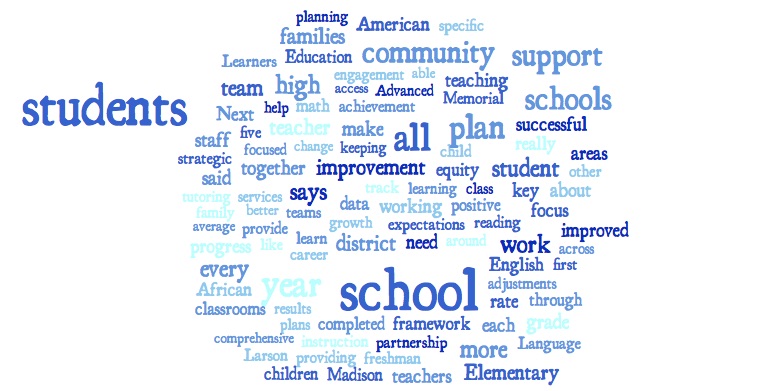
wordcloud: Madison Schools' 2014-2015 Annual Report

Madison School District (4.2MB PDF).

Molly Beck summarizes the report.

It would be useful to determine if substantive progress is being made on Madison’s long term, disastrous reading results.

Share

We’re Making Life Too Hard for Millennials

Steven Rattner:

TO some, millennials — those urban-dwelling, ride-sharing indefatigable social networkers — are engaged, upbeat and open to change. To others, they are narcissistic, lazy and self-centered.

I’m in the first camp, but regardless of your opinion, be fretful over their economic well-being and fearful — oh so fearful — for their prospects. The most educated generation in history is on track to becoming less prosperous, at least financially, than its predecessors.

Share

That ‘Useless’ Liberal Arts Degree Has Become Tech’s Hottest Ticket

George Anders:

less than two years Slack Technologies has become one of the most glistening of tech’s ten-digit “unicorn” startups, boasting 1.1 million users and a private market valuation of $2.8 billion. If you’ve used Slack’s team-based messaging software, you know that one of its catchiest innovations is Slackbot, a helpful little avatar that pops up periodically to provide tips so jaunty that it seems human.

Such creativity can’t be programmed. Instead, much of it is minted by one of Slack’s 180 employees, Anna Pickard, the 38-year-old editorial director. She earned a theater degree from Britain’s Manchester Metropolitan University before discovering that she hated the constant snubs of auditions that didn’t work out. After dabbling in blogging, videogame writing and cat impersonations, she found her way into tech, where she cooks up zany replies to users who type in “I love you, Slackbot.” It’s her mission, Pickard explains, “to provide users with extra bits of surprise and delight.” The pay is good; the stock options, even better.

Share

Credit Recovery is a Scandal: The New York State Education Test Integrity Unit Must Open an Investigation.

Ed in the Apple:

Has the statute of limitations expired? I admit it, I scrubbed Regents exam essays, or. to use the current term, “re-scored” the exams. We weren’t worried about graduation rates or teacher evaluation; we simply wanted to give kids a break. We took a look at every paper with grades from 61 to 64, sometimes you “found” one or two points, and, sometimes not. If the kid came to class, did his/her homework and tried, a little push over the top seemed warranted. If the kid cut class, was truant, no mercy, if he/r failed the course, take the course over, night school or summer school; such were the unwritten rules for decades.

In the post 2002 world of accountability graduation rates matter, they determine the future of a school and they determine the future of a teacher. Under federal rules states must identify low performing schools as identified by student scores on state grades 3-8 tests and graduation rates determined by credit accumulation and Regents passing rates. In New York State 700 out of the 4400 schools fall into the “struggling” categories – focus, priority and persistently struggling. 62 of these schools could fall into receivership, i. e., removed from the school district and handed over to a company to manage. (Read the program description here).

There are three ways to increase student achievement:

– Via Will Fitzhugh.

Share

Philologisticalistic Experts (HS English Departments)

Will Fitzhugh:

When it comes to Words, our High School English Departments are the Rulers. They dominate reading and writing, partly because the other departments—including the History and other Social Studies departments—don’t want to assign book reports or term papers and they certainly don’t want to read and grade them.

The English Word Experts are supported in this by the K-12 Literacy World, which never saw a student history research paper they could not ignore. Everywhere you look, reading and writing mean fiction, and for fiction, the Literacy World is adamant that the responsibility for that belongs to English (English Language Arts) Departments.

College professors and employers, with near unanimity, complain about the nonfiction reading, research, and writing abilities of the young people they work with. Talking to the schools and/or the Literacy World about their concerns is just exactly like talking to a dead phone. They cannot hear what they are being told.

Students are not lobbying, in most cases, for the chance to write a serious 5,000-6,000-word term paper, and only later will they face the consequences of their lack of preparation.

Since 1987, The Concord Review has published 106 issues, with 1,165 history research papers by secondary students from 44 states and 40 other countries. The average length of the eleven papers in the Winter issue last Fall was 7,500 words, with endnotes and bibliography. Some of those papers came from International Baccalaureate schools, which still require an Extended Essay for the full Diploma. Some came from private schools, where faculty (and parents) still expect students to write at least one serious term paper before college.

Many of the papers lately have been from an Independent Study, or from Summer programs, like the Stanford Summer Humanities Institute and the TCR Summer Program for high school students. But in general, our public high schools, in my experience, even including an exam school like Boston Latin School, not only do not assign serious term papers, they also do not even want students to see the exemplary work that has been published by their peers, so that they cannot be inspired by them to work harder on reading history and on writing research papers themselves.

Thanks to the Web, more and more students are finding such examples anyway, and they take advantage of them. (e.g. www.tcr.org) One example of hundreds:

————————-

“Thank you so much for publishing my essay on the Irish Ladies’ Land League in the Spring issue of The Concord Review. I am honored that my writing was chosen to appear alongside such thoughtful work in your journal.

“When a former history teacher first lent me a copy of The Concord Review, I was inspired by the careful scholarship crafted by other young people. Although I have always loved history passionately, I was used to writing history papers that were essentially glorified book reports. A week before a paper was due, I would visit the local university library, check out all available books on my assigned topic and write as articulate a summary as possible. Such assignments are a useful strategy for learning to build a coherent argument, but they do not teach students to appreciate the subtleties and difficulties of writing good history. Consequently, few students really understand how history is constructed.

“As I began to research the Ladies’ Land League, I looked to The Concord Review for guidance on how to approach my task. At first, I did check out every relevant book from the library, running up some impressive fines in the process, but I learned to skim bibliographies and academic databases to find more interesting texts. I read about women’s history, agrarian activism and Irish nationalism, considering the ideas of feminist and radical historians alongside contemporary accounts.

“Gradually, I came to understand the central difficulty of writing history: how do you resurrect, in words, events that took place in a different place and time? More importantly, how do you resurrect the past only using the words of someone else? In the words of Carl Becker,

History in this sense is story, in aim always a true story; a story that employs all the devices of literary art (statement and generalization, narration and description, comparison and comment and analogy) to present the succession of events in the life of man, and from the succession of events thus presented to derive a satisfactory meaning.

“Flipping through my note cards, the ideas began to fit themselves together in my mind. I was not certain, but there was an excitement in being forced to think rigorously; in wrestling with difficult problems I knew I could not entirely solve. Writing about the Ladies’ Land League, I finally understood and appreciated the beautiful complexity of history.

“In short, I would like to thank you not only for publishing my essay, but for motivating me to develop a deeper understanding of history. I hope that The Concord Review will continue to fascinate, challenge and inspire young historians for years to come.”

Sincerely,
Emma Curran Donnelly Hulse
[North Central High School, Indianapolis, Indiana
and Columbia University]

===========

Let’s do make an effort to free our high school students from the English Department/Fiction-Only Monopoly, and allow them to be inspired, by the serious academic expository writing of their peers, to attempt real term papers themselves, before they go on, as most now do, to find themselves both unprepared and a Literacy Problem for their professors and their future employers.

Will Fitzhugh
The Concord Review
www.tcr.org
Share

Change in teaching philosophy yields positive results for Madison schools

Dave Dleozier:

Elementary schools in the district saw an almost 10 point gain over two years in literacy and math.

“Our high school graduation rate continues to move in the right direction almost across the board for every student group,” MMSD Superintendent Jennifer Cheatham said. “In addition, there are pockets of accelerated results. When it comes to graduation rates, for example the four-year graduation rate for African-American students at La Follette High School increased to 75 percent, a 10 percent point gain.”

Elvehjem Elementary School is symbolic of the improvements seen throughout the district. The school has seen improvements in MAP reading proficiency for grades three through five from 40 percent to 46 percent. For African-American students that number increased from 12 percent to 25 percent. Reading proficiency for special education students improved from 12 percent to 21 percent.

Share

A Guide to Implementing Student-Based Budgeting (SBB)

Introduction by Karen Hawley Miles (PDF):

School district leaders face an array of challenges that affect how they allocate scarce resources to schools—stubborn achievement gaps, changing and complex demographics, and shrinking federal and state support. As the range of need grows more complex, schools are growing as diverse as the students they serve. In this context, many leaders are actively seeking ways to ensure that all schools have flexibility to organize resources to match student and school needs, while also ensuring equity across school types.

Education Resource Strategies (ERS) leverages more than 15 years of experience helping district leaders strategically reallocate their resources to improve student performance. As part of this work, we’ve collaborated with some of the leading districts that have made bold changes to their funding systems and worked through the results of these changes. Our work on funding is part of our broader School System 20/20 vision—an action-oriented framework for urban school districts to ensure that every school succeeds for every child.
Our work on school funding is based on seven principles for effective school budgeting. We believe that all school funding systems need to rest on this foundation:

Share

K-12 Tax & Spending Climate: Not the retiring type: meet the people still working in their 70s, 80s and 90s

Audrey Gillan:

‘I still have my life force’
Ivan Roitt, 87, is emeritus professor at Middlesex University’s Centre for Investigative and Diagnostic Oncology. He lives in Finchley, north London, with his wife, Margaret. They have three daughters and six grandchildren.

There was no conscious decision – I just went on working. When I finished as head of immunology at University College London, after 25 years, a colleague asked if I would like to go to Middlesex University. I thought, “Let’s do something useful”, so I set up the cancer research centre.

Share

What students should really be learning

Gillian Tett:

This summer, LinkedIn, the social media platform beloved by many professionals (albeit disliked by anyone annoyed by incessant emails), is taking part in a striking little experiment in Colorado.

This initiative does not aspire to connect ambitious MBA students with exciting jobs or link the alumni of elite colleges. Instead, LinkedIn, in tandem with non-governmental groups such as the Markle Foundation, a technology-focused charity, is connecting employers who need skilled and semi-skilled workers with local community colleges. The hope is that this will help colleges and students see where jobs are being created — and thus work with companies to create the right college courses to deliver training.

Or to put it another way, instead of using the power of digital connections to help people find jobs, LinkedIn is going a step back — using cyber platforms to enable colleges to train students in the best way.

……

But, in reality, state institutions tend to be too stodgy and slow-moving to reform education in any meaningful way, particularly given the speed at which digitisation is changing the economy. And while some companies are still running effective apprenticeship and training schemes, this tends to occur in an ad hoc way in places such as the US.

Share

Thinking Slowly About Education in Singapore

Fernando Reimers:

I travelled to Singapore in May of 2015. On my arrival, on a weekend, I took a long walk from my hotel to the National Museum of Singapore, where I had the opportunity to visit an exhibit celebrating the life and legacy of former Primer Minister Lee Kuan Yew, who had recently passed away. Seeing the exhibit, and reflecting on the history of the young nation, was a very good way to start this visit. It helped me frame and understand how the same impetus that led Lee Kuan Yew to invest in the design of beautiful gardens, so people could be proud of living in a beautiful city, had led him and others to invest in education, as a way to help shape the character of the Singaporean people. Nations are narratives, and national identity encompasses the stories we tell ourselves and others about who we are. Reflecting on the history of a young nation renders the power and intentionality of building such narratives more visible and it makes the role of the builders of such narratives also more apparent. This visit to the Museum made me reflect not just on Lee Kuan Yew, but also on other members of the generation of ‘elders’ of the country, those who were adults when Singapore was founded and who led the institutions that were created to foster the country’s development. I thought of Sing Kong Lee, former Director of the NIE, a remarkable institution founded by Dr. Ruth Wong Hie King to support the continuous improvement of the education system, or Kishore Mahbubani, the founder of the Lee Kuan Yew School of Public Policy and of others like them.

Share

A College Without Classes

Alana Semuels:

Had Daniella Kippnick followed in the footsteps of the hundreds of millions of students who have earned university degrees in the past millennium, she might be slumping in a lecture hall somewhere while a professor droned. But Kippnick has no course lectures. She has no courses to attend at all. No classroom, no college quad, no grades. Her university has no deadlines or tenure-track professors.

Instead, Kippnick makes her way through different subject matters on the way to a bachelor’s in accounting. When she feels she’s mastered a certain subject, she takes a test at home, where a proctor watches her from afar by monitoring her computer and watching her over a video feed. If she proves she’s competent—by getting the equivalent of a B—she passes and moves on to the next subject.

Share

MPS approves ‘no excuses’ charter school with vow to draw students back

Vivian Wang:

Laying down a new marker in the competition for school enrollment in Milwaukee, the School Board has approved a high-profile young educator’s proposal for a new charter school, after he promised to ramp up efforts to reverse the flow of students leaving the district for voucher schools and other options.

Maurice Thomas’ planned Milwaukee Excellence Charter School, set to open in 2016, promises an “unapologetically college preparatory” education for grades six to 12, complete with longer school days, an extended school year and strict disciplinary standards. By 2024, Thomas said, 100% of graduates will be at a four-year college.

Such “no excuses” schools have produced higher rates of graduation and better test scores than conventional schools in some parts of the country. Such a school could be especially impactful at the planned location on the city’s northwest side, a historically underserved area in education.

The school will likely be housed in the vacant Edison Middle School building at 5372 N. 37th St.

As a charter school authorized by Milwaukee Public Schools, Milwaukee Excellence will keep the public dollars that follow students into its classrooms in MPS coffers. As an independent school, though, it can be staffed by non-district, non-unionized employees and operate free of some regular rules governing public schools.

Share

Wolfram Summer Camp Projects

Wolfram:

38 high schoolers; 2 weeks; -> 38 original #WolfLang projects

Share

The Video Game Dream

Robert Kolker:

In the spring of 2014, after a decade of visa problems, the Hassan family moved out of its spacious house in Karachi, Pakistan, to an apartment in Rosemont, a suburb of Chicago near O’Hare International Airport. They were a family of eight, two parents and six kids, jammed into a three-bedroom space. Money was tight and work unsteady; for most of them, the move was a struggle. But their 15-year-old son, Sumail, was thrilled—being in the U.S. meant less lag time when he played Dota 2.

Share

What the New Education Buzzwords Actually Mean

Mikhail Zinshsteyn:

Education writing is famous for its alphabet soup of acronyms and obscure terms, but it could just as well be faulted for trafficking buzzwords in search of clear definitions.

Ideas like grit, motivation, fitting in, and learning from one’s mistakes—often summarized as noncognitive factors—are just some of the concepts that are coming up more frequently these days. A new paper from the Carnegie Foundation for the Advancement of Teaching provides definitions for many of these new terms, which arose in part because of the recent push by psychologists, economists, and education experts to delve more deeply into what compels students to understand complex new material.

Each concept has its own section and is accompanied by summaries of key experiments that gave rise to the ideas’ relevance (as well as reference points for reporters whose inboxes are inundated with the latest efforts to boost student grades and college prospects).​

Share

A Chill for Chinese Exchanges?

Elizabeth Redden:

draft law that would require foreign nongovernmental organizations to register their activities with police authorities in China has American universities worried about a chilling effect on educational exchanges of all types.

The draft law defines foreign NGOs broadly and is sweeping in its scope, seemingly applying not only to universities that have physical locations in China but also to any institution that so much as sends a single student or professor there. If an American university were to conduct an international research conference in China, that would seem to require registration under the law. So would sending a faculty member there to interview applicants for a graduate program. Or sending a professor to give a lecture or take part in a joint research project. Or organizing a networking event for alumni in China. Or sending a student singing group to participate in a competition there.

Share

A scholarship program for poor kids survives a union legal assault.

School vouchers may be the most effective anti-poverty program around, yet they’re fought tooth and hammer by the teachers unions. Late last week the North Carolina Supreme Court awarded a victory to poor kids by protecting vouchers from another union attack.

Two years ago Tar Heel Republicans passed a modest reform offering low-income students $4,200 scholarships to attend qualifying private schools. The law requires, among other things, that private schools report graduation rates and test scores. It also mandates an annual report comparing the learning gains of voucher recipients and public school students.

Taxpayer plaintiffs backed by the union argued in a lawsuit that vouchers accomplish no “public purpose” because private schools don’t have to adhere to such state educational standards as teacher licensing requirements. You have to admire the gall of a union to argue that private schools are “unaccountable” when only one in five black fourth-graders at North Carolina public schools scored proficient in reading on the National Assessment of Educational Progress in 2013. According to the Institute for Justice, which represented voucher parents in the case, five of six low-income students fail the state’s end-of-grade math or reading tests.

Share

States in Motion: Visualizing how education funding has changed over time

John C. Osborn, John Fensterwald, and Matt Levin:

After a complete redesign and the addition of new data, we’re excited to relaunch “States in Motion.”

The project explores numerous datasets through interactive charts for all 50 states plus the District of Columbia. The idea behind the project is to take a historical look at how the economic and social conditions have changed for each state over time, and how those changes have impacted investment in education and student achievement. Each section explores specific data in chart form and offers context in related text. There could be many stories in each chart; we’re telling just one of them.

The charts and context below are California-centric, meaning we mainly explored how California has changed compared with other states historically over numerous data metrics. Some of the questions going into the project include:

Share

Michigan Union Boomerang

Wall Street Journal:

This being America, no good deed goes unlitigated, but sometimes the good deed still wins. So it is in Michigan, where on Wednesday the state Supreme Court turned a union lawsuit on its head and said the state’s right-to-work law applies to 36,000 government workers.

In 2012 Michigan passed a right-to work statute that lets workers decide whether to join a union and thus pay union dues. The United Auto Workers (UAW), which represents 17,000 state workers, brought a lawsuit claiming the law doesn’t apply to its members because their employment terms are set by the Michigan Civil Service Commission.

Share

Make School Wants To Build The Product University For The Masses

Danny Crichton:

College has failed, or so many Silicon Valley entrepreneurs believe. Not only are tuition costs spiraling out of control, but students are leaving college without the ability to produce … anything. We are living in the era of code, and yet, college students are graduating barely able to read or write an essay – let alone make an app.

Make School hopes to change this sordid state of affairs. Through a rigorous and lengthy two-year curriculum, the school hopes to instill deeper critical thinking skills while also providing students engineering and product skills that will allow them to be highly productive at startups and large tech companies.

Share

School System Wants $77K from Michigan Mom to Fulfill Her FOIA Request

CR Denning:

The Freedom of Information Act (FOIA) is supposed to make getting documents from the government straightforward. But a Goodrich, Michigan, mom named Sherry Smith is finding out just how crooked the process can be. When she filed a FOIA request for educational records related to her son, Mitchell, the school system told her there would be a hefty price tag—to wit, $77,718.75.

Mitchell has an intellectual disability, which means the state will pay for his education until he turns 26. Having just finished high school, he and his family found a program at a local college they felt was just right for him.

Share

They’re Back! How to Cope With Returned College Grads

Rob Lazebnik:

Congratulations. Two months ago, your kid graduated from college, bravely finishing his degree rather than dropping out to make millions on his idea for a dating app for people who throw up during Cross Fit training. If he’s like a great many of his peers, he’s moved back home, where he’s figuring out how to become an adult in the same room that still has his orthodontic headgear strapped to an Iron Man helmet.

Now we’re deep into summer, and the logistical challenges of your grad really being home are sinking in. You’re constantly juggling cars, cleaning more dishes and dealing with your daughter’s boyfriend, who not only slept over but also drank your last can of Pure Protein Frosty Chocolate shake.

Share

From Grandmother to Granddaughter, Passing Along Religious Traditions

Clare Ansberry:

Kathy Reveille began taking her granddaughter, Bianca, to church because no one else did.

Bianca’s mother was Catholic and her father was Baptist. They couldn’t agree on what church to attend so they didn’t go. “I really wanted to belong to a church. I didn’t care what kind,” says Bianca, who is turning 15 this week. She always felt she was missing something, she says. The absence became more pronounced after her father died.

“That’s when the big questions come up,” says her grandmother, Ms. Reveille. “I stepped into the gap.”

Bianca High received rosary beads from her grandmother after her confirmation this past spring. ENLARGE
Bianca High received rosary beads from her grandmother after her confirmation this past spring. PHOTO: KRISTIAN THACKER FOR THE WALL STREET JOURNAL

Share

Why Libraries Matter

Julie Dressmer & Jessie Hicks

A day in the life of New York City’s public libraries: Traveling from borough to borough, this short documentary by Julie Dressner and Jesse Hicks reveals just how important the modern library is for millions of people.

Share

Schools With Tough Tests Send More Low-Income Kids to College

Mikhail:

Schools that that teach low-income students a notoriously demanding curriculum are almost twice as likely to see those students enroll in college, a new report shows.

This news comes on the heels of growing research suggesting that challenging assessments, which are a staple of the International Baccalaureate program featured in the report, help students develop a deeper understanding of key subjects like math and history. That “deeper learning,” in turn, may lead to more college opportunities.

The International Baccalaureate, a nonprofit organization that sells its stable of intensive coursework for various subjects to schools around the world, released the study last week, calculating that more than half of the 1,650 schools in the United States that use IB material fit the federal designation of Title I schools, which means they enroll a large low-income student population. In fact, the number of Title I schools offering IB programming increased by 50 percent between 2009 and 2013, the report said.

The IB program provides curricula tailored for specific grade levels, including the IB “diploma program” for high school students. The IB study tracked how many of its low-income diploma program students attending Title I schools enrolled in college, finding that in 2013 nearly eight in 10 went on to a postsecondary institution. The national college-going average for low-income students is 46 percent, the report notes. According to IB, about a third of the diploma program test-takers were considered low-income students. To become an International Baccalaureate school, campuses must go through the program’s authorization program.

Share

You believe the entire structure of American college financial aid should be changed. Why?

Bob Sullivan:

Higher education doesn’t work like a normal business. It’s much harder to get the results you want out of the investments you make. In my book with Andrew Kelly, Reinventing Financial Aid, I have a chapter where I go back to the inception of the financial aid system and I work through the set of decisions that were made and put in place at the beginning. (There was the question) “Should you send aid directly to students or to schools?” The thinking at the time was – led by economists, including Milton Friedman — we should not send the money to schools, but to students. They argued that doing this would exert control over schools the way we think vouchers do today.

But the thing is (it doesn’t) end up working in the way vouchers were intended. The customers (college students) have a very hard time extracting accountability. Institutions don’t seem constrained at all. I argued in that chapter that we made a critical mistake. By not sending money to the schools we (state and government agencies) gave up the ability to hold schools accountable. But I don’t think we can back our way into that now by attaching a bunch of new rules to existing programs. I think we have to create financial aid version 2.0.

Share

Watch Key & Peele Talk About Teachers in the Same Way SportsCenter Talks About Athletes

Key & Peele:

In a clip previewing Wednesday night’s episode of Key & Peele, the Comedy Central duo discuss teachers as if they were professional athletes. They stage a fake draft at Radio City Music Hall and critique how and why teachers call on certain people in class.

Although it’s all in good fun, the jokes about the salary differences between a teacher and a professional athlete is the most depressing part. Just imagine if a public school teacher could actually sign a contract guaranteeing a $80 million salary over the next six years with a $40 million in incentives based on test scores.

Share

Wanderers and Homebodies

Paul John:

For instance, Elsevier’s report “International Comparative Performance of the UK Research Base — 2011,” carried out for the Department for Business, Innovation and Skills, reveals that the 46 percent of British academics who published with overseas collaborators in 2010 garnered twice as many citations for their papers as those who collaborated only within their institution. They also had 40 percent more citations than those who collaborated with academics at other institutions in the U.K.

Share

Kids in India Are Sparking Urban Planning Changes by Mapping Slums

Sam Sturgis:

Every kid likes to draw. But in India, young people living in slums are using their sketching skills to spur urban change.

As part of a broader civic campaign centered on “child clubs,” groups of children are creating detailed “social maps” of their marginalized neighborhoods to voice their concerns about public space, as first reported in Citiscope, a CityLab partner site.

Since 2011, UNICEF has been encouraging kids to use mobile technology and open data to map environmental and health issues near their homes. But that technology isn’t available to everyone. Instead, much of the child-led mapping campaign sweeping India today relies on old-school topography materials—paper and a rainbow-spectrum of markers.

Share

I am an adjunct professor who teaches five classes. I earn less than a pet-sitter

Lee Hall:

Like most university teachers today, I am a low-paid contract worker. Now and then, a friend will ask: “Have you tried dog-walking on the side?” I have. Pet care, I can reveal, takes massive attention, energy and driving time. I’m friends with a full-time, professionally employed pet-sitter who’s done it for years, never topping $26,000 annually and never receiving health or other benefits.

The reason I field such questions is that, as an adjunct professor, whether teaching undergraduate or law-school courses, I make much less than a pet-sitter earns. This year I’m teaching five classes (15 credit hours, roughly comparable to the teaching loads of some tenure-track law or business school instructors). At $3,000 per course, I’ll pull in $15,000 for the year. I work year-round, 20 to 30 hours weekly – teaching, developing courses and drafting syllabi, offering academic advice, recommendation letters and course extensions for students who need them. As I write, in late June, my students are wrapping up their final week of the first summer term, and the second summer term will begin next week.

Share

A century after his death, work of wordsmith James Murray is remembered

Hannah Somerville:

ACADEMICS, family members and fans gathered in Oxford yesterday to celebrate 100 years since the death of James Murray, chief editor of the first Oxford English Dictionary.

Wreaths were laid at the lexicographer’s grave in Wolvercote Cemetery, Banbury Road, at 11am, led by his great-grandson Oswyn Murray.

One special offering was provided by Oxford English Dictionary staff.

Lynda Mugglestone, professor of history of English at Oxford University, said: “We have taken facsimiles from the original dictionary’s font and the wreath uses those letters.

“He was involved in every single design decision and spent ages thinking about fonts, so it is really nice.”

Share

Trusting parents to make smart choices on student data

Jules Polonetsky

With all of these benefits come risks. Some worry that the vendors providing these new technologies could use the detailed student data they hold for marketing purposes. Others worry the data could be sold. Although more than 150 companies have signed a Student Privacy Pledge, legally committing to not sell student data, federal and state lawmakers continue to seek ways to expand student privacy laws to more effectively protect student data.

One key issue has emerged as a point of contention among many of the proposed bills. Should parents have the right to tell a company holding their child’s data to enable additional services, such as sending homework information to a tutoring service or sending a transcript to a college or for a scholarship application? Should a parent be able to use the school’s network to share their child’s art portfolio with relatives or even online? Or, what if a child, with parental permission, wants to continue to maintain their school email account or use an educational app to practice test questions? Oddly, the leading state privacy law passed in California does not make allowances for parents to expressly enable new services, and the drafters of federal legislation have largely followed suit.

Share

Sleeping Through a Revolution

Jonathan Taplain:

We have become convinced that only machines and corporations make the future, but I don’t think that is true. In thinking about the role of the humanist in our technology-driven future, I was drawn to a sermon Martin Luther King preached at the National Cathedral in Washington two weeks before he was killed. At the outset he told the story of how Rip Van Winkle had passed a sign with a picture of King George III of England on the way up the mountain where he fell into a long sleep. When he came down the mountain, the same sign bore a picture of George Washington.

With such economic power comes political power. Uber recently hired Obama campaign svengali David Plouffe to help it navigate the political lobbying waters of Washington, taking a page from Google’s bible. Google outspends all but a few financial and military firms in its lobbying efforts. The main financial backers of the Libertarian movement, the Koch brothers, have vowed to spend $900 million in the 2016 election cycle to ensure that the “no regulation, no taxes” principles of the movement are sacrosanct in the corridors of power.

The digital monopolists are not above using the rhetoric of libertarianism to spread the message that they alone are the guardians of freedom in the world. When the media companies tried (in an admittedly ham-handed fashion) to pass a law (Stop Online Piracy Act) that would require Google to block sites that were making millions off of stolen content, Google unleashed an online campaign stating this would amount to censorship. The uproar from the crowd quickly killed the bill.

Share

I run a university. I’m also an Uber driver.

Laurence Schall:

In my day job, I run Oglethorpe University, a liberal arts college in Atlanta. Over the last 40 years, I’ve also worked in the bleached-white collar realms of law and real estate.

This summer, I added a new line to my resume: Uber driver.

I signed up because I wanted to broaden my perspective on today’s “sharing economy.” After all, my students are confronting a very different job market than I did. Since the 2008 recession, many Americans have been pushed into or chosen to join the freelance marketplace, taking jobs with no regular hours, no benefits and no office. My wife calls it “Panera World,” where she, a freelance advertising executive, joins dozens of other freelancers who spend hours in the restaurant bakery working on their computers and phones every day. Some may forgo full-time work altogether, choosing by necessity or by choice to string together a series of part-time opportunities.

Share

Groups That Back Bloomberg’s Education Agenda Enjoy Success in Albany

Kate Taylor:

Former Mayor Michael R. Bloomberg has been out of office for a year and a half, but his influence over New York schools is practically as strong as ever.

A group devoted to continuing his education agenda and founded in part by his longtime schools chancellor, has become one of the most powerful forces in Albany by pouring millions into lobbying and adroitly exploiting rivalries in state politics.

The organization, StudentsFirstNY, and another group with a similar focus called Families for Excellent Schools have formed a counterweight to teachers’ unions, long among the top spenders in the state capital. This year alone, the groups saw major elements of their platforms come to pass, such as tying teacher evaluations more closely to test scores, adding hurdles to earning tenure and increasing the number of charter schools, measures all unpopular with the unions.

Share