School Information System

Civics: The Last Days of Jerry Brown

Andy Kroll:

One of Brown’s favorite sayings is Age quod agis, a Latin phrase he learned while training to be a Jesuit priest. It means: Do what you’re doing. Don’t traffic in nostalgia. Don’t fantasize about what’s next. For a man who has heeded these rules, it is striking how much he has devoted his last days to leaving his mark on California. He, of course, wouldn’t put it that way.

“I’ve probably thought more about this than almost anybody you’ve ever met,” Brown tells me. We’re back to talking about legacy. “It’s a term that journalists use because you can’t say you’re doing this to do good — that sounds too Pollyanna-ish. You can’t say you’re doing it because you’re going to enrich your friends, because that would sound illegal. You can’t say you derive pleasure from it, because that wouldn’t fit the norms of our political culture.” Legacy, to him, is simple. “It’s a way to make people feel they’re a little more important than they are and their life is not as empty as it actually is.”

In his first stretch as governor, Brown’s unorthodox approach was viewed less charitably. He was erratic and undisciplined, enthralled with the maxim (coined by the British thinker Gregory Bateson) that the new comes from the random. He kept strange hours, staying up until 3 a.m., and stranger company. His aide-de-camp was Jacques Barzaghi, a French filmmaker who famously said of Brown’s 1992 presidential run: “We are not disorganized. Our campaign transcends understanding.”
Brown preached the virtues of “creative inaction” and would put off decisions until the last moment. Or he would fixate on issues of small importance and leave larger ones to fester. Tony Kline, who served as Brown’s legal affairs secretary in those days, tells the story of a bill landing on Brown’s desk that would ban the sale of meat from a certain species of Caribbean turtle. Kline, who remains good friends with the governor, says Brown spent half a day immersed, researching turtle meat, while other bills went untouched. “It would drive us a little crazy,” Kline says.

After a decade and a half away from elected office, Brown ran for Oakland mayor in 1998 and won. It was here that friends say his political education began in earnest. He spent the next eight years learning firsthand what it was government did. He read the police reports, spoke at funerals, and wrestled with Oakland’s underperforming public schools, later opening two charter schools of his own. “He’d say that as the governor, you’re flying at 35,000 feet,” Gil Durán, Brown’s former press secretary, says, “but as mayor, you’re right in the street.”

At his final state budget press conference, Brown told a room full of reporters: “The next governor is going to be on the cliff. What’s out there is darkness, uncertainty, decline, and recession.”

Share

Held back: How Wisconsin School of Business donors stalled efforts to revamp its programming

Pat Schneider:

News that faculty at the school had given preliminary endorsement to such a plan spread.

“The word was out there, and it went far,” said Stabio, a first-year MBA student from Texas. The Wall Street Journal wrote about it next day.

Speculation about the future of the two-year MBA at Wisconsin spawned news stories and social media posts, leading to anger and angst among donors, alumni and students. Business school officials struggled to gain control of the story on the eve of Oct. 20 homecoming festivities. Scheduled events included a reception for the school’s most prestigious benefactors.

Share

Duke’s Felipe De Brigard examines false memories, or why we’re so sure of things we’re wrong about

Eric Ferreri:

You mean, what you want to be true?

Not necessarily. You almost never have control over the process of filling up or reconstructing your memories. Unbeknownst to you, the process operates probabilistically. Given your past experiences and knowledge, your memory system gives you the most likely thing that could have happened to help you fill any gaps at the time of retrieval. Most of the time the final product coincides with what actually happened, so it is true. But sometimes it does not, in which case we talk about false memories. I think most of our memories are reconstructed in this way, and many of them are false, we just don’t notice.

All of this made me think that when we imagine things, we also imagine how things could have occurred in the past. Say you were crossing the street and almost got hit by a car. You can’t help but imagine what would have happened if you did get hit by the car. We just slip into that kind of imagination.

Share

Civics: At Trial of Omar Mateen’s Wife, Judge’s Questioning Reveals a Huge Hole in Prosecution’s Case and Deceit by Prosecutors

Glenn Greenwald and Murtaza Hussein:

So it’s far from clear that no matter how much the prosecutor’s case falls apart, Salman will be acquitted. But whatever the ultimate verdict is, it is now clear that the Justice Department knew that one of its primary claims against Salman was utterly false and yet concealed that discovery from everyone – not just the public but also Salman’s lawyers and the judge, who cited that false evidence to justify keeping Salman imprisoned for the last year without any possibility of bail.

Share

Madison West High School student found with BB gun, principal says

Logan Wroge:

A Madison West High School student was found with a BB gun Thursday, principal Karen Boran said in an email to parents.

Police received information in the morning that a student might be in possession of a BB gun, Boran said. The student was found by police off school property, and a search turned up the weapon, she said.

Share

Facebook’s Cambridge Analytica problems are nothing compared to what’s coming for all of online publishing

doc searls:

Giant Irony Alert: the same is true for the Times, along with every other publication that lives off adtech: surveillance-based advertising. These pubs don’t just open the kimonos of their readers. They treat them as naked beings whose necks are bared to vampires ravenous for the blood of personal data, all ostensibly so those persons can be served with “interest-based” advertising.
 
 With no control by readers (beyond tracking protection which relatively few know how to use), and damn little care or control by the publishers who bare those readers’ necks to the vampires, who knows what the hell actually happens to the data? No one entity, that’s for sure.
 
 For one among many views of what’s going on, here’s a screen shot of what RedMorph, a privacy monitoring and protection extention in Chrome showed going on behind Zeynep’s op-ed in the Times:

Share

Women and Math

Rafia Zakaria:

The writer is an attorney teaching constitutional law and political philosophy.

THE drill is well known: every time the results of some sort of worldwide survey are released, women in the Muslim world are towards the bottom. Afghan women usually occupy the lowest rungs of political participation, women in Somalia and Sudan have the lowest access to healthcare facilities, women in Iraq and Syria are forced into marriages at astoundingly young ages, and Pakistani women along with Egyptian women experience high levels of domestic violence and general misogyny.

Years of these sorts of surveys, products of complexities reduced to variables and relationship to regression, have taught those who read them to approach with caution, a degree of warranted criticism, a degree of preparedness for the disappointments to follow.

It was a pleasant surprise, therefore, to encounter a study that upended all others. In her book titled Fifty Million Rising, social scientist Saadia Zahidi found that women in many Muslim countries have a higher number of graduates in science, technology, engineering and maths (STEM) fields than their counterparts in other nations. The percentages are impressive: in Iran, 70 per cent of university graduates in STEM fields are women; in Oman, Saudi Arabia, Qatar and the United Arab Emirates, 60pc of graduates are women, and over 40pc of science graduates in Algeria are women. According to Zahidi, the reason for the advance is that many of these Muslim countries have invested heavily in improving women’s access and education in these fields.

It’s not that they do not encounter gender stereotypes or the sort of constraints that come from being a woman in conservative and male-dominated societies, it is that women are genuinely ambitious and want to excel. In some countries, like the UAE and Jordan, girls actually expressed greater confidence in their math skills than boys at the same age and grade level. In contrast to these percentages, only 18pc of all computer science degrees at American universities are awarded to women. At the high school level, only 27pc of those who sit for the Advanced Placement Computer Science Exam are female.

Women in many Muslim countries have a higher number of graduates in STEM fields than their counterparts in other nations.

Share

Students’ visit to gun range ‘none of your damn business,’ parents say

Steve Strunsky:

Angered by word of the disciplining of two Lacey High School students for a gun-related social media post, 200 parents, community members and other supporters of the Second Amendment on Monday let the Board of Education know they don’t want the district trampling on their rights or meddling in their home lives.

“You guys are reaching into our private life, the private life of our children,” said one parent, Lewis Fiordimondo, who has twins in pre-kindergarten and a daughter at the high school. “It’s not your place. It’s not the school’s place.”

Another dad, Frank Horvath, whose son is a senior at Lacey High, put things in blunter terms.

“It’s none of your damn business what our children do outside of school,” Horvath told the seven board members toward the end of a four-hour meeting, most of it occupied by speaker after speaker venting anger and frustration at school officials largely unable to respond due to confidentiality rules.

Share

“Peak Civilization”: The Fall of the Roman Empire

Ugo Bardi:

In ancient societies that I studied, for example the Roman Empire, the great problem that they faced was when they would have to incur very high costs just to maintain the status quo. Invest very high amounts in solving problems that don’t yield a net positive return, but instead simply allowed them to maintain what they already got. This decreases the net benefit of being a complex society.

Share

My Cow Game Extracted Your Facebook Data

Ian Bogost:

And yet, if you played Cow Clicker, even just once, I got enough of your personal data that, for years, I could have assembled a reasonably sophisticated profile of your interests and behavior. I might still be able to; all the data is still there, stored on my private server, where Cow Clicker is still running, allowing players to keep clicking where a cow once stood, before my caprice raptured them into the digital void.

Much more, here.

Share

Why Equitable Maps Are More Accurate and Humane

Sarah Holder:

“For most of human history, maps have been very exclusive,” said Marie Price, the first woman president of the American Geographical Society, appointed 165 years into its 167-year history. “Only a few people got to make maps, and they were carefully guarded, and they were not participatory.” That’s slowly changing, she said, thanks to democratizing projects like OpenStreetMap (OSM).

OSM is the self-proclaimed Wikipedia of maps: It’s a free and open-source sketch of the globe, created by a volunteer pool that essentially crowd-sources the map, tracing parts of the world that haven’t yet been logged. Armed with satellite images, GPS coordinates, local community insights and map “tasks,” volunteer cartographers identify roads, paths, and buildings in remote areas and their own backyards. Then, experienced editors verify each element. Chances are, you use an OSM-sourced map every day without realizing it: Foursquare, Craigslist, Pinterest, Etsy, and Uber all use it in their direction services.

When commercial companies like Google decide to map the not-yet-mapped, they use “The Starbucks Test,” as OSMers like to call it. If you’re within a certain radius of a chain coffee shop, Google will invest in maps to make it easy to find. Everywhere else, especially in the developing world, other virtual cartographers have to fill in the gaps.

Share

K-12 Tax & Spending Climate: How the Cook County Assessor Failed Taxpayers

Jason Grotto and Sandhya Kambhampati:

Amid the most tumultuous real estate market since the Great Depression, Cook County Assessor Joseph Berrios produced valuations for thousands of commercial and industrial properties in Chicago that did not change from one reassessment to the next, not even by a single dollar.

That fact, one finding in an unprecedented ProPublica Illinois-Chicago Tribune analysis of tens of thousands of property records, points to a conclusion that experts say defies any logical explanation except one:

Berrios failed at one of his most important responsibilities — estimating the value of commercial and industrial properties.

What’s more, a separate analysis reveals commercial and industrial property assessments throughout Cook County were so riddled with errors that they created deep inequities, punishing small businesses while cutting a break to owners of high-value properties and helping fuel a cottage industry of politically powerful tax attorneys.

And because commercial and industrial properties as a group were not assessed properly, residential homeowners across the county were forced to carry an additional and unnecessary burden, paying more in property taxes than they would have otherwise.

State law says the assessor must revalue property every three years. Yet Berrios, using methods hidden from the public, repeatedly produced initial valuations of commercial and industrial properties — known as first-pass values — that did not change.

Share

Chinese Companies Are Buying Up Cash-Strapped U.S. Colleges

Bloomberg:

Chinese companies are taking advantage of America’s financially strapped higher-education system to buy schools, and the latest deal for a classical music conservatory in Princeton, New Jersey, is striking chords of dissonance on campus.

Beijing Kaiwen Education Technology Co. agreed in February to pay $40 million for Westminster Choir College, an affiliate of Rider University that trains students for careers as singers, conductors and music teachers. The announcement came just weeks after the government-controlled Chinese company changed its name from Jiangsu Zhongtai Bridge Steel Structure Co.

The pending purchase rankles some Westminster faculty and alumni, who question what a longtime maker of steel spans knows about running an elite school whose choirs sang with maestros Leonard Bernstein, Arturo Toscanini and Seiji Ozawa. Alumni are among those suing in New York federal court to block the sale, saying it violates Westminster’s 1991 merger agreement with Rider and will trigger the choir college’s demise.

“There’s a lot of fear among people associated with the college,” said Chris Bonanni, 20, an undergraduate student.

Share

Democrats can’t expand opportunity without reducing inequality

Elizabeth Bruenig:

But, speaking as a member of the “Bernie Sanders wing,” I don’t actually view the two focal points — opportunity and inequality — as fully separable. The impact of inequality on the overall economy and political climate means that, unless inequality itself is reduced, individual initiative won’t have much impact and conditions for ordinary people in America will continue, in key ways, to worsen.

Sanders himself agrees. “You have an economic situation where a tiny number of people have enormous amounts of wealth,” Sanders told me at his Senate office Wednesday morning, “and politically, you have the Koch brothers and a handful of billionaires buying elections.” Sanders pointed out that the top 1 percent of earners would rake in roughly 83 percent of the benefits of President Trump’s tax cuts, a series of policies for which Koch-led groups spent more than $20 million. As Yale University political scientist Jacob Hacker pointed out in The Post, the decision to supply a generous tax cut to the rich — greatly encouraged by the vast wealth of billionaire donors — is a de facto decision to reduce expenditures that help ordinary Americans, “like public investments in infrastructure, education, research and development, and the regulation of labor and financial markets.” Put simply, inequality allows the wealthiest Americans to exert undue control over politics, thereby maintaining the conditions that made them rich in the first place, and hamstringing government efforts that could increase opportunities for the rest of us.

Share

Which Houston-area school districts serve the fewest special ed students?

Shelby Webb:

#15 Aldine ISD

Percent of students receiving special education services: 7.22 percent

Number of students receiving special education services: 5,039
Total enrollment in 2016-2017: 69,768

Share

Are school systems ready to shrink? Why Outer Suburbs in the East and Midwest Have Stopped Booming

Robert Gebeloff:

Hunterdon County, N.J., is rich. It ranks sixth nationally among counties in median household income, and has for decades exemplified the American outer-ring suburb.

But in one crucial measure, this exurban enclave 60 miles west of Manhattan resembles old mill communities in northern New England or impoverished regions of Appalachia. The measure is death as compared to birth, otherwise known by demographers as “natural increase.” In this case, it’s negative.

Hunterdon County residents gave birth to 3,590 babies between 2013 and 2016. But even more residents — 3,647 — died. Go back to a four-year period two decades earlier: 5,882 births, 2,947 deaths.

Share

Banned Software License List

Google:

For various reasons described in the following sections, some software is available only under license terms that make it unsuitable for use at Google. Exceptions may exist in some rare circumstances; contact emailremoved@ if in doubt.

Share

Can money attract more minorities into the teaching profession?

Michael Hansen :

Many education policymakers and practitioners across the country recognize the need to recruit and retain more racial and ethnic minorities into the teaching profession. As we’ve previously discussed in our ongoing teacher diversity series, there is credible evidence that minority teachers can boost a range of minority student outcomes, yet minorities are underrepresented among the population of public school teachers.

In light of the scarcity of minority teachers, many states and districts have begun trying ways to somehow bring more minorities into the classroom. To our knowledge, most of these methods have taken the form of targeted outreach, whether to minority communities or teacher preparation programs in universities serving high concentrations of minority students. Though it may be too soon to know whether these different strategies ultimately pan out, we ask if another type of strategy might be effective. That is, could financial incentives help diversify the teacher workforce?

In this installment, we use school- and district-level data from the Schools and Staffing Survey (SASS) to examine this question.[1] We explore whether districts that offer different types of financial incentives to teachers tend to have greater diversity among teachers within their schools. Based on our analysis, we see a strong association between workforce diversity and four incentive policies that may be particularly attractive for minority teachers. Though we cannot say whether these relationships are causal, the results suggest these policies are worth exploring as strategies for diversifying the teacher workforce.

Share

Pioneers of Modern Computer Architecture Receive ACM A.M. Turing Award

ACM:

ACM, the Association for Computing Machinery, today named John L. Hennessy, former President of Stanford University, and David A. Patterson, retired Professor of the University of California, Berkeley, recipients of the 2017 ACM A.M. Turing Award for pioneering a systematic, quantitative approach to the design and evaluation of computer architectures with enduring impact on the microprocessor industry. Hennessy and Patterson created a systematic and quantitative approach to designing faster, lower power, and reduced instruction set computer (RISC) microprocessors. Their approach led to lasting and repeatable principles that generations of architects have used for many projects in academia and industry. Today, 99% of the more than 16 billion microprocessors produced annually are RISC processors, and are found in nearly all smartphones, tablets, and the billions of embedded devices that comprise the Internet of Things (IoT).

Hennessy and Patterson codified their insights in a very influential book, Computer Architecture: A Quantitative Approach, now in its sixth edition, reaching generations of engineers and scientists who have adopted and further developed their ideas. Their work underpins our ability to model and analyze the architectures of new processors, greatly accelerating advances in microprocessor design.

The ACM Turing Award, often referred to as the “Nobel Prize of Computing,” carries a $1 million prize, with financial support provided by Google, Inc. It is named for Alan M. Turing, the British mathematician who articulated the mathematical foundation and limits of computing. Hennessy and Patterson will formally receive the 2017 ACM A.M. Turing Award at the ACM’s annual awards banquet on Saturday, June 23, 2018 in San Francisco, California.

Share

Where is the money going? Frustrated Teacher…. (her district spends about 50% of Madison’s $20k/student)

Jay Greene::

A 7-year veteran teacher teaching in Arizona’s Paradise Valley Unified School District has created a social media firestorm by posting her pay stub on social media- $35,621. Before writing anything else, I like anyone else want to pay dedicated teachers much better than this. Teacher compensation decisions however are made at the district/campus level, and an examination of PVUSD finances just makes things look worse. Much worse.

The Arizona Auditor General reports on district finances. Paradise Valley received total revenue of $10,143 per pupil in 2017. This figure is above the state-wide average. A class of 30 students produces over $300,000 in revenue. Even with benefit costs included, teacher compensation will not even sniff 20% of the revenue generated by this class of 30. Where did the rest of the money go?

Madison has long spent more than most, now nearly $20,000 per student.

This, despite long standing, disastrous reading results.

Share

Student Planning Abortion Protest After School Shooting Walkout

Lemor Abrams:

This week, Rocklin High School students are using social media to organize a pro-life walkout using the hashtag #life.

“To honor all the lives of aborted babies pretty much. All the millions of aborted babies every year,” said organizer Brandon Gillespie.

He says his history teacher inspired the idea.

As thousands of students across the country walked out of class demanding strict gun laws, in honor of the Parkland shooting victims, Benzel was placed on paid administrative leave when she asked students to consider whether there’s a double standard in the national school walkout.

“I would like a conversation about when is too much? And are we going allow this on the other side?” said Julianne Benzel

Global abortion data (duckduckgo.com | Pew)

Share

Gloria Reyes is the right choice for Madison School Board

The Capital Times:

So where do we see a difference? One area is safety. Both candidates stress the need for school safety, but we give the nod here to Reyes, the former police officer, who brings experience and insight to discussions of preventing violence in our schools.

We are also impressed with the life experience that Reyes would bring to the board. Reyes has faced barriers and overcome them. She says she’s running to give back to a community that never gave up on her, and we’re impressed with her passion in this regard.

Finally, as a Latina and the mother of biracial children, Reyes would bring another voice of diversity to a school board that serves a district with a large number of minority students. Reyes believes that the entire community must be involved in making our schools successful for all students, and points out that it is natural for her to reach out to minority members in our community because of her background and experience. That’s a vital recommendation for a board that must always strive to represent of the whole of the population it serves. We endorse Gloria Reyes for the School Board on April 3.

Share

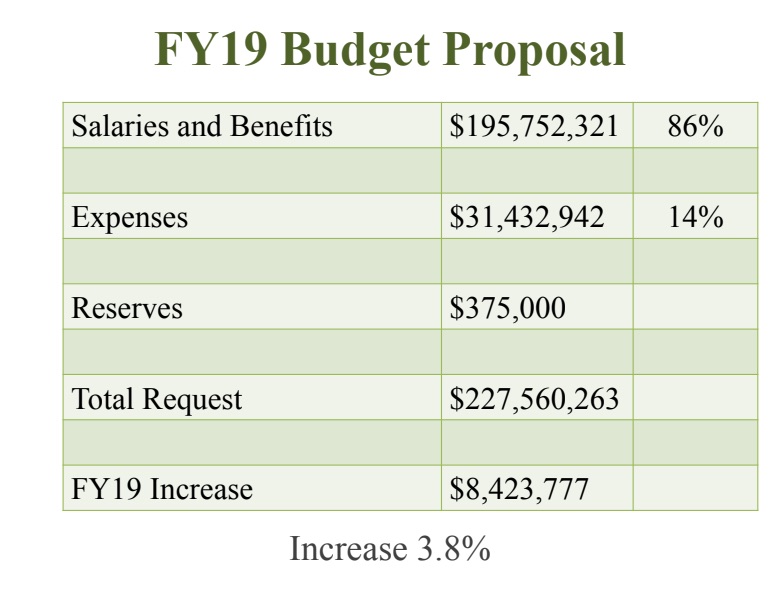
Madison Schools Project 4.58% 2018-2019 Property Tax Levy Increase

Madison School District Administration (PDF):

Budget Design Parameters:

Enrollment – slight decrease

Level total staffing (budget neutral)

Narrowing priority actions

Compensation options – first phase

Tax levy updated with 2x charter estimate built in

Using less than full levy authority ($5MM of $8MM) to manage the tax levy increase, preserve state aid eligibility, and maintain budget flexibility for 2019-20

Share

Madison School Board 2017-2018 Mid Year Update

.

PDF Slides:

Overall behavior incidents increased by 14%

Suspension events increased by 26%

Share

Better Off Than Their Parents: Why Russia’s Youth Are Backing Putin

James Marson in Chelyabinsk and Thomas Grove:

Russia’s young adults are mostly disengaged from politics, broadly supportive of Mr. Putin and primarily focused on their own lives. They are largely satisfied with their lot and aware that they are living better than their parents.

“No one’s bothering me, no one is confiscating my apartment, my bread, so everything’s fine,” said Mr. Ivlev, who lives in the industrial city of Chelyabinsk east of the Ural mountains. “Politics doesn’t interest me.”

Share

Civics: Have We Kept Madison’s Republic?

Sarah Turberville:

Over 200 years ago, our Founding Fathers faced a question: How could they build a democracy to withstand the trials of time and survive the pressures that destroyed those that came before?

Ultimately, the reasoned voice of James Madison, the “Father of the Constitution,” prevailed. So how is our republic holding up? Would Madison recognize our elected representatives as the guardians against factional governance that he had imagined? The short answer is no.

Madison advocated for a country led by representatives whose “wisdom may best discern the true interest of their country,” and whose “patriotism and love of justice” would moderate the passions and whims of the public. Elected representatives should be above the influence of “factions” — special interests and rival parties — whose interests are often adverse to the common good.

Share

The Verdict Is In: AI Outperforms Human Lawyers in Reviewing Legal Documents

Kyree Leary:

It’s hard to ignore the ways artificial intelligence (AI) has already bested humans, from making incredibly convincing internet videos to beating humanity’s best Go players. AI is expected to outpace humans in a number of occupations; some of which might be a little unexpected.

A new study released this week from LawGeex, a leading AI contract review platform, has revealed a new area in which AI outperforms us: Law. Specifically, reviewing Non-Disclosure Agreements (NDAs) and accurately spotting risks within the legal documentation.

For the study, 20 human attorneys were pitted against LawGeex’s AI in reviewing 5 NDAs. The controlled conditions of the study were designed to resemble how lawyers would typically review and approve everyday contracts.

Share

K-12 Tax & Spending Climate: state tax capture up 9.5%

US Census Bureau:

Total state tax revenue increased 9.5% to $242.8B in Q4 2017, from $221.7B reported in the same quarter of the prior year. Individual income tax, at $92.5B, is up 14.4% from $80.9B in Q4 2016. See the latest report here: go.usa.gov/xQcnV

Share

The Wizard and the Prophet: On Steven Pinker and Yuval Noah Harari written

John Faithful Hamer:

Prophet (2018), Charles C. Mann maintains that intellectual life in the 21st century is defined by a civil war between Wizards, who believe that technology will save us, and Prophets, who see various kinds of disaster on the horizon: “Prophets look at the world as finite, and people as constrained by their environment. Wizards see possibilities as inexhaustible, and humans as wily managers of the planet. One views growth and development as the lot and blessing of our species; others regard stability and preservation as our future and our goal. Wizards regard Earth as a toolbox, its contents freely available for use; Prophets think of the natural world as embodying an overarching order that should not casually be disturbed.” Steven Pinker, the author of Enlightenment Now: The Case for Reason, Science, Humanism, and Progress (2018), is a Wizard. Yuval Noah Harari, the author of Homo Deus: A Brief History of Tomorrow (2015), is a Prophet.

Share

How Researchers Learned to Use Facebook ‘Likes’ to Sway Your Thinking

Keith Collins and Gabrielle JX Dance:

Perhaps at some point in the past few years you’ve told Facebook that you like, say, Kim Kardashian West. When you hit the thumbs-up button on her page, you probably did it because you wanted to see the reality TV star’s posts in your news feed. Maybe you realized that marketers could target advertisements to you based on your interest in her.

What you probably missed is that researchers had figured out how to tie your interest in Ms. Kardashian West to certain personality traits, such as how extroverted you are (very), how conscientious (more than most) and how open-minded (only somewhat). And when your fondness for Ms. Kardashian West is combined with other interests you’ve indicated on Facebook, researchers believe their algorithms can predict the nuances of your political views with better accuracy than your loved ones.

As The New York Times reported

Share

Extensive Data Shows Punishing Reach of Racism for Black Boys

Emily Badger, Claire Cain Miller, Adam Pearce and Kevin Quealy:

Black boys raised in America, even in the wealthiest families and living in some of the most well-to-do neighborhoods, still earn less in adulthood than white boys with similar backgrounds, according to a sweeping new study that traced the lives of millions of children.

White boys who grow up rich are likely to remain that way. Black boys raised at the top, however, are more likely to become poor than to stay wealthy in their own adult households.

Most white boys raised in wealthy families will stay rich or upper middle class as adults, but black boys raised in similarly rich households will not.

Related: They’re all rich white kids and they’ll do just fine, not!

Share

UT System regents vote unanimously to raise cost of tuition, fees

Shannon Najmabadi:

Attending college is set to become slightly more expensive for undergraduates at all eight of the University of Texas System’s academic institutions.

With few questions, the system’s Board of Regents voted unanimously Monday to up the cost of tuition and fees at each college they oversee by up to 8.5 percent for in-state undergraduates. Most schools will see increases in the 1 percent to 7 percent range – adding hundreds of additional dollars to students’ tuition bills each year.

The hikes range from 0.1 percent for in-state undergraduates at the University of Texas at San Antonio to 8.5 percent for students at the University of Texas of the Permian Basin. The new rates will be in place for the fall 2018 semester, with another increase set to take effect the following academic year.

Share

China will ban people with poor ‘social credit’ from planes and trains

Sean O’Kane:

Starting in May, Chinese citizens who rank low on the country’s burgeoning “social credit” system will be in danger of being banned from buying plane or train tickets for up to a year, according to statements recently released by the country’s National Development and Reform Commission.

With the social credit system, the Chinese government rates citizens based on things like criminal behavior and financial misdeeds, but also on what they buy, say, and do. Those with low “scores” have to deal with penalties and restrictions. China has been working towards rolling out a full version of the system by 2020, but some early versions of it are already in place.

Previously, the Chinese government had focused on restricting the travel of people with massive amounts of debt, like LeEco and Faraday Future founder Jia Yueting, who made the Supreme People’s Court blacklist late last year.

Share

Robert Langlands, Mathematical Visionary, Wins the Abel Prize

Kevin Hartnett:

Robert Langlands, who developed one of the most original insights of 20th-century mathematics, was named the winner of the 2018 Abel Prize at a ceremony in Norway this morning. The prize, which is modeled on the Nobel, is one of the highest honors in mathematics.

Langlands, 81, an emeritus professor at the Institute for Advanced Study in Princeton, New Jersey, is the progenitor of the “Langlands program,” which explores a deep connection between two pillars of modern mathematics: number theory, which studies arithmetic relationships between numbers, and analysis, which is an advanced form of calculus. The link has far-reaching consequences that mathematicians have used to answer centuries-old questions about the properties of prime numbers.

Langlands first articulated his vision for the program in 1967 — when he was 30 — in a letter to the famed mathematician André Weil. He opened the 17-page missive with a now-legendary stroke of modesty: “If you are willing to read it as pure speculation, I would appreciate that,” he wrote. “If not — I am sure you have a waste basket handy.”

Since then, generations of mathematicians have taken up and expanded upon his vision. The Langlands program now ranges over so many different fields that it is often referred to as the search for a “grand unified theory” of mathematics.

Share

“stations fail to report their data, and the temperature gets estimated by NOAA using a computer mode”

Deplorable clomate science blog:

Most of these adjustments are due to simply making up data. Every month, a certain percentage of the 1,218 United States Historical Climatology Network (USHCN) stations fail to report their data, and the temperature gets estimated by NOAA using a computer model. Missing data is marked in the USHCN database with an “E” – meaning “estimated.” In 1970, about 10% of the data was missing, but that number has increased to almost 50%, meaning that almost half of the current adjusted data is fake.

Share

Michigan State University Is Botching Its Reputation-Rehab

Steve Friess:

It was the board’s first regularly scheduled meeting following the criminal-sentencing hearings of the former sports-medicine doctor Larry Nassar. And Brian Breslin, facing an overwhelming vote of no confidence from the university’s faculty, had already indicated he would not step down. But then he struck a different tone. Breslin’s “conscience would bother [him],” he said, if he didn’t speak his mind.

The crowd of hundreds gathered there—already quivering with anger over the Nassar debacle—seemed to perk up in anticipation of some further statement on the scandal.

Share

A US university is tracking students’ locations to predict future dropouts

Amy Wang:

At the University of Arizona, school officials know when students are going to drop out before they do.

The public college in Tucson has been quietly collecting data on its first-year students’ ID card swipes around campus for the last few years. The ID cards are given to every enrolled student and can be used at nearly 700 campus locations including vending machines, libraries, labs, residence halls, the student union center, and movie theaters.

They also have an embedded sensor that can be used to track geographic history whenever the card is swiped. These data are fed into an analytics system that finds “highly accurate indicators” of potential dropouts, according to a press release last week from the university. “By getting [student’s] digital traces, you can explore their patterns of movement, behavior and interactions, and that tells you a great deal about them,” Sudha Ram, a professor of management systems, and director of the program, said in the release. “It’s really not designed to track their social interactions, but you can, because you have a timestamp and location information,” Ram added.

For an example of how granular those data points can get, take Ram’s explanation of social tracking: “There are several quantitative measures you can extract from these networks, like the size of [students’] social circle, and we can analyze changes in these networks to see if their social circle is shrinking or growing, and if the strength of their connections is increasing or decreasing over time.”

Share

Poynter receives $3 million from Google to lead program teaching teens to tell fact from fiction online

Poynter:

The Poynter Institute will lead a project funded by Google.org called MediaWise, a groundbreaking endeavor aimed at helping middle and high school students be smarter consumers of news and information online.

Google is investing $3 million over two years in MediaWise, which will bring together experts from the Local Media Association, the Stanford Graduate School of Education and Poynter. MediaWise will feature a curriculum to be taught in classrooms and a first-of-its-kind teen fact-checking initiative online. The project aims to reach a million students, with at least 50 percent coming from underserved or low-income communities.

“Democracy works best when citizens can make decisions for themselves based on accurate, independent and honest information,” said Poynter Institute president Neil Brown. “Poynter is honored to be part of MediaWise, which aims to help the next generation of voters have that power, and to reduce the spread of misinformation, which is polluting our civic life.”

Share

In Search of God’s Perfect Proofs

Erica Klarreich:

Paul Erdős, the famously eccentric, peripatetic and prolific 20th-century mathematician, was fond of the idea that God has a celestial volume containing the perfect proof of every mathematical theorem. “This one is from The Book,” he would declare when he wanted to bestow his highest praise on a beautiful proof.

Never mind that Erdős doubted God’s very existence. “You don’t have to believe in God, but you should believe in The Book,” Erdős explained to other mathematicians.

In 1994, during conversations with Erdős at the Oberwolfach Research Institute for Mathematics in Germany, the mathematician Martin Aigner came up with an idea: Why not actually try to make God’s Book — or at least an earthly shadow of it? Aigner enlisted fellow mathematician Günter Ziegler, and the two started collecting examples of exceptionally beautiful proofs, with enthusiastic contributions from Erdős himself. The resulting volume, Proofs from THE BOOK, was published in 1998, sadly too late for Erdős to see it — he had died about two years after the project commenced, at age 83.

“Many of the proofs trace directly back to him, or were initiated by his supreme insight in asking the right question or in making the right conjecture,” Aigner and Ziegler, who are now both professors at the Free University of Berlin, write in the preface.

Share

Gloria Reyes best choice to protect, improve Madison schools

Wisconsin State Journal Editorial:

Gloria Reyes has a clear position on keeping police officers in Madison’s high schools.

“I support EROs in school,” Reyes told the State Journal editorial board this week. “I don’t need a committee to tell me that.”

That’s different from the view of her opponent, Anna Moffit, in the April 3 election for Madison School Board. Moffit, who has served on the board for three years, initiated a district committee to study “educational resource officers” and whether they should stay in city schools.

Moffit told our editorial board she’s not comfortable removing the officers “at this point,” meaning a contract with the city for police services won’t be terminated next month. Yet Moffit is vague on her intentions beyond that. She sits on the committee studying officers in schools and sounds like she’ll support whatever recommendations it makes to the School Board in May.

Much more on the April 3, 2018 election, here.

Share

Madison School District proposes ‘micro school’ for troubled students at La Follette

Karen Rivedal:

Participation would be voluntary, with staff spending this week with students and parents in recruitment efforts. A family orientation is to be held April 3, with a launch on April 5 and a review of how it’s going as soon as May 11.

Program staff are to include a full-time teacher and social worker and a part-time special education caseworker and restorative justice coordinator, Jara said.

A sample day, according to a staff presentation, would offer “community building and soft skills development,” tailored and flexible academics, and a class called Hip Hop Architecture 101, in which students could learn applied math and science skills from industry professionals.

Staff members envision up to 40 percent of the initial enrollment would be special education students. Enrollment also would trend male and African-American.

Madison has long tolerated disastrous reading results, despite spending more than most, now nearly $20,000 per student.

Share

On Facebook and Privacy

Mark Suster:

Everybody knew 3rd party apps had access to data on you, your friends & family. I’ve been highlighting this publicly for years. Nobody cared because every app company benefited. My presentation to Caltech nearly 8 years ago slideshare.net/msuster/social…

Share

How GMOs can save civilization (and probably already have)

Michael Eisen:

Humans first began collecting and growing edible grains, fruits and roots, and corralling wild animals for meat, milk, and material goods thousands of years ago. Ever since, we have been shaping these plants and animals to meet our needs and desires. Compare corn to its ancestor, teosinte, cattle to the aurochs from which they were derived — or any other crops and livestock on which we rely to their wild relatives — and you’ll find the remarkable story of human agriculture and the transformative power of artificial selection.

The success our ancestors had in creating the modern cornucopia of domesticated plants and animals is all the more remarkable for their near-complete lack of understanding of where new traits come from or how they pass from one generation to the next. They didn’t know that every trait they favored arose through one or more random alterations — mutations — to a species’ genetic code, passed on from parents to their offspring in the form of DNA.

Share

Civics: North Carolina Police Issued Sweeping Warrants to Search Data On All Google Devices Near Murder Scene

Sydney Fussell:

Google was served at least four sweeping search warrants by Raleigh, North Carolina police last year, requesting anonymized location data on all users within areas surrounding crime scenes. In one case, Raleigh police requested information on all Google accounts within 17 acres of a murder, overlapping residences, and businesses. Google did not confirm or deny whether it handed over the requested data to police.

WRAL reporter Tyler Dukes found four investigations in 2017 where police issued these uniquely extensive warrants: two murder cases, one sexual battery case, and an arson case that destroyed two apartment complexes and displaced 41 people. Police routinely request information from technology companies—Google says it shares data with law enforcement about 81% of the time—but these specific cases are remarkable: Instead of finding a suspect, and then searching that person’s data, police are searching enormous amounts of data to pinpoint a potential suspect.

Share

Broward County’s Reverse Jail-to-School Pipeline

Paul Sperry:

At the same time the Broward County school system was dismantling the “school-to-prison pipeline” under policies that failed to stop accused shooter Nikolas Cruz, it was building another pipeline, funneling back into regular classrooms thousands of other potentially dangerous students released from local jails, county and school district records reveal.

Through a little-known “re-engagement” program for serious juvenile offenders, the Florida district has “transitioned” back to school almost 2,000 incarcerated students, a number comparable to student bodies at many high schools, according to district data obtained by RealClearInvestigations. Local probation officers warn that these offenders have a high risk of reoffending.

Another initiative, the Behavior Intervention Program, attempts to mainstream a smaller number of “students who exhibit severe, unmanageable behavior,” according to a 2017-2018 program handbook, including those who are “convicted of a serious crime such as rape, murder, attempted murder, sexual battery or firearm related [offense].”

Share

“God made me black on purpose”

Tim Alberta:

Indeed, the senator has spent plenty of time lately at 1600 Pennsylvania Ave. When the unified Republican government made tax reform its top priority—after failing to repeal and replace the Affordable Care Act—he emerged as a star player, one of four senators who crafted the legislation and worked alongside the administration to win over holdouts. Scott’s repeat visits to the White House were punctuated by a victory lap on the South Lawn after Congress passed the GOP tax plan. It should have been a crowning moment in his career—not only for the role he played in writing and passing the law, but because he had triumphed in securing bipartisan language in the final product that accomplished a longtime goal: creating “Opportunity Zones” across America, with tax incentives offered for investing in poor communities. (He makes a point of noting that both urban and rural areas will benefit.) When Scott took his place at the ceremony on the afternoon of December 20—flanking President Donald Trump, right next to Speaker Paul Ryan—the extent of his influence was on full display.

But that’s not what everyone saw. Just minutes before Trump invited Scott to speak at the lectern, Andy Ostroy, a HuffPost blogger, tweeted: “What a shocker … there’s ONE black person there and sure enough they have him standing right next to the mic like a manipulated prop. Way to go @SenatorTimScott.” When the event ended, Scott opened Twitter and spotted the comment. He responded: “Uh probably because I helped write the bill for the past year, have multiple provisions included, got multiple Senators on board over the last week and have worked on tax reform my entire time in Congress. But if you’d rather just see my skin color, pls feel free.”

The exchange crystallized the central dilemma of Scott’s political existence. Concerned about narrowing his brand, the senator long has tried to downplay his ethnic exceptionalism and avoid the role of race-relations ambassador for the GOP. And yet Scott, now more than ever, cannot seem to escape being perceived as such. He is not just a generic black Republican in a generic period of history; he is the most powerful and prominent black elected official in America, serving at a time of heightened racial tension and widespread accusations of xenophobia against his own party and the president who leads it. This ensures that Scott wears a target on his back regardless of the issue or crisis at hand. When race is involved, the stakes are even higher, forcing upon him decisions of personal and political identity: Scott can choose to stay silent and be accused of selling out his heritage, or speak out and be defined by his blackness.

Share

Berkeley Council Approves Surveillance Technology Oversight Ordinance

Darwin BondGraham:

Berkeley’s police and other city departments hoping to acquire new surveillance technologies will now have to disclose publicly the equipment or software they’re seeking to acquire and justify the acquisition before gaining approval.

The Berkeley City Council approved a new law last night that subjects surveillance technologies to sweeping civilian oversight, making Berkeley the first city in California to do so.

“Last night’s unanimous vote by the Berkeley City Council was another strong indicator that citizens are demanding input into how powerful surveillance equipment is used in their community and who gets access to the data,” said Brian Hofer, a member of the civil liberties group Oakland Privacy.

Under the new law, city departments must show that the benefits of a new surveillance technology outweigh possible harms to privacy and civil liberties, before gaining permission to buy and use these tools.

Share

Analysis: Christakis Enshrines the ‘Common’ Public School — but Somehow Forgets About the Achievement Gap

Beth Hawkins:

During one family engagement night last year, my son’s ninth-grade class competed in a contest called a policy slam. Working in teams of three, students were given two sets of data that, analyzed together, revealed a social issue. Students then created policy prescriptions to address the problem they found, detailed in short PowerPoints.

The numbers revealed that as educational attainment rose, crime rates fell. Reasoning that curbing dropout rates was crucial, the winning team proposed combating institutional racism in schools so kids would stay enrolled.

The kids at this public charter school in Minneapolis, Venture Academy, know way too much about systemic racism. The schools they opted out of struggle with nation-leading racial achievement gaps. There are mainline district schools in my city where you can count on one hand the number of black and brown students and kids, like mine, with disabilities who can read and compute proficiently.

As a consequence, many of my son’s classmates started high school several grade levels behind in math and reading. More than 90 percent qualify for free or discounted lunch, 26 percent are learning English, 26 percent receive special education services, and 6 percent are homeless.

Share

University unions move towards deal on pension dispute

Robert Wright:

Academics at scores of UK universities are expected to return to work on Wednesday after their union and an employers’ group reached agreement on a pension dispute that has caused days of strike action.

The agreement between the University and College Union and Universities UK was announced on Monday evening after a week of negotiations at Acas, the conciliation service.

The settlement, which will have to be approved by UCU members, means the union will now almost certainly not go ahead with plans, announced last week, to disrupt final exams with a series of strikes between April and June.

Members of the UCU at 64 institutions including Oxford and Cambridge Universities and Imperial College London had been striking over UUK’s plans to end the defined benefit element of their pension scheme. UUK had said that was necessary to eliminate the £6.1bn deficit in the Universities Superannuation Scheme, one of the UK’s biggest pension funds.

The two sides agreed to a three-year “transitional arrangement”, starting in April next year, during which both sides will make higher contributions to pensions. They will also seek a new valuation of the pension scheme to inform their options once the transition period expires in 2022.

Share

Pixar’s Senior Scientist explains how math makes the movies and games we love

Tim Carmody:

Tony DeRose wanders between rows at New York’s Museum of Mathematics. In a brightly-colored button-up T-shirt that may be Pixar standard issue, he doesn’t look like the stereotype of a scientist. He greets throngs of squirrely, nerdy children and their handlers — parents and grandparents, math and science teachers — as well as their grown-up math nerd counterparts, who came alone or with their friends. One twentysomething has a credit for crowd animation on Cars 2; he’s brought his mom. She wants to meet the pioneer whose work lets her son do what he does.

“It’s wonderful to see such a diverse crowd,” he says. “How many of you have seen a Pixar film?” he asks after taking the podium. The entire room’s hands go up. “How many of you have seen three? Five?” He pauses. “How many of you have seen all of them?” Dozens of people raise their hands, maybe a quarter of the room. “Wow,” he says. He smiles, to himself and the crowd. This gig is not one bit bad.

Share

K-12 Tax & Spending Climate: Financing intangible capital

VOX, CEPR’s Policy Portal:

Investment is shifting from tangible physical assets to intangible goods like software, data, and R&D. This column analyses the impact of this shift on the structure of firm financing. The financial system’s shift from public to private equity is, on the whole, an encouraging reflection of its response to the changing needs of the economy.

“Because the financier risks losing his money to uncertainty, adverse selection, or moral hazard, he hesitates to lend when the financial infrastructure is not adequate to resolve these problems. But he can still protect himself by requiring collateral-valuable assets that the financier can keep in case the borrower defaults.”
Rajan and Zingales (2003).

When most people think of investment, what comes to mind is the purchase of new equipment and structures. A restaurant might start with construction, and then fill its new building with tables, chairs, stoves, and the like. This is the world of tangible capital.

Share

A New Era in Precision Gene Editing

Elsy Boglioli and Magali Richard:

Advances in genetics – that began in the early 1960s – have led to continuous improvements in our understanding of DNAʼs central role in the determination of biological attributes. These advances led to numerous innovations in medicine and agriculture, such as large-scale production of insulin by bacteria for diabetic patients and plants made tolerant to herbicide to improve yield while reducing environmental footprint. This marked the entry into a new period like the first industrial revolution marked the entry into the 19th century. A second revolution began in 2000 with breakthrough advances in DNA sequencing technologies that read the information contained in DNA. This led to vast sequencing programs with the aim of sequencing the entire tree of life. It opened new areas such as personalized medicine, taking into account the genomic peculiarities of each individual.

With this easier access to DNA sequences, today we are on the verge of a third revolution that will deeply impact our lives, to the extent that computers have changed society: we are entering the era of “gene editing”, following the era of “gene reading”. Gene editing is the rational and precise modification of DNA sequences program in living cells and organisms. Why edit genes? For everything: from designing pathogen-resistant crops or therapeutic correction of defective genes responsible for diseases to rewriting the program of organisms to produce new sophisticated biologicals. The application possibilities are beyond imagination.

Not surprisingly, this new revolution has already sparked the enthusiasm of scientists and investors, with over $1 billion USD of venture-capital financing invested in emerging gene- editing technologies within the past two years.

Two recently developed technologies, Transcription Activator-Like Effector (TALE) nucleases and Clustered Regularly Interspaced Short Palindromic Repeats (CRISPR) nucleases, make it possible to edit genes within a few weeks, as opposed to several months or years. Once a fully dedicated research subject, gene editing is becoming a routine manipulation in life science laboratories.

Combining accessibility with powerful potential, these technologies have already triggered ethical and legal debates. We face the usual switch from “Can we do it?” to “Should we do it?”, similar to current and past debates on other groundbreaking innovations such as human genome sequencing today or the printing press in the fifteenth century. Still we can assume that the possibilities introduced by advances in this field will drive overall acceleration and enthusiasm rather than slowdown and reluctance.
The pace of development is indeed already accelerating, driven by the amount of money invested in these technologies. The unanswered question is what will be the next safer, more efficient and more precise gene editing technology? What is certain is that gene editing is about to change our lives in many ways.

Share

How Health and Education Journalists Can Turn Privacy Laws to Their Advantage

Annie Waldman:

Be Prepared Before Filing a Data Request

First, find out if the data exists. Look online or phone the government entity and ask for data schemas, dictionaries and repositories (specifically discussing with a records officer which “limited use” data sets may be available). If you plan to file a request with a particular state, familiarize yourself with the state’s data reporting requirements. Ask a public affairs officer for the data before filing a formal request. Explain to the records officers that you don’t want to waste their time or yours.
Track down the internal data wizard. Try to speak with data custodians, or the people responsible for maintaining the databases, instead of, or in addition to, a public affairs or records officer. They know the data best and can help you tailor your request.

Always request an itemized cost estimate. Government agencies sometimes calculate exorbitant cost estimates for fulfilling your request. Make sure you seek an itemized estimate to see if they are over-charging you.

Share

Why Cities Boom While Towns Struggle The jobs gap is also a jobs map: Places that succeed have a critical mass of creativity.

William A. Galston:

I have recently finished reading what may be the most important book of the decade on the contemporary economy. It is not Thomas Piketty’s controversial “Capital in the Twenty-First Century” or Robert Gordon’s magisterial “Rise and Fall of American Growth.” It is Berkeley economist Enrico Moretti’s short, lucid, nontechnical volume, “The New Geography of Jobs,” published in 2012.

Mr. Moretti’s book offers a compelling and simple explanation of the most fundamental economic trend of our time—the widening split between dynamic…

Share

3D Printed Food Startup Presents Peculiarly Pixelated Sushi at SXSW

Clare Scott:

There are a lot of different things you can do with sushi. There are about as many varieties of sushi as there are edible sea creatures – and then some. I’m rather fond of the vegetarian kind – I’ve had sweet potato, pickle, even cherry. (I think. Is my memory malfunctioning? Cherry sushi seems weird.) But for the most part, sushi has the same basic structure – seaweed wrap, rice filling, seafood or vegetables in the middle. It is generally round in shape. There’s nothing pixelated about it. And if that seems like a weird thing to say, then actual pixelated sushi is even weirder.

Open Meals is a company that aims to digitize all of the world’s foods – and then 3D print them. They’re creating a digital, patent-pending Food Base that stores information such as flavor, color, shape, texture, and nutrients of different kinds of foods. A user would select the food they wanted from the database, and then the company’s Pixel Food Printer would 3D print small pixel cubes in the shape of that food and injected with the flavors, colors and nutrients of the food.

Share

Civics: FBI Tracked an Activist Involved With Black Lives Matter as They Travelled Across the U.S., Documents Show

George Joseph and Murtaza Hussain:

At the height of 2014’s Black Lives Matter protests in Ferguson, Missouri, FBI agents tracked the movements of an activist flying in from New York, and appear to have surveilled the homes and cars of individuals somehow tied to the protests, according to recently released documents provided to The Intercept.

The documents, which include FBI emails and intelligence reports from November 2014, suggest that federal surveillance of Black Lives Matter protests went far beyond the online intelligence-gathering first reported on by The Intercept in 2015. That intelligence-gathering by the federal government had employed open-source information, such as social media, to profile and keep track of activists. The newly released documents suggest the FBI put resources toward running informants, as well as physical surveillance of antiracist activists.

The heavily redacted records were obtained by two civil rights groups, Color of Change and the Center for Constitutional Rights, through a Freedom of Information Act lawsuit and are being published here for the first time. Internal communications from Department of Homeland Security officials, released through this lawsuit, also revealed the existence of a document described by DHS officials as the “Race Paper,” which was the subject of a filing by the civil rights groups on Monday.

Share

Robotics, Vision and Motion Control Industries Set New Growth Records in 2017

Quality Magazine:

The North American robotics, machine vision and motion control markets continue to set new records, according to the Association for Advancing Automation’s annual report on automation and robotics market statistics.

“What I find most telling about these results is not simply that the automation market continues to grow, but that it is growing in such a wide variety of industries,” according to Jeff Burnstein, president of A3 . “New industries continue to embrace robotics, vision, and motion, reaping the benefits of automation.”

Share

On Colorado “Teacher Tenure”

Melanie Asmar:

The Colorado Supreme Court ruled against the educators, who sued Denver Public Schools in 2014 alleging that the state’s largest district violated their rights to due process. Some of the teachers had lost their positions in schools and failed to get re-hired by a principal within a set period of time, which led the district to put them on unpaid leave — a move the teachers argued amounted to getting rid of them without cause or a hearing.

The district argued it was simply following a 2010 state law, known as Senate Bill 191, that changed the rules for teacher evaluations and assignments. The law allows teachers who lose their positions because of circumstances such as student enrollment declines to be put on unpaid leave if they don’t find new positions within 12 months or two hiring cycles.

Share

Mathematics for Computer Science

MIT Open Courseware.

Share

Commentary on K-12 Tax, spending and Outcomes: Kansas City and Madison

2018 – Kansas City Star Editorial:

Taylor was blunt in linking educational attainment with dollars spent.

“The analysis finds a strong, positive relationship between educational outcomes and educational costs,” Taylor concluded. She also said a 1 percentage point increase in graduation rates is associated with a 1.2 percent increase in costs in lower grades and a 1.9 percent increase in costs at the high school level.

That amounts to a breathtaking repudiation of the long-standing conservative argument that there’s no link between outcomes and spending.

“It’s a validation of what I have been working on with a lot of colleagues and advocates and parents for many years.” said state Rep. Melissa Rooker, a moderate Republican from Fairway who has worked for years to boost school funding.

1998: Money and school Performance, Paul Ciotti:

For decades critics of the public schools have been saying, “You can’t solve educational problems by throwing money at them.” The education establishment and its support-
ers have replied, “No one’s ever tried.” In Kansas City they
did try. To improve the education of black students and
encourage desegregation, a federal judge invited the Kansas
City, Missouri, School District to come up with a cost-is-no-
object educational plan and ordered local and state taxpayers
to find the money to pay for it.

Kansas City spent as much as $11,700 per pupil–more
money per pupil, on a cost of living adjusted basis, than any
other of the 280 largest districts in the country. The money
bought higher teachers’ salaries, 15 new schools, and such
amenities as an Olympic-sized swimming pool with an underwa-
ter viewing room, television and animation studios, a robot-
ics lab, a 25-acre wildlife sanctuary, a zoo, a model United
Nations with simultaneous translation capability, and field
trips to Mexico and Senegal. The student-teacher ratio was
12 or 13 to 1, the lowest of any major school district in the
country.

The results were dismal. Test scores did not rise; the
black-white gap did not diminish; and there was less, not
greater, integration.

More, here.

Madison has long spent far more than most taxpayer supported school districts, now nearly $20,000 per student.

Yet, Madison has long tolerated disastrous reading results.

Share

Foreign-Student Enrollments at Risk as Trump Administration Targets China

Josh Mitchell and Melissa Korn:

China sends more students to the U.S. than any other nation, accounting for roughly one-third of the 1.1 million international students enrolled at American universities in the 2016-2017 academic year. China has long valued access to U.S. colleges and universities, which consistently rank among the best in the world.

When international students and their families spend money at American colleges, it is considered an export for the U.S. because money flows from a foreign country to the U.S.

Foreign students attending American educational institutions accounted for $39.4 billion in U.S. exports in 2016, Commerce Department data show. That figure mainly reflects the tuition students pay and excludes spending on many other goods and services, such as rent, clothing or food.

By contrast, Americans studying abroad bought $7.6 billion in education imports that year. That means the U.S. ran a trade surplus of nearly $32 billion in education, one of the largest of any industry. It is close to the U.S. civilian aircraft industry’s $43 billion surplus in trade last year.

The anti-China package is part of a broader push by President Donald Trump to reduce the nation’s overall trade deficit, which reached $568.4 billion in 2017. Some economists say the effort to crack down on China—along with a separate U.S. push to reduce immigration—could inadvertently hurt the U.S. where it has a comparative trade advantage.

Share

Voices in Time: Erased from Appalachia

Elizabeth Catte:

In 1940, West Virginia governor Homer Holt ordered Bruce Crawford, the director of the West Virginia Writer’s Project—a division of the New Deal’s Works Progress Administration—to remove an image of a Mexican coal miner from the official state guidebook, soon to be published as West Virginia: A Guide to the Mountain State. The directive came through an assistant, who summarized the confrontational meeting: “The picture of a Mexican miner was vetoed because Mexican miners are few and far between in West Virginia, which is proud of its Anglo-Saxon origins. I need not labor the point.” The skirmish, in which Crawford emerged mostly victorious (the image of a Mexican miner remained absent in the final publication), was part of a larger struggle over who controlled West Virginia’s history—its industry or its people.

Share

Thriving in the Gig Economy

Gianpiero Petriglieri, Susan J. Ashford and Amy Wrzesniewski:

“Have you ever been on a trapeze?” That’s how Martha, an independent consultant, responded when we asked her to describe her work in the five years since she’d left a global consulting firm to set out on her own. She had recently tried the art, which she saw as a good metaphor for her life: the void she felt when between assignments; the exhilaration of landing the next engagement; the discipline, concentration, and grace that mastering her profession required. Trapeze artists seem to take huge risks, she explained, but a safety system—including nets, equipment, and fellow performers—supports them: “They appear to be on their own, but they’re not.”

Martha (whose name, like others in this article, has been changed) is part of a burgeoning segment of the workforce loosely known as the gig economy. Approximately 150 million workers in North America and Western Europe have left the relatively stable confines of organizational life—sometimes by choice, sometimes not—to work as independent contractors. Some of this growth reflects the emergence of ride-hailing and task-oriented service platforms, but a recent report by McKinsey found that knowledge-intensive industries and creative occupations are the largest and fastest-growing segments of the freelance economy.

To learn what it takes to be successful in independent work, we recently completed an in-depth study of 65 gig workers. We found remarkably similar sentiments across generations and occupations: All those we studied acknowledged that they felt a host of personal, social, and economic anxieties without the cover and support of a traditional employer—but they also claimed that their independence was a choice and that they would not give up the benefits that came with it. Although they worried about unpredictable schedules and finances, they also felt they had mustered more courage and were leading richer lives than their corporate counterparts.

Share

‘Striking weaknesses’ in adult financial skills By

Katherine Sellgren :

A quarter of adults struggle to work out how much change they should get in a shop and half cannot read a simple financial line graph, a study suggests.

The study, from Cambridge University and University College London, found “striking weaknesses” in adults’ financial skills across 31 countries.

It says financial literacy is essential if consumers are to avoid getting into debt or being misled on money matters.

The report says the findings point to a need for “urgent policy intervention”.

The researchers analysed more than 100,000 results from 16- to 65-year-olds from 31 countries (listed below) who had completed the Programme for International Assessment of Adult Competencies test in 2011.

Related: Math Forum.

Share

Schools Are Spending Millions on High-Tech Surveillance of Kids

Sidney Fussell:

Advanced surveillance technologies once reserved for international airports and high-security prisons are coming to schools across America. From New York to Arkansas, schools are spending millions to outfit their campuses with some of the most advanced surveillance technology available: face recognition to deter predators, object recognition to detect weapons, and license plate tracking to deter criminals. Privacy experts are still debating the usefulness of these tools, whom they should be used on, and whom they should not, but school officials are embracing them as a way to save lives in times of crisis.

On Monday, the Magnolia School Board in Magnolia, Arkansas approved $287,217 for over 200 cameras at two schools. According to the Magnolia Reporter, the camera system will be capable of “facial recognition and tracking, live coverage, the ability to let local local law enforcement tap into the system in the event of a school situation, infrared capability and motion detection.”

And they aren’t the only ones. Earlier this month, the Lockport City School District announced it was installing new cameras outfitted with both face recognition and object recognition software. According to the software’s maker, faces can be matched against a database of gang members, fired employees, and sex offenders, while the object recognition tech can look for weapons and other prohibited objects.

Share

Commentary on the US Taxpayer Supported School System

Sarah Jones:

Education, Betsy DeVos once said, is an “industry.” “It’s a battle of Industrial Age versus the Digital Age. It’s the Model T versus the Tesla. It’s old factory model versus the new internet model. It’s the Luddites versus the future,” she told a SXSWEdu audience in 2015. Three years later, she’s the secretary of education, and the so-called industry she presides over is undergoing a period of mass activism. Teachers in Oklahoma, Kentucky, and Arizona are threatening to emulate their West Virginia peers, who staged a historic strike earlier in March. Students, too, have grievances: On March 14, students in over 2,500 high schools and colleges, most of them public, will walk out of class to call for gun regulation.

DeVos’ belief—that education is an industry, improved by competition—is shared by other school choice advocates. But it also pits her against the very idea of public education, one of the bedrock principles of the American project to provide equality to all. The Constitution may not recognize a right to an education, but some states do, and each state constitution includes language requiring the creation of a public school system. That language can vary widely, but there are commonalities; the words “free,” “common,” and “efficient” frequently appear.

Free, common, and efficient. These words tell us that public schools should be accessible and ubiquitous, and that they should function. The teachers’ strikes may be clouded in the language of fiscal austerity, and current student walkouts may react to the different threat of gun violence, but they both stand against those who would undermine the pillars of the public school system. If there is a unifying theory linking student walkouts to teacher strikes, it’s this: Public schools are some of the most democratic institutions in America. At a time when public welfare, another democratic principle, looks shakier than ever, it’s nearly a miracle that entry is still free, and that schools are, theoretically at least, open to all.

Madison spends far more than most taxpayer supported school systems, nearly $20,000 per student.

Yet, we have long tolerated disastrous reading results.

Share

50 million Facebook profiles harvested for Cambridge Analytica

Carole Cadwalladr and Emma Graham-Harrison:

It includes emails, invoices, contracts and bank transfers that reveal more than 50 million profiles – mostly belonging to registered US voters – were harvested from the site in the largest ever breach of Facebook data.

Facebook on Friday said that it was also suspending Wylie from accessing the platform while it carried out its investigation, despite his role as a whistleblower.

At the time of the data breach, Wylie was a Cambridge Analytica employee, but Facebook described him as working for Eunoia Technologies, a firm he set up on his own after leaving his former employer in late 2014.

The evidence he supplied to authorities in the UK and US includes a letter from Facebook’s own lawyers sent to him in August 2016, asking him to destroy any data he held that had been collected by GSR, the company set up by Kogan to harvest the profiles.

Related: “strip mining humanity

The 2008 and 2012 Obama campaigns and Facebook.

Dan Ball (2013): How the Obama campaign won the race for voter data.

Former Google Chairman Eric Schmidt’s role in the 2016 Clinton campaign.

Eric Schmidt and Wikileaks.

Aggregating Data.

Obama, Facebook and 2012.

Ex-Obama Campaign Director Drops Bombshell Claim on Facebook: ‘They Were on Our Side’:

A former Obama campaign official is claiming that Facebook knowingly allowed them to mine massive amounts of Facebook data — more than they would’ve allowed someone else to do — because they were supportive of the campaign.

In a Sunday tweet thread, Carol Davidsen, former director of integration and media analytics for Obama for America, said the 2012 campaign led Facebook to “suck out the whole social graph” and target potential voters. They would then use that data to do things like append their email lists.

Friended: How the Obama Campaign Connected with Young Voters:

That’s because the more than 1 million Obama backers who signed up for the app gave the campaign permission to look at their Facebook friend lists. In an instant, the campaign had a way to see the hidden young voters. Roughly 85% of those without a listed phone number could be found in the uploaded friend lists. What’s more, Facebook offered an ideal way to reach them. “People don’t trust campaigns. They don’t even trust media organizations,” says Goff. “Who do they trust? Their friends.”

Fake News and Bots May Be Worrisome, but Their Political Power Is Overblown: Brendan Nyhan.

Zeynep Tufekci:

Yep. Facebook non-users get profiled, too. This is our online infrastructure: dossiers are accumulated whatever you do.

How Obama’s Team Used Big Data to Rally Voters:

In the 2008 presidential election, Obama’s targeters had assigned every voter in the country a pair of scores based on the probability that the individual would perform two distinct actions that mattered to the campaign: casting a ballot and supporting Obama. These scores were derived from an unprecedented volume of ongoing survey work. For each battleground state every week, the campaign’s call centers conducted 5,000 to 10,000 so-called short-form interviews that quickly gauged a voter’s preferences, and 1,000 interviews in a long-form version that was more like a traditional poll. To derive individual-level predictions, algorithms trawled for patterns between these opinions and the data points the campaign had assembled for every voter—as many as one thousand variables each, drawn from voter registration records, consumer data warehouses, and past campaign contacts.

Mea Culpa formulas.

Facebook Data of 1.2 Million Users from 2005 Released: Limited Exposure, but Very Problematic by Michael Zimmer

The Flight of the Zuckerberg:

20 Quick Thoughts About The Facebook Scandal

Seb Joseph:

“Barack Obama was the one that made data targeting in political advertising cool. When he did it, people said he was smart. Now, we’re pissed off at Cambridge Analytica for doing the same thing because Donald Trump got elected.”

“Governments have been trying to find agencies that can do what Cambridge Analytica did for Donald Trump for years. There have been briefs in the past from both Labour and Conservative [political parties] saying, ‘Can you help us win an election?’ I’ve seen them, so the governments have known what’s possible.”

A republic requires interested and engaged citizens.

The long term Madison K-12 reading disaster has a very steep price, far beyond our $20,000 per student annual expenditures.

Share

Why Cal State L.A. turns the most low-income students into top earners

Josh Kenworthy:

—In many ways, George Pla is the embodiment of the American dream.

The son of Mexican immigrants, Mr. Pla moved to Los Angeles’s Boyle Heights neighborhood at 5 years old. One of five children growing up on the $100 a month his father earned doing construction work in the 1950s, Pla says he always dreamed of attending “the college on the hill.”

That college was California State University, Los Angeles, a mid-tier public university that he credits with his rapid ascent up the income ladder.

Get the Monitor stories you care about delivered to your inbox.

“Without Cal State L.A., I’m nowhere,” says Pla, who initially got his foot in the door at an East Los Angeles community college. After two years he transferred to Cal State, where he graduated in 1972 before going on to get a graduate degree in public finance from the University of Southern California.

Today, Pla is the founder and CEO of a nationally recognized civil engineering firm, Cordoba Corp. He employs more than 200 people and builds major infrastructure projects for California’s transportation, education, water, and energy sectors. With a base salary of more than $1 million a year, Pla’s story and others like it are held up as the pinnacle of the American Dream. His alma mater, Cal State, Los Angeles, launches more low-income kids into the top income bracket than Harvard, according to a new study by a group of high-level academics working under the title The Equality of Opportunity Project.

Share

Madison student organizers of district-wide walkout ‘don’t plan on slowing down’

Amber Walker:

Allison: The amount of principal and administrative support we got was astonishing.

Social media played a significant role in organizing this movement. Did you all communicate with the young people in Parkland during your planning process?

As Madison as it gets: Get Cap Times’ highlights sent daily to your inbox

Allison: As much as we would have liked to, I imagine they are swamped. We were swamped, so I can’t imagine what they’ve been dealing with. It would be awesome to meet and reach out to them in the future to try and organize national marches and events. For now, we’ve just been following their lead.

Share

Obama, Facebook (and Google) and Trump

Zeynep Tufekci:

Also *ahem*. A good number of us had been objecting and pointing out the broader harms of the interaction between Facebook’s business model and politics even when it appeared to benefit Obama/Democrats.

Related: “strip mining humanity

The 2008 and 2012 Obama campaigns and Facebook.

Dan Ball (2013): How the Obama campaign won the race for voter data.

Former Google Chairman Eric Schmidt’s role in the 2016 Clinton campaign.

Eric Schmidt and Wikileaks.

Aggregating Data.

Obama, Facebook and 2012.

Ex-Obama Campaign Director Drops Bombshell Claim on Facebook: ‘They Were on Our Side’:

A former Obama campaign official is claiming that Facebook knowingly allowed them to mine massive amounts of Facebook data — more than they would’ve allowed someone else to do — because they were supportive of the campaign.

In a Sunday tweet thread, Carol Davidsen, former director of integration and media analytics for Obama for America, said the 2012 campaign led Facebook to “suck out the whole social graph” and target potential voters. They would then use that data to do things like append their email lists.

Friended: How the Obama Campaign Connected with Young Voters:

That’s because the more than 1 million Obama backers who signed up for the app gave the campaign permission to look at their Facebook friend lists. In an instant, the campaign had a way to see the hidden young voters. Roughly 85% of those without a listed phone number could be found in the uploaded friend lists. What’s more, Facebook offered an ideal way to reach them. “People don’t trust campaigns. They don’t even trust media organizations,” says Goff. “Who do they trust? Their friends.”

Fake News and Bots May Be Worrisome, but Their Political Power Is Overblown: Brendan Nyhan.

Zeynep Tufekci:

Yep. Facebook non-users get profiled, too. This is our online infrastructure: dossiers are accumulated whatever you do.

How Obama’s Team Used Big Data to Rally Voters:

In the 2008 presidential election, Obama’s targeters had assigned every voter in the country a pair of scores based on the probability that the individual would perform two distinct actions that mattered to the campaign: casting a ballot and supporting Obama. These scores were derived from an unprecedented volume of ongoing survey work. For each battleground state every week, the campaign’s call centers conducted 5,000 to 10,000 so-called short-form interviews that quickly gauged a voter’s preferences, and 1,000 interviews in a long-form version that was more like a traditional poll. To derive individual-level predictions, algorithms trawled for patterns between these opinions and the data points the campaign had assembled for every voter—as many as one thousand variables each, drawn from voter registration records, consumer data warehouses, and past campaign contacts.

Mea Culpa formulas.

Facebook Data of 1.2 Million Users from 2005 Released: Limited Exposure, but Very Problematic by Michael Zimmer

The Flight of the Zuckerberg:

20 Quick Thoughts About The Facebook Scandal

Seb Joseph:

“Barack Obama was the one that made data targeting in political advertising cool. When he did it, people said he was smart. Now, we’re pissed off at Cambridge Analytica for doing the same thing because Donald Trump got elected.”

“Governments have been trying to find agencies that can do what Cambridge Analytica did for Donald Trump for years. There have been briefs in the past from both Labour and Conservative [political parties] saying, ‘Can you help us win an election?’ I’ve seen them, so the governments have known what’s possible.”

A republic requires interested and engaged citizens.

The long term Madison K-12 reading disaster has a very steep price, far beyond our $20,000 per student annual expenditures.

Share

Say goodbye to the information age: it’s all about reputation now

Gloria Orrigi:

The paradigm shift from the age of information to the age of reputation must be taken into account when we try to defend ourselves from ‘fake news’ and other misinformation and disinformation techniques that are proliferating through contemporary societies. What a mature citizen of the digital age should be competent at is not spotting and confirming the veracity of the news. Rather, she should be competent at reconstructing the reputational path of the piece of information in question, evaluating the intentions of those who circulated it, and figuring out the agendas of those authorities that leant it credibility.
 
 Whenever we are at the point of accepting or rejecting new information, we should ask ourselves: Where does it come from? Does the source have a good reputation? Who are the authorities who believe it? What are my reasons for deferring to these authorities? Such questions will help us to get a better grip on reality than trying to check directly the reliability of the information at issue. In a hyper-specialised system of the production of knowledge, it makes no sense to try to investigate on our own, for example, the possible correlation between vaccines and autism. It would be a waste of time, and probably our conclusions would not be accurate. In the reputation age, our critical appraisals should be directed not at the content of information but rather at the social network of relations that has shaped that content and given it a certain deserved or undeserved ‘rank’ in our system of knowledge.
 
 These new competences constitute a sort of second-order epistemology. They prepare us to question and assess the reputation of an information source, something that philosophers and teachers should be crafting for future generations.

Share

“A tenet of the Estonian system is that an individual owns all information recorded about him or her”

Nathan Heller:

It was during Kotka’s tenure that the e-Estonian goal reached its fruition. Today, citizens can vote from their laptops and challenge parking tickets from home. They do so through the “once only” policy, which dictates that no single piece of information should be entered twice. Instead of having to “prepare” a loan application, applicants have their data—income, debt, savings—pulled from elsewhere in the system. There’s nothing to fill out in doctors’ waiting rooms, because physicians can access their patients’ medical histories. Estonia’s system is keyed to a chip-I.D. card that reduces typically onerous, integrative processes—such as doing taxes—to quick work. “If a couple in love would like to marry, they still have to visit the government location and express their will,” Andrus Kaarelson, a director at the Estonian Information Systems Authority, says. But, apart from transfers of physical property, such as buying a house, all bureaucratic processes can be done online.

Share

The divide between the humanities and science (1959)

CP Snow:

No, I intend something serious. I believe the intellectual life of the whole of western society is increasingly being split into two polar groups. When I say the intellectual life, I mean to include also a large part of our practical life, because I should be the last person to suggest the two can at the deepest level be distinguished. I shall come back to the practical life a little later. Two polar groups: at one pole we have the literary intellectuals, who incidentally while no one was looking took to referring to themselves as ‘intellectuals’ as though there were no others. I remember G. H. Hardy once remarking to me in mild puzzlement, some time in the 1930s: “Have you noticed how the word ‘intellectual’ is used nowadays? There seems to be a new definition which certainly doesn’t include Rutherford or Eddington or Dirac or Adrian or me. It does seem rather odd, don’t y’know?”.2

Literary intellectuals at one pole—at the other scientists, and as the most representative, the physical scientists. Between the two a gulf of mutual incomprehension—sometimes (particularly among the young) hostility and dislike, but most of all lack of understanding. They have a curious distorted image of each other. Their attitudes are so different that, even on the level of emotion, they can’t find much common ground. Non-scientists tend to think of scientists as brash and boastful. They hear Mr. T. S. Eliot, who just for these illustrations we can take as an archetypal figure, saying about his attempts to revive verse-drama that we can hope for very little, but that he would feel content if he and his co-workers could prepare the ground for a new Kyd or a new Greene. That is the tone, restricted and constrained, with which literary intellectuals are at home: it is the subdued voice of their culture. Then they hear a much louder voice, that of another archetypal figure, Rutherford, trumpeting: “This is the heroic age of science! This is the Elizabethan age!” Many of us heard that, and a good many other statements beside which that was mild; and we weren’t left in any doubt whom Rutherford was casting for the role of Shakespeare. What is hard for the literary intellectuals to understand, imaginatively or intellectually, is that he was absolutely right.
And compare “this is the way the world ends, not with a bang but a whimper—incidentally, one of the least likely scientific prophecies ever made—compare that with Rutherford’s famous repartee, “Lucky fellow, Rutherford, always on the crest of the wave.” “Well, I made the wave, didn’t I?”

The non-scientists have a rooted impression that the scientists are shallowly optimistic, unaware of man’s condition. On the other hand, the scientists believe that the literary intellectuals are totally lacking in foresight, peculiarly unconcerned with their brother men, in a deep sense anti-intellectual, anxious to restrict both art and thought to the existential moment. And so on. Anyone with a mild talent for invective could produce plenty of this kind of subterranean back-chat. On each side there is some of it which is not entirely baseless. It is all destructive. Much of it rests on misinterpretations which are dangerous. I should like to deal with two of the most profound of these now, one on each side.

First, about the scientists’ optimism. This is an accusation which has been made so often that it has become a platitude. It has been made by some of the acutest non-scientific minds of the day. But it depends upon a confusion between the individual experience and the social experience, between the individual condition of man and his social condition. Most of the scientists I have known well have felt—just as deeply as the non-scientists I have known well—that the individual condition of each of us is tragic. Each of us is alone: sometimes we escape from solitariness, through love or affection or perhaps creative moments, but those triumphs of life are pools of light we make for ourselves while the edge of the road is black: each of us dies alone. Some scientists I have known have had faith in revealed religion. Perhaps with them the sense of the tragic condition is not so strong. I don’t know. With most people of deep feeling, however high-spirited and happy they are, sometimes most with those who are happiest and most high-spirited, it seems to be right in the fibres, part of the weight of lift. That is as true of the scientists I have known best as of anyone at all.

Share

Research Shows That Published Versions Of Papers In Costly Academic Titles Add Almost Nothing To The Freely-Available Preprints They Are Based On

Glyn Moody:

The open access movement believes that academic publications should be freely available to all, not least because most of the research is paid for by the public purse. Open access supporters see the high cost of many academic journals, whose subscriptions often run into thousands of dollars per year, as unsustainable for cash-strapped libraries, and unaffordable for researchers in emerging economies. The high profit margins of leading academic publishers — typically 30-40% — seem even more outrageous when you take into account the fact that publishers get almost everything done for free. They don’t pay the authors of the papers they publish, and rely on the unpaid efforts of public-spirited academics to carry out crucial editorial functions like choosing and reviewing submissions.

Academic publishers justify their high prices and fat profit margins by claiming that they “add value” as papers progress through the publication process. Although many have wondered whether that is really true — does a bit of sub-editing and design really justify the ever-rising subscription costs? — hard evidence has been lacking that could be used to challenge the publishers’ narrative. A paper from researchers at the University of California and Los Alamos Laboratory is particularly relevant here. It appeared first on arXiv.org in 2016 (pdf), but has only just been “officially” published (paywall). It does something really obvious but also extremely valuable: it takes around 12,000 academic papers as they were originally released in their preprint form, and compares them in detail with the final version that appears in the professional journals, sometimes years later, as the paper’s own history demonstrates. The results are unequivocal:

Share

Defense against misinformation begins at the individual level (must be able to read)

David Stuckenberg:

opinion contributor
With the foundations of global stability being challenged by disruptive powers such as Russia and China, and rogues like North Korea and Iran, there’s scarcely been a more dangerous time to loose faith in each other and our government system. Yet, from social issues to economy and politics to defense, the U.S. struggles to deflect deliberate efforts to speed the loss of our national identity and unity. Make no mistake, “we the people” are the target in this diabolical campaign.

Consider an illustrative question/example. What’s more dangerous: an angry buffalo blocking a one-lane bridge, or a realistic hologram of an angry buffalo standing in the middle of a bridge?

Although only one can actually cause physical harm, either could cause traffic accidents; thus both are potentially dangerous. However, false images offer advantages over reality if the goal is chaos and strife. While a live buffalo could achieve the intended purpose, it takes far more resources. Furthermore, if someone found a buffalo on a bridge, it could be viewed as a “one-off” or freak event.

Related: Madison’s long term, disastrous reading results.

Share

The life of Samuel Johnson, would-be attorney-at-law.

Richard Cohen:

Toward the end of his life, Samuel Johnson drew up a list of subjects that he would like to research. He projected forty-nine works in all; none was on any aspect of the law. According to James Boswell, Johnson’s celebrated biographer, almost the only subjects sure to dis­tress Johnson when raised were mortality, par­ticularly his own, and what might have trans­pired had he become a lawyer. Even when nearing seventy, he rounded on his friend William Scott, who had innocently commented, “What a pity it is, sir, that you did not follow the profession of the law. You might have been lord chancellor of Great Britain and attained to the dignity of the peerage.” According to Boswell, “Johnson, upon this, seemed much agitated; and in an angry tone exclaimed, ‘Why will you vex me by suggesting this, when it is too late?’ ” For here lay a curious paradox: of all great writers, in any language, Johnson was the one most consumed by the law, yet he never practiced it, and being relegated to the position of an outside observer brought him profound misery—even as he acknowledged his career could not have been otherwise.

For the young Johnson, actually studying the law in any formal way had proved im­possible. After leaving Oxford without a degree (he was too poor to continue beyond a bare thirteen months there), he cast around for suit­­able em­ployment, taking up a succession of me­nial teaching posts and then, in 1738, regular hack work for the London-based Gentleman’s Magazine. He would sign letters “Impransus”—the supperless one. About that time, he inquired of a legal friend “whether a person might be permitted to practice as an advocate” in the House of Commons without a degree in civil law. The authority he consulted, an Oxford contemporary, was confident that Johnson “would have attained to great eminence.” Johnson himself believed that he would have been a successful law­yer, one reason being his lightning ability to understand both (or many) sides of an argument. Boswell affectionately reports that there where times when the “Why, sir…” of later John­sonian replies was designed to give him a cru­cial extra second to decide which side of an ar­gu­ment to take that day. Hardly an unprejudiced observer, Boswell adds:

I cannot conceive a man better qualified to make a distinguished figure as a lawyer; for he would have brought to his profession a rich store of various knowledge, an uncommon acuteness, and a command of language in which few could have equaled, and none have surpassed him.

Share

America’s technological hegemony is under threat from China

The Economist:

“DESIGNED by Apple in California. Assembled in China”. For the past decade the words embossed on the back of iPhones have served as shorthand for the technological bargain between the world’s two biggest economies: America supplies the brains and China the brawn.

Not any more. China’s world-class tech giants, Alibaba and Tencent, have market values of around $500bn, rivalling Facebook’s. China has the largest online-payments market. Its equipment is being exported across the world. It has the fastest supercomputer. It is building the world’s most lavish quantum-computing research centre. Its forthcoming satellite-navigation system will compete with America’s GPS by 2020.

America is rattled. An investigation is under way that is expected to conclude that China’s theft of intellectual property has cost American companies around $1trn; stinging tariffs may follow. Earlier this year Congress introduced a bill to stop the government doing business with two Chinese telecoms firms, Huawei and ZTE. Eric Schmidt, the former chairman of Alphabet, Google’s parent, has warned that China will overtake America in artificial intelligence (AI) by 2025.

Share

When Politics Undermines Scholarship: A New “Analysis” from Julia Sass Rubin and Mark Weber

Laura Waters:

A new report is out called “New Jersey Charter Schools: A Data-Driven View – 2018 Update, Part I” by Julia Sass Rubin and Mark Weber. This study, draped with a Rutgers University banner, purports to be a scholarly analysis proving that charter schools are an untenable fiscal burden on traditional districts and enroll proportionally fewer special education students, English Language Learners, and low-income students than their sending district public schools. The report concludes with recommendations which, if implemented, would bring charter school growth to an abrupt halt.

Are you having a deja vu moment? I am. Sounds just like a report the Rubin and Weber wrote in 2014. That’s because it’s a duplicate updated with an increased proclivity for skewing statistics. But we’re getting ahead of ourselves. First let’s look at the provenance of the report — an important factor when judging the credibility of the analysis — and then dig into the accuracy of the data.

Rubin is a professor at Rutgers’ Bloustein School and the founder of Save Our Schools-NJ, the Princeton-based anti-charter/accountability group that draws its members primarily from wealthy N.J. suburbs. She led the recent unsuccessful fight by Princeton Public Schools (with an assist from Weber) that sought to disallow the popular local charter to expand by 76 students. Weber, a Rutgers doctoral student under the tutelage of Bruce Baker, runs the anti-charter/accountability blog called Jersey Jazzman and was the 2017 annual convention keynoter at N.J.’s anti-charter/accountability union, NJEA. NJEA is an advertiser on his blog.

Get the picture? Let’s make it clearer

Share

Now Inclusion Means Exclusion

Kyle Smith:

The survey doesn’t make sense unless you acknowledge this fact. “Free speech” and “in the name of diversity, everyone is allowed to say their piece” aren’t opposing ideas. “Free speech” vs. “shut up, heretic” are. When these students extol “inclusion” they aren’t talking about being welcoming to minorities, women, or unpopular viewpoints. They aren’t thinking about Jason Riley (a black author who was disinvited from a Virginia Tech speaking engagement because of the administration’s fear that he might spark protests) or Christina Hoff Sommers (who this month was blocked from entering the forum for her speech at the law school of Oregon’s Lewis & Clark College, then repeatedly shouted down and interrupted, then asked to cut off her remarks by the dean of diversity and inclusion because the students were getting “antsy”). They are portraying free speech as a zero-sum game in which the speech of X cancels out the speech of Y, who after all could have been appearing in that hall or on that op-ed page instead.

Or to put it another way, today’s digitally nurtured students are imagining speech as much like a book with a fixed number of pages: If there are only so many pages, then some must be set aside for the speech of the marginalized. Yet speech isn’t limited at all. It’s like the Internet, to which more pages are always being added. Of course today’s Internet-marinated students know this; the students of the Left simply pretend otherwise because they fear the spread of conservative ideas, and the only surefire way of winning an argument against a conservative is to prevent him from speaking.

Share

Teaching And Learning Print This ‘A Different Kind of University’

Colleen Flaherty:

Well, you can imagine the mood in the College of Letters and Science, which houses the humanities,” said Michael Williams, chair of English at Stevens Point. Guessing that professors in the fine arts and communications are feeling similarly “grim,” Williams said he and his colleagues feel “dismayed, shocked and angry.”

Those in disciplines “directly affected are also apprehensive,” he added, “across all ranks, tenured and untenured, since most are able to see it as a clear opportunity for the administration to test the application of [University of Wisconsin System Board of Regents Policy Document] 20-24, the new rules governing tenure.”

A bit of history: before 2015, tenure was more protected on University of Wisconsin campuses than it was pretty much anywhere else in the U.S. — tenured faculty members only could be laid off in cases of true financial emergency. But with the legal weakening of tenure at the hands of the state’s Republican-controlled Legislature came the rewriting of related Board of Regents policies on tenure and program discontinuance

Share

A Milwaukee high school is one of the lowest performing in the U.S. Is help on the way?

Alan Borsuk:

By the numbers, Milwaukee North Division High School is one of the lowest performing comprehensive public high schools in America.

Let’s start with a few numbers from the state Department of Public Instruction:

Daily attendance during the 2016-’17 school year: 62.3%.

Graduation rate, as of the 2016-’17 school year: Graduating after four years in high school, 31.7%. For those at the end of their fifth year, 30.1%. At the end of their sixth year, 53.2%.

The state report card for the school, issued last fall, says 7.5% of juniors who took the ACT test required by the state were proficient in language arts. Proficient in math: 0%.

The percentage of students whose scores were “below basic,” the lowest category: 80% in language arts and 87.5% in math.

The average ACT test score for the school was 13.3.

Share

Teachers with Guns: Who Will Get Shot?

WORT-FM:

On a day when students across Madison and across the nation are walking out of their schools for National Walkout Day, we’re talking about guns in schools. If teachers have guns — who will get shot? Substitute host Harry Hawkins tackles gun violence in schools with Sherry Lucille, Retired School Counselor and Jalateefa Joe-Meyers, CEO of Sankofa Education.

Share

Student stays in classroom, suspended

Shannon Gilchrist:

“‘The biggest problem, Dad, is that there shouldn’t be politics in the classroom… I may just sit in my seat. As far as I’m concerned, that’s the least intrusive of the choices I’ve been given,”’ Jacob said, according to his father. The boy also told him that he was far from the only student who felt that way.

Shoemaker told his son that he supported whatever decision he made, but he should know there might be consequences.

So Jacob did stay in his seat. About an hour after his lone act of civil disobedience, he was handed the out-of-school suspension for Wednesday for failing to follow instructions to either join students outside or those in the study hall.

“He stayed in the classroom, where he was supposed to be in the first place,” Shoemaker said. “It’s kind of ironic.”

Share

Commentary on Yale Admissions

Walter aolson:

Jeremiah Quinlan, dean of undergraduate admissions at Yale, has written a letter to the Wall Street Journal responding to my opinion piece last week. Countering a claim I never made, he asserts that civic activism in an applying student is not “the only attribute we look for.”

Interestingly, Quinlan does not distance his office from, seek to explain, or mention at all, the earlier Yale admissions blog post on which my piece was based, which had said of accepted students: “we expect them to be versed in issues of social justice.” Instead, he summarily dismisses my analysis as “false” and wrong.”

Meanwhile, in Quinlan’s reworking, what had been a call for applicants to be “versed in issues of social justice” has turned into a thing more anodyne: Yale will “expect its students to be engaged citizens.”

But even that fallback ought to be controversial, if intended as a requirement for applicants rather than a plus. So a high school senior has mastered a field of study or performance, shown mature character and wide-ranging mind, but never spoken out on a public issue, marched, campaigned or even perhaps taken the time to vote? That’s an automatic “no” for an admissions committee?

Share

‘More than your typical set of agency breakdowns’: Audit pans NYC’s handling of homeless students

Alex Zimmerman:

Education officials have allowed many of New York City’s homeless students to miss large swaths of school without required intervention from city personnel, according to a scathing audit issued Thursday by Comptroller Scott Stringer.

The report comes as city officials have struggled to address the growing student homelessness crisis: There were over 111,000 homeless students last year — or roughly one in 10 public school students. And while advocates have pushed for the education department to devote more resources to serving homeless students, Stringer’s audit offers new evidence that they often slip through the cracks.

“In violation of the Department of Education’s regulations, I can say they’re doing almost nothing to follow up with the parents when homeless students are absent,” Stringer told the New York Times, which first reported the audit’s findings. He added in a statement: “This audit shows more than your typical set of agency breakdowns.”

Here are three key findings from the report, which you can read in full here:

1. Students living in shelters sometimes miss an astonishing amount of school.

Share

Mass Incarceration: The Whole Pie 2018

Peter Wagner and Wendy Sawyer:

Can it really be true that most people in jail are being held before trial? And how much of mass incarceration is a result of the war on drugs? These questions are harder to answer than you might think, because our country’s systems of confinement are so fragmented. The various government agencies involved in the justice system collect a lot of critical data, but it is not designed to help policymakers or the public understand what’s going on. Meaningful criminal justice reform that reduces the massive scale of incarceration, however, requires that we start with the big picture.

This report offers some much needed clarity by piecing together this country’s disparate systems of confinement. The American criminal justice system holds almost 2.3 million people in 1,719 state prisons, 102 federal prisons, 1,852 juvenile correctional facilities, 3,163 local jails, and 80 Indian Country jails as well as in military prisons, immigration detention facilities, civil commitment centers, state psychiatric hospitals, and prisons in the U.S. territories. And we go deeper to provide further detail on why people are locked up in all of those different types of facilities.

Share

Howard Fuller withdraws proposal to locate charter school at Milwaukee North Division

Annysa Johnson:

Fuller’s co-location proposal was taken up by the school board’s Charter School Review Panel on Feb. 27, according to a notice provided Friday by MPS’ Office of Board Governance.

He declined to provide a copy of his proposal, and the district has yet to make it available in response to an open records request. Office of Board Governance Director Jacqueline Mann said Friday that charter school proposals may contain proprietary information and that she is working with the Milwaukee city attorney’s office to determine whether it can be released.

While the proposal considered by the advisory panel covered strictly a co-location arrangement — two schools operating in a single building — Fuller said he ultimately “wanted it to be one school.”

Share

Women Lose Out to Men Even Before They Graduate From College

Jacki Gu:

For almost 40 years, women have outnumbered men on U.S. college campuses. They’re accepted to the same schools as men, study in the same degree programs and graduate at higher rates than men. So when female graduates enter the labor force, you’d expect that they would at least find the same opportunities as their male peers, if not better ones.

That hasn’t necessarily happened, though. Male and female graduates of the same college majors tend to veer toward different types of jobs, according to a Bloomberg analysis of American Community Survey data of educational attainment, occupation and income. Women are less likely than men to have careers aligned to their field of study. The jobs many women take typically have lower career earning potential.

The data capture occupations and pay for people at different stages of their career, whether someone graduated from college last year or 30 years ago. But the trends are clear. Even in traditionally pre-professional fields, such as business, science and economics, equal educational attainment doesn’t always correspond to similar career choices by men and women.

Share

How Has Betsy DeVos Reshaped the Department of Education?

The Takeaway:

Betsy DeVos was thrust into the spotlight this weekend on an episode 60 Minutes, as she struggled to give satisfying answers to interviewer Lesley Stahl. DeVos has been appearing on several news programs recently, as the federal government assigned the secretary of education to head up a federal commission on school safety.

Long a champion of private education, DeVos has been vocal in her desire to see taxpayer funds spent at religious and charter schools through a system of school vouchers. In fact, DeVos claimed America’s public school system was a “dead end” at a speech in 2015.

Share

Just Another Piece of Quit Lit

Joseph Conley:

A few years ago I quit my Ph.D. program. It was the second best decision I’ve ever made. They don’t write novels or make movies about us quitters. That honor is reserved for people who never gave up, believed in themselves, didn’t listen to all the naysayers, and persevered. However, with graduate-school attrition rates at around 50 percent, half of us never reach the Ph.D. promised land. I’m a quitter. And, honestly, I think some of you should be, too.

It is hard to tell people that you’ve quit something. I remember feeling a powerful terror, expecting people I told to cut ties with me. I know that sounds terribly hyperbolic, but since my parents had said they were proud of me for pursuing a doctorate, I assumed they would be ashamed of me for quitting. Over the years, my friends had overshot me in life markers, but that was easy to justify based on my “higher pursuits.” With that ego-crutch removed, I was forced to face what I hadn’t accomplished.

As it turned out, (almost) no one abandoned me because of my loss of faith in graduate study. Instead, my relational terror was replaced by an existential terror as I realized that all of those specialized topics we study so deeply for so long in graduate school are — for the most part — of zero interest to anyone else.

Share

A Princeton sociologist spent 8 years asking rural Americans why they’re so

Sean Illing:

Robert Wuthnow, a sociologist at Princeton University, spent eight years interviewing Americans in small towns across the country. He had one goal: to understand why rural America is so angry with Washington.

Wuthnow’s work resulted in a new book, The Left Behind: Decline and Rage in Rural America. He argues that rural Americans are less concerned about economic issues and more concerned about Washington threatening the social fabric of small towns and causing a “moral decline” in the country as a whole. The problem, though, is that it’s never quite clear what that means or how Washington is responsible for it.

So I decided to speak with Wuthnow about what he learned and whether fears about America’s “moral decline” are really just a cover for much deeper fears about race and demographic changes.

A lightly edited transcript of our conversation follows.

Share

Civics: Is The DOJ Adhering To A Perjury Double Standard?

Beth Weingarten:

If we are a nation of laws and not of men, and if we believe in equal justice for all and special privileges for none, then our government has a funny way of showing it. As the Washington Examiner reports, the five year statute of limitations on perjury and/or false statement charges that could have been brought against former Obama administration Director of National Intelligence (DNI) James Clapper have now expired.

Clapper’s offending statements made in March 2013 concerned his denial of any National Security Agency (NSA) bulk data collection program, which was soon after exposed by Edward Snowden.

While giving congressional testimony under oath, Clapper responded untruthfully to a question from Democratic Sen. Ron Wyden about whether the NSA “collect[ed] any type of data at all on millions, or hundreds of millions of Americans.

“No, sir,” he asserted. “Not wittingly.”

Equal protection imunder the law.

Share

Teacher on Leave After Questioning Whether School Would Let Pro-Life Students Walk Out, Too

Robby Soave:

CBS
Rocklin High School in Rocklin, California, placed a teacher on paid administrative leave after she let students discuss the politics of the National School Walkout, which took place around the country yesterday morning.

Julianne Benzel told CBS13 that she suspects she got in trouble for suggesting that schools administrators who condoned the student walkout might be practicing a double standard.

“And so I just kind of used the example which I know it’s really controversial, but I know it was the best example I thought of at the time,” said Benzel. “[If] a group of students nationwide, or even locally, decided ‘I want to walk out of school for 17 minutes’ and go in the quad area and protest abortion, would that be allowed by our administration?”

Her students saw her point, and the discussion—which took place last week—was fruitful, according to Benzel. But on Wednesday, the teacher received a call that she had been placed on leave.

Officials did not specify what the problem was, but offered the following statement:

Share

University of Michigan pours billions into funds run by contributors’ firms

Matthew Dolan and David Jesse:

Executives at some of the nation’s top investment firms donated hundreds of millions of dollars to the University of Michigan while the university invested as much as $4 billion in those companies’ funds, a Detroit Free Press investigation found.
More than $400 million of that amount was sent into funds managed by three alumni who advise the university on its investments. Critics worry Michigan’s approach of investing with some of its top donors, who also help guide the university’s nearly $11-billion endowment, creates a conflict.
Robert Jones, an MBA graduate from Michigan who helped lead Goldman Sachs Group’s quantitative equity fund management unit before helping to found his own firm, is a member of U-M’s Investment Advisory Committee, which advises the university’s investment staff.
Jones said in an interview last year his firm does not receive U-M investments. And he said he would worry about the appearance of a conflict of interest if his alma mater chose his firm.

Share

Say goodbye to the information age: it’s all about reputation now

Gloria Origgi:

We are experiencing a fundamental paradigm shift in our relationship to knowledge. From the ‘information age’, we are moving towards the ‘reputation age’, in which information will have value only if it is already filtered, evaluated and commented upon by others. Seen in this light, reputation has become a central pillar of collective intelligence today. It is the gatekeeper to knowledge, and the keys to the gate are held by others. The way in which the authority of knowledge is now constructed makes us reliant on what are the inevitably biased judgments of other people, most of whom we do not know.

Let me give some examples of this paradox. If you are asked why you believe that big changes in the climate are occurring and can dramatically harm future life on Earth, the most reasonable answer you’re likely to provide is that you trust the reputation of the sources of information to which you usually turn for acquiring information about the state of the planet. In the best-case scenario, you trust the reputation of scientific research and believe that peer-review is a reasonable way of sifting out ‘truths’ from false hypotheses and complete ‘bullshit’ about nature. In the average-case scenario, you trust newspapers, magazines or TV channels that endorse a political view which supports scientific research to summarise its findings for you. In this latter case, you are twice-removed from the sources: you trust other people’s trust in reputable science.

Share

Charter Schools Have Positive Impact on Nearby Schools, Study Finds

Ashley Bateman:

Charters have a “spillover” effect on nearby traditional government schools, and the closer the proximity to a charter school, the greater the positive effect on the students in the nearby schools, Sarah A. Cordes, assistant professor of policy, organizational, and leadership studies at Temple University, reports in “Charters and the Common Good: The spillover effects of charter schools in New York City,” published by EducationNext in spring 2018.

Cordes studied more than a decade’s worth of student achievement data for 876,731 students attending 584 elementary schools in community school districts in New York City (NYC) with at least one charter school serving children in similar grades.

“These findings shed new light on the public debate over the effects of charter schools on non-charter students,” Cordes writes. “Rather than sapping resources and putting students at district schools at a disadvantage, the data in New York City show that students do better when charters open nearby. In particular, students at co-located district schools, where their school shares a building with a charter school, experience the most sharply positive spillover effects. Importantly, the effects of co-location appear to be specific to charter schools, as students in district schools that are co-located with other district schools do not experience similar performance gains.”

Share

Why Aren’t Gene Editing Treatments Available Yet For People With Genetic Disorders?

Kristen Hovet:

“EDS is a genetic tissue disorder that forces the body to make defective collagen,” Crisci told LeapsMag. Since collagen is the main component of connective tissue (bones, blood vessels, the gastrointestinal tract, skin, cartilage, etc.), and is the most abundant protein in mammals, EDS can affect virtually every part of the body. “This results in widespread joint pain, usually due to hypermobility, sometimes along with digestive issues such as inflammatory bowel disease, and prolapsed organs.”

Share

Which Districts Get Into Financial Trouble and Why: Michigan’s Story

David Arsen, Thomas A. DeLuca, Yongmei Ni and Michael Bates:

Like other states, Michigan has implemented a number of policies to change governance and administrative arrangements in local school districts deem to be in financial emergency. This paper examines two questions: (1) Which districts get into financial trouble and why? and (2) Among fiscally distressed districts, are there significant differences in the characteristics of districts in which the state does and does not intervene? We analyze factors influencing district fund balances utilizing fixed effect models on a statewide panel dataset of Michigan school districts from 1995 to 2012. We evaluate the impact of state school finance and choice policies, over which local districts have limited control, and local district resource allocation decisions (e.g., average class size, teacher salaries, and spending shares devoted to administration, employee health insurance, and contracted services). Our results indicate that 80% of the explained variation in district fiscal stress is due to changes in districts’ state funding, to enrollment changes including those associated with school choice policies, and to the enrollment of high-cost, special education students. We also find that the districts in which the state has intervened have significantly higher shares of African-American and low-income students than other financially troubled Michigan districts, and they are in worse financial shape by some measures.

Michigan offers an interesting case of a state with a highly centralized school finance system in which the state sets per pupil funding levels for each district, and most operating revenues follow students when they move among districts or charter schools. Districts have very limited authority to raise additional tax revenues for school operations from local sources. Consequently local responses to financial stress focus primarily on efforts to reduce spending.
Roughly ten percent of Michigan’s 550 districts had operating deficits at the end of each fiscal year from 2012 to 2014. Thus far, three districts, each predominantly African-American and urban, have been placed under an emergency manager’s control, including the state’s largest district, Detroit Public Schools. Two more predominantly African-American districts were dissolved soon after PA 96’s passage. State review teams have recently declared financial emergency in two additional predominantly African-American, urban districts that are currently operating under consent decrees.2 These recent laws and their implementation provide state officials with much greater authority to reshape not only the finances and operations, but also the educational programs in districts serving many of Michigan’s highest-need students. They simultaneously greatly diminish the power of local citizens and educators in these districts to shape education service provision.

Although it has received limited attention, financial accountability could assume growing prominence in the accountability movement. Legislation such as Michigan’s emergency management law changes the politics of state intervention and governance reforms by providing state officials greater legitimacy to intervene in local districts (Arsen & Mason, 2013). To be viewed as legitimate, it is necessary to define the heart of the educational problem as administrative incompetence or the failure of local democratic governance structures. The legitimacy of state takeovers on academic grounds is sometimes undermined by concerns that test-based accountability penalizes schools for failing to overcome disadvantages related to students’ poverty over which they have little control. State takeovers of “academically failing” districts might be criticized, therefore, as unfairly targeting districts that face the greatest educational challenges or “blaming the victims” (McDermott, 2007).
In contrast, administrators and elected representatives in any local community, rich or poor, can be expected to handle public funds honestly and competently. If local officials lack the basic administrative competence to balance their budgets (like everyone else), it is hardly surprising that they also lack the capability to educate their students. By framing school failure in terms of financial accountability, state policy makers may undercut traditional education actors’ legitimacy over academic affairs and establish more politically salient grounds for changes in the control and operation of local schools.

Madison spends nearly $20,000 per student…

Share

Community Interaction and Conflict on the Web

Srijan Kumar, William L. Hamilton, Jure Leskovec, Dan Jurafsky:

1% of all communities initiate 74% of all conflicts on Reddit. The red nodes (communities) in this map initiate a large amount of conflict, and we can see that these conflict intiating nodes are rare and clustered together in certain social regions.

“Come look at all the brainwashed idiots in r/Documentaries
Seriously, none of those people are willing to even CONSIDER that our own country orchestrated the 9/11 attacks. They are all 100% certain the “turrists” were behind it all, and all of the smart people who argue it are getting downvoted to the depths of hell. Damn shame. Wish people would do their research. Here’s the link.”

The above post in reddit.com/r/conspiracy (now deleted) led to several members of r/conspiracy posting uncivil comments (starting a ‘raid’) on the linked post in reddit.com/r/Documentaries.

Therefore, in this research work (accepted and to be presented at World Wide Web conference, WWW 2018), we conduct a data driven analysis of how conflicts/raids occur between communities in Reddit, their impact, mitigation, and prediction.

Share

Amazon Partnership with British Police Alarms Privacy Advocates

Ava Kofman:

Police in Lancashire, a county in northwest England, have rolled out a program to broadcast crime updates, photos of wanted and missing people, and safety notifications to Amazon Echo owners. Since February, the free app has been available to those using Alexa, a cloud-based voice assistant hooked up to the Echo smart speaker. The first of its kind in the U.K., the program was developed by the police force’s innovations manager in a partnership with Amazon developers.

The program marks the latest example of third parties aiding, automating, and in some cases, replacing, the functions of law enforcement agencies — and raises privacy questions about Amazon’s role as an intermediary. Lancashire County will store citizens’ crime reports on Amazon’s servers, rather than those operated by the police. “If we can reduce demand into our call centers via the use of voice recognition or voice-enabled technology, and actually give the community the information they need without them needing to ring into police, then that’s massive,” Rob Flanagan, Lancashire Constabulary innovations manager, told the College of Policing conference, according to TechSpot.

Share