School Information System

The Chinese were solving 14th degree polynomials in 1303, why?

Borsevik:

Reading through the wikipedia on Chinese Mathematics, I came across a myriad of surprises including:

“Si-yüan yü-jian (《四元玉鑒》), or Jade Mirror of the Four Unknowns, was written by Zhu Shijie in 1303 AD and marks the peak in the development of Chinese algebra. The four elements, called heaven, earth, man and matter, represented the four unknown quantities in his algebraic equations. It deals with simultaneous equations and with equations of degrees as high as fourteen.”

A main takeaway I get from this article is that Chinese mathematics was not motivated by the beauty of mathematics or its theory (most things were left unproven), but by purely practical concerns of astronomy and engineering. What practical problem warranted a 14th degree equation?

Share

China launches platform to stamp out ‘online rumours’

Reuters:

China has launched a platform, which includes a mobile app, that lets the public report “online rumours” and even uses artificial intelligence to identify reports that are false, as Beijing cracks down on what it views as socially destabilising content.

The platform, launched on Wednesday, comes as Beijing steps up efforts to police the internet, especially social media used by people to discuss politics and other sensitive subjects, despite stringent censorship.

Besides a website, the platform Piyao – which means “refuting rumours” – also has a mobile app and social media accounts with social media giants Weibo and WeChat.

Via those channels, Piyao will broadcast “real” news, sourcing reports from state-owned media, party-controlled local newspapers, and various government agencies.

Share

The Unreachables

Joshua Brown:

But why would people do that?
It’s because tribal affiliation has completely taken over their lives and their identities are totally wrapped up in it. They tune into their cable news channel each evening to receive their marching orders and direct instruction on what to believe and what to forget they’ve heard about. In other aspects of their lives, they demonstrate the same blind loyalty and unquestioning faith, so why not in the culture wars too?

There are people who choose to have others do the thinking for them. There are people who decide what team they’re on first, before considering any individual issue or question. There are people who are so swept up by the emotional reward from feeling like they’re a part of one side, that even the mere suggestion of the other side having a point becomes a sort of sacrilege unto itself.
These are the Unreachables.

Share

Chinese University Hires ‘Patriotic,’ ‘Politically Educated’ Mentors For Foreign Students

Radio Free Asia:

A university in the northeastern Chinese province of Jilin is recruiting patriotic and “politically sensitive” students to act as “buddies” for new foreign students arriving on campus this fall, RFA has learned.

Jilin University’s international institute, which runs the curriculum offered to foreign students, many of whom are studying Chinese, last week issued a recruitment notice.

Many universities around the world run similar mentoring or “buddy” programs to help international students settle in to an unfamiliar environment.

But in China, the job comes with a few additional requirements.

Those who act as mentors, or “buddies,” to incoming foreign students must “passionately love the motherland and this college, and be well-educated in what is politically sensitive,” the Aug. 23 notice reads.

Share

“Most notably, 44% of younger users (those ages 18 to 29) say they have deleted the Facebook app from their phone in the past year”

Andrew Perrin:

Most notably, 44% of younger users (those ages 18 to 29) say they have deleted the Facebook app from their phone in the past year, nearly four times the share of users ages 65 and older (12%) who have done so. Similarly, older users are much less likely to say they have adjusted their Facebook privacy settings in the past 12 months: Only a third of Facebook users 65 and older have done this, compared with 64% of younger users. In earlier research, Pew Research Center has found that a larger share of younger than older adults use Facebook. Still, similar shares of older and younger users have taken a break from Facebook for a period of several weeks or more.

Share

Affirmative action should be based on class, not race

Richard Kahlenberg:

Many Americans are of two minds on the issue of affirmative action in college admissions. On the one hand, they recognise that the United States has an egregious history of racial discrimination that needs to be addressed. They also believe that all students learn more—and society benefits—when colleges bring together people of diverse backgrounds.

On the other hand, many Americans are uncomfortable with the idea that the racial box an applicant checks has a large impact on his or her chances of admission. They worry that racial preferences stigmatise beneficiaries, breed resentment, and encourage everyone— including whites—to identify by race. And many other Americans—among them, former President Barack Obama—think it’s unfair when a wealthy African American or Latino applicant receives a preference over a low-income white or Asian student.

Share

As MeToo unnerves China, a student fights to tell her story

Yanan Wang:

The sight of five burly guards blocking the way out of her dorm filled Ren Liping with rage.

It was 3 a.m. on a recent Saturday and the thin, bespectacled 26-year-old Chinese graduate student was exhausted. Her mind raced back to earlier in the day when she had tried once again to publicly protest her alleged rape. Again, the police had stopped her and held her at a station for hours. Again, she was escorted back to campus.

Now this.

Share

Class and acculturation also need to be examined

Janice Rashhed:

My prior experience (and observation) as a parent of two former OPRF High School teens is that black kids’ experience at OPRF is mediated by several factors: prior academic preparation, parental involvement, and social class and acculturation.

Specifically, black kids transferring from (under-performing) inner-city CPS elementary and/or CPS high schools have had a hard time catching up, academically, when they transfer into Oak Park schools. One of my good friends, whose daughter is now a senior at OPRF and an “A” honor roll student and already being recruited by top colleges all over the country, attended Providence-St. Mel School (nationally known for its superior academics on the West Side of Chicago) for her elementary education. Her parents are also very involved and are an integral part of the OPRF sports team she plays on.

Now for the ugly part: Social class and acculturation are like neon signs. Teachers and students alike can tell the difference of these “within group” variations. How are teachers and fellow students (black and white) able to discern the social class and acculturation of any given student? It’s pretty obvious — the students’ speech, dress and other behaviors.

Madison has long tolerated disastrous reading results.

They’re all rich white kids and they’ll do just fine – NOT!

Share

Schools Crack Down as More Students Cut Class

Tawnell Hobbs:

The growing problem of children skipping school has districts across the country experimenting with solutions, from punishments to rewards.

Educators are divided about what approach works. Students who miss school are more likely to fall behind and are at greater risk of dropping out. Paterson Public Schools in New Jersey and other districts are sending specialists into homes to determine if hardships—such as not having clean clothes—are keeping students from showing up.

Districts in Washington state and Arkansas have set up truancy boards with students, parents, community members and mental-health professionals who interview students to find out why they are no-shows. Dothan City Schools in Alabama is withdrawing habitually truant students and charging their parents a re-enrollment fee.

For perks, districts in Texas, Florida and elsewhere are raffling off cars, televisions and gift cards for perfect attendance. Students in the Cleveland Metropolitan School District get robocall reminders to wake up and go to school by members of the Cleveland Browns football team.

Share

Is Education a Fundamental Right?

Jill LePore:

Before sunrise on a morning just after Labor Day, 1977, Humberto and Jackeline Alvarez, Felix Hernandez, Rosario and Jose Robles, and Lidia and Jose Lopez huddled together in the basement of the United States Courthouse in Tyler, Texas, the Rose City, to decide just how much they were willing to risk for the sake of their children, for the sake of other people’s children, and for the sake, really, of everyone. Among them, the Alvarezes, Hernandez, the Robleses, and the Lopezes had sixteen children who, the week before, had been barred from entering Tyler’s public schools by order of James Plyler, Tyler’s school superintendent. On the first day of school, Rosario Robles had walked her five children to Bonner Elementary, where she was met by the principal, who asked her for the children’s birth certificates, and, when she couldn’t provide them, put her and the kids in his car and drove them home.

This hadn’t been the principal’s idea, or even Plyler’s. In 1975, when Texas passed a law allowing public schools to bar undocumented immigrants, Plyler ignored it. “I guess I was soft-hearted and concerned about the kids,” he said. Also, there weren’t many of them. About sixteen thousand children went to the schools in the East Texas city of Tyler, which considered itself the rose-growing capital of America and was named for John Tyler, the President of the United States who had pushed for the annexation of Texas in 1844, which led to a war with Mexico in 1846. Of those sixteen thousand students, fewer than sixty were the children of parents who had, without anyone’s permission, entered the United States from Mexico by crossing a border established in 1848, when the war ended with a treaty that turned the top half of Mexico into the bottom third of the United States. Jose Robles worked in a pipe factory. Humberto Alvarez worked in a meatpacking plant. They paid rent. They owned cars. They paid taxes. They grew roses.

Nevertheless, in July of 1977 Tyler’s school board, worried that Tyler would become a haven for immigrants driven away from other towns, insisted that undocumented children be kicked out of the city’s schools unless their parents paid a thousand dollars a year, per child, which few of them could afford, not even the Robleses, who owned their own home. Turned away from Bonner Elementary, the Robleses sent some of their kids to a local Catholic school—Jose did yard work in exchange for tuition—but they were put in touch with the Mexican American Legal Defense and Educational Fund, which sent an attorney, Peter Roos, who filed a lawsuit in the U.S. Eastern District Court of Texas. It was presided over by a judge whose name was Justice. “There were two judges in Tyler,” Roos liked to say. “You got Justice, or no justice.”

Participating in a lawsuit as an undocumented immigrant is a very risky proposition. In a closed-door meeting, Roos asked that the parents be allowed to testify in chambers and so avoid revealing their identities, which could lead to deportation. They had come to the courthouse knowing that, at any moment, they could be arrested, and driven to Mexico, without so much as a goodbye. Judge William Wayne Justice refused to grant the protective order. “I am a United States magistrate and if I learn of a violation of the law, it’s my sworn duty to disclose it to the authorities,” he said. Roos went down to the basement, near the holding cells, to inform the families and give them a chance to think it over. They decided to go ahead with the suit, come what may. Justice did make efforts to protect them from publicity, and from harassment, decreeing that the proceeding would start before dawn, to keep the press and the public at bay, and that the plaintiffs’ names would be withheld.

Roos filed a motion requesting that the children be allowed to attend school, without paying tuition, while the case unfolded, which was expected to take years. “An educated populace is the basis of our democratic institutions,” his brief argued, citing Brown v. Board of Education. “A denial of educational opportunities is repugnant to our notions that an informed and educated citizenry is necessary to our society.” The case was docketed as Doe v. Plyler. “This is one that’s headed for the United States Supreme Court,” Justice told his clerk. Five years later, the appeal, Plyler v. Doe, went to Washington.

Share

Fewer Americans Uproot Themselves for a New Job

Rachel Feintzeig and Lauren Weber:

Fewer U.S. workers are moving around the country to seek new job opportunities, as changing family ties and more openings near home make people less willing to uproot their lives for work.

About 3.5 million people relocated for a new job last year, according to U.S. census data, a 10% drop from 3.8 million in 2015. The numbers have fluctuated between 2.8 million and 4.5 million since the government started tracking annual job-related relocations in 1999—but have been trending lower overall, even as the U.S. population grew by nearly 20% over that stretch.

Experts cite a number of factors that in some periods have kept people in one place, including a depressed value for their home or limited job openings. In the current strong economy, real-estate values have rebounded, but that has made housing costs prohibitively high in some regions where jobs are abundant, such as major East and West Coast cities.

Share

Harvard Business School professor: Half of American colleges will be bankrupt in 10 to 15 years

Abigail Hess:

This fall, 19.9 million college students will be traveling to college campuses across the United States to start a new school year. There are over 4,000 colleges and universities in the United States, but Harvard Business School professor Clayton Christensen says that half are bound for bankruptcy in the next few decades.

Christensen is known for coining the theory of disruptive innovation in his 1997 book, “The Innovator’s Dilemma.” Since then, he has applied his theory of disruption to a wide range of industries, including education.

In his recent book, “The Innovative University,” Christensen and co-author Henry Eyring analyze the future of traditional universities, and conclude that online education will become a more cost-effective way for students to receive an education, effectively undermining the business models of traditional institutions and running them out of business.

Share

America’s Elite Universities Are Censoring Themselves on China

Isaac Stone Fish:

There is an epidemic of self-censorship at U.S. universities on the subject of China, one that limits debate and funnels students and academics away from topics likely to offend the Chinese Communist Party. This epidemic stems less from the hundreds of millions of dollars Chinese individuals and the Chinese Communist Party spend in U.S. universities, or the influx of students from mainland China—roughly 350,000 in the United States, up more than fivefold from a decade ago. Rather, it is that some people in American academia, too eager to please Beijing or too fearful of offending China and the Chinese people, have submitted to a sophisticated global censorship regime. This weakens not only their scholarship and integrity, but also their negotiating power with Beijing over issues such as access for research, conferences and other academic collaborations, and joint programs between American and Chinese institutions.

More than 100 interviews over the last six months with professors, students, administrators, and alumni at U.S. universities reveal a worrying prevalence of self-censorship regarding China. In a previously unreported incident, Columbia University’s Global Center in Beijing canceled several talks it feared would upset Chinese officials, according to a person familiar with the matter. Some graduate students admitted to regularly censoring themselves. “It has gotten to the point where I don’t engage with anything overly political relating to the Chinese state,” said a white graduate student at a top American university, who described her views as “middle of the road” for those studying China. “I would not willfully do anything that would endanger my ability to get a visa to China in the future,” she added. (Like many of the people I spoke to for this article, the student asked to remain anonymous, because of the real and perceived risks of openly discussing self-censorship. She also asked that I identify her race because she believes there is even less freedom for people of color and Chinese-Americans to speak openly about China.

6. Can Taiwan semiconductor expertise close Ch

Share

Here’s How America Uses Its Land

Dave Merrill and Lauren Leatherby:

There are many statistical measures that show how productive the U.S. is. Its economy is the largest in the world and grew at a rate of 4.1 percent last quarter, its fastest pace since 2014. The unemployment rate is near the lowest mark in a half century.

What can be harder to decipher is how Americans use their land to create wealth. The 48 contiguous states alone are a 1.9 billion-acre jigsaw puzzle of cities, farms, forests and pastures that Americans use to feed themselves, power their economy and extract value for business and pleasure.

Share

Is Safetyism Destroying a Generation?

Matthew Lesh:

In recent years behaviours on university campuses have created widespread unease. Safe spaces, trigger warnings, and speech codes. Demands for speakers to be disinvited. Words construed as violence and liberalism described as ‘white supremacy’. Students walking on eggshells, too scared to speak their minds. Controversial speakers violently rebuked – from conservative provocateurs such as Milo Yiannopoulos to serious sociologists such as Charles Murray, to left-leaning academics such as Bret Weinstein.

Historically, campus censorship was enacted by zealous university administrators. Students were radicals who pushed the boundaries of acceptability, like during the Free Speech Movement at UC Berkeley in the 1960s. Today, however, students work in tandem with administrators to make their campus ‘safe’ from threatening ideas.

Share

Public Support Climbs for Teacher Pay, School Expenditures, Charter Schools, and Universal Vouchers

Albert Cheng, Michael B. Henderson, Paul E. Peterson and Martin R. West:

Education’s political landscape has shifted dramatically over the past year. To the consternation of most school-district officials, Secretary of Education Betsy DeVos used the bully pulpit to promote charter schools, vouchers, and tax credits for private-school scholarships. To the distress of teachers unions, the U.S. Supreme Court struck down an Illinois law requiring government workers who elect not to become union members to pay representation fees. To the chagrin of civil-rights groups, the U.S. Department of Education said that it was reviewing a letter sent to school districts by the Obama administration informing them that they were at risk of incurring a civil-rights violation if students of color were suspended or expelled more often than their peers. To the relief of Common Core enthusiasts, the politically charged debate over the standards moved to the back burner. And to the dismay of parents, teachers, and policymakers across the political spectrum, students demonstrated almost no gains in reading and math on the 2017 National Assessment of Educational Progress (NAEP) over the 2015 test.

All these events were consequential, but none penetrated into the thinking of the American public as sharply as did teacher strikes in six southern and western states. Those walkouts seem to have lent new urgency to teacher demands for salary raises and increased financial support for schools.

The status of public opinion on these and other topics comprises the 12th annual Education Next (EdNext) survey of public opinion, administered in May 2018. The poll’s nationally representative sample of 4,601 adults includes an oversampling of parents, teachers, African Americans, and those who identify themselves as Hispanic. (All estimates of results are adjusted for non-response and oversampling of specific populations. See methods sidebar for further details.)

On several issues, our analysis teases out nuances in public opinion by asking variations of questions to randomly selected segments of survey participants. Respondents were divided at random into two or more segments, with each group asked a different version of the same general question. For example, we told half of the respondents—but not the other half—how much the average teacher in their state was paid before asking them whether they thought salaries should be increased, be decreased, or remain about the same. By comparing the differences in the opinions of the two groups, we are able to estimate the extent to which relevant information influences public thinking as to the desirability of a pay increase.

Share

How To Get Kids To Do Chores: Does The Maya Method Work?

Michaeleen Doucleff:

If hadn’t seen it with my own eyes, I wouldn’t have believed it.

But there it was, right in front of me: A preteen voluntarily doing chores around the house.

There was no fuss. No nagging or whining. And there were no visible rewards.

I was visiting Maya families in the Yucatan, reporting for NPR’s special parenting series #HowToRaiseAHuman. While I was interviewing one mom her 12-year-old daughter went over to the dishes and started washing away — without being asked.

“She is old enough to understand what needs to be done around the house,” Maria de los Angeles Tun Burgos told me through a translator. “Sometime I go a way from the house, and when I come back, I find the house cleaned and everything picked up.”

Share

The Manga Guide to Statistics

Tim Martin:

When I came across two books recently that try to make the subject more fun and approachable, I was initially quite sceptical. In my opinion, the main problem with statistics is not that people don’t spend time trying to learn it, but rather that they don’t properly comprehend the underlying principles. Too often teachers seem to be trying to make it more approachable by leaving out the mathematics, leaving just a series of “black box” techniques into which the student plugs the numbers. The problem with this is that it’s easy to plug numbers into the wrong black box.

Head first statistics Front cover
The Manga Guide to Statistics tells the story of Rui, a young girl who takes a course on statistics in order to impress an attractive teacher. The reader learns through Rui’s eyes as we observe a series of lessons. Though Rui lacks interest in the topic, she seems intelligent and the teacher strikes a good tone that avoids ever being patronising. The characters make for an entertaining read, and unlike “Head First”, the jokes actually made me laugh.

Share

Why a Chinese Billionaire Was Studying in the U.S. Before Arrest Bloomberg

Bloomberg:

It’s not just about academic credentials. Many executives who grew up frustrated by overseas restrictions are indulging in travel freedoms. Others whose companies are exploring overseas markets hope to tap networks abroad and gain insight into their targets.

“For people like Richard Liu, it is not so much about knowing more people. It is surely for the purpose of widening his perspective, to learn new ideas, to get better understanding of the American society and market,” said Freeman Shen, an alumnus and Carlson board of overseers member who founded electric-vehicle startup WM Motor Technology Co.

Liu was arrested by the Minneapolis police on an accusation of “criminal sexual conduct” late Friday night and held about 16 hours. A Police Department spokesman says the investigation is ongoing. Joseph Friedberg, Liu’s attorney, said he is confident there will be no criminal charges and that the CEO did nothing wrong.

Liu is now back at work in his home country, a big source of scholars for American colleges. Though U.S.-China tensions are running high, the University of Minnesota continues to tout its decades-old tradition of welcoming students from the Orient. The college says it was among the first to resume exchanges after the normalization of relations with China in the late 1970s, establishing an office dedicated to maintaining ties in 1979. In 2008, it opened an office in Beijing to support that collaboration.

The “education at Minnesota is as rigorous as that in Harvard,” added Shen, who also attended the Ivy League college.

Foreign graduates and recruitment executives say one deep-seated reason for the recent surge in popularity of overseas academic programs is an urgent need to solve the problems facing a rapidly changing economy: the rich-poor divide, technology development and sustainable growth among them.

“What worked before, everybody knows will not work in the future,” said Ken Qi, a recruitment executive for Spencer Stuart. “The whole economy is under huge pressure to be transformed.”

Share

Where the Pacific Northwest’s “Big One” Is More Likely to Strike

Miles Bodmer and Doug Toomey:

The Pacific Northwest is known for many things—its beer, its music, its mythical large-footed creatures. Most people don’t associate it with earthquakes, but they should. It’s home to the Cascadia megathrust fault that runs 600 miles from Northern California up to Vancouver Island in Canada, spanning several major metropolitan areas including Seattle and Portland, Oregon.

This geologic fault has been relatively quiet in recent memory. There haven’t been many widely felt quakes along the Cascadia megathrust, certainly nothing that would rival a catastrophic event like the 1989 Loma Prieta earthquake along the active San Andreas in California. That doesn’t mean it will stay quiet, though. Scientists know it has the potential for large earthquakes—as big as magnitude 9.

Share

Civics: Hacking a Prince, an Emir and a Journalist to Impress a Client

By David D. Kirkpatrick and Azam Ahmed
:

The rulers of the United Arab Emirates had been using Israeli spyware for more than a year, secretly turning the smartphones of dissidents at home or rivals abroad into surveillance devices.

So when top Emirati officials were offered a pricey update of the spying technology, they wanted to make sure it worked, according to leaked emails submitted Thursday in two lawsuits against the spyware’s maker, the Israel-based NSO Group.

Could the company secretly record the phones of the emir of Qatar, a regional rival, the Emiratis asked? How about the phone of a powerful Saudi prince who directed the kingdom’s national guard? Or what about recording the phone of the editor of a London-based Arab newspaper?

Share

Elite School Literally Divided Over Incoming Migrant Students

Wang Lianzhang:

A century-old primary school in eastern China has divided its campus in two, Sixth Tone’s sister publication The Paper reported Friday: One side is for 800 children from migrant families, the other for 400 children whose parents own expensive apartments within the elite school district.

The decision to physically segregate the school in Suzhou, Jiangsu province, follows parents’ complaints of their children having to share precious educational resources with the new arrivals from lower-class households. These 800 students, most of whom are between the ages of 8 and 12, previously attended Lixin Primary School, a private school that catered chiefly to the children of migrant workers. But when Lixin’s land lease expired in June 2017, the school did not move or even try to find another site. Eventually, the land’s owner, a local education investment company, sued the school. In July 2018, a court sided with the plaintiff and ordered Lixin to leave the premises.

Share

New York City’s new schools chancellor seems to care only about demographic representation in the classroom.

Bob McManus:

Richard Carranza has been New York City’s schools chancellor for five months now, long enough for a picture to emerge of a city official obsessed with ethnicity, yet indifferent to academic performance. Worse, he seems oblivious to the dangers embedded in racialized public-education policies—as does the man who hired him, Mayor Bill de Blasio.

Carranza made it clear before he arrived that his principal interest is ethnic equilibrium in the nation’s largest public school system, not achieving positive, across-the-board performance outcomes. The system has some bright spots—they’re moving center stage as the chancellor’s obsession with “integration” unfolds—but New York’s schools in general are a mess. As recently as two years ago, 420 of the city’s 525 high schools had prepared fewer than half of their graduates for college or a career.

Share

Apple, Google, et al. Strike a Blow against the College Cartel

Frederick Hess and Hrant Addison:

Some of America’s biggest companies have stopped requiring college degrees for many entry- and mid-level jobs. Here’s hoping others follow suit.
Earlier this month, the job-search site Glassdoor compiled a list of 15 major companies that no longer require applicants for certain posts to have a college degree. The list included an array of entry- and mid-level jobs —everything from barista to “Apple Genius” to “senior manager of finance” — at such corporate giants as Apple, Google, Bank of America, Penguin Random House, Home Depot, Costco, Whole Foods, and Starbucks. Glassdoor lauded these firms for opening new pathways to success and recognizing “that book smarts don’t necessarily equal strong work ethic, grit and talent.” CNBC and Axios provided similar, approving coverage.

This is a praiseworthy development, to be sure. But it should also raise an obvious question: Why were firms requiring college degrees for such jobs in the first place? Is there good reason to believe that having a B.A. in sociology or women’s studies makes one more qualified to be a stocker at Costco or shift supervisor at Starbucks?

Share

Incarceration as Incapacitation: An Intellectual History

Timothy Crimmins:

Explaining the dramatic rise of incarceration in the United States has been surprisingly difficult. Theories abound, but they are continually defeated by the vastness and complexity of the American criminal justice system. For a time, the prime suspect was the War on Drugs, which President Obama described as “the real reason our prison population is so high.” Numerically, this never made sense, given that drug offenders are a small fraction of state prisoners.1 Mandatory minimums and three-strikes laws were tangible reforms that attracted a great deal of attention. But as causal explanations they, too, wither under scrutiny. “There’s not a lot of evidence that the amount of time spent in prison has changed that much,” as law professor John Pfaff recently observed.2 Even landmark pieces of federal legislation—think of the 1994 Violent Crime Control and Law Enforcement Act, which dogged Hillary Clinton during her 2016 campaign—probably had minor statistical impact.

Share

Path to Biological Numeracy

bionumbers:

“I often say that when you can measure what you are speaking about, and express it in numbers, you know something about it; but when you cannot measure it, when you cannot express it in numbers, your knowledge is of a meagre and unsatisfactory kind; it may be the beginning of knowledge, but you have scarcely in your thoughts advanced to the state of Science, whatever the matter may be.” William Thomson (Lord Kelvin) [Popular lectures and addresses, Vol. 1, “Electrical Units of Measurement”, 1883]

Though Lord Kelvin was unaware of the great strides that one can make by looking at bands on gels without any recourse to numbers, his exaggerated sentiment focuses attention on the possible benefits of biological numeracy.

One of the great traditions in biology’s more quantitative partner sciences such as chemistry and physics is the value placed on centralized, curated quantitative data. Whether thinking about the astronomical data that describes the motions of planets or the thermal and electrical conductivities of materials, the numbers themselves are a central part of the factual and conceptual backdrop for these fields. Indeed, often the act of trying to explain why numbers have the values they do ends up being an engine of discovery.

Share

A neuroscientist explains what tech does to the reading brain

Angela Chen:

For anyone who has ever been a reader, there’s much to sympathize with in Maryanne Wolf’s Reader, Come Home. The UCLA neuroscientist, a great lover of literature, tries to read Hermann Hesse’s Glass Bead Game, an old favorite, only to realize that she finds him boring and too complex. She wonders why he ever won a Nobel. And Wolf, who previously wrote Proust and the Squid: The Story and Science of the Reading Brain, is horrified that this is what has happened to her ability to concentrate.

Reader, Come Home is about, as its subtitle states, “the reading brain in a digital world.” The Verge spoke to Wolf about how technology is changing the brain, what we lose when we lose deep attention, and what to do about it.

Share

Strength Coaches in College Football Have Become Strongmen

Brian Costa,
Rachel Bachman and Andrew Beaton
:

The faces of America’s college football programs are its head coaches, many of whom are paid millions of dollars and wield enormous power within universities. But the authority figure that players see most while at school is one that most fans wouldn’t even recognize.

Strength and conditioning coaches have evolved from handy helpers in the gym to overlords of a season outside the season: off-season workouts. It is their domain—in weight rooms shielded even from the view of head coaches—that is increasingly under scrutiny after a series of player deaths and hospitalizations following grueling workouts.

These coaches have become among the most highly paid and influential on staffs. During the winter and summer months when NCAA rules keep head coaches and their assistants at a distance, players effectively report to the strength and conditioning coach. Those broad powers, coupled with the dangerous episodes, have raised questions about whether the coaches are sufficiently regulated.

“These guys become their own little fiefdoms,” said Rick Neuheisel, a former head coach at UCLA, Colorado and Washington.

Share

The Strange Persistence of First Languages

Julie Sedivy:

Several years ago, my father died as he had done most things throughout his life: without preparation and without consulting anyone. He simply went to bed one night, yielded his brain to a monstrous blood clot, and was found the next morning lying amidst the sheets like his own stone monument.

It was hard for me not to take my father’s abrupt exit as a rebuke. For years, he’d been begging me to visit him in the Czech Republic, where I’d been born and where he’d gone back to live in 1992. Each year, I delayed. I was in that part of my life when the marriage-grad-school-children-career-divorce current was sweeping me along with breath-sucking force, and a leisurely trip to the fatherland seemed as plausible as pausing the flow of time.

Now my dad was shrugging at me from beyond— “You see, you’ve run out of time.”

Share

For a ‘house church’ in Beijing, CCTV cameras and eviction

Christian Shepherd:

But in April, city authorities asked the church to install 24 closed-circuit television (CCTV) cameras in the building for “security”, Zion’s head pastor, Jin Mingri, told Reuters.

“They wanted to put cameras in the sanctuary where we worship. The church decided this was not appropriate,” Jin said over tea in his spacious, book-lined office. “Our services are a sacred time.”

When the request was refused, police and state security agents started harassing churchgoers, calling them, visiting them, contacting their workplace and asking them to promise not to go to church, according to statements from the church and interviews with attendees.

Share

Two Years Later, the Elites Are Still Disconnected From Voters

David Winston:

So I want to share what two voters, both from competitive states, told us in focus groups — the first nearly two years ago; the second just two weeks ago.

One man demonstrated why people have such contempt for elites, telling us:

“The elites get their say every day. We get our say once every two years. To me, that’s an elite. They override my vote.”

Nearly two years later, a second man offered a similar view of the world this way:

Share

Bureaucracy As Active Ingredient

Scott Alexander:

Organizations have a legal incentive not to deny people things, because the people involved can sue them. But they have an economic incentive not to say yes to every request they get. Seeing how much time and exasperation people are willing to put up with in order to get what they want is an elegant way of separating out the needy from the greedy if every other option is closed to you.

Share

Google and Mastercard Cut a Secret Ad Deal to Track Retail Sales

Mark Bergen and Jennifer Surane:

For the past year, select Google advertisers have had access to a potent new tool to track whether the ads they ran online led to a sale at a physical store in the U.S. That insight came thanks in part to a stockpile of Mastercard transactions that Google paid for.

But most of the two billion Mastercard holders aren’t aware of this behind-the-scenes tracking. That’s because the companies never told the public about the arrangement.

Alphabet Inc.’s Google and Mastercard Inc. brokered a business partnership during about four years of negotiations, according to four people with knowledge of the deal, three of whom worked on it directly. The alliance gave Google an unprecedented asset for measuring retail spending, part of the search giant’s strategy to fortify its primary business against onslaughts from Amazon.com Inc. and others.

But the deal, which has not been previously reported, could raise broader privacy concerns about how much consumer data technology companies like Google quietly absorb.

“People don’t expect what they buy physically in a store to be linked to what they are buying online,” said Christine Bannan, counsel with the advocacy group Electronic Privacy Information Center (EPIC). “There’s just far too much burden that companies place on consumers and not enough responsibility being taken by companies to inform users what they’re doing and what rights they have.”

Many schools use Google services.

Share

Boy Who Became a German Philosopher

Kwame Anyhony Appiah:

On the Kidnapped African In 1707, a boy no more than five years old left Axim, on the African Gold Coast, for Amsterdam, aboard a ship belonging to the Dutch West India Company. In those days, the trip to Europe took many weeks, but his arrival in the Dutch port was not the end of his long journey. He then had to travel another few hundred miles to Wolfenbüttel, the home of Anton Ulrich, Duke of Brunswick-Wolfenbüttel. Anton Ulrich was a major patron of the European Enlightenment. His librarian was Gottfried Leibniz, one of the leading philosophers, mathematicians, and inventors of his era, and co-creator, with Isaac Newton, of calculus; and the ducal library in Wolfenbüttel housed one of the most magnificent book collections in the world.

The child had apparently been offered as a “gift” to the duke, who, in turn, handed the boy on to his son, August Wilhelm; and we first hear of him as a member of August Wilhelm’s household. From his baptism until 1735, the boy continued to receive the patronage of the dukes of Brunswick-Wolfenbüttel, as Anton Ulrich was succeeded by August Wilhelm, and August Wilhelm was succeeded by his brother, Ludwig Rudolf, in turn. And, as a child, he would no doubt have met Leibniz, who lived, as he did, under their patronage.

Share

World’s Leading Human Rights Groups Tell Google to Cancel Its China Censorship Plan

Ryan Gallagher:

A coalition of 14 organizations — including Amnesty International, Human Rights Watch, Reporters Without Borders, Access Now, the Committee to Protect Journalists, the Electronic Frontier Foundation, the Center for Democracy and Technology, PEN International, and Human Rights in China — issued the demand Tuesday in an open letter addressed to the internet giant’s CEO, Sundar Pichai. The groups said the censored search engine represents “an alarming capitulation by Google on human rights” and could result in the company “directly contributing to, or [becoming] complicit in, human rights violations.”

The letter is the latest major development in an ongoing backlash over the censored search platform, code-named Dragonfly, which was first revealed by The Intercept earlier this month. The censored search engine would remove content that China’s ruling Communist Party regime views as sensitive, such as information about political dissidents, free speech, democracy, human rights, and peaceful protest. It would “blacklist sensitive queries” so that “no results will be shown” at all when people enter certain words or phrases, according to confidential Google documents.

Google launched a censored search engine in China in 2006, but ceased operating the service in the country in 2010, citing Chinese government efforts to limit free speech, block websites, and hack Google’s computer systems. The open letter released Tuesday asks Google to reaffirm the commitment it made in 2010 to no longer provide censored search in China.

“It is difficult not to conclude that Google is now willing to compromise its principles.”
The letter states: “If Google’s position has indeed changed, then this must be stated publicly, together with a clear explanation of how Google considers it can square such a decision with its responsibilities under international human rights standards and its own corporate values. Without these clarifications, it is difficult not to conclude that Google is now willing to compromise its principles to gain access to the Chinese market.”

Share

Mapping Australian higher education 2016

Andrew Norton:

Many recent science and information technology graduates are failing to find full-time work at a time when science, technology, engineering and mathematics (STEM) education is a priority for government and industry.

Mapping Australian higher education 2016 shows that in 2015, only half of bachelor degree science graduates seeking full-time work had found it four months after completing their degrees, 17 percentage points below the average for all graduates.

Among recent science graduates who found full-time jobs, only half say their qualification is required or important for their job – about 20 percentage points below the average.

Although job outcomes improve over time, science bachelor degree graduates are less likely than other STEM graduates to work in high-skill managerial or professional jobs.

Share

VOA: Authorities Force Chinese Citizens to Renounce Belief in Christianity

VOA:

In recent years, the authorities across China have stepped up their efforts to suppress religious activities that are not officially permitted. Their actions have included the forced demolition of churches or the removal of church crosses, harassment and attacks on religious gatherings, and arrests of church missionaries and church members. In addition, there have been recent postings on the Internet showing that the authorities have been forcing Christian believers in China to sign a statement in which they renounce their belief in Christ. In an article, VOA published a picture of the standard renouncement form that contained the following statement: “I had limited understanding of Christianity. Taking on Christianity as my belief is also blindly following the trend. Now I have a more comprehensive understanding of religion and religious beliefs. After further studying Christianity, I have a clearer understanding of my spiritual needs. I announce that I will not participate in Christian religious activities from now on and I will no longer believe in Christianity.” Another Christian in Ma Anshan City of An Hui Province wrote the following personal statement, “After studying the regulations on religious affairs and on careful reflection, (I) promise not to believe in Christianity and will resolutely listen to the party and follow the party.” On April 3, the State Council published a White Paper reassuring that China has adopted the policy of freedom to practice one’s belief. Not long ago, however, 48 house churches in Beijing issued a joint statement criticizing the authorities for interfering in church activities and calling on the authorities to stop suppressing house churches and to respect the right of freedom of religious belief as stated in the Chinese Constitution.

Share

Wisconsin school district considers ticketing students for cellphones

Annysa Johnson:

There are a few ways a student could snag a municipal citation at Kewaskum High School in Washington County. Disorderly conduct. Underage drinking or vaping.

Now, under a proposal up for discussion by village officials Monday, the district might soon add whipping out a cellphone in class.

The Kewaskum School District is seeking a village ordinance that would allow for the ticketing of students who violate its cellphone policy a third time. If approved, it would be one of the more draconian policies in southeastern Wisconsin. But Vice Principal Mark Bingham said it was a necessary step to rein in what has become the No. 1 discipline problem in this exurban Milwaukee high school.

“We want to try to eliminate those distractions and truly utilize that classroom time for learning,” said Bingham. “Obviously … our hope is that we don’t get to that situation where we have to involve law enforcement.”

Share

Don’t Trust Anyone Over 21

Nicole Ault:

Freshmen entering college this fall don’t remember 9/11. I’m a senior, and for me it is only the dimmest of memories. We’re a new generation, and we’re not “millennials,” whose birth years fall between 1981 and 1996, according to Pew Research. We’re Generation Z, or “iGen,” as psychologist Jean Twenge has dubbed us. We were born in 1997 and after.

The term “millennial” has become a smear on anyone under 35, a vague indictment of selfish sloth. But iGen-ers aren’t millennials by birth year or behavior—and by lumping us in with them, older generations hold us to a distressingly low standard. We have the potential to do—and be—so much more.

Young as it is, iGen is proving itself smarter than the avocado-toast-and-Instagram stereotype. Studies have found that we’re cautious and practical, more averse to student debt. We do less drinking, take fewer drugs and have less sex than millennials did at our age. With the war on terror and the 2007-09 recession shaping our earliest memories, we’re more realistic than idealistic.

Share

Google is on the verge of making a huge mistake with China

Chen Guangcheng:

The recent news that Google is working on a search engine for China’s highly censored Internet reminded me of a Chinese saying: “to have your spine pointed at.” Back home in China, if someone who has done something immoral or unethical is seen walking down the street, others might point at the person’s back after he passes, chastising and cursing him under their breath. Alternatively, if a person is known to be planning to do something unethical, he will be warned against “doing something that gets your spine pointed at.” And the designation is anything but temporary. Anyone who has been singled out this way should prepare for years of ostracization.

Back in 2010, Google grandly announced that it was leaving China’s vast consumer market, citing its hallowed principle of “do no evil.” The company said that it had decided to choose user privacy over profits rather than collaborate with the Communist Party regime in the surveillance of Chinese citizens. I was in prison when I heard this unfolding news, having myself been tracked, traced, spied on and kidnapped, and later tried on bogus charges and sentenced to more than four years in prison for my human rights work. In prison I labored secretly for months to secure a forbidden shortwave radio, which I kept hidden in a used milk carton. I listened to programs like Voice of America and Radio Free Asia at night while wrapped under my quilt, the speaker pressed close to my ear at the lowest possible volume. Having had my freedom denied me by the Chinese Communist Party, the news of this upstart tech company risking lost revenue to do the right thing gave me real hope.

Share

The School Shootings That Weren’t

Anya Kamenetz:

How many times per year does a gun go off in an American school?

We should know. But we don’t.

This spring the U.S. Education Department reported that in the 2015-2016 school year, “nearly 240 schools … reported at least 1 incident involving a school-related shooting.” The number is far higher than most other estimates.

But NPR reached out to every one of those schools repeatedly over the course of three months and found that more than two-thirds of these reported incidents never happened. Child Trends, a nonpartisan nonprofit research organization, assisted NPR in analyzing data from the government’s Civil Rights Data Collection.

We were able to confirm just 11 reported incidents, either directly with schools or through media reports.

In 161 cases, schools or districts attested that no incident took place or couldn’t confirm one. In at least four cases, we found, something did happen, but it didn’t meet the government’s parameters for a shooting. About a quarter of schools didn’t respond to our inquiries.

“When we’re talking about such an important and rare event, [this] amount of data error could be very meaningful,” says Deborah Temkin, a researcher and program director at Child Trends.

Share

Just how big is China’s ‘hidden’ debt pile? Beijing orders local cadres to find out

Frank Tang:

China’s ruling Communist Party and cabinet have ordered local authorities to stop amassing “hidden” debt as part of Beijing’s bigger push to head off catastrophic financial risks.

The order was sent to municipal governments throughout the country, according to official reports of cadres meeting to study the threat.

The full text of the order has not been released but the official Hunan Daily reported on Thursday that provincial governor Xu Dazhe ordered cadres “to follow requests from the central leadership to get a clear picture of hidden local government debt as soon as possible and then make plans to address it”.

Officials in Jingzhou and Yunxi county in Hubei province and the county of Kangle in Gansu also met to examine the instructions, reports on government websites said.

Zhao Quanhou, a senior researcher with the Ministry of Finance’s Chinese Academy of Fiscal Sciences, said the debt curbs were an effort to cut leverage in the economy, listed by President Xi Jinping as the country’s overriding economic priority.

Share

“if I agree with him on so many issues and admire him as a leader, what in blazes went so wrong?”

Marc Tucker:

o this book is fascinating. On page after page, I was cheering Duncan on, agreeing with him on the issues and wishing him success. And, on page after page, I was asking myself, if I agree with him on so many issues and admire him as a leader, what in blazes went so wrong? You need to read this book because this turns out to be an important question for the United States.

Duncan is unapologetic about his program. If anything, he says, he is sorry that he did not press even harder on certain pieces of it. His big regret is that he did not do a better job of helping the public understand what he was doing and why he was doing it. I don’t think that was the problem. This book is beautifully written in highly accessible language. Arne Duncan is a great communicator. Communication is not his problem. The problem, I think, lies elsewhere.

Arne Duncan is his mother’s son. Ann Duncan spent her life running an after-school children’s center in Chicago, serving mostly very poor Black children who the Chicago schools were failing badly, “…making up for what the local schools couldn’t or wouldn’t teach…” Arne and his brother grew up in that school, in the company of these children from the projects. That was his world. After his junior year at Harvard, Duncan took a year off to work in the school and do his sociology thesis, which was, of course, on the school. Again and again, in his book, Duncan tells stories about the kids he met in his mom’s center. What comes through is his admiration for the grit and determination he found in kids living in desperate circumstances and his anger at the failure of the schools to do what his mom was doing for them, to give them a fighting chance.

He tells a story about a high schooler named Calvin who he is tutoring. Calvin has had good grades, has worked hard in school and expects to go to a good college. Then Duncan discovers that Calvin cannot read simple material or put a simple sentence together. His grades have been lies. Over and over again in the book, Duncan’s outrage against lies like these fills the pages. What makes this book so compelling is that these lies are not presented in the abstract, as a policy analyst would write about them. They come with live people like Calvin attached. They have a real cost in human lives stunted. They develop in the reader a growing anger at the system. That is what they are intended to do.

Share

Why California’s Privacy Law Won’t Hurt Facebook or Google

Antonio Garcia Martinez:

California, that innovative economic juggernaut that so often takes the regulatory lead on matters such as automobile emissions, is once again establishing the ground rules to a vital industry. The California Consumer Privacy Act (CCPA), signed into law by Governor Jerry Brown in June, is the improbable result of a wealthy real estate investor, with the colorful name of Alastair Mactaggart, and a gang of volunteers taking an interest in consumer privacy. Mactaggart used California’s zany ballot initiative system (and his personal fortune) to get a version of a proposed privacy law onto the November ballot. Faced with the horrifying prospect of a well-funded privacy evangelist jamming regulation down the throats of the state’s golden-goose tech companies, legislators quickly devised their own alternative. This rollicking policy adventure is recounted at length in a cover story by Nicholas Confessore for The New York Times Magazine.
 
 Look through the rah-rah triumphalism of the piece, however and you’ll see that far from succumbing to some irresistible activist push, incumbents Google and Facebook craftily shaped the legislation to suit themselves. When in the history of American democracy have state legislators voted to severely and onerously regulate trillion-dollar companies in their home districts, motivated only by an overweening concern for consumer rights (and not donor pressure)? Never, is the answer—which is why the implications of CCPA could use some further scrutiny. (Spoiler alert: Facebook doesn’t hate the law).

Share

Seeing the Forest: Unpacking the Relationship Between Madison School District (WI) Graduation Rates and Student Achievement

Laurie Frost and Jeff Henriques [PDF]:

Dear Simpson Street Free Press:

Thank you for leading the way in looking more closely at recent reports of an increase in MMSD minority student graduation rates and related issues:

http://simpsonstreetfreepress.org/special-report/local-education/rising-grad-rates

http://simpsonstreetfreepress.org/special-report/local-education/act-college-readiness-gap

Inspired by your excellent work, we decided to dig deeper.
We call the result of our efforts Seeing the Forest: Unpacking the Relationship Between MMSD Graduation Rates and Student Achievement.

We hope Simpson Street Free Press readers will take the time to read our brief report and reflect on its findings.

Sincerely,
Laurie Frost, Ph.D. Jeff Henriques, Ph.D.
August 20, 2018

Much has been made about the recent (Class of 2017) increase in MMSD high school graduation rates, especially for Black students.
https://madison.com/wsj/news/local/education/local_schools/madison-high-school- graduation-rate-for-black-students-soars/article_daf1dc5a-d8c8-5bcc-bf2b-6687ccfbdaf6.html

https://www.madison.k12.wi.us/files/www/uploads/2018arenglish.pdf

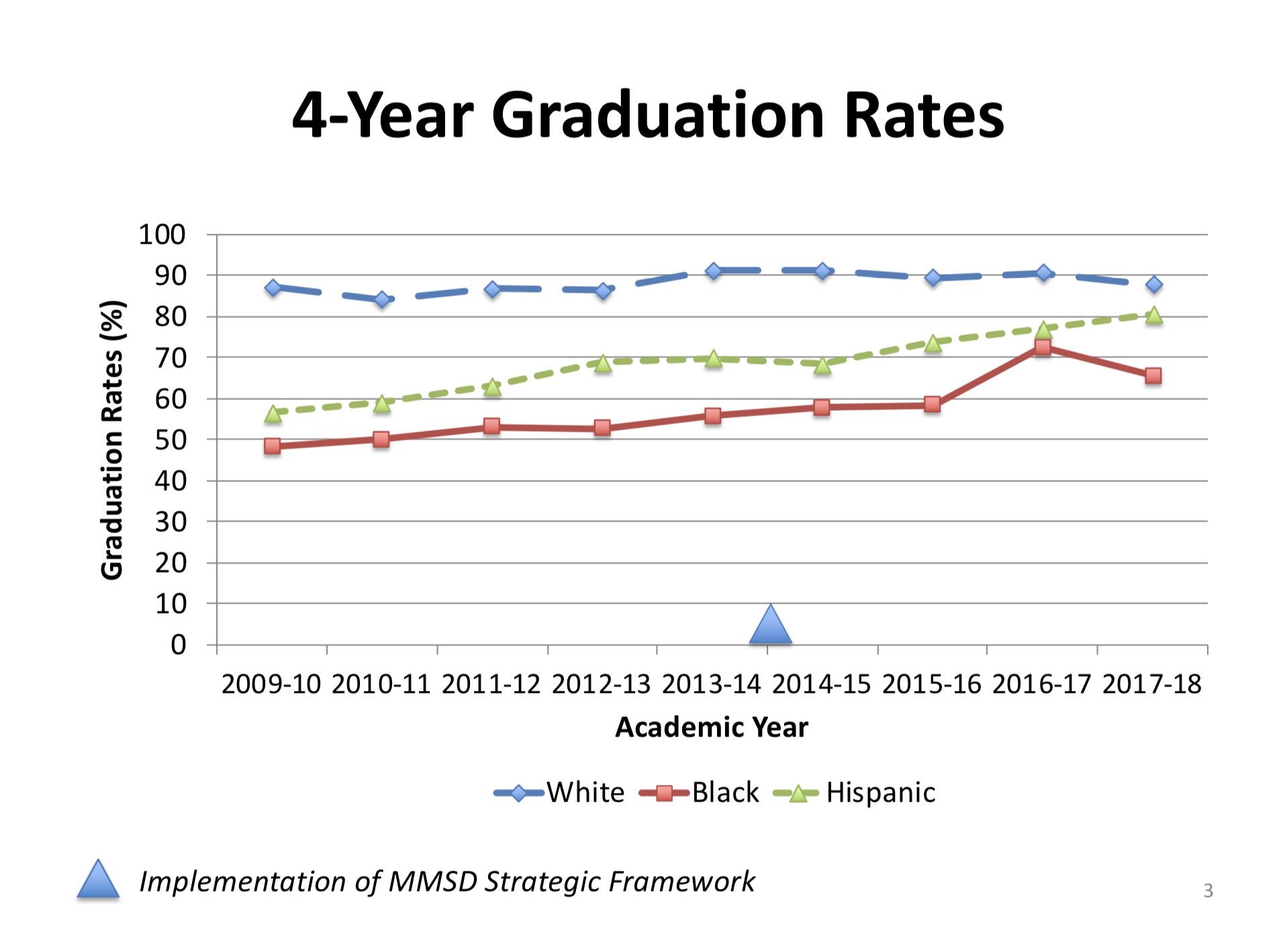
The graph below displays MMSD graduation data (as reported by the DPI) for the past eight years for White, Black, and Hispanic students. As you can see, in 2016-17, Hispanic students showed a 3.3% increase in graduation rate over the previous year and Black students showed an astounding 14.1% increase. Compared to their peers in the Class of 2013 (the year prior to the implementation of the MMSD’s Strategic Framework), the Hispanic and Black students in the Class of 2017 showed an 8.2% and 19.8% increase in graduation rates, respectively.

We will leave it to others to determine what accounts for the increase in minority student graduation rates – whether it is due, for example, to procedural changes in the way high school graduates are tallied; other (possibly questionable) data reporting practices; interventions that have produced bona fide improvements in student achievement; or a lower bar for success(including graduation) due to grade inflation, non-rigorous alternative educational options, and/or watered-down credit recovery programs (practices that have been the focus of investigative reports in other parts of the country).

For us, the important question is: Has the increase in minority student graduation rates been accompanied by an increase in minority student learning and achievement? Put another way, as we graduate an increasing number of our minority students, are we graduating more minority students who are college ready? who can read and do math at grade level?

We believe the best way to determine college readiness is with the ACT, which all MMSD juniors have been required to take since 2013-14*. Though far from perfect, the ACT is a widely used standardized test with well-established and well-documented reliability and validity. It yields objective performance data in the core academic areas, data that allow for meaningful comparisons across time, geography, and demographics. Grades (and GPA), in contrast, are somewhat subjective and “squishy”. They are locally determined and, in practice, easily influenced – whether consciously or unconsciously – by the adults’ desire for success, both their own and their students’, especially during times of strong administrative and societal pressure for that success.

The ACT defines college readiness benchmark scores as the level of achievement (in terms of ACT test performance) required for a student to have at least a 75% chance of earning a C or better in an introductory college course in the same content area. Since 2013, the ACT-based college readiness benchmark score for both Reading and Math has been 22. (Before 2013, the benchmark score was 21 for Reading and 22 for Math.)

Here are the ACT-based college readiness data in Reading and Math for the MMSD Classes of 2008 through 2017.

As you can see, in the Class of 2017, 12.7% of the Black students met the college readiness benchmark in Reading (vs. 12.8% the year before and 10.4% in 2014, the first year of universal test participation in the MMSD) and 8.1% met it in Math (vs. 15.3% the year before and 8.1% in 2014). Those are the same Black students who showed the dramatic single-year increase in graduation rate of 14.1%. Clearly the increase in graduation rate for the Black students in the Class of 2017 was not accompanied by an increase in their college readiness. The same is true for their Hispanic classmates. The disconnect between minority student graduation rates and minority student achievement is, at best, puzzling (and at worst, alarming).

Question: How are we to understand increasing minority student graduation rates in the absence of an increase in minority student achievement (defined as college readiness)?

Question: More generally, how are we to understand such high minority student graduation rates in combination with such low minority student achievement?

These are questions we should all want to know the answers to.

In keeping with recent trends in education research, we wanted to know more about how the MMSD Class of 2017 fared over time, how their cohort learning profile evolved over their years as MMSD students. To that end, we looked at the percentage of students in the Class/cohort who were deemed proficient or advanced in Reading and Math from third grade on.

We undertook this effort with full awareness that a) the District uses different tests to assess grade level proficiency at different grade levels and, b) there is some variability in the students tested at each grade level (due to student movement in and out of the District, who shows up on test day each year, etc.). We moved forward with the analyses despite these obstacles because a) we believed that since all the tests are used to determine the same thing – grade level proficiency – there was enough meaningful equivalence across them to warrant the effort, and b) the changing membership of a cohort over time is a natural limitation of longitudinal data.

Perfection should not be the enemy of the good, as they say, nor should arguments about an absence of perfect data be used as an excuse to not look. We need to do the best we can with the data we have, keeping the problems in mind, but also in perspective.

Here is what we found.

This is what we accomplished with the minority students in the MMSD Class of 2017 over the course of nine years: little to nothing. No limitation in the data set can explain away these painful results.

And yet 77% of the Hispanic students and 72.6% of the Black students in the Class of 2017 earned MMSD high school diplomas. Clearly most of them did so without having grade level skills in reading and math.

We looked at the Classes of 2016 and 2018 and obtained essentially the same results.

Unfortunately, a high school diploma without high school level reading and math skills is of limited value when it comes to finding success and making a good life post-high school. Thus, despite our best efforts and multiple Doyle Building and community-based initiatives over the years, we continue to fail at preparing our minority students for life beyond the MMSD.

This is the proverbial forest. We need to look at it, long and hard. We need to take a break from looking at individual trees – or worse, single aspects of individual trees. It is critical that we take in the full landscape. No more hiding or explaining away the heartbreakingly tragic results. As a community and as a school district, we need to be honest with ourselves about how dismally we have failed and continue to fail our minority students.

Laurie A. Frost, Ph.D. Jeffrey B. Henriques, Ph.D.
August 20, 2018

A Note About the Data and Data Sources

Grades 3 – 8 proficiency data are based on WKCE test scores.

Grades 9 and 10 proficiency data are based on ACT Aspire test scores.

Grade 11 proficiency data and college readiness scores are based on ACT test scores. Source for all data (except the 2013-14 ACT Aspire data):

http://wisedash.dpi.wi.gov/

Source for the 2013-14 ACT Aspire data:
https://accountability.madison.k12.wi.us/files/accountability/2015-8- 7%20ACT%20%26%20Aspire%20Scores%20Report%202014-15.pdf

* The MMSD implemented universal ACT test participation for high school juniors in 2013-14. Since then, the percentage of students taking the test has increased in all demographic groups. In the Class of 2017, 87.9% of White students, 64.1% of Black students, and 80.3% of Hispanic students took the ACT (vs. 67.0%, 27.1% and 47.8% for the Class of 2013, the year before universal participation was implemented).

Before universal participation was implemented, the group of students who took the ACT likely included a disproportionately high number of college-bound students (vis-a-vis the entire junior class). As a result, the percentage of students identified as college ready by the test in the years before 2013-14 was likely inflated. Had all students been taking the exam in the earlier years, it is likely that the percentage of students identified as college ready would have been lower, comparable to the percentage observed in more recent years.

Related: The Madison School District’s “Strategic Framework”.

2006: “They’re all Rich White Kids, and they’ll do just fine, NOT!”

2013: Madison’s long term, disastrous reading results.

Madison spends far more than most taxpayer funded school districts. Details, here.

Share

Uproar over ‘wacky’ plan to start baby boom in China by taxing adults under 40

Mandy Zuo:

A proposal to tax all working adults aged under 40 – with the money going to a “reproduction fund” to reward families who have more than one child – has caused uproar in China.

The idea was the most controversial among a series of measures floated by two academics from prestigious Nanjing University in an article published by Communist Party mouthpiece Xinhua Daily on Tuesday.

It comes amid a nationwide campaign to encourage people to have more children – a drastic turnaround after a one-child policy that lasted nearly four decades and only ended three years ago – as Beijing worries about a rapidly ageing society, shrinking workforce and falling birth rate creating a demographic time bomb.

Related: Choose Life.

Share

Vocational Training Is Back as Firms Pair With High Schools to Groom Workers

Michelle Hackman:

Gabe Schorner never considered himself a good student until he enrolled in his high school’s new welding program, where, in an industrial-style classroom, Mr. Schorner found himself enchanted by the molten metal and its bright blue glow as he molded it.

The skills he picked up led directly to a full-time offer from Electric Boat, the Rhode Island-based submarine manufacturer, where he is now making $16.50 an hour. “I don’t like the idea of going to college — I wanted to avoid taking on that debt and everything else,” Mr. Schorner said. “Being out in the world is a lot more fun.”

Coventry High School established its welding program after Electric Boat, one of the state’s largest employers, declared it was looking to hire 14,000 new employees in the next decade.

The company wasn’t finding enough recruits coming out of college. So it turned to high schools — where students can be discovered early, and the training is free.

Such direct ties between big companies and local high schools are multiplying. Volkswagen is helping schools in Tennessee modernize their engineering programs; Tesla is partnering with Nevada schools on an advanced manufacturing curriculum; and fisheries in Louisiana have created courses for students to train for jobs in “sustainability.”

The renewed popularity of so-called career education programs marks a shift away from the idea that all students should get a liberal-arts education designed to prepare them for college.

Share

Alex Usher:

For decades, Canadians interested in post-secondary education (PSE) have decried the lack of easily available, easily digestible data on the post-secondary sector. In part, this lacuna results from some very large gaps in our PSE data system, especially with respect to colleges, staff, and student assistance (in contrast, statistics on institutional finances are among the best in the world). There are also some types of statistics which take an inordinately long time to appear (data on international students, for instance, routinely take three to four times as long to appear in Canada as they do in the US, the UK, or Australia). Our decentralized, federal system is partly to blame, but mainly, Canadian governments and statistical agencies just seem not to care about good education data the way some other countries do.
That said, there actually is a considerable amount of data on Canadian post-secondary education available, but it is just not usually put in a narrative form which is easily accessible. The Canadian Association of University Teachers (CAUT), for instance, puts out an invaluable annual “almanac”, but the data has a profound university skew and tends to be presented in tabular form rather than through more intuitive graphics. Universities Canada occasionally puts together some good publications on the state of the system, but these have become rarer as of late and in any case largely miss the colleges. The Council of Ministers of Education, Canada (CMEC) has an irregularly published system of “Education Indicators” but these are more focused on education as a whole rather than on post-secondary and fall prey to the same preference for tables over graphs. Statistics Canada produces a great deal of data (if not always very promptly), but does very little to help people interpret it.
As a result of all this, Higher Education Strategy Associates has decided to produce an annual publication called “The State of Post-Secondary Education in Canada”. We took as our model a similar set of publications produced by Andrew Norton and his colleagues at the Grattan Institute in Melbourne entitled “Mapping Australian Higher Education”. Like the Australian exercise, we expect we will take on slightly different issues in each future edition, depending on what new data come available. For the inaugural year, we chose to stick to the basics: describing the Canadian system (trickier than it sounds), detailing trends in student and staff numbers, and looking at how the system is financed, both from an institutional and a student perspective. We hope that by putting all of this information in a handy and convenient format, and providing some accompanying narrative, that we can help improve the quality of public dialogue on post-secondary education policy issues. Any and all comments or suggestions about how to improve the publication for future years will be gratefully received.

Share

STDs continue rapid rise in U.S., setting new record, CDC says

Linda Carroll:

Experts say many factors have contributed to the rapid rise, though the biggest one may be less frequent condom use. It’s less clear whether dating apps, like Tinder, have contributed in some way to the spread of STDs, though some researchers think they have.

“We have seen steep and sustained increases over the last five years,” said Dr. Gail Bolan, director of the Division of STD Prevention at the CDC. “Usually there are ebbs and flows, but this sustained increase is very concerning. We haven’t seen anything like this for two decades.”

Share

Betsy DeVos Plans to Overhaul Title IX, Focus on Due Process for Accusers and the Accused

Robby Soave:

According to the Times, the new rules “would add the ability for victims and their accused perpetrators to request evidence from each other and to cross-examine each other. The rules also allow the complainant and the accused to have access to any evidence obtained during the investigation, even if there are no plans to use it to prove the conduct occurred.”

Cross-examination is a key component of due process and an important tool for arriving at the truth of a dispute. But under the previous administration’s Title IX guidance, university officials were discouraged from extending this right to students accused of sexual misconduct, under the theory that scrutinizing alleged victims would be traumatizing.

The new policy would mandate cross-examination in situations where a school’s adjudication process involves a live hearing, and it would require an effective substitute in all other cases.

Share

New on Parents’ To-Do List: Checking Children’s Credit History

Yuka Hayashi:

Parents have a new item to add to their financial to-do list: check their child’s credit history.

A new federal law going into effect in September will make it easier for families to combat the growing problem of identity fraud of minors, allowing them to make inquiries about credit files in their child’s name and freeze a file at no cost.

Data-security experts say children are increasingly targeted by thieves who steal their Social Security numbers to create fake or “synthetic” identities, then open credit cards, take out loans or apply for public assistance. One credit-reporting company, Experian , EXPGY +1.20% estimates such identity theft will affect one in four children before they become an adult.

The ability to check children’s credit reports is part of a broader banking law that also allowed unlimited, free credit freezes for adults, a response to a massive data breach at Equifax Inc. EFX +0.98% last September.

Share

Francis Fukuyama Postpones the End of History: The political scientist argues that the desire of identity groups for recognition is a key threat to liberalism.

Louis Menand:

In February, 1989, Francis Fukuyama gave a talk on international relations at the University of Chicago. Fukuyama was thirty-six years old, and on his way from a job at the RAND Corporation, in Santa Monica, where he had worked as an expert on Soviet foreign policy, to a post as the deputy director of policy planning at the State Department, in Washington.

It was a good moment for talking about international relations, and a good moment for Soviet experts especially, because, two months earlier, on December 7, 1988, Mikhail Gorbachev had announced, in a speech at the United Nations, that the Soviet Union would no longer intervene in the affairs of its Eastern European satellite states. Those nations could now become democratic. It was the beginning of the end of the Cold War.

At RAND, Fukuyama had produced focussed analyses of Soviet policy. In Chicago, he permitted himself to think big. His talk came to the attention of Owen Harries, an editor at a Washington journal called The National Interest, and Harries offered to publish it. The article was titled “The End of History?” It came out in the summer of 1989, and it turned the foreign-policy world on its ear.

Share

When Digital Platforms Become Censors

Glenn Reynolds:

Call 2018 the “Year of Deplatforming.” The internet was once celebrated for allowing fresh new voices to escape the control of gatekeepers. But this year, the internet giants decided to slam the gates on a number of people and ideas they don’t like. If you rely on someone else’s platform to express unpopular ideas, especially ideas on the right, you’re now at risk. This raises troubling questions, not only for free speech but for the future of American politics and media.

The most famous victim of deplatforming is, not coincidentally, the least popular: Alex Jones, the radio host known for promoting outrageous conspiracy theories about everything from vaccinations to the Sandy Hook massacre. In a concerted action earlier this month aimed at loosely defined “hate speech,” Facebook , Apple , Spotify and YouTube removed from their services most of the material by Mr. Jones and his InfoWars network. Twitter recently followed suit with a seven-day suspension.

Apple cited its “terms of use” in removing InfoWars from its iTunes podcast listings but couldn’t explain why it didn’t remove the InfoWars app, which shares the same content, from its App Store. YouTube made general reference to its “terms of service and community guidelines,” but didn’t say what Mr. Jones had done wrong. Facebook’s reasons were similarly vague.

Their evasiveness isn’t hard to explain. After all, Mr. Jones isn’t doing anything different from what he has been doing for years. The real reason for his removal is that technology companies don’t like his views and have come under increasing pressure to deny him the use of their platforms.

Nor is it just Alex Jones who’s been subjected to digital unpersoning lately. The Austin-based “crypto-anarchist” Cody Wilson creates and distributes designs for guns that can be produced using 3-D printers. Shopify recently shut down the online storefront of Mr. Wilson’s company, Defense Distributed.

Share

Those Who Can Do, Can’t Teach

Adam Grant:

If you want to be great at something, learn from the best. What could be better than studying physics under Albert Einstein?

A lot, it turns out. Three years after publishing his first landmark paper on relativity, Einstein taught his debut course at the University of Bern. He wasn’t able to attract much interest in the esoteric subject of thermodynamics: Just three students signed up, and they were all friends of his. The next semester he had to cancel the class after only one student enrolled. A few years later, when Einstein pursued a position at the Swiss Federal Institute of Technology in Zurich, the president raised concerns about his lackluster teaching skills. Einstein eventually got the job after a friend vouched for him, but the friend admitted, “He is not a fine talker.” As his biographer Walter Isaacson summarized, “Einstein was never an inspired teacher, and his lectures tended to be regarded as disorganized.”

Although it’s often said that those who can’t do teach, the reality is that the best doers are often the worst teachers.

Two decades ago, I arrived at Harvard as an undergraduate excited to soak up the brilliance of professors who had won Nobels and Pulitzers. But by the end of the first month of my freshman year, it was clear that these world-class experts were my worst teachers. My distinguished art history professor raved about Michelangelo’s pietra serena molding but didn’t articulate why it was significant. My renowned astrophysics professor taught us how the universe seemed to be expanding, but never bothered to explain what it was expanding into (still waiting for someone to demystify that one).

Share

Swift Gene-Editing Method May Revolutionize Treatments for Cancer and Infectious Diseases

Gina Kolata:

For the first time, scientists have found a way to efficiently and precisely remove genes from white blood cells of the immune system and to insert beneficial replacements, all in far less time than it normally takes to edit genes.

If the technique can be replicated in other labs, experts said, it may open up profound new possibilities for treating an array of diseases, including cancer, infections like H.I.V. and autoimmune conditions like lupus and rheumatoid arthritis.

The new work, published on Wednesday in the journal Nature, “is a major advance,” said Dr. John Wherry, director of the Institute of Immunology at the University of Pennsylvania, who was not involved in the study.

But because the technique is so new, no patients have yet been treated with white blood cells engineered with it.

Share

France Takes On Cellphone Addiction With a Ban in Schools

Sam Schechner:

Solal Paroux’s friends all have smartphones, and the 12-year-old Parisian has been needling his parents to get him one too. But his parents are resisting.

And now they have the law on their side.

When school starts up in September, a new French law will ban students ranging roughly from ages 3 to 15 from using smartphones anywhere on school grounds, with only narrow exceptions.

The law is one of the most sweeping attempts yet to address growing concerns among parents and educators that a generation of children is growing up addicted to the mobile devices in their pockets.

“Children don’t have the maturity” for smartphones, said Valérie Paroux, Solal’s mother. “Some adults don’t either.”

Share

Spending more money on schools doesn’t help students learn

Will Flanders:

The results were staggering, even after accounting for other demographic and socioeconomic factors that can impact student performance.

All three types of spending were related to either negative proficiency or null proficiency gains for students. None of the types of spending examined were found to correlate with better student outcomes. Of the three, perhaps the least surprising is that more spending on non-teaching staff leads to worse student outcomes. The growth of the education bureaucracy has received increased attention in recent years, with school districts putting more and more money into positions that do not directly touch the classroom. Our research here shows that this is counterproductive if the goal is to improve student performance.

More surprising is that teacher pay and overall spending are negatively related to student outcomes. Wisconsin is a state that ranks relatively high in funding equity across school districts, and more funds are directed toward school districts with more difficult populations. The same can be said for teacher pay, which is often higher in school districts with proportionally more challenging students. So while we wouldn’t claim that additional dollars actually hurt student achievement, we would say that they certainly don’t seem to help. This finding is consistent with much of the research on school finance, which tends to show null or very small positive effects on performance. School funding has increased immensely since the 1970s, and we appear to have crossed the threshold of diminishing returns, whereby additional spending does not lead to commensurate increases in student performance.

The main point is that throwing more money at any of the areas examined here in public schools is not likely to have a positive impact on student outcomes. So how can the public be convinced that more money is not the answer? A recent poll where we asked respondents if they knew how much was spent per student in Wisconsin schools may help to illuminate the problem. The vast majority, more than 80 percent, of respondents underestimated spending. But when these respondents were then told the true amount of spending per student, they became much more likely to say we are already spending enough. More spending always sounds good prima facie, but providing people with the tangible numbers of what we already spend appears to sober them up.

Share

“The Becks, possibly out of exasperation with the Ivy League boys the museum kept sending them as field assistants”

Jonathan Meiburg:

The hall was the brainchild of Frank Chapman, the visionary chairman of the museum’s Department of Ornithology, and Leonard C. Sanford, a deep-pocketed New Haven surgeon with an ornithology habit. Chapman arrived at the museum as a volunteer in 1887 and didn’t retire until 1942, at age 78. He more or less acquired Sanford along the way: in 1912, Chapman convinced him to store his personal collection of bird skins at the museum and installed him in an office next to Chapman’s as an unofficial member of the staff.

It was a shrewd, if unconventional, move. Sanford was well-connected, ambitious, persuasive, and competitive, especially with his friends at Harvard’s Museum of Comparative Zoology. Robert Cushman Murphy, who came to the museum as a young man in 1912 and later chaired the department after Chapman retired, noted that Sanford “particularly enjoyed possessing things which the other fellow did not have, and partly because the other fellow did not have them.”

Share

Logged off: meet the teens who refuse to use social media

Sirin Kale:

For 17-year-old Mary Amanuel, from London, it happened in Tesco. “We were in year 7,” she remembers, “and my friend had made an Instagram account. As we were buying stuff, she was counting the amounts of likes she’d got on a post. ‘Oooh, 40 likes. 42 likes.’ I just thought: ‘This is ridiculous.’”

Isabelle, an 18-year-old student from Bedfordshire who doesn’t want to disclose her surname, turned against social media when her classmates became zombified. “Everyone switched off from conversation. It became: ‘Can I have your number to text you?’ Something got lost in terms of speaking face to face. And I thought: ‘I don’t really want to be swept up in that.’” For 15-year-old Emily Sharp, from Staines in Surrey, watching bullying online was the final straw. “It wasn’t nice. That deterred me from using it.”

It is widely believed that young people are hopelessly devoted to social media. Teenagers, according to this stereotype, tweet, gram, Snap and scroll. But for every young person hunched over a screen, there are others for whom social media no longer holds such an allure. These teens are turning their backs on the technology – and there are more of them than you might think.

Share

Is There Any Such Thing as an Illegal Teacher Strike?

Mike Antonucci:

Teachers from seven school districts in Washington State are on strike, with Seattle on the brink. The news isn’t entirely grim, since Spokane did reach a tentative agreement.

Strikes by public employees are illegal in Washington, though it’s a particularly pointless law since violating it carries no penalties.

I’m opposed to virtually all anti-strike laws. Back when West Virginia teachers were striking illegally, I shared with you the one measure I use to judge when a strike should be illegal: If you have to call in the National Guard to replace them, then they should not be allowed to strike.

Share

Asian-American Students Suing Harvard Over Affirmative Action Win Justice Dept. Support

Katie Benner:

The Justice Department lent its support on Thursday to students who are suing Harvard University over affirmative action policies that they claim discriminate against Asian-American applicants, in a case that could have far-reaching consequences for the use of affirmative action in college admissions.

In a so-called statement of interest, the department supported the claims of the plaintiffs, a group of Asian-Americans rejected by Harvard. They contend that Harvard has systematically discriminated against them by artificially capping the number of qualified Asian-Americans from attending the school in order to advance less qualified students of other races.

“Harvard has failed to carry its demanding burden to show that its use of race does not inflict unlawful racial discrimination on Asian-Americans,” the Justice Department said in its filing.

The filing said that Harvard “uses a vague ‘personal rating’ that harms Asian-American applicants’ chances for admission and may be infected with racial bias; engages in unlawful racial balancing; and has never seriously considered race-neutral alternatives in its more than 45 years of using race to make admissions decisions.”

Share

K-12 Tax & Spending Climate: Milwaukee County retirees could lose cost-of-living increases as unfunded pension liability grows

Don Behm:

A Milwaukee County pension reform task force has recommended the possible elimination of 2% annual cost-of-living increases now added to thousands of retirees’ pension payments at a cost of up to $20 million a year.

The proposal comes as the county’s unfunded liability for the pension commitments it already has made to retirees and current employees has swelled to at least $550 million this year, officials said.

In response, the county’s annual pension contribution — a total of the year’s general pension system operating costs and an amount for the unfunded liability — has steadily increased in recent years from $27.4 million in 2012 to $72.6 million this year, budget documents show.

The portion of the payment designated for the unfunded liability alone has grown from $10.23 million in 2012 to $53.23 million in 2018.

Milwaukee County Pension Scandal Primer.

Share

China Signals End to Child Birth Limits by 2020 at Latest

Bloomberg:

China’s parliament struck “family planning” policies from the latest draft of a sweeping civil code slated for adoption in 2020, the clearest signal yet that the leadership is moving to end limits on the number of children families can have.

A new draft of the Civil Code submitted Monday to the Standing Committee of the National People’s Congress removed all “family planning-related content,” according a report published Tuesday in the Communist Party’s People’s Daily newspaper. That would suggest that the decades-old birth restrictions wouldn’t be enforced after the law goes into effect, since the code is intended to govern all aspects of private life from contracts to company registrations to marriages.

Related: Choose life.

Share

Race-Based School Criteria Roils Asian-Americans–Again

Janie Har:

Time and again, Chinese-American students consistently delivered top academic scores, only to be denied admission to their dream school. Parents bemoaned what they saw as an unfair racial advantage given to black and Latino children while their own children were overlooked.

“Every year hundreds of Chinese-American parents would be in anguish,” said Lee Cheng, a 46-year-old intellectual property attorney, who sought to end the practice. “I remember the disappointment in some of my friends who were the kids of immigrants, of very, very poor people who worked in Chinatown.”

This may sound like the fights going on today over testing in elite public schools in New York City or lawsuits against prestigious universities such as Harvard over affirmative action.

But the scenario played out more than three decades ago on the other side of the country over a public high school, demonstrating the enduring nature of a controversy in which Asian-Americans have played a key role despite some feeling shut out of the broader conversation.

Share

Welcome Students, Let’s Talk About Confederate Statues

Cameron McWhirter and Melissa Korn:

Shadé Shepard recently attended an orientation session addressing the slave-owner connections of her new college, Sewanee.

Also known as the University of the South, the liberal-arts school in the Tennessee mountains was conceived by slave owners who didn’t want their sons going North for an education, and many ex-Confederates taught there after the Civil War.

“I appreciated them being blunt about it,” said Ms. Shepard, an 18-year-old African-American first-year student from Washington, D.C. Life on the predominantly white campus “will definitely take some adjusting,” she said, though so far, people have been welcoming.

The toppling of a Confederate statue by protesters on Monday at the University of North Carolina at Chapel Hill is the latest skirmish in an intense debate over the future of such monuments and imagery on southern campuses. Institutions from Virginia to Mississippi are trying to come to terms with statues, markers and building names linked to their Confederate past, without alienating alumni and donors.

Share

Drone images of India, South Africa offer bird’s-eye view of rich-poor divide around world

SCMP:

Miller’s ongoing photo essay, called “Unequal Scenes”, explores many of the world’s biggest cities.

“We are helping to create a visual record of extreme inequality to provoke conversations, increase dialogue, and accelerate the pace of change for equity of all groups of people,” he says.

Share

The bridge of desperation


Katy Watson:

Laura is getting paid 30,000 pesos ($10) for her hair. It’ll be sold on to make extensions or wigs.

“It’s the first time I’ve done it,” she says with a mixture of nervousness and embarrassment. She’s come for the day from the town of Rubio, about an hour from the border.

Laura is selling her hair because her eldest daughter, eight-year-old Andrea, has diabetes and the family needs to raise money to pay for her insulin which she takes three times a day. The family has run out of supplies and it’s been three days since little Andrea last had her shots. Jhon’s salary as a saddler doesn’t always stretch to pay for his daughter’s drugs.

“There’s no medicine, it’s hard,” says Laura. “People are dying in Venezuela because they can’t get the medicines they need.”

After five minutes of cutting, the family heads off to find a pharmacy. At first glance you can’t tell Laura’s had most of her hair removed. The hair-cutter has left a thin layer of long hair on top to hide the truth. Laura admits she feels a bit sad.

“It will pay for something at least,” she says. Her husband Jhon says they’re looking for a “pirate” pharmacy – an informal stall that sells drugs in plastic cabinets on the street. Insulin pens will be cheaper there than in a walk-in drug store.

Socialism and Venezuela.

Share

Milwaukee’s Public School Barricade

Wall Street Journal:

We wrote in 2015 about how MPS blocked charter and private school purchases of empty school buildings, which prevented high-performing schools like St. Marcus Lutheran from expanding. The state legislature then passed a law ordering the city and school district to sell vacant public school buildings.

Well, what do you know, the district still hasn’t sold a single vacant building to other schools despite 13 letters of interest from private and charter operators for 11 vacant buildings, according to the Wisconsin Institute for Law and Liberty. Following protests from the teachers’ union, a local zoning board denied a bid by Right Step, a private school for children expelled from Milwaukee public schools. The city hasn’t even classified many unused buildings as “vacant.”

Milwaukee’s recalcitrance is denying thousands of students a better education—St. Marcus Lutheran alone has 264 students on its wait list—while draining tax dollars. Annual utility bills for vacant buildings cost $1 million, and the Wisconsin Institute for Law and Liberty calculates that the district could recover $5 million from selling its unoccupied real estate.

Related: a conversation with Henry Tyson.

Share

Pro-Democracy Party Slams Communist Party ‘Brainwashing’ in Hong Kong Textbooks

Radio Free Asia:

A pro-democracy party in Hong Kong has hit out at newly published school textbooks backed by the Chinese government as “biased,” and aimed at “brainwashing” students.

The books and teaching materials published by Educational Publishing, which is wholly controlled by Beijing’s Central Liaison Office in the city, contain a biased account of the 2014 pro-democracy Occupy Central movement, according to activists who led the movement.

The account of the 79-day civil disobedience movement for fully democratic elections offers only quotes from four opponents and relegates movement co-founder and Hong Kong University law professor Benny Tai to the status of “supporter.”

The group said that even textbooks not published by the company had begun using terminology that is approved by the ruling Chinese Communist Party to describe the histories of Hong Kong and China.

According to Demosisto committee member Isaac Cheng, a history textbook published by Marshall Cavendish describes Hong Kong as being “occupied” during British colonial rule.

He said the 1919 student-led May 4th movement protesting against the Chinese government’s weak response to the Treaty of Versailles that handed territory in the eastern province of Shandong to Japan had been misrepresented.

“For example, there is a sentence added in at the end which describes the May 4th movement as a patriotic movement close to Chinese people’s hearts, but makes no mention of the emphasis in the May 4th movement on fighting for democracy and westernization,” Cheng told RFA.

Share

Common STDs Hit New U.S. Record

Joseph Williams:

IN A DISTURBING national trend, the number of three common sexually transmitted diseases hit a record high last year, with nearly 2.3 million cases reported in the U.S. – eclipsing the record set in 2016 by more than 200,000 cases, according to the Centers for Disease Control and Prevention.

Comparing data from 2013 with 2017’s preliminary data showed “steep, sustained increases” in reported cases of chlamydia, gonorrhea and syphilis, the CDC said, also warning that gonorrhea is showing signs of becoming resistant to the antibiotics used to treat it.

“We are sliding backward,” Dr. Jonathan Mermin, director of the CDC’s National Center for HIV/AIDS, Viral Hepatitis, STD, and TB Prevention, said in a statement. “It is evident the systems that identify, treat, and ultimately prevent STDs are strained to near-breaking point.”

Share

Civics: Using supervised machine learning to quantify political rhetoric

Adam Hughes:

Using the 11,000 posts coded by Mechanical Turk workers, we split the data into five equally sized portions and trained the model five separate times, each time omitting a different 20% of the data so we could check how well the model did. Not only did this process help determine whether the models worked, but it also helped us determine prediction thresholds that provided us with the greatest balance between precision and recall. The full results of the cross validation process are shown here. Finally, in addition to cross-validation, we also compared our model’s predictions for the 1,100 posts that Center researchers labeled themselves, to make sure that our models agreed not only with the Mechanical Turk workers, but our own judgments as well.

Once we had our predictions, we decided to step back from the individual posts and take a look at the overall rates at which congressional Facebook posts took sides or went local. To do so, we computed the overall weighted proportions of posts that contained each of our topics, based on the machine learning models as well as the Mechanical Turk coders and in-house researchers, and compared the three different overall estimates. Happily, they all seemed to match closely.

Finally, we used these data to look at patterns in which members of Congress took sides, who went local and how the Facebook audience reacted to different kinds of posts. But our research doesn’t have to be the last word on this. We think other researchers and scholars interested in Congress might have their own ideas about how to use these data, so we’re publishing a dataset that contains our estimates of the rate at which individual members of Congress expressed opposition, expressed support or discussed local topics on Facebook. The dataset covers the full 114th Congress and the first year of the 115th Congress and is available here. (You’ll just need to create an account first.)

Please cite the dataset as: van Kessel, Patrick, Adam G. Hughes, and Solomon Messing. 2018. “Taking Sides on Facebook: How Congressional Outreach Changed Under President Trump.” Dataset: Pew Research Center.

Share

Sex, Steroids, And Arnold: The Story Of The Gym That Shaped America

David Davis:

When did the modern-day fitness movement really begin in the U.S.?

Maybe our infatuation with getting in shape can be traced to when President-elect John F. Kennedy published an article in Sports Illustrated titled “The Soft American,” urging “the United States to move forward with a national program to improve the fitness of all Americans.” Or perhaps in 1982, when Jane Fonda donned Spandex and leggings and released the first of her best-selling workout videos. Cynics might cite the first time athletes gobbled down blue Dianabol pills, the first “mainstream” steroid, back in the 1950s.

Another candidate: That day in 1965 when Joe Gold, a crusty Merchant Marine from East Los Angeles, opened a workout space for hardcore weightlifters and bodybuilders on a desolate street in Venice Beach.

The original Gold’s Gym was a squat sweatbox that Joe and a few of his pals built from cinder blocks. Gold himself crafted the equipment that he and his fellow “Muscleheads” used to shape their flesh into cathedrals of strength. The gym spawned Pumping Iron, one of the most popular and critically acclaimed documentaries in modern times; redefined the masculine look in everything from commercials to modeling to movies; helped establish Southern California as the nation’s fitness capital; and shaped the ascent of one Arnold Schwarzenegger.

Share

Why you should consider applying for grad school right now

Robert Wiblin:

pplication deadlines for US PhD programs are coming up over the next month (as of Nov 2017). We think many of our readers who are considering grad school at some point in the next few years should apply this year.

We’re writing this informal list of pros and cons now because a number of people we’ve recently given career coaching to have been much more reluctant to apply for grad school than we think is justified.

Why should they take the option seriously?

Share

New Teaching Notes from Our World in Data

Esteban Ortiz-Ospina:

Over the last years we heard from many teachers and lecturers who use our work in their teaching, and in our recent survey we learned (here) more about what you need from us for teaching.

Responding to your request I am currently developing new resources to support those who use Our World in Data in teaching and learning about global development. As part of this effort, I have put together a brand new set of teaching notes for five of our most popular topics.

These new teaching notes provide a narrative around key interactive data visualizations so that we hope you can directly use these slides for your classes.

Here is the list of the slide decks we have produced so far. These are like lecture slides: Just click on the topic you are interested in and move through the slides with the arrow keys on your keyboard.

Share

China economy FAQ

akunthala:

Almost every day now, if you check Twitter, some founder or VC or journalist will have made the trip out to Shenzhen only to come back saying “CHINA IS SO AHEAD !!11!!1”. It’s hard to judge the veracity of these statements, since China and it’s economy seem so opaque to most people living in the West. People don’t even know where to start reading about it.

After a month or so of reading books and talking to people, here’s my “getting started” guide to learning about China. My aim with this blog post is to share general pointers that guide you where to look.

History and Background
For a broad description of the main differences between ‘Western’ societies and others, try reading about WEIRD psychology, the World Values Survey or the social impact of Christianity during the middle ages. The last book is good, because it explains the development of the concept of ‘human rights’.

China was a relatively isolated society until the 19th century, that saw itself almost as a world unto itself. The system of the Chinese emperor and mandarins had been in power for thousands of years. For the pragmatic mindset and cyclical view of history that evolved in this period, try The Art of War.

For a first encounter with the British “barbarians” — missionaries, diplomats and opium traders — in the 19th century, which eventually led to the fall of the Qing dynasty, try Imperial Twilight.

Share

The New Reading Environment  Each this is not to say or in other words a dull sword wielded against willful misunderstanding

n plus one:

HAVE EDITORS EVER KNOWN SO MUCH about their readers? And known, in particular, how little and how badly they read? Today even the Weekly Standard and Democracy: A Journal of Ideas announce up front how long it takes to get through one of their online articles, like a warning, or a dare to cull the weak. Newspaper and magazine editors track page views, unique page views, time on-site, and, for the publishers willing to pay thousands a year, scroll depth — the exact point at which readers give up. Twitter, meanwhile, is a scrolling record of bad reading habits. Retweets of pieces one hasn’t finished; parts of pieces one wants to read but isn’t ready to endorse; fragments that cause one to click away in disgust. A reader argues with a stranger about whether they’ve actually read the piece, only to discover that the stranger is the author. The author, a reader herself, knows all about bad reading habits.
The intimacy between online writers and readers determines how we read and write. As late as the 1990s, despite the lurid fan pages and dank chat rooms of the early internet, there was presumed to be a gulf between these two constituencies. Even with Fox News ascendant and internet news ever more dominant, mass media institutions remained monolithic enough to manufacture consent. The first decade of the 21st century was a transitional one in terms of reader-writer relations, its habits now as foreign as those of Edward R. Murrow’s America. Gone are the happy days when we dialed up to submit a comment to Salon.com, only to be abused by Glenn Greenwald or destroyed — respectfully — by the academics at Crooked Timber. Back then, we could not have imagined feeling nostalgic for the blogosphere, a term we mocked for years until we found it charming and utopian. Blogs felt like gatherings of the like-minded, or at least the not completely random. Even those who stridently disagreed shared some basic premises and context — why else would they be spending time in the comments section of a blog that looked like 1996? Today’s internet, by contrast, is arbitrary and charmless. On social media, criticism once confined to the comments now comes as free-range abuse directed at other readers. Readers can address all parties instantaneously — writers, editors, publishers, and the world. And so writers who publish online peer into the fishbowl of readerly reception. Drop in some flakes and watch the fish swarm.

Share

The inescapable weight of my $100,000 student debt

MH Miller:

On Halloween in 2008, about six weeks after Lehman Brothers collapsed, my mother called me from Michigan to tell me that my father had lost his job in the sales department of Visteon, an auto parts supplier for Ford. Two months later, my mother lost her job working for the city of Troy, a suburb about half an hour from Detroit. From there our lives seemed to accelerate, the terrible events compounding fast enough to elude immediate understanding. By June, my parents, unable to find any work in the state where they spent their entire lives, moved to New York, where my sister and I were both in school. A month later, the mortgage on my childhood home went into default.

After several months of unemployment, my mother got a job in New York City, fundraising for a children’s choir. In the summer of 2010, I completed my studies at New York University, where I received a BA and an MA in English literature, with more than $100,000 of debt, for which my father was a guarantor. My father was still unemployed and my mother had been diagnosed with an aggressive form of breast cancer. She continued working, though her employer was clearly perturbed that she would have to take off every Friday for chemotherapy. To compensate for the lost time, on Mondays she rode early buses into the city from the Bronx, where, after months of harrowing uncertainty, my parents had settled. She wanted to be in the office first thing.

Share

23andMe will no longer let app developers read your DNA data

Christina Farr:

23andMe, which provides DNA testing kits for consumers, is telling outside app developers that they’ll no longer have access to the company’s raw genomic data.

Developers of health apps, weight loss services and quantified self tests have been able to use 23andMe’s anonymized data sets since 2012, when the company announced the opening of its application programming interface (API). The idea was to “allow authorized developers to build a broad range of new applications and tools for the 23andMe community,” the company said at the time.

But on Thursday, 23andMe sent an email to developers, informing them that the API was being disabled in two weeks and that apps will only be able to use reports generated by the company and not the hard data.

“We’re updating our API program to focus on apps that build on the interpretations and results we provide to our customers,” 23andMe said in the email, which was viewed by CNBC.

Share

The number of migrant domestic workers in Lebanon, as well as the gulf states, are rising dramatically, but the conditions for them remain inhumane

Ghadi Ghosn and Virginie Le Borgne.

Share

Google Search Result bias commentary

Eric Weinstein:

This denial is ominous.

Google regularly biases search in countless political ways (Anti-gun, anti-extremist, pro-multiculturalism, etc…) according to many experiments I‘ve run and does so in a fashion that is so transparently obvious as to be comical.

Many edication organizations use Google services.

Share

Mainland Chinese university bars two Hong Kong human rights lawyers from teaching regular course there

Alvin Lum:

A source said the two barristers Peking University objected to were human rights lawyer Hectar Pun and Cheung Yiu-leung, vice-chairman of the China Human Rights Lawyers Concern Group. They were not allowed to teach the common law course and asked to be replaced, despite having done so for several years. Both have not replied to Post requests for comment.

But a few other members from the group who had also taught on the month-long programme, which ran annually at the university from 2011, were not blacklisted. The course still went ahead this year.

Dykes revealed he was not allowed to attend the closing ceremony of the course in Beijing in June, which he had intended to join to “get to the bottom of the refusal” of the two members continuing their lectures.

Share

Researchers replicate just 13 of 21 social science experiments published in top journals

Joel Achenbach:

The “reproducibility crisis” in science is erupting again. A research project attempted to replicate 21 social science experiments published between 2010 and 2015 in the prestigious journals Science and Nature. Only 13 replication attempts succeeded. The other eight were duds, with no observed effects consistent with the original findings.

The failures do not necessarily mean the original results were erroneous, as the authors of this latest replication effort note. There could have been gremlins of some type in the second try. But the authors also noted that even in the replications that succeeded, the observed effect was on average only about 75 percent as large as the first time around.

The researchers conclude that there is a systematic bias in published findings, “partly due to false positives and partly due to the overestimated effect sizes of true positives.”

Share

Summer Teen Employment

Bill McBride:

Here is a look at the change in teen employment over time.

The graph below shows the participation rate and employment-population ratio for those 16 to 19 years old.

The graph is Not Seasonally Adjusted (NSA), to show the seasonal hiring of teenagers during the summer.

A few observations:

1) Although teen employment has recovered some since the great recession, overall teen employment has been trending down. This is probably because more people are staying in school (a long term positive for the economy).

Share

What is the Real Value of $100 in Metropolitan Areas?

Alex Muresianu Erica York:

In May, the U.S. Bureau of Economic Analysis released new data covering differences in purchasing power in different metropolitan and nonmetropolitan areas in 2016. In layman’s terms, the data compares how much $100 can buy in different regions of the country. This post focuses on comparing the purchasing power in different metropolitan areas around the country.

There are large differences in price level by region. In general, the regions where $100 buys the least are concentrated around large cities in the Northeast and California. Conversely, $100 stretches the most in the rural areas of the Midwest and the Southeast.

Share

Student Debt Is Worse for Women

Julia Piper:

As an undergraduate at Christopher Newport University, Kelcie Chandler did not know that there was a significant difference in how much debt women and men hold after graduating from college. But she did notice that her female classmates were much more likely to talk about their debt than were the men she knew.

Women talked about “what kinds of jobs they were getting, and the pay for those jobs, and being concerned about whether or not they can pay rent, and pay for their groceries and their car payment, and also student loans.”

One question, she noticed, was on a lot of female students’ minds — “Am I going to be paying off these debts until I die?” Though the question may have been posed hyperbolically, it does reflect the daunting task students face upon graduation.

Share

What High School Applications and Acceptance Offers Tell Us About Chicago’s System of Schools

Jason Weeby:

Before digging into the research on Chicago’s education system and talking to many of the city’s leaders for a current project at Bellwether, I categorized the district as largely traditional with a decent sized charter sector. What I learned was that Chicago has more school types and school choice than I realized, especially at the high school level. It turns out that while most of the headlines regarding the district have been about scandals and violence, a lot of people have been focused on making sure more kids go to better schools faster.

That fact was reinforced when I looked at a recent report from the University of Chicago Consortium on School Research on the first round of applications and offers from Chicago’s brand new high school unified enrollment system. Neerav Kingsland provides a good take on the results. I just want to reiterate one point and add a few more observations.

Share

The Incredible, Rage-Inducing Inside Story of America’s Student Debt Machine

Ryann Liebenthal:

When Leigh McIlvaine first learned that her student loan debt could be forgiven, she was thrilled. In 2008, at age 27, she’d earned a master’s degree in urban and regional planning from the University of Minnesota. She’d accrued just under $70,000 in debt, though she wasn’t too worried—that’s what it took to invest in her future. But graduating at the height of the recession, she found that the kind of decent-paying public-sector job she’d anticipated pursuing was suddenly closed off by budget and hiring freezes. She landed a gig at a nonprofit in Washington, DC, earning a $46,000 salary. Still, she was happy to live on that amount if it was the cost of doing the work she believed in.

At the time, she paid about $350 each month to stay in a decrepit house with several roommates, more than $100 for utilities, and $60 for her cellphone bill. On top of that, her loan bill averaged about $850 per month. “Rent was hard enough to come up with,” she recalled. Then one day while researching her options, she read about something called the Public Service Loan Forgiveness (PSLF) plan. At the time, Congress had just come up with a couple of options for borrowers with federal loans. They could get on an income-based repayment plan and have their student loans expunged after 25 years. Or, for borrowers working public service jobs—as social workers, nurses, nonprofit employees—there was another possibility: They could have their debt forgiven after making 10 years’ worth of on-time payments.

Share

District Spending Is About to Get a Lot More Transparent. Are You Ready?

David A. DeSchryver & Noelle Ellerson Ng:

The federal government has never asked this of districts, and few superintendents have thought through the mechanics of the work at the school level. Hard questions are cascading across the country: What to do with shared school costs? What about centrally purchased items? Do existing charts of accounts adequately capture the information required by law? All of these are sticky questions that administrators must soon resolve.
In the short term, superintendents and principals will need to get on the same page about current district allocation policies and practices, why some schools appear to get more resources than others, and how this all aligns with the stated vision and mission of the district.

Consider, for example, a scenario where Elementary School A receives $250 more per pupil than Elementary School B down the road. Why is that happening? Perhaps School A serves more students with learning disabilities. If so, why is that the case? Perhaps High School C benefits from more state and local per-pupil revenue than a neighboring school because of an effort to better serve regional workforce technology campaigns. Is that a fair distribution of resources? If the allocations seem to contradict the district’s stated objectives, what will be done to adjust the investment strategy?

The earlier that district leaders begin to pay attention to these matters, the less disruptive the new reporting and transparency will be for school and district staff faced with new questions from the public.

Share

“Click here to kill everybody”

Hannah Kuchler:

The early architects of the internet did not want it to kill anybody. In cyber security expert Bruce Schneier’s new book, David Clark, a professor at the Massachusetts Institute of Technology, recalls their philosophy: “It is not that we didn’t think about security. We knew that there were untrustworthy people out there, and we thought we could exclude them”.

Schneier describes how the internet, developed as a gated community, is now a battleground where these untrustworthy people cause great harm: harnessing computers to kill by crashing cars, disabling power plants and perhaps, soon enough, using bioprinters to cause epidemics.

The clumsily-named internet of things, which Schneier rechristens the barely more elegant Internet+, is growing fast: between 20bn to 75bn devices could be online by 2020, depending on the estimate. This mushrooming hands more power to hackers, while cyber defenders struggle to protect the internet.

Share

The NSA Continues to Violate Americans’ Internet Privacy Rights

Patrick Toomey:

A federal court will be scrutinizing one of the National Security Agency’s worst spying programs on Monday. The case has the potential to restore crucial privacy protections for the millions of Americans who use the internet to communicate with family, friends, and others overseas.

The unconstitutional surveillance program at issue is called PRISM, under which the NSA, FBI, and CIA gather and search through Americans’ international emails, internet calls, and chats without obtaining a warrant. When Edward Snowden blew the whistle on PRISM in 2013, the program included at least nine major internet companies, including Facebook, Google, Apple, and Skype. Today, it very likely includes an even broader set of companies.

Share

Network-Based Businesses Will Disrupt All Sectors of the Economy

Mike Maples:

Today, I am convinced that:

Software-defined networks will be the most valuable businesses, displacing traditional corporations as central actors.
Networks can bring exponential improvements in prosperity throughout the world.
Networks will encounter fierce resistance from traditional businesses, governments, and other parts of society that don’t want a different future.

Share

Inside James Dyson’s all-or-nothing quest for an electric car

Stuart McGurk:

“No. In Singapore 40 per cent of all graduates are engineers. They encourage it. They don’t encourage it here.” So not because it’s cheaper? “In Singapore the average wage is double that in England and the land four times the price.” It is fair to say that neither of these things are true of Malaysia.

He has not yet, he says, made a call on where the Dyson car will be made. “But I’ll have to soon.”

Dyson does not believe that businesses should pay tax on profits. He believes it should be far easier to fire people.

Share

Some Techies Are Shunning Silicon Valley for the Japanese Dream

Pavel Alpeyev:

Still, for businesses that do try to lure workers from overseas, the buzz around Japan helps.

Mercari Inc., operator of a hit online flea market in Japan, this spring was able to hire 33 new graduates from the Indian Institutes of Technology, a top-notch network of engineering schools whose students tend to have their pick of the world’s tech employers. Alumni include Silicon Valley celebrities like Google Chief Executive Office Sundar Pichai and Sun Microsystems’ co-founder Vinod Khosla.

Mercari, which went public in June, plans to expand its 100-plus engineering force by 1,000 in the next three years and needs foreigners to fill some of those roles.

Share

Skim reading is the new normal. The effect on society is profound

Maryanne Wolf:

Look around on your next plane trip. The iPad is the new pacifier for babies and toddlers. Younger school-aged children read stories on smartphones; older boys don’t read at all, but hunch over video games. Parents and other passengers read on Kindles or skim a flotilla of email and news feeds. Unbeknownst to most of us, an invisible, game-changing transformation links everyone in this picture: the neuronal circuit that underlies the brain’s ability to read is subtly, rapidly changing – a change with implications for everyone from the pre-reading toddler to the expert adult.

As work in neurosciences indicates, the acquisition of literacy necessitated a new circuit in our species’ brain more than 6,000 years ago. That circuit evolved from a very simple mechanism for decoding basic information, like the number of goats in one’s herd, to the present, highly elaborated reading brain. My research depicts how the present reading brain enables the development of some of our most important intellectual and affective processes: internalized knowledge, analogical reasoning, and inference; perspective-taking and empathy; critical analysis and the generation of insight. Research surfacing in many

Share

Machine Learning for Middle Schoolers

Stephen Wolfram:

A year ago I published a book entitled An Elementary Introduction to the Wolfram Language—as part of my effort to teach computational thinking to the next generation. I just published the second edition of the book—with (among other things) a significantly extended section on modern machine learning.

I originally expected my book’s readers would be high schoolers and up. But it’s actually also found a significant audience among middle schoolers (11- to 14-year-olds). So the question now is: can one teach the core concepts of modern machine learning even to middle schoolers? Well, the interesting thing is that—thanks to the whole technology stack we’ve now got in the Wolfram Language—the answer seems to be “yes”!

Share

The Humanities Are in Crisis Students are abandoning humanities majors, turning to degrees they think yield far better job prospects. But they’re wrong.

Benjamin Schmidt:

People have been proclaiming the imminent extinction of the humanities for decades. A best-selling volume in 1964 warned that a science-focused world left no room for humane pursuits, even as Baby Boomers began to flood the English and history departments of new universities. Allan Bloom warned about academics putting liberal ideology before scholarship in 1987; humanities degrees quickly rose. While coverage of individual academic disciplines like musicology, history, or comparative literature often deals with the substance of scholarship, talk of the humanities in general always seems to focus on their imminent extinction. In 2010, Wayne Bivens-Tatum provided a useful walk through the first 50 years of the humanities crisis, until about 1980. Because of this long history, I’ve always been skeptical of claims that the humanities are in retreat.

Actually, the humanities aren’t in crisis.

But something different has been happening with the humanities since the 2008 financial crisis. Five years ago, I argued that the humanities were still near long-term norms in their number of majors. But since then, I’ve been watching the numbers from the Department of Education, and every year, things look worse. Almost every humanities field has seen a rapid drop in majors: History is down about 45 percent from its 2007 peak, while the number of English majors has fallen by nearly half since the late 1990s. Student majors have dropped, rapidly, at a variety of types of institutions. Declines have hit almost every field in the humanities (with one interesting exception) and related social sciences, they have not stabilized with the economic recovery, and they appear to reflect a new set of student priorities, which are being formed even before they see the inside of a college classroom.

Share

Top geneticist loses £3.5-million grant in first test of landmark bullying policy

Holly Else:

One of the world’s largest research-funding charities has revoked a £3.5-million (US$4.5-million) grant awarded to a top cancer geneticist, Nazneen Rahman, following allegations that she bullied scientists and other staff members when she worked at the Institute of Cancer Research (ICR) in London.

The decision to pull the funding represents the first implementation of a pioneering anti-bullying and anti-harassment policy that the charity — the Wellcome Trust in London — introduced in June. Wellcome says that it learnt in July that Rahman had resigned following an independent investigation into the bullying allegations.

“My team and I will complete our Wellcome-funded research prior to my leaving ICR in October,” Rahman told Nature. “We are working with ICR and Wellcome to ensure science and patients can benefit from our work.”

Share

What You Need to Know Before Considering a PhD

Rachel Thomas:

Understanding Opportunity Costs

I grossly underestimated how much I could learn by working in industry. I believed the falsehood that the best way to always keep learning is to stay in academia, and I didn’t have a good grasp on the opportunity costs of doing a PhD. My undergraduate experience had been magical, and I had always both excelled at and enjoyed being in school. The idea of getting paid to be in school sounded like a sweet deal!

As I wrote about here, I later realized that my traditional academic success was actually a weakness, as I’d learned how to solve problems I was given, but not how to how to find and scope interesting problems on my own. I think for many top students (my former self included), getting a PhD feels like a “safe” option: it’s a well-defined path to doing something considered prestigious. But this can just be a way of postponing many necessary personal milestones: of learning to define and set your own goals apart from a structured academic system and of connecting more deeply with your own intrinsic motivations and values.

At the time, I felt like I was learning a lot during my PhD: taking advanced courses, reading papers, conducting research, regularly giving presentations, organizing two conferences in my field, coordinating a student-run graduate course, serving as an elected representative for grad students in my department, and writing a thesis. In hindsight, all of these were part of a narrower range of skills than I realized, and many of these skills were less transferable than I’d hoped. For instance, academic writing is very different from the type of writing I do through my blogging (which reaches a much wider audience!), and understanding academic politics was very different from startup politics, since the structure and incentives are so different.

Share

The Twisty Top-Down Policy Path To The Classroom

Peter Greene:

From Outcome Based Education (remember the 90s?) to Common Core to ESSA to a hundred policy initiatives on the state level, the story is usually the same: Policymakers create a policy for K-12 education, it rolls out into the real world, and before too long those same policymakers are declaring, “That’s not what we meant at all.” Explanations generally include “You’re doing it wrong” or “Maybe we should have put a bigger PR push behind it” or “The teachers union thwarted us.” Common Core fans still claim that all Common Core problems are because of trouble with the implementation.

Somehow policymakers never land on another possibility– that the policy they created was lousy. But good or bad, education policy follows a twisty path from the Halls of Power where it’s created to Actual Classrooms where teachers have to live with it. Here are all the twists that can lead to trouble

Share

Common Core Collaborators: Six Organizational Portraits

Richard Phelps, via a kind email:

Historical, financial and media analyses of the organization that spawned the Common Core Initiative, the two copyright holders, two of the paid proselytizers, and the delivery vehicle, where the reputed CC “architect” now runs things (for a cool annual salary of well over a $million).

Real Clear Propaganda: Bellwether’s Education News Bias by Richard P. Phelps:

Education news aggregation at the RealClearEducation (RCE) website purports to be journalistic, independent, thorough and somewhat representative of the whole. During a period from 2014 to 2016, however, it was run directly by leaders of the DC consulting group Bellwether Education Partners (BEP). During that period, RCE’s selection of source material was lopsidedly skewed toward those issues and perspectives favored by those allied with BEP. Except for some occasional instances of pandering to the more politically well connected among the opposition, RealClearEducation was about as biased a news source as was humanly possible to construct. Its coverage of the Common Core Standards Initiative (CCSI), in particular, ranged from blatant promotion to a variety of disingenuously framed news and opinion pieces featuring individuals and organizations receiving funds from Common Core’s donor groups, without revealing their conflict of interest. Bellwether’s behavior in managing a news outlet raises larger questions about the trustworthiness of information provided by education policy funders and recipients, the incestuous nature of the interlocking interests at both ends of the funding, and the almost total absence of the vast majority of the US population from some education policy discussions.

The Thomas B. Fordham Foundation and Institute: Influence for Hire by Richard P. Phelps:

According to a recent publicly available filing with the Internal Revenue Service, the Thomas B. Fordham Foundation is “the nation’s leader in advancing educational excellence for every child through quality research, analysis, and commentary, as well as on-the-ground action and advocacy in Ohio.” The mission statement for the legally separate but commonly owned Thomas B. Fordham Institute uses exactly the same words. Moreover, the two organizations share the same board of trustees. All of which would lead one to believe that the two entities—foundation and institute—should be considered two parts of the same whole.

The Council of Chief State School Officers and National Governors Association: Whom do they serve? by Richard P. Phelps:

he Council of Chief State School Officers (CCSSO) and the National Governors Association (NGA) are member associations headquartered in Washington, DC. They are also co-owners of the Common Core Standards—the controversial educational content standards that most US states have incorporated, in whole or in part, into their K–12 education programs.1

Yet, despite what their names might suggest, they are not government entities, even though most of their members are elected or appointed state government officials. Peter Wood explain

Does College Board deserve public subsidies? by Richard P. Phelps:

The century-old College Entrance Examination Board (College Board) sponsors, develops, and administers standardized testing programs, most famously the “SAT suite of tests,” which includes the SAT college admission test and the “pre-SAT,” or PSAT, and the more than thirty Advanced- Placement (AP) courses and exams that high-school students take for college credit.
In its own words,
We are a mission-driven, not-for-profit membership organization made up of over 6,000 of the world’s leading colleges, schools, and other educational organizations. Through our programs and initiatives, we expand opportunities for students and challenge them to own their future

… Our primary goals are to improve college and career readiness and increase access to opportunity for all students through focused assessments, rigorous instruction, personalized practice, breaking barriers to college entry, and access to better planning tools and skills needed most for tomorrow’s lobs.1

The Organization Named Achieve: Cradle of Common Core Cronyism by Richard P. Phelps:

Achieve is corporate America’s direct connection to national education policy. Mainstream business leaders seem to trust it, and their foundations give it money. Achieve lists all of the following as contributors:1

Arconic Foundation; AT&T Foundation; The Battelle Foundation; Bayer USA Foundation; Bill & Melinda Gates Foundation; The Boeing Company; Carnegie Corporation of New York; Charles and Lynn Schusterman Family Foundation; Chevron; The Cisco Foundation; DuPont; ExxonMobil; The GE Foundation; GSK; IBM Corporation; Intel Foundation; The Joyce Foundation; The Leona & Harry B. Helmsley Charitable Trust; Lumina Foundation; Microsoft; PwC Charitable Foundation; The Prudential Foundation; S. D. Bechtel, Jr. Foundation; State Farm Insurance Companies; Travelers Foundation; and The William and Flora Hewlett Foundation.

Share