School Information System

Top 10 education issues facing Georgia

Maureen Downey:

First up is Dr. Dana Rickman, policy and research director for the partnership, on the Top Ten Education Issues to Watch in 2013.
Please note that all these comments are from the speakers today, not from me. (I did add a few comments, but I clearly designate them as mine.) I am writing as folks speak and may miss a typo but will go back during the breaks and clean this up.
Top 10 issues, says Rickman:
Race to the Top: Halfway through implementing grant. Where do we stand?

Share

K-12 Tax & Spending Climate: Illinois’ Pension Debt

Sara Burnett:

Stacy Goodar was in her first year at a private hospitality management school when she learned she would lose several thousand dollars in state financial aid. Though she qualified for the need-based scholarship, the 22-year-old — like about 18,000 other students statewide — was cut off because Illinois’ grant program ran out of money.
“It’s why a lot of students drop out,” Goodar says. “If you can’t afford it, what else are you going to do?”
The college scholarships are just one casualty of the multibillion-dollar Illinois pension crisis continuing to wreak havoc with the state’s budget, siphoning cash away from areas such as education, public safety and human services and jacking up the cost of borrowing money for the state and its cities, counties and school districts.

Share

What constitutes evidence of cheating?

KW Regan:

Today I write about the difficulty of detecting fraud at chess, and the role of statistical evidence.
The New York Times this morning joins several chess media outlets covering the allegations against a Bulgarian player who was searched during a tournament in Croatia last month. When we mentioned this case in our “Predictions and Principles” post earlier this month, I had the issue of principles regarding statistical evidence high in my mind, and this is reflected in my exemplar of a formal report. It accompanies a cover letter to the Association of Chess Professionals, raising the issue of what do you do when there is no physical or observational evidence but the statistical evidence is strong, and who should have oversight of standards and procedures for statistical tests.
Dunaway also had a small role in the 1999 remake, in which Crown again escapes uncaught but with a different endgame. Crown is played by Pierce Brosnan of James Bond fame. There is a James Bond quality to current speculation about possible cheating methods, from embedded chips to special reflective glasses. They are among items considered at the end of this 70-minute video by Bulgarian master Valeri Lilov, which was also covered by ChessBase.com. But none of this speculation is accompanied by any hard evidence. The real action may be not with the kind of gadgeteers to interact with M or Q or even Miss Moneypenny, but rather the actuaries down below who track the numbers.

Share

Parents’ Financial Support Linked to College Grades

Tamar Lewin:

Parents saving for college costs, take heed: A new national study has found that the more college money parents provide — whether in absolute terms or as a share of total costs — the lower their children’s college grades.
Students from wealthy families are more likely than those from poor families to go to college, and those whose parents pay their way are more likely to graduate. But according to “More Is More or More Is Less? Parent Financial Investments During College,” a study by Laura Hamilton, a sociology professor at the University of California, Merced, greater parental contributions were linked with lower grades across all kinds of four-year institutions.
“It’s a modest effect, not big enough to make the kid flunk out of college,” said Dr. Hamilton, whose study was published in this month’s American Sociological Review. “But it was surprising because everybody has always assumed that the more you give, the better your child does.”

Share

An Interview with Seattle’s Superintendent

Seattle 21:

Seattle Public Schools faces several key challenges, including overcrowding, a new strategic plan and a February special election seeking $1.25 billion in levy renewals. Will voters support the district’s vision? How does the State Supreme Court’s order for the legislature to fully fund public education impact Seattle students? In studio, we talk one-on-one with Superintendent Jose Banda. And we get perspective from Seattle School Board Member Michael DeBell, Save Seattle Schools blogger Melissa Westbrook and El Centro de la Raza’s Executive Director Estela Ortega.

Share

A new topic for your college admissions essay: Money

marketplace:

College admissions officers say that more high school seniors than usual are writing their college essays about money issues. Applicants are tackling everything from foreclosures to parents getting laid off and how money fits into the happiness equation. Ron Lieber is the Your Money columnist for The New York Times. This week, he invited college applicants to send some of their finance-related essays to the paper.
“We’ve gotten a couple dozen already. I was expecting a lot of essays about class and discovering what it really means to be wealthy or what it really means to be poor. And we got some of those,” says Lieber. “But the ones that have stuck out so far are ones that are actually about what it means to work and what it means not to work.”

Share

3 New Charter Schools in Boston

Michael Goldstein, via a kind reader’s email:

Our friends at Barr Foundation produced this 12-minute video. It profiles 3 new Boston schools.
The first is Margarita Muñiz Academy. MMA is a two-way bilingual Spanish-English High School. Shout outs to Meg Campbell and Greg Gunn for helping get this off the ground. If you want to know what 2-way bilingual means, watch the video.
Then there’s Dudley Street Neighborhood Charter School. I blogged about here in September. Christine, their principal, is married to our middle school principal, Megan. I’m pretty sure I noticed our 2-year-old checking out their almost 2-year-old on Thanksgiving.

Related: We are not interested in the development of more charter schools.

Share

A Math Teacher on Common Core Standards

Stephanie Sawyer, via a kind reader’s email:

I don’t think the common core math standards are good for most kids, not just the Title I students. While they are certainly more focused than the previous NCTM-inspired state standards, which were a horrifying hodge-podge of material, they still basically put the intellectual cart before the horse. They pay lip service to actually practicing standard algorithms. Seriously, students don’t have to be fluent in addition and subtraction with the standard algorithms until 4th grade?
I teach high school math. I took a break to work in the private sector from 2002 to 2009. Since my return, I have been stunned by my students’ lack of basic skills. How can I teach algebra 2 students about rational expressions when they can’t even deal with fractions with numbers?
Please don’t tell me this is a result of the rote learning that goes on in grade- and middle-school math classes, because I’m pretty sure that’s not what is happening at all. If that were true, I would have a room full of students who could divide fractions. But for some reason, most of them can’t, and don’t even know where to start.
I find it fascinating that students who have been looking at fractions from 3rd grade through 8th grade still can’t actually do anything with them. Yet I can ask adults over 35 how to add fractions and most can tell me. And do it. And I’m fairly certain they get the concept. There is something to be said for “traditional” methods and curriculum when looked at from this perspective.
Grade schools have been using Everyday Math and other incarnations for a good 5 to 10 years now, even more in some parts of the country. These are kids who have been taught the concept way before the algorithm, which is basically what the Common Core seems to promote. I have a 4th grade son who attends a school using Everyday Math. Luckily, he’s sharp enough to overcome the deficits inherent in the program. When asked to convert 568 inches to feet, he told me he needed to divide by 12, since he had to split the 568 into groups of 12. Yippee. He gets the concept. So I said to him, well, do it already! He explained that he couldn’t, since he only knew up to 12 times 12. But he did, after 7 agonizing minutes of developing his own iterated-subtraction-while-tallying system, tell me that 568 inches was 47 feet, 4 inches. Well, he got it right. But to be honest, I was mad; he could’ve done in a minute what ended up taking 7. And he already got the concept, since he knew he had to divide; he just needed to know how to actually do it. From my reading of the common core, that’s a great story. I can’t say I feel the same.
If Everyday Math and similar programs are what is in store for implementing the common core standards for math, then I think we will continue to see an increase in remedial math instruction in high schools and colleges. Or at least an increase in the clientele of the private tutoring centers, which do teach basic math skills.

Related links: Math Forum.

Share

THE SIX/FORTY-ONE/SIX Weekly Reading Plan for American Students

Carol Jago, Past President of NCTE, and Will Fitzhugh, penniless drudge at The Concord Review,
ARE pleased (proud, humble, thrilled, inspired, excited, etc.)
TO ANNOUNCE:
Their innovative, new, exciting, transformative, breakthrough:
THE SIX/FORTY-ONE/SIX Weekly Reading Plan for American Students
The Kaiser Foundation finds that Americans 8-18 spend 53 hours
a week (A WEEK) with electronic entertainment media.
Jago and Fitzhugh propose a bold new initiative, potentially in collaboration
with CCSSO, NGA, the College Board, NASSP, the Department of Education,
and others, which will ask students to spend SIX HOURS a week reading
a novel, SIX HOURS a week reading a history book, and that will still leave
them Forty-One HOURS a Week, or nearly six hours each day, for their electronic
entertainment media…
It could be called the 41/6/6/ Plan or the 6/6/41 Plan if either would appeal more to the media
covering this transformative and bold new and exciting innovative initiative.
Tweets and other comments on this exciting new initiative welcomed.
Will Fitzhugh
Share

State education dollars once again are diluted

Tulsa World:

Trish Williams, chief financial officer at Tulsa Public Schools, raised an interesting question this week and most people who value public education would like a straight answer – not a virtual one.
As state law stands – thanks to the Legislature and Oklahoma Department of Education – online, for-profit charter schools now are allowed to receive funds. Students who formerly got up and went to school can remain home and take algebra in their pajamas in the privacy of their homes.
For the second year in a row, expansion of those online charter schools drew a significant share of funds that traditionally had been divided up and distributed among public schools.
“As long as our state laws allow for these for-profit entities to come in, it’s a good question to ask, ‘Where it will end?’ The pie is only so big,” Williams said.

Share

Should You go to graduate school?

Ron Rosenbaum:

Apparently, people have been talking. Recently I received an email from an editor at Bookforum who was asking a number of writers to contribute essays to a book to be called Should I Go to Grad School? for an institution called the Platform for Pedagogy.
She told me, somewhat mysteriously, slightly ominously: “Several people have mentioned that you have strong feelings on the subject.”
Hm. It’s true, I had recently spoken to a grad school class on Shakespeare at NYU (led by my colleague, the gifted poet and memoirist Meghan O’Rourke) about my book The Shakespeare Wars.
And if all grad school teachers of literature were like her, I would have no problem with the institution.

Share

Oregon education chief talks about budgets and opportunity

Susan Palmer:

Oregon education chief Rudy Crew got upstaged on Friday by a local educator who filled in for him when he was an hour late for a speaking date with the Eugene City Club.
Crew, who said he was held up because of a doctor’s appointment that couldn’t be rescheduled, arrived at the weekly luncheon midway through extemporaneous remarks from Johnny Lake, an assistant professor of teacher education at Northwest Christian University. Lake is on loan this year as an administrator at the Eugene School District, and he stepped up to the mike to share his research on the importance of student relationships with teachers.
The more students interact with their teachers, the better they do, he said. The interactions aren’t complicated or difficult, Lake said.
“It’s not rocket science. These are everyday practices,” he said. It’s as straightforward as teachers staying after class or during recess to help with homework, expecting students to work hard and encouraging them to think well of their skills, he said.

Share

Gifted, Talented and Seperated, Deja Vu

Al Baker:

IT is just a metal door with three windows, the kind meant to keep the clamor of an elementary school hallway from piercing a classroom’s quiet. Other than paint the color of bubble gum, it is unremarkable.
But the pink door on Room 311 at Public School 163 on the Upper West Side represents a barrier belied by its friendly hue. On one side are 21 fourth graders labeled gifted and talented by New York City’s school system. They are coursing through public school careers stamped accelerated.
And they are mostly white.
On the other side, sometimes sitting for reading lessons on the floor of the hallway, are those in the school’s vast majority: They are enrolled in general or special education programs.

Related:
English 10
TAG Complaint
“They’re all rich, white kids and they’ll do just fine” — NOT!

Share

Education Matters: Making Reading Proficiency a State Priority

KARK 4:

Parents, educators, community leaders, and state policymakers gathered at Philander Smith College this weekend to discuss making third-grade reading proficiency a state priority.
The Arkansas Campaign for Grade-Level Reading hosted the two-day Action Summit this weekend.
The goal of the Arkansas Campaign for Grade-Level Reading is that by 2020, all Arkansas children will read at grade level by the end of third grade.
Arkansas is currently ranked 37th in the nation in fourth grade reading proficiency according to the National Assessment of Educational Progress.

Reading is surely job 1 for most Districts, including Madison.

Share

Handwriting: a joined-up case

Gillian Tett:

A couple of weeks ago, as I sat with friends in Maryland next to their Christmas tree, I heard their teenage daughter – who I shall call Julia – complain about her recent school tests. But what threw her off her stride were not the multiple choice questions or the essays. The shock came when the examiners asked her to write her name and a brief sentence in “cursive” style (or what British people call “joined-up” writing, as opposed to block print).
Never mind that Julia, 16, was supposed to have learnt cursive writing eight years before at her (excellent) school; or that cursive writing has long been the educational standard in the western world. In reality, Julia almost never uses it. Nor do her friends: an (entirely informal) survey of the American teenagers that I met during the holiday period suggests that almost all of them are now writing in a “printed” style, and struggle to do anything else.
“Nobody does cursive,” I was repeatedly told by kids and young adults, whenever I could tear them away from their mobile devices long enough to discuss the issue. Indeed, they seemed so baffled that I might as well have asked them if they wrote using a quill pen.

Share

Understanding the Gates Foundation’s Measuring Effective Teachers Project

Jay Greene:

If I were running a school I’d probably want to evaluate teachers using a mixture of student test score gains, classroom observations, and feedback from parents, students, and other staff. But I recognize that different schools have different missions and styles that can best be assessed using different methods. I wouldn’t want to impose on all schools in a state or the nation a single, mechanistic system for evaluating teachers since that is likely to be a one size fits none solution. There is no single best way to evaluate teachers, just like there is no single best way to educate students.
But the folks at the Gates Foundation, afflicted with PLDD, don’t see things this way. They’ve been working with politicians in Illinois, Los Angeles, and elsewhere to centrally impose teacher evaluation systems, but they’ve encountered stiff resistance. In particular, they’ve noticed that teachers and others have expressed strong reservations about any evaluation system that relies too heavily on student test scores.

Share

Under-Examined Higher Ed Data

Andrew Gillen:

The third capability of Education Sector’s new Higher Ed Data Central that we would like to highlight is the ability to analyze under-examined data (see here and here for previous installments). While far from perfect data sources, Department of Education databases contain many hidden gems that get almost no attention.
For instance, the department used to collect the number of “Executive/administrative and managerial” university employees who make over $100,000. If we look at just private non-profit, four-year universities and put highly compensated employees in per-student terms, it is clear that some schools seem to have many more highly compensated administrators than others.

Share

Third Grade Follow-up to the Head Start Impact Study

Michael Puma, Chesapeake Research Associates, Stephen Bell, Abt Associates, Ronna Cook, Ronna Cook Associates, Camilla Heid, Pam Broene, and Frank Jenkins, Westat, Andrew Mashburn, Portland State University, and Jason Downer, University of Virginia:

Looking across the full study period, from the beginning of Head Start through 3rd grade, the evidence is clear that access to Head Start improved children’s preschool outcomes across developmental domains, but had few impacts on children in kindergarten through 3rd grade. Providing access to Head Start was found to have a positive impact on the types and quality of preschool programs that children attended, with the study finding statistically significant differences between the Head Start group and the control group on every measure of children’s preschool experiences in the first year of the study. In contrast, there was little rd evidence of systematic differences in children’s elementary school experiences through 3 grade, between children provided access to Head Start and their counterparts in the control group.
In terms of children’s well-being, there is also clear evidence that access to Head Start had an impact on children’s language and literacy development while children were in Head Start. These effects, albeit modest in magnitude, were found for both age cohorts during their first year of admission to the Head Start program. However, these early effects rapidly dissipated in elementary school, with only a single impact remaining at the end of 3rd grade for children in each age cohort.
With regard to children’s social-emotional development, the results differed by age cohort and by the person describing the child’s behavior. For children in the 4-year-old cohort, there were no observed impacts through the end of kindergarten but favorable impacts reported by parents and unfavorable impacts reported by teachers emerged at the end of 1st and 3rd grades.
One unfavorable impact on the children’s self-report emerged at the end of 3rd grade. In contrast to the 4-year-old cohort, for the 3-year-old cohort there were favorable impacts on parent- reported social emotional outcomes in the early years of the study that continued into early elementary school. However, there were no impacts on teacher-reported measures of social- emotional development for the 3-year-old cohort at any data collection point or on the children’s self-reports in 3rd grade.

More here and here.

Share

All schools in China to hire security guards after Henan knife attack

Amy Li:

Repercussions from a Henan school knife attack that injured 23 pupils last month are still being felt as Beijing security officials announced on Wednesday that every kindergarten, and primary and middle school in China will hire at least one full-time security officer.
The officials, from the Central Comprehensive Social Management Commission that oversees law enforcement, said they had ordered a nationwide crackdown on crimes in neighbourhoods near schools. Illegal businesses and hazardous roads and construction projects nearby are also being inspected.
The announcement, reported by the People’s Daily on Thursday, comes weeks after a man stormed into a village school and slashed several young children in a.brutal attack.

Share

Create a (Washington) state Department of Education that reports to the governor

Outgoing Washington Governor Chris Gregoire:

WASHINGTON’S education agencies are too often focused on the adults, not the children. Among my biggest goals as governor has been to change that, to return the focus to students in a seamless education system from early learning through college, and to provide accountability for that outcome.
It is our moral responsibility to get it right, and now it’s also our legal one with the state Supreme Court’s McCleary ruling on the constitutional mandate for K-12 basic education funding. In the budget I proposed for 2013-2015, I asked the Legislature to make a sizable down payment on that obligation. That starts with $1 billion for the next two years and grows to $3.4 billion a biennium in six years.

Similar sentiments have been raised in Wisconsin vis a vis the Department of Public Instruction (DPI) Superintendent.

Share

Maryland Bill Would Make Teacher Union Agency Fees Mandatory

Mike Antonucci:

I won’t repeat the arguments against agency fees, but Maryland’s case has an additional irony: Ten of the state’s 24 school districts already require non-members to pay agency fees to the union. The provision was negotiated into teachers’ contracts through the collective bargaining process, which is supposed to be the sacrosanct method for achieving gains in teacher pay, benefits and working conditions. But the Maryland State Education Association has been unable to persuade the remaining 14 school districts to go along, so it calls on the state legislature to circumvent the negotiating process in those districts.

Share

In Support of The Milwaukee Public Schools

Diane Ravitch:

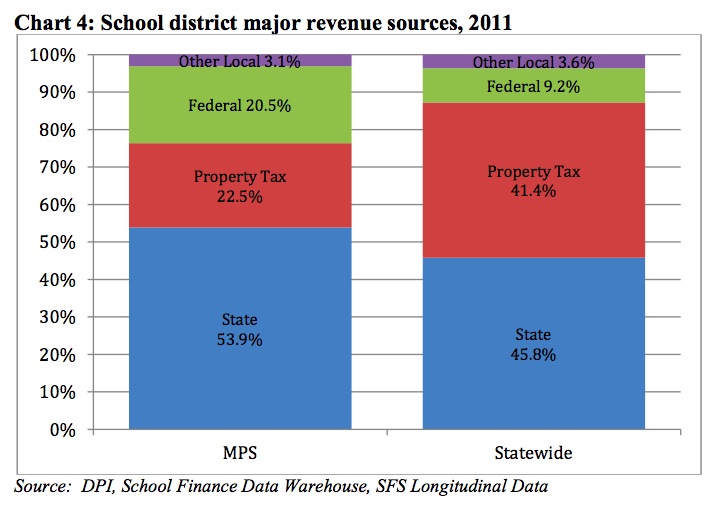
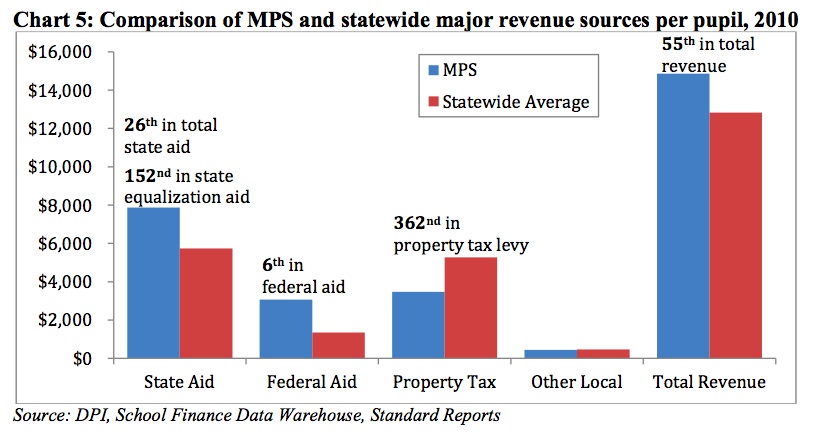
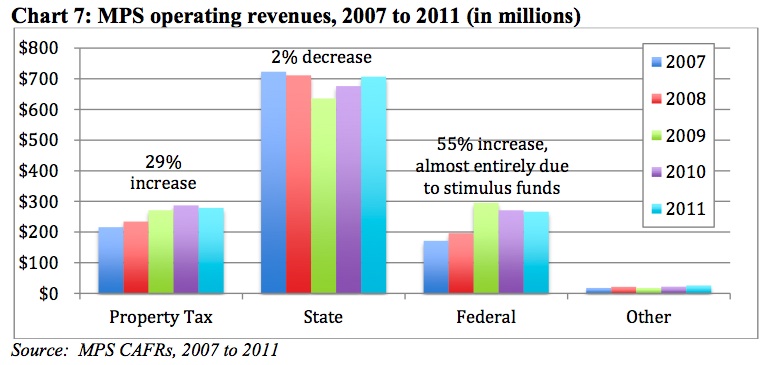
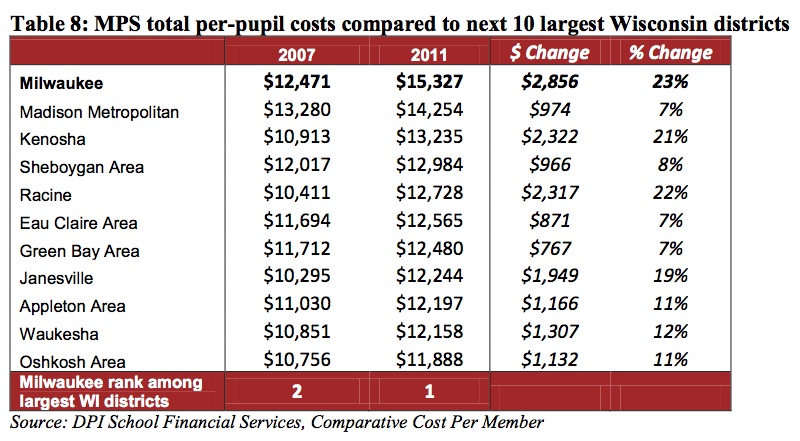
In his Jan. 6 column, Alan J. Borsuk says that a new vision for education in Milwaukee is needed to get beyond the stale and failed answers of the past. He is right.
Milwaukee has had voucher schools since 1990, longer than any school district in the nation. Students in the voucher schools perform no better than those in the public schools.
Milwaukee has had charter schools for about 20 years. Students in the charter schools do no better than those in the public schools.
As the other sectors have grown, Milwaukee Public Schools has experienced sharply declining enrollment. At the same time, the number of students with disabilities is far greater in the public schools than in either the voucher or charter schools. The latter are unable or unwilling to take the children who are most challenging and most expensive to educate. Thus, MPS is “competing” with two sectors that skim off the ablest students and reject the ones they don’t want. Most people would say this is not a level playing field.

Share

Report says UW System overpaid health premiums, pensions by nearly $33M

Associated Press:

The University of Wisconsin System overpaid for health insurance premiums and pension contributions by nearly $33 million over the last two years, including $8 million for more than 900 employees who had already left their jobs, according to a report released Thursday.
The Legislative Audit Bureau’s findings prompted state lawmakers to call for a deeper review of UW System’s payroll and benefit protocols.
“This is a $32 million error,” said Rep. Samantha Kerkman, R-Powers Lake, co-chairwoman of the Legislture’s audit committee. “My initial response was I’m shocked. I’m really disappointed.”

Share

“When controlling for demographic characteristics, the effects of additional years in MMSD on WKCE scores are largely ambiguous”: An Update on Madison’s Transfer Students & The Achievement Gap


170K PDF via a kind Andrew Statz email:

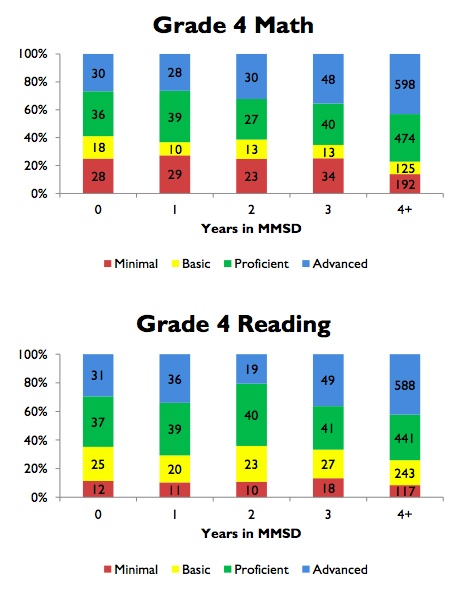
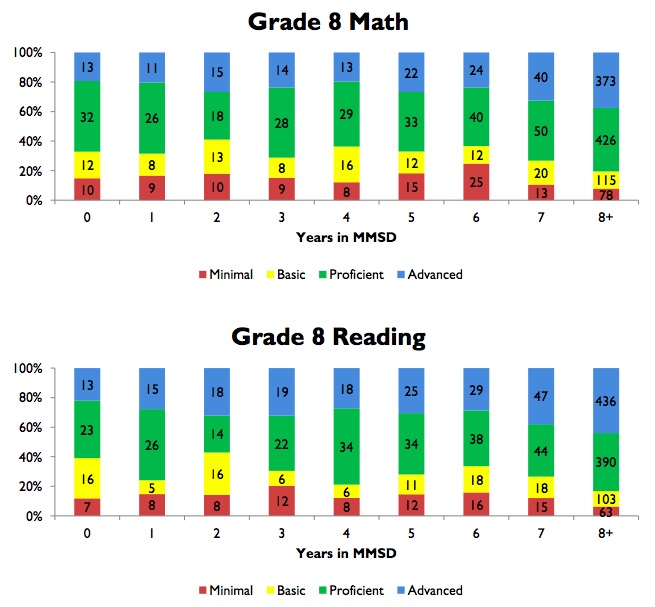
MAJOR FINDINGS
1. Students who have spent more time in MMSD perform better on the WKCE than their peers who have spent less time in MMSD.
2. Students who have spent more time in MMSD are demographically different from recent arrivals, who are less likely to be white and more likely to be low-income.
3. When controlling for demographic characteristics, the effects of additional years in MMSD on WKCE scores are largely ambiguous.
Based on these findings, MMSD may be better served by refining its core curriculum to meet students’ needs based on demographic characteristics rather than the recency of their arrival in MMSD. The recent arrivals report is attached. Our official statement about our findings follows.
The most notable anomaly is among 10th grade students. In both Reading and Math, 10th grade students who had spent one year in MMSD performed as well as students who had spent their entire careers in MMSD and substantially better than new students as well as students who had spent between 2 and 9 years in MMSD. This suggests that students who enter MMSD in 9th grade are altogether different from students who enter in other grades. The high performance level for students spending one year in MMSD prior to 10th grade may reflect students entering MMSD in 9th grade after attending private schools through 8th grade.
——————————–
It is the district’s responsibility to meet students where they are in their learning and identify needed interventions, enrichment or other programs to advance that learning. That means we need to have curriculum and programs that work for all of the students we serve, regardless of demographic background or how long they have been in the district.
Unfortunately, we know that achievement gaps exist in schools across the country, and no single district has entirely eliminated them. Focusing only on how long a student has been in our district does not underscore the complexity of the issue and is not the most effective predictor of achievement.
Instead, strengthening classroom instruction and ensuring interventions and enrichment that advance learning for every student regardless of demographic characteristics will yield the best results.
However, we do know that mobility, including moving from another district or moves within MMSD, does have some impact on achievement. Exploring community solutions to enhance stability throughout a student’s education could both increase achievement and help close gaps.

Related: Madison’s Mayor on Transfer Students & The Achievement Gap; District Plans to Release Data “Within 3 Weeks”.
Larry Winkler kindly published a more detailed analysis, here.
I asked several observers for their perspective on the rhetoric, assertions and the Friday report. Here’s one:
“When the data were first presented, the argument put forth was that the performance of newly arrived students explained much of the performance gap that we see in our schools. However, when the District examined the effects of race and socioeconomic status in the analysis, they found that the performance of low income and minority students who had been in the MMSD for many years was not significantly different from the performance of low income and minority students who were new to the District.
It is disappointing that the District and the Mayor’s office ran so far and so fast with their initial, incomplete analysis.”
UPDATE: Larry Winkler kindly created a set of charts scaled by percentages.

Share

KIPP should be given a chance to run Camden charter schools

Laura Waters:

This week NJ Spotlight acquired, via a formal Open Records Act request, the application from KIPP Cooper Norcross Academy to the Camden City Board of Education. The applicants hope to create up to five charter schools under the auspices of N.J.’s Urban Hope Act, a bill passed last January that allows non-profits to operate new schools in Newark, Trenton, and Camden.
The application process has not been lacking in melodrama. (See here for previous Newsworks coverage.) While Mayor Dana Reed heartily supports other options in Camden besides its dismal traditional schools, the school board initially rejected all applications and later, only begrudgingly, agreed to consider the one from KIPP, a highly-regarded program that serves 41,000 kids in the country and operates five schools in Newark.

Share

Oil boom and trust of conservative lawmakers

Kevin Kiley:

Grant Shaft, a member of the North Dakota State Board of Higher Education and its immediate past chair, gets funny looks from other states’ board members when he talks about his system’s plans.
“At meetings of the [Association of Governing Boards of Universities and Colleges], there’s no question we’re the envy of everybody,” he said. “We go to breakout sessions and hear about the dismal economic crisis in each other state, and it comes North Dakota’s turn and we have such a different story.”
That’s because North Dakota, unlike almost every other state, is poised to make an unprecedented spending increase in its higher education system. The state’s governor has proposed a 14 percent increase — about $90 million — in the 11-campus system’s operating budget for the next biennium, as well as an additional $177 million in one-time capital expenditures. Politicians and education leaders hope an infusion of cash will help transform the system – which has struggled with inconsistent direction and leadership – into one of the country’s best.
The proposal stands out in higher education because most states are still cutting budgets in the wake of the economic downturn, which led to a 25 percent decline in per-student funding between 2006-07 and 2011-12, according to the College Board. At the same time, Republican lawmakers in other states have begun to question the value of state investments in higher education, with some calling for even greater austerity.

Share

Don’t Let Math Pull the Wool Over Your Eyes

Carl Bialik:

This column will make the case that many people, including holders of graduate degrees, professional researchers and even editors of scientific journals, can be too easily impressed by math. A mathematical model is developed to describe sequential effects. (See the highlighted equation in the graphic).
Did that second sentence make the first more persuasive? It did for most participants in a recent intriguing experiment whose result suggests people often interact with math in a way that isn’t very logical. Other research has shown that even those who should be especially clear-sighted about numbers–scientific researchers, for example, and those who review their work for publication–are often uncomfortable with, and credulous about, mathematical material. As a result, some research that finds its way into respected journals–and ends up being reported in the popular press–is flawed.

Share

School Design May Affect a Child’s Grades

Ian Steadman:

A study of school design has discovered that school layouts can influence a child’s development by as much as 25 percent — positively or negatively — over the course of an academic year.
The 751 pupils using 34 classrooms across seven primary schools in Blackpool were studied over the 2011-12 academic year by the University of Salford’s School of the Built Environment and architecture firm Nightingale Associates. Standardised data — such as age, gender and academic performance — were collected on each child at the start and end of the year, while each classroom was rated for quality on ten different environmental factors, such as orientation for natural light, shape, colour, temperature and acoustics.
The results, published in Building and the Environment, revealed that the architecture and design of classrooms has a significant role to play in influencing academic performance. Six of the environmental factors — colour, choice, connection, complexity, flexibility and light — were clearly correlated with grade scores.

Share

Advocating teacher content knowledge licensing requirements

Joel Klein:

For many critics of contemporary American public education, Finland is the ideal model. It performs at the top on international tests and has a highly respected teaching corps, yet it doesn’t rely on policies like test-based accountability and school choice that are the cornerstones of U.S. reform. So, the critics argue, let’s change course and follow Finland.
It’s facile, at best, to look to a small, largely homogenous, country, with a very different educational pedigree as a model for a nation like ours. Still, the “go- Finland” crowd is onto something: Finland long ago decided to professionalize its teaching force to the point where teaching is now viewed on a par with other highly respected, learned professions like medicine and law. Today, only the best and brightest can and do become teachers: Just one in every 10 applicants are accepted to teacher preparation programs, which culminate in both an undergraduate degree and subject-specific Master’s degree. Even after such selective admissions and competitive training, if there are graduates who are not deemed ready for the classroom, they will not get appointed to the system.
Like law and medical schools, education schools shouldn’t be able to survive if fewer than half their students can pass a rigorous professional exam.
Contrast that with America, where virtually anyone who graduates from college can become a teacher, and where job security, not teacher excellence, defines the workforce culture. According to the consulting firm McKinsey, “The U.S. attracts most of its teachers from the bottom two-thirds of college classes, with nearly half coming from the bottom third.” And, today, more than a third of math teachers in the U.S. don’t have an undergraduate degree in math, let alone a Master’s degree. Yet, even with this remarkably low threshold for entry, once someone becomes a teacher in the U.S., it’s virtually impossible to remove him or her for poor performance.
What explains this cross-national difference? It does not seem to be teacher pay. Although teacher salaries in Finland are slightly higher than the average salary there, they are comparable to teacher salaries in other European countries. And when adjusted for national price indices, they’re lower than teacher salaries in the U.S.
Instead, the difference seems to be rooted directly in the relative professionalization of the position. In addition to setting high standards of entry and providing high-quality professional education, Finland has established a culture that motivates teachers to excel at school and then innovate in the classroom. As a result, teaching holds an appeal comparable to that of other high-status careers in Finland.

Wisconsin has taken a baby step toward teacher content knowledge requirements via the adoption of MTEL.

Share

Parenthood & Life Expectancy

The Economist:

PARENTS often complain that their lives are being shortened by the stress of having children, yet numerous studies suggest the opposite: that it is the childless who die young, not those who have procreated. Such research has, however, failed to find out whether it is the actual absence of children which causes early mortality or whether, rather, it is brought about by the state of mind that leads some people not to have children in the first place.
To resolve the point Esben Agerbo of the University of Aarhus in Denmark and his colleagues conducted an investigation that tried to take the question of wanting children out of the equation, by looking only at those people who had demonstrated a desire to be parents by undergoing in vitro fertilisation (IVF). They discovered, as they report in the Journal of Epidemiology and Community Health, that there really does seem to be something about the presence of kids which makes a difference to the length of people’s lives.

Share

Colleges Lose Pricing Power

Michael Corkery:

The demand for four-year college degrees is softening, the result of a perfect storm of economic and demographic forces that is sapping pricing power at a growing number of U.S. colleges and universities, according to a new survey by Moody’s Investors Service.
Facing stagnant family income, shaky job prospects for graduates and a smaller pool of high-school graduates, more schools are reining in tuition increases and giving out larger scholarships to attract students, Moody’s concluded in a report set to be released Thursday.
But the strategy is eating into net tuition revenue, which is the revenue that colleges collect from tuition minus scholarships and other aid. College officials said they need to increase net tuition revenue to keep up with rising expenses that include faculty benefits and salaries. But one-third of the 292 schools that responded to Moody’s survey anticipate that net revenue will climb in the current fiscal year by less than inflation.
For the fiscal year, which for most schools ends this June, 18% of 165 private universities and 15% of 127 public universities project a decline in net tuition revenue. That is a sharp rise from the estimated declines among 10% of the 152 private schools and 4% of the 105 public schools in fiscal 2012.
Nearly half of the schools surveyed by Moody’s reported enrollment declines this fall, though overall median enrollment remained relatively flat from the previous year. A stagnant high-school graduate population, particularly in the Northeast and Midwest, is contributing to the declines at some schools.

This will affect the K-12 world as well.

Share

Pupil Hernandez, who refused to wear RFID, loses appeal

BBC:

A Texan student who refused to wear a badge with a radio tag that tracked her movements has lost a federal court appeal against her school’s ID policy.
The radio chips track attendance, which in turn helps secure school funding.
But Andrea Hernandez, 15, stopped wearing the badge on religious grounds, saying it was the “mark of the beast”.
After John Jay High School suspended her, she went to court and won a temporary injunction to continue going to the school, without the badge.

Share

Math Envy and CoffeeScript’s Foibles, Part 2

John Bender:

In the previous post I presented the basics of operational semantics and showed how derivations trees can be used to differentiate two terms that are syntactically similar. This post develops the closing thoughts further with the introduction of type rules, example tools for automating evaluation and type derivation, and a concrete definition of semantic ambiguity. The primary goal is to establish the best way to detect ambiguous term pairings and then outline what will work for a tool that can be generalized beyond the CoffeeScript subset.
Type Rules
Type rules are similar in construction to evaluation rules, consisting of a premise and conclusion. As with evaluation rules the premise establishes the preconditions for the conclusion. Again, each rule is tagged with a name for reference but preceded by a t- in this case to distinguish them from inference rules (e-).

Share

The Education of Michelle Rhee

PBS Frontline. More here and here.

Share

2013 Madison Schools Wishlist

Madison schoolboard member Ed Hughes:

11. I wish for a successful introduction of the Mondo reading program in all our elementary schools. Superintendent Jane Belmore has particular interest and expertise in literacy and she has spearheaded the school district’s decision to adopt the Mondo Bookshop Program at the K-5 level across all elementary schools, with the purchase of new curriculum materials funded through some of the unexpected state aid that came our way this fall. The Mondo program, which is said to have clearly-focused lesson guides that are aligned to the Common Core state standards, should be a significant step forward in terms of a district-wide, aligned, early literacy scope and sequence. I also wish that now that we have made a commitment to the Mondo program, we stick with it and don’t lurch towards some other approach if the improved outcomes we’re seeking take a while to arrive.
12. I realize there is initiative fatigue among our teachers and staff, but I wish for a continued push for new student-based ideas and initiatives developed at the school level, like the drive toward converting Toki Middle School to an Expeditionary Learning school. This fall, there was discussion of Toki possibly switching to a charter school structure as a way of accessing state funds that could help accelerate the conversion. I am sorry that this charter proposal has run into complications and has been withdrawn before the Board really had a chance to consider it, but I hope that principals, teachers and staff at all our schools continue to search for innovative approaches toward enhancing the engagement and learning of our students.

Share

Have We Lost the War on Drugs?

Gary Becker & Kevin Murphy:

President Richard Nixon declared a “war on drugs” in 1971. The expectation then was that drug trafficking in the United States could be greatly reduced in a short time through federal policing–and yet the war on drugs continues to this day. The cost has been large in terms of lives, money and the well-being of many Americans, especially the poor and less educated. By most accounts, the gains from the war have been modest at best.
The direct monetary cost to American taxpayers of the war on drugs includes spending on police, the court personnel used to try drug users and traffickers, and the guards and other resources spent on imprisoning and punishing those convicted of drug offenses. Total current spending is estimated at over $40 billion a year.
These costs don’t include many other harmful effects of the war on drugs that are difficult to quantify. For example, over the past 40 years the fraction of students who have dropped out of American high schools has remained large, at about 25%. Dropout rates are not high for middle-class white children, but they are very high for black and Hispanic children living in poor neighborhoods. Many factors explain the high dropout rates, especially bad schools and weak family support. But another important factor in inner-city neighborhoods is the temptation to drop out of school in order to profit from the drug trade.

Share

High schools, take the online course

Patrick Welsh:

Like most school districts around the country, the Alexandria, Va., district where I teach has been guilty of churning out one initiative after another that has promised to revolutionize education. In reality, these innovations usually turn out to be old ideas disguised in new lingo.
Thankfully, there is one initiative in Alexandria and in a growing number of school systems nationwide that is revolutionizing the way kids learn: online classes. This approach not only helps potential dropouts keep working toward diplomas, but also allows the most motivated students to seek courses not often offered in a traditional school setting.
If teachers and school administrators are ever going to live up to their ideal of meeting the needs of all students, they are going to have to swallow their pride, put kids first and make online classes available to more and more kids.

Share

Madison’s Mayor on Transfer Students & The Achievement Gap; District Plans to Release Data “Within 3 Weeks”

Paul Fanlund, via a kind reader’s email

There is an achievement gap. A significant part of the achievement gap is not because of the failure on the part of the Madison public schools, but it is because of the number of students who have transferred here from other districts, districts like Chicago,” he says.
“Those kids come here unprepared. They come from poorly performing schools. There is a reluctance to discuss this factor. The reluctance to discuss it has at least two consequences. The first is that we come to erroneous conclusions about the quality of education in Madison. The second problem is that we don’t develop strategies for these kids so that we can close that achievement gap.”
Soglin says a child who’s far behind in reading “who transferred in from a poorly performing district as opposed to a child who’s been in Madison her entire life, could require very different interventions. There are people who don’t want to talk about this problem and that’s one of the reasons we fail in addressing the achievement gap.
“Now, talking about this alone is not going to solve it, but addressing it and analyzing it properly may in the short term cast some negatives, but it is going to lead to a better job in terms of correcting the problem.”

I (and others) inquired about the data behind the Mayor’s assertion several months ago. I received an email today – after another inquiry – from the District’s Steve Hartley stating that the data will be available in “under 3 weeks”.
Related, also from Madison Mayor Paul Soglin: “We are not interested in the development of new charter schools”.
Background links:
November, 2005 When all third graders read at grade level or beyond by the end of the year, the achievement gap will be closed…and not before
“They’re all rich, white kids and they’ll do just fine” — NOT!
60% to 42%: Madison School District’s Reading Recovery Effectiveness Lags “National Average”: Administration seeks to continue its use
61 Page Madison Schools Achievement Gap Plan -Accountability Plans and Progress Indicators

Share

Success of new UK academies as yet unproved

Chris Cook:

When the Henrietta Barnett School in north London became an academy, it wrote to parents saying this would give the school “greater access to financial resources”. The story is a familiar one.
The business manager of a London secondary school told the Financial Times: “When we converted, we worked out exactly how much it was worth to us. We estimated that, all in, we could run a ÂŁ750,000 surplus on becoming an academy. That’s a lot of building repairs.”
This is a big part of the coalition’s academy success story. Five times as many schools have joined the scheme as were expected, including half of all state secondaries. The Department for Education encouraged this change through accidental overfunding.
It was intended that schools would become academies because of the legal benefits: they have exemptions from the national curriculum and teachers’ pay arrangements, which should give them flexibility to be more innovative. The intention was to attract schools with extra rights not extra money.

Share

Employers, educators search for answers to technical jobs issue

Michael Burke:

The challenge of finding good employees is so long-standing and pervasive that Racine Metal-Fab has revised its hiring approach.
“If we see behaviors we don’t like, we fire faster and hire slower,” said company President and Chief Operating Officer Scott Lucas.
Area companies are doing what they can internally to cultivate and preserve the best possible workforce, while some talk about what else can be done to offer companies better candidates.
At Poclain Hydraulics, 1300 N. Grandview Parkway, “For every 20 resumes, we maybe bring in five to eight people,” said Tom Shinners, vice president of finance and human resources. “Of those, we probably hire 40 percent. We might get two or three hires from 20 resumes.”
“Years ago you had apprenticeships, companies that would bring you on and train you,” said Andrew Beere, human resources manager at Pioneer Products, 1917 S. Memorial Drive. “And we have kind of gone back to that. If they have some experience, we’re willing to train.”

Share

2 Pi: Rhymes And Radii

NPR, via a kind reader’s email:

It’s fourth period at Montgomery Blair High School in Silver Spring, Md., and students are filing into a classroom at the end of a long hallway. Jake Scott, who doubles as both varsity wrestling coach and math teacher, calls his algebra class to order, but some students are more orderly than others.
Keeping control of the class is one thing, but holding their attention through complicated calculations and theorems is another challenge altogether. So Scott gets a little extra help from his alter ego, 2 Pi.
About three years ago, Scott started infusing rap into his lessons. His alias comes from a math formula, and as 2 Pi the rapping math teacher, Scott makes learning math cool, while also developing a connection with his students.

Share

Mainland parents still willing to exploit loopholes in one-child policy

Fiona Tam:

How much are you willing to pay to have a second child with Hong Kong residency rights or American citizenship? That’s the question Shenzhen authorities asked the city’s residents when they introduced heavy fines this year for those who exploit loopholes in the mainland’s one-child policy and give birth overseas.
Since Tuesday, Shenzhen permanent residents have faced fines of at least 219,000 yuan (HK$270,000) for giving birth to a second baby, whether in Hong Kong, the US or another foreign country. The amount is six times the city’s average annual income last year but it can increase sharply if the parents’ annual income is higher.
Rich couples earning more than 73,000 yuan a year will be required to pay an extra amount equal to twice the difference. For example, a couple earning 500,000 yuan a year could be fined 1.07 million yuan for their second child, including the basic 219,000 yuan fine and 854,000 yuan in additional fines.

Share

Madison Teachers, Inc. Newsletter

83K PDF, via a kind Jeannie Bettner email.

Share

WI Association of School Boards: Taxpayer Dollars at Work Against Taxpayers – Fighting Open Records: Resolution 13-16: Costs Associated With Open Records Requests

Wisconsin Association of School Boards (PDF), via a kind reader’s email:

Create: The WASB supports legislation to allow a public records authority to charge a requester for all of the actual, necessary and direct costs associated with complying with requests under the Public Records Law.
Rationale: The committee advanced this resolution to allow the membership to decide whether to go on record in support of allowing public records authorities, including school districts, to charge a requester for all of the actual, necessary and direct costs associated with complying with requests under the Public Records Law. (A recent Wisconsin Supreme Court decision held that public records authorities are not authorized to charge a requester for the costs of redacting non-disclosable information contained in otherwise disclosable public records.)

Related: Madison Schools’ Report Cards Take a hit after data error and Where does MMSD get its numbers from?.
Open Records. Sunlight Foundation.
The publication of1996-2006 Madison Police call data occurred after a lengthy open records process. Perhaps the City is becoming more forthcoming?
https://data.cityofmadison.com/

Share

What measures the best teacher? More than scores, study shows

Stephanie Simon:

Effective teachers can be identified by observing them at work, measuring their students’ progress on standardized tests – and asking those students directly what goes on in the classroom, according to a comprehensive study released Tuesday.
The three-year, $50 million Measures of Effective Teaching study, funded by the Bill & Melinda Gates Foundation, found it was difficult to predict how much students would achieve in a school year based on their teacher’s years of experience or knowledge of pedagogical technique.
But researchers found they could pick out the best teachers in a school and even predict roughly how much their students would learn if they rated the educators through a formula that put equal weight on student input, test scores and detailed classroom observations by principals and peers.

Share

DNA Dreams — documentary

Steve Hsu:

What would happen if the gene was found that IQ determines us? And when people and animals could be easily cloned? Wait there a new world full of perfect people? And we want that world be? In China’s Pearl River Delta is that world in the making. On the outskirts of Shenzhen is BGI, recently the largest genetic research world. Working day and night here 4000 young scientists at mapping the DNA of plants, animals and humans. Knowledge of this code of life opens up many new possibilities. For instance, the eighteen year old high school dropout Zhao Bowen an international research team that wants to find the genes for intelligence. He works with the young, brilliant psychologist Yang Rui, that IQ tests decreases with gifted children and their blood samples to collect DNA. In a later lab work forty young people led by the 24-year-old Lin Lin a clone project, which includes fluorescent mini-pigs produces and clone factory will grow. Between the cloning of humans and animals exist ethical, but hardly practical differences. Which applications are in the offing as this knowledge will soon become common property? China has few legal obstacles to the life sciences and also to capital is not a defect. The young scientists can fully indulge their fascination. They are optimistic and want to progress. But reality is stubborn and it exists for them not only in bits, bytes and algorithms.

Share

Math even mathematicians don’t understand (the sequel)

Kevin Hartnett:

On November 4 I published an article in the Ideas section about Shinichi Mochizuki, a mathematician who claims to have proved the ABC conjecture, one of the great unsolved problems in math. The only catch is that his proposed proof is written in mathematics so complex that literally no one in the world can evaluate its accuracy. Long, unintelligible tracts are not uncommon in mathematics and normally the math community chooses simply to ignore them — but in this case Mochizuki is so highly regarded that experts around the world have decided to puzzle it out, which could take years.
A few weeks later I received an email from a friend of a 90-year-old mathematician named Henry Pogorzelski, an emeritus professor at the University of Maine. The email explained that for the last half-century, Pogorzelski has toiled at a proof of the legendary Goldbach Conjecture and after decades of effort he believes he has it, though his work runs thousands upon thousands of pages, and no mathematicians can understand it or are even willing to invest the time to try to. Pogorzelski’s friend explained that he hoped I might write a story that would stir some interest in the professor’s work.
Though Pogorzelski is 50 years older and less internationally noted than Mochizuki, their careers have some surface similarities. After promising starts — early in his career Pogorzelski worked under the famed Andre Weil at the Institute for Advanced Study– they devoted themselves to solving big “named” problems in mathematics. (One difference is that by the time he embarked on solving ABC, Mochizuki had already solved enough hard problems to build up considerable credibility with his peers; Pogorzelski had no similar track record at the time he embarked on Goldbach.)

Share

For Newly Minted M.B.A.s, a Smaller Paycheck Awaits

Ruth Simon:

Like many students, Steve Vonderweidt hoped that a master’s degree in business administration would open doors to a new job with a higher paycheck.
But now, about eight months after receiving his M.B.A. from the University of Louisville, Mr. Vonderweidt, 36 years old, hasn’t been able to find a job in the private sector, and continues to work as an administrator at a social-service agency that helps Louisville residents obtain food stamps, health care and other assistance. He is saddled with about $75,000 in student-loan debt–much of it from graduate school.

Share

More teenage girls joining Hong Kong street gangs

Lana Lam:

A growing number of girls are muscling out the boys in Hong Kong’s teenage street gang culture, according to a charity that has been helping troubled youngsters for over two decades.
Social workers at Youth Outreach, who take in 200 children off the streets every night at their Sai Wan Ho drop-in centre, say that in their early teens girls are often physically stronger than boys and have a more mature personality, making them natural authority figures.
“A lot of the gang leaders are now girls and they are getting younger and more masculine,” said social worker Ted Tam Chung-hoi, 33, who has worked with Youth Outreach for 10 years.
Every night, the centre’s staff pick up children found out on the streets all over Hong Kong, especially in more remote districts such as Tin Shui Wai, Tuen Mun and Tseung Kwan O, and bring them back to the centre, which stays open from 9pm to 7am.

Share

Students of math and physics may enjoy these 323 pages of notes by Alex Alaniz:

Alex Alaniz:

These are step-by-verifiable-step notes designed to take students with a year of calculus based physics who are about to enroll in ordinary differential equations all the way to doctoral foundations in either mathematics and physics without mystery. Abstract algebra, topology (local and global) folds into a useful, intuitive toolset for ordinary differential equations and partial differential equations, be they linear or nonlinear. The algebraist, the topologist, the theoretical physicist, the applied mathematician and experimental physicist are artificial distinctions at the core. There is unity.
Mathematician, you will see step-by-verifiable-step algebra, topology (local and global) in a unified framework to treat differential equations, ordinary, partial, linear and nonlinear. You will then see why the physicists created a great font of differential equations, the calculus of variations. You will see why the physicists care about both discrete and continuous (topological) Lie groups and understand what quantum mechanics is as a mathematical system from its various historical classical physical roots: Lagrangian mechanics, Hamiltonian mechanics, Poisson brackets. You will have the tools to understand the Standard Model of physics and some of our main paths forward to grand unified theories and theories of everything. With these notes you should never again be able to practice abstraction for the sake of abstraction. Physicist, you will not be held hostage to verbiage and symbology. You will see that mathematics has deep, unavoidable limitations that underlie physics, itself suffering unavoidable limitations. You will see unity, e.g., summing angular momentum in terms of tensor products and directions sums, ladder operators, Young’s tableaux, root and weigh diagrams as different codifications of the same thing. Neither of you have to take your required courses as exercises in botany and voodoo as exemplified by ordinary differential equations. You will have context and operational skills. As lagniappes you will have the calculus of variations, the fractional calculus, stochastic calculus and stochastic differential equations.

Share

Cerebral circuitry: Researchers are focusing on whether gadgets are changing how our brains work as regards empathy and human interaction

April Dembosky:

I am flying. No plane, no wings, just me soaring over rooftops with a mild flip in my belly as I dip closer to the grid of city streets. I lean to the right to curve past a skyscraper, then speed up and tilt left to skirt by a tree. There has been an earthquake and I am looking for a lost child who is diabetic and needs insulin.
This is not a dream. I am awake, wearing my normal clothes – no cape or leotard – standing squarely on both feet in a room of the virtual reality laboratory at Stanford University.
About 70 test subjects have done the same simulation, half of them flying in a virtual helicopter, the other half granted the virtual superpower of flight. Half from each group have a mission: find and save the lost child.
After the simulation, head gear returned to a hook on the wall, a researcher reaches for her clipboard to ask a few questions. She accidentally knocks over a tin of pens. In sociology studies, this is a classic trick for measuring altruistic intent. The test subjects who flew Superman-style rushed to help clean up the spill. They responded four seconds faster and picked up two more pens on average than the helicopter passengers.

Share

Deferring Six Figures on Wall Street for Teacher’s Salary

Scott Eidler:

Four years after the financial crisis, Wall Street hiring has remained weak, and many college graduates have searched for jobs and even careers in other fields. In the last several years, hundreds of such would-be finance professionals and management consultants have taken their high-powered ambitions and spreadsheet modeling skills to the classroom.
Teach for America, the 22-year-old nonprofit organization that recruits high-achieving college graduates to teach in some of the nation’s poorest schools for two years, in particular has garnered renewed interest among the business-oriented set. Teach for America says that its 2012 class contained about 400 recent graduates with a major in business or economics. Of those with professional experience, about 175 worked in finance.
Those participants include Zachary Dearing, 23, a recent graduate of M.I.T. Two summers ago, he was an intern at McKinsey & Company, and the year before, Goldman Sachs.

Share

The 2012 “Borsuk Awards”

Alan Borsuk, via a kind reader’s email:

“Organization of the Year: Schools That Can Milwaukee. Unfortunately, anything that even smells of voucher and charter issues is controversial. Can’t we set that aside and stick to the quality of the work these folks are doing? If a school is working with Schools That Can, I can be confident it is a school that is determined to be outstanding. The organization, a nonprofit that coaches and trains school staffs, includes some of the most talented educators in town. They are working with more than 20 schools – MPS, charters and vouchers – and building a track record of success.”

Share

All I learned in college was how to work for someone else

Stefan Kendall:

Recently, there have been a number of points and counter-points made about leaving college to join or found a start-up. The most popular point against leaving is that a degree will market you better to join big corporations.
And that’s exactly it.
College prepares you for a life of the corporate stooge, but it’s worse than that. Classes in college actively teach you lessons you must unlearn, and fail to teach you anything even marginally related to what it takes to run a company. If you want to work for someone else, college is great. Having a bachelors in Chemical Engineering and a minor in Drama prepares you *excellently* to get hired as a product manager at a product company. If you want to be an entrepreneur, though, you’re screwed.
Things I’ve unlearned
1. Plagiarism is bad.
Wrong! If the licensing is right, copy to your heart’s content. If you’re not in violation of copyright, trademark, or patent, you can do whatever you want with someone else’s creation. Sometimes they even give you permission. Did you find a real swell formula online? Did you know you can’t copyright formulas?

Share

Pressure to Rein In Tuition Squeezes Colleges

Michael Corkery:

Private colleges are facing pressure to slow tuition hikes and boost aid, as families question the cost.
College officials say the long-held faith among many Americans that college is worth whatever it costs is starting to waver under the weight of lackluster job prospects, stagnant wages and a pileup of student debt.
The shift is already threatening to put stress on some schools’ finances. Average tuition this past year rose by the smallest percentage in at least 40 years among the 960 private schools that belong to the National Association of Independent Colleges and Universities, which collectively enroll 90% of the students in private colleges. It climbed 3.9% to $29,305.

Share

Life, death and sport: The best culture is not divorced from life, but our most profound way to make sense of it

Harry Eyres:

Maybe I’ve overvalued culture, retreated into its ivory tower too much as an escape from noisy, messy reality. I remember driving along the Westway out of London, past rows of what the cartoonist Osbert Lancaster called “bypass variegated” semi-detached houses, designed “to achieve the maximum of inconvenience … [using] the least attractive materials and building devices known to the past”, while listening to Mozart or Beethoven and finding the coexistence of angelic beauty and aesthetic disaster hard to reconcile.
Of course the best culture is not divorced from life, but the most profound way we have of making sense of it. Two of my musical highlights this year were dark, rich confrontations with mortality as interpreted by artists bringing all their life-experience to bear on music of almost unbearable poignancy: in one case by a young composer, aware of his limited time and raging against the dying of the light, the other by an elderly one looking back with nostalgia and infinite regret, but also with warmth and love.

Share

Measures of Segregation

Scott Jaschik:

Court decisions dating to the 1950s theoretically ended racial segregation of higher education in the United States. But data to be presented today at the annual meeting of the American Economic Association show that the pace of desegregation has slowed over time. And in a finding that could be controversial, the study finds that states that ban the consideration of race in admissions may see the pace of desegregation accelerate.
The study is by Peter L. Hinrichs, an assistant professor of public policy at Georgetown University. He focuses on black and white students, not those in other racial and ethnic groups, and he examines “exposure” and “dissimilarity” (defined below) of black and white students as two measures of desegregation. Hinrichs uses federal data from every college, filed since the era in which desegregation started. He argues that these measures illustrate the extent to which colleges are truly desegregated, which may not be reflected simply by increases or decreases in black student enrollments (which can be concentrated at certain institutions).
Exposure is the percentage of black students at colleges attended by white students, and vice versa. Here he shows that from 1968, the typical white student attended a college that was 2.3 percent black. But by 2009, the typical white student attended a college that was 9.8 percent black. This percentage gain is much larger than overall black enrollment during this period, which also rose, from 5.5 percent to 13.7 percent.

Share

Twelve States Receive Failing Grades from StudentsFirst

Motoko Rich:

In a report issued Monday, StudentsFirst ranks states based on how closely they follow the group’s platform, looking at policies related not only to tenure and evaluations but also to pensions and the governance of school districts. The group uses the classic academic grading system, awarding states A to F ratings.
With no states receiving an A, two states receiving B-minuses and 12 states branded with an F, StudentsFirst would seem to be building a reputation as a harsh grader.
Ms. Rhee said that the relatively weak showing reflected how recently statehouses had begun to address issues like tenure and performance evaluations. “We didn’t say in any way that we want to show people how bad it is,” she said in a telephone interview. “We wanted to show the progress that is being made, but in places where progress is slower to come, be very clear with leaders of that state what they could do to push the agenda forward and create a better environment in which educators, parents and kids can operate.”

Related: Ripon Superintendent Richard Zimman:

“Beware of legacy practices (most of what we do every day is the maintenance of the status quo), @12:40 minutes into the talk – the very public institutions intended for student learning has become focused instead on adult employment. I say that as an employee. Adult practices and attitudes have become embedded in organizational culture governed by strict regulations and union contracts that dictate most of what occurs inside schools today. Any impetus to change direction or structure is met with swift and stiff resistance. It’s as if we are stuck in a time warp keeping a 19th century school model on life support in an attempt to meet 21st century demands.” Zimman went on to discuss the Wisconsin DPI’s vigorous enforcement of teacher licensing practices and provided some unfortunate math & science teacher examples (including the “impossibility” of meeting the demand for such teachers (about 14 minutes)). He further cited exploding teacher salary, benefit and retiree costs eating instructional dollars (“Similar to GM”; “worry” about the children given this situation).

Share

Promoting Quality Teaching: New Policy Report from Accomplished California Teachers

Accomplished California Teachers:

Approximately one-third of all new teachers in the United States leave the profession within five years, and veteran teachers are leaving at ever higher rates. Teacher attrition, which has grown by 50 percent in the past 15 years, costs the nation roughly $7 billion a year for recruiting, hiring, and inducting new teachers. With this revolving door of teachers and the resulting hemorrhage of resources, schools suffer from instability and students lose out on the opportunity to learn from high-quality teachers.
Among the factors behind this high turnover are outdated teacher compensation systems and narrow career options for professional growth, according to a new report by Accomplished California Teachers (ACT), a teacher-leadership network based at Stanford.

Share

Finally, EdTech That is Based on Real Research

Annie Murphy Paul:

Imagine you’re walking down the street when your phone buzzes. “What is the capital of Maryland?” it asks you. You know the answer but you can’t quite grasp it until all of a sudden you remember: “Annapolis.” The question prompted your brain just in time.
That is the scenario envisaged by the makers of software Cerego, which launched last week, writes Hal Hodson in New Scientist:
“It uses a basic principle of cognitive science called ‘spaced repetition’ to improve learning. To remember something long term, a student must return to it several times, increasing the interval between each revision. The concept isn’t new, but Cerego aims to harness the idea to let people learn anytime, anywhere.
‘The amount of information we need to retain is growing rapidly,’ says Cerego co-founder Andrew Smith Lewis. ‘Current solutions do a fine job of bringing information to the screen, but we’re not seeing much on how we learn.’ Smith Lewis says Cerego’s grand ambition is to ‘handle learning and relearning for the duration of the user’s lifetime.’

Share

Higher ed: an obituary

New Criterion:

The fate of American higher education has been a central concern of The New Criterion from its very first issue in September 1982. About academia, as about other cultural institutions–the art museums, orchestras, media and entertainment industries, as well as the law and those social institutions through which the past perpetuates itself into the present–The New Criterion has cast a wary eye, celebrating the vital, where it can be found, but also criticizing the many signs of decadence and irresponsibility wherever they have been on display, which, alas, has been almost everywhere. When it came to the academic world, our chief complaints have revolved around the anti-Western politicization of intellectual life. We focused on the way ideology subjugated the life of the mind to the hermetic lucubrations of deconstruction, post-structuralism, and all the other increasingly quaint-sounding efforts to dismiss or subvert the main currents of what Matthew Arnold famously extolled as “the best that has been thought and said in the world.”

Share

The Philosophy of Computer Science

Stanford Encyclopedia of philosophy:

The Philosophy of Computer Science (PCS) is concerned with philosophical issues that arise from reflection upon the nature and practice of the academic discipline of computer science. But what is the latter? It is certainly not just programming. After all, many people who write programs are not computer scientists. For example, physicists, accountants and chemists do. Indeed, computer science would be better described as being concerned with the meta-activity that is associated with programming. More generally, and more precisely, it is occupied with the design, development and investigation of the concepts and methodologies that facilitate and aid the specification, development, implementation and analysis of computational systems. Examples of this activity might include the design and analysis of programming, specification and architectural description languages; the construction and optimisation of compilers, interpreters, theorem provers and type inference systems; the invention of logical frameworks and the design of embedded systems, and much more. Many of the central philosophical questions of computer science surround and underpin these activities, and many of them centre upon the logical, ontological and epistemological issues that concern it. However, in the end, computer science is what computer scientists do, and no exact formulaic definition can act as more than a guide to the discussion that follows. Indeed, the hope is that PCS will eventually contribute to a deeper understanding of the nature of computer science.

Share

A greater role in math education for parents: mathematical reasoning at home

Katie Kormanik:

While policymakers, researchers and educators decide how our children learn math, parents don’t seem to be anywhere in the mix. Yet parents can and should play a greater role in their children’s math education. The problem is that most parents simply don’t know how. This situation is complicated by the fact that many parents struggled with math themselves, making it more difficult for them to help their children and often resulting in their inadvertently passing on their own math phobia.
One of the best things parents can do to improve their children’s math literacy is to regularly expose them to practical applications of math at home. This is not “teaching,” per se, as much as it is helping them develop mathematical reasoning on their own. What students observe, discover and learn outside the classroom can often benefit them more than what they learn in class. The former tends to be practical and applicable in real situations outside academia; the latter often focuses on the theoretical and the abstract. Parents can help merge these two realms.

Share

What would you have to say to the (Seattle) superintendent?

Charlie Mas:

I don’t make a habit of asking the staff to do things so much as asking them for information. That’s because they don’t work for me and they aren’t accountable to me. I don’t hesitate to offer suggestions for action to the Board because they are accountable to the public and they are supposed to represent the public.
So if I had the opportunity to speak with the superintendent, I wouldn’t so much have suggestions for him as questions. They are big questions and perhaps some of them will be answered in the Strategic Plan. Perhaps not. The previous Strategic Plan was a management plan more than an academic plan. Is that what it’s supposed to be? The new Strategic Plan is shaping up to be more of an academic plan.

Share

MoMath: Manhattan’s Museum of Mathematics

Lisa Grossman:

MATHEMATICS is awesome, full stop. That’s the philosophy behind a new museum opening next week in New York City.
The founders of the Museum of Mathematics (MoMath) know they have a fight on their hands, given the pervasive idea that the subject is boring, hard and scary. But they are determined to give mathematics a makeover, with exhibits that express an unselfconscious, giddy joy in exploring the world of numbers and forms.
“We want to show a different side of mathematics,” says museum co-founder Cindy Lawrence. “Our goal is to get kids excited, and show them the math they’re doing in school is just one tree in a whole huge forest.”
To this end, mathematics pervades every aspect of the design, sometimes in surprising places. Take the museum’s Enigma CafĂ©. At first glance, it looks like any other trendy, modern Manhattan cafe. But instead of coffee, puzzles will be served. And a careful look reveals that the floor is a 6-by-6 grid, the walls are made of Tetris-like puzzle shapes called pentominoes, and the tables are arranged as a knight would progress across a chessboard.
“We try to hide math everywhere,” says Lawrence.

Share

State law change keeps Wisconsin principal evaluations under wraps

Matthew DeFour:

A change in state law creating a new teacher and principal evaluation system also exempts those evaluations from public disclosure, even though the public has previously had access to principal evaluations.
Open government advocates were unaware of the new exemption to the state’s open records law, but said the Legislature should revisit the principal evaluation issue.
“I hope that there would be some willingness to reassess this decision,” said Bill Lueders, president of the Wisconsin Freedom of Information Council. “There are few issues that matter more to ordinary people than the quality of their children’s education. For that reason the evaluations of the top school official, the principal, have traditionally been open, and we think they should stay that way.”
Jim Lynch, executive director of the Association of Wisconsin School Administrators, said the group of state education leaders who designed the evaluation system recommended the records exemption in the law based on the purpose of the new system, which is not to compare educators.
“The focus of this is to have assessments meant for organizations to make human resources decisions and for people to learn and grow,” Lynch said. “That is done best in a confidential environment.”

Share

English Letter Frequency Counts: Mayzner Revisited

Peter Norvig:

On December 17th 2012, I got a nice letter from Mark Mayzner, a retired 85-year-old researcher who studied the frequency of letter combinations in English words in the early 1960s. His 1965 publication has been cited in hundreds of articles. Mayzner describes his work:

I culled a corpus of 20,000 words from a variety of sources, e.g., newspapers, magazines, books, etc. For each source selected, a starting place was chosen at random. In proceeding forward from this point, all three, four, five, six, and seven-letter words were recorded until a total of 200 words had been selected. This procedure was duplicated 100 times, each time with a different source, thus yielding a grand total of 20,000 words. This sample broke down as follows: three-letter words, 6,807 tokens, 187 types; four-letter words, 5,456 tokens, 641 types; five-letter words, 3,422 tokens, 856 types; six-letter words, 2,264 tokens, 868 types; seven-letter words, 2,051 tokens, 924 types. I then proceeded to construct tables that showed the frequency counts for three, four, five, six, and seven-letter words, but most importantly, broken down by word length and letter position, which had never been done before to my knowledge.

and he wonders if:

perhaps your group at Google might be interested in using the computing power that is now available to significantly expand and produce such tables as I constructed some 50 years ago, but now using the Google Corpus Data, not the tiny 20,000 word sample that I used.

The answer is: yes indeed, I am interested! And it will be a lot easier for me than it was for Mayzner. Working 60s-style, Mayzner had to gather his collection of text sources, then go through them and select individual words, punch them on Hollerith cards, and use a card-sorting machine.

Share

Chris Christie’s education reform plan: Part II

Laura Waters:

School funding is never just about dollars and cents. Instead, it subsumes a whole slew of issues, including educational needs, politics, economic constraints, and public perception. New Jersey’s 2013 Education Adequacy Report, issued last week by Ed. Comm. Cerf, incorporates one other factor: the Christie Administration’s education reform agenda.
New Jersey funds most schools through local property taxes and, historically, this has led to vast educational inequities between poor and rich districts. After all, wealthy communities have a much higher tax base to devote to public education.
A series of Supreme Court decisions, known as Abbott v. Burke, ordered that N.J.’s poorest school districts be given enough state money – from N.J.’s first income tax — to even out those inequities. In 2008, the Corzine Administration passed the new School Funding Reform Act (SFRA), which tried to render the Abbott designations obsolete through a new formula in which “the money follows the child,” regardless of zip code.
Part of our new system of education funding (which is on a sort of probationary status after challenges from Education Law Center) is that the Commissioner must present an annual Educational Adequacy Report that specifies the amount of money needed to “adequately” educate a child for the year.
Here’s the bottom line, courtesy of NJ Spotlight: “the base proposal for funding is $11,009 per child in fiscal 2014, up almost $500 from this year.” However, adds Spotlight, “certain at-risk students will see decreases in funding by as much as $1,000 per year.”

Share

After Arrest, a Wider Inquiry on SAT Cheating

Jenny Anderson:

When Samuel Eshaghoff, a 19-year-old sophomore at Emory University, was arrested on Tuesday for allegedly accepting money to take the SAT for six Long Island high school students, testing officials said it was an isolated event. But school officials and prosecutors disagree, and a continuing investigation is focusing on other schools and students.
“I do believe it’s more systemic than just Great Neck North,” said Kathleen M. Rice, the district attorney for Nassau County.
Ms. Rice brought criminal charges against Mr. Eshaghoff and misdemeanor charges against six current and former Great Neck North students who said Mr. Eshaghoff took the test for them. Five of the six said they paid him a fee of up to $2,500. Mr. Eshaghoff has pleaded not guilty. She said she was investigating two other schools and various other test takers. She said the cheating problem was widespread, a sentiment echoed by school administrators and superintendents.
“As tests have become higher-stakes tests, as the competition between kids for scholarships and college entrance has increased, the likelihood of kids looking for ways to beat the system — to cheat — has increased,” said Henry Grishman, superintendent of Jericho Public Schools on Long Island, which has 3,200 students.

Share

Like math? Thank your motivation, not your IQ

Tia Ghose:

Looks like Tiger Mom had it half-right: Motivation to work hard and good study techniques, not IQ, lead to better math skills, a new study shows.
But there’s a catch: The findings, published this month in the journal Child Development, show that keeping children’s heads in the math books by force probably won’t help.
The analysis of more than 3,500 German children found those who started out solidly in the middle of the pack in the fifth grade could jump to the 63rd percentile by eighth grade if they were very motivated and used effective learning strategies, said lead author Kou Murayama, a psychology researcher at the University of California at Los Angeles.

Share

An F for effort on holding down college tuition

Charles Lane:

At the University of Minnesota, the number of employees with “human resources” or “personnel” in their job titles has grown from 180 to 272 since the 2004-05 academic year. Since 2006, the university has spent $10 million on consultants for a vast new housing development that is decades from completion. It employs 139 people for marketing, promotions and communications. Some 81 administrators make $200,000 per year or more.
In the past decade, Minnesota’s administrative payroll has gone up three times as fast as the teaching payroll, and twice as fast as student enrollment.

Share

School-business analogy is off

Thomas Zachek:

Schools are not like businesses.
Analogies drive our thinking. It can be helpful to see complex or unfamiliar concepts in terms of the simple or familiar. But analogies also can be faulty and deceptive.
One of the most common, yet most misleading, analogies in current vogue is the notion that schools are like businesses or should be. Even school administrators who should know better talk about “the business model.”
Schools are fundamentally unlike businesses, and what applies to one doesn’t necessarily apply to the other.
Businesses are funded by revenue they generate, and their success is defined and measured by their profit. Schools are funded by an outdated and problematic revenue formula based on property taxes. A highly successful school may be just as hurting for revenue as a poor one. Consequently, schools are beholden to taxpayers in a way that no business is. What business has ever had to beg the public for permission to modernize or add on?

Share

Lindsay Unified students blazing their own paths to higher achievement

Benjamin Riley:

Those of us who travel in education reform circles hear a lot of skepticism about whether traditional school districts can truly innovate.
Yet, more than five years ago, a small rural school district in the Central Valley that serves predominately English language learners from low-income families reimagined its entire strategic approach to education and learning. And now, Lindsay Unified School District may just win a $10 million “Race to the Top-District” grant from the federal government.
You see, a few years back the leadership of Lindsay Unified started asking provocative questions about the traditional method of schooling, where students progress based on a preset length of time and are given simple letter grades at the end of their courses. Questions such as:

Share

Milwaukee Public Schools moving forward to meet challenges

Gregory Thornton:

When I became superintendent of Milwaukee Public Schools in July 2010, I knew the district – like many other urban school districts – faced deep financial challenges. But I had confidence that the Board of School Directors, administration and staff understood the urgency and were committed to make tough decisions to secure the district’s financial future for the 79,000 students we serve.
An independent, third-party analysis of MPS finances released recently by the Public Policy Forum found the tough decisions made by the district over the past two years are showing signs of paying off. MPS’ fiscal condition has improved significantly, with savings of nearly $400 million. While much of the Public Policy Forum report focused on past years, the real story is the future of MPS and the continued efforts of the district to move forward to address additional fiscal challenges.
Four key factors are the root causes of MPS’ financial pressures: rising health care costs; increased legacy costs for retiree benefits; declining enrollment, which results in less revenue; and the high level of dependency on state and federal funding, which can be very volatile and complicates MPS’ ability to be in control of its own financial future.

Share

UW-Platteville experiences enrollment boom

Karen Herzog:

The fastest-growing campus in the University of Wisconsin System has a tri-state advantage.
Nestled in the rolling hills of southwestern Wisconsin, 20 miles from the Iowa and Illinois borders, UW-Platteville’s enrollment has ballooned 39% since it began offering a tuition break to students from neighboring states who pursue high-demand fields.
Under the Tri-State Initiative, which started in 2005, students from Illinois and Iowa majoring in agriculture, business, criminal justice, education, engineering, industrial technology, math and science pay the same tuition and fees as Wisconsin residents – $7,463 this year – plus $4,000. That’s $4,573 less than students from other states pay, with the exception of Minnesota, whose residents benefit from the Wisconsin-Minnesota Reciprocity Agreement and pay $7,829.
It’s an especially sweet deal for Illinois residents, whose own state schools generally cost significantly more than UW-Platteville, officials said. Of the 7,822 undergraduates who enrolled at Platteville this fall, about 15% were from Illinois and about 5% from Iowa – a total of 1,489 students.

Share

A collection that identifies California as a world apart: Early maps depicting the region as an island draw academics

Larry Gordon:

Something was unusual about the 1663 map of the Western Hemisphere.
Yes, much of the North and South American coasts followed contours geographers would recognize today. And in California, Santa Catalina, Santa Barbara and Point Reyes were clearly marked. But wait! What was that body of water marked Mare Vermiglio, or Red Sea, separating California from the mainland? And why was California a big carrot-shaped island?
That geographic oddity caught the attention of Glen McLaughlin, an American businessman who was browsing through antique maps at a shop in London in 1971. He bought it — and began pursuing a quirky and expensive passion that would lead him to devote an entire room in his San Jose-area home to what is believed to be the largest private collection of such maps.
“It was not a very pretty map, but it had the concept that California was a very different place, a special place,” McLaughlin recalled about that first purchase.

Share

The Secular Faith: The results of our obsession with fairness are comical, as when schools legislate equal valentine outcomes for students every Feb. 14.

Meghan Clyne:

If the U.S. Treasury received a dollar every time President Obama demanded that the rich pay their “fair share” to eliminate our deficits, the problem might take care of itself. After incessant use on the campaign trail, the line is again getting a workout in negotiations over the fiscal cliff. It is a surefire rhetorical tactic: Who could possibly argue against fairness?
Stephen Asma is willing to try. Contemporary society, he argues in “Against Fairness,” is obsessed with fairness, which he takes to mean a universal egalitarianism and its attendant ideologies and practices, including meritocracy, redistribution and utilitarian ethics. Our “hunger for equality” prohibits favoritism, Mr. Asma says, but this great leveling also razes the virtues that arise from favoritism–duty, honor, loyalty, compassion–leaving us with a shallow notion of the good.
Mr. Asma’s breezy book reads as a series of episodic reflections on the fairness question, each from a different perspective–scientific, anthropological, cultural and political. The author, a philosophy professor at Columbia College in Chicago, believes that we should ditch our fairness-based morality in favor of an ethics based on “tribes,” which he defines as any “us in a milieu of thems,” the most obvious bonds being those of blood and friendship. Mr. Asma thus cheerfully defends nepotism, preferential hiring and patronage politics, our resistance to which, he says, “encourages the civic success of a whole population of detached, expedient eunuchs.”

Share

3D improves test scores in the classroom

Nigel Brown & Leo Kent:

A recent study has revealed that 3D technology dramatically improves concentration and learning in the classroom. The study, which introduced 3D projectors and provided 3D glasses to class members, was conducted by researchers at the International Research Agency on behalf of Texas Instruments.
Improving learning rates
Led by Professor Anne Bamford, the study showed that 86% of pupils improved from the pre-test to the post-test in the 3D classes, compared to only 52% who improved in the 2D classes.
In the 3D in Education White Paper, Professor Bamford wrote, “Individuals improved test scores by an average of 17% in the 3D classes, compared to only an 8% improvement in the 2D classes between pre-test and post-test. The teachers commented that the pupils in the 3D groups had deeper understanding, increased attention span, more motivation and higher engagement.”

Share

Mother who kept girl from school given hard lesson

Winnie Chong:

A single mother has been ordered into Siu Lam Psychiatric Centre for two months after keeping her daughter from school.
Kung Lai-kung, 48, not only wasted public resources with her long-running defiance of an Education Bureau order but also denied her daughter two years of schooling, said Fan Ling deputy magistrate Cherry Hui Shuk-yee.
The secondary-age student was kept away from school from September 1 last year to May, the court heard. She was also stopped from attending school previously.
Kung had rejected the school where her daughter was allocated a place, insisting on a slot in a top- line Band 1 secondary school.

Share

Yet Another Rankings Fabrication

Scott Jaschik:

Tulane University has admitted that it sent U.S. News & World Report incorrect information about the test scores and total number of applicants for its M.B.A. program.
The admission — as 2012 closed — made the university the fourth college or university in that year to admit false reporting of some admissions data used for rankings. In 2011, two law schools and one undergraduate institution were found to have engaged in false reporting of some admissions data.
A statement issued by Tulane said that it discovered the problem when preparing a new set business school data for U.S. News and found that numbers, “including GMAT scores and the number of applications, skewed significantly lower than the previous two years. Since the school’s standards and admissions criteria have not changed, this raised a concern that our data from previous years had been misreported.”

Share

Rhode Island Schools Spend $2 Billion-Only Half Goes to the Classroom

Stephen Beale:

School districts in Rhode Island spend more than $2 billion annually, but barely half that money has made it into the classroom, state data shows.
For fiscal year 2009–the most recent year for which detailed data is available–52.1 percent of the $2,135,367,785 spent on local education went towards instruction. The remaining 48 percent was for instructional support, operations, administrative costs, and expenses for other commitments, according to data available from the Rhode Island Department of Education (RIDE). (See below charts.)
“Only 52 percent is going into the classroom,” said Jim McGwin, the president of the North Kingstown Taxpayers Organization. “That seems small.”
McGwin, who has 30 years of experience in the business world evaluating balance sheets and operations, said school districts on average should be spending a minimum of 60 percent of their funds on their core function: teaching children in the classroom.

Share

Math in a Child’s World: Policy and Practical Challenges for Preschool Mathematics

EdSource:

Several studies have shown that basic math concepts acquired at a preschool level–including counting, sorting, and recognizing simple patterns and shapes–are the most powerful predictors of later learning, even more than reading.
But preschools face many challenges in implementing a high quality math curriculum, including:
The paucity of math content in preschool teacher preparation;
The uneven quality or lack of professional development and in-service learning opportunities for teachers;
Linking what children learn in preschool with what they are expected to learn in the K-3 grades;
The barriers imposed by “math anxiety” among many preschool teaching staff

Share

New NJ Special Education Ruling: Providing Appropriate Services to Kids with Autism

Laura Waters:

A special education case came through the transom last week, courtesy of a group of parents in Millburn, New Jersey. The case pinpoints a few percolating problems in NJ’s special education arena, particularly school districts’ struggles to provide adequate services to kids with a diagnosis of autism. This case, J.S. and K.S. v. Millburn Township Board of Education (not yet online, but I’ve posted it here for reference) touches on some districts’ reluctance to classify kids as autistic, the politics of district/parent negotiations, and the role of our consortium of private education schools.
This December 7th ruling involves a young girl, referred to in court documents as A.C., and the services offered to her by Millburn Public Schools, an Essex County district that is rated as a “J” District Factor Group, the wealthiest possible designation. In October 2008, the child’s parents approached the district because of concerns with her speech and social development. A.C. had just turned three years old and, under federal and state law, was eligible for special education services through her local school district.
To any informed lay reader, A.C. displayed clear signs of autistic-like symptoms. Most of her speech was unintelligible. She made little or no eye contact, rocked back and forth, exhibited repetitive behavior, showed no evidence of imaginary play, had no interest in peers, and recited scripts from “Dora the Explorer” episodes.

Share

UW a great value in public education, survey says

Bill Novak:

If Wisconsin students and parents are looking for one of the best values in the country in higher education, stay at home.
Kiplinger’s Personal Finance has ranked UW-Madison 13th in its list of the 100 best values in public colleges, the second year in a row the state’s flagship university has been ranked in that spot.
The survey tapped North Carolina as the best value in public education for the 12th year in a row, or since the survey started.
The publication looked at data from close to 600 public four-year colleges and universities to come up with the survey results, based on criteria such as admission rates, percentage of student returning to school as sophomores, student-faculty ratios, tuition, financial aid and low average debt at graduation.

Share

50 Things

MIT Admissions:

As you begin your college experience, and I prepare for my 10-year college reunion, I thought I’d leave you with the things that, in retrospect, I think are important as you navigate the next four years. I hope that some of them are helpful.
Here goes…
Your friends will change a lot over the next four years. Let them.
Call someone you love back home a few times a week, even if just for a few minutes.
In college more than ever before, songs will attach themselves to memories. Every month or two, make a mix cd, mp3 folder, whatever – just make sure you keep copies of these songs. Ten years out, they’ll be as effective as a journal in taking you back to your favorite moments.

Share

Statistics vs. Machine Learning, fight!

Brendan O’Connor:

10/1/09 update — well, it’s been nearly a year, and I should say not everything in this rant is totally true, and I certainly believe much less of it now. Current take: Statistics, not machine learning, is the real deal, but unfortunately suffers from bad marketing. On the other hand, to the extent that bad marketing includes misguided undergraduate curriculums, there’s plenty of room to improve for everyone.
So it’s pretty clear by now that statistics and machine learning aren’t very different fields. I was recently pointed to a very amusing comparison by the excellent statistician — and machine learning expert — Robert Tibshiriani. Reproduced here:

Share

Madison schools starting to embrace ‘restorative justice’ for problem behavior

Pat Schneider:

The Madison School District is betting that restorative justice practices — giving people in conflict the opportunity to hear each other’s side of the story in an attempt to heal a rift — are a powerful tool in making schools safer, more productive places.
Following a two-year pilot project at La Follette High School and Black Hawk and Sennett middle schools, the district has entered into an agreement with the YWCA Madison to extend the program to East High School as well as Sherman, O’Keeffe, and Whitehorse middle schools.
The school district has allocated $164,420 for payment to YWCA, which trains staff and helps run restorative practice circles, and made restorative practices part of its plan to close the achievement gap between students of color and white students.
To hear the students at Sennett Middle School tell it, restorative practices hold a lot of potential for helping students do better in school and for building more positive relationships.

Share

Understanding School Discipline in California: Perceptions and Practice

EdSource:

This report on a new EdSource survey of 315 school districts–representing two-thirds of public school students in California–sheds new light on how the state implements student discipline policies.

Share

Do online courses spell the end for the traditional university?

Carole Cadwalladr:

Two years ago, I sat in the back seat of a Toyota Prius in a rooftop car park in California and gripped the door handle as the car roared away from the kerb, headed straight towards the roof’s edge and then at the last second sped around a corner without slowing down. There was no one in the driver’s seat.
It was the prototype of Google’s self-driving car and it felt a bit like being Buck Rogers and catapulted into another century. Later, I listened to Sebastian Thrun, a German-born professor of artificial intelligence at Stanford University, explain how he’d built it, how it had already clocked up 200,000 miles driving around California, and how one day he believed it would mean that there would be no traffic accidents.
A few months later, the New York Times revealed that Thrun was the head of Google’s top-secret experimental laboratory Google X, and was developing, among other things, Google Glasses – augmented reality spectacles. And then, a few months after that, I came across Thrun again.

Share

5 Most Inspirational Videos of 2012

Geoffrey James:

These five short videos will remind you what’s important in life and work.
This has been a difficult few days for everybody, especially for those of us who have children in primary school.
I had already selected the following five clips as the most inspirational and motivational videos of the year.
I think they are testament to the fact that the human spirit is greater than tragedy and to remind us that the reason we all work so hard is because we want to make a difference in the world.

Share

The Schoolmaster

Dana Goldstein:

David Coleman is an idealistic, poetry-loving, controversy-stoking Rhodes Scholar and a former McKinsey consultant who has determined, more than almost anyone else, what kids learn in American schools. His national curriculum standards and pending overhaul of the SAT have reignited a thorny national debate over how much we should expect from students and schools, and how much is out of their control.
On a hot June morning in suburban Delaware, in the chintzy, windowless ballroom of a hotel casino, David Coleman stood at a podium reciting poetry. After reading Dylan Thomas’s “Do Not Go Gentle Into That Good Night,” a classic example of the villanelle form, Coleman wanted to know why green is the only color mentioned in the poem, why Thomas uses the grammatically incorrect go gentle instead of go gently, and how the poet’s expression of grief is different from Elizabeth Bishop’s in her own villanelle, “One Art.”
“Kids don’t wonder about these things,” Coleman told his audience, a collection of 300 public-school English teachers and administrators. “It is you as teachers who have this obligation” to ask students “to read like a detective and write like an investigative reporter.”

Share

Why Kids Should Grade Teachers

Amanda Ripley:

Nubia Baptiste had spent some 665 days at her Washington, D.C., public school by the time she walked into second period on March 27, 2012. She was an authority on McKinley Technology High School. She knew which security guards to befriend and where to hide out to skip class (try the bleachers). She knew which teachers stayed late to write college recommendation letters for students; she knew which ones patrolled the halls like guards in a prison yard, barking at kids to disperse.
If someone had asked, she could have revealed things about her school that no adult could have known. Once Nubia got talking, she had plenty to say. But until that morning of her senior spring, no one had ever asked.
She sat down at her desk and pulled her long, neat dreadlocks behind her shoulders. Then her teacher passed out a form. Must be another standardized test, Nubia figured, to be finished and forgotten. She picked up her pencil. By senior year, it was a reflex. The only sound was the hum of the air conditioning.

Share

Milwaukee Public Schools needs a new backbone & A Few Useful Madison Data Points

George Lightbourn:

The Public Policy Forum recently published a new report (4MB PDF Link) that, like many previous reports from a variety of think tanks, casts doubt on the fiscal future of Milwaukee Public Schools. However, the PPF report added an interesting twist by throwing down a challenge to state and local political leadership.
It is time “to define where MPS fits into Milwaukee’s education framework,” they concluded, and to “define and secure the resources needed to effectively fulfill that role.”
In other words, quit complaining about MPS and do something. The district, beset with long-term budget woes, is rapidly losing students whose parents want safer, better schools.
Generations of School Boards, superintendents and sympathizers have decried the inadequacy of state school aids. True or not, the more important question is: Will there be more money? While state aid will likely increase, it’s unlikely to match the expectations of some people, including Mayor Tom Barrett. The price tag to fix the state aid “funding flaw” as the mayor advocates is $50 million. Even on his best day, I doubt the mayor could convince the Legislature to write a check for that kind of money.

View the complete Public Policy Forum report on the Milwaukee Public Schools, here (4MB PDF).


It would be interesting to see a peer comparison (State, National & Global) of Madison, as well.

Share

The maths of exam marks

Chris Cook:

At the moment, the Department for Education is considering changes to the league tables and the exam system. This seems an opportune moment to make a simple point about qualification-awarding and accountability: English school examinations are subject to measurement error in a really big way.
Here is a simple thought experiment to flesh it out. Imagine a class of 100 students. Let us specify that each one has a “true” ability that means that one pupil should get one point, one pupil should get two, one should get three and so on – up to 100 marks. Now, let’s award this class one of 10 grades: 90+ gets you an A, 80+ a B and so on.
Let us assume that the tests are perfect. If that were the case, you would get ten individuals in each grade. Easy enough. But what happens if we start introducing errors into the test? We can do that with a set of exotically named (but very simple) “Monte Carlo” estimates, which I calculated using this simple spreadsheet.

Share

2013 Wisconsin DPI Superintendent and Madison School Board Candidates

Patrick Marley & Erin Richards:

“I’ve been frustrated with the fact that our educational system continues to go downhill even with all the money the Legislature puts into it,” he said.
Pridemore said he will release more details about his educational agenda in forthcoming policy statements and has several education bills in the drafting phase. Asked if he believed schools should have armed teachers, he said that was a matter that should be left entirely to local school boards to decide.
Evers, who has been school superintendent since 2009, is seeking a second term. He has previously served as a teacher, principal, local school superintendent and deputy state schools superintendent.
Wisconsin’s education landscape has undergone some major changes during his tenure, including significant reductions in school spending and limits on collective bargaining for public workers that weakened teachers unions, which have supported Evers in the past.
Evers wants to redesign the funding formula that determines aid for each of Wisconsin’s 424 school districts and to provide more aid to schools. Also, he wants to reinvigorate technical education and to require all high schools to administer a new suite of tests that would offer a better way to track students’ academic progress and preparation for the ACT college admissions exam.

Don Pridemore links: SIS, Clusty, Blekko, Google and link farming. Incumbent Tony Evers: SIS, Clusty, Blekko, Google and link farming.
Matthew DeFour:

School Board president James Howard, the lone incumbent seeking re-election, faces a challenge from Greg Packnett, a legislative aide active with the local Democratic Party. The seats are officially nonpartisan.
Two candidates, low-income housing provider Dean Loumos and recently retired Madison police lieutenant Wayne Strong, are vying for Moss’ seat.
The race for Cole’s seat will include a primary on Feb. 19, the first one for a Madison School Board seat in six years. The candidates are Sarah Manski, a Green Party political activist who runs a website that encourages buying local; Ananda Mirilli, social justice coordinator for the YWCA who has a student at Nuestro Mundo Community School; and T.J. Mertz, an Edgewood College history instructor and local education blogger whose children attend West High and Randall Elementary schools.

Share

K-12 Tax & Spending Climate: Don’t allow phony retirements

The Wisconsin State Journal

The findings of a recent state audit should remind state leaders — and their constituents — that the Legislature still needs to fix the “double dip.”
Taxpayers deserve tighter rules to guard against abuse, something the audit confirmed.
Double dipping allows public workers to “retire” and then return to their jobs just 30 days later to collect full-time salaries and pension income at the same time.
In the worst cases, some public employees — often top managers — have returned and stayed in their six-figure, full-time jobs for years after supposedly “retiring.” That costs more money, both in longer guaranteed pension payments and higher salaries than what younger, new hires in those positions would likely earn.

Share

The Best Speech About Education — Ever

Nick Morgan:

Every now and then a speech comes along that reminds me why public speaking is still essential and why I said back in 2003 that the only reason to give a speech is to change the world.
Today, Mike Johnston is a state senator from Colorado, but his passion is education, and it was ignited as a Teach for America teacher in the Mississippi delta in 1997. From that came a searing book, In the Deep Heart’s Core, about the terrible challenges facing teachers and learning in that state. Johnston moved on to become the principal of a school for challenged kids in Colorado.

Share

Our creative director waxes lyrical about The Orchestra

Theo:

A delight to behold – a feast for the eyes, the ears, and the heart.
The Orchestra is quite simply the most beautiful thing my company has ever made. Beautiful in every sense of the word. It’s filled with beautiful music. It’s filled with beautiful images. And it communicates its subject more beautifully than anything I’ve ever seen before.
Anything? Yes, anything.
Sure, there may be more beautiful paintings, more beautiful poems, or more beautiful sunsets. But I’m talking about things whose purpose is to communicate a sizable body of knowledge, to teach me something interesting about the world, to expand my horizons and deepen my understanding. I cannot think of anything, anywhere, in any medium, ever, that has done this as beautifully as the interactive experience we call The Orchestra.

Share

Jerry Brown pushes new funding system for California schools

Kevin Yamamura:

Gov. Jerry Brown is pushing hard to overhaul California’s convoluted school funding system. His plan has two major objectives: Give K-12 districts greater control over how they spend money, and send more dollars to impoverished students and English learners.
Studies show that such children require more public help to reach the same level of achievement as their well-off peers. But as rich and poor communities alike clamor for money in the wake of funding cuts, Brown’s plan could leave wealthy suburbs with fewer new dollars than poorer urban and rural districts.
That makes perfect sense, said Michael W. Kirst, president of the State Board of Education and a Stanford University professor who co-wrote a 2008 paper that became the model for Brown’s proposal.
“Low-income people have less resources to invest in their children,” Kirst said. “A lot of investment comes from parental ability to buy external things for their kids that provide a better education. In the case of low-income groups, they can’t buy tutors, after-school programs or summer experiences.”

Share

Worst College Majors for Your Career

Kiplingers:

Make no mistake: An undergraduate degree can improve your employment prospects and paycheck size. A high school graduate earns 40% less than someone with a bachelor’s degree and is more than twice as likely to be unemployed. But not all college majors are created equal. In fact, grads with certain majors sometimes fare worse in the labor force than workers who stopped studying after high school.
Considering the time and expense that goes into earning a college degree, knowing whether your course of study is a career-killer is powerful knowledge indeed. That’s why we analyzed the jobless rates and salaries for graduates with the 100 most popular majors to come up with our list of the ten worst values in college majors.

Share