School Information System

The Case for Saturday School

Chester Finn:

Kids in China already attend school 41 days a year more than students in the U.S. Now, schools across the country are cutting back to four-day weeks. Chester E. Finn Jr. on how to build a smarter education system.
“He who labors diligently need never despair, for all things are accomplished by diligence and labor.” –Menander
How many days a year did the future Alexander the Great study with Aristotle? Did Socrates teach Plato on Saturdays as well as weekdays? During summer’s heat and winter’s chill?
Though such details remain shrouded in mystery, historians have unearthed some information about education in ancient times. Spartans famously put their children through a rigorous public education system, although the focus was on military training rather than reading and writing. Students in Mesopotamia attended their schools from sunrise to sunset.
In the face of budget shortfalls, school districts in many parts of the United States today are moving toward four-day weeks. This is despite evidence that longer school weeks and years can improve academic performance. Schoolchildren in China attend school 41 days a year more than most young Americans–and receive 30% more hours of instruction. Schools in Singapore operate 40 weeks a year. Saturday classes are the norm in Korea and other Asian countries–and Japanese authorities are having second thoughts about their 1998 decision to cease Saturday-morning instruction. This additional time spent learning is one big reason that youngsters from many Asian nations routinely out-score their American counterparts on international tests of science and math.

Share

The New Public Option

Michael Bendetson:

How has the United States responded to this global challenge in education? We continue to lower our standards. While No Child Left Behind (NCLB) was a major step in education reform, it has inadvertently created a system where states continue to lower the expectations bar. In 2007, only 18% of Mississippi students scored proficient in the standardized national reading test. However, 88% scored proficient in the standardized state reading test. While Mississippi can be considered an extreme, a Department of Education report acknowledged, “state-defined proficiency standards are often far lower than proficiency standards on the NAEP.” While under this system test scores have improved slightly, our student’s education level has remained constant. As states are under enormous pressure to show improvements in test scores, standards are lowered. While politicians avoid future trouble, our children inherit it.
Even our once seemingly monopoly on higher education has eroded in recent years. While ranking 2nd in the world in older adults with a college diploma, the U.S. has slipped to 8th in the world in young adults with a college diploma. As other countries continue to provide numerous incentives for their students to attend universities, the United States seems content in allowing higher education to climb ever higher out of the reach of ordinary Americans. Furthermore, China and other Asian countries have created a higher education system that is far more useful in equipping its students with the needs to survive in a 21st century economy. More than 50 percent of undergraduate degrees awarded in China are in the fields of science, technology, engineering and math, compared to just 16 percent in the United States. While we are focused on creating litigators and lawyers, China and our competitors are creating the entrepreneurs and engineers of the future.

Share

British boy receives pioneering stem cell surgery – from his own cells

AFP:

British and Italian doctors have carried out groundbreaking surgery to rebuild the windpipe of a 10-year-old British boy using stem cells developed within his own body, they said.
In an operation Monday lasting nearly nine hours, doctors at London’s Great Ormond Street children’s hospital implanted the boy with a donor trachea, or windpipe, that had been stripped of its cells and injected with his own.
Over the next month, doctors expect the boy’s bone marrow stem cells to begin transforming themselves within his body into tracheal cells — a process that, if successful, could lead to a revolution in regenerative medicine.
The new organ should not be rejected by the boy’s immune system, a risk in traditional transplants, because the cells are derived from his own tissue.
“This procedure is different in a number of ways, and we believe it’s a real milestone,” said Professor Martin Birchall, head of translational regenerative medicine at University College London.

Share

Despite Gains, Albany Charter School Is Told to Close

Trip Gabriel:

ccountability is a mantra of the charter school movement. Students sign pledges at some schools to do their homework, and teachers owe their jobs to students’ gains on tests.
Attrition rates have been criticized, but Mr. Jean-Baptiste said, “We attract more than the amount of students we lose.”
But as New York State moves to shut down an 11-year-old charter school in Albany, whose test scores it acknowledges beat the city’s public schools last year, it is apparent that holding schools themselves accountable is not always so easy, or bloodless, as numbers on a page.
The principal, teachers and families of the New Covenant school have mounted a furious defense, citing rising achievement as well as their fears for the loss of a safe harbor from chaotic homes and streets, where teachers deliver homework to parents who are in jail to keep them involved, and the dean of students chases gang members from a nearby park.

Share

Should schools use seclusion rooms, restraints?

Shawn Doherty:

By age 2 Donovan Richards was kicked out of day care for hitting. At age 3, he was obsessed with dinosaurs and utterly uninterested in other children. At 4, he was hospitalized for mania after he threatened to kill himself with his toy sword. And by 5, he was on medicine for bipolar and autism spectrum disorders. One doctor told Paula Buege her son would end up in an institution. Buege vowed to help him remain at home and go to public school in Middleton instead.
He was a handful there. School records from a grim stretch in November 2001 show Donovan, then 7, was given frequent timeouts and suspended several days in a row. “Donovan was being escorted to the calming room. When the special education aide tried to remove a ball from the room, Donovan lay on the ball and bit the EA on the wrist. He also hit her arm with the door when she was trying to get out of the room,” read one report. The next school day, Donovan threw wood chips in a classmate’s face and was put into the “quiet” room again. “He repeatedly kicked the wall and slammed the window with great force, spit on walls and shouted profanity,” his teacher wrote.

Followup article here.

Share

Need Help with an article on Cyber Bullying

Via a Maggie Ginsberg-Schutz email:

Families and/or kids needed to discuss personal experience with cyber bullying. A reporter for a local print publication is putting together an in-depth look at electronic aggression and kids/teens. She is looking for real stories that go beyond the statistics. First names only (unless you’re comfortable giving more), along with some general information like age and area (for example, “12-year-old John from Verona”). Unfortunately, time is crunched. If you have a personal experience with harassment, humiliation, or bullying on MySpace, Facebook, blogs, Twitter, text messaging, or something similar, please contact Maggie at 608-437-4659 or maggieschutz@gmail.com as soon as possible.

Share

One Classroom, From Sea to Shining Sea

Susan Jacoby:

AMERICAN public education, a perennial whipping boy for both the political right and left, is once again making news in ways that show how difficult it will be to cure what ails the nation’s schools.
Only last week, President Obama declared that every high school graduate must be fully prepared for college or a job (who knew?) and called for significant changes in the No Child Left Behind law. In Kansas City, Mo., officials voted to close nearly half the public schools there to save money. And the Texas Board of Education approved a new social studies curriculum playing down the separation of church and state and even eliminating Thomas Jefferson — the author of that malignant phrase, “wall of separation” — from a list of revolutionary writers.
Each of these seemingly unrelated developments is part of a crazy quilt created by one of America’s most cherished and unexamined traditions: local and state control of public education. Schooling had been naturally decentralized in the Colonial era — with Puritan New England having a huge head start on the other colonies by the late 1600s — and, in deference to the de facto system of community control already in place, the Constitution made no mention of education. No one in either party today has the courage to say it, but what made sense for a sparsely settled continent at the dawn of the Republic is ill suited to the needs of a 21st-century nation competing in a global economy.

Share

Why Isn’t Everybody Learning Online?

Tom Vander Ark:

Pretty good free online K-12 learning options exist in most states, so why aren’t more students learning online? There are more than 2 million students learning online and that’s growing by more than 30% annually, but there are five significant barriers to more rapid adoption:

  1. Babysitting: Don’t underestimate the custodial aspect of school–it’s nice to have a place to send the kids every day. Homeschooling continues to grow aided by online learning but will never exceed 10% because most folks don’t want their kids around all day every day or just can’t afford to stay home.
  2. Money & Jobs: At the request of employee groups, the Louisiana state board recently rejected three high quality virtual charter applications. Districts don’t want to lose enrollment revenue and unions don’t want to lose jobs.
  3. Tradition: Layers of policies stand in the way of learning online starting with seat time requirements–butts in seats for 180 hours with a locally certificated teacher plowing through an adopted textbook.

There are likely many opportunities to offer online learning options for our students, particularly in tight budget times.

Share

The education president

Chicago Tribune:

Rhode Island’s Central Falls High School faces a world of problems. Not quite half of the freshmen class of 2005 went on to graduate last year. A little more than half of the juniors passed a state reading test. In math, just 7 percent passed.
Superintendent Frances Gallo asked her teachers to step up, to help her turn around their failing school. She asked them to teach 25 minutes more each day. She asked them to tutor the kids, to eat lunch once a week with the kids, to spend more time learning how to teach effectively.
She also offered to increase their pay. Teachers at Central Falls do well: $72,000 to $78,000 a year. Gallo offered them a $3,400 bump.
The teachers union said no.

Share

Madison’s $30M Spending Increase & Tax Gap Rhetoric Dissected

School Board Vice President Lucy Mathiak:

So what does this mean? Well, assuming that the board will use its levying authority under the referendum and the state funding formula, the gap is smaller than the reported (and internalized) $30 million. It is probably more like the $17 million in state aid cuts plus the $1.2 million in budget items for which there is no funding source. Or, by higher math, c. $18.2 million BEFORE the board makes its budget adjustments and amendments. (This process will take place between now and the final vote on May 4, and will likely involve a combination of cuts recommended by administration and cuts proposed by the board.)
This means that the draconian school closings and massive staff layoffs reported earlier are unlikely to happen. Indeed, the board added one cut to the list at Monday’s meeting when it voted to cut $43,000 in funding budgeted to produce a communication plan.

Share

Tiny school’s fate roils rural California district

Louis Sahagun:

Class divisions fuel furor over a plan to close college-prep academy in the eastern Sierra Nevada. ‘The situation has unleashed pandemonium,’ says the district’s superintendent.
When Eastern Sierra Unified School District Supt. Don Clark stared down a projected budget deficit, he did what school administrators across the nation have had to do: consider laying off teachers and closing campuses.
But that decision, in a rural district sprawled along U.S. 395 between the snowy Sierra and the deserts of Nevada, has exposed deep resentments between parents of students in traditional high schools and those with teenagers in a college-prep academy designed for high achievers.
The trouble started a week ago when Clark announced that the district, facing a budget shortfall of $1.8 million, was considering laying off more than a dozen teachers and closing the 15-year-old Eastern Sierra Academy, among other measures.

Share

Princeton School District’s Budget Math: Cajole Teacher Unions into Accepting Contract Concessions

New Jersey Left Behind:

Princeton Township Public Schools offers a template on what will most likely occur across many districts on the heels of Gov. Christie’s budget: an effort by school boards to cajole local unions into accepting contract concessions. With cuts of up to 5% of total school budgets, increases in health benefits, and annual salary increases ranging in the mid-4%, there’s no other way to find the money. Other costs – supplies, utilities, transportation – are not fungible.
A few quick facts about Princeton, a 3,500-student school district with sky-high test scores. The annual cost per pupil there is $18,340 compared to a state average of $15,168. (These are 2008-2009 figures from the state database.) The median teacher salary is $69,829 plus benefits. The state median salary is $59,545 plus benefits. Costs of benefits in Princeton come to 23% of each teacher’s salary.

Princeton’s “User Friendly Budget“.

Share

Pepsi Says No To Full Calorie Soda Sales in Schools, by 2012

Associated Press:

PepsiCo Inc. said Tuesday it will remove full-calorie sweetened drinks from schools in more than 200 countries by 2012, marking the first such move by a major soft-drink producer.
PepsiCo announced its plan the same day first lady Michelle Obama urged major companies to put less fat, salt and sugar in foods and reduce marketing of unhealthy products to children. Pepsi, the world’s second-biggest soft-drink maker, and Coca-Cola Co., the biggest, adopted guidelines to stop selling sugary drinks in U.S. schools in 2006.
The World Heart Federation has been urging soft-drink makers for the past year to remove sugary beverages from schools. The group is looking to fight a rise in childhood obesity, which can lead to diabetes and other ailments.
PepsiCo’s move is what the group had been seeking because it affects students through age 18, said Pekka Puska, president of the World Heart Federation, made up of heart associations around the world. In an interview from Finland, Dr. Puska said he hopes other companies feel pressured to take similar steps. “It may be not so well known in the U.S. how intensive the marketing of soft drinks is in so many countries,” he said. Developing countries such as Mexico are particularly affected, he added.

Share

Quality Schools

Charlie Mas:

It has been, for some time now, the District’s contention that they are working to “make every school a quality school”. This is a significant goal of the Strategic Plan, “Excellence for All”, and a pre-requisite for the New Student Assignment Plan.
So one might wonder how the District defines a “quality school”. In fact, many more than one might wonder about it. The entire freakin’ city might wonder about it. Well, they can just go on wondering because the District doesn’t have an answer.
That’s right. They have been ostensibly working for two years now towards a goal that they have not defined. Although the District defines accountability as having objectively measurable goals and insists that everyone is accountable, there are no objectively measurable goals tied to the definition of a “quality school”. This would appear to be an intentional effort to evade accountability. Not only are there no objectively measurable goals, there are no metrics, no benchmarks, and no assessments. Nice, eh?

Share

It starts with good teachers

Los Angeles Times Editorial:

Congratulations to the panel of teachers, administrators and parents who put together groundbreaking proposals on smarter ways to hire, pay, evaluate and fire teachers in the Los Angeles Unified School District. Improbable as it is that many of the proposals will be adopted by the school board, which is heavily influenced by the teachers union, they have opened a conversation sought by parents and school reformers, and that conversation is unlikely to be silenced until major changes are made.
We have long supported some of these recommendations: Not allowing seniority to rule which teachers are laid off. Expanding the probationary period before teachers get tenure. Including test scores and parent and student opinions in teacher evaluations. Paying more for excellent teachers who are willing to work in low-performing schools.

Share

Wisconsin School NEWS

Students’ Success in Milwaukee Montessori High School (small charter school)
Rural School Districts: Declining Enrollments & Hard Choices
Should Schools Use Seclusion Rooms for Students?
Read 100+ Comments

Share

New MIT study on student cheating

Valerie Strauss:

What surprised me most about a new study on cheating at MIT–which concludes that copying homework can lead to lower grades–was that students cheat at the prestigious school, which only admits brainy kids who don’t need to.
But of course, students cheat everywhere, even at the best schools; witness the recent grade-changing scandal at high-achieving Churchill High School, and, for that matter, the computer hacking scandal at high-achieving Whitman High School last year. Both are in Montgomery County and both are among the best secondary schools in the country.
In fact, according to the book, “Cheating in School: What we Know and What We Can Do,” by Stephen F. David, Patrick F. Drinan and Tricia Bertram Gallant, there are students cheating everywhere–from elementary to graduate school, rich and poor schools, public and private.
The authors define cheating as “acts committed by students that deceive, mislead or fool the teacher into thinking that the academic work submitted by the student was a student’s own work.”

Share

Obama Retreats on Education Reform

Karl Rove:

In a week dominated by health care, President Barack Obama released a set of education proposals that break with ideals once articulated by Robert F. Kennedy.
Kennedy’s view was that accountability is essential to educating every child. He expressed this view in 1965, while supporting an education reform initiative, saying “I do not think money in and of itself is necessarily the answer” to educational excellence. Instead, he hailed “good faith . . . effort to hold educators responsive to their constituencies and to make educational achievement the touchstone of success.”
But rather than raising standards, the Obama administration is now proposing to gut No Child Left Behind’s (NCLB) accountability framework. Enacted in 2002, NCLB requires that every school be held responsible for student achievement. Under the new proposal, up to 90% of schools can escape responsibility. Only 5% of the lowest-performing schools will be required to take action to raise poor test scores. And another 5% will be given a vague “warning” to shape up, but it is not yet clear what will happen if they don’t.

Share

What Values Are Apparent in Your School Textbooks?

Holly Epstein Ojalvo:

Students: Take a look at some of the changes to the Texas curriculum, and then at a passage from your own American history or government textbook. Considering word choice and the inclusion and treatment of leaders and movements, what values and ideas do you think it conveys? What connotations do the terms used have for you? Tell us what ideas you think are expressed in how your textbook is written.
Adults, please note: Though, of course, anyone can be a “student” at any age, we ask that adults respect the intent of the Student Opinion question and refrain from posting here. There are many other places on the NYTimes.com site for adults to post, while this is the only place that explicitly invites the voices of young people.

Math textbooks are an area ripe for this type of inquiry.

Share

Another Madison High School Option? Learn more on 3/25/2010 @ 7:00p.m.

via a Michelle Sharpswain email:

A group of parents is gathering information from Madison-area community members about whether or not parents would like to see another high school option in the area and, if so, what it might look like. Would it be an independent school or a charter school? Would it be a math and science academy, a performing arts school, an Expeditionary Learning school, or something else?
If you would like to share your ideas, wish list, or perspective, please join us for what is likely to be a stimulating conversation about possibilities. A discussion will take place Thursday evening, March 25th, at 7 p.m. at Wingra School (3200 Monroe St.). Please feel welcome to bring neighbors, family members, etc. who would like to participate.
Note: Wingra has very generously offered space for this conversation to take place. This is not a Wingra-sponsored event, nor is it a discussion about Wingra starting a high school.

Share

Are ‘Early College’ High Schools A Good Idea?

Eliza Krigman:

In recent years, high schools that are configured to provide students the opportunity to earn both a high-school diploma and a college associate’s degree or up two years of credit toward a bachelor’s degree have grown in popularity. The Early College High School Initiative, a private partnership made up of 13 member organizations, has started or redesigned more than 200 such schools since 2002. In addition, the National Center on Education and the Economy is spearheading a similar initiative. Dozens of public schools in eight states next fall will adopt a program that lets 10th-grade students test out of high school and go to community college. The first generation of these schools targeted low-income, minority students who were likely to be the first in their family to attend college.

Share

Pleasantville Blast

New Jersey Left Behind:

We looked at Pleasantville High School last week in the context of Diane Ravitch’s new book, chosen at random among the cohort of segregated, impoverished, and failing Jersey schools. Coincidentally this challenged Abbott district made non-bloggy headlines s a day later because at that week’s Board meeting Pleasantville Superintendent Gloria Grantham blasted away at teachers to the consternation of her Board, The Press of Atlantic City reports,

Grantham spoke at length Tuesday night about the benefits teachers get – vacation days, free health coverage, free professional development – and the effort they owe their students.
“This is not to hurt anyone, this is just to present the facts. We have got to do a better balancing act between what our students receive and what our adults receive,” Grantham said. “They’re benefiting pretty well from the opportunity to teach in our high school.”

Share

Formula for better schools

Providence Journal:

For years, many people, including politicians and unions, have complained that Rhode Island is the only state without a school-funding formula. The public’s distrust of the legislature, however, has made it difficult to proceed. Not without reason, people feared that vast amounts of money would be simply siphoned away, without accountability, to benefit teachers unions and other powerful interests, not students.
But now there seems hope that Rhode Island can move beyond such cynicism. State Education Commissioner Deborah Gist and the state Board of Regents have approved a plan more focused on students. The formula is now before the General Assembly.
Under their plan, state school-aid dollars would “follow the students” — even to charter schools, public institutions that operate outside the red tape of standard schools and are sometimes anathema to teachers unions.

Share

The Academic Performance Tournament

David Motz:

For the fifth consecutive year, Inside Higher Ed presents its Academic Performance Tournament – a unique look at what the National Collegiate Athletic Association’s Division I Men’s Basketball Tournament would look like if teams advanced based solely on their outcomes in the classroom.
The winners were determined using the NCAA’s Academic Progress Rate, a nationally comparable score that gives points to teams whose players stay in good academic standing and remain enrolled from semester to semester. When teams had the same Academic Progress Rates, the tie was broken using the NCAA’s Graduation Success Rate – which, unlike the federal rate, considers transfers and does not punish teams whose athletes leave college before graduation if they leave in good academic standing.

Share

Colleges don’t like senior slump in high school

Beth Harpaz:

OK, mom and dad. Remember your last semester of high school? Chances are you weren’t freaking out about your AP chem class. Your prom plans may have mattered more than your 12th-grade GPA. And if you were headed to college, you were probably waiting to hear from just a couple of schools.
It’s not like that today for college-bound high school seniors. They’re cramming in AP classes for college credit. They’re waiting to hear from 10 or 12 schools. And they can’t shrug off homework, because many colleges make admission contingent on decent final grades.
“We have a policy to do 100 percent verification to ensure that final high school transcripts are received and reviewed,” said Matt Whelan, assistant provost for admissions and financial aid at Stony Brook University in New York. “While it has been the exception, unfortunately, I have had the experience of sending letters to students informing them that because they did not successfully complete high school, they could were no longer admitted, and we rescinded both admission and financial aid.”
College administrators around the country echoed Whelan’s sentiments, from the University of Southern California, to Abilene Christian University in Texas, to Dartmouth, an Ivy League college in New Hampshire.
Not only do 12th graders feel pressure to keep up academically, but many also dedicate themselves to beloved teams, clubs and the performing arts.

Share

Cheaters never prosper when teachers get in the way

Jay Matthews:

What should we do about the computer hackers at Winston Churchill High School in Montgomery County who changed dozens of grades? What is the solution to student cheating in general?
Research suggests that rising pressure to get into good colleges has led students to cut corners. One study cited by the Educational Testing Service said only about 20 percent of college students in the 1940s said they had cheated in high school, and the proportion is four times as large today.
Deemphasize the college race, some experts say, and much of this nonsense will go away. I have written for many years about research showing that adult success really doesn’t depend on the prestige of one’s alma mater. But that approach to easing cheating isn’t going to get us far. Competition is too much a part of American culture. Also, college pressure tends to affect only the top 20 percent of students who seek selective schools (it’s a higher percentage in the affluent Washington area) and not students who cheat for other reasons, such as laziness or boredom.

Share

Civil Rights Overreach Quotas for college prep courses?

Wall Street Journal:

Education Secretary Arne Duncan said last week that the Obama Administration will ramp up investigations of civil rights infractions in school districts, which might sound well and good. What it means in practice, however, is that his Office of Civil Rights (OCR) will revert to the Clinton Administration policy of equating statistical disparity with discrimination, which is troubling.
OCR oversees Title VI of the 1964 Civil Rights Act, which prohibits discrimination by race, color or national origin in public schools and colleges that receive federal funding. In a speech last week, Mr. Duncan said that “in the last decade”–that’s short for the Bush years–“the Office for Civil Rights has not been as vigilant as it should have been in combating racial and gender discrimination.” He cited statistics showing that white students are more likely than their black peers to take Advanced Placement classes and less likely to be expelled from school.
Therefore, Mr. Duncan said, OCR “will collect and monitor data on equity.” He added that the department will also conduct compliance reviews “to ensure that all students have equal access to educational opportunities” and to determine “whether districts and schools are disciplining students without regard to skin color.”

Share

Obama Flaw: Achievement Gap

Jay Matthews:

Also, I see a problem in the president using the achievement gap as a measure of schools in his suggested revisions. This could mean that a wonderfully diverse school like T.C. Williams High in Alexandria, a recent subject on this blog, would be motivated to ignore its best students, who want to get even better, and focus all its money and time on those at the bottom of the achievement scale so they can narrow the gap. That is not a good idea, and I hope the president will get it out of his proposal.

Share

Many Nations Passing U.S. in Education, Expert Says

Sam Dillon:

One of the world’s foremost experts on comparing national school systems told lawmakers on Tuesday that many other countries were surpassing the United States in educational attainment, including Canada, where he said 15-year-old students were, on average, more than one school year ahead of American 15-year-olds.
America’s education advantage, unrivaled in the years after World War II, is eroding quickly as a greater proportion of students in more and more countries graduate from high school and college and score higher on achievement tests than students in the United States, said Andreas Schleicher, a senior education official at the Organization for Economic Cooperation and Development in Paris, which helps coordinate policies for 30 of the world’s richest countries.
“Among O.E.C.D. countries, only New Zealand, Spain, Turkey and Mexico now have lower high school completion rates than the U.S.,” Mr. Schleicher said. About 7 in 10 American students get a high school diploma.

Share

The Push-Back on Charter Schools

Geoffrey Canada, Harlem Children’s Zone, Richard D. Kahlenberg, Century Foundation, Jeffrey Henig and Luis Huerta, Teachers College, Columbia, Michael Goldstein, Match Charter Public School:

Two recent New York Times articles have described opposition to the thriving charter school movement in Harlem. An influential state senator, Bill Perkins, whose district has nearly 20 charter schools, is trying to block their expansion. Some public schools in the neighborhood are also fighting back, marketing themselves to compete with the charters.
This is a New York battle, but charter schools — a cornerstone of the Obama administration’s education strategy — are facing resistance across the country, as they become more popular and as traditional public schools compete for money. The education scholar Diane Ravitch, once a booster of the movement, is now an outspoken critic.
What is causing the push-back on charter schools, beyond the local issues involved ? Critics say they are skimming off the best students, leaving the regular schools to deal with the rest? Is that a fair point?

Share

UC ordered to refund $38 million to professional degree students

Larry Gordon:

The university violated a pledge that fees would not rise during students’ enrollments, a judge rules. The refunds will apply to students who began law, medicine, nursing and other programs in 2003.
The University of California must refund about $38 million to professional degree students who were illegally charged fee increases after they started school in 2003, a Superior Court judge in San Francisco ruled Friday.
UC is likely to appeal the decision, officials said.
In the ruling, Judge John E. Munter said that several thousand UC students in law, medicine, nursing and other programs were, in effect, promised that their professional school fees would not rise during their enrollments and that the university violated that pledge.

Share

No Education Silver Bullet

Dana Goldstein:

In the United States, the education debate has been framed as a zero-sum game. But a look at Finland, whose schools rank No. 1 in global surveys, shows that a national commitment to education can neutralize political debates over school reform.
Last spring, Timo Jaatinen, a Finnish high school teacher living in Virginia, was surfing Internet job boards looking for a position in his home country. After a few phone interviews, Jaatinen was offered a spot as an English and Swedish teacher at Alppila Upper Secondary School in Helsinki, a popular general education high school with a reputation for attracting students interested in the arts.
“The principal said, ‘This job is yours,'” remembered Jaatinen, one of those young, dynamic teachers who you’d guess teenagers instinctively respect. “And then she said, ‘Do you want to go to Rome?'”
Jaatinen was lucky. Alppila had scored well on the city of Helsinki’s educational benchmarks for the 2007-2008 school year, and all the school’s teachers were rewarded with modest salary bonuses and a free Italian vacation, to which new teachers were also invited. Jaatinen headed back to Finland to begin his new job and claim his trip.

Share

Prizes for Innovation

The Cooney Prizes:

The goal of the Cooney Center Prizes for Innovation is to identify, inspire, nurture, and scale breakthrough ideas in children’s digital media and learning. The program will annually award cash prizes and provide ongoing business planning support and mentorship to a new generation of children’s media entrepreneurs and visionaries.

Share

New data on how far boys are falling behind

Richard Whitmire:

Ask anyone about President Obama’s track record and you’ll hear the same: Not much movement on global warming, the domestic economy or health care. But there is one area in which Obama has already begun to move long-dormant mountains: education reform.
He has steered billions of dollars into education, which Education Secretary Arne Duncan has doled out in a carrot-and-stick approach that has forced states to promise reforms that were long thought impossible. For example, several state legislatures were “persuaded” — okay, legally bribed — into peeling back excessive teacher-protection laws.
Ultimately, however, Obama will be measured by his bottom line goal: for the United States to have the world’s highest proportion of college graduates by the year 2020. Translated, that means jumping from the middle of the rankings of developed nations to the top in just 10 years.

Share

Wisconsin Charter Schools Conference in Madison March 22-23: many important keynote speakers, including politicians + important topics for education

Laurel Cavalluzzo 160K PDF:

Featured speakers at the conference include Greg Richmond, President and founding board member of the National Association of Charter School Authorizers and establisher of the Chicago Public School District’s Charter Schools Office; Ursula Wright, the Chief Operating Officer for the National Alliance for Public Charter Schools; Sarah Archibald of the Consortium for Policy Research in Education at UW-Madison and the Value-Added Research Center; and Richard Halverson, an associate professor of Educational Leadership and Policy Analysis at the University of Wisconsin-Madison.
Also speaking at the Conference will be:

  • State Senator John Lehman (D-Racine), Chair Senate Education Committee
  • State Senator Luther Olsen (R-Berlin), Ranking Minority Member, Senate Education
  • State Representative Sondy Pope-Roberts (D-Middleton), Chair, Assembly Education Committee
  • State Representative Brett Davis (R-Oregon), Ranking Minority Member, Assembly Education

The Conference will feature interactive sessions; hands-on examples of innovative learning in classrooms; networking; a coaching room open throughout the conference; and keynote speakers that highlight the importance of quality in and around each classroom, and the impact that quality has on the learning of students everywhere. More details are attached.
Thank you for your consideration and your help in getting word out! If you would like to attend on a press pass, please let me know and I will have one in your name at the registration area.

Share

Madison School District’s 2009-2010 Citizen’s Budget Released ($421,333,692 Gross Expenditures, $370,287,471 Net); an Increase of $2,917,912 from the preliminary $418,415,780 2009-2010 Budget

Superintendent Dan Nerad 75K PDF:

Attached to this memorandum you will find the final version of the 2009-10 Citizen’s Budget. The Citizen’s Budget is intended to present financial information to the community in a format that is more easily understood. The first report groups expenditures into categories outlined as follows:

  • In-School Operations
  • Curriculum & Teacher Development & Support
  • Facilities, Other Than Debt Service
  • Transportation
  • Food Service
  • Business Services
  • Human Resources
  • General Administration
  • Debt Service
  • District-Wide
  • MSCR

The second report associates revenue sources with the specific expenditure area they are meant to support. In those areas where revenues are dedicated for a specific purpose(ie. Food Services) the actual amount is represented. In many areas of the budget, revenues had to be prorated to expenditures based on the percentage that each specific expenditure bears of the total expenditure budget. It is also important to explain that property tax funds made up the difference between expenditures and all other sources of revenues. The revenues were broken out into categories as follows:

  • Local Non-Tax Revenue
  • Equalized & Categorical State Aid
  • Direct Federal Aid
  • Direct State Aid
  • Property Taxes

Both reports combined represent the 2009-10 Citizen’s Budget.

Related:

I’m glad to see this useful document finally available for the 2009-2010 school year. Thanks to the Madison School Board members who pushed for its release.

Share

The Key To Saving American Education: Retrain or Replace Teachers?

Evan Thomas & Pat Wingert:

I’m excited for the opportunity to “debate.” The term violates my traditional sensibilities, but I’ll try to get over it. What resolution should we discuss? Resolved: “The problem with education is teachers,” as one online headline for your story read. Resolved: “The best way to deal with underperforming teachers is to fire them.” Resolved: “Much of the ability to teach is innate,” as the lead story in your package declares.
My reporting for The New York Times Magazine turned up counter-arguments to each of these declarations. But it also turned up many facts that appear in your story. Here are some premises we can probably agree on: The quality of teaching plays a major role in determining whether children learn. An upsetting number of teachers are not helping children learn as much as we want them to. A smaller group of teachers are actively impeding learning. It is insanely difficult to fire these bad teachers, and the teaching profession at large is an insanely isolated one in which it is not unusual for the only people who ever observe the professional at work to be 9 years old.
That said, the overwhelming conclusion of my reporting is that efforts to change this picture must go beyond simply firing the lowest performers. One reason is just plain money. Firing employees–in many professions, not just teaching–brings a lot of legal hurdles and therefore costs a lot of money. The bill is especially high for firing teachers; to fire underperforming teachers in New York City, Chancellor Joel Klein invested $1 million a year in a fleet of fancy attorneys tasked solely with this responsibility. In the two years the project has gone on so far, the city only fired three teachers charged with incompetence.

Share

Harvard study: Are weighted AP grades fair?

Debra Viadero:

To encourage high school students to tackle tougher academic classes, many schools assign bonus points to grades in Advanced Placement or honors courses. But schools’ policies on whether students should receive a grade-point boost and by how much are all over the map.
My local public school district, for instance, used to add an extra third of a grade-point to students’ AP course grades while the private high school on the other side of town would bump up students’ grades by a full letter grade.
Since students from both schools would be applying to many of the same colleges, and essentially competing with one another, it didn’t seem fair to me that the private school kids should get such a generous grade boost.
That’s why I was heartened to come across a new study by a Harvard University researcher that takes a more systematic look at the practice of high school grade-weighting.
He found that for every increasing level of rigor in high school science, students’ college course grades rose by an average of 2.4 points on a 100- point scale, where an A is 95 points and a B is worth 85 points and so on. In other words, the college grade for the former AP chemistry student would be expected to be 2.4 points higher than that of the typical student who took honors chemistry in high school. And the honors students’ college grade, in turn, would be 2.4 points higher than that of the student who took regular chemistry.
Translating those numbers, and some other calculations, to a typical high school 1-to-4-point grade scale, Sadler estimates that students taking an honors science class in high school ought to get an extra half a point for their trouble, and that a B in an AP science course ought to be counted as an A for the purpose of high school grade-point averages.

Share

Taking a Look at Poverty From an Affluent Chicago Suburb

James Warren:

DuPage County typifies our penchant for caricature: In the collective mind it’s white, homogeneous, middle class, well-to-do, Republican. But, as Elmhurst College is revealing with missionary zeal, it’s also a case study in the often-hidden poverty around us.
S. Alan Ray was clueless about the county and the college before he applied to be president of Elmhurst, a liberal arts institution affiliated with the United Church of Christ. But his due diligence and vision convinced the trustees, and as president at the helm of the battleship that is any college, Mr. Ray is trying to steer 3,360-student Elmhurst down a path of service.
“The tables can be turned at any time — it’s an understanding I try to inculcate on campus,” said Mr. Ray, a low-key, brainy and very focused former Roman Catholic seminarian with a doctorate in religion and a law degree.

Share

Average Faculty Salaries by Field and Rank at 4-Year Colleges and Universities, 2009-10

The Chronicle of Higher Education.

Share

Waukesha West wins Wisconsin academic decathlon

Amy Hetzner:

Waukesha West High School won its ninth straight title Friday at the Wisconsin Academic Decathlon in Wisconsin Dells, earning a trip to next month’s national competition.
The team scored 46,428.3 points out of a possible 60,000, placed first in the Super Quiz relay and earned the top team award for all 10 featured subjects, said decathlon director Molly Ritchie.
In academic decathlon, nine student teams go head to head in a series of tests on academic subjects, interviews and essays. Each team includes three students with A-grade averages, three with B averages and three C students.
Twenty teams competed in the state competition, based on their performance at local and regional events.

Share

Obama’s plan for education reform: short on specifics, so far

Patrik Jonsson:

In Saturday’s address, Obama called for Congress to reauthorize the Elementary and Secondary Education Act, which in 2002 became known as the No Child Left Behind Act.
With a goal of having every child read at grade level by 2014, No Child Left Behind has been criticized by current Education Secretary Arne Duncan as “utopian” and as failing to properly reward schools for progress. One change under his proposed legislative blueprint, Obama said, would be that schools that perform well would be rewarded, while underperforming schools would face tough consequences.
A focus on education reform may be a politically astute move for the president and fellow Democrats in Congress, some of whom face difficult elections in the fall. Education reform, unlike financial regulatory reform or new environmental laws, is a kitchen-table issue that many Americans support.
“The announcement’s timing suggests Obama is looking beyond the health care proposal that still lingers in Congress, has delayed the president’s international trip next week, and threatens his party’s electoral prospects in November,” writes the Associated Press.

Share

The School Board Job

Charlie Mas:

I don’t know what job the members of the school board came to do. I don’t know what job they think they are doing. But I do know what job they aren’t doing: they aren’t doing the Board job.
The Board job begins with serving as the elected representatives of the public. But the Board members aren’t representing the public’s voice in Seattle Public Schools. They certainly aren’t advocating for the public’s perspective. We know that they aren’t because if they were, we would hear them begin their sentences with the words: “My constituents want… ” and they don’t. We don’t hear them say “My constituents want equitable access to language immersion programs.” or “My constituents want equitable access to Montessori programs.” or “My constituents want access to a real Spectrum program for their Spectrum-eligible children.” or “My constituents want reduced class sizes.” We aren’t hearing that. And we sure aren’t hearing them follow these statements with “So let’s make it happen for them.”

Share

Can you lead a school system if you can’t write a clear sentence?

Maureen Downey:

In a provocative Detroit News column, columnist Laura Berman describes the troubling case of Detroit school board president Otis Mathis. Mathis appears to be a decent man admired by his colleagues. He is fair and open. He can also barely construct a sentence, as Berman shows by sharing his e-mails.
One Mathis example that she provides:

If you saw Sunday’s Free Press that shown Robert Bobb the emergency financial manager for Detroit Public Schools, move Mark Twain to Boynton which have three times the number seats then students and was one of the reason’s he gave for closing school to many empty seats.

Mathis does not deny his writing problems or his weak education record and speaks openly with Berman about them. He says his own struggles and deficiencies don’t disqualify him from leading a school system that shares many of those same struggles and shortcomings on an epic scale.

Share

Obama-Care Meets Obama-Ed

Peter Wood:

Of President Obama’s three big takeovers–cap ‘n trade, health care, and higher ed–higher ed has garnered the least public attention. That may change now that the administration is attempting to impose its wishes by legislative trickery.
The health care bill that the Democrats hope to pass by “reconciliation” to avoid the normal Senatorial voting procedure is now being amended to include the administration’s Big Grab on federal student loans. If this works, we will have one bill in which the federal government not only takes primary control of American health care but also simultaneously takes practical control of American higher education.
Some background: last September, The Wall Street Journal (“The Quietest Trillion”) gave an early heads-up to the administration’s then-plan to move the Department of Education from a 20 percent to an 80 percent share of the student loan market. A bill passed the House that month that would have eliminated private lenders from the federally guaranteed student loan market by July 1, 2010. It came with a promise that taxpayers would save some $87 billion from substituting a government-run service for the rough-and-tumble of private lenders. In October, Secretary of Education Arne Duncan sent a letter to colleges and universities across the country advising them to get their institutions ready for a 2010 implementation of the new rules, dubbed “Direct Lending.” College officials, some House Democrats, and a few Republicans expressed their uneasiness at the new plan.

Share

School Districts vs. A Good Math Education

Charlie Mas:

If you are a parent in cities such as Bellevue, Issaquah or Seattle, your kids are being short-changed–being provided an inferior math education that could cripple their future aspirations–and you need to act. This blog will tell the story of an unresponsive and wrong-headed educational bureaucracies that are dead set on continuing in the current direction. And it will tell the story of how this disaster can be turned around. Parent or not, your future depends on dealing with the problem.
Let me provide you with a view from the battlefield of the math “wars”, including some information that is generally not known publicly, or has been actively suppressed by the educational establishment. Of lawsuits and locking parents out of decision making.
I know that some of you would rather that I only talk about weather, but the future of my discipline and of our highly technological society depends on mathematically literate students. Increasingly, I am finding bright students unable to complete a major in atmospheric sciences. All their lives they wanted to be a meteorologist and problems with math had ended their dreams. Most of them had excellent math grades in high school. I have talked in the past about problems with reform or discovery math; an unproven ideology-based instructional approach in vogue among the educational establishment. An approach based on student’s “discovering” math principles, group learning, heavy use of calculators, lack of practice and skills building, and heavy use of superficial “spiraling” of subject matter. As I have noted before in this blog, there is no competent research that shows that this approach works and plenty to show that it doesn’t. But I have covered much of this already in earlier blogs.

Related: Math Forum audio / video.

Share

Kansas City Adopts Plan to Close Nearly Half Its Schools

Susan Saulny:

The Kansas City Board of Education voted Wednesday night to close almost half of the city’s public schools, accepting a sweeping and contentious plan to shrink the system in the face of dwindling enrollment, budget cuts and a $50 million deficit.
In a 5-to-4 vote, the members endorsed the Right-Size plan, proposed by the schools superintendent, John Covington, to close 28 of the city’s 61 schools and cut 700 of 3,000 jobs, including those of 285 teachers. The closings are expected to save $50 million, erasing the deficit from the $300 million budget.
“We must make sacrifices,” said board member Joel Pelofsky, speaking in favor of the plan before the vote. “Unite in favor of our children.”

Share

Gates Funds Aid University of Oregon’s College-Prep Efforts

University of Oregon:

Developing a set of core content standards to prepare high school students with the academic foundation and skills necessary to succeed on any college campus is the goal of a new initiative at the University of Oregon.
Specifically targeted are the subject areas of mathematics and English, as well as a set of career-oriented two-year certificate programs.
David T. Conley, a professor of education and founder and chief executive officer of the non-profit Educational Policy Improvement Center (EPIC), will lead the ambitious project, which is partially funded by a $794,000 grant from the Bill & Melinda Gates Foundation.
The Seattle-based foundation announced in February a $19.5 million package of 15 grants to develop and launch new instructional tools and assessments to assure college readiness across the nation. Other support for the UO project comes from the Council of Chief State School Officers and the National Governors Association as part of the Common Core State Standards Initiative.

Share

Feds examine LA schools’ English learner program

Associated Press:

The U.S. Education Department is planning to examine the Los Angeles Unified School District’s low achieving English-language learning program to determine whether those students are being denied a fair education.
The department’s Office for Civil Rights will investigate whether the nation’s second-largest school district is complying with federal civil rights laws with regard to English-language learners, who comprise about a third of the district’s 688,000 pupils, according to the Los Angeles Times.
The inquiry was sparked by the low academic achievement of the district’s English learners. Only 3 percent are proficient in high-school math and English.
Problems in LAUSD’s English-language learning program were highlighted last fall in a study by the Tomas Rivera Policy Institute.

Share

Why We Must Fire Bad Teachers

Newsweek
The relative decline of American education at the elementary- and high-school levels has long been a national embarrassment as well as a threat to the nation’s future. Once upon a time, American students tested better than any other students in the world. Now, ranked against European schoolchildren, America does about as well as Lithuania, behind at least 10 other nations. Within the United States, the achievement gap between white students and poor and minority students stubbornly persists–and as the population of disadvantaged students grows, overall scores continue to sag.
For much of this time–roughly the last half century–professional educators believed that if they could only find the right pedagogy, the right method of instruction, all would be well. They tried New Math, open classrooms, Whole Language–but nothing seemed to achieve significant or lasting improvements.
Yet in recent years researchers have discovered something that may seem obvious, but for many reasons was overlooked or denied. What really makes a difference, what matters more than the class size or the textbook, the teaching method or the technology, or even the curriculum, is the quality of the teacher. Much of the ability to teach is innate–an ability to inspire young minds as well as control unruly classrooms that some people instinctively possess (and some people definitely do not). Teaching can be taught, to some degree, but not the way many graduate schools of education do it, with a lot of insipid or marginally relevant theorizing and pedagogy. In any case the research shows that within about five years, you can generally tell who is a good teacher and who is not

Share

Draft US K-12 “Core Standards” Available for Comment

National Governors Association Center for Best Practices and Council of Chief State School Officers:

As part of the Common Core State Standards Initiative (CCSSI), the draft K-12 standards are now available for public comment. These draft standards, developed in collaboration with teachers, school administrators, and experts, seek to provide a clear and consistent framework to prepare our children for college and the workforce.
Governors and state commissioners of education from 48 states, 2 territories and the District of Columbia committed to developing a common core of state standards in English-language arts and mathematics for grades K-12. This is a state-led effort coordinated by the National Governors Association Center for Best Practices (NGA Center) and the Council of Chief State School Officers (CCSSO).
The NGA Center and CCSSO have received feedback from national organizations representing, but not limited to teachers, postsecondary education (including community colleges), civil rights groups, English language learners, and students with disabilities. These standards are now open for public comment until Friday, April 2.

Share

List of California’s lowest-performing schools released

Katy Murphy:

Five schools in Oakland, five in Hayward and one in San Lorenzo are among 188 statewide that have been deemed “persistently lowest-achieving” on a preliminary list released Monday by state education officials.
The unwelcome distinction was given to schools that posted low scores on reading and math tests in the past three years and that have shown little improvement, based on the state education department’s analysis.
In Hayward, that includes all three of the city’s high schools.
The schools will eventually be required to make one of four interventions set forth by the federal government, including the replacement of the principal and staff, closure and charter conversion, state officials said Monday. Those who wish to receive federal school improvement grant funds must do so by this fall; otherwise, the timeline is unspecified.

Share

Notes on the Alliance for Education Teacher Quality Survey

Melissa Westbrook:

just finally got around to looking over the Alliance for Education survey called “Teaching Quality Community Survey”. What were they thinking? (Sorry to be a little late to this party but I was out of town last week.) I’m not going to even provide a link. I answered every question “don’t know” so I could read through the whole thing.
Just from a survey standpoint, it’s a mess. There are multiple values in questions starting with the very first one. It’s about (1) redesigning the salary schedule AND (2) eliminating coursework incentives AND (3) “reallocating pay to target the district’s challenges and priorities.” What?!? You can’t write a survey question like that.
Question two has a classic “leading the reader” form using phrases like “redouble efforts” and “as attempted by the current superintendent”. How does the reader know this actually DID happen? Also, the “latest” negotiations haven’t even formally started; is the district showing its hand here?
And it goes on and on. “Gather teacher data so that teachers are equitably distributed among schools.” So elsewhere they want to eliminate pay for more education for teachers but at the same time in this question they want to spread the number of teachers who do have more education more equitably among the schools?

Share

Pressed by Charters, Public Schools Try Marketing

Jennifer Medina:

Rafaela Espinal held her first poolside chat last summer, offering cheese, crackers and apple cider to draw people to hear her pitch.
She keeps a handful of brochures in her purse, and also gives a few to her daughter before she leaves for school each morning. She painted signs on the windows of her Chrysler minivan, turning it into a mobile advertisement.
It is all an effort to build awareness for her product, which is not new, but is in need of an image makeover: a public school in Harlem.
As charter schools have grown around the country, both in number and in popularity, public school principals like Ms. Espinal are being forced to compete for bodies or risk having their schools closed. So among their many challenges, some of these principals, who had never given much thought to attracting students, have been spending considerable time toiling over ways to market their schools. They are revamping school logos, encouraging students and teachers to wear T-shirts emblazoned with the new designs. They emphasize their after-school programs as an alternative to the extended days at many charter schools. A few have worked with professional marketing firms to create sophisticated Web sites and blogs.

Share

Ed chief: Agency to review equal access at schools

Bob Johnson:

Education Secretary Arne Duncan said Monday the federal government will become more vigilant to make sure students have equal access and opportunity to everything ranging from college prep classes to science and engineering programs.
“We are going to reinvigorate civil rights enforcement,” Duncan said on a historic Selma bridge to commemorate the 45th anniversary of a bloody confrontation between voting rights demonstrators and state troopers.
Duncan said the department also will issue a series of guidelines to public schools and colleges addressing fairness and equity issues.
“The truth is that, in the last decade, the office for civil rights has not been as vigilant as it should be. That is about to change,” Duncan said.
Duncan spoke to a crowd about 400 people on the Edmund Pettus Bridge in observance of “Bloody Sunday,” the day in 1965 when several hundred civil rights protesters were beaten by state troopers as they crossed the span over the Alabama River, bound for Montgomery.

Share

Loud noises pose hearing-loss risk to kids

Joyce Cohen:

For football fans, the indelible image of last month’s Super Bowl might have been quarterback Drew Brees’ fourth-quarter touchdown pass that put the New Orleans Saints ahead for good. But for audiologists around the nation, the highlight came after the game – when Brees, in a shower of confetti, held aloft his 1-year-old son, Baylen.
The boy was wearing what looked like the headphones worn by his father’s coaches on the sideline, but they were actually low-cost, low-tech earmuffs meant to protect his hearing from the stadium’s roar.
Specialists say such safeguards are critical for young ears in a deafening world. Hearing loss from exposure to loud noises is cumulative and irreversible; if such exposure starts in infancy, children can live “half their lives with hearing loss,” said Brian Fligor, director of diagnostic audiology at Children’s Hospital Boston.

Share

Algebra in Wonderland

Melanie Bayley:

SINCE “Alice’s Adventures in Wonderland” was published, in 1865, scholars have noted how its characters are based on real people in the life of its author, Charles Dodgson, who wrote under the name Lewis Carroll. Alice is Alice Pleasance Liddell, the daughter of an Oxford dean; the Lory and Eaglet are Alice’s sisters Lorina and Edith; Dodgson himself, a stutterer, is the Dodo (“Do-Do-Dodgson”).
But Alice’s adventures with the Caterpillar, the Mad Hatter, the Cheshire Cat and so on have often been assumed to be based purely on wild imagination. Just fantastical tales for children — and, as such, ideal material for the fanciful movie director Tim Burton, whose “Alice in Wonderland” opened on Friday.
Yet Dodgson most likely had real models for the strange happenings in Wonderland, too. He was a tutor in mathematics at Christ Church, Oxford, and Alice’s search for a beautiful garden can be neatly interpreted as a mishmash of satire directed at the advances taking place in Dodgson’s field.
In the mid-19th century, mathematics was rapidly blossoming into what it is today: a finely honed language for describing the conceptual relations between things. Dodgson found the radical new math illogical and lacking in intellectual rigor. In “Alice,” he attacked some of the new ideas as nonsense — using a technique familiar from Euclid’s proofs, reductio ad absurdum, where the validity of an idea is tested by taking its premises to their logical extreme.

Share

Officials Allow Sex Offender to Live Near School

Gerry Shih:

A convicted sex offender has moved into a home across the street from Wildwood Elementary School in Piedmont, infuriating parents, who are asking school officials and the police why the 2006 state law mandating a minimum distance of 2,000 feet between schools and the residences of sex offenders is not being enforced.
But the Piedmont police, on the advice of county and state law enforcement officials, say there is nothing they can do.
On Feb. 12, James F. Donnelly, 71, a convicted sex offender, registered his new address as 256 Wildwood Avenue, where a blue-hued house overlooks Piedmont, Oakland’s upscale, uphill neighbor.
Shortly after Mr. Donnelly filed his registration, Chief John Hunt of the Piedmont police realized that the house was almost directly across from the school.
“We said, Wait, this can’t be, somebody dropped the ball,” Chief Hunt said in an interview.

Share

Patricia Travers, Violinist Who Vanished, Dies at 82

Margalit Fox:

At 11, the violinist Patricia Travers made her first solo appearance with the New York Philharmonic, playing Lalo’s “Symphonie Espagnole” with “a purity of tone, breadth of line and immersion in her task,” as a critic for The New York Times wrote in 1939.
At 13, she appeared in “There’s Magic in Music,” a Hollywood comedy set in a music camp. Released in 1941 and starring Allan Jones, the film features Patricia, chosen by audition from hundreds of child performers, playing with passionate intensity.
In her early 20s, for the Columbia label, she made the first complete recording of Charles Ives’s Sonata No.2 for Violin and Piano, a modern American work requiring a mature musical intelligence.
Not long afterward, she disappeared.
Between the ages of 10 and 23, Ms. Travers appeared with many of the world’s leading orchestras, including the New York, London and Berlin Philharmonics and the Boston and Chicago Symphonies. She performed on national radio broadcasts, gave premieres of music written expressly for her and made several well-received records.

Share

Interpol called in to investigate kidnapping of British schoolboy

Dean Nelson, Farzana Fiaz & Ben Leach:

Sahil Saeed, five, was seized by gunmen on Thursday hours before he was due to fly home to Oldham with his father after visiting his sick grandmother in Jhelum, Punjab
His father, RajaNaqqash Saeed, claimed he had been tortured by four armed men who left with his son and demanded a £100,000 ransom.
Rehman Malik, Pakistan’s interior minister, said that Interpol had been asked to help with the investigation but warned the kidnappers that police were closing in.
His comments came after four Pakistani police officers were suspended after initially failing to respond to the family’s emergency call. Police in the city have said they have made no progress with the case.
Rehman Malik also gave his backing to claims that the kidnapping was an “inside job” by disgruntled relations.

Share

Parents love it, but Wisconsin’s open enrollment option puts school districts on edge during tough economic times

Appleton Post-Crescent:

Zachary Dupland was a kindergartner at Menasha’s Gegan Elementary School when his parents split up. His dad, Eric Dupland, moved to Appleton. His mom, Tauna Carson, moved to Neenah.
As part of their custody agreement, however, they opted to keep Zachary, now a third-grader, at a school in Menasha by applying for open enrollment.
His parents felt no reason existed to uproot him from his friends and teachers, at least until middle school.
“We wanted to avoid any more dramatic changes in his life,” Eric Dupland said.
“This option has been wonderful for us,” Carson said. “It has allowed us to do just what we need to do for Zachary.”

Share

Fixing US STEM education is possible, but will take money

Todd Morton:

The state of science, technology, engineering and math (STEM) education in the United States has seen some unflattering appraisals in recent years, and deservedly so. In early February, the House of Representatives heard testimony on undergraduate and graduate education. The message from the panel, which included experts from academia, STEM-based industries, and the National Science Foundation (NSF), was clear: the problems in STEM education are well-known, and it’s time to take action.
Both the hearing’s charter and its chair, Daniel Lipinski (D-IL), pointed out the obvious problem in higher education: students start out interested, but the STEM programs are driving them away. As the National Academies described in its 2005 report Rising Above the Gathering Storm, successful STEM education is not just an academic pursuit–it’s a necessity for competing in the knowledge-based economy that the United States had a key role in creating.
The potential for action comes thanks to the fact that the America COMPETES Act of 2007 is up for reauthorization. Its initial focus was on STEM education at the K-12 levels, but efforts at the undergraduate and graduate levels are needed to retain students to fill the jobs left vacant as baby boomers retire.

Share

Education reformers making progress

Charles Davenport, Jr.:

ittle Johnny can’t read or write because, in government schools, the interests of teachers’ unions prevail over the interests of children. Unions may be beneficial to educators, but they are indifferent — if not hostile — to the intellectual development of children.
But education reformers nationwide are celebrating a rare victory for the kids. Last month in Rhode Island, Superintendant Frances Gallo fired the entire staff of Central Falls High School — a total of 93 people. The grateful citizens of Central Falls have erected a billboard in Gallo’s honor. Rightly so. Gallo, Rhode Island Education Commissioner Deborah Gist and the Central Falls school board (which approved the firings on a 5-2 vote) are an inspiration to the public school reform movement.
Central Falls High is one of the worst schools in Rhode Island. Only 45 percent of the students are proficient in reading, 29 percent in writing and, incredibly, only 4 percent in math. Compare those abysmal numbers to Rhode Island’s (somewhat less embarrassing) statewide averages in the same subjects: 69, 42 and 27 percent, respectively. Furthermore, half of the students at Central Falls are failing every subject, and the school’s graduation rate is 48 percent.
Only teachers’ unions could defend such a spectacular failure. Several hundred bused-in, placard-waving educators and their union representatives showed up in Central Falls hours before the firings. “We are behind Central Falls teachers,” proclaimed Mark Bostic of the American Federation of Teachers, “and we will be here as long as it takes to get justice.” But on Tuesday, the Central Falls union publicly pledged to support Gallo’s reforms, and she said she’s willing to negotiate.

Share

In Harlem, Epicenter for Charter Schools, a Senator Wars Against Them

Jennifer Medina:

When hundreds of parents went to Albany last month to rally for charter schools, they were greeted by a parade of politicians offering encouragement and promises.
But when Bill Perkins, the state senator from Harlem who represents many of the parents, took the stage, they drowned him out with boos.
Some parents confronted him later in the vestibule outside the Senate chamber, demanding that he meet with them that afternoon and chanting “Move Bill, get out the way, get out the way,” before he could even speak.
As advocates of charter schools, including the Bloomberg administration, try to persuade legislators to lift the limit on the number of such schools in the state, no one is as likely to stand in their way as Mr. Perkins, whose district encompasses nearly 20 charter schools. Several more are planned next year.

Share

K-12 Tax & Spending Climate: What’s Wrong with the Public Sector?

Charlie Mas:

I read this comment on Crosscut and I just have to share it.
Here is a link to the original article. It was about the (lack of a) Republican party alternative to the state budget.
The comment came from Stuka at 8:44pm on Thursday, March 4. I won’t quote all of it, but I absolutely want to share this part:

The fundamental problem with the public sector is not lack of taxes but lack of performance monitoring and improvement over time. Witness the public school system for evidence of the failure to monitor the quality of teachers, of teaching performance, of student performance, and of school performance. Same with the criminal-justice system: who is monitoring the quality of inmates produced by our prisons? The quality of justice by our judges and prosecutors? and the quality of policing by our police departments?
Unfortunately, we don’t pay for outcomes, but for staffing levels at fixed salary levels. A secondary effect of good government seems to be sometimes adequate government. Maybe we ought to reward for performance instead. That will happen only when compensation is tied to performance and not taking up space in a bureaucracy until the bureaucrat can collect a pension for enduring the bureaucracy, a feat that may be quite difficult and challenging, but in and of itself, produces no output that citizens value.
I highly value the services that government intends to provide (unlike many Republicans), but am unwilling to pay (unlike many Democrats) for monopolistic and ineffective government bureaucracies that have no handle on how to be effective and efficient in what they’re doing. This leaves me in a quandry since the demand for services is unceasing and the inertia of ineffective government is entrenched. Mostly I try to vote for anything that smacks of actual reward for performance, and vote against anything that looks like hoggish behavior (as in pigs get fat, hogs get slaughtered).

Share

Bill Ayers and friends eat their young

Mike Petrilli:

Amidst the Race to the Top excitement this week, an important story may have gotten lost in the buzz. On Wednesday, my colleague Jamie Davies O’Leary, a 27 year-old Princeton grad, liberal Democrat, and Teach For America alumna described her surprise bookshop encounter with former Weatherman and lefty school reformer Bill Ayers.
If Bill Ayers and Fred and Mike Klonsky were 22 again, they would be signing up for Teach For America. The whole thing is worth reading (it’s a great story) but note this passage in particular, about Ayers’ talk:

[Ayers] answered a young woman’s question about New York Teaching Fellows and Teach For America with a diatribe about how such programs can’t fix public education and consist of a bunch of ivy leaguers and white missionaries more interested in a resume boost than in helping students. Whoa.
And:
As someone who read Savage Inequalities years ago and attribute my decision to become a teacher partially to the social justice message, I almost felt embarrassed. But that was before I learned a bit of context, nuance, data, and evidence surrounding education policy debates. It’s as if Bill Ayers hasn’t been on the planet for the last two decades.

Almost as soon as Jamie’s essay was posted, the Klonsky brothers (Fred and Mike–both longtime friends and associates of Ayers, both involved in progressive education causes) went after her. Fred posted a missive titled, “File under misguided sense of one’s own importance.” Mike tweeted that her depiction of the encounter was a “fantasy.”

Share

Cops vs Kids

Bob Herbert:

If you don’t think the police in New York City need to be reined in, consider the way the cops and their agents are treating youngsters in the city’s schools.
In March 2009, a girl and a boy in the sixth grade at the Hunts Point School in the Bronx were fooling around and each drew a line on the other’s desk with an erasable marker. The teacher told them to erase the lines, and the kids went to get tissues. This blew up into a major offense when school safety officers became involved.
The safety officers, who have been accused in many instances of mistreating children, are peace officers assigned to the schools. They wear uniforms, work for the New York Police Department and have the power to detain, search, handcuff and arrest students. They do not carry guns.
In this case, the officers seized the two pupils and handcuffed them. Before long, an armed police officer showed up to question the youngsters. The girl asked for her mother and began to cry. Tears were no defense in the minds of the brave New York City law enforcers surrounding this errant child. They were determined to keep the city safe from sixth graders armed with Magic Markers.

Share

Teacher Unions Trade High Health Care Costs for Members: “Simple Change Could Ease Milwaukee Public Schools’ Budget Crunch”

Alan Borsuk:

But changing benefits is, of course, a matter for labor negotiations, and the unions, particularly the Milwaukee Teachers’ Education Association, don’t want to change what they have.
Union’s response
Mike Langyel, president of the MTEA, said in a lengthy telephone conversation that the union just does not accept that there would be any savings by shifting more, if not all, employees to the lower cost plan. He called the notion that money could be saved this way “a fantasy” and accused Bonds and Superintendent William Andrekopoulos of engaging in “a theatrical production” aimed at making teachers scapegoats for MPS’ problems.
He said teachers earned their health insurance by accepting lower wage increases, going back more than 20 years, and members feel strongly about the Aetna plan. Langyel also questioned the honesty of the administration’s cost figures, although he did not give any specific instance that he believed was wrong.
“This is a calculated attempt by this administration to provide false choices,” Langyel said. “This will not solve the funding problems of this district one bit. . . .  The needs of this district are not going to be met on the backs of those people who are already sacrificing to be Milwaukee teachers.”
Langyel said that if all MPS employees were on the HMO plan, that would drive up the costs of that plan to a point that might eliminate the claimed savings. MPS administrators agree that the actual results of such a switch are not known and most likely would be less than the simple calculation that yielded the $47 million figure. Many older employees with higher health care costs are now on the Aetna plan, for one thing. But they do not agree there would be no savings.

This strategy is not unique to Milwaukee.

Share

K-12 Tax & Spending Climate: Federal pay ahead of private industry

Dennis Cauchon:

Federal employees earn higher average salaries than private-sector workers in more than eight out of 10 occupations, a USA TODAY analysis of federal data finds.
Accountants, nurses, chemists, surveyors, cooks, clerks and janitors are among the wide range of jobs that get paid more on average in the federal government than in the private sector.
Overall, federal workers earned an average salary of $67,691 in 2008 for occupations that exist both in government and the private sector, according to Bureau of Labor Statistics data. The average pay for the same mix of jobs in the private sector was $60,046 in 2008, the most recent data available.
These salary figures do not include the value of health, pension and other benefits, which averaged $40,785 per federal employee in 2008 vs. $9,882 per private worker, according to the Bureau of Economic Analysis.

Share

A Charter Friendly Superintendent

Jay Matthews:

Zina McGowan-Thomas, the energetic public information officer for St. Mary’s County public schools, sends me many announcements and news releases that I am tempted to delete, as I do most e-mails from local school districts. I know this is a bad idea, because sometimes you will find, in the smallest bulletin, something astonishing, like such as the e-mail she sent me a few weeks ago about the Chesapeake Public Charter School.
She told me and her long list of contacts that the school was about to have an open house. Ho-hum. All schools have open houses. Wait a minute: McGowan-Thomas works for a public school district with 27 schools and 17,000 students. Her job is to spread information about them, not a charter school. To most public school employees in the United States, charter schools are the enemy. Finding McGowan-Thomas promoting a charter school event is like seeing your local post office displaying a FedEx poster.
Charter schools are independent public schools that use tax dollars but do not have to follow a lot of school district rules. They can have different hours, different textbooks, different teaching methods and whatever else appeals to the teachers and parents who have gotten permission to set them up.

Share

Rhode Island School Shake-Up Is Embraced by the President

Steven Greenhouse & Sam Dillon:

A Rhode Island school board’s decision to fire the entire faculty of a poorly performing school, and President Obama’s endorsement of the action, has stirred a storm of reaction nationwide, with teachers condemning it as an insult and conservatives hailing it as a watershed moment of school accountability.
The decision by school authorities in Central Falls to fire the 93 teachers and staff members has assumed special significance because hundreds of other school districts across the nation could face similarly hard choices in coming weeks, as a $3.5 billion federal school turnaround program kicks into gear.
While there is fierce disagreement over whether the firings were good or bad, there is widespread agreement that the decision would have lasting ripples on the nation’s education debate — especially because Mr. Obama seized on the move to show his eagerness to take bold action to improve failing schools filled with poor students.
“This is the first example of tough love under the Obama regime, and that’s what makes it significant,” said Michael J. Petrilli, a vice president at the Thomas B. Fordham Institute in Washington, an educational research and advocacy organization.

Share

KIPP helps worst students, study says

Jay Matthews:

Among the many controversies surrounding the Knowledge Is Power Program, the nation’s most successful charter school network, is the suggestion that KIPP scores look good because their weakest students drop out. A new and unusually careful survey has found that in the case of at least one KIPP school, that’s not true.
Last year I wrote a book, “Work Hard. Be Nice,” about KIPP co-founders Dave Levin and Mike Feinberg. I promised readers who think this makes me biased that I would mention this in future columns on KIPP. I don’t think I’m biased, but I am obsessed. I think KIPP–and schools like it–are the most interesting phenomenon to emerge in public education in my lifetime. I make sure that all important developments in KIPPland–both good and bad–are reported here.
The new study, “Who Benefits From KIPP,” [[[this link is to a page that makes you pay for the report. The link to the report directly for free is http://econ-www.mit.edu/files/5311, but I could not copy and paste it. Yet the WSJ managed to use it as a link in a blog post. Maybe our experts can figure this out.]]]was done by Joshua D. Angrist, Parag A. Pathak and Christopher R. Walters of the Massachusetts Institute of Technology, Susan M. Dynarski of the University of Michigan and Thomas J. Kane of Harvard University, for the National Bureau of Economic Research. It is the first to use a randomized control group method to determine the effects of KIPP’s long school days, energetic teaching and strong work ethic on fifth- through eighth-graders.

Share

As public education goes, so goes California

San Jose Mercury News Editorial:

How appropriate that, as one of the biggest education protests in history unfurled across the state, California’s application for a Race to the Top school reform grant was rejected by federal officials. Could there possibly be a louder wake-up call?
Given the chaos and infighting that muddied the state’s halting attempt to qualify for Race to the Top, the rejection is no surprise. But if education funding continues to decline, and if turf battles continue to prevent real reform, it’s not just students who will suffer. California’s greatness is at risk.
For much of the late 20th century, our public schools, colleges and universities were the envy of the nation, driving an economic boom that made the Golden State a global power. It’s no coincidence that this happened when taxpayers’ commitment to education was at its zenith.
That support has been declining for years, and the results are alarming.
Community colleges are required to accept everyone, but next fall, they’ll turn away some 200,000 students because they can’t afford to offer enough classes. With unemployment around 12 percent, what will those students — with only a high school diploma — do while waiting for a spot on campus?

Share

Teachers as reformers: L.A. Unified teachers won the right to run several new or underperforming schools. Can they pull it off?

Los Angeles Times Editorial:

Los Angeles schools did not undergo the transformation we had expected from the Public School Choice initiative, which in its first year opened more than 30 new or underperforming public schools to outside management. Top-notch charter operators applied for relatively few schools and then were removed from the running at the last minute. The school board once again mired itself in political maneuvers instead of putting students first.
What transformation there was came, more surprisingly, from the teachers. They agreed to allow and create more pilot schools, which are similar to charter schools but employ district personnel. They formed partnerships and, with the help of their union, United Teachers Los Angeles, drew up their own, often strong applications for revamping schools. It would be wrong to underestimate the effort and skills needed to pull this off. The time frame was short and the list of requirements long. Unlike charter operators, which submit such applications as a matter of course, the teachers had no particular background for this work. They met with parents who have long fumed that the schools discourage their participation. They listened. They responded.
This is a tremendous step in a school district where, too often, teachers and their union have not been the agents of change but impediments to it. In fact, had the process worked as it was supposed to, the reform initiative would have served as a much stronger application for federal Race to the Top funds than anything the Legislature came up with.

Share

Frosh will need to show writing skills

Anne Simons, via a kind reader’s email:

Seniors will have to “show evidence of their writing” in order to graduate, beginning with the class of 2013, Dean of the College Katherine Bergeron will announce Thursday.
“All students are expected to work on their writing both in general courses and in their concentration,” Bergeron wrote in an e-mail to be sent to students Thursday. Sophomores will have to reflect on their writing in their concentration forms, according to the letter.
The changes come out of recommendations from the Task Force on Undergraduate Education, Bergeron told The Herald. Based on the findings of an external review and discussions with faculty and academic committees, the College Writing Advisory Board and the College Curriculum Council collaborated on a new, clearer delineation of the expectations of writing at Brown, she said.
Bergeron’s letter ends with a statement on writing, explaining why it is an important skill for all graduates. “Writing is not only a medium through which we communicate and persuade; it is also a means for expanding our capacities to think clearly,” she wrote.

Share

Fire the teachers? When schools fail, it may work

Ray Henry:

When all the teachers were fired from Central Falls High School last week in a sweeping effort at school reform, their superintendent gave them a taste of the accountability President Barack Obama says is necessary.
It is a strategy that has been used elsewhere, such as in Chicago and Los Angeles. But while there have been some improvements in test scores, schools where most teachers have been replaced still grapple with problems of poverty and discipline. Even advocates of the approach say firing a teaching staff is just one of several crucial steps that must be taken to turn around a school.
Central Falls teachers have appealed the firings and both they and the administration are now indicating a willingness to go back to the table to avoid mass firings. Teachers say wholesale firings unfairly target instructors who work with impoverished children who have been neglected for years.
“We believe the teachers have been scapegoated here,” American Federation of Teachers President Randi Weingarten said of the Central Falls firings this week.

Share

“Clearly what’s needed and lacking in the district is a curriculum.”

New Jersey Left Behind:

That’s a real quote. The speaker is Asbury Park School District’s new superintendent Denise Lowe, who says that “major changes have to be made to the schools or the school district will cease to exist, ” according to the Asbury Park Press. Enrollment is dropping because students are leaving for parochial schools and charter schools, so she’s put together a five-year plan to improve achievement.
She’s got her work cut out for her. Asbury Park High School, for example, with 478 kids, has a 45.7% mobility rate. (The state average is 9.6%.) 72% of students failed the 11th grade HSPA test in language arts and 86.1% failed the math portion. Average SAT scores are 325 in math and 330 in verbal. Attendance rates in 9th grade are 83%. A whopping 64.6% of kids never pass the HSPA and end up taking the Special Review Assessment, a back-door-to-diploma-route that is impossible to fail. The total comparative cost per pupil? $24,428. (DOE data here.)

Share

Media Use by Teens and Adolescents Continues to Explode

Thomas:

Has the time come for parents to pull the plug on mobile media?
A recent study completed by the Kaiser Family Foundation brought little in the way of surprises for those who work with children. But just to set the record straight, the foundation found that daily media use among children and teens is up dramatically even when compared to just five years ago.
With mobile devices providing nonstop internet availability, it is easy to see that entertainment media has never been more accessible than it is right now. The results of the Kaiser survey reveals that children, particularly minority youth, are taking advantage of that access.
But for parents and educators, the key question should not be simply how much time is actually spent with media. Instead, the issue should center upon what effect such consumption has on the mental, emotional and academic development of our youngsters.

Share

Jordan School District seeks ruling on seniority layoffs could bring spate of lawsuits

Lisa Schencker & Katie Drake:

The Jordan School Board is asking a state judge to rule on how seniority must be calculated for its employees as it plans to lay off about 500 staff members and educators.
Without clarification about how seniority should be considered, the district could face liability in numerous potential lawsuits, the 3rd District Court complaint said. It names the Jordan Education Association (JEA) and the Jordan Classified Education Association, and has been assigned to Judge Joseph Fratto.
Whatever the judge determines could well decide who among Jordan’s teachers would be most vulnerable to layoffs.
The Jordan board, in the face of a projected $30 million shortfall, has decided to cut about 500 jobs, including 200 to 250 teachers. When terminating workers, school districts in Utah must abide by a “last in, first out” policy that provides job security to those with the most seniority.
The board now plans to eliminate employees in each school based on the number of years they have worked for the district. In other words, the jobs of those teachers with the least district seniority in each school would be at risk.

Share

17 states to fight dismal college completion rates

Jessie Bonner:

More than a dozen states have formed an alliance to battle dismal college completion rates and figure out how to get more students to follow through and earn their diplomas.
Stan Jones, Indiana’s former commissioner for higher education, is leading the effort with about $12 million in startup money from several national nonprofits including the Bill and Melinda Gates Foundation.
About one in every two Americans who start college never finish, said Jones, who founded Complete College America, a Washington, D.C.-based nonprofit, last year.
The U.S. has focused on access to higher education for the past several decades, and states need to turn their focus toward how many students actually graduate after they get in, even if it means using a funding structure that is based on degree completion instead of attendance, Jones said Tuesday.

Share

The key to education

Harriet Brown:

I wish to take issue with some of the assumptions made by the four teachers who were interviewed concerning the Gates Foundation grant (“Teachers in transition,” Views, Feb. 28).
It was said several times that good parenting is essential for children’s success in school. Not true! My two brothers and I grew up in a totally dysfunctional home, filled with constant criticism, hatred, anger, punishment, a mostly absent father, and one in which our mother constantly set us one against the other. There were no books, no magazines, no art on the walls and certainly no love or encouragement. Never once did we hear, “I’m proud of you!” or “Good job!”
We should have been poster children for not succeeding in school, but we weren’t. Today, my older brother is a medical doctor. My younger brother has two master’s degrees and is a life-long learner with a huge book collection. I started and completed my BA in English at age 25, with two toddlers to care for and no help from anyone, graduated in three years and had a successful career. We all still read voraciously.

Share

School Salary & Benefit Growth Driving Budget “Cuts”

New Jersey Left Behind:

NJEA President Barbara Keshishian has a news release out today slamming Gov. Christie’s seizure of $475 million in local district surplus accounts. Add to that a possible 15% cut in state aid, she intones, and it’s a “doomsday scenario for families” which will have “a devastating impact next fall, with many [districts] forced to lay off teachers and staff, cut academic programs or raise taxes.”
Fair enough. Local school districts are frantically calculating draconian cuts to accommodate projected shortfalls. But here’s the missing link in her jeremiad: those cuts are driven less by loss of surplus and state aid than by payroll and benefits increases radically out of sync with economic realities and private sector compensation. However, the solution’s pretty simple: NJEA should direct its local affiliates to proffer a one-year freeze on salaries, and encourage small contributions to health benefits.
Here’s an example. District A has a budget of $50 million. Typically 75% of those costs are payroll and benefits, or $37.5 million. If NJEA would exercise meaningful leadership and promote flat salaries for one year, those lay-offs, academic cuts, and tax raises would be almost entirely mitigated.

Share

Calling the Parents When a College Student Drinks

Lisa Belkin:

I visited my college-freshman son last week, and over pizza we talked about drinking. Part of pledging a fraternity means being the sober designated driver, I learned, and I was relieved that the the idea had become ingrained in college culture. Kids get it that driving while drinking is dangerous, right? Not exactly, he corrected. What they get is that a single D.U.I. means expulsion, and that’s a concept students respect.
So schools have the tools to stop students from drinking altogether, at least those who are under-age and breaking the law, I suggested. Just throw the book at anyone who gets caught?
He didn’t think that sounded like a good idea.

Share

Push to strengthen environmental education is gaining traction and a Look at Madison’s 300 Acre School Forest

Mary Ellen Gabriel, via a kind reader’s email:

Two dozen seventh-graders from Jefferson Middle School toil up a stony ridge on snowshoes, in the heart of the Madison School Forest. At the top they peel off into small groups and stand gazing upward at a twiggy village of giant nests, silhouetted against a pure-blue sky.
“How many do you see in your tree?” calls Nancy Sheehan, a school forest naturalist. The kids in her group count seven great blue heron nests in the bare branches of one towering white oak. They also record data about the tree, including its GPS location, which they’ll turn over to the Department of Natural Resources as part of ongoing monitoring of this heron rookery near the Sugar River in southwest Verona.
“This is your chance to do some real science,” Sheehan tells them. “Herons are extremely sensitive creatures. If this landscape continues to suit them, they’ll come back again in spring. That’s why your work today is important.”
Seventh-grader Amos Kalder’s cheeks are red with cold (and exercise) as he gazes upward at the rookery: “Dude, it’d be so cool to see these nests with all the herons in them. There’d be like 50 birds sitting in the sky.”

The school forest is a real blessing, one in which I had an opportunity to participate in some years ago. I hope every classroom visits.

Share

A Once Great American Scholar

Tom Vander Ark:

Last week I attended Education Industry Days in a hotel between the AFT and the NEA-a bit ironic, don’t you think?. On the opening day, the front page of the USA Today reported that public sector union members now outnumber private sector members-we are well protected from ourselves.
The once respected scholar Diane Ravitch has joined the unions in monopoly protection-no choice, no market, no testing. She nearly made me crash my car in Phoenix this morning during her ridiculous back-to-the future NPR interview suggesting a return to free-for-all teach what-ever-however past. A former conservative, she now shuns markets, choice, testing-basically everything necessary to drive performance at scale. Hard to follow the logic of how her proposals would make things better for low income kids.
If you care about equality and excellence, see Education Equality Project and their case for accountability. Folks like Ravitch complain about accountability but don’t offer an alternative that has a reliable chance for making this significantly better for low income kids.

Share

50 State Report on College Readiness


Daniel de Vise:

Many states have made measurable progress in recent years toward the elusive goal of college readiness, according to a new report by the nonprofit Achieve.
Maryland, Virginia and the District have made more progress than some, but less than most. Each state has achieved only one of five college-readiness goals identified in the report.
“What started off as isolated efforts among a few states five years ago has produced a national consensus: All students should receive a quality education that prepares them to succeed in college, career and life,” said Mike Cohen, Achieve’s president, in a release.
Achieve’s fifth annual “Closing the Expectations Gap” report finds that the majority of states, 31, now have high school standards in English and mathematics that align with the expectations of colleges and business. (Meaning that collegiate and business officials were involved in drafting the standards and approved the final product.) In 2005, by contrast, only three states had such standards.

Complete report here, which mentions:

Four additional states: new Hampshire, New Mexico, Wisconsin and Wyoming reported plans to administer college and career ready assessments, although their plans are not yet developed enough to include in the table on page 16.

Share

The Substitute: After more than 30 years, he was going back to school. This time, he’d be in charge. Sort of.

Rob Hiaasen:

I was fingerprinted and cleared of any state or federal wrongdoing. No record of forgery, arson, maiming, child-selling or keeping a disorderly house — although I dodged a bullet with the last one. There are usually dishes in the sink and laundry unfolded (how do you fold fitted sheets?). Despite my domestic transgressions, I was invited to attend an orientation for substitute teachers. The word “mandatory” was used, but I preferred to think of myself as invited.
Either way, Plan B was under way.
If you need another sign of the country’s unemployment, attend an orientation for substitute teachers — if you can get a seat. It was standing room only at a Baltimore County public high school, as I sat with pencil and paper taking notes on the dangers of blood-borne pathogens, how to keep students on task, how to be positive but not overly friendly, and how to get paid $82.92 for a day’s work. Younger and older people were there, but more middle-aged men attended than I had expected. Guess that’s why this unemployment streak has been nicknamed a man-cession.

Share

School choice – an overrated concept

Francis Gilbert:

As a teacher for 20 years, I can tell parents that with their support children can flourish anywhere
The agony of waiting is over. Yesterday was national offer day, when parents learnt if their children had got into their favoured secondary schools. Unfortunately, as many as 100,000 children and their families have been bitterly disappointed.
As a teacher who has taught at various comprehensives for 20 years, I know that means a lot of tears and pain. I have seen parents who hit the bottle and come raging on to the school premises, demanding that the school takes their child; parents who do nothing but pester the school secretaries on the phone or by email; and parents who have just given up in despair, despite the fact that they have good grounds to appeal.
The main things parents should remember is not to descend into a great panic, and to review their situation dispassionately. What many don’t grasp is that if they fail to meet the admissions criteria of a school, children won’t get in, no matter how wonderful. The government has a strict admissions code that means schools have little room for manoeuvre: they can no longer just pick pupils they like the look of.

Share

Knewton launches adaptive-learning SAT Prep Course

Matt Bowman:

Knewton, an online test prep company that uses adaptive learning to boost scores on standardized tests, announced today the launch of its new SAT prep course. The company already provides prep courses for the GMAT and LSAT, and now hopes to tap the market of high-pressure parents and overachieving high school students.
The SAT prep course will include live instructors, educational videos and real-time feedback on students’ performance in specific SAT concepts. Overbearing parents can also track their children’s progress with a set of tools designed for them. The course costs $490, (there’s a $290 intro offer).
The courses use adaptive learning technology–a method that serves up questions and resources according to students’ needs based on their past performance. The concept is taken from adaptive learning tests, which serve questions that get harder or easier, depending on a student’s answers. In fact, Knewton’s two chief test designers, Len Swanson and Robert McKinley, helped design those tests: Swanson wrote the scoring algorithms for the adaptive learning tests used by the Educational Testing Service (ETS), which administers the SAT, GRE, and AP tests, and McKinley wrote the algorithms for the ACT.

Share

Life Among the ‘Yakkity Yaks’

Bari Weiss:

‘Who do you think made the first stone spear?” asks Temple Grandin. “That wasn’t the yakkity yaks sitting around the campfire. It was some Asperger sitting in the back of a cave figuring out how to chip rocks into spearheads. Without some autistic traits you wouldn’t even have a recording device to record this conversation on.”
As many as one in 110 American children are affected by autism spectrum disorders, according to the Centers for Disease Control. Boys are four times more likely to be diagnosed than girls. But what causes this developmental disorder, characterized by severe social disconnection and communication impairment, remains a mystery.
Nevertheless, with aggressive early intervention and tremendous discipline many people with autism can lead productive, even remarkable, lives. And Ms. Grandin–doctor of animal science, ground-breaking cattle expert, easily the most famous autistic woman in the world–is one of them.
Earlier this month, HBO released a film about her to critical acclaim. Claire Danes captures her with such precision that Ms. Grandin tells me watching the movie feels like “a weird time machine” to the 1960s and ’70s and that it shows “exactly how my mind works.”

Share

District May End North Carolina Economic Busing Program

Robbie Brown:

When Rosemarie Wilson moved her family to a wealthy suburb of Raleigh a couple of years ago, the biggest attraction was the prestige of the local public schools. Then she started talking to neighbors.
Don’t believe the hype, they warned. Many were considering private schools. All pointed to an unusual desegregation policy, begun in 2000, in which some children from wealthy neighborhoods were bused to schools in poorer areas, and vice versa, to create economically diverse classrooms.
“Children from the 450 houses in our subdivision were being bused all across the city,” said Ms. Wilson, for whom the final affront was a proposal by the Wake County Board of Education to send her two daughters to schools 17 miles from home.
So she vented her anger at the polls, helping elect four new Republican-backed education board members last fall. Now in the majority, those board members are trying to make good on campaign promises to end Wake’s nationally recognized income-based busing policy.

Share

Teacher Layoffs: Rethinking “Last-Hired, First-Fired” Policies

National Council on Teacher Quality:

In September of 2009, Washington, DC, schools Chancellor Michelle Rhee laid off nearly 400 teachers, citing a serious shortfall in funds for the DC school system. The move, coming as it did after Washington hired more than 900 new teachers in the summer of 2009, made jaws drop — some in outrage, some in awe. But the controversy was due only partly to the fact that Rhee axed jobs so close on the heels of a hiring spree; she also took full advantage of a clause in DC regulation that made “school needs,” not seniority, the determining factor in who would be laid off.
Approve of Rhee’s move or not, the highly scrutinized and controversial layoffs spotlight an important question: what factors should be considered when school districts must decide who will stay and who will go?
In the past year, cash-strapped districts have been handing out pink slips by the hundreds, and some, by the thousands. The Bureau of Labor Statistics estimates that nearly 60,000 teachers were laid off in 2009. State budget gaps and deficit projections, with federal stimulus funding already spent, suggest more of the same for 2010. Some observers expect current cuts to come faster even than those of the 1970s, when the baby boom generation waned, emptying out schools across the country.

Share

Obama’s unfortunate comments on teacher firings

Valerie Strauss:

I have an uncle who was for years a Chicago public school teacher. Passionate and articulate about his subject, biology, Arnie cared a great deal about whether the kids learned in his class.
But here’s the disturbing thing he recalls about his career:
In the years that his classes were filled with kids from poor, broken homes who didn’t eat or sleep with any regularity, he worried that he wasn’t nearly as effective as he wanted to be. He reached some of the kids, sometimes, with some material, but not enough to his liking, no matter what he did or how hard he tried.
When he changed schools and suddenly was teaching kids from middle-class families who valued education, he instantly became a brilliant teacher. His students progressed at a fast clip, and everything he did seemed to work.
What some school reformers seem to forget is that the kids’ circumstances outside school affect their class performance: how much they eat, how much they sleep, how many words they heard when they were young, how many books were made available to them, the abilities and the disabilities with which they were born, etc.

Share

More on the Madison School District High School’s Use of Small Learning Communities & A Bit of Deja Vu – A Bruce King Brief Evaluation

Pam Nash 4.5MB PDF:

Introduction and Overview
1. Background and Overview Daniel A. Nerad, Superintendent of Schools
Prior to the fall of 2008, MMSD high schools functioned as four separate autonomous high schools, with minimal focus on working collaboratively across the district to address student educational needs.
In 2008 MMSD received a Federal Smaller Learning Communities for $5.3 million dollars over a five year period. The purpose of that grant is to support the large changes necessary to:

  • Increase student achievement for all students.
  • Increase and improve student to student relationships and student to adult relationships.
  • Improve post-secondary outcomes for all students.

District administration, along with school leadership and school staff, have examined the research that shows that fundamental change in education can only be accomplished by creating the opportunity for teachers to talk with one another regarding their instructional practice. The central theme and approach for REaL has been to improve and enhance instructional practice through collaboration in order to increase stndent achievement. Special attention has been paid to ensure the work is done in a cross – district, interdepartmental and collaborative manner. Central to the work, are district and school based discussions focused on what skills and knowledge students need to know and be able to do, in order to be prepared for post-secondary education and work. Systemized discussions regarding curriculum aligll1nent, course offerings, assessment systems, behavioral expectations and 21 st century skills are occurring across all four high schools and at the district level.
Collaborative professional development has been established to ensure that the work capitalizes on the expertise of current staff, furthers best practices that are already occurring within the MMSD high school classrooms, and enhances the skills of individuals at all levels from administration to classroom teachers needed. Our work to date has laid the foundation for further and more in-depth work to occur.
While we are at the formative stages of our work, evidence shows that success is occurring at the school level. Feedback from principals indicates that district meetings, school buildings and classrooms are feeling more collaborative and positive, there is increased participation by teachers in school based decisions, and school climate has improved as evidenced by a significant reduction in behavior referrals.
This report provides a summary of the REaL Grant since fall of2008 and includes:
1. Work completed across all four high schools.
2. School specific work completed.
3. District work completed.
4. REaL evaluation
5. Future implications
In addition the following attachments are included:
1. Individual REaL School Action Plans for 09-10
2. REaL District Action for 09-10
3. ACT EP AS Overview and Implementation Plan
4. AVID Overview
5. Templates used for curriculum and course alignment
6. Individual Learning Plan summary and implementation plan
7. National Student Clearninghouse StudentTracker System
8. Student Action Research example questions
2. Presenters

  • Pam Nash, Assistant Superintendent of Secondary Schools
  • Darwin Hernandez, East High School AVID Student
  • Jaquise Gardner, La Follette High School AVID Student
  • Mary Kelley, East High School
  • Joe Gothard, La Follette High School
  • Bruce Dahmen, Memorial High School
  • Ed Holmes, West High School
  • Melody Marpohl, West High School ESL Teacher

3. Action requested of the BOE
The report is an update, providing information on progress of MMSD High Schools and district initiatives in meeting grant goals and outlines future directions for MMSD High schools and district initiatives based on work completed to date.

MMSD has contracted with an outside evaluator, Bruce King, UW-Madison. Below are the initial observations submitted by Mr. King:
The REaL evaluation will ultimately report on the extent of progress toward the three main grant goals. Yearly work focuses on major REaL activities at or across the high schools through both qualitative and quantitative methods and provides schools and the district with formative evaluation and feedback. During the first two years ofthe project, the evaluation is also collecting baseline data to inform summative reports in later years of the grant. We can make several observations about implementation ofthe grant goals across the district.
These include:
Observation 1: Professional development experiences have been goal oriented and focused. On a recent survey of the staff at the four high schools, 80% of responding teachers reported that their professional development experiences in 2009-10 were closely connected to the schools’ improvement plans. In addition, the focus of these efforts is similar to the kinds of experiences that have led to changes in student achievement at other highly successful schools (e.g., Universal Design, instructional leadership, and literacy across the curriculum).
Observation 2: Teacher collaboration is a focal point for REaL grant professional development. However, teachers don’t have enough time to meet together, and Professional Collaboration Time (PCT) will be an important structure to help sustain professional development over time.
Observation 3: School and district facilitators have increased their capacity to lead collaborative, site-based professional development. In order for teachers to collaborate better, skills in facilitation and group processes should continue to be enhanced.
Observation 4: Implementing EP AS is a positive step for increasing post-secondary access and creating a common assessment program for all students.
Observation 5: There has been improved attention to and focus on key initiatives. Over two- thirds ofteachers completing the survey believed that the focus of their current initiatives addresses the needs of students in their classroom. At the same time, a persisting dilemma is prioritizing and doing a few things well rather than implementing too many initiatives at once.
Observation 6: One of the important focus areas is building capacity for instructional leadership, work carried out in conjunction with the Wallace project’s UW Educational Leadership faculty. Progress on this front has varied across the four schools.
Observation 7: District offices are working together more collaboratively than in the past, both with each other and the high schools, in support of the grant goals.
Is it likely that the four high schools will be significantly different in four more years?
Given the focus on cultivating teacher leadership that has guided the grant from the outset, the likelihood is strong that staff will embrace the work energetically as their capacity increases. At the same time, the ultimate success ofthe grant will depend on whether teachers, administrators, anddistrict personnel continue to focus on improving instruction and assessment practices to deliver a rigorous core curriculum for all and on nurturing truly smaller environments where students are known well.

Related:
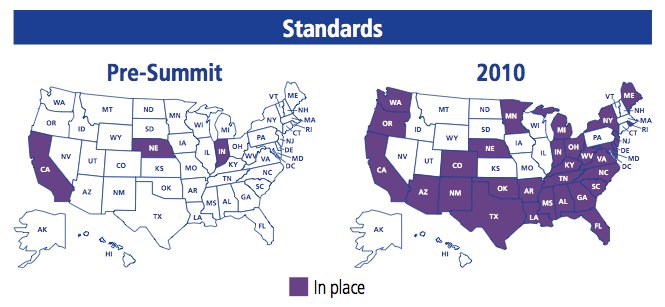
Share

Playing along with the Mozart effect
If you want music to sharpen your senses, boost your ability to focus and perhaps even improve your memory, you need to be a participant, not just a listener.

Melissa Healy:

Five months after we are conceived, music begins to capture our attention and wire our brains for a lifetime of aural experience. At the other end of life, musical memories can be imprinted on the brain so indelibly that they can be retrieved, perfectly intact, from the depths of a mind ravaged by Alzheimer’s disease.
In between, music can puncture stress, dissipate anger and comfort us in sadness.
As if all that weren’t enough, for years parents have been seduced by even loftier promises from an industry hawking the recorded music of Mozart and other classical composers as a means to ensure brilliant babies.
But for all its beauty, power and capacity to move, researchers have concluded that music is little more than ear candy for the brain if it is consumed only passively. If you want music to sharpen your senses, boost your ability to focus and perhaps even improve your memory, the latest word from science is you’ll need more than hype and a loaded iPod.

Share

What happens to Madison’s bad teachers?

Lynn Welch:

It’s absurd to believe anyone wants ineffective teachers in any classroom.
So when President Barack Obama, in a speech last fall at Madison’s Wright Middle School, called for “moving bad teachers out of the classroom, once they’ve been given an opportunity to do it right,” the remark drew enormous applause. Such a pledge is integral to the president’s commitment to strengthen public education.
But this part of Obama’s Race to the Top agenda for schools has occasioned much nervousness. Educators and policymakers, school boards and school communities have questions and genuine concern about what it means. What, exactly, is a bad teacher, and how, specifically, do you go about removing him or her from a classroom?
Many other questions follow. Do we have a “bad teacher” problem in Madison? Does the current evaluation system allow Madison to employ teachers who don’t make the grade? Is our system broken and does it need Obama’s fix?
A look into the issue reveals a system that is far from perfect or transparent. But Madison school board President Arlene Silveira agrees it’s an issue that must be addressed.

Share

And the Orchestra Played On

Joanne Lipman:

The other day, I found myself rummaging through a closet, searching for my old viola. This wasn’t how I’d planned to spend the afternoon. I hadn’t given a thought to the instrument in years. I barely remembered where it was, much less how to play it. But I had just gotten word that my childhood music teacher, Jerry Kupchynsky — “Mr. K.” to his students — had died.
In East Brunswick, N.J., where I grew up, nobody was feared more than Mr. K. He ran the town’s music department with a ferocity never before seen in our quiet corner of suburbia. In his impenetrably thick Ukrainian accent, he would berate us for being out of tune, our elbows in the wrong position, our counting out of sync.
“Cellos sound like hippopotamus rising from bottom of river,” he would yell during orchestra rehearsals. Wayward violinists played “like mahnyiak,” while hapless gum chewers “look like cow chewing cud.” He would rehearse us until our fingers were callused, then interrupt us with “Stop that cheekin plocking!”

Share

An Update on the Madison School District’s Efforts to Increase Teacher Use of the “Infinite Campus” Student Portal

Superintendent Dan Nerad 2.1MB PDF:

The Board of Education has shown concern with current levels of participation among staff, parents, and students in the use of the Infinite Campus student information system. This concern comes despite many efforts to engage the stakeholders with various professional development opportunities and promotional campaigns over the past three years. In December 2009, the Board was provided a summary from a staff survey conducted on the topic explaining why staff had been reluctant to use the teacher tools. That report is found as an attachment to this report (see Attachment 1).
A survey of Wisconsin school districts was completed to determine the standards for teacher use of student information system technologies in the state. The survey gathered information about the use of grade book, lesson planners, and parent and student portals. Responses were collected and analyzed from over 20 Wisconsin districts. Nearly all responding districts report either a requirement for online grade book use, or have close to 100 percent participation. (See Attachment 2).
Describe the action requested of the BOE
The administration is requesting that the Board of Education take action in support of the proposed action steps to enhance the overall use of the teacher and portal tools among our stakeholders.
The proposed time line for full teacher use of grade level appropriate Infinite Campus teacher tools is: High school teachers – 2011-2012 End of 4th Quarter, Middle school teachers – 2010-2011 End of 4th Quarter, Elementary school teachers – End of 4th Quarter, 2011-2012 (calendar feature only)

Fascinating tone. I support the Board’s efforts to substantially increase usage of this system. If it cannot be used across all teachers, the system should be abandoned as the District, parents and stakeholders end up paying at least twice in terms of cost and time due to duplicate processes and systems.

Share

Problem children should be helped, not excluded, says schools report

Anushka Asthana:

The system of excluding badly behaved pupils from school should be abolished because it punishes the most vulnerable children, a major new report on education has concluded, writes Anushka Asthana.
The study, by the thinktank Demos, says that difficult children are being pushed out of schools too often and finds that exclusions do not solve behavioural problems. Instead, they are linked to very poor results and in three out of four cases relate to children with special educational needs who should receive additional support. The report finds that 27% of children with autism have been excluded from school.
Sonia Sodha, co-author of the report, said: “Most other countries do not permanently exclude children from school in the same way we do. Instead of helping these children, we are punishing and then banishing them.”
The report comes as figures from the Conservatives show that 1,000 pupils are excluded or suspended for physical and verbal assaults every day. Speaking at the Tory party spring conference, Michael Gove, shadow children’s secretary, promised that in power he would make it easier for teachers to remove violent and disruptive pupils.

Share

Starting them young: Nursery schools are the latest front-line in the Scandinavian integration debate

The Economist:

N SOFT, southern countries, snow is enough to close schools. In Sweden–a place that lives by the maxim that “There is no such thing as bad weather, just the wrong clothes”–fresh snow is a cue to send 18-month-olds into the playground, tottering around in snowsuits and bobble hats. It is an impressive sight at any time. But it is particularly striking in a Stockholm playground filled with Somali toddlers, squeaking as they queue for sledge-rides.
The playground belongs to Karin Danielsson, a headmistress in Tensta, a Stockholm suburb with a large immigrant population. Mrs Danielsson calls her municipal preschool “a school for democracy”. In keeping with Swedish mores, even young children may choose which activities to join or where to play. All pupils’ opinions are heard, but they are then taught that the group’s wishes must also be heeded.
Swedes take preschool seriously. Though education is not compulsory until seven, more than 80% of two-year-olds are enrolled in preschool, and many begin earlier. Among European countries only Denmark has higher enrolment rates at that age.

Share