School Information System

Video, Notes & Links: Wisconsin Senate Bill 22 Hearing

via a kind reader’s email:

Clusty Search: Wisconsin Senate Bill 22.

Share

A Nation of Dropouts Shakes Europe

Charles Forelle:

Isabel Fernandes, a cheery 22-year-old with a constellation of stars tattooed around her right eye, isn’t sure how many times she repeated fifth grade. Two, she says with a laugh. Or maybe three. She redid seventh grade as well. She quit school with an eighth-grade education at age 20.
Ms. Fernandes lives in a poor suburb near the airport. She doesn’t work. Employers, she says, “are asking for higher education.” Even cleaning jobs are hard to find.
Portugal is the poorest country in Western Europe. It is also the least educated, and that has emerged as a painful liability in its gathering economic crisis.
Wednesday night, the economic crisis became a political crisis. Portugal’s parliament rejected Prime Minister José Sócrates’s plan for spending cuts and tax increases. Mr. Sócrates handed in his resignation. He will hang on as a caretaker until a new government is formed.

Share

On Public Education

Jerry Pournelle:

“How Not to Lay Off Teachers” in today’s Wall Street Journal (link) rather weakly repeats something that everyone who studies the education mess knows. It’s worth your time if you have any doubts that seniority is not the right way to determine who should be paid public money to teach in public schools. Of course just because everyone knows something doesn’t mean much.

The steep deficits that states now face mean that teacher layoffs this year are unavoidable. Parents understandably want the best teachers spared. Yet in 14 states it is illegal for schools to consider anything other than a teacher’s length of service when making layoff decisions.
It gets worse. “Many people don’t realize that teachers are not evenly distributed nationwide,” says Tim Daly of the New Teacher Project, which has released a new report on the nationwide impact on quality-blind layoffs. “Fourteen states have these rules but about 40% of all teachers work in those states, and they’re the states with the biggest budget deficits.” In addition to New York, the list includes California, New Jersey, Pennsylvania, Ohio, Illinois and Wisconsin.

Share

What do students miss with a virtual education?

Christopher Dawson:

I had the chance to speak at a local university on Tuesday, talking to a class on cloud computing about the impact of technology (especially, of course, the cloud) on higher education. The class was great and was, itself, focused on team-based learning and simulations using a variety of cloud and web-based tools. What was even better, though, was the Q&A session with the students and my follow-up conversations with faculty and staff.
Let me start with something that ZDNet’s digital video and photo blogger, Janice Chen, wrote in an unrelated discussion we were having about ZDNet’s upcoming 20th anniversary:

Share

Why One Innovator is Leaving the Public Sector

Andrew Rotherham:

Lately you can’t turn around in education without bumping into someone talking about innovation. The President is asking Congress for more federal support for educational innovation in this year’s budget, more and more school districts are naming “innovation officers,” and just last week a group of Silicon Valley start-up veterans launched a new incubator for innovative education companies. But while innovation is a catchy buzzword, on the ground conditions are often anything but innovative. This week, the resignation of a school administrator in New York City who most readers have probably never heard of vividly illustrates that disconnect.
Joel Rose, 40, got his start teaching in Houston with Teach For America. After law school and a stint at Edison Schools, he landed at the New York City Department of Education leading a personnel strategy for that massive 1.1. million student system. Rose was struck, as many observers are, by how little technology had changed education relative to most other fields during the past few decades. So he started a program within the New York City Public Schools called “School of One” that uses technology to offer a completely customized schooling experience for each student.

Share

Not-so-public education: A Colorado school voucher program seems likely to benefit mostly middle-class students and religious schools.

Los Angeles Times

Supporters of school vouchers like to say that their goal is to provide a higher-quality education for the children who need it most. The latest events in Colorado say otherwise. A voucher program there seems more likely to benefit middle-class children and religious schools than low-income public school students, and to worsen inequities in education.
Last week, the board of the Douglas County School District voted for a pilot program that will give the parents of 500 of its 60,000-students about $4,500 each — 75% of what the district receives in per-pupil funding — to use toward tuition at participating private schools of their choice. Many of the private schools in the area are religiously based.
Even in Colorado, where a dollar stretches a lot further than in Southern California, $4,500 falls significantly short of private school tuition. Most schools there range from about $7,000 up to $14,000. Clearly, the parents poised to benefit most from this taxpayer-sponsored perk are those with a few thousand to spare to fill in the price gap. There might be scholarships for some of the needier students — about 10% of the Douglas County students qualify for free or reduced-price school lunches — but no one is promising anything.

Share

Hand-Crafted Digital Texts

Scott McLemee:

Despite an abiding preference for the traditional book, I started using an e-reader about seven months ago — and have found it insinuating itself into daily life, just as a key chain or wallet might. For there is a resemblance. A key chain or wallet (or purse) is, in a sense, simply a tool that is necessary, or at least useful, for certain purposes. But after a while, each becomes more than that to its owner. To be without them is more than an inconvenience. They are extensions of the owner’s identity, or rather part of its infrastructure.
Something like that has happened with the e-reader. I have adapted to it, and vice versa. Going out into the world, I bring it along, in case there are delays on the subway system (there usually are) or my medical appointment runs behind schedule (likewise). While at home, it stays within reach in case our elderly cat falls asleep in my lap. (She does so as often as possible and has grown adept at manipulating my guilt at waking her.) Right now there are about 450 items on the device. They range from articles of a few thousand words to multivolume works that, in print, run to a few hundred pages each. For a while, my acquisition of them tended to be impulsive, or at least unplanned. Whether or not the collection reflected its owner’s personality, it certain documented his whims.

Share

Questions Abound as the College-Rankings Race Goes Global

Ellen Hazelkorn:

It is amazing that more than two decades after U.S. News & World Report first published its special issue on “America’s Best Colleges,” and almost a decade since Shanghai Jiao Tong University first published the Academic Ranking of World Universities, rankings continue to dominate the attention of university leaders. Indeed, the range of people watching them now includes politicians, students, parents, businesses, and donors. Simply put, rankings have caught the imagination of the public and have insinuated their way into public discourse and almost every level of government. There are even iPhone applications to help individuals and colleges calculate their ranks.
More than 50 country-specific rankings and 10 global rankings are available today, including the European Union’s new U-Multirank, due this year. What started as small-scale, nationally focused guides for students and parents has become a global business that heavily influences higher education and has repercussions well beyond academe.

Share

Hundreds attend, testify at legislative hearing on charter school changes

Susan Troller:

Testimony at the Capitol over a controversial bill that would strip control over charter schools from locally elected officials and place it in the hands of a politically appointed state-wide authorizing board drew hundreds on Wednesday to a standing-room-only Senate education committee hearing.
Senate Bill 22, authored by state Sen. Alberta Darling (R-River Hills) would also fund independent charter schools ahead of traditional public schools. I wrote about the bill on Tuesday and it’s generated a robust conversation.
Madison Superintendent Daniel Nerad testified in opposition to the bill, and so did local school board member Marjorie Passman. Kaleem Caire, president and CEO of the Urban League of Greater Madison and a strong proponent of the proposed boys-only Madison Preparatory Academy for minority students, testified in support of the bill. Madison Prep, if approved, will be a publicly funded charter school in Madison.

Share

Justice Department sues on behalf of Muslim teacher, triggering debate

Jerry Markon:

Safoorah Khan had taught middle school math for only nine months in this tiny Chicago suburb when she made an unusual request. She wanted three weeks off for a pilgrimage to Mecca.
The school district, faced with losing its only math lab instructor during the critical end-of-semester marking period, said no. Khan, a devout Muslim, resigned and made the trip anyway.
Justice Department lawyers examined the same set of facts and reached a different conclusion: that the school district’s decision amounted to outright discrimination against Khan. They filed an unusual lawsuit, accusing the district of violating her civil rights by forcing her to choose between her job and her faith.

Share

Teacher bonus program fails to lure and retain top teachers in Washington’s high-poverty schools

Jim Simpkins, via email:

– A $99 million teacher bonus program that Washington legislators designed to lure good teachers into high-poverty schools has not worked as intended, according to a new analysis from the University of Washington Bothell’s Center on Reinventing Public Education.
“Not only has the $10,000 annual bonus failed to move effective teachers to high-poverty schools, it has also failed to make those teachers any more likely to stay in high-poverty schools than other teachers,” said the report’s author, Jim Simpkins.
Washington State provides $5,000 bonuses to those teachers who undergo and pass the rigorous national board certification process, a credentialing program that marks its graduates as among the best teachers. The evidence, however, on whether national board certified teachers (NBCTs) are actually more effective teachers is mixed.
In 2007, state legislators added a second $5,000 bonus for NBCTs who teach in a high-poverty school, defined as one where a large portion of students are on free or reduced-price lunches. According to the Center’s report, ” . . . less than 1% of Washington’s NBCTs move from low-poverty to high-poverty schools each year.”

Share

Separate and Unequal

Bob Herbert:

One of the most powerful tools for improving the educational achievement of poor black and Hispanic public school students is, regrettably, seldom even considered. It has become a political no-no.
Educators know that it is very difficult to get consistently good results in schools characterized by high concentrations of poverty. The best teachers tend to avoid such schools. Expectations regarding student achievement are frequently much lower, and there are lower levels of parental involvement. These, of course, are the very schools in which so many black and Hispanic children are enrolled.

Share

Newark teachers protest charter schools’ use of public school buildings

Daniel Ulloa:

The Newark Teachers Union sent an email to its 4,800 members urging them to protest against the placement of charter school in underutilized public school buildings at an Advisory board meeting held tonight at Barringer High School.
According to the Wall St. Journal, Union President Joseph Del Grosso strongly objects to the placement of charter schools in public school buildings, claiming that some of the private funding that the Charter schools will make obvious the stark differences between the two types of schools.
The meeting will begin at 6 P.M. Tuesday, and staff, students, and parents are all being invited to voice their concerns.

Share

Unions Give Teachers a Voice and a Platform From Which to Help Students

Marc Korashan:

When I began teaching in New York City in 1975 I didn’t initially see the need for a union or get involved in union activities. I knew, from history and the stories my parents and grandparents told, about the struggle for unions, but like so many today, I took the existence of a union and a contract for granted. My chapter leader gave me some advice and made sure I had all the necessary forms when I got appointed, but that was the sum of my union involvement until I moved to a position as an Education Evaluator on School Based Support Teams.
In that position, as a Special Education Teacher/Education Evaluator, I was much more exposed to the whims of management than I had been as a classroom teacher. Administrators didn’t often walk into my SIE VIII classroom as most of them were afraid of the volatile students I taught. I worked with my co-teacher and we succeeded in making a difference for most of our students.

Share

As Little Girls and Boys Grow, They Think Alike

Avery Johnson:

Boys’ and girls’ brains are different–but not always in the ways you might think.
A common stereotype is that boys develop more slowly than girls, putting them at a disadvantage in school where pressure to perform is starting ever younger. Another notion is that puberty is a time when boys’ and girls’ brains grow more dissimilar, accounting for some of the perceived disparities between the sexes.
Now, some scientists are debunking such thinking. Although boys’ and girls’ brains show differences around age 10, during puberty key parts of their brains become more similar, according to recent government research. And, rather than growing more slowly, boys’ brains instead are simply developing differently.

Share

The Value of Education — and Teachers

The Somewhat Daily RAG:

A pharmacist friend in Jasper, Alberta said that she was appalled at the seemingly light sentences given to abusers who kill children while someone murdering a police officer gets a life sentence.
Her take on this disparity was, “How do you know that if this child grew up he wouldn’t become a policeman?”
An interesting and provocative take which I recalled when thinking of the value of education and our teachers who seem to be under attack these days as overpaid (whoever though a teacher could be accused of that?) and greedy.

Share

Georgia charter school ruling to reverberate across nation

A state Supreme Court opinion that will decide who has the power to fund and open public charter schools is expected by March 31, ending a constitutional challenge that threatens to derail the education of thousands of students.
The two-year legal battle launched by seven local districts over power, money and the exclusive right to open neighborhood schools has threatened Georgia’s reputation as a national leader in education reform.
The feud began in 2009 when the Georgia Charter Schools Commission, a state board, got into the business of approving and funding neighborhood schools such as Cherokee Charter Academy.
The school, which plans to open in the fall as Cherokee County’s first charter campus, received more than 1,300 applications for about 700 spots. It was denied twice by the Cherokee Board of Education.

Share

Bill Gates Seeks Formula for Better Teachers

Stephanie Banchero:

Bill Gates shook up the battle against AIDS in Africa by applying results-oriented business metrics to the effort. Now, he is trying to do the same in the tricky world of evaluating and compensating teachers.
The Microsoft Corp. co-founder has moved on from a $2 billion bet on high school reform–much of it spent on breaking up big, failing high schools and replacing them with smaller ones.
Now, he is venturing that improving teacher effectiveness is the key to fixing broken schools. The Bill & Melinda Gates Foundation has awarded $290 million to school districts in Memphis, Tenn.; Hillsborough, Fla.; and Pittsburgh, and a charter consortium in California to build new personnel systems Mr. Gates hopes will be models for the country.

Share

Republican bill calls for a board of political appointees to authorize charter schools

Susan Troller:

Under a Republican-sponsored bill, nine political appointees would get to authorize public charter schools while local school districts foot the bill. The creation of this state-wide charter school authorizing board — with members appointed by the governor and the leaders of the state Senate and Assembly — is a key provision of legislation authored by Sen. Alberta Darling of River Hills that will get a hearing on Wednesday at 10 a.m. at the Capitol before the Senate Education Committee.
Senate Bill 22 not only de-emphasizes local control, but also creates changes in how teachers are certified and removes caps from the numbers of students who may enroll in virtual schools. A companion bill is also pending in the state Assembly.
Opponents say the proposed changes would not only eliminate local control in favor of a new, politically motivated bureaucracy but would also siphon general aid away from all of Wisconsin’s 424 public school districts in favor of charters. But backers say it will remove current barriers that prevent charter schools from realizing their full potential.
“This bill would get rid of the charter school lite culture we currently have in Wisconsin and allow these schools’ full potential for autonomy, flexibility and innovation to be fully realized,” says John Gee, executive director of the Wisconsin Association for Charter Schools.

Related:
School Choice Wisconsin: Milwaukee residents favor school choice expansion

Share

Teacher Tenure Reform: Applying Lessons from the Civil Service and Higher Education

Public Impact:

Research continues to confirm what intuition has told many of us for years: Teacher quality has a bigger impact on student learning than any other factor in a school. Nationwide, this finding has increasingly motivated policymakers and the public to focus reforms on dramatically improving teacher quality. National, state, and local leaders have initiated reforms designed to better prepare teachers for the classroom, more accurately identify and reward top teachers, support teachers’ development, and equip education leaders to identify and remove the very least-effective teachers.
Discussions of teacher quality often lead to questions about which teachers are retained and dismissed in K-12 public schools, and thus to questions about tenure. Teacher tenure was designed in the early 1900s as a set of procedural protections against unfair and arbitrary dismissals.1 But today, concerns about the effect on student outcomes — along with budgetary constraints — dominate education reform discussions.
As a result, leaders in a handful of states and districts have begun making changes to align their tenure systems with their goal of increasing student learning. Common changes include streamlining tenure protections and increasing the rigor of the tenure-granting process.2 Parallel efforts to improve the quality, accuracy, and rigor of educator evaluations have strengthened the basis for personnel decisions based on performance, and have fueled increased interest in tenure reform

Share

The Search for a New Way to Test Schoolkids

Bill Tucker:

Excerpt from Greg Toppo’s article:
“…In other places, educators are experimenting with different ways to test what kids learn. Bill Tucker, a managing director at Education Sector, a Washington, D.C., think tank, says states like Oregon have led the way with so-called adaptive tests, computerized assessments that actually change as students answer questions right or wrong. Such tests satisfy the requirements of the No Child Left Behind law. Students sit for these tests any time they’re ready, from October on, and the tests allow schools to find out more about how much kids have learned. And since each test is essentially different from the last, they’re “harder to game,” Tucker says.
In a bid to look beyond bedrock skills such as reading and math, a few states are also looking at other measures, such as how many of their high school graduates had to take remedial classes in college, Tucker says. Federal Race to the Top funding, part of the Obama administration’s education stimulus plan, is pushing states to develop databases that would allow states to track graduates.
The federal government has also invested in two separate efforts by the states to overhaul tests; 45 states are participating. One project is aimed at developing so-called “through testing,” which would sample every few months how much students learn, then combine those scores with the score on an end-of-year test. The other project focuses on computer-adaptive tests, like those used in Oregon, to be given at year’s end.

Share

Teaching to the Text Message

Andy Selsberg:

I’VE been teaching college freshmen to write the five-paragraph essay and its bully of a cousin, the research paper, for years. But these forms invite font-size manipulation, plagiarism and clichés. We need to set our sights not lower, but shorter.
I don’t expect all my graduates to go on to Twitter-based careers, but learning how to write concisely, to express one key detail succinctly and eloquently, is an incredibly useful skill, and more in tune with most students’ daily chatter, as well as the world’s conversation. The photo caption has never been more vital.
So a few years ago, I started slipping my classes short writing assignments alongside the required papers. Once, I asked them, “Come up with two lines of copy to sell something you’re wearing now on eBay.” The mix of commerce and fashion stirred interest, and despite having 30 students in each class, I could give everyone serious individual attention. For another project, I asked them to describe the essence of the chalkboard in one or two sentences. One student wrote, “A chalkboard is a lot like memory: often jumbled, unorganized and sloppy. Even after it’s erased, there are traces of everything that’s been written on it.”

Share

It’s School Admissions Season in New York City: Does your 18-month-old have what it takes?

Katie Roiphe:

When T.S. Eliot wrote about the cruelest month “mixing memory and desire”, he might also have had in mind that this is the season of school admissions in New York City. So as the sooty piles of snow melt into gray puddles, parents obsess over the letters they will and won’t receive from the school that will or won’t confer on their radiant progeny the blessing of its approval. It seems to be a challenge in this season for even the more sensible parents among us, even those who really have better things to do, not to fall prey to the prevailing fantasy that if your child is rejected from one of these desirable and enlightened places, he or she will be destined for a life of drug addiction, grand theft auto, or general exile.
My 18-month-old recently had his first school interview. Apparently he sailed through it, though how is somewhat mysterious to me. Especially since he calls all fruits “apples” and sentences such as “Mommy. Moon. Get it” are not necessarily indicative of a huge understanding of the workings of the universe. However, no one is too young for the system, and a small obstacle like language cannot be permitted to get in the way of the judging and selecting and general Darwinian sorting to which it is never too soon to accustom yourself in this city. I have been asked to write recommendations for other one-and-a-half-year-olds for this same lovely school, and have thought of, but did not actually write, “He knows a lot about trucks.”

Share

Better education takes team work

Kathleen Monohan Romano:

Suzanne Fields writes in her March 5 column that teachers should put pupils first. I am appalled that teachers are being blamed for the state of education and the economy.
I have been a teacher in the Capital Region for 25 years and have had the privilege of working with highly qualified, dedicated, hardworking professionals. Yes, we consider ourselves professionals. The union has fought to improve salaries and working conditions, and protect workers from favoritism.
U.S. schools lag behind those in other countries because of America’s culture. There has been a decline in discipline, self-discipline and structure in the home, as well as a host of other social problems. Teachers should be respected by their students and the families they serve; instead, they are unfairly under attack. Students in other countries work harder; their culture is one of respect for education and teachers.

Share

As Thomas Jefferson High School adds help for poor English skills, some Va. parents fume

Kevin Sieff:

As Northern Virginia became home to more immigrant families in recent decades, Fairfax County officials say they started programs to teach English as a second language at every school – about 200 of them. Except one.
The holdout was the region’s hallowed magnet school, Thomas Jefferson High School for Science and Technology, where many assumed that steep admissions standards rendered such a program for English language learners unnecessary.
But next year, at the behest of the school’s teachers, Thomas Jefferson – often called TJ – plans to hire its first instructor to cater to a growing number of students who thrive in math and science classes but sometimes struggle with English.
The decision to hire the half-time teacher has reinvigorated a debate about TJ’s mission – namely, how heavily the school’s admissions policy should favor math and science standouts over well-rounded applicants with superior reading and writing abilities.

Share

The search for a new way to test schoolkids

Greg Toppo:

By all accounts, George Washington Elementary School is the very model of a modern urban public school.
Tucked into an up-and-coming neighborhood west of downtown, the school has produced impressive results on annual Maryland School Assessment (MSA) math and reading tests over the past several years. By 2007, scores had improved so steadily that the U.S. Department of Education made it a National Blue Ribbon School of Excellence. First lady Laura Bush came to town to hand out the award.
But in October 2008, a parent came forward with a troubling complaint: Someone was tampering with answer bubble sheets at Washington Elementary.
Soon, Baltimore Schools CEO Andres A. Alonso showed up at a PTA meeting at Washington and found “very poor” parent turnout and “an absence of student or staff enthusiasm,” according to city records.

Share

Embattled principal to leave Madison for Puerto Rico school

Matthew DeFour:

The Glendale Elementary School principal who was accused by some teachers of being a bully while praised by others as a visionary is leaving at the end of the year to take a principal job in Puerto Rico.
In a statement, Mickey Buhl said he knew sometime last school year that this would be his last year at Glendale. “The stage we are at makes it a wise time for a change for the school and for me,” he wrote to parents last week.
Superintendent Dan Nerad praised Buhl as an “innovative instructional leader who has played a key role in improving the educational results for Glendale students.”
During Buhl’s six years, test scores among Glendale’s low-income and minority students have improved as changes were made to foster more collaboration between teachers. But Buhl’s aggressive management style rubbed some teachers the wrong way, prompting a district investigation last fall.

Share

British University Leaders: Pay for Performance

Hannah Fearn:

Vice chancellors of British universities (the equivalent of university presidents) could lose up to 10 percent of their salaries if they fail to do their job properly under new plans to establish fair pay in the public sector in Britain.
Under the proposals, set out today by journalist and economist Will Hutton, rank-and-file academics would also play a role in setting the salary of their vice chancellor. Hutton, executive vice-chair of the Work Foundation think tank, was commissioned by the British government last year to lead a review of fair pay in the public sector.
An interim report published in December revealed that universities had the highest pay differential between the top and bottom earners across the entire public sector, with vice chancellors earning on average 15.35 times the salary of those at the bottom of the pay spine such as porters and cleaners. For Russell Group universities (leading research universities), the ratio rose to 19:1.

Share

Report: Teacher quality crucial: Meeting targets best practices for nation’s educators

Associated Press:

Countries that outpace the U.S. in education employ many different strategies to help their students excel. They do, however, share one: They set high requirements to become a teacher, hold those who become one in high esteem and offer the instructors plenty of support.
On Wednesday and today, education leaders, including U.S. Education Secretary Arne Duncan, the nation’s largest teacher unions, and officials from the highest scoring countries, are meeting in New York to identify the best teaching practices.
The meeting comes after the recently released results of the Programme for International Student Assessment exam of 15-year-olds alarmed U.S. educators. Out of 34 countries, it ranked 14th in reading, 17th in science and 25th in math.
“On the one hand, the United States has a very expensive education system in international standards,” said Andreas Schleicher, who directs the exam. “On the other hand, it’s one of the systems where teachers get the lowest salaries.
“Then you ask yourself, how do you square those things?”

Investors:

Some 16 countries’ teachers union leaders and education ministers say the U.S. must “raise the status of the teaching profession”– meaning spend more money. We’ve wasted enough. Let’s reduce unions’ power.
Defenders of government control of education will believe any and every explanation for failure — except government control.
Andreas Schleicher, the head of the division of the Organization for Economic Cooperation and Development that conducts evaluations of the scholastic performance of different countries’ 15-year-old pupils every three years, complains in a new report about the image of educators in America.
“The teaching profession in the U.S. does not have the same high status as it once did,” he says, “nor does it compare with the status teachers enjoy in the world’s best-performing economies.”

Share

An interview with Henna Virkkunen, Finland’s Minister of Education

Justin Snider:

The Hechinger Report: It’s well-known that Finland’s teachers are an elite bunch, with only top students offered the chance to become teachers. It’s also no secret that they are well-trained. But take us inside that training for a moment – what does it look like, specifically? How does teacher training in Finland differ from teacher training in other countries?
Virkkunen: It’s a difficult question. Our teachers are really good. One of the main reasons they are so good is because the teaching profession is one of the most famous careers in Finland, so young people want to become teachers. In Finland, we think that teachers are key for the future and it’s a very important profession–and that’s why all of the young, talented people want to become teachers. All of the teacher-training is run by universities in Finland, and all students do a five-year master’s degree. Because they are studying at the university, teacher education is research-based. Students have a lot of supervised teacher-training during their studies. We have something called “training schools”–normally next to universities–where the student teaches and gets feedback from a trained supervisor.
Teachers in Finland can choose their own teaching methods and materials. They are experts of their own work, and they test their own pupils. I think this is also one of the reasons why teaching is such an attractive profession in Finland because teachers are working like academic experts with their own pupils in schools.

Share

U.S. Is Urged to Raise Teachers’ Status

Sam Dillon via a Kris Olds’ email:

To improve its public schools, the United States should raise the status of the teaching profession by recruiting more qualified candidates, training them better and paying them more, according to a new report on comparative educational systems.
Andreas Schleicher, who oversees the international achievement test known by its acronym Pisa, says in his report that top-scoring countries like Korea, Singapore and Finland recruit only high-performing college graduates for teaching positions, support them with mentoring and other help in the classroom, and take steps to raise respect for the profession.
“Teaching in the U.S. is unfortunately no longer a high-status occupation,” Mr. Schleicher says in the report, prepared in advance of an educational conference that opens in New York on Wednesday. “Despite the characterization of some that teaching is an easy job, with short hours and summers off, the fact is that successful, dedicated teachers in the U.S. work long hours for little pay and, in many cases, insufficient support from their leadership.”

Share

Superman & Teacher Evaluation

Elizabeth Coffman:

There’s been a lot of negative media lately, particularly surrounding education and teachers’ unions in Wisconsin, Ohio and Florida.
My children attend a Florida public high school that is ranked as one of the top five best schools in the state for academics, and consistently ranked number one in football and volleyball. They have an extensive Advanced Placement course program that is so popular that my kids cannot get into all of the AP courses that they want. The courses are large and overenrolled, but at least they are challenging.
From my perspective as a parent and a college educator, most of my kids’ high school teachers have been excellent. A few, however, have been inferior — a situation that does not really surprise me. As a former department chair and evaluator of faculty performance at the college level, I understand how flawed and difficult the evaluation process can be. I also understand how faculty have different strengths and weaknesses. The weaker scholar with the higher student GPA average may be the person who provides after-hours counsel to students in trouble. The faculty with the lower student evaluations and course G.P.A.’s may be the most intellectually challenging faculty in the classroom — the one who students learn to appreciate after they graduate. And then there are a few faculty who should probably leave education entirely, but will not go and cannot be fired without difficulty, if they have tenure. All of these issues–teacher evaluation, compensation, tenure–are on the political table right now for public schools. Florida is one of the states that is pushing a bill to link secondary student performance to better teacher retention and merit pay. New Florida Governor (and Tea Party favorite) Rick Scott supports a bill in which teacher evaluations are no longer subject to the collective bargaining process, only pay and benefits are negotiated. Teachers’ unions are unhappy about the methods (and the rhetoric) that many politicians are using for evaluating them and their classrooms. It’s unfortunate how this clash between workers and management is playing out in the classroom.

Share

Write About Why You are an Educator and a Proud Union Member

WJ Levay:

Those of you who are excellent teachers and who stand in solidarity with our unions are probably no stranger to the question, “Well, why are you involved with the union if you’re a good teacher?” It’s time for educators to stand up and answer that question loudly and clearly.
EDUSolidarity, a group of progressive educators, encourages you to explain how being a union member supports and enables you to be the kind of teacher that you are. Include personal stories if possible. Focus not only on your rights, but also on what it takes to be a great teacher for students and how unions support that.

Share

The Inevitable Wisconsin

Hans Moleman:

In the words of Young Frankenstein’s Inspector Kemp, “A riot iss an ogly think.” So is the Wisconsin shootout; ugly – but inevitable.
The unions had to be expecting a tough time with their new Governor Walker. No doubt they anticipated a difficult negotiation – “hard bargaining”, as the governor cut labor costs to balance the budget. Instead, they found themselves facing political forces who actually intend to put an end to them.
Unions have always decried every effort to rollback labor costs or union power as “union-busting.” Now their past rhetorical excesses have caught up with them, as they confront the real thing. (Cf “Wolf, the Boy who Cried…”)
At first it looked as if Walker was indeed bargaining hard. Rolling back pensions, increasing employee contributions, and making labor accept it as a compromise by agreeing not to end collective bargaining outright. And there would be the peace, as Don Barzini would say.
Well, gentlemen may cry “peace, peace,” but there is no peace. Before it could be seen if Walker was a “let’s make a deal” type, Democrats abandoned the state and the unions seized the Capitol to bully the governor and Republicans. They in turn found a parliamentary bypass and passed the bill to strip bargaining rights. The budget, with its real benefit reductions and budget cuts is still pending. But the unions appear to have used up most of their ammo, so their hopes cannot be high.

Share

Teachers will move forward

Mary Bell

Wisconsin’s public school teachers and support staff are reeling after a week in which our state leaders put political ambitions before their constituents.
When the governor signed into law his unprecedented attack on workers’ rights, he did so amidst plummeting approval ratings and an intense and growing base of Wisconsinites who are outraged by the actions he is taking to destroy our great state.
Make no mistake, this disregard for public opinion and workplace rights will have a broad and lasting negative impact on our state’s future. From schools to hospitals to public services – and ultimately, to middle-class families across this state, the damage these actions set into place will be deep and wide.
On behalf of educators across our state, I remind you that weeks ago we accepted the financial concessions the governor asked for to help solve our state’s budget crisis. But we have consistently said that silencing the voices of workers by eliminating their collective bargaining rights goes too far.

Mary Bell is a Wisconsin Rapids junior high teacher with 33 years experience in the classroom. She is serving as president of the Wisconsin Education Association Council.

Share

Quality in the classroom Layoffs by seniority are not in the best interests of students

Joe Williams:

With Republican governors across the nation looking for new ways to demean and disparage public school teachers, it was refreshing to see Gov. Andrew Cuomo take a different tack. He proposed legislation to expedite an agreed-upon evaluation system that could be used as early as next school year to elevate the quality and professionalism of New York’s teaching work force.
While Cuomo’s bill will have a positive impact on the state’s education system years down the road, it doesn’t address a major threat to teacher quality this year: seniority-based layoffs.
It is time for Cuomo to lead on the issue by eliminating the state law that requires layoffs to be based on seniority rather than effectiveness.

Share

Madison School Board Tension over Spending/Taxes & Compensation

Bill Lueders:

Gov. Scott Walker says the changes he has rammed through the Legislature will give school districts and local governments “the tools” they need to withstand the severe cuts in state aid his budget will deliver. What he doesn’t get into is how the tensions caused by his agenda will divide the members of these bodies, as they have the state as a whole.
One example of this is the Madison school board, where disagreements over the impact of Walker’s actions have spurned an ugly exchange, in which school board member Lucy Mathiak lobbed an F-bomb at a fellow board member, Marj Passman.
The exchange happened yesterday, March 14. Passman was contacted by a Madison school teacher who felt Mathiak had been dismissive of the teacher’s concerns, urging her to “get over yourself.” Passman, who allows that board members have been deluged with angry emails, says she expressed to Mathiak that she agreed this response was a little harsh.

Somewhat related: Jason Shepherd: Going to the mat for WPS
School board yields to pressure to keep costlier insurance option

Suzanne Fatupaito, a nurse’s assistant in Madison schools, is fed up with Wisconsin Physicians Service, the preferred health insurance provider of Madison Teachers Inc.
“MTI uses scare tactics” to maintain teacher support for WPS, Fatupaito recently wrote to the school board. “If members knew that another insurance [plan] would offer similar services to WPS and was less expensive – it would be a no-brainer.”
WPS, with a monthly price tag of $1,720 for family coverage, is one of two health coverage options available to the district’s teachers. The other is Group Health Cooperative, costing $920 monthly for a family plan.
During the past year, the Madison school board has reached agreements with other employee groups to switch from WPS to HMO plans, with most of the savings going to boost pay.
In December, the board held a secret vote in closed session to give up its right to seek health insurance changes should negotiations on the 2007-09 teachers contract go into binding arbitration. (The board can seek voluntary insurance changes during negotations.)

Lucy has been a long time friend and I have long appreciated her activism on behalf of students, the schools and our community.

Share

1 Billion Customers for Education

Sanjay Saigal:

The sixteenth century universalist poet Kabir captures the high Indian regard for education:
गुरु गोबिंद दोऊ खडे, काके लागूं पाये
बलिहारी गुरु आप की, गोबिंद दियो मिलाये
To whom should I bow, my Guru or the Lord?
I bow to thee, O Guru, for you have shown me God
A host to universities since before the time of Christ, India has long revered learning, which, along with spirituality have been the pillars of the Indian notion of civilization (Sankriti). Despite the history, at the time of independence in 1947, only one in five citizens was literate. In independent India, equitable access to education was considered of first importance, hence the sector came under the purview of the government.
Until economic liberalization in 1991, India’s best tertiary institutions were exclusively public funded. These included the well-known Indian Institutes of Technology (IITs) and the Indian Institutes of Management (IIMs). The first private university was recognized in 1995 – today, India has 77. Most private universities are run on unabashedly profit-oriented lines. While the better ones compete with the top public institutions, most do not. Philanthropic support of college and universities is weak, even as the ranks of the wealthy grows in strength.

Share

Guido Sarducci and the Purposes of Higher Education

Sandy Baum and Michael McPherson:

The way college courses generally work is that a teacher presents a group of students with some subject matter, then attempts through tests and papers to determine how well the students have mastered the subject matter. Those judgments are summarized in a letter grade. A list of those subject matters and grades constitutes the transcript that describes what the student has learned and what the student’s performance was overall.
The students and the teacher are focused on the subject matter, and the implied view is that the learning in college is captured in the exercises that inform those grades. The limitations of this “subject matter recall” model of higher education are hilariously captured in Don Novello’s comic performance on Saturday Night Live as Father Guido Sarducci, who marketed the “Five Minute University”: http://youtu.be/kO8x8eoU3L4

Share

Vouchers advance in Pennsylvania and Washington, D.C.

The Wall Street Journal:

The U.S. is enjoying a new spring of education reform, with challenges to teacher tenure and “parent-trigger” for charter schools. So it’s natural that the mother of all school choice reforms–vouchers–is also making a comeback.
Last week a House committee voted to restore Washington, D.C.’s opportunity scholarship program, which lets kids in persistently failing schools attend a private school of the family’s choosing. Joe Lieberman is pushing similar legislation in the Senate, where it enjoys bipartisan support. The White House and teachers unions killed the program in 2009, despite clear evidence of academic gains.
Meanwhile, more states are realizing that true educational choice extends beyond charter schools. The most promising development is occurring in Pennsylvania, where a state-wide voucher bill supported by new Governor Tom Corbett is moving through the Republican-controlled legislature.

Share

K-12 Tax & Spending Climate: Outgoing Democrat Representative Dave Obey’s Midnight Bonuses

Michael Horne:

Retired Rep. Dave Obey, the Wausau Democrat who was known for running a lean congressional office, left office after giving a nice taxpayer-funded gift to his staff in the form of an 84 percent salary bonus. Obey ranked eighth among all 435 members of the House of Representatives in his fourth quarter generosity to staff.
The practice of jacking up fourth quarter salaries for staffers is something that several members of Wisconsin’s congressional delegation – led by Republican representatives Thomas Petri (Wisconsin’s 6th District), F. James Sensenbrenner (5th Dist) and Democrat Gwen Moore (4th Dist.) – have engaged in over the last decade.
DAVE OBEY
The “4th Quarter Bonus,” as it has been called by Capitol insiders, is now documented thanks to the researchers at LegiStorm, an organization that catalogues and categorizes Congressional financial data. Congressional salary data is reported quarterly and was released March 1. In every year, there is a pronounced spike in fourth-quarter staff salaries that averages 20 per cent among members of the House of Representatives.
In the fourth quarter of 2010, fueled by bonuses that were largely fed by departing members – mostly retiring or defeated Democrats like Obey – congressional staff salary expenditures exceeded $200 million for the first time, totaling $201.7 million. LegiStorm reported that bonuses were nearly twice as large for staffs of departing House members as they were for continuing members.

Related: US debt clock: The outstanding public debt as of 3/13/2011 @ 8:01:46p.m. is $14,175,382,249,980.58 which is $45,698.37 per citizen.

Share

Teachers shouldn’t be judged by test scores alone

David Sanchez:

There are those who think the best way to determine teacher effectiveness is by looking only at students’ test scores. The simplicity of this approach can be seductive, but it is inherently flawed. This approach only makes sense if you assume all children come to school with the same abilities, have the same educational resources and opportunities and return home to the same support systems. As a kindergarten teacher for more than 30 years, I can confirm what you already know to be true: Every child is different.
The fact of the matter is student achievement and teacher effectiveness aren’t simple to measure, and the results of one test are not going to offer a complete assessment of either. Many different measures must be used in order to determine true effectiveness.
So how do you define teacher effectiveness? How to evaluate it? How to reward it? These are all good questions. Most research will tell you an effective teacher is one of the most important factors in a student’s education, and I would agree. Research will also tell you that many other factors can and do influence student success: poverty, hunger, homelessness, language skills, parental involvement and education, the learning environment, hormones and personal motivation.

Share

Proposed budget makes all-male charter school in Madison less likely

Matthew DeFour:

The chances the Madison School Board will approve an Urban League proposal for an all-male charter school geared toward low-income minorities are dwindling.
Madison Preparatory Academy would cost the district $1.1 million in 2012-13, its first year of operation. That would increase to $2.8 million by its fifth year, Superintendent Dan Nerad told the board last week.
“For each of these years, (the district) would be obligated to reduce programs and services to our existing schools to transfer this amount of money to Madison Prep,” Nerad wrote in a memo.
Some school board members said last week that Gov. Scott Walker’s budget proposal makes it less likely they will be able to support cutting other programs to find money for Madison Prep.

Share

Who has plan to lift teachers’ gloom?

Alan Borsuk:

So much tumult lately. It’s hard to focus on just one thing. So here are four short columns instead of one long one.
Column 1
Forget the Viagra. The teachers I’ve been in touch with lately need Prozac.
Somewhere in the chaos of last week, the Milwaukee teachers union confirmed that it had given up the fight for its members’ rights to have drugs for sexual dysfunction covered by their insurance (a stand that, whatever its merits, belongs in the Hall of Fame of public relations blunders).
But depression among teachers – now that’s a serious subject. Maybe not genuine, clinical depression. Rather, bad-morale, pessimistic, stressed-out, I-think-it’s-only-going-to-get-worse depression.
Maybe the unhappiness will blow over. Daily routines tend to win out in our minds. Or maybe you think ill will is just a necessary by-product of the mother of all comeuppances that teachers deserved and got at the hands of Gov. Scott Walker and the legislative Republicans.
But marking the 150th anniversary of the start of the Civil War by staging a new one in Wisconsin will have long-term consequences on teachers and teaching. Some maybe on the upside. Some will have lasting effects as downers. Who goes into teaching, who stays, what the work is like – there will be big issues to sort out.

I sincerely hope that Wisconsin political, education and civic leaders take the lead on new education opportunities, rather than follow. Minnesota Democrat Governor Mark Dayton just signed an alternative teacher licensing law days ago. Janet Mertz advocated for a similar model for math & science teachers via this 2009 email. Education model, curricular and financial changes are certainly well underway.

Share

Pay Teachers More

Nick Kristof:

Until a few decades ago, employment discrimination perversely strengthened our teaching force. Brilliant women became elementary school teachers, because better jobs weren’t open to them. It was profoundly unfair, but the discrimination did benefit America’s children.
These days, brilliant women become surgeons and investment bankers — and 47 percent of America’s kindergarten through 12th-grade teachers come from the bottom one-third of their college classes (as measured by SAT scores). The figure is from a study by McKinsey & Company, “Closing the Talent Gap.”
Changes in relative pay have reinforced the problem. In 1970, in New York City, a newly minted teacher at a public school earned about $2,000 less in salary than a starting lawyer at a prominent law firm. These days the lawyer takes home, including bonus, $115,000 more than the teacher, the McKinsey study found.
We all understand intuitively the difference a great teacher makes. I think of Juanita Trantina, who left my fifth-grade class intoxicated with excitement for learning and fascinated by the current events she spoke about. You probably have a Miss Trantina in your own past.
One Los Angeles study found that having a teacher from the 25 percent most effective group of teachers for four years in a row would be enough to eliminate the black-white achievement gap.

Share

Detroit Considers Turning 41 Schools Into Charters

Matthew Dolan:

The emergency financial manager of the Detroit Public Schools presented a plan Saturday to turn nearly one in every three schools into charter schools as part of a bid to save the district millions of dollars and prevent massive school closings.
The 41 schools selected for independent control currently enroll about 16,000 of the district’s 73,000 students and would operate as public school academies starting as soon as this fall. The district expects to release a list of the schools this week and solicit proposals for their transfer.
Recently the district led by a state-appointed manager overseeing a total of 142 schools has explored modeling Detroit on post-Katrina New Orleans, where a shrunken district was remade with mostly charter schools.
Robert Bobb, the emergency financial manager, said in a news release Saturday that the charter-school plan would reduce operating costs by $75 million to $99 million, but did not say over what period of time any cost savings would be realized.

Share

Salman Khan: Let’s use video to reinvent education

TedTalks:

Salman Khan talks about how and why he created the remarkable Khan Academy, a carefully structured series of educational videos offering complete curricula in math and, now, other subjects. He shows the power of interactive exercises, and calls for teachers to consider flipping the traditional classroom script — give students video lectures to watch at home, and do “homework” in the classroom with the teacher available to help.

Khan discusses moving away from the “one size fits all” approach to education. However, he does advocate “peer to peer tutoring”…….

Share

What the school reform debate misses about teachers

Joel Klein:

As the debate rages over public unions and, in particular, over their role in school reform, an unfortunate dichotomy about America’s teachers has emerged. On one side, unions and many teachers say that teachers are unfairly vilified, that they work incredibly hard under difficult circumstances and that they are underpaid. Critics, meanwhile, say that our education system is broken and that to fix it we need better teachers. They say that teachers today have protections and benefits not seen in the private sector – such as life tenure, lifetime pension and health benefits, and short workdays and workyears.
Both sides are right.
Teaching is incredibly hard, especially when dealing with children in high-poverty communities who come to school with enormous challenges. Many teachers work long hours, staying at school past 6 p.m., and then working at home grading papers and preparing lessons. Some teachers get outstanding results, even with our most challenged students. These are America’s heroes, and they should be recognized as such. Sadly, they aren’t.

Share

Just say no to voucher expansion

Barbara Miner:

Memo to all Wisconsin legislators. There is an easy way to prove you care about public education in Wisconsin. And it won’t cost a penny.
Just say no to Gov. Scott Walker’s proposed expansion of the Milwaukee voucher program providing tax dollars to private schools.
This may seem merely like a Milwaukee issue. It’s not. Voucher advocates have made clear for more than 20 years that their goal is to replace public education with a system of universal vouchers that includes private and religious schools.
The heartbreaking drama currently playing in Milwaukee – millions of dollars cut from the public schools while vouchers are expanded so wealthy families can attend private schools in the suburbs – may be coming soon to a school district near you.

Share

Madison School District reaches tentative contract agreement with teachers’ union

Matthew DeFour:

The Madison School District has reached a tentative agreement with all of its unions for an extension of their collective bargaining agreement through mid-2013.
Superintendent Dan Nerad said the agreement includes a 50 percent employee contribution to the pension plan. It also includes a five percentage point increase in employees’ health insurance premiums, and the elimination of a more expensive health insurance option in the second year.
Salaries would be frozen at current levels, though employees could still receive raises for longevity and educational credits.
The district said the deal results in savings of about $23 million for the district over the two-year contract.
The agreement includes no amnesty or pay for teachers who missed four days last month protesting Gov. Scott Walker’s proposal to strip public employee collective bargaining rights. Walker’s signing of the bill Friday prompted the district and MTI to reach an agreement quickly

Channel3000:

A two-year tentative contract agreement has been reached between the Madison Metropolitan School District and the Madison Teachers Union for five bargaining units: teachers, substitute teachers, educational and special educational assistants, supportive educational employees and school security assistants.
District administrators, with the guidance of the Board of Education, and Madison Teacher Inc. reps negotiated from 9 a.m. Friday until 3 a.m. Saturday when the tentative agreements were completed.
Under details of the contract, workers would contribute 50 percent of the total money that’s being contribution to pension plans. That figure according to district officials, is believed to be very close to the 12 percent overall contribution that the budget repair bill was calling for. The overall savings to the district would be $11 million.

David Blaska

I present Blaska’s Red Badge of Courage award to the Madison Area Technical College Board. Its part-time teachers union would rather sue than settle until Gov. Scott Walker acted. Then it withdrew the lawsuit and asked the board for terms. No dice. “Times have changed,” said MATC’s attorney.
The Madison school board showed a rudimentary backbone when it settled a contract, rather hastily, with a newly nervous Madison teachers union.
The school board got $23 million of concessions over the next two years. Wages are frozen at current levels. Of course, the automatic pay track system remains, which rewards longevity.

NBC 15

The Madison Metropolitan School District and Madison Teachers, Inc. have reached tentative contract agreements for five bargaining units: teachers, substitute teachers, educational and special educational assistants, supportive educational employees, and school security assistants.
District administrators, with the guidance of the Board of Education, and MTI reps negotiated from 9:00 a.m. Friday until 3:00 a.m. Saturday when the tentative agreements were completed.
The Board of Education held a Special Meeting today at 2:00 p.m. and ratified the five collective bargaining agreements. The five MTI units must also ratify before the contracts take effect.
Summary of the agreements:

Share

Judge Bars School Tax Increase in Kansas

Stephanie Simon:

A federal judge in Kansas on Friday ruled against a group of suburban parents who sought to put a property-tax increase on the ballot in order to raise funds for their public schools.
Kansas, like a handful of other states, caps the amount of money that local school districts can raise from property taxes, in an effort to enforce a rough parity in spending across the state. Parents in the Shawnee Mission School District, which serves mostly affluent suburbs of Kansas City, sued to lift that cap. They were opposed in court by Gov. Sam Brownback’s administration and a coalition of superintendents representing mostly poor and rural districts.
U.S. District Judge John W. Lungstrum dismissed the case on the grounds that the cap was a crucial and integral part of the state’s complex formula for distributing education funds in a manner meant to ensure that wealthy school districts don’t pull far ahead of poorer districts. “If the plaintiffs were to prevail on their claim that the cap is unconstitutional, the entire [school funding] scheme would be struck down,” Judge Lungstrum wrote.

Share

Emanuel: City (Chicago) needs more single-gender public high schools

Fran Spielman:

Chicago needs more public high schools in general — and more single-gender high schools in particular — to bolster student performance and stem an exodus of middle class families, Mayor-elect Rahm Emanuel said Friday.
During a town-hall meeting with Chicago high-school students, Emanuel blamed a “severe shortage” of high schools, in part, for an alarming, 200,000-person decline in the city’s population in the 2010 U.S. Census.
The mayor-elect said that nine out of ten students who apply for admission to Lane Tech High School are turned away. On the West Side, there are 14,000 students “ready to go to high school and only 7,000 slots,” he said.

Share

Gist Says Providence Teacher Firings Were Legal

Stephen Beale:

Education Commissioner Deborah Gist has ruled that the mass firings of all Providence teachers was legal, in a letter to a state senator obtained by GoLocalProv.
Gist says that budget issues–such as the financial crisis facing Providence–can be a cause for terminating teachers, in a March 8 letter she sent in response to a letter from state Senator James Sheehan, D-Narragansett, North Kingstown.
“As to your first question, there is a clear precedent for the use of ‘financial exigency’ as just cause for termination,” Gist says in the letter.
Gist cited a 1982 case, Russell Arnold & Michael Clifford v. Burrillville School Committee. “In this case, the Commissioner held that ‘fiscal exigency’ could provide ‘good and just case’ for the termination of tenured teachers,” Gist writes. “In short, provided that there exists adequate evidence of exigent fiscal circumstances, financial exigency has been found to satisfy the ‘good and just cause’ element of statutory protection for teachers.”

Share

Teachers Unions explained

via Brian Hall

Share

The Education DIMARYP (Pyramid Spelled Backwards)


The Concord Review.

Share

A teacher weeps for the future of Wisconsin schools

Vikki Kratz:

The morning after the Republicans stripped me of my rights, I stood in the hallway of my school, watching my four-year-olds stream in. They gave me hugs. They ran up to show me things: a new shirt, an extra pretty hair ribbon, a silly band. They wanted to know if it was chocolate milk day. They pointed out that one of their classmates, who had been out sick for a few days, had come finally come back!
And for a little while, normalcy returned to our world. I had spent the evening before at the Capitol, in the crowd of thousands that pushed against the locked doors, demanding to be let in. I think I spent most of the night in shock – not only at how suddenly I could be deprived of everything I had worked for, but of how suddenly the country I thought I knew could become unrecognizable. I was standing with a crowd on the steps in front of the Capitol door when a police officer slammed it shut in our faces. I walked around the building until I found a spot where protesters had lowered a bathroom window. And I watched in disbelief as people began hoisting each other in through the open window, while dozens milled around them. “Ssssh,” they warned each other. Don’t make any noises that might attract the police.

Share

My hard lessons teaching community college

Kate Gieselman:

“Stand up if you have ever been told that you weren’t college material,” the school president booms during the commencement ceremony.
In answer to his question, dozens of students stand and pump their fists; cheers go up; an air horn blasts. He goes on:
“Now, stand if you are the first member of your family to go to college.”
Dozens more rise.
“Stand if you started your degree more than 10 years ago,” and then the president tells them to stay standing as he ticks off intervals of time, “Fifteen years? Twenty years? Twenty-five years?”

Share

Average Faculty Salaries by Field and Rank at 4-Year Colleges and Universities, 2010-11

The Chronicle of Higher Education.

Share

In a Wealthy Suburb, Concern Over School Taxes

Louis Uchitelle:

This wealthy New York suburb prides itself on its public schools. Class sizes are small. Students can choose from an array of subjects not offered everywhere. Teacher pay ranks among the nation’s highest. And voters long approved high real estate taxes to pay for it all.
But even here — as in other affluent enclaves — corners are being cut, bringing home the wrenching debate that has caused turmoil in so many other communities. What some really fear is that the cuts will continue. “You hear people say they want Mandarin taught in the sixth grade or they want smaller class size or some other enhancement,” said Julie Meade, president of the Parent Teacher Association and mother of two school-age children. “But they don’t talk about raising taxes to pay for what they advocate. I haven’t heard anyone say raise taxes to pay for quality.”
Ms. Meade and others in her P.T.A. are beginning to suggest that austerity may be going too far, particularly in the matter of class size, which has crept up in kindergarten through fifth grade to an average of 22 from 19.9 in 2006-7, the last full school year before the recession. While 22 is hardly overcrowding by the standards of most American school districts, it does push the envelope in the wealthiest suburbs.

Share

‘Insanity,’ ‘stupidity’ drive education reform efforts

Susan Troller:

A big crowd packed into the University of Wisconsin’s Memorial Union Theater on Tuesday night to hear education historian Diane Ravitch, considered one of the most influential scholars in the nation on schools.
In her talk, she ripped into Gov. Scott Walker’s budget, U.S. Secretary of Education Arne Duncan’s Race to the Top, the obsession with measuring student progress through high stakes testing, privatization of education through charters and vouchers and No Child Left Behind legislation that is closing schools and punishing teachers.
Her gloomy assessment of the current passion for “fixing” education and vilifying teachers is particularly striking because Ravitch herself is a former proponent of school testing and accountability and an early supporter of the No Child Left Behind legislation.

Share

Wisconsin Teachers urge school boards to approve contracts ahead of budget repair bill

Matthew DeFour:

Teachers unions across the state are urging school boards, including Madison’s, to approve two-year contract extensions with major wage concessions before a Republican proposal to dismantle collective bargaining takes effect.
But the Wisconsin Association of School Boards is warning districts not to rush contract approvals as they may be limiting their options in the face of historic state funding cuts.
“We’re telling people to be very cautious,” said Bob Butler, an attorney with the Wisconsin Association of School Boards. “There’s just a lot of unknowns for what their revenue will look like under the governor’s (budget) proposal and how that proposal will evolve over time.”

Share

Dad, I Prefer the Shiraz Do Parents Who Serve Teens Beer and Wine at Home Raise Responsible Drinkers?

Melinda Beck:

Parents teach their children how to swim, how to ride a bicycle and how to drive. Should they also teach their teenagers how to drink responsibly?
The volatile issue is seldom discussed at alcohol-awareness programs. But some parents do quietly allow their teens to have wine or beer at home occasionally, figuring that kids who drink in moderation with their family may be less likely to binge on their own.
Many other parents argue that underage drinking of any kind is dangerous and illegal, and that parents who allow it are sending an irresponsible message that could set teens up for alcohol abuse in later years.
U.S. government surveys have started tracking where and how teenagers obtain alcohol–and that at least some of the time, parents are the suppliers.

Share

Tested: Covering schools in the age of micro-measurement

LynNell Hancock:

Eleven New York City education reporters were huddling on e-mail last October 20, musing over ways to collectively pry a schedule of school closings out of a stubborn press office, when the chatter stopped cold. Word had filtered into their message bins that the city was about to release a set of spreadsheets showing performance scores for 12,000 of the city’s 80,000 teachers–names included. Few understood better than the beat reporters that this wonky-sounding database was a game changer.
The Los Angeles Times already had jolted newsrooms across the country back in August, when it published 6,000 public school teachers’ names next to its own performance calculations. New York education reporters, though, were considerably more reluctant to leap on this bandwagon. They found themselves with twenty-four hours to explain a complex and controversial statistical analysis, first to their editors and then to the public, while attempting to fend off the inevitable political and competitive pressure to print the names next to the numbers, something nearly every one of them opposed. “I stayed up all night kind of panicked,” said Lindsey Christ, the education reporter for the local NY1 television station, “writing a memo to everyone in the newsroom explaining what was coming and what was at stake.”

Share

White House Blog Post on Education

Katelyn Sobochik:

In the third edition of the Advise the Advisor program, Melody Barnes, Director of the Domestic Policy Council and one of President Obama’s senior advisors on education policy, is asking for feedback from parents, teachers and students on what’s working in communities and what needs to change.
Providing our nation’s students with a world-class education is a shared responsibility. It’s going to take all of us – educators, parents, students, philanthropists, state and local leaders, and the federal government – working together to prepare today’s students for the jobs of the 21st century.
You can add your voice to the conversation by answering one or all of the following questions at WhiteHouse.gov/Advise:

Share

Will Seniority-Based Layoffs Undermine School Improvement Efforts in Washington State?

Robin Lake, Michael DeArmond, Cristina Sepe via a Deb Britt email:

A new analysis finds that policies known as “last in, first out” may disproportionately affect schools receiving federal School Improvement Grants (SIGs).
A centerpiece of U.S. Secretary of Education Arne Duncan’s school reform agenda, SIG funds are intended to transform or turn around chronically failing schools. Analyzing Washington State personnel files, researchers at the Center on Reinventing Public Education found that teachers at risk of layoff are concentrated in schools receiving SIG funds. Many teachers in these schools are newly hired, chosen on the basis of high ability and commitment to education of disadvantaged children.
In Washington’s SIG schools, about 23% of teachers are in their first three years of teaching. That’s nearly twice the proportion of new teachers in other schools in the same districts.
A 5% budget reduction in Tacoma Public Schools, for example, could mean that Tacoma’s SIG schools would lose one-quarter to one-half of their current teachers.

Share

Texans Duel Over Millions in School Funding

Ana Campoy:

As Texas schools scrounge for cash to buy supplies and threaten to lay off teachers, $830 million in education funding earmarked for the state is sitting at the federal Department of Education.
The money, part of the stimulus package passed last year by Congress to help U.S. schools, is trapped by an increasingly hostile battle between the state’s Republican and Democratic politicians over how to use it–to the dismay of school districts facing an almost $10 billion shortfall in state aid.
Democrats in the state’s congressional delegation included a provision in the federal legislation requiring Texas to use the money to supplement existing spending. In the past, they contend, Republicans have replaced state education dollars with federal money, then used the savings for other purposes.
“Federal aid to education should actually aid education in our local Texas schools, not provide a bailout to the governor for his mismanagement of the state budget,” said U.S. Rep. Lloyd Doggett, a Democrat who represents part of Austin.

Share

Last in, Most Worried

Elissa Gootman:

The clamor over “last in, first out” — shorthand for the way union contracts provide for the layoffs of public-school teachers, according to seniority — is anything but an esoteric political debate for the young teachers at the Academy for Language and Technology, a small high school that opened in the Morris Heights section of the Bronx in 2007. According to a list released by the city, the school stands to lose as many as 9 of 29 teachers if the predictions of 4,675 layoffs before the next school year come true.
Many newer schools and those in poor neighborhoods, which tend to hire newer teachers, would lose a particularly large share of their staff members. The Academy for Language and Technology, which was created for native Spanish speakers, fits into both categories.

Share

Wisconsin School choice programs get boost in Walker budget

Matthew DeFour:

Gov. Scott Walker’s budget proposal calls for deep cuts in most areas of public education with one notable exception – public school choice programs.
In addition to steep reductions in school district funding, Walker’s budget calls for a 10 percent cut to grants for programs such as bilingual-bicultural education and 4-year-old kindergarten. It also retains current grant funding for special education and low-income students, despite projected growth in those populations.
Meanwhile, Milwaukee’s 20-year-old voucher program would receive $22.5 million more to accommodate 1,300 additional students. The growth would result from Walker’s proposal to remove the program’s income requirements and enrollment caps.
And independent charter schools would receive $18.4 million more over the biennium. Walker is projecting 600 additional students as his proposal would lift the state enrollment cap on virtual charter schools, allow the UW System’s 13 four-year universities to establish charter schools, and allow independent charter schools in any district in the state.

Share

The Elephant in Portland’s Room

Caroline Fenn, Charles McGee and Doug Wells:

Monday evening, the Portland School Board will vote on a teacher contract that, once again, ignores the elephant in the room — Portland Public Schools’ failure to adequately educate low-income children and children of color. We encourage all Portland residents to read the contract and see what some would have us celebrate. School board members should explain what they’ve gained and what they’ve given up with this negotiation. The public deserves answers.
The district’s budget woes are real. But the bigger problem is that PPS time and again puts adult jobs and politics ahead of students’ learning and graduating. Our community and state pay a hefty price. With an overall graduation rate of 53 percent (31 percent for Hispanic, 44 percent for African American and 45 percent for poor children), our quality of life is being redefined right before our eyes.
On Dec. 20, the Black Parent Initiative, the Coalition of Black Men, Community & Parents for Public Schools, and Stand for Children asked the school district, school board and teacher association to eliminate barriers to recruiting and retaining excellent teachers and principals, and to better serve our students, in particular our students of color. Barriers exist in both the teacher contract and district policy. The Native American Youth and Family Center, Latino Network, the Asian Pacific American Network of Oregon, the Hispanic Chamber and a number of civic leaders soon joined with us.

Share

Ghana Teachers are better off under single spine

Nathan Gadugah:

The Deputy Education Minister Mahama Ayariga has dismissed assertions that teachers are worse off under the new pay policy, the single spine salary structure.
Teachers across the country have threatened a nationwide sit-down strike after widespread distortions in their salaries released in February under the Single Spine Salary Structure (SSSS).
The teachers were expecting an improved and enhanced salary under the much publicised single spine but were utterly shocked to notice that their salaries had either being halved or were lower than the preceding month.
They have accused the Fair Wages Commission of among other things failing to include their Professional Allowance in the build up of the SSSS and have threatened to disrupt the 54th Independence Day Celebration if government does not yield to their demands to review the salaries.
But speaking on Joy FM’s News analysis programme News file the deputy Education Minister Mahama Ayariga stated that the agitations by the teachers are a misunderstanding of the issues.

Share

The Way You Learned Math Is So Old School

NPR:

Your fifth-grader asks you for help with the day’s math homework. The assignment: Create a “stem-and-leaf” plot of the birthdays of each student in the class and use it to determine if one month has more birthdays than the rest, and if so, which month? Do you:
a) Stare blankly
b) Google “stem-and-leaf plot”
c) Say, “Why do you need to know that?”
d) Shrug and say, “I must have been sick the day they taught that in math class.”
If you’re a parent of a certain age, your kids’ homework can be confounding. Blame it on changes in the way children are taught math nowadays — which can make you feel like you’re not very good with numbers.
Well, our math guy, Keith Devlin, is very good at math, and he tells Weekend Edition Saturday host Scott Simon that there’s a reason elementary schools are teaching arithmetic in a new way.
“That’s largely to reflect the different needs of society,” he says. “No one ever in their real life anymore needs to — and in most cases never does — do the calculations themselves.”

Share

Bill Gates: How state budgets are breaking US schools


“We need to care about state budgets: Big Money, Little Scrutiny”.
Ripon Superintendent Richard Zimman:

“the very public institutions intended for student learning has become focused instead on adult employment. I say that as an employee. Adult practices and attitudes have become embedded in organizational culture governed by strict regulations and union contracts that dictate most of what occurs inside schools today. Any impetus to change direction or structure is met with swift and stiff resistance. It’s as if we are stuck in a time warp keeping a 19th century school model on life support in an attempt to meet 21st century demands.”

Related: “The Guys at Enron Would Never Have Done This“.
Much more on schools increased “adult to adult” spending here.

Share

Breakthrough

It is settled wisdom among Funderpundits and those to whom they give their grants that the most important variable in student academic achievement is teacher quality.
However, a small number of dissenting voices have begun to speak. Richard Arum and Josipa Roksa, in Academically Adrift have suggested that (p. 131) “Studying is crucial for strong academic performance…” and “Scholarship on teaching and learning has burgeoned over the past several decades and has emphasized the importance of shifting attention from faculty teaching to student learning…”
This may seem unacceptably heterodox to those in government and the private sector who have committed billions of dollars to focusing on the selection, training, supervision, and control of K-12 teachers, while giving no thought to whether K-12 students are actually doing the academic work which they are assigned.
In 2004, Paul A. Zoch, a teacher from Texas, wrote in Domed to Fail (p. 150) that: “Let there be no doubt about it: the United States looks to its teachers and their efforts, but not to its students and their efforts, for success in education.” More recently, and less on the fringe of this new concern, Diane Ravitch wrote in Death and Life of the Great American School System (2010) (p. 162) that “One problem with test-based accountability, as currently defined and used, is that it removes all responsibility from students and their families for the students’ academic performance. NCLB neglected to acknowledge that students share in the responsibility for their academic performance and that they are not merely passive recipients of their teachers’ influence.”
There are necessarily problems in turning attention toward the work of students in judging the effectiveness of schools. First, all the present attention is on teachers, and it is not easy to turn that around. Second, teachers are employees and can be fired, while students can not. It could not be comfortable for the Funderpundits and their beneficiaries to realize that they may have been overlooking the most important variable in student academic achievement all this time.
In February, when the Associated Press reported that Natalie Monroe, a high school English teacher in Pennsylvania, had called her students, on a blog, “disengaged, lazy whiners,” and “noisy, crazy, sloppy, lazy LOAFERS,” the response of the school system was not to look more closely at the academic efforts of the students, but to suspend the teacher. As one of her students explained, “As far as motivated high school students, she’s completely correct. High school kids don’t want to do anything…(but) It’s a teacher’s job…to give students the motivation to learn.”
It would seem that no matter who points out that “You can lead a student to learning, but you can’t make him drink,” our system of schools and Funderpundits sticks with its wisdom that teachers alone are responsible for student academic achievement.
While that is wrong, it is also stupid. Alfred North Whitehead (or someone else) once wrote that; “For education, a man’s books and teachers are but a help, the real work is his.”
As in the old story about the drunk searching under the lamppost for his keys, those who control funds for education believe that as long as all their money goes to paying attention to what teachers are doing, who they are, how they are trained, and so on, they can’t see the point of looking in the darkness at those who have the complete and ultimate control over how much academic achievement there will be–namely the students.
Apart from scores on math and reading tests after all, student academic work is ignored by all those interested in paying to change the schools. What students do in literature, Latin, chemistry, history, and Asian history classes is of no interest to them. Liberal education is not only on the back burner for those focused on basic skills and job readiness as they define them, but that burner is also turned off at present.
This situation will persist as long as those funding programs and projects for reform in education pay no attention to the actual academic work of our students. And students, who see little or no pressure to be other than “disengaged lazy whiners” will continue to pay the price for their lack of education, both in college and at work, and we will continue to draw behind in comparison with those countries who realize that student academic achievement has always been, and will always be, mainly dependent on diligent student academic work.
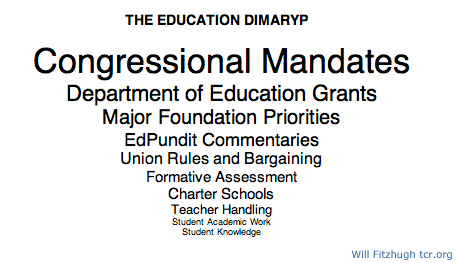
Share

When It Comes To Class Size, Smaller Isn’t Always Better

Andy Rotherham:

Budget cuts! Layoffs! Bigger classes! Oh my! Given the mini-Wisconsins erupting around the country, it’s not surprising that parents are worried about their children’s schools. At least 45 states will face some budget shortfall for the fiscal year that begins this July, according to The Center on Budget and Policy Priorities.
Last week the school board of Providence, Rhode Island gave pink slips to the city’s entire teaching force. Rumors of class sizes as large as 60 students circulated in Detroit.
Reality check: There will be teachers teaching in Providence next year. Similar sky-is-falling scenarios will be averted in Detroit and elsewhere, too. But that doesn’t mean that there will not be fewer teachers–and larger classes–in many places when school opens this fall. Secretary of Education Arne Duncan may well be right that scarce resources will be the “new normal” for schools.
The looming budget cuts are putting the question of class size front and center in local communities and the national education debate. A proposal to raise class sizes in Idaho by laying off more than 700 teachers led to protests around the state. Many other states and cities are considering changes to rules about class size.

Share

Fixing Struggling Schools

Arne Duncan:

Every day educators across the country are challenging the status quo and showing that low-performing schools can be turned around. Today, the President and I will visit Miami Central Senior High School to talk to some of those educators. Central has received nearly $800,000 in federal funding to support and accelerate turnaround efforts already underway.
Working with the school district and teachers union, Central promoted a strong school leader to be principal and replaced more than half the staff. It extended learning time after-school and during the summer, and engaged the community by offering Parent Academy classes for parents on graduation requirements and financial literacy. More than 80 percent of students are on free or reduced price lunch. Yet academic performance is steadily improving — and students and teachers are showing that a committed school can beat the demographic odds.
The burdens of poverty are real, and overcoming those burdens takes hard work and resources. But poverty is not destiny. Hundreds of schools in high-poverty communities are closing achievement gaps. America can no longer afford a collective shrug when disadvantaged students are trapped in inferior schools and cheated of a quality education for years on end.

Share

NJEA officials warn against N.J. education chief’s plan to tie test scores to teacher evaluations

Ted Sherman:

Tying test scores to teacher evaluations could narrow curriculums in schools and reinforce teaching for the sake of passing a test, the New Jersey Education Association argued today, saying that plans by the Christie Administration to impose performance reviews based on how well students do on standardized tests were unworkable.
Last month, acting Education Commissioner Christopher Cerf unveiled a five-point reform proposal that would abandon New Jersey’s teacher job guarantee program and replace it with an evaluation system rewarding educators for good student performance and working in at-risk schools
Under the plan, the state’s public school teachers would be assessed and paid using a new rating system based in part on how their students do in the classroom.

Share

Midwest union battles highlight debate over improving schools

Nick Anderson

The Republican faceoff with labor unions in the Midwest and elsewhere marks not just a fight over money and collective bargaining but also a test of wills over how to improve the nation’s schools.
Various GOP proposals to narrow labor rights, dismantle teacher tenure and channel public money toward private schools raise a question: Should states work with teacher unions to overhaul education or try to roll over them?
Like many Democrats, President Obama wants collaboration. He has preached teamwork with unions even as he pushes harder than any of his predecessors to get bad teachers out of schools and pay more to those who excel.
Here in Indiana, Gov. Mitch Daniels (R) shares many of Obama’s education goals. But Daniels, a possible 2012 presidential contender, and several of his Republican peers are pursuing reform through confrontation.

Share

Teachers Wonder, Why the Scorn?

Trip Gabriel:

The jabs Erin Parker has heard about her job have stunned her. Oh you pathetic teachers, read the online comments and placards of counterdemonstrators. You are glorified baby sitters who leave work at 3 p.m. You deserve minimum wage.
“You feel punched in the stomach,” said Ms. Parker, a high school science teacher in Madison, Wis., where public employees’ two-week occupation of the State Capitol has stalled but not deterred the governor’s plan to try to strip them of bargaining rights.
Ms. Parker, a second-year teacher making $36,000, fears that under the proposed legislation class sizes would rise and higher contributions to her benefits would knock her out of the middle class.
“I love teaching, but I have $26,000 of student debt,” she said. “I’m 30 years old, and I can’t save up enough for a down payment” for a house. Nor does she own a car. She is making plans to move to Colorado, where she could afford to keep teaching by living with her parents.

Whitney Tilson, via email:

This front page story in today’s NYT annoys the heck out of me because it’s missing one word in its title – it should read: “Teachers UNIONS Wonder, Why the Scorn?” The author presents NO evidence that Americans don’t cherish teachers other than a random placard and online comment. What Americans DO object to are unions using their enormous political influence to benefit their members while throwing kids under the bus – two great examples are the impossibility of firing even the most horrific teachers and doing layoffs purely by seniority. Checker Finn has it exactly right:

Chester E. Finn Jr., president of the Thomas B. Fordham Institute, a conservative-leaning education policy group, said the decline in teachers’ status traced to the success of unions in paying teachers and granting job security based on their years of service, not ability.
“They are reaping a bitter harvest that they didn’t individually plant but their profession has planted over 50 years, going from a respected profession to a mass work force in which everyone is treated as if they are interchangeable, as in the steel mills of yesteryear,” Mr. Finn said.

And why did the author quote the only young teacher in America who thinks it’s fair that he’s being laid off because he lacks seniority rather than doing it based on which teachers are best for kids? He could have easily quoted one of the Educators 4 Excellence teachers, for example:

Last month Mr. Tougher was notified that because of his lack of seniority, he will be laid off, or “excessed,” this year under the state’s proposed cuts to school aid. A union activist, he believes seniority-based layoffs are fair.
“The seniority part, I get that,” said Mr. Tougher, who is single. “While it would be a bummer if I were excessed for next year, that’s just how things go sometimes.”

Share

Gates Says High Pension Costs Hurt Education

Robert Guth & Michael Corkery:

Billionaire philanthropist Bill Gates will step into the national debate over state budgets Thursday with a call for states to rethink their public-employee benefits systems, which he says stifle funding for the nation’s public schools.
Mr. Gates in an interview said he will use a high-profile conference Thursday in Long Beach, Calif., to urge that more attention be paid to how states calculate their employee-pension funding and health-care obligations. “These budgets are way out of whack,” Mr. Gates said. “They’ve used accounting gimmicks and lot things that are truly extreme.”
The comments come after Mr. Gates spent more than a year studying the issue and enlisting the advice of leading academics and others.

Share

Seattle school district: A culture of fear? District Limits Employee Communications with the School Board

Amy Rolph & Scott Gutierrez:

A fear of retaliation and an official policy that keeps Seattle Public Schools employees from directly raising concerns with the school board are at least partly to blame for a scandal involving $1.8 million in misused public funds, auditors and investigators say.
The scandal unfolding at the school district is calling into question why Superintendent Maria Goodloe-Johnson and the seven members of the school board weren’t alerted earlier to concerns about Silas Potter, who ran the Regional Small Business Development Program.
Those concerns aren’t new — at least, not to a handful of employees in the school district. But when those concerns were voiced over the last several years, they never made it up to the school board.
At Seattle Public Schools, when employees do speak up, they have to navigate an obstacle course of bureaucracy before gaining the ears of board members.

Share

Wisconsin Governor Seeks Change in Reading Programs, Highlights dramatic fall in NAEP Performance

Matthew DeFour:

But the Department of Public Instruction (DPI) is questioning the legality of Walker’s proposal to fund the program through the Department of Administration.
Walker has proposed spending $600,000 in each of the next two years to implement recommendations of a new task force appointed by Walker that would develop a third-grade reading test. Walker noted Wisconsin’s performance on a national fourth-grade reading exam has fallen from third out of 39 states in 1994 to 30th out of 50 states in 2009.
“From kindergarten to third grade, our kids learn to read, and then from third grade on, they use reading to learn,” Walker said in his budget address. “We need to make sure every child can read as they move on from third grade.”

Related:

Share

Erasing Signatures From History

Jeffrey Zaslow:

In his 35 years as a high school English teacher in suburban Philadelphia, Thom Williams often encouraged his students to splash their most creative thoughts on the walls of his classroom.
Hundreds of students embraced his invitation, covering those painted cinderblocks with original art, quotes from favorite books, and deep thoughts born from teenaged angst.
“I looked to those walls for inspiration,” says 18-year-old Lauren Silvestri, a student of Mr. Williams’s at Marple Newtown High School in Newtown Square, Pa. Before graduating last year, she signed her name and a quote she loves. “It felt good to know I’d come back someday and my words on the wall would be there.”
Her words won’t remain for long, however. Mr. Williams died of cancer in December at age 63, and now the school is being renovated. That classroom’s walls are set to be demolished or painted over. “Thom was a free spirit who encouraged his students to be free spirits,” says Raymond McFall, the school’s principal. Still, “I can’t have everybody painting on the walls of the school.”

Share

Bill Gates Addresses Governors on Improving Education

cspan:

The National Governors Association concluded its 3-day winter meeting today with an address by Microsoft Chairman Bill Gates. Governors from across the country gathered to discuss issues facing states, including job creation and providing education that prepares workers to compete in a global market.
Today’s closing session focused on “Preparing to Succeed in a Global Economy.” Gates talked about the efforts of the Bill and Melinda Gates Foundation to improve education and how education is imperative to remaining competitive in a global economy.
This morning, the Governors were at the White House to meet with President Obama. He discussed with them the ongoing state and federal budget situation as well as the implementation of the health care law. In remarks, the President said that he is open to new ideas on how to lower the cost of health care and the burden on the states, but the quality of care cannot suffer.

Gates notes that US per pupil spending has doubled in the past 20 years and yet the outcomes have not changed that much. Gates advocates “flipping these curves”, essentially spending the same and doing much more.
Gates also noted the decline in the amount of time teachers spend teaching (adult to children) accompanied by an increase in adult staffing levels over the past 20 years.

Share

Monona Grove Teacher Contract Agreement

Peter Sobol:

The MGEA has ratified the contract agreed to earlier today by the board. This contract is for the 2009-2011 school year and will expire June 30th.
The contract mostly maintains the status quo to allow us to complete the year in an orderly fashion even if the current budget repair bill passes. Hopefully it will give us enough time to deal with the implications of the yet to be released state budget and make layoff and staffing decisions with enough knowledge to minimize disruption. The same is true of senior teachers with the option to retire. It also minimizes risk: in the absence of a contract we would be governed only by the complex state statutes if the “budget repair bill” becomes law, and there is a risk that any disputes would end up in litigation without this settlement.
The agreed upon contract provides for 0% salary increase in the first year (2009-10) and 1% in the current year. This is significantly less than inflation and saves the district money relative to what had been budgeted. Given that the MGEA would retain the right to negotiate salaries up to the rate of inflation under the “budget repair bill’ this is probably a deal for the district. A teacher who started in the district this year with a bachelors will receive $31,695 in salary (including the new teacher stipend), a teacher with a master’s and 16 years experience will receive $51,717.

Share

Billions in Bloat Uncovered in Beltway

Damian Paletta:

The U.S. government has 15 different agencies overseeing food-safety laws, more than 20 separate programs to help the homeless and 80 programs for economic development.
These are a few of the findings in a massive study of overlapping and duplicative programs that cost taxpayers billions of dollars each year, according to the Government Accountability Office.
A report from the nonpartisan GAO, to be released Tuesday, compiles a list of redundant and potentially ineffective federal programs, and it could serve as a template for lawmakers in both parties as they move to cut federal spending and consolidate programs to reduce the deficit. Sen. Tom Coburn (R., Okla.), who pushed for the report, estimated it identifies between $100 billion and $200 billion in duplicative spending. The GAO didn’t put a specific figure on the spending overlap.

Share

What Wisconsin reveals about public workers and political power.

The Wall Street Journal:

The raucous Wisconsin debate over collective bargaining may be ugly at times, but it has been worth it for the splendid public education. For the first time in decades, Americans have been asked to look under the government hood at the causes of runaway spending. What they are discovering is the monopoly power of government unions that have long been on a collision course with taxpayers. Though it arrived in Madison first, this crack-up was inevitable.
We first started running the nearby chart on the trends in public and private union membership many years ago. It documents the great transformation in the American labor movement over the latter decades of the 20th century. A movement once led by workers in private trades and manufacturing evolved into one dominated by public workers at all levels of government but especially in the states and cities.
The trend is even starker if you go back a decade earlier. In 1960, 31.9% of the private work force belonged to a union, compared to only 10.8% of government workers. By 2010, the numbers had more than reversed, with 36.2% of public workers in unions but only 6.9% in the private economy.

Robert Barro:

How ironic that Wisconsin has become ground zero for the battle between taxpayers and public- employee labor unions. Wisconsin was the first state to allow collective bargaining for government workers (in 1959), following a tradition where it was the first to introduce a personal income tax (in 1911, before the introduction of the current form of individual income tax in 1913 by the federal government).
Labor unions like to portray collective bargaining as a basic civil liberty, akin to the freedoms of speech, press, assembly and religion. For a teachers union, collective bargaining means that suppliers of teacher services to all public school systems in a state–or even across states–can collude with regard to acceptable wages, benefits and working conditions. An analogy for business would be for all providers of airline transportation to assemble to fix ticket prices, capacity and so on. From this perspective, collective bargaining on a broad scale is more similar to an antitrust violation than to a civil liberty.
In fact, labor unions were subject to U.S. antitrust laws in the Sherman Antitrust Act of 1890, which was first applied in 1894 to the American Railway Union. However, organized labor managed to obtain exemption from federal antitrust laws in subsequent legislation, notably the Clayton Antitrust Act of 1914 and the National Labor Relations Act of 1935.

Share

Madison Teachers, Inc. 2011 Candidate Questionnaire

1MB PDF, via a kind reader’s email:. Mayoral Candidate Paul Soglin participated and I found this question and response interesting:


What strategies will you introduce to reduce the 6000+ families who move in and out of Madison Public School classrooms each year?
In the last three years more children opted out of the district than all previous years in the history of the district. That contributed to the increase of children from households below the poverty line rising to over 48% of the kids enrolled.
To stabilize our enrollment we need stable families and stable neighborhoods. This will require a collaborate effort between governments, like the city, the county and the school district, as well as the private sector and the non-profits. It means opening Madison’s economy to all families, providing stable housing, and building on the assets of our neighborhoods.
One decades old problem is the significant poverty in the Town of Madison. I would work with town officials, and city of Fitchburg officials to see if we could accelerate the annexation of the town so we could provide better services to area residents.

Ed Hughes and Marj Passman, both running unopposed responded to MTI’s questions via this pdf document.

MTIVOTERS 2011 School Board Election Questionnaire
Please respond to each ofthe following questions. If you wish to add/clarifY your response, please attach a separate sheet and designate your responses with the same number which appears in the questionnaire. Please deliver your responses to MTI Headquarters (821 Williamson Street) by, February 17, 2011.
General:
If the School Board finds it necessary to change school boundaries due to enrollment, what criteria would you, as a Board member, use to make such a judgement?
Ifthe School Board finds it necessary to close a school/schools due to economic reasons, what criteria would you, as a Board member, use to make such a judgement?
If the School Board finds it necessary, due to the State-imposed revenue controls, to make further budget cuts to the 2011-12 budget, what criteria would you, as a Board member, use to make such a judgement?
IdentifY specific MMSD programs and/or policies which you believe should to be modified, re-prioritized, or eliminated, and explain why.
What should the District do to reduce violence/assure that proper discipline and safety (of the learning and working environment) is maintained in our schools?
Do you agree that the health insurance provided to District employees should be mutually selected through collective bargaining?
_ _ YES _ _ NO Explain your concerns/proposed solutions relative to the District’s efforts to reduce the “achievement gap”.
Should planning time for teachers be increased? If yes, how could this be accomplished?
Given that the Wisconsin Association of School Boards rarely supports the interests of the Madison Metropolitan School District, do you support the District withdrawing from the W ASB? Please explain your rationale.
From what sources do you believe that public schools should be funded?
a. Do you support further increasing student fees? _ _ YES _ _ _ NO
Do you support the Wisconsin Alliance for Excellent Schools’ (WAES) initiative to raise sales tax by 1% to help fund schools?
_ _ YES _ _ NO
Do you support class sizes of 15 or less for all primary grades? _ _ YES _ _ NO
Do you support:
a. The use of public funds (vouchers) to enable parents to pay tuition with tax payers’ money for religious and private schools?
_ _ YES _ _ NO
b. The expansion of Charter schools within the Madison Metropolitan School District? _ _ YES _ _ NO
c. The Urban League’s proposed “Madison Preparatory Academy for Young Men” as a charter school which would not be an instrumentality of the District?
_ _ YES _ _ _ NO
Do you agree that the usual and customary work ofteachers, i.e. work ofthose in MTI’s teacher bargaining unit, should not be performed by others (sub-contracted)?
_ _ YES _ _ NO List MMSD staff and Board member(s) from whom you do or would seek advice.
Is your candidacy being promoted by any organization? _ _ YES _ _ NO
If yes, please name such organization(s). Have you ever been employed as a teacher? If yes, please describe why you left the teaching profession.
Do you support the inclusion model for including Title 1, EEN and ESL students in the regular education classroom? Why/why not?
What grouping practices do you advocate for talented and gifted (TAG) students?
Aside from limitations from lack ofadequate financial resources, what problems to you feel exist in meeting TAG students’ needs at present, and how would you propose to solve these problems?
The Board ofEducation has moved from the development ofpolicy to becoming involved in implementation of policy; i.e. matters usually reserved to administration. Some examples are when it:
a. Decided to hear parents’ complaints about a teacher’s tests and grading. b. Decided to modifY the administration’s decision about how a State Statute should be implemented.
Do you believe that the Board should delegate to administrators the implementation of policy which the Board has created?
_ _ YES _ _ NO
Do you believe that the Board should delegate to administrators the implementation of State Statutes? _ _ YES _ _ NO
Do you support the Board exploring further means to make their meetings more efficient? _ _ YES _ _ _ NO
Do you support a merit pay scheme being added to the Collective Bargaining Agreement _ _ YES _ _ _ NO
If yes, based on which performance indicators?
Do/did/will your children attend private or parochial schools during their K-12 years? Ifno, and ifyou have children, what schools have/will they attend(ed)?
_ _ YES _ _ NO If you responded “yes”, please explain why your child/children attended private parochial schools.
Legislation
Will you introduce and vote for a motion which would direct the Wisconsin Association of School Boards to request the introduction and promote the passage oflegislation to eliminate the revenue controls on public schools and return full budgeting authority to the School Board?
_ _ YES _ _ _ NO
Will you introduce and vote for a motion to direct the Wisconsin Association of School Boards to request the introduction and promote the passage oflegislation to prohibit the privatization ofpublic schools via the use oftuition tax credits (vouchers) to pay tuition with taxpayers’ money to private or religious schools?
_ _ YES _ _ NO
Will you introduce and vote for a motion to direct the Wisconsin Association of School Boards to request the introduction and promote the passage of legislation which will maintain or expand the benefit level of the Wisconsin Family and Medical Leave Act?
_ _ YES _ _ _ NO
Will you introduce and vote for a motion to direct the Wisconsin Association of School Boards to request the introduction and promote the passage oflegislation which will increase the retirement formula multiplier from 1.6% to 2% for teachers and general employees, i.e. equal that of protective employees?
_ _ YES _ _ NO
Will you introduce and vote for a motion to direct the Wisconsin Association of School Boards to request the introduction and promote the passage of legislation which will forbid restrictions to free and open collective bargaining for the selection ofinsurance for public employees (under Wis. Stat. 111.70), including the naming ofthe insurance carrier?
_ _ YES
_ _ NO
Will you introduce and vote for a motion to direct the Wisconsin Association of School Boards to request the introduction and promote the passage of legislation which will guarantee free and open collective bargaining regarding the establishment of the school calendar/school year, including when the school year begins?
_ _ YES _ _ NO
Will you introduce and vote for a motion to direct the Wisconsiu Association of School Boards to request the introduction and promote the passage of legislation to forbid the work of employees organized under Wis. Stat. 111.70 (collective bargaining statute) to be subcontracted?
_ _ YES _ _ NO
Will you introduce and vote for a motion to direct the Wisconsin Association of School Boards to seek passage of legislation which will require full State funding of any State-mandated program?
_ _ YES _ _ NO
Will you introduce and vote for a motion to direct the Wisconsin Association of School Boards to seek passage oflegislation which will provide adequate State funding of public education?
_ _ YES _ _ NO
Do you support a specific school finance reform plan (e.g., School Finance Network (SFN), Wisconsin Alliance for Excellent Schools (WAES), Andrews/Matthews Plan)?
Why/why not? Your Campaign:
Are you, or any of your campaign committee members, active in or supportive (past or present) of the “Get Real”, “ACE”, “Vote No for Change” or similar organizations?
Name ofCampaign Committee/Address/Phone #/Treasurer. List the members ofyour campaign committee.

Share

Inside the multimillion-dollar essay-scoring business

Jessica Lussenhop:

Dan DiMaggio was blown away the first time he heard his boss say it.
The pensive, bespectacled 25-year-old had been coming to his new job in the Comcast building in downtown St. Paul for only about a week. Naturally, he had lots of questions.
At one point, DiMaggio approached his increasingly red-faced supervisor at his desk with another question. Instead of answering, the man just hissed at him.
“You know this stuff better than I do!” he said. “Stop asking me questions!”
DiMaggio was struck dumb.
“I definitely didn’t feel like I knew what was going on at all,” he remembers. “Your supervisor has to at least pretend to know what’s going on or everything falls apart.”
DiMaggio’s question concerned an essay titled, “What’s your goal in life?” The answer for a surprising number of seventh-graders was to lift 200 pounds.

Share

New York Democrat Governor Andrew Cuomo and the unions: The governor’s showdown is more subtle

The Economist:

IN 1975, when New York City teetered toward bankruptcy, Hugh Carey, then the governor of the state of New York, convinced the teachers’ union to invest a significant amount of its pension funds in bail-out bonds. He also persuaded District Council 37 to shelve pay increases for its municipal workers. The unions played a crucial role in saving the city and probably the state with it. Thirty-five years later, during his gubernatorial campaign, Andrew Cuomo gave copies of “The Man Who Saved New York”, an account of Mr Carey’s role in the crisis, to labour leaders. Seymour Lachman, the book’s co-author, reckons that, like Mr Carey, Mr Cuomo wants and needs the unions’ help in surviving the current crisis.
Facing a $10 billion deficit, Mr Cuomo campaigned on pension reform, making it clear he was going to target public-sector unions and sounding more like his Republican neighbour across the Hudson, Chris Christie, than a Democrat. Mr Christie stirred up a lot of headlines when he took on the unions, most recently calling them greedy, selfish and self-interested. Mr Cuomo is less vitriolic, but no less adamant that he wants the unions to do their part. During his budget address on February 1st, in which he declared the state to be “functionally bankrupt”, he called on the state’s public-sector unions to make $450m in concessions. He threatened, as a “last resort”, to lay off up to 9,800 state workers to get the savings needed.

Share

Is America’s best high school soft on math?

Jay Matthews:

By all accounts, he is one of the best math teachers in the country. The Mathematics Association of America has given him two national awards. He was appointed by the Bush administration to the National Mathematics Advisory Panel. For 25 years he has prepared middle-schoolers for the tough admissions standards at Thomas Jefferson High School for Science and Technology, the most selective high school in America.
Yet this year, when Vern Williams looked at the Jefferson application, he felt not the usual urge to get his kids in, but a dull depression. On the first page of Jefferson’s letter to teachers writing recommendations, in boldface type, was the school board’s new focus: It wanted to prepare “future leaders in mathematics, science, and technology to address future complex societal and ethical issues.” It sought diversity, “broadly defined to include a wide variety of factors, such as race, ethnicity, gender, English for speakers of other languages (ESOL), geography, poverty, prior school and cultural experiences, and other unique skills and experiences.” The same language was on the last page of the application.
“This is just one example of why I have lost all faith in the TJ admissions process,” Williams said. “In fact, I’m pretty embarrassed that the process seems no more effective than flipping coins.”

Share

Op-Ed: Rage Simmering Among American Teachers

NPR:

Education historian Diane Ravitch says the teachers on the front lines of labor rallies in Wisconsin reflect growing anger among educators nationwide. Teachers are sick and tired, she says, of being blamed for the ills of America’s public schools.
MARY LOUISE KELLY, host:
Now, as teachers started standing up in union protests in Wisconsin, Diane Ravitch sat down and wrote an opinion piece for CNN’s website titled “Why America’s Teachers are Enraged.” When Diane Ravitch looked at the teachers camping out at Wisconsin’s capital, she connected their demonstrations to what she says is a simmering rage felt among teachers across the country, an anger among educators who feel they’ve been unfairly blamed for everything that’s wrong with schools today. Within a few days, Ravitch’s article was a sensation on social media sites. She got 8,000 comments on Facebook.
We want to hear from teachers and parents, also students out there, about this issue. Do you feel that teachers are unfairly under attack, or do teachers need to rethink the way they do their jobs?

Share

Washington should stick to proven state math standards

Clifford Mass:

IF our state Legislature takes no action this session, Washington state will drop its new, improved math standards for an untested experiment: Common Core “national” standards that have never been used in the classroom and for which assessments have yet to be developed.
And there is a high price tag for such a switch, an expense our state can ill afford. Surprisingly, one of the most profound changes in U.S. education in decades has been virtually uncovered by the national media.
Until two years ago, our state had some of the worst math standards in the country, rated “F” by the Fordham Foundation, and lacking many of the essentials found in standards used by the highest-performing nations. That all changed in 2008, when under the impetus of the state Legislature, a new set of standards, based on world-class math requirements, was adopted.

Share

Why America’s unions are not working any more

Christopher Caldwell:

During the holiday break this winter, a woman in my neighbourhood was at the supermarket with her son when they ran into the son’s teacher. “See you Monday,” the mother said. The teacher gaily informed her she would not be back until mid-month, as she had planned a vacation in Central America. Teachers used to content themselves with the months off they enjoy in summers and at holidays, but they have got used to more. One can understand why American public employees ardently defend their unions, and the benefits they win. But one can also understand why, in a time of straitened budgets, union-negotiated contracts might be among the first places to make savings.
A fierce budget battle has been running for more than a week in Madison, Wisconsin. It goes far beyond salaries and benefits, to touch on the deeper question of whether collective bargaining has any place in government employment. Governor Scott Walker, a Republican elected last autumn with support from the Tea Party movement, believes it does not. His “budget repair” bill not only requires state employees to contribute to their pension and health plans. It would also end collective bargaining for benefits. Democratic senators, lacking the votes to defeat the bill, fled the state, denying the quorum necessary to bring it to a vote.
Mr Walker is not making a mountain out of a molehill. Wisconsin has a $137m budget gap to fill this year and a $3.6bn deficit over the next two. The big year-on-year leap reflects, in part, the expiration of federal stimulus spending, much of which was used to avoid laying off government workers. Citizens of other advanced countries sometimes make the mistake of assuming that the US has a skeletal bureaucracy. That is wrong. Once you include state, county and city employees, it is a formidable workforce and an expensive one. State employees account for up to $6,000bn in coming pension costs. Wisconsin’s difficulties are milder than those elsewhere, which means that similar clashes are arising in other states, especially where Republicans rule.

Share

American Teaching Standards: Don’t know much about history

The Economist:

Many states emphasise abstract concepts rather than history itself. In Delaware, for example, pupils “will not be expected to recall any specific event or person in history”. Other states teach children about early American history only once, when they are 11. Yet other states show scars from the culture wars. A steady, leftward lean has been followed by a violent lurch to the right. Standards for Texas, passed last year, urge pupils to question the separation of church and state and “evaluate efforts by global organisations to undermine US sovereignty through the use of treaties”.
Some states fare better. South Carolina has set impressive standards–for example, urging teachers to explain that colonists did not protest against taxation simply because taxes were too high. Other states, Mr Finn argues, would do well to follow South Carolina’s example. “Twenty-first century skills” may help pupils become better workers; learning history makes them better citizens.

Related: The State of State U.S. History Standards 2011: Wisconsin = F.

Share

Can parents effectively reclaim duties after funding cuts?

Alan Borsuk:

This is a boom time for parental choice in education. Frankly, that’s pretty scary to me.
I’m not talking about the school voucher program or charter schools, or other things like that.
I’m talking about the choices parents make in how they raise their children – how they can do (or not do) things that maximize the chances of their children becoming well-educated, well-balanced, constructive adults.
Since, say, the 1960s, expectations have grown for schools to take care of an increasing range of children’s needs. That goes for academics, of course, but also for social development, recreation, mentoring and, in many cases, providing nutrition, clothing and some basics of health care. That’s especially true for schools serving low-income kids, but you’d be surprised how often it is true in all schools.
I believe that one of the things we are seeing in the continuing chaos in Madison is that the tide is cresting for schools to play such roles. Teachers and staff members are simply going to be unable to do some of the things they’ve done to make up for what parents aren’t doing.

Share

A Simple Approach to Ending the State Budget Standoff

Madison School Board Member Ed Hughes:

Here’s an idea for resolving the state’s budget repair bill crisis. Governor Walker’s budget repair bill is designed to eviscerate public employee unions. But with a few changes it could actually lead to an innovative and productive way of addressing the legitimate concerns with the collective bargaining process, while preserving the most important rights of teachers and other public employees.
Background: A Tale of Two Unions
First, some background that highlights the two sides of the issue for me as a member of the Madison School Board. Early on Friday morning, February 25, our board approved a contract extension with our AFSCME bargaining units, which include our custodians and food service workers. The agreement equips the school district with the flexibility to require the AFSCME workers to make the contributions toward their retirement accounts and any additional contributions toward their health care costs that are required by the budget repair bill, and also does not provide for any raises. But the agreement does preserve the other collective bargaining terms that we have arrived at over the years and that have generally worked well for us.
AFSCME has stated that its opposition to the Governor’s bill is not about the money, and our AFSCME bargaining units have walked that talk.
Our recent dealings with MTI, the union representing our teachers and some other bargaining units, have been less satisfying. Because of teacher walk outs, we have to make up the equivalent of four days of school. An obvious way to get started on this task would be to declare Friday, February 25, which has been scheduled as a no-instruction day so that teachers can attend the Southern Wisconsin Educational Inservice Organization (SWEIO) convention, as a regular school day.

Through a variety of circumstances, I’ve had an opportunity to recently visit with several Dane County (and Madison) businesses with significant blue collar manufacturing/distribution employment. In all cases, these firms face global price/cost challenges, things that affect their compensation & benefits. Likely reductions in redistributed State of Wisconsin tax dollars could lead to significantly higher property taxes during challenging economic times, if that’s the route our local school boards take.

Share

Chicago’s Urban Prep Academies Visits Madison: Photos & a Panorama

.
Students from Chicago’s Urban Prep Academies visited Madison Saturday, 2/26/2011 in support of the proposed Madison Preparatory IB Charter school. A few photos can be viewed here.
David Blaska:

I have not seen the Madison business community step up to the plate like this since getting Monona Terrace built 20 years ago.
CUNA Mutual Foundation is backing Kaleem Caire’s proposal for a Madison Prep charter school. Steve Goldberg, president of the CUNA Foundation, made that announcement this Saturday morning. The occasion was a forum held at CUNA to rally support for the project. CUNA’s support will take the form of in-kind contributions, Goldberg said.
Madison Preparatory Academy for Young Men would open in August 2012 — if the Madison school board agrees. School board president Maya Cole told me that she knows there is one vote opposed. That would be Marj Passman, a Madison teachers union-first absolutist.
The school board is scheduled to decide at its meeting on March 28. Mark that date on your calendars.
CUNA is a much-respected corporate citizen. We’ll see if that is enough to overcome the teachers union, which opposes Madison Prep because the charter school would be non-union.

Share

Leader of Teachers’ Union Urges Dismissal Overhaul

Trip Gabriel, via a kind reader’s email:

Responding to criticism that tenure gives even poor teachers a job for life, Randi Weingarten, the president of the American Federation of Teachers, announced a plan Thursday to overhaul how teachers are evaluated and dismissed.
It would give tenured teachers who are rated unsatisfactory by their principals a maximum of one school year to improve. If they did not, they could be fired within 100 days.
Teacher evaluations, long an obscure detail in an educator’s career, have moved front and center as school systems try to identify which teachers are best at improving student achievement, and to remove ineffective ones.
The issue has erupted recently, with many districts anticipating layoffs because of slashed budgets. Mayors including Michael R. Bloomberg of New York and Cory A. Booker of Newark have attacked seniority laws, which require that teacher dismissals be based on length of experience rather than on competency.
Ms. Weingarten has sought to play a major role in changing evaluations and tenure, lest the issue be used against unions to strip their influence over work life in schools — just as Republican lawmakers in Wisconsin and Ohio are trying to do this week.

Share

K-12 Tax & Spending Climate: Wisconsin Cities Must Wrestle with Reality

Willie L. Hines, Jr.

As you have surely read, there’s a lot going on in Madison, Wis., these days. The tens of thousands of protesters currently storming the Capitol came about when our new governor, Scott Walker, called a special legislative session in order to introduce a “budget repair bill.” The stated purpose for this emergency session and this bill was that we have a short-term deficit that needs to be addressed.
Gov. Walker and Republican legislators have taken the liberty of extending their scope well beyond that original purpose. Instead of focusing on the short-term deficit as promised, they are using this emergency session as an opportunity to introduce dramatic, systematic changes to how local governments operate all over Wisconsin. The most controversial, which saves no money in the near future and perhaps no money ever unless policymakers make future decisions to cut benefits, is to eliminate collective bargaining for non-public safety employees.

Share

On Science Exams, New York’s Students Fall Short

Fernanda Santos:

Only 18 percent of the city’s public school fourth graders and 13 percent of its eighth graders demonstrated proficiency on the most recent national science exams, far below state and national achievement levels, according to results released Thursday.
Alan J. Friedman, a member of the National Assessment Governing Board, the bipartisan group that oversees the tests, called the city’s results “a big disappointment,” particularly because New York has a number of cultural organizations devoted to science, like the Museum of Natural History and the New York Hall of Science in Queens, which he directed for 22 years.
The exam was given in 2009 to a sampling of 4,300 fourth and eighth graders in the city, or about 3 percent of students in those grades. Nationwide, 33 percent of fourth graders and 29 percent of eighth graders showed proficiency, and in New York State, those numbers were 30 and 31, respectively.

Share