School Information System

Friends School of Baltimore Teaches 8th-Graders About Islam

James Tarabay:

Most American schoolchildren learn about Islam in a social studies classroom. But at the Friends School in Baltimore, eighth-graders make their own mini-pilgrimage every year, to the Islamic Center in Washington, D.C.
As their bus rattles along the highway south to Washington, most of the kids are busy making up songs about each other. But 12-year-old Julia Potter is counting off the Five Pillars of Islam on her fingers: charity, prayer, fasting, profession of faith, and the pilgrimage to Mecca.
These kids are well-versed in the basics of Islam and more: In class, they learn about Judaism, Hinduism and Christianity; about prophets, taboos and holy laws. And every year, eighth-graders visit the Islamic Center — though every year, according to teacher Deloris Jones, they get there late. “There’s absolutely nothing over the years I have been able to do to keep this thing on time,” Jones says.

Share

Change and Race to the Top

Robert Godfrey:

Which brings us to this next item, one with twist and turns not completely understandable at this point, but certainly not held up by people like myself as a model of how to “get the job properly done” — to use Herbert’s words.
Diane Ravitch, an intellectual on education policy, difficult to pigeonhole politically (appointed to public office by both G.H.W. Bush and Clinton), but best described as an independent, co-writes a blog with Deborah Meier that some of our readers may be familiar with called “Bridging Differences.” This past week she highlighted a possibly disturbing development in the Race to the Top competition program of the Department of Education, that dangles $4.3 billion to the states with a possible $1.3 billion to follow. Ravitch’s critique suggests that this competition is not run by pragmatists, but rather by ideologues who are led by the Bill Gates Foundation.

If this election had been held five years ago, the department would be insisting on small schools, but because Gates has already tried and discarded that approach, the department is promoting the new Gates remedies: charter schools, privatization, and evaluating teachers by student test scores.

Two of the top lieutenants of the Gates Foundation were placed in charge of the competition by Secretary Arne Duncan. Both have backgrounds as leaders in organisations dedicated to creating privately managed schools that operate with public money.

None of this is terribly surprising (See the Sunlight Foundation’s excellent work on the Obama Administration’s insider dealings with PhRMA). Jeff Henriques did a lot of work looking at the Madison School District’s foray into Small Learning Communities.
Is it possible to change the current K-12 bureacracy from within? Ripon Superintendent Richard Zimman spoke about the “adult employment” focus of the K-12 world:

“Beware of legacy practices (most of what we do every day is the maintenance of the status quo), @12:40 minutes into the talk – the very public institutions intended for student learning has become focused instead on adult employment. I say that as an employee. Adult practices and attitudes have become embedded in organizational culture governed by strict regulations and union contracts that dictate most of what occurs inside schools today. Any impetus to change direction or structure is met with swift and stiff resistance. It’s as if we are stuck in a time warp keeping a 19th century school model on life support in an attempt to meet 21st century demands.” Zimman went on to discuss the Wisconsin DPI’s vigorous enforcement of teacher licensing practices and provided some unfortunate math & science teacher examples (including the “impossibility” of meeting the demand for such teachers (about 14 minutes)). He further cited exploding teacher salary, benefit and retiree costs eating instructional dollars (“Similar to GM”; “worry” about the children given this situation).

I suspect that Duncan and many others are trying to significantly change the adult to student process, rather than simply pumping more money into the current K-12 monopoly structures.
They are to be commended for this.
Will there be waste, fraud and abuse? Certainly. Will there be waste fraud and abuse if the funds are spent on traditional K-12 District organizations? Of course. John Stossel notes that when one puts together the numbers, Washington, DC’s schools spend $26,000 per student, while they provide $7,500 to the voucher schools…..
We’re better off with diffused governance across the board. Milwaukee despite its many travails, is developing a rich K-12 environment.
The Verona school board narrowly approved a new Mandarin immersion charter school on a 4-3 vote recently These citizen initiatives offer some hope for new opportunities for our children. I hope we see more of this.
Finally, all of this presents an interesting contrast to what appears to be the Madison School District Administration’s ongoing “same service” governance approach.

Share

Down with parent power

Jay Matthews:

I have been exchanging emails with Gabe Rose, communications director of something called the Parent Revolution in my home state, California. Rose and his organization are part of a movement that has, to my open-mouthed amazement, persuaded the state government to give parents the power to close or change the leadership of low-performing public schools.
It sounds great. It has many parents excited. It could shake up the state educational establishment, including the education department, school boards and teacher unions. They could use some shaking up.
Yet I can’t shake my feeling it is a bad idea, a confusing distraction that will bring parents more frustration, not less, and do little to improve their children’s educations.

Share

New Plan on San Francisco School Selection, but Still Discontent

Jesse McKinely:

After years of complaints from parents, the San Francisco Unified School District has just taken a serious step toward revamping its well-meaning but labyrinthine student-assignment system, which decides the educational homes for tens of thousands of children.
The current system — designed to meet the terms of a settlement in a long-fought federal desegregation case — involves a complicated computer algorithm that creates student “profiles,” using various economic and educational factors, with the aim of sending students of different backgrounds to the same schools.
It has resulted instead in more segregation and has aggravated parents to a point where efforts to manipulate the system have become endemic.
This month, the school district rolled out a new plan. It is designed to more closely consider proximity between a student’s home and classroom. It is to be applied to every child headed for kindergarten.

Share

Report on New York City small schools finds more choice, but modest interest

Anna Phillips:

A new report on the rapid proliferation of small schools in New York City finds that while the schools have expanded students’ options, most students choose to attend larger schools.
Commissioned by the Bill & Melinda Gates Foundation, the report is one of four that will eventually be released in order to study how the schools have multiplied, who is attending them, who is teaching in them, and whether they’re succeeding. The Gates Foundation popularized and funded the small schools movement in New York, fueling the growth of nearly 200 small schools with a $150 million investment.
A New-York based research group, MDRC, conducted the report, which does not look at the schools’ academic record — that analysis will come out in spring — but focuses on the schools’ enrollment and demographics.
One of the report’s key findings is that the small schools are seeing modest demand from students.

Complete report: 3.4MB PDF.

Share

New regulations impacting Milwaukee school choice program: School closures up, number of new schools down

The Public Policy Forum, via a kind reader’s email:

Between the 2008-09 and 2009-10 school years, fewer new schools joined the Milwaukee Parental Choice Program (MPCP) than ever before. In addition, 14 MPCP schools closed and another three schools merged–the most year-over- year closures the program has seen (Chart 1).
In this 12th edition of the Public Policy Forum’s annual census of MPCP schools, we find 112 schools are participating in the choice program, enrolling 21,062 students using taxpayer-funded tuition vouchers. The number of full-time equivalent students using vouchers is greater than in any other year of the program’s 19-year history; however, there are fewer schools participating today than earlier this decade (Chart 2, page 2).
The decline in the number of new schools and the increase in the number of closed schools are likely due to new state regulations governing the program. These regulations require schools new to the program to obtain pre-accreditation before opening and require existing schools to become accredited within three years of joining the program.
Throughout this decade, the average number of schools new to the program had been 11 per year. Under the new pre- accreditation requirement, 19 schools applied for pre-accreditation, but just three were approved. Another 38 schools had previously indicated to state regulators an intent to participate in the program in 2009-2010, but did not apply for pre -accreditation. The pre-accreditation process is conducted by the Institute for the Transformation of Learning (ITL) at Marquette University.

Milwaukee Voucher Schools – 2010.
Complete report: 184K PDF, press release: 33K PDF

Share

Teachers group pushes back against proposed Wisconsin dyslexia testing mandate

Susan Troller, via a kind reader’s email

Will Morton was a happy, creative and enthusiastic child until he went to kindergarten.
As his classmates sounded out letters, and began reading words and simple sentences, he fell behind. His teacher was perplexed by Will’s lack of progress because he was clearly bright and had plenty of exposure to books and language at home. And his parents were worried, because Will’s older brother and sister had learned to read easily.
“We knew nothing about reading problems because we hadn’t ever had any experience with them, but I remember wondering in kindergarten if he was dyslexic because he seemed to have trouble recognizing letters and associating them with sounds,” says Chris Morton, Will’s mother. “His teacher told us not to worry, that it was a little developmental delay and we needed to give him time and he’d be fine.”
But she was wrong, experts on dyslexia say.
Students like Will – who have persistent trouble reading because the neural pathways in their brains do not decode letters and sounds in the ways that make reading and writing natural – need specific help, they say, and the sooner the better. Without that kind of help, they will never catch up, and even if they manage to disguise their different learning style, they are likely to continue to struggle with reading, spelling, language and sometimes with math; in short, they won’t ever achieve their full intellectual potential.

Learning Differences Network and Wisconsin State Reading Association.

Share

School used student laptop webcams to spy on them at school and home

Cory Doctorow:

According to the filings in Blake J Robbins v Lower Merion School District (PA) et al, the laptops issued to high-school students in the well-heeled Philly suburb have webcams that can be covertly activated by the schools’ administrators, who have used this facility to spy on students and even their families. The issue came to light when the Robbins’s child was disciplined for “improper behavior in his home” and the Vice Principal used a photo taken by the webcam as evidence. The suit is a class action, brought on behalf of all students issued with these machines.
If true, these allegations are about as creepy as they come. I don’t know about you, but I often have the laptop in the room while I’m getting dressed, having private discussions with my family, and so on. The idea that a school district would not only spy on its students’ clickstreams and emails (bad enough), but also use these machines as AV bugs is purely horrifying.

Share

Questioning the Way Colleges Are Managed

Jack Kadden:

Ninety percent of parents believe it is likely that their children will attend college, and most of them believe that any student can get the loans or financial aid required. But a new survey, reported on by my colleague, Tamar Lewin, finds that parents don’t have a lot of confidence in the way colleges are managed.
Increasingly, parents think colleges are too focused on their own finances, rather than the educational experience of students, the survey found.

“One of the really disturbing things about this, for those of us who work in higher education,” said Patrick Callan, president of the National Center for Public Policy and Higher Education, “is the vote of no confidence we’re getting from the public. They think college is important, but they’re really losing trust in the management and leadership.”

Share

Plan Would Let Students Start College Early

Sam Dillon:

Dozens of public high schools in eight states will introduce a program next year allowing 10th graders who pass a battery of tests to get a diploma two years early and immediately enroll in community college.
Students who pass but aspire to attend a selective college may continue with college preparatory courses in their junior and senior years, organizers of the new effort said. Students who fail the 10th grade tests, known as board exams, can try again at the end of their 11th and 12th grades. The tests would cover not only English and math but other subjects like science and history.
The new system of high school coursework with the accompanying board examinations is modeled largely on systems in high-performing nations including Denmark, Finland, England, France and Singapore.
The program is being organized by the National Center on Education and the Economy, and one of its goals is to reduce the numbers of high school graduates who need remedial courses when they enroll in college. More than a million college freshmen across America must take remedial courses each year, and many drop out before getting a degree.
“That’s a central problem we’re trying to address, the enormous failure rate of these kids when they go to the open admission colleges,” said Marc S. Tucker, president of the center, a Washington-based nonprofit. “We’ve looked at schools all over the world, and if you walk into a high school in the countries that use these board exams, you’ll see kids working hard, whether they want to be a carpenter or a brain surgeon.”

This makes sense.
Related: Janet Mertz’s enduring effort: Credit for non-MMSD Courses

Share

Parents pulling ‘trigger’ on school

Connie Lianos:

After five years of getting nowhere with Los Angeles Unified officials, fed-up parents in Sunland-Tujunga are using a new state law to force change at a long-troubled middle school.
Parents and community members say problems at Mount Gleason Middle School, which has been on a federal list of under-performing campuses for a dozen years, go beyond failing test scores.
“There is an unsafe atmosphere at this school that is spilling over into the community…,” said Lydia Grant, a resident and parent of a former Mount Gleason student. “People are tired of it and we want to see change.”
Thanks to new legislation, known as the “parent trigger” law, they’re able to do something about it.

Share

An exchange with the director of the Washington State Board of Education

Martha McLaren:

Here is an open letter which I sent last night to Edie Harding, Executive Director of the State Board of Education. Under the letter I have paraphrased her reply; below that is my response to her.
I am responding to your comment today in the Seattle Times:
‘ “It’s long been established that in our state, the local board is always the prime decision-maker on curriculum.” ….the Seattle decision was “a surprise, and if I were the Seattle School Board, I would — well, I might take issue with the judge,” she added.’
Having been one of the plaintiffs in the recent textbook appeal in Seattle, I’m well aware that School Boards make curriculum decisions. However, Ms. Harding, what recourse do you suggest to parents when School Boards abdicate their decision making power – refusing to consider voluminous, compelling, evidence from parents and community members, and instead give school administrators carte blanch to turn math education in directions that are unacceptable to informed parents and community members?

Share

Competing for Students Who Can Pay

Jack Kadden:

My colleagues at the Economix blog have put up an interesting post by an economics professor at the University of Massachusetts at Amherst exploring the increasing competition for students who can help a school’s bottom line.
The professor, Nancy Folbre, notes that competition works when consumers “can taste before they buy,” but that’s difficult when making choices about higher education.
She particularly questions the marketing efforts of for-profit colleges.

Share

Nutrition: Vermont’s healthy start

Lisa Rathke:

The third- and fourth-graders at Sharon Elementary know where the veggies in their soup come from because they’ve visited the farms. They know the nutritional value of the carrots, onions and cabbage because they’ve studied them in class, and they know how they’re grown because they’ve nurtured them in raised beds out back.
The 105-student school is part of the National Farm to School Network, aimed at getting healthier meals into school cafeterias, teaching kids about agriculture and nutrition and supporting local farmers.
About 40 states have farm-to-school programs, but Vermont is a leader in incorporating all three missions into its programs.
“Vermont has really taken it on in quite the most holistic way and not just in a couple of school districts, but statewide,” said Anupama Joshi, director of the Farm to School program, based at the Center for Food and Justice at Occidental College in Los Angeles.
Vermont might be a step ahead of other states because a nonprofit partnership called Vermont FEED already had been working to get local foods into schools.

Share

The $555,000 Student-Loan Burden

Mary Pilon:

As Default Rates on Borrowing for Higher Education Rise, Some Borrowers See No Way Out; ‘This Is Just Outrageous Now’
When Michelle Bisutti, a 41-year-old family practitioner in Columbus, Ohio, finished medical school in 2003, her student-loan debt amounted to roughly $250,000. Since then, it has ballooned to $555,000.
It is the result of her deferring loan payments while she completed her residency, default charges and relentlessly compounding interest rates. Among the charges: a single $53,870 fee for when her loan was turned over to a collection agency.
“Maybe half of it was my fault because I didn’t look at the fine print,” Dr. Bisutti says. “But this is just outrageous now.”

Share

To make school food healthy, Michelle Obama has a tall order

Ed Bruske:

First lady Michelle Obama’s new campaign against childhood obesity, dubbed “Let’s Move,” puts improvements to school food at the top of the agenda. Some 31 million children participate in federal school meal programs, Obama noted in announcing her initiative last week, “and what we don’t want is a situation where parents are taking all the right steps at home — and then their kids undo all that work with salty, fatty food in the school cafeteria,” she explained. “So let’s move to get healthier food into our nation’s schools.”
Last month I had a chance to see up close what all the school food fuss was about when I spent a week in the kitchen of my 10-year-old daughter’s public school, H.D. Cooke Elementary, in Northwest D.C. Chartwells, the company contracted by the city to provide meals to the District’s schools, had switched in the fall from serving warm-up meals prepackaged in a factory to food it called “fresh cooked,” and I couldn’t wait to chronicle in my food blog how my daughter’s school meals were being prepared from scratch.

Share

Utah considers cutting 12th grade — altogether

DeeDee Correll:

The proposal by state Sen. Chris Buttars would chip away at Utah’s $700-million shortfall. He’s since offered a toned-down version: Just make senior year optional.
Reporting from Denver – At Utah’s West Jordan High School, the halls have swirled lately with debate over the merits of 12th grade:
Is it a waste of time? Are students ready for the real world at 17?
For student body president J.D. Williams, 18, the answer to both questions is a resounding no. “I need this year,” he said, adding that most of his classmates feel the same way.
The sudden buzz over the relative value of senior year stems from a recent proposal by state Sen. Chris Buttars that Utah make a dent in its budget gap by eliminating the 12th grade.

A good idea.

Share

Teach every child about food

Jamie Oliver:

Share

Detroit Public Schools challenged by high-quality charter schools From The Detroit News: http://detnews.com/article/20100211/OPINION01/2110342/Editorial–Detroit-Public-Schools-challenged-by-high-quality-charter-schools#ixzz0fNPgbPTI

The Detroit News:

The evolution of charter schools and education in Detroit is no more sharply illustrated than by these facts: It was Gov. Jennifer Granholm who went to Houston to convince the phenomenally successful YES academies to open a school in Detroit, and it was the Detroit Public Schools that sold YES the school building where it will begin holding classes this fall.
Six years ago, Granholm stood in the schoolhouse door with the Detroit Federation of Teachers and said no to an expansion of charters in the city. Since then, the high performance of the city’s best charter schools, the continued deterioration of the Detroit Public Schools and the demand from parents for alternative education choices has changed attitudes about charters. DPS, under the leadership of Emergency Financial Manager Robert Bobb, now welcomes the competition from charters as an impetus to improve its schools.
In fact, Bobb sold YES the old Winship Elementary School on the city’s northwest side to use as a home for the new academy, serving grades 6-12.

Share

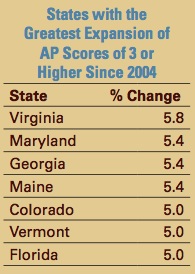
6th Annual AP Report to the Nation: Maryland Finishes #1

The College Board [1MB PDF file]:

Educators across the United States continue to enable a wider and more ethnically diverse proportion of students to achieve success in AP®. Significant inequities remain, however, which can result in traditionally underserved students not receiving the type of AP opportunities that can best prepare them for college success. The 6th Annual AP Report to the Nation uses a combination of state, national and AP Program data to provide each U.S. state with the context it can use to celebrate its successes, understand its unique challenges, and set meaningful and data-driven goals to prepare more students for success in college.

Share

Amid rising tuition costs and heavy debt burdens, college marketplace lacks consumer focus

MassINC, C. Anthony Broh & Dana Ansel:

Rising college costs have Americans making greater sacrifices to get their degrees. In 2008, families took on more than $86 billion in college loans and the average undergraduate finished school with more than $23,000 in debt. Higher education is now one of the most important investment decisions middle class Americans make. But far too often they’re lured to colleges with the most energetic tour guide, the biggest reputation for partying, or the highest ranking in the popular press.
These temptations win out because the choices are complicated and families aren’t getting the information they needed to make truly informed decisions. Beyond choosing a school, families trying to find the best savings plan or the least expensive loan also face complicated choices with insufficient information.
According to the new MassINC report, “When you look at the tuition prices that middle class families are facing, together with the debt burdens graduates are taking on, it is astounding that there is such little transparency in the higher education marketplace,” said Greg Torres, President of MassINC and Publisher of CommonWealth magazine. “By laying out a framework for how parents and students navigate this system, we hope to shed some light on what we can do to give more support to families making one of the biggest investments of their lives.”

Read the complete report here. CTRL – click to download the 2.0MB PDF file.

Share

If you really want to hear about it …

Nikola Krastev:

The seminal coming-of-age novel, The Catcher in the Rye, came out in 1951 during a time of anxious, Cold War conformity. The book by J D Salinger, the reclusive American author who died last week at the age of 91, featured its immortal teenage protagonist – the anguished, rebellious Holden Caulfield.
The book struck a chord with American teenagers who identified with the novel’s themes of alienation, innocence and rebellion.
But when the novel was translated into Russian during the “Khrushchev thaw”, its anti-hero’s tormented soul-searching also reverberated among admirers throughout the Soviet bloc.
Nad propastyu vo rzhi was first published in the Soviet Union in the November 1960 issue of the popular literary magazine Inostrannaya Literatura (Overseas Literature). The translation became an instant sensation, and dog-eared copies of the magazine were passed from reader to reader.
Boris Paramonov, a Russian philosopher and contributor to RFE/RL’s Russian Service, says he and his Russian friends and colleagues instantly recognized that it was a book that would endure.

Share

Girl thrown over balcony failed to get place at ESF primary school

Sherry Lee:


The mother who threw her four-year-old daughter from a shopping mall balcony before leaping to her death had recently learned that her child had failed to get a primary place at an ESF school, despite attending an ESF kindergarten. Police are still investigating the cause of the tragedy….

Share

HOPE Christian schools go quietly about business of teaching

Erin Richards:

It’s easy to miss the school tucked into the corner of a strip mall at N. 25th St. and W. North Ave. and its sister building a few miles away, an airy gray metal and brick structure that doesn’t have a sign yet.
The most noticeable school of the three may be at the south end of a nonprofit building on N. King Drive, and that’s because a large banner outside proclaims the high school’s name.
But within these unassuming spaces, HOPE Christian Schools are quietly expanding and changing, figuring out the best way to make sure every child – from kindergarten through 12th grade – is on the path to college.
The schools are without frills because energy and resources at this point are better spent on the elements more closely tied to student success: strong teachers who want to stay year to year, innovative and empowered administrators, testing tools that provide day-to-day and week-to-week feedback about how fast kids are progressing and which ones need more attention.
“We’re still focusing on what our model looks like,” said Andrew Neumann, president of HOPE Christian Schools.
Neumann also is president of the umbrella nonprofit Educational Enterprises, which plans to establish schools nationwide that help populations of disadvantaged, minority children get to college. The schools in Milwaukee are a testing ground; this year, Educational Enterprises opened a HOPE-inspired college prep charter elementary school in Phoenix.

Share

Choices without Equity: Charter
 School
 Segregation 
and 
the

 Need
 for
 Civil
 Rights
 Standards


Erica 
Frankenberg,
 Genevieve 
Siegel‐Hawley,
and
 Jia
 Wang [1.4MB PDF]
:

Seven years after the Civil Rights Project first documented extensive patterns of charter school segregation, the charter sector continues to stratify students by race, class and possibly language. This study is released at a time of mounting federal pressure to expand charter schools, despite on-going and accumulating evidence of charter school segregation.
Our analysis of the 40 states, the District of Columbia, and several dozen metropolitan areas with large enrollments of charter school students reveals that charter schools are more racially isolated than traditional public schools in virtually every state and large metropolitan area in the nation. While examples of truly diverse charter schools exist, our data show that these schools are not reflective of broader charter trends.
Four major themes emerge from this analysis of federal data. First, while charter schools are increasing in number and size, charter school enrollment presently accounts for only 2.5% of all public school students. Despite federal pressure to increase charter schools–based on the notion that charter schools are superior to traditional public schools, in spite of no conclusive evidence in support of that claim–charter school enrollment remains concentrated in just five states.
Second, we show that charter schools, in many ways, have more extensive segregation than other public schools. Charter schools attract a higher percentage of black students than traditional public schools, in part because they tend to be located in urban areas. As a result, charter school enrollment patterns display high levels of minority segregation, trends that are particularly severe for black students.

More here and here.

Share

Autism risks detailed in children of older mothers

Lindsey Tanner:

A woman’s chance of having a child with autism increase substantially as she ages, but the risk may be less for older dads than previously suggested, a new study analyzing more than 5 million births found.
“Although fathers’ age can contribute risk, the risk is overwhelmed by maternal age,” said University of California at Davis researcher Janie Shelton, the study’s lead author.
Mothers older than 40 were about 50 percent more likely to have a child with autism than those in their 20s; the risk for fathers older than 40 was 36 percent higher than for men in their 20s.
Even at that, the study suggests the risk of a woman over 40 having an autistic child was still less than 4 in 1,000, one expert noted.
The new research suggests the father’s age appears to make the most difference with young mothers. Among children whose mothers were younger than 25, autism was twice as common when fathers were older than 40 than when dads were in their 20s.

Share

For Students at Risk, Early College Proves a Draw

Tamar Lewin:

Precious Holt, a 12th grader with dangly earrings and a SpongeBob pillow, climbs on the yellow school bus and promptly falls asleep for the hour-plus ride to Sandhills Community College.
When the bus arrives, she checks in with a guidance counselor and heads off to a day of college classes, blending with older classmates until 4 p.m., when she and the other seniors from SandHoke Early College High School gather for the ride home.
There is a payoff for the long bus rides: The 48 SandHoke seniors are in a fast-track program that allows them to earn their high-school diploma and up to two years of college credit in five years — completely free.
Until recently, most programs like this were aimed at affluent, overachieving students — a way to keep them challenged and give them a head start on college work. But the goal is quite different at SandHoke, which enrolls only students whose parents do not have college degrees.
Here, and at North Carolina’s other 70 early-college schools, the goal is to keep at-risk students in school by eliminating the divide between high school and college.
“We don’t want the kids who will do well if you drop them in Timbuktu,” said Lakisha Rice, the principal. “We want the ones who need our kind of small setting.”

Once again, the MMSD and State of WI are going in the wrong direction regarding education. Much more on “Credit for non-MMSD courses.

Share

Easy = True How ‘cognitive fluency’ shapes what we believe, how we invest, and who will become a supermodel

Drake Bennett:

Imagine that your stockbroker – or the friend who’s always giving you stock tips – called and told you he had come up with a new investment strategy. Price-to-earnings ratios, debt levels, management, competition, what the company makes, and how well it makes it, all those considerations go out the window. The new strategy is this: Invest in companies with names that are very easy to pronounce.
This would probably not strike you as a great idea. But, if recent research is to be believed, it might just be brilliant.
One of the hottest topics in psychology today is something called “cognitive fluency.” Cognitive fluency is simply a measure of how easy it is to think about something, and it turns out that people prefer things that are easy to think about to those that are hard. On the face of it, it’s a rather intuitive idea. But psychologists are only beginning to uncover the surprising extent to which fluency guides our thinking, and in situations where we have no idea it is at work.
Psychologists have determined, for example, that shares in companies with easy-to-pronounce names do indeed significantly outperform those with hard-to-pronounce names. Other studies have shown that when presenting people with a factual statement, manipulations that make the statement easier to mentally process – even totally nonsubstantive changes like writing it in a cleaner font or making it rhyme or simply repeating it – can alter people’s judgment of the truth of the statement, along with their evaluation of the intelligence of the statement’s author and their confidence in their own judgments and abilities. Similar manipulations can get subjects to be more forgiving, more adventurous, and more open about their personal shortcomings.

Share

Divided Attention: In an age of classroom multitasking, scholars probe the nature of learning and memory

David Glenn:

Imagine that driving across town, you’ve fallen into a reverie, meditating on lost loves or calculating your next tax payments. You’re so distracted that you rear-end the car in front of you at 10 miles an hour. You probably think: Damn. My fault. My mind just wasn’t there.
By contrast, imagine that you drive across town in a state of mild exhilaration, multitasking on your way to a sales meeting. You’re drinking coffee and talking to your boss on a cellphone, practicing your pitch. You cause an identical accident. You’ve heard all the warnings about cellphones and driving–but on a gut level, this wreck might bewilder you in a way that the first scenario didn’t. Wasn’t I operating at peak alertness just then? Your brain had been aroused to perform several tasks, and you had an illusory sense that you must be performing them well.
That illusion of competence is one of the things that worry scholars who study attention, cognition, and the classroom. Students’ minds have been wandering since the dawn of education. But until recently–so the worry goes–students at least knew when they had checked out. A student today who moves his attention rapid-fire from text-messaging to the lecture to Facebook to note-taking and back again may walk away from the class feeling buzzed and alert, with a sense that he has absorbed much more of the lesson than he actually has.

Share

An Oasis of Calm, for Young People That Need It

Jennifer Medina:

OF all the supplies at Haven Academy, a charter school in the South Bronx, none matter as much as the squishy. Like any elementary school, Haven has pencils, books and desks. But it is the squishy — a colorful rubber ball with dozens of tentacles that can withstand the strength of any young student — that daily absorbs a fit of anger or a mess of tears.
In the office of Jessica Nauiokas, the principal, a forlorn little boy yanks at a squishy and an angry little girl tosses one like a yo-yo. When Marquis, 6, was kicking and screaming one recent morning, a purple squishy was the only thing that could calm him.
Marquis, a kindergartner, had grown so frustrated with reading that he crawled under a table while other students wrote their alphabet letters; then he threw a chair across the room. Gabriella Cassandra, the school’s social worker, literally carried him to the principal’s office, where he again crawled under a chair.

Share

More on the Successful Seattle Lawsuit against Discovering Math

Laurie Rogers:

Decision favors plaintiffs in court challenge of Seattle math text adoption
Statement from Laurie Rogers:
Last year, Seattle Public Schools adopted the Discovering math series despite valiant opposition from parents and math professionals, despite poor assessments of the Discovering series’ rigor and adherence to the new state math standards, and despite the fact that OSPI did NOT ultimately recommend the Discovering math series.
In response, three people filed a lawsuit, saying that Seattle didn’t have sufficient supporting evidence for its adoption, and also that the Discovering series was associated with an INCREASE in achievement gaps.
Recently, a judge agreed with the plaintiffs and – while stopping short of telling Seattle to cease and desist in their adoption – told Seattle to revisit its adoption. The district can continue to use the Discovering series, and Seattle administrators have stated their clear intention to do so.
Nevertheless, the court decision is momentous. It sets a precedent for districts across the country. When board members can’t justify their adoption decisions, the people now have legal recourse.

Share

The best way to guide your teenager through the high-risk years.

Alan Kazdin & Carlo Rotella:

Our last article summarized the current state of research on teens and risk. That research demonstrates that teenagers do not suffer from some special inability to reason. Larry Steinberg and other researchers explain the steep rise in risk-taking behavior that comes with puberty by elaborating the interplay between two brain systems. The social-emotional system, which develops robustly in early adolescence, seeks out rewarding experiences, especially the sensation afforded by novel and risky behavior, and is also activated by the presence of peers. The cognitive-control system, which undergoes its great burst of development in later adolescence, evaluates and governs the impulses of the social-emotional system.
During the years of greatest risk-taking, which peak somewhere around the age of 16 and during which the presence of peers greatly increases risk-taking, the adolescent brain is like a car with a powerful accelerator (the sensation- and peer-seeking social-emotional system) and weak brakes (the risk-containing cognitive-control system). That being the case, it’s clear why some common approaches to reducing risk-taking by teenagers–explaining why drunk driving is dangerous, asking them to pledge to abstain from premarital sex–don’t work very well.

Share

Facebookgate, the 2010 edition

Jenna Johnson:

Admissions officers more than a year ago started noticing something odd about the Facebook groups built around their incoming classes: The creators weren’t newly admitted students. Or current students. Or alums. Or anyone with any tie to the universities.
Brad J. Ward, who then worked in the Butler University admissions office, began to compare the groups from colleges across the country — including Georgetown, Virginia Tech and George Washington University — and realized they were all created by the same handful of people. “There’s something going down on Facebook. Pay attention,” he wrote on his blog, Squared Peg, in December 2008
With help from admissions workers across the country, Ward traced these individuals to College Prowler, a Pittsburgh-based company that publishes campus guidebooks, and a not-yet-launched roommate-matching Web site called MatchU, started by a recent college graduate named Justin Gaither.

Share

Ever wondered why your friends seem so much more popular than you are? There’s a reason for that

Oliver Burkeman:

This is going to be ­awkward, but someone has to tell you, so it may as well be me: you’re kind of a loser. You know that feeling you sometimes have that your friends have more friends than you? You’re right. They do. And you know how almost everyone at the gym seems in better shape than you, and how everyone at your book club seems better read? Well, they are. If you’re single, it’s probably a while since you dated – what with you being such a loser – but when you did, do you recall thinking the other person was more romantically experienced than you? I’m afraid it was probably true.
The only consolation in all this is that it’s nothing personal: it’s a ­bizarre statistical fact that almost all of us have fewer friends than our friends, more flab than our ­fellow gym-goers, and so on. In other words, you’re a loser, but it’s not your fault: it’s just maths. (I mean, it’s probably just maths. You might be a catastrophic failure as a human being, for all I know. But let’s focus on the maths.)
To anyone not steeped in ­statistics, this seems crazy. ­Friendship is a two-way street, so you’d assume things would average out: any given person would be as likely to be more popular than their friends as less. But as the sociologist Scott Feld showed, in a 1991 paper bluntly entitled Why Your Friends Have More Friends Than You Do, this isn’t true. If you list all your friends, and then ask them all how many friends they have, their ­average is very likely to be higher than your friend count.

Share

Seattle Court Reverses School Board Decision to Implement Discovery Math

Judge Julie Spector’s decision [69K PDF], via Martha McLaren:

THIS MATTER having come on for hearing, and the Court having considered the pleadings, administrative record, and argument in this matter, the Court hereby enters the following Findings of Fact, Conclusions of Law, and Order:
FINDINGS OF FACT
1. On May 6, 2009, in a 4-3 vote, the Seattle School District Board of Directors chose the Discovering Series as the District’s high school basic math materials.
a. A recommendation from the District’s Selection Committee;
b. A January, 2009 report from the Washington State Office of Public Instruction ranking High School math textbooks, listing a series by the Holt Company as number one, and the Discovering Series as number two;
c. A March 11, 2009, report from the Washington State Board of Education finding that the Discovering Series was “mathematically unsound”;
d. An April 8, 2009 School Board Action Report authored by the Superintendent;
e. The May 6, 2009 recommendation of the OSPI recommending only the Holt Series, and not recommending the Discovering Series;
f. WASL scores showing an achievement gap between racial groups;
g. WASL scores from an experiment with a different inquiry-based math text at Cleveland and Garfield High Schools, showing that W ASL scores overall declined using the inquiry-based math texts, and dropped significantly for English Language Learners, including a 0% pass rate at one high school;
h. The National Math Achievement Panel (NMAP) Report;
1. Citizen comments and expert reports criticizing the effectiveness of inquiry-based math and the Discovering Series;
J. Parent reports of difficulty teaching their children using the Discovering Series and inquiry-based math;
k. Other evidence in the Administrative Record;
I. One Board member also considered the ability of her own child to learn math using the Discovering Series.
3. The court finds that the Discovering Series IS an inquiry-based math program.
4. The court finds, based upon a review of the entire administrative record, that there IS insufficient evidence for any reasonable Board member to approve the selection of the Discovering Series.
CONCLUSIONS OF LAW
I. The court has jurisdiction under RCW 28A.645.010 to evaluate the Board’s decision for whether it is arbitrary, capricious, or contrary to law;
2. The Board’s selection of the Discovering Series was arbitrary;
3. The Board’s selection of the Discovering Series was capricious;
4. This court has the authority to remand the Board’s decision for further review;
5. Any Conclusion of Law which is more appropriately characterized as a
Finding of Fact is adopted as such, and any Finding of Fact more appropriately
characterized as a Conclusion of Law is adopted as such.
ORDER
IT IS HEREBY ORDERED:
The decision of the Board to adopt the Discovering Series is remanded for further proceedings consistent with this opinion.
Dated this 4th day of February, 2010.

Melissa Westbrook has more.
Seattle Math Group Press Release:

Judge Julie Spector today announced her finding of “arbitrary and capricious” in the Seattle School Board’s May 6 vote to adopt the Discovering Math series of high school texts despite insufficient evidence of the series’ effectiveness.
Judge Spector’s decision states, “The court finds, based upon a review of the entire administrative record, that there is insufficient evidence for any reasonable Board member to approve the selection of the Discovering series.”
Plaintiffs DaZanne Porter, an African American and mother of a 9th-grade student in Seattle Public Schools, Martha McLaren, retired Seattle math teacher and grandparent of a Seattle Public Schools fifth grader, and Cliff Mass, professor of atmospheric science at the University of Washington, had filed their appeal of the Board’s controversial decision on June 5th, 2009. The hearing was held on Tuesday, January 26th, 2010

Share

Failure rate for AP tests climbing

Greg Toppo & Jack Gillum:

The number of students taking Advanced Placement tests hit a record high last year, but the portion who fail the exams — particularly in the South — is rising as well, a USA TODAY analysis finds.
Students last year took a record 2.9 million exams through the AP program, which challenges high school students with college-level courses. Passing the exams (a score of 3 or higher on the point scale of 1 to 5) may earn students early college credits, depending on a college’s criteria.
MARYLAND: A model in AP access, achievement.
The findings about the failure rates raise questions about whether schools are pushing millions of students into AP courses without adequate preparation — and whether a race for higher standards means schools are not training enough teachers to deliver the high-level material.

Jay Matthews has more.

Share

The Junior Meritocracy: Should a child’s fate be sealed by an exam he takes at the age of 4? Why kindergarten-admission tests are worthless, at best.

Jennifer Senior:

Skylar Shafran, a turquoise headband on her brunette head and a pink princess shirt on her string-bean frame, is standing on a chair in her living room, shifting from left foot to right. She has already gulped down a glass of orange juice and nibbled on some crackers; she has also demonstrated, with extemporaneous grace, the ability to pick up Hello Kitty markers with her toes. For more than an hour, she has been answering questions to a mock version of an intelligence test commonly known to New York parents as the ERB. Almost every prestigious private elementary school in the city requires that prospective kindergartners take it. Skylar’s parents, Liz and Jay, are pretty sure they know where they’re sending their daughter to school next year, but they figure it can’t hurt to get a sense of where she sits in the long spectrum of precocious New York children. And so, although it wasn’t cheap–$350–they’ve hired someone to find out. Skylar has thus far borne this process with cheerful patience and determination. But every 4-year-old has her limits.
“What is an umbrella?” asks the evaluator, a psychology graduate student in her mid-twenties.
“To keep me dry.”
“And what is a book?”

David Shenk has more.

Share

12 local schools on state’s ‘worst’ list

Jennifer Smith Richards:

Twelve central Ohio schools are among the worst 5 percent statewide.
Their academic struggles mean they are eligible to receive federal money to help them transform or start over. A list of these schools was released yesterday by the Ohio Department of Education.
Six Columbus City Schools buildings are on the list of the worst-off, as are four in Cleveland and 16 in Cincinnati. Several charter schools — six of them in central Ohio — also made the “top” rung on the list.
“No one is going to like the fact that they’re on this list,” said Mark Real, who heads the Columbus-based nonprofit KidsOhio, which studies education issues. He’s been monitoring stimulus-related spending and improvement programs. “But this is not just a ‘label and leave it’ approach. These schools are in for some pretty intensive care.”
These schools all have a large number of poor students and have been mired in academic difficulties for several years.

Share

Stanford’s effort to curb alcohol abuse grows

John Wildermuth:

Stanford’s successful effort to exempt itself from Santa Clara County’s new rules on underage drinking has put a focus on the university’s growing effort to curb alcohol abuse on campus.
The county’s new ordinance, which took effect last year, makes it easier for police to cite anyone hosting a party where underage drinking occurs. It can mean a fine of up to $1,000 plus costs anytime the police are called in.
About 95 percent of Stanford’s 6,600 undergraduates, many of them younger than 21, live on campus in university-owned housing. As the landlord, the school could have found itself facing plenty of potential liability under the new county rules.
But the financial question didn’t play a role in the university’s attempt to persuade county officials to free Stanford from the regulations, said Jean McCown, the school’s director of community relations.

Share

Playing to Learn

Susan Engel:

So what should children be able to do by age 12, or the time they leave elementary school? They should be able to read a chapter book, write a story and a compelling essay; know how to add, subtract, divide and multiply numbers; detect patterns in complex phenomena; use evidence to support an opinion; be part of a group of people who are not their family; and engage in an exchange of ideas in conversation. If all elementary school students mastered these abilities, they would be prepared to learn almost anything in high school and college.
Imagine, for instance, a third-grade classroom that was free of the laundry list of goals currently harnessing our teachers and students, and that was devoted instead to just a few narrowly defined and deeply focused goals.
In this classroom, children would spend two hours each day hearing stories read aloud, reading aloud themselves, telling stories to one another and reading on their own. After all, the first step to literacy is simply being immersed, through conversation and storytelling, in a reading environment; the second is to read a lot and often. A school day where every child is given ample opportunities to read and discuss books would give teachers more time to help those students who need more instruction in order to become good readers.
Children would also spend an hour a day writing things that have actual meaning to them — stories, newspaper articles, captions for cartoons, letters to one another. People write best when they use writing to think and to communicate, rather than to get a good grade.

Share

A Talk with Ellie Schatz: WCATY Founder and Author of “Grandma Says It’s Good to be Smart”

I enjoyed meeting and talking with Ellie Schatz recently. Listen to the conversation via this 17MB mp3 audio file CTRL-Click to download or read the transcript. Parent and activist Schatz founded WCATY and is, most recently author of “Grandma Says it’s Good to Be Smart“.
I enjoyed visiting with Ellie and found the conversation quite illuminating. Here’s a useful segment from the 37 minute interview:

Jim: What’s the best, most effective education model these days? Obviously, there are traditional schools. There are virtual schools. There are chartered schools. There are magnets. And then there’s the complete open-enrollment thing. Milwaukee has it, where the kids can go wherever they want, public or private, and the taxes follow.
Ellie: [32:52] I think there’s no one best model from the standpoint of those models that you just named. [32:59] What is important within any one of those models is that a key player in making that education available to your child believes that no matter how good the curriculum, no matter how good the model, the children they are about to serve are different, that children are not alike.
[33:30] And that they will have to make differences in the curriculum and in the way the learning takes place for different children.
[33:45] And I have experienced that myself. I’ve served on the boards of several private schools here in the city, and I have given that message: “This may be an excellent curriculum, and I believe it’s an excellent curriculum. But that’s not enough.”
[34:05] You cannot just sit this curriculum down in front of every child in the classroom and say, “We’re going to turn the pages at the same time, and we’re going to write the answers in the same way.” It does not work that way. You must believe in individually paced education.
[34:24] And that’s why I say the WCATY model cannot change. If it’s going to accomplish what I set out for WCATY to do, it must be accelerated from the nature of most of the curriculum that exists out there for kids today.

Thanks to Rick Kiley for arranging this conversation.

Share

A Tougher ‘A’ at Princeton Has Students on Edge

Jacques Steinberg, via a kind reader’s email:

p>Lisa Foderaro writes in The Times’s Metropolitan section that efforts by Princeton University to curb grade inflation are “now running into fierce resistance from the school’s Type-A-plus student body.”

The university had hoped that other institutions would follow its lead in making it harder for students to earn an A. “But the idea never took hold beyond Princeton’s walls,” Ms. Foderaro writes, adding: “with the job market not what it once was, even for Ivy Leaguers, Princetonians are complaining that the campaign against bulked-up G.P.A.’s may be coming at their expense.”

How much tougher is it to earn an A at Princeton? The percentage of grades in the A range fell below40 percent last year, compared to nearly 50 percent in 2004, when the policy was adopted.

In nearly 100 comments and counting, reader response on the issue of grade inflation has been fierce. For a sense of how one important arbiter — Yale Law School — interprets undergraduate grades, I draw your attention to this comment, from Asha Rangappa, the dean of Yale Law (and a Princeton graduate.) — Jacques

Share

Who Owns Student Work?

Meredith Davis:

A number of years ago, curious about the ownership of student work produced in a class, I asked a lawyer friend who specializes in art and design copyright law if schools had the right to reproduce student work in their recruitment publicity without the students’ permission. He informed me that the student, despite advice from faculty who may have shaped the work, owns the work and that written permission must be secured before it could be reproduced. He also said such works could be considered student records and recruitment results in some benefit to the institution that exceeds any reading of the “fair use” practices of educational institutions (i.e. those that might be applied to the use of lecture slides for a class).
This reading of the law is at odds with the prevailing opinion of many schools that the student would not have produced work of a particular quality under his or her own resources, and therefore, that faculty have some “ownership rights” in the output of any class. Since that time I have been very careful to ask students first about any public use of their work, even in lectures I give at other schools, and I always credit the work with their names and give students the details on the presentation venues for their resumes. My lawyer friend told me that statements in college catalogs claiming that the institution retains ownership of work produced in a class wouldn’t hold up in court; unless the maker is an employee of the institution/company or has signed away rights through some explicit agreement, ownership is retained by the maker. Other attorneys may have different interpretations, and I don’t profess to be a legal expert, but the ownership of work produced by students is certainly something to think about.

Share

Abstinence-Only Education Works According To New Study

Frank James:

Abstinence-only education has been a frequent point of contention between conservatives and liberals.
Conservatives, particularly religious ones, have argued that young people need to be taught the moral dimension of sexual activity as part of abstinence education and urged to avoid sex until marriage.
For those reasons, liberals and many health and education professionals have argued against abstinence-only education. Many of them have preferred comprehensive sex education.
Now a new study indicates that abstinence-only education works even when it doesn’t have a moral component.

Share

L.A. Confidential: Seeking Reasons for Autism’s Rise

Melinda Beck:

Why is a child born in northwest Los Angeles four times as likely to be diagnosed with autism as a child born elsewhere in California?
Medical experts have pondered for years why autism rates have soared nationwide, and why the disorder appears to be much more prevalent in certain communities than in others. Now, some recent studies that zero in on California may shed some light on these baffling questions.
A new autism study shows clusters of high autism rates in parts of California. WSJ’s health columnist Melinda Beck joins Simon Constable on the News Hub with more.
Researchers from Columbia University, in a study published in the current Journal of Health & Place, identified an area including West Hollywood, Beverly Hills and some less posh neighborhoods that accounted for 3% of the state’s new cases of autism every year from 1993 to 2001, even though it had only 1% of the population.
Another recent study, from the University of California, Davis, published in Autism Research, also found high rates of autism in children born around Los Angeles, as well as nine other California locations. Autism, usually diagnosed before a child is 3 years old, is a developmental disorder characterized by impaired social interaction and communication and repetitive behavior.

Share

New Critiques on the Proposed “Common Core” English & Math Standards

via a kind reader. Math 627K PDF:

This document provides grade level standards for mathematics in grades K-8, and high school standards organized under the headings of the College and Career Readiness Standards in Mathematics. Students reaching the readiness level described in that document (adjusted in response to feedback) will be prepared for non-remedial college mathematics courses and for training programs for career-level jobs. Recognizing that most students and parents have higher aspirations, and that ready for college is not the same as ready for mathematics-intensive majors and careers, we have included in this document standards going beyond the readiness level. Most students will cover these additional standards. Students who want the option of entering STEM fields will reach the readiness level by grade 10 or 11 and take precalculus or calculus before graduating from high school. Other students will go beyond readiness through statistics to college. Other pathways can be designed and available as long as they include the readiness level. The final draft of the K-12 standards will indicate which concepts and skills are needed to reach the readiness level and which go beyond. We welcome feedback from states on where that line should be drawn.
English Language Learners in Mathematics Classrooms
English language learners (ELLs) must be held to the same high standards expected of students who are already proficient in English. However, because these students are acquiring English language proficiency and content area knowledge concurrently, some students will require additional time and all will require appropriate instructional support and aligned assessments.
ELLs are a heterogeneous group with differences in ethnic background, first language, socio-economic status, quality of prior schooling, and levels of English language proficiency. Effectively educating these students requires adjusting instruction and assessment in ways that consider these factors. For example ELLs who are literate in a first language that shares cognates with English can apply first-language vocabulary knowledge when reading in English; likewise ELLs with high levels of schooling can bring to bear conceptual knowledge developed in their first language when reading in a second language. On the other hand, ELLs with limited or interrupted schooling will need to acquire background knowledge prerequisite to educational tasks at hand. As they become acculturated to US schools, ELLs who are newcomers will need sufficiently scaffolded instruction and assessments to make sense of content delivered in a second language and display this content knowledge.

English Language Arts 3.6MB PDF
Catherine Gewertz:

A draft of grade-by-grade common standards is undergoing significant revisions in response to feedback that the outline of what students should master is confusing and insufficiently user-friendly.
Writing groups convened by the Council of Chief State School Officers and the National Governors Association are at work on what they say will be a leaner, better-organized, and easier-to-understand version than the 200-plus-page set that has been circulating among governors, scholars, education groups, teams of state education officials, and others for review in recent weeks. The first public draft of the standards, which was originally intended for a December release but was postponed until January, is now expected by mid-February.

Share

A Determined Quest to Bring Adoptive Ties to Foster Teenagers

Erik Eckholm:

After a day of knocking on doors chasing fleeting leads, Carlos Lopez and his partner finally heard welcome words: Yes, a resident confirmed, the man they were seeking lived in this house and would be home that evening.
Mr. Lopez, a former police detective, now does gumshoe work for what he calls a more fulfilling cause: tracking down long-lost relatives of teenagers languishing in foster care, in desperate need of family ties and in danger of becoming rootless adults. That recent day, he was hoping to find the father of a boy who had lived in 16 different foster homes since 1995. The boy did not remember his mother, who had long since disappeared.
Finding an adoptive parent for older children with years in foster care is known in child welfare circles as the toughest challenge. Typically, their biological parents abused or neglected them and had parental rights terminated. Relatives may not know where the children are, or even that they exist. And the supply of saints in the general public, willing to adopt teenagers shaken by years of trauma and loss, is limited.

Share

The Economic Benefits From Halving The Dropout Rate: A Boom To Businesses In The Nation’s Largest Metropolitan Areas

Alliance for Excellent Education:

Few people realize the impact that high school dropouts have on a community’s economic, social, and civic health.
Business owners and residents–in particular, those without school-aged children–may not be aware that they have much at stake in the success of their local high schools.
Indeed, everyone–from car dealers and realtors to bank managers and local business owners–benefits when more students graduate from high school.
Nationally, more than seven thousand students become dropouts every school day. That adds up to almost 1.3 million students annually who will not graduate from high school with their peers as scheduled. In addition to the moral imperative to provide every student with an equal opportunity to pursue the American dream, there is also an economic argument for helping more students graduate from high school.
To better understand the various economic benefits that a particular community could expect if it were to reduce its number of high school dropouts, the Alliance for Excellent Education (the Alliance), with the generous support of State Farm®, analyzed the local economies of the nation’s fifty largest cities and their surrounding areas. Using a
sophisticated economic model developed by Economic Modeling Specialists Inc., an Idaho-based economics firm specializing in socioeconomic impact tools, the Alliance calculated economic projections tailored to each of these metro regions.

Share

Study: Many sex offenders are kids themselves

Wendy Koch:

More than a third of sex crimes against juveniles are committed by juveniles, according to new research commissioned by the Justice Department.
Juveniles are 36% of all sex offenders who victimize children. Seven out of eight are at least 12 years old, and 93% are boys, says the study by the Crimes Against Children Research Center at the University of New Hampshire.
The report comes as states toughen penalties for adult sex offenders and wrestle with how to handle juveniles.
“They are different from adult sex offenders,” says study co-author David Finkelhor. They are more likely than adults to commit sex offenses in groups, and their victims are younger and more likely to be male.

Share

Discussing Rigor at Seattle’s Rainier Beach High School

Michael Rice:

I was reading the comments in an earlier post about the new assignment plan and there were many comments about the rigor or lack there of at Rainier Beach High School. I would like to dispel the myth that Rainier Beach does not offer rigor to the high achieving student. If you have a high achieving 8th grader and are in the RBHS attendance area, here is just a sample of what you can expect:
In math as a Freshman, you will start in at least Honors Geometry with Ms. Lessig who is our best math teacher. Once you get through that, you will take Honors Advanced Algebra with me, then Pre Calculus with Mr. Bird (a math major in college) and then as a Senior, you take AP Calculus with Ms. Day, a highly experienced and skilled teacher. As a bonus, in either your Junior or Senior year, you get to take AP Statistics with me. All of these classes are demanding and well taught by teachers who know what they are doing and are passionate about teaching math.

Share

Newcomers Test Schools In Plano, Texas, Population Shift Prompts Rezoning That Angers Many Parents

Ana Campoy:

This Dallas suburb, a wealthy enclave known for its top-notch schools, is struggling to integrate a flood of poor, minority students.
In a battle mirrored in other districts across the U.S., parents here have been fighting for months over which public high school their kids will attend: one under construction in an affluent corner of the Plano Independent School District, or an older school several miles away in the city’s more diverse downtown.
Last month, the district’s school board angered many parents when it created a Pac-Man-shaped zone that placed their children in the downtown school for grades nine and 10 instead of in the newer, closer campus.
The downtown school has the highest proportion of poor students of all high schools in the district; many are Hispanic and African-American.
“We want to go to our neighborhood school,” said Kelly McBrayer, a white, 48-year-old stay-at-home mother of three who lives near the site of the new high school.

Share

Australia’s National School Website a victory for education

Jane Fynes-Clinton:

WHEN the Federal Government’s My School website goes live this morning, I will give a little internal cheer.
It will be a little victory for transparency, a little win for democracy and a little tick in the box that shows the Federal Government is deadly serious about improving education standards.
It will also be a little kick in the shins for those who would rather the mountain of compiled information the Government already has – and has had for some years – remains buried under layers of bureaucracy far from public view.
I will be happy because I want to know about the statistics around the performance of the schools in my area. I want to see the spots that need addressing and the areas where they are leading the way. Like most thinking parents out there, the information made available this morning will not be the sole premise on which I will judge those schools, those teachers or those students. Those who have been bleating about the way in which the students, teachers and schools will be judged must view parents as shallow and mushroom-like.

Share

Study: Online Education Continues Its Meteoric Growth

Jeff Greer:

Online college education is expanding–rapidly. More than 4.6 million college students were taking at least one online course at the start of the 2008-2009 school year. That’s more than 1 in 4 college students, and it’s a 17 percent increase from 2007.
Turns out it’s the economy, stupid.
Two major factors for the soaring numbers in the 2008-2009 school year are the sour economy and the possibility of an H1N1 flu virus outbreak, according to the seventh annual Sloan Survey of Online Learning report, titled “Learning on Demand: Online Education in the United States in 2009.” But, the survey’s authors say, there is a lot more work to be done, and there’s huge potential for online education to expand, especially at larger schools.
“For the past several years, all of the growth–90-plus percent–is coming from existing traditional schools that are growing their current offerings,” says Jeff Seaman, one of the study’s authors and codirector of the Babson Survey Research Group at Babson College. Seaman’s coauthor, Elaine Allen, who is also a codirector of the Babson Survey Research Group, added that community colleges, for-profit schools, and master’s programs have seen significant growth in online offerings.

Share

Georgia Tech president: No guns on campus

Maureen Downey, via email:

G.P. “Bud” Peterson, president of Georgia Tech, sat down with writers at the AJC today and made clear that he did not support the pending legislation in the Georgia General Assembly to allow guns on college campuses. (We talked about other education issues that I will write about later.)
Under a bill in the House, Georgia gun owners with conceal carry permits could bring their guns everywhere except the courthouse and the jailhouse. The restrictions on churches and campuses would be lifted.
Georgia Tech President Bud Peterson says “absolutely not” to guns on his campus in an interview Wednesday with the AJC
“Absolutely not,” said Peterson, who was appointed as the 11th president of Georgia Tech in April after serving as chancellor at the University of Colorado at Boulder and provost at Rensselaer Polytechnic Institute in New York. In addition, Peterson has held various positions at Texas A&M University and taught mathematics, physics and chemistry in Kansas.
In other words, this man has been around students and on campuses all his life and he doesn’t believe that guns will better protect students.
But let him do the talking.

Share

National Australia Schools comparison website going live

Sydny Morning Herald:

The federal government’s controversial website giving information on the performance of all schools will go live from this Thursday.
The site, called My School, will provide profiles for almost 10,000 schools and will allow parents to compare schools in their area as well as statistically-similar schools in other regions.
In navigating the web page, parents will be able to look at the profiles of their child’s school which includes the numbers of students, teachers, attendance rates and the percentage of indigenous students.
Federal Education Minister Julia Gillard made no apology for the introduction of the website.
“I’m passionate about this and I believe this is the right direction for this country,” she told Sky News on Monday.

www.myschool.edu.au

Share

Criticism of Australia’s National School Comparison Website

Lucy Carter:

Independent policy think-tank the Grattan Institute has added to growing criticism of the Federal Government’s My School website, saying it will not give an adequate assessment of a school’s performance.
My School, scheduled to be launched tomorrow, has already come under heavy criticism.
The Education Union says it will unfairly stigmatise disadvantaged schools, and the Secondary Principals Council says it fails to include crucial data about school funding.
However, several parent groups have supported the proposal to provide information on school performance.
Federal Education Minister Julia Gillard says it will provide parents and the community with accurate information, allowing them to be their own judge.

Share

In Oklahoma, One in Five Children Live in Poverty

Gavin Off:

A year ago, the life Demetria Overstreet and her family knew slowly began to fade.

Her husband, Lenzie, was diagnosed with kidney failure and had to leave his job to begin treatment.

With its main money-maker out of work, mounting medical bills and three children to care for, the family saw its financial problems beginning to build.

At one point, their home’s gas and electricity were turned off. Car payments lagged. And at times, the family survived on eating hotdogs and chips.

“It was depressing, especially when my son would come home and said ‘Momma, nothing comes on,’ ” Overstreet said, referring to the electricity.

Share

Audio: The 2010 State of the Madison School District

39MB mp3 audio. I recorded this from Monday evening’s video stream. Unfortunately, the sound level was quite low. Notes and links on the 2010 State of the Madison School District here.
566K State of the District PDF.

Share

Honor student world: Where all the students are above average

Maureen Downey:

Here is an interesting op-ed piece by a tenured professor of biology at Piedmont College, Robert H. Wainberg. He is alarmed because he has been told by former students who are now teachers that some schools no longer hold Honors Day to recognize the accomplishments of above average and exemplary students so they don’t hurt the feelings of kids who don’t earn awards.
This piece will appear in the paper on the education page Monday. Enjoy.
By Robert H.Wainberg:

I have been a professor of Biology and Biochemistry at a regional college for over two decades. Sadly, I have noticed a continual deterioration in the performance of my students during this time. In part I have attributed it to the poor study habits of the last few generations (X, XX and now XXX) who have relied too heavily on technology in lieu of thinking for themselves.
In fact, the basics are no longer taught in our schools because they are considered to be “too hard,” not because they are archaic or antiquated. For example, students are no longer required to learn the multiplication or division tables since they direct access to calculators in their phones.
Handwriting script and calligraphy are now in danger of extinction since computers use printed letters. A report I recently read disturbingly admitted that many of our standardized tests used for college admission or various professional schools (MCAT, LSAT and GRE) have to manipulate their normal bell-shaped curves to obtain the higher averages of decadtudenes ago.
What we fail to realize is that the concept of “survival of the fittest” still applies even within the realm of technology. There will always be those who are more “adapted” to the full potential of its use while others will be stalled at the level of downloading music or playing games.

Ah, yes. One size fits all education uber alles.

Share

More Than Academics at Chicago’s Morton Alternative

Giovanna Breu:

A gritty industrial patch of a blue-collar Chicago suburb seems an unlikely setting for the pioneering curriculum at Morton Alternative High School. The program, which combines intensive psychotherapy with conventional studies to help gang members and emotionally troubled teenagers finish school, has reported promising results and has attracted the notice of educators nationwide.
Morton Alternative High School is the last chance for students who are expelled from Morton East High School and Morton West.
Dr. Mark Smaller, a Chicago psychoanalyst, started the program at Morton Alternative three-and-a-half years ago as a contrast to schools that take a strict disciplinary approach to youths with behavioral problems. Dr. Smaller and his team of social workers conduct weekly group and individual therapy sessions to help students deal with emotional problems and social pressures common to life in neighborhoods where families struggle with job losses, crime, violence and immigration issues.
Morton Alternative in Cicero is the last chance for students who are expelled from Morton East and Morton West High Schools. An average of about 100 students are at the school at any one time — those judged to have some chance for improvement — though they come and go throughout the academic year.

Share

Freshmen applications to selective area colleges surge

Daniel de Vise:

High school seniors are applying to selective colleges around Washington in record numbers this year, particularly to schools with reputations for meeting the full financial needs of admitted freshmen. The trend suggests that the weak economy has driven applicants to schools that offer a bigger bang for the tuition buck.
A surge in applications is not what admission deans expected this year, after a fiscal downturn and a flattening population of college-age students.
But applications to Johns Hopkins University in Baltimore are up 13 percent over last year, with a projected pool of 18,150 students competing for 1,235 seats in the freshman class. The University of Richmond received 8,500 applications for 805 slots, a 9 percent increase. Applications are up 6 percent at Washington and Lee University in Lexington, Va., and 3 percent at George Washington University in the District. The University of Virginia fielded 22,396 applications, an all-time high. The College of William and Mary, too, expects a record number of applicants.
“It shouldn’t be happening, should it?” said Bill Hartog, dean of admissions at Washington and Lee. “My take on it is, financial aid, financial aid, financial aid.”

Share

Five areas where colleges could use some schooling

Jay Matthews:

My family has much experience in higher education, not all of it happy. I spent six years as an often struggling undergraduate and grad student. My journalist wife did ten years in higher ed, including three of what she considered hard labor as a visiting professor. Our kids add another 11 years, with the youngest child about to sign up for three more. Please don’t ask me what that will cost.
American colleges and universities are the great strength of our education system. They are revered around the world. But those schools put heavy stress on our families, since getting into, paying for and graduating from the ones we most want often exceeds our capabilities. We need to know more about what they are doing to us, so I am happy to see washingtonpost.com launch two higher education blogs: College Inc. by Daniel de Vise and Campus Overload by Jenna Johnson. Let me celebrate that event by grumbling about what I consider higher education’s five biggest blind spots:
1. College privacy rules are a mess. They are difficult to understand and infuriating when they exacerbate a family crisis. I have heard many stories about students getting into trouble, and their parents being among the last to know. University officials will sometimes take pity on a frantic dad and reveal important things in the kid’s personal file. But why can’t we have more reasonable procedures? Academics who fear intrusive helicopter parents should read the National Survey of Student Engagement report, which reveals that the children of such people do better in college than kids like mine, who didn’t hear much from us.
2. Professors know too little about what high schools are doing to prepare students for their classes.

Share

Convicted sex pests may still be teaching in Hong Kong

Liz Heron, Elaine Yau and Fox Yi Hu:

More than 30 teachers and classroom assistants have been convicted of sex offences in the past 10 years – but the Education Bureau will not say if they are still working in the city’s schools.
Since January 1, 2000, at least 31 staff have been convicted of offences ranging from indecent assault of their pupils to secretly filming girls getting undressed for a dance class.
The catalogue of convictions and the names of the offenders was compiled by the Sunday Morning Post (SEHK: 0583, announcements, news) and presented to the Education Bureau, which was asked what action had been taken against the offenders.
But the bureau, responsible for registering teachers and advising schools on vetting prospective staff, refused to say how many of the 31 were still registered as teachers and how many were working in schools.
A spokeswoman also refused to explain why it would not release the information to the public. She did say 13 teachers were deregistered from 2006 to 2008 and seven of these had been convicted of sex offences.

Share

A Diverse Milwaukee IB High School with Rigor…. Problem or Opportunity?

Alan Borsuk:

Picture a Milwaukee Public Schools high school that college-bound students are clamoring to attend. The school has grown from 100 to 1,000 in six years. Its program is rigorous, its test scores are strong. Hundreds are on a waiting list for admission for next year.

You might think MPS leaders would look at the meteoric rise of Ronald Wilson Reagan College Preparatory School on the far south side and say, "Terrific! This is an opportunity. What can we do to satisfy the obviously huge appetite for what this program has to offer?"

Or, if you were perhaps a bit more cynical, you might think MPS leaders would look at the Reagan situation and say: "OK, who screwed up? Who allowed this school to grow so fast? Can we get a lot of these parents to switch their kids to other high schools where – for some reason – there is no waiting list?"

Reagan arguably has provided the biggest shot in the arm that MPS has gotten in the last decade or so. It provides a rigorous International Baccalaureate program for all its students – "We have one vision, one mission, one focus – IB," says Julia D’Amato, the principal and chief driver behind Reagan’s success. Reagan is working with other MPS schools to develop a kindergarten through high school IB continuum in MPS.

But in recent months, Reagan has had to fend off an attempt to cap its enrollment and it has been ordered to reduce sharply the number of students next fall who do not fall into the special education category. Reagan leaders clearly feel frustrated by how much work is going into protecting their success from MPS leaders.

"All the buzzwords that are supposed to make a successful school, that’s what we have here," says Mary Ellen McCormick-Mervis, one of the school’s administrators. "If we’re doing everything right, why not help us?"

Parent meeting set

Share

Milwaukee Custer High School: Our Daughters Fighting, Not Learning

The Milwaukee Drum:

The person who posted this video on YouTube said this fight happened 1/5/10… that’s some way to say Happy New Year.
I know some of you readers cannot stand when I post video of US acting the fool… well that’s life. Here’s some reality for US to look at for the next 30 seconds and do something about OUR kids.
It’s one thing to see these young girls fighting so viciously. It’s a damn shame to see ALL the other kids are cheering on this ish. Where’s the teachers and what took the security so long? I know this isn’t going on everyday, but this ish is getting tired.

Share

More teens are choosing to wait to get driver’s licenses

Donna St. George:

The quest to get a driver’s license at 16 — long an American rite of passage– is on the wane among the digital generation, which no longer sees the family car as the end-all of social life.
The holdouts include Kat Velkoff, who turned 17 in Chantilly without a license. Focused on tough classes, the debate team, dance and color guard, she turned 18 without taking the wheel. Then 19.
“It just wasn’t a priority,” said Velkoff, who got her license last fall at 20. “It was just never the next thing that needed to get done in my life.”
Federal data released Friday underscore a striking national shift: 30.7 percent of 16-year-olds got their licenses in 2008, compared with 44.7 percent in 1988. The downtrend is even sharper in Virginia and Maryland, state figures show. Numbers from the District, which go back to 2003, show a decline in the past two years.

Share

Wisconsin School Open Enrollment Period Begins 2/1, Ends 2/19

Channel3000:

Parents wishing to send their children to a different school district next year will be able to participate in the open enrollment program the first three weeks of February.
From Feb. 1 through Feb. 19 parents can apply for their children to attend a public school other than the one in which they live. Last school year, more than 28,000 students participated.
Participation in the program has grown each year since it began in 1998 when just 2,500 were enrolled.

Learn more about full and part time Wisconsin open enrollment here.

Share

What Makes a Great Teacher–Not Just for the Gifted, but for All Students

Carol Fertig:

The January/February 2010 issue of The Atlantic features a noteworthy article titled, What Makes a Great Teacher? Although the article does not focus on gifted education per se, it is still worth a close read. The article discusses specific attributes that excellent teachers with exceptional track records tend to display in the classroom. (It is important to note that these attributes are based on research that was conducted by the nonprofit organization, Teach for America, which advocates for teacher reform. It is also important to note that the group’s research focuses solely on teachers who work in underperforming school districts where the primary goal in the general education classroom is to get students to perform at or above grade level.) The article outlines several specific recommendations that the organization makes for recruiting and hiring successful teachers, particularly in underserved communities.
For those of us in the gifted education community, the traits identified in the article may be ones that we should perhaps consider first before we consider any additional teacher characteristics that might be specific to gifted education. (See my previous blog entry titled, Training and Competencies of Teachers of the Gifted.)

Share

Elementary gifted ed made easy

Jay Matthews:

Two weeks ago I explored the possibility that high schools could challenge all students, gifted or otherwise, without having gifted programs. Quaker Valley High School outside of Pittsburgh, for instance, seemed able to create new opportunities for a variety of kids by ignoring standard procedures that had outlived their usefulness, such as homework requirements or rules against taking more than one course in the same period.
One wise reader said, in effect: Yeah, but that will never work in elementary schools.
As if by fate, I received an email shortly after from Susan Ohanian, a delightful teacher, speaker, author and blogger whose work I love, even when she is portraying me as a test-addled idiot. We may disagree on policy issues, but we have shared tastes about what good teaching looks and sounds like. In her email, she described how she brought a free-form gifted non-program to an elementary school in Troy, N.Y.
Here is what she said. Don’t forget to take a look at her blog at susanohanian.org.

Share

High cholesterol puts 1 of 5 teens at risk of heart disease

Rob Stein:

One out of every five U.S. teenagers has a cholesterol level that increases the risk of heart disease, federal health officials reported Thursday, providing striking new evidence that obesity is making more children prone to illnesses once primarily limited to adults.
A nationally representative survey of blood test results in American teenagers found that more than 20 percent of those ages 12 to 19 had at least one abnormal level of fat. The rate jumped to 43 percent among those adolescents who were obese.
Previous studies had indicated that unhealthy cholesterol levels, once a condition thought isolated to the middle-aged and elderly, were increasingly becoming a problem among the young, but the new data document the scope of the threat on a national level.
“This is the future of America,” said Linda Van Horn, a professor of preventive medicine at Northwestern University who heads the American Heart Association’s Nutrition Committee. “These data really confirm the seriousness of our obesity epidemic. This really is an urgent call for health-care providers and families to take this issue seriously.”

Share

Tackling the Term Paper

Kristy (Christiane) Henrich, Marblehead High School Class of 2010
“Civil War Medicine” paper published in the Winter 2009 Issue of The Concord Review

Before crafting my research paper on U.S. Civil War Medicine, I had never composed a piece of non-fiction literature beyond six or seven pages. Twenty pages seemed to be an unconquerable length. I remember the dread that filled me as my A.P. United States History teacher, Mrs. Melissa Humphrey, handed out the assignment for the twenty-page research paper. She also passed around copies of The Concord Review as examples of research papers done well. For us, the first deadline was only a few weeks away. We had to have a thesis. It was then that I truly realized the depth of this academic adventure. My job was not to simply report on some topic in U.S. history; I had to prove something. I had to create an arguable thesis and defend it. I was overwhelmed.
I put the assignment in the back of my mind for about a week. Then, I began to think seriously about what I could possibly want to write about. I brainstormed a list of all times in U.S. history that fascinate me, ranging from World War II to the Civil Rights Movement. Finally, I settled on Civil War medicine because of my plans to pursue a career in medicine. I figured this would be a great opportunity to gather more knowledge on my potential future profession.
Simply choosing a topic was not enough, though. I needed a thesis. So I began to search through books and online databases for any information about Civil War medicine. I gathered so much information that my head was spinning. I realized I had to narrow down my topic, and that this would be done by creating a specific, arguable thesis. Sifting through all the data and historical articles, I noticed that Civil War medicine was not as atrocious as I had always believed it to be. I had my thesis. I wanted to defend Civil War medicine by placing it in its own historical context, something many fail to do when evaluating it with a modern eye.
A few weeks later, approved thesis in hand, I stepped into the Tufts University library, the alma mater of my mother. The battle plan: gather enough materials, particularly primary sources, to prove my thesis. The enemy: the massive amounts of possibly valuable literature. I had never previously encountered the problem of finding books so specialized that they didn’t end up being helpful for my thesis nor had I ever been presented with so many options that I had to narrow down from thirty to a mere fifteen books. Actually, I had never left a library before with so many books.
For the next few months, the books populated the floor of my room. Every weekend, I methodically tackled the volumes, plastering them with Post-it notes. The deadline for the detailed outline and annotated bibliography loomed. I continued reading and researching, fascinated by all I was learning. In fact, I was so fascinated that I felt justified using it as my excuse to delay synthesizing all of my information into an outline. With thousands of pages of reading under my belt, I finally tackled the seven-page map for my twenty-page journey. That was easily the hardest part of the entire process. Once the course was charted, all I had to do was follow it. Of course, it was under construction the entire way, and detours were taken, but the course of the trip turned out much like the map.
I thought printing out the twenty-page academic undertaking, binding it, and handing it in was the greatest feeling I had ever experienced from a scholastic endeavor. I remember being overjoyed that day. I remember sleeping so soundly. I remember the day as sunny. I’m not sure if it actually was…
Clearly, I was thinking small. I had no idea what my grade would be. At that point, I did not even care. I had finished the paper. I considered that a tremendous accomplishment. Eventually, the graded research papers were handed back. What had previously been my greatest academic feeling was surpassed. The grade on my paper was a 99%. I was overjoyed and thrilled that I had not only completed such a tremendous task but had completed it pretty darn well. I thought that was the greatest feeling.
I still needed to think bigger. I submitted my paper to The Concord Review on a whim this summer. I remember Mrs. Humphrey showing us the journals and praising their quality. She is a tough teacher, and I thought since she had liked my paper so much I should give The Concord Review a go. I was not counting on being published. I knew my chances were slim, and I knew I was competing with students from around the world.

This November, I received a letter in the mail from Will Fitzhugh, the founder of The Concord Review. My paper was selected to be published in the Winter 2009 issue. That was the greatest feeling. I am a seventeen-year-old public high school student. I am also a seventeen-year-old published author. People work their whole lives to make it to this point. I feel so honored to have this recognition at my age. My hard work paid off far beyond where I thought it would. Thank you, Mr. Fitzhugh, for recognizing the true value of academic achievement and for reminding me why I love to learn.

Evaluating the Legacy of Civil War Medicine; Amputations, Anesthesia, and Administration
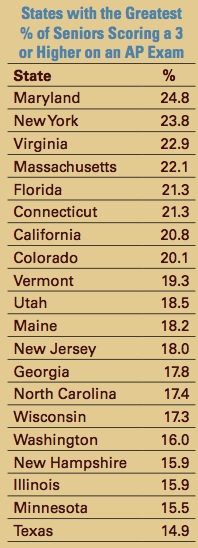
Share

More screen time for youth than adults on the job

Cecilia Kang:

Youth are spending more time with nearly every form of media than ever, according to a report released Wednesday by the Kaiser Family Foundation. They spend more hours on the computer, in front of television, playing video games, texting and listening to music than an adult spends full-time at work.
The only media young people aren’t soaking up, the study says, are newspapers, magazines and other print publications.
Youth spend more than 7 1/2 hours a day using electronic media, or more than 53 hours a week, the 10-year study says. “And because they spend so much of that time ‘media multitasking’ (using more than one medium at a time), they actually manage to pack a total of 10 hours and 45 minutes worth of media content into those 7½ hours.”
Affirming parents’ fears, the study showed those habits ripple throughout a youth’s life. Those who were big media consumers were more likely than kids and teens who are only seldom in front of a screen to earn average or poor grades in school. Those who use more electronic media get in more trouble, and say they are often sad.

Share

Yale: The musical

Jenna Johnson:

A new Yale admissions video released Friday starts as most campus tours do: an uncomfortable question-and-answer session with an over-caffeinated admissions officer. Some kid asks what year the school was founded. A dowdy mom elbows a nerdy dad.
And then a sultry young woman in a red sundress in the back row asks: “Why did you choose Yale?”
There’s a reflective pause. A reflection piano overture. Reflective looks around the room. And then — bam! — the boring admissions video turns into a musical. The admissions officer serenades the no-longer-bored students: When I was a senior in high school, colleges called out my name. Every day I debate where to matriculate, but every place seemed the same. Yet after I went through the options, only one choice remained. I wanted to hail from a college called Yale . . . .
It feels like an episode of Glee, the popular TV show that overnight made it socially acceptable and even sexy to sing in the high school show chorus. Those involved admit they watched the movie “High School Musical” for inspiration. And since the video was posted on YouTube on Friday evening, it has been viewed nearly 50,000 times.

Share

Just who made the young so doltish?

The Economist:

WHY are the young so disappointing, when it comes to their manners, dress codes, or knowledge of the canon of Western civilisation? Ask a British or American conservative, and he will blame the left: the 1960s vintage teachers who disdain dead white guys like Shakespeare, the college campuses where Derrida and deconstruction have displaced reading actual literature or the egalitarian ethos of “all shall have prizes”.
Ask someone from the left, for example in Britain, and they will trace the rot back to Thatcherism: the hostility to pure research, the focus on commercially-driven vocational education (all those degree courses in golf course management or marketing, elbowing aside history or Ancient Greek), or the dumbing down of examinations by ministers who knew the price of everything and the value of nothing.
Luc Ferry, a prolific French philosopher and former education minister in the conservative government of Jean-Pierre Raffarin, has a new book out, “Face à la crise: Matériaux pour une politique de civilisation”, offering a distinctly Gallic view of the problem: the fault lies with globalisation.

Share

The Four “R’s” – A Charter School That Works

Bruce Fuller:

“Good audience skills are imperative,” Danielle Johnson reminds her restless 10th-graders as one, Raquel, nervously fiddles with her laptop before holding forth on her project portfolio at City Arts and Technology High School (known as CAT), a charter school of 365 students on a green knoll above the blue-collar southern reaches of Mission Street in San Francisco.
“I decided to use the story of my mom getting to this country as an immigrant,” Raquel says, moving into her personal-memoir segment, sniffing back tears as a blurry photo of her mother at age 18 appears on the screen. “I had never asked my mother about how she got here.”
CAT exemplifies President Obama’s push to seed innovative schools that demand much from all students, echoed by Sacramento’s $700 million reform plan that goes to Washington this week. How to bottle the magic of CAT teachers like Johnson – listening carefully to each teen, strengthening each voice with basic skills and motivating ideals – is the challenge facing would-be reformers.

Share

Our Opinion: If only wishing could pay the education bills

Tallahassee Democrat:

Perhaps with business organizations behind it, a significant increase in the state’s investment in education from kindergarten through college could gain some traction in the Florida Legislature.
Certainly without it, there is virtually no likelihood that lawmakers in an election year will find the courage to search for ways — not all of them monetary — to improve public education, and therefore our state’s chances for the future.
An educated population and an accomplished work force are the underpinnings of a state where, as the Florida Council of 100 and Florida Chamber of Commerce expressed in a report last week, the American dream can be successfully carried out. Where better, asked Council of 100 Chair Susan Story “than in the state of Florida?”
Both Gov. Charlie Crist and former Gov. Jeb Bush put their stamp of approval on what was described at its unveiling Thursday as the “education wish list” of these two significant Florida business groups. Last year, the two joined with education leaders to get more money for higher education, even though the Legislature went in the opposite direction, cutting $150 million from our universities. Again this year budget committees are asking universities to be prepared for across-the-board cuts as high as 10 percent, in keeping with a budget shortfall of as much as $3 billion.
The recommendations from these groups, which are coincidentally against most tax or fee increases and lifting sales-tax exemptions, include tougher graduation standards at the pre-K-12 level, virtual elimination of teacher tenure and a constitutional amendment legalizing vouchers.

Closing the Talent Gap: A Business Perspective (January 2010) 3MB PDF.
Updates, via a Steven M. Birnholz email:
Press Release.
Political, Business Leaders: Overhaul Education in Fla.” Lakeland Ledger
Business groups propose major changes to education,” Daytona Beach News Journal.

Share

Market fixes for California’s schools

Bruce Fuller:

Ronald Reagan must be grinning in his grave.
Gov. Arnold Schwarzenegger sends to the White House this week a colorful pastiche of education fixes, hoping to score $700 million in federal dollars. Sacramento’s plan echoes Washington’s own reform strategy – built on President Obama’s surprising faith in market remedies for the ills facing schools.
Oddly mimicking Reagan’s game plan of a generation ago, Sacramento’s agenda relies on market competition by seeding more charter schools, allowing parents to shutter lousy schools and rewarding teachers who boost student performance.
“This is about parental choice in public education,” said state Sen. Gloria Romero, D-Los Angeles, a chief architect of the bipartisan plan.

Share

Why US high school reform efforts aren’t working

Amanda Paulson:

Since it began in 2004, the Baltimore Talent Development High School has posted some impressive graduation rates and achievement scores, among other things.
Even more notable, efforts by educators at nearby Johns Hopkins University to replicate the school’s gains in dozens of other locations have also met with some success. Slowly, the network of Talent Development High Schools is helping student groups that often seem most at risk.
But good news at the high school level is unusual. Despite vigorous calls for change and a host of major reform efforts, encouraging results have been scarce. National Assessment of Educational Progress (NAEP) scores – considered the “Nation’s Report Card” – tend to be stagnant for high-schoolers, even when they rise for elementary school students.
Only about half of low-income and minority students in US high schools graduate, and many of those who do are unprepared for college. The isolated examples of success often fail when administrators or education reformers try to reproduce them on a large scale.

Share

Consider community college, three-year plan to cut costs

Janet Bodnar:

For years, Kiplinger’s has been advising parents that one way to keep higher-education costs under control is to have their kids attend community college for a year or two and then switch to a four-year school. This year, they finally listened to us — with a vengeance.
Community colleges are packed to the gills, and students are flocking to state institutions across the board. The average annual sticker price for a four-year public school remains a tad over $15,000 — less than half the tab at a private institution. In our exclusive rankings of the 100 best values in public colleges, nearly 40 percent charge in-state students less than the average price, reports Senior Associate Editor Jane Bennett Clark.
There’s nothing like a financial crisis to get families to focus on how much they’re paying for big-ticket items such as college expenses. Surprisingly, they haven’t always done that. In 2008, a survey of parents and students by Sallie Mae found that when deciding whether to borrow for college, a whopping 70 percent said a student’s potential postgraduate income did not factor into the discussion.

Share

Best Value Colleges 2010

USA Today:

The Princeton Review’s 100 “Best Value Colleges” list for 2010 is based on data compiled and analyzed by The Princeton Review, the education services and test-prep company known for its annual college listings.
The analysis uses the most recently reported data from each institution for its 2009-10 academic year. The top 10 public and private “Best Values” are ranked; the rest are listed alphabetically.
FULL STORY: Can getting a degree be affordable?
The Princeton Review selected the schools based on surveys of administrators and students at more than 650 public and private college and university campuses.

Share

US Education Chief Criticizes NBA and the NCAA

Katie Thomas:

Education Secretary Arne Duncan entered some of the most contentious debates in college sports on Thursday when, in a speech at the N.C.A.A. convention, he called for stricter consequences for college teams that do not graduate their athletes and said the N.B.A.’s age-minimum policy sets up young athletes for failure.
“Why do we allow the N.C.A.A, why do we allow universities, why do we allow sports to be tainted when the vast majority of coaches and athletic directors are striving to instill the right values?” said Duncan, who was a co-captain of his Harvard basketball team and played in an Australian professional league from 1987 until 1991.
He said his time as a college athlete was one of the most valuable periods of his life, but feared the N.B.A.’s age rule, which requires that a player be at least 19 years old and at least one year removed from high school before entering the league, does a disservice to athletes.

Share

Top public universities faulted on financial aid

Jenna Johnson:

Many of the nation’s top public universities are giving millions of dollars in financial aid to students from relatively wealthy families instead of to those who urgently need it, resulting in campuses that are often less diverse than those at elite private schools, a new report says.
From 2003 to 2007, public research universities increased the amount of aid to students whose parents make at least $115,000 a year by 28 percent, to $361.4 million, said the Education Trust, a nonprofit advocacy group.
Those schools routinely award as much in financial aid to students whose parents make more than $80,000 a year as to those whose parents make less than $54,000 a year, according to the report, “Opportunity Adrift.”

Share

Advantages and Drawbacks of Attending a (Mostly) Women’s College (Part the Last)

Susan O’Doherty:

Over the past several weeks, I have discussed the impact of attending a traditionally female college in the early 1970s. I wasn’t there that long — like most students of the time, I got on the train at 18 and disembarked at 22 with a diploma. But those four years were formative, shaping the rest of my personal and professional life in some important ways:
–Valuing female friendships: Most women I know value their friendships with other women, of course. But I was raised in a time and culture that put men first. We were encouraged to break a date with a girl friend, for example, if a boy asked us out. My exposure to the brilliance, fierce loyalty, seriousness and silliness of my classmates put an end to that nonsense. My best friend from college remains one of my two best friends today. She is the person I call when I need to talk through a problem, cry without explaining myself, or share good (or bad) news. There is nothing I wouldn’t do for her.
–Valuing women in the workplace: I have friends, both male and female, who complain about “women bosses”: that they are petty, self-contradictory micromanagers, mostly. For a while I thought I had just been extraordinarily lucky to have a string of extremely competent, visionary, and decisive (not to mention empathetic and fun) female employers. Then I realized that we were sometimes talking about the same people. Women of my generation were trained not to raise our voices; to deliver definite pronouncements as though they were tentative questions; and to mask and deny irritation until it builds up into an explosion. This behavior is so ingrained in many of us that we don’t realize we’re sending out seemingly mixed signals. Working on tech crews, student committees, etc., at college, I got used to decoding “Maybe we should go with the yellow scrim; what do you think?” as “Please get started on the yellow scrim now,” and this assumption that my female bosses a) knew what they wanted and b) were communicating this, if I listened hard enough, saved me many misunderstandings as a young flunky. I also, unlike many of my peers, took women’s competence as a given, and thus avoided the irritating questioning and second-guessing that tends to lead to the aforementioned explosions.

Share

The Diary: Barbara Ehrenreich

Barbara Ehrenreich:

In the course of their work my brilliant children – a human rights lawyer and a freelance journalist – travel to places such as Phnom Penh and Dubai. In the course of mine Macomb, Illinois, is a more typical destination, involving five hours of flying, including a layover in Detroit and then two hours of driving through snow-covered fields barely interrupted by a couple of semi-boarded-up “towns”, including the intriguingly named Preemption (population 71).
After all this industrial-agricultural wasteland, Macomb is a veritable hive of human, cultural and commercial activity. There is a branch of the state university system, where I have been invited to speak, and until a few months ago, my hosts inform me, there were a total of two Italian restaurants in town, one famed for its Spam-and-Doritos-topped pizza. I’m staying at the Hampton Inn, a minimalist motel chain located opposite a Farm King, an agricultural supply store. I can’t help asking whether this is where the university puts up a genuine celebrity speaker, such as Bill Cosby. “Oh no,” I am told, “he flew in in his private plane and out the same night.”
Ann, a congenial administrator at Western Illinois University, fills me in on the student body. They are mostly white, first-generation college students and, while about a third of them are studying law enforcement with a view to a career in police work, this does not stop them from illegal under-age drinking or, for that matter, smoking pot. We muse on the problem of binge drinking, endemic to American campuses: why go straight from sobriety to vomiting? Haven’t they ever sampled the pleasures of tipsiness? Then Ann tells me one of the saddest things I’ve heard on the perennial subject of Young People Today: they don’t know how to be “silly”, she says, in the sense of whimsy and absurdity. They are strait-laced and even a little timid, unless, of course, they are utterly wasted.

Share

‘Parent trigger’ shifts balance of power in debate over education reform

San Jose Mercury News:

Much has been written about how two education reform bills signed into law last week might affect California’s chances of qualifying for federal Race to the Top funds.
As important as that funding is, the new laws’ significance goes much deeper. It signals that the balance of power in education is shifting away from teachers unions and toward parents, where it belongs.
The “parent trigger,” a controversial element of the legislation, is the best evidence of this turning point.
The concept was developed by the grass-roots group Parent Revolution in the Los Angeles Unified School District. If a majority of parents in a failing school petitions for an overhaul, the district must do something — replace administrators, convert to a charter school or make other major reforms.
By law, tenured California teachers can convert their school to a charter if a majority of them vote for it, and that has happened dozens of times. But teachers unions and other groups opposed giving parents the same right. One group called it the “lynch mob” provision — an odd choice of words, given that it would empower parents primarily in minority communities where failing schools abound.

Share

Revolution in U.S. education is in California

Alain Bonsteel:

The greatest revolution in education in the United States today is taking place in Los Angeles. It is the mandate of the Los Angeles Unified School District School Board to convert almost a third of its schools either to charter schools, the public schools of choice that are the one shining light in an otherwise dysfunctional system, or other alternatives such as magnet schools. The change is not only a mighty one for the state’s largest school district, but in time it could double the number of public schools of choice in California.
What is remarkable is not just the magnitude of this earth-shaking change, but the complete shift of the paradigm about how we think about public education. The driving force behind this revolution is Los Angeles Mayor Antonio Villaraigosa, who is not only a Democrat but also a former organizer for the United Teachers of Los Angeles, Los Angeles teachers’ union. Villaraigosa took his nontraditional stand because, as he noted, LAUSD was racked with violence and plagued with a dropout rate of 50 percent, and showed no signs of improving.

Share

Charter tackles middle school challenges with young faculties and a no-nonsense attitude

Howard Blume:

At Lakeview Charter Academy, inexperienced teachers have strong support and high expectations.
Eleazar and Nora Gonzalez decided to send their son Daniel to Lakeview Charter Academy because, they said, large public middle schools have a reputation for gangs and drugs. They also worried about academics.
So they warmed to the no-nonsense welcomings issued at the first monthly parents night.
“It will be a miracle the day I don’t give homework because home is to review,” Alexandra Aceves, 25, announced, in English and Spanish, to the Gonzalez family and others crowded into a second-floor classroom.
The scene exemplified the characteristics of the 10 schools operated by Partnerships to Uplift Communities, a locally based charter management organization that, like others in Los Angeles, has focused on serving low-income minority communities. It has taken on, in particular, the thorny challenge of middle schools, especially in the Latino neighborhoods of the San Fernando Valley and downtown.

Share

Charters generally perform better than traditional schools, not as well as magnets

Howard Blume Mitchell Landsberg and Sandra Poindexter:

Standardized tests show that the highest-performing charters push low-income black and Latino youth to higher levels of achievement.
At their best, charter schools in Los Angeles shatter the conventional wisdom that skin color and family income are the greatest predictors of academic success.
Setting standards high and wringing long hours out of students and teachers, the highest-performing charters push low-income black and Latino youth to levels of achievement, as measured by standardized tests, more typical of affluent, suburban students.
If such schools were the norm, any debate over the value of charters would be moot. But there is no typical charter. They adhere to no single vision and vary widely in quality.
That said, a Times analysis showed that, overall, L.A. charter schools deliver higher test scores than traditional public schools. But charters lag well behind L.A. Unified’s network of magnet schools.

Share

Ohio Charter schools buck enrollment trend

Catherine Candisky & Cindy Kranz:

Although charter schools come under withering criticism from some quarters, Ohio parents apparently aren’t listening.
A new state Department of Education report shows that charter-school enrollment is up 8 percent this year, while the number attending traditional Ohio schools has fallen.
Currently, 89,000 students attend 332 charter schools statewide. At the same time, enrollment in traditional public schools has dropped slightly to 1.75 million students.
In Greater Cincinnati, 32 charter schools enroll more than 9,000 students. Enrollment increases mirror the state trend.
T.C.P. World Academy’s enrollment increased from 389 last year to 410 students this year.
“We always have a waiting list,” said Superintendent/Principal Karen French, who attributed the enrollment increase to performance results and word of mouth.

The Cincinnati College Preparatory Academy
enrollment numbers are at about 700 students now, compared with nearly 650 last year.

Share

Getting a Job in College: Second Thoughts

Stephen Krieder Yoder, Isaac Yoder and Levi Yoder:

Isaac: My first semester at college was as fun and stimulating as I had hoped. Several classes already have changed my way of thinking, and I have a group of new friends.
But not everything went according to plan: I went back on one decision I made before going into college — the decision to not work a job during the college year.
Dad and I had agreed before college that if taking my studies seriously was my most important goal, spending time and energy working a job could detract from that goal. My part-time job at a tea shop in high school created many sleep-deprived days at school and made it more difficult to complete all my assignments well. Though I ended up succeeding despite the extra work, I thought that this added stress would be more problematic in college, when I would have more, and harder, schoolwork.
But after only my first semester, I’ve already begun to work a job in student government, in addition to my other extracurriculars.

Share

The Changing Nature of Employment in the Great Recession

Jay Fenello:

I recently saw the Great Depression film “The Grapes of Wrath,” and while I had seen it before, this time I was reminded of what’s going on in employment today. The movie starts off with Henry Fonda returning to his family farm after having been away for a few years, only to find his home abandoned. He soon learns that his family, as well as all of his Oklahoma neighbors, have been evicted and are leaving for the promise of jobs in California.
We then learn that the families in Oklahoma have been hit with a perfect storm. Drought, low farm prices, and the displacement caused by farm automation had resulted in bankruptcy and foreclosure for millions of farmers. It was reported that one man with a tractor could replace 10-15 family farms, and over 100 farm workers.
Similarities to the Great Recession
Consider the tractor for a moment. The gasoline powered tractor first appeared way back in 1892. However, it didn’t really catch on until the tractor was mass produced in the 1910’s. Then, as tractor prices came down, its use on the farm started to take off. The result was an increase in farm productivity, falling prices for farm products, and a loss of jobs for millions of farmers. This displacement peaked 20 years later, during the Great Depression.

Share

Charters ‘better’ at readin’ & ‘rithmetic

Yoav Gonen:

he city’s charter schools are providing a bigger boost to students’ reading and math performance than are traditional public schools, according to a new study.
The study — by the Center for Research on Education Outcomes at Stanford University — is the second in four months showing positive results for the city’s charter schools. It comes as proponents of the publicly funded, privately run schools are urgently pushing officials to lift the state’s charter school cap above 200.
New York’s application for as much as $700 million in federal aid under a competition known as Race to the Top — which looks favorably on states that support charter school growth — is due by Jan. 19.

Share

My Lazy American Students & The Blowback

Kara Miller:

IT WAS the kind of student conference I hate.
“I’ll do better,” my student told me, leaning forward in his chair. “I know I’ve gotten behind this semester, but I’m going to turn things around. Would it be OK if I finished all my uncompleted work by Monday?”
I sat silent for a moment. “Yes. But it’s important that you catch up completely this weekend, so that you’re not just perpetually behind.”
A few weeks later, I would conduct a nearly identical conversation with two other students. And, again, there would be no tangible result: No make-up papers. No change in effort. No improvement in time management.
By the time students are in college, habits can be tough to change. If you’re used to playing video games like “Modern Warfare” or “Halo” all night, how do you fit in four hours of homework? Or rest up for class?
Teaching in college, especially one with a large international student population, has given me a stark – and unwelcome – illustration of how Americans’ work ethic often pales in comparison with their peers from overseas.
My “C,” “D,” and “F” students this semester are almost exclusively American, while my students from India, China, and Latin America have – despite language barriers – generally written solid papers, excelled on exams, and become valuable class participants.

  • Lauren Garey: Lazy American students? Uninformed professor!
  • Matt Rocheleau:

    Mixed reaction to ‘My lazy American students’ column

  • Jason Woods & Matt Rocheleau: Babson dean provides rebuttal on ‘lazy American students’
  • Kara Miller: Lazy American Students: After the Deluge:

    On Monday, The Boston Globe ran an opinion piece entitled “My Lazy American Students.”
    In it, I wrote about how teaching in college has shown me that international students often work harder than their American counterparts. Though this is emphatically not true across the board, the work ethic and success of Asian, European, and South American students – who have to compete with a classroom of native English speakers – can be astounding.
    I also noted in the column that there’s too much texting in class, too much dozing off, too much e-mail-checking, too much flirting (I didn’t mention flirting in the first piece, but I’ll mention it here). Obviously, international students do all these things, but I have noticed them more amongst American students.
    I worked hard on the column and lay in bed Sunday night hoping that – amidst the flurry of Christmas shopping – someone would read it.
    And that’s when the avalanche started.

Share

Reproductive contracts and the best interests of children

Ronald Bailey:

The question of what it means to be a parent has never been simple. But three recent cases highlight just how complicated things can get–and how inconsistent the courts have been in weighing genetic parenthood against the deals struck by would-be parents (gay and straight) with their partners.
Case 1: Sean Hollingsworth and Donald Robinson Hollingsworth are legally married in California and are registered as civil union partners in New Jersey. The two husbands arranged for Donald’s sister, Angelia Robinson, to serve as a gestational surrogate carrying embryos produced using sperm from Sean Hollingsworth and donor eggs. In October 2006, Ms. Robinson bore twin girls whom she turned over to their two fathers. In March 2007, Ms. Robinson sued for custody alleging that she had been coerced into being a surrogate. A New Jersey court ruled last week that Ms. Robinson, who has no genetic tie to the twins, is their legal mother and can sue for primary custody later this year.

Share

Taking a Leap of Faith

Lorna Siggins:

OU ARE A specialist in your field, you can see the opportunities before you, but there’s little or nothing that you can do. If this place sounds vaguely familiar, it is where Dr Deirdre MacIntyre found herself almost a decade ago.
She wasn’t a solo traveller, either. A colleague and close friend, Dr Moya O’Brien, had also reached that bus stop. The trick was to recognise when it was time to jump off.
“We had trained in psychology together, she was my bridesmaid, I was her birth partner and we had worked together in what was the Eastern Health Board before it became the Eastern Regional Health Authority ,” MacIntyre recalls. “We both had families with small kids, and very heavy clinical caseloads at work.
“I loved my career in child guidance, I loved my clinical work, but both of us felt that our impact was limited within the health board structure,” MacIntyre recalls.
At this point, she had nearly 20 years’ experience as a clinical psychologist and was principal in charge of the ERHA’s child and adolescent psychology services. She had been involved in establishing community-based psychology services for children and their families.

Share

Question 2010

Katinka Matson:

Read any newspaper or magazine and you will notice the many flavors of the one big question that everyone is asking today. Or you can just stay on the page and read recent editions of Edge …
Playwright Richard Foreman asks about the replacement of complex inner density with a new kind of self-evolving under the pressure of information overload and the technology of the “instantly available”. Is it a new self? Are we becoming Pancake People — spread wide and thin as we connect with that vast network of information accessed by the mere touch of a button.
Technology analyst Nicholas Carr wrote the most notable of many magazine and newspaper pieces asking “Is Google Making Us Stupid”. Has the use of the Web made it impossible for us to read long pieces of writing?
Social software guru Clay Shirky notes that people are reading more than ever but the return of reading has not brought about the return of the cultural icons we’d been emptily praising all these years. “What’s so great about War and Peace?, he wonders. Having lost its actual centrality some time ago, the literary world is now losing its normative hold on culture as well. Is the enormity of the historical shift away from literary culture now finally becoming clear?
Science historian George Dyson asks “what if the cost of machines that think is people who don’t?” He wonders “will books end up back where they started, locked away in monasteries and read by a select few?”.

Share

A push for Latinos to pursue education

Emily Hanford:

A report out from the Southern Education Foundation out today says the South is the first part of the country where more than half the children in public schools are minorities. That is happening in part because more Latinos and their larger families are moving in. Latinos are the fastest-growing part of the U.S. population.
And as the United States tries to keep up with other countries in getting students into, and graduated from college, Latinos are getting special attention. Because they’re the least likely to get college degrees. From American RadioWorks, Emily Hanford reports.

Share

The ascendancy of the non-private person

Andrea James:

OK, I lied about no more wonky posts. Xeni’s Facebook post reminded me of something. I want to float an idea about privacy as a commodity, vs. privacy as a right.
Tiger Woods, described frequently as a “very private” person, was unable to keep his private life private. Why? Because he interacted with non-private people. The reason Kim Kardashian and the Jersey Shore denizens have risen to positions of prominence in popular culture is because they each epitomize the non-private person. They have nothing to hide, so nothing that becomes public knowledge can hurt them. Ms. Kardashian can be urinated on in a sex tape and actually be helped in terms of being a public figure. My own ability to be effective as a transgender rights activist is because there’s nothing anyone could expose about me that would deter me from my activism. That gives me enormous power over anonymous haters who vent their impotent fury at me to no avail. Their own fear of exposure (loss of privacy) is their greatest weakness. What does this mean for you, dear reader? Read on.

Share

Gifted Education Outrages

Jay Matthews:

My Dec. 10 column about that troublesome Washington area gifted child, future billionaire Warren Buffett, said our schools are never going to help such kids much. I said the gifted designation was often arbitrary and should be disposed of. Instead, we ought to find ways to let all kids explore their talents.
This produced a flood of comments on my blog. Many readers thought I was callous and daft. “Unfortunately, eliminating the label generally means that the schools give up doing anything for advanced learners,” wrote a reader signing in as EduCrazy. Another commenter, CrimsonWife, said “if educators are fine with giving special attention and services to kids who are far out of the mainstream on the low end of the spectrum, why is it so controversial to provide specialized services to kids who are far out of the mainstream on the high end?”

Share

At a Silicon Valley community centre, Asian ping-pong parents are grooming children for Olympic glory

Patricia Leigh Brown:

Young people who were serious about table tennis used to have to make the trip to Beijing, Stockholm or Moscow to train with world-class coaches. Now they go no farther than the Silicon Valley suburb of Milpitas.
“I’m trying to become one of the greatest players in the nation,” Srivatsav Tangirala, 14, says matter-of-factly between drills at the huge new table tennis facility in the suburb. He and three dozen players, some as young as five, sprint sideways along the edge of the tables, 45 times in a row, perfecting their footwork.
“Lean forward, lean, lean, lean, lean,” their coach implores.
This is the largest training programme for youths in the country, run by the India Community Centre in a region that is 60 per cent Asian. Here, ping-pong parents who grew up with the sport in Sichuan province or Hyderabad are the new soccer mums and Little League dads.

Share