School Information System

First big crisis over for Rhee–when’s the next one?

Jay Matthews:

I share my colleague Bill Turque’s well-earned skepticism about reports of an agreement on a D.C. teacher’s contract, but Washington Teachers’ Union chief George Parker’s encouraging public statement about the negotiations is one more sign that D.C. Schools Chancellor Michelle A. Rhee’s job is safe– for now.
There are smart people around town, and in the country (Rhee remains the most interesting story in U.S. education circles), who thought the D.C. Council criticism and teachers union legal action against her would end her tenure when she laid off 266 teachers and staff in October. But I ran into a council member at a holiday gathering last week who agreed with me that she has successfully ridden the crisis out.
So what’s next? I can confidently predict she will be in trouble again. She is essentially attempting to charterize a public school system—give individual principals the same powers that charter school leaders have to hire and fire their teachers and create education teams that focus intensely on raising student achievement. No other major urban school system has had a leader with such an agenda before. She threatens many strongly held views about how schools should be run, and she isn’t that diplomatic in going about it.

Share

Free for All: Fixing School Food in America

Michael O’Donnell:

In his brilliant and distressing essay on the cruelties of English boarding school life in the 1910s, “Such, Such Were the Joys,” George Orwell devoted a few lines to the prevailing attitudes toward feeding children. A boy’s appetite was seen as “a sort of morbid growth which should be kept in check as much as possible.” At Orwell’s school, St. Cyprian’s, the food was therefore not only unappetizing but calorically insufficient; students were often told “that it is healthy to get up from a meal feeling as hungry as when you sat down.” Only a generation earlier, school meals began with “a slab of unsweetened suet pudding, which, it was frankly said, broke the boys’ appetites.” Orwell described sneaking, terrified, down to the kitchen in the middle of the night for a slice or two of stale bread to dull the hunger pains. His contemporaries at public school had it better, and worse: so long as their parents gave them pocket money to buy eggs, sausages, and sardines from street vendors, they scrounged enough food to get through the day.
This spirit of tut-tut character building through patronizing if affectionate deprivation comes off as thoroughly British, but for a time the attitude spanned the Atlantic. In 1906, one American principal opposed the growing enthusiasm for a school lunch program by warning: “If you attempt to take hardship and suffering out of their lives by smoothing the pathway of life for these children, you weaken their character, and by so doing, you sin against the children themselves and, through them, against society.” Let them starve a little, went the thinking–it won’t kill them, and it’s better than getting fat on sweets.

Share

Race to the Top Vagueness & Commentary

Sarah De Crescenzo:

Some of the most contentious areas of the new legislation include the option to close failing schools, convert them to charter schools or replace the principal and half the staff. Parents could exercise greater power within the public school system, with the possibility of moving children in the lowest-performing schools elsewhere or petition to turn around a chronically failing school.
The transfer option would be available to parents of children at the worst 1,000 schools. Parental petitions would be limited to 75 schools.
However, the implementation of any reforms is hazy, as the federal guidelines for the program cite broad goals, such as “making improvements in teacher effectiveness.”
Mekeel assured the board members that supporting the state’s application would not bind the district to accept the funds, if California is selected as a recipient.
“You’ll have another decision to make before we’re actually involved in this,” he said.
The legislation package also provides a method for linking teacher evaluations to student performance — an aspect arousing the fury of educators statewide.

Share

As NCLB reaches 8-year mark, many wonder what’s next?

Nick Anderson:

Eight years after President George W. Bush signed the bill that branded an era of school reform, the education world is wondering when President Obama will seek to rewrite the No Child Left Behind law.
Obama officials, who for months have been on a “listening and learning” tour, are expected at some point to propose a framework for the successor to a law that is two years overdue for reauthorization. Time is growing short if the president aims for action before midterm elections that could weaken Democratic majorities in Congress.
As the eighth anniversary of the law’s enactment passed quietly Friday — an occasion that Bush marked throughout his presidency as a domestic policy milestone — the regimen of standardized testing and school accountability remains intact.
Every year from grades three through eight, and at least once in high school, students must take reading and math exams. Every year, public schools are rated on the progress they make toward the law’s goal of universal proficiency by 2014. And every year, states label more schools as falling short and impose sanctions on them, including shakeups and shutdowns.

Share

Top 10 education policy issues for 2010

Valeria Strauss:

Since Friday is the day for lists on The Sheet, here is one showing the 10 most important education policy issues for 2010, as determined by the non-profit American Association of State Colleges and Universities. I have shortened the analysis; for a fuller one, click here.
1) Fiscal Crises Facing States
The biggest force behind much of the policy action that will occur in 2010 is the quarter-trillion-dollar collective deficit that has devastated states’ budgets in the past 24 months. Public colleges and universities throughout most of the country are slicing and dicing budgets because state governments have lowered–dramatically in some cases–public funding. This has been most obvious in California, where tuition increases are the highest ever and where enrollment caps have kept ten of thousands of students out of classrooms.

Share

Deadline looming for Minnesota teacher contracts

Tom Weber:

Fewer than half of the state’s school districts have reached deals on new contracts with their teachers and the remaining have until the end of next week to do so.
The deadline comes as districts grapple with the possibility that the state might cut funding in coming months. Gov. Pawlenty is also pressuring districts to hold down raises.
Sandy Skaar, president of the union that represents the 2,800 teachers in Anoka-Hennepin, the state’s largest school district, is clearly relieved to have reached a deal.
“I’ve been doing bargaining now for 12 years, and this was clearly the most difficult round of bargaining I’ve ever experienced,” Skaar said.
Union members and the school board are expected to ratify the deal next week. In a district that’s already cut millions of dollars and closed schools to trim costs, union leadership agreed to a contract that includes no salary increases.

Share

The Challenge of School Reform

Brian Kelly:

The headline on the January print issue cover is meant to be provocative [“Will School Reform Fail?“]. I hope it’s not predictive. The notion of failure might come as a surprise to those who follow the crucially important challenge of improving America’s public education system. News over the past few years has been encouraging: more rigorous standards, a burgeoning charter school movement, private money and public talent focusing on a growing consensus about what works. And there are great suc cess stories–some of which we tell in this issue. But they are mostly on an indi vidual basis. Yes, the 100 best high schools we highlight are extra ordinary institutions. But America has 22,000 public high schools, and too many of them are dreadful. The good news is that there seems to be general agree ment among policymakers on how to make things bet ter. The logjam of inertia has been broken, with broad acceptance of the need for ambitious national standards and ways to measure account ability of schools and teachers; the need to train, deploy, and reward bet ter teachers–while moving bad ones out–and the value of competition. At last, some big-city mayors have as sumed the burden of fixing their schools and have struggled to cut through union and board-of-ed bu reaucracies. On the national level, Arne Duncan, the education secre tary, has an unprecedented pot of money to implement change and showcase best practices. This should be a moment of great promise.

Share

Teacher Unions and Obamas “Education Reforms”

Andrew Smarick:

Based on local news reports, it appears that a growing number of states are putting together bold plans in order to better position themselves for Race to the Top grants. But in a number of places, unions are erecting serious obstacles. For instance, in Florida, Minnesota, and Michigan, state union officials are discouraging their local affiliates from supporting the plans because of elements the union finds objectionable, such as merit pay programs and efforts to use student performance gains in teacher evaluations. In New Jersey, the union is slamming the state’s application.
Education Secretary Arne Duncan and his department place a premium on collaboration, so states gain points in the Race to the Top scoring when they show that stakeholders from across the state support the proposal. That’s certainly a reasonable inclination–wider buy-in suggests a greater chance at successful implementation.

Share

Gifted Education Outrages

Jay Matthews:

My Dec. 10 column about that troublesome Washington area gifted child, future billionaire Warren Buffett, said our schools are never going to help such kids much. I said the gifted designation was often arbitrary and should be disposed of. Instead, we ought to find ways to let all kids explore their talents.
This produced a flood of comments on my blog. Many readers thought I was callous and daft. “Unfortunately, eliminating the label generally means that the schools give up doing anything for advanced learners,” wrote a reader signing in as EduCrazy. Another commenter, CrimsonWife, said “if educators are fine with giving special attention and services to kids who are far out of the mainstream on the low end of the spectrum, why is it so controversial to provide specialized services to kids who are far out of the mainstream on the high end?”

Share

What’s up With Implementation of the Arts Task Force Recommendations – Who Knows

I have similar concerns about “meaningful” implementation of the fine arts task force recommendations. The task force presented its recommendations to the School Board in October 2008, which were based in large part on input from more than 1,000 respondents to a survey. It was another 7 months before administration recommendations were ready for the School Board, and its been another 6 months since then without any communication to the community or staff about: a) brief summary of what the School Board approved (which could have been as simple as posting the cover letter), b) what’s underway, etc. Anything at a Board meeting can be tracked down on the website, but that’s not what I’m talking about. There are plenty of electronic media that allow for efficient, appropriate communication to many people in the district and in the community, allowing for on-going communication and engagement. Some of the current issues might be mitigated, so further delays do not occur. Also, there already is a blog in the arts area that is rarely used.
Afterall, one of our School Board members, Lucy Mathiak, has a full-time job (in addition to being a school board member) as well as having a lot of other life stuff on her plate and she’s developed a blog. It wouldn’t be appropriate for administrators to comment as she does if they are wearing their administrator hats, but concise, factual information would be helpful. I mentioned this to the Superintendent when I met with him in November. He said he thought this was a good idea and ought to take place – haven’t seen it yet; hope to soon, though.
In the meantime, I’m concerned about the implementation of one of the most important aspects of the task force’s recommendations – multi-year educational and financial strategic plan for the arts, which members felt needed to be undertaken after the School Board’s approval and in parallel with implementation of other efforts. Why was this so important to the task force? Members felt to sustain arts education in this economic environment, such an effort was critical.
From the task force’s perspective, a successful effort in this area would involve the community and would not be a solo district effort. As a former member and co-chair of the task force, I’ve heard nothing about this. I am well aware of the tight staffing and resources, but there are multiple ways to approach this. Also, in my meetings with administrative staff over the summer that included my co-chair, Anne Katz, we all agreed this was not appropriate for Teaching and Learning whose work and professional experience is in the area of curriculum. Certainly, curriculum is an important piece, but is not the entire, long-term big picture for arts education. Also, there is no need to wait on specific curriculum plans before moving forward with the longer-term effort. They are very, very different and all the curriculum work won’t mean much if the bigger picture effort is not undertaken in a timely manner. When the task force began it’s work, this was a critical issue. It’s even more critical now.
Does anyone have information about what’s underway, meaningful opportunities for community and teacher engagement (vs. the typical opportunities for drive by input – if you don’t comment as we drive by, you must not care or tacitly approve of what’s being done is how I’ve heard the Teaching and Learning approach described to me and I partially experienced personally). I so hope not, because there are many knowledgable teaching professionals.
I know the topic of this thread was talented and gifted, but there are many similar “non-content” issues between the two topics. I’m hoping to address my experiences and my perspectives on arts education issues in the district in separate posts in the near future.
Share

Charters and Unions What’s the future for this unorthodox relationship?

Alexander Russo:

Nearly two years ago, Spanish teacher Emily Mueller was dismayed to learn that her charter high school, Northtown Academy in Chicago, was asking teachers to teach six classes instead of five.
There was no real discussion between teachers and administrators about alternative solutions, according to Mueller. There was no pay increase attached to the increased workload, either. The unilateral, unpaid workload increase “just didn’t seem sustainable,” she says.
But Mueller didn’t want to leave the school, one of three chartered by an organization called Chicago International Charter School and operated by an organization called Civitas Schools. So she and a handful of colleagues did something that only a few charter school teachers have done: they began the long, difficult, but ultimately successful push to join the Illinois Federation of Teachers and negotiate a contract that now represents roughly 140 teachers at the three schools.

Share

Teachers contract raises pay only for continued service, education

Elliot Mann:

Rochester’s teachers won’t receive cost-of-living raises for two years but can still receive pay bumps for experience and continuing their education, under a two-year contract approved Tuesday.
The Rochester School Board ratified the 2009-2011 teachers contract Tuesday night. Nearly 60 percent of Rochester’s 1,160 teachers approved the deal on Monday. The deal freezes the teacher’s salary schedule for two years.
Rochester Education Association President Kit Hawkins said the teacher’s union didn’t want to approve raises, only to watch budget cuts take away more of their peers and more programming. The school district will need to cut $4.5 million next year, and the soft freeze will save the district some money compared to projections.
Rochester public schools cut more than $9 million last year.
“We need to feed our families and pay our bills like everyone else, but we also understand we’re in a recession and the district is in grave financial (condition),” Hawkins said.

Related: Madison School District & Madison Teachers Union Reach Tentative Agreement: 3.93% Increase Year 1, 3.99% Year 2; Base Rate $33,242 Year 1, $33,575 Year 2: Requires 50% MTI 4K Members and will “Review the content and frequency of report cards”.

Share

Berkeley High’s Extra Science Labs May Be Cut

Jill Tucker:

Berkeley High School sophomore Razan Qatami glanced at the wall clock in her advanced biology lab class and frowned. At 4:15 p.m., she still had about 10 more minutes before she was done for the day.
While most high school science classes incorporate labs into regular class time, Berkeley High requires most of its students to attend labs before or after school in the so-called zero or seventh periods.
That means showing up at 7:30 a.m. to, say, dissect frogs, or staying until 4:30 p.m. – additional class time that not surprisingly costs additional money.
School administrators would like to see that money spread around, specifically to help struggling students, and have proposed cutting out the supplementary lab classes.
Qatami would love to see those early and late labs discontinued.

More here.

Share

Schools grant must go forward

Boston Globe:

TEACHERS UNIONS and state education officials may disagree over how to turn around failing schools, especially if it involves overhauling labor contracts. But both sides should be able to agree on one thing: Massachusetts students would benefit greatly from the infusion of $250 million in federal grant money.
A fierce competition is underway among more than 30 states for dollars from the Race to the Top program, an education initiative included in last year’s stimulus bill. Applications are due Jan. 19, and those with the best chance of success will include statements of support signed by superintendents, school committee members, and heads of teachers unions. The unions will be the hardest to enlist. Scores of local union leaders across the state are waiting for signals from the Massachusetts Teachers Association and the state chapter of the American Federation of Teachers. And these union heads are waiting to hear more today from state education officials about how the grant application might affect their members.

Share

Special-Ed Funds Redirected School Districts Shift Millions of Dollars to General Needs After Getting Stimulus Cash

Anne Marie Chaker:

Florida’s Broward County Public Schools saved as many as 900 jobs this school year. Nevada’s Clark County School District just added more math and tutoring programs. And in Connecticut’s Bloomfield Public Schools, eight elementary- and middle-school teachers were spared from layoffs.
These cash-strapped districts covered the costs using a boost in funding intended for special education, drawing an outcry from parents and advocates of special-needs children.
A provision in federal law allows some school districts to spend millions of dollars of special-education money elsewhere, and a government report indicates many more districts plan to take advantage of the provision.
School administrators say shifting the money allows them to save jobs and valuable programs that benefit a wide range of students.
“We absolutely need this,” said James Notter, superintendent of the Broward County Public Schools, the sixth-largest district in the country. He said the provision is “an absolute salvation for us,” because the $32 million reduced from the local budget for special education allows him to save between 600 and 900 jobs that would likely have disappeared this school year.

Share

K-12 Tax & Spending Climate

Francesco Guerrara & Nicole Bullock:

The US public pension system faces a higher-than-expected shortfall of more than $2,000bn that will increase pressure on many states’ strained finances and crimp economic growth, according to the chairman of New Jersey’s pension fund.
The estimate by Orin Kramer will fuel investors’ concerns over the deteriorating financial health of US states after the recession. “State and local governments are correctly perceived to be in serious difficulty,” Mr Kramer told the Financial Times.
“If you factor in the reality of these unfunded promises, their deficits will rise exponentially.”
Estimates of aggregate funding requirement of the US pension system have ranged between $400bn and $500bn, but Mr Kramer’s analysis concluded that public funds would need to find more than $2,000bn to meet future pension obligations.

Share

Hillsborough school board sees opportunity and peril in $100 million Gates reforms

Tom Marshall:

It could be the hardest $100 million the Hillsborough County School Board ever spent.
Members were in a festive mood Tuesday, nearly two months after the Bill & Melinda Gates Foundation picked the district to carry out a seven-year reform to boost teacher effectiveness. But by the end of their first workshop to discuss the plan, their feet were firmly on the ground.
“This is the largest single education grant in the history of the foundation,” said senior Gates program officer Don Shalvey, describing Hillsborough’s plan as a national model. “(But) we also think every organization has within it a flaw that could be fatal.”

Share

Wisconsin Mayoral control bill prompts conflicting testimony

Amy Hetzner:

Dozens of speakers passionately disagreed about how to fix Milwaukee Public Schools during a daylong state Senate hearing Tuesday, with the only consensus being that a solution is unlikely to come soon in Madison.
Several hundred people packed the auditorium at MPS’ central office to testify before the Senate Education Committee on a bill that would give the city’s mayor more power over Milwaukee Public Schools and a separate measure that would allow the state’s school superintendent to more easily intervene in failing schools in Wisconsin.
Like the Milwaukee legislators who have split over the mayoral-control legislation, members of the public at the hearing were fairly evenly divided about whether allowing the mayor, rather than the School Board, to appoint MPS’ superintendent was necessary to improve academic performance in the school system or a step backward for democratic representation.
“How in the world does excluding parents from selecting their school leadership encourage them to participate in the education of their children?” Milwaukee resident Mike Rosen said.
Former Milwaukee School Board member Jeanette Mitchell said, however, that she supported mayoral control because it would give education a bigger platform in the city. She exhorted legislators to work together to reach a compromise to help students succeed in city schools.

Share

Remarkable: Three Uncontested Madison School Board Seats for the April, 2010 Election

Gayle Worland:


Three uncontested candidates will run for three-year terms on the Madison school board in April.
Incumbents Beth Moss and Maya Cole are running for school board Seats 3 and 5, respectively. James Howard is running for Seat 4, currently held by Johnny Winston, Jr., who announced in November that he would not seek a third term.
Thomas Farley, director of the nonprofit Chris Farley Foundation and an expected candidate for Seat 4, filed two of the three necessary documents to get his name on the ballot, said Adam Gallagher, deputy clerk for the City Clerk’s office. However, candidates also must file a minimum of 100 signatures of electors who reside in the Madison school district, and only 94 of signatures gathered by Farley by Tuesday’s 5 p.m. deadline met that criteria, Gallagher said.

Wisconsin School Board power may change, due to legislation under consideration at the Capitol.

Share

2010 Likely to See Major Debate On Education

Paul Krawzak & Melissa Bristow:

When it comes to education, Americans may disagree on most of the details, but they do agree on one point: Today’s system is in need of an overhaul. Despite huge hikes in federal, state and local spending on schools in recent decades, policymakers, education advocates and experts, parents, employers and educators concur: The nation’s children need better preparation for 21st century life and careers.
Whatever the system’s good points and whatever its faults, there is strong agreement on the need to revamp for a new decade and radically changing job markets. With unemployment at 10%, many jobs go unfilled because of a shortage of skilled workers. Higher education costs more than too many people can afford and keeps rising much faster than inflation. And too many youngsters are left behind by a system that can’t keep up with changing needs.

Share

K-12 Tax & Spending Climate: Hikes for most public costs in Madison exceed rate of inflation

Bill Lueders:

It’s the end of the decade, a perfect time to take stock of how the cost of living, vis-à-vis public institutions, has changed. So Watchdog has tabulated the costs of more than 20 basic services, most provided or regulated by government.
In each case, we sought cost amounts effective Jan. 1 for four years: 1990, 2000, 2005 and 2010. We then tabulated the percentage increases over 10- and 20-year spans.
According to the U.S. Bureau of Labor Statistics’ online inflation calculator, $1 in 1990 was worth $1.32 in 2000 and $1.65 in 2009; $1 in 2000 was worth $1.26 in 2009. So the rate of inflation was 65% from 1990 to 2009, and 26% from 2000 to 2009.
Few of the fees and charges we tracked stayed within those ranges. And besides the mill rates used to calculate property taxes (which are offset by increases in assessed value), only one measure showed a decline: the rate and per-customer cost of natural gas. MGE spokesman Steve Kraus attributes this to falling demand.

Bill Lueders notes that Madison School District property taxes are up 83.9% since 1989 and 21.6% since 1999.

Share

The keys to a successful education system

Kevin Huffman:

Ten years ago, deep in the Rio Grande Valley, two 23-year-old Teach for America teachers opened an after-school tutoring program. Through sheer force of will, the program became a public charter school, housed on the second floor of a local church. Eventually, that school became a cluster of 12 schools, serving kids from Colonias — communities so impoverished that some lack potable water.

IDEA College Prep graduated its first high school class in 2007 with 100 percent of the seniors headed to college. Last month, U.S. News and World Report ranked it No. 13 among America’s public high schools.

"It’s not magical resources," IDEA Principal Jeremy Beard told me. "It’s the thinking around the problem. I have no control over what goes in on in the kids’ Colonia. But we can create a culture. Kids here feel part of a family, part of a team, part of something special."

I have worked in education for most of the past 17 years, as a first-grade teacher, as an education lawyer and, currently, for Teach for America. I used to be married to the D.C. schools chancellor. And the views expressed here are mine alone. I tell the IDEA story because too often when we look at the sorry state of public education (on the most recent international benchmark exam conducted by the Program for International Student Assessment, U.S. high schoolers ranked 25th out of 30 industrialized nations in math and 24th in science) we believe the results are driven by factors beyond our control, such as funding and families. This leads to lethargy, which leads to inaction, which perpetuates a broken system that contributes to our economic decline.

Clusty Search on Teach for America’s Kevin Huffman.

Share

At Landover middle school, philosophy is part of lunch menu

Nelson Hernandez:

Schools these days focus mostly on preparing students for tests of reading and math, but during lunchtime at Kenmoor Middle School in Landover, the youngsters sitting in a small circle were tackling the really deep questions: Ethics. Fairness. How to split dessert.
All three issues turned up as the seventh- and eighth-graders in the Philosophy Club tackled the question of the day: “Imagine that you are babysitting a 6-year-old and an 8-year-old. The parents have left some treats for dessert: two bananas, a lollipop and an ice cream bar. The parents’ instructions are to allow each child to choose one treat. Unfortunately, both kids want the ice cream bar. How can you distribute the goods fairly?”
Someone suggested that they split the ice cream bar in half, but other students had other ideas.

Share

More required P.E.–a bad idea from good people

Jay Matthews:

Sometimes it is the smartest, most concerned policymakers who do the most harm to schools. My favorite recent example is the Healthy Schools Act, a bill introduced by D.C. council member Mary M. Cheh and Council Chairman Vincent C. Gray two weeks ago.
Cheh and Gray are good people trying to address a national epidemic of childhood obesity and insufficient physical activity. In Cheh’s press release she notes that 18 percent of D.C. high school students are obese, 70 percent fail to meet the U.S. Centers for Disease Control recommended levels of physical activity and 84 percent do not attend physical education classes daily. It is their solution that troubles me.
I am unqualified to comment on the food parts of the bill. I have never written about nutrition. I would be embarrassed to reveal the amount of crackers, cookies and ice cream I eat each day. I can only wonder how D.C. will pay for the required fresh produce from local growers in all schools, and how they will get students to eat it.
The bill’s physical education requirements are its worst part– a nifty-sounding reform that many of the District’s best principals and teachers will declare one of the dumbest ideas they ever heard.

Share

How Michigan education reforms will unfold is unclear

Julie Mack:

How sweeping education reforms signed into law Monday will be implemented in Michigan remains unclear to area school officials.
Gov. Jennifer Granholm on Monday signed reforms that make it easier to close failing schools, link teacher pay to performance and hold school administrators accountable. The bills also raise the dropout age from 16 to 18, starting with the Class of 2016; allow up to 32 more charter schools to open each year; give professionals from areas other than education an alternative way to become teachers, and allow for cyber-schools to educate students who have dropped out online.
State Superintendent Mike Flanagan said up to 200 low-performing schools could end up under state control as a result of the new laws.
The legislation is part of Michigan’s effort to win money from the Obama administration’s Race to the Top competition tied to education reform. Michigan could get up to $400 million if it’s among the winners.
Local school boards and unions now face a Thursday deadline to sign a “Memorandum of Understanding” that indicates their support for the reforms. The memorandums are to be included with the state’s Race to the Top application. School districts where the board and union do not sign an agreement risk losing their share of the money.

Share

UFT And Elected Officials: Charter Schools Must Be Public Schools, Serving All Students

Leo Casey:

With growing appeals for changes in New York’s charter school law, prominent elected officials joined the United Federation of Teachers today in a call for major reforms which would ensure that charter schools become public schools in the fullest meaning of the term — not private schools supported with public funds.
State Senator John Sampson, leader of the Senate’s majority Democratic Conference, and New York City Comptroller John Liu joined UFT President Michael Mulgrew in this call. State Senators Eric Schneiderman and Toby Stavisky and State Assembly members Michael Benedetto, Alan Maisel, Jose Peralta, Adam Clayton Powell, IV and Linda Rosenthal were present and participating in the call.
Among the proposed changes are:
a mandate for charter schools to serve the same proportion of the neediest students as the local community district in which they are located;

Clusty Search: Leo Casey.

Share

Michigan Teaching School Tries Something New

Larry Abramson:

America’s teachers’ colleges are facing some pressure to reinvent themselves.
Education Secretary Arne Duncan has been leading the assault, with a series of speeches calling for better teacher training. Duncan says it’s crucial that education schools revamp their curricula so they can help replace a wave of baby boomers who will soon retire from teaching.
One university is trying to rebuild its teacher-training program from the ground up.
At the University of Michigan School of Education, Dean Deborah Ball and her faculty have taken apart their training program and reassembled it, trying to figure out what skills teachers really need.
Katie Westin, a senior at the University of Michigan and a student teacher, says that when she compares notes with teachers-in-training at other schools, it’s clear that her program is more hands-on.
“We expect people to be reliably able to carry out that work. We don’t seem to have that same level of expectation or requirement around teaching,” Ball says.

Share

Elmbrook gets UW-Waukesha classes: “Professors Save Students the Trip”

Amy Hetzner, via a kind reader’s email:

By the time the first bell rings at Brookfield Central High School, most of the students in Room 22 are immersed in college-level vector equations, reviewing for their final exam on the Friday before Christmas.
Senior Lea Gulotta, however, looks on the bright side of waking early every morning for the past semester so she can take a Calculus 3 class taught at the school by a college professor.
“We get to sleep in for a month,” she said, noting that the regular high school semester won’t end until mid-January.
There’s another positive to Brookfield Central’s agreement with the University of Wisconsin-Waukesha continuing education department, which brought the advanced mathematics class to the high school this year as part of the state’s youth options program. Under youth options, school districts pick up the costs of courses at Wisconsin colleges if they don’t have similar offerings available to students.
Instead of seeing students spend extra time commuting and attending class on a college campus, the arrangement placed the professor in the high school to teach 11 students who had completed advanced-placement calculus as juniors. Two of the students in the class come from the Elmbrook School District’s other high school, Brookfield East.
Elmbrook pays UW-Waukesha the same tuition that it would pay if its students chose to attend the college campus on their own, she said.

Related: Janet Mertz’s tireless crusade on credit for non-Madison School District classes.

Share

Preliminary Draft of the Milwaukee Mayoral Control Legislation:
LRB 3737/P2 Milwaukee Transforms Education for All Our Children (TEACH) Act

via a kind reader’s email 180K PDF:

Milwaukee Public Schools Reading & Math Proficiency 15K PDF.

Related: Madison School District Reading and the Poverty Achievement Gap.

Share

The Replacements: On Substitute Teaching and Days Out of the Classroom

Carolyn Bucior:

TWO years ago, during lunch with a second-grade teacher in the Chicago area, I mentioned that I was going to substitute teach. The teacher — I’ll call him Dan — started into a story about his own experience with a substitute, which is easily summarized: Dan left a lesson plan; the sub didn’t follow it. So, he ended by asking, how hard can substitute teaching be?
I smiled, said nothing and bit into my Reuben.
Over the next two years, I would learn — as I subbed once a week for a variety of classes, including kindergarten, sixth grade, middle-school social studies, high-school chemistry, phys ed, art, Spanish, and English as a second language — that Dan’s story is standard teacher fare. Last time I heard it, though, I didn’t bite my sandwich or my tongue.
As much as I became frustrated by the lack of training and support, I was most angered by how many days teachers were out of their classrooms. Nationwide, 5.2 percent of teachers are absent on any given day, a rate three times as high as that of professionals outside teaching and more than one and a half times as high as that of teachers in Britain. Teachers in America are most likely to be absent on Fridays, followed by Mondays.
This means that children have substitute teachers for nearly a year of their kindergarten-through-12th-grade education. Taxpayers shell out $4 billion a year for subs.
I subbed for many legitimately ill teachers and for many attending educational conferences. But my first assignment was to fill in for a sixth-grade teacher who went to a home-and-garden show. My last was for a first-grade teacher who said she needed a mental health day because her class was so difficult.

Share

Creativity in Schools in Europe: A survey of Teachers

The Institute for Prospective Technological Studies: CACHIA Romina, FERRARI Anusca, KEARNEY Caroline, PUNIE Yves, VAN DEN BERGHE Wouter, WASTIAU Patricia – 1MB PDF:

An overwhelming majority of teachers are convinced that creativity can be applied to every domain of knowledge and that everyone can be creative. They also subscribe to the idea that creativity is a fundamental skill to be developed in schools, even if they are more ambiguous about how it can be taught, and less sure still about how it can be assessed.
Survey respondents were asked to express their opinion about how they view creativity, as a general concept as well as in the school context, on a scale of 5 ranging from ‘strongly agree’ to ‘strongly disagree’. The results are displayed in Figure 1.
Literature reports that very often people, including teachers, refer to creativity as being related exclusively to artistic or musical performances, as springing from natural talent, and as being the characteristic of a genius. These myths about creativity stifle the creative potential of students and create barriers to fostering creativity in schools.
To a large extent, the teachers that took part in our survey have an understanding of creativity which goes against such myths. Almost all teachers who took part in the survey are convinced that creativity can be applied to every domain of knowledge (95,5%) , and to every school subject. More than 60% are even strongly convinced of this. They confirm this view very clearly by disagreeing to a large extent with a statement restricting creativity to the realm of artistic and cultural expression (85%).

Share

The science of science education

Irving Epstein:

More minority students need to be lured into the sciences. One program has been a resounding success.
At most universities, freshman chemistry, a class I’ve taught for nearly 40 years, is the first course students take on the road to a career in the health professions or the biological or physical sciences. It’s a tough course, and for many students it’s the obstacle that keeps them from majoring in science. This is particularly true for minority students.
In 2005, more than two-thirds of the American scientific workforce was composed of white males. But by 2050, white males will make up less than one-fourth of the population. If the pipeline fails to produce qualified nonwhite scientists, we will, in effect, be competing against the rest of the world with one hand tied behind our backs.
We’ve been able to survive for the last several decades in large measure because of the “brain drain” — the fact that the most able students from other countries, particularly China and India, have come here to study science at our best universities and, in many cases, have stayed to become key players in our scientific endeavors.

Share

Can Inner-City Prep School Succeed? Answer Is YES

Monica Rhor:

It was Deadline Day at YES Prep North Central, the day college applications were supposed to be finished, the day essays, personal statements and a seemingly endless series of forms needed to be slipped into white envelopes, ready for submission.
The day the school’s first graduating class would take one leap closer to college.
The seniors inside Room A121 were sprinting, scurrying and stumbling to the finish line. They hunched over plastic banquet tables, brows furrowed and eyed fixed on the screens of Dell laptop computers. Keyboards clattered, papers rustled and sighs swept across the room like waves of nervous energy.
So much was riding on this.

Share

True education reform starts with good teachers

Warren Smith:

There is a lot of talk about education reform, but let’s face it: True education reform takes place once the classroom door closes. A recent report by the National Council on Teacher Quality (“Human Capital in Seattle Public Schools”) reinforces this point. The most effective education reform begins and ends in the classroom. Nothing we do at the state level can replace the value of a superior teacher.
So what is the measurement of a premier educator? It’s more than just a student’s test scores.
The best teachers value their students as individuals. Danyell Laughlin, an English teacher in Silverdale, works tirelessly to show students that each one “of them is valuable and has valuable things to share.” Every child is a priority, and because that child is valued, that child values learning.
Our best teachers foster a respect for self and others, a love for learning, and a child’s capacity to dream and achieve those dreams.
The best teachers also believe that each and every child can learn. Their belief in their students is contagious.

Share

The search for a good teacher

Victoria Phetmisy:

Is a good teacher hard to find?
Statistically, no. A good teacher is easy to find if you check their SAT scores, their resumes and then see if their students’ standardized test scores beat the average and close the gap. But a really good teacher–one that isn’t just perfect on paper, but is also effective in the classroom–is harder to seek out. No one can pinpoint what exactly makes a good teacher, if not their results from the students.
So the search begins. The Gates Foundation, a large proponent for education reform, has dedicated $2.6 million towards finding what exactly makes a good, effective teacher. The study, called the Measures of Effective Teaching (MET), will last two years, beginning with the 2009 school year, with the goal to figure out how to measure the effectiveness of a teacher without having to rely on the performance results from the students’ standardized test scores.
This study is going beyond just measuring test scores. They realize that it is going to be hard to take into consideration what all a teacher does in the classroom. They’ve upped the ante by asking for volunteer teachers to sign up their classrooms to be observed by way of videotape, their students’ test scores and also by taking test themselves.

Share

As complex investments plunge, 5 Wisconsin school districts pressured over loans

Amy Hetzner:

As five Wisconsin school districts face increased pressure to return millions of dollars in loans, the $200 million in investments they undertook with money from that debt are almost entirely without value and unlikely to pay back when they mature in 2013, according to representatives for the districts.
The districts said in a statement to the Journal Sentinel that one of the investments had stopped paying interest two months ago after a dramatic decline in value. The statement did not indicate which investment had ceased paying interest, but one of the schools’ attorneys, Stephen Kravit, had earlier identified it as an investment devised by the Royal Bank of Canada known as Sentinel Limited Series 2.
The five districts involved – Kenosha, Kimberly, Waukesha, West Allis-West Milwaukee and Whitefish Bay – invested $115 million in Sentinel 2 through trusts, using a combination of existing assets or borrowed money.
The $10 million invested by Whitefish Bay and $5 million by Kimberly were the entire amounts they invested in complicated transactions undertaken in 2006 on the advice of bankers from Stifel, Nicolaus & Co. Inc. The West Allis-West Milwaukee and Waukesha districts invested $40 million each in Sentinel 2 and Kenosha invested $20 million.

Madison’s Assistant Superintendent for Business Services, Erik Kass, formerly worked for the Waukesha School District.

Share

In D.C. teacher assessments, details make a difference

Jay Matthews:

I am still receiving e-mails about my Nov. 23 column on Dan Goldfarb, the first teacher to share with me the results of an evaluation under the new D.C. teacher assessment plan, IMPACT.
Goldfarb was not happy with his score, 2.3 out of a possible 4 points. He said the rules forced his evaluator to focus on trivia, such as whether he had been — to quote the IMPACT guidelines — “affirming (verbally or in writing) student effort or the connection between hard work and achievement.” He said the evaluator told his principal of his complaints about the program and about D.C. Schools Chancellor Michelle A. Rhee, violating confidentiality.
Goldfarb had legitimate gripes. But his evaluation was a tiny sample of this innovative attempt to rate teachers. When I sought evaluations from teachers not as opposed to IMPACT, several said they would send theirs, but so far only one has.
That evaluation differed from Goldfarb’s in intriguing ways. The score was almost perfect, 3.92 out of 4. The analysis, however, seemed somewhat out of sync with the thinking behind the program.

Share

Just the facts, please, as we ponder Milwaukee Public Schools’ change

Alan Borsuk:

The state Senate’s Education Committee will hold a public hearing at the Milwaukee Public Schools central office, 5225 W. Vliet St., at 10 a.m. Tuesday to hear people’s thoughts about proposals to change the way MPS is governed.
Some people – Gov. Jim Doyle and some legislators – seem to think this hearing is a significant step toward legislative action. I’m dubious, for two reasons:
1. Count me as one who thinks the prospects are not good for action in the Legislature on any major changes, especially the idea of giving control of MPS to Milwaukee’s mayor. The Democratic legislative leaders made that clear by not even taking up proposals in December. Republicans aren’t in the mood to help Mayor Tom Barrett, a Democratic candidate for governor. (Today’s political trivia question: How many members of the Senate Education Committee are from Milwaukee? Zero.)
2. I’m tired of the political posturing, on all sides, about change in MPS. With a few exceptions, so little of it is attached to real commitment to doing better. And so much of it pays little attention to the facts, with ideology, belief or just plain incorrect statements trumping careful, focused use of real, live facts.

Share

Madison School District’s Infinite Campus Teacher Tool and Parent/Student Portal Report: Approximately 2/3 of Middle and High School Parents don’t use it

Kurt Kiefer, Lisa Wachtel:

This report summarizes data on the use of Infinite Campus teacher tools and the Parent and Student Portal. Data come from a survey conducted among all teachers responsible for students within the Infinite Campus system and an analysis of the Infinite Campus data base. Below are highlights from the report.
About half of all middle and high school teachers responsible for providing grades to students are using the grade book tool.
Grade book use has declined over the past year at the middle school level due to the introduction of standards- based grading. In addition to the change in grading approach, the grade book tool in Infinite Campus does not handle standards-based grading as efficiently as traditional grading.
Lesson Planner and Grade book use is most common among World Languages, Physical Education, and Science teachers and less common among fine arts and language arts/reading teachers.
Grade book and other tool use is most common among teachers with less than three years of teaching experience. Seventy percent ofteachers responding to the survey within these years of experience category report using the tools compared with about half of all other experience categories.
Most of the other teacher tools within Infinite Campus, e.g., Messenger, Newsletters, reports, etc., are not being used due to a lack of familiarity with them.
Many teachers expressed interest in learning about how they can use other digital tools such as the Moodie learning management system, blogs, wikis, and Drupal web pages.
About one third of parents with high school students use the Infinite Campus Parent Portal. Slightly less than 30 percent of parents of middle school students use the Portal.
Having just been introduced to elementary schools this fall, slightly more that ten percent of parents of students at this level use the Portal.
Parents of white students are more likely to use the Portal than are parents of students within other racial/ethnic subgroups.
About half of all high school students have used the Portal at one time this school year.
About one in five middle school students have used the Portal this year.
Variation in student portal use is wide across the middle and high schools.
Follow up is planned during January 2010 with staff on how we can address some ofthe issues related to enhancing the use of these tools among staff, parents, and students.
This report is scheduled to be provided to the Board of Education in February 2010.

Share

$4,431,115 Two Year Cost for 4K in Madison

Madison School District Superintendent Dan Nerad 650K PDF:

The Board ofEducation over the past two months has received information relative to the programdesignofa4-kprogramandsomebudgetscenariosrelativetothe4-kprogram. The budget scenarios showed the Community Model Option where the community providers provided to the district the amount necessary to support their programs and two concepts for allowing this fee to decrease.
Over the past month, administration and the community providers have met to discuss the amount to be brought forward as a fee per child for the community early childhood centers. The amount within your packet reflects that amount the early childhood community has asked ofthe district.
Information Contained in your packet: Budget Impact:
The budget impact sheet is reflective of all costs associated with the operation ofa community based model for four-year-old kindergarten. This model reflects the latest numbers proposed by the community for the per child reimbursement, along with an escalator of 3% each year. The model also reflects the latest information from the DPI, that shows we are currently not likely to be eligible to receive the 4-k startup grants with the State of Wisconsin budget. These numbers show a negative budget balance of $4,188,069 in year 1 and a negative budget balance of $243,046in year two, for a total two year negative balanceof $4,431,115. This becomes the target for further information within your packet relative to “Financing Options” for 4-k.

Share

Rhee vows to shield D.C. teachers, supplies amid budget cuts

Bill Turque:

D.C. Schools Chancellor Michelle A. Rhee has vowed to protect funding for teachers and classroom supplies as she prepares to cut the system’s overall budget by $22 million because of shrinking tax revenue and the end of one-time federal stimulus spending.
The fiscal 2011 budget, which begins in October, is projected to shrink from $779 million to $757 million. Spending would fall most sharply in the “school support category,” including security, food service and after-school programs. Rhee’s central office would also face cuts.
But Rhee said this week that financial constraints won’t limit her efforts to transform historically poor academic performance in the 45,000-student system.
“Obviously financial times like this make things tough, but no, they won’t stop us from being successful,” Rhee said in an e-mail Thursday.

Share

Race to the Top Insights: Part 1

Mchele McNeil:, via a kind reader’s email

I spent the morning in a U.S. Department of Education technical-assistance planning seminar on Race to the Top, and have picked up a lot of interesting tidbits. Many states are in attendance–including Hawaii, Mississippi, New Mexico, North Dakota, and Tennessee (including education commissioner Tim Webb), just to name a few. Interestingly, Texas is also in attendance, I’m told.
The seminar will continue well into the afternoon, but so far, here are the insights I’ve picked up about this $4 billion competition:
Race to the Top Director Joanne Weiss emphasized that there will be a lot of losers in Phase 1 of the application, so states shouldn’t worry if they want to wait until the second round of competition. “We promise there will be plenty of money left in Phase 2,” she said.

Part 2

Share

Madison School District’s Strategic Objectives Performance Measures

Madison Superintendent Dan Nerad 600K PDF:

Attached are the revised performance measures we will use to help monitor progress in meeting the Strategic Objectives Action Steps. Goals for the WKCE scores remained at 100% success rate as that is the requirement in No Child Left Behind legislation. Other goal areas were reduced to 95% as the target.

Related: Madison School District’s Strategic Plan.

Share

Madison School District Talented and Gifted Education Plan Update

Daniel Nerad, Superintendent of Schools Lisa Wachtel, Executive Director, Teaching and Learning Barbie Klawikowski, Interim Talented and Gifted Coordinator 260K PDF:

Identification Criteria – Several action steps within Goal 1 are based on the need for a clearly defined criteria and process to identify students as talented and gifted. The Talented and Gifted (TAG) Division staff has established and confirmed identification criteria including: 1) consideration of students’ levels of academic performance; 2) grade level performance data employing the historical two-year above grade level as a marker; and 3) consideration of several student data sources, including input and information from teachers and family. Work will continue into the spring semester to incorporate these data sources to create a student profile and, pending individual student performance level indicators, a Differentiated Education Plan (DEP) for students.
Monitoring Model – TAG staff continues work with the Research and Evaluation Department to create a model for student data analysis to aid in identification. These models will be research- based and provide the information needed to make identification, programming, and additional diagnostic decisions pertaining to individual students. It has been determined that the Student Intervention Monitoring System (SIMS) can be used as the tracking and reporting system. It currently containing much of the student information needed, including assessment and other data from Infinite Campus, that will make up the student profile component of a TAG student report. T AG staff will use SIMS in the current form to develop student profiles and Differentiated Education Plans (DEPs). Next steps include customizing reports in SIMS to meet future documentation/Plan development needs=

Share

Milwaukee school takeover is baffling political battle

Joel McNally:

Why would Milwaukee Mayor Tom Barrett, running for governor, continue an apparently losing fight on a controversial local issue that doesn’t gain him any votes statewide while tearing apart his political base at home?
Barrett’s attempt to seize control of Milwaukee Public Schools from the elected School Board failed to muster enough support in the Legislature recently to even bring up the issue after Gov. Jim Doyle called a special session. The Legislature adjourned without discussing mayoral control.
Meanwhile, the Milwaukee School Board, under the leadership of President Michael Bonds, has narrowed its national search for a new superintendent down to three finalists — two African-Americans and a Latino — all with experience in urban school districts.
Extending an olive branch, Bonds invited Barrett to personally interview the three finalists and make a recommendation to the board.
He also named Barrett to a community panel advising the board on the selection. The diverse committee includes Alphonso Thurman, University of Wisconsin-Milwaukee dean of education, state Rep. Annette Polly Williams, former Mayor Marvin Pratt, private philanthropist Julia Uihlein and prominent Latino, Hmong, American Indian and union leaders.

Share

Commentary on Charter Schools in the Madison School District

Madison School Board Vice President Lucy Mathiak:

On Monday, the Board of Education will have a presentation by the planning group that is proposing an environmentally-focused project-based charter middle school. The Badger Rock Middle School is the first charter proposal to come before the board since the Studio School debacle a few years back. From what we are hearing in the community, it is not likely to be the last (more on that later).
Proposed Charter: Badger Rock Middle School
What we will be deciding now: The board will be asked to approve the group’s initial proposal, which will form the basis of a planning grant application to the Department of Public Instruction. If the planning grant is awarded, the group will carry out additional work necessary to develop and design the charter school in greater detail, and develop a proposal that would come before the board requesting approval of the creation of the school and its charter.

Share

Tracking An Emerging Movement: A Report on Expanded-Time Schools in America

David A. Farbman:

Fifteen years ago, the National Education Commission on Time and Learning explained that the American school calendar of 180 six-hour days stands as the “design flaw” of our education system, for schools could not be expected to enable children to achieve high standards within the confines of the antiquated schedule. Today, a small but growing number of schools have begun to overcome this “flaw” by operating with school days substantially longer than the six-hour norm and, in many cases, a calendar that exceeds the standard 180 days.
The National Center on Time & Learning (NCTL), with the support of the William and Flora Hewlett Foundation, has produced this groundbreaking report on the state of what can be called “expanded- time schools.” Through this effort, NCTL has helped to define and bring together this previously unidentified category of schools, while still recog- nizing the considerable diversity among this group. Extracting and analyzing information from NCTL’s newly created database of over 650 schools that feature an expanded day and/or year, this report describes the various trends emerging among these schools, including issues related to costs, time use and student outcomes. The searchable database is available on our website, www.timeandlearning.org.

Share

Seattle Times Editorial “Wrong on Everything”

Charlie Mas:

The Seattle Times has a sort of Year-In-Review editorial about education in today’s paper. Nearly every statement in the editorial is either incorrect, unsubstantiated, or misguided.
“Academic standards were raised” They were? Where? How? By whom? I didn’t see anyone raising any standards this year.
“The Legislature amended the Basic Education Act, a giant leap forward in an 18-year education-reform effort.” Yes, they voted for it, but they didn’t fund it and they are now in Court saying that they are already fulfilling their obligation to funding education, so they are denying it. The amended act is lip service – hardly a step forward, let alone a giant leap.
They said that the delay in making high stakes math and science tests a graduation requirement was a gaffe. No, the gaffe has been miseducating students in math and science for the past ten years. These tests were supposed to be used to hold adults accountable, not students. Where are the adults who have suffered negative consequences for these failures? Why punish the students, the people with the least power to influence the system?

Share

High School Career Academies: A 40-Year Proven Model for Improving College and Career Readiness

Betsy Brand:

Career academies are a time-tested model for improving academic achievement readying students for both college and careers, and engaging the world outside of school in the work of reforming them. As lawmakers work to craft policies that will dramatically improve American public education, career academies should be recognized for their effectiveness and included in reform efforts.

Share

Berkeley High May Cut Out Science Labs
The proposal would trade labs seen as benefiting white students for resources to help struggling students.

Eric Klein:

Berkeley High School is considering a controversial proposal to eliminate science labs and the five science teachers who teach them to free up more resources to help struggling students.
The proposal to put the science-lab cuts on the table was approved recently by Berkeley High’s School Governance Council, a body of teachers, parents, and students who oversee a plan to change the structure of the high school to address Berkeley’s dismal racial achievement gap, where white students are doing far better than the state average while black and Latino students are doing worse.
Paul Gibson, an alternate parent representative on the School Governance Council, said that information presented at council meetings suggests that the science labs were largely classes for white students. He said the decision to consider cutting the labs in order to redirect resources to underperforming students was virtually unanimous.
Science teachers were understandably horrified by the proposal. “The majority of the science department believes that this major policy decision affecting the entire student body, the faculty, and the community has been made without any notification, without a hearing,” said Mardi Sicular-Mertens, the senior member of Berkeley High School’s science department, at last week’s school board meeting.

La Shawn Barber has more.
Related: English 10.

Share

New York Department of Education creed to marginalize PTA fund raising overturned

Amy Padnani:

They’re not quite gambling halls or casinos, but public schools might have to get a Games of Chance License from the state if they want to continue some of their fundraisers.
According to a new proposal, which will be voted on later this month, schools cannot hold raffles, such as 50-50s or Chinese auctions, unless they have the license from the state Racing and Wagering Board, which also involves getting an ID number and filling out numerous forms.
The changes, updated yesterday, followed an earlier proposal that banned raffles all together. The policy, along with parents’ concerns, was outlined in an Advance story on Monday.
City officials said the policy was originally written by the Department of Education’s legal department, but once they realized the impact it would have on PTAs, raffles were approved once again.

Share

Blueprint For Connecticut Public Schools

Hartford Courant:

This state does well in schooling better-off suburban children. But it fails low-income children, who are mostly concentrated in city schools. Poor students in the fourth and eighth grades in Connecticut score three grade levels below their more comfortable peers — the worst achievement gap in the nation — even though this state is among the highest per-pupil spenders in the nation.
Connecticut’s goals for the next decade, starting in 2011, should be to end that terrible distinction and reach the No. 1 spot on “the nation’s report card,” the National Assessment of Educational Progress. Gov.-elect Dan Malloy’s choice of education commissioner will be critical.
The legislature and Board of Education made commendable strides in 2010 by increasing pre-K funding and adding more rigorous high school graduation requirements in math, science and languages, among other things.

Share

Why Washington area schools are the best

Jay Matthews:

The end of the year is a time to count blessings. Let’s start with the underappreciated fact that the Washington area is the best place in the country for children to both learn the mysteries of science, math, English and history, and to become comfortable with stark differences in race and culture.
I’ve looked all over the country for schools–particularly high schools–that have a critical mass of committed parents and educators of various backgrounds who are determined to create a lively learning environment for every child. It was hard to find that when I lived in Pasadena, Calif., which was still reeling from massive white flight after a desegregation fight. It wasn’t much better when we moved to Westchester County, N.Y., where schools were very short of minorities and low-income people.
Coming to Washington, it took time to see the difference. As usual, everyone complained about public education. That’s an American pastime. But the more high schools I visited here, the more I realized this was—at least relatively speaking– the Shangri-la of American education. There were more schools in one place than I had ever seen that fit my profile—well-mixed, well-run, with families committed to strong instruction. They shrugged off neighbors who, betraying unexamined biases, wondered how they could send their kids to THOSE schools.

Share

Foreign Language Teaching in U.S. Schools: Results of a National Survey

Nancy Rhodes & Ingrid Pufahl:

CAL has completed a comprehensive survey of K-12 foreign language programs nationwide, describing how our schools are meeting the need for language instruction to prepare global citizens. For comparative purposes, the survey has collected statistical data in 1987, 1997, and 2008. Elementary and secondary schools from a nationally representative sample of more the 5,000 public and private schools completed a questionnaire during the 2007-2008 school year. The 2008 survey results complement and enhance the field’s existing knowledge base regarding foreign language instruction and enrollment in the United States.
The report of the survey, Foreign Language Teaching in U.S. Schools: Results of a National Survey, provides detailed information on current patterns and shifts over the past 20 years in languages and programs offered, enrollment in language programs, curricula, assessment, and teaching materials, qualifications, and trainings, as well as reactions to national reform issues such as the national foreign language standards and the No Child Left Behind (NCLB) legislation. The survey results revealed that foreign language instruction remained relatively stable at the high school level over the past decade but decreased substantially in elementary and middle schools. Moreover, only a small percentage of the elementary and middle schools not teaching languages planned to implement a language program within the next two years. The findings indicate a serious disconnect between the national call to educate world citizens with high-level language skills and the current state of foreign language instruction in schools across the country. This report contains complete survey results, along with recommendations on developing rigorous long sequence (K-12 programs whose goals are for students to achieve high levels of language proficiency, and are of interest to anyone interested in increasing language capacity in the United States. 2009.

Jay Matthews comments.

Share

The truth about Arne Duncan and the Chicago schools

Jay Matthews:

My colleague Nick Anderson, the Post’s national education reporter, has done a wonderfully balanced and nuanced job of answering a question I am often asked: If Arne Duncan is such a hotshot education secretary, then why are the Chicago schools he once led so bad?
Anderson’s front page story Tuesday provides all the relevant facts—disappointing test score gains, watered-down Illinois state standards, Duncan turnaround projects that didn’t work. But he also puts it in context, showing where Duncan forced some improvements and how daunting Chicago’s problems are.
He also makes it clear that you can’t expect anyone to transform our urban school systems in a big way quickly. The improvements that occur are always on the margins. Those districts will never rise to the level of their suburban neighbors. But you can see Duncan has been working at this very hard for many years, and (if you look at what he has actually said rather than what sloppy writers like me have suggested) he has been honest about how far his home town still needs to go.

Share

Teacher Support for Compensation Reform Surveys Show Less Experienced Teachers Are More Supportive of Differentiated Compensation

Robin Chait:

Download this memo (pdf)

Policymakers have grappled in recent years with strategies for improving the effectiveness of the teaching workforce, particularly that segment serving students in poverty. There is a growing consensus that state and district systems for attracting, evaluating, developing, compensating, and retaining effective teachers are in need of a major overhaul. Three polls find that inexperienced teachers are open to reforms to one of these systems–compensation systems.
A number of promising compensation reform programs have shown that changes in payment structures often include upgrades to other systems as well, such as those needed for evaluating and developing teachers. It is unclear whether inexperienced teachers will continue to support differentiated compensation as they become more experienced, but these findings indicate that the time is ripe for targeting differentiated compensation to new teachers at the federal, state, and district level.
Targeting these new teachers is critical. Reforming the profession in ways that appeal to them could help increase the retention rates of the effective teachers in this group. Several forms of differentiated compensation reward the most effective teachers, hopefully increasing the proportion of highly effective teachers in the profession. And it is likely that these teachers will be more supportive of differentiated compensation as veterans if they have a positive experience with it early on in their career. If districts want to reform compensation systems more broadly, it is important that they eventually have veterans on board with these reforms.

Share

A much-needed message from state’s education commissioner

Newsday:

David Steiner, New York’s new education commissioner, gave a stirring address last week about where he hopes to lead public education in this state. He’s setting his sights very high, and both his message and his method are laudable. The State Education Department has needed an effective communicator at the top.
“Teaching well is a deeply complex professional activity,” Steiner told the Board..

Share

Silicon Valley companies’ help needed to shore up math education

Muhammed Chaudhry:

Thirteen-year-old Kayla Savage was failing math. Like many of her classmates in middle school, she hated the subject. Stuck in a large seventh-grade class with a teacher who had little time to offer individual help, Kayla was lost among rational numbers and polynomials.
Her frustration led to a phobia of math, an all-too-common affliction that often starts in middle school and threatens to derail students’ future math studies in high school and chances for college.
Kayla is like thousands of students across America who struggle with math. The struggle in California is borne out by this grim U.S. Education Department statistic: Students in California rank 40th in eighth-grade math, a critical year in math learning that sets the path for math success in high school and beyond.
In Santa Clara County, only about 39 percent of eighth-graders meet the California standard for Algebra I proficiency. One study showed that less than one-third of eighth-graders have the skills or interest to pursue a math or science career. Yet these careers are the drivers of our future.

Silicon Valley Education Foundation.

Share

Educators face new challenges

Canan Tasci:

The decade began with ambitious plans for raising the bar on public education and student achievement.
After winning office as the nation’s 43rd president, George W. Bush introduced a federal program, dubbed No Child Left Behind, aimed at improving education through higher standards and greater accountability.
For the better part of the decade, educators and school administrators worked diligently to implement the program and meet its expectations.
More recently, however, a recession of historic proportions has taken a heavy toll on the public school system, prompting deep budget cuts, and in some cases, a rethinking of what schools will offer.
“Our future depends on our ability to prepare the next generation for success in the hyper-competitive global economy,” said Jack O’Connell, state superintendent of public instruction. “In order to deliver the quality education our students need, we must get off this budget roller coaster and find a stable, long-term solution to education funding. Our future depends on it.”

Share

Test Data Help Cloud Duncan’s Legacy as Chicago Schools Chief

Nick Anderson:

Soon after Arne Duncan left his job as schools chief here to become one of the most powerful U.S. education secretaries ever, his former students sat for federal achievement tests. This month, the mathematics report card was delivered: Chicago trailed several cities in performance and progress made over six years.
Miami, Houston and New York had higher scores than Chicago on the National Assessment of Educational Progress. Boston, San Diego and Atlanta had bigger gains. Even fourth-graders in the much-maligned D.C. schools improved nearly twice as much since 2003.
The federal readout is just one measure of Duncan’s record as chief executive of the nation’s third-largest system. Others show advances on various fronts. But the new math scores signal that Chicago is nowhere near the head of the pack in urban school improvement, even though Duncan often cites the successes of his tenure as he crusades to fix public education.

Share

2010 Education Appropriations Guide

Jason Delisle:

Congress completed the fiscal year 2010 appropriations process on Dec. 13, 2009, finalizing annual funding for nearly all federal education programs through September 2010 at $63.7 billion, up $1.1 billion from the prior year, excluding economic stimulus funding under the American Recovery and Reinvestment Act. Making sense of the federal education budget and the appropriations process can be a frustrating task for education advocates, state and local policymakers, the media, and the public. The now concluded fiscal year 2010 appropriations process is no exception.
This issue brief is intended to be a helpful guide to the appropriations process and recently enacted fiscal year 2010 education funding. It includes an analysis of funding for major education programs and a timeline of the 2010 appropriations process. It also includes exclusive tables comparing 2010 funding to prior years, the president’s budget request, and funding under the American Recovery and Reinvestment Act.

Complete PDF Report

Share

MMSD Reading and the Poverty Achievement Gap

“The research around early reading intervention illuminates the complex decision making required to meet individual student literacy needs. There seems to be no one right answer, no quick fix for success. While recent research brings up questions as to the cost/benefit of Reading Recovery, what other supports and options are available? One thing is certain, alternative interventions must be in place prior to removing current systems.” Summary, “Reading Recovery: A Synthesis of Research, Data Analysis and Recommendations,” Madison Metropolitan School District Report to the Board of Education, December, 2009.

How well are we teaching our children to read?
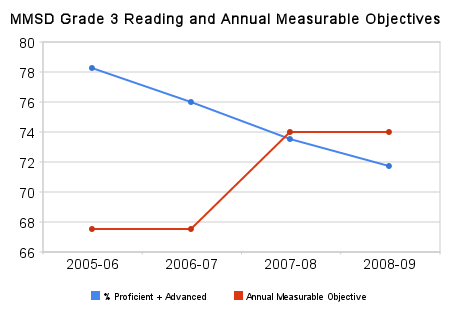
The “Annual Measurable Objectives” under No Child Left Behind for Wisconsin call for all students to achieve reading levels of proficient or better under the WKCE by the 2013-14 school year. Benchmarks toward that goal are phased in over time. The current intermediate goal (ending this school year) is 74%. (Put another way, the percentage of students who are below proficient should not exceed 26%.) The goals move up to 80.5% in 2010-11, 87% in 2011-12, and 93.5% in 2012-13.
71.7% of MMSD 3rd graders scored at or above the proficient level on last year’s (November 2008) WKCE reading assessment (this and the rest of the WKCE data cited here are from the DPI web site). This did not quite meet the 74% Annual Measurable Objective. We should be concerned that achievement levels are going down even as achievement targets are going up:
mmsd_grade_3_reading_and_annual_measurable_objectives(2).png
The Annual Measurable Objectives also apply to demographic subgroups, including economically disadvantaged students. Economically disadvantaged students—whose futures are almost wholly dependent on the ability of their schools to teach them to read—and their achievement levels deserve particular attention.
How well are we teaching our children from low-income families to read?
%below_proficient_wkce_reading_-_economically_disadvantaged_3rd_graders.png
Can we continue to explain/excuse/blame poverty rates for this failure?
%_of_economically_disadvantaged_3rd_grade_students.png
What should we do to acknowledge and address this crisis?

Share

Austin, TX School District Budget Survey

Austin Independent School District:

Budget Shortfall: The district is facing a budget shortfall of $15M for FY 2010-11 just to cover normal operating expenses. This deficit grows even larger when additional budget increases are considered for new Instructional programming tied to the District’s Strategic Plan and employee raises. The district is now contemplating various budget reduction proposals to assist in closing the budget gap for FY 2010-11. The District would like to obtain your input and feedback to the proposals that are currently being considered.
The Efficiency Study: In August 2008, the Board of Trustees commissioned an efficiency study that was conducted in May 2009. The study recommended a number of cost savings proposals to assist the District in making budgetary cuts. The District implemented nearly a quarter of the proposed recommendations from the report. A number of the proposals were rejected due to the severity of impact that would have occurred at local schools. Please click on the link: Budget Survey.

Share

School district, Austin Education Association reach contract agreement: no salary increases and no benefit changes for two years

Rachel Drewelow:

Austin Public School (APS) District and the Austin Education Association announced Wednesday that they have reached a contract agreement.
The agreement includes no salary increases and no changes to insurance for the duration of the contract — the 2009-2010 and 2010-2011 years. Approximately 85 percent of association members voted this week. Of voters, 91 percent voted yes to ratify the new contract.>

Related: Madison School District & Madison Teachers Union Reach Tentative Agreement: 3.93% Increase Year 1, 3.99% Year 2; Base Rate $33,242 Year 1, $33,575 Year 2: Requires 50% MTI 4K Members and will “Review the content and frequency of report cards”.

Share

Rural school districts using 4-day weeks to save funds

Tom Weber:

When it rained in northern Minnesota a few weeks ago, water leaked into a room in Blackduck High School where students had stored art projects just a few hours earlier. Every project was damaged.
The school district is considering asking voters to approve higher taxes to raise $500,000 to repair the roof. But Superintendent Bob Doetsch is sure that voters would only agree to pay more if they’re convinced the district has done everything possible to save money.
To cut costs, the rural Blackduck, Warroad and Ogilvie school districts decided four months ago to implement a four-day school week as did the MACCRAY district did last year. The four districts say the change hasn’t solved their budget woes, but the shorter week helped. That’s attracted the attention of school officials elsewhere in Minnesota who are considering the change.

Share

City Schools’ New Criteria for Diversity Raise Fears

Crystal Yednak & Darnell Little:

The Chicago public schools’ response to a recent court desegregation ruling — a plan to use students’ social and economic profiles instead of race to achieve classroom diversity — is raising fears that it will undermine the district’s slow and incremental progress on racial diversity.
Chicago schools, like the city itself, are hardly a model of racial integration. But a Chicago News Cooperative analysis of school data shows the district has made modest gains in the magnet, gifted, classical and selective-enrollment schools, where, for nearly 30 years, race has been used as an admission criterion. Those advances may be imperiled in the wake of court rulings that have prompted Chicago Public Schools to look for factors other than race when assigning students to such schools.
Nationwide, court rulings have prompted school districts to seek creative ways to diversify classrooms without using a student’s race as a factor. In Chicago, school officials last week moved ahead with their own experiment.
Instead of race as an admissions factor, they now will use socioeconomic data from the student’s neighborhood — income, education levels, single-parent households, owner-occupied homes and the use of language other than English as the primary tongue — in placing children in selective-enrollment schools.

Share

‘Virtual schools’ gain popularity in Duluth

Minnesota Public Radio:

With the radio playing softly in the background and munching on spoonfuls of noodles and cheese, Maria Vespa sat at her family’s kitchen counter to take her geography mid-term on a recent afternoon.
The 15-year-old stared intently at her computer screen as test questions popped up. She’d study each for a minute, take another bite of lunch and click on an answer. When she got stumped, she pulled out her notebook.
“That’s one of the great things about online school,” Maria said. “You get to use your notes when you’re taking tests.”
Another great thing about online school: instant grades. A few moments after Maria answered the last test question, her score popped up.
“I got a B,” she said. “I would have loved an A, but a B is still pretty good.”

Share

How teacher pay should work

Tom Vander Ark:

Kim Marshall’s December 16 EdWeek commentary attempts to “demolish the argument for individual merit pay.” He makes good points that suggest that individual bonuses based solely on value-added test scores are not a good idea. He suggests, instead, team-based bonuses and more pay for master teachers.
There’s an alternative in between that most big organizations and it works like this:

  • In collaboration with peers and a manager, a Personal Performance Plan, sets out objectives for the year. For a teacher these objectives may include several objective assessments, but would also include team contributions, and a personal growth plan.
  • A pool for merit increases is set based on the financial health of the organization and cost of living (let’s assume an annual target of 2.5%)
  • Quarterly conversations about performance are summarized in a year end document.
  • Merit increases would range from 0% for teachers that accomplished few objectives and 5% for teachers that exceeded expectations.

Share

Gov. Patrick talks education reform at charter school in Norwell

Dana Forsythe:

Norwell had an important visitor this past week.
Bay State Gov. Deval Patrick stopped by the South Shore Charter Public School on Friday (Dec. 18), where he held an on-location cabinet meeting and used the opportunity to talk up his education reform bill.
Patrick and his cabinet met with the students and staff at the charter school and talked with Pru Goodale, the school’s executive director, about the school’s initiatives to diversify education through various programs.
“The South Shore Charter School is helping students thrive and opening up worlds of opportunity for them,” Patrick said. “All children deserve the same chance at a world-class education and that’s what our reform package will give them.”

Share

Alderman Jim Bohl’s MPS Compromise

The Milwaukee Drum:

With competing plans for governing the Milwaukee Public Schools now petering out in Madison, I’m suggesting a modest compromise that gives each side something it wants.
First, give the Mayor of Milwaukee the ability to appoint the MPS Superintendent. The superintendent would be confirmed by the Common Council, and after confirmation, would serve at the pleasure of the mayor.

Share

4k-8 study Monona Grove School District Report

Peter Sobol:

At last nights board meeting former Winnequah Principal Patty McGuinness presented the results of the 4k-8 study commissioned by the board last summer. The report detailed the costs of implementing 4k-8 grade configurations in each community. The proposed configuration would require significant changes to Winnequah school to accomodate programming for Monona 3-8th grade students and some changes to Glacial Drumlin to shift CG 4th graders into the building.
The report (I’ll link it here when it is up on the district website) was very thorough, and I found it a useful exercise to see all the costs and factors that go into making a school laid out in one place. It is worth a read on that basis. One issue identified from the study was that the scheduling wouldn’t work with the current encore staff and additional staffing would be required. These additional requirements hadn’t been worked out, but they would add to the costs included the study.

Complete Report: 5MB PDF.

Share

Child care quality studied Better early education would benefit region, but at double the cost

Erin Richards:

Southeastern Wisconsin could benefit economically by increasing the quality of early childhood education centers, but doing so presents a daunting tradeoff: more than doubling the expense of caring for infants and young children up to age 5.
A three-year study by Public Policy Forum researchers released Tuesday found that a system of high-quality early childhood education programs would cost about $11,500 per child, per year.
In the current system, child care providers are estimated to spend about $5,625 per child annually.
The new report relies on research showing a correlation between high-quality early learning experiences and higher rates of achievement in school, especially for disadvantaged children.
The analysis for policy-makers includes the economic pros and cons of maintaining the status quo, funding a variety of mid-level improvements and implementing a high-quality system of early childhood education across southeastern Wisconsin, said Anneliese Dickman, research director at the Public Policy Forum.

Complete 1MB PDF Report.

Share

Rotherham: Detroit schools are on a slow reform path

Andrew Rotherham:

Call it the soft bigotry of low expectations. As pressure increases on teachers unions to mend their ways and become better partners in school reform, the bar for what constitutes meaningful change seems to be getting lower.
In October, the New Haven (Conn.) Federation of Teachers agreed to a new labor agreement that was hailed by both American Federation of Teachers President Randi Weingarten and Secretary of Education Arne Duncan as a breakthrough and national model. Yet the contract was actually a set of promises and processes to potentially undertake reforms after more discussion and mutual agreement.
Maybe the union was playing for time to make more reform-oriented deals away from the crucible of a labor negotiation. Critics were not buying it and argued the entire thing was a ploy. We’ll know who was right by next summer.

Share

High School’s Last Test: Ratcheting Up Accountability in Grade 13

JB Schramm E. Kinney Zalesne:

But the real revolution, tucked away in the Race to the Top guidelines released by the Department of Education last month, is that high school has a new mission. No longer is it enough just to graduate students, or even prepare them for college. Schools must now show how they increase both college enrollment and the number of students who complete at least a year of college. In other words, high schools must now focus on grade 13.
To be sure, this shift is long overdue. It has been a generation since a high school diploma was a ticket to success. Today, the difference in earning power between a high school graduate and someone who’s finished eighth grade has shrunk to nil. And students themselves know, better even than their parents or teachers, according to a recent poll conducted by Deloitte, that the main mission of high school is preparation for college.
Still, this shift will be seismic for our nation’s high schools, because it will require gathering a great deal of information, and using it. And at the moment, high school principals know virtually nothing about what becomes of their graduates. Most don’t even know whether their students make it to college at all.

Share

Pittsburgh Mayor Strikes a Deal to Abandon Tuition Tax

Ian Urbina:

In what he described as a “leap of faith,” Mayor Luke Ravenstahl of Pittsburgh agreed on Monday to shelve his plans for the nation’s first tax on college tuition in exchange for an increase in voluntary contributions from local colleges and universities to the city.
City officials said the mayor also had a promise from university officials to help lobby state lawmakers in Harrisburg for changes to enable the city to raise certain taxes and fees.
“This is a leap of faith for us all; the future of our city and of our citizens is riding on it,” Mr. Ravenstahl said. “But it is a leap of faith that, if successful, will result in the revenue, $15 million annually, that Pittsburgh needs to solve our legacy cost problem.”
City and university officials declined to offer details about the commitment, but at a joint news conference on Monday morning, officials from the University of Pittsburgh and Carnegie Mellon University said they had pledged to make larger voluntary donations to the city than they did from 2005 to 2007. In addition, some local corporations, including the insurer Highmark, are contributing additional money.

Share

In many area school districts, a need for painful financial cuts

Gayle Worland:

When the Stoughton Area School District shuttered its Yahara Elementary School last June because of declining enrollments, shrinking funds and a failed school referendum in 2005-06, the total $1 million cost savings was meant to help balance the district’s books into the next decade.
But despite that move, plus 68 staff layoffs and reduced bus routes in recent years, the district now faces another gap — of $3 million over the next three years — and the school board is considering taking a referendum to voters in April.
“The sense was that we would be okay for the 2010-11 school year,” former Yahara principal Cheryl Price, now principal of the new Sandhill Elementary School, said of Yahara’s closing. “They knew that this was one fix. But we thought we had a couple of years” without having to make more drastic cuts.
Those cuts could range from more staff reductions, increasing class sizes, raising athletic fees and eliminating talented and gifted programming.

Related: K-12 Tax & Spending Climate.

Share

Reading Recovery: Effectiveness & Program Description

US Department of Education, Institute of Education Sciences, via a kind reader’s email:

No studies of Reading Recovery® that fall within the scope of the English Language Learners (ELL) review protocol meet What Works Clearinghouse (WWC) evidence standards. The lack of studies meeting WWC evidence standards means that, at this time, the WWC is unable to draw any conclusions based on research about the effectiveness or ineffectiveness of Reading Recovery® on ELL.
Reading Recovery® is a short-term tutoring intervention designed to serve the lowest-achieving (bottom 20%) first-grade students. The goals of Reading Recovery® include: promoting literacy skills; reducing the number of first-grade students who are struggling to read; and preventing long-term reading difficulties. Reading Recovery® supplements classroom teaching with one-to-one tutoring sessions, generally conducted as pull-out sessions during the school day. The tutoring, which is conducted by trained Reading Recovery® teachers, takes place for 30 minutes a day over a period of 12 to 20 weeks.

Related: 60% to 42%: Madison School District’s Reading Recovery Effectiveness Lags “National Average”: Administration seeks to continue its use.

Share

Arbitrator issues pay proposals for Calvert teachers

Christy Goodman:

An arbitrator recently released recommendations to help end an impasse over the current school year’s contract between the Calvert County Board of Education and the teachers union.
At issue are the terms of the third year of the teachers’ three-year contract. The board suggests a 0.5 percent cost-of-living adjustment, but the Calvert Education Association wants a 4.5 percent increase.
M. David Vaughn of the American Arbitration Association met with a member of the board and the union and recommended that the teachers receive a one-time payment of 1 percent of salary and that a sick leave bank be established.
The board and the teachers are working under the assumptions that all step increases would remain, and a 1.1 percent lump sum increase was included for employees at the highest tiers of the pay scale.

Locally: Madison School District & Madison Teachers Union Reach Tentative Agreement: 3.93% Increase Year 1, 3.99% Year 2; Base Rate $33,242 Year 1, $33,575 Year 2: Requires 50% MTI 4K Members and will “Review the content and frequency of report cards”.

Share

Homework-tracking Web sites won’t work without teacher input

Jay Matthews:

My former Post colleague Tracy Thompson has two daughters in a Washington area school district. I promised not to say which one. It doesn’t matter, because the issue she raises involves all high-tech schools, of which we have many.
People aren’t using the new Web features designed to help families. Is it because parents like me are technophobes? Not entirely. The reluctant participants who concern Thompson are teachers.
Both of Thompson’s kids have attention-deficit hyperactivity disorder. They have trouble getting their work done. Her school district, like several in the area, has Web sites on which parents can see their children’s assignments. That way, they cannot be fooled by sly evasions when they ask their children, sitting in front of the TV, whether they have any homework.
Thompson was delighted to discover the Web homework schedules when her older daughter was a sixth-grader. Disappointment followed, she said, when “I found out only about half of her teachers used it. Some teachers were weeks behind in updating the info. My older daughter is off to high school next year and has matured amazingly over the past three years, so I don’t have to worry that much about her stuff anymore. But now my younger daughter is in third grade, and I am in my second year of trying to get her teachers to use the Web.”

Related Infinite Campus and the Madison School District. Read the Middle School Report Card Report, which includes information on the District’s use of Infinite Campus.

Share

Race to the Top: View from Monona Grove

Peter Sobol:

The district received an initial solicitation from the state DPI regarding “Race to the top” funds. The race to the top funds will be divided into two parts, with half of the funds going to districts that agree to implement programs in 5 areas outlined in the memorandum:

Share

Michigan urban school districts get most stimulus help

AP:

As Michigan school districts fight to cope with state cuts, urban districts have a fallback their suburban and rural counterparts are less likely to get: direct grants from the federal stimulus package.
Schools in low-income areas such as Detroit, Grand Rapids and Flint are getting direct grants from the Recovery Act that easily exceed the cuts of at least $165 per student districts will lose in state aid this fiscal year.
Wealthier suburban districts are getting far less direct help from the stimulus package. That leaves them with fewer sources to tap to avoid teacher layoffs and program cuts that some districts could see starting in January.
Detroit schools are “aggressively pursuing” the Recovery Act cash, spokesman Steven Wasko said. The district expects to receive roughly $800 million over more than two years from all sources of the broad program, including money that could help the district reduce class sizes and build or remodel schools.

Share

DPS union must partner in school reform

Rochelle Riley:

Enough talk about a teacher’s strike.
Enough talk about recalling Detroit Federation of Teachers president Keith Johnson, the first president the union has had in a long time who is dealing with the reality of a broke district and broken economy.
In the wake of the DFT ratifying its contract with the district, a minority of unhappy teachers has called for Johnson’s head.
To that vocal minority, let me say two things:
$219 million.
84,000 children.
The first is the school district’s deficit. The second is the number of children who should be at the forefront of all of our thoughts and efforts.

Share

Finally some sense about 21st century skills–part three, the Wagner dialogue

Jay Matthews:

As promised, to end this series on adjusting schools to the new economy, I had an email chat with Tony Wagner, co-director of the Change Leadership Group at the Harvard Graduate School of Education and author of “The Global Achievement Gap: Why Even Our Best Schools Don’t Teach The New Survival Skills Our Children Need–and What We Can Do About It.” We limited ourselves to no more than 100 words per response, to keep it moving. Here goes:
Mathews: I loved your book, as you saw in my review last week. It is the best book ever written about the 21st century skills movement. But why were you so hard on Advanced Placement? There are many AP teachers who think the program is terrific for the typical schools where they work (you focused on some of the tiny upper crust schools that are a different issue) and who are trying to do everything you and I want them to do. Why not see AP (and IB, which is pretty near exactly what you want) as a great platform for change rather than the enemy?

Share

K-12 Tax & Spending Climate: New school, old funding problems

Alan Borsuk:

Conrad Farner is like a guy with a beautiful home and an ugly checkbook.
It’s impossible to escape the irony as the superintendent of Greenfield schools conducts a tour of the community’s high school, where the finishing touches are being put on a $48.5 million overhaul that has turned a building that was literally sinking into the ground and, in serious ways, falling apart, into a showcase.
Handsome classrooms, a spacious gym, great theater, terrific swimming pool, a set of new athletic fields. It’s an impressive setting for the 1,200 students (22% of them not from Greenfield, by the way). Only a few parts of the old high school were kept while the new structure was built around it.
But the subject of our conversation is Farner’s strong warnings that the actual work of education in Greenfield schools is being cut, year by year, in ways that are taking a serious toll.
And, he argues, unless something changes quickly in the way Wisconsin funds schools, Greenfield – along with numerous districts across the state – will reach a point where it will simply not be able to pay its bills or will have to go back to voters seeking operating money beyond the state-set limits.
The district budget this year “is not even close to what our students need,” he said in a presentation to the Greenfield School Board before the budget was adopted. He has a list of 122 positions or services that have been eliminated or reduced since 2002-’03.
Some of them are pretty minor. Some of them are matters of doing business smarter and more efficiently. But some of them affect kids in ways that really matter – fewer teaching specialists, fewer counselors, fewer extra-curricular activities. The ratio of students to teachers has risen in Greenfield from 13.8 in 2004-’05 to 15.9 this year, a sizable jump.

Share

Progressive Dane Endorses Beth Moss for Madison School Board

Progressive Dane:

At the December 16, 2009 general membership meeting, Madison Board of Education Member Beth Moss and County Board Supervisors John Hendrick, Al Matano, Kyle Richmond and Barbara Vedder were enthusiastically endorsed for re-election.

Share

‘Duplicitous and Shameful’ Democrats vote to send poor kids to inferior schools.

Wall Street Journal:

The waiting is finally over for some of the District of Columbia’s most ambitious school children and their parents. Democrats in Congress voted to kill the District’s Opportunity Scholarship Program, which provides 1,700 disadvantaged kids with vouchers worth up to $7,500 per year to attend a private school.
On Sunday the Senate approved a spending bill that phases out funding for the five-year-old program. Several prominent Senators this week sent a letter to Majority Leader Harry Reid pleading for a reconsideration. Signed by Independent-Democrat Joe Lieberman, Democrats Robert Byrd and Dianne Feinstein, and Republicans Susan Collins and John Ensign, it asked to save a program that has “provided a lifeline to many low-income students in the District of Columbia.” President Obama signed the bill Thursday.
The program’s popularity has generated long waiting lists. A federal evaluation earlier this year said the mostly black and Hispanic participants are making significant academic gains and narrowing the achievement gap. But for the teachers unions, this just can’t happen. The National Education Association instructed Democratic lawmakers to kill it.

Share

Are we dumbing down 9th grade physics?

Jay Matthews:

I am keeping my weekly Extra Credit column alive on this blog with occasional answers to reader questions, the format of that column I did for many years in the Extras before they died. This teacher, Michael Feinberg (no relation to the co-founder of the KIPP schools with the same name), sent me a copy of an intriguing letter about physics he sent to the Montgomery County school superintendent, and agreed to let me get an answer and use it here.
Dear Dr. Weast:
I am a retired MCPS teacher; I taught Physics at both Kennedy H.S. and Whitman H.S. until the time that I retired in 2005. After retirement I have, on occasion, tutored Physics students.
When the 9th grade Physics curriculum was introduced I opposed it on the grounds that Physics should be taught at a higher mathematical level. While tutoring students in both grades 9 and 11/12 I see that this is true; students in 11th grade learn rigorous Physics with mathematical applications while students in 9th grade usually do descriptive worksheets. I believe that it unfair that students in 9 th grade receive the same honors credit for what is promoted as the same curriculum but is not the same.

Share

90 cameras to be installed outside Chicago Public schools

Fran Spielman:

Ninety cameras will be installed outside Fenger and 39 other Chicago Public high schools to stop what Mayor Daley called the ugly “epidemic of children killing children,” thanks to a $2.25 million gift from the banking giant that employs the mayor’s brother.
Last year, a bloody weekend for CPS students prompted Daley to link 4,844 cameras inside schools and 1,437 exterior school cameras to police districts, squad cars and the 911 center. Until that time, real-time video from school cameras was accessible only to school security.
Thanks to J.P. Morgan Chase, where William Daley serves as Midwest chairman, 40 more high schools will get exterior cameras. They include Fenger, where 16-year-old Derrion Albert was beaten to death in September during a brawl captured on videotape and played around the world.
Another camera will be installed outside Walter H. Dyett High School, 555 E. 51st St., where two students have been murdered this year.

Share

Wisconsin risks stumbling in ‘Race to Top’

University of Wisconsin School of Education Dean Julie Underwood:

President Barack Obama spoke at Wright Middle School in Madison last month and urged our nation to make improving K-12 education a national priority.
The president underscored the critical link between improving education and our nation’s future economy. He called for our schools to push all students to achieve at higher levels.
The president also spoke about our need to raise the bar for student achievement and to close existing achievement gaps. He is offering the states $4.35 billion in competitive “Race to the Top” grants to try to spur improvement.
His call for reform comes at a critical time for our schools. Our graduates face an increasingly competitive world. The future of our state rests on our ability to prepare our students with the knowledge and skills necessary to succeed.
In recent years, however, the real struggle in Wisconsin has been in maintaining the quality public school system created by previous generations. Our public schools operate under a financial system that chokes reform and chips away at quality.

Underwood’s School of Education has a close relationship with the Madison School District via grants and other interactions. Former Madison Superintendent Art Rainwater now works for the School along with former Administrator Jack Jorgenson. Underwood attended the 2008 Madison Superintendent candidate public appearances.

Share

Los Angeles Unified often hands out tenure with little or no review of novice instructors’ ability or their students’ performance.

Jason Felch, Jessica Garrison & Jason Song:

It is a chance L.A. Unified all but squanders, according to interviews with more than 75 teachers and administrators, analyses of district data over the last several years, and internal and independent studies. Among the findings:

  • Nearly all probationary teachers receive a passing grade on evaluations. Fewer than 2% are denied tenure.
  • The reviews are so lacking in rigor as to be meaningless, many instructors say. Before a teacher gets tenure, school administrators are required to conduct only a single, pre-announced classroom visit per year. About half the observations last 30 minutes or less. Principals are rarely held responsible for how they perform the reviews.
  • The district’s evaluation of teachers does not take into account whether students are learning. Principals are not required to consider testing data, student work or grades. L.A. Unified, like other districts in California, essentially ignores a state law that since the 1970s has required districts to weigh pupil progress in assessing teachers and administrators.

Share

Education Secretary Arne Duncan calls himself a big fan of National Board Certification for Teachers. “What if every child had a chance to be taught by a National Board Certified teacher? I think the difference it would make in our students’ lives woul

Birmingham News:

U.S. Education Secretary Arne Duncan calls himself a big fan of National Board Certification for Teachers.
“What if every child had a chance to be taught by a National Board Certified teacher? I think the difference it would make in our students’ lives would be extraordinary,” he said recently.
Unfortunately, every child doesn’t have that chance. In fact, most don’t. But a growing number of teachers nationally and in Alabama are becoming board certified.
Nationally, more than 82,000 teachers are board certified, with nearly 8,900 joining the ranks this year. Alabama has 233 newly certified teachers, bringing the state’s total to 1,781, the National Board for Professional Teaching Standards announced Wednesday. Alabama ranks 11th nationally in the number of teachers board certified this year, and 13th in the total number of certified teachers.

Share

We need best education at least cost

Thomas Wasco:

I applaud the work of the Board of Education in their efforts to downsize the district’s infrastructure. During my service on the board, I learned how difficult that process can be when various factions of the community come before the board pleading to save their favorite schools. In fact, many current board members have campaigned for their buildings in the past. They cited educational studies praising the positive influences of small neighborhood schools and how important it was to maintain the configuration at that time. It appears they have now come to realize instead that what they once called warehousing of students does not lead to an adverse learning environment and that larger schools can indeed contribute to student success. That observation is supported by their decision to replace the plan that placed 400 students in each of six buildings to one that has three buildings with approximately 500 students and three with many fewer students.
Now the public is being asked to spend millions on four buildings Ridge Mills, John Joy, Denti and Gansevoort. I suggest that the board reconsider the proposition and look to renovate three buildings. Instead of closing Ridge Mills, they could close both Ridge Mills and John Joy that currently serve a total of 481 students. The combination would still be smaller in size than either Denti or Bellamy (about 500 and 485 students, respectively). The board can renovate either one of the closed buildings and reopen it to provide adequate space for their students and result in one less building for the district to maintain.

Share

A Plan for California’s Failing Schools

Marisa Lagos:

Parents would be able to yank their children out of failing schools and ask any other school in the state to admit them under a compromise bill approved Thursday by the state Senate.
That change and other proposals are part of the state’s plan to compete for President Obama’s Race to the Top grants – up to $4.3 billion for all states and as much as $700 million for California alone.
States have until next month to apply for the federal grants, but political fighting over how to make California as competitive as possible has killed two competing proposals and left little time before the Jan. 19 application deadline.
To qualify, states have been asked to demonstrate a commitment to education reform. Under the bill, California would establish specific plans for failing schools, including closing a school, dismissing the principal and up to half of the teachers, or allowing the school to become a charter school.

Share

More Michigan – Funky Rubber Room!

Andrew Rotherham:

Yesterday we checked in on the Race to the Top debate in Michigan. Today, Detroit News editorial writer and columnist Amber Arellano writes up a guest post on the debate in Motown over the possible arrival of “rubber rooms,” which as we’ve noted on this blog aren’t as fun as the name implies.

Detroit’s New Rubber Room

New York City’s embarrassment is Detroit’s education reform “revolution”

This month the Detroit Public Schools posted the lowest student achievement results in the 40-year history of the NAEP. Educators began weeping when briefed on the news. And city charter schools, once Motown’s hope for change, on average are performing just as terribly as the school district.

As if Detroit’s education reputation couldn’t get any worse, consider: a new teachers’ contract, if ratified today, would create Detroit’s first Rubber Room.

Share

Milwaukee School Board Approves Condom Giveaways

Tom Kertscher:

Without discussion, the Milwaukee School Board voted 7-0 Thursday night to make condoms available at many of the city’s high schools, paving the way to make Milwaukee Public Schools one of the relatively few districts in the nation to provide contraception to students.
The communicable disease prevention program, as the district calls it, could be in place as soon as the 2010-’11 school year.
The proposal sparked some opposition after being made public Dec. 2, but the board approved the condom distribution without much dissent. Comments from the public are not allowed at board meetings and a board committee had voted 5-0 on Dec. 9 to recommend adopting the program.
The condoms will be available free of charge, but only to students in high schools that have school nurses and only after students request them at the nurse’s office, according to a fact sheet circulated by the school district. Up to two condoms will be distributed at a time.
Thursday’s vote does not authorize funding for the program, but the district has said it will not use taxpayer money to buy condoms and instead will seek other sources of funding.

Somewhat related: biggovernment.com and mediamatters.org have been going back and forth on Obama Administration “safe school czar” Kevin Jenning’s K-12 sex education activities.

Share

The Explosion of Charter Schools in America

US News & World Report:

With 809, California leads the nation in the number of charter schools. In less than 20 years, the education activists have started nearly 5,000 of these institutions, which are publicly financed and free for students to attend but independently operated.

Share

A reason to hope for better schools

St. Petersburg Times:

They are two of the clearest reasons to be both discouraged and hopeful about public education in Tampa Bay. The wide disparities in passing rates for Advanced Placement exams, often within the same high school, indicate a failure by district superintendents and school principals to hold teachers accountable for performance. Looking forward, a $100 million grant to Hillsborough schools by the Gates Foundation offers a wonderful opportunity to improve teacher training and match salaries to more sophisticated measures of performance. The bold experimentation in Hillsborough could show the way to address the sorts of shortcomings exposed by the analysis of AP exams.
There are more immediate steps that can be taken to address a system that rewards schools for increasing the number of students taking AP exams but ignores teachers with ridiculously low exam passing rates. The state should proceed with plans to put more weight on passing rates in evaluating high schools. The schools should re-examine their policies that encourage even unprepared students to take college-level AP classes. Students should be challenged with rigorous courses, but it is a disservice to admit those who have virtually no chance to grasp the material well enough to pass the exam. That is a waste of time and taxpayers’ money.

Share

Wisconsin Race to the Top: Governor/DPI Letter and “Memorandum of Understanding”

via a kind reader’s email; Letter from Governor Doyle and Department of Public Instruction Superintendent Tony Evers [107K PDF]:

We are excited to invite you to participate in Wisconsin’s Race to the Top application to the federal government. Through the American Recovery and Reinvestment Act, President Obama and Congress provided $4 billion in competitive grant funding to states that move forward with innovations and reform in education.
Earlier this fall, at our request, the Wisconsin Legislature passed bills to make Wisconsin both eligible and more competitive for the Race to the Top grants. Now our local school district leaders – school board members, superintendents, principals, teachers, and other staff – need to prepare their district for participation in Wisconsin’s grant application. Enclosed is the Race to the Top district memorandum of understanding (MOU) that the federal government requires participating districts to sign as part of the state’s Race to the Top grant application. The MOU provides a framework of collaboration between districts and the state articulating the specific roles and responsibilities necessary to implement an approved Race to the Top district grant.
The MOU is divided into two parts – Exhibit I and Exhibit II. To receive any Race to the Top funding, a district must agree to the activities in Exhibit I. Districts that agree to Exhibit I are eligible, if they so choose, to participate in Exhibit II. In Exhibit II districts will receive additional funding for participating in the additional activities. Exhibit I is included in this information and Exhibit II will be forthcoming in the very near future.

“Memorandum of Understanding” [208K PDF]:

I’m told that Madison’s potential intake of “Race to the Top” funds is less than 1% of the current $400MM budget.
Related: US National Debt Tops Debt Limit.

Share

Book Whisperer: Are good readers born or made?

Donalyn Miller via Valerie Strauss:

My guest today is Donalyn Miller, a sixth-grade language arts teacher in Texas and literacy expert. She is the author of “The Book Whisperer: Awakening the Inner Reader in Every Child,” and writes about literacy for teachermagazine.org.
By Donalyn Miller
A recent Carnegie Mellon University research study indicates that children engaged in a 100-hour intensive reading remediation program improved both their reading ability and the white matter connections in their brains.
While the study shows promise for educators and clinicians who work with developing readers, one casual mention in the study stood out for me– the 25 children designated as “excellent readers” in the control group still outperformed the 35 third and fifth graders who participated in the remediation program.
The widespread belief that some readers possess an innate gift, like artists or athletes, sells many children short. I often hear parents claim, “Well, my child is just not a reader,” as if the reading fairy passed over their child while handing out the good stuff.

Share

Beyond the Classroom: Using Title IX to Measure the Return to High School Sports

Betsey Stevenson [317K PDF]:

Previous research has found that male high school athletes experience better outcomes than non-athletes, including higher educational attainment, employment rates, and wages. However, students self-select into athletics so these may be selection effects rather than causal effects. To address this issue, I examine Title IX which provides a unique quasi- experiment in female athletic participation. Between 1972 and 1978 U.S. high schools rapidly increased their female athletic participation rates–to approximately the same level as their male athletic participation rates–in order to comply with Title IX. This paper uses variation in the level of boys’ athletic participation across states before Title IX as an instrument for the change in girls’ athletic participation over the 1970s. Analyzing differences in outcomes for both the pre- and post-Title IX cohorts across states, I find that a 10-percentage point rise in state-level female sports participation generates a 1 percentage point increase in female college attendance and a 1 to 2 percentage point rise in female labor force participation. Furthermore, greater opportunities to play sports leads to greater female participation in previously male-dominated occupations, particularly for high-skill occupations.

Share