School Information System

Generation net: The youngsters who prefer their virtual lives to the real world

Liz Thomas:

Children are often happier with their online lives than they are with reality, a survey has revealed.
They say they can be exactly who they want to be – and as soon as something is no longer fun they can simply hit the quit button.
The study also shows that, despite concerns about online safety, one in eight young people is in contact with strangers when on the web and often lies about their appearance, age and background.
Researchers for children’s charity Kidscape assessed the online activities of 2,300 11- to 18-year-olds from across the UK and found that 45 per cent said they were sometimes happier online than in their real lives.
The report – Virtual Lives: It is more than a game, it is your life – lays bare the attitudes of children today to the internet and includes revealing insights into how they feel when they are on the web.
Share

Charter Location Influences Sustainability

Tom Vander Ark:

Andy Rotherham just published a report with obvious conclusions: sustainability is impacted by location. More specifically, if you open a charter in California, you will spend a lifetime begging for money.
Find the New paper on charter school finance from Bellwether out today (pdf). Press release can be found here and The Wall Street Journal editorial page weighs-in on it here.
Andy summarizes:

Share

Data indicates 5 percent of Rochester graduates ready for college, careers

Erinn Cain:

The New York State Education Department has released data that it said indicates that not all students graduating high school are prepared to enter college or careers.
The data compares graduation rates versus college- and career-ready graduation rate calculations for general education students who entered ninth grade in the 2005-06 school year, through June 2009.
General education graduation requirements for a local diploma include a score of 65 or better on two Regents exams and 55 or better on three Regents exams. The designation of college- and career-ready is defined by graduates who received at least an 80-percent grade on the math Regents exam and 75 on the English Regents exam.
In Rochester, there was a 46.6 percent graduation rate, with only 5.1 percent of graduates being college- and career-ready, said state education officials. This compares to 49.5 and 14.7 percent, respectively, in Syracuse, and 64.5 and 22.8 percent in New York City.

Share

Michigan Board of Education raises proficiency scores for MEAP and MME

Kyle Feldscher:

Don’t be surprised if a surprising number of Michigan school districts fall short of proficient scoring after next year’s round of standardized state testing.
The Michigan Board of Education approved higher cut scores, or scores that mark proficiency, for both the Michigan Educational Assessment Program (MEAP) and Michigan Merit Exam (MME) tests at a board meeting Tuesday. According to experts, the new standards will be more honest about how well students are doing on the tests.
“It’s going to make a real difference in the share of kids who are being labeled proficient and in the share of schools passing AYP (Adequate Yearly Progress),” said Susan Dynarski, associate professor of economics, education and public policy at the University of Michigan. “Michigan has been Lake Woebegone — right now 95 percent of our third graders are labeled as proficient in math and under the new standards, it would become 34 percent.”

Share

Laura Bush to announce 2nd education initiative from Bush Institute

Jamie Stengle:

The George W. Bush Institute’s second big education initiative will seek to improve graduation rates by focusing on middle school as a foundation for future success.
Former first lady Laura Bush is set to announce the initiative, called “Middle School Matters,” Wednesday in Houston at Stovall Middle School in the Aldine school district.
She says research has shown that 6th through 8th grade is a crucial time and that many high school dropouts essentially dropped out in middle school. One goal will be to ensure students are prepared for high school.

Share

Spotlight on LIFO in New York

Elizabeth Ling:

No one wants the big teacher layoffs that most analysts say are inevitable under our current state budget crisis. But many of us are very concerned that if such layoffs are necessary, the state’s “last in, first out” rule will mean that many of our best teachers will be forced out regardless of their qualifications and effectiveness. This could be particularly devastating for schools in high-poverty neighborhoods, where teachers tend to have fewer years of experience
A new poll shows that a majority of New Yorkers disapprove of the state’s “last in, first out” (LIFO) law that forces schools to fire the most recently hired teachers during a budget crisis, regardless of teacher quality

Share

New Wisconsin school medication rules tie hands

Bill Lueders:

Beginning March 1, public schools in Madison and across the state will be constrained in their ability to dispense medication to students and respond to health emergencies.
“Our options are now limited,” says Freddi Adelson, the Madison district’s health services coordinator.
The changes, crafted by the state Department of Public Instruction and passed by the Legislature last year, set stricter rules for dispensing medications at school than current district policy.
For instance, Madison schools now let school nurses dispense acetaminophen or ibuprofen to the students of parents who give written permission. The new rules say schools can dispense only medications

Share

Mansfield Arabic Program On Hold

CBS DFW:

A Mansfield ISD program to teach Arabic language and culture in schools is on hold for now, and may not happen at all.
The school district wanted students at selected schools to take Arabic language and culture classes as part of a federally funded grant.
The Foreign Language Assistance Program (FLAP) grant was awarded to Mansfield ISD last summer by the U.S. Department of Education.
As part of the five-year $1.3 million grant, Arabic classes would have been taught at Cross Timbers Intermediate School and other schools feeding into Summit High School.
Parents at Cross Timbers say they were caught off-guard by the program, and were surprised the district only told them about it in a meeting Monday night between parents and Mansfield ISD Superintendent Bob Morrison.

Share

K-12 Tax & Spending Climate: For Federal Programs, a Taste of Market Discipline

David Leonhardt::

Wouldn’t it be nice if taxpayers could somehow get a refund for government programs that didn’t work?

Instead, the opposite tends to happen. Programs that fail to make a difference — like many of those that train workers for new jobs — endure indefinitely. Often, policy makers don’t even know which work and which don’t, because rigorous evaluation is rare in government. And competition, which punishes laggards in the private sector, is typically absent in the public sector.

But there is some good news on this front. Lately, both American and British policy makers have been thinking about how to bring some of the competitive discipline of the market to government programs, and they have hit on an intriguing idea.

Share

Wisconsin Teachers’ Union Proposed Education Reforms

Wisconsin Education Association Council:

State officers of the Wisconsin Education Association Council (WEAC) today unveiled three dramatic proposals as part of their quality-improvement platform called “Moving Education Forward: Bold Reforms.” The proposals include the creation of a statewide system to evaluate educators; instituting performance pay to recognize teaching excellence; and breaking up the Milwaukee Public School District into a series of manageable-sized districts within the city.
“In our work with WEAC leaders and members we have debated and discussed many ideas related to modernizing pay systems, better evaluation models, and ways to help turn around struggling schools in Milwaukee,” said WEAC President Mary Bell. “We believe bold actions are needed in these three areas to move education forward. The time for change is now. This is a pivotal time in public education and we’re in an era of tight resources. We must have systems in place to ensure high standards for accountability – that means those working in the system must be held accountable to high standards of excellence.”
TEACHER EVALUATION: In WEAC’s proposed teacher evaluation system, new teachers would be reviewed annually for their first three years by a Peer Assistance and Review (PAR) panel made up of both teachers and administrators. The PAR panels judge performance in four areas:

  • Planning and preparing for student learning
  • Creating a quality learning environment
  • Effective teaching
  • Professional responsibility

The proposed system would utilize the expertise of the UW Value-Added Research Center (Value Added Assessment) and would include the review of various student data to inform evaluation decisions and to develop corrective strategies for struggling teachers. Teachers who do not demonstrate effectiveness to the PAR panels are exited out of the profession and offered career transition programs and services through locally negotiated agreements.
Veteran teachers would be evaluated every three years, using a combination of video and written analysis and administrator observation. Underperforming veteran teachers would be required to go through this process a second year. If they were still deemed unsatisfactory, they would be re-entered into the PAR program and could ultimately face removal.
“The union is accepting our responsibility for improving the quality of the profession, not just for protecting the due process rights of our members,” said Bell. “Our goal is to have the highest-quality teachers at the front of every classroom across the state. And we see a role for classroom teachers to contribute as peer reviewers, much like a process often used in many private sector performance evaluation models.”
“If you want to drive change in Milwaukee’s public schools, connect the educators and the community together into smaller districts within the city, and without a doubt it can happen,” said Bell. “We must put the needs of Milwaukee’s students and families ahead of what’s best for the adults in the system,” said Bell. “That includes our union – we must act differently – we must lead.”

Madison’s “value added assessment” program is based on the oft-criticized WKCE examinations.
Related: student learning has become focused instead on adult employment – Ripon Superintendent Richard Zimman.

Share

Study finds funding gap between D.C. specialty and neighborhood schools

Bill Turque:

The two public high schools, 21/2 miles apart in Northwest Washington, serve vastly different student populations. And they do it with vastly different levels of financial support, according to an analysis of school spending by a District advocacy group.
School Without Walls accepts only the city’s most accomplished students after a competitive application process that requires interviews with prospective parents as well. More than 700 students are vying for 120 spots in next year’s ninth-grade class. Those who are admitted will attend classes in a freshly renovated vintage building on the George Washington University campus. District funds per student: $10,257.
Cardozo, near 13th Street and Florida Avenue, is a neighborhood high school that takes all comers in an attendance area that includes about a dozen group homes and homeless shelters. Parole officers and social workers are sometimes the only adults who appear at the school on students’ behalf. The wiring in the cavernous 1916 building was so bad a couple of years ago that when all of the computers were turned on, power in half of the school would go out, said Principal Gwendolyn Grant.
District funds per student: $7,453.

Locally, the Madison School District’s 2010-2011 budget, according to the “State of the Madison School District Report” is $379,058,945. Enrollment is 24,471 which yields per student spending of $15,490.12.

Share

Starving Charters A new study shows the funding bias against non-traditional schools.

The Wall Street Journal:

Look quickly and you might think that charter schools have it easy, given the celebrated documentary “Waiting for ‘Superman,'” the efforts of reformers like Michelle Rhee and Joel Klein, and the support of the Obama Administration. That’s why a report out Tuesday is a needed corrective: It demonstrates how government policies regularly discriminate against charters.
Published by Bellwether Education Partners, a reform-minded advocacy group, the report examines the finances of Aspire Public Schools, a network of 30 California charter schools with 9,800 students from kindergarten through high school. With extended school days and years, innovative curricula and other hallmarks of charter autonomy, Aspire ranks as California’s single best school system serving a majority of very poor students. Yet it operates with margins of only 0.6%, or $60 per student, which make it harder to scrape together funds to open new schools.

Share

High-schoolers’ ‘recess’: Benefit or brain drain?

Jay Matthews:

There is no limit to what you learn about schools if you listen to teachers. Did you know, for instance, that Fairfax County, the Washington region’s largest school district, is using 10 days a year of valuable instruction time on do-what-you-like recesses for high school students?
I didn’t, either. West Springfield High School physics teacher Ed Linz says this program, designed to help struggling students, is a waste. At his school, students get 90 free minutes a week, which they can use to find dates for Saturday night or check basketball scores, if they want. But his principal, Paul Wardinski, says most students do homework, work on group projects and enrich their studies. It helps teachers to be creative, he says, even if some students look for imaginative ways to goof off.
Linz disclosed the recesses to the county School Board last month. Like President Obama, he said that this is our Sputnik moment and that we can’t win the future throwing away precious class time.

Share

More charters, more choices

Baltimore Sun:

Montgomery County is rightly proud of its public school system, which is widely regarded as one of the best in the state. Perhaps that’s why, nearly eight years after state lawmakers passed a law allowing for the establishment of charter schools — alternative institutions that receive public funds but operate independently — the Montgomery County school board has yet to approve a single application to open one.
Is that because no one has come up with a credible plan for a school that would give parents more choices for educating their children? Or is it because local school officials simply don’t want the competition?
The state school board looked into the matter last year, after Montgomery County school officials turned down the applications of two groups that wanted to set up new charter schools in the district. What they found goes a long way toward explaining why school reform advocates like the Washington-based Center for Education Reform have rated Maryland’s charter school law as one of the weakest in the nation. Despite passing important reforms last year regarding lengthening of the time it takes teachers to earn tenure and linking student test scores with teacher evaluations, lawmakers need to take another look at strengthening the state’s charter school law if Maryland is to build on those gains.

Share

Bills assert parents’ right to home school in New Hampshire

Norma Love:

A long-simmering dispute between the state and parents who prefer to teach their children at home is being renewed.
The House Education Committee has scheduled for Tuesday hearings on three bills on home schooling in its largest room, the House chamber. Legislation regulating home schooling has drawn large crowds over the years.
Last month, a divorced couple who couldn’t agree on how to educate their daughter took the fight to the state Supreme Court. The court is being asked if parents have a constitutional right to home school their kids. In this case, the father objected to his wife’s strict Christian teachings and wants their daughter taught at public schools. The mother prefers home schooling.
Home schooling advocates say they want less regulation over what they argue is a parent’s right.

Share

Welcome to our urban high schools, where kids have kids and learning dies.

Gerry Garibaldi:

In my short time as a teacher in Connecticut, I have muddled through President Bush’s No Child Left Behind act, which tied federal funding of schools to various reforms, and through President Obama’s Race to the Top initiative, which does much the same thing, though with different benchmarks. Thanks to the feds, urban schools like mine–already entitled to substantial federal largesse under Title I, which provides funds to public schools with large low-income populations–are swimming in money. At my school, we pay five teachers to tutor kids after school and on Saturdays. They sit in classrooms waiting for kids who never show up. We don’t want for books–or for any of the cutting-edge gizmos that non-Title I schools can’t afford: computerized whiteboards, Elmo projectors, the works. Our facility is state-of-the-art, thanks to a recent $40 million face-lift, with gleaming new hallways and bathrooms and a fully computerized library.
Here’s my prediction: the money, the reforms, the gleaming porcelain, the hopeful rhetoric about saving our children–all of it will have a limited impact, at best, on most city schoolchildren. Urban teachers face an intractable problem, one that we cannot spend or even teach our way out of: teen pregnancy. This year, all of my favorite girls are pregnant, four in all, future unwed mothers every one. There will be no innovation in this quarter, no race to the top. Personal moral accountability is the electrified rail that no politician wants to touch.

Share

Cuomo, Pushing School Cuts, Offers a Target: Superintendent Salaries

Thomas Kaplan:

Carole G. Hankin, the schools superintendent in Syosset on Long Island, made an unexpected cameo appearance in Albany last week: Gov. Andrew M. Cuomo cast her salary as a prime example of wasteful spending by school districts.
Mr. Cuomo did not mention Dr. Hankin by name in his budget address, but he did offer her salary: $386,868, more than the pay of any other superintendent in the state. “I applied for that job,” the governor joked, adding that he had decided to run for governor, which pays $179,000, only after he had been rejected.
Mr. Cuomo’s remarks came as he presented a budget calling for a $2.85 billion reduction in local school aid, a proposal that has already drawn fierce criticism from educators. But the governor offered some criticism of his own for school officials.
Mr. Cuomo, a Democrat, said that school districts had enough means to withstand the decline in state financing, and pointedly suggested that they look at whether they are spending too much on their own bureaucracy.

Share

Wealthy donors demanding bigger voice in Catholic schools

Paul Vitello:

Private philanthropists have changed the face of public education over the last decade, underwriting the rise of charter schools and promoting remedies that rely heavily on student testing and teacher evaluation.
But with much less fanfare, wealthy donors have begun playing a parallel role in the country’s next-largest educational network: Roman Catholic schools.
In New York — as in Boston, Baltimore and Chicago — shrinking enrollment and rising school deficits in recent years have deepened the church’s dependence on its cadres of longtime benefactors. Donors have responded generously, but many who were once content to write checks and attend student pageants are now asking to see school budgets, student reading scores and principals’ job evaluations.
In the jargon of education reform, they want transparency and accountability; and though the church bureaucracy has resisted similar demands from other constituents in the past, the donors are getting pretty much what they want.

Share

Pennsylvania School voucher debate heats up

Mark Scolforo:

Supporters call them a matter of choice, a lifeline for children stuck in broken schools. Opponents deride them as unconstitutional and unworkable and warn that they will erode conditions in some of Pennsylvania’s most troubled schools.
The debate over taxpayer-paid tuition vouchers to help poor children find alternatives to attending the state’s weakest-performing public schools has emerged as a major item on the legislative agenda for the next six months — perhaps the major item after the state budget.
The voucher issue will come to the fore in the General Assembly on Feb. 16, when the chairman of the Senate Education Committee will lead a hearing on his bill to establish the Opportunity Scholarship and Educational Improvement Tax Credit Act.

Share

Brewster Board of Education Addresses Cuomo’s Budget

Katherine Pacchiana:

The board also expressed concern about the $1.3 billion earmarked for education in the federal stimulus package that was supposed to be distributed in addition to the state education budget. Instead, that money was used to substitute for state education allocations.
“This is an alarming trend,” said Board President Stephen Jambor. “While it makes great headlines to blame the schools, it is underhanded to underfund us in the first place. Your state taxes keep going up the hill to Albany. We have to get busy in fighting back because push has come to shove.”
These issues have been detailed in a letter to the governor which was personally delivered by Sandbank. A copy of the letter will be posted on the district’s website.

Share

Duluth school district troubled by downward enrollment

Jana Hollingsworth:

Anna Cook chose online education for her 7-year-old daughter this fall after an unhappy year at Lincoln Park Elementary School, where she said overwhelmed teachers and bullying made traditional school seem like “chaos.”
“I didn’t feel like my child was in a safe situation there,” Cook said. “All I could do was get her out of there.”
Cook is part of a steady stream of people choosing to leave the district. As the School Board prepares to cut $7.3 million from its budget, partly because of declining enrollment, it’s taking a look Tuesday at that number, along with where the students are going and how to get them back.
Red Plan opponents have long said angry families are sending their students in droves to neighboring districts because of the plan. But Cook’s story shows there are a variety of reasons families are seeking education elsewhere, including more choice, smaller class sizes and fresh starts.

Share

HR in public schools fails students

Chris Rickert:

The simplest of conversations, the most important of facts. And yet nearly six years after those images were discovered by the Madison School District, Nelson was a superintendent and had to be caught allegedly trying to solicit sex from what he thought was a 15-year-old boy online before the bizzaro world of public school human resources stood up and took notice.
I am assuming (safely, I really, really hope) that had my imagined exchange occurred, Nelson’s public schools career would have been over. There also does not appear to have been anything contractually or legally to prevent it from occurring.
Madison human resources director Bob Nadler said Nelson had an oral agreement — “not a contract” — under which, in exchange for Nelson’s resignation, the district would disclose nothing more than his dates of employment, position and salary.
These kinds of agreements happened with some frequency, according to Art Rainwater, the superintendent in Madison at the time Nelson was nabbed for porn. As to the exact circumstances surrounding how Nelson was lucky enough to get one and who it was with, well, “I honestly don’t remember,” Rainwater told me.
Not only could Madison have dropped the dime on its very own pervert; state law provides some liability protection for doing so. Employers who act in “good faith” when providing a reference are protected unless they knowingly lie or provide a reference maliciously or violate the state’s blacklisting statute, according to Marquette University Law School Associate Professor Paul Secunda.

Rickert deserves props for contacting former Madison Superintendent Art Rainwater (who now is employed – along with others from the Madison School District – at the UW-Madison School of Education) on this matter.

Share

Another Closed Session on Madison’s Superintendent Review….. Sixth since August, 2010

The Madison Board of Education:

2. Evaluation of the Superintendent pursuant to Wis. Stat §19.85(1)(c)

Much more on Madison Superintendent Dan Nerad, here.
This search reveals that there have been six closed session meetings since August, 2010 on the Superintendent evaluation. I wonder how this frequency conflicts with the public’s right to know?

Share

What school vouchers have bought for my family

Vivian Butler:

I worried constantly about my daughter Jerlisa when she attended our neighborhood elementary school. I knew that I wanted a better education for her, but I didn’t know how to make that happen. In 2005, I took a chance and applied to the D.C. Opportunity Scholarship Program. Little did I know how much more than $7,500 I would be gaining.
I grew up in the District and attended D.C. public schools. Jerlisa started off the same way. We enrolled her at Gibbs Elementary School for kindergarten, and as the years went by she started to fall behind. There was so much going on around the school and in the classroom. Every morning, I walked with her to school, and every afternoon I waited outside the school gates to walk her home again. She got teased for that, but I was worried about the drug dealers, addicts and bullies in the neighborhood. I didn’t have any other choice. I had to make sure she was safe.
When Jerlisa was in fifth grade, she became anxious and didn’t want to return to school. It was clear to me she wasn’t getting the help that she needed. That’s when I received fliers about the Opportunity Scholarship Program. Although I didn’t know everything about the OSP, I knew I had to do something different, even if it meant getting out of my comfort zone. When you’re a single mother on a fixed income, sometimes simple things like filling out your name, address or income on a form can be a scary thing to do.

Share

Postponing Mandatory Teacher use of Madison’s Infinite Campus System

Superintendent Dan Nerad:

Background information: In 2010, the Board approved a number of administrative recommendations geared toward increasing usage of the Infinite Campus System. The current timeline requires all high school teachers to use grade-level appropriate Infinite Campus teacher tools by the end of the fourth quarter of the 2010-2011 school year.
The administration has been notified by the vendor that significant changes will be made to the Infinite Campus interface in July 2011. Accordingly, if training sessions were to continue as required to meet the current deadline, those same teachers would have to be trained on a new interface only months later.
It would be more prudent to wait until the new interface is available and require full implementation of the Infinite Campus teacher tools at the high schools by the end of the second quarter of the 2011-2012 school year.
D. BOE action requested: Postpone mandatory use of Infinite Campus teacher tools at the high schools until the end of the second quarter of the 2011-2012 school year.

Much more on the Madison School District’s implementation of Infinite Campus, here.
A January, 2010 usage survey.
The system originally lifted off during the fall of 2007. I wonder how much has been spent on it without full use? This type of system can be a useful way for parents, teachers and students to communicate – if it is used…..

Share

The Escalating Arms Race for Top Colleges

Jennifer Moses:

It is no secret that the children of certain families (and we all know who we are) are primed to take a disproportionate share of the places at the best–or at least the most prestigious–colleges. That’s because we’re already sending our kids to the kinds of excellent schools that help prepare them for admission to such colleges.
But just in case our children don’t quite have the stats to make it into, say, Georgetown or UNC on their own steam, you can bet that we, as parents, will do everything in our power to make it happen. We are all caught up in a crazy arms race, where the order of the day (to borrow a useful term from the Cold War) is “escalation dominance.”

Share

Should Everyone Go to College?

Kristina Chew:

In a report issued on February 2nd, Harvard researchers question the value of ‘college for all.’
According to the co-authors of the report, Academic Dean Robert Schwartz and Ronald Ferguson, a Senior Lecturer at Harvard, the US’s four-year colleges are failing students by focusing too much on classroom-based academics and not adequately preparing students for careers. The proposal has sparked immediately concern from educators as it raises the ‘specter of tracking,’ in which students (often from lower-income or disadvantaged backgrounds) are ‘channeled unquestioningly into watered-down programs that curtail their prospects,’ according to EdWeek.
Currently, 42 percent of 27-year-olds in the US have no more than a high school degree. Only 30 percent of Americans earn a bachelor’s degree by the time they are 27. President Obama has stated that he wants to improve the nation’s college graduation rate to 60 percent in 10 years (ABC News). The US now ranks in 12th place in the world for college graduates, In comparison Canada’s college graduation rate is 55.8 percent; in South Korea and Russia, the rate for college graduates is 55.5 percent, according to statistics from the College Board.

Share

Jamie Oliver Still at Odds With Los Angeles Schools

Anne Louise Bannon:

A little over two weeks after celebrity cook Jamie Oliver started shooting the second season of his Food Revolution reality TV show at the Westwood-based Jamie’s Kitchen, the Los Angeles Unified School District remains at odds with the production company about letting the show shoot in district schools.
However, Robert Alaniz, spokesperson for the district said that officials have been meeting with Oliver’s team.
“He’d be more than welcome, but sans cameras,” Alaniz said, adding that district officials simply believe that the school district is no place for a reality television show.

Share

Idaho Superintendent of Schools Luna’s proposed changes to education opposed by local school board

Idaho State Journal:

Pocatello-Chubbuck School District 25 has officially come out against an education reform plan backed by State Superintendent of Public Instruction Tom Luna, arguing it adds new costs at a time when the state can’t cover existing expenses.
School board members, who hosted a special meeting Tuesday to discuss the plan, even took exception with the name of Luna’s plan, called “Students Come First.”
“The legislation itself is insulting in its title, thinking that any one of the school boards in this state would not put children first,” board members wrote in the document they authored outlining their position on the plan.
They noted past policy changes, including core standards and heightened graduation requirements, involved considerable input and time for research. Luna’s proposed legislation, they argue, wasn’t based on sufficient input or extensive research. They suggest implementing pilot programs to test various aspects of the plan, which could be used to measure success or as a basis for modifications.

Share

What football can teach school reformers

Larry Lee:

The Birmingham school board plans to hire 60 Teach for America teachers over the next three years in an effort to bring more innovation to low-performing schools.
TFA is a privately run program that recruits recent college graduates, gives them five weeks of training in how to teach and sends them across the country for two years to work in largely under-performing schools.
In addition to paying their salaries, the Birmingham school system will also pay $5,000 per year per new hire to TFA for training.
On Jan. 15, I sat with my son, and 70,000 others, watching Auburn University celebrate winning the BCS national football championship because what my alma mater has just done could be a great example for Superintendent Witherspoon and members of the Birmingham school board.

Share

Texas High School Freshman Sends Robot to School in His Place

Shane:

This is so awesome. A school district in Knox City, Texas has allowed a student with a severe illness that keeps him at home to attend classes like a normal freshman by using a Vgo telepresence robot. My son’s school had to have a meeting with the school board to let me GIVE them technology.
The boy is named Lyndon Baty and he suffers from polycystic kidney disease, and treatment for the disease has left his immune system suppressed. The poor immune system means he can’t be around other kids to attend classes.

Share

Rhode Island education chief says schools can’t put off improvements

Jennifer Jordan
:

Education Commissioner Deborah A. Gist is putting the brakes on regulations that require high school students to reach at least “partial proficiency” on state tests in order to graduate. She’s pushing the 2012 deadline back two years.
But she says Rhode Island’s high schools can’t continue to dole out diplomas to students who cannot read, write or compute at a high-school level.
Schools must do more to help students reach the higher goals, and state education officials must find better ways to support schools, she says.
“We need people to understand we are not putting a two-year pause in place,” Gist said in an interview Friday.

Share

Madison 4K enrollment begins Monday

Matthew DeFour:

Enrollment begins Monday for Madison’s new 4-year-old kindergarten program that begins next fall.
Parents of children who turn 4 on or before Sept. 1 can register at their local elementary school between 1 p.m. and 6 p.m. for the half-day, tuition-free program.

Share

Wisconsin Legislature mulls changes to open enrollment program

Matthew DeFour:

As families begin to enroll their students Monday in virtual schools or neighboring districts through the state’s open enrollment process, the Legislature is debating changes to the program.
The Senate approved a bill this week that would extend the enrollment period from three weeks in February to three months, starting this year. The bill still needs approval in the Assembly and the governor’s signature.
The changes would make it easier for parents who want to enroll their students in public schools outside their own district, but may not be thinking about that decision in February, said Sen. Luther Olsen, R-Ripon, who introduced the bill.
Democrats opposed the changes, however, saying the wider window will cause administrative hassles and uncertainty for school districts about proper staffing levels as they try to budget for the next school year.

Much more on open enrollment, here.

Share

Minnesota Governor Mark Dayton lays out K-12 education plan

Doug Belden:

Gov. Mark Dayton pledged Friday to increase funding for K-12 education and laid out a plan that focuses on early learners and reducing achievement disparities between student groups.
But there was no detail on how much the plan would cost or how it would be accomplished with the state facing a $6.2 billion deficit.
Dayton deferred questions about funding to his Feb. 15 budget presentation, saying Friday’s announcement was about fulfilling a campaign pledge to provide more money to schools.
He’ll propose increasing aid each of the next two years, he said, “no excuses, no exceptions.”
Dayton promised last year as a candidate to spend more on schools every year, but softened that stance because of the state’s financial problems.
Dayton’s seven-point education plan, titled “Better Schools for a Better Minnesota,” calls for investment in early-childhood initiatives — led by Education Commissioner Brenda Cassellius — and all-day kindergarten, as well as a push to increase the number of children ready for kindergarten and to ensure all children are reading by third grade.

Share

Brooklyn School Meeting Draws Protest

Barbara Martinez:

Hundreds of protesters descended on Brooklyn Thursday, laying bare the deep philosophical divide that has become central to the Bloomberg administration’s education policy: whether the city should fix failing schools or shut them down.
The dichotomy came to a head this week as the Panel for Educational Policy met twice to vote on whether to shutter 22 schools deemed failures because its students can’t read or do math on grade level.
The panel, which is populated mostly by Bloomberg appointees, voted to close 10 schools at its meeting Tuesday and was expected to vote to close the other 12 Thursday night.
The administration and charter-school advocates argue that some schools are such failures they must be shut down completely and replaced with new schools. Students are allowed to register at the new schools, but for the most part, the new schools start up with different teachers and administrators. The city maintains that the new schools are more effective.

Share

New Jersey Voucher Bill Fact-Check

New Jersey Left Behind:


NJ’s voucher bill, the Opportunity Scholarship Act, is the big education news story today. Assembly Bill 2810 will be the subject of a hearing today before the Assembly Commerce and Economic Development Committee and proponents and opponents are going to the mattresses. Excellent Education for Everyone (E3) is running print ads that begin, “My school is failing me! I go to one of the worst schools in New Jersey. There are 80,000 kids just like me. The New Jersey Education Association wants to me to stay here. Will you help me get out?” New Jersey Teachers Association is running its own ad campaign, and has put out this set of talking points for parent leaders to use to lobby against the bill, which passed through the Senate Education Committee last month. (Here’s coverage from The Wall Street Journal and NJ Spotlight.)

Share

Ending the education wars

Conor Williams:

Recently retired New York City schools chancellor Joel Klein made headlines this week when he told the Times of London that “it’s easier to prosecute a capital-punishment case in the U.S. than terminate an incompetent teacher.” The New York Post blared, “Joel: Easier to ax a killer than a teacher.” The prize for most sensational probably goes to Liz Dwyer’s headline, “Joel Klein Compares Teachers to Murderers.”
There’s plenty of scorched earth between Klein’s words and these headlines, reflecting how unnecessarily polarized the education reform wars remain, even over the smallest changes in policy.

Share

Lessons for Online Learning

Erin Dillon and Bill Tucker:

Advocates for virtual education say that it has the power to transform an archaic K-12 system of schooling. Instead of blackboards, schoolhouses, and a six-hour school day, interactive technology will personalize learning to meet each student’s needs, ensure all students have access to quality teaching, extend learning opportunities to all hours of the day and all days of the week, and innovate and improve over time. Indeed, virtual education has the potential not only to help solve many of the most pressing issues in K-12 education, but to do so in a cost-effective manner. More than 1 million public-education students now take online courses, and as more districts and states initiate and expand online offerings, the numbers continue to grow. But to date, there’s little research or publicly available data on the outcomes from K-12 online learning. And even when data are publicly available, as is the case with virtual charter schools, analysts and education officials have paid scant attention to–and have few tools for analyzing–performance. Until policymakers, educators, and advocates pay as much attention to quality as they do to expansion, virtual education will not be ready for a lead role in education reform.

Share

Educating the Mayor

Melissa Westbrook:

I learned Mayor is having an informational briefing tomorrow morning about charter schools. It will be done by two staff from the Center for Reinventing Public Education from UW. Now this is fine but I will say that the CRPE is not exactly neutral on charters (the majority of their research is around it with them being in the pro column). Of course, it is a little odd use of time in a state that has no charter law and has turned it down three times.
When I saw the e-mail yesterday, I called and asked if I could come and listen. The staffer was very nice, said no and then said he would check. I was told today, sorry but no.
The issue isn’t so much that I can’t go. I’m sure there won’t be any other media there but I operate on the “it doesn’t hurt to ask” policy.

Speaking of Mayors, I’ve invited the four candidates for Madison Mayor to chat about education topics. Should they respond affirmatively, I will post the video conversations here.

Share

LIFO is Bad for Kids

EdReformer

“The sponsor of a bill that would make teacher effectiveness the main determining factor during layoffs says that the proposal is worth billions of dollars in school improvement,” the AP in the Tacoma News Tribune reported last week. Senator Rodney Toms thinks seniority protections in teacher contracts that result in last-in-first-out (LIFO) doesn’t make sense for kids.

There’s nothing out there that I could do this year that makes a multibillion-dollar difference in education other than this legislation,” he said. “To leave billions of dollars on the table because we like the status quo is unacceptable.”
Tom said any other initiative aimed at improving student learning as much as one that ensures the best teachers remain in the classroom would cost the state billions of dollars. In other words, if his proposal is ignored and the system remains unchanged, a big potential savings would be lost, he argues.
Tom’s bill, Senate Bill 5399, would require school districts facing layoffs to first lay off teachers who received the lowest average evaluation ratings during their two most recent evaluations, based on a formula that gives a weight of 60 percent to the most recent evaluation and 40 percent to the previous one.

An AIE release today supports Sen. Toms bill:

Share

5 Seek 2 Deerfield, WI School Board Seats

Wisconsin State Journal

In Deerfield, five candidates are running for two 3-year terms on the Deerfield School Board. The top four vote-getters in the Feb. 15 primary will advance to the April 5 general election.

Share

Los Angeles Schools’ Panel Looking at Race Issues

Leiloni de Gruy:

Acknowledging that the achievement gap between African-American students and those of other races has persisted far too long, the Los Angeles Unified School District has established an African-American Education Working Committee designed to help create a plan to replicate “best practices” district-wide.
The 25-member committee has met twice since it was formed in mid-January, and has yet to determine specifics on what practices will be implemented and how.
But, committee member and Community Coalition lead organizer for youth programs Tonna Onyendu said “The beginning has been about introducing everyone to what the task force is about, and what the purpose is and why we are convening. Then we also made sure we were all on the same page in terms of what the goals of the task force are, which is to improve the educational outcome of African-American students within LAUSD.”

Share

Warning: This Game Is Not for Children

Donna Perry:

In the middle of this winter of our discontent, the rearrangement of a state education Board may be going unnoticed by busy, weary families. But changes announced this week for the state Board of Regents has a whole lot to do with the future opportunities these families can expect for their children, whether they realize it or not. Chairman Robert Flanders, who provided strong leadership as an unwavering supporter of the bold reform vision of state Education Commissioner Deborah Gist, is stepping down and former House Majority Leader and friend to unions and union lawyers, George Caruolo, is Governor Chafee’s pick for new Board Chairman.
Though it may be unfair to prejudge incoming appointments, it’s a foregone conclusion to state that for the Board to lose Judge Flanders and the equally strong Gist supporters Angus Davis and Anna Cano-Morales all at once spells setbacks for the Gist engine for sure. But to characterize this as a victory for the Chafee-Union alliance, and a defeat for the lightning rod Commissioner is to miss the shameful truth. After all, if the leadership of the teachers’ unions wants to reclaim their turf as the unnamed but fully operating Commissioners of Education, what record of victory are they actually trying to reclaim?

Share

West Virginia State superintendent candidates

Davin White:

Deputy State Schools Superintendent Jorea Marple believes pre-kindergarten through 12th-grade education in West Virginia has reached a pivotal point, and the state’s current direction for schools is just beginning to show benefits.
Mark Manchin, executive director of the state School Building Authority, wants to develop policies that help provide a “high-quality, 21st Century education” for children. He also promises to help support teachers and school administrators, provide safe and up-to-date school buildings and work with state lawmakers and the governor to ensure the state Board of Education’s agenda is advanced.
Carolyn Long, chairwoman of the West Virginia University Board of Governors, believes her experience in both higher education and other public schools could help bring “these two cultures together” to serve the needs of West Virginia.

Share

K-12 Tax & Spending Climate: Education & Accountability at the Pentagon

Chuck Spinney:

On 4 August 1822, James Madison wrote a letter to W.T. Barry about the importance of popular education and, by inference, the importance of the relationship of the First Amendment to the task of holding an elected government accountable for its actions. He concluded his opening paragraph, setting the tone for the entire letter, by saying, “A popular government without popular information, or the means of acquiring it, is but a prologue to a farce or a tragedy, or perhaps both. Knowledge will forever govern ignorance, and a people who mean to be their own governors must arm themselves with the power which knowledge gives.”
Nowhere is the farce and tragedy feared by James Madison more evident than in the national debate over if, or how much, the defense budget should be cut back as part of our efforts to reduce the deficit. With the defense budget at war with Social Security, Medicare, and needed discretionary spending in education, investments in infrastructure, and elsewhere, it is a tragedy that must be undone if we are to protect our middle class way of life.

Related: A Madison Maintenance referendum audit?.

Share

Consolidation Of Schools And Districts

Craig Howley, Jerry Johnson, and Jennifer Petrie:

Arguments for consolidation, which merges schools or districts and centralizes their management, rest primarily on two presumed benefits: (1) fiscal efficiency and (2) higher educational quality. The extent of consolidation varies across states due to their considerable differences in history, geography, population density, and politics. Because economic crises often provoke calls for consolidation as a means of increasing government efficiency, the contemporary interest in consolidation is not surprising.
However, the review of research evidence detailed in this brief suggests that a century of consolidation has already produced most of the efficiencies obtainable. Indeed, in the largest jurisdictions, efficiencies have likely been exceeded–that is, some consolidation has produced diseconomies of scale that reduce efficiency. In such cases, deconsolidation is more likely to yield benefits than consolidation. Moreover, contemporary research does not support claims about the widespread benefits of consolidation. The assumptions behind such claims are most often dangerous oversimplifications. For example, policymakers may believe “We’ll save money if we reduce the number of superintendents by consolidating districts;” however, larger districts need–and usually hire–more mid-level administrators. Research also suggests that impoverished regions in particular often benefit from smaller schools and districts, and they can suffer irreversible damage if consolidation occurs.
For these reasons, decisions to deconsolidate or consolidate districts are best made on a case-by-case basis. While state-level consolidation proposals may serve a public relations purpose in times of crisis, they are unlikely to be a reliable way to obtain substantive fiscal or educational improvement.

Share

Oregon Governor Proposes in State K-12 Tax Dollars

Paris Achen:

Fears of having to make millions of dollars in budget cuts at Oregon school districts were fueled Tuesday when Gov. John Kitzhaber proposed a K-12 education allocation of $5.56 billion for the next biennium.
Local school district officials said the amount would be insufficient to support existing services at schools, and they continued to hold out hope that the Legislature would augment that number.
One-time federal stimulus funds in this biennium helped to postpone some of the cuts districts now face, and education lobbyists are urging the Legislature to backfill what’s lost in stimulus funds, so that total K-12 funding would reach $5.8 billion for the biennium.
“We were expecting this,” said Ashland schools Superintendent Juli Di Chiro. “We are hoping the Legislature will see differently. At the minimum, we need level funding.”
The Medford School District, with 12,300 students, expects cuts of $13.5 million to $14 million from its $90 million budget, under the governor’s budget proposal.

Share

Houston School District offering free SAT testing in class

Ericka Mellon:

All high school juniors in the Houston Independent School District will have the chance to take the SAT college entrance exam in class for free this April.
Typically, students only can take the SAT on Saturdays or Sundays. HISD officials say the district will be only the third in the country to offer the in-class testing — which should significantly increase the number of students taking the exam.
Nearly 5,000 of HISD’s graduates in 2010 — less than half — took the SAT, according to the district. It’s likely other students took the ACT exam, which most colleges accept as well, but that number wasn’t immediately available for the Class of 2010.

Share

Teacher Licensure in Wisconsin – Who is Protected: The Parents or the Education Establishment?

Mark Schug & Scott Niederjohn:

It has been 10 years since Wisconsin overhauled an old set of rules for state teacher licensure (PI 3 and PI 4) and replaced it with a new set called PI 34. At the time of its approval in 2000, PI 34 was warmly welcomed by state leaders and legislators from both sides of the aisle. It was praised as a way to create a new generation of Wisconsin teachers.
The purpose of this report is to assess PI 34 in an effort to learn whether it has made good on these high expectations.
The underlying issue in this assessment has to do with occupational licensure. Why is it widespread in many states including Wisconsin? There are two viewpoints. The first is that consumers don’t have enough information to make judgments regarding the purchase of services from members of certain occupations. Licensure, according to this view, serves as a means to protect consumers from fraud and malpractice.
The second argument is made by economists. It opposes the first. Prominent economists claim that licensure benefits members of various occupations more than it benefits consumers. It does so by limiting access to the occupations in question, thus reducing competition. Those seeking protection from barriers of this sort believe that the various regulations will eventually enhance their incomes. The costs to consumers include reduced competition and restricted consumer choice.

PI 34’s weaknesses far outweigh its strengths. The weaknesses include the following:

  • PI 34 undervalues the importance of subject-matter knowledge in initial training programs for teachers and in teachers’ professional development activity.
  • PI 34 imposes an overwhelming regulatory system–dwarfing, for example, the regulatory system governing licensure for medical doctors.
  • PI 34 rules for licensure renewal fail to ensure that renewal will depend on demonstrated competence and professional growth. These rules create incentives for pro forma compliance, cronyism, and fraud.
  • PI 34 sets up high barriers (a single, proprietary avenue) for entrance into teaching. It makes licensure conditional on completion of approved training programs requiring, normally, at least two years of full-time enrollment in education coursework. Many highly trained professionals contemplating career changes are deterred by these requirements from becoming teachers, despite demand for their services.
  • PI 34 has no built-in measures for linking teacher licensure to teacher competence. Wisconsin has no evidence that any incompetent teacher has ever been denied licensure renewal.
  • PI 34 enables education producers (WEAC and the DPI) to dominate the licensure system. In this system, parents and students are marginalized.
  • PI 34 is particularly onerous for educators in large urban districts like Milwaukee, where producing academic gains is a challenging problem, and school principals, struggling to hire competent teachers, would benefit greatly from a flexible licensure system.

Related: An Email to Madison Superintendent Dan Nerad on Math Teacher Hiring Criteria.

Share

New York Governor Cuomo Proposes Slight Cuts to Education Spending

Jacob Gershman:

Mr. Cuomo’s plan, particularly his hard line on public-school spending, drew criticism from teachers’ unions and Democrats, who control the Assembly.
The budget would lower total spending on education and Medicaid to levels slightly below current-year amounts. For local governments that relied on stimulus money, the governor’s budget will feel like a bigger cut. The budget pain is especially tough for New York City schools, which would see state aid cut by hundreds of millions of dollars.
The governor’s plan would freeze higher-education spending and general aid to localities. He also seeks to squeeze $1 billion out of state agencies. Spending on public employee pensions, health insurance and other benefits would increase by $474 million, an 8% rise over the current fiscal year.
Mr. Cuomo, who has said he wants to create a lower-cost pension for new employees, did not include such plans in his budget, saving the battle for another day.

Share

Think twice About an MBA

The Economist:

Business schools have long sold the promise that, like an F1 driver zipping into the pits for fresh tyres, it just takes a short hiatus on an MBA programme and you will come roaring back into the career race primed to win. After all, it signals to companies that you were good enough to be accepted by a decent business school (so must be good enough for them); it plugs you into a network of fellow MBAs; and, to a much lesser extent, there’s the actual classroom education. Why not just pay the bill, sign here and reap the rewards?
The problem is that these days it doesn’t work like that. Rather, more and more students are finding the promise of business schools to be hollow. The return on investment on an MBA has gone the way of Greek public debt. If you have a decent job in your mid- to late- 20s, unless you have the backing of a corporate sponsor, leaving it to get an MBA is a higher risk than ever. If you are getting good business experience already, the best strategy is to keep on getting it, thereby making yourself ever more useful rather than groping for the evanescent brass rings of business school.

Share

Make our schools safe, effective

Caryl Davis:

I was assailed at my workplace. This wouldn’t be out of the ordinary had my workplace been a boxing or MMA ring. But it is not typical, as my workplace is a school.
I was struck in the head and face from behind as I escorted a group of students from the cafeteria. I didn’t pass out or fall down, but I was stunned.
I sought medical attention and received the pat “I’m sorry that happened to you” response from those who likely couldn’t find the words to make meaning of what occurred.
My assault occurred several weeks after Flamond Hightower, a paraprofessional educator at Milwaukee’s Phyllis Wheatley Elementary School, sent a notorious e-mail that identified the challenges at his school. The e-mail had been intended only for Wheatley faculty and staff but found its way to the electronic mailboxes of Milwaukee Public Schools employees throughout the district. Its message was clear and strong: HELP!
Hightower pointed to and was concerned about the disorder in his school. Perhaps his means of communicating were a bit extreme, but sometimes it takes an event before people listen.

Share

Detroit Public Schools consider public boarding school

Chastity Pratt Dawsey:

The Detroit Public Schools is looking for an organization willing and able to open a public boarding school in fall 2012, the district announced today.
Now through Feb. 28, DPS is accepting applications for a high school that would be a charter school offering residential housing.
The school would target students in grades 9 to 12 and focus on providing a high-quality, rigorous college-preparatory curriculum for youths “who need a thoughtful, caring, safe, and nurturing day and residential environment,” according to a DPS statement released today.

Share

The Children Must Play What the United States could learn from Finland about education reform.

Samuel Abrams via a Mary Battaglia email:

While observing recess outside the Kallahti Comprehensive School on the eastern edge of Helsinki on a chilly day in April 2009, I asked Principal Timo Heikkinen if students go out when it’s very cold. Heikkinen said they do. I then asked Heikkinen if they go out when it’s very, very cold. Heikkinen smiled and said, “If minus 15 [Celsius] and windy, maybe not, but otherwise, yes. The children can’t learn if they don’t play. The children must play.”
In comparison to the United States and many other industrialized nations, the Finns have implemented a radically different model of educational reform–based on a balanced curriculum and professionalization, not testing. Not only do Finnish educational authorities provide students with far more recess than their U.S. counterparts–75 minutes a day in Finnish elementary schools versus an average of 27 minutes in the U.S.–but they also mandate lots of arts and crafts, more learning by doing, rigorous standards for teacher certification, higher teacher pay, and attractive working conditions. This is a far cry from the U.S. concentration on testing in reading and math since the enactment of No Child Left Behind in 2002, which has led school districts across the country, according to a survey by the Center on Education Policy, to significantly narrow their curricula. And the Finns’ efforts are paying off: In December, the results from the 2009 Program for International Student Assessment (PISA), an exam in reading, math, and science given every three years since 2000 to approximately 5,000 15-year-olds per nation around the world, revealed that, for the fourth consecutive time, Finnish students posted stellar scores. The United States, meanwhile, lagged in the middle of the pack.

Share

G.O.P. Governors Take Aim at Teacher Tenure

Trip Gabriel & Sam Dillon:

Seizing on a national anxiety over poor student performance, many governors are taking aim at a bedrock tradition of public schools: teacher tenure.
The momentum began over a year ago with President Obama’s call to measure and reward effective teaching, a challenge he repeated in last week’s State of the Union address.
Now several Republican governors have concluded that removing ineffective teachers requires undoing the century-old protections of tenure.
Governors in Florida, Idaho, Indiana, Nevada and New Jersey have called for the elimination or dismantling of tenure. As state legislatures convene this winter, anti-tenure bills are being written in those states and others. Their chances of passing have risen because of crushing state budget deficits that have put teachers’ unions on the defensive.

Share

Florida Lawmaker Wants Teachers To Grade Parents

WBPF:

A central Florida lawmaker wants school teachers to grade parents on their children’s report cards.
State Rep. Kelli Stargel, R-Lakeland, recently proposed a bill that would require public school teachers to grade the parents of their students in kindergarten through third grade.
A grade of “satisfactory,” “unsatisfactory” or “needs improvement” would be added to their children’s report cards.
The grading system would be based on the following criteria:

Share

Out Educate: School and the State of the Union

Amanda Read:

namored with President Obama’s plans for the country.
Perhaps it’s no surprise that the rumored “Sputnik moment” fell flat. After all, the “clean green” mantra lit up with squiggly bulbs just doesn’t ignite the creativity of the populace like the notion of going to the moon. Of course there was more to the president’s technological ideals than that, but he invested too many words in education to make them sound believable.
In a way Obama was playing it safe by pulling out the motherhood-and-apple-pie concept of winning the future through education for the children. Nobody (except the Grinch) would argue against something done for the children, would they?

“When a child walks into a classroom, it should be a place of high expectations and high performance. But too many schools don’t meet this test. That’s why instead of just pouring money into a system that’s not working, we launched a competition called Race to the Top.”

Ah, but Mr. President, a crucial distinction must be made here. There is a difference between education and federal spending on education. Since when has federal involvement in education helped the economy or improved learning?

Share

‘A Rosa Parks moment for education’

Kevin Huffmana:

Last week, 40-year-old Ohio mother Kelley Williams-Bolar was released after serving nine days in jail on a felony conviction for tampering with records. Williams-Bolar’s offense? Lying about her address so her two daughters, zoned to the lousy Akron city schools, could attend better schools in the neighboring Copley-Fairlawn district.
Williams-Bolar has become a cause célèbre in a case that crosses traditional ideological bounds. African American activists are outraged, asking: Would a white mother face the same punishment for trying to get her kids a better education? (Answer: No.)
Meanwhile, conservatives view the case as evidence of the need for broader school choice. What does it say when parents’ options are so limited that they commit felonies to avoid terrible schools? Commentator Kyle Olson and others across the political spectrum have called this “a Rosa Parks moment for education.”

Share

Education expert says flat test scores are result of student apathy

Alan Borsuk:

Henry Kranendonk describes himself as “a person who’d never served on anything other than a church board” until the day about three years ago when he got a call from an aide to Margaret Spellings, then the U.S. secretary of education.
Would he join an elite group of somewhat frustrated people working near the top of the national education pyramid?
Well, that’s not quite how it was put. But that’s a practical reading of what being a member of the National Assessment Governing Board has meant for Kranendonk, who was the top math specialist in Milwaukee Public Schools at that point.
Those unhappy numbers, released last week, about how only one in five high school seniors across the country is proficient in science? The data a year ago that put MPS fourth- and eighth-graders near the bottom of the proficiency list among 18 urban districts? Those reports over the last decade that showed Wisconsin had the largest or close to the largest gaps in the U.S. between white and black students in reading and math?

Share

DeKalb, GA finds teachers could have accessed tests late at night

Megan Matteucci:

Principals and teachers may have violated state procedures by entering locked DeKalb County school closets on weekends and late at night to access students’ answers to standardized tests.
If so, they weren’t caught on camera, but their security key cards gave them away.
The Atlanta Journal-Constitution learned DeKalb County school district’s internal investigation into possible cheating on the Criterion-Referenced Competency Test hinged on illegal access to the tests and led to 24 educators being removed from the classroom this week. The list includes principals, assistant principals and teachers who are now doing administrative jobs.
“There’s a chain of evidence that requires only certain people to have access to those tests,” schools’ spokesman Walter Woods said Friday. “There were several instances where employees accessed school over the weekend, and those employees were flagged.”

Share

A $60 Million Palace for Texas High School Football

Greg Bishop:

From his office window, Steve Williams surveyed the chaos of construction. His view consisted of rocks and dirt beneath bulldozers and cranes, but where others might see excess, he saw something brazen, bold and gloriously Texan.
The $60 million football stadium at Allen High School, where Williams is the district athletic director, was starting to take shape.
This is no ordinary stadium, in no ordinary state, where football ranks near faith and family. Super Bowl XLV will take place a short drive southwest next Sunday at Cowboys Stadium in Arlington, but while the “big game” will repeatedly highlight football’s oversize importance in Texas, the folks in Allen need no reminders. Here, every game is big.
Williams — Bubba to his friends — arrived long before the boom, when Allen was more speck than sprawl, and now he cannot fathom all the fuss over this stadium, the calls from England, the Pacific Northwest, New York.

Share

Early results promising in Houston school reform effort

Ericka Mellon:

Student attendance rates are up, suspensions are down and math performance is improving in the nine struggling Houston ISD schools taking part in the district’s experimental reform program called Apollo 20.
But the instruction in many classrooms remains too basic and boring, according to the first major progress report on the $29 million effort being watched by urban districts nationwide. Questions also remain about future funding of the program.
HISD Superintendent Terry Grier, who released the Harvard University report to the school board on Saturday, described the first-semester results as “very good news” but acknowledged some weaknesses.
“This is a three-year pilot,” he said. “You’re not going to turn around the lowest-performing schools in the district, all of them, in a year.”
The Apollo program launched in August at five middle schools and four high schools that ranked among the lowest-achieving in the Houston Independent School District. The effort started with a staff shake-up. Grier’s administration replaced all the principals, and about 40 percent of the teachers are new to the campuses.

Share

The Process for Discussing Madison School District High School Alignment

Superintendent Dan Nerad:

This is to provide clarity, transparency and direction in improving our high school curriculum and instruction, with ongoing communication.
(As presented to the MMSD Board of Education on January 6, 2011)
The following guiding principles were discussed:

Lots of related links:

Share

Proposed Changes in Madison’s Open Enrollment Policy

Dylan Pauly:

The attached proposed changes to Policy 4025 reflect the amendments to Wis. Stat. §118.51, which now permits a nonresident district to consider whether a student has been habitually truant for purposes of allowing open enrollment into the non-resident district. This change applies to students who lived in the district, moved outside of the district boundaries, and are seeking to stay in the district as a nonresident student. A second change allows a district to prohibit a nonresident student from attending district schools after an initial acceptance if the student is habitually truant during either semester of the current school year. The open enrollment period begins February 7, 2011 and ends February 25, 2011.

Much more on open enrollment, here.
Wisconsin’s 2011-2012 open enrollment application period is February 7, 2011 to February 25, 2011.

Share

Madison School District Strategic Plan: 2 Year Action Plans

Superintendent Dan Nerad: Year two action plans.
Much more on Madison’s strategic planning process here.

Share

A Measured Approach to Improving Teacher Preparation

Chad Aldeman, Kevin Carey, Erin Dillon, Ben Miller, and Elena Silva, via email:

Over the next five years, more than a million new teachers will enter public school classrooms. But the system in place to produce these teachers–supported by an ever-expanding set of federal financial aid programs and multimillion-dollar federal grants–offers no guarantees of quality for anyone involved, from the college students who often borrow thousands of dollars to attend teacher preparation programs to the districts, schools, and children that depend on good teachers.
“Simply put, the nation’s thousands of teacher preparation programs are good at churning out teachers but far less successful at ensuring that those teachers meet the needs of public schools and students,” say the authors of a new Education Sector policy brief. In A Measured Approach to Improving Teacher Preparation, analysts Chad Aldeman, Kevin Carey, Erin Dillon, Ben Miller, and Elena Silva examine the way the United States currently prepares teachers and offers some specific suggestions on how to improve it.

Share

Why 4-K is a good idea

Jami Collins & Vikki Kratz:

Mary was four years old when she entered the pre-kindergarten program in Marshall. Her parents were struggling with her behavior. She had a significant speech delay. She didn’t like snuggling with them. She didn’t want to read books. And she refused to let her parents touch her hair.
“What are we doing wrong?” her parents wondered.
Mary’s early childhood teachers worked with her parents and her pediatrician to help diagnose the problem: Mary had autism. Her teachers created a special education plan for her, which included “social stories” — books of pictures from Mary’s daily life that helped explain mysterious rituals like brushing her hair.
The teachers taught Mary how to read facial expressions and verbalize her feelings, instead of having tantrums. They took her on field trips to public places, so she could get used to the noise and bustle of other people.
As Mary’s parents began to understand autism, the teachers supported them by offering advice. The intense, early intervention helped Mary and her family learn to manage her autism. By sixth grade, Mary was doing so well she was able to exit special education services for good.

Much more on Madison’s planned 4k program, here.

Share

Milwaukee leaders, lawmakers forge plan for vacant schools

Erin Richards:

An unusual partnership has formed between City of Milwaukee leaders and suburban legislators to wrest control of empty, wasting Milwaukee Public Schools buildings, and a last-ditch effort by the superintendent to negotiate with them appears to be going nowhere.
According to legislation proposed this week by the two suburban Republicans and endorsed by city officials, the City of Milwaukee would control selling or leasing surplus real estate in Milwaukee Public Schools if it sits fallow for 18 months.
State Sen. Alberta Darling (R-River Hills) and state Rep. Mark Honadel (R-South Milwaukee) co-authored the bill to help the city get more high-performing schools into vacant or underutilized MPS properties. The plan could open the buildings for a variety of uses and the city would direct proceeds from the sales or leases back to MPS.
“It’s in the best interest of the taxpayer that we have a clear line of authority on property of the city,” Darling said in an interview. “Many people have been patient about this for years.”

Share

Obama School Reform Plan Relies on Big Business

Kate Anderson Brower:

To help the U.S. compete with emerging economies such as China and India, President Barack Obama pitched Congress on a renewed focus on education in his Jan. 25 State of the Union message. “This is our generation’s Sputnik moment,” he said, invoking the U.S. response to the Soviet Union’s 1957 launch of the first satellite. That feat, at the height of the Cold War, jarred American assumptions of technological superiority.
With a divided Congress and House Republicans gunning for the Education Dept., Obama’s school reform plans may depend largely on Big Business. Administration officials say they have had more than 30 meetings and phone calls over the last year with executives about school overhaul. Penny Pritzker, who led Obama’s 2008 campaign fundraising effort and is chairman of Pritzker Realty Group in Chicago, says she’s “sure that business leaders will be asked to go to Capitol Hill to make the argument” for an improved public education system. Jeffrey R. Immelt, the General Electric (GE) chief executive officer, agrees education should be a part of his portfolio as head of Obama’s new jobs and competitiveness council, Pritzker says.

Share

Do students at selective schools really study less?

Games with Words:

So says Philip Babcock in today’s New York Times. He claims:

Full-time college students in the 1960s studies 24 hours per week, on average, and their counterparts today study 14 hours per week. The 10-hour decline is visible for students from all demographic groups and of all cognitive abilities, in every major and at every type of college.

The claim that this is true for “every type of college” is important because he wants to conclude that schools have lowered their standards. The alternative is that there are more, low-quality schools now, or that some schools have massively lowered their standards. These are both potentially problems — and are probably real — but are not quite the same problem as all schools everywhere lowering their standards.
So it’s important to show that individual schools have lowered their standards, and that this is true for the selective schools as well as the not-selective schools. The article links to this study by Babcock. This study analyzes a series of surveys of student study habits from the 1960s to the 2000s, and thus seems to be the basis of his argument, and in fact the introduction contains almost the identical statement that I have quoted above. Nonetheless, despite these strong conclusions, the data that would support them appear to be missing.

Share

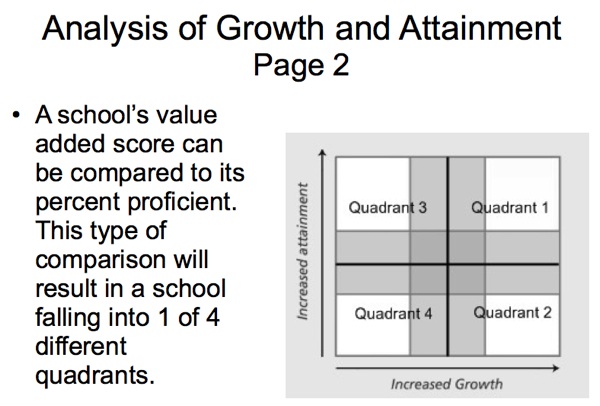
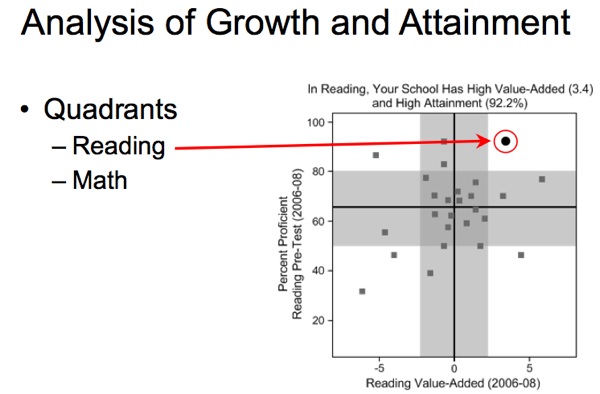
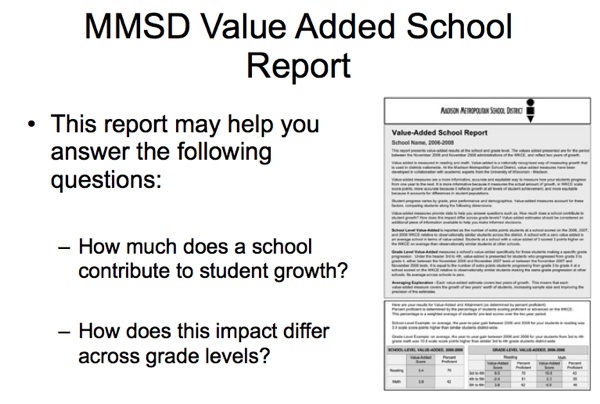
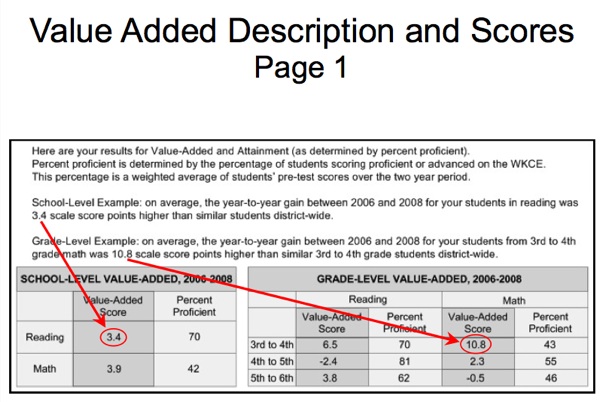
Value Added Assessment in Madison Presentation


Value Added Resource Center @ Wisconsin Center for Education Research

Complete report 1.4MB

Summary.

Much more on value added assessment here.


Madison’s value added assessment program is based on the oft-criticized wkce.

Share

‘Embedded honors’ program has issues

Mary Bridget Lee:

The controversy at West High School continues about the Madison School District’s new talented and gifted program. Students, parents and teachers decry the plan, pointing to the likelihood of a “tracking” system and increasingly segregated classes.
While I am in agreement with them here, I must differ when they mistakenly point to the current “embedded honors” system as a preferable method for dealing with TAG students.
The idea itself should immediately raise red flags. Teaching two classes at the same time is impossible to do well, if at all. Forcing teachers to create twice the amount of curriculum and attempt to teach both within a single context is unrealistic and stressful for the educators.
The system creates problems for students as well. There is very little regulation in the execution of these “embedded honors” classes, creating widely varying experiences among students. By trying to teach to two different levels within one classroom, “embedded honors” divides teachers’ attention and ultimately impairs the educational experiences of both groups of students.
While the concerns raised about Superintendent Dan Nerad’s plan are legitimate, “embedded honors” as a solution is not.

Lots of related links:

Share

A Collaboration to Transform Education in Los Angeles

L.A. Compact, via a David Baskerville email:

In February 2009, leaders from the Los Angeles Education Community publicly signed the L.A. Compact – a collaborative commitment to transform education in Los Angeles. The Compact signers have pledged to put the interests of students first. They have committed to work together to meet the following goals:

Goal 1: All students graduate from high school
Goal 2: All students have access to and are prepared for success in college
Goal 3: All students have access to pathways to sustainable jobs and careers

As part of their commitment, the signers pledged to release an initial data report in order to facilitate the measurement of their progress against these baselines in future years. The data in this report details Los Angeles Unified School District’s rates of graduation, enrollment, preparation, and more. It then follows LAUSD graduates and tracks their progress in post-secondary education. At this point in its development, the report highlights several important markers as we discuss collaborative opportunities for improvement. The measurements and their sources will continue to be refined and expanded over the coming years.

L.A. Compact.

Share

No Child Left Behind, perfection and caveats

Nick Anderson:

A couple of highly valued sources have taken issue with a story I wrote in today’s paper about the No Child Left Behind law.
The gist of their complaint, I believe, is that I did not walk readers through more of the fine print of the 2002 law to explain the context of the well-known goal of all students passing state tests by 2014. So let’s do that now.
First of all, here’s what the law says:
Section 1111 (b)(2)(F) Accountability–Timeline: Each State shall establish a timeline for adequate yearly progress. The timeline shall ensure that not later than 12 years after the end of the 2001-2002 school year, all students in each group described in subparagraph (C)(v) will meet or exceed the State’s proficient level of academic achievement on the State assessments under paragraph (3).
This excerpt from a rather long statute marks the core of the promise of No Child Left Behind. “All students” means what it says. “Shall ensure” is self-evident. “Proficient” means, essentially, passing the test. The requirement here is for states to chart a path toward 100 percent proficiency by 2014. Not 90 percent, or 80 percent, but 100 percent.

Share

144 Unions, 18 School Districts Receive Health Care Waivers

Mike Antonucci:

The Department of Health and Human Services released its latest list of companies and organizations that received a one-year waiver of the Affordable Care Act’s ban on annual dollar limits on benefits. A total of 733 waivers have been granted for 2011, of which at least 144 went to unions and union trusts, while an additional 18 went to school districts.
Waivers were granted to at least 17 locals and affiliates of the Teamsters, 11 of the International Brotherhood of Electrical Workers (IBEW), 28 of the United Food and Commercial Workers (UFCW), 7 of the SEIU, and one to the United Federation of Teachers Welfare Fund.

Share

Georgia’s DeKalb yanks 24 teachers from classroom on cheating allegations

Megan Matteucci and Jaime Sarrio:

Twenty-four DeKalb County educators have been reassigned to nonschool duties over irregularities in 2009 state testing that affected nine schools and possibly 1,400 students. The unidentified educators, both teachers and principals, could face losing their teaching licenses. The DeKalb District attorney will review the investigation conducted by the school system and determine if criminal charges are warranted.
DeKalb County schools Interim Superintendent Ramona Tyson said 29 current and former employees were referred to the state Professional Standards Commission.
Phil Skinner, AJC DeKalb County schools Interim Superintendent Ramona Tyson said 29 current and former employees were referred to the state Professional Standards Commission.
School officials told The Atlanta Journal-Constitution Thursday they referred 24 educators and five former employees to the Georgia Professional Standards Commission after an internal investigation uncovered numerous irregularities on the April 2009 Criterion-Referenced Competency Tests.
“No cheating has been proved and no one has come forward and admitted to cheating,” schools spokesman Jeff Dickerson said. “But we couldn’t have these individuals in the classroom right now. We made these decisions based on what is best for our students.”

More here.

Share

Benchmarking the Seattle School District’s Administrative Costs

Melissa Westbrook;

I attended 4 hours of the Board Work Session on the 2011-2012 Budget. Unfortunately, the meeting was 5+ hours (maybe longer, Dorothy?) It was taped so I will try to get a link if you care to listen.

I will write up my notes but for your reading pleasure here are the following:

  • staff finally got information to the Board that I know the Board has wanted for a long time. This would be benchmarking comparisons to other districts (both local and out-of-state). This chart is for 2009-2010 expenditures and FTE comparisons in dollars.
  • This chart is for 2009-2010 expenditures and FTE comparisons (as a % of total)

My irritation with these is that this is information that should have been presented LONG ago. It overburdened an already long and heavily detailed meeting.

The Powerpoint and another document – the Strategic Plan Budget Planning Tool for Fiscal Year 2011-2012 – are not yet up at the website. You’ll want to see those as well but for now, the above charts should keep you busy. The Fiscal document really is key because it gets to the heart of the Strategic Plan.

Share

Public School Principals: No Good Deed Left Unpunished

Christian Schneider:

Over at the mothership, Sunny Schubert has a wonderful column about a teacher she knows that has attempted to infuse his school with a little class. Zach, the fresh faced 22 year old newbie, decided he needed to set himself apart from his 7th grade students, so he started wearing a tie to school. For this transgression, he was mocked by the veteran teachers, none of whom saw any reason to dress up for school. In a show of solidarity with their teacher, Zach’s students actually started wearing ties to school – while the other teachers took time out of their day to trash his classroom with gaudy neckties.
This story is good enough – but Schubert also mentions a wildly entertaining “scandal” brewing at Glendale Elementary School in Madison, which serves a large number of African-American children. (In fact, Glendale has the highest percentage of poor and minority students at any Madison elementary school.)
In 2005, Mickey Buhl took over as Glendale’s principal, with the purpose of instilling the school with a new attitude and more innovative techniques. Since he took over, the school’s test scores have risen dramatically.

Share

A rebellion at Madison West High School over new curriculum

Lynn Welch

When Paul Radspinner’s 15-year-old son Mitchell wanted to participate in a student sit-in last October outside West High School, he called his dad to ask permission.
“He said he was going to protest, and wanted to make sure I had no problem with it. I thought, ‘It’s not the ’60s anymore,'” recalls Radspinner. The students, he learned, were upset about planned curriculum changes, which they fear will eliminate elective class choices, a big part of the West culture.
“It was a real issue at the school,” notes Radspinner. “The kids found out about it, but the parents didn’t.”
This lack of communication is a main reason Radspinner and 60 other parents recently formed a group called West Cares. Calling itself the “silent majority,” the group this month opposed the new English and social studies honors classes the district is adding next fall at West, as well as Memorial. (East and La Follette High Schools already offer these classes for freshmen and sophomores.)
The parents fear separating smarter kids from others at the ninth-grade level will deepen the achievement gap by pushing some college-bound students into advanced-level coursework sooner. They also believe it will eviscerate West’s culture, where all freshmen and sophomores learn main subjects in core classes together regardless of achievement level.
“It’s a big cultural paradigm shift,” says parent Jan O’Neil. “That’s what we’re struggling with in the West community.”

Lots of related links:

Share

2010 State Teacher Policy Yearbook Blueprint for Change

National Council on Teacher Quality, via email:

Most states’ evaluation, tenure and dismissal policies remain disconnected from classroom effectiveness.

  • Teacher evaluation is a critical attention area in 42 states because the vast majority of states do not ensure that evaluations, whether state or locally developed, preclude teachers from receiving satisfactory ratings if those teachers are found to be ineffective in the classroom. In addition, the majority of states still does not require annual evaluations of all veteran teachers, and most still fail to include any objective measures of student learning in the teacher evaluations they do require.
  • In 46 states, teachers are granted tenure with little or no attention paid to how effective they are with students in their classrooms. While there are a few states that have vague requirements for some consideration of evidence, and a few others that promise that teacher evaluations will “inform” tenure decisions, only Colorado, Delaware, Oklahoma and Rhode Island demand that evidence of student learning be the preponderant or decisive criterion in such decisions.
  • Dismissal is a critical attention area in 46 states. There are at least two state leaders taking this issue head on. In Oklahoma, recent legislation requires that tenured teachers be terminated if they are rated “ineffective” for two consecutive years, or rated as “needs improvement” for three years running, or if they do not average at least an “effective” rating over a five-year teaching period. In Rhode Island, teachers who receive two years of ineffective evaluations will be dismissed. Any teacher with five years of ineffective ratings would not be eligible to have his or her certification renewed by the state.

Share

Fixing Teacher Tenure Without a Pass-Fail Grade

Andrew Rotherham

Education eyes were on Washington this week to see what President Obama would say about schools in his State of the Union address. But just as in 2010, if you really want to follow the action on education reform, it’s better to look toward the states. All the new governors (29), education chiefs (18 new ones elected or appointed since November) and legislators (nearly 1,600) mean things are more fluid in the states, where teacher tenure is becoming a major flash point. Florida and New Jersey are considering pretty much ending tenure altogether. And while those states may be ground zero for tenure battles, Idaho, Illinois, Indiana, Ohio and Pennsylvania are also considering significant changes.
Quick primer: When people refer to tenure for public-school teachers, what they’re really talking about is a set of rules and regulations outlining due process for teachers accused of misconduct or poor performance. The elaborate rules often make it nearly impossible to fire a teacher. Joel Klein, who recently stepped down as New York City schools chancellor, has pointed out that death-penalty cases can be resolved faster than teacher-misconduct cases. In some places, the due-process rules are part of collective-bargaining agreements, and in others they’re state law. In either case, there is a consensus among education reformers and some teachers’-union leaders that the rules need to be changed and the process streamlined. The contentious debate tends to be about how to modify what constitutes due process — as negotiators did in a landmark teachers’ contract in the District of Columbia in 2009 — rather than get rid of it altogether.

Share

Duncan’s school of wisdom

George Will:

“Since 1995 the average mathematics score for fourth-graders jumped 11 points. At this rate we catch up with Singapore in a little over 80 years . . . assuming they don’t improve.”
– Norman R. Augustine,
retired CEO of Lockheed Martin
What America needs, says one American parent, is more parents who resemble South Korean parents. Education Secretary Arne Duncan, 46, a father of a third-grader and a first-grader, recalls the answer Barack Obama got when he asked South Korean President Lee Myung-bak, “What is the biggest education challenge you have?” Lee answered: “Parents are too demanding.” They want their children to start learning English in first rather than second grade. Only 25 percent of U.S. elementary schools offer any foreign-language instruction.
Too many American parents, Duncan says, have “cognitive dissonance” concerning primary and secondary schools: They think their children’s schools are fine, and that schools that are not fine are irredeemable. This, Duncan says, is a recipe for “stasis” and “insidious paralysis.” He attempts to impart motion by puncturing complacency and picturing the payoff from excellence.

Share

K-12 Tax & Spending Climate: Senator Rand Paul on Cutting the Federal Deficit by 1/3

David Freddoso:

Want to save $500 billion this year? Sen. Rand Paul, R-Ky., has a way to do it.
Is it realistic? Maybe not every part of it, but have a look below and judge for yourself. I don’t think his total removal of rental subsidies is unreasonable — the fact that Section 8 is a total failure doesn’t justify dumping its beneficiaries into oblivion. But there’s also no reason every agency has to see its budget increase every year, and a lot of these cuts really do make sense. Most of them simply represent a return to 2008 levels of spending — remember that a 30 percent cut is less than it seems when an agency’s budget been increasing by 40 percent over the last few years.
Why fund NASA at traditional levels if President Obama has scaled back its mission? Why not let Indian tribes manage their own trust funds, especially considering the federal mismanagement? Why not realign our military bases abroad, sell unused federal buildings (something Obama has already begun doing), transfer some national parks to the states, and end the wasteful corporate subsidies that come out of the Departments of Energy and Commerce?

This exercise illustrates the huge changes that lie (not too far) ahead given the large deficits (and debt) we face.

Share

Low expectations and other forms of bigotry

The Economist:

SMALL rays of light can illuminate surprisingly large areas of darkness. The fuss continues to rumble on about the decision by Michael Gove, the education secretary, to publish revised school league tables showing how many pupils achieved a reasonable pass in five core subjects: English, maths, a foreign language, a science subject and either history or geography (a cluster of subjects that he is calling the English baccalaureate). This marked a sudden switch away from a system in which schools reported how many pupils gained a reasonable pass (an A, B or C grade) in any five subjects including English and maths.
As my colleagues in the Britain section reported earlier this month, this transparency ambush has already achieved one desired and desirable effect: to expose how many schools were boosting their scores by pushing pupils into soft, often vocational subjects which counted for as much as a pass in chemistry, French or history.

Share

Young inventors prompt colleges to revamp rules

Alan Scher Zagier:

Tony Brown didn’t set out to overhaul his college’s policies on intellectual property. He just wanted an easier way of tracking local apartment rentals on his iPhone.
The University of Missouri student came up with an idea in class one day that spawned an iPhone application that has had more than 250,000 downloads since its release in March 2009. The app created by Brown and three other undergraduates won them a trip to Apple headquarters along with job offers from Google and other technology companies.
But the invention also raised a perplexing question when university lawyers abruptly demanded a 25 percent ownership stake and two-thirds of any profits. Who owns the patents and copyrights when a student creates something of value on campus, without a professor’s help?

Share

K-12 Tax & Spending Climate: New Mexico Gov. Susana Martinez: We ‘are not under-taxed; the government has simply over-spent’

Andrew Malcolm:

Like fellow Republican governor Nikki Haley of South Carolina, New Mexico’s new governor, Susana Martinez, is her state’s first female chief executive. She is also the nation’s first Latina governor, as Haley is the first woman governor in the United States of Indian descent.
But Martinez is not new to public service, having been a prosecutor for nearly a quarter-century. Her full biography is here. Her husband, Chuck Franco, has also had a long career in law enforcement. See the couple’s photo below greeting a little girl.
Last week with Alaska Gov. Sean Parnell’s State of the State address, we heard of the strong economy in the country’s largest state geographically. (For links to all of the state of the state addresses published on Top of the Ticket so far, please scroll to the bottom.)
With New Mexico, however, we return to the familiar 2011 governmental theme of deficits and the need to cut spending. Martinez hits that theme strongly, imposing several major changes from policies of her predecessor, Democrat Bill Richardson.
She has ordered the state jet sold, cut expenses at the governor’s residence by 55%, including letting go the two personal chefs who had been working there, cut her cabinet members’ salaries by 10% and frozen all new vehicle purchases, except for law enforcement, among other stringencies.

Share

Tuition Hike-oholism Hits Bottom?

Kristin Conklin:

“After decades of funding our eleven campuses on the basis of past appropriations and past expenditures, we have lost track of the rationale for each campus’s funding level. We must begin a new approach to funding higher education where we ask the board of higher education to develop a funding methodology that is based on the outcomes that education leaders and citizens would like to see from their college campuses.”
— North Dakota Gov. Jack Dalrymple’s Jan. 4 state of the state address.
Faced with a 5 percent tuition rise and the likelihood of future increases, students at the City University of New York filed a lawsuit against the school protesting the tuition hike. Could we be on the verge of a student movement like that recently under way in England, where rioters incensed over tuition increases have thrown Molotov cocktails, smashed windows, and even attacked Prince Charles’s car?
CUNY’s was a modest hike, with average prices remaining well below the national average. CUNY takes pride in its history of serving low-income and first-generation students with a high-quality, affordable education.. But CUNY, like many public institutions in the U.S., is doing what led to student revolts in England: shifting the burden of paying for higher education from taxpayers to students. According to the State Higher Education Executive Officers association, tuition in the U.S. increased from 25 percent of all educational revenue to 37 percent from 1984 to 2009, even as total spending per student remained about the same.

Share

Introducing Hispanics for School Choice

Aaron Rodriguez:

Hispanics for School Choice (HFSC), a non-profit organization founded in Milwaukee County, is hosting a coming out event at the United Community Center (UCC) on January 24th. It marks the first time in Wisconsin history that leaders in the Hispanic community have organized to expand the Milwaukee Parental Choice Program.
A Buzz at the State Capitol
Last week, Executive Board members of Hispanics for School Choice created somewhat of a buzz as they descended upon the State Capitol to circulate their legislative agenda. Associates from the American Federation of Children and School Choice Wisconsin accompanied HFSC in separate meetings with Senate Majority Leader Scott Fitzgerald, Assembly Speaker Jeff Fitzgerald, Education Committee Chair Steve Kestell, and Secretary of the Department of Administration Mike Huebsch to discuss a timetable of moving the School Choice program forward.
HFSC Board Members were also given exclusive entry to a closed caucus in the Grand Army of the Republic Hearing Room before Assembly Republicans – an access rarely granted to non-profit organizations of any sort for any reason. Before the 60-member caucus, Board Members of HFSC were introduced communicating the idea that HFSC aimed to be more of a resource to legislators than a needy lobbyist.

Share

The worst of “best practices”

Roxanna Elden:

District, county, and state education offices are fond of sharing “best practices” through professional development. The idea is to spread the word about strategies that work in some schools so other teachers can use these strategies and get the same great results. There are times when it works this way. Unfortunately, things can get complicated when the same people who pick and distribute best practices are also responsible for checking whether they are being done correctly, and when none of those people are current teachers. Here’s an example of how the sharing of best practices sometimes works once supervising offices get involved.
Phase one: A school seems to be successful in educating students in a given subject or demographic sub-group. Let’s call this School A.
Phase two: A team of people who want to know what made School A successful descends upon the school. They sit in the classrooms. They ask questions. Then the team comes back with a report that says something like, “Teachers at School A are successful because they ask students to make their own test using fill-in-the-blank test questions. This is a research-based report.”
Phase three: The information from the report is filtered through a series of people sitting in a quiet, student-less office. Materials are created. Packets are made.

Share

The Educationist View of Math Education

Barry Garelick:

In Jay Greene’s recent blog post, “The Dead End of Scientific Progressivism,” he points out that Vicki Phillips, head of education at the Gates Foundation misread her Foundation’s own report. Jay’s point was that Vicki continued to see what she and others wanted to see: “‘Teaching to the test makes your students do worse on the tests.’ Science had produced its answer — teachers should stop teaching to the test, stop drill and kill, and stop test prep (which the Gates officials and reporters used as interchangeable terms).”
I was intrigued by the education establishment’s long-held view as Jay paraphrased it. This view has become one of the “enduring truths” of education and I have heard it expressed in the various classes I have been taking in education school the last few years. (I plan to teach high school math when I retire later this year). In terms of math education, ed school professors distinguish between “exercises” and “problems”. “Exercises” are what students do when applying algorithms or routines they know and can apply even to word problems. Problem solving, which is preferred, occurs when students are not able to apply a mechanical, memorized response, but rather have to apply prior knowledge to solve a non-routine problem. Moreover, we future teachers are told that students’ difficulty in solving problems in new contexts is evidence that the use of “mere exercises” or “procedures” is ineffective and they are overused in classrooms. One teacher summed up this philosophy with the following questions: “What happens when students are placed in a totally unfamiliar situation that requires a more complex solution? Do they know how to generate a procedure? How do we teach students to apply mathematical thinking in creative ways to solve complex, novel problems? What happens when we get off the ‘script’?”

Share

A Breath of Fresh Air on Ed Reform

Melissa Westbrook:

I do wish I had attended the Washington Policy Center breakfast last week. One reason is the speaker was Dr. Andres Alonso, the head of Baltimore Schools. He sounds like an interesting guy and I would have liked to hear him in person.
However, a couple of readers (Greg is one), pointed out that there was coverage of his speech in this week’s Crosscut. What is interesting is he seems the non-firebreathing, anti-union, anti-parent Michelle Rhee. He came into an incredibly poor situation:
Only 35 percent of Baltimore’s students received high-school diplomas the year before Alonso arrived. Proficiency levels as measured by standardized tests were in the cellar. Over nine years the district lost 25,000 students, dwindling from 106,540 in 1999 to 81,284 in 2008.
In the same period the district gained 1,000 staff, Alonso said. With costs rising despite continuing enrollment declines, “baseline aid from the state to the city had doubled…. It was clearly an organization not sustainable over time.”
How could they lose over 25,000 students and gain 1,000 staff? Who was the superintendent before this guy?

Share

More choice in schools needed

James Gleason:

The Gleason Family Foundation has long had an intense interest in the quality of education. With great disappointment over the decades, we’ve watched our public education system continually fail to meet the needs of all children.
The education special interests tell us that the crisis in education is a fabricated one. But the growing body of achievement data overwhelmingly shows that K-12 student performance, particularly in urban school systems, has been middling at best, comparing unfavorably even to some Third World countries.
Rochester, like all too many urban school systems, graduates fewer than 50 percent of its students, many of whom are totally unprepared to meet the challenges of an increasingly high tech world.

Share

Virtual School Enrollment Cap Stifles Choice

James Wigderson:

Today marks the beginning of School Choice Week.
Well, members of the Wisconsin legislature have several important choices ahead of them as they look at the educational landscape in this state.
The temptation is to sweep our state’s educational problems under the rug with one heck of a broom for an excuse, “there is no money.”
To give in to that temptation would be wrong and there are steps the legislature can take to restore educational innovation and improve educational access without breaking the bank.
One of the steps would be to eliminate the cap on online public charter school enrollment. The cap is one of the most shameful educational policy holdovers from the Governor Jim Doyle era, and it needs to be repealed.

Share

The Sinking States

Scott Jaschik:

States are spending more than $79 billion on higher education in 2010-11, a decline of 0.7 percent from last year, according to a report being released today by the Center for the Study of Education Policy at Illinois State University and the State Higher Education Executive Officers.
While a cut of less than 1 percent might seem like a relief, given the magnitude of some of the cuts public higher education systems have faced in recent years, the report contains plenty of danger signs for the future. More than $2.5 billion of the total state spending on higher education came from the federal government in the form of stimulus funds that have now run out. Over two years, state support is down nearly 2 percent — in a period when the same economic downturn that has left state coffers empty has also spurred enrollment increases in much of public higher education, and greater demands for financial aid. And plenty of states are talking about additional cuts for 2011-12.

Share

Calculating the difference in New Jersey charter schools

Bob Braun:

It’s New Jersey School Choice Week. Gov. Chris Christie signed a proclamation encouraging all citizens to “join the movement for educational reform.”
Or, at least, his brand of reform, one that includes cutting $1 billion from traditional public schools while spending taxpayer money on independent schools that have somehow failed to enroll New Jersey’s neediest children, those with handicaps, language problems, and very low income.
In the last few days, the governor issued a study that purported to show charters “outperforming” traditional schools, approved 23 more charters, proposed laws making it easier to create the independent but publicly funded schools, and hired an organization run by Geoffrey Canada, the champion of New York charter schools, to try his magic in Paterson.
Some critics argue state studies comparing scores of charter schools with their home districts were not scientific and unbiased and, if they showed anything, proved test score averages can be improved by not enrolling children who don’t do well on standardized tests.

Share

It’s time for Oklahoma to excel in education

Bill Price:

The 2011 legislative session presents a historic opportunity for Oklahoma to lead in improving our children’s future through comprehensive education reform. The combination of a reform-minded Legislature, governor and state school superintendent, along with an engaged public, provides a unique window for passing the greatest educational improvements in our lifetime.
The first reform is choice in education through an educational tax credit scholarship act that follows the example of the states that have seen the most rapid improvement in educational achievement. This bill empowers parents to find the schools that will best meet their children’s needs, stimulates the creation of innovative scholarship schools, and provides the competition that has been proven to greatly improve the public schools.
Choice also is promoted by expanding the charter school laws, allowing the state schools superintendent to charter new schools, and freeing these highly successful charter schools to finance their own infrastructure needs.

Share

And Then What Happened?

Roger Rosenblatt:

I have a good feeling about this class. I’m going to like them. Liking a class is more practically useful than it sounds. In a likable class, discussions are freer, more open. When the students like one another, they take everyone’s work more seriously. In another class I taught, after a woman read a section of her novel aloud, another woman asked, “May I be your friend?” The first woman answered, “You already are.” The students will also feel safe with one another and will trust the group with personal information they use in their writing.
In my novel-writing workshop, a student wrote about a woman who was taking care of her husband, whose mind was deteriorating. She too was deteriorating from the effort. She told her story as a novel, but the students understood it was her own. They respect such disclosures. They unite with one another like a noisy brood of brothers and sisters. And they can always unite against me.

Share

Suitable to whom? Legislators defining a “suitable” education or curriculum for Kansas schools won’t necessarily keep the state out of court.

The Lawrence World:

From a practical standpoint, we would like to think that every action taken by the Kansas Legislature would be “suitable” for the state.
However, that word has spawned considerable controversy in Kansas as it pertains to education funding — controversy that has landed the state in court before and may do it again.
Gov. Sam Brownback wants to avoid that and many Kansans would agree with his contention that defending state laws in court is a poor use of precious resources. To that end, in his State of the State address, Brownback invited legislators to better define “a suitable education.”
Like many Kansans, Brownback quoted a term that actually doesn’t appear in Article 6 of the Kansas Constitution, which covers education. The actual wording is that the legislature “shall make suitable provision for finance of the educational interests of the state.” The sentence even appears under Section 6: Finance.

Share

In response to criticism, Madison Schools will consider additional 4K sites

Matthew DeFour:

Responding to concerns that potential locations for Madison’s new 4-year-old kindergarten program are not located in poor neighborhoods where they may be most beneficial, school district officials said Monday they will evaluate additional sites.
The School Board on Monday approved 19 elementary schools with available space as potential 4K sites, but also asked the district to identify churches or community centers with space where Madison teachers could be assigned for the 2 1/2 hour daily program beginning this fall.
The district is expecting to hear back this week from 35 day care centers that were approved to participate in the program.
Not all of the 54 potential sites will end up being used, but the district won’t know the exact distribution until parents register their students beginning Feb. 7.

Much more on Madison’s 4K program, here.

Share