School Information System

K-12 Tax & Spending Climate: Hikes for most public costs in Madison exceed rate of inflation

Bill Lueders:

It’s the end of the decade, a perfect time to take stock of how the cost of living, vis-à-vis public institutions, has changed. So Watchdog has tabulated the costs of more than 20 basic services, most provided or regulated by government.
In each case, we sought cost amounts effective Jan. 1 for four years: 1990, 2000, 2005 and 2010. We then tabulated the percentage increases over 10- and 20-year spans.
According to the U.S. Bureau of Labor Statistics’ online inflation calculator, $1 in 1990 was worth $1.32 in 2000 and $1.65 in 2009; $1 in 2000 was worth $1.26 in 2009. So the rate of inflation was 65% from 1990 to 2009, and 26% from 2000 to 2009.
Few of the fees and charges we tracked stayed within those ranges. And besides the mill rates used to calculate property taxes (which are offset by increases in assessed value), only one measure showed a decline: the rate and per-customer cost of natural gas. MGE spokesman Steve Kraus attributes this to falling demand.

Bill Lueders notes that Madison School District property taxes are up 83.9% since 1989 and 21.6% since 1999.

Share

The keys to a successful education system

Kevin Huffman:

Ten years ago, deep in the Rio Grande Valley, two 23-year-old Teach for America teachers opened an after-school tutoring program. Through sheer force of will, the program became a public charter school, housed on the second floor of a local church. Eventually, that school became a cluster of 12 schools, serving kids from Colonias — communities so impoverished that some lack potable water.

IDEA College Prep graduated its first high school class in 2007 with 100 percent of the seniors headed to college. Last month, U.S. News and World Report ranked it No. 13 among America’s public high schools.

"It’s not magical resources," IDEA Principal Jeremy Beard told me. "It’s the thinking around the problem. I have no control over what goes in on in the kids’ Colonia. But we can create a culture. Kids here feel part of a family, part of a team, part of something special."

I have worked in education for most of the past 17 years, as a first-grade teacher, as an education lawyer and, currently, for Teach for America. I used to be married to the D.C. schools chancellor. And the views expressed here are mine alone. I tell the IDEA story because too often when we look at the sorry state of public education (on the most recent international benchmark exam conducted by the Program for International Student Assessment, U.S. high schoolers ranked 25th out of 30 industrialized nations in math and 24th in science) we believe the results are driven by factors beyond our control, such as funding and families. This leads to lethargy, which leads to inaction, which perpetuates a broken system that contributes to our economic decline.

Clusty Search on Teach for America’s Kevin Huffman.

Share

How Michigan education reforms will unfold is unclear

Julie Mack:

How sweeping education reforms signed into law Monday will be implemented in Michigan remains unclear to area school officials.
Gov. Jennifer Granholm on Monday signed reforms that make it easier to close failing schools, link teacher pay to performance and hold school administrators accountable. The bills also raise the dropout age from 16 to 18, starting with the Class of 2016; allow up to 32 more charter schools to open each year; give professionals from areas other than education an alternative way to become teachers, and allow for cyber-schools to educate students who have dropped out online.
State Superintendent Mike Flanagan said up to 200 low-performing schools could end up under state control as a result of the new laws.
The legislation is part of Michigan’s effort to win money from the Obama administration’s Race to the Top competition tied to education reform. Michigan could get up to $400 million if it’s among the winners.
Local school boards and unions now face a Thursday deadline to sign a “Memorandum of Understanding” that indicates their support for the reforms. The memorandums are to be included with the state’s Race to the Top application. School districts where the board and union do not sign an agreement risk losing their share of the money.

Share

UFT And Elected Officials: Charter Schools Must Be Public Schools, Serving All Students

Leo Casey:

With growing appeals for changes in New York’s charter school law, prominent elected officials joined the United Federation of Teachers today in a call for major reforms which would ensure that charter schools become public schools in the fullest meaning of the term — not private schools supported with public funds.
State Senator John Sampson, leader of the Senate’s majority Democratic Conference, and New York City Comptroller John Liu joined UFT President Michael Mulgrew in this call. State Senators Eric Schneiderman and Toby Stavisky and State Assembly members Michael Benedetto, Alan Maisel, Jose Peralta, Adam Clayton Powell, IV and Linda Rosenthal were present and participating in the call.
Among the proposed changes are:
a mandate for charter schools to serve the same proportion of the neediest students as the local community district in which they are located;

Clusty Search: Leo Casey.

Share

Elmbrook gets UW-Waukesha classes: “Professors Save Students the Trip”

Amy Hetzner, via a kind reader’s email:

By the time the first bell rings at Brookfield Central High School, most of the students in Room 22 are immersed in college-level vector equations, reviewing for their final exam on the Friday before Christmas.
Senior Lea Gulotta, however, looks on the bright side of waking early every morning for the past semester so she can take a Calculus 3 class taught at the school by a college professor.
“We get to sleep in for a month,” she said, noting that the regular high school semester won’t end until mid-January.
There’s another positive to Brookfield Central’s agreement with the University of Wisconsin-Waukesha continuing education department, which brought the advanced mathematics class to the high school this year as part of the state’s youth options program. Under youth options, school districts pick up the costs of courses at Wisconsin colleges if they don’t have similar offerings available to students.
Instead of seeing students spend extra time commuting and attending class on a college campus, the arrangement placed the professor in the high school to teach 11 students who had completed advanced-placement calculus as juniors. Two of the students in the class come from the Elmbrook School District’s other high school, Brookfield East.
Elmbrook pays UW-Waukesha the same tuition that it would pay if its students chose to attend the college campus on their own, she said.

Related: Janet Mertz’s tireless crusade on credit for non-Madison School District classes.

Share

Preliminary Draft of the Milwaukee Mayoral Control Legislation:
LRB 3737/P2 Milwaukee Transforms Education for All Our Children (TEACH) Act

via a kind reader’s email 180K PDF:

Milwaukee Public Schools Reading & Math Proficiency 15K PDF.

Related: Madison School District Reading and the Poverty Achievement Gap.

Share

The Replacements: On Substitute Teaching and Days Out of the Classroom

Carolyn Bucior:

TWO years ago, during lunch with a second-grade teacher in the Chicago area, I mentioned that I was going to substitute teach. The teacher — I’ll call him Dan — started into a story about his own experience with a substitute, which is easily summarized: Dan left a lesson plan; the sub didn’t follow it. So, he ended by asking, how hard can substitute teaching be?
I smiled, said nothing and bit into my Reuben.
Over the next two years, I would learn — as I subbed once a week for a variety of classes, including kindergarten, sixth grade, middle-school social studies, high-school chemistry, phys ed, art, Spanish, and English as a second language — that Dan’s story is standard teacher fare. Last time I heard it, though, I didn’t bite my sandwich or my tongue.
As much as I became frustrated by the lack of training and support, I was most angered by how many days teachers were out of their classrooms. Nationwide, 5.2 percent of teachers are absent on any given day, a rate three times as high as that of professionals outside teaching and more than one and a half times as high as that of teachers in Britain. Teachers in America are most likely to be absent on Fridays, followed by Mondays.
This means that children have substitute teachers for nearly a year of their kindergarten-through-12th-grade education. Taxpayers shell out $4 billion a year for subs.
I subbed for many legitimately ill teachers and for many attending educational conferences. But my first assignment was to fill in for a sixth-grade teacher who went to a home-and-garden show. My last was for a first-grade teacher who said she needed a mental health day because her class was so difficult.

Share

Creativity in Schools in Europe: A survey of Teachers

The Institute for Prospective Technological Studies: CACHIA Romina, FERRARI Anusca, KEARNEY Caroline, PUNIE Yves, VAN DEN BERGHE Wouter, WASTIAU Patricia – 1MB PDF:

An overwhelming majority of teachers are convinced that creativity can be applied to every domain of knowledge and that everyone can be creative. They also subscribe to the idea that creativity is a fundamental skill to be developed in schools, even if they are more ambiguous about how it can be taught, and less sure still about how it can be assessed.
Survey respondents were asked to express their opinion about how they view creativity, as a general concept as well as in the school context, on a scale of 5 ranging from ‘strongly agree’ to ‘strongly disagree’. The results are displayed in Figure 1.
Literature reports that very often people, including teachers, refer to creativity as being related exclusively to artistic or musical performances, as springing from natural talent, and as being the characteristic of a genius. These myths about creativity stifle the creative potential of students and create barriers to fostering creativity in schools.
To a large extent, the teachers that took part in our survey have an understanding of creativity which goes against such myths. Almost all teachers who took part in the survey are convinced that creativity can be applied to every domain of knowledge (95,5%) , and to every school subject. More than 60% are even strongly convinced of this. They confirm this view very clearly by disagreeing to a large extent with a statement restricting creativity to the realm of artistic and cultural expression (85%).

Share

Can Inner-City Prep School Succeed? Answer Is YES

Monica Rhor:

It was Deadline Day at YES Prep North Central, the day college applications were supposed to be finished, the day essays, personal statements and a seemingly endless series of forms needed to be slipped into white envelopes, ready for submission.
The day the school’s first graduating class would take one leap closer to college.
The seniors inside Room A121 were sprinting, scurrying and stumbling to the finish line. They hunched over plastic banquet tables, brows furrowed and eyed fixed on the screens of Dell laptop computers. Keyboards clattered, papers rustled and sighs swept across the room like waves of nervous energy.
So much was riding on this.

Share

As complex investments plunge, 5 Wisconsin school districts pressured over loans

Amy Hetzner:

As five Wisconsin school districts face increased pressure to return millions of dollars in loans, the $200 million in investments they undertook with money from that debt are almost entirely without value and unlikely to pay back when they mature in 2013, according to representatives for the districts.
The districts said in a statement to the Journal Sentinel that one of the investments had stopped paying interest two months ago after a dramatic decline in value. The statement did not indicate which investment had ceased paying interest, but one of the schools’ attorneys, Stephen Kravit, had earlier identified it as an investment devised by the Royal Bank of Canada known as Sentinel Limited Series 2.
The five districts involved – Kenosha, Kimberly, Waukesha, West Allis-West Milwaukee and Whitefish Bay – invested $115 million in Sentinel 2 through trusts, using a combination of existing assets or borrowed money.
The $10 million invested by Whitefish Bay and $5 million by Kimberly were the entire amounts they invested in complicated transactions undertaken in 2006 on the advice of bankers from Stifel, Nicolaus & Co. Inc. The West Allis-West Milwaukee and Waukesha districts invested $40 million each in Sentinel 2 and Kenosha invested $20 million.

Madison’s Assistant Superintendent for Business Services, Erik Kass, formerly worked for the Waukesha School District.

Share

DeKalb County schools: Cars and credibility now in question

Maureen Downey:

Clearly, the great car deals that DeKalb school officials arranged for themselves were wrong. As the AJC reports in an exclusive investigation:

Patricia “Pat” Pope, whose involvement in multimillion-dollar school construction projects is under investigation by county authorities, purchased a black 2005 Ford Explorer from the school district for $5,442 — about one-third the car’s market value at the time, according to county documents obtained by The Atlanta Journal-Constitution.
Pope also asked the county’s maintenance department to overhaul the car with new tires and a paint job before she bought it, according to a state agency that investigated the purchase. The department did about $2,500 worth of work on the car.
The arrangement appears similar to a 2007 car purchase by DeKalb schools Superintendent Crawford Lewis. Pope also played a major role in that transaction, documents show.
The Georgia Department of Audits and Accounts investigated both purchases and determined that the difference between the price Pope and Lewis paid for the vehicles and the cars’ fair market values amounted to a “gratuity,” or extra compensation, which Georgia law forbids.

Share

Just the facts, please, as we ponder Milwaukee Public Schools’ change

Alan Borsuk:

The state Senate’s Education Committee will hold a public hearing at the Milwaukee Public Schools central office, 5225 W. Vliet St., at 10 a.m. Tuesday to hear people’s thoughts about proposals to change the way MPS is governed.
Some people – Gov. Jim Doyle and some legislators – seem to think this hearing is a significant step toward legislative action. I’m dubious, for two reasons:
1. Count me as one who thinks the prospects are not good for action in the Legislature on any major changes, especially the idea of giving control of MPS to Milwaukee’s mayor. The Democratic legislative leaders made that clear by not even taking up proposals in December. Republicans aren’t in the mood to help Mayor Tom Barrett, a Democratic candidate for governor. (Today’s political trivia question: How many members of the Senate Education Committee are from Milwaukee? Zero.)
2. I’m tired of the political posturing, on all sides, about change in MPS. With a few exceptions, so little of it is attached to real commitment to doing better. And so much of it pays little attention to the facts, with ideology, belief or just plain incorrect statements trumping careful, focused use of real, live facts.

Share

Madison School District’s Infinite Campus Teacher Tool and Parent/Student Portal Report: Approximately 2/3 of Middle and High School Parents don’t use it

Kurt Kiefer, Lisa Wachtel:

This report summarizes data on the use of Infinite Campus teacher tools and the Parent and Student Portal. Data come from a survey conducted among all teachers responsible for students within the Infinite Campus system and an analysis of the Infinite Campus data base. Below are highlights from the report.
About half of all middle and high school teachers responsible for providing grades to students are using the grade book tool.
Grade book use has declined over the past year at the middle school level due to the introduction of standards- based grading. In addition to the change in grading approach, the grade book tool in Infinite Campus does not handle standards-based grading as efficiently as traditional grading.
Lesson Planner and Grade book use is most common among World Languages, Physical Education, and Science teachers and less common among fine arts and language arts/reading teachers.
Grade book and other tool use is most common among teachers with less than three years of teaching experience. Seventy percent ofteachers responding to the survey within these years of experience category report using the tools compared with about half of all other experience categories.
Most of the other teacher tools within Infinite Campus, e.g., Messenger, Newsletters, reports, etc., are not being used due to a lack of familiarity with them.
Many teachers expressed interest in learning about how they can use other digital tools such as the Moodie learning management system, blogs, wikis, and Drupal web pages.
About one third of parents with high school students use the Infinite Campus Parent Portal. Slightly less than 30 percent of parents of middle school students use the Portal.
Having just been introduced to elementary schools this fall, slightly more that ten percent of parents of students at this level use the Portal.
Parents of white students are more likely to use the Portal than are parents of students within other racial/ethnic subgroups.
About half of all high school students have used the Portal at one time this school year.
About one in five middle school students have used the Portal this year.
Variation in student portal use is wide across the middle and high schools.
Follow up is planned during January 2010 with staff on how we can address some ofthe issues related to enhancing the use of these tools among staff, parents, and students.
This report is scheduled to be provided to the Board of Education in February 2010.

Share

$4,431,115 Two Year Cost for 4K in Madison

Madison School District Superintendent Dan Nerad 650K PDF:

The Board ofEducation over the past two months has received information relative to the programdesignofa4-kprogramandsomebudgetscenariosrelativetothe4-kprogram. The budget scenarios showed the Community Model Option where the community providers provided to the district the amount necessary to support their programs and two concepts for allowing this fee to decrease.
Over the past month, administration and the community providers have met to discuss the amount to be brought forward as a fee per child for the community early childhood centers. The amount within your packet reflects that amount the early childhood community has asked ofthe district.
Information Contained in your packet: Budget Impact:
The budget impact sheet is reflective of all costs associated with the operation ofa community based model for four-year-old kindergarten. This model reflects the latest numbers proposed by the community for the per child reimbursement, along with an escalator of 3% each year. The model also reflects the latest information from the DPI, that shows we are currently not likely to be eligible to receive the 4-k startup grants with the State of Wisconsin budget. These numbers show a negative budget balance of $4,188,069 in year 1 and a negative budget balance of $243,046in year two, for a total two year negative balanceof $4,431,115. This becomes the target for further information within your packet relative to “Financing Options” for 4-k.

Share

Rhee vows to shield D.C. teachers, supplies amid budget cuts

Bill Turque:

D.C. Schools Chancellor Michelle A. Rhee has vowed to protect funding for teachers and classroom supplies as she prepares to cut the system’s overall budget by $22 million because of shrinking tax revenue and the end of one-time federal stimulus spending.
The fiscal 2011 budget, which begins in October, is projected to shrink from $779 million to $757 million. Spending would fall most sharply in the “school support category,” including security, food service and after-school programs. Rhee’s central office would also face cuts.
But Rhee said this week that financial constraints won’t limit her efforts to transform historically poor academic performance in the 45,000-student system.
“Obviously financial times like this make things tough, but no, they won’t stop us from being successful,” Rhee said in an e-mail Thursday.

Share

Race to the Top Insights: Part 1

Mchele McNeil:, via a kind reader’s email

I spent the morning in a U.S. Department of Education technical-assistance planning seminar on Race to the Top, and have picked up a lot of interesting tidbits. Many states are in attendance–including Hawaii, Mississippi, New Mexico, North Dakota, and Tennessee (including education commissioner Tim Webb), just to name a few. Interestingly, Texas is also in attendance, I’m told.
The seminar will continue well into the afternoon, but so far, here are the insights I’ve picked up about this $4 billion competition:
Race to the Top Director Joanne Weiss emphasized that there will be a lot of losers in Phase 1 of the application, so states shouldn’t worry if they want to wait until the second round of competition. “We promise there will be plenty of money left in Phase 2,” she said.

Part 2

Share

Madison School District’s Strategic Objectives Performance Measures

Madison Superintendent Dan Nerad 600K PDF:

Attached are the revised performance measures we will use to help monitor progress in meeting the Strategic Objectives Action Steps. Goals for the WKCE scores remained at 100% success rate as that is the requirement in No Child Left Behind legislation. Other goal areas were reduced to 95% as the target.

Related: Madison School District’s Strategic Plan.

Share

Madison School District Talented and Gifted Education Plan Update

Daniel Nerad, Superintendent of Schools Lisa Wachtel, Executive Director, Teaching and Learning Barbie Klawikowski, Interim Talented and Gifted Coordinator 260K PDF:

Identification Criteria – Several action steps within Goal 1 are based on the need for a clearly defined criteria and process to identify students as talented and gifted. The Talented and Gifted (TAG) Division staff has established and confirmed identification criteria including: 1) consideration of students’ levels of academic performance; 2) grade level performance data employing the historical two-year above grade level as a marker; and 3) consideration of several student data sources, including input and information from teachers and family. Work will continue into the spring semester to incorporate these data sources to create a student profile and, pending individual student performance level indicators, a Differentiated Education Plan (DEP) for students.
Monitoring Model – TAG staff continues work with the Research and Evaluation Department to create a model for student data analysis to aid in identification. These models will be research- based and provide the information needed to make identification, programming, and additional diagnostic decisions pertaining to individual students. It has been determined that the Student Intervention Monitoring System (SIMS) can be used as the tracking and reporting system. It currently containing much of the student information needed, including assessment and other data from Infinite Campus, that will make up the student profile component of a TAG student report. T AG staff will use SIMS in the current form to develop student profiles and Differentiated Education Plans (DEPs). Next steps include customizing reports in SIMS to meet future documentation/Plan development needs=

Share

Commentary on Charter Schools in the Madison School District

Madison School Board Vice President Lucy Mathiak:

On Monday, the Board of Education will have a presentation by the planning group that is proposing an environmentally-focused project-based charter middle school. The Badger Rock Middle School is the first charter proposal to come before the board since the Studio School debacle a few years back. From what we are hearing in the community, it is not likely to be the last (more on that later).
Proposed Charter: Badger Rock Middle School
What we will be deciding now: The board will be asked to approve the group’s initial proposal, which will form the basis of a planning grant application to the Department of Public Instruction. If the planning grant is awarded, the group will carry out additional work necessary to develop and design the charter school in greater detail, and develop a proposal that would come before the board requesting approval of the creation of the school and its charter.

Share

“I’ve been in Detention for years and I’m a Teacher”

David Pakter:

When I began teaching in New York City 37 years ago, if you were reported for serious misconduct, you were sent to a Board of Education office until the matter was resolved. But as the system grew, removing teachers from the classroom became standard for even the most trivial offence. The board’s offices got so crowded they began leasing buildings around the city to use as “reassignment centres”, nicknamed “rubber rooms”.
As many as 800 to 1,000 teachers are in rubber rooms on any given day; it’s an academic Guantánamo Bay. Many go stir-crazy. Brooklyn’s Chapel Street rubber room is huge but so crowded that people are almost falling out of the windows.

Share

Easy Money For College Can Mess You Up, Man

Katherine Mangu-Ward

When the government subsidizes something, we wind up with more of it. When it subsidizes something heavily–and combines that subsidy with an aggressive campaign encouraging consumption of that thing from the presidential bully pulpit–we wind up with a lot more of it.
Oceans of federal money gush into higher education every day, and every administration promises more to come. That gush obscures the real demand for educated workers. The result is lots of cashiers and waitresses with B.A.s, and lots of people with student loan debt that’s tough for them to repay. For most students, the federal subsides geared toward nudging them to consume more education actually result in the acquisition of more education debt.
On the corporate side (and the non-profit side, for that matter) the subsidy encourages institutions to shape their practices around grabbing as much of that “free” money as possible. As critics of for-profit education never fail to note:

Share

Tracking An Emerging Movement: A Report on Expanded-Time Schools in America

David A. Farbman:

Fifteen years ago, the National Education Commission on Time and Learning explained that the American school calendar of 180 six-hour days stands as the “design flaw” of our education system, for schools could not be expected to enable children to achieve high standards within the confines of the antiquated schedule. Today, a small but growing number of schools have begun to overcome this “flaw” by operating with school days substantially longer than the six-hour norm and, in many cases, a calendar that exceeds the standard 180 days.
The National Center on Time & Learning (NCTL), with the support of the William and Flora Hewlett Foundation, has produced this groundbreaking report on the state of what can be called “expanded- time schools.” Through this effort, NCTL has helped to define and bring together this previously unidentified category of schools, while still recog- nizing the considerable diversity among this group. Extracting and analyzing information from NCTL’s newly created database of over 650 schools that feature an expanded day and/or year, this report describes the various trends emerging among these schools, including issues related to costs, time use and student outcomes. The searchable database is available on our website, www.timeandlearning.org.

Share

Seattle Times Editorial “Wrong on Everything”

Charlie Mas:

The Seattle Times has a sort of Year-In-Review editorial about education in today’s paper. Nearly every statement in the editorial is either incorrect, unsubstantiated, or misguided.
“Academic standards were raised” They were? Where? How? By whom? I didn’t see anyone raising any standards this year.
“The Legislature amended the Basic Education Act, a giant leap forward in an 18-year education-reform effort.” Yes, they voted for it, but they didn’t fund it and they are now in Court saying that they are already fulfilling their obligation to funding education, so they are denying it. The amended act is lip service – hardly a step forward, let alone a giant leap.
They said that the delay in making high stakes math and science tests a graduation requirement was a gaffe. No, the gaffe has been miseducating students in math and science for the past ten years. These tests were supposed to be used to hold adults accountable, not students. Where are the adults who have suffered negative consequences for these failures? Why punish the students, the people with the least power to influence the system?

Share

K-12 Tax & Spending Climate: Wisconsin’s Budget Deficit Climbs to $2.71Billion

Jason Stein:

The state of Wisconsin ended its fiscal year last June with a $2.71 billion budget deficit, a new state report shows.
That’s an 8 percent increase over last year’s deficit of $2.5 billion. The report shows the financial challenges ahead for the next state leader who will take over in January 2011 after Gov. Jim Doyle leaves office.
The figures on the shortfall in the state’s main account differ from those in most state reports, which simply figure how much cash the state has. This report, which is prepared according to generally accepted accounting rules, also takes into account spending that the state has promised to make in the future.

Todd Berry:

A week before Christmas, an important report appeared on a Wisconsin government website. There were no press releases from Madison politicians. No headline news stories.
Yet no public official, taxpayer, or citizen can afford to ignore the report’s bottom line: According to its just-released financial statements, state government closed its 2008-09 books with a $2.71 billion deficit in its general fund.
To many readers, this might come as a surprise. By law, state government is supposed to balance its budget. On paper, it does. However, for more than a decade, governors and legislators of both parties have “balanced” budgets through use of accounting maneuvers, timing delays, borrowing, and billions in one-time money.
When the state controller, a CPA, prepares the state’s official financial statements, he must follow generally accepted accounting principles, or GAAP. That means he must reverse the budget gimmicks and accurately represent the state’s true financial condition. When he does this, the budget’s black ink turns red.

Share

New York Department of Education creed to marginalize PTA fund raising overturned

Amy Padnani:

They’re not quite gambling halls or casinos, but public schools might have to get a Games of Chance License from the state if they want to continue some of their fundraisers.
According to a new proposal, which will be voted on later this month, schools cannot hold raffles, such as 50-50s or Chinese auctions, unless they have the license from the state Racing and Wagering Board, which also involves getting an ID number and filling out numerous forms.
The changes, updated yesterday, followed an earlier proposal that banned raffles all together. The policy, along with parents’ concerns, was outlined in an Advance story on Monday.
City officials said the policy was originally written by the Department of Education’s legal department, but once they realized the impact it would have on PTAs, raffles were approved once again.

Share

Blueprint For Connecticut Public Schools

Hartford Courant:

This state does well in schooling better-off suburban children. But it fails low-income children, who are mostly concentrated in city schools. Poor students in the fourth and eighth grades in Connecticut score three grade levels below their more comfortable peers — the worst achievement gap in the nation — even though this state is among the highest per-pupil spenders in the nation.
Connecticut’s goals for the next decade, starting in 2011, should be to end that terrible distinction and reach the No. 1 spot on “the nation’s report card,” the National Assessment of Educational Progress. Gov.-elect Dan Malloy’s choice of education commissioner will be critical.
The legislature and Board of Education made commendable strides in 2010 by increasing pre-K funding and adding more rigorous high school graduation requirements in math, science and languages, among other things.

Share

Why Washington area schools are the best

Jay Matthews:

The end of the year is a time to count blessings. Let’s start with the underappreciated fact that the Washington area is the best place in the country for children to both learn the mysteries of science, math, English and history, and to become comfortable with stark differences in race and culture.
I’ve looked all over the country for schools–particularly high schools–that have a critical mass of committed parents and educators of various backgrounds who are determined to create a lively learning environment for every child. It was hard to find that when I lived in Pasadena, Calif., which was still reeling from massive white flight after a desegregation fight. It wasn’t much better when we moved to Westchester County, N.Y., where schools were very short of minorities and low-income people.
Coming to Washington, it took time to see the difference. As usual, everyone complained about public education. That’s an American pastime. But the more high schools I visited here, the more I realized this was—at least relatively speaking– the Shangri-la of American education. There were more schools in one place than I had ever seen that fit my profile—well-mixed, well-run, with families committed to strong instruction. They shrugged off neighbors who, betraying unexamined biases, wondered how they could send their kids to THOSE schools.

Share

The truth about Arne Duncan and the Chicago schools

Jay Matthews:

My colleague Nick Anderson, the Post’s national education reporter, has done a wonderfully balanced and nuanced job of answering a question I am often asked: If Arne Duncan is such a hotshot education secretary, then why are the Chicago schools he once led so bad?
Anderson’s front page story Tuesday provides all the relevant facts—disappointing test score gains, watered-down Illinois state standards, Duncan turnaround projects that didn’t work. But he also puts it in context, showing where Duncan forced some improvements and how daunting Chicago’s problems are.
He also makes it clear that you can’t expect anyone to transform our urban school systems in a big way quickly. The improvements that occur are always on the margins. Those districts will never rise to the level of their suburban neighbors. But you can see Duncan has been working at this very hard for many years, and (if you look at what he has actually said rather than what sloppy writers like me have suggested) he has been honest about how far his home town still needs to go.

Share

Teacher Support for Compensation Reform Surveys Show Less Experienced Teachers Are More Supportive of Differentiated Compensation

Robin Chait:

Download this memo (pdf)

Policymakers have grappled in recent years with strategies for improving the effectiveness of the teaching workforce, particularly that segment serving students in poverty. There is a growing consensus that state and district systems for attracting, evaluating, developing, compensating, and retaining effective teachers are in need of a major overhaul. Three polls find that inexperienced teachers are open to reforms to one of these systems–compensation systems.
A number of promising compensation reform programs have shown that changes in payment structures often include upgrades to other systems as well, such as those needed for evaluating and developing teachers. It is unclear whether inexperienced teachers will continue to support differentiated compensation as they become more experienced, but these findings indicate that the time is ripe for targeting differentiated compensation to new teachers at the federal, state, and district level.
Targeting these new teachers is critical. Reforming the profession in ways that appeal to them could help increase the retention rates of the effective teachers in this group. Several forms of differentiated compensation reward the most effective teachers, hopefully increasing the proportion of highly effective teachers in the profession. And it is likely that these teachers will be more supportive of differentiated compensation as veterans if they have a positive experience with it early on in their career. If districts want to reform compensation systems more broadly, it is important that they eventually have veterans on board with these reforms.

Share

Technology Leapfrogs Schools and Jurisdictions

James Warren:

Plainfield East High School doesn’t have a senior class. But it clearly possesses a new staple of American education: “sexting.” I urge a surely chagrined Principal Anthony Manville to buy several large boxes of fig leaves.
A 16-year-old honors student took a nude photo of herself, used her cellphone to send it to a friend and, bingo, for the last two weeks the photo has made the rounds of the three-year-old school with 1,300 students. Plainfield police seized some students’ phones and passed them on to computer forensic experts at the Will County Sheriff’s Department.
The school is contemplating punishment, the police are interviewing students and James Glasgow, the Will County state’s attorney, is mulling whether to prosecute anybody under Illinois child pornography statutes. In the meantime, everybody can spend time off over the holiday cheerfully consuming “Teens and Sexting,” a study just completed by the Internet and American Life Project at the Pew Research Center.
Based partly on a survey of 800 teenagers, parents and guardians, it underscores the role of cellphones “in the sexual lives of teens and young adults.” Four percent of the teenagers indicated that had dispatched “sexually suggestive nude or nearly nude images or videos of themselves” via text messaging, while 15 percent claimed they had received such images of a person they know.

Share

2010 Education Appropriations Guide

Jason Delisle:

Congress completed the fiscal year 2010 appropriations process on Dec. 13, 2009, finalizing annual funding for nearly all federal education programs through September 2010 at $63.7 billion, up $1.1 billion from the prior year, excluding economic stimulus funding under the American Recovery and Reinvestment Act. Making sense of the federal education budget and the appropriations process can be a frustrating task for education advocates, state and local policymakers, the media, and the public. The now concluded fiscal year 2010 appropriations process is no exception.
This issue brief is intended to be a helpful guide to the appropriations process and recently enacted fiscal year 2010 education funding. It includes an analysis of funding for major education programs and a timeline of the 2010 appropriations process. It also includes exclusive tables comparing 2010 funding to prior years, the president’s budget request, and funding under the American Recovery and Reinvestment Act.

Complete PDF Report

Share

Austin, TX School District Budget Survey

Austin Independent School District:

Budget Shortfall: The district is facing a budget shortfall of $15M for FY 2010-11 just to cover normal operating expenses. This deficit grows even larger when additional budget increases are considered for new Instructional programming tied to the District’s Strategic Plan and employee raises. The district is now contemplating various budget reduction proposals to assist in closing the budget gap for FY 2010-11. The District would like to obtain your input and feedback to the proposals that are currently being considered.
The Efficiency Study: In August 2008, the Board of Trustees commissioned an efficiency study that was conducted in May 2009. The study recommended a number of cost savings proposals to assist the District in making budgetary cuts. The District implemented nearly a quarter of the proposed recommendations from the report. A number of the proposals were rejected due to the severity of impact that would have occurred at local schools. Please click on the link: Budget Survey.

Share

Students seek clout beyond campuses

Tim Holt:

An earlier generation of college students took on the Vietnam War. Now a new generation is poised to take on the mess in Sacramento.
This Christmas break, students from University of California and state and community college campuses will fan out across the state to collect signatures in support of an initiative that would free the Legislature from its two-thirds vote requirement on budget and revenue matters. Their goal is to collect enough signatures by April 15 to qualify for the November 2010 ballot.
Amid a welter of sit-ins, teach-ins and building takeovers, this is a bold effort to reach beyond the campuses and address the chronic problems of a dysfunctional Legislature and the state’s fiscal crisis. If it passes, the California Democracy Act will allow a simple majority in the Legislature to pass a budget and balance it if necessary with new revenue sources.

Share

School district, Austin Education Association reach contract agreement: no salary increases and no benefit changes for two years

Rachel Drewelow:

Austin Public School (APS) District and the Austin Education Association announced Wednesday that they have reached a contract agreement.
The agreement includes no salary increases and no changes to insurance for the duration of the contract — the 2009-2010 and 2010-2011 years. Approximately 85 percent of association members voted this week. Of voters, 91 percent voted yes to ratify the new contract.>

Related: Madison School District & Madison Teachers Union Reach Tentative Agreement: 3.93% Increase Year 1, 3.99% Year 2; Base Rate $33,242 Year 1, $33,575 Year 2: Requires 50% MTI 4K Members and will “Review the content and frequency of report cards”.

Share

Extending Foster Care Past 18

Daniel Heimpel:

George White, 17, knows what happens to many California kids like him when they age out of the foster-care system. One of White’s eight biological siblings recently turned 18. When the payments stopped, his foster parents packed his belongings into plastic trash bags, leaving the teenager homeless while juggling work and classes at an L.A. trade school.
Of the roughly 4,500 18-year-olds who will “emancipate” from care in California every year, one quarter will experience homelessness like White’s brother. To drive this statistic home, White has organized a 4K run through Compton and will ride his bike 1,149 miles: each mile representing one California foster youth who will spend time on the street, in a shelter, or couch surfing. “It’s not enough having people on Capitol Hill saying they will or want to help you, you have to help yourself,” he says in the Compton offices of Peace 4 Kids, an organization that works to provide opportunity for foster kids in a community where services are notoriously lacking.
Last year, Congress authorized giving states matching federal funds to extend foster care until age 21. But the way that law is interpreted could mean that in 27 states, including California and the District of Columbia, 18-year-olds would still be left out in the cold.

Share

Rural school districts using 4-day weeks to save funds

Tom Weber:

When it rained in northern Minnesota a few weeks ago, water leaked into a room in Blackduck High School where students had stored art projects just a few hours earlier. Every project was damaged.
The school district is considering asking voters to approve higher taxes to raise $500,000 to repair the roof. But Superintendent Bob Doetsch is sure that voters would only agree to pay more if they’re convinced the district has done everything possible to save money.
To cut costs, the rural Blackduck, Warroad and Ogilvie school districts decided four months ago to implement a four-day school week as did the MACCRAY district did last year. The four districts say the change hasn’t solved their budget woes, but the shorter week helped. That’s attracted the attention of school officials elsewhere in Minnesota who are considering the change.

Share

City Schools’ New Criteria for Diversity Raise Fears

Crystal Yednak & Darnell Little:

The Chicago public schools’ response to a recent court desegregation ruling — a plan to use students’ social and economic profiles instead of race to achieve classroom diversity — is raising fears that it will undermine the district’s slow and incremental progress on racial diversity.
Chicago schools, like the city itself, are hardly a model of racial integration. But a Chicago News Cooperative analysis of school data shows the district has made modest gains in the magnet, gifted, classical and selective-enrollment schools, where, for nearly 30 years, race has been used as an admission criterion. Those advances may be imperiled in the wake of court rulings that have prompted Chicago Public Schools to look for factors other than race when assigning students to such schools.
Nationwide, court rulings have prompted school districts to seek creative ways to diversify classrooms without using a student’s race as a factor. In Chicago, school officials last week moved ahead with their own experiment.
Instead of race as an admissions factor, they now will use socioeconomic data from the student’s neighborhood — income, education levels, single-parent households, owner-occupied homes and the use of language other than English as the primary tongue — in placing children in selective-enrollment schools.

Share

You Could Hire This Robot Teacher for $77,000

Kit Eaton:

The robot revolution is indeed on its way: Soon we’ll have robovacuums, robot chefs, and now, robots teaching our kids about robots. But it’s not a one-way evolution, as humans are becoming little more futuristic too, with the help of a robo-knee.
Japan’s Bot for School Kids
The robot pictured above is yet another humanoid robot (that’ll be an android, then) joining the ranks currently led by Honda’s amazing Asimo. This unnamed machine is based on a design by ZMP and is pretty capable–even has a video-projection system built in. There’s a lithium battery to give it some autonomy, and all the gyros and accelerometers to give it a sense of balance as its 21 joints let it amble across the floor. It can speak and hear, and it’s WiFi enabled for remote control.
As you can see from the video below, this new robot just isn’t quite in the same class as Asimo. Its locomotion is stilted, and it basically hops from foot to foot while walking–Asimo’s gait, in comparison, is so very human that it can stroll, jog and even run pretty much exactly as we do. Asimo’s sensor array is also smarter, and it has manipulator hands for doing physical tasks.

Share

‘Virtual schools’ gain popularity in Duluth

Minnesota Public Radio:

With the radio playing softly in the background and munching on spoonfuls of noodles and cheese, Maria Vespa sat at her family’s kitchen counter to take her geography mid-term on a recent afternoon.
The 15-year-old stared intently at her computer screen as test questions popped up. She’d study each for a minute, take another bite of lunch and click on an answer. When she got stumped, she pulled out her notebook.
“That’s one of the great things about online school,” Maria said. “You get to use your notes when you’re taking tests.”
Another great thing about online school: instant grades. A few moments after Maria answered the last test question, her score popped up.
“I got a B,” she said. “I would have loved an A, but a B is still pretty good.”

Share

Doyle proposes using possible federal windfall to change how schools are funded

Jason Stein:

Gov. Jim Doyle wants to use a possible federal windfall to change the way schools are funded in Wisconsin a plan that could help struggling schools but cost property taxpayers.
State schools could win up to $250 million in competitive “Race to the Top” stimulus money next year for programs to improve student learning. As that one-time money runs out, Doyle wants to lift state-imposed revenue caps on qualifying schools so they can raise property taxes if needed to keep the programs in place.
Doyle said his administration would provide more details on the plans in the state’s application for the federal funds, due Jan. 19.
“Part of Race to the Top (reforms) is how you demonstrate that you can sustain them over time,” Doyle said in a year-end interview with the State Journal. “If we can bring these two things together, we can make some really substantial long-term reform.”

Share

How teacher pay should work

Tom Vander Ark:

Kim Marshall’s December 16 EdWeek commentary attempts to “demolish the argument for individual merit pay.” He makes good points that suggest that individual bonuses based solely on value-added test scores are not a good idea. He suggests, instead, team-based bonuses and more pay for master teachers.
There’s an alternative in between that most big organizations and it works like this:

  • In collaboration with peers and a manager, a Personal Performance Plan, sets out objectives for the year. For a teacher these objectives may include several objective assessments, but would also include team contributions, and a personal growth plan.
  • A pool for merit increases is set based on the financial health of the organization and cost of living (let’s assume an annual target of 2.5%)
  • Quarterly conversations about performance are summarized in a year end document.
  • Merit increases would range from 0% for teachers that accomplished few objectives and 5% for teachers that exceeded expectations.

Share

Gov. Patrick talks education reform at charter school in Norwell

Dana Forsythe:

Norwell had an important visitor this past week.
Bay State Gov. Deval Patrick stopped by the South Shore Charter Public School on Friday (Dec. 18), where he held an on-location cabinet meeting and used the opportunity to talk up his education reform bill.
Patrick and his cabinet met with the students and staff at the charter school and talked with Pru Goodale, the school’s executive director, about the school’s initiatives to diversify education through various programs.
“The South Shore Charter School is helping students thrive and opening up worlds of opportunity for them,” Patrick said. “All children deserve the same chance at a world-class education and that’s what our reform package will give them.”

Share

Alderman Jim Bohl’s MPS Compromise

The Milwaukee Drum:

With competing plans for governing the Milwaukee Public Schools now petering out in Madison, I’m suggesting a modest compromise that gives each side something it wants.
First, give the Mayor of Milwaukee the ability to appoint the MPS Superintendent. The superintendent would be confirmed by the Common Council, and after confirmation, would serve at the pleasure of the mayor.

Share

4k-8 study Monona Grove School District Report

Peter Sobol:

At last nights board meeting former Winnequah Principal Patty McGuinness presented the results of the 4k-8 study commissioned by the board last summer. The report detailed the costs of implementing 4k-8 grade configurations in each community. The proposed configuration would require significant changes to Winnequah school to accomodate programming for Monona 3-8th grade students and some changes to Glacial Drumlin to shift CG 4th graders into the building.
The report (I’ll link it here when it is up on the district website) was very thorough, and I found it a useful exercise to see all the costs and factors that go into making a school laid out in one place. It is worth a read on that basis. One issue identified from the study was that the scheduling wouldn’t work with the current encore staff and additional staffing would be required. These additional requirements hadn’t been worked out, but they would add to the costs included the study.

Complete Report: 5MB PDF.

Share

Child care quality studied Better early education would benefit region, but at double the cost

Erin Richards:

Southeastern Wisconsin could benefit economically by increasing the quality of early childhood education centers, but doing so presents a daunting tradeoff: more than doubling the expense of caring for infants and young children up to age 5.
A three-year study by Public Policy Forum researchers released Tuesday found that a system of high-quality early childhood education programs would cost about $11,500 per child, per year.
In the current system, child care providers are estimated to spend about $5,625 per child annually.
The new report relies on research showing a correlation between high-quality early learning experiences and higher rates of achievement in school, especially for disadvantaged children.
The analysis for policy-makers includes the economic pros and cons of maintaining the status quo, funding a variety of mid-level improvements and implementing a high-quality system of early childhood education across southeastern Wisconsin, said Anneliese Dickman, research director at the Public Policy Forum.

Complete 1MB PDF Report.

Share

Rotherham: Detroit schools are on a slow reform path

Andrew Rotherham:

Call it the soft bigotry of low expectations. As pressure increases on teachers unions to mend their ways and become better partners in school reform, the bar for what constitutes meaningful change seems to be getting lower.
In October, the New Haven (Conn.) Federation of Teachers agreed to a new labor agreement that was hailed by both American Federation of Teachers President Randi Weingarten and Secretary of Education Arne Duncan as a breakthrough and national model. Yet the contract was actually a set of promises and processes to potentially undertake reforms after more discussion and mutual agreement.
Maybe the union was playing for time to make more reform-oriented deals away from the crucible of a labor negotiation. Critics were not buying it and argued the entire thing was a ploy. We’ll know who was right by next summer.

Share

Beverly Hills Schools to Cut Nonresidents

Jennifer Steinhauer:

Daniel Kahn has never lived in this city, but he has attended its legendary public schools since the fourth grade. Now in eighth grade, he is vice president of the student council, plays in two school bands and is an A student who has been preparing to tread in his sister’s footsteps at Beverly Hills High School.
But Daniel will almost certainly be looking for a new place to hang his backpack next fall. The school board here intends to do away with hundreds of slots reserved for nonresident children, most of whom live in nearby neighborhoods of Los Angeles where the homes are nice but the city’s public school system is deeply distressed.
The students used to be a financial boon for Beverly Hills, bringing millions of dollars in state aid with them. But California’s budget crisis is changing the way schools are financed in many wealthy cities, suddenly turning the out-of-towners into money losers.

Share

High School’s Last Test: Ratcheting Up Accountability in Grade 13

JB Schramm E. Kinney Zalesne:

But the real revolution, tucked away in the Race to the Top guidelines released by the Department of Education last month, is that high school has a new mission. No longer is it enough just to graduate students, or even prepare them for college. Schools must now show how they increase both college enrollment and the number of students who complete at least a year of college. In other words, high schools must now focus on grade 13.
To be sure, this shift is long overdue. It has been a generation since a high school diploma was a ticket to success. Today, the difference in earning power between a high school graduate and someone who’s finished eighth grade has shrunk to nil. And students themselves know, better even than their parents or teachers, according to a recent poll conducted by Deloitte, that the main mission of high school is preparation for college.
Still, this shift will be seismic for our nation’s high schools, because it will require gathering a great deal of information, and using it. And at the moment, high school principals know virtually nothing about what becomes of their graduates. Most don’t even know whether their students make it to college at all.

Share

Pittsburgh Mayor Strikes a Deal to Abandon Tuition Tax

Ian Urbina:

In what he described as a “leap of faith,” Mayor Luke Ravenstahl of Pittsburgh agreed on Monday to shelve his plans for the nation’s first tax on college tuition in exchange for an increase in voluntary contributions from local colleges and universities to the city.
City officials said the mayor also had a promise from university officials to help lobby state lawmakers in Harrisburg for changes to enable the city to raise certain taxes and fees.
“This is a leap of faith for us all; the future of our city and of our citizens is riding on it,” Mr. Ravenstahl said. “But it is a leap of faith that, if successful, will result in the revenue, $15 million annually, that Pittsburgh needs to solve our legacy cost problem.”
City and university officials declined to offer details about the commitment, but at a joint news conference on Monday morning, officials from the University of Pittsburgh and Carnegie Mellon University said they had pledged to make larger voluntary donations to the city than they did from 2005 to 2007. In addition, some local corporations, including the insurer Highmark, are contributing additional money.

Share

In many area school districts, a need for painful financial cuts

Gayle Worland:

When the Stoughton Area School District shuttered its Yahara Elementary School last June because of declining enrollments, shrinking funds and a failed school referendum in 2005-06, the total $1 million cost savings was meant to help balance the district’s books into the next decade.
But despite that move, plus 68 staff layoffs and reduced bus routes in recent years, the district now faces another gap — of $3 million over the next three years — and the school board is considering taking a referendum to voters in April.
“The sense was that we would be okay for the 2010-11 school year,” former Yahara principal Cheryl Price, now principal of the new Sandhill Elementary School, said of Yahara’s closing. “They knew that this was one fix. But we thought we had a couple of years” without having to make more drastic cuts.
Those cuts could range from more staff reductions, increasing class sizes, raising athletic fees and eliminating talented and gifted programming.

Related: K-12 Tax & Spending Climate.

Share

Reading Recovery: Effectiveness & Program Description

US Department of Education, Institute of Education Sciences, via a kind reader’s email:

No studies of Reading Recovery® that fall within the scope of the English Language Learners (ELL) review protocol meet What Works Clearinghouse (WWC) evidence standards. The lack of studies meeting WWC evidence standards means that, at this time, the WWC is unable to draw any conclusions based on research about the effectiveness or ineffectiveness of Reading Recovery® on ELL.
Reading Recovery® is a short-term tutoring intervention designed to serve the lowest-achieving (bottom 20%) first-grade students. The goals of Reading Recovery® include: promoting literacy skills; reducing the number of first-grade students who are struggling to read; and preventing long-term reading difficulties. Reading Recovery® supplements classroom teaching with one-to-one tutoring sessions, generally conducted as pull-out sessions during the school day. The tutoring, which is conducted by trained Reading Recovery® teachers, takes place for 30 minutes a day over a period of 12 to 20 weeks.

Related: 60% to 42%: Madison School District’s Reading Recovery Effectiveness Lags “National Average”: Administration seeks to continue its use.

Share

Studying Young Minds, and How to Teach Them

Benedict Carey:

Many 4-year-olds cannot count up to their own age when they arrive at preschool, and those at the Stanley M. Makowski Early Childhood Center are hardly prodigies. Most live in this city’s poorer districts and begin their academic life well behind the curve.
But there they were on a recent Wednesday morning, three months into the school year, counting up to seven and higher, even doing some elementary addition and subtraction. At recess, one boy, Joshua, used a pointer to illustrate a math concept known as cardinality, by completing place settings on a whiteboard.
“You just put one plate there, and one there, and one here,” he explained, stepping aside as two other students ambled by, one wearing a pair of clown pants as a headscarf. “That’s it. See?”
For much of the last century, educators and many scientists believed that children could not learn math at all before the age of five, that their brains simply were not ready.

Share

Arbitrator issues pay proposals for Calvert teachers

Christy Goodman:

An arbitrator recently released recommendations to help end an impasse over the current school year’s contract between the Calvert County Board of Education and the teachers union.
At issue are the terms of the third year of the teachers’ three-year contract. The board suggests a 0.5 percent cost-of-living adjustment, but the Calvert Education Association wants a 4.5 percent increase.
M. David Vaughn of the American Arbitration Association met with a member of the board and the union and recommended that the teachers receive a one-time payment of 1 percent of salary and that a sick leave bank be established.
The board and the teachers are working under the assumptions that all step increases would remain, and a 1.1 percent lump sum increase was included for employees at the highest tiers of the pay scale.

Locally: Madison School District & Madison Teachers Union Reach Tentative Agreement: 3.93% Increase Year 1, 3.99% Year 2; Base Rate $33,242 Year 1, $33,575 Year 2: Requires 50% MTI 4K Members and will “Review the content and frequency of report cards”.

Share

Homework-tracking Web sites won’t work without teacher input

Jay Matthews:

My former Post colleague Tracy Thompson has two daughters in a Washington area school district. I promised not to say which one. It doesn’t matter, because the issue she raises involves all high-tech schools, of which we have many.
People aren’t using the new Web features designed to help families. Is it because parents like me are technophobes? Not entirely. The reluctant participants who concern Thompson are teachers.
Both of Thompson’s kids have attention-deficit hyperactivity disorder. They have trouble getting their work done. Her school district, like several in the area, has Web sites on which parents can see their children’s assignments. That way, they cannot be fooled by sly evasions when they ask their children, sitting in front of the TV, whether they have any homework.
Thompson was delighted to discover the Web homework schedules when her older daughter was a sixth-grader. Disappointment followed, she said, when “I found out only about half of her teachers used it. Some teachers were weeks behind in updating the info. My older daughter is off to high school next year and has matured amazingly over the past three years, so I don’t have to worry that much about her stuff anymore. But now my younger daughter is in third grade, and I am in my second year of trying to get her teachers to use the Web.”

Related Infinite Campus and the Madison School District. Read the Middle School Report Card Report, which includes information on the District’s use of Infinite Campus.

Share

Race to the Top: View from Monona Grove

Peter Sobol:

The district received an initial solicitation from the state DPI regarding “Race to the top” funds. The race to the top funds will be divided into two parts, with half of the funds going to districts that agree to implement programs in 5 areas outlined in the memorandum:

Share

Michigan urban school districts get most stimulus help

AP:

As Michigan school districts fight to cope with state cuts, urban districts have a fallback their suburban and rural counterparts are less likely to get: direct grants from the federal stimulus package.
Schools in low-income areas such as Detroit, Grand Rapids and Flint are getting direct grants from the Recovery Act that easily exceed the cuts of at least $165 per student districts will lose in state aid this fiscal year.
Wealthier suburban districts are getting far less direct help from the stimulus package. That leaves them with fewer sources to tap to avoid teacher layoffs and program cuts that some districts could see starting in January.
Detroit schools are “aggressively pursuing” the Recovery Act cash, spokesman Steven Wasko said. The district expects to receive roughly $800 million over more than two years from all sources of the broad program, including money that could help the district reduce class sizes and build or remodel schools.

Share

DPS union must partner in school reform

Rochelle Riley:

Enough talk about a teacher’s strike.
Enough talk about recalling Detroit Federation of Teachers president Keith Johnson, the first president the union has had in a long time who is dealing with the reality of a broke district and broken economy.
In the wake of the DFT ratifying its contract with the district, a minority of unhappy teachers has called for Johnson’s head.
To that vocal minority, let me say two things:
$219 million.
84,000 children.
The first is the school district’s deficit. The second is the number of children who should be at the forefront of all of our thoughts and efforts.

Share

Finally some sense about 21st century skills–part three, the Wagner dialogue

Jay Matthews:

As promised, to end this series on adjusting schools to the new economy, I had an email chat with Tony Wagner, co-director of the Change Leadership Group at the Harvard Graduate School of Education and author of “The Global Achievement Gap: Why Even Our Best Schools Don’t Teach The New Survival Skills Our Children Need–and What We Can Do About It.” We limited ourselves to no more than 100 words per response, to keep it moving. Here goes:
Mathews: I loved your book, as you saw in my review last week. It is the best book ever written about the 21st century skills movement. But why were you so hard on Advanced Placement? There are many AP teachers who think the program is terrific for the typical schools where they work (you focused on some of the tiny upper crust schools that are a different issue) and who are trying to do everything you and I want them to do. Why not see AP (and IB, which is pretty near exactly what you want) as a great platform for change rather than the enemy?

Share

K-12 Tax & Spending Climate: New school, old funding problems

Alan Borsuk:

Conrad Farner is like a guy with a beautiful home and an ugly checkbook.
It’s impossible to escape the irony as the superintendent of Greenfield schools conducts a tour of the community’s high school, where the finishing touches are being put on a $48.5 million overhaul that has turned a building that was literally sinking into the ground and, in serious ways, falling apart, into a showcase.
Handsome classrooms, a spacious gym, great theater, terrific swimming pool, a set of new athletic fields. It’s an impressive setting for the 1,200 students (22% of them not from Greenfield, by the way). Only a few parts of the old high school were kept while the new structure was built around it.
But the subject of our conversation is Farner’s strong warnings that the actual work of education in Greenfield schools is being cut, year by year, in ways that are taking a serious toll.
And, he argues, unless something changes quickly in the way Wisconsin funds schools, Greenfield – along with numerous districts across the state – will reach a point where it will simply not be able to pay its bills or will have to go back to voters seeking operating money beyond the state-set limits.
The district budget this year “is not even close to what our students need,” he said in a presentation to the Greenfield School Board before the budget was adopted. He has a list of 122 positions or services that have been eliminated or reduced since 2002-’03.
Some of them are pretty minor. Some of them are matters of doing business smarter and more efficiently. But some of them affect kids in ways that really matter – fewer teaching specialists, fewer counselors, fewer extra-curricular activities. The ratio of students to teachers has risen in Greenfield from 13.8 in 2004-’05 to 15.9 this year, a sizable jump.

Share

‘Duplicitous and Shameful’ Democrats vote to send poor kids to inferior schools.

Wall Street Journal:

The waiting is finally over for some of the District of Columbia’s most ambitious school children and their parents. Democrats in Congress voted to kill the District’s Opportunity Scholarship Program, which provides 1,700 disadvantaged kids with vouchers worth up to $7,500 per year to attend a private school.
On Sunday the Senate approved a spending bill that phases out funding for the five-year-old program. Several prominent Senators this week sent a letter to Majority Leader Harry Reid pleading for a reconsideration. Signed by Independent-Democrat Joe Lieberman, Democrats Robert Byrd and Dianne Feinstein, and Republicans Susan Collins and John Ensign, it asked to save a program that has “provided a lifeline to many low-income students in the District of Columbia.” President Obama signed the bill Thursday.
The program’s popularity has generated long waiting lists. A federal evaluation earlier this year said the mostly black and Hispanic participants are making significant academic gains and narrowing the achievement gap. But for the teachers unions, this just can’t happen. The National Education Association instructed Democratic lawmakers to kill it.

Share

Detroit Public Schools’ teachers move to oust union president

Gina Damron & Chastity Pratt Dawsey:

On the heels of the Detroit Federation of Teachers approving a contract agreement with Detroit Public Schools, an effort to oust the union president is heating up.
Union members said Saturday they’ve nearly collected the 1,000 signatures needed to force a re-vote on Keith Johnson — a driving force behind the new contract, which requires most union members to defer $10,000 in pay and calls for wide-ranging school reforms.
“We’re not going to accept this,” Heather Miller, a math teacher at Marquette Elementary School, said Saturday, adding that a grievance has been filed over the voting process, including alleged flawed voter rosters and what those who filed the grievance consider wrongly placing information on the ballot about the dangers of a no vote. She said a hearing date on the grievance has not yet been set.
“This is about the future of Detroit; the future of our school district,” she said.

Share

The education gap of greatest concern is the out-of-wedlock birthrate

Edward Hayes:

Before Pearl Harbor was attacked in 1941, the out-of-wedlock birthrate for African-Americans was nineteen percent. According to the National Center for Health Statistics, in 2004 the illegitimate black birthrate was 69.4 percent. In contrast, the out-of-wedlock rates that year for Caucasians and Hispanics were 25 and 45 percent respectively. Consequently, in America well over half of our minority population enters the education sweepstakes with one parent tied behind their back. Our largest minorities groups have a parent gap that not only precedes the performance differential in math in reading, it guarantees it.
We are living in a moment in time where otherwise reasonable people debate the merits of raising a child in a same-sex-marriage home. Consequently, it is culturally reasonable to argue whether wealthy Americans can raise children in single-parent homes without handicapping their education. That said, it is criminally insane to suggest that a single parent of limited means is doing anything other than providing a rough life for both child and mother. Frankly, I have had it with televised images of sobbing single parent mothers lamenting the demise of their fatherless children because of the misdeeds of someone else’s single-parent child.

Share

Wisconsin risks stumbling in ‘Race to Top’

University of Wisconsin School of Education Dean Julie Underwood:

President Barack Obama spoke at Wright Middle School in Madison last month and urged our nation to make improving K-12 education a national priority.
The president underscored the critical link between improving education and our nation’s future economy. He called for our schools to push all students to achieve at higher levels.
The president also spoke about our need to raise the bar for student achievement and to close existing achievement gaps. He is offering the states $4.35 billion in competitive “Race to the Top” grants to try to spur improvement.
His call for reform comes at a critical time for our schools. Our graduates face an increasingly competitive world. The future of our state rests on our ability to prepare our students with the knowledge and skills necessary to succeed.
In recent years, however, the real struggle in Wisconsin has been in maintaining the quality public school system created by previous generations. Our public schools operate under a financial system that chokes reform and chips away at quality.

Underwood’s School of Education has a close relationship with the Madison School District via grants and other interactions. Former Madison Superintendent Art Rainwater now works for the School along with former Administrator Jack Jorgenson. Underwood attended the 2008 Madison Superintendent candidate public appearances.

Share

Los Angeles Unified often hands out tenure with little or no review of novice instructors’ ability or their students’ performance.

Jason Felch, Jessica Garrison & Jason Song:

It is a chance L.A. Unified all but squanders, according to interviews with more than 75 teachers and administrators, analyses of district data over the last several years, and internal and independent studies. Among the findings:

  • Nearly all probationary teachers receive a passing grade on evaluations. Fewer than 2% are denied tenure.
  • The reviews are so lacking in rigor as to be meaningless, many instructors say. Before a teacher gets tenure, school administrators are required to conduct only a single, pre-announced classroom visit per year. About half the observations last 30 minutes or less. Principals are rarely held responsible for how they perform the reviews.
  • The district’s evaluation of teachers does not take into account whether students are learning. Principals are not required to consider testing data, student work or grades. L.A. Unified, like other districts in California, essentially ignores a state law that since the 1970s has required districts to weigh pupil progress in assessing teachers and administrators.

Share

Education Secretary Arne Duncan calls himself a big fan of National Board Certification for Teachers. “What if every child had a chance to be taught by a National Board Certified teacher? I think the difference it would make in our students’ lives woul

Birmingham News:

U.S. Education Secretary Arne Duncan calls himself a big fan of National Board Certification for Teachers.
“What if every child had a chance to be taught by a National Board Certified teacher? I think the difference it would make in our students’ lives would be extraordinary,” he said recently.
Unfortunately, every child doesn’t have that chance. In fact, most don’t. But a growing number of teachers nationally and in Alabama are becoming board certified.
Nationally, more than 82,000 teachers are board certified, with nearly 8,900 joining the ranks this year. Alabama has 233 newly certified teachers, bringing the state’s total to 1,781, the National Board for Professional Teaching Standards announced Wednesday. Alabama ranks 11th nationally in the number of teachers board certified this year, and 13th in the total number of certified teachers.

Share

We need best education at least cost

Thomas Wasco:

I applaud the work of the Board of Education in their efforts to downsize the district’s infrastructure. During my service on the board, I learned how difficult that process can be when various factions of the community come before the board pleading to save their favorite schools. In fact, many current board members have campaigned for their buildings in the past. They cited educational studies praising the positive influences of small neighborhood schools and how important it was to maintain the configuration at that time. It appears they have now come to realize instead that what they once called warehousing of students does not lead to an adverse learning environment and that larger schools can indeed contribute to student success. That observation is supported by their decision to replace the plan that placed 400 students in each of six buildings to one that has three buildings with approximately 500 students and three with many fewer students.
Now the public is being asked to spend millions on four buildings Ridge Mills, John Joy, Denti and Gansevoort. I suggest that the board reconsider the proposition and look to renovate three buildings. Instead of closing Ridge Mills, they could close both Ridge Mills and John Joy that currently serve a total of 481 students. The combination would still be smaller in size than either Denti or Bellamy (about 500 and 485 students, respectively). The board can renovate either one of the closed buildings and reopen it to provide adequate space for their students and result in one less building for the district to maintain.

Share

A Plan for California’s Failing Schools

Marisa Lagos:

Parents would be able to yank their children out of failing schools and ask any other school in the state to admit them under a compromise bill approved Thursday by the state Senate.
That change and other proposals are part of the state’s plan to compete for President Obama’s Race to the Top grants – up to $4.3 billion for all states and as much as $700 million for California alone.
States have until next month to apply for the federal grants, but political fighting over how to make California as competitive as possible has killed two competing proposals and left little time before the Jan. 19 application deadline.
To qualify, states have been asked to demonstrate a commitment to education reform. Under the bill, California would establish specific plans for failing schools, including closing a school, dismissing the principal and up to half of the teachers, or allowing the school to become a charter school.

Share

School fees

Financial Times:

Arriving in Christmas mail, the heaviest letter of them all: next term’s school fees. A century ago, the cost of a private education at a secondary British school was about seven guineas, roughly £7.35 or one and half ounces of gold. Today, the average bill is £4,000 a term, or six ounces of gold. At the most prestigious boarding schools, such as Eton, a term’s fees can reach £9,000 (before extras). That takes the total cost of a private secondary education to as much as £135,000 – about half a gold ingot.
Talk about a heavy load. During the past decade, school fees have risen by three-quarters. Broader UK inflation, meanwhile, has been about 20 per cent. Everything is relative, however, and by some measures school fees have actually fallen. Take what is typically the largest asset owned by a private educating family, their home. Now match it against their largest cost. In 1999, the value of an average UK house was equivalent to five years of Eton fees. Today it would buy almost 6 years.

Share

More Michigan – Funky Rubber Room!

Andrew Rotherham:

Yesterday we checked in on the Race to the Top debate in Michigan. Today, Detroit News editorial writer and columnist Amber Arellano writes up a guest post on the debate in Motown over the possible arrival of “rubber rooms,” which as we’ve noted on this blog aren’t as fun as the name implies.

Detroit’s New Rubber Room

New York City’s embarrassment is Detroit’s education reform “revolution”

This month the Detroit Public Schools posted the lowest student achievement results in the 40-year history of the NAEP. Educators began weeping when briefed on the news. And city charter schools, once Motown’s hope for change, on average are performing just as terribly as the school district.

As if Detroit’s education reputation couldn’t get any worse, consider: a new teachers’ contract, if ratified today, would create Detroit’s first Rubber Room.

Share

The Explosion of Charter Schools in America

US News & World Report:

With 809, California leads the nation in the number of charter schools. In less than 20 years, the education activists have started nearly 5,000 of these institutions, which are publicly financed and free for students to attend but independently operated.

Share

Rules on teachers, schools could change to snare aid

Dawson Bell:

Determined not to leave up to $400 million in federal funds on the table, state lawmakers appear determined this week to resolve differences in House and Senate bills that mandate significant changes in public schools.
To qualify for the Race to the Top federal stimulus money, Michigan would have to make changes to allow merit pay for teachers, lessen restrictions on opening charter schools, plan for sanctions for underperforming schools and make it easier for people to become teachers. Teachers unions and local school officials have fought the ideas in the past.
Rep. Tim Melton, D-Auburn Hills, said state and federal initiatives will produce “a sea change” in the way troubled schools operate and kids learn. “It’s a huge deal,” he said.
And it’s a lot of money for a state with big money problems. The Democrat-controlled House and Republican-controlled Senate have approved different versions of legislation that must be resolved before Gov. Jennifer Granholm can sign it.

Share

When College Students Start to Think

Christian Schneider:

University of Wisconsin campuses have a well-deserved reputation for being safe havens for liberal thought. But at the UW-Fox Valley, something odd is happening – it appears a backlash is underway.
It all began in November, when Campus Dean Dr. James Perry suggested on his blog that the campus should have more “green” parking spaces. Apparently, the campus has set aside certain choice parking spots for students with Priuses (Prii?) or other “low emitting and fuel efficient” (LEFEV) vehicles. Dr. Perry suggested expanding the number of “green” spaces, to encourage more students to buy these cars, saying:

Share

A reason to hope for better schools

St. Petersburg Times:

They are two of the clearest reasons to be both discouraged and hopeful about public education in Tampa Bay. The wide disparities in passing rates for Advanced Placement exams, often within the same high school, indicate a failure by district superintendents and school principals to hold teachers accountable for performance. Looking forward, a $100 million grant to Hillsborough schools by the Gates Foundation offers a wonderful opportunity to improve teacher training and match salaries to more sophisticated measures of performance. The bold experimentation in Hillsborough could show the way to address the sorts of shortcomings exposed by the analysis of AP exams.
There are more immediate steps that can be taken to address a system that rewards schools for increasing the number of students taking AP exams but ignores teachers with ridiculously low exam passing rates. The state should proceed with plans to put more weight on passing rates in evaluating high schools. The schools should re-examine their policies that encourage even unprepared students to take college-level AP classes. Students should be challenged with rigorous courses, but it is a disservice to admit those who have virtually no chance to grasp the material well enough to pass the exam. That is a waste of time and taxpayers’ money.

Share

Wisconsin Race to the Top: Governor/DPI Letter and “Memorandum of Understanding”

via a kind reader’s email; Letter from Governor Doyle and Department of Public Instruction Superintendent Tony Evers [107K PDF]:

We are excited to invite you to participate in Wisconsin’s Race to the Top application to the federal government. Through the American Recovery and Reinvestment Act, President Obama and Congress provided $4 billion in competitive grant funding to states that move forward with innovations and reform in education.
Earlier this fall, at our request, the Wisconsin Legislature passed bills to make Wisconsin both eligible and more competitive for the Race to the Top grants. Now our local school district leaders – school board members, superintendents, principals, teachers, and other staff – need to prepare their district for participation in Wisconsin’s grant application. Enclosed is the Race to the Top district memorandum of understanding (MOU) that the federal government requires participating districts to sign as part of the state’s Race to the Top grant application. The MOU provides a framework of collaboration between districts and the state articulating the specific roles and responsibilities necessary to implement an approved Race to the Top district grant.
The MOU is divided into two parts – Exhibit I and Exhibit II. To receive any Race to the Top funding, a district must agree to the activities in Exhibit I. Districts that agree to Exhibit I are eligible, if they so choose, to participate in Exhibit II. In Exhibit II districts will receive additional funding for participating in the additional activities. Exhibit I is included in this information and Exhibit II will be forthcoming in the very near future.

“Memorandum of Understanding” [208K PDF]:

I’m told that Madison’s potential intake of “Race to the Top” funds is less than 1% of the current $400MM budget.
Related: US National Debt Tops Debt Limit.

Share

Book Whisperer: Are good readers born or made?

Donalyn Miller via Valerie Strauss:

My guest today is Donalyn Miller, a sixth-grade language arts teacher in Texas and literacy expert. She is the author of “The Book Whisperer: Awakening the Inner Reader in Every Child,” and writes about literacy for teachermagazine.org.
By Donalyn Miller
A recent Carnegie Mellon University research study indicates that children engaged in a 100-hour intensive reading remediation program improved both their reading ability and the white matter connections in their brains.
While the study shows promise for educators and clinicians who work with developing readers, one casual mention in the study stood out for me– the 25 children designated as “excellent readers” in the control group still outperformed the 35 third and fifth graders who participated in the remediation program.
The widespread belief that some readers possess an innate gift, like artists or athletes, sells many children short. I often hear parents claim, “Well, my child is just not a reader,” as if the reading fairy passed over their child while handing out the good stuff.

Share

Beyond the Classroom: Using Title IX to Measure the Return to High School Sports

Betsey Stevenson [317K PDF]:

Previous research has found that male high school athletes experience better outcomes than non-athletes, including higher educational attainment, employment rates, and wages. However, students self-select into athletics so these may be selection effects rather than causal effects. To address this issue, I examine Title IX which provides a unique quasi- experiment in female athletic participation. Between 1972 and 1978 U.S. high schools rapidly increased their female athletic participation rates–to approximately the same level as their male athletic participation rates–in order to comply with Title IX. This paper uses variation in the level of boys’ athletic participation across states before Title IX as an instrument for the change in girls’ athletic participation over the 1970s. Analyzing differences in outcomes for both the pre- and post-Title IX cohorts across states, I find that a 10-percentage point rise in state-level female sports participation generates a 1 percentage point increase in female college attendance and a 1 to 2 percentage point rise in female labor force participation. Furthermore, greater opportunities to play sports leads to greater female participation in previously male-dominated occupations, particularly for high-skill occupations.

Share

Latest College athletics fiscal data hint at moderation

Gary Brown:

ata from the NCAA’s most recent study on revenue and expenses [6MB PDF Complete Report] at Division I institutions show a slight moderation in the rate of spending in the aggregate within the division and a reduced growth in the gap between the so-called “haves” and “have-nots,” though the gap continues to be wide.
The report summarizing Division I athletics program finances between 2004 and 2008 also reveals that 25 schools – all in the Football Bowl Subdivision – reported positive net revenue for the 2008 fiscal year, six more than in the 2006 fiscal year. Only 18 FBS institutions, however, have reported revenue over expenses when the data from all five years are aggregated.
The findings make NCAA officials cautiously optimistic that the advice from former NCAA President Myles Brand’s Presidential Task Force three years ago to moderate spending is being heeded, though those same officials acknowledge that these data through the end of the 2008 fiscal year (June) do not reflect the subsequent economic downturn that may reveal a different story on spending in next year’s report.

Share

Put power over California’s schools in hands of parents

Ben Austin:

Let me tell you about my recent trip to Sacramento. It is a story about why we need a revolution.
Earlier this month, Senate leaders introduced a “parent trigger” into California’s “Race to the Top” education reform legislation.
Under the policy, parents at a systemically failing school could circulate a petition calling for change. If 51% of the parents signed it, the school would be converted to a charter school or reconstituted by the school district, with a new staff and new ways of operating. The concept recognized a truth that school officials often discount: Parents are in the best position to make decisions about what’s right for their kids.
Last week, the parent trigger legislation moved to the Assembly Education Committee, chaired by Assemblywoman Julia Brownley (D-Santa Monica). Thousands of parents sent letters, made calls, staged protests and showed up to testify before her committee about the importance of parents taking back power over our schools.

Share

Green Schools National Conference

Dear Green Schools Advocates,
We have extended our Early Bird registration rate for the Green Schools National Conference to January 15th. We are encouraging everyone to register early as space is limited for this ground breaking green schools event.
Purchase Orders are now being accepted so you can lock in the lower rate now and pay later. Low rates are also being offered for groups of 4 or more from one school / organization.
Please go online to register at: http://www.greenschoolsnationalconference.org/register_now.htm
Registration Questions?
Email: greenschoolsconf@continue.uoregon.edu or call 1.800.280.6218 between 9am-5pm Pacific Coast Time.
We have received exciting commitments from two of our featured speakers.
TOM FEEGEL, Author of “Green My Parents” and the mastermind behind “Earth Hour & Live Earth”. Tom is continuously making positive contributions for educators, students and parents in the green schools movement.
MICHAEL STONE, Author of “Smart By Nature: Schooling for Sustainability.” He is Senior Editor at the Center for Ecoliteracy. Michael coedited “Ecological Literacy” and was managing editor of “Whole Earth” magazine.
Plan to attend the GREEN SCHOOLS NATIONAL CONFERENCE on October 24-26, 2010 in Minneapolis, MN.

Share

Wauwatosa teachers get raises; district gets health care concession

Amy Hetzner:

The Wauwatosa School Board has ratified a contract that will give steep pay raises to the district’s most experienced teachers while also winning an important concession for the district with a change in retiree health insurance benefits.
The agreement, approved by the board on Monday and by the Wauwatosa Education Association on Friday, increases teachers’ salaries and benefits by 4.76% this school year and by 4.25% in the following year. The top pay for the most experienced teachers will increase by more than 8% to $74,030. Teachers with doctorate degrees can receive annual stipends of $1,415.
With the agreement, district officials were able to accomplish a goal by getting teacher approval to change health insurance benefits for future retirees. While teachers now receive health insurance after they retire based on the number of years they have worked for the district, teachers hired after July 2010 will be awarded stipends tied to their final salaries with which they can pay for their health insurance, said Daniel Chanen, Wauwatosa’s director of human resources.

Share

Bill could solve Milwaukee Public Schools Governance debate

Erin Richards:

A bill that would give the state schools chief more power to fix chronically low-performing schools might improve education in Milwaukee and circumvent the fractious debate over mayoral control, said the chairman of the Senate Education Committee on Tuesday.
Sen. John Lehman (D-Racine) said the education committee took executive action Tuesday to introduce the bill, which Lehman requested be tweaked from an earlier version to zero in on the state superintendent’s attention to a handful of schools in MPS.
A similar bill that passed the Assembly’s education committee earlier this fall was not as specific about what qualified as a low-performing school.
“The state superintendent powers bill has not seen the same kind of ‘draw a line and plant your feet firmly in the sand and don’t move’ that mayoral control has seen,” Lehman said. “The state superintendent powers bill is more about turning to thoughtful public policy on this to see what we can do for Milwaukee Public Schools.”

Share

Will Cleveland High School Become Seattle Superintendent Maria Goodloe-Johnson’s Crown Jewel or Albatross?

Nina Shapiro:

As Seattle Public Schools released new details about its latest transformation plan for perpetually-troubled Cleveland High School over the past week, there’s been a collective eye roll among some teachers there.
“I’ve been here for 15 years and every other year we do this,” says math teacher David Fisher, referring to a long string of ballyhooed overhauls that the Beacon Hill school has embarked on at the behest of the district.
One thing is different: The district is promising to pour money into this reinvention of Cleveland as the School of Science, Technology, Engineering and Mathematics (STEM). It proposes to spend more than $4 million over the first three years, according to a report at last Wednesday’s school board meeting by Superintendent Goodloe-Johnson. That’s a lot of money for a school that is already up and running. (See the breakdown of spending on page 8 of this pdf.)

Melissa Westbrook has more.

Share

Senator Taylor on MPS-Mayoral Takeover: “If the bill comes to the floor in the Senate, it’s going to pass.”

Bill Osmulski:

[Milwaukee…] Wisconsin State Senator Lena Taylor (D-Milwaukee) proclaims that if her bill giving the mayor of Milwaukee control of Milwaukee’s Public Schools comes up in Special Session this week, it will pass the State Senate.
“I believe if the bill comes to the floor in the Senate, it’s going to pass,” Taylor said in an exclusive interview with the MacIver News Service. “I don’t hesitate on that.”
Taylor’s bill, co-authored by Rep. Pedro Colon, (D-Milwaukee) is the result of a compromise between legislative supporters, the mayor and the governor. It grants the mayor authority over MPS and allows him him to pick the superintendent. City residents would still be allowed to elect the school board, but many of its powers would be transferred to the superintendent. Current Milwaukee Mayor Tom Barrett originally wanted the ability to appoint the school board himself.
Some of Taylor’s Democratic colleagues from Milwaukee are opposed to her proposal. Two of them, Milwaukee Senator Spencer Coggs and Representative Tamara Grigsby, recently announced their own proposal, which would allow the mayor more say in MPS, but their plan stops short of handing over full control of the district. The Coggs-Grigsby plan has the support of the teachers’ union and several prominent community activists.

Share

What’s with the new U.S. News high school list?

Jay Matthews:

I occasionally communicate with Montgomery County school superintendent Jerry D. Weast, but usually it is one of his people who call to set up the appointment. Yesterday he was so bothered about something he called himself. It wasn’t me who upset him, but my friends and fellow members in good standing of the School Ranking Scoundrels club, the editors of U.S. News & World Report.
They just came out with their latest list of America’s Best High Schools. Weast was astonished to see that none of the three Montgomery County schools that had been on the U.S. News top 100 list in the past were mentioned this time. In fact there were no Maryland, Virginia or D.C. schools on the list at all, except for Langley, number 47, and the Thomas Jefferson High School of Science and Technology in Fairfax County which was, as usual, number one in the country.
Weast wanted me to find out from U.S. News why this was. I told him I thought it was better if he contacted the magazine himself, and gave him the email address of the U.S. News director of data research, Robert Morse, whose work for the last several decades, beginning with the magazine’s America’s Best Colleges list, I highly admire.
I am uncomfortable saying more about this, because of my personal involvement in rating high schools. I invented and still produce each year Newsweek’s America’s Top High Schools list. That list started a decade before the U.S. News list, and rates schools in a somewhat different way, although many schools appear on both lists. I exclude very selective schools like Jefferson from my list, but include about 70 percent of Washington area schools, including every school in Montgomery County, based on their students’ participation rates in college level exams like Advanced Placement and International Baccalaureate.

Share

Finally some sense about 21st century skills–part two, the Wagner book

Jay Matthews:

My wife was enjoying a quiet flight back to Washington after a week off in California when I, sitting next to her, started thrashing around. I was reading a book, but in a way that any person would find disturbing. I was marking and remarking pages. I was filling margins with unreadable scrawls. I was flipping back and forth. I was talking to myself: “Whoa! No! Yes!”
“What is that?” she asked.
It’s a good question. The simple answer is: the latest book by school improvement activist Tony Wagner: “The Global Achievement Gap: Why Even Our Best Schools Don’t Teach the New Survival Skills Our Children Need.” Wagner is co-director of the Change Leadership Group at the Harvard Graduate School of Education. He is also a great writer and speaker. I consider this book more of an experience than a read.
My habit is to write on the last page, next to the inside of the back cover, any column ideas that come to me from a book. The last page of my copy of Wagner’s book is a maze of my jottings. I have been making fun of the 21st century skills movement as a high-cost, high-level, often incomprehensible conversation among people who have forgotten to explain what it means to teachers.

Share

Some out-of-state schools try 4-day week

Amy Graff:

Public schools across the country are trying to figure out how to manage with shrinking budgets. School districts are increasing class size, firing teachers, and cutting art programs and field trips. Some districts have gone as far to try a four-day school week.
School districts can save money by parking their buses for three days.
Last week, the four-day week was a hot topic in Oklahoma media as the state now has four districts that have dropped a day from the traditional school week. Mostly rural school systems in at least 10 other states have made the switch to save money: Arizona, Colorado, Kansas, Louisiana, Arkansas, New Mexico, Oregon, South Dakota, Wisconsin and Wyoming, according to the LA Times.
The increasing number of districts changing over to the new schedule is no surprise. Last year, the American Association of School Administrators surveyed school boards and found that 1 in 7 boards nationwide was considering whether to drop a day, according to Time.
San Francisco Unified School District is not a district that has considered the four-day schedule. “In my year on the board, the idea of a four-day school week has never even been remotely mentioned as an option,” says board member Rachel Norton. “In fact, I’d be shocked to hear if it had ever been mentioned in recent memory! To my mind, the four-day school week would be tremendously difficult for families, and I can’t imagine that teachers and other school staff would consider cutting a day of school to be a good option, not when all of the research says that more, rather than less, school is what our children need.”

Share

Milwaukee schools face booming retiree health care costs

Erin Richards:

The Milwaukee School Board has spent 20 years ignoring a “fiscal time bomb” in the form of generous and unfunded health insurance benefits for retired MPS teachers and staff that will cost the district $5 billion by 2016, according to a new report by the Wisconsin Policy Research Institute.
On Monday, the president of the conservative institute that conducted the report, George Lightbourn, said the study raises serious questions about the School Board’s ability to provide financial oversight of the district and that it lends support to changing the governance structure of MPS.
The report comes in the same week that the Legislature is expected to convene a special session to consider a bill that would give the Milwaukee mayor power to appoint a superintendent and authority over the district’s budget.
“Even if the mayor took over (the school system), the mayor would have to deal with this thing,” Lightbourn said. “But it’s more likely that somebody who has a different approach to this might actually look at this and if nothing else say: ‘We have to slow down these costs.’ ”

Share

K-12 Tax & Spending Climate: Public United States Debt Rose from 41 to 53% of the Gross Domestic Product in the Past Year

Peterson-Pew Commission on Budget Reform PDF Report

Over the past year alone, the public debt of the United States rose sharply from 41 to 53 percent of gross domestic product (GDP). Under reasonable assumptions, the debt is projected to grow steadily, reaching 85 percent of GDP by 2018, 100 percent by 2022, and 200 percent in 2038.
However, before the debt reached such high levels, the United States would almost certainly experience a debt- driven crisis–something previously viewed as almost unfathomable in the world’s largest economy. The crisis could unfold gradually or it could happen suddenly, but with great costs either way. The tipping point is impossible to predict, but the United States is already hearing con- cerns about its fiscal management from some of its largest creditors, and the country is uncomfortably vulnerable to shifts in confidence around the world.

Wisconsin ranks 10th amongst the States in State-Local debt service. Exploding debt levels mean that it is highly unlikely school districts will see significant new revenues. Like many organizations, they must change and spend precious dollars where most needed and automate elsewhere (virtual learning tools are a natural, as this post demonstrates).

Share

Schools race to — where, exactly? California’s pursuit of federal Race to the Top grants seems directionless, even reckless.

Los Angeles Times:

What wouldn’t California do for $700 million right now? That’s not a rhetorical question. With U.S. Education Secretary Arne Duncan parceling out more than $4 billion to states that conform to his vision of school reform, California’s Legislature is just one of dozens that are frantically revamping their states’ education systems for some of that cash. Should California succeed, its share would be somewhere between $350 million and $700 million.
To obtain the money, Sacramento must pass legislation that would serve as the basis for an application. This has given Gov. Arnold Schwarzenegger a perfect opportunity to push for more parent choice and fewer restrictions on charter schools, while the teachers unions have pushed an agenda that would handcuff the charter movement. There is some merit to both sides’ proposals — charter schools should be more accountable, and parents should have more say in the education process — but they have been poorly executed in ways that could have negative repercussions. Applications for Duncan’s “Race to the Top” grants are due in January, so who has time for a thoughtful debate?

Related: Joe Williams DFER blog. Mike Antonucci looks at the California Teachers Association lobbying.

Share

Repayment sought from teachers union

Bruce Lieberman:

Vista school trustees are seeking reimbursement from the teachers union for about $128,000 in salary payments made to the union’s president over the past three years.
Under a 1995 agreement, the Vista Unified School District has been paying for the union president’s salary, even though that person is on leave from the classroom. In exchange, the union has paid the salary of a replacement teacher, who invariably is on a lower pay scale. As a result, the school district has paid more money to the union than the union has returned to the district.
A court decision last year found that state education laws require school district unions to reimburse school districts for all salary payments they make to union presidents on leave from the classroom, said Myrna Vallely, assistant superintendent for human resources at Vista Unified.

Share

Reforming Education is Critical

Artur Davis:

I am a proud graduate of Montgomery’s public schools, and my progression from the railroad tracks in west Montgomery to the halls of Congress proves that education can transform lives. As governor I will do everything in my power to build a public school system that gives our children the chance to cross the bridge that I have walked.
The next governor of Alabama will need to launch a decade-long effort to revitalize public education. In a century where Alabama’s workers must compete globally, we can no longer afford to sit near the bottom of national categories that rank college affordability and high school graduation rates. We cannot be afraid of reform and we cannot dismiss the possibility that new ideas can work.
I will make it a priority to strengthen Alabama’s nationally recognized early learning programs. Our pre-kindergarten program is an Alabama success story, and many more children in our state should have access to it. Similarly, the Alabama Reading Initiative, which helped produce the biggest jump in fourth-grade reading performance in the country, must be broadened to reach middle school and above.

Share

Who’s Got Michelle Rhee’s Back?

Wall Street Journal:

The Washington, D.C., public school system, with its high dropout rates and low test scores, has long been a national embarrassment. But things seem to be improving under maverick Schools Chancellor Michelle Rhee. So it’s curious that the White House hasn’t done more to support her reform efforts, especially since they track so closely with the Obama Administration’s own stated education goals.
New student test scores released by the U.S. Department of Education last week showed that Washington’s fourth-graders made the largest gains in math among big city school systems in the past two years. D.C.’s eighth-graders increased their math proficiency at a faster rate than all other big cities save San Diego. Washington still has a long way to go, but it’s no longer the city with the lowest marks, a distinction that now belongs to Detroit.
Before Ms. Rhee’s arrival, the nation’s capital went through six superintendents in 10 years. Since taking over as Chancellor in 2007, Ms. Rhee has replaced ineffective principals, laid off instructors based on “quality, not by seniority” and shuttered failing schools. These actions have angered teacher unions to the point of bringing (unsuccessful) lawsuits, yet academic outcomes are clearly improving.

Share

Years Of Schooling Leaves Some Students Illiterate

Scott Simon:

Author Beth Fertig says that as many as 20 percent of American adults may be functionally illiterate. They may recognize letters and words, but can’t read directions on a bus sign or a medicine bottle, read or write a letter, or hold most any job. Her new book, Why cant U teach me 2 read, follows three young New Yorkers who legally challenged the New York City public schools for failing to teach them how to read — and won. Host Scott Simon talks to Fertig about her book.
….
SIMON: The No Child Left Behind Act is often criticized. But you suggest in this book that it perhaps did force teachers to not just let a certain percentage of students slip through the cracks.
Ms. FERTIG: That is the one thing that I do hear from a lot of different people is, by not just looking at how a whole school did and saying, you know, 60 or 70 percent of our kids passed the test, they now have to look at how did our Hispanic kids do, how did our black students do, how did our special ed students do, how did English language learners do – students who aren’t born to parent who speak English.
And this way, by just aggregating the data, they’re able to see which kids are falling behind and hopefully target them and give them more interventions, more help with their reading. And the ideal is that a child like Umilka isn’t going to be caught, you know, in high school and they’re going to figure out then that they weren’t reading.
SIMON: You make a point in the book you can’t get a job cracking rocks these days without having to probably fill out a computer form as to how many rocks you cracked.
Ms. FERTIG: Exactly. Antonio is now working at UPS as a loader. He had to take a basic orientation test. And because he had improved his reading skills to a fourth or fifth grade level, he was able to pass that. But he feels stuck now.

Related: Madison School District Reading Recovery Review & Discussion.

Share

The Closing of New York City Public Schools: A Case of “Persistently Failing DoE Management”

Leo Casey:

With the last of the official announcements of the schools targeted for closure by Chancellor Klein, the final grim toll can be tallied. An unprecedented twenty-one schools have been told that the Department of Education will begin their phase out in September 2010. Fifteen of those schools — a completely disproportionate number — were high schools.*
With this wide swath of devastation, there can be no illusion that this is a process based on an educational calculus. The evidence simply tells a very different story: the Chancellor could not close significant numbers of Elementary and Middle Schools, once 97% of them scored A and B on School Progress Reports that so heavily weighted the wildly inflated and broken state exams. So Klein decided that to reach his targets, he would close high schools in much larger numbers. Among the high schools slated for closure are schools which are in good standing with the New York State Education Department and schools which are meeting their Annual Yearly Progress benchmarks under No Child Left Behind, as well as a school which just received the school-wide bonus. The list includes schools which never received a School Progress grade lower than C, and schools which actually improved on every measure in the School Progress Reports.
Why take a machete to New York City public high schools in this way? The reason is not difficult to decipher. The Chancellor needs a great deal of space in public school buildings to pursue his political and ideological agenda of creating and supporting new charter schools and new DoE schools. Since it had become politically untenable to create that space by closing large numbers of elementary and middle schools, the space would have to be found in high schools.

Share

Reading Recovery Discussed at the 12/7/2009 Madison School Board Meeting and Administration Followup


Click for a Reading Recovery Data Summary from Madison’s Elementary Schools. December 2009

Madison School Board 24MB mp3 audio file. Madison Superintendent Dan Nerad’s December 10, 2009 memorandum [311K PDF] to the board in response to the 12/7/2009 meeting:

Attached to this memo are several items related to further explanation of the reason why full implementation is more effective for Reading Recovery and what will happen to the schools who would no longer receive Reading Recovery as part of the administrative recommendation. There are three options for your review:

  • Option I: Continue serving the 23 schools with modifications.
  • Option II: Reading Recovery Full Implementation at Title I schools and Non-Title I Schools.
  • Option III: Serving some students in all or a majority of schools, not just the 23 schools who are currently served.

The first attachment is a one-page overview summary ofthe MMSD Comprehensive Literacy Model. It explains the Balanced Literacy Model used in all MMSD elementary schools. It also provides an explanation of the wrap around services to support each school through the use of an Instructional Resource Teacher as well as Tier II and Tier III interventions common in all schools.
The second attachment shows the detailed K-5 Title I Reading Curriculum Description in which MMSD uses four programs in Title I schools: Rock and Read, Reading Recovery, Apprenticeship, and Soar to Success. As part of our recommendation, professional development will be provided in all elementary schools to enable all teachers to use these programs. Beginning in Kindergarten, the four instructional interventions support and develop students’ reading and writing skills in order to meet grade level proficiency with a focus on the most intensive and individualized wrap around support in Kindergarten and I” Grade with follow up support through fifth grade.
Currently these interventions are almost solely used in Title I schools.
The third attachment contains three sheets – the frrst for Reading Recovery Full Implementation at Title I schools, the second for No Reading Recovery – at Title I Schools, and the third for No Reading Recovery and No Title I eligibility. In this model we would intensify Reading Recovery in a limited number of schools (14 schools) and provide professional development to support teachers in providing small group interventions to struggling students.
The fourth attachment is a chart of all schools, students at risk and students with the highest probability of success in Reading Recovery for the 2009-10 school year. This chart may be used if Reading Recovery would be distributed based on student eligibility (districtwide lowest 20% of students in f rst grade) and school eligibility (based on the highest number of students in need per school).
Option I: Leave Reading Recovery as it currently is, in the 23 schools, but target students more strategically and make sure readiness is in place before the Reading Recovery intervention.

Related: 60% to 42%: Madison School District’s Reading Recovery Effectiveness Lags “National Average”: Administration seeks to continue its use.
Props to the Madison School Board for asking excellent, pointed questions on the most important matter: making sure students can read.
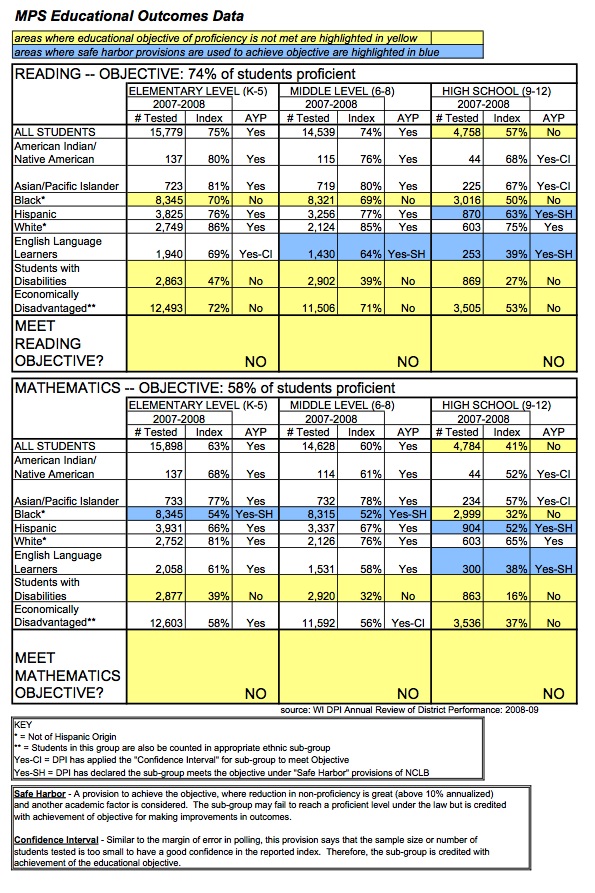
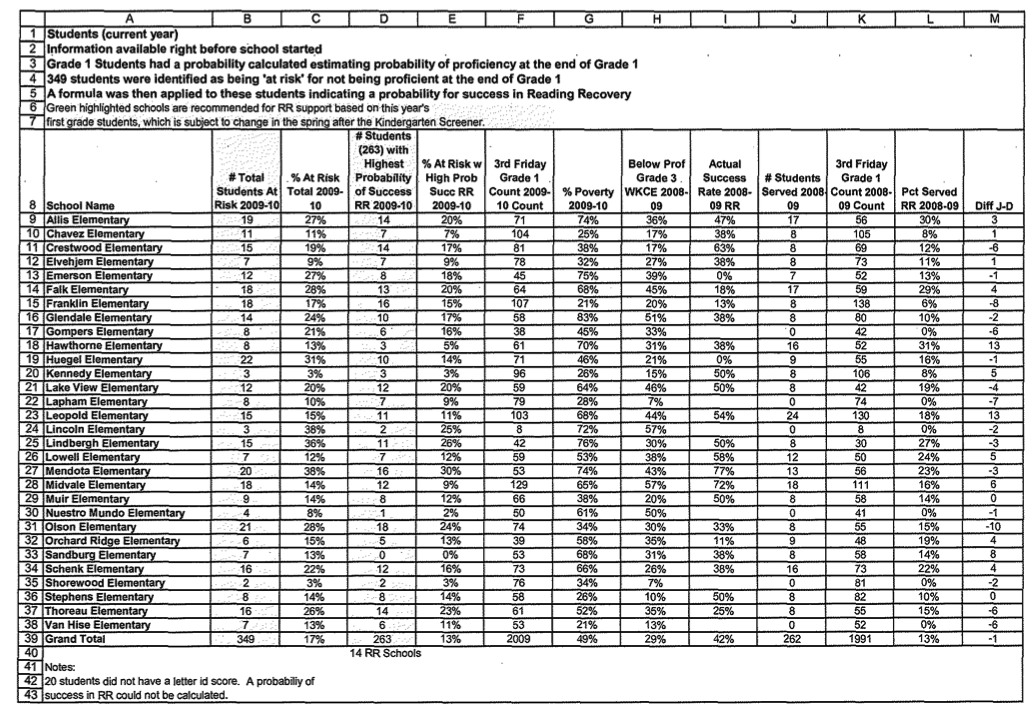
Share

Verona, WI School Board Discussion of the New Century Charter School

via a kind reader’s email, who notes that Verona’s video archives include very helpful topic based navigation!

At the most recent meeting on Dec. 7, the school board heard a final presentation from New Century School’s site council. Developments with New Century’s charter renewal are reaching a critical point, since we need approval from the school board by early January to participate in kindergarten recruitment. New Century is one of Wisconsin’s oldest charter schools (established in May 1995), and our school community is fighting for the charter’s continued existence. It’s been a challenging journey.

Click “video” for the December 7, 2009 meeting and look for “D”, the New Century Presentation. Interestingly, “E” is a presentation on a proposed Chinese immersion charter school.
Unfortunately, Madison lacks significant charter activity, something which, in my view, would be very beneficial to the community, students and parents.

Share

With Wisconsin’s QEO Gone, schools bargain harder on teachers’ contracts

Amy Hetzner:

So far this school year, the approximately 100 school districts that have reached agreements with their teachers have average settlements that increase salaries and benefits by 3.75%, according to Bob Butler, staff counsel for the Wisconsin Association of School Boards. That compares with an average total compensation increase of 4.11% for teachers in the 2008-’09 school year.
Given that settlements tend to go down the longer negotiations take, Butler said the average increases for 2009-’10 and 2010-’11 are likely to be below what they have been in the past and what was considered a minimum settlement under the QEO law.
The recession, even in growing and financially stable districts, is the main reason behind the settlement drops, Butler said. Even though the Legislature removed the QEO salary restrictions, it left revenue limits in place so that any increase in teacher compensation almost certainly means staff cuts, he said.
In addition, facing pressure from taxpayers, some school districts, such as Whitnall, refused to enact a tax levy up to their state-imposed revenue limits this year.
“We have seen such a drastic reduction in the amount of money we have coming in from the state, it would have been hard to settle at 3.8% even if the QEO still stood there,” Whitnall School Board President Bill Osterndorf said.

Related, 9/25/2009: Madison School District & Madison Teachers Union Reach Tentative Agreement: 3.93% Increase Year 1, 3.99% Year 2; Base Rate $33,242 Year 1, $33,575 Year 2: Requires 50% MTI 4K Members and will “Review the content and frequency of report cards”.

Share

Milwaukee Public Schools have heard the criticism; what’s next?

Alan Borsuk:

I give William Andrekopoulos credit – the school superintendent has invited outside scrutiny of what’s going on in Milwaukee Public Schools, and he hasn’t flinched when that has brought bad news time after time.
He says it takes courage to do this, and, especially compared with the mealy-mouthed way lots of executives in public and private businesses act, he’s right.
“If you don’t put the truth on the table . . .  there will never be a sense of urgency to improve,” he said in a phone conversation. He said he wants his successor – whom the School Board is on pace to pick soon – to have a clear understanding of what the score is.
So here’s some of the score:
In 2006, Andrekopoulos invites the Council of the Great City Schools, a professional organization for big city school administrators, to assess the education program in MPS. The result: A report that is strongly critical, saying efforts in city schools are a hodgepodge of practices, many of them weak. The report also says there is a pervasive lack of urgency about getting better results in MPS.

Share

Wisconsin School Property Tax Levies Set for 2009-10 Tax Bill, Up 6.0%

Wisconsin Taxpayers Alliance:

School property tax levies for 2009-10 are up 6.0%, from $4.28 billion last year to $4.54 billion this year, according to the Wisconsin Taxpayers Alliance (WISTAX), a nonprofit, nonpartisan research organization. The rise in school taxes exceeded last year’s increase of 5.2%, due principally to state budget cuts in aid to K-12 schools.
According to WISTAX, tax changes ranged from increases of 41.2% in Seneca and 32.8% in Gilmanton to reductions of more than 19% in Ladysmith and Sharon J1. However, increases larger than those in prior years were the norm, and 116 districts (27%) of the state’s 425 districts had increases of 10% or more. In another 151 districts, levies were up between 5% and 10%. Only 42 districts cut property taxes.
“Although state budget reductions and tighter school revenue limits have made the headlines,” noted WISTAX President Todd A. Berry, “the more telling stories are coming from budget details.”
For example, schools raised their general fund levies more than 8%, well above the overall 6% increase. They pared back the overall increases by retiring or refinancing debt and by rearranging expenditures formerly charged to a little-known fund exempt from state revenue limits: fund 80, or the community services fund. This fall, 78 of 425 districts trimmed community service levies that fund such items as community recreation and adult classes; 10 districts eliminated the tax altogether. These actions served to reduce what would otherwise have been an 8.2% tax increase.

Share

Bill gives Milwaukee Mayor Barrett mega power over schools

Larry Sandler & Erin Richards:

Milwaukee Mayor Tom Barrett would have more power over the Milwaukee Public Schools superintendent and budget than nearly any other U.S. mayor holds over a big-city school system, under a bill the Legislature is to consider Wednesday.
“If they go ahead with the present plan, it will make for one of the most powerful education mayors in the country,” said Joe Viteritti, a professor of public policy at Hunter College who led a commission to study mayoral control in New York City and has edited a book, “When Mayors Take Charge.”
The bill, sponsored by state Sen. Lena Taylor (D-Milwaukee), would allow the mayor to appoint the superintendent without confirmation by the School Board or Common Council, and would let the superintendent set the school budget and tax levy without a vote by the board or council.
Elected School Board members – who now select the superintendent and approve the budget – would be limited to an advisory role on the budget and would control only such functions as student discipline, community outreach and adult recreation.

Share