School Information System

DC Schools Have More Students Than School-Aged Kids Living In The District

Luke Rosiak & Kathryn Watson:

District of Columbia public and charter elementary schools have more students attending classes than the federal city’s entire population of such school-aged kids, indicating a fraud rate of at least 11 percent.

Mathematically, that is the minimum portion of elementary schoolers who must be non-D.C. residents, but whose parents are freeloading off taxpayers to take advantage of the District of Columbia Public Schools’ extended hours, after-school care and proximity to employers.

Share

Great Mathematicians on Math Competitions and “Genius”

Less Wrong:

mentioned in Fields Medalists on School Mathematics, school mathematics usually gives a heavily distorted picture of mathematical practice. It’s common for bright young people to participate in math competitions, an activity which is closer to that of mathematical practice. Unfortunately, while math competitions may be more representative of mathematical practice than school mathematics, math competitions are themselves greatly misleading. Furthermore, they’ve become tied to a misleading mythological conception of “genius.” I’ve collected relevant quotations below.

Acknowledgment – I obtained some of these quotations from a collection of mathematician quotations compiled by my colleague Laurens Gunnarsen.

Related: Math Forum.

Share

Paris calls all willing citizens to become reservists

AFP:

French Interior Minister Bernard Cazeneuve on Saturday called on citizens to become reservists and help boost security forces in the wake of the country’s latest terror attack.

France’s “operational reservists” include French citizens with or without military experience as well as former soldiers.

“I want to call on all French patriots who wish to do so, to join this operational reserve,” said Cazeneuve.

Share

So Many Research Scientists, So Few Openings as Professor

Gina Kolata:

The United States is producing more research scientists than academia can handle.

We have been told time and again that the United States needs more scientists, but when it comes to some of the most desirable science jobs — tenure-track professorships at universities, where much of the exciting work is done — there is such a surplus of Ph.D.s that in the most popular fields, like biomedicine, fewer than one in six has a chance of joining the club in the foreseeable future.

While they try to get a foot in the door, many spend years after getting their Ph.D. as poorly paid foot soldiers in a system that can afford to exploit them. Even someone as brilliant as Emmanuelle Charpentier, who in 2015 became head of the Max Planck Institute for Infection Biology after a momentous discovery in gene editing, spent the previous 25 years moving through nine institutions in five countries.

Share

Bill Gates calls the ed tech bluff

Frederick Hess:

In truth, Gates’s observation should not have surprised anyone who has been paying attention. After all, technology has long been offered as the miraculous balm that will transform and improve teaching and learning. Enthusiasts have said this about iPads, laptops, the Internet, desktop computers, videotapes, televisions, the radio . . . and even chalkboards, if you go back far enough. With each new advance, schools spend heavily on nifty new gizmos, make grand promises, and get enthusiastic reviews. And then, each time, nothing much changes.

Unfortunately, most technology in schooling has involved haphazard attempts to slather new devices across classrooms, with little vision of how or why these will make a difference.

Share

We’ve Already Solved Oxfam’s Little Inequality Problem

Tim Worstall:

The World Economic Forum at Davos is fast approaching so Oxfam has decided to re-release their report screaming that we’re all going to hell in a handcart because of increasing inequality. About which we can say two things. The first thing being that they’re complaining about the wrong thing. Wealth is an interesting concept and we might well want to pay it some attention. But I’m afraid that the way Oxfam is doing it is simply wrong. Precisely because it is a net concept, as they agree it is (that is, it’s assets minus debts) then by their very definition there’s more poor people in either the US or Europe than there are in China. Just not something which passes the basic smell test and not something that should spark our concern in any great manner. Because this is a side effect of the fact that we have efficient financial markets in the rich countries. That is, it’s possible to borrow money when you don’t own anything: as students do to go to college for example. In a net wealth measurement, those students have negative wealth. And thus are classified as poor as they head out the door with their newly minted Harvard degrees.

The real joy of Oxfam’s complaint is that this is made very clear in the Credit Suisse report they take their own data from. As I pointed out here in fact:

It’s that left hand side we want to look at.

Share

The Taulbee Survey

CRA:

The Taulbee Survey is the principal source of information on the enrollment, production, and employment of Ph.D.s in computer science and computer engineering (CS & CE) and in providing salary and demographic data for faculty in CS & CE in North America. Statistics given include gender and ethnicity breakdowns.

Share

Civics: Rewriting the rulebook on coups, time to add cyberpower

the grugq:

Mere hours after the putsch in Turkey has failed, it is still too early to understand exactly what went on. Given those constraints, I still want to discuss something which has altered “the game” so much that the existing guidebook needs to be significantly revised.

I am not a military strategist, but I have lived through a couple coups here in Thailand, so I have some first hand experience of what they look like. The guide book to running a coup is still Luttwak’s Coup d’État, but it needs to be revised to reflect the use of cyberpower. In the same vein, people who talk about cyberpower need to understand what it actually is (hint: it isn’t a stockpile of exploits, it’s the ability to create and maintain advantage.)

The Good Coup Guide

A coup is basically a sucker punch. The trick is to end the fight before it even begins. The members of the coup are in the minority and a long drawn out fight, even if they win, will not have the trappings of legitimacy or stability. The goal is to have a rapid attack against the existing leadership and replace them before anyone knows what happened. At the same time, the general population needs to be kept out of the way, because large groups of civilians complicate things to no end.

Essentially, the existing leaders need to be removed from positions of power and their ability to coordinate and organise a resistance must be blocked. This is easier when there are only a few means of mass communication (e.g the TV station, or the radio station.)

Share

Civics: Justice department ‘uses aged computer system to frustrate Foia requests’

Sam Thielman:

A new lawsuit alleges that the US Department of Justice (DoJ) intentionally conducts inadequate searches of its records using a decades-old computer system when queried by citizens looking for records that should be available to the public.

Freedom of Information Act (Foia) researcher Ryan Shapiro alleges “failure by design” in the DoJ’s protocols for responding to public requests. The Foia law states that agencies must “make reasonable efforts to search for the records in electronic form or format”.

In an effort to demonstrate that the DoJ does not comply with this provision, Shapiro requested records of his own requests and ran up against the same roadblocks that stymied his progress in previous inquiries. A judge ruled in January that the FBI had acted in a manner “fundamentally at odds with the statute”.

Now, armed with that ruling, Shapiro hopes to change policy across the entire department. Shapiro filed his suit on the 50th anniversary of Foia’s passage this month.

Foia requests to the FBI are processed by searching the Automated Case Support system (ACS), a software program that celebrates its 21st birthday this year.

Share

U.S. Wins First Place at International Mathematics Competition in Hong Kong

Mathematical Association of America:

“We are very excited to bring home another first-place IMO award, which serves as a recognition for the the high standard of mathematical creativity and problem-solving capabilities we have in our country,”said Po-Shen Loh, lead coach for the U.S. team and associate professor of mathematics at Carnegie Mellon University.

“We are very excited to bring home another first-place IMO award, which serves as a recognition for the the high standard of mathematical creativity and problem-solving capabilities we have in our country,”said Po-Shen Loh, lead coach for the U.S. team and associate professor of mathematics at Carnegie Mellon University.

The six U.S. team members were selected through a series of competitions organized by the Mathematical Association of America (MAA), culminating with the USA Mathematical Olympiad. The six team members joined 70 of their peers at Carnegie Mellon University in June to immerse themselves in problem solving for three weeks at MAA’s Mathematical Olympiad Summer Program.

“We have been running the U.S. Olympiad training program with a focus on the long-term development of our country’s talent, and it’s great to see that reflected in the continued team success a second year in a row,” said MAA Executive Director Michael Pearson.

Members of the winning 2016 U.S. team were Ankan Bhattacharya, Michael Kural, Allen Liu, Junyao Peng, Ashwin Sah, and Yuan Yao, all of whom were awarded gold medals for their individual scores. Team members Liu and Yao each earned perfect test scores. The team was accompanied by Loh and deputy coach Razvan Gelca, professor of mathematics and statistics at Texas Tech University.

Related: Math Forum.

Share

candidates, 4 seats: A preview of the Minneapolis school board race

Erin Hinrichs:

Just a few months into Superintendent Ed Graff’s tenure as the leader of Minneapolis Public Schools, another major change in leadership will take shape. He’ll be reporting to at least one new board member, and as many as four, after the upcoming school board election in November.

Board Member at Large Carla Bates has decided not to run for re-election; Board Member Kim Ellison is looking to fill Bates’ seat, leaving the District 2 seat up for grabs.

In addition to Ellison, two more incumbents — Tracine Asberry and Josh Reimnitz — will be vying alongside five other candidates to fill four open seats.

All of the candidates have kicked off their campaign efforts online, through websites and social media activity. And yard signs have already found their way into some neighborhoods. But the race rhetoric will likely become more heated once the first round of campaign finance reports are filed by the Aug. 2 deadline.

Share

Civics: Bipartisan House Members Announce Fourth Amendment Caucus

U.S. House of Representatives – Peter Whippy:

Today, a bipartisan group of lawmakers, led by co-chairs U.S. Reps. Zoe Lofgren (D-Calif.) and Ted Poe (R-Texas), announced the newly formed Fourth Amendment Caucus to protect the privacy and security of Americans in the digital age.
The bipartisan caucus is comprised of twenty-five founding members, thirteen Republicans and twelve Democrats. The members will lead efforts in the House of Representatives to protect against warrantless searches and seizures, close privacy violating surveillance loopholes, and champion reform efforts to protect and restore Fourth Amendment rights.

“Members of the House of Representatives from both parties are eager to debate and vote on privacy and surveillance issues that are far too often drafted in secret and jammed through the legislative process under tight deadlines, restrictive procedures, and little debate,” said Lofgren. “From shutting the backdoor on warrantless spying to leading efforts to protect privacy, this Fourth Amendment Caucus gives members a new, nonpartisan forum for ideas, organization, and strategy as we fight to protect the Constitution and the American people.”

The fourth amendment:

The Fourth Amendment to the United States Constitution prohibits unreasonable searches and seizures and requires any warrant to be judicially sanctioned and supported by probable cause. It is part of the Bill of Rights and was adopted in response to the abuse of the writ of assistance, a type of general search warrant issued by the British government and a major source of tension in pre-Revolutionary America. The Fourth Amendment was introduced in Congress in 1789 by James Madison, along with the other amendments in the Bill of Rights, in response to Anti-Federalist objections to the new Constitution. Congress submitted the amendment to the states on September 28, 1789. By December 15, 1791, the necessary three-quarters of the states had ratified it. On March 1, 1792, Secretary of State Thomas Jefferson announced the adoption of the amendment.Show LessWikipedia
Related Topics

Share

Half of all US food produce is thrown away, new research suggests

Suzanne Goldberg:

Americans throw away almost as much food as they eat because of a “cult of perfection”, deepening hunger and poverty, and inflicting a heavy toll on the environment.

Vast quantities of fresh produce grown in the US are left in the field to rot, fed to livestock or hauled directly from the field to landfill, because of unrealistic and unyielding cosmetic standards, according to official data and interviews with dozens of farmers, packers, truckers, researchers, campaigners and government officials.

From the fields and orchards of California to the population centres of the east coast, farmers and others on the food distribution chain say high-value and nutritious food is being sacrificed to retailers’ demand for unattainable perfection

Share

PH525x series – Biomedical Data Science

github:

The unprecedented advance in digital technology during the second half of the 20th century has produced a measurement revolution that is transforming science. In the life sciences, data analysis is now part of practically every research project. Genomics, in particular, is being driven by new measurement technologies that permit us to observe certain molecular entities for the first time. These observations are leading to discoveries analogous to identifying microorganisms and other breakthroughs permitted by the invention of the microscope. Choice examples of these technologies are microarrays and next generation sequencing.

Scientific fields that have traditionally relied upon simple data analysis techniques have been turned on their heads by these technologies. In the past, for example, researchers would measure the transcription levels of a single gene of interest. Today, it is possible to measure all 20,000+ human genes at once. Advances such as these have brought about a shift from hypothesis to discovery-driven research. However, interpreting information extracted from these massive and complex datasets requires sophisticated statistical skills as one can easily be fooled by patterns arising by chance. This has greatly elevated the importance of statistics and data analysis in the life sciences.

Share

‘We’re struggling to survive’: student debt still weighing down people over 30

Megan Carpentier:

But for many thirty- or fortysomething residents of the state capital, about 150 miles north of Manhattan, their student debt is still weighing them down, despite their having aged out of the twentysomething demographic that is the focus of public student debt sympathy.

“I pay $700 a month in student loans and I didn’t go to a fancy school,” explained Deanna Fox, 30, a writer who lives in Delanson, to a table full of people in their 30s and 40s gathered at the Riverfront Bar and Grille in Albany. “But there really wasn’t any opportunity as far as scholarships go: because I came from a very middle-class family, I was too wealthy – even though we didn’t have much – to get a lot of state-funded grants or scholarships, and wasn’t wealthy enough for my parents to pay for me to go to college out of their own pockets.

“So I had to take out probably 75% of my funding for college as a loan, and most of it was private loans.”

“I also pay $700 in student loans a month,” said Emily Lemieux, a 34-year-old museum professional living in Albany, “and I also didn’t go to fancy schools.”

Share

‘The US? We’re in bad shape’: squeezed middle class tell tales of struggle

Dan Roberts:

Once upon a time, this middle-aged professional, who is putting her daughters through university too, would have been considered solidly middle class. Yet that full-time teaching job pays just $3,333.33 a month, a household salary that is now below official definitions of middle income – even when adjusted for the relatively low cost of living in a town such as Goldsboro, North Carolina, where she works.

When tax and medical insurance are deducted, her take-home figure drops by more than a third, after which money for food, housing, a car and college tuition has to be found. To make the numbers add up, she has to work three other jobs a week.

Sadly, her experience is far from unusual. Across the town of Goldsboro, like many other places in a country once famous for the width of its wealth, America’s middle class is struggling. The issue was one of the most prominent and persistent mentioned when Guardian US asked, as part of our Voices of America series, more than 1,300 voters to identify the single most pressing issue for them in the 2016 election campaign

Share

Notes on Madison’s 2016-2017 $421,473,742 budget

3.7MB 2016-2017 Budget Book (PDF):

Focus on Reading in Kindergarten through Second Grade
For the first time, all kindergarten through second grade teachers at our highest needs schools will meet quarterly in grade levels for professional development and time to plan and collaborate together. They will also use new computer adaptive software designed to supplement core instruction and ensure students are building foundational skills in the early grades.

MAP and ACT in Context
MAP: In all categories but one, we are far above the national average for growth.
ACT: More students than ever are taking the ACT. With participation rates 25% above the national average, scores are in the 60th percentile nationally. Participation increased by 8% overall.

GOAL 1: Every student is on-track to graduate as measured by student growth and achievement at key milestones.

GOAL 2: Every student has access to a challenging and well-rounded education as measured by programmatic access and participation data.

Launched targeted professional development and planning on early reading for all teachers in kindergarten through second grade and computer adaptive software aimed at early literacy at our 13 highest need elementary schools

Selected elementary math curriculum and new reading resources for middle schools

I’ve always found it amazing how often the District swaps curriculum.

The emphasis on reading is welcome, but are we making progress in addressing Madison’s, long term, disastrous reading results?

It has long been a challenge to find the District’s total spending. This year, while somewhat improved (page 12) still lacks “Construction” spending.

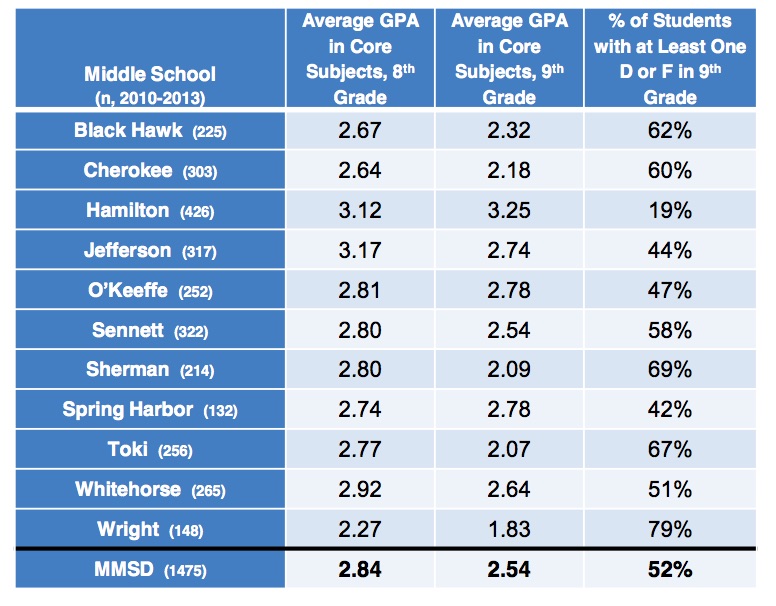
Two budget tables are presented below and on the following page. These tables provide a high level overview of the 2016-17 budget proposal and are intended to serve as an introduction to the budget discussion which follows.

The first table, 2016-17 All Funds Summary, captures all budget activity for MMSD with the exception of the Construction Fund (reported elsewhere to maintain comparability). This table is designed to report on the ‘total budget picture’ for MMSD.

The second table, 2016-17 Operating Funds Summary, sharpens the focus to just the operating funds (defined as General Fund + Special Education Fund, less interfund transfers). This fund captures the basic operations of the district. It excludes the Debt Service, Construction, Food Service and Community Service funds. This table is designed to report on the ‘core operations’ of MMSD.

Presumably, all taxpayer dollars spent by the Madison School District support it’s mission, educating our children….

Madison plans to enroll 25,076 students for the 2016-2017 school year. The Administration plans to spend $_____ per student.

Share

Charter School Company Blasts “Shameless” California Attorney General

Molly Hensley-Clancy:

attorney general won a groundbreaking $168.5 million settlement against the country’s largest operator of online charter schools.

Or, after a lengthy investigation, it managed to collect only $2.5 million from a business that pulled in almost $1 billion in revenue in 2015 — with no fines, penalties, or admission of wrongdoing.

Which one is true? It all depends on who you ask.

After a wide-ranging investigation into virtually every aspect of the controversial business model of online charter operator K12 Inc. — from how its schools advertise to how they record attendance and collect payments — California Attorney General Kamala Harris settled for $8.5 million in actual, real-world money, which will be paid by the company to the state. Her office also extracted $160 million in what Harris called “debt relief” for the California schools that the company manages — for a total, the attorney general’s office said, of $168.5 million.

Share

I didn’t even know where Finland was”

Joe Heim:

I didn’t even know where Finland was,” said Briana, 16. “But we’re learning more about it and trying to teach her more about America and our culture.”

She also observed a distinct difference between the Finns and the Americans.

Share

please I’m A Student-Debt Slave.’ How’d We Get Here?

Eric Westervelt:

by student debt: More than 40 million Americans are shouldering a crippling $1.3 trillion in loans.

That burden is obstructing careers, families, dreams, employment and even retirement.

Uncle Sam and Wall Street have made lots of money off the crisis.

We’ve covered this issue in many ways, including the debates, the players, tips for easing debt, how debt is affecting young people’s decision making and a lot more.

But how did we get here? Who has profited most and how?

Share

The injustice of California’s teacher tenure

George Will:

Technically, California teachers are granted lifetime tenure after just two years. Actually, they must be notified of tenured status after just 16 months. (Thirty-two states grant tenure after three years, nine states after four or five. Four states never grant tenure.) When incompetent or negligent teachers gain tenure, dismissal procedures are so complex and costly that the process can take up to 10 years and cost up to $450,000. The trial court called the power to dismiss “illusory.” Each year approximately two teachers are dismissed for unsatisfactory performance — 0.0007 percent of California’s 277,000 teachers.

Share

When America believed in eugenics

Victoria Brignell:

Amid popular fears about the decline of the national stock, one of the main drives behind the formation of American immigration policy at the end of the 19th century was the desire to exclude disabled people. The first major federal immigration law, the Act of 1882, prohibited entry to any ‘lunatic, idiot, or any person unable to take care of himself or herself without becoming a public charge.’

As the eugenics movement gathered strength, the exclusion criteria were gradually tightened to make it easier for immigration officials to keep disabled people out of America. The 1907 law denied entry to anyone judged ‘mentally or physically defective, such mental or physical defects being of a nature which may affect the ability of such alien to earn a living.’ It added ‘imbeciles’ and ‘feeble-minded persons’ to the list of automatically excluded people and inspectors were directed to exclude people with ‘any mental abnormality whatever’. Regulations in 1917 included a long list of disabilities that could be cause for exclusion including arthritis, asthma, deafness, deformities, heart disease, poor eyesight, poor physical development and spinal curvature.

Detecting physical disabilities was a major aspect of the American immigration inspector’s work. The Commissioner General of Immigration reported in 1907: “The exclusion from this country of the morally, mentally and physically deficient is the principal object to be accomplished by the immigration laws.” Inspection regulations stated that each individual ‘should be seen first at rest and then in motion’ in order to detect ‘abnormalities of any description’. It was recommended that inspectors should watch immigrants as they carried their luggage upstairs to see if ‘the exertion would reveal deformities and defective posture’. As one inspector wrote: “It is no more difficult to detect poorly built, defective or broken down human beings than to recognise a cheap or defective automobile.” An abnormal appearance meant a chalked letter on the back – L for lameness, G for goitre, X for mental illness. Once chalked, a closer inspection was required, which meant that other problems were likely to be established.

Share

The New Ruling Class

Helen Andrews:

Last fall, Toby Young did something ironic. Toby is the son of Michael Young, the British sociologist and Labour life peer whose 1958 satire The Rise of the Meritocracy has been credited with coining the term. Toby has become an education reformer in his own right, as founder of the West London Free School, after a celebrated career as a journalist and memoirist (How to Lose Friends and Alienate People). In September, he published an 8,000-word reconsideration of his father’s signature concept in an Australian monthly. The old man was right that meritocracy would gradually create a stratified and immobile society, he wrote, but wrong that abolishing selective education was the cure. “Unlike my father, I’m not an egalitarian,” Young wrote. If meritocracy creates a new caste system, “the answer is more meritocracy.” To restore equality of opportunity, he suggested subsidies for intelligence-maximizing embryo selection for poor parents “with below-average IQs.”1 The irony lay in the implication that Young, because of who his father was, has special insight into the ideology that holds that it shouldn’t matter who your father is.

His outlandish resort to eugenics suggests that Toby Young found himself at a loss for solutions, as all modern critics of meritocracy seem to do. The problems they describe are fundamental, but none of their remedies are more than tweaks to make the system more efficient or less prejudicial to the poor. For instance, in Excellent Sheep, William Deresiewicz accuses the Ivy League of imposing a malignant ruling class on the country, then meekly suggests that elite universities might solve the problem by giving greater weight in admissions to socioeconomic disadvantage and less to “résumé-stuffing.”2 In The Tyranny of the Meritocracy, Lani Guinier belies the harsh terms of her title by advising that we simply learn to reward “democratic rather than testocratic merit.”3 Christopher Hayes subtitled his debut book Twilight of the Elites “America after Meritocracy,” but the remedies he prescribes are all meant to preserve meritocracy by making it more effective.4 In his latest book, Our Kids, Robert Putnam proves that American social mobility is in crisis, then reposes his hopes in such predictable nostrums as housing vouchers and universal pre-kindergarten.5

Share

After the Baby Bust: The Politics and Ecology of Zero Population Growth

Paul Robbins

“Lazy workers.”

This, the owners of coffee and rubber estates in Karnataka, India, told us, was why they would tear out dense canopies of trees harboring wild hornbills and critically endangered frogs and replace them with more intensive and less wildlife-friendly crops. Compared to the days when their fathers ran these estates, and the workers required for the back-breaking tasks of weeding, coppicing, and harvesting were more pliable, today’s workers had become defiant and demanding. Laborers now insisted on smoke breaks, higher wages, and even electricity. Worse, farmers told us, they had little choice but to either give up labor-demanding crops or to comply with worker demands, lest their laborers vanish.

The shift in labor relations is striking given the locale. Karnataka is a place where the bargaining power of workers has always been notoriously poor, where rural poverty is crushing, and where generations of people have lived without access to modern amenities and education.1

Many factors have contributed to the shift: urbanization, labor outmigration, globalization, and an unprecedented aspirational culture that eschews rural farm labor where other opportunities exist. But one central reason, contributing to and accelerating all the others, is far more surprising: Karnataka is shrinking. As in most states throughout southern India, the fertility rate in the state has fallen to 1.8, and for many years has been well below the rate at which new births can replace those who naturally pass away.2 Population is getting smaller, influencing wages, farming practices, and habitat. Zero population growth has arrived in southern India: a Baby Bust.

As growth has ceased throughout Karnataka, across southern India, and in many other parts of the world3, new social arrangements are evolving, new ecologies are coming into being, and new political and economic conflicts are emerging. What happens to an economy, anywhere in the world, when population stalls or declines? How are relationships between workers and owners reconfigured? What happens in families, when the demands for women’s labor and demands for reproduction come into conflict, especially in historically patriarchal contexts? When labor becomes scarce, do regions shift to land abandonment and incidental rewilding, or instead to increasingly mechanized and intensive agricultural systems?

Share

Peña Nieto faces tough lessons over Mexico teachers’ protests

Jude Webber:

In a failing school system in which more than half of 15-year-olds cannot master basic maths, the reform is one of the most significant of the policy changes pushed through by Mr Peña Nieto in his first two years in office. Mexico’s students are among the worst performers in the OECD, so the reforms are critical to improving poor productivity and vaulting Mexico into the big league of world economies.

But a dissident teachers’ union, the CNTE, wants the reform bill — which introduces a merit-based system of appointing, promoting and firing teachers — scrapped. It has been staging weeks of roadblocks and marches, which have spread beyond the union’s southern power base to Mexico City and the northern state of Nuevo León.

Officials of the CNTE met interior ministry mediators on Monday to try to end the impasse, but came away with a commitment only to keep talking. The main SNTE union, which had earlier backed the reform, has weighed in with a dozen demands of its own. These include changes to teacher evaluations, the backbone of the reforms.

“The government is going to have to make some concessions,” said Sergio Aguayo, a political analyst. “The question is, to what extent teachers are going to want to make life easy for Peña Nieto.”

The answer appears to be “not very”. The SNTE has begun negotiations with the education ministry on its own demands.

“There’s a lot of pressure to water down the reform,” says Marco Fernández, a professor at the Tecnológico de Monterrey university and researcher at think-tank México Evalúa. “I’m fearful,” he said.

Share

Civics: In first, U.S. judge throws out cell phone ‘stingray’ evidence

Nate Raymond:

Pauley in Manhattan on Tuesday ruled that defendant Raymond Lambis’ rights were violated when the U.S. Drug Enforcement Administration used such a device without a warrant to find his Washington Heights apartment.

The DEA had used a stingray to identify Lambis’ apartment as the most likely location of a cell phone identified during a drug-trafficking probe. Pauley said doing so constituted an unreasonable search.

“Absent a search warrant, the government may not turn a citizen’s cell phone into a tracking device,” Pauley wrote.

The ruling marked the first time a federal judge had suppressed evidence obtained using a stingray, according to the American Civil Liberties Union, which like other privacy advocacy groups has criticized law enforcement’s use of such devices.

Share

Dragas Says The University Of Virginia Create A $2.3 Billion Dollar Slush Fund

Karen Kapsidelis:

“Privately referred to as ‘unfound money’ (that is, unfound by legislators, the press, and — as a result — the general public), this astounding sum could run the entire University Academic Division for a year and a half. It would pay the four-year tuition bills for 44,000 Virginia students,” she wrote.

Instead, the administration is “hoarding” the funds for other uses, she said, citing as an example a recent proposal for “a $50 million program for self-care training to include journaling, meditation and yoga for nursing students.” She also was critical of salary increases for faculty and administrators.

In his statement, de Bruyn said that the funds that support the Cornerstone Plan “enable strategic investments in our faculty, academic programs, clinical enterprise, research infrastructure and physical space needs that will continue to benefit future generations of students while also minimizing tuition increases.”

For the coming academic year, U.Va.’s tuition increase of 1.5 percent for continuing in-state undergraduate students is the lowest of all public institutions in the state, he said, and U.Va. also reduced the four-year loan caps for Virginia students while meeting full financial need for all students.

Share

Harvard study: campus scandals devastate enrollment

Marlo Safi:

According to a working paper out of the Harvard Business School, scandals on college campuses that receive extensive media coverage lead to decreases in the number of applications that college receives.

“Our finding suggests that media is…holding colleges accountable by deterring future scandals.” Tweet This

Long-form articles, which are longer articles that can approach the size of novels, have “the same effect as dropping ten rankings in the popular U.S. News and World Report college rankings” when they focus on instances of scandals including cheating, sexual assault, murder, or hazing, the study reports.

The study’s authors identify 124 different public scandals that occurred between 2001 and 2013 at the top 100 U.S. colleges. Scandals with more than five mentions in the The New York Times lead to a 9 percent drop in applications the following year, and scandals covered by long-form magazine articles receive 10 percent fewer applications the following year.

Share

Public university now requires applicants pledge commitment to ‘diversity and inclusion’

William Nardi:

“As of July 1, the University of Cincinnati will request a Diversity and Inclusion statement of all applicants for faculty and staff positions,” the university recently announced. “Faculty and administrative/professional applicants will be asked to submit a personal statement summarizing his or her contributions (or potential contributions) to diversity, inclusion and leadership.”

As part of the new policy, a similar mandate has been announced for those simply seeking hourly jobs at the public university, which receives more than 63,000 applications per year, according to campus officials.

Those applicants must now answer the question: “As an equal-opportunity employer with a diverse staff and student population, we are interested in how your qualifications prepare you to work with faculty, staff and students from cultures and backgrounds different from your own.”

Share

K-12 Tax & Spending Climate: US County Gini Index

Link. Much more on Gini, here.

Share

Autism As a Disorder of High Intelligence

Bernard Crespi:

A suite of recent studies has reported positive genetic correlations between autism risk and measures of mental ability. These findings indicate that alleles for autism overlap broadly with alleles for high intelligence, which appears paradoxical given that autism is characterized, overall, by below-average IQ. This paradox can be resolved under the hypothesis that autism etiology commonly involves enhanced, but imbalanced, components of intelligence. This hypothesis is supported by convergent evidence showing that autism and high IQ share a diverse set of convergent correlates, including large brain size, fast brain growth, increased sensory and visual-spatial abilities, enhanced synaptic functions, increased attentional focus, high socioeconomic status, more deliberative decision-making, profession and occupational interests in engineering and physical sciences, and high levels of positive assortative mating. These findings help to provide an evolutionary basis to understanding autism risk as underlain in part by dysregulation of intelligence, a core human-specific adaptation. In turn, integration of studies on intelligence with studies of autism should provide novel insights into the neurological and genetic causes of high mental abilities, with important implications for cognitive enhancement, artificial intelligence, the relationship of autism with schizophrenia, and the treatment of both autism and intellectual disability.

Share

On The Problem With Monolithic School Districts

Jared Diamond:

suggests is that we can extract from human history a couple of principles. First, the principle that really isolated groups are at a disadvantage, because most groups get most of their ideas and innovations from the outside. Second, I also derive the principle of intermediate fragmentation: you don’t want excessive unity and you don’t want excessive fragmentation; instead, you want your human society or business to be broken up into a number of groups which compete with each other but which also maintain relatively free communication with each other. And those I see as the overall principles of how to organize a business and get rich.

Share

History degrees at Harvard, Yale, Stanford, others don’t require US history course

Nick Anderson:

University does not require history majors to take a course in U.S. history. Nor do Georgetown University, the University of Maryland and many other highly regarded schools.

The American Council of Trustees and Alumni says that’s a problem. The council, based in Washington, recently surveyed the requirements for history majors at top colleges and universities and concluded that too many give short shrift to the United States.

“A democratic republic cannot thrive without well-informed citizens and leaders,” said the council’s president, Michael Poliakoff. “Elite colleges and universities in particular let the nation down when the examples they set devalue the study of United States history.”

The council’s survey of programs at 76 highly ranked colleges and universities found that 53 do not require history students to take a course focused on the nation’s history. Among the 23 that do have such a requirement were the University of California at Berkeley, the College of William and Mary, Columbia University and — not surprisingly — the U.S. Naval Academy and U.S. Military Academy.

Share

K-12 Tax & Spending Climate: National Debt To 141% Of US Economy By 2046

CBO:

Federal debt held by the public, which was equal to 39 percent of gross domestic product (GDP) at the end of fiscal year 2008, has already risen to 75 percent of GDP in the wake of a financial crisis and a recession. In CBO’s projections, that debt rises to 86 percent of GDP in 2026 and to 141 percent in 2046—exceeding the historical peak of 106 percent that occurred just after World War II.
The prospect of such large debt poses substantial risks for the nation and presents policymakers with significant challenges.

Share

Seven Pervasive Statistical Flaws in Cognitive Training Interventions

David Moreau*, Ian J. Kirk and Karen E. Waldie:

The prospect of enhancing cognition is undoubtedly among the most exciting research questions currently bridging psychology, neuroscience, and evidence-based medicine. Yet, convincing claims in this line of work stem from designs that are prone to several shortcomings, thus threatening the credibility of training-induced cognitive enhancement. Here, we present seven pervasive statistical flaws in intervention designs: (i) lack of power; (ii) sampling error; (iii) continuous variable splits; (iv) erroneous interpretations of correlated gain scores; (v) single transfer assessments; (vi) multiple comparisons; and (vii) publication bias. Each flaw is illustrated with a Monte Carlo simulation to present its underlying mechanisms, gauge its magnitude, and discuss potential remedies. Although not restricted to training studies, these flaws are typically exacerbated in such designs, due to ubiquitous practices in data collection or data analysis. The article reviews these practices, so as to avoid common pitfalls when designing or analyzing an intervention. More generally, it is also intended as a reference for anyone interested in evaluating claims of cognitive enhancement.

Share

A Meta-Analysis of Blood Glucose Effects on Human Decision Making

Jacob L. Orquin & Robert Kurzban:

The academic and public interest in blood glucose and its relationship to decision making has been increasing over the last decade. To investigate and evaluate competing theories about this relationship, we conducted a psychometric meta-analysis on the effect of blood glucose on decision making. We identified 42 studies relating to 4 dimensions of decision making: willingness to pay, willingness to work, time discounting, and decision style. We did not find a uniform influence of blood glucose on decision making. Instead, we found that low levels of blood glucose increase the willingness to pay and willingness to work when a situation is food related, but decrease willingness to pay and work in all other situations. Low levels of blood glucose increase the future discount rate for food; that is, decision makers become more impatient, and to a lesser extent increase the future discount rate for money. Low levels of blood glucose also increase the tendency to make more intuitive rather than deliberate decisions. However, this effect was only observed in situations unrelated to food. We conclude that blood glucose has domain-specific effects, influencing decision making differently depending on the relevance of the situation to acquiring food.

Share

K-12 Tax and Spending Climate: 

Scott Hodge:

There are many reasons to reform the U.S. tax code. The United States has a high marginal corporate tax rate, a poorly defined tax base, and an out-of-date international tax system. However, one often overlooked issue in tax reform is complexity. For decades, the tax code has become more and more detailed, with thousands of additional pages of statutes, regulations, and case law. This added complexity imposes a real cost on the U.S. economy. Tackling the cost of tax complexity to our nation’s economy should be a priority for lawmakers.

The Expanding Size of the Tax Code
Over the last century, the federal tax code has expanded dramatically in size and scope. In 1955, the Internal Revenue Code stood at 409,000 words. Since then, it has grown to a total of 2.4 million words: almost six times as long as it was in 1955 and almost twice as long as in 1985.

However, the tax statutes passed by Congress are only the tip of the iceberg when it comes to tax complexity. There are roughly 7.7 million words of tax regulations, promulgated by the IRS over the last century, which clarify how the U.S. tax statutes work in practice. On top of that, there are almost 60,000 pages of tax-related case law, which are indispensable for accountants and tax lawyers trying to figure out how much their clients actually owe.

Share

Why the Great Divide Is Growing Between Affordable and Expensive U.S. Cities

Laura Kusisto:

Across the country, a divide is emerging between cities that are growing outward and remaining affordable and ones that are hemmed in by geography and onerous zoning codes and are becoming more and more expensive.

As a whole, U.S. cities are expanding as rapidly as they have throughout the last half-century. From the 1950s until the 2000s they have added about 10,000 square miles per decade, or an area roughly the size of Massachusetts, according to research by Issi Romem, chief economist at real-estate site BuildZoom, to be released Monday. But beneath the surface a divide is deepening.

Share

Mom ‘in Tears’ Over Inspiring Letter Teacher Sent to Her Son With Autism

Nicole Pelletiere:

School and Sports College in St. Helens. In second grade, students take stage one of their SATs in various subjects and then measured again in grade six, Twist said.

Lansbury is a school for children with special needs. Ben was the only child in his school to take the SATs this year, his teacher’s assistant Ruth Clarkson confirmed to ABC News today.

On July 8, Twist received Ben’s test results from Clarkson. Ben also received a special letter from Clarkson, who commended him on his many strengths and abilities, highlighting that the SATs “only measure a little bit” of who he is as a person and as a student.

Clarkson goes on to list talents Ben possesses, such as his kindness, ability to keep friends and musical talent, among others.

Share

Here’s Why L.A.’s New Changes to Teacher Evaluation Are Bad for Students and Teachers

Thomas Toch:

In the nearly 650,000-student Los Angeles Unified School District, the local union, United Teachers Los Angeles, recently won changes that permit veteran teachers in the nation’s second largest school system to be evaluated as infrequently as twice a decade; makes it more difficult to use evaluations to establish “master” teacher positions, career ladders, or performance-based pay by eliminating the top category of “highly effective;” and plays down the role of student achievement in teacher evaluations.

Share

How ‘dad deprivation’ could be eroding modern society

Martin Daubney:

One of the world’s most respected campaigners on men’s issues believes “dad deprivation” is directly causing what he’s termed “the boy crisis” – and unless society urgently intervenes, we will be in danger of writing off a generation of men.

This Saturday, Warren Farrell – pioneering men’s activist, author of The Myth Of Male Power and a mentor who once coached John Lennon – will give a hugely-anticipated keynote speech at Male Psychology Conference in London.

Share

Human capital in the long run


Jong-Wha LeeHanol Lee
:

This study presents new data sets on long-run enrollment ratios, educational attainment, and human capital stock measures for numerous countries. We construct a complete data set of historical enrollment ratios, subdivided by education level and gender, for 111 countries from 1820 to 1945 (at five-year intervals) by using newly compiled census observations and information on the year of establishment of the oldest school in individual countries. Then, by utilizing these enrollment ratios, as well as available census data from 1945 onward on different age groups’ educational attainment, we construct a data set of estimated educational attainment, disaggregated by gender and age group, and aggregate human capital stock that spans from 1870 to 2010. The data show that over the past two centuries, there has been remarkable growth in average educational attainment and human capital stock as well as a narrowing of the gap in average educational attainment between nations.

Share

Taxpayer Funded Education Rhetoric

Julie Bosman:

“Our local grade school is now the government school,” State Senator Forrest Knox wrote in an op-ed article last year, echoing conservative concerns that the government had inserted itself unnecessarily into education.

The intent was obvious to her, Ms. Massman said. “They are trying to rebrand public education,” she said.

The use of the term has set off alarms even among some Republicans, who fear that it signals still less support, financially and otherwise, for the public schools in a state that had long felt pride over the quality of its education system. The recent adoption of a school finance plan that was acceptable to Mr. Brownback, the Legislature and the Kansas Supreme Court has not entirely assuaged those concerns.
Davis Merritt, a columnist for The Wichita Eagle, said in a column in May that state legislators’ “deaf and blind” ideology was threatening public schools.
“Some have begun to call public schools ‘government schools,’ a calculated pejorative scorning both education and anything related to government,” he wrote.
That elicited a response from Bob Weeks, the host of “WichitaLiberty.TV,” a show about Kansas politics and public affairs.
“It is surprising to me that liberals and progressives object to the term ‘government schools,’” he said on the show. “They like government, don’t they? These people want more taxation and government spending, don’t they? Well, when we think about our public schools, we find they have all the characteristics of government programs.”

Share

Presenting Scientific Results

The Economist:

A PICTURE is said to be worth a thousand words. That metaphor might be expected to pertain a fortiori in the case of scientific papers, where a figure can brilliantly illuminate an idea that might otherwise be baffling. Papers with figures in them should thus be easier to grasp than those without. They should therefore reach larger audiences and, in turn, be more influential simply by virtue of being more widely read. But are they? Bill Howe and his colleagues at the University of Washington, in Seattle, decided to find out.

First, they trained a computer algorithm to distinguish between various sorts of figures—which they defined as diagrams, equations, photographs, plots (such as bar charts and scatter graphs) and tables. They exposed their algorithm to between 400 and 600 images of each of these types of figure until it could distinguish them with an accuracy greater than 90%. Then they set it loose on the more-than-650,000 papers (containing more than 10m figures) stored on PubMed Central, an online archive of biomedical-research articles.

Share

Why is the Iranian government opening the world’s biggest bookstore?

Holly Dagres:

There is a conundrum facing Iranian officials. The government, on the one hand, wants Iranians to read more. At the same time, with the other hand, it wants to cover their eyes.

Love of the written word is deeply rooted in Iranian society, due to its extraordinary history of arts, sciences and literature. However, Iranians aren’t reading enough. Bookstores in Iran are a rarity, with some 1,500 shops for a population of almost 80 million. There was a time when publishers gave books a print run of 3,300-5,500 copies. Now, the numbers have dropped drastically to 500, sometimes even 300 copies.

That’s why the Iranian government recently announced it would be opening the largest bookstore in the world – by square footage – during the coming months. According to the Guinness Book of World Records, this title was held by the Barnes & Noble bookstore in New York City, which covered 154,250ft². Unfortunately, the 5th Avenue flagship store closed down in 2014.

Share

Why High School Students Need More Than College Prep

Claudio Sanchez:

Roughly seven out of 10 high school grads are headed to college every year — but that leaves hundreds of thousands who aren’t. And survey after survey shows that employers are demanding — even of college-bound students — some level of job skills and professionalism: punctuality, customer service, managing people and teamwork.

That’s the message students at Willamette High hear just about every day over the PA system: You need job skills with real market value. The school’s career and technical education program offers courses and training in all kinds of fields; culinary arts, health careers, robotics and welding. Students train as bank tellers with a local credit union, or learn food service and restaurants at Willy’s Cafe.

Share

Civics: Analyzing the Facebook News Feed

Wall Street Journal:

Facebook’s role in providing Americans with political news has never been stronger—or more controversial. Scholars worry that the social network can create “echo chambers,” where users see posts only from like-minded friends and media sources. Facebook encourages users to “keep an open mind” by seeking out posts that don’t appear in their feeds.

Share

The Rise of the Lawnmower Parent

Karen Fancher:

I’m a professor at a well known local university, and my office is located directly across from the elevators. Because I maintain a literal “open-door” policy for my students, visitors often mistake me for the department secretary, as I am the first person they see when the elevator doors open. At this time of year, the same scenario happens repeatedly:

something, but out of the corner of my eye I see the elevator doors slide open. It’s a teenage girl and a middle-aged woman, presumably her mother. The parent walks into my office, with the girl trailing sheepishly behind. The mother says, “My daughter will be starting here in the fall. We’ve got a problem with her class schedule.” I try to make eye contact and address the girl as I politely give them directions to the Office of Student Services down the hall, but it’s the mother who apologizes for interrupting me. They leave my office, Mom leading the way with the class schedule in her hand.

Share

Homeschooling: How to Get Started in 7 Steps

Marlow Scmauder:


The school system works for many, but not all. What do you do when you’ve made the decision to homeschool, but don’t know how to get started? We’ve got it summarized to seven steps for you.

1. Leave school
You can notify the school in advance, or withdraw your child the same day. The approach you choose may depend on why your child is leaving: if school was a bad mismatch, the sooner, the better. If the situation is less about a mismatch than just wanting to try something different, two weeks’ notice or even the end of the term may feel right.

Share

What does a country average actually mean?

Dirk van Damme:

The international statistical system, one of the great achievements of international organisations, has mirrored the evolution of the nation-state. International statistics – and those related to education are no exception – were tuned towards comparing and benchmarking countries against each other. National averages thus became the dominant data. Most of the data points in Education at a Glance, for example, are national averages. However, the expansion and increased sophistication of data collection and data processing have allowed for the development of many more measures than just national averages. Indeed, averages without m

Share

Parenthood and Happiness: Children are A Blessing

Ana Swanson:

The key to their findings isthat not every country experiences a “parenting happiness gap” like the United States does. On average, an American parent reports being 12 percent unhappier than a non-parent in America – the biggest gap in the 22 countries the researchers looked at, followed distantly by Ireland. In 12 other countries, non-parents also described themselves as happier than parents. However, in eight countries – Portugal, Hungary, Spain, Norway, Sweden, Finland, France and Russia – parents actually reported being happier than non-parents.

The fourth commandment and Luther’s explanation are useful:

shalt honor thy father and thy mother [that it may be well with thee and thou mayest live long upon the earth].

What does this mean?–Answer.

We should fear and love God that we may not despise nor anger our parents and masters, but give them honor, serve, obey, and hold them in love and estee

Share

Idea Makers: A Book about Lives & Ideas

Stephen Wolfram:

The book is about lives and ideas, and how they mix together. At its core it’s a book of stories about people, and what those people managed to create. It’s the first book I’ve written that’s fundamentally non-technical—and I’m hoping all sorts of readers without deep technical interests will be able to enjoy it.
There’s a common stereotype that techies like me aren’t interested in people. But for some reason I always have been. Yes, I like computers and abstract ideas and those sorts of things very much, and I certainly spend a great deal of my time on them. But I also like people, and find them interesting. And no doubt that has something to do with why I’ve chosen to spend the past 30 years building up a company that is—like any company—full of people.
One of the things I always find particularly interesting about people is their life trajectories. I’ve been fortunate enough to mentor many people, and I hope to have had a positive effect on many life trajectories. But I also find life trajectories interesting for their own sake—as things to understand and learn from.
Idea Makers is in a sense an exploration of a few life trajectories whose intellectual output happens to have intersected with my own. Some of the people in the book are extremely well known; others less so. I had all sorts of different reasons for writing the pieces that have ended up in the book. Sometimes it was to celebrate an anniversary. Sometimes because of some event. And sometimes—sadly—it was because the person they’re about just died. And although I didn’t plan it this way, the sixteen people in the book turn out to represent an interesting cross-section. (Yes, it would have been nice to have a bit more diversity among them, but unfortunately, with my subjects being from past generations, it didn’t work out that way.)

Share

Microsoft and University of Washington researchers set record for DNA storage

Jim Brunker:

Researchers at Microsoft and the University of Washington have reached an early but important milestone in DNA storage by storing a record 200 megabytes of data on the molecular strands.

The impressive part is not just how much data they were able to encode onto synthetic DNA and then decode. It’s also the space they were able to store it in.

Once encoded, the data occupied a spot in a test tube “much smaller than the tip of a pencil,” said Douglas Carmean, the partner architect at Microsoft overseeing the project.

Think of the amount of data in a big data center compressed into a few sugar cubes. Or all the publicly accessible data on the Internet slipped into a shoebox. That is the promise of DNA storage – once scientists are able to scale the technology and overcome a series of technical hurdles.

Share

Teaching Traumatized Kids: Some schools are using simple acts of kindness to support vulnerable students.

Kames Redford & Karen Pritzker:

Today, much has changed in Kelsey’s life. She graduated from Lincoln this spring with a 4.0 GPA while also taking classes at a community college. She is articulate, confident, and happy. Kelsey believes Lincoln changed her life.

A deeper understanding of Kelsey’s journey could offer answers to critical questions about how to help millions of traumatized children—particularly those growing up in poverty—succeed in school and beyond.

Share

5 ways to improve medical school

Akhilesh Pathipati:

Like many aspects of health care, medical education evolves slowly. The modern curriculum is based on the Flexner Report — a review published in 1910. It hasn’t changed much since then.

It needs to.

As a medical student at Stanford, I’ve seen firsthand the limitations of today’s physician training. We can do better. Here are five reforms that I think would prepare doctors for medicine in the 21st century.

Teach skills, not just facts

Every medical school course list includes a slew of classes on physiology, pathology, and pharmacology. All important topics, but the emphasis on scientific information leaves physicians unprepared in a world where today’s facts may be outdated tomorrow.

Share

Wealth, Health, and Child Development: Evidence from Administrative Data on Swedish Lottery Players*

David Cesarini, Erik Lindqvist, Robert Östling and Björn Wallace:

We use administrative data on Swedish lottery players to estimate the causal impact of substantial wealth shocks on players’ own health and their children’s health and developmental outcomes. Our estimation sample is large, virtually free of attrition, and allows us to control for the factors conditional on which the prizes were randomly assigned. In adults, we find no evidence that wealth impacts mortality or health care utilization, with the possible exception of a small reduction in the consumption of mental health drugs. Our estimates allow us to rule out effects on 10-year mortality one sixth as large as the cross-sectional wealth-mortality gradient. In our intergenerational analyses, we find that wealth increases children’s health care utilization in the years following the lottery and may also reduce obesity risk. The effects on most other child outcomes, including drug consumption, scholastic performance, and skills, can usually be bounded to a tight interval around zero. Overall, our findings suggest that in affluent countries with extensive social safety nets, causal effects of wealth are not a major source of the wealth-mortality gradients, nor of the observed relationships between child developmental outcomes and household income. JEL Codes: I10, I14, J24.

Share

How to Write Like Antonin Scalia

Kyle Petersen:

Bryan Garner, one of the world’s leading authorities on the English language, first began reading the dictionary as a teenager—because of a girl. He had used the word facetious. She admiringly noted his vocabulary. “I thought, ‘Well, I can really work on this,’ ” Mr. Garner tells me wryly. So he began copying good words, perhaps 20 keepers a day, into a notebook. “It took me about two years to realize that having an enormous vocabulary does not work on females by itself,” he says. “By that time I had fallen in love with the English language.”

Today, Mr. Garner is the editor in chief of “Black’s Law Dictionary” and a contributor to “The Chicago Manual of Style.” He has even become an eponym: “Garner’s Modern English Usage,” the fourth edition of his widely acclaimed guide to stringing words together well, dropped in April. Mr. Garner gives about 200 seminars a year, teaching lawyers—the best-paid writers in the world, he likes to say—how to polish their prose.

Share

One City Early Learning Centers of Madison, WI named first U.S. pilot site outside of China to implement revolutionary new education approach

Kaleem Caire, via a kind email:

One City Early Learning Centers of Madison, Wisconsin will be the first U.S. pilot site for the ground­breaking AnjiPlay curriculum. One City will feature environments and materials designed by AnjiPlay program founder Ms. Cheng Xueqin, and One City teachers and staff will receive training from Ms. Cheng and Dr. Chelsea Bailey of AnjiPlay World. Additionally, a series of AnjiPlay related events will be held in Madison from July 20­26, 2016 making the city of Madison a leader in bringing the AnjiPlay approach to children outside of China.

AnjiPlay is a comprehensive educational approach grounded in a philosophy of love,risk,joy,reflectionandengagement.AnjiPlayiscurrentlythefull­timecurriculumof 130 schools serving 14,000 children ages 3­6 in Anji County, China. The AnjiPlay approach was developed over a period of 15 years by Ms. Cheng, Director of Pre­primary Education for Anji County. It was recognized by the President of China in 2014 with the National Award for Achievement in Early Childhood Education and will be adapted as a national curricular standard in China this year. Over the past two years, the world has begun to learn about AnjiPlay through conferences and talks at Mills College, Stanford University, Columbia University and MIT.

One City is a new preschool utilizing a two­-generation model to prepare children, ages 1 to 5 years old, for school and life success, while working in partnership with parents and the broader community to move its children’s families forward. One City believes that strong families and neighborhoods produce strong children. Presently, the school is serving 30 children on the South Side of Madison, Wisconsin, one of the most racially, ethnically and economically diverse neighborhoods in Wisconsin. It will grow to serve 110 children in its present location, with an eye to serving more than 1,000 children in Dane County, Wisconsin in the next 10 years.

One City CEO and Founder Mr. Kaleem Caire and AnjiPlay founder Ms. Cheng Xueqin first met during Ms. Cheng’s February 2016 visit to Madison, WI in a meeting organized by Dr. Marianne Bloch, Professor Emeritus in the Department of Curriculum and Instruction at the University of Wisconsin­Madison. Ms. Cheng was deeply moved by Mr. Caire’s commitment to ensuring access to affordable, high quality preschools in partnership with parents and the community. Mr. Caire was similarly moved by Ms.Cheng’s vision of how complex, self­organized play can shape the global future of early childhood education. Mr. Caire and Ms. Cheng agreed on­the­spot to work together to bring the joys of complex learning through true, creative and innovative play to the children of Madison.

Mr. Caire stressed that “It is important to us that our children develop the knowledge, habits, skills, consciousness, and passion for learning, and learning about all matter of different things, at a very young age. We also want active learning taking place, as we look to nurture more creative, innovative and analytical thinkers, doers and leaders among our children. Through AnjiPlay, our children get to learn and play while creating their own play every day. Through Anji, we can accomplish our mission and goals.”

Ms. Cheng added, “children benefit from love in their environments, love expressed by one another, by families, by teachers, by schools and by communities. Children must also be trusted to take risks and encouraged to seek their own understanding of the world. Children should enjoy challenging, open­ended environments and materials. All children should have access to these opportunities and resources. It is their right. In Anji, our views of childhood and approach to early childhood education involve entire communities and particularly the efforts of leaders in the community like Kaleem Caire. I am grateful that he has committed to providing all of the children in his community with access to the joys of a childhood filled with love, risk and discovery.”

Training of One City teachers in the AnjiPlay approach began in June and will continue through the summer of 2017. Dr. Bailey with work closely with Mr. Bryce Pickett, One City Director of AnjiPlay, and the One City teaching staff on site and virtually throughout the year, including site visits to the kindergartens of Anji, China. The first shipment of AnjiPlay materials will arrive in Madison from Anji during the second week of July. These sophisticated, minimally structured, nature­based materials were designed and developed by Ms. Cheng over 15 years of testing and observation in the kindergartens of China. These materials have been further standardized by RISD professor and noted toy designer Cas Holman.

Ms. Cheng will visit Madison from July 19 to 23 to take part in training of One City’s staff. Ms. Cheng, Dr. Bailey and Mr. Caire will be available to members of the press for interviews and comment. Ms. Cheng will participate in a series of events and activities during her visit to Madison, including a public presentation “The Benefits of Risky Play” hosted by the Madison Public Library (Saturday, July 23 from 2:30pm – 4:00pm, Central Library).

CLICK HERE: Download Flier of Madison Public Library Event
A selection of high­resolution images: www.anjiplay.com/pressroom
More information about AnjiPlay: www.anjiplay.com
More information about One City Early Learning Centers: www.onecityearlylearning.org

Share

Why would you fight against the school that works for my black child?

Citizen Contributor:

The result: My children missed the opportunity to enter the first round of the lottery by a mere two weeks.

This meant my son entering Kindergarten was guaranteed a slot in one of our city’s worst performing schools- something our city still promises for children being displaced due to being in foster care- compounding trauma onto trauma. The students who need the best are reserved the worst. They’re left vulnerable and unprotected because they have nobody influential to fight for them.

We were still somewhat lucky. For one, my child who missed the kindergarten lottery qualified for special education services and I happened to know people who helped us get him into a better performing school. His kindergarten team was incredible! However, things went downhill from there. At one point, knowing our child was on the sibling wait list at a high performing public charter school, a district teacher pulled me aside for a private conversation. As a parent of a Black male she disclosed, “THEY (the district) don’t do well with OUR (African American, male) children.”

Share

If Your Child Is Being Disruptive, Stop Them

Annie Reneau:

Can we talk for a minute about parents who ignore their kids when they are being disruptive?

Here’s an example of what I’m talking about: A foreign language school in our area offered a story time for kids ages 4 to 6 at our local library. Each week, the stories and songs were conducted in a different language. I thought that sounded neat, so I took my 5-year-old one week. There were six or seven other families there with their preschool and kindergarten-aged children. The kids sat on the floor in front of the storyteller, and the parents all watched from benches on the perimeter a few feet back.

Share

The War on Stupid People American society increasingly mistakes intelligence for human worth.

David Freedman:

As recently as the 1950s, possessing only middling intelligence was not likely to severely limit your life’s trajectory. IQ wasn’t a big factor in whom you married, where you lived, or what others thought of you. The qualifications for a good job, whether on an assembly line or behind a desk, mostly revolved around integrity, work ethic, and a knack for getting along—bosses didn’t routinely expect college degrees, much less ask to see SAT scores. As one account of the era put it, hiring decisions were “based on a candidate having a critical skill or two and on soft factors such as eagerness, appearance, family background, and physical characteristics.”

The 2010s, in contrast, are a terrible time to not be brainy. Those who consider themselves bright openly mock others for being less so. Even in this age of rampant concern over microaggressions and victimization, we maintain open season on the nonsmart. People who’d swerve off a cliff rather than use a pejorative for race, religion, physical appearance, or disability are all too happy to drop the s‑bomb: Indeed, degrading others for being “stupid” has become nearly automatic in all forms of disagreement.

Share

“For decades, diversity management programs flourished with no evidence whatsoever about their effects and their success.” 

Jena MacGregor:

But perhaps the most common and seemingly elementary tactic — compulsory diversity training aimed at helping people’s biases or preventing discriminatory behavior — appears to actually do more harm than good.

In the cover story of the latest issue of the Harvard Business Review, sociologists from Harvard University and Tel Aviv University explore the counterintuitive idea that some of the most common tools for improving diversity — one of which is mandatory training — are not just ineffective. They could be detrimental to improving the number of women and minorities in the managerial ranks.


Making people attend diversity training may seem to make sense, said one of the study’s co-authors, Alexandra Kalev, in an interview: “But it doesn’t work. For decades, diversity management programs flourished with no evidence whatsoever about their effects and their success.”

Share

Adult Employment And School District Mission

Andrew Rotherham:

School districts around the country are getting ready for the 2017 school year, which for many starts in just a few weeks. Officials are thinking about transporting students to school, what they’ll feed them, health services for them, sports teams and schedules, and all the other things we call on school districts to do. Meanwhile, if you’re lucky, someone might also be focused on who is going to teach your child and what they’re going to teach.

Backward? Yes, of course it is. And like many things in our education system it’s not what we might design but instead what has evolved and embedded itself over time. Teaching and learning, ostensibly the core functions of schools and school districts, are now just one among many important things we expect them to do. Larger school districts operate food services rivaling restaurant chains and transportation programs on par with large bus companies. We wouldn’t ask Greyhound to also get really good at introducing students to algebraic concepts in the early grades or call on Five Guys to teach Shakespeare, so why we do expect school districts to be great at complicated work like transportation and food as well as teaching?

Related: A focus on adult employment.

Share

Too Hard To Fail?

Moriah Balingit and Donna St. George:

Under a new policy in Virginia’s Fairfax County, one of the nation’s largest school systems, middle and high school students can earn no lower than a score of 50 if they make a “reasonable attempt” to complete work. And for the first time this year, high school teachers who were going to fail a student had to reevaluate the student using “quality points,” making an F less detrimental to a student’s final grade. Prince George’s County in Maryland will limit failing grades to a 50 percent minimum score when students show a “good-faith effort.”

Related: When A stands for average.

Share

Android Co-Founder To Lead Google’s New Education Project

Dan Primack:

At the time, it just felt like idle elevator conversation. But that was my mistake, because Miner is now planning to launch an education-focused company within Google GOOG -0.88% . This also means that he’ll be stepping down as a general partner with GV, transitioning into a venture partner role through which he’ll maintain some of his existing portfolio board seats.

cost disease” opens many opportunites for diverse education services, rather the generally monolotithic k-12 world. The current system, despite spending more than any other country, often struggles with the essentials.

Share

Education, wages, and economic inequality

Paul Campos:

along a couple of interesting stories regarding what’s happening in the US economy to workers with different educational credentials.

This WSJ article looks at the long-term decline in the labor force participation rate among prime working-age men (the LFPR is the percentage of a group’s members who are either employed or looking for work). The LFPR among this group has been declining for more than half a century, and has now fallen to 83% among 25-54 men with a high school degree or less (it’s 94% among 25-54 men with a BA degree or more).

Meanwhile Georgetown’s Center on Education and the Workforce has put out a report estimating that 99.2% of the jobs created since the end of the Great Recession have gone to workers with at least some college education.

Now to the extent that estimate is accurate it would appear to mean that workers “need” at least some college credits to be competitive for new jobs. But “need” is a tricky concept in this context. Do workers need college credentials because the jobs that demand them require either enhanced human capital or skills training provided by college in order for the jobs to be done, or at least done adequately? Or are employers using higher ed as a sorting and signaling device because they can?

One clue is provided by wage rates. If employers are hiring the college-educated because these credentials indicate that employees are acquiring scarce assets, either in the form of enhanced human capital or practical skills, then the increased wages paid to them should reflect that scarcity. On the other hand, if credentials are simply being used as sorting devices to winnow a overly large labor pool, then we wouldn’t expect to see wage increases for the lucky winners of this lottery.

Share

Data Mining Novels Reveals the Six Basic Emotional Arcs of Storytelling

MIT Technology Review:

Vonnegut was representing in graphical form an idea that writers have explored for centuries—that stories follow emotional arcs, that these arcs can have different shapes and that some shapes are better suited to storytelling than others.

Vonnegut mapped out several arcs in his lecture. These include the simple arc encapsulating “man falls into hole, man gets out of hole” and the more complex one of “boy meets girl, boy loses girl, boy gets girl.”

Vonnegut is not alone in attempting to categorize stories into types, although he was probably the first to do it in graphical form. Aristotle was at it over 2000 years before him and many others have followed in his footsteps.

Share

Homeschoolers Top SAT National Average Scores in 2014

Shane Vander Hart:

The SAT 2014 test scores of college-bound homeschool students were higher than the national average of all college-bound seniors that same year. Some 13,549 homeschool seniors had the following mean scores: 567 in critical reading, 521 in mathematics, and 535 in writing (College Board, 2014a). The mean SAT scores for all college-bound seniors in 2014 were 497 in critical reading, 513 in mathematics, and 487 in writing (College Board, 2014b). The homeschool students’ SAT scores were 0.61 standard deviation higher in reading, 0.26 standard deviation higher in mathematics, and 0.42 standard deviation higher in writing than those of all college-bound seniors taking the SAT, and these are notably large differences.

Share

How To Raise Brilliant Children, According To Science

Roberta Michnick, Ph.D. Golinkoff and Kathy, Ph.D. Hirsh-Pasek:

“Why are traffic lights red, yellow and green?”

When a child asks you a question like this, you have a few options. You can shut her down with a “Just because.” You can explain: “Red is for stop and green is for go.” Or, you can turn the question back to her and help her figure out the answer with plenty of encouragement.

No parent, teacher or caregiver has the time or patience to respond perfectly to all of the many, many, many opportunities like these that come along. But a new book, Becoming Brilliant: What Science Tells Us About Raising Successful Children, is designed to get us thinking about the magnitude of these moments.

Share

Secrets Of The London Library

Londonist:

He didn’t get on with the librarian there either, and could never find the books he wanted. His solution? To set up a lending library on his own.

In 1840 Carlyle started generating public support, giving a rousing speech at the Freemasons’ Tavern in Covent Garden (now the site of the Freemason’s Hall) where he suggested that “the building of a library is one of the greatest things we can do.”

From a little acorn a mighty oak grew and by May 1841 the library had raised enough money to open its doors to the public.
In fact, three mighty oaks have grown from The Freemasons’ Tavern. The Geological Society was established there at a meeting held in 1807. The London Library came next and in 1863, The Football Association was established at a fiery meeting in which the rules of football were laid down. Blackheath FC were overruled in their wish to allow “hacking” (kicking an opponent in the leg) — a practise, we are pleased to say, that the library has never allowed.

Share

LAUSD inks deal to avoid ‘parent trigger’ or lawsuit at southeast LA elementary school

Kyle Stokes:

The Los Angeles Unified School District has inked a deal bringing in an outside school turnaround group to run 20th Street Elementary School, averting a protracted court battle over a long-running “parent trigger” effort that would’ve wrested the school from the district’s control.

Under terms of a five-year agreement released Tuesday, the Partnership for L.A. Schools — a non-profit created by former L.A. Mayor Antonio Villaraigosa that already operates 17 schools — would assume control over most day-to-day operations at the school just south of downtown.

The decision represents a compromise between the district and parent advocates at the school, who in February petitioned the district to allow an independent charter operator to run the school. Under California law, if parents at low-performing schools gather enough signatures, the school district can be forced to introduce changes, including converting the school to a charter.

Share

Valparaiso Law School reduces faculty, class size to prepare for a different future

Marilyn Odendahl:

Valparaiso Law School is hardly the first to feel the pain of falling student applications, but as the subject of a recent profile in the New York Times, its troubles may be the most well-known.

In February, the northwest Indiana institution announced it was going to reduce its faculty and class sizes in response to fewer lawyers finding jobs and fewer students wanting to get a J.D. Valparaiso offered buyouts to all tenured faculty members.

The harsh spotlight was on Valparaiso again when The Gray Lady published a long article June 17 about the law school’s plight. The newspaper found alumni who were heavily in debt and interviewed professors who were rethinking the decisions to accept less-qualified students to keep enrollment steady when applications dropped.

Share

From Trump to Brexit: Trust in Government Is Collapsing Around the World

Uri Freedman:

On Wednesday, Facebook made an announcement that you’d think would only matter to Facebook users and publishers: It will modify its News Feed algorithm to favor content posted by a user’s friends and family over content posted by media outlets. The company said the move was not about privileging certain sources over others, but about better “connecting people and ideas.”

But Richard Edelman, the head of the communications marketing firm Edelman, sees something more significant in the change: proof of a new “world of self-reference” that, once you notice it, helps explain everything from Donald Trump’s appeal to Britain’s vote to exit the European Union. Elites used to possess outsized influence and authority, Edelman notes, but now they only have a monopoly on authority. Influence largely rests with the broader population. People trust their peers much more than they trust their political leaders or news organizations.

For 16 years, Edelman’s company has been surveying people around the world on their trust in various institutions. And one of the firm’s findings is that people are especially likely these days to describe “a person like me”—a friend or, say, a Facebook friend—as a credible source of information. A “person like me” is now viewed as twice as credible as a government leader, Edelman said at the Aspen Ideas Festival, which is co-hosted by the Aspen Institute and The Atlantic. “We have a reversal of traditional influence. It is going not top-down, but sideways.”

Share

What It’s Like Working With Someone With Autism, Asperger’s

Dave Gentry:

Never forget to pump a handshake three times- not one, and definitely not five. Seen from an autistic perspective, the social, shared, and flexible attributes of the modern shared office can be intimidating. As work and life spill into each other, they clash with coping mechanisms for autism spectrum disorder, in which high-level functioning depends on adherence to routine, scripts, and schedules. Despite this challenge, autistic professionals can have precious attributes, and demand better understanding of the relationship between the workplace and this complicated disorder.

Share

How High Are Property Taxes in Your State? (2016)

Share

Civics: Intel’s Position on Encryption Policy

Intel

Intel believes governments should not weaken the security of technology. On the current policy discussions of whether governments should be able to access the content of encrypted communications, Intel has the following perspective.

Encryption is fundamental to the global economy

The law does not, and should not, mandate companies to include backdoors

Encryption must not be architected with backdoors

Government mandates on the design of technology are likely to impede needed innovation

Finding a path forward requires collaboration between industry and law enforcement

Share

Goldman Sachs to drop on-campus interviews

Laura Noonan

Goldman Sachs is abandoning the time-honoured practice of on-campus interviews for undergraduates at elite schools and will now ask students to use pre-recorded interviews to pitch for a job at the bank.

The Wall Street bank announced the new initiative on Thursday along with a range of other innovations it says will make its recruitment more consistent and rigorous.

“The number one priority is how do we find more terrific people that are potential candidates for the firm,” said Edith Cooper, global head of human capital management at the bank. “Leveraging technology will help you get to more places.”

Goldman attracts more than 250,000 applications from students annually, including almost 225,000 from undergraduates. But more than half of the undergraduates it traditionally hires comes from a group of less than 50 “target” schools, including prestigious Ivy League colleges.

Share

Pension Mismanagement Hits Blacks Hardest

The American Interest:

One of the under-appreciated tragedies of black history in the United States is that they have tended to win access to employment in certain sectors of the economy just as those sectors were starting to decline—or, as WRM put it several years ago, “blacks often only get to the gravy train when the locomotive is coming to the end of its run.”
Toward the end of the 19th century, when employers had access to mass low-skilled European immigrant labor, blacks were more-or-less shut out of Northern factory jobs, one of the underpinnings of middle class prosperity. Blacks started to make their way into manufacturing by midcentury, but by the 1970s, this sector of the economy had already peaked.

Ditto for government employment. A key objective—and success—of the civil rights movement was to grant blacks access to middle-class professional jobs in the civil service. In the 1970s and 1980s, blacks flocked to public sector jobs that provided middle-class wages and strong retirement security. But now state and local finances are starting to deteriorate, burdened by can-kicking legislators and mismanaged pension funds.

Share

61 percent of Wisconsin’s school districts will get more state redistributed tax dollars next year

Molly Beck:

A majority of the state’s public school districts will receive more state general aid in the coming school year than they did the prior year, the latest state estimates show.

Of the state’s 424 school districts, 61 percent — or 260 — are projected to receive more aid in the 2016-17 school year, the state Department of Public Instruction said Friday.

The DPI estimates show Madison schools receiving about $53.7 million in state general aid next school year, a 2.3 percent increase.

On Monday, the Madison School Board passed a $376.5 million preliminary operating budget that was predicated, in part, on the conservative assumption that the district would get about $47.8 million in general state aid for the upcoming school year, said Rachel Strauch-Nelson, district spokeswoman.

While Friday’s estimate is good news, it does not mean the district suddenly has more money to spend, district officials said.

Much more on the Madison School District’s 2016-2017 budget, here.

Share

New paper: “A formal solution to the grain of truth problem”

Rob Bensinger:


A Bayesian agent acting in a multi-agent environment learns to predict the other agents’ policies if its prior assigns positive probability to them (in other words, its prior contains a grain of truth). Finding a reasonably large class of policies that contains the Bayes-optimal policies with respect to this class is known as the grain of truth problem. Only small classes are known to have a grain of truth and the literature contains several related impossibility results.

In this paper we present a formal and general solution to the full grain of truth problem: we construct a class of policies that contains all computable policies as well as Bayes-optimal policies for every lower semicomputable prior over the class. When the environment is unknown, Bayes-optimal agents may fail to act optimally even asymptotically. However, agents based on Thompson sampling converge to play ε-Nash equilibria in arbitrary unknown computable multi-agent environments. While these results are purely theoretical, we show that they can be computationally approximated arbitrarily closely.

Share

Publisher under fire for fake article webpages

Rachel Becker:

An online debate is swirling around a tactic that academic publisher John Wiley & Sons uses to fight online piracy. The company created a webpage, accessible by several URLs, that appeared to be an academic paper to automated downloading programs. But any users who accessed the URLs were then blocked from viewing other Wiley content. Wiley and other publishers use these ‘trap’ URLs — which are invisible to most human users — to detect and prevent unauthorized downloading and republishing of their content. But some users say that the tactic is too heavy-handed.

Computational biologist Richard Smith-Unna of the University of Cambridge, UK, brought Wiley’s use of trap URLs to light in late May, after several users were locked out of the university’s Wiley subscription. Smith-Unna, who says that he inadvertently accessed some trap URLs during a data-mining project, tweeted about the lock-out and posted a Google doc containing the URLs. The post incited an outcry from scientists and librarians on social media, and curious onlookers who clicked on the URLs also reported losing access to Wiley content.

Share

Richard Feynman on Teaching Math to Kids and the Lessons of Knowledge

Farnam Street:

Legendary scientist Richard Feynman was famous for his penetrating insight and clarity of thought. Famous for not only the work he did to garner a Nobel Prize, but also for the lucidity of explanations of ordinary things such as why trains stay on the tracks as they go around a curve, how we look for new laws of science, how rubber bands work, and the beauty of the natural world.

Feynman knew the difference between knowing the name of something and knowing something. And was often prone to telling the emperor they had no clothes as this illuminating example from James Gleick’s book Genius: The Life and Science of Richard Feynman shows.

Share

Low-performing charters have more ways to stay open

Lynn Bonner:

The House overwhelmingly approved a bill that will change charter school oversight, allowing less frequent reviews of charter schools and making easier for struggling schools to keep their charters.

Under the bill, charters would no longer be reviewed at least once every five years. Instead, a school would be reviewed once before its charter expires, unless there are indications it’s in trouble.

Rep. Paul Stam, an Apex Republican, said the change will allow the state to focus on the schools that need the most help.

The State Board of Education would no longer be able to revoke a charter simply because a school is low performing. Charters with low test scores that meet or exceed growth, or those that are making progress on improvement plans would be able to stay open.

Are the same standards applied to traditional public schools?

Share

For More Children, Puberty Signs Start at 8

Sumathi Reddy:

When Frank Biro walks into a class of second- or third-graders these days, there are almost always a couple of girls who look different than the rest.

“There will be quite a few girls that look like they’re going into early puberty,” says Dr. Biro, a professor of pediatrics at Cincinnati Children’s Hospital Medical Center who gives talks about puberty at schools occasionally.

Dr. Biro researches a phenomenon that has increasingly captured the attention of researchers: Puberty appears to be starting earlier in healthy girls, and possibly even boys. At Kaiser Permanente in Northern California, clinicians begin assessing girls for changes related to puberty at age 6.

Share

UC Berkeley’s ‘income inequality’ critics earn in top 2%

Marc Joffe:

Scholars from the University of California at Berkeley have played a pivotal role in making income inequality a major political issue. But while they decry the inequities of the American capitalist system, Berkeley professors are near the top of a very lopsided income distribution prevailing at the nation’s leading public university.

Among the most prominent of these scholars is Robert Reich, Chancellor’s Professor of Public Policy at the University of California at Berkeley. Reich’s 2013 film, Inequality for All, is an indictment of a rigged U.S. economy that makes a select few richer while consigning the middle class to stagnation. A review of the film and Reich’s other work suggests that the economist and former Clinton-era Labor Secretary provided numerous talking points for Bernie Sanders’ high-profile – though ultimately unsuccessful – presidential campaign.

Share

Heard in the Hutong: Beijingers on the Gaokao Exam

Wall Street Journal:

Do you think the gaokao is a good and fair way to select students?

Not so fair. For most ordinary families, Gaokao is a fair selection. I have watched some news reports that said people stole identity information to take the Gaokao. There is still vulnerability in this selection system.

Do you think Chinese students face more pressure than students in other countries?

Chinese students face more challenges, especially now it is hard to get a job in China. I just took the Gaokao this year. Chinese students have less happiness compared to students in other countries. Compared to the strict graduation here, it is easier to be enrolled in universities abroad. A lot of Chinese students lost their teenage during high school and are bound by their parents and teachers.

What do you think about the gaokao’s role in deciding a student’s future?

Gaokao is a turning point, but it can’t totally decide one’s life.

Share

The dying breed of craftsmen behind the tools that make scientific research possible

Rosanna Xia:

Hunkered down in the sub-basement of the Norman W. Church Laboratory for Chemical Biology, underneath a campus humming with quantum teleportation devices, gravity wave detectors and neural prosthetics, Rick Gerhart chipped away at a broken flask.

Blowtorch in hand, he pulled the softened glass apart like taffy, tweezing out glass shards with a flick of his wrist. Peering into the dancing flames, he examined his work for wrinkles — imperfections invisible to the untrained eye.

“It not only should be functional,” he said, smoothing the rim with a carbon rod, “it has to look good.”

Share

How Anti-Growth Sentiment, Reflected in Zoning Laws, Thwarts Equality

Conor Dougherty:

The small city of Boulder, home to the University of Colorado’s flagship campus, has a booming local economy and a pleasantly compact downtown with mountain views. Not surprisingly, a lot of people want to move here.

Something else is also not surprising: Many of the people who already live in Boulder would prefer that the newcomers settle somewhere else.

Share

Miranda Warning Equivalents Abroad

Federation of American Scientists:

This report contains short summaries describing warnings similar to the Miranda warning that are required in 108 jurisdictions around the globe. The summaries are divided into sections based on broad geographic categories: Americas and the Caribbean, East Asia and the Pacific, Europe and Central Asia, Middle East and North Africa, South Asia, and Sub- Saharan Africa.

The warnings specified in the surveyed jurisdictions vary, but typically include the right to remain silent and the right to legal counsel. A number of countries also specify that a person who is arrested or detained has the right to be informed of the reasons for the arrest or detention or of the charges being brought. In some countries, the additional right to have these things explained in a language the detainee understands is explicitly stated. Commonwealth countries have traditionally followed the English Judges’ Rules developed in the early twentieth century, and some continue to do so, while many Member States of the European Union (EU) have adopted an EU directive on the issue.

Points of variance among the countries concern the timing of the warning and whether the detainee is told that the fact of remaining silent will or will not be used in legal proceedings.

Countries surveyed that have no Miranda-type warning were not included.

Share

No grades, no timetable: Berlin school turns teaching upside down

Philip Olterman:

Anton Oberländer is a persuasive speaker. Last year, when he and a group of friends were short of cash for a camping trip to Cornwall, he managed to talk Germany’s national rail operator into handing them some free tickets. So impressed was the management with his chutzpah that they invited him back to give a motivational speech to 200 of their employees.

Anton, it should be pointed out, is 14 years old.

The Berlin teenager’s self-confidence is largely the product of a unique educational institution that has turned the conventions of traditional teaching radically upside down. At Oberländer’s school, there are no grades until students turn 15, no timetables and no lecture-style instructions. The pupils decide which subjects they want to study for each lesson and when they want to take an exam.

Share

Law Schools Cut Back to Counter Tough Financial Times

Katherine Mangan:

Many were once a boon to their universities, with revenues that subsidized money-losing parts of the institution. Now the money is frequently going in the opposite direction.

Share

Where Are All the Principals of Color?

Melinda Anderson:

Nancy Gutierrez was primed to shine. As the new principal at Fischer Middle School in East San Jose, California, it was more than a new job for Gutierrez, it was a homecoming. She was a product of the heavily Mexican American, working-class, and immigrant community, and her mom still lived just a few blocks from the school in Northern California. “I grew up going to the same bodega on the corner as they did,” Gutierrez said, speaking of her students and their families. “I wasn’t someone who … had these expectations and didn’t know who the community was.”

Even so, she got a rude awakening at her first back-to-school meeting, and it ultimately changed her perspective. “Even though I was from that same [area], even though I was of the same [Hispanic] background, they still didn’t trust the school system,” she said. “I thought I would immediately earn credibility by just who I was, but that wasn’t the case. Rightfully so, I had to earn my stripes.”

Share

Responding To Artificial Intelligence

The Economist:

After many false dawns, AI has made extraordinary progress in the past few years, thanks to a versatile technique called “deep learning”. Given enough data, large (or “deep”) neural networks, modelled on the brain’s architecture, can be trained to do all kinds of things. They power Google’s search engine, Facebook’s automatic photo tagging, Apple’s voice assistant, Amazon’s shopping recommendations and Tesla’s self-driving cars. But this rapid progress has also led to concerns about safety and job losses. Stephen Hawking, Elon Musk and others wonder whether AI could get out of control, precipitating a sci-fi conflict between people and machines. Others worry that AI will cause widespread unemployment, by automating cognitive tasks that could previously be done only by people. After 200 years, the machinery question is back. It needs to be answered.

Share

Brain Scanning Just Got Very Good—and Very Unsettling

Megan Scudellari:

Seven years ago, the U.S. National Institutes of Health (NIH) decided to map all the connections in the brain. In 2010, the Human Connectome Project (HCP) was born. It has provided funding to the tune of $40 million to two collaborating consortia whose aim was to acquire and share high-resolution data of structural and functional connections in the human brain. The researchers have sought to understand, on a scale never before attempted, the neural pathways that make us human, and how changes in those pathways make us sick.

At a symposium yesterday at the NIH campus in Bethesda, Maryland, top researchers from the HCP came together to provide an update on the project’s achievements and future directions. To date, the consortia have released brain-scanning data from hundreds of individuals and that data has been used in more than 140 scientific publications. Perhaps even more importantly, the effort has produced impressive new tech, including unprecedented magnetic resonance (MR) hardware. Among the gadgets are high-powered scanners and customized head coils. In addition, there are legions of software for analyzing, visualizing and sharing the petabytes of neuroimaging data being generated.

Share

Why You Should Aim for 100 Rejections a Year

Kim Liao:

Last year, I got rejected 43 times by literary magazines, residencies, and fellowships—my best record since I started shooting for getting 100 rejections per year. It’s harder than it sounds, but also more gratifying.

In late 2011, a writer friend was sharing her experiences of having months of uninterrupted writing time at her residencies at the Millay Colony, Ragdale, and Yaddo. I was staggered by her impressive rates of acceptance. You probably have one of those friends, too—you know the one I’m talking about, that friend who is a beautiful writer, but who also seems to win everything? I could barely believe that she had the balls to apply to—let alone, get accepted to—several residencies, a prestigious fellowship, and publications in journals I had actually heard of.

Share

How Chinese Students Saved America’s Colleges

Justin Fox:

A survey released this week by Bain and Kantar Worldpanel found that Chinese shoppers are increasingly turning to domestic brands and abandoning foreign ones. That’s not happening with post-secondary education, though! The number of Chinese students at foreign universities rose from 417,351 in the 2005/2006 school year to 712,157 in 2012/2013 (the most recent year for which I could find data). The U.S. is by far the leading destination:

Share

Milwaukee Schools’ Governance Battles

Alan Borsuk:

Another possibility: I have floated in the past a fantasy of creating a school oversight board that would control the faucet for public money for schools in Milwaukee. Leave the structure of MPS, vouchers and charters in place, but put a board above them that would require individual schools to show good cause why they are worthy of public support. Sort of like a super chartering authority.


Of course, there is the option of not doing much to change things. Every year, the percentage of Milwaukee children enrolled in the conventional MPS system goes down by one to two points. Most likely, within three to four years, less than half will be in MPS, with the rest generally in charter schools, private schools, or suburban public schools available through the open enrollment option. In other words, MPS is in deep long-term trouble already. Maybe those who don’t like MPS can just let existing trends keep working.

Milwaukee Journal Sentinel Editorial.

Share

K-12 Tax & Spending Climate: Today’s Renters Really Are Worse Off Than Their Parents

Laura Kusisto:

Inflation-adjusted rents have risen by 64% since 1960, but real household incomes only increased by 18% during that same time period, according to an analysis of U.S. Census data released by Apartment List, a rental listing website.

Share

Commentary On Illinois K-12 Tax And Spending Policies

Becky Vevea:

Is it fair? That was what a panel of Illinois lawmakers tried to answer about how Illinois pays for its public schools. The discussion was held at a City Club luncheon on Mondayand WBEZ’s Becky Vevea was there.

Much more on per student spending, here. Madison is > $17k while Chicago is > $14k.

Share

Visualizing The US Higher Education Industry

New America.

Share