School Information System

UW-Platteville experiences enrollment boom

Karen Herzog:

The fastest-growing campus in the University of Wisconsin System has a tri-state advantage.
Nestled in the rolling hills of southwestern Wisconsin, 20 miles from the Iowa and Illinois borders, UW-Platteville’s enrollment has ballooned 39% since it began offering a tuition break to students from neighboring states who pursue high-demand fields.
Under the Tri-State Initiative, which started in 2005, students from Illinois and Iowa majoring in agriculture, business, criminal justice, education, engineering, industrial technology, math and science pay the same tuition and fees as Wisconsin residents – $7,463 this year – plus $4,000. That’s $4,573 less than students from other states pay, with the exception of Minnesota, whose residents benefit from the Wisconsin-Minnesota Reciprocity Agreement and pay $7,829.
It’s an especially sweet deal for Illinois residents, whose own state schools generally cost significantly more than UW-Platteville, officials said. Of the 7,822 undergraduates who enrolled at Platteville this fall, about 15% were from Illinois and about 5% from Iowa – a total of 1,489 students.

Share

A collection that identifies California as a world apart: Early maps depicting the region as an island draw academics

Larry Gordon:

Something was unusual about the 1663 map of the Western Hemisphere.
Yes, much of the North and South American coasts followed contours geographers would recognize today. And in California, Santa Catalina, Santa Barbara and Point Reyes were clearly marked. But wait! What was that body of water marked Mare Vermiglio, or Red Sea, separating California from the mainland? And why was California a big carrot-shaped island?
That geographic oddity caught the attention of Glen McLaughlin, an American businessman who was browsing through antique maps at a shop in London in 1971. He bought it — and began pursuing a quirky and expensive passion that would lead him to devote an entire room in his San Jose-area home to what is believed to be the largest private collection of such maps.
“It was not a very pretty map, but it had the concept that California was a very different place, a special place,” McLaughlin recalled about that first purchase.

Share

The Secular Faith: The results of our obsession with fairness are comical, as when schools legislate equal valentine outcomes for students every Feb. 14.

Meghan Clyne:

If the U.S. Treasury received a dollar every time President Obama demanded that the rich pay their “fair share” to eliminate our deficits, the problem might take care of itself. After incessant use on the campaign trail, the line is again getting a workout in negotiations over the fiscal cliff. It is a surefire rhetorical tactic: Who could possibly argue against fairness?
Stephen Asma is willing to try. Contemporary society, he argues in “Against Fairness,” is obsessed with fairness, which he takes to mean a universal egalitarianism and its attendant ideologies and practices, including meritocracy, redistribution and utilitarian ethics. Our “hunger for equality” prohibits favoritism, Mr. Asma says, but this great leveling also razes the virtues that arise from favoritism–duty, honor, loyalty, compassion–leaving us with a shallow notion of the good.
Mr. Asma’s breezy book reads as a series of episodic reflections on the fairness question, each from a different perspective–scientific, anthropological, cultural and political. The author, a philosophy professor at Columbia College in Chicago, believes that we should ditch our fairness-based morality in favor of an ethics based on “tribes,” which he defines as any “us in a milieu of thems,” the most obvious bonds being those of blood and friendship. Mr. Asma thus cheerfully defends nepotism, preferential hiring and patronage politics, our resistance to which, he says, “encourages the civic success of a whole population of detached, expedient eunuchs.”

Share

3D improves test scores in the classroom

Nigel Brown & Leo Kent:

A recent study has revealed that 3D technology dramatically improves concentration and learning in the classroom. The study, which introduced 3D projectors and provided 3D glasses to class members, was conducted by researchers at the International Research Agency on behalf of Texas Instruments.
Improving learning rates
Led by Professor Anne Bamford, the study showed that 86% of pupils improved from the pre-test to the post-test in the 3D classes, compared to only 52% who improved in the 2D classes.
In the 3D in Education White Paper, Professor Bamford wrote, “Individuals improved test scores by an average of 17% in the 3D classes, compared to only an 8% improvement in the 2D classes between pre-test and post-test. The teachers commented that the pupils in the 3D groups had deeper understanding, increased attention span, more motivation and higher engagement.”

Share

Mother who kept girl from school given hard lesson

Winnie Chong:

A single mother has been ordered into Siu Lam Psychiatric Centre for two months after keeping her daughter from school.
Kung Lai-kung, 48, not only wasted public resources with her long-running defiance of an Education Bureau order but also denied her daughter two years of schooling, said Fan Ling deputy magistrate Cherry Hui Shuk-yee.
The secondary-age student was kept away from school from September 1 last year to May, the court heard. She was also stopped from attending school previously.
Kung had rejected the school where her daughter was allocated a place, insisting on a slot in a top- line Band 1 secondary school.

Share

Yet Another Rankings Fabrication

Scott Jaschik:

Tulane University has admitted that it sent U.S. News & World Report incorrect information about the test scores and total number of applicants for its M.B.A. program.
The admission — as 2012 closed — made the university the fourth college or university in that year to admit false reporting of some admissions data used for rankings. In 2011, two law schools and one undergraduate institution were found to have engaged in false reporting of some admissions data.
A statement issued by Tulane said that it discovered the problem when preparing a new set business school data for U.S. News and found that numbers, “including GMAT scores and the number of applications, skewed significantly lower than the previous two years. Since the school’s standards and admissions criteria have not changed, this raised a concern that our data from previous years had been misreported.”

Share

Rhode Island Schools Spend $2 Billion-Only Half Goes to the Classroom

Stephen Beale:

School districts in Rhode Island spend more than $2 billion annually, but barely half that money has made it into the classroom, state data shows.
For fiscal year 2009–the most recent year for which detailed data is available–52.1 percent of the $2,135,367,785 spent on local education went towards instruction. The remaining 48 percent was for instructional support, operations, administrative costs, and expenses for other commitments, according to data available from the Rhode Island Department of Education (RIDE). (See below charts.)
“Only 52 percent is going into the classroom,” said Jim McGwin, the president of the North Kingstown Taxpayers Organization. “That seems small.”
McGwin, who has 30 years of experience in the business world evaluating balance sheets and operations, said school districts on average should be spending a minimum of 60 percent of their funds on their core function: teaching children in the classroom.

Share

Math in a Child’s World: Policy and Practical Challenges for Preschool Mathematics

EdSource:

Several studies have shown that basic math concepts acquired at a preschool level–including counting, sorting, and recognizing simple patterns and shapes–are the most powerful predictors of later learning, even more than reading.
But preschools face many challenges in implementing a high quality math curriculum, including:
The paucity of math content in preschool teacher preparation;
The uneven quality or lack of professional development and in-service learning opportunities for teachers;
Linking what children learn in preschool with what they are expected to learn in the K-3 grades;
The barriers imposed by “math anxiety” among many preschool teaching staff

Share

New NJ Special Education Ruling: Providing Appropriate Services to Kids with Autism

Laura Waters:

A special education case came through the transom last week, courtesy of a group of parents in Millburn, New Jersey. The case pinpoints a few percolating problems in NJ’s special education arena, particularly school districts’ struggles to provide adequate services to kids with a diagnosis of autism. This case, J.S. and K.S. v. Millburn Township Board of Education (not yet online, but I’ve posted it here for reference) touches on some districts’ reluctance to classify kids as autistic, the politics of district/parent negotiations, and the role of our consortium of private education schools.
This December 7th ruling involves a young girl, referred to in court documents as A.C., and the services offered to her by Millburn Public Schools, an Essex County district that is rated as a “J” District Factor Group, the wealthiest possible designation. In October 2008, the child’s parents approached the district because of concerns with her speech and social development. A.C. had just turned three years old and, under federal and state law, was eligible for special education services through her local school district.
To any informed lay reader, A.C. displayed clear signs of autistic-like symptoms. Most of her speech was unintelligible. She made little or no eye contact, rocked back and forth, exhibited repetitive behavior, showed no evidence of imaginary play, had no interest in peers, and recited scripts from “Dora the Explorer” episodes.

Share

UW a great value in public education, survey says

Bill Novak:

If Wisconsin students and parents are looking for one of the best values in the country in higher education, stay at home.
Kiplinger’s Personal Finance has ranked UW-Madison 13th in its list of the 100 best values in public colleges, the second year in a row the state’s flagship university has been ranked in that spot.
The survey tapped North Carolina as the best value in public education for the 12th year in a row, or since the survey started.
The publication looked at data from close to 600 public four-year colleges and universities to come up with the survey results, based on criteria such as admission rates, percentage of student returning to school as sophomores, student-faculty ratios, tuition, financial aid and low average debt at graduation.

Share

50 Things

MIT Admissions:

As you begin your college experience, and I prepare for my 10-year college reunion, I thought I’d leave you with the things that, in retrospect, I think are important as you navigate the next four years. I hope that some of them are helpful.
Here goes…
Your friends will change a lot over the next four years. Let them.
Call someone you love back home a few times a week, even if just for a few minutes.
In college more than ever before, songs will attach themselves to memories. Every month or two, make a mix cd, mp3 folder, whatever – just make sure you keep copies of these songs. Ten years out, they’ll be as effective as a journal in taking you back to your favorite moments.

Share

Statistics vs. Machine Learning, fight!

Brendan O’Connor:

10/1/09 update — well, it’s been nearly a year, and I should say not everything in this rant is totally true, and I certainly believe much less of it now. Current take: Statistics, not machine learning, is the real deal, but unfortunately suffers from bad marketing. On the other hand, to the extent that bad marketing includes misguided undergraduate curriculums, there’s plenty of room to improve for everyone.
So it’s pretty clear by now that statistics and machine learning aren’t very different fields. I was recently pointed to a very amusing comparison by the excellent statistician — and machine learning expert — Robert Tibshiriani. Reproduced here:

Share

Madison schools starting to embrace ‘restorative justice’ for problem behavior

Pat Schneider:

The Madison School District is betting that restorative justice practices — giving people in conflict the opportunity to hear each other’s side of the story in an attempt to heal a rift — are a powerful tool in making schools safer, more productive places.
Following a two-year pilot project at La Follette High School and Black Hawk and Sennett middle schools, the district has entered into an agreement with the YWCA Madison to extend the program to East High School as well as Sherman, O’Keeffe, and Whitehorse middle schools.
The school district has allocated $164,420 for payment to YWCA, which trains staff and helps run restorative practice circles, and made restorative practices part of its plan to close the achievement gap between students of color and white students.
To hear the students at Sennett Middle School tell it, restorative practices hold a lot of potential for helping students do better in school and for building more positive relationships.

Share

Understanding School Discipline in California: Perceptions and Practice

EdSource:

This report on a new EdSource survey of 315 school districts–representing two-thirds of public school students in California–sheds new light on how the state implements student discipline policies.

Share

Do online courses spell the end for the traditional university?

Carole Cadwalladr:

Two years ago, I sat in the back seat of a Toyota Prius in a rooftop car park in California and gripped the door handle as the car roared away from the kerb, headed straight towards the roof’s edge and then at the last second sped around a corner without slowing down. There was no one in the driver’s seat.
It was the prototype of Google’s self-driving car and it felt a bit like being Buck Rogers and catapulted into another century. Later, I listened to Sebastian Thrun, a German-born professor of artificial intelligence at Stanford University, explain how he’d built it, how it had already clocked up 200,000 miles driving around California, and how one day he believed it would mean that there would be no traffic accidents.
A few months later, the New York Times revealed that Thrun was the head of Google’s top-secret experimental laboratory Google X, and was developing, among other things, Google Glasses – augmented reality spectacles. And then, a few months after that, I came across Thrun again.

Share

5 Most Inspirational Videos of 2012

Geoffrey James:

These five short videos will remind you what’s important in life and work.
This has been a difficult few days for everybody, especially for those of us who have children in primary school.
I had already selected the following five clips as the most inspirational and motivational videos of the year.
I think they are testament to the fact that the human spirit is greater than tragedy and to remind us that the reason we all work so hard is because we want to make a difference in the world.

Share

The Schoolmaster

Dana Goldstein:

David Coleman is an idealistic, poetry-loving, controversy-stoking Rhodes Scholar and a former McKinsey consultant who has determined, more than almost anyone else, what kids learn in American schools. His national curriculum standards and pending overhaul of the SAT have reignited a thorny national debate over how much we should expect from students and schools, and how much is out of their control.
On a hot June morning in suburban Delaware, in the chintzy, windowless ballroom of a hotel casino, David Coleman stood at a podium reciting poetry. After reading Dylan Thomas’s “Do Not Go Gentle Into That Good Night,” a classic example of the villanelle form, Coleman wanted to know why green is the only color mentioned in the poem, why Thomas uses the grammatically incorrect go gentle instead of go gently, and how the poet’s expression of grief is different from Elizabeth Bishop’s in her own villanelle, “One Art.”
“Kids don’t wonder about these things,” Coleman told his audience, a collection of 300 public-school English teachers and administrators. “It is you as teachers who have this obligation” to ask students “to read like a detective and write like an investigative reporter.”

Share

Why Kids Should Grade Teachers

Amanda Ripley:

Nubia Baptiste had spent some 665 days at her Washington, D.C., public school by the time she walked into second period on March 27, 2012. She was an authority on McKinley Technology High School. She knew which security guards to befriend and where to hide out to skip class (try the bleachers). She knew which teachers stayed late to write college recommendation letters for students; she knew which ones patrolled the halls like guards in a prison yard, barking at kids to disperse.
If someone had asked, she could have revealed things about her school that no adult could have known. Once Nubia got talking, she had plenty to say. But until that morning of her senior spring, no one had ever asked.
She sat down at her desk and pulled her long, neat dreadlocks behind her shoulders. Then her teacher passed out a form. Must be another standardized test, Nubia figured, to be finished and forgotten. She picked up her pencil. By senior year, it was a reflex. The only sound was the hum of the air conditioning.

Share

“I Was Adam Lanza”

The Daily Beast
Recently, the Huffington Post published an article titled “I am Adam Lanza’s mother” by a woman named Liza Long. The article presents a picture of a 13-year-old boy who threatened his mother, sometimes going so far as to pull a knife on her, scream obscenities at her, and leap out of cars as they’re driving down the highway.
The rest of the world has reacted to the idea of such a child with horror and incomprehension. I sympathize with the horror. I can only wish that I shared the incomprehension. I understand, intimately, how Liza Long’s son feels. I was like him.
Like the author of that piece, Liza Long, my mother had no idea what to do about my sudden transformation (in my case, around 16) into a borderline homicidal maniac. Like her son, I used knives to try and make my threats of violence seem more real. Like her son, I would leap out of our car in the middle of the road just to get away from my mother, over the most trivial of offenses. Like her son, I screamed obscenities at my mother shortly after moments of relative peace. And worse than this poor woman’s son, whose mindset toward his peers we can only guess, I will admit that I fantasized multiple times about taking ordnance to my classmates.
By the logic which leads Liza Long to say, “I am Adam Lanza’s mother,” I have to say: “I was Adam Lanza.”

This is a very honest, generous, and thought-provoking piece … and one from an important source.

Share

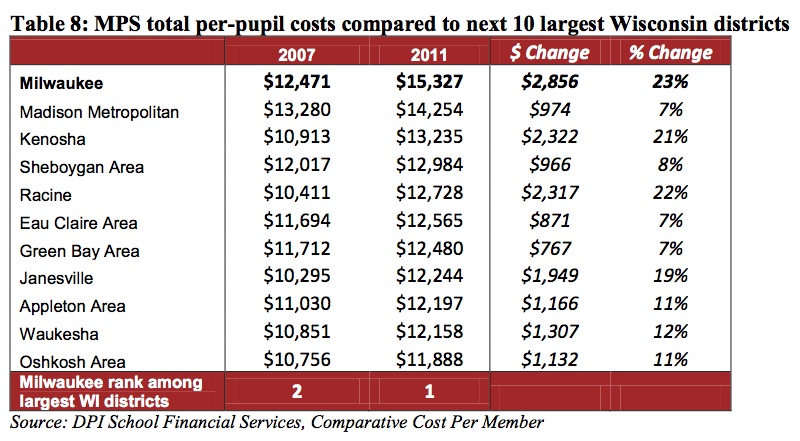
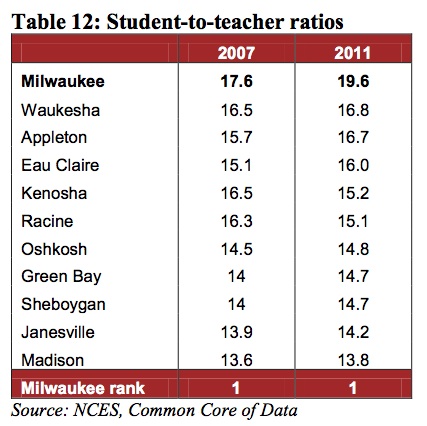
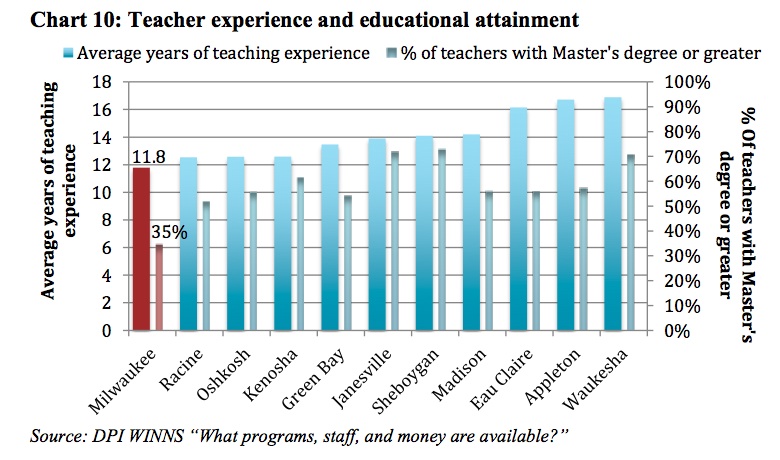
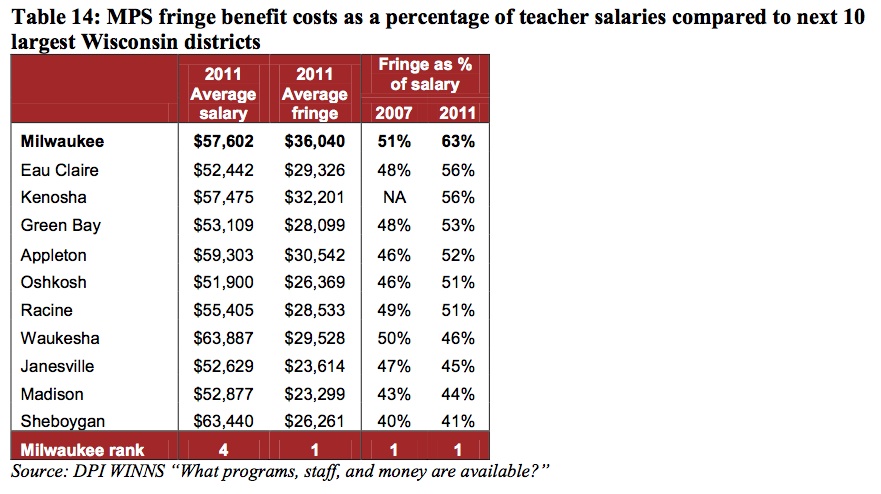
Milwaukee Public Schools needs a new backbone & A Few Useful Madison Data Points

George Lightbourn:

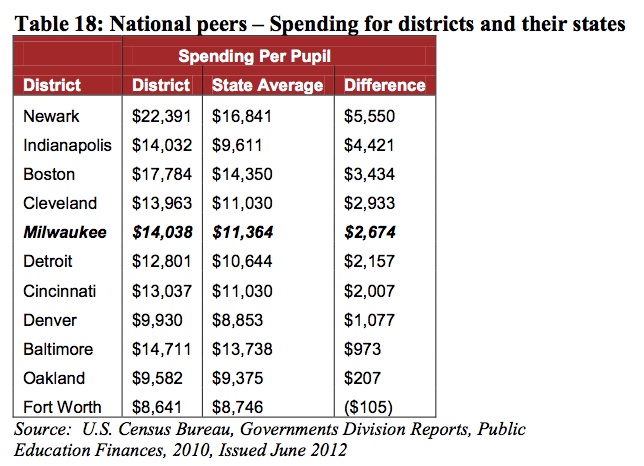
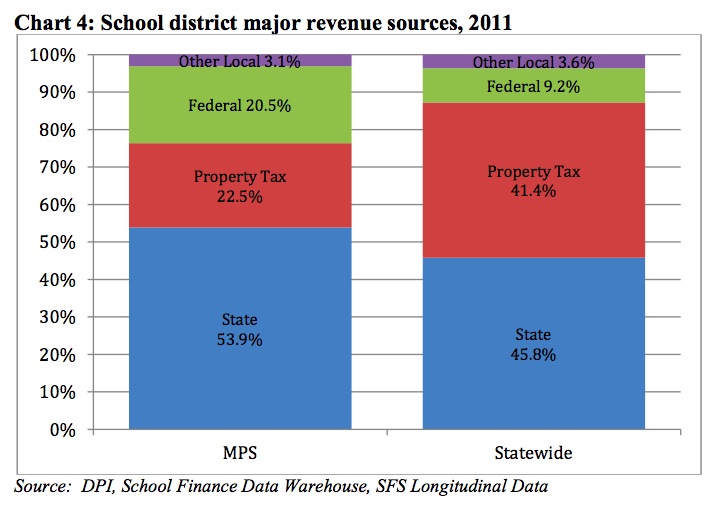
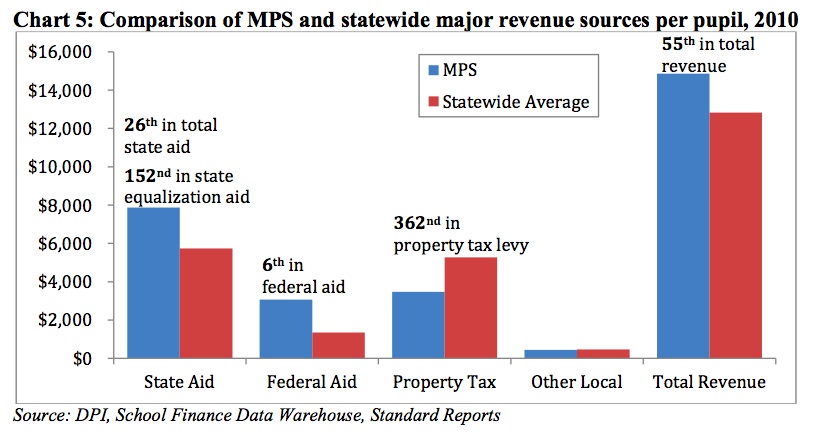
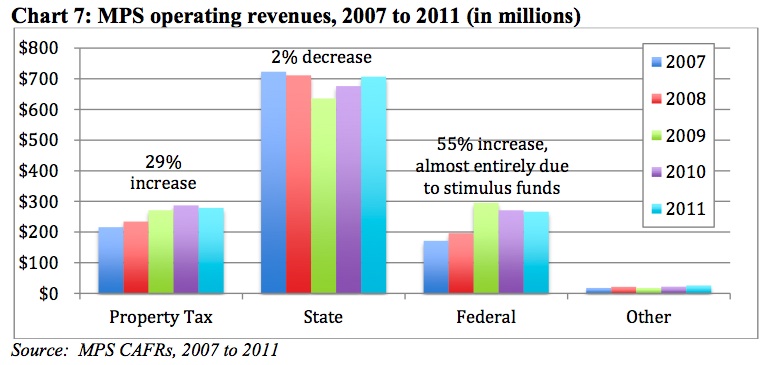
The Public Policy Forum recently published a new report (4MB PDF Link) that, like many previous reports from a variety of think tanks, casts doubt on the fiscal future of Milwaukee Public Schools. However, the PPF report added an interesting twist by throwing down a challenge to state and local political leadership.
It is time “to define where MPS fits into Milwaukee’s education framework,” they concluded, and to “define and secure the resources needed to effectively fulfill that role.”
In other words, quit complaining about MPS and do something. The district, beset with long-term budget woes, is rapidly losing students whose parents want safer, better schools.
Generations of School Boards, superintendents and sympathizers have decried the inadequacy of state school aids. True or not, the more important question is: Will there be more money? While state aid will likely increase, it’s unlikely to match the expectations of some people, including Mayor Tom Barrett. The price tag to fix the state aid “funding flaw” as the mayor advocates is $50 million. Even on his best day, I doubt the mayor could convince the Legislature to write a check for that kind of money.

View the complete Public Policy Forum report on the Milwaukee Public Schools, here (4MB PDF).


It would be interesting to see a peer comparison (State, National & Global) of Madison, as well.

Share

The maths of exam marks

Chris Cook:

At the moment, the Department for Education is considering changes to the league tables and the exam system. This seems an opportune moment to make a simple point about qualification-awarding and accountability: English school examinations are subject to measurement error in a really big way.
Here is a simple thought experiment to flesh it out. Imagine a class of 100 students. Let us specify that each one has a “true” ability that means that one pupil should get one point, one pupil should get two, one should get three and so on – up to 100 marks. Now, let’s award this class one of 10 grades: 90+ gets you an A, 80+ a B and so on.
Let us assume that the tests are perfect. If that were the case, you would get ten individuals in each grade. Easy enough. But what happens if we start introducing errors into the test? We can do that with a set of exotically named (but very simple) “Monte Carlo” estimates, which I calculated using this simple spreadsheet.

Share

2013 Wisconsin DPI Superintendent and Madison School Board Candidates

Patrick Marley & Erin Richards:

“I’ve been frustrated with the fact that our educational system continues to go downhill even with all the money the Legislature puts into it,” he said.
Pridemore said he will release more details about his educational agenda in forthcoming policy statements and has several education bills in the drafting phase. Asked if he believed schools should have armed teachers, he said that was a matter that should be left entirely to local school boards to decide.
Evers, who has been school superintendent since 2009, is seeking a second term. He has previously served as a teacher, principal, local school superintendent and deputy state schools superintendent.
Wisconsin’s education landscape has undergone some major changes during his tenure, including significant reductions in school spending and limits on collective bargaining for public workers that weakened teachers unions, which have supported Evers in the past.
Evers wants to redesign the funding formula that determines aid for each of Wisconsin’s 424 school districts and to provide more aid to schools. Also, he wants to reinvigorate technical education and to require all high schools to administer a new suite of tests that would offer a better way to track students’ academic progress and preparation for the ACT college admissions exam.

Don Pridemore links: SIS, Clusty, Blekko, Google and link farming. Incumbent Tony Evers: SIS, Clusty, Blekko, Google and link farming.
Matthew DeFour:

School Board president James Howard, the lone incumbent seeking re-election, faces a challenge from Greg Packnett, a legislative aide active with the local Democratic Party. The seats are officially nonpartisan.
Two candidates, low-income housing provider Dean Loumos and recently retired Madison police lieutenant Wayne Strong, are vying for Moss’ seat.
The race for Cole’s seat will include a primary on Feb. 19, the first one for a Madison School Board seat in six years. The candidates are Sarah Manski, a Green Party political activist who runs a website that encourages buying local; Ananda Mirilli, social justice coordinator for the YWCA who has a student at Nuestro Mundo Community School; and T.J. Mertz, an Edgewood College history instructor and local education blogger whose children attend West High and Randall Elementary schools.

Share

K-12 Tax & Spending Climate: Don’t allow phony retirements

The Wisconsin State Journal

The findings of a recent state audit should remind state leaders — and their constituents — that the Legislature still needs to fix the “double dip.”
Taxpayers deserve tighter rules to guard against abuse, something the audit confirmed.
Double dipping allows public workers to “retire” and then return to their jobs just 30 days later to collect full-time salaries and pension income at the same time.
In the worst cases, some public employees — often top managers — have returned and stayed in their six-figure, full-time jobs for years after supposedly “retiring.” That costs more money, both in longer guaranteed pension payments and higher salaries than what younger, new hires in those positions would likely earn.

Share

The Best Speech About Education — Ever

Nick Morgan:

Every now and then a speech comes along that reminds me why public speaking is still essential and why I said back in 2003 that the only reason to give a speech is to change the world.
Today, Mike Johnston is a state senator from Colorado, but his passion is education, and it was ignited as a Teach for America teacher in the Mississippi delta in 1997. From that came a searing book, In the Deep Heart’s Core, about the terrible challenges facing teachers and learning in that state. Johnston moved on to become the principal of a school for challenged kids in Colorado.

Share

Our creative director waxes lyrical about The Orchestra

Theo:

A delight to behold – a feast for the eyes, the ears, and the heart.
The Orchestra is quite simply the most beautiful thing my company has ever made. Beautiful in every sense of the word. It’s filled with beautiful music. It’s filled with beautiful images. And it communicates its subject more beautifully than anything I’ve ever seen before.
Anything? Yes, anything.
Sure, there may be more beautiful paintings, more beautiful poems, or more beautiful sunsets. But I’m talking about things whose purpose is to communicate a sizable body of knowledge, to teach me something interesting about the world, to expand my horizons and deepen my understanding. I cannot think of anything, anywhere, in any medium, ever, that has done this as beautifully as the interactive experience we call The Orchestra.

Share

Jerry Brown pushes new funding system for California schools

Kevin Yamamura:

Gov. Jerry Brown is pushing hard to overhaul California’s convoluted school funding system. His plan has two major objectives: Give K-12 districts greater control over how they spend money, and send more dollars to impoverished students and English learners.
Studies show that such children require more public help to reach the same level of achievement as their well-off peers. But as rich and poor communities alike clamor for money in the wake of funding cuts, Brown’s plan could leave wealthy suburbs with fewer new dollars than poorer urban and rural districts.
That makes perfect sense, said Michael W. Kirst, president of the State Board of Education and a Stanford University professor who co-wrote a 2008 paper that became the model for Brown’s proposal.
“Low-income people have less resources to invest in their children,” Kirst said. “A lot of investment comes from parental ability to buy external things for their kids that provide a better education. In the case of low-income groups, they can’t buy tutors, after-school programs or summer experiences.”

Share

Worst College Majors for Your Career

Kiplingers:

Make no mistake: An undergraduate degree can improve your employment prospects and paycheck size. A high school graduate earns 40% less than someone with a bachelor’s degree and is more than twice as likely to be unemployed. But not all college majors are created equal. In fact, grads with certain majors sometimes fare worse in the labor force than workers who stopped studying after high school.
Considering the time and expense that goes into earning a college degree, knowing whether your course of study is a career-killer is powerful knowledge indeed. That’s why we analyzed the jobless rates and salaries for graduates with the 100 most popular majors to come up with our list of the ten worst values in college majors.

Share

Special Team: Chy Johnson & Her Boys

Rick Reilly:

How about a little good news?
In the scrub-brush desert town of Queen Creek, Ariz., high school bullies were throwing trash at sophomore Chy Johnson. Calling her “stupid.” Pushing her in the halls.
Chy’s brain works at only a third-grade level because of a genetic birth defect, but she knew enough to feel hate.
“She’d come home every night at the start of the school year crying and upset,” says her mom, Liz Johnson. “That permanent smile she had, that gleam in her eye, that was all gone.”
Her mom says she tried to talk to teachers and administrators and got nowhere. So she tried a whole new path — the starting quarterback of the undefeated football team. After all, senior Carson Jones had once escorted Chy to the Special Olympics.
“Just keep your ear to the ground,” Liz wrote to Carson on his Facebook page. “Maybe get me some names?”
But Carson Jones did something better than that. Instead of ratting other kids out, he decided to take one in — Chy.

Share

Study: Education Extends Longevity–Except for Black Males

Barbara Peters Smith:

The human longevity bonanza that gives newborns today three decades more of life expectancy than they would have had a century ago appears to have no real stopping point.
Now researchers are trying to determine how U.S. society should change to accommodate so many longer, healthier lifespans, and why one group of white Americans does not seem to be benefiting from the trend.
Published in the August issue of Health Affairs and reported widely in the media, the researchers’ study found that while everybody else is living longer, non-Hispanic white women without high school diplomas have actually lost five years of life expectancy and their male counterparts lost three years.

Share

Why Education Emancipation is the Moral Imperative of our Time

C. Bradley Thompson:

These are–to be sure–radical claims, but they are true, and the abolition of public schools is an idea whose time has come. It is time for Americans to reexamine–radically and comprehensively–the nature and purpose of their disastrously failing public school system, and to launch a new abolitionist movement, a movement to liberate tens of millions of children and their parents from this form of bondage.1
Twenty-first century Abolitionists are confronted, however, by a paradoxical fact: Most Americans recognize that something is deeply wrong with the country’s elementary and secondary schools, yet they support them like no other institution. Mention the possibility of abolishing the public schools, and most people look at you as though you are crazy. And, of course, no politician would ever dare cut spending to our schools and to the “kids.”
For those who take seriously the idea that our public schools are broken and need to be fixed, the most common solutions include spending more money, raising standards, reducing class size, issuing vouchers, and establishing charter schools. And yet, despite decades of such reforms, our schools only get worse.

Share

National Education Reform: School Choice Equals Opportunities For Hispanics

John Benson:

The Latino population is one of many groups affected by a national education reform. One of the most discussed programs is that of school choice, which varies from state to state, and offers families the opportunity to choose a school for their children other than the one assigned by geographic default.
Take for instance in Indiana, where a private-school choice program has more than 9,300 students involved.
“There’s a fairly extensive sort of tiered school choice/voucher program in its second year where based on income, kids could qualify for partial or full dollar amounts of what the state would spend on them in their district,” Indiana Commission on Hispanic and Latino Affairs Executive Director Daniel Lopez tells VOXXI. “It could be applied either partially or fully to a private school of their choice.”
Lopez said the program can be compared to a similar initiative in Florida, the only difference being the Hoosier State impacts more students. He added that enrollment is growing, which is a result of advocates spreading the world out in the Latino

Share

5 Things to Know Before Taking Out a Student Loan

Josh Mitchell:

Wednesday’s Wall Street Journal reports that the federal lending program designed to make college education available to everyone is creating a pile of debt so large it is fanning worries that it has become too easy to borrow too much.
Looking to take out a student loan? Here are five things to know.
1. Research what aid is available to you–including scholarships, state and federal grants, and then federal loans. Meet with your school’s financial-aid counselor to learn these options. Visit the government’s website. The private website www.Finaid.org also has good resources.
2. Know the terms of your loans. What is the interest rate, what is the repayment period, and when precisely will payments begin? More importantly, find out what your expected monthly payment will be upon graduation. The financial aid counselor should be able to provide this. Also, learn about the federal government’s income-based repayment program.

Share

Out Of Bounds: High Schools Should Ban Football

Talk of the Nation:

During a meeting of the Dover, N.H. school board in October, board member Paul Butler proposed a ban on high school football. The idea received stiff opposition. He told the board he believes they have “a moral imperative” to start ending the game in light of concussion research.

Share

A tutorial from the business school of life

Michael Skapinker:

We cover many subjects in this section: new working patterns, women in management, immigrant start-ups, the future of computing, empowering staff, business’s responsibility to society. It is a wide spread and it is unusual to find it all in just one person.
But all these themes run through the life of Dame Stephanie Shirley – child refugee, software pioneer and crusading philanthropist – who, at the age of 79, has published her autobiography.
It is called Let IT Go, the capitalised middle word a play on “it” and “information technology”, which is a slightly limp introduction to the book’s bracing start.
Dame Stephanie was among the last of the 10,000 German, Austrian, Polish and Czech children allowed into the UK, without their parents, as the second world war loomed. Aged five, she and her older sister tumbled on to the platform at London’s Liverpool Street station, flotsam in a “river of exhausted, bewildered, tear-stained faces”.

Share

Long Time Madison School District Citizen Activist Hospitalized After Stroke

Via Matthew DeFour. My prayers are with Don and his family. Madison and all schools could certainly use more citizen activists. Don Severson SIS notes and links.

Share

College Football’s Big-Money, Big-Risk Business Model

Rachel Bachman & Matthew Futterman:

On one side are the nation’s largest universities, which face sharp declines in public funding. On the other, the cable and broadcast television networks, which are struggling to hold on to viewers and advertisers.
Like dynastic rulers desperate to protect their holdings, the two sides have engineered an alliance. The schools have offered up their most marketable asset, college football. The networks have agreed to marry the sport to the most important segment of their audience: the millions of viewers across the country who can still be counted on to drop whatever they are doing to watch live sports.
As a dowry, TV has agreed to pump about $25.5 billion in rights fees into college conferences and their member schools over the next 15 years. That includes a recent deal for ESPN to televise major-college football’s first playoff–a four-team bracket launching in 2014–that is valued at $5.6 billion over 12 years. The schools, meanwhile, are doing whatever is needed to maximize what they can command from TV: playing more games, jumping to new conferences, abandoning long-standing rivalries, dismantling the old system of postseason bowl games and, last June, approving that first-ever playoff.

Share

How to make computer science courses better

Sophie Chou:

As I sit here working on a project in lieu of going to class for the umpteenth time, I realized with sudden clarity that perhaps the current way that Computer Science is taught in universities is not the optimal way. Large lecture halls, clunky languages- it’s a bad sign when even a die-hard “learning for learning’s sake” student skips class on a regular basis.
anyway, a few thoughts on how I would change the structure of Computer Science courses to maximize efficiency + interest and minimize pain:
STOP TEACHING JAVA.
Seriously. I have never, ever been required to interview in a specific language at any company (even the “big names”), and if the people you’re talking to are deadset on Java, you probably don’t want to work there anyway. C is a much, much better “lower” level language for really grasping the way programming works, and Python is a much, much more fun language if you want to lower the barriers to entry and get students making things right away.

Share

New Apps Show The Music Education Revolution Is Just Getting Started

John Paul Titlow:

Music will never be the same. But you knew that. You see it everyday when you share a playlist from Spotify or Songza, comment on a SoundCloud waveform or discover an artist who, as it turns out, got their start not in some Brooklyn dive bar, but on YouTube. Both the creation and distribution of music have been radically altered by technology.
So too has the way people learn how to play it.
This revolution is still young. As neat as some of this stuff is, innovation in music education is just beginning to heat up, and a handful of recent apps point to a future where learning music is easier, more accessible and even fun.
That technology is changing music education isn’t exactly breaking news. Music lessons come installed with GarageBand on every new Mac and app stores are overflowing with portable software that teaches music theory and guitar chords. Earlier this year, the New York Times ran a feature detailing how music teachers are using Skype and other digital communication tools to interface with students regardless of their physical location, a phenomenon that opens up new possibilities for teachers and learners alike. Meanwhile, sites like Coursera and Berklee Music offer comprehensive university-level classes in everything from songwriting to record production.

Share

Is big disruption good for urban school districts?

Jay Matthews:

My colleague Emma Brown has been looking closely at Chancellor Kaya Henderson’s plans to close one of every six traditional D.C. public schools.
In one piece, she cited activists who raised the possibility that the education system of our nation’s capital might, as a consequence of the downsizing, be split in two: Charter schools would rule the low-income neighborhoods, while regular public schools would thrive only in the affluent areas where achievement rates remain high.
This is not some wild nightmare. Education finance lawyer Mary Levy, a careful and longtime analyst of D.C. schools, said at one meeting: “What we are rapidly approaching is a [public school system] concentrated west of Rock Creek Park and perhaps around Capitol Hill, and a separate charter school system filled by lottery in most of the rest of the city.”
This is upsetting to many D.C. residents and people in the region who work or have lived in the city. But to some reformers, it is a great opportunity, a way to let parent choice energize the schools and give urban children more chances for success.

Share

Football BCS Rankings, if Academics Mattered

New America Foundation:

The college football Bowl Championship Series rankings have been announced, but what would the list look like ranked instead by the teams’ academic achievement? The New America Foundation’s Education Policy Program today released its sixth annual BCS Academic Bowl rankings aiming to show just that.
The rankings use information collected by the NCAA — federal graduation rates and academic progress — to track educational success, not in-game performance. New America’s BCS Academic Bowl looks at data from the top 25 teams in the Bowl Championship Series’ final standings to rank their academic prowess.
New America’s analysis found:

Share

Amsterdam schools to bring in ‘no toking zones’

Associated Press:

Eberhard van der Laan’s introduction of a law that in other countries either already exists or seems so obvious it wouldn’t even require a rule is the result of the Netherlands’ unique drugs policy. Under the “tolerance” principle, marijuana is technically illegal here, but police can’t prosecute people for possession of small amounts.
That’s the loophole that made possible Amsterdam’s famed “coffee shops” – cafes where marijuana is sold openly. But it has also had the unwanted side effect that Dutch children are frequently exposed to the drug in public areas.
City spokeswoman Iris Reshef says schools have always forbidden pot, but found it difficult to enforce the policy when students smoked on or near campus and challenged administrators to do anything about it.
“It’s not really what you have in mind as an educator, that children would be turning up for class stoned, or drunk either for that matter,” she said. “But it has been a problem for some schools.”

Share

Ten myths about gifted students and programs for gifted

Carolyn Coil:

American educators have struggled for more than 40 years to define giftedness. Yet even now, there is no universally agreed upon definition of what it means to be gifted. U.S. federal law defines gifted students as those who perform or who show promise of performing at high levels in any one of five categories: general intellectual ability, specific academic aptitude, creative or productive thinking, leadership ability or visual/performing arts.
Beyond that definition, there are no specific national criteria for identifying gifted and talented students nor does federal law provide funding or mandates for identification of these students or programming for them. This definition is left to the states.
The result has been a wide variety of state definitions and methods for the identification of gifted children. Some states have specific definitions for giftedness, while others have none. Some states require programs for gifted students, while others do not.

Share

Open source groups warn Greece will waste millions on school software

Gijs HILLENIUS:

Advocates of free and open source are warning that the Greek government is going to waste millions of euro on proprietary software licences for the country’s schools. They are calling on the Ministry of Education to cancel its latest procurement.
“Favouring proprietary software while ignoring the potential of open source, constitutes a choking of the educational process.”
The ministry published a request for tender in November, seeking suppliers of 26,400 laptops, 1760 servers and 1760 wifi access routers. The value of the contract is set at just over 15 million euro. The purchase will be partly financed by the European Regional Development Fund.
The ministry is asking for laptops and servers that can run either a ubiquitous proprietary operating system or Linux. But, say the Greek Linux User Group (Greeklug) and Eel/lak, a Greek open source advocacy organisation founded by 25 universities and research centres, the technical requirements clearly favour proprietary solutions over open source. “The specification is a copy of the proprietary vendor’s e-mail and office software.”

Share

Can Rocketship Launch a Fleet of Successful, Mass-Produced Schools? (Opening in Milwaukee later in 2013)

PBS NewsHour:

JEFFREY BROWN: Now we look to a California education experiment called the Rocketship Model that involves teachers, kids and parents and aims to expand one day to serve a million students.
NewsHour’s special correspondent for education, John Merrow, has our report.
JOHN MERROW: The Model T was the first, the first innovative and affordable car available to the masses. Others had built good cars, but Henry Ford figured out how to build a lot of them. He and his moving assembly line proved that quality can be mass-produced.
Mass production is a problem the auto industry solved over 100 years ago, but it’s an issue our education system has yet to figure out. America has lots of terrific schools. People open great schools every year, but typically open just one. Nobody has figured out how to mass-produce high-quality, cost-effective schools.
John Danner is the latest to give it a shot. He created an innovative charter school model with replication in mind. Charter schools receive public funding, but are privately managed and operate outside of the traditional public system.
…..
JOHN MERROW: New Orleans, Nashville, Indianapolis, and Memphis have all approved charters for Rocketship schools to be built in their cities. Next year, two new schools will open in San Jose and one in Milwaukee. Danner plans to have 46 schools up and running in five years, with a vision of someday serving 50 cities and a million students. If he succeeds, Rocketship could become the Model T of education.

Notes and links on Rocketship’s arrival in Milwaukee.

Share

Music careers in dollars and cents: 2012 Edition

Career Development Center @ Berklee College of Music (2.7MB PDF).
Berklee’s website.

Share

The author of “Alex’s Adventures in Numberland” tells us about popular attempts to explain the history of counting and numbers

Malba Tahan

Your first choice is in Portuguese.
A fascinating property of maths is that it is totally international and never goes out of date. So if you write a maths classic it is a classic for ever, everywhere. This Brazilian book links my past life in Brazil with maths. The literal translation of the Portuguese title is ‘The Man Who Calculated’ but the English version is called The Man Who Counted. There are editions in many other languages too.
The author Malba Tahan is a fictional character, the pen name of Júlio César de Mello e Sousa, and the book is set in Arabia as a mixture of One Thousand and One Nights and a maths book – it’s coming out of the most populous Catholic country in the world and yet it’s as much a love story to Arab culture as to maths itself. There were lots of Arab immigrants in Brazil and they love Arab culture – one of the most popular fast food chains is called Habib’s. The story here is presented as if the author, who I believe only went to Lisbon once and virtually never left Brazil, has just stumbled upon or discovered this Arab text.

Share

A free school under a bridge in India


NBC News:

Founder of a free school for slum children Rajesh Kumar Sharma, second from right, and Laxmi Chandra, right, write on black boards, painted on a building wall, at a free school run under a metro bridge in New Delhi, India. At least 30 children living in the nearby slums have been receiving free education from this school for the last three years.

Share

The Financial Times Lexicon

The Financial Times:

Browse thousands of words and phrases selected by Financial Times editors and suggest new terms for the glossary.

Share

How I learned a language in 22 hours

Joshua Foer:

“What do you know about where I come from?” That was one of the first questions I ever asked Bosco Mongousso, an Mbendjele pygmy who lives in the sparsely populated Ndoki forest at the far northern tip of the Republic of Congo. We were sitting on logs around a fire one evening four years ago, eating a dinner of smoked river fish and koko, a vitamin-rich wild green harvested from the forest. I’d come to this hard-to-reach corner of the Congo basin – a spot at least 50km from the nearest village – to report a story for National Geographic magazine about a population of chimpanzees who display the most sophisticated tool-use ever observed among non-humans.
Mongousso, who makes his living, for the most part, by hunting wildlife and gathering forest produce such as nuts, fruits, mushrooms and leaves, had teeth that had been chiselled to sharp points as a child. He stood about 1.4m (4ft 7in) tall and had a wide, wonderful grin that he exercised prolifically. He considered my question carefully.

Share

The Mind of Students

What is on the minds of our students? We mostly have no idea. The Edupundits all seem to agree that the most important variable in student academic achievement is teacher quality. But isn’t the most important variable in student academic achievement really student academic work in the end?
The teacher can know a lot about her subject, can speak well, tell wonderful stories, have good control over the class, and so on, but if the student is thinking about something else, what is the result?
I have known first-rate teachers whose students didn’t do any work academically and mediocre teachers who had some students who achieved a lot academically.
All those hundreds of people spending many millions of dollars and countless months of effort on teacher assessment never seem to wonder what is going on in the minds of our students in a given class. How many times has an evaluator, visiting a class to judge the work of a teacher, ever thought to ask a few students, in those moments, what they know about the current subject, or even what they are thinking about at the time?
The Hindus say the mind is like a drunken monkey, and even a sober mind is pulled in many directions at once, by memories, worries, ideas, desires, impressions of all kinds, and even, occasionally, by the subject matter of the class the student is sitting in. But the point is that while we are teaching, even though we may get a student question from time to time, or we may ask a student for a comment from time to time, during the vast majority of the time we spend teaching, we have not the slightest insight into what is occupying the minds of almost all of our students while we are teaching our brains out.
A recent study found (mirabile dictu) that students who don’t come to class learn less than students who do. But the fact is that even when students do come to class, their attention and their minds may very well be absent from class. There are countless objects of interest to distract the minds of students from the current work of any class as presented by the teacher.
This is not to say that wonderful teachers cannot draw and hold the attention of almost all the students in their class for amazingly long stretches. But students have many concerns, both personal and academic. Not only the next athletic event, or personal relationship, but even the subject matter of the next class or the last class may occupy the minds of some or many of our students while we teach.
Teaching and learning are at least as subtle and complex as brain surgery, and the surgeon has one single anaesthetized patient, and the help of four or five other professionals, while the teacher may have thirty conscious high school students and no one to watch for signs of student distraction, if any…As every teacher knows it is ridiculously easy for a student to show every sign of serious attention while their mind is actually kilometers away on some other matter entirely.
Stitching knowledge and ideas into the existing mental and memory frameworks of students is a lot more difficult and intricate an undertaking than most of those designing teacher assessment projects even want to think about, but it is the actual daily venture of our teachers.
My main interest and experience are with history at the high school level, so I am not sure what bearing my suggestions would have for calculus, chemistry, or Chinese language courses. But I believe that the attention of our history students can be captured and rewarded by asking them to read at least one good complete history book each year, and to write one serious Extended Essay-type history research paper each year while they are in high school.
If they read and report on a good history book, the chances are that they will have given it their attention, and learned some history from it. If they write a 6,000-word history research paper (and I am regularly publishing 8,000-15,000-word papers by secondary students from 46 states and beyond), they will clearly have had to give the historical subject of their research their attention, and they will have learned some history (see: student academic achievement) in the process.
Of course, we should continue to try to recruit and retain the top 5% of college graduates as our school teachers, and we should encourage them to teach their hearts out. But unless we begin to look more closely in an effort to discover what, academically, is going on in the minds of students, we will continue to ignore the main engines of academic work in our schools. I hope one or two of our more elite and well-funded Edupundits may give this idea a passing thought or two.
—————————–
“Teach by Example”
Will Fitzhugh [founder]
The Concord Review [1987]
Ralph Waldo Emerson Prizes [1995]
National Writing Board [1998]
TCR Institute [2002]
730 Boston Post Road, Suite 24
Sudbury, Massachusetts 01776-3371 USA
978-443-0022; 800-331-5007
www.tcr.org; fitzhugh@tcr.org
Varsity Academics®
www.tcr.org/blog
Share

What grade would you give public schools?

James Causey:

Fact: There are some really good Milwaukee Public Schools. Another fact: There are some that even the district’s superintendent says need improvement. To be fair, the same facts also apply to voucher schools.
There are a number of factors that contribute to a school’s success. Successful schools have engaged parents along with an equally motivated student body and teachers. Struggling schools often lack parental support and more often than not have behavioral problems that impede learning.
If I were to ask you to assign a letter grade to public schools in Milwaukee, what grade would you give them?
A survey asked 1,200 city residents that question, and 70% gave the public schools a “C” or worse.
And when asked who is responsible for a child’s failure, 64% of respondents said it was the parents and the students. Only 10% said it was the teachers’ fault and only 5% blame the school as a whole.
I’m not surprised by the study’s findings because the struggling schools in the district usually receive the most press while, unfortunately, the best schools fail to receive the recognition they deserve.

Share

Knowledge is less a canon than a consensus

David Shaywitz:

In 1870, German chemist Erich von Wolf analyzed the iron content of green vegetables and accidentally misplaced a decimal point when transcribing data from his notebook. As a result, spinach was reported to contain a tremendous amount of iron–35 milligrams per serving, not 3.5 milligrams (the true measured value). While the error was eventually corrected in 1937, the legend of spinach’s nutritional power had already taken hold, one reason that studio executives chose it as the source of Popeye’s vaunted strength.
The point, according to Samuel Arbesman, an applied mathematician and the author of the delightfully nerdy “The Half-Life of Facts,” is that knowledge–the collection of “accepted facts”–is far less fixed than we assume. In every discipline, facts change in predictable, quantifiable ways, Mr. Arbesman contends, and understanding these changes isn’t just interesting but also useful. For Mr. Arbesman, Wolf’s copying mistake says less about spinach than about the way scientific knowledge propagates.

Share

USC doctoral student unravels ‘tin whisker’ mystery

Jeff Stensland:

Americans love their electronics, and millions will undoubtedly receive everything from flat-screen TVs and e-readers to video games and coffee makers this holiday season. Over time, even the best of these devices inexplicably stop working. Often it’s not worth the time and money to have them repaired, but the nagging question of “why” still lingers long after they’re thrown in the trash.
Yong Sun, a mechanical engineering doctoral student at the University of South Carolina’s College of Engineering and Computing, has solved part of the puzzle.
Little-known culprits of this electronic destruction, tiny killers that leave no evidence the human eye can detect, are microscopic strands known as “whiskers.” These hair-like fibers of metal grow out of the tin used as solder and coating on many electronic circuits. The presence of these whiskers can cause short-circuits since they act as bridges to conduct electricity to closely-spaced parts, a problem expected to become more prevalent as devices are designed smaller and smaller.

Share

Kyle Neddenriep rates his favorite 10 Indiana high school sports venues

Cody Zeller:

Indianapolis Star high school insider Kyle Neddenriep has traveled the state to cover his beat. From Muncie to Evansville, here are his 10 favorite venues:
The Reitz Bowl, Evansville: When it comes to high school football, there’s no better place to watch a playoff game on a chilly fall evening. Originally built in 1921 with seating for 10,000 fans, the Reitz Bowl is nestled next to the Ohio River, making for a gorgeous view from the press box. I covered Cathedral’s semistate game at Reitz at the end of the 2009 season and was blown away by the experience. I think Cathedral was, too, as Reitz won 31-10.
One of the things I’ll remember most was the walk from my car up the hill and through a neighborhood to the stadium entrance. Most of the houses on the tree-lined streets were dressed up with football signs and banners. It felt like something out of “All the Right Moves.” I can’t imagine there are many better atmospheres for football in the country, let alone the state.

Share

The Changing Classroom: Collaboration is king in Menomonee Falls schools

Erin Richards:

It was early spring this year in Menomonee Falls when the school district brought together area business leaders, district teachers and administrators, college deans and chamber of commerce representatives to talk about an important issue: the local skills gap.
Particularly for this community rich with manufacturing and industry, that meant talking about health care jobs that would need to be filled at Community Memorial Hospital, and the need for trained workers in area manufacturing plants – and the school district’s role in preparing that labor force.
But unlike similar meetings where conversations fizzle after coffee or lunch, the ideas took root. The school district now aims to rebuild its technical education program from graduation backward, coordinating with a lead local manufacturer and Waukesha County Technical College to revamp curriculum and push new content down to the middle school level that will support that high school work.
At a time when budgets are tight and schools are under increasing pressure to strengthen student performance, collaborative efforts with other districts or nonschool entities are drawing attention as ways to either save money or create better opportunities for children.

Share

Long-form writing is alive and kicking

Simon Schama:

All of you out there sounding off about the tweetification of English can relax. The 2012 Bodley Head/FT non-fiction Essay Prize, for writers aged 35 or under, yielded a harvest of essays so rich in imaginatively chosen subject matter and in spirited style that there can be no doubt that long-form non-fiction is very much alive and kicking. Somewhere between the expansiveness of the blogosphere with its indulgence of loose, spontaneous free association, and the straitjacket of the strict-deadline column, the essay as an art of written thought survives and flourishes. Hazlitt and Orwell can stop revolving in their tombs.
Some 400 submissions were received, in a wide range of voices from whimsically informal (a musing on scarecrows) to the sternly tutorial (what’s the point of foreign correspondents?). But all were stamped with the distinctive tone of their authors. The strongest followed the models of the classic essayists by beginning with a glimpse of the concrete (in both senses in the case of Enver Hoxha’s recycled Albanian bunkers) and moving outwards to bigger, deeper meditations on the human condition.

Share

Like the neighborhood, not the school? Author understands your problem.

Jay Matthews:

In my 30 years writing about schools, one reader question outnumbers all others: “I like where I live, but I have kids now and the local school doesn’t look good to me. What should I do?”
I tell them how to investigate their neighborhood school. I explain that children of education-focused parents learn much no matter what school they attend. Then I advise them to go with their gut. Even if everybody thinks their local school is great, if it doesn’t feel right they should send their kids elsewhere.
I’ve done a long magazine piece and lots of columns on this, but I have never seen the issue dissected as well as in a new book by Washington-area parent Michael J. Petrilli, “The Diverse Schools Dilemma: A Parent’s Guide to Socioeconomically Mixed Public Schools.” It is deep, up to date, blessedly short (119 pages) and wonderfully personal. He shares all the frustrations and embarrassments he and his wife suffered while looking for schools for their two young sons.

Share

Common Core: The Totalitarian Temptation

Jonah Goldberg
Liberal Fascism
New York: Doubleday, 2007, pp. 326-327
…Progressive education has two parents, Prussia and John Dewey. The kindergarten was transplanted into the United States from Prussia in the nineteenth century because American reformers were so enamored of the order and patriotic indoctrination young children received outside the home (the better to weed out the un-American traits of immigrants). One of the core tenets of the early kindergarten was the dogma that “the government is the true parent of the children, the state is sovereign over the family.” The progressive followers of John Dewey expanded this program to make public schools incubators of a national religion. They discarded the militaristic rigidity of the Prussian model, but retained the aim of indoctrinating children. The methods were informal, couched in the sincere desire to make learning “fun,” “relevant,” and “empowering.” The self-esteem obsession that saturates our schools today harks back to the Deweyan reforms from before World War II. But beneath the individualist rhetoric lies a mission for democratic social justice, a mission Dewey himself defined as a religion. For other progressives, capturing children in schools was part of the larger effort to break the backbone of the nuclear family, the institution most resistant to political indoctrination.
National Socialist educators had a similar mission in mind. And as odd as it might seem, they also discarded the Prussian discipline of the past and embraced self-esteem and empowerment in the name of social justice. In the early days of the Third Reich, grade-schoolers burned their multicolored caps in a protest against class distinctions. Parents complained, “We no longer have rights over our children.” According to the historian Michael Burleigh, “Their children became strangers, contemptuous of monarchy or religion, and perpetually barking and shouting like pint-sized Prussian sergeant-majors…Denunciation of parents by children was encouraged, not least by schoolteachers who set essays entitled ‘What does your family talk about at home?'”
Now, the liberal project Hillary Clinton represents is in no way a Nazi project. The last thing she would want is to promote ethnic nationalism, anti-Semitism, or aggressive wars of conquest. But it must be kept in mind that while these things were of enormous importance to Hitler and his ideologues, they were in an important sense secondary to the underlying mission and appeal of Nazism, which was to create a new politics and a new nation committed to social justice, radical egalitarianism (albeit for “true Germans”), and the destruction of the traditions of the old order. So while there are light-years of distance between the programs of liberals and those of Nazis or Italian Fascists or even the nationalist progressives of yore, the underlying impulse, the totalitarian temptation, is present in both.
The Chinese Communists under Mao pursued the Chinese way, the Russians under Stalin followed their own version of communism in one state. But we are still comfortable observing that they were both communist nations. Hitler wanted to wipe out the Jews; Mussolini wanted no such thing. And yet we are comfortable calling both fascists. Liberal fascists don’t want to mimic generic fascists or communists in myriad ways, but they share a sweeping vision of social justice and community and the need for the state to realize that vision. In short, collectivists of all stripes share the same totalitarian temptation to create a politics of meaning; what differs between them–and this is the most crucial difference of all–is how they act upon that temptation.

============
“Teach by Example”
Will Fitzhugh [founder]
The Concord Review [1987]
Ralph Waldo Emerson Prizes [1995]
National Writing Board [1998]
TCR Institute [2002]
730 Boston Post Road, Suite 24
Sudbury, Massachusetts 01776-3371 USA
978-443-0022; 800-331-5007
www.tcr.org; fitzhugh@tcr.org
Varsity Academics®
www.tcr.org/blog
Share

Housewife, “Gold Miss,” and Equal: The Evolution of Educated Women’s Role in Asia and the U.S.

Jisoo Hwang:

Abstract: The fraction of U.S. college graduate women who ever marry has increased relative to less educated women since the mid-1970s. In contrast, college graduate women in developed Asian countries have had decreased rates of marriage, so much so that the term “Gold Misses” has been coined to describe them. This paper argues that the interaction of rapid economic growth in Asia combined with the intergenerational transmission of gender attitudes causes the “Gold Miss” phenomenon. Economic growth has increased the supply of college graduate women, but men’s preference for their wives’ household services has diminished less rapidly and is slowed by women’s role in their mothers’ generation. Using a dynamic model, I show that a large positive wage shock produces a greater mismatch between educated women and men in the marriage market than would gradual wage growth. I test the implications of the model using three data sets: the Japanese General Social Survey, the American Time Use Survey, and the U.S. Census and American Community Survey. Using the Japanese data, I find a positive relationship between a mother’s education (and employment) and her son’s gender attitudes. In the U.S., time spent on household chores among Asian women is inversely related to the female labor force participation rate in husband’s country of origin. Lastly, college graduate Korean and Japanese women in the U.S. have greater options in the marriage market. They are more likely to marry Americans than Korean and Japanese men do, and this gender gap is larger among the foreign born than the U.S. born.

Share

The art of Doing Science and Engineering

RW Hamming (PDF).

Share

Benchmarking school systems

Chris Cook:

One question I get asked a lot is: “You say that Frewmanackshire is a terrible local authority. How do you know? Do you know what we are working with?” etc etc. It is true that schools with radically different intakes cannot be usefully compared. So I thought I would let you in on how I benchmark schools, and supply you with two jolly new maps.
What I do for secondary schools, is run a simple regression – that is to say, I fit a simple line through all the pupils’ school results in the country after asking it to account for the children’s ethnicity, poverty and prior test results. Unlike other models, the regression contains precisely zero information about the schools – only data about the children.
I work out what FT score each child would get if their fate were the national average for that kind of child. Then you can see who is under- or over-performing. By definition, this kind of approach is zero-sum (the computer will run its lines through the middle of the pack). Someone will always be behind. But it’s helpful to see who is weaker and stronger.

Share

Graduates find success teaching in Chilean schools

Thomas Jerome Baker:

Enseña Chile, a programme backed by Anglo American that puts high-flying graduates in the classroom teaching some of Chile’s most vulnerable students, is achieving remarkable results. Enseña Chile selects and trains high-calibre university graduates to teach in state schools in vulnerable communities across the country. Photograph: Anglo American
Education is a hot issue in Chile.
The country is fiercely debating the best way to create the schools and universities it needs as it transitions to an economy that relies as much on the skills and talent of its people as on its natural resources.
Although classroom performance is among the best in Latin America and public spending on education has increased seven fold in the past 20 years, experts say there is a wide gap between the privately schooled rich and the majority who are too often failed by municipal education.

Share

A sad attack on Advanced Placement

Jay Matthews:

Nearly all of us are experts about something — Yorkshire terriers, Redskins quarterbacks, California native plants, whatever. Even obscure subjects have fans.
My obsession is the Advanced Placement program, those college-level courses and tests for high school students. I have studied AP for 30 years. I am saddened, as all devotees are, by outbursts of misinformation about my topic. The most recent example is an essay on TheAtlantic.com by former AP government and politics teacher John Tierney, entitled “AP Classes Are a Scam.”

Share

Colleges join the food-truck craze, launching their own trucks to offer students convenience and variety — and to keep their dining dollars on campus

Jessica Teich:

The tantalizing aromas of earthy empanadas and tangy barbecue chicken mingling in the air lure a small crowd to the rumbling, bright red truck parked smack in the middle of Northeastern University’s Snell Library Quad.
Outside the Hungry Hungry Husky food truck, students and professors jockey to scan the menu. Reaching up to a delivery window for a heaping tray of pita chips and some fresh guacamole, Lauryn Coccoli gushes, “Ah, you’re the best, thank you so much!” She is met with an appreciative nod by a worker inside the school’s food truck.
“Whenever he’s here, I’m here,” says Coccoli, a graduate student at Northeastern. “It’s absolutely convenient, cost-effective, and the food’s great; it tastes better and is cheaper than in there,” she says, gesturing to the Curry Student Center, which houses nearly 10 food court eateries.

Share

Schoolhouse to Courthouse

Donna Lieberman:

KENNETH screwed up. The 11th grader made a crude joke about the police officers in his Bronx high school — and an officer overheard.
“What did you say?” the officer demanded. “Say it again and I’m going to punch you in the [expletive] mouth.”
“You can’t [expletive] touch me,” said Kenneth, who has Asperger syndrome.
And so it began …
The officer pulled out his nightstick, with one hand, grabbed Kenneth (whose name I’ve changed) by the throat with the other, and pushed him against the wall. Then he pinned the boy’s arms behind his back and pulled him, by the neck of his hoodie, down the fourth-floor hallway.

Share

Readers’ cures for bad teaching of writing

Jay Matthews:

The teaching of writing is one of the great weaknesses of American schools. It is also the only one about which I, as a paid manufacturer of sentences, am competent to give personal advice.
I think students would benefit from one-on-one editing by their teachers. This is rare, but teachers and students who have done it tell me that it works for them as well as it did for me when I was a beginning journalist.
They like my idea of a required one-semester high school English course called Writing and Reading. Each student would produce a written piece each week and have it edited by the teacher for 10 minutes. The rest of the week, students would work in class on their next essay or read whatever they like while their classmates are edited. This spares teachers from marking up essays at home. Just 10 minutes of editing a week per student does not seem like much, but such personal contact is powerful. By the end of a semester, that would total nearly three hours of personal editing per kid, unheard of in schools today.

Share

What Should Children Read?

Sara Mosle:

Malcolm Gladwell, author of “The Tipping Point” and a New Yorker staff writer, told me how he prepared, years ago, to write his first “Talk of the Town” story. “Talk” articles have a distinct style, and he wanted to make sure he got the voice straight in his head before he began writing. His approach was simple. He sat down and read 100 “Talk” pieces, one after the other.
The story nicely illustrates how careful reading can advance great writing. As a schoolteacher, I offer Mr. Gladwell’s story to students struggling with expository writing as evidence that they need not labor alone. There are models out there — if only they’ll read them!
Mr. Gladwell’s tale provides a good lesson for English teachers across the country as they begin to implement the Common Core State Standards, a set of national benchmarks, adopted by nearly every state, for the skills public school students should master in language arts and mathematics in grades K-12.

Share

Stop Subsidizing Obesity

Mark Bittman

Not long ago few doctors – not even pediatricians – concerned themselves much with nutrition. This has changed, and dramatically: As childhood obesity gains recognition as a true health crisis, more and more doctors are publicly expressing alarm at the impact the standard American diet is having on health.
“I never saw Type 2 diabetes during my training, 20 years ago,” David Ludwig, a pediatrician, told me the other day, referring to what was once called “adult-onset” diabetes, the form that is often caused by obesity. “Never. Now about a quarter of the new diabetes cases we’re seeing are Type 2.”
Ludwig, who is director of the New Balance Foundation Obesity Prevention Center in Boston, is one of three authors, all medical doctors of an essay (“Viewpoint”) in the current issue of the Journal of the American Medical Association titled “Opportunities to Reduce Childhood Hunger and Obesity.”
That title that would once have been impossible, but now it’s merely paradoxical. Because the situation is this: 17 percent of children in the United States are obese, 16 percent are food-insecure (this means they have inconsistent access to food), and some number, which is impossible to nail down, are both. Seven times as many poor children are obese as those who are underweight, an indication that government aid in the form of food stamps, now officially called SNAP, does a good job of addressing hunger but encourages the consumption of unhealthy calories.

Given the role that nutrition plays — from conception onward — in brain development, learning, etc., clearly this is an achievement gap issue.

Share

Patriotic education distorts China world view

Jamil Anderlini:

After 21-year-old Cai Yang was arrested in September for beating a Toyota-driving Chinese compatriot with a bicycle lock during an anti-Japanese protest, his mother tried to explain his actions.
“The education at school always instils the idea that Japanese are evil people and if you turn on the television most of the programmes are about the anti-Japanese war,” Yang Shuilan said. “How can we possibly not resent the Japanese?”
Apart from the fact that Cai’s 50-year-old victim was Chinese not Japanese, Ms Yang makes a valid point.
In the wake of the 1989 Tiananmen Square massacre and the fall of the Soviet Union, China’s leaders concluded that the Communist party needed to improve its “thought work”. So they launched a new “patriotic education” campaign that continues to this day.
The selective teaching of history – emphasising the brutality of foreign invaders and ignoring atrocities or mistakes by China’s leaders – is intended to boost the party’s legitimacy by cultivating a nationalistic, anti-western victim mentality among young Chinese.

Share

Special Education teachers are an aging population: Local schools see shortage in speech and language pathologists and occupational therapists

Corrie Pelc:

California is currently facing as shortage of qualified teachers – including special education teachers – according to an article printed in September on US News on NBCNews.com.
The article cited a report, “Greatness by Design” released by the California Department of Education in September – a report designed to help improve how teachers are recruited, trained and mentored – that states “there are still shortages of qualified teachers in fields such as special education.”
Dr. Pia Wong, department chair for the Department of Teaching Credentials and professor at California State University Sacramento, says one reason for the shortage is teachers retiring without anyone to fill their positions. “When you look at the average age of teachers in special (education) and general education, it’s an aging population,” she explains. “Based on when people typically do retire or can retire, we know in the next 10 years we’re going to see very high numbers of retirement.”

Share

Does Texas Have an Answer to Sky-High Tuition?

Lara Seligman:

Texas is experimenting with an initiative to help students and families struggling with sky-high college costs: a bachelor’s degree for $10,000, including tuition fees and even textbooks. Under a plan he unveiled in 2011, Republican Gov. Rick Perry has called on institutions in his state to develop options for low-cost undergraduate degrees. The idea was greeted with skepticism at first, but lately, it seems to be gaining traction. If it yields success, it could prompt other states to explore similar, more-innovative ways to cut the cost of education.
Limiting the price tag for a degree to $10,000 is no easy feat. In the 2012-13 academic year, the average annual cost of tuition in Texas at a public four-year institution was $8,354, just slightly lower than the national average of $8,655. The high costs are saddling students with huge debt burdens. Nationally, 57 percent of students who earned bachelor’s degrees in 2011 from public four-year colleges graduated with debt, and the average debt per borrower was $23,800–up from $20,100 a decade earlier. By Sept. 30, 2011, 9.1 percent of borrowers who entered repayment in 2009-10 defaulted on their federal student loans, the highest default rate since 1996.
In the Lone Star State, 10 institutions have so far responded to the governor’s call with unique approaches, ranging from a five-year general-degree pipeline that combines high school, community college, and four-year university credits to a program that relies on competency-based assessments to enable students to complete a degree in organizational leadership in as little as 18 months.

Share

The Professionals Know What the Universities Won’t Tell You

Role Model Software:

I just got back from the Software Craftsmanship North America conference in Chicago. I knew that the industry was ready for a new model of training, but I was a bit overwhelmed by just how ready. I can honestly say that they were actually beyond ready… they were hungry.
At the welcome reception, one craftsman or journeyman after another greeted me (whether they knew me or not) and congratulated me on the opening of the Craftsmanship Academy. They all stated in one way or another that the universities weren’t preparing people for the realities of software development and didn’t seem to care. Many asked how I was going to approach their education and nodded approvingly when I told them what and why I was going to do. I probably told the story about teaching data structures in context, a half dozen times to people whose collective response seemed to be saying “I always suspected how much easier it could be to teach theory in the context of practice.”

Share

Hooked on opiates: More legal use leads to more addiction, crimes, deaths

MaryJo Webster and Brandon Stahl:

Hannah Linderholm was a cheerleader and played sports in high school. She went to church every Sunday with her parents in New Prague and was excited about starting college.
“I had my life all together,” Linderholm, 21, said wistfully last week.
But in college, she fell for a guy who was getting high illegally on oxycodone, a highly controlled painkiller sold under the brand name Oxycontin, and she thought it would be OK to try it. “Then it just snowballed,” she said.
Within a year, she dropped out of college, had drained her savings account and was spending $180 a day to feed her body’s growing demand for the drug dubbed “oxy” on the street.
“All I wanted to do was get high,” she said. “I didn’t care about anything.”
Getting the pills was easy, Linderholm said, even though oxycodone can be obtained only with a doctor’s prescription. Her boyfriend had found a network of people willing to sell their prescriptions for $1 per milligram.

Share

The most important element of student success?

Joanne Yatvin:

Not long ago I wrote a post condemning rigor in education and hailing vigor as the most important element of student success. Unfortunately, I used dictionary definitions and metaphors and gave only sketchy examples of vigorous learning activities to make my case. This time I want to be more factual and descriptive to let readers know what reformers mean when they call for more rigor and what good teachers mean by vigor.
Looking at the recommendations of policy makers, the widely adopted Common Core Standards and the practices in “reformed” schools, it’s easy to see what they mean by rigor: a demanding academic program for all, beginning earlier than at present and advancing more rapidly through the grades, with little tolerance for variations in student progress or behavior. Specifically, grade level performance is expected of all students in all subjects. There is greater complexity in reading materials and much more non-fiction at all levels. Algebra belongs in middle school, and there should two years of math and science in high school for everyone. Formal testing starts in kindergarten and test frequency increases in subsequent grades.

Share

After settlement, UW System to turn over syllabuses to nonprofit National Council on Teacher Quality

Bruce Vielmetti, via a kind reader’s email:

Wisconsin’s public universities have agreed to turn over education course syllabuses to a nonprofit group reviewing teacher education programs nationwide.
The University of Wisconsin System Board of Regents had contended the course descriptions were copyrighted and not subject to disclosure under the state’s public records law. The National Council on Teacher Quality disagreed and sued in January.
Under a settlement agreement approved this month, the UW System will provide the syllabuses for “core undergraduate education” courses taught in 2012 at the system’s 12 universities, and will pay the council nearly $10,000 in attorney fees, damages and costs. The UW System will not charge location or copying fees for providing the records.
The agreement provides that the payment is not an admission of liability or of a public records law violation. The plaintiff is represented by the Wisconsin Institute for Law & Liberty, a Milwaukee-based public interest law firm.

Notes and links on the NCTQ’s open records lawsuit against the UW-Madison School of Education.

Share

Elite education for the masses

Nick Anderson:

Brian Caffo teaches a public-health course at Johns Hopkins University that he calls a “mathematical biostatistics boot camp.” It typically draws a few dozen graduate students. Never more than 70.
This fall, Caffo was swarmed. He had 15,000 students.
They included Patrycja Jablonska in Poland, Ephraim Baron in California, Mohammad Hijazi in Lebanon and many others far from Baltimore who ordinarily would not have a chance to study at the elite Johns Hopkins Bloomberg School of Public Health. They logged on to a Web site called Coursera and signed up. They paid nothing for it.
These students, a sliver of the more than 1.7 million who have registered with Coursera since April, reflect a surge of interest this year in free online learning that could reshape higher education. The phenomenon puts big issues on the table: the growth of tuition, the role of a professor, the definition of a student, the value of a degree and even the mission of universities.

Share

High-flying interns who are going places

Alicia Clegg:

Christina Pelka caught the tra­v­el bug as a Californian schoolgirl holidaying in Cuba. So when she heard through the college grapevine that KPMG, the professional services firm, was offering overseas internships to students she made sure she was part of the programme.
“Every dinner, basketball game and campus event they hosted, I was there. I knew that if they had interns travelling abroad, they must be serious about international opportunities,” Ms Pelka says. She completed a four-week internship in London in 2008 and now works at KPMG’s Chicago office, and is optimistic about a transfer to Europe.
KPMG is one of a number of organisations giving student interns an early taste of cross-border working. As more businesses operate globally, they want employees who have experience of working in other countries. Graduates, for their part, say they are up for overseas challenges. In a multi-country survey for professional services firm PwC, 71 per cent of recent graduates said they would like to work abroad at some stage.

Share

‘Education First’ must put the marginalised at the centre

Pauline Rose:

Goal-setting often leads to attention being paid to low-hanging fruit – those easiest to reach, making it possible to show progress most quickly. Unfortunately, in education, this approach has left 61 million children – many of them poor, girls and those living in remote rural locations – missing out on the push towards getting all children into school by 2015.
It is welcome that one of the three areas being addressed by the UN Secretary-General, Ban Ki-moon, in his new global initiative launched on September 26, 2012, “Education First” is putting every child into school.
To achieve this important intention, future goals and any discussions of a post-2015 agenda must include equity-based targets so that the marginalised benefit from progress. This is a remediable injustice and one which we must all work to resolve.
Ensuring progress in education reaches the marginalised has been a recurrent theme in our Education for All Global Monitoring Report, the next edition of which is due in just over two weeks.

Share

December 2012 Education Insider: Tracking Measures, Assessment Consortia, Student Surveys, and Multi‐State Advocacy Groups

Whiteboard Advisors:

In this month’s Education Insider, insiders weigh in on the progress of the Common Core assesment consortia, the use of student surveys in teacher evaulations, and the state of education advocacy organizations. Highlights from the survey include:
Insiders continue to be skeptical of the Common Core assessment consortia–especially the Smarter Balanced Assessment Consortium. In addition, 67% of Insiders think that the PARCC consortium will not succeed in establishing a common cut score across states on its assessments and 76% of Insiders believe the same thing about SBAC.
Insiders are not very familiar with the research about using student surveys as a component of teacher evaluation but see promise in the idea.

Share

Learning from the next generation

David Montagu:

Members of the Royal Society’s Vision Committee went back to school yesterday to meet with pupils from the Paddington Academy.
In a session full of lively debate, pupils challenged the Committee on a wide variety of issues to do with science and science education. Among the major concerns they drew the Committee’s attention to were the uncertainties of climate change, increased flooding, the recent destruction wrought by Hurricane Sandy, worldwide water shortages and the need for more attention to be given to science in news programmes.

Share

Five States to Increase Class Time

Ruthie:

In an effort to boost student achievement and prepare students for jobs in a global economy, five states have announced they will add 300 hours or more of class time to the school calendar.
Currently, most of the country operates on the traditional, short, five-day school week, with summers off, a system largely based on a century’s old calendar that has little significance for the majority of American students. As reformers seek to find a schedule that works, many have argued for school week models that add instructional time.
Colorado, Connecticut, Massachusetts, New York and Tennessee will take part in this new initiative, which will affect nearly 20,000 students in 40 schools. Schools, working with districts, parents, and teachers, will decide whether to make the school day longer, add more days to the school calendar, or both. Once a model is proven successful, advocates plan to expand the program to high-need schools in urban communities.

Share

Even a bad AP score can be good

Jay Matthews:

I am approaching the 30th anniversary of my Dec. 7, 1982, encounter with East Los Angeles math teacher Jaime Escalante. That day changed my life. If I had not met the guy who was helping so many Hispanic kids master calculus, I wouldn’t be writing columns today. I also wouldn’t be having frequent arguments about how much low-income students can learn.
Escalante proved that the children of day laborers can do well in challenging Advanced Placement courses if given enough time and encouragement to learn. In 1987, he and his Garfield High School colleague Ben Jimenez were responsible for 26 percent of all Mexican American students in the country who passed AP calculus exams.
Several of these students were not doing well in other subjects. And many people, including some educators, still believe that AP can’t help you if you are not already a good student. That is why many schools still bar average students from taking AP.

Share

Springboard to Higher Ed: More Students Are Taking Community-College Courses While in High School

Caroline Porter:

Nicole Perez spends her school days at a local high school here, but when the 17-year-old senior steps into English class she is dipping her toes into college.
Ms. Perez is one of a growing number of students taking community-college courses at their high schools. These “dual-enrollment” classes are a low- or no-cost way for students to gain college credits, helping smooth their way to a college degree.
“It’s a little more work, but I actually like that,” said Ms. Perez, who hopes the credits will save her time and money next year, when she plans to attend a four-year university.
The growing cost of college, rising student debt and a weak economy have prompted a rethinking of the role of community colleges. In 2009, President Barack Obama made community colleges a big part of his plan to return the U.S. to its perch as the nation with the most higher-education degrees per capita by 2020.

Share

Is the Ivy League Fair to Asian Americans?

Conor Friedersdorf:

Are Ivy League institutions discriminating against Asian Americans by limiting how many are admitted? That’s the subject of a debate published this week in the New York Times. Let’s start with the folks who believe that there’s effectively a race-based quota limiting Asian Americans.
Ron Unz makes the most powerful argument for that proposition. “After the Justice Department closed an investigation in the early 1990s into charges that Harvard University discriminated against Asian-American applicants, Harvard’s reported enrollment of Asian-Americans began gradually declining, falling from 20.6 percent in 1993 to about 16.5 percent over most of the last decade,” he writes. “This decline might seem small. But these same years brought a huge increase in America’s college-age Asian population, which roughly doubled between 1992 and 2011, while non-Hispanic white numbers remained almost unchanged. Thus, according to official statistics, the percentage of Asian-Americans enrolled at Harvard fell by more than 50 percent over the last two decades, while the percentage of whites changed little. This decline in relative Asian-American enrollment was actually larger than the impact of Harvard’s 1925 Jewish quota, which reduced Jewish freshmen from 27.6 percent to 15 percent.”

Share

High-profile studies overrate going to college and picking the right major

Andrew G. Biggs, Abigail Haddad:

There are obvious advantages to going to college. And yes, science majors have much higher lifetime earnings than art majors. But the reasons why aren’t as simple as some studies would have you believe.
Whether to attend college and, if so, what to study are decisions of great financial and personal importance for younger Americans. It has become conventional wisdom that as many people as possible should graduate college and that college students should increasingly major in technical fields such as engineering, math and computer science. But college is a major investment. Average annual tuition at public four-year colleges today tops $13,000, with tuition at private schools exceeding $31,000. Moreover, the college major chosen by students guides the types of jobs they may hold for the rest of their lives, which influences not only income but also personal satisfaction from work. These choices should not be entered into lightly or lacking solid information.
Unfortunately, popular research on the costs and benefits of higher education is plagued by basic statistical errors, generating misleading conclusions and encouraging bad public policy. It is a basic tenet of statistics that correlation does not imply causation: simply because two things tend to occur together — such as college attendance and higher incomes — does not necessarily mean that one causes the other. While both college attendance and choice of major do affect earnings, their effects are much smaller than has been reported.

Share

Vocabulary Declines, With Unspeakable Results The first step to fight income inequality: Do a better job of teaching kids to read.

ED Hirsch:

For all the talk about income inequality in the United States, there is too little recognition of education’s role in the problem. Yet it is no coincidence that, as economist John Bishop has shown, the middle class’s economic woes followed a decline in 12th-grade verbal scores, which fell sharply between 1962 and 1980–and, as the latest news confirms, have remained flat ever since.
The federal government reported this month that students’ vocabulary scores on the National Assessment of Educational Progress have seen no significant change since 2009. On average, students don’t know the words they need to flourish as learners, earners or citizens.
All verbal tests are, at bottom, vocabulary tests. To predict competence most accurately, the U.S. military’s Armed Forces Qualification Test gives twice as much weight to verbal scores as to math scores, and researchers such as Christopher Winship and Anders D. Korneman have shown that these verbally weighted scores are good predictors of income level. Math is an important index to general competence, but on average words are twice as important.
Yes, we should instruct students in science, technology, engineering and math, the much-ballyhooed STEM subjects–but only after equipping them with a base of wide general knowledge and vocabulary.

Related: 60% to 42%: Madison School District’s Reading Recovery Effectiveness Lags “National Average”: Administration seeks to continue its use.
When all third graders read at grade level or beyond by the end of the year, the achievement gap will be closed…and not before.

Share

What grade would you give public schools?

James E. Causey:

Fact: There are some really good Milwaukee Public Schools. Another fact: There are some that even the district’s superintendent says need improvement. To be fair, the same facts also apply to voucher schools.
There are a number of factors that contribute to a school’s success. Successful schools have engaged parents along with an equally motivated student body and teachers. Struggling schools often lack parental support and more often than not have behavioral problems that impede learning.
If I were to ask you to assign a letter grade to public schools in Milwaukee, what grade would you give them?
A survey asked 1,200 city residents that question, and 70% gave the public schools a “C” or worse.
And when asked who is responsible for a child’s failure, 64% of respondents said it was the parents and the students. Only 10% said it was the teachers’ fault and only 5% blame the school as a whole.
I’m not surprised by the study’s findings because the struggling schools in the district usually receive the most press while, unfortunately, the best schools fail to receive the recognition they deserve.

Share

For Whom Is College Being Reinvented?

Scott Carlson and Goldie Blumenstyk:

Last year, leading lights in for-profit and nonprofit higher education convened in Washington for a conference on private-sector innovation in the industry. The national conversation about dysfunction and disruption in higher education was just heating up, and panelists from start-ups, banking, government, and education waxed enthusiastic about the ways that a traditional college education could be torn down and rebuilt–and about how lots of money could be made along the way.
During a break, one panelist–a banker who lines up financing for education companies, and who had talked about meeting consumer demands in the market–made chitchat. The banker had a daughter who wanted a master’s in education and was deciding between a traditional college and a start-up that offered a program she would attend mostly online–exactly the kind of thing everyone at the conference was touting.
For most parents, that choice might raise questions–and the banker was no exception. Unlike most parents, however, the well-connected banker could resolve those uncertainties, with a call to the CEO of the education venture: “Is this thing crap or for real?”
In higher education, that is the question of the moment–and the answer is not clear, even to those lining up to push for college reinvention. But the question few people want to grapple with is, For whom are we reinventing college?

Another view, here.

Share

The End of the Map

Simon Garfield:

As some may recall, it was not so long ago that we got around by using maps that folded. Occasionally, if we wanted a truly global picture of our place in the world, we would pull shoulder-dislocating atlases from shelves. The world was bigger back then. Experience and cheaper travel have rendered it small, but nothing has shrunk the world more than digital mapping.
Photo Illustration by Stephen Webster; Sebastiano del Piombo/Art Resource (painting)
There is something valuable about getting lost occasionally, even in our pixilated, endlessly interconnected world.
In medieval Christian Europe, Jerusalem was the center of the world, the ultimate end of a religious pilgrimage. If we lived in China, that focal point was Youzhou. Later, in the days of European empire, it might be Britain or France. Today, by contrast, each of us now stands as an individual at the center of our own map worlds. On our computers and phones, we plot a route not from A to B but from ourselves (“Allow current location”) to anywhere of our choosing. Technology has enabled us to forget all about way-finding and geography. This is some change, and some loss.

Share

Parent sentenced for attack on coach

Tom Smith:

The parent of a Rogers High School student accused of attacking a coach in March will spend a year in prison.
Lauderdale County Circuit Judge Mike Jones on Thursday sentenced Edward Clarence Jenkins Jr., 41, 2042 Lauderdale 144, Killen, to 60 months, split with a year to serve in prison and the rest on probation.
Jones found Jenkins guilty of second-degree assault during a Nov. 15 trial.
District Attorney Chris Connolly said Jenkins waived his right to a jury trial and the case was heard by Jones without a jury.
Jenkins said he was upset with a coach for yelling at his 8-year-old son, according to reports.
Chris Krieger, head boys’ basketball coach and an elementary school physical education teacher, sustained minor injuries in the attack, which occurred in front of the high school office on the morning of March 6.
Jenkins had asked for probation and to be placed on home detention.
His attorney, David Odem, of Florence, said Jenkins’ wife is disabled and he is needed at home to help with their five adopted children.

Share

Madison School Board Candidate & advocate TJ Mertz talks about Madison Prep, teachers and school ‘reform’

Pat Schneider:

Capital Times: What’s the most important issue facing the Madison Metropolitan School District today?
TJ Mertz: Trust. There’s a lot of distrust in the community on all sides — between community and the school district, within the school district between administration and classroom staff, between the board of education and the administration. If we’re going to have effective initiatives on the achievement gap, it requires trust.
CT: What can be done about that lack of trust?
TM: The district should be honest about what it can and can’t do, what is working and what isn’t working. It needs to be more open in decision-making and should be more transparent, welcoming and inclusive. There’s some collaborative work going on that’s good, but community leaders need to be more honest, too. If you are bringing in John Legend and Howard Fuller and Geoffrey Canada and say they have the answer, you’re lying to the audience. Look at how they are achieving their “success.” It’s being achieved largely through attrition, and even with that the test scores aren’t that good. Let’s talk about state school finance reform. Let’s not talk about firing teachers — every bit of research shows that as a tool for school improvement, it doesn’t work. People should stop looking for miracles. Hard work, incrementalism — it isn’t sexy — but that is what works.
CT: It was the Urban League of Greater Madison that brought Legend, Fuller and Canada to town recently for a fundraiser and education conference. You were strongly opposed to Urban League CEO Kaleem Caire’s Madison Prep proposal for a charter school aimed at students of color. Why?
TM: The proposed programs of that school did not target the kids who are being failed by the district. Ask anyone who knows curriculum if the international baccalaureate is a way to address students who are grades behind, and they’ll laugh. But that was what he was selling — so who was he targeting? Students below proficiency were the ones used in the PR campaign, which made it harder for them and a lot of other people to work with the school district. It was a bait-and-switch.

Share

The End of the University as We Know It

Nathan Harden:

In fifty years, if not much sooner, half of the roughly 4,500 colleges and universities now operating in the United States will have ceased to exist. The technology driving this change is already at work, and nothing can stop it. The future looks like this: Access to college-level education will be free for everyone; the residential college campus will become largely obsolete; tens of thousands of professors will lose their jobs; the bachelor’s degree will become increasingly irrelevant; and ten years from now Harvard will enroll ten million students.
We’ve all heard plenty about the “college bubble” in recent years. Student loan debt is at an all-time high–an average of more than $23,000 per graduate by some counts–and tuition costs continue to rise at a rate far outpacing inflation, as they have for decades. Credential inflation is devaluing the college degree, making graduate degrees, and the greater debt required to pay for them, increasingly necessary for many people to maintain the standard of living they experienced growing up in their parents’ homes. Students are defaulting on their loans at an unprecedented rate, too, partly a function of an economy short on entry-level professional positions. Yet, as with all bubbles, there’s a persistent public belief in the value of something, and that faith in the college degree has kept demand high.
The figures are alarming, the anecdotes downright depressing. But the real story of the American higher-education bubble has little to do with individual students and their debts or employment problems. The most important part of the college bubble story–the one we will soon be hearing much more about–concerns the impending financial collapse of numerous private colleges and universities and the likely shrinkage of many public ones. And when that bubble bursts, it will end a system of higher education that, for all of its history, has been steeped in a culture of exclusivity. Then we’ll see the birth of something entirely new as we accept one central and unavoidable fact: The college classroom is about to go virtual.

Share

Global Burden of Disease Study 2010

The Lancet:

The Global Burden of Disease Study 2010 (GBD 2010) is the largest ever systematic effort to describe the global distribution and causes of a wide array of major diseases, injuries, and health risk factors. The results show that infectious diseases, maternal and child illness, and malnutrition now cause fewer deaths and less illness than they did twenty years ago. As a result, fewer children are dying every year, but more young and middle-aged adults are dying and suffering from disease and injury, as non-communicable diseases, such as cancer and heart disease, become the dominant causes of death and disability worldwide.
Since 1970, men and women worldwide have gained slightly more than ten years of life expectancy overall, but they spend more years living with injury and illness.
GBD 2010 consists of seven Articles, each containing a wealth of data on different aspects of the study (including data for different countries and world regions, men and women, and different age groups), while accompanying Comments include reactions to the study’s publication from WHO Director-General Margaret Chan and World Bank President Jim Yong Kim. The study is described by Lancet Editor-in-Chief Dr Richard Horton as “a critical contribution to our understanding of present and future health priorities for countries and the global community.”

Share

Ranks of English learners swelling in Minnesota schools

Mike Zittlow:

Maria and Ines Mendez, 17-year-old seniors at Harding High School in St. Paul, have lofty goals for students who spoke no English when their family came to Minnesota from Mexico five years ago.
“I want to own my own businesses; I want to be my own boss,” Ines said. Her twin sister wants to be a pharmacist. Both are in Advanced Placement classes and are on track to graduate in the spring.
The Mendez sisters are among the growing number of Minnesota students whose first language is not English. Nearly 65,000 English learner students are enrolled in Minnesota schools, representing more than 200 languages.
That number has grown rapidly in the past two decades, soaring by 50,000, a 300 percent increase in English learners.

Share

Milwaukee Public Schools boosts teacher pay, (barely) tweaks residency rule

Erin Richards:

To better attract new talent to Milwaukee Public Schools, the district will raise starting teacher salaries and allow some new teachers or school leaders extra time to establish residency in the city, the Milwaukee School Board decided Thursday night.
Starting in July, the starting teacher salary will be $41,000, an increase from $37,721, according to a measure approved at the full board meeting.
Current teachers making less than that in the district will also be brought up to the $41,000, according to the Office of Board Governance.
That salary does not include benefits, which significantly increases an employee’s overall compensation.
The changes to salary and residency were proposed by the administration because of an expected wave of retirements at the end of this year that will require MPS to hire at least 700 new teachers and 50 new school leaders.

Share

Waunakee nixes athletes swapping gym class for academic credit

Matthew DeFour:

A policy to allow athletes to swap gym credit for another academic credit sailed through the Madison School Board last month, but the Waunakee School Board took the wind out of such a proposal Monday night.
The suburban Dane County school board discussed whether administration should draft a policy, but voted 4-3 against it, Superintendent Randy Guttenberg said.
“The conversation at Monday’s meeting stemmed around the differences in lessons taught in physical education class vs. what is taught in athletic or other activities, on one hand, and the idea of giving students more flexibility to organize their high school courses, on the other,” Guttenberg said in an email.
The topic has generated a lot of letters to the editor raising similar pro and con arguments. The Monroe School District in Green County also recently adopted a policy allowing the gym swap.

Share

In Madison high schools, 1 in 4 black students chronically absent

Matthew DeFour:

The district expects the attendance rate of minority students will improve as a result of strategies adopted in the district’s $7.5 million plan to close the disparity in achievement between minority and white students, said Joe Gothard, assistant superintendent for secondary schools.
The strategies include adding staff to work with parents at four elementary schools, expanding its culturally relevant practices program to help students understand the importance of school and implementing a new, $250,000 early warning system that among other things alerts principals when students are missing too much school. Previously principals had to track the attendance data themselves.
Gothard, a former La Follette High School principal, said when he would contact parents about absenteeism the reaction often was surprise.
“We know that we need our students in our schools in their seats to achieve,” Gothard said. “Attendance and time in school is definitely at the top of our list in strategies and partnerships that we have to put in place.”

Share

For Poor, Leap to College Often Ends in a Hard Fall

Jason DeParle:

Angelica Gonzales marched through high school in Goth armor — black boots, chains and cargo pants — but undermined her pose of alienation with a place on the honor roll. She nicknamed herself after a metal band and vowed to become the first in her family to earn a college degree.
“I don’t want to work at Walmart” like her mother, she wrote to a school counselor.
Weekends and summers were devoted to a college-readiness program, where her best friends, Melissa O’Neal and Bianca Gonzalez, shared her drive to “get off the island” — escape the prospect of dead-end lives in luckless Galveston. Melissa, an eighth-grade valedictorian, seethed over her mother’s boyfriends and drinking, and Bianca’s bubbly innocence hid the trauma of her father’s death. They stuck together so much that a tutor called them the “triplets.”

Related: Madison’s ongoing reading challenges. More here.

Share

University of North Carolina’s no-show classes

Allie Grasgreen:

Athletics-related motivations are not to blame for the breakdowns within the University of North Carolina at Chapel Hill’s Department of African and Afro-American Studies, in which hundreds of students — half of whom were athletes — received credit for no-show classes and benefited from unauthorized grade changes.
That was what one might call the positive takeaway from the latest investigation into the scandal, this one comprising two new reviews by former North Carolina Gov. James Martin and the management consulting firm Baker Tilly (both tapped by UNC). In laying all the blame on the department’s former chair and his then-assistant, the reports also cleared faculty in the department of any wrongdoing, and found that the bogus classes and grades do not appear to have extended to other departments.
But the news was far from all good for the university: evidence of erroneous classes and grades extends all the way back to 1997 — a decade earlier than UNC had previously documented — and it indicates that the number of courses that were not managed or graded properly is quadruple what UNC had previously reported.
“What we found was astonishing in its enormity,” Martin said as he presented the reports to UNC’s Board of Trustees on Thursday morning. “This was not an athletic scandal, it was an academic one, which is worse, but an isolated one.”

Share

Scientists link obesity to gut bacteria

Pippa Stevens:

Obesity in human beings could be caused by bacterial infection rather than eating too much, exercising too little or genetics, according to a groundbreaking study that could have profound implications for public health systems, the pharmaceutical industry and food manufacturers.
The discovery in China followed an eight-year search by scientists across the world to explain the link between gut bacteria and obesity.
Researchers in Shanghai identified a human bacteria linked with obesity, fed it to mice and compared their weight gain with rodents without the bacteria. The latter did not become obese despite being fed a high-fat diet and being prevented from exercising.

Share