Crime is making Americans much poorer
America has few large cities and they usually have a bad rap. They’re known for being crime-ridden, inhospitable places dotted by ‘bad neighborhoods’ and poor architecture, with hostile design elements, poorly-maintained streets, and unenticing public art. The prototypical example of this is Detroit, Michigan, which was once a booming industrial powerhouse containing nearly two million people, museums and gorgeous art deco homes, towers, and squares, and America’s highest household incomes. Now, it would be all too polite to call it a ‘hellhole’, and it’s not alone.
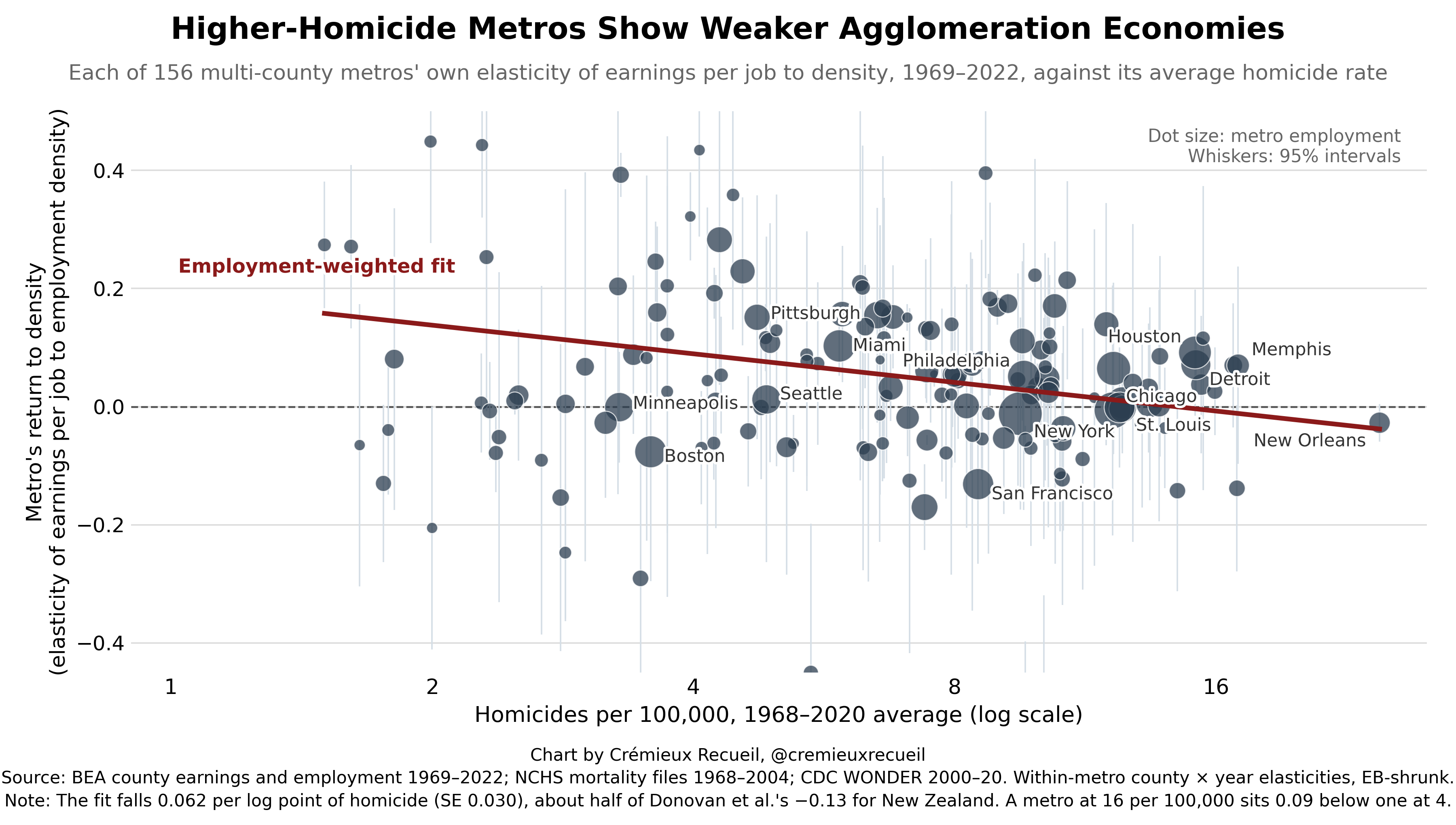
America’s cities are, by and large, bad.1 The easiest way to see this is to understand the primary reason why they’re so bad: crime. The big benefit of cities for countries is that they’re economic engines of progress due to agglomeration effects: benefits and cost-savings that appear because companies, services, and workers are geographically collocated in them. But agglomeration effects are negatively related to crime. Look:
But is this causal? Does crime reduce the extent of agglomeration economies? To a major extent, yes, and we know it thanks to a suite of different disasters—bombings, fires, earthquakes, hurricanes, etc.—, to random events that displaced populations—the Mariel Boatlift, Japanese internment, close elections that appointed discriminatory mayors, etc.—, to the historical period known as the Great Migration—the mass movement of African Americans from the southeastern U.S. to the rest of the country’s urban areas. My replication package deals with all of these, and they produce convergent results, but for this article, I’ll just talk about the clearest example.
The Great Migration started just before World War I and ended just after the passage of the Civil Rights Act. The era was marked by African Americans leaving the South for two main reasons: to escape Jim Crow laws and to seek economic opportunity in the factories of the North.