Unopposed: August 11 2026 Wisconsin Primary Ballot
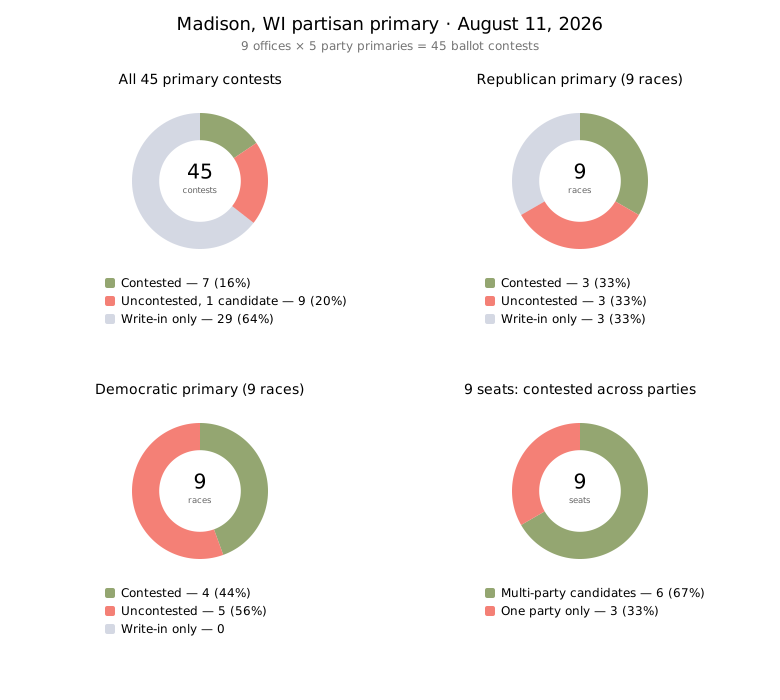
Uncontested local races are a big challenge.
This topic arises – for me – with every election.
Friends scattered here and there occasionally ask, “What’s the deal with (Wisconsin/Madison)?” My response in 2010: One must understand the Milwaukee County Pension Scandal, recalls and Scott Walker victories there and later statewide.
More recently, a look at the uniparty, perhaps combined with apathy merits a deep dive.
Further, I mentioned a Francesca Hong pro literacy vote (one of four democrats) during a recent South Madison Rotary talk.
Gemini summary on the number of uncontested Madison School Board elections in recent years:
The Madison Metropolitan School District board is a much more competitive body — more contested than council or judicial seats, though still short of the mayoral races. It has 7 numbered seats on staggered 3-year terms, so over 2006–2026 each seat comes up roughly 6 to 7 times.
Total seat opportunities (2006–2026): ~46 to 47 ballot races
Competitive races (2+ candidates): ~19 to 21 races (~40% to 45%)
Uncontested races (1 candidate): ~25 to 27 races (~55% to 60%)
Commentary:
State Navigate Poll Briefing alt link:
…recording which party primary voters are participating in. No one can truly say that they can give you the demographics of previous Democratic primary electorates in either of these states with at least a 95% confidence interval, especially on age demographics. This is due, again, to the voter file being incredibly poor: many voters in Wisconsin have a birth year of 1800, and we don’t believe in vampires. These generally are newer voters who skew very young; about half of voters who we polled with a birth year of 1800 say they are in the 18-29 age bracket. Thus, if you were to simply take the voter file’s birth year data, you’ll get a Democratic primary electorate that is majority 65+ and has less than 2% of voters under the age of 30. Absentee requests for the Wisconsin primary (which includes requests for Republican ballots) are 5-6% 18-34. Given that this age group has been notorious for voting late/on Election Day, we find it hard to imagine a Wisconsin Democratic primary electorate that is
People are frustrated about “the establishment” in Democratic politics.
So, I asked Ben Wikler: To you, what is “the establishment”?
His answer:
Former Madison Mayor Dave Cieslewicz:
To that end I’ve combed the DSA document for each specific policy item. I found no fewer than 51, which may seem daunting, so below I’ve created a handy template so that Fran can just print it off and write “YES,” “NO,” or “MAYBE” beside each one. I’ve also been so presumptuous as to give her my thoughts on each one, but she can just ignore those, as I’m sure you and all people of good judgement will.
Here goes!
You will have no debt.
Really? Somebody’s going to pay off my credit cards both now and every month into the future? Cool! There’s a ton of stuff on Amazon I’ve been wanting. If only I had those latest Taylor Mades I’d be breaking par. I know it.
Baldwin and Pocan are both pretty far left themselves. This doesn’t convey anything like “this is a moderate person who should be acceptable to moderates.”
That said, WI voters will vote for people all over the ideological spectrum. What they won’t vote for is crooks. So depending on who is seen as what by November, she might get through to the governor’s office, or she might not. TBD.
NEW — Progressives believe they are on the cusp of another major victory if Francesca Hong can win the WI governor primary today, paving the way for 2028 and beyond.
But so far, many national progressive leaders want nothing to do with the race.
“I don’t know her,” Sen. Elizabeth Warren (D-Mass.) said.
Campaign finance records show Reid Hoffman is the largest donor to the Democratic Party of Wisconsin.
Hoffman, a venture capitalist and LinkedIn co-founder, has donated $15.4 million to the state party, according to campaign finance records.
The Wisconsin Ethics Commission confirmed in an email that online records reach back to 2008, though Hoffman only began donating to the state party in 2019. Wisconsin passed legislation in 2015 that allowed unlimited contributions to state parties.
State online campaign finance records show Hoffman’s name twice; he has profiles under different addresses.
Hoffman’s combined donations place him far above the second-highest donor, Illinois Gov. JB Pritzker, whose donations total about $5.9 million.
It is interesting that some Badger State residents accept Pritzker’s millions, given the general loathing on Illinois. Wisconsin Watch on Republican donors.
But a Crimson Hub audit has revealed that under the prior administration, Voice of America produced and disseminated a video profiling Democratic Socialists of America member and “fresh face” of the Wisconsin Democratic Party, Francesca Hong.
—–
Those terms are obvious: the Democratic Party will ingest and mirror the key precepts of the DSA, and they won’t go whole hog against DSA candidates who don’t totally say the quiet part out loud. This is why Slotkin didn’t endorse Stevens against El-Sayed in Michigan. It’s why Schumer and Jeffries didn’t endorse Cuomo against Mamdani in NYC.