Can the Classroom Ever Be Automated?
MIT Press Reader
Long before AI, teaching machines promised to make education more efficient. Their forgotten history reveals why that dream keeps falling short.
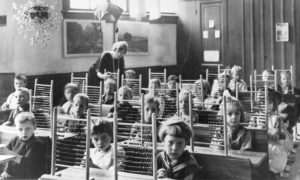
When entrepreneurs talk about innovation in education, their ideas tend to orbit around two seductive promises: automation and personalization. They claim that new technologies — such as tablets, adaptive learning, and classroom management software — will relieve teachers of administrative drudgery while allowing students to learn independently. But as Audrey Watters argues, this vision of the automated, individualized classroom is not new at all; in fact, it is an age-old fantasy, repackaged again and again for successive generations.
In her book “Teaching Machines,” Watters chronicles the little-known history of the 20th-century classroom devices that gave the book its title: machines designed to automate instruction, deliver instant feedback, and let students move through lessons on their own. The earliest version was developed in 1924 by psychologist Sidney L. Pressey, whose “Automatic Teacher” presented students with multiple-choice questions and recorded their answers. The promise of Pressey’s device, however, was derailed by the Great Depression. Three decades later, the famed psychologist B. F. Skinner developed a teaching machine of his own, shaped by his controversial theories of behaviorism — the idea that human learning can be molded through external repetition and reinforcement. But in the end, Skinner’s invention failed to survive the machinery of corporate bureaucracy and a broader culture wary of mechanizing the classroom.