a steady decline in textbook quality that no rational agent in the chain has any motive to reverse.
I was struck by how much the prose and content had been dumbed down. In places, it truly read like a middle-school textbook. I went back to the older editions I had kept, and a side-by-side comparison from 2000 forward shows a clear deterioration with each revision. In 2000, students were reading a serious work. The current edition is not.
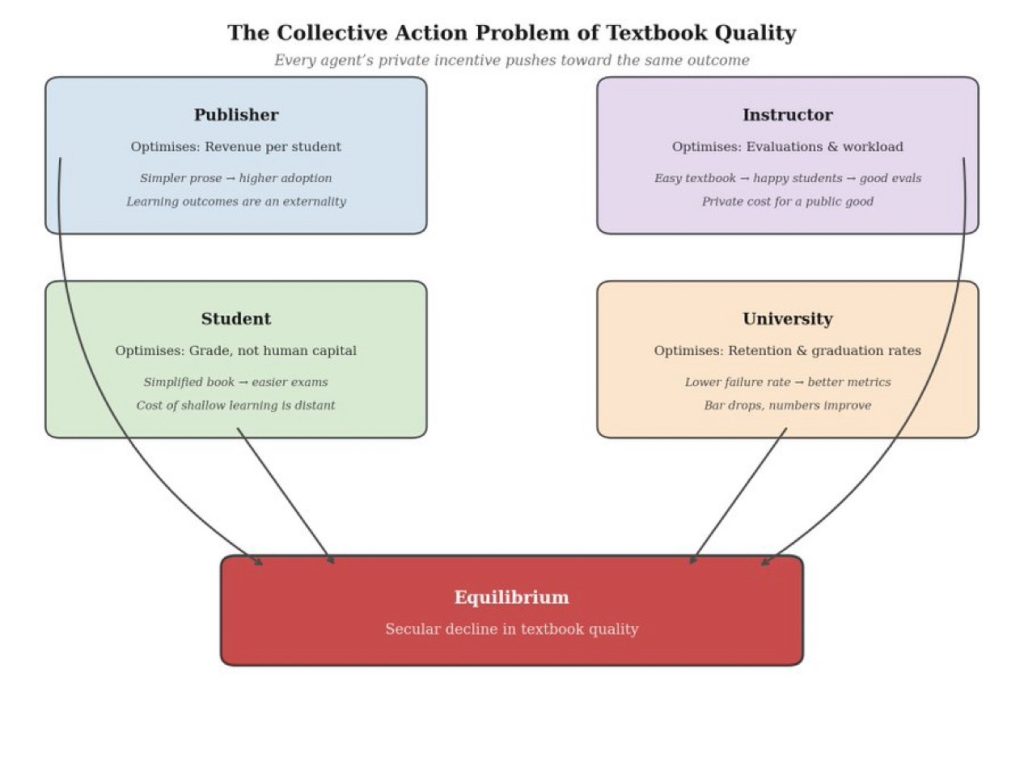
As an economist, I suppose I should not be surprised. Four rational agents shape the outcome, and not one of them has any reason to defend quality.
The publisher maximizes revenue per student, not learning. Simpler prose and lighter material may reduce what students learn, but they raise adoption rates: instructors find the book “easier to teach with” and students complain less. Learning outcomes are an externality.
The instructor worries about teaching evaluations and grade inflation. Assign an easy textbook, and students are content; you hand out A’s to most of them, and your workload drops. The instructor who assigns the harder book and earns lower evaluations bears a private cost for a public good. A textbook collective action problem.
Good point. I see five reasons:
1) When university was for 10-15% of the age cohort, the entering student could handle serious prose. Massification changed the median reader, and publishers adjusted to the actual audience.
2) Teaching evaluations, which became widespread in the 1970s and were tied to tenure decisions by the 1980s, gave the instructor’s natural desire to avoid complaints a formal channel into personnel files. Before that, students could grumble, but it went nowhere.
3) Grade inflation, kicked off during Vietnam (when failing a student could get him drafted), turned into a one-way ratchet that no department can unilaterally reverse. Also, by its very nature, grade inflation unravels over time.
4) The consolidation of textbook publishing into a handful of firms meant competition shifted from intellectual quality to ease of adoption.
5) And the decline in sustained reading among adolescents means students genuinely arrive less prepared for demanding text than they did forty years ago, which makes the dumbing down partly demand-driven, not just supply-driven.