Massachusetts schools rank first, but for how much longer?
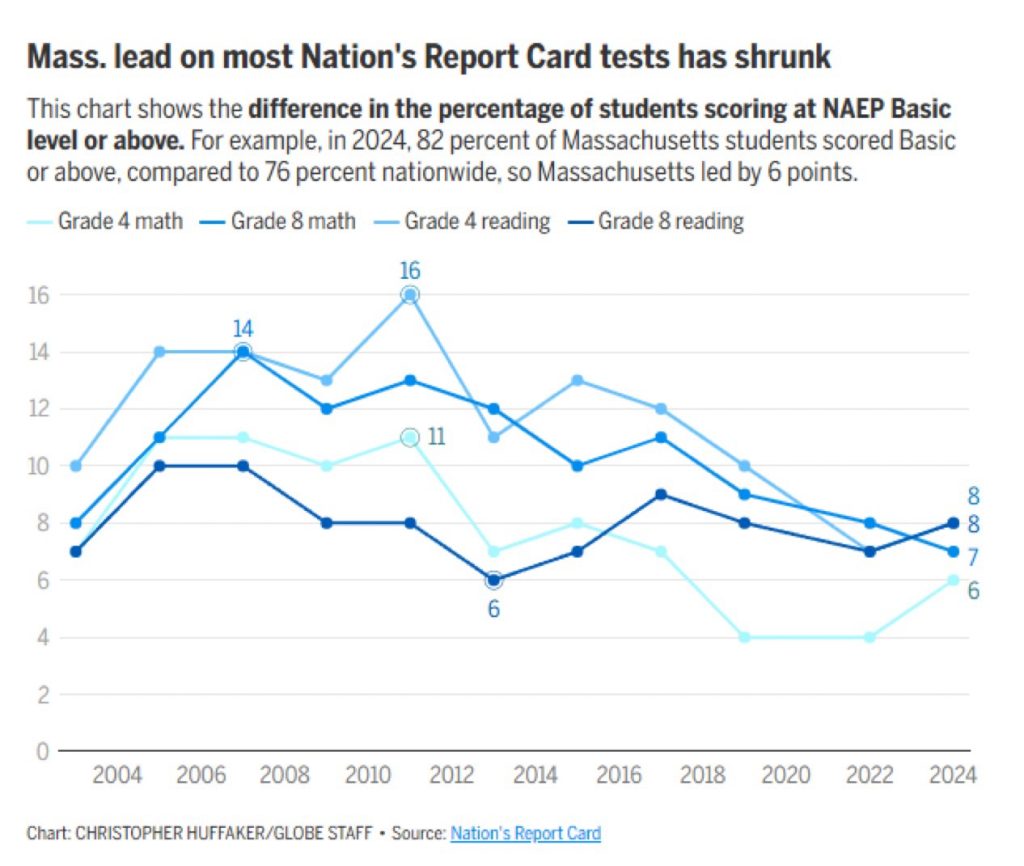
The reckoning may come soon: students next sit for the national test this spring and a continuation of recent underwhelming performances risks any number of states, including Wyoming, New Jersey, or even Mississippi, toppling the Commonwealth from its lead in one or more subjects.
So for the governor on whose watch this is brewing, the urgency to respond is in part helped along by a matter of pride:
“We’re not going to give that ranking up,” Governor Maura Healey said at an event recently to introduce new statewide graduation requirements, at which she referred to the state’s ranking no less than three times.
“I’m a little competitive,” she added.
For political leaders, symbolism matters: for the setting of her event in early December, Healey chose Dedham, where the first taxpayer-funded schools were established more than a century before the British colonies became the United States.
In response to the slippage, Healey and other Democratic leaders have proposed a kitchen sink of solutions that include new graduation requirementssuch as state tests in some required courses and senior year projects, and a state mandate on how reading is taught that is pending before the state Senate. Declining scores have also been cited by other education leaders and advocates as an argument for banning cellphones in school, further raising state school aid, and other measures.
In what is perhaps a measure of the seriousness of the challenge, Healey is willing to buck the state’s leading teachers’ union, which is also one of the most influential blocs of support within the state Democratic Party.
Politically, that’s a big risk, but the state’s perch at the top matters greatly: to parents, who expect their children to learn to read and do math and lead successful lives; to employers who want to be confident in hiring Massachusetts school graduates; and even to voters if they perceive their leaders are letting one of the state’s biggest advantages slip away.
———
more.
Related: MTEL.