1998 Madison School Board Meeting Literacy & Math Discussions
What eleven board meetings say about literacy, and about mathematics.
Eleven sets of Madison school board minutes survive from 1998 in this collection, one for each regular meeting from January through December except April. Read in order, they show a district deciding what it was going to hold itself to.
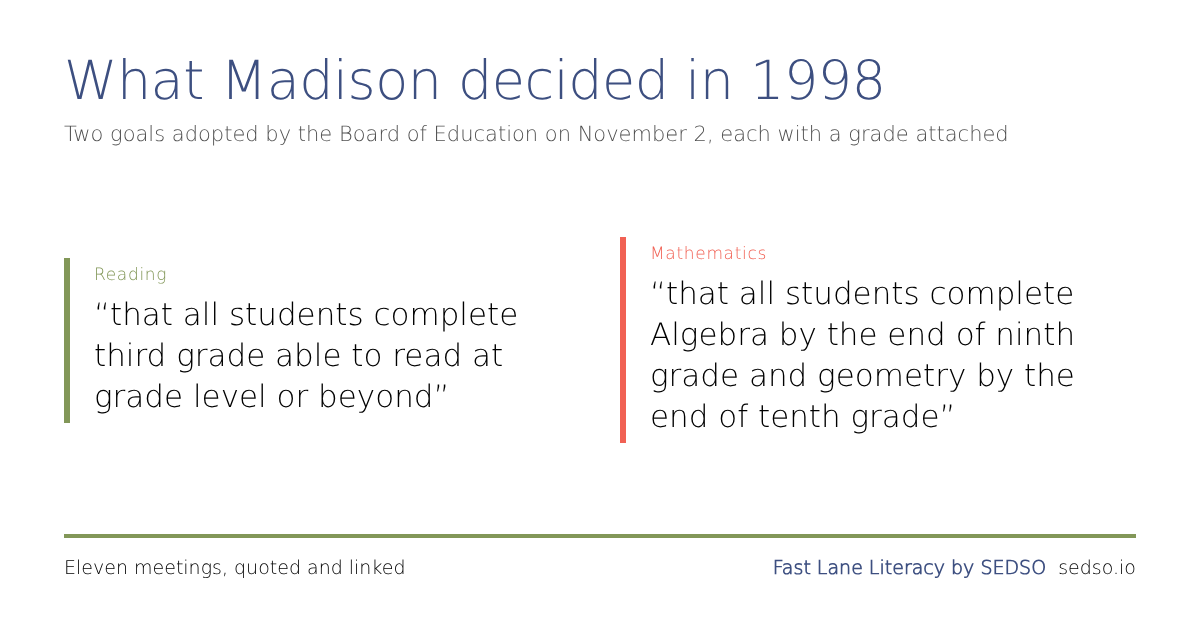
In January the board told its delegate to the state school boards convention to vote against a resolution that would have required students to reach a set level of competency in reading, social studies, language arts, math and science before moving up a grade. Ten months later, on November 2, the same board adopted goals of its own: every student reading at grade level by the end of third grade, and every student through algebra by the end of ninth grade and geometry by the end of tenth. The difference was not whether to set a standard but who would set it.
Between those two meetings the money moved the same way. A federal Goals 2000 grant in May paid to point elementary summer school at what the minutes already call “the third grade literacy goal.” In June the board put $20,000 into a Summer Literacy Initiative. SAGE, the state program that cut kindergarten and first grade classes to fifteen children, reached a second Madison school in March and a third by September. Schools of Hope asked the city for 400 volunteers to tutor children in reading.
The sharpest line in the year is an answer, not a proposal. Asked in September why art, music and gym classes were larger in SAGE schools, the interim superintendent said plainly that SAGE funding supports reading and math, not special instruction.
This summary along with 1998 Madison School Board meeting minutes has been added to Legislation and Reading: The Wisconsin Experience, 1998–.