Americans—and young Americans, in particular—are dating less, coupling less, marrying less, and having fewer children. A new book offers several theories for why.
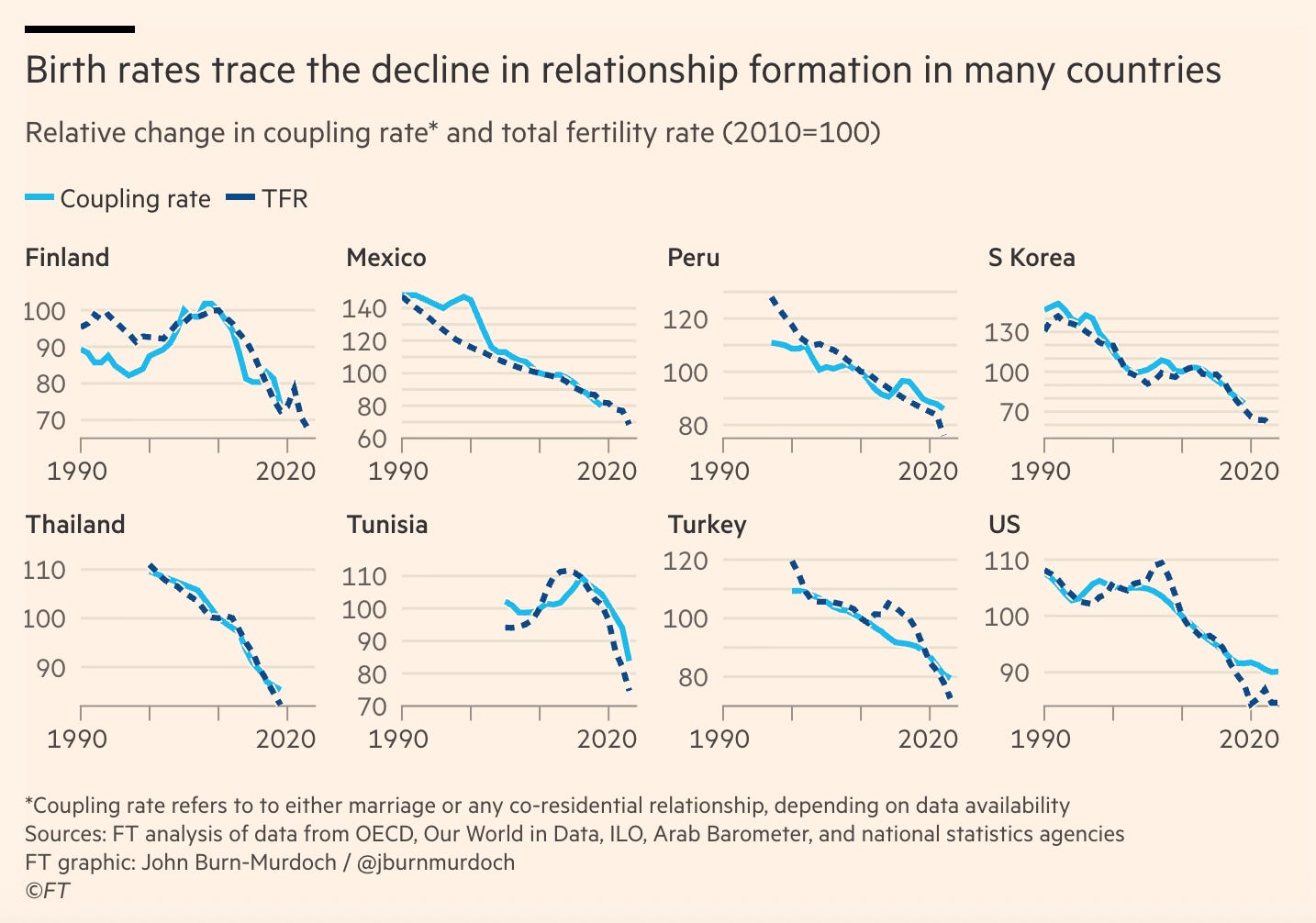
I care about the decline of coupling and marriage not because I consider myself a strict evangelist of matrimony—I think people should do what they can to enjoy themselves without hurting others—but rather because I think it bears on two of the most important questions about the future: (1) How many people exist, and (2) how happy are they? The relationship between romance and births is practically linear. Since 1990, Burn-Murdoch has shown, the decline of births traces the decline of relationship formation across many countries. Fewer relationships mean fewer people, and accelerating population declines around the world are, somewhat like climate change, a slowly accumulating phenomenon that will almost certainly shape the future of economics, technology, and the texture of human existence.
———
Only about 10% of people have the initiative to consistently organize social gatherings.
When they ran institutions anyone could and did join, we all benefited. Now you have to be close friends with them to benefit, which means most people miss out.
———
User participation often more or less follows a 90–9–1 rule:
- 90% of users are lurkers (i.e., read or observe, but don’t contribute).
- 9% of users contribute from time to time, but other priorities dominate their time.
- 1% of users participate a lot and account for most contributions: it can seem as if they don’t have lives because they often post just minutes after whatever event they’re commenting on occurs.