Civics: New Zealand as Mediocristan
The experience got me thinking about New Zealand as a kind of spiritual aspirant to Nassim Taleb’s Mediocristan: a fictional province in which all your outcomes in life are mild and bounded, clustering tightly around the average. As a New Zealander, you are unlikely to be exposed to top-tier, world-beating opportunities, but you also don’t have to think twice about whether you can afford to go to the hospital.
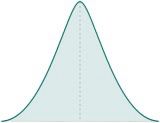
The distribution of life outcomes in Mediocristan looks something like this:
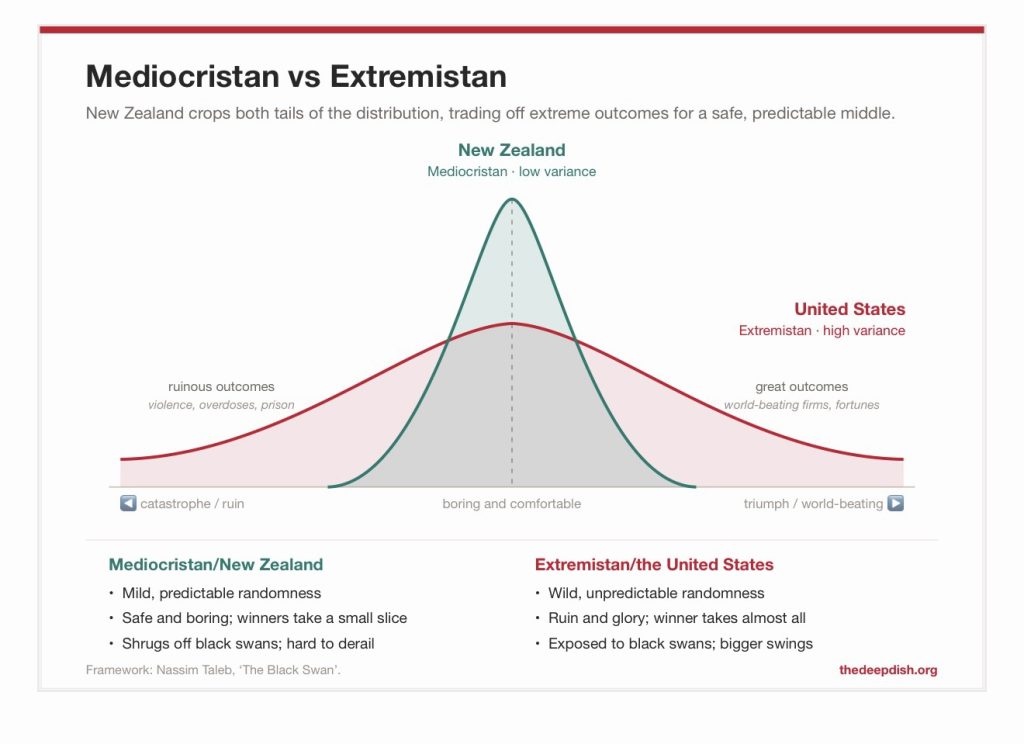
Cross the border into Extremistan, and you enter the realm of wild randomness. Here, the distribution of life outcomes is fat-tailed: a single freakish event can outweigh all of the other data points combined. Trillionaires live next door to paupers. There are midgets the size of your fingernail, and giants as tall as skyscrapers. Every new technology has the potential to wipe the entire country out of existence, or create a paradise beyond the wildest dreams of its inhabitants.
If New Zealand is Mediocristan, then the spiritual counterpart to Extremistan is obviously the United States of America.
In the land of the brave and home of the free, the best thing that can happen to you is very, very good; the worst thing that can happen to you is very, very bad.
Here’s what the distribution of life outcomes looks like under the two regimes:
Obviously Taleb never intended to map this distinction onto actual countries, but let’s run with it for a moment.
New Zealand is mild and predictable because we are unusually good at cropping the left tail of the distribution: not only reducing the frequency of tail-risk events, but the magnitude of their impact.
How do we pull this off?
In a word: geography. New Zealand is a little pimple on the arse-end of the world. It’s possible that you, overseas reader, do not fully comprehend how isolated we are down here in the Pacific, so here is a perspective of the Earth that you have probably never even seen before: