What will be left for us to work on?
Arvind NarayananJul 13, 2026
I had the honor of giving a keynote at the International Conference on Machine Learning in Seoul last week titled “What will be left for us to work on?” I addressed the widespread anxiety about how we should adapt as AI capabilities increase. I was thrilled by the talk’s reception, so I have made my slides available here, annotated with a lightly edited transcript. You can also view them below right here on this page, but the online version has animations, clickable links, and a much nicer experience overall.
Update [August 2026]: ICML has released the video of the talk.
I made three arguments. First, the AI as Normal Technology framework is a correct and useful as a way to think about AI’s impacts, unless and until there is some future discontinuity such as through recursive self-improvement. Second, even though we should take recursive self-improvement seriously, there is no milestone that companies might achieve in the lab that will suddenly put us all out of work. Third and finally, jobs of the future will be radically different, and a lot of adaptation will be needed. I shared my thinking about what this might look like and ended with a vision of human/AI “co-superintelligence”.
Now is a time of great excitement in AI, but it’s also a time of great anxiety in the AI community. I want to address that anxiety head on. How do we prepare for a future where AI will become capable of doing more and more of the work that we do today?
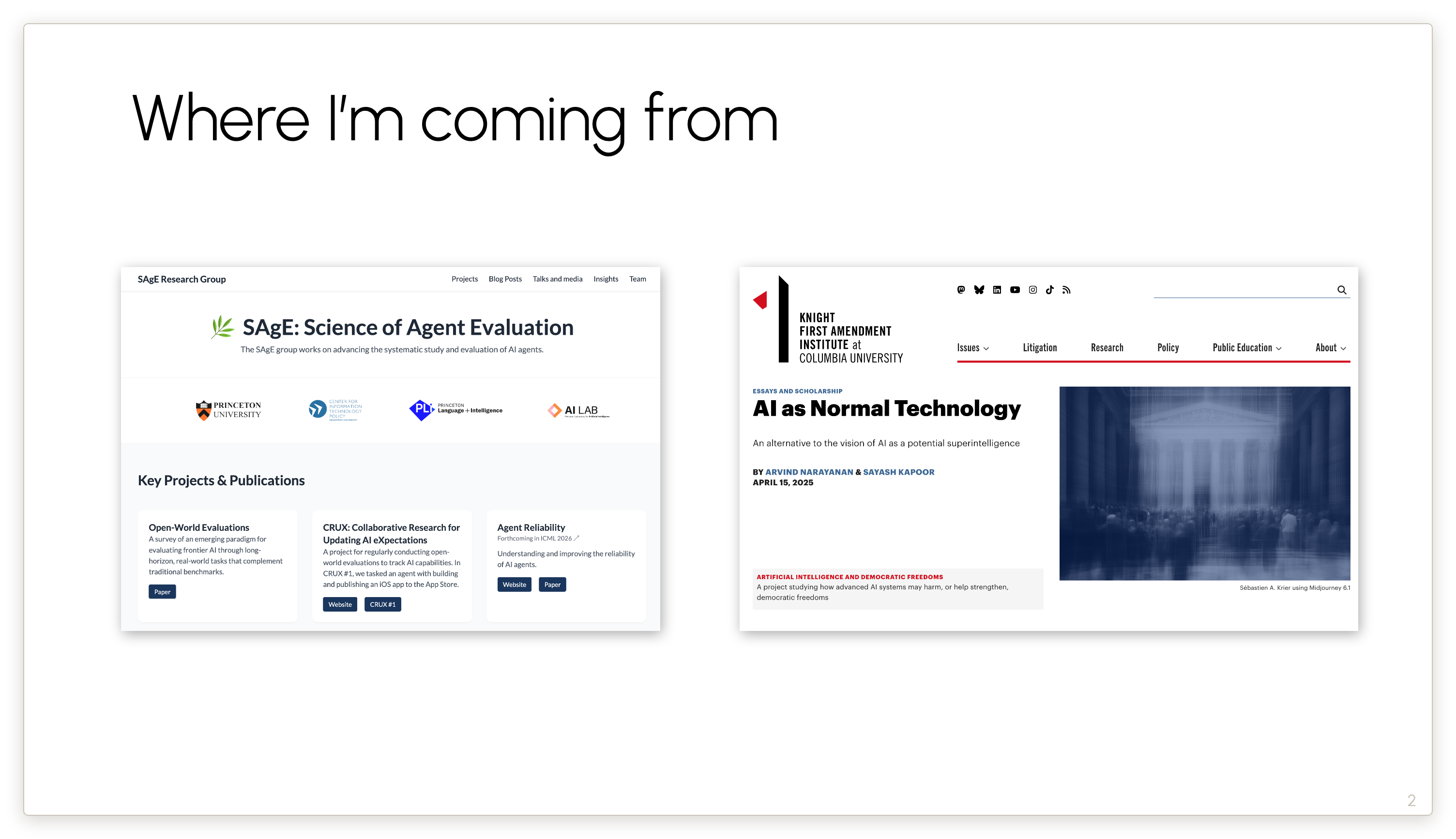
I lead a team at Princeton University trying to advance the science of AI agent evaluation. We try to go beyond the usual claims of “Look, capability is going up on benchmarks!” Those claims tend to be misinterpreted by the broader public as implying that agents are soon about to take all our jobs.
Maybe that will happen. But in our work we try to understand the factors beyond capability that matter for real-world deployment, and bring that understanding into evaluations.
The work that I’m better known for is the essay I co-authored with Sayash Kapoor called AI as Normal Technology. It’s a way to think about the medium-term future of AI and how to adapt to it — and in turn how to adapt it to the needs of society and the economy.