k-12 tax & $pending climate: The Fiscal Crisis Facing American Cities
American cities rely on money from Washington, D.C. Some of this is obvious, some of it much less so. But the federal fiscal regime that made this support possible is becoming harder to sustain. For decades, Washington could finance expanding commitments through debt without forcing immediate tradeoffs elsewhere in the budget. That era is ending.
Worse still, municipal exposure to a federal pullback is likely to manifest as what will appear to be fundamentally local failures. Residents who encounter deteriorating infrastructure, struggling schools, and shrinking public services will be unlikely to understand federal fiscal constraints. They will instead blame city hall.
US Sovereign Debt for Urbanists
For decades, the U.S. government borrowed money on uniquely favorable terms. The dollar’s status as the world’s post-WWII reserve currency gave the United States a borrowing advantage few other nations could match. Throughout the 2010s, interest rates were so low that there were seemingly no constraints on how much the federal government was able to borrow.1
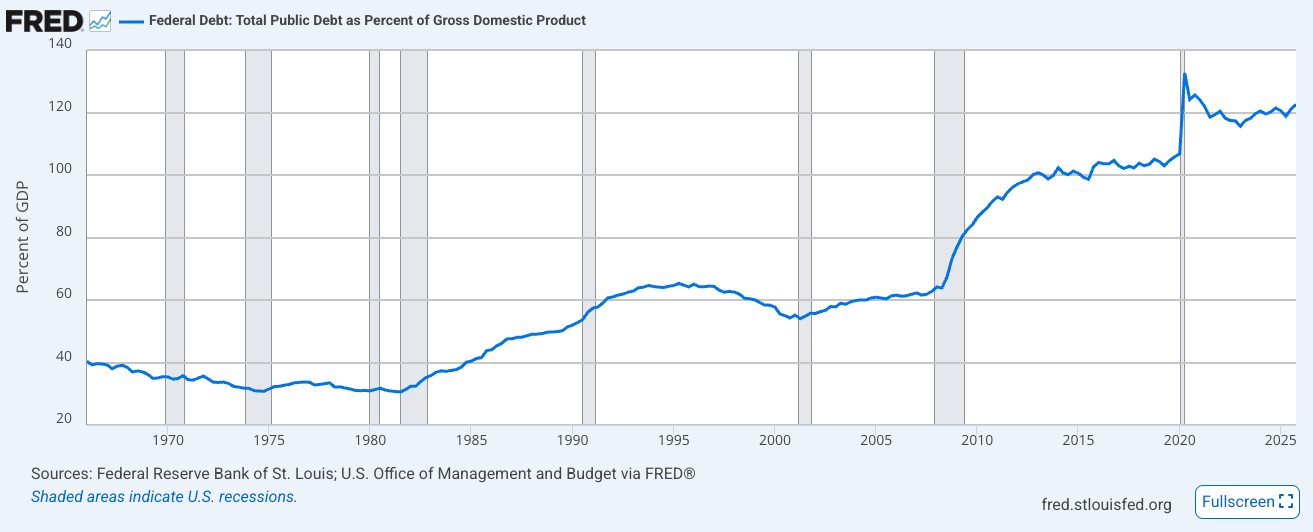
Then COVID happened. Emergency spending pushed the gross federal debt-to-GDP ratio past 120%, and the subsequent rise in interest rates has made that enlarged debt load increasingly costly to carry.2Unlike previous debt scares — and there have been many — this one came with a structural change in borrowing costs. Interest payments on the national debt have already surpassed defense spending and are now on track to consume nearly a third of federal revenue within a generation.
At the Hoover Institution’s annual Monetary Policy Conference earlier this year, Stanford finance professor Hanno Lustig argued that Treasuries are beginning to lose their special status in international markets. Before 2020, investors accepted lower returns because Treasuries carried what economists call a convenience yield: a premium attached to their safety, liquidity, and money-like qualities. That premium, Lustig argues, has now disappeared, at least at the margin.
None of this means the United States is about to go bankrupt. But it does mean the era of easy fiscal choices is ending. As the cost of servicing the debt increases, Congress must borrow more, raise additional revenue, or devote a smaller share of the federal budget to everything else. Whichever path it chooses, the federal government will have less room to maintain the commitments on which American cities have come to depend.