| School Information System |
 | Sponsorships | Sponsorships |
|
|
Alastair Creelman & Linda Reneland-Forsman:
Statistics are often used to reveal significant differences between online and campus-based education. The existence of online courses with low completion rates is often used to justify the inherent inferiority of online education compared to traditional classroom teaching. Our study revealed that this type of conclusion has little substance. We have performed three closely linked analyses of empirical data from Linnaeus University aimed at reaching a better understanding of completion rates. Differences in completion rates revealed themselves to be more substantial between faculties than between distribution forms. The key-factor lies in design. Courses with the highest completion rates had three things in common; active discussion forums, complementing media and collaborative activities. We believe that the time has come to move away from theoretical models of learning where web-based learning/distance learning/e-learning are seen as simply emphasizing the separation of teacher and students. Low completion rates should instead be addressed as a lack of insight and respect for the consequences of online pedagogical practice and its prerequisites.
Newsletter signup | Send us your ideas
Alison Gopnik
Changes in our environment can actually transform the relation between our traits and the outside world.
We all notice that some people are smarter than others. You might naturally wonder how much these differences in intelligence depend on genes or upbringing. But that question, it turns out, is impossible to answer. That's because changes in our environment can actually transform the relationship among our traits, our upbringing and our genes.
The textbook illustration of this is a dreadful disease called PKU. Some babies have a genetic mutation that makes them unable to process an amino acid in their food, and it leads to severe mental retardation. For centuries, PKU was incurable. Genetics determined whether someone suffered from the syndrome, which gave them a low IQ. Then scientists discovered how PKU works. Now, we can immediately put babies with the mutation on a special diet. Whether a baby with PKU has a low IQ is now determined by the food they eat--by their environment.
We humans can figure out how our environment works and act to change it, as we did with PKU. So if you're trying to measure the relative influence of human nature and nurture, you have to consider not just the current environment but also all the possible environments that we can create. This doesn't just apply to obscure diseases. In the latest issue of Psychological Science, Timothy C. Bates of the University of Edinburgh and colleagues report a study of the relationship among genes, SES (socio-economic status, or how rich and educated you are) and IQ. They used statistics to analyze the differences between identical twins, who share all DNA, and fraternal twins, who share only some.
When psychologists first started studying twins, they found identical twins much more likely to have similar IQs than fraternal ones. They concluded that IQ was highly "heritable"--that is, due to genetic differences. But those were all high SES twins. Erik Turkheimer of the University of Virginia and his colleagues discovered that the picture was very different for poor, low-SES twins. For these children, there was very little difference between identical and fraternal twins: IQ was hardly heritable at all. Differences in the environment, like whether you lucked out with a good teacher, seemed to be much more important.
In the new study, the Bates team found this was even true when those children grew up. IQ was much less heritable for people who had grown up poor. This might seem paradoxical: After all, your DNA stays the same no matter how you are raised. The explanation is that IQ is influenced by education. Historically, absolute IQ scores have risen substantially as we've changed our environment so that more people go to school longer.
Richer children have similarly good educational opportunities, so genetic differences among them become more apparent. And since richer children have more educational choice, they (or their parents) can choose environments that accentuate and amplify their particular skills. A child who has genetic abilities that make her just slightly better at math may be more likely to take a math class, so she becomes even better at math.
But for poor children, haphazard differences in educational opportunity swamp genetic differences. Ending up in a terrible school or one a bit better can make a big difference. And poor children have fewer opportunities to tailor their education to their particular strengths. How your genes shape your intelligence depends on whether you live in a world with no schooling at all, a world where you need good luck to get a good education or a world with rich educational possibilities. If we could change the world for the PKU babies, we can change it for the next generation of poor children, too.
Newsletter signup | Send us your ideas
Earlier this week, I spotted, among the job listings in the newspaper Reforma, an ad from a restaurant in Mexico City looking to hire dishwashers. The requirement: a secondary school diploma.Years ago, school was not for everyone. Classrooms were places for discipline, study. Teachers were respected figures. Parents actually gave them permission to punish their children by slapping them or tugging their ears. But at least in those days, schools aimed to offer a more dignified life.
Nowadays more children attend school than ever before, but they learn much less. They learn almost nothing. The proportion of the Mexican population that is literate is going up, but in absolute numbers, there are more illiterate people in Mexico now than there were 12 years ago. Even if baseline literacy, the ability to read a street sign or news bulletin, is rising, the practice of reading an actual book is not. Once a reasonably well-educated country, Mexico took the penultimate spot, out of 108 countries, in a Unesco assessment of reading habits a few years ago.
One cannot help but ask the Mexican educational system, "How is it possible that I hand over a child for six hours every day, five days a week, and you give me back someone who is basically illiterate?"
...
This is not just about better funding. Mexico spends more than 5 percent of its gross domestic product on education -- about the same percentage as the United States. And it's not about pedagogical theories and new techniques that look for shortcuts. The educational machine does not need fine-tuning; it needs a complete change of direction. It needs to make students read, read and read.
But perhaps the Mexican government is not ready for its people to be truly educated. We know that books give people ambitions, expectations, a sense of dignity. If tomorrow we were to wake up as educated as the Finnish people, the streets would be filled with indignant citizens and our frightened government would be asking itself where these people got more than a dishwasher's training.
Newsletter signup | Send us your ideas
Peer reviews of conference paper submissions is an integral part of the research cycle, though it has unknown origins. For the computer vision community, this process has become significantly more difficult in recent years due to the volume of submissions. For example, the number of submissions to the CVPR conference has tripled in the last ten years. For this reason, the community has been forced to reach out to a less than ideal pool of reviewers, which unfortunately includes uninformed junior graduate students, disgruntled senior graduate students, and tenured faculty. In this work we take the simple intuition that the quality of a paper can be estimated by merely glancing through the general layout, and use this intuition to build a system that employs basic computer vision techniques to predict if the paper should be accepted or rejected. This system can then be used as a first cascade layer during the review pro- cess. Our results show that while rejecting 15% of "good papers", we can cut down the number of "bad papers" by more than 50%, saving valuable time of reviewers. Finally, we fed this very paper into our system and are happy to report that it received a posterior probability of 88.4% of being "good".1. Introduction
Peer reviews of conference paper submissions is an in- tegral part of the research cycle, though it has unknown origins. For the computer vision community, this process has become significantly more difficult in recent years due to the volume of submissions. For example, the number of submission to the CVPR conference has tripled in the last ten years1 (see Fig. 1). For this reason, the commu- nity has been forced to reach out to a less than ideal pool of reviewers, which unfortunately includes uninformed ju- nior graduate students, disgruntled senior graduate students,
Newsletter signup | Send us your ideas
If ramen noodle sales spike at the start of every semester, here's one possible reason: textbooks can cost as much as a class itself; materials for an introductory physics course can easily top $300.Cost-conscious students can of course save money with used or online books and recoup some of their cash come buyback time. Still, it's a steep price for most 18-year-olds.
But soon, introductory physics texts will have a new competitor, developed at Rice University. A free online physics book, peer-reviewed and designed to compete with major publishers' offerings, will debut next month through the non-profit publisher OpenStax College.
Newsletter signup | Send us your ideas
Research supports parental involvement as a viable means of enhancing children's academic success. Once again, Michelle Belnavis, a cultural relevance instructional resource teacher (K-5) for MMSD, has organized an event that brings African American community leaders, families, staff, students, and neighborhood organizations together to provide inspiration and information to schools and neighborhoods in honor of National African American Parent Involvement Day."We have been doing a lot of research in looking at the effect of having parents' actively involved in their children's education and a big part is that relationship-building," Belnavis tells The Madison Times. "This gives an opportunity for teachers and families and parents to come together for the purpose of celebrating unity. I think a lot of times when parents come into school there's a feeling like, 'I don't really belong here' or 'My children go to school here but I don't really have a connection with the teacher.'
Newsletter signup | Send us your ideas
SOMETIMES it takes but a single pebble to start an avalanche. On January 21st Timothy Gowers, a mathematician at Cambridge University, wrote a blog post outlining the reasons for his longstanding boycott of research journals published by Elsevier. This firm, which is based in the Netherlands, owns more than 2,000 journals, including such top-ranking titles as Cell and the Lancet. However Dr Gowers, who won the Fields medal, mathematics's equivalent of a Nobel prize, in 1998, is not happy with it, and he hoped his post might embolden others to do something similar.It did. More than 2,700 researchers from around the world have so far signed an online pledge set up by Tyler Neylon, a fellow-mathematician who was inspired by Dr Gowers's post, promising not to submit their work to Elsevier's journals, or to referee or edit papers appearing in them. That number seems, to borrow a mathematical term, to be growing exponentially. If it really takes off, established academic publishers might find they have a revolution on their hands.
Newsletter signup | Send us your ideas
Are hardbound textbooks going the way of slide rules and typewriters in schools?Education Secretary Arne Duncan and Federal Communications Commission chairman Julius Genachowski on Wednesday challenged schools and companies to get digital textbooks in students' hands within five years. The Obama administration's push comes two weeks after Apple Inc. announced it would start to sell electronic versions of a few standard high-school books for use on its iPad tablet.
Digital books are viewed as a way to provide interactive learning, potentially save money and get updated material faster to students.
Newsletter signup | Send us your ideas
For the second consecutive year, Washington, D.C. , is ranked as the most literate city in the country, according to an annual statistical survey to be released today.Here is the top 10 for 2011, as ranked by Central Connecticut State University President Jack Miller, based on data that includes number of bookstores, library resources, newspaper circulation and Internet resources:
Newsletter signup | Send us your ideas
MG Siegler in his latest TechCrunch article posits that although Apple's new iBooks strategy is admirable in its effort to fix problems in public high schools, that it's not realistic and that their market strategy should revolve around colleges and college textbooks.On the surface, which seems logical enough, his argument is sound. But It ignores the one, HUGE driving force in education: money.
Nearly all high schools are public, or receive public funding in one way or another and help to satisfy the law which states that students of high school age must attend school. Textbooks are merely a means of teaching these students topics which help these schools qualify for their funding.
Newsletter signup | Send us your ideas
Absent the glamour of the black mock turtleneck, Apple's Thursday event, held at the Guggenheim Museum in New York, still came bearing flowers of rhetoric, lovingly transplanted from their native soil in Cupertino's sunny clime. One such rhetorical staple, the feature checklist, made its appearance about nine minutes in. Usually, the checklist is used to contrast Apple's latest magical object with the feature set of lesser smartphones or other misbegotten tech tchotchkes; it was more than a little eye-popping to see the same rhetoric of invidious comparison used against the book in full -- that gadget which, as senior VP Phil Schiller reminded us, was invented (in its print incarnation) back at the end of the Hundred Years' War.
Newsletter signup | Send us your ideas
On the heels of Apple's big education and iBooks event, it's worth taking a quick snapshot of the education publishing industry as it stands today.Not because the tools announced today will inevitably transform the future of education the way iTunes and the iPhone did the music and smartphone industries -- however fun that may be to imagine.
Rather, you simply can't understand Apple's interest in breaking into the education market without at least a little understanding of that market's scope. And you can't understand why Apple's adopted the approach that it has without understanding that market's connection to our wider media ecosystem.
Newsletter signup | Send us your ideas
Apple's controversial license terms are discussed here.
Newsletter signup | Send us your ideas
Apple is slated to announce the fruits of its labor on improving the use of technology in education at its special media event on Thursday, January 19. While speculation has so far centered on digital textbooks, sources close to the matter have confirmed to Ars that Apple will announce tools to help create interactive e-books--the "GarageBand for e-books," so to speak--and expand its current platform to distribute them to iPhone and iPad users.Along with the details we were able to gather from our sources, we also spoke to two experts in the field of digital publishing to get a clearer picture of the significance of what Apple is planning to announce.
So far, Apple has largely embraced the ePub 2 standard for its iBooks platform, though it has added a number of HTML5-based extensions to enable the inclusion of video and audio for some limited interaction. The recently-updated ePub 3 standard obviates the need for these proprietary extensions, which in some cases make iBook-formatted e-books incompatible with other e-reader platforms. Apple is expected to announce support for the ePub 3 standard for iBooks going forward.
Newsletter signup | Send us your ideas
Summary of the Wisconsin Read to Lead Task Force Recommendations, January, 2012Related: Erin Richards' summary (and Google News aggregation) and many SIS links.
Teacher Preparation and Professional Development
All teachers and administrators should receive more instruction in reading pedagogy that focuses on evidence-based practices and the five components of reading as defined by the National Reading Panel (phonemic awareness, phonics, fluency, vocabulary, and comprehension).
There must be more accountability at the state level and a commitment by institutions of higher education to improving teacher preparation.Licensure requirements should be strengthened to include the Massachusetts Foundations of Reading exam by 2013.
Teacher preparation programs should expand partnerships with local school districts and early childhood programs.
Information on the performance of graduates of teacher preparation programs should be available to the public.
A professional development conference should be convened for reading specialists and elementary school principals.
DPI should make high quality, science-based, online professional development in reading available to all teachers.
Professional development plans for all initial educators should include a component on instructional strategies for reading and writing.
Professional development in reading instruction should be required for all teachers whose students continually show low levels of achievement and/or growth in reading.
- Screening, Assessment, and Intervention
Wisconsin should use a universal statewide screening tool in pre-kindergarten through second grade to ensure that struggling readers are identified as early as possible.
Proper accommodations should be given to English language learners and special education students.Formal assessments should not replace informal assessments, and schools should assess for formative and summative purposes.
Educators should be given the knowledge to interpret assessments in a way that guides instruction.
Student data should be shared among early childhood programs, K-12 schools, teachers, parents, reading specialists, and administrators.
Wisconsin should explore the creation of a program similar to the Minnesota Reading Corps in 2013.
- Early Childhood
DPI and the Department of Children and Families should work together to share data, allowing for evaluation of early childhood practices.
All 4K programs should have an adequate literacy component.
DPI will update the Wisconsin Model Early Learning Standards to ensure accuracy and alignment with the Common Core State Standards, and place more emphasis on fidelity of implementation of the WMELS.
The YoungStar rating system for early childhood programs should include more specific early literacy criteria.
- Accountability
The Educator Effectiveness Design Team should consider reading outcomes in its evaluation systems.
The Wisconsin School Accountability Design Team should emphasize early reading proficiency as a key measure for schools and districts. Struggling schools and districts should be given ongoing quality professional development and required to implement scientific research-based screening, assessment, curriculum, and intervention.
Educators and administrators should receive training on best practices in order to provide effective instruction for struggling readers.
The state should enforce the federal definition for scientific research-based practices, encourage the use of What Works Clearinghouse, and facilitate communication about effective strategies.
In addition to effective intervention throughout the school year, Wisconsin should consider mandatory evidence-based summer school programs for struggling readers, especially in the lower grades, and hold the programs accountable for results.
- Family Involvement
Support should be given to programs such as Reach Out and Read that reach low-income families in settings that are well-attended by parents, provide books to low-income children, and encourage adults to read to children.The state should support programs that show families and caregivers how to foster oral language and reading skill development in children.
Adult literacy agencies and K-12 schools should collaborate at the community level so that parents can improve their own literacy skills.
Newsletter signup | Send us your ideas
What inspired you to start The Concord Review?Diane Ravitch, an American historian of education, wrote a col- umn in The New York Times in 1985 about the ignorance of his- tory among 17-year-olds in the United States, based on a study of 7,000 students. As a history teacher myself at the time, I was interested to see that what concerned me was a national problem, and I began to think about these issues. It occurred to me that if I had one or two very good students writing his- tory papers for me and perhaps my colleagues had one or two, then in 20,000 United States high schools (and more overseas) there must be a large number of high school students doing exemplary history research papers. So in1987, I established The Concord Review to provide a journal for such good work in his- tory. I sent a four-page brochure calling for papers to every high school in the United States, 3,500 high schools in Canada, and 1,500 schools overseas. The papers started coming in, and in the fall of 1988, I was able to publish the first issue of The Concord Review. Since then, we have published 89 issues.
Newsletter signup | Send us your ideas
Bill Smojver, Director of Technical Services:
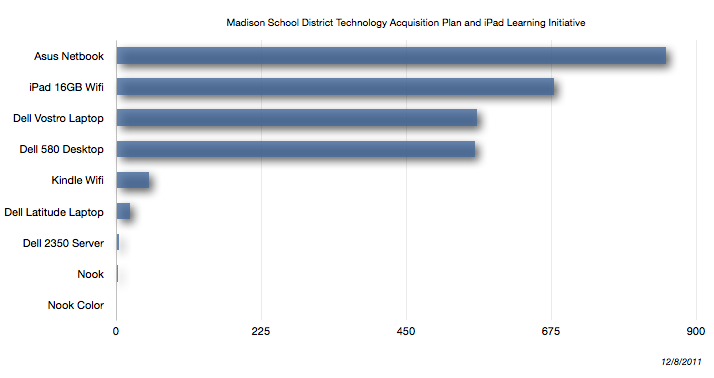
Madison Metropolitan School District was provided an award from the Microsoft Cy Pres settlement in the Fall of 2009. Since that time the district has utilized many of these funds to prorate projects across the district in order to free up budgeted funds and to provide for more flexibility. The plan and process for these funds liquidates the General Purpose portion of the Microsoft Cy Pres funds, provides an equitable allocation per pupil to each school, and is aimed at increasing the amount of technology within our schools.I found the device distribution to be quite interesting. The iPad revolution is well underway. Technology's role in schools continues to be a worthwhile discussion topic.The total allocation remaining from Cy Pres revenues totals $2,755,463.11, which was the target for the technology acquisition plan. Two things happened prior to allocating funds to schools: first was to hold back $442,000 for the future purchase of iPads for our schools (at $479 per iPad this equates to a 923 iPads), and second was to hold back $200,000 necessary for increased server capacity to deal with the increase in different types of technology.
The final step was to allocate the remaining funding ($2,113,463.11) out to the schools on a per pupil basis. This was calculated at $85.09 per pupil across all schools within the district.
Newsletter signup | Send us your ideas
Fellow members of the Electronic Educational Entertainment Association. My remarks will be brief, as I realize you all have texts to read, messages to tweet, and you will of course want to take photos of those around you to post on your blog.
I only want to remind you that the book is our enemy. Every minute a student spends reading a book is time taken away from purchasing and using the software and hardware the sale of which we depend on for our livelihoods.
You should keep in mind the story C.S. Lewis told of Wormwood, the sales rep for his uncle Screwtape, a district manager Below, who was panicked when his target client joined a church. What was he to do? Did this mean a lost account? Screwtape reassured him with a story from his own early days. One of his accounts went into a library, and Screwtape was not worried, but then the client picked up a book and began reading. However, then he began to think! And, in an instant, the Enemy Above was at his elbow. But Screwtape did not panic--fortunately it was lunchtime, and he managed to get his prospect up and at the door of the library. There was traffic and busyiness, and the client thought to himself, "This is real life!" And Screwtape was able to close the account.
In the early days, Progressive Educators would sometimes say to students, in effect, "step away from those books and no one gets hurt!" because they wanted students to put down their books, go out, work for social justice, and otherwise take part in "real life" rather than get into those dangerous books and start thinking for themselves, for goodness' sake!
But now we have more effective means of keeping our children in school and at home away from those books. We have Grand Theft Auto and hundreds of other games for them to play at escaping all moral codes. We have smartphones, with which they can while away the hours and the days texting and talking about themselves with their friends.
We even have "educational software" and lots of gear, like video recorders, so that students can maintain their focus on themselves, and stay away from the risks posed by books, which could very possibly lead them to think about something besides themselves. And remember, people who read books and think about something besides themselves do not make good customers. And more than anything, we want and need good customers, young people who buy our hardware and software, and who can be encouraged to stay away from the books in libraries, which are not only free, for goodness's sake, but may even lead them to think. And that will be no help at all to our bottom line. Andrew Carnegie may have been a philanthropist, but by providing free libraries he did nothing to help us sell electronic entertainment products. We must never let down our guard or reduce our advertising. Just remember every young person reading a book is a lost customer! Verbum Sap.
-----------------------------
"Teach by Example"
Will Fitzhugh [founder]
The Concord Review [1987]
Ralph Waldo Emerson Prizes [1995]
National Writing Board [1998]
TCR Institute [2002]
730 Boston Post Road, Suite 24
Sudbury, Massachusetts 01776-3371 USA
978-443-0022; 800-331-5007
www.tcr.org; fitzhugh@tcr.org
Varsity Academics®
www.tcr.org/blog
Newsletter signup | Send us your ideas
Sometimes you find yourself part of a trend accidentally: Some old, beloved jacket in your closet becomes fashionable, or your private, favorite novel is discovered by the world. Having written four books of fiction for adults, I wrote a novel for kids, and looked up from the first draft to find that other writers were doing the same thing--and adults were reading the books.My plunge into the world of children's publishing surprised my friends as much as it surprised me. One asked, "How did you make the change? Did you have some kind of magical elixir?" I did, if you consider that magical elixirs are slow and difficult and sometimes frustrating to make, and involve wrong turns and unexpected discoveries. But here's the basic recipe:
1. Don't worry about what category the book belongs in. I thought I was writing a young adult novel and discovered that there was a type of book called "middle reader" only when my publishers told me I'd written one. I worked in a state of utter naïveté about what the rules are for writing children's books, which was liberating.
Newsletter signup | Send us your ideas
The Royal Society continues to support scientific discovery by allowing free access to more than 250 years of leading research.From October 2011, our world-famous journal archive - comprising more than 69,000 articles - will be opened up and all articles more than 70 years old will be made permanently free to access.
kite
The Royal Society is the world's oldest scientific publisher and, as such, our archive is the most comprehensive in science. Treasures in the archive include Isaac Newton's first published scientific paper, geological work by a young Charles Darwin, and Benjamin Franklin's celebrated account of his electrical kite experiment. Readers willing to delve a little deeper may find some undiscovered gems from the dawn of the scientific revolution - including Robert Boyle's account of monstrous calves, grisly tales of students being struck by lightning, and early experiments on to how to cool drinks 'without the Help of Snow, Ice, Haile, Wind or Niter, and That at Any Time of the Year.'
Newsletter signup | Send us your ideas
The first edition of this book appeared in 1946. Eight translations were made of it, and there were numerous paperback editions. In a paperback of 1961, a new chapter was added on rent control, which had not been specifically considered in the first edition apart from government price-fixing in general. A few statistics and illustrative references were brought up to date.Otherwise no changes were made until now. The chief reason was that they were not thought necessary. My book was written to emphasize general economic principles, and the penalties of ignoring them-not the harm done by any specific piece of legislation. While my illustrations were based mainly on American experience, the kind of government interventions I deplored had become so internationalized that I seemed to many foreign readers to be particularly describing the economic policies of their own countries.
Nevertheless, the passage of thirty-two years now seems to me to call for extensive revision. In addition to bringing all illustrations and statistics up to date, I have written an entirely new chapter on rent control; the 1961 discussion now seems inadequate. And I have added a new final chapter, "The Lesson After Thirty Years," to show why that lesson is today more desperately needed than ever.
Newsletter signup | Send us your ideas
"The next twenty-five years offer an opportunity to transform the way students have learned for centuries. We will be able to deliver education to students where they are, based on their specific needs, desires, and backgrounds."--Andrew S. RosenImagine a university where programs are tailored to the needs of each student, the best professors are available to everyone, curriculum is relevant to the workplace - and the value of the education is demonstrable. In Change.edu, Andrew S. Rosen shows how that future is possible but in danger of being stifled by a system of incentives that emphasize prestige and tradition, rather than access and outcomes.
The U.S. higher education system has historically been considered one of the best in the world. This thought-provoking story presents the imperative for transforming that system for the 21st century and beyond. Rosen takes on the sacred cows of traditional higher education models, and calls on the country to demand the changes we need to build a qualified workforce and compete in a global economy. Change.edu is sure to open minds -- and open doors to a wealth of opportunities.
Newsletter signup | Send us your ideas
AMONG the episodes in his life that didn't last, that were over almost before they began, including a spell in the army and a try at marriage, Michael Hart was a street musician in San Francisco. He made no money at it, but then he never bought into the money system much--garage-sale T-shirts, canned beans for supper, were his sort of thing. He gave the music away for nothing because he believed it should be as freely available as the air you breathed, or as the wild blackberries and raspberries he used to gorge on, growing up, in the woods near Tacoma in Washington state. All good things should be abundant, and they should be free.Project Gutenberg:He came to apply that principle to books, too. Everyone should have access to the great works of the world, whether heavy (Shakespeare, "Moby-Dick", pi to 1m places), or light (Peter Pan, Sherlock Holmes, the "Kama Sutra"). Everyone should have a free library of their own, the whole Library of Congress if they wanted, or some esoteric little subset; he liked Romanian poetry himself, and Herman Hesse's "Siddhartha". The joy of e-books, which he invented, was that anyone could read those books anywhere, free, on any device, and every text could be replicated millions of times over. He dreamed that by 2021 he would have provided a million e-books each, a petabyte of information that could probably be held in one hand, to a billion people all over the globe--a quadrillion books, just given away. As powerful as the Bomb, but beneficial.
Project Gutenberg offers over 36,000 free ebooks to download to your PC, Kindle, Android, iOS or other portable device. Choose between ePub, Kindle, HTML and simple text formats.We carry high quality ebooks: All our ebooks were previously published by bona fide publishers. We digitized and diligently proofed them with the help of thousands of volunteers.
No fee or registration is required, but if you find Project Gutenberg useful, we kindly ask you to donate a small amount so we can buy and digitize more books. Other ways to help include digitizing more books, recording audio books, or reporting errors.
Newsletter signup | Send us your ideas
Emma Brown, via a kind James Dias email:
Seventh-grade history teacher Mark Stevens bellowed a set of 21st-century instructions as students streamed into class one recent Friday at Fairfax County's Glasgow Middle School."Get a computer, please! Log on," he said, "and go to your textbook."
Electronic books, having changed the way many people read for pleasure, are now seeping into schools. Starting this fall, almost all Fairfax middle and high school students began using online books in social studies, jettisoning the tomes that have weighed down backpacks for decades.
It is the Washington area's most extensive foray into online textbooks, putting Fairfax at the leading edge of a digital movement that publishers and educators say inevitably will sweep schools nationwide.
But questions remain about whether the least-privileged children will have equal access to required texts. Many don't have computers at home, or reliable Internet service, and the school system is not giving a laptop or e-reader to every student.
Newsletter signup | Send us your ideas
Business schools are under the microscope again, their relevance and value questioned in many quarters. The financial crisis has triggered a self-examination of their raison d'etre.However, before we can decide whether and how business schools need to change, it is worth pausing to consider how and why business schools have evolved as they have.
A new book, "The Roots, Rituals and Rhetorics of Change: North American Business Schools After the Second World War," describes the revolution in business education that took place in the 1950s and 1960s. The book was published by Stanford University Press.
Newsletter signup | Send us your ideas
In honor of the National Book Festival, running Sept. 24 - 25 on the National Mall, we asked some of the authors participating to share their thoughts on a few writerly subjects.What do writers think about writing? Here's a small selection of what they had to say.
THE THING I'M HAPPIEST ABOUT IN MY WRITING CAREER IS . . .
That rarest of occurrences: being able to finance my writing life with the writing itself.
-- Russell Banks
The sound of my father's voice on the telephone when I told him that I had been awarded the Pulitzer Prize. That the book, "Thomas and Beulah," dealt with my home town and was about my maternal grandparents made the announcement that much sweeter.
Newsletter signup | Send us your ideas
When I read "Library Limbo," a news story about library staff members being laid off the University of San Diego, I had to resist adding a comment because I needed what preschools sometimes call a "time out." My first responses were strong, but not measured, and in stories like this there are always layers of complexity that the best journalist in the world cannot represent. Rarely are personnel decisions of any kind easy to describe, and some of the key information is usually not publicly available. Often what is described as the elimination of a position becomes suddenly not discussable because it's a personnel matter. A personnel matter that can't be discussed is not about a change in a position but about the performance of the person in the position, which is a different . . . hang on, I apparently need to go sit quietly in the corner for a few more minutes . . .Okay. So let's not talk about that particular situation at the University of San Diego because I don't know enough about it to comment meaningfully. Instead I want to propose a few general things about libraries, change, and organizations.
Newsletter signup | Send us your ideas
Just as many predicted, sales figures show that more people are opting to buy e-books rather than printed copies. Sales of e-books rose 167 percent in June, reports Publishers Weekly, with sales totaling $473.8 million for the first half of the year. But sales of print books -- both paperbacks and hardcovers -- continue to decline.It isn't just publishers that are scrambling to adjust their business models to the growing demand for e-books; so too are libraries having to reconsider how they will provide content for their patrons.
Even though there's keen interest on the part of library patrons to check out e-books, making a move to digital loans is not going to be easy. That's true for all libraries, but it's especially true for school libraries, many of which already face budget woes, and as such, have to weigh carefully how to invest in new books to stock the shelves.
Newsletter signup | Send us your ideas
THOMAS NAGEL, an American philosopher, wants to know what it is like for a bat to be a bat. Ian Anderson, a Scot who performs with the band Jethro Tull, sang of a slightly less intractable difficulty: "wise men don't know how it feels to be thick as a brick." In "School Blues" Daniel Pennac, a prize-winning French writer, describes what faces a school dunce when the teacher before him cannot recall what it felt like to be ignorant.Mr Pennac was once such a child (he uses the French cancre, as in Cancer, the crab: a creature that scuttles sideways instead of advancing forwards). But despite becoming a teacher, he can remember what it was like not to understand lessons. The voices in his head remind him of it. They taunt him throughout his semi-autobiographical novel, which partially traces his sorry academic career as the child of high-achieving parents whose three older brothers excelled at school. Luckily for him, his parents did not let him flee the system but instead persisted in finding a teacher who would help him to succeed. The breakthrough came aged 14 when his latest tutor--"no doubt amazed by my increasingly inventive excuses as to why I hadn't done my homework"--commissioned him to write essays and then a novel.
Newsletter signup | Send us your ideas
Daniel Loxton via a kind Larry Winkler email:
Evolution: How We and All Living Things Came to Be took home the national Lane Anderson Award as the best Canadian science book for young readers at an award dinner in Toronto last night. The win was reported today by the National Post, the Vancouver Sun, Quill & Quire, the Canadian Children's Book Center and other media. It was published by Canadian publisher Kids Can Press. But it's not for lack of trying that a Canadian publisher rather than American publisher issued this book.According to author Daniel Loxton, US publishers wouldn't touch it.
"It's important to realize that most of the publishing professionals I dealt with in the US were lovely and encouraging. They all said "no," but some recommended smaller, artier presses they felt might consider Evolution.... [S]ome of America's top children's publishing professionals rejected Evolution, some citing concerns that it was too controversial, too much of "a tough sell," or ("in today's climate") too likely to find needed distribution channels closed.... It was certainly frustrating to knock on cold doors, but I am sympathetic to publishers. [I]t's a tough time for book producers, and they need to work hard to mitigate risk. Publishers face the on the ground reality that almost half of American adults--many of them reviewers, librarians, booksellers, or teachers--believe that evolution did not happen at all.
Newsletter signup | Send us your ideas
there's been a lot going on recently with books. i've been watching eric ries and i'm blown away by how successful he's been at promoting his book the lean startup. i saw that @dharmesh wrote about it at onstartups.com, and tweeting out small agreeable little tidbits from the book is genius--i don't know whether this was intentional or not, but that's an awesome idea.i met noah kagan last friday to catch up over drinks at showdown in sf, and i met someone interesting there: laura roeder. i usually meet people who claim to be "social media experts" (as every hacker reading this rolls their eyes) but this woman actually had a significant following and presence on twitter and facebook, and not one of those fake "follow me and i'll auto-follow you back" type of things. i dropped in on a small video conference she was doing today corresponding to her book launch, which i had not realized she was working on (for some reason, she didn't mention it when we met, even though i had mentioned startups open sourced was paying my rent at this point).
Newsletter signup | Send us your ideas
As noted in a previous entry ('Visualizing the globalization of higher education and research'), we've been keen to both develop and promote high quality visualizations associated with the globalization of higher education and research. On this note, the wonderful Floating Sheep collective recently informed me about some new graphics that will be published in:Graham, M., Hale, S. A., and Stephens, M. (2011) Geographies of the World's Knowledge, London, Convoco! Edition.
Newsletter signup | Send us your ideas
April 16 is the 50th anniversary of the publication of a little book that is loved and admired throughout American academe. Celebrations, readings, and toasts are being held, and a commemorative edition has been released.I won't be celebrating.
The Elements of Style does not deserve the enormous esteem in which it is held by American college graduates. Its advice ranges from limp platitudes to inconsistent nonsense. Its enormous influence has not improved American students' grasp of English grammar; it has significantly degraded it.
The authors won't be hurt by these critical remarks. They are long dead. William Strunk was a professor of English at Cornell about a hundred years ago, and E.B. White, later the much-admired author of Charlotte's Web, took English with him in 1919, purchasing as a required text the first edition, which Strunk had published privately. After Strunk's death, White published a New Yorker article reminiscing about him and was asked by Macmillan to revise and expand Elements for commercial publication. It took off like a rocket (in 1959) and has sold millions.
Newsletter signup | Send us your ideas
Nature Publishing Group, which publishes several highly regarded scientific journals and textbooks, was founded in England in 1869, eight years before electric lights illuminated the streets of London. Now, 140 years later, with the help of Harvard Classics scholar Vikram Savkar, the company is beginning to disrupt the traditional textbook model that it helped to create. This month at California State University, the company released Principles of Biology, an interactive, constantly updating biology textbook that retails for less than $50. Like most digital textbooks, the software is accessible on laptops and tablets, but unlike most digital textbooks, it's not just a scan of a .pdf. The company calls it a "digital reinvention of the textbook," meaning that students can interact with the material; they can literally match amino acids and corresponding DNA with their fingers. Inc.com's Eric Markowitz spoke with Vikram Savkar about what it takes to create a culture of innovation in an old-school company.
Newsletter signup | Send us your ideas
A group of business and philanthropic leaders appointed by Governor Dannel P. Malloy presented their education reform proposals to the state Board of Education Wednesday, pitching changes to teacher certification requirements, preparation programs and evaluations to help close Connecticut's dramatic achievement gap.Members of the Connecticut Council on Education Reform said they considered the timing appropriate, coming as Malloy introduced his new education commissioner and reiterated that education will be a priority in next year's legislative session.
"We think next year could be the lynchpin," said Steve Simmons, vice chair of the council and CEO of Simmons/Patriot Media and Communications. "The governor has said that this first year was focused on the budget crisis and the second year was going to be education reform. I think we have a great chance here over this next nine or ten month period to really push for change."
Newsletter signup | Send us your ideas
While they say that all politics is local, Colorado seems to be national news, yet again. Our state is featured prominently in Steven Brill's new book, Class Warfare, which is receiving a lot of press from national news outlets.Weaving a narrative around the passage of Senate Bill 10-191 in Colorado, Brill tells a good story, replete with heroic figures like Senator Mike Johnston. I worked closely on SB 191 from its inception to passage, I can tell you that the on the ground details of its success are even more interesting than what's depicted in Brill's account.
Please see DFER's case study on SB 191 here for a close examination of the strategy, the broad coalition, and the bipartisan champions that helped make SB 191 a reality. Without the active support of the sophisticated coalition of political leaders on both sides of the aisle, including House sponsors Rep. Christine Scanlan and Rep. Carole Murray, non-profit organizations such as Stand for Children Colorado, civil rights groups, and business leaders that worked with the media, spoke with legislators, and reached out to their communities, the bill would not have passed. For further reading, Van Schoales, a DFER-CO Advisory Committee member, has written a review of Class Warfare: available here.
Newsletter signup | Send us your ideas
Nicolaus Copernicus, the man credited with turning our perception of the cosmos inside out, was born in the city of Torun, part of "Old Prussia" in the Kingdom of Poland, at 4:48 on Friday afternoon, February 19 1473. By the time his horoscope for that auspicious moment was created - at the end of the astronomer's life - his contemporaries already knew that he had fathered an alternative universe: that he had defied common sense and received wisdom to place the Sun at the centre of the heavens, then set the Earth in motion around it.Copernicus grew up Niklas Koppernigk, the second son and youngest of four children of a merchant family. He was raised in Torun, in a tall brick house that is now a museum to the memory of the town's famous son. From here, he and his brother, Andrei, could walk to classes at the parish school of St. John's Church or to the family warehouse near the river Vistula. When Niklas was 10, his father died, and he and his siblings came under the care of their maternal uncle, Lukasz Watzenrode, a minor cleric, or "canon", in a nearby diocese. He arranged a marriage contract for one niece and consigned the other to a convent, but his nephews he supported at school, until they were ready to attend his alma mater, the Jagiellonian University in Krakow. By then, Uncle Lukasz had risen to become Bishop of Varmia.
Newsletter signup | Send us your ideas
The beginning of a freshman's college experience is an exciting time. Dining halls! No bedtime! Taunting your RA! Exorbitantly expensive textbooks!
Wait, that last one is no fun at all. It's hard to make that first trip to the college bookstore for required texts without leaving with a bit of sticker shock. Why are textbooks so astonishingly expensive? Let's take a look.Publishers would explain that textbooks are really expensive to make. Dropping over a hundred bucks for a textbook seems like an outrage when you're used to shelling out $10 or $25 for a novel, but textbooks aren't made on the same budget. Those hundreds of glossy colorful pages, complete with charts, graphs, and illustrations, cost more than putting black words on regular old white paper. The National Association of College Stores has said that roughly 33 cents of every textbook dollar goes to this sort of production cost, with another 11.8 cents of every dollar going to author royalties. Making a textbook isn't cheap.
There's certainly some validity to this explanation. Yes, those charts and diagrams are expensive to produce, and the relatively small print runs of textbooks keep publishers from enjoying the kind of economies of scale they get on a bestselling popular novel. Any economist who has a pulse (and probably some who don't) could poke holes in this argument pretty quickly, though.
Newsletter signup | Send us your ideas
That's the title of a post from Heather Mac Donald (Secular Right); here's an excerpt, though you should read the whole post:In the course of a column blasting media entrepreneur Steven Brill's new book on the school reform movement, New York Times reporter Michael Winerip inadvertently sets out his economic assumptions. A revelation of an entire world view does not get any more crystalline than this. (Regarding education, Winerip almost equally tellingly criticises Brill for not showing enough respect to teachers and teachers unions.)Winerip lists several of Brill's sources -- the "millionaires and billionaires who attack the unions and steered the Democratic Party to their cause" -- then adds:
Newsletter signup | Send us your ideas
For many students and their families, scraping together the money to pay for college is a big enough hurdle on its own. But a new survey has found that, once on a campus, many students are unwilling or unable to come up with more money to buy books--one of the very things that helps turn tuition dollars into academic success.In the survey, released on Tuesday by the U.S. Public Interest Research Group, a nonprofit consumer-advocacy organization, seven in 10 college students said they had not purchased a textbook at least once because they had found the price too high. Many more respondents said they had purchased a book whose price was driven up by common textbook-publishing practices, such as frequent new editions or bundling with other products.
"Students recognize that textbooks are essential to their education but have been pushed to the breaking point by skyrocketing costs," said Rich Williams, a higher-education advocate with the group, known as U.S. PIRG. "The alarming result of this survey underscores the urgent need for affordable solutions."
Newsletter signup | Send us your ideas
If you're looking for a textbook example of technology obstruction by the media industry, look no further than e-textbooks.Related: e-textbook readers compared."About 90 percent of the time, the cheapest option is still to buy a used book and then resell that book," says Jonathan Robinson, founder of FreeTextbooks.com, an online retailer of discount books. "That is really an obstacle for widespread adoption [of e-textbooks], because smarter consumers realize that and are not going to leap into the digital movement until the pricing evens out."
That's sad news for students headed back to college this fall. IPads, Kindles and even HP's doomed TouchPad tablet are literally flying off the shelves, and many students wouldn't be caught dead on campus without one.
Meanwhile, e-textbook sales at the nation's universities are stuck in single digits, with little hope of escape before 2013. According to Simba Information , in the next two years e-textbook revenue will reach just $585.4 million and account for just over 11 percent of all higher education and career-oriented textbook sales -- a notable but not yet predominant force in the marketplace.
Newsletter signup | Send us your ideas
Textbook pirates have struck again. Nearly three years after publishers shut down a large Web site devoted to illegally trading e-textbooks, a copycat site has sprung up--with its leaders arguing that it is operating overseas in a way that will be more difficult to stop.The new site, LibraryPirate, quietly started operating last year, but it began a public-relations blitz last week, sending letters to the editor to several news sites, including The Chronicle, in which it called on students to make digital scans of their printed textbooks and post them to the site for free online.
Such online trading violates copyright law, but some people have apparently been adding pirated versions of e-textbooks to the site's directory. The site now boasts 1,700 textbooks, organized and searchable. Downloading the textbooks requires a peer-to-peer system called BitTorrent, and the LibraryPirate site hosts a step-by-step guide to using it.
Newsletter signup | Send us your ideas
Apply. Visit campus. Complete the financial aid form. Get four years of free textbooks.First-year University of Dayton students can receive up to $4,000 over four years for textbooks by completing three steps of the fall 2012 application process by March 1.
"We want to help parents and students understand that from the very first day, a University of Dayton education is very rewarding," said Kathy McEuen Harmon, assistant vice president and dean of admission and financial aid.
"Through this initiative, we want to underscore that a University of Dayton education is affordable and we are committed to helping families in very tangible ways," she said.
With the economy still difficult, Harmon said the free textbook program will bring families clarity and certainty about one piece of the financial puzzle.
Newsletter signup | Send us your ideas
Leadership in any organization comes from the top. No, the superintendent is not "the top" of a school district organization. The top spot is held by the School Board, seven elected individuals who work together to implement policies and practices to meet the changing needs of students and families, all within the limited resources, financial and otherwise, that are available.I have been fortunate during my first two years as superintendent to work with a dedicated and hard-working School Board. Being a board member requires the commitment of endless hours of time and effort, and is frequently somewhat thankless as there are very few decisions made in a large school district that will be welcomed by all. The service and support of our current board is appreciated.
Recently the School Board met in a retreat to review the best practices of high-performing boards and evaluate what changes they can implement to improve not only the functioning of the School Board, but ultimately the effectiveness and efficiency of the school district. I commend our board for this undertaking as it is a great modeling and example of the culture we are seeking to develop in the South Washington County Schools of continuous improvement and performance excellence. While the School Board generally functions very well, there is always room for improvement and this board is committed to such evaluation, assessment and improvement of their performance.
Newsletter signup | Send us your ideas
Akademos, Inc., a leading provider of integrated online bookstores and marketplaces to educational institutions, announced today that it has launched a digital reader that will allow its member institutions to access electronic content from traditional publishers and from open resources, such as the Connexions Consortium, World Public Library, the Guttenberg Project, and many others.The company also announced its first major Open Educational Resources (OER) partnership with publisher Flat World Knowledge, which is providing the company with its full catalog of over 40 high-quality textbooks covering major subject areas for introductory general education colleges courses.
Newsletter signup | Send us your ideas
WHEN school textbooks make the headlines in East Asia, they are usually cast as bystanders to some intractable old dispute, and related demands that children be taught "correct" history. Thankfully though, future-minded officials in South Korea have given cause for this correspondent to write about something altogether different: by 2015, all of the country's dead-tree textbooks will be phased out, in favour of learning materials carried on tablet computers and other devices.The cost of setting up the network will be $2.1 billion. It is hoped that cutting out printing costs will go some way towards compensating for this expenditure. Environmentalists will of course be pleased, regardless. A cloud network will be set up to host digital copies of all existing textbooks, and to give students the (possibly unwelcome) ability to access materials at any time, via iPads, smartphones, netbooks, and even Stone-Age PCs. Kids will need to come up with a new range of excuses for not doing their homework: the family dog cannot be blamed for eating a computer, nor can a file hosted on a cloud network be left behind on a bus.
Newsletter signup | Send us your ideas
Alice Wong considered herself an avid reader, but it didn't occur to her that she might have to learn how to read to her two young children. She was even less aware that courses were available to teach this skill."I never used to understand the power of reading," says Wong, who has a four-year-old son and a two-year-old daughter.
Newsletter signup | Send us your ideas
In today's Academic Minute, the University of North Florida's Katie Monnin describes how the use of graphic novels in the classroom can improve reading comprehension and attitudes about reading among young readers. Monnin is an assistant professor of literacy at North Florida and author of the forthcoming Really Reading with Graphic Novels and Teaching Content Area Graphic Novels.
Newsletter signup | Send us your ideas
Well, that oversized Kindle didn't become the textbook killer Amazon hoped it would be, but at least one country is moving forward with plans to lighten the load on its future generation of Samsung execs. South Korea announced this week that it plans to spend over $2 billion developing digital textbooks, replacing paper in all of its schools by 2015. Students would access paper-free learning materials from a cloud-based system, supplementing traditional content with multimedia on school-supplied tablets. The system would also enable homebound students to catch up on work remotely -- they won't be practicing taekwondo on a virtual mat, but could participate in math or reading lessons while away from school, for example. Both programs clearly offer significant advantages for the country's education system, but don't expect to see a similar solution pop up closer to home -- with the US population numbering six times that of our ally in the Far East, many of our future leaders could be carrying paper for a long time to come.Brian S. Hall has more.
Newsletter signup | Send us your ideas
Secretary for Education Michael Suen Ming-yeung yesterday threw down the gauntlet to school textbook publishers, saying the government would take over publishing them unless "monopolies" get serious about selling the books and teaching materials separately.Advocacy groups welcomed the idea, saying it would lower prices, but publishers described the one-year ultimatum as "mission impossible".
Publishers last year pledged to separately sell textbooks and teaching materials, which can cost twice as much as the textbooks. But they recently said it would take another three years to do so.
Newsletter signup | Send us your ideas
Literary agent Andrew Wylie is of the old school. His office suite in New York's Fisk Building feels more like a faculty lounge than a synergistic, new-media conglomerate. But the Wylie Agency, which represents some 750 clients, including a who's who of the literary establishment--Roth, Updike, Rushdie--has been at the vanguard of changes in the book industry world-wide. With the advent of e-books and the demise of Borders, the publishing establishment may seem to be crumbling. Yet Wylie, renowned for his ability to extract huge advances from tightfisted publishers, doesn't seem to be much ruffled.Nicknamed "The Jackal" for his aggressive deal-making, Wylie struck terror into publishers last year by setting up a company, Odyssey Editions, to distribute electronic versions of books he represents through Amazon.com. But don't mistake him for a pop-culture version of a vulpine 15-percenter. Trim, polite and circumspect, Wylie, 63, is uncaffeinated. A New England WASP, he stands foursquare for literary elitism and good old-fashioned standards. And while he has his share of celebrity and political clients, he insists his work is all about great, lasting literature, not quick-buck synergies, "60 Minutes" tie-ins or Facebook friends.
Newsletter signup | Send us your ideas
With few exceptions, Americans spend more on public education than anyone else in the world, but we get some of the worst results. The reason is that most of our public education systems do not properly teach students what they need to know.That's it. There is no magic. And the federal takeovers, the jazzy new technology, Bill Gates' money, the data-gathering, reform, transformation, national initiatives, removal of teacher seniority, blaming of parents, hand-wringing in the media, and budget shifting won't change that simple fact.
In all of the local, state and federal plans for reforming and transforming public education, I see the bureaucracy growing, the taxpayer bill exploding, the people's voice being eliminated, good teachers being threatened with firing or public humiliation, and students not being taught what they need to know.
A May 25 Wall Street Journal article says some schools now charge parents fees for basic academics, as well as for extracurricular activities, graded electives and advanced classes. Those are private-school fees for a public-school education, and that's just wrong.
Newsletter signup | Send us your ideas
Flourish: A Visionary New Understanding of Happiness and Well-Being. By Martin Seligman. Free Press; 368 pages; $26. Nicholas Brealey PublishingThe idea that it is the business of governments to cheer up their citizens has moved in recent years to centre-stage. Academics interested in measures of GDH (gross domestic happiness) were once forced to turn to the esoteric example of Bhutan. Now Britain's Conservative-led government is compiling a national happiness index, and Nicolas Sarkozy, France's president, wants to replace the traditional GDP count with a measure that takes in subjective happiness levels and environmental sustainability.
Newsletter signup | Send us your ideas
Just in time for the summer reading season, Amazon.com announced its list of the Top 20 Most Well-Read Cities in America. After compiling sales data of all book, magazine and newspaper sales in both print and Kindle format since Jan. 1, 2011, on a per capita basis in cities with more than 100,000 residents, the Top 20 Most Well-Read Cities are:
Newsletter signup | Send us your ideas
A hard-hitting look inside America's K-12 showing why children are failing, who is standing in their way, who is helping, and what needs to happen.
Newsletter signup | Send us your ideas
Politicians are usually sticks in the mud, technologywise, but that certainly wasn't the case down in Tallahassee this week. Florida legislators closed their eyes, clicked their heals, and took a giant leap forward into the Information Age, passing a budget measure that bans printed textbooks from schools starting in the 2015-16 school year. That's right: four years from now it will be against the law to give a kid a printed book in a Florida school. One lawmaker said the bill was intended to "meet the students where they are in their learning styles," which means nothing but sounds warm and fuzzy.
Newsletter signup | Send us your ideas
Rob Harris, via a kind reader's email:
Two new children's books explore the life of Jane Goodall, the chimpanzee expert and prominent conservationist. The Times spoke with Dr. Goodall about living out her childhood dreams.
Newsletter signup | Send us your ideas
Perry and Lester are two guys living in an abandoned mall outside of Miami. They're the sort of guys who, to borrow a phrase from the Queen in Alice in Wonderland, can think up six impossible things before breakfast -- and then build them in their workshop out of stuff they've found in the junkyard.In short, they're makers.
Cory Doctorow's Makers: A Novel of the Whirlwind Changes to Come is jam-packed with cool ideas. In the book, a lot of these come from Perry and Lester, like a toast-making robot made of seashells or the Distributed Boogie Woogie Elmo Motor Vehicle Operation Cluster, which uses a gaggle of discarded toys to drive a Smart car via voice commands. Now these two examples are pretty silly -- something you do just to prove you can, but there's also some stuff that shows up later in the book that made me think, "Hey, I'd buy one of those!" Parts of the book read like a "Best of Kickstarter" highlights reel.
Newsletter signup | Send us your ideas
Barney Jopson and David Gelles:
Amazon will let users of its Kindle e-reader borrow electronic books from two-thirds of US libraries as it seeks to broaden the device's appeal in the face of competition from Apple's iPad and rival tablets.The world's largest online retailer said that from later this year, customers would be able to borrow e-books from libraries and read - and annotate - them on a Kindle or any other device to which users have downloaded a Kindle app.
Amazon's move intensifies questions about the commercial threat the growing popularity of e-readers poses to traditional book publishers, which have acknowledged a concern that e-book lending might cannibalise sales of books. US public libraries have spent several years building up their e-book collections, which have been accessible to users of Barnes & Noble's Nook and Sony's Reader device. But until now they have not worked with the Kindle.
Newsletter signup | Send us your ideas
First there was Amy Chua, the Yale law professor and author of "Battle Hymn of the Tiger Mother," who sent legions of parents into a tizzy with her exacting standards for piano practice and prohibitions against sleepovers.Now comes Bryan Caplan, an economist at George Mason University whose book "Selfish Reasons to Have More Kids: Why Being a Great Parent is Less Work and More Fun Than You Think" was published on Tuesday. In it, he argues that parenting hardly matters, and that we should just let our children watch more television and play video games. With parenting made so easy, he says, we should go ahead and have more children.
It's the age-old nature-or-nurture debate. Ms. Chua clearly favors the nurture side of the equation (if her heavy-handed approach could be described as "nurturing"). Mr. Caplan, who has already been dubbed the "Un-Tiger Mom," writes, "While healthy, smart, happy, successful, virtuous parents tend to have matching offspring, the reason is largely nature, not nurture."
Newsletter signup | Send us your ideas
I am probably the nation's most devoted reader of real-life high school reform drama, an overlooked literary genre. If there were a Pulitzer Prize in this category, Alexander Russo's new book on the remaking of Locke High in Los Angeles would win. It is a must-read, nerve-jangling thrill ride, at least for those of us who love tales of teachers and students.Readers obsessed with fixing our failing urban schools will learn much from the personal clashes and political twists involved in the effort to save what some people called America's worst school. I remember the many news stories about Locke, and enjoyed discovering the real story was different, and more interesting.
Locke was not really our toughest high school. Russo finds some nice students and kind teachers. But its inner-city blend of occasional mayhem and very low test scores made it famous when its teachers revolted and helped turn it over to a charter school organization that tried to fix it by breaking it into smaller, more manageable pieces.
Newsletter signup | Send us your ideas
On exam day in Sabina Trombetta's Colorado Springs first-grade art class, the 6-year-olds were shown a slide of Picasso's "Weeping Woman," a 1937 cubist portrait of the artist's lover, Dora Maar, with tears streaming down her face. It is painted in vibrant -- almost neon -- greens, bluish purples, and yellows. Explaining the painting, Picasso once said, "Women are suffering machines."The Economist has more.The test asked the first-graders to look at "Weeping Woman" and "write three colors Picasso used to show feeling or emotion." (Acceptable answers: blue, green, purple, and yellow.) Another question asked, "In each box below, draw three different shapes that Picasso used to show feeling or emotion." (Acceptable drawings: triangles, ovals, and rectangles.) A separate section of the exam asked students to write a full paragraph about a Matisse painting.
Trombetta, 38, a 10-year teaching veteran and winner of distinguished teaching awards from both her school district, Harrison District 2, and Pikes Peak County, would have rather been handing out glue sticks and finger paints. The kids would have preferred that, too. But the test wasn't really about them. It was about their teacher.
Trombetta and her students, 87 percent of whom come from poor families, are part of one of the most aggressive education-reform experiments in the country: a soon-to-be state-mandated attempt to evaluate all teachers -- even those in art, music, and physical education -- according to how much they "grow" student achievement. In order to assess Trombetta, the district will require her Chamberlin Elementary School first-graders to sit for seven pencil-and-paper tests in art this school year. To prepare them for those exams, Trombetta lectures her students on art elements such as color, line, and shape -- bullet points on Colorado's new fine-art curriculum standards.
Newsletter signup | Send us your ideas
Two Chinese novelists, Su Tong and Wang Anyi, have just been named finalists for the biennial Man Booker International Prize, the first Chinese writers to receive this honour. This is, therefore, something of a milestone. Yet, even while savouring the reflected glow of this accolade, those familiar with contemporary Chinese literature might wonder why it has taken so long. One explanation might be that this prize, like many international prizes, is based on works in English, and the English-language publishing world has been slow to produce Chinese novels or, indeed, much of anything in translation (a situation that, fortunately, seems to be improving somewhat).This particular prize, furthermore, is awarded not for a single book, but for a writer's entire corpus. China's recent history has been such that it has not been possible for a long time to publish novels; these two authors are, by the standards of such lifetime prizes, relatively young, Su Tong particularly so.
Newsletter signup | Send us your ideas
Reviewed by Katharine Beals, via a kind reader's email:
The Death and Life of the Great American School System was wildly hailed as author and education critic Diane Ravitch's dramatic about-face on No Child Left Behind, charter schools, and school choice. What's missing from this sensational take is that Ravitch has changed her mind only about school reform tactics, and not about what constitutes good schools, or about her top priorities in fostering them.
She still stresses curriculum--apparently still her topmost priority. She still supports a challenging, content-rich core curriculum of the sort promoted by E.D. Hirsch and his Core Knowledge Foundation. She still believes that the best teachers are those with who know their fields well and are enthusiastic about teaching. She still believes that attracting such teachers is nearly as essential, if not as essential, as curriculum reform.
It's in the question of why we've strayed so far from these ideals that Ravitch has shifted. While her earlier research (c.f. Left Back, published in 2000) critiqued, inter alia, a variety of prominent fad-peddling members of the education establishment, Ravitch now appears to blame just three factors: the high-stakes testing and accountability of No Child Left Behind (NCLB); the meddling in education by powerful outsiders like politicians and businessmen; and school choice ventures that skim off the best students and leave the rest to the most struggling of public schools.
On NCLB testing and accountability, Ravitch is convincing. Tests can be effective, comprehensive measures of achievement, in which case teaching "to" them is equivalent to teaching students what they should learn anyway. But, as Ravitch explains, NCLB's top-down, high-stakes, punitive approach deters states from devising tests that come anywhere near this ideal.
Newsletter signup | Send us your ideas
Despite an abiding preference for the traditional book, I started using an e-reader about seven months ago -- and have found it insinuating itself into daily life, just as a key chain or wallet might. For there is a resemblance. A key chain or wallet (or purse) is, in a sense, simply a tool that is necessary, or at least useful, for certain purposes. But after a while, each becomes more than that to its owner. To be without them is more than an inconvenience. They are extensions of the owner's identity, or rather part of its infrastructure.Something like that has happened with the e-reader. I have adapted to it, and vice versa. Going out into the world, I bring it along, in case there are delays on the subway system (there usually are) or my medical appointment runs behind schedule (likewise). While at home, it stays within reach in case our elderly cat falls asleep in my lap. (She does so as often as possible and has grown adept at manipulating my guilt at waking her.) Right now there are about 450 items on the device. They range from articles of a few thousand words to multivolume works that, in print, run to a few hundred pages each. For a while, my acquisition of them tended to be impulsive, or at least unplanned. Whether or not the collection reflected its owner's personality, it certain documented his whims.
Newsletter signup | Send us your ideas
William F. Buckley Jr., my political opposite, once denounced the growing popularity of CD-ROM's in student research. Shouldn't young people learn from real books?I disagreed. Why not instead digitize a huge number of books and encourage the spread of book-friendly tablet computers with color screens and multimedia capabilities? (Decades later, we have a version of that in the iPad.) Buckley loved my proposal ("inspiring") and came out in the 1990s with two syndicated columns backing the vision. As a harpsichord-playing Yalie famous for political and cultural conservatism and cherishing archaic words, Buckley was hardly a populist in most respects. But he fervently agreed with me that a national digital library should be universal and offer popular content--both books and multimedia. The library should serve not just the needs of academics, researchers, and lovers of high culture.
Newsletter signup | Send us your ideas
My daughter's college applications are all in, and now we can quietly go nuts while admissions fairies from coast to coast get busy, as Andrew Ferguson wonderfully puts it, "sprinkling pixie dust and waving wands, dashing dreams or making them come true."It's an apt metaphor because, as anyone who's been in it knows, the family caravan to collegeland is magical and terrifying: You begin wide-eyed and innocent, skipping along with outsized hopes, only to shrink before the fire-breathing ogres of the SAT, the essay, the deadlines, the costs. In "Crazy U," Ferguson invites you to join him on the dream-mare that he and his son endured.
The book is both a hilarious narrative and an incisive guide to the college admissions process. Ferguson, a senior editor at the Weekly Standard, has done his research, poring over mountains of published material and interviewing admissions officers, college coaches, academics and the guy behind the U.S. News & World Report college rankings.
Newsletter signup | Send us your ideas
Matthew DeFour & Gena Kittner:
The Madison School District and others across the state are scrambling to issue preliminary layoff notices to teachers by Monday due to confusion over Gov. Scott Walker's budget repair bill and the delay of the state budget.Related: Providence plans to pink slip all teachers Due to Budget DeficitMadison may issue hundreds of preliminary layoff notices to teachers Monday if an agreement with its union can't be reached to extend a state deadline, school officials said Thursday.
The School Board plans to meet at 7 a.m. Friday in closed session to discuss the matter.
The Wisconsin Association of School Boards this week urged local school officials to decide on staff cuts by Monday or risk having potential layoffs challenged later in court.
"It's hugely important and hugely upsetting to everyone," said Craig Bender, superintendent of the Sauk Prairie School District, which will issue preliminary notices to 63 of its roughly 220 teachers. "It has a huge effect on how schools can function and how well we can continue to educate all kids."
Bender said the preliminary notices reflected "a guess" about the number of teachers who could lose their jobs because the state budget has not been released.
The first tremors of what could be coming when Gov. Scott Walker releases his 2011-'13 budget proposal next week are rippling through Wisconsin school districts, where officials are preparing for the worst possibilities and girding for fiscal fallouts.Susan Troller:"I'm completely nervous," Cudahy School District Superintendent Jim Heiden said. "Walking into buildings and seeing teachers break into tears when they see you - I mean, that's the level of anxiety that's out there."
For the past two weeks, protests in Madison have been the focus of a nation, as angry public-sector workers have descended on the Capitol to try to stop Walker's proposal to roll back most of their collective bargaining rights, leaving them with the ability to negotiate only limited wage increases.
Next week, the demonstrations could move to many of the state's 425 school districts, the first local entities that will have to hash out budgets for a fiscal year that starts July 1.
Gov. Scott Walker's secrecy and rhetoric regarding his budget plans are fueling rumors and anxiety as well as a flurry of preliminary teacher layoff notices in school districts around the state.In Dane County, the Belleville school board voted to send layoff notices to 19 staff members at a meeting on Monday. Both the Madison and Middleton Boards of Education will meet Friday to determine their options and if they will also need to send out layoff notices, given the dire predictions of the governor's budget which will be announced March 1.
In Madison, hundreds of teachers could receive layoff notices, district officials confirmed. Superintendent Daniel Nerad called it an option that would provide "maximum flexibility under the worst case scenario" in an e-mail sent to board members Thursday evening.
Most districts are bracing, and planning, for that worst case scenario.
Newsletter signup | Send us your ideas
Get out your library cards: Now you can wirelessly download electronic books from your local library using the Apple iPad or an Android tablet.Last week, OverDrive Inc. released OverDrive Media Console for the iPad, a free app from Apple's App Store. With the app, you can now borrow eBooks for reading on the go with a tablet.
You can already borrow an eBook from a library using an eReader, including the Sony Reader and Barnes & Noble Nook, but you'll need a PC and a USB cable for downloading and synching. Amazon's Kindle doesn't allow borrowing eBooks from libraries.
For the past week, I borrowed and wirelessly downloaded digital books onto tablets primarily using OverDrive, the largest distributor of eBooks for libraries. I tested the OverDrive Media Console for the iPad. I also used the Dell Streak 7 tablet to test the app on the Android operating system; this app also works on Android smartphones. An iPhone app is available.
Newsletter signup | Send us your ideas
We've needlessly turned parenting into an unpleasant chore. Parents invest more time and money in their kids than ever, but the shocking lesson of twin and adoption research is that upbringing is much less important than genetics in the long run. These revelations have surprising implications for how we parent and how we spend time with our kids. The big lesson: Mold your kids less and enjoy your life more. Your kids will still turn out fine.Selfish Reasons to Have More Kids is a book of practical big ideas. How can parents be happier? What can they change--and what do they need to just accept? Which of their worries can parents safely forget? Above all, what is the right number of kids for you to have? You'll never see kids or parenthood the same way again.
Newsletter signup | Send us your ideas
Exams are out, the Great Books are in.
In a far-reaching overhaul of undergraduate education, Chinese University will scrap exams for most mandatory subjects and boost the teaching of both Western and Chinese classics.The changes are part of the university's preparation to lengthen degree courses from three years to four years next year.
Details of the overhaul revealed yesterday include a drastic reduction in the number of final exams for mandatory courses in general education, languages, physical education and information technology.
"We will focus on the classics by [authors such as] Adam Smith, Charles Darwin and Karl Marx. We want students to cite classics when thinking about modern problems," said Leung Mei-yee, director of the university's general education foundation programme.
Newsletter signup | Send us your ideas
Universities house an enormous amount of information and their libraries are often the center of it all. You don't have to be affiliated with any university to take advantage of some of what they have to offer. From digital archives, to religious studies, to national libraries, these university libraries from around the world have plenty of information for you. There are many resources for designers as well. Although this is mainly a blog that caters to designers and artists I have decided to include many other libraries for all to enjoy.
Newsletter signup | Send us your ideas
In the wake of a state review that found dozens of errors in Virginia social studies textbooks, Del. David Englin will introduce a bill Monday that would overhaul the state's textbook adoption process.The legislation would shift the responsibility of vetting textbooks from panels consisting mostly of school teachers to the publishers. Companies would have to be certified with the Virginia Board of Education before their books are approved for use in public schools.
Last year, textbook review committees approved two books by Five Ponds Press - "Our Virginia, Past and Present" and "Our America to 1865" - that several state-appointed scholars found last month to have dozens of historical inaccuracies.
"As a legislator and a parent, I was shocked and appalled to learn that Virginia social studies textbooks had such egregious factual inaccuracies," Englin (D-Alexandria) said. "As parents, the bare minimum we expect from textbooks is that the facts are correct."
Newsletter signup | Send us your ideas
The world's first technology for writing was invented not by poets or prophets or the chroniclers of kings; it came from bean counters. The Sumerian cuneiform script--made up of symbols incised on soft clay--grew out of a scheme for keeping accounts and inventories. Curiously, this story of borrowing arithmetical apparatus for literary purposes has been repeated in recent times. The prevailing modern instrument for writing--the computer--also began as (and remains) a device for number crunching.Dennis Baron's extended essay A Better Pencil looks back over the entire history of writing technologies (clay tablets, pens, pencils, typewriters), but the focus is on the recent transition to digital devices. His title implies a question. Is the computer really a better pencil? Will it lead to better writing? There is a faction that thinks otherwise:
Newsletter signup | Send us your ideas
Join Mattie and Josh, the sister-brother team who discover the mysterious Chaos Cave. Ghostly breezes chill their spines as they try to interpret strange petro glyphs and a note of warning. The kids stumble upon a skeleton whose bones rest around an ancient Chinese Puzzle Box. Inside the box they find a ring--a ring that will change their lives forever.Chaos Cave transports Mattie and Josh on A Revolutionary Adventure as the kids travel through time to Boston, 1775. They encounter the evil Archie, who murdered his own brother and now seeks the ring for all the power it holds. While they desperately try to evade Archie, they must also find a way to return safely to their own time without altering the course of important historic events.
Newsletter signup | Send us your ideas
Language analysts, sifting through two centuries of words in the millions of books in Google Inc.'s growing digital library, found a new way to track the arc of fame, the effect of censorship, the spread of inventions and the explosive growth of new terms in the English-speaking world.In research reported Thursday in the journal Science, the scientists at Harvard University, Massachusetts Institute of Technology, Google and the Encyclopedia Britannica unveiled a database of two billion words and phrases drawn from 5.2 million books in Google's digital library published during the past 200 years. With this tool, researchers can measure trends through the language authors used and the names of people they mentioned.
It's the first time scholars have used Google's controversial trove of digital books for academic research, and the result was opened to the public online Thursday.
Newsletter signup | Send us your ideas
The Last Lingua Franca: English Until the Return of Babel. By Nicholas Ostler - The Economist:
ENGLISH is the most successful language in the history of the world. It is spoken on every continent, is learnt as a second language by schoolchildren and is the vehicle of science, global business and popular culture. Many think it will spread without end. But Nicholas Ostler, a scholar of the rise and fall of languages, makes a surprising prediction in his latest book: the days of English as the world's lingua-franca may be numbered.The Last Lingua Franca: English Until the Return of BabelConquest, trade and religion were the biggest forces behind the spread of earlier lingua-francas (the author uses a hyphen to distinguish the phrase from Lingua Franca, an Italian-based trade language used during the Renaissance). A linguist of astonishing voracity, Mr Ostler plunges happily into his tales from ancient history.
Newsletter signup | Send us your ideas
Being named to Oprah Winfrey's book club is a boon to working authors, but this week the talk show host dug into literary history and named as her latest pick two novels by Charles Dickens: "A Tale of Two Cities" and "Great Expectations."Setting down our paged-through copy of Jonathan Franzen's "Freedom" for a bit, Speakeasy has been thinking about Dickens' legacy. Will modern readers relate to the impoverished 19th century social conditions that are so associated with Dickens' work -- is yesterday's chimney sweep today's downsized auto worker? We put the issue to two Dickens scholars: Michael Slater, author of a well-reviewed biography, "Charles Dickens" (Yale University Press) and Lillian Nayder, author of "The Other Dickens: A Life of Catherine Hogarth" (Cornell University Press) about the novelist's wife.
Newsletter signup | Send us your ideas
While English is the most widely-spoken lingua franca in history, so-called common or working languages can be much less pervasive. Elamite, for example, was the submerged administrative language of the Persian Empire in the sixth century B.C.E. All official documents were written down in Elamite, but they were both composed and read out in Persian, the language of the illiterate ruling class. Then there is Pali, the language of Theravada Buddhism. No longer used in everyday conversation, Pali is written in different scripts in Sri Lanka, Cambodia, and Burma, and sounds different when read aloud by Thai and Burmese speakers. The identity of the language is almost obscured by its profusion of forms.Pali is a tantalizing case for Nicholas Ostler, because it suggests to him the possibility of a "virtual" language. A "virtual language" would not be read or spoken itself. It would allow the user to understand what is being written or said without learning the original language--in much the same way that "virtual reality" allows the user to have an experience of something without actually doing it. Pali is not "one language" in the concrete sense that it has one set of words, but those who know any of its forms can access exactly the same information. Yet on closer inspection this is not because it is a "virtual language." It is because the differences between its forms are largely superficial. However the words are pronounced or written down, they mean the same thing. It is one language after all.
Newsletter signup | Send us your ideas
THE Nobel Prize in Literature was presented to Mario Vargas Llosa at an awards ceremony on Friday in Oslo. This reawakened the disappointment felt by many fans of African literature, who had hoped that this would be the year for the Kenyan writer Ngugi wa Thiong'o. But there's actually reason to celebrate Mr. Ngugi's loss. African literature is better off without another Nobel ... at least for now.A Nigerian publisher once told me that of the manuscripts she reads from aspiring writers, half echo Chinua Achebe and half try to adopt Wole Soyinka's style. Mr. Achebe and Mr. Soyinka, who won the continent's first Nobel in literature in 1986, are arguably the most celebrated black African writers, especially in terms of Western accolades. But their dominance causes problems in a region where the common attitude is, "If it already works, why bother to improve on it?"
Newsletter signup | Send us your ideas
Ben Kemper, 19, plans to wear a frock coat with cuffs to the annual Jane Austen birthday tea in Boise, Idaho, on Saturday.The outfit will be "the whole shebang," says Mr. Kemper, who hopes to scare up some yard work so he can pay for the new threads. He says his costume may include riding boots, a cane, gloves and a buttoned vest.
Mr. Kemper is among an unlikely set of fans of the long-dead Ms. Austen--young people. The English novelist best known for "Pride and Prejudice" and "Sense and Sensibility" has been dead since 1817, yet she is drawing a cultish pack of young people, especially young women, known as "Janeites" who are dedicated to celebrating all things Austen.
Newsletter signup | Send us your ideas
My books have moved with me from Maine to Connecticut to San Francisco to New York, to Iowa to New York to Los Angeles to Rochester to Amherst and now to New York once again. I'm a writer, also the child of two people who were each the ones in their family to leave and move far away, and the result is a life where I've moved regularly, and paid to ship most of my books so often I'm sure I've essentially repurchased them several times over. Each time I move, my books have grown in number. Collectively, they're the autobiography of my reading life. Each time I pack and unpack them, I see The Phoenicians, a picture history book my father gave me as a child, and will never sell; the collection of Gordon Merrick paperbacks I shoplifted when I was a closeted teenager, stealing books no one would ever let me buy. The pages still retain the heat of that need, as does my copy of Joy Williams's Breaking and Entering, bought when I was a star-struck college student at the Bennington Summer Writers' Workshop 20 years ago. Each time they were all necessary, all differently necessary.In the life of a New Yorker, a new book is a crisis the exact size of one new book. I spent three hours scrutinizing the shelves for weak links that could go to the used bookstore, projecting either into the past--When had I read this book and why?--or the future--Would I ever read this again, or even read it?--and filled three bags. I held my two mass-market paperback editions of Joan Didion's Play It As It Lays, bought at Church Street Books in San Francisco in 1990--one to own and one to lend--and after all this time, put the second into the bag. The one remaining now a reminder that I once had two.
Newsletter signup | Send us your ideas
A request by a Seattle parent to have the 1931 novel "Brave New World" removed from Seattle Public Schools' literature curricula will be considered -- and possibly decided -- at a Seattle School Board meeting Wednesday evening.Parent Sarah Sense-Wilson has persuaded Nathan Hale High School administrators to drop the distopian Aldous Huxley novel from its Language Arts class, which her daughter took last year. But she has not been as successful in her attempts to have the book removed from literature curricula districtwide.
Having been denied by Superintendent Maria Goodloe-Johnson, Sense-Wilson will make her case this evening to the board, the final appeal under district rules.
Sense-Wilson, a Native American, said she and her daughter found the book offensive for its numerous uses of the word "savages."
Newsletter signup | Send us your ideas
E-book gadgets have finally cracked the mass market here in the United States or at least have come a long way.Consider a memorable Kindle commercial from Amazon, in which a brunette in a bikini one-ups an oafish man reading off a rival machine. Mr. Beer Belly asks about her e-reader. "It's a Kindle," she says by the pool. "$139. I actually paid more for these sunglasses." Mad Men would be proud. A year or two from now, count on twice as much ballyhoo and on better machines for less than $99.
I myself own both a Kindle 3 and the Brand X iPad and can attest to the improved readability of the latest E Ink from Amazon's supplier, even indoors, despite lack of built-in illumination. Outside on walks, as with earlier Kindles, I can listen to books from publishing houses savvy enough to allow text to speech. No matter where I am, I can instantly see all occurrences of a character's name in an engrossing Louis Bayard novel. I can also track down the meanings of archaic words that Bayard's detective narrator uses in this murder mystery set at West Point and featuring a fictionalized Edgar Allan Poe.
Newsletter signup | Send us your ideas
In the 1960s, when she was in her 90s, Mamie Tape Lowe liked to tell her great-grandchildren the story of her first day of school in San Francisco in 1884. On a warm day in September, Mamie's mother dressed her in a checkered pinafore, tied a ribbon in her hair and took her to the Spring Valley Primary School on Union Street. When they arrived, the principal, Jennie Hurley, refused to let her in. In Mamie's telling, "they said all the 'pigtails' would be coming" if they admitted Mamie. But her father "fought like heck" and sued the board of education. Mamie's great-grandchildren, who were fifth- generation Americans, marveled that there was a time when Chinese-American children were denied an education or had to attend a separate school for "Orientals."The lawsuit filed by her father on Mamie's behalf--eventually decided by the California Supreme Court a year later--is a little-known landmark in the history of Chinese in America, but it is at the center of the most interesting chapter in "The Lucky Ones" by Columbia University historian Mae Ngai. "The Lucky Ones" follows three generations of the Tape family, from the 1860s, when Mamie's parents arrived in San Francisco from China, to 1943, when the exclusion laws were lifted and Chinese in America achieved full democratic rights. Ms. Ngai uses the Tape family's history as a vehicle to describe the emergence of a Chinese-American middle class in an era when the vast majority of Chinese immigrants were illiterate male "coolies."
Newsletter signup | Send us your ideas
Kindle owners buy twice as many books as non-Kindle owners. Just one of the many signs that while the paper book is dead, the narrative will live on.If you are saying to yourself, "That sounds horrible. I hope books do not go away," I ask you to consider the world's poorest and most remote kids.
The manufactured book stunts learning, especially for those children. The last thing these children should have are physical books. They are too costly, too heavy, fall out-of-date and are sharable only in some common and limited physical space.
Newsletter signup | Send us your ideas
Over the next 10 years, scientific experts will be dealing with "extreme weather." No one knows how weird and dangerous it will get.Moscow already faces Bahrain-like temperatures. Downpours swamp a fifth of Pakistan. President Mohamed Nasheed, of the Maldives, worries enough about future sea levels to hold a cabinet meeting underwater in scuba gear. (Don't miss this on YouTube!)
Parallel thinking should apply to a phenomenon of greater concern to readers here: "extreme academe." Think of it as the hysterical upgrading of ugly visions of the future already found in polite critiques of higher ed.
Back in 2003, for instance, former Harvard President Derek Bok, in Universities in the Marketplace: The Commercialization of Higher Education (Princeton University Press), drilled home the problem capsulized in his subtitle by noting that throughout the 1980s, deans and professors brought him "one proposition after another to exchange some piece or product of Harvard for money--often, quite substantial sums of money."
Newsletter signup | Send us your ideas
Last week, Secretary of Education Arne Duncan announced the latest winners of Race to the Top, the initiative he devised to leverage federal dollars to drive education reform at the state level. While no grant process is perfect, the competition drove a remarkable volume of new plans and even new laws designed to advance educational opportunity. Many states showed boldness--and I'm particularly excited that all 12 winning states mentioned Teach For America in their applications.Ms. Kopp is the founder and CEO of Teach For America. She is the author of the forthcoming book "A Chance to Make History: What Works and What Doesn't in Providing an Excellent Education for All" (PublicAffairs).This fall marks Teach For America's 20th anniversary, and I have spent much of the summer reflecting on the sea change that has taken place in public education over the last two decades.
When we set out to recruit our first corps of teachers in 1990, it would be fair to say that there was no organized movement to ensure educational opportunity for all children in our nation. The prevailing assumption in most policy circles was that socioeconomic circumstances determined educational outcomes. Thus, it was unrealistic to expect teachers or schools to overcome the effects of poverty.
When Jaime Escalante led a class of East Los Angeles students to pass the AP calculus exam in 1982, the Educational Testing Service questioned the results, and Hollywood went on to make the hit movie "Stand and Deliver" about his success. Escalante was lionized as an outlier--not as someone whose example could be widely replicated.
Newsletter signup | Send us your ideas
The next edition of the Oxford English Dictionary, the world's most definitive work on the language, will never be printed because of the impact of the internet on book sales.Sales of the third edition of the vast tome have fallen due to the increasing popularity of online alternatives, according to its publisher.
A team of 80 lexicographers has been working on the third edition of the OED - known as OED3 - for the past 21 years.
The dictionary's owner, Oxford University Press (OUP), said the impact of the internet means OED3 will probably appear only in electronic form.
The most recent OED has existed online for more than a decade, where it receives two million hits a month from subscribers who pay an annual fee of £240.
Newsletter signup | Send us your ideas
Striving to be a dad, I read "The Odyssey" this summer.You probably know the story. Odysseus is trying to make his way back home from the battlefield at Troy. He's been away at war for two decades.
But the gods punish him again and again on the sea journey home. With each new disaster that befalls him, Odysseus longs more for his wife and son. Finally he reaches the soil of his beloved Ithaca and speaks this line lamenting all he had lost by seeking glory in battle:
...I had no love for working the land, the chores of household either, the labor that raises crops of shining children.
That line caught my attention because I was reading "The Odyssey" precisely to help raise my family "crop." My 14-year-old son enters high school in a few weeks and "The Odyssey" was his assigned summer reading.
Newsletter signup | Send us your ideas
Katharine Beals, Trumpeter Books, 2009 Reviewed by Barry Garelick, via email
Many school parents question the value of today's homework assignments. They rightly wonder whether their children are getting the education they need in order to succeed in college. For the most part, they are well-meaning parents who were educated from the 1950's through the 1970's in a different style--a style derided by the current power elite in graduate schools of education and school administration. They describe the schoolroom remembered by today's parents as: sitting in rows, facing front, listening passively to a teacher who talked to the blackboard, "memorizing by rote", and thinking uncritically. In today's classrooms, students are given a minimal amount of instruction, and instead are presented with a question--say a math problem--told to form groups and work out an approach to solving the problem. Or if not a math problem, they are told to discuss an aspect of a book they are reading. Homework assignments are often art projects, in which students must construct dioramas of the climactic event of a story they read, or decorate a tissue box with German phrases to help them learn the language, or put together a family tree with photographs and label each with the Spanish term for their place in the family.In Raising a Left-brain Child in a Right-brain World, Katharine Beals explores today's classrooms and describes in detail why this approach is particularly destructive and ineffective for students who are shy, awkward, introspective, linear and analytic thinkers. She is careful to explain that her use of the term "left brained" is her way of categorizing students who are linear thinkers--who process information by learning one thing at a time thoroughly before moving on to the next. (I use the term in the same fashion in this review.)
A particularly powerful passage at the beginning of the book describes the difficulties that left-brained children face and provides a stark and disturbing contrast with the traditional classrooms that the parents of these children remember:
Making matters worse is how today's informal discussions favor multiple solutions, personal opinions, and personal connections over single correct answers. In previous generations the best answer, exerting an absolute veto power, favored the studious over the merely charismatic; how that there is no best answer, extroversion is king. ... To fully appreciate the degree to which today's classrooms challenge our children, we should consider how they might have fared in more traditional schools. Imagine how much more at ease they might be in general, and how their attitudes toward school might improve, if they enjoyed the privacy of quietly listening to teachers lecture instead of having to talk to classmates. ...Imagine if they could read to themselves instead of to a group, do math problems on their own, and find, in the classroom, a safe haven from school yard dynamics. (p. 23)
Newsletter signup | Send us your ideas
This book is depressing because it is so persuasive. There is a school of thought in America which argues that the government must be the main force that provides help to the black community. This shibboleth is predicated upon another one: that such government efforts will make a serious difference in disparities between blacks and whites. Amy Wax not only argues that such efforts have failed, she also suggests that such efforts cannot bring equality, and therefore must be abandoned. Wax identifies the illusion that mars American thinking on this subject as the myth of reverse causation--that if racism was the cause of a problem, then eliminating racism will solve it. If only this were true. But it isn't true: racism can set in motion cultural patterns that take on a life of their own.Wax appeals to a parable in which a pedestrian is run over by a truck and must learn to walk again. The truck driver pays the pedestrian's medical bills, but the only way the pedestrian will walk again is through his own efforts. The pedestrian may insist that the driver do more, that justice has not occurred until the driver has himself made the pedestrian learn to walk again. But the sad fact is that justice, under this analysis, is impossible. The legal theory about remedies, Wax points out, grapples with this inconvenience--and the history of the descendants of African slaves, no matter how horrific, cannot upend its implacable logic. As she puts it, "That blacks did not, in an important sense, cause their current predicament does not preclude charging them with alleviating it if nothing else will work."
Newsletter signup | Send us your ideas
How Global Universities Are Reshaping the WorldBy Ben Wildavsky. Princeton Univ. 240 pp. $26.95
Globalization is changing the food we eat, the way we communicate and, increasingly, the way we go to college. Nearly 3 million students were enrolled in universities outside their borders in 2009, a 57 percent increase over the previous decade, according to the Institute of International Education, which facilitates exchange programs.
"The Great Brain Race," by Ben Wildavsky, takes a comprehensive look at today's worldwide marketplace for college students -- with stops in such places as Singapore, South Korea and Saudi Arabia, where western schools, including the University of Chicago and potentially George Mason University, are opening satellite campuses or where local governments are making heavy investments in American-style research universities. The author, a former education editor at U.S. News & World Report, also explores the latest attempts to rate the world's top colleges now that more students are degree-shopping across borders.
Newsletter signup | Send us your ideas
On Friday afternoons between work and rugby practice, Brittany Wolfe would rush to the campus library hoping copies of her advanced algebra textbook had not all been checked out by like-minded classmates.It was part of the math major's routine last quarter at the University of California, Los Angeles: Stand in line at the reserve desk in the library's closing hours with the goal of borrowing a copy for the weekend.
The alternative was to buy a $120 book and sell it back for far less. If she could sell it back at all.
"It's like this terrible game of catch your books when you can," said Wolfe, a new graduate who estimates she saved $800 a year using books on reserve and who now shares textbook tips as a counselor to incoming UCLA students. "It's frustrating when you're already stressed about school. Being stressed about textbooks doesn't seem right."
Newsletter signup | Send us your ideas
Robert Lane Greene is an international correspondent for The Economist, currently covering American politics and foreign policy online. His book on the politics of language around the world, "You Are What You Speak", will be published by Bantam (Random House) in the spring of 2011.Monitors of language-usage are often seen as either scolds or geeks. Which book do you recommend to convey what is fascinating about language?
After years of reading about language for pleasure and then researching for my own book, I'd still refer anyone who asks back to the book that lit a fire for me a decade or so ago: Steven Pinker's "The Language Instinct" (written about by The Economist here). You can take or leave Mr Pinker's case that all human languages share a few common features, and that those features are wired into our grey matter (rather than, say, an extension of our general intelligence). But whatever your views on this subject, it's hard to read the book and then happily go back to seeing language as a set of iron-bound rules that are constantly being broken by the morons around you. Instead, you start seeing this human behaviour as something to be enjoyed in its fascinating variability.
Newsletter signup | Send us your ideas
Sensing a business and cultural opportunity, Scholastic carefully translates English-language books like "Heidi" and "The Magic School Bus" to be used at schools in several Arab-speaking countries.The publisher was on a rare and delicate mission to translate and mass-market books from America for a part of the world that often rails against American values.
Carol Sakoian, a vice president of Scholastic Inc., brought a small group of Arab officials into a conference room to screen a stack of stories. They read and read, about caterpillars, volcanoes, Amelia Earhart, and a big red dog named Clifford.
Newsletter signup | Send us your ideas
"Inspirational" is the best word to describe the American Library Association's annual summer conference, at least for lovers of children's and teen literature.Melissa Westbrook has more.For the ALA's summer meeting is the time when the authors and illustrators who have won the organization's top awards -- the Newbery and Caldecott Medals, as well as a host of others -- come and give their acceptance speeches.
The speeches are consistently thought-provoking and thoughtful, as authors and illustrators assess how the creative process, coupled with their life experiences, have brought them to the point of winning a top children's-literature award.
Two of the best speeches are invariably given by the winners of the Caldecott and Newbery Medals, and this year was no exception.
Newsletter signup | Send us your ideas
In 2000, in a book called Losing the Race, I argued that much of the reason for the gap between the grades and test scores of black students and white students was that black teens often equated doing well in school with "acting white." I knew that a book which did not focus on racism's role in this problem would attract bitter criticism. I was hardly surprised to be called a "sell-out" and "not really black" because I grew up middle class and thus had no understanding of black culture. But one of the few criticisms that I had not anticipated was that the "acting white" slam did not even exist.Clusty Search: Acting White: The Ironic Legacy of Desegregation, by Stuart Buck.I was hardly the first to bring up the "acting white" problem. An early description of the phenomenon comes from a paper by John Ogbu and Signithia Fordham in 1986, and their work was less a revelation of the counterintuitive than an airing of dirty laundry. You cannot grow up black in America and avoid the "acting white" notion, unless you by chance grow up around only white kids. Yet in the wake of Losing the Race, a leading scholar/activist on minority education insisted that he had never encountered the "acting white" slander--while shortly thereafter describing his own son doing poorly in school because of precisely what Ogbu, Fordham, myself, and others had written about. Jack White, formerly of Time, roasted me in a review for making up the notion out of whole cloth. Ogbu (with Astrid Davis) published an ethnological survey of Shaker Heights, Ohio describing the "acting white" problem's effects there in detail, while a documentary on race and education in that town explicitly showed black students attesting to it. Both book and documentary have largely been ignored by the usual suspects.
Stuart Buck at last brings together all of the relevant evidence and puts paid to two myths. The first is that the "acting white" charge is a fiction or just pointless marginal static. The other slain myth, equally important, is that black kids reject school as alien out of some sort of ingrained stupidity; the fear of this conclusion lies at the root of the studious dismissal of the issue by so many black thinkers concerned about black children. Buck conclusively argues that the phenomenon is a recent and understandable outgrowth of a particular facet of black people's unusual social history in America--and that facet is neither slavery nor Jim Crow.
Related: Madison Teachers' Harlem trip's aim is to aid 'culturally relevant' teaching.
Newsletter signup | Send us your ideas
This book has been taken out of print by W. H. Freeman. You are welcome to use it if you like. We believed in 1992 it was the way to introduce theory in Computer Science, and we believe that today.
Newsletter signup | Send us your ideas
Barry Garelick, via email:
Earlier this month, the Common Core State Standards Initiative (CCSSI)--a state-led effort coordinated by the National Governors Association Center for Best Practices (NGA Center) and the Council of Chief State School Officers (CCSSO)--issued the final version of its math standards for K-12.
The draft standards were released in March and CCSSI allowed the public to submit comments on the draft via their website. Over 10,000 comments were received. The U.S. Coalition for World Class Math was one of the commenter's and I had a hand in drafting comments. We were concerned with the draft standards' use of the word "understand" and pointed out that the use of this verb results in an interpretation by different people for different purposes. I am pleased to see that the final version of the standards has greatly reduced the use of the word "understand", but I remain concerned that 1) it still is used for some standards, resulting in the same problems we raised in our comments, and 2) the word "understand" in some instances has been replaced with "explain".
I am not against teaching students the conceptual underpinnings of procedures. I do not believe, however, that it is necessary to require students to then be able to recite the reasons why a particular procedure or algorithm works; i.e., to provide justification. At lower grade levels, some students will understand such explanations, but many will not. And even those who do may have trouble articulating the reasons. The key is whether they understand how such procedure is to be applied, and what the particular procedure represents. For example, does a student know how to figure out how many 2/3 ounce servings of yogurt are in a ¾ ounce container? If the student knows that the solution is to divide ¾ by 2/3, that should provide evidence that the student understands what fractional division means, without having to ask them to explain what the relationship is between multiplication and division and to show why the "invert and multiply" rule works each and every time.
Newsletter signup | Send us your ideas
Can a $50 stack of paperbacks do as much for a child's academic fortunes as a $3,000 stint in summer school?Researchers think so. Now, an experimental program in seven states -- including the Chicago Public Schools -- will give thousands of low-income students an armful of free books this summer.
Research has shown that giving books to kids might be as effective at keeping them learning over the summer as summer school -- and a lot cheaper. The big questions are whether the effect can be replicated on a large scale -- and whether it can help reduce the achievement gap between low-income and middle-class students.
Schools have always tried to get students to read over the summer. For middle-class students, that's not as big a deal. They usually have access to books, says Richard Allington, a reading researcher at the University of Tennessee-Knoxville.
Newsletter signup | Send us your ideas
In this era of rising college expectations -- more applications, more students and more university places than ever -- we Americans remain very insular. We think nothing can be better than Harvard, Yale, Princeton, Stanford or some other moldy brick institution high on the U.S. News list. A few adventurous U.S. students are enrolling in Canadian and British schools, but nobody talks about that in the high school cafeteria or the PTA.Our self-regard is, in some ways, justified. On most international ratings, one of the topics of Ben Wildavsky's intriguing new book "The Great Brain Race: How Global Universities Are Reshaping the World," U.S. colleges still dominate the top 10. But Wildavsky reveals that that will probably change. Students in Europe, Asia, Africa and South America are beginning to speak as knowledgeably about France's Ecole Polytechnique, the Indian Institutes of Technology and Britain's University of Leicester as they do about Columbia and Caltech. Many foreign universities are catching up with ours.
In our comfortable spot at the top of the world's higher ed pyramid, we are ignoring one of the most powerful trends of the 21st century -- a growing free trade in great minds. Wildavsky, a senior fellow in research and policy at the Kauffman Foundation, argues that this will make this era more innovative, and more prosperous, than any that human civilization has seen.
Newsletter signup | Send us your ideas
Keeping just 20 books in the home can boost children's chances of doing well at school, according to a major study.Regular access to books has a direct impact on pupils' results, irrespective of parents' own education, occupation and social class, it was claimed.
Researchers said that children coming from a "bookish home" remained in education for around three years longer than young people born into families with empty bookshelves.
The study, led by Nevada University, in the United States, comes despite continuing concerns over a decline in reading at school.
It is feared that some teachers are being forced to dump books - and teach children using basic worksheets - to boost their performance in literacy tests.
Michael Rosen, the former Children's Laureate, has said that many pupils now go all the way through their formative years at school without reading a single novel.
Newsletter signup | Send us your ideas
The Unincorporated Man is a science fiction novel in which shares of each person's income stream can be bought and sold. (Initial ownership rights are person 75%, parents 20%, government 5%--there are no other taxes--and people typically sell shares to finance education and other training.)The hero, Justin Cord a recently unfrozen business person from our time, opposes incorporation but has no good arguments against the system; instead he rants on about "liberty" and how bad the idea of owning and being owned makes him feel. The villain, in contrast, offers reasoned arguments in favor of the system. In this scene he asks Cord to remember the starving poor of Cord's time and how incorporation would have been a vast improvement:
Newsletter signup | Send us your ideas
'Throw away your dictionaries!' is the battle cry as a simplified global hybrid of English conquers cultures and continents. In this extract from his new book, Globish, Robert McCrum tells the story of a linguistic phenomenon - and its links to big money.Globalisation is a word that first slipped into its current usage during the 1960s; and the globalisation of English, and English literature, law, money and values, is the cultural revolution of my generation. Combined with the biggest IT innovations since Gutenberg, it continues to inspire the most comprehensive transformation of our society in 500, even 1,000, years. This is a story I have followed, and contributed to, in a modest way, ever since I wrote the BBC and PBS television series The Story of English, with William Cran and Robert MacNeil, in the early 1980s. When Bill Gates was still an obscure Seattle software nerd, and the latest cool invention to transform international telephone lines was the fax, we believed we were providing a snapshot of the English language at the peak of its power and influence, a reflection of the Anglo-American hegemony. Naturally, we saw our efforts as ephemeral. Language and culture, we knew, are in flux. Any attempts to pin them down would be antiquarianism at best, doomed at worst. Besides, some of the experts we talked to believed that English, like Latin before it, was already showing signs of breaking up into mutually unintelligible variants. The Story of English might turn out to be a last hurrah.
Newsletter signup | Send us your ideas
In late 2000, Wes Moore, an ex-military officer and soon-to-be Rhodes scholar, came across a series of articles in the Baltimore Sun that caught his attention. They chronicled the aftermath of a robbery gone awry: A few months earlier a group of armed men had broken into a Baltimore jewelry store, and in the process of making their escape, shot and killed an off-duty police officer named Bruce Prothero. It wasn't just the violence of the act that shocked Moore, it was the name of one of the suspects: Wes Moore.Several years later, when Moore (the Rhodes scholar) returned from his studies at Oxford, the story continued to haunt him. Here were two men with the same name, from the same city, even the same age, and two dramatically different trajectories. In the hopes of finding out why, Moore began writing and visiting the man (who had since been sentenced to life in prison). The result is "The Other Wes Moore," Moore's vivid and richly detailed new book about both men's childhoods in Baltimore and the Bronx.
Newsletter signup | Send us your ideas
A storm is brewing in teacher training in America. It involves a generational change that we education writers don't deal with much, but is more important than No Child Left Behind or the Race to the Top grants or other stuff we devote space to. Our urban public schools have many teachers in their twenties and thirties who are more impatient with low standards and more determined to raise student achievement than previous generations of inner city educators, having seen some good examples. But they don't know what exactly to do.This new cohort is frustrated with traditional teacher training. They think most education schools are too fond of theory (favorite ed school philosopher John Dewey died in 1952 before many of their parents were born) and too casual about preparing them for the practical challenges of teaching impoverished children.
Newsletter signup | Send us your ideas
Paul Caron:
Since I am touring colleges with my daughter this week in advance of the May 1 acceptance deadline, I was particularly struck by the law prof blogosphere discussion (here and here) of The Price of Admission : How America's Ruling Class Buys Its Way into Elite Colleges--and Who Gets Left Outside the Gates, by Daniel Golden. From the Washington Post's review:Stepping into this cauldron of anxiety about admission to elite colleges is Daniel Golden, a Wall Street Journal reporter who won a Pulitzer Prize in 2004 for a series of articles on the inner workings of college admissions offices. In his provocative and stimulating book, The Price of Admission, Golden makes a powerful case that the number of well-to-do whites given preference to highly selective colleges dwarfs that of minorities benefiting from affirmative action. He follows this central theme in a wide-ranging series of case studies of systematic preference for the wealthy, the privileged and the famous, as well as legacies, faculty children and -- most innovatively -- athletes in such patrician sports as rowing, horseback riding, fencing and even polo. A tough investigative reporter, Golden does not hesitate to name names -- not only of specific institutions (including Harvard, Duke, Brown, Notre Dame, the University of Virginia, Princeton, Stanford and Amherst) and administrators, but also of individual students (including the sons of Al Gore and Sen. Bill Frist) whom he deems to be beneficiaries of preferences for the privileged. The result is a disturbing exposé of the influence that wealth and power still exert on admission to the nation's most prestigious universities.That virtually all elite private colleges give preference to the sons and daughters of alumni will come as a surprise to no one. But preference also extends to wealthy applicants whose families have been identified as potential donors -- "development cases" in the parlance of the trade. Golden documents that even Harvard, with its $25.9 billion endowment, is not above giving preference to the scions of the super-rich. His primary example, however, of development cases being central to the admissions process is Duke, where the university embarked on a systematic strategy of raising its endowment by seeking out wealthy applicants. Golden estimates that Duke admitted 100 development applicants each year in the late 1990s who otherwise would have been rejected. Though this may be something of an extreme case, special consideration for applicants flagged by the development office is standard practice at elite colleges and universities.
Also enjoying substantial preference at elite colleges, both public and private, are varsity athletes. In a fascinating case study of women's sports at the University of Virginia, Golden shows how the effort to comply with Title IX, a gender equity law that has the praiseworthy goal of ensuring equality between female and male athletes, has had the unintended effect of giving an admissions edge to female athletes who play upper-class sports. Between 1992 and 2002, the number of college women nationwide in rowing, a sport highly concentrated in private schools and affluent suburbs, rose from 1,555 to 6,690; more recently, the number of female varsity horseback riders increased from 633 to 1,175 between 1998 and 2002. The net effect of the rise of these overwhelmingly patrician sports, Golden argues, has been to further advantage already advantaged women.
Newsletter signup | Send us your ideas
Diane Ravitch's new book "The Death and Life of the Great American School System: How Testing and Choice Are Undermining Education" has been burning up the charts. Ravitch has been ubiquitous, writing op-eds in support of her book, doing lectures and interviews all over the place, and being reviewed in all sorts of high-profile venues.As an overall matter, the book says little, if anything, that is actually new on the subjects of testing and choice. What Ravitch is really selling with this book is the story of her personal and ideological conversion. Not so long ago, she was writing articles like "In Defense of Testing," or "The Right Thing: Why Liberals Should Be Pro-Choice," a lengthy article in The New Republic that remains one of the most passionate and eloquent defenses of school choice and vouchers in particular. Now she seems to be a diehard opponent of these things. But she's not saying anything that other diehard opponents haven't already said countless times.
Newsletter signup | Send us your ideas
Imagine if a school were to spend more per pupil on ceramics electives than core science classes. What if a district were to push more funding to wealthy neighborhoods than to impoverished ones? Such policies would provoke outrage. Yet these schools and districts are real.Clusty Search: Marguerite Roza.Today's taxpayers spend almost $9,000 per pupil, roughly double what they spent 30 years ago, and educational achievement doesn't seem to be improving. With the movement toward holding schools and districts accountable for student outcomes, we might think that officials can precisely track how much they are spending per student, per program, per school. But considering the patchwork that is school finance--federal block funding, foundation grants, earmarks, set-asides, and union mandates--funds can easily be diverted from where they are most needed.
Newsletter signup | Send us your ideas
TODAY, Apple's iPad goes on sale, and many see this as a Gutenberg moment, with digital multimedia moving one step closer toward replacing old-fashioned books.Speaking as an author and editor of illustrated nonfiction, I agree that important change is afoot, but not in the way most people see it. In order for electronic books to live up to their billing, we have to fix a system that is broken: getting permission to use copyrighted material in new work. Either we change the way we deal with copyrights -- or works of nonfiction in a multimedia world will become ever more dull and disappointing.
The hope of nonfiction is to connect readers to something outside the book: the past, a discovery, a social issue. To do this, authors need to draw on pre-existing words and images.
Newsletter signup | Send us your ideas
"Saving Schools: From Horace Mann to Virtual Learning" (Belknap Press, 336 pages, $25.95) by Paul E. Peterson: Education reformers have left the essential teacher-pupil relationship untouched for more than a century, fighting instead for changes outside the classroom: desegregation, teacher pay hikes, funding equality, increased testing, vouchers and changes in curriculum.Harvard University government professor Paul Peterson argues that although many of those efforts have been well-intentioned, even noble, American schools haven't kept pace with changes in society. And they're just not very good.
In a compelling and enlightening narrative, "Saving Schools: From Horace Mann to Virtual Learning," Peterson traces a variety of reform movements by profiling their leaders or other key players. Horace Mann fostered public schools nationwide, creating a global model in the 19th century; in the early 1900s, John Dewey pushed for education that respected children as individuals and erased social strata; the Rev. Martin Luther King Jr., in leading the civil rights movement, forced schools to start doing as courts and legislators told them; Albert Shanker pushed for better pay and conditions for teachers; a series of "rights" reformers tried to improve quality across the board, while a series of scholars measuring their work found precious little benefit, and that led to the "adequacy" and choice movements, including the push for publicly funded vouchers and charter schools, which together involve less than 10 percent of U.S. schoolchildren.
Newsletter signup | Send us your ideas
Tyler started this nice meme. I'm a bit skeptical about the reliability of introspection and memory, and I think this kind of thing generally reflects one's favorite current self-construction rather than real influence, so I'll try to avoid that, but I won't entirely. I guess I'll do this roughly chronologically, and leave out the Bible and the Book of Mormon...1. The Phantom Tollbooth by Norton Juster and Jules Feiffer. This book made me realize that it is possible to play with words and ideas. I can't even remember much of the story now. (Is it Milo?) What I remember is the revelation that it is possible to get a thrill from manipulating ideas and the words that express them.
2. Dune by Frank Herbert. The Dune books connected with me deeply as a teenager. They appealed, I think, to the sense that people have profound untapped powers that discipline can draw out; e.g., Mentats, Bene Gesserit. Also, it appealed to the fantasy that I might have special awesome hidden powers, like Paul Atreides, and that they might just sort of come to me, as a gift of fate, without the hassle of all that discipline. I think this book is why I was slightly crushed when I turned 18 and realized that not only was I not a prodigy, but I wasn't amazingly good at anything. I sometimes still chant the Litany against Fear when I'm especially nervous or panicking about something.
Newsletter signup | Send us your ideas
As part of a Compton Adult School tutoring program, adults trying to pass the California High School Exit Examination get an assist from Palos Verdes High students.Brandy Rice eyed the test question.
She thought of what her tutor directed her to do: Read the entire sentence. Read all the answers.
Instead of playing multiple-choice roulette with the answers as she had so many times before, she followed the directions.
Rice, 26, was one of 20 Compton Adult School students in a tutoring program for the California High School Exit Examination. The tutors weren't teachers, but teenagers from Palos Verdes High School.
The tutors carpooled from the green, laid-back beach community on a hill to Compton every Saturday for five weeks. Most had never before been to Compton and weren't used to getting up at 7 a.m. on a weekend.
Newsletter signup | Send us your ideas
This manuscript - one of the British Library's best - loved treasures - is the original version of Alice's Adventures in Wonderland, by Lewis Carroll, the pen-name of Charles Dodgson, an Oxford mathematician.Dodgson was fond of children and became friends with Lorina, Alice and Edith Liddell, the young daughters of the Dean of his college, Christ Church. One summer's day in 1862 he entertained them on a boat trip with a story of Alice's adventures in a magical world entered through a rabbit-hole. The ten-year-old Alice was so entranced that she begged him to write it down for her. It took him some time to write out the tale - in a tiny, neat hand - and complete the 37 illustrations. Alice finally received the 90-page book, dedicated to 'a dear child, in memory of a summer day', in November 1864.
Newsletter signup | Send us your ideas
From Slate's review of Dianne Ravitch's new book, in which the former advocate of No Child Left Behind and charter schools admits they've failed. Excerpt:The data, as Ravitch says, disappoints on other fronts, too--not least in failing to confirm high hopes for charter schools, whose freedom from union rules was supposed to make them success stories. To the shock of many (including Ravitch), they haven't been. And this isn't just according to researchers sympathetic to labor. A 2003 national study by the Department of Education (under George W. Bush) found that charter schools performed, on average, no better than traditional public schools. (The study was initially suppressed because it hadn't reached the desired conclusions.) Another study by two Stanford economists, financed by the Walton Family and Eli and Edythe Broad foundations (staunch charter supporters), involved an enormous sample, 70 percent of all charter students. It found that an astonishing 83 percent of charter schools were either no better or actually worse than traditional public schools serving similar populations. Indeed, the authors concluded that bad charter schools outnumber good ones by a ratio of roughly 2 to 1.Obviously, some high-visibility success stories exist, such as the chain run by the Knowledge Is Power Program, or KIPP, which I've previously discussed here. But these are the decided exceptions, not the rule. And there's no evidence that a majority of eligible families are taking advantage of charters, good or bad. "While advocates of choice"--again, Ravitch included--"were certain that most families wanted only the chance to escape their neighborhood school, the first five years of NCLB demonstrated the opposite," she writes. In California, for example, less than 1 percent of students in failing schools actually sought a transfer. In Colorado, less than 2 percent did. If all this seems a little counterintuitive, Ravitch would be the first to agree. That's why she supported charters in the first place. But the evidence in their favor, she insists, simply hasn't materialized.
Newsletter signup | Send us your ideas
SINCE "Alice's Adventures in Wonderland" was published, in 1865, scholars have noted how its characters are based on real people in the life of its author, Charles Dodgson, who wrote under the name Lewis Carroll. Alice is Alice Pleasance Liddell, the daughter of an Oxford dean; the Lory and Eaglet are Alice's sisters Lorina and Edith; Dodgson himself, a stutterer, is the Dodo ("Do-Do-Dodgson").But Alice's adventures with the Caterpillar, the Mad Hatter, the Cheshire Cat and so on have often been assumed to be based purely on wild imagination. Just fantastical tales for children -- and, as such, ideal material for the fanciful movie director Tim Burton, whose "Alice in Wonderland" opened on Friday.
Yet Dodgson most likely had real models for the strange happenings in Wonderland, too. He was a tutor in mathematics at Christ Church, Oxford, and Alice's search for a beautiful garden can be neatly interpreted as a mishmash of satire directed at the advances taking place in Dodgson's field.
In the mid-19th century, mathematics was rapidly blossoming into what it is today: a finely honed language for describing the conceptual relations between things. Dodgson found the radical new math illogical and lacking in intellectual rigor. In "Alice," he attacked some of the new ideas as nonsense -- using a technique familiar from Euclid's proofs, reductio ad absurdum, where the validity of an idea is tested by taking its premises to their logical extreme.
Newsletter signup | Send us your ideas
I spent part of the last two weekends reading Diane Ravitch's new book, The Death and Life of the Great American School System. It's part polemic and part confessional.Ravitch, once an ardent supporter of charter schools, accountability and other market-based reforms, has done a dramatic, highly public 180-degree turn. She now says these approaches will destroy public education if allowed to continue unfettered.
A former federal education official (under Bush I and Clinton) and an influential writer and thinker on education, Ravitch's change of heart is attracting national notice, and with good reason.
Her book, while exhibiting some of the new convert's zeal and bombast, contains thought-provoking stuff. While I don't agree with some of her conclusions, and though she paints some people as villains who don't deserve the abuse, she also makes some compelling arguments that those of us pushing some of the reforms she now abhors would be wise to ponder.
Newsletter signup | Send us your ideas
The demise of the venerable codex, or bound book, has been predicted at least since 1899, when HG Wells in The Sleeper Awakes envisaged the entire corpus of human literature reduced to a mini-library of "peculiar double cylinders" that would be viewable on a screen. More informed commentators have been arguing since the computer became domesticised in the 1980s that it would herald the end of print but, each time, the predicted end of days has rolled around with no sign of an apocalypse. As the joke goes, books are still cheap, robust and portable, and the battery life is great.Most of us are in no hurry to see them go. This week the UK's early version of World Book Day rolls around with its freight of £1 children's books (the rest of the world gets around to it on April 23). Meanwhile, Oxford has just launched upon the public its lavish Companion to the Book, a vast work of reference seven years in the making in which some 400 scholars chart the forms that books have taken since mankind began scratching out characters.
But it seems reasonable to think that change is afoot. At the time of writing, an American court is in the process of reconsidering the settlement that Google reached with the Authors Guild in 2008, allowing the company to digitise thousands of books, including many still in copyright. The case has caused heated debate - court documents this week revealed that more than 6,500 authors, many well-known, have decided to opt out of the Google settlement. The case continues: its outcome promises to transform the way in which we view and access information. If Google has its way, one of the world's largest companies will end up with unchallenged distribution rights over one of the world's largest book collections.
Newsletter signup | Send us your ideas
"Dictionaries are like watches, the worst is better than none, and the best cannot be expected to go quite true." So said Samuel Johnson, according to James Boswell--and if any man can get away with making a pithy, slightly nonsensical, yet somehow illuminating statement about the merits of dictionaries, repositories of our language, it is Johnson.Watches and other kinds of clocks may not "go quite true" yet, but they have managed to attain such a degree of exactness that the point is largely moot. The most accurate form of timekeeper available today, a cesium fountain atomic clock, is expected to become inaccurate by no more than a single second over the next fifty-plus million years (although it is by no means clear what other clock might be used to judge the world's most accurate timekeeper).
What of dictionaries? Have they been improved to the same extent as clocks? Is there somewhere a dictionary that is expected to be wrong by only one word in the next fifty million years?
Newsletter signup | Send us your ideas
Mark H. Ingraham Dean Emeritus, College of Letters & Science, University of Wisconsin
Professor Emeritus of Mathematics, University of Wisconsin [Click to view this 23MB PDF "book"]:
ContentsThanks to Richard Askey for extensive assistance with this digitized book. Clusty Search Mark Ingraham.Preface
Part I Liberal Education
The Omnivorous Mind 3
Given May 16, 1962, to the University of Wisconsin Chapter of Phi Beta Kappa. Republished from The Speech Teacher of September 1962.Truth-An Insufficient Goal 17
The Keniston Lecture for 1964 at the University of Michi- gan; March 17, 1964. Republished from the Michigan Quarterly Review of July 1964.On the Adjective "Common" 31
An editorial for the February 1967 Review of the Wisconsin Academy of Arts, Letters, and Sciences, February 23, 1967.Part II Educational Policy
Super Sleep-A Form of Academic Somnambulism 37
First given as retiring address as President of A.A. U.P . This much revised version was given to the Madison Literary Club, March 12, 1940.No, We Can't; He Has a Committee Meeting 57
Madison Literary Club; May 11, 1953.Is There a Heaven and a Hell for Colleges? 70
Commencement address, Hiram College; June 8, 1958.The College of Letters and Science 79
Talk given to the Board of Regents of the University of Wisconsin, May 3, 1958.Some Half Truths About the American Undergraduate 84
Orientation conference for Whitney-Fulbright Visiting Scholars. Sarah Lawrence College, September 6, 1962.Maps Versus Blueprints 94
Honors Convocation, University of Wisconsin, May 18, 1973.
Part III To Students
A Talk to Freshmen 103
University of Wisconsin; September 18, 1951Choice: The Limitation and the Expression of Freedom 112
Honors Convocation, University of Wisconsin; June 17, 1955. Republished from the Wisconsin Alumnus."The Good is Oft Interred with Their Bones" 121
Commencement, University of Wisconsin-Oshkosh; Janu- ary 19, 1968.
Talk at Honors Convocation at Ripon CollegeTalk at Honors Convocation at Ripon College 129
April 9, 1969The Framework of Opportunity 136
Thanksgiving Address, University of Wisconsin; November, 1947
Part IV A Little Fun
Food from a Masculine Point of View 149
Madison Literary Club; November 11, 1946On Telling and Reading Stories to Children 165
Attic Angel Tower, Madison, Wisconsin; March 6, 1978Three Limericks 179
Fragments 181
a. From an address given to the University oF Wyoming Chapter of Phi Beta Kappa, April 26, 1965b. A comment
Part V Somewhat Personal
Letter of Resignation from Deanship 185
April 5, 1961Retirement Dinner Talk 188
May 24, 1966
Newsletter signup | Send us your ideas
In some quarters I'm viewed as a lawyer with a professional identity problem: I've spent half of my time representing students and professors struggling with administrators over issues like free speech, academic freedom, due process and fair disciplinary procedures. The other half I've spent representing individuals (and on occasion organizations and companies) in the criminal justice system.These two seemingly disparate halves of my professional life are, in fact, quite closely related: The respective cultures of the college campus and of the federal government have each thrived on the notion that language is meant not to express one's true thoughts, intentions and expectations, but, instead, to cover them up. As a result, the tyrannies that I began to encounter in the mid-1980s in both academia and the federal criminal courts shared this major characteristic: It was impossible to know when one was transgressing the rules, because the rules were suddenly being expressed in language that no one could understand.
In his 1946 linguistic critique, Politics and the English Language, George Orwell wrote that one must "let meaning choose the word, not the other way around." By largely ignoring this truism, administrators and legislators who craft imprecise regulations have given their particular enforcement arms---campus disciplinary staff and federal government prosecutors---enormous and grotesquely unfair power.
Newsletter signup | Send us your ideas
Elmore Leonard, Diana Athill, Margaret Atwood, Roddy Doyle, Helen Dunmore, Geoff Dyer, Anne Enright, Richard Ford, Jonathan Franzen, Esther Freud, Neil Gaiman, David Hare, PD James, AL Kennedy:
Get an accountant, abstain from sex and similes, cut, rewrite, then cut and rewrite again - if all else fails, pray. Inspired by Elmore Leonard's 10 Rules of Writing, we asked authors for their personal dos and don'tsElmore Leonard: Using adverbs is a mortal sin
1 Never open a book with weather. If it's only to create atmosphere, and not a charac ter's reaction to the weather, you don't want to go on too long. The reader is apt to leaf ahead look ing for people. There are exceptions. If you happen to be Barry Lopez, who has more ways than an Eskimo to describe ice and snow in his book Arctic Dreams, you can do all the weather reporting you want.
2 Avoid prologues: they can be annoying, especially a prologue following an introduction that comes after a foreword. But these are ordinarily found in non-fiction. A prologue in a novel is backstory, and you can drop it in anywhere you want. There is a prologue in John Steinbeck's Sweet Thursday, but it's OK because a character in the book makes the point of what my rules are all about. He says: "I like a lot of talk in a book and I don't like to have nobody tell me what the guy that's talking looks like. I want to figure out what he looks like from the way he talks."
Newsletter signup | Send us your ideas
Jay Matthews:
It wasn't until I was in my fifties that I realized how restricted my high school reading lists had been, and how little they had changed for my three children. They were enthusiastic readers, as my wife and I were. But all, or almost all, of the required books for either generation were fiction.I am not dismissing the delights of Twain, Crane, Buck, Saroyan and Wilder, all of which I read in high school. But I think I would also have enjoyed Theodore H. White, John Hersey, Barbara Tuchman and Bruce Catton if they had been assigned.
Maybe that's changing. Maybe rebellious teens these days are fleeing Faulkner, Hemingway, Austen, and Baldwin, or whoever is on the 12th grade English list, and furtively reading Malcolm Gladwell, David McCullough, Doris Kearns Goodwin and other non-fiction stars.
Sadly, no.
The Renaissance Learning company released a list of what 4.6 million students read in the 2008-2009 school year, based on its Accelerated Reader program that encourages children to choose their own books. J.K. Rowling's Harry Potter has given way to the hormonal allure of Stephenie Meyer's teen vampire books, but both school and non-school books are still almost all fiction.
When I ask local school districts why this is, some get defensive and insist they do require non-fiction. But the only title that comes up with any frequency is Night, Elie Wiesel's story of his boyhood in the Holocaust. It is one of only two nonfiction works to appear in the top 20 of Accelerated Reader's list of books read by high schoolers. The other is 'A Child Called 'It,' Dave Pelzer's account of his alleged abuse as a child by his alcoholic mother.
Will Fitzhugh, whose Concord Review quarterly publishes research papers by high school students, has been fighting for more non-fiction for years. I agree with him that high school English departments' allegiance to novels leads impressionable students to think, incorrectly, that non-fiction is a bore. That in turn makes them prefer fiction writing assignments to anything that could be described by that dreaded word "research."
A relatively new trend in student writing is called "creative nonfiction." It makes Fitzhugh shudder. "It allows high school students (mostly girls) to complete writing assignments and participate in 'essay contests' by writing about their hopes, experiences, doubts, relationships, worries, victimization (if any), and parents, as well as more existential questions such as 'How do I look?' and 'What should I wear to school?'" he said in a 2008 essay for EducationNews.org.
Educators say non-fiction is more difficult than fiction for students to comprehend. It requires more factual knowledge, beyond fiction's simple truths of love, hate, passion and remorse. So we have a pathetic cycle. Students don't know enough about the real world because they don't read non-fiction and they can't read non-fiction because they don't know enough about the real world.
Educational theorist E.D. Hirsch Jr. insists this is what keeps many students from acquiring the communication skills they need for successful lives. "Language mastery is not some abstract skill," he said in his latest book, The Making of Americans. "It depends on possessing broad general knowledge shared by other competent people within the language community."
I think we can help. Post comments here, or send an email to mathewsj@washpost.com, with non-fiction titles that would appeal to teens. I will discuss your choices in a future column. I can see why students hate writing research papers when their history and science reading has been confined to the flaccid prose of their textbooks. But what if they first read Longitude by Dava Sobel or A Beautiful Mind by Sylvia Nasar? What magical exploration of reality would you add to your favorite teenager's reading list?
Newsletter signup | Send us your ideas
Paul Hill via a Center on Reinventing Public Education email:
Why haven't schools of choice yet achieved a broader appeal? Publicly funded school choice programs--charter schools in forty-three states and vouchers in a few localities--have for the most part been qualified successes. Yet the rhetoric of choice supporters promised much more effective schools and an era of innovation that has not come to pass. In Learning as We Go: Why School Choice Is Worth the Wait, Paul T. Hill examines the real-world factors that can complicate, delay, and in some instances interfere with the positive cause-and-effect relationships identified by the theories behind school choice.Hill explains why schools of choice haven't yet achieved a broader appeal and details the key factors--including politics, policy, and regulation--that explain the delay. The author then suggests changes in public policy along with philanthropic investment that could overcome barriers and increase the rate of progress toward full operation of what he calls the "virtuous cycle" stimulated by school choice.
Newsletter signup | Send us your ideas
It wasn't until I was in my 50s that I realized how restricted my high school reading lists had been and how little they had changed for my three children. They were enthusiastic readers, as my wife and I were. But all, or almost all, of the required books for both generations were fiction.I am not dismissing the delights of Twain, Crane, Buck, Saroyan and Wilder, all of which I read in high school. But I think I also would have enjoyed Theodore H. White, John Hersey, Barbara Tuchman and Bruce Catton if they had been assigned.
Could that be changing? Maybe rebellious teens these days are fleeing Faulkner, Hemingway, Austen and Baldwin, or whoever is on the 12th grade English list, and furtively reading Malcolm Gladwell, David McCullough, Doris Kearns Goodwin and other nonfiction stars.
Sadly, no. The Renaissance Learning company released a list of what 4.6 million students read in the 2008-09 school year, based on its Accelerated Reader program, which encourages children to choose their own books. J.K. Rowling's Harry Potter has given way to the hormonal allure of Stephenie Meyer's teen vampire books, but both school and non-school books are still almost all fiction.
Newsletter signup | Send us your ideas
Electronic Frontier Foundation:
After several years of false starts, the universe of digital books seems at last poised to expand dramatically. Readers should view this expansion with both excitement and wariness. Excitement because digital books could revolutionize reading, making more books more findable and more accessible to more people in more ways than ever before. Wariness because the various entities that will help make this digital book revolution possible may not always respect the rights and expectations that readers, authors, booksellers and librarians have built up, and defended, over generations of experience with physical books.As new digital book tools and services roll out, we need to be able to evaluate not only the cool features they offer, but also whether they extend (or hamper) our rights and expectations.
The over-arching question: are digital books as good or better than physical books at protecting you and your rights as a reader?
Newsletter signup | Send us your ideas
Keeping traditional school libraries up to date is costly, with the constant need to acquire new books and to find space to store them. Yet for all that trouble, students roam the stacks less and less because they find it so much more efficient to work online. One school, Cushing Academy, made news last fall when it announced that it would give away most of its 20,000 books and transform its library into a digital center.Do schools need to maintain traditional libraries? What are the educational consequences of having students read less on the printed page and more on the Web?
Newsletter signup | Send us your ideas
The seminal coming-of-age novel, The Catcher in the Rye, came out in 1951 during a time of anxious, Cold War conformity. The book by J D Salinger, the reclusive American author who died last week at the age of 91, featured its immortal teenage protagonist - the anguished, rebellious Holden Caulfield.The book struck a chord with American teenagers who identified with the novel's themes of alienation, innocence and rebellion.
But when the novel was translated into Russian during the "Khrushchev thaw", its anti-hero's tormented soul-searching also reverberated among admirers throughout the Soviet bloc.
Nad propastyu vo rzhi was first published in the Soviet Union in the November 1960 issue of the popular literary magazine Inostrannaya Literatura (Overseas Literature). The translation became an instant sensation, and dog-eared copies of the magazine were passed from reader to reader.
Boris Paramonov, a Russian philosopher and contributor to RFE/RL's Russian Service, says he and his Russian friends and colleagues instantly recognized that it was a book that would endure.
Newsletter signup | Send us your ideas
 I enjoyed meeting and talking with Ellie Schatz recently. Listen to the conversation via this 17MB mp3 audio file CTRL-Click to download or read the transcript. Parent and activist Schatz founded WCATY and is, most recently author of "Grandma Says it's Good to Be Smart".
I enjoyed visiting with Ellie and found the conversation quite illuminating. Here's a useful segment from the 37 minute interview:
Jim: What's the best, most effective education model these days? Obviously, there are traditional schools. There are virtual schools. There are chartered schools. There are magnets. And then there's the complete open-enrollment thing. Milwaukee has it, where the kids can go wherever they want, public or private, and the taxes follow.Thanks to Rick Kiley for arranging this conversation.Ellie: [32:52] I think there's no one best model from the standpoint of those models that you just named. [32:59] What is important within any one of those models is that a key player in making that education available to your child believes that no matter how good the curriculum, no matter how good the model, the children they are about to serve are different, that children are not alike.
[33:30] And that they will have to make differences in the curriculum and in the way the learning takes place for different children.
[33:45] And I have experienced that myself. I've served on the boards of several private schools here in the city, and I have given that message: "This may be an excellent curriculum, and I believe it's an excellent curriculum. But that's not enough."
[34:05] You cannot just sit this curriculum down in front of every child in the classroom and say, "We're going to turn the pages at the same time, and we're going to write the answers in the same way." It does not work that way. You must believe in individually paced education.
[34:24] And that's why I say the WCATY model cannot change. If it's going to accomplish what I set out for WCATY to do, it must be accelerated from the nature of most of the curriculum that exists out there for kids today.
Newsletter signup | Send us your ideas
I think I have about as good a handle as anyone on the reasons to feel depressed about the Milwaukee school situation. I've been giving talks to groups around the city fairly often lately. I jokingly refer to it as my Spreading Gloom tour.Organizing Schools for Improvement: Lessons from Chicago.But at heart, I still am optimistic. Why?
Because I've had the privilege of visiting some schools lately that offer hope. There are too few of them, but they exist. You find them in the Milwaukee Public Schools system, among the private schools supported by public vouchers, and among the charter schools that operate outside MPS. I expect to feature some of them in upcoming columns.
Because there is ample reason to believe that other urban school systems are doing better than Milwaukee. Every school district that is dominated by children coming from impoverished settings has big struggles. But other cities are showing more success and exhibiting more energy than we are, and I don't know any convincing reason why Milwaukee needs to be behind the pack so often. Certainly, this could be changed if we did the right things.
Because things have to get better in terms of the educational success of kids for the city, the metropolitan area and even the state to thrive, and I somehow think awareness of that will eventually create enough pressure to bring improvement.
And - my specific subject for today - because of a new book.
Newsletter signup | Send us your ideas
As his title hints, Louis Menand has written a business book. This is good, since the crisis in American higher education that the Harvard professor of English addresses is a business crisis. The crisis resembles the more celebrated one in the US medical system. At its best, US education, like US healthcare, is of a quality that no system in the world can match. However, the two industries have developed similar problems in limiting costs and keeping access open. Both industries have thus become a source of worry for public-spirited citizens and a punchbag for political opportunists.Clusty Search: Louis Menand - "The Marketplace of Ideas".Menand lowers the temperature of this discussion. He neither celebrates nor bemoans the excesses of political correctness - the replacement of Keats by Toni Morrison, or of Thucydides by queer theory. Instead, in four interlocking essays, he examines how university hiring and credentialing systems and an organisational structure based on scholarly disciplines have failed to respond to economic and social change. Menand draws his idea of what an American university education can be from the history of what it has been. This approach illuminates, as polemics cannot, two grave present-day problems: the loss of consensus on what to teach undergraduates and the lack of intellectual diversity among the US professoriate.
Much of today's system, Menand shows, can be traced to Charles William Eliot, president of Harvard for four decades after 1869. Faced with competition from pre-professional schools, Eliot had the "revolutionary idea" of strictly separating liberal arts education from professional education (law, medicine, etc), and making the former a prerequisite for the latter. Requiring a lawyer to spend four years reading, say, Molière before he can study for the bar has no logic. Such a system would have made it impossible for Abraham Lincoln to enter public life. Funny, too, that the idea of limiting the commanding heights of the professions to young men of relative leisure arose just as the US was filling up with penurious immigrants. Menand grants that the system was a "devil's bargain".
Newsletter signup | Send us your ideas
During my guestblogging stint, I have mentioned a couple of American expats who exported their problematic conceptions of "mental illness" all over the world from their base in Toronto. Ken Zucker and Ray Blanchard are egregious examples of this problem, but they are just the tip of the iceberg. It's one of the most important political issues of the 21st century, but it is one of the most difficult for both practitioners and the general public to step back and see in its historical and geopolitical context. It involves challenging some of the most deeply held beliefs about how the world works.Today, the New York Times has an excellent introduction to the concept, by Ethan Watters, author of Therapy's Delusions. It's a good overview of his upcoming book. Quoth Ethan:
Newsletter signup | Send us your ideas
via a Susan Hobart email:
USE THE ORDER FORM ATTACHED TO ORDER YOUR COPY OF ROOM 2'S PUBLICATION, A IS FOR AVOCADO. ALL PROCEEDS WILL GO TOWARD BUYING A COMPUTER AND BOOKS FOR ALL STUDENTS AT THE BIBI JANN SCHOOL IN DAR ES SALAAM, TANZANIA! DUE TO LOTS OF INTEREST, WE HAVE EXTENDED OUR DEADLINE THROUGH JANUARY! CHECK IT OUT BELOW TO SEE ONLINE COPY OF THE BOOK! IF YOU HAVE ALREADY PLACED YOUR ORDER, HERE IS A SNEAK PEAK OF THE BOOK! THANKS FOR ALL YOUR SUPPORT! SUSIE HOBART, LINDSAY NORRISH AND THE WRITERS OF ROOM 2, LAKE VIEW SCHOOL.
Susan J Hobart
Teacher, Grades 4/5
Lake View Elementary School
1802 Tennyson Lane
Madison, Wisconsin 53704 USA
608.204.4061
shobart@madison.k12.wi.us
Newsletter signup | Send us your ideas
The winter 2009-2010 issue of "American Educator", has a number of interesting articles. Here are two of interest for people interested in mathematics education.
Daniel Willingham "Is It True That Some People Just Can't Do Math"
Patsy Wang-Iverson, Perla Myers, and Edmund Lim W.K. "Beyond Singapore's Mathematics Textbooks - Focused and Flexible Supports for Teaching and
Learning"
The first has a number of useful references as well as comments. Here is one. There have been many papers written in Madison on student's lack of understanding of the equal sign. I once asked Liping Ma if this was a problem in China. She said that as far as she knew it was not. There is confirmation of this in one of the references.
Four questions asked of sixth grade students in the U.S. and China.

The second article in American Educator has comments on curriculum, teacher induction and education and support while teaching. There is also a one page supplemental article on teacher professional development and evaluation by Susan Sclafani and Edmund Lim W.K.
In addition there have been two very interesting books on school mathematics education written by mathematicians. The first is "Arithmetic for Parents: A Book for Grownups about Children's Mathematics" by Ron Aharoni, Sumizdat, 2007. An article by Aharoni about his experience teaching mathematics in an elementary school in Israel can be read here. This is a good introduction to his book, and more useful details are in the
book.
The second is "And All the Children Are Above Average: A Review of The End of Ignorance: Multiplying Our Human Potential" by John Mighton, a Canadian mathematician and playwright. The paperback version of this book was published by Vintage Canada. You can read about Mighton here. and there is also information about his math program JUMP here. This program was developed after Mighton learned a number of things while tutoring students who had significant problems in learning elementary mathematics. A review of this book by David Kirshner appeared in the Journal for Research in Mathematics Education in the January, 2010 issue.
Newsletter signup | Send us your ideas
Madison Superintendent Dan Nerad 600K PDF:
Attached are the revised performance measures we will use to help monitor progress in meeting the Strategic Objectives Action Steps. Goals for the WKCE scores remained at 100% success rate as that is the requirement in No Child Left Behind legislation. Other goal areas were reduced to 95% as the target.Related: Madison School District's Strategic Plan.
Newsletter signup | Send us your ideas
Ellie Schatz, via a kind reader's email:
What better gift to give that special child than the message that learning is cool. Most children really think that naturally as they begin to explore their world by walking, talking, and gaining new skills at a rapid rate as toddlers and preschoolers. A cartoon in the Dec. 14 "The New Yorker" shows two little kids in a sandbox. The older one says to the younger one: "It's all learning-is-fun and invented spelling, and then-bam!- second grade."Schatz founded WCATY and has written a new book: Grandma Says It's Good to Be Smart.What's wrong with second grade? As a teacher, consultant, longtime educational specialist, it is sad to often see fewer smiles and sparkling eyes with each advancing grade of school. Rather than continuing to believe that learning is fun, cool, an ultimate aim, too many children dumb down, hide their talents, and proceed in a lock-step method of learning that doesn't fit them and holds little appeal. It doesn't have to be that way.
Newsletter signup | Send us your ideas
Greg Mortenson via Jay Matthews:
Greg Mortenson's first book, "Three Cups of Tea," was a gravity-defying, wide-screen, wilderness adventure. It began with the author's failed attempt to climb the world's second-highest mountain. It included a daring rescue, a bonding with an alien tribe in a tiny cliffside village and his establishment of several dozen schools in Taliban territory despite being kidnapped and threatened with death.That book, which came out in 2006, was a publishing-industry cliffhanger, too. Mortenson hated the subtitle Penguin insisted on: "One Man's Mission to Fight Terrorism One School at a Time." It sold nicely in hardcover, enough to merit a paperback edition and to persuade the publisher to insert Mortenson's preferred subtitle: "One Man's Mission to Promote Peace One School at a Time."
Newsletter signup | Send us your ideas
I share this secret only with recluses like myself who lack the imagination to conceive of any gift better than a book. If you are buying for a child -- particularly if you are in a last-minute Christmas shopping panic -- scan this list compiled by a company called Renaissance Learning.It is an amazing document. Parents who keep track of what their children are doing in school, particularly in this area, might be vaguely aware of Renaissance Learning and its famous product, Accelerated Reader, the most influential reading program in the country. It was started 23 years ago by Judi Paul and her husband, Terry, after she invented on her kitchen table a quizzing system to motivate their children to read.
Students read books, some assigned but many chosen on their own, and then take computer quizzes, either online or with Accelerated Reader software, to see whether they understood what they read. Students compile points based in part on the difficulty and length of each book and sometimes earn prizes from their schools.
Newsletter signup | Send us your ideas
They're not the students strolling across the bucolic liberal arts campuses where their grandfathers played football. They are first-generation college students--children of immigrants and blue-collar workers--who know that their hopes for success hinge on a degree.But college is expensive, unfamiliar, and intimidating. Inexperienced students expect tough classes and demanding, remote faculty. They may not know what an assignment means, what a score indicates, or that a single grade is not a definitive measure of ability. And they certainly don't feel entitled to be there. They do not presume success, and if they have a problem, they don't expect to receive help or even a second chance.
Rebecca D. Cox draws on five years of interviews and observations at community colleges. She shows how students and their instructors misunderstand and ultimately fail one another, despite good intentions. Most memorably, she describes how easily students can feel defeated--by their real-world responsibilities and by the demands of college--and come to conclude that they just don't belong there after all.
Eye-opening even for experienced faculty and administrators, The College Fear Factor reveals how the traditional college culture can actually pose obstacles to students' success, and suggests strategies for effectively explaining academic expectations.
Newsletter signup | Send us your ideas
If you went to my high school and weren't in attendance on the first day back from summer break -- say, you had been on vacation with your parents an extra day, or you had come down with the flu -- a rumor that you were pregnant and out getting an abortion went hastily through the locker-lined halls. In 10th grade, it happened to me (I had been sick), and, from then on, I wanted to write about a popular girl who is mistaken for pregnant by her schoolmates. The girl must hand in her homecoming crown, withdraw from student government, where she is president, and give up her football-captain/quarterback boyfriend.Years went by, and I did become a writer -- a screenwriter, not a novelist. I wrote this story to mixed reviews. "Interesting premise," said one agent. "But not much story there." I chalked it up to the particular necessities of those who buy and produce screenplays: They need shocking, cinematic events. They need things to blow up.
I decided to write the story as a young adult novel. I have always loved and admired YA novels, as much for their alternate themes of devastation and lightheartedness as for how influential they can be in their readers' lives. I sat down to write the story and finished it in a couple of months. But before I sent it to an agent who was interested, I did something I never thought I could do: I deleted it.
Newsletter signup | Send us your ideas
While I'm recommending books.... I recently read The Global Achievement Gap, by Tony Wagner, an excellent book about the failures of today's secondary schools and how schools prepare students to memorize facts rather than problem solve. He identifies seven skills necessary to survive in the 21st century: critical thinking and problem solving; collaboration across networks; agility and adaptability; initiative and entrepreneurialism; effective oral and written communication; accessing and analyzing information; and developing curiosity and imagination. He takes "learning walks" through schools, and provides snapshots of school days, both good and bad. I wish every principal would read this book, take a learning walk of her/his own, and then implement many of the wonderful suggestions for ways to engage students in a meaningful way.
Newsletter signup | Send us your ideas
Just over a year ago, Nature Publishing Group's new Education Division quietly launched the Beta of a revolutionary idea: Replace expensive textbooks with a free collaborative learning space for science. Scitable.com went live in January, 2008 and has quickly become a magnet for serious students of genetics (the first field that Nature is addressing).Now, a year after its beta, Scitable.com is alive and well. Students and faculty from all over the world are actively using Scitable's resources to teach and learn about genetics.
What can you do on Scitable?
Newsletter signup | Send us your ideas
How wild and wonderful imaginings are realized in architecture is the subject of Building on Nature: The Life of Antoni Gaudí, written by San Francisco author Rachel Rodríguez and illustrated by Julie Paschkis (Holt; 32 pages; $16.99; ages 5-8). Curvy structures such as the Sagrada Familia Cathedral in Barcelona "sparkle and glitter and whisper with joy," according to this charming portrait of their Catalonian designer.Stylized gouache art pays playful homage to Gaudí, his work and the natural world that taught him about light and form. And in the late 19th and early 20th centuries, when "green" was just a color, he practices recycling. Broken dishes and tiles morph into fantastic surfaces that embody the value-added confluence of imagination and innovation.
Newsletter signup | Send us your ideas
We education writers receive many books in the mail with terrible titles, real slumber-time stuff. Here are some on my bookshelf: "Learning and Understanding: Improving Advanced Study of Mathematics and Science in U.S. High Schools";| "Rethinking High School Graduation Rates & Trends"; and "SREB Fact Book on Higher Education."Those volumes proved to be pretty good, as evidenced by the fact that I didn't throw them out. I mention this because on top of that stack is a new book that sets the record for largest gap between quality of work and liveliness of title.
It is "Schoolhouses, Courthouses, and Statehouses: Solving the Funding-Achievement Puzzle in America's Public Schools" by Eric A. Hanushek and Alfred A. Lindseth| I forced myself to read it because it was on the agenda of a conference I was attending.
I'm glad I did. It is enlightening, maddening, hopeful, frustrating and amazingly informative, all in just 411 pages. I don't like admitting this, but it even changed my mind on a hot issue, the connection between U.S. schools and U.S. economic success.
I probably would have read "Schoolhouses, Courthouses, and Statehouses" cq that serial comma eventually, because Hanushek is one of the bad boy economists who have been providing some of the most provocative education research. I don't know Lindseth, an attorney and national expert on school finance law, but the chapters on that subject were very good, and comprehensible, so he also deserves some credit.
Newsletter signup | Send us your ideas
Whether the Google books settlement passes muster with the U.S. District Court and the Justice Department, Google's book search is clearly on track to becoming the world's largest digital library. No less important, it is also almost certain to be the last one. Google's five-year head start and its relationships with libraries and publishers give it an effective monopoly: No competitor will be able to come after it on the same scale. Nor is technology going to lower the cost of entry. Scanning will always be an expensive, labor-intensive project. Of course, 50 or 100 years from now control of the collection may pass from Google to somebody else--Elsevier, Unesco, Wal-Mart. But it's safe to assume that the digitized books that scholars will be working with then will be the very same ones that are sitting on Google's servers today, augmented by the millions of titles published in the interim.That realization lends a particular urgency to the concerns that people have voiced about the settlement --about pricing, access, and privacy, among other things. But for scholars, it raises another, equally basic question: What assurances do we have that Google will do this right?
Doing it right depends on what exactly "it" is. Google has been something of a shape-shifter in describing the project. The company likes to refer to Google's book search as a "library," but it generally talks about books as just another kind of information resource to be incorporated into Greater Google. As Sergey Brin, co-founder of Google, puts it: "We just feel this is part of our core mission. There is fantastic information in books. Often when I do a search, what is in a book is miles ahead of what I find on a Web site."
Newsletter signup | Send us your ideas
A good story is a dirty secret that we all share. It's what makes guilty pleasures so pleasurable, but it's also what makes them so guilty. A juicy tale reeks of crass commercialism and cheap thrills. We crave such entertainments, but we despise them. Plot makes perverts of us all.It's not easy to put your finger on what exactly is so disgraceful about our attachment to storyline. Sure, it's something to do with high and low and genres and the canon and such. But what exactly? Part of the problem is that to find the reason you have to dig down a ways, down into the murky history of the novel. There was once a reason for turning away from plot, but that rationale has outlived its usefulness. If there's a key to what the 21st-century novel is going to look like, this is it: the ongoing exoneration and rehabilitation of plot.
Where did this conspiracy come from in the first place--the plot against plot? I blame the Modernists. Who were, I grant you, the single greatest crop of writers the novel has ever seen. In the 1920s alone they gave us "The Age of Innocence," "Ulysses," "A Passage to India," "Mrs. Dalloway," "To the Lighthouse," "Lady Chatterley's Lover," "The Sun Also Rises," "A Farewell to Arms" and "The Sound and the Fury." Not to mention most of "In Search of Lost Time" and all of Kafka's novels. Pity the poor Pulitzer judge for 1926, who had to choose between "The Professor's House," "The Great Gatsby," "Arrowsmith" and "An American Tragedy." (It went to "Arrowsmith." Sinclair Lewis prissily declined the prize.) The 20th century had a full century's worth of masterpieces before it was half over.
Newsletter signup | Send us your ideas
For years Lorrie McNeill loved teaching "To Kill a Mockingbird," the Harper Lee classic that many Americans regard as a literary rite of passage.But last fall, for the first time in 15 years, Ms. McNeill, 42, did not assign "Mockingbird" -- or any novel. Instead she turned over all the decisions about which books to read to the students in her seventh- and eighth-grade English classes at Jonesboro Middle School in this south Atlanta suburb.
Among their choices: James Patterson's adrenaline-fueled "Maximum Ride" books, plenty of young-adult chick-lit novels and even the "Captain Underpants" series of comic-book-style novels.
But then there were students like Jennae Arnold, a soft-spoken eighth grader who picked challenging titles like "A Lesson Before Dying" by Ernest J. Gaines and "The Bluest Eye" by Toni Morrison, of which she wrote, partly in text-message speak: "I would have N3V3R thought of or about something like that on my own."
The approach Ms. McNeill uses, in which students choose their own books, discuss them individually with their teacher and one another, and keep detailed journals about their reading, is part of a movement to revolutionize the way literature is taught in America's schools. While there is no clear consensus among English teachers, variations on the approach, known as reading workshop, are catching on.
Newsletter signup | Send us your ideas
Via email:
Dear Read On Wisconsin! Book Club Members,
Welcome to the 2009-2010 school year!
We are pleased to announce that we have finalized the book selections! Thanks to the hard work of our Literacy Advisory Committee (LAC), we have decided on wonderful collections for all age groups. Each submission was carefully considered, and we feel that our assortment features inspiring books that will both enrich and entertain students. We think that you will all be very pleased with these engaging and inspiring choices!
We look forward to hosting Reading Days at the Residence this upcoming school year. Please check this website often for dates and details. We remind you that for each book, the LAC has developed discussion questions. Please encourage your students to be active participants in the student web log. As always, we welcome any questions or feedback regarding the book club or Reading Days.
On Wisconsin!
Jessica Doyle
First Lady of Wisconsin
Ashley Huibregtse
Assistant to the First Lady
ead on Wisconsin! Selections 2009 - 2010
SEPTEMBER Preschool: Link and Rosie's Pets & Link and Rosie Pick Berries by Sharron Hubbard Primary: Sumis' First Day of School Ever by Soyung Pak Intermediate: Planting the Trees of Kenya by Claire A Nivola Middle School: Three Cups of Tea: Young Reader's Edition by Greg Mortenson & David Oliver Relin High School: In Defense of Food by Michael Pollen & Dreams From My Father by Barack Obama
OCTOBER Preschool: Same, Same by Martha Joceyln & Actual Size by Steve Jenkins Primary: Colorful World by Cece Winans Intermediate: Just In Case by Yuyi Morales Middle School: After Tupac and D. Foster by Jacqueline Woodson High School: Fortunes of Indigo Skye by Deb Caletti & The Good Liar by Greg Maguire
NOVEMBER Preschool: My Colors, My World/ Mis colores, Mi Mundo by Maya Christina Gonzales Primary: Bintou's Braids by Sylviana A. Diouf Intermediate: Silent Music by James Rumford Middle School: Red Glass by Laura Resau High School: Nation by Terry Pratchett
DECEMBER Preschool: Old Bear by Kevin Henkes Primary: One Thousand Tracings by Lita Judge Intermediate: The Higher Power of Lucky by Susan Patron Middle School: How To Steal a Dog By Barbara O'Connor High School: Hunger Games by Suzanne Collins
JANUARY Preschool: Elephants Never Forget by Anushka Ravishankan Primary: Little Night/ Nochecita by Yuyi Morales Intermediate: Knuckleheads by Jon Scieszka Middle School: The Graveyard Book by Neil Gaiman High School: Box Out by John Coy
FEBRUARY Preschool: Dance With Me by Charles R Smith Jr Primary: The Two Mrs. Gibsons by Toyomi Igus Intermediate: Show Way by Jacqueline Woodson & Henry's Freedom Box by Ellen Levine Middle School: Chains by Laurie Halse Anderson High School: A Hope in the Unseen by Ron Suskind
MARCH Preschool: Birds by Kevin Henkes Primary: You Cannot Take a Balloon into the Metropolitan Museum by Jacqueline Preiss Weitzman Intermediate: Mountain Wolf Woman by Diana Young Holiday Middle School: The London Eye by Siobhan Dowd High School: Jerk, California by Johnathan Friesen
APRIL Preschool: Haiku Baby by Betsy Snyder & Monsoon Afternoon by Kashmira Sheth Primary: Before John Was a Jazz Giant by Carol Weatherford Intermediate: Hate That Cat By Sharron Creech Middle School: Diamond Willow by Helen Frost High School: Surrender Tree by Mararita Engle
MAY Preschool: Will Sheila Share by Elivia Savadier Primary: How to Heal A Broken Wing by Bob Grahm Intermediate: No Talking by Andrew Clemente Middle School: Seer of Shadows by Avi & The Postcard by Tony Abbot High School: Bite of A Mango by Mariah Kamara
SUMMER Preschool: Duck Rabbit by Amy Krouse Rosenthal and Tom Lichtenheld & Scoot by Cathryn Falwell Primary: Chicken of the Family by Mary Amato Intermediate: Dussie by Nancy Springer & Boys of Steel by Marc Tyler Nobleman Middle School: Diary of a Wimpy Kid by Jeff Kinney & When you Reach Me by Rebecca Stead High School: Name of The Wind by Patrick Rothfuss & Little Brother by Cory Doctorow
Newsletter signup | Send us your ideas
Q: What happens to a boy when he reaches puberty?
A: He says goodbye to childhood and enters adultery.Q: How can you prevent milk turning sour?
A: Keep it in the cow.We've all been there. You've been studying hard, the day of the BIG test arrives, you turn over the paper, and 'what the *&%@ does that mean?!' Not a clue.
Some students, rather than admit defeat, choose to adopt a more creative approach to answering those particularly awkward exam questions.
Packed full of hilarious examples, this book will bring a smile to the face of teachers, parents and students alike - and anyone who's ever had to sit a test.
Newsletter signup | Send us your ideas
I enter the lobby of Claire Nightingale's apartment building, here to tell her I have murdered her only son."In This Way I Was Saved," a novel by Brian DeLeeuw
My mother says she can't listen to love songs anymore.
"Not That Kind of Girl," a memoir by Carlene Bauer
One evening, as Shahid Hasan came out of the communal hall toilet, resecured the door with a piece of looped string, and stood buttoning himself under a dim bulb, the door of the room next to his opened and a man emerged, carrying a briefcase.
"The Black Album, a novel (republished with "My Son the Fanatic") by Hanif Kureishi
Newsletter signup | Send us your ideas
Students frequently rent DVDs to watch in their dorm rooms, but soon they may start checking out something much heavier and pricier: textbooks.Saying they offer an alternative to the textbook industry's bloated prices, a growing number of companies are renting new and used titles at reduced prices. Among them are Chegg, BookRenter and the Follett Higher Education Group, which will test drive a rental service at campus bookstores this fall. They join a number of colleges that have already started their own on-campus programs.
With all of them, the concept is essentially to pay to check out textbooks as if they're out of a library -- only there are more copies and titles, and they can be used for longer periods of time. Through Chegg, for instance, a student searches for a book and rents it for up to a certain number of days, such as up to a quarter or a semester. Users are promised discounts of 65 to 85 percent off the list price, but if they don't return a book on time, they are charged full price. The same punishment applies to doodling in the margins, since the books are meant for reuse. As a disclaimer on Chegg warns: "Highlighting in the textbook is OK -- to a certain extent. Writing in the book is not accepted."
Newsletter signup | Send us your ideas
26MB mp3 audio file. Marj Passman, Lucy Mathiak and Maya Cole raised a number of questions regarding the purchase of $69K worth of Singapore Math Workbooks (using Federal tax dollars via "Title 1") without textbooks or teacher's guides at Monday evening's Board Meeting. The purchase proceeded, via a 5-2 vote. Ed Hughes and Beth Moss supported the Administration's request, along with three other board members.
Related Links:
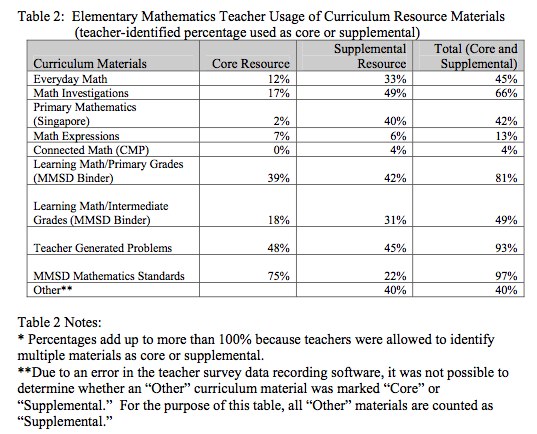 Newsletter signup | Send us your ideas
Like many girls, I began my adventures in babysitting when I was 11 years old. It was in the late 1980s, after I had taken a Red Cross course to become "babysitter certified," acquiring expertise in dislodging an object from a choking baby's throat and learning to ask parents for emergency phone numbers. During my roughly four-year career, there were highs, like using my babysitting contacts to co-found a lucrative summer day camp in my neighborhood, and lows: bratty children and stingy parents, such as one mom who would have me come over 45 minutes early but wouldn't start the clock until she left and always wrote out a check when she got back -- even though, considering my $2-per-hour rate, she probably could have paid me from change in the bottom of her purse.My experiences were fairly typical of those encountered by millions of young women, as I might have suspected at the time and as I am thoroughly convinced after having read "Babysitter: An American History," a scholarly examination of the subject by Miriam Forman-Brunell. Ms. Forman-Brunell is a history professor at the University of Missouri in Kansas City, but she is also a mother who reports that she has hired a bevy of babysitters.
Babysitting, the author says, has always been a source of tension: "Distressed parent-employers have suspected their sitters of doing wrong ever since the beginning of babysitting nearly one hundred years ago." Before that, extended families or servants ensured that someone was watching the kids, but with the rise of the suburban nuclear family, parents looking to preserve adult intimacy in their marriages were forced to seek help elsewhere. Since most either weren't willing to or couldn't pay adult wages, the labor supply was reduced to young teens who wanted money but didn't have other ways of earning it.
Newsletter signup | Send us your ideas
It just can't be a very good sign that when someone raises serious questions about one of the liveliest and controversial issues in our field those questions are ignored or distorted and caricatured. I've heard Checker Finn's new book on pre-kindergarten education referred to as an anti-pre-k book (it's not), an intemperate attack on the pre-k movement (it's critical, sure, but let's assume they're not as vulnerable as the kids they serve), or dismissed as simply too conservative to be taken seriously by the field (again it's not).That doesn't mean it's a flawless book. Sara Mead has engaged with it and points out some problems with the analysis (in particular Finn overstates current participation levels - especially from a quality standpoint - and that's no small thing given his underlying point) and she also rounds up the other writing on it. But in general there hasn't been a lot of discussion of Reroute the Preschool Juggernaut's points about current program coordination, costs and how to think about costs, quality, and universality. These are not small matters; they cut to the heart of what is likely to be a massive public investment in an important strategy to improve outcomes for economically disadvantaged youngsters.
Newsletter signup | Send us your ideas
Every three years, the Program for International Student Assessment ranks the education levels of 15-year-olds around the world. The most recent test, in 2006, brought back results from 30 industrialized nations that were hardly inspiring for U.S. teachers and parents. American students' science scores lagged behind those of their counterparts in 20 countries, including Finland, Japan, Germany and Belgium. The numbers from the math test were even worse: The U.S. came in 25th. The "rising tide of mediocrity" in American schools -- famously so described in 1983 by a government report called "A Nation at Risk" -- would now appear to be about chin-high.In response to "A Nation at Risk," Terry Moe and John Chubb in 1990 published "Politics, Markets and America's Schools," which identified special-interest groups -- mainly teachers unions -- as the culprits in preventing the reforms urged in the report. Now Messrs. Moe and Chubb have returned to the subject with "Liberating Learning," a more optimistic sequel. The authors believe there exists a magic bullet that is capable of shattering the unions' political power and, at last, bringing the sort of reform and excellence to U.S. K-12 education that might make U.S. students competitive with Finnish teenagers. The ammunition? Technology.
Newsletter signup | Send us your ideas
Until recently, the young-adult fiction section at your local bookstore was a sea of nubile midriffs set against pink and turquoise backgrounds. Today's landscape features haunted girls staring out from dark or washed-out covers. Current young-adult best sellers include one suicide, one deadly car wreck, one life-threatening case of anorexia and one dystopian universe in which children fight to the death. Somewhere along the line our teenagers have become connoisseurs of disaster.Jay Asher's "Thirteen Reasons Why," which is narrated by a dead girl, came out in March 2007 and remains on the bestseller list in hardcover. The book is the account of a fragile freshman named Hannah Baker who kills herself by overdosing on pills and sends audiotapes to the 13 people she holds responsible for making her miserable in the last year of her life. There may be parents who are alarmed that their 12-year-olds are reading about suicide, or librarians who want to keep the book off the shelves, but the story is clearly connecting with its audience--the book has sold over 200,000 copies, according to Nielsen BookScan.
For those young readers who find death by pill overdose inadequately gruesome, there's Gayle Forman's "If I Stay," which takes as its subject a disfiguring car wreck. The book has sold a robust 17,000 copies in its first two months on sale, and was optioned by Catherine Hardwicke, the director of the film "Twilight." The story follows an appealing cellist named Mia who goes on a drive to a bookstore with her unusually sympathetic ex-punk-rocker parents. When a truck barrels into their Buick, Mia hovers ghost-like over the scene. She sees her family's bodies crushed, then watches on as her own mangled body is bagged and rushed to the hospital. Lingering somewhere between this world and the next, Mia must decide whether to join her parents in the afterlife or go it alone in the real world. The brilliance of the book is the simplicity with which it captures the fundamental dilemma of adolescence: How does one separate from one's parents and forge an independent identity?
Newsletter signup | Send us your ideas
"education is the dullest of subjects," Jacques Barzun wrote in the very first sentence of his astonishingly fresh 1945 classic, Teacher in America. Barzun de- spised the idea of "professional educators" who focus on "methods" instead of subject matter. He loved teachers, but knew they "are born, not made," and that most teachers' colleges teach the wrong stuff.Related: teacher hiring criteria in Madison.Cut to 2009, when Barack Obama thinks education is the most exciting of subjects. Even so, Obama and his education secretary, Arne Duncan, get Barzun. They understand that the key to fixing education is better teaching, and the key to better teaching is figuring out who can teach and who can't.
Just as Obama has leverage over the auto industry to impose tough fuel--economy standards, he now has at least some leverage over the education industry to impose teacher-effectiveness standards. The question is whether he will be able to use it, or will he get swallowed by what's known as the Blob, the collection of educrats and politicians who claim to support reform but remain fiercely committed to the status quo.
Teacher effectiveness-say it three times. Last week a group called the New Teacher Project released a report titled "The Widget Effect" that argues that teachers are viewed as indistinguishable widgets-states and districts are "indifferent to variations in teacher performance"-and notes that more than 99 percent of teachers are rated satisfactory. The whole country is like Garrison Keillor's Lake Woebegon, except all the teachers are above average, too.
Newsletter signup | Send us your ideas
via email:
It's time to move away from "differentiated curriculum" which is really segregated learning, to student-centered cooperative education.It's time to embrace what the children have to teach our world: their cooperative, creative, and compassionate spirit.
It's a shame we continue to spend more money to prevent children from sharing learning and ideas with each other and our world.
Us adults would stand to learn much on how to alleviate economic woes, if we cooperated with the regenerative spirit that children keep trying to impart in our world.
I've been a sub for a while in this district that continues to bow down to parents who care only about self-serving educational models while exploiting resources, schools, and our community.
Since I've resolved that I probably will never be hired as a full-time teacher, I've written a book recently published called The Power of Paper Planes: Co-Piloting with Children to New Horizons.
Dave Askuvich, daskuvich@hotmail.com
Newsletter signup | Send us your ideas
As tragedies go, not getting what you want is the straightforward kind, and getting it can be the ironic variety. But there is also the existential tragedy of not knowing what you want to begin with. That's the species of catastrophe recounted in Walter Kirn's memoir, "Lost in the Meritocracy: The Undereducation of an Overachiever," the witty, self- castigating story of the author's single-minded quest to succeed at a series of tests and competitions that took him from one of the lowest-ranked high schools in Minnesota to Princeton. As Kirn, a noted critic and novelist, tells it, in childhood he leapt onto a hamster wheel baited with "prizes, plaques, citations, stars," and kept rattling away at it until his junior year in the Ivy League, when he suffered a breakdown that left him nearly speechless.
Newsletter signup | Send us your ideas
In a 21st-century version of the age of discovery, teams of computer scientists, conservationists and scholars are fanning out across the globe in a race to digitize crumbling literary treasures.In the process, they're uncovering unexpected troves of new finds, including never-before-seen versions of the Christian Gospels, fragments of Greek poetry and commentaries on Aristotle. Improved technology is allowing researchers to scan ancient texts that were once unreadable -- blackened in fires or by chemical erosion, painted over or simply too fragile to unroll. Now, scholars are studying these works with X-ray fluorescence, multispectral imaging used by NASA to photograph Mars and CAT scans used by medical technicians.
A Benedictine monk from Minnesota is scouring libraries in Iraq, Syria, Lebanon, Turkey and Georgia for rare, ancient Christian manuscripts that are threatened by wars and black-market looters; so far, more than 16,500 of his finds have been digitized. This summer, a professor of computer science at the University of Kentucky plans to test 3-D X-ray scanning on two papyrus scrolls from Pompeii that were charred by volcanic ash in 79 A.D. Scholars have never before been able to read or even open the scrolls, which now sit in the French National Institute in Paris.
Newsletter signup | Send us your ideas
Parentonomics: An Economist Dad Looks at Parenting By Joshua GansWhat happens when Mr Spock meets Dr Spock? The answer is Parentonomics, an autobiographical account of how an economist used his professional training in game theory to bring up his three children.
Joshua Gans describes his experiences in the labour wards, changing nappies and dealing with tantrums, spousal absences and sibling rivalry - all the while explaining what he did or did not do, the economic principles involved, and whether any of it worked as a parenting strategy.
The obvious question is whether this is supposed to be good advice or some kind of joke. There is no ambiguity in Parentonomics: Gans is not joking. Thankfully, he can be very funny. Although he is an academic - a professor at Melbourne Business School - his writing has a professional snap. While the advice is intended to be useful, readers will come to their own conclusions about that. It does at least tend to be thought-provoking.
Newsletter signup | Send us your ideas
When Rupert Isaacson decided to take his autistic son, Rowan, on a trip to Mongolia to ride horses and seek the help of shamans two years ago, he had a gut instinct that the adventure would have a healing effect on the boy. Mr. Isaacson's instinct was rewarded after the trip, when some of Rowan's worst behavioral issues, including wild temper tantrums, all but disappeared.Now the publisher of Mr. Isaacson's book about the journey, "The Horse Boy," has a similar instinct about the market potential of his story, and is hoping for its own happy ending.
Little, Brown & Company, which released "The Horse Boy" on Tuesday, has a lot riding on its success: the publisher paid more than $1 million in an advance to Mr. Isaacson before he and his family had even taken their Mongolian trip.
Michael Pietsch, publisher of Little, Brown, said booksellers had already placed orders high enough to justify a first printing of 150,000 copies.
Newsletter signup | Send us your ideas
SDo we spend enough on public education? What does it mean that California has fallen from near the top of per-pupil spending in the United States to very near the bottom?Money has long been at the center of debates over education. Now a book from a UC Berkeley professor argues that the entire debate is wrongheaded.
In "The Money Myth: School Resources, Outcomes, and Equity" (Russell Sage Foundation, 2009), W. Norton Grubb argues that how much we spend is less important than how we spend it. For decades, Grubb says, school spending has inexorably risen, while student achievement has stayed relatively stagnant. Maybe it's time to look at which expenditures actually improve education, he argues, and which are a waste. The Times' Mitchell Landsberg spoke to Grubb about his book.
Let me try to boil down the message in your book: Money matters, but only if it's spent well. Is that right?
That's certainly one of the conclusions, absolutely. And again, this phrase that I use constantly in the book is, "It's often necessary, but it's not sufficient." So it's finding what the necessary resources are in the school and then directing money and other resources -- like leadership, vision, cooperation, collaboration -- to them that makes a difference. And part of the point is an attempt to move the debates away from money to resources, because a lot of the debates in school finance have just been about money.
Newsletter signup | Send us your ideas
Have you got what it takes to be seen as a genius? Do you really want to?
Geniuses don't exist in the present. Think of the people you've met: Would you call any of them a genius in the Mozart, Einstein, Shakespeare sense of the word? Even the MacArthur Foundation's "genius" grants don't call their winners geniuses.
We throw the g-word around where it's safe: in reference to dead people. Since there's no one alive who witnessed Wolfgang Amadeus Mozart pee in his kindergarten pants or saw young Pablo Picasso eating crayons, we can call them geniuses in safety, as their humanity has been stripped from our memory.
Even if you believe geniuses exist, there's little consensus on what being a genius means. Some experts say genius is the capacity for greatness. Others believe it's that you've accomplished great things.
Forget this pointless debate. Chasing definitions never provides what we want: a better understanding of how to appreciate, and possibly become, interesting creative people.
Be obsessed with work
Show me a genius and I'll show you a workaholic. Van Gogh produced 2,000 works of art between 1880 and 1890 (or 1,100 paintings and 900 sketches). That's four works of art a week for a decade. He didn't even get started until age 25.
Da Vinci's journals represent one clear fact: Work was the center of his life. He had neither a spouse nor children. Picasso was a machine, churning out 12,000 works of art. He said, "Give me a museum and I'll fill it" and made good on that boast. Shakespeare wrote more than 40 plays, plus dozens of sonnets, poems and, of course, grocery lists.
These are people who sacrificed many ordinary pleasures for their work.
The list of lazy geniuses is short. There are burnouts, suicides and unproductive years in retreat--but none could be called slackers.
Have emotional or other serious problems
For all their brilliance, most geniuses did not live well-adjusted lives. Picasso, Van Gogh, Edison, Einstein and Nietzsche (and most major modern philosophers) were often miserable. Many never married or married often, abandoned children and fought depression.
Newton and Tesla spent years in isolation by choice and had enough personality disorders to warrant cabinets full of pharmaceuticals today. Michelangelo and da Vinci quit jobs and fled cities to escape debts.
Kafka and Proust were both hypochondriacs, spending years in bed or in hospitals for medical conditions, some of which were psychological. Voltaire, Thoreau and Socrates all lived in exile or poverty, and these conditions contributed to the works they're famous for.
Happily positive emotions can work as fuel, too. John Coltrane, C.S. Lewis and Einstein had deeply held, and mostly positive, spiritual beliefs that fueled their work.
But the real lesson is that all emotions, positive or negative, provide fuel for work and geniuses are better at converting their emotions into work than more ordinary people.
Don't strive for fame in your own lifetime
Most people we now consider geniuses received little publicity in their lifetimes compared with the accolades heaped on them after their deaths. Kafka and Van Gogh died young, poor and with little fame.
Desiring fame in the present may spoil the talents you have. This explains why many young stars have one amazing work but never rise to the same brilliance later: They've lost their own opinions. Perhaps it's best to ignore opinions except from a trusted few and concentrate on the problems you wish to solve.
To focus on learning and creating seems wise. Leave it to the world after you're gone to decide if you were a genius or not. As long as you're free to create in ways that satisfy your passions and a handful of fans, you're doing better than most, including many of the people we call geniuses.
Newsletter signup | Send us your ideas
Jay Mathews is a bit of a journalistic oddball. Most reporters see the education beat as a stepping stone to bigger things, but much to his credit Mathews, who writes for The Washington Post, returned to covering schools after an international reporting career. He is best known for his book on Jaime Escalante, who taught low-income children in East Los Angeles to excel in AP calculus and was featured in the film "Stand and Deliver." Now Mathews is back to profile two young teachers -- Mike Feinberg and Dave Levin -- who founded the wildly successful Knowledge Is Power Program (KIPP), a chain of 66 charter schools now educating 16,000 low-income students in 19 states and the District of Columbia.While I have some quarrels with the book's implicit and explicit public-policy conclusions, "Work Hard. Be Nice" provides a fast-paced, engrossing and heartening story of two phenomenally dedicated teachers who demonstrate that low-income students, if given the right environment, can thrive academically. In 52 short and easily digestible chapters, Mathews traces the story of two Ivy League graduates who began teaching in Houston in 1992 as part of the Teach for America program. Both struggle at first but come under the tutelage of an experienced educator, Harriett Ball, who employs chants and songs and tough love to reach students whom lesser teachers might give up on. Levin and Feinberg care deeply: They encourage students to call them in the evening for help with homework, visit student homes to get parents on their side and dig into their own pockets to buy alarm clocks to help students get to school on time. In Mathews's telling, it's hard not to love these guys.
Newsletter signup | Send us your ideas
Did you know that 365 -- the number of days in a year -- is equal to 10 times 10, plus 11 times 11, plus 12 times 12?Or that the sum of any successive odd numbers always equals a square number -- as in 1 + 3 = 4 (2 squared), while 1 + 3 + 5 = 9 (3 squared), and 1 + 3 + 5 + 7 = 16 (4 squared)?
Those are just the start of a remarkable number of magical patterns, coincidences and constants in mathematics. No wonder philosophers and mathematicians have been arguing for centuries over whether math is a system that humans invented or a cosmic -- possibly divine -- order that we simply discovered. That's the fundamental question Mario Livio probes in his engrossing book Is God a Mathematician?
Livio, an astrophysicist at the Hubble Space Telescope Science Institute in Baltimore, explains the invention-vs.-discovery debate largely through the work and personalities of great figures in math history, from Pythagoras and Plato to Isaac Newton, Bertrand Russell and Albert Einstein. At times, Livio's theorems, proofs and conundrums may be challenging for readers who struggled through algebra, but he makes most of this material not only comprehensible but downright intriguing. Often, he gives a relatively complex explanation of a mathematical problem or insight, then follows it with a "simply put" distillation.
An extended section on knot theory is, well, pretty knotty. But it ultimately sheds light on the workings of the DNA double helix, and Livio illustrates the theory with a concrete example: Two teams taking different approaches to the notoriously difficult problem of how many knots could be formed with a specific number of crossings -- in this case, 16 or fewer -- came up with the same answer: 1,701,936.
Newsletter signup | Send us your ideas
I was pitched headfirst into the world of e-books in 2002 when I took a job with Palm Digital Media. The company, originally called Peanut Press, was founded in 1998 with a simple plan: publish books in electronic form. As it turns out, that simple plan leads directly into a technological, economic, and political hornet's nest. But thanks to some good initial decisions (more on those later), little Peanut Press did pretty well for itself in those first few years, eventually having a legitimate claim to its self-declared title of "the world's largest e-book store."Unfortunately, despite starting the company near the peak of the original dot-com bubble, the founders of Peanut Press lost control of the company very early on. In retrospect, this signaled an important truth that persists to this day: people don't get e-books.
A succession of increasingly disengaged and (later) incompetent owners effectively killed Peanut Press, first flattening its growth curve, then abandoning all of the original employees by moving the company several hundred miles away. In January of 2008, what remained of the once-proud e-book store (now called eReader.com) was scraped up off the floor and acquired by a competitor, Fictionwise.com.
Unlike previous owners, Fictionwise has some actual knowledge of and interest in e-books. But though the "world's largest e-book store" appellation still adorns the eReader.com website, larger fish have long since entered the pond.
And so, a sad end for the eReader that I knew (née Palm Digital Media, née Peanut Press). But this story is not just about them, or me. Notice that I used the present tense earlier: "people don't get e-books." This is as true today as it was ten years ago. Venture capitalists didn't get it then, nor did the series of owners that killed Peanut Press, nor do many of the players in the e-book market today. And then there are the consumers, their own notions about e-books left to solidify in the absence of any clear vision from the industry.
Newsletter signup | Send us your ideas
Kurt Vonnegut - free from audible.com.
Newsletter signup | Send us your ideas
Of the many parallels between Barack Obama and John F. Kennedy, one has eluded all coverage: Both attended Catholic school as children. In fact, while JFK may have been the Irish Catholic from Boston, he spent less time at the Canterbury School in Connecticut than did young Barry (as he was then called) at St. Francis of Assisi in Indonesia.At a time when America's 6,165 Catholic elementary and 1,213 secondary schools are celebrating Catholic Schools Week, President Obama's first-hand experience here opens the door to a provocative opportunity. In his inaugural address, the president rightly scored a U.S. school system that "fail[s] too many" of our young people. How refreshing it would be if he followed up by giving voice to a corollary truth: For tens of thousands of inner-city families, the local parochial school is often the only lifeline of hope.
"When an inner-city public school does what most Catholic schools do every day, it makes the headlines," says Patrick J. McCloskey, author of a new book called "The Street Stops Here," about the year he spent at Rice High -- an Irish Christian Brothers school in Harlem. "President Obama has a chance to rise above the ideological divide simply by giving credit where credit is due, by focusing on results, and the reason for those results."
Newsletter signup | Send us your ideas
I have devoted many years to writing about schools, but much of the time I am really writing about poverty. Paul Tough has devoted several years to writing about poverty, but much of the time he is really writing about schools.This is apparent in his insightful book "Whatever It Takes: Geoffrey Canada's Quest to Change Harlem and America." You don't see the words "schools" or "education" in the title, but be assured this is one of the best books ever written about how poverty influences learning, and vice versa.
As usual, I am late reviewing the book because I took my time reading it. I got a copy in September, when it came out. Books like this I like to absorb slowly and carefully. I keep them in a small room in my house where I know I will be alone, at least for short periods of time. It makes for great concentration, even if my reviews always miss their deadlines.
I have institutionalized this personal failing by creating the Better Late Than Never Book Club, of which Tough's book is the latest featured selection. The club -- which sells no books and offers no discounts, sorry -- celebrates volumes I consider so important that I review them even if they are months, and in some cases years, past their publication dates.
Newsletter signup | Send us your ideas
What Do They See in Me That I Don't See in Myself?:
Jesse wished he could run away, far away. Someplace where no one knew him. A place where everything wasn't his fault and nothing was beyond his reach... Jesse Hardaway is used to things being his fault. It's just him and his mom at home, and she's always yelling at him. School is like home, only about ten times worse! He's in fifth grade special education and has to battle ADHD and an anger/behavior disorder every day. If he isn't in trouble, he's getting into it. The only thing Jesse is sure of is that the world is against him, and he is ready to give up.via a Nikki Callahan email.One good thing Jesse has in his life is his best friend Davess, who never stops trying to look out for him. At school, Mrs. Abogar and Ms. Dubose try to look out for him too, though Jesse doesn't know why and wishes they would stop.
Here it comes, Jesse thought, the thing that drives me nuts. That irritating thing that they are so known for. That thing that makes you wonder whether you should hug them or yell at them. The famous Punishment-with-a-Smile. I hate it... But very soon he is about to discover that these two women not only understand him, for some reason they actually care about him.
Newsletter signup | Send us your ideas
In 2004, the Institute for Jewish and Community Research, a San Francisco think tank, launched an effort to address "anti-Semitism and anti-Israelism" in American education, from K-12 to higher education. Its book, The UnCivil University, focused on the USA's colleges and universities.But the effort also gave rise to an extensive survey on the political, religious and social beliefs of university faculty -- some of whom admitted to holding strong prejudices against evangelical Christians.The researchers say they found a politically active, vocal minority -- especially within Middle East studies departments -- that held strong anti-Israel positions. Many of the same professors holding what the researchers found were strong political biases are often tapped to review K-12 social studies, history and geography textbooks, which explain religious history, among other topics, to very young children, the institute says.
So authors Gary Tobin and Dennis Ybarra looked at 28 textbooks over nearly five years -- finding what they call "glaring distortions and inaccuracies," many centered on the books' treatment of Israel, Judaism and Christianity. Aside from their findings on how religions are treated, their new book, The Trouble With Textbooks (Lexington Books, $21.95), which appeared on shelves this fall, in part explores problems with the textbook approval process.
Newsletter signup | Send us your ideas
The Pioneer Institute [April 2006]
A Review of E.D. Hirsch's The Knowledge Deficit (Houghton Mifflin, 2006)
by Will Fitzhugh, The Concord Review
E.D. Hirsch, Jr., who published Cultural Literacy in 1987, arguing that there was knowledge which every student ought to have, has now published another book, The Knowledge Deficit, (Houghton Mifflin, 2006) suggesting that the bankruptcy of the "transfer of thinking skills" position has lead to preventing most U.S. schoolchildren, and especially the disadvantaged ones who really depend on the schools to teach them, from acquiring the ability to read well.
Not too long after the beginning of the twentieth century, the U.S. mental measurement community convinced itself, and many others, that the cognitive skills acquired in the study of Latin in school did not "transfer" to other important tasks, one of which at the time was teaching students "worthy home membership."
As a result, not only was the study of the Latin language abandoned for many students, but at the same time the "baby"--of Caesar, Cicero, Horace, Tacitus, Virgil and others--was thrown out with the "bathwater." In losing the language, we also lost Roman history, law, poetry, and prose.
In place of this classical knowledge which had been thought essential for two thousand years, the mental measurement community offered "thinking skills," which they claimed could be applied to any content.
Professor Hirsch reaches back beyond the mental measurement folks to Thomas Jefferson, for someone who shares his view of the value of the knowledge in books:
"In our pre-romantic days, books were seen as key to education. In a 1786 letter to his nephew, aged fifteen, Jefferson recommended that he read books (in the original languages and in this order) by the following authors: [history] Herodotus, Thucydides, Xenophon, Anabasis, Arian, Quintus Curtius, Diodorus Siculus, and Justin. On morality, Jefferson recommended books by Epictetus, Plato, Cicero, Antoninus, Seneca, and Xenophon's Memorabilia, and in poetry Virgil, Terence, Horace, Anacreon, Theocritus, Homer, Euripides, Sophocles, Milton, Shakespeare, Ossian, Pope and Swift. Jefferson's plan of book learning was modest compared to the Puritan education of the seventeenth century as advocated by John Milton." (p. 9)
Professor Hirsch believes the Romantic notion that with the right skills, somehow knowledge will arrive by itself, without the need to resort to books, has been responsible for the steady decline in U.S. students' reading scores, compared to our international colleagues, the longer they stay in school.
In the 1980s, the Harvard faculty was once more debating what to put in a common core of knowledge to be taught to all the students. After much disagreement, professors who didn't want to teach survey courses, and perhaps believed in the transfer of thinking skills from one discipline to another, decided not to require any general knowledge in particular and to teach "ways of thinking" as they focused on whatever topics they were studying at the time themselves.
In 1990, Caleb Nelson, a recent graduate in Mathematics from Harvard College, published an article in The Atlantic Monthly, called "Harvard's Hollow Core." He noted that the 1945 Harvard statement of goals said that "educational institutions should strive to create responsible democratic citizens, well-versed in the heritage of the West and endowed with the common knowledge and the common values on which a free society depends." Mr. Nelson reported, however, that by the 1970s, Harvard would develop a "Core Curriculum" that was somewhat different. "Yet although Harvard officials wanted to reform the curriculum, they did not want to launch divisive arguments within the faculty about which subjects were most important...in the seventies, Harvard devised a novel scheme to avoid discord while still reforming its curriculum. If every 'specific proposal' for reform raised a fire storm, the college would simply avoid specifics. Rather than emphasize knowledge the new core curriculum would emphasize students' critical faculties...As Anthony Oettinger, a professor of applied mathematics said about the resulting proposal, 'This motion cannot fail to pass; it has become totally content-free.'...The philosophy behind the core is that educated people are not those who have read many books and have learned many facts, but rather those who could analyze facts if they should ever encounter any, and who could 'approach' books if it were ever necessary to do so."
While the Harvard Core has been widely imitated, and has thus done more damage than anyone could have anticipated, this is not what Professor Hirsch has focused on in his new book. He is concerned about the fact that reading instruction which slights the essential requirement of knowledge is spreading the "Matthew effect" in reading. "Those who already have good language understanding will gain still more language proficiency, while those who lack initial understanding will fall further and further behind." (p. 25) Even with the advances in reading recently made by a general return to direct instruction in phonics, without knowledge the student will not be able to read much.
"After mastering decoding, a student who reads widely can indeed, under the right circumstances, gain greater knowledge and thence better reading comprehension. But such gains will only occur if the student already knows enough to comprehend the meaning of what he or she is decoding! Many specialists estimate that a child or an adult needs to understand around 90 percent of the words in a passage in order to learn to understand the other 10 percent of the words. Moreover, it's not just the words that the student has to grasp the meaning of; it's also the kind of reality that the words are referring to. When a child doesn't understand those word meanings and those referred-to realities, being good at sounding out words is a dead end." (p. 25)
All of this would seem to be obvious: if you don't know what someone is talking about, you can't very well understand what they are saying. If you don't know the basic subject matter of a passage in a book, you won't know what the passage is about. But this sort of common sense has yet to penetrate the educrats' wonderful world of reading "skills." And there are consequences.
Many now seem puzzled that 32% of our high school students drop out before graduating with their class. ACT has just reported that of the high school graduates they tested, 49% cannot understand reading at the level of difficulty of freshman college texts.
Professor Hirsch points out that knowledge is necessary for making advances in reading (and learning) by relying on the work of those who have done the research in this area:
"Cognitive psychologists have determined that when a text is being understood, the reader (or listener) is filling in a lot of the unstated connections between the words to create an imagined situation model based on domain-specific knowledge...To understand language, whether written or spoken, we need to construct a situation model consisting of meanings construed from the explicit words of the text as well as meanings inferred or constructed from relevant background knowledge. The spoken and the unspoken taken together constitute the meaning. Without this relevant, unspoken background knowledge, we can't understand the text." (p. 38)
Professor Hirsch is arguing that in deliberately putting the pursuit of knowledge aside, educators are ensuring that far too many of our students, and in particular those who cannot rely on their homes to provide them with a good background of knowledge, are being prevented from reading to learn. Phonics may teach them to decode words, but only knowledge can give them the base they need to understand what they find in books. As Caleb Nelson said in his article on Harvard's Core:
"The problem goes beyond the particular courses that are now in the Core: no set of introductory courses could achieve the core's ostensible goals. One cannot think like a physicist, for example, without actually knowing a great deal of physics...If the core's goals were realistic, they would still have little to recommend them. Why, for instance, are lessons about the nature of history as a discipline the most important things for students to learn in their required history course? Students should certainly recognize that history is the testing ground of public policy, and that its study can reveal much about the psychology of people and nations; as Santayana's famous aphorism goes, those who cannot remember the past are condemned to repeat it. But this lesson about history is useless unless one also learns the actual facts of history--an accomplishment that requires careful attention to historical facts themselves."
The anti-intellectualism and anti-knowledge attitudes that Professor Hirsch has found among so many professors and teachers in education, are not limited to the elementary schools or to Harvard College. The fondness for "critical thinking" without much knowledge may have reached some sort of peak in the suggestion of the Creation Science people that secondary students be encouraged to "think critically" about the theory of evolution. Has any of them stopped to consider that if high school students spent all four years on the study of the evidence evolutionary biologists have published, not only could they study nothing else, but they would only have scratched the surface of the scientific evidence in the field? It might be less onerous for students to "think critically" about all the U.S. Supreme Court decisions of the last ten years. It would perhaps be easier for them to "think critically" about capitalism if they understood the difference between monetary policy and fiscal policy and their differing effects.
Professor Hirsch, a scholar of the history of ideas, has quite clearly identified the two intellectual forces that battle against the value of knowledge:
"The two ideologies or philosophies that dominate in the American educational world, which tend to corrupt scientific inferences, are naturalism and formalism. Naturalism is the notion that learning can and should be natural and that any unnatural or artificial approach to school learning should be rejected or deemphasized. This point of view favors many of the methods that are currently most praised and admired in early schooling--'hands-on learning,' 'developmentally appropriate practice,' and the natural, whole-language method of learning to read. By contrast, methods that are unnatural are usually deplored, including 'drill,' 'rote learning,' and that analytical, phonics approach to teaching early reading. We call such naturalism an ideology rather than a theory because it is more a value system (based on the European Romantic movement) than an empirically based idea. If we adopt this ideology, we know in advance that the natural is good and the artificial is bad. We don't need analysis and evidence; we are certain, quite apart from the evidence, that children's education will be more productive if it is more natural. If the data do not show this, it is because we are using the wrong kinds of data, such as scores on standardized tests. That is naturalism.
"Formalism is the ideology that what counts in education is not the learning of things but rather learning how to learn. What counts is not gaining mere facts but gaining formal skills. Along with naturalism, it shares an antipathy to mere facts and the piling up of information. The facts, it says, are always changing. Children need to learn how to understand and interpret any new facts that come along. The skills that children need to learn in school are not how to follow mindless procedures but rather to understand what lies behind the procedures so they can apply them to new situations. In reading, instead of learning a lot of factual subject matter, which is potentially infinite, the child needs to learn strategies for dealing with any texts, such as 'questioning the author,' 'classifying,' and other 'critical thinking' skills." (p. 135)
Both Professor Hirsch, in 1987, with Cultural Literacy, in 1996 with The Schools We Deserve, and now, in 2006, with The Knowledge Deficit, and Caleb Nelson in 1990, have tried to show us the reasons why so many of our students are ignorant, and thus unable to comprehend good lectures and read serious texts. No wonder so many of our students give up on school or on college, when we have arranged it so that far too many of them don't know what educated people are talking and writing about. As the Nation At Risk Report said in 1983, "If an unfriendly foreign power had attempted to impose on America the mediocre educational performance that exists today, we might well have viewed it as an act of war."
Professor Hirsch, in his timely new book The Knowledge Deficit, provides the insights and the recommendations needed to help us protect our students against the anti-intellectual and anti-knowledge forces they face every day now in our schools (and in our colleges), and instead try to give them the knowledge they will need to help them read, listen, and gather more knowledge in the future.
[E.D. Hirsch told me this was the first serious review of his book, and he liked it.]
Newsletter signup | Send us your ideas
Still, "Outliers" is unabashedly inspiring. Education is at its vital heart; teachers and parents ought to put it on Christmas lists and bring it to PTA meetings. The students in my own classes, many of whom never seize opportunities, and blame others for failures, would benefit greatly by reading Gladwell's provocative and practical book about the landscape of success.Gladwell's website. Jeffrey Trachtenberg has more.
Newsletter signup | Send us your ideas
At Clarksburg High School in Montgomery County, teacher Jeanine Hurley's English class finished "The Canterbury Tales" and just started "Hamlet." Senior Raphael Nguyen says he doesn't spend a lot of time on homework because Hurley doesn't give much.At Langley High School in Fairfax County, teacher Kevin Howard's English class is studying "Othello" after reading William Faulkner's "Light in August." Senior Ryan Ainsworth, 17, said he does an average of 75 minutes reading and writing each night because Howard can pour it on.
Although students in these classes don't read the same works, they are taking the same course: Advanced Placement English Literature and Composition. And their teachers have the same goal: for students to learn how to connect text to meaning through skills assessed on the AP exam in May.
Newsletter signup | Send us your ideas
Excerpt from Chapter 1: The Crime"Woosh! Splat!' A gooshy, white spitball whizzed past Julia's ear. It smushed onto the blackboard and stuck. Julia watched a wet stream travel down from the wad. It left a shiny black trail on the board. There was only one person in the room who would do such a thing. Julia knew who it was.
Julia knew what would happen next. It was the same thing that happened every time Teddy Parker misbehaved.
Miss Crawford, the teacher, spun around and faced the class like a fighter squaring off against an opponent. "Who made this spitball?" she demanded.
Julia clamped her skinny legs together and froze in her seat. Her knobby knees bumped each other.
"Who made this spitball?" Miss Crawford repeated.
"It wasn't any of the sixth graders," said Frank O'Malley, a blond haired, Irish boy. He stood, as was the custom, to speak for his age group.
Julia knew she was expected to answer. She was the only fifth grader in the room who spoke English. The other fifth grade girl sat wide-eyed with sealed lips.
Julia wished they didn't have to go through this ritual every time Teddy Parker acted up. Teddy's family came to Phippsburg long before Julia's. Teddy lived in a real house. Julia's family lived in an old boxcar that had been taken off of the rails. There were other families from Italy, Ireland, and Greece living in the boxcar section of town.
Julia didn't know why Teddy was a trouble maker. He was luckier than all of the other kids. Teddy's father ran the coal mine where everyone else's father worked.
The fourth graders didn't do it," said a girl popping up and down in one motion.
Julia had missed her turn to answer.
"It wasn't any of the third graders, Miss Crawford," said another girl.
"The second graders didn't do it," said Teddy's sister, Paulina.
A small boy stood. "It wasn't the first grade, Teacher," he said.
There will be a punishment for this, "Miss Crawford Said.
"Whoever made this spitball will have to come to the front of the room."
Julia watched Miss Crawford focus on Teddy. He shifted in his wooden seat at the end of the sixth grade row.
"What do you have to say, Teddy?" asked Miss Crawford.
Julia looked at Teddy sitting in his new clothes from Denver. He wore a new shirt under a new sweater, new knickers, and new knee socks. Julia guessed his underwear was new, too. Teddy's clothes were the right size, not patched and baggy hand-me-downs like Julia's. Most of the kids were dressed like her, in clothes that had once been worn by their parents.
Julia watched Teddy slowly rise. He stepped out to the side of his desk. Julia waited for Teddy to make his confession. It was his chance to show off every day. She knew in a moment he would proudly walk to the front of the room, stand on tip toe, and place his nose on a chalk dot Miss Crawford drew on the board. The class would watch him stand there on pointed toe while he took his punishment. Miss Crawford wouldn't make Teddy stand at the board for a whole hour like she would any other student. Teddy was her pet. She'd call off his punishment after five or ten minutes.
It was the same every time. Nothing exciting ever happened in Phippsburg. Why couldn't it be a little bit different this once?
Julia reached up and felt a rag curl in her hair. Mama tied the rags into her hair last night. Julia liked how the curls made a soft half circle around her plain face.
Julia closed her eyes and made one silent wish. "Please let something exciting happen today for a change."
She opened her eyes and blinked three times for good luck.
Miss Crawford was waiting for an answer. Teddy straightened his shoulders and drew in a long, deep breath.
"Miss Crawford, I must tell the truth," he said.
"Yes, you must," said Miss Crawford.
All eyes were glued on Teddy Parker.
"It was...Julia!" he announced.
Newsletter signup | Send us your ideas
 Alexander Givental, via email:
The Stereometry book adapted from Russian by A. Givental is the second part of the legendary Kiselev's Geometry. It first appeared in 1892 as a second half of a single textbook and, for a long time, the two co-existed between the same covers. Indeed, the idea of a plane was introduced on page 1 while the last chapter of the book (that followed the stereometry part) was devoted to the geometric constructions in two dimensions. Kiselev's Geometry has demonstrated an unusual staying power, being in an uninterrupted circulation for a good part of a century. (For the historic outline, see the review of the first part.) As a matter of fact, the first part of the book met with stiffer competition so that, while its rule was weakened in the 1960s, the second part reigned in the textbook market well into the 1970s.The combined 1980 edition came out under the title Elementary Geometry for teacher colleges with a Foreward by A. N. Tikhonov who observed, albeit with some reservations, that the pedagogical mastery with which the book was written, the simplicity and consistency of the exposition, kept the book from becoming obsolete.
Newsletter signup | Send us your ideas
Jeremy Miller is the author of "Tyranny of the Test," the September cover story. The article, which explains how No Child Left Behind has changed the structure of our schools-and how "teaching the test" takes more away from students than it gives-was based on his years of experience working as a test-prep "coach" for Kaplan, Inc. Associate Editor Ben Austen follows up with Jeremy Miller now that the issue is on newsstands.1. At some point last year, you decided you wanted to write about working for Kaplan in New York City's public schools. This kind of reporting, in which the participant's journalistic intentions are not made explicit, is always complicated. But the issues here seemed to be compounded by your background as a full-time classroom teacher and by your desire to succeed at a job that you increasingly saw as problematic. What were some of the difficulties you faced in reporting this story?
Newsletter signup | Send us your ideas
A book by Allan Ahlberg & Bruce Ingman:
"One day that little pencil made a move, shivered slightly, quivered somewhat . . . and began to draw."Welcome back Banjo, the boy from THE RUNAWAY DINNER! Once a pencil draws him, there's no telling what will come next -- a dog, a cat, a chase (of course), and a paintbrush to color in an ever-expanding group of family and friends. But it's not long before the complaints begin -- "This hat looks silly!" "My ears are too big!" -- until the poor pencil has no choice but to draw . . . an eraser. Oh no! In the hands of Allan Ahlberg and Bruce Ingman, can anything but havoc and hilarity ensue?
The creators of THE RUNAWAY DINNER and PREVIOUSLY team up to imagine the comical world that comes to life when a lonely pencil starts to draw.
Newsletter signup | Send us your ideas
Members of the Madison School Board will ask city taxpayers to help finance the Madison Metropolitan School District budget, voting Monday night to move forward with a school referendum.Andy Hall:The referendum will be on the ballot on Election Day, Nov. 4.
Superintendent Dan Nerad outlined a recommendation last week for the board to approve a recurring referendum asking to exceed revenue limits by $5 million during the 2009-10 school year, $4 million for 2010-11 and $4 million for 2011-12. With a recurring referendum, the authority afforded by the community continues permanently, as opposed to other referendums that conclude after a period of time.
Accounting initiatives that would soften the impact on taxpayers were also approved Monday.
One part of the initiative would return $2 million to taxpayers from the Community Services Fund, which is used for afterschool programs. The second part of the initiative would spread the costs of facility maintenance projects over a longer period.
WKOW-TV:Madison School District voters on Nov. 4 will be asked to approve permanent tax increases in the district to head off projected multimillion-dollar budget shortfalls.
In a pair of 7-0 votes, the Madison School Board on Monday night approved a proposal from Superintendent Daniel Nerad to hold a referendum and to adopt a series of accounting measures to reduce their effect on taxpayers.
Nerad said the district would work "day and night" to meet with residents and make information available about the need for the additional money to avert what school officials say would be devastating cuts in programs and services beginning in 2009-10, when the projected budget shortfall is $8.1 million.
"I understand this goes to the community to see if this is something they support. We're going to do our best to provide good information," said Nerad.Channel3000:Some citizens who spoke at Monday's meeting echoed the sentiments of board members and school officials.
"Our schools are already underfunded," said one man.
However, others spoke against the plan. "This is virtually a blank check from taxpayers.
Superintendent Dan Nerad had to act quickly to put the plan together, facing the $8 million shortfall in his first few days on the job.NBC 15:"I will never hesitate to look for where we can become more efficient and where we can make reductions," said Nerad. "But I think we can say $8 million in program cuts, if it were only done that way, would have a significant impact on our kids."
The plan was highly praised by most board members, but not by everyone who attended the meeting.
"This virtually gives the board a blank check from all of Madison's taxpayers' checkbooks," said Madison resident David Glomp. "It may very well allow the school board members to never have to do the heavy lifting of developing a real long-term cost saving."
"We need to respect the views of those who disagree with us and that doesn't mean they're anti-school or anti-kids," says board member Ed Hughes.Much more on the planned November, 2008 referendum here.Board members stressed, the additional money would not be used to create new programs, like 4-year-old kindergarten.
"What's a miracle is that our schools are continuing to function and I think that's the conversation happening around Wisconsin, now, says board vice president Lucy Mathiak. "How much longer can we do this?"
The referendum question will appear on the November 4th general election ballot.
The board will discuss its educational campaign at its September 8th meeting.
TJ Mertz on the "blank check".
Newsletter signup | Send us your ideas
Since the release of "A Nation at Risk" 25 years ago, we have seen the introduction of top-down standards (including the No Child Behind Act), the spread of a bottom-up school-choice movement (including vouchers and charter schools), and the advent of entrepreneurial programs, like Teach for America, that combine a market-oriented approach with a focus on academic results.Real Education by Charles Murray.Meanwhile, record numbers of students aspire to higher education, not least because the economic returns to a college degree are, despite a recent leveling off, indisputable. Thus all sorts of people are busy trying to make sure that more high-school grads get a shot not only at enrolling in college but at finishing it.
None of this much impresses Charles Murray. In "Real Education," he suggests that teachers, students and reformers are all suffering from a case of false consciousness. "The education system," he says, "is living a lie."
The problem with American education, according to Mr. Murray, is not what President Bush termed the "soft bigotry of low expectations" but rather the opposite: Far too many young people with inherent intellectual limitations are being pushed to advance academically when, Mr. Murray says, they are "just not smart enough" to improve much at all. It is "a triumph of hope over experience," he says, to believe that school reform can make meaningful improvements in the academic performance of below-average students. (He might have noted, but doesn't, that such students are disproportionately black and Hispanic.)
Newsletter signup | Send us your ideas
Would-be reformers are trying to beat the high cost -- and, they say, the dumbing down -- of college materials by writing or promoting open-source, no-cost online texts.Yian Mui & Susan Kinzie:The annual college textbook rush starts this month, a time of reckoning for many students who will struggle to cover eye-popping costs of $128, $156, even $198 a volume.
Caltech economics professor R. Preston McAfee finds it annoying that students and faculty haven't looked harder for alternatives to the exorbitant prices. McAfee wrote a well-regarded open-source economics textbook and gave it away -- online. But although the text, released in 2007, has been adopted at several prestigious colleges, including Harvard and Claremont-McKenna, it has yet to make a dent in the wider textbook market.
"I was disappointed in the uptake," McAfee said recently at an outdoor campus cafe. "But I couldn't continue assigning idiotic books that are starting to break $200."
McAfee is one of a band of would-be reformers who are trying to beat the high cost -- and, they say, the dumbing down -- of college textbooks by writing or promoting open-source, no-cost digital texts.
The rising cost of college textbooks has driven Congress and nearly three dozen states -- including Maryland and Virginia -- to attempt to curtail prices and controversial publishing practices through legislation. But as the fall semester begins, students are unlikely to see much relief.Well worth looking into, including in the K-12 world.Estimates of how much students spend on textbooks range from $700 to $1,100 annually, and the market for new books is estimated at $3.6 billion this year. Between 1986 and 2004, the price of textbooks nearly tripled, rising an average of 6 percent a year while inflation rose 3 percent, according to a 2005 report by the Government Accountability Office. In California, the state auditor reported last week that prices have skyrocketed 30 percent in four years.
"It's really hard just paying for tuition alone," said Annaiis Wilkinson, 19 and a student at Trinity Washington University who spends about $500 a semester on books. "It really sets people back.
Newsletter signup | Send us your ideas
MORMONS, military and McKinsey are the three Ms said to characterise the student body at Harvard Business School (HBS). Philip Delves Broughton, a British journalist, was none of the above, yet he was prepared to spend $175,000 for a chance to attend this "factory for unhappy people". He never completely fitted in, perhaps because he largely shunned the prodigious alcohol-driven networking for which MBAs are famous, or perhaps because he did not really want to devote his life to getting rich. Yet his engaging memoir suggests he found it a positive experience.What They Teach You At Harvard Business SchoolMr Delves Broughton did not set out to write a book about the course. Nor is this probably the book that HBS would choose to mark its 100th birthday, which it is celebrating extensively this year. Yet anyone considering enrolling will find this an insightful portrait of HBS life, with detailed accounts of case studies and slightly forced classroom fun, such as the students on the back row--the "skydecks"--who rate the performance of their peers. ("HBS had two modes, deadly serious and frat boy.")
Newsletter signup | Send us your ideas
Synopsisvia Barnes & Noble. Clusty Search: Steve Baldwin & Karen Holgate.The American public school system, once the envy of the world, is now a cesspool of political correctness, ineptitude and violence, yet its administrators demand - and receive - far more funding per child than do higher-performing private and religious schools.
From "teachers" who can barely comprehend English to the elevation of foreign cultures and ideals above our own, from the mainstreaming of violent juvenile felons to demands that "queer studies" be considered as vital as math, our classrooms have become havens for indoctrination, sexual license and failed educational fads.
In From Crayons to Condoms, you'll experience today's public schools as never before, through the voices of parents and children left stranded in the system, the same voices that teachers unions and school administrators are determined to stifle. Here's a "must-read" for every parent concerned about their child's future, and for every taxpayer sick of being dunned endlessly to prop up a failed system.
Newsletter signup | Send us your ideas
Books about boarding school have always been popular, but they've often been seen - like the schools themselves - as old fashioned and well past their sell-by date. This may no longer be the case - for the school, and their fictional equivalents.The Boarding Schools Association say that both independent and the 35 state boarding establishments, are in robust health. The numbers of boarders is up for the first time in three years.
Meanwhile Wild Child, a film about an 16-year-old American sent to a British boarding school to be "tamed" is released next week, while School Friends, a new boarding school series aimed at girls of eight and up, is published at the end of August. Its publishers are claiming that it's "Malory Towers for the new Millennium." My daughter is already a fan, proclaiming concisely that she "really, really likes them."
Newsletter signup | Send us your ideas
Emily Bazelon reviews Pamela Paul's new book. "How We Are Sold on $800 Strollers, Fetal Education, Baby Sign Language, Sleeping Coaches, Toddler Couture, and Diaper Wipe Warmers -- and What It Means for Our Children."
Parenting books tend to fall into two categories. There are the advice books that play on readers' anxieties, urging parents to scale ever greater heights on behalf of their kids. (Try harder! Move faster! Buy more!) And then there are the anti-advice books that promise to deflect all of this anxiety-mongering by helping parents ward off the latest sales pitch.Pamela Paul and Carl Honoré seek to fit into this second category. And yet their books are as anxious about staving off anxiety as any advice book is about stoking it. The effect is a bit like being told to calm down by someone whose neck veins are bulging.
Paul's focus is on the money that parents spend, and her premise is pretty unassailable: It's hard not to buy things for your kid, especially if you can afford it. Paul calls this "the anxiety of underspending." Baring her own wallet, she writes, "No matter what I do, someone else seems to be doing enviably more or improbably less, and either way, their child and family seem all the better for it."
Newsletter signup | Send us your ideas
The West Bend School Board, chastened by a two-to-one defeat of its $119 million referendum for improved facilities, is seeking input from the community on how to go forward.
To their credit, district leaders have done that all along. But they still missed the mark on gauging what the community wanted.One thing is clear: just coming back at a slightly reduced total will probably not work. The margin of defeat was too large. So, some creative thinking is needed.
My own guess is that the referendum failed on two counts: its sheer size in dollars was too much for taxpayers to swallow and it lacked vision.
It’s hard to get excited about bricks, mortar and maintenance, necessary as they are.
It would be exciting, though, to come up with a program of study that would allow our young people to compete better in the globalizing world.
A stunning new book, "The Post-American World," by Fareed Zakaria, a Newsweek columnist and perhaps the most insightful journalist in the country, outlines the challenges facing the United States and its next generations.
He calls it "The Rise of the Rest" and generally says the rise into prosperity of other countries can be a positive for America if we react in the right way.
Newsletter signup | Send us your ideas
The title of a 2004 report by the National Endowment for the Arts was “Reading at Risk.” The follow-up, released in November 2007, upped the ante. “To Read or Not to Read: A Question of National Consequence,” placed the consumption of Moby Dick up there with questions of poverty and health care. Weighty stuff. Around the same time, Newsweek published a cover story entitled “The Future of Reading”—I assumed the gist was along the lines of, “Nobody will be doing any, and the Russians will win.” I was wrong. In an almost uniquely American take on the subject, Newsweek decided to peer past the decline in reading and instead enthuse about the creation of new, expensive technologies that would help us read—namely, Amazon’s Kindle. The newsmag’s decision made a sort of perverse sense. After all, books may be in sharp decline, but compared to, say, 1992, reading on computer screens is way, way up. If you could put books on a computer screen, and maybe connect that to the Internet, you might really have something.
Newsletter signup | Send us your ideas
Children have welcomed the Harry Potter books in recent years like free ice cream in the cafeteria, but the largest survey ever of youthful reading in the United States will reveal today that none of J.K. Rowling's phenomenally popular books has been able to dislodge the works of longtime favorites Dr. Seuss, E.B. White, Judy Blume, S.E. Hinton and Harper Lee as the most read.Books by the five well-known U.S. authors, plus lesser-known Laura Numeroff, Katherine Paterson and Gary Paulsen, drew the most readers at every grade level in a study of 78.5 million books read by more than 3 million children who logged on to the Renaissance Learning Web site to take quizzes on books they read last year. Many works from Rowling's Potter series turned up in the top 20, but other authors also ranked high and are likely to get more attention as a result.
"I find it reassuring . . . that students are still reading the classics I read as a child," said Roy Truby, a senior vice president for Wisconsin-based Renaissance Learning. But Truby said he would have preferred to see more meaty and varied fare, such as "historical novels and biographical works so integral to understanding our past and contemporary books that help us understand our world."
Michelle F. Bayuk, marketing director for the New York-based Children's Book Council, agreed. "What's missing from the list are all the wonderful nonfiction, informational, humorous and novelty books as well as graphic novels that kids read and enjoy both inside and outside the classroom."
Newsletter signup | Send us your ideas
He's got a serious new title: the very first officially declared U.S. National Ambassador for Young People's Literature. But author Jon Scieszka is on a mission to get schools and parents to lighten up when it comes to selecting books for children.It's time, he said, for reading to be fun again.
Scieszka was picked recently by Librarian of Congress James H. Billington to fill the newly created role, designed to raise the profiles of reading and good books for young people. He is traveling the country, talking to adults about how to get children to read more, especially those who find reading a chore.
Legions of children know him from his award-winning books, including "The Stinky Cheese Man," and his GuysRead.com Web site, which promotes books for boys. He also has Trucktown, a new series for preschool and kindergarten students, who wouldn't be at all surprised by his unorthodox views about reading, although some adults might.
The way he sees it, parents and teachers should:
Newsletter signup | Send us your ideas
Parents at Green Acres, a private school in Montgomery County, complained this month when a teacher read to a group of third-graders from a book containing gruesome descriptions of violence against enslaved Africans and the conditions on the ships that brought them to the United States. They said the children were too young for the difficult theme and graphic language.At Deal Junior High School in the District, some parents wondered why their children were reading books this year that they considered too easy for advanced seventh-grade students ("Treasure Island" by Robert Louis Stevenson) or books without much literary merit ("The Seven Habits of Highly Effective Teens" by Sean Covey.)
The episodes illustrate how difficult it is for librarians, teachers and parents to match children with the right book at the right age in an effort to turn young people into lovers of reading. And experts say that process is becoming increasingly complicated.
Newsletter signup | Send us your ideas
Two engaging books came out a year ago, each so compelling I planned a major column with guest commentators and debates and confetti and dancers and rock music. Then life intruded. I never got it together. Now my only face-saving option is to make these books the latest selections to our Better Late Than Never Book Club, this column's way of heralding works that I never get around to reading when I should.The books are " 'It's Being Done': Academic Success in Unexpected Schools" by Karin Chenoweth, and "Collateral Damage: How High Stakes Testing Corrupts America's Schools," by Sharon L. Nichols and David C. Berliner. My mistake was to see the two volumes as yin and yang, left and right, liberal and conservative, a distillation of the education wars, when they are in some ways complementary. So I will do Chenoweth's book today and Nichols-Berliner in two weeks.
I need to issue a bias alert for " 'It's Being Done.' " Chenoweth is a former Washington Post columnist whose work I have admired for many years. She said she was hired by the Achievement Alliance--a coalition of five educational organizations--to find and describe "schools where poor children and children of color do better than their peers in others schools." She profiles several regular public schools that meet her criteria. But the most interesting part of the book is her description of a school she removed from her list, even though its test scores looked good.
Newsletter signup | Send us your ideas
Nietz Old Textbook Collection:
The entire texts of all books in the collection can be searched. Searches will retrieve every title containing the search term. Clicking on a title link recovers bibliographic information about the book and a list of pages where the search term was located. Choosing a link to an individual page displays an image of the page.
Newsletter signup | Send us your ideas
I was ready to like Peter Sacks' new book, "Tearing Down the Gates: Confronting the Class Divide in American Education." He is a terrific reporter with a keen sense of weak spots in conventional wisdom about schools. And since the word "class" in the title of this column has always had a double meaning, I was eager to read the work of someone who shared my view that socioeconomic differences are at the root of our failure to help many of our brightest kids get the educations they deserve.It turns out Sacks has written an exceptional book, with one particular chapter that blew me away. But my first quick read made me grumpy, for reasons that have more to do with my own personal flaws and biases than his good work.
I started with the Washington thing, what all we journalists working in our nation's capital do when checking out a new book -- look for our names in the index. Sadly, I wasn't there. Well, maybe the acknowledgments? No again. The fact that Sacks and I have never met, as far as I can remember, may have something to do with that. Still, it wasn't a good beginning for me.
Newsletter signup | Send us your ideas
via email:
Our School: The Inspiring Story of Two Teachers, One Big Idea and the Charter School That Beat the Odds (Palgrave Macmillan) brings readers inside a San Jose charter high school that prepares students who are “failing but not in jail” to succeed at four-year colleges.The book just came out in paperback. I’ll be in Milwaukee Friday, March 23 to speak at Marquette’s Soup and Substance lunch at noon at Alumni Memorial Union, 1442 W. Wisconsin Ave., in room 163 [Map]. The lunch is open to the public. I’ll also do a reading at Schwartz Bookshop, 2262 S. Kinnickinnic Ave at 7 pm [Map].
Most Downtown College Prep students come from Mexican immigrant families and read at the fifth-grade level when they start ninth grade. DCP promotes the work-your-butt-off style of education. Teachers don’t tell students they’re wonderful. They tell them they’re capable of improving, which is true. The school now has one of the highest pass rates in San Jose on the state graduation exam. All graduates go to four-year colleges.
Our School has received good reviews in the Wall Street Journal, New York Post, Washington Post, Milwaukee Journal-Sentinel, Sacramento Bee, Teacher Magazine and elsewhere.
After 19 years as a Knight Ridder columnist, I quit in 2001 to write “Our School,” freelance and start an education blog, joannejacobs.com, which now draws more than 1,000 visitors a day.
With all the despair about educating "left behind" kids, I think people should hear about a school that's making a difference.
Newsletter signup | Send us your ideas
In Artful Sentences: Syntax as Style, Virginia Tufte presents and comments on - more than a thousand excellent sentences chosen from the works of authors in the 20th and 21st centuries. The sentences come from an extensive search to identify some of the ways professional writers use the generous resources of the English language.
Newsletter signup | Send us your ideas
In Education Myths, Jay P. Greene takes on the conventional wisdom and closely examines twenty myths advanced by the special interest groups dominating public education. In addition to the money myth, the class size myth, and the teacher pay myth, Greene debunks the special education myth (special ed programs burden public schools), the certification myth (certified or more experienced teachers are more effective in the classroom), the graduation myth (nearly all students graduate from high school), the draining myth (choice harms public schools), the segregation myth (private schools are more racially segregated), and a dozen more.Watch or listen to a recent Jay Green Speech here.
Newsletter signup | Send us your ideas
You can read John Taylor Gatto's The Underground History of American Education (2000) for free online.
A former teacher and long-time critic of the system, Gatto is the author of Dumbing Us Down, A Different Kind of Teacher, The Exhausted School and Educating Your Child in Modern Times: Raising an Intelligent, Sovereign, & Ethical Human Being.
Via Joanne Jacobs. Newsletter signup | Send us your ideas
Lewis Collens reviews Shakespeare, Einstein and the Bottom Line: The Marketing of Higher Education by David L. Kirp.
David Kirp's excellent book "Shakespeare, Einstein, and the Bottom Line" provides a remarkable window into the financial challenges of higher education and the crosscurrents that drive institutional decision-making. He reminds us that the coin of the realm in higher education is the quality of education and research, and he cautions that the pursuit of dollars can debase the coin of the realm.Kirp explores the continuing battle for the soul of the university: the role of the marketplace in shaping higher education, the tension between revenue generation and the historic mission of the university to advance the public good.
Newsletter signup | Send us your ideas
