
| School Information System |
 | Sponsorships | Sponsorships |
|
|
Alan J. Borsuk and Sarah Carr:
Milwaukee Public Schools teachers will begin shouldering a larger share of the costs of their health care under an arbitrator's ruling issued Tuesday.The decision ended 2 1/2 years of work on a two-year contract for more than 6,000 teachers with a victory for the School Board and the administration of Superintendent William Andrekopoulos.
After management and the Milwaukee Teachers' Education Association deadlocked - almost entirely over health insurance issues - the dispute went to the arbitrator, Marquette University Law School Professor Jay Grenig, who was required to pick between the final offers of each side without making any changes.
Under the MPS plan, teachers would begin paying portions of the cost of their health care, including deductibles and co-pays on many services. Administrators say the district pays more than 60 cents in fringe benefits for every dollar it pays in salaries.
Newsletter signup | Send us your ideas
By mid-December of 2005, a task force appointed by the Madison School Board will make recommendations about future school construction and possible school boundary changes in the West and Memorial High School areas of the district. In the following article from The Capital Times, August 30, writer Cliff Miller reports that developer Gary Gorman has withdrawn from his role in the redevelopment of a large apartment complex adjacent to Leopold Elementary School. The complex---Ridgewood Country Club Estates---has housed low-income families whose children have attended Leopold and Chavez Elementary Schools. The nature of the new housing and the timing of the redevelopment could have significant implications for west side elementary school enrollments, particularly the future enrollment at Leopold School.
Gorman drops Ridgewood plans
FITCHBURG - Redevelopment of Ridgewood Country Club Estates will move forward, new owner E.J. Plesko and Mayor Tom Clauder promised, despite Monday's stunning withdrawal from the project by Madison developer Gary Gorman in a disagreement over issues of "vision" and decision-making control with the 52-acre apartment complex's new owner.
"After a series of discussions with E.J. Plesko & Associates, the new owner of Ridgewood, our team concluded that we do not share a common vision for the property and regrettably had no choice but to withdraw," Gorman announced in a press release Monday afternoon.
Plesko pledged in a statement released this morning to continue to redevelop the property: "I want to assure the community of Fitchburg that our commitment is absolutely solid and that we have taken immediate steps to move this project forward."
Explaining his withdrawal as developer, Gorman said, "There aren't specific things, although I think it's fair to say E.J.'s vision is more conventional than ours. We truly embraced the urban village type of approach. He's more conventional. Nobody's right and nobody's wrong."
Plesko, a Madison investor, settled a foreclosure action against the 832-apartment complex's West Allis owners two weeks ago by buying it for a reported $29 million from bankers holding the mortgage.
"The real estate redevelopment business is a continuing process and a business that is not without bumps in the road," Plesko said in the statement. "We are moving forward with this project. We enjoyed working with Gary Gorman and his folks, and we are putting the team together to accomplish what we set out to do. We have an excellent working relationship with Fitchburg Mayor Tom Clauder and the City Council, and we'll continue on that road as we move the project forward."
Clauder said Monday he assured fellow city officials and staff, "We're changing the jockey, we're still going (forward.)" Clauder said Gorman called him on his cell phone while the mayor was driving Sunday afternoon. Hearing Gorman's decision, "I almost hit a big old oak tree," Clauder confessed.
Clauder and other officials persuaded Gorman, a Fitchburg resident, to take on the redevelopment project after a series of discussions earlier this year. The city has been working with Gorman to write an urban renewal plan for the physically and financially neglected neighborhood. The city now must shift gears to work with Plesko, who apparently has assumed the added role of developer.
Gorman said originally Plesko was to be the owner, Gary Gorman & Associates the developer and decision maker. Discussions in the following two weeks yielded a different picture.
"E.J. wanted to have a vigorous voice in the process, and I came to the conclusion that you can't have two pilots flying the airplane." "He has a $30 million investment and I don't," said Gorman, a high-profile developer behind several other projects under way or being planned in Fitchburg, Madison and other communities in Wisconsin and other states.
After Plesko's announcement of buying the Ridgewood complex, Gorman described a vision of an "urban village" containing rental and owner-occupied apartments, condominiums and houses within walking distance to shopping, open space, recreation and other amenities.
Plesko's assumption of control leaves in question those ideas as well as the fate of the city-owned Nine Springs Golf Course, an issue that aroused strong concern of residents during public meetings on the project early this year.
Clauder noted that except for the golf course, "It's private property. It doesn't belong to the city."
Pleska said he had retained Fiduciary Real Estate of Milwaukee to continue as property manager while redevelopment continues. In addition, Madison-based Suby, Von Haden & Associates will consult on the project, a new real estate legal counsel will be hired, the current urban land master planner will be retained and a highly respected redevelopment company will become part of the team.
Newsletter signup | Send us your ideas
The Middleton-Cross Plains School District has posted information on their upcoming vote on borrowing $53 Million to finance the construction and operation of a K-8 school, a new transportation center, and improvements to several elementary schools. Ann Marie Ames has more. The District also has a new website with the latest news posted on their home page. The site also includes the ability to pay for meals online.
Newsletter signup | Send us your ideas
A Madison middle school teacher has been suspended with pay pending the outcome of an independent investigation of a sexual harassment complaint filed by 28 parents, district officials said Tuesday.More from Steve Elbow.Jefferson Middle School Principal John Burmaster said that when school resumes Thursday there will be a new Spanish language teacher in place of Hector Vazquez, whom parents say created a hostile learning environment for their children last year.
"That's good news," said Roger Greenwald, one of the parents who filed the Title IX complaint against Vazquez on Friday because they were not satisfied with the district's initial investigation of their concerns this past spring.
In their complaint, parents said Vazquez showed students an R-rated movie, made repeated references to his personal sexual exploits, stared at girls' breasts in class and touched students in a way that made them and observers uncomfortable.
Newsletter signup | Send us your ideas
Connecticut Attorney General Richard Blumenthal has made good on his nearly 5-month-old threat to sue the U.S. Department of Education over the No Child Left Behind Act, making his state the first to take its objections about the law to the federal courts.
Filed Aug. 22 in U.S. District Court in Hartford, the state’s complaint in Connecticut v. Spellings argues that federal funding to the state for the No Child Left Behind law falls far short of what is needed to meet the law’s testing and accountability requirements. The suit contends the failure to fully fund the law violates a provision in the nearly 4-year-old education statute itself that says states will not be required “to spend any funds or incur any costs not paid for under this act.”
From Education Week, August 22, 2005
By Jeff Archer
“Our message today is: Give up the unfunded mandates, or give us the money,” Mr. Blumenthal said at a press conference in his office after filing the lawsuit.
Although surrounded by key Connecticut education leaders and policymakers who expressed their support at the announcement, Mr. Blumenthal said no other state had joined the legal action. Since first threatening to sue over the law in April, he has said one of the reasons he has waited to do so was to give other states a chance to take part.
The 28-page complaint recounts how Connecticut’s attempts to get waivers of some of the student-assessment provisions in the No Child Left Behind law have been repeatedly denied in recent months by U.S. Secretary of Education Margaret Spellings.
In particular, Connecticut education officials sought unsuccessfully to get out of the law’s requirement that they expand their testing system—which assesses students in mathematics and reading in grades 4, 6, and 8—to cover the entire span of grades 3-8. An estimate by the state department of education pegs the cost of putting in place those and other additional assessments called for in the law at $41.6 million by 2008, compared with $33.6 million that the state is slated to receive from the federal government by then for test implementation.
“The additional tests, as imposed by the requirements of NCLB, are of questionable merit,” state Commissioner of Education Betty J. Sternberg said at the Aug. 22 press conference. “There is no research base that tells us that additional testing of this type will yield better results.”
Connecticut also has unsuccessfully sought flexibility in the law’s requirements on the testing of special education students and students who are learning English.
The state’s legal case rests largely on the so-called unfunded-mandates provision in the No Child Left Behind law, which says that “nothing in this chapter shall be construed to authorize” the federal government to “mandate a state or any subdivision thereof to spend any funds or incur any costs not paid for under this chapter.” The complaint also cites the spending clause in Article I of the U.S. Constitution, which has been construed by the courts as requiring Congress to make unambiguous any conditions attached to states’ acceptance of federal money.
Susan Aspey, a spokeswoman for the U.S. Education Department, called the lawsuit “unfortunate” in a written statement. Arguing that Secretary Spellings has worked to meet states' concerns about the law, she added nonetheless that testing in each grade, from 3-8, is needed to catch problems in a timely manner.
“Today's action doesn't bring the state any closer to closing its achievement gap, which is among the largest in the nation,” Ms. Aspey said.
In June, the department asked a judge in U.S. District Court in Detroit to dismiss a similar lawsuit filed by the National Education Association, arguing that the No Child Left Behind Act is not an unfunded mandate because states are under no obligation to take the federal money allocated for it. The department’s motion is pending. ("U.S. Asks Court to Dismiss Lawsuit Over NCLB," July 13, 2005.)
Turning that argument around at his press conference, Attorney General Blumenthal said that by threatening to withhold money from the state if it doesn’t comply with the law’s requirements, the federal government is putting hundreds of millions of dollars for Connecticut’s schools at risk. That fear, he added, is partly why other states haven’t joined the suit, although he left open the possibility that some other states may yet do so.
“That’s money that goes to schools that serve our neediest children,” he said. “It goes to school lunch programs, after-school programs, reading-achievement programs, all of the kinds of programs that are necessary for meeting the objectives and goals of No Child Left Behind.”
The federal Education Department has 60 days to file a legal response, which could be a motion to dismiss the case.
Meanwhile, the case has been assigned to U.S. District Court Judge Mark R. Kravitz.
“We’re hoping he will expedite our case, and it won’t be years, but a matter of months,” Mr. Blumenthal said.
Newsletter signup | Send us your ideas
The Madison School District announced that the 24% of eligible Madison students taking the SAT scored the highest ever and remain significantly above state and national averages:
Madison students' composite score is 1266, up 37 points from four years ago (1229) and up 16 points from last year's results (1250). The 1266 Madison composite is well over the state average composite of 1191, and significantly over the national average of 1028. (See tables below for details.)The College Board posted national results and aggregate scores here.The 16 point improvement is attributable to higher scores on both the verbal and math portions of the exam. The average verbal score for Madison students is 624, up from 615 the previous year. The average math score is 642, up from 635 in 2003-04.
Newsletter signup | Send us your ideas
At Memorial, Athletic Director Tim Ritchie said he hopes kids who get cut will find a team in an expanded intramural basketball league through Madison School Community Recreation.Lampert-Smith mischaracterizes this decision as a "cost of saving money." The Madison School District's budget grows annually (including the generation of grant funds, which is to be commended), this year to $320M+. Rather, the Madison School Board's decision to eliminate no-cut freshman sports reflects choices made, or not made, such as:"You hope that you have a good intramural program that keeps kids working towards making the team next year," he said.
I worry about the kids for whom basketball or volleyball would have been their only school activity. And I'm even more worried about the kids who won't try out because they fear not making the grade.
Those are the missing kids that Joe Frontier worries about.
Sometimes, there's no real way to know the true cost of saving money.
Newsletter signup | Send us your ideas
First the bad news: Only about two-thirds of American teenagers (and just half of all black, Latino and Native American teens) graduate with a regular diploma four years after they enter high school.The complete report can be found here (PDF). Campaign for America's Future Website.Now the worse news: Of those who graduate, only about half read well enough to succeed in college.
Don't even bother to ask how many are proficient enough in math and science to handle college-level work. It's not pretty.
Of all the factors combining to shape the future of the U.S., this is one of the most important. Millions of American kids are not even making it through high school in an era in which a four-year college degree is becoming a prerequisite for achieving (or maintaining) a middle-class lifestyle.
Newsletter signup | Send us your ideas
Isthmus featured a story on the concerns of Juan Lopez about MMSD hiring of people of color.
I sent Juan the following e-mail telling him that I shared his concern:
Juan,
I agree completely with your concerns about minority hiring in the district, as reported in Isthmus. When I attended committee and board meetings in the past, Valencia Douglas was the only district staff of color (unless Clarence attended). Now that she's gone, we'll only have a sea of white faces! So sad.
Ed Blume
As an afterthought in a second e-mail, I said:
Juan,
As chair of the Committee on Human Resources, you're in a great spot to look at district hiring. When you do, I hope that you can make some changes.
Ed
He responded in the following e-mail:
Mr. Blume,
Apparently you have not been closely following the BOE because I have been involved directly and indirectly in the district hiring especially as it relates to hiring people of color. I was also involved prior to being elected to the BOE as a member of the District's Affirmative Action and the Superintendent's Human Relations Advisory Committee. The only other people I know who have been as involved and outspoken were Jerry Smith, Jr. and Ray Allen. Johnny Winston and Shwaw Vang have also begun to make a difference. Not only have we been critics, we have actually done something about it. Thank you and have a great weekend.
Juan Jose Lopez
And I responded:
Juan,
I meant my comments as a compliment and support. You seemed to take them as a criticism.
I sincerely wish you luck in getting more people of color into the top administrative positions in the district.
It's been a concern of mine for years. I did a lot of analysis on the issue and tried to get the Cap Times, State Journal, and Isthmus to write stories, but they never did. If I'd had the blog at those times, I would have had a place to post my analysis. Now it's out of date, and the data is harder to find to redo the analysis because the district no longer posts reports on minority hiring on the Web site. The last useful information was posted in a press release in 1995. I'd love to see the district prepare a similar analysis comparing the 1995 figures on minority employees to today's figures.
Again, I wish you well in your efforts.
Ed
Newsletter signup | Send us your ideas
Norimitsu Onishi writes from Seoul:
JUST as she did during the school year, Jeong Hye Jin, 15, spent the long, sweltering summer commuting to her high school by day and to private classes in the evening.
Summer school was mandatory, not for students who had fallen behind, but for those who, as she put it, "have a chance of getting into good universities." Not attending was never an option for Hye Jin, who is ranked 17th out of 430 students in the 10th grade at Young Hoon High School, in a working-class neighborhood here in the capital.
Newsletter signup | Send us your ideas
Nolan Finley writing from Detroit:
The hope is that this first, small school will turn into a statewide system of high schools linked to businesses and hell-bent on preparing Michigan kids for the best colleges, the best jobs, the best futures.I think Madison should also explore smaller high schools (including smaller facilities)."We know from research that small high schools are making a big difference in the lives of young people across the country," says Granholm, who approached Apple about coming to Detroit during a visit to Silicon Valley several months ago. "When a global corporation like Apple makes a commitment of this magnitude to education in Michigan, it underscores how critical it is that we prepare all of our children for the 21st-century economy."
Michigan certainly isn't doing that today. You've read these statistics before, but they are so bleak, so disturbing, that they bear repeating at every opportunity, lest parents forget how greatly their children are being cheated:
Newsletter signup | Send us your ideas
The overpayments, mentioned briefly by the school system's outside auditor in a report made public in July, were documented in greater detail in an internal audit dated June 30. The Post obtained the internal audit through a public-records request.
Some employees were allowed to rack up "negative leave balances," meaning they were paid for time off beyond what they were owed.
Some employees who had retired and then returned to active service under a special state program had salaries larger than allowed under law.
Newsletter signup | Send us your ideas
Click on the image to view the article.
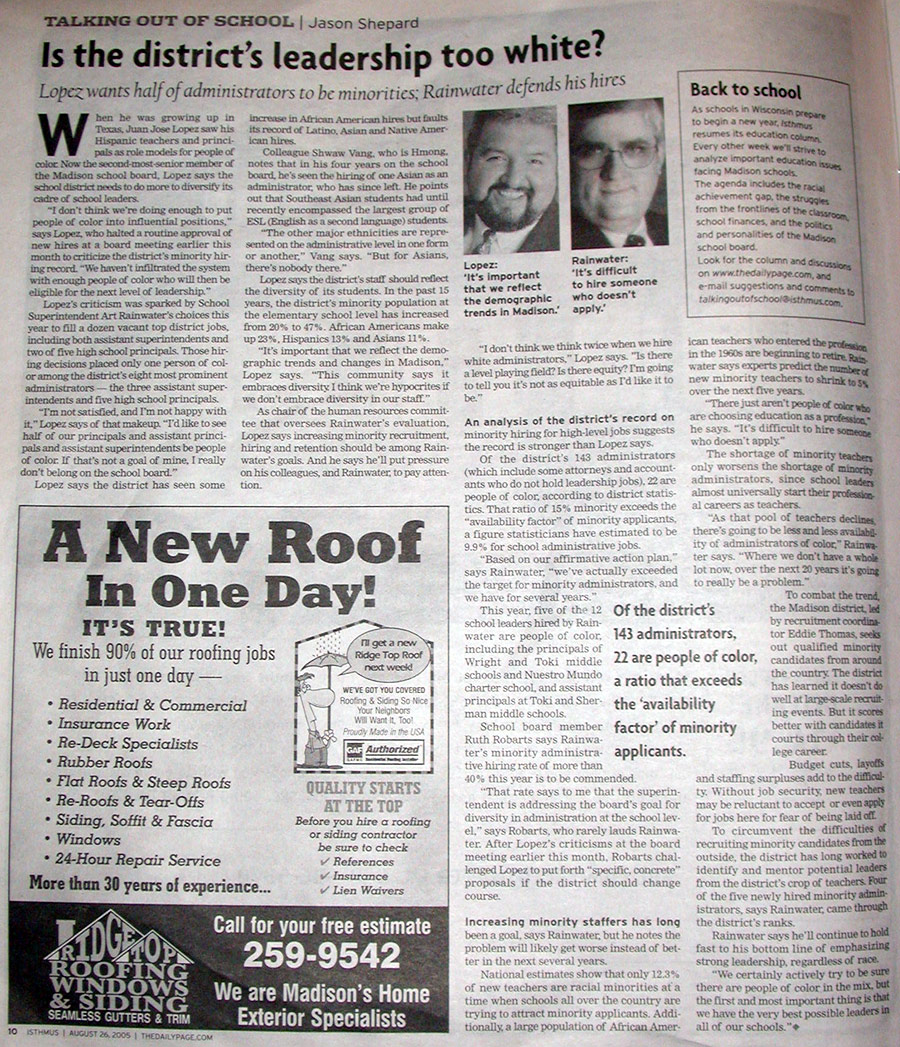
Jason Shephard starts Isthmus's excellent biweekly Talking Out of School Column with a look at the Madison School District's minority hiring policies.
"I don't think we're doing enough to put people of color into influential positions," says [Board Member Juan Jose] Lopez, who halted a routine approval of new hires at a board meeting earlier this month to criticize the district's minority hiring record.According to a note next to this article, Talking out of School will be available on Isthmus's website. We'll link to those, of course.
School Board Member Ruth Robarts says [Superintendent] Rainwater's minority administrator hiring rate of more than 40% this year is to be commended.
Newsletter signup | Send us your ideas
In an August 4, 2005, an MS-NBC Report indicates tutoring firms (for profit, and non-profit), because schools and districts are ailing under the NCLB law, are doing well. Public schools are going to be funneling $900M to these private companies to tutor kids from schools that are not making adequate yearly progress. And, there are no standards that such firms need to maintain to get these funds, according to the article.
Among other issues:
"One sore spot is that some of the most troubled public school schools systems like Chicago’s have been forced to shut down their own after-school tutoring services because of federal rules that apply to failing districts.
Beth Swanson of Chicago Public Schools figures that means only 25,000 students will get services in the coming year, down from 80,000."
Newsletter signup | Send us your ideas
By January of 2003, Kentucky reading officials were frustrated. They had just been denied federal Reading First funds for the third time, and state leaders worried that they might lose the opportunity to bring in an unprecedented $90 million for reading instruction in grades K-3 over six years. Like most states strapped by budget cuts, they could not afford to lose that money.Eduwonk has more.Months before, consultants to the federal program strongly suggested to state officials that Kentucky’s choice of assessment was a major sticking point in their pursuit of the grant. According to the officials, consultants pushed them to drop the assessment they were using, Pearson’s Developmental Reading Assessment (DRA), and choose the Dynamic Indicators of Basic Early Literacy Skills (DIBELS), which was quickly becoming the most widely used test under Reading First. But there was a problem: One of the consultants on the four-member team had a second job — as a trainer for DIBELS.
Newsletter signup | Send us your ideas
Twenty-eight parents have filed a sexual harassment complaint with the Madison School District against a Jefferson Middle School teacher they claim created a hostile learning environment for their children last year.Roger Greenwald, a member of the Committee of Concerned Parents of Jefferson Middle School, said the Title IX complaint was filed Friday because parents were unhappy with the district's initial response to their concerns about Spanish teacher Hector Vasquez, who came to Jefferson last year from Sennett Middle School.
Newsletter signup | Send us your ideas
The Dallas School Board has approved a policy that will require some school administrators to learn Spanish. The new policy, approved by a 5-4 vote on Aug. 25, now requires that all elementary school principals who work in schools in which at least half of the students are English-language learners, or formerly carried that designation, must learn the native language of those students.
From Education Week, August 26, 2005
By Mary Ann Zehr
In the Dallas Independent School District, where 65 percent of the system’s 160,000 students are Hispanic, that basically means some principals must learn Spanish. Those administrators have one year from now to enroll in a Spanish course and three years to become “proficient,” which isn’t defined in the new policy. The district will pay for the courses.
Elementary schools that have received a “recognized” or “exemplary” label in the state’s accountability system are exempted from the policy. The policy applies similarly to middle and high schools with large numbers of English-language learners, but those schools are permitted to select a principal, vice principal, or dean of instruction to fulfill the requirement—rather than just the principal.
“I’ve never heard of a school board ever requiring this,” said Dora Johnson, a senior program associate who monitors school foreign-language issues at the Center for Applied Linguistics in Washington. She said some police departments have mandated that officers learn rudimentary Spanish, but she hasn’t heard of a school district requiring its administrators to learn the language.
Opponents Critique Policy
The policy is the brainchild of Joe May, a Dallas school board trustee and Mexican-American. Mr. May grew up in a Spanish-speaking household in Laredo, Texas. He first learned English after he enrolled in school.
The policy is intended to increase parent involvement in schools with large percentages of parents who don’t speak English, Mr. May said. “The new [educational] approaches that are coming out are collaborative approaches,” he said. “That means working together with parents. If you are going to be applying it to kids whose parents don’t speak English, the only way that’s going to happen is through the requirement that the principal learns the language of the parent.”
But Ron Price, a board trustee who voted against the policy, said it is unfair. “To ask people who have active lives and busy schedules to learn a second language and become proficient is almost impossible in some cases,” he said.
It is important for school staff members to be able to communicate with parents who don’t speak English, he said, but the responsibility for that shouldn’t be put on administrators. Schools have other options, such as hiring bilingual liaisons to talk with parents, he noted.
“When you connect a person’s employment to the ability to speak a second language, that might be unconstitutional, and it’s un-American,” Mr. Price said.
In response to the characterization of the policy as “un-American,” Mr. May gave a little laugh.
“I chuckle,” he said, “because this is how naïve these people are. In Texas, a good portion of Hispanics are raised speaking Spanish and when they go to public schools, they learn English.”
Mr. May said the new policy will affect almost 50 schools in the district. Out of 14 elementary schools that have a high percentage of English-language learners, a dozen already have a principal who speaks both English and Spanish, he pointed out. But only about half of the middle and high schools with large percentages of English-language learners have a bilingual administrator, he added.
Newsletter signup | Send us your ideas
The current issue of The Simpson Street Free Press includes pieces by both Jazmin Jackson and Andrea Gilmore on the importance of arts education. This issue also has a letter to the editor from School Board member Johnny Winston, Jr. on the arts funding issues facing the District.
Participating in Arts Promotes Achievement and Academic Success
by Jazmin Jackson, age 15
When I was four years old, my mother took me to watch my older sister perform in a ballet. Since then, I knew I wanted to take dance lessons and perform like her. I’m fortunate to have hard-working parents who help pay for expensive classes. But many parents are not able to afford the cost of putting their kids into special programs like dance lessons. So what do those kids do?
Their best option is participating in the school art programs.
Music classes, show choir, theater, ceramics, painting, strings, band—I could go on and on. These are just a few of the great programs that our schools offer. These are also the programs that often face cuts from school budgets—especially these days.
Many people don’t realize the importance of these programs. The arts allow kids to learn many important life skills that they will use throughout their lives—skills for interviewing for a job, getting into college, and maturing into a responsible adult.
As a dancer, I must arrive on time and commit to attending every class and every rehearsal. Our teachers are constantly stressing how we have to be able to adapt quickly and step in for someone if they are sick or injured. If I want to get a good part, I have to work to the best of my ability. The lessons I learn I will use for the rest of my life.
Children involved in the arts are constantly developing good work habits that build strong character. Kids involved in arts and music not only benefit now, but they broaden their horizons for the future. They explore talents that they may wish to pursue later in life.
For a long time, sports have been an all-around-favorite school activity. Most teens are involved in some type of club having to do with a sport. And no matter how much we complain about running in 80-degree weather, gym class will continue to be mandatory. We all understand the importance of physical health.
Isn’t just as important to continue to hold music classes during the school day? Apparently it was to the parents of Sherman Middle School students.
In a recent letter to school board members, the principal at Sherman, Ann Yehle, proposed a plan to move music programs to after hours. Then, at a school board meeting, parents voiced strong disagreement about moving band and orchestra classes to the end of the school day. Superintendent Art Rainwater quickly stated, “music will be offered during the regular school day.”
However, Sherman plans to proceed in testing its after-school proposal.
I think it’s very important that all kids have the opportunity to participate in an arts program. Not all students are interested in sports. Arts and music programs are extremely important because they allow kids to express themselves and participate in something they enjoy doing.
But what’s even more important is that these kinds of programs are really academic programs. Andrea Gilmore, our senior teen editor, has made this point around our newsroom often in the past few months. Her editorials have been printed in this paper and in the Wisconsin State Journal. I tend to agree with Andy. Skills learned in art or music classes are easily transferred to math or science or English class.
Creating artwork, making music, or using the imagination allows kids to exercise their minds and explore their talents. Children participating in art or music better themselves by learning positive lifelong habits important academic skills.
Elementary Strings Should Be Part of Madison's Core Curriculum
An Editorial
by Andrea Gilmore, age 18
I am lucky. I have been playing the violin since I was in the fourth grade. I was exposed to music at an early age and music has helped me gain skills that have enhanced my school career. Through music, I learned self-confidence, self-discipline, time management, cooperation, and study skills.
Unfortunately, many young people may not have the opportunity I had.
The elementary strings program costs only $500,000 in a budget of more than $350 million. School board members recently decided to keep the elementary strings program next year in some form, while cutting approximately $500,000 overall out of the music-education programs.
Elementary strings programs are essential to the development of our community’s young people and should be supported in all Madison Schools.
One reason elementary strings programs are crucial to schools is that music programs help close the minority-student-achievement gap. Music programs, when incorporated in the academic curriculum, increase academic achievement of minority and low-income students.
Eliminating programs like elementary strings only adds to the widening differences among students that is often based on family income. The opportunity to play in an orchestra or to receive music education should not be based on whether parents can afford private lessons. If school districts eliminate music programs, students from low-income families will be adversely affected.
According to University of Wisconsin music professor Richard Davis, “underprivileged children will suffer the most. It’s another way of letting those who can afford it get the opportunities. The fear is that you’re going to have a very one-sided warped community, where one world will have all of the exposure and sophistication, and the other world won’t.”
Music and fine arts should be part of the core curriculum in our schools. I attribute much of my success in school, and in life, to my experience with music. I sincerely hope every fourth grader in Madison has this important opportunity.
A young person learning how to play music, who can put a price on that? School Board, please make your cuts elsewhere.
[Sources: Ruth Robarts of the Madison School Board; The Capital Times]
Andrea Gilmore is a senior at Madison Memorial High School and the Science Editor for the Simpson Street Free Press. She will attend UW-Madison this fall.
Newsletter signup | Send us your ideas
The Performance and Achievement Blog contains a new posting describing a rubric for school improvement. The rubrics allow one to estimate the current status of the schools and District with regard to the following: Student Achievement, Quality Planning, Professional Development, School Leadership, Partnerships with Community and Parents, Continuous Improvement and Evaluation.
Newsletter signup | Send us your ideas
A suburban Dallas school district launched the "Virtual Cafeteria" site to show what's being served each day at each school. It can tally nutritional information for items on a lunch tray, including calories, fat grams, carbs, protein, vitamin A and vitamin C.For instance, a meal of a chef salad, a slice of pizza, a cookie and milk will cost $4.75 and runs about 746 calories.
"We are really making a valiant effort to put nutritional information in the hands of our customers, be it parents, a grandmother, a teacher or the student themselves," said Rachelle Fowler, student nutrition director for the Carrollton-Farmers Branch school district.
Newsletter signup | Send us your ideas
Thousands of rookie teachers across the country nervously contemplate study plans and wonder if they can live up to the expectations of students, parents, the principal and themselves. Classroom veterans offer advice to the new teachers. Guests:audio>Jennifer Westra, first-time teacher at Liliam Lujan Hickey Elementary School in Las Vegas, Nev.
Rafe Esquith, author of There Are No Shortcuts and longtime fifth-grade teacher in Los Angeles
David Espinosa, New York City teaching fellow
Newsletter signup | Send us your ideas
Wisconsin DPI (PDF):
The Wisconsin Department of Public Instruction will conduct a hearing Aug. 29 at the agency headquarters in Madison to take public testimony on a change in administrative rules affecting the open enrollment program. The hearing will be held from 5 to 6 p.m. in Room 041 of the GEF 3 Building, 125 South Webster Street, Madison.Map
Newsletter signup | Send us your ideas
Representative Spencer Black will introduce a constitutional amendment that would limit the power and scope of the Governor’s veto.
Black said “This amendment is an attempt to move beyond the partisan gridlock and political game playing that has stymied efforts to reform the partial veto power for more than three decades. Amendments to our constitution should not be political footballs – they should be thoughtful attempts to improve the functioning of state government.”
Black said the constitutional amendment he will offer is based on the recommendation of the bi-partisan Legislative Council Study Committee on Improving Wisconsin’s Fiscal Management. Black’s proposed amendment to the State Constitution provides that the Governor may not use the veto to create new laws not passed by the Legislature. It would also prohibit the Governor from increasing appropriations beyond what was approved by the Legislature.
“This amendment would eliminate so-called ‘creative vetoes’ that have allowed Governors to single handedly write new laws and make new appropriations. The amendment would restore a true partial veto. The veto was originally intended to be a negative power, a check on the power of the Legislature,” said Black. “Instead, because of the State Supreme Court interpretations, the Wisconsin partial veto now allows the Governor, by creatively deleting words or digits to write new law, to raise taxes or make appropriations without legislative approval.”
“What was originally intended as a check on the power of one branch of government (the Legislature) has instead become an excessive grant of power to another branch (the Governor). The current veto power of Wisconsin’s Governor far exceeds that of any other Governor in the country or of the President,” Black noted. “The Wisconsin partial veto is a deep infringement on the separation of powers designed by our founding fathers,” stated Black.
Black noted that attempts to reform the partial veto have been considered by the Legislature for at least three decades, but dropped as the party control of the Governor’s office has changed. “In the mid seventies, Tommy Thompson led the charge to amend the constitution, but he dropped his support when a Republican (Lee Dreyfus) was elected Governor. Likewise, as Attorney General, Jim Doyle supported reform, he has now dropped his support for an amendment. Interestingly, the Republicans who are now sponsoring an amendment were silent when Tommy Thompson vastly expanded the use of the partial veto in the 80’s and 90’s. I suspect that if a Republican were to win the Governor’s race in 2006, some of the Republican legislators would drop their support for a constitutional amendment like a hot potato.”
Black said three factors that may allow the amendment to move beyond the usual partisan bickering are:
1. It is sponsored by a legislator from the party of the Governor.
2. It is the wording agreed to by a bi-partisan committee after much study and discussion.
3. It would not be effective until a new Governor is sworn in 2011. Otherwise, since an amendment would have to receive second consideration and a referendum vote in the 2007-08 session, the amendment would affect the sitting Governor and become a partisan battleground.
The proposed amendment would add the following language to Article V of the state constitution:
“In approving an appropriation bill in part, the governor may reduce the dollar amount of an appropriation as shown in the bill, but may not increase it.
In approving an appropriation bill in part, the governor may not approve any law that the legislature did not authorize as part of the enrolled bill.”
Press release from Rep. Black's office
8/24/2005
State Capitol P. O. Box 8952 Madison, WI 53708 (608) 266-7521
Newsletter signup | Send us your ideas
Dr. Ari Brown - pediatrician in Austin, Tex., spokeswoman for the American Academy of Pediatrics and author of "Baby 411: Clear Answers and Smart Advice for Your Baby's First Year" - cautions that in haste to get children the clothes and supplies they need for school, health issues are sometimes overlooked.She and other experts offer the following advice:
BACKPACKS Many children have no lockers in school and are forced to carry all their books back and forth to school and between classes. An overweight pack can cause muscle strains and overuse injuries and distort the child's posture.
A loaded backpack should not weigh more than one-fifth of a child's weight. The pack's shoulder straps should be wide and padded on the back as well. The pack should always be carried using both straps. "Now and then, a parent should check what's in the pack and determine if everything has to be carried daily," Dr. Brown suggested.
Newsletter signup | Send us your ideas
Several Madison School District parents emailed the following questions recently:
Newsletter signup | Send us your ideas
He arrived 10 minutes before his fate, so Filip Olsson stood outside Severna Park High School and waited for coaches to post the cut list for the boys' soccer team.Sort of related: Sunday's Doonesbury on overstressing our children.Olsson, a sophomore, wanted desperately to make the junior varsity, but he also wanted justification for a long list of sacrifices. His family had rearranged a trip to Sweden so he could participate in a preparatory soccer camp; he'd crawled out of bed at 5:30 a.m. for two weeks of camp and tryouts and forced down Raisin Bran; he'd sweated off five pounds and pulled his hamstring.
Finally, a coach walked by holding a list, and Olsson followed him into the high school. He walked back out two minutes later, his hands shoved deep into his pockets and his eyes locked on the ground.These things are tough, but of course, the real world is like this..."It felt," he said later, "like a punch in the stomach."
Thousands of area teenagers suffered similarly last week during high school sports tryouts, an increasingly high-stakes process both coaches and players abhor. As more families invest money into year-round club sports and intensive summer camps in an effort to propel their kids onto top high school teams, the pressure has increased on what remains a subjective tryout process. Because a spot on a varsity or junior varsity team can dramatically impact a teenager's self-confidence and social status, there is little tolerance of mistakes.
In an effort to better explain cuts to players and parents, coaches have started to record player evaluation grades. Few coaches, though, agree on how to decide which players are cut. Fewer still agree on how to cut those players. Only one thing, coaches said, can be universally agreed upon: Tryouts are as imperfect as their punishing end result.
"The day you have to cut kids is the worst day at the school all year," said Andy Muir, the field hockey coach at W.T. Woodson. "Everybody is trying hard to do the right thing -- the kids to make the team, the coaches to pick the right team -- and everyone ends up devastated. It's heartbreaking."
Olsson, 15, tried hard not to think about that possible endpoint when he arrived at Severna Park at 7:30 a.m. last Monday. He had enough to worry about. As the coaches took attendance for the first time, Olsson stood out awkwardly from the other 48 aspiring junior varsity players. At 6 feet 2 inches, he hovered more than a foot above many of his freshman and sophomore counterparts. His long, wavy hair -- a style that befits his rock-and-roll guitar playing -- stamped him as unique amongst crew-cut soccer players.
Even more unusual, though, were the circumstances of his tryout. Of the 48 players competing for about 22 spots, only Olsson had been cut the previous year and chosen to return. "Kids who get cut as freshmen almost never come back," said Stan Malm, coach of the junior varsity team. "Nobody wants that pain twice."
Severna Park players never touched a soccer ball for the first two hours last Monday, the first day Maryland public schools were allowed to practice. Instead, they ran timed 40-yard dashes and shuttle runs, a result of a trend that has overtaken high school tryouts.
Because of increased complaints from parents, many high school coaches now strive to make cuts more scientific. Until she retired last season, longtime Eleanor Roosevelt girls' soccer coach Kathy Lacey made her players run 1.5 miles in less than 12 minutes to make the team. Mike Bossom, the volleyball coach at Centennial, scores players with a number -- 1 through 5 -- for each drill and then logs the scores on a Microsoft Excel spreadsheet.
For the first time this season, Severna Park Athletic Director Wayne Mook required his coaches to record running times and player evaluation grades, then hand in that paperwork to him. It is an arduous process that many coaches find tiresome, but Mook instituted it for a reason: After a player was cut from the girls' lacrosse team last spring, the family hired lawyers to meet with the school.
"In this day and age, you have to cover yourself a little bit," Mook said. "When I meet with a parent whose kid has been cut, I need something to show them. I need proof."
Under those orders, Malm and his volunteer assistant coach, Joe Keough, marched their players to a grassy knoll near the Severna Park High School entrance last Monday for a series of physical tests that hardly qualified as scientific.
Keough and Malm walked off what felt like 40 yards, then timed players with stopwatches. Every player ran twice, and often his time changed by nearly a full second from one sprint to the next. During the shuttle run, a 25-yard sprint that required players to stop and touch the grass every five yards, players slid on the uneven ground so often Keough screamed "Safe!" and signaled like an umpire.
Olsson's times in the 40-yard dash (6.1 seconds), the shuttle run (36 seconds) and the mile (6 minutes 57 seconds) left him near the bottom of the list, but he felt confident about the soccer ahead. He'd played well for a competitive under-19 team during the last year; he'd retouched his skills and gained valuable face time during the World Class Soccer Camp -- run by Severna Park varsity coach Bob Thomas -- during the previous week.
"The only thing that should help you get on the team is soccer," Olsson said. "It's about how well you can play."
It was about a lot of other things, too. One player hurt his chances by wearing lacrosse shorts, a major offense to Severna Park's look-like-a-soccer-player dress code, Keough said. Another had a father who blossomed into a high-level player, so he was hard to cut. Another had a brother who stood 6-2, which made the coaches optimistic about a future growth spurt.
Most of all, though, the coaches wanted players to show leadership and communication, so Olsson, often shy, worked hard to be vocal around a group of kids with whom he didn't usually feel comfortable. After a scrimmage, he suggested gently that a few of his teammates try switching positions. They looked back at him quizzically.
During the first two days of tryouts, players spent a combined five hours actually playing soccer. Coaches gave each player a numbered and colored pinny -- Olson got 30 blue -- which was used in place of names as identification when making cuts. Yellow pinnies, given to returning players, acted like bulletproof jackets; an orange or a blue pinny indicated a new player who could get cut.
Each day, Malm and Keough ran the group through drills and scrimmages meant to reveal both soccer skill and dedication. First there was a dribbling drill, then shooting practice, then four-on-four scrimmages, then a full-field game. On both days, Olsson drank almost a gallon of water and two 32-ounce Gatorades to stay hydrated. "A kid who really wants to make the team will exhaust himself trying," Malm said. "He would eat poop for you."
The coaches at Severna Park had a particularly difficult task. Almost 90 percent of their players entered tryouts with several years of year-round club soccer behind them. The Falcons' recent success -- they advanced to the Maryland 3A state final last season -- enticed players to train exhaustively for tryouts.
"Most of the players we cut could start on other teams," Keough said. "Cutting the right kids is almost impossible."
Keough and Malm are well equipped for the job. Malm recently retired after 25 years as a police officer, in part so he could spend more time coaching. Keough works for a trucking company from midnight to 8 a.m. -- his regular shift -- before going to the high school. During tryouts, he slept two hours each night, sometimes restlessly. He was cut twice from the Arundel baseball team -- he still won't talk to the coach who cut him -- and he dreaded imposing the same feelings of failure on somebody else.
Since Keough saw his name in bold letters on a list of players cut, though, things have changed significantly. Though neither Maryland nor Virginia tells its schools how to cut players, coaches and athletic directors look for ways to dull the blow. Few high schools post the names of players cut because coaches find that too demoralizing.
At South River High School, a departmental policy requires every coach to inform athletes face to face. Several high schools, including Severna Park, post lists identifying players by assigned number. Bethesda-Chevy Chase field hockey coach Amy Wood posts a list of players who made the team, because she thinks numbers are impersonal.
"The way to do it right is to take every kid aside one by one and tell them privately what they did well and didn't do well," said Alan Goldberg, a sports psychologist at Competitive Advantage in Amherst, Mass. "You want to let kids understand that failure is a part of getting better. The big problem is when failure is just presented as failure. That's traumatizing."
At the end of Tuesday's four-hour tryout, Malm gathered his aspiring players and promised to be available for 10 minutes to anybody he cut. The list of players still on the team would be posted on the team's Web site and outside Mook's office at about 4:30 p.m., he said. Olsson nodded and then walked toward his water bottle.
"I think I'll definitely make it past the first cut," he said. "I'm pretty sure about that."
He went home for four hours, ate a sandwich from Subway, took a nap and hydrated to get ready for Wednesday's practice. Then he went back to school -- "It feels more real to see the actual cuts than just seeing it online," he said -- and searched the list for 30 blue.
He never found it.
While his mom, Annica, waited in the car, Olsson walked out to the school track to find Keough and Malm for his 10 minutes. They told him to work on his speed and his foot skills. They suggested he try a personal trainer.
"They think some one-on-one work would help me, so I'll do it," Olsson said. "I'm probably going to come out again next year. Getting cut hurts pretty bad, but that's what it takes. There's nothing harder than making your high school team."
Newsletter signup | Send us your ideas
Since 1999, the Madison School Board has had a written employment contract with Superintendent Art Rainwater. It contains a job evaluation process that is fair to the superintendent and that requires the Board to perform its most important function, setting clear goals for the district.
Before the first day of each school year, the Board must set performance goals that are "measurable to the extent possible". By July 30 of the next year, the Board must meet with the superintendent, review his progress toward meeting the performance goals, review his self-evaluation, and review confidential evaluations by other administrators in the district.
If the Board followed the contract, the superintendent and the public would know what's expected of the most powerful employee in terms of "improvement in programs, projects and activities to be undertaken" during the upcoming year.
According to the MMSD Human Resources department, the last time the Board evaluated the superintendent was in 2002. It did not follow all of the requirements of the contract in that evaluation.
The first day of the school year is September 1. The Board has not set measurable performance goals for the superintendent for 2005-06, although it has had two discussions on the subject.
When the evaluation does occur, I suggest that we all compare the provisions of the contract with the evaluation. If the Board does not set measurable performance goals for the superintendent in 2005-06, it will again fail in its duty under the contract.It will again fail to inform the public about its priorities for our children and fail to hold the superintendent accoutable under the priorities.
The contract spells out the evaluation process very clearly.
PERFORMANCE EXPECTATIONS: Each year before the first day of school, the Board and superintendent must establish performance expectations for the next year in writing based on his duties and responsibilities under the contract and any other criteria mutally agree upon.
MEASURABLE OUTCOMES: "To the extent possible, all performance expectations shall have measurable outcomes".
JULY 30 DEADLINE: After setting performance expectations, the Board must meet with the superintendent to discuss his evaluation no later than July 30.
Two types of appraisals are required.
SPECIFIC RESULTS & ACCOMPLISHMENTS BASED ON PERFORMANCE EXPECTATIONS: The written performance expectations must include goals that reflect the superintendent's priorities for the improvement programs, projects and activities to be undertaken. Prior to meeting with the Board for his evaluation, the superintendent must complete a self-evaluation that summarizes his progress on each goal.
5 PERFORMANCE CATEGORIES---PLANNING, ORGANIZING, LEADING, SUPERVISING AND JOB KNOWLEDGE: In each category the Board must indicate the type of evidence of performance and data sources that will be used to evaluate the superintendent's performance.
SURVEYS OF OTHER ADMINISTRATORS: The Board must distribute surveys about the superintendent's performance in the five categories to individuals who report directly to him and a random selection of other administrators.
Newsletter signup | Send us your ideas
Additional grist:
Underheim argues that technology could save schools money if they used it more creatively. Instead of funding two classes of 10 students apiece with both an algebra and a geometry teacher, he asks, why not combine the classes, give every student a computer with software for the specific subject they are trying to learn and keep just one math teacher available to help with special problems?
Yet in less than five years, that entire market has come undone. By 2004, sales of educational software - a category that includes programs teaching math, reading and other subjects as well as reference works like encyclopedias - had plummeted to $152 million, according to the NPD Group, a market research concern."Nobody would have thought those were the golden days," Warren Buckleitner, editor of Children's Technology Review, said of the late 1990's. "Now we're looking back and we're saying, 'Wow, what happened?'"
University Lake School in Delafield has enough wireless laptop computers for every student and teacher in grades six through 12 — a 5-year-old venture that is part of an experiment known in education circles as one-to-one, or ubiquitous, computing.Slashdot discussion.
Newsletter signup | Send us your ideas
As college students begin a new academic year, many parents are reeling from tuition fees. This fall's probable average 8% increase at public universities, added onto double-digit hikes in the two previous years, means tuition at a typical state university is up 36% over 2002 -- at a time when consumer prices in general rose less than 9%. In inflation-adjusted terms, tuition today is roughly triple what it was when parents of today's college students attended school in the '70s. Tuition charges are rising faster than family incomes, an unsustainable trend in the long run. This holds true even when scholarships and financial aid are considered. One consequence of rising costs is that college enrollments are no longer increasing as much as before. Price-sensitive groups like low-income students and minorities are missing out. A smaller proportion of Hispanics between 18 and 24 attend college today than in 1976. The U.S. is beginning to fall below some other industrial nations in population-adjusted college attendance.
Newsletter signup | Send us your ideas
No doubt that the Madison Schools would benefit from revenues that might come through increased advertising, as recently proposed by Johnny Winston Jr., chair of the Board of Education's Finance and Operations Committee.
On the other hand, increasing advertising to our students is undesirable for many reasons. Schools should not treat students as consumers, but as learners. Our students already live in an environment saturated with encouragements to consume. In addition, many of the advertisers with strong incentives to advertise to young people sell food products that are not in the kids' best interest.
My hope is that the Finance and Operations Committee will consider limiting any expansion of advertising opportunities to ads that target adults, not students.
Below is my proposal to this committee.
To: Johnny Winston, Jr. & Finance Committee
From: Ruth Robarts
Date: August 18, 2005
RE: Proposal for revised advertising policy for MMSD
I agree with you that the Madison School Board must consider whether there are significant opportunities to increase district revenues through increased advertising. At the same time, I am very reluctant to support more advertising to our students. In my opinion, we are already providing too many venues for advertising questionable products to students, particularly food and beverages that are unhealthy or are poor substitutes for healthier products.
Therefore, I propose that the Finance and Operations Committee consider limiting its exploration of this issue to researching the opportunities for advertising directed at adults. For starters, we have a web site and two cable TV channels. We have newsletters that go from schools to parents regularly as well as district publications that circulate widely. We have also a fleet of trucks and vans that move around the district every day. The demographics of our web site users, cable TV audience and recipients of school and district newsletters and publications alone should be attractive to many businesses that depend on adult expenditures, such as car dealerships, realtors, apartment managers, technology providers—especially those who sell education-related technology such as virtual learning tools---hardware stores, etc.
One advantage of this approach would be that we would protect our students from more marketing during the school day and school activities, while offering businesses that sell to adults a variety of venues and a good audience for their ads. Another would be that potential advertisers might be more willing to discuss their interest publicly, during our exploration of policy changes, because they would not be seen as preying on young consumers.
Obviously, if we raised significant dollars through ads, for example, on our cable TV offerings to the general public, we could use those dollars to reduce our dependence on taxes raised for “community services” and begin to expand the TV coverage of all Board of Education meetings. Dollars raised through other ads could be used to reduce the tax revenues that go to Business Services or Building Services.
The only change needed in our current policy on ads would be to add the words "to students". See below.
Policy 3660 - Advertising
The Board does not endorse the advertisement of any commercial or non-commercial product, materials, or service to students. Employees shall neither distribute to students nor otherwise use in school instructional or non-instructional materials that contain commercial or non-commercial advertising except as provided in Procedure 3660.
Advertising
1. Non-instructional Materials:
a. Non-instructional materials such as calendars and posters that contain advertising may be placed in schools by employees, subject to the approval of the principal of such school.
b. Non-instructional materials that contain advertising that are not covered in 1.a. above shall not be distributed to pupils or used in schools except as approved by the Superintendent or her/his designee.
2. Instructional Materials:
Instructional materials that contain advertising shall be selected in accordance with the program materials selection criteria and may be used in schools if such materials are not obtainable through usual educational resources.
Newsletter signup | Send us your ideas
"We don't have a lot of proof that this works," said Neah Lohr, the former director of the informational media and technology team for the state Department of Public Instruction. "Certainly students like the technology. That's not the question."My view is that technology is simply another tool that may be part of a successful learning process. Critical thinking, rigor and general inquisitiveness are far more important than learning Word 2003 (which will be obsolete by the time our students reach the workforce). Successful technologists are capable of learning and using any tool. I was reminded of our priorities yesterday while visiting Sun Prairie's CornFest: a teen could not make change (1.50 change was given for a 2.50 purchase from a $5.00 bill). More posts on this subject.Research results are mixed. But most studies conclude that for computers and other technology to have much effect on student performance, a number of conditions are necessary: Teachers have to be technologically adept; classroom assignments have to allow for exploration; and curricula have to abandon breadth for depth.
Although schools have made changes in some of those areas, particularly increasing teachers' technical proficiency, the predominant uses of computers remain word processing, heavily filtered Internet searches and the occasional PowerPoint presentation. In addition, with pressure rising to improve test scores, more schools have embraced skill-drilling software that contributes little to long-term student learning, observers say.
Newsletter signup | Send us your ideas
Teachers say creating a PowerPoint presentation captivates students and gives them background using a technological tool common in business.More on Powerpoint and schools here.Critics say PowerPoint requires students to do little more than assemble outlines and is a poor replacement for age-old standards such as essays.
Edward Tufte, professor emeritus at Yale University, has been one of the most vocal opponents, such as in an opinion piece called "PowerPoint is Evil" carried in the September 2003 edition of Wired.
"Rather than learning to write a report using sentences, children are being taught how to formulate client pitches and infomercials," Tufte wrote.
With 10 to 20 words and a piece of clip art for each PowerPoint slide, with only three to six slides per presentation, that amounts to only 80 words for a week's work. "Students would be better off if the schools simply closed down on those days and everyone went to the Exploratorium or wrote an illustrated essay explaining something," he wrote.
Newsletter signup | Send us your ideas
Since May I've been asking the administration and board members, collectively and individually, whether the budget for this school year includes funding for a promising middle school remedial reading program called Read 180. The headline on a State Journal story on January 29, 2005, read: District Eyes Reading Program For Expansion. The subheadline said: Teachers Want More Students In The Read 180 Program, Which Has Raised Reading Levels Quickly.
But NO ONE seems to know whether the program received any funding at all in the budget!
At least no one has answered me when I've asked by e-mail and at various committee meetings of the board.
The failure of anyone to know highlights one of the weaknesses of the budget process, that is, no one (board and administration alike) has much control over academic achievement when no one knows whether a promising program did or did not get funding.
The MMSD needs a budget process that tells the board and administration, as well as the public, three things about spending on important programs and budget areas. In fact, we all need to know:
1) How much was budgeted last year.
2) How much was spent last year.
3) How much is budgeted for this year.
Until the budget includes these pieces of information, no one knows how taxpayer money is being spent.
Newsletter signup | Send us your ideas
According to a story in the Capital Times, the University of Wisconsin may scrap software that the MMSD is attempting to use. Like the UW, which spent 6 years and millions beyond the budget for the software, the MMSD devoted "16 hours a day" to get the software to generate a budget for the board to consider in the spring of 2005.
Newsletter signup | Send us your ideas
Word for word, these are my original goals:(Print Friendly PDF version - 280K).
- 1. Keep our school in our community. Make the school a focal point in our community. Create opportunities for community involvement in our school. Maintain and increase school pride.
- 2. Balance the budget. Keep looking for costs savings that do not negatively affect the education of our students. Continue plans to balance the budget after the referendum money ends.
- 3. Provide the best education possible within the budget. Educate the most students possible for the dollars allocated by the revenue cap.
- 4. Improve test scores. Results must improve in every area tested. Hold the administration and teachers accountable for the test scores. Find ways to obtain test scores that make our students, parents, teachers, administrators, and members of our community proud.
- 5. Improve teachers. Reward the good teachers. Retrain, eliminate, or replace any ineffective teachers. Increase morale. Require accountability.
- 6. Improve administration. Reward the good administrators. Retrain, eliminate, or replace any ineffective administrators. Review and recommend updates to school procedures. Require accountability.
- 7. Improve the school board. Seek responsible board members. Hold the school board accountable for reaching the goals of the board.
- 8. Work with the parents of home-schooled and parochial school students to see if our school can find ways to help the students achieve a well-rounded education.
- 9. Listen & Learn. Listen to the concerned members of our community, students, parents, teachers, administrators, and staff. Implement the constructive suggestions of the Steering Committee and Action Teams for Long Range Planning that relate to board goals.
- 10. Pay attention to details. Review and update board policies and school procedures. Update union contracts. Require a day’s work for a day’s pay. Monitor expenses. Protect the assets of the school district.
Newsletter signup | Send us your ideas
The Sun Prairie School District's increasingly active weblog:
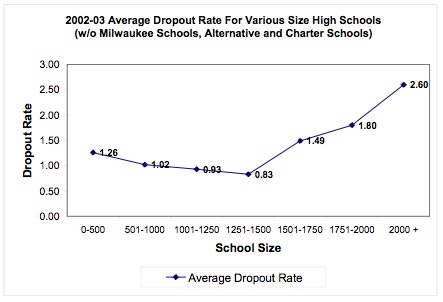
On August 9, 2005, a public hearing was held on the proposed high school facilities in Sun Prairie. At the hearing a question was asked regarding the high school drop-out rates for all Wisconsin public high schools. Drop out rates refer to the percent of students who do not complete a high school education We have compiled information for three years for all public school districts except the Milwaukee Public Schools. The data is the latest information available from DPI. A clear pattern is evident over the three years. It is apparent that as high schools grow above 1500 students, the percentage of drop-outs doubles and triples over that of high school with enrollments between 1000-1500.Sun Prairie is planning to construct two new, smaller higher schools rather than one very large facility.
Newsletter signup | Send us your ideas
Madison students who took the 2005 ACT college entrance exam continued to outperform their state and national peers. MMSD students' composite score was slightly higher overall on the ACT compared to a year ago, 24.3 vs. 24.2 (scale of 1 to 36), while the average ACT score this year for Wisconsin students was 22.2 and nationally, 20.9.Almost 74 percent of the MMSD students in the Class of 2006 took the ACT, a record number. Generally, when more students take the test, scores drop. However, the average MMSD ACT participant scored higher than roughly 72% of all Wisconsin ACT participants and higher than 78% of all ACT participants across the country.
Newsletter signup | Send us your ideas
Only about half of this year's high school graduates have the reading skills they need to succeed in college, and even fewer are prepared for college-level science and math courses, according to a yearly report from ACT, which produces one of the nation's leading college admissions tests.The report, based on scores of the 2005 high school graduates who took the exam, some 1.2 million students in all, also found that fewer than one in four met the college-readiness benchmarks in all four subjects tested: reading comprehension, English, math and science.
Newsletter signup | Send us your ideas
With strong bi-partisan support, a bill providing that Wisconsin school districts may use federal funds to cover the difference between the price of standard diesel fuel and the price of biodiesel for school buses recently passed the Wisconsin state legislature. On August 17, Governor Jim Doyle signed the bill into law.
The "clean bus" bill, aka Sentate Bill 39/Assembly Bill 67, had unanimous support in both houses of the legislature. Representative Jerry Petrowski (Marathon), who authored the bill, said that the new law "helps our children breathe cleaner air on buses, helps our farmers, and reduces our dependence on foreign oil".
Biodiesel is a cleaner-burning fuel that reduces toxic emissions and pollution. It can be derived from used vegetable oil or soybeans.
Newsletter signup | Send us your ideas
American Beverage Association:
Under the new policy, the beverage industry will provide:Pepsi Statement | Coke Statement (not yet online). Betsy McKay has more (click the link below).The American Beverage Association is asking beverage producers and school districts to implement the new policy as soon as possible. Where school beverage contracts already exist, the policy would be implemented when the contract expires or earlier if both parties agree. The success of the policy is dependent on voluntary implementation of it by individual beverage companies and by school officials. The policy will not supercede federal, state and local regulations already in place. ABA’s Board of Directors, which unanimously approved the policy, represents 20 companies that comprise approximately 85 percent of school vending beverage sales by bottlers.
- Elementary Schools with only water and 100 percent juice.
- Middle Schools with only nutritious and/or lower calorie beverages, such as water, 100 percent juice, sports drinks, no-calorie soft drinks, and low-calorie juice drinks. No full-calorie soft drinks or full-calorie juice drinks with five percent or less juice until after school; and
- High Schools with a variety of beverage choices, such as bottled water, 100 percent juice, sports drinks, and juice drinks. No more than 50 percent of the vending selections will be soft drinks.
Childhood obesity is a serious problem in the U.S., and the responsibility for finding common-sense solutions is shared by everyone, including our industry. We intend to be part of the solution by increasing the availability of lower-calorie and/or nutritious beverages in schools,” said Susan K. Neely, ABA president and chief executive officer.
Under mounting pressure from health advocates and parents, Coca-Cola Co., PepsiCo Inc. and other beverage marketers plan to announce today a set of voluntary restrictions to limit sales of their drinks in schools.Under new industry guidelines, to be announced at a meeting of state legislators in Seattle and later in full-page ads in several national newspapers, the companies eventually will halt all sales of carbonated soft drinks in elementary schools and remove all sugared drinks from middle schools during school hours. The new policy applies only to new contracts, not existing ones, meaning that it could take several years for the restrictions to catch up with many schools.
The guidelines still permit sales of all drinks in middle schools after the school day, and allow sales of diet soft drinks, sports drinks, low-calorie juice drinks, juices and water all day. No beverages are banned from high schools, but the association is recommending that at least half of vending-machine slots in those schools be allocated to noncarbonated beverages such as juice and water.
Beverage-industry leaders say the new guidelines should appease the growing chorus of critics who blame soft-drink sellers for rising obesity among U.S. children, while still protecting the industry's financial interests in marketing to young people.
"The societal debate is about how to solve childhood obesity," said Susan Neely, president and chief executive of the American Beverage Association, an industry group. "This policy is on target with what parents want and what the objective is."
Industry officials concede the new restrictions are a somewhat watered-down version of a proposal that beverage companies have been debating all summer. Some industry representatives originally advocated removing soft drinks altogether from middle schools during school hours.
But according to people familiar with the negotiations, the ABA's board of directors returned that proposal, arguing that diet drinks -- which represent a huge and growing segment of their business -- don't pose a concern for childhood obesity.
"We put a lot of work into crafting these industrywide guidelines," said Don Knauss, president of Coke's North American operations. "We will offer our strong endorsement."
"Parents tell us they'd like help in determining what products are sold in schools, and we're listening," said Dawn Hudson, president and chief executive officer, Pepsi-Cola North America. She adds that Pepsi is also "providing incentives to our bottlers that will encourage compliance with the new policy."
Once viewed as benevolent American icons, the soda giants have become lightning rods for critics who blame them for the growing number of overweight kids and teens. Since 2003, at least six state legislatures have voted to restrict the sale of soft drinks in schools. At least 38 states have proposed bills this year to improve the quality of school nutrition, and 15 of those bills have been enacted, according to the National Conference of State Legislatures, a Washington group representing the interests of state governments.
A nutrition-advocacy group, the Center for Science in the Public Interest, has been pressuring the Food and Drug Administration to slap tobacco-style warning labels on sodas and fruit drinks. And plaintiffs' lawyers are circling, raising the specter of litigation reminiscent of the courtroom battles that cost cigarette makers billions of dollars.
The new school approach is the first salvo in a broader public-relations counterattack by beverage companies to help the industry reverse its tarnished image. To lead that charge, the trade group tapped Ms. Neely in May to run the organization.
The creator of the "Harry and Louise" ads that helped torpedo President Clinton's health-care plan in the early 1990s and a veteran of Washington political battles, Ms. Neely is working on a multimillion-dollar advertising and PR campaign to show that the beverage industry derives a substantial portion of its sales and growth from healthier beverages.
Details of the new marketing push aren't being disclosed, but it will resemble industrywide campaigns launched in recent years to enhance the image of the plastics and pharmaceutical industries, said Ms. Neely. "I think you have an expectation that the biggest brands in the world will step up to the plate and help society grapple with problems," she said. "You have to have an industry voice."
Appeasing critics while protecting the industry's interests won't be easy. While it will cut some sales of regular soda to preteens, the new school policy doesn't entirely remove soda from schools, as some advocacy groups have wanted.
The guidelines aren't mandatory or enforceable, although ABA members say they plan to adhere to them. Companies represented on the association's board account for 85% of all school beverage sales, Ms. Neely said.
Some industry critics said they wondered how widely the new policy will be observed. Decisions on what beverages will be sold are often up to the schools themselves. "It's a good publicity ploy," said Lucy Nolan, executive director of End Hunger Connecticut! Inc., an advocacy group that campaigned unsuccessfully for restrictions on school soft drink sales in that state. "But what's the incentive to follow it?"
Whether existing contracts between beverage producers and schools will be amended to incorporate the new ABA policy remains to be seen. While Coke and Pepsi's biggest bottlers said they will implement the new policy, they noted that any changes in the beverages they supply are also up to the schools.
Coca-Cola Enterprises Inc. the world's largest soft drink bottler, said that for the 2005-2006 school year, it had already planned to sell only water and 100% juice to elementary schools, and to allocate half of vending machine slots in high schools to noncarbonated drinks.
"We will be engaging in dialogue with our school customers to encourage them to adopt the ABA policy," said John Downs, CCE's senior vice president for public affairs and communications.
The big bottler, which supplies Coke products to 80% of U.S. markets, said it plans to send a note to its sales teams and bottling facilities to ask them to implement the new policy immediately.
Newsletter signup | Send us your ideas
I have been the President of the Weyauwega-Fremont School Board for the last four years. I own a small realty and appraisal company,a small computer, and Internet website development company. I recently founded a non-profit charitable corporation to help underprivileged children in Wisconsin. I serve on the school board primarily as a concerned parent of school aged children and as a taxpayerMore on Steve Loehrke.I always tell my employees “Don’t bring me a problem without bringing me at least two possible solutions.” So I’m going to tell you what I perceive to be the problem and give you some possible solutions. Some people perceive the problem to be not enough money for education and their only solution is to dig deeper into taxpayer’s pockets. From where I sit, the problem is “How do we maintain or improve the quality of education in Wisconsin while controlling the current and future costs to taxpayers?”
Most people associated with schools in Wisconsin are worried about some type of tax freeze because they think it will limit the money available to schools. I am not. Here’s why: Historically, school districts budgeted for what they thought they would need to run their respective district and raised taxes to match. Then, around 1993, as part of the QEO law changes, the State of Wisconsin established revenue caps. So instead of a bottomless billfold, school districts suddenly had a fixed amount of taxpayer’s money placed into their billfold each year. They had to learn to spend no more than they made, just like most people with regular jobs. However, instead of learning to do with what was available, school districts did things like promote referendums to exceed the revenue cap.
Before I got on the Board, our school district tried three times until they finally received voter approval for a referendum. When I got on the Board, I was told that our district would have to plan for another referendum when the existing one ran out in order to keep our district afloat. Demographics showed that our school district would be switching from an increasing enrollment to a declining enrollment. I have observed that an increasing enrollment hides many financial problems while a declining enrollment emphasizes the problems. Our school district had been running deficits budgets and was depleting its fund balance to pay regular expanses. Our mill rate was one of the highest in the area. Our administrative overhead was one of the highest in the county. Our employees’ health insurance costs were one of the highest in our neighborhood. Our post retirement costs were the highest in our conference. Yet, everyone said they expected another referendum to sustain the bloat. No one wanted to tighten the belt.
Newsletter signup | Send us your ideas
Alan Borsuk (69% of Wisconsin's Class of 2005 took the ACT):
Wisconsin kids in the Class of 2006 averaged 22.2 on a scale of 36 on the ACT, the same score for Wisconsin for the sixth straight year. But the average score in Minnesota moved up a tenth of a point to 22.3, breaking last year's tie for the best record among 25 states where the ACT is the dominant exam.ACT data and results are available here.Wisconsin officials said 10.2% of the 45,700 students in the Class of 2005 who took the ACT were from minority groups, up from 9.8% in 2004.
However, the gap between white students and some minority groups, particularly African-Americans, remained a major concern, both Ferguson and Burmaster said, and the new results presented little evidence that the gap was closing.
The composite score of black students in Wisconsin was 16.9 this year, compared with 17.2 a year ago. The composite score of white students stayed the same at 22.6.
ACT officials also report results based on whether students took what is considered a "core curriculum" for getting ready for college - at least four years of English and three years of math, natural sciences and social sciences.
Wisconsin students who did that had an average score of 22.9 while those who took less than the core program averaged 20.9. Both figures were a point or better than the comparable national averages.
Newsletter signup | Send us your ideas
When students in Leslie Chernila's English class at the Art Institute of Washington write an essay about the work of Garrison Keillor, she has them send it off to a critic halfway across the country before turning it in. The paper soon returns, complete with comments about structure and word choice.The service, offered by District-based Smarthinking Inc., is part of a growing educational trend that has millions of students logging on to get assistance with reading, writing and arithmetic. Once a dot-com pipe dream, online education is now maturing into a viable market. More than 2.6 million students in the United States were expected to study online through courses and tutoring last fall, up from 1.9 million in 2003, according to the Sloan Consortium, an online research group.
Burck Smith, chief executive and co-founder of Smarthinking, credits the rise in demand for online educational services to several factors, including an increase in the number of non-traditional students who don't have a lot of time to look for on-campus resources, a more competitive educational landscape in which colleges and schools are trying harder to attract students with additional services and students' greater familiarity with the Internet.
More than 500 institutions, including Anne Arundel Community College, Gallaudet University and the Art Institute of Washington, subscribe to Smarthinking. And the company says it has signed up 19 institutions for this fall, including District-based Southeastern University.
Schools pay Smarthinking for a block of time and offer students free access to the service from a personal computer or a college lab. Colleges signing up for the first time can buy a plan that permits up to 15 hours of tutoring for each student and then adjust its next contract according to usage, Smith said. The company did not disclose the cost per hour.Terry H. Coye, director of tutorial and instructional programs at Gallaudet University, said his school turned to Smarthinking to supplement its limited tutoring services for graduate students. With many of Gallaudet's deaf and hard-of-hearing students accustomed to learning online, the service was a good fit, Coye said.
Founded in 1999, Smarthinking employs more than 450 part-time instructors from around the world to offer round-the-clock tutoring. Washington students struggling in the middle of the night with a math question may get an answer from a tutor in India, where the morning's work is already underway.
The company says 80 percent of its online tutors have graduate degrees in their discipline. While tutors come from around the world, 98 percent of the writing instructors are based in the United States.
Though some critics might worry that a student could get too much help from someone outside the classroom, the company said it trains its tutors -- who get an average of 15 hours of training -- to guide students through problems and not give away the answers.
The company is not yet profitable, Smith said, but he estimated that sales grew by "35 to 40 percent" last year. The new fall contracts are expected to bring in an additional $500,000 to $750,000, Smith said.
As more students become accustomed to the technology, the competition for online tutoring services is likely to heat up. Already, educational services giants Kaplan Inc., owned by the Washington Post Co., and Princeton Review Inc. have made inroads in the online education market. And Baltimore-based Educate Inc. said it plans to expand its online tutoring service.
"Long-term, there is no reason to believe [online tutoring] is not going to grow as students go online and take classes," said J. Mark Jackson, director of K-12 research at Eduventures Inc., a market-research firm. Because it is a supplemental service rather than a core offering, he said, it is unclear how large the market might grow.
Online tutors are available 24 hours a day for one-on-one help in math, writing, science and other topics. Students and tutors discuss assignments through online chat sessions, using a virtual whiteboard that allows for use of charts, graphs and diagrams. Those wanting help with a paper can submit a draft for feedback, which usually comes back within 24 hours.
Chernila, coordinator for the academic achievement center at the Art Institute of Washington, said she relies on Smarthinking tutors to help students refine their writing. She encourages her students to use the tutors for "another voice and an another opinion." The additional feedback, she said, made for better student work. The Art Institute pays for the service, provided free to students.
Brent Mellecker, 19, a media arts and animation major who took Chernila's literature class, said he was pleased with the responses he received from Smarthinking. But, he said, it could sometimes take up to three days to get a paper back.
"I always asked for the first available tutor online to make sure I got [the paper] back in time," Mellecker said. A few other students also experienced small delays with their essays, Chernila said. But she said it rarely interfered with her class.
Amy Yang, 20, a game art and design major, said she found the comments helpful on her writing assignments and usually received a response from a tutor in a day or two.
Chuck Kleiner, vice president of sales and marketing at Smarthinking, said company records show that 80 percent of the papers submitted from the Art Institute of Washington since 2003 were returned within 24 hours. Kleiner said that records indicated only 4 percent of the papers were returned after 30 hours and that those delays were usually caused when essays were submitted before a holiday break.
Speaking of time, Kleiner said more than 70 percent of questions arise between 6 p.m. and 9 a.m. on weekdays, and on weekends.
"We're available when they can't get help anywhere else," he said.
Would you like to send this article to a friend? Go to
http://www.washingtonpost.com/ac2/wp-dyn/emailafriend?contentId=AR2005081501265&sent=no&referrer=emailarticle
Newsletter signup | Send us your ideas
Milwaukee Public Schools - PDF:
With 95,600 students enrolled in its facilities, and room for 122,000 students, MPS has too much vacant space. To save money and more prudently use MPS resources, the administration, working with consultants, developed the draft guidelines for public input. After the public has had the opportunity to provide feedback, the guidelines will be finalized and sent to the school board for final approval this fall.
Newsletter signup | Send us your ideas
Getting school supplies, adjusting to a new morning routine, doing homework again, meeting new friends, and joining sports teams and after school clubs: it all adds up to make heading back to school a busy time for children and families. But Congresswoman Tammy Baldwin, Madison School Board member Johnny Winston, Jr., and a working family who gets its health care through BadgerCare are urging parents to set aside a few minutes to explore their options for free or low-cost quality healthcare.
“Health insurance can give students the healthy start they need to begin the school year right, so looking into BadgerCare really needs to be on your family’s back-to-school list this summer,” said Madison School Board member Johnny Winston, Jr. “Families in Wisconsin who are uninsured, underinsured or spending huge amounts of their income on health insurance should explore BadgerCare as an option.”
BadgerCare is a comprehensive health care program for families that covers eyeglasses, immunizations, sports physicals, speech therapy, doctor and hospital visits, prescriptions and more. BadgerCare is available at little or no cost to families earning up to 185% of the federal poverty line. A family of three, for example, earning nearly $30,000 can qualify; the income limit is nearly $36,000 for a family of four.
Finding out BadgerCare was available to families, even if the adults are working, made a big difference for Erin Quinn and her seven-year-old daughter, Alexus. Erin works full time, but cannot afford the $200 premiums that come with the health insurance offered through her employer. Five years ago, the county worker who assists Erin with Alexus’ mental health care needs mentioned BadgerCare. Erin enrolled herself and her daughter and say “the routine checks, prescriptions and other health care BadgerCare covers for our family’s needs are heaven-sent. I feel real lucky that BadgerCare is there for families who cannot afford health care,” said Quinn.
Erin works in sales and marketing at Widen Enterprises in Monona, earning $12.35 an hour. BadgerCare, through Unity HMO, covers not only routine check-ups for her and Alexus, but also the very important in-home mental health therapy their family needs. Erin is concerned about the challenges of getting into dental clinics and that getting some mental health care services can be challenging. “But, overall, the coverage is really making a difference for us.”
- more -
Research released earlier this month by the Robert Wood Johnson Foundation shows that kids who lack health insurance are less likely to get any medical care at all, much less the medical care they need, and are less likely to have a personal doctor than kids who have health insurance.
In Wisconsin in 2003:
·25.6% of children without health insurance received no medical care, compared to 15% of children with health insurance.
·Children without health insurance were three times more likely (1.7% vs. .5%) to have not received all the medical care they needed compared to those with health insurance.
·39.5% of children without health insurance did not have a personal doctor or nurse, compared to 11.8% of children with health insurance.
“Bottom line: health insurance makes a big difference when it comes to keeping kids healthy,” said Michael Jacob, project coordinator for Covering Kids and Families – Wisconsin, a coalition based at the University of Wisconsin that seeks to get kids and families enrolled in the health insurance programs for which they are eligible. Jacob stressed the importance of exploring BadgerCare as an option. “A phone call can make a world of difference for you and your family.”
An estimated 85,000 children in Wisconsin were without health insurance in 2003, with half of them likely eligible for BadgerCare.
BadgerCare and other Family Medicaid health plans for children and their families now provide free or low-cost health insurance for more than 517,000 residents statewide, nearly 90,000 through BadgerCare. As of June 2005, 26,887 Dane County residents were enrolled in BadgerCare and Family Medicaid programs. Yet, thousands more families who may be eligible for these free benefits are not enrolled.
Students who receive free or reduced-price meals – about 30 percent of the state’s school children – are income-eligible for the BadgerCare family health plan if they lack health coverage. In Dane County, 21 percent of schoolchildren were enrolled in the free/reduced price lunch program last year.
“While we've long recognized that school achievement is linked to meeting kids’ nutritional needs, we must also meet their medical needs,” said Congresswoman Tammy Baldwin. “Many students are likely to underachieve if they cannot see the blackboard or hear their teacher because they lack medical coverage for eyeglasses or hearing aids. BadgerCare is essential for keeping at-risk children healthy and in school and their parents at work. It’s a federal-state partnership that I strongly support,” said Baldwin.
“Something as simple as new eyeglasses could really turn around a struggling child’s performance in school,” notes Winston. “These kids are our future workers, homeowners, neighbors and leaders. By helping to build stronger community members, we help build a stronger community.”
The Covering Kids and Families Back to School Campaign is a national effort funded by the Robert Wood Johnson Foundation. More information about the Wisconsin effort can be found at www.ckfwi.org.
How to Apply for BadgerCare:
To apply, call or visit your county human services department.
In Dane County, call 242-7441.
Satellite sites are also available in:
·Stoughton (873-5636)
·Sun Prairie (837-7380)
Information is also available at the State Department of Health and Family Services web site at http://dhfs.wisconsin.gov/em/imagencies/index.htm
Newsletter signup | Send us your ideas
If you can help please contact Renita Evans at 274-9001 or revans@ivcf.org. Thank you.
Renita Evans wrote:
I am sending this email on behalf of an old friend/acquaintance. Her name is Patricia; Patricia has two sons in school Lateef and Rasheed. Last week I ran into Lateef at the Barber Shop, he asked me if I would be able to help he and his younger brother with school clothes and supplies this year as their mom is not in a position to do anything for them and school starts Sept. 1. Immediately, I thought of the Back to School Back Pack give always that will be happening within the next few weeks but I could not think of any resources for them to receive clothing. So, as I am not able to clothe these 2 boys alone I am reaching out to the communities in which I live and function asking for help on behalf of these two young boys.
Lateef called and left a message on my voicemail with their sizes. They are as follows:
Lateef: Top XL, Pants 30 R (Lateef is about 13 or 14)
Rasheed: Top L, Pants 10 R (Rasheed is about 8 or 9)
If you can and feel lead to help in this way, you may get the items to me and/or lead me to any resources that I may be able to lead them to.
I will make sure they get it before the 1st.
Thanks so much for your time, consideration, and prayers concerning this.
Sincerely,
Renita
Newsletter signup | Send us your ideas
The 100 Black Men of Madison Annual Back To School Picnic will be held on Saturday August 27th from 11:00 a.m. to 1:30 p.m. at Demetral Park on Commercial and Packers Ave. This event will be held rain or shine. Now in its ninth year, this event will distribute 1,800 backpacks filled with much needed school supplies for “at-risk” elementary and middle school students.
Children must be in attendance to receive a backpack and they are distributed on a “first come, first served” basis. Free hamburgers, hot dogs and other special treats will be served. Other activities include the OSCAR MAYER Wienermobile, City of Madison Fire Department Fire Trucks and football players from the University of Wisconsin Badgers and Head Coach Barry Alvarez. Event sponsors include: Oscar Mayer/Kraft Foods, Target, Office Depot, and Famous Footwear. This event is being held in partnership with the society St. Vincent de Paul. For more information please contact Back to School Picnic Committee Chair, Wayne Canty at (608) 332-3554, wcanty@Kraft.com or President of the 100 Black Men of Madison, Darrell Bazzell at (608) 263-2509, dbazzell@vc.wisc.edu.
The 100 Black Men of Madison is a nonprofit service organization of professional men dedicated to improving the quality of life and enhancing educational opportunities for African Americans and other people of color in the Madison area, with particular emphasis on young black males.
Newsletter signup | Send us your ideas
Wisconsin Department of Revenue, via WisPolitics. Madison's equalized values increased 9.28% in 2004.
Newsletter signup | Send us your ideas
Kristian Knutsen covers Johnny Winston, Jr.'s Streetball & Block Party over at the Daily Page. More about the Streetball & Block Party. Kristian steps it up by including some mp3 audio clips of his chat with Johnny.
Newsletter signup | Send us your ideas
One of the issues affecting decisions on attendance boundaries for Leopold Elementary School is whether the Ridgewood Country Club Apartments, located across the street from the school, will continue to house large numbers of low income families.
The following article from The Capital Times provides an update on the ownership and future plans for the apartment complex.
With local investor on board, Ridgewood future lookin' up
By Cliff Miller and Ann Marie Ames
Correspondents for The Capital Times
August 15, 2005
FITCHBURG - Developer Gary Gorman's vision of turning Ridgewood Country Club Apartments into an "urban village" is brighter, now that local investors E.J. Plesko and Associates have bought the 832-apartment complex for $29 million.
City officials joined Gorman on Saturday to announce the purchase deal, which wipes out a mortgage foreclosure action that complicated efforts to redevelop the 52-acre property surrounding the city-owned Nine Springs Golf Course west of Fish Hatchery Road.
Gorman called the Plesko purchase agreement "a huge positive step to eliminating the uncertainty about the redevelopment plan."
US Bank and Trust Co. filed the foreclosure case in Dane County Circuit Court in April against the West Allis owners, Ridgewood Associates II, Harry and Jerry Marek and Dan Pieper and their management company, CMS Ridgewood of Geneva, Ill.
Those parties are removed from the picture, leaving Gorman working with Plesko on redevelopment. They said they will keep Fiduciary Real Estate Development Co. of Milwaukee, the court-appointed property managers that took over the complex in the foreclosure case, to continue in that role while the redevelopment plans are being worked out with the city.
Asked Sunday to describe his vision for Ridgewood, Gorman said, "I'm hoping it will be an urban village where people can walk to shop and walk to the library and have access to greenspace." He sees "more natural greenspace" with walking and biking paths providing non-automobile travel options to residents.
"I certainly expect a mix of housing types. It won't be 832 rental apartments," as it is now. The mix may include condominiums and other owner-occupied homes in addition to rental housing, "significant new commercial and shopping" space, and public use features.
Ridgewood is one of three locations recently recommended by a city committee as possible sites for Fitchburg's first library. Gorman said he hopes the Ridgewood site will be chosen.
Some buildings will be demolished, others rehabilitated, but Gorman said it is too early to guess at the numbers.
"We are hoping to treat current residents in a sensitive fashion," he said. At the press conference it was suggested that tenants displaced by demolition or major rehabilitation can be moved to vacant apartments in the complex.
"The residents are the highest priority," Gorman told reporters. "The first thing we did was to engage the residents in the redevelopment process," and they and neighbors will continue to be included, he said.
Among his early discussions with residents was a meeting with a class of Ridgewood first- and second-graders taught by Troy Dassler at Leopold School. The Spanish-speaking youngsters and their crayon drawings and letters were featured in The Capital Times last winter. Gorman said he made the visit in response to their invitation to him reported by the newspaper.
"It was fun," he said. He speaks "far from fluent" Spanish, he said, but was able to communicate with the children in words and by watching a slide show Dassler helped them assemble illustrating their fears and hopes.
In other discussions with residents, Gorman said he had learned a great deal. "They have offered a broad spectrum of opinions. They want to be treated with respect in regards to their circumstances," he said, but noted that they recognize that some buildings must be torn down rather than just fixed up.
"What impresses me is that many of the residents have the greater good of the community at heart, not just their own needs," he told the press conference. He added Sunday that he believes some current residents are potentially eligible to become home buyers but need help navigating the language, cultural and knowledge barriers such as knowing how to get a mortgage and how insurance works that stand in their way.
He hopes to get present city officials to agree with a redevelopment plan this fall, move it through governmental approval processes during the winter and break ground for construction by mid or late summer. "It will certainly be a staged process, over a number of years."
Before it can begin, he said, there are many "financial, political and social perspectives (that) have to weave themselves together in a way that coordinates."
Newsletter signup | Send us your ideas
Werner, who is 17, was one of seven Wisconsin high school students who posted a 36 on the ACT during the 2004-'05 testing cycle, according to data released by ACT Inc. on Friday. They were among 251 students nationwide who averaged a top score on the battery of English, reading, science and math tests during that time.68% of Wisconsin students took the ACT (national average is 40). Those taking the test scored slightly higher than the national average composite score (22.2 vs. 20.9). State comparisons can be found here and here.In addition to Werner, Astrid Stuth of Divine Savior Holy Angels High School in Milwaukee and Kent Rosenwald of Waukesha North High School represent the Milwaukee area. Corey Watts of Madison West High School and Dan Gerber of Onalaska High School got perfect scores, too. All of the students, except for Gerber, were juniors when they got their 36s. Gerber was a sophomore.
Newsletter signup | Send us your ideas
The stricter Colorado cap does three things: it imposes firm spending caps (which grow only to reflect population and inflation), returns any excess revenues to taxpayers and allows only voters, not legislators, to override the caps.Both sides agree that the measure reined in the budget. The growth in per capita spending fell to 31 percent in the decade after the cap from 72 percent in the decade before, according to the Independence Institute, a Colorado group that favors it.
Supporters say the cap ignited the subsequent economic boom, with low taxes luring businesses. They also say it kept the state from overspending when flush only to face painful cuts later. "Tabor saved Colorado's fiscal fanny," said Jon Caldara, the institute's president......
Another major fight is under way in California, where Gov. Arnold Schwarzenegger has pushed an antispending provision onto the fall ballot, albeit one seemingly less strict than that of Colorado.
In Maine, a veteran tax opponent, Mary Adams, is gathering signatures to put a spending cap on the ballot next year. And last year, the leader of the Wisconsin Senate, Mary Panzer, a moderate Republican, delayed convening a special session to consider a spending cap. That drew a primary challenge from a conservative rival, Glenn Grothman, who defeated her in what Mr. Norquist calls a watershed moment.
Newsletter signup | Send us your ideas
Washington Post Editorial Page:
The results are almost unanimous: Standards are low, teacher training is poor and unless something is done right away, there will be an enormous teacher shortage, particularly in math and science, within the next decade. The Teaching Commission -- a group whose board includes former IBM chief executive Louis V. Gerstner Jr. and former first lady Barbara Bush -- concluded that rigid rules for teacher pay have failed to attract teachers to more difficult schools and more difficult subjects; that education schools needed higher standards; and that teacher licensing should be more rigorous. Last May the National Academy of Education issued a set of recommendations designed to deal with precisely the same problems: performance-linked teacher pay, incentives to teach in urban and poor rural schools, higher standards for teacher training, and more support for beginning teachers. The Education Trust, which has studied the extraordinarily weak content of teacher training curriculums, advocates rigorous quality standards that will make the entire teaching "market" more effective by identifying better teachers and allowing them to command higher salaries.
Newsletter signup | Send us your ideas
In a recent letter to the editor of Isthmus, KJ Jakobson asks "whether the new joint district-union task force for investigating health insurance costs be a truly collaborative effort to solve a very costly problem? Or will it instead end up being a collusion to maintain the status quo?"
Here is the full text of the letter, published on August 10, 2005, and her challenge to the Madison School Board.
A Conflict of Interest
John Matthews would like us to believe that he was fully cleared in 1994 of any conflict of interest concerning his dual role as Madison Teachers Inc. union official and board member of Wisconsin Physicians Service ("District Ties to WPS Prove Costly", Isthmus, 6/10/05). This is not the case.
On February 1, 1994, then Commissioner of Insurance Josephine Musser stated in a letter to school board member Nancy Mistele that her office did not address numerous concerns that Mistele had raised, including "conflict of interest issues which may arise under labor law or raise questions as a matter of public policy" and "the reciprocal concern of a potential conflict of interest by a union official who is involved in negotiating coverage for union membership".
Musser suggested that the Madison school district "may wish to give serious attention to a number of questions, which are not within the scope of this office's authority" and that the district may want "to seek further clarification of this issue" from the Wisconsin Employment Relations Commission.
I have been unable to uncover any documentation in the WERC database that the school board ever followed up on Musser's suggestions. I believe it is time to do so.
Given the history of Matthews holding health insurance hostage at the bargaining table and the district not raising a serious challenge in recent years, Matthews' allegiance to WPS makes me wonder: Will the new joint district-union task force for investigating health insurance costs be a truly collaborative effort to solve a very costly problem? Or will it instead end up being a collusion to maintain the status quo?
Newsletter signup | Send us your ideas
In recent months the major food companies have been trying hard to
convince Americans that they feel the pain of our expanding waistlines,
especially when it comes to kids. Kraft announced it would no longer
market Oreos to younger children, McDonald's promoted itself as a salad
producer and Coca-Cola said it won't advertise to kids under 12. But
behind the scenes it's hardball as usual, with the junk food giants
pushing the Bush Administration to defend their interests. The recent
conflict over what America eats, and the way the government promotes
food, is a disturbing example of how in Bush's America corporate
interests trump public health, public opinion and plain old common sense.
The latest salvo in the war on added sugar and fat came July 14- 15,
when the Federal Trade Commission held hearings on childhood obesity and
food marketing.
by Gary Ruskin and Juliet Schor
The Nation, August 29, 2005
Despite the fanfare, industry had no cause for concern;
FTC chair Deborah Majoras had declared beforehand that the commission
will do absolutely nothing to stop the rising flood of junk food
advertising to children. In June the Department of Agriculture denied a
request from our group, Commercial Alert, to enforce existing rules
forbidding mealtime sales in school cafeterias of "foods of minimal
nutritional value"--i.e., junk foods and soda pop. The department
admitted that it didn't know whether schools are complying with the
rules, but, frankly, it doesn't give a damn. "At this time, we do not
intend to undertake the activities or measures recommended in your
petition," wrote Stanley Garnett, head of the USDA's Child Nutrition
Division.
Conflict about junk food has intensified since late 2001, when a Surgeon
General's report called obesity an "epidemic." Since that time, the
White House has repeatedly weighed in on the side of Big Food. It worked
hard to weaken the World Health Organization's global anti-obesity
strategy and went so far as to question the scientific basis for "the
linking of fruit and vegetable consumption to decreased risk of obesity
and diabetes." Former Health and Human Services Secretary Tommy
Thompson--then our nation's top public-health officer--even told members
of the Grocery Manufacturers Association to "'go on the offensive'
against critics blaming the food industry for obesity," according to a
November 12, 2002, GMA news release.
Last year, during the reauthorization of the children's nutrition
programs, Republican Senator Peter Fitzgerald of Illinois attempted to
insulate the government's nutrition guidelines from the intense industry
pressure that has warped the process to date. He proposed a modest
amendment to move the guidelines from the USDA to the comparatively more
independent Institute of Medicine. The food industry, alarmed about the
switch, secured a number of meetings at the White House to get it to
exert pressure on Fitzgerald. One irony of this fight was that the key
industry lobbying came from the American Dietetic Association, described
by one Congressional staffer as a "front for the food groups."
Fitzgerald held firm but didn't succeed in enacting his amendment before
he left Congress last year.
By that time the industry's lobbying effort had borne fruit, or perhaps
more accurately, unhealthy alternatives to fruit. The new federal
guidelines no longer contain a recommendation for sugar intake, although
they do tell people to eat foods with few added sugars. The redesigned
icon for the guidelines, created by a company that does extensive work
for the junk food industry, shows no food, only a person climbing stairs.
Growing industry influence is also apparent at the President's Council
on Physical Fitness. What companies has the government invited to be
partners with the council's Challenge program? Coca-Cola, Burger King,
General Mills, Pepsico and other blue chip members of the "obesity
lobby." In January the council's chair, former NFL star Lynn Swann, took
money to appear at a public relations event for the National Automatic
Merchandising Association, a vending machine trade group activists have
been battling on in-school sales of junk food.
Not a lot of subtlety is required to understand what's driving
Administration policy. It's large infusions of cash. In 2004 "Rangers,"
who bundled at least $200,000 each to the Bush/Cheney campaign, included
Barclay Resler, vice president for government and public affairs at
Coca-Cola; Robert Leebern Jr., president of federal affairs at Troutman
Sanders PAG, lobbyist for Coca-Cola; Richard Hohlt of Hohlt & Co.,
lobbyist for Altria, which owns about 85 percent of Kraft foods; and
José "Pepe" Fanjul, president, vice chairman and COO of Florida Crystals
Corp., one of the nation's major sugar producers.
Hundred-thousand-dollar men include Kirk Blalock and Marc Lampkin, both
Coke lobbyists, and Joe Weller, chairman and CEO, Nestle USA. Altria
also gave $250,000 to Bush's inauguration this year, and Coke and Pepsi
gave $100,000 each. These gifts are in addition to substantial sums
given during the 2000 campaign.
For their money, the industry has been able to buy into a strategy on
obesity and food marketing that mirrors the approach taken by Big
Tobacco. That's hardly a surprise, given that some of the same companies
and personnel are involved: Junk food giants Kraft and Nabisco are both
majority-owned by tobacco producer Philip Morris, now renamed Altria.
Similarity number one is the denial that the problem (obesity) is caused
by the product (junk food). Instead, lack of exercise is fingered as the
culprit, which is why McDonald's, Pepsi, Coke and others have been
handing out pedometers, funding fitness centers and prodding kids to
move around. When the childhood obesity issue first burst on the scene,
HHS and the Centers for Disease Control funded a bizarre ad campaign
called Verb, whose ostensible purpose was to get kids moving. This
strategy has been evident in the halls of Congress as well. During child
nutrition reauthorization hearings, the man some have called the Senator
from Coca-Cola, Georgia's Zell Miller, parroted industry talking points
when he claimed that children are "obese not because of what they eat at
lunchrooms in schools but because, frankly, they sit around on their
duffs watching Eminem on MTV and playing video games." And that, of
course, is the fault not of food marketers but of parents. Miller's
office shut down a Senate Agriculture Committee staff discussion of a
ban on soda pop in high schools by refreshing their memories that Coke
is based in Georgia.
A related ploy is to deny the nutritional status of individual food
groups, claiming that there are no "good" or "bad" foods, and that all
that matters is balance. So, for example, when the Administration
attacked the WHO's global anti-obesity initiative, it criticized what it
called the "unsubstantiated focus on 'good' and 'bad' foods." Of course,
if fruits and vegetables aren't healthy, then Coke and chips aren't
unhealthy. While such a strategy is so preposterous as to be laughable,
it is already having real effects. Less than a month after Cadbury
Schweppes, the candy and soda company, gave a multimillion-dollar grant
to the American Diabetes Association, the association's chief medical
and scientific officer claimed that sugar has nothing to do with
diabetes, or with weight. Industry has also bankrolled front groups like
the Center for Consumer Freedom, an increasingly influential Washington
outfit that demonizes public-health advocates as the "food police" and
promotes the industry point of view.
Meanwhile, public opinion is solidly behind more restrictions on junk
food marketing aimed at children, especially in schools. A February Wall
Street Journal poll found that 83 percent of American adults believe
"public schools need to do a better job of limiting children's access to
unhealthy foods like snack foods, sugary soft drinks and fast food." Two
bills recently introduced in Congress, Massachusetts Senator Ted
Kennedy's Prevention of Childhood Obesity Act and Iowa Senator Tom
Harkin's Healthy Lifestyles and Prevention (HeLP) America Act, both
place significant restrictions on the ability of junk food producers to
market in schools.
Interestingly, this is a crossover issue between red and blue states.
Concern about obesity and excessive junk food marketing to kids is
shared by people across the political spectrum, and some conservatives,
such as Texas Agriculture Commissioner Susan Combs and the Eagle Forum's
Phyllis Schlafly, as well as California Governor Arnold Schwarzenegger,
have argued for restricting junk food marketing to children. This may be
one of the reasons New York Senator Hillary Clinton has once again
become vocal on the topic of marketing to children, although Senator
Clinton has called not for government intervention but merely for
industry self-regulation, requesting that the companies "be more
responsible about the effect they are having"--exactly the policy the
industry wants.
A vigorous government response would clearly garner the sympathy of the
majority of Americans. The growing chasm between what the public wants
and the Administration's protection of the profits of Big Food is a
powerful example of the decline of democracy in this country. Let them
eat chips!
Newsletter signup | Send us your ideas
The MMSD Board of Education approved the charges to the task forces which will look at attendance issues.
Link to the East charge here.
Link to the West-Memorial charge here.
Newsletter signup | Send us your ideas
From the Associated Press and the Wisconsin State Journal:
A Survey Finds High School Students Want More Demanding Coursework To Prepare For Work And College.
Wednesday, August 10, 2005
BEN FELLER Associated Press
WASHINGTON
The campaign to make high school more demanding seems to be picking up support from the people who have the biggest stake in the matter: the students.
Almost nine in 10 students say they would work harder if their high school expected more of them, a new survey finds. Less than one-third of students say their school sets high academic expectations, and most students favor ideas that might add some hassle to their life, such as more rigorous graduation standards and additional high-stakes testing.
"The good old times in high schools are being replaced by good old hard work," said Peter Hart, whose Peter D. Hart Research Associates conducted the survey for the "State of Our Nation's Youth Report," released Tuesday. "There's a recognition among students that they have to be more ready to compete."
The nonprofit Horatio Alger Association, which provides college scholarships and mentoring to needy students, issued the annual report on youth attitudes. The findings are based on a phone survey of 1,005 students in high school last May.
Improving high schools has become an urgent topic in education, as mounting research shows many students aren't ready for college or work after graduation -- if they get that far. The call for change has come from President Bush, governors, employers and college faculty. Now students are saying it, too.
Julie Hetcko, 16, of Lincoln, Neb., who will be a senior in the fall, has taken three Advanced Placement courses and is looking for other ways to prepare for college. High schools that don't offer some type of advanced coursework, she said, are holding students back.
"Times are changing," she said. "I don't think people realize how much students are trying to excel, trying to get into college. It's important that adults and parents know that it's not just a walk in the park. We want to work for our grades."
When given options for improving high schools, 95 percent of students agreed that more real-world opportunities, such as internships, would help at least somewhat. More than 90 percent also favored two other ideas: earlier counseling in high school about how to prepare for college, and more opportunities to take college-level courses for free.
Majorities of students said other changes would help, too, including increasing the availability of after-school and summer school, requiring students to pass math and English exams to graduate and requiring four years of math and courses in biology, chemistry and physics.
The students' call for more rigor comes as 41 percent of them said the pressure to get good grades is a major problem for them, about the same level as the last two years. One-third of students said getting good grades is very important when it comes to fitting in with their friends -- a factor cited more often than having a car or being involved in sports.
More than three in four students plan to go to a four-year university. A total of 83 percent said high school is preparing them "adequately" for college, although a smaller number, 71 percent, said high school is getting them sufficiently ready for the work world.
Most of the students surveyed were enrolled in public schools, with the rest attending a private school, home school or another type of school. Students age 13 to 19 took part.
The survey has a margin of sampling error of plus or minus 3 percentage points.
Among other findings:
More than two in five students say at least half the students they know cheat on tests.
More than six in 10 students say they have a cell phone.
Nine in 10 students say they have at least one family member whom they can confide in.
The full report can be found online at http://www.horatioalger.com/pdfs/state05.pdf
Newsletter signup | Send us your ideas
Teachers rarely know the full story behind their students, and this is particularly so at Locke, in South Central, one of the city's poorest and toughest areas. "So much goes on away from school," says Ms. Levine, who loses students to homelessness, pregnancy, work, drugs and jail. She never knows which ones will make it through. Most don't. The ninth grade at Locke four years ago had 979 students; in June, 322 graduated.
Newsletter signup | Send us your ideas
The Middleton-Cross Plains and Sun Prairie School Districts are both planning building referenda this fall. Learn more here:
Newsletter signup | Send us your ideas
Lee Rainie and Paul Hitlin (PDF version):
The internet is an important element in the overall educational experience of many teenagers. Schools are a common location where online teens access the web, although very few online teenagers rely exclusively on their school for that web access. Further, there is widespread agreement among teens and their parents that the internet can be a useful tool for school. However, 37% of teens say they believe that “too many” of their peers are using the internet to cheat. And there is some disagreement among teens and their parents about whether children must be web-literate by the time they begin school. Additionally, large numbers of teens and adults have used the web to search for information about colleges and universities.The most recent Pew Internet Project survey finds that 87% of all youth between the ages of 12 and 17 use the internet. That translates into about 21 million people. Of those 21 million online teens, 78% (or about 16 million students) say they use the internet at school. Put another way, this means that 68% of all teenagers have used the internet at school.
This represents growth of roughly 45% over the past four years from about 11 million teens who used the internet in schools in late 2000. In the Pew Internet Project survey in late 2000, we found that 73% of those ages 12 to 17 used the internet and that 47% of those in that age cohort used the internet at school.
Newsletter signup | Send us your ideas
Thanks to Christina Daglas for her coverage of the Madison School Board's "cautious" approach to increasing advertising in the schools. If there is serious business interest in more advertising, the Board must consider the possibilities and the public deserves advance notice that we may increase ads.
I am not, however, concerned "about businesses that, in (my) opinion, fail to advance positive messages in their advertisements, such as fast food companies", as the article states.
I said that I will not support more advertising of products that undermine our curriculum. I gave Coca-Cola ads as an example because I believe that ads for soft drinks undermine the messages of our health curriculum. The Board should not increase advertising for products whose consumption contributes to demonstrated increases in childhood obesity, diabetes and heart disease. We are already a venue for too many of these ads and products.
Newsletter signup | Send us your ideas
Kurt Kiefer kindly posted a link to the demo site. Take a look and if you'd like to give it a spin, request a password. Thanks, Kurt for posting this information!
Newsletter signup | Send us your ideas
Some great letters to the editor of the Independent, a London newspaper, on the phoney debate over including the "teaching" of "intelligent design" alongside evolution in our school curricula.
http://comment.independent.co.uk/letters/article304598.ece
What next in US schools? Alchemy?
Sir: George Bush wants intelligent design, a.k.a. creationism, to be taught in American classrooms, side by side with evolution, so as to give students "both sides of the debate". Why stop there? Children could be taught medieval alchemy along with modern chemistry, flat-earthism together with cosmology and Aristotelian physics together with relativity.
Why is one particular laughable scientific fallacy being given such prominence and other equally deserving candidates being neglected?
JOE WALMSWELL
LONDON E7
Sir: Intelligent design is not science; it is a strategy used by creationists of the religious right to try and get their religious ideas into the classroom. If their ideas had any merit, they would have gained acceptance by the scientific establishment.
The aim of intelligent design is to spread confusion about evolution without being too overtly religious. This will not fool scientists: the danger is that members of the public may be tricked into thinking that there is a controversy where none exists.
The same strategy is used by the economic right to spread doubt about the causes of (or even the existence of) global warming.
The problem with intelligent design is that it is defeatist and intellectually bankrupt, its proponents say, "Here is a biological structure that we can't understand, so God did it." Scientists say, "Here is a biological structure that we can't understand; how can we find out about it?"
PETER FOSTER
BRISTOL
Sir: Could someone please ask George Bush (and now it seems, also the Pope) why, if everything was so intelligently designed, it was necessary to crash a Mars-sized planet into the earth in order to create the moon, which could then slow our rotation sufficiently to allow any life to develop?
And could they also ask why, as intelligent design initially led to the domination of the dinosaurs, it was then necessary to crash a New York-sized meteorite into Mexico in order to kill them off and allow tiny mammals to develop into men?
Does science not come into "intelligence", or was God just making it up as he went along?
GRAHAM RANKIN
ALES, FRANCE
Sir: Alan Howe (letter, 5 August) makes an erroneous judgment, common among proponents of both "intelligent design" and creationist theories: he implies that the fact that Darwin's theories are "under attack" within the scientific community is somehow anti-evolution.
Scientific rigour demands the continual questioning and "attack" of all current theories - it is the basis of scientific method that no idea is allowed to stand without question, and that new data demands new applications of logic. In other realms, such as religion and politics, questioning might constitute an attack, but in science it is without stigma.
ROSALIND RILEY
FRITTENDEN, KENT
Sir: It's surely no coincidence that the majority of exponents of "intelligent design" are men. Any woman will tell you that the female reproductive system, with its monthly difficulties and risky, painful childbirth, has been anything but intelligently designed. Or maybe it just proves that God is male?
JULIE COURTNEY
SEVENOAKS, KENT
The big difference between the US. and other nations is at the low end of the achievement spectrum. Our kids who score low are at the VERY bottom, well below the lowest scoring kids in other nations that we compare ourselves to (think Germany, Japan, Singapore, Denmark). Thus our average score is much lower than that of other nations. Not because our smart kids are scoring poorly, but because we have so many kids at the bottom, and our bottom is so low.This is overlooked by education ideologists who just want to whine without solving problems. And the solutions don't cost more money. But they demand that we rethink the way we deploy educational resources. I'm talking as a nation, not a parent. Any individual parent wants what they want for their kid. But from a public policy perspective, it is better for the nation as a whole if we raise the floor.
All the organizational stuff--class size (and btw, the rich white parents in my district are the MOST vocal about getting smaller class sizes, and many send their kids to private schools in order to get junior into a class of 18), desk arrangements, etc.--is just moving deck chairs around on the deck of the Titanic. Education is in trouble because it's very core is rotten. We don't know how to teach teachers.
Newsletter signup | Send us your ideas
Fred Wade questions Governor Doyle's vetoes that recently provided more funds for Wisconsin Schools by moving funds and increasing state debt:
There are at least six reasons why the most important vetoes that Gov. Jim Doyle made in the 2005-07 state budget are unconstitutional.The text, history, design and structure of the Wisconsin Constitution all make clear that legislation must be authorized and enacted by the Legislature in order to be a legitimate exercise of governmental power.
The vetoes violate this basic requirement of our fundamental law by deleting words, digits and punctuation marks from the bill that the Legislature passed in order to create new spending mandates that the Legislature did not authorize.
It is as if someone found your checkbook on the street and wrote checks on your account without your permission, except that these checks are written for amounts in the hundreds of millions of dollars.
In one example, Doyle fabricated a new sentence to create $750 million of spending that the Legislature did not authorize. It reads, "The Department of Transportation shall transfer to the general fund from the transportation fund in the 2005-07 fiscal biennium, $427,000,000."In another section, he cobbled together an appropriation for the Department of Public Instruction that reads, "The secretary of administration shall transfer from the balances of the general fund an amount equal to $330,000,000 during the 2005-06 fiscal year and the 2006-07 fiscal year to any appropriation under section 20.255 of the statutes."
In a third section of the budget bill, he manufactured a provision that reads, "The secretary of administration may transfer moneys to any appropriation account or fund from the general fund."
None of these provisions appears anywhere in the text of the budget bill that the Legislature passed and authorized to become law.
Here are six reasons why the vetoes are unconstitutional:
1). The Wisconsin Constitution provides that "the legislative power shall be vested in a Senate and Assembly."
The state Supreme Court has held that this provision gives the Legislature the "power to declare whether or not there shall be a law; to determine the general purpose or policy to be achieved by the law; (and) to fix the limits within which the law shall operate."
If that interpretation is correct, governors cannot have any legitimate power to create legislation that the Legislature did not approve.
2). The Wisconsin Constitution requires "all laws of the state" to have an enacting clause, which declares that "the people of the state of Wisconsin, represented in Senate and Assembly, do enact as follows."
However, the Legislature plainly did not authorize or enact any of the provisions cited above that Doyle created with vetoes.
3). The Wisconsin Constitution provides that "no money shall be paid out of the treasury except in pursuance of an appropriation by law."
Since a "law" is defined as "an act of the Legislature" that is "to become effective as a rule of conduct when published," a "law" that the Legislature did not "enact" would be a contradiction in terms.
4). In 1998, the state Supreme Court held that the state Legislature "clearly has the appropriation power."
It defined an "appropriation" as "the setting aside from the public revenue of a certain sum of money for a specified object, in such manner that the executive officers of the government are authorized to use that money, and no more, for that object, and no other."
Yet, Doyle has purported to create three appropriations that the Legislature did not authorize.
5). Doyle claims that he acted properly because the Constitution provides that "appropriation bills may be approved in whole or in part by the governor."
But to "approve" means "to judge and find ... acceptable," and that is not what the governor did.
6). Finally, when the partial veto power was created in 1930, there was no intent, on the part of anyone, to give governors a power to create legislation without the concurrence and consent of the Legislature.
Instead, the purpose was to permit governors to reject "items" of an appropriation bill, instead of being forced to swallow "bad" legislation with the "good," so that all of the "items" that remained after a partial veto would be legislation that had both been authorized by the Legislature and concurred in by the governor.
Fred Wade is a Madison attorney who has represented legislators in unsuccessful attempts to have courts declare the partial veto unconstitutional.
Newsletter signup | Send us your ideas
The debate about advertising in Madison schools continued Monday night as School Board members came a step closer to forming a subcommittee to examine the issue.After years of stiff opposition to similar proposals, board members are being cautious. In a meeting of the Finance and Operations Committee, board member Johnny Winston Jr. said district policies currently do not allow advertising. But with tight budgets, no avenue should be overlooked, he said.
Newsletter signup | Send us your ideas
The quality of Advanced Placement programs is coming under scrutiny at a time when educators are pushing to strengthen the academic level of high school class offerings.Eduwonk has additional commentsCome February, the college prep classes at high schools across the nation will be audited amid concerns that some schools may be offering watered-down versions of AP courses. Full descriptions of every AP course, syllabus, sample assignment and sample exam for the 2007-08 year will be reviewed.
"Administrators are under pressure to create advanced-type classes. Parents want them. Policy-makers want them. If I'm being told to teach Advance Placement, I can put AP in front of any course name," said Jim Ballard, executive director of the Michigan Association of Secondary School Principals. "Of course, it's more than simply adding the name, and that's where the College Board is crying foul."
The College Board, which sets AP curriculum standards and conducts nationwide exams each spring, is reviewing the courses in response to calls from colleges and universities about ensuring the rigor of AP classes, officials said.
Newsletter signup | Send us your ideas
Alas, the e-books are encoded in DRM which pretty much spoils the potential success of this pilot project:We all need to become familiar with the ongoing DRM (Digital Restrictions Management) machinations all around us. Things are getting worse. Learn more about DRM via wikipedia.
- Textbook is locked to the computer where you downloaded it from;
- Copying and burning to CD is prohibited;
- Printing is limited to small passages;
- Unless otherwise stated, textbook activation expires after 5 months
(*gasp*);- Activated textbooks are not returnable;
- Buyback is not possible.
Newsletter signup | Send us your ideas
Keeping on topic :) Dave Newbart finds that 1/3 of Illinois' high school grads are not ready for college. Thus, 2/3 apparently are (evidently not, according to the article).
If colleges are to retain and graduate more students, the state needs to do a better job of educating them long before they set foot on campus, lawmakers and educators said Thursday.Joanne Jacobs has more.New research presented by the Illinois Education Research Council at a meeting of the Senate Committee on Higher Education showed many Illinois high school graduates are simply not prepared to go to college.
More than one-third of Illinois graduates are not ready for college, said Jennifer Presley, director of the council, which is tracking nearly the entire class of 2002. Another 28 percent are only partially ready, she said. Yet 43 percent of the least ready students go to college, and 58 percent of minimally ready students do.
"It's shameful the number of people that are not prepared coming out of our high schools,'' said state Rep. Kevin McCarthy (D-Orland Park), chair of the House Committee on Higher Education.That means when they get to college, they are forced to make up what they failed to learn earlier. Carol Lanning, senior director for program planning and accountability at the Illinois Community College Board, said one in seven community college students -- or 100,000 people -- are enrolled in remedial classes, often to get help in one or two subjects. But the 10 percent of students who need help in three subjects "rarely succeed no matter what,'' Lanning said.
Racial disparity decried
At City Colleges of Chicago, many students find themselves taking 1-1/2 years of remedial courses before they can even start earning college credit, officials said. Often, when students learn how long it will take, "they vote with their feet'' and leave the school, said Perry Buckley, vice president of the Illinois Federation of Teachers and an English teacher at City Colleges.
Officials with the Chicago Public Schools said they were trying to do more to prepare students, such as more Advanced Placement courses.
Still, Senate Assistant Majority Leader Miguel del Valle (D-Chicago) thinks the colleges need to focus more resources on programs that help students make it through. He said schools needed to do a better job tracking students and determining why graduation rates for Latinos and blacks are so much lower than for whites and Asians.
"Why are we today still falling short of answering that critical question?'' he asked. "We've lost a lot of students over the last two decades. If we don't fully answer that question, how do we put together a plan to change those numbers?''
Newsletter signup | Send us your ideas
Joan, since you don't allow response comments to your posts, I am forced to post here.
I'm sorry that I misread your editorial comments about what you imagine the PEOPLE program and its students to be about, to constitute a larger set of questions about fairness and access to UW-Madison. So, to keep it short and sweet, here are my responses to what I take to be your two primary questions:
1) Do I believe that students with a 2.75 GPA can succeed at Madisson?
Yes. I have first-hand experience with our undergraduate population and the people who serve them, probably more than you. There are studens with 2.75 GPAs and lower who do very well at Madison; there are students who come in with 3.5 and higher GPAs who founder. SOURCE: student service workers and admissions staff at UW-Madison.
2) Do I believe that the admissions rules should be bent for students who complete the PEOPLE program?
Yes, IF that is what is happening. The article says that students must maintain a MINIMUM 2.75 GPA to stay in the program; there is no information on the average GPA of PEOPLE students admitted to UW-Madison. As quoted in my previous post, the article clearly says that PEOPLE graduates who are unlikely to succeed are not admitted. As such, I must believe that there is some judicious application of admissions criteria in borderline cases.
That said, the University of Wisconsin System has a responsibility to prepare all of its students for the world they will inherit. That world is increasingly multi-ethnic, and all students' employment options are very much linked to employer perceptions of whether those students are culturally competent to succeed in businesses with diverse staff and customer bases. Simply put, the future employment options of our students rest on our ability to recruit and retain a diverse student body. This becomes a factor on the side of giving students the benefit of the doubt in borderline admissions cases, and has little to do with whether those students ultimately succeed or fail.
On a personal note, I salute you and your accomplishments. I worked my way through UW-Madison from the age of 17, ending with an MA and PhD in history, at the time ranked fifth in the United States (minoring in sociology, ranking first in the United States)against private and public insitutions. I know that the curriculum is rigorous. I came into the graduate program with 26 students;there were 3 of us left after the MA level. As a grad student I was a tutor and a TA, and you are rightfully proud of your achievements. However, that does not entitle you to make uninformed assertions about what high school students who are working hard to prepare for higher education are or are not likely to achieve if admitted.
Newsletter signup | Send us your ideas
Much of the national progress reported for 9- and 13-year-olds was driven by gains in the South. For example, while 9-year-olds in the Northeast gained 10 points in reading achievement (the equivalent of a grade level) over the past 30 years, the South gained 24, according to the National Center for Education Statistics (NCES). While reading scores for 13-year-olds barely budged in most of the United States, the South gained 12 points, more than a grade level.It's vindication for a generation of Southern governors, business groups, and educators who launched the standards movement in education a decade before it was picked up by the rest of the nation.
Newsletter signup | Send us your ideas
Lucy,
Your anger at your experience with MMSD is palpable. I'd like, however, to stick to the main point of my original post which is whether UW should be lowering admission standards for students who participate in the PEOPLE program. Whatever you think of the validity of those requirements, it doesn't change the fact that it is what nearly every other student has to contend with. And nothing you have said persuades me that a student with a 2.75 GPA has a very good shot at succeeding at UW. (And I didn't say every PEOPLE grad got in to UW, but it's clear that they will not necessarily be held to the same admission standards as everyone else.) I also don't see why you have such trouble accepting my query whether this program will actually turn out successful college graduates, and at what cost. (Perhaps you don't remember the airbrushing incident, where a minority student was photoshopped into a glossy UW brochure to create the impression of greater diversity) I'd hope this program isn't a bandaid but genuinely prepares students to deal with the rigors of college.
I come from a hard science background. Your belief that a motivated student, albeit with a significantly lower GPA, will ask good questions begs the question. The rigors of science and math education are not much about sharing cultural or experiental differences. You can either do it or not--motivation AND preparation. And I'd argue that while GPA certainly isn't the ideal measure, it does indicate some commitment and participation in the process of education.
As to your experience with MMSD. I too have had issues with how the district educates its students, especially talented and gifted students. Nonetheless, after seeing two children through the system, our family did not witness the kind of institutional racism you describe flowing from teachers and staff. Maybe it happens in other schools in the district but not at Franklin/Randall, Hamilton or West.
Moreover, our kids were in heterogeneous classrooms all the way through middle school. The same curriculum was available, the same preparation for high school, all there for all students. Indeed, we saw faculty and staff bending over backwards to engage minority students. I was involved for six years on Hamilton's School Improvement Committee when the then principal would propose five goals every year, all of them centered on boosting the achievement and performance of the school's most at-risk students, all or nearly all of them minority students.
During our tenure, we also saw the advent of Wright Middle School. (Who says MMSD won't build a school that is inherently segregated?) It was my understanding that Wright was not only to be a school built for ease of access for students and families on the south side but also to provide a curriculum and atmosphere that would address the disparities in minority achievement. Thus, these minority students came into West with a great deal of support in their earlier school years.
Now you suggest that minority students are discouraged and steered away from the more difficult college prep curriculum in our high schools. I can't speak for schools other than West. I agree that West is certainly a segregated place, but believe that to be a product of self-selection as much as anything else. But I'm here to tell you there is no way the school will stop a student from enrolling in a class. If your student wanted to enroll in the college prep curriculum, they might be told it will be tough and/or that they don't have the pre-reqs but if you insisted on it, you'd get it. And it would be really hard once they were in those classes. I could write a book about that, but it isn't relevant to this discussion. (Do you think minority students are the only ones steered away from the tougher curriculum? You'd be wrong.) By the way, don't you wonder how these kids came to enroll in the PEOPLE program? Could it be from those same counselors you think are trying to keep them down?
You also note that male minority students have it especially rough, that there is a stigma for minority students to "acting white" which I take to mean buying in to doing well in school. Whose problem is that? Do you for one minute think it's easy for any student to be deemed "smart", but especially males? Peer pressure in high school isn't limited to race.
See, I don't accept the notion that there is a racial difference in the way we learn. I'm a biologist by training---there isn't that much difference between us and the chimps, as the flare of anger in your posts bears witness. This isn't to say there isn't racism out there but there is also sexism, homophobia, anti-intellectualism, and a host of other sources of bigotry students have to contend with. You either deal with it or you make excuses.
If you believe there is institutional racism in MMSD, by all means address it. Gather families together, prove your case, encourage your children to not take no for an answer. Seek institutional changes.
That said, I still don't accept your assertion that a student who is taking honors classes at West is somehow not going to be prepared for college and needs the rules bent to get in via the PEOPLE program. West students have a decent college prep curriculum if you insist on being part of it.
Motivation and assistance at home make a huge difference to children's success. The data may be dated, but the Hamilton principal used to say that the two key factors predicting a student's success were the educational status of the mother and whether the student came from an intact home. (Perhaps you have better information.) Thus, it wouldn't surprise me to learn that PEOPLE kids have smart moms and have dads around, too, spurring their children on. My comments about what my children had did not imply that all of the PEOPLE students lacked any or all pieces, only my sympathy for those who did not and the understanding that it was harder without that support. And I resent your snarkiness about it, your ad feminems, your twisting of my words to fit your angry scenario.
I am not opposed to providing additional coaching and instruction (and I did get the part that it was year-round.) And yes times have changed since I tutored---it's gotten even harder. What I learned in graduate genetics and biochemistry is now taught in the introductory classes. We ask ever more of our students, as well we should. Students from India and Asia routinely smoke our students---they take more rigorous courses and display on average far more discipline than the average US student. I doubt very much that a 2.75 GPA student will be able to successfully compete in this new world, not that there aren't exceptions, but generally speaking, I'm betting on my view over yours. And why should they get to attend UW while a student who is better prepared for the new playing field is shut out?
So I return to my original question--is it right to bend the admission requirements for PEOPLE students. I don't think it is. And at the risk of waving a red flag in front of you, your offense at the question is entirely your problem not mine.
(With apologies to readers - it is not possible to respond using the comments feature on the blog.)
Response to Lucy's Post on PEOPLE program
JOAN: Tempting though it is to rebut your arguments tit for tat I am not sure it will necessarily be productive.
RESPONSE: I would be interested in a “tit for tat” response to my comments on the reasons why the PEOPLE program is needed.
JOAN: Let's back up and look at the assumptions underlying this program. The first is that minority students are not getting adequate preparation in their home schools. You assert that this is true in the well-staffed, well-funded Madison school district because of institutional racism. You believe your visual review of a school proves your point. That's not particularily strong evidence.
RESPONSE: I think you need to go back and read what I wrote. I said,
“All of the above examples are conditions that I have witnessed first hand or, in one or two cases, have heard of from other parents – including parents of white students. When the above conditions disappear and/or white students experience these same conditions, we can talk about equity.”
Nowhere did I say or imply that my comments were “based on a visual review of a school.” It is true that there is no systematic, methodologically defensible, study of how students of color and their parents fare in Madison’s schools. I would welcome a well-crafted study of this nature.
I suspect that our opinions are informed by different experiences and information sources. I can’t speak to your knowledge base because I know nothing of it. I can share that I base my comments on:
-- twelve years of direct daily experience with MMSD as the parent of an African American student-- the experiences shared over fourteen years by parents of African American students and other students of color; today, those students range in age from seven to their early thirties
-- what I have learned over the past seven years from current and former students of color who I spend time with at school, at extracurricular events, in my home, and at social events
-- information and commentary by students of color currently enrolled at UW-Madison and who graduated from Madison schools (contrary to what you would have us believe, by the way, these students are campus leaders with very solid academic and community credentials – including participation in the Honors Program)
-- the issues raised by parents of students of color who, with me, participated in monthly meetings with the former principal at East
-- affirming responses from parents of white students when I’ve talked about disparities in Madison education in the past year
-- information and commentary shared by current and former school principals and staff and by members of the community who work with students of color in the K-12 system
-- issues raised by current students – white and students of color – at public forums devoted to student achievement, to educational equity, and to disproportionate minority confinement
-- questions and comments from parents at the MAFAAC sponsored school board candidate forums in 2004 and 2005
-- questions and concerns raised at MAFAAC meetings over several years
-- feedback from parents and community members when I visited neighborhood centers with Valencia Douglas and others this past spring
-- concerns and experiences expressed by colleagues on campus, who face serious choices about where their children will attend school
Again, I know that this is not a scientifically verifiable knowledge base, but it is a pretty broad set of contacts and experiences.
JOAN: This isn't about ability but preparation and motivation.
RESPONSE: I agree about preparation – if students are consigned to connected math rather than algebra, they aren’t going to have the same preparation, for example. That is a very different issue from motivation, which often is present – and in combination with intelligence – but is overlooked in the selection process.
The student most quoted in the article sounds pretty motivated, by the way:
“Raymond McCurty-Smith was a high school freshman in Milwaukee when he first heard about UW-Madison's PEOPLE program from a teacher in his honors English class.He said he understood immediately what it could mean to him and his family -- what a great deal he could get with a full-tuition scholarship if he finished the program and kept up his grades. The program helps disadvantaged and minority youth prepare for college and, preferably, enroll at UW-Madison as freshmen.
"It was funny because I was already thinking of going to UW-Madison, and that decided it," said McCurty-Smith, 17, who will start his senior year of high school this fall. "It was just such a good opportunity."
But last week, as he finished the program's third and final summer session on campus and looked forward to enrolling at UW-Madison in a year, McCurty-Smith counseled against anyone doing it just for the payoffs -- the scholarship and the $1,000 check that he and the other participants will receive in lieu of wages they could have earned working a regular job this summer.
"It's a really good program if you are determined to come to UW-Madison and you're determined to work," he said, adding that not everyone in the program had such noble motives, in his opinion. "The goofers in class are easy to pick out, just here for the money."
JOAN: West is tough on all kids, just for the record.
RESPONSE: West certainly prides itself on its academic rigor. I also would submit that each of the four high schools has curriculum that is demanding and challenging whether that curriculum is represented as AP or TAG designations or is the product of a teacher who demands peak performance in “regular” classes.
The issue from where I sit is who has access to that curriculum and how? When the access process produces upper level courses that are almost exclusively white, or white with a smattering of Asian American students, it should encourage us to ask whether the representation is about ability or about perception and/or process.
JOAN: (And for the commenter below who mentioned that a kid with a 3.6 from West might not be in the top 10%, you're exactly right--one B in four years and you're out of the top 5%, two B's and you're out of the top 10%, historically anyway.)
RESPONSE: As for the grades/GPAs, I believe that they are currently viewed as less indicative of future success than one might imagine. The factors working against a strict GPA value include: grade inflation due to parental pressure, variance in curriculum from one school or district to the next, the level/challenge of courses taken, academically gifted kids who get poor grades because they are not engaged due to boredom and frustration.
On another note: most college faculty would give their eye teeth for a 2.5 student who asks challenging questions and brings engagement and fresh perspective to a class, over a room of 3.9-4.0 students who are good at meeting the technical requirements to get high grades but are burnt out and/or unwilling to take risks for fear of jeopardizing their grades. This is not to dismiss students who are high academic achievers, but rather to reflect what some higher education studies – and individual faculty – are reporting.
JOAN: As I said in my first post, I had first-hand experience tutoring minority students from Milwaukee. They clearly needed the kind of advance preparation this program offers.
RESPONSE: As I recall, that was several years ago and does not involve the current crop of newly-admitted students. I would encourage you to take another look at the students who are coming from Milwaukee’s schools today. For example the reconfiguration of Rufus King has created a highly competitive school [ http://www2.milwaukee.k12.wi.us/king/scroll.html ] ranked fifth in the US, first in Wisconsin.
JOAN: Thus, I am not opposed to a summer program, but I have serious questions about bending the admission rules.
RESPONSE: Perhaps you misread the article. It is far from a summer program only:
“..the program, which so far has produced 117 UW-Madison undergraduates, including 41 students who will be freshmen this fall. To get the scholarship, those freshmen also must complete an eight-week summer program of classes for credit designed to further prepare them for college.An additional 952 students are involved in some earlier stage of the program, which can include after-school classes on study skills and tutoring in reading, writing, math, science and foreign languages.
Summer sessions, all on campus, include academic classes, field trips, campus orientations, cultural activities and, for the oldest students, internships in local companies and organizations. Enrollment in these summer sessions has jumped from 139 pre-college students to more than 800.”
And:
“In 2000, a slate of middle-school offerings was added in Madison -- program officials say they don't have the money to expand it elsewhere -- and this fall an elementary-school program will start on Madison's northeast side around Northport Drive and Packers Avenue. That new offering, known as PEOPLE Prep, is designed to prepare children as early as second grade for the middle-school program.The entire PEOPLE program now includes 500 high school students, 497 middle schoolers and 55 in grades two through six, plus the 117 undergraduates. A few hundred faculty members and staff from across campus help teach it, and the program provides professional development for high school teachers from the Milwaukee area during summer training sessions.”
JOAN: Moreover, it is beyond me how someone could successfully attend and graduate from UW with such low admission scores.
RESPONSE: The article never said that PEOPLE students are guaranteed admission.
“… not every (PEOPLE) graduate who applies gets in, said Carlos Reyes, an admissions officer. This fall, for example, about 80 program finishers applied for admission, but only about 50 were accepted; of those, 41 enrolled and will be freshmen this fall.Students in PEOPLE must maintain at least a 2.75 grade-point average in high school and meet UW-Madison's entrance requirements, officials said. Reasons that some program finishers aren't accepted include the same things that keep out regular applicants, Reyes said, such as slacking off senior year, getting bad grades or not taking rigorous enough classes.”
JOAN: I am also here to tell you that my children did not for the most part feel supported in MMSD. Welcome to the club, in other words.
RESPONSE: Like I said in my earlier post, the issues are way beyond whether someone "feels supported." It's a separate club which has pretty exclusive membership. When they start to experience what students of color experience in our schools, and I hope that never happens, I will say “welcome to the club.” Until then, their experiences are as different as the separate floors at West.
JOAN: However, they did have the advantage of an intact, financially secure family, college-educated parents and alot of opportunities low-income kids miss out on. So let me repeat that I'm not opposed to offering college prep classes to kids who need it. But I still think they need to meet the same standards at the end of the day. Otherwise, we may as well gift them with a college diploma, skip the four/five year investment of time and energy, and just strip away the facade that this is supposed to be about advanced education.
RESPONSE: I'm struggling with the assumption that all students or color, or students in the PEOPLE program, are from "broken" families without post-high school educations. The program includes students from a very broad range of backgrounds who, for whatever, reason, are in need of the critical mass and academic training that they are not experiencing in their schools.
Beyond that, you may want to re-read the original article. I draw very different meaning from its tone and content, and find that your presentation distorts both the content and wording of the original article and the intent/function of the PEOPLE program. This is an insult to the students and staff who are putting the time and effort into meeting the requirements to successfully graduate from PEOPLE, and it is a real insult to the students who do indeed meet the requirements for admission to UW-Madison.
Newsletter signup | Send us your ideas
I cringe when I hear people in any organization discussing "our experts know the best", or generally advocating a top down, command and control approach. Paul Graham recently wrote a wonderful article on the lessons we can learn from "Open Source". He refers to open source software and blogging among other avocations. Graham includes three lessons from the open source and blogging worlds:
Newsletter signup | Send us your ideas
Lucy,
I feared this would become personal. Tempting though it is to rebut your arguments tit for tat I am not sure it will necessarily be productive. If necessary I will, though I prefer to look past your anger which now seems aimed directly at me.
Let's back up and look at the assumptions underlying this program. The first is that minority students are not getting adequate preparation in their home schools. You assert that this is true in the well-staffed, well-funded Madison school district because of institutional racism. You believe your visual review of a school proves your point. That's not particularily strong evidence. This isn't about ability but preparation and motivation. West is tough on all kids, just for the record. (And for the commenter below who mentioned that a kid with a 3.6 from West might not be in the top 10%, you're exactly right--one B in four years and you're out of the top 5%, two B's and you're out of the top 10%, historically anyway. But then what does that say for the student with a 2.75 at West who can get into UW through the PEOPLE program?)
Here is why I commented. What troubles me is whether this will be a fruitful program or just a bandaid, which is why I expressed the hope that this was designed in a way to measure genuine success as defined by actually graduating from college.This is assumption number one, that this program is not just about getting minority students on campus but actually successfully graduating. And I don't think it out of line to then ask whether it is a cost-effective program.
But more important, at least what could be gleaned from the story, it sounds to me like UW alters its admission requirements for those who attend faithfully the PEOPLE program. I have a big problem with a different set of rules for those participating in a program not open to all students.
As I said in my first post, I had first-hand experience tutoring minority students from Milwaukee. They clearly needed the kind of advance preparation this program offers. Thus, I am not opposed to a summer program, but I have serious questions about bending the admission rules. Moreover, it is beyond me how someone could successfully attend and graduate from UW with such low admission scores. I say that as someone from a blue-collar family who was a Wisconsin honor scholar, Phi Beta Kappa/honors undergrad, UW MS (teaching assistant) and UW law degree, (to succumb for a moment to a tit for tat.)
I am also here to tell you that my children did not for the most part feel supported in MMSD. Welcome to the club, in other words. However, they did have the advantage of an intact, financially secure family, college-educated parents and alot of opportunities low-income kids miss out on. So let me repeat that I'm not opposed to offering college prep classes to kids who need it. But I still think they need to meet the same standards at the end of the day. Otherwise, we may as well gift them with a college diploma, skip the four/five year investment of time and energy, and just strip away the facade that this is supposed to be about advanced education.
I was saddened and disappointed by the tone, content, and assumptions underlying Joan’s recent post on UW-Madison’s PEOPLE program and feel a need to respond as a parent who is engaged in trying to address cultures of racism in Madison schools and as a graduate and staff member of UW-Madison. I’ve interspersed the responses with Joan’s original wording:
JOAN: Glaringly absent from the reporting is what are the criteria for getting accepted into this program. It sounds like a program open only to minority students, or is it for low-income students of color?
RESPONSE: According to the PEOPLE web site, the PEOPLE Program is designed for U.S. Citizens and Permanent Residents who are African American, American Indian, Asian American (with an emphasis on Southeast Asian American), Chicano/a, Puerto Rican, Latino/a and disadvantaged students strong academic potential currently in sixth grade in the Madison Metropolitan School District. Priority will be given to students eligible for the free and reduced hot lunch program.
JOAN: In addition, I noticed that two of the students interviewed in the article were from Madison West. Is MMSD so deficient in preparing its (low income) minority students that they can only hope to succeed with this special program? I can understand how students coming from poorly funded and troubled districts like Milwaukee might need extra attention, but Madison West?
RESPONSE: Yes.
When our high schools – some say West for example – have separate floors for “advanced” and “regular” classes, and those floors are visibly segregated by color, it is imperative that the university step up and provide the educational opportunities that are not taking place in our schools.
When school counselors advise students of color – without looking at their schedules or checking their grades – that they are not college material, those students need a resource like the PEOPLE program.
When parents of color or parents of students of color request that their children be placed in college prep curriculum only to be told “oh, no. that would be too hard,” there needs to be a PEOPLE program to give students access to what they can and should achieve.
When students of color, especially boys, face a culture that regularly tells them that to read, to study, to plan for college, is “acting white,” and that culture is reinforced by what students see and experience in their schools on a daily basis, there is a critical need for programs – like PEOPLE - that can create a critical mass of college bound students of color.
When classes composed primarily of students of color watch videos and play word search at the high school level, while their white counterparts read books, write essays, and do internet research projects, there is a critical need for a PEOPLE program to provide the academic skills, motivation, and self-esteem that are not built by watching videos. Thye kids see what is expected of them, and they are very capable of drawing the conclusions that the adults seem to be missing.
When police officers regularly stop students of color to ask “what are you doing here” when they are waiting to talk to a teacher after school or waiting to give someone a ride home from school, we have a problem. And that problem signals, loud and clear, that the system and the people who are in charge, don’t see students of color as engaged members of the school community.
I wish that I were exaggerating. All of the above examples are conditions that I have witnessed first hand or, in one or two cases, have heard of from other parents – including parents of white students. When the above conditions disappear and/or white students experience these same conditions, we can talk about equity.
The biggest issue is not that the PEOPLE program exists, but rather that it cannot possibly accommodate all of the students who could succeed if given access to a program that gives them the tools.
JOAN: Moreover, I know students at West who did not get in to UW despite GPAs of 3.6 and higher. This is the best education many can afford for their children. To learn that their students cannot get admitted while some are allowed in with significantly lower requirements (SIC) and paid summer college prep courses might be a bitter pill to swallow. (For the record, both our children were accepted at UW.)
RESPONSE: If you think this is a bitter pill to swallow, check my comments above and try to imagine how you would feel if your children were subject to the same conditions. The fact is, c. 40-50 students from each Madison high school enroll as freshman students at UW-Madison each year. The overwhelming majority of those students are white.
MY FINAL TEN CENTS:
The post seemed to assume that the students of color who participate in PEOPLE are somehow less able than their white counterparts. That would be a huge and erroneous assumption and one that I hope I am misreading.
I also should note that the treatment of students of color (the majority in some of our schools) in Madison’s schools and UW-Madison’s predominantly white campus are significant issues in areas that also affect white students:
1) Corporate recruiters that are unwilling to come to campus because they don’t feel they can recruit students of color OR white students who are culturally competent to work with diverse populations
2) Retention of faculty and staff who have children of color and are appalled at what they discover when their children hit the K-12 system
3) Apprehensions of parents whose children develop strong friendships
in diverse schools and worry that their children will lose something valuable by going to a predominantly white college.
4) The anti-social behavior of students in our schools, who are smart enough to know when they’ve been pegged as “no potential” and see no point in participating in or supporting a positive academic environment.
Newsletter signup | Send us your ideas
In May, voters rejected referendums for more operating money and a new "Leopold" school. That failed budget meant significant staffing cuts. But in the case of the new school, the district admits, they had no back-up plan. Now, the board is working to address student issues, as Madison continues to grow."Both parents and staff are going to find things a lot more difficult... We cut custodians, we cut teaching positions, we cut services, we cut people downtown," says school board president Carol Carstensen.
A long range planning committee has been asked to seriously evaluate boundary changes in the district.
Newsletter signup | Send us your ideas
The second thing that will be free is a complete curriculum (in all languages) from Kindergarten through the University level. There are several projects underway to make this a reality, including our own Wikibooks project, but of course this is a much bigger job than the encyclopedia, and it will take much longer.Jimmy Wales is the founder of wikipediaIn the long run, it will be very difficult for proprietary textbook publishers to compete with freely licensed alternatives. An open project with dozens of professors adapting and refining a textbook on a particular subject will be a very difficult thing for a proprietary publisher to compete with. The point is: there are a huge number of people who are qualified to write these books, and the tools are being created to leave them to do that.
I just wanted to add one little note to today's post, based on an excellent philosophical question Diana Hsieh asked yesterday about my views on free knowledge. While I do, in fact, think that it is wonderful that each of the ten things I will list will be free, the point of naming the list "will be free" rather than "should be free" or "must be free" is that I am making concrete predictions rather than listing a pie in the sky list of things I wish to see.
Newsletter signup | Send us your ideas
Neal Conan, Talk of The Nation:
Some British schools want to erase "Failure" off report cards -- in favor of "deferred success. The idea is to spare the self-esteem of struggling or indifferen students. But is a good self-image the product of praise or real achievement? Neal Conan and guests discuss what really builds self-esteem in children.Audio
Newsletter signup | Send us your ideas
The Wisconsin State Journal discusses the college prep program UW sponsors for middle (Madison students only) and high school minority students.
Glaringly absent from the reporting is what are the criteria for getting accepted into this program. It sounds like a program open only to minority students, or is it for low-income students of color?
While it has barely been in existence long enough to produce college graduates, I would hope someone is studying PEOPLE's effectiveness. For instance, I'd like to see a control group who can't attend these summer sessions but who are given the same break on admission, (2.75 GPA is all that's required), and if accepted at UW, the students also get a full five-year tuition scholarship. Then I'd like to see the numbers on those who graduate and in what time period and at what cost.
Many years ago while I was a UW zoology grad student, I was a paid tutor through a university program aimed at assisting minority students. All my students were from Milwaukee. None was prepared, either for the intro zoo course or for college in general. Thus, I am sympathetic to the idea of helping these students before they enroll at the university. However, I have to question the lowered admission requirements. If you can't cut a 2.75 in high school, you're not likely to successfully complete a degree at UW-Madison.
In addition, I noticed that two of the students interviewed in the article were from Madison West. Is MMSD so deficient in preparing its (low income) minority students that they can only hope to succeed with this special program? I can understand how students coming from poorly funded and troubled disticts like Milwaukee might need extra attention, but Madison West?
Moreover, I know students at West who did not get in to UW despite GPAs of 3.6 and higher. This is the best education many can afford for their children. To learn that their students cannot get admitted while some are allowed in with significantly lower requirments and paid summer college prep courses might be a bitter pill to swallow. (For the record, both our children were accepted at UW.)
So I have two questions: are there checks in place to determine whether this is an effective program, and cost-effective at that, given the 5+ million dollars expended on about 1200 individuals; and how does the UW legitimately justify employing markedly different admission criteria, especially if PEOPLE isn't open to all students who wish to participate.
Uw's Long-term College Prep Program Puts Prospects In The Pipeline
Sunday, July 31, 2005
Karen Rivedal Wisconsin State Journal
Raymond McCurty-Smith was a high school freshman in Milwaukee when he first heard about UW-Madison's PEOPLE program from a teacher in his honors English class.
He said he understood immediately what it could mean to him and his family -- what a great deal he could get with a full-tuition scholarship if he finished the program and kept up his grades. The program helps disadvantaged and minority youth prepare for college and, preferably, enroll at UW-Madison as freshmen.
"It was funny because I was already thinking of going to UW-Madison, and that decided it," said McCurty-Smith, 17, who will start his senior year of high school this fall. "It was just such a good opportunity."
But last week, as he finished the program's third and final summer session on campus and looked forward to enrolling at UW-Madison in a year, McCurty-Smith counseled against anyone doing it just for the payoffs -- the scholarship and the $1,000 check that he and the other participants will receive in lieu of wages they could have earned working a regular job this summer.
"It's a really good program if you are determined to come to UW-Madison and you're determined to work," he said, adding that not everyone in the program had such noble motives, in his opinion. "The goofers in class are easy to pick out, just here for the money."
For diversity
The PEOPLE program -- the acronym stands for Pre-College Enrichment Opportunity Program for Learning Excellence -- was launched in 1999 as part of Plan 2008, UW-Madison's plan to improve diversity on the mostly white campus. Through 2003, all 226 completing the program had graduated from high school, with 96 percent going on to college and nearly half of those choosing UW-Madison.
"I'm pleased with that," said Walter Lane, an assistant dean in the School of Education who leads PEOPLE. "Hopefully this trend will continue to go upward."
The university spent nearly $3 million last year on the program, which so far has produced 117 UW-Madison undergraduates, including 41 students who will be freshmen this fall. To get the scholarship, those freshmen also must complete an eight-week summer program of classes for credit designed to further prepare them for college.
An additional 952 students are involved in some earlier stage of the program, which can include after-school classes on study skills and tutoring in reading, writing, math, science and foreign languages.
Summer sessions, all on campus, include academic classes, field trips, campus orientations, cultural activities and, for the oldest students, internships in local companies and organizations. Enrollment in these summer sessions has jumped from 139 pre-college students to more than 800.
UW-Madison officials view the program as a success, noting it will take time to build up the college numbers.
"Given the young people now in the pipeline, there's no question that the number of students enrolling at UW-Madison will continue to grow exponentially," said Darrell Bazzell, vice chancellor for administration. "The investment is starting to pay off."
`A good experience'
On Friday, McCurty-Smith and 122 others were recognized for finishing the program at a banquet in the Kohl Center moderated by top university officials and corporate sponsors. Proud parents at separate tables packed the room, some of them beaming their relief and joy in broad smiles and high praise for the program.
"It's been a good experience," said Joann Johnson, whose daughter, Madison West High School student Renita Paris, was among the honorees. Paris, who will be a senior this fall, started the program when she was in middle school, an option available only in Madison.
"It helps a lot of children start thinking about their future earlier than they would have before and in a consistent way," Johnson said. "They start getting excited that, yes, they can go to college."
Like several other parents interviewed at the event, Johnson said Paris would be the first one in her family to go to college, and probably would not be able to do it without the scholarship money.
Another program finisher, Madison West's Phouthaphone Maly, also said the money was important, but she liked the program primarily for something else. Coming to campus every summer for the past several years has helped her meet officials and develop a social network of other mostly minority students in the program.
"I met a lot of people who will help me through college," Maly said.
Every PEOPLE graduate who enrolls at UW-Madison gets free tuition for up to five years, but not every graduate who applies gets in, said Carlos Reyes, an admissions officer. This fall, for example, about 80 program finishers applied for admission, but only about 50 were accepted; of those, 41 enrolled and will be freshmen this fall.
Students in PEOPLE must maintain at least a 2.75 grade-point average in high school and meet UW-Madison's entrance requirements, officials said. Reasons that some program finishers aren't accepted include the same things that keep out regular applicants, Reyes said, such as slacking off senior year, getting bad grades or not taking rigorous enough classes.
McCurty-Smith's mother, Jacquise Smith of Milwaukee, said her son seemed to learn a lot in the program. He especially liked the business experience he got by working at American Family Insurance as part of the six-week program this summer. Other internships are offered in fields including social work, pharmacy, education, nursing, computer programming, theater and law.
"He loved his internship," Smith said. "He really wants to attend UW-Madison, and I want him to as well."
Program expanding
High school students in the program must attend multi-week summer sessions after their freshman, sophomore and junior years of high schools. In Madison, high-school students also must complete various offerings during the school year.
The program began with 65 students from Milwaukee, later expanding to Madison, Racine, Waukesha and the Ho-Chunk, Lac Courte Oreilles and Menomonee Indian nations.
In 2000, a slate of middle-school offerings was added in Madison -- program officials say they don't have the money to expand it elsewhere -- and this fall an elementary-school program will start on Madison's northeast side around Northport Drive and Packers Avenue. That new offering, known as PEOPLE Prep, is designed to prepare children as early as second grade for the middle-school program.
The entire PEOPLE program now includes 500 high school students, 497 middle schoolers and 55 in grades two through six, plus the 117 undergraduates. A few hundred faculty members and staff from across campus help teach it, and the program provides professional development for high school teachers from the Milwaukee area during summer training sessions.
Over the past two years, UW-Madison has spent about $5.76 million for PEOPLE, including almost $600,000 in gifts, with similar amounts in the previous years, Bazzell said. The SBC Foundation is the program's oldest and biggest private contributor, with donations totaling nearly $1 million since 1999.
Contact Karen Rivedal at krivedal@madison.com or 252-6106.
In a rather quick followup to Governor Doyle's recent budget line item changes (details), WEAC is running TV ads supporting his budget changes. Colin Benedict has more:
The first thing you notice about a new ad touting Gov. Jim Doyle's work in the budget is that it feels like a Doyle campaign ad.But it isn't. Its paid for by the Wisconsin Education Association Council, the state teachers' union. When it paid to run the ad at WISC-TV, WEAC dropped off a 52-page document justifying every claim made in this ad.
The ad says, "After inheriting a budget mess, Gov. Jim Doyle has saved millions by cutting waste and balancing the budget." That is true, News 3 reported. When Doyle took office, the deficit was the largest in state history -- $3.2 billion. However, "cutting waste" is a very subjective term -- one person's waste is another's lifeline.
WEAC's definition of waste is $60 million for Milwaukee's Marquette interchange, $35 million to study work to the zoo interchange, and $94 million in proposed rate increases for nursing homes and other health care providers. Doyle vetoed it all to find more money for schools.
The ad also credits Doyle for balancing the budget. News 3 points out he is required by law to do that. He is not allowed to run deficits like the federal government.
The ad goes on to explain the governor understands working families are being squeezed by taxes.
The ad says, "That's why he froze property taxes, cut the gas tax, and eliminated state taxes on Social Security. All while keeping the state's promise to fund our great schools."
This needs clarification. The ad is giving Doyle credit for three ideas originally introduced by Republicans.
Newsletter signup | Send us your ideas
http://media.jalc.org/nea/home.html
The National Endowment for the Arts and Jazz at Lincoln Center have created materials to help fill and enthrall classrooms with jazz and to build important connections between the music and the story of our nation. The program web sites includes on-line materials and contact information for people who are interested in using this curriculum.
Newsletter signup | Send us your ideas
He was introduced to blogging as an educational tool by Patrick Delaney, Galileo's librarian. Mr. Delaney also helped Mindy Chiang, a Mandarin-language teacher at Galileo, set up a blog for her Chinese-American and Chinese immigrant students to write about and post their experiences for the benefit of fifth and sixth graders from schools in Elk Grove and Santa Barbara, Calif., who were studying Chinatowns.Ms. Chiang and Mr. Delaney were delighted to discover that the quality of the writing for the blog surpassed her students' previous work. Moreover, when Ms. Chiang had them record audio versions of their essays in English and Mandarin using school iPod's, the students' accents were vastly improved.
"It's pretty clear that they were worried about being embarrassed," said Mr. Delaney, noting that the essays were available to the students' families and Web surfers in China. "Having an audience compelled these kids to step it up a notch."
Still, some educators are not completely sold on the value of interactivity. "If interactivity becomes the fundamental basis of the educational process, how do we judge merit?" asked Robbie McClintock, a learning technologies expert at Teachers College of Columbia University.
Newsletter signup | Send us your ideas
Wisconsin DPI (PDF):
The grant will support the planning, design, and implementation of charter schools in areas of the state with a large proportion of schools that have been identified for improvement under the federal No Child Left Behind (NCLB) Act. Additionally, it will support increased collaboration among educational partners to enhance the charter climate and support educational options through charter schools; assure quality educators and strong leadership in every charter school; increase capacity for opening charter schools that boost student achievement and comply with NCLB and the Individuals with Disabilities Education Improvement Act of 2004; evaluate the effectiveness of charter schools and share those results; strengthen management and fiscal sustainability of the state’s charter schools; and increase parent, teacher, and community involvement in the development of charter schools through the dissemination of best practices that improve student achievement.
Newsletter signup | Send us your ideas
Physical education is one of 27 online courses now offered by the Minneapolis Public Schools, which had none four years ago. Thousands of other districts nationwide are adding online courses, said Susan Patrick, director of educational technology at the federal Department of Education.This is a great example of the "out of the box - non same service thinking" that is required today. Johnny's post illustrate's the District's same service financial challenges:"We're seeing just tremendous growth," Ms. Patrick said, "in enrollments and in the kinds of courses offered."
In a survey, the department estimated that there were 328,000 student enrollments in online courses offered by public schools during the 2002-3 year. Ms. Patrick said enrollments had probably doubled since then.
Newsletter signup | Send us your ideas
Dear Editor:
Thank you for your comments regarding the reductions in Madison Metropolitan School District’s 4th and 5th grade elementary strings program and other Fine Arts programs. I personally know the importance of the strings program. I played the violin many years ago as a student at Lindbergh Elementary School. I continue to support Fine Arts programming. My board motions, budget amendments and voting record reflect those priorities. However, given our budgetary challenges I cannot make a strong commitment to any program in the future.
The reason that I cannot make this commitment is the reason for the threats to fine arts and public education funding itself. The MMSD like every other district in this state has a very difficult challenge with the state imposed revenue limits, state and federal mandates and high community expectations. The state imposed revenue caps allow a district to increase spending by only 2.6% every year. The percentage of everything else needed to operate the school district such as salaries, benefits, equipment, textbooks and utilities continue to increase beyond 2.6%. This leaves a “gap” in the budget, which in order to make up means we have to cut services or ask local taxpayers to increase their taxes to exceed the revenue cap. This is why the majority of the members of the Madison School Board voted to ask the community via referendum on May 24th for additional money for operating expenses. Although, this referendum failed, members of the school board made budget amendments that kept the 4th and 5th grade elementary strings program continuing at least one day a week. Additionally, the board decided to make additional cuts to restore smaller class sizes in elementary school gym, music and art classes. Making these decisions were very difficult and probably even more difficult for the Madison community to understand.
In closing, I share your feelings of frustration regarding the reduction of services to our school children. This is a very complex problem that is not only happening in Madison but around the state. For instance, the Florence County School District decided to close due to fiscal limitations that made it impossible to continue to operate an effective school district. I assure you that service reductions are not just targeted toward Fine Arts although very vocal advocates continue to make that assumption. Reductions have also been made in sports, academic class sizes, special education, bilingual resources, library services, building custodians, administration and other departments to the total of around $8 million dollars this year. If state and federal school financing does not change, coupled with the non-passage of future operating referenda will force the school board to make even more difficult decisions that affect our school district.
Although, the circumstances of school finance make things difficult, I am committed to providing a quality educational experience for all 25,000 students in this district. As a member of the Board of Education, I will always be equitable in reductions of service and try to think of alternatives for the MMSD to continue having a quality Fine Arts program as well as other educational and extra-curricular activities for students to learn and enjoy.
Johnny Winston, Jr. was elected to the board of education in 2004. Mr. Winston is currently Vice President and chairperson of the Finance and Operations committee. He is employed as a firefighter for the City of Madison. He is the father of three daughters including two school district graduates.
Newsletter signup | Send us your ideas
Ohmygosh. She screamed and turned to her father, Martin Fraeman, who had picked her up at Blair in the family Toyota. I'm a finalist! A finalist in the Intel Science Talent Search, the competition that might as well be a junior Nobel Prize. Abby called her mother and screamed again. The hundreds of hours she'd spent researching her astronomy project at Washington's Carnegie Institution had given her a shot at winning one of the nation's most coveted science awards.
Newsletter signup | Send us your ideas
Still, when Jallon showed up in Annapolis last August with her proposal to create KIPP Harbor Academy, she was not received with open arms. For months, the Anne Arundel County school board appeared poised to reject Annapolis's first charter school, which would be publicly funded but independently operated. School board members worried that the charter school would drain students and resources from Annapolis's two existing middle schools. Jallon, who lives in Hanover near Arundel Mills Mall, found herself in constant -- and ultimately successful -- negotiation with school board members and leaders from the county teachers union.
Newsletter signup | Send us your ideas