
| School Information System |
 | Sponsorships | Sponsorships |
|
|
Moreover, he will lead the campaign for a mill levy to fund ProComp, the pay-for-performance model that has been approved by teachers and that also has Hickenlooper's support. Indeed, Bennet is so committed to that model that he hopes to negotiate such a provision as part of his own employment contract, a sure sign of confidence that the job is doable and the challenges are not intractable.Joanne Jacobs has some useful links behind this story, one of which is Siegfried Englemann's piece on students "who are victims of the unshifted paradigm".On Monday, Bennet said naming a chief academic officer would be among his highest priorities, and that he expects to start a national search for that person soon. That decision, perhaps more than any other he makes early in his new post, could determine whether he achieves the ambitious goal he has set for Denver: to be the best urban school district in the country.
Newsletter signup | Send us your ideas
Joan mentioned last night's Wisconsin Chamber Orchestra's Concerts on the Square. The concert included the performance of a Dvorak piece by a 16-year old violinist from Janesville Parker, Saya Chang-O'Hara. Conductor Andrew Sewell introduced Saya as follows (paraphrased): "I don't mean to be political here, but she learned to play the violin in elementary strings".
Newsletter signup | Send us your ideas
A reader forwarded this Wisconsin State Journal Editorial:
You have to wonder if the members of the Madison School Board couldn't benefit from a remedial math course.Last week, with the School District facing the prospect of having to cut $3.1 million from its budget, the School Board voted to add $651,400 in spending.
No wonder frustrated School Board member Bill Keys felt compelled to warn: "We have a serious financial problem on our hands. I do think the community and the board is in a kind of denial."
Keys' words deserve the attention of taxpayers not only in Madison but also throughout a majority of school districts in Wisconsin. Any district that denies the looming threats to its budget risks paying a stiff price.
School boards face uncertain budget circumstances. Schools will benefit from an increase in state spending on education in the next state budget. But how big the increase will be remains undecided.
Newsletter signup | Send us your ideas
Aids to local governments increased dramatically since 1955, according to the study. Local school aids rose 10.8% per year, while shared revenues to local governments increased 4.9% annually. However, WISTAX researchers point out that there are questions about the long-term effectiveness of local aids for reducing property taxes. Economic research in Wisconsin and elsewhere finds that state and federal aids to local governments only partially offset local property taxes, as a portion of that aid funds new spending.The study finds that some limits on local governments have been effective at relieving property taxes and some have not. During the 1970’s, the state imposed cost controls on schools and levy limits on counties and municipalities. Due to an increasing number of "loopholes," they were deemed ineffective and eliminated in 1983. Recent revenue limits on schools have been more effective, because they do not have similar loopholes. Counties and technical colleges have limits on the tax rates they can impose. However, large increases in property values have limited their effectiveness.
Newsletter signup | Send us your ideas
This season's Concerts on the Square kicked off with an interesting medley of polka/waltz/cancans, but the best reason to have attended was the performance of a Dvorak piece by a 16-year old violinist from Janesville Parker, Saya Chang-O'Hara. Put simply, she was brilliant. Juilliard should be knocking on her door any day now. It was an honor to hear her play.
But what might be of interest to folks on this site is this: she only started playing when she was eleven, AS PART OF HER SCHOOL'S STRINGS PROGRAM.
Corante launched an interesting new blog on the "Future of Work". Food for thought.
Newsletter signup | Send us your ideas
Sandy Cullen's article in the June 28, 2005 WI State Journal Sherman's curriculum riles parents notes:
On Friday, the state Department of Public Instruction ruled that under Wisconsin law, instrumental music instruction must be available to all students in grades seven through 12 during the regular school day."It is unusual to pull students from one class to meet instructional time in another class," said Michael George, director of the Content & Learning Team for the state Department of Public Instruction, who issued Friday's ruling. "Clearly, they're not getting the same experience as other students."
Besides music instruction, Sherman parents are concerned that few students have the opportunity to take 8th grade algebra and that no child will have the opportunity to take a full year of foreign language prior to high school.
Yehle said middle school is a time when students should be sampling many subject areas to gauge their interests and skills, and should be introduced to what it's like to study a foreign language, rather than develop proficiencies.
Sherman principal Ann Yehle's comments seem at odd with a) Wisconsin's Model Academic Standards in foreign language which call for "... a strong foreign language program beginning in the elementary grades" and b) Wisconsin's Administrative Code - Public Instruction, Chapter PI 8 Appendix 8 Instructional Guidelines which recommend 100 minutes of foreign language instruction per week beginning in Grade 5.
It's hard to see where Sherman Middle School's curriculum is not being dummed down for its students compared to other Madison middle schools and to school districts surrounding Madison WI.
Much afoot at Sherman Middle school. MMSD will look at developing a district-wide middle school curriculum. While that might improve the mess at Sherman, it might also mean watering down the curriculum, eg. math, throughout the district.
http://www.madison.com/wsj/home/local/index.php?ntid=45223
"School Board President Carol Carstensen, who made it one of her priorities to examine how the district's 11 middle schools are structured and to consider proposals for changes, said that questions and concerns about middle- school curriculum existed before the situation at Sherman boiled over.
"It came to a head around Sherman," Carstensen said.
Among the concerns is whether the kind of preparation students receive for high school varies depending on which middle school they attend, she said.
In one of her first jobs as the new superintendent of secondary schools, Pam Nash will focus on designing a middle school system that is consistent across the district, Rainwater said.
"Each of our middle schools has developed in a very different way," Rainwater said, adding, "It provides a tremendous amount of flexibility."
Carstensen said that while a more centralized model would sacrifice some autonomy and creativity in a school's ability to meet the needs of its specific student population, she believes that all students should have the same opportunities in certain areas, including instrumental music and advanced math classes."
http://www.madison.com/wsj/home/local/index.php?ntid=45223
Sherman's curriculum riles parents
Sandy Cullen Wisconsin State Journal
June 28, 2005
With continuing controversy over curriculum at Sherman Middle School prompting some parents to transfer students to other schools, School Board members and administrators will review the district's model for all of Madison's middle schools.
Sherman Principal Ann Yehle said she knows of three students who are leaving the school because of the controversy ignited last month when she announced that band and orchestra classes would be moved to an optional eighth hour after the regular school day. On Friday, the state Department of Public Instruction ruled that under Wisconsin law, instrumental music instruction must be available to all students in grades seven through 12 during the regular school day.
Prior to DPI's ruling, Yehle had agreed to offer band and orchestra during the regular school day as well as during the optional eighth hour next year. But some parents are still upset after learning that students might have to miss other classes, such as foreign language or art, on the days they have band and orchestra.
"It is unusual to pull students from one class to meet instructional time in another class," said Michael George, director of the Content & Learning Team for the state Department of Public Instruction, who issued Friday's ruling. "Clearly, they're not getting the same experience as other students."
Superintendent Art Rainwater, who said he will send a letter to Sherman parents today, said that students taking band and orchestra would miss another exploratory class one day a week, where in the past they missed the opportunity to take another entire class. Exploratory classes include music, art, foreign language, gym, healthy living and technology.
Rainwater also said Sherman will begin allowing students to take algebra at their parents' request, addressing another issue of contention at the school.
Many parents are upset that the number of Sherman students eligible to take algebra has dropped dramatically in recent years. They say that Sherman has required students to attain higher scores on an assessment test than other middle schools, preventing many students from taking an advanced math class before high school.
Yehle said she expected eight students to take the advanced math class in the coming year, down from a high of about 25 in years past.
School Board President Carol Carstensen, who made it one of her priorities to examine how the district's 11 middle schools are structured and to consider proposals for changes, said that questions and concerns about middle- school curriculum existed before the situation at Sherman boiled over.
"It came to a head around Sherman," Carstensen said.
Among the concerns is whether the kind of preparation students receive for high school varies depending on which middle school they attend, she said.
In one of her first jobs as the new superintendent of secondary schools, Pam Nash will focus on designing a middle school system that is consistent across the district, Rainwater said.
"Each of our middle schools has developed in a very different way," Rainwater said, adding, "It provides a tremendous amount of flexibility."
Carstensen said that while a more centralized model would sacrifice some autonomy and creativity in a school's ability to meet the needs of its specific student population, she believes that all students should have the same opportunities in certain areas, including instrumental music and advanced math classes.
Many parents have expressed concerns about differences between Sherman and other middle schools in the district, including the way Sherman schedules foreign language classes. Some parents also are dissatisfied with the opportunities Sherman provides for talented and gifted students.
Parent Alan Sanderfoot said those factors prompted him to transfer his daughter Olivia from Sherman to O'Keeffe Middle School, and that other parents are considering doing the same.
As a seventh-grader at O'Keeffe, Sanderfoot said, Olivia will have foreign language classes throughout the year. At Sherman, French and Spanish classes for seventh- and eighth-graders are concentrated into half of the school year, causing concerns among some parents about a gap in learning.
George said foreign language and music are two areas in which "continuous progress is very important."
"Many foreign language programs in Wisconsin begin in the elementary school and have opportunities for continuous progress," he said.
Rainwater said he does not believe the Sherman students experience a disadvantage in foreign language instruction.
Sanderfoot, who has another daughter headed for Sherman, said parents' concern is not just about opportunities for their own child.
"This is people worried about the whole middle school model and what it's going to mean in high school."
School Board member Lawrie Kobza, who was president of Sherman's parent group prior to her April election to the board, agrees that there is a bigger issue behind the Sherman controversy.
She said it appears that only Sherman and Sennett middle schools do not allow students to take a full year of foreign language in eighth grade.
"There's a lot of advantages to it," Kobza said, adding that foreign language looks good on college applications and can save money if students test out of college classes.
Yehle said middle school is a time when students should be sampling many subject areas to gauge their interests and skills, and should be introduced to what it's like to study a foreign language, rather than develop proficiencies.
But Sanderfoot and other parents are concerned Sherman's curriculum is being "dumbed down," which Yehle denies.
There is concern about parents' criticism of Yehle, Carstensen said, adding, "Everything that I've heard prior to any of this is very enthusiastic."
When she became principal 4 years ago, Sherman was considered a school in crisis, and Yehle has been credited with reversing the school's downward spiral.
"Ann has done a lot of good things at Sherman," said Kobza, who worked with other parents and Yehle to turn the school around.
"It's just heartbreaking to me to see this," Kobza said of the current controversy. "It's really just bringing the whole school down."
This fall, Sherman will be entering the third and final year of a comprehensive school reform grant, which has involved examining everything the school does and making changes, which are starting to be implemented.
Carstensen said she also is concerned that parents feel that they are not being listened to, adding that parents need to be involved in the process of change.
The school cafeteria line is hardly the place to develop healthy eating habits. Forget fruits and veggies -- the typical lunch usually contains fast food staples like pizza and french fries. What can -- or can't -- school districts do to make lunches healthier?audio. Chez Panisse's Alice Water's participated in this program (Waters has been active in Berkeley nutrition programs).
Newsletter signup | Send us your ideas
The current issue of Fortune (2nd of a 2 part 75th anniversary edition) includes some fascinating examples of leadership and decision making. Jerry Useem summarizes the article.
If surmounting your anxieties is step one, step two is letting go of your inner perfectionist because there is no such thing as a perfect decision-maker. Even if you had all the information in the world and a hangar full of supercomputers, you�d still get some wrong.20 Decisions that made history is also quite worthwhile.But there�s a big difference between a wrong decision and a bad decision. A wrong decision is picking Door No. 1 when the prize is actually behind Door No. 2. It�s a lousy result, but the fault lies with the method. A bad decision is launching the space shuttle Challenger when Morton Thiokol�s engineers predict a nearly 100% chance of catastrophe. The method, in this case, is no method at all.
The distinction is important, because it separates outcomes, which you can�t control, from process, which you can. Wrong decisions are an inevitable part of life. But bad decisions are unforced errors. They�re eminently avoidable—and there are proven techniques to avoid the most predictable pitfalls (see Great Escapes).
Newsletter signup | Send us your ideas
The Madison School Board flirted Monday night with the idea of holding another referendum to seek funding for a second school on the Leopold Elementary grounds, but then backed away from it for now.The board's Long Range Planning Committee met with parents from Leopold at the school and heard their pleas for another referendum. Two of the three committee members - Juan Jose Lopez and Bill Keys - favored holding another referendum but ultimately moved to table the idea when it was clear that a majority of board members were not ready to go back to the voters so soon after the defeat of a similar referendum on May 24.
Newsletter signup | Send us your ideas
Virginia will drop a basic skills test for would-be teachers which measures high-school-level reading, writing and math performance. Instead, the state will develop its own test of college-level reading and writing skills. Only math teachers will be tested on math knowledge.
Here are "advanced math" test prep questions for Praxis I, which is being abandoned. Thirty-five years out of high school, I can do these problems in my head. It's hard to believe there are people smart enough to teach who can't pass a basic math test. How are they going to average students' grades?
Newsletter signup | Send us your ideas
Rep Tamara Grigsby, via Wispolitics:
- Wisconsin has the highest incidence of African-American teen births in the nation.
- Milwaukee has the highest high school drop-out rates for African-Americans in the country, which is directly connected to the high teen birth rate in our state.
- In 2001, Milwaukee had the second highest teen birth rate of the nation’s 50 biggest cities.
- Wisconsin has the 14th highest chlamydia rate (17,942 cases reported) and the 21st highest rate of syphilis in the nation (5,663 cases reported).
- Almost ½ of all new sexually transmitted infections are contracted by 15-24 year olds, despite the fact that this population only makes up 25% of the sexually active population.
Newsletter signup | Send us your ideas
Message from Mitch Wolfe, parent organizer for the program:
The WIAA Board of Controls approved a 7 school co-op which includes all four Madison city schools, Middleton, Waunakee, and Monona Grove for the upcoming 2005-6 season.
Retiring Memorial Athletic Director, Gary Kolpin attended the meeting in Green Lake and presented important background information to the WIAA. Stipulations included that the co-op arrangement would be evaluated after the first year and that no additional girls could be added to the roster after the first game played, which will be 6:30 pm Friday, November 18, 2005 @MIA vs. Superior High School. We are disappointed that the Board of Controls did not allow inclusion of all 10 interested schools for this season. We understand their concern about creating a "powerhouse." The WAHA census data suggests that all current hockey players (not playing for the Capitols) at the 10 schools would all be able to participate and still have less than 20 skaters total.
The time is ripe for the other three schools (Verona, Edgewood, and Oregon) to be part of co-ops for the following 2006-7 season. We have already begun discussions to facilitate the development of Dane County team #2. We are very optimistic that girls from these three schools and the additional five Dane County high schools that currently offer boy's hockey (McFarland, Stoughton, Deforest-Poynette, and Sun Prairie) will have a WIAA opportunity within the next 1-2 years. It will require parental interest and effort at every single high school. Please contact your athletic director and volunteer to organize your parents at your individual school. It can happen.
Once again, a huge thanks to Gary Kolpin, Art Rainwater, Johnny Winston Jr. and the entire Madison BOE, and many others who have supported and encouraged this historic process. There is still much to be done and everyone will need to pitch in.
Please pass the word to all other interested girls and report interest to either Marty Cleveland, Deb Lloyd, Kent Klagos or myself.
Reminder: July 11-14, from 3:30-5:00 Capitol with Troy Ward will be a camp for high school girls at the entire 10 schools. The WIAA permits 5 days of team practice prior to August 1. This should be an excellent opportunity to gain skills, have fun, and meet your teammates.
There will be more to come in the next several days. We are compiling a list of all girls from the 7 high schools and will make that available soon.
Mitch
*Just a friendly reminder that this program is supported by a benefactor and not taxpayer funds. - Johnny Winston, Jr.
Newsletter signup | Send us your ideas
In a comparison of a 1973 algebra textbook and a 1998 "contemporary mathematics" textbook, Williamson Evers and Paul Clopton found a dramatic change in topics. In the 1973 book, for example, the index for the letter "F" included factors, factoring, fallacies, finite decimal, finite set, formulas, fractions and functions. In the 1998 book, the index listed families (in poverty data), fast food nutrition data, fat in fast food, feasibility study, feeding tours, ferris wheel, fish, fishing, flags, flight, floor plan, flower beds, food, football, Ford Mustang, franchises and fund-raising carnival.......
It seems terribly old-fashioned to point out that the countries that regularly beat our students in international tests of mathematics do not use the subject to steer students into political action. They teach them instead that mathematics is a universal language that is as relevant and meaningful in Tokyo as it is in Paris, Nairobi and Chicago. The students who learn this universal language well will be the builders and shapers of technology in the 21st century. The students in American classes who fall prey to the political designs of their teachers and professors will not.
Newsletter signup | Send us your ideas
Reader David Lehane emailed this article by Evelyn J. Pringle:
he scheme concocted by the pharmaceutical industry and pushed forward by the Bush administration to screen the entire nation's public school population for mental illness and treat them with controversial drugs was already setting off alarms among parents all across the country. But in the state of Indiana, the alarm just got louder.Tax payers had better get out their check books because school taxes are about to go up as the law suits against school boards start mounting over the TeenScreen depression survey being administered to children in the school.
The first notice of intent to sue was filed this month in Indiana by Michael and Teresa Rhoades who were outraged when they learned their daughter had been given a psychological test at school without their consent.
In December 2004, their daughter came home from school and said she had been diagnosed with an obsessive compulsive and social anxiety disorder after taking the TeenScreen survey.
Newsletter signup | Send us your ideas
Original URL: http://www.jsonline.com/news/state/jun05/336091.asp
NOTE: THIS LINK LEADS TO A PAGE THAT INCLUDES A CHART THAT IS NOT REPRODUCED HERE
From the Milwaukee Journal Sentinel
Does state's method inflate graduation rate?
Wisconsin says 92% finish high school; report estimates 78% do
By SARAH CARR
scarr@journalsentinel.com
Posted: June 23, 2005
A new report lambastes states across the country for using flawed, and even "irrational," methods of calculating graduation rates that ultimately dupe the public.
The report does not criticize Wisconsin as harshly as a few other states, such as North Carolina, but it does offer an alternative method of estimating graduation rates that would put Wisconsin's rate at 78% for the 2000-'01 school year, 14 percentage points lower than the 92% rate reported for the 2002-'03 school year.
"Every year (states) report these literally preposterous numbers," said Kati Haycock, director of the Education Trust, a Washington, D.C.-based organization that advocates for disadvantaged students and released the report.
The report suggests that Wisconsin and many other states measure graduation rates in a manner that gives an overly rosy, distorted picture of the number of students who are actually finishing high school in the United States.
"The states that are reporting inaccurate graduation-rate data are doing themselves a huge disservice," wrote Daria Hall, the author of the report. "They're depriving educators, policy-makers and advocates of crucial information necessary to create a sense of urgency for high school improvement. And they're leaving educators vulnerable to accusations of dishonesty."
The authors of the report acknowledge that comparing rates from two different school years is not ideal. But they add: "While a better match of years would of course be preferable, state-level graduation rates do not change so much from year to year that it would preclude this comparison."
For the 2002-'03 school year, Wisconsin determined the graduation rate by taking the number of students who graduated and dividing it by the number of graduates added to the number of dropouts over four years. So if a school had 100 graduates and 25 dropouts, the graduation rate would be 80%.
"It's an estimate, just like ours is an estimate," said Tony Evers, deputy state superintendent for schools, referring to the 78% figure. He added that the state hopes to have a more reliable system - which would track individual students by assigning identification numbers - in place by fall.
"When authors use inflammatory language when none is really needed, I always question their motives," Evers said, in response to the Education Trust report. "But there are things we can learn from this article. We absolutely do need to have an integrated, statewide data system and . . . once we have it in place, we will be in a better position to have much more complete data."
Methods, numbers vary
The Education Trust used a method created by Christopher Swanson at the Urban Institute to reach the 78% estimate for Wisconsin. Swanson compares the number of 10th-graders in one year with the number of ninth-graders in the previous year to estimate the percentage of ninth-graders who were promoted.
He then makes the same estimate for the other high school grades, and multiplies the different ratios to arrive at an estimated graduation rate.
Much of the discrepancy between state results and Swanson's results stems from which students are counted as graduates and dropouts. Wisconsin, for instance, in the past has counted many students who obtain GEDs as graduates, not dropouts. But Joe Donovan, a spokesman for the state's Department of Public Instruction, said Wisconsin is moving toward a more stringent definition in which more students would be counted as dropouts.
Walter Secada, a professor of teaching and learning at the University of Miami who wrote a study on Hispanic graduation rates, said he "would probably trust the Urban Institute's way (of estimating graduation rates) because, essentially, they have no ax to grind. They are a third party that is looking at it in a way that lets the chips fall where they may."
"I don't think states do things maliciously," he added. "But it's important to keep pressure on states to say, 'You really need to improve the methods you are using.' "
Evers said the new tracking system in Wisconsin will allow the state to distinguish between students who transfer to different schools or states as opposed to those who drop out of school. "This is a critical issue, and what causes such variability in numbers," he said.
The Education Trust report also criticizes states that have set low targets for improvement in graduation rates under the federal No Child Left Behind Act. The report points out that Wisconsin, as well as 33 other states, actually set goals that are lower than their own reported graduation rates for 2002-'03.
Further, the report notes that a majority of states, including Wisconsin, do not report graduation rates specifically for low-income students or those with disabilities.
Evers said attacking states for setting low progress goals for federal reporting misses the point.
At the local level, he said, people are well aware of the need to improve the graduation rate for Milwaukee Public Schools.
"To say they are not being held accountable is bogus," Evers said.
Newsletter signup | Send us your ideas
What criteria does the district use to select SAGE schools?
The board has before it on Monday, June 27, a motion to drop SAGE at Lapham/Marquette (37/24% low-income) and Crestwood (23% low-income). Huegel (41%) and Sandburg (42%) will replace them. The agenda also lists all of the schools scheduled to be designated SAGE schools.
The following schools will be SAGE schools though they have a lower percentage of low income students than Lapham’s 37%: Chavez (29%), Muir (29%), Shorewood (28%), Stephens (32%).
The following schools with particularly high percentages of low-income students do not appear on the list: Glendale (67%), Lincoln (70%), Mendota (73%), Midvale (65%), and Nuestro Mundo (45%).
The MMSD Web site has a list of low-income students in all schools.
Here are the schools with the percentage of low-income students in 2004:
63% Allis
29% Chavez
23% Crestwood
62% Emerson
50% Falk
23/25% Franklin/Randall
63% Hawthorne
64% Lake View
37/24% Lapham/Marquette
53% Leopold
60% Lindbergh
54% Lowell
29% Muir
49% Schenk
28% Shorewood
32% Stephens
45% Thoreau
41% Huegel
42% Sandburg
Newsletter signup | Send us your ideas
Roger Schank spoke at iLaw today:
i had to retire before i could talk about this stuff!Roger C. Schank BackbroundCharles Eliot was the president of harvard 1869-1909 is the most evil man in the history of harvard -- he set up the high school curriculum that is still in place TODAY.
If you ever wondered why you took algebra in high school, is because the guy in princeton was selling a textbook on algebra, so he put algebra on high school curriculum!
i'm a math major and a computer science prof, and algebra has never come up in my life, maybe it has in yours.
Newsletter signup | Send us your ideas
"Many children are taught never to talk to strangers, an extreme precaution with minimal security benefit."
In talks, I'm even more direct. I think "don't talk to strangers" is just about the worst possible advice you can give a child. Most people are friendly and helpful, and if a child is in distress, asking the help of a stranger is probably the best possible thing he can do.
This advice would have helped Brennan Hawkins, the 11-year-old boy who was lost in the Utah wilderness for four days.
The parents said Brennan had seen people searching for him on horse and ATV, but avoided them because of what he had been taught.
"He stayed on the trail, he avoided strangers," Jody Hawkins said. "His biggest fear, he told me, was that someone would steal him."
They said they hadn't talked to Brennan and his four siblings about what they should do about strangers if they were lost. "This may have come to a faster conclusion had we discussed that," Toby Hawkins said.
In a world where good guys are common and bad guys are rare, assuming a random person is a good guy is a smart security strategy. We need to help children develop their natural intuition about risk, and not give them overbroad rules.
Newsletter signup | Send us your ideas
Newly elected Madison School Board member Lawrie Kobza was wise to move to use $240,000 in money made available by insurance savings to revive Lincoln Elementary School's Open Classroom Program and to restore "specials" - music, art and gym classes at the elementary schools - to their regular sizes. And the board majority was right to back her move to maintain broadly accepted standards of quality in the city's public schools.
Newsletter signup | Send us your ideas
Newly elected Madison School Board member Lawrie Kobza was wise to move to use $240,000 in money made available by insurance savings to revive Lincoln Elementary School's Open Classroom Program and to restore "specials" - music, art and gym classes at the elementary schools - to their regular sizes. And the board majority was right to back her move to maintain broadly accepted standards of quality in the city's public schools.
Kobza's proposal was challenged by Superintendent Art Rainwater, who argued that the money should remain unspent. He said he was uncertain about the precise amount of the insurance savings that will result from recent contract negotiations with employee unions, and warned that the district could lose another $3.1 million in state funding if the anti-education budget proposed by legislative Republicans is adopted.
Rainwater was expressing legitimate concerns. But the School Board cannot base decisions about the programs and the opportunities that are made available to the community's children on fears about what particular legislators will do.
These are hard times for the schools. The defeat of last month's referendums, the threats from the Legislature and the general uncertainty about funding have put a great deal of pressure on the board.
But the board majority has signaled its determination to continue to err on the side of what is best for the kids.
June 23, 2005
Newsletter signup | Send us your ideas
The New York Times
June 22, 2005
STRASBURG, Pa., June 16 - Mary Mellinger began home-schooling her eldest sons, Andrew and Abram, on the family's 80-acre dairy farm five years ago, wanting them to spend more time with their father and receive an education infused with Christian principles. Home schooling could not, however, provide one thing the boys desperately wanted - athletic competition.
But the school district here, about 60 miles west of Philadelphia, does not allow home-schooled children to play on its teams. So Mrs. Mellinger reluctantly gave in and allowed the boys to enroll in public high school, where Andrew, 17, runs track and Abram, 15, plays football and both perform with the marching and concert bands.
"We grieved about losing the time we had with the boys," Mrs. Mellinger, 41, said outside the 150-year-old red brick house where Mellingers have lived for seven generations. "It seems so unfair. We're taxpayers, too."
Mrs. Mellinger's plaint has become the rallying cry for an increasing number of parents across the country who are pushing more public schools to open their sports teams, clubs, music groups and other extracurricular organizations to the nation's more than 1 million home-educated students.
This year, bills were introduced in at least 14 state legislatures, including Pennsylvania's, to require school districts to open extracurricular activities, and sometimes classes, to home-schooled children, say groups that track the issue. Fourteen states already require such access, while most others leave the decision to local school boards.
But many districts strongly resist the idea, citing inadequate resources, liability issues, questions about whether students would be displaced from teams and clubs, and concerns about whether home-schooled children could be held to the same academic and attendance standards. In some states, districts also lose state aid when children leave to be home schooled, although that is not the case in Pennsylvania.
The push for access is in many ways a new chapter for the home-schooling movement, which for years viewed public education as a hostile, overly regulated system that should be avoided at all costs.
But as the movement has gained more acceptance and grown in size and diversity, more parents want their children to be involved in school activities like chess, basketball or Advanced Placement courses, say home-schooling advocates and educators. Even people who do not want the services argue that other families should not be denied them, seeing access as a civil rights issue for people who pay school taxes.
"We found enough activities within the home-school community to satisfy our needs," said Maryalice Newborn, who runs a support network for home-school families outside Pittsburgh. "But if somebody else wants to participate, shouldn't they have that right?"
Christopher Klicka, senior counsel for the Home School Legal Defense Association, a nonprofit group based in Virginia, said polls showed that a majority of home-school parents remained wary of letting their children participate in public school activities. But as earlier battles over the right to home schooling fade from memory, that attitude is likely to change, he said.
"The further we get from those early days, when there was real persecution, the more people will forget," Mr. Klicka said. "And they will want equal access more."
In Oregon, Colorado and other states that distribute aid based on enrollment, some districts have begun encouraging home-schooled students to take courses, typically in advanced subjects like calculus or foreign languages, said Mike Griffith, a policy analyst with the Education Commission of the States, a nonprofit group.
But most states do not provide per-pupil aid for extracurricular activities, so there is less incentive to allow home-schooled students to participate, Mr. Griffith said.
In Pennsylvania, where the number of home-schooled students has risen steadily in recent years to more than 24,400 children, more districts each year are allowing those students to participate in extracurricular activities, and sometimes classes.
But nearly half of the state's 501 school districts prohibit such access, including many here in rural Lancaster County, a conservative area with one of the largest populations of home-schooled students in the state. Stephany Baughman of Strasburg led the fight to change that policy in one of the districts last year.
Mrs. Baughman has always home-schooled her four children, calling it a way "to speak into their lives." But two years ago, her eldest child, Derek, wanted to join the high school soccer team. The Lampeter-Strasburg district said no. So she petitioned the school board last year to change its policy, turning the drive into a civics lesson for her children.
The board refused to change its policy. So she sent Derek, 15, to a private Christian academy, where he has played on the varsity soccer and basketball teams. Mrs. Baughman hopes the state legislation requiring access will pass so that her 12-year-old son, Brandon, can join the high school lacrosse team while continuing to be educated at home.
"Some families don't want to mix in," said Mrs. Baughman, who gave up a career as a commercial photographer to teach her children. "We're not like that."
Brian Barnhart, assistant superintendent of the 3,250-student Lampeter-Strasburg School District, said the school board remained unconvinced that home-schooled children could be held to the same standards as public school students.
Mr. Barnhart said many parents also worried that home-schooled students would take coveted positions from public school students. "We see extracurricular activities as a reward for students who are complying and who are working through school," he said.
Tim Allwein, assistant executive director of the Pennsylvania School Boards Association, said many boards believed that allowing home-schooled students into sports and clubs would be an administrative nightmare that raised questions about costs, transportation and liability. For that reason, the association opposes the state bill, saying the decision should be left to the individual districts.
"The single main ingredient to making this work is to have a school board that is open to the idea," Mr. Allwein said. "Not all of them have been."
Such arguments infuriate home-schooling advocates, who say hundreds of districts in many states have resolved those issues.
"It's institutional prejudice," said Senator Rick Santorum, a Pennsylvania Republican whose wife is home-schooling the couple's four school-age children. "It's offensive."
The Pennsylvania State Education Association, the state teachers' union, has joined the school board association in opposing the legislation, which was sponsored by State Senator Bob Regola, a Republican from near Pittsburgh, and would require districts to allow home-schooled students to participate in extracurricular activities.
Nevertheless, the bill was approved by the Senate Education Committee, and opponents and supporters give it a strong chance of clearing both houses of the Republican-controlled legislature this fall. It is not clear, however, whether Gov. Edward G. Rendell, a Democrat, would sign it.
"He will review the bill when it reaches his desk, but he believes that this is a local decision," said Kate Philips, the governor's spokeswoman.
Both Abram and Andrew Mellinger said that if the bill became law, they would probably return home for their education but continue playing sports and music at the high school.
"I'd love to have them back," said Mrs. Mellinger, who is also home-schooling three of her four other children. "But I can't provide all the opportunities they need. We can practice music. But we can't put together an orchestra."
* Copyright 2005 The New York Times Company
Jay Matthew has updated his list of the top 1000 US High Schools. The list, known as The Challenge Index, uses a ratio: the number of Advanced Placement or International Baccalaureate tests taken by all students at public high schools in 2004, divided by the number of graduating seniors at the schools in 2004. Newsweek says that although the list "doesn't tell the whole story about a school, it's one of the best measures available to compare a wide range of students' readiness for higher-level work, which is more crucial than ever in the postindustrial age."
Here's a list of Wisconsin High Schools included on the Challenge Index. Verona (710) and Madison Memorial (598) were the only Dane County schools included. Milwaukee Rufus King was the top ranked Wisconsin school on the list at 215.
Tom Kertscher takes a look at a recent addition to the list, Grafton High School.
Newsletter signup | Send us your ideas
From this week's iLaw conference: "Teach the kids to code. Teach the artists to code. Let them control their own culture." Are we fostering consumers or creative types? Follow the discussion here.
Newsletter signup | Send us your ideas
http://www.thewheelerreport.com/releases/June05/June22/0622doaschools.PDF
Date: June 21, 2005
To: Marc Marotta
Secretary
From: David Schmiedicke
State Budget Director
Subject: School District Revenue Limits -- REVISED
We have received a number of inquiries regarding the impact of the reduction to the allowable per pupil revenue limit increase made by the Joint Committee on Finance (JCF') in its version of the 2005-07 biennial budget bill (AB 100). As you know, Governor Doyle's budget recommendations retained the current law allowable increase, which is last year's allowable increase plus increase in the consumer price
index.
Under current law, the increases are estimated to be $248.48 per pupil in FY2005-06 and $252 in FY2006-07. The JCF version of the budget reduces those increases to $120 per pupil in FY06 and $100 in FY2006-07. For the biennium, this represents a reduction of an estimated $352 million in school district revenues compared to current
law.
On a percentage basis, current law and the Governor's proposal would provide the average district with per pupil revenue increases of approximately 2.9% in each year (over the state average base revenue per pupil of $8,415 for FY05). Under the JCF version of the budget, the allowable increase would be reduced to 1.4% in FY06 and 1.2% in FY07.
The net increase in school district revenue limits after the JCF reductions to current law can also be compared with the increase in the all-funds state budget adopted by JCF. Compared with the fiscal year 2004-05 base of $24.9 billion, the JCF budget increases all funds spending over the prior year by 5.0% in fiscal year 2005-06 and 2.4% in fiscal year 2006-07. The increase to general fund spending in the JCF budget over the fiscal year 2004-05 base of $12.0 billion is 7.7% in fiscal year 2005-06 and 2.6% in fiscal year 2006-07 over the prior year.
Newsletter signup | Send us your ideas
I thought she was merely endorsing the anti-war position. But my son set me straight. This student actually believed that if she had lived at the time, she might have been drafted. She didn't understand that conscription in the United States has always applied to males only. How could she have known? Our schools teach history ideologically. They teach the message, not the truth. They teach history as if males and females have always played equal roles. They are propaganda machines.More on David Gelernter.Ignorance of history destroys our judgment. Consider Sen. Dick Durbin (D-Ill), who just compared the Guantanamo Bay detention center to Stalin's gulag and to the death camps of Hitler and Pol Pot — an astonishing, obscene piece of ignorance. Between 15 million and 30 million people died from 1918 through 1956 in the prisons and labor camps of the Soviet gulag. Historian Robert Conquest gives some facts. A prisoner at the Kholodnaya Gora prison had to stuff his ears with bread before sleeping on account of the shrieks of women being interrogated. At the Kolyma in Siberia, inmates labored through 12-hour days in cheap canvas shoes, on almost no food, in temperatures that could go to minus-58. At one camp, 1,300 of 3,000 inmate
Newsletter signup | Send us your ideas
n high school, I was a 3.8 (grade-point average) student. It was simple for me to get by with the bare minimum. I just got lazy," says Andrea Edwards, 19, a graduate of Inglewood High. "Now that I'm here, it's embarrassing -- there's so much I just don't know."The story notes that 8 out of 10 first-time freshman enrolled at Dominguez Hills last fall needed remediation in English and 7 in 10 needed remediation in math. Throughout the 23-campus CSU system, only 43% of the entering freshmen were proficient in both classes. Dominguez Hills president James Lyons summed it up: “There’s a disconnect between what they’re doing in high school to earn that GPA, and what is required and expected at the university level.” Via Eduwonk and Joanne Jacobs"You kind of feel left behind -- like, why is my report card lying?" adds 19-year-old Kiwanna Hines, who was in the top 10 percent of her class at Junipero Serra High in Gardena. "I have my grandma, my auntie, my mom, my cousins -- all of them are depending on me to graduate college. It's a lot of pressure."
Newsletter signup | Send us your ideas
The long range planning committee approved motions to address the East and West side "demographics and long range facility needs, including the development of a task force, a charge to the task force, task force membership, task force timeline, and task force process."
The West side task force will presumably tackle the problem of Leopold overcrowding. The body should definitely include representatives of those of us who voted against the referendum on building a second school at Leopold. Hopefully, an inclusive group will produce a proposal that can win wide-spread support. A task force only of supporters will likely fail to gain needed public confidence.
Newsletter signup | Send us your ideas
The Wisconsin Assembly approved a new two year state budget early this morning by a 56-40 vote. Spending increases 6.4%, while the percentage of funds generated by sales taxes goes up 9.9%. Governor Doyle proposed a 16% (!) increase in road projects to 4.4billion. Republicans added $93M to that, creating a 18% increase in road spending. State support for local school spending grows 8.6% (458M) to 5.3billion (Doyle proposed a $938M increase, "paid" for by additional state borrowing and transfers from other programs).
Newsletter signup | Send us your ideas
Two interesting looks at Referenda activity:
But supporters of the music programs realize that in Germantown - and throughout the Milwaukee area - most borrowing referendums for school building projects have failed in the past year and a half. So they are trying a new approach: Before asking for public money, they plan to raise private money to help fund additions to the high school.Germantown parent John Dawson, who is leading plans for a music referendum, said the message to taxpayers will be "we need your help, but we're not looking for a handout."
The reprieve from financial pressure will be relatively short-lived. The district still faces a $13.4 million shortfall next year and likely will be asking voters again for a boost in funding.Rather than resting on the success of the spending referendum, School Board members already were looking ahead to future challenges.
"We have an obligation to make sure we keep an eye on being fiscally responsible," said board member Randy Bangs, who added that the passage of the referendum proposal was just one battle. "The bigger prize is a better district, which needs the support of the entire community."
Bangs said the board will continue to search for ways to make the district more efficient so that next year, if finances necessitate it, the district will attempt to pass a spending referendum for a minimal amount.
Newsletter signup | Send us your ideas
Daithí Ó Murchú and Brent Muirhead:
At the beginning of the 21st. Century, all educators and all educational institutions, at all levels of education provision, are faced with the greatest time of possibility for change and evolution or stagnation and regression. Barker, 1978 in New York, stated that “action with vision can change the world” and the authors, based on their many years of experience working in both traditional and managed or virtual, E-Learning, lifelong-learning environments contend that the promotion of critical thinking is a key element in meaningful, responsible and soulful learning. Our ‘raison d’être’ as educators is to prepare our students for the society which does not yet exist and in doing so, provide them with opportunities to critically assess and transform their experiences into authentic learning experiences (Ó Murchú, 2005). This article explores the thought processes, realities and perceptions of the authors’ on-going experiences in on-line classes and gives their insights into promoting critical thinking in these Managed Learning Environments (MLEs).
Newsletter signup | Send us your ideas
At the Monday June 20, 2005 MMSD School Board meeting, funding was restored for music, art and gym elementary specials for a total of about $550,000. Can it be possible that all elementary specials, except elementary strings, would be restored? I can't believe this. Isn't the elementary string course an elementary music special (part of the School Board approved music education curriculum). If this restoration of funds exclude the elementary string teachers, isn't this even more demoralizing to a small group of teachers who have already seen 60% of their colleagues laid off. And, what about the nearly 2,000 children who will only learn half what they previously learned in two years - that's okay? How can these children's education NOT be affected if they are only learning half the curriculum?
The Administration in March and the School Board last night have made all these decisions without asking one single question about the impact of their decisions on what children will be able to learn. They did not ask one single question about what planning has taken place in music education curriculum in the past year. There hasn't been any.
Money is not the only issue. I believe a lack of strategic planning in fine arts is an issue. I'm coming to think this about foreign language and more advanced math in middle school - challenging curriculum in general. Progressive curriculum planning in the face of draconian budget constraints is desperately needed in music education and has not taken place over the past five years that courses have been on the chopping block. Administrative staff admits they have not assessed music curriculum. Without further exploration, staff continues to think only general music is needed. Administrators do not want to pay attention to music education in my opinion, so parents, teachers and the community need to let our School Board know action is needed (comments@madison.k12.wi.us).
Elementary strings has been proposed for elimination for four straight years in one form or another. However, at no time during the past 4 years, has there been any analysis of the music curriculum and standards in light of the financial environment. There has been some discussions about delivery models but no planning to undertake progressive curriculum planning in music - none. That seems a tad irresponsible to me.
Year after year, the community advocates for this program. Yet, in between springs, nothing happens and the downward cycle repeats itself. I've told administrators that the layoffs this spring were not needed. We've had revenue caps for 10 years, we know expenses are rising faster than revenues, we know that fine arts education is at risk early on - yet, no planning has taken place, none.
I simply do not understand where the continued disconnect is, but I do believe one issue might be the assumption by board members that instrumental music does not include children of poverty or minority children - even though the data show otherwise, because more than 600 elementary school children who studied strings this year are low income. I am left with this impression when based upon Board member and administrator comments made to me.
I continue to hear board members speak about the study of music being elite and also 8th grade algebra and middle school foreign language being elite? Elite white? Elite academic? Rather than using the word "elite" I would like to see board members ask questions about "what do our children need to learn" to be successful in high school and to be successful in post high school college or other education? Offering algebra in 8th grade, and helping more children to be successful in algebra in 8th grade is a necessity. So too is a foreign language in 7th and 8th grade, if not earlier. Where do our kids need to be and how do we get them there? If we don't ask those questions and provide the necessary courses, parents will vote with their feet - get out of town.
So, with the restoration of the budget in elementary specials, class sizes for all elementary specials will be the same as last year, but does this mean that 60% of elementary string teachers are still laid off and the remaining instrumental elementary string teachers may be faced next year with teaching at 6-7 schools each week.
Further, in the middle of the board discussion last night, the Superintendent announced, not officially but they have gotten a preliminary nod from the federal government, that the district would be receiving about a $1.6 million PEP grant - physical education. He gave no explanation, nor was he asked by any Board member, what is in the grant and how will the resources be allocated? The administrative staff present at the Board meeting, however, were excited at the prospect of adding an athletic coordinator downtown using the federal grant money, because this person would be covered by grant funds. Do the grant funds have to go for an administrative coordinator position so senior or can the downtown staff already doing athletic work be paid through the grant? I hope someone on the Board asks these questions.
While the School Board does not design curriuclum, they are responsible for curriculum policy - what children learn. By state law, a local School Board is responsible for approving sequentially developmental curriculum in a number of areas including the music and art.
In my opinion, direction from the School Board to the administrative staff is needed in music education before our children lose out all together. Work mostly likely needs to take place simultaneously with curriculum and partnership committees. I personally believe a fine arts strategic plan with an action plan is needed ASAP.
Sandy Cullen summarized last evening's Madison School Board meeting where:
Newsletter signup | Send us your ideas
This June 20, 2005 document is on-line in PDF format at: http://www.thewheelerreport.com/releases/June05/June20/0620lfbschoollimits.pdf
In response to a number of legislative inquiries, this memorandum provides information on
the potential changes to revenue limits for school districts, compared to the 2004-05 base year,
under AB 100 as proposed by the Governor and the Joint Finance version of the budget.
Under the Joint Finance provisions, the per pupil adjustment would be set at $120 in 2005-06
and $100 in 2006-07 and thereafter, compared to an estimated $248 and $252, respectively, under
current law and AB 100. Under the Joint Finance provisions, the low-revenue ceiling would be
increased from the current law $7,800 in 2004-05 to $8,100 in 2005-06 and $8,400 in 2006-07,
identical to AB 100.
The attachments present information to illustrate the possible revenue limit changes under
AB 100 and the Joint Finance provisions compared to the 2004-05 base year.
Newsletter signup | Send us your ideas
 |  |  |
Newsletter signup | Send us your ideas
How far can schools stretch their dollars?
Education funding is central to budget debate in Madison
By ALAN J. BORSUK and AMY HETZNER, The Milwaukee Journal Sentinel
aborsuk@journalsentinel.com
Posted: June 18, 2005
Let's say your parents base your budget for gasoline for the year on $1.75 a gallon.
The next year, Mom and Dad say, we're increasing your allowance to cover $2 a gallon.
But gas now costs $2.30.
54987School Funding
Quotable
There has to be more of a middle ground here that I would challenge both parties to deal with. They’re not serving the state very well with this kind of polarization.
Have your folks given you an increase? Of course. A big one, if you look at the percentage.
Have they given you a decrease? Of course. There's no way you're going to be able to drive as far you did last year with less gasoline.
Welcome to the intense, real and genuinely important debate over state funding of education for the next two years.
Here's a two-sentence summary of an issue likely to dominate the Capitol for the next few weeks as the state budget comes to a head:
Republican leaders are saying the increase in education funding for the next two years, approved by the Joint Finance Committee and heading toward approval by the Legislature itself, calls for $458 million more for kindergarten through 12th-grade education for the next two years, a large increase that taxpayers can afford.
Democrats and a huge chorus of superintendents, teachers and school board members around the state are protesting, saying that the increase will mean large cuts in the number of teachers and the levels of service for children because it doesn't contain enough fuel to drive the educational system the same distance as before.
At the root of the issue is an education funding system approved by the Legislature a decade ago, when Republican Tommy G. Thompson was the governor. It created a cap on how much school districts could spend each year for general operations. In general, two-thirds of that amount was to come from the state with the rest from local property taxes.
The revenue cap plan included a formula for figuring out how much the cap would increase each year. The state has stuck to the formula since then, even as battles over high taxes and school aid have escalated. The revenue cap was to increase $248 per student next year and $252 per student the following year. School districts, which are generally well along in their budget work for next year, have been using those numbers to make plans.
The budget proposed by Democratic Gov. Jim Doyle called for two-thirds state funding of schools, a level the state backed away from two years ago. Doyle wanted a $938 million increase in state education funding over the coming two years.
The finance committee, made up of Assembly and Senate members and with a strong Republican majority, voted, among other cuts, to reduce the revenue cap increases to $120 per student for 2005-'06 and $100 per student for 2006-'07.
The resulting $458 million increase amounts to a 2.8% increase in total school aid and school levy credits in 2005-'06 and a 3% increase in 2006-'07. But the committee's plan would allow actual school revenue to grow by only about half of those amounts. The rest is earmarked essentially for reducing property taxes.
The Joint Finance Committee proposal would allow the average district to increase the amount it receives under revenue limits by 1.43% for next year, according to data from the state Department of Public Instruction. In 2006-'07, that increase drops to 1.17%.
Districts decry plan
The Wisconsin Association of School Boards issued a statement saying the Joint Finance plan would mean that, statewide, there would be "an estimated 4,739 fewer teachers over the next two years."
Data from the DPI show that as of 2002-'03, there were about 74,000 teachers statewide. The school board association said the effects of the budget would be widespread and serious.
In the Mequon-Thiensville School District, which expects a drop of 20 students in the coming school year, Superintendent Robert Slotterback said the Joint Finance plan would allow his district's revenue to grow only 0.36% in 2005-'06 and 0.26% in 2006-'07.
The district has cut 20 positions, including 14 teachers, and shut an elementary school to help balance its budget next school year, he said.
"Either they don't understand school finance or they're not being totally honest with the public," Slotterback said in response to Republicans' contention that allocating more money to schools over the next two years is not a cut.
"It's true that it's $400 million over what was spent on schools this year. That would be the equivalent of you at your home having a 10 percent increase in gas and electricity, 4 percent in cost and maintenance stuff you can't really control, and your boss saying 'What are you complaining about? You're getting a 5-cent-an-hour raise.' "
Milwaukee Public Schools Superintendent William Andrekopoulos used words such as "catastrophic," "historic" and "devastating" to describe what the cuts would mean. MPS has reduced its teaching staff by more than 10% over the last two years, and Andrekopoulos said the proposed budget, which would provide $40 million less over two years than what MPS was expecting, would mean such things as substantial increases in class sizes.
"We've been making cuts in this district for the last 10 years," he said. "There just isn't $40 million to absorb without it having a direct impact on teaching and learning."
With health insurance costs still rising, Waukesha School District Superintendent David Schmidt said teachers in his school system might receive only 1.4% salary increases next school year, even as the district faces the possibility of $1.6 million in additional program reductions under the Joint Finance budget.
One cut expected in Waukesha: The district estimates it will save $150,000 next school year by reducing health room aide time. Schmidt said such a cut can affect learning.
"When we send a child home who has an asthma issue on a Tuesday morning at 10 o'clock rather than being treated or at least monitored by a health room clerical person, they're home for the rest of the day. They lose learning time," Schmidt said.
State Assembly Speaker John Gard, a key figure in crafting the budget, was unmoved by the school leaders' statements.
"We believe a $458 million increase is an enormous commitment to schools, and at the same time, we're going to keep our word and freeze property taxes," he said.
Asked what he thought the budget would mean to schools, he said: "It means more money. Every school is going to have more money, and I don't know if we'll ever live to see the day when it's enough in (the school officials') mind.
"At the end of the day we are trying to give the taxpayers a budget that they can afford. I know schools are going to say the sky is falling."
But, Gard added, they always say that.
Battle continues
The Joint Finance proposal is not the final act in the budget battle. Doyle is clearly considering how to use the cards in his hand - especially his veto power - to change things. He told teachers lobbying Thursday in the state Capitol that he would keep fighting for education.
Even some Republicans are uncomfortable with the proposed level of education spending.
Sen. Luther Olsen (R-Ripon), chair of the Senate Education Committee, voted for the proposal as a member of the Joint Finance Committee. But he said in an interview that he did not question statements from people such as Andrekopoulos or groups such as the school board association on what the Republican budget would mean.
"Honestly, there will be negative consequences," Olsen said. But he said there also are big problems in increasing state spending the way Doyle has proposed.
"Right now, it's the second act in a four- or five-act play," Olsen said. Much could change before the curtain goes down on the budget process. Olsen said he thought that, in the end, schools will get more money than is now on the table, although Gard dismissed that prediction.
Olsen and other Republicans also have said that if school boards choose, they can go to voters in their districts with referendums to increase property taxes.
Some school administrators criticized both parties for political gamesmanship. They complained Doyle has been ineffective in working with Republicans, and that GOP legislators seem more concerned with backing the governor into a corner than solving problems.
"There has to be more of a middle ground here that I would challenge both parties to deal with," said Keith Marty, superintendent of the Menomonee Falls School District. "They're not serving the state very well with this kind of polarization."
Newsletter signup | Send us your ideas
Please write/call legislatures ASAP - the legislature plans to take up the proposed budget this coming week, and the proposed budget for education is a disaster for our children's future and our state's economic health.
Schultz (WI State Senator, Republican Leader in the Senate):
http://www.legis.state.wi.us/senate/sen17/sen17.html
Gard (WI State Representative, Wi State Assembly Speaker):
http://www.legis.state.wi.us/assembly/asm89/asm89.html
Doyle:
http://www.wisgov.state.wi.us/section.asp?linkid=59&locid=19
The Republican legislature is planning to move forward with a proposed state budget that is attempting to back off once again 2/3 state funding of schools with some fancy language. Just like that - saying we are already giving the largest increase in history to education.
Thanks for making the effort to contact GOP leaders and to ask the Gov. to hold firm (which ALL his public statements have indicated that he will, but it's unclear what his veto opportunties will be until the statutory languagefor the budget document is available). This information was provided by:
Joe Quick
Legislative Liaison/Communication Specialist
Madison Schools
663-1902
Republicans in the legislature are trying to get over by saying, "We're providing a record increase in school aids." You have too much money already. Not quite the truth for K-12 public education. The governor's recommendation, also a record increase, allowed for an INFLATION INCREASE to the revenue limits * AS PROVIDED UNDER CURRENT LAW * In Madison, where only 25% of our budget comes from the state funding, and the rest from the local property tax levy, funding 2/3 helps Madison property taxpayers.
This "shifting the discussion" is a key element in the Republican's strategy without talking about what is important - what does it cost to education our children per the State of WI constitution and how will we fulfill our obligation? Both parties need to get serious about discussions about strategies for funding public education in WI. In the meantime, the legislature needs to adequately fund public education through the budget, or through a sales tax whose proceeds only go for education. Education is a major economic engine; our's is sputtering, but not quite shut down. We need to act in the short-term by contacting our legislators and we need to act in the long-term by working seriously toward making education strong inthe 21st century. Please, please contact your legislator now!
Legislatures think you can build a budget by talking about any increase in funding having meaning. Rubbish. Budgets are about priorities and the allocation of budget resources are about our state's priorities. To me, our highest priority needs to be keeping WI's economy strong - the budget discussions this legislature are having are not moving us in that direction. Pettiness, jaded debates dominate our lawmakers' discussions. That couldn't be more apparent than in the discussions on funding education. No discussions about how education is an investment in the future well being of our state for citizens of every age, no discussions about how excellent K-12 and higher education attract talented people to our state and are major drivers of our economy.
Ostensibly about how short-sighted the legislative cuts are to the UW system, this guest MJS business op-ed addresses a few big issues affecting how we finance public education in general.
http://www.jsonline.com/bym/news/jun05/334962.asp
Of particular interest was this: "Working with a team of business leaders to explore strategies that would free resources to enhance educational outcomes. Do we need 16 school districts in Dane County? Could distance education better leverage UW's teaching stars?
Finding a lower cost health care benefits solution that mirrors private sector changes to build more consumerism into health care decisions.
Working with Doyle to find a better K-12 school financing system that also recognizes the need for some degree of spending limits in our schools.
We do not want to wake up and wonder what happened to the educational system that once made Wisconsin and its businesses so great. Businesses, not to mention our children, will pay the price."
UW deserves our financial attention
By KAY PLANTES
Guest opinion
Posted: June 19, 2005
I wish Wisconsin's legislative and executive leadership followed the example of great leaders who, in the midst of mandatory cost-cutting to avoid losses, understand their advantages and sacrifice everything else during tight budgets to ensure future success.
These same leaders charge premium prices when customers highly value their offering.
It's time Wisconsin business leaders explain these lessons to Wisconsin's legislative and executive leaders, who are allowing the next gubernatorial election's debating points to shape state budgetary priorities. Our state's education system, especially the University of Wisconsin, is bearing the brunt of their shortsightedness. Our economy will pay the price.
Our forefathers sacrificed much to build our exemplary higher education system. As a result, UW-Madison's education and research excellence survives in spite of the state's relatively modest income level. In fact, faculty research talents make the UW System one of Wisconsin's largest industries for bringing money into the state.
Higher education's importance will only increase in years ahead because of three macro forces:
Industry consolidation. With Wisconsin corporate headquarters closing, we need more start-up companies.
Increasingly competent global manufacturing competition. We need cutting-edge technology and workers to stay ahead of China and India before they move into Wisconsin-based capital goods manufacturing industries. Remember "Made in Japan"?
Knowledge economy. We need more, not fewer, adults with advanced degrees.
We will not make these shifts if we lose the competitive advantage that the UW System provides our business community. Yet, over the last 10 years, Wisconsin's support of the UW grew only 12.7% in total, compared to 87.9% in California, 52.5% in North Carolina and 47% nationally. We ranked last among Midwestern states, as well.
Put another way, we invested $13 in the UW per $1,000 of Wisconsin' personal income in 1995. Today, it's $5.
Despite this economically dangerous relative decline, the Legislature's Joint Finance Committee could not find $40 million out of the $12 billion plus in taxes and fees the state will collect to fully fund Gov. Jim Doyle's $50 million request for additional spending for the UW. The university had initially asked Doyle for $81.7 million, an amount to cover increased costs.
How can everything else in the budget be more important?
A UW economist I know told me colleges and universities are all over the UW System right now with offers to star faculty. Faculty stars are like the patents that create a business' revenue stream or the most valued employees that protect it.
Would you let your assets leave without a fight? Our elected officials are asking the UW to do just that. And don't invest in new faculty, either.
If our elected officials cannot find the money in the budget, I advise they raise the sales tax 1percentage point and expand its base, targeting the proceeds to education. An extra penny for our schools is a sound investment in our future, an investment Wisconsin residents would make if they knew the money went directly to education.
In exchange for more funding, Wisconsin's educational systems and teachers union should commit to:
Working with a team of business leaders to explore strategies that would free resources to enhance educational outcomes. Do we need 16 school districts in Dane County? Could distance education better leverage UW's teaching stars?
Finding a lower cost health care benefits solution that mirrors private sector changes to build more consumerism into health care decisions.
Working with Doyle to find a better K-12 school financing system that also recognizes the need for some degree of spending limits in our schools.
We do not want to wake up and wonder what happened to the educational system that once made Wisconsin and its businesses so great. Businesses, not to mention our children, will pay the price.
Kay Plantes is an MIT-trained economist and corporate strategist in Madison. She was the Department of Commerce's chief economist and director of policy development in the Dreyfus administration.

Economist Mark Thoma offers some thoughts on grade inflation:
There are two episodes that account for most grade inflation. The first is from the 1960s through the early 1970s. This is usually explained by the draft rules for the Vietnam War. The second episode begins around 1990 and is harder to explain....Alex Tabarrock offers some additional thoughts & background links.
My study finds an interesting correlation in the data. During the time grades were increasing, budgets were also tightening inducing a substitution towards younger and less permanent faculty. I broke down grade inflation by instructor rank and found it is much higher among assistant professors, adjuncts, TAs, instructors, etc. than for associate or full professors. These are instructors who are usually hired year-to-year or need to demonstrate teaching effectiveness for the job market, so they have an incentive to inflate evaluations as much as possible, and high grades are one means of manipulating student course evaluations.
Newsletter signup | Send us your ideas
Paul Caron points to two articles on TABOR:
A Taxpayer Bill of Rights is a long overdue addition to the architecture of state constitutions. Proposition 13 halted the aggressive encroachment of state government more than 25 years ago, but only temporarily: Even after adjusting for inflation, most state tax collections are two to three times fatter than they were then. The painful experience since is that only hard and fast constitutional limits can rein in the powerful spending interests that live off the government.
Another important tool in alleviating tax and spend "ratchet-up" is the Taxpayer Bill of Rights (TABOR). This budget tool requires that excess revenue growth (in excess of population plus inflation) be rebated to the taxpayers. TABOR also requires voter approval for tax increases.
Newsletter signup | Send us your ideas
Alan J. Borsuk and Amy Hetzner:
Republican leaders are saying the increase in education funding for the next two years, approved by the Joint Finance Committee and heading toward approval by the Legislature itself, calls for $458 million more for kindergarten through 12th-grade education for the next two years, a large increase that taxpayers can afford.Democrats and a huge chorus of superintendents, teachers and school board members around the state are protesting, saying that the increase will mean large cuts in the number of teachers and the levels of service for children because it doesn't contain enough fuel to drive the educational system the same distance as before.
At the root of the issue is an education funding system approved by the Legislature a decade ago, when Republican Tommy G. Thompson was the governor. It created a cap on how much school districts could spend each year for general operations. In general, two-thirds of that amount was to come from the state with the rest from local property taxes.
The revenue cap plan included a formula for figuring out how much the cap would increase each year. The state has stuck to the formula since then, even as battles over high taxes and school aid have escalated. The revenue cap was to increase $248 per student next year and $252 per student the following year. School districts, which are generally well along in their budget work for next year, have been using those numbers to make plans.The budget proposed by Democratic Gov. Jim Doyle called for two-thirds state funding of schools, a level the state backed away from two years ago. Doyle wanted a $938 million increase in state education funding over the coming two years.
The finance committee, made up of Assembly and Senate members and with a strong Republican majority, voted, among other cuts, to reduce the revenue cap increases to $120 per student for 2005-'06 and $100 per student for 2006-'07.
The resulting $458 million increase amounts to a 2.8% increase in total school aid and school levy credits in 2005-'06 and a 3% increase in 2006-'07. But the committee's plan would allow actual school revenue to grow by only about half of those amounts. The rest is earmarked essentially for reducing property taxes.
The Joint Finance Committee proposal would allow the average district to increase the amount it receives under revenue limits by 1.43% for next year, according to data from the state Department of Public Instruction. In 2006-'07, that increase drops to 1.17%.
.......
Some school administrators criticized both parties for political gamesmanship. They complained Doyle has been ineffective in working with Republicans, and that GOP legislators seem more concerned with backing the governor into a corner than solving problems.
"There has to be more of a middle ground here that I would challenge both parties to deal with," said Keith Marty, superintendent of the Menomonee Falls School District. "They're not serving the state very well with this kind of polarization."
Newsletter signup | Send us your ideas
I think what I found most disturbing about the elimination of band, orchestra and vocal music from the school day in Sherman Middle School was the exclusion (almost isolation) of music staff by other Sherman staff from the front of the room at the parent meeting in early June to present the exploratory changes being mandated including questions/issues surrounding the music curriculum at Sherman. I found the a) open irritation by some Sherman Middle School staff toward the music staff shocking, b) the lack of music curriculum assessment and planning for the changes unsettling, and c) the exclusions of parents and students in the process alarming.
An experienced teacher who taught my daughter has done important developing ways and approaches to actively include minority families into the school environment said it best, "Teachers and administrators do not have the corner on all the answers and creative ideas - we need to interact openly and in meaninful ways with our parents and community members." I think this is advice the Sherman leadership would do well to heed. As the new high school principal at East indicated - my plan won't succeed but our plan will.
I think roles, responsibilities, oversight of curriculum quality could stand to be revisited.
Anakin wins that race by repairing his crippled racer in an ecstasy of switch-flipping that looks about as intuitive as starting up a nuclear submarine. Clearly the boy is destined to be adopted into the Jedi order, where he will develop his geek talents - not by studying calculus but by meditating a lot and learning to trust his feelings. I lap this stuff up along with millions, maybe billions, of others. Why? Because every single one of us is as dependent on science and technology - and, by extension, on the geeks who make it work - as a patient in intensive care. Yet we much prefer to think otherwise.Scientists and technologists have the same uneasy status in our society as the Jedi in the Galactic Republic. They are scorned by the cultural left and the cultural right, and young people avoid science and math classes in hordes. The tedious particulars of keeping ourselves alive, comfortable and free are being taken offline to countries where people are happy to sweat the details, as long as we have some foreign exchange left to send their way. Nothing is more seductive than to think that we, like the Jedi, could be masters of the most advanced technologies while living simple lives: to have a geek standard of living and spend our copious leisure time vegging out.
If the "Star Wars" movies are remembered a century from now, it'll be because they are such exact parables for this state of affairs. Young people in other countries will watch them in classrooms as an answer to the question: Whatever became of that big rich country that used to buy the stuff we make? The answer: It went the way of the old Republic.
Newsletter signup | Send us your ideas
If there is no money, cut arts education is the decisions administrators make - often, though, without first looking at the impact on student's achievement (using readily available data) or without consideration of the impact on who will stay/leave a school. Couldn't decisions made in the absence of examining data and listening to parents cost far more in lost revenue and prestige than the cost of a class?
When I read about the cuts to music education at the elementary school level, the primary reasons given are that these cuts were due to budget constraints and pull-out programs are difficult to schedule. When I read about the cuts to Sherman Middle School's vocal and instrumental music program from the regular school day, the primary reasons given are lack of interest (decline in enrollment during the past several years coincidentally matches the current principal's tenure) and the principal's requirement for heterogenous classes and mandated exploratory options for Sherman's children.
Yet, when I read the national news, research and hundreds of other documents I learn that a) music improves children's peer relationships and academic performance in schools and b) schools with a signficant low income student body that increase their arts education see significant increases in these children's test scores.
I am concerned that Madison's budget cut decisions and the adoption of "new" models of education that make access to meaningful sequentially developed music classes difficult or impossible are being made without better information about the benefits to Madison school children's learning from fine arts education. We know parents will move (and some are moving and/or making plans to move their children out of Sherman Middle School following the principal's spring mandates) to those schools that offer rigorous academics, foreign language, music and art classes.
What do we know about the effect of cuts to music and art courses on our children's success in school, their interest in learning and improved test scores? What analysis is done, data reviewed, prior to making such major curricular decisions? What options are explored? How are teachers and professionals in the community involved in these decisions?
I'd like to see our Board ask some of these questions. I'd like to see more public discussions of these changes before they are made. Madison schools have a history of music and art classes as part of our children's public education. Before we cut these programs further, we owe it to our children to better understand the positive impacts on their learning from music and art classes. It costs much more money and effort to start all over.
My sense from talking with administrators is that if I have to make a choice between reading and art, I'll choose reading. Sounds sensible enough unless we learn that those art classes were in fact making a positive contribution to a child's ability to read. Current administrators, feeling stressed from budget cut decisions, are falling into the traditional role of keep the basics, cut everything else. The Board and the community needs to help them look beyond that and ask them to explore the data a bit more for our kids' sakes.
There may also be implications for the school district's ability to continue to attract a wide variety of students to its school system, a subject that will wait for another blog.
For Legislative Fiscal Bureau policy papers and membership lists of relevant committees, go to: http://www.schoolinfosystem.org/mmsd/leg/
FROM JOE QUICK, MMSD LEGISLATIVE LIAISON
If you have already received this Update, our apologies. We are trying to inform parents about this important budget issue before the Legislature votes next week.
Dear PTO/A Leaders:
The attached information outlines changes Republican leaders made to Gov. Doyle's budget. Please take a moment to call Senate Majority Leader Dale Schultz and Assembly Speaker John Gard (contact information in news update) to express your opposition to cutting back on the allowable per pupil revenue limit increase. Gov. Doyle's budget allows a $248 per pupil increase for next school year, the GOP plan, $120 (would require an additional $3.1 million cut to the budget BEFORE it is finalized this October); for the 06-07 school year, the Gov. allows an increase of $252 per pupil, the GOP plan $100 per pupil (would require MMSD to cut $6.9 million in 06-07).
As you know, under current law the district had to cut $8.6 million this year; the GOP proposal adds another $3.1 million. For the 2006-07 school year, again, under current law, the district estimates that the "revenue cap gap" to offer a "same services" budget will be about $7 million; the GOP plan would double that estimate and require a $14 million cut for the 06-07 school year in order to comply with state-imposed revenue limits.
In your contact, talk about what cuts you've ALREADY seen at your child's school. If you have questions, or want more information, please contact me at 663-1902 or via e-mail jquick@madison.k12.wi.us.
Thanks for your interest, and help -- Joe Quick, Legislative Liaison, Madison Schools.
LEGISLATIVE NEWS UPDATE
Number 4, June 13, 2005
GOP guts Doyles education budget
JFC proposes revenue limit increase below inflation
Republican legislative leaders touted an historic increase in school aids, but they decimated Gov. Jim Doyles budget proposal to have the state pick up two-thirds of the total cost of K-12 education in Wisconsin, and they offered only a 1.4% increase on the per pupil revenue limit increase as the Joint Finance Committee (JFC), on an 11-5 vote, finished its work on the 2005-07 biennial budget. The bill now moves to the Assembly.
In a late-afternoon news conference Doyle said the Republican budget was one of the largest cuts to K-12 education in decades. "We are now seeing the results of making education the last priority on their agenda. By the time they got around to education, there was no money left to support our schools. Quite simply, their budget is a cruel hoax on schools and property taxpayers. I will use every power at my disposal to make sure that we get a budget that is fair to both property taxpayers and our schools."
The reduction in the allowable per pupil revenue limit increase could be devastating to the states schools. The Department of Public Instruction estimates that the reduction to $120 per pupil increase for 2005-06 (from $248 per current law) and to $100 per pupil increase (from an estimated $252 per student) in 2006-07 would be a loss of $350 million in resources for Wisconsins schools.
For Madison, the Governors budget office estimated that another $3.1 million would have to be cut by October for 05-06(on top of the $8.6 million already cut) and an additional $7 million for 2006-07. The district estimates that under current law, the revenue cap gap in 2006-07 would be about $7 million, so the GOP proposal would translate into a $14 million cut that school year.
The allowable increase in revenue limit authority proposed by the GOP would be a 1.4% increase. According to the U.S. Department of Labors Web site, for the period of April 2004 through April 2005, the Consumer Price Index is running at about 3.5% - with energy costs up 17.1% for the same period.
Please take a moment to contact Senate Majority Leader Dale Schultz (R-Richland Center) at 266-0703, or via e-mail sen.schultz@legis.state.wi.us and Speaker John Gard (R-Peshtigo) 266-3387, rep.gard@legis.state.wi.us. Urge them to restore the allowable revenue limit increase to current law ($248 in 05-06 and $252 in 06-07) and to fund two-thirds of education to relieve the burden of the local property tax payers and to benefit our states children. Tell them about the cuts that have hurt your school and classroom.
The following is a brief outline of the key K-12 provisions in the JFCs budget version.
State Equalization Aid - Increase state equalization aid by $141.4 million
in 2005-06 and $230.2 million in 2006-07, but reduces Governor Doyle's proposed increase by $328.4 million.
Revenue Limits - Reduces the revenue limit per pupil adjustment to $120 in
2005-06 and $100 in 2006-07 and thereafter. Current law, proposed by the Governor, is $248 per pupil in 2005-06 and $252 in 2006-07.
Special Education Categorical Aid - Provides a $12 million increase in 2006-07. Allows guidance counselor and school nurse services to be eligible for reimbursement.
Low-incidence/High Cost Special Education Initiative - Adopts Doyle proposal to create a categorical aid program in 2006-07 to provide $3.5 million to reimburse 90 percent of costs over $30,000 per special education student - an estimated $1.4 million for MMSD.
Bilingual-Bicultural Education Aid - Increases aid by $2.4 million over the biennium, enough to keep the reimbursement ratio at its current level of 12%.
SAGE - Provides $6.14 million over the biennium to fully fund estimated SAGE
enrollments under current law. Allows participating school districts to opt-out of SAGE for grades 2, 3, or both years. Any unexpended portion of the SAGE appropriation would
lapse to the general fund at the end of each year.
Four-Year-Old Kindergarten - Maintains current level of state funding. Deletes
Doyles K4 $3 million start-up grant.
Declining Enrollment Districts - Deletes the Governor's recommendation to
allow districts to set revenue limits at the greater amount determined by using either a 3-year or 5-year rolling average of pupil enrollment.
School Breakfast - Deletes the Governor's recommended $1.3 million increase over the
biennium to increase the reimbursement from 10 to 15 cents to districts that offer breakfast (estimated loss of $25,000 for MMSD).
GOP leaders say they are on track to send the budget to the governor by late-June or early July. However, rumors swirled at the Capitol that the Senate may not have the 17 votes necessary to pass the bill. Sen. Rob Cowles (R-Green Bay), a JFC member, was the only Republican to vote against the bill. The GOP has 19 senators, so only two Republican senators could oppose the budget and allow the bills passage. When the bill does get to the Governor, he will have wide veto latitude to improve the bill, or delete provisions.
Newsletter signup | Send us your ideas
Information sent to me by Senn Brown, Secretary
Wisconsin Charter Schools Association.
Read about the new vision of public education in Milwaukee at: http://www.jsonline.com/news/metro/jun05/334378.asp .
See references in story to Veritas (charter) High School --- http://www2.milwaukee.k12.wi.us/dcs/dcs_school_5/vhs.htm and the new Tenor (charter) High School --- http://www.talcnewvision.org/jahia/Jahia/pid/256 (scroll down to Tenor).
SENN BROWN, Secretary
Wisconsin Charter Schools Association
P.O. Box 628243
Middleton, WI 53562
Tel: 608-238-7491 Fax: 608-663-5262
Email: sennb@charter.net Web: http://www.wicharterschools.org
Newsletter signup | Send us your ideas
Sherman's parents are puzzled and frustrated. Music classes for instrument and vocal will be during the day, but the classes will be pull out classes!
Last Monday, Principal Ann Yehle informed parents that orchestra, band and vocal music would be offered during the day if her concerns were met. Parents asked what her concerns were - the response they received was a list of what teachers needed in the exploratory classes to teach those classes - including certain equipment for a class in one case.
No mention was made of demographics, student academic background, etc. This week parents received a letter from the principal which says that all children will have the opportunity to play an instrument afterschool if the day schedule does not meet their schedule's needs - good step. However, those children taking instrumental or vocal music during the day will be pulled out of various classes depending upon the week. Children in these music classes will not have schedules that accomodate their desire to study an instrument or to develop vocal skills and to fully participate in their other classes without the extra burden of making up work missed in class, which might be hard to do for some types of classes such as gym class. Children will need to take their instrument or vocal music class in addition to all the other "mandated" classes without having the full benefit of being in the class the entire quarter - bad step.
Madison's music education curriculum is for grades K-12 and requires that students take classes in sufficient time and frequency to meet the standards set forth in the curriculum. There is reference in the curriculum that children should have the opportunity to study music during the day; however, I don't think those writing the curriculum felt it necessary to add "study during the day without conflict with other classes." Isn't it about time that the music professionals had a chance to assess the impact on children's learning of changes in the music curriculum at Sherman Middle School?
Earlier in the month, Principal Ann Yehle indicated that the instrument and vocal classes would be held during the day and the impression parents had was that she would work with them to plan for this for next year. It appears the Sherman parents are being handed another mandate and that children who want to play an instrument or train their voice are being penalized - and these were children who tended to have better school behavior!
Little solid evidence is available to gauge whether the federal government’s multibillion-dollar Reading First initiative is having an effect on student achievement, but many states are reporting anecdotally that they are seeing benefits for their schools.
Among those benefits are extensive professional development in practices deemed to be research-based, extra instructional resources, and ongoing support services, according to an Education Week analysis of state performance reports published June 8, 2005.
The program forged under the No Child Left Behind Act is expected to pump $6 billion into reading programs over six years. Already, more than 4,700 schools have received grants, though a small number of schools have been dropped from the program for failing to fulfill its implementation or accountability requirements.
By Kathleen Kennedy Manzo
Washington
The optimism is tempered, however, by the problems some states have encountered in recruiting enough qualified reading coaches and staff members to help push the program along. And some in the field continue to maintain that the initiative has restricted local control over curricular and instructional decisions.
Findings from the Education Week review coincide with a study from the Washington-based Center on Education Policy, released last week.
While many states responding to the center’s national survey on the subject praised the measure for promoting greater rigor in reading instruction, others said it is too inflexible. Reading instruction has been affected significantly in participating schools and districts, according to the CEP study, but many respondents were uncertain about whether carrying out the Reading First agenda has led to improved instruction.
Moreover, concern is widespread that the program is being implemented too strictly, that it favors a handful of consultants and commercial products, and that the assessment of schools and students may be inappropriate.
“The main message is that this is a very important program and not enough attention is being paid to it,” said CEP President Jack Jennings, a former longtime education aide to House Democrats. “We can say Reading First is having an impact—districts are changing their reading programs—but we don’t know yet if that’s for the better or for the worse.”
‘Noteworthy Progress’
The annual reports from Reading First coordinators in each state, the District of Columbia, and several U.S. territories were submitted to the U.S. Department of Education last fall, but were made available for review only recently.
“The program is being implemented very well at the state and local level,” Sandi Jacobs, a senior education program specialist for the Education Department, said in a recent interview.
What the States Are Saying About Federal Initiative
Statewide Impact
“Reading First provides a linking mechanism among state reading programs and initiatives. Reading First also helps the state build on the infrastructure necessary to ubiquitously promote scientifically based reading research as the foundation for K-3 assessment, progress monitoring, intervention, curriculum, and core basal acquisition programs.” — Texas
“From the end of 2003 to the end of 2004, the percentage of students achieving at the lowest level on the [Florida Comprehensive Assessment Test] decreased by 3 percentage points, while all schools in Florida showed a 1 percent decrease. At the same time, the percentage of students performing at grade level on the FCAT in Reading First schools increased by 5 percentage points, while all schools increased their percentage of students reading at grade level by 3 percentage points.” —Florida
Implementation Issues
“The implementation challenges in the first year of Reading First have centered on the difficulties in recruitment of highly qualified professional staff at the regional and district level to fill the roles of Reading First coordinators, coaches, and assessment specialists. The available level of expertise to support Reading First goals was found to be less than optimal.” —New York
“Staffing has been a problem from the beginning. We presently have no field coordinators, no content coordinator, and no professional-development coordinator. We have experienced delays in processing subgrants due to these staffing issues.” —New Jersey
Success Stories
“The student population at Calcedeaver Elementary School is 95 percent Native American, with 86 percent of the students receiving free or reduced lunch. Calcedeaver is proud to have ranked second in the state (first among K-3 schools) on the DIBELS (Dynamic Indicators of Basic Early Literacy Skills) assessment.” —Alabama
“Coaches point to changes in teacher behavior after attending training or modeled lessons. Coaches have also stressed the use of student-assessment data to plan and drive instruction. Assessments have provided valuable in-depth information about students’ skills and instructional needs, particularly those students who are at risk or in need of additional support.” —Illinois
SOURCE: U.S. Department of Education, State Performance Reports, Fall 2004Indeed, some states, particularly those that have been taking part in the program for several years, credit Reading First with driving dramatic changes.
Florida has trained some 16,000 of its 35,000 K-3 teachers in research-based methods and has already seen some gains in 3rd grade reading scores; teachers in Colorado have been learning to use assessment results to design more immediate intervention plans for struggling students; and California officials are continuing to adapt principles from Reading First—adherence to a prescribed instructional program and additional training in using those materials—to nonparticipating schools statewide.
“We have made a commitment to touch as many teachers and students and principals with Reading First as we can, whether they are eligible [or not],” said Mary Laura Openshaw, the director of Florida’s reading initiative, which has opened up Reading First training sessions to all K-3 teachers and administrators in the state. Just because their school doesn’t participate, she said, “we don’t want to deny the services to the kids.”
Those training sessions, which often last several days and may be offered several times a year, have proved challenging in many states, where officials report that qualified presenters are hard to find. In some cases, a dearth of candidates to conduct professional-development workshops forced delays in implementation.
Michigan, one of the first states to win Reading First money, continued to have difficulty getting consistent and adequate materials to trainers and teachers. Costs for the training and materials—provided through a contract with Sopris West, a Longmont, Colo.-based company that sells assessments and training services—also went up unexpectedly.
Overall, however, Michigan’s report says that schools in the program are making “noteworthy progress.”
“By and large, it’s going really well,” said Faith Stevens, who oversees Michigan Reading First. “I wouldn’t say it’s been completely smooth sailing, but the program has grown, … and the grantees feel really proud of what they’ve been able to accomplish.”
Kicked Out, Dropped Out
It was not smooth sailing for several Michigan schools. Six schools—three in Detroit, two in Muskegon, and one in Saginaw—were dropped after failing to make the progress outlined in the grant requirements.
Throughout the country, a small number of other schools have been cut from the program primarily because of changes in leadership or because of consolidation. A handful of other schools, however, lost their grants from the voluntary program after failing to show sufficient progress on standardized tests. Participating schools, many of them enrolling predominantly disadvantaged children, agreed to follow detailed plans for improving reading instruction and must show progress in student performance within two years.
Other schools bowed out of Reading First after administrators determined it was not meeting expectations.
The superintendent in Madison, Wis., withdrew five schools in the 24,000-student district from Reading First after a federal reviewer suggested its literacy program gave teachers too much leeway in using their judgment over instruction and focused too much on teaching children to read for meaning.
The reviewer—from the Western Regional Reading First Technical Assistance Center at the University of Oregon—recommended that the district abandon its existing literacy program and adopt a commercial series, according to Superintendent Art Rainwater.
“It is not reasonable nor would data support [the district] in following [the reviewer’s] suggestion to eliminate our current program and purchase a single published program,” Mr. Rainwater wrote in a memo to the Madison school board in October. The district could have qualified for an additional $2 million in Reading First grants over the next several years.
In the months since, Mr. Rainwater has not regretted the decision, he said last week. Ultimately, he said, teachers need the knowledge and skills to decide the best approach for teaching their students. “They demanded that we have daily scripted lesson plans for teachers,” the superintendent said, “but that violates one of the basic tenets of what we believe is important for reading instruction.”
Other schools’ grants have been discontinued because the recipients refused to change instructional programs. Several California schools, for example, lost their grants after deciding to continue with the Success for All program.
“When our district applied for and brought in Reading First, we thought at first we would be able to mesh the two programs,” Kathy Stecher, the principal at Moreno Elementary School in Montclair, Calif., said, adding that the school attributed significant student progress to Success for All.
Three schools in her Ontario-Montclair district, in fact, were dropped from Reading First. Although the district intended to combine Success for All with Reading First, Ms. Stecher said, “we were told no, we could not” by Reading First officials.
Success for All, which takes a schoolwide approach to bolstering learning and preventing reading difficulties in young children, has perhaps the strongest research base of all the commercial reading programs. ("Long-Awaited Study Shows ‘Success for All’ Gains," May 11, 2005.)
Despite such evidence, some Success for All schools have been denied grants under Reading First, according to Robert Slavin, a professor of education at Johns Hopkins University and a founder of Success for All. Others, he charged, were pressured to switch to other commercial programs in order to get the money.
“Schools are being discouraged. … If they do apply [using Success for All], they are not getting funded,” Mr. Slavin said. “If they happen to get Reading First funding, they are put under enormous pressure to drop it or make modifications to gut it.”
“Reading First,” he said, “has really turned into a major disaster for us.”
According to an Education Department spokeswoman, Elaine Quesinberry, “many” Reading First schools use Success for All,
The California schools dropped from the program did not meet state requirements that one of two state-approved commercial programs—Houghton Mifflin and Open Court—be used in Reading First schools, according to Patricia Webb, a consultant with the state’s professional-development and curriculum-support division.
About 100 Success for All schools are in Reading First, Mr. Slavin said.
Telling the Tale
Complaints that the federal program tends to favor a handful of reading texts and experts have persisted since the program was rolled out in 2002. Federal officials have tried to dispel misconceptions that an “approved list” of products or consultants exists. Over the past several years, however, educators and publishers have continued to complain that the program is overly prescriptive.
Just last month, a former state education official in Georgia filed complaints with the state inspector general charging that officials had added requirements that resulted in texts she publishes being unfairly left out of the running for Reading First funds. ("Ga. Officials Admit Mistakes on ‘Reading First’ Rules," May 11, 2005.)
Mr. Jennings, of the Center on Education Policy, said that policymakers and federal officials should be taking a closer look at those issues.
But federal officials say that states have chosen to be prescriptive in order to ensure that teachers adhere to proven practices.
“We’re looking forward to getting the next set of data from the [current] school year,” the Education Department’s Ms. Jacobs said. “It’s going to tell the tale.”
Vol. 24, Issue 39, Pages 1,17See
Also
See a related story in this issue, “National Reading Czar to Leave Public Sector for Teacher Ed. Venture.” Hard data on the program’s effectiveness are still a year or more away, but many state officials say they have received widespread reports from schools and districts of improved morale, more effective instruction, and, in a few cases, higher test scores.
Newsletter signup | Send us your ideas
Some time ago, Ruth Robarts wrote about the Madison School District's Courier system, used to deliver hard copy documents to School Board members. The IRS recently announced that in an effort to reduce costs, they elminated the annual delivery of paper tax forms to practioners, substituting electronic distribution.
Newsletter signup | Send us your ideas
Via Wispolitics:
Milwaukee Public Schools (MPS) today announced the second phase of its community engagement initiative regarding the future use of its facilities. School officials will again host a series of meetings to seek and gather information from teachers, principals, community organizations and parents.MPS must eliminate vacant space that exists because of a downward trend in enrollment, and make solid decisions regarding dwindling resources. MPS currently has 95,600 students, but it operates buildings that, combined, feature room for 122,000 students.
“We are encouraging the community to come out for the second round of meetings,” said Tyrone Dumas, Milwaukee Public Schools’ Community Engagement project leader. “We’ve heard from some teachers, administrators and parents in the first phase of this process, however, we need to touch many more in order to develop fair and accurate guidelines by which we could close some school sites.”
Newsletter signup | Send us your ideas
A well written article by a teenager on the state of youth sports today and the overemphasis on competition and winning as the main value. Need to continue to emphasize fun and skill development.
Newsletter signup | Send us your ideas
Andrea Gilmore (This opinion piece was published in the Wisconsin State Journal):
I am lucky. I have been playing the violin since I was in the fourth grade. I was exposed to music at an early age and music has helped me gain skills that have enhanced my school career. Through music, I learned self-confidence, self-discipline, time management, cooperation and study skills.Unfortunately, many young people may not have the opportunity I had. The elementary strings program costs only $500,000 in a budget of about $300 million. School board members recently decided to keep the elementary strings program next year in some form, while cutting approximately $500,000 overall out of the music-education programs.
Elementary strings programs are essential to the development of our community's young people and should be supported in all Madison schools. Elementary strings programs are crucial to schools because music programs help close the minority student achievement gap. Music programs, when incorporated in the academic curriculum, increase academic achievement of minority and low-income students.Eliminating programs like this only adds to the widening differences among students that is often based on family income. The opportunity to play in an orchestra or to receive music education should not be based on whether parents can afford private lessons. If school districts eliminate music programs, students from low-income families will be adversely affected.
According to UW music professor Richard Davis, "underprivileged children will suffer the most. It's another way of letting those who can afford it get the opportunities. The fear is that you're going to have a very one-sided, warped community, where one world will have all of the exposure and sophistication, and the other world won't."
Music and fine arts should be part of the core curriculum in our schools. I attribute much of my success in school, and in life, to my experience with music. I sincerely hope every fourth grader in Madison has this important opportunity. Who can put a price on a young person learning how to play music? The Madison School Board should make cuts elsewhere.
Newsletter signup | Send us your ideas
The Economist [6.9.2005]:
The obvious way to deal with this is to use the education system to guarantee a level playing field. Improve educational opportunities for the poorest Americans, make sure that nobody is turned away from university on grounds of financial need, and you will progressively weaken the link between background and educational success. Alas, there are at least three big problems with this.The first is that the schools the poorest Americans attend have been getting worse rather than better. This is partly a problem of resources, to be sure. But it is even more a problem of bad ideas. The American educational establishment's weakness for airy-fairy notions about the evils of standards and competition is particularly damaging to poor children who have few educational resources of their own to fall back on. One poll of 900 professors of education, for example, found that 64% of them thought that schools should avoid competition.
MINDING ABOUT THE GAP Jun 9th 2005America worries that it is becoming a class society. With reason
FOR a people who pride themselves on ignoring social class, Americans are suddenly remarkably interested in it. The country's two leading newspapers are winding up blockbuster series on the subject. The NEW YORK TIMES's, in ten parts, is called, simply enough, "Class matters". The WALL STREET JOURNAL's offering, which will stretch to "at least seven parts", is ostensibly about social mobility. But the series' conclusion is that social mobility has failed to keep up with widening social divisions: in other words, that class does indeed matter.
America, of course, is rife with social distinctions, but it has always prided itself on the assumption that talented people are free to rise to their natural level. The country's favourite heroes have been Benjamin Franklin types who made something out of nothing. (The 15th child of a candle-and-soap maker, Franklin retired a wealthy man at 42.) And its favourite villains have usually been Paris Hilton types, who combine inherited wealth with an obvious lack of talent. "The mass of mankind has not been born with saddles on their backs", said Thomas Jefferson, "nor a favoured few booted and spurred, ready to ride them."
There was more to this than self-flattery. Foreigners have also been struck by America's social fluidity. In the 1830s, Alexis de Tocqueville noted the average American's "hatred" of the "smallest privileges". In the 1860s, Karl Marx remarked that "the position of wage labourer is for a very large part of the American people but a probational state, which they are sure to leave within a longer or shorter term". In the 1880s, James Bryce noted America's talent for producing self-made men. Joseph Ferrie, an economic historian at Northwestern University, has crunched the census numbers from 1850 to 1920 and discovered that there was something to all this: more than 80% of unskilled men in America moved to higher-paying occupations, compared with less than 51% in Britain.Today's America gives every impression of being more classless than ever. Shops such as Restoration Hardware and Anthropologie cater for the mass middle class in much the same way that Woolworths once catered for the mass working class. And Ivy League students dress more like rappers than budding merchant bankers. But beneath this bland surface, social divisions are getting wider.
There is little doubt that the American social ladder is getting higher. In 1980-2002 the share of total income earned by the top 0.1% of earners more than doubled. But there is also growing evidence that the ladder is getting stickier: that intergenerational mobility is no longer increasing, as it did during the long post-war boom, and may well be decreasing.
This is hardly the first time that America has threatened to calcify into a class society. In the Gilded Age, in the late 19th and early 20th centuries, the robber barons looked like turning into an English upper class. But this time round it could be much harder to restore the American ideal of equality of opportunity.
The reason for this lies in the paradox at the heart of the new meritocracy. These days the biggest determinant of how far you go in life is how far you go in education. The gap in income between the college-educated and the non-college-educated rose from 31% in 1979 to 66% in 1997. But access to college is increasingly determined by social class. The proportion of students from upper-income families at the country's elite colleges is growing once again, having declined dramatically after the second world war. Only 3% of students in the most selective universities come from the bottom income quartile, and only 10% come from the bottom half of the income scale.
CLINGING TO PRIVILEGE
The obvious way to deal with this is to use the education system to guarantee a level playing field. Improve educational opportunities for the poorest Americans, make sure that nobody is turned away from university on grounds of financial need, and you will progressively weaken the link between background and educational success. Alas, there are at least three big problems with this.The first is that the schools the poorest Americans attend have been getting worse rather than better. This is partly a problem of resources, to be sure. But it is even more a problem of bad ideas. The American educational establishment's weakness for airy-fairy notions the evils of standards and competition is particularly damaging to poor children who have few educational resources of their own to fall back on. One poll of 900 professors of education, for example, found that 64% of them thought that schools should avoid competition.
The second is the politics of education reform. The Democrats have much deeper roots in poor America than the Republicans; they also have much greater faith in the power of government. But they are too closely tied to the teachers' unions to push for sensible reforms, such as testing and school choice. Their notions of improvement seem limited to pouring in more money.
The third reason is the most powerful of all: that the educated classes still do such a superb job of consolidating and transmitting their privileges. This goes far beyond the NEW YORK TIMES's "Sunday Vows" section, which lovingly chronicles the pairings of Princeton-educated bankers with Yale-educated lawyers at the very top of the tree. America's college-educated class is now a much larger share of the population than it was.
The NEW YORK TIMES has supported its series on class with editorials condemning Mr Bush's tax cuts. But even if the paper's argument is correct, it ignores the basic fact that so many people have become so good at passing their educational privileges on to their children. That is not something that is going to go away with a mere tweak of tax policy; after all, they are only doing what comes naturally.
See this article with graphics and related items at http://www.economist.com/printedition/displayStory.cfm?Story_ID=4055607Go to http://www.economist.com for more global news, views and analysis from the Economist Group.
Newsletter signup | Send us your ideas
Video and audio clips are now available for Monday evening's Madison School Board meeting:
Newsletter signup | Send us your ideas
I was asked to post the following letter from Robert Rickman, MMSD instrument teacher, to Rita Applebaum, MMSD Interim Fine Arts Coordinator:
6/15/05
Dear Ms. Applebaum,
I was recently informed that you spoke to Mark Messer, Memorial High School orchestra teacher, about the 4th and 5th grade Strings classes. I am shocked to hear that you have moved to eliminate fourth grade Strings classes based upon a conversation with him, and a hurried and undiscussed vote from Strings teachers that you solicited by e-mail the day before school was out.
Approximately 8 years ago, Mariel Wozniak, the Arts Administrator, called me and ten of my colleagues together to interpret Wisconsin DPI music education guidelines and adapt the Madison Strings curriculum accordingly. Our current curriculum is the result of this arduous and thoughtful undertaking.
If the curriculum must be revisited, I believe that the least that should occur in terms of educationally justifiable action is to have a curriculum evaluation discussion amongst senior instrumental teaching staff as to best practices for administering this 4th and 5th grade instrumental curriculum. It would be irresponsible for this matter to be acted upon by any other means.
After teaching instrumental music for 16 years (specifically Strings from 4th to 12th grade), it is my opinion that the 4th and 5th grade curriculum should remain as is, even with a reduction from twice a week to a once a week lessons.
I am sure that you are aware that 4th and 5th grade Strings is hugely popular in Madison. Attempts to eliminate or reduce this program have been met with huge community outcry repeatedly over the past four years. Additionally, the School Board clearly directed the administration to provide Strings at least once a week even in light of the failure of the referenda. I trust that as acting Arts Administrator, you will do everything you can to support this curriculum, the will of the public, and the School Board.
If I can be of help in any future discussion, please call upon me.
Sincerely,
Robert C. Rickman
Music education in Madison's public schools has been on the chopping block for the past four years, beginning with the Superintendent's proposed cut to Grade 4 strings. All the proposed cuts were made without any planning for changes, and the harshest cuts came this year, again without any planning for change among the key stakeholders and those most affected by the change - our children. This past year, in the absence of a fine arts coordinator, a team of teachers was to be put into place to oversee fine arts education - this did not happen but an interim fine arts coordinator was hired in the spring. Perhaps it's time for the community to form a task force to collaborate on future directions and an educational framework for music education in our public schools?
This spring 60% of the elementary string staff was cut - 4 FTEs will teach nearly 2,000 children in 27 schools next year, 10% of the elementary music staff was cut and instrumental and vocal music were proposed for afterschool at Sherman Middle School.
All these cuts and changes were proposed by the Superintendent to the School Board without first directing his staff to undertake any curriculum planning with key stakeholders. None of his proposed cuts followed any curriculum evaluation and redesign of curriculum plans to minimize the impact of cuts on a) children's learning and b) teachers. Nor are there any current plans for an assessment of music education in grades K-12 for the district since these cuts were put into place. Perhaps it's time to take this planning step.
Music education, along with challenging academics, sports, foreign language and other fine arts education, are found in schools of excellence. Any changes in light of financial constraints need to be made following a careful process that includes key stakeholders so that we make decisions that will keep our students and their families in our schools and provide the best education for our children we can under the current challenging financial environment. Administrators are needed in that process but they are not sufficient to ensure an outcome that is best for our children's learning.
Well-reported story on the realities of school choice in Milwaukee. Vouchers are the lifeblood of religious schools in Milwaukee and religion permeates instruction.
http://www.jsonline.com/news/metro/jun05/333800.asp
Religious schools are a top choice
Expansion of vouchers has resulted in unprecedented level of public funding of religious education
By ALAN J. BORSUK
aborsuk@journalsentinel.com
Posted: June 14, 2005
Fourth of 7 parts
Three sentences bring home one of the most significant impacts of Milwaukee's groundbreaking private school voucher program.
Inside Choice Schools:
15 Years of Vouchers
Photo/Jack Orton
Students and teachers at Eastbrook Academy, a choice school at 5375 N. Green Bay Ave., begin the day with 10 minutes of announcements, and prayer on the playground. Religious schools account for more than 80 of the 115 schools currently participating in Milwaukee's voucher program, and parents often choose them because of the religious aspect.
Photo/Gary Porter
Hajar Mahdi (right) helps Shaynau Solocheck, 16, with her homework during an informal advising session at Clara Mohammed School, 317 W. Wright St. The school is one of three Muslim schools in Milwaukee's choice program. Along with the normal school curriculum, students study the Arabic language.
More photos
Online Chat
Journal Sentinel reporters Alan J. Borsuk, Sarah Carr and Leonard Sykes will answer your questions about the series at noon Wednesday, June 15.
POST A QUESTION
Schools in Program
35
Catholic
12
Wisconsin Synod Lutheran
11
Missouri Synod Lutheran
22
Other Christian
3
Muslim
1
Jewish
Private School Enrollment
Graphic/Bob Veierstahler
Declining Enrollment
The Series
Sunday: Many popular assumptions about Milwaukee's school choice program are flawed - and sometimes, flat-out wrong.
Monday: Opening a voucher school is easy. Creating a good one? Much harder. That's why there is an increasing emphasis on accountability.
Tuesday: Parents pick schools for a slew of reasons, some having more to do with word-of-mouth than academic quality.
Wednesday: The breadth and depth of publicly funded religious education in Milwaukee as a result of the voucher program is without precedent.
Thursday: The influx of voucher students is challenging Catholic schools to re-examine their identity.
Friday: Marcia Spector's schools are stretching the notion of public education.
Saturday: Fifteen years on, three schools that helped define the choice movement in Milwaukee are doing it again.
SECTION: The complete series
The Reporters
Alan J. Borsuk: Borsuk has been a reporter and editor for The Milwaukee Journal and the Milwaukee Journal Sentinel since 1972. He has reported on education since 1996. Borsuk has played volunteer leadership roles in three schools his children attended. He also was a leader in founding a parochial school in Milwaukee in 1989 that later - after his involvement had ended - became part of the voucher program.
Sarah Carr: Carr joined the Journal Sentinel as an education reporter in 2002. She worked at The Chronicle of Higher Education, the Cape Cod Times, The Berkshire Eagle and The Charlotte Observer.
Leonard Sykes Jr.: Sykes has been a reporter, editor and urban affairs writer for The Milwaukee Journal and the Milwaukee Journal Sentinel since 1986. He has covered city hall, county government, crime and general assignment for the newspaper, and in 2001, he began reporting on urban affairs.
Related Coverage
TMJ4 Video: Leonard Sykes discusses the series
Choice Facts
Who can enroll: In general - there are exceptions - students who live in the city of Milwaukee and whose families meet income guidelines - $28,492 for a household of three or $40,056 for a household of five, to give two examples from the 2005-'06 guidelines published by the state Department of Public Instruction.
Which schools can participate: Any private schools in the city of Milwaukee, including religious schools. They must meet an increased list of rules mostly related to business and finance issues.
How many participants: As of the official attendance count in January, 13,978 students.
Amount paid per student: This year, $5,943 per student or the actual cost of educating a child, whichever is lower.
Total payments by the state to schools: $83,034,407 (unaudited, expected total).
One: On doors throughout St. Margaret Mary School, at N. 92nd St. and Capitol Drive, there are small printed signs that say: "Be it known to all who enter here that Christ is the reason for this school."
Two: More than 10,000 students - over two-thirds of the total using publicly funded vouchers to attend private schools in Milwaukee this year - were attending religious schools.
Three: Wisconsin is putting money into religious schools in Milwaukee in ways and amounts that are without match in at least the last century of American history.
It was clear to Journal Sentinel reporters who visited 106 of the 115 schools that participated in the voucher program this year that without vouchers, there would be fewer religious kindergarten through eighth-grade schools left in the city. And aside from several strong parochial high schools that serve large numbers of suburban students, there wouldn't be many high schools, either.
Almost two-thirds of students who attended private schools in the city this year did so with vouchers. Because vouchers are limited to low-income families, few of these students could have done so without them. Most of the schools are religious.
Is it a public good that religious education is so widely available in Milwaukee at no cost to low-income families?
Many say it adds to the vitality of life in the city. Some schools have played key roles in strengthening neighborhoods. Proponents also point out that there is some precedent, that the G.I. Bill gave public money to use for education, with no regard to whether a school was public or had a religious affiliation.
Others say it's not right - that public money should not be used to pay for religious schools, period.
What cannot be debated is that thousands of parents are choosing religious schools for their children because they want the influence of faith in their children's education. Voucher payments to religious schools - now running about $60 million a year - have given new life to old Catholic and Lutheran schools and brought about the creation of more than 20 Christian schools run by African-Americans and serving almost all-black student bodies.
Thirty-five Catholic schools; 12 Wisconsin Synod Lutheran schools; 11 Missouri Synod Lutheran schools; 22 other Christian schools, some affiliated with specific denominations and others not; three Muslim schools; and one Jewish school are part of the program.
The percentage of voucher students in specific schools ranges from 2% to 100%. Overall, 60% of students in Catholic kindergarten through eighth-grade schools were attending on vouchers. The figure was about 66% for both groups of Lutheran schools.
For many schools, the voucher payments are 80% to 100% of their income. That simple math, combined with shrinking congregations in many urban Catholic and Lutheran churches, leaves many principals to acknowledge that they would not exist without vouchers.
No 'strange-type' schools
June 10, 1998 was the pivotal date in the history of religious schools and the voucher program.
On that day, the Wisconsin Supreme Court ruled that including religious schools in the program was constitutional - the first decision by any state Supreme Court upholding school vouchers.
On a 4-2 vote, the court held that as long as voucher payments were based on parents' choices of schools, paying money to religious schools was not an impermissible form of state support for religion. It also held that there shouldn't be "excessive entanglement" between the state and the schools, which, in practical terms, has meant that the state has almost no power to tell a school what should go on in its classrooms.
The U.S. Supreme Court turned down an appeal of the Wisconsin decision, in effect letting it stand, then voted 5-4 in 2002 that a similar voucher program in Cleveland was constitutional.
The voucher movement has had limited impact nationally since then.
When the doors of the Milwaukee voucher program were opened to religious schools, some critics predicted that schools practicing extreme forms of religion - "some real strange-type schools," as then-state schools superintendent John Benson put it - would open. That has not happened. The religious schools speak to the mainstream of American life, not the fringes.
If you've ever been in a Catholic or Lutheran school, chances are you'd find visiting most of those schools - and they make up half the schools in the voucher program - a familiar experience.
They are traditional in their educational programs and conservative in their approaches to behavior. Most require uniforms such as light-colored polo shirts and dark pants or skirts. Their teachers are licensed, atmospheres are structured, and they generally have small classes meeting in buildings that haven't changed much in years.
Several Lutheran and Catholic schools are moving outside the traditional mold. In some ways, they are being even more traditional. St. Marcus Lutheran, the Hope School and Hope Christian School are each Lutheran schools that are taking a highly structured, no-compromises approach to academics and behavior, including drills and homework, rigorous enforcement of rules, and a strict dress code (ties and coats for boys at Hope School).
The religious schools vary widely in how intensely they teach the faith. In many instances, such as in a large number of Catholic schools, specific religious practices are not as front-and-center as they are elsewhere. People of other Christian faiths, even non-Christians, are comfortable there.
In other cases, the religious mission of the schools is so pervasive it would be illogical for someone who does not adhere to the school's belief system to attend.
Why would someone who isn't intent on Christianity attend a school named Believers in Christ? Why would anyone who isn't an Orthodox Jew attend a school such as Yeshiva Elementary School, where students spend about half of each day in such things as Talmudic study?
The answer is, they don't, although legally they have the right to.
The voucher law permits students to "opt out" of religious education in school - a major issue when the state Supreme Court found the law constitutional. Many religious schools worried that the opt-out rule would create difficult situations in school; that was one of several reasons some schools, particularly Lutheran schools, were slow to join the program after the 1998 decision.
In reality, opting out has been a non-issue. Except for isolated instances, it doesn't happen much.
Michael Brown, principal of St. Philip Neri Catholic School, 5501 N. 68th St., said: "People are smart. They're not going to send their kids to a religious school and then opt out of religion."
He estimated that only about 10% of the school's 183 students are Catholic, but said all take part in the religious aspect of the school, including daily prayer, weekly Mass and daily religious classes.
Brown said that several years ago, a couple of non-Catholic families said they did not want their children taking part in a specific religious program and that was no problem.
Numbers still falling
Even with the rise of the voucher program, the number of students attending private schools in the city has continued to fall in recent years and is now at the lowest level in a generation or more, according to the annual census of children in the city conducted by Milwaukee Public Schools.
MPS figures show that 21,829 children 4 to 19 years old were in private schools as of June 30, 2004, down from 27,723 in June 1998 - when the state Supreme Court opened the way for religious schools to get vouchers - and 49,306 in 1967.
That was a period when the religious schools in the city were much larger and stronger, before so many congregation members moved to the suburbs. Some had classrooms of 50. It is common to walk through a parochial school today that seems like it is fairly full when a couple hundred kids are present, then to be told that 500 or more used to attend the school.
In that era, the churches paired with the schools were much stronger and able to provide almost all the support a school needed. That is rarely the case in Milwaukee now. School enrollments are down, church support is a fraction of the budget and voucher money is, in many cases, the name of the financial game for religious schools, especially in high-poverty neighborhoods.
Serving African-Americans
If the No. 1 impact of school choice when it comes to religion has been to keep Catholic and Lutheran schools going in the city, an important second impact has been to open the door to the creation of religious schools connected to African-American churches.
Visitors to Holy Redeemer Christian Academy in recent years have included President George W. Bush and basketball legend Michael Jordan. Combine that high visibility with a large, beautiful new building at W. Hampton Ave. and Mother Daniels Way (N. 35th St.), and the school, which had 309 voucher students in January, is the one many people think of first on this score.
But Holy Redeemer is part of a broader picture. More than 20 Christian schools, with more than 2,300 students using vouchers, have arisen out of African-American community churches or have been started by people who wanted to head a Christian-oriented school serving African-Americans.
It could be said that one of the signs of being a vibrant church in the black community is to have launched a school connected to your church.
• Annie Oliver worked for Milwaukee Public Schools for 26 years, including six as an assistant principal of Washington High School. She says she left when her frustrations with MPS mounted and she felt there were better ways to reach children. In 1997, Mount Zion Assembly of the Apostolic Faith, headed by Bishop Earl Parchia, opened Early View Academy of Excellence with five students and Oliver heading its education program.
She says that within three years, the school had 300 students. For the last two years, the school has operated in a former budget movie theater at 7132 W. Good Hope Road, purchased and remodeled at a cost of more than $3 million. It now has kindergarten through 10th-grade classes with about 265 students, all but a dozen or so on vouchers. Its education program includes the highly scripted Direct Instruction method of teaching reading, and textbooks for general curriculum subjects put out by a Christian publishing company.
• The influential Christian Faith Fellowship Church at W. Good Hope Road and N. 86th St. started the Darrell L. Hines Academy as a voucher school. That school became a charter school, authorized to operate by City Hall, several years ago. It had to drop religious content from its program at that time, but it remains in the same set of buildings as the church.
• King's Academy Christian School is connected to Christ the King Baptist Church, 7798 N. 60th St., headed by Pastors John and Marilyn McVicker. Now a school of 100 (with 80% of them using vouchers), it will move into a new multimillion dollar building this fall.
On the other end of the spectrum, some of the African-American religious schools are small, not connected to churches with resources, and housed in converted offices, storefronts, homes or other unconventional space. They include several schools that did not allow Journal Sentinel reporters to enter and raised some of the strongest questions about quality of any schools in the choice program.
Schools that did not allow reporters to visit include Greater Holy Temple Christian Center and Texas Bufkin Academy.
Grace Christian Academy, Sa'Rai and Zigler Upper Excellerated Academy and Dr. Brenda Noach Choice School were among those that were visited and which appeared to have substantial weaknesses in their academic programs.
High schools differ
School choice has largely been an elementary and middle school program, with fewer students at the high school level. One reason for that: While some of the best private high schools in the city consider it part of their mission to admit some low-income students, these schools are at capacity and highly competitive on admissions.
Marquette University High School and Divine Savior Holy Angels High School have capped participation at 2% of their student bodies; Pius XI High School had 236 voucher students - 18% of its student body - this year; and about 9% of Wisconsin Lutheran High's 900 students are attending on vouchers.
On the other hand, at Messmer High School, which is often spotlighted as an example of the voucher program at its best, nearly three-fourths of the 575 students attend on vouchers. St. Joan Antida High School also serves a large number of low-income students - about 63% of its 320 girls were attending on vouchers this spring.
Religion permeates content
No matter the faith of the school, the long-term goals of the religious schools are to inculcate their students with the values, morals and sometimes the specific practices that the school espouses.
Carrie Miller, principal of Mount Calvary Lutheran School, at N. 53rd and Locust streets, said she emphasizes the school's goal of making the students "Christ-like witnesses" to parents considering sending their children there.
The school wants students to learn how God wants people to act and relate to each other, and wants religion to be an element not only in specific classes on the subject but in everything done in the day, she said.
Like many other principals, she said the voucher program has allowed the church "to become even more of a mission/outreach environment."
Benjamin Clemons, principal of Risen Savior Lutheran School, 9550 W. Brown Deer Road, said, "We have an obligation to reach out to people with the word."
That worries Elliot M. Mincberg, legal director of People for the American Way, a Washington-based group that has played a leading role in opposing vouchers, especially for religious schools.
Nothing about how things have unfolded in Milwaukee changes his view that it is "a fundamental founding principle that taxpayer money should not go to support religion and religious institutions in that way."
"The reason religion is so strong in this country," he said, "is because of the careful efforts to avoid interference with religion and to avoid government promotion of religion." Vouchers threaten that in a way that people may regret 50 years from now, he said.
Like many others working in religious schools, Clemons said he uses religion in setting standards for behavior and discipline. God's word is "an extremely powerful and potent tool" for dealing with kids, he said.
In many schools, religious and non-religious content blend together in classes.
One winter morning, first-graders at Community Vision Academy, an elementary school that is part of Community Baptist Church at N. Sherman Blvd. and W. North Ave., copied down the following sentences from the blackboard as part of their writing work for the day:
"Today is Monday. Jan. 31, 2005. It is cloudy and cold. This is the last day of January. Jacob was tricked and married Leah. Jacob had to work seven more years to marry Rachel his real love."
Even when the religious content is not overt, religion should be part of everything that goes on in a school such as hers, said Brenda White, principal of St. Margaret Mary School.
"What makes Catholic schools Catholic is how strongly what they're teaching in the classrooms is connected to their mission," she said.
And clearly, that's what a large number of parents want.
Yolande Lasky, principal of Our Lady of Good Hope Catholic School, 7140 N. 41st St., asked if any families in the school resist the religious content, said, "If anything, it goes the other way."
Parents choose the school because they want religion for their kids.
A new worldwide chain of for-profit colleges started to go public with its plans last month for Whitney International University, which will offer a range of programs in numerous countries. At the time, Best Associates, the Dallas-based merchant bank that is creating Whitney, said it also had plans for teacher education in the United States.
Those plans are now starting to emerge — and the American College of Education, as this effort will be called, represents a new model for training teachers. In fact, organizers of the teacher education program make no effort to hide their disdain for most programs that exist today.
Story continues.
Newsletter signup | Send us your ideas
Despite increasingly tough standards, the number of Wisconsin schools that will be flagged this year for failing to meet federally mandated reading and math goals will be less than half what it was last year - 51 as opposed to 108 - but not because things are getting better.Rather, it is the state's controversial calculation method that allows schools to miss the goals by substantial percentages without having it count against them.
For the same reason, only one school district in the state will be flagged for failing to meet the federally mandated standards, whereas last year 30 school districts were listed as failing to make enough progress.
The dramatic shift is due to the use of a statistical tool known as confidence intervals.
Newsletter signup | Send us your ideas
Allied Drive Open House tonight
6/14/2005
5:30 p.m.Allied Drive Head Start Building,
2096 Red Arrow Trail. Map
Madison, WI.FYI: the mayor will attend the 2nd annual Allied Drive open house tonight. The event starts at 5:30pm, with a short speaking program at about 6:15pm. In addition to the mayor, Art Rainwater and Kathleen Falk are also expected to attend.
The open house is an opportunity for Allied Drive residents and service providers to meet with each other and their elected officials to discuss issues important to the neighborhood and learn about available services from city, county and non-profit agencies. Food, childcare and Spanish and Hmong translation services are all offered at the event.
George Twigg
Communications Director
Office of Mayor Dave Cieslewicz
(608) 266-4611
Newsletter signup | Send us your ideas
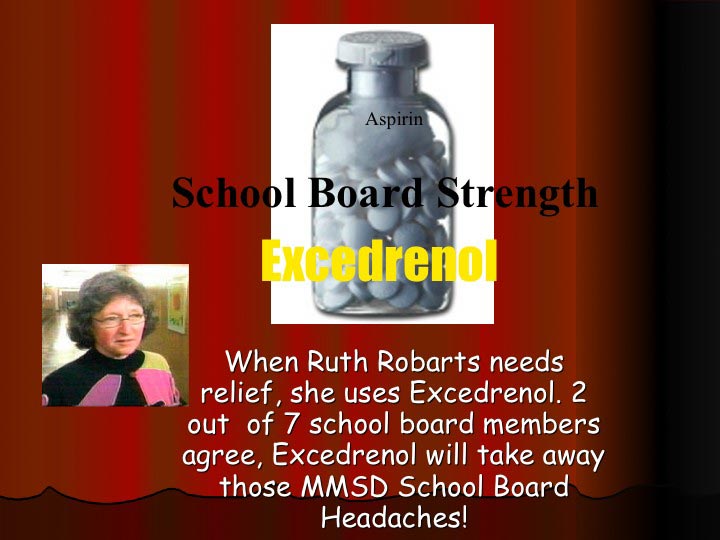
Ruth Robarts wonders what the future is for advertising & the Madison Schools. Reader Troy Dassler, seeing an opportunity, quickly created a mockup for Ruth. Click on the image above for more "details" :)
Newsletter signup | Send us your ideas
HOW LAPHAM ELEMENTARY ACHIEVED SUCCESS BY BUCKING THE DISTRICT'S FAVORED APPROACH
By Katherine Esposito
"At Marquette Elementary, Lapham’s 3rd through 5th grade sister school, skillful use of Direct Instruction has resulted in reading scores for Marquette third-graders that are virtually unsurpassed district-wide. Scores for black students particularly stand out.
In 1998, just 9% of Marquette black third graders were considered “advanced” readers, as measured on the third-grade state reading comprehension test; by 2003, 38% were “advanced.” District-wide, only 9% of black children scored as “advanced” in 2003."
Read the full article here.
Newsletter signup | Send us your ideas
Johnny Winston Jr., chair of the Finance and Operations Committee of the Madison School Board, kicked off a new discussion of the possible role of business ads to raise money for our schools at the June 13 meeting of his committee. Committee member Lawrie Kobza asked the administration to bring back information about what other districts are doing beyond the advertisements in yearbooks, school newspapers and the like. Good ideas, both.
However, why stop there? Maybe there are products looking for School Board member endorsements.
Maybe our reputation for long, contentious meetings could help us turn a profit for kids.
Imagine the ads.
Close-up of tired School Board member (me).
Voice over: You know Ruth Robarts as a voice for dissenting views on the Madison School Board. But do you know what she does about Monday night headaches?
Me: Ever get headaches at meetings where everybody says the same thing? Even you? Nobody listens to you? When you're ready to go home, they start up another PowerPoint presentation and hand out the spreadsheets?
Me, too, but I found a solution---School Board Strength Excedrenol. If it works for me, it will work for your Monday night headaches.
Fade to picture of product.
Newsletter signup | Send us your ideas
Madison School Board Vice President Johnny Winston, Jr. held a Finance & Operations Committee meeting this evening. Winston discussed and sought feedback on new methods that the Board and District might use to interact with the public. Notes and links are available on the Finance & Operations Committee Blog.
Newsletter signup | Send us your ideas
The Madison School District has a useful summary of current and completed grants. The page includes the type of grant, amount and Project Director.
Newsletter signup | Send us your ideas
I put the vote totals on the Leopold referendum for a few wards into an
Exel file. Here's what the numbers show:
Yes
68.2% Eastside (Tenny-Lapham neighborhood, Marquette, Lowell)
48.2% Leopold area (Wards 67,68,69, 84, 85, 86)
30.4% Northeast side (North Sherman Avenue area)
49.3% Fitchburg
Please check my figures with the official tally. I want to be certain the numbers are correct.
I'd also like to break down the vote by high school attendance area, but that will take a little time. Anyone else willing to do it?
Colin Benedict also explained the voting trends on Channel 3 on "election night."
Newsletter signup | Send us your ideas
Suzy Grindrod writes that Madison school bureaucrats' decisions are short-sighted and are Stringing the kids along
So they make the arts unworkable in early elementary school, they gut the incredibly successful elementary strings program, they remove band and orchestra from core curriculum in middle school ... and then they are going to complain that there is no diversity in the high school bands and orchestras and -- CHOP.
There is something fundamentally wrong with what is happening in Wisconsin’s Capitol city -- a community that just built a $200 million arts district downtown, as these short-sighted and creatively stunted bureaucrats make it unlikely that many Madison kids will end up on Overture's stage in the future unless they have the money to buy private lessons.
Can Madison turn this disgraceful situation around before the existing cost-effective MMSD music education curriculum implodes and vanishes from public school and performance music education is only for those who can pay?
Stringing kids along By Suzy Grindrod I recently attended the Madison East High School orchestra concert, where there was a lovely slide show of the graduating seniors. I recognized a number of them from my tenure at Hawthorne Elementary (which at one time was a magnet school for the fine arts, although Madison Metropolitan School District revisionist history now denies that) – I knew those kids from kindergarten on.Many of those kids got their musical start in 4th grade strings, if not before. There are numerous CDs in my collection by professional musicians who are graduates of Madison schools. These are not just local musicians, but people who are known nationally and internationally.
Music (and all fine arts education, not to mention foreign language) is in trouble in Madison. The reduction in the Strings program has been well publicized. In the wake of the failed May 24 referenda it seems like a done deal that elementary "specials" teacher allocations are being cut and classes will be doubling up for art, music, and PE.
The latest is the plan to remove band and orchestra from the core curriculum at Sherman Middle School, making them optional and "exploratory" two days a week AFTER SCHOOL HOURS. This flies in the face of so much it is hard to know where to begin. It violates No Child Left Behind which identifies fine arts as part of a core curriculum. It violates DPI standards which mandate a specified amount of fine arts education in middle school. It belies the stated MMSD "framework" of engagement, relationships, and learning. It ignores reams of research that show the correlation between arts education and academic achievement. It assumes that parents of Sherman middle schoolers want an extended day for their child. It seems like it will violate the contracts of the band and orchestra teachers, and certainly sends them the message that what they teach is not important, that they are essentially glorified babysitters.
It is also inequitable -- other middle schools get music as part of their core curriculum and after school clubs. Sherman gets this. But wait ... if this program is "successful" (but there are no published criteria for what "success" would look like) the year after next it will be forced down the throats of -- no, no, I mean MANDATED in -- ALL Madison middle schools. And then, maybe, all the schools in the state will be taking advantage of this money-saving maneuver.
So they make the arts unworkable in early elementary school, they gut the incredibly successful elementary strings program, they remove band and orchestra from core curriculum in middle school ... and then they are going to complain that there is no diversity in the high school bands and orchestras and -- CHOP.
There is something fundamentally wrong with what is happening in Wisconsin’s Capitol city -- a community that just built a $200 million arts district downtown, as these short-sighted and creatively stunted bureaucrats make it unlikely that many Madison kids will end up on Overture's stage in the future unless they have the money to buy private lessons.
Doug Erickson, WI State Journal reporter, writes about Nuesstro Mundo, MMSD's bi-lingual charter school - Two-language school is seen as muy bueno
Alan Borsuk & Sarah Carr visit many Milwaukee voucher schools. Here's their story.
Newsletter signup | Send us your ideas
Wisconsin State Journal Editorial Page (this link will go away soon as the WSJ takes them down...):
State lawmakers once again faced a tough job with few easy answers when Gov. Jim Doyle handed them his state budget request four months ago.Credit the Legislature's Joint Finance Committee for resisting a borrowing binge and for slapping Doyle's hand when he reached for pots of money he shouldn't touch.
The committee, led by Rep. Dean Kaufert, R-Neenah, and Sen. Scott Fitzgerald, R- Juneau, reversed about half of Doyle's raid of highway dollars and stopped him from looting an account that pays for medical malpractice claims. Money for those programs comes from fees and taxes that users pay with the understanding those dollars won't be diverted.
The committee also stopped Doyle from borrowing money based on the future collection of excise taxes. Instead, the committee paid for medical care for the poor, elderly and disabled with real dollars.
That's the good part, along with the committee's empathy for the beleaguered property taxpayer.
But let's remember how the state's finances got screwed up to begin with. State leaders patched gaping holes in past budgets using one-time money that's now gone. They also backloaded past budgets to push higher costs - both for expensive new programs and tax cuts - into the future.
Newsletter signup | Send us your ideas
The Cap Times published two articles today on East High:
Newsletter signup | Send us your ideas
Rock Springs, WY Teacher Jennifer Wilmetti writes:
While the intent of the No Child Left Behind Act was praiseworthy, the means put in place to achieve the goals are flawed in several ways.
Newsletter signup | Send us your ideas
Madison Teachers, Inc., the Madison teachers' union, has recently ratified its collective bargaining agreement with the Madison school district for 2005-06 and 2006-07. Later this month, the Board of Education will have its chance to ratify the agreement, although the board gave preliminary assent on June 6.
On June 10, Isthmus writer Jason Shepard provided an excellent analysis of the ways that providing Wisconsin Physicians Service (WPS) to the teachers drives up the cost of each contract. The article also questions the relative quality of the WPS coverage. See "District ties to WPS prove costly", available at many locations in Dane County.
The following graphs, based on data from MMSD, illustrate the impact of high cost WPS coverage on the cost of the two-year contract and the extent to which access to WPS coverage for roughly half of the teachers receiving health insurance through MMSD erodes wage gains.
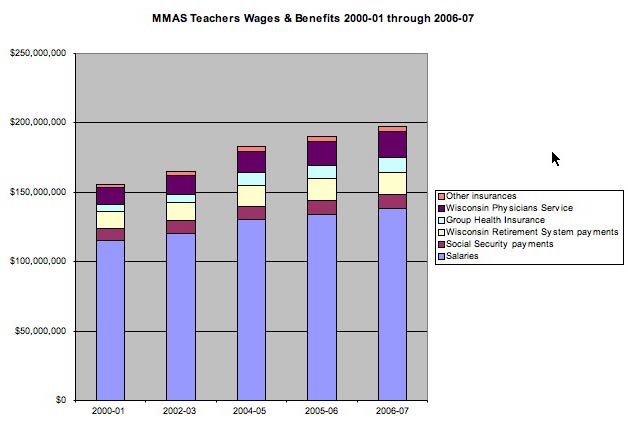
Graph 1 shows that the cost of the total package (wages and benefits) for Madison teachers has increased 27 percent from $155.9 M in 2000-01 to $197.7 M for 2006-07. In the same years, the cost of WPS has increased 31 percent from $12.2 M to $16 M. 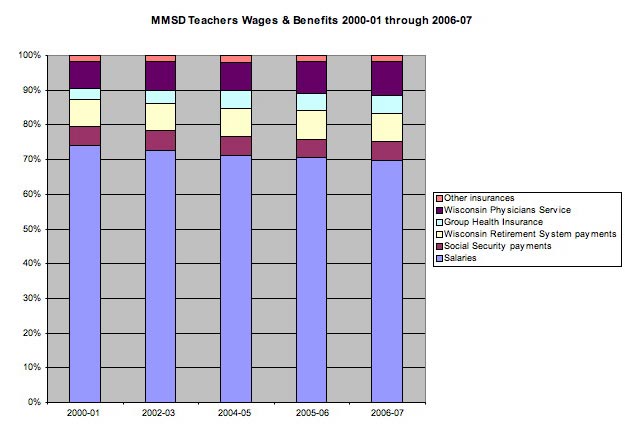
Graph 2 demonstrates the impact of the cost of fringe benefits, including WPS, on teacher wages. Between 2000-01 and 2006-07, wages as a percentage of total compensation drop from 74% to 70 percent.
Clearly, the Board of Education must pursue similar health insurance coverage at lower costs for its teachers and other MTI-represented employees. There are millions of dollars at stake and every dollar not saved is another unnecessary staff or program cut. Unfortunately, the contract for 2005-07 continues WPS for the teachers. If the parties agree to make a shift away from WPS during the term of the agreement--a possibility that could come from the new joint task force on health insurance--the savings will go to the wage scale, rather than to reinstating positions and restoring programs, unless MTI agrees to give the savings back to the district. What seems likely as the result of a shift from WPS is a multi-million dollar windfall for teachers in the form of higher wages. Higher wages, of course, drive other costs up, such as Wisconsin Retirement System and Social Security payments. In turn, higher wages going into the 2007-09 contract will force more teacher reductions.
Newsletter signup | Send us your ideas
Patrick Marley, Steve Walters and Stacy Forster:
The Legislature's Joint Finance Committee adopted a budget early today that tightly limits property taxes, cuts the gas tax by a penny and phases out taxes on Social Security benefits.Governor Doyle referred to this as a "cut", while, in fact, state aid to local schools will evidently continue to go up - more than twice as much as the current budget. It would be great if the politicians would be truthful... on both sides.The budget includes $458 million more for schools, less than half what Democratic Gov. Jim Doyle proposed in his version of the budget. The state is spending about $5.3 billion on schools this year.
The Republican-controlled committee passed the budget on an 11-5 vote at 6:15 a.m., after all-night deliberations. Sen. Robert Cowles (R-Green Bay) joined the four Democrats on the committee in voting against the budget, which he said included too much spending and borrowing.
Republicans said schools would flourish under their spending plan, and warned Doyle not to veto their school budget or their property tax limits. If Doyle did so, schools could raise much more cash, but it would come from local property taxes instead of state income and sales taxes.
UPDATE: Phil Brinkman adds more details: evidently the Republicans (read this carefully) reduced the allowed increase in per pupil spending from $248 in 2005/2006 and $252 in 2006/2007 to 120 and 100. So, if I read all this correctly, spending continues to grow, just at a lower rate. The Republicans claim that the 248 and 258 increase from the current per pupil spending amounts would lead to large local property tax jumps over the next two years.
UPDATE2: More from JR Ross. Via Wispolitics. Ross points out a great example of the doubletalk: the Republicans bill cuts the gas tax by .01 BUT, the tax is indexed to inflation so it actually increases annually anyway.
UPDATE3: Here's the Bill AB100
Newsletter signup | Send us your ideas
Lisa Snell, writing in Reason Magazine:
But while federal and state legislators congratulate themselves for their newfound focus on school accountability, scant attention is being paid to the quality of the data they’re using. Whether the topic is violence, test scores, or dropout rates, school officials have found myriad methods to paint a prettier picture of their performance. These distortions hide the extent of schools’ failures, deceive taxpayers about what our ever-increasing education budgets are buying, and keep kids locked in failing institutions. Meanwhile, Washington—which has set national standards requiring 100 percent of school children to reach proficiency in math and reading by 2014—has been complicit in letting states avoid sanctions by fiddling with their definitions of proficiency.The federal government is spending billions to improve student achievement while simultaneously granting states license to game the system. As a result, schools have learned to lie with statistics.
Newsletter signup | Send us your ideas
The agenda of the Finance and Operations committee meeting for Monday, June 13 contains these items:
4. Communication to the Public about the Proposed 2005-06 Budget
6. Nontraditional Communication Strategies to Speak to Community Stakeholders.
Mark Twain once remarked: "The difference between the right word and the almost right word is the difference between lightening and the lightening bug."
For me, "communication to" and "speak to" is vastly different than "communication with" and "speak with" -- like the difference between "lightening" and "lightening bug".
I can hear the failed referenda supporters and the supporting press editorials: Just needed a little better PR.
"With" has this strong flavor of team work, working together, listening: dialog!. "To?" Well, that has been the legacy of the Administration and Board.
But, no, folks. "With" is not a four-letter word. It needs to be used, again and again, until it becomes part of the Administration's and Board's culture.
Newsletter signup | Send us your ideas
A reader forwarded this article: Jay Mathews, writing in the Washington Post:
So when I found a new attack on the National Council of Teachers of Mathematics (NCTM), the nation's leading association for math teachers, by a group of smart advocates, I saw a chance to bring some clarity to what we call the Math Wars. For several years, loosely allied groups of activist teachers and parents with math backgrounds have argued that we are teaching math all wrong. We should make sure that children know their math facts -- can multiply quickly in their heads and do long division without calculators, among other things -- or algebra is going to kill them, they say. They blame the NCTM, based in Reston, Va., for encouraging loose teaching that leaves students to try to discover principles themselves and relies too much on calculators.
10 Myths (Maybe) About Learning MathBy Jay Mathews
I love debates, as frequent readers of this column know. I learn the most when I am listening to two well-informed advocates of opposite positions going at each other.
I have held several debates here, although not all of them have worked because the debaters lose focus. One will make a telling point, and the other, instead of responding, will slide off into a digression.
So when I found a new attack on the National Council of Teachers of Mathematics (NCTM), the nation's leading association for math teachers, by a group of smart advocates, I saw a chance to bring some clarity to what we call the Math Wars. For several years, loosely allied groups of activist teachers and parents with math backgrounds have argued that we are teaching math all wrong. We should make sure that children know their math facts -- can multiply quickly in their heads and do long division without calculators, among other things -- or algebra is going to kill them, they say. They blame the NCTM, based in Reston, Va., for encouraging loose teaching that leaves students to try to discover principles themselves and relies too much on calculators.
The NCTM people, on the other hand, said this was a gross misstatement of what they were doing.
The advocates call their new assault "Ten Myths About Math Education and Why You Shouldn't Believe Them." I took the myths, and their explanation of each, and asked the NCTM to respond to each one. Here is the result. There are some quotes that are not attributed, but are found in sources cited on the myth Web page, and some technical language, but I think this provides a good quick review of what this raging argument is all about.
Feel free to send your comments to one of the people who came up with the list of 10, Elizabeth Carson at nycmathforum@yahoo.com or to the NCTM at president@nctm.org. The NCTM Web site is http://www.nctm.org/about/position_statements/, and the names of the dissident group are on the myth Web page.
Myth #1 -- Only what students discover for themselves is truly learned.
Advocates: Students learn in a variety of ways. Basing most learning on student discovery is time-consuming, does not insure that students end up learning the right concepts, and can delay or prevent progression to the next level. Successful programs use discovery for only a few very carefully selected topics, never all topics.
NCTM: NCTM has never advocated discovery learning as an exclusive or even primary method of instruction. In fact, we agree that students do learn in a variety of ways, and effective learning depends on a variety of strategies at appropriate times. The goal is not just to know math facts and procedures but also to be able to think, reason and apply mathematics. Students must build their skills on a strong foundation of understanding.
Myth #2 -- Children develop a deeper understanding of mathematics and a greater sense of ownership when they are expected to invent and use their own methods for performing the basic arithmetical operations, rather than being taught the standard arithmetic algorithms and their rationale, and given practice in using them.
Advocates: Children who do not master the standard algorithms begin to have problems as early as algebra I.
The snubbing or outright omission of the long division algorithm by NCTM- based curricula can be singularly responsible for the mathematical demise of its students. Long division is a pre-skill that all students must master to automaticity for algebra (polynomial long division), pre-calculus (finding roots and asymptotes), and calculus (e.g., integration of rational functions and Laplace transforms.) Its demand for estimation and computation skills during the procedure develops number sense and facility with the decimal system of notation as no other single arithmetic operation affords.
NCTM: NCTM has never advocated abandoning the use of standard algorithms. The notion that NCTM omits long division is nonsense. NCTM believes strongly that all students must become proficient with computation (adding, subtracting, multiplying, and dividing), using efficient and accurate methods.
Regardless of the particular method used, students must be able to explain their method, understand that other methods may exist, and see the usefulness of algorithms that are efficient and accurate. This is a foundational skill for algebra and higher math.
MYTH #3 -- There are two separate and distinct ways to teach mathematics. The NCTM backed approach deepens conceptual understanding through a problem solving approach. The other teaches only arithmetic skills through drill and kill. Children don't need to spend long hours practicing and reviewing basic arithmetical operations. It's the concept that's important.
Advocates: "The starting point for the development of children's creativity and skills should be established concepts and algorithms. ..... Success in mathematics needs to be grounded in well-learned algorithms as well as understanding of the concepts."
What is taught in math is the most critical component of teaching math. How math is taught is important as well, but is dictated by the "what." Much of understanding comes from mastery of basic skills -- an approach backed by most professors of mathematics. It succeeds through systematically empowering children with the pre-skills they need to succeed in all areas of mathematics. The myth of conceptual understanding versus skills is essentially a false choice -- a bogus dichotomy. The NCTM standards suggested "less emphasis" on topics needed for higher math, such as many basic skills of arithmetic and algebra.
"That students will only remember what they have extensively practiced -- and that they will only remember for the long term that which they have practiced in a sustained way over many years -- are realities that can't be bypassed."
NCTM: Math teaching does not fall into two extremes. There are several ways to teach effectively. Even a single teacher isn't likely to use the same method every day. Good teachers blend the best methods to help students develop a solid understanding of mathematics and proficiency with mathematical procedures.
It's worth noting that standard algorithms are not standard throughout the world. What is most important is that an algorithm works and that the student understands the math underlying why it works.
Every day teachers make decisions that shape the nature of the instructional tasks selected for students to learn, the questions asked, how long teachers wait for a response, how and how much encouragement is provided, the quality and level of practice needed -- in short, all the elements that together become the opportunities students have to learn. There is no one-size-fits-all model.
Myth #4 -- The math programs based on NCTM standards are better for children with learning disabilities than other approaches.
Advocates: "Educators must resist the temptation to adopt the latest math movement, reform, or fad when data-based support is lacking. ....."
Large-scale data from California and foreign countries show that children with learning disabilities do much better in more structured learning environments.
NCTM: Most of the math programs published in this country claim to be based on the NCTM Standards. More important than the materials we use is how we teach. Students, all students, are entitled to instruction that involves important mathematics and challenges them to think.
Myth #5 -- Urban teachers like using math programs based on NCTM standards.
Advocates: Mere mention of [TERC, a program emphasizing hands-on teaching of math that this group doesn't believe demands enough paper and pencil work] was enough to bring a collective groan from more than 100 Boston Teacher Union representatives. ..... "
NCTM: Curricular improvement is hard, takes a lot of work, and demands support -- for the teacher, for students, and for parents. It should be noted that Boston students using the TERC-developed curriculum seem to be thriving. The percentage of failing students on the Massachusetts state assessment decreased from 46 to 30 percent and students scoring at the Proficient and Advanced categories increased from 14 to 22 percent between 2000-2004 (Boston Globe, December 14, 2004).
Myth #6 -- "Calculator use has been shown to enhance cognitive gains in areas that include number sense, conceptual development, and visualization. Such gains can empower and motivate all teachers and students to engage in richer problem-solving activities." (NCTM Position Statement)
Advocates: Children in almost all of the highest scoring countries in the Third International Mathematics and Science Survey (TIMMS) do not use calculators as part of mathematics instruction before grade 6.
A study of calculator usage among calculus students at Johns Hopkins University found a strong correlation between calculator usage in earlier grades and poorer performance in calculus.
NCTM: The TIMSS 1999 study of videotaped lessons of eighth-grade mathematics teachers revealed that U.S. classrooms used calculators significantly less often than the Netherlands (a higher achieving country) and not significantly differently from four of the five other higher-achieving countries in the analysis. When calculators are used well in the classroom, they can enhance students' understanding without limiting skill development. Technology (calculator or computer) should never be a replacement for basic understanding and development of proficiency, including skills like the basic multiplication facts.
Myth #7-- The reason other countries do better on international math tests like TIMSS and PISA is that those countries select test takers only from a group of the top performers.
Advocates: On NPR's "Talk of the Nation" program on education in the United States (Feb. 15, 2005), Grover Whitehurst, director of the Institute of Education Sciences at the Department of Education, stated that test takers are selected randomly in all countries and not selected from the top performers.
NCTM: This is a myth. We know that students from other countries are doing better than many U.S. students, but certainly not all U.S. students. One reason U.S. students have not done well is that the way we have taught math just doesn't work well for enough of our students, and we have the responsibility to teach them all.
Myth #8 -- Math concepts are best understood and mastered when presented "in context"; in that way, the underlying math concept will follow automatically.
Advocates: Applications are important and story problems make good motivators, but understanding should come from building the math for universal application. When story problems take center stage, the math it leads to is often not practiced or applied widely enough for students to learn how to apply the concept to other problems.
"[S]olutions of problems ..... need to be rounded off with a mathematical discussion of the underlying mathematics. If new tools are fashioned to solve a problem, then these tools have to be put in the proper mathematical perspective. ..... Otherwise the curriculum lacks mathematical cohesion.
NCTM: For generations, mathematics was taught as an isolated topic with its own categories of word problems. It didn't work. Adults groan when they hear "If a train leaves Boston at 2 o'clock traveling at 80 mph, and at the same time a train leaves New York ..... " Whatever problems and contexts are used, they need to engage students and be relevant to today's demanding and rapidly changing world.
An effective program lets students see where math is used and helps students learn by providing them a chance to struggle with challenging problems. The teacher's most important job in this setting is to guide student work through carefully designed questions and to help students make explicit connections between the problems they solve and the mathematics they are learning.
Myth #9 -- NCTM math reform reflects the programs and practices in higher performing nations.
Advocates: A recent study commissioned by the U.S. Department of Education, comparing Singapore's math program and texts with U.S. math texts, found that Singapore's approach is distinctly different from NCTM math "reforms."
Also, a paper that reviews videotaped math classes in Japan shows that there is teacher-guided instruction (including a wide variety of hints and helps from teachers while students are working on or presenting solutions).
NCTM: The study commissioned by the U.S. Department of Education comparing Singapore's mathematics program and texts with U.S. math texts also found that the U.S. program "gives greater emphasis than Singapore's to developing important 21st-century mathematical skills such as representation, reasoning, making connections, and communication. The U.S. frameworks and textbooks also place greater emphasis on applied mathematics, including statistics and probability."
NCTM's standards call for doing more challenging mathematics problems, as do programs in Singapore, Japan and elsewhere, but they also recognize the needs of 21st-century learners.
Myth #10 -- Research shows NCTM programs are effective.
Advocates: There is no conclusive evidence of the efficacy of any math instructional program.
Increases in test scores may reflect increased tutoring, enrollment in learning centers, or teachers who supplement with texts and other materials of their own choosing. Also, much of the "research" touted by some of the NSF programs has been conducted by the same companies selling the programs. State exams are increasingly being revised to address state math standards that reflect NCTM guidelines rather than the content recommended by mathematicians.
NCTM: True, there is no compelling evidence that any curriculum is effective in every setting, nor are there data to show exactly what causes improvement in student learning when many factors are involved. There is evidence that some of the more recently developed curricula are effective in some settings. However, the effectiveness with which a program, any program, is implemented is critical to its success, as are teacher quality, ongoing professional development, continuing administrative support, and the commitment of resources. Again, the issue of effectiveness is more likely to be attributable to instruction than to any specific curriculum.
Contrary to what is stated in some of these myths, there is no such thing as an "NCTM program." NCTM does not endorse or make recommendations for any programs, curricula, textbooks, or instructional materials. NCTM supports local communities using Principles and Standards for School Mathematics as a focal point in the dialogue to create a curriculum that meets their needs.
Newsletter signup | Send us your ideas
School-funding update
JFC budget for public schools even worse than expected
Contact your legislators about anti-public education budget
Opportunities to fight against Finance Committee's budget
Help WAES spread the school-finance reform message
School-funding reform calendar
The Wisconsin Alliance for Excellent Schools (WAES) is a statewide network of educators, school board members, parents, community leaders, and researchers. Its Wisconsin Adequacy Plan -- a proposal for school-finance reform -- is the result of research into the cost of educating children to meet state proficiency standards.
************
JFC budget for public schools even worse than expected
Just when public school advocates thought funding problems couldn't get any worse, the Wisconsin Legislature's Joint Finance Committee (JFC) proved them wrong.
Early Friday, the panel adopted motions that not only reduced the Governor's public school budget by over $300 million, but also slashed the public school revenues local school boards anticipated in their budgets for the 2005-06 school year. In addition, the committee drastically reduced Governor Jim Doyle's categorical aid package.
One Republican member of the committee, Sen. Robert Cowles of Green Bay, broke ranks and joined four Democrats (Sens. Russ Decker, Schofield, and Lena Taylor, Milwaukee, and Reps. Pedro Colon, Milwaukee, and Mark Pocan, Madison ) to vote against the omnibus motion that contained general school aid and revenue limits. And, although he voted "yes," Wisconsin Public Radio reported this morning that Sen. Luther Olsen, Republican from Berlin, said there wasn't enough money in the budget.
Voting in favor of the JFC budget that reduces anticipated school funding were (all Republicans) Sens. Scott Fitzgerald of , Mary Lazich of , Alberta Darling of , Robert Cowles of , Joe Leibham of , and Olsen; and Reps. Dean Kaufert of Neenah, David Ward of Fort Atkinson, Jeff Stone of Greendale, Scott Jensen of Waukesha, Kitty Rhoades of Hudson, and Dan Meyer of Eagle River.
Gov. Doyle characterized the JFC action saying, "Not only will the Republican budget cause the largest education cut in decades, but it also sets taxpayers up for a huge property tax increase. Republicans know there is no way schools can handle this kind of cut, and the only option will be a massive increase in property taxes."
Gov. Doyle referred to the particulars of the motion that:
Increases general school aids by 4.3 percent ($462 million over the two years of the budget as compared to the Governor's request for $940), an amount the Wisconsin State Journal said "school officials say (is) far less than they need, even to cover current obligations (http://www.madison.com/wsj/home/local/index.php?ntid=43021&ntpid=2
The same motion also reduces the per-student increase allowable under revenue limits, stopping local school boards from making up lost state aid from property taxes (except through referenda). Current law -- and the per-student increase -- used to set school budgets for next year is $248 per-student, per-year. The JFC plan slashes that to $120 per-student in the first year of the biennium and $100 in the second ... a two-year total that is less than one-half of the one-year levy limit increase under current law.
The next stop for the Joint Finance Committee's version of the budget -- and the next place for public school advocates to get involved (see below) -- is the Assembly, where Speaker John Gard, Republican from Peshtigo, said lawmakers will take it up on June 22 and deliver it to the Governor by July 1. Following action in the Assembly, the Senate gets a shot at the budget, then the Governor (for possible vetoes), and then final approval by the Legislature (veto override session if necessary.
Gov. Doyle has promised to "use every power at (his) disposal to make sure that we get a budget that is fair to both property taxpayers and our schools," including vetoing the entire document.
For more budget coverage see wispolitics.com's JFC blog at http://blogs.wispolitics.com/budget.html
***********
Contact your legislators about anti-public education budget
Although the Joint Finance Committee has approved a budget that further restricts revenues to public schools that have struggled under caps for over a decade, we still have a chance to get involved.
First, you need to contact members of the Joint Finance Committee who voted for the budget -- if they represent you -- and explain to them your displeasure. It is time they are held accountable for the harm they are doing to our schools. If you don't know who represents you (Senators and Representatives), go to http://165.189.139.210/WAML/ (complete with contact information) and find out. Then, check the website of JFC (http://www.legis.state.wi.us/lfb/jfc/jfcmembership.html) to see if they are on the panel. If so, call, write, or e-mail them (just click on the link) about what their action means to your schools and your children.
Second, you need to contact your Assembly representatives (http://165.189.139.210/WAML/) -- the next stop for the budget -- whether or not they are Republicans or Democrats and whether or not they are on Joint Finance. You need tell them that you expect them to change the JFC budget because it hurts public education in Wisconsin. And, most importantly, you need to tell them you will be watching how they vote.
***********
Opportunities to fight against Finance Committee's budget
Although the only real end to the annual ritual of public education budget cuts is complete reform of the school funding system, we should take every opportunity to point out how bad the budget approved early Friday by the Joint Finance Committee really is. Here are three opportunities to get involved:
Wisconsin Education Association Council (WEAC) members will be in Madison on Thursday, June 16, for their annual lobby day.You can get details off of their website at http://www.weac.org.
The Wisconsin Council on Children and Families (WCCF) is sponsoring a "Support Wisconsin Values" rally and lobby day on Tuesday, June 21. Details will appear on the group's website at http://www.wccf.org or you can contact Linda Kleinschmidt, WCCF government relations manager, at lkeinschmidt@wccf.org or 608-284-0580 (extension 306).
Budget cuts could lead to to the closing of many of the schools in Milwaukee Public Schools (MPS). The MPS board has decided to ask the public for input on criteria for those closings. It would also be an excellent time to register disgust with the JFC budget and its impact on children. Hearings -- all from 5:30 to 7:30 p.m. -- will be held June 20 at the High School of the Arts and at Bay View; June 21 at Rufus King High School; June 22 at John Marshall and Riverside University high schools; June 23 at Vincent and Pulaski high schools; June 27 at Washington and Custer high schools.
*************
Help WAES spread the school-finance reform message
Still, the only way to solve the state's school funding problems is to change the way we finance our public schools. That's the message we need to spread all over the state.
First of all, you can sign up for a school-funding reform presentation. An outreach specialist will work with you to plan an event and then show up to be part of the presentation. You can see the present schedule at the bottom of this e-mail update. We have reached hundreds of people this way ... many who are now partners in the coalition.
For those who aren't sure when, where, or how they will have a presentation ... but still want to educate themselves and members of the community ... "Adequacy To Go" is for you. The package contains a CD -- complete with a school-funding reform PowerPoint presentation -- and supporting documentation and material.
You can order both by going to http://www.excellentschools.org/calendar/SchoolFundingWorkshop.htm and making the appropriate selection.
************
School-funding reform calendar
June 7 -- Jack Norman, IWF and WAES research director, will be part of "A Closer Look at the June 21 Referendum" to be held at Memorial Hall, 72 7th Street, in Racine, beginning at 7 p.m.
June 21 -- School-funding reform presentation for the Racine Retired Educators' Association, 11:30 a.m., at the Roma Lodge, 7130 Spring Street in Racine
June 23 -- Multi-district school-funding reform presentation, from 7 to 9 p.m., in the auditorium at Three Lakes High School
Oct. 13-14 -- School-funding reform presentations for the Northwestern Wisconsin Education Association at Eau Claire Memorial High School, 2225 Keith Street (presentations at 12:25 p.m. on Oct. 13 and 8:30 a.m. on Oct. 14)
Please feel free to share your copy of the WAES school-funding update with anyone interested in school-finance reform. Contact Tom Beebe (tbeebe@wisconsinsfuture.org) at 414-384-9094 for details.
--
Tom Beebe, Outreach Specialist
Institute for Wisconsin’s Future
1717 South 12th Street
Milwaukee, WI 53204
414-384-9094 (office)
920-650-0525 (cell)
tbeebe@wisconsinsfuture.org
http://www.excellentschools.org
http://www.wisconsinsfuture.org
UW's Dick Askey emailed links to two of his papers on Elementary Math Curriculum:
While there was a need to do something to improve school mathematics education, NCTM did not face up to the most critical problem, the lack of firm content knowledge of far too many teachers. There were other lacks in their program. NCTM did not look seriously at mathematics education in other countries. Mathematicians were not involved in the development of the Standards. The NCTM authors of their Standards had the strange notion that it is possible to teach conceptual understanding without developing technical skill at the same time. Instances of all of these failures and what came from them will be given below.
Elementary school mathematics, it turns out, is not so elementary. This means that teaching it well requires much deeper mathematical knowledge than almost everyone has thought. There will be no math reform unless we provide teachers with the training, textbooks, time, and support needed to develop this knowledge.
Newsletter signup | Send us your ideas
The NYTimes' Tom Friedman has a nice piece on the importance of good teachers in our children's education. As the mother of a graduating senior, I wish there was space here to list the terrific teachers (as well as TAG and guidance staff) both our children had while attending Franklin/Randall, Wingra, Hamilton and West. Our deepest gratitude to those who helped our kids love to learn.
http://www.nytimes.com/2005/06/10/opinion/10friedman.html
"We are heading into an age in which jobs are likely to be invented and made obsolete faster and faster. The chances of today's college kids working in the same jobs for the same companies for their whole careers are about zero. In such an age, the greatest survival skill you can have is the ability to learn how to learn. The best way to learn how to learn is to love to learn, and the best way to love to learn is to have great teachers who inspire."
Why is the MMSD annexing more students on the West side when there's such a concern about space? What attendance areas include the annexed land? I wonder too about the fiscal impact of adding more students. Will more students lead to more program cuts, so that the additions really become a fiscal drain rather than a fiscal benefit?
I'm not trying to be difficult, I'm genuinely asking why adding students is a good idea. It may be a perfectly good approach, but it just seems odd given the controversy about West side enrollment and overcrowding.
I've actually been wondering whether the MMSD shouldn't give up some kids to other school districts on the West side. In particular, I wonder about the penninsula that feeds into Leopold. Or by contrast, annexing the land and kids who lie between the penninsula and Chavez and building an elementary school in that annexed territory to relieve the overcrowding at Leopold.
I'm not advocating anything, so don't "bust my chops." I'm just thinking out loud.
Newsletter signup | Send us your ideas
Have you ever seen the television show, “Kids Say the Darndest Things” hosted by Bill Cosby? Since becoming elected to the Madison school board, I have had students say all kinds of the “darndest” things to me. Here are a few examples…
During my school board campaign last year, I visited Randall Elementary School and talked with a 5th grade class. One of the students asked, “Who’s place are you taking on the board?” I replied, “I’m running for the seat number 4, that Ray Allen has.” Another student replied, “I really liked Ray Allen, too bad the Bucks traded him.” The student was referring to the former Milwaukee Bucks basketball star (and movie star in Spike Lee’s “He Got Game”) that was traded to the Seattle Supersonics. Who says that students know their elected officials?
A few weeks ago, I was invited to walk several blocks with students at a Sherman Middle School. This school wide program helped to promote good diet and exercise. After returning to the school a student asked me, “Are you Art Rainwater?” I replied, “No, I’m not Art Rainwater, he’s far better looking than me!”
On Monday night, a student spoke during public appearances and testified about the importance of fine arts to the district. After his speech I was totally caught off guard when he stated to the full auditorium that I had come to his classroom during my campaign and said regarding saving the fine arts, “I would take care of it.” While I don’t remember that specific conversation, I was caught so off guard that for one of the few times since being elected to the school board, I was speechless!
Finally, I received the brutal honesty and truth about being an elected official. On Tuesday afternoon, I made an unannounced visit to the Open Classroom program at Lincoln Elementary. I was given a tour of the classrooms and met many wonderful students, teachers, staff and parents. I was even given a rap performance by some of the children about the importance of the Open Classroom. As I prepared to leave, one kindergartener rushed out to the hallway to see me. He yelled, “If I have to go to a different school next year, you better get a new job!”
Out of the mouths of babes…
Newsletter signup | Send us your ideas
Little did I know when I published an article in 1955 on "The Role of Government in Education" that it would lead to my becoming an activist for a major reform in the organization of schooling, and indeed that my wife and I would be led to establish a foundation to promote parental choice. The original article was not a reaction to a perceived deficiency in schooling. The quality of schooling in the United States then was far better than it is now, and both my wife and I were satisfied with the public schools we had attended. My interest was in the philosophy of a free society. Education was the area that I happened to write on early. I then went on to consider other areas as well. The end result was "Capitalism and Freedom," published seven years later with the education article as one chapter.
Newsletter signup | Send us your ideas
" Children can't achieve unless we raise their expectations and turn off the television sets and eradicate the slander that says a black youth with a book is acting white."-- Barack Obama, keynote speech, 2004 Democratic National ConventionIt may be even worse than Obama imagined: It's not just black children who face ridicule and ostracism by their peers if they do well in school. The stigmatizing effects of "acting white" appear to be felt even more by Hispanics who get top grades.
Newsletter signup | Send us your ideas
Jason Shephard emailed a copy of his article on Madison Schools' Healthcare costs. This article first appeared in the June 10, 2005 issue of Isthmus. The Isthmus version includes several rather useful charts & graphs that illustrate how the Madison School District's health care costs compare with the City and County. Pick it up.
K.J. Jakobson voted “yes, yes, yes” on the recent Madison school referendums but promised herself after the vote to look into whether the district is paying too much for its employees’ health insurance. What she’s found has led her to agree with district critics.
“Here’s an issue that could potentially, at least for this year, solve the entire budget problem,” says Jakobson, a former business administrator who this week sent the school board a memo on the issue. “Personally, I feel the district is being negligent in not providing alternatives.”
For years, questions have been raised about the Madison district’s health insurance costs, and especially its relationship with Wisconsin Physicians Service, the provider specified in the teachers’ contract. WPS has regularly been lauded by John Matthews, executive director of Madison Teachers Inc. and a paid member of WPS’s board of directors.
Health insurance coverage for the district’s roughly 5,000 employees now costs $37 million a year. That’s more than 10% of the district’s total budget of $317 for 2004-2005. The expense is facing growing scrutiny at a time when the school board is slashing education programs and laying off teachers.
On Tuesday, the district and MTI announced a new two-year contract with $14.7 million in new spending for teacher raises. The roughly 4% salary and benefits hike in each of the next two years will go largely toward rising health-care costs. The wage scale will increase just 0.75% in the first year and 0.9% in the second, although the average teacher will see a pay hike of about 2.1% in each year due to automatic step increases.
The deal also calls for the district and MTI to create a task force to analyze health-care costs, in part because of rising premiums through WPS. If the task force recommends a switch in coverage, officials say any savings will go toward teacher pay rather than prevent layoffs.
Of the Madison teachers who enroll in health insurance plans, 53% elect WPS, with the rest opting for a cheaper HMO-alternative. This year, the monthly premium for WPS family coverage was $1,360 -– by far the highest premium for policies covering the school district, city, county and state employees. Rates with WPS have increased 176% since 1993 will rise 13.1% again next year.
Current WPS rates are 71% higher than those for Dane County government employees, who 11⁄2 years ago agreed to insurance-coverage changes to avoid layoffs. The county now pays $796 for monthly family coverage under its most expensive plan. The city of Madison, in comparison, pays $929 for its most expensive HMO plan.
Bob Nadler, the district’s director of human resources, says his office has solicited proposals from HMOs whose premiums are “near” the rates of the county and city. But because the union has refused to negotiate the item, exact cost savings are unknown. A 1997 estimate placed potential savings at $3.6 million. And in 2000, the Wisconsin Policy Research Institute concluded that the district would save almost $2.5 million annually if it enrolled in the state health insurance pool. “We’re talking estimates of anywhere between $2 million and $10 million,” says Jakobson. “Even $1 million in savings would prevent all teacher layoffs this year.”
Making a change will not be easy, since WPS has been specified in the teachers’ contract for as long as anyone can remember. Matthews says the union has kept WPS in exchange for lower wages because the plan offers greater coverage and flexibility than HMO plans.
“I think MTI members have said, this is quality issue for us,” Matthews says. “I have sacrificed wages to keep my health insurance the way I want it.” And indeed, rising health-care costs have largely gobbled up the “total package” raises given to teachers over the past decade.
“Basically, since the revenue caps, the district has said, ‘Here’s the amount of money we have for wages and benefits. If you continue with WPS, you have this kind of salary increase,’” says school board President Carol Carstensen. “Ultimately, this is a decision for the bargaining unit to decide between wages and benefits.”
The contract with the Madison district is among WPS’s largest for group coverage, Nadler says. In the 1980s, the district unsuccessfully tried to remove WPS from the teachers contract to allow it to put health-care coverage
out for bids from other companies.
Matthews won’t give up WPS without a fight, and some have suggested his dogged support stems from his role as a member of WPS’ board and executive committee. In 1994, the state Office of the Commissioner of Insurance cleared Matthews of interest-of-interest allegations. But concerns continued to be raised, with the commissioner of insurance in 1997 telling the Wisconsin State Journal, “If I were a member of the union or a member of the School Board, I would be asking, ‘Why aren’t we bidding this out?’”
The ties between Matthews and WPS date back more than 20 years. Matthews says he serves because of his expertise: “I’m the conscience of the public sector unions on the WPS board.” He adds that he discloses on WPS conflict-of-
interest statements that he puts MTI interests first.
A detailed survey of MTI members conducted this spring, says Matthews, showed that “keeping WPS was the number-one priority” of teachers. “As far as the members are concerned, this is more important than wages.”
But the clear trend in the past decade is teachers selecting Group Health Cooperative, the HMO plan the district started offered in the 1970s to comply with federal law. GHC costs $807 a month for family coverage.
In the past, Matthews says he’s discouraged teachers from taking GHC because of lower-quality service. Now, many younger teachers are willing to select an HMO plan that’s more restrictive but less costly. In 1997, only 20% of Madison teachers were enrolled in GHC; today that figure is 47%.
Matthews says many older, more veteran teachers, however, believe WPS coverage is critical. It allows them, their spouses and children to choose doctors in different networks. It provides greater choices for family members who live out of state, including retirees and college students. They stick with the plan even though the district, to cut costs, now requires a 10% employee contribution to premiums, an increased deductible, and co-pays for prescription drugs. Two years ago, WPS also instituted a preferred provider plan that limited which providers employees could see without paying more money.
Still, others say HMO coverage is just as good in part because Dane County is unique in its variety and depth of coverage in the 5 most-popular HMO plans. “There was a time when HMOs may not have been high quality,” says Carstensen, who herself receives HMO health care. “I think that in this community, the quality of care is extremely high in any of the HMOs.”
One of the reasons WPS is more expensive, according to both Matthews and Nadler, is that teachers enrolled in the plan have generally higher usage rates than those in GHC.
“All these young healthy people go to GHC. They don’t have costs. If you went and talked to 10 new teachers, they probably haven’t been to the doctor at all, for any reason,” Matthews says. “That’s not the case if you go talk to 10 teachers over the age of 50 who are the population in WPS.”
There is one measure, however, that undercuts claims that WPS provides superior care. Office of the Commissioner of Insurance records show WPS has a significantly higher grievance rate than other area health providers. In 2003, WPS had 68 grievances per 10,000 enrollees, while GHC of South Central Wisconsin had 28.2, Physicians Plus 21.8, Dean 20.2, and Unity 17.2. All of WPS complaints involved the denial of benefits.
Virtually everyone acknowledges a change in insurance plans could save the district millions. But because the union sees the WPS money as belonging to teachers, it wants to transfer any savings directly to higher wages. District officials seem to think they’re powerless to do otherwise.
“Does it save the district money to go to a lower costing option? Probably not, because that money would go to salaries,” says Nadler. “This is a bargaining issue and the union won’t give this in exchange for nothing. Changing plans becomes a big negotiating item.”
School board member Ruth Robarts says $3 million is her conservative estimate of potential savings, which translates into 54 jobs. She suggests the district follow the lead of Dane County Executive Kathleen Falk, who used health-care savings to avoid layoffs during the last contract negotiations with county unions.
“We’ve got to work with the union and see about translating several millions of dollars in savings to keeping jobs and protecting programs,” Robarts says. “The only difference between us and the county is that we are weak in our bargaining and they are strong.
“Why are we wasting millions of dollars and why does the union prefer layoffs which hurt kids, over changes in the contract? I think we probably need a couple of new school board members and another contract in order to be in the same position as Kathleen was.”
Newsletter signup | Send us your ideas
From Milwaukee Magazine:
On the day Dante Hamilton came to Nathaniel Hawthorne Elementary School on Milwaukee’s North Side, he was like most African-American children who enroll in urban school districts in the United States. He was already behind. . . .Fortunately for Dante, he had what the Chinese call the luck of time and place when his mother enrolled him at Hawthorne. Today, at age 10, he is a fourth-grader who reads at a sixth-grade level.
The article continues for several pages and insightfully covers a wide range of relevant topics on schools.
Newsletter signup | Send us your ideas
Christina Daglas article in the Cap Times on 6/8/05 refers to John Matthews, head of MTI, and his position on the board of WPS the insurance company that provides policies to the Madison school teachers as not having a conflict of interest. I have no information that Mr. Matthews has done anything wrong however, I strongly dispute the fact that this is not a conflict of interest. This is the first I have heard of his position on the board of WPS. I have asked the board many times why teachers are under such an expensive health care contract when many families in the community of Madison are well served by U.W. providers under a less expensive program, mine included. I was told many times the cost savings would be small to switch to a different carrier but this newly revealed information makes me question whether that is true or not. Per the Capital Times, Mr. Matthews fails to see a conflict of interest.....he fails to see a conflict of interest. I guess I keep repeating this statement and wondering how he can not see a conflict of interest. Anyone else see a conflict of interest?
Newsletter signup | Send us your ideas
Thank you to Troy Dassler, Marisue Horton, and others who commented on my report on the meeting of the Long Range Planning Committee on Monday, June 6.
Several people objected to my characterization of the some of the presentations as nasty and bitter. I know that it’s hard to perceive Leopold leaders and supporters as anything but polite, but I was shocked when they launched into immediate denunciations of Ruth Robarts and Lawrie Kobza, blaming them for the defeat of the referendum.
I video taped the meeting, and I hope to see the tape on the blog in the near future so that we can all assess the presentations, especially a particularly passionate personal attack on Don Severson, who stayed for the remainder of a long board meeting.
Several people also contend that the Long Range Planning Committee considered numerous options before settling on a recommendation to build a second school at the Leopold site. I’m not aware of the “many alternatives” weighed and rejected by the Long Range Planning Committee. As I look at the options on the MMSD Web site, I see two options -- build or not build a new school on the Leopold site. Granted, there are variations on boundary changes based on the build/not build options, but the Web site does not show “many alternatives.”
Neither do I see on the MMSD Web site any discussion, maps, or other considerations of building one or more new schools at one or more different sites, re-opening Hoyt, purchasing and reopening Dudgeon, opening one or more charter or magnet schools in the area, building a school within Fitchburg city boundaries, or any combination of the above, just to name a few possible alternatives. If I missed information on these options, please let me know.
Immediately after the referendum failed, I wrote the following in an e-mail to Arlene Silveira:
My heart goes out to you, even though I voted no. You did everything you possibly could on the Leopold referendum.
Fortunately, you might still be able to win support for a West side school, and maybe even on the Leopold site, but as I posted on the blog, I beg the board and Leopold supporters to do two things:
1) Lay out three or four alternative locations and configurations for a new Westside school with a lot of public input, draw possible boundaries, develop cost projections, and then debate which alternative seems to be the most likely to achieve academic excellence on the West side.
2) Invite organizations or individuals to propose a charter school on the Westside. Several people during the debate suggested a charter or magnet school, so let's see whether one might emerge as the best option for providing excellent education in the area.
If you need help with the process, I'm certainly willing, and I assume that everyone who posts on the blog would help too.
I hope that the Leopold supporters will ask to sit down with people like me to work out a solid process and plan to address overcrowding at Leopold and facility needs throughout the district. I want to relieve the overcrowding. I will vote for a solution based on a review of all of the alternatives, even an alternative that costs more than building a second school at Leopold.
Who will invite me, Don Severson, and other “no” voters to talk with them?
Newsletter signup | Send us your ideas
A smaller-than-expected contract for Madison teachers would leave about $400,000 for the School Board to spend on cash-strapped programs, although critics say more was available.Superintendent Art Rainwater and board President Carol Carstensen would not speculate Tuesday on what programs could benefit, but board member Ruth Robarts said maintaining the Open Classroom program at Lincoln Elementary School and alleviating planned class-size increases for art, music and gym teachers could be possibilities.
Rainwater, Carstensen and Madison Teachers Inc. Executive Director John Matthews presented the proposed contract at a news conference at MTI headquarters Tuesday.
Newsletter signup | Send us your ideas
This information was given to Madison school board members via Joe Quick, Legislative Liaison.
Recall of New Berlin BOE members
What happens in Waukesha when you budget according to the Gov's proposal
Paying school fees in order to get your diploma
Newsletter signup | Send us your ideas
Q: How many board members does it take to change a lightbulb?
A: "WHAT!!?!?! CHANGE?" they gasp in horror
No one is going to win as long as there is a divide between the board and the community. It would be great if it were as easy as "we need to educate people," or, "we need to reach more people," to pass a referendum as Carol Carstensen has suggested. But that does not appear to be the case.
The issue is not educating, it is persuading people that the board's strategies are the best options. That cannot be done until all options are on the table with accurate, verifiable, comparative costs and impacts presented so that people can join the board and the administration in supporting its strategies.
This has not happened and, based on the last school board election and the referendum votes, more mailings and radio ads with the same positions is not likely to get more support for the board or its choices.
Using committee meetings to denounce members of the board and citizens who care enough to come to meetings as enemies of public education is not a step forward, either. Particularly when the bashing is based on assumptions rather than fact, as in Juan Lopez's decision to bash Barb Schrank. Apparently Mr. Lopez was unaware that Barb voted yes on all three questions AND openly urged others to do so. Just how does attacking her publicly win him support for his stated cause?
Similarly, militant speeches that take a tone that "people voted against the referendum so let's punish them with draconian cuts" is pushing the supporters needed to pass the referendums away. Nor are hostile speeches advocating "close an East Side school" because the Leopold referendum didn't pass going to build support for Leopold. Especially when the near East and near West sides voted heavily FOR Leopold. By this logic, why not punish Fitchburg, where the total votes were against - not for - the Leopold expansion?
As for the suggestion that we are complaining without giving the board clear options, the record will show that many of us HAVE come forward with clear, viable plans despite the current president's statements to the contrary. And we have reminded the board that that is the case. In some instances those plans have clearly stated objectives and cost savings analyses. In others, the ideas are put forward as a request to consider with little or no response and certainly no follow up discussion.
At this point, many of us would settle for the board discussions ANY of the choices - theirs, mine, or others. To get a sense of what this statement means, go back and find the hard work on the budget and options for cuts/alternatives to referendum in board minutes and board committee minutes. If the discussions are happening, they are not happening in public. Either way, this is a loss for everyone.
Simply put, many people who support public education would like to see change that begins with meetings devoted to discussion of clear proposals - with costs and details included - rather than passive listening to administration power point presentations. When the board gets past speeches and down to the ideas and facts, they will have a chance at persuading voters that their strategies are viable.
Until we see a return to civility and issue-focused debate rather than character assassination, we will see the gap between board and voters grow rather than shrink.
Newsletter signup | Send us your ideas
How can you claim the moral high ground when you're denying him a chance to escape to a better private school?Well, the public system did lose $4,400, but that's actually $1,000 less than the cost of educating the average student and there was one pupil fewer to teach.
As enrollment has dropped at Edison, the student-to-teacher ratio has improved to about 22 from about 30. In the past two years, a new principal has revamped the administration and replaced half the teachers in the school. Under the new leadership, the average test score at the school last year rose dramatically - one of the largest increases of any high school in Florida.
Edison's improvement is not an isolated example, as three separate studies have found in Florida. Test scores have gone up more rapidly at schools facing the threat of vouchers than at other schools. The latest study, by Martin West and Paul Peterson of Harvard, shows that Florida's program is much more effective than the federal No Child Left Behind program.
Newsletter signup | Send us your ideas
 | President Carol Carstensen's Board Goals 7MB Video Bill Keys' Long Range Planning Goals 8MB Video Lawrie Kobza's Partnership Committee Goals 6MB Video Juan Jose Lopez's Human Resource Committee Goals 3.5MB Video Ruth Robarts' Legislative Committee Goals 3MB Video Shwaw Vang's Performance & Achievement Committee Goals 4MB Video Johnny Winston Jr.'s Finance & Operations Committee Goals 4MB Video |
Newsletter signup | Send us your ideas
 Click to watch this event | The Madison Board of Education's Long Range Planning Committee met on the 6th. Arlene Silveira and Beth Zurbuchen lead along with many others spoke about the failed referenda and next steps. Results and background here. Arlene and Beth were prominent members of Madison Cares, a group that spent heavily in favor of the referenda. Don Severson, President of Active Citizens for Education also spoke at this event and recommended that the District look at the entire west side, not just Leopold. Severson also argued for a very open discussion with the community. |
Newsletter signup | Send us your ideas
Joint committee to examine health care changes
Union and district officials announced today a tentative teaching contract settlement for the period beginning July 1, 2005 through June 30, 2007. The contract was given preliminary approval by the Board of Education Monday night, and the union membership will vote this Thursday.
Terms of the contract include:
2005-2006
Base Salary Raise - .75%
Benefits – 3.32%
Total – 3.98%
2006-2007
Base salary raise - .90 %
Benefits – 3.07%
Total – 3.97%
Superintendent Art Rainwater said, "This is a good contract that serves the interests of both our taxpayers and teaching staff. I'm also encouraged that a joint committee comprised of union and management will conduct a thorough examination of district health care costs and discuss potential alternatives to lower insurance expenses." Rainwater said the terms of the tentative contract would allow the contract to be re-opened if there is consensus on health care changes.
Key contract provisions include:
* Modifications in the salary schedule that will allow beginning MMSD teachers' starting pay to increase from the current $29,324 to $30,724. (According to the Wisconsin Association of School Boards, MMSD starting teacher salaries rank 126 out of 322 school districts reporting data.)
* Three separate union and management committees of ten members each at the elementary, middle and high school level will review and make recommendations by July 30, 2005 about the content and frequency of report cards.
* Memorandum of Understanding creating a Joint Committee on Health Insurance. The six-member committee (3 members assigned by both the superintendent and MTI executive director) will study health and dental insurance and make recommendations on several issues including long term disability, sick leave and retirement insurance. The 2005-07 contract could be re-opened for negotiations only related to health insurance and salary issues, and then, only by mutual consent of the parties.
Newsletter signup | Send us your ideas
Following are remarks and attachments distributed to the MMSD Board of Education electronically and hard copy on Monday, June 6, 2005, by KJ Jakobson, who is a researcher working with Active Citizens for Education in matters related to health care benefits for school district employees. Discussion and questions may be directed to KJ Jakobson directly and/or to Don Severson.:
Dear School Board,In light of the referenda failures its time for the district to drive a hard bargain with the union concerning its intransigence with respect to health insurance carriers.
My research indicates there is a win/win solution for teachers, the district and students but WPS has a lot to lose (~8% of its group health business) and won't give up easily. It is unclear whether, at this point in time, John Matthews is serving the teachers or serving WPS. In any case, I am certain WPS will not give up its favored and special access position at the bargaining table without a big fight. However it is time to face that battle head-on on behalf of teachers, students, taxpayers and most of all the children who are adversely affected when staffing is reduced and programs are cut.
I have attached the following documents:
which hopefully will be of assistance to you in driving a hard bargain on the subject of health care costs.
- "Important Facts, Text and Resources in Consideration of Issues Relevant to Reducing Health Care Costs in the Madison Metropolitan School District In Order to Save Direct Instruction and Other Staffing and Programs for the 2005-06 School Year" 65K pdf
- Summary of Complaints & Grievances for Group Health Insurance Carriers 68K pdf
- Madison Schools Health Care Potential Cost Savings Scenarios 72K pdf
- Madison Schools Health Care Potential Cost Savings Percentages 56K pdf
I have also verbally given a more lengthy analysis to both Carol Carstensen and Ruth Robarts.Sincerely,
KJ Jakobson
PO Box 14751
Madison, WI 53708-0751
Thank you,
Don Severson
President
Active Citizens for Education
(608) 238 8300
donleader at aol dot com
Newsletter signup | Send us your ideas
 | May 19, 2005 Referenda Forum Video & Audi First Hour Video | MP3 Audio Second Hour Video | MP3 Audio |
Newsletter signup | Send us your ideas
Editorial note: Carol Carstensen contacted me to correct the sequence of events at the Long Range Planning Committee meeting on Monday, June 6. She initially suggested the formation of a task force, but couldn't make the motion because she does not formally serve on the committee.
I apologize that I missed her suggestion. Many of the people who spoke earlier had begun to leave and two or three board members seemed to be talking at the same time.
I edited my original post to include Carol's role in making the suggestion. Ed Blume
Leopold school supporters packed room 103 of the Doyle Building to speak at a meeting of the Long Range Planning Committee on Monday evening, June 6.
Arlene Silveira led off with a bitter attack on Ruth Robarts and Lawrie Kobza, accusing them of causing the defeat of the referendum to build a second school on the Leopold school site.
Beth Zurbachen followed with an equally nasty attack.
Nearly two dozen more Leopold supporters continued the assault for almost two hours.
Ironically, Lawrie Kobza, at Carol Carstensen's suggestion, kept their hopes alive. Carol offered the idea of forming a task force. Since she isn't a formal member of the committee, she could not make a motion. Instead Lawrie made, Juan Lopez seconded, and the committee approved a motion to form a task force to explore attendance issues on the West side.
If Carol hadn't made the suggestion and Lawrie had not made the motion, the committee would have adjourned with absolutely no movement on solving the overcrowding problem at Leopold, and probably no possibility of considering the issue until late in the summer.
Carol deserves praise for recognizing the need to restart an examination of the overcrowding on the West side.
Lawrie also deserves praise for not behaving vindictively against the Leopold supporters who blasted her. Instead she was more than willing to move toward an inclusive process that might just give the Leopold supporters and all West side children an option to overcrowding.
Newsletter signup | Send us your ideas
This is a letter from Sherman Principal, Ann Yehle via Superintendent Rainwater to school board members regarding NOT moving Band & Orchestra to "8th Hour" for the upcoming year. I do have a copy of her original rationale to why she wished to do it. I will send it to anyone who wishes to read it. No changes will take place in the 2005-06 school year.
To all:
There appears to be lack of a clear understanding relative to what constitutes the school day as well as what bell schedule changes require a waiver and what bell schedule changes do not require a waiver from the state DPI. From communications with other principals in WI who have performance music at a zero hour, over lunch, or during an "8th hour" there isn't consistency on whether a waiver from DPI is necessary. At this point given our most recent email communication from Mike George at DPI, there is a possibility that DPI would require us to obtain a waiver. While the reasoning we would provide on the waiver would meet the criteria necessary to get a waiver, align with MMSD strategic plan, Sherman CSR work, and while there is precedence for this move in other WI districts, a public meeting in front of the BOE is necessary. The timing on this would present a challenge for next school year. Furthermore, even though we may not need a waiver, I believe the course of action I outline below to be in the best interests of Sherman Middle School students, staff, families for the 05-06 school year.
Members of the Sherman Middle School Exploratory team worked on adjustments to 8th hour over the weekend and then met again this morning. Based on our weekend work and today's meeting, we have decided to proceed as follows.
Next steps
1. We remove the performance music courses of band and orchestra from 8th hour and offer them between 7:40 and 2:40. We allow students at each grade level to take a performance class regardless of whether or not they took a performance class the year before. This should help with access. It appears as though we are getting some commitment from parents to come in and work with these students during what we would still call 8th hour. We will contact East High Principal Alan Harris and determine whether or not it would be feasible for East High students to come to Sherman during 8th hour and serve as music tutors to our students. In addition, we will still offer a variety of elective offerings during 8th hour such as drumming, technology, Sherman Musical, etc.
2. Students in the lit lab can take music lessons during 8th hour and Sherman music teachers and parents will help facilitate this. These students would be allowed to perform during concerts and would be treated as members of the performance group.
3. Our exploratory team will meet with parents next school year. We will use this as a forum to get support for all exploratory courses and assist parents in supporting these courses as well as performance music courses. In addition, we will explain to parents that through working together if we are unable to address the concerns of the exploratory team, we will continue to explore moving performance music classes to 8th hour in 06-07. This would give us time to address any waiver needs with the state DPI as well as determine if intermediate steps could address the present concerns of our exploratory team.
4. Parents will work with the exploratory team to hold an exploratory week that will culminate with our school-wide musical next year.
5. We can work to engineer heterogeneity in performance music classes next year. With new teachers I will require them to address the standards in a more culturally competent manner. It does appear I have some parent support to help with this as well.
6. We will work to continue to educate all of our parents on what is a middle school. Although we have been working to do this, it is clear folks needs some additional information.
7. We will send a letter home with students today via backpack mail detailing the adjustments to 8th hour. We will send this letter out electronically to our Weekly Recap list. We will also send it to our feeder elementary principals and Loren Rathert and Alan Harris at East High.
Newsletter signup | Send us your ideas
Milwaukee Mayor Tom Barrett has sent a letter to members of the Joint Finance Committee and the Milwaukee legislative delegation outlining his concerns regarding funding for public K-12 education.
http://www.thewheelerreport.com/releases/June05/June6/0606barrettjfcschools.PDF
Perhaps Mayor Dave would like to take a stab at such a message?
Newsletter signup | Send us your ideas
From The Capital Times, Monday, June 6
http://www.madison.com/tct/mad/local//index.php?ntid=42450
Changes coming in music, art classes
The arts hit hardest in teacher layoffs
By Cristina Daglas
June 6, 2005
Lapham Elementary School music teacher Lynn Najem and art teacher Sally Behr will keep their jobs next year, but their classrooms won't be what they have been.
Next year, both Behr and Najem will be teaching classes of approximately 22 students in comparison to the previous 15.
The total number of students they teach is not increasing, but the number of classes offered is decreasing. The approximately 230 kindergarten through second-grade students at Lapham will remain the same.
"They think of us as fancy recess ... a holding tank," Najem said. "This is typical of the School Board."
In the wake of a failed referendum question two weeks ago, the Madison School Board approved 23 layoffs, reportedly the highest number in more than 10 years. Music positions accounted for the greatest number of those positions, 8.5, followed by physical education teachers with 5.3 and art teachers with 2.5. Friday was the deadline for teachers to get layoff notices.
At Lapham, there will no longer be enough equipment to go around for all of the students in Najem's music classes and she said trying to get young children to share time on a keyboard is not easy. More importantly, both Najem and Behr worry about the amount of attention they can give to each student.
"Special needs kids are not going to have a place to excel," Behr said, adding that many students often find expressive outlets in the arts rather than in math class. "We catch a different part of them."
And there are greater musical opportunities at Lapham than in most schools. Najem recently orchestrated an "Alice in Wonderland" production with 49 students.
"I've had people come to this school because of the drama program," Najem said, adding that it is funded through other organizations.
Between them, Najem and Behr have 27 years of experience, but they still fear that future cuts could push them out of their jobs.
"Because I am not full time, I'm low on the totem pole," Najem said, adding that while she qualifies for benefits right now, additional cuts in future years may change that. "You know that there will be cuts next year."
Behr reiterated this fear, stating that when she started in the district 10 years ago she was teaching at 80 percent time and this upcoming year she will be at 50 percent, the minimum level required to receive health insurance benefits.
"For some reason it keeps coming out of the arts and I don't know why," Behr said, adding that the cuts are "very disproportionate."
Despite their frustration, both teachers said there is still much to be thankful for. They haven't had to switch schools or leave the district, allowing them to continue to work with the same families.
"You have such an investment in your building. I love the kids and the families," Behr said teary-eyed, adding that art classes challenge students. "Every lesson we raise the bar. That would have saved me in elementary school."
Years ago, Lapham was home to a full-time talented and gifted teacher who offered a number of classes allowing students to excel in their particular interests, according to Behr. Lapham also employed a teacher devoted to teaching computer classes.
"We just had much more in the building and it's eroded," she said. "We're the last fun thing and now we're going too."
Newsletter signup | Send us your ideas
Change is hard! This fact holds true to most businesses or organizations including the Madison Metropolitan School District. Though the MMSD is not dying in the sense of being gone forever, the failure of the operating referendum on May 24th has given the school district the opportunity to develop new service delivery models that may enhance student opportunities for success.
As of late, school board members have been receiving e-mail communications from concerned parents related to changes in band and orchestra at Sherman Middle School. The Sherman principal has decided to move band and orchestra to an “8th hour” or after school. My question is, “Why just band and orchestra at Sherman?” Why not facilitate this change throughout the school district in other academic areas?
Local colleges and universities have adopted this model. These models offer courses during multiple times of day and the evening that provide advantages to the traditional and the non-traditional student. Why shouldn’t the MMSD look to these models?
Changes in service delivery such as those at Sherman Middle School could be an opportunity to enhance other programs and curricula throughout the district. Can you imagine students having the opportunity to take advanced placement courses or talented and gifted programs after school while earning grades/credit? How about students needing to recover deficient credits? How about teachers who would like to flex their work schedule in order to take an early morning collegiate course or to better accommodate their childcare arrangements? This could be a “win-win” situation for all involved.
Change is hard. But change is a must given the challenges facing the Madison Metropolitan School District. Change is also an opportunity to explore new ways of teaching and learning for the betterment of the entire school district.
Newsletter signup | Send us your ideas
Utah has led state opposition to the federal No Child Left Behind Act. Now U.S. Education Secretary Margaret Spellings is applying pressure, saying Utah should worry more about educating minority students than concerns about the law.
Newsletter signup | Send us your ideas
AS I told them, we could do without Hollywood for a century. We could not do without them and their sacrifice for a week. Gratitude. As my pal Phil DeMuth says, it's the only totally reliable get-rich-quick scheme. Gratitude. Losing the luxury of feeling aggrieved when, if you look closely, you have an opportunity. My father washed dishes at the Sigma Psi house so that he could build an education and a life for the family he did not even have yet.At my house, I always insist on doing the dishes, and I feel a thrill of gratitude for what washing a dish can do with every swipe of the sponge. Wiping away the selfishness of the moment, building a life for my son. The zen of dishwashing. The zen of gratitude. The zen of riches. Thanks, Pop.
Newsletter signup | Send us your ideas
Amy Hetzner takes a look at Milwaukee Mayor Tom Barrett's proposal forwarded to the Legislature's Joint Finance Committee.
Newsletter signup | Send us your ideas
Madison East High School parents, staff, and community members have been working since the beginning of 2005 to create an advocacy and support organization for this key East side school. The group was named at the June 2 meeting:
EAST HIGH UNITED
A parent-teacher-staff-student-community organization
The organization meets as a whole in the East High School cafeteria on the second Thursday of each month. (There is no July meeting, the next meeting is August 11).
In addition, working groups focussed on specific initiatives meet at a time agreed upon by members of those groups. A list of existing and emerging working groups is contained in this report from the June 2 meeting.
OUTCOMES - JUNE 2 MEETING
(NOTE: Several important announcements that are included at the end of this message along with names of people who have stepped forward to serve as contacts for several working groups that are being formed around specific initiatives.)
1. WE HAVE A NAME!!!
The lack of a name has been challenging for people trying to promote our fledgling organization, in efforts to build visibility with district administration and board members, etc. After some discussion, participants in the June 2 meeting decided to name the organization:
EAST HIGH UNITED
A parent-teacher-staff-student-community organization
The short version will be "East High United," but we will use the tag line to affirm our commitment to have membership open to anyone with a commitment to advocating for and supporting East High School.
2. NEXT MEETING
Thursday, August 11, 7 PM, East High Cafeteria
That meeting will focus on:
1) opportunities for visibility for East High United and its working groups during Freshman Orientation and during Registration Week in August, and
2) How might the issues identified by parents and staff in the March and April meetings be addressed in an East School Improvement Plan? How can our working groups contribute to development and implementation of a successful plan?
3. UPCOMING LISTENING SESSIONS WITH OUR NEW PRINCIPAL
Alan Harris, our new principal, will be holding listening sessions for parents and community members over the summer. The times and places of those sessions are being determined. At this time, there are two listening sessions scheduled in June for Latino/a parents and Hmong parents.
6/15 - 7:00 - Latino/a parents
EHS cafeteria
6/22 - 7:30 - Hmong parents
EHS cafeteria
There will be another session for African American parents, and sessions for any member of the East High community. The dates, times, places of those sessions will be announced when they are available.
4. SHERMAN MIDDLE SCHOOL STRINGS and BAND PROGRAMS
There was quite a bit of discussion about the announced changes in the Sherman Middle strings and band programs and larger questions regarding the future of fine arts in the East attendance area and the Madison school district at large.
Several parents were absent in order to attend a meeting at Sherman School regarding the changes there, and two parents came over to report in on the discussion at Sherman.
Additional information is available in the Wisconsin State Journal on-line archives at:
http://www.madison.com/archives/read.php?ref=wsj:2005:06:01:417576:LOCAL/WISCONSIN
In addition, several people have posted comments on the http://www.schoolinfosystem.org/ site (scroll down the page to find) regarding announced changes and the process through which the decision was made and communicated.
If you want to share questions or concerns with district administration and/or the school board on this issue, you are encouraged to attend the monthly Madison school board meeting (June 6, 7 PM, Doyle Building, McDaniel Auditorium) and/or send an e-mail to comments@madison.k12.wi.us.
5. EXISTING OR EMERGING WORKING GROUPS
In addition to resolving the name question, we identified several existing or emerging working groups around specific initiatives. NOTE: These groups meet at times and places that are MOST convenient to and agreed to by working group members. To form a working group around a change or issue that you would like to see addressed, please contact Lucy Mathiak at lucym@charter.net regarding your interests. Please contact the people listed to get involved with one or more of these new projects. This turned out to be a LONG list, so please read to the end to see what is happening!
VOLUNTEER COORDINATION
To ask for volunteer assistance or help connecting with volunteer opportunities at East, please contact:
David Mandehr, 257-1497, dmandehr@merr.com or dmandehr@madison.k12.wi.us
POSITIVE NEWS ABOUT EAST
This group formed earlier in the academic year and has been worrking to find and promot positive stories about East in the local media, from community news papers to the Madison dailies. To get involved contact:
Jeanette Riechers 249-0647, jriechers@aol.com
Allan Crossley 255-2706, wildmgr@sbcglobal.net
Kari Douglas mkdoug3g@charter.net
BUILDING AN INCLUSIVE ORGANIZATION - AFRICAN AMERICAN FOCUS
This group has been meeting on Sunday afternoons once a month to develop and use strategies to include members of the African American community in East High United. To date, efforts have included inviting the new principal to hold community listening sessions in neighborhood centers, connecting with members of the Sherman Middle School parents group who will be coming to East next year, and preliminary plans for a parent to parent potluck and welcome session at the beginning of the school year. To get involved, contact:
Angie Crawford 204-1609 acrawford@madison.k12.wi.us
Brenda Robinson 661-8157 bl.robinson@hosp.wisc.edu
Lucy Mathiak 255-0939 lucym@charter.net
Jill Jokela 241-2545 jjokela@sbcglobal.net
Abha Thakkar 661-0060 abha@northsideplanningcouncil.org
BUILDING AN INCLUSIVE ORGANIZATION - LATINO/A FOCUS
This is a very new initiative that is emerging from ESL staff at East. There will be a meeting at 3:30 on Wed., June 8, at East High School to talk about strategies and actions to include Latino/a families, particularly those for whom English is a second language, in East High United and its activities. To get involved, contact:
Blanca Cruz 204-1663 bcruz@madison.k12.wi.us
Joe Nigh 204-1633 jnigh@madison.k12.wi.us
Lucy Mathiak 255-0939 lucym@charter.net
STAFF LIAISON TO EAST HIGH UNITED
Theresa Calderon tcalderon@madison.k12.wi.us
SCHOOL CLIMATE
This group is just being formed and will work on goals, strategies, and actions, to address concerns regarding school climate. To get involved contact:
Jeff Leverich 241-3222 leverichj@weac.org
ACADEMIC PROGRAMS
This group is just being formed and will work on goals, strategies, and actions to ensure high academic standards and diversity in academic achievement at East. To get involved contact:
Jill Jokela 241-2545 jjokela@sbcglobal.net
Pat McDonald 204-1806 pmcdonald@madison.k12.wi.us
EAST HIGH UNITED GOVERNANCE AND STRUCTURE
This group met between the March and April meetings, and developed a proposed mission statement and structure for East High United, using ideas and input from parents, teachers and staff, from the March meeting. East High United has agreed to hold off on formalizing its structure and governance until the organization is more inclusive of all East communities, but we might expect to come back to governance and structure questions at some point in 2005-2006. To get involved, contact:
Jeff Leverich 241-3222 leverichj@weac.org
Joe Brogan 257-2010 kkowalik@wisc.edu
Lucy Mathiak 255-0939 lucym@charter.net
6. ANNOUNCEMENTS
In general: we started out in March with about 50 names on our e-mail list. The summaries and materials now go out to c. 150 e-mail addresses on the parent/community member list, 10 community organizations and neighborhood newsletters, everyone on the Parent Network e-mail list, some 200 members of the Booster Club, and over 260 faculty/staff at East High School.
_________________
ON-LINE INFORMATION ON EAST HIGH UNITED
Please check the Madison East High School Web site, including the calendar (Thanks Katie Johsnson!!!).
Updates and information will be posted on the School Information System site at http://www.schoolinfosystem.org/ (there is a menu pick on the left side of the page for PTO/A issues) as well.
_________________
EAST TO CELEBRATE 10 YEARS OF CERTIFIED NURSING ASSISTANT PROGRAM ON JUNE 9
NOTE: CNA program needs our advocacy and support
Dorothy Winger, who heads the CNA program, wrote:
I have an event occuring on June 9, 2:30-4pm in the LMC.
This is the ten year anniversary of the Certified Nursing Assistant
(CNA) program which is a part of the Family and Consumer Education
Department at East High.
The CNA program is an important step for
students interested in a career in health care. It is excellent
preparation for any student planning to go into a hands-on health care
career, but it is also now a requirement for entry into nursing schools
in Wisconsin. Our students are able to obtain their CNA while still in
high school, allowing them to decide if this is the right career path
for them before they invest in the college courses and allowing students
more immediate entry into the nursing programs.
Unlike those students trained at MATC, the East High CNA program is offered for free with
students only paying their $100 testing and certification fee to the
state. In the last ten years we have certified 160 CNA students.
On June 9 at 2:30-4pm will be holding the pinning ceremony for this semester's CNA students as well as welcoming back CNA graduates and instructors from the past ten years of the CNA program. We also invite others the attend the ceremony and show their support for the CNA program.
Milt McPike supported the program at its start in 1995-96 and has continued to advocate for CNA as a line-item in the budget since his retirement, but this is not yet a reality - we exist on only donations and grants which have become scarce. Funding for this program has been a struggle with the budget crunch faced by both schools and health care
institutions. Many nursing homes and hospitals have closed their CNA training programs with the recent changes in the certification and testing process and have stopped providing the lab and clinical nurse instructors for our program due to budget cuts.
Our demand for this program at East High has been strong. CNAs are constantly being hired in Madison as caregivers in nursing homes, hopitals, homecare, elder
care, and hospice care. Students obtaining certification are immediately employable at age 16 for $9 /hr jobs and their wages increase with experience and age to as much as $16 /hr.
This is a living wage that has helped our graduates pay their way through college and support their families. We are hoping that increased awareness of the program and its benefit to students and the community will encourage funding. Please help support our program through media attention or whatever means you feel are appropriate - and we'd love to have any of you attend!
Questions can be directed to:
Dottie Winger, CNA teacher
East High, Room 32 (and come check out our CNA lab!)
204-1666 classroom phone (8:15am-2:45pm)
770-0509 cell phone (2:45pm to evening)
833-9037 home phone (till 9:30pm and accepts messages)
_________________
E-MAIL FROM JEAN NOTHNAGEL RE. "SERVICE E" INVOLVEMENT
Jean could not attend the June 2 meeting, but sent some thoughts about Service E at East. Please contact Jean at nothnjl@dhfs.state.wi.us if you have feedback/would like to work on this issue. Jean wrote:
I attended the Service E presentation last month, and I was very disappointed in seeing the decline in the number of students being recognized for their service work. In years past about 25% of all students were Service E recipients -- this year it I think it was barely over 10%.
Service E is the only non-academic pin that is worn on gowns at graduation, and I know students who really value that. Truly a recognition available to all students. And it is unique to East, which
should continue to be a source of pride.
I think some connection between PTO efforts could align with (what I see as a need for) invigoration of the Service E activity at school. I think it overlaps the "positive news" we would like to get out there, plus it partners us with students, teachers and staff.
Newsletter signup | Send us your ideas
Robert Slavin of John Hopkins reports on current educational models that are supported by scientific evidence, and makes recommendations.
Despite some recent improvements, the academic achievement of American students
remains below that of those in most industrialized nations, and the gap between African
American and Hispanic students and White students remains substantial. For many years, the
main policy response has been to emphasize accountability, and No Child Left Behind has added
further to this trend. There is much controversy about the effects of accountability systems, but
they have had little impact on the core technology of teaching: Instruction, curriculum, and
school organization.
This paper argues that genuine reform in American education depends on a movement
toward evidence-based practice, using the findings of rigorous research to guide educational
practices and policies. No Child Left Behind gives a rhetorical boost to this concept, exhorting
educators to use programs and practices “based on scientifically-based research.” In practice,
however, programs that particularly emphasize research-based practice, such as Reading First,
have instead supported programs and practices (such as traditional basal reading textbooks) that
have never been evaluated, while ignoring well-evaluated programs. The same is true of the
earlier Comprehensive School Reform program, which was intended for “proven,
comprehensive” programs but has instead primarily supported unresearched programs.
This paper reviews research on programs that already have strong evidence of
effectiveness. Programs with strong evidence of effectiveness fell into the following categories.
1. Comprehensive school reform models, which provide professional development and
materials to improve entire schools. Research particularly supports Success for All and
Direct Instruction, but smaller numbers of studies support several additional models
including the School Development Program, America’s Choice and Modern Red
Schoolhouse.
2. Instructional technology. Research supports integrated learning systems in mathematics.
Word processing has been found to improve writing achievement.
3. Cooperative learning programs engage students in small groups to help each other learn.
Many studies support this strategy in elementary and secondary math, reading, and other
subjects.
4. Innovative mathematics programs. The first What Works Clearinghouse report supported
research on two technology-based programs, Cognitive Tutor and I Can Learn, in middle
schools. Elementary programs such as Cognitively Guided Instruction and Project SEED
also have strong evidence of effectiveness.
5. Innovative elementary reading programs having strong evidence of effectiveness include
Success for All and Direct Instruction, as well as Reciprocal Teaching and Cooperative
Integrated Reading and Composition.
6. Tutoring programs in reading, especially Reading Recovery, have rigorous evaluations
showing their effectiveness.
7. Dropout prevention programs, such as the Coca-Cola Valued Youth Program and Alas,
have good evidence of effectiveness.
See Full Report
Newsletter signup | Send us your ideas
New York Times editorial by Matt Miller:
Speaking just between us - between one who writes columns and those who read them - I've had this nagging question about the whole enterprise we're engaged in.
Is persuasion dead? And if so, does it matter?
The significance of this query goes beyond the feelings of futility I'll suffer if it turns out I've wasted my life on work that is useless. This is bigger than one writer's insecurities. Is it possible in America today to convince anyone of anything he doesn't already believe? If so, are there enough places where this mingling of minds occurs to sustain a democracy?
The signs are not good. Ninety percent of political conversation amounts to dueling "talking points." Best-selling books reinforce what folks thought when they bought them. Talk radio and opinion journals preach to the converted. Let's face it: the purpose of most political speech is not to persuade but to win, be it power, ratings, celebrity or even cash.
By contrast, marshaling a case to persuade those who start from a different position is a lost art. Honoring what's right in the other side's argument seems a superfluous thing that can only cause trouble, like an appendix. Politicos huddle with like-minded souls in opinion cocoons that seem impervious to facts.
Newsletter signup | Send us your ideas
David Blunkett, the Education Secretary who introduced the Literacy Strategy, promised to resign in 2002 unless 80 per cent met the expected standard of English on leaving primary school. The target has never been met, but Mr Blunkett long ago moved on to higher things. Instead, it is the nation's children who have suffered: between 1998 and 2005, well over a million children have failed to achieve basic standards of literacy. A quarter of a million 11-year-olds are unable to read and write properly.The SUN and Joanne Jacobs have more. I agree with the Telegraph's perspective on decentraliziation vs. a top down approach.Yet, as Mr Burkhard and the CPS reported recently, if schools had been allowed to employ the phonics method, illiteracy at age 11 might have been eradicated altogether. Judging by tests in Clackmannanshire, where synthetic phonics have been taught since 1998, the method reduces the rate of reading failure to near zero. The evidence suggests that pupils taught using phonics are over three years ahead of their peers taught by other techniques.
Newsletter signup | Send us your ideas
Board member Ruth Robarts said the mistake was "clearly (Price's) responsibility" but added that it was unclear whether he would face any real consequences for it.Lord knows, I've made plenty of mistakes in my life. I hope the District treats everyone the same in this respect.She mentioned a case a few years ago when the district fired several custodians because Price charged them with "stealing time," or checking out before their assigned hours. They were fired shortly before Thanksgiving, but were brought back after it was found they were reporting to work early with their supervisors' approval.
Robarts said those workers faced the most severe form of punishment, while it's not clear that Price will face anything of the same scale.
She called the incorrect ballots "a very human kind of error," but added that "you have to be extremely careful, and someone at (Price's) level knows that."
Pat Smith, the president of AFSCME Local 60, said he clearly remembers the fight when Price fired 13 custodians. "If one of my Local 60 members makes a costly mistake, hopefully they'll be treated as good as Roger," Smith said.
Newsletter signup | Send us your ideas
Posted in PDF format here
Highlights:
- Expect several public appearances related to the Sherman strings/band programs
ALSO
- Articulation of committee goals for 05-06
- Recommendations regarding transfer of parcels from Middleton-Cross Plains and Verona districts and related boundary changes
- Purchasing recommendations
Newsletter signup | Send us your ideas
WKOW-TV reports on the "flawed election ballots for last week's Madison School District referendum."
Newsletter signup | Send us your ideas
Milwaukee Superintendent William G. Andrekopoulos wrote a letter (PDF) to the members of the Wisconsin Legislature's Joint Finance Committee on school funding:
On May 26, the Milwaukee Board of School Directors passed its budget for the 2005-2006 school year. The budget successfully holds the line on taxes with a levy increase of less than one percent.Via Wispolitics
However, it also marks another year in a long line of years, where harmful cuts will be made to programs. Schools will have fewer resources and students will have fewer opportunities to engage in a full range of educational activities.
Newsletter signup | Send us your ideas
Juan,
I wrote to you by e-mail previously and invited you to submit on the blog goals for the Human Services Committee, which you chair.
I have not yet received a response.
You may recall that I wrote that schoolinfosystem.org will soon launch a page dedicated to the committees of the Board. We hope to post the following items for each committee:
* Goals for the coming year, as set by each chair or committee.* Meeting agendas.
* Meeting minutes.
* Documents provided to the committee. (We’d like to post these prior to the committee meetings.)
* Notes and videos of the committees if people submit any to the blog.
I’m once again inviting you to provide the goals that the Human Resources Committee will pursue in the coming year. You can post them directly by asking Jim Zellmer to give you a password so that you can post, or you can send the goals to me, and I’ll post them for you.
I look forward to hearing from you in the near future.
Ed Blume
Newsletter signup | Send us your ideas
Please e-mail the school board. Simply say, "I do not agree with the plan to move Sherman's curricular performance music classes to an afterschool, 8th hour format. Our children deserve to have their school academic curricular classes during the day not after school."
And sign your name. It's as easy as that. School Board members can be emailed at: comments@madison.k12.wi.us.
Reader Rebecca Stockwell emailed this link to a PDF document published by the Public Schools of the Tarrytowns (Westchester County, NY) after a renovation & expansion referendum failed. The newsletter begins:
The referendum was to finance a major school facilities renovation and expansion project. The proposal, which was the result of more than two years of analyzing our facilities needs and evaluating options for addressing them, was defeated by a vote of about 1200 to 1000.Factors that appear to have contributed to the “no” vote include 1) concern about the cost of the project in a community that had not faced a major facilities referendum in 50 years, 2) some disagreement with the scope and/or conceptual design elements of the project, 3) some confusion and mis- trust over the district's analysis of the tax implications, and 4) the perception by some that they had not had an adequate opportunity to participate in or be fully informed about the process leading up to the project referendum.
At the same time, feedback also strongly indicated widespread support across all segments of our population for continuing to take a long-range, comprehensive approach in addressing our facilities needs.
We have listened carefully to the feedback.
Moving forward, we seekpublic input as we re-evaluate our options. Once the Board selects the option we wish to pursue, we will convene committees that include community members to help us make the final plan as cost effective as possible and to help us make sure that our financing plan and the analysis of the tax impact are as credible as possible.This newsletter will provide a review of steps that led up to the 2004 referendum and a description of the process we now propose to follow.
Due to space limitations and increasing enrollment, the High School Chorus now rehearses in the Korean Church, which is located next door to the high school.
Newsletter signup | Send us your ideas
The current music education upheaval at Sherman Middle School is about
Making changes that seem to be by fiat may be desirable to the person in charge, but the students and parents are the school's and district's customers - please listen to us at the start of a process, let us have time to have meaningful input and comment! Isn't it the School board who are the district's policymakers, especially curriculum policy and what defines a school day. Those are the basics! A longer school day might make sense - but not by what appears and feels like fiat and not without public discussions, deliberations and decisions by our School Board.
The Madison School Board, not a principal, is responsible for making the value decisions about what Madison’s children learn and the length of a school day. Our school board is given this responsibility by the State of WI constitution and by the public who elect members to a local board. In the case of the issues at Sherman Middle School, the School Board is currently not part of the process; they are definitely not the policymakers and decisionmakers in this important change – but they need to be, because this affects learning for all Madison’s children.
For music education, WI state law requires that a local school board approve a sequential, K-12 curriculum plan for music instruction. Madison’s School Board has approved a district-wide curriculum plan for music education with standards that meets state requirements. School boards don’t write the educational plans, but they are required by law to approve them and board members need to be sure these plans are developed with input from appropriate professionals and community members – teachers, music professionals in Madison, administrators, parents. Once the curriculum plan is approved, our district-wide and school administrators need to follow that curriculum as teachers develop classes to meet the curriculum. A school principal mandating that children take General Music at Sherman Middle School does not meet district curriculum standards and does not comply with state law.
Other middle schools in Madison with high numbers of low income and minority populations are devising ways to grow and to have strong performance music classes during the day (for example, Sennett, Jefferson, Hamilton, Cherokee). Why should Sherman Middle School’s children have less equitable access to this beneficial academic subject? A principal needs to work on addressing problems that face his/her school while complying with School Board directives. Why didn’t the Sherman principal form a team of parents, elementary and high school music teachers to determine what the barriers are to higher participation in performance music in Sherman Middle School and develop options for discussion and review at the school level? Isn’t that what we want our principals to be doing when they run into a challenge? In the case of music education, put children’s learning in music education first and pull together a team that includes, not excludes parents, from the process to tackle issues facing Sherman and develop options. Why didn’t a school team approach the challenge from how do we make this work for our children?
The continued deterioration of music education in Madison’s schools is not about money. Academic music education classes are cost effective and positively benefit children’s learning in so many areas, including the core academics. The entire K-12 MMSD music education program, including performance music that begins in Grade 4, costs less than $250 per student and nearly 20,000 students participate in music education districtwide. Compare that to $350+ per participant spent on high school extracurricular sports and $600 per student spent on the district’s administrative contract budget. If you had seen any of the wonderful music performances this spring, including the citywide strings festival, you would know that the Madison community is getting a huge bang for its buck and that our children worked very hard.
If we need to make changes, let’s work together for our children. Our School Board makes the decisions on our behalf about what our children learn. They must make these decisions in open meetings following processes that engage teachers, administrators, students and the community in order to make the best decisions for our children’s learning. That’s their responsibility.
The Scarsdale (NY) schools have a bond vote June 15. Supporters have published a website, that includes video clips, a FAQ and voter information. This site supports the bond issue, but also includes quite a bit of information. Transparency on these matters is vital, I believe to any hope of success.
Newsletter signup | Send us your ideas
Ms. Link and her husband, Jim, 42, a financial services sales manager for the Wachovia Corporation of Charlotte, N.C., belong to a growing segment of the upper middle class, executive gypsies. The shock troops of companies that continually expand across the country and abroad, they move every few years, from St. Louis to Seattle to Singapore, one satellite suburb to another, hopscotching across islands far from the working class and the urban poor.I found this article quite interesting, particularily the choice this family made with respect to their next move (an older, established neighborhood).As a subgroup, relos are economically homogenous, with midcareer incomes starting at $100,000 a year. Most are white. Some find the salaries and perks compensating; the developments that cater to them come with big houses, schools with top SAT scores, parks for youth sports and upscale shopping strips.
Newsletter signup | Send us your ideas
Mary H. Fisher, "Tax Worries Didn't Justify a No Vote" and Rick Berg, "Taxpayers made rational choice with 'no' votes on referendums":
Dear Editor: As a grandmother/senior citizen, I feel very sad that the "yes" vote did not win for the children. It makes me more sad that these same people would think nothing of signing a loan for the big white elephant known as the Overture Center for $25 million and that it is just wonderful.
And I do believe the majority of the "no" voters are seniors. They should be ashamed. It gets really disgusting to hear that all of these seniors are going to be taxed right out of their homes - so be it. That does not mean that the children should not have a decent classroom to study and learn in or that we should not be able to maintain all of the teachers and programs that we enjoyed and all generations have since.
Now is not the time to let our schools and education take a back seat to anything or anyone. Education should have top priority, with affordable health care coming in a very close second.
Mary H. Fisher
Madison
By Rick Berg
June 1, 2005
When a very small group of concerned citizens sat down to organize the Vote No for Change effort, one simple principle, more than any other, guided our thinking: Give the people the truth, the freedom to discuss it and then trust in their judgment.
By respecting the ability of district voters to make intelligent and informed decisions, Vote No for Change prevailed on two out of three school referendum questions last week and nearly pulled off the electoral trifecta.
We asked voters to vote no for change and they did.
But the victory didn't come easy.
• We were up against two of the most powerful, effective and well-financed unions in the state, MTI and WEAC, and knew we would be outspent by at least 8-to-1 in a David vs. Goliath struggle.
• Nearly all media endorsements supported "yes" votes on the questions.
• Madison Mayor Dave Cieslewicz (who sent pro-referendim mail and calls to thousands of voters) and a gaggle of ex-mayors supported higher property taxes by urging a yes vote on all three questions.
Ditto for County Executive Kathleen Falk and former County Exec Rick Phelps, who spent some of their own reputation on trying to shore up the crumbling credibility of the Madison School Board. Send your refund requests to Art Rainwater and Bill Keys.
That's a lot of political firepower aimed at a small, determined group of ordinary citizens.
Yet our message, for the most part, prevailed with the voters. Why?
• Voters understood that increasing operational spending at twice the rate of inflation over the past 10 years, while district student enrollment fell by 162 and staff numbers soared by 655, was not prudent management of taxpayer resources, and it really doesn't matter where that taxpayer money comes from. Of course, the last-minute ballot blunder by the board/district that cost taxpayers another $50,000 only helped to reinforce our message.
• Voters agreed with the premise that we can have good schools and we can value good teachers ... but at an affordable price. And voters were smart enough to know that more money does NOT equal more quality. The days of business as usual in Madison have come to an end.
• Voters painfully understand what we were saying about the decreasing affordability of housing in Madison and that too many residents were being pushed to the breaking point or being forced to flee Madison for more affordable suburban housing. At least two School Board members have suggested the answer to this problem for Madison homeowners is a second mortgage or reverse mortgage. Next time you run into a member of the Madison School Board, say "I voted no on turning my house equity over to you!"
• Madison CARES spokesperson Beth Zurbuchen helped crystallize the arrogance of district leadership and the naked contempt many of them feel for the regular folks who pay the bill when she suggested that those who don't have kids in the schools (about 75 percent of district residents) shouldn't have a say in how their tax dollars are spent. Sit down, shut up and hand over the cash! Thanks, Beth!
• An unusually aggressive electronic media worked hard to get information into the hands of voters. Kudos to them!
• Voters paid attention, considered the facts and made the effort to get out to vote.
Everyone connected with Vote No for Change knows Madison schools have problems that need to be addressed. We also know that there may not be agreement on answers to those problems, but we stand ready to be productive participants in a new dialogue about spending, accountability, prudent management and doing whatever we can to maintain and enhance the quality of education and Madison schools.
It would be a serious mistake to construe the results of the referendums as a repudiation of quality education in Madison or as a vote against children. It was neither.
Voters sent an affirmative message in favor of accountability, reasonable (and generous) spending on public schools, and for better management in the Madison School District. There is a big difference between being generous with school spending and being extravagant. Voters sent that message to the Madison School Board. We will now see if the board heard the message and takes it to heart.
On a day when two out of three school spending referendum questions go down to defeat by fairly substantial margins, the rest of the state can't help but pay attention to the fact that voters, even in ultraliberal Madison, will still respond to clear, reasonable and sensible messages about runaway spending and taxation. Kudos to the voters!
Rick Berg was a leader of the Vote No for Change group that opposed last week's Madison school referendums.
Newsletter signup | Send us your ideas
This information was given to Madison School Board members by Joe Quick
Milwaukee Public Schools Superintendent William Andrekopoulos warned Tuesday that if limits on how much Wisconsin school districts can increase their spending are held down by the Legislature, dozens of additional teaching positions in city schools will be cut.
The legislature's Joint Finance Committee is expected in the next few days to take up proposals to allow school districts to increase their spending over the next two years, but by amounts that are smaller than what Gov. Jim Doyle has proposed.
Read the full article at this link.
http://www.jsonline.com/news/metro/may05/330264.asp
Newsletter signup | Send us your ideas
"A plan to make band and orchestra classes at Sherman Middle School an after-school program next year is upsetting parents and other music supporters in the Madison School District," according to a story by Sandy Cullen in the Wisconsin State Journal.
Newsletter signup | Send us your ideas