School Information System

Search results for: 70 million madison

1,013 results

LA Schools Go Online, but Seattle and others Say No

Danny Westneat: So Los Angeles announced an “unprecedented commitment” of $100 million in emergency funding to get all students who need them both devices and internet access for continuing their educations online this year. Compare to what school leaders have been saying here. Seattle Public Schools “won’t transition to online learning,” Superintendent Denise Juneau tweeted last week. “2 things […]

A Conversation About the Science of Reading and Early Reading Instruction with Dr. Louisa Moats

Kelly Stuart & Gina Fugnitto: Dr. Louisa Moats: The body of work referred to as the “science of reading” is not an ideology, a philosophy, a political agenda, a one-size-fits-all approach, a program of instruction, nor a specific component of instruction. It is the emerging consensus from many related disciplines, based on literally thousands of […]

Notes and Commentary on the Wisconsin School Choice Event

At the Pence rally. A lot of people here with yellow sashes in support of school vouchers. Many nonwhite. — Rocknrolli OneAndOnly (@RocknRocknrolli) January 28, 2020 .@vp mentions @GovEvers‘s absence and a bill to be reintroduced today by @RepBrostoff to phase out school vouchers in Wisconsin: “I know the governor can’t be here with us […]

Study: $3.2B in Economic Benefits with the growth of school choice

Wisconsin Institute for Law & Liberty: On the first day of National School Choice Week, a new study (here) estimates how further growth of Wisconsin’s parental choice programs could result in $3.2 billion in new economic benefits to Wisconsin over the next two decades. Ripple Effect, authored by Will Flanders, PhD, builds upon a recent study which documented […]

Civics: Paging Dr. Google: How the Tech Giant Is Laying Claim to Health Data

Rob Copeland, Dana Mattioli and Melanie Evans Roughly a year ago, Google offered health-data company Cerner Corp. an unusually rich proposal. Cerner was interviewing Silicon Valley giants to pick a storage provider for 250 million health records, one of the largest collections of U.S. patient data. Google dispatched former chief executive Eric Schmidt to personally […]

Former WEAC leader and longtime teachers advocate Morris Andrews dies

Mitchell Schmidt: Andrews became executive director of WEAC, the state’s largest teachers union, in 1972. At the time, the association of 40,000 teachers had little involvement in state politics or lobbying efforts. But that soon changed. Andrews was considered a force to be reckoned with in the statehouse halls and advocated for teachers, bus drivers, […]

Audit: UW tuition revenue grew $366M over 9 years as nonresident enrollment surged

Todd Richmond: The University of Wisconsin System’s in-state student enrollment has dropped sharply over the past nine years, reflecting declining regional populations and System efforts to get students to graduation faster, according to a report state auditors released Monday. The loss of in-state students has been nearly offset by rising nonresident enrollment, helping total tuition […]

Google now pays more money in EU fines than it pays in taxes

Graeme Burton: And the company also took the time to separate out “European Commission fines” in its consolidated statements of income in the company’s accounts. These increased from $2.7 billion in 2017 to $5.1 billion in 2018, with a further €50 million already set to be added to the bill for its first quarter and […]

“One issue state officials say they have detected as they monitor the effectiveness of the READ Act is that not all teachers are up to date on how best to teach reading.”

Christopher Osher: But districts are free to use their READ Act per-pupil funds on whatever curriculum they want, even on interventions researchers have found ineffective. “Typically, as with any education policy, we’re only given so much authority on what we can tell districts to do and what we monitor for,” Colsman said in an interview […]

K-12 Tax & Spending Climate: Retirement in America? Too Expensive.

Max Holleran: The new book Gringolandia: Lifestyle Migration Under Late Capitalism by Matthew Hayes explores the little-discussed phenomenon of migration from North to South by retirees, focusing on the historic city of Cuenca, Ecuador. In this city, as many as 12,000 North Americans have arrived in recent years to enjoy the colonial Spanish architecture and […]

Gubernatorial Candidate Tony Evers Proposal: Spend 12.3% (10%?) more taxpayer funds on Wisconsin K-12 school districts; while killing substantive reading improvement efforts.

Jessie Opoien: Evers, a Democrat, is asking for $1.4 billion in additional funds for the state’s K-12 schools in the 2019-21 budget. The $15.4 billion request, submitted by Evers on Monday, comes less than two months before Walker and Evers will meet on the ballot — and Evers’ budget letter includes a swipe at the […]

K-12 Governance Diversity; Charlotte Edition – Nearly 1 in 5 NC students are opting out of traditional public schools. Does it matter?

T. Keung Hui: Nearly 1 in 5 North Carolina students is not attending a traditional public school, and that percentage is likely to continue rising as more families choose alternative education options. For the third year in a row, enrollment has fallen in North Carolina’s traditional public schools even as the number of students continues […]

Governor Candidate & Wisconsin Public Instruction chief Tony Evers Governance Commentary (track record?)

Tony Evers: As state superintendent, I’ve fought Walker’s school privatization schemes. I’ve proudly stood by our educators and fought for more funding for our public schools, while Walker has cut funding. We must never forget that under Walker, over a million Wisconsinites voted to raise their own taxes to adequately fund their schools. This isn’t […]

Milwaukee schools braces for bruising budget battle; busing services, health care benefits could be pared

Annys Johnson: The school board’s Committee on Accountability, Finance and Personnel will take up two other cost-saving proposals on Tuesday, including one to restructure employee health care benefits. According to the administration’s analysis, that proposal would save up to $17.4 million by: Eliminating coverage of spouses who have access to insurance elsewhere or charge employees […]

Obama, Facebook (and Google) and Trump

Zeynep Tufekci: Also *ahem*. A good number of us had been objecting and pointing out the broader harms of the interaction between Facebook’s business model and politics even when it appeared to benefit Obama/Democrats. Related: “strip mining humanity” The 2008 and 2012 Obama campaigns and Facebook. Dan Ball (2013): How the Obama campaign won the […]

Do School Vouchers Work? Look to Milwaukee

Tawnell Hobs: “The schools that have 20% to 30% voucher kids and 70% to 80% fee-paying kids, they look more like the private schools that we sort of put on a pedestal—that have very ambitious programs,” says Patrick Wolf, a professor of education policy at the University of Arkansas who has studied private-school choice programs […]

80% of U.S. reported less income in 2016 survey than in 2007

Alexandre Tanzi: Newly released income and wealth data from the Federal Reserve Board’s triennial Survey of Consumer Finances show that America’s richest families enjoyed gains in income and net worth over the last decade. Not part of the top 10 percent? Then your income probably fell. The data show that families ranked in the highest […]

Student debt: focusing on the symptoms. K-12 math competence

Katelyn Ferral More people are borrowing more money to pay for college each year. Total student loan debt reached $1.44 trillion this year, held by 44.2 million borrowers nationwide, according to federal government figures. In Wisconsin, there are about 1 million people who together hold more than $19 billion in student loan debt, according to […]

Redistributed Wisconsin K-12 tax dollars grow in latest legislative plan

Molly Beck: Overall, Walker proposed $11.5 billion for schools, including the $649 million increase. A spokesman for budget committee co-chairwoman Sen. Alberta Darling, R-River Hills, said the Joint Finance Committee reduced the increase to $639 million because of reductions to funding proposed by Walker for rural school districts and for schools in the Milwaukee School […]

Katy ISD Superintendent Lance Hindt: Legacy Stadium will ‘pull community together’

Mike Glenn: Some of the local bitterness and acrimony over the Katy Independent School District’s new 12,000-seat, $70.3 million Legacy Stadium should subside now that it’s finally ready for “Friday Night Lights” football, Katy ISD Superintendent Lance Hindt said shortly before the official dedication. “Everybody in this community agreed there was another stadium that was […]

Money isn’t the problem facing Wisconsin schools

Will Flanders and Rick Esenberg: Let’s look at the long run and the short run. Since 1993, per-pupil spending, after adjusting for inflation, has increased by 7.2%. Although measures of student performance have been flat over that time period, the long-term trend in spending has clearly been up. And the short term is no different. […]

School finance overhaul no easy task

Annysa Johnson After years of complaints from constituents, Wisconsin lawmakers say they are serious about overhauling the state’s school funding formula. But it will be no easy task, with daunting legal and political risks. And without a large infusion of cash — from the state, local property taxpayers or both — it is unlikely to […]

Wisconsin Education Superintendent Proposes 2.7% and 5.4% Taxpayer Spending Increase

Molly Beck: Over all, Evers is seeking about a $707 million increase in spending including a $525 million increase in general school aid and other changes that would comprise a funding formula overhaul. The request seeks a 2.7 percent increase in overall spending in the 2017-18 school year and a 5.4 percent increase in the […]

Commentary On Wisconsin’s K-12 Tax & Spending Climate

Todd Milewski: “There should be some room for inflationary increases, and our schools have been really constrained for several biennia now. So zero is not a win. Certainly, it’s better than what it was but, frankly, nothing has changed over the last six months so maybe the budget should have been put in place as […]

Commentary On Wisconsin’s K-12 Tax & Spending Climate

Alan Borsuk: Everyone was awaiting word from the Legislative Fiscal Bureau on revenue projections for the next two years. The hope was that the estimates would be raised from earlier figures, which would allow more money to be put into play and allow Republicans to get out from under some Walker proposals that have been […]

An Update on One City Early Learning Centers & Reading….

Kaleem Caire, via a kind email: We had a great time at our campaign kick-off event for One City Early Learning Centers at the CUNA Mutual Conference Center on March 6! More than 350 friends and champions for children joined us on a Friday night to learn about our plans to raise $1.4 million to […]

Teacher Union Lobbying: “We’re saying, ‘OK. We used to have sway top down and the only way we get back there again is to educate people at the local level.’”

Molly Beck: Either way, membership is down more than 50 percent from the union’s 98,000-member levels before Gov. Scott Walker signed his signature legislation in 2011 that significantly diminished collective bargaining rights for most public employees. WEAC’s lobbying dollars have dropped dramatically, too. A decade ago, WEAC spent $1.5 million on lobbying during the 2005-2006 […]

Wisconsin students will take scaled back Common Core-aligned tests this spring

Molly Beck Wisconsin students are set to take a new kind of standardized test next month — one that is online, interactive and expected to be more rigorous than the annual pencil-and-paper exam given to students for years. But a technical glitch in the creation of the new test for students in third through eighth […]

Commentary on Elections, School Choice & Lobbying Expenditures

Bill Lueders: School choice proponents, many from out of state, funneled $64,000 directly into candidates’ coffers in 2014, through AFC and another group. (The AFC-affiliated funder, Wisconsin Federation for Children Political Fund, filed its last report Nov. 26, a month late, risking a penalty of up to $500. Its Washington, D.C.-based administrator did not respond […]

Wisconsin superintendent seeks an Increase in Redistributed State Tax Dollars to $12,800,000,000

Erin Richards & Kelly Meyerhoffer: State Superintendent Tony Evers wants to boost funding for Wisconsin’s K-12 schools by $613 million in the next biennial budget, combined with increases to the amount of money schools can raise in local taxes, and a new way of funding the Milwaukee voucher program. The Wisconsin Department of Public Instruction’s […]

Commentary on 0.0015% of Wisconsin K-12 spending over the past 10 years

Molly Beck: Over the past 10 years, Wisconsin taxpayers have paid about $139 million to private schools that were subsequently barred from the state’s voucher system for failing to meet requirements related to finances, accreditation, student safety and auditing, a State Journal review has found. More than two-thirds of the 50 schools terminated from the […]

There are no free lunches: not even ‘free’ school lunches

Chris Rickert: Madisonians usually aren’t too keen on doling out public subsidies to people who don’t need them. There’s that old saw about “tax breaks for millionaires,” of course, but also past outrage over a proposed taxpayer loan for Edgewater hotel renovators and brewing discontent over a potential taxpayer loan for the Judge Doyle Square […]

Vouchers: First He Came for the Teachers; then He Came for the Kids; School Calendar 2013-14; Ready, Set, Goal Conferences; Parent-Teacher Conferences

Madison Teachers, Inc. Solidarity Newsletter (PDF), via a kind Jeannie Bettner email:

As he described it in February, 2011, Governor Scott Walker “dropped a bomb” on Wisconsin’s public employees, attempting to strip them of their rights to collectively bargain. Now he’s aiming at our kids. Walker’s 2013 biennial budget goes a long way in his plan to crush public education in Wisconsin; a move to privatize via VOUCHERS (i.e. providing funding from the area public school to enable parents to pay tuition to send their children to private or religious schools).
In its press conference on May 17, the Forward Institute released their study of the impact of school funding on educational opportunity. The study found that schools with higher poverty levels have experienced greater loss in funding when compared to more affluent schools across the state. The number of students in Wisconsin living in poverty has doubled since 2007, and since 2007 state funding of public education has fallen to its lowest level in 17 years. Walker’s biennial budget proposes to further exacerbate the situation by expanding voucher schools into nine additional areas, including Madison.
Expanding voucher schools will take away funding from our public schools. Not only are school districts required to pay 38.4% of the cost of each voucher; they lose the ability to count the student attending private/parochial schools in the state aid formula on which the amount of revenue is based. In Madison, a person would receive $6,442 from the MMSD to send their child to a private or parochial school. Yet Madison would receive no additional state aid to offset that cost, so payments come directly from money that would have supported education in Madison public schools. It is projected that in the first five years of vouchers, Madison schools could lose nearly $27 million to vouchers.

….

MTI has received several concerns regarding the calendar, as recently released by the District, for the 2013-14 school year. Among the demands by the District, enabled by Governor Walker’s Act 10, in last year’s negotiations, was that one of the Voluntary Days, August 28, be converted to a mandatory attendance “development day”. It is specifically designated as “development”, not “staff development”. The latter is designated for August 29. Since the 1970’s the Contract provided returning teachers three Voluntary Days, days for which they are paid, but did not have to be at their assigned work site. The new Contract, effective July 1, 2013, reduces that to two days. “All Staff Day” is August 30.
Secondly, an agreement provides that the District has full
discretion as to whether to enable Ready, Set, Goal Conferences. The agreement provides teachers compensation or flex time for engaging parents in such conferences. Because of the proposed cut in State aid under Governor Walker’s Budget, MMSD may not authorize RSG Conferences this fall. They ask that teachers prepare letters inviting parents for such conferences, should funding enable them.
Third, is the issue of Parent-Teacher conferences. The Contract provides that there will be two evenings for conferences and that the day following conferences will also be for conferences with no students present to enable conferences which were not held on the prior evening. The District has failed to list November 13 as being with no students, while they scheduled evening conferences on November 12. The District has proposed to MTI changing the day following each conference to be with students, and having the only “no student” day be November 27, the day before Thanksgiving.

Vouchers are not an existential threat to our local public school structure. Long-term disastrous reading scores are, and merit everyone’s full attention.

Voucher Posturing & Special Interest Groups

Pat Schneider

Why is EAGnews, the website for a Michigan-based “education reform” group — proudly pro-voucher, pro-charter school, anti-union and basically anti-public schools — blasting local Madison media outlets with alarming press releases about spending in the Madison School District?
To galvanize Madison citizens into demanding accountability from school district officials, says Steve Gunn, communications director for the group.
To promote EAG’s pro-voucher agenda, say critics.
“Maybe we’ll whet some taxpayers’ appetite, and they’ll march down there and ask, ‘What are you spending my money on?'” Gunn said in a phone interview Thursday. The website is part of Education Action Group, a private nonprofit organization out of Muskegon, Mich.
The headline of the press release EAGnews sent to local media Thursday proclaims: “Madison schools spent $243,000 for hotels, more than $300,000 for taxis and more than $150,000 for pizza in 2012.”
Well, actually it’s $232,693 in hotel expenses in 2012 that EAG cites in the body of its press release and associated article. Beyond the discrepancy between headline and text, both press release and article mash together credit card expenses for travel by district employees with expenditures for routine district functions. In citing more than $300,000 in taxi cab charges paid to three local companies, EAG does not mention that the companies are hired to transport special needs, homeless and Work and Learn students to school and job placement sites.
Gunn admits that the taxi charges or the “cool $4.8 million” in payments to bus companies might be for transporting children, but says he doesn’t know for sure because the school district did not deliver promised details about the spending list it released in response to an open records request.

“Wisconsin Wave” appears to be active on governance issues as well, including education, among others.


is a project of the Liberty Tree Foundation. The Liberty Tree Foundation appeared during the 2013 Madison School Board race due to Sarah Manski’s candidacy and abrupt withdrawal. Manski’s husband Ben is listed as a board member and executive director of Liberty Tree. Capital Times (the above article appeared on The Capital Times’ website) writer John Nichols is listed as a Liberty Tree Foundation advisor.
Long-term disastrous reading scores are an existential threat to our local schools not vouchers

Local Political Commentary on Vouchers

Melissa Sargent, D-Madison, represents District 48 in the Assembly:

By now, most people have heard about Scott Walker’s proposal to expand the voucher school system to new districts, including Madison, yet many people aren’t clear as to what this means for our students as well as the administrators, teachers and parents. I’ve been asked by numerous constituents to give an explanation of how this would apply, in real terms, to our public education system.
The best way to break this down is in three parts: the fiscal effect on taxpayers and our public schools; a comparison between public school and private school accountability; and a comparison of the performance of students in voucher schools and public schools.
FINANCES: Madison currently has 4,202 private school students. Based on a conservative assessment of income levels, 1,387 of these students would be eligible for the voucher program. So what does this mean for Madison taxpayers?
If 1,387 private school students become voucher students, Madison taxpayers would subsidize private schools for about $3.8 million and see a reduction in state aid of that amount. The Madison district’s taxpayers would have to pay more to replace the $3.8 million, or the district would have to make $3.8 million worth of cuts in services for public school students. One thing that has been made abundantly clear to me by my constituents and other community members is Wisconsinites don’t like the idea of their taxpayer dollars going toward private education.

State Senator Fred Risser, Representative Jon Erpenbach, Representative Mark Miller:

As legislators, we hear about many important issues that will impact our state’s future. No issue we face has an impact as far reaching as the education of Wisconsin children. Providing future generations with the skills to be productive and successful must be a top priority.
Unfortunately, in the proposed state budget, corporate special interests won out over Wisconsin children.
In the proposed budget, the governor has chosen to increase voucher program funding by $94 million. The proposal also expands the voucher program to school districts with two or more “failing schools.”
Based on this language, the Madison School District would as failing, and therefore open to voucher expansion. As a result, Madison tax dollars would be invested in private, unaccountable schools, rather than its public schools.
We believe that just isn’t right. Every time a student leaves the public school and enters the voucher program, the state withholds $2,200 in funding from the public school. While it may mean one fewer student to educate, the school’s fixed costs remain the same, and the district is forced to raise property taxes to cover the difference.

Much more on vouchers, here. Madison’s long-term, disastrous reading scores.

Lobbying and Wisconsin $chools

Bill Lueders:

In 2011-12, GAB numbers show, Wisconsin contract lobbyists (hired guns) were reportedly paid $30.8 million. Meanwhile, in-house lobbyists (lobby group employees) reported their lobbying-related compensation at $24.3 million. Other lobby costs came to $7.8 million.
The session’s highest rollers, spending a total of $6.3 million, were public employee unions — Wisconsin State AFL-CIO, Wisconsin Education Association Council and AFSCME Council 11. Tellingly, 94% of this flowed forth in 2011, when the unions were fighting changes that would weaken their power; just 6% came in 2012, after these changes were made.
Other big spenders in 2011-12 include Wisconsin Manufacturers & Commerce, Wisconsin Hospital Association, AT&T Wisconsin, Wisconsin Medical Society, Wisconsin Property Taxpayers Inc. and Wisconsin Counties Association. All came in between $750,000 and $1 million. They were among more than 50 groups to top the $250,000 mark.
In terms of time spent, Wisconsin Property Taxpayers, a “property tax relief and reform” group, led the pack with 13,267 hours. A quarter of this, the largest share, went toward backing new state rules on metallic mining. Those efforts failed in 2011-12 but sailed through this year.
Other big players, time-wise, were the three aforementioned unions and AFSCME International, Wisconsin Independent Businesses, Wisconsin Association of School Boards, Wisconsin Manufacturers & Commerce, and the Wisconsin Hospital Association. All racked up more than 7,500 lobby hours.
In all, state groups reported 432,255 hours of lobbying — the equivalent of 100 people working full time over these two years.

A remarkable amount of money is spent on education lobbying. In 2010, WEAC spent $1,570,000 in an effort to re-elect four state senators. That is quite a statement and illustrates how things roll in the education world. Richard Zimman’s 2009 Madison Rotary Club speech is well worth reading.

Infinite Campus Prevails in Statewide Deal; Wisconsin company protests losing $15M state contract to Minnesota company

The Wisconsin company that lost out on a contract to run a student information system in the state’s schools protested the awarding of the bid to Minnesota’s Infinite Campus on Friday, arguing that the process was unfair.
Skyward Inc., of Stevens Point, said in its protest filed with the state Department of Public Instruction that it should be awarded the contract or all the bids should be thrown out. Skyward said DPI, as well as the committee of five unidentified people who evaluated the bids, “failed to provide a fair, transparent, and open process.”
Skyward, which employs about 270 people statewide, threatened to leave Wisconsin if it lost the contract that’s $15 million initially but could grow to as high as $80 million over the next decade. The company has been waging a public relations battle for the past two weeks since the state announced the contract would be going to Infinite Campus of Blaine, Minn., running full-page ads in newspapers across the state urging people to contact Gov. Scott Walker.

Hillary Gavan:

School District of Beloit Director of Technology Victor Masliah said Beloit has been using Skyward Student system for 20 years. On Monday he said all districts have been asked to convert their student system side to Infinite Campus in the next five years. The latest state decision only affects the Skyward Student side, as Infinite Campus does not have a business side.
“The longer we wait, the higher our conversion costs may be as we continue to enter more types of data into our Skyward Student system daily,” he said.
Masliah said 80 percent of Wisconsin school districts use the business side of Skyward, as it’s recognized to be the best business system for schools.
The student side of Skyward costs approximately $52,000 per year, and the business side costs about $66,000 per year. Transitioning a system brings significant costs in data conversions, data migrations and trainings. For example, switching to a different Student system could potentially cost between $200,000 to $450,000.

wsaw:

The evaluation was accurate and fair. That’s what Infinite Campus says about the process used to pick them to provide student information services for most schools across the Badger State.
Over the past couple weeks we’ve heard a lot from Skyward. They’re asking Wisconsin residents to encourage the state Department of Instruction to overturn its decision to go with Infinite Campus.
Today, we examined the actual score card that lead Infinite Campus, based in Minnesota, to get the job. That scorecard was released by Infinite Campus.
It ranks 31 different categories such as grading, attendance and technical support. Infinite Campus beat out six different candidates, including Skyward in nearly every category. The process by which the scores were awarded isn’t detailed, and the Department of Public Instruction said they won’t comment on the process.

Much more on Infinite Campus, here.
The Wisconsin DPI’s scorecard (200K PDF).

Local boards key to WEAC’s fate

Wisconsin State Journal:

Good teachers are more important than good teachers unions.
That’s worth noting as the Wisconsin Education Association Council loses membership and explores a possible merger.
WEAC has been hurt by Act 10, Gov. Scott Walker’s strict limits on collective bargaining for most public workers. Act 10 means most teachers across Wisconsin are no longer required to pay dues to a union. The legislation also prompted many aging teachers to retire sooner than planned.
WEAC membership has fallen from nearly 100,000 two years ago to around 70,000, with further decline expected as contract extensions in cities such as Madison, Janesville and Milwaukee expire.

Related: WEAC: $1.57 million for Four Wisconsin Senators.

Middleton-Cross Plains voters OK school building plan

Barry Adams:

Overcrowding at the elementary schools and aged facilities at Kromrey Middle School will be corrected after voters in the Middleton-Cross Plains Area School District on Tuesday overwhelmingly approved a nearly $60 million referendum.
The proposal was the largest in the state this fall and was approved after voters turned back referendums in 2005 and 2009.
“What we tried to do is combine and do a common-sense plan that everyone could understand, was fiscally responsible and looked at the long-term needs of the community,” Superintendent Don Johnson said.
The district was among nine area school districts that combined to ask 12 referendum questions in south central Wisconsin.

Related: Minnesota voters approve most school levy requests

Most Minnesota school districts with levy referendums on the ballot yesterday met with success.
Voters in 29 of 40 districts approved levies, essentially pledging local taxpayer support for their schools, in addition to state-provided funds.
This year’s approval is better than average in a year crowded with local, state and federal races, said Greg Abbott, a spokesman for the Minnesota School Boards Association.
“This passing percentage is a good 20, 25 percent above what a presidential [election] year usually runs,” Abbott said. “That means they really did their work and they got out there and got people to the polls.”

MMSD Alum Barbara Thompson’s Tenure in Montgomery, Alabama: IB, AP, Pre-AP, Mandarin, Programs with Higher Ed; Spends 39% per student less

The Montgomery Business Journal, via a kind reader’s email:

The Grundels’ success story is exactly what Montgomery Public Schools Superintendent Barbara Thompson [bing blekko clusty google] wants to hear. She wants all the district’s nearly 32,000 students to achieve, succeed and enjoy learning.
This fall, the district will launch its International Baccalaureate program and will offer a career technical education program along with seven Career Academies; a growing magnet program for both the arts and academics; and an Advanced Placement (AP) program that continues to expand at a tremendous pace.
“It is a unique pathway for our students having all those programs,” Thompson said. “It means that your child can come into this school district and be challenged at any level. Some of those pathways are going to lead to a four-year college; some will lead to a two-year college; some will lead you right into the world of work. It’s giving students those career pathways that really fit with their strength area.”
Now, you begin to see what all those pieces mean and what the big picture is. “The master plan is to bring our traditional schools up to the level of the magnets,” Thompson said. “That really is the ultimate goal in terms of what we are doing with our rigor and expectations. That is the end game.”
“These are all steps to get us there. I think kids need deliberate steps to get from places, which is why you have the pre-AP program offered at middle school because they can’t just jump into AP in high school.
“It’s why you have the Career Exploratory at middle school because once again you want to go into the Career Academies or career tech. We are making sure that every child takes the explorer test in eighth grade and that goes over their aptitude and skills so when they reach high school they are supposedly doing a four-year plan. That’s every student.”
And the programs that the superintendent has implemented the past few years as well as expanding existing ones, support, encourage and excite targeted groups of students – all students.
The programs on the surface may appear to be disjointed – what does a pre-K program have in common with an Overage Academy – but the common thread is making sure the students succeed.
The pre-K program was expanded from six to 23 programs and turned the closed McKee Elementary School into a pre-K center. Those programs may be cut to 21 because of funding.
That’s the youngest targeted group. Here’s what the district has done for other groups of students:

  • Increased graduation rates, although with the state’s new method of computing graduation rates – those numbers are likely to fall as will graduation rates across the state.
  • Created a sixth-grade academy to help elementary school students make the transition to middle school.
  • Created a ninth-grade academy to help middle school students make the transition to high school.
  • Created an Overage Academy to help struggling ninth-graders who are two or more years older than the usual students further advance in their schooling.
  • Created a Credit and Grade Recovery program to provide more one-on-one teacher assistance so the students will be able to graduate – and hundreds have.
  • Launched an academic magnet program at Johnnie Carr Middle School.
  • Reconfigured nearly all the middle schools for grades six through eight.
  • Instituted a school-wide dress code.
  • Placed a pre-AP program in middle schools.
  • Placed a career tech program in middle schools.
  • Will launch a Mandarin Chinese program with Auburn University Montgomery that will be at the new eastside high school (in fall 2013) as well as Carr and MacMillan International Academy.
  • Consolidated the district by closing some schools and using others in a different way.
  • Will bring at least 15 highly qualified Teach for America teachers to the district in the fall – and they usually stay for two years.
  • Has begun the process for system-wide accreditation.
  • Cut $37 million from the budget over three years and turned a $2.5 million deficit into a surplus of nearly $8 million.

“It really is a puzzle and you are trying to put it together so you create this environment where learning is really exciting for students,” Thompson said. “We are trying to meet those needs of all of our students.
“When I first came here, I gave you the three Rs: relevance, rigor and relationships. All of these programs fall under that category.”
You can imagine, a system with nearly 32,000 students has a lot of needs and you can imagine that Montgomery County’s third-largest employer – about 4,500 people – has a lot of needs. Tom Salter, senior communications officer for MPS, likes to point out that if you combine the students and employees, the school district would be the 13th-largest city in the state. “With that many folks compared to a single, private school that has a hand-picked 600 or 700 in it – it’s different, but it’s not necessarily better to be in a private school.”

“relevance, rigor and relationships” – well said.
Alabama participated in the 2011 TIMSS global exam along with Minnesota and Massachusetts. Wisconsin has never benchmarked our students via the global exams. We have been stuck with the oft-criticized WKCE.
The Montgomery, Alabama schools spent $283,633,475 for 31,470 students ($9,012.82/student) while Madison spent 39% more, or $14,858 per student. The 2011-2012 budget was roughly $369,394,753 for 24,861 students.

Wisconsin and National School Spending Growth Perspectives

Laura Waters:

Andrew J. Coulson, director of the Cato Institute’s Center for Educational Freedom, has an editorial in the Wall St. Journal this week assailing the “explosive growth” in America’s public school work force. Since 1970, he charges, student enrollment has “flat-lined,” yet the number of teachers and instructional aides has doubled, from 3.3 million to 6.4 million, with concurrent increases in costs.
Coulson writes, “America’s public schools have warehoused three million people in jobs that do little to improve student achievement–people who would be working productively in the private sector if that extra $210 billion were not taxed out of the economy each year.”
But there’s a panacea readily available: create state voucher systems to send all our kids to private schools. (Also, elect Mitt Romney because President Obama’s education agenda is an “expensive and tragic failure.”)
Whoa, Nellie!
While it’s no doubt a challenge to squish a radical paradigm shift within the confines of the WSJ’s 600-word limit, that’s no excuse for specious logic or casual disregard for facts. Worse, this sort of inflammatory rhetoric gives education reform a bad name.
For example, let’s look at Mr. Coulson’s claim that American public schools hire too many teachers and aides (i.e., have too low a teacher/student ratio), and that private schools are cheaper and produce higher-achieving students.
He writes, “If we returned to the student-staff ratio of 1970, American tax payers would save about $210 billion in personnel costs.”


Madison School Board member Ed Hughes:

There is no mystery about the size of the overall pie. The last budget under Governor Doyle appropriated $5,025,190,300 for elementary and secondary school aids for 2009-10 and $5,271,555,900 for 2010-11. Under Governor Walker’s budget, this total was cut to $4,845,083,000 for 2011-12 and $4,913,986,100 for 2012-13. So Governor Walker slashed general state aid to schools by about $538 million over the biennium. This is hardly cause for celebration.
How next year’s $4.9 billion in general state aid is split up among the state’s 424 school districts is determined by the school funding formula. I describe how the formula works here. This year, to just about everyone’s surprise, the formula has turned out to be Madison’s friend.
Last year, application of the school funding formula resulted in MMSD qualifying for about $15 million in general state aid. This amount was increased to about $43 million by virtue of the hold-harmless provision of the law that capped each school district’s reduction in state aid at 10% of the previous year’s total.
How could it be that the same formula that calculated that MMSD was entitled to $15 million in state aid in 2011-12 would determine that the district was in line for $53 million for 2012-13?


Wisconsin State Tax Based K-12 Spending Growth Far Exceeds University Funding

Weaker WEAC meets new reality

Wisconsin State Journal:

The conversation covered much ground, but mostly we talked about WEAC’s new reality, and the daunting task facing a union that just lost a huge political battle in a decisive way.
Some highlights:

  • Did WEAC make a mistake in endorsing Kathleen Falk so early in the process? “She was a strong and viable candidate,” Bell said. “And we needed to make sure there was another voice in the arena.”
  • What does the future hold for WEAC? “Every election has lessons,” she said. “Scott Walker is going to be in office for at least two more years, and we have to figure out how we can work with that.”
  • Can WEAC sustain its membership in a post-Act 10 world? Burkhalter said membership was about 90,000 before Walker’s strict limits on collective bargaining for most public workers kicked in. Once all the current teacher union contracts expire and individual teachers are free to choose whether to pay dues or not, WEAC hopes to retain 60,000 to 70,000 of that base, he said.

WEAC: $1.57 million for Four Wisconsin Senators. Much more on WEAC.

SCHOOL REFORM TOWN HALL MEETING AT LAFOLLETTE H.S. SHARE THE WORD!!

Michael Johnson, via a kind email:

Madison Metropolitan School District, Verona Area School District, United Way of Dane County, Urban League of Greater Madison & Boys & Girls Clubs of Dane County is collaborating to host a town hall meeting with one of the most respected urban school superintendents in the nation at Lafollette High School on May 26th at 1pm. Paul Vallas has raised hundreds of millions of dollars to support academic achievement, he has raised test scores in urban communities, built hundreds of schools while maintaining great working relationships with community leaders, teachers and unions. His efforts has been featured in Education Week, New York Times and hundreds of other articles profiling his work in urban school districts.
Arne Duncan the current US Secretary of Education served as his Deputy Chief of Staff and the current Superintendent of Schools in Milwaukee was his former Chief Academic Officer. During Vallas time in other cities he has led the effort to build over 175 new school buildings and renovated more than 1,000 existing buildings. According to several news outlets Paul Vallas managed consecutive years of improved reading and math scores in every school district he led. During his time in Chicago he organized the largest after school and summer programs in the nation. His education reforms produced double digit increases in test scores which was some of the highest in the nation among the 50th largest school districts in the United States. His leadership efforts was cited in two presidential state of the union addresses and CBS News highlighted that he is one of the most sought out school superintendents in the country. Recently he was invited by the Government of Chile to assume responsibility of turning around and improving test scores in 1,100 of Chile’s lowest performing schools. He was invited by the Government of Haiti to advise their Prime Minister and education team. He also served as an education adviser to London- Prime Minister Tony Blair.
Paul Vallas will share best practices, talk about school reform and take questions on how we can improve academic achievement for our kids. I hope you can join us on Saturday, May 26th at 1pm for this important discussion at LaFollette High School, 702 Pflaum Rd. Madison in the auditorium. To confirm your attendance please email Sigal Lazimy at slazimy@bgcdc.org. Thanks in advance and we look forward to seeing you! Below is a documentary of his work in New Orleans.
http://www.youtube.com/watch?v=FLVpKpaYtRI

Directions.

Superintendents: Lightning Challenge for School Reformer

David Wessel:

Paul Vallas made his mark in education-reform circles as school superintendent in the big cities of Chicago, Philadelphia and New Orleans, post-Katrina. Now the superstar superintendent is trying to turn around the schools in much smaller Bridgeport, Conn.–in 150 days or so.
This is more than a curiosity: America’s economic future depends on fixing its public schools. And, as Mr. Vallas observes, “There are a lot of Bridgeports”–small, de-industrialized, cash-short cities with failing schools.
If he succeeds here–within “existing financial constraints,” as he puts it, and with strong unions–Bridgeport can inspire others. “There are models for school improvement that don’t cost $1 million a school,” Mr. Vallas argues, a not-so-subtle swipe at the cost of experiments elsewhere.
The saga of schools in Bridgeport (pop. 144,229), a poor city amid the wealth of Fairfield County, is too long for this space. The short version: For nearly a decade, the state has flunked the 20,250-student, 37-school system. Only 10% of tenth graders meet state math and reading standards. At the best-performing of the city’s three high schools, the dropout rate is 23%; at the worst, 45%.
For years, members of the elected school board were at odds both with each other and with the city. The city hasn’t increased school funding for four years.In July, with quiet backing from the mayor, governor and wealthy education-reform enthusiasts, the school board took the extraordinary step of voting itself out of existence and asked the state to take over. A new state-appointed board fired the superintendent and, in December, signed Mr. Vallas to a one-year contract, raising money from private donors whose identities weren’t disclosed to pay his $229,000 salary and settle with his predecessor. But in February, the state Supreme Court declared the takeover illegal, and ordered a special election for a new school board. The date has yet to be set.

Bridgeport’s 2010-2011 budget spent $215,843,895 for “more than” 21,000 students = about $10,278/student. Madison spent $14,858.40/student during the 2011-2012 budget cycle.

School referendums greeted favorably by Wisconsin voters

Barry Adams:

Beloit has the state’s highest unemployment rate at 12.5 percent, and property values in the Beloit School District averge $198,000 per student — one of the lowest ratios in the state.
But on Tuesday, voters in the southern Rock County school district approved one of the costliest referendums in state history.
The $70 million plan to renovate most schools in the district, build a middle school and a pool, is being called historic for the city. It will not only benefit education but, according to supporters, serve as a catalyst for economic development.
“From a marketing aspect, I shuddered every time I saw the figures. It’s a heck of a lot of money,” said Randy Upton, president of the Greater Beloit Chamber of Commerce, which publicly supported the plan. “By providing the facilities, it’s going to make people proud and make people look at Beloit as a place to live and invest.”
Beloit wasn’t alone Tuesday in its referendum success.

Recall WEAC “When School Children Start Paying Union Dues, I’ll Start Representing Schoolchildren” – Al Shanker

the Recall WEAC website is live, via a kind reader’s email:

Reforming Education And Demanding Exceptional Results in Wisconsin (READER-WI) is a non-partisan organization devoted to reforming and improving the education system in Wisconsin.
We are facing a critical time here in Wisconsin. Where is education going in the 21st century? Will we have an educational system designed to improve educational outcomes for all children in all income brackets and of all ethnicities? Or will we have an educational system designed to maximize Big Labor revenues, and designed to protect the worst teachers while driving out the best?
Click on the tabs at the top of this page to learn more about the crisis we are in. Then, join us in our fight to reform education. Children can no longer be used as political pawns. Let’s make a real, positive difference.

More, here, including the beltline billboard due tomorrow.
Al Shanker: Blekko or Clusty.
Related: WEAC: $1.57 million for Four Wisconsin Senators, Sparks fly over Wisconsin budget’s labor-related provisions and Teachers Union & (Madison) School Board Elections.
Joe Tarr:

The quote has been repeated many times, often by conservatives attacking unions as the bane of public education. Joe Klein used it in a June 2011 article in The Atlantic.
However, the Albert Shanker Institute made an extensive effort to find the source of the quote but failed. In a blog post, the Institute concluded: “It is very difficult — sometimes impossible — to prove a negative, especially when it is something like a verbal quotation…. So, we cannot demonstrate conclusively that Albert Shanker never made this particular statement. He was a forthright guy who was known for saying all manner of interesting and provocative things, both on and off the record. But we believe the quote is fiction.”
The Institute speculates that the quote might be a distortion of a speech Shanker gave in the 1970s at Oberlin College, where he said, “I don’t represent children. I represent teachers… But, generally, what’s in the interest of teachers is also in the interest of students.”
The Wikipedia entry lists other quotations from Shanker that are not disputed, including some that would fit perfectly with the stated goals of READER-WI.
Such as this one: “A lot of people who have been hired as teachers are basically not competent.”
And this one: “It is as much the duty of the union to preserve public education as it is to negotiate a good contract.”

Kaleem Caire should run for School Board

The Capital Times:

Madison Urban League President Kaleem Caire fought hard to win approval of his Madison Prep project. But the Madison School Board ultimately rejected a plan that would have steered tens of millions of taxpayer dollars into a project that board members felt lacked sufficient oversight and accountability.
The response of Caire and his fellow Madison Prep advocates was to suggest a variety of moves: the filing of a complaint with the U.S. Department of Justice, or perhaps a request for state intervention to allow the project to go forward without state approval.
We would suggest another approach.
Caire has succeeded in garnering a good deal of support for Madison Prep. He could capitalize on that support and make a run for the School Board.

Much more on the proposed Madison Preparatory IB charter school, here.
Changing the school board would either require: patience (just two of seven seats: Lucy Mathiak, who is not running after two terms and Arlene Silveira, who apparently is seeking a third term) are up in April, 2012 or a more radical approach via the current Wisconsin method (and Oakland): recalls. Winning the two seats may not be sufficient to change the Board, given the 5-2 no vote. Perhaps the “momentum”, if realized, might sway a vote or two?
Perhaps the TAG complaint illustrates another approach, via the courts and/or different government agencies.

Wisconsin teachers union tops list of biggest lobbying groups for 2009-10, report shows

Scott Bauer:

The statewide teachers union led in spending on lobbying state lawmakers even before this year’s fight over collective bargaining rights.
The Wisconsin Education Association Council spent $2.5 million on lobbying in 2009 and 2010, years when Democrats were in control of all of state government, a report released Thursday by the Government Accountability Board showed.
WEAC is always one of the top spending lobbyists in the Capitol and they took a central role this year fighting Gov. Scott Walker’s plan curbing public employee union rights, including teachers.
Back in 2009, when Democrat Jim Doyle was governor and Democrats controlled the Senate and Assembly, WEAC wasn’t helping to organize massive protests but it was a regular presence in the Capitol.
Much of its lobbying in 2009 was in support of removing caps on raises for teachers during contract negotiations, a move supported by Doyle and approved by the Legislature.

School choice expanding as record fine languishes

Associated Press:

A school choice group that pumped millions of dollars into helping get its candidates elected in Ohio, Wisconsin and other states has yet to pay a record $5.2 million fine imposed three years ago by Ohio election officials, according to the state attorney general.
The fine imposed on All Children Matter languishes even as Ohio Gov. John Kasich pushes a $55.5 billion budget proposal that would continue to expand school choice, doubling the number of school vouchers in the state and lifting a cap on community schools.
The Ohio Elections Commission unanimously ruled in 2008 that All Children Matter, headed by former Michigan Republican Chairwoman Betsy DeVos and run out of that state, illegally funneled $870,000 in contributions from its Virginia political action committee to its Ohio affiliate. That violated a $10,000 cap on what Ohio-based political-action committees could accept from any single entity.

Anne Arundel Board of Education approves superintendent’s budget

Joe Burris:

The Anne Arundel County Board of Education on Wednesday approved Superintendent Kevin Maxwell’s $968.6 million operating budget recommendations for next year by an 8-1 margin, after one board member unsuccessfully moved to have the budget amended and another complained that it requests too much additional spending as the county aims to be more fiscally responsible.
The board simultaneously approved the $156.9 million capital budget that gives $46.7 million to continuing construction projects at four schools, Northeast High School and Belle Grove, Folger McKinsey and Point Pleasant elementary schools. It also allocates $3.6 million for designs to replace Severna Park High School, $11 million for full-day kindergarten and pre-kindergarten additions, and $14 million for textbooks.
The operating budget for fiscal year 2012 is $37.3 million more than the previous year’s budget. It funds negotiated agreements with unions, the system’s health care obligations and 20 mentor teachers required to fulfill obligations associated with the Race to the Top federal money.

Anne Arundel spends $12,334.69 per student ($931,269,700 2011 budget for 75,500 students).
Locally, the Madison School District’s 2010-2011 budget, according to the “State of the Madison School District Report” is $379,058,945. Enrollment is 24,471 which yields per student spending of $15,490.12.

New Milford superintendent proposes 2.31 percent increase to next year’s education budget

Nancy Hutson:

Schools Superintendent JeanAnn Paddyfote is proposing a budget for the next school year that carries a 2.31 percent increase.
She believes it is “fiscally responsible” and offers “exciting” educational enhancements.
She is scheduled to present her $58.262 million budget — $873,773 for capital — proposal to the Board of Education Tuesday night at Sarah Noble Intermediate School. Snow dates are Wednesday and Thursday.
The most dramatic piece of the proposed budget, supplemented by some $700,000 in federal education money, is a proposal to use the federal funding to hire nine teachers for an all-day kindergarten program.
Two years ago the district did a pilot, full-day class at John Pettibone Elementary School that showed good results, but funding was not available to continue it into the following year.

The New Milford, CT school district’s 2010-2011 budget is $58,734,610 for 4,864 students; $12,075.32 per student (New Milford 2010-2011 Adopted Budget 15MB PDF). Madison spent $15,241 per student in 2009-2010, according to the most recent Citizen’s Budget. Much more on New Milford, here.

A School Board Thinks Differently About Delivering Education, and spends less

The school board in a wealthy suburban county south of Denver is considering letting parents use public funds to send their children to private schools–or take classes with private teachers–in a bid to rethink public education.
The proposals on the table in Douglas County constitute a bold step toward outsourcing a segment of public education, and also raise questions about whether the district can afford to lose any public funds to private educators.
Already hit hard by state cutbacks, the local board has cut $90 million from the budget over three years, leaving some principals pleading for family donations to buy math workbooks and copy paper.
“This is novel and interesting–and bound to be controversial,” said Chester E. Finn Jr., president of the Thomas B. Fordham Institute, a conservative, educational think tank in Washington, D.C.
…
Douglas County School District board members are also considering letting students enrolled in public schools opt out of some classes in favor of district-approved alternatives offered at for-profit schools or by private-sector instructors. Students might skip high-school Spanish, for example, to take an advanced seminar in Chinese, or bypass physics to study with a rocket scientist, in person or online.
Another proposal under review calls for expanding publicly-funded services for families that home-school their children.
Superintendent Elizabeth Celania-Fagen said she is not sure which proposals she might support. But in a recent letter to parents of the district’s 56,000 students, she said her leadership team “did not find the ideas alarming” and pledged the district would “set the stage for new thinking in education.”
“These days, you can build a custom computer. You can get a custom latte at Starbucks,” said board member Meghann Silverthorn. “Parents expect the same out of their educational system.”

Related: The ongoing struggle for credit for non Madison School District courses.

Virtual makeover: Open enrollment, online schools alter education landscape

Susan Troller

Eighth-grader James Roll enjoys learning math, science, English and social studies through an online school that lets him learn at his own pace using a computer at home. But he says he likes the art and music classes at what he calls “real school” — Kromrey Middle School in Middleton — even more.
James is a pioneer of sorts, and so is the Middleton-Cross Plains School District, when it comes to computer-based, or virtual, learning.
This year, Middleton launched its 21st Century eSchool. It’s one of just a dozen virtual schools in Wisconsin, and the second in Dane County; last year the McFarland School District became the sponsoring district for the Wisconsin Virtual Academy (WIVA), which opened for the 2009-2010 school year with about 400 students and this year counts twice that many.
The two schools share several key elements: They offer a broad range of online courses, beginning at the kindergarten level and continuing all the way through high school, employ licensed Wisconsin teachers to oversee online learning, and require that students participate in mandatory testing each year.
……
Hughes’ obvious irritation was fueled by recent open enrollment figures showing that Madison has lost more than 150 students to McFarland, both to the Wisconsin Virtual Academy and to McFarland bricks-and-mortar schools.
Hughes expanded on his frustration in a recent piece he wrote for his Ed Hughes School Blog: “Since we have to send about $6,800 per student to districts that receive our open enrollers, this means that we’ll be cutting a (perhaps figurative) check in excess of $1,000,000 to the McFarland School District.”
But McFarland Superintendent Scott Brown says his district is only getting $300 to $350 per student per year from the online school and says the Wisconsin Virtual Academy is not necessarily poaching students from the traditional classroom. “Schools like WIVA have brought a lot of students who may not have been under the tent of public education into school districts like ours.

More options for our children is great for them, parents, business, our communities and taxpayers.
With respect to Ed’s post, providing alternative models at what appears to be substantially lower cost than Madison’s annual $15K per student expenditures is good for all of us, particularly the students.
The financial aspects of the open enrollment and alternative education models gets to the heart of whether traditional districts exist to promote adult employment or student education.
The Khan Academy is worth a visit.. Standing in front of new education models and more choices for our children is a losing proposition. Just yesterday, Apple, Inc. announced the end of hard drives for volume computers with the introduction of a flash memory based notebook. Certainly, hard drive manufacturers will be fighting over a smaller market, but, new opportunities are emerging. Some will take advantage of them, others won’t. Education is no different.

Breaking down the Eau Claire Area School District budget

While property values have decreased in Eau Claire, school district employees say property tax rates are going up about 4 percent this year.
While Eau Claire’s superintendent Dr. Ron Heilmann notes that the economic times are still tough for many, he says the increase this year will likely be about half of last year’s increase which was right around 7 percent.
The paintbrushes fly in Kriss Webert’s seventh grade art room. And these kids can thank $2.5 million in federal stimulus money for keeping their art classes.
But Superintendent Heilmann paints a much grimmer picture if that money had not been around this year.
“Larger class sizes, we would have seen larger class sizes at the elementary level, and we actually added back some staffing at the middle and high school level. Those dollars have helped mitigate the direct cost to taxpayers in the addition of staff,” he says.
But, the $2.5 million federal jobs dollars are just a piece of the very complex puzzle that makes up the Eau Claire Area School District budget.

Eau Claire’s proposed 2010-2011 budget is $147,973,616 for 10,700 students ($13,829 per student). Madison spent $15,241 per student during the 2009/2010 budget year.

Wisconsin School Finance Reform Climate: 16% Health Care Spending Growth & Local Lobbying

Jason Stein & Patrick Marley:

The state health department is requesting $675 million more from state taxpayers in the next two-year budget to maintain services such as Wisconsin’s health care programs for the poor, elderly and disabled, according to budget estimates released Thursday.
That figure, included in a budget request by the state Department of Health Services, shows how difficult it will be for the next governor to balance a budget that already faces a $2.7 billion projected shortfall over two years.
One of the chief reasons the state faces the steep increase in costs is because federal economic stimulus money for health care programs will dry up before the 2011-’13 budget starts July 1.
That scheduled decrease in funding would come even as high unemployment lingers, driving many families into poverty and keeping enrollment in the programs relatively high. State Health Services Secretary Karen Timberlake said the state needs to find a way to keep health care for those who need it.
“People need this program in a way many of them never expected to,” she said.
But maintaining health programs at existing levels could cost even more than the $675 million increase over two years – a 16% jump – now projected in the budget request, which will be handled by the next governor and Legislature.

Dane County Board Urges State Action on School Reform 194K PDF via a TJ Mertz email:

This evening the Dane County Board of Supervisors enthusiastically approved a resolution urging the Wisconsin Legislature to make comprehensive changes in the way schools are funded. The Board encouraged the Legislature to consider revenue sources other than the local property tax to support the diverse needs of students and school districts.

“I hear over and over again from Dane County residents that investing in education is a priority, said County Board Supervisor Melissa Sargent, District 18, the primary sponsor of the resolution. “However, people tell me they do not like the overreliance on property taxes to fund education – pitting homeowners against children,” she added.

For the last 17 years, the state funding formula has produced annual shortfalls resulting in program cuts to schools. In 2009-2010, cuts in state aid resulted in a net loss of over $14 million in state support for students in Dane County, shifting the cost of education increasingly to property taxpayers. More and more districts are forced to rely on either program cuts or sometimes divisive referenda. In fact, voters rejected school referendums in five districts Tuesday, while just two were approved.

“The future of our children and our community is dependent on the development of an equitable system for funding public education; a system the recognizes the diverse needs of our children and does not put the funding burden on the backs of our taxpayers, said Madison Metropolitan School
Board member Arlene Silvera. “I appreciate the leadership of the County Board in raising awareness of this critical need and in lobbying our state legislators to make this happen,” she said.

Jeffery Ziegler a Member of the Marshall Public School District Board of Education and Jim Cavanaugh, President of the South Central Federation of Labor, both emphasized the need to get the attention of state officials in statements supporting the resolution. Ziegler described how state inaction has forced Board Members to make decisions that harm education.

State legislators can apparently decide to just not make the tough decisions that need to be made. School boards have a responsibility to keep our schools functioning and delivering the best education they can under the circumstances, knowing full well that those decisions will have a negative effect on the education of the children in their community.

Cavanaugh observed that the consensus that reform is needed has not led to action and pointed to the important role local governmental bodies can play in changing this by following the lead of the Dane County Board

“Legislators of all political stripes acknowledge that Wisconsin’s system for funding public schools is broken. Yet, there doesn’t appear to be the political will to address this very complicated issue. Perhaps they need a nudge from the various local units of government.”

In passing this resolution, Dane County is taking the lead on a critical statewide issue. Wisconsin Alliance for Excellent Schools (WAES) board member Thomas J. Mertz said that WAES thanked the Dane County Board and said that WAES will seek similar resolutions from communities around the state in the coming months.

“All around Wisconsin districts are hurting and we’ve been working hard to bring the need for reform to the attention of state officials,” said WAES board member Thomas J. Mertz. “Hearing from local officials might do the trick,” he concluded.

Gubernertorial candidates Tom Barrett (Clusty) and Scott Walker (Clusty) on education.
The current economic climate certainly requires that choices be made.
Perhaps this is part of the problem.
Finally, The Economist on taxes.

Ignorance By Degrees Colleges serve the people who work there more than the students who desperately need to learn something.

Mark Bauerlein:

Higher education may be heading for a reckoning. For a long time, despite the occasional charge of liberal dogma on campus or of a watered-down curriculum, people tended to think the best of the college and university they attended. Perhaps they attributed their career success or that of their friends to a diploma. Or they felt moved by a particular professor or class. Or they received treatment at a university hospital or otherwise profited from university-based scientific research. Or they just loved March Madness.
Recently, though, a new public skepticism has surfaced, with galling facts to back it up. Over the past 30 years, the average cost of college tuition and fees has risen 250% for private schools and nearly 300% for public schools (in constant dollars). The salaries of professors have also risen much faster than those of other occupations. At Stanford, to take but one example, the salaries of full professors have leapt 58% in constant dollars since the mid-1980s. College presidents do even better. From 1992 to 2008, NYU’s presidential salary climbed to $1.27 million from $443,000. By 2008, a dozen presidents had passed the million-dollar mark.
Meanwhile, tenured and tenure-track professors spend ever less time with students. In 1975, 43% of college teachers were classified as “contingent”–that is, they were temporary instructors and graduate students; today that rate is 70%. Colleges boast of high faculty-to-student ratios, but in practice most courses have a part-timer at the podium.

Related: Ripon Superintendent Richard Zimman:

“Beware of legacy practices (most of what we do every day is the maintenance of the status quo), @12:40 minutes into the talk – the very public institutions intended for student learning has become focused instead on adult employment. I say that as an employee. Adult practices and attitudes have become embedded in organizational culture governed by strict regulations and union contracts that dictate most of what occurs inside schools today. Any impetus to change direction or structure is met with swift and stiff resistance. It’s as if we are stuck in a time warp keeping a 19th century school model on life support in an attempt to meet 21st century demands.” Zimman went on to discuss the Wisconsin DPI’s vigorous enforcement of teacher licensing practices and provided some unfortunate math & science teacher examples (including the “impossibility” of meeting the demand for such teachers (about 14 minutes)). He further cited exploding teacher salary, benefit and retiree costs eating instructional dollars (“Similar to GM”; “worry” about the children given this situation).
Zimman noted that the most recent State of Wisconsin Budget removed the requirement that arbitrators take into consideration revenue limits (a district’s financial condition @17:30) when considering a District’s ability to afford union negotiated compensation packages. The budget also added the amount of teacher preparation time to the list of items that must be negotiated….. “we need to breakthrough the concept that public schools are an expense, not an investment” and at the same time, we must stop looking at schools as a place for adults to work and start treating schools as a place for children to learn.”

K-12 Tax & Spending Climate: Wisconsin deficit for next two-year budget swells to $2.5 billion

Jason Stein:

The state’s yawning budget hole has swelled to $2.5 billion, underscoring the massive challenge that awaits the next governor and Legislature, a new report shows.
The projections by the Legislature’s non-partisan budget office show the expected shortfall for the 2011-2013 budget has grown by $462 million from the just over $2 billion that was expected a year ago.

The Madison School District released a memorandum on expected redistributed state tax dollars last week 119K PDF. Superintendent Dan Nerad:

As you can see over the past five years, equalization aid for MMSD has been slightly erratic, increasing for two years and then decreasing drastically over the past 2 years as the State of Wisconsin removed $147 million of funding from the equalization aid formula.
The 2009-10 school year was the first time over the last 10 years that MMSD saw a maximum decrease in funding from the State of Wisconsin, which statutorily is set at 15%, For MMSD this was a decrease in the State’s connnitment to public education in Madison of over $9.2 million when compared with funds received in 2008-09.
When planning for the 20I0-11 school year budget, Administration openly planned for another reduction in equalization aid funding of 15% or approximately $7.8 million. The early aid estimate that was released on July I, 2010 shows MMSD in a better situation than was first projected through the budget process for one reason. The breakdown ofequalization aid for MMSD in 2010-11 as projected by the DPI is as follows:

John Schmid: Study says state is a ‘C’ student

Obama Dealt a Blow Over Education Initiatives

Stephanie Banchero:

President Barack Obama’s education-overhaul agenda was dealt its first major setback after the U.S. House of Representatives diverted money from charter schools, teacher merit pay and the Race to the Top competition to help fund a jobs bill that would stave off teacher layoffs.
Even a last-minute veto threat by Mr. Obama late Thursday couldn’t prevent the diversion of $800 million, including a $500 million cut from Race to the Top, the president’s showcase initiative that rewards states for adopting innovative education redesigns.
Officials with the U.S. Department of Education vowed Friday to keep the president’s education agenda intact and find other places to make budget trims.
“We’re grateful they passed a jobs bills but not at the expense of the reform efforts we need for our long-term economic interests,” said Peter Cunningham, spokesman for the Education Department.

TJ Mertz offers a number of comments, notes and links on congressional efforts to reduce “Race to the Top” funding and increase federal redistributed tax dollar assistance for teacher salaries.
It is difficult to see the governance and spending approaches of the past addressing the curricular, teacher and student challenges of today, much less tomorrow.

A Letter from Polly Williams to Tony Evers on the Milwaukee Public Schools

Wisconsin Representative Annette Polly Williams:

February 5, 2010
State Superintendent Tony Evers
Department of Public Instruction
125 S. Webster Street
PO Box 7841
Madison, WI 53707-7841
Dear Superintendent Evers:
I am contacting you regarding your Notice of Decision dated February 4, 2010 issued to the Milwaukee Public Schools (MPS) which would potentially eliminate the $175 million in federal funds received for services to low-income children through the Title I program. In your press statement, you indicated that you had a legal responsibility to the children of Milwaukee and that you were using the only tool allowed under state law to ensure these federal funds are used effectively to improve MPS. Not only I am deeply perplexed by the timing of this notice, but I’m equally concemed over the use of your authority to withhold federal dollars to “speed up change” in MPS. I find your efforts to be disingenuous.

Clusty Search: Polly Williams, Tony Evers. Via the Milwaukee Drum.

Milwaukee’s Michael Bond’s Letter to Wisconsin Governor Jim Doyle on Race to the Top & Governance

Michael Bonds, President, Milwaukee Board of School Directors [1.3MB PDF]:

January 18, 2010
Governor Jim Doyle
Office of the Governor
115 East State Capitol
Madison, WI 53702
Dear Governor Doyle:
As President of the Milwaukee Board of School Directors, I am writing to express my disappointment with your cynical statement regarding Wisconsin’s Race to the Top (RTT) application. In your release, you predict that the application will fail because it does not include mayoral control of the Milwaukee Public Schools District (MPS). You also argue that the Legislature’s refusal to adopt your mayoral control proposal in Milwaukee will cost other school districts millions of dollars.
Since mayoral control is not a requirement for Race To the Top dollars, your statement can only be interpreted as a political attempt to tum the rest of the state against MPS and to intimidate legislators who oppose mayoral control into supporting your proposal.
The facts are as follows:

via The Milwaukee Drum.

K-12 Tax & Spending Climate: Dane County Expects Higher Property Tax Growth

Matthew DeFour:

For only the second time in 13 years, Dane County Executive Kathleen Falk said she won’t be able to hold property tax growth to her self-imposed index.
Coupled with the value of existing Dane County residential property this year dropping $700 million, or 2 percent, that means homeowners may see a higher county property tax increase than usual.
County property tax increases have been relatively low in recent years because of the county’s tremendous growth and Falk’s practice of increasing the property tax levy by the rate of population growth plus inflation. But the index for next year would be based on inflation of 0.75 percent and population growth of 0.44 percent, or 1.19 percent — “the lowest in recent memory,” Falk wrote to the County Board.
If she stuck to the limit, the total tax levy would increase $1.4 million. But next year, Human Services faces $2 million in state cuts and the Sheriff’s Office costs $1 million more just to maintain services.

Sparks fly over Wisconsin budget’s labor-related provisions

Steven Walters & Stacy Forster:

As the dust settles around the new state budget, partisan disagreement continues over the boost that unions – particularly education unions – got by making it easier for them to sign up thousands of new members and by repealing the 3.8% annual limit on teachers’ pay raises.
The provisions passed because Democrats, who got control of the Legislature for the first time in 14 years, partnered with Democratic Gov. Jim Doyle to advance changes the governor and unions had been pushing for years.
Unions traditionally help elect Democratic politicians. The largest teachers union, the Wisconsin Education Association Council, spent about $2.1 million before last November’s elections, with much of that backing Democrats.
Most of the labor-related provisions in the budget were added to provide people with “good, family-supporting jobs,” said Rep. Mark Pocan (D-Madison), co-chairman of the Legislature’s Finance Committee.
“The idea that we’re shifting back to the worker, rather than just big business and management, that’s part of what Democrats are about,” Pocan said.
It also helped that the two top Democratic legislators, Assembly Speaker Mike Sheridan of Janesville and Senate Majority Leader Russ Decker of Weston, are veteran labor leaders.
Sheridan is the former president of a Janesville union for General Motors; Decker was a union bricklayer when he was elected president of the Central Wisconsin Building Trades.
In a statement, Sheridan said Assembly Democrats focused on giving workers struggling through the recession “an opportunity to negotiate for better working circumstances or wages.” They also made sure the budget included tax breaks to help businesses create and protect jobs, he said.
Republican leaders say taxpayers will be the ultimate losers, when they must pay public employees higher wages and better benefits.
Republicans also say Doyle and Democratic legislative leaders approved the changes to thank unions for their campaign cash and endorsements before last November’s elections. The Democrats also are laying groundwork to win support heading into the 2010 elections, GOP lawmakers say.

One striking example of lobbying effectiveness during challenging economic times: the budget includes a change to arbitration rules between school districts and teacher unions:

To make matters more dire, the long-term legislative proposal specifically exempts school district arbitrations from the requirement that arbitrators consider and give the greatest weight to
revenue limits and local economic conditions. While arbitrators would continue to give these two factors paramount consideration when deciding cases for all other local governments, the importance of fiscal limits and local economic conditions would be specifically diminished for school district arbitration.

This is obviously the kind of thing frequently seen in Washington…. It would be interesting to see the players (and money) behind this legislation. In related local news, the Madison School District and the local teacher union have yet to agree to a new contract. Perhaps this arbitration change plays a role in the process?

Mark Miller “explains” how State budget isn’t all that bad

In a remarkable act of denial, Senator Mark Miller has issued the following release absolving himself and his colleagues of all responsibility for the legislative actions that have exacted significant hits on public schools. Passing the buck for the accuracy of the data that was used to calculate aid cuts, and omitting the critical information […]

An Economist, an Academic Puzzle and a Lot of Promise

Steven Pearlstein, via a kind reader’s email:

Early in his career, Paul Romer helped solve one of the great puzzles of economics: What makes some economies grow faster than others? His “new growth theory” might one day earn him a Nobel prize.


Then a decade ago, Romer, by then a professor at Stanford University, decided to tackle what may be an even tougher puzzle: Why were so many of his students coming to class unprepared and disengaged?


Romer’s quest began with the proposition that the more time students put into their studies, the more they learn. As Malcolm Gladwell demonstrates in his new book, “Outliers,” that’s certainly true in many other areas of human endeavor — the more you practice scales or swing a club, the better you are at playing piano or hitting a decent golf shot. Why should learning economics be any different?


It took some noodling around, but two years later, Romer raised $10 million in venture capital to start a software company he called Aplia. The idea was to develop interactive exercises that students could do in conjunction with the most widely used college economics textbooks. Students would answer questions, then get immediate feedback on what they got right and wrong, along with some explanations that might help them get it right on a second and third try. Aplia’s team of young Ph.D. economists and software programmers also devised laboratory experiments in which the entire class could participate in simulated markets that give students a practical understanding of concepts like money supply and demand curves.

Locally, the Madison School Board is discussing a proposed technology plan this evening. Ideally, before any more is spent, the Infinite Campus system should be fully implemented, and used by teachers, staff and students. Once that is done, there are many possibilities, including this example.

Grade Inflation at American Colleges and Universities


gradeinflation.com, via a kind reader:

This web site is an outgrowth of an op-ed piece that I wrote on grade inflation for the Washington Post, “Where All Grades Are Above Average” In the process of writing that article, I collected data on trends in grading from about 30 colleges and universities. I found that grade inflation, while waning beginning in the mid-1970s, resurfaced in the mid-1980s. The rise continued unabated at virtually every school for which data were available. By March 2003, I had collected data on grades from over 80 schools. Then I stopped collecting data until December 2008, when I thought it was a good time for a new assessment.
I now have data on average grades from over 180 schools (with a combined enrollment of over two million undergraduate students). I want to thank those that have helped me by either sending information or telling me where I can find it. I especially want to thank Chris Healy and Lee Coursey who, combined, uncovered over 50 web sites with detailed data. Chris Healy has written a research paper with me on the topic of grading at American colleges and universities that we finished March 2, 2009; preprints are available upon request. I also want to thank those that have sent me emails on how to improve my graphics. Additional suggestions are always welcome.

View University of Wisconsin-Madison grades by College and Department from 1998 onward here.

Wisconsin Governor Doyle Proposes 7.4% Spending Increase & $426M More for K-12

Jason Stein:

Boosted by federal stimulus dollars, Doyle’s budget calls for a 7.4 percent increase in total state and federal spending. But the proposed spending from the state’s main account actually drops by 1.7 percent to $27.9 billion over 2010 and 2011. It would leave the state with $270 million in reserves.
The budget includes a host of major proposed changes:
• Cutting $900 million from existing agency budgets, including a 1 percent across-the-board cut, and rejecting $1.8 billion from the amount those agencies sought in new spending. The cuts include closing three dozen Division of Motor Vehicle offices, two state trooper stations and 25 Department of Natural Resources offices and cutting state staff at welcome centers for tourists.
State employees would avoid large layoffs and furloughs but the amount of state jobs would shrink by 209 to 69,038 by June 2011.
• Levying $1.4 billion in new taxes and fees, including a tax on oil companies of $544 million. That includes increasing the income tax rate on spring 2010 returns by 1 percentage point to 7.75 percent for single filers earning more than $225,000 a year and married filers earning more than $300,000. The proposal would also lower the state’s exemption for capital gains taxes from 60 percent to 40 percent, raising up to $95 million.
• Providing $426 million more in mostly federal money for K-12 schools over two years, a move Doyle said was essential to holding down property taxes. The budget would hold funding for the University of Wisconsin System essentially flat, leaving universities to manage rising costs through tuition increases, new efficiencies or service cuts.

Steven Walters, Patrick Marley & Stacy Forster:

For what may be the first time in state government history, general-fund spending will actually drop for the fiscal year that begins July 1, by about 5%. Total state spending – including tuition, fees, licenses and federal aid – will rise, however.
But, Doyle said, he had no choice but to ask the Legislature to approve $1.4 billion in tax increases – the largest reworking of the tax codes in decades.
The tax increases include: $540 million paid from oil company profits; $318 million by creating a new 7.75% tax rate for the richest 1% of taxpayers; $290 million in higher taxes on cigarette smokers; $215 million in higher corporate income taxes; and $85 million paid on capital gains investments.

Wisconsin School Finance Climate: $3,000,000,000 Budget Hole

Steven Walters & Patrick Marley:

The 2009-’10 budget that Doyle must recommend early next year will be his hardest, for several reasons. It’s the last budget before he is expected to seek a third term in 2010. The current budget had $750 million in tax and fee increases, which raised taxes on cigarettes and license plate renewals. Accounting tricks used by both parties over the past eight years are no longer available. Long-term debt has risen dramatically, raising questions about how much more debt the state can handle.
“This is going to be a very difficult time,” Doyle said.
Rep. Mark Pocan (D-Madison) said Democrats would quickly pass bills to increase job training, boost spending on green energy, require businesses to more publicly disclose their tax liabilities and bar the state from contracting with companies that ship jobs overseas.
“Our number one thing we want to do is get in there and work on the economy and jobs and the cost of living,” Pocan said. “And when working on the (state) budget, we’re going to do it with working families and the middle class first and foremost in mind, and not the special interests.”
Republican Sen. Ted Kanavas of Brookfield said Thursday that Republicans know they won’t be able to pass anything in the next legislative session, but they can be advocates for taxpayers.
“We can’t lead, but we can point out” problems in the choices Democrats make, Kanavas said.

Much more on Wisconsin state finances & school spending here.

School taxes lower than expected

The Madison Metropolitan School District has announced that the school portion of the local property tax will be lower than anticipated in 2008-09. The drop in the rate translates to an anticipated savings of $67.50 in 2008-09 for a home assessed at $250,000. “What this means is that property tax rates will be lower because […]

Wisconsin SAGE program’s 15-student limit is often exceeded, report says

Amy Hetzner:

About half of the classrooms participating in the state’s school class-size reduction program in 2006-’07 exceeded its 15-student limit at least part of the school day, according to a recent report.
Dwindling resources and enrollment fluctuations were the main reasons given for the variation, according to the report by the Wisconsin Center for Education Research at the University of Wisconsin-Madison.
Although the report raises concerns about such practices, including that some school administrators seemed unaware of the program’s 15-student maximum, it concludes, “There are multiple ways to implement reduced class size well.”
The report is part of the state Department of Public Instruction’s regular monitoring of the $111 million SAGE program – Student Achievement Guarantee in Education – that aims to reduce class sizes for kindergarten through third grade in more than 470 Wisconsin schools. The center has another study in the works looking at long-term quantitative results from the program.

Final Budget With Lower Taxes

From the Wisconsin State Journal (similar article in Cap Times). Counter-intuitive but true. Madison School Board OKs tax rate cut Wisconsin State Journal The Madison School Board approved lowering taxes on the average Madison home by $67.50, or 2.70 percent, at its meeting Monday night. The tax rate will be $9.81 per $1,000 of assessed […]

Referendum Climate: Fiscal Policy Report on the Nation’s Governors

Chris Edwards:

evenue poured into state governments as the U.S. economy expanded between 2003 and 2007, prompting the nation’s governors to expand state budgets and offer the occasional tax cut. But now that the economy has slowed and revenue growth is down, governors are taking various actions to close rising budget deficits.
This ninth biennial fiscal report card examines the tax and spending decisions made by the governors since 2003. It uses statistical data to grade the governors on their taxing and spending records – governors who have cut taxes and spending the most receive the highest grades, while those who have increased taxes and spending the most receive the lowest grades.
Three governors were awarded an “A” in this report card – Charlie Crist of Florida, Mark Sanford of South Carolina, and Joe Manchin of West Virginia. Eight governors were awarded an “F” – Martin O’Malley of Maryland, Ted Kulongoski of Oregon, Rod Blagojevich of Illinois, Chet Culver of Iowa, Jon Corzine of New Jersey, Bob Riley of Alabama, Jodi Rell of Connecticut, and C. L. “Butch” Otter of Idaho.

Wisconsin’s Governor Doyle received a “D”:

When running for governor, James Doyle pledged not to raise taxes. He mostly kept that promise his first few years, and even provided a smattering of tax cuts. His fiscal policies then took a turn for the worse. In 2007 he proposed an array of large tax increases totaling about $900 million, including higher cigarette taxes, hospital taxes, oil company taxes, and increased real estate transfer taxes. Doyle has also refused to go along with the legislature in providing property tax relief, and he is fond of using increased debt to finance spending. But Doyle’s spending record is better than his tax record, and this year he is insisting on budget restraint to eliminate a deficit.

Much more on Madison’s November, 2008 referendum here.

Alabama’s State Budget & Education Spending Forecast looks “Grim”

The Birmingham News:

Hubbert said he expects Education Trust Fund revenues to fall short at least 5 percent, or at least $318 million, of what the Legislature budgeted for the fiscal year that began Oct. 1. As bad as that sounds, it could get worse. Hubbert said if the economy continues to slide, the shortfall could top $400 million.
Trust fund revenues already are more than $200 million below what lawmakers expected. That’s mainly because tax collections for the fiscal year that ended Sept. 30 grew $146 million less than forecast, and Riley last year drained a $440 million reserve to avoid education spending cuts. Lawmakers had expected to have from $64 million to $109 million left in the reserve fund to spend this year. Instead, that money is gone.
The Legislature didn’t help matters by passing a $6.36 billion education budget for 2009. That amount exceeds by $102 million the average revenue forecasts of the state finance director and the Legislative Fiscal Office. Essentially, lawmakers decided that cutting almost $370 million from the $6.7 billion education budget from 2008 was hard enough, and they didn’t want to carve another $100 million-plus for 2009.

Tax base growth is certainly not a given at the moment. Related: November 2008 Madison School District referendum notes and links.

Wisconsin “School Lawsuit Facts” Site Posted by PR Firm

“School Lawsuit Facts”:

MILWAUKEE, WI, September 30, 2008 . . . Five Wisconsin school districts (the “Districts”) filed suit in Milwaukee County Circuit Court yesterday seeking to rescind their $200 million investment with Stifel Nicolaus & Company, Inc. (“Stifel”) and the Royal Bank of Canada (“RBC”). They allege $150 million in losses to date.
The Districts contend Stifel and RBC either knowingly or negligently misrepresented and omitted crucial details in transactions made by the Districts to secure funding for their Other Post-Employment Benefit (OPEB) liabilities by failing to disclose or concealing their true risks. The Districts contend such investments were unsuitable for a public trust fund. They further allege Stifel and RBC collected large fees and realized massive cost savings while effectively positioning the Districts as guarantors of an ultra-risky portfolio of assets.
The school districts include: Kenosha Unified School District; Kimberly Area School District; School District of Waukesha; West Allis – West Milwaukee School District and Whitefish Bay School District. In addition to Stifel Nicolaus and RBC, the school districts have also included James M. Zemlyak of Elm Grove in the complaint. During the time of the transaction Zemlyak was the Chief Financial Officer and Co-Chief Operations Officer for Stifel.

Madison Assistant Superintendent of Business Services Erik Kass was most recently with the Waukesha School District. Amy Hetzner and Paul Soglin have more.
Roger Frank Bass on Two Crises: Wall Street & Education:

One, $700 billion is peanuts. Low-end estimates of educational outlays are more than $400 billion per year — that’s $5.2 trillion during a child’s K-12 education, more than seven times what the government will spend to prop up “free” enterprise. (The Global Movement for Children, using United Nations data, states that the 80 million children not receiving education could be schooled for about $15 billion per year.) And, like our financial institutions, U.S. education performs less well than in virtually all developed countries despite per-student outlays that are some of the highest anywhere. In military terms, this is a clear and present danger.
Along with bankrolling failures, the parallels include lax oversight. Just as Wall Street was craftily packaging collateralized debt obligations and hedge funds, state- and local-education agencies were bundling worthless test scores into triple-A public relations.
Just as the Securities and Exchange Commission and other regulatory agencies failed to monitor their charges, Departments of Public Instruction and those responsible for our children’s education never demanded the transparency needed to evaluate the substandard data behind ever riskier instructional methods. When a stock market falls apart, at least we can pick ourselves up and keep going. When education falls apart, we won’t have the intellectual capital to move forward. Economic growth begins with knowledge, not money. Ask India.

These events provide timely and useful dinner conversation fodder with our children:

  • “What do you think happened to the baby-sitting money deposited into the bank yesterday?”
  • “What will you do one day if the money is not there?”
  • “Where does the money come from?”

Dane County, WI Schools Consider MAP Assessement Tests After Frustration with State WKCE Exams
Waunakee Urges that the State Dump the WKCE

Andy Hall takes a look at a useful topic:

From Wisconsin Heights on the west to Marshall on the east, 10 Dane County school districts and the private Eagle School in Fitchburg are among more than 170 Wisconsin public and private school systems purchasing tests from Northwest Evaluation Association, a nonprofit group based in the state of Oregon.
The aim of those tests, known as Measures of Academic Progress, and others purchased from other vendors, is to give educators, students and parents more information about students ‘ strengths and weaknesses. Officials at these districts say the cost, about $12 per student per year for MAP tests, is a good investment.
The tests ‘ popularity also reflects widespread frustration over the state ‘s $10 million testing program, the Wisconsin Knowledge and Concepts Examination.
Critics say that WKCE, which is used to hold schools accountable under the federal No Child Left Behind law, fails to provide adequate data to help improve the teaching methods and curriculum used in the classrooms.
They complain that because the tests are administered just once a year, and it takes nearly six months to receive the results, the information arrives in May — too late to be of use to teachers during the school year.
The testing controversy is “a healthy debate, ” said Tony Evers, deputy state superintendent of public instruction, whose agency contends that there ‘s room for both WKCE and MAP.
….
“It ‘s a test that we feel is much more relevant to assisting students and helping them with their skills development, ” said Mike Hensgen, director of curriculum and instruction for the Waunakee School District, who acknowledges he ‘s a radical in his dislike of WKCE.
“To me, the WKCE is not rigorous enough. When a kid sees he ‘s proficient, ‘ he thinks he ‘s fine. ”
Hensgen contends that the WKCE, which is based on the state ‘s academic content for each grade level, does a poor job of depicting what elite students, and students performing at the bottom level, really know.
The Waunakee School Board, in a letter being distributed this month, is urging state legislators and education officials to find ways to dump WKCE in favor of MAP and tests from ACT and other vendors.

The Madison School District and the Wisconsin Center for Education Research are using the WKCE as a benchmark for “Value Added Assessment”.
Related:

Media Education Coverage: An Oxymoron?

Lucy Mathiak’s recent comments regarding the lack of substantive local media education coverage inspired a Mitch Henck discussion (actually rant) [15MB mp3 audio file]. Henck notes that the fault lies with us, the (mostly non) voting public. Apathy certainly reigns. A useful example is Monday’s School Board’s 56 minute $367,806,712 2008/2009 budget discussion. The brief chat included these topics:

  • Retiring Superintendent Art Rainwater’s view on the District’s structural deficit and the decline in it’s equity (Assets – Liabilities = Equity; Britannica on the The Balance Sheet) from $48,000,000 in the year 2000 to $24,000,000 in 2006 (it is now about 8% of the budget or $20M). (See Lawrie Kobza’s discussion of this issue in November, 2006. Lawrie spent a great deal of time digging into and disclosing the structural deficits.) Art also mentioned the resulting downgrade in the District’s bond rating (results in somewhat higher interest rates).
  • Marj asked an interesting question about the K-1 combination and staff scheduling vis a vis the present Teacher Union Contract.
  • Lucy asked about specials scheduling (about 17 minutes).
  • Maya asked about the combined K-1 Art classes (“Class and a half” art and music) and whether we are losing instructional minutes. She advocated for being “open and honest with the public” about this change. Art responded (23 minutes) vociferously about the reduction in services, the necessity for the community to vote yes on operating referendums, ACT scores and National Merit Scholars.
  • Beth mentioned (about 30 minutes) that “the district has done amazing things with less resources”. She also discussed teacher tools, curriculum and information sharing.
  • Ed Hughes (about 37 minutes) asked about the Madison Family Literacy initiative at Leopold and Northport. Lucy inquired about Fund 80 support for this project.
  • Maya later inquired (45 minutes) about a possible increase in Wisconsin DPI’s common school fund for libraries and left over Title 1 funds supporting future staff costs rather than professional development.
  • Beth (about 48 minutes) advocated accelerated computer deployments to the schools. Lucy followed up and asked about the District’s installation schedule. Johnny followed up on this matter with a question regarding the most recent maintenance referendum which included $500,000 annually for technology.
  • Lucy discussed (52 minutes) contingency funds for energy costs as well as providing some discretion for incoming superintendent Dan Nerad.

Rick Berg notes that some homes are selling below assessed value, which will affect the local tax base (property taxes for schools) and potential referendums:

But the marketplace will ultimately expose any gaps between assessment and true market value. And that could force local governments to choose between reducing spending (not likely) and hiking the mill rate (more likely) to make up for the decreasing value of real estate.
Pity the poor homeowners who see the value of their home fall 10%, 20% or even 30% with no corresponding savings in their property tax bill, or, worse yet, their tax bill goes up! Therein lie the seeds of a genuine taxpayer revolt. Brace yourselves. It’s gonna be a rough ride.

The Wisconsin Department of Revenue noted recently that Wisconsin state tax collections are up 2.3% year to date [136K PDF]. Redistributed state tax dollars represented 17.2% of the District’s revenues in 2005 (via the Citizen’s Budget).
Daniel de Vise dives into Montgomery County, Maryland’s school budget:

The budget for Montgomery County’s public schools has doubled in 10 years, a massive investment in smaller classes, better-paid teachers and specialized programs to serve growing ranks of low-income and immigrant children.
That era might be coming to an end. The County Council will adopt an education budget this month that provides the smallest year-to-year increase in a decade for public schools. County Executive Isiah Leggett (D) has recommended trimming $51 million from the $2.11 billion spending plan submitted by the Board of Education.
County leaders say the budget can no longer keep up with the spending pace of Superintendent Jerry D. Weast, who has overseen a billion-dollar expansion since his arrival in 1999. Weast has reduced elementary class sizes, expanded preschool and kindergarten programs and invested heavily in the high-poverty area of the county known around his office as the Red Zone.
“Laudable goals, objectives, nobody’s going to argue with that,” Leggett said in a recent interview at his Rockville office. “But is it affordable?”
It’s a question being asked of every department in a county whose overall budget has swelled from $2.1 billion in fiscal 1998 to $4.3 billion this year, a growth rate Leggett terms “unacceptable.”

Montgomery County enrolls 137,745 students and spent $2,100,000,000 this year ($15,245/student). Madison’s spending has grown about 50% from 1998 ($245,131,022) to 2008 ($367,806,712) while enrollment has declined slightly from 25,132 to 24,268 ($13,997/student).
I’ve not seen any local media coverage of the District’s budget this week.
Thanks to a reader for sending this in.
Oxymoron

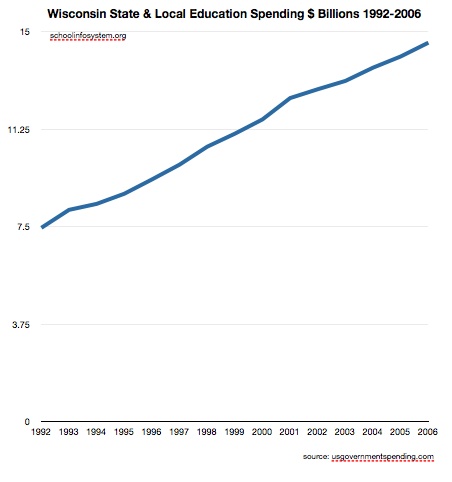
Dual Enrollment Grows: Pennsylvania High School Students Take College Classes via State Program

Any Sostek:

Sitting in the back row of her South Fayette High School economics class, Emily Cord waved off her teacher as he passed out voter-registration cards.
“I’m not 18 till June,” she said.
An hour later, however, she was sitting in ECO102, Principles of Macroeconomics, at Community College of Allegheny County, with classmates beyond not just the voting age but the drinking age.
Emily is one of thousands of Pennsylvania students enrolled in both high school and college classes through the state’s dual enrollment program, which pays part of the college tuition.
A state report released last month notes “extraordinary demand and interest on the part of students” in the program. Since the dual enrollment program started in the 2005-06 school year, state funding has doubled, to $10 million for the current school year.
In the 2006-07 school year, the number of participants increased 69 percent from the previous year, from 7,270 students to 12,267 students statewide.

Related:

Where Have all the Students Gone? An Update

An update to Barb Schrank’s November, 2005 post:

Comments from a reader:

At $6,000 per child that’s about $16 million per year. At $9,000 per child, that’s about $23 million per year. If we kept 332, that would be $2-3 million more per year.
Also, MMSD not only lost students, which has a negative effect on what the district gets under revenue caps, we’ve increased our low-income population, which means that for every dollar the district gets, more of those dollars need to be spent on non-instructional services.
If the district does not consider the economic development implications of its decisions, we’re likely to

  • see more go to school outside MMSD, or
  • for the non-low income students who go to school here increased family dollars will be spent on private aspects of education- lessons, tutoring, etc.

Madison’s population in 2000 was 208,054 and is estimated to be 223,389, according to the census bureau. Madison’s poverty rate is estimated to be 13%, according to the Small Area Estimates Branch [Website].

District Enrollment
2000-2001
Enrollment
2006-2007
Per Student Spending (06/07 Budget) Administrators Total Staff ACT % Tested (05-06) ACT Comp Score
Madison 25,087 24,755 $12,422 91.5 3544.6 61.1 24.2
Verona 4222 4540 $12,113 22 603.4 69.6 23.6
Middleton-Cross Plains 5125 5640 $12,822 21 756.3 73 24.5
Waunakee 2836 3357 $11,987 14 427.6 70.7 23.3
Sun Priarie 4776 5946 $11,238 20 741.3 62.6 23
McFarland 1951 2017 $11,853 9.5 251.2 64 23.7
Monona Grove 2702 2885 $12,289 13 388 71.4 22.6
Oregon 3430 3588 $11,572 15 465.1 59.2 23.2

Data sources:

Thanks to a number of readers for the updated information.

Wisconsin K-12 Tax & Spending Outlook

Milwaukee Journal-Sentinel Editorial:

Another year and deeper in debt.
No, that’s not some sad-eyed, old country ballad. It’s the state of Wisconsin’s long-term finances.
To pay for highways, buildings and environmental programs over the past decade, the state has increased long-term debt by 87%, a trend that if left unchecked will surely mean increasingly difficult budget decisions down the road.
The Journal Sentinel’s Steven Walters noted in a recent report that the Legislative Fiscal Bureau says the state had $8.28 billion in such debt in 2006, up from $4.41 billion in 1996 (www.jsonline.com/689757). The period studied covered the leadership of Gov. Jim Doyle, a Democrat, and Republicans Scott McCallum and Tommy G. Thompson.
In effect, the governors, with legislative acquiescence, have made politically advantageous decisions to have their favorite programs and pay for them later. It’s basically credit card budgeting.
But the bill always comes due.
As Todd Berry, president of the Wisconsin Taxpayers Alliance, told Walters, the growing debt is a risk. Principal and interest payments on general-obligation bonds will exceed $700 million for the first time this year. Payments on transportation bonds will cost $174 million.
While state officials say the debt load is manageable, a major bond agency, Standard & Poor’s Ratings Services, last week changed its rating outlook from “positive” to “stable.”
Other long-term trends make such budget moves all the more troublesome. Per-capita income in Wisconsin is about $4,000 a year less than in Minnesota, for example, a gap that has widened. And the number of elderly is expected to jump 90% from 702,000 in 2000 to near 1.34 million by 2030 while the percentage of working age people is expected to decline from 61% to 57%, meaning fewer taxpayers supporting more people in need of services. Add to that the need to replace aging roads, bridges and sewers.

Clearly, we are unlikely to see significant increases in redistributed state tax dollars to “rich” school districts like Madison [2007-2008 Citizen’s Budget].
Related: K-12 Tax & Spending Climate:

According to the Wisconsin DPI, per student spending in Wisconsin has increased by 5.1% annually, since 1987. The Madison School District increased at a 5.25% rate during that time. Clearly, our public schools are attempting to address more issues than ever, from academics to breakfast, special education and health care.

Running Start gives high-schoolers jump-start on college credit

Amy Rolph:

If those college-prep classes feel a little emptier in high school these days, it’s because they are. About 10 percent of the students aren’t there.
Those 17,000 juniors and seniors aren’t truant. They’re enrolled at the local community college, getting a jump-start on earning college credit before high school graduation even rolls around.
That’s about how many high school students the State Board of Community and Technical Colleges estimates are enrolled in Running Start, the early entrance program that lets qualifying juniors and seniors earn college and high school credit at the same time and without paying anything. Enrollment has grown steadily since the program’s launch in 1990 — so much so that community college officials say it’s costing them almost $35 million a year to educate those extra high school students.
Success has its price, and the community colleges will ask the Legislature for $35 million more over five years — specifically $7 million each year.
“Over time, the Running Start program has grown successfully and the reimbursement the colleges get has stayed the same, while inflation has steadily grown,” said Suzy Ames, spokeswoman for the state community college board.
Community colleges are entitled to 70 percent of the money earmarked for each Running Start student, Ames said. But with more students wanting to start college early, the colleges have to add classes, faculty and staff to accommodate them.

Related: Madison’s Dual Enrollment Climate.
Running Start.
Celeste Flint:

I don’t think Seattle’s coffee addiction is making our students smarter. High schools have lowered the bar too far, and everybody knows it.
At age 10, American students score well above the international average, but by age 15, when American students are tested against those in 40 other countries, they drop to 25th place, according to an ABC report.
Youth literally get dumber the longer they stay in American schools.
With high school teachers so sensitive to self-esteem issues that they make it impossible to fail, it’s only natural that motivated young people want to get out.
Running Start is the fire escape out of the collapsing American education system. But as a result, the 17,000 Washington Running Start students, many who aren’t quite ready for higher education, are taking a toll on college courses.
Many high school students just don’t have the maturity to handle a real workload, and as a result the dumbing-down continues into college.
Being a transfer student from a community college, I witnessed countless high school students regularly skip classes, not do the homework and then complain until the teacher slowed down the course. Inevitably half the material was re-taught.

A bit of Tangential, International News

Both articles below are at best, thinly related to this site’s purpose. However, I think they each merit a link and a read: Thailand to keep on repatriating Hmong to Laos by Pracha Hariraksapitak: Thailand has no plans to halt its repatriation of ethnic Hmong to communist Laos despite appeals by U.S. Congressmen and the […]

Community invited to give input on grant opportunity

(It seems that the public information session on the work of the High School Redesign Committee — including how it relates to the SLC grant described below — has been turned into something else quite entirely.) On Thursday, June 7, 2007, Superintendent Art Rainwater will be leading a discussion to solicit the Board of Education’s […]

Vang Pao Elementary School Groundbreaking

Andy Hall: A windswept field on Madison’s Far West Side became a place of reverence Wednesday for 60 Hmong residents who attended the groundbreaking ceremony of Vang Pao Elementary, a $12.9 million school whose funding was embraced by taxpayers but whose name remains controversial. “I just want to take this as a memory,” explained Bee […]

Fair Indigo To Donate 100% Of Store Sales On World Fair Trade Day

(Fair Indigo, Middleton, WI) – To honor World Fair Trade Day on Saturday May 12th and support its theme “Kids Need Fair Trade”, fair trade clothing pioneer Fair Indigo will donate all sales that day in its Madison, Wisconsin flagship store [map]to education: half to local Madison-area Parent-Teacher organizations and half to the Fair Indigo […]

MMSD / MTI Contract Negotiations Begin: Health Care Changes Proposed

Susan Troller: The district and Madison Teachers Inc. exchanged initial proposals Wednesday to begin negotiations on a new two-year contract that will run through June 30, 2009. The current one expires June 30. “Frankly, I was shocked and appalled by the school district’s initial proposal because it was replete with take-backs in teachers’ rights as […]

How can we help poor students achieve more?

Jason Shephard: As a teacher-centered lesson ended the other morning at Midvale Elementary School, about 15 first-graders jumped up from their places on the carpeted rug and dashed to their personal bins of books. Most students quickly settled into two assigned groups. One read a story about a fox in a henhouse with the classroom […]

$65M for 42 Houston Charter Schools

Jay Matthews: The charter school movement, begun 16 years ago as an alternative to struggling public schools, will today make its strongest claim on mainstream American education when a national group announces the most successful fundraising campaign in the movement’s history — $65 million to create 42 schools in Houston. The money, which comes from […]

Reality Check: Taxpayers Pay For Lobbying

Colin Benedict on Channel3000: Wisconsin taxpayers are paying millions to lobby state lawmakers, in many cases, for more money. Dane County does it too — it spent nearly $175,000 last session, WISC-TV reported. Part of it was for more money from the state to pay for county nursing home patients, and Dane County argued against […]

Reading Recovery: More chipping and shredding in Fargo!

What makes this article from Fargo interesting is how it almost exactly mirrors the findings in my home district, Hortonville, and the recent analysis of Reading Recovery done in Madison. That being, a 50% success rate for RR students. From the article: “However, West Fargo student data over time, as presented by Director of Knowledge […]

Wisconsin’s K-12 Spending Climate

Avrum Lank: Per capita income will continue to grow in Wisconsin through 2009, but at a slower rate than in the nation as a whole, according to an economic outlook released Friday by the state Department of Revenue. Employment also will grow, but manufacturing jobs will decline, the report said. Even so, corporate income tax […]

Wisconsin’s School Finance Climate

Andy Hall on local referendums: Layoffs and pay cuts are looming in a western Dane County school district, and officials in the Adams-Friendship area are contemplating closing two elementary schools after voters rejected two school referendums last week. Voters also approved referendums Tuesday for a $14.68 million elementary school in Sun Prairie and $2.48 million […]

School Finance: K-12 Tax & Spending Climate

School spending has always been a puzzle, both from a state and federal government perspective as well as local property taxpayers. In an effort to shed some light on the vagaries of K-12 finance, I’ve summarized below a number of local, state and federal articles and links. The 2007 Statistical Abstract offers a great deal […]

Daily Newspapers Support Wisconsin School Finance Reform

Milwaukee Journal-Sentinel Editorial: The need for a new state school funding system is starkly illustrated by the fix in which the Waukesha School District finds itself. Caught between rising costs, state mandates and state caps, the district faces a $3.4 million budget shortfall in the next school year. To meet the shortfall, district administrators have […]

Study Takes a Sharp Look at NYC’s Dropout Rate

Elissa Gootman: The first comprehensive look at New York City’s failing students has found that nearly 140,000 people from ages 16 to 21 have either dropped out of high school or are already so far behind that they are unlikely to graduate. The study, which the New York City Department of Education is to present […]

Press release: MMSD Information sessions about Nov. 7 referendum

The Madison School District will hold four referendum information sessions in advance of the November 7 referendum. The public is invited to attend any of these sessions. Thurs. October 12 6:30 PM Sennett School 502 Pflaum Rd. 53716 Lecture lab Tues. October 17 6:30 PM Cherokee School 4301 Cherokee Dr. 53711 LMC Wed. October 18 […]

Wisconsin CHARTER SCHOOL NEWS: Week of August 21

DPI Awards $4 Million in Charter School Grants WCSA’s New Office — The WCSA is now located in a new office in downtown Madison. The WCSA’s new address, phone, fax and email is — Wisconsin Charter Schools Association, P.O. Box 1704, Madison, WI 53703 & Tel: 608-661-6946 & Fax: 608-258-3413 & Email: info@wicharterschools.org WCSA website: […]

University Student Reading Buddies

Reader Reed Schneider emails this: A plan to have 40 Spring Arbor University students serve next year as “reading buddies” for struggling first-graders in Jackson Public Schools could be a win-win situation. The Jackson school board recently cut three Reading Recovery teacher positions to help trim its $1.86 million deficit. JPS will obtain the services […]

School-funding update from Wisconsin Alliance for Excellent Schools (WAES)

The Wisconsin Alliance for Excellent Schools (WAES) is a statewide network of educators, school board members, parents, community leaders, and researchers. Its Wisconsin Adequacy Plan — a proposal for school-finance reform — is the result of research into the cost of educating children to meet state proficiency standards. Washburn joins list of districts in budget […]

Tim Olsen on Generating Cash from the Doyle Administration Land/Building

Tim Olsen’s email to Madison Board of Education Member Ruth Robarts: And below are the specifics you requested re calculating an estimated value for the Doyle site. You are welcome to share this email with anyone interested. And thanks for the opportunity to speak to the Board, for your comments, and for including Lucy Mathiak’s […]

School-Funding Update from WAES (WI Alliance for Excellent Schools)

Referendum soundly defeated in Phillips School District Greendale voters support $14 million tax levy North Carolina will use lottery proceeds for schools Slot machine revenue not best bet for public schools What’s new in the anti-TABOR toolbox? School-funding reform calendar The Wisconsin Alliance for Excellent Schools (WAES) is a statewide network of educators, school board […]

June 17 MMSD Asks PTOs and Presumably Parents to Contact Legislators

For Legislative Fiscal Bureau policy papers and membership lists of relevant committees, go to: https://www.schoolinfosystem.org/mmsd/leg/ FROM JOE QUICK, MMSD LEGISLATIVE LIAISON If you have already received this Update, our apologies. We are trying to inform parents about this important budget issue before the Legislature votes next week. Dear PTO/A Leaders: The attached information outlines changes […]