
| School Information System |
 | Sponsorships | Sponsorships |
|
|
The UW-Odyssey Project changes lives for adults near the poverty level. Now in its tenth year, this inspirational project has empowered more than 250 low-income adults to find their voices and get a jumpstart at earning college degrees they never thought possible. Graduates of the program have journeyed from homelessness to UW-Madison degrees, from incarceration to meaningful work in the community.You are warmly invited to a special screening of a new documentary about the UW-Odyssey Project on Thursday, December 6, at the Sundance Cinema (Hilldale Shopping Mall). Showings will be at 5:00, 5:40 and 6:20 p.m. in theater #3. Refreshments will be served in the second floor bistro. This event is free, but donations to the Odyssey Project's important work will be gratefully appreciated.
For more information about the UW-Odyssey Project, the new documentary, and how to vote for Emily Auerbach (Odyssey Project founder and director) for Lady Godiva Chocolate's Inspirational Woman of the Year, go to http://www.odyssey.wisc.edu/.
Newsletter signup | Send us your ideas
The Cupcake Wars came to Public School 295 in Sunset Park, Brooklyn, in October. The Parent-Teacher Association's decision to raise the price of a cupcake at its monthly bake sale -- to $1, from 50 cents -- was supposed to be a simple way to raise extra money in the face of city budget cuts. Instead, in a neighborhood whose median household income leaped to $60,184 in 2010 from $34,878 a decade before, the change generated unexpected ire, pitting cash-short parents against volunteer bakers, and dividing a flummoxed PTA executive board, where wealthier newcomers to the school serve alongside poorer immigrants who have called the area home for years.
"A lot of people felt like they really needed to be heard on this," recalled Dan Janzen, a mild-mannered freelance copywriter with children in first and third grades who leads the school's development committee and devised the price increase. One mother expressed dismay at being blindsided, while others said they were worried about those at the school without a dollar to spare. Ultimately, the PTA meeting at which the issue came to a head was adjourned without a resolution.
Such fracases are increasingly common at schools like P.S. 295, where changing demographics can cause culture clashes. PTA leaders are often caught between trying to get as much as possible from parents of means without alienating lower-income families. Sometimes, the battles are over who should lead the PTA itself: many of the gentrifiers bring professional skills and different ideas of how to get things done, while those who improved the school enough to attract them become guardians of its traditions.
So along with cross-cultural exchanges, international festivals and smorgasbords, school diversity can mean raw feelings about race and class bubbling to the surface. "It's never just about the cupcake," said Jeffrey Henig, a professor of political science and education at Teachers College, who has written extensively about this topic. "The cupcake is the spark."
Newsletter signup | Send us your ideas
Wisconsin Taxpayers Alliance, via a kind Senn Brown email:
In 2010-11, a record number of students took advantage of Wisconsin's open enrollment program to attend school elsewhere than in their own district. The 34,498 participants was 8.1% higher than in 2010 and nearly five times higher than in 2001. Open enrollment numbers varied widely, with 13 districts experiencing net outflows of more than 10% of their student populations and 34 with net inflows of similar magnitude. These findings are detailed in SchoolFacts11, the annual reference book from the Wisconsin Tax- payers Alliance (WISTAX) that provides, for every school district in the state, a wide range of information on enrollment, finance, staffing, and test scores.Related: Madison School District 2009 outbound open enrollment survey. Much more, here.In 2010-11, 4.0% of Wisconsin's public school students attended a district other than their own. Dover (26.2%) and South Shore (23.0%) both had net outflows (students leaving less those coming) of more than 20%. Eleven other districts (Florence, Mercer, Neosho, Palmyra-Eagle, Richfield, Stockbridge, Twin Lakes, Washington-Caldwell, Wheatland, Winter, and Wonewoc-Union Center) had net outflows of over 10%.
Student counts drive a District's tax and spending authority.
Newsletter signup | Send us your ideas
Echo Lau drove to Whitney High School on a recent Monday evening to pick up her kids. She left with dinner.The student parking lot at the Cerritos campus is transformed every week into a congested food truck stop as eight mobile eateries attract the business of loyal followers, parents and students.
But this isn't a typical stop for these catering trucks; this is a school fundraiser, in which a portion of the proceeds go directly to Whitney to help pay for a new multi-media center.
Outdoor food courts are popping up in the parking lots of at least a dozen high schools across Southern California with more on the way. Financially strapped public schools -- hit hard by budget cuts, new fundraising guidelines, and fewer donors -- have found a way to capitalize on the food truck craze.
Newsletter signup | Send us your ideas

2011-2012 Revised Budget 1.3MB PDF (Budget amendments document). District spending remains largely flat at $369,394,753, yet "Fund Equity", or the District's reserves, has increased to $48,324,862 from $22,769,831 in 2007 (page 24). The District's property tax "underlevy" (increases allowed under Wisconsin school revenue limits which are based on student population changes, successful referendums along with carve-outs such as Fund 80, among others) will be $13,084,310. It also appears that property taxes will be flat (page 19) after a significant 9% increase last year. Interestingly, MSCR spending is up 7.97% (page 28).
2011-2012 enrollment is 24,861. $369,394,753 planned expenditures results in per student spending of $14,858.40.
I welcome clarifications and updates to these numbers, which are interesting. We've seen a doubling of District reserves over the past few years while spending has remained relatively flat as has enrollment.
Finally, this is worth reading in light of the District's 2011-2012 numbers: Madison Superintendent Dan Nerad Advocates Additional Federal Tax Dollar Spending & Borrowing via President Obama's Proposed Jobs Bill.
Newsletter signup | Send us your ideas
"School choice" is a broad term that refers to a wide range of alternatives, including themed charter schools that are entirely under the control of their home school districts. Forty states and the District of Columbia have those in place, according to the American Federation for Children, a national school choice advocacy group.It would be interesting to compare special interest spending in support of the status quo, vs groups advocating change, as outlined in Bill Lueders' article. A few links:But it is the voucher programs, in which public funds are used to send children to private schools, that are the focus of much of the energy around the choice movement. Seven states and the District of Columbia have those, and Milwaukee's voucher program is the first and largest of its kind in the country. That makes Wisconsin a key national battleground.
"Wisconsin has a high level of value to the movement as a whole," says Robert Enlow, president of the Indianapolis-based Friedman Foundation for Educational Choice, a nonprofit group that advocates for school choice. The state, he says, is notable for "the high level of scholarship amounts that families can get."
Milwaukee's voucher program had 20,300 full-time equivalent voucher students at 102 private schools in 2010-11, compared to about 80,000 students at Milwaukee's public K-12 schools. The total cost, at $6,442 per voucher student, was $130.8 million, of which about $90 million came from the state and the rest from the Milwaukee Public Schools.
Critics see the school choice program as part of a larger strategy -- driven into high gear in Wisconsin by the fall election of Gov. Scott Walker and other Republicans -- to eviscerate, for ideological and religious reasons, public schools and the unions that represent teachers.
How much do election-year firewalls cost to build? For the state's largest teachers union, $1.57 million.That's how much the Wisconsin Education Association Council said last week it will spend trying to make sure four Democratic state senators are re-elected - enough, WEAC hopes, to keep a Democratic majority in the 33-member state body.
Although there are 15 Democratic candidates running for the state Senate, and 80 Democrats running for the state Assembly, the latest WEAC report shows that the teachers union is placing what amounts to an "all in" bet on saving just four Democratic senators who are finishing their first terms.
In an Oct. 25 report to the Government Accountability Board, the 98,000-member union reported that it will independently:
The statewide teachers union led in spending on lobbying state lawmakers even before this year's fight over collective bargaining rights.The Wisconsin Education Association Council spent $2.5 million on lobbying in 2009 and 2010, years when Democrats were in control of all of state government, a report released Thursday by the Government Accountability Board showed.
WEAC is always one of the top spending lobbyists in the Capitol and they took a central role this year fighting Gov. Scott Walker's plan curbing public employee union rights, including teachers.
Back in 2009, when Democrat Jim Doyle was governor and Democrats controlled the Senate and Assembly, WEAC wasn't helping to organize massive protests but it was a regular presence in the Capitol.
Spending in the summer's recall elections by special interest groups, candidates and political action committees shattered spending records set in previous elections, with $43.9 million doled out on nine elections, according to a study released Tuesday by the Wisconsin Democracy Campaign.Spending by six political action committees or special interest groups topped the $1 million mark. We Are Wisconsin was the top spender.
The union-backed group spent roughly $10.75 million, followed by the conservative-leaning Club for Growth at $9 million and $4 million in spending from the Greater Wisconsin Committee.
Newsletter signup | Send us your ideas
"Come on Madison, we can do better than this!"That's Kaleem Caire. He said it not recently but in 1998 in an op-ed questioning why his hometown wasn't paying more attention to the poor educational outcomes and high incarceration rates of black males.
"I'm asking Madison to be your best self and get this done!"
That's also Caire, in an interview this week about his proposal for a publicly funded charter school designed to improve educational outcomes of low-income minority students.
What hasn't changed, then to now, is Caire's conviction that Madison's public schools are failing minority students and his willingness to force issues that cause some distress to the city's white liberal establishment.
What has changed is Caire's clout. He returned to his hometown in 2010 after a decade long detour with his family to the East Coast. As president and CEO of the Urban League of Greater Madison, and public face for the proposed Madison Preparatory Academy, his profile has skyrocketed. But with it has come criticism and skepticism over a plan that challenges Madison's longstanding commitment to inclusive learning.
Newsletter signup | Send us your ideas
Critics of public school "reform" say that it looks too much like a business model with education foundations that have big wallets taking control away from local communities.Microsoft Chairman Bill Gates, along with his wife, Melinda Gates, founded the Bill and Melinda Gates Foundation, which had an endowment of $33.5 billion as of 2009. The foundation is "driven by the passions and the interests of the Gates family," with an education goal to expand educational opportunities and access to information technology.
Another notable figure is Los Angeles entrepreneur and philanthropist Eli Broad (rhymes with road). With his wife Edythe, Broad founded The Broad Foundations, which have assets of $2.1 billion with a mission to advance entrepreneurship for the public good in education, science and the arts.
"Priorities of some of these foundations nationally have taken precedence over parents and community members," said Pam Grundy, co-founder of Mecklenburg Acts, the local affiliate of Parents Across America. "They're trying to do a lot of things that have never been proven to work. We feel like our kids are like an experiment."
Newsletter signup | Send us your ideas
Houghton Mifflin Harcourt said it has launched the HMH Global Education Challenge, which is designed to encourage "game-changing ideas" for improving student outcomes in K-12 education.A Boston company that has a long history in the textbook business, Houghton Mifflin Harcourt said in a press release that entrants who submit proposals will be eligible to win from a pool of $250,000 in cash and prizes.
Newsletter signup | Send us your ideas
DonorsChoose.com, via a kind reader's email:
Here's how it works: public school teachers from every corner of America post classroom project requests on DonorsChoose.org. Requests range from pencils for a poetry writing unit, to violins for a school recital, to microscope slides for a biology class.Then, you can browse project requests and give any amount to the one that inspires you. Once a project reaches its funding goal, we deliver the materials to the school.
You'll get photos of your project taking place, a thank-you letter from the teacher, and a cost report showing how each dollar was spent. If you give over $100, you'll also receive hand-written thank-you letters from the students.
At DonorsChoose.org, you can give as little as $1 and get the same level of choice, transparency, and feedback that is traditionally reserved for someone who gives millions. We call it citizen philanthropy.
Newsletter signup | Send us your ideas

March 25, 2011
Dear Friends & Colleagues,
On Monday evening, March 28, 2011 at 6pm, the Madison Metropolitan School District's (MMSD) Board of Education will meet to vote on whether or not to support the Urban League's submission of a $225,000 charter school planning grant to the Wisconsin Department of Public Instruction. This grant is essential to the development of Madison Preparatory Academy for Young Men, an all-male 6th - 12th grade public charter school.
Given the promise of our proposal, the magnitude of longstanding achievement gaps in MMSD, and the need for adequate time to prepare our final proposal for Madison Prep, we have requested full support from the school board.
Monday's Board meeting will take place at the Doyle Administration Building (545 West Dayton Street) next to the Kohl Center. We hope you will come out to support Madison Prep as this will be a critical vote to keep the Madison Prep proposal moving forward. Please let us know if you'll be attending by clicking here. If you wish to speak, please arrive at 5:45pm to register.
Prior to you attending, we want to clarify misconceptions about the costs of Madison Prep.
The REAL Costs versus the Perceived Costs of Madison Prep
Recent headlines in the Wisconsin State Journal (WSJ) reported that Madison Prep is "less likely" to be approved because of the size of the school's projected budget. The article implied that Madison Prep will somehow cost the district more than it currently spends to educate children. This, in fact, is not accurate. We are requesting $14,476 per student for Madison Prep's first year of operation, 2012-2013, which is less than the $14,802 per pupil that MMSD informed us it spends now. During its fifth year of operation, Madison Prep's requested payment from MMSD drops to $13,395, which is $1,500 less per student than what the district says it spends now. Madison Prep will likely be even more of a savings to the school district by the fifth year of operation given that the district's spending increases every year.
A March 14, 2011 memo prepared by MMSD Superintendent Daniel Nerad and submitted to the Board reflects the Urban League's funding requests noted above. This memo also shows that the administration would transfer just $5,541 per student - $664,925 in total for all 120 students - to Madison Prep in 2012-2013, despite the fact that the district is currently spending $14,802 per pupil. Even though it will not be educating the 120 young men Madison Prep will serve, MMSD is proposing that it needs to keep $8,935 per Madison Prep student.
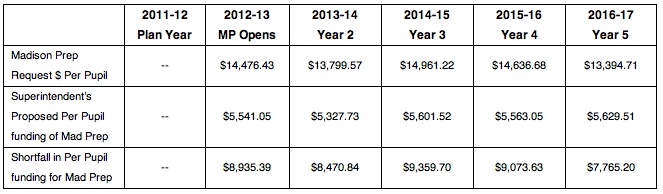
Therefore, the Urban League stands by its request for equitable and fair funding of $14,476 per student, which is less than the $14,802 MMSD's administration have told us they spend on each student now. As Madison Prep achieves economies of scale, reaches its full enrollment of 420 sixth through twelfth graders, and graduates its first class of seniors in 2017-18, it will cost MMSD much less than what it spends now. A cost comparison between Madison Prep, which will enroll both middle and high school students at full enrollment, and MMSD's Toki Middle School illustrates this point. 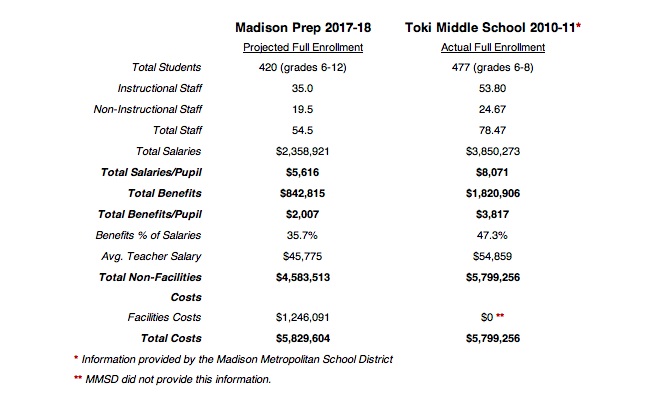
We have also attached four one-page documents that we prepared for the Board of Education. These documents summarize key points on several issues about which they have expressed questions.
We look forward to seeing you!
Onward!
Kaleem Caire
President & CEO
Urban League of Greater Madison
Main: 608-729-1200
Assistant: 608-729-1249
Fax: 608-729-1205
Website: www.ulgm.org


Kaleem Caire, via email.
Madison Preparatory Academy Brochure (PDF): English & Spanish.
DPI Planning Grant Application: Key Points and Modifications.
Update: Madison School Board Member Ed Hughes: What To Do About Madison Prep:
In order to maintain Madison Prep, the school district would have to find these amounts somewhere in our budget or else raise property taxes to cover the expenditures. I am not willing to take money away from our other schools in order to fund Madison Prep. I have been willing to consider raising property taxes to come up with the requested amounts, if that seemed to be the will of the community. However, the draconian spending limits the governor seeks to impose on school districts through the budget bill may render that approach impossible. Even if we wanted to, we likely would be barred from increasing property taxes in order to raise an amount equal to the net cost to the school district of the Madison Prep proposal.Mr. Hughes largely references redistributed state tax dollars for charter/virtual schools - a portion of total District per student spending - the total (including property taxes) that Madison Prep's request mentions. I find Madison Prep's fully loaded school based cost comparisons useful. Ideally, all public schools would publish their individual budgets along with total District spending.This certainly wouldn't be the first time that budgetary considerations prevent us from investing in promising approaches to increasing student achievement. For example, one component of the Madison Prep proposal is a longer school year. I'm in favor. One way the school district has pursued this concept has been by looking at our summer school model and considering improvements. A good, promising plan has been developed. Sadly, we likely will not be in a position to implement its recommendations because they cost money we don't have and can't raise under the Governor's budget proposal.
Similarly, Madison Prep proposes matching students with mentors from the community who will help the students dream bigger dreams. Effective use of mentors is also a key component of the AVID program, which is now in all our high schools. We would very much like to expand the program to our middle schools, but again we do not have the funds to do so.
Newsletter signup | Send us your ideas
Learn more here, via a Kathy Esposito email.
Newsletter signup | Send us your ideas
A Wisconsin case that could have nationwide implications for how reporters cover and how parents watch high school sports is making its way through the courts, with crucial constitutional arguments taking place Friday in federal court in Chicago.The case pits community newspapers against the association that oversees high school sports in Wisconsin. Fans in many states rely on community newspapers for news about high school teams, and the newspapers say they need easy, unencumbered access to sporting events to provide that coverage. But the association says it can't survive if it can't raise money by signing exclusive contracts with a single video-production company for streaming its tournaments.
The newspapers argued Friday before the 7th Circuit Court of Appeals that the First Amendment's guarantee of freedom of press should enable them to put such publicly funded events online as they see fit, free of charge.
The case began in 2008, when the Wisconsin Interscholastic Athletic Association sued The Post-Crescent of Appleton after it streamed live coverage of high school football playoff games. After a U.S. District judge sided with the association last year, saying its exclusive deal with a video production company didn't impinge on freedom of the press, the newspaper's owner, Gannett Co., and the Wisconsin Newspaper Association appealed.
Newsletter signup | Send us your ideas
Beginning on Monday, February 14, 2011, 826 National will draw a prize a day for five other lucky winners including: the Anti catalog of records, a 60-disc Matador Records sampler, Poketo Road Trip prize pack, a drum head signed by The New Pornographers, Neko's limited-edition 1966 Gretsch Silver Duke guitar, a Gibson guitar signed by members of the Speaking Clock Revue including Elton John, Elvis Costello, Dr. Ralph Stanley, Leon Russell, and T Bone Burnett, an Adidas prize pack, a Carr Amplifier and much more. The winner of the car will be drawn on Friday, February 18, 2011.
Limited edition, custom Poketo T-shirts are being sold in conjunction with the online event in 826 chapter storefronts across the country and online at the 826 National store.This drawing seeks to raise both money and awareness for the 826 National writing centers, co-founded by award-winning educator Nínive Calegari and award-winning author Dave Eggers. 826 National centers are located in San Francisco, New York, Los Angeles, Chicago, Seattle, Ann Arbor, Boston, and Washington, DC. Last year, 826 chapters served over 24,000 students and produced 800 student-authored publications, with all programs free of charge for students, classes, and schools.
Newsletter signup | Send us your ideas
Last week’s TIME column about the prospects for school spending occasioned some interesting responses. A common one, though, was the idea that the public is just clamoring to spend more on schools. You hear this a lot. Unfortunately, there are three problems with this argument:
Structural: The money just isn’t there (and annual increases are largely spoken for). The current trajectory of spending is simply not sustainable unless we’re prepared to made radical changes in policies, for example, affecting health care, senior citizens, or prisons. Whether or not we should make those changes is debatable. In many states all senior citizens get a break on property taxes, which are a key revenue source for schools. As the population ages this will ripple through public education budgets. Should these measures be means-tested for ability to pay? Perhaps. Given how politics works are they likely to be? Doubtful. Likewise, our correctional policies are a mess but most politicians are not lining up to fix them. So sure, today’s fiscal choices are just that, choices, but the implications of those decisions and prospects for change must be considered with an eye toward political and other realities realities. A second, related, structural constraint is how little discretionary money there is annually because of how much is tacked down for ongoing obligations. In practice this means that there are annual increases (excepting the last few years where in some places you’ve seen genuine reductions), which consume new money.
Newsletter signup | Send us your ideas
The Obama administration could not have set the stage for a better demonstration of the power and priorities of Wisconsin's teachers unions.Related: WEAC tops lobbyist spending listWith its Race to the Top competition, the federal government dangled the prospect of a share of $4.35 billion for those states ready to enact reforms, especially related to improving teacher and principal performance.
Eyes on that prize, states launched plans tying teacher pay and promotions to student achievement, giving state officials more control over local schools and overhauling data tracking and assessment systems.
Then the game got tricky: Teachers unions had to be on board.
In the end, only 11 states and the District of Columbia ended up with money from the program this year. Wisconsin got nothing.
The Wisconsin Education Association Council had helped kill or watered down critical parts of the state's proposal, with the president of the teachers union attaching a letter to the application that one participant described as "grudging." In the end, only 12% of the union's local leaders endorsed a plan that might have brought in more than $250 million in school funding to Wisconsin.
The Wisconsin Education Association Council spent nearly twice as much as any other organization to lobby lawmakers in 2009, according to the Government Accountability Board.The state's largest teachers union reported spending more than $1.5 million and 7,239 hours lobbying, almost twice as much as the Wisconsin Insurance Alliance, which spent the second-highest amount on lobbying in the state.
One aspect of the union's lobbying effort was largely successful, with the state Legislature repealing the 16-year-old qualified economic offer law that restricted teachers' pay and benefits.
Newsletter signup | Send us your ideas
Everyday masses of students march up and down Bascom Hill at the University of Wisconsin and on their way, pass a piece of history.Many students headed to class or exams Monday however, passed festivities taking place inside the more than 100-year-old Education Building.
To kick-off American Education Week, UW's School of Education planned a two-day event to showcase the renovation of the building, Dean Julie Underwood said.
In particular, the re-dedication of the building Monday morning brought together students, faculty, staff and alumni not only to celebrate the building, but those who made it possible.
UW alumni John and Tashia Morgridge donated $34 million to renovate the building, and those in attendance treated them to many standing ovations as well as thanks.
Newsletter signup | Send us your ideas
Madison public schools produced more National Merit Scholarship semifinalists than any other school district in the state again this year.View individual state cut scores, by year here. In 2010, Minnesota's cut score was 215, Illinois' 214, Iowa 209 and Michigan 209. Wisconsin's was 207.Thirty-nine students from Madison East, West, La Follette and Memorial high schools, along with 10 other Madison seniors who receive home schooling or attend Edgewood High or Abundant Life Christian School, are among 16,000 students nationwide to receive the honor. The semifinalists, who represent fewer than 1 percent of U.S. high school seniors, will continue to compete for some 8,400 National Merit scholarships worth more than $36 million to be announced next spring.
Congratulations all around!
Newsletter signup | Send us your ideas
CHILDREN can be tender souls. Pitch them a sob story and they often swallow it whole. Reflect the harsh reality outside the school gates, however, and they develop sophisticated strategies for making hard choices. That, at least, is the early experience of an initiative to teach philanthropy to young teenagers.Two years ago the Big Give, an organisation which collates information about 6,000 charities worldwide in an attempt to foster philanthropy, asked the fee-paying Dragon School in Oxford to run a pilot programme. It gave the school £1,250 to donate to charity and asked 13-year-old pupils to decide where the money should go.
Newsletter signup | Send us your ideas
Dustin Block, via email:
Greetings from Racine! I'm writing because I need your help. A public school in Racine is in the running for $500,000 through a "Kohl's Care" contest on Facebook. Kohls is giving away a half-million dollars to the 20 schools who collect the most votes by Sept. 4. Right now Mitchell Middle School in Racine is in 20th place and could really use your votes to move up the standings and secure the money.Here's the link: http://apps.facebook.com/KohlsCares/school/1017351/mitchell-middle?src=SchoolBitly
It'd really mean a lot to Racine and the Mitchell Middle-schoolers if you could take the five minutes to vote. Mitchell was built in 1937 and has only had one renovation in 73 years. Racine Unified doesn't have much money for repairs, so this is a great way you can help out a poor school system in desperate need of money.
You really can make a difference! Just follow the link above and vote!
Thanks much!
-Dustin
Newsletter signup | Send us your ideas
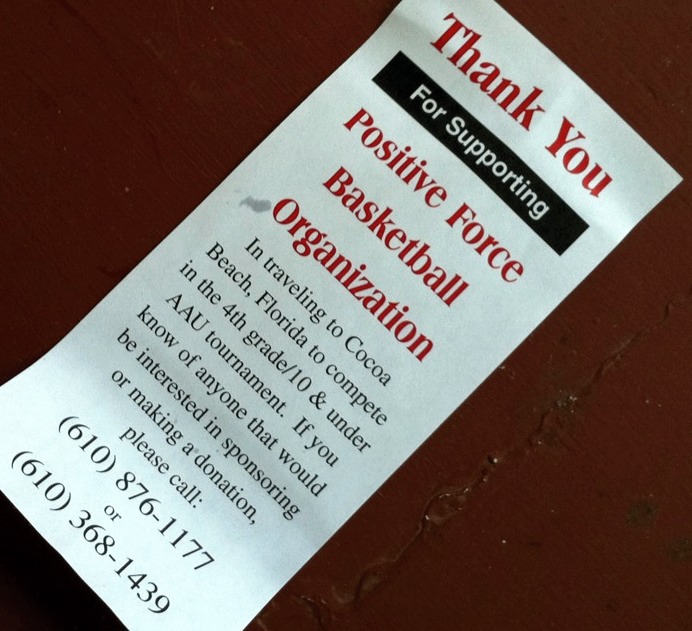
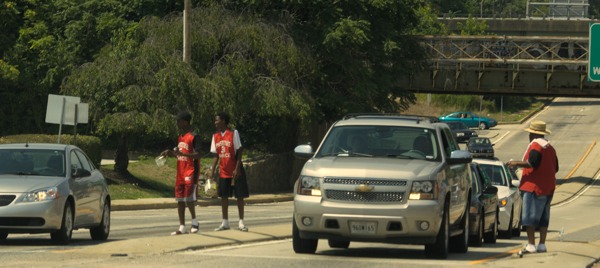
Newsletter signup | Send us your ideas
Jennifer Levitz & Staphanie Simon:
When his budget for pencils, paper, and other essential supplies was cut by a third this school year, the principal of Combee Elementary School worried children would suffer.Then, a local church stepped in and "adopted" the school. The First Baptist Church at the Mall stocked a resource room with $5,000 worth of supplies. It now caters spaghetti dinners at evening school events, buys sneakers for poor students, and sends in math and English tutors.
The principal is delighted. So are church pastors. "We have inroads into public schools that we had not had before," says Pastor Dave McClamma. "By befriending the students, we have the opportunity to visit homes to talk to parents about Jesus Christ."
Short on money for everything from math workbooks to microscope slides, public schools across the nation are seeking corporate and charitable sponsors, promising them marketing opportunities and access to students in exchange for desperately needed donations.
Newsletter signup | Send us your ideas
Today's Wall Street Journal:
The election results are obviously a big setback for the Democratic Party-government union alliance that has ruled Trenton for the past decade. So far, Governor Christie is winning the spending debate. The lesson for other governors is that opposition from public-employee unions is not insurmountable if you can articulate to voters what's at stake.Joseph Marbach, Dean of the College of Arts and Sciences at Seton Hall:
I think the governor was very successful in ... portraying the teachers union as out of touch with what's going on with working families. The voters are more aligned with his position... I think it ... gives him continued momentum to continue to rein in costs.
Newsletter signup | Send us your ideas
An Education Life:
Why homeschool? Maybe to brush up for an exam, get a sense of what a college is like, or just to learn. In the articles listed below, writers who know the fields weigh in on some of the highlights of free education.
Newsletter signup | Send us your ideas
Despite the 2008 referendum which so many of us worked so hard to pass, state actions and inaction have once again placed the quality of our public schools in jeopardy. It is time to stand up for our schools (again).On Sunday April 18th at 1:00 pm at Warner Park Community Recreation Center - 1625 Northport Dr. - the Madison Metropolitan School District Board of Education will hold their second Public Hearing on the 2010-11 district budget. The Board needs to hear from the community that we value education and are willing to pay to keep our schools strong. Progressive Dane urges community members to attend and make their voices heard.
Even if you don't want to speak at the meeting, you can attend register with positive message. If you can't make on Sunday, the Board can be contacted at board@madison.k12.wi.us.
Newsletter signup | Send us your ideas
Susan Troller, via a kind reader's email:
Where did the money go?Related: Proposed Madison School District Maintenance Referendum: 1999, 2005 and 2010 Documents:For more than a year, Madison School Board member Lucy Mathiak has been asking Madison school district officials for a precise, up-to-date summary of how $26.2 million in 2005 maintenance referendum dollars were spent over the last five years.
She's still waiting, but her patience is wearing out.Now the sharp-tongued budget hawk says she may ask the school board as early as Monday night to authorize an outside audit that would identify how the money approved by taxpayers in 2005 for repairs and maintenance of dozens of the district's aging buildings was actually spent between 2005 and fall of 2009.
"We need to have a serious, credible accounting for where the money went from the last referendum, and I haven't seen that yet," Mathiak told The Capital Times. "I'm ready to ask for an audit, and I think there are other board members who are equally concerned."
The Madison School District is considering another maintenance referendum ($85M?). The documents below provide a list of completed (1999, 2005) and planned projects (2010+). The reader may wish to review and compare the lists:
The 2005 special election included 3 referenda questions, just one of which passed - the maintenance matter.
- 1999 and 2005 Maintenance Referenda Project List 332K PDF
- 2010 Facilities Assessment
- 9/7/2004 Project List - 51MB .xls
- Roof Replacement List - 2004 100k .xls & Roof Summary2
Newsletter signup | Send us your ideas
When Parkview Superintendent Steve Lutzke talks to fellow superintendents, the question isn't, "Are you going to referendum?"The question is, "When are you going to referendum?"
Declining enrollments and increasing costs that exceed revenue limits plague the Orfordville-based Parkview School District and its neighbor to the west, Brodhead. The results are referendums in both districts April 6 asking voters for permission to exceed state revenue caps.
"They have a lot of company," said John Ashley, executive director of the Wisconsin Association of School Boards.
Parkview and Brodhead join 34 other districts in the state planning 48 referendums on next month's ballot. Of those, 26 referendums are to exceed revenue caps.
Newsletter signup | Send us your ideas
The goal of the Cooney Center Prizes for Innovation is to identify, inspire, nurture, and scale breakthrough ideas in children's digital media and learning. The program will annually award cash prizes and provide ongoing business planning support and mentorship to a new generation of children's media entrepreneurs and visionaries.
Newsletter signup | Send us your ideas
Fifteen special interest groups including casino operators, drug firms and unions for teachers and public employees spent more than $1 billion during the last decade trying to influence California public officials and voters, the state's watchdog agency reported today.The Wisconsin Education Association Council also tops the Badger State's lobbying expenditures.
The money went for lobbying, campaign contributions to state politicians and ballot measure campaigns to get voters to advance the groups' agendas, according to the report by the state Fair Political Practices Commission.``This tsunami of special interest spending drowns out the voices of average voters, and intimidates political opponents and elected officials alike,'' said Commission Chairman Ross Johnson, a former state senator.
Newsletter signup | Send us your ideas
Developing a set of core content standards to prepare high school students with the academic foundation and skills necessary to succeed on any college campus is the goal of a new initiative at the University of Oregon.Specifically targeted are the subject areas of mathematics and English, as well as a set of career-oriented two-year certificate programs.
David T. Conley, a professor of education and founder and chief executive officer of the non-profit Educational Policy Improvement Center (EPIC), will lead the ambitious project, which is partially funded by a $794,000 grant from the Bill & Melinda Gates Foundation.
The Seattle-based foundation announced in February a $19.5 million package of 15 grants to develop and launch new instructional tools and assessments to assure college readiness across the nation. Other support for the UO project comes from the Council of Chief State School Officers and the National Governors Association as part of the Common Core State Standards Initiative.
Newsletter signup | Send us your ideas
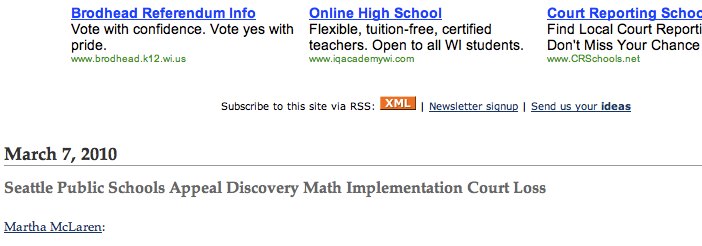
One of the reasons I place Google ads on this site (they generate very little money) is to periodically observe what type of advertisements their algorithms place around the content. I found this ad supporting a Brodhead referendum interesting, in that it links directly to the District's website. The link includes "doubleclick" tracking logic.
Perhaps the District is paying for the ad campaign from their operating funds, or an advocacy group is funding it?
Newsletter signup | Send us your ideas
President Obama is apparently about to tell the nation he wants to freeze federal spending for three years in several areas, including education. I like the idea. I would also support cutting back entitlement payments for financially secure geezers like me, and find ways for everyone to make some sacrifices for our country.I agree.I can hear the objections. We can't fix our economy by shortchanging our kids. They are our future. True, but we don't have much evidence that spending more money on their schooling has had much effect on what they have learned. The most exciting and productive schools I have studied are driven by ideas, not bucks. If they need money for special projects, they find it. But the power of their teaching comes from the freedom they are allowed to help with their students, as a team, in ways that make the most sense to them.
More money often prevents that from happening. It has strings that force teachers to do stuff, and spend time on paperwork, that doesn't work for them. The recent history of the stimulus funds used for education makes this clear.
Newsletter signup | Send us your ideas
Smart and timely. The Verona School Board will vote on the proposed Chinese immersion charter school Monday evening, 1/18/2010 - via a kind reader.
Documents:
Newsletter signup | Send us your ideas
Listen to the Madison School Board Discussion via this 32MB mp3 audio file (and via a kind reader's email).
Financing this initiative remains unsettled.
I recommend getting out of the curriculum creation business via the elimination of Teaching & Learning and using those proceeds to begin 4K - assuming the community and Board are convinced that it will be effective and can be managed successfully by the Administration.
I would also like to see the Administration's much discussed "program/curricular review" implemented prior to adding 4K.
Finally, I think it is likely that redistributed state tax programs to K-12 will decrease, given the State's spending growth and deficit problems. The financial crunch is an opportunity to rethink spending and determine where the dollars are best used for our children. I recommend a reduction in money spent for "adults to talk with other adults".
Board member Beth Moss proposed that 4K begin in 2010. This motion was supported by Marj Passman and Ed Hughes (Ed's spouse, Ann Brickson is on the Board of the Goodman Center, a possible 4K partner). Maya Cole, Lucy Mathiak and Arlene Silveira voted no on a 2010 start. The Board then voted 5-1 (with Ed Hughes voting no) for a 2011 launch pending further discussions on paying for it. Retiring Board member Johnny Winston, Jr. was absent.
I appreciate the thoughtful discussion on this topic, particularly the concern over how it will be financed. Our Federal Government, and perhaps, the State, would simply plow ahead and let our grandchildren continue to pay the growing bill.
Links:
"I'm going to say it's the hardest decision I've made on the board," said board member Marj Passman, who along with board members Beth Moss and Ed Hughes voted to implement four-year-old kindergarten in 2010. "To me this is extremely difficult. We have to have 4K. I want it. The question is when."But board president Arlene Silveira argued the district's finances were too unclear to implement four-year-old kindergarten -- estimated to serve 1,573 students with a free, half-day educational program -- this fall.
"I'm very supportive of four-year-old kindergarten," she said. "It's the financing that gives me the most unrest."
Silveira voted against implementation in the fall, as did Lucy Mathiak and Maya Cole. Board member Johnny Winston, Jr. was absent.
On a second vote the board voted 5-1 to approve 4K for 2011-12. Hughes voted against starting the program in 2011-12, saying it should begin as soon as possible.
The plan will begin in September 2011. Initially, the board considered a measure to start in 2010, but a vote on that plan was deadlocked 3-3. A second motion to postpone the beginning until the 2011-2012 school year passed by a 5-1 vote.The board didn't outline any of the financing as yet. District spokesman Ken Syke said that they're working on 2010 budget first before planning for the 2011 one.
The board's decision could have a large impact on the district and taxpayers as the new program would bring in federal funds.
This is the first real commitment from MMSD to establish comprehensive early childhood education.What they don't have yet is a plan to pay for it.
It would've cost about $12.2 million to start 4k this fall, according to Eric Kass, assistant superintendent for business services.
About $4.5 million would come from existing educational service funds, $4.2 million from a loan, and about $3.5 million would be generated thru a property tax increase.
Some board members said they were uncomfortable approving a funding plan for 4k, because there are still a lot of unanswered questions about the district's budget as a whole.
Members first deadlocked in a three-to-three tie on whether to start 4-K this fall, then voted five-to-one to implement it the following year.The cost this year would have been more than $12 million. The decision to delay implementation is due to serious budget problems facing the Madison District.
Nearly 1600 4-year-old students are expected to participate in the half-day kindergarten program.
The Board of Education is urged to vote NO on the proposal to implement 4-year old Kindergarten in the foreseeable future. In behalf of the public, we cite the following support for taking this action of reject the proposal:The Board and Administration Has failed to conduct complete due diligence with respect to recognizing the community delivery of programs and services. There are existing bona fide entities, and potential future entities, with capacities to conduct these programs
Is not recognizing that the Constitution and Statutes of the State of Wisconsin authorizes the provision of public education for grades K-12, not including pre-K or 4-year old kindergarten
Has not demonstrated the district capacity, or the responsibility, to manage effectively the funding support that it has been getting for existing K-12 programs and services. The district does not meet existing K-12 needs and it cannot get different results by continuing to do business as usual, with the 'same service' budget year-after-year-after-year
Newsletter signup | Send us your ideas
via a Susan Hobart email:
USE THE ORDER FORM ATTACHED TO ORDER YOUR COPY OF ROOM 2'S PUBLICATION, A IS FOR AVOCADO. ALL PROCEEDS WILL GO TOWARD BUYING A COMPUTER AND BOOKS FOR ALL STUDENTS AT THE BIBI JANN SCHOOL IN DAR ES SALAAM, TANZANIA! DUE TO LOTS OF INTEREST, WE HAVE EXTENDED OUR DEADLINE THROUGH JANUARY! CHECK IT OUT BELOW TO SEE ONLINE COPY OF THE BOOK! IF YOU HAVE ALREADY PLACED YOUR ORDER, HERE IS A SNEAK PEAK OF THE BOOK! THANKS FOR ALL YOUR SUPPORT! SUSIE HOBART, LINDSAY NORRISH AND THE WRITERS OF ROOM 2, LAKE VIEW SCHOOL.
Susan J Hobart
Teacher, Grades 4/5
Lake View Elementary School
1802 Tennyson Lane
Madison, Wisconsin 53704 USA
608.204.4061
shobart@madison.k12.wi.us
Newsletter signup | Send us your ideas
Economic development officials on Wednesday announced the first project to use funds from a $50 million education endowment pledged by Toyota Motor Corp.The project is a curriculum management audit of eight school districts in the area surrounding a Blue Springs site where Toyota plans to build a car plant. Toyota will make its first $5 million payment in May to the education fund being run by the Tupelo-based CREATE Foundation.
Work on the plant, meanwhile, is stalled because of the recession.
"Certainly, we hope this will be another reassurance to the people who have been very patient and understanding that we are coming and we are committed," said Barbara McDaniel, external affairs manager for Toyota Motor Engineering & Manufacturing North America.
McDaniel said the Mississippi education endowment is the largest ever given by the company.
"I think we wanted to make a strong statement that education is very important to Toyota, and we wanted the money to not just benefit the future for Toyota-related employment, but we wanted it to benefit the entire Mississippi region," she said.
Newsletter signup | Send us your ideas
ata from the NCAA's most recent study on revenue and expenses [6MB PDF Complete Report] at Division I institutions show a slight moderation in the rate of spending in the aggregate within the division and a reduced growth in the gap between the so-called "haves" and "have-nots," though the gap continues to be wide.The report summarizing Division I athletics program finances between 2004 and 2008 also reveals that 25 schools - all in the Football Bowl Subdivision - reported positive net revenue for the 2008 fiscal year, six more than in the 2006 fiscal year. Only 18 FBS institutions, however, have reported revenue over expenses when the data from all five years are aggregated.
The findings make NCAA officials cautiously optimistic that the advice from former NCAA President Myles Brand's Presidential Task Force three years ago to moderate spending is being heeded, though those same officials acknowledge that these data through the end of the 2008 fiscal year (June) do not reflect the subsequent economic downturn that may reveal a different story on spending in next year's report.
Newsletter signup | Send us your ideas
What wouldn't California do for $700 million right now? That's not a rhetorical question. With U.S. Education Secretary Arne Duncan parceling out more than $4 billion to states that conform to his vision of school reform, California's Legislature is just one of dozens that are frantically revamping their states' education systems for some of that cash. Should California succeed, its share would be somewhere between $350 million and $700 million.Related: Joe Williams DFER blog. Mike Antonucci looks at the California Teachers Association lobbying.To obtain the money, Sacramento must pass legislation that would serve as the basis for an application. This has given Gov. Arnold Schwarzenegger a perfect opportunity to push for more parent choice and fewer restrictions on charter schools, while the teachers unions have pushed an agenda that would handcuff the charter movement. There is some merit to both sides' proposals -- charter schools should be more accountable, and parents should have more say in the education process -- but they have been poorly executed in ways that could have negative repercussions. Applications for Duncan's "Race to the Top" grants are due in January, so who has time for a thoughtful debate?
Newsletter signup | Send us your ideas
Like many other principals across the city, Edward Tom has developed something of a nervous habit. Each morning, when he switches on his computer at the Bronx Center for Science and Mathematics, he checks to make sure his school has the same amount of money it had the night before.Mr. Tom is not a principal one would normally suspect of anxiety. Eighty-three percent of the students in the senior class at his small South Bronx high school graduated this spring, well above the 52 percent borough average. More than three-quarters of them enrolled in four-year colleges, winning $3 million in scholarships.
"These are the students people said couldn't learn," Mr. Tom, who has been principal since the school opened in 2005, said proudly.
But budget cuts are coming, even if it is too soon to say exactly when and how much. Most city agencies have been asked to submit plans for cost savings; the Department of Education has been asked to prepare for a 1.5 percent midyear cut and a 4 percent cut for next autumn's entering class.
While it is not known how much individual schools will be asked to shave, principals like Mr. Tom are preparing for the worst. It is part of their role, since 2007, of managing a large portion of their own operating budgets.
Newsletter signup | Send us your ideas
Kimberly Hamilton arrives and leaves work in the dark so often, custodians at Winchester Elementary School are on alert not to lock her in or out."If I leave at 5 o'clock, someone's putting a hand to my forehead to see if I have a fever," she says, laughing at the absurdity, but serious about the hours it takes to move children from barely proficient to mastery.
She teaches her third-graders to get along with others, be good citizens, live in a violent society and dream for the future.
The $90 million grant the Bill & Melinda Gates Foundation awarded this month to Memphis City Schools to improve the effectiveness of its teachers offers Hamilton the biggest one-time raise she could ever hope for in public education, going from the $49,000 she earned last year to the $75,000 base pay proposed for the district's most talented teachers.
Newsletter signup | Send us your ideas
Wisconsin residents should brace for more tax increases and service cuts, based on an analysis that rated the state's budget predicament among the 10 worst in the country.The rise in unemployment and a steep drop in revenues from 2008 to 2009 suggest a dire future for a state that has struggled to fill perennial budget shortfalls, according to the Pew Center on the States and its report, "Beyond California: States in Fiscal Peril."
The top-10 ranking puts Wisconsin in a dubious group with California, a state that issued IOUs to contractors earlier this year. Wisconsin is ranked ninth-worst, tied with Illinois.
"A challenging mix of economic, political and money-management factors have pushed California to the brink of insolvency," said Susan Urahn, managing director of the Pew Center on the States. "But while California often takes the spotlight, other states are facing hardships just as daunting."
States will slow the country's climb out of the recession if they turn to tax increases or drastic spending cuts to balance their budgets, Urahn said. At a minimum, the shortfalls will lead to more furloughs of state workers, higher college tuition fees and less support for social services.
Newsletter signup | Send us your ideas
The Ford Foundation pledged $100 million Wednesday to "transform" urban high schools in the United States, focusing on seven cities, including Los Angeles.The seven-year initiative is among the largest philanthropic efforts aimed at improving education in the United States and, as described, could both complement and challenge aspects of the Obama administration's education reform efforts. It will fund research and reform in four areas: teacher quality, student assessment, a longer school day and year, and school funding.
The initiative is being led by Jeannie Oakes, who until recently was head of the Institute for Democracy, Education, and Access at UCLA, where she was a strong advocate for reform aimed at helping disadvantaged students in the Los Angeles Unified School District. Besides Los Angeles, the Ford Foundation effort will focus on schools in New York, Newark, N.J., Philadelphia, Chicago, Detroit and Denver.
Oakes said the foundation has already begun working with L.A. Unified Supt. Ramon C. Cortines to find ways to better distribute finances in the district. She said Ford also hopes to help Los Angeles land one of the Obama administration's "Promise Neighborhood" grants, which place public schools at the center of a comprehensive strategy of combating poverty and improving educational achievement.
Newsletter signup | Send us your ideas
You could lure new talent with competitive pay and support. Give teachers the power to evaluate each other's work. Reward those who perform, and fire those who don't.
It could spark a seismic change in the nation's schools, or prompt a backlash that alters nothing.
With a little luck, the Hillsborough County Public Schools will soon embark on a seven year, $202 million journey to find out. The district would join a national effort to improve teacher effectiveness, the one factor experts say makes the biggest difference in a student's success or failure.
Officials worry about cost overruns, dissension from teachers and their union, and other glitches which have doomed similar efforts across the nation. But success would create a generation of great teachers, and bolster the district's reputation as a laboratory for educational reform./em>
Newsletter signup | Send us your ideas
Memphis City Schools administrators haven't spent the money, but they're counting on nearly $100 million from the Bill & Melinda Gates Foundation to improve the effectiveness of the district's teachers.In fact, the district is investing $720,000 for a consultant to help make MCS Gates grant-ready.
U.S. Sen. Bill Frist may also tap the wealth of the Microsoft founder to help put together a statewide reform plan for Tennessee that would address teaching and school governance issues.
Not just at the district and state level, however, is the influence of America's richest education reformer being felt.
The reform-minded Education Secretary Arne Duncan, who's preparing to hand out $4.3 billion in stimulus money for public education improvement projects across the country, has two former Gates employees among his inner circle.
Newsletter signup | Send us your ideas
Wisconsin Charter Schools Association via a Laurel Cavalluzzo email:
The 2nd Annual WCSA Awards Gala will take place on Friday, November 6th at Turner Hall Ballroom in Milwaukee. You don't want to miss this special evening!The Annual Awards Gala honors those individuals and schools that have made an impact on schools, teachers and students in Wisconsin's charter school community.
The event will start at 6 p.m. with a "red carpet" meet and greet, and will continue with dinner and entertainment, with the exciting presentation of the 2009 Charter Schools Awards of Excellence and the premier of our new Charter School Video.
Newsletter signup | Send us your ideas
With states jockeying for extra school dollars from the economic stimulus, Education Secretary Arne Duncan reminded them Tuesday the point is to help kids do better.Cash-strapped states are competing for $5 billion in grants from the economic stimulus for changes the Obama administration wants, such as charter schools and teacher pay based on student performance.
"It's really not about the money -- it's about pushing a strong reform agenda that's going to improve student achievement," Duncan said in an interview with The Associated Press.
States can't even apply for the money yet. Still, nine states have changed their laws or made budget decisions to improve their standing. The latest is California, where a bill was signed Sunday allowing student test scores to be used to evaluate teachers.
Duncan said the moves are encouraging. Still, he said states will have to do more than make promises.
Newsletter signup | Send us your ideas
eachers punished for speaking out. Principals fired for trying to do the right thing. Union leaders defending the indefensible. Bureaucrats blocking new charter schools. These are just some of the people we meet in The Cartel. The film also introduces us to teens who can't read, parents desperate for change, and teachers struggling to launch stable alternative schools for inner city kids who want to learn. We witness the tears of a little girl denied a coveted charter school spot, and we share the triumph of a Camden homeschool's first graduating class.Together, these people and their stories offer an unforgettable look at how a widespread national crisis manifests itself in the educational failures and frustrations of individual communities. They also underscore what happens when our schools don't do their job. "These are real children whose lives are being destroyed," director Bob Bowdon explains.
The Cartel shows us our educational system like we've never seen it before. Behind every dropout factory, we discover, lurks a powerful, entrenched, and self-serving cartel. But The Cartel doesn't just describe the problem. Balancing local storylines against interviews with education experts such as Clint Bolick (former president of Alliance for School Choice), Gerard Robinson (president of Black Alliance for Educational Options), and Chester Finn (president of the Thomas B. Fordham Institute), The Cartel explores what dedicated parents, committed teachers, clear-eyed officials, and tireless reformers are doing to make our schools better for our kids.
Newsletter signup | Send us your ideas
Sunday's New York Times features a Style section article that quite frankly turned my stomach (at least, I'm pretty sure it was the article and not the 6 month old fetus I'm carrying!). It describes a debate over Harvard's decision to sign on to a new, expensive preppy clothing line-- one that charges more than $150 for a shirt, and up to $500 for a sports coat. A variety of opinions are represented, from that of the director of admissions and financial aid ( a former aid recipient himself) to an undergraduate who said, "I think it's good that it's [Harvard's] doing something to make money."These deals apparently generate about $500,000 per year for the university, which (poor baby) saw its endowment decline by 30% last year. And that money goes to financial aid, so we're not supposed to worry that Harvard's being greedy.
And that's the main issue the reporter tackles--whether the decision to say yes to a clothing line that portrays an elite undergraduate student body conflicts with Harvard's stated goals of expanding diversity. Whether the money raised is enough to cover the additional costs associated with outreach. The "damage" done.
Well, of course it's not! Image, we all know, is everything-- especially when it comes to those families who rely on media for information in the absence of more informed sources. Harvard's biggest obstacles to bringing in more students from disadvantaged backgrounds are: (1) image; (2) cost of attendance; and (3) admissions requirements. The school is trying to conquer the second one with financial aid, by promising to cover all demonstrated need. That sounds great, but the fact is that the number of admitted students with tremendous financial need isn't very substantial-- if it were, the amount of money required to fulfill that promise would be much more forboding.
Newsletter signup | Send us your ideas
It's shaping up to be a grim year for the Spokane Public School district in Washington state. Like so many others, it is making deep cuts in everything from teaching staff to school supplies this coming school year. But there's one bright spot for the district: The amount of federal dollars to incorporate technology in the classroom--and to train teachers to use it--is expected to double to about $160,000 from the previous year.At the same time school districts around the nation are bracing for a round of severe belt-tightening as a result of strained state and local budgets, they're also getting a significant bump in federal funding to make their classrooms more tech-savvy, which they hope will help improve student performance.
Students at North Carolina's Greene Central High School use their school-issued laptops to collaborate on a social-studies project: Some school districts have seen increased funding for technology as staff and other programs are suffering substantial cuts.
The only problem: Districts are prohibited from using the money for any other purpose--which can mean that they have to cut staff and other programs while spending lavishly on computers.
The Enhancing Education Through Technology program was authorized in 2002 as part of the Bush-era No Child Left Behind law. But the level of funding steadily declined to $267.5 million in 2008 from $700.5 million six years earlier--a 62% drop. The economic-stimulus package signed into law by President Barack Obama in February restored $650 million in funding to the program, to be used over the course of the next two school years. States are expected to receive those funds this week to distribute to their school districts.
Newsletter signup | Send us your ideas
Superintendent Dan Nerad [184K PDF]:
Every two years the State of Wisconsin goes through a process to finalize a two year budget for all governmental programs. This biennial budget process is the source of the State's commitment to public education here in Wisconsin, historically driven by legislative guidance to adhere to two-thirds funding.
The two-thirds funding has changed over recent years, but for the most part the State of Wisconsin was able to continue annual increases to public education in an attempt to keep up with rising costs within this sector.The biennial budget was sigued into law near the end of June by Governor Jim Doyle after various proposals and with relatively few vetoes. This budget has numerous provisions that will effect the future of public education that include:
Each of these provisions can and Will have a very unique impact on :MMSD over the years to come. The repeal of the QEO will potentially impact future settlements for salaries and benefits. The decrease in funding for public education by the state is projected to create the need for a tax increase conversation in order to sustain current programs. The decrease in the revenue limit formula will cause MMSD to face more reductions in programs and services fur the next two years at a minimum.
- Repeal of the Qualified Economic Offer (QEO)
- Decrease in funding for public education by the state of approximately $147 million
- Decrease in the per pupil increase associated with revenue limits
Many public and private organizations are dealing with this issue. It is perhaps a time to make lemonade out of lemons. In the MMSD's case, getting out of the curriculum creation business (teaching & learning) and placing a renewed focus on hiring the most qualified teachers and letting them run.
Newsletter signup | Send us your ideas
When the Elvehjem Elementary School parents who raised $200,000 for a playground outside the school last year started looking for a new fundraising project, they thought of the teacher on the itty-bitty chair.She's someone like Julie Fitzpatrick, a first-grade teacher at Elvehjem who uses a nearly decade-old classroom computer to track attendance, fill out report cards and answer parents' e-mails. The bulky monitor and sluggish hard drive sit on a desk sized for the 6- and 7-year-olds who also use the terminal, one of two PCs in Fitzpatrick's room.
Even if the teacher wanted to bring more modern equipment from home, like a laptop, she couldn't access the Internet with it. There's no wireless connection.
"I go in to take my son to his first day of school, and I see these two ancient-looking computers with floppy disc drives," said Brian Johnson, vice-president of operations for a Madison high-tech firm and a parent in the group LVM Dreams Big Technology, which hopes to raise $20,000 this summer to buy the school some of the latest classroom tools: document cameras that can project computer and other images on a screen, an interactive "whiteboard" called a Smart Board, and a message board with an LCD screen at the school entrance to announce the day's activities. They hope to come up with another $5,000 for grants aimed at teachers wanting to try new technologies.
Newsletter signup | Send us your ideas
The Middleton High School Class of 2009 had quite a few ways to spend the $11,000 it raised over four years at the school. It could buy, for example, a souvenir key chain for every senior graduating. Or order a plaque for the school. Or host a big party.Instead, the students decided to give every penny away.
A few liked the idea so much, they decided to raise even more -- so far, $27,509 more.
Now totalling more than $37,509, the seniors' cash gift is heading to Middleton Outreach Ministries, or MOM, a nonprofit that serves people in need from Madison west of Midvale Boulevard to across the Middleton-Cross Plains school district.
Though students have donated to MOM or run food drives -- including helping the U.S. Postal Service's drive last week -- the largesse of the Class of 2009 is unique, executive director David Miller said.
Newsletter signup | Send us your ideas
Memphis City Schools is one of 10 districts being considered for millions of dollars over five years to improve teacher quality, including exit strategies for those who don't make the grade.
The Bill & Melinda Gates Foundation has set aside $500 million to study what makes an effective teacher, create ways to develop more and set up meaningful rewards, which could include merit pay.Four winners will be announced in mid-August.
A delegation from Memphis, including Supt. Kriner Cash, school board president Tomeka Hart and Stephanie Fitzgerald, president of the Memphis Education Association, is in Atlanta discussing options with foundation members through today.
"The focus is very clear. The Gates are looking for how you keep excellent teachers and new ways to begin measuring their effectiveness," Cash said. "The work will also include an exit strategy for teachers who are not as satisfactory."
Gates -- the biggest private source of money for education reform in the nation -- invited 30 districts to submit applications. Memphis made the cut after foundation officials visited several days late this winter and invited district leaders to Atlanta as a semifinalist.
Newsletter signup | Send us your ideas
"It is clear from the research that the extra spending is simply not delivering value for money," Geoff Mawdsley, director of Reform Scotland, said. "Put another way, billions of pounds have been spent in the last decade to little or no effect."While spending per pupil has risen from £2,092 to £4,638 at primary level and from £3,194 to £6,326 at secondary schools, the proportion of those gaining five good grades at the end of fourth year has fallen from 47 per cent to 46 per cent.
Reform Scotland also claimed that data it had obtained showed that pupils in England who had been lagging behind Scotland in 1998 are now ahead, with the number achieving equivalent grades rising from 36 per cent to 48 per cent.
The Scottish education system has long been regarded as among the best in the world, but the report claims that this view is now a myth.
Mr Mawdsley called on the Scottish government to publish more information about pupils' performance. "Using the measure of the pupils attaining five good grades by S4, including maths and English, would be a good start," he said.
Newsletter signup | Send us your ideas
Most solicitations don't begin with the words "don't give," but that's the approach being used this year by the private Oakwood School in a clever, celebrity-packed appeal timed to its annual fundraising drive.In the 3 1/2-minute video, Danny DeVito, Jason Alexander, Steve Carell and other Hollywood stars voice such sentiments as "The economy is in the toilet, so don't give" and "You'd be stupid to give" before getting to the real point: "Unless you care about your children and their future," and "Unless you care about families who had a hard year and need some help with tuition."
Created by parent volunteers, the video is an example of the inventive methods private schools are using this spring to generate giving at a time when traditional benefactors may be hard-pressed themselves.
Oakwood's "Don't Give" campaign was a precursor to its major fundraiser, a star-studded event Saturday at The Lot in West Hollywood, featuring comedy, music and an auction. The video was meant to be an internal communication but was distributed on YouTube, said James Astman, Oakwood's head of school.
Newsletter signup | Send us your ideas
The federal economic stimulus law will deliver about $398 million to Wisconsin's schools over the next two years, but officials say it won't solve their budget problems and homeowners should still expect property tax increases.School Districts should not spend the money in ways that increase ongoing operating costs.... Much more on the splurge/stimulus here.Moreover, it's still unclear how districts will be able to use the money, when it will arrive and what impact it will have on students.
"It is pretty significant," said Erica Pickett, director of business services for the Stoughton School District, of the stimulus money. "But what we don't have are the strings -- what we can and can't spend it on."
Also unclear is how most of the money will be divided among school districts.
The U.S. Department of Education last week unveiled preliminary district-by-district allocations for the program in the stimulus law that provides money to help disadvantaged students, a total of $139 million for Wisconsin.
Madison schools, for example, would receive $5.7 million over the next two years for the program, known as Title I and designed to assist disadvantaged students in reading and math.
That's in addition to the $5.4 million the district is getting in the current year under the program. In Portage, schools will get $175,987 over two years in new Title I money under the stimulus law. That compares with the $268,497 it is receiving this year.
Newsletter signup | Send us your ideas
An ambivalent Cinderella? A blood-thirsty Little Red Riding Hood? Prince Charming with a roving eye? A Witch... who raps? They're all among the cockeyed characters in James Lapine and Stephen Sondheim's fractured fairy tale "Into the Woods." When the Baker and his Wife learn they're cursed with childlessness, they embark on a quest for the special objects required to break the spell swindling, lying and stealing from Cinderella, Little Red, Rapunzel, and Jack (of beanstalk fame). One of Sondheim's most popular works, this timeless yet relevant piece is a rare modern classic.
Performance and ticket information:
March 6, 7, 13 and 14 • 7:30 pm • West High Auditorium
Tickets are $8 for students and $10 for adults
Buy your tickets online now at www.seatyourself.biz/mwhs
Please join the West HS community in a celebration of the arts in our schools. This year's cast is exceptionally talented and a Sondheim musical is always a treat. "Into the Woods" is a production not to be missed!
Note: "Into the Woods" is not appropriate theater fare for elementary school and younger, less mature middle school children; however, do not worry if you're child's class is going to the school performance on March 10. They are only doing the first act for that performance and the first act is delightfully appropriate for young audiences.
Newsletter signup | Send us your ideas
Bear Market for Charities
Mike Spector
Wall Street Journal
NEW YORK -- Geoffrey Canada has spent decades building a strategy for saving poor children from crime-ridden streets and crumbling public schools.His "Harlem Children's Zone" now serves thousands of kids, some of whom are showing impressive test scores. He has attracted the attention of the new White House because of his charity's model: Instead of tackling problems here and there, the program envelops an entire neighborhood, with services ranging from parenting classes to health clinics to charter schools.
But Wall Street's meltdown and money manager Bernard Madoff's alleged financial fraud threaten the donor base that bankrolls Mr. Canada's work. Facing declining revenues, he's had to lay off staff and cancel plans to expand. He says he doesn't yet "have a Plan B" for replacing his Wall Street support, which had reached upwards of $15 million annually.
Mr. Canada's difficulties show how dependent nonprofits can become on certain steady donors, and how their plans can be derailed when those revenues dry up. It underscores the challenges facing nonprofits, which grew and proliferated amid the bull-market earlier this decade.
Today, the U.S. boasts more than one million nonprofits, up from about 774,000 ten years ago. Their biggest donations come from corporations, foundations and the ultra-wealthy. Many have been hit hard by the deepening recession. A drop in charitable contributions could shutter as many as 100,000 nonprofits over the next year, says Paul Light, a professor at New York University's Wagner School of Public Service.
Mr. Canada, a 57-year-old social worker, calls his strategy the "conveyor belt," because it aims to give children an intensive experience in a succession of programs until they graduate from college. Children in pre-kindergarten are taught foreign languages, for instance. From there, children enter Mr. Canada's charter schools with longer school days and a calendar lasting until the first week of August.
The approach is starting to deliver results. Last year, nearly all the third-graders in Mr. Canada's charter schools scored at or above grade-level in math, better than recent citywide averages. Eighth-graders outperformed the average New York student in math, according to New York state data.
"The math thing is just so far above anything I've ever seen," says Roland Fryer, a Harvard economist who heads a new education lab. "The real hard work is to figure out why it's working and whether that kind of thing can be exported so we can help more kids."
President Barack Obama's advisers met with Mr. Canada recently to learn more about his approach. Mr. Obama said during the campaign that he wants to create "promise neighborhoods" modeled on Mr. Canada's charity in 20 cities across the U.S. Today, that initiative remains part of the White House's publicized agenda.
Read more ...
Breaks my heart to post this.
Newsletter signup | Send us your ideas
Brian Gottlob @ the Buckeye Institute, via a kind reader's email 1.1MB PDF:
A child-centered school finance policy that supports the choices of parents can create higher-quality schools and more equality in the educational opportunities available to children. The only way to ensure that all children have the same educational opportunities and equal resources to obtain them and at the same time create powerful incentives to improve school performance, is to adopt a student-centered school funding system.Public schools are nominally "free," but pricing, which implicitly occurs through housing markets, fundamentally limits access to better schools and consigns less wealthy families to less desirable schools. The subsequent separation of students along class lines also means that the non-financial inputs critical to good schools, such as peer and family influences, can be even more unevenly distributed than financial resources. The unequal distribution of opportunity remains even when state aid is targeted at the "neediest" schools. state money that simply equalizes financial resources will have limited effects on the root causes of education inequities.
This report outlines an alternative approach that seeks to overcome the limits of past attempts to equalize opportunities. It investigates the combined policies of open enrollment (in public, charter, and private schools) with financial support that follows the child. such a system will make the differences in local resources for education funding largely irrelevant. We limit our report to the mechanics and implementation issues of such a system, but to highlight how key policy choices would affect its implementation and costs. The report and demonstrate its fiscal impacts. our purpose is not to argue for particular policies within such a systeis an introduction to and not the final word on a fundamental shift in school finance policy in Ohio. As such, it will invite many questions and concerns that will deserve further research.
The report:
- highlights the need for a reform of ohio's school finance system.
- Documents ohio's level of financial support and compares it to other states.
- Discusses the role of property taxes in funding schools.
- outlines the basic structure of a child-centered school finance system.
- Presents a basic weighted system of per-pupil financial support and creates a matrix of students in ohio schools to estimate the expenditures required to fund each child under a child-centered finance system.
- Presents a model to calculate the expenditures required to fund a child-centered system at different levels of per-pupil financial support and under various policy choices.
- Analyzes the implications for property taxes within communities under different policy choices within a child-centered funding system.
- Estimates how much money businesses and individuals would contribute towards the education of deserving, needy students after the introduction of a tax credit for donations to scholarship-granting organizations.
Newsletter signup | Send us your ideas
The SEED School of Wisconsin said Tuesday that the Elizabeth A. Brinn Foundation is pledging $2 million towards SEED's campaign to bring a public, urban boarding school to the state.The boarding school is being proposed by a local coalition of leaders, cooperating with The SEED Foundation, a Washington, D.C.-based nonprofit that operates boarding schools in Washington, D.C. and Baltimore. Both schools are publicly funded and educate children who start, on average, with skills two to three years behind grade level. More than 98 percent of SEED school graduates have been accepted at a four-year college, according to The SEED Foundation.
"The children of Milwaukee and other challenged communities around the state will benefit from the Brinn Foundation's gracious gift," said Robert Sowinski, president of The SEED School of Wisconsin's board of directors.
Newsletter signup | Send us your ideas
Excerpt: "A main strategy of the schools, breaking large high schools into smaller units, on its own guaranteed no overall success, Gates said.The implementation of "Small Learning Communities" in Madison has not been without controversy.
He said the New York City small schools were an example of successes in raising high school graduation rates -- but a disappointment in that their graduates were no likelier than any city student to be prepared to go onto college.Gates said the small number of successful schools did well not because they were structured as small schools, but because they enacted many different innovations: improved teaching quality, a longer school day, innovative instructional tools, a focus on tracking student achievement data."
Newsletter signup | Send us your ideas
The Bill & Melinda Gates Foundation today unveiled new directions for its education giving, which include working to double the number of students who complete some kind of postsecondary degree.More here.Efforts also would be made to identify and reward good teaching, help average teachers get better, devise better tests and create a national set of learning standards for high schools.
Bill and Melinda Gates announced these and other plans today to a group of about 100 guests in Seattle that included many big names in U.S. education.
The leaders of the nation's two largest teachers unions were there, as well as superintendents of some of the biggest districts in the country, including New York, Chicago, and Washington D.C. Advisers to president-elect Barack Obama also were present, as were several people who are rumored to be in the running to be the next U.S. Secretary of Education.
Newsletter signup | Send us your ideas
Tommy Cornelius and the other members of the Piedmont High School boys water polo team never expected to find themselves running through school in their Speedos to promote a bake sale across the street. But times have been tough since the school banned homemade brownies and cupcakes.The old-fashioned school bake sale, once as American as apple pie, is fast becoming obsolete in California, a result of strict new state nutrition standards for public schools that regulate the types of food that can be sold to students. The guidelines were passed by lawmakers in 2005 and took effect in July 2007. They require that snacks sold during the school day contain no more than 35 percent sugar by weight and derive no more than 35 percent of their calories from fat and no more than 10 percent of their calories from saturated fat.
The Piedmont High water polo team falls woefully short of these standards, selling cupcakes, caramel apples and lemon bars off campus in a flagrant act of nutritional disobedience.
Newsletter signup | Send us your ideas
It's not just Madison...
Tommy Cornelius and the other members of the Piedmont High School boys water polo team never expected to find themselves running through school in their Speedos to promote a bake sale across the street. But times have been tough since the school banned homemade brownies and cupcakes.
The old-fashioned school bake sale, once as American as apple pie, is fast becoming obsolete in California, a result of strict new state nutrition standards for public schools that regulate the types of food that can be sold to students. The guidelines were passed by lawmakers in 2005 and took effect in July 2007. They require that snacks sold during the school day contain no more than 35 percent sugar by weight and derive no more than 35 percent of their calories from fat and no more than 10 percent of their calories from saturated fat.
The Piedmont High water polo team falls woefully short of these standards, selling cupcakes, caramel apples and lemon bars off campus in a flagrant act of nutritional disobedience.
Newsletter signup | Send us your ideas
Andy Hall: Dane County school districts with interactive whiteboards include Madison, Sun Prairie, Waunakee, Middleton-Cross Plains, Verona, Oregon, McFarland, Stoughton, Cambridge, Mount Horeb and Monona Grove.
Many students have a natural affinity for interactive whiteboards, which are a hybrid between an old-fashioned chalkboard and a computer.
Whatever can be shown on a computer can be projected onto the whiteboard, about six feet wide and four feet tall.
"It's got that technological kind of buzz to it that really attracts them," said Jeff Horney, learning coordinator at Cherokee on the city's West Side. The school has four interactive whiteboards and more are on the way, thanks to help from foundation grants and the school's Parent Teacher Organization.
And West High School has received a $91,000 grant from the California-based Tosa Foundation to replace dusty chalkboards with interactive whiteboards.
In Aegerter's classroom, seventh-grader Clayton Zimmerman showed his classmates every step of a science experiment, tapping his finger on the screen's images to remove a stopper from the top of a bottle and drag it off to the side.
Newsletter signup | Send us your ideas
Milwaukee Journal-Sentinel Editorial:
Mayor Tom Barrett and the Milwaukee School Board agree on this much: The community needs an accurate reading on the district's finances.Unfortunately, that may be the only thing they agree on.
Both are moving separately on plans to get the numbers. The School Board wants to spend $50,000 of taxpayers' money to perform an audit to see where the Milwaukee Public Schools can be more efficient. Barrett is seeking funding from local foundations for an assessment of the struggling district's financial and operational situation -- a study that also could take the next step and recommend restructuring and how to best direct resources to the classroom where they can most help educate Milwaukee's kids.
On paper, we believe Barrett's plan goes beyond that of the School Board, because it will home in on a half-dozen or so top priorities that, when funded adequately, will improve MPS performance and increase the district's credibility among parents, taxpayers and decision-makers in Madison.
For Barrett's plan to have bite, he needs the support of foundations to retain a firm expert in urban school system finance and operations. Then the mayor needs to pressure the board and administration to get to work.
Newsletter signup | Send us your ideas
Community and Schools Together:
We have a referendum!Much more on the November, 2008 Referendum here.
Community and Schools Together (CAST) has been working to educate the public on the need to change the state finance system and support referendums that preserve and expand the good our schools do. We are eager to continue this work and help pass the referendum the Madison Metropolitan School District Board of Education approved on Monday, August 25, 2008.
"The support and interest from everyone has been great," said Franklin and Wright parent and CAST member Thomas J. Mertz. "We've got a strong organization, lots of enthusiasm, and we're ready to do everything we can to pass this referendum and move our schools beyond the painful annual cuts. Our community values education. It's a good referendum and we are confident the community will support it."
Community and Schools Together (CAST) strongly supports the Madison Metropolitan School District Board of Education's decision to place a three-year recurring referendum on the November 4, 2008 ballot. This is the best way for the district to address the legislated structural deficit we will face over the next few years.
This responsible approach provides time for the MMSD and the community to engage in the strategic planning that will take our already excellent schools to the next echelon. It will also establish a solid foundation for setting future budgets, justifying future referendums, and working for state finance reform. Such a process could be easily derailed if the community and district become distracted by discussion of major reductions in programs and services. At little cost to taxpayers, the Board's action has given our community an opportunity to enter the Superintendent Nerad era in a way that will allow us to make good use of his talents and contributions.
"If we want to look at the big picture and plan for the future, we need the certainty that a recurring referendum provides," stressed Hamilton Middle School parent and CAST activist Jerry Eykholt.
Since 1993 the district has reduced programs and services by over $60 million, even as other costs have continued to rise. The proposed referendum will provide basic operating funds to maintain the existing programs and services in Madison's schools. Over the last fifteen years more than $60 million of programs and services have been cut. Without a referendum the cuts will continue at ever higher levels.
"Without the referendum, the preliminary areas identified by Superintendent Nerad and his staff for further cuts would create unwarranted stresses on our students, making it much harder to provide the education they deserve," said Deb Gilbert, a CAST member and parent of two children at Leopold.
CAST is confident that the board and administration understand this referendum simply provides the authority to exceed revenue limits and, with the community, will continue to seek additional efficiencies and limit levy amounts to that needed to ensure a sound education for Madison's children.
"I like the partnership aspects," said CAST Treasurer and Falk parent Jackie Woodruff. "They clearly understand that we all need to work together to make the best use of the resources the community provides."
A three-year referendum is a responsible way to allow the community and district to engage in a strong partnership to ensure the future success of Madison schools and students while minimizing the impact on children and tax payers.
CAST is proud of the quality of Madison's schools and what they have achieved, even as resources have been cut and the needs of our population have grown through rapidly changing demographics--evidence of the dedication and creativity of the MMSD staff and the Madison community. Quality public education is essential to maintaining the economic health and quality of life of our community.
"We need to keep our schools strong--they are at the heart of our neighborhoods and what makes Madison such a great place to raise children" said Jill Jacklitz an activist with CAST and parent at Marquette and Lapham.
CAST is a grassroots organization of parents, educators, and community members that is dedicated to educating the citizens of Madison about school funding referenda in the Madison Metropolitan School District.
If you believe quality public schools for all is an integral part of our democracy, join us in working to assure our schools have adequate resources. We look forward to sharing a positive message about the future of the MMSD. Visit www.madisoncast.org for more information or contact:
Community and Schools Together, madisoncast@sbcglobal.net
Jill Jacklitz 608-249-4377, mamajillj@gmail.com
Thomas J. Mertz 608-255-4550, 608-215-1942, tjmertz@sbcglobal.net
Deb Gilbert, 608-212-1237, heintzfamily@charter.net
Newsletter signup | Send us your ideas
Variations of this question are often asked: "Are we spending too much, too little or just the right amount on education?" I thought it might be useful to have a look at some local, state, federal and global information. Click to view the charts in detail:
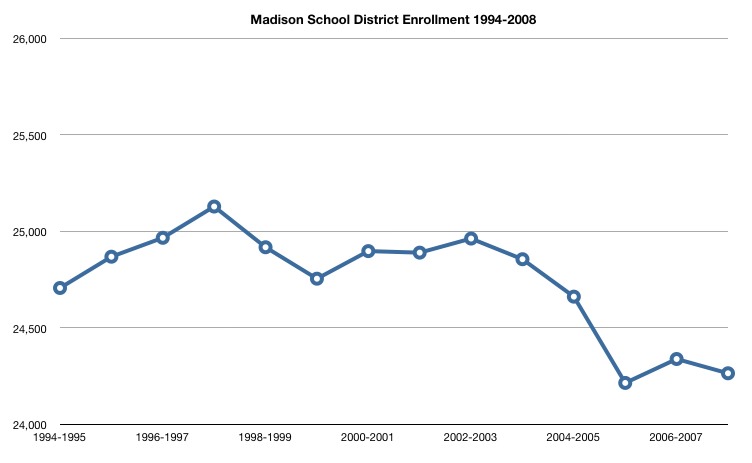 Madison School District Enrollment: 1994-2007 (the demographics have changed during this time) | 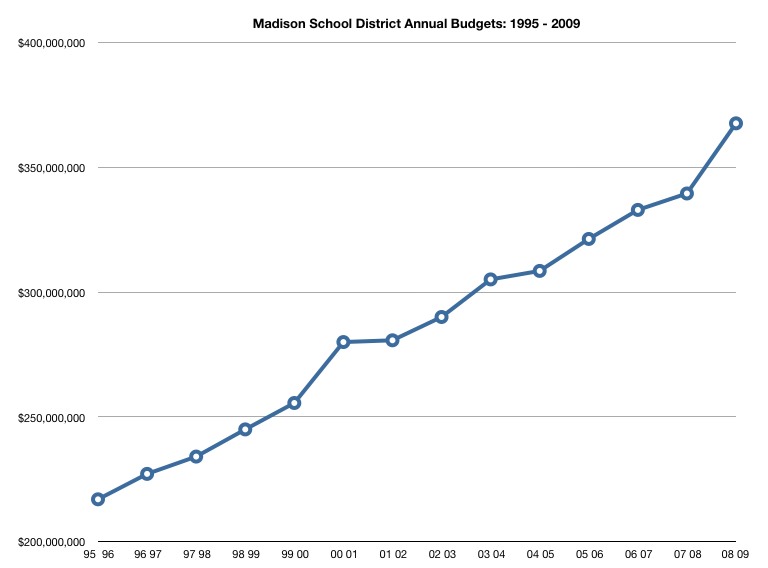 Madison School District Budgets: 1995-2009 | 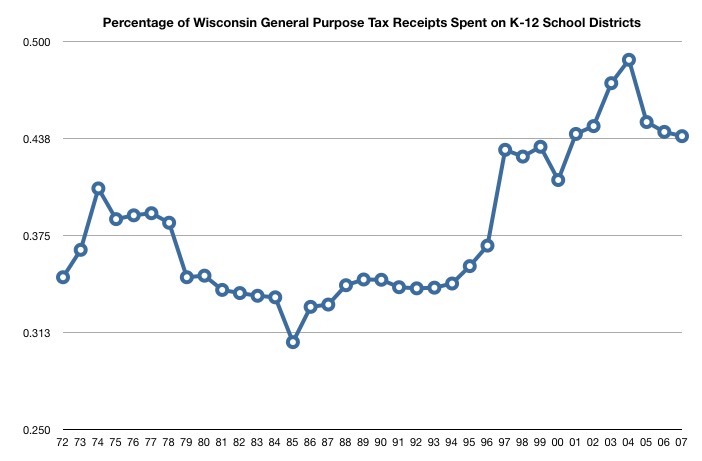 Percentage of Wisconsin General Purpose State Tax Revenue Spent on K-12 School Districts: 1972-2007 |
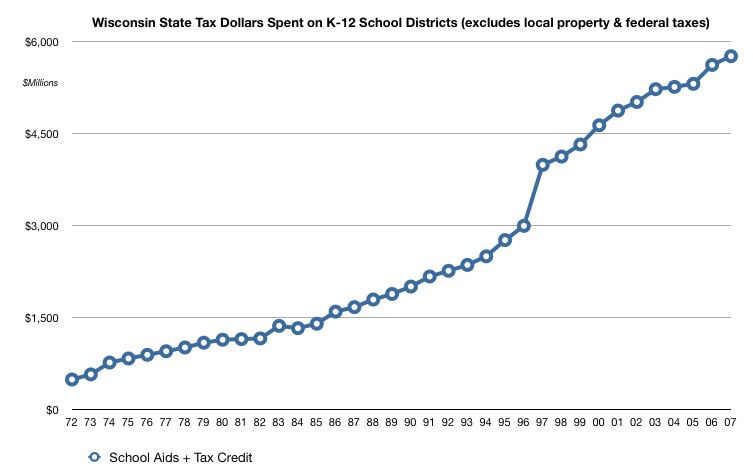 Wisconsin State Tax Dollars Spent on K-12 School Districts: 1972-2007 | 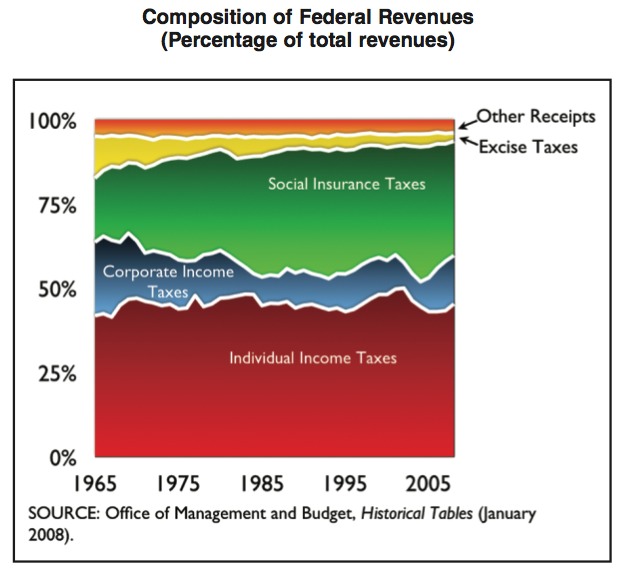 US Government Tax Revenue, by Source: 1965-2005 | 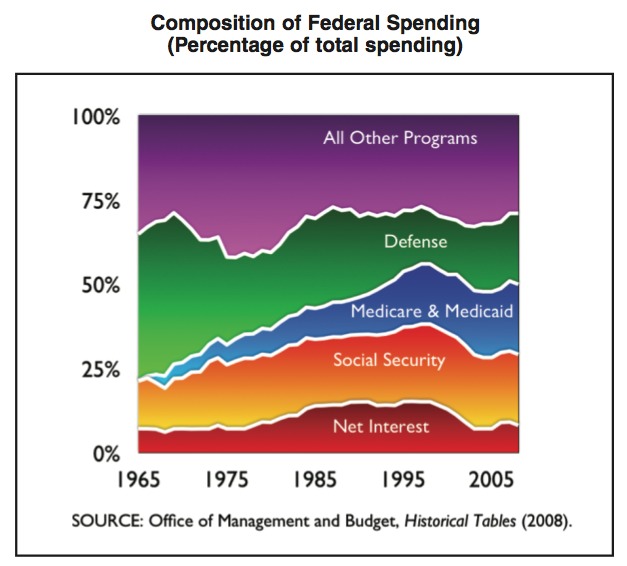 Composition of US Government Spending: 1965-2005 |
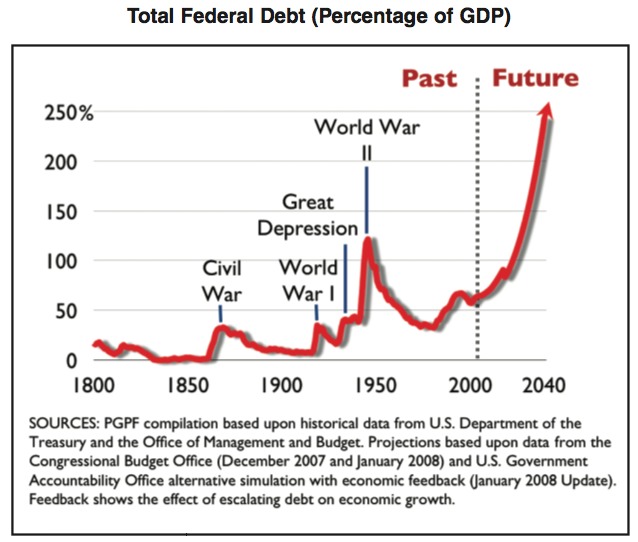 Total US Governement Debt, as a percentage of GDP | 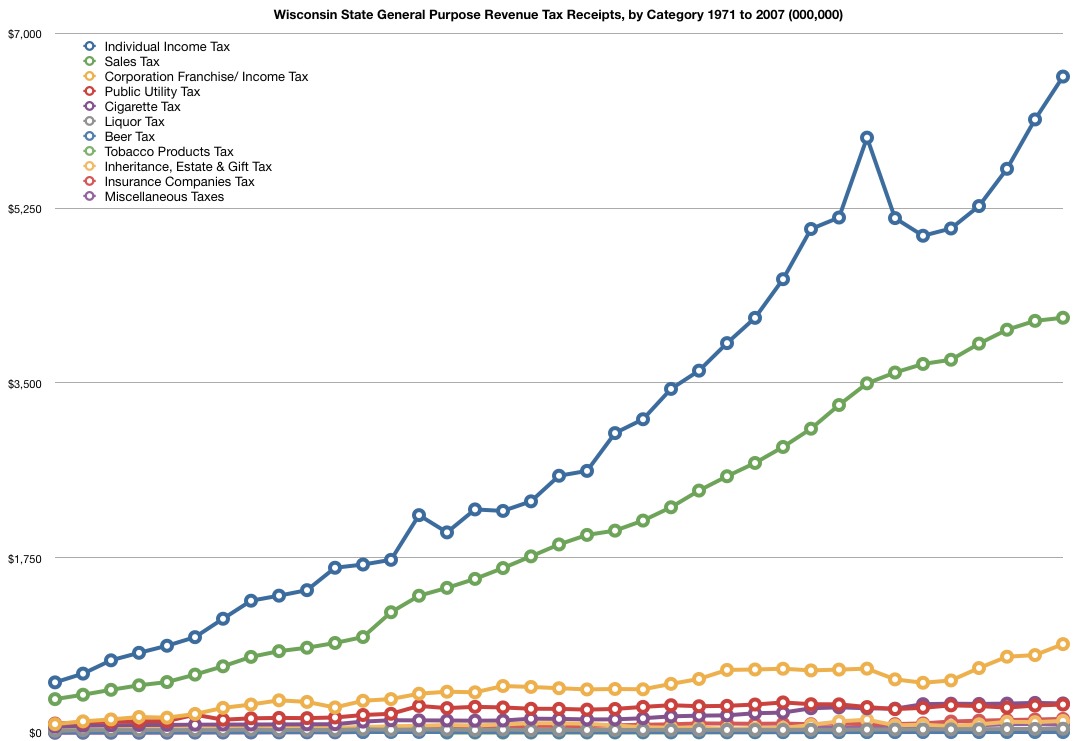 Wisconsin General Purpose Revenue Tax Receipts by Category: 1971-2007 | 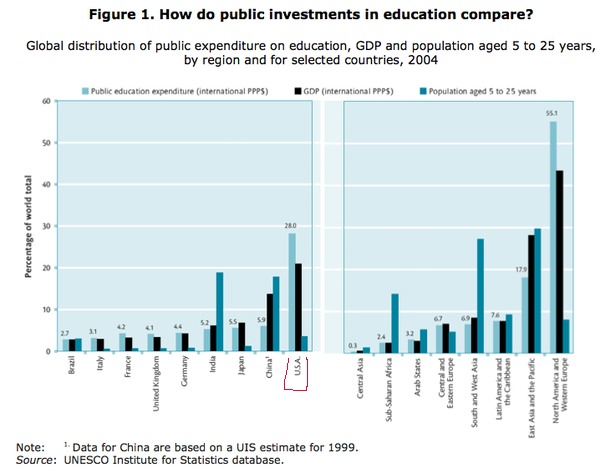 Global Distribution of public expenditure on Education: ages 5 to 25 |
US Bureau of Labor Statistics: Consumer Price Index. $1000 in 1995 requires $1443.33 according to their inflation calculator, while $1000 in 1972 requires $5,262.30 in 2008.
November Madison School District Planned November, 2008 Referendum notes & links. Tax climate notes & links: When is a Tax Cut Really a Tax Hike by Gene Epstein, 20 Reasons to Kill Corporate Taxes by James Pethokoukis, I.O.U.S.A the Movie, the Economist: Inflation's Last Hurrah and Dave Blaska on the proposed referendum.
Newsletter signup | Send us your ideas
Active Citizens for Education (ACE) calls for the Madison Metropolitan School District Board of Education to delay making specific decisions for the presentation of a recurring referendum to the taxpayers for a vote on the November election ballot.
Passage of a recurring referendum on the November 2008 ballot would allow the board and school administration to permanently exceed the state mandated revenue spending caps. Such a move to fix a so-called current "budget gap" would allow the board and administration to exceed annual spending caps permanently, every year into the future. This would virtually give the board a "blank check" from district taxpayers to plug future budget gaps or shortfalls. It could prevent the board and administration from having to carefully and thoughtfully budget, like every taxpayer must do when their household budget faces tough economic times and shortfalls.
The plans and communications presented in recent weeks by the board and administration provide greater hope for more effective decision-making now and in the future. The recommendations for changes in policy and accountability options in community services, transportation, lease contracts, fund balances and capital expansion (maintenance) will have positive impacts on reducing the so-called "budget gap."
The Board must earn the trust of the taxpayers by clearly showing that they can be "good stewards" of taxpayer dollars. Past experience has not earned that trust! If a referendum is ultimately required to fix upcoming budgets, it should be a non-recurring referendum, thereby preventing 'mortgaging' the future with year-after-year, permanent increases in spending authority.
The Board and administration must correct the absence of specific processes and strategies for analysis and evaluation of business and educational services, programs, practices and policies. Urgent and substantial investments of time and work are critical for these processes to evolve into hard evidence. This evidence is absolutely necessary to show the public that serious steps are under way to provide clear, concrete data and options for identifying the most effective and efficient results-oriented management of the financial resources of the district. It must be shown that the resources will be directly applied to improvements in student learning and achievement.
In order for the public to support any change in spending habits or spending authority the district must meet the following conditions: a) full disclosure and accountability in the reporting of methodologies, data measurements, analyses and results in spending and the effective use of existing funding levels; b) assure that the shifting of funds is done on the basis of evaluations and assessments; c) changes are put in place to affect improvements in curriculum and instruction which directly increase student achievement and development at all levels; d) make the schools and the educational climate safe and secure for all students and staff; and e) engage in collaborative and cost-sharing initiatives with other government entities, as well as private and non-profit organizations.
Don Severson, President of ACE, said in a statement "When realistic evidence of progress toward these conditions is shown, then Active Citizens for Education and the general public will actively and willingly support the district with appropriate financial means. Anything short of meeting these conditions will not be in the best interests of our children and the community."
The school board and administration must continue to work to improve their communications and evaluation processes to gain the trust and confidence of the public for both short-and long-term successes. The district board is urged to proceed carefully and firmly in a strategic and progressive manner. A decision, at this time, by the board to request taxpayer support for a recurring referendum on the November 2008 ballot would be significantly premature and disastrous.
Questions raised at the Madison School District's Financial Forums
Please send your own comments, concerns and/or convictions to all board members and superintenent at comments@madison.k12.wi.us or to selected ones of your choice.
Newsletter signup | Send us your ideas
Barack Obama says he believes in universal preschool and if he's elected president he'll pump "billions of dollars into early childhood education." Universal preschool is now second only to universal health care on the liberal policy wish list. Democratic governors across the country -- including in Illinois, Arizona, Massachusetts and Virginia -- have made a major push to fund universal preschool in their states.But is strapping a backpack on all 4-year-olds and sending them to preschool good for them? Not according to available evidence.
"Advocates and supporters of universal preschool often use existing research for purely political purposes," says James Heckman, a University of Chicago Noble laureate in economics whose work Mr. Obama and preschool activists routinely cite. "But the solid evidence for the effectiveness of early interventions is limited to those conducted on disadvantaged populations."
Mr. Obama asserted in the Las Vegas debate on Jan. 15 that every dollar spent on preschool will produce a 10-fold return by improving academic performance, which will supposedly lower juvenile delinquency and welfare use -- and raise wages and tax contributions. Such claims are wildly exaggerated at best.
Newsletter signup | Send us your ideas
But Silveira also said the 2005 referendum campaign suffered because the School Board itself was divided on it, "and it was a pretty split community speaking out on both sides in favor and being opposed."We are on the same page now. We're really changing our focus to one of really spending more time on student achievement."
For board member Lucy Mathiak, a key difference between Nerad's proposal and past ones are the measures he has taken to cut costs already.
Newsletter signup | Send us your ideas
On Aug. 18 Nerad will present his recommendations to the board on whether a referendum is the way to trim an $8.2 million hole in the budget, and the board likely will vote Aug. 25 to formulate referendum questions for the Nov. 4 election. In addition, the gap is expected to be $6 million in the 2010-11 school year and $5.1 million in 2011-12.Andy Hall:Since a state-imposed revenue formula was implemented in 1993 to control property taxes, the district has cut $60 million in programs, staffing and services. The district did not have to make budget reductions during the 2008-09 school year after it benefited from a one-time, $5.7 million tax incremental financing district windfall from the city. The district will spend approximately $367.6 million during the 2008-09 school year, an increase of about 0.75 percent over the 2007-08 school year budget.
In addition to exploring reductions, Madison officials are researching how much it would cost to begin offering kindergarten to 4-year-olds in the district — a program offered by two-thirds of the school districts in Wisconsin.Much more on the budget here.Resident William Rowe, a retired educator, urged school officials to generate excitement by offering 4K, which research has shown can help improve academic achievement.
"I believe this is the time to go for it," said Rowe, who proposed that a 4K referendum be offered separately from a referendum that would help avert budget cuts.
Don Severson, president of Active Citizens for Education, a district watchdog group, praised district officials for making the process so open to the public. However, he urged officials to provide more information about the costs and benefits of specific programs to help the public understand what's working and what's not. He predicted a referendum is "going to be very difficult to pass" but said he still hasn't decided whether one is needed.
Newsletter signup | Send us your ideas
Frederic J. Fransen
Center for Excellence in Higher Education
Perhaps it's time for college fundraisers to come clean about the differences between giving to colleges and universities and giving to their athletic programs.
When donors give to athletics their gifts may produce visible results (a winning season, perhaps, or an NCAA tournament spot), but such gifts do not help colleges achieve their primary mission: the education of tomorrow's leaders.
Not that there is anything wrong with giving to athletic programs, but a spade needs to be called a spade.
We've all heard the rationalizations. College athletic programs -- especially big-time football and basketball -- boost school spirit and spur alumni giving.
College athletic programs give some students a shot at a college education they wouldn't get otherwise. And sports competition helps us become well-rounded individuals. None of these points is inherently untrue. They're just irrelevant.
Americans, through tax dollars, tuition, and philanthropy, support some 2,500 public and private four-year colleges and universities for a reason: to educate those who will lead and sustain us in the future.
As much as I might enjoy the Indiana Pacers and Indianapolis Colts, their services are fundamentally unnecessary for the survival, prosperity, well-being and enlightenment of the country.
Yet, 26 percent of all dollars donated to Division I-A colleges and universities now go to athletics, according to an analysis published in the April 2007 issue of the Journal of Sport Management. In 1998, the comparable figure was 14.7 percent.
The Chronicle of Higher Education reported late last year that overall spending on sports has been growing "at a rate three times faster than that for spending on the rest of the campus." And for most schools, according to recently released NCAA research, sports program costs exceed revenues. Only the top athletic powerhouses make money -- and, frequently, only when they win.
Where's the money going? Mostly, the money goes to build new stadiums, arenas and practice facilities to showcase the schools' gladiators.
Schools in the six top college athletic conferences received more than $3.9 billion in donations for athletic facilities from 2002 to 2007 alone, the Chronicle of Higher Education says.
The question that needs to be asked is why are schools spending big bucks on athletic facilities for a relative handful of semi-pro athletes when academics should be their focus?
One reason many philanthropists choose to give to college athletics is because they know what they are getting. Who can blame them?
When you donate a large sum of money to support University of Wisconsin athletic programs, you do so because the Badgers have a winning tradition and you hope your gift will help produce additional championships.
When you write the same check to the English or history department, you may never know where the money went.
If education is to be the primary focus of our colleges and universities, officials involved in the "rainmaking" process need to do a better job of demonstrating to donors what their educational gifts accomplish in an equally transparent and powerful way.
They do higher education a disservice when they spend money excessively on the game, while shortchanging the end game: a highly educated workforce to face the competitive challenges of the 21st century -- and a tolerant and enlightened public capable of making intelligent personal and political choices.
That's what we need. And that's what a new field house doesn't buy.
Newsletter signup | Send us your ideas
THE literacy and numeracy of new employees have tumbled over the past decade despite Labour's £28 billion increase in annual education spending, according to research by a leading employers' organisation.The Institute of Directors (IoD) found that 71% of its members believe the writing abilities of new employees had worsened, while 60% believed numeracy had also declined; 52% reported a worsening of the basic ability to communicate.
With the exam results season under way, more than 60% of company directors now think GCSEs and A-levels are less demanding than a decade ago. Overall, only 27% believe schools have got better under Labour.
A-level results to be released this Thursday are expected to show the number of passes going above 97% and the proportion of A grades rising slightly from last year's 25.3%, the 11th successive annual rise.
Newsletter signup | Send us your ideas
Via a Johnny Winston, Jr. email:
The Johnny Winston, Jr. 2008 Streetball and Block Party will be held on Saturday August 9th from 12 noon to 7:00 p.m. at Penn Park (South Madison – Corner of Fisher and Buick Street). “Streetball” is a full court, “5 on 5” Adult Men’s Basketball tournament featuring some of the best basketball players in the City of Madison, Milwaukee, Beloit, Rockford and other cities. The rain date for basketball games only is Sunday August 10th.
The “block party” activities for youth and families include: old and new school music by D.J. Double D and Speakerboxx DJ’s; funk and soul music by the Rick Flowers Band, youth drill and dance team competition, free bingo sponsored by DeJope Gaming; face painting and youth activities sponsored by Madison School and Community Recreation, YMCA of Dane County, Dane County Neighborhood Intervention Program; The Boys & Girls Club of Dane County, the Madison Children’s Museum, pony rides by “Big Bill and Little Joe” and more. This event includes information booths and vendors selling a variety of foods and other items.
This is a safe, family event that has taken the place of the “South Madison Block Party.” The Madison Police Department and other neighborhood groups are supporting this as a positive activity for the South Madison community. Over the past seven years, $10,000 has been donated to charitable programs that benefit South Madison and support education such as the Boys & Girls Club and the Southside Raiders Youth Football and Cheerleading Teams.
In all, this event will provide a wonderful organized activity for neighborhood residents to enjoy this summer. If you have any questions, would like to volunteer or discuss any further details, please feel free to call (608) 347-9715; e-mail at: johnnywinstonjr@hotmail.com or www.madisonstreetball.com. Hope to see you there!
Please feel free to forward this information to other interested persons or organizations.
Newsletter signup | Send us your ideas
Wisconsin State Journal Editorial: "Tame State's Tax Bite on Homes":
The poor rating should serve as yet another warning to state and local leaders not to jack up this worst-of-all tax even higher. It also should energize groups such as The Wisconsin Way, which is brainstorming for creative and fair ways to reduce our state 's property tax burden while growing our high-tech economy.Mark Perry - "A Nation of Entitlements":If anything, the Taxpayers Alliance ranking Tuesday minimized the pinch many Wisconsin homeowners feel. That 's because the group looked at the burden on all properties together -- homes, businesses, farms and other land.
If you single out just homes, a different study last year suggested Wisconsin property taxes rank No. 1 in the nation. The National Association of Home Builders compiled property tax rates on a median-valued home in each state. Only Wisconsin and Texas (which doesn 't have a state income tax) exceeded $18 per $1,000 of property value.
In its report Tuesday, the Taxpayers Alliance measured the property tax bite more broadly. It ranked states based on ability to pay. It found that Wisconsin 's property tax burden eats up about 4.4 percent of personal income here.
These middle class retirement programs, Social Security, Medicaid and Medicare, cost more than $1 trillion annually (about the same as the entire economic output of Canada, the 13th largest ecoomy in the world, see chart above), and will cause federal spending to jump by half, from 20% of the economy to 35% by 2035. This tsunami of spending is a major threat to limited government because it runs on auto-pilot with automatic increases locked in by each program’s governing laws. While other programs are constrained through annual budgets, entitlements get first call on resources. Other goals such as defense or national security must compete for an increasingly smaller share of what’s left.
Newsletter signup | Send us your ideas

With the school year winding down and summer almost here, it would be easy for any area high school student to spend his or her time simply counting down the days to the start of summer fun. But for one group of students at Middleton High School, there is no time like the present to start a new project, aimed at helping those in need halfway around the world.
For the past three weeks, this group of students have been collecting used sports equipment for children in the country of Liberia, all in the name of helping the youth of this nation, which is recovering from a 15-year civil war, learn how to see each other as teammates rather than enemies.
The inspiration for the project — titled Sports For Africa and part of a burgeoning non-profit organization called Project Liberia -- came from 16-year-old Laytee Norkeh, whose mother and father are Liberian nationals. As Norkeh and her friends listened to heartbreaking stories of the great need that exists across the small West African country, they couldn't help but see an opportunity to get involved.
"We felt a strong need to take matters into our own hands and help those who are so helpless," Norkeh says. "It takes so little to make such a big difference in the lives of these people. We want to help them and give them hope of a better future."
Norkeh, along with Eli Rosen, Carli Kopatz, Lexie Jordee, Sam Delabarre, Ashley Guse, Campbell White, David Ripp, Alex Koritzinsky, and John Zimmerman have been working to collect used sports equipment at their school and other local businesses. The collection runs from May 28 - June 6th. Laytee has created a video which will be shown to the student body beginning May 28th.
About Project Liberia:
Project Liberia is a collection of individual programs designed to meet some of the most pressing needs for a nation recovering from a devastating civil war. Each venture — from building a community center, developing a micro-loan system and bringing sports equipment to children in villages and orphanages — has been developed to enhance the physical, mental, emotional and spiritual fiber of the people of Liberia. 501(c)(3) status pending.For more information, please contact Bulleh Bablitch at (608) 577-6711 or project.liberia@yahoo.com.
Liberia via the CIA's World Factbook.
Newsletter signup | Send us your ideas
Amy Herzog took some curious steps as she prepared to interview with a big donor, one that could write a huge check for medical research on her son's rare digestive disorder. She fretted over choosing the sweater and pants she wore, not wanting to look like "some old mom." She made her husband, Brian, go with her. "I did not want to walk in there alone," she says.The Herzogs found the meeting room and sat down. Before them, with pens poised over questionnaires, was a committee of students at Highland Park High School.
The 1,888-student school in an affluent Chicago suburb is one of a number of schools across the country that have emerged as highly sought scientific benefactors. Last year, the students raised $180,000, and an anonymous donor matched that. Students gave the $360,000 in one lump to a research organization started by a local family whose son has Huntington's disease and whose daughter will develop the fatal genetic disorder.
Newsletter signup | Send us your ideas
If you think high school sports are too slick, too big-time, or too professional, just wait. When this Ohio transplant has his way—and he will—they’re going to get slicker, bigger, and much more pro. Stephenson, the former president of Dave Campbell’s Texas Football, founded Titus Sports Marketing in 2003. The company’s first major deal came a year later, when it sold naming rights for the Tyler Independent School District’s stadium to Trinity Mother Frances Health System for $1.92 million, the largest such contract for a high school ever. In September 2007 Titus also put together the Clash of Champions, a game televised on ESPNU between the best high school football team in Florida, Miami Northwestern, and the best in Texas, Southlake Carroll. Northwestern won the game (hyped as “the biggest game in the history of high school football”) 29—21, but the real winner may have been Stephenson.Where did you get the idea for Titus?
I knew high schools were looking at ways of maximizing revenue. A lot of districts are looking to give their stadiums a face-lift—to add parking, double the concessions and restrooms, redo the field house. High schools are where colleges were fifteen years ago, and there’s a lot of lost advertising revenue because there’s nobody there to capture it. We’re pioneers. We work with the school district; we sell the assets that they direct us to sell.
Newsletter signup | Send us your ideas
The "Wisconsin Way" recently held a forum in Waukesha. The local Taxpayer's League posted some notes [website].
A schedule of forums appears on their website (Madison is 12/6/2007). More:
Welcome to the Wisconsin Way! You’ve made the first step to helping lower Wisconsin’s property taxes, while protecting our services and maintaining Wisconsin’s quality of life.A groundswell of public concern about the affordability of property taxes on the one hand and the need to maintain Wisconsin’s critical infrastructure on the other has prompted several statewide leadership groups to join forces in a historic search for solutions called The Wisconsin Way.
In the coming months, the original conveners of the Wisconsin Way—the Wisconsin Counties Association, the Wisconsin Education Association Council, Wisconsin Realtors Association, Wisconsin Transportation Builders Association and Wood Communications Group—will host a series of public gatherings around the state in an effort to engage Wisconsin citizens in a constructive, solution-oriented conversation about what we can do to make Wisconsin taxes fairer and reduce the property tax burden without sacrificing the quality of public services that have made Wisconsin a special place to live and work.
Newsletter signup | Send us your ideas
Ted Widerski:
The Talented and Gifted Division of MMSD is busy organizing ‘MathFests’ for strong math students in grades 4 – 8. These events are planned to provide an opportunity for students to interact with other students across the city who share a passion for challenging mathematics. Many of these students study math either online, with a tutor, by traveling to another school, or in a class with significantly older students.These events will be hosted by Cuna Mutual Insurance and American Family Insurance. Students will have an opportunity to learn math in several ways: a lecture by a math professor, group learning of a new concept, and individual and small group math contests. Over 300 students from 38 schools will be invited to participate.
The funding for this project is challenging as there are no significant MMSD funds available. A plea for funding in the last several weeks has resulted in gifts totaling about $1000. Those gifts will guarantee that the middle school Mathfest will be held on Wednesday, February 21st.
In order to hold the Elementary MathFests on each side of Madison would require additional donations. Gifts totaling $1600 would provide the necessary support to provide 200 students with a very special experience. If anyone or any group would like to contribute, it would be most appreciated. Please contact me: Ted Widerski, TAG Resource Teacher at: twiderski@madison.k12.wi.us
Thank you for supporting this math event.
Newsletter signup | Send us your ideas
Property taxes in Wisconsin are the nation's highest in proportion to the value of owner-occupied homes, according to a recent national study.The Tax Foundation [Gerald Prante]:hat is "nothing terribly new or earth-shaking," said Todd A. Berry, president of the Wisconsin Taxpayers Alliance in Madison, who predicted the taxes still are too low to cause a fundamental change in state policy.
The study results are "a combination of two things," Berry said. "We are a higher property tax state . . . (and) our median home value is lower. Put those together, and it is going to push us up."
No tax riles the American people more than property taxes, especially real estate taxes that are based on the value of their homes and land. According to a recent Tax Foundation poll, property taxes are thought to be the least “fair” of all state and local taxes.Prante's last point regarding the relationship between changes in the housing market, tax assessments and rates is an important factor to watch. Madison has experienced substantial housing growth (and therefore parcel quantity and values) over the past decade. If/when that changes, there will be some blowback with respect to assessments, millrates and the net taxes we pay.Most likely, part of the reason for this loathing is that taxpayers are more acutely aware of what property taxes cost them than they are of income, payroll, corporate, or sales taxes. Sometimes, property taxes are paid into an escrow account without much personal attention from the taxpayer, but often property taxes involve the actual writing of a huge check to the local government.
Key Findings:
- Property taxes highest in the Northeast, Texas, Illinois, and Wisconsin
- New York and New Jersey dominate list of high-tax counties
- About half of all property taxes go to public schools
- Property taxes rose faster than incomes from 2002 to 2004
- Housing market decline may force local governments to cut spending or raise property tax rates
Add the Madison School District's recently revealed 7 year structural deficit, the subsequent need to reduce the annual school district spending increases in it's current $333M+ budget by a larger than normal amount and we have a rather challenging school spending environment. Complete report: 409K PDF
Newsletter signup | Send us your ideas

Academic Blend, a 100% Fair Trade Coffee. An insurgent fundraising idea from Thoreau Elementary School's activist parents. 4 flavors (check out the eyes), $10/pound. Email Rosana Ellman (rellmann@charter.net) to order.
Add your interesting fund raising ideas to this post via the comments. The recently revealed Madison School District's $6M structural deficit (slightly less than 2% of its $332M budget) places a premium on creative fund raising and expense reduction. The 2007/2008 budget will feature larger than normal reductions in the District's spending increases, due to the structural deficit.
Newsletter signup | Send us your ideas