
| School Information System |
 | Sponsorships | Sponsorships |
|
|
Fewer than one-third of California students who took a statewide physical fitness test this year managed to pass all six areas assessed, new results show.State Supt. of Public Instruction Tom Torlakson, a longtime cross-country coach who has made physical fitness a signature issue, announced the results this week as he launched a program to improve children's health. The campaign will use such celebrity athletes as NBA all-star Bill Walton and others to visit schools to urge students to drink more water, eat more fruits and vegetables and increase their exercise.
"When only 31% of children are physically fit, that's a public health challenge we can't wait to address," Torlakson said in a statement.
Newsletter signup | Send us your ideas
By Reihan Salam
I've been eagerly awaiting the release of the latest issue of National Affairs, which includes Rick Hess's fascinating and at times provocative discussion, or perhaps I say "devastating takedown," of "achievement-gap mania." The following paragraph gives you a hint as to Hess's conclusion:
In essence, NCLB was an effort to link "conservative" nostrums of accountability to Great Society notions of "social justice." The result was a noble exercise hailed for its compassion. The sad truth, however, is that the whole achievement-gap enterprise has been bad for schooling, bad for most children, and bad for the nation.
I found his discussion of the neglect of advanced and gifted education particularly convincing, as well as his recounting of how the "delusion of rigor" has undermined quality control across many domains. Hess ends his essay with an accounting of where "achievement-gap mania" has left the politics of K-12.
(1) Reforming education has become someone else's problem:
First, achievement-gap mania has signaled to the vast majority of American parents that school reform isn't about their kids. They are now expected to support efforts to close the achievement gap simply because it's "the right thing to do," regardless of the implications for their own children's education. In fact, given that only about one household in five even contains school-age children -- and given that two-thirds of families with children do not live in underserved urban neighborhoods, or do not send their kids to public schools, or otherwise do not stand to benefit from the gap-closing agenda -- the result is a tiny potential constituency for achievement-gap reform, made up of perhaps 6% or 7% of American households.
Because middle-class parents and suburbanites have no personal stake in the gap-closing enterprise, reforms are tolerated rather than embraced. The most recent annual Gallup poll on attitudes toward schooling reported that just 20% of respondents said "improving the nation's lowest-performing schools" was the most important of the nation's education challenges. Indeed, while just 18% of the public gave American schools overall an A or a B, a sizable majority thought their own elementary and middle schools deserved those high grades. The implication is that most Americans, even those with school-age children, currently see education reform as time and money spent on other people's children.
(2) Reforming education for the majority of students who come non-poor families is seen as somehow unnecessary:
Second, achievement-gap mania has created a dangerous complacency, giving suburban and middle-class Americans the false sense that things are just fine in their own schools. Thus it's no surprise that professionals and suburbanites tend to regard "reforms" -- from merit pay to charter schooling -- as measures that they'll tolerate as long as they're reserved for urban schools, but that they won't stand for in their own communities. ...
Gap-closing strategies can be downright unhelpful or counterproductive when it comes to serving most students and families, and so can turn them off to education reform altogether. Longer school years and longer school days can be terrific for disadvantaged students or low achievers, but may be a recipe for backlash if imposed on families who already offer their kids many summer opportunities and extracurricular activities. Policies that seek to shift the "best" teachers to schools and classrooms serving low-achieving children represent a frontal assault on middle-class and affluent families. And responding to such concerns by belittling them is a sure-fire strategy for ensuring that school reform never amounts to more than a self-righteous crusade at odds with the interests of most middle-class families.
This is one reason why Hess rightly bristled at the crusader mentality that informs films like the recent Waiting for 'Superman.'
(3) Education reform has come to be associated with metrics that aren't particularly helpful for schools that serve non-poor students.
Third, achievement-gap mania has prompted reformers to treat schools as instruments to be used in crafting desired social outcomes, capable of being "fixed" simply through legislative solutions and federal policies. This tendency is hardly surprising, given that most of the thinking about achievement gaps is done in the context not of education reform but of "social justice." Thus gap-closers approach the challenge not as educators but as social engineers, determined to see schools fix the problems that job-training initiatives, urban redevelopment, income supports, and a slew of other well-intentioned government welfare programs have failed to address.
With the social engineer's calm assurance that there are clear, identifiable interventions to resolve every problem, today's education reformers insist that closing the achievement gap is a simple matter of identifying "what works" and then requiring schools to do it. And integral to determining "what works" has been evaluating different strategies in terms of their effects on reading and math scores and graduation rates. This approach has been especially popular when it comes to identifying good teachers. But while the ability to move these scores may be 90% of the job for an elementary-school teacher in Philadelphia or Detroit, it doesn't necessarily make sense to use these metrics to evaluate teachers in higher-performing schools -- where most children easily clear the literacy and numeracy bar, and where parents are more concerned with how well teachers develop their children's other skills and talents.
As Hess has argued elsewhere, what we really need is a more diverse ecology of specialized instructional providers tailored to meet the needs of individual students, including advanced and gifted students, rather than rigid carrot-and-stick systems designed to "fix" centralized command-and-control systems not by making them less centralized and command-and-control, but rather by issuing new commands from the center.
(4) This "what works" mentality, which implicitly assumes that there are a few simple nostrums that "work" in every or at least most cases, has proved a barrier to innovation:
Fourth, the achievement-gap mindset stifles innovation. When a nation focuses all its energies on boosting the reading and math scores of the most vulnerable students, there is neither much cause nor much appetite for developing and pursuing education strategies capable of improving American schools overall.
Consider the case of school choice. Today, for all the vague talk of innovation, charter schools and school vouchers rarely do more than allow poor, urban students to move from unsafe, horrific schools into better conventional-looking schools. The leading brands in charter schooling, for instance, almost uniformly feature traditional classrooms; an extended school day, school year, or both; and a reliance on directive pedagogy attuned to the needs of disadvantaged students. In other words, these are terrific 19th-century schools. One has to search long and hard among the nation's more than 5,000 charter schools to find the handful that are experimenting with labor-saving technologies, technology-infused instruction, or new staffing models better suited to the 21st century.
Furthermore, the intense focus on gap-closing has led to a notion of "innovation" dedicated almost entirely to driving up math and reading scores and graduation rates for low-income and minority students. Promising innovations that promote science, foreign-language learning, or musical instruction have garnered little public investment or acclaim. Even in terms of math and reading, there is not much interest in interventions that do not show up on standardized state assessments.
(5) And interestingly, Rick argues that gap-closing has dimmed interest in promoting racially and socioeconomically integrated schools.
As always, the essay is worth reading in full. I haven't done it justice.
Newsletter signup | Send us your ideas
My mom once asked me about the first steps I would hypothetically take to make a "better school." I don't claim to be an education expert, but I do have personal opinions about the ideal school -- one I'd like to go to. Among many other things, I said that I would change school starting times, improve cafeteria lunches, and bring back recess. These would be good first steps because they help a lot of students a little bit. And they can have wide-reaching impacts.
Starting Times
Studies have repeatedly shown that everyone, especially children with developing brains, need a good amount of high-quality sleep. It's difficult to get when you have to worry about waking up at 7 in the morning to go to school. Not everyone is a morning lark, and by starting school so early, not only students but also educators have to stave off yawns throughout the day.
I was at a conference where a well-respected sleep researcher, Dr. James Maas, revealed that adolescent sleep cycles tend to begin at 3 a.m. and end at 11 a.m. Yet we're starting school at 7 or 7:30 a.m. While I wouldn't quite change school start times to 11 a.m. (since we have to consider parents who have to go to work), I think it would be reasonable to move them to 8:45 AM or after. Then hypothetically a teenager could go to bed at 12 a.m. (as many often do), wake up at 8, shower and eat breakfast, and go to school with eight rather than five or six hours of sleep.
Lunch
Another step: improve cafeteria lunches. Put a cap on the amount of sodium, fat, and calorie content allowed in each lunch. Mandate nonfat or 1 to 2 percent milk (and in smaller containers -- who really drinks that much milk?) instead of whole milk. Get rid of chocolate milk, soft drinks, and vending machines with unhealthy items. Require a certain percentage of food served be organic and/or local, and have smaller portions to help minimize cost (we all know how much food gets dumped out). Have the school's cooking classes (or maybe the entire student body) help make lunch on certain days.
A bigger step: I think it would be a good idea to have randomly assigned seating during lunch. This might be controversial among students, but the social division that occurs when students simply pick out where they want to sit can be hurtful and exclusive to students new to the school or children with difficulty making friends. Also, it seems that teachers rarely eat lunch and converse with the students. I've learned a lot from being able to have conversations with adults. So, teachers would be required to eat lunch with the students -- at least on certain days -- (and really, if they really can't stand students to the extent that they can't eat with them, should they be teaching?)
Recess
While making nutritious school lunches would be an excellent way to start combating childhood obesity, bringing back recess, at all grade levels, could do even more (as well as markedly increasing cognitive ability). In middle and high school you might have a somewhat more organized approach (depending on students, because it isn't hard to envision students simply standing around and talking to each other instead of exercising.
Perhaps instead of a dreaded required class one semester of junior high, physical education could become a fun, daily 15 to 20 minute class -- where healthy behaviors, like calisthenics, frequent exercise, jogging, and hiking, would be modeled every day. Students could get involved actively in the "curriculum," by submitting their favorite exercise activities and voting on which new things to try.
"Big" Changes
I want to talk about "big" changes I would make in education (if I were in a position of incredible power!) -- multiple, age-independent, subject-based grade levels; online learning; and authority hierarchy in school.
Age-Independent Grades
I took two electives recently at Redmond Junior High. Everyone asked what grade I was in. It would go something like this:
"Adora, what grade are you in?"
"Ninth grade."
They look incredulously at my apparently seventh-grade style of dress (i.e., sweaters and shirts vs. tank tops and jackets) and say, "You're in ninth grade?"
"Yeah," I nod quickly, and explain, "I skipped a grade."
[Actually, it's feasible that I skipped two grades, since 12-year-olds are often put in seventh grade (depending on when your birthday is) but usually I say I just skipped one, since I'm now thirteen.]
One's grade in school decides what you'll learn and the level at which you'll learn it. It decides when you'll graduate from high school and even the friends you'll make (most of your friends are probably in your grade or close to it). My question is why your age, not your aptitude, should determine your grade -- and why grade covers all subjects, when people have varying degrees of ability and interest across subjects. (Yes, there's a reason kids are always asked, "What's your favorite subject?")
I am at a loss as to the benefits of putting a group of people of approximately the same age -- but of varying aptitudes -- into one room where they will all learn the same thing. The quicker students will sit bored while the teacher re-explains a concept they already know from their voracious reading, while the slower students will be confused and left out by the rapid pace at which everyone else seems to be progressing.
My parents homeschooled my sister and me for many years. Why? Because the local school insisted that I, being three, should go to preschool, and my sister, being five, should go to kindergarten. The problem? You learn your alphabet in preschool, and I was already reading chapter books. At the same time, however, I was not so far along with math and science. In other words, I was not "advanced" in everything. Yet many gifted and talented programs try to put students into all-around advanced classes.
Wouldn't it make more sense to be able to take some kind of test (oral, written, multiple choice, or informal discussion with a counselor) to determine what level you would be? Maybe then I could have taken a test which would have allowed me to learn at second grade reading and history level, and kindergarten or first-grade math and science.
To me, this approach makes far more sense than sorting students into grades based on when your birthday is. Would you ever tell a son or daughter, little brother or sister, "You weren't born before September 1st, so I'm not going to help you learn your alphabet"? Yet that is what our school system does every year.
Placement tests to sort students into levels would put students with a larger knowledge base into higher grades, but a large knowledge base doesn't necessarily mean a love of learning. I'd propose that honors/gifted status would then be determined by a student's desire to learn and exhibition of independent learning traits (i.e., reading a lot outside of school, tracking current events, etc.). For instance, if you're a 10-year-old who's been advanced to seventh-grade level mathematics, you'd be placed in the honors math class. The material covered would be the same as the seventh-grade level math (because honors classes would no longer have to serve only as a means of providing harder material -- you'd be placed in a higher grade if you had that large knowledge base), but there would be more discussion, extracurricular activity, etc.
I personally think that there is no compelling benefit to having an age-based grade system. It could be argued that some poor little advanced 3-year-old, taking language arts classes with 8-year-olds, will feel different and lonely--but 10 years ago, you would have found 3-year-old Adora Svitak taking classes at Renton's H.O.M.E. Program (a public program offering classes for homeschooled children)... with 6, 7, and 8-year-olds, among others -- and feeling fine. Diversity should be more than a buzz phrase. If students are prepared to make friends with and learn from those younger (or older) than them, we have made true progress in embracing diversity.
Authority Hierarchy in School
I definitely think that students need to get involved in decision-making on a deeper level, beyond simply being on an associated student government or student council. At the TEDx conference I organized last year, TEDxRedmond, several speakers (all of whom were under 18), spoke movingly on their opinions about education and certain ways their schools had supported and/or failed them.
In many countries, schools are preparing students to participate in a democratic environment; yet schools themselves tend to be extremely autocratic, with all high-level decisions being made by adults. Let students have a voice -- use online technology to have students give constructive feedback to their teachers and school administrators. Implement student suggestions. Put students on school district boards. Allow students to help form curriculum and get their ideas on which assignments work best for them. Hold regular meetings where students are invited to speak to their school officials.
Online Learning
Every school district should have an online learning framework, so that "blended learning" (partially online, partially in-person) can be an option for students. Students could read more of the fact-based lesson material online, so that when they came to class in-person, time could be used on higher-order thinking skills like experiments, projects, and the like. A lot of excellent learning takes place when students are face-to-face with each other and a teacher, yet there are situations where students may not always be able to make it to class. Should students not be able to continue doing any of their work simply because of a school flu epidemic, school staff on strike, snow days, or absences?
Other obvious benefits of incorporating online learning:
As a student at an online public high school, I see my teachers using many of these tools. Many of my teachers have Google Voice as well as embeddable chat tools, so we can quickly get in contact.
Of course, all these changes, big and small, will cost money. Where will that come from? By shifting more content online, we could cut some of the spending that would go toward giant reams of paper and industrial-size printers and copiers. Maybe we could levy a tax on soft drink and junk food purchases, to pay for healthier school lunches. (We could call it "Buy a Twinkie for Yourself, Give a Whole Wheat Sandwich to a Student!")
Finally, students should take international studies classes, since it's often shocking how little Americans know about other countries. Let's do a pop quiz. I bet most Canadians can name our president. Can you name the prime minister of Canada? It's rare to find someone who hasn't heard of "California" or "New York" before. Can you name a single state of India? It's easy enough for most people to find the U.S. on a map. Can you find New Zealand, recently affected by a devastating earthquake? Or Afghanistan, where we're currently at war?
I know this post is quite long, and because of the extreme municipal-level management of schools, many of these changes are seemingly impossible. In the coming days and years, I'm hoping we can work together to create a better school -- not just for today's kids, but for tomorrow's.
Newsletter signup | Send us your ideas
The charter-school movement appears to be catching up to the teachers union in political giving to Albany.With the help of hedge-fund managers and other Wall Street financiers, charter-school advocates gave more than $600,000 to Albany political candidates and party committees since January, according to the latest campaign filings. That's more than twice as much as in prior reporting periods, according to allies of charter schools, which are publicly funded but privately run.
Pro-charter donations appear to have surpassed the $500,000 or so that candidates raised from teachers unions during the six-month period.
Newsletter signup | Send us your ideas
Recess will be one of the topics on today's The Conversation starting at noon. Call in if you have thoughts, 543-KUOW. Here's their report on it. Interesting finding:
Another big difference between the schools is that at Thornton Creek, most of the students are white and middle-class. At Dunlap, nearly all of the students are black, Latino or Asian and from low-income families.That corresponds to what KUOW found when we surveyed recess times across the Seattle school district. For instance, we looked at the 15 highest-poverty and lowest--poverty schools. Kids at the low-poverty schools average 16 minutes more recess than kids at the high-poverty schools. That amounts to about one whole recess more.
And amount of recess?
Dornfeld: "A lot of schools in the district give kids 45 minutes to an hour of recess every single day. Is that something that you see as realistic for this school?"
Newsletter signup | Send us your ideas
The ongoing health care debate has focused on accessible and affordable health care. Although reforming health care policies is important, we need to change the health behaviors that make our health system one of the most expensive in the developed world. Costly chronic diseases such as diabetes and heart disease are linked to obesity, smoking and diet - things we can do something about.The Michigan Youth Risk Behavior Survey found that nearly one-fifth of high school students smoke cigarettes and binge drink. Over 50% do not attend any physical education classes, and the number of overweight youth has been increasing. These behaviors set the stage for lifelong obesity, smoking habits and poor diet.
According to Trust for America's Health, in five years, Michigan could save $545 million in annual health care costs by spending just $10 per person on programs to increase physical activity, encourage better nutrition and prevent the use of tobacco.
Newsletter signup | Send us your ideas
The public schools, perhaps more than any other institution in American life, are afflicted with "sounds good" syndrome. Let's teach kids about the dangers of smoking. Sounds good. Let's improve math scores with a new curriculum called "whole math." Sounds good. Let's reduce teen pregnancy and sexually transmitted diseases by teaching sex ed. Sounds good. Let's have cooperative learning where kids help one another. And so on.The Fairfax County, Va., schools (where my children attend) recently joined a nationwide "sounds good" trend by introducing a character education curriculum. Students were exhorted to demonstrate a number of ethical traits like (I quote from my son's elementary school's website) "compassion, respect, responsibility, honesty." It would be easy to mock the program -- each trait, for example, is linked to a shape (respect is a triangle, honesty is a star). The intention to help mold character is a laudable one. But this program, like so much else about the public schools in the "sounds good" era, has foundered.
The curriculum made news recently when a report ordered by the school board evaluated student conduct for "sound moral character and ethical judgment" and then grouped the results by race. Oh, dear. It seems that among third graders, 95 percent of white students received a grade of "good" or better, whereas only 86 percent of Hispanic kids did that well and only 80 percent of black and special education students were so rated.
Martina A. "Tina" Hone, an African-American member of the school board, told the Washington Post that the decision to aggregate the evaluations by race was "potentially damaging and hurtful."
Newsletter signup | Send us your ideas
Consider the eighth-grade NAEP results from Massachusetts, which are a stunning exception to the nationwide pattern of stagnation and decline. Since 1998, the state has improved significantly in the number of eighth-graders reading at the "proficient" or "advanced" levels: Massachusetts now has the largest percentage of students reading at that higher level, and it is No. 1 in average scores for the eighth grade. That is because Massachusetts decided in 1997 that students (and teachers) should learn certain explicit, substantive things about history, science and literature, and that students should be tested on such knowledge.E.D. Hirsch Jr. is an author, most recently of "The Knowledge Deficit," and chairman of the Core Knowledge Foundation.
Newsletter signup | Send us your ideas
To those concerned about the success of the Madison Schools,
I am writing to express my support for the positive changes proposed by the district with respect to food policy. It is exciting that the district has been proactive in including students, parents, health providers, educators, and policy makers. As a pediatrician working with childhood obesity and childhood diabetes, I believe our schools do- and can have an even more positive influence- on the health of our children.
We are all struggling with the epidemic of childhood obesity, its costs, ramifications, and its effect on children and their families. We need to address this problem though our families, through our communities, and definitely through our schools. We continue to "leave many children behind" when it comes to healthy nutrition and physical activity. The State of California has shown that children with greater fitness levels, also have greater academic levels. Supporting an environment for achieving this is imperative for our children.
Healthy food choices should always be offered even if it means different fund raising methods in our schools including removing soda, and other unhealthy food practices. It is time for the Board to look carefully at how they can help be part of the solution regarding this problem and the long-term health of our students.
I hope that the board will also consider a minimum standard of physical activity for each student. The Surgeon General has called for 60 minutes of physical activity per day for children, (of which much could come through school), while in Canada, the recommendation for Healthy Active Living is 90 minutes of exercise (activity) per day.
This week, on a national level, a bipartisan coalition has introduced the Child Nutrition Promotion and School Lunch Protection Act to improve students' eating habits and children's overall health. The legislation would update outdated federal nutrition standards for snack foods sold in school cafeterias alongside regular school meals and would apply those standards everywhere on school grounds, including in vending machines and school stores.
Senators Tom Harkin (D-IA), Arlen Specter (R-PA), Dick Durbin (D-IL), Lisa Murkowski (R-AK), Jeff Bingaman (D-NM), and Lincoln Chaffee (R-RI) sponsored the measure. "Many American kids are at school for two meals a day," said Harkin. "But instead of a nutritious school breakfast and lunch in the cafeteria, they are enticed to eat Cheetos and a Snickers bar from the vending machines in the hallway. Junk food sales in schools are out of control. It undercuts our investment in school meal programs, and steers kids toward a future of obesity and diet-related disease." According to the release, current federal regulations limiting the sale of junk food in schools are narrow and have not been updated in almost 30 years. And although a narrow category of junk foods cannot be sold in certain areas of schools, even those items can be sold anywhere else on-campus, at any time.
I realize there are many issues facing the board related to budget, academic curriculum, and overcrowding. I hope you will consider the food policy on May 1st and physical activity issues in the future with the same convictions. Thank you for considering.
Aaron Carrel
Aaron Carrel, MD
University of Wisconsin Children's Hospital
Pediatric Endocrinology, Diabetes, and Fitness
608-265-8182
Newsletter signup | Send us your ideas
Students at Lowell Elementary School are learning better ways to release pent-up energy than by kicking a desk or taking a poke at a classmate.Through an innovative series of exercises designed to link body movement to breathing to a calm and focused mind, students and teachers, as well as some entire families, are finding an alternative to the restless energy that creates conflict and disrupts classrooms.
"The 3S Smart Learning System is transforming," said Elisabeth Phillips, a special education teacher at Lowell who has been instrumental in developing the yoga-like program at Lowell.
Newsletter signup | Send us your ideas
Did anyone else read Michael O'Shea in Sunday's Parade this weekend? Only one state, Illinois, has PE mandatory in K - 12 and 40% of our elementary schools throughout the nation no longer set aside time for recess. See www.actionforhealthkids.org or www.liveitprogram.com.
Is it me or is there a reason students are heavier, and is there a reason 1/4 of students attending American schools take some form of mood altering medication?
My happy, busy 2nd grade son, who loves school and gets along well with his peers, has been the subject of well meaning teachers requesting an ADHD evaluation. Are we treating kids so they can survive an 8 hour day without activity? Is this in the best interest of our children or to accommodate the "union approved schedule"?
My son has P.E. three times a week and recess for 25 minutes in an 8 hour day 4 days a week. He is 8. I take more breaks from work than he does. We (the nation) really don't get it. I look at the people I currently know who are successful as adults and not many of them sat still for 8 hours a day without activity, creativity, and pure frustration from adults around them nor were they medicated or prevented from physical activity due to budget cuts and testing. I can include in this list
We should let them move first then see what happens. I don't encourage hostile, ill behaved students but are we encouraging growth, creativity within unique students that succeed by eliminating movement? We need to let kids move so they can concentrate.
Let's keep Madison kids moving so they can think.
Newsletter signup | Send us your ideas
In a mirror-lined dance studio, teenagers sashay through a number from the musical "Hairspray." Next door in the weight room, teacher Shawn Scattergood demonstrates proper form on the leg press. At Northport High School on Long Island, physical education also includes yoga, step aerobics and fitness walking, as well as team sports like volleyball and basketball. There are archery targets, soccer fields and a rock-climbing wall where students inscribe their names to show how high they get.For anyone who grew up when P.E. meant being picked last for softball, it's a dizzying array of choices.
"What we try and do is give them a real broad offering so that they can choose things they want to do," said Robert Christenson, the director of physical education. He said the current curriculum has been developed over the last five years.
Newsletter signup | Send us your ideas
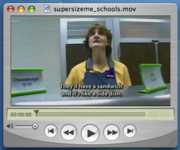
The Documentary SuperSize Me has two segments useful to readers: School food and PE. The school food segment includes a visit to Appleton Central Alternative School and a discussion of their healthy food partnership with Natural Ovens of Manitowoc. Interesting. 20MB Video excerpt from the film SuperSize Me
Newsletter signup | Send us your ideas