| School Information System |
 | Sponsorships | Sponsorships |
|
|
School systems scrambling to find qualified science teachers are trying to recruit him. He's a prized commodity in Texas, where nearly a quarter of science classes in middle and high schools are taught by teachers without proper science credentials."You have to want to (teach). They're not paying teachers like the glamorous research jobs," said Sinski, who had thought he'd follow his parents' footsteps and become a pharmacist. But "research science doesn't appeal to me. It's monotonous. Teaching exposes you to different faces and new and exciting things."
Newsletter signup | Send us your ideas
In last summer's prize-winning R-rated film "Me and You and Everyone We Know," a barely pubescent boy is seduced into oral sex by two girls perhaps a year older, and his 6-year-old brother logs on to a pornographic chat room and solicits a grown woman with instant messages about "poop."Is this what your teenage children are watching? If so, what message are they getting about sexual mores, and what effect will it have on their behavior?
The journal Pediatrics addressed the topic last July in a supplemental report, "Impact of the Media on Adolescent Sexual Attitudes and Behaviors." It is an important and, sad to say, much neglected subject. The report, based on a thorough review of scientific literature, was requested by Congress and supported by the Centers for Disease Control and Prevention and the University of Texas Health Science Center at Houston.
Newsletter signup | Send us your ideas
 Video | MP3 Audio | Monday evening's Board meeting presented a rather animated clash of wills between, it appears, those (A majority of the Board, based on the meeting discussions) who support Fitchburg's Swan Creek residents and their desire to remain at a larger Leopold School vs. those who favor using existing District schools that have extra space for the 63 Fitchburg children (no other students would move under the plan discussed Monday evening), such as Lincoln and/or the Lincoln/Midvale pair. |
Lawrie Kobza and Ruth Robarts suggested that the District's overcrowding priorities are:
|  Video | MP3 Audio | This video clip includes the public comments. |
Local media roundup:
within its school district by pairing Franklin-Randall and Lincoln-Midvale. There was success, it could have been greater.There are certainly no shortage of views on the pairing results, recently expressed within the West Side Task Force.
Facilities are always a tough issue. A reader emailed that Thoreau, for example, does not have a lunch room. Students march in and out of the gym.
Well worth watching, particularly when these questions are sent to the voters via a referendum.
As a parent, taxpayer and citizen, I very much appreciate the questions Lawrie Kobza raised Monday evening (I strongly supported her candidacy last spring). The District's fiscal challenges are not small: flat enrollment, revenue caps which limit growth in the district's $321M budget to 2.5% annually - as long as enrollment is flat, high property taxes and two recent failed referenda. In my view, the District must exhaust all options, thoroughly, before asking for more money. I was glad to see Johnny suggest that other means be pursued to fund these facilities. Finally, Fitchburg's public school climate is a challenge to read. Our neighbor to the south voted down the Leopold expansion referenda last spring. Linking Leopold expansion to a new far west school - built on land which was purchased last fall before the west task force began its work - (part of the Memorial attendance area) is an interesting approach to the question (and, perhaps the April School Board elections).
Another update: another reader emails that four members of the west side task force represented Leopold's interests vis a vis currently or recently enrolled children.
Newsletter signup | Send us your ideas
Since the program's inception in 1961, UW-Madison has produced thousands of volunteers. And today, for the 20th consecutive year, UW-Madison takes the top spot, with 104 volunteers currently serving in the field.The UW's new website has an RSS feed.UW-Madison also ranks as the institution with the second highest number of volunteers with advanced degrees, with 18 alumni. The University of Michigan-Ann Arbor earned the number spot in this category, with 22 volunteers.
Newsletter signup | Send us your ideas
By Anita Weier, The Capital Times, JAnuary 31, 2006
Wisconsin ranked 13th among the states in a national health study, down from ninth in 2004, as obesity and child poverty rose.
The study, titled America's Health Rankings 2005, analyzed personal behaviors, community environment, health policies and health outcomes.
The healthiest states were Minnesota, Vermont, New Hampshire, Utah and Hawaii, in that order. The least-healthy was Mississippi, followed in order by Louisiana, Tennessee, Arkansas and South Carolina.
Wisconsin's strengths included a high rate of high school graduation, a low rate of violent crime, a low incidence of infectious diseases and a low rate of uninsured people.
Challenges included low per capita public health spending at $79 per person, which put the state in 46th place, and a high rate of smoking at 21.9 percent of the population, which put it in 31st place.
Herb Bostrom, deputy administrator of the state's Division of Public Health, agreed that smoking and some other behavioral issues are a problem. But the public health funding issue is another matter, he said.
The study tends to look only at state funding for public health, not at grants and fees, according to Bostrom. "Wisconsin has been very successful in acquiring federal grants and grants from non-federal sources," he said.
Another factor is that some states provide direct health services while Wisconsin funds other providers that do so. "Different states do things differently," he said.
The study was conducted by the United Health Foundation, the American Public Health Association and the Partnership for Prevention, and was published in State Policy Reports as well as other publications and Web sites.
Another major health problem cited by the study was the fact that the percentage of children in poverty increased by 17 percent - from 15.4 percent to 18 percent of those under 18, from 2004 to 2005.
That figure would have been worse, the study said, if the rate of births per 1,000 teenage females had not decreased by 26.1 percent - from 43.7 births per thousand in 1991 to 32.3 births per thousand in 2002.
Since 1990, the prevalence of obesity soared by 105 percent - from 11.3 percent to 23.2 percent of the population.
Additionally, Wisconsin ranked 23rd for cardiovascular deaths and 23rd for total mortality.
Racial disparities also existed.
For instance, the infant mortality rate was substantially worse for minorities. Non-Hispanic whites had a rate of 5.6 deaths per 1,000 live births, while non-Hispanic blacks had a rate of 17.9 deaths per 1,000 live births.
Whites were screened for cholesterol levels at a much higher rate than Hispanics.
Bostrom added that blacks and American Indians have high rates of diabetes.
"Disparity is a big problem. The Division of Public Health is focusing on the disparity in health outcomes and working with minority populations in the Milwaukee area, Rock County and Dane County," he said.
But he pointed out that such differences are often due more to income than any sort of genetic tendency. "In many cases, there are socio-economic and education differences. These are societal issues," he said.
"If we could raise our health status for minorities to the level of the majority, that could make a substantial improvement."
Newsletter signup | Send us your ideas
By Susan Troller, The Capital Times, January 31, 2006
Madison voters may be looking at another referendum on school building this spring to address overcrowding issues, but the School Board appears split in its support of taking the issue to the voters.
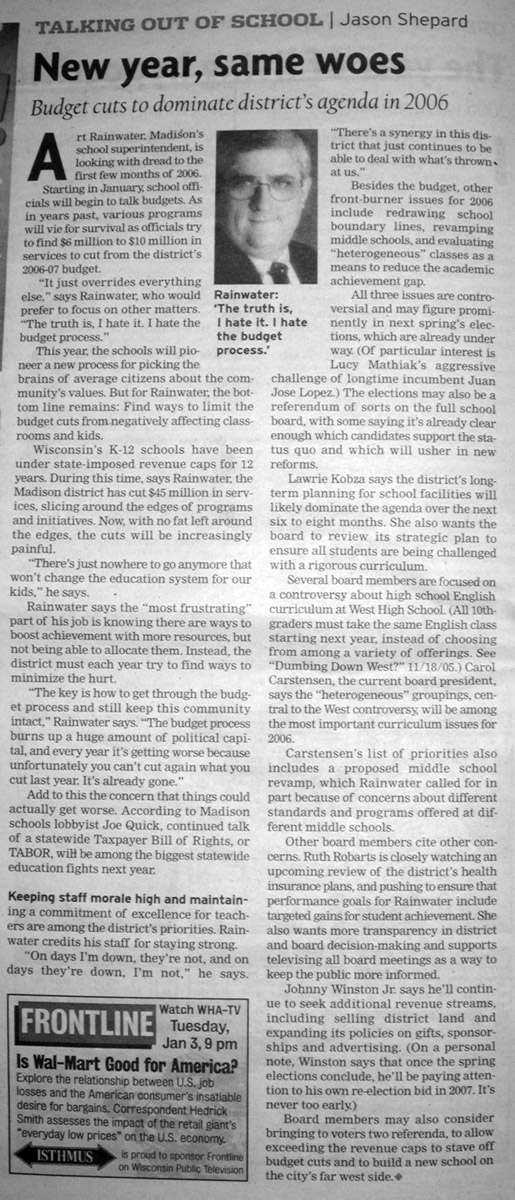
School Board President Carol Carstensen has recommended that the administration prepare language that would ask voters to approve spending for a new $17 million elementary school on the city's far west side and an addition to Leopold Elementary, south of the Beltline in Fitchburg. Both proposals were unanimously recommended by a citizen-led task force that has been studying boundary issues and overcrowding since last fall.
"From the beginning, I have said I would support the recommendations of the task force," Carstensen said. She emphasized that the time frame for a referendum question on the April ballot would be very short, and that in order to keep that option open, it was necessary to move ahead with the language request.
"We have until Feb. 17 to decide whether to present this to the voters," she said.
On Monday, board members reviewed task force recommendations for the West/Memorial attendance area as well as recommendations from an East attendance area task force on how to deal with declining enrollments in that area of the school district. No final decisions on the recommendations were made at the meeting.
The majority of the board seemed to support a referendum based on the task force recommendations, which were the result of hundreds of hours of work by dozens of citizen representatives.
But board member Ruth Robarts was wary about what she terms rushing to referendum. She said, "We have a problem if we make a building recommendation in a vacuum. People deserve a comprehensive multi-year plan that takes into account the needs of all sides of town."
Robarts joined board member Lawrie Kobza in questioning the process at Monday's sometimes contentious meeting. Kobza said she had hoped that the task force recommendations would be analyzed by the board as part of a broader examination of needs in the district.
"It never occurred to me that these recommendations wouldn't become part of a larger plan," Kobza said. She noted that the task force charge did not include any scrutiny of the La Follette High School area and its projected overcrowding within five years.
Kobza rejects the proposal to build a Leopold addition. She favors a solution to overcrowding at the school that includes busing students to the undercapacity Lincoln-Midvale paired elementary schools, even if it means bus rides that exceed 45 minutes.
"A 45-minute bus ride isn't the end-all and be-all," she said.
Other board members were vehement in their support of the task force recommendations. "We gave this task force this job and if we weren't going to respect their recommendation we should have done it ourselves," Johnny Winston Jr., board vice president, said.
"We need to make decisions and not prolong this to next fall," Juan Jose Lopez said, noting that the schools are crowded now.
Arlene Silveira, a candidate for School Board and member of the West/Memorial boundary task force, supports a referendum to build a new school and an addition at Leopold. But she said she hoped that the decision to go to referendum would wait until the fall.
"My concern is that April is too fast," she said. "I supported last year's referendum and one of the things we heard is that people want information about how we came to the decisions we made. We need a communications plan to tell our story."
Newsletter signup | Send us your ideas
Alan Borsuk on Phil McDade's report for the Wisconsin Policy Research Institute: [250K pdf]
"The growing performance gap is largely influenced by socioeconomic factors beyond the influence of schools," McDade said. "Property wealth, poverty and race were found to affect student performance."According to the report, Madison High Schools (along with Verona, Middleton-Cross Plains, Wisconsin Heights, Monticello, Monona Grove and Waunakee) were in the top 10% based on 1996-1997 WKCE results in. However, they (Madison) were no longer present in the top 10% based on 2003/2004 results (Deerfield, Dodgeville, Middleton-Cross Plains, McFarland, Waunakee and Verona were in the top 10% based on the 2003/2004 data).The per-student spending difference was much smaller than the difference in test scores and actually was smaller in 2003-'04 than it was seven years earlier, leading McDade to conclude that increased spending would not be a key to closing the gap.
Even though the roots of the gap are in matters such as poverty, McDade suggested that policy makers consider steps to increase academic performance of high school students, including stronger graduation requirements, tougher admissions standards to University of Wisconsin campuses and increased emphasis on sending more high school graduates to college.
Newsletter signup | Send us your ideas
 Video | MP3 Audio | Rafael Gomez recently organized a Forum on: Abuses and Uses of Curriculum in the Area of Language & Reading:
Participants included:
|
Newsletter signup | Send us your ideas
Can professional business management practices improve the performance of troubled public schools? Several high-visibility projects have been undertaken to bring best management practices to the classroom, including Harvard's Public Education Leadership Project. But in the 1990s, a different approach was begun: Riding a wave of charter school legislation, for-profit and nonprofit startups called private education management organizations, or EMOs, were created, essentially private companies brought in to manage public schoolsThe result? Mixed, but promising, says Steven F. Wilson, a senior fellow at the John F. Kennedy School of Government at Harvard University. Wilson was founder and former CEO of one of those EMOs, Advantage Schools, which at its height had 10,000 students in its programs. He writes of his experiences in a new book, Learning on the Job: When Business Takes on Public Schools, published by Harvard University Press.
Newsletter signup | Send us your ideas

Reader Troy Dassler emailed this photo, taken a few hours ago, at Leopold's Math Night event.
Newsletter signup | Send us your ideas
When the task forces began, each had three stated goals to address, including the following:
Income dispartiy among schools
Just eyeballing the final reports of the task forces gives me the impression that the recommended changes will not significantly change the low-income percentages of kids in any of the schools.
Newsletter signup | Send us your ideas
For a decade we’ve been told that our kids, just as they seem to be getting taller with each generation, are also getting brighter. Every year new waves of children get better GCSE, A-level and degree results than their predecessors. Meanwhile, in primary schools, the standards in national maths and English tests at 11 head in one direction — relentlessly upwards.Last week came the bombshell that blew a gaping hole in this one-way escalator of achievement.
Far from getting cleverer, our 11-year-olds are, in fact, less “intelligent” than their counterparts of 30 years ago. Or so say a team who are among Britain’s most respected education researchers.
In the easiest question, children are asked to watch as water is poured up to the brim of a tall, thin container. From there the water is tipped into a small fat glass. The tall vessel is refilled. Do both beakers now hold the same amount of water? “It’s frightening how many children now get this simple question wrong,” says scientist Denise Ginsburg, Shayer’s wife and another of the research team.
Another question involves two blocks of a similar size — one of brass, the other of plasticine. Which would displace the most water when dropped into a beaker? children are asked. Two years ago fewer than a fifth came up with the right answer.
Newsletter signup | Send us your ideas
BBC:
He believes the genes which make some analytical may also impair their social and communication skills.A weakness in these areas is the key characteristic of autism.
It is thought that around one child in every 100 has a form of autism - the vast majority of those affected are boys.
The number of diagnoses seems to be on the increase, but some argue this is simply because of a greater awareness of the condition.
In a paper published in the journal Archives of Disease of Childhood ($), Professor Baron-Cohen labels people such as scientists, mathematicians and engineers as 'systemizers'.
Newsletter signup | Send us your ideas
National Center for Education Statistics:
Status and Trends in the Education of Blacks draws on the many statistics published by NCES in a variety of reports and synthesizes these data in one compact volume. In addition to indicators drawn from existing government reports, some indicators were developed specifically for this report. The objective of this report is to make statistical information about the educational status of Blacks easily accessible to a variety of audiences.
Newsletter signup | Send us your ideas
Supported by a $15 million four-year grant from the Carroll and Milton Petrie Foundation, the Partnership will address New York City’s need for highly qualified, well-trained teachers who will immediately be able to excel in the City’s public schools.
Through an unprecedented collaboration among K-12 educators and higher education faculty in education and the arts and sciences, the Partnership plans innovations in how pre-service teachers--students who are receiving formal education but have not yet become full-time teachers--are taught and by whom; how they first learn the craft of teaching, and how they continue to develop teaching skill throughout their careers. The Partnership will demonstrate how teacher education can be responsive to the City’s most pressing needs, how learning what to teach and learning how to teach can better come together, and how beginning teachers can be ready from the start to work effectively in urban classrooms.
Newsletter signup | Send us your ideas
This year, Florida will introduce the largest reform package since the sweeping changes we made in 1999.These reforms include differentiated pay and performance-based pay for teachers to attract and retain talented educators in critical subject areas, encourage them to teach in economically challenged schools and reward them for improving student performance.
Our proposed reforms will bring rigor and relevance to middle schools by requiring students in grades six through eight to earn 12 credits in math, science, language, arts and social studies for promotion to high school, and requiring those who cannot read at grade level to get reading instruction.
We're also looking to revamp high schools to better prepare students for the future and for postsecondary education by creating career academies, where students can major or minor in math and science, or fine arts, or on career and vocational skills, depending on their goals and interests. The goal is for students to graduate knowing what they want to do with their lives, so they leave school armed with college credits toward their goal or, if they choose a vocational route, with certified skills for a specific industry.
Newsletter signup | Send us your ideas
Expanding on its efforts to increase the reading skills of elementary school students, the Schools of Hope project led by the United Way of Dane County also is focusing on helping middle school students develop the math skills needed to be successful in high school, college, employment and daily life.Rafael Gomez is organizing a Forum on Math Curriculum Wednesday evening, February 22, 2006 at McDaniels Auditorium. Look for more information soon.Since the Madison School Board adopted the goal that all students would complete algebra by the end of ninth grade and geometry by the end of 10th grade, the option of taking less rigorous classes, such as general or consumer math, has disappeared.
All high school students are now required to take algebra and geometry - or two credits of integrated mathematics, combining algebra, statistics and probability, geometry and trigonometry - in order to graduate.
"These are really gate-keeping courses and skills," said Mary Ramberg, the district's director of teaching and learning. She added that without them, students "will have a lot of options closed."
Newsletter signup | Send us your ideas
As state politicians and interest groups argue over whether to lift the enrollment cap in Milwaukee's voucher school program, the cap in another school choice initiative is quietly slated to expire.Under state law, the 2006-'07 school year will be the first time in Wisconsin's open enrollment public school choice program in which school districts will be unable to control the number of students leaving their boundaries if they exceed a certain portion of their enrollment.
The provision, which had been in effect since open enrollment began in 1998, was used by at least 10 school districts to limit potential monetary losses in the current school year, according to figures from the state Department of Public Instruction. They include districts such as Florence, which faced possible dissolution this year before voters bailed out the financially ailing school system, and Palmyra-Eagle on the outskirts of the metropolitan Milwaukee area.
Newsletter signup | Send us your ideas
For unions representing teachers and other government employees, the fine print is making it harder to negotiate improvements in benefits such as retiree health insurance."It certainly made my life more complex," said Michael McNett, director of collective bargaining for the Wisconsin Education Association Council, the state's largest teachers union.
For the Port Edwards School District, which has an annual budget of $6.1 million and 90 employees, the rule will mean an additional expense of about $120,000 a year - about the cost of employing two teachers , said Superintendent Michael W. Alexander.
Newsletter signup | Send us your ideas
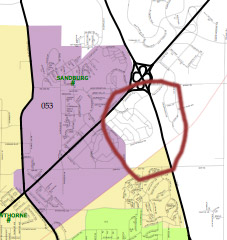 A reader emailed this interesting MMSD budget item. The land and buildings around East Towne Mall are not in the MMSD, according to the district's map.
Fitchburg contributed $10,030,120 or 5% [Fitchburg City Budget PDF] to the MMSD's $200,363,255 total Tax Levy (total MMSD 2005/2006 budget is $321+M [includes funds redistributed via other means such as income, gas and other taxes/fees from state and federal organizations]); see the 2005-2006 Budget Amendments and Tax Levy Adoption [PDF].
Newsletter signup | Send us your ideas
Capital Times article published on Saturday, 1/28/06
by Susan Troller
When more than 400 enthusiastic young Latin lovers packed Great Hall of the Memorial Union this week, their whoops and cheers were loud enough to, well, awaken a dead language.
Hailing from both public and private high schools, the exuberant students were attending the annual Wisconsin Junior Classical League Convention, which began Thursday and ends today. The unlikely object of their enthusiasm was the study of Latin, which was, repeatedly, described as awesome, amazing and life-altering.
Carolyn Briggs, a Madison West junior who is president-elect of WJCL, said, "When I first went to the national convention, I fell in love. Not with a person, but with a language. Now my devotion to Latin, and to WJCL, borders on an obsession."
Briggs, dressed for the Spirit (pep rally) portion of the convention, was wearing boxer shorts emblazoned with the legend LATIN KICKS across the back.
Carolyn Hill, also from West, is a senior and outgoing WJCL historian. A beginning student in Greek, she said she intends to become a classics major.
"I really want to be a Latin teacher, and I think I'd like to teach in a public high school. Latin has been an amazing class, a great thing to study. When I was a kid, I wanted to be an archeologist, so maybe my interest is an extension of that.
"But it's conventions like these that really get you going," she added. "I mean, where else would you find people willing, or able, to sing 'Yellow Submarine' in Latin?"
Aaron and Caleb Burr, a senior and freshman brother duo who are part of a 33-student convention delegation from Edgewood High School, are also Latin fans. Aaron, who is taking Advanced Placement 4th year Latin, finds the ancient history compelling, and he loves a competition called Certamen that poses tough Latin questions in a Jeopardy-style format.
Caleb, a freshman in his first year of studying the language, confessed he wasn't very good, but that he liked the challenge. He keeps at it because, rugged or not, he enjoys it. "I also like the mythology," he said.
West is Madison's only public high school that still maintains a Latin program.
According to Gale Stone, West's Latin teacher and convention co-chair, there are about 100 Latin students in any given year at her school. A Latin teacher for 25 years, 18 of them at the high school level, she brought 67 of her students this year to the state convention.
In addition to the deafening Spirit competition on Friday morning and Certamen, events included a war machines competition, memorized and impromptu oratory, testing in Latin proficiency, a costume contest, a Roman banquet and an impromptu art competition. Part of the JCL creed promises "to hand on the torch of classical civilization in the modern world."
Eight public schools and seven private schools, including a home school association, were represented at the convention. "I try to make my classes fun, and a little different," Stone said, explaining the devotion her students show toward Latin.
"The language is extremely difficult, and it takes at least a couple of years for students to get much of a sense of proficiency. It's important for them to be able to find their own passion," she said.
"It's kind of like checking in at a hotel. There are lots of different rooms to capture the imagination, from mythology to military history to engineering feats to how they made their underwear," she laughed.
"Another great thing about Latin is that it's a great leveler of backgrounds for the students. Very few kids come in with an advantage. It doesn't matter whether you come from a professorial household, or a janitorial household. At the outset, it's unfamiliar to everyone," she said.
E-mail: stroller@madison.com
Published: January 28, 2006
Copyright 2006 The Capital Times
On a September day 4 1/2 years ago, nearly 1,100 ninth-graders — a little giddy, a little scared — arrived at Birmingham High School in Van Nuys. They were fifth-generation Americans and new arrivals, straight arrows and gangbangers, scholars and class clowns.Lucy Mathiak posted MMSD dropout data, including those who showed high achievement during their elementary years.On a radiant evening last June, 521 billowing figures in royal blue robes and yellow-tasseled mortarboards walked proudly across Birmingham's football field, practically floating on a carpet of whoops and shouts and blaring air horns, to accept their diplomas.
It doesn't take a valedictorian to do the math: Somewhere along the way, Birmingham High lost more than half of the students who should have graduated.
It is a crucial question, not just for Birmingham but for all American schools.
High school dropouts lead much harder lives, earn far less money and demand vastly more public assistance than their peers who graduate.
Newsletter signup | Send us your ideas
The University of Missouri offered podcasts of lectures through its school network before it signed up with Apple last summer as a pilot school. But "iTunes U" offered a software and service package for free, said Keith Politte, the development officer at the university's School of Journalism.
Newsletter signup | Send us your ideas
Ladera Heights, an unincorporated community of about 8,000 people, has for decades belonged to the school district in adjacent Inglewood, a decidedly poorer, predominantly black and Latino city whose schools have struggled academically and financially.A group of Ladera Heights residents, many of whom have pulled their children out of Inglewood schools in favor of private ones, want their neighborhood assigned to the school district in Culver City, a more racially mixed, more affluent community than Inglewood.
Newsletter signup | Send us your ideas
 | Dane County Public Affairs Council 2006 Madison School Board Candidate Forum. View [video] or listen [mp3 audio] to the entire event, or read each question below and view the candidate responses. |
Opening Statements [video]
Describe how you would strengthen the role of the Board of Education in the relationship with the Superintendent and the unions (especially the teachers’ union) representing employees in negotiating contract agreements and in the implementation and oversight of those agreements? [video]
There are serious budget issues facing the district for the next budget cycle. What changes in the budgeting process will you support to assist the Board of Education to best resolve those issues locally, within the current revenue structure? What is your position with respect to a referendum to raise the revenue cap related to budgeting for the District? [
Reading and mathematics are two of the most critical curriculum issues needing attention in the District. What solutions should the Board work toward for improving effectiveness, efficiency and performance with the achievement issues in those areas? [
Health care costs for all employees and incentive/merit pay for teachers are two critical issues in the District. Contracts for teachers and others must be negotiated during your term of office. What are your views about these issues? What will be your approach to dealing with these issues in the negotiating processes? [
Task Forces appointed by the Board are preparing recommendations for the Board with attention to changing demographics and facility capacities. What are your observations regarding preliminary options of the Task Forces? What are your views regarding constructing school additions, a new elementary school and school closings? What will be your approach to reviewing the recommendations of the Task Forces and to weighing options within the context of the budgeting process for the next fiscal year and beyond? [
The Community Services Fund (80) has undergone significant growth (nearly 250%) outside the revenue cap in the past six years. What will you do as a member of the Board in reducing the burden of this fund on the taxpayers and for providing rigorous oversight and accountability for programs, services, budget and taxing authority within this fund? [
The Board provides little, if any, leadership in the development of District policy related to curriculum. What are the public policy issues you believe need to be addressed related to curriculum standards; and, to addressing achievement differences among students of different races and cultures? What will be your role as a member of the Board to provide leadership and set direction in this area? [Question skipped due to time constraints]
A safe school environment from violence, crime and harassment for students and staff is increasingly challenged by negative and disruptive incidents with respect to these issues. What must the Board do in order to assure a safe climate in our schools? [
Closing Statements [
Candidates for two seats on the Madison School Board had mixed opinions this morning on whether to build new school space to handle the enrollment problems in the district. Earlier this week, a task force representing west side schools (many of which are overcrowded) unanimously recommended building a new far west side elementary school and a seven-classroom addition at Leopold Elementary, while a similar task force for the east side recommended moving district programs to fill empty space in schools there.
Group Says Voters Have A Chance To Change The Way The Board Does Business.
Newsletter signup | Send us your ideas
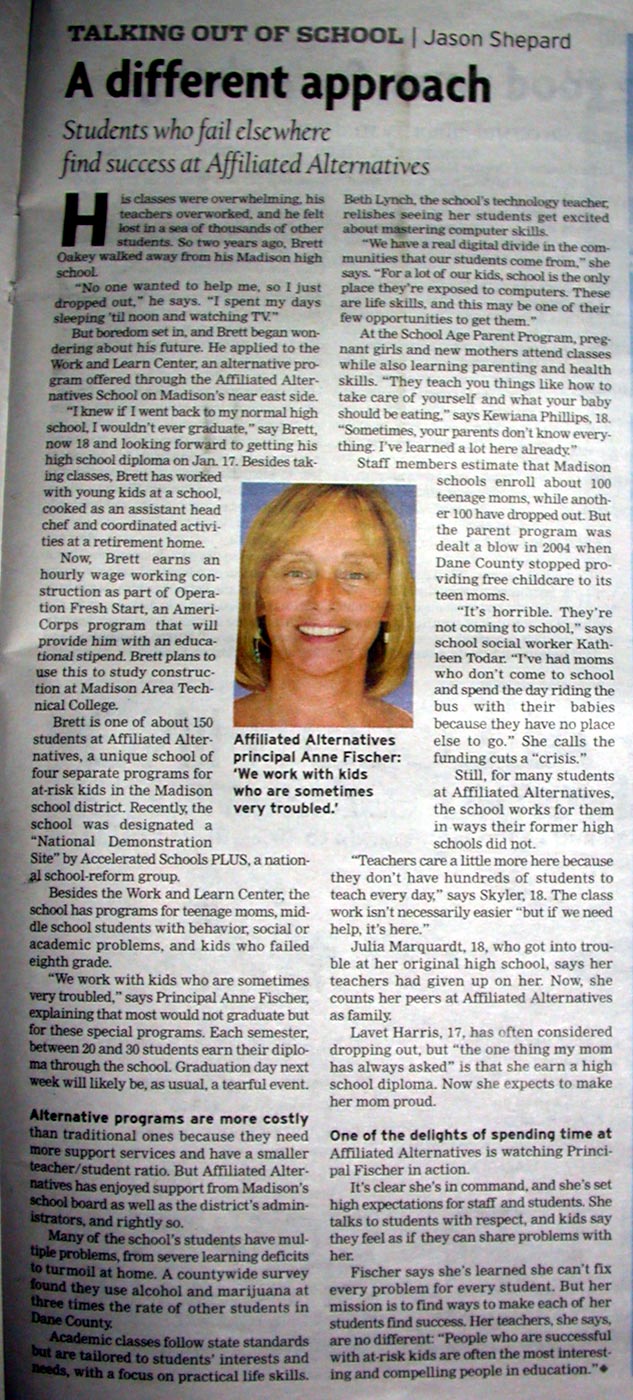
Jason Shepherd recently wrote an article on the Madison School District's Affiliated Alternatives Program. This differentiated program supports about 150 students:
Many of the school's students have multiple problems, from severe learning deficits to turmoil at home. A countywide survey found they use alchol and marijuana at three times the rate of other students in Dane County.View full article.Academic classes follow state standards but are tailored to students' interests and needs, with a focuse on practical life skills.
One of the delights in spending time at Affiliated Alternatives is watching Principal Fischer in action.
It's clear she's in command, and she's set high expectations for staff and students. She talkes to students with respect, and kids say they feel as if they can share problems with her.
Newsletter signup | Send us your ideas
Parent Group Presidents:
BUDGET FACTOID:
The district’s contract settlement with MTI for this year and next are 3.98% and 3.97% package increases. This is below the state average (about 4.5%), below the average for large districts and below the average for Dane County districts.
Jan 23rd Meetings:
5 p.m. Special Board Meeting:
The Board discussed the status of contracts for administrators but took no action. The administration has already proposed reducing 4 administrative positions next year.
6 p.m. Long Range Planning Committee Meeting (Bill Keys, chair):
The Committee received the reports and final recommendations from the East Area and the Memorial/West Areas Task Forces. The recommendations are as follows: East Area recommendations:
Do not close schools
2. Move Affiliated Alternatives to Marquette/O’Keeffe
3. Move MSCR to Emerson
4. Change the middle school feeder pattern to move either Emerson or Hawthorne students to O’Keeffe.
5. Move the undeveloped land near the intersection of Milwaukee St. and Fair Oaks to the East Area.
6. Possible boundary changes affecting the 4 schools on the north side (Gompers, Lakeview, Lindbergh and Mendota).
Memorial/West recommendations:
1. Build an addition onto Leopold and build a new school on the far west side.
The Task Force also provided the Board with 2 “fall-back” plans if the Board did only one of the above (either the addition or the new school). If the Board chooses to do neither (or if a referendum for both fails), the Task Force could not put together an option that provided enough space for the 5 years it was charged to consider. It did give the Board a sample plan of the kind of boundary changes that would be necessary, as well as the information that there were at least 14 other plans they had considered but none were supported by a majority of the Task Force.
The Committee accepted the reports and recommendations and voted to pass them to the full Board for further discussion and decisions.
JANUARY 30th MEETINGS : (these will be in McDaniels auditorium and televised on Channel 10)
5 p.m. Performance & Achievement Committee (Shwaw Vang, chair)
Several presentations on heterogeneous grouping. (This is the first of several meetings on this topic.)
6 p.m Special Board Meeting:
The Board will discuss the recommendations from the Task Forces and begin to make decisions. If the Board is going to authorize a referendum in April it must make that decision within a few weeks.
FUTURE MEETINGS:
February 6 (televised)
5 p.m. Finance & Operations (Johnny Winston, Jr, chair) recycling report; shared savings; 5 year budget forecast
6 p.m. Performance & Achievement (Shwaw Vang, chair) - continued discussion of heterogeneous grouping;
7:15 p.m. Regular Board meeting
Last September, when the cost of natural gas skyrocketed I proposed that the Board pass a resolution to “cancel” winter this year. Do you suppose the recent unseasonably warm weather is a consequence of that?
Carol
Carol Carstensen, President
Madison School Board
"Until lions have their own historians, the hunters will always be glorified." - African Proverb
Newsletter signup | Send us your ideas
Sweden did: ($$):In Sweden the fixed pay scheme for teachers was abolished in the mid-1990s as part of an agreement designed to enhance local autonomy and flexibility in the school system. The government committed itself to substantially raise teacher salaries over a five-year period, but on the condition that not all teachers received the same increase. There is accordingly no fixed upper limit and only a minimum basic salary is centrally negotiated, along with the aggregate rise in the teacher salary bill. Salaries are negotiated when a teacher is hired and teacher and employer agree on the salary to be paid upon commencement of the term of employment. Teachers’ work roles and performance are considered in the negotiation and linked to the pay. There is now much greater variety in teachers’ pay, with those in areas of shortage and with higher demonstrated performance able to negotiate more.It may seem strange that a social democracy so willing to limit economic freedom would embrace market-oriented reform of teacher pay. But according to this, Swedish policymakers concluded that "an expansion and improved quality of social services could not be accomplished without improving the efficiency in the public sector." And the unions agreed, "in order to improve salaries and working conditions."
Too often in America, we are forced to choose between destroying the public sector and preserving its every bad feature. But this guy was on to something. There is, well, a third way. And it's a little sad when Sweden is working harder to find it than we are.
Newsletter signup | Send us your ideas
The plan advanced by Jerry Eykholt, a member of the task force studying ways to deal with overcrowding at schools on in west side of the Madison school district, would move students to Lincoln Elementary School.Eykholt drafted the proposal in response to a letter signed by 185 households in Swan Creek who opposed moving students from Leopold.
One of the proposals had recommended moving Swan Creek students to Midvale and Lincoln elementary schools. Eykholt?s proposal would move them only to Lincoln, thereby reducing the length of the bus ride, which he said would address one of the major concerns of the residents.
Previous proposals would move elementary students to Lincoln (grades 3 through 5) and Midvale (grades K through 2). His proposal would require Lincoln to offer all elementary grades.
Eykholt called Lincoln "a very nurturing environment" that provided an exceptional level of assistance to students, a consequence of the district?s efforts to serve students from low-income families.
Newsletter signup | Send us your ideas
Madison Alder and MMSD employee Larry Palm attended a $100 budget session. Palm posts his thoughts here. Anita Martin, writing in the Madison Times also reviews the $100 budget.
Newsletter signup | Send us your ideas
In the crowded media center at West High School on Thursday night, Special Agent Erik Szatkowski led parents to what he considers manna for sexual predators: an online site where adolescents post their pictures, interests and other tidbits about themselves.On the Web site, which describes itself as "a community of online diaries and journals," Szatkowski introduced his audience to 14-year-old Katie, who likes "The O.C.," and 14-year-old Brooke, who posted a photo of herself on her page. He also found a 12-year-old Milwaukee boy who boasted: "I'm a b-ball player. I'm a sexy beast. I'm a ladies man."
Newsletter signup | Send us your ideas
At 6:20, the bus pulled up, and Carly was on her way to Robinson Secondary School.Carly, an eighth-grader who complains she's frequently groggy during early-morning classes, said she would prefer it if school "started at 8:30 and ended at 3."
"I wake up because of all the people" in class, she said. "But I'm still tired."
Newsletter signup | Send us your ideas
Woodland Grange Primary school in Leicestershire beat the space agency and its online updates of the Rover Mars probe to win the education category of Yahoo! Search Finds of the Year.The school's mix of field trip tales, homework tips, nativity play photos and pupils' weblogs won over judges, who also picked it ahead of opinion polls site YouGov and the British Geological Survey.
Newsletter signup | Send us your ideas
The key architect behind that transformation was the tough young executive director of Madison Teachers Inc., John Matthews, who had come to Madison eight years earlier from Montana.Former Madison Mayor (currently with Epic Systems - Verona) Paul Soglin weighs in as well.Thirty years later, Matthews is still tough and, more than ever, still casts a powerful shadow across the public education landscape of Madison as a tireless and relentless advocate for teachers. With Matthews at the helm, MTI has remained a dominant force in education and labor.
Newsletter signup | Send us your ideas
Next fall, a stunning $55 million high school will open on the edge of Fairmount Park here. For now, it is called the School of the Future, a state-of-the-art building with features like a Web design laboratory and a green roof that incorporates a storm-water management system. But it may turn out to be the school of the future in another sense, too: It is a public school being used to raise a lot of private money.
Newsletter signup | Send us your ideas
Recently, the Madison School Board has authorized a plethora of special committees to consider issues confronting the district and to make recommendations to the board. These committees have the potential to improve future board decisions by bringing new ideas and new information to our attention.
Currently, there is a special committee to advise the board on advertising. There are the two large task forces that recently issued recommendations regarding overcrowding and under-utilization problems in the West, Memorial and East High attendance areas. There is committee of parents, teachers, and administrators to suggest changes in our health and safety policies regarding animals in our classrooms. There is a committee to review whether staff and other resources are allocated equitably to the schools, taking differences in student populations into consideration. There are budget forums intended to seek community input on next year’s budget.
In every case, the board publicly discussed its goals for the committee before launching it. In every case, the board voted on a specific charge to the committee and set procedures and a timeline for meetings. In every case the board has received regular reports on the progress of the committee.
The glaring exception to this process was the creation of a task force of teachers union and district representatives to consider whether changes in health insurance programs for the teachers might make it possible for the district to shift dollars from health insurance payments to wages. Millions of dollars in potential savings are at stake.
In this case, the board did not set goals for the committee. It did not take the time to issue any instructions to the district representatives. Nor has the board required any reporting from the district representatives regarding the scope of its discussions or the nature of savings that the district representatives are seeking.
On January 23, the board discussed the report from the committee on animals in classrooms for more than two hours. The board clarified its prior charge to the committee and directed further work. It’s inexplicable that the leadership of the same board shows no interest in directing the work of its representatives in their discussions of potential health insurance savings with the teachers union.
Newsletter signup | Send us your ideas
I am a member or the MMSD's Student Senate. I am currently involved in a group discussing a draft of a proposed food policy which I feel is rather Draconian. The draft has not yet been made public (I am told this is because it is a "draft" and thus not ready for release) and that the issues have been publicized. However, I am concerned about some measures of the policy and feel that they have not been highlighted for interested parents. I think some of you might have concerns as well. Here are some of the propositions that my committee has voted against altering as well as what parents were told at the January 17th meeting about the policy
"When beverage vending is available, the only beverages that be offered for sale [not me wording] or permitted in schools at all sites accessible to students will be water, milk, fruit juices composed of 100% fruit juice with no added sweeteners of caffeine, and electrolyte replacement ("sports") beverages that do not contain caffeine or more than 42 grams of added sweetener per 20 oz serving."
"No food will be sold to students in vending machines"
This is currently true of all elementary schools and most middle schools, but not the high schools. Vending sales at the four major high schools bring in roughly $15-20 thousand a year for the school (some of a principal's only discretionary income). Personally, I feel eliminating all sales of soda and snacks seems extreme, especially considering the current financial pressure schools are under. The "cold turkey" elimination of all of these sales starting with the 06-07 school year seems like too much.
"Candy will not be given or sold to students nor offered for sale at school or to the community by the school during the school day. The sale of candy and snacks [this language will be revised to be more specific] is not permitted on school grounds during the school day."
This would mean that clubs that rely on sales of such items would have to search for new methods. Bake sales would be eliminated. Students would be able to buy a giant cookie in the lunchroom, but not a small one in support of a club.
From the information packet from the parent meeting on the 17th, it seems the district made it's intentions somewhat clear here. "Should we continue [vending/fundraising sale of soda/snacks] in light of what we know about the relationship of food intake to the increase in overweight and obese children?" The document does not mention the proposed elimination of such sales.
The district was less open about some other issues. For example, while healthier lunch was discussed, the following was not:
"All 'a la carte' items that are available during the school breakfast/lunch program that is served to students during the school day will have no more than 40% (35% by 9/1/2007 and 30% by 9/1/2008) of total calories derived from fat and no more than 10% of calories derived from saturated fat."
On the surface, this sounds like a good idea. However, the realities would be, quite simply, stupid. Students would be able to purchase pizza as part of a meal, but not just as a slice. What this would mean, since many students who buy meals don't eat the included fruit and milk, is that they would end up paying more for the same slice.
Also:
"No food preparation or cooking is permitted in the classrooms other than Family and Consumer Education classes or other classes with the express purpose of teaching cooking In these classes, no peanuts or nut products will be used."
Thus, foreign language classes would no longer be allowed to prepare tradition dishes (a common practice in my experience) and elementary school classes would not be able to cook (I know some of these schools have special school-day programs involving cooking that would have to go).
On these issues, parents were only given questions asking what would be done to ensure the safety of children with food allergies without unduly infringing on the food choices or others' and how the safety of none Food Services prepared foods could be insured. No mention of the proposed policies was made (which is especially egregious considering some of the provisions under the food allergies section that were modified just today).
I know some of your views may differ from mine, but I feel that what is most important is that you are not kept in the dark about what is going on in this district. There will be a second parent meeting held this Thurs. the 26th. I can't seem to find the time or location on the district web site so if you are interested, good luck finding it. Sometime in late March or Early April, this issue will go before the full Board of Education (I will try and let you know when that meeting will take place) so you will have another opportunity to voice your opinion.
Newsletter signup | Send us your ideas
Key to the discussion about state and local fiscal policy is the shared revenues program. While few would disagree with the premise that the shared revenues program was conceived in the early 1970s to compensate local governments for the State’s exemption of the manufacturing property and equipment, one cannot ignore the effect the program has been having on spending behavior.
Much of my research over the past six years has been on the impact of WI’s Shared Revenues program on local spending. It is important to understand that both in terms of the amount (nearly $1 billion annually) and the lack of strings attached to this aid (local governments can spend the money on whatever they see fit), WI is unique when compared to other states. While other states such as Florida, Massachusetts, Michigan, Minnesota and New Jersey have sizable intergovernmental aid programs, most are either tied to a specific revenue source such as sales or personal income taxes or require the funds to spent on specific programs/services.
Newsletter signup | Send us your ideas
Isthmus has posted week 1 of their Take-Home Test:
weekly question-and-answer quiz of the five candidates vying for two seats on the Madison Board of Education.Fabulous.Every week, we'll ask them a set of questions, one dealing with school board dynamics or the issues facing the 24,000-student-district, and the other more personal, aimed at revealing their experiences and attitudes.
Newsletter signup | Send us your ideas
“We have the critical mass to get serious about this sector of our economy,” Jim Leonhart, a biotech executive said Tuesday at a Wisconsin Innovation Network luncheon.Obiviously, our young people will need to tools (curriculum) to play in this era.“We don’t have any option but to promote life science technologies, including stem cell research here in this state,” added Leonhart, who heads the Wisconsin Biotechnology and Medical Device Association.
Newsletter signup | Send us your ideas
Madison Teachers Inc's PAC, MTI Voters endorsed [pdf] Juan Jose Lopez (Seat 2 vs. Lucy Mathiak) and Arlene Silveira (Seat 1 vs Maya Cole or Michael Kelly) for Madison School Board. Learn more about the candidates here. Cole and Mathiak have posted their responses to MTI's candidate questions.
These endorsements have historically included a significant amount of PAC campaign support. Prior election campaign finance reports are available on the City Clerk's website (scroll to the bottom).
Newsletter signup | Send us your ideas
The looming boundary changes in the Madison Metropolitan School District are having an impact on the local housing market. Home sellers and buyers aren't sure where kids will go to school.
Newsletter signup | Send us your ideas
My Jr. High student at Jefferson has been informed that there is a good chance his Family and Consumer Education (FCE) and his Technology classes will not be at Jeffferson next year. I have heard ramblings about foreign language being reduced at Jr. High level as well.
This is where I begin to think Public Schools are going to continue to lose students. My son would never choose to take a foreign language or FCE. He is my "jock" and the wonderful cultural and diverse information he is receiving from foreign L.A. and F.C.E are the reason we keep sending our kids to a public school. If the public offerings dwindle to nothing, why would we, a middle to high income family continue to send our children to public schools? If MMSD continues eliminate the diversity and class selection, they can continue to see the decrease in high income students. Money is required to offer these classes, however, if the extra-curricula activities and interesting diverse classes are eliminated, the district will deal with less students, higher numbers of low income students, and the continual decrease of middle and high income students. Many will not see the significance of these numbers, but it is significant as costs rise to educate students that demand more social and psychological needs. The district needs to evaluate the long term effects of eliminating these programs.
Newsletter signup | Send us your ideas
Wednesday, 1.25.2006; 7:30 - 9:00a.m. @ US Bank Plaza [map / directions] Lower Level Conference Room:
A discussion of issues facing our school district and community such as: high costs and low achievement; the budget; revenue caps; referenda; reading and math curricula; health care costs; dministrative costs; contract negotiations; boundary changes and school closings/new buildings; violence in schools; Fund 80; and more. Primary election for seat one is Feb. 21. Final elections in April. Who will earn your support?
Newsletter signup | Send us your ideas
Student achievement is a top priority of all school boards. To me student achievement in any subject area results from how well the student is able to learn and to experience what’s being taught. Multitudes of factors effect how well students are able to learn –for example, a students’ personal socioeconomic background and parents’ education, the school environment, teacher training, etc. There is something else that can effect how well each and every child will learn – curriculum.
What is the school board’s responsibility regarding curriculum? In the next few blogs, I’ll be posting some information I’ve gathered and thoughts/questions I have about curriculum policy and school board responsibility. Personally, I feel that developing and overseeing curriculum policy is one of the most important roles of any school board if that board’s top priority is student achievement. What is the MMSD School Board's curriculum policy?
Commentator Emily Wylie teaches 11th grade English at a New York City public girls' school. She also taught them when they were in 8th grade, and since then they've gotten a reputation as a bad class. Wylie doesn't disagree.
Newsletter signup | Send us your ideas
The author Kurt Vonnegut has been looking to the future through his writing ever since the publication of his first novel, Player Piano. The story tells of a time when men are displaced by machines in the workplace. Society is reduced to a managing class and a consuming class. His books have often included an element of science fiction, including his most famous work, Slaughterhouse-Five.audio
THE YEAR WAS 2081, and everybody was finally equal. They weren’t only equal before God and the law. They were equal every which way. Nobody was smarter than anybody else. Nobody was better looking than anybody else. Nobody was stronger or quicker than anybody else. All this equality was due to the 211th, 212th, and 213th Amendments to the Constitution, and to the unceasing vigilance of agents of the United States Handicapper General.
Newsletter signup | Send us your ideas
 Video | MP3 Audio | The second candidate interview is now available. Look for an interview with Lucy Mathiak soon (I've not heard back from Michael Kelly or Juan Jose Lopez). Maya Cole's interview is here Candidate details here |
Newsletter signup | Send us your ideas
As many of the nation's school systems begin searching for new superintendents in the next few months, they will employ a traditional tactic: secrecy. In many cases, the process will involve only a select few who know who is being considered for what can be a municipality's most highly paid public...
Newsletter signup | Send us your ideas
An agenda item has been added to tomorrow night's School Board meeting - Administrator Contracts. The board meeting begins following a 5 p.m. executive session. Meeting location is in Lincoln Elementary School, 909 Sequoia Trail.
I hope the State of WI legal requirements regarding this class of employee contract is presented. Does MMSD meet / exceed these legal requirements? If so, how?
Questions that are not clear to me include: a) is a two-year rolling contract required for all administrators, b) what is the difference between non-renewal and extension of a contract - is the end of January date really an extension?, c)is there a Board policy - if not, does one need to be developed, d) are there options open to the School Board to hold on one-year contract extensions due to upcoming cuts to the budget, e) how can changes be made by moving/retraining staff if needed, and f) can grant money being used to pay for administrators be used in other ways (not including grant oversight/accounting? We're in the same spot as the past two years - not talking about administrator contracts until one week or so before a deadline.
I feel this information needs to be clear and to be transparent to all employees, the board and the community. I believe a multi-year staffing strategy as part of a multi-year strategic plan is important to have, especially given the critical nature of the district's resources. This idea is not proposed as a solution to the public school's financial situation - not at all, that's not the point.
The $100 budget process is helping the community learn about the fiscal constraints and is an important first step, but this community exercise does not provide for reallocation of resources or different ways of doing things. A next step could help answer the question - now what? A multi-year strategic plan would provide the opportunity for the community to talk about those next steps, convey their values, etc. What does the community want Madison's public education to look like in five year (ten years), what do we need to do, and what do we need to do differently.
 | Madison United for Academic Excellence [www site] held a Madison School Board candidate forum Tuesday evening, January 17, 2006. Maya Cole, Michael Kelly, Lucy Mathiak and Arlene Silveira participated (election website). Candidate statements and questions appear below: |
|
Newsletter signup | Send us your ideas
A story by Sandy Cullen in the Wisconsin State Journal reports on two groups that tried the $100 budget exercise:
The State Journal asked 10 people to participate in the exercise led by Superintendent Art Rainwater and his assistant superintendent for business services, Roger Price. District administrators will lead additional sessions of the exercise at Madison's 11 middle schools on Tuesday, Wednesday and Thursday.
"This is not a process to build a budget," Price said. Rather, the exercise is meant to give residents an opportunity to express their priorities to administrators and School Board members as the district puts together its 2006-07 budget.
Newsletter signup | Send us your ideas
The measure, backed by the Bush administration and expected to pass the House when it returns next month, would provide $750 to $1,300 grants to low-income college freshmen and sophomores who have completed "a rigorous secondary school program of study" and larger amounts to juniors and seniors majoring in math, science and other critical fields.It leaves it to the secretary of education to define rigorous, giving her a new foothold in matters of high school curriculums.
Mindful of the delicate politics at play when Washington expands its educational role into matters zealously guarded as local prerogatives, senior Department of Education officials said they would consult with governors and other groups in determining which high school programs would allow students to qualify for grants.
Newsletter signup | Send us your ideas
Teachers sign their contracts for the next year usually in March - however, this is not a guarantee of a job for next year. Teachers can still be surplused or laid off from their jobs. The process for this is governed by their MTI contract.
Surplusing teachers effects the school budget the next school year, so there is an "immediate" effect upon the number of teachers, upon the district's educational resources available for children's learning and upon the budget's bottom line. This is different for MMSD personnel on administrative contracts. Administrative contracts are in most cases two-year rolling contracts, except as stated in the Human Resources (HR) policy , so the financial effect of reducing administrative positions that are filled can take up to 18 months to be reflected in the budget. Wouldn't this reduce the Board's decisionmaking authority during the budget process and potentially put an additional burden of budget cuts on teachers, psychologists, social workers, custodians, etc.?
Does this mean that administrative employees on a two-year rolling contract have 18 months to retrain/to apply for an open position in MMSD or to find a new job while still keeping their current job and getting paid if their contract is not extended. WI law governs some of the policy in place, but I don’t know how much of MMSD’s policy is required by state law, and I don’t know if state law requires contracts for all administrative personnel.
For MMSD administrators, the administrative rules governing their contracts are contained in MMSD HR Policy 2.06 . There is no School Board policy that I could find on administrative contracts. Perhaps one is necessary to clarify a number of issues and to set policy/direction for the district.
The current HR policy on administrative contracts states: “An administrator who has been issued a two-year contract and whose performance is satisfactory shall be issued a one-year contract extension in the spring of each year, thereby creating a two-year rolling contract, except an administrator may not receive a two-year contract if the District is considering reorganization, reassignment, reduction in force or other personnel action that may result in the elimination of the administrator’s position.” Does that give the School Board the flexibility to hold on giving contract extensions to administrators at this point in the budget process. Holding on a contract extension is much different than a non-renewal notice. Which applies at the end of the month?
Teachers, custodians, social workers are covered by their union contracts. These personnel are paid for the year they worked, and these provisions are based upon collective bargaining. If these district personnel are laid off and not rehired into an open position, they do not receive pay after their contract ends.
If the administration feels all staffing is cut to the bone, maybe the school board needs to begin working on multi-year strategies. I'm concerned about relying on the state or referenda to pull us through, and this effort might make the needs/issues more transparent to the public.
Perhaps the School Board and its personnel committees would spend more time during the year talking about staffing strategies. This seems to me to be especially important to continue to do in these extremely tight financial times.
Additional information on surplus and layoff contract dates:
Teachers are often given surplus notices, usually in April, which can be a partial up to a 100% surplus from their job. Surplus notices can be given until July 1 (I think this is the date without checking the contract). These surplus notices often are based upon the budget cut proposed to the School Board, which always proceeds the budget before the School Board and seems to me to be the only focus in the budget once that list is made public.
Layoff notices can be given to teachers no later than 10 days before the end of the school year. While there is no contract language for administrators, a corresponding approach would be not to extend administrative contracts.
Barb Schrank, parent, artist, blogger
spouse of Madison school teacher
treasurer, Mathiak for School Board
Twenty percent of U.S. college students completing 4-year degrees - and 30 percent of students earning 2-year degrees - have only basic quantitative literacy skills, meaning they are unable to estimate if their car has enough gasoline to get to the next gas station or calculate the total cost of ordering office supplies, according to a new national survey by the American Institutes for Research (AIR). The study was funded by The Pew Charitable Trusts.1.9MB PDF
Newsletter signup | Send us your ideas
Fordham Foundation criticizes focus on ‘discovery learning.’
More than two-thirds of states have science standards that earn a C grade or worse for their quality, in part because they overemphasize “discovery learning,” the idea that students should be encouraged to acquire knowledge through their own investigation and experimentation, a study issued last week concludes.
Too many of those standards—documents that spell out what students are expected to know—also present science in a sprawling, unorganized way that is short of facts and content, according to the report by the Thomas B. Fordham Foundation.
By Sean Cavanagh, Education Week, December 14, 2005
Titled “The State of State Science Standards, 2005,” the report is a follow-up to a 2000 analysis conducted by the conservative-leaning Washington-based think tank, which promotes strong academic standards and educational options such as charter schools. During the five years since the previous report, the overall quality of standards remained about the same, with roughly the same number of states, 19, receiving an A or B on both studies.
States' Standing
A new study indicates that state science standards are generally strongest in their presentation of biology and weakest in chemistry and environmental science.
Discipline or issue Average score for all states
Biological sciences 68%
Physical science 64%
Earth/space science 61%
Inquiry 57%
Evolution 57%
Chemistry, environmental science 50%
A majority of states received a C or lower on the quality of their science standards.
Grade Number of States
A 7
B 12
C 9
D 7
F 15
SOURCE: Thomas B. Fordham Foundation
“The nation, in its entirely, is neither making progress nor losing ground when it comes to its expectations for what students should learn in science,” the new report says. “Unfortunately, that’s hardly news worth celebrating.”
The analysis judges science standards on such factors as presentation of unambiguous learning goals, freedom from educational or academic jargon, organization, and treatment of core topics, such as evolution.
Paul R. Gross, a professor emeritus of life sciences at the University of Virginia in Charlottesville, directed the study. He combed through the lengthy documents with the help of other researchers with extensive scientific backgrounds in college and K-12 education.
Just seven states scored an A on their science standards: California, Indiana, Massachusetts, New Mexico, New York, South Carolina, and Virginia. Twelve states were awarded a B, nine received a C, seven states took a D, and 15 received an F. Thirteen states took higher grades than they did in 2000; 19 saw their grades drop.
When it came to the theory of evolution, whose handling by schools is a topic of furious debate around the country, 20 states earned a “sound” rating, or a grade of A or B, a decrease from 24 states in 2000, the study found. Twenty-two states received a D or F, compared with 12 in 2000.
For More Info
"The State of State Science Standards 2005" is available from the Thomas B. Fordham Foundation.
Upgrading U.S. students’ scientific knowledge is increasingly important in today’s economy, particularly in light of foreign competition, the authors note. The Fordham study generally judges states on their coverage of crucial scientific facts and ideas that the authors believe students will need, as recognized by the mainstream scientific community.
The overall weak treatment of evolution, the authors say, is probably not the result of recent pressure to include supposed alternatives to evolution, such as “intelligent design”—the idea that an unspecified architect has shaped life’s development. Instead, the report says, the inadequacy is a function of the “general weakness of disciplinary content for all science.”
Kansas alone received an F-minus grade on coverage of evolution, in large part because its standards were recently rewritten to suggest wrongly that the theory’s scientific basis was somehow “in deep trouble,” Mr. Gross said.
Fordham’s findings on evolution bear some similarity to the results of a recent Education Week analysis, which showed that many state science standards ignore the central principles and evidence associated with the established theory. The newspaper also found that state assessments include evolution to varying degrees. ("Treatment of Evolution Inconsistent," Nov. 9, 2005 and "Evolution Theory Well Represented in Leading High School Textbooks," Dec. 7, 2005.)
What Kind of Lessons?
The Fordham Foundation study particularly objected to states’ support for discovery learning, which expects students to gain scientific knowledge by working through problems on their own, such as hands-on experiments. That approach is sometimes considered the opposite of “direct instruction,” or lessons directed by teachers presenting basic facts.
“It’s not possible for [students], no matter how smart they are, to work out the law of thermodynamics on their own,” Mr. Gross said in a phone call with reporters. Such concepts “have got to be taught. [They] cannot come from hands-on” learning.
Fordham’s report does not reject hands-on learning outright, but says a balance between straightforward presentation of facts and “investigation in the field, laboratory, or library” should be struck.
Discovery learning is sometimes associated with a concept called inquiry. Fordham’s report approves of that approach to science standards, as long as it emphasizes “real and useful” subject matter. In fact, the study grades states on how well they promote inquiry, which it defines as the process of doing science, as well as incorporating explanations of its history, philosophy, and purpose.
Gerald F. Wheeler, the executive director of the Arlington, Va.-based National Science Teachers Association, disagreed with the report’s conclusion about the negative influence of discovery learning.
The NSTA official sees the opposite problem: Many science teachers are offering students an endless stream of facts for memorization, often reading them straight from textbooks, without making the content interesting or meaningful, he said.
“I don’t see the inappropriately high level of discovery learning they see,” Mr. Wheeler said of the Fordham authors. “They’re creating a false dichotomy. … The picture they’re presenting is an extreme one.”
Newsletter signup | Send us your ideas
 | WPS's (Wisconsin Physician Service) recent presentation to the MMSD/MTI Health Insurance Task Force. [Text: HTML] [pdf slides] |
Newsletter signup | Send us your ideas
Dear Carol,
You raise several intriquing questions in your recent post on the Doyle Buildin. I look forward to you putting the future use/ownership of the Doyle building on a School Board agenda so that there can be full and public discussion of the costs/benefits, advantages/disadvantages of a full range of proposals from no change to sale. Having read the various memos, I know that I would appreciate a full exploration of factual and verifiable information on what the move would mean.
A meaningful inquiry, with opportunity for respectful dialogue between an informed public - including developers, preservationists, and members of the university community - and an engaged board would go a long way toward vetting the issues related to continued ownership, use as a rental property, or sale.
I am confident that you will post the date when this will be on the board agenda to this and other sites so that we can all stay current with the discussion. Thank you so much for your interest in this intriguing question and for your interest in exploring alternative proposals and new ideas for handling district resources.
Lucy Mathiak
Newsletter signup | Send us your ideas
The report is available here: 4MB PDF. Long Range Planning Committee website.
Channel3000 has more.
Newsletter signup | Send us your ideas
Administrators are a vital and integral part of any responsibly operating organization, including MMSD. If I feel that way, why would I would like to see the School Board consider making decisions that would keep options for staff reductions open until later in the budget process? Given that no multi-year strategic, budget or staffing plans are in place, I would like the School Board to discuss what their options are at this time or is the only option moving to one-year contracts for a majority of administrators. I urge the Board to maintain their decision-making flexibility at this time in the annual budget process.
Two years ago, as I was learning more about MMSD's operations, I came across the end of January date (which is based on WI law, but I don't know the specifics or how MMSD's Human Resources applies the policy) to notify administrators of contract extensions for one year or non-renewal (I haven't found all the definitions). I felt then the school board’s authority to make budgetary decisions was diminished if the passing of this date meant the board was “locked” into multi-year personnel commitments for administrative employees at the start of the budget process.
I’ve been asked by a couple Board members, what’s next after all the administrators are gone (something I do not advocate or support – it’s ridiculous. Besides, there is no risk of that happening next year, and I don't think that's the question the School Board needs to be asking).
However, my question to the School Board is what is their employment policy regarding these contracts? A multi-year strategic plan that involves community discussion would go a long way toward addressing that question. If the WI legislature does not get going and make changes to public financing of public education, and if local Madison referenda are not passing, budget cuts will have to be made, and not because we have too many teachers, but because the School Board has to cut the budget.
Madison has excellent teachers (my daughter has been the beneficiary of our teachers' excellence even if they don't always have the curriculum they need), and Madison strongly supports public education. I feel we need to have public discussions and to develop longer-term strategies, we need these discussions now and we need them to be ongoing, dynamic and broad based.
Lastly, by not looking longer term, discussing these issues throughout the year, admin positions end up being on a School Board agenda at the front of the budget process, because of the January deadline. The School Board is putting our school district's administrators (inadvertently, I'm sure) in an unfavorable light publicly and subject to "attack," which is unfair, unnecessary and preventable. I would think an alternative, longer-term approach would be viewed favorably by Madison.
Barb Schrank, parent, artist, blogger
Spouse of MMSD teacher
Treasurer of Mathiak for School Board
 | Group Health Cooperative's recent presentation to the MMSD/MTI Health Insurance Task Force. [5.1MB PDF] |
Newsletter signup | Send us your ideas
The Wisconsin Alliance for Excellent Schools (WAES) is a statewide network of educators, school board members, parents, community leaders, and researchers. Its Wisconsin Adequacy Plan -- a proposal for school-finance reform -- is the result of research into the cost of educating children to meet state proficiency standards.
Quality Counts grades are mixed for Wisconsin
Waukesha looks at cutting $3 million, 32 positions ... and more
Racine looking at yet another referendum
School districts prepare for budget cuts
School-funding reform calendar
Quality Counts grades are mixed for Wisconsin
Although Wisconsin scores at or above the national average on all four Quality Counts indicators, the state received only an overall grade of B- (C+ in efforts to improve teacher quality; B- in standards and accountability and resource equity, and a B in school climate).
The study is produced annually by Education Week with support from the Pew Center on the States.
Part of the problem with the C+ in efforts to improve teacher quality can be attributed to inadequate funding. The report notes that "Wisconsin lags behind in providing professional support and training for teachers" and "does not require and finance mentoring for new teachers."
*************
Waukesha looks at cutting $3 million, 32 positions ... and more
According to a Jan. 16 story in the Milwaukee Journal-Sentinel (http://www.jsonline.com/news/wauk/jan06/385433.asp), "elementary band and orchestra could face the music this year, along with environmental education and classroom teachers at all grades."
That was the word out of the Waukesha School District last week as school board members considered administrative recommendations to cover the districts projected $3 million shortfall in 2006-07.
Under the proposal, which was developed after discussions with about 50 administrators as well as teacher leaders, about half of the potential shortfall would be covered by eliminating 32 full-time classroom teaching positions. That move would increase the average class ratio by one student in first- through sixth-grade classrooms (to 25-1) and by two students in the middle and high schools (to 27-1).
****************
Racine looking at yet another referendum
The reality of another budget shortfall is setting in for residents of the Racine Unified School District and has school board members looking toward yet another referendum in the near future (http://www.journaltimes.com/articles/2006/01/12/local/iq_3851586.txt).
After hearing about a projected $10.5 million shortfall for 2006-07, the board formed a referendum committee. School board member Russ Carlsen, who will co-chair the committee, said that in the absence of referendum money, the district would have to make cuts to personnel, since employee costs comprise 85 percent of the district's budget.
Carlsen said the state's school-funding system, which doesn't allow revenues to grow at near the pace of expenses, has driven the district's budget shortfalls. "Regardless of how many efficiencies we develop, we're always going to be short."
Last June, voters approved a one-year, $6.45 million referendum, a vote that followed a failed two-year referendum for nearly $18 million in April of 2005.
*****************
School districts prepare for budget cuts
School districts throughout central Wisconsin are beginning to look at their budgets for the 2006-07 school year, and most are gearing up for yet another round of budget cuts (http://www.marshfieldnewsherald.com/apps/pbcs.dll/article?AID=/20060108/CWS0101/601080451/1732).
While decisions are still being made -- program reductions, loss of extracurriculars, elimination of staff, and increased fees -- several districts are turning to closing schools. Wisconsin Rapids already voted to close a school, and Stevens Point board members will meet next week to discuss the possibility. In Marshfield, board members are trying to cover their shortfall of $500,000 to $1 million through staff attrition, while Tomorrow River officials have scheduled a $350,000 referendum in February.
Bette Lang, Point superintendent, told her board that "all school districts are struggling." She said that her district was lucky, having passed a referendum two years ago, "but because of additional expenditures we will still have a deficit."
************
School-funding reform calendar
Jan. 23, 2006 -- School-funding reform presentation, 6:30 p.m., in the St. Francis School District (http://www.stfrancissd.org/)
Jan. 25, 2006 -- School-funding reform presentation, 7 p.m., at the Markesan Middle School (http://www.markesan.k12.wi.us/default.htm), 100 East Vista Boulevard
Feb. 22, 2006 -- School-funding reform presentation at Marinette School District High School (http://www.marinette.k12.wi.us/)
March 10, 2006 -- School-funding reform presentation, 3:30 p.m., School Finance Class (Ed 810) in the Edgewood College Doctoral Program
March 13, 2006 -- School-funding reform presentation, noon, for the Fond du Lac Retired Educators Association., Knights of Columbus building, 795 Fond du Lac Avenue
June 6, 2006 -- School-funding reform presentation, 1 p.m., for the Dodge County Retired Educators Association, Marsh Haven
Please feel free to share your copy of the WAES school-funding update with anyone interested in school-finance reform. Contact Tom Beebe (tbeebe@wisconsinsfuture.org) at 414-384-9094 for details.
--
Thomas S. Beebe, Outreach Specialist
Institute for Wisconsin’s Future
1717 South 12th Street
Milwaukee, WI 53204
Voice: 414-384-9094
Fax: 414-384-9098
Cell: 920-650-0525
E-mal: tbeebe@wisconsinsfuture.org
http://www.excellentschools.org
http://www.wisconsinsfuture.org
Newsletter signup | Send us your ideas
There's been no shortage of budget discussions on this site, particularly attempts to make the process and results transparent (this year, the MMSD is offering a $100 Budget process which focuses on reductions in a budget that grows annually). These questions are not unique to Madison. Reform advocate Winslow Wheeler publishes a useful attempt to help us all understand the actual size of the Defense Department budget. I like their objectives:
The project considers both the fiscal and strategic implications of defense programs and promotes informed oversight of Pentagon activities. The Straus Military Reform Project provides analysis and fosters debate on the uses, strategy, doctrine and forces of the U.S. military and its role in the wider national security structure. It provides a forum for discussion and encourages the free expression of all views.Locally, an open, easily understood budget process is essential to taxpayer support for public education. Dictionary.com: obfuscation.
Newsletter signup | Send us your ideas
States now spend more on health care for the poor than they do on elementary and secondary education, a policy group said Thursday in its annual review of efforts to deal with the growing problem of the uninsured.Learn more at www.statecoverage.net. The report (pdf) is available here.The states spent 21.9 percent of their revenue on Medicaid in fiscal year 2004. Elementary and second education consumed about 21.5 percent of states' budgets. Higher education came in at a distant third, 10.5 percent.
The previously discussed "Geezer Wars" are clearly underway. This is one of many reasons why I don't believe we'll see significant changes to school funding - beyond the current annual moderate increases. In Madison's case, school spending has increased from $200M in 1994/1995 to $329M in 05/06.
Newsletter signup | Send us your ideas
The first private high school in the area to support itself largely through wages earned by students working one day a week for local employers will open in Takoma Park in fall 2007, the Archdiocese of Washington announced yesterday.Archdiocese officials said the new Cristo Rey school, based on a work-study model first tried in inner-city Chicago 10 years ago, will be its first new archdiocese high school in more than 55 years. It will open on the site of Our Lady of Sorrows School, a parish elementary school closing this year because of declining enrollment.
Newsletter signup | Send us your ideas
Thirty-eight percent of Arkansas' public school children are overweight or at risk of being overweight, the University of Arkansas for Medical Sciences said in a report issued Thursday.Learn more about this issue here and by watching the recent Nutrition and Schools Forum.The finding was the same as last year's when UAMS also studied the effects of a 2003 state law that called for mandatory and voluntary changes in the schools to address health issues among Arkansas' children.
Health officials said Thursday they hope to see obesity numbers decline as more schools offer healthier food choices.
Newsletter signup | Send us your ideas
MAFAAC's recent meeting notes are now online. Topics include: working with the Madison School District, school climate and recent data on school arrests.
Newsletter signup | Send us your ideas
One of the more unlikely offices to have been flooded with mail is that of the City University of New York (CUNY), a public college that lacks, among other things, a famous sports team, bucolic campuses and raucous parties (it doesn't even have dorms), and, until recently, academic credibility.A primary draw at CUNY is a programme for particularly clever students, launched in 2001. Some 1,100 of the 60,000 students at CUNY's five top schools receive a rare thing in the costly world of American colleges: free education. Those accepted by CUNY's honours programme pay no tuition fees; instead they receive a stipend of $7,500 (to help with general expenses) and a laptop computer. Applications for early admissions into next year's programme are up 70%.
Admission has nothing to do with being an athlete, or a child of an alumnus, or having an influential sponsor, or being a member of a particularly aggrieved ethnic group—criteria that are increasingly important at America's elite colleges. Most of the students who apply to the honours programme come from relatively poor families, many of them immigrant ones. All that CUNY demands is that these students be diligent and clever.
Newsletter signup | Send us your ideas
Maricella Miranda writes:
Teachers and administrators want to keep challenging students in the Burnsville-Eagan-Savage school district [MN], but traditional college-prep courses may not be enough.
That's why the International Baccalaureate program might be introduced into the curriculum districtwide. The program's rigorous courses demand critical thinking and hands-on learning from students of all ages while focusing on international components for each subject. The IB program is taught in 1,597 schools in 122 countries.
There are three International Baccalaureate programs for grades K-12. They have common components, such as relating subjects and finding connections in local and international communities.
"We want to make sure we have something that gives our students an advantage. We want our students to stay in our district," Babbitt said. Adding the programs to District 191's curriculum would cost an estimated $100,000, district administrators said.
Rufus King, Milwaukee WI , known as the Rufus King International Baccalaureate High School is a WI urban, citywide, college preparatory high school that is strongly committed to math, science, technology, and the International Baccalaureate (IB) Program. Well over 1000 students each year now vie for the 350 freshmen seats. Rufus King is consistently in the top 50% of schools in the U.S., and the top 3.5% of schools worldwide in the number of IB examinations given.
I have noticed a movement about MMSD. There seems to be the following needs:
1. Make each grade/class the same across the district so that all
students have a equitable distribution of funds, resources, and knowledge. (Connected math, FOSS science, middle school curriculm, and West English)
2. Great concern from "legal" I assume that food, animals, and flammable paper present a hazard to the students and potentially invite a lawsuit. (pet proposal, upcoming food proposal to eliminate any homemade food in the school, and the fire code issue)
3. Boundary changes to solve growth and income disparity which causes financial stress on the district. (Task forces, failed referendum, spending cap)
So here's the solution:
I have a "solution" to help all these problems in one. The #1 health hazard to my children, I have learned over the years,are the other students my children attend school with and the germs they carry. So I propose we stop sending our children to school. We should purchase laptops for each student, pay for (or maybe Dave will provide) internet service for each household and teach all the students via the internet. Sale the buildings, fire the teachers, ditch the bus contracts and have a totally germ free, fire free, income disparity free, curriculm EXACTLY THE same throughout the entire virtual school district. One teacher could be retained to teach each grade level so all students receive exactly the same lesson. High schools could offer the same courses just the experience of group discusssion, band, and choir might not be the same.
This solves money issues, contract issues, disparity issues of every kind, and those germ and allergy issues that seem to plague our schools. It eliminates the growth problem and the need for more buildings. I was thinking we could keep the high schools for physical activity, but I can't figure out how they can play team sports without getting germs or how to have coaches that would provide students with the EXACT same experience......I'll have to keep working on that.
Newsletter signup | Send us your ideas
Madison District 15 Alder (and MMSD Affiliated Alternatives Employee) Larry Palm:
Tonight I attended the Public Forum at O’Keefe Middle School to discuss a potential move of the Affiliated Alternatives into the building shared with Marquette Elementary School.Palm also notes that it is budget time again and suggests that the District "take this year off from a referendum".
I appreciated the high level of questions asked of Steve Hartley, the District’s Director of Alternative Programs. A large majority of questions revolved around the anticipated interactions between students at what would essentially be a K-12 campus (minus the students that attend certain grades at Lapham Elementary School– which is also another option on the East Side Task Force for either the Affiliated Alternatives or the administrative offices of MSCR).
Newsletter signup | Send us your ideas
I think we need to be careful about what we assume when we are talking about students of color in the schools. The children of color in our schools include a growing number of children whose parents, regardless of racial or ethnic identity, are highly educated with degrees ranging from the BA/BS levels to PhD, law, and medical degrees. Many have attended schools or come from communities with high numbers of professionals of African American, Latino/a, Asian American, or American Indian heritage. As our businesses and higher educational institutions hire more diverse professionals, we will see more children of color from middle and upper income families.
Children of color with highly educated parents historically have had trouble getting access to advanced educational opportunities regardless of their academic preparation or ability. And we are seeing a concurrent relocation to private schools, suburbs, and other cities because the parents have every bit as high expectation for their children as any other parents.
We also need to take a look at ALL children - including low income and/or children of color - when we are planning for advanced academic opportunities and placement in our schools. According to an MMSD study a few years ago, a significant portion of our high school drop outs are African American males who tested at the high end of the scale at the elementary level.
MMSD Withdrawal/Did Not Graduate Student Data (1995 - 1999)When the District analyzed dropout data for this five year period, they identified four student profiles. One of these groups, it could be argued, would have benefited from appropriately challenging learning opportunities, opportunities which might have kept them engaged in school and enabled them to graduate. Group 1: High Achiever, Short Tenure, Behaved
This group comprises 27% of all dropouts during this five-year period.
Characteristics of this group:
• Grade 5 math scores 84.2 percentile
• Male 55%
• Low income 53%
• Minority 42%
• African American 31%
• Hispanic 6%
• Asian 5%Group 1 dropouts (expressed as the % of total dropouts for that school)
High SchoolEast 25.9%
La Follette 23.8%
Memorial 23.4%
West 32.4%
We all - including the Madison School Board - need to ask whether we are doing enough to identify and provide opportunities for gifted and talented youth among children of color or children from low income backgrounds. Then we need to create sufficient classes and class space to allow ALL children who are capable of succeeding access to the highest level of classes possible. Creating false shortages for advanced academics helps no one, from individual students to entire schools.
Many of our schools now enroll populations that are 40% - 60% students of color. To have advanced classses with only a few - if any - students drawn from this potential talent pool, defies the statistical odds for the population. We can change this if, as a school community, we have the will to do so and the courage to talk openly about our priorities, practices, and assumptions.
Newsletter signup | Send us your ideas
But what the computer-programming student who goes by the handle "Lover Of Nightlife" did last month, as the fall semester raced to a close, could only have happened in the age of the Internet: He went online to outsource his predicament."This is homework I did not have time to study for," he said in a message on a Web site devoted to outsourcing computer projects. "I need you guys to help me."
Attached was a take-home final exam for a computer class that Mr. Nightlife Lover wanted to pay someone else -- presumably, someone from a place where people can't afford a lot of night life to begin with -- to take for him.
Newsletter signup | Send us your ideas
Neal Goldman is a math entrepreneur. He works on Wall Street, where numbers rule. But he's focusing his analytic tools on a different realm altogether: the world of words.Goldman's startup, Inform Technologies LLC, is a robotic librarian. Every day it combs through thousands of press articles and blog posts in English. It reads them and groups them with related pieces. Inform doesn't do this work alphabetically or by keywords. It uses algorithms to analyze each article by its language and context. It then sends customized news feeds to its users, who also exist in Inform's system as -- you guessed it -- math.
Newsletter signup | Send us your ideas
In a recent comment, a person asked if you had to be unhappy with MMSD to write on the blog. Short answer - no. Jim Zellmer, who began this blog, encourages folks with all different thoughts, ideas and opinions about MMSD and education to write and/or make comments on the blog. I would like to encourage those who are interested in writing about what they think and what their ideas, hopes and dreams are for public education will contact Jim (zellmer at virtualproperties_dot_com) to learn more about becoming a SIS blogger. Diverse perspectives have the potential to enrich and deepen the discussions, which I feel will benefit our community.
Anne K. Walters writing in the Chronicle of Higher Education:
Public colleges in states that spend a lot of money on higher education aren't necessarily better than colleges in states that provide them with meager support, according to a report that ranks states based on an analysis of their higher-education budgets and the performance of their colleges. The report, which was prepared by the National Center for Higher Education Management Systems, attempts to answer the age-old question in debates over state financing of higher education: Does more money equal better quality? The report, A New Look at the Institutional Component of Higher Education Finance: A Guide for Evaluating Performance Relative to Financial Resources [by Patrick J. Kelly & Dennis P. Jones] compares state funds for higher education in each state with colleges' performance in a variety of areas, including graduation and participation rates. The report concludes that education can succeed even when state support falls.Wisconsin ranks #4 in "Performance relative to funding" for public research institutions.
Newsletter signup | Send us your ideas
 Video | MP3 Audio | The first candidate interview is now available. Look for interviews with Arlene Silveira (Arlene's interview is now available here) and Lucy Mathiak soon (I've not heard back from Michael Kelly or Juan Jose Lopez). Candidate details here |
Newsletter signup | Send us your ideas
On Wednesday, January 11, representatives of Madison Teachers, Inc. (MTI) and the Madison school district met at the union's headquarters for three hours. MTI Executive Director John Matthews chaired the meeting. It was the first of two meetings at which MTI and MMSD will supposedly explore the potential for savings on health insurance costs for the teachers. Those expecting a serious effort by union and district representatives to compare costs and services from a range of health insurance providers and press the companies for savings will be seriously disappointed.
There were two presentations at the meeting: one from representatives of Wisconsin Physicians Services (WPS) and one from Group Health Cooperative (GHC). Despite a promise from the board president and superintendent that the meeting would be videotaped, the district did not tape the meeting. So far only the text for the WPS presentation (with accompanying PowerPoint) is available for public review.
At the meeting on January 25, 2006---also at MTI's headquarters at 821 Williamson Street beginning at 1 p.m.---the task force will hear presentations from representatives of Dean Care and Unity. There has been no explanation of why there will not be presentations from Physicians Plus or the State Group Health Plan. Both offer services comparable to those that teachers currently receive under the collective bargaining agreement between the parties at competitive rates.
The text from the WPS presentation follows.
MTI/MMSD PRESENTATION
January 11, 2006
Good Afternoon,
My name is Bill Bathke. I am the Executive Vice President and Chief Operating Officer at Wisconsin Physicians Service Insurance Corporation. I also serve on WPS’ Board of Directors.
With me today are:
Richard Birrenkott -- Regional Vice President, WPS Sales
John Trochlell -- Director, WPS Actuarial Services
Jo Musser -- Senior Vice President, WPS Medical Affairs, Provider Relations, & Compliance
Caroline Berghammer -- Director, WPS Large Group Underwriting
Essie Whitelaw -- Senior Vice President, WPS Operations
Randy Lengyel -- Senior Vice President, WPS MIS
Annette Grosz-Ringdahl -- Senior Director, Marketing Services
We’re here today to reinforce the importance WPS places on the MMSD/MTI “PARTNERSHIP”...a partnership that began in 1952 and has continued for 54 consecutive years...a partnership built on trust, respect, commitment, determination, and performance.
WPS was incorporated in 1946 as a stand-alone “not for profit” service insurance corporation under Chapter 613 of the Wisconsin Statutes.
Although we are subject to the same tax obligations (sales, income, property) as a for-profit company, our unique structure limits acquisition and divestiture options and causes us to be extremely focused around our true mission...
“Providing health and life insurance and benefit plan administration to private and government customers...considered by our customers to be the very best.”
For 60 consecutive years, WPS has been HERE...providing Wisconsin residents with health care financing options emphasizing “FREEDOM OF CHOICE” insuring access and quality of care.
Our decisions are not driven by “stock price” or “quarterly returns for shareholders”...rather, they focus on the long-term goal of providing the very best service on a cost-effective basis for our customer...in this case, the Madison Teacher.
Given our business diversification, WPS is able to bring global experience...intelligence... technology...to the forefront of our relationship with MMSD/MTI.
As the largest fiscal intermediary for Medicare...which is the largest health care financing organization in the world today...WPS administers the Part B (physicians) reimbursement program in Wisconsin, Michigan, Illinois, and Minnesota. Given our cooperative agreement with Mutual of Omaha, WPS will become the largest Part A (hospital) benefits administrator in all states except New York.
WPS continues its 46-year history as a fiscal intermediary for the Department of Defense. Today, we administer over 70% of the military’s health care administration needs.
As fiscal intermediary for the Western Region, WPS processes claims in 22 states including California, Hawaii, and Alaska. As fiscal intermediary for foreign claims, WPS processes all military health claims originating outside the continental United States.
And as prime contractor for TDEFIC, TRICARE for Life, WPS oversees the administration of the military’s Medicare supplement plan worldwide.
On the commercial front, WPS is #2 in Wisconsin market share for individual health insurance and #6 for group. In addition to offering a Medicare supplement plan, WPS is one of only two Wisconsin companies certified to offer a Medicare Part D pharmacy product, which became available the first of this month.
All total, WPS will administer over $14 billion of benefits this year. With WPS, you get a demonstrated track record of excellence, integrity, unmatched program experience, and real commitment to each MTI beneficiary.
With WPS, you get PEOPLE you know and experience you trust. It’s hard to believe...I was just five years old when this partnership first began!
Rich will now talk more specifically about our partnership and what makes it so unique and successful.
Rich Birrenkott
Thank you, Bill. Over the next hour we’re going to share with you some insight about Partnership, Choice and Value Care.
#1
These are three important words that carry an enormous amount of responsibility for WPS.
As Bill indicated our partnership goes back to November 1, 1952. That’s a long time ago. As you can imagine, the health plan that is in existence today is nowhere close to the one that started this partnership. Through our relationship of working together the current plan has evolved into a health plan that is best for those who actually need health care.
Now that’s an important statement. Those who actually need health care. Because if you do not need health care, you’ll have no perception or idea of how important your health plan can be in a time of crisis. When a crisis strikes either you or a member of your family, knowing that your health plan will take care of you provides the security you need. One other important item to make note of is the fact that WPS cannot in any way modify your plan without prior approval from MMSD and MTI.
Choice is a word that gets bantered around each and every day. What does it truly mean to have choice? We will talk about that in more detail. But know that at WPS each person has the freedom to choose their provider based on the medical needs of themselves or their family members.
Value Care is a vehicle that helps to transport individuals who are engaged in a serious or not so serious health care crisis. And we’ll have a more detailed discussion about that later.
Let’s begin with Partnership.
#2
As has been previously indicated, our partnership began in 1952.
- As the slide states, health care has changed but our focused relationship has not. We understand your expectations because we know you our client. And we know the provider community which serves you while providing you with a freedom of choice plan.
- What does this mean to you? It means that you can count on WPS to be here tomorrow just as we are today. We cannot be divested or acquired. We have a commitment to serve the community and have done so for the past 60 years. We have been in our partnership longer than our local HMO competitors have been in business.
Neighbors working with neighbors.
- WPS has over 3,000 employees here locally. During our 60 years as an employer in the greater Madison area, we have undoubtedly had thousands of children of our employees who have and are attending the many terrific Madison schools.
- WPS employees participate in countless local activities which help guide our younger generation such as the Business Education Partnership programs. * Such as Starting Your Own Business & Schools Make a Difference.
#3
WPS knows and respects MMSD & MTI union.
- Through the many years of working together we understand the collective bargaining process and the need for responsiveness to priority concerns.
#4
WPS provides personalized service.
- Average tenure of operations staff is 10 years. Why is that important? Because when I am in a time of crisis I need to be able to count on the person I’m talking with for prompt accurate information. With our tenured staff you have a consistent highly educated and knowledgeable resource on which you can count.
- How many of you have heard of monthly satisfaction surveys? At WPS these are our lifelines to staying in touch with our customer. As you can see you have a 93% customer service satisfaction rate. *The sample that is utilized includes only those individuals who have had a claim processed. But what does that mean. It means that if we as a carrier can maintain high levels of satisfaction, we are providing for the needs of our customers. This is not just a one time level of 93%, we consistently achieve this level as indicated when WPS received two outstanding awards for Customer Service. One was the Entrepreneur of the Year Award for customer service from Marian College and the other was the distinguished Wisconsin Forward Mastery Level Award for customer service.
#5 - #6 - #7 - #8
As I mentioned in the beginning, Choice is a critical and integral part of the WPS plan. It gives each and every person the freedom to select a provider of their choice. This simply means you can choose whom you wish to use – whenever you wish to use them. If I want to see a doctor at the UW, I do it. If my wife prefers a doctor at Dean Clinics, she goes there. And even if our daughter wants to go and visit a doctor at Physicians Plus, she just goes there.
Now I do not know about you, but if my daughter were to encounter a serious illness and my present provider was unable to come up with a diagnosis, I know in my heart that I would want the ability to secure medical advice in order to determine the diagnosis, no matter where that provider may be located in Wisconsin or elsewhere. Or if necessary to utilize one of WPS’ Centers of Excellence located throughout the U.S., such as John Hopkins, Cleveland Clinic or St. Jude Children’s Hospital to name a few.
Choice also means the opportunity to have a selection of top quality providers from which to choose. With WPS you have the ability to access Top Quality providers from a resource of over 12,400 physicians and 140 hospitals. As illustrated by the two charts over here on my left. Access to this many providers creates an enormous amount of flexibility for our members and their families.
With regards to access to care, you can access any physician at any time and as we talked about earlier, each family member has the opportunity to access any physician of their choice. No restrictions. No primary care selection needed and no red tape or hoops to jump through. Just plain and simple free access to the provider that you want, when you want.
Additionally, WPS gives our members what I like to call a Travel Card. What I mean by this is that each member has access to providers all across the nation. Not just for urgent care but for all care.
Think about this for second.
My child Lynsee is away at college in California. After her classes she begins to feel ill. When she calls home and tells her mother that she is not feeling well, she asks what doctor she can see. Would I ask Lynsee to stop what she is doing and wait until she came home to receive care? Or if I was wintering in Arizona, and because I enjoy golfing, bent over to put a tee in the ground and my back goes out. Can I wait until you return home in the spring to receive care? I believe the answer in both of these cases is that I would want to receive the necessary medical care promptly and without delay or disruption.
The information that I just shared with you frequently becomes associated with the thought “Yeah, choice is great, but it costs more.” I know that for many individuals this is the perception. Freedom of choice is synonymous with higher cost. But that perception is a long way from the truth.
And here to give us the reality perspective on cost is John Trochlell. John is also a Fellow in the Society of Actuaries.
John Trochlell
I would like to say a few words about provider choice and its impact on your health insurance premiums.
#9
As many of you know, there exists a big difference in the premium rates of the two plan options available to you, the WPS PPO and the GHC HMO plans. What you may not know is what drives such a large difference in premiums. The WPS premiums are much higher as a result of something called adverse-selection. Adverse-selection occurs when employees are given a choice of multiple insurance options, each with different employee premium contributions. Quite naturally, employees tend to pick the option that best suits themselves, based on their own families’ needs.
#10
If you’re someone with current or imminent health care needs...if you’re older, or an early retiree who travels...if your family utilizes multiple provider systems, because you know that no one system has a monopoly on all the best docs...if you prefer to play an active role in the selection of your doctor...then you’re more likely to pay the existing premium contribution and choose the WPS open access PPO.
#11
If, however, you’re young, healthy...or more passive about who your doctor will be...then you’re more likely to save the premium contribution and choose the closed panel HMO plan.
#12
It is the result of this decision making process, taking place every year, that causes these premiums to be so different. Normal insurance plans have good risks offsetting the bad, younger, healthier members subsidizing the older members with health conditions; in this plan, the different risks are covered by different insurance companies, so the balance created by the pooling of risks does not occur. If you consider just the demographical component of this effect, you’ll see the impact. A 55-year old female on average may be 75% more expensive, from a health insurance perspective, as a 35-year old female. That’s a 75% impact before you even consider the self-selection between the two plans that is occurring based on that person’s own appraisal of their health. The WPS premium rates would be substantially lower if our plan covered the entire group rather than just those who most need health care.
#13
WPS has maintained a very transparent financial relationship with both the District and the Union. Both parties know where every dime of your health insurance premium has been spent. Because of the long relationship between our organizations and our corporate mission, we have not tried to avoid insuring your seriously ill members, through underwriting or other risk selection measures. Instead, we work hard to support and assist those members and families navigate through the complexities of Madison’s health care system.
To explain more about those efforts, I would like to introduce Jo Musser. In addition to a having background in nursing, Jo in the former commissioner of insurance for the State of Wisconsin.
Jo Musser
Thank you, John.
The high cost cases that John told you about are costly in emotional and quality of life terms, too. I would like to tell you about how WPS supports your members and their families when they are ill and need to interact with the health care system.
#14
Let me introduce you to Cathy and her success with the support of the WPS disease management program. [Jo read Cathy’s story off of slide]
DM programs do have short-term payoff in dollars and for families and patients. The average savings of $200/case may not sound like a great deal, but when you add up the large number of folks with risk factors and pre-catastrophic situations, it adds up to real money! But the real payback is over the long term. Hospitalizations that are prevented, ER visits turned into routine care and increased quality of life through education and support.
#15
Betsy participated in our case management program when she had colorectal cancer. [Jo read Betsy’s story off of slide]
All of WPS’ DM and CM programs are voluntary, but our participation rates are high and our satisfaction rates even higher. Again, the $1,100/case savings may not sound like a lot, but it is significant for the members and when multiplied by the number of cases, meaningful dollars for the district’s budget. Our data show that for every dollar of resources invested in care management programs, four dollars are returned in savings for you and your members.
#16
Rich and his wife had premature twins. Preemies can be very costly both financially and emotionally. Rich feels strongly that his family could not have navigated successfully through the system with out the ongoing support of our UM program. [Jo read Rich’s story off of slide]
WPS nurses and social workers help patients and family members navigate through an increasingly complex and technologically sophisticated health care system.
MMSD and MTI beneficiaries have stories just like those I told you about above. I didn’t use their stories to respect the privacy of all, but I can assure you, there are many success stories among your group, just like those I told you today.
Your members have been cared for here at home, at centers of excellence, in Milwaukee or at Mayo Clinic if they need it. They have been cared for while traveling or retired anywhere in the country.
The care is there for them and so is our staff of caring and compassionate nurses.
#17 - #18
WPS helps your members form active partnerships with their medical caregivers by making available easy to use tools to help them become better informed and better consumers.
Our Healthwise Knowledgebase provides easy-to-understand information on over 3,200 health-related topics. It helps patients navigate the system, provides information on treatment options, and through interactive tools helps them to ask the right questions of caregivers.
Patient safety and health system quality is a significant factor in overall health outcomes and cost. That’s why WPS helps direct member users of our website to links that provide detailed, independent analysis of hospital safety and quality.
Shown here is the Leapfrog home page. Many of you may be familiar with Leapfrog, a national organization that measures hospital quality.
The Wisconsin Quality Collaborative, Checkpoint and Medicare Quality Indicators are just a few of the sites we refer members to.
All of these WPS medical support programs help your members and help to control your costs.
Bill Bathke
A lot of effort has gone into making our past relationship the best it could be. WPS truly values the relationship we now have with Madison Teachers.
You have my personal as well as WPS’ commitment to work just as hard going forward...insuring that we provide the very best service on the most cost-effective basis possible.
Thanks for the role you play in educating our kids and thanks for the confidence you place in WPS when it comes to selecting your HEALTH BENEFIT PLAN.
You...our insured...make up what we know as “WPS” today.
Ms. Jennifer Solomon, a Madison teacher and WPS insured, shared the real meaning of partnership in a very personal letter to the editor of The Capital Times, last night’s edition. Thanks, Jennifer, for sharing your experience and for giving us the opportunity to help.
Newsletter signup | Send us your ideas
Newsletter signup | Send us your ideas
A number of local organizations use Yahoo Groups for their inter-group communications. James McMurry notes that Yahoo is now tracking your usage per MACHINE via web beacons:
The following message was sent to me by the moderator of another group that I'm in. Everyone needs to be aware of it as Yahoo is tracking people now, even when they are not on the Yahoo site.Ray Everett-Church posts a counterpoint to this matter.If you belong to ANY Yahoo Groups - be aware that Yahoo is now using "Web Beacons" to track every Yahoo Group user. It's similar to cookies, but allows Yahoo to record every website and every group you visit, even when you're not connected to Yahoo.
Look at their updated privacy statement at: http://privacy.yahoo.com/privacy. About half-way down the page, in the section on cookies, you will see a link that says WEB BEACONS.
In my view a blog is a far more effective, and safe tool to use for group activities. We're happy to help set one up for you. Just email zellmer at mailbag_dot_com Safe computing - think, be aware and practice it :) The EFF has more on privacy and other electronic rights topics.
UPDATE: Another approach via Apple's iTunes: ask permission.
Newsletter signup | Send us your ideas
Doing some traveling and want to speak the local language? Then you need Rambler – language phrase books designed for the iPod and made for the real world. Rambler is here to help make travel everything you want it to be. With over 900 words and phrases per language at your fingertips, mixing with the locals will be something you can look forward to.Looks interesting, though I've not given it a try just yet.
Newsletter signup | Send us your ideas
A 2006 budget staffing discussion to come before the School Board tonight is about changes to administrative positions for next school year outlined in a memo to the School Board from the Superintendent. (Download memo on administrative changes for 2006-2007). The Superintendent is intending to save money through the elimination of several positions via resignations or retirements. I don’t remember seeing a dollar figure in the memo. However, I don’t feel this is an adequate administrative staffing reduction proposal at this time in the budget process.
What’s the big deal? If there are no other reductions made to the administrative budget prior to the end of this month, no additional reductions in administrative positions can be made due to requirements in the administrators’ contracts. This means that any and all other necessary reductions in staffing positions will have to come from those personnel who most likely work directly with students – teachers, SEAs, etc. I'm not proposing staffing cuts, but the School Board will be facing budget cuts this spring for next year.
To prevent this, the School Board might consider a minimum of a 20%+ reduction (vs. the proposed less than 5% reduction) in the administrative contract budget. Why? Later in the budget process, the School Board will be faced with cuts to custodians, teachers, etc. I believe the School Board could consider taking this action now to enable them to have the ability to make the best decisions on behalf of students when they have better information about what additional cuts will be proposed.
Last spring Lawrie Kobza made the following comment: “For the most part, our budget cuts are not based upon whether we are overstaffed in a particular area. I don't feel that we cut teachers, or social workers, or custodians because we felt that we were overstaffed in those areas. We didn't compare the District to benchmarks from other districts on custodial staffing levels to determine appropriate staffing levels for the District. We cut custodians because we had a budget that we had to meet.”
Cutting 20%+ of the administrative budget will give the School Board additional budget planning flexibility that is not available due to the current timing of contracts and the budget process. Will this be hard on administrative staff – certainly. However, I don’t think this will be any harder on them than it is on the thousands of teachers and other MMSD personnel who do not learn of their “fate” until late May (as the spouse of a teacher, I’m familiar with the stresses the uncertainty in the budget process brings). Some districts facing dire financial constraints have held off committing to their entire administrative staff. Some might find that approach to be extreme – others might say we are facing dire financial constraints that are destroying public education and these drastic decisions must be made.
Some people will ask – which positions? Won’t this encourage people to seek employment elsewhere? To the first question, I think the Superintendent is the appropriate manager to make these decisions (not the School Board). To the second question, there is that possibility but that possibility has to be weighed against what’s in the best interest of our children and the School District?
Lawrie Kobza made the following comment during a discussion of the Business Services Budget, “I believe that Roger has told us that staffing in Business Services is as thin as it can be if Business Services continues to perform the same functions it is currently performing. I believe that he also indicated that further staff cuts would mean that functions would have to be dropped. I accept that statement. But, what I would like to see from Business Services and Human Resources is a written report on what functions or services they would pull back from if their budgets had to be reduced by l0%, 20%, or 30% (or whatever percentages we ask about), and what it would mean to the District if those functions or services were reduced or eliminated. I believe that we should ask staff to prepare that written report for us. They have the most expertise on this, and undoubtedly they have given the issue of budget cuts in their departments a lot of thought.”
Elizabeth Burmaster, State of WI Superintendent recently informed school districts that she is setting aside federal Individuals with Disabilities Education Act (IDEA) discretionary funding to reimburse Wisconsin schools for services to children with severe disabilities.
“I am again allocating federal discretionary dollars, a total of $1.25 million, to support my Keeping the Promise: High-Cost Special Education Aid program,” Burmaster said.
“It is our long-held belief that all children are entitled to a quality education. However, some of our students have severe or multiple disabilities that require very specialized equipment and services that can cost three or more times the average expense of educating a student. This aid will help our schools pay for services for these children.”
School districts have until February 24 to make claims for costs incurred in the 2004-05 school year. Reimbursement will be made in June. As in past years, the Department of Public Instruction expects that the number and amount of eligible claims will require that reimbursement be prorated.
I wonder how much MMSD received last year - how were the reimbursed funds allocated? What decision(s) did the Board make? Did the reimbursed funds stay in the Special Education Fund or were they reallocated to other areas in the budget. As clarification, I'm not talking about the funds from DPI but the funds they are reimbursing. I also know that special education was cut last year as were other areas in the budget.
There must be public sector leaders who are more concerned about their legacy than the next election. There must be an environment of trust so that as review is done of past failures, it is free from recrimination and blame. The purpose of the checking and reviewing must be to learn for future not to assign blame.To find a mayor or a governor with the inclination, the time, and the values to focus on serious management issues is no easy task. In today's environment, with Katrinas, failing bridges, poor school systems, and the prospect of terrorism at every corner, the matter is even more pressing.
Newsletter signup | Send us your ideas
From an email I received recently:
--------------------
McDonald's has competition everywhere... globally. It is exceptional when it comes to standardization of product and services - they even have Hamburger U. Yet I have been to McDonald's in suburbia and McDonald's in rural America and McDonald's in poor urban areas. They are not equal. And it isn't just a case of McDonalds.. the same is true for Burger King and any other fast food chain that has corporate inspections and standards.
For instance, the Burger King, KFC, and McDonald's near my urban church each suffer from the same problems - they are dirtier and have poorer service than those same stores in the suburban area I live in... there is no McDonald's Playland in the urban Cleveland or Akron McDonald's I know but there are loads of them out in my suburban area. Competition doesn't seem to be helping those who live in the poor urban area gain the same experience those in suburbia get... even with restaurants that possess strong standards and assessments.
I think this says something about the theory that competition would be good for our schools and would equalize the playing field for kids in urban, rural, and suburban schools. It doesn't seem to be working for McDonald's.
Sue
Sue Ramlo, PhD
Professor of General Technology
Department of Engineering & Science Technology
The University of Akron
Akron, OH 44325-6104
sramlo@uakron.edu
330-972-7057
Newsletter signup | Send us your ideas
The report is that nearly one sixth of young people between the ages of 2-19 are said to be overweight. While this is alarming, it is perhaps even more important to appreciate that the 16% overweight rate represents the nationwide average. Local rates vary widely depending on gender, race, socioeconomic status, educational background, and probably more, as yet, undetermined factors.Among Mexican Americans ages 6-19, nearly one in four boys, and one in five girls are overweight. Over one fifth of African American females ages 6-19 are overweight. Combining these figures with those at risk for being overweight, we learn that excessive weight threatens the health of between a third and a half of children in these groups. And, the situation continues to worsen.
Newsletter signup | Send us your ideas
Reader Jonathan Gramling emails in response to this article:
In reference to Ed Blume's and Barb Schrank's comments about the Juan José López fundraising letter, if the shoe fits, wear it. The difference between being critical and being negative is just partisan semanntics like the difference between insurgent and freedom fighter. It's not the high road. It just reflects your partisan leanings and who you support in an election. So don't be so condescending!Jonathan Gramling
gramljon at_aol.com
Newsletter signup | Send us your ideas
$1.74 – Move all employees in Curriculum Research and Staff Development into classroom teaching and school administrative positions that will be vacated through normal attrition.
$0.40 – Replace Reading Recovery with Read 180
$0.15 – Move Associated Alternatives to Doyle. (Plenty of room with Curriculum Research & Staff Development leaving. Use UW facilities for gym. Use various large conference rooms for lunch.)
$?.?? – Move MSCR to Doyle. Mothball Hoyt subject to further review of best use or sale.
$0.043 – Eliminate one administrative position in superintendent’s office.
$0.043 – Eliminate Legislative Liaison position; rely on lobbyists of Wisconsin School Board Association.
$0.043 – Eliminate Director, Public Information.
$0.243 – Eliminate 9 positions in Gateways to Learning
$0.043 – Eliminate 1 position in research
$0.043 – Eliminate 1 position in Human Resources
Total reduction $2.791 or $7,256,600, without eliminating a single classroom teacher.
Newsletter signup | Send us your ideas
Newsweek International Edition columnist Fareed Zakaria interviewed Singapore Minister of Education Tharman Shanmugaratnam to understand why he believes Singapore students score tops in math and science on international tests, but lacks leaders in business, academia, math and science in the professional world.
Shanmugaratnam's sees driving ambition, creativity, and adventuresomeness as lacking in Singapore students -- characteristics that are not measured in global testing. He says, "Most of all, America has a culture of learning that challenges conventional wisdom, even if it means challenging authority. "
Funding and academic-private partnerships are another factor in U.S. favor, he says. Foundations are critical for funding research in the U.S. "For example, you could not imagine American advances in biomedical sciences without the Howard Hughes Foundation," says Shanmugaratnam.
But Shanmugaratnam is not all praise for U.S. education system. "[It] as a whole has failed. Unless you are comfortably middle class or richer," he explained, "you get an education that is truly second-rate by any standards.... In Singapore we get the poor kid who is very bright and very hungry, and that's crucial to our success."
Newsletter signup | Send us your ideas
Rich Eggleston says that TABOR would subvert Democracy:The irony is that public educators in Milwaukee believe choice has helped improve all the city's schools. "No longer is MPS a monopoly," says Milwaukee Public Schools superintendent William Andrekopoulos. "That competitive nature has raised the bar for educators in Milwaukee to provide a good product or they know that parents will walk." The city's public schools have made dramatic changes that educators elsewhere can only dream of. Public schools now share many buildings with their private counterparts, which helps alleviate the shortage of classrooms. Teachers, once assigned strictly by seniority, are now often hired by school selection committees. And 95% of district operating funds now go directly to schools, instead of being parceled out by a central office. That puts power in the hands of teachers who work directly with students.
Milwaukee schools are still struggling, but progress is obvious. Students have improved their performance on 13 out of 15 standardized tests. The annual dropout rate has fallen to 10% from 16% since the choice program started. Far from draining resources from public schools, spending has gone up in real terms by 27% since choice began as taxpayers and legislators encouraged by better results pony up more money.
In Wisconsin, the 'Taxpayers Bill of Rights' is being billed as a tool of democracy, but it's actually a tool to subvert the representative democracy that to reasonable people has worked pretty well. When Milwaukee-area resident Orville Seymeyer e-mailed me and suggested I "get on the TABOR bandwagon," this is what I told him:via wisopinion
Newsletter signup | Send us your ideas
Since there have been different ideas about using Doyle to solve some of the district’s space/funds problems, I thought I would list the questions that occur to me as I consider next steps.
1.Locate the Affliated Alternatives (at Brearly) in Doyle:
a. How much space will AA need?
b. What will be the cost of remodeling to accommodate students?
c. What about cafeteria and gym space?
d. Where would we move the staff that must leave Doyle to make room for the students?
e. What is the cost of the move and of remodeling the new space?
2.Sell or lease Doyle
a. Where would central office staff be located?
b. What is the cost of the move?
c. What is the cost of remodeling the new space?
d. What are the out-of-pocket costs (travel, time, etc) of locating Doyle staff in more than one location?
e. What is a realistic expectation of the money generated by a long-term lease?
f. What is a realistic expectation about the amount Doyle would bring if sold?
g. If there is development potential, why haven't there been proposals for the district/UW parking lots behind Doyle?
Newsletter signup | Send us your ideas
At least 2,500 ninth-graders in Prince George's County will abruptly move this week from a standard one-year algebra course into a two-year program, shielding the struggling students from a state graduation test this spring that officials said they were likely to fail.The highly unusual shift comes midway through the school year in one of Washington's largest suburban school systems and in some respects runs counter to a regional trend of pushing students to take higher-level mathematics as early as possible.
Newsletter signup | Send us your ideas
Nine local high school students were inducted into the National Achievers Society at Sunday's 22nd annual Youth Recognition Breakfast. The society was started by the National Urban League and other civic groups to promote positive attitudes about academic achievement, school participation, and a committment to exceeding expectations. The inducted students include Tyrone Cratic of East, Ricquelle Badger of Edgewood, Chukwuma Offor of La Follette, Heena Ahmed of McFarland, Latoya Allen of Memorial, April Greene of Sun Prairie, Tessia Brown of Verona, Rob Hetzel of Waunakee, and Diana Savage of West. In addition, Halil Ahmed and Shamika Kroger from Memorial and La'Basha McKinney of East were named Mann Scholars, a program that honors the legacy of Bernard and Kathlyn Mann, African-American parents whose five children graduated from Madison schools and went on to receive college degrees. Outstanding Young Person Awards were also presented to over 170 middle and high school students from around Dane county. Congratulations to these exemplary students.
Newsletter signup | Send us your ideas
Sandy Cullen writes:
For nearly two years, a wide range of school officials and parents have puzzled over what to do about the lopsided enrollment trends. In the next few weeks, the emotionally charged issue will come to a head as two task forces offer their ideas to the Madison School Board.
A next step might include representatives from both task forces working with the school board, because these representatives bring to the table the two very different perspectives of these task forces, which the School Board will have to meld into one plan. Both task forces have worked thoughtfully and diligently, and representatives of these task forces would bring that experience to help with next steps.
As a community, we need to make this work for all kids fairly with consideration of their education needs and the financial resources available.
If the MSCR were to be moved from Hoyt, how would Hoyt be used?
Newsletter signup | Send us your ideas
Unlike previous school-choice cases, Bush v. Holmes did not hinge on the use of public funds at religious schools. Instead, five of the seven presiding justices ruled that school vouchers violate the "uniformity" clause of Florida's Constitution. Far from being an arcane and forgotten technicality, this clause was amended and reapproved by voters just eight years ago: It mandates, among other things, "a uniform, efficient, safe, secure and high quality system of free public schools that allows students to obtain a high quality education." If only wishing could make it so.What the new wording fails to consider is that a homogenized government bureaucracy is not necessarily compatible with efficiency and quality. By this point in American history, we should know better. After more than a century of honing its public school system, Florida has managed an on-time graduation rate of just 57%, placing it third from last nationally. Its composite SAT score is the fourth lowest among the states.
Newsletter signup | Send us your ideas
College admissions officers around the country will be reading my application essays this month, essays in which I describe personal aspirations, academic goals -- even, in one case, a budding passion for the sitar. What they won't know is that I actually graduated from college more than a year ago, and that the names attached to these essays are those of my duplicitous clients.
Newsletter signup | Send us your ideas
At some schools, online courses - originally intended for nontraditional students living far from campus - have proved surprisingly popular with on-campus students. A recent study by South Dakota's Board of Regents found 42 percent of the students enrolled in its distance-education courses weren't so distant: they were located on campus at the university that was hosting the online course.
Numbers vary depending on the policies of particular colleges, but other schools also have students mixing and matching online and "face-to-face" credits. Motives range from lifestyle to accommodating a job schedule to getting into high-demand courses.
Newsletter signup | Send us your ideas
Two Madison School Board Candidates have published their answers to Madison Teachers, Inc. 2006 School Board Election Questionnaire:
Newsletter signup | Send us your ideas
Dear Board,
While serving as a member on the Long Range Planning Committee for the West/Memorial Task Force I came to a few insights I would like to share.
Our charge was to seek solutions for the over-crowded schools in Memorial and Leopold attendance area as well as address the low income disparity throughout the area.
There is space at Midvale/Lincoln, Randall, Shorewood,and there is 110 seats at Hamilton, 94 seats at Wright, and 118 seats at Cherokee. And of course the strange building of Hoyt that must have ghost or something since no one wants to touch it. There is space in West. The move of Leopold to Chavez is wrong minded since it shifts the West area problem to the overcrowded Memorial area.
The Elephant in the Room throughout the entire Task Force was Midvale/Lincoln and the perceived lack of quality at that school. There is 75 seats at Lincoln and 62 seats at Midvale this year and each time the suggestion was made to shift students from Leopold to M/L it was met with distaste, (except for two apartment buildings of 30 students) as the memo from the Swan Creek neighborhood (see attachment) was an example. That memo, while it outraged me, is a glaring example why we can't solve Leopold overcrowding (see memo [pdf] from Midvale Parent Jerry Eykholt to the Swan Creek Parents). On the task force Leopold was sent to Chavez, Randall/Franklin, Thoreau over and under M/L, but somehow those 137 seats at M/L seemed too far away. I think the district is failing Midvale/Lincoln.
Mary Kay Battaglia
Newsletter signup | Send us your ideas
And while many people say, "We need to spend more money on our schools," there actually isn't a link between spending and student achievement.I'm impressed ABC devoted so much effort to education. The article includes full text and video.Jay Greene, author of "Education Myths," points out that "If money were the solution, the problem would already be solved … We've doubled per pupil spending, adjusting for inflation, over the last 30 years, and yet schools aren't better."
He's absolutely right. National graduation rates and achievement scores are flat, while spending on education has increased more than 100 percent since 1971. More money hasn't helped American kids.
Ben Chavis is a former public school principal who now runs an alternative charter school in Oakland, Calif., that spends thousands of dollars less per student than the surrounding public schools. He laughs at the public schools' complaints about money.
Stossel also touches on Kansas City's effort to turn around (1980's and 1990's) by spending more per student than any other district in the country. Madison School District Superintendent Art Rainwater implemented the largest court-ordered desegregation settlement in the nation's history in Kansas City, Mo
Newsletter signup | Send us your ideas
William Ouchi is giving a talk today on decentralized schools, and organizations. He's a management prof at UCLA and author of a best-seller, Making Schools Work. He says that before WWII there were 25 million students in public schools, now there are 50 million. Before WWII there were 116,000 school districts, now there are 16,000. School districts have become centralized.
Newsletter signup | Send us your ideas
Kurt Gutknecht, writing in the Fitchburg Star:
Residents of Swan Creek have launched a spirited campaign against plans to bus students from the area to Midvale/Lincoln elementary schools.UPDATE: Midvale parent Jerry Eykholt sent this letter [pdf] to the Task Force and Swan Creek residents.A few days after Christmas, 185 households signed a letter [500K PDF] opposing the plan, which a task force had proposed to address overcrowding at several schools in the western part of the Madison Metropolitan School District.
Students from Swan Creek now attend Leopold Elementary School.
The letter was presented at the Jan. 5 meeting of the task force. Another task force is preparing plans for the east side of the district where under enrollment is a greater concern.According to the letter, said the plan being considered meant the “subdivision is used selfishly by the Madison school district” to “plug holes in a plan that has very little merit” and contradicts an agreement the district made when it exchanged land with the Oregon School District. During the negotiations prior to the land swap, the Madison district said children from Swan Creek would attend Leopold.
The letter cited behavioral and safety issues associated with long bus rides, the negative effects on parent involvement and neighborhood cohesion, and criticized the attempt to use children from the subdivision to achieve balanced income at the schools.
Prasanna Raman, a member of the task force who presented the letter, said busing students from Swan Creek could be a case of reverse discrimination.
Arlene Silveria, a member of the task force who’s running for a seat on the school board, said she was concerned that removing “new” neighborhoods such as Swan Creek from Leopold would endanger the future of the school, whose enrollment might consist of higher than optimum proportion of low-income students.The task force has generally endorsed transferring students from new subdivisions in Fitchburg instead of those from established neighborhoods.
The task force has been meeting for more than four months to develop three plans for consideration by the board. The recommendations aren’t binding, however, and some members of the task force questioned how much effort they should expend on the proposals.
Members have largely agreed to three plans: one based on a new addition at Leopold, one based on a new school on the far west side and another that included both building projects. At the Jan. 5 meeting, the task force failed to agree on a plan that addressed options if no new space was provided.
Members discussed submitting four plans, or adding the no-construction option to each of the three plans. The task force agreed to meet again Jan. 11 to discuss the plans, which must be presented to the board before the end of the month.
Pending additional changes, the three plans associated with new building involve a change in schools for some Fitchburg residents. One would send students from Swan Creek to Midvale-Lincoln, although these students would stay at Leopold if one more classroom were incorporated in the Leopold addition. Fifty-six students in the High Ridge Trail area would go to Thoreau instead of Chavez.
Another plan would send all students south of Lacy Road to Chavez, but the 50-minute bus ride was longer than the 45-minute maximum recommended by the task force.
The most contentious deliberations involved a plan that would not involve any new construction. The initial proposal, which was slightly modified at the Jan. 5 meeting, would move more than 400 students and affect 13 schools.
Several members questioned whether they should even consider such a plan because the task force had previously decided that a satisfactory solution must include new classrooms.
Since the no-building plan involved a period of only three years, some members said it was inconsistent with the task force’s mandate to formulate long-range plans.
Others said some opposition to a 2004 referendum, which would also have authorized an addition to Leopold, was due to the failure of the board too present an alternative plan.
Some observers, who did not want to be identified, questioned whether race had a role in the opposition of residents of the largely white and affluent Swan Creek subdivision to Midvale/Lincoln. However, Swan Creek residents are asking to remain at Leopold, which is one of the most racially and ethnically diverse schools in the district.
The board is unlikely to endorse any arrangements that appear to show preferential treatment lest it be flooded with similar requests. The failure of Fitchburg to approve last year’s Leopold referendum may also weigh in the board’s decisions, although it’s not a factor that’s likely to be discussed openly.
Task force members occasionally had trouble remembering the numerous boundary changes and other aspects of the plans. Some were concerned that representatives of the school board assisting task force didn’t accurately implement their decisions. There were also complaints that some of the options considered by the task force were inconsistent with guidelines they had previously endorsed.
The lengthy deliberations have taken their toll on members of the task force. “I’ve actually lost my marbles on it,” said Annette Miller. “I really don’t want to have any more meetings,” especially since there’s no guarantee the board will endorse any of the task of the group’s recommendations.
Newsletter signup | Send us your ideas
O’Keeffe and Lapham/Marquette PTGs will host a forum on the Affiliated Alternative Programs at 6:45 p.m. in the all purpose room on Wednesday, January 18. A flyer on the meeting lists the following purposes for the forum:
* Provide an opportunity for O’Keeffe, Lapham/Marquette school community members to ask questions about the proposal to place the Affiliated Alternative Program at the O’Keeffe/Marquette site AND to have an open community forum among ourselves after the Q&A
* Steve Hartley, Director of Alternative Programs, will be presenting information on the Affiliated Alternative Program and its space needs.
* Loren Rathert, Chairman for the East Area Task Force, will answer questions regarding the task force process.
Newsletter signup | Send us your ideas
Michael F. Shaughnessy recently interviewed Frances R. Spielhagen about Gifted Ed in the new millennium. Dr. Spielhagen has engaged in both funded and non-funded education research and policy analysis. As an Eleanor Roosevelt Fellow in 1991-1992, she explored perspectives of achievement among gifted females, ages 9-26. She continues her work on acceleration policies in mathematics, working in collaboration with Dr. Joyce Van Tassel-Baska, of the Center for Gifted Education at the College of William and Mary, in Williamsburg, Virginia. Dr. Spielhagen has recently spoken out against cuts in gifted education, and has identified "seven stupid arguments" that are offered as explanations for cutting gifted education.
# 1: All children are gifted
#2: It is not fair to offer special services for gifted students.
#3: Gifted students learn on their own.
#4: Gifted programs are elitist.
#5: Gifted programs are racist.
#6: Gifted children are weird.
#7: Why bother? Gifted students pass the state tests.
You can read the entire interview at EducationNews.Org.
Newsletter signup | Send us your ideas
The Madison Times (now owned by former school board member, Ray Allen) recently asked various members of the Madison community to comment on the life and legacy of Dr. Martin Luther King, Jr. I was honored to do so. These comments can be seen in this weeks issue. I'm also including dates and times of Dr. King events in the City. I hope you and your family are able to attend some of these events.
I wrote:
As a member of the Madison School Board, Dr. Martin Luther King Jr.’s dream resonates within me. In his famous, “I Have A Dream” speech, Dr. King spoke of a world, “where little black boys and black girls will be able to join hands with little white boys and white girls and walk together…” Today, in our school district these children are not just Black and white but Latino, Asian and Native American. Not only can boys and girls walk together but they can learn together as well.
When our children learn together, education can be a great equalizer against racism and prejudice. With an education our children can be judged not by the color of their skin but by the content of their character. As we celebrate Dr. King’s birthday, we celebrate his legacy as well. Dr. King’s dream lives in each of us.
Johnny Winston, Jr.
Madison School Board member
Dr. King Events
The 2006 City-County Observance will take place on Monday, January 16,
6:00 p.m. at the Overture Center's Capitol Theater located at 201 State Street in Madison. Madison City Channel 12 will broadcast the event live. Dr. Gloria Johnson-Powell, MD, will be the featured speaker. In addition, the event will again feature the presentation of the annual City and County Dr. King Awards presented by Madison Mayor Dave Cieslewicz and Dane County Executive Kathleen Falk. Entertainment will be provided by the Martin Luther King,
Jr. Community Choir which will be led by noted local music director
Leotha Stanley.
In addition to the City-County Observance, the King Coalition will
sponsor three other FREE events during the king Holiday weekend in an
attempt to bring the Dane County community together to reaffirm our
continuing commitment to build a just community out of our racial,
religious and economic diversity:
Friday, January 13, 5:00 p.m., 19th Annual Free Community Dinner: Gordon Commons, Room B5, University of Wisconsin Campus, 717 W. Johnson Street (upper level of Lake Street Side).
Sunday, January 15, 4:00 p.m., Martin Luther King, Jr. Ecumenical Church Service: Mt. Zion Baptist Church, 2019 Fisher Street, Madison.
Monday January 16, 8th Annual Martin Luther King, Jr. Youth Service Day: Madison will join hundreds of communities across the country in
celebrating the national holiday by making it "a day ON, not a day off." Hundreds of middle and high school students are expected to attend an inspirational forum at the Monona Terrace beginning at 8:00 a.m. Later that day, these students will spread throughout Dane County where they will begin their commitment to a year of volunteer service. Students that performed at least 100 hours of volunteerism during 2005 will be presented with the President's Volunteer Service Award by U.S. Rep. Tammy Baldwin. Call Tracie Gilbert at (608) 251-8550 to register.
In addition to King Coalition sponsored events, other activities
commemorating the King Holiday include:
Saturday, January 14, I have a Dream Scholarship Ball: Sponsored by
Women In Focus, the Ball raises money to provide college scholarships to deserving students. The festive evening will be held at the Monona
Terrace, beginning at 6 p.m.. Tickets may be purchased by calling Gloria at 833-8424 or Tina at 277-9141.
Sunday, January 15, The Urban League's 22nd Annual Breakfast
Celebration: Outstanding young people will be inducted into the National Achievers Society. The 2006 Mann Scholars will be announced. The breakfast begins at 8:00 a.m. at Edgewood High School, 2219 Monroe
Street, Madison. Sponsored by the Urban League of Greater Madison, Inc. Tickets are available for only $5 by calling (608) 251-8550.
Monday, January 16, Noon, Annual State Tribute & Ceremony: Capitol
Rotunda with Guests Tony Brown and Attorney Fred Gray.
Newsletter signup | Send us your ideas
American students fizzle in international comparisons, placing 18th in reading, 22nd in science and 28th in math - behind countries like Poland, Australia and Korea. But why? Are American kids less intelligent? John Stossel looks at the ways the U.S. public education system cheats students out of a quality education in "Stupid in America: How We Cheat Our Kids," airing this Friday at 9 p.m CST on ABC.
Newsletter signup | Send us your ideas
Andrekopoulos said those studies are showing that students in high value-added programs are decidedly more engaged in actual classroom activity than those in low value-added schools.In a recent presentation to the School Board, he said MPS now understands why low-performing schools are that way. "We didn't know that two years ago," he said.
Milwaukee Public Schools has begun listing how individual schools are doing not only on the widely used measure of what percentage of students are proficient or btter in standardizd tests, (attainment), but also with a measure in which the average increase in student scores from year to year in each school is compared with the average for all of MPS (value added).
Newsletter signup | Send us your ideas
Madison United for Academic Excellence will be hosting a Candidates Forum this coming Tuesday, January 17, 2006 to be held at 7:00 p.m. in Room 209 of the Doyle Administration Building.
Come dialogue with the candidates for the Madison School Board about curriculum, academic excellence and related issues. Voice your concerns. Share you views.
You are invited and encouraged to submit questions to the candidates before the forum. Please email them at:
Candidates for Seat 1
Michael Kelly - blsauyeah@yahoo.com
Arlene Silveira - arlenesilv@aol.com
Lucy Mathiak - lucym@charter.net
Our you can send your questions to madison_united@yahoo.com, and we will pass them along to the candidates.
We hope that you can join us on Tuesday night.
Newsletter signup | Send us your ideas
Marcia and Gray at MMSD TV have been rather busy lately, posting interviews and a BOE meeting online and distributing some of them via podcasts and vidcasts. Links and feeds are available here. I hope we see all BOE meetings available in this manner soon. Great job.
Newsletter signup | Send us your ideas
"Inclusive education" is often mischaracterized as solely about educating students with disabilities in the "least restrictive environment." Fortunately, inclusive education now means providing a supportive and quality education for all students. It is in this spirit that I want to speak to the accomplishments of our staff in making Madison one of the most inclusive, progressive urban school systems in the country.
For students with disabilities, Madison first emerged as a national leader in providing inclusive education in 1977, when it closed Badger School, a segregated facility for students with cognitive disabilities. Closing Badger's doors opened another historic door which allowed students with significant disabilities to attend a school along with their non-disabled peers for the first time.
Since that historic event, other important changes have occurred in MMSD resulting in our schools becoming increasingly inclusive of all students. Some of these changes included:
1)beginning in 1987, educating the full range of students with disabilities in their neighborhood schools rather than at clustered school sites;
2)moving from categorical self-contained programming to cross-categorical programming;
3)placing students in chronologically age-appropriate general education classrooms and providing support through a collaborative teaming model;
4)providing inclusive community-based instruction utilizing local employers, transportation systems and recreational facilities.
Today, over 90% of Madison students with disabilities are educated in their neighborhood school.
Some detractors argue that the inclusive movement has diluted and compromised the quality of education for all students. However, a growing body of evidence supported by research and our own local experiences suggests inclusive educational experiences results in students better understanding and appreciating the rich diversity represented in our schools and society.
But many challenges remain. To address these challenges will require:
1)flexibility in the design of service delivery and the creative use of our resources;
2)valuing parent and family participation;
3)collaboration among staff in planning, teaching and problem-solving;
4)the use of technology to enhance and support learning;
5)reducing the misidentification of students, especially students of color.
Together, we can take great pride in Madison's schools as a national leader in creating inclusive educational opportunities for all of our students.
Jack Jorgensen, Educational Services Executive Director
News and information for staff members and the Madison community
Vol. I No. 2 December 19, 2005
http://www.madison.k12.wi.us./today/122.htm
Active Citizens for Education's Don Severson appeared on Vicki McKenna's radio show recently. [10mb mp3 - about 30 minutes]
Newsletter signup | Send us your ideas
Four years ago this week, President Bush signed into law the No Child Left Behind Act, designed to raise test scores and close the achievement gap between rich and poor and white and minority students. What has it achieved so far?audio
Newsletter signup | Send us your ideas
Message from the East Attendance Area Task Force regarding rationale for Removing School Closings from Consideration. It reflects contributions from several Task Force members. This is another reason to be impressed by the hardwork of both the East and West/Memorial Task Forces.
Rationale for Removing School Closings from Consideration:
1. While very accurate at the district level, enrollment projections are less precise at the individual school level.
2. If we assume some reliability, the LaFollette attendance area is likely to be over capacity in 5 years. Leaving space available in East area schools will allow for potential boundary changes that will delay the need for another school on the far east side-Sprecher area-for the foreseeable future.
3. There is research suggesting children in poverty may benefit from small school size, in addition to small class size. The East attendance area has some of the smallest capacity schools in the district; it also has the highest concentration of children in poverty. In addition to strong leadership, smaller class sizes in the East area are contributing to the decrease in the achievement gap among students and across schools.
4. Elementary school aged children in the East attendance area, while attending schools with the highest level of low income enrollment, benefit from the fewest number of children being bused and lowest distance busing rates. The advantage this presents children and their families is better access to, and opportunity to become involved in, a neighborhood school.
5. Excess space in the East area schools can be, and is being, used efficiently as numerous district-wide programs are housed in East area schools. Placing programs within East area schools is a better way to continue to meet the unique needs of students in the East attendance area.
6. The financial benefits of closing a school are not worth the costs of disrupting the education of children attending that neighborhood school. Madison schools that have been closed in the East area have all been re-opened.
7. District wide, the problem of over-crowding in West/Memorial area schools bears much greater weight and urgency; further, changes on the East side would have no direct or real effect on the problems faced by these attendance areas. Solutions to the East attendance area and the West/Memorial attendance areas are not linked fiscally nor should they be practically linked. The issues, compositions, needs and realities are very different for the two attendance areas and each deserve due, deliberate and unique consideration and resolution.
8. Renovations, investments in the School Improvement Process (SIP), great parental and neighborhood support…these kinds of things are considered to have much more value than what would be gained by closing a neighborhood school. The East attendance area has greater poverty because proportionally more families who lack economic resources live in the attendance area. Communities in this area benefit from having neighborhood schools where families and children are more likely to connect with one another at school and as a result are more likely to be connected to their neighbors and neighborhoods. This is a critical resource in more economically fragile communities. What benefits schools, benefits communities and what benefits communities, benefits schools.
9. The impact of central East attendance area in-fill development project, such as Voight Farms, Union Corners, and Don Miller lot development are unknown. These projects are different than the existing downtown projects in that they will have a mix of housing and retail and will include dwelling sizes and prices to better accommodate families
10. We do not see the school closing option as viable, cost-effective or real long-range solution to best meet the educational needs of children in the East High School attendance area.
Newsletter signup | Send us your ideas
This is a message from Janice Rice of the Native American Council of Madison on the Communities United list serve. This message is pertinent given some of the changes that State Superintendent Libby Burmaster is proposing regarding state high schools and nicknames.
Fellow CU members,
When the issue of mascots come up periodically, the voice of tribal leaders is rarely heard. If you would take the time to read the letter from John Froman, Chief of the Peoria Tribe, it demonstrates some of the reasons why our tribal leaders have not been as vocal about the mascot issue.
I could say more about the topic as I have lived through it myself. I went to Tomah High School and we are still called the Tomah Indians. It's a complex issue, but I basically boil it down to "how well are the American Indian students and parents treated in the school district?" If the relationship is good, there is no issue. When the relationship is tenuous, the students become the victims--both in the classroom and at the sports events.
I hope you'll take the time to read the editorial in the Washington Post and John Froman's letter to George Will. It's excellent!
Janice Rice
Native American Council of Madison
****************************************
http://www.washingtonpost.com/wp-dyn/content/article/2006/01/04/AR2006010401590.html
On January 6th, the day after Will's editorial was published, John Froman, chief of the Peoria Tribe of Indians of Oklahoma (they've been cited as descendents of the Illiniwek who were once in Illinois), wrote a letter to George Will, in response to Will's editorial. Here's the link to his letter, on the Peoria website:
http://www.peoriatribe.com/uploads/washington_post.pdf
Newsletter signup | Send us your ideas
Join West Madison and Middleton Neighbors: Make a Difference in Our Community
Sunday, January 22, 2006, 1:30–3:30 p.m.
Middleton Public Library, 7426 Hubbard Avenue [map]
Dear Friends and Neighbors,
Are you concerned about:
If so, please join with your neighbors from West Madison and Middleton in a community-based grassroots initiative to influence public policy.
At this lively, interactive forum you will:Hear from people working with children on a daily basis and people at the heart of the policy debate. With your neighbors plan how we can work together to influence public policy and opinion
Forum speakers include:
I don’t view myself as an “activist”—typically I follow the news and worry about what’s happening, but not much more than that. But I’ve realized that nothing will change unless people who care are out there making it change. We can work together in our community to effect the change we want.
I hope to see you at the Forum—and please feel free to invite friends, family and neighbors. I’m looking forward to working with you and others in our community for the well-being of our children and our future.
To RSVP or for more information please call me, 233-8151, or e-mail HYPERLINK "mailto:grnordheim at ameritech.net" grnordheim@ameritech.net.
PARKING: The Middleton Library requests that we do not use the west parking lot, which is reserved for short-term library patrons. Please use the lot immediately to the south of the building.
Thank you,
Gail Nordheim
5418 Old Middleton Road #103
Madison WI 53705
Newsletter signup | Send us your ideas
Summary of a West Attendance Area Task Force Discussion at the Thoreau PTO:
MMSD Chief of Staff Mary Gulbrandsen participated in a well attended Thoreau PTO meeting recently to discuss the options that the West Attendance Area Task force is currently evaluating. I thought the conversation was quite interesting and have summarized several of the points discussed below:
Newsletter signup | Send us your ideas
Some students think it's OK to be average. They know they could do better, but figure why bother?Besides, it's not cool to do well in school. Their friends tell them so through classroom put-downs.
Gary Gilmer, 15, a freshman at Mount Pleasant High School, found that out when he signed up for a program the school started this year called Advancement Via Individual Determination, or AVID. Through AVID, school officials select average students who are making C's and D's, but have the potential to do better, and put them in honors and college-prep classes.
Newsletter signup | Send us your ideas
I am a staunch advocate for school vouchers, and a recent controversy help reaffirm my support. Residents of Ladera Heights - an affluent, mostly black community in Los Angeles metro - have organized for a territory transfer proposal to leave Inglewood's school district of not-as-affluent blacks and Hispanics and join Culver City's mostly white, middle-class school district with higher student achievement (registration required). However, both suburbs oppose the plan, which the Los Angeles County Committee on School District Organization takes up this month. Ladera Heights should have foreseen opposition by Culver City. That was a not-so-subtle hint by white folks to upscale coloreds (median household income in Ladera Heights: $90,000+); create your own good schools. Whatis even more problematic to me was the response by Inglewood officials, one of whose school board members calls the proposal racist and argues that Ladera Heights residents merely want to raise their property values (which are already higher than that of Culver City). Ahem, Ladera Heights is 70%+ black. Yet Inglewood officials want children to remain in crap schools in order to do social engineering and undermine freedom of association. However, if there was a school voucher option then the parents of Ladera Heights (which is not large enough to form its own district) could tailor a school for its community's children.
Newsletter signup | Send us your ideas
What's the point of high school for the majority of our kids? Even at a school as successful on paper as Cajon, most of the kids I see every day are literally having their time wasted by a curriculum that is at least 80 percent college preparatory. I know that in the last decade the concept of "school-to-work" connections, "career academies" and "smaller learning communities" has been all the rage. But the reality that I've seen is that most of these have been pretty ineffectual due to the counter-trend of steadily beefing up college prep curriculum requirements - to the point that virtually all high school students are required to follow a course of study that will qualify them for a four-year college, even though less than half have any mathematical hope of doing so.
Newsletter signup | Send us your ideas
If you were at the West HS PTSO meeting last night (report to be posted soon for anyone who was unable to attend -- the topic was an update on the SLC initiative by SLC Coordiator Heather Lott), then you know that the question of what 9th and 10th grade science will look like next year and thereafter was left somewhat unanswered. I had the following clarifying email exchange with West HS Principal Ed Holmes today:
Dear Ed,
I am writing to ask for clarification about your plans for 9th and 10th grade science in the coming years.
Very specifically, there was considerable confusion last night about Chemistry. Will there would be "Chemistry" and "Chemistry in the Community" next year ... or not? You and Heather seemed not to be in agreement, and we noticed afterward that the document Heather handed out described 10th grade science as "TBA," which was confusing, and worrisome.
Also, in response to a parent question, you said there would be Accelerated Biology next year, that there would be "no changes" in science next year. Can we trust that?
All in all, the science situation was left in a bit of a muddle, so I am asking you to please go on record here and make it very, very clear what the plans are for next year and what the plans/hopes/goals are for the years after next.
1) Will there be Accelerated Biology next year, yes or no?
2) If yes, how many sections of Accelerated Biology will there be next year?
3) What will the procedure be for getting into Accelerated Biology for next year?
4) What is your plan for Biology -- your vision, your goal, your intention -- in the years after next?
5) Will both "Chemistry" and "Chemistry in the Community" be offered next year, as separate classes (i.e., not a blend of the two within the same classroom, somehow) ... or not?
6) What is you plan for Chemistry -- again, your vision, your ultimate goal, your hope -- in the years after that?
Please, Ed, if your plan is to ultimately have only one form of biology offered at the 9th grade level and only one form of chemistry offered at the 10th grade level (with perhaps only what you're calling an "embedded honors" option available in each course for the brightest and most motivated students) -- if that is your vision and what you are working towards -- then I ask that you be straight with us about that right now.
Thank you.
Respectfully,
Laurie
P.S. I still feel like we parents have never been given an adequate explanation (empirically supported, not just rhetoric) as to why you refuse to have an honors/accelerated section for each 9th and 10th grade course (i.e., English, science, social studies) per each of the four SLC's. (I assume that's how it's done for math?) A plan like that -- combined with efforts to increase the diversity of the students in these honors/accelerated sections -- would make a huge difference in how this turns out for West, in the end. Perhaps you could provide an answer to that question now?
Laurie,
In response to your questions regarding next years course selections:
1) Yes, there will be Accelerated Biology.
2) There will be one section of Accelerated Biology.
3) The procedure for getting into Accelerated Biology will be the same
as in years past. There will be an exam given to determine who will be
in the Accelerated Biology class.
4) Next year there will be an honors option embedded in the
traditional biology class for students who opt to take honors level
biology. My plans are to continue with the aforementioned system for
offering Biology at West. I do not foresee a change in what we offer at
this time.
5) Yes, both Chemistry and Chemistry in the Community will be offered
as separate classes.
6) At this time I do not foresee a change in the way we offer
chemistry at West.
The courses listed above are found in next years Program of Study book.
The book has gone to print and has been returned to us. I do not plan
to change what we have printed and will be disseminating to the public.
If you are interested in a copy of the 2006 -2007 West High Program of
Study book they are available in Theresa Calderon's office, Highland
SLC.
I will most likely be out of town over the next several days on matters
of a personal nature. I will respond to any further questions you might
have upon my return.
Thank you for your continued interest and concern.
Ed Holmes, Principal
West High School
Ed,
Thank you so much for your speedy reply ... and for the clarification. It is much appreciated.
Needless to say, I am happy to hear that you do not foresee any changes in either biology or chemistry in the coming years. (Please correct me if I have misunderstood.)
I am also happy to hear about continued accelerated and honors options in biology and the continuation of the math-rich course in chemistry, all of which are needed by many West students. As I have said many times, I truly believe this is the better course for West to chart in order to insure the school meets its professional and moral responsibility to the full range of students -- and to insure that those students who need accelerated and honors options do not leave the West attendance area. It also makes the educational opportunities at West more like those at our other three high schools, a form of equity that is at the heart of the middle school redesign effort.
I will ask you again to please consider offering accelerated and honors classes within each SLC for English and social studies, as well.
Safe travels,
Laurie
Newsletter signup | Send us your ideas
I received a mailing from Juan Lopez today, and his message struck me as sharply negative toward his opponent and anyone else who makes suggestions about how to improve the district. Here are a few excerpts:
We do not lack for nay-sayers and pessimists who say that the sky is falling and dismiss our accomplishments. . . . We do not lack for special interests during this period of fiscal austerity. . . .
Already my opponents are crafting narrow, negative issues to try to focus the campaign on a few trees while ignoring the beauty of the forest. . . .
I will be vocal during the upcoming campaign in order to counter the distrotions and pessisism that may be put forward during this election. . . .
I respectfully urge Juan to take the high road throughout the rest of the campaign.
Truth in advertising: I'll be voting for Lucy Mathiak.
Newsletter signup | Send us your ideas
Independent Commission on Education:
The mission of the ICE is to provide a wholly independent, fresh and informed perspective on the District's finances and operations to ensure the right resources are available and aligned to help the District achieve its academic plan.Commission Report [pdf] | Deloitte Report [pdf]
Newsletter signup | Send us your ideas
In high school now, at Madison Memorial, I see this achievement gap more clearly than ever. Where are all the minority students in my advanced placement classes? Or more specifically, where are all the black students? In my advanced classes I can count them on one hand. And of these students, most are from middle to upper class families. Their parents have degrees of some sort, and their parents have pushed education—just as my parents encouraged me.This leads me to ask, “What happens to all the kids whose parents don’t have degrees and who aren’t pushed to learn?” It seems to me that in a lot of these cases, they get trapped in the system, just like the two boys who fought at my school. And do teachers and administrations really know how to help them? It surprises me that we are taught history, math, science, and English but we are never given answers to some of the more difficult questions. The questions that deal with our society and our lives as young people growing up.
What does all of this mean for the African American youth who are struggling? How will they advance in school, and what’s more, in society?
Newsletter signup | Send us your ideas
CHINESE NEW YEAR'S DINNER
Sunday, January 22, 5:00 PM, Peking Palace
Dinner provided by Peking Palace & other local restaurants - $10 !
AND Silent Auction/Door prizes:
Chinese paintings, other works of art and handicrafts
Chinese pearls
Services at local businesses
AND Dinner performances:
Classical Chinese music, folk dance, & more!
AND For $10 have your photo taken in traditional Chinese clothing!
All Proceeds to go to scholarships for study tour in China
For reservations call 257-0187 or respond to Nick Berigan; berigan@tds.net.
AND to read more about Memorial's Chinese program go to last Sunday's WSJ story about the program
Newsletter signup | Send us your ideas
Two of the most popular -- and most insidious -- myths about academically gifted kids is that "they're all rich, white kids" and that, no matter what they experience in school, "they'll do just fine." Even in our own district, however, the hard data do not support those assertions.
When the District analyzed dropout data for the five-year period between 1995 and 1999, they identified four student profiles. Of interest for the present purpose is the group identified as high achieving. Here are the data from the MMSD Research and Evaluation Report from May, 2000:
Group 1: High Achiever, Short Tenure, Behaved
This group comprises 27% of all dropouts during this five-year period.
Characteristics of this group:
Put in words, more than one-quarter of the District's dropouts during the second half of the 1990's had exhibited high academic achievement early in their school careers. (The report actually uses the word "astounding" to describe these students' previous achievement.) In addition, over half of this group of early achieving dropouts were poor, more than two-fifths were minority students, and almost one-third were African American. (Note: this number - 27% - is roughly comparable to what is found nationwide regarding the percentage of dropouts who have tested and/or performed in the gifted range -- that is, across the nation, gifted students don't do "just fine" no matter what happens to them in school.)
During this same time period - the second half of the 1990's - the percentage of MMSD high school students who were from low income families was about 16% and the percentage who were minority was about 25%. Thus low income and minority students were significantly over-represented in this high achieving group of dropouts (53% versus 16% and 42% versus 25%).
Point: The best way to insure that poor and minority students of high academic ability are not "lost" is to work at finding them in the first place, and then to support and follow them throughout their school careers - i.e., to have in place a broad-based system of early and ongoing identification (one that does not require parental advocacy), as well as a set of ongoing support and retention strategies.
Point: The best way to insure that all students of high academic potential have equal access to adequately challenging learning opportunities is to have enough of these appropriately rigorous learning opportunities, in all of the District's schools and at all grade levels.
To the extent that "high end" learning opportunities and District services for high potential students decrease, it hurts all academically talented students in the District. That goes without saying. But these data suggest that as those services and programming are eliminated, we may be doing particular harm to those academically talented students who come from less advantaged backgrounds. These students are less likely to have parents who can advocate effectively for them, thus they are less likely to have access to the ever shrinking pool of appropriately rigorous learning opportunities available in our schools. These students are also less likely to have parents who can provide them with opportunities for advanced learning outside of school, not to mention transfer them to private school, when their learning needs are not met in the public system.
A case in point: West High School
Because of the curricular changes currently occurring at West High School -- changes which threaten the historically broad range of challenging courses West has offered its high end learners -- we'd like to draw your attention to a further breakdown of these data, from the same District report:
| High School | Group 1 dropouts (% of total dropouts for that school) |
| East | 25.9 |
| La Follette | 23.8 |
| Memorial | 23.4 |
| West | 32.4 |
Put in words, from 1995 to 1999, West had a significantly higher percentage of dropouts who exhibited high academic achievement early in their school careers than did any of the District's other three high schools, each of which had about the same percentage of Group I dropouts. (Note: 32.4% is also significantly higher than the national estimate.) There is no reason to assume that the demographic characteristics of West's Group I dropouts are significantly different from those of the District-wide group of Group 1 dropouts -- that is, it is likely that many of the West Group 1 dropouts were either minority students, from low income families, or both. This suggests that as West contemplates getting rid of ever more "high end" courses (arguably as a result of the Small Learning Communities initiative), they may be moving in the wrong direction -- assuming that the goal is to maximize minority achievement, as opposed to simply minimizing minority failure. As 10 of West's 18 math teachers put it in an April, 2004, letter to the Isthmus:
It seems the administration and our school board have redefined 'success' as merely producing 'fewer failures.' Astonishingly, excellence in student achievement is visited by some school district administrators with apathy at best, and with contempt at worst. But, while raising low achievers is a laudable goal, it is woefully short-sighted and, ironically, racist in the most insidious way. Somehow, limiting opportunities for excellence has become the definition of providing equity! Could there be a greater insult to the minority community? (bold, italics and underline added)A recent report from the St. Louis Black Leadership Roundtable speaks to the complexity of the challenge of closing the achievement gap while also maintaining a commitment to high academic standards for all -- and the importance of keeping the big picture in full view.
Conclusion: The two most popular myths about "high end" students is that they are all rich, white kids and that no matter what they experience in school, "they will do just fine." The above data from our own district illustrate well just how untrue those two statements are. Students of high academic potential come in all colors and from all cultures and socioeconomic backgrounds. To think otherwise is, quite simply, racist. Furthermore, students at any point along the performance continuum disengage from school when they feel misunderstood, unappreciated, and poorly taken care of by their schools. In that regard, "high end" students are no different from any others.
Note: Unfortunately, the 2000-20004 dropout data have not been analyzed in the same way the 1995-1999 data were and we have been told that there are no plans to do those analyses. A request has been made to reconsider that decision.
Additional note: According to a December, 2004, MMSD Research and Evaluation report, the District-wide high school dropout rates for the years 1995 -1999 were 21%, 17%, 19%, 18% and 19%, respectively (average equals 19%). For ease of computation, consider a West high school class of 500 students. Given an average 19% dropout rate, that means 95 students not graduating each year, more than 30 of them with a history of high academic performance - including 15 - 20 academically talented poor and/or minority students.
Final note: The percentage of West students who are minority and the percentage who are poor have both increased significantly since the late 1990's. Currently, the West student population is approximately 24.9% low income (compared to 14.6% in the late 1990's) and 35.8% minority (compared to 26.3% in the late 1990's). This may well mean that even more poor and minority students of high academic potential are not graduating.
Bottom line question: Are we really prepared to sacrifice so many potential scholars and leaders of color?
Laurie Frost & Jeff Henriques
Newsletter signup | Send us your ideas
Are you interested in helping to create a public charter school of arts and technology in Madison?
You're invited to attend a planning meeting of local parents, educators and others at:
Date: January 18 ( Wednesday )
Time: 6:00 - 8:00 pm
Site: MADISON Library - Sequoya Branch
513 South Midvalle Blvd. [map]
Please help to make THE STUDIO SCHOOL a reality within the public school district.
Here's background info for your review:
Please RSVP to:
SENN BROWN, Secretary
Wisconsin Charter Schools Association
P.O. Box 628243
Middleton, WI 53562
Tel: 608-238-7491 Fax: 608-663-5262
Email: sennb@charter.net Web: http://www.wicharterschools.org
Newsletter signup | Send us your ideas
Information about MMSD's Community $100 Budget Process is now available. Community members will have the opportunity to participate in this process on one of three nights (January 24, 25, 26) at one of 11 locations (MMSD middle schools) around Madison.
Through this process, community members will have the opportunity to share their priorities for cutting the budget with the School Board. At each meeting there will be a presentation followed by community input.
The goals of this process are: 1) generate community priorities to use in the formal budget process, 2) provide opportunities for individuals to express budget priorities, 3) demonstrate difficulty in making $6-10 million in cuts, 4) improve understanding of educational implications of budget reductions and 5) develop awareness of size and complexity of operating budget.
Every MMSD resident is invited to participate, but each is limited to participating one time. Length of the sessions will be between 1 hour 20 minutes and 1 hour 45 minutes.
As a case study, Penn's urban renewal effort is probably the most comprehensive -- targeting every service and institution that makes a community vibrant. The university restored shuttered houses and offered faculty incentives to move into the neighborhood; invested $7 million to build a public school; brought in a much-needed 35,000-square-foot grocery store and movie theater; and offered the community resources such as hundreds of used Penn computers."We said we teach our students about civic engagement. You can't do that and not be role models for civic engagement," said former Penn president Judith Rodin, who was a catalyst in the renewal efforts.
The president invoked North Glen's success on the fourth anniversary of the law, at a time when support for his signature education initiative has eroded.Despite large increases in federal aid to schools, many congressional Democrats say that overall, the law is underfunded. Some conservatives say the law undermines local authority and gives the federal government too much control over schools. Those concerns have stalled a Bush administration proposal to expand the law's testing requirement to the nation's high schools.
Educational researchers say it is too soon to say whether the law has prompted lasting improvement in student achievement. "Bush is claiming greater success for the act than he can justify," said Jack Jennings, president of the Center on Education Policy, a Washington research organization that has closely studied the law's impact. "It is still unclear that the law will be successful in solving the problems in public education."
At North Glen, the percentage of black third-graders rated as proficient on the statewide test rose from 32 percent in 2003 to 94 percent in 2005, placing the campus among the top schools in Maryland for black student performance. Black students perform at least as well as whites on several academic measures at the school, whose student population is 42 percent black, 40 percent white, 11 percent Hispanic and 7 percent other ethnic groups.
The chairman of the D.C. Council's finance committee said yesterday that a proposal to modernize schools should be paid for by dedicating $100 million of city sales tax revenue every year for the next 15 years.
Newsletter signup | Send us your ideas
Memorial High School sophomore Christopher Tate didn't want to study the "regular" foreign languages such as Spanish or French.This "choice" or elective approach is an interesting contrast to the English elective reductions underway at West."I wanted to take something new and different," said Christopher, 15. So, like a growing number of people nationwide, he is learning Mandarin Chinese instead.
"China is poised to become the world's other superpower," said Natasha Pierce, who is teaching Mandarin to about 70 students at Memorial, the only Madison school where the language is offered. "We need to be culturally and linguistically competent in Chinese."
Beginning in 2007, an Advanced Placement exam in Mandarin will be offered, providing students the added incentive of receiving college credit if they pass the test, she said.
Newsletter signup | Send us your ideas
Anybody who wants be a writer ought to first be a reader. Reading not only inspires you to write, it will teach you more about the craft than any teacher or college professor will be able to. Every good writer I know was hungry reader as a kid.
Newsletter signup | Send us your ideas
Close the education schools writes George Will in Newsweek:
The surest, quickest way to add quality to primary and secondary education would be addition by subtraction: Close all the schools of education.Will doesn't think much of requiring would-be teachers to have the politically correct "disposition" for teaching. "The permeation of ed schools by politics is a consequence of the vacuity of their curricula, he argues, quoting Heather McDonald's 1998 City Journal article, "Why Johnny's Teacher Can't Teach."Today's teacher-education focus on "professional disposition" is just the latest permutation of what MacDonald calls the education schools' "immutable dogma," which she calls "Anything But Knowledge."Will wants to return to teacher-centered classrooms led by math teachers who know math.The dogma has been that primary and secondary education is about "self-actualization" or "finding one's joy" or "social adjustment" or "multicultural sensitivity" or "minority empowerment." But is never about anything as banal as mere knowledge. It is about "constructing one's own knowledge" and "contextualizing knowledge," but never about knowledge of things like biology or history.
Newsletter signup | Send us your ideas
In my Dec 12, 2005 entry, I described the 2005 Fordham Institute report giving Wisconsin an "F" on its State Science Standards. As I mentioned, then, having a quality state standard is not synonomous with quality implementation. The Fordham report also included comments by the evaluators, disparaging the pedagogical approaches taken by schools.
To make the issue of Standards vs. Implementation more concrete, here is a year 2000 report by Dr. Gerald Bracey comparing Fordham's prior report with the NAEP and other tests.
His analysis showed that the states scoring highest in the Fordham study ranked at the low end of the scale on NAEP and the international TIMSS study, while the states that the Fordham study ranked "irresponsible" occupied 7 of the top 10 on NAEP-TIMSS.
I briefly reviewed the latest published NAEP Science report (2000) for a similar comparison. The Fordham "A" states of California, New Mexico, and South Carolina scored significantly below the National average; the "A" states of Indiana and New York scored average; and only the "A" states of Massachusetts and Vermont scored as above average. (Wisconsin was not included in the report).
So, now I ask, as I asked and suggested in a previous comment, where is the data and reliable information to make informed decisions? or even to have an informed opinion?
Newsletter signup | Send us your ideas
NOTES:
This version includes the address/location of the joint insurance committee meeting on Wednesday.
Also, note that the agenda for the Board-Common Council Liaison meeting on Wed. night is of interest to the two attendance area task forces that are due to report in this month.
_____________________
WEDNESDAY, JANUARY 11, 2006
1:00 p.m. Madison Metropolitan School District/Madison Teachers Inc.
Joint Insurance Committee
1. Call to Order
2. Options regarding Health Insurance Benefits for Certain Madison School District Employees
3. Adjournment
Madison Teachers Inc.
Large Conference Room
821 Williamson Street
Madison, WI 53703
---------------------------------------------------------------------------
6:30 p.m. Special Meeting of the Madison School Board and the Memorial
and West Attendance Areas Demographics and Long Range Facility Needs Task
Force
Doyle Administration Bldg
Room 103
545 W. Dayton St.
Madison, WI 53703
---------------------------------------------------------------------------
7:00 p.m. Common Council/Board of Education Liaison Committee
1. Approval of Minutes dated November 16, 2005
2. Public Appearances
3. Announcements
There are no announcements.
4. New Developments/Growth in the City of Madison and Implications for
Madison Schools
5. Housing Patterns Impact on Student Enrollments in Madison Schools
6. Madison Schools with Declining Enrollments
7. Other Business
There is no other business.
8. Adjournment
Doyle Administration Bldg
McDaniels Auditorium
545 W. Dayton St.
Madison, WI 53703
Newsletter signup | Send us your ideas
Tamar Lewin writes in the New York Times January 8, 2006, about Advance Placement Classes - students and parents believe AP classes are important preparation for college, colleges have mixed feelings about students who take AP classes.
"We've been put off for quite a while about the idea of teaching to the test, which is what a lot of A.P.'s are," says Lynn Krahling, guidance director of the Queen Anne's School in Upper Marlboro, Md. "We're convinced, as an educational institution, that they're not as valuable as what we could be offering on our own.
"But," she says, "I think we're going to stick with A.P.'s - purely out of fear. Parents are so terrified that if we drop our A.P.'s it would really affect college admissions that I think some of them would jump ship."
EVERY summer, there is a fabulous moment at the Greensboro, N.C., "Cool to Be Smart" celebration, for students who have passed five or more Advanced Placement exams - the moment when one of them selects a lucky key and wins a new car and balloons cascade from the ceiling.
"I was so surprised when my key fit in the door that I just stood there for a couple seconds, and the balloons came down and everybody was clapping and cheering and my dad came screaming and yelling from the audience," says Laura St. Cyr, last year's winner, now a freshman at nearby Elon University.
In the last four years, the Guilford County School District has given away four cars, 20 laptop computers and 22 scholarships of $1,500 each - all in the service of coaxing students into more rigorous courses.
When Terry B. Grier became superintendent of the district, which serves more than 67,000 students, the two high schools with the most affluent students offered at least 15 Advanced Placement courses; the 12 others offered only a handful. So Dr. Grier decreed that every high school would have at least 15 A.P. courses, every student who took an A.P. class would be required to take the A.P. exam, paid for by the district, and every A.P. teacher would have special training. He cajoled local businesses to donate the prizes to create momentum for the program.
"Why should your ability to access a quality academic course be bound by where you live in our community, in our country?" says Dr. Grier. "A.P.'s are not for the elite, they're for the prepared. And it's our job to prepare these kids."
His efforts have doubled the number of students taking A.P. courses, doubled the scholarship money they receive from colleges, and tripled the number of A.P. students who are black, in a district that is about half minority. Last year, 246 students qualified for "Cool to Be Smart," and while Laura St. Cyr was the only one to get a Honda CRV, all of them were eligible for college credits that could save them on tuition. (Many universities award credit for courses when students score at least a 3 - out of 5 - on the exam.)
Tactics differ, but Mr. Grier's commitment to the Advanced Placement program has become part of the gospel of improving education in hundreds of struggling urban and rural districts. Schools are doing all kinds of things to nudge students into A.P. classes, which are intended to mirror introductory college survey courses.
At some schools in Dallas, students get $100 for every test on which they score 3 or higher, thanks to a partnership with Texas Instruments; their teachers also get $100, in addition to $20 an hour for tutoring them. In New Jersey, Hackensack High School attracted 300 students to a new summer-school program to help hard-working students move into A.P. classes. Arkansas, Florida and South Carolina pay for all their students' exams, which would otherwise cost $82 a shot. Minnesota will join the list this year.
The Advanced Placement program, administered by the College Board, began 50 years ago as a way to give a select few high school students a jump-start on college work. But in recent decades, it has morphed into something quite different - a mass program that reaches more than a million students each year and is used almost as much to impress college admissions officers and raise a school's reputation as to get college credit. As the admissions race has hit warp speed, Advanced Placement has taken on new importance, and government officials, educators and the College Board itself have united behind a push to broaden access to A.P. courses as a matter of equity in education.
But at the very time that schools like those in Guilford County, Dallas and Hackensack are jumping on the A.P. bandwagon, many of the elite schools that pioneered A.P. are losing enthusiasm, looking for ways to cut their students loose from curriculums that can cram in too much material at the expense of conceptual understanding and from the pressure to amass as many A.P. grades on their transcripts as possible. A few have abolished A.P. programs altogether, and many have limited students to taking three a year, fearing burnout and bad scores.
It's not that a large number of private schools shun A.P. courses - to the contrary, the number offering them rose 15 percent last year - but teachers and college counselors at many top-notch schools, public and private, confess to discomfort with the way the program seems to hijack the curriculum.
"We've been put off for quite a while about the idea of teaching to the test, which is what a lot of A.P.'s are," says Lynn Krahling, guidance director of the Queen Anne's School in Upper Marlboro, Md. "We're convinced, as an educational institution, that they're not as valuable as what we could be offering on our own.
"But," she says, "I think we're going to stick with A.P.'s - purely out of fear. Parents are so terrified that if we drop our A.P.'s it would really affect college admissions that I think some of them would jump ship."
Sixty percent of American high schools now participate in the program, which offers courses in 35 subjects, from macroeconomics to music theory. Last year, 1.2 million students took 2.1 million A.P. exams, and the number of students taking A.P. courses has increased tenfold since 1980. Newsweek magazine has gone so far as to rank the nation's best public high schools using the number of students who merely show up to take A.P. or International Baccalaureate tests as the sole criterion. (I.B. is another advanced curriculum, though far less common; Dr. Grier counts it for his "Cool to Be Smart" program.)
No wonder, then, that more than 3,000 students took seven or more A.P. exams last year. No wonder, either, that some students use the A.P. program tactically, knowing that their senior-year A.P. course listings will appear on their transcripts, and be counted in admissions decisions, long before they take the A.P. exam in May - if they ever do. (The A.P. brand is a curious one: students can take the exams, which run three hours, without taking the courses.) Part of the pressure to take A.P. classes also springs from the fact that most schools weigh A.P. grades more heavily than others - an A in A.P. is often worth five points, while a regular A is worth four - so savvy students know that A.P. courses can raise their G.P.A.'s, one of the most important elements in college admissions.
SO many more students are arriving at colleges with a slew of A.P. courses under their belts that some institutions have become more choosy about giving them credit. Harvard, for example, no longer gives credit for scores below 5. And A.P. classes have spread so widely that the College Board is concerned that some schools are putting the label on courses that offer a diluted curriculum. So starting next month, it will begin to audit the 15,000 high schools that offer A.P. classes to make sure students everywhere get the same quality of curriculum.
"It's really important that we not give students in traditionally underserved schools a watered-down version of A.P.'s," says Trevor Packer, director of the Advanced Placement program. "This is a massive outreach effort to help even the playing field."
Despite its explosive growth, only 23 percent of last year's public high school graduates had taken at least one A.P. class, he says, adding: "Among those who take A.P. exams, 1 in 10 students in urban schools score 3 or higher, compared to 6 in 10 in suburban schools."
At many urban schools, superintendents, principals and teachers talk about how the Advanced Placement program exposes students to new subjects like economics and psychology. They say A.P. courses help identify opportunities for those who might otherwise not think of themselves as college material, and help solve discipline problems when bored students acting up in lower-level classes are put with higher achievers. Even students who score only a 2 on an exam, or never even take the exam, they say, benefit from having challenged themselves.
So while high-end schools are capping the number of A.P. classes a student can take, burnout is less a concern at schools where exposure to the curriculums is considered a virtue in itself.
"I've had students who made a 2 come back from college and tell me they did really well in freshman English because they'd been so well prepared by their A.P.," says Michael Watkins, director of guidance at W. T. White High School in Dallas, which has the $100 bonuses for successful exam scores. "I used to work at a suburban high school, all Anglo, where they said no student could handle more than three A.P.'s. We have the opposite view here: They can take as many as they want. I had a student, from Vietnam, who took 20 A.P. exams. If they're willing to do the work, our teachers will help them, tutoring before and after school and on weekends. We had one student who got 60 hours of college credit. That saves a lot of tuition money. And we're very proud that our A.P. classes are racially mixed."
One of the most troubling aspects of American education has long been an intractable achievement gap, with white students outpacing blacks in academic performance, a disparity reflected - and, many say, caused - by ability-grouping systems that cluster white students in honors classes and minorities at lower levels. At some racially mixed schools, a peek through classroom doors at skin color is a good indication of what level the class is. Advanced Placement classes have traditionally been viewed as part of the problem, but with an open-door policy, some educators say, they can be part of the solution.
In the last 10 years, the number of black students taking A.P. exams has tripled, to 68,000, and the number of Latino students has nearly quadrupled, to 151,000. While the percentage of Latinos taking the exam matches their percentage in the school population (about 13 percent), the percentage of blacks taking the exam, 5.5 percent, is only a third of the percentage of blacks in the high school population.
For all the excitement in struggling districts, though, it is unclear just how much taking an A.P. class does to raise academic achievement, particularly for students who never take the exam. Research shows that good scores on A.P. exams are strong predictors of college success. But last year, a study of University of California freshmen by two Berkeley professors found that the number of A.P. courses on students' transcripts bore little or no relationship to their college performance. So, the authors suggested, selective colleges should reconsider their use of A.P. enrollment as a make-or-break criterion in admissions. Another study, in Texas, found that A.P. classes had no advantage over other kinds of college-prep classes in raising a student's performance once in college.
In 2002, a committee of the National Research Council, part of the National Academy of Sciences, sharply criticized A.P. math and science courses for cramming in too much material at the expense of understanding and failing to keep up with developments in the subjects. The College Board is now revamping its science and history courses.
ONE striking oddity of the Advanced Placement program today is that while many less-than-distinguished public high schools have open-door policies about who can enroll in A.P. courses, many academically superior schools still act as gatekeepers, allowing only top students to enroll. At many suburban and private schools, students must have good grades or a teacher recommendation or both. And at Stuyvesant and Bronx Science, the two most competitive public high schools in New York, demand is so great that only students with the highest grades get into the popular A.P. classes.
Some of the most academically demanding private schools - among them, in New York, Brearley, Fieldston and Dalton - take a different approach: they do not offer Advanced Placement, although many of their students still take the exams.
"At Dalton, advanced classes aren't called A.P.'s, but I think most of my grade took A.P. exams last spring," says Nell Hawley, a senior who took three exams last spring and scored 5 on each. "But not having A.P. classes at Dalton means that you get to learn for the sake of learning, not taught to the test."
At Friends Seminary, a small New York private school, A.P. biology was dropped recently in favor of a faculty-devised advanced biology course. The change was not a happy one for Audrey Reynolds, the director of college counseling. "It was much to my chagrin, since 85 to 90 percent of our students were getting a 4 or 5 on the A.P. bio exam, but our department thought the A.P. didn't give the extensive lab work we think is necessary," she says.
While it is the department's job to make that decision, she says, her job is to make sure that colleges accept the new course on the same basis as the A.P. Schools typically send course descriptions along with transcripts so admissions officials can judge a student's achievement level.
At Friends, for each student who takes the new advanced bio course, Ms. Reynolds adds a page-and-half attachment setting forth its track record with A.P. and the rigors of the new curriculum - and, she says, "referring to the National Academy of Sciences report that A.P. bio covered so much material that students spent the year racing through it rather than getting into depth."
Two seniors at Friends, Eden Wall and Annie Perretta, say they have learned an enormous amount in their A.P. courses but wish there had been more room for discussion. Sometimes, they say, the pace can be overwhelming.
"In our physics A.P., we had a test where our whole class did badly, and we asked our teacher if we could slow down and review," Eden says. "We love our physics teacher, and he understood, but he said we had so much material to get through before the break that there was no time for review. I think he was as frustrated as we were."
Lawrence Weschler, director of the New York Institute for the Humanities, became critical of A.P. courses based on the experience of his daughter, Sara, who decided on Brown but has deferred enrollment.
"When Sara would go on her college tours, everywhere she went, they said, 'We will be looking to see if you took every challenging course you could, and that's how you will be judged,' so of course she took as many as she could," he says, adding that it seemed misguided for high school students to try to place out of classes they should be looking forward to taking in college.
"Even where the A.P. courses got the kids excited," Mr. Weschler says, "the excitement would immediately be doused. In European history, the kids got very involved in the causes of World War I and wanted to talk about it, but the teacher said they couldn't because they had to move on and cover all the material for the test. And in A.P. English, in the Pelham school system, the assignment for the poetry unit was to take a poem home at night and come up with two multiple-choice questions on it that could be on the test."
Many counselors are troubled at the extent to which Advanced Placement has become a weapon in the college-admissions arsenal, especially when students forgo electives they might have preferred.
"On one hand, many of the classes are ambitious and wonderful, and I'm glad we have them," says Scott White, a counselor at Montclair High School in New Jersey. "I also understand that colleges have no good way to consistently assess the highest level kids, and A.P.'s can provide an external paradigm for doing that. But from the student's point of view, there is a horrific rise in the expectations on the part of colleges, almost a sense that if a student isn't taking the highest level in every course, there's something wrong. So we have students taking five A.P.'s, grinding away at all that memorization in a way that's more appropriate to boot camp than to kids growing up."
Some schools say there is now a sense that Advanced Placement classes have become inevitable.
"Part of it is that the College Board has done a very good job in marketing their products, working to increase access and enrollment, and the more students take the A.P.'s, the more they perpetuate the idea that students should take A.P.'s," says Emmi Harward, director of college counseling at Hampton Roads Academy in Newport News, Va.
"Five years ago," she says, "our English and history faculty developed some elective seminar-style courses for seniors, very rich college-level courses on the ethics of war and the power of myth. Even though the courses were very appealing, they felt like a risk to some students and parents who know there are colleges out there that just circle the number of A.P.'s on the transcript."
WHEN all is said and done, how important are A.P. courses in college admissions?
That depends. Certainly, most schools count them in an applicant's favor. One common approach is used at the State University of New York at Geneseo, where admissions officers tally the number of foreign language, math and science courses an applicant has taken, along with the number of A.P. or other advanced courses. Community college courses, often taken by advanced students in districts that lack an A.P. program, count, too, says Kristine Shay, director of undergraduate admissions, but "not exactly on the same basis, since they don't have that known national curriculum."
SUNY Binghamton takes a different tack. Admissions officers look at the grade point average and SAT scores, circle the number of A.P. and honors courses, consider what coursework was available at the high school and make a nonnumeric judgment: "All things being equal, if we had a kid with an 88 average and three A.P.'s, versus a kid with a 90 average and no A.P.'s, we'd probably take the one with the A.P.'s - but make it an 85 average and three A.P.'s and I'm stumped," says Cheryl Brown, director of undergraduate admissions. She adds that almost 100 students arrived on campus this academic year with enough credits for sophomore standing.
Admissions officers at the most elite colleges say, in almost identical words, that they want students who have taken "the most rigorous program the school offers" (Marlyn McGrath Lewis, Harvard); "the most demanding program they can take at their high school" (Karl Furstenberg, Dartmouth); "courses that challenge them academically" (Jeffrey Brenzel, Yale); and "the most challenging program that's available and that they can handle" (Richard Nesbitt, Williams).
"We don't expect students to take every A.P. that's offered, but if their school has 15 A.P.'s and they've avoided them all, that would certainly say something," Mr. Nesbitt says.
While admissions officers acknowledge that taking the most difficult A.P. courses, like Calculus BC, indicates a strong academic background, they take pains to say that there is no magic, no numeric formula - and no penalty for students from schools that do not have an A.P. program.
"Sheer A.P. firepower, having 10 A.P.'s, doesn't impress us," says Mr. Brenzel. "It's just one factor in evaluating a student's background and preparation."
NOT too long ago, Hackensack High School set its best students on an honors track that included few minorities, though two-thirds of the student body is black and Hispanic. But a summer tutoring program that began last year has helped ambitious students move into Advanced Placement and pre-A.P. classes, which are now inching closer to the school's overall racial mix.
"I push it with all the parents, some of whom still think about A.P.'s as an elite thing," says Mark Porto, the principal. "I had an African-American mother come in, upset that her son had been suspended. He's a bright boy and I told her that what we really should be talking about was why he wasn't taking any A.P.'s."
In the A.P. American history class, Hackensack students read excerpts from J. P. Morgan, Theodore Roosevelt and Woodrow Wilson, analyzing their tones for clues as to whom these leaders were trying to reach and whom they wanted to protect, while placing the writings in the broader social context of the emerging progressive and consumer movements.
Many in the class have always been among the school's top performers, but others, like Theo Idigo, entered the A.P. world through the summer program, where the same teacher helped prepare him.
"I never thought about A.P.'s until my brother went away to college, and started telling me how I should take as many A.P.'s, as many difficult courses, as I could, because that would help me prepare for college," he says, adding that he hopes to apply to Princeton, Temple and elsewhere. "Now I think they're good."
In an English literature A.P., Hackensack students work in small groups, as their teacher floats from table to table, asking questions: "Who's speaking in this poem, and who's he talking to?" she asks. "He's a farmer, right? Is he an educated man? No. And what kind of imagery is he using? Right, animal imagery. And why? Because that's what he knows. And what do you think is his attitude toward his wife?"
Slowly, the students tease out the story: this is an older farmer, married to a very young woman who remains scared and distant from him, and he longs for closeness. "They probably met online," a student says.
Marc Paulo Guzman, Hackensack's top-ranked senior, takes the literature class, along with A.P. biology and A.P. calculus.
"I wish there were more A.P.'s offered," he says. "They're fast-paced, and you learn a lot." Marc, whose family emigrated from the Philippines in 1993, is applying to Princeton, Yale and Duke. "I've done a lot of research about college on the Internet," he says, "and I know A.P.'s can help you get in."
Tamar Lewin is an education reporter for The Times.
* Copyright 2006The New York Times Company
Black Students Lose Again is the headline on John Tierney's Jan. 7 New York Times column on the Florida Supreme Court's decision to throw out vouchers for students attending low-performing schools.
Democrats once went to court to desegregate schools. But in Florida they've been fighting to kick black students out of integrated schools, and they've succeeded, thanks to the Democratic majority on the State Supreme Court.Most voucher recipients are black students who've used the tuition aid to transfer from nearly all-minority schools to integrated private schools that offer a college prep education. Tierney cites Adrian Bushell, who chose a Catholic school that is 24 percent black instead of Miami Edison, a large local high school that's 94 percent black and 6 percent Hispanic.His experience is typical. In other places that have tried vouchers, like Milwaukee and Cleveland, studies have shown that voucher recipients tend to move to less segregated schools.The court majority ruled the vouchers are unconstitutional because Florida is required to provide a "uniform" system of education.Besides helping Adrian (who's got a 3.1 average and plans on college), the Florida program has also benefited students in public schools like Miami Edison. Because each voucher is worth less than what the public system spends per student, more money is left for each student in the public system. And studies have repeatedly shown that failing Florida schools facing voucher competition have raised their test scores more than schools not facing the voucher threat.
Newsletter signup | Send us your ideas
State Superintendent Jack O'Connell delivered a tough-love message Friday to nearly 50,000 high school seniors still hoping to escape a new requirement that they pass the state's exit exam to get a diploma in June:The answer is "no,'' he said. There will be no way for this year's students who fail the test to graduate with their classmates.
His message was a response to demands from critics of the exit exam that he find some alternative to this high-stakes test.
"I have concluded that there is no practical alternative available that would ensure that all students awarded a high school diploma have mastered the subject areas tested by the exam and needed to compete in today's global economy," O'Connell said.
Newsletter signup | Send us your ideas
High-tech gadgets have become some of the biggest nuisances at schools in recent years, especially right after winter break. But slowly, surely, instead of shunning such devices, some teachers are finding ways to use them in the classroom.Some useful ideas in this story, including teacher training. Stanford is podcasting, among othes.They're part of a small but growing movement where educators strive to use the language and media of today's tech- and Web-savvy kids to teach.
Here are three of the most popular new technologies teachers are testing in their classrooms.
Newsletter signup | Send us your ideas
Let me attempt to answer your questions [about Mumbo Gumbo in the Kitchen].
First, remember that the budget is an estimate made in April/May of what will be needed in the next school year. Several determinants of the budget are not known until the fall - most importantly, the number of students.
Second, you should be aware that Food Service is a break-even (self-supporting) part of the district - it is run entirely on revenue from sale of meals and federal and state subsidies for meals. Over the last couple of years, Food Service has expanded its services to be able to serve breakfast at every school. This year it has added providing afternoon snacks for programs at 22 schools.
The budget increase over the last year is due to:
* increased cost of food and supplies
* increased energy cost - both for preparation of food - and for delivering it to 46 schools & 9 alternative sites
* increased cost of employee salary and benefits
As to the question of the number of staff - part is due to the increase needed to provide the afternoon snacks. The rest of the explanation really requires some background information. Recently, the district implemented a new software system. One of the major problems with the old system (aside from the fact that it was old and kept crashing) was that it was not one system - there were separate systems for Payroll, Employment and Budget - and these systems did not "talk" to each other. The new software integrates all of these aspects of the district. It allows accurate and timely information on such things as number of hours worked.
The vast majority of Food Service workers work part-time so 1 FTE may actually reflect 2 or 3 (or more) individuals. Prior to the new system, hourly workers submitted paper time sheets to school clerks who then transmitted the information to Payroll. Inevitably, there will be differences between the hours estimated as needed to provide the meals (translated into FTE's) and the actual experience. Because the Payroll system can now "talk" to the Budget system this year's budget reflects the actual number of hours used.
As to the staffing reduction statement, here is what the budget document actually says: "The Division is reviewing staffing levels for the 2005-06 school year and expects to reduce the staffing by approximately 2%." It does not say that it has reduced staffing.
Carol
P.S. I hope that this response will be as prominently displayed on SIS as your initial post.
Newsletter signup | Send us your ideas
Preview of Doyle's State of the State speech from The Wheeler Report, 1/6/06
DOYLE ENDORSES HIGHER MATH, SCIENCE GRADUATION REQUIREMENTS
MERRILL, WI -- Gov. Doyle last night endorsed higher math and science requirements for high school graduation during a town hall meeting set up to preview his January 17 State of the State Message to the Legislature.
Doyle focused on education, health care and environmental proposals during the session. “I want to make sure every kid in Wisconsin gets a quality education,” he said, pointing to his vetoes in the current budget to restore twothirds funding for public schools. He said three years of science and three years of math should be required in Wisconsin high schools.
With “Wisconsin Values” emerging as the theme of his upcoming speech, Doyle told a crowd of about 100 at the T. B. Scott Library here, “Trust Wisconsin values and they’ll take you in the right direction.” He concluded his hourlong session with the admonition that “we need to sell our quality of life.”
“We’ve got to brag about who we are and what we have to offer,” he said, again emphasizing his “Wisconsin Values” which included “hard work,” a “commitment to education,” and “looking out for each other.”
On health care, Doyle said there was “no doubt” the current system is directed to “treatment rather than prevention.” He said Medicare is the fastest growing segment of the state budget and is so because of “deeply misguided policies in Washington (DC).”
“I want a more flexible system,” he said. “I want to reach more people than now in BadgerCare and SeniorCare.”
Doyle also said there needs to be more emphasis on early childhood development. He said children are going to school without a good breakfast and added, “We could double the amount we’re spending (on school breakfasts) and still be 50th in the nation in spending.”
In addition to expanding the breakfast program, Doyle said “really good exercise and physical education programming should be built into the course of the school day.” And, “If I could do one thing,” he said. “It would be that no kid started smoking cigarettes until after the age of 21.”
On the environment, Doyle said forests in Wisconsin are under “great pressure” and the state must take steps to protect them. He said it is vital to maintain the Stewardship Fund, look for creative ways to help the paper industry (such as buying forest lands and obtaining lifetime easements), and improve the quality and quantity of the Great
Lakes water system.
Doyle also said the opportunities for small business in the state are “enormous” because of the Internet and high speed access to it. He said his goal is to get 100% high speed access to the Internet statewide over the next couple of years.
On the high cost of energy, he said he hopes Congress will take action to allow the states to deal with natural gas rates, called again for oil companies to contribute some of their post-Katrina profits to low income heating assistance, and noted the PSC has cut rate increase requests by electric utilities.
Doyle continues his pre-State of the State town hall meetings today at noon in Oshkosh. (END)
Newsletter signup | Send us your ideas
Madison Schools Superintendent Art Rainwater:
School districts across Wisconsin are preparing to begin the yearly ritual of reducing services to their students. Under the current revenue caps there really is no choice for most of us. For most districts the easy choices were made long ago. After twelve years of revenue caps there are only choices left that harm our children.There are many budget posts on this site, including those that discuss health care costs, reading recovery, business services, state funding, local property taxes and a different point of view on school funding. Personally, for many reasons, I don't see the current situation, modest annual budget growth, changing much. The more we yearn for additional state and federal dollars, the more we become dependent upon the political spaghetti associated with that type of funding. Having said all that, I do agree that the current model is a mess. I just don't see it getting any better. We simply need to spend our annual $329M in the most effective, productive way possible.At the same time that educational research is showing us more effective ways to ensure that all children learn, inadequate school finance systems are ensuring that we do not have the resources to implement what we know.
Or, the choice this year for some may be the reduction of the advanced courses (emphasis added) that allow our state's students to be competitive with students globally, thus limiting the availability of the highly educated work force that our state needs to be competitive.
I'm glad that Art is putting his words on the web! I look forward to more such publications.
Newsletter signup | Send us your ideas
In Madison, locally-oriented blogging is being led by a number of group efforts focused upon education, taverns, and the overall experience of living in town, complemented by a growing host of political writers. Here's my thoughts about the growth of blogging in Madison over 2005.The incontestable leader among Madison blogs over 2005 was School Information System (SIS), the group blog devoted to promoting community discussion about the Madison Metropolitan School District.
...
Regardless of the election's outcome, look for School Information System to increase its visibility and activity over the next year.
Newsletter signup | Send us your ideas
These words were written by a middle school special education assistant (SEA) who prefers to remain anonymous:
As adults, we head off to work everyday expecting each day to be similar to the others. Nothing out of the ordinary, just, pretty much, the same old, same old. But one day a difference occurs. A pounding against a wall starts somewhere down the hallway. It gets louder and more frequent. Then, the yelling begins. At first, one considers the possibilities for such commotion and none of them are pleasant. A fight amongst workers? A disgruntled customer or client? The yelling turns to screaming and it unnerves everyone around. The explanation is that there is a problem and to keep on working, to simply ignore the disruption. It eventually stops. The next day and after that, several days a week the same incident happens. The length of the disturbance can last from 10 to 45 minutes. It is obvious that whoever is in this situation is in severe emotional distress. Still, all those working on that same floor are told to ignore it, even if it is making one physically uncomfortable to listen to these episodes.
Now, imagine that this is not an adult environment, but the building where your child attends school. The problem is a special education student who loses control and is put into the safe room. The child is to remain in the room until they can quiet themselves, which sometimes means, until they exhaust themselves. Obviously the pattern is not the same for each individual. But, one individual may have a pattern. Their level of coping in a school environment may reach its threshold at about the same time each day, resulting in a safe room experience after four or five hours in school attendance. The pattern created for them will be to hit their wall of frustration, have a time out (a loss of control) in the safe room and return to their SEA for the rest of the day.Is this the educational model that best serves the special student and those who are told to ignore this behavior? Despite all the rhetoric surrounding what special education envelopes, the reality is a much different picture. In a perfect world, the best intentions are always fulfilled. It is time to strip away the illusions and work with what truly happens to all these students every day.
Newsletter signup | Send us your ideas
In the December 25th Wash. Post Outlook section Stan Hinden discussed the impending retirement of the baby boomers. It's an enormous issue in terms of the shifting demographic burden.
It also matters for schools. Yet rather than preparing, the spending trajectory of the past thirty years has created an assumption that we can just spend our way to better schools and in any event is unlikely to continue. And, for a couple of reasons especially tax structures and entitlement spending schools are particularly vulnerable if indeed there is a Geezer War.
In today's Baltimore Sun, Eduwonk writes about some implications for schools as the burden shifts and what to start doing about it -- namely addressing the dreaded P-word: Productivity.
Newsletter signup | Send us your ideas
From today's Capital Times:
By Anita Weier
January 4, 2006
Fraud, waste and mismanagement in state government are the targets of a bill authored by state Sen. Julie Lassa. The bill would create a toll-free telephone line in the Legislative Audit Bureau to receive reports of questionable activities.
Lassa, D-Stevens Point, said the identities of those who called the hotline would be confidential.
"Their ID would be protected, but a record of the complaint would be created," she said. That report would be an open record unless an investigation is going on, Lassa added. "If the Audit Bureau finds something, they would report to the Legislature or appropriate law enforcement authorities."
Fourteen other states have established this type of hotline, including Ohio, where 639 reports were received in the first six years of the program and $16.1 million was recovered for the state treasury as a result.
Lassa, a member of the Legislature's Joint Audit Committee, said that the committee has received some "pretty terrible" audit reports in recent years, such as a W-2 audit in Milwaukee County, and that state workers and organizations that receive state funds should be accountable.
The nonpartisan Audit Bureau would be best qualified to manage such a line and choose which reports were worth pursuing, she said.
Former Gov. Scott McCallum vetoed a similar from the state budget, Lassa said.
She added that she introduced a bill during the last session that would have accomplished the same thing, but some legislators were concerned that the new responsibility would take away from other duties of the busy Audit Bureau.
"It would be very important that we develop a protocol for the circumstances of an investigation," State Auditor Janice Mueller told the committee. "We would not handle discrimination or wrongful termination, and there are already hotlines for insurance and unemployment compensation fraud."
It would also have to be clear that the hotline would be for state issues, not for problems in local governments, Mueller added.
The committee did not vote on the bill Tuesday, but Lassa said after the hearing that she is hopeful that it will be enacted during the coming legislative session. Legislators of both parties have signed on as co-sponsors.
"It is important that people feel their state government is accountable to them," she said.
Newsletter signup | Send us your ideas
After schoolinfosystem.org reported on inconsistencies in the MMSD’s library aids budgeting and possibly poor management of the funds (also called Common School Funds), the MMSD changed budget and accounting practices in October.
In a communication to MMSD School Library Media Specialists, the MMSD’s library coordinator Mark Lea wrote on October 24, 2005:
“On Wednesday, the Superintendent, Art Rainwater informed the building principals of the steps that the District needed to take to satisfy the requirements of the 2004-05 disbursement of the Common School Fund (CSF). In late April of 2005, the District received $675,055 in categorical aid to compensate us for the purchase of school materials purchased during the 2004-205 school year. In 2004-05, the District expended @$382,000 (sic) school library materials, so we were about $293,000 short of fulfilling our obligation for receipt of the categorical aid. Because we did not spend as much as we received in categorical aid, we are required to expend an additional $293,000 this year, or return the difference to DPI.”
In an exchange of e-mails with staff later on the same day, Lea admitted that the accounting changes are “confusing. . . . Most categorical aid is delivered before it is spent. In the case of the Common School Fund, the aid usually arrives in late April when purchasing in most Districts has stopped for the year. ”
“We do not yet know how much aid we will get in April 2006 to compensate us for 2005-2006 purchases,” he continued. “However, we do know that we need to at least cover the amount we received last year in addition to covering as much as possible (and hopefully all) of the current year ($ unknown). In order to make those two goals (cover last year’s shortfall and this year’s aid) possible, it was thought that each school would have to budget and spend at least $13.36 per pupil for school library materials.”
In explaining new accounting procedures in a memo to librarians and principals on November 22, Candie Steffen, Accounting Services, wrote, “. . . we believe this is a positive change in that funds allocated for common school fund eligible purchases will be segregated from the general school formula budget, and as such, will be available for library purchases only.”
In other words, the MMSD previously did not track “common school fund eligible purchases” or funds, but merely dumped them into “the general school formula budget,” where they may or may not have been spent on eligible purchases. At the end of each fiscal year, consequently, the MMSD staff scrambled to see whether they could find eligible purchases to cover the aids received. Some years the staff apparently could uncover sufficient expenditures, but in other years they couldn’t, so the MMSD returned the unspent money to DPI.
The Case of the Disappearing Library Aids fulfilled a vital a watchdog role, which will continue in the sizzling series of continuing MMSD Budget Mysteries.
Newsletter signup | Send us your ideas
But what government can do, he says, is expand opportunities, most classically by education. The Milwaukee Public Schools are trying but are frequently unsuccessful. Of the children who enter its ninth grade, fewer than half make it to 12th grade. The district is trying to change, but a city that makes it onto national TV because of a mob beating needs anyone with bright ideas. And it would be particularly perverse to see those bright ideas, or the willingness of parents to take charge of children's lives, stymied because of some separate argument about other programs the governor is demanding.
Newsletter signup | Send us your ideas
He wrote the legal brief that persuaded the Supreme Court in 1958 to order the integration of Little Rock's public schools, and four decades later, his wavy black hair having long turned into an unruly gray cumulus, he was in court fighting to preserve a desegregation program for the St. Louis region.In the past several years, though, Mr. Taylor has added a more controversial line to his résumé, as a public advocate for the No Child Left Behind law. From conferences of state legislators to conclaves at education schools, he has defended a statute closely associated with President Bush, parting ways with many of his lifelong allies on the left and bewildering the audiences that would otherwise venerate him.
Newsletter signup | Send us your ideas
The idea's appeal lies in its simplicity, proponents say. If school districts were required to make their administrative operations more efficient, they could free up money for use in the classroom.
Newsletter signup | Send us your ideas
So far, the mayor has given only a few hints of his plans. During his re-election campaign, he pledged to double the number of charter schools in New York City, to more than double the number of children attending public prekindergarten and to radically upgrade the high schools with enhanced job training for the worst students and more elite programs for the best.
Newsletter signup | Send us your ideas
Largely because of these rules, our urban schools better resemble bloated, civil-service bureaucracies than efficient, professional academies of learning.This is obviously a heated issue all around.The problem of union-precipitated bureaucracy is especially acute in urban schools given that union fundraising and organization greatly outstrip the political resources available to urban parents. Given this disparity in political influence, urban-district teachers unions negotiate, disproportionately, with themselves: unions on one side of the table; union-backed school board members, often elected specifically because of union support, on the other.
Newsletter signup | Send us your ideas
The 2006 State Superintendent's PK-16 Institute on Service-Learning and Citizenship, in conjunction with the Dialogues with Democracy Conference, will be held February 2, 2006 at the Marriott West in Madison. Julie Rodriguez Chavez, granddaughter of late civil rights and farm labor leader, Cesar Chavez, will deliver the keynote presentation.
This year's conference will encourage participants to examine
service-learning through the lens of developing a participatory democracy. Topics include key issues and opportunities faced by educators and students, integrating high quality service-learning into the curriculum, and assessment practices. This conference draws participants who are new to service-learning, as well as many who have worked in the field for several years.
WEAC is providing scholarships to the first 100 WEAC members to register at http://www.regonline.com/Checkin.asp?EventId=86094. Other scholarships are available for Social Studies teachers and K-12 students. See the DPI website at http://www.dpi.state.wi.us/fscp/slupdate.html for details.
We are very excited to have secured Julie Chavez as our keynote speaker, and would like to get this information out to educators leaders throughout the state.
Thank you very much for your help!
Teri
Teri Dary
Education Consultant for Service-Learning
Wisconsin Department of Public Instruction
125 S. Webster St.
P.O. Box 7841
Madison, WI 53707-7841
(608)261-7494
Newsletter signup | Send us your ideas
This small event says a lot about global competition. Traveling around Asia for most of the past month, I have been struck by the relentless focus on education. It makes sense. Many of these countries have no natural resources, other than their people; making them smarter is the only path for development. China, as always, appears to be moving fastest.But one thing puzzles me about these oft-made comparisons. I talked to Tharman Shanmugaratnam to understand it better. He's the minister of Education of Singapore, the country that is No. 1 in the global science and math rankings for schoolchildren. I asked the minister how to explain the fact that even though Singapore's students do so brilliantly on these tests, when you look at these same students 10 or 20 years later, few of them are worldbeaters anymore. Singapore has few truly top-ranked scientists, entrepreneurs, inventors, business executives or academics.
Newsletter signup | Send us your ideas
Beautiful Minds: An Innovative Math Program Helps Change the Face of Gifted and Talented Education
By John O'Neil (from NEA Today, January, 2006)
"Friendly fractions" are the day's topic, but Alison Foley's 20 fourth-graders can't dig into that concept until they've tallied and graphed their favorite desserts. Votes for ice cream, brownies, cake, and cookies—even a lone vote for cannoli—go up on the board.
"What about ice cream cake?" one student asks. "If we were doing a Venn diagram, we could put that in the intersection," Courtney offers. Soon, desks and chairs are pulled aside and Foley's kids use yarn and their bodies to make a human pie chart illustrating their data, then go on to calculate what fractions result when you add various categories together.
Foley's math curriculum—which presents concepts several years above grade level—isn't the only thing unusual about her classroom at Smith School in West Hartford, Connecticut. Smith is one of 10 schools in Connecticut and Kentucky piloting an innovative project, Mentoring Mathematical Minds (Project M3), aimed at identifying children in grades 3–5 capable of handling advanced mathematics. Developed at the University of Connecticut, the program is designed to expand the population of students typically served by gifted and talented programs. Sure enough, look around Foley's classroom—which draws students from Section 8 housing as well as million-dollar homes—and you'll see students as diverse as their favorite desserts, with Black students elbow to elbow with Hispanic, Asian-American, and White pupils.
National figures on gifted education programs suggest such diversity is unusual. Data collected by the Education Department's Office of Civil Rights show that White and Asian students are typically overrepresented among programs for the gifted, while other minorities tend to be underrepresented.
The University of Connecticut project is part of a movement to broaden the scope of gifted and talented programs, which in some communities are fighting for survival. Some advocates for gifted programs say the federal so-called No Child Left Behind law (NCLB), which mandates that schools raise all students' performance to minimally acceptable standards, has school officials focused on average or underachieving learners.
"Teachers who used to teach AP are now teaching remedial reading instead," notes Jane Clarenbach, director of public education and affiliate relations for the National Association for Gifted Children. More bad news: President Bush has proposed eliminating federal Jacob Javits grants, which support research on gifted education (including programs like Project M3).
While research consistently shows the advantages of offering gifted students content tailored to their needs, many buy into the notion that it's not necessary—they say gifted kids will do just fine, even without special curricula. Indeed, with NCLB pressures mounting and district budgets tight, some see gifted programs as offering extra resources to kids who already have all the advantages.
But Clarenbach and others argue that forcing gifted students to march in lockstep with their peers holds them back. Nine-year-old Courtney would probably agree. She spent part of last year in Smith School's regular third-grade math class, and part of the year receiving Project M3's enriched curriculum. Looking back at her grade-level math work, Courtney recalls, "I'd just zip through it in five minutes and have to wait half an hour for everyone to finish. It gave me headaches when I had to do the same things over and over again, honestly."
Clarenbach points out that the issue can be further complicated because the gifted population itself is diverse. For example, some gifted students excel in a single content area but are weak in others; some even have learning disabilities. Still, that doesn't mean areas of strength should be ignored. Project M3 Director Kathy Gavin, who works at the Neag Center for Gifted Education and Talent Development at the University of Connecticut, cites the example of one student who was almost held back in second grade because of reading difficulties, but who it was thought could benefit from the M3 program. The student was placed in it and "has excelled," she says.
Broadening the Pool
Without a special math program like Project M3, the talents of children like Courtney, a vivacious African-American who has already mapped out her life's goals, might go unchallenged. Kathy Gavin says she's met an urban principal who told her flat-out, "I don't have any gifted kids in my school." But Project M3 helps find them. Kids are selected based on multiple criteria, including a special assessment of nonverbal math ability, which measures such things as spatial sense and reasoning, and standardized tests when available. Teacher recommendations and prior grades also factor in. Opening up the selection process (gifted programs in the past often selected students based on IQ scores alone) has allowed students with less obvious talents to benefit, says Gavin. Once they're in, kids take four units of about six weeks each, with content pitched several years beyond grade-level standard: the fourth-graders in Foley's class, for example, studied a unit on algebra in which they solved for variables. The lessons focus on conceptual understanding, with lots of time for reflection and discussion.
Early results show that the program has promise. Students taking the M3 curriculum at the 10 schools where the program is being piloted have posted "significant gains" on standardized math tests compared with control groups, with lower-income students recording the highest gains, says Gavin. Alison Foley's fourth-graders were among those who showed gains, and, to her relief, her kids also swept through their district-level tests. She had worried about the results, because the M3 curriculum was such a departure from the standard (and tested) math curriculum in the district.
Foley sees other benefits too—especially for girls who traditionally have been underrepresented in advanced math programs. In regular math classes, boys tend to be more assertive, blurting out answers, while girls hang back. In the M3 classrooms, students often work in pairs and discuss solutions, Foley says, and that helps girls rehearse their answers and support their thinking.
Students like Mariam are benefiting. When the class began, says Foley, "Mariam was overshadowed by the other kids, especially the boys." But as the year went on her confidence grew. In a recent algebra unit, she argued her point against the entire class—and she was right, says Foley. "That was a huge step for her, and now she has become, in a subtle way, a leader."
Courtney, who pronounces Project M3 "just awesome," appreciates being in a class with kids who share her passion for numbers. "The difference between this class and the others is that the kids in the other math classes do it for the rewards, because they're going to get gum or chocolate or something," she says. "And when they come out of math, they look so unhappy! But when we come out of math, we have smiles on our faces because we love it."
Scouting For Talent
Look around your classroom. Could bored Brittany, loquacious Lakisha, or rambunctious Robert benefit from gifted education services? Here's how to find out:
* Know the signs. Gifted students often demonstrate advanced performance in one or more disciplines and abstract or complex thinking. They may also have an increased ability to make connections and see relationships. Varying your assignments can bring out the best in some students: For example, try letting kids show what they know through skits, poems, or dioramas.
* Pre-test. Find out what students know before you teach a new topic. Both formal assessments (quizzes or interest inventories) and informal (observations or class discussion) can help you identify students who require enrichment activities or an accelerated pace.
* Watch for clues. Sometimes actions speak louder than words. A kid who seems bored or disinterested (even acting up) may, in fact, need more challenging work. Talk with the child, a parent, or his or her former teacher to track the behavior pattern and address the issue.
* Allow for differences. All students have academic strengths and weaknesses. A gifted student who excels in science may struggle in writing. Try to make sure students are working at the appropriate level of challenge in each subject area to ensure their growth.
Link to article for those who want photo and charts:
http://www.nea.org/neatoday/0601/gifted.html
Newsletter signup | Send us your ideas
I've updated the elections page with the official candidate information. There will be a February primary for Seat 1. Thanks to Debra Schmidt in the Madison City Clerk's office for forwarding the information to me via email.
Lee Sensenbrenner talked with some of the candidates earlier today.
Newsletter signup | Send us your ideas
The Daily Telegraph reports on the collapse of the most accepted and widely used reading methodology in England and the United States:
The abandonment by teachers of the traditional method of teaching reading, known as phonics, precipitated the greatest educational catastrophe of the past 50 years.
Their steadfast refusal to re-introduce the method, in the face of overwhelming evidence of sharply falling reading standards, represents the greatest educational betrayal of the past 20 years, reducing the life chances of an estimated four million children.
Yesterday's carefully worded but withering report by Jim Rose (176K PDF), a former chief inspector, accepted instantly and in its entirety by Ruth Kelly, the Education Secretary, should finally draw a line under this shocking example of the profession's capacity for collective pig-headedness and self-delusion.
Jim Zellmer previously posted a BBC story on the report by Rose.
Newsletter signup | Send us your ideas
Twenty-four young faces in the kindergarten class at Woodstock Elementary School watch intently as their teacher holds up a construction-paper cutout of a large red circle and waits for them to identify the shape.
Newsletter signup | Send us your ideas
More than four out of five Indian engineering students attend private colleges, whose potential growth seems limitless. ...Something similar is happening to the Indian school system...Since the early 1990s the percentage of 6-to-14-year-olds attending private school has jumped from less than a tenth to roughly a quarter of the total in that cohort, according to India's National Council of Applied Economic Research. And this number may be on the low side. James Tooley of the University of Newcastle in Britain has found that in some Indian slums about two-thirds of the children attend private schools, many of which are not officially recognized and so may escape the attention of nationwide surveys.
Newsletter signup | Send us your ideas
I don't think there is a more important story in this new year of 2006 than what happens to the country's growing charter schools.But no matter what happens to the federal law, we are going to continue to try to improve schools in this country, one way or another. I would prefer to spend my time looking at the most interesting and encouraging efforts to do so, and that means checking on the charter schools -- independently run public schools -- since they have the most freedom to innovate.
Newsletter signup | Send us your ideas
(What follows started out as a comment in response to the 12/27 entry and 1/3 comment on gifted education and equity, but has grown to entry status.)
Here is another relevant link -- http://www.nagc.org/index.aspx?id=538. It's to a page on the National Association for Gifted Children (NAGC) website. The page is entitled "Why We Should Advocate for Gifted and Talented Students."
I think it's important, when speaking about these issues, to know where the education money is going. It's really quite sobering to learn the truth and should put anyone who feels guilty about advocating for the needs of really bright, academically advanced kids at ease. Remember, the bright kids who suffer the most as a result of the lack of dollars and appropriate curriculum -- the ones whose potential remains untapped and undeveloped -- are the ones whose parents cannot provide for them when the schools fail to. In addition, as learning continues to be watered down, more and more students will need additional challenge beyond what they receive in the regular classroom -- if they are to thrive, that is, rather than just get by. Of course, much of what we are dealing with these days is less a matter of money than it is a matter of attitude.
By the way, in case you didn't know, gifted programming is mandated in the state of Wisconsin -- http://dpi.wi.gov/cal/gifted.html. It's just not funded (until this year, when fewer than $200,000 were included in the budget for a new gifted and talented consultant at DPI and some AP and middle school programming). Not only that, but for well over a decade there hasn't been a g/t consultant on the staff of DPI (see last sentence -- that will be changing in February). That means no one to oversee the delivery of services to the 51,000 gifted students in Wisconsin and no one to monitor districts' compliance with the state statutes.
What about the MMSD? Well, the MMSD has been out of compliance with Wisconsin state statutes for gifted education since 1990. (Yes, 1990. That's not a typo.) It's "Talented and Gifted Program Plan" was written in 1991. I'm trying to get it posted on the District website.
Anyway, here is the excerpt from the NAGC website:
Gifted Education Programs Require Funding
Although gifted education programs and services yield increased learning gains for high-ability students, gifted education funding at the state and local levels ebbs and flows with the economy. 17 states allocated no state funds for gifted programs in 2002.
In 2005, .00029% of the federal K-12 education budget goes to gifted and talented students.
By comparison, 3% of the federal K-12 education budget goes to the Reading First Program, 2% to Drug Prevention, and 2% to English Language Acquisition. 57% covers the rest of the programs in the No Child Left Behind Act, and 31% is dedicated to children with disabilities through the Individuals with Disabilities Education Act (IDEA). (Note: although some states classify gifted students without disabilities in the "special education" category, federal funds from IDEA does not support these programs.)
When looking at the federal K-12 budget for FY 2005 in smaller increments, the Javits program, the only federally funded gifted education initiative, receives 3 cents out of every $100 spent on education. In contrast, Reading First gets $3.50, English Language Acquisition gets $1.80, all other No Child Left Behind programs (in aggregate) receive $57.75, and IDEA programs receive $31.10.
There is also a powerful graphic depiction of the funding situation at the bottom of the page: http://www.nagc.org/index.aspx?id=538
Again, you ask, what about the MMSD? Well, this year's total MMSD budget is 321 million dollars, of which 600,000 are allocated for talented and gifted salaries and services. That's 19 cents per 100 dollars of expenditure. Compare that figure to other expenditures by perusing the budget: http://www.mmsd.org/budget/mmsd/0506/Budget_Amendments_and_Tax_Levy_2005-06.pdf.
One more number: according to the functional analysis conducted for the District by Virchow Krause in 2002, an estimated 5000 MMSD students (of 25,000 total enrollment) receive and benefit from TAG services.
Newsletter signup | Send us your ideas
To cut through the fog, intrepid investigators, the so far unsolved mystery boils down to three questions:
1. Why did the MMSD Food Service budget increase by $246,599 or 3.5% this year compared to the previous year?
2. Why did the MMSD add 10 new food service workers, when the school population (and presumably the number of meals) is in decline?
3. Why did the budget document claim to reduce staffing by “by approximately 2%” when staffing actually increased by 10.9%?
Newsletter signup | Send us your ideas
Here are links to the Wisconsin State Journal article on Dan Spooner that I mentioned in my December 29 post. This portrays just one of a number of students in MMSD who make very successful transitions into adulthood and jobs, thanks to strong cooperatiive efforts between the school district and local employers, with support from Dane County.
These are links to the main story and the sidebar:
http://www.madison.com/archives/read.php?ref=wsj:2005:12:25:539027:FRONT
http://www.madison.com/archives/read.php?ref=wsj:2005:12:25:539026:FRONT
Reader Carla Shedivy suggests that this Paul Graham essay "What You'll Wish You'd Known" is a must read for high school freshman:
But there are other jobs you can't learn about, because no one is doing them yet. Most of the work I've done in the last ten years didn't exist when I was in high school. The world changes fast, and the rate at which it changes is itself speeding up. In such a world it's not a good idea to have fixed plans.And yet every May, speakers all over the country fire up the Standard Graduation Speech, the theme of which is: don't give up on your dreams. I know what they mean, but this is a bad way to put it, because it implies you're supposed to be bound by some plan you made early on. The computer world has a name for this: premature optimization. And it is synonymous with disaster. These speakers would do better to say simply, don't give up.
Newsletter signup | Send us your ideas
Paying my annual property tax bill recently, I wondered what the effect of Madison's development growth (some might call it sprawl) has had on overall spending growth and on an individual's tax burden (note, Madison Schools include Fitchburg, Maple Bluff and Shorewood parcels). I contacted the city assessor's office and asked how the number of parcels has changed since 1990. Here are the numbers (thanks to Hayley Hart and JoAnn Terasa):
Some believe that more money will solve the School District's challenges.
2005: 64976 2004: 62249 2003: 60667 2002: 59090 2001: 58140 2000: 57028 1999: 56006 1998: 54264 1997: 53680 1996: 53152 1995: 52524 1994: 51271 1993: 50938 1992: 49804 1991: 49462 1990: 49069
Local taxpayers have long supported the Madison School District's above average spending per student. In light of our growing state tax burden (up 10% this year), and the political pressure to moderate tax growth or implement a tax "freeze" (Republican candidate for Governor Scott Walker advocates 2/3 state funding for schools and a property tax freeze [pdf]. Given the profile and sensitivity of this issue along with Doyle's desire to be re-elected, I wonder what promises will be made prior to November's election date?), I don't believe we'll see significant growth in state funding.
Former Madison Mayor Paul Soglin, now working for Verona's fast growing (fast!) Epic Systems takes a different look at Madison's development challenges (self inflicted, in his view) and the implications for the City's schools and tax base. Well worth reading.
What does this mean for public education funds? Like most public and private organizations, districts will need to do more with what they have and plan for more of the same, essentially the current moderate budget growth.
Further Background:
Newsletter signup | Send us your ideas
But in the end, Ms. Mackney said, the decision was simple. Boston, where tuition is now $31,530 a year, offered her no financial aid, while Allegheny awarded her a $50,000 merit scholarship, or $12,500 a year. That amounts to nearly a 50 percent discount of Allegheny's $26,650 tuition.
Newsletter signup | Send us your ideas
Literate black people were not immune to the mob violence and intensifying racism that greeted all African-Americans after the Civil War. Nevertheless, the ability to read and write gave them a vantage point on their circumstances and protected them from swindlers who regularly stripped illiterate people of land and other assets. For these families, literacy was a form of social capital that could be passed from one generation to the next. By contrast, nonliterate families were disproportionately vulnerable to the Jim Crow policies and social exploitation that often locked them out of the American mainstream for generations on end.
Newsletter signup | Send us your ideas
Interesting interview with Burt Rutan on his approach to space travel (low cost, efficient) vs. the traditional NASA approach (very expensive).I found it interesting to listen to Rutan's young engineer's discuss the challenges and opportunities in their work. Two related articles worth reading:
Newsletter signup | Send us your ideas
Governing Magazine's Buntin takes a look at what Indy Mayor Bart Peterson is up to in Indianapolis with public charter schools. Background on Peterson's initiative here.
Via Eduwonk
Newsletter signup | Send us your ideas
Jason Shepherd writing in the December 29, 2005 Isthmus:
Newsletter signup | Send us your ideas
www.schoolinfosystem.org's top 10 links for 2005:
Newsletter signup | Send us your ideas