April 23, 2005
Drastic Changes at Ridgewood Apartments Don't Factor into School Board Plans for Leopold School
On Monday, April 25, the Madison School Board will hold a special session to vote on a plan that affects hundreds of west side families and six to eight elementary schools in the event that the May 24 referendum to build a second school on the Leopold site fails.
Options before the Board do not mention the drastic changes taking place in the Ridgewood apartment complex that is near Leopold Elementary School and home to many current Leopold students and their families. While it appears increasingly likely that the large low income community near Leopold will be displaced by changes in ownership of the apartment complex, the Board will be voting on plans that do not take this factor into account. Instead, at the insistence of Board member Carol Carstensen, the Board seems poised to lock into
a plan for 2006-07 that does not recognize the likelihood that the
Leopold School population will not grow as rapidly as current projections suggest and will change in its portion of low income families. Earlier this spring, the board voted not to change the Leopold school boundaries for 2005-06. The options before the Board on April 25 would be implemented for 2006-07.
Carol Carstensen appears to have suggested the options that the administration now recommends. The options first became available on April 21, four days before the final vote. They have not been through the Long Range Planning Committee process nor has the public had the opportunity to analyze the plans and comment at hearings.
While the administration's previous "fallback" option would move 1137 west side elementary students to different schools, the new recommendations move 168 to 304. The majority of students moved under both options are low income students. The plan to moves 168 students affects students at Chavez, Crestwood, Leopold, Stephens, Thoreau and Van Hise schools. The second plan affects students at Chavez, Crestwood, Falk, Huegel, Leopold, Muir, Stephens and Lincoln schools.
MMSD Boundary Change Page; See Options 3D1 Revised & 3D3 Revised
MMSD Option 3D1 Revised School Changes (School By School Details PDF | Maps - 6 Page PDF)
MMSD Option 3D3 Revised School Changes (School By School Details - PDF | Maps - 4 Page PDF)
For recent developments regarding the Ridgewood apartments, see http://www.madison.com/tct/news/stories/index.php?ntid=37310&ntpid=0
Cherokee Middle School's 50th Anniversary Party
 |  |
Cherokee is having an open house this morning from 9:30 to noon. [map]
April 22, 2005
A Foreshadowing for Madison Schools???
This link was forwarded to Madison School Board members by Joe Quick
Racine School Board decides its next move after failed referendum:
http://www.journaltimes.com/articles/2005/04/12/local/iq_3479828.txt
Is it me, or is this a forshadowing of the future of Madison School District?
There will be more....
"MadTeach is all about....teaching in Madison.....getting mad about teaching....and of course, getting mad about teaching in Madison.........."
Great to see this, though it's anonymous.... This site does not have an RSS feed (google owned blogger does not yet support it). Our rss feed is here.
LA Times: The Preschool-Tax Folly
The LA Times opposes Rob Reiner's proposed "Universal Pre-School" scheme:
The last thing California needs right now is to raise another huge sum of money — $2.3 billion a year to start — that can't be used to close existing gaps.Reiner would do that with a higher tax on incomes of more than $400,000 a year. Last November, voters approved a poorly thought-out measure to tax million-dollar earners to fund mental health programs. The line of good causes calling out for a tax on the rich will only get longer.
This editorial page has advocated reinstating higher tax levels on top incomes, but only if the revenue is used to heal the crippled general fund, and only temporarily. With a healthier budget, the Legislature could have a rational discussion about funding more preschool.
April 21, 2005
Shook on School Funding
Way back in the corners of our collective political consciousness I am beginning to sense that there is an answer beginning to form. It probably involves consolidating many school districts and putting in place some kind of insurance program that keeps employee costs under control on the expenditure side.via wisopinion.comOn the revenue side, it also seems we are all starting to become more aware that not every sector in our economy is pulling its weight. Most every comparative study of tax burden during the past few decades has seen a dramatic shift of the burden onto the individual property taxpayer and away from the business sector. There are also a lot of taxable entities that are not being taxed at all, like nonprofits and even fraternal and religious organizations.
The Lesson: Minority Achievement in Two Milwaukee Schools
Mary Van de Kamp:A fascinating article in Milwaukee Magazine compares two elementary schools with black principals and low-income black students. At one school, students outperform the district's white students; at the neighboring school, students do far worse.
Last year, 81 percent of Hawthorne’s black fourth-graders scored proficient or above in math and 79 percent proficient or above in reading, compared to 34 and 63 percent, respectively, at Thurston Woods.....
At Hawthorne, the principal works closely with teachers. Reading is the top priority; there's no time for frills.Via Joanne JacobsTeachers and assistants are expected to hone their craft, and (principal Bettye) Washington provides a steady stream of coaching and advice from experts. Each teacher is also assigned a buddy, and if any of a teacher’s students are struggling, it’s the grade-level committee of their peers and the school learning team’s responsibility to step in and help.
With literacy coach Carolyn Wesley (twin daughter of TV weatherman Paul Joseph) and math specialist Annette Perry, Washington studies the tests students take after every five lessons to identify any child who hasn’t mastered 80 percent of the material, then gets them help.
. . . Hawthorne’s efforts are paying off. Last year, 93 percent of the school’s African-American fifth-graders scored at or above proficiency in math – 48 percentage points higher than the district average for African-American students and 16 points higher than the average for white students.
Hawthorne’s black fourth-graders scored at 80 percent proficiency or better in every subject area, beating the district average for black students by as much as 36 percentage points. Ninety-eight percent of the school’s black third-graders scored proficient in reading.
At nearby Thurston Woods, where the principal doesn't like sharing power with teachers, morale is low, and so are test scores. Both schools use the Direct Instruction curriculum. It works at Hawthorne, where teachers get coaching and support; it doesn't at Thurston Woods.
MPS does not have a history of celebrating excellence in its midst. For a long time, a culture of mediocrity prevented praising the exemplary for fear it might make the inferior feel bad.
But Hawthorne, the highly effective school, didn't make a list of schools closing the black-white achievement gap, because the district decided schools didn't qualify without at least 10 percent white enrollment; comparing to the districtwide average for whites wasn't considered. Meanwhile, the ineffective school is being expanded; the principal will get a raise.
April 20, 2005
National Survey on K-12 Salaries Released
A national survey of K-12 salaries appears in a recent issue of Education Week.. Among other things, the Educational Research Service that conducted the survey found that the gap between salaries of teachers and those of education professionals in higher paid positions--principals and superintendents--has steadily widened over the past decade.
Local point of interest---the salary paid to Madison Superintendent Art Rainwater in 2003-04( $153,150) exceeded the average for superintendents in the Great lakes states ($114, 026) and the average for superintendents nationally with the same years in office ($109,254) for 2004-05.
ERS Releases Nationally Representative K-12 Salary Data
Pay Varies by Size of District, Region, Amount of Per-Pupil Spending, Survey Finds
By Jennifer Park
The Educational Research Service has collected nationally representative data on the salaries and wages of 23 professional and 10 support positions in precollegiate education for the current school year.
The Arlington, Va.-based nonprofit organization has been collecting salary data for more than 30 years through its annual survey, but it just started to weight the data to represent national figures this year.
The data for 2004-05 show significant variations in pay across districts of different sizes, locations, and amounts of per-pupil spending. The survey provides interesting findings on superintendents’ salaries based on race, gender, and the number of years they have been in their current positions.
A clear relationship between the size of a school district and the salaries its employees earn emerges from the data, but that link holds only for higher-paid jobs, such as superintendent, deputy superintendent, assistant superintendent, principal, and district-level director.
Salaries for superintendents who are leading districts with 25,000 or more students are about 80 percent higher than those for superintendents in districts with fewer than 2,500 students. High school principals in the largest districts make 23 percent more than their peers in smaller districts.
But no such relationship appears for lower-paying positions, such as assistant principal, teacher, counselor, librarian, or nurse. In fact, the average teacher or assistant principal in a district with an enrollment of between 2,500 and 25,000 students is actually paid more than those in districts with 25,000 or more students, according to the ERS data.
The geographic location of a school district also plays a role in pay variations across the field. Salaries are far higher in the Mideast and Far West than in the Plains and Southwest, the survey shows. In addition, education personnel working in rural communities are paid much less than their counterparts in urban and suburban school districts.
For example, teachers in rural districts are paid 27 percent less than their suburban counterparts, and 20 percent less than those in large urban districts.
Data provided by ERS on superintendents’ salaries also shines a light on pay differences based on the background of school district leaders. Superintendents get a large boost in pay when they stay in the same district for more than seven years, the data suggest.
Race, Gender Differences
Also, male superintendents make almost $3,000 more per year than their female counterparts. Minority female superintendents earn the most of all superintendents, however, making almost $20,000 more a year than their white female counterparts, and almost $15,000 more than both white and minority male superintendents.
Since ERS has weighted its data only for the 2004-05 school year, unweighted data must be used to analyze trends over time. According to the districts surveyed, salaries of superintendents, high school principals, and teachers fell this school year when adjusted for inflation.
Superintendents’ pay dropped just a fraction of a percent, but high school principals and teachers each saw about a 2 percent drop in real dollars.
Teachers are also getting the short end of the stick when it comes to salary increases over the past decade. Between the 1994-95 and 2004-05 school years, teachers’ salaries have dropped 3.4 percent when adjusted for inflation, while high school principals and superintendents have seen gains over that period of 2.4 percent and 12 percent, respectively, according to the research service.
ERS researchers speculate that some of the decline in teacher salaries is a result of new teachers entering the teaching force and retirements from the high end.
Also, the gap between the salaries of teachers and those of education professionals in higher-paid positions—principals and superintendents—has steadily widened over the past decade. ("Schools Chiefs Lead the Way in Pay Trends," June 23, 2004.)
Vol. 24, Issue 31, Page 14
http://www.edweek.org/ew/articles/2005/04/13/31ers.h24.html?querystring=ERS%20releases&print=1
EIA: Teachers Comprise 50.8% of All US K-12 Public Education Employees
Education Intelligence Agency posted this data from the US Census Bureau, US Dept of Education and the NEA. Take a look.
Eighteen states plus the District of Columbia employ more non-teachers than teachers. South Carolina ranks highest in the percentage of teacher employees at 65 percent, while Kentucky brings up the rear with classroom teachers making up only 42.6 percent of its public education workforce.via joanne jacobs
Addressing Racial Issues in School Discipline
In 2000, The Justice Matters Institute Discipline Task Force published a report called Turning TO Each Other Not ON Each Other: How School Communities Prevent Racial Bias in School Discipline." The report provides helpful insights and resources for people who are concerned about creating more effective and equitable approaches to discipline in our schools.
That report is available in PDF form at: http://www.justicematters.org/turnto.html
April 19, 2005
Pre Evaluation for Reading
To add to the discussion of successful/unsuccessful reading programs there is an interesting system in place in Anchorage, Alaska that has shown to be successful and seems very logical. Kindergarten students are screened thru testing in the Spring of each year with a system called the Slingerland pre-reading test. This test evaluates student's strengths and weaknesses in the auditory, visual, and kinesthetic modalities. Once strengths are identified they are placed in first grade, and some times second, based on the results. First/Second grade teachers are trained to emphasis either an auditory, visual, or kinesthetic curriculm and students with that strength are placed accordingly. Of course, some students show no strengths or weaknesses in a specific area and are placed in classrooms based on traditional means.
This is a wonderful, proactive way to target a childs natural learning style. It avoids waiting for a problem to develop before seeking this information. Slingerland was developed to work with Autistic children but has been adapted to a general classroom setting and is implemented in all the Anchorage elementary schools.
April 18, 2005
Preventing Early Reading Failure
I came across an interesting review by Joseph K. Torgesen in the American Educator that is relevant to recent discussions on Reading Recovery and Direct Instruction. You can find the article online, but I will limit myself to quoting just a few lines from the paper.
"Instruction for at-risk children must be more explicit than for other children. ... Explicit instruction is instruction that does not leave anything to chance and does not make assumptions about skills and knowledge that children will acquire on their own. ... Evidence for this is found in a recent study of preventive instruction given to a group of highly at-risk children during kindergarten, first grade, and second grade (Torgesen, Wagner, Rashotte, Rose, et al., 1999). Of three interventions that were tested on children with phonological weaknesses, the most phonemically explicit one produced the strongest growth in word-reading ability. In fact, of the three interventions tested, only the most explicit intervention produced a reliable increase in the growth of word-reading ability over children who were not provided any special interventions.(emphasis added) Other studies (Brown and Felton, 1990; Hatcher, Hulme, and Ellis, 1994; Iversen and Tunmer, 1993) combine with this one to suggest that schools must be prepared to provide very explicit and systematic instruction in beginning word-reading skills to some of their students if they expect virtually all children to acquire word-reading skills at grade level by third grade.
10 Area Teachers Receive Kohl Awards
The award that Tina Murray received Sunday may not go far in helping fund a new environmental project she started last week at Shabazz City High School, but it was gratifying nonetheless.Murray, who has worked as a technology teacher at Shabazz for seven years, was one of 10 Dane County teachers to receive the Herb Kohl Educational Foundation Fellowship award.
Madison Cares Thoreau PTO Presentation
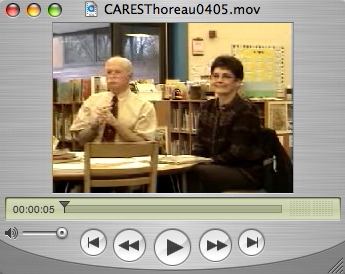 | Madison School Board President Bill Keyes & Arlene Silveira Madison CARES presentation at the Thoreau PTO on Tuesday, April 12, 2005. Video (75MB). More on Madison CARES here. |
Additional School on the Leopold School Site Facts
This information was provided to school board members via public information department
· Leopold Elementary School is overcrowded, and will become more and more overcrowded. The school’s capacity is 655 students; 668 students currently attend the school. In five years the school is projected to have a minimum of 750 students and as many as 830 students, that is 95 to 175 over capacity.
· In addition, because of overcrowding there, 111 students who live close to Leopold are assigned to elementary schools outside their neighborhood. One of these schools is Chavez Elementary which currently needs and will continue to need seats for students moving into new developments close to this school on the southwest side.
· This question asks for authorization for up to $14.5 million to build and equip a new elementary school adjacent to the existing school on the Leopold site, and to renovate, remodel, equip and add to the existing Leopold building, and to make related site improvements.
· Building on the existing site precludes having to purchase at least 15 acres of additional land for an elementary school.
· Included in the $14.5 million is up to $1.6 million for the existing Leopold building to convert and remodel the former library and current cafeteria into small and large classrooms.
· If this referendum is approved, the new school will open for the 2007-08 school year, and plans call for the two schools to be paired. Just as it’s done in other school district paired schools, one building would have kindergarten – 2nd grade students, and the other building would have 3rd – 5th grade students.
· Construction of this new elementary school will be consistent with the school district practice of having schools close to where students live, and of all students in a given neighborhood attending the same school.
· Without the new school on the Leopold site, and in the optimal boundary changes scenario presented to the Board of Education, at least an additional 64 current Leopold students will be assigned to schools outside their neighborhood. Under this scenario, over 300 students will be moved to different West side elementary schools – Thoreau, Van Hise, Stephens and Crestwood.
· Other boundary redistricting scenarios under consideration would move 828, 1063 or 1137 students to different elementary schools due to overcrowding. *(soon there will be an option to move around 300 students but the school board has yet to receive the information)
· The new school will cost the average homeowner an average of $25 per year for 15 years, and will generally maintain present school boundaries. (The median value of Madison homes is $205,400.)
For more information about the May 24 referendum, go to the district’s Web site at www.mmsd.org
April 16, 2005
Steve Stephenson: Broken school budget led to Kobza win
Dear Editor: As a parent of children at both Madison East High School and Sherman Middle School, I am thankful for the hard work and significant positive contributions that Lawrie Kobza and her husband, Peter, have made to both of these schools.Perhaps those apprehensive at the election of Lawrie Kobza to the Madison School Board are concerned that it won't be business as usual. Quite frankly, this is exactly why Lawrie now sits on the board. The easiest thing for a school board to do when facing a budget problem is to float a referendum to ask the voters for more money. This is similar to giving a drug addict a fix. It is only temporary and the real issues will still be waiting for you when the fix wears off.
The old saying goes "if it ain't broke, don't fix it." In this case, it is appropriate to say "if it is broke, fix it." As a taxpayer, I am willing to invest in the quality of our schools if I am confident that those on the board, in partnership with our teachers, are working hard to come up with solutions. I don't believe that this has been the case as of late, which is why I was pleased to cast my vote for Lawrie Kobza.This letter to the Editor appeared in the April 16, 2005 Capital Times.I applaud The Capital Times for supporting Lawrie Kobza. It's not about conservative or liberal, it's about doing the right things for our children.
Steve Stephenson
Madison
April 15, 2005
SB171 Hearing on School Referenda Timing
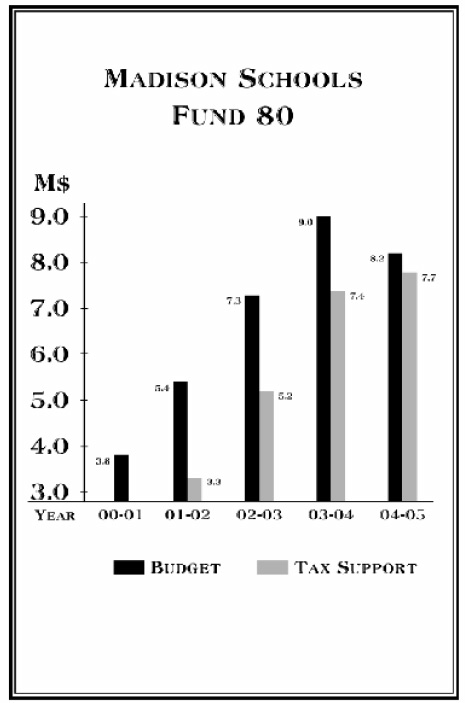 Click on this graph for a larger version | Following is a link to 2005 Senate Bill 171 relating to the scheduling of referenda to approve school district borrowing or exceed a school district's revenue limit. A hearing is scheduled for the bill on Wednesday, April 20, 9:00 a.m., Room 400 SE, before the Committee on Labor and Election Process Reform of the Senate, Tom Reynolds, Chair. (74K PDF). Send your views on this to Senate President Alan Lasee 200K PDF ACE Whitepapers: 1. Community Services Fund (Fund 80) [64K PDF] 2. Fund 80 Media Presentation [180K PDF] Kanavas requests audit of Waukesha School District's Community Service Funds. |
Teachers fight possible bilingual education cuts
Capital Times April 15, 2005
Full article at: http://www.madison.com/tct/mad/local//index.php?ntid=36209&nt_adsect=edit
Teachers fight possible bilingual education cuts
By Lee Sensenbrenner
April 15, 2005
Bilingual teachers who are helping students in the Madison Metropolitan School District to learn English are organizing against a proposed cut to their department.
Threatened with losing eight positions if a May 24 operating budget referendum for $7.4 million is unsuccessful, the teachers said in an open letter Thursday that the cut would take away much of their ability to help mainly Spanish speaking elementary students who are struggling to keep up.
As laid out in the administration's $7.4 million list of proposed cuts, dropping 8.4 bilingual resource teachers would save $425,880. This would take away one of two teachers in the elementary classrooms where the positions would be lost.
Senator Kanavas Requests Audit of Waukesha School District
Senator Ted Kanavas (R-Brookfield) has asked the Legislative Audit Bureau to audit the Waukesha School District's use of "community service funds" (called "Fund 80" by Madison Metropolitan School District) to finance high school pool project.
The following article from the April 15 Milwaukee Journal Sentinel includes a larger discussion about how funds are being used in other Milwaukee-area communities and whether those uses conform to state law.
From the Milwaukee Journal Sentinel
April 15, 2005
Senator requests audit of Waukesha schools
He questions use of funds related to pool project
By AMY HETZNER
ahetzner@journalsentinel.com
Posted: April 14, 2005
One of the fastest growing, and perhaps least regulated, of school district expenditures could get increased scrutiny because of questions over the financing of a Waukesha high school pool expansion.
State Sen. Ted Kanavas (R-Brookfield) has asked the state Legislative Audit Bureau to audit the Waukesha School District's use of April 2001 referendum funds, particularly as they relate to the pool.
An audit is far from certain because the bureau usually confines its work to state operations, Kanavas concedes. But Chris Kliesmet, a spokesman for Citizens for Responsible Government, said he hopes the situation will prompt the state's attorney general and lawmakers to take a stronger hand in enforcing a law that allows school districts to raise tax levies to pay for "community services" outside of the revenue caps that restrict their operating funds.
"They went and, we feel, violated if not the letter of the law, the spirit of the law," Kliesmet said of Waukesha school officials' use of the district's community service levy to pay for the pool project. "I guess that's for a court to decide."
Waukesha School Board members say they have done nothing wrong and have even consulted with an attorney and the state Department of Public Instruction for verification.
"We wouldn't have done what we did if we felt there were any issues," School Board member Daniel Warren said. "From day one, we felt it was and still feel it is an appropriate use of those funds."
Service levies up 170%
Taxes levied statewide for schools' community service funds have exploded 170%, to $45.9 million this school year, since 2000-'01 when the state first removed them from the restrictions of revenue caps, Department of Public Instruction records show. That compares with a 23% increase in the total amount levied by school districts over the same five-year period.
The community service money has paid for everything from clerical and custodial salaries related to community use of school facilities to playgrounds and anti-drug programming. And, while the Department of Public Instruction offers some guidance, districts have been largely on their own in determining what might qualify for community service funds.
But in Waukesha, a group of taxpayers is challenging their district's use of community service funds - $800,000 this school year - to help pay for an enlarged competition pool at South High School.
Voters had approved spending about $1 million in a 2001 referendum to repair the pool. That amount, as well as the pool, expanded after the Waukesha Express Swim Team offered to contribute toward a larger pool.
Critics of the pool project contend that state law allows community service money to go only toward programming, not toward buildings.
And they also contest whether the district's use of the funds is really for a community service, given that a contract to help secure more funding for the pool gives special access to the swim team.
"I had probably a dozen, roughly a dozen, constituents who asked, 'Is this kosher, the way that they're spending the money?' " Kanavas said. "I said, 'I think it is. But I'm not sure, so we can check.' "
Use of funds defended
Waukesha school officials, like those elsewhere, defend their use of community service funds.
Some school districts run the recreation departments for their communities.
In some of those cases, school officials say, the rapid growth in their community service funds just represents a recent move to account for such costs in their proper place, something that has grown in importance with the restrictions revenue caps put on their everyday budgets.
David Ewald, superintendent of the South Milwaukee School District, said he can see where there would be a "real temptation" to increase community service funds "because we're all so tight with money that we have to use whatever resources we could use."
But he said, at least in his district, that is not why the community service levy increased more than $200,000 last year, to nearly a half-million dollars. The new cash infusion is going to pay personnel and new equipment costs related to the addition of a performing arts center and fitness center at the high school, he said.
"Even though there's a commitment to having them self-funded after two years, there are start-up costs involved in those," Ewald said.
At the Hartland-Lakeside School District in Waukesha County, its $230,000 community service fund went toward adding playground equipment at Hartland North Elementary School as well as helping to expand adult education classes available to the community, according to district Business Manager Peter Balzer. The district hired a part-time community education director whose salary is paid out of the fund, he said.
Such programming would not be available if the district could not raise funds through its community service levy, Balzer said.
"We would not provide programs to those beyond Hartland-Lakeside . . . if we had to cut programs for our students," he said.
April 14, 2005
GPS Enabled Children's Uniforms...
But the notion of electronic IDs in schools has proven more than a little controversial, with some calling them a cutting-edge way to monitor attendance and keep kids safe and others assailing them as an assault on the youngsters' right to privacy.
Neenah schools add staff to special ed, gifted-talented program
The following story from the April 13, Appleton Post-Crescent reports on a school district in Wisconsin that is actually adding staff to both gifted and special education.
News-Record staff writer
NEENAH — The equivalent of four teachers will be added to the Neenah Joint School District next year to enhance its special education, and gifted and talented programs.
Last week, the Board of Education set the staffing level at 480.5 teaching positions for 2005-06, compared with 476.5 this year.
The changes will cost taxpayers an additional $244,000 next year.
Two additional teachers and one additional paraprofessional will be hired for special education.
The number of special education students in Neenah has increased by 5 percent to 948 during the last 15 months because of more cases of autism and speech and language disabilities, according to Anne Lang, director of special education.
That means one in every seven students in Neenah receives special education services.
The staffing plan also authorizes 1.5 additional positions for the district’s gifted and talented program.
One teacher will be hired for a new magnet class for highly intellectual students at Shattuck Middle School. It will be an extension of the magnet class begun this year at the elementary level.
Neenah parent James Godlewski said his fifth-grade son has blossomed in the magnet class. He asked that the program be continued in middle school.
“Promoting the excellence of our talented students, whether it be in athletics, in music or academically, is a very important aspect of what makes the Neenah Joint School District an important and special place,” Godlewski said.
A half-time gifted and talented position will be added at the elementary schools, reversing a cut made last year.Neenah High School will get 2.5 additional teaching positions next year, including one for the recently approved alternative high school for at-risk students that will be housed at the Boys’ and Girls’ Brigade.
Administrators initially had sought 3.5 additional positions as a result of an accounting error.
The increase in staff at the high school will be offset by three fewer positions at the elementary schools. Administrators projected a 4 percent decline in elementary enrollment next year.
Duke Behnke can be reached at 920-729-6622, ext. 32, or by e-mail at dbehnke at newsrecord.net.
Direct Instruction Wins More Praise
The cover story in today's Isthmus (dated April 15) includes new praise for the effectiveness of Direct Instruction for teaching reading.
For example, the article says, "Among the beneficiaries . . . are special ed students, who receive an especially intense form of Direct Instruction. One-third of Marquette's special ed kids were 'advanced' readers on last year's third-grade test, while over one-half were 'proficient.'
The article continue, "Meanwhile, at Franklin-Randall, the district's other paired elementary schools, the third-grade scores for special ed students are the inverse of those at Lapham-Marquette: Whereas Marquette has one-third of its kids at the top and 8% at the bottom, Randall has 8% at the top and one third at the bottom. At Hawthorne Elementary, one of five schools formerly eligible for the Reading First grant, no special ed children register as 'advanced,' and most perform poorly."
Unfortunately, most Isthmus articles are not posted on-line. When an electronic copy become available, I'll post a link to it.
Ed Blume
Ridgewood Apartment Changes
Cliff Miller on recent management changes and the redevelopment plans at Fitchburg's Ridgewood Apartments. This complex is very close to Madison's Leopold School. Any changes at Ridgewood may affect Leopold along with the planned expansion.
April 13, 2005
Original letter on Reading Recovery weaknesses
Below Jeff Henriques posted a response from the MMSD to a letter criticizing Reading Recovery.
The critical letter concludes:
"Reading Recovery has not met the needs of these lowest performing students. Most significantly, its excessive costs can make it more difficult for a school to provide help for all students in need, especially those who are behind in the upper grades. Thus, Reading Recovery is not a productive investment of taxpayers’ money or students’ time and is a classic example of a “one size fits all” method."
Read the full letter letter on Reading Recovery's flaws.
Ed Blume
NCLB Causing Decline in Achievement
The New York Times on April 13 reported on a study by the Northwest Evaluation Association that shows there is a decline in the improvement of students in schools since the enactment of NCLB. To quote the article in part:
"Since No Child Left Behind, ... individual growth has slowed, possibly because teachers feel compelled to spend the bulk of their time making sure students who are near proficiency make it over the hurdle.
The practice may leave teachers with less time to focus on students who are either far below or far above the proficiency mark, the researchers said, making it less likely for the whole class to move forward as rapidly as before No Child Left Behind set the agenda."
The following link is to the actual report from the NWEA site, for your reading pleasure.
MMSD's reply on Reading Recovery
In response to criticism of Reading Recovery here and on the Madison TAG Parents web site, MMSD Reading Recovery Coordinator, Sharon Gilpatrick, provided TAG staff with information in response to the letter about Reading Recovery and asked that it be shared with the community.
According to the Reading Recovery Council of North America the Internet letter criticizing Reading Recovery was not an "unbiased review of evidence. It represents a narrow but vocal minority opinion." They also state that it has a number of biases and omits important findings. You can draw your own conclusions by reading their letter signed by their group of international researchers.
A Quid Pro Quo for Passing the Referenda
The District must have a budget process that allows the Board of Education and the public to review the budget, and balance the interests of the public, students and staff to accomplish the effective and efficient operation of the School District, and to ensure that its priorities are addressed.
The current timeline for budget approval does not allow the Board or the public to have reasonable and informed access to the information necessary to balance those interests, or to ensure those priorities.
Instead, current and past budget practices allow staff contracts to be accepted, budget cuts to be proposed, and additional programs to be considered, all without the ability to place these items within the budget as a whole, and therefore balance all interests.
Modifying the budget process to allow this balancing, to me, is non-negotiable.
I, for one, will not be supporting any of the referenda on the May 24 ballot, unless the budget process is fixed.
I will be voting in favor of all the referenda on May 24, if and only if the Board takes actions prior to the referenda to ensure all proposed staff contracts and other agreements are incorporated into the previously published budget and not acted separately upon by the Board; and, if and only if, all cuts to programs are proposed and presented in the context of the previously published budget, and not acted separately upon by the Board.
In order to get my vote, the 2005-2006 budget process and timelines need to be modified, even at this late date, to conform. We cannot reneg on any contracts already voted on by the Board, and we cannot review the failure to consider adminstrative renewals by the Board, and we cannot pull back the publicly proposed cuts to await the timely arrival of the budget.
But, we must be delivered an estimated 2005-2006 budget sooner than the proposed May 2nd to give the public time to review it, place the proposed cuts into its budget context, and plan for alternative budget adjustments. At the latest, the budget can be delivered to the Board and public on April 22nd, even under the current timeline, by posting the budget on the website prior to or instead of printing (we might even be able to save printing costs!).
Accepting the referenda for a changed budget process is a quid pro quo contract between the Board and the public. It is a prototypical win-win agreement. All sides to the coming debate over the referenda get everything they want. Those in favor of the referenda get the referenda passed; those who want a significantly better budget process get their interests heard.
Accepting such a challenge might even avoid the coming, and, what I perceive to be, very devisive battle among the many sides to debates.
For those who find such an agreement more of a compromise than a win-win agreement, consider it progress towards opening up the budget process – progress that could have been accomplished years ago.
The real debate has not started, but I’ve already heard some loose lips. I’ve heard it said (paraphrasing), “If you can’t afford the tax increases, take a mortgage out on your home.” And I’ve read comments that said (paraphrasing again), “If the Leopold expansion was in a white area, there would be no problem. The opposition are racists.”
Unless some agreement is accepted, I don’t see a reasoned and tempered debate occurring in the next month and a half.
Instead, we’ll be spitting at each other.
QEO - What State Statute Says
There is some difference of opinion about what state law requires under the QEO statutes, particularly regarding the "required" 3.8% increase. For what it's worth, this is how the statute is worded:
SOURCE:Updated 03−04 Wis. Stats. Database 22
111.70 EMPLOYMENT RELATIONS
(nc) 1. “Qualified economic offer” means an offer made to a
labor organization by a municipal employer that includes all of the
following, except as provided in subd. 2.:
a. A proposal to maintain the percentage contribution by the
municipal employer to the municipal employees’ existing fringe
benefit costs as determined under sub. (4) (cm) 8s., and to maintain
all fringe benefits provided to the municipal employees in a
collective bargaining unit, as such contributions and benefits
existed on the 90th day prior to expiration of any previous collective
bargaining agreement between the parties, or the 90th day
prior to commencement of negotiations if there is no previous collective
bargaining agreement between the parties.
b. In any collective bargaining unit in which the municipal
employee positions were on August 12, 1993, assigned to salary
ranges with steps that determine the levels of progression within
each salary range during a 12−month period, a proposal to provide
for a salary increase of at least one full step for each 12−month
period covered by the proposed collective bargaining agreement,
beginning with the expiration date of any previous collective bargaining
agreement, for each municipal employee who is eligible
for a within range salary increase, unless the increased cost of providing
such a salary increase, as determined under sub. (4) (cm)
8s., exceeds 2.1% of the total compensation and fringe benefit
costs for all municipal employees in the collective bargaining unit
for any 12−month period covered by the proposed collective bargaining
agreement plus any fringe benefit savings, or unless the
increased cost required to maintain the percentage contribution by
the municipal employer to the municipal employees’ existing
fringe benefit costs and to maintain all fringe benefits provided to
the municipal employees, as determined under sub. (4) (cm) 8s.,
in addition to the increased cost of providing such a salary
increase, exceeds 3.8% of the total compensation and fringe benefit
costs for all municipal employees in the collective bargaining
unit for any 12−month period covered by the proposed collective
bargaining agreement, in which case the offer shall include provision
for a salary increase for each such municipal employee in an
amount at least equivalent to that portion of a step for each such
12−month period that can be funded after the increased cost in
excess of 2.1% of the total compensation and fringe benefit costs
for all municipal employees in the collective bargaining unit plus
any fringe benefit savings is subtracted, or in an amount equivalent
to that portion of a step for each such 12−month period that
can be funded from the amount that remains, if any, after the
increased cost of such maintenance exceeding 1.7% of the total
compensation and fringe benefit costs for all municipal
employees in the collective bargaining unit for each 12−month
period is subtracted on a prorated basis, whichever is the lower
amount.
c. A proposal to provide for an average salary increase for
each 12−month period covered by the proposed collective bargaining
agreement, beginning with the expiration date of any previous
collective bargaining agreement, for the municipal
employees in the collective bargaining unit at least equivalent to
an average cost of 2.1% of the total compensation and fringe benefit
costs for all municipal employees in the collective bargaining
unit for each 12−month period covered by the proposed collective
bargaining agreement plus any fringe benefit savings, beginning
with the expiration date of any previous collective bargaining
agreement, including that percentage required to provide for any
step increase, as determined under sub. (4) (cm) 8s., unless the
increased cost of providing such a salary increase, as determined
under sub. (4) (cm) 8s., exceeds 2.1% of the total compensation
and fringe benefit costs for all municipal employees in the collective
bargaining unit for any 12−month period covered by the proposed
collective bargaining agreement plus any fringe benefit
savings, or unless the increased cost required to maintain the percentage
contribution by the municipal employer to the municipal
employees’ existing fringe benefit costs and to maintain all fringe
benefits provided to the municipal employees, as determined
under sub. (4) (cm) 8s., in addition to the increased cost of providing
such a salary increase, exceeds 3.8% of the total compensation
and fringe benefit costs for all municipal employees in the collective
bargaining unit for any 12−month period covered by the collective
bargaining agreement, in which case the offer shall include
provision for a salary increase for each such period for the municipal
employees covered by the agreement at least equivalent to an
average of that percentage, if any, for each such period of the prorated
portion of 2.1% of the total compensation and fringe benefit
costs for all municipal employees in the collective bargaining unit
plus any fringe benefit savings that remains, if any, after the
increased cost of such maintenance exceeding 1.7% of the total
compensation and fringe benefit costs for all municipal
employees in the collective bargaining unit for each 12−month
period and the cost of a salary increase of at least one full step for
each municipal employee in the collective bargaining unit who is
eligible for a within range salary increase for each 12−month
period is subtracted from that total cost.
2. “Qualified economic offer” may include a proposal to provide
for an average salary decrease for any 12−month period covered
by a proposed collective bargaining agreement, beginning
with the expiration date of any previous collective bargaining
agreement, for the municipal employees covered by the agreement,
in an amount equivalent to the average percentage increased
cost of maintenance of the percentage contribution by the municipal
employer to the municipal employees’ existing fringe benefit
costs, as determined under sub. (4) (cm) 8s., and the average percentage
increased cost of maintenance of all fringe benefits provided
to the municipal employees represented by a labor organization,
as such costs and benefits existed on the 90th day prior to
commencement of negotiations, exceeding 3.8% of the total compensation
and fringe benefit costs for all municipal employees in
the collective bargaining unit required for maintenance of those
contributions and benefits for that 12−month period if the
increased cost of maintenance of those costs and benefits exceeds
3.8% of the total compensation and fringe benefit costs for all
municipal employees in the collective bargaining unit for that
12−month period.
Middle School Goes out of Fashion?
. . . a growing body of evidence is showing that preteen students do better when they can remain in their familiar elementary schools for longer -- with better grades and fewer disciplinary problems than their middle-school peers.Via Eduwonk & Joanne Jacobs. . . An early study tracked hundreds of middle-school-age students in Milwaukee public schools, comparing those who switched to a new school in grade seven with their counterparts in a K-8 school who didn't have to make any switch. The research found that those who switched had more negative attitudes toward school and lower grades. Girls in particular didn't recover in middle adolescence (grades nine and 10) when it came to self-esteem and participation in extracurricular activities.
April 12, 2005
Charters Pay Teachers More? - Albuquerque
"It's true. We do pay more," said Greta Roskom, a charter-school principal and a former Albuquerque Public Schools principal and administrator.By and large, charter schools are paying their teachers more than APS pays theirs.
Comment for MMSD Employee on '05-'06 Budget
I appreciate the listing of alternative considerations but have questions and concerns about those being recommended:
• Seek a wage freeze from MTI members for a year
Correct me if I'm wrong. It's my understanding that 3.8% is a QEO requirement and it's been mentioned that MTI works considerably well with the MMSD adminstration. Other Wisconsin districts have extended higher increases ranging from 4.2-4.6%. I would hate to lose our great teachers to other locations in the state if we don't at least maintain a minimal increase. Arbitration is a scary thought as well.
• The Board should cut your losses and cancel expensive and inaccurate systems like Kronos and Lawson;
I'd like to know if it is the system that is poor; or that because it is new, staff are having a hard time learning something new.
• Freeze hiring of administrative staff. Other staff have been required to do more - with less.
To play devils advocate; the parent and community specialist may actually increase and maintain better relationships within the Madison community. Parents and citizen involvement is essential and we all know; after the referenda go away, the interest will unfortunately diminish...I'd like to see more interaction with the board, administration and community and if it takes someone to organize and maintain it; I'll support it.
• Cancel all out of state conference attendance for administration and teaching staff.
So are we decreasing teachers ability to learn, bring in fresh ideas and put on blinders by learning only within our state/district boundaries?
MMSD Employee on Budget for 2005-06
DATE: April 6, 2005
TO: Madison School Board Members
FROM: School District Employee
RE: MMSD Budget Concerns/Questions
As a Madison taxpayer, parent, and employee of MMSD, I have a unique perspective on the workings of this school district. I also feel a great responsibility to write my concerns. The Board should address:
• How can food service/custodial/secretarial personnel be cut/surplused at the same time that more administrators are added and given substantial raises?
• How can the Board consider cutting services at the schools when incredible amounts of money are spent on conference attendance by administrators and teachers?
• How many assistants does the Superintendent need? While a few Assistant Superintendents have retired/left in recent years, Supt. Rainwater now has a "Chief of Staff' and "Special Assistant for
Parent and Community Relations." How can these expensive staff be justified?
• How much money is being spent on the new Lawson purchasing and Kronos payroll systems? It takes staff triple the time to do the same work in this cumbersome, on-line purchasing system. Lawson is simply not working efficiently. The accuracy of its accounting reports is very questionable. The Kronos (timeclock) system is being forced upon the District's hard working employees because some employees were not working when they were supposed to. Rather than administrators tighten
control over those select few, an entire, new and expensive system is being implemented for certain groups of staff (custodial, food service, secretarial). Administrators, teachers & many other school
based staff are exempt from this system. My exposure to the Kronos and Lawson systems has demonstrated that they are highly inefficient. Employee morale is extremely low. Good employees, who often work extra, without overtime pay - will no longer go the extra mile to complete projects or to serve the public and students.
I suggest that before you cut any services for the students or increase student fees, the following options be
investigated:
• Seek a wage freeze from MTI members for a year - union members, as a gesture of concern/empathy to the community, should consider this option;
• The Board should cut your losses and cancel expensive and inaccurate systems like Kronos and Lawson;
• Freeze hiring of administrative staff. Other staff have been required to do more - with less.
• Cancel all out of state conference attendance for administration and teaching staff.
The Board has lost its credibility in the sight of voters. The referendums in May will not pass (nor should they). Board members must ask some serious questions, make sure you are being given the while picture from administration, and take action.
CC: Wisconsin State Journal
MTI
What about an e-mail link from teachers to parents?
In Madison, parents have begun asking why MMSD does not link parents to teachers through regular e-mail reports and messages. The April 6, 2005 issue of Education Week offers pros and cons of this suggestion. http://www.edweek.org/ew/articles/2005/04/06/30email.h24.html?querystring=e-mail%20opens%20line
Some Direct Instruction Curricula
Direct Instruction frequently enters discussions of reading in Madison's schools.
Strictly speaking, Direct Instruction (with a capital D and a capital I) is a copyrighted program. Direct instruction (little d, little i) refers to a variety of programs that use direct systematic instruction and other principles of Direct Instruction.
Additionally, direct instruction works to teach other subjects, math, science, history, and more.
Dr. Martin Kozloff, professor at University of North Carolina-Willmington, prepared a long list of direct instruction cirricula. Click here to read a short description of each.
Ed Blume
April 11, 2005
QEO: Good or Bad?
The perennial argument that the QEO has somehow “capped” teacher salaries just doesn’t square with the numbers because most districts voluntarily settle above the 3.8 percent total package, which includes both salary and benefits. The Wisconsin Association of School Boards database shows that total-package increases averaged about 4.5 percent in 2003-04 and 4.3 percent in 2004-05.Stan Johnson:
Prior to the law change, arbitrators intervened in stalled negotiations and brought the sides together by analyzing such data as a local school district’s ability to pay, national and regional market forces, and comparable wages and benefits in the geographic area. Arbitration was the single most important factor accounting for the period of labor peace from the late 1970s to early 1990s.What's the QEO? via wisopinion
Capital Times Editorial on Kobza's Win
4.11.2005 Capital Times Editorial:
Newcomer Lawrie Kobza surprised a lot of people with her win in Tuesday's voting for the Madison School Board, which saw her upset incumbent Bill Clingan by a comfortable 53-47 percent margin.Great to see the Capital Times engaged....Her win is being read as something of a municipal Rorschach test.
Some members of the current board majority, who vigorously opposed her candidacy, fear that Kobza will be another Ruth Robarts, the dissident board member who has angered her colleagues by picking fights on budget issues and accusing other board members of being rubber stamps for Superintendent Art Rainwater.
UPDATE: Karyn Saemann on No School District, no sense of place; schools in Fitchurg.
Where's the board majority?
Jason Shepard speculated on how a majority might form on the MMSD school board when Lawrie Kobza officially takes a seat.
“Lawrie Kobza’s win . . . over Madison school board incumbent Bill Clingan by a 53% - 47% margin will almost certainly alter the board’s ideological alignment. The only question is how.
Kobza credits a surprise endorsement from The Capital Times as the tipping point of her campaign. But a last minute mailing signed by Ed Garvey and former Mayors Paul Soglin and Sue Bauman questioned whether Kobza is really a liberal.
Kobza, an attorney with a sharp mind, says her election proves voters want changes in school governance. Soon-to-be colleague Ruth Robarts is thrilled: “There’s going to be a new dialogue.”
At election–night parties, there was speculation that Kobza could side with Robarts on what would normally be 6-1 votes, and also of a coalition made up of Kobza, Robarts and moderates Shwaw Vang and Johnny Winston. But Carol Carstensen says her big win . . . shows public support of the board’s liberal majority. We’ll see.”
-- Isthmus, April 8, 2005
Milwaukee Schools Update
Quite a bit happening in Milwaukee, according to Alan Borsuk.
The revolving door for urban school superintendents has been a major fact of life across the country. The general rule of thumb many use is that if you make it three years in the job, you're doing better than average.Andrekopoulos will reach the three-year mark in August. He has said from the start that he was committed to the job for five years, and he recently said he might want to make it six.
It is still going to be heavy going for him and everyone else involved in MPS. The budget decisions are going to be tough and the politics demanding. Change, as Andrekopoulos says, is hard.
Most important, the job of raising the level of educational success of children in the city overall is complicated and slow going, at best.
But the Goldberg election may prove over time to have been an important signal that Andrekopoulos will beat the urban superintendent challenge and get the five years or more that he wants. That is likely to make this the key question for the next several years: Will the policies he stands for work?
April 10, 2005
The 65% Solution?
George Will, writing from Phoenix:
The idea, which will face its first referendum in Arizona, is to require that 65 percent of every school district's education operational budget be spent on classroom instruction. On, that is, teachers and pupils, not bureaucracy.Joanne Jacobs has a few comments.Nationally, 61.5 percent of education operational budgets reach the classrooms. Why make a fuss about 3.5 percent? Because it amounts to $13 billion. Only four states (Utah, Tennessee, New York, Maine) spend at least 65 percent of their budgets in classrooms. Fifteen states spend less than 60 percent. The worst jurisdiction -- Washington, D.C., of course -- spends less than 50 percent.
5 Reasons Why the Madison School Board Should Continue the Elementary Strings Program
In the May 24 referendum for the operating budget, voters will determine whether the Madison schools will have an additional $7.4 million to spend next year and for all the years thereafter. Superintendent Art Rainwater and the management team issued a cut list in March. According to Rainwater, the board should cut the programs, staff and expenses on this list if the referendum fails. http://www.madison.k12.wi.us/budget/mmsd/0506/2005-06_Budget_Discussion_Items.pdf
Before the referendum election, the school board can take items off of the cut list. One of the items that should come off the list is the proposed elimination of the elementary strings program, a program that costs $500,000 within a budget of more than $350 million.
There are at least five good reasons why the board should support the strings program and direct Superintendent Rainwater to make other cuts to save these dollars.
Reason 1: Music programs help close the minority student achievement gap. Music programs integrated into the academic curriculum are proving that they increase the academic achievement of minority and low income students, in particular. For this reason, the Ford Foundation is currently funding music and art programs in many school districts nationally.
Reason 2: Federal funding is available for expanded music programs. Music and other fine arts programs integrated into the academic curriculum can bring in federal dollars under the No Child Left Behind Act, as they have in the Tucson, Arizona and New York City school districts.
Reason 3: Eliminating programs like elementary strings adds to the differences between have and have-nots in Madison. When districts eliminate music programs, the harm falls mainly on low income children. Recently University of Wisconsin Music Professor Richard Davis assessed the proposed cut in the Madison schools. He said,“underprivileged children will suffer the most,” says Davis. “It’s another way of letting only those who can afford it get the opportunities. The fear is that you’re going to have a very one-sided, warped community, where one world will have all of the exposure and sophistication, and the other world won’t."
Reason 4: Strings programs are essential preparation for good jobs in the future in Madison. The City of Madison and the University of Wisconsin-Madison are investing together to develop Madison as a national and international venue for the performing arts. Pulling the strings training program out from under our low income and minority students in 2005 will keep these children from getting the good jobs and careers that come with that development. Families with economic means will be able to prepare their children from the new arts-focused economy in Madison. Other families will be left out.
Reason 5: There are many economic alternatives to this cut. The school board has many, sound alternatives to eliminating the elementary strings program as a way of saving $500,000. Think about the size of the cut. Out of a budget of more than $350 million, the cost of the elementary strings program is 0%. Combinations of small cuts in discretionary accounts used for purchasing outside services and consultants, conferences and staff travel expenses, supplies and equipment or the “miscellaneous” accounts of district departments would cover the cost of elementary strings and other classroom programs now on the cut list.
Please contact your school board members at comments@madison.k12.wi.us as soon as possible. Register your opposition to cutting this important program for our students. Our young musicians need your help now. You can also express your opposition by speaking to the school board at a rally on May 2. For more information about the rally, contact Barbara Schrank at schrank4@charter.net.
April 09, 2005
Dave Burkhalter Named WEAC Executive Director
Via Wispolitics:
Daniel Burkhalter, who has been director of government relations for the Illinois Education Association since 1993, is the new executive director of the Wisconsin Education Association Council.Wispolitics. Clusty searchThe WEAC Board of Directors approved the appointment of Burkhalter Friday (April 8, 2005). He succeeds Michael A. Butera, who left in November to take a position with the National Education Association. WEAC Legal Counsel Bruce Meredith has been acting executive director.
Demand Student Centered Decisions
Decisions: Adult or Student-centered? by Dr. John Benham, Music Advocate
Why do I include this as an issue of music advocacy? Because, it is my observation that the lack of a student-centered decision-making process is the number one issue in education!
As stated in a previous entry, whenever any decision is made the question must be asked:
"What will the short and long term effects of this decision be on the students in the district?"
Federal mandates, the demand for increasing test scores, the shortage of funding for public education, and a variety of other issues often convey an environment of negativism toward public education and in particular the public school educator. Even in states or districts that have demonstrated standards of excellence in student achievement there is often the presence of a public attitude that assumes "since there are problems in education somewhere they must be just as bad in our district, too!"
This crisis of negativism places the educator in the position of constantly defending their roles as administrators or teachers. The need to demonstrate administrative leadership or skills as a teacher can drive the decision-maker to operate out of personal need. The need for self-preservation politicizes the decision-making process and can lead to conflict (power struggles) between administrators, school board, and teachers. Student learning can become a secondary issue.
While public education exists for learning, the decision-makers in any school district are adults. Adults tend to make decisions based upon the perspective their position gives them on any issue. Administrators solve problems from an administrative perspective: Budgets, staffing, public relations, keeping teachers happy. Teachers solve problems from a teaching perspective: class size, student loads, salaries & benefits, keeping parents happy.
When the mission of education is perceived as teaching or educating children (See Decision-Makers: Who's Really Calling the Shots?) and not learning, the forces underlying the decision-making process may be driven by adult-centered issues. The influence of adult-centered issues in the decision-making process is often subtle. At other times they are blatantly obvious. Somehow educators seem to have adopted the concept that if we solve the issues that surface related to our job conditions, we have improved the learning of our students. Consequently decisions tend to be made that resolve adult needs, but do not necessarily improve learning.
Some examples from actual school districts may serve to illustrate the problem.
Example #1: The school district is in a financial crisis. The administrators decide that all students shall be required to schedule a one-period
While the district was in a financial crisis, further research into the situation revealed that there was a music teacher the administration had wanted to fire for several years. The financial crisis provided the perfect opportunity. The district mandated the elimination of 50% of the entire music teaching staff in order to go deep enough into the seniority tract to eliminate that teacher. The decision to require each student to schedule one study period per day was primarily to facilitate those students who would no longer be able to take music.
The Result: Upon revealing these facts to the parents, the administration rescinded their recommendation and reinstated the music program.
Example #2: Elementary schools in the district are overcrowded, but building a new school is not an option. Changing attendance boundaries or areas would solve the problem, but is an extremely volatile issue. The district decides to approach the problem with "educational reform." They will adopt a middle school philosophy of education.
The Result: The six graders are moved into the old "junior high" facilities. The names are changed, but little else. They may add an exploratory wheel in which student take a greater variety of subjects or activities, or even make a few other changes. General music is reduced from a full year to a six week exploratory. Band, choir and orchestra are reduced from daily instruction to every other day to facilitate more exploratory classes; and music teachers are replaced with exploratory teachers. Lessons and elementary (grade five) beginning instruction are eliminated. Elementary classroom teachers are happier because the "pull-out" lessons are gone.
Example #3: The district has hired a new administrator(s) who has decided to investigate various alternatives of educational reform. They decide to adopt block scheduling.
The Result: Students lose eight weeks of instructional time per course. The new administrator demonstrates leadership skill as an "agent of change." [Note:In every district that has consulted me about block schedule as educational reform, there has been a new administrator leading the change.]
Example #4: In a small district, the administration and guidance counselors are working out the class schedule for the coming year. One major issue seems to be in the way of completing the process. All the coaches (including the high school principal) participate in an amateur basketball league. Their schedules have all been arranged so that they have the last hour of the day available to practice in the gym. The problem: There are no other teachers available to supervise study hall during the last period.
The Result: Although the band director is voluntarily teaching band lessons during his "prep" hour, it is decided that the only logical action is to eliminate lessons and assign study hall supervision to the band director.
DEMAND STUDENT-CENTERED DECISIONS!
*
John Benham, Ph.D.
www.supportmusic.com
March 23, 2005
Hacker High School
The Hacker Highschool project is the development of license-free, security and privacy awareness teaching materials and back-end support for teachers of elementary, junior high, and high school students.Today's kids and teens are in a world with major communication and productivity channels open to them and they don't have the knowledge to defend themselves against the fraud, identity theft, privacy leaks and other attacks made against them just for using the Internet. This is the reason for Hacker Highschool.
Teacher Union Agreements Around the USA
Madison Teachers, Inc. is currently bargaining with the Madison School District. The current agreement can be found here (167 page PDF). I ran some google searches and found the following teacher contracts online:
- Boulder, CO 97 Pages
- Portland, OR 96 Pages
- Eugene, OR 50 Pages
Arts & Education: Milwaukee Ballet, Degas & Milwaukee Art Museum
 | I chanced upon a rather extraordinary afternoon recently at the Milwaukee Art Museum. The Museum is currently featuring a Degas sculpture exhibition, including Little Dancer. Interestingly, several ballerinas from the Milwaukee Ballet were present. Children could sketch and participate. I took a few photos and added some music. The result is this movie. Enjoy! |
April 08, 2005
Connecticut's A.G. to sue Federal Government
Air America's Al Franken interviewed Richard Blumental, Connecticut's Attorney General, Friday because he is fiing a law suit against the federal government. His complaint on behalf of the state of Connecticut is the federal government is illegally and unconstitutionally requiring states and communities to spend millions of dollars to administer federally mandated test. He claims it is unconstitutional for the federal government to mandate education to the local communities without financially backing the mandates. He is asking that other states join in............
The same could be true for Special Education mandates required by the state and federal government in Madison. Mr. Keyes repeats over and over that if the state and federal government met their promised support for S.E. we would eliminate our budget gap.
While attending a board meeting last year I asked why we could not sue the state and federal government over these mandates. While the board chuckled at the idea, I was serious. I hate frivolous law suits but sometimes publicity is worth the suit. Read more at AP.com or thealfrankenshow.com.
East vs. West
Problems on the East & Problems on the West: Problems pitting the city against one another
East: (Hawthorne)
Immediate priorities with buildings of lower capacity
Issues concerning the needs of children are fulfilled in a reasonable manner
West:
Overcapacity where there is no other facility with low capacity
A shift of 1100 students
Sell-it:
Parents are the same no matter what side of town they are from.
Parents are afraid of the unknown; empower them to learn more about the school they will attend
Encourage them to visit the schools in their area to understand community and city needs
This may not be the solution, but it’s sure worth the research. It would seem reasonable to move Kennedy students to Elvehjem to alleviate problems at Hawthorne. The classroom dynamics at Kennedy vs. Elvehjem, (at least on paper) are similar and the population being moved is consistent to those currently enrolled at Elvehjem. Elvehjem is also at lower capacity and has space.
Sell-it!
Kennedy parents are afraid because they don’t know: They don’t know the school, they don’t know the staff, they don’t know the building & they don’t know the success experienced at Elvehjem.
Hawthorne has programs for their population. ESL and transportation questions MUST be addressed. (Shenk does not have an ESL program and currently busses these students to another school)
Parents in a school dealing with overcrowding issues ARE willing to move, BUT parents currently in a school that is functioning just fine, need to be SOLD on the idea. The board and administration must come up with solutions; apologies for lack of action, do not solve the problem but it is wise to identify it as a concern to not happen again. I can tell you, the Hawks communities were put at ease (more comfortable) after I visited Glen Stephens and shared my visit with them. The issue of moving us 0.9 miles to a school with early start and then, most likely having to move us again in 2 years (as the existing communities around Muir, Stephens and Crestwood sell homes to young families) is not a solution to our problem.
In the past 3-months of attending board meetings, I can tell you this:
You (the board and administration) represent this CITY….NOT a specific community. You must be the leaders to facilitate an understanding between East vs. West, North vs. South, community vs. community. There is a group of parents; Leopold parents, who have busted their butts to understand the issues of their particular school and who have worked alongside the administration and Madison school Board (for 5 years) to create a wonderful plan. A “PLAN” that the Leopold community needs, that the Leopold majority endorse, that the Leopold teaching staff and administration fully support. A plan that is also ‘sellable’ to the Madison public because of its practicality. These parents have the knowledge, the wherewithal, and stamina to empower other parents and share their experience with other PTO’s across the Isthmus (within Madison) in getting it done!
I simply want to bring to your attention that the answer is within the community. The real solution…beyond building a new school is being exemplified by Leopold parents. And it is costly and frustrating to this city when some communities are being heard more than others. As the Madison School Board, you have run past campaigns stating you want to listen to the community and support their needs. You are defeating a real solution when you pit us against one another, believing one side of town deserves your attention and support more than another. To not believe in the Leopold ‘solution’ is a disservice to the entire city.
Continue your efforts to visit each school. You can’t sell the Doyle Building but you can certainly rent its space to the local businesses and university and get out to the community to understand and pull us together. All PTO’s have come to realize that this year was not what they anticipated…create a network; support all of us!
Marisue Horton
School Administrator Sharing
Lake Mills Superintendent Dean Sanders will speak to the Johnson Creek School Board at the end of April about the possibility of the districts sharing a superintendent, a business manager and possibly a pupil services director.The move might not only save money, but it could also avoid cuts to staff and services, he said. Sanders said both districts face financial challenges.
"We all have to look at ways of making our districts run, short of cutting programs and hurting kids," Sanders said.
April 07, 2005
Madison C.A.R.E.S Presentation @ Thoreau PTO 4.12.2005
Mary Marcus forwarded this event notification: Tuesday, April 12, 2005 / 6:30 to 7:30p.m. @ Thoreau School PTO Meeting (Map & Driving Directions)
Guest Speakers Bill Keys and Arlene Silveria from Madison C.A.R.E.S. (Citizens Acting Responsibly for Every Student).Madison C.A.R.E.S. background information
Madison CARES (Citizens Acting Responsibly for Every Student) is an organization of citizens who are concerned about the future of the public schools and have come together in support on the 3 referenda that will be on the ballot in the Madison Metropolitan School District on 5/24. At the meeting, we will provide you with information on the 3 referenda questions and how they may affect your school. We will also introduce you to our organization. There will be time for questions and answers.
Mr. Rainwater, I am looking at you. And I’m more than disappointed.
Dear Editor,
I just returned from the annual Madison Strings Festival with a warm feeling in my heart. It wasn’t the warmth of joy, however, despite the lasting echoes of 1,000 children playing music. It was the embers of rage beginning to kindle. For the fourth time, the Strings Festival was tainted by rumblings of anger, shock, and outrage at Art Rainwater’s ongoing assault on Madison values. For the fourth time, the elementary strings program in the Madison schools is targeted for demolition.
Madison has spoken clearly about its commitment to the arts. (We have a $200 million gift downtown to prove it.) Madison has spoken clearly about its commitment to fact-based decision-making. Students who play an instrument care more about school, perform better in school, and are better equipped to achieve their life goals. More than 67% of students participate in strings (and the numbers would be higher but for a handful of anti-strings principals.) Minority and low-income children participate in percentages higher than their representation in the district. Private lessons are expensive (current market rate - $1500/year). At a cost of $285 per student, elementary strings is likely the most cost-effective minority achievement program in the district.
Madison has spoken clearly and unrelentingly about its commitment to arts in our schools and the Strings program in particular. Why does the superintendent persist in putting this extremely popular $500,000 budget item on the chopping block, while never considering a cut to the $500,000 pay increase for his administration? Madison values our low student to teacher ratios (10-to-1). But as a taxpayer, I can’t support an administrator-to-child ratio that is 20% higher than the state average. Madison does NOT value an administration so bloated, it includes a full-time "Chief of Staff” for the superintendent.
Madison schools need to reflect Madison values. We spend more than $12,000 per student. Are we really relegated to reading, ‘riting and ‘rithmetic? As Mr. Rainwater stated publicly a few years back, he came from a small town in Arkansas that didn’t have a well-developed arts program in his schools, “And look at me!” Mr. Rainwater, I am looking at you. And I’m more than disappointed.
Maureen Rickman, Ph.D.
Parent
Madison, WI
Letter in The Capital Times on Thursday, April 7, 2005
Tuesday's Madison Schools Election Traditional Media Summary
Lee Sensenbrenner & Sandy Cullen briefly summmarize Tuesday's election results/
April 06, 2005
Leopold area split on location of new school?
By trying to compare city council ward maps and the Leopold Elementary attendance map, it appears to me that Lawrie Kobza and Bill Clingan ran neck and neck in the Leopold area:
| Ward 57 | Ward 58 | Ward 59 | Total | |
| Kobza - 32 | Kobza - 16 | Kobza - 129 | Kobza - 177 | |
| Clingan - 36 | Clingan - 14 | Clingan - 138 | Clingan - 188 |
Kobza favored construction of a new school at a different location to help relieve crowding at Leopold. Clingan favored construction of the new school at the Leopold site.
Do the results mean that the attendance area is nearly evenly split on the two options?
The comments section is open for anyone with an answer or interpretation.
Ed Blume
The Real Education Revolution?
In doing so, they overlook people like Joyce and Eric Burges, who are at the Valley Home Educators convention promoting their organization, the National Black Home Educators Resource Association. The Burgeses produce an annual symposium for African-American families in their home state of Louisiana, and Joyce Burges dreams of opening up a series of private learning centers where homeschooling parents can combine resources and offer instruction in a central location. In pursuit of this goal, Burges has reached out to local businesses and foundations, but few have responded so far. “We’re an upstart, grassroots organization,” she says, “so I’m asking businesses for anything that can help us get the word out that parental involvement in education is a viable way of ensuring that children do exceptionally well.…A lot of them say, ‘Yes, we sense your passion, but we can’t really do anything.’”
"Fixing" No Child Left Behind
The United States has historically viewed public education as a local issue, so the federal government has looked the other way when the states have damaged the national interest by failing to educate large swaths of the population. That approach has left us with one of the weakest educational systems in the developed worl
April 05, 2005
String Instrument Study is Academic - Can Comfortably Begin at a Young Age
Bravo for taking this [string survey] on...it is really important for the elementary string classes to be recognized as an ACADEMIC elective, NOT as extra- or co-curricular study.
Find and use the research. Compile many testimonials from families with children in string instrument study. Look at best practice in the area and around Wisconsin. The study of a stringed instrument, which can comfortably start at as young an age as possible, allows a student to take ownership of their own learning in a completely direct way. Rarely is there such an opportunity for students to experience simultaneous physical, intellectual and emotional development at 100% capacity ANYWHERE else in the academic environment. Bring the Madison music study offerings up to par [with surrounding area school districts]! Stop the cuts and squeezing that has been happening over the last 5 years.
String Survey Comment - Non-Madison Orchestra Teacher -
April 04, 2005
WI Legislative Fiscal Bureau on State Funding for Local School Districts
Bob Lang, Director of the Wisconsin Legislative Fiscal Bureau released an estimate of 2004/2005 State support for local school districts (44 Page PDF)
April 03, 2005
The arts are a crucial component of an intelligent school curriculum.
"Without incorporating arts education, our children will not be prepared for success and survival in the world community we live in. The arts broaden our perception of the world, utilize our brains more fully and train us to look for a variety of solutions. The arts bring joy into lives that are not always full of sun.
I am deeply concerned about the impact on the future lives of children in lower middle class families as well as children living in poverty who will be denied access to orchestral music if the strings program is cut for 4th & 5th grades.
I grew up in a family of six children, in a blue collar family in north central Wisconsin. There was no extra money for private lessons, but all of us played an instrument beginning in 4th grade, and continuing through high school graduation. We continue to value music in our adult lives. That early music education broadened our perspectives, and enriched our lives in so many different ways."
String Survey - Parent Comment
Timing Of The One-Year Operating Referendum
Timing is everything. Timing is the reason that I believe a one-year operating referendum has a better chance of passage than a two or three year referendum.
Since being elected to the Madison school board last year, it has been very clear to me that many people in our community are educated in school board politics via local media. Unfortunately, television snippets, radio sound bites and newspaper articles rarely tell the entire story. However, in the March 31st Opinion section of the Wisconsin State Journal gets the story right! The article states, “Tapping property taxpayers for more money is a regrettable option, but the finger of blame does not point to the board. Rather, outdated and unproductive state school financing rules are at fault. They put school districts like Madison's in a no-win situation. In response, the School Board, with a few exceptions, has been taking the right approach. By cutting, combining and conserving, the board has held down spending while keeping school quality high.” Thank you Wisconsin State Journal for telling readers the truth!
I support the one-year operating referendum because I believe it is the right thing to do and the right time given the other referenda on the ballot (building a new school and maintenance being the other two). I am also sympathetic to community concerns regarding higher property taxes and the uneasiness that leaves in the community’s sense of economic security. For instance, gas prices are increasing, President Bush is advocating privatizing social security and many lawmakers are still promoting the Taxpayer Bill of Rights (TABOR).
The timing for any school board referendum will never be optimal. However, it is important to make any referenda as palatable as possible for as many people as possible. Given our circumstances, the time to do that is for one year. That time will be on Tuesday May 24th.
Strings Festival Photos (Madison West High School)
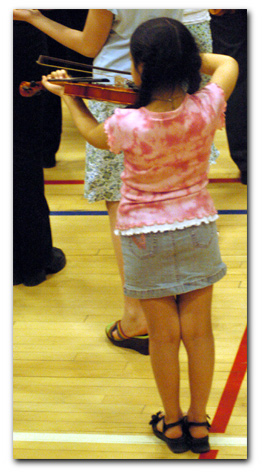 | West High School April 2, 2005 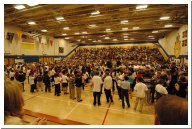 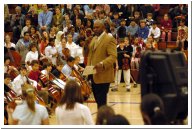 Video/Audio (MP3) (thanks to Denny Lund for taking these pictures) |
Let the String Teachers Stick to Music Education
"It is unreasonable that the strings program in MMSD should be the target of cuts every year, when it is demonstrated OVER AND OVER that it is a successful program musically, it helps with academic progress, and it is a boon to economically disadvantaged students. Will the School Board please allow the string teachers in the district stick to music education rather than fighting for the existence of a proven program?"
from comments - String Survey
String Survey - Comments
Take the string survey - results will be tabulated and forwarded to the school board. I'll be posting comments from the survey on this website:
survey comment response: "Don't cut music. I was never in a strings program, but rather played trombone. I think that my experiences in music helped shape my teenage years more than probably any other factor. I think it would be sad to see it go. 4th grade is not too young to learn music; and early start allows them to be interested in music before they are overwhelmed by too many other things."
String Orchestra Festival Soars Despite District Administration Annual Assault
The annual string festival is a reminder of how wonderful music education is, and of how important this is for our children's education. This annual spring event is also a reminder of how badly the existing School Board is failing our children. Lawrie Kobza, school board candidate for Seat 6, wrote, "Fourth and fifth grade strings is a well-established, much-loved, and much-supported program. There is also significant research demonstrating a high correlation between playing an instrument and achievement. Given all of these positives, the 4th & 5th grades strings program should not be considered for cuts until the district does everything possible it can to retain or if necessary restructure the program so that strings can continue to be offered in 4th and 5th grades even in times of tight finances." This is Lawrie's approach - not settling for the status quo, working together creatively for what we value for our kids's education. I am voting for her on Tuesday, April 5th, because the strings festival, sports, academics would all benefit from her talents on the school board. The status quo is not working locally - the longer we stay with the status quo, the more our kids will suffer.
The 39th string festival that was held yesterday was inspiring and an experience that children and parents alike will hold dearly in their memories. Consider, when the first elementary string orchestra was taught in 1969 Madison, there were was not even 100 students. Today, the total student population has not changed all that much and the elementarys string orchestra has grown to nearly 2,000 students - 1,866 students this year.
Yet, each year students, parents and teachers are left to wonder - what is going on? It is not simply about money, it is not even about scheduling. The Superintendent is not considering children's learning and achievement - he has no clue about the benefit to children's learning of this curriculum. He has has spent every year since he has been Superintendent using one lame excuse after another trying to cut this program, remaining deaf to the children, parents and city of madison. Why can he "get away with this?" On this and many other trends that are troubling in our school district. Rainwater has a compliant school board and he loves it, who wouldn't.
Shipping this curriculum to MSCR would destroy the music education instrumental curriculum. Setting up private lessons to supplement what children learn in school would add to the learning experience, having small group lessons would complement the program. The spring performance yesterday was the culmination of a semester's work for children - they memorized all those songs. There were complicated skills, etc., that was included in that work. Think of how much learning they absorbed into their minds!
The Rainwater budget excuse to cut the program is not supported by the data, a possible impact on test scores is not supported by the data, and even the scheduling is not supported when teachers are left to work out the issues. Leopold Elementary is an example of a school where the new teacher has done a phenomonal job of working out the scheduling with teachers and the demand for the curriculum and participation has soared.
So, what does the current superintendent and school board approve - an increase in the administrative budget these past 2 years of $1.4 million - the number of administrators have increased in number, not decreased. Not one cut. this year's budget increase cut $2 million from the elementary and secondary school budgets - adding dollars to every other department. Those are bad decisions for kids, and the current board is letting the current administration make those decisions. The current school board is letting the administration to use "terror" to manage our school district on budget, new buildings, boundary changes, etc. Yes, state financing is not there, but neither is our existing school board.
For four years, students, parents and the community have asked for a community advisory committee on fine arts education - nothing from the School Board, because the Superintendent does not want us to come together to work together. When you make changes to what children learn and study, you start with the curriculum - you begin with the teachers.
April 02, 2005
Super Strings Festival
The Memorial Strings Festival was a wonderful collection of children from forth to twelve grade, every color, every size, and all abilities. As I sat proudly and watched my daughter play, along with so many parents who were sitting and standing (as there were no seats left so many showed up)I was sad. The director was sad and the two strings teachers that were given pink slips (one from Crestwood, our school) Friday were sad. Surely this program does not need to be on the chopping block. I kept thinking, with this many parents attending a festival couldn't we do a fundraiser at the festival, sale something or just have a donation box for strings. Many parents like myself feel strings and no-cut freshman sports are placed on the block because they get the "involved parents" fired up to vote for whatever the referendum is, just to save these two programs. They are right. I will vote for the referendum to save a $500,000 program. I would not vote to save a secretary, two aides, two janitors and two middle management positions. But I will vote for it because, although I have been in charge of many fundraising events, I can't figure out how to raise $500,000 without a major community effort.
I have an idea though. How about moving 4/5 strings out of the classroom and into the Monday afternoon slot? Run it through MSCR or After School Program and while all the other teachers do whatever it is they do Monday afternoon allow strings kids to stay Monday for an hour of strings.(At Crestwood, After School provides foreign language in this same manner) MSCR does not seem to be a part of the MMSD budget that requires cutting and parents already pay a fee ($40 for me) to have their child in strings. We could increase the fee and then raise money for scholarships so to include low income children. The only problem I see with this arrangement is;
1. transportation for low -income students (we could have one at the Allied Drive Learning center instead of the school, parents could choose) 2. could we get enough strings teachers to cover the schools at the same time slot? If the referendum fails lets not throw this program out, let's think outside the box and find a solution.
April 5, 2005 Madison School Board Election Campaign Finance Disclosures
Pre-election School Board Candidates Campaign Finance Disclosures (City Clerk Reports):
- Seat 7: Carol Carstensen: $ Raised: 9,906 (PAC = 100.00); Spent $4,697.94; On Hand 8,541.95
- Seat 7: Larry Winkler: $ Raised: 3,788.25 (PAC = 0); Spent $1,788.25; On Hand 2,100.00
- Seat 6: Bill Clingan: $ Raised: 11,305 (PAC = 2440); Spent $5183.8; On Hand 7,219.01
- Seat 6: Lawrie Kobza: $ Raised: 11,474.01 (PAC = 575); Spent $3432.47; On Hand 6,706.94
- MTI Voters (Madison Teachers PAC): $ Raised: $12,000 $ Spent 5,490.6 Cash on Hand: $28,211.23
- Madison Teachers, Inc: Radio Ad Expenditures for Bill Clingan and Carol Carstensen: $5,514.00 (heard this ad today on 105.5
- Progressive Dane: $ Raised: 2,205.81 $ Spent $2,114.69 Cash on Hand: 676.61 ($255 went to Bill Clingan)
Additional details and links are available here.
April 01, 2005
No Child Left Behind takes credit for Madison Schools reading success (No Joke)
A message to Madison School Board members from Superintendent Art Rainwater:
Attached is a press release from the Federal Department of Education in which they use our closing the gap in third grade reading as the example for Wisconsin of what NCLB and the Reading First grants have accomplished. The other interesting thing is the data they use to show how successful they have made us is the same data we used to show them why they should fund our Balanced Literacy program.
School Board Candidate Lawrie Kobza Says Don't Cut Elementary Strings - Offers Suggestions
VOTE TUESDAY, APRIL 5
I support offering students the opportunity to take strings in 4th and 5th grade, and oppose the administration's proposed cuts to the program.
Fourth and fifth grade strings is a well-established, much-loved, and much-supported program. There is also significant research demonstrating a high correlation between playing an instrument and achievement. Given all of these positives, the 4th & 5th grades strings program should not be considered for cuts until the district does everything possible it can to retain or if necessary restructure the program so that strings can continue to be offered in 4th and 5th grades even in times of tight finances.
One step in this process, and a step that the community has requested, is to bring fine arts professionals and advocates to the table and work collaboratively on what the district's fine arts curriculum is and what it should be, what it costs, what ways there are to reduce or control district costs, whether there are other sources of funding, and whether services can be offered in conjunction with or through other community partners. Fine arts professionals and advocates are in the best position to look at these questions and think creatively about what and how these services can be offered.
Another step in the process is to form a community-wide task force, with a diverse group of interested parties, to establish community priorities for the programs offered by the school district, including programs such as fine arts and extracurricular sports. Instead of pitting program against program, we need to develop a community consensus on what the school district should offer and how cuts to desired programs should be made if cuts are necessary. The school board should use this community guidance -- not just administration's recommendations -- as it makes necessary funding decisions.
The school district is faced with limited financial resources and as a community we must look at ways to reduce spending. However, I do not believe it is appropriate or justified to totally eliminate an important program such as 4th and 5th grade strings based solely upon the administration's recommendation. We need to first take the steps set out above before we even consider elimination of this much-loved program.
Lawrie Kobza
Madison School Board Candidate for Seat 6
For more information about Lawrie, go to www.kobzaforschoolboard.org
VOTE TUESDAY, APRIL 5
Authorized and paid for by Kobza for School Board, Barbara Schrank, Treasurer
District's Virchow-Krause Report Less Than It Seems
The District's functional analysis report from Virchow-Krause (hereafter VK) has been touted as showing how well the District is being run. But, the report's results are less than they seem. On page three of the report, VK gives the assumptions for the report. Quoting from the report:
-------
As Superintendent Rainwater has noted, there are several key assumptions behind the functional
analysis. These assumptions are:
· Every single thing the District does is good for kids. Long ago the District eliminated all those
things that were peripheral.
· All District staff members - teachers, administrators, custodians and food service workers –
are good at what they do.
· The District has very talented people that work very hard and that work very smart.
· Site-based teachers and administrators currently have full time jobs – and they can't absorb
more work. Functions cannot move from the central office to people at the site because sitebased
staff members are working as hard and as efficiently as possible.
With these assumptions in mind, the results of the functional analysis are presented in this
report.
-------
Clearly, given the assumptions of the report, VK could not have found anything but that the District is doing everything just perfectly.
Had these assumptions not been in place, VK might have been able to inform the District, Board and public of solutions not currently in front of us.
What is disturbing, however, is that the Board doesn't truly read or understand the critical material before them, that the District can make those assumptions, probably with Board acquiesence, and then have the temerity to claim they are providing leadership, and doing all that they can do.
Press Release and List of Members of DPI Task Force on High Schools
Burmaster announces High School Task Force members
MADISON—State Superintendent Elizabeth Burmaster released a list of the members of the State
Superintendent’s High School Task Force.
The group, co-chaired by JoAnne Brandes, executive vice president, chief administrative officer,
and general counsel for Johnson Diversey Inc., and Ryan Champeau, principal of Waukesha North High
School, will hold its next meeting May 3 at the Sheraton Madison Hotel. It will look at various local
initiatives aimed at redesigning or transforming the high school experience, enhancing student learning
and engagement, and strengthening the alignment of high school with postsecondary education and
workforce needs.
Madison Participants include:
Katie Arnesen of Madison
Parent
Steve Hartley, Director of Alternative Programs
Madison Metropolitan School District
Michael Meissen, Principal
LaFollette High School, Madison
Kendra Parks, Teacher
Memorial High School, Madison
The press release and a list of the members of the task force is on-line at: http://www.thewheelerreport.com/releases/Apr05/Apr1/0401dpihstaskforce.pdf